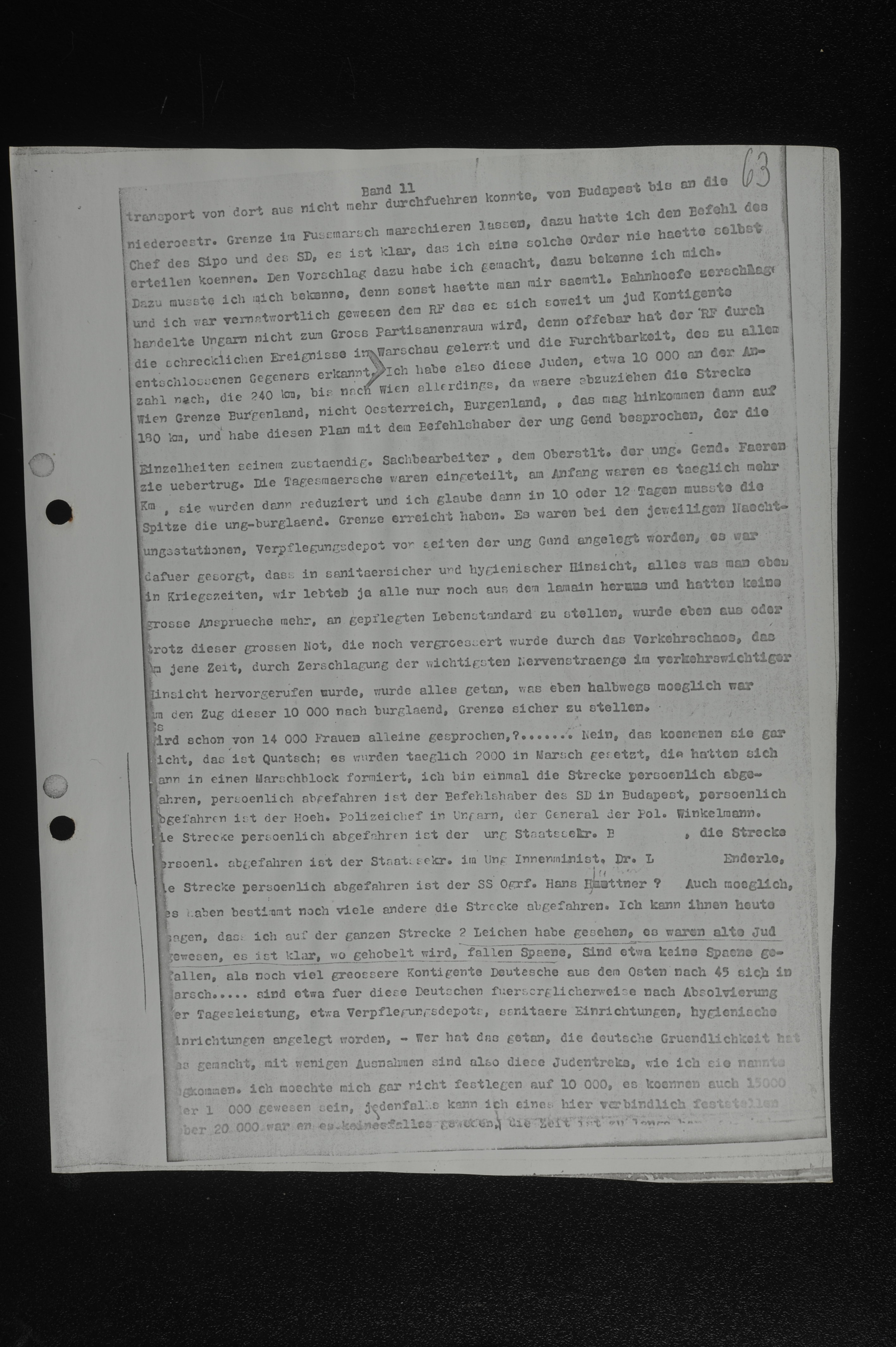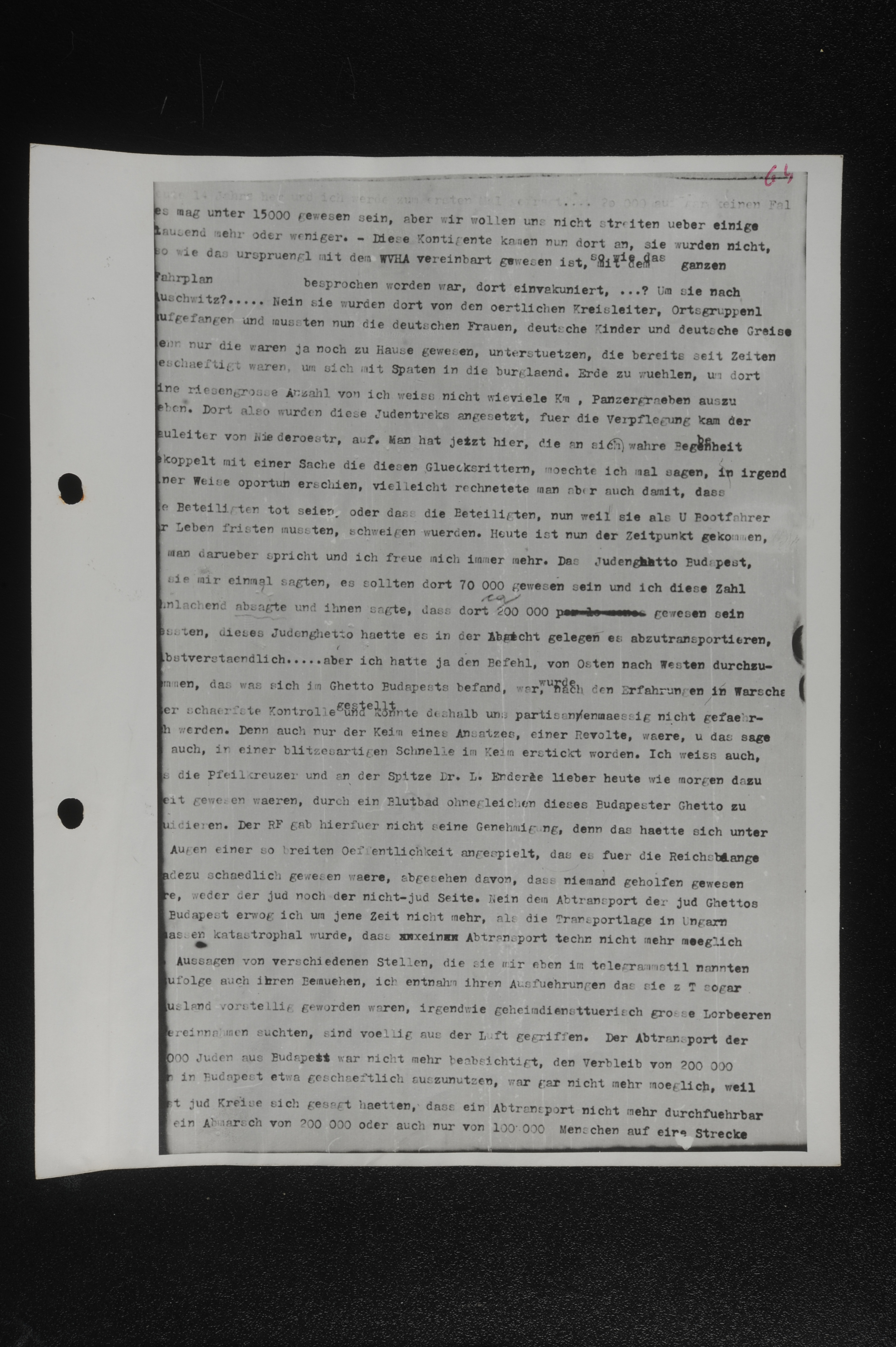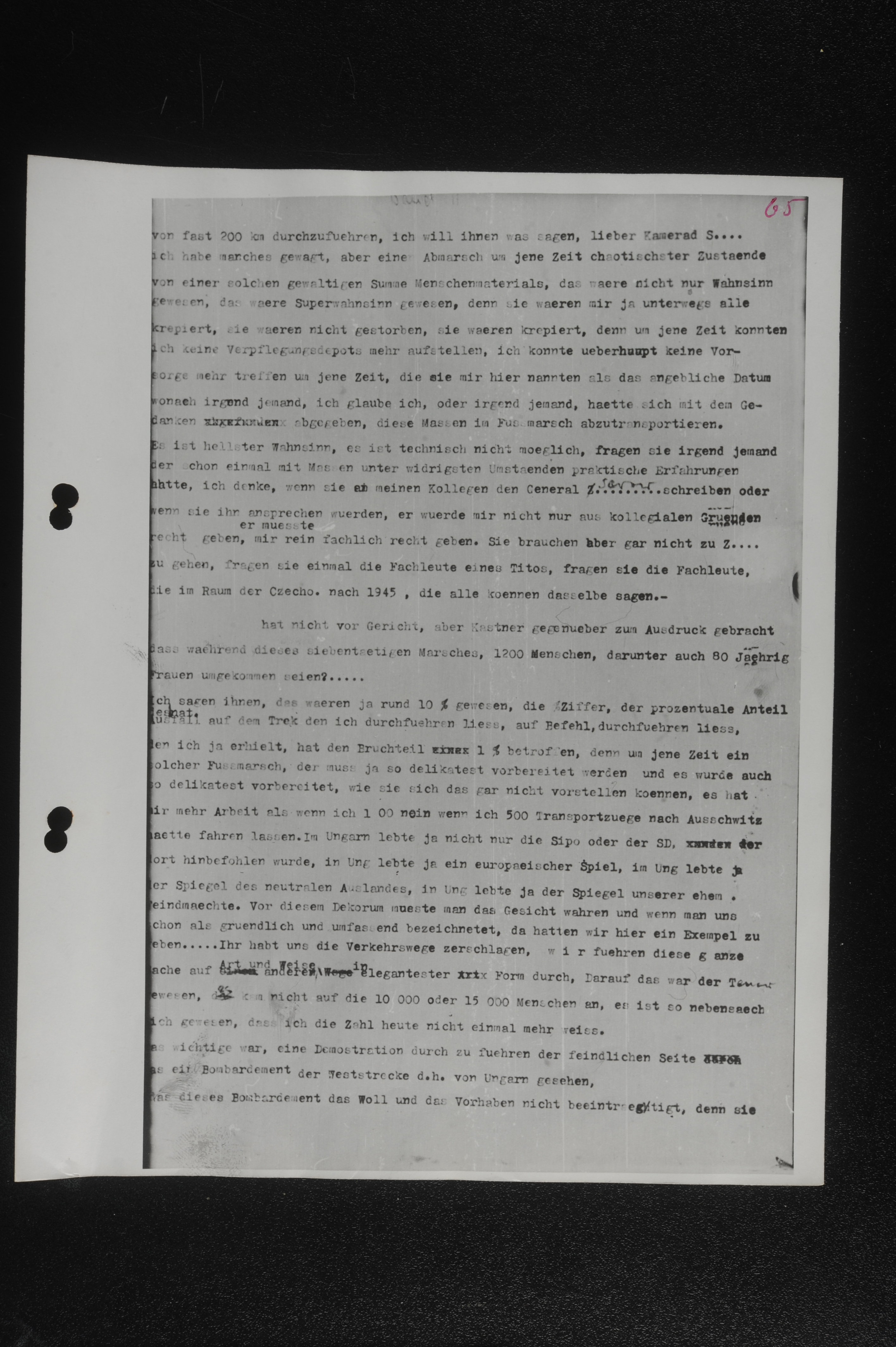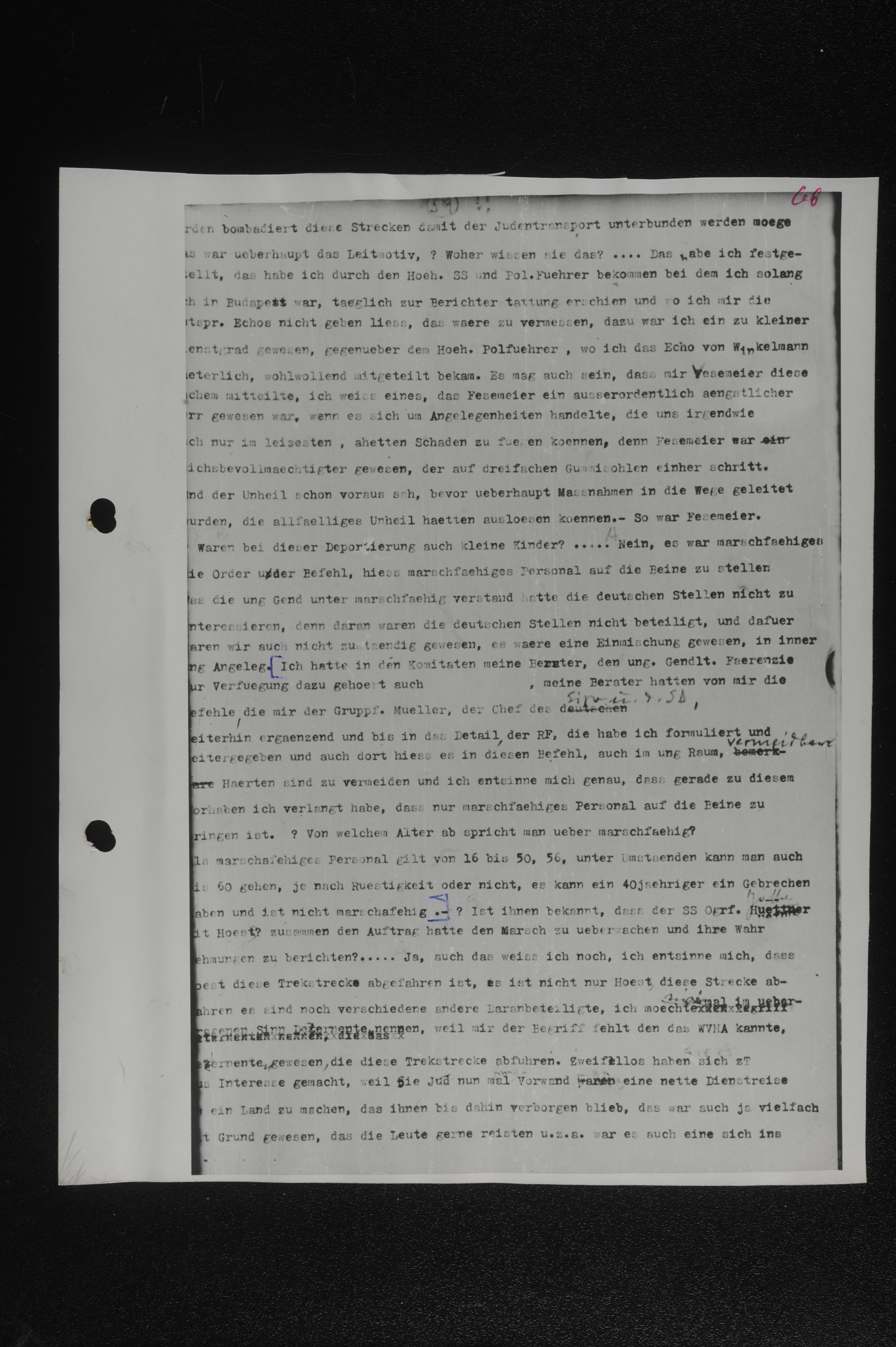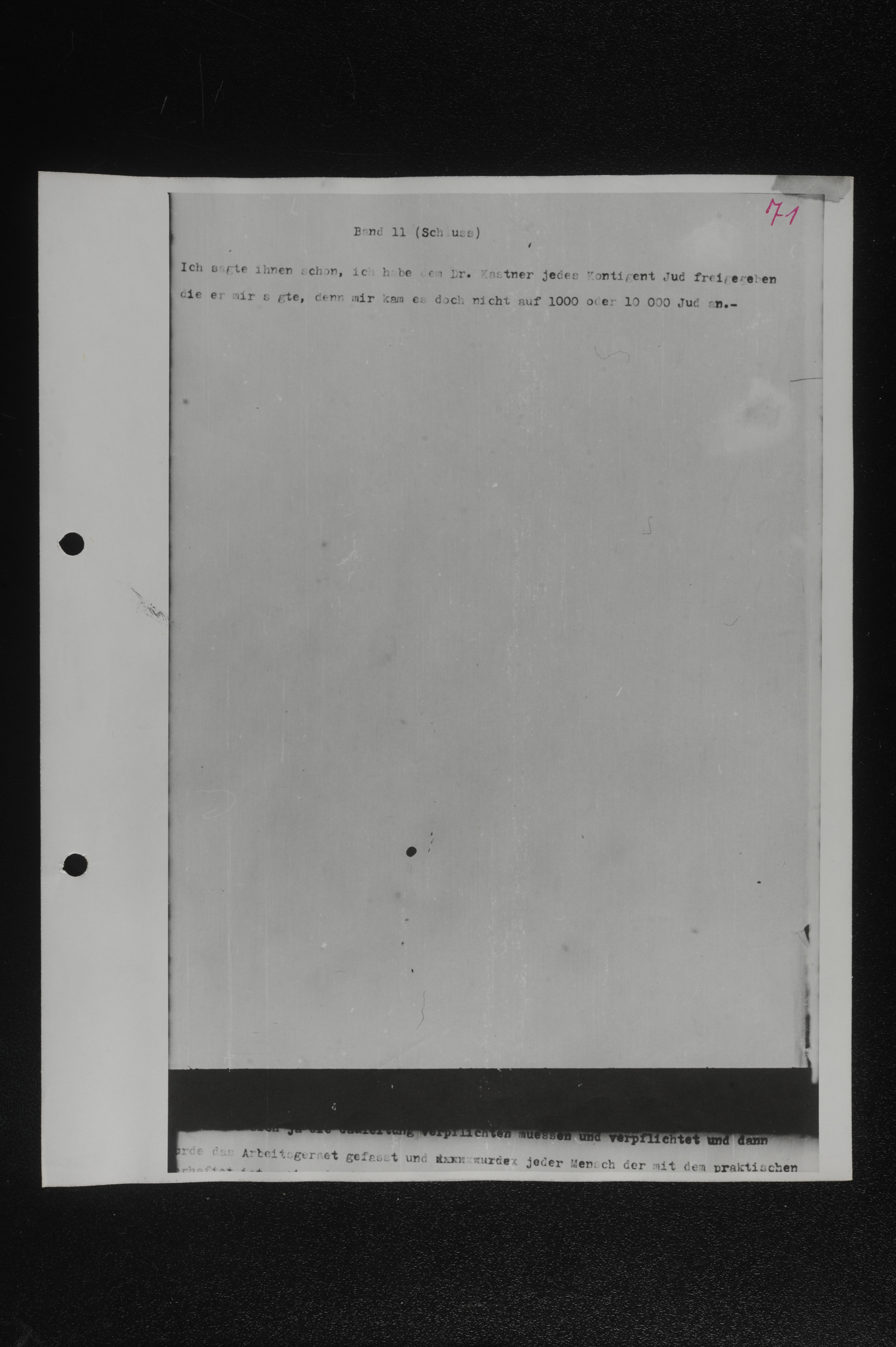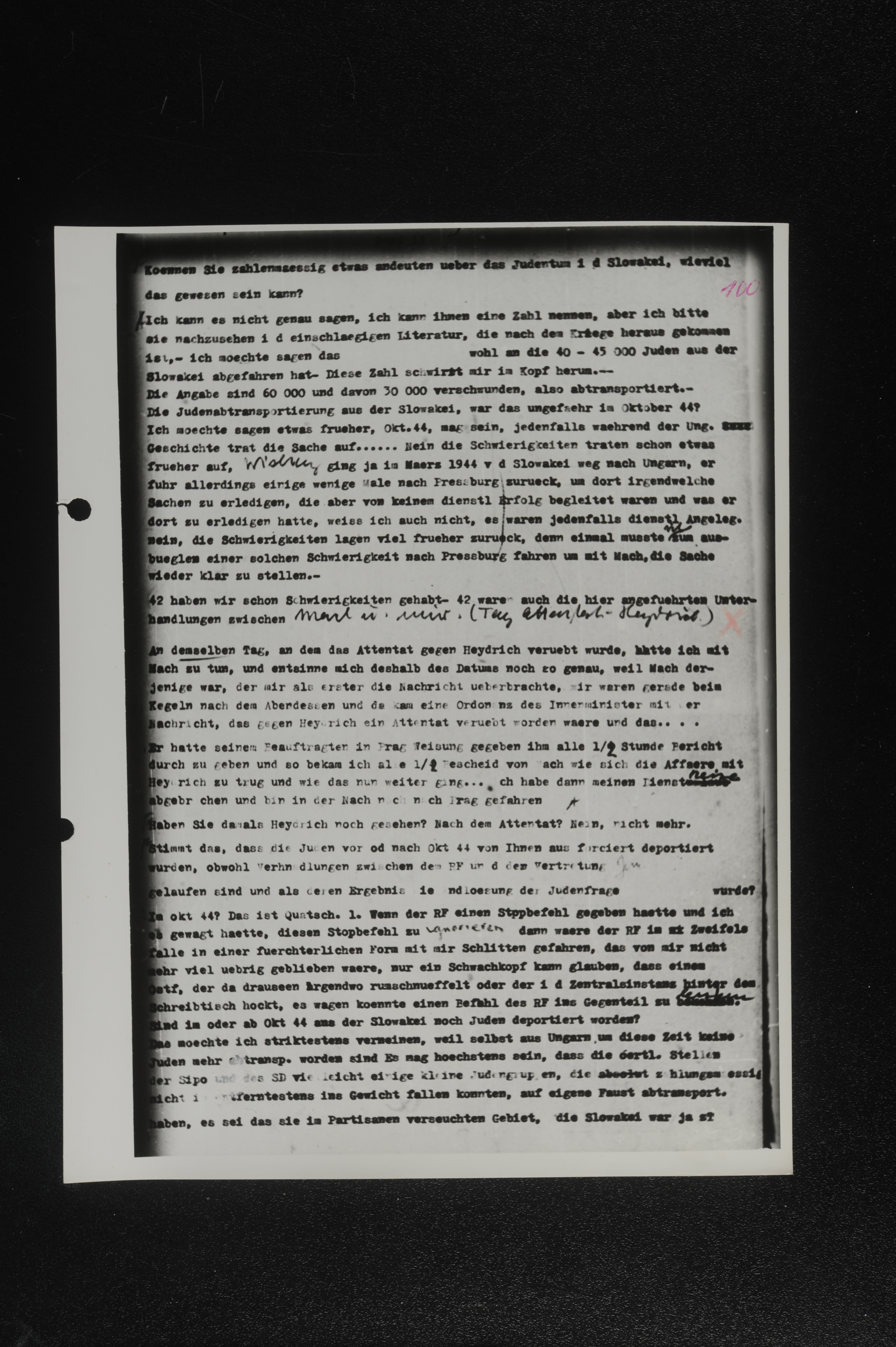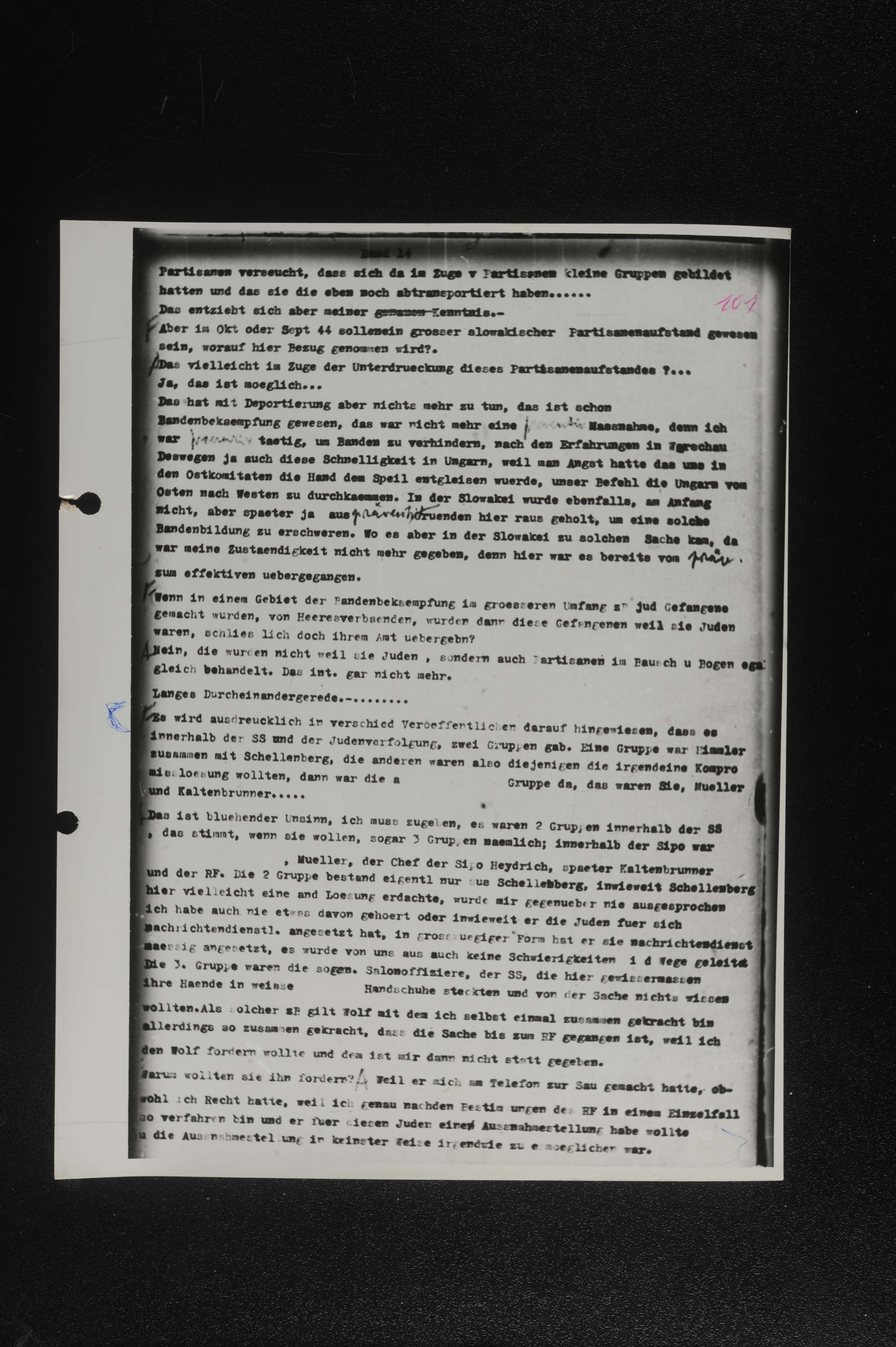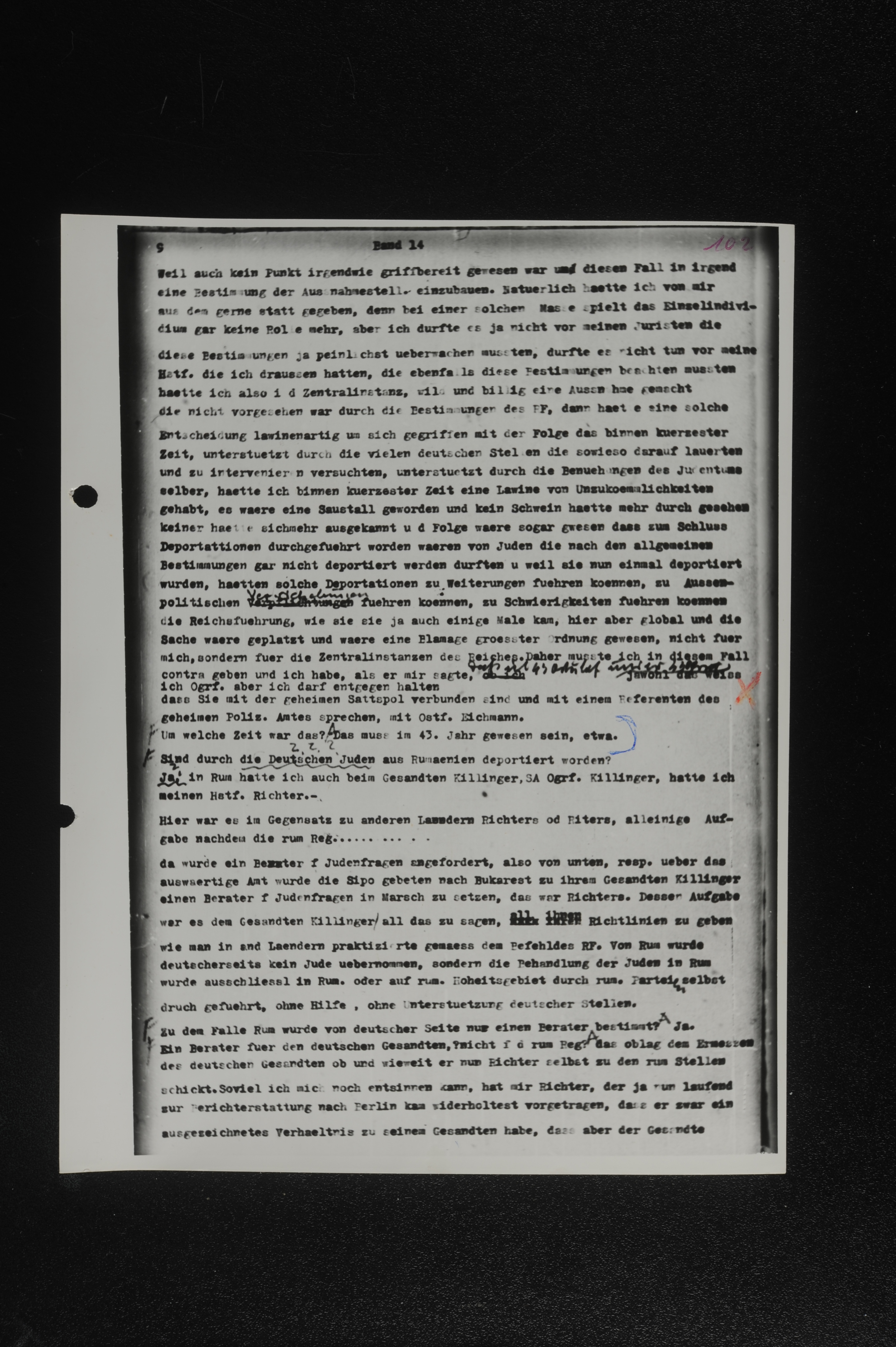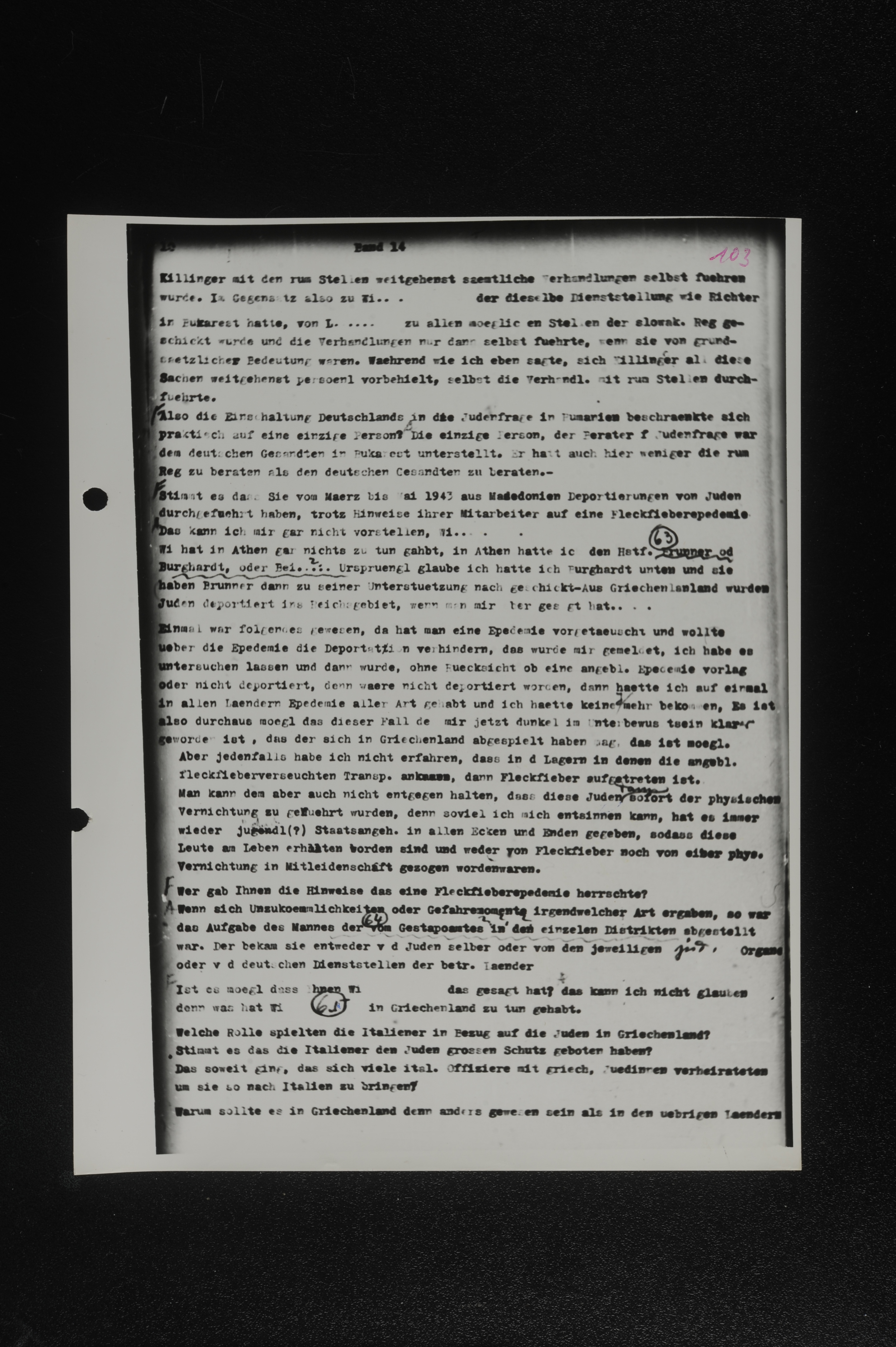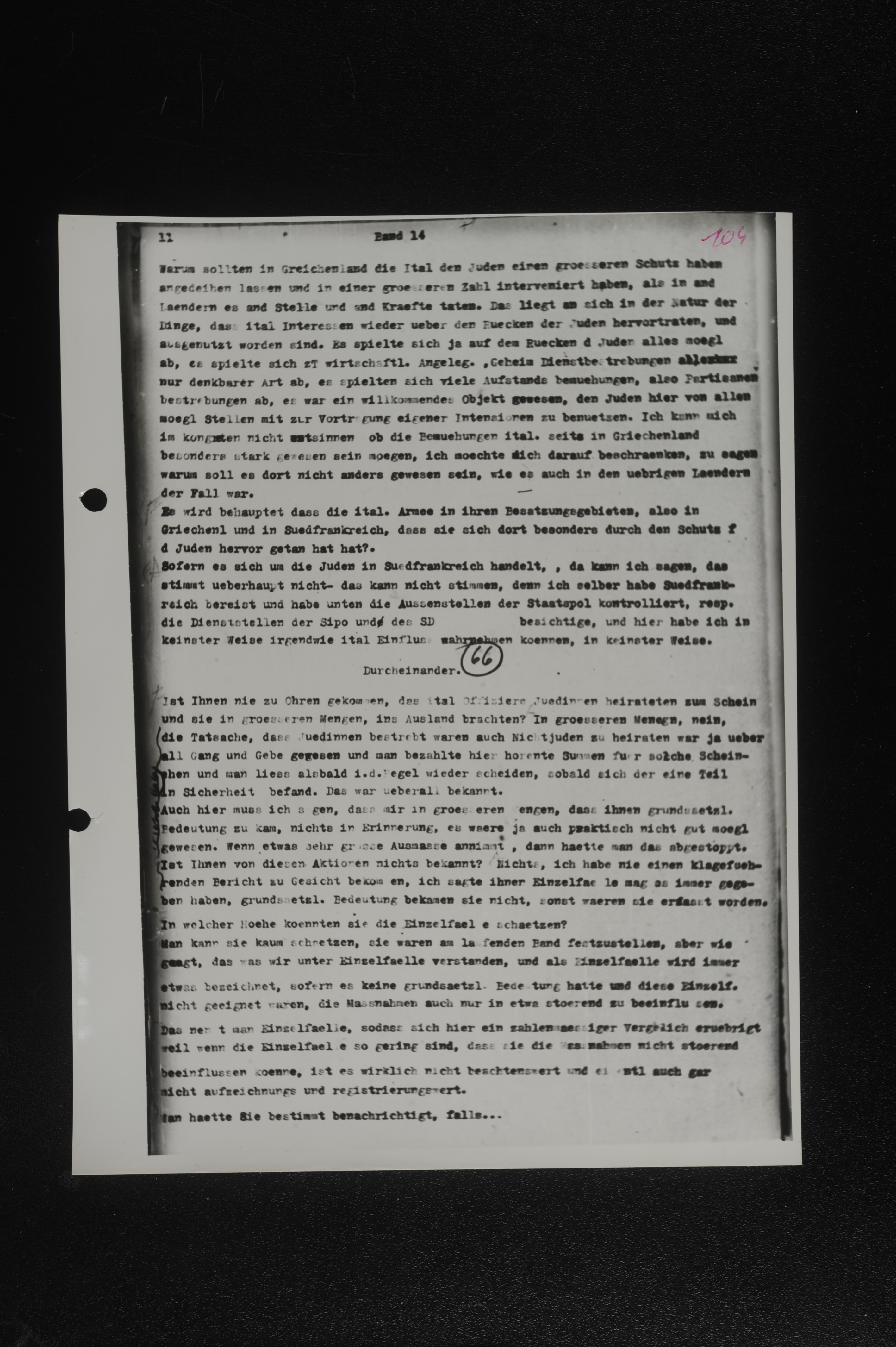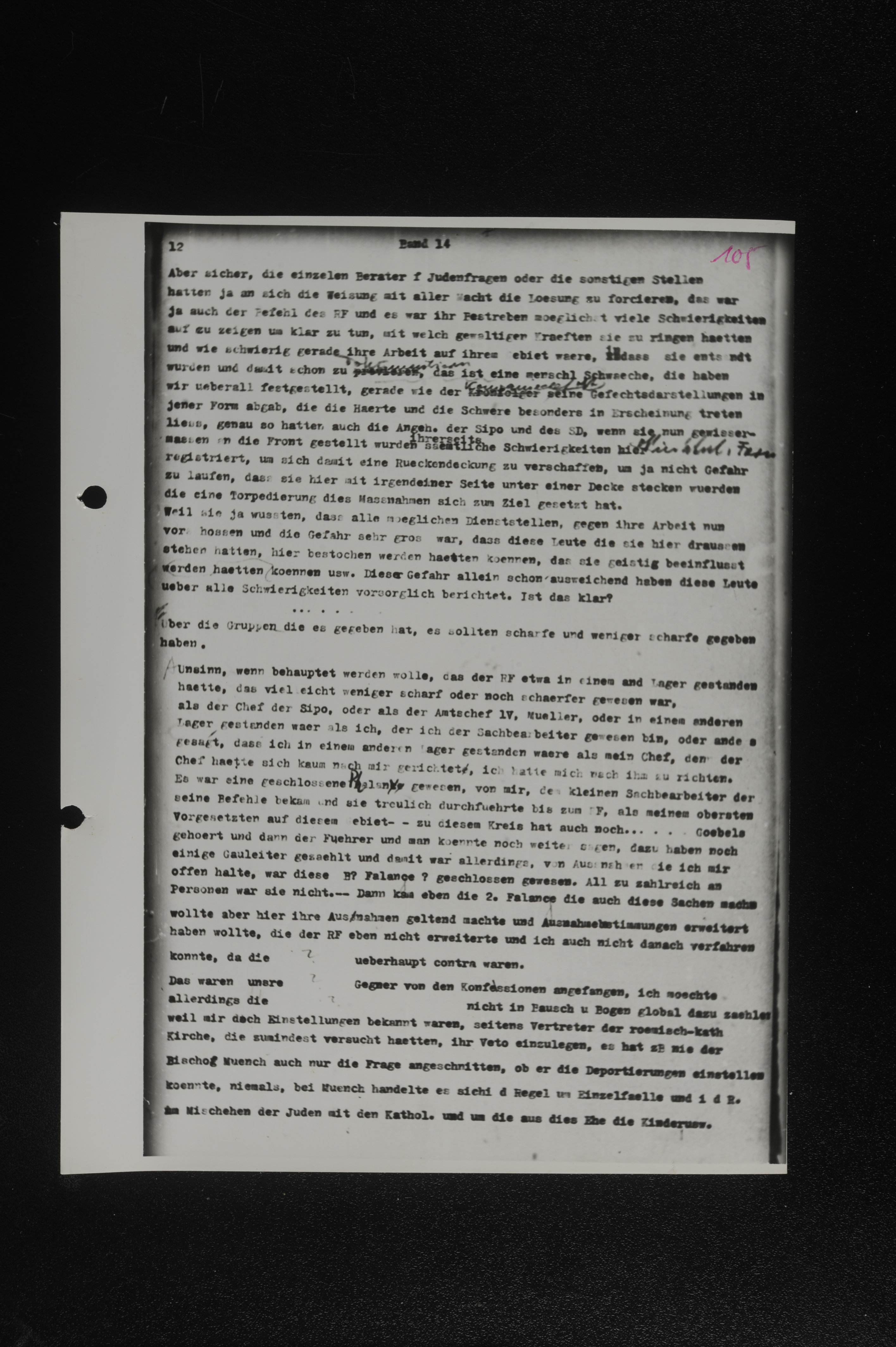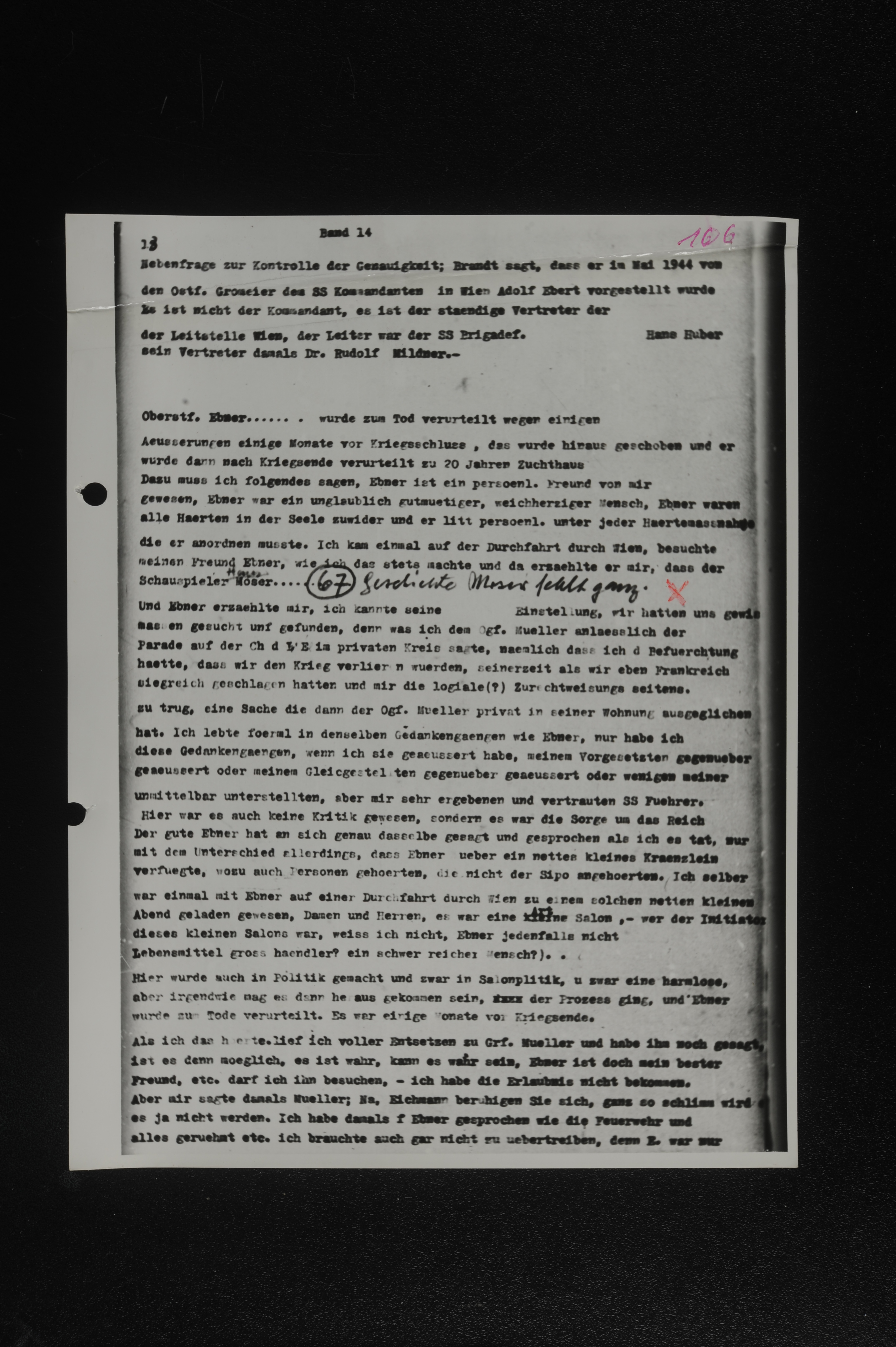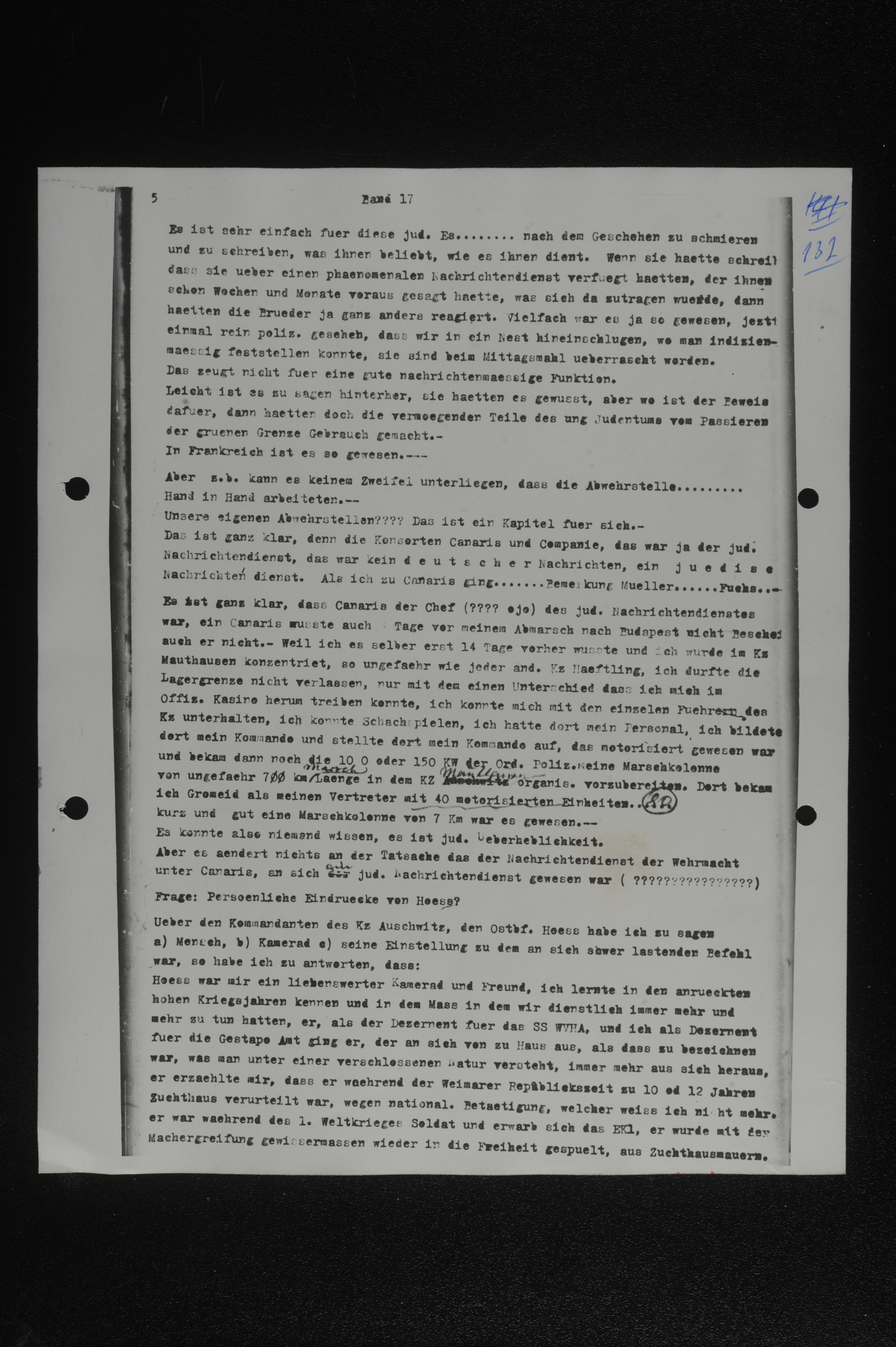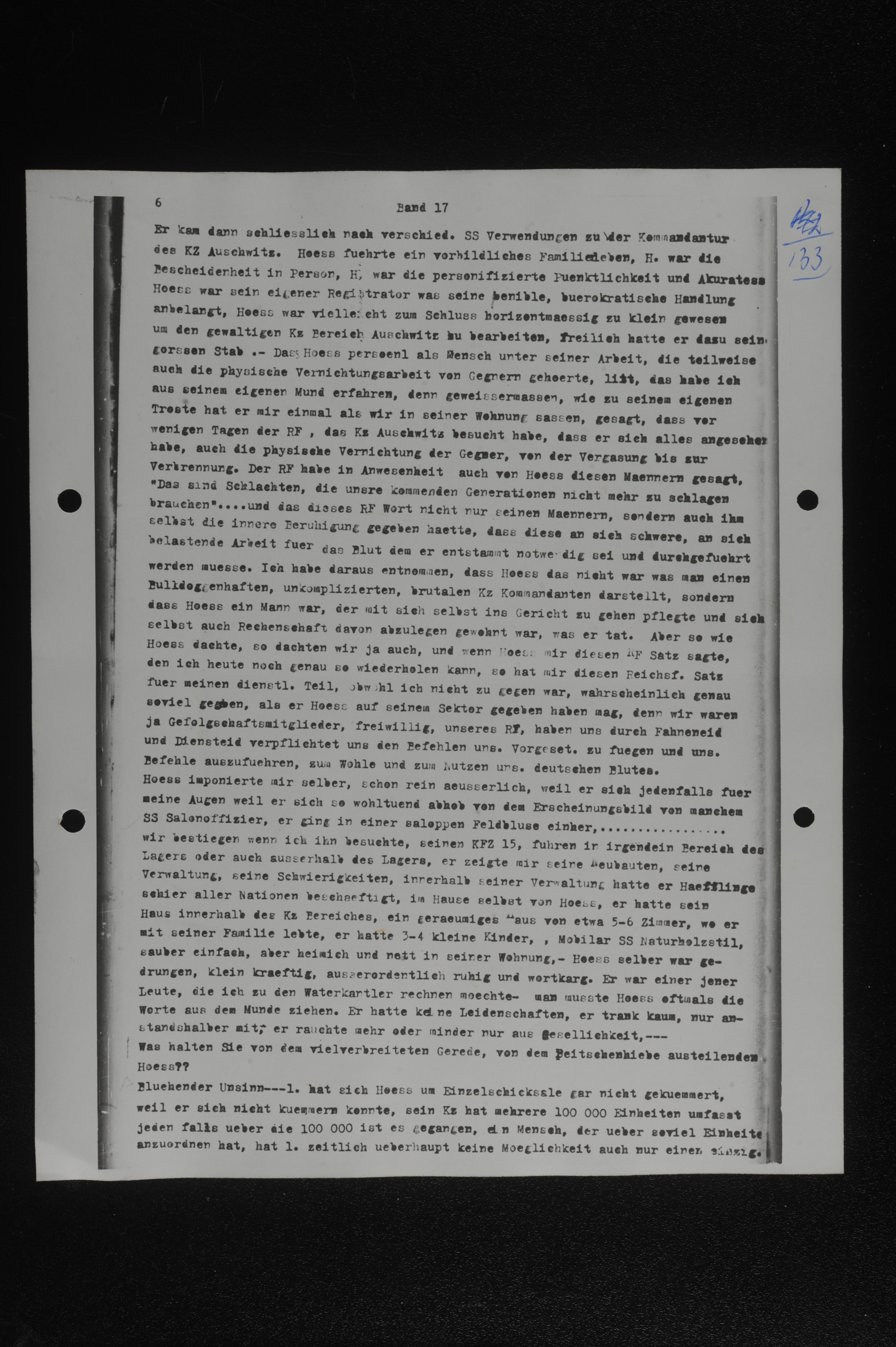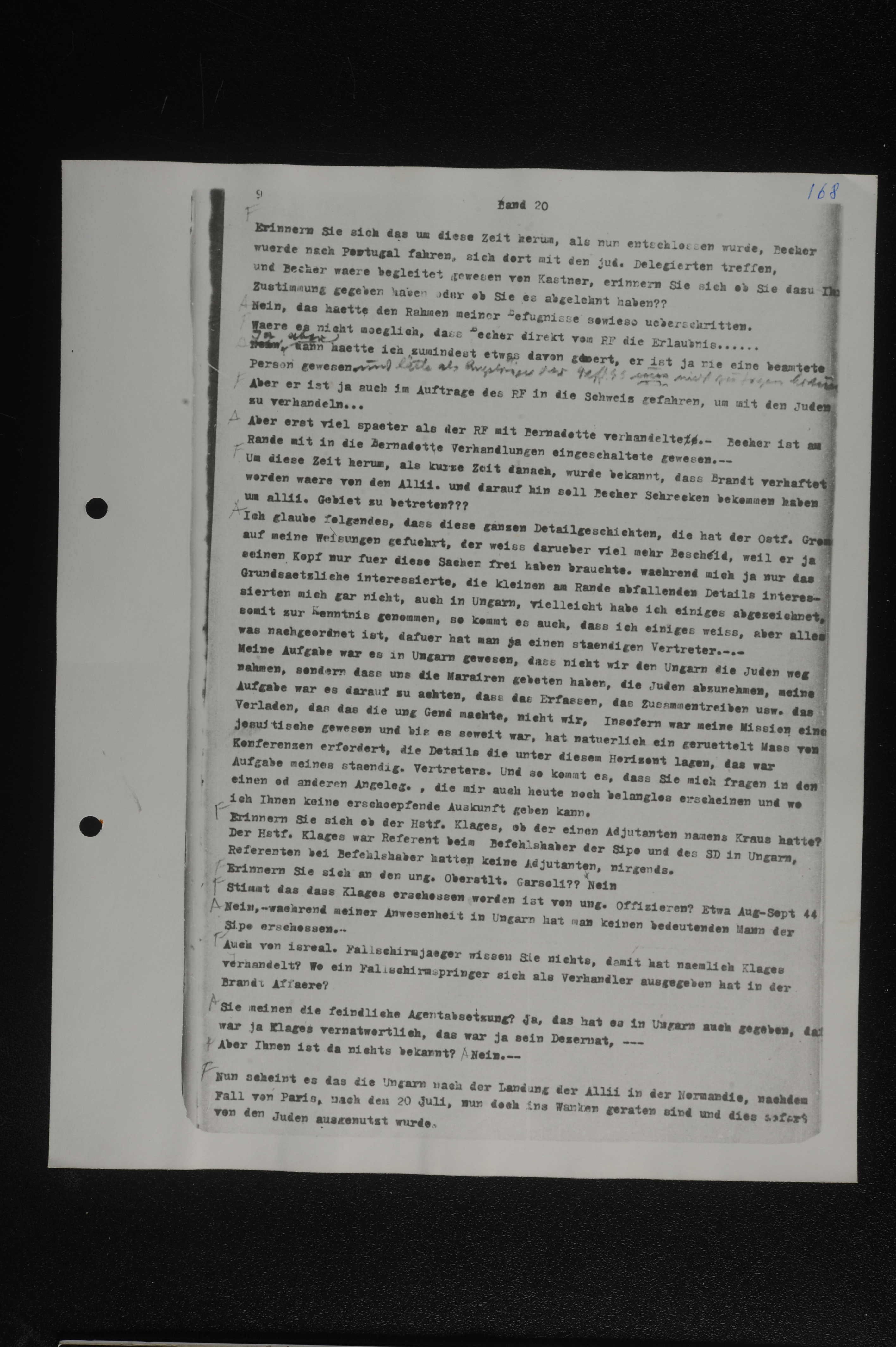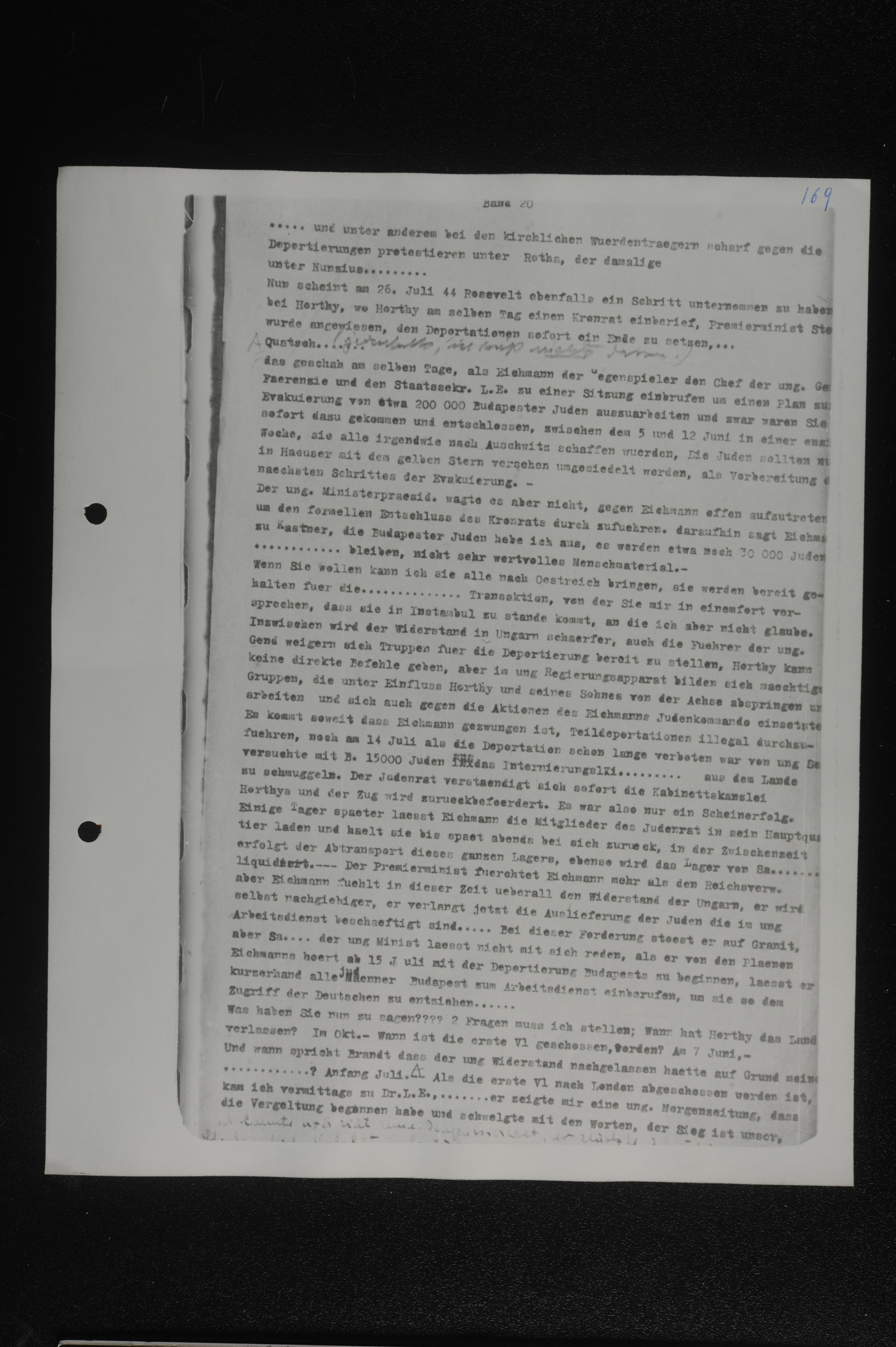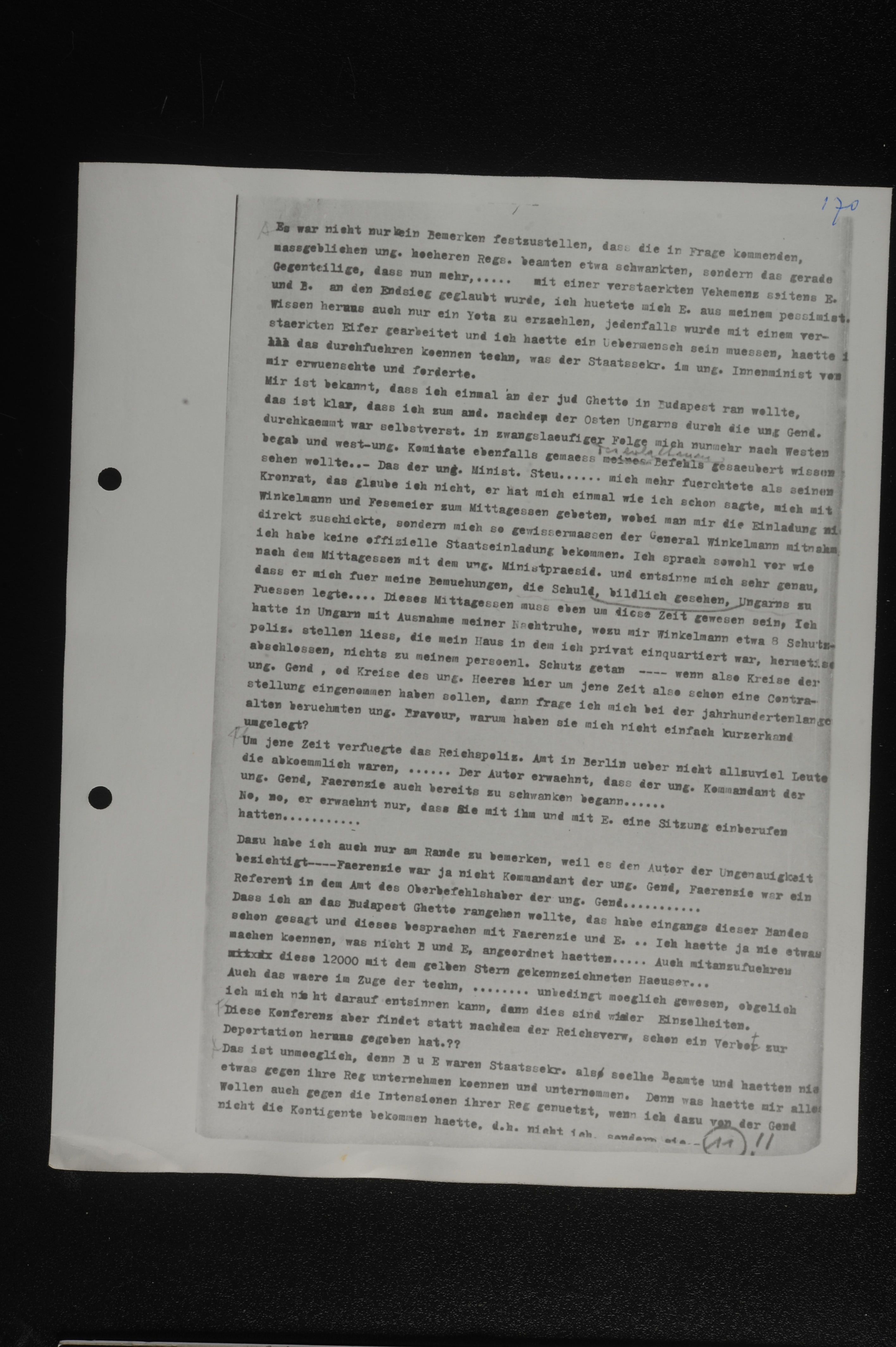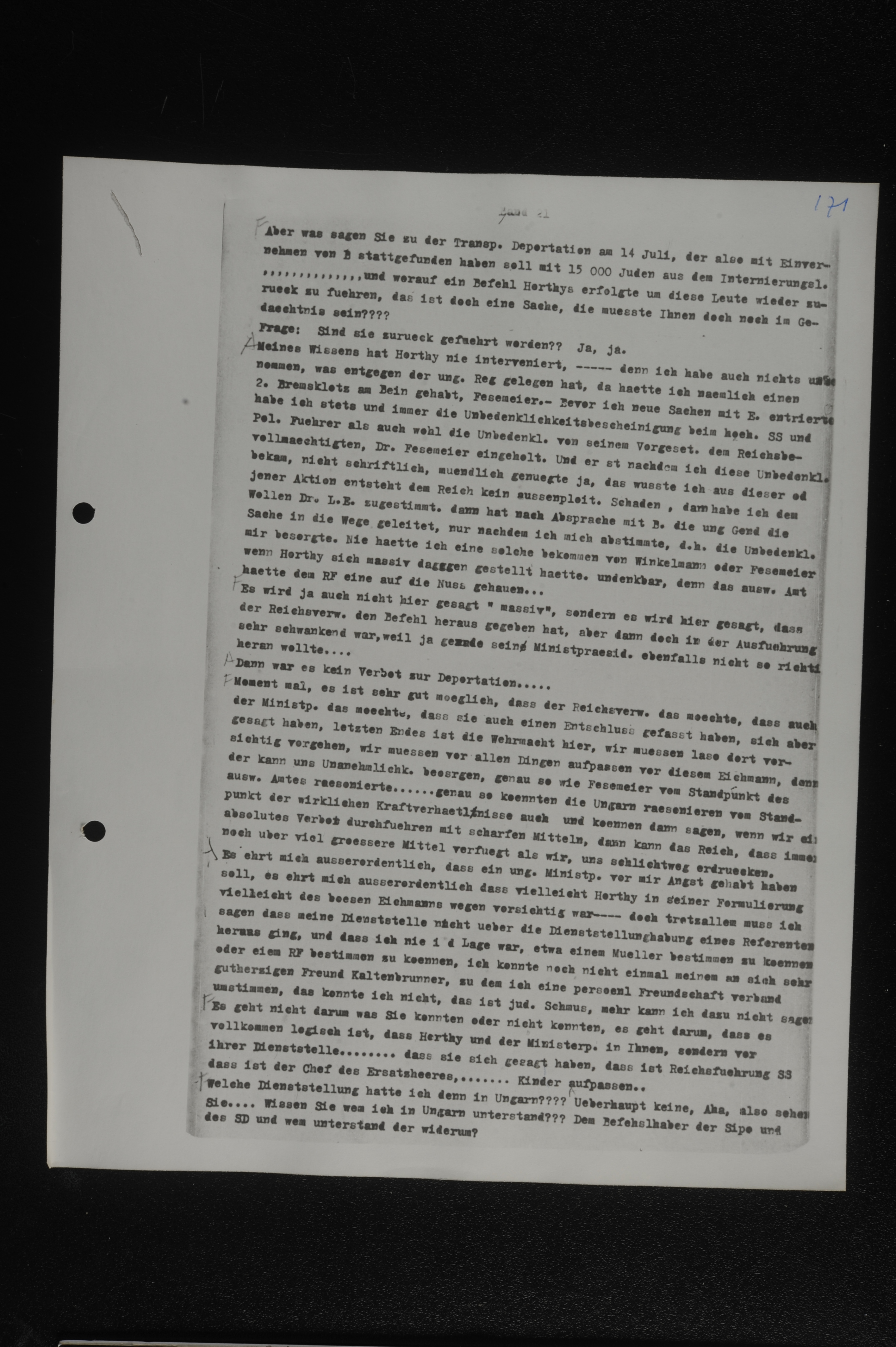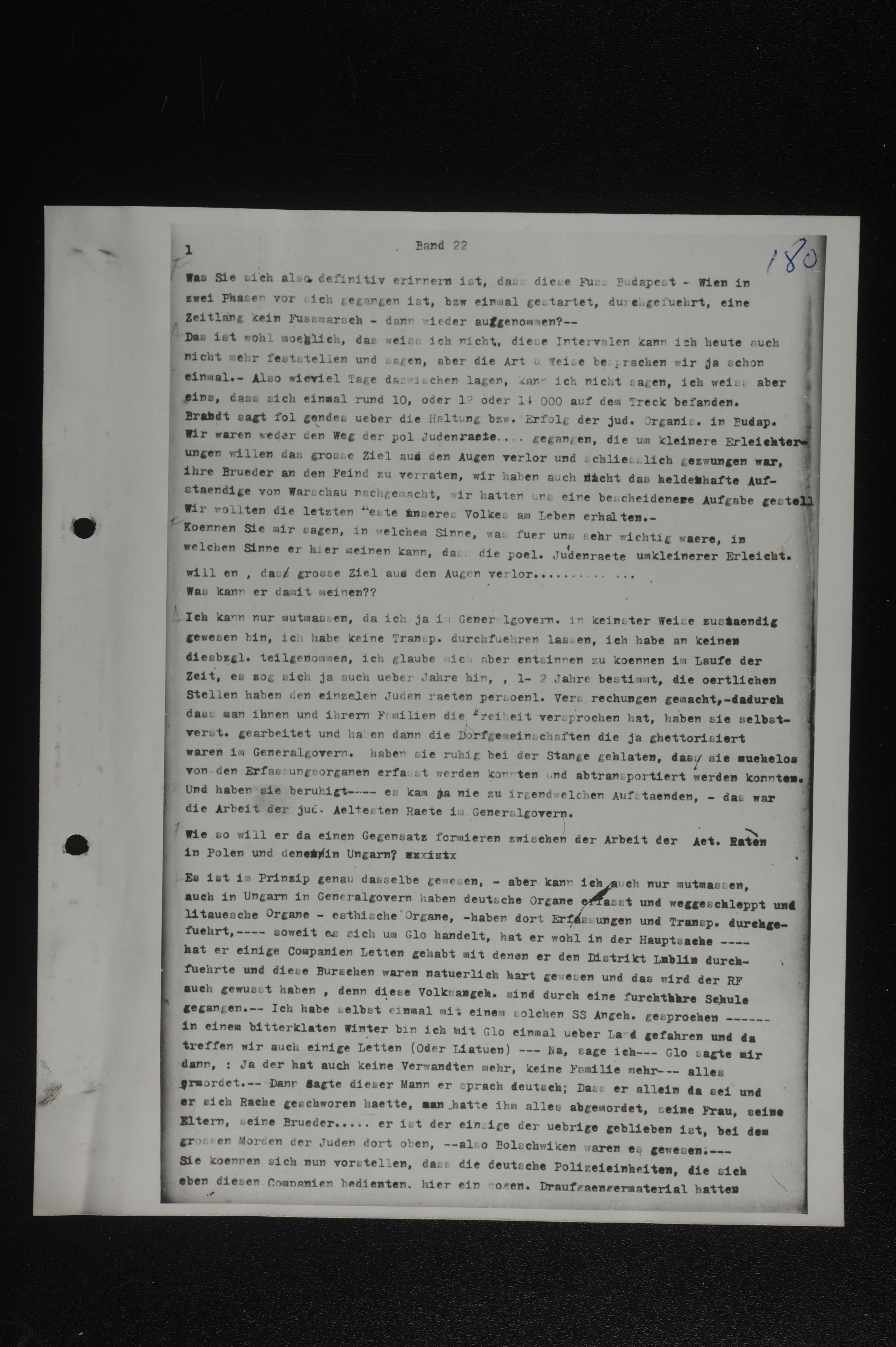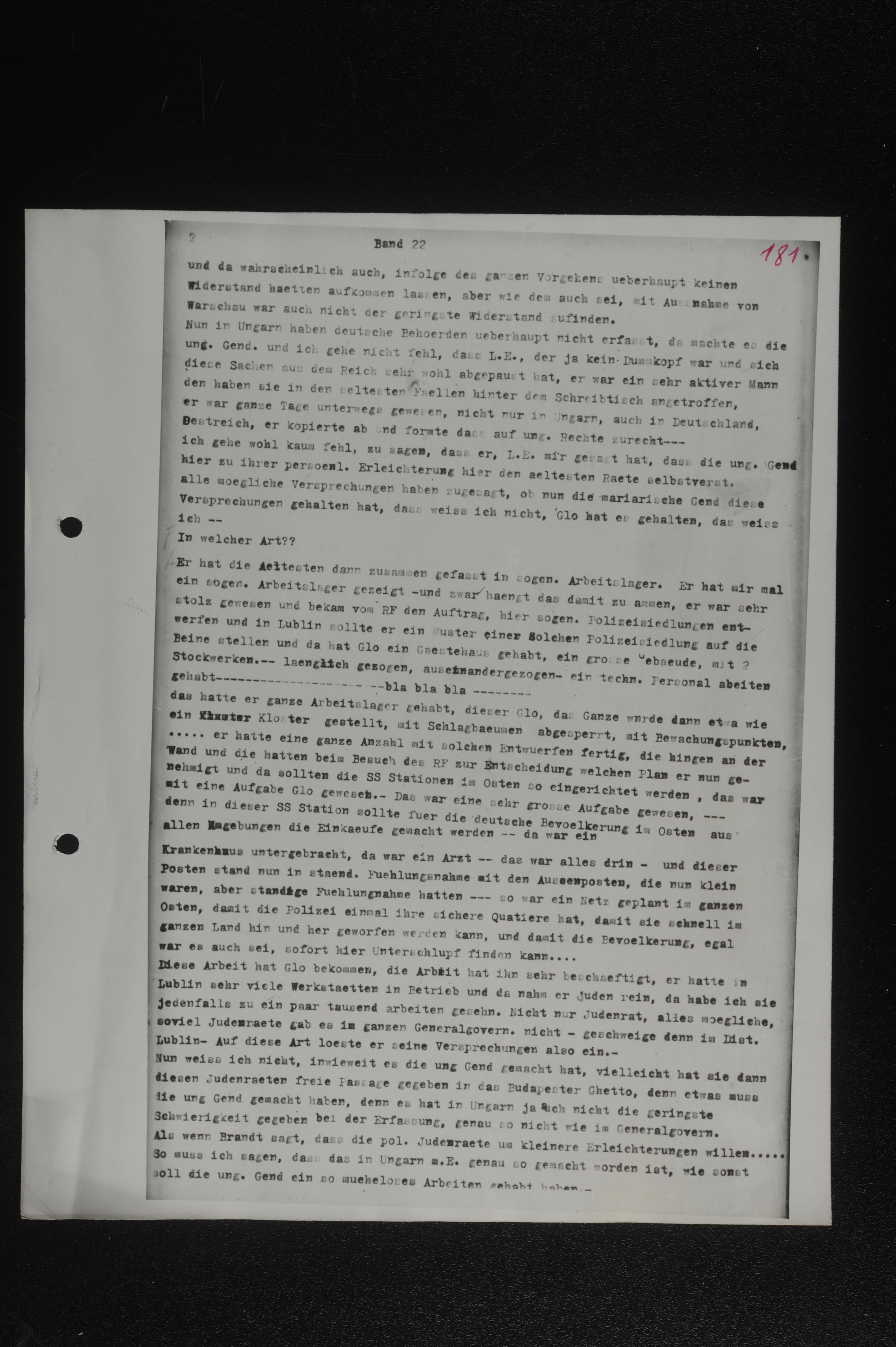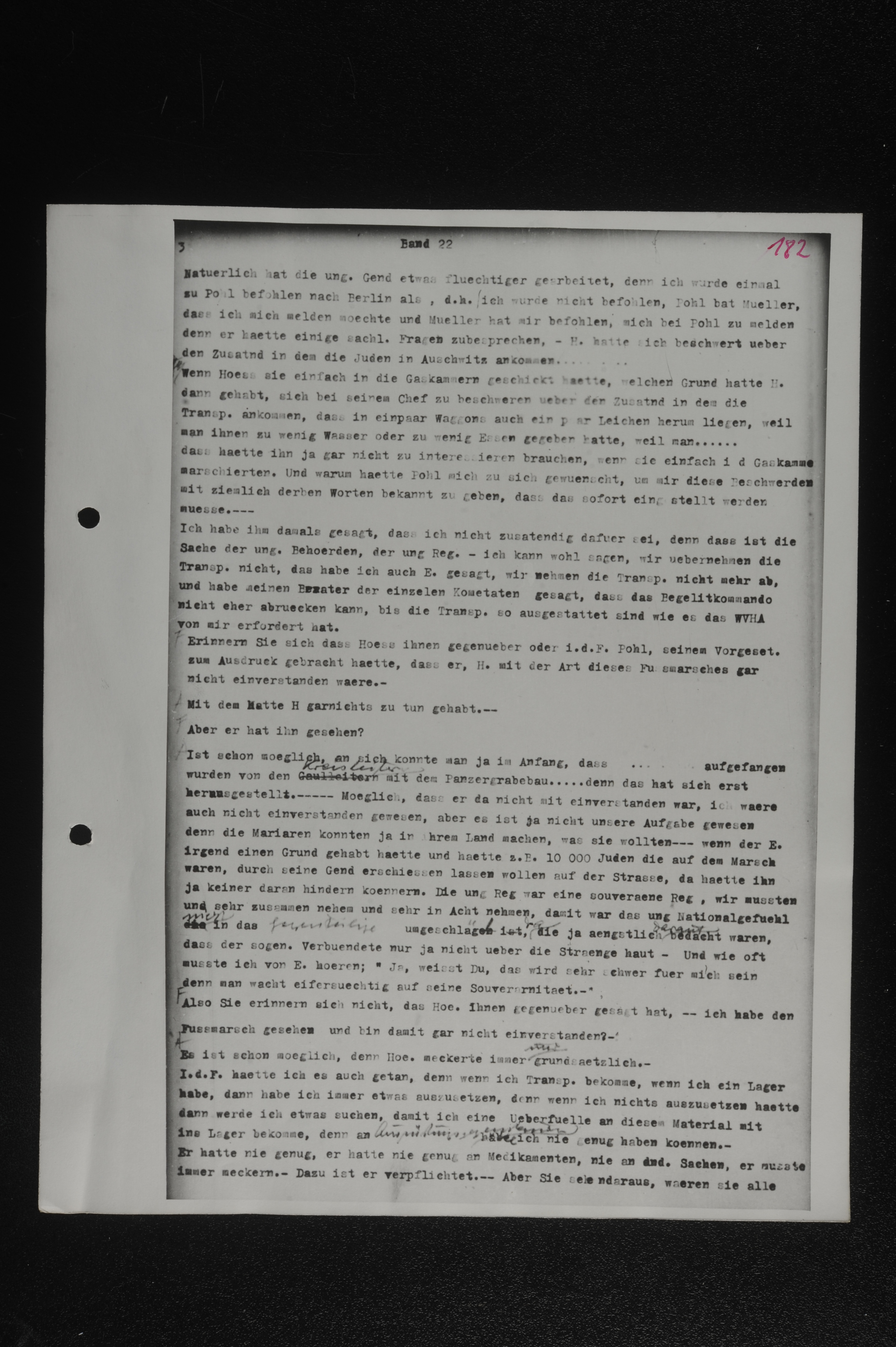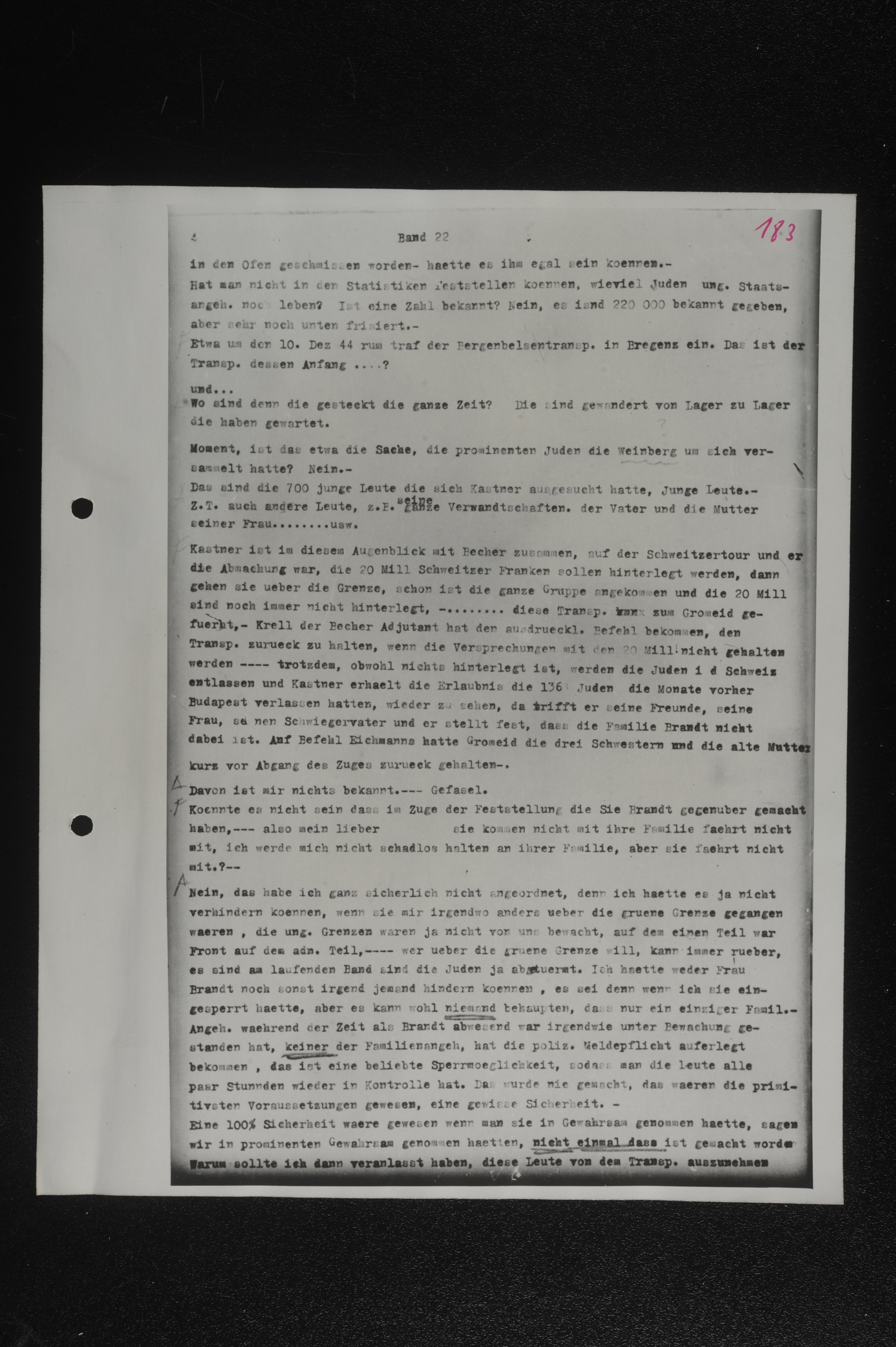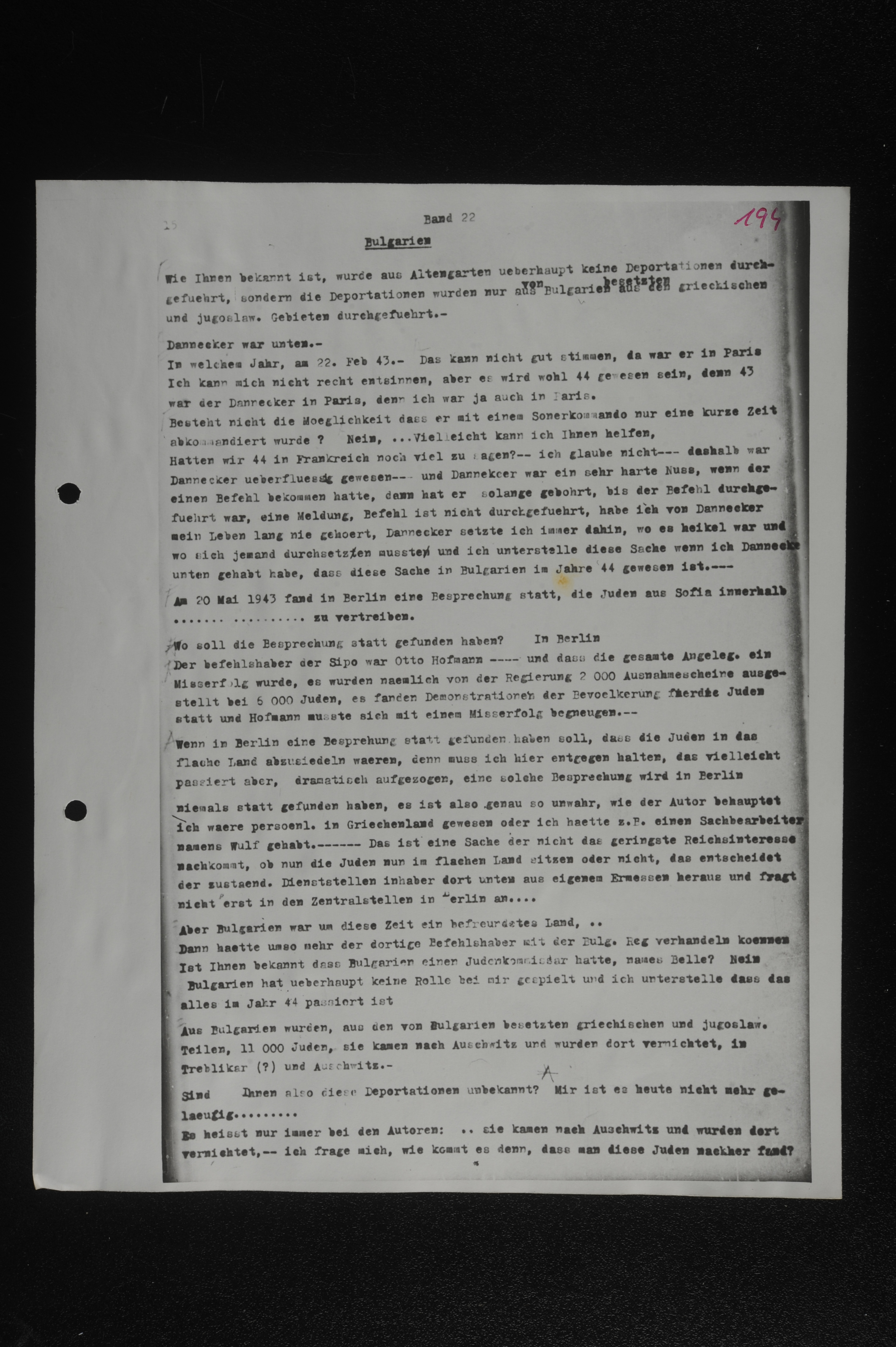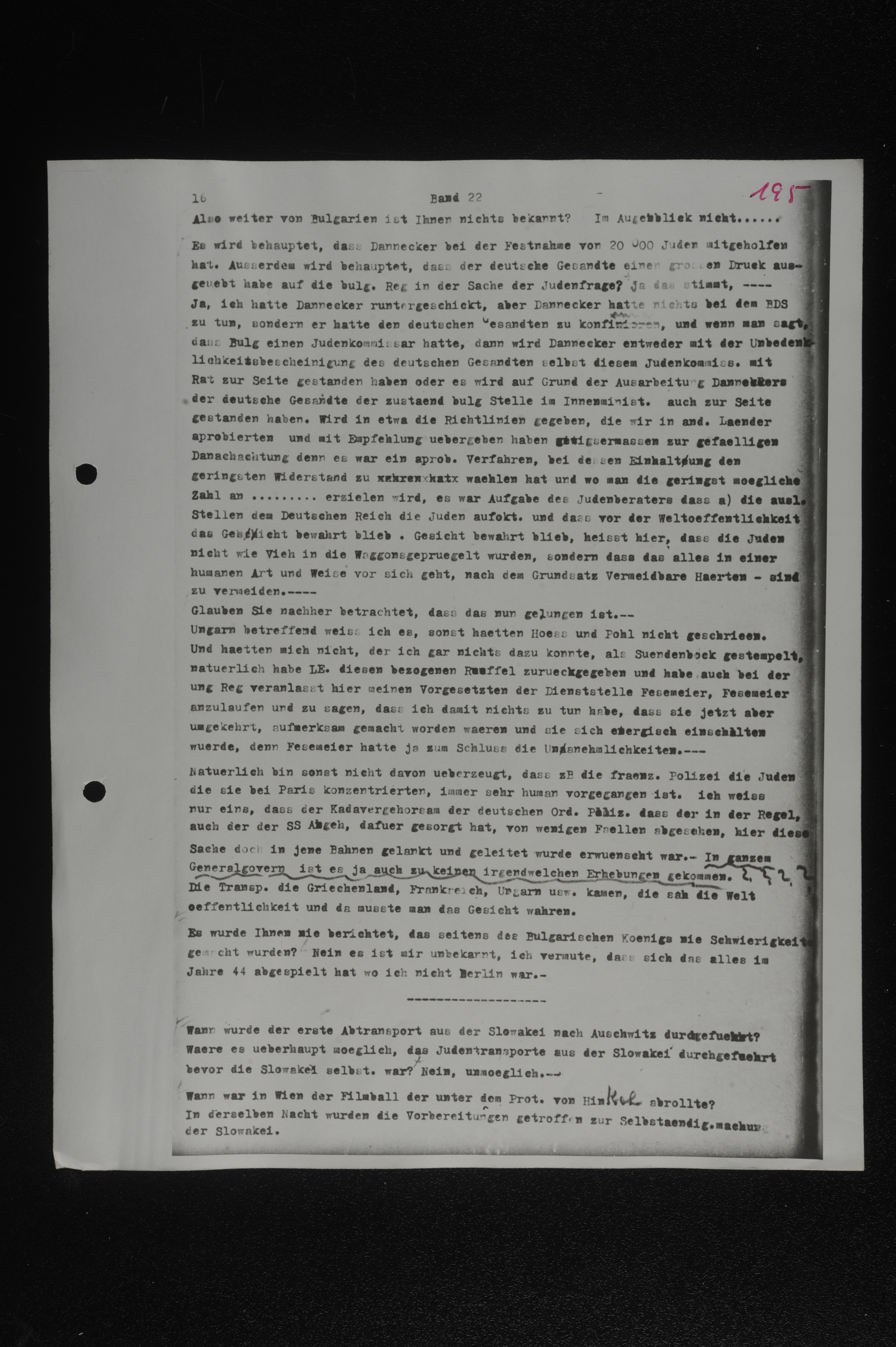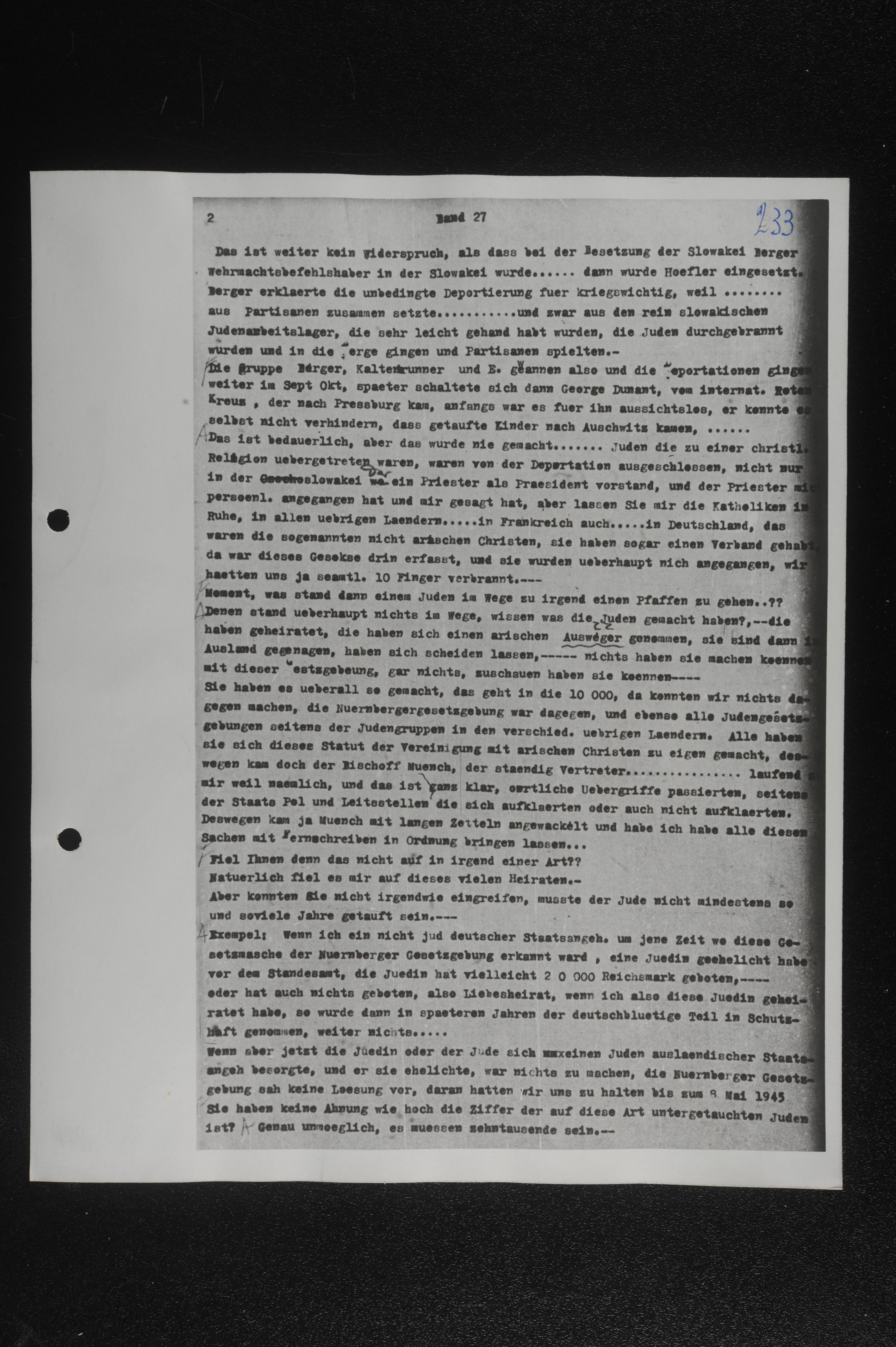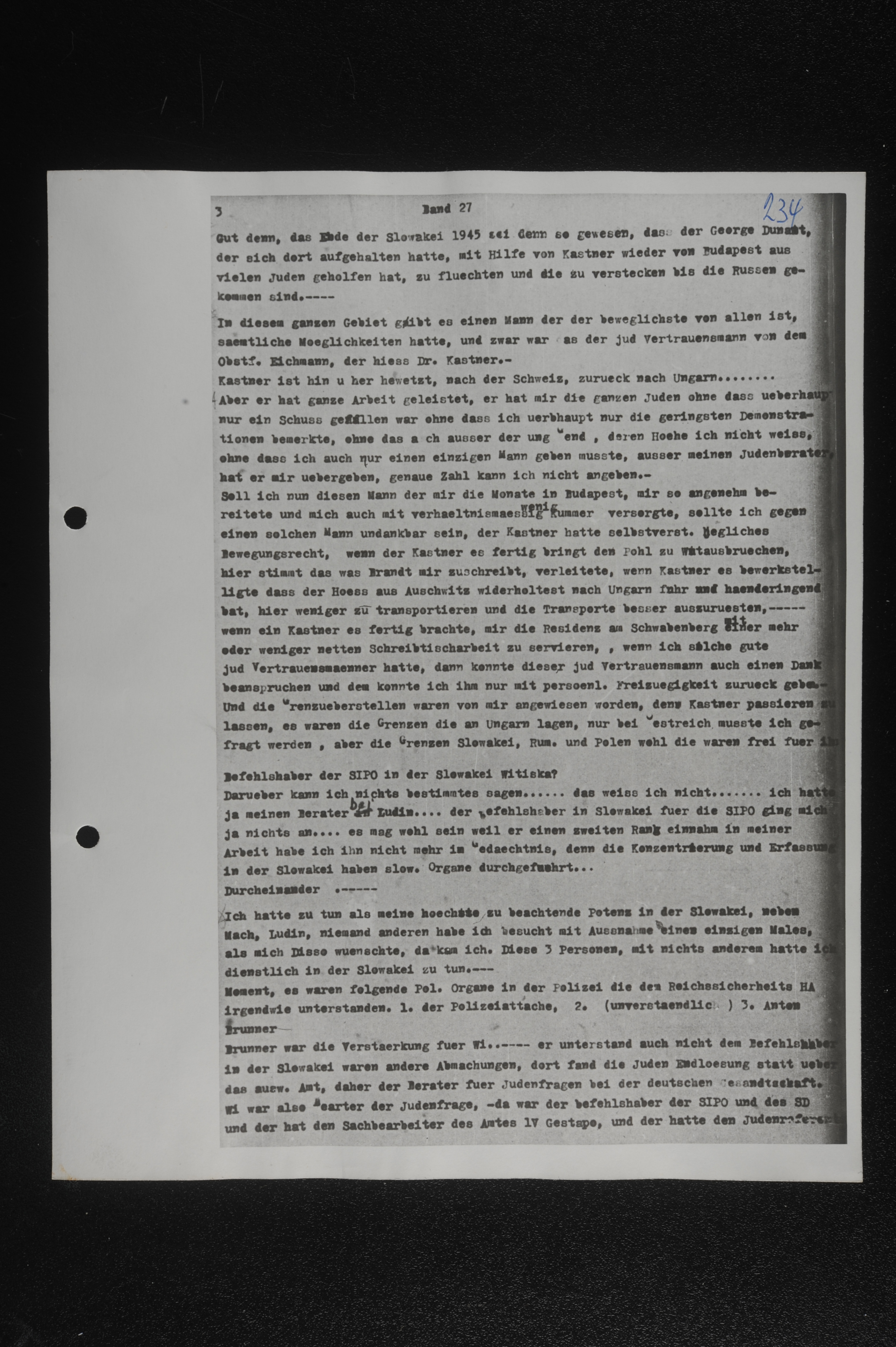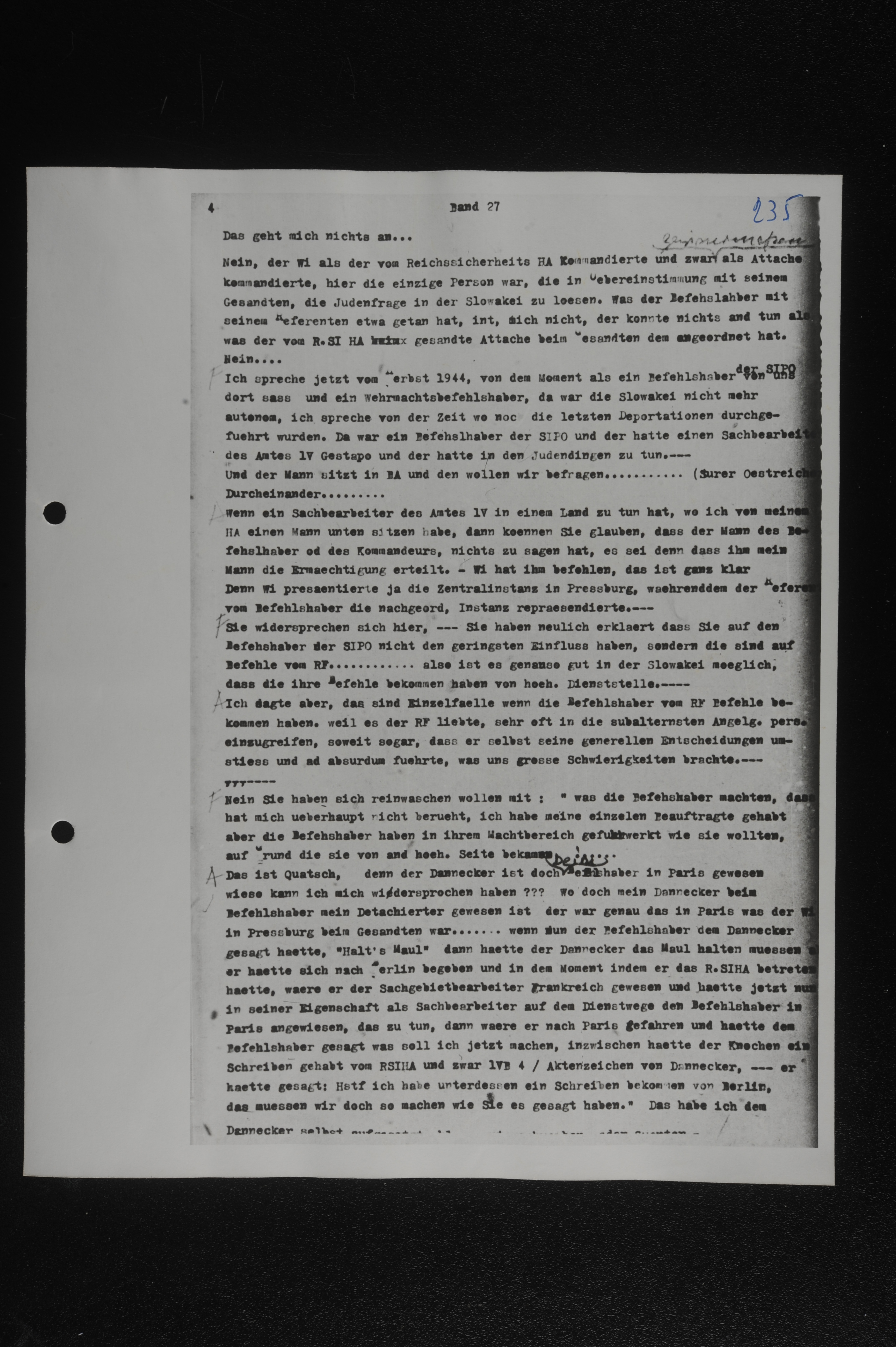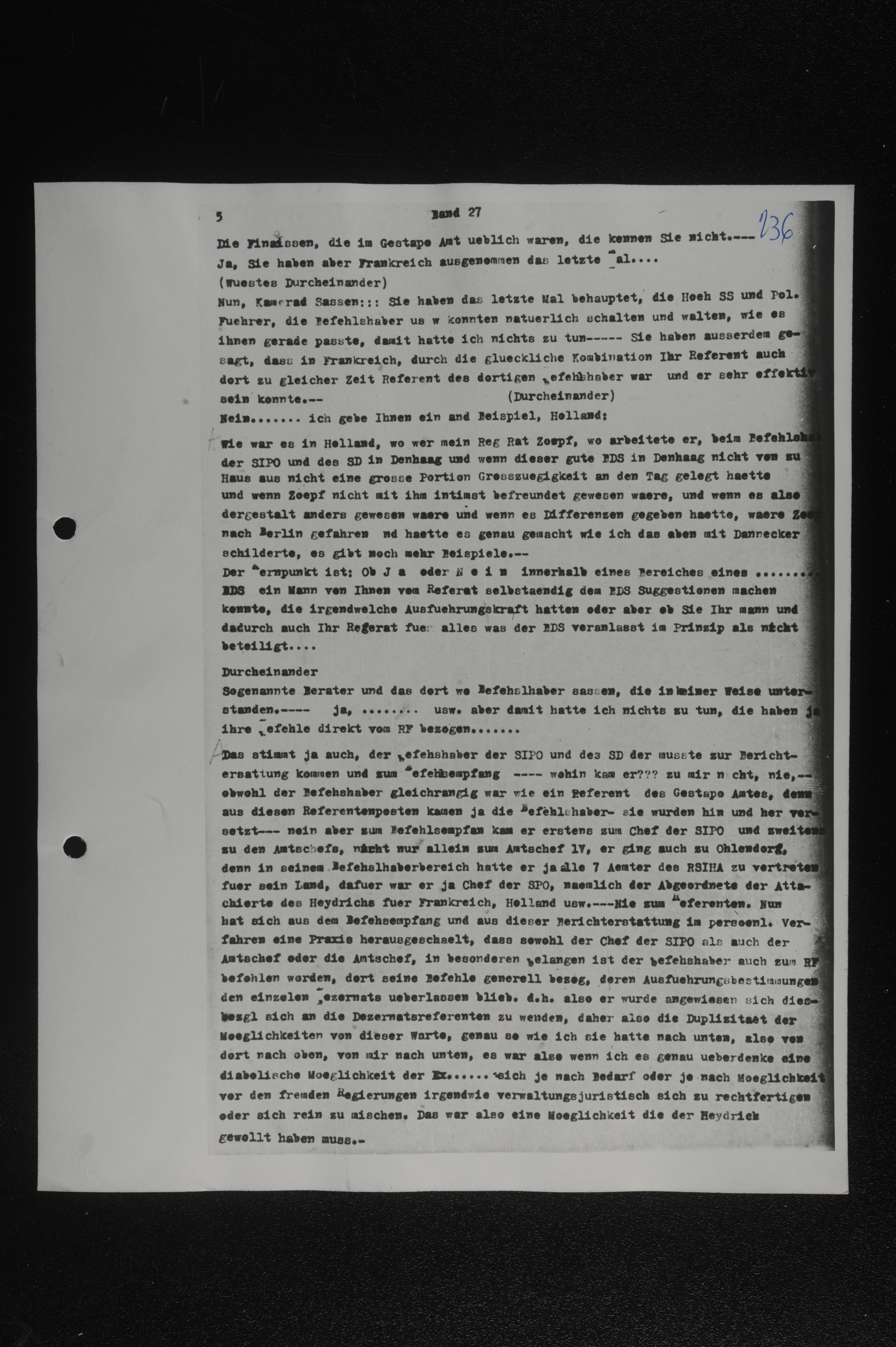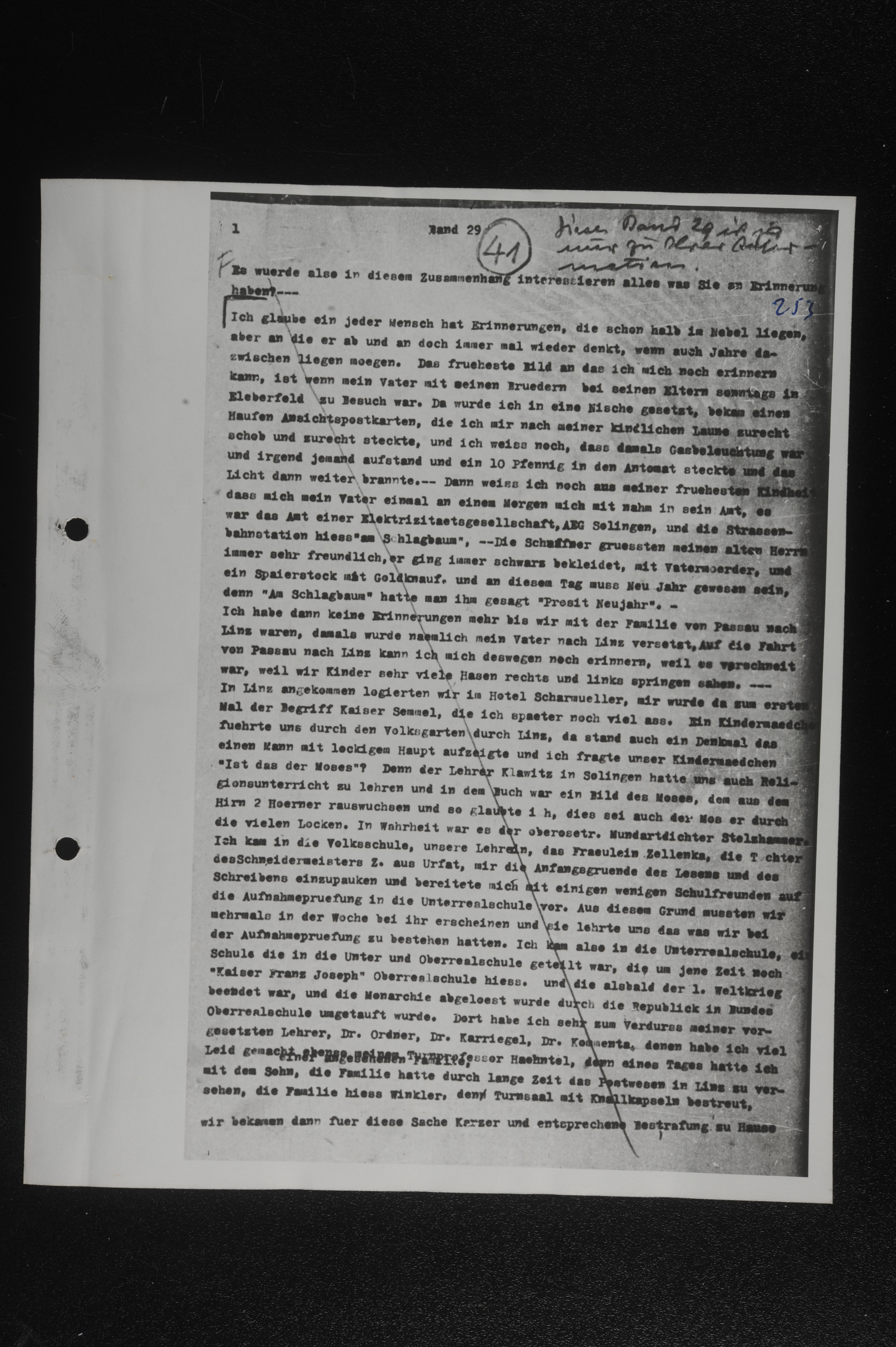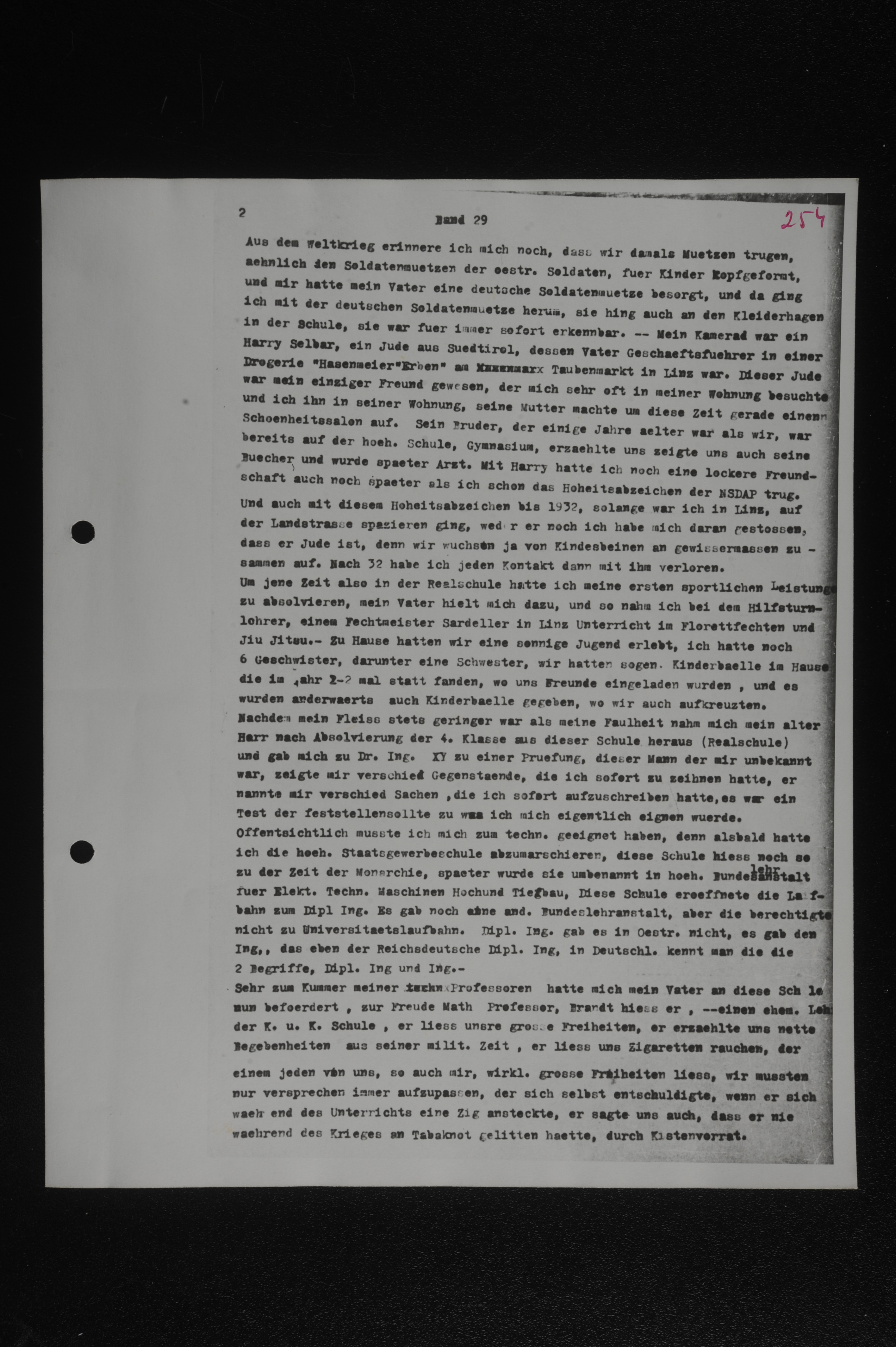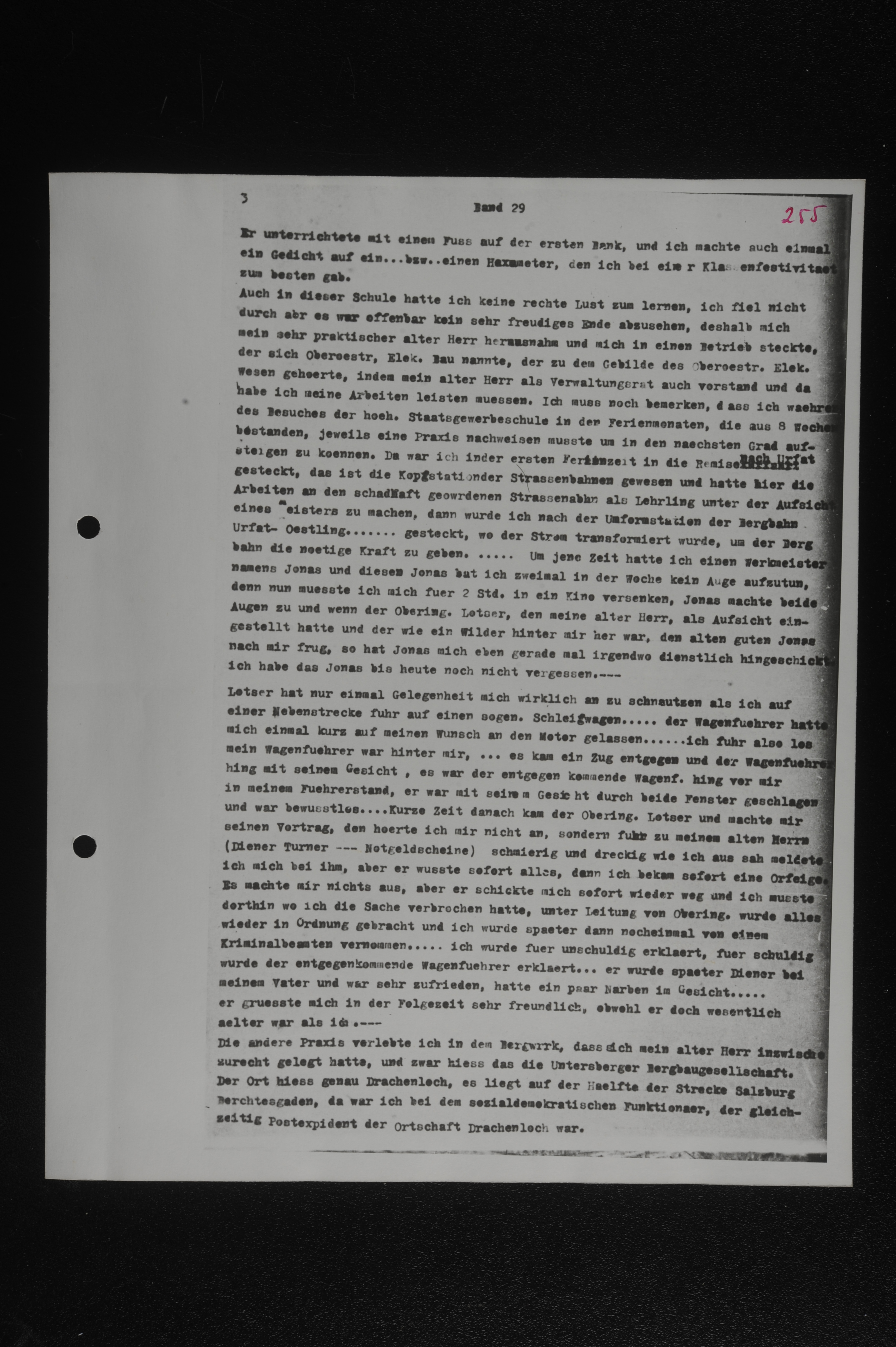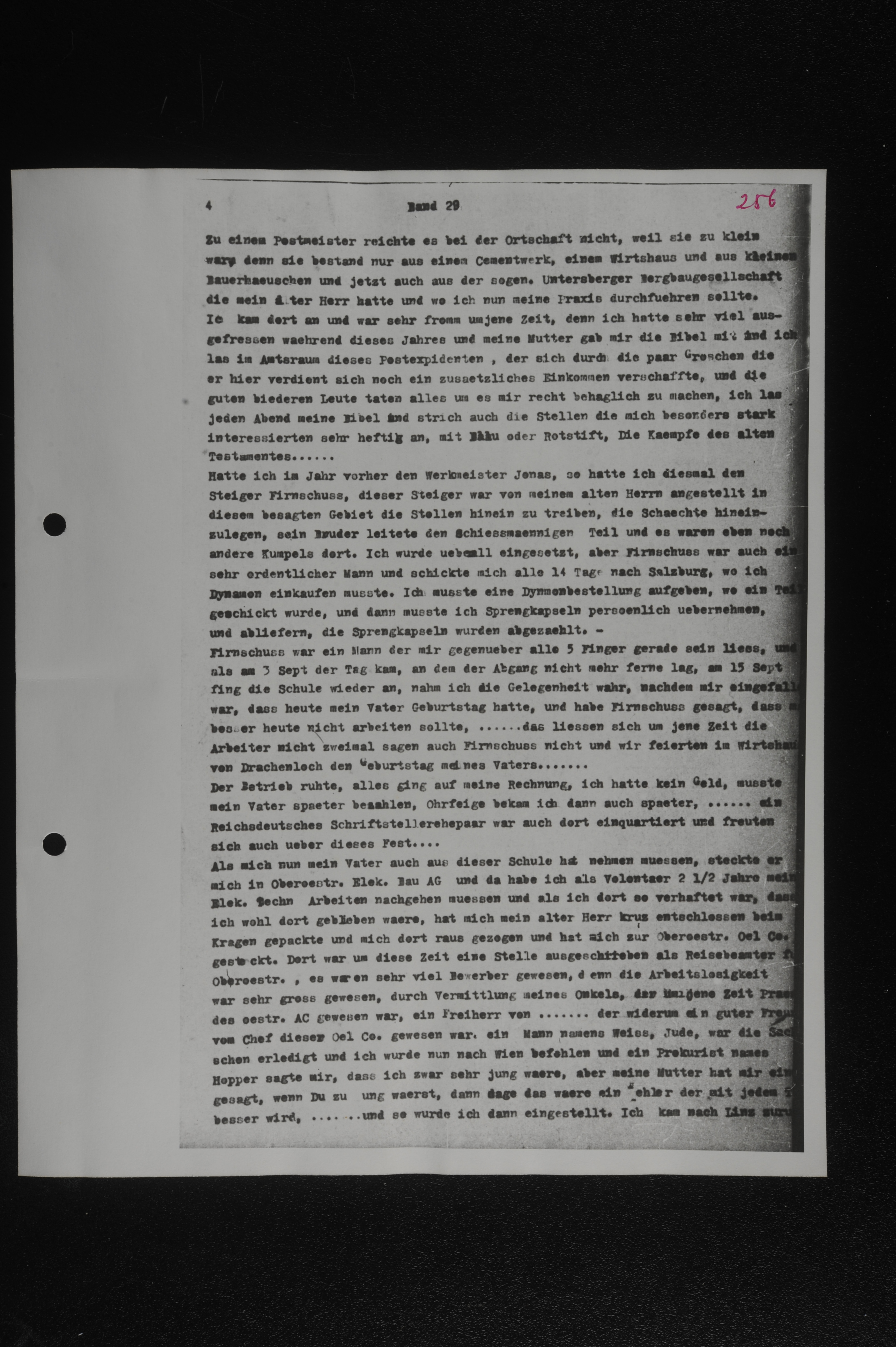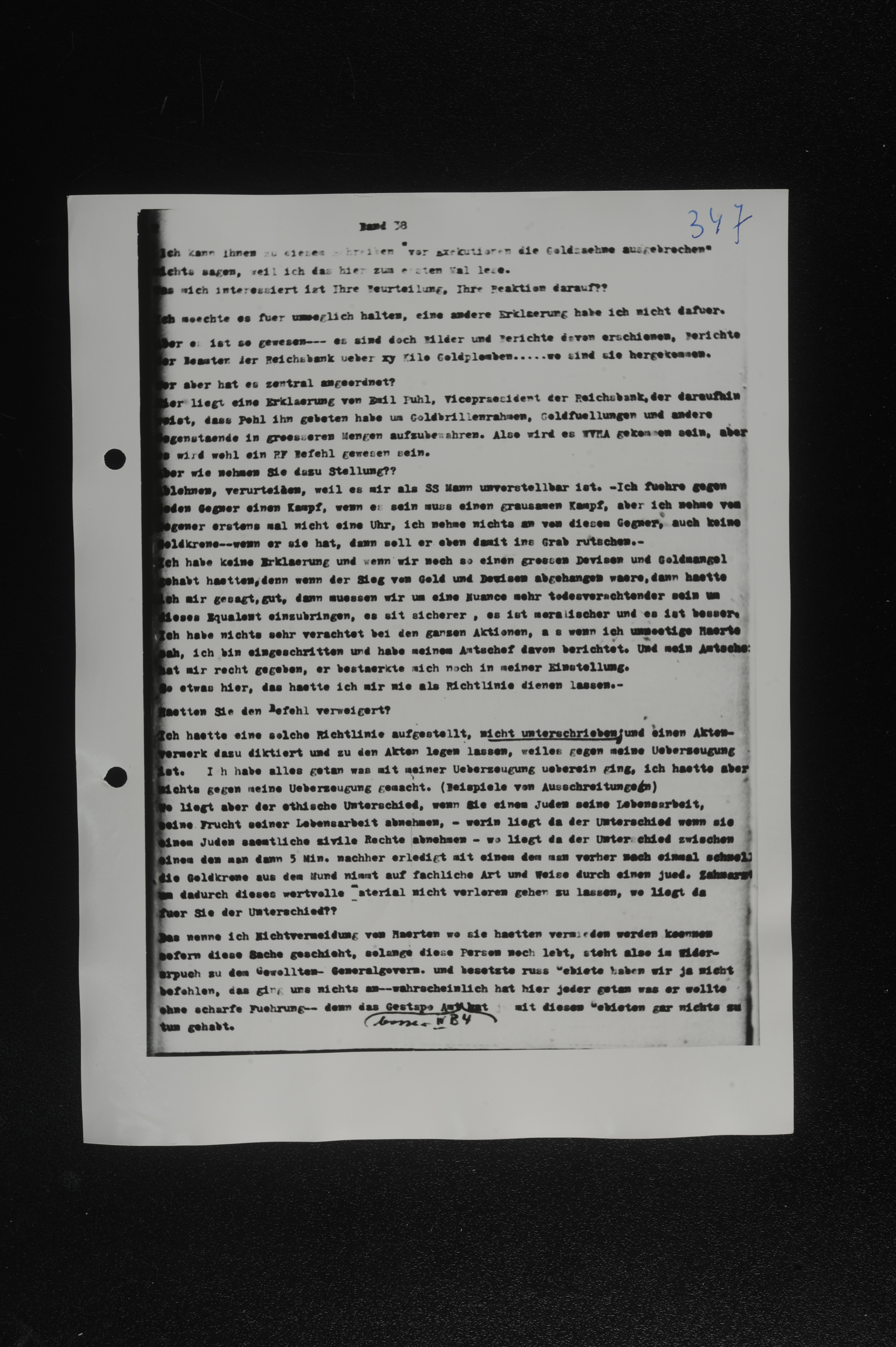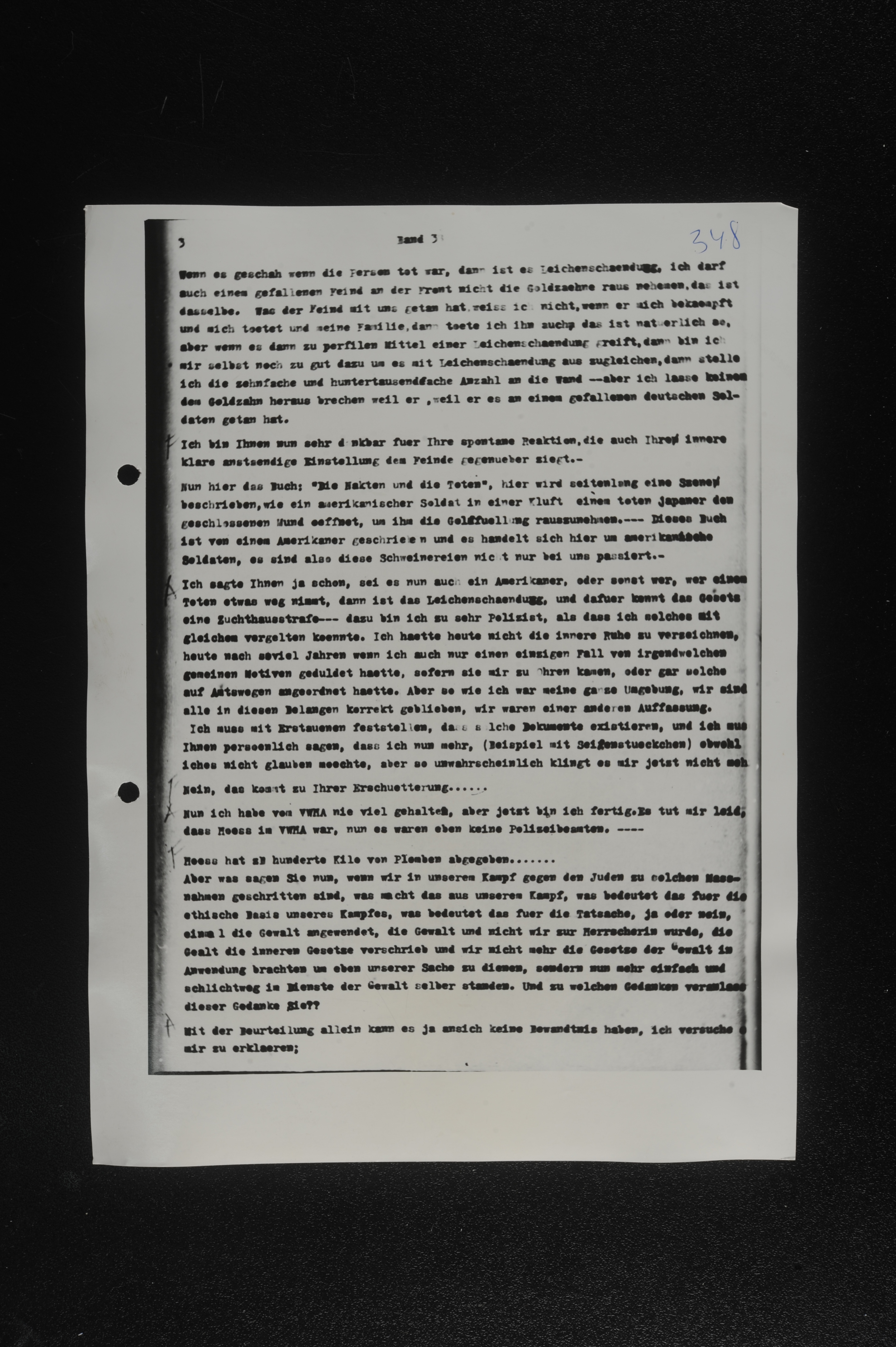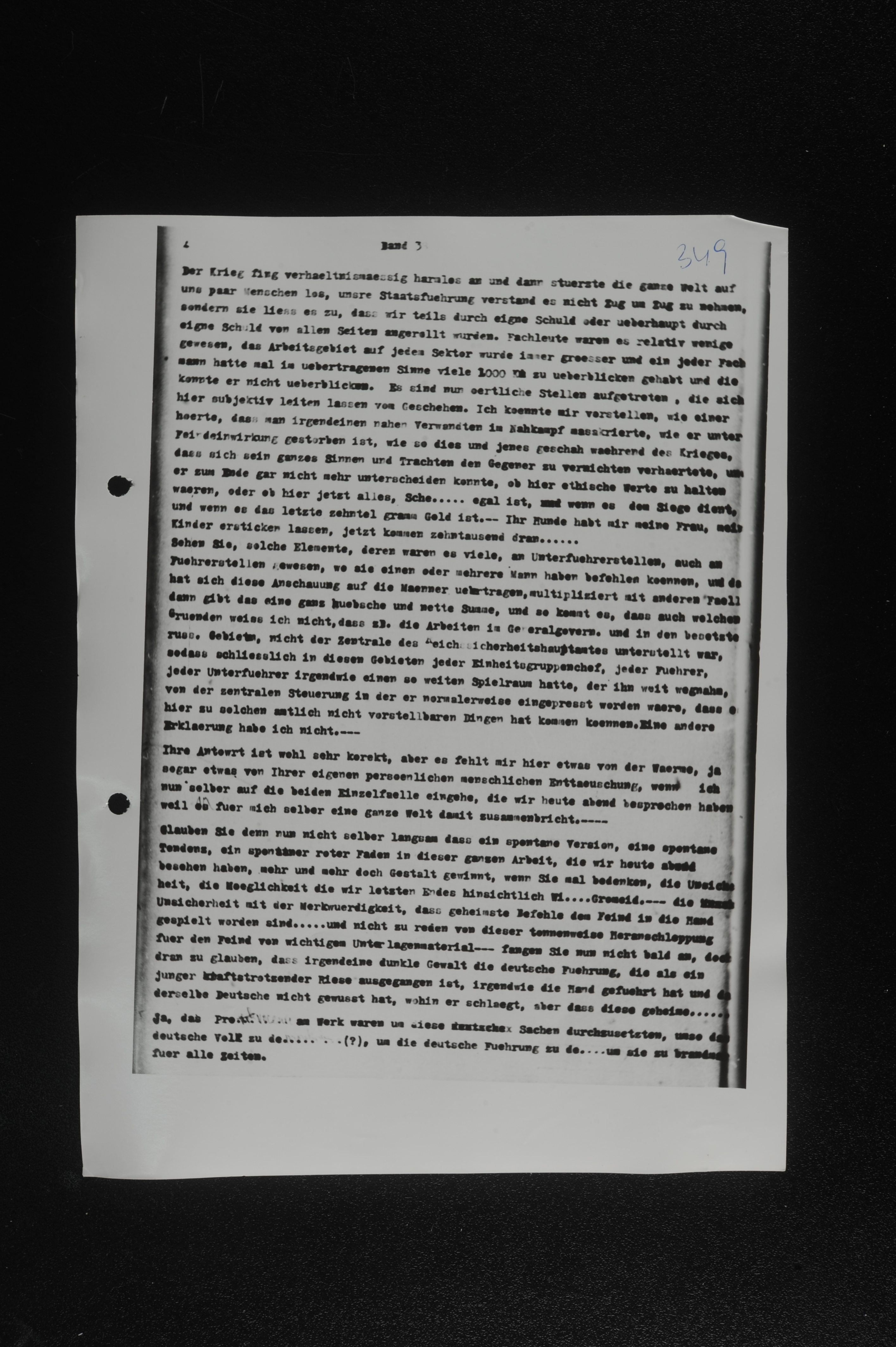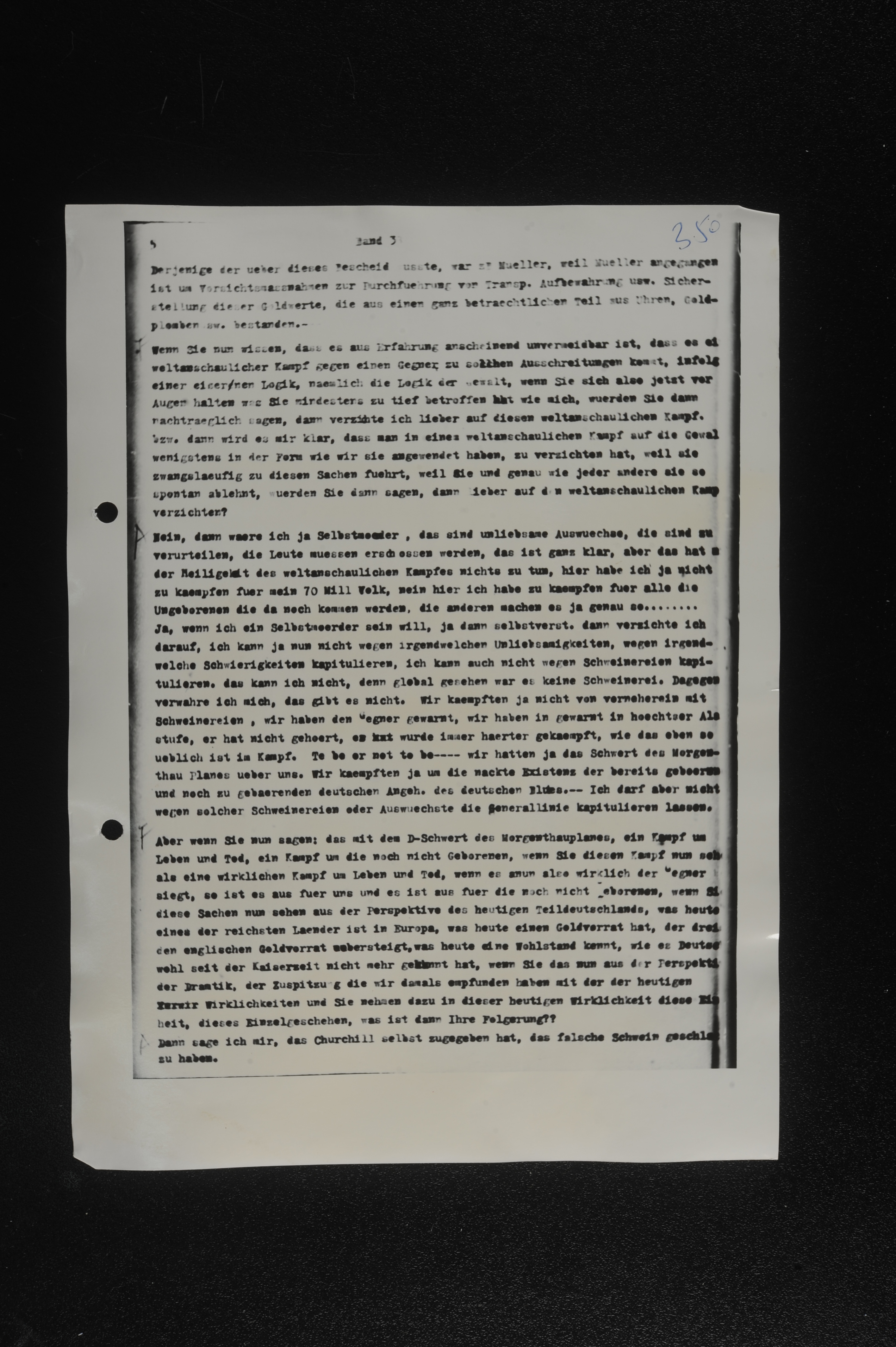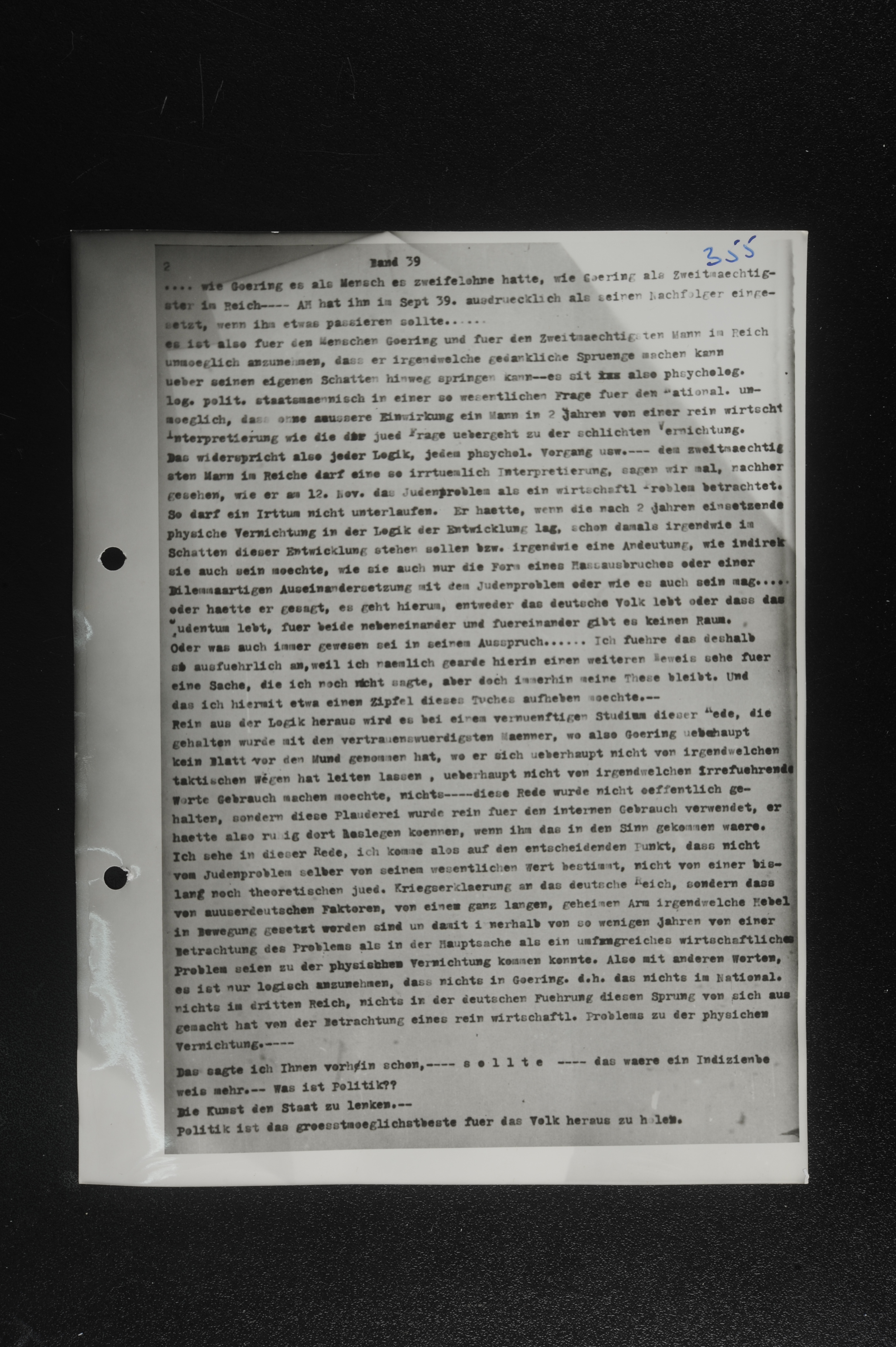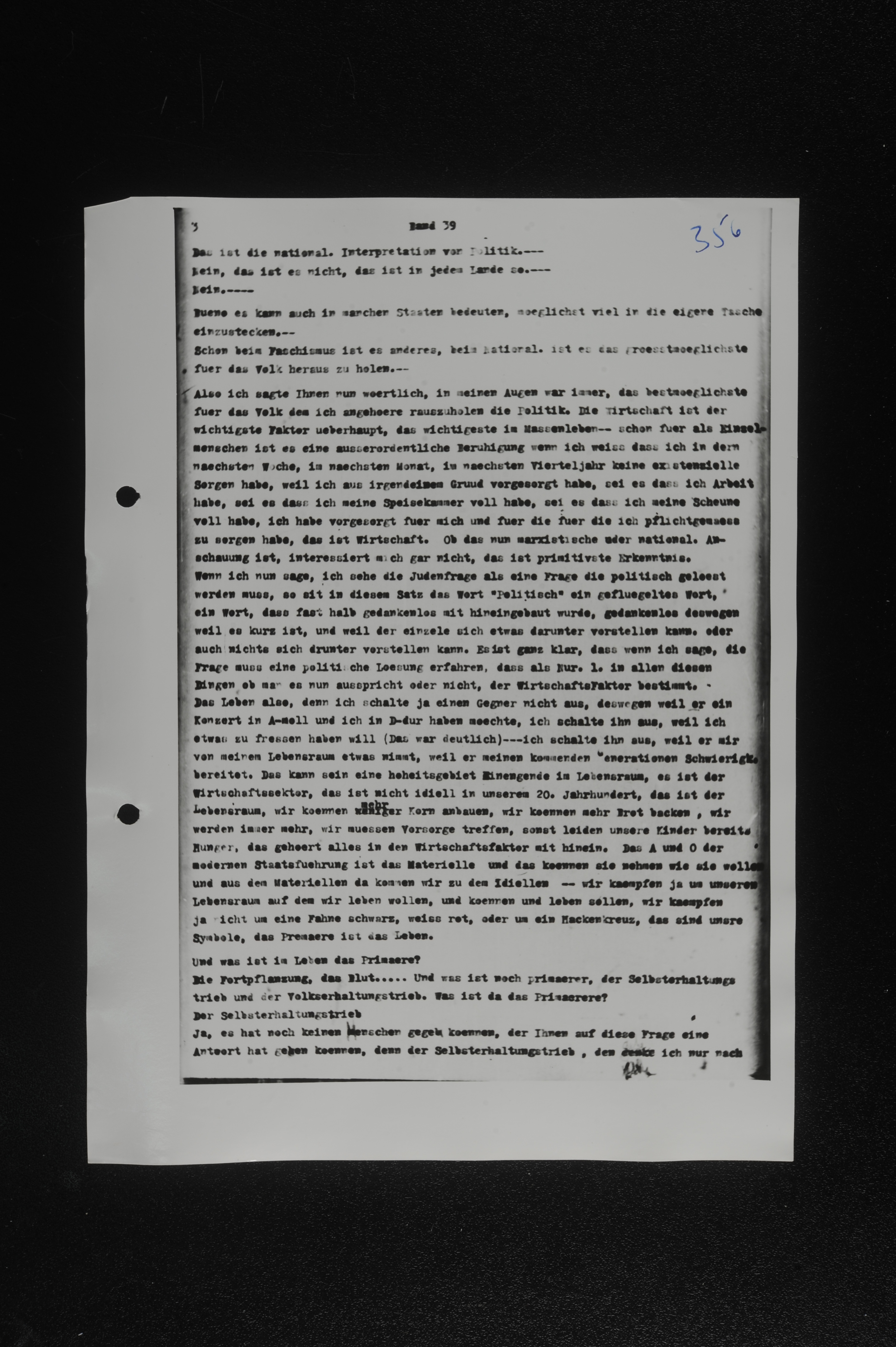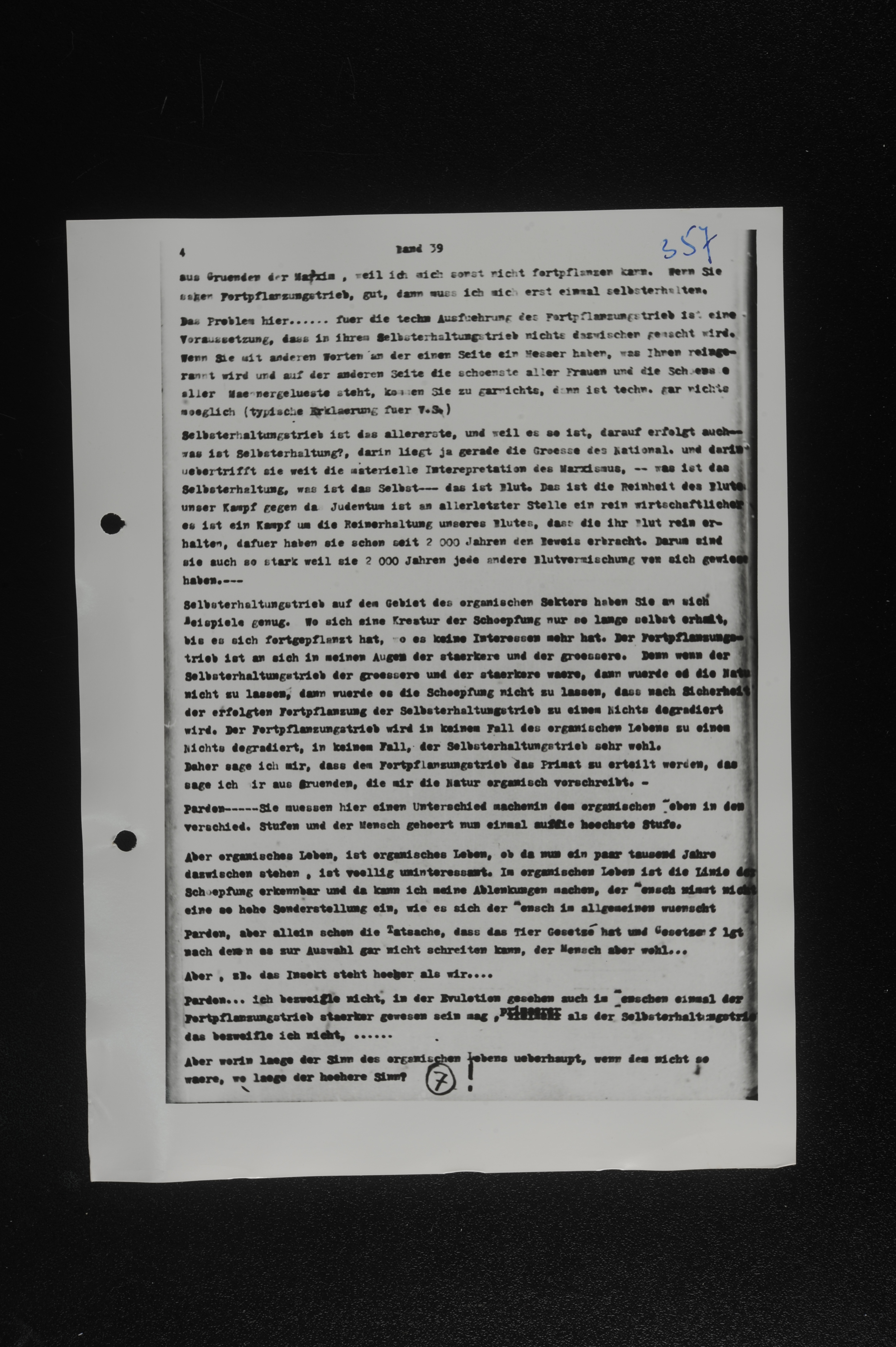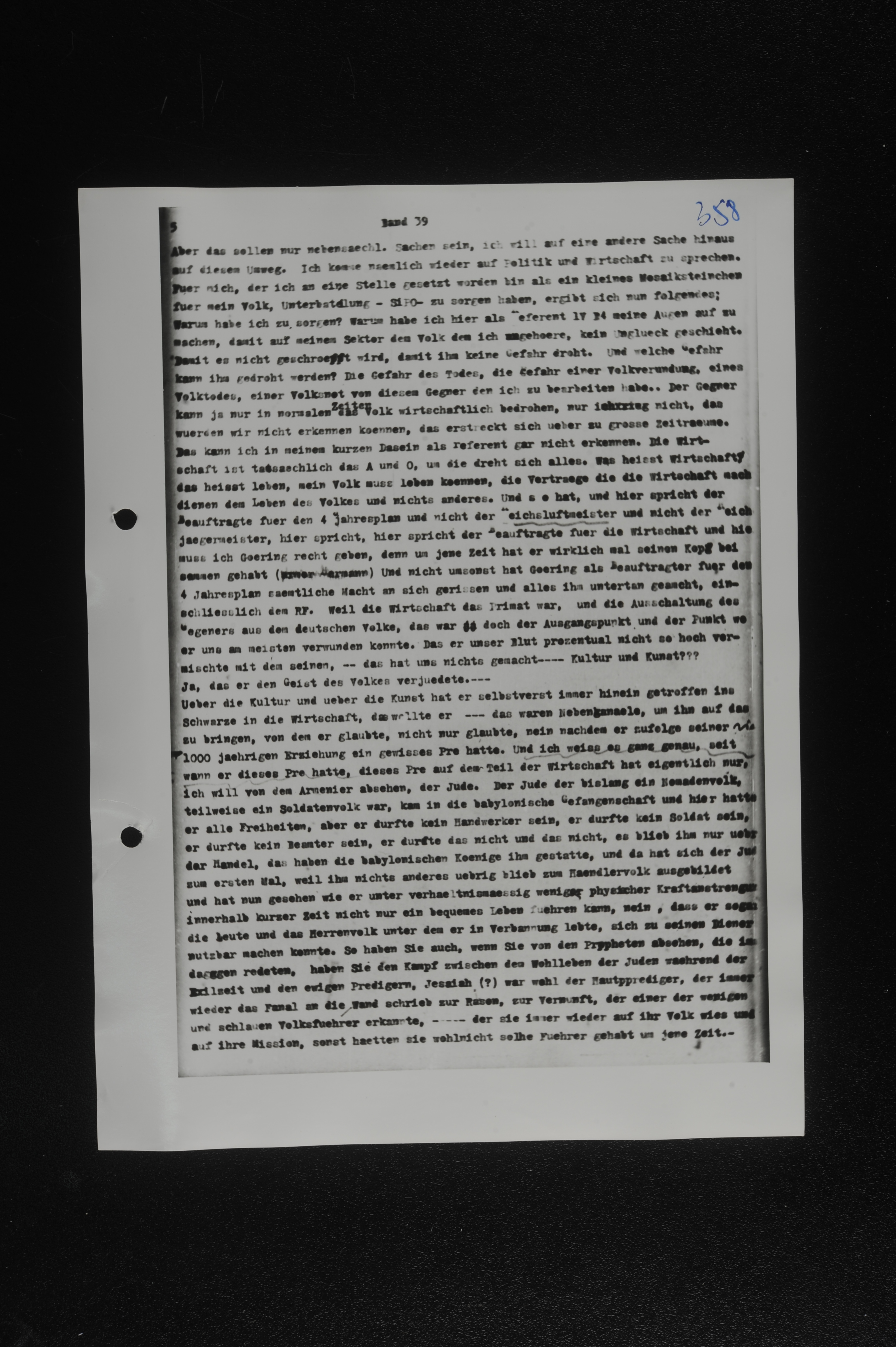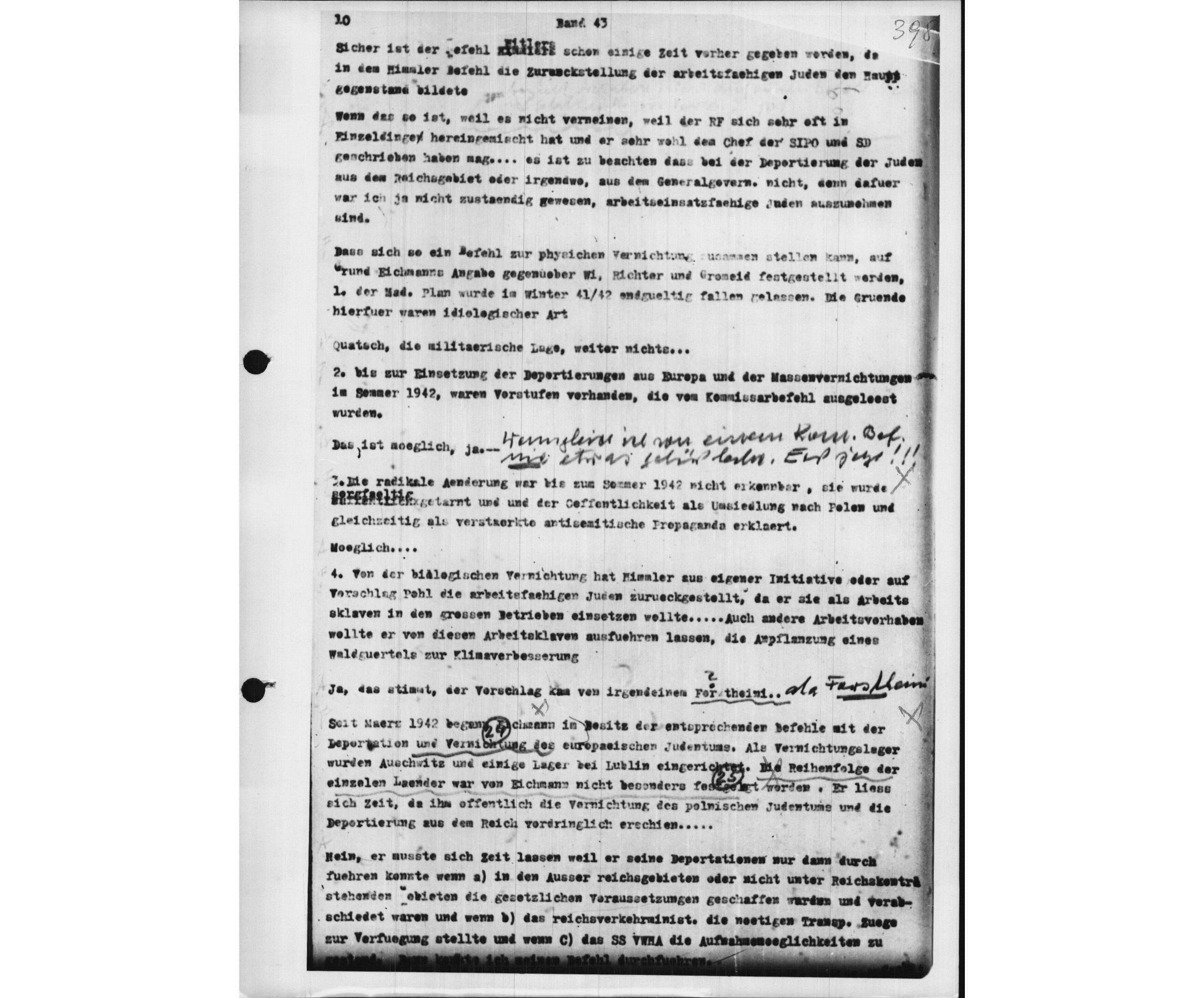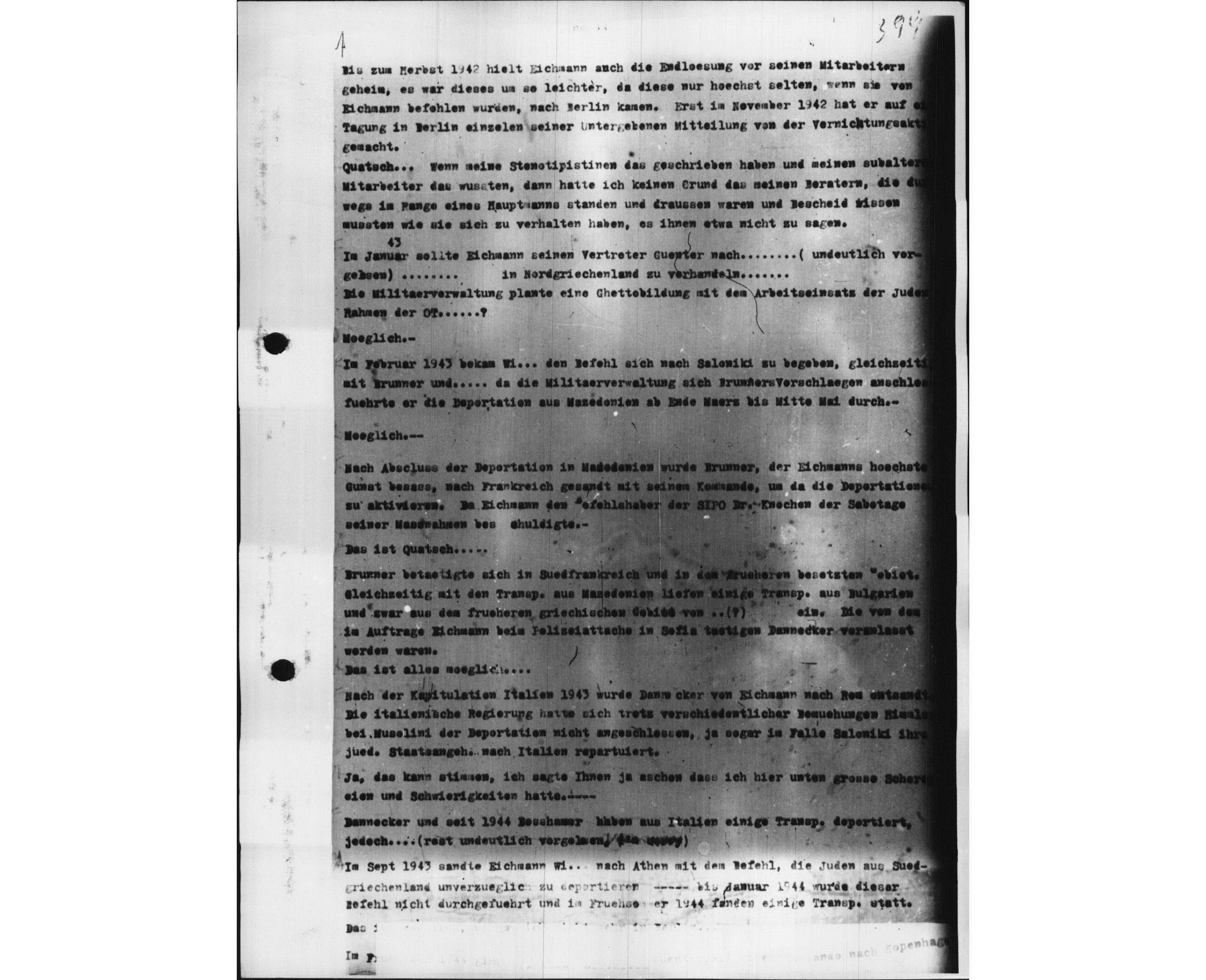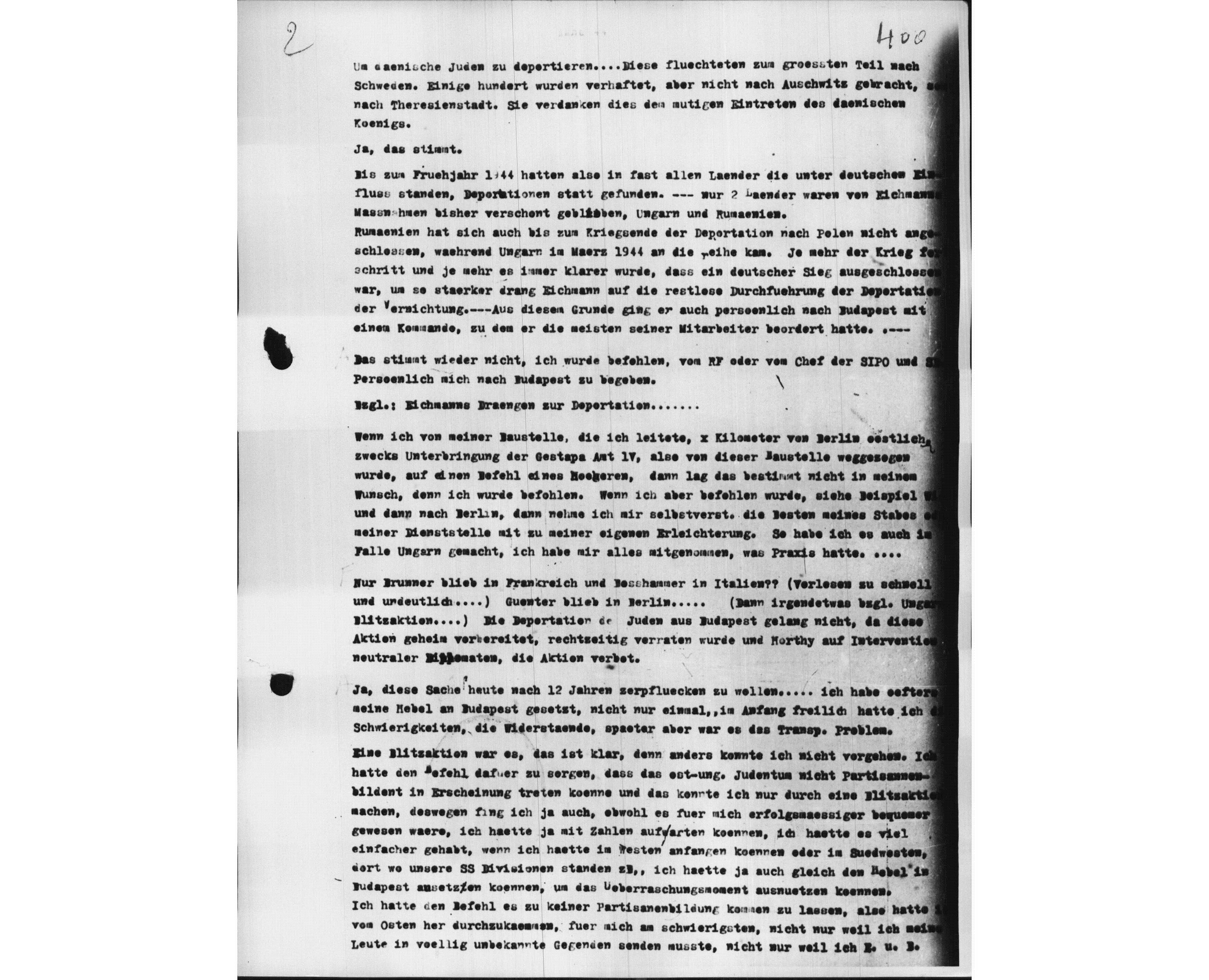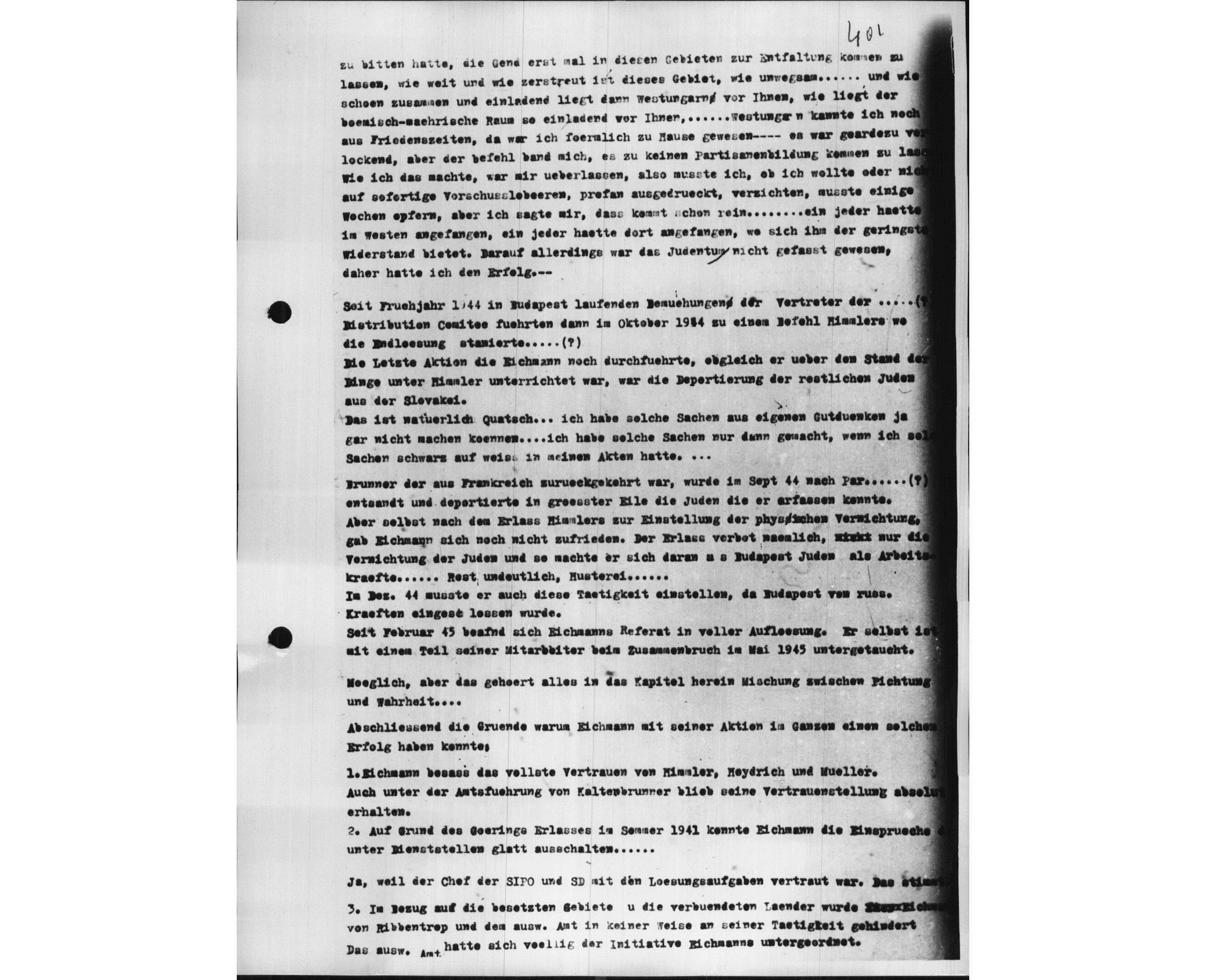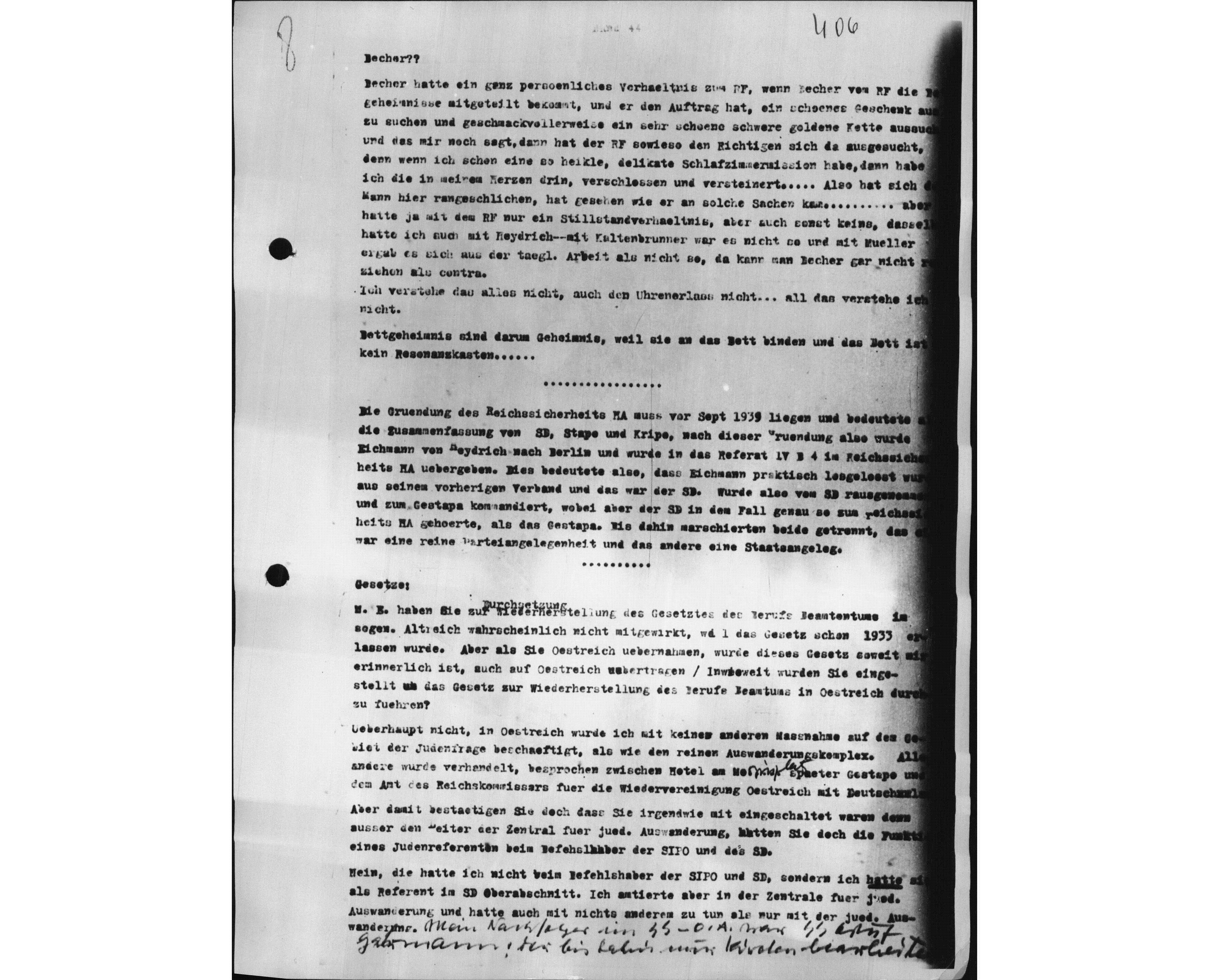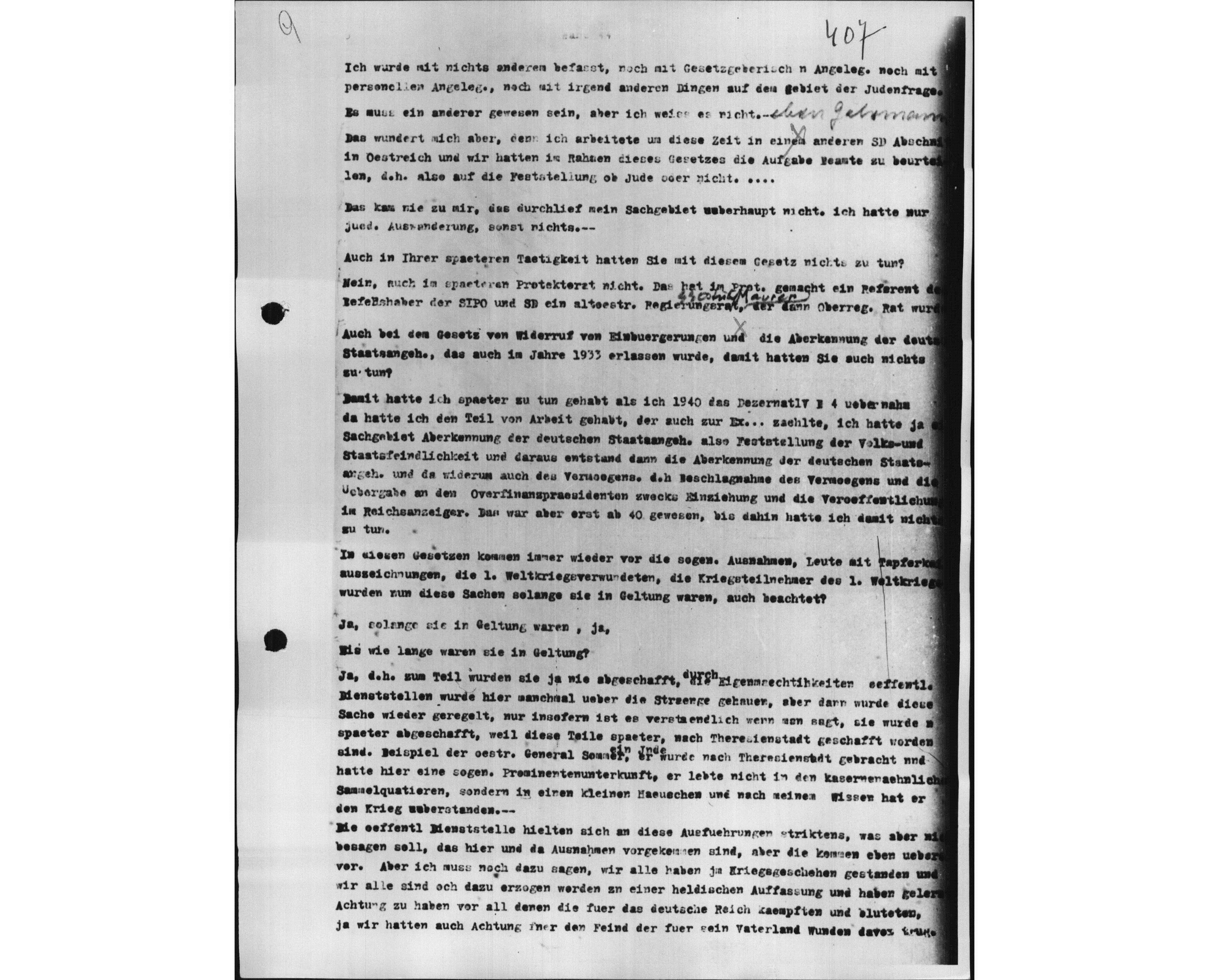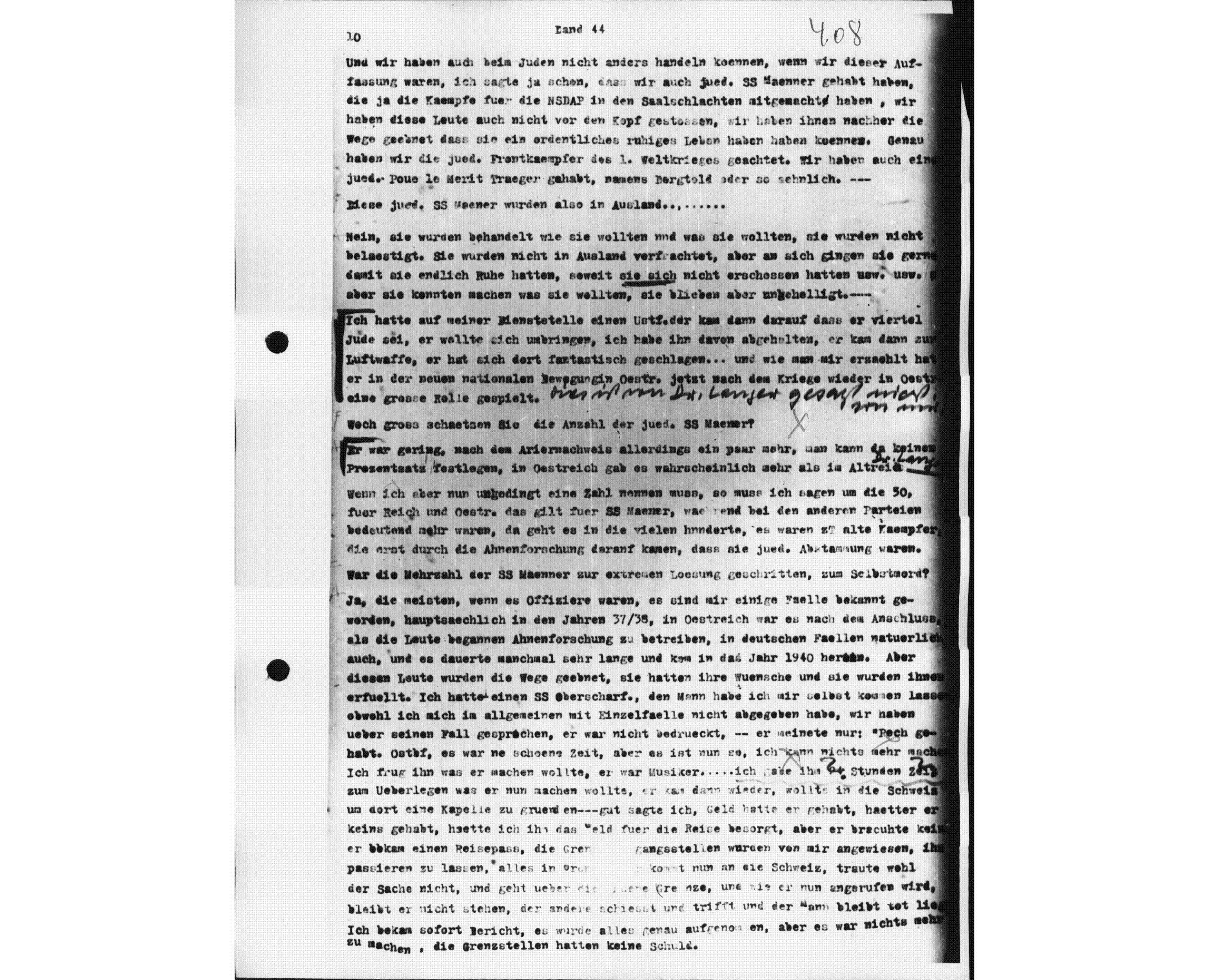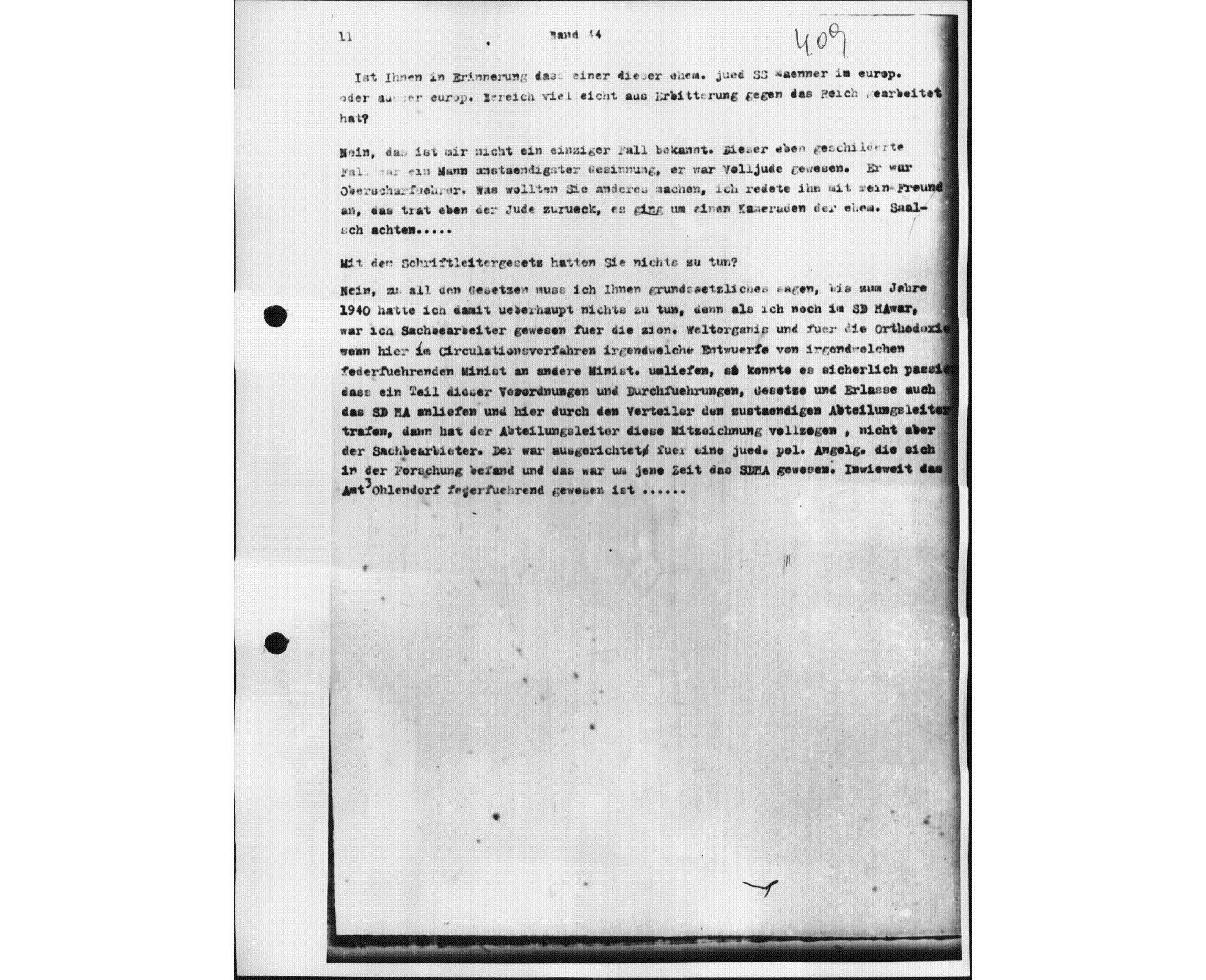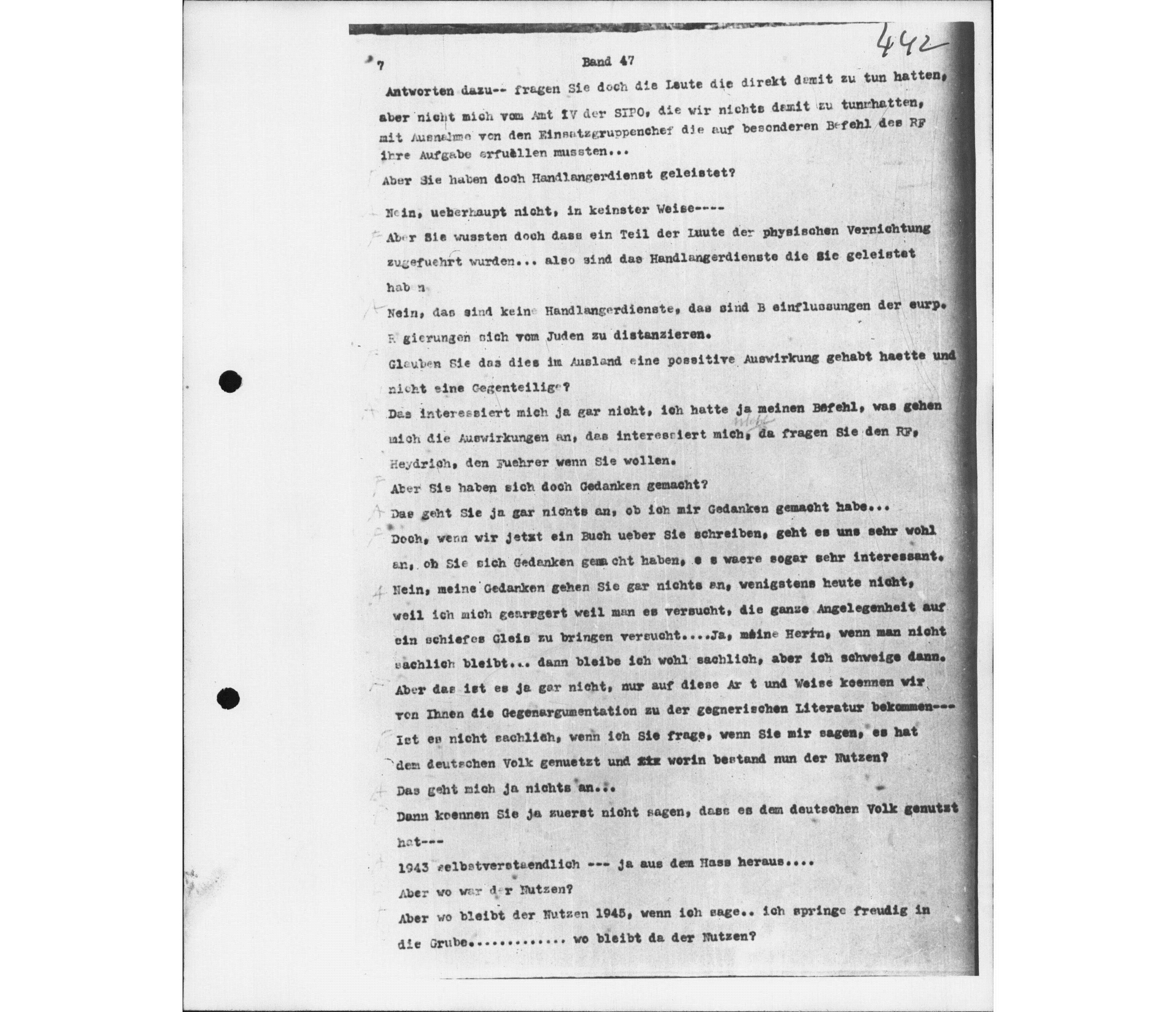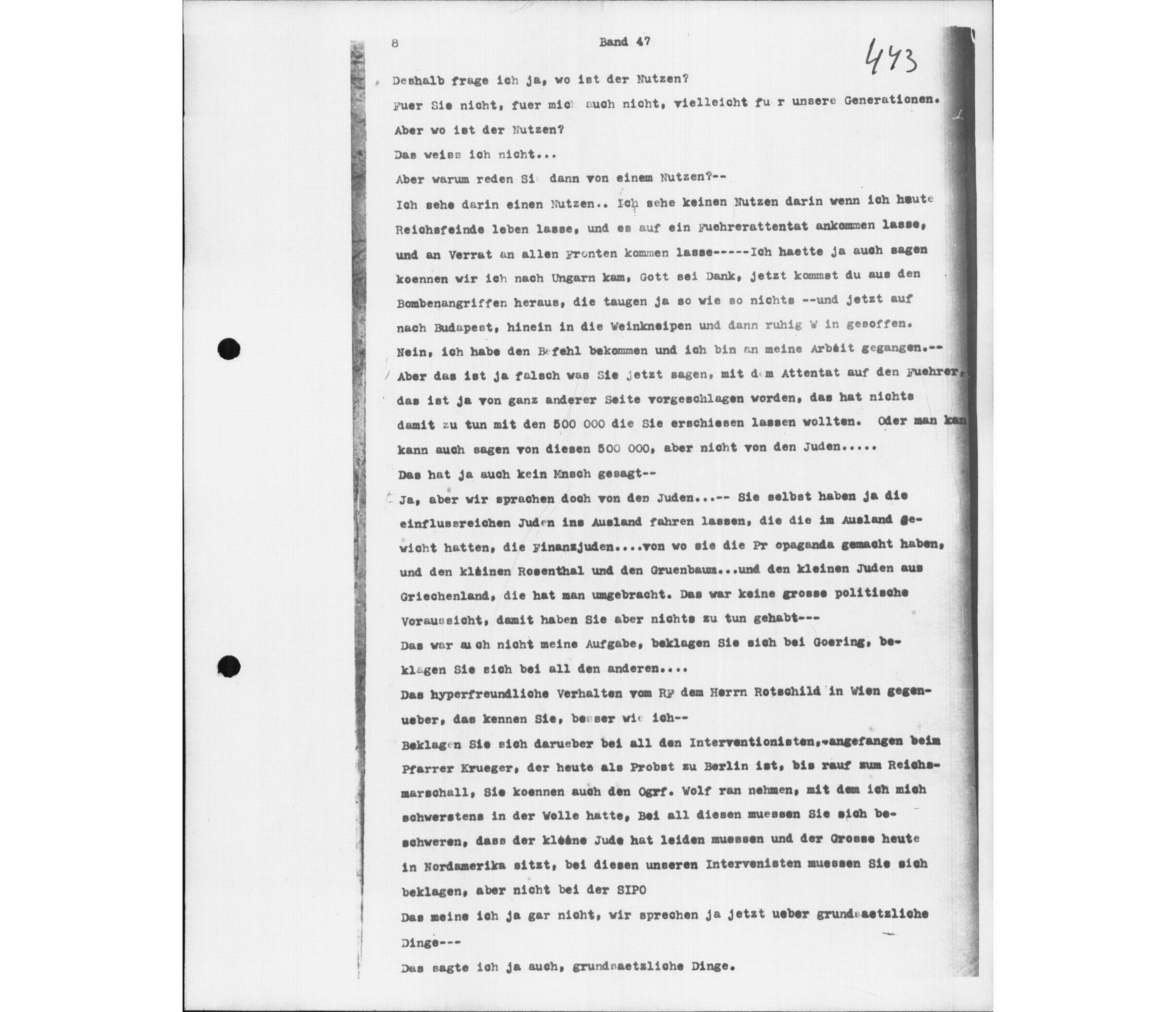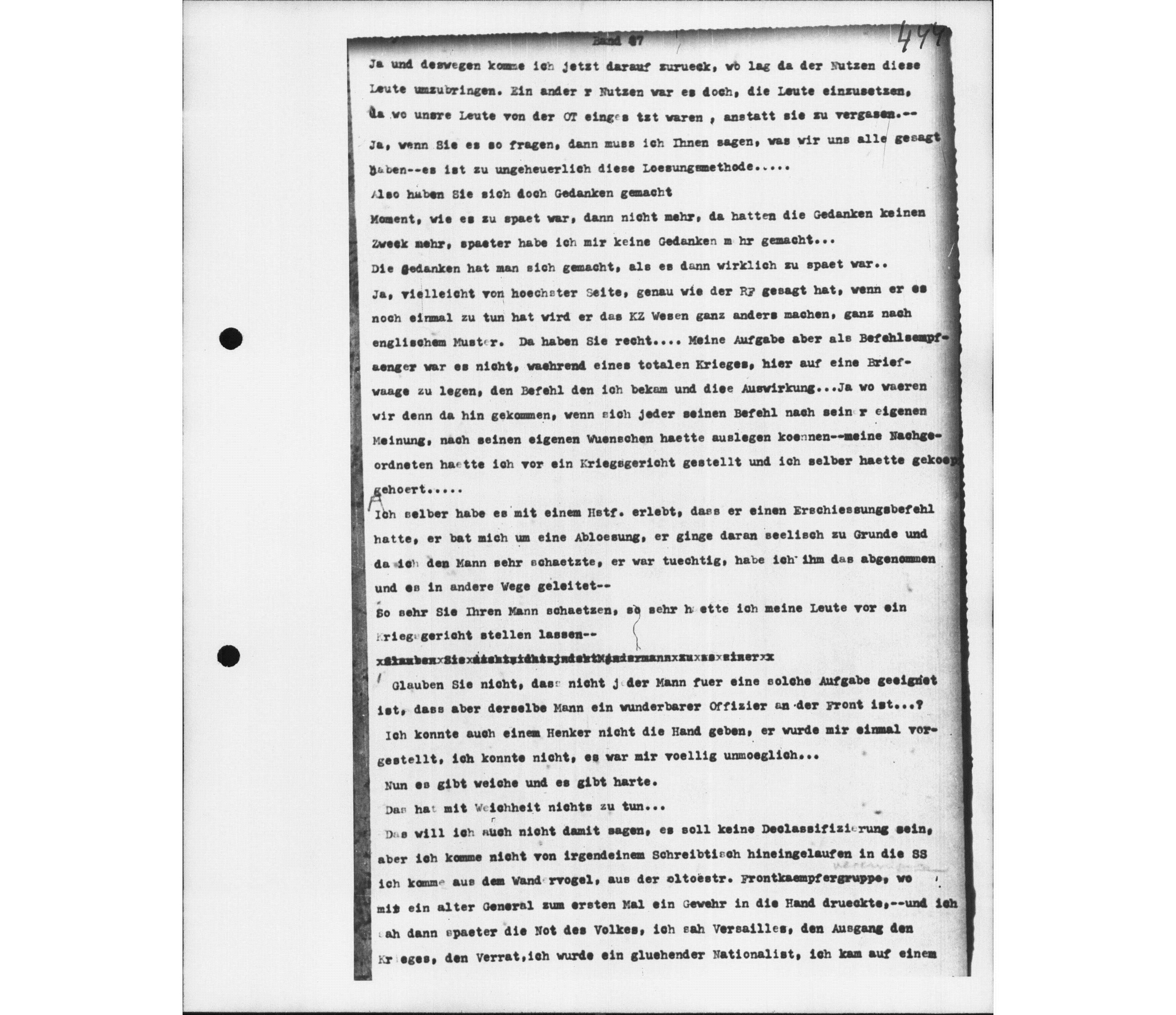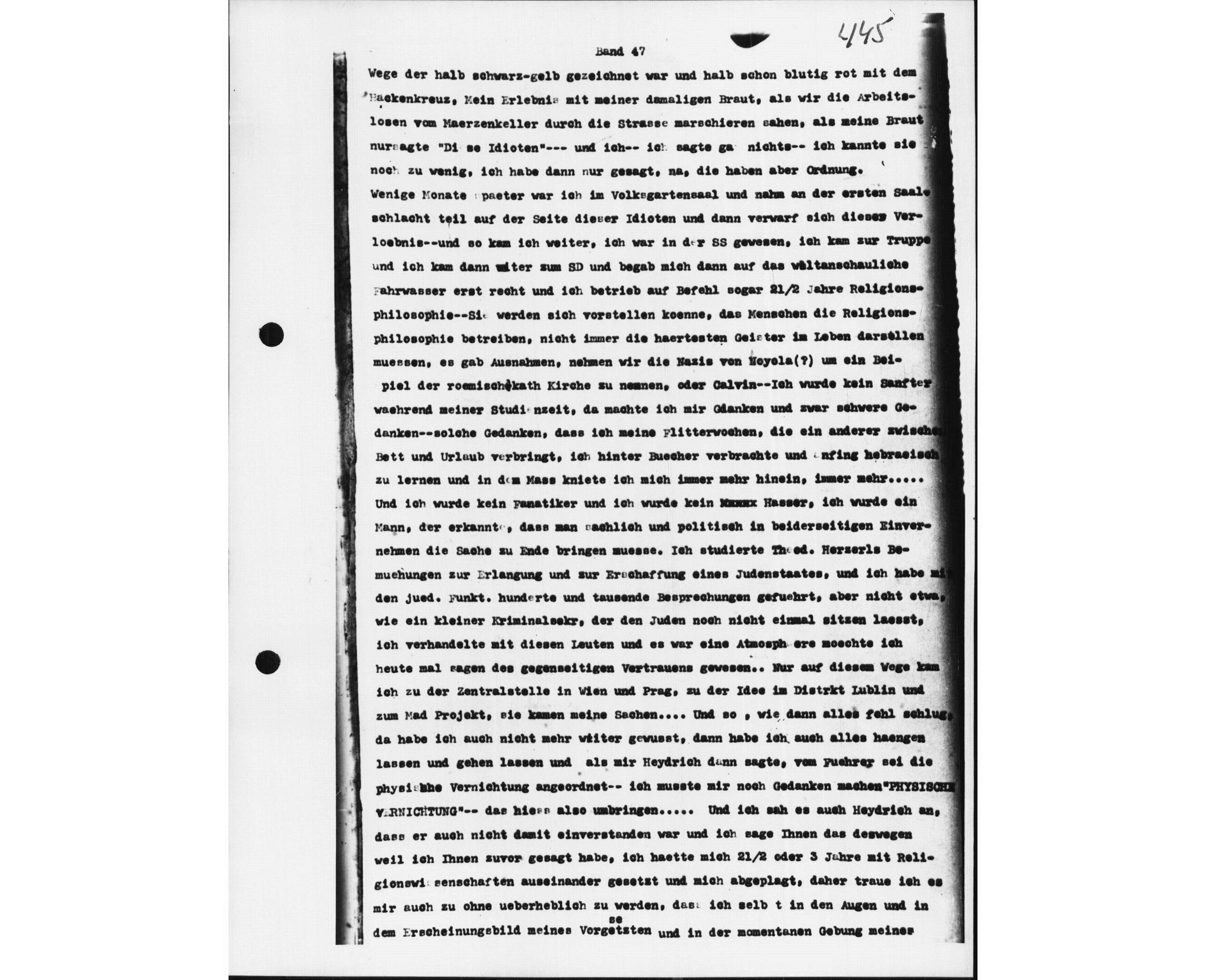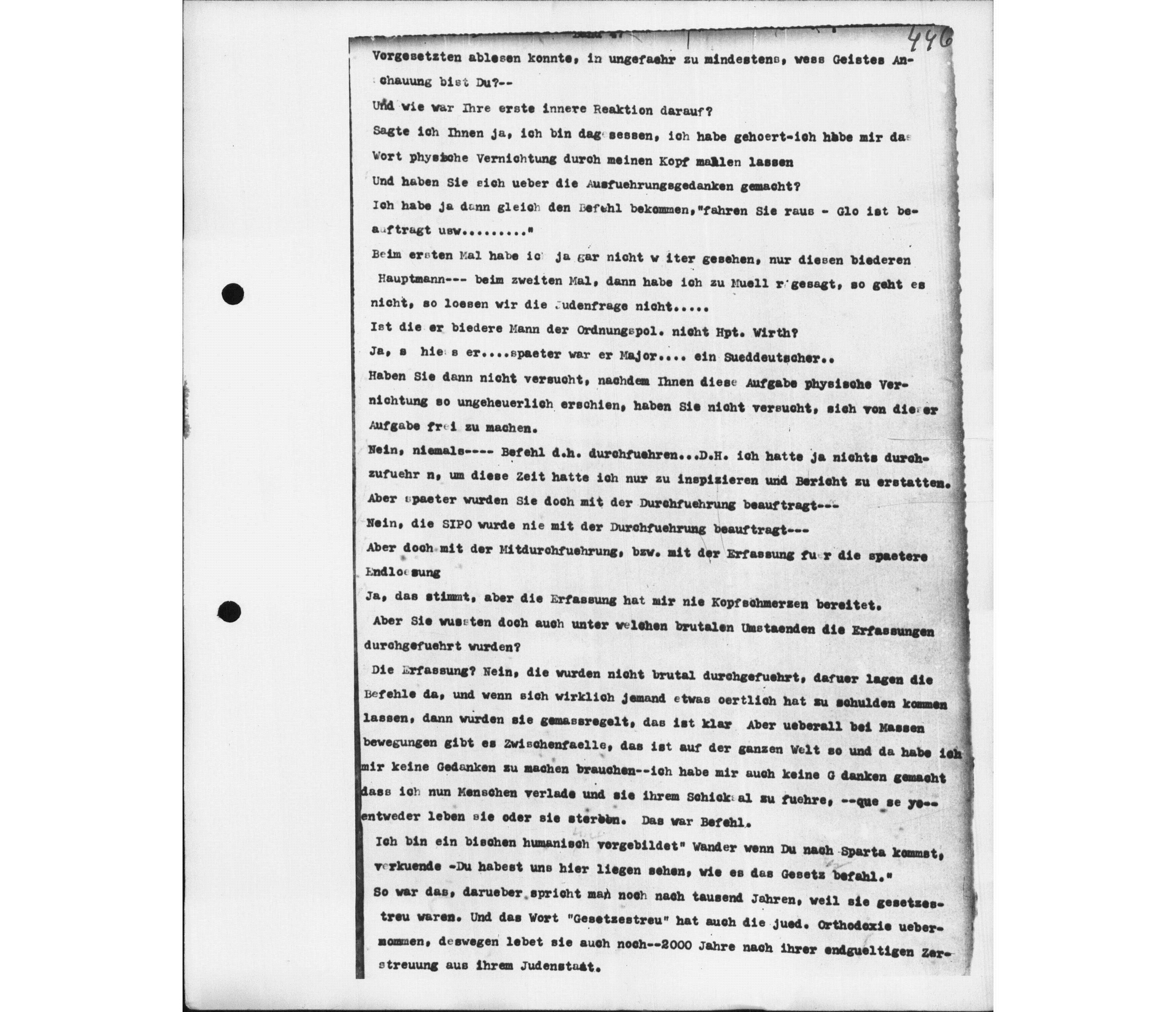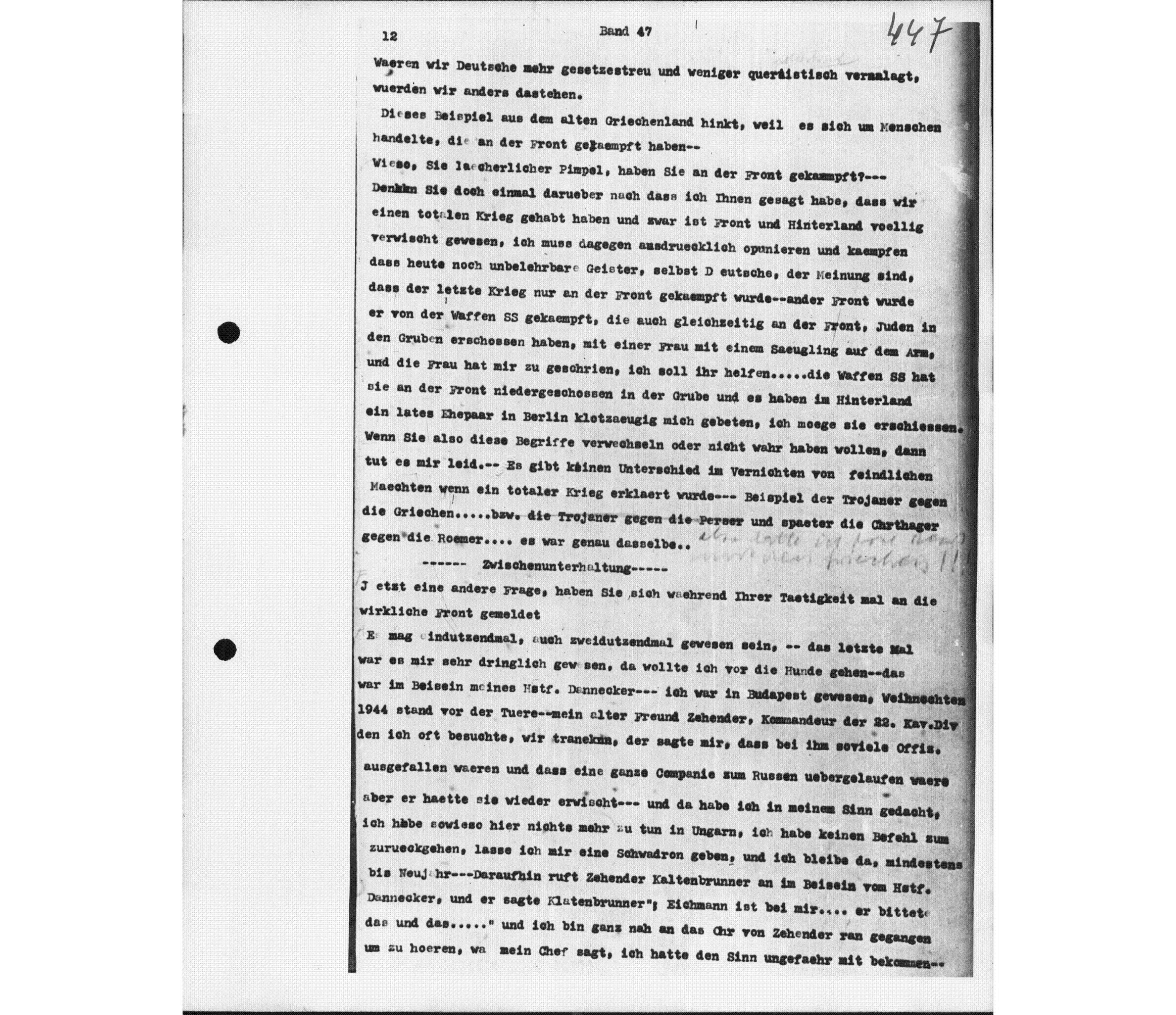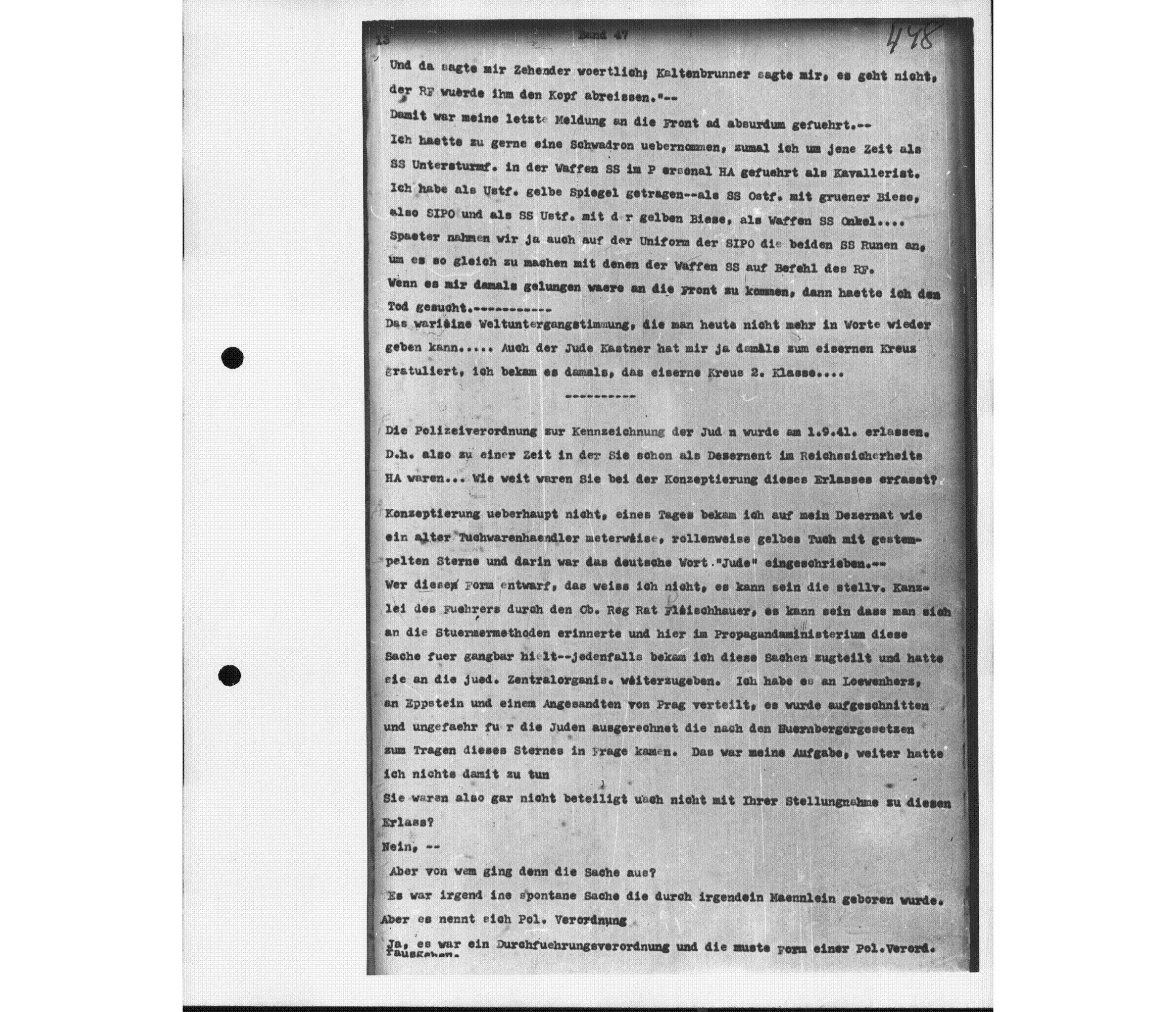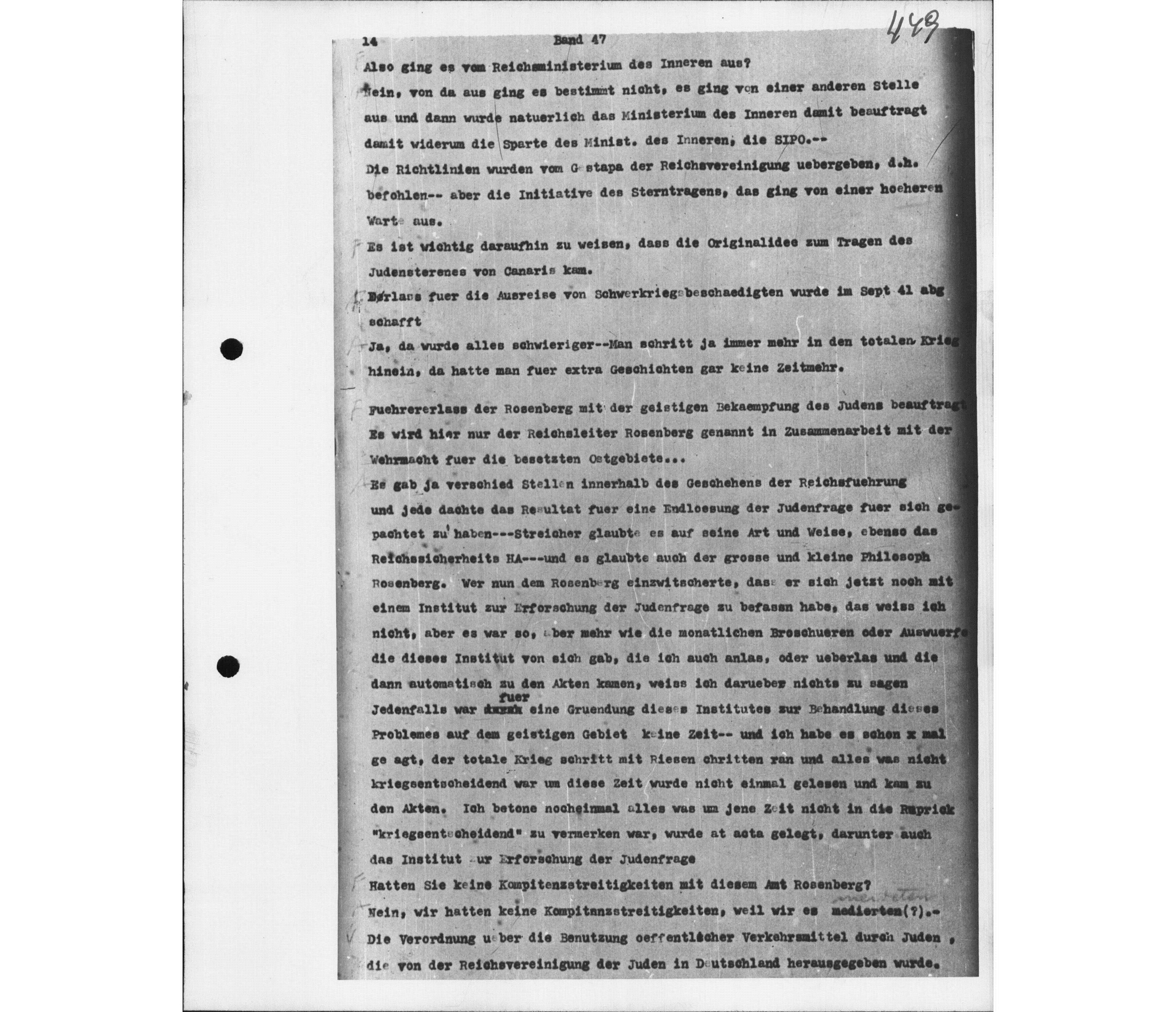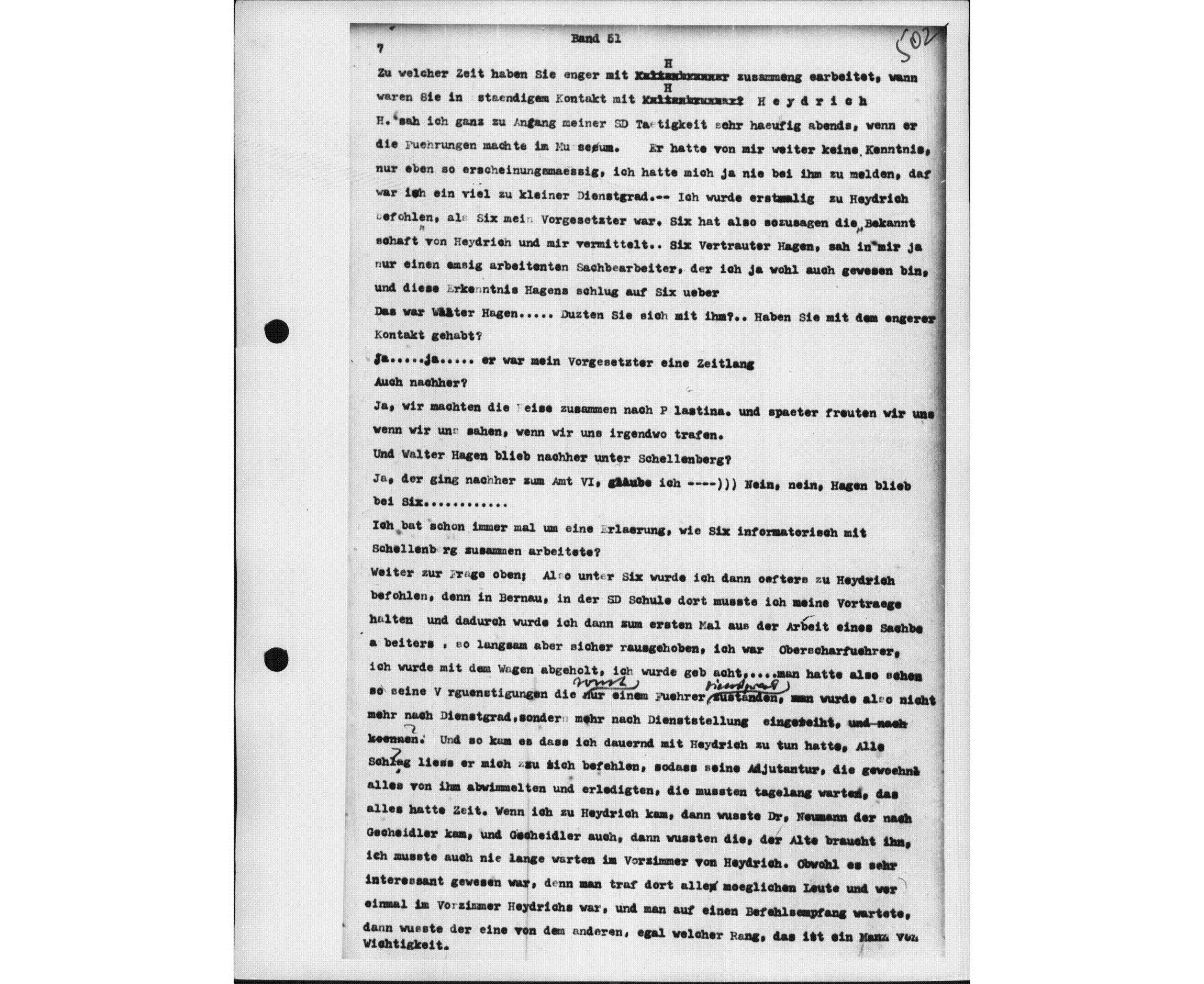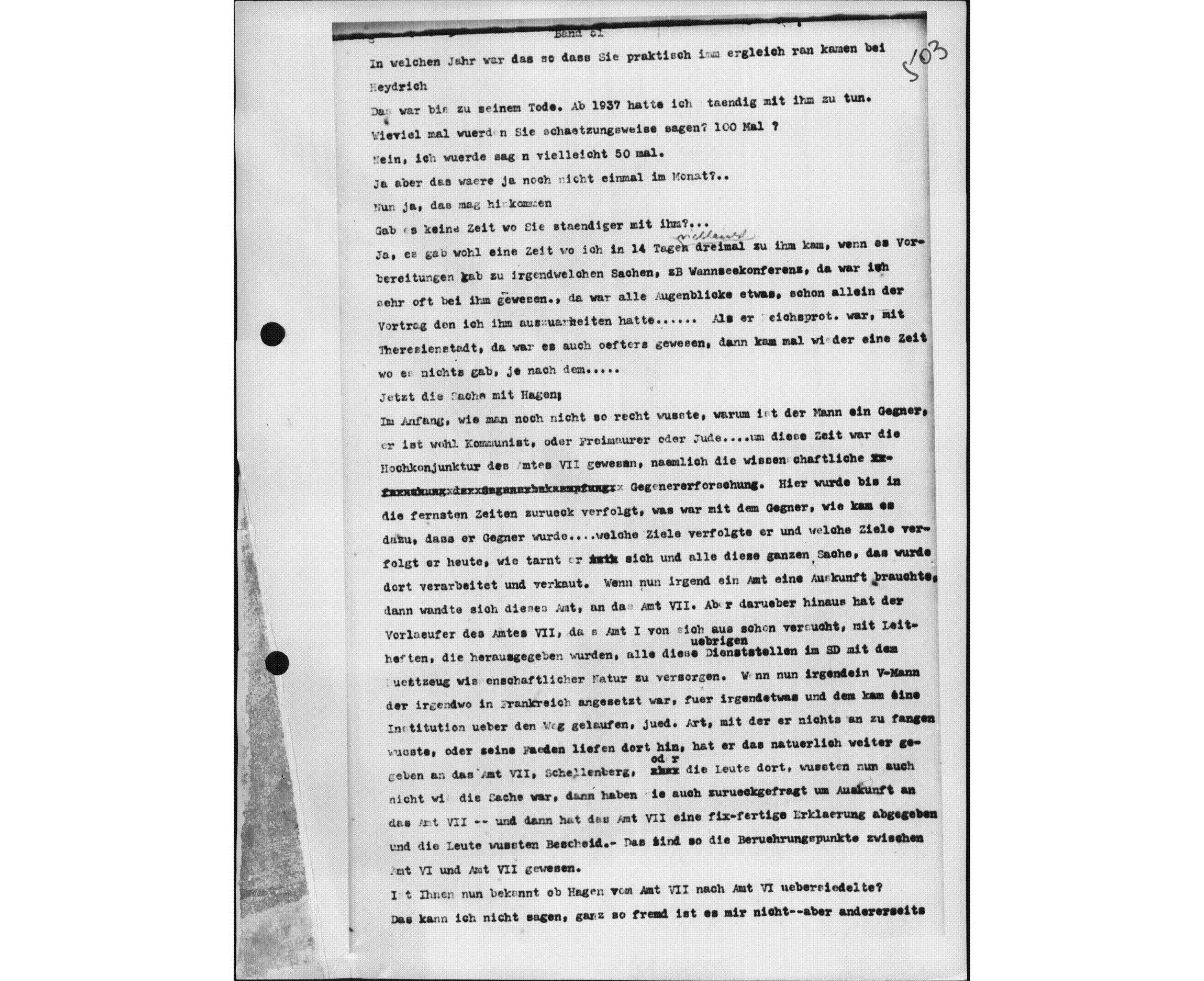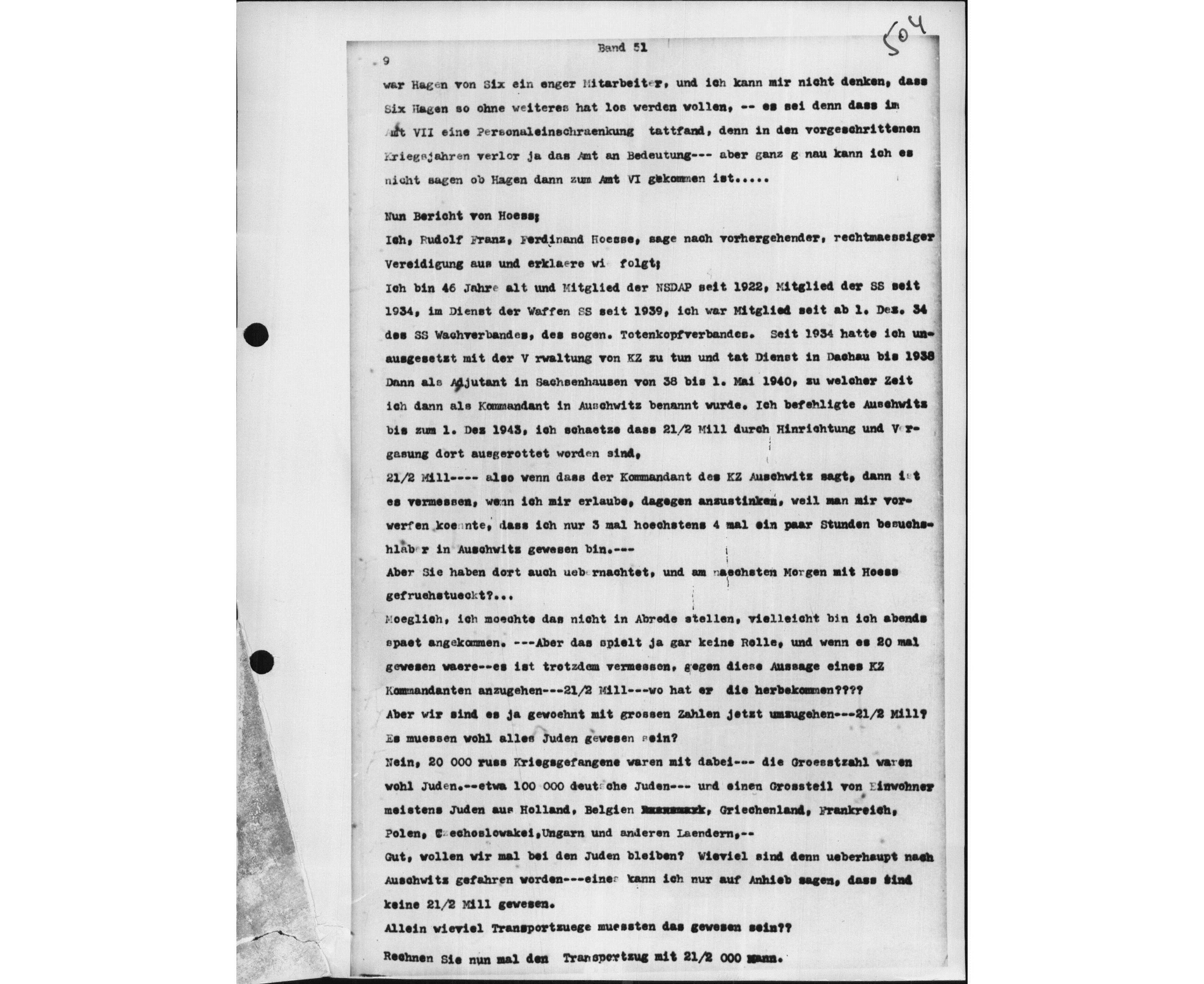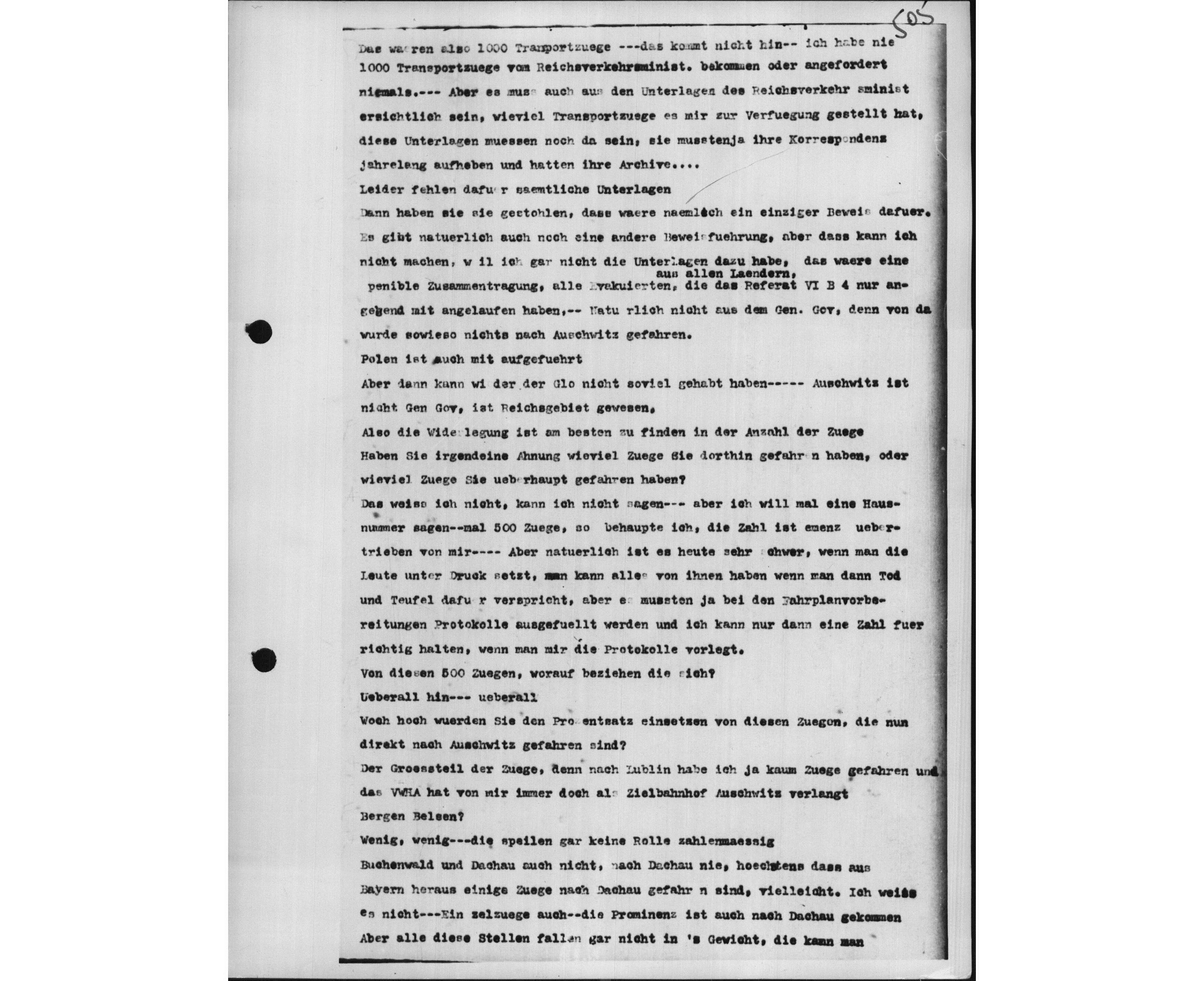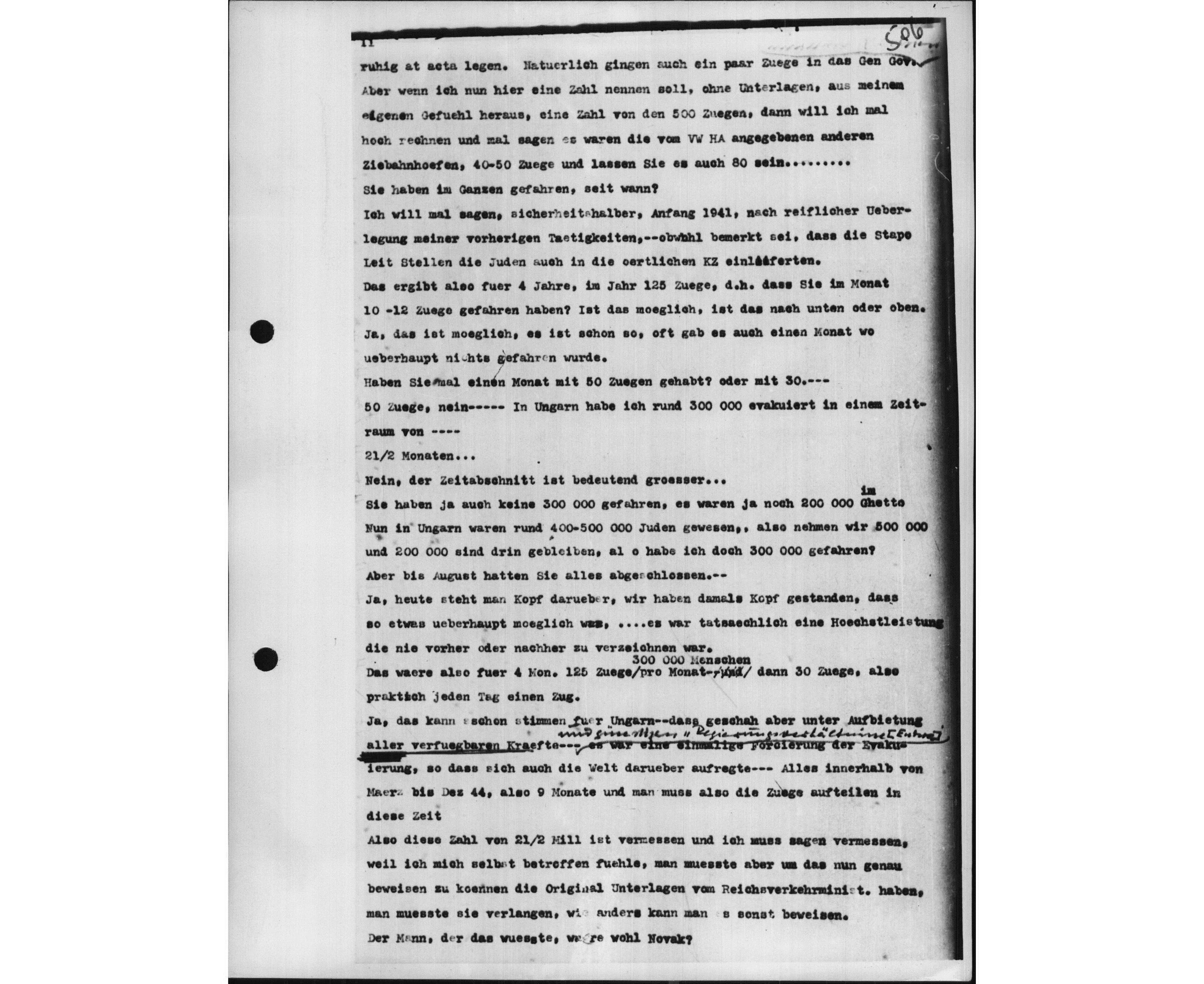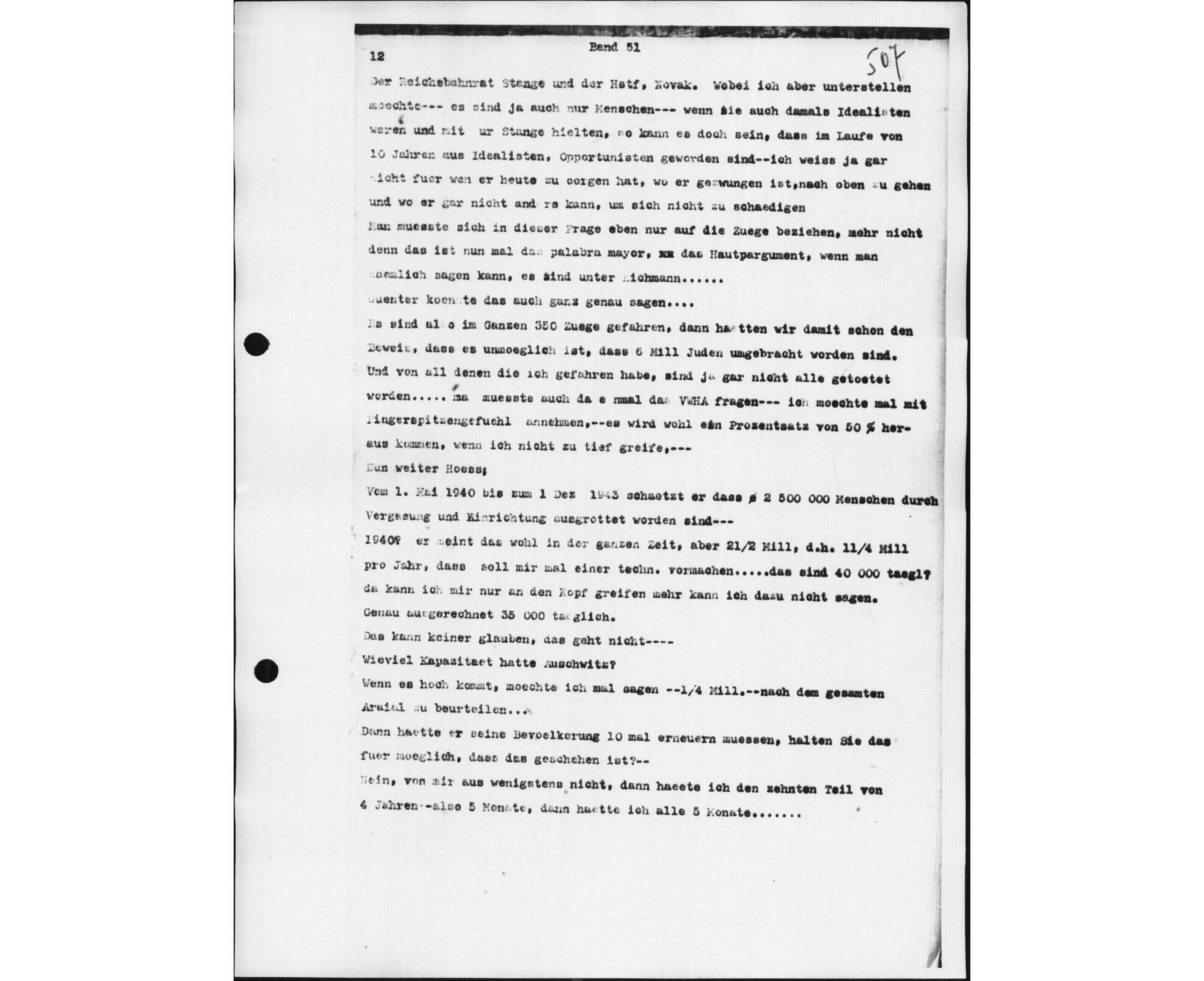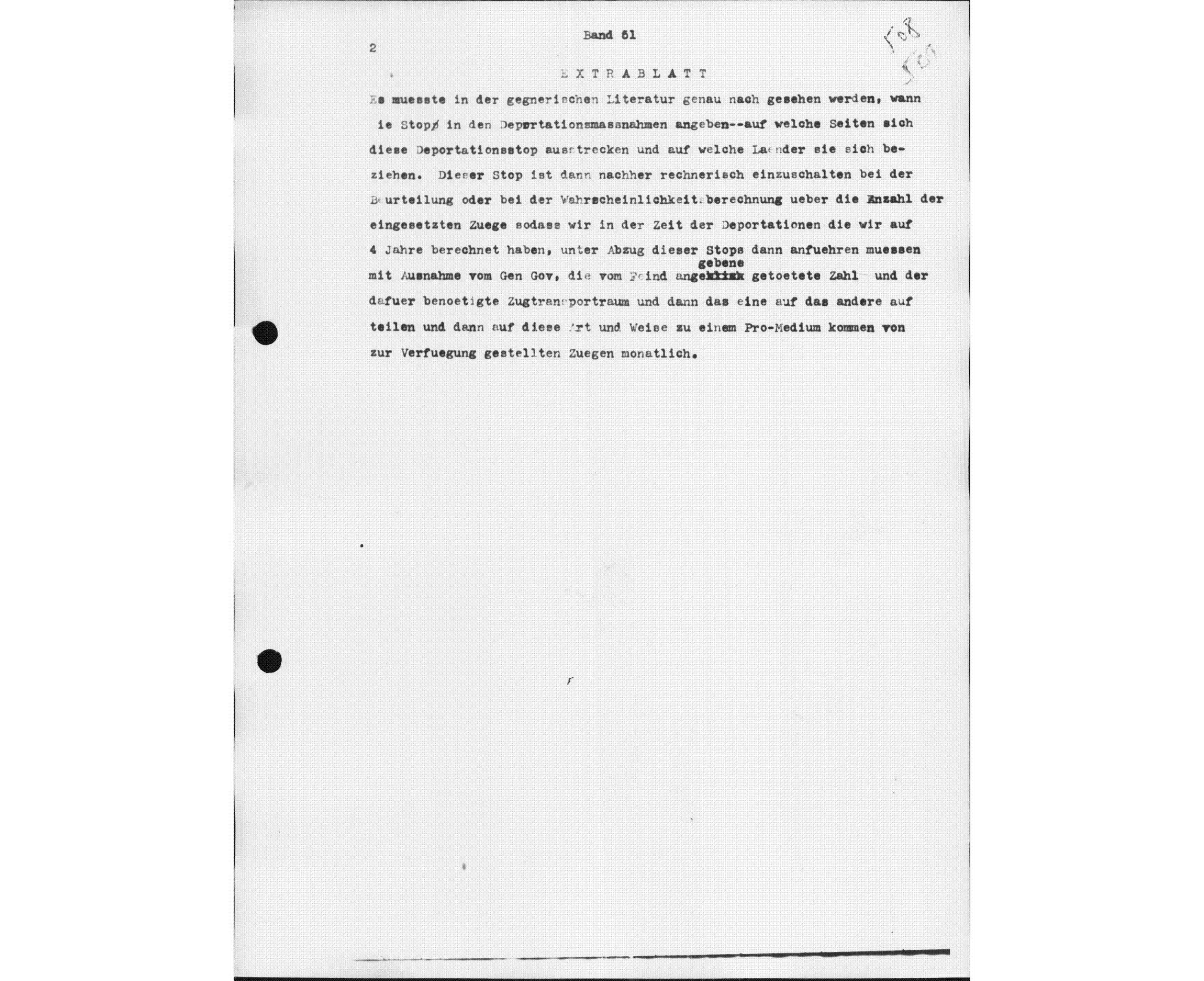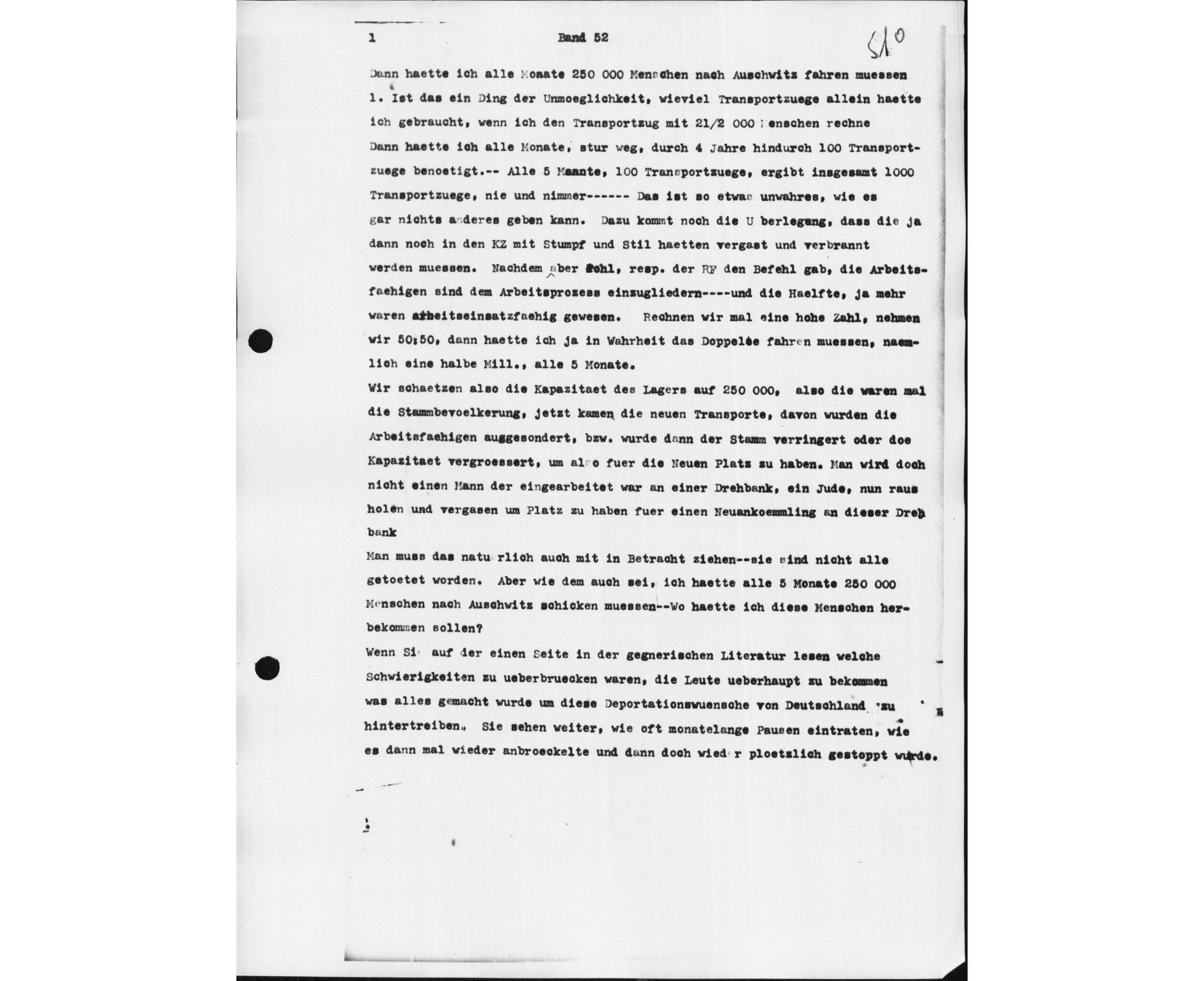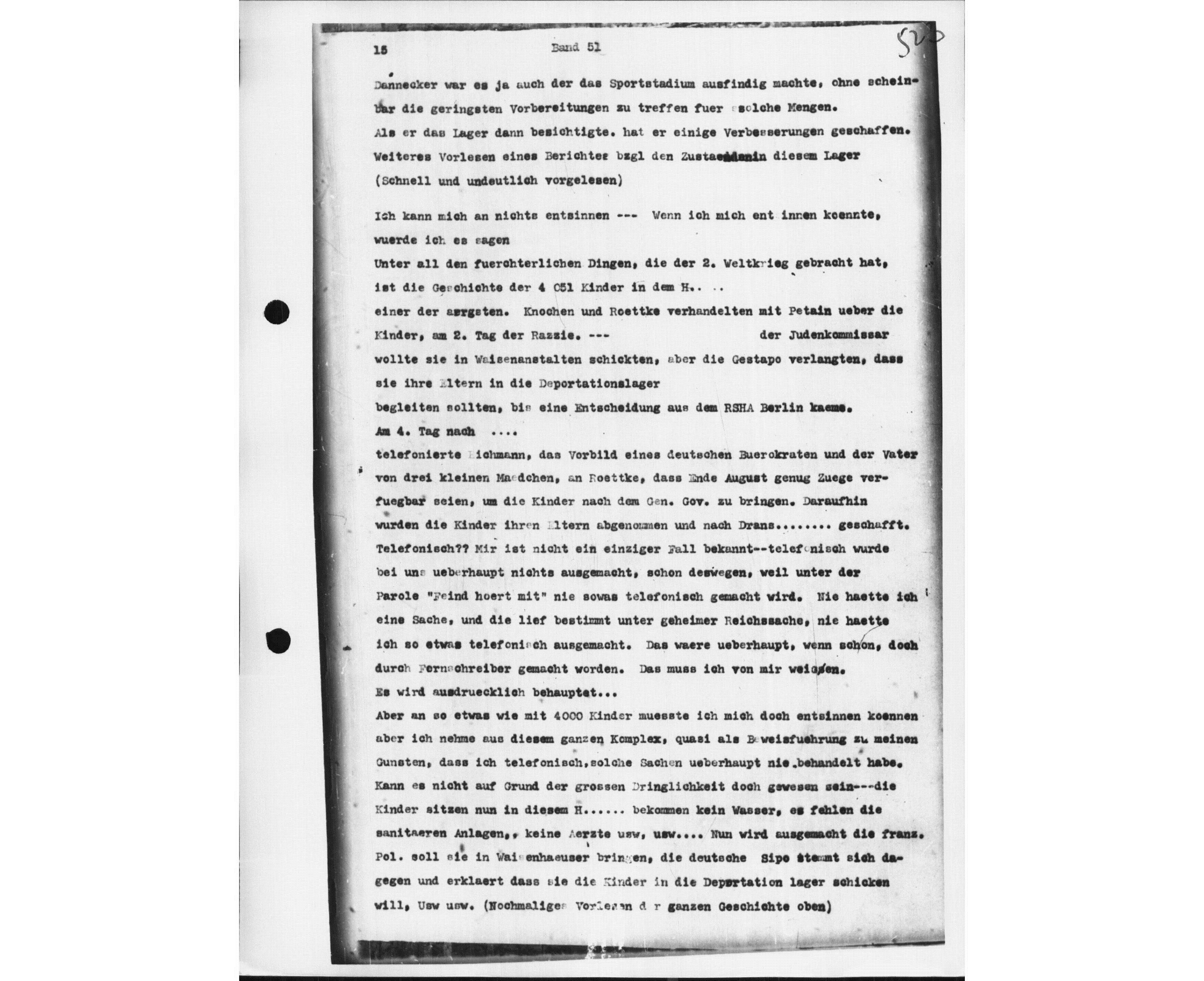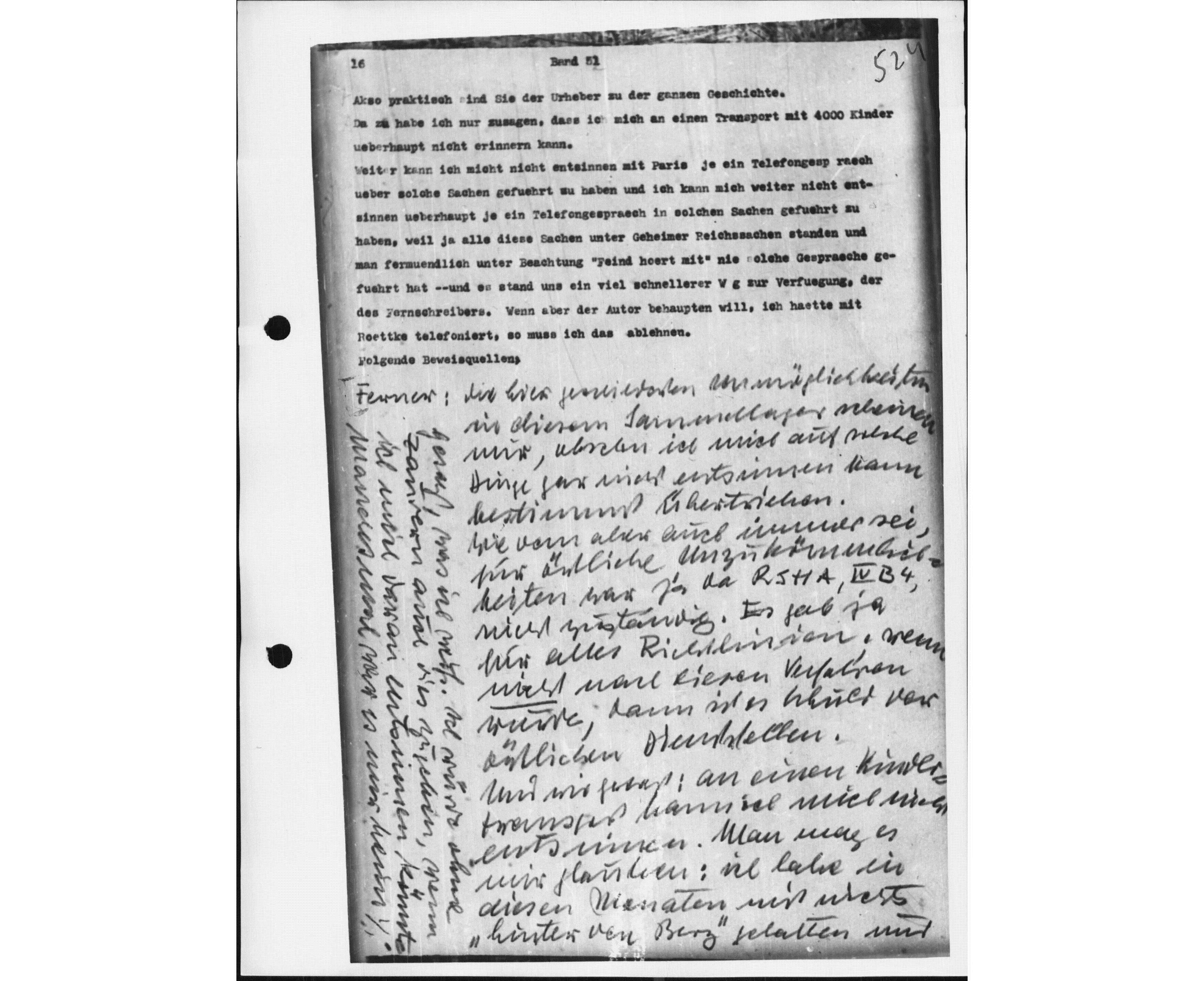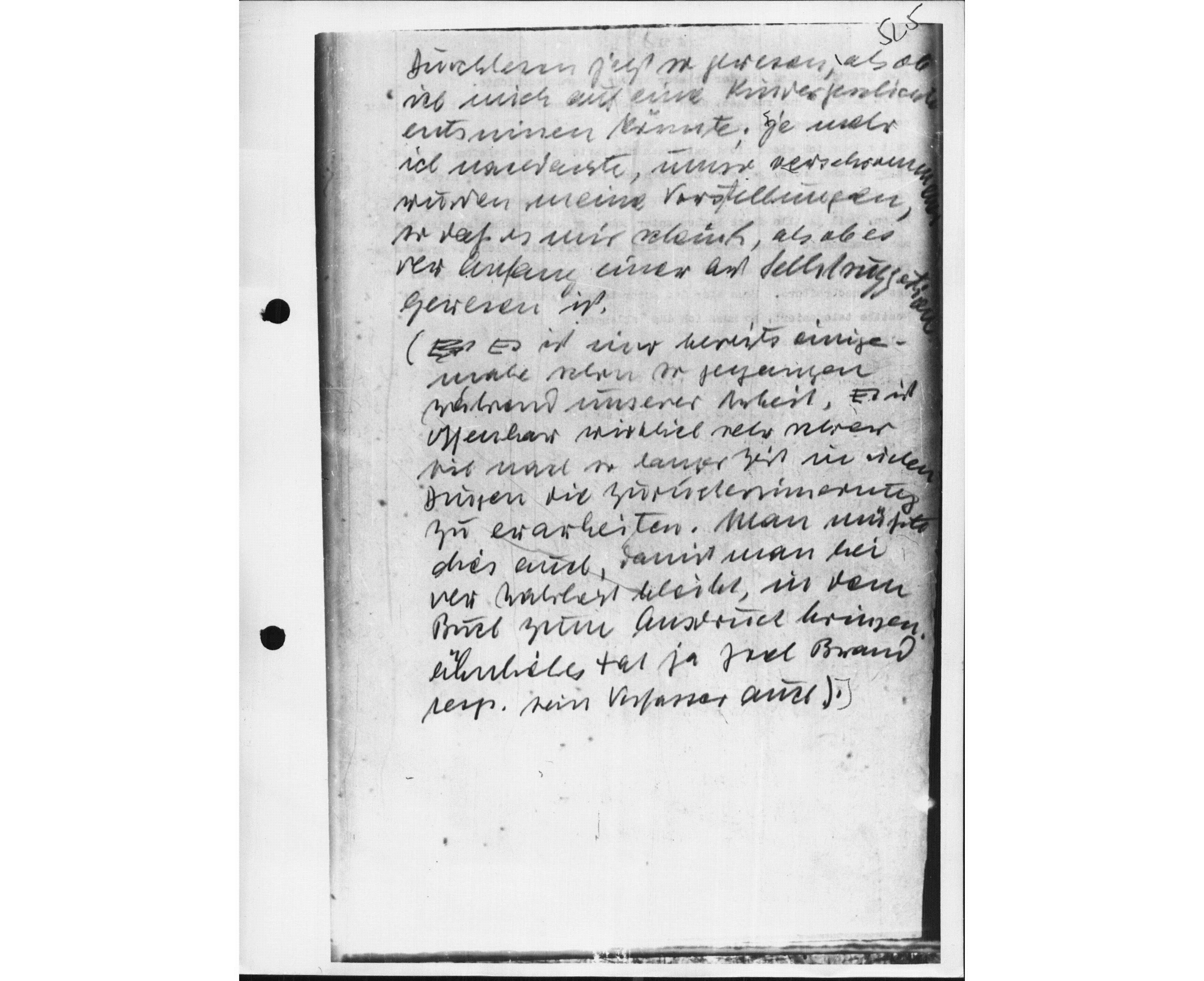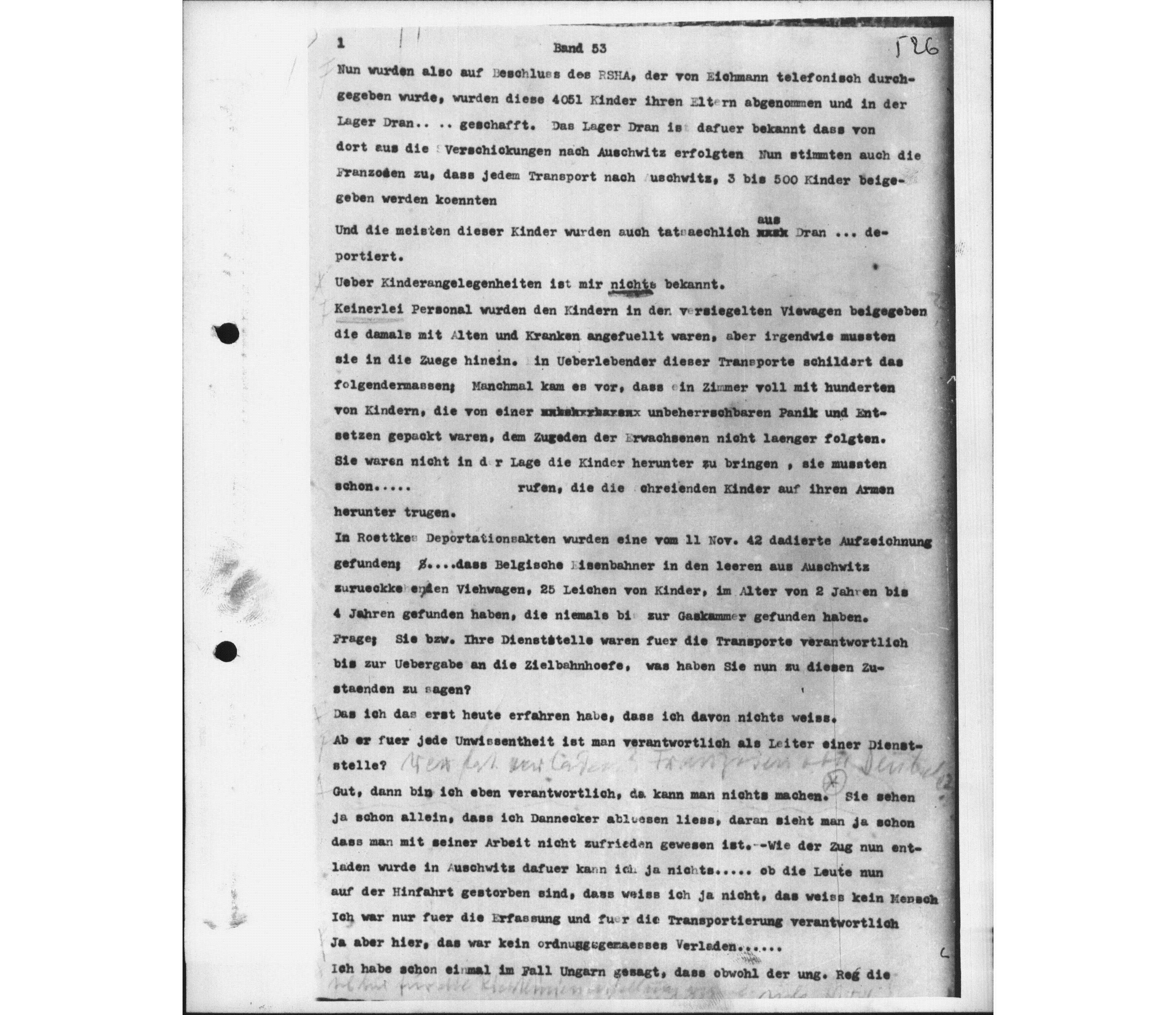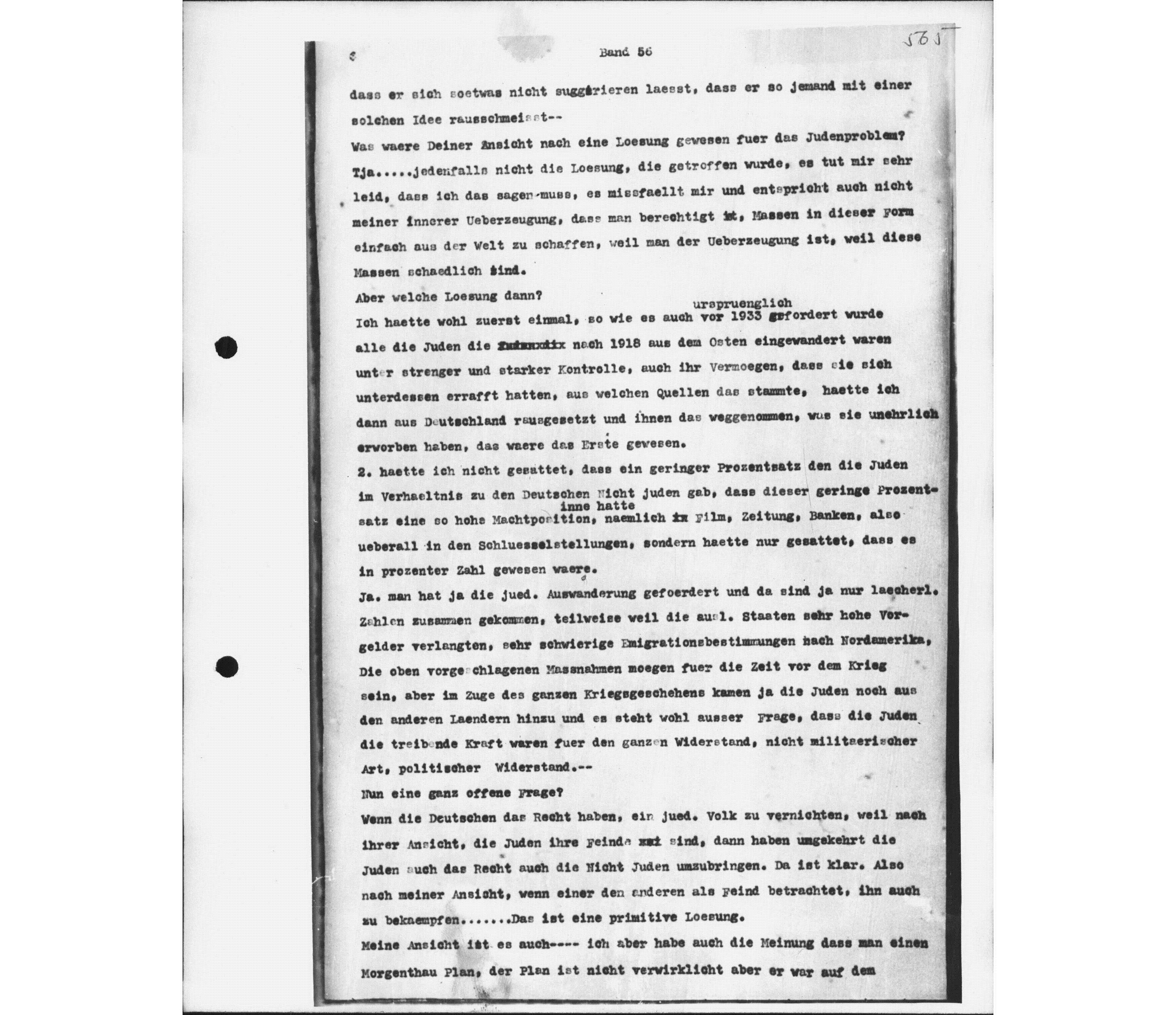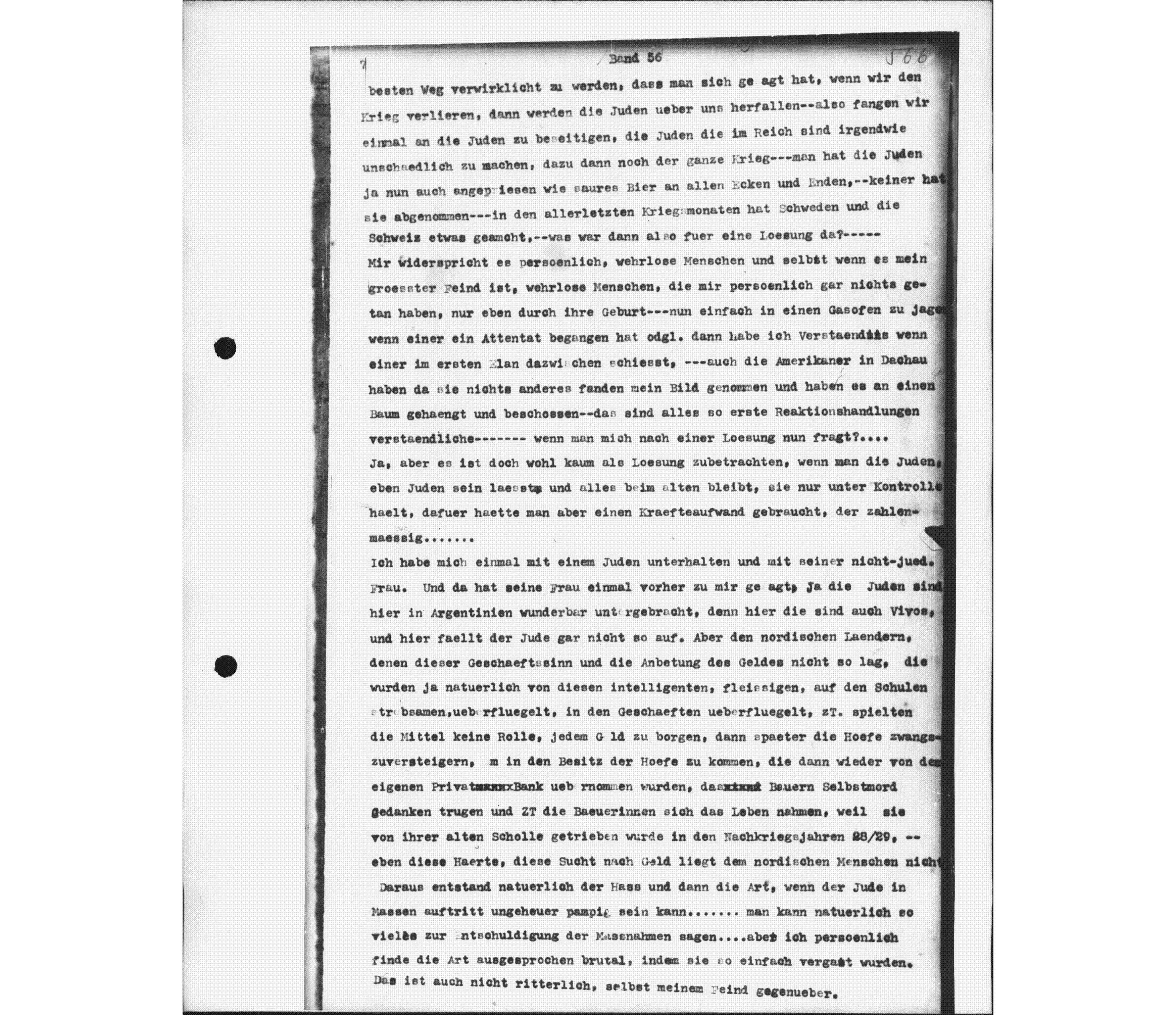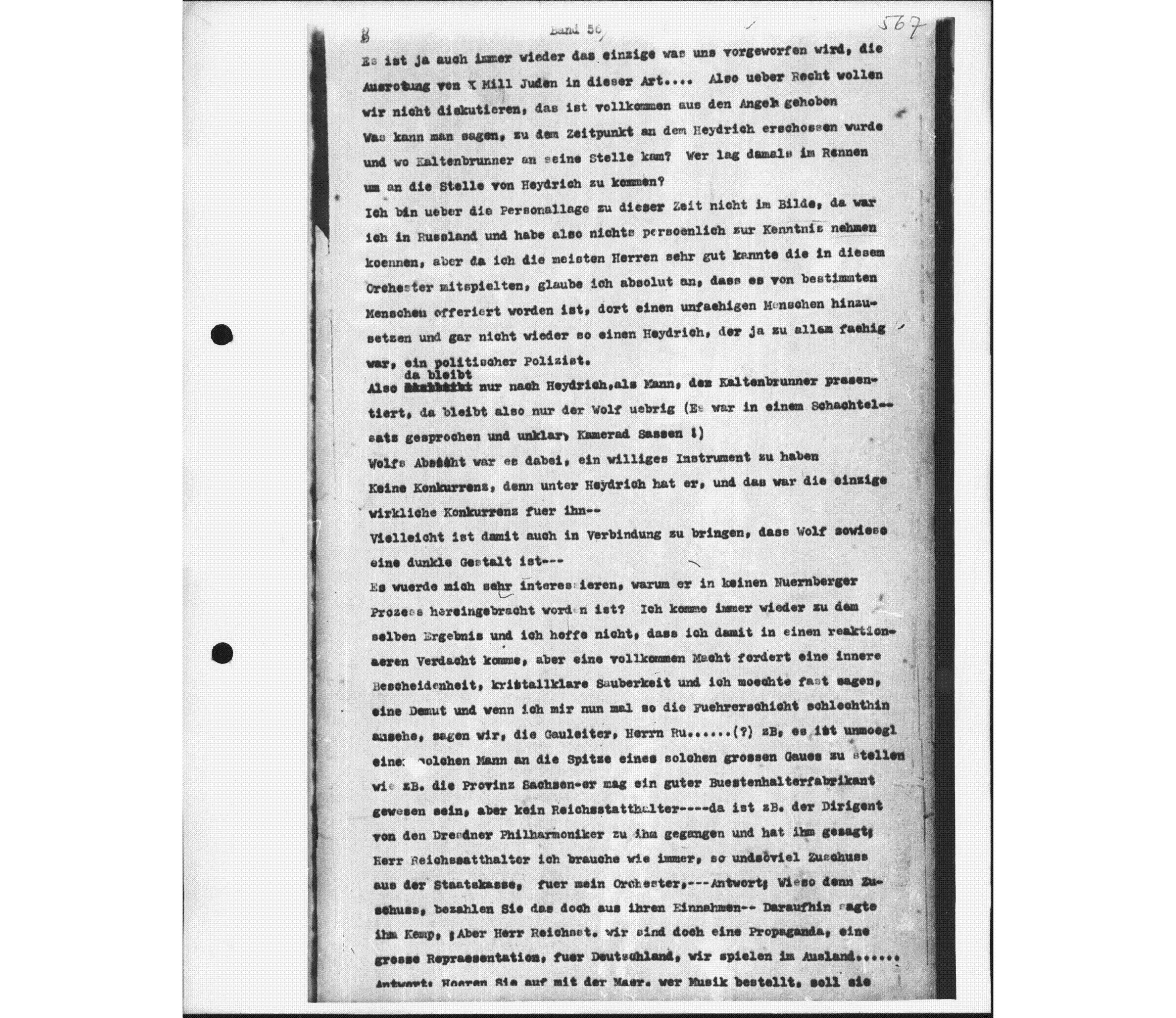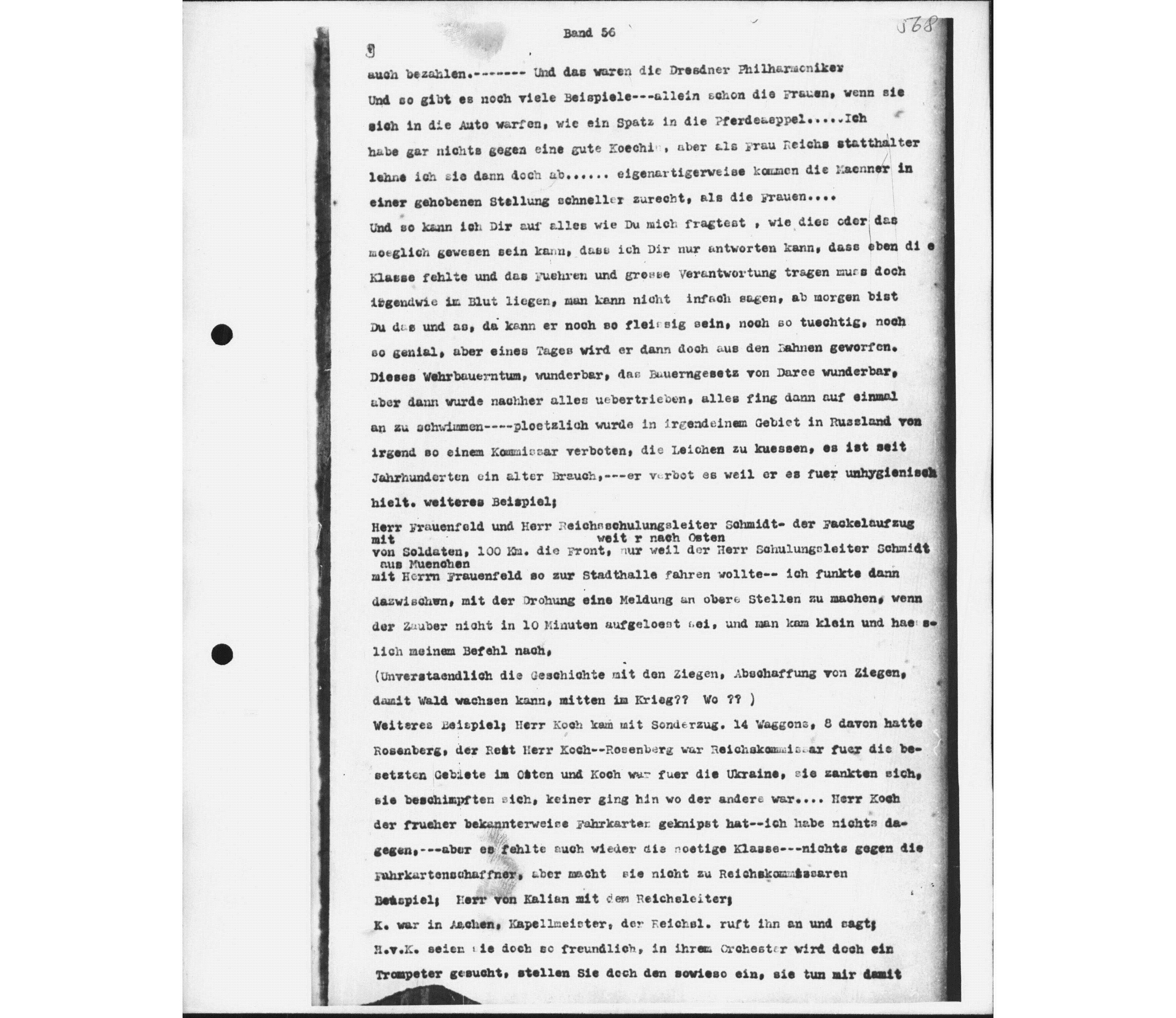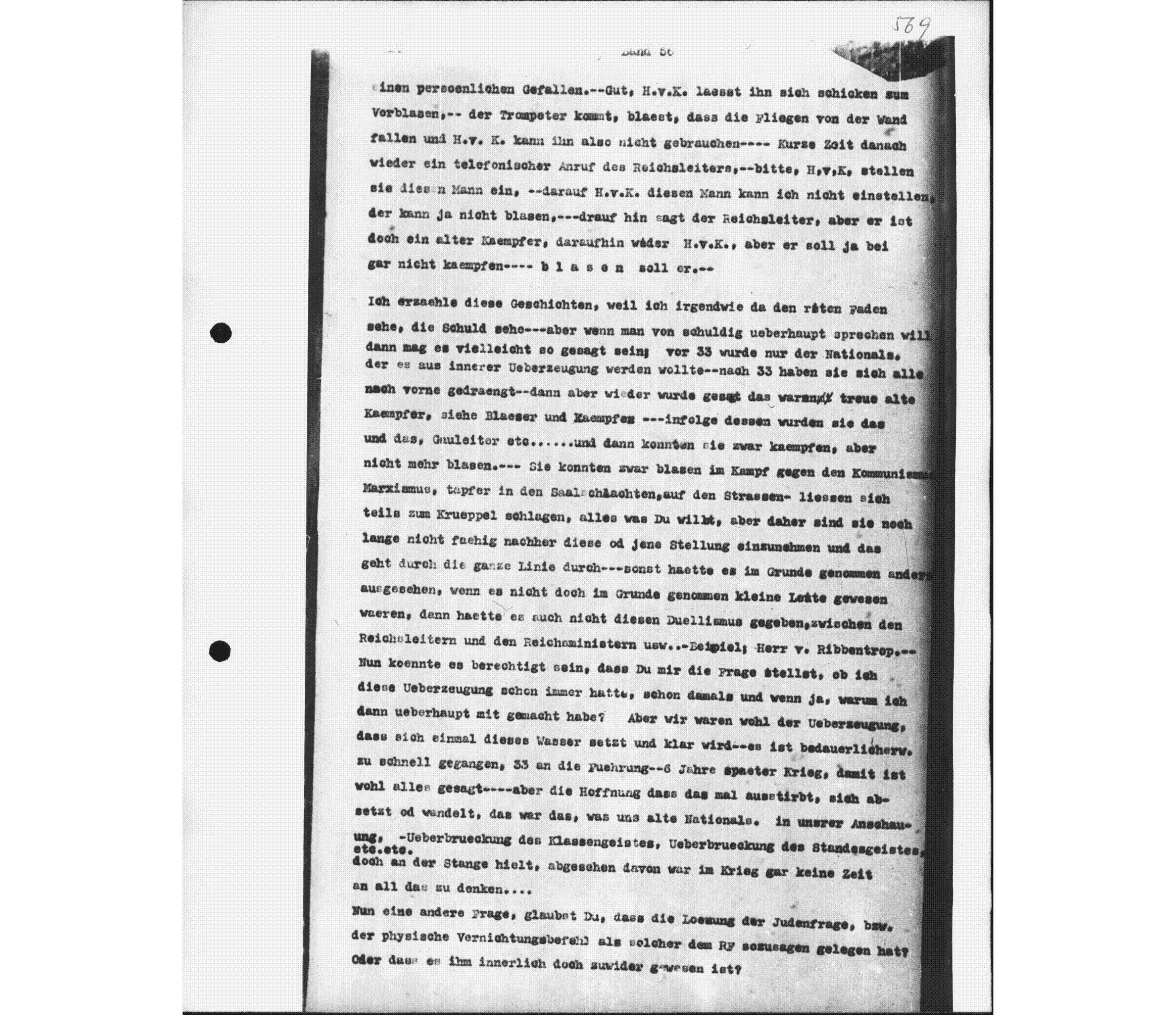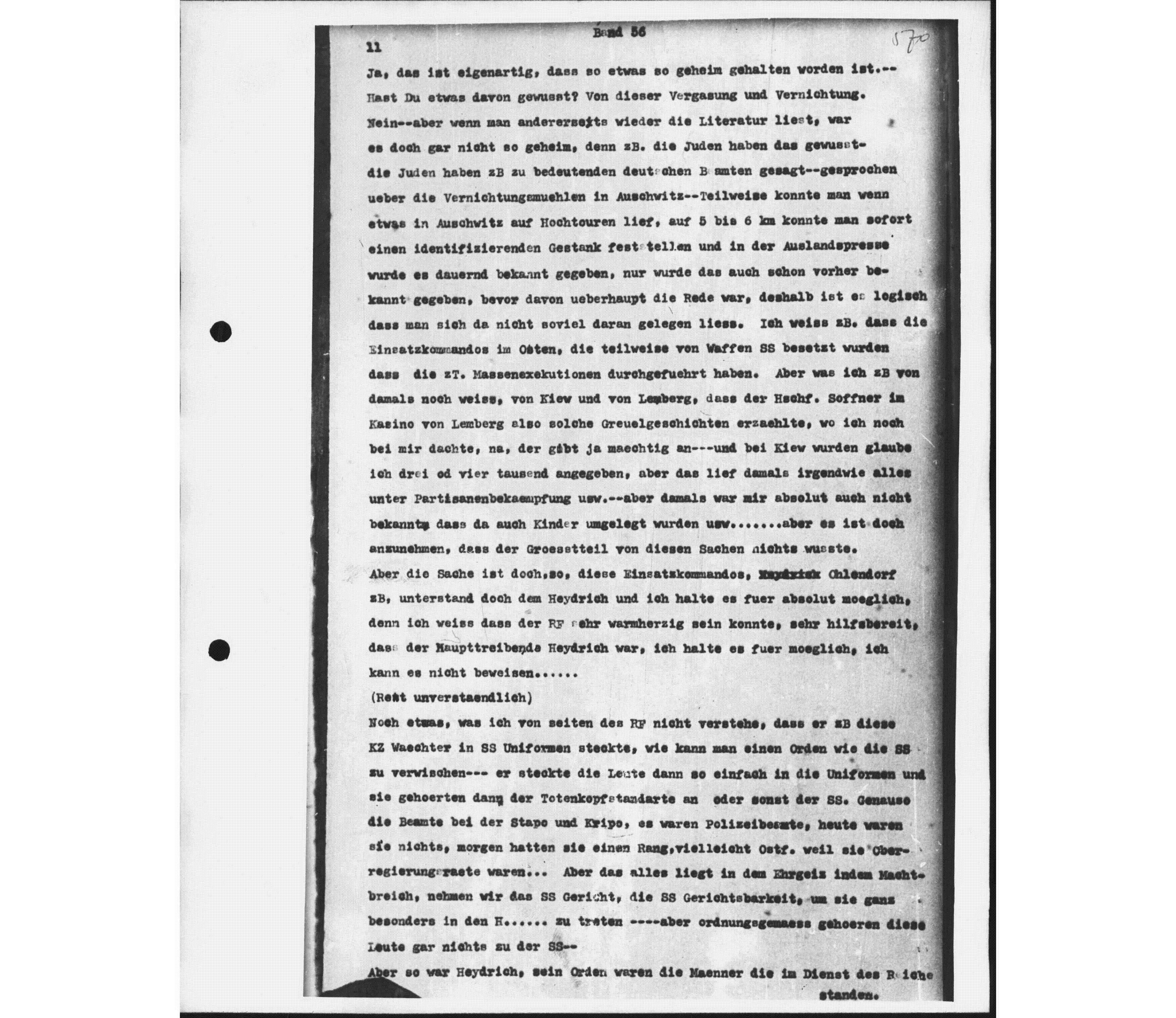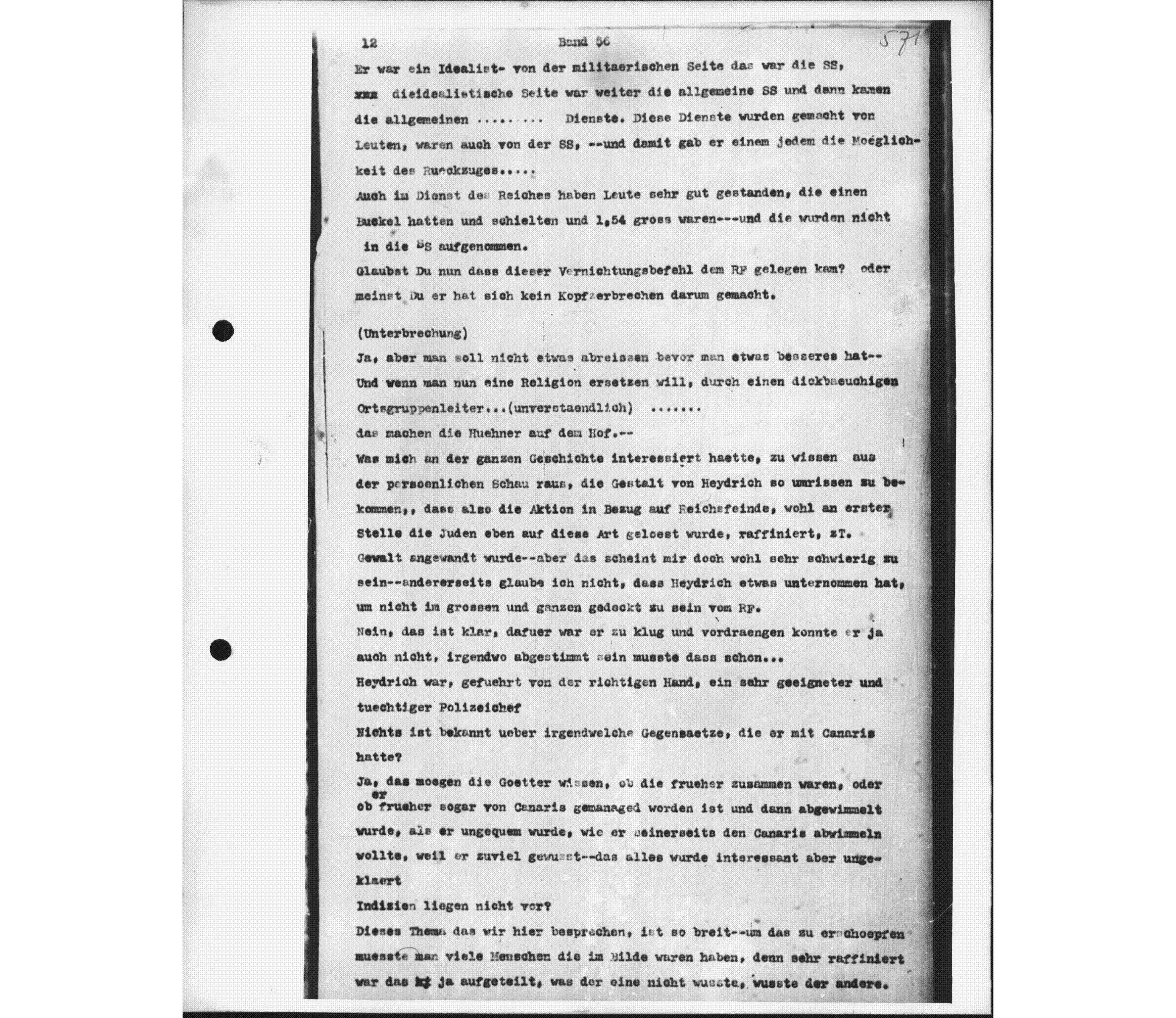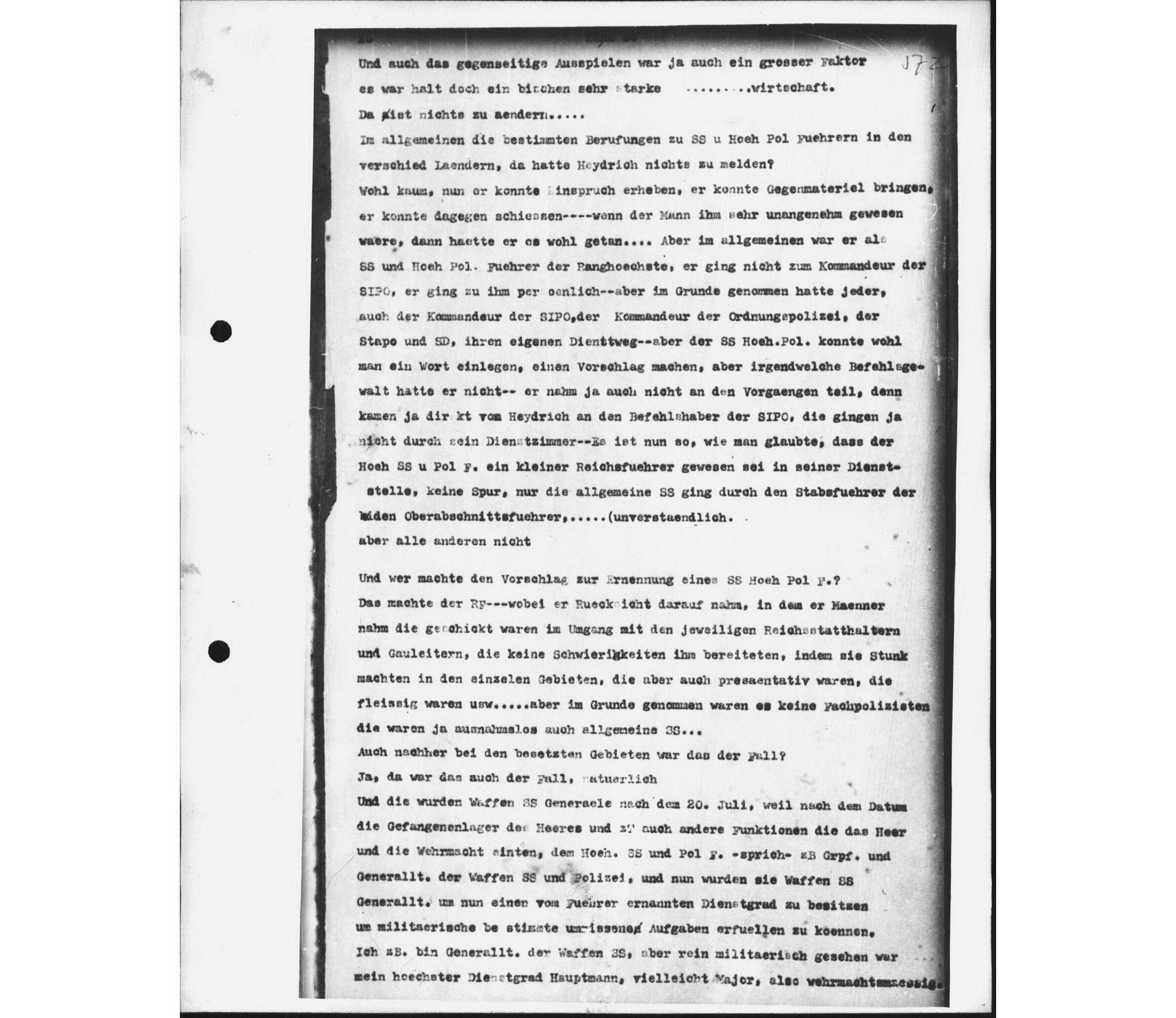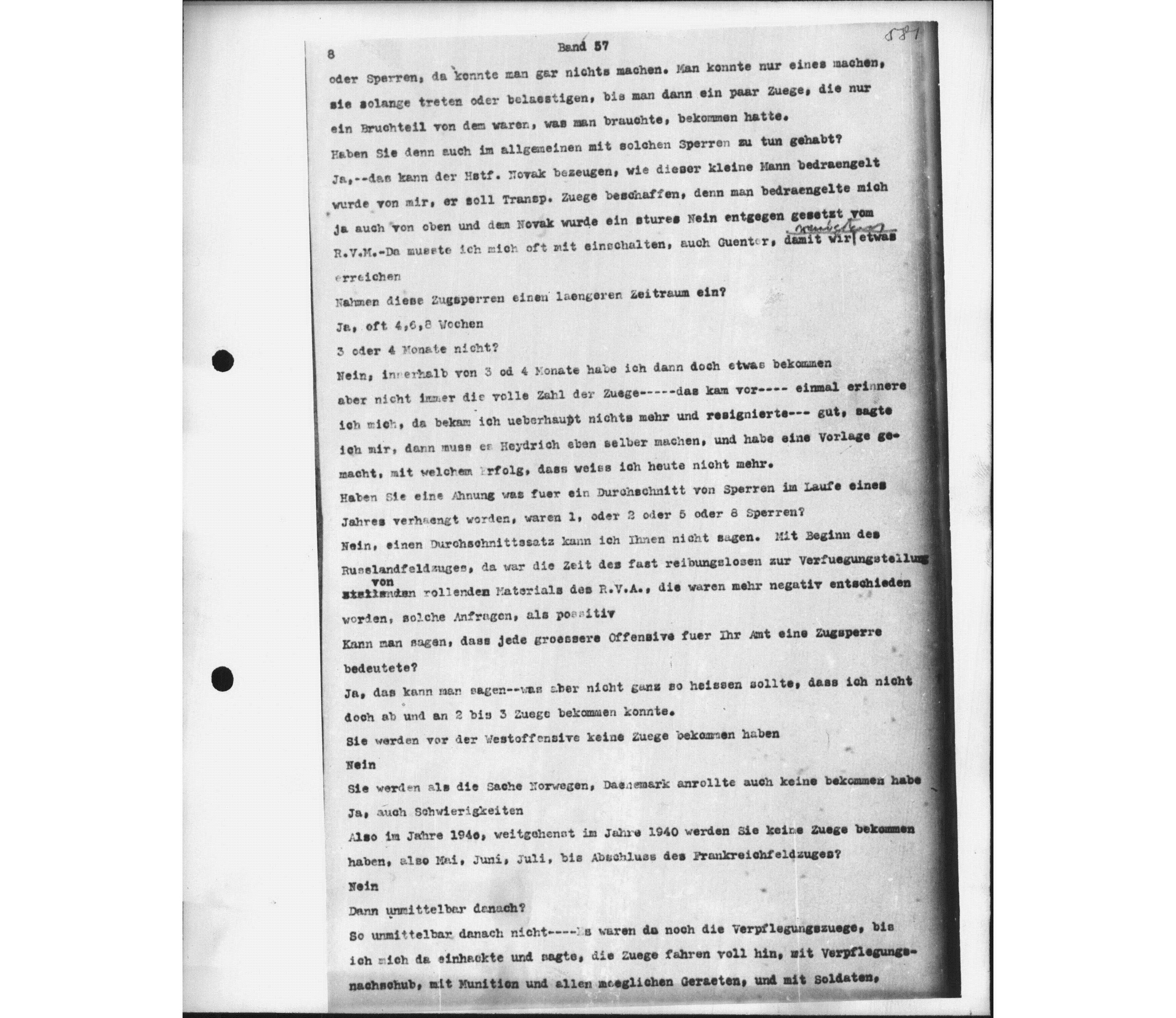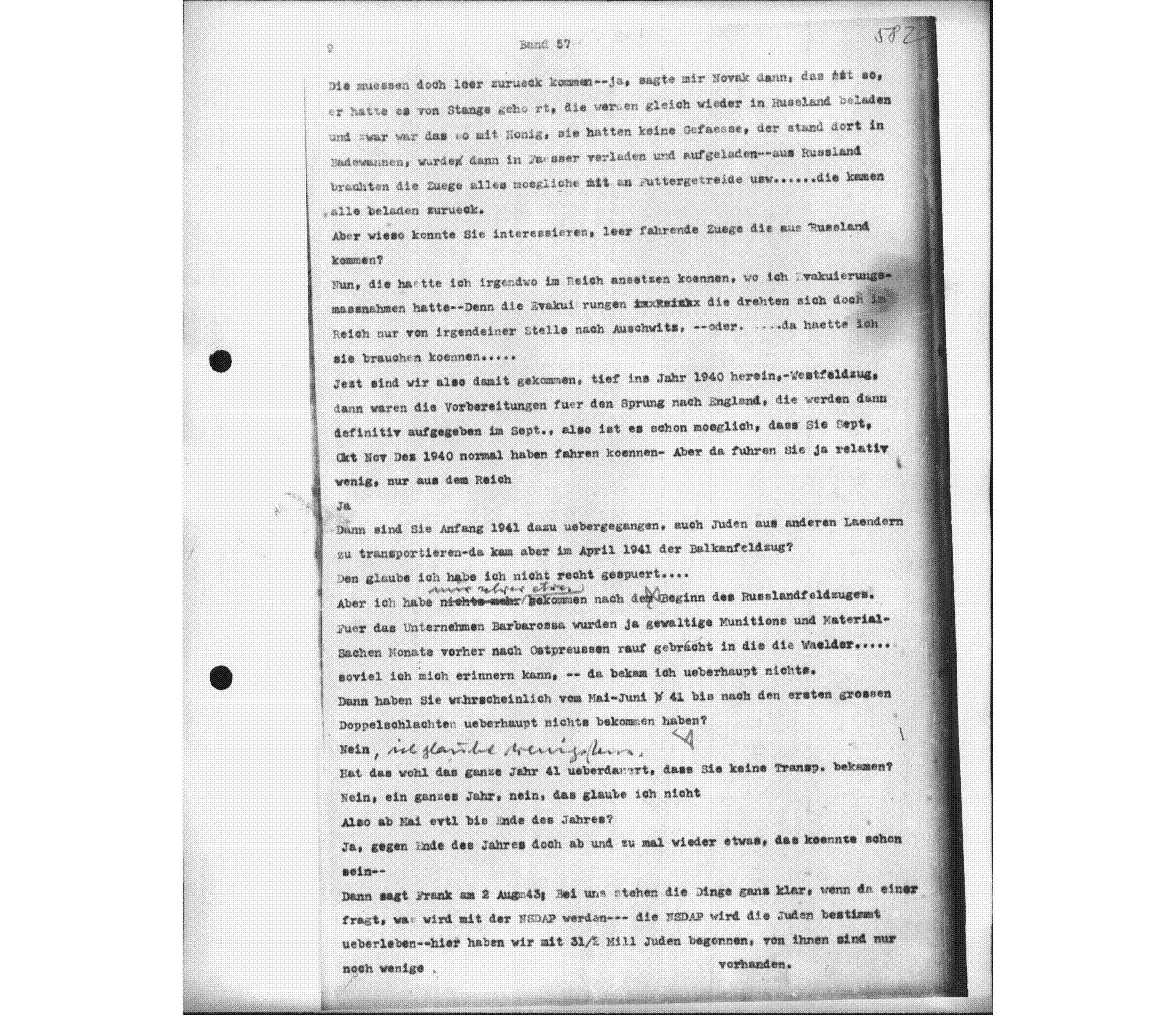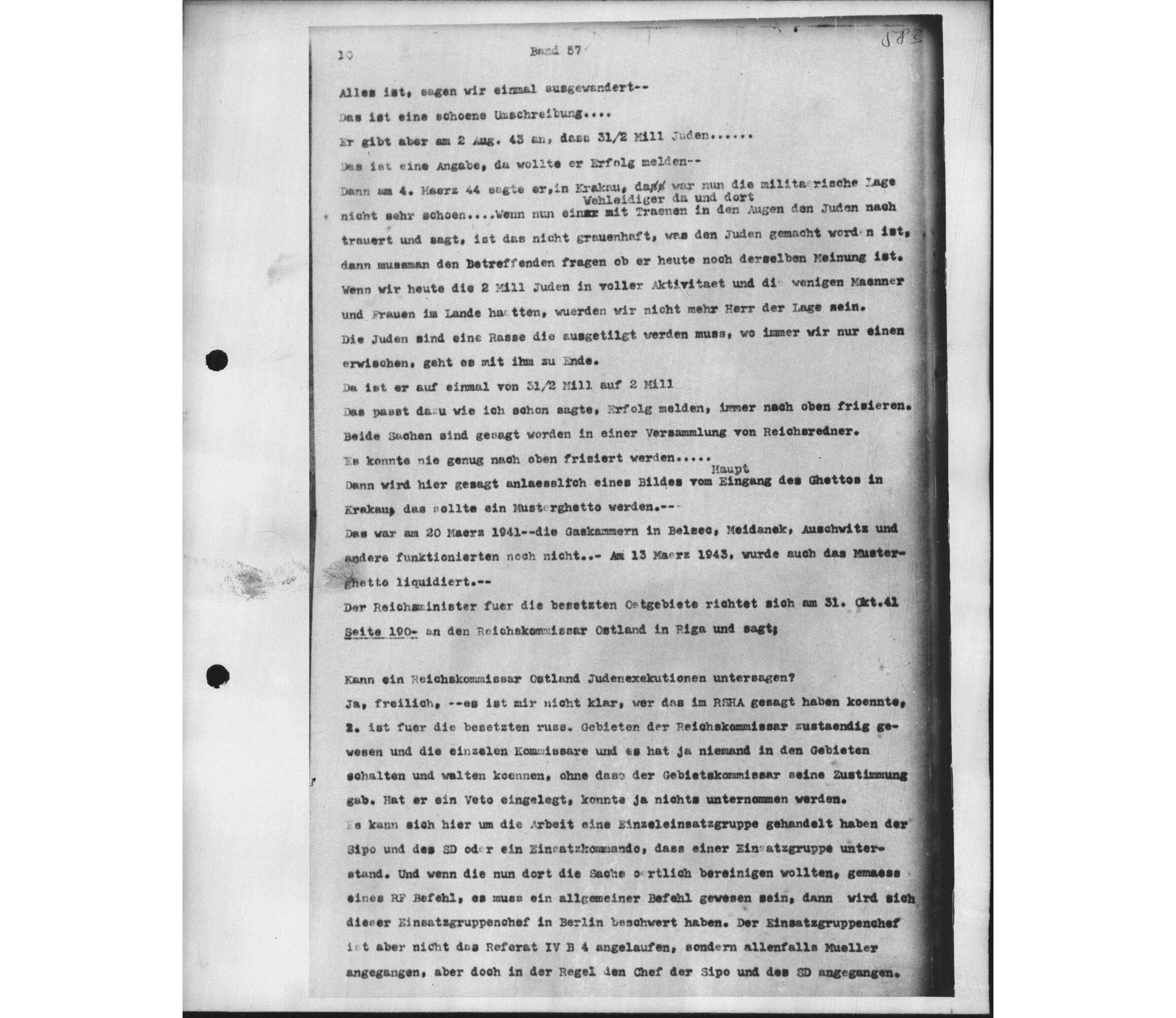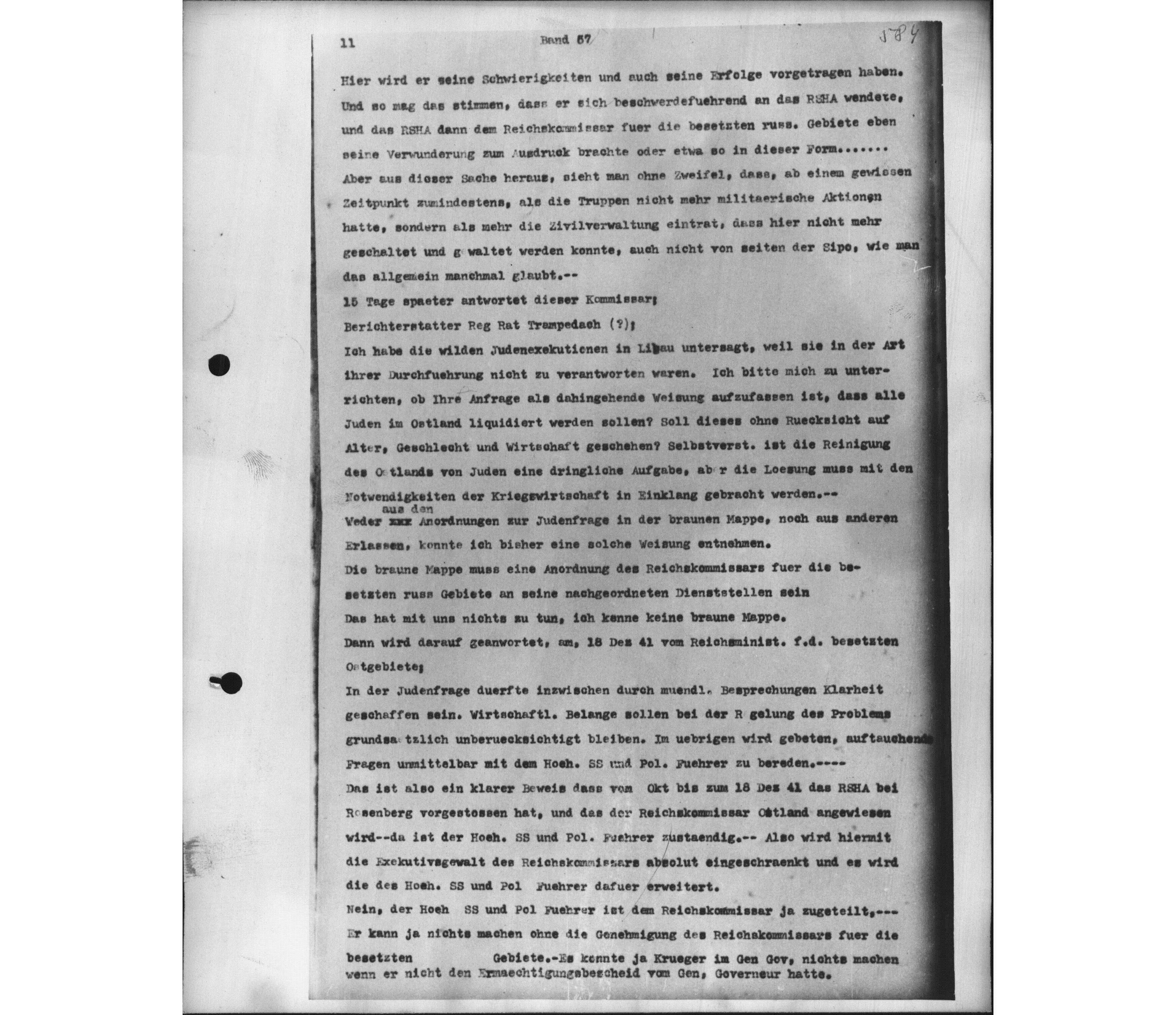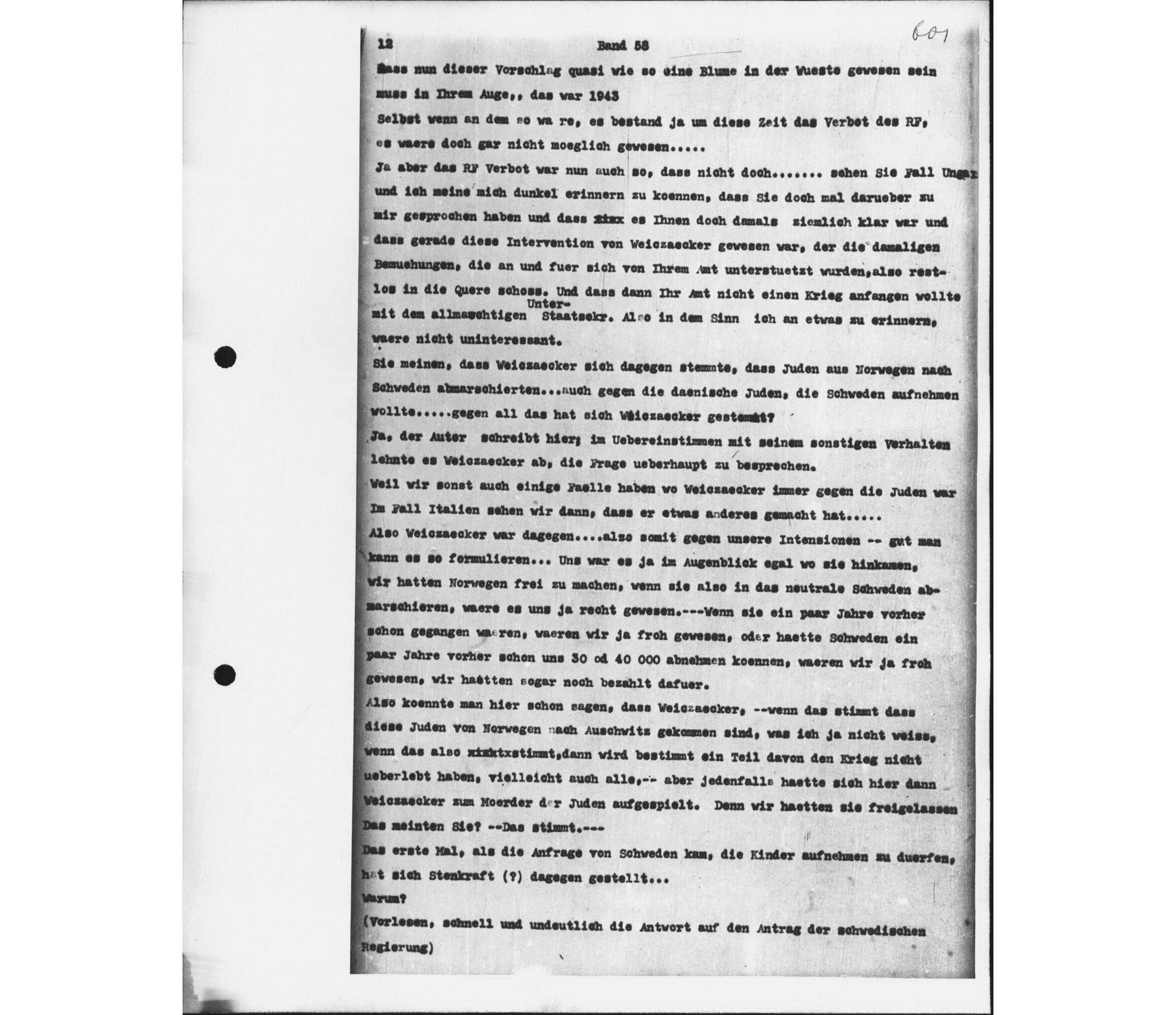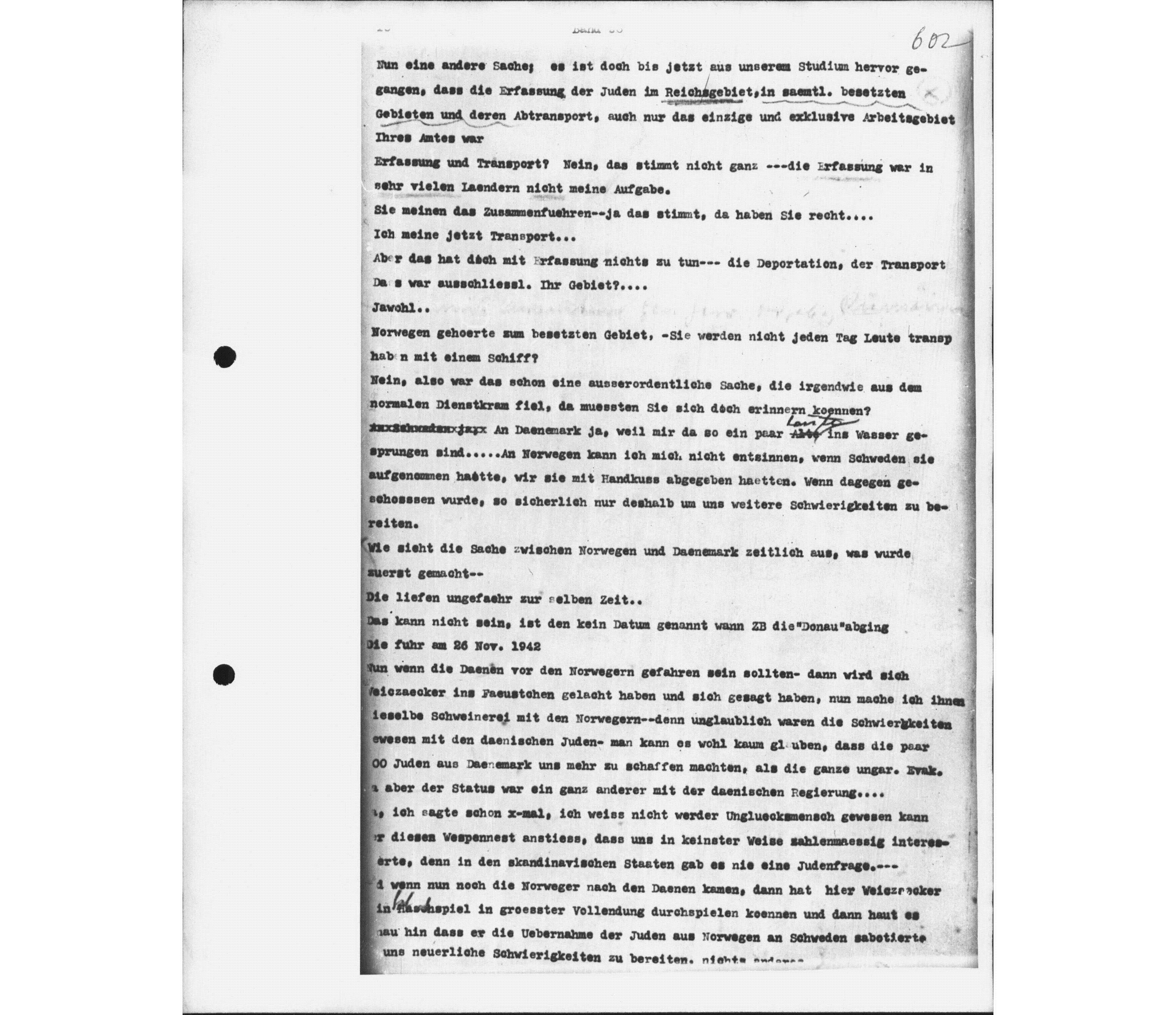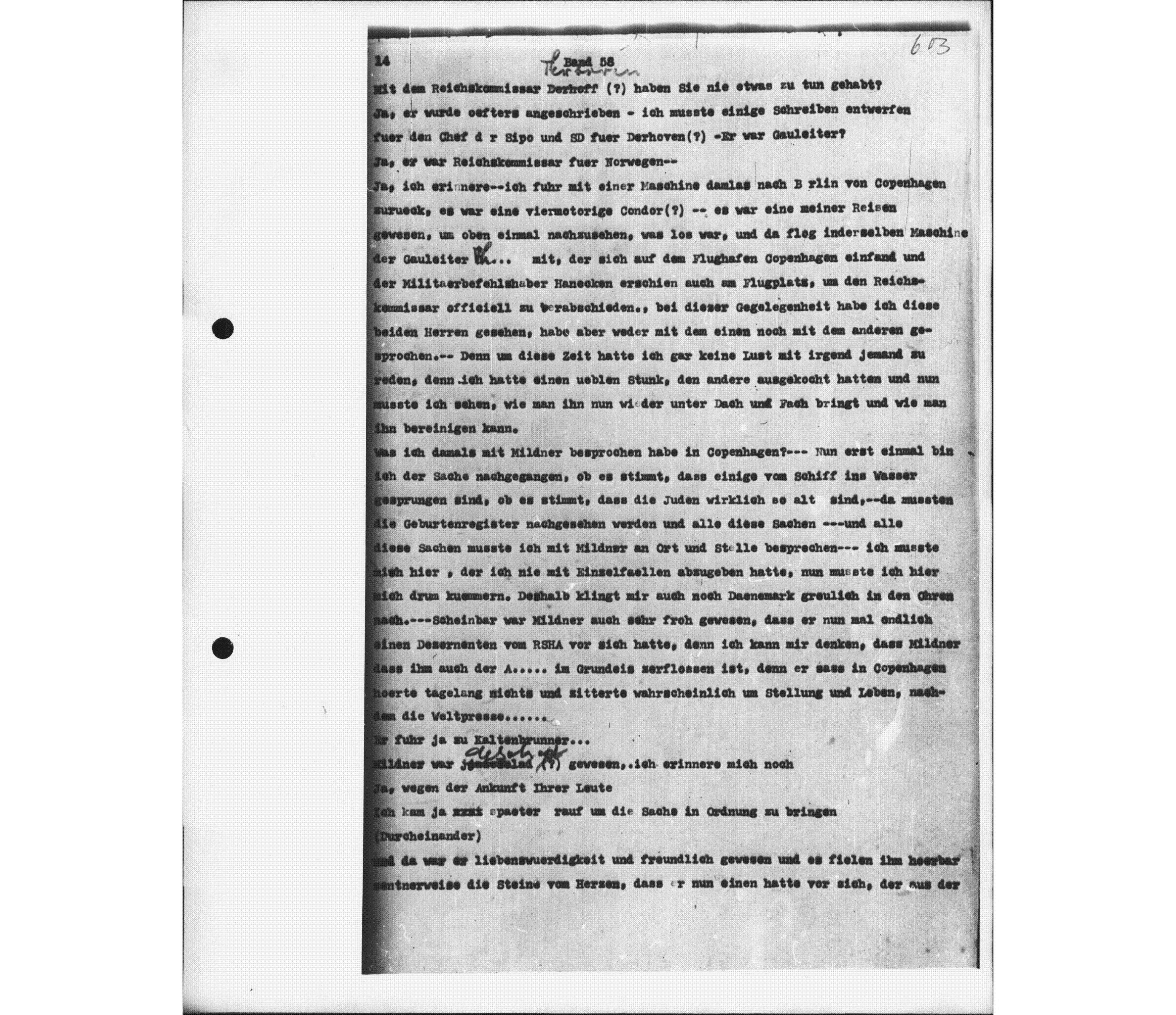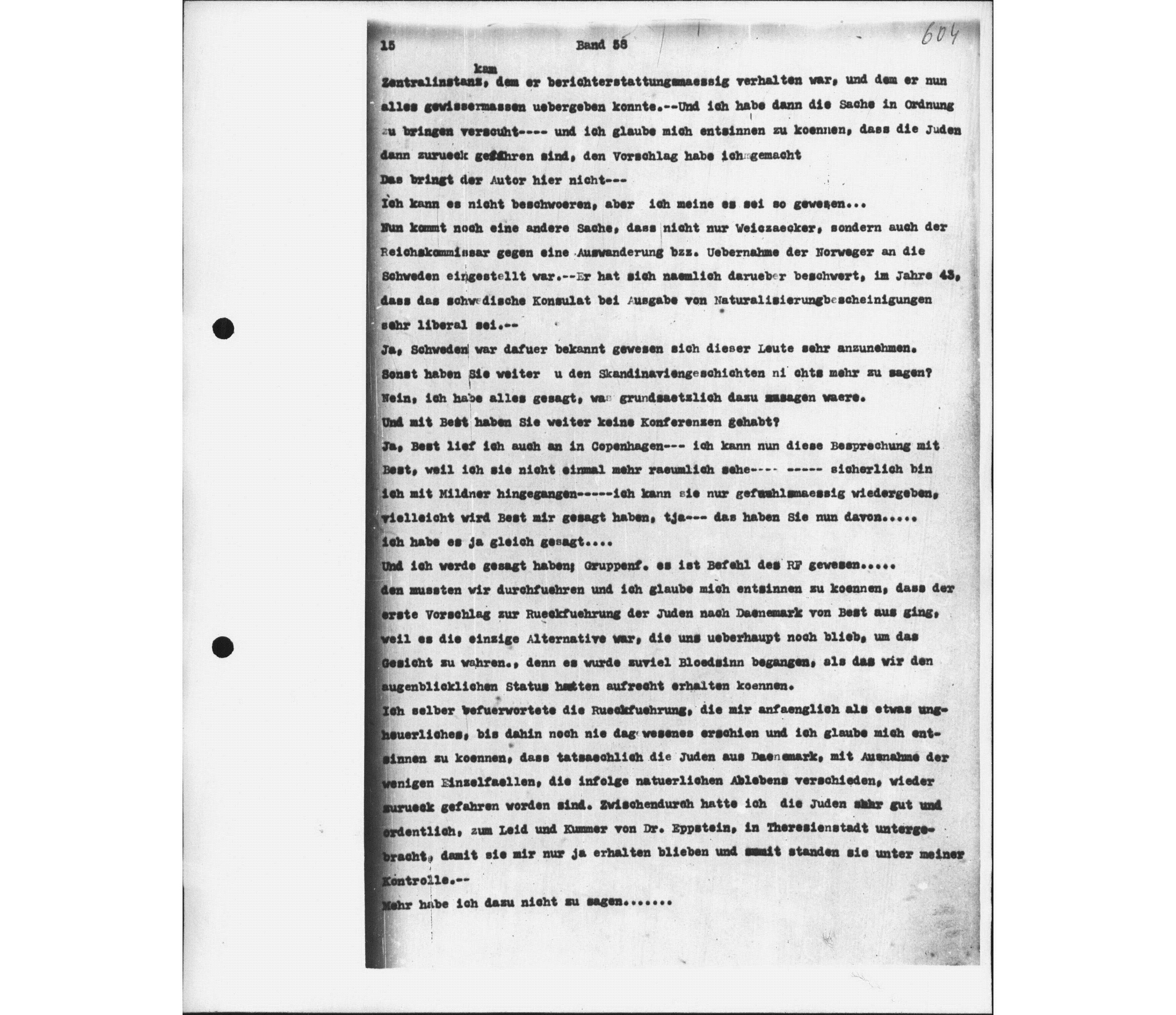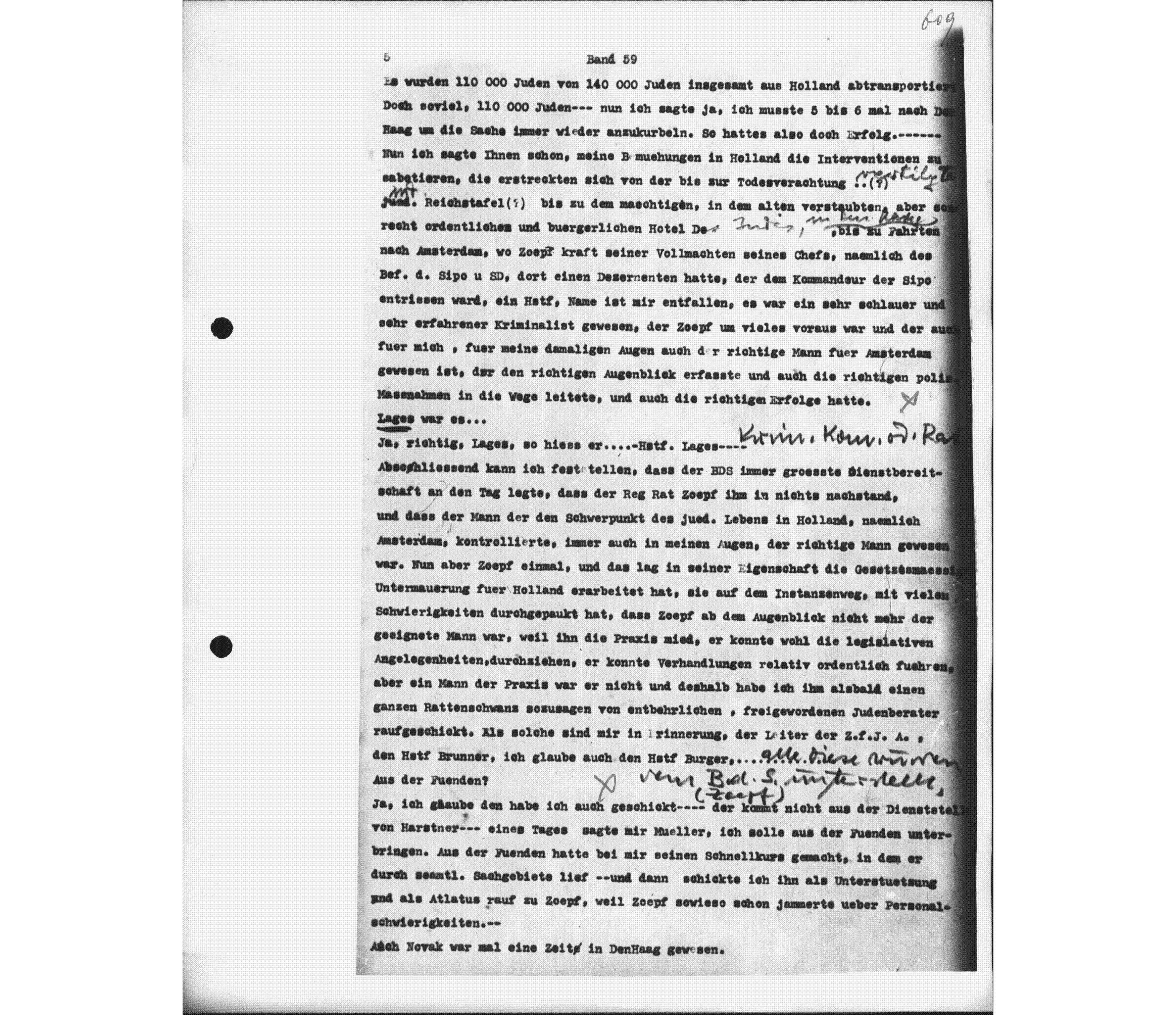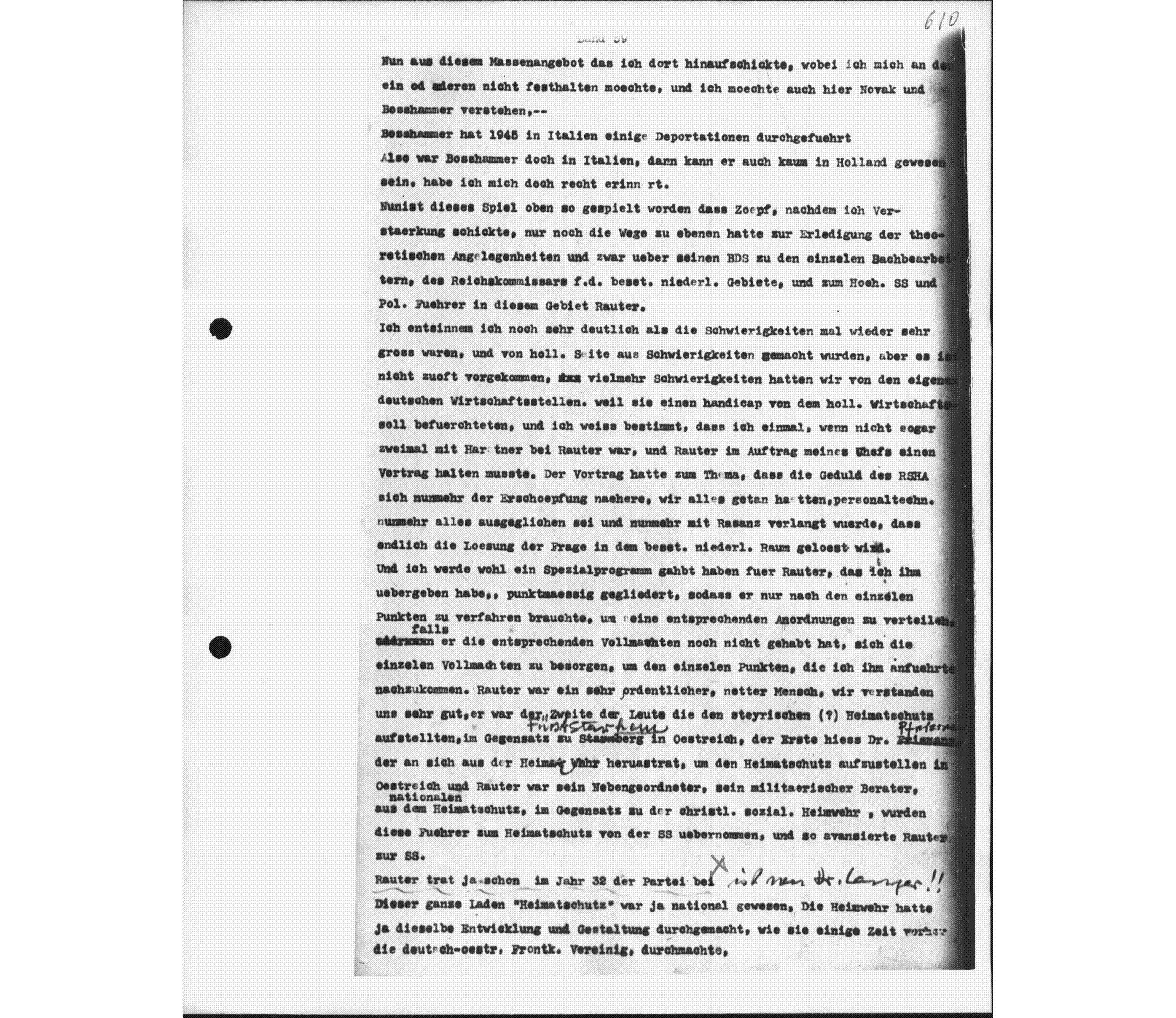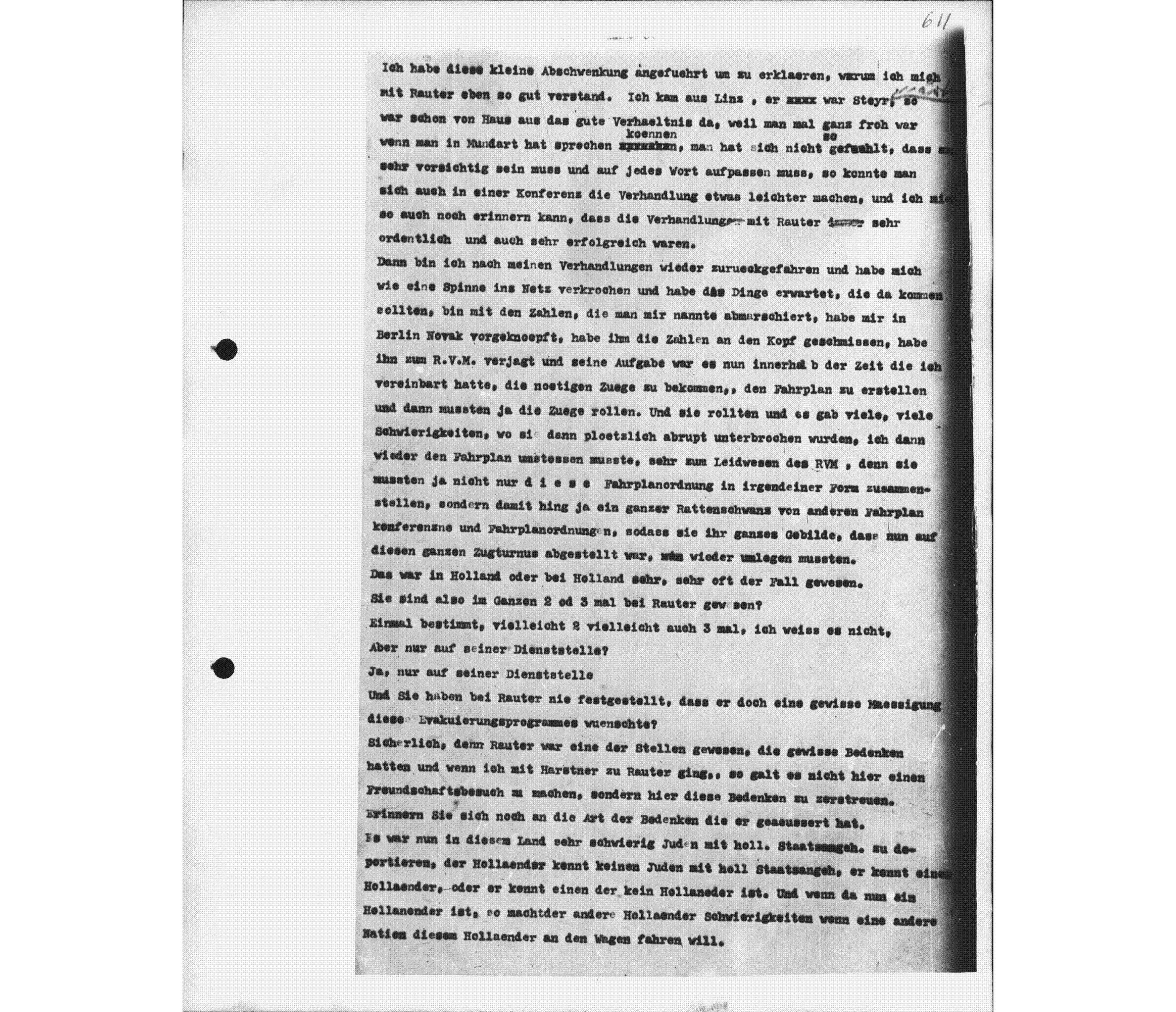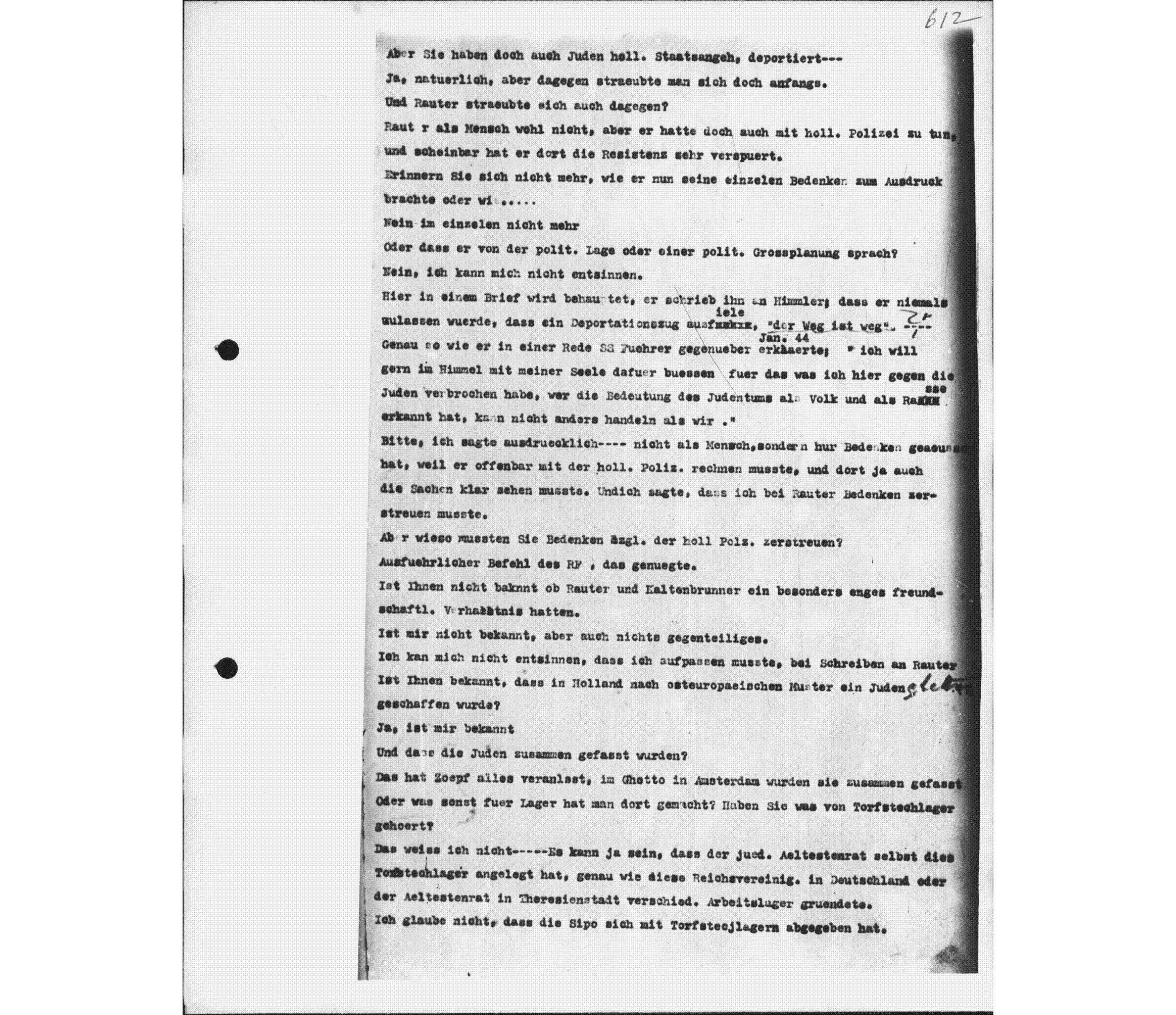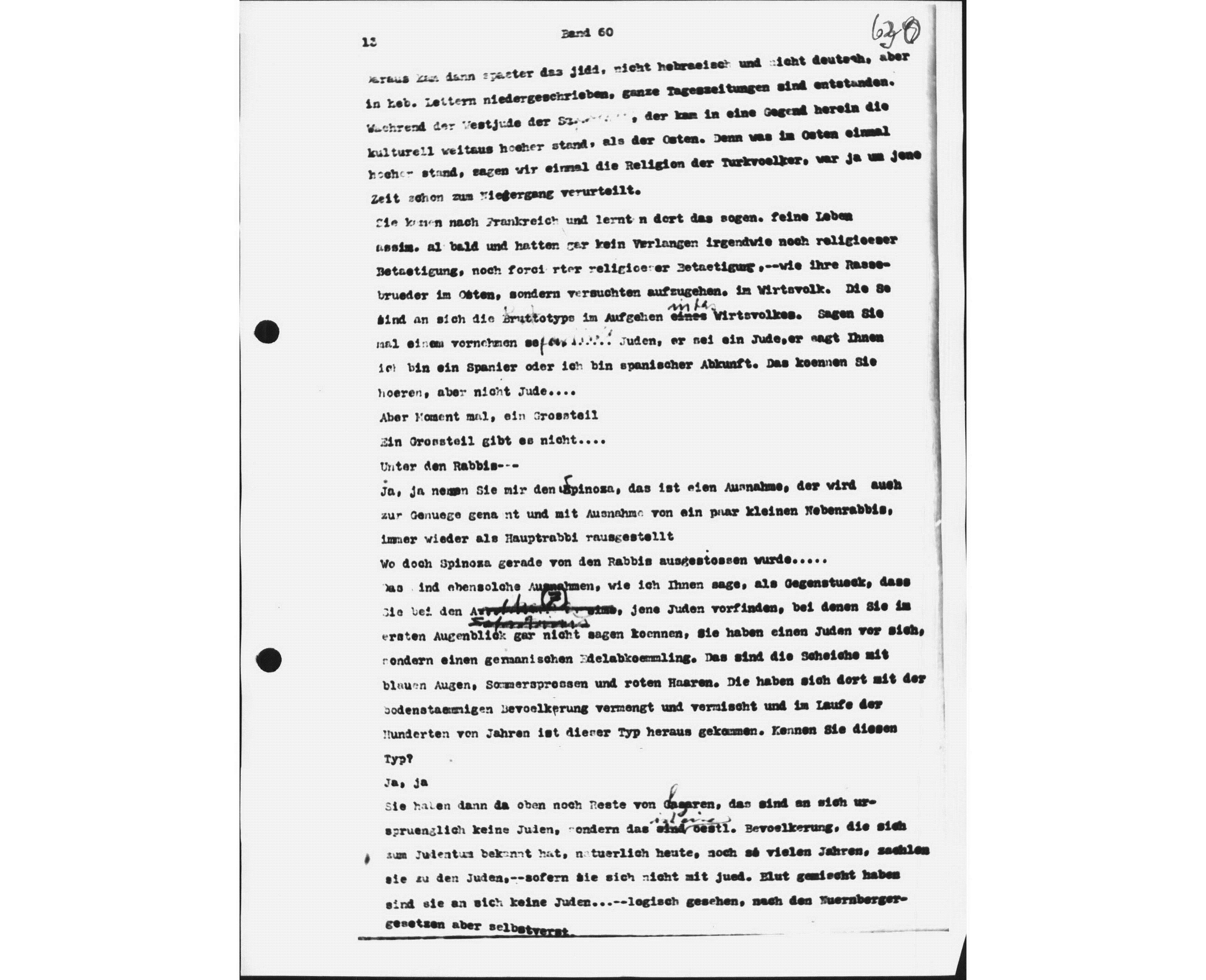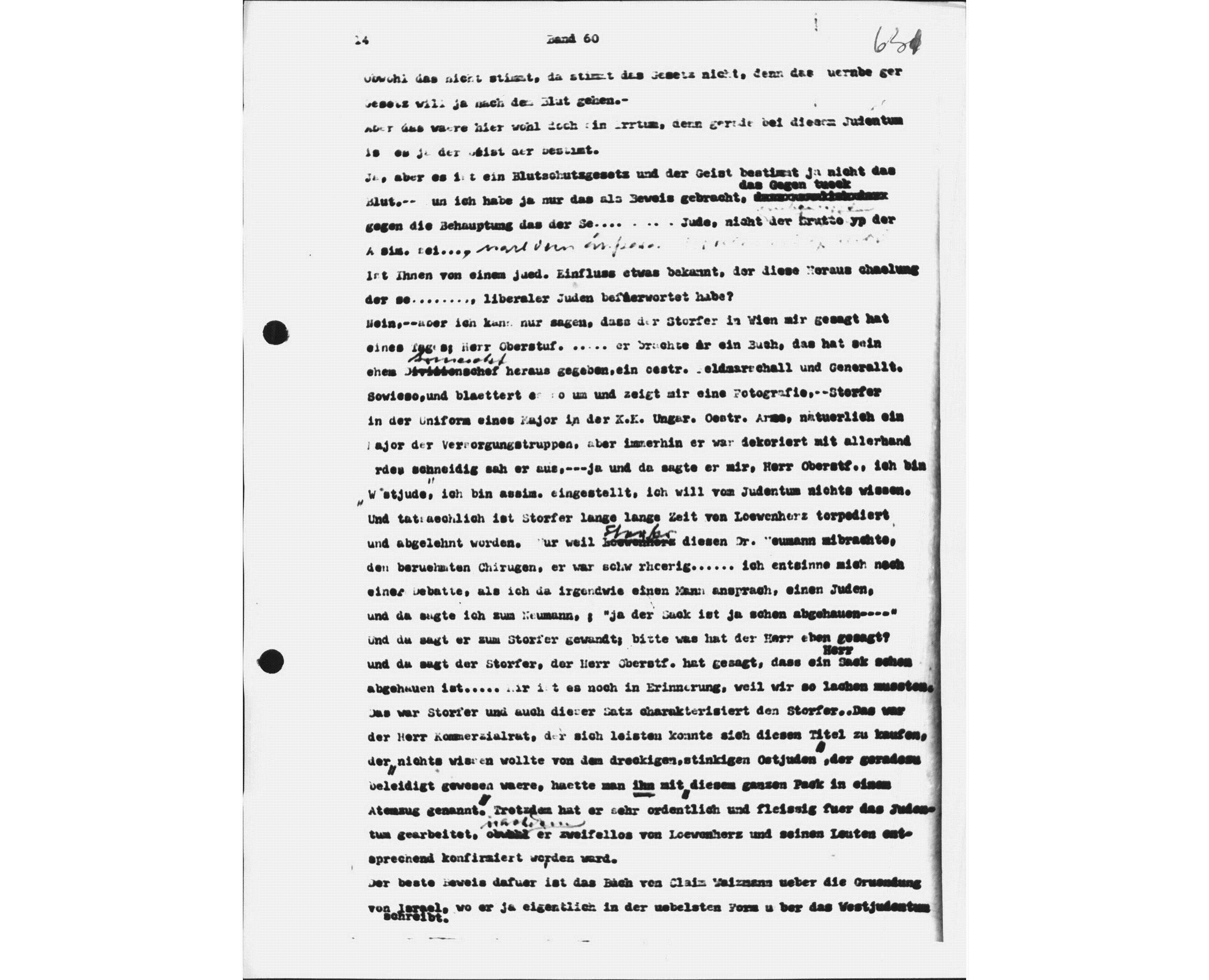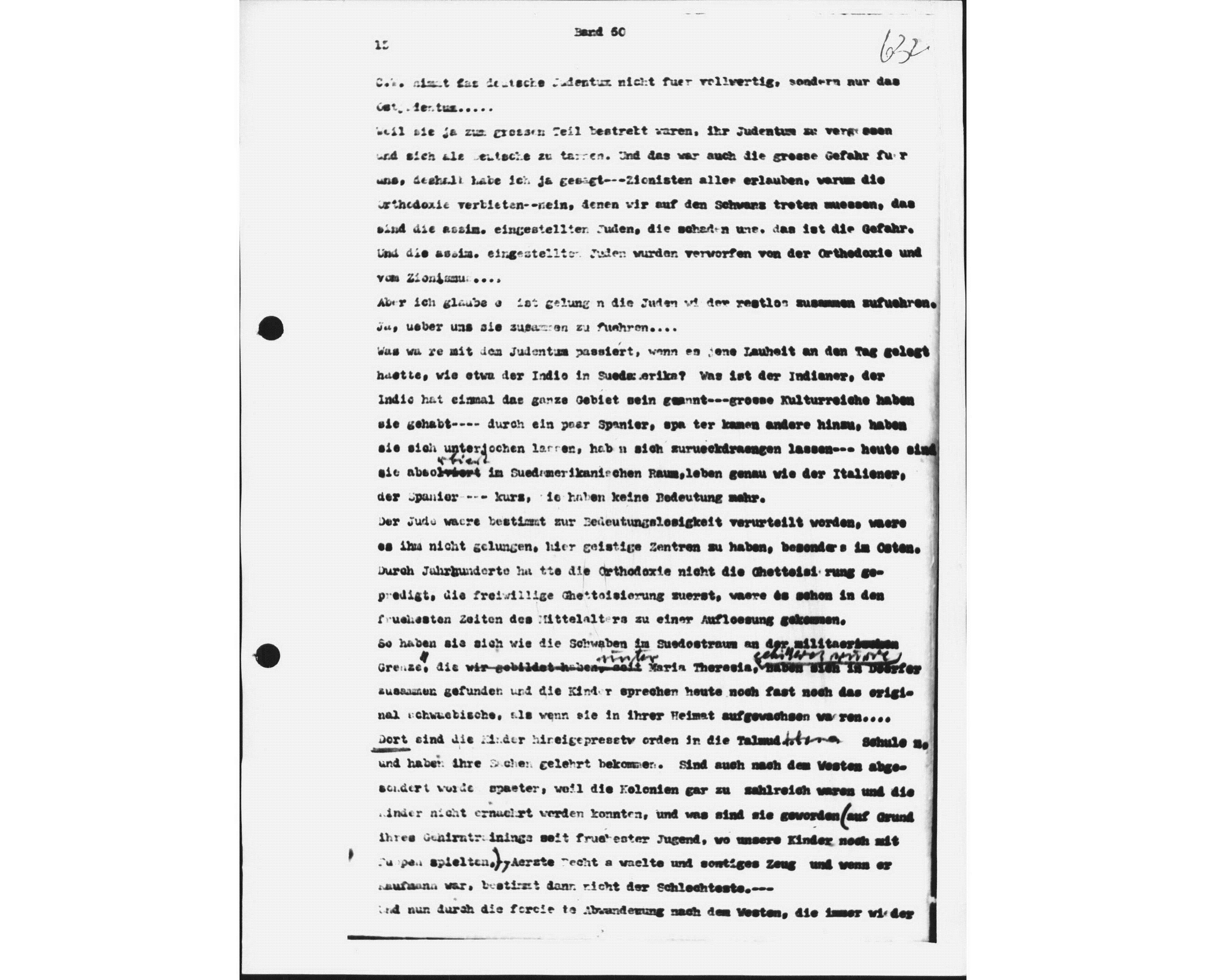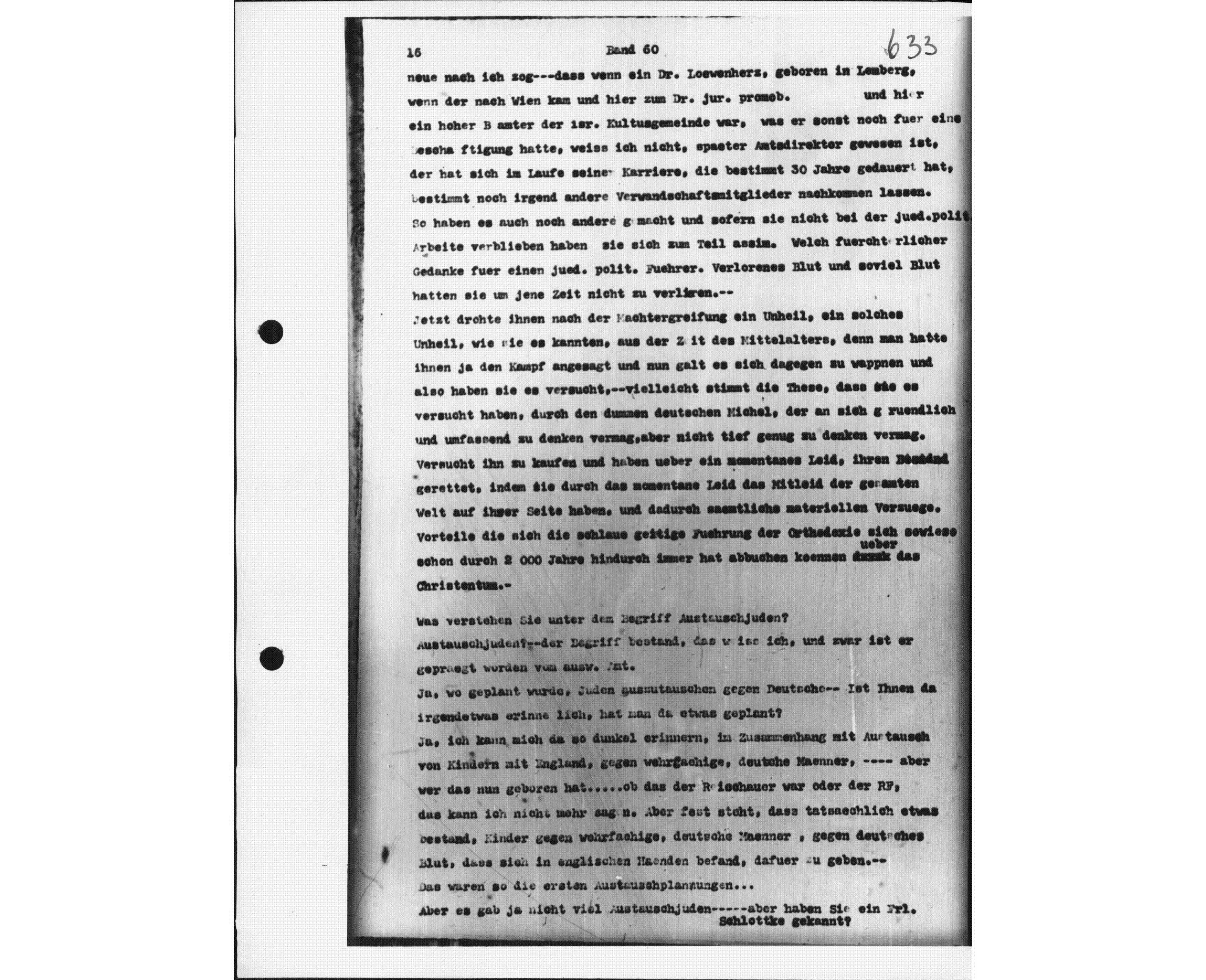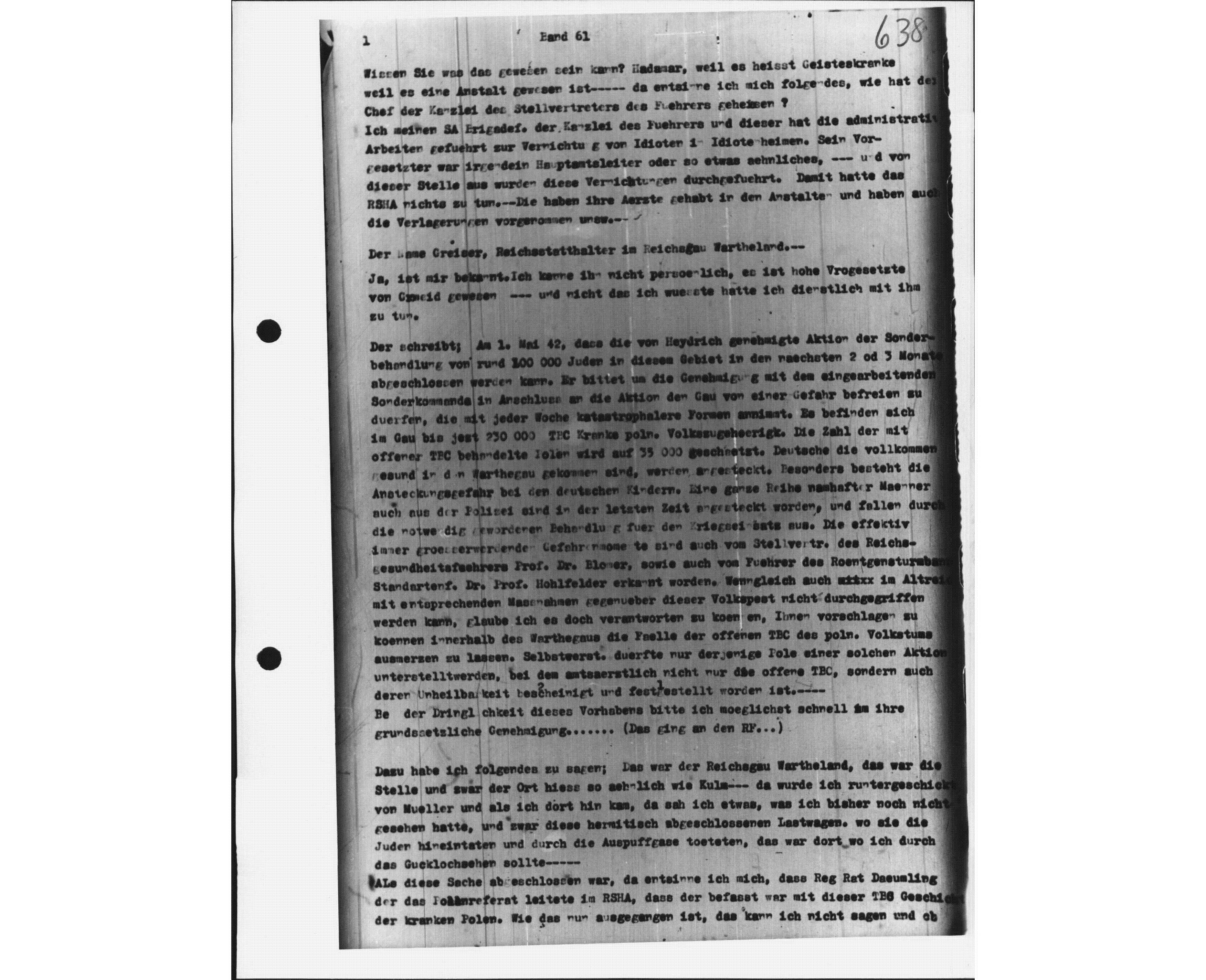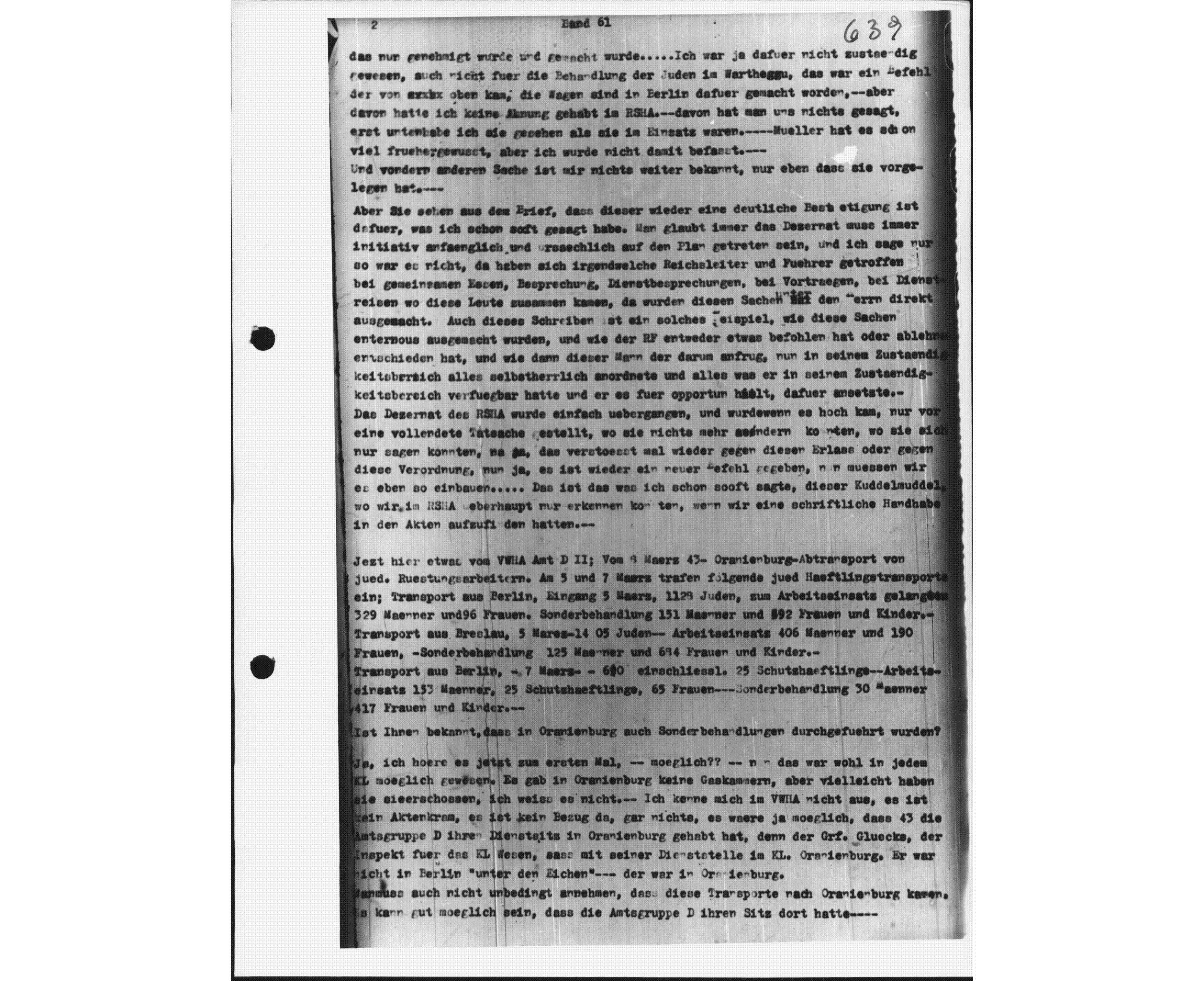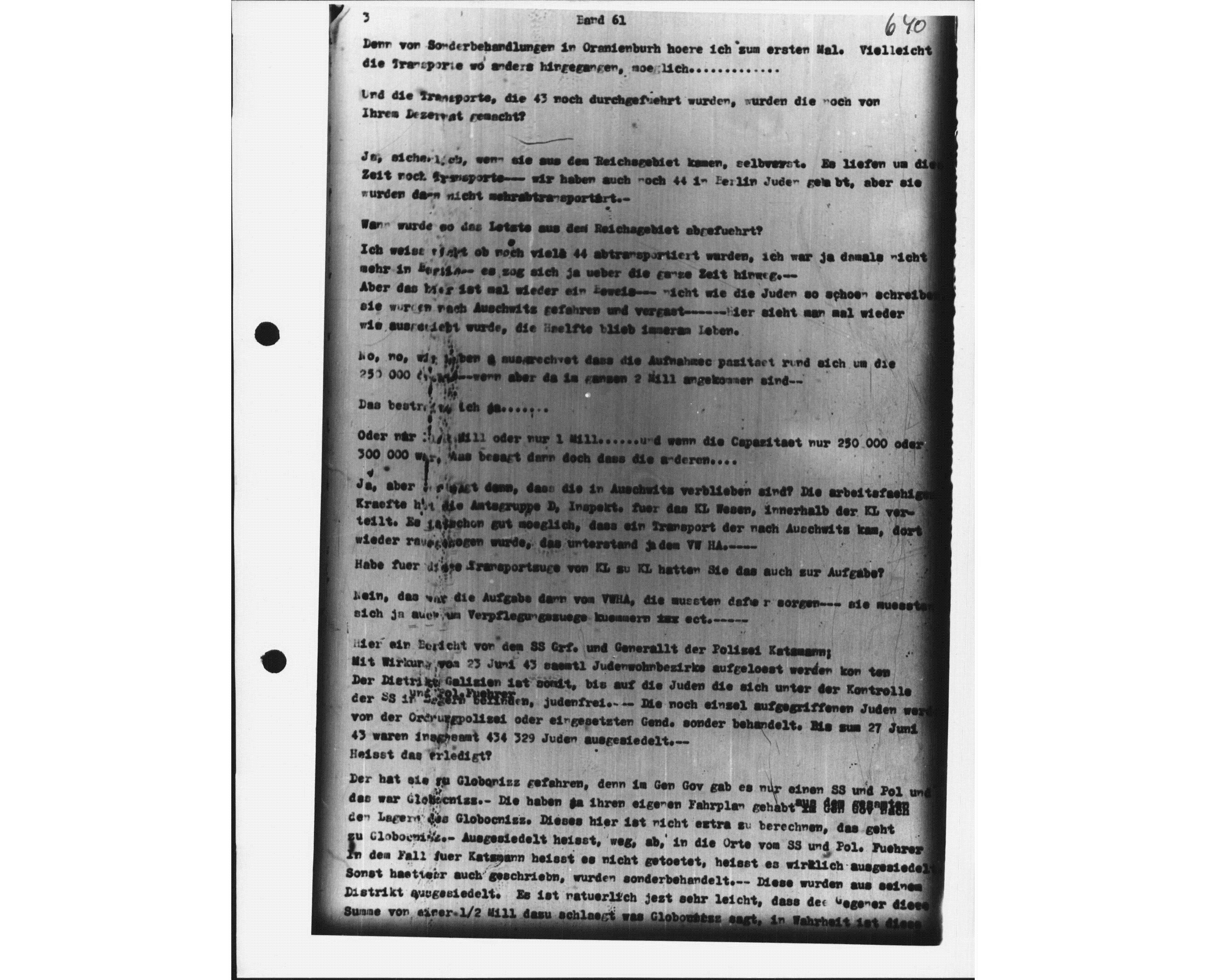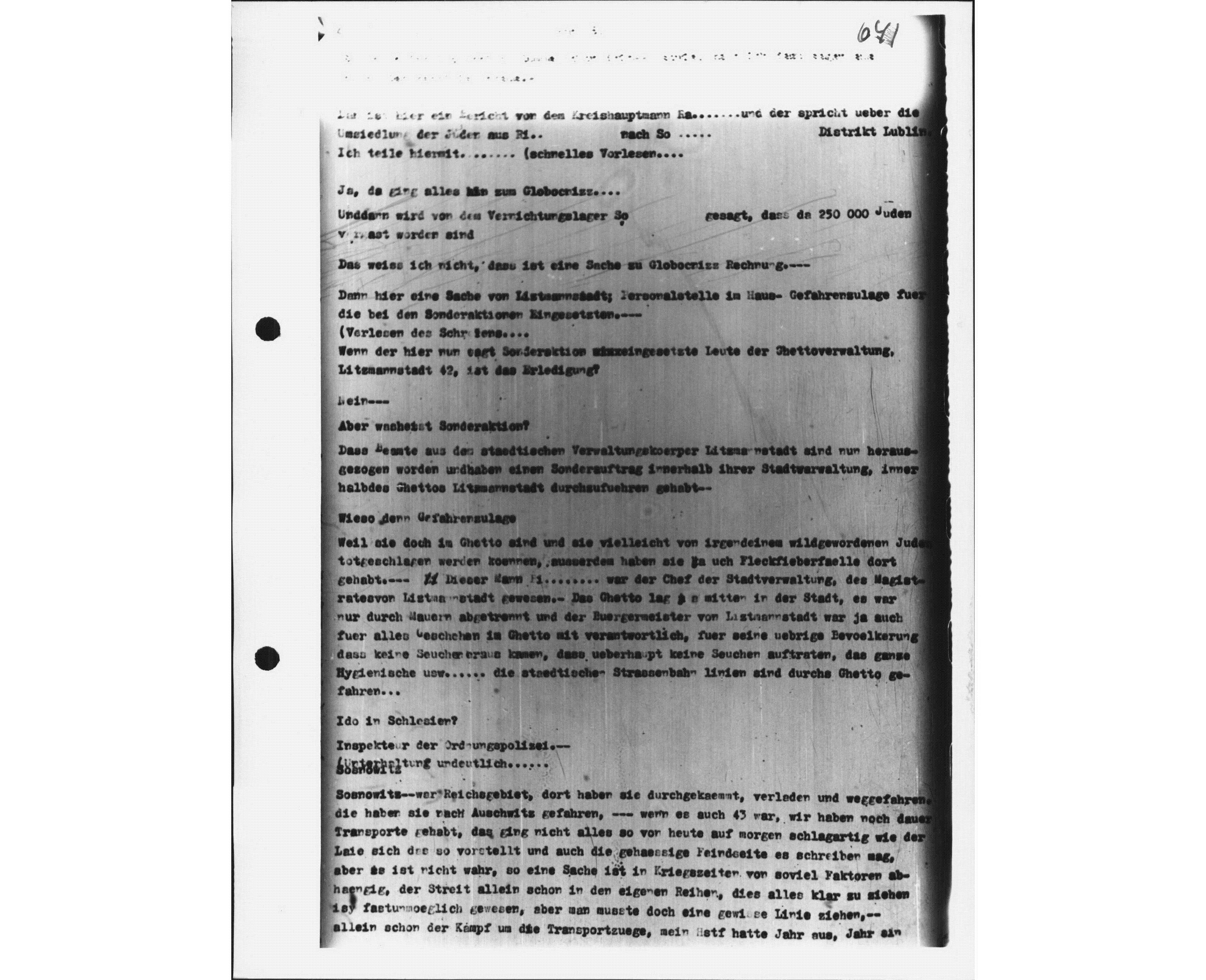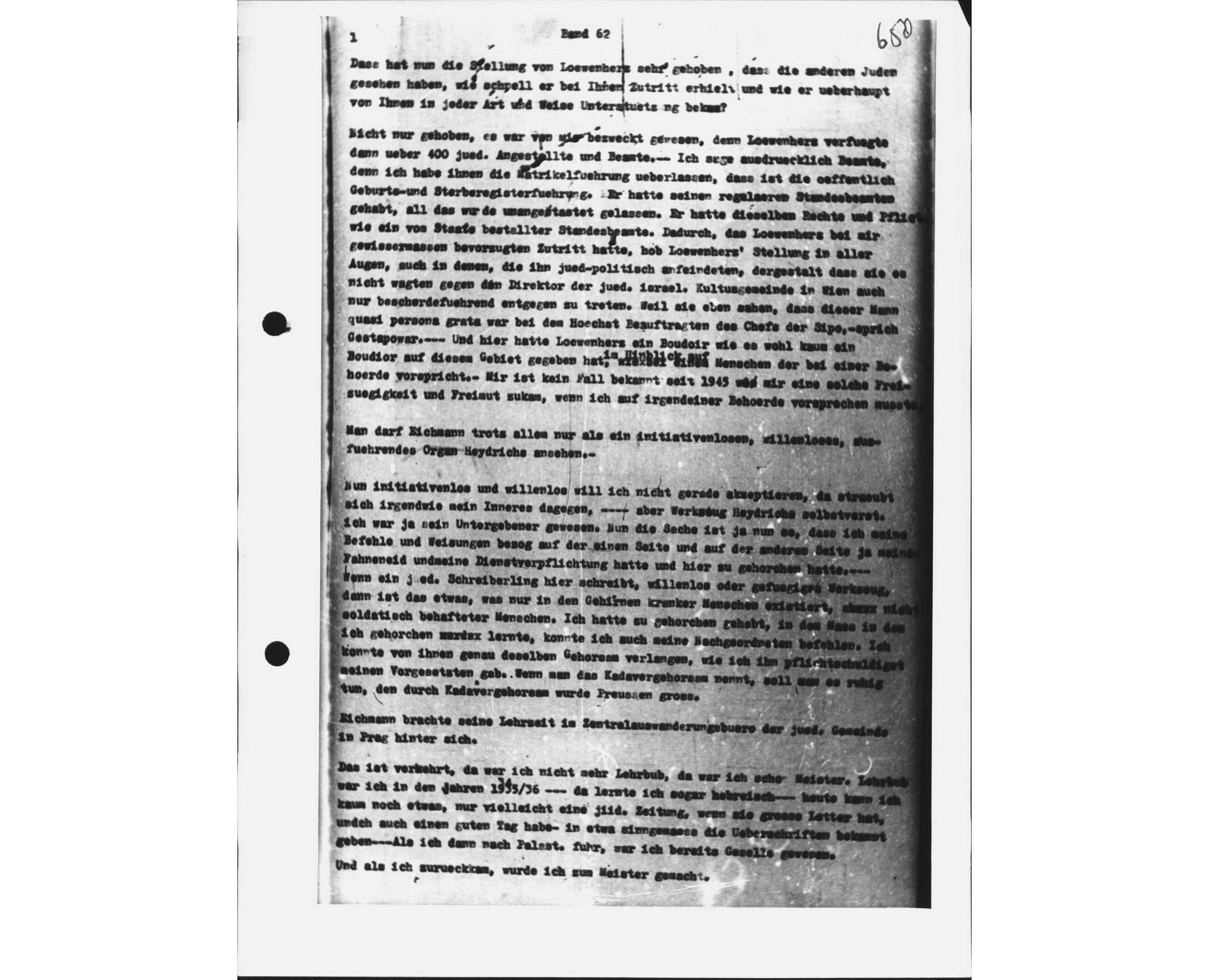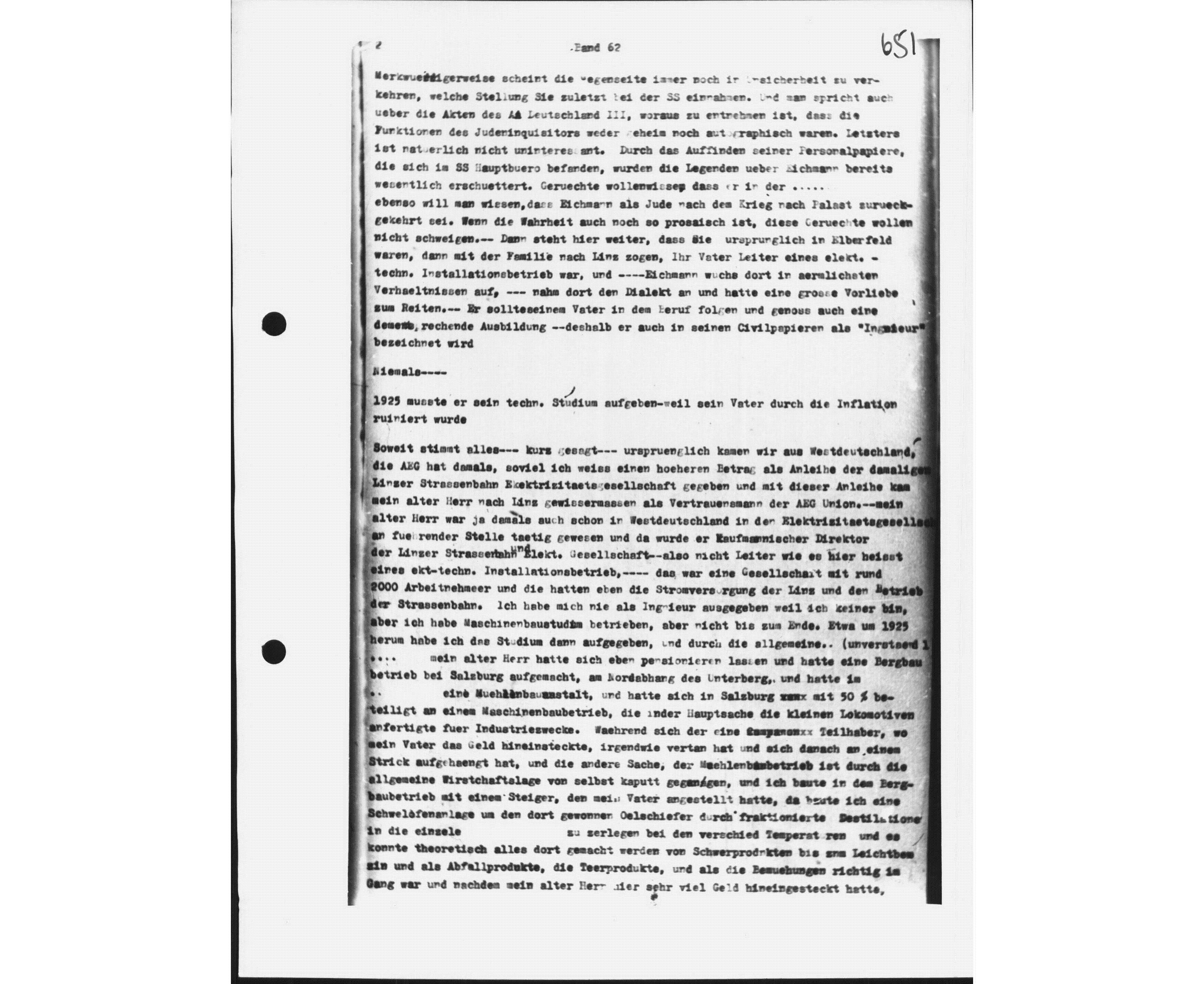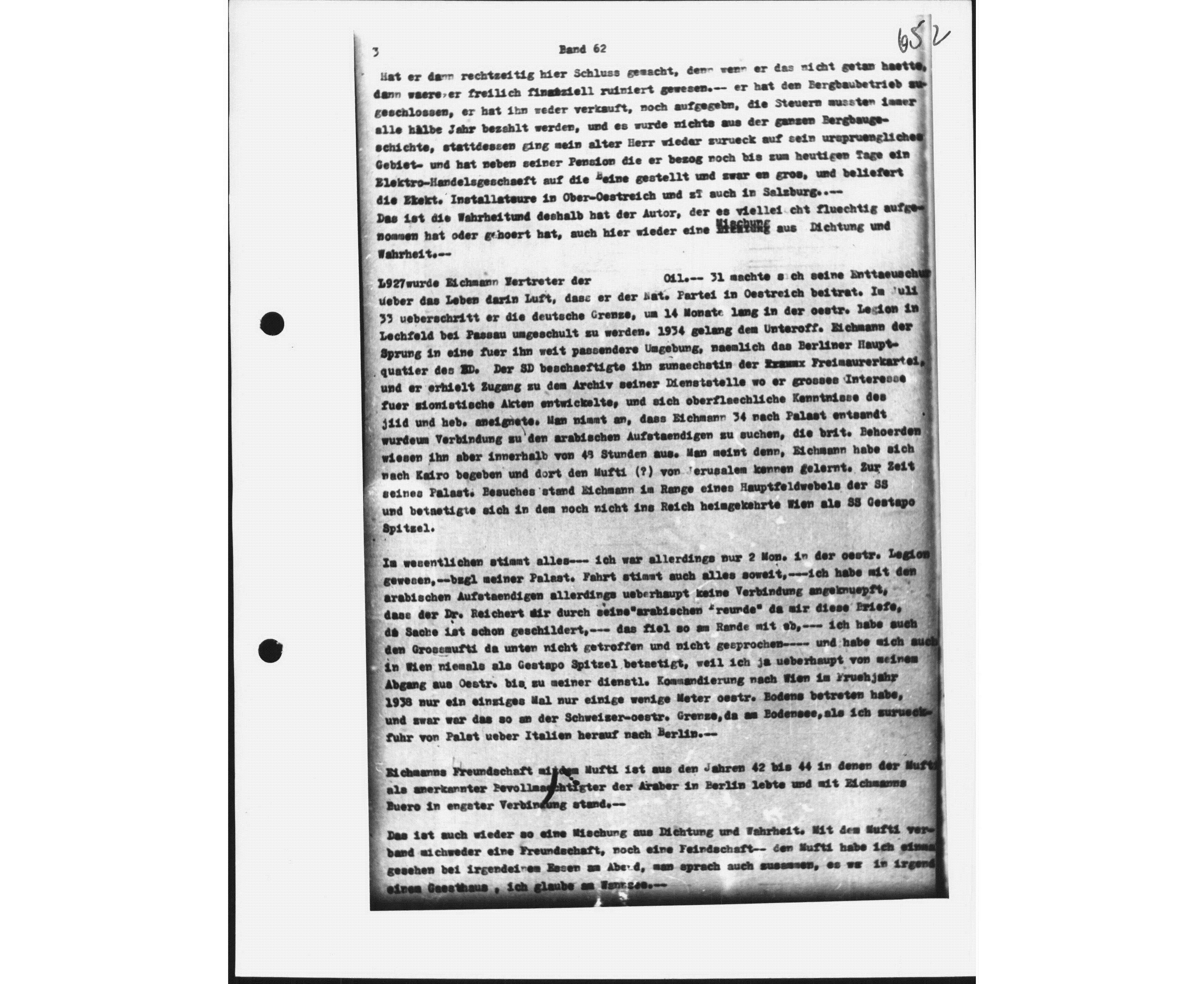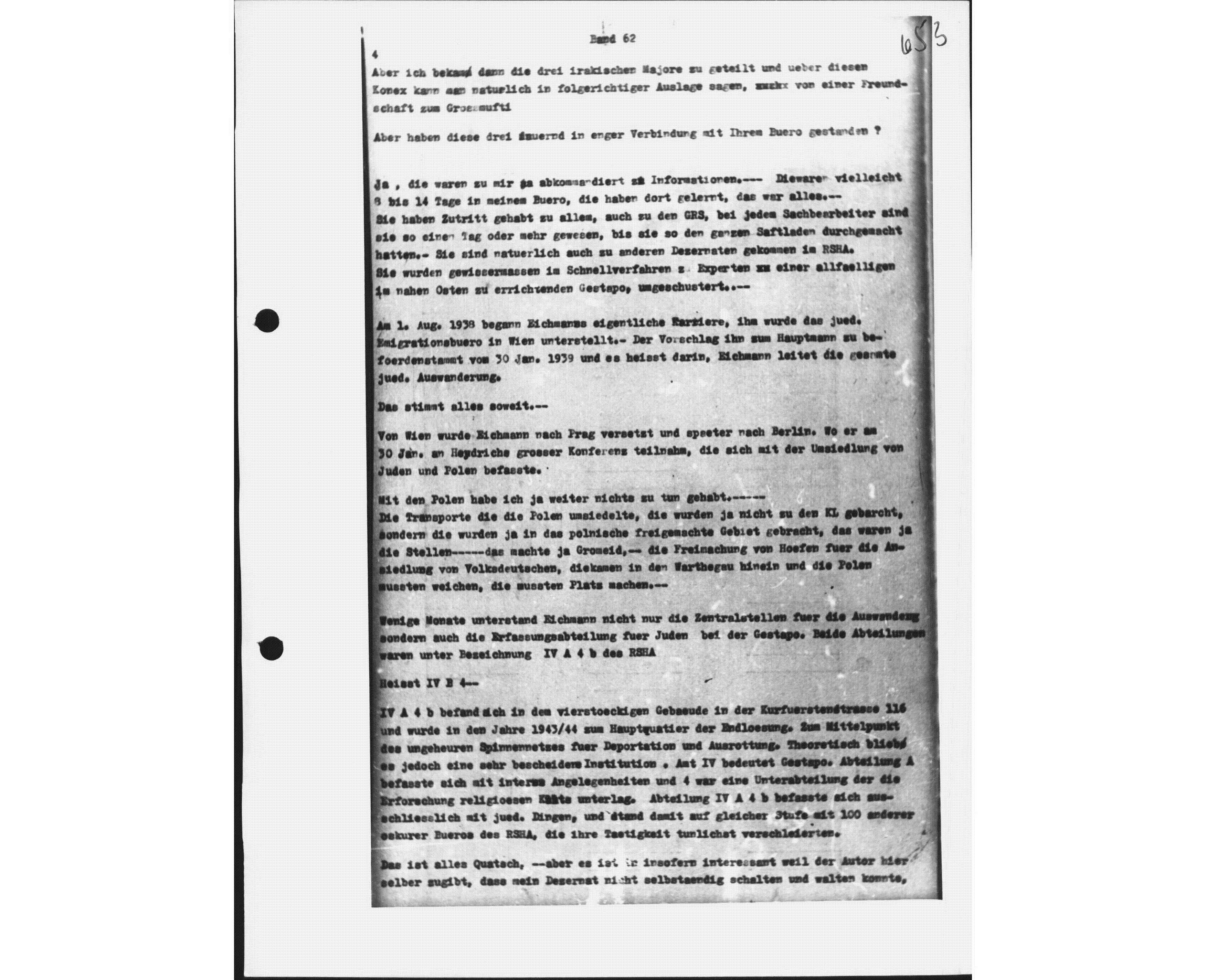
Eichmann and Sassen interview
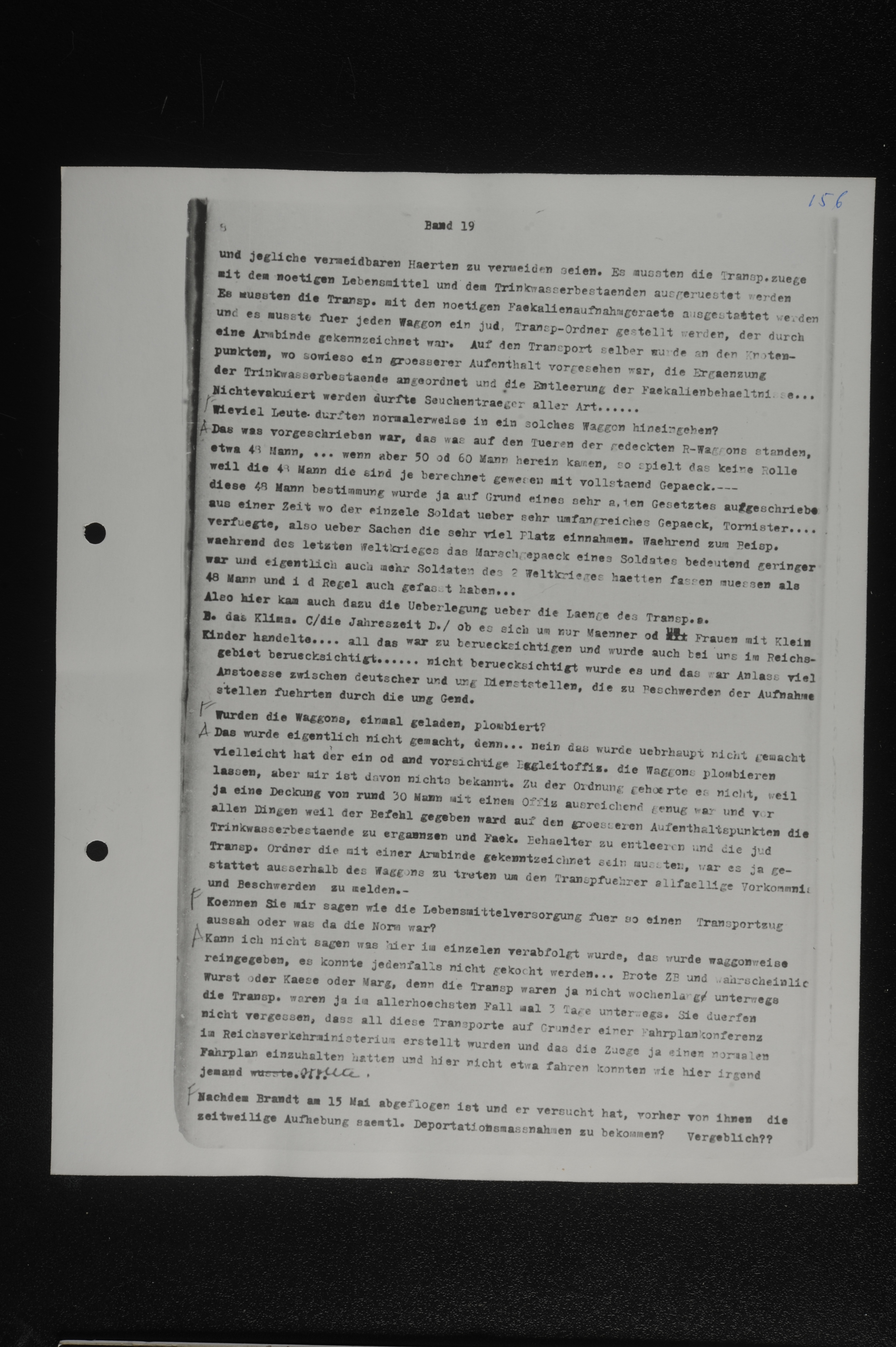
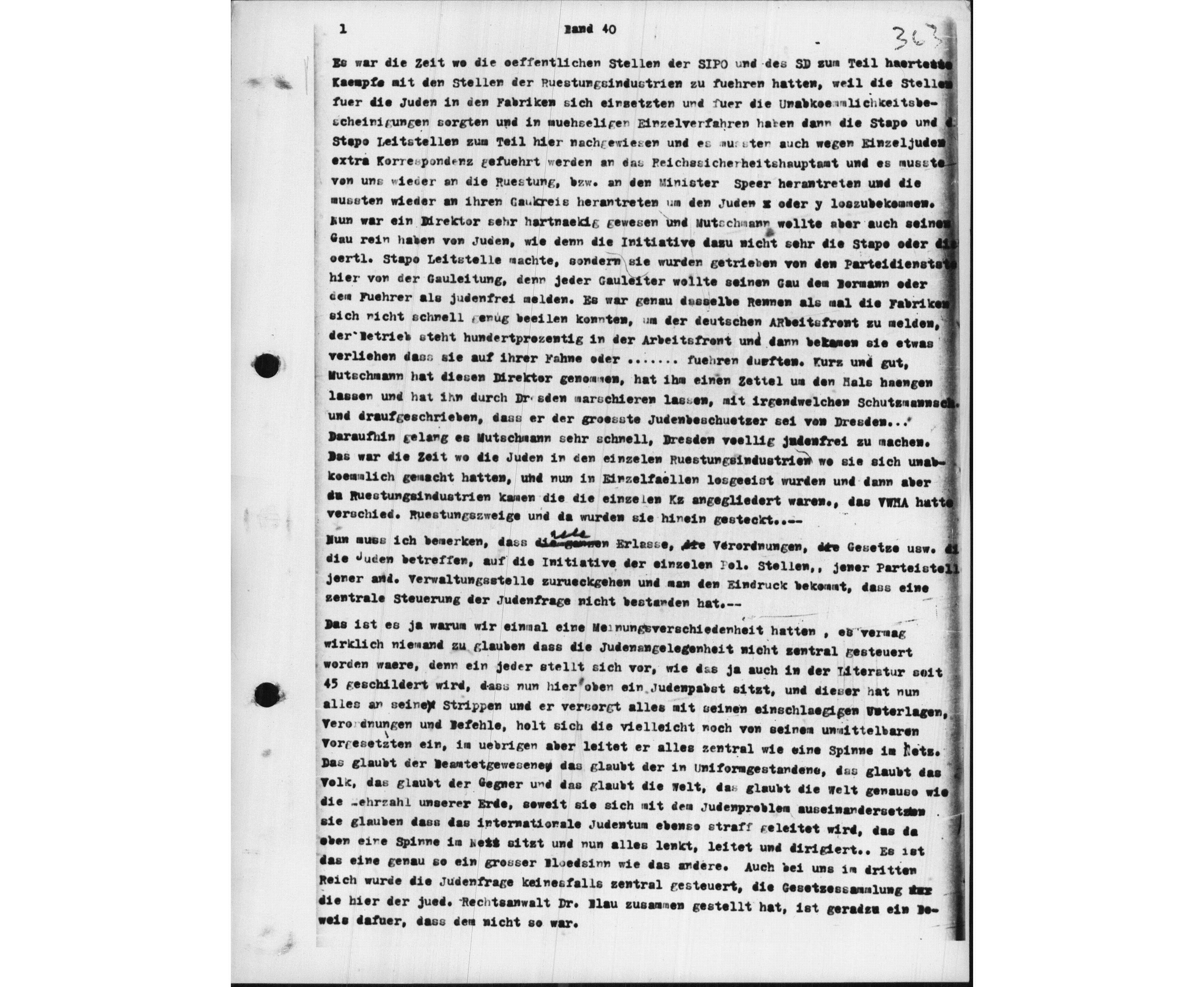
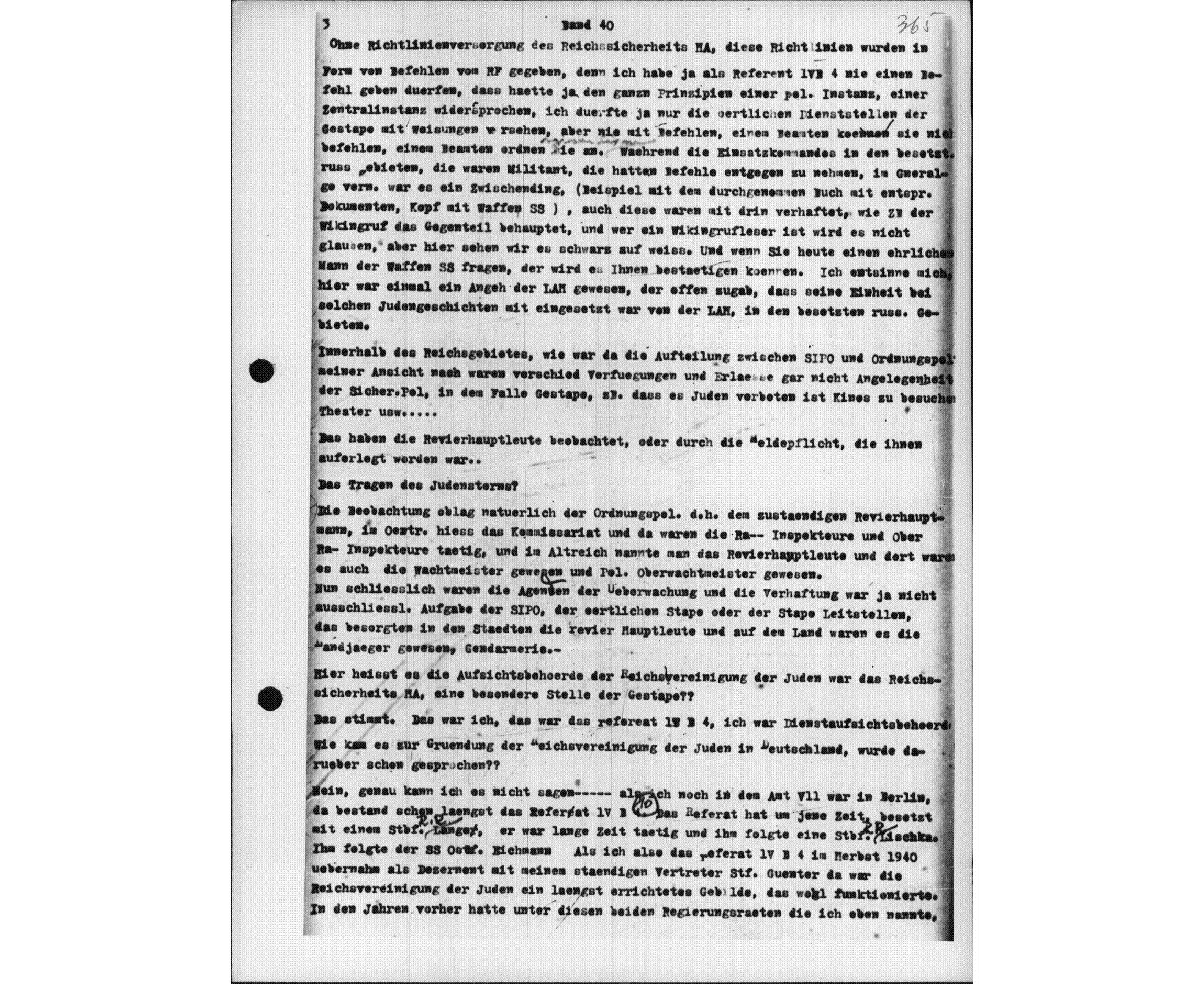
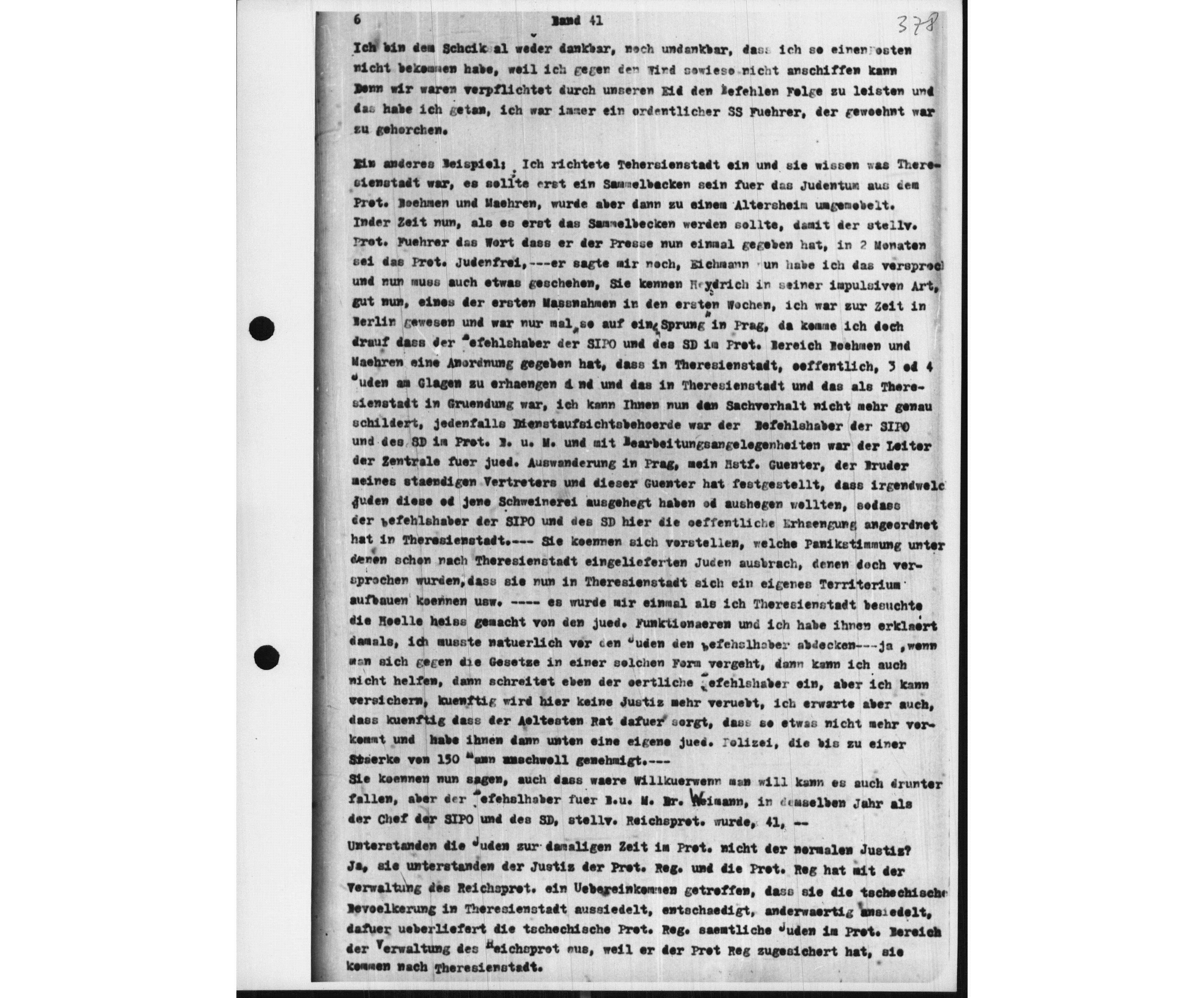
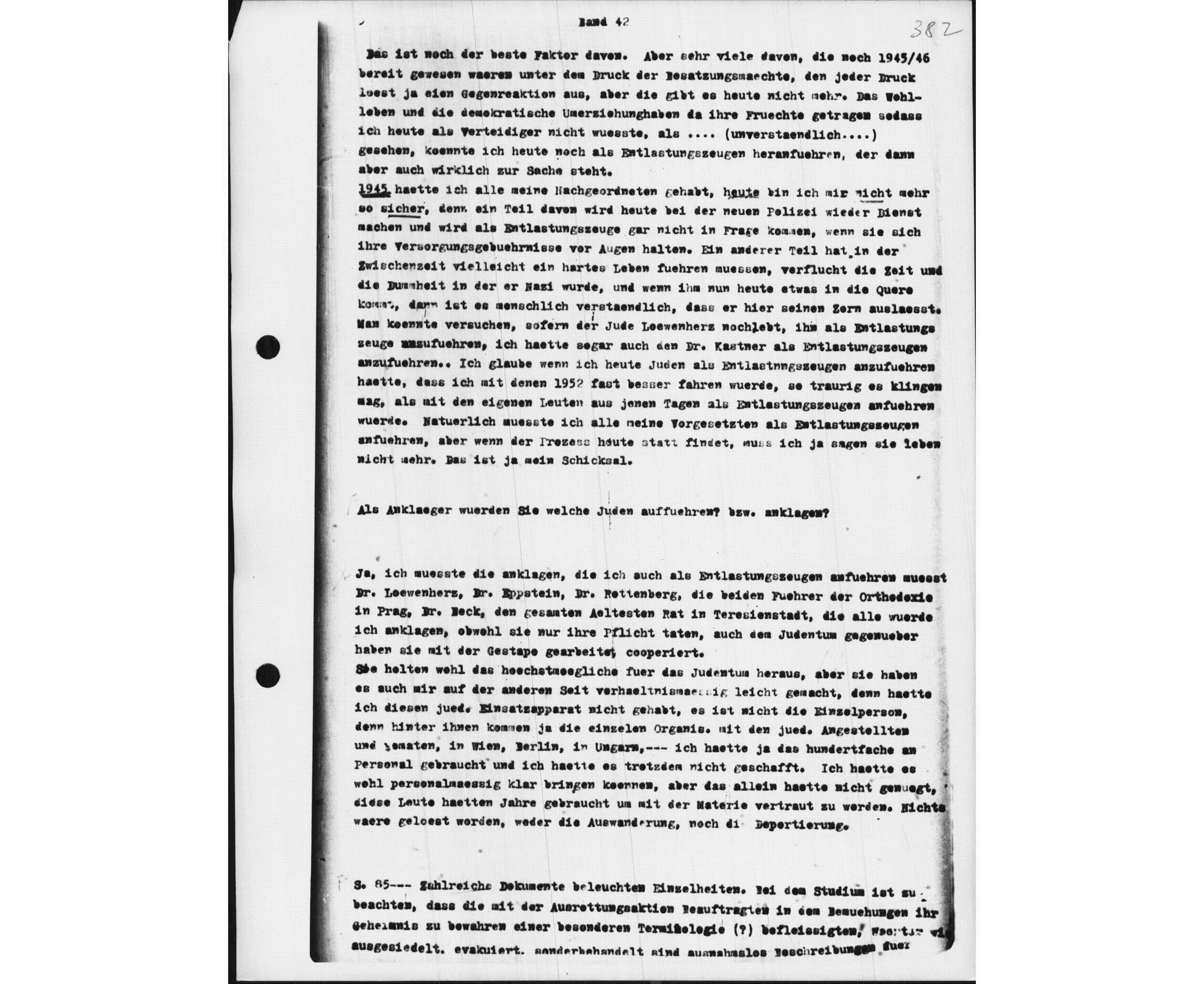
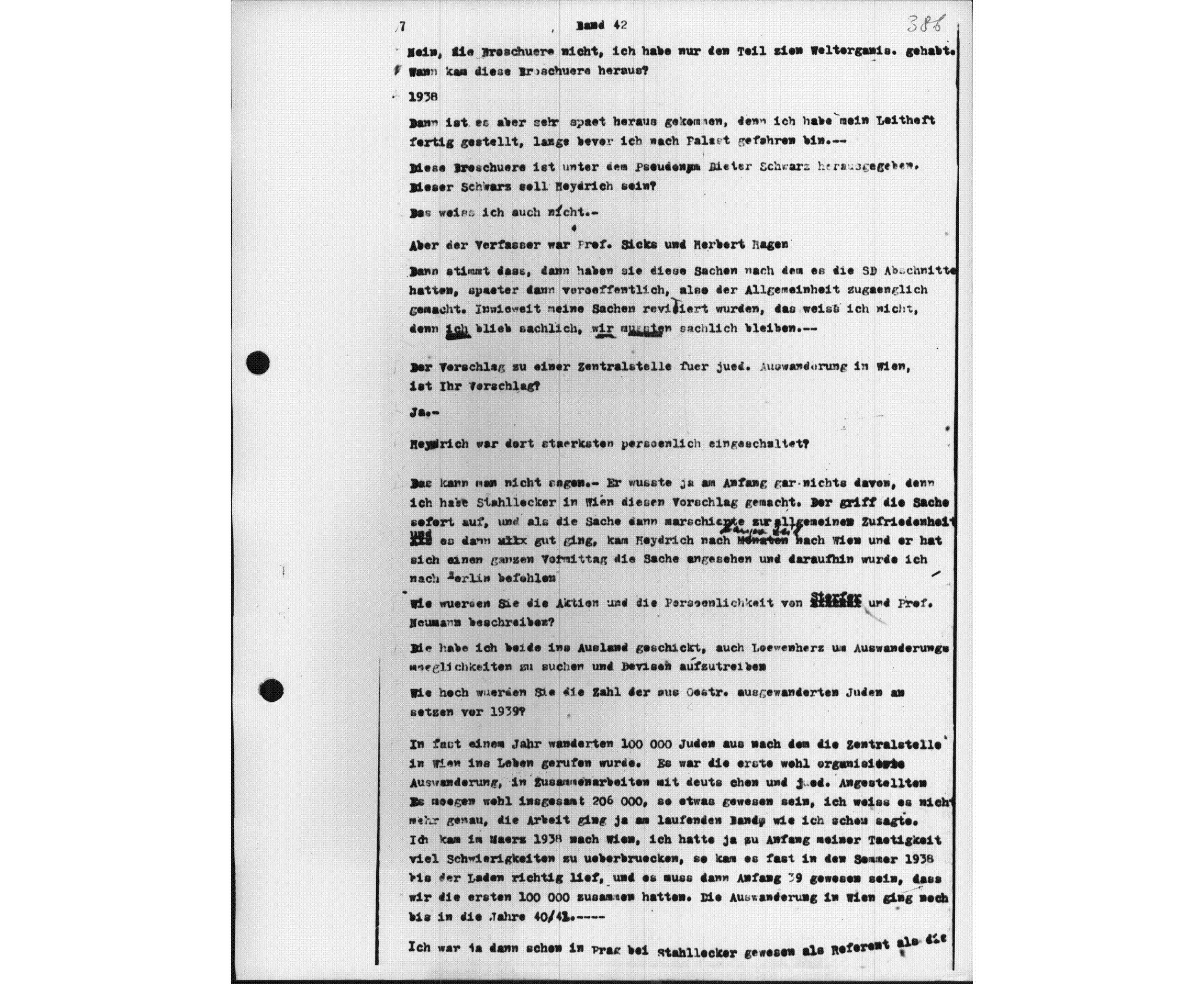
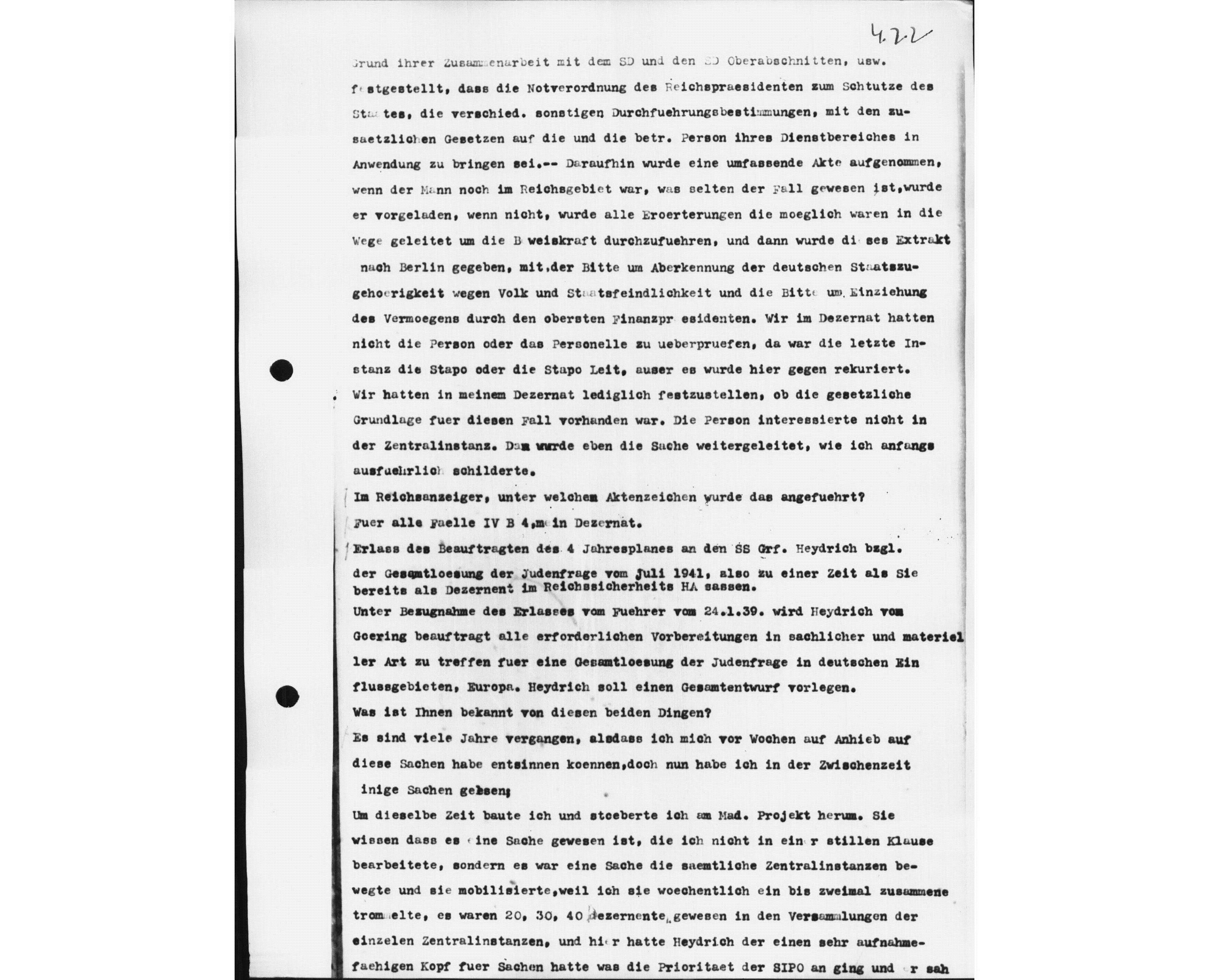
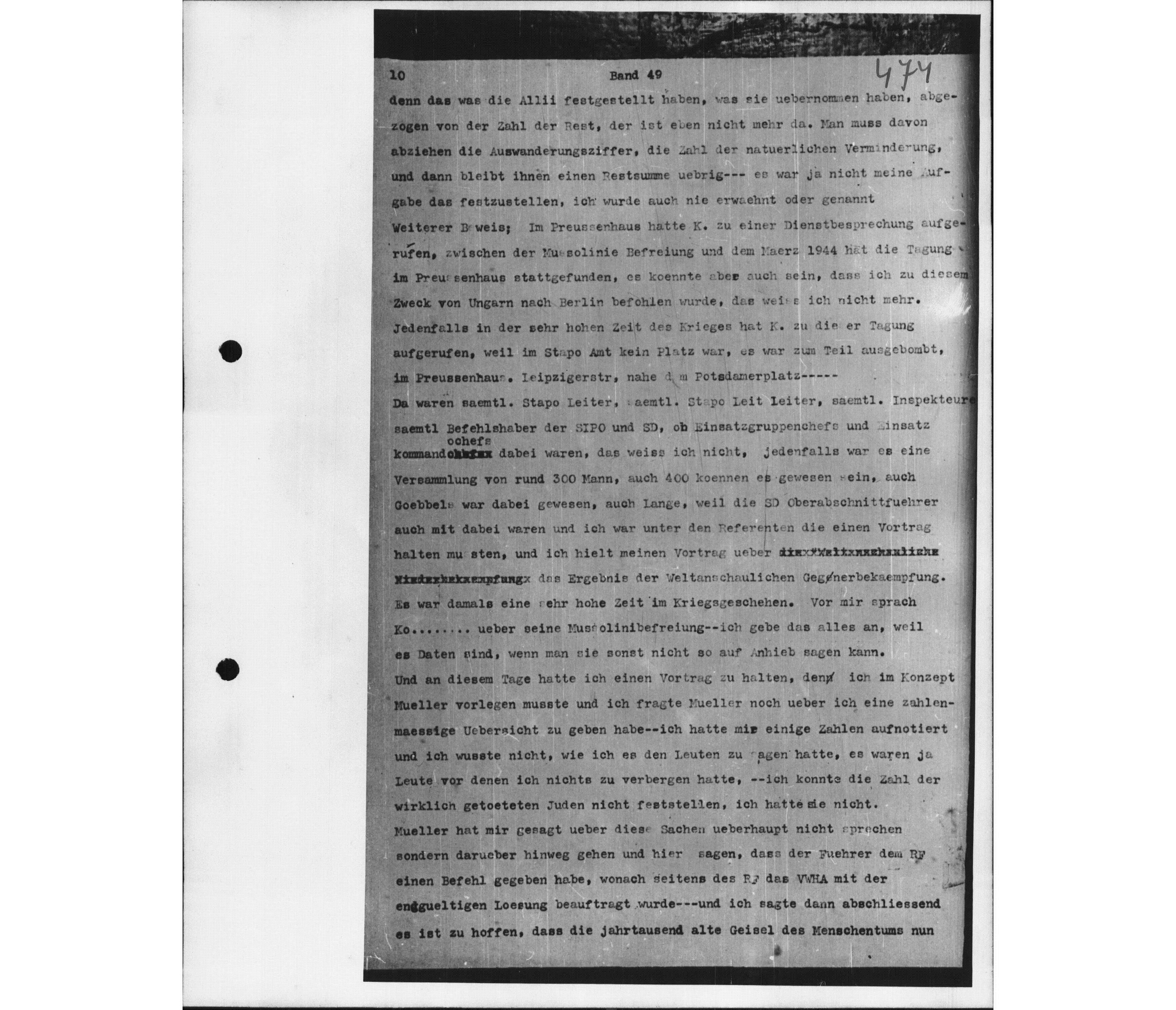
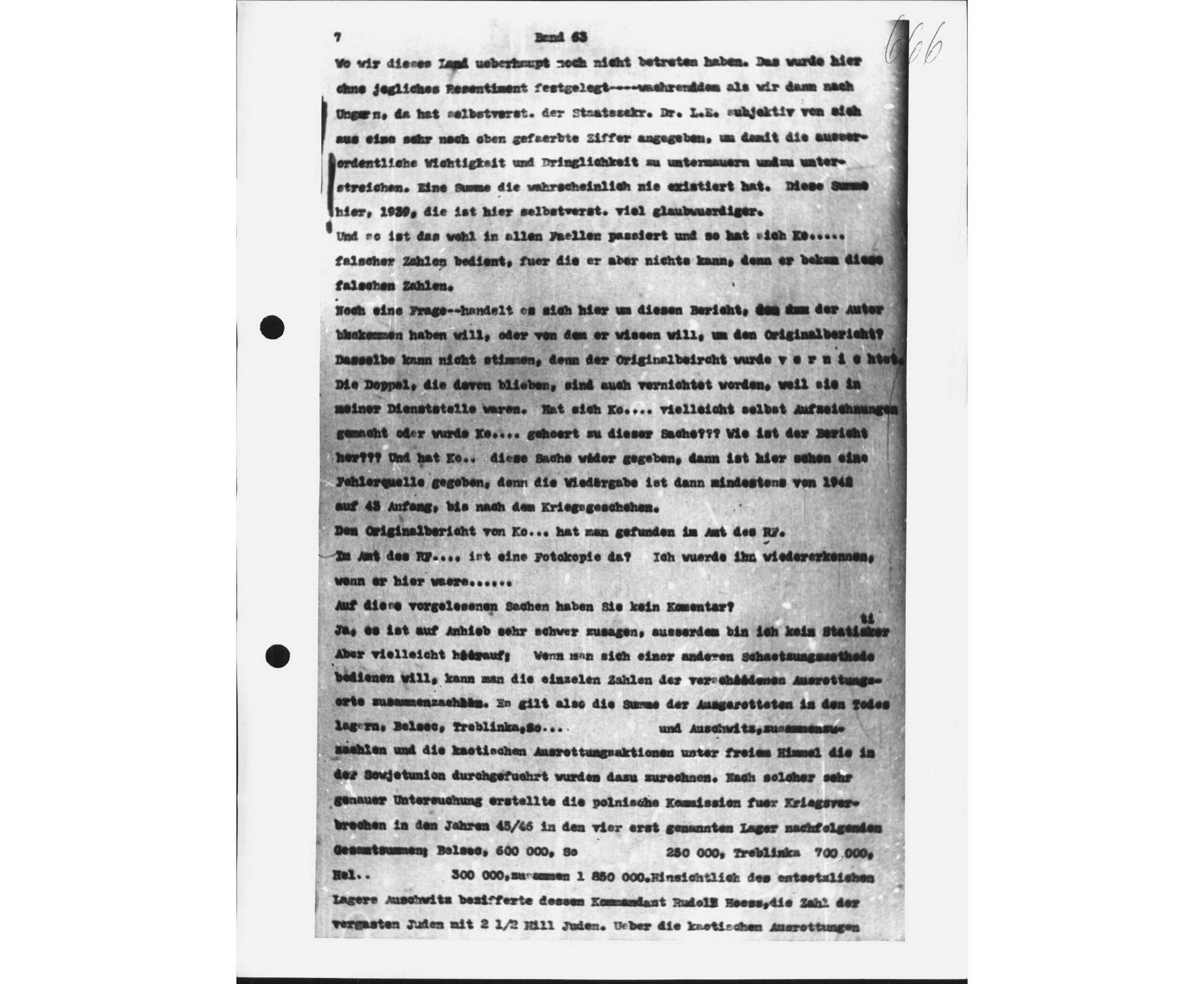
Eichmann in SS uniform and peaked cap with the death's-head badge, smiling slightly.~1942
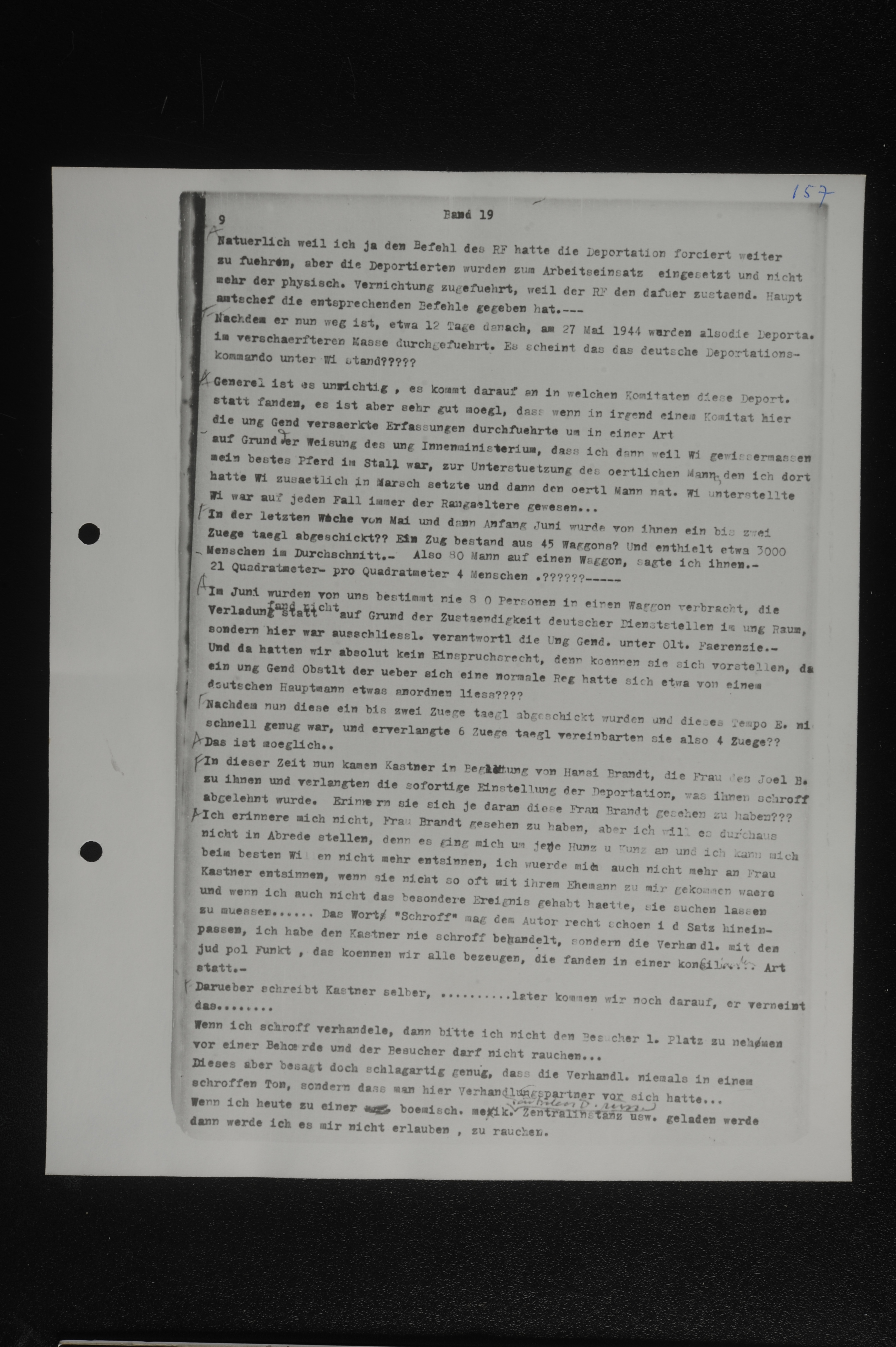
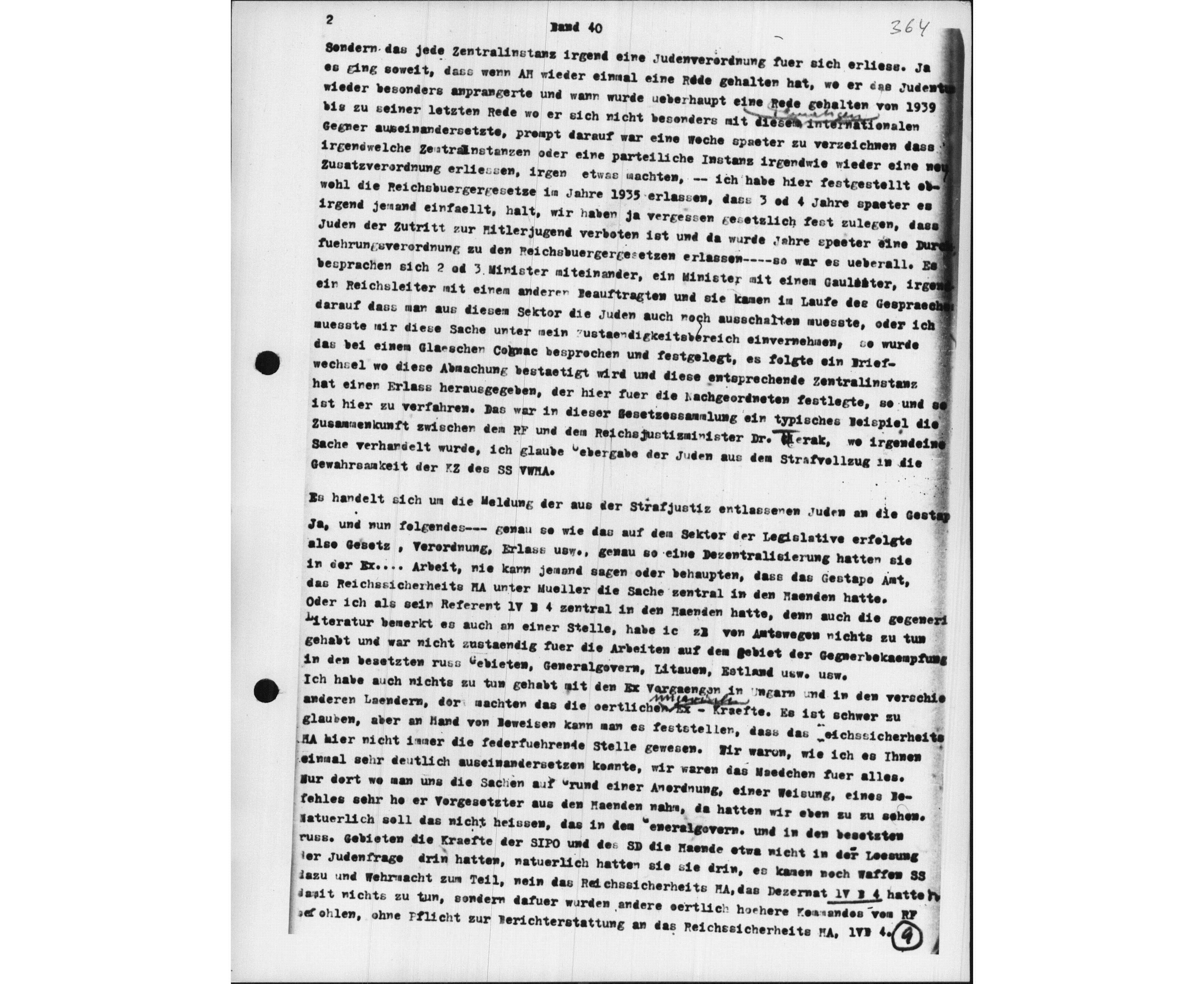
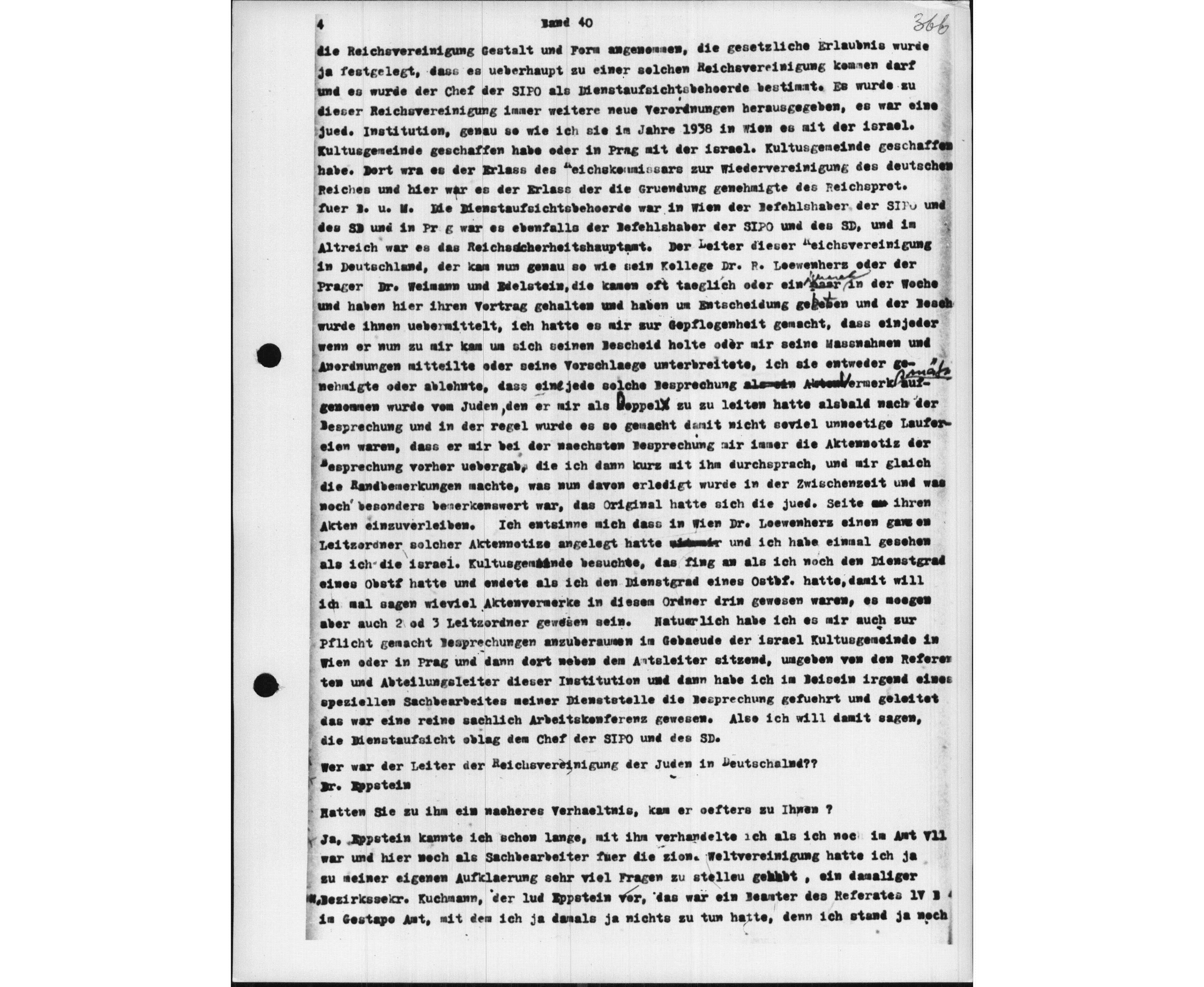
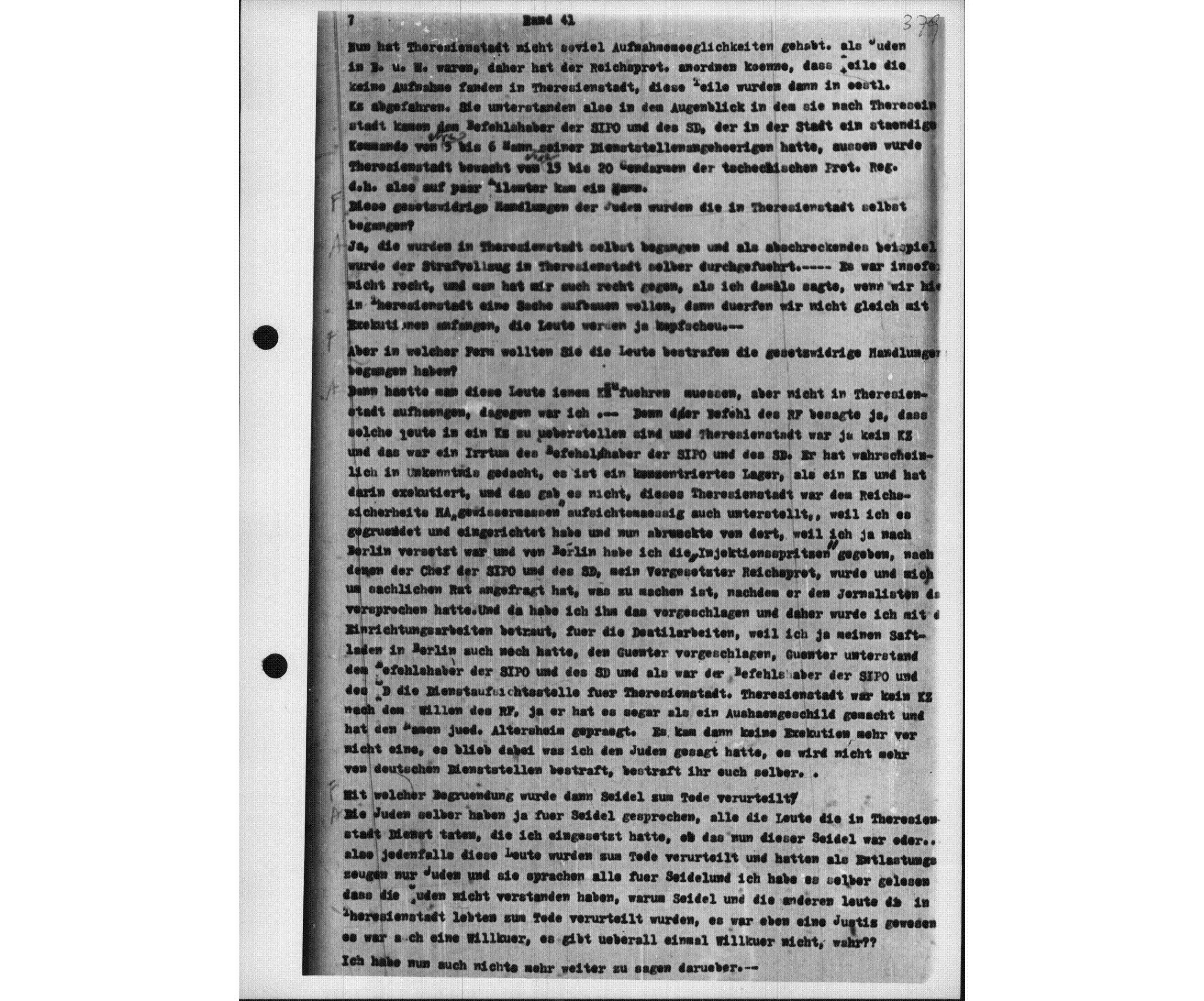
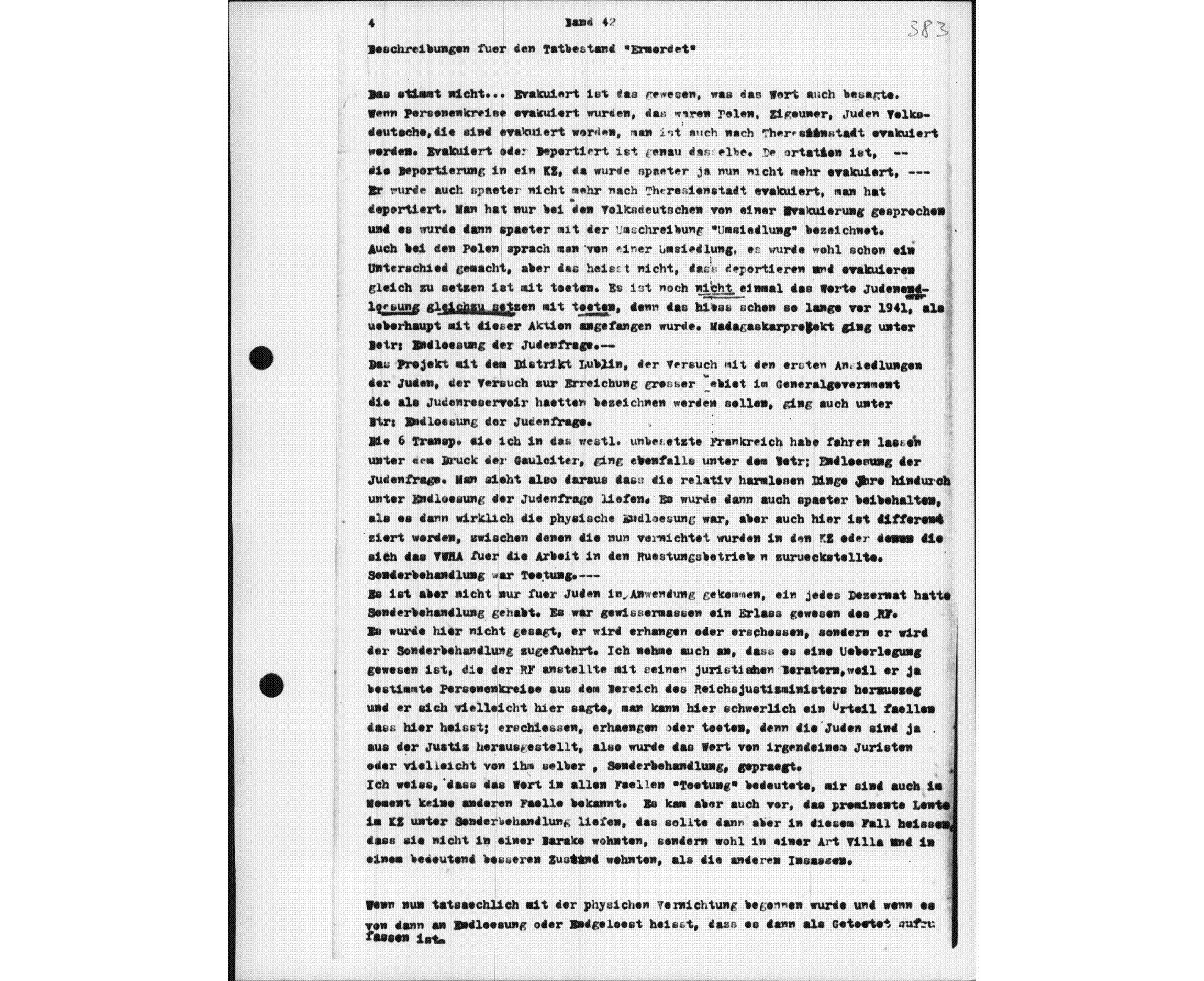
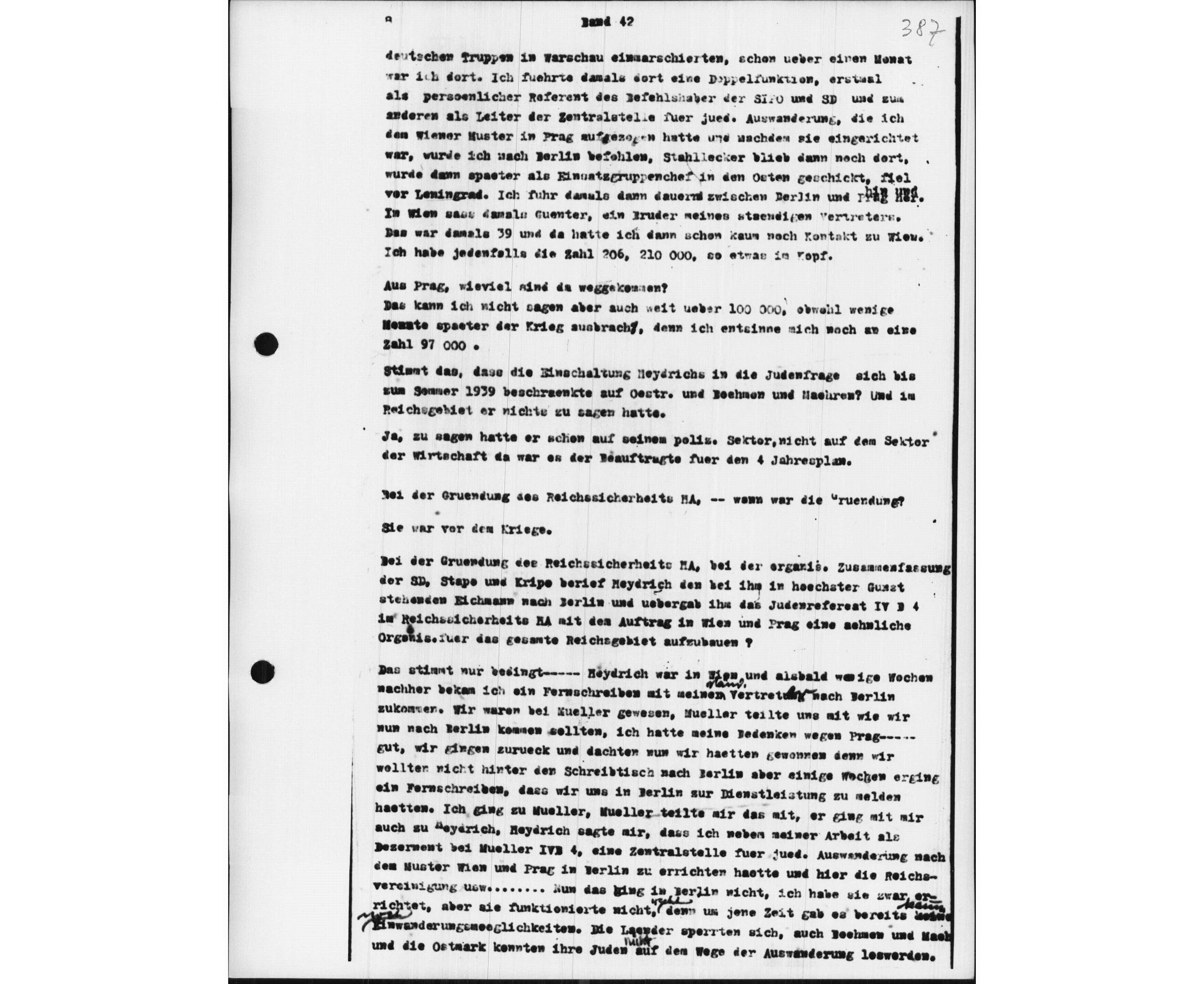
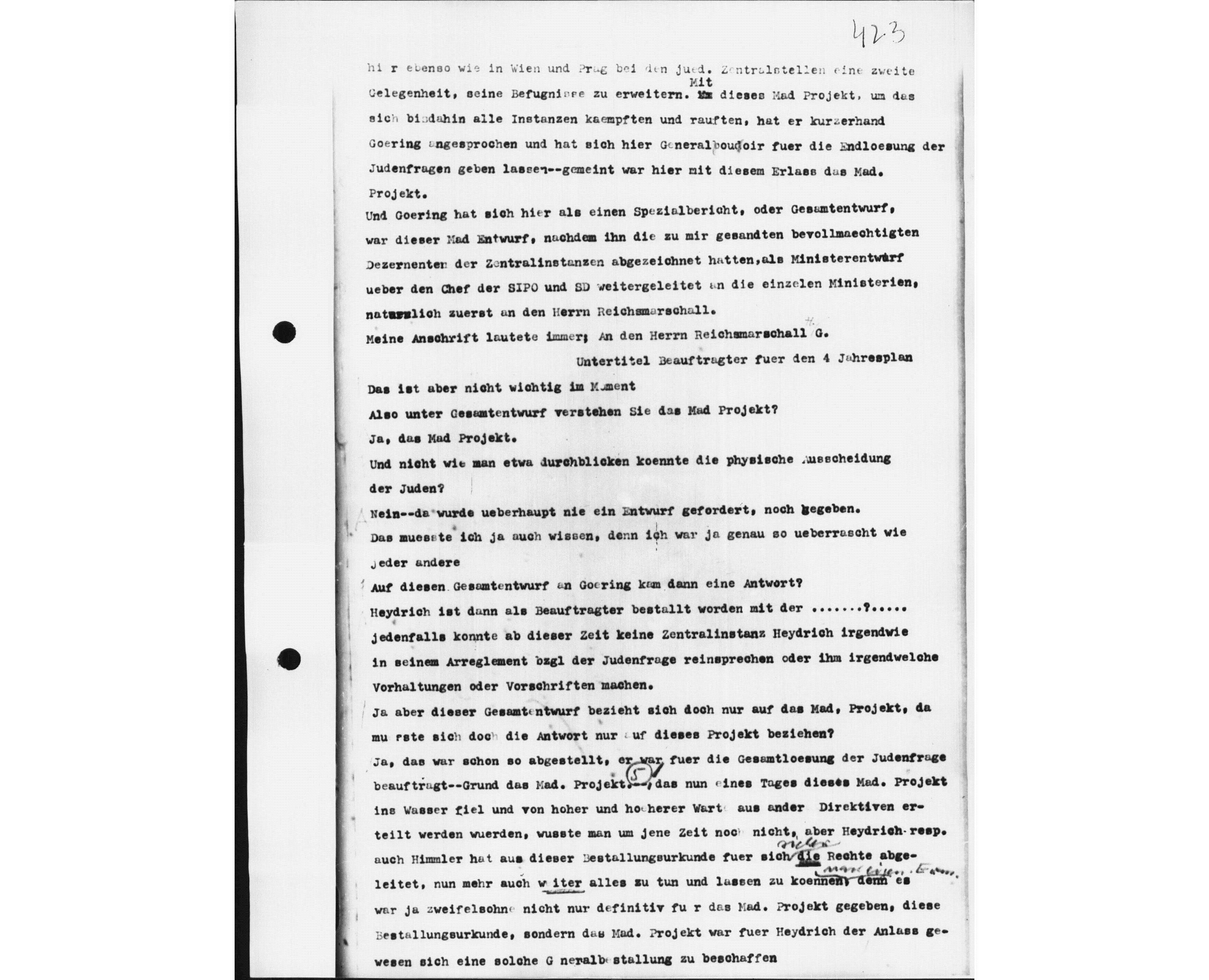
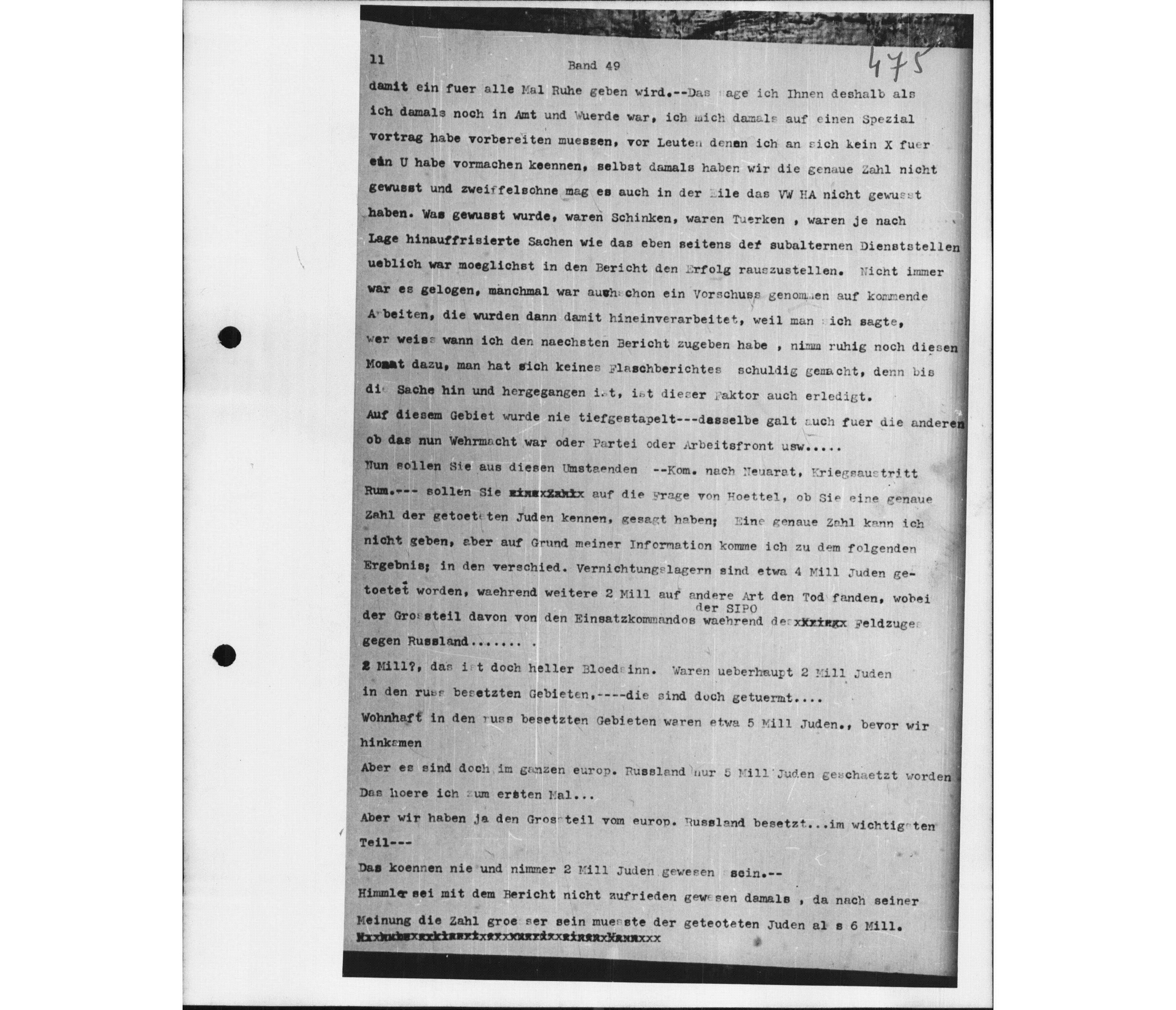
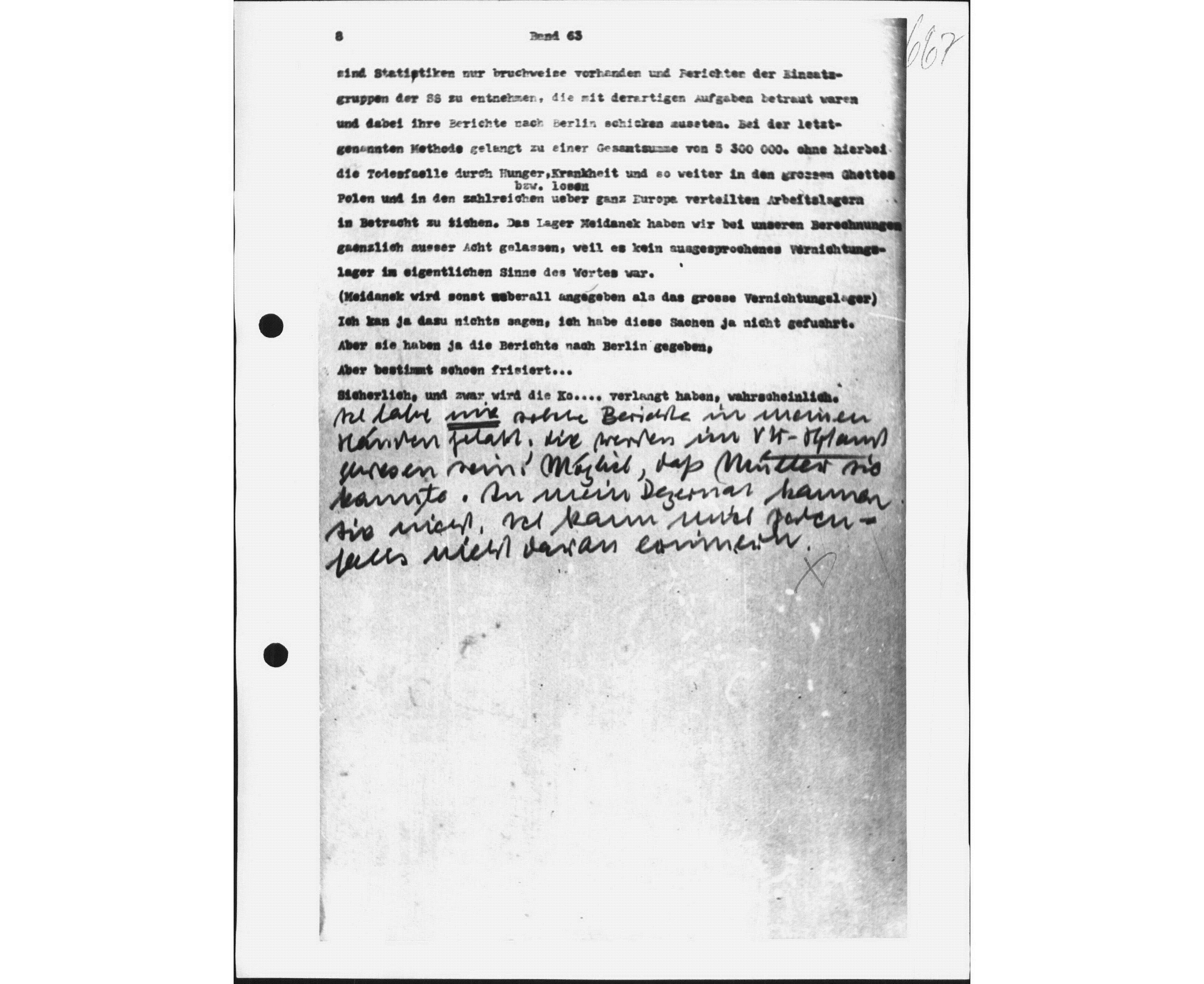
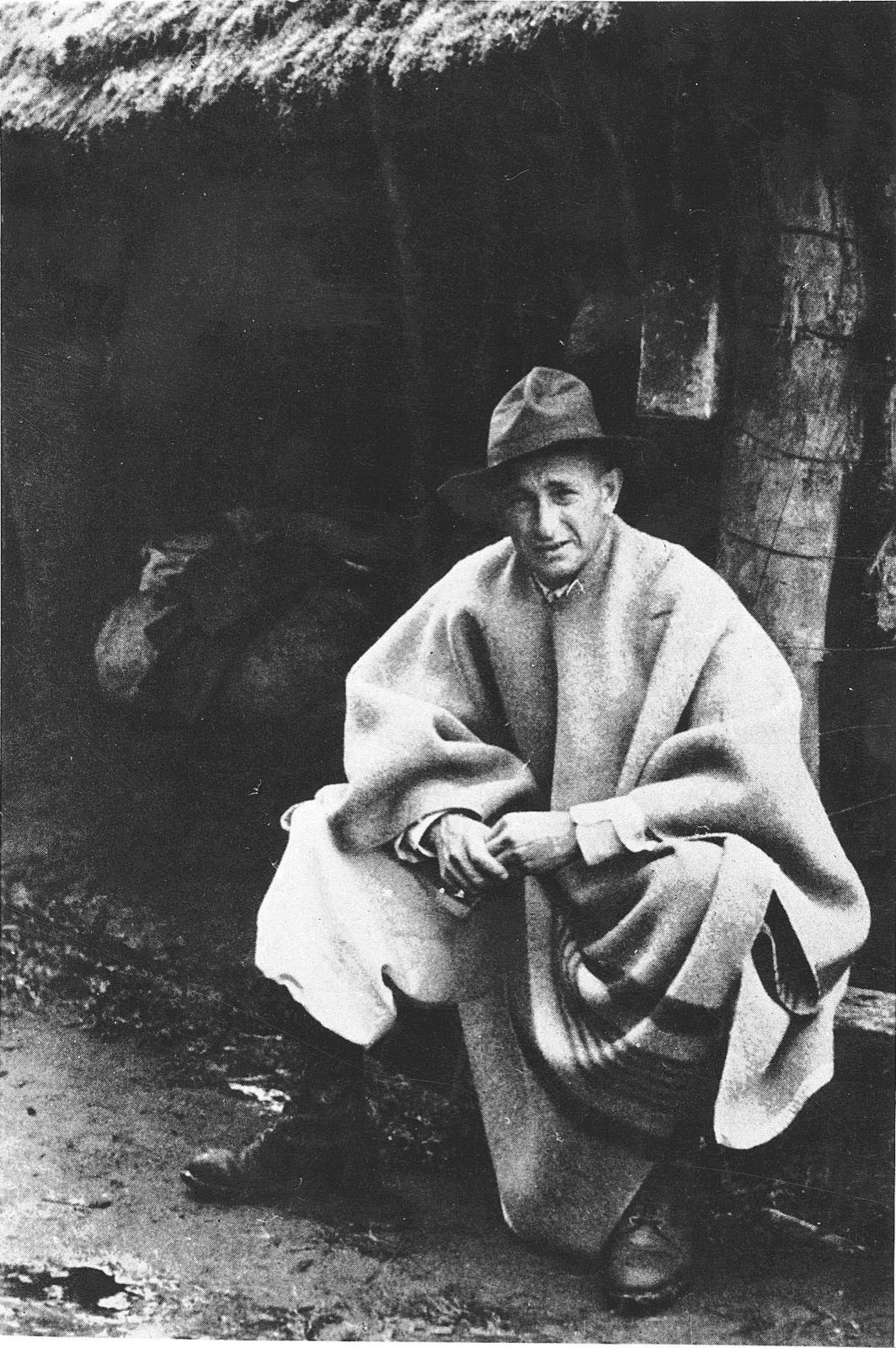
Eichmann in a felt hat and a heavy poncho, squatting in front of a hut with a thatched roof.1950s
On the left, Eichmann wears SS uniform during the war. On the right, he squats in a poncho in Argentina in the 1950s. Photographs from Wikimedia Commons and Yad Vashem.

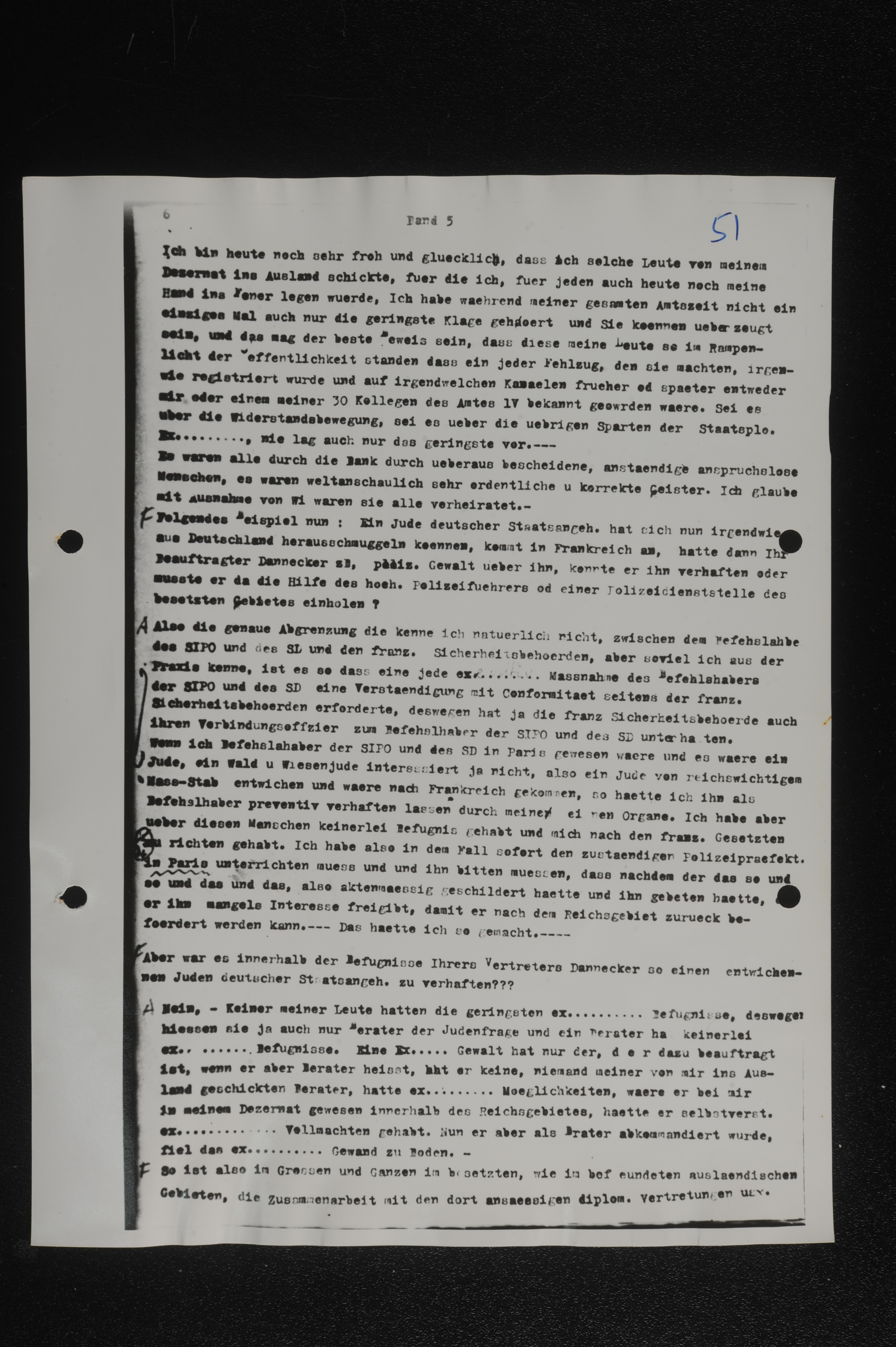
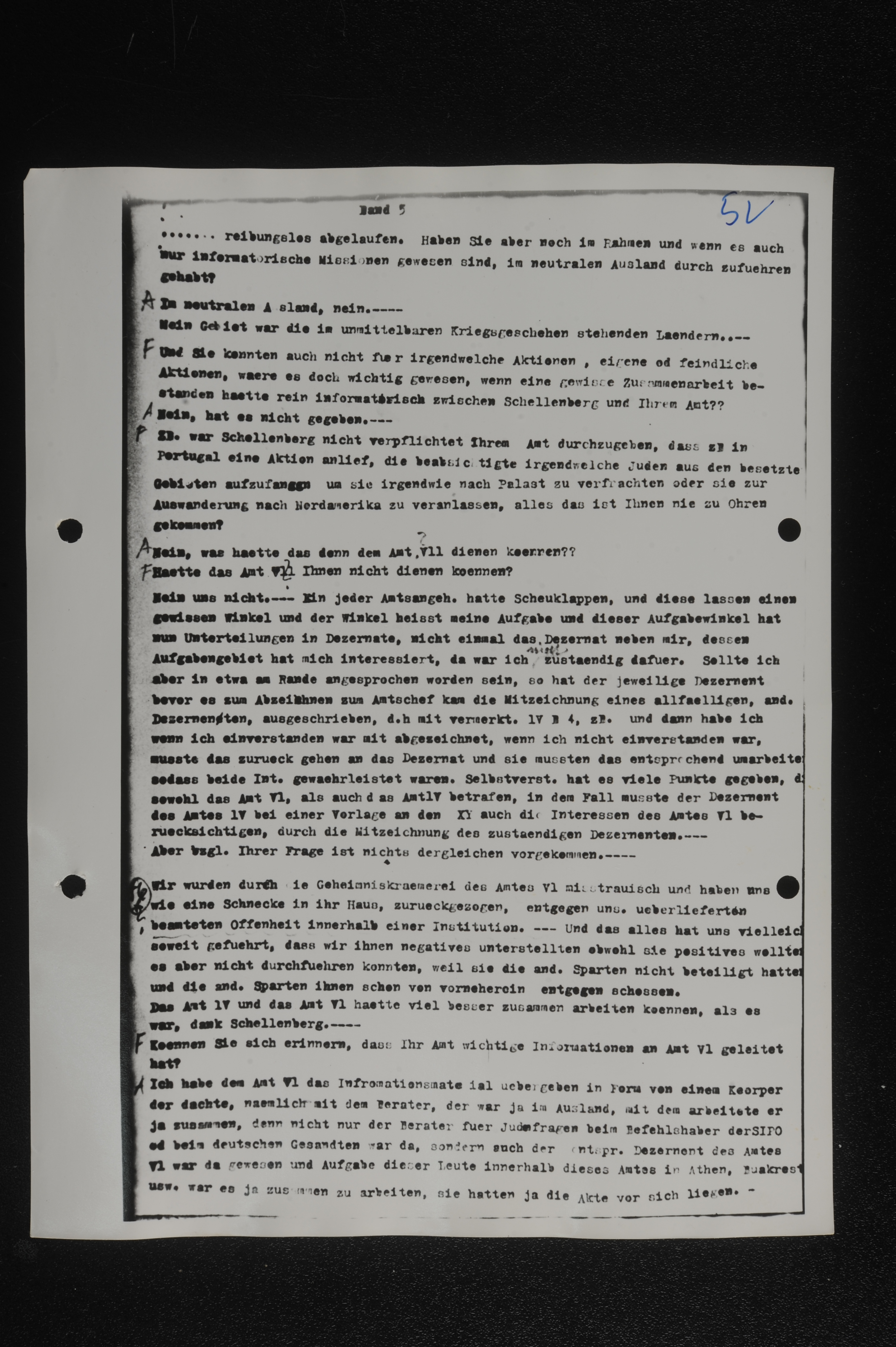
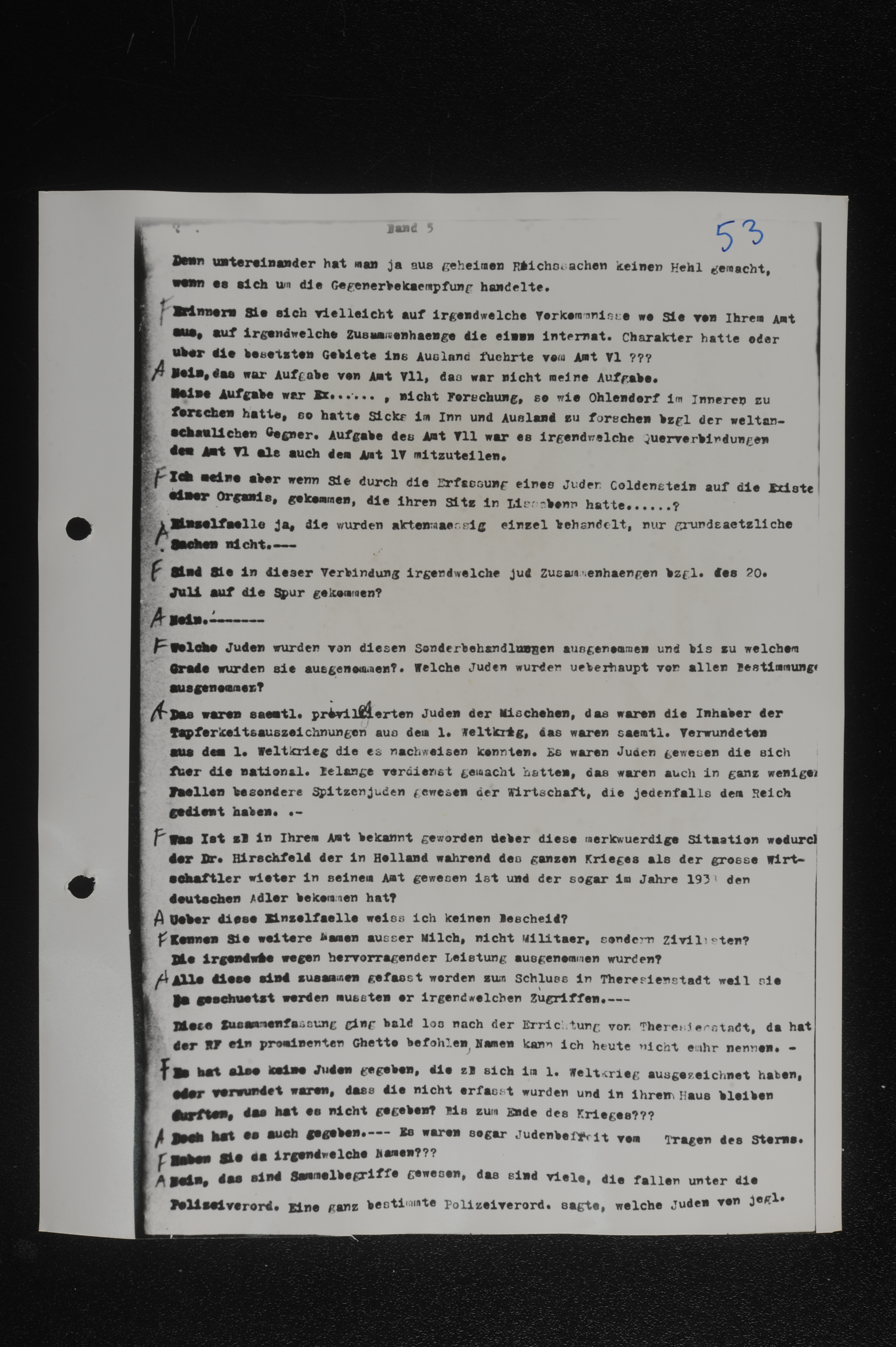
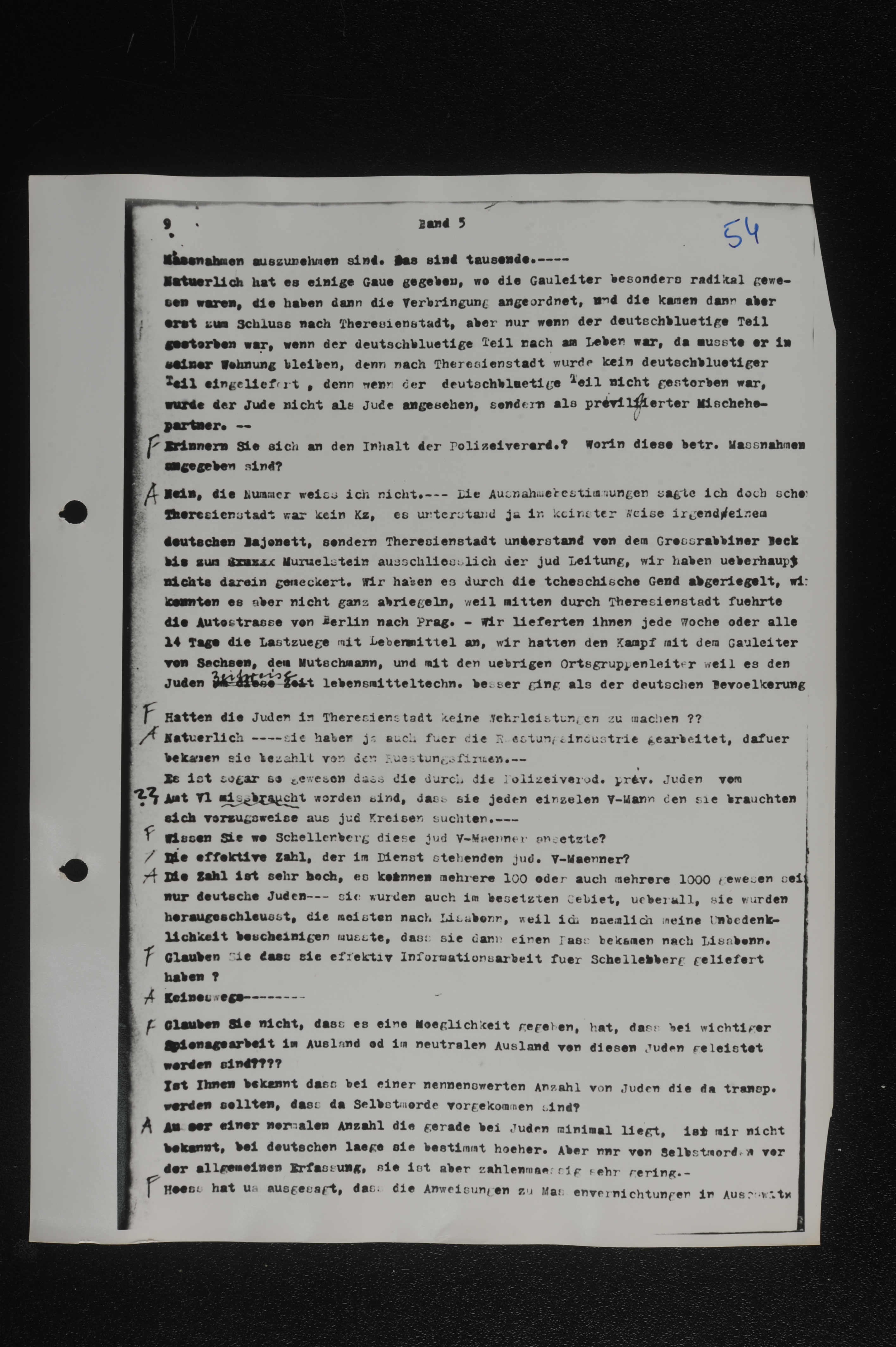
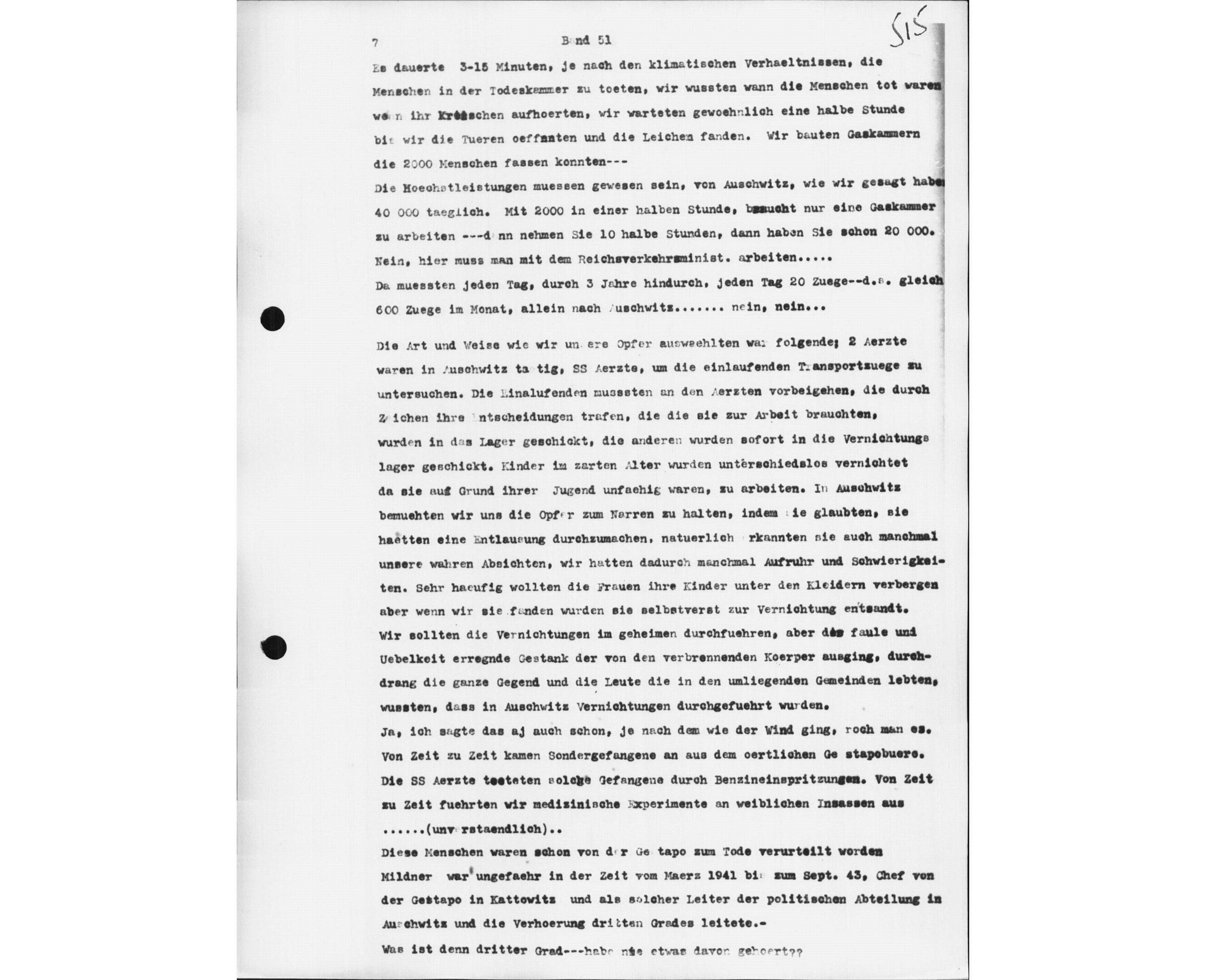
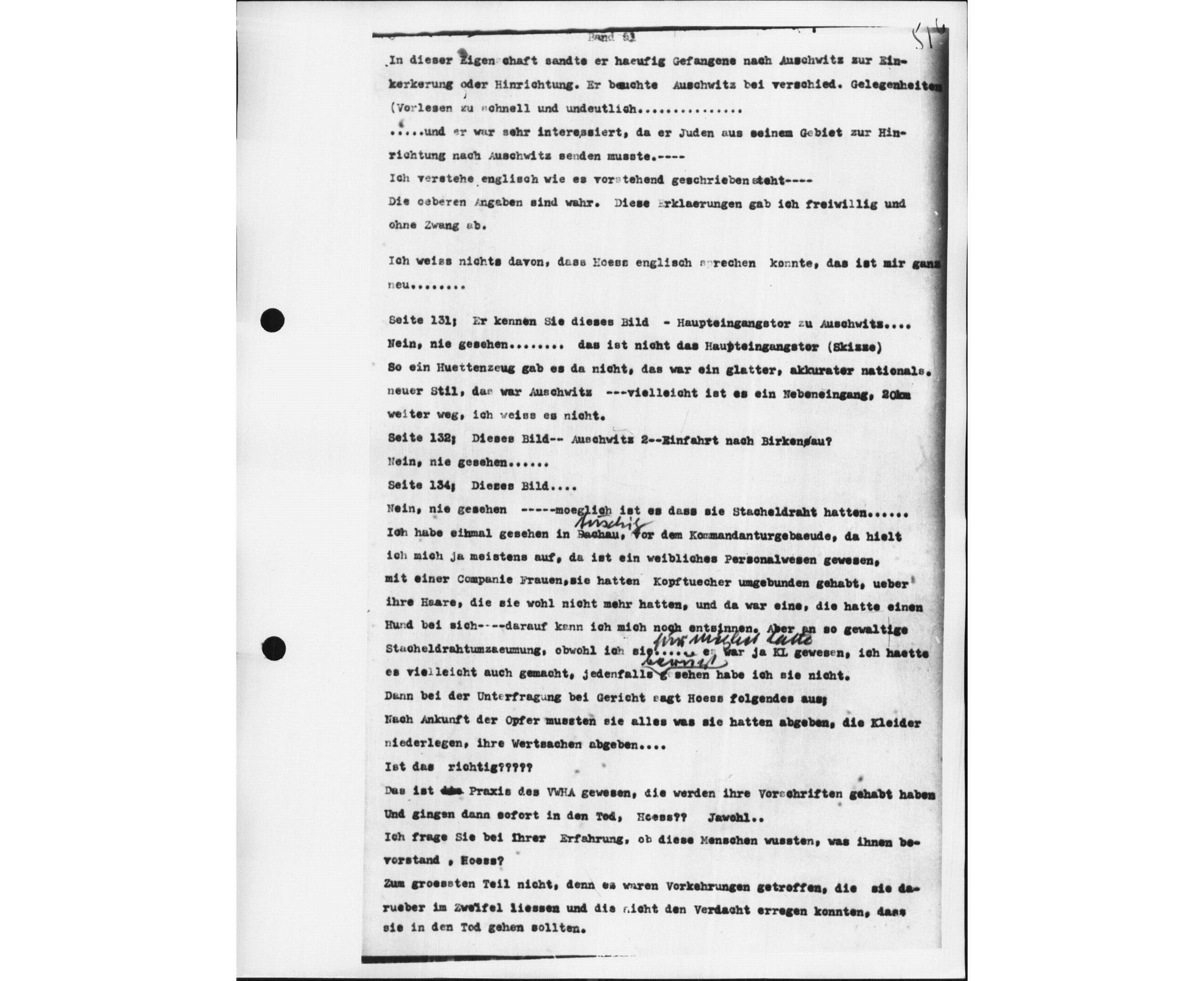
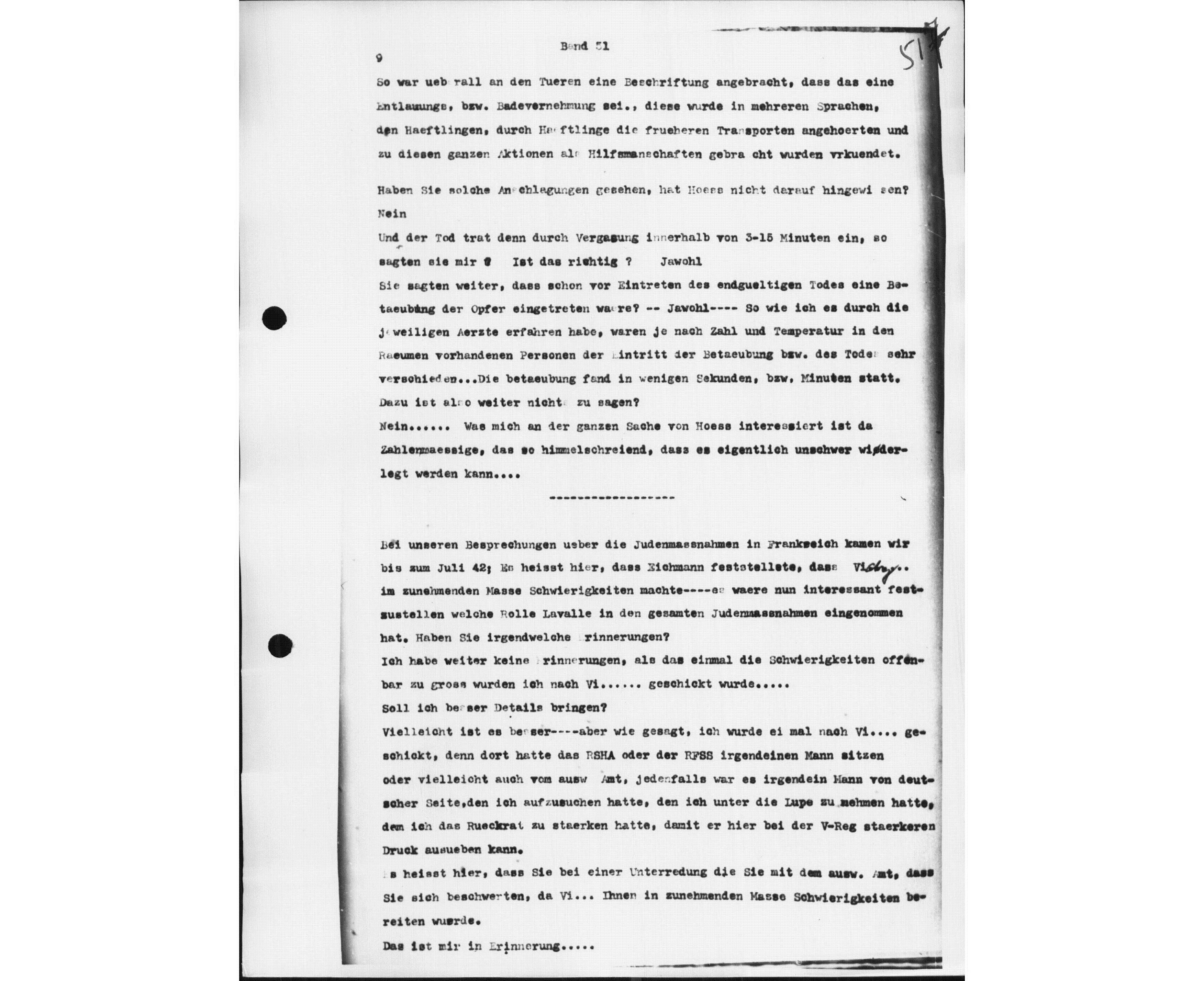
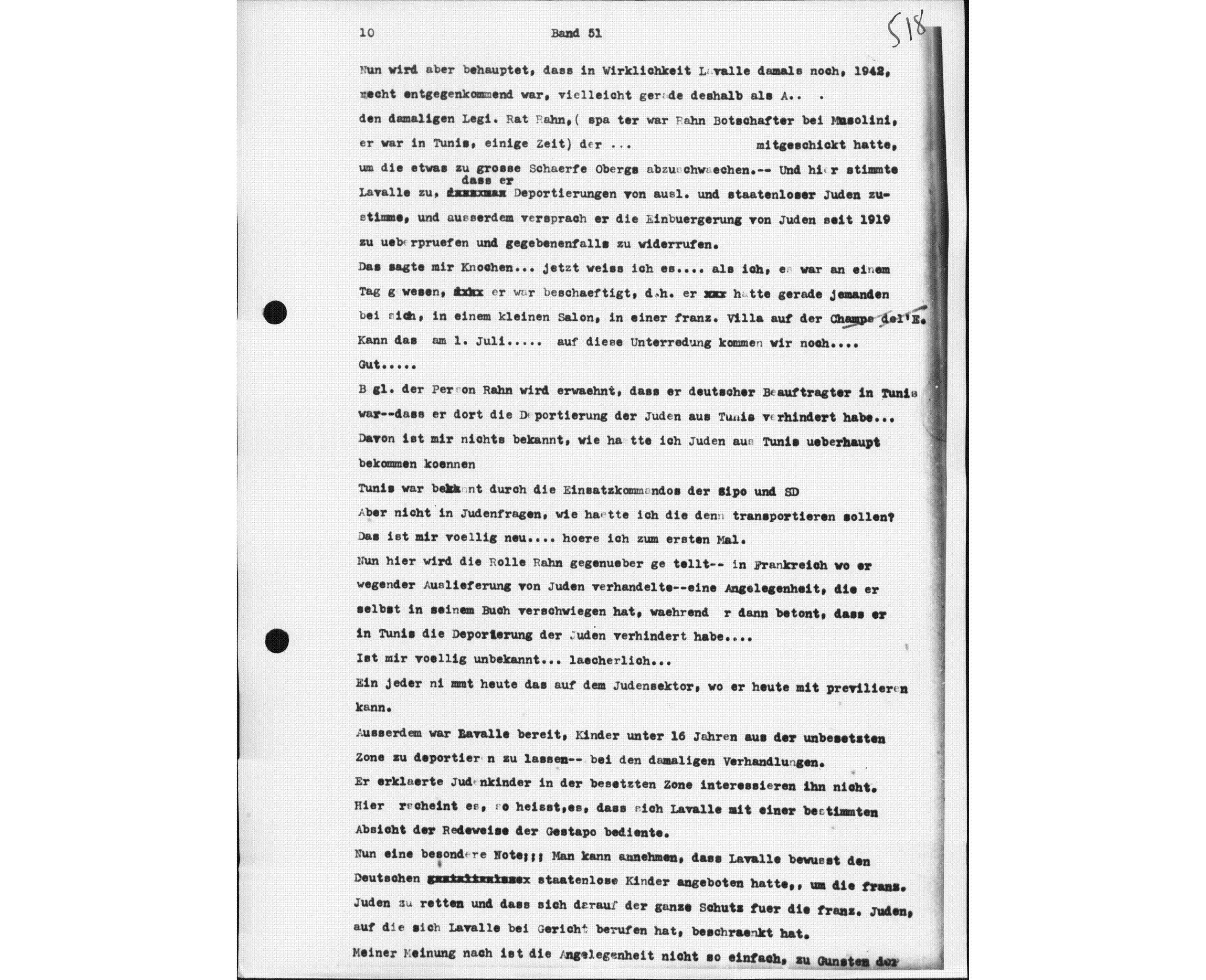
The Eichmann Sassen Transcripts

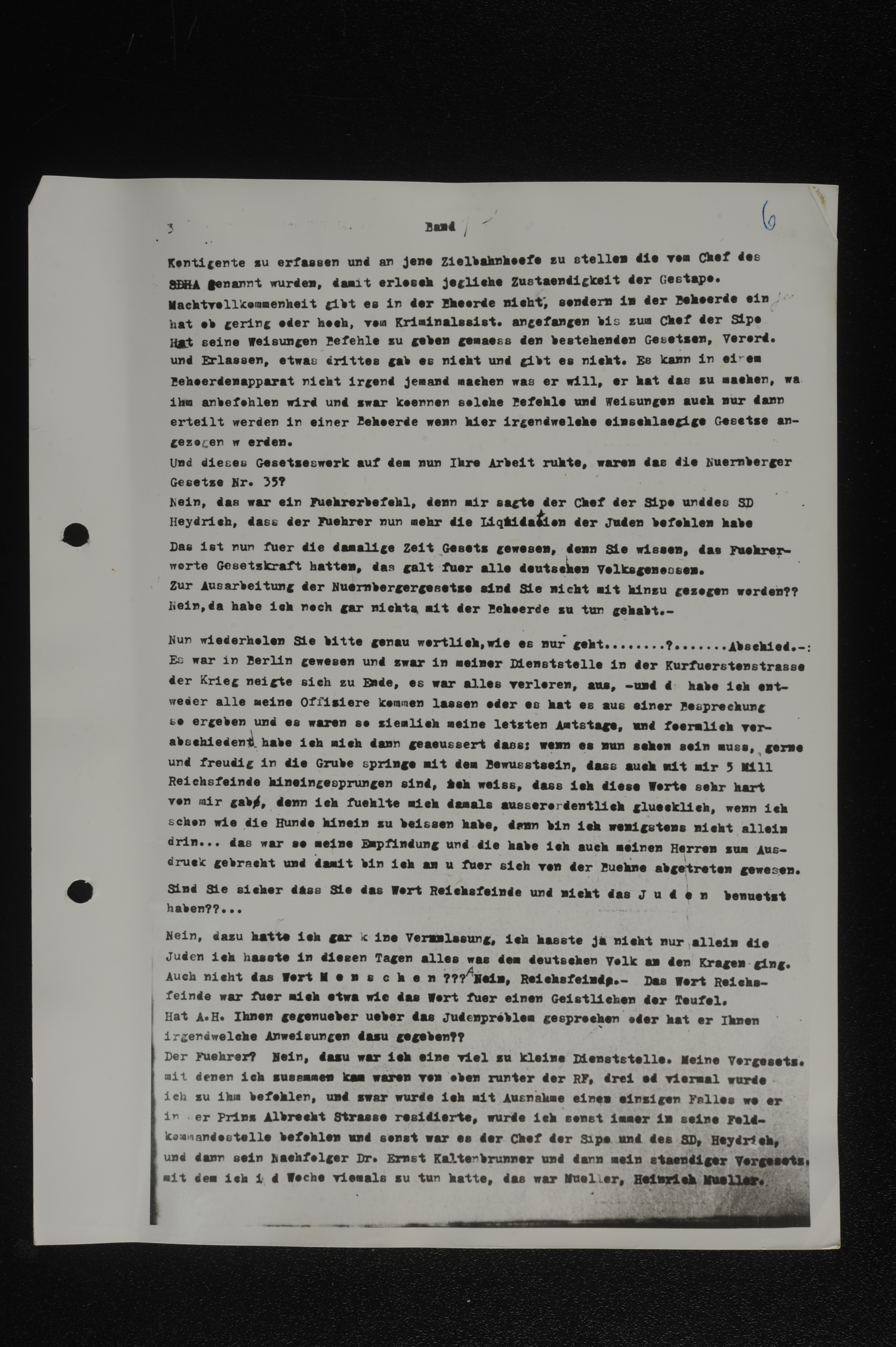
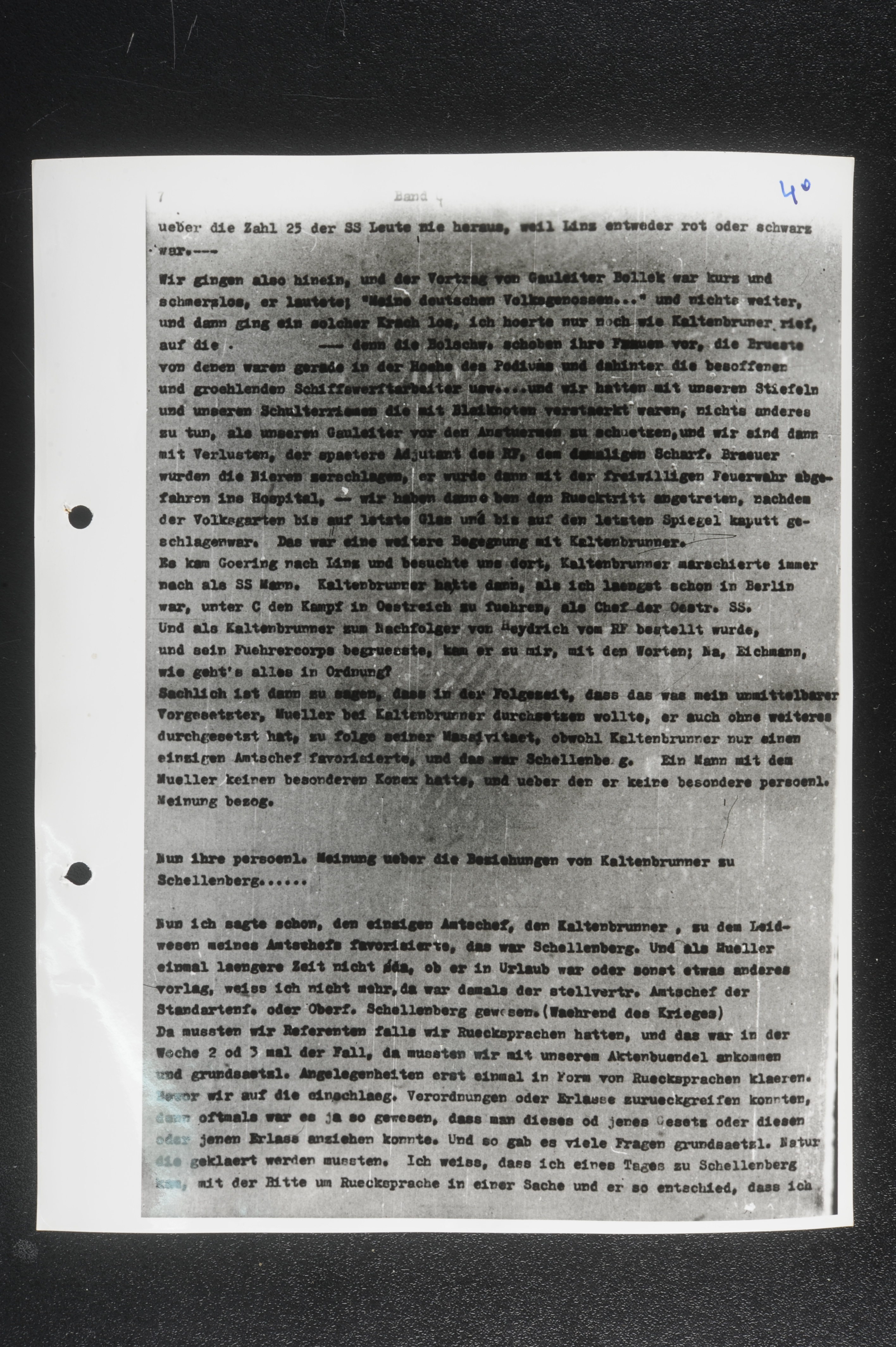
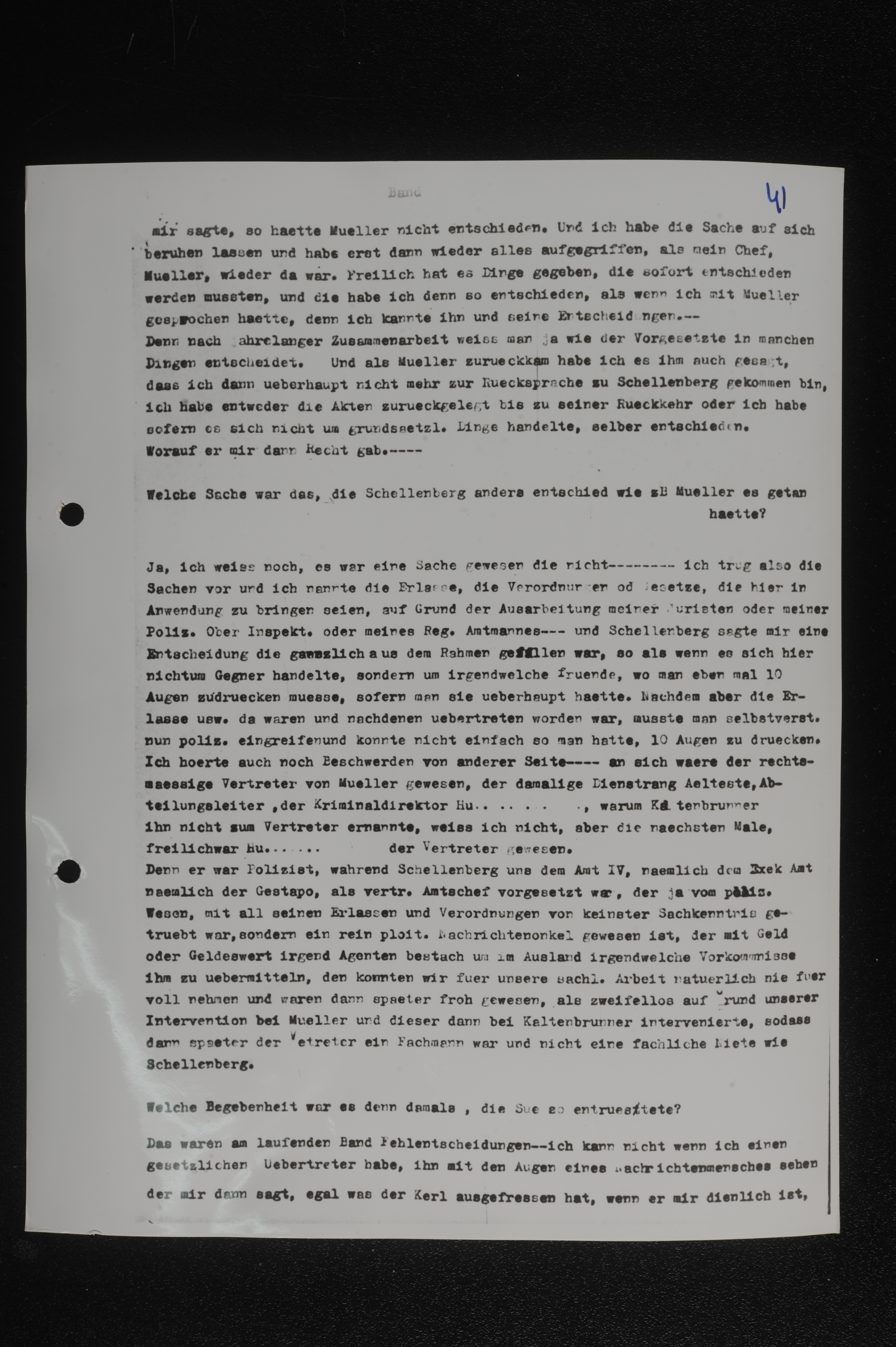
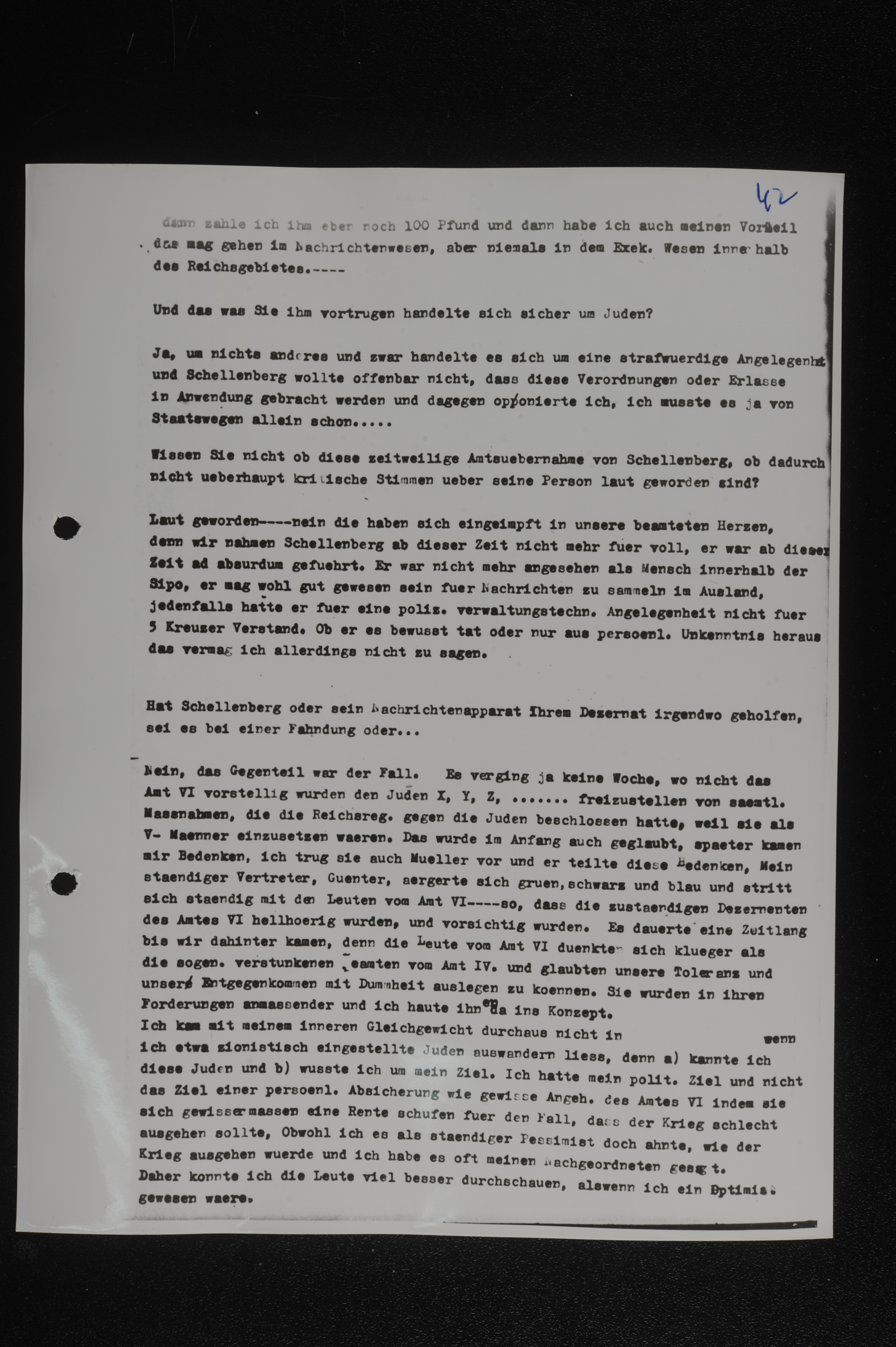
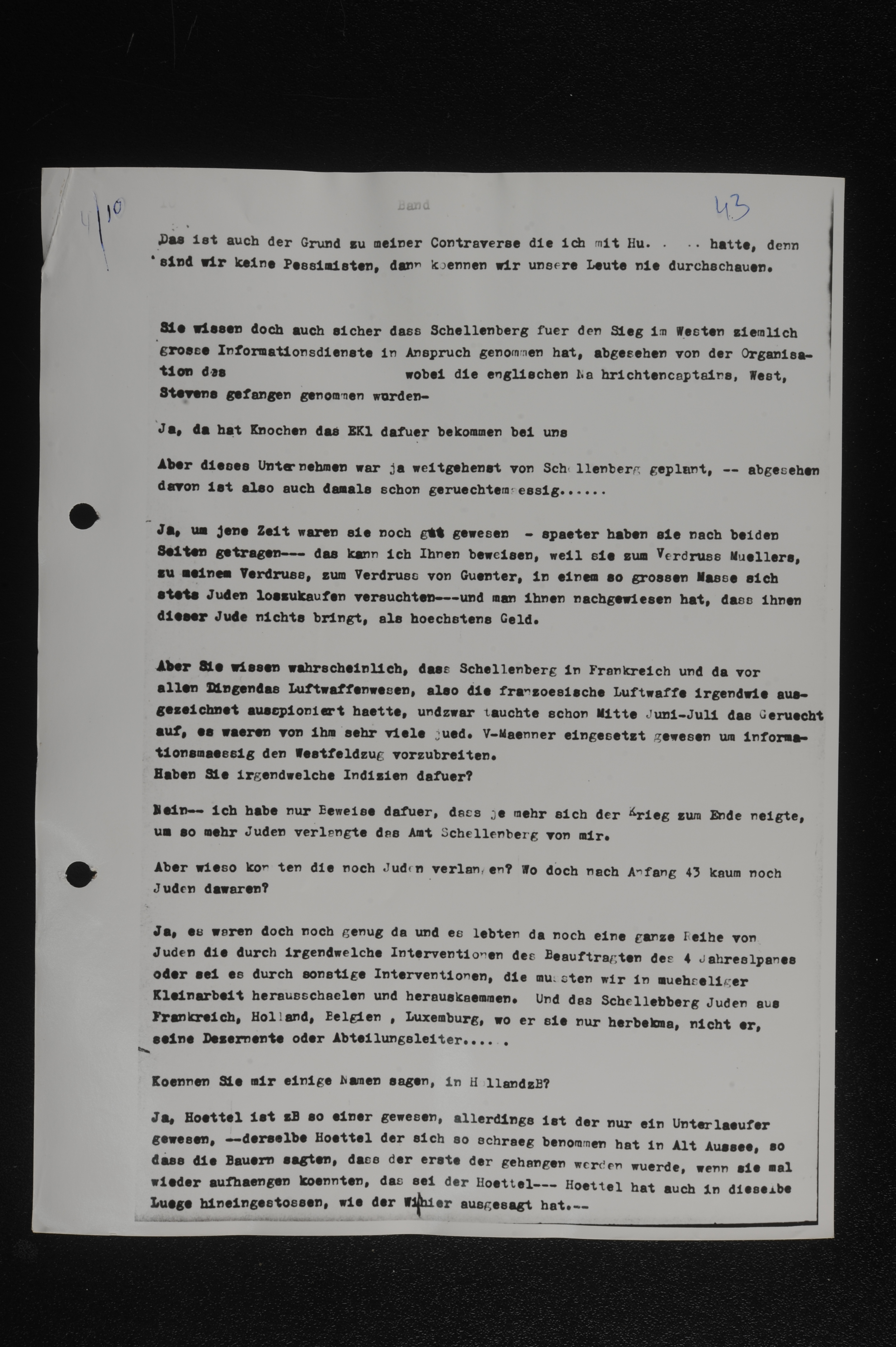
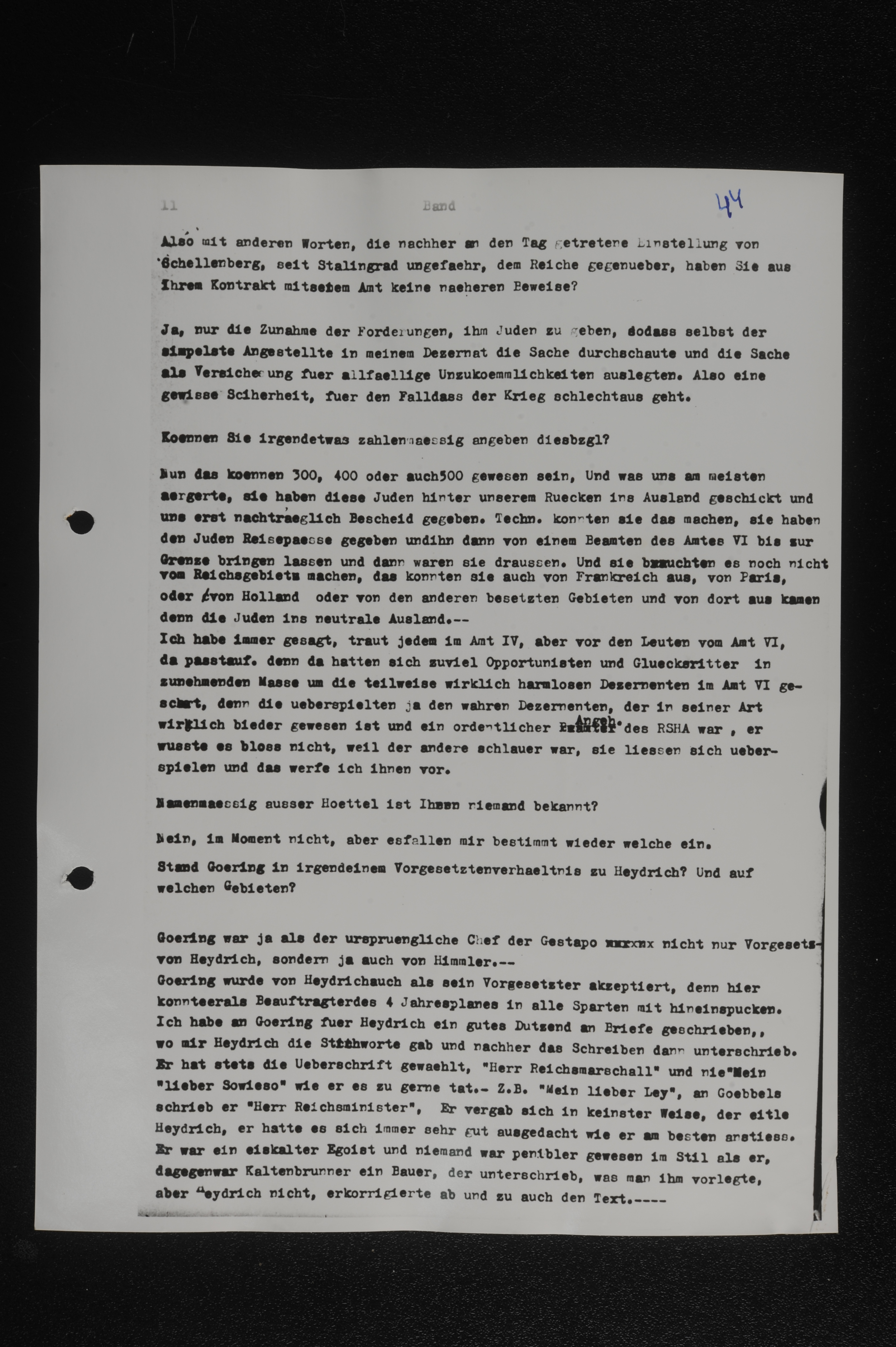
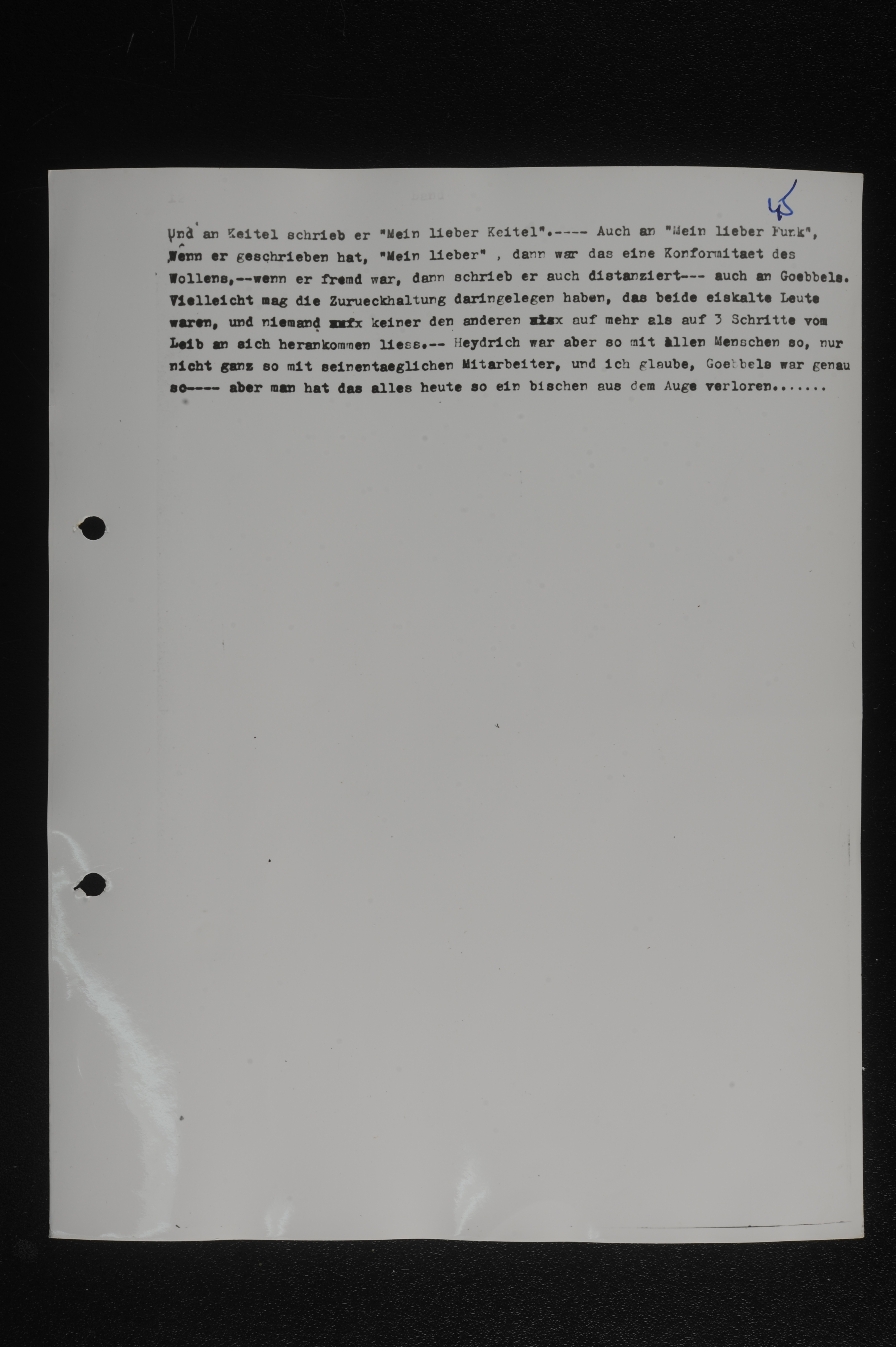
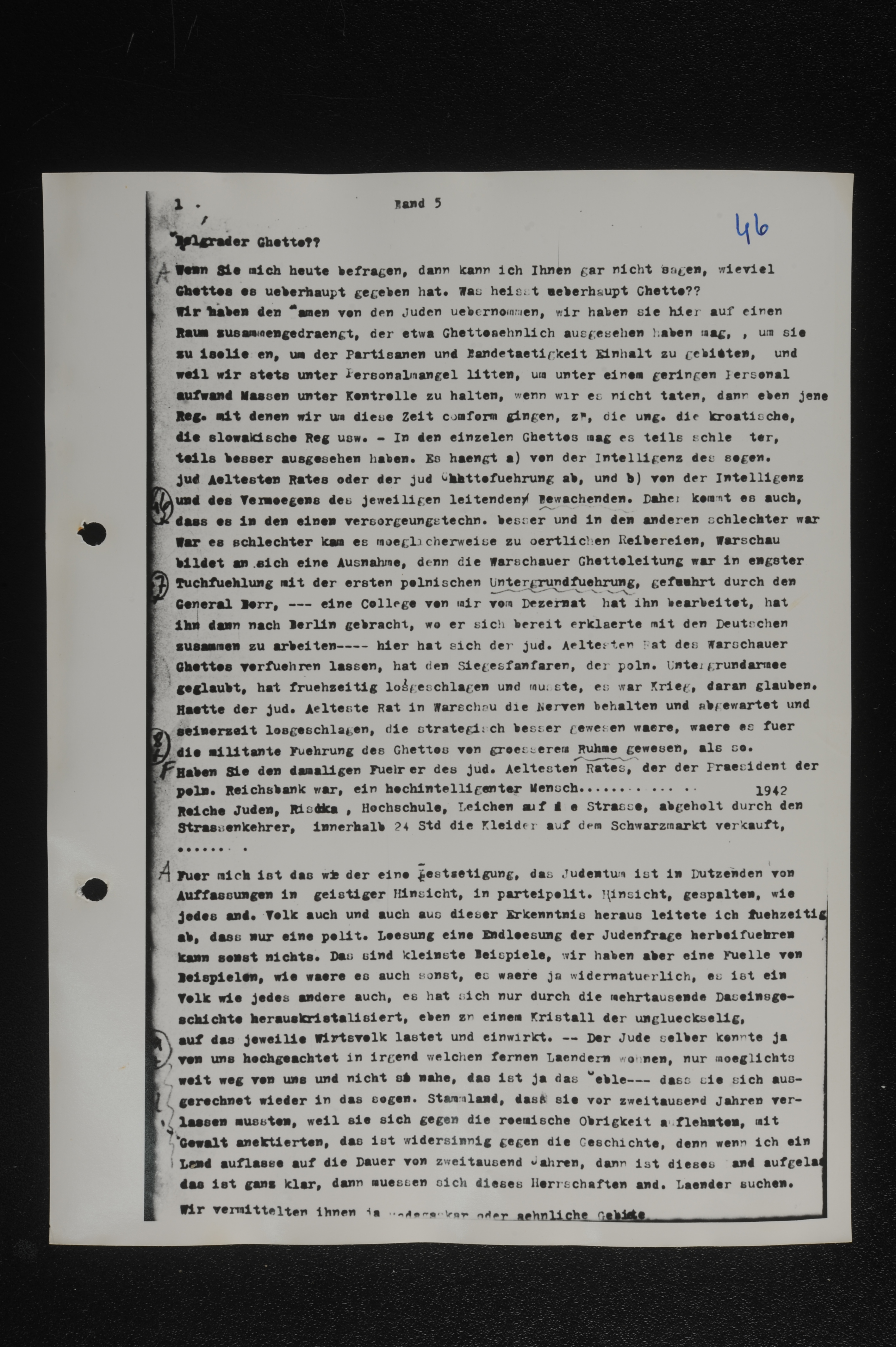
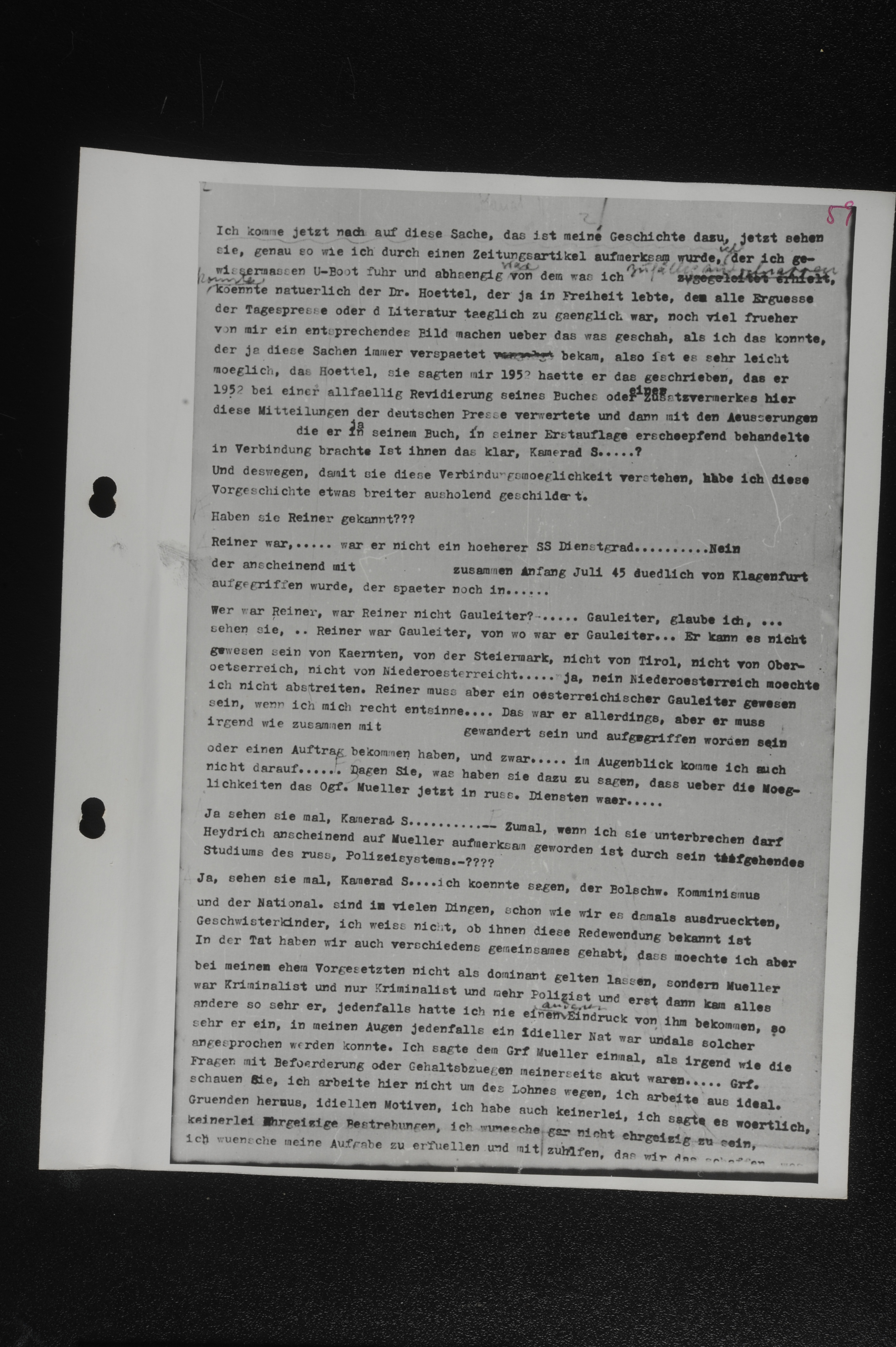
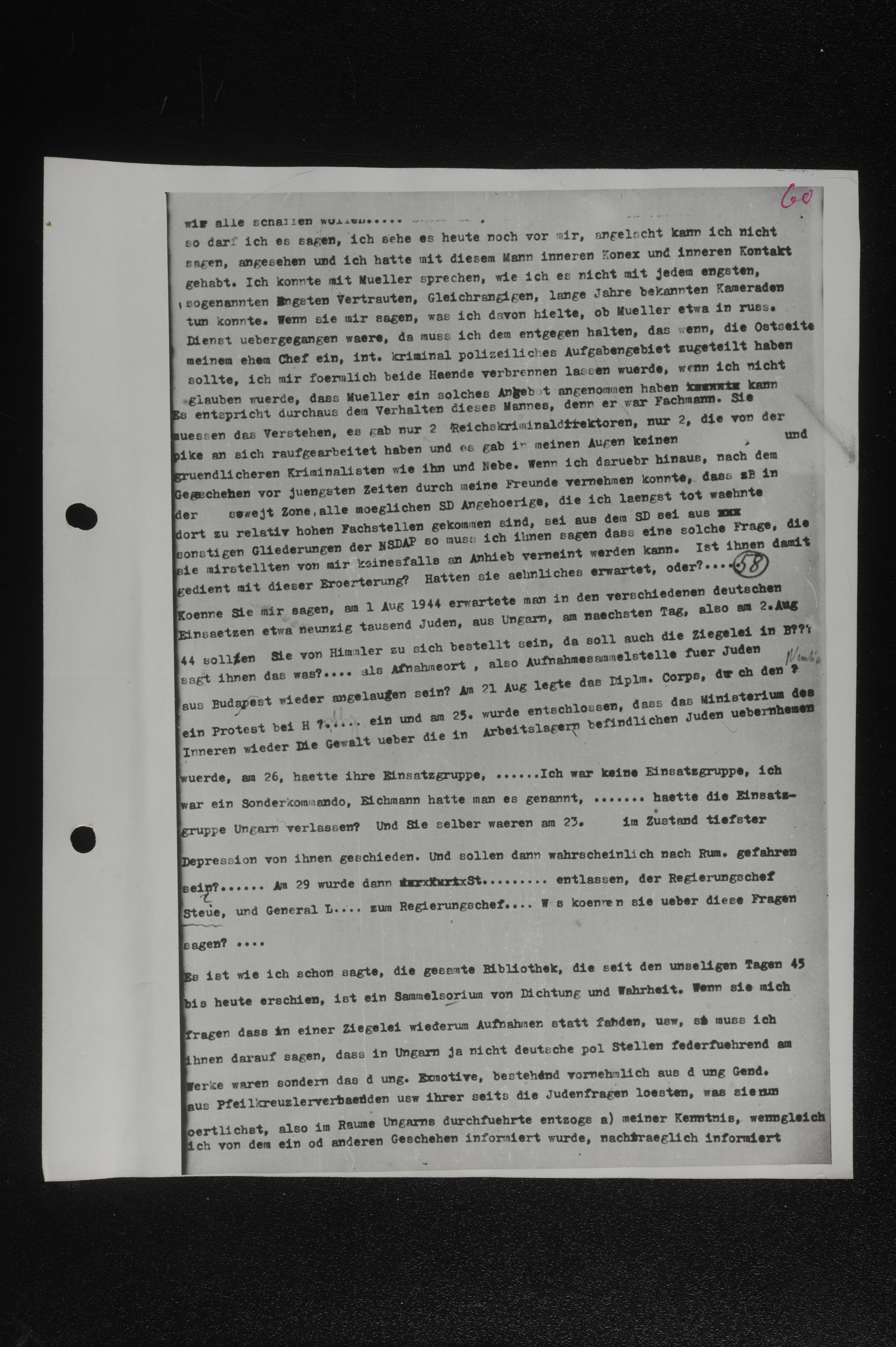
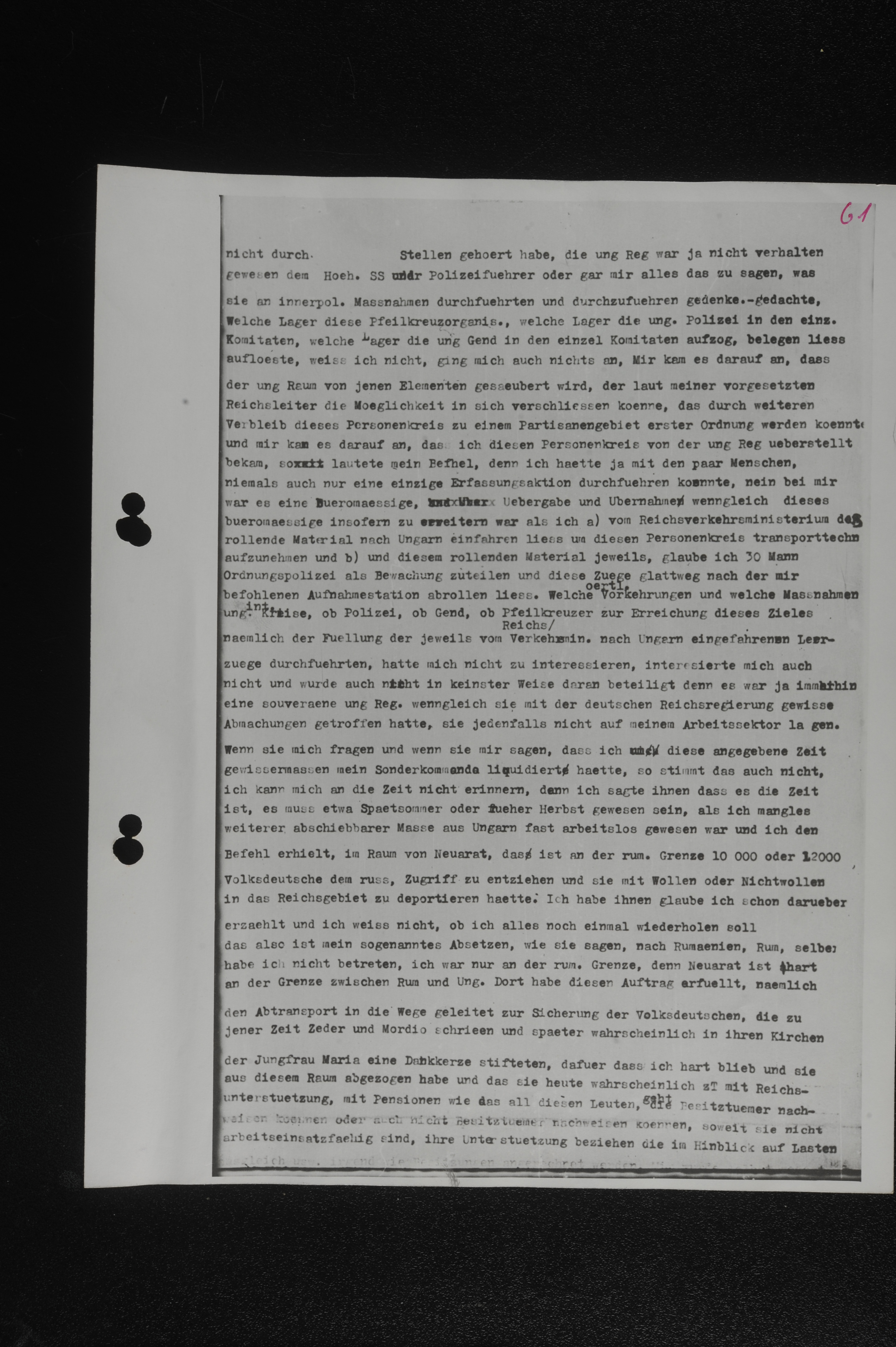
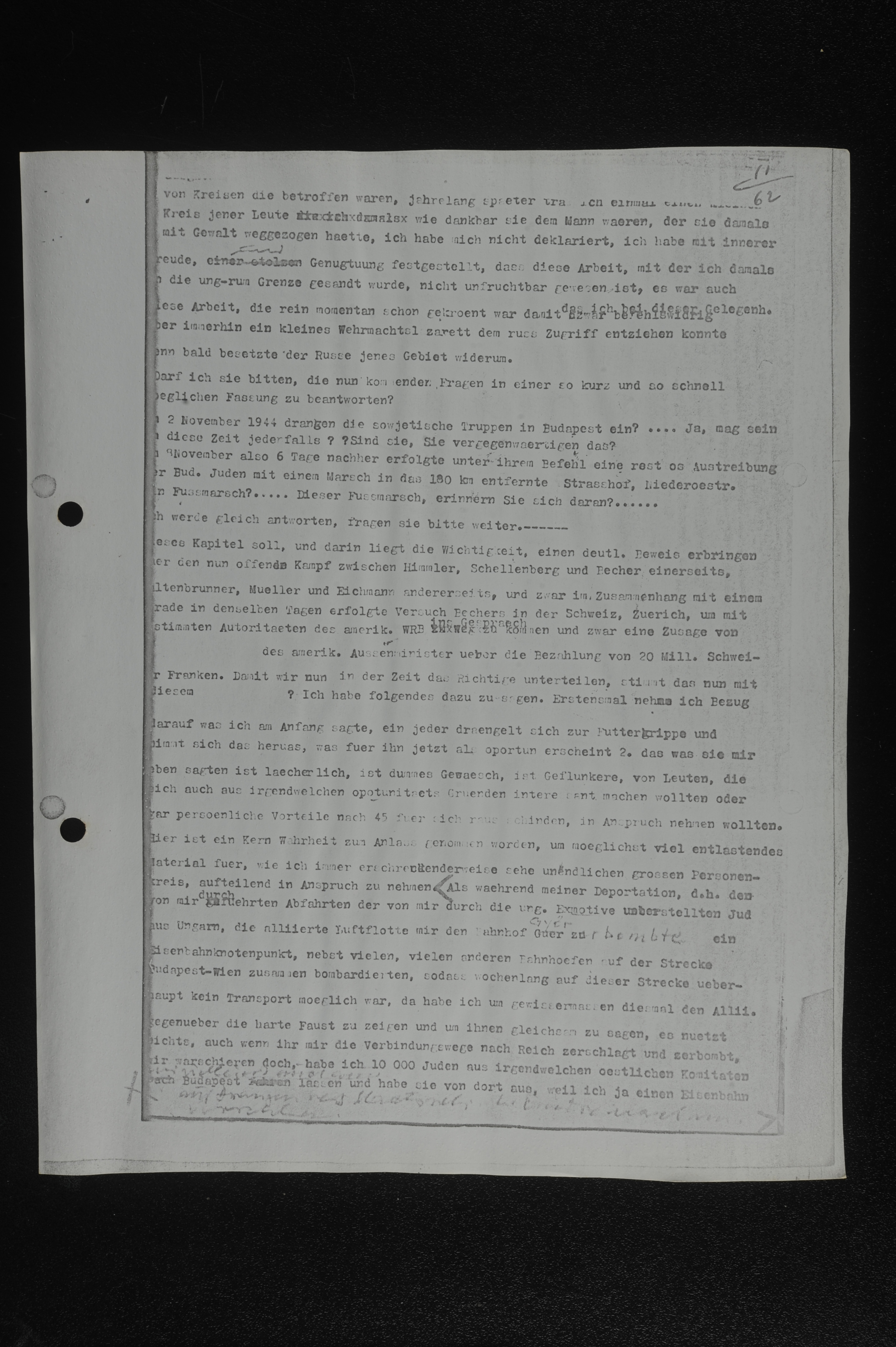
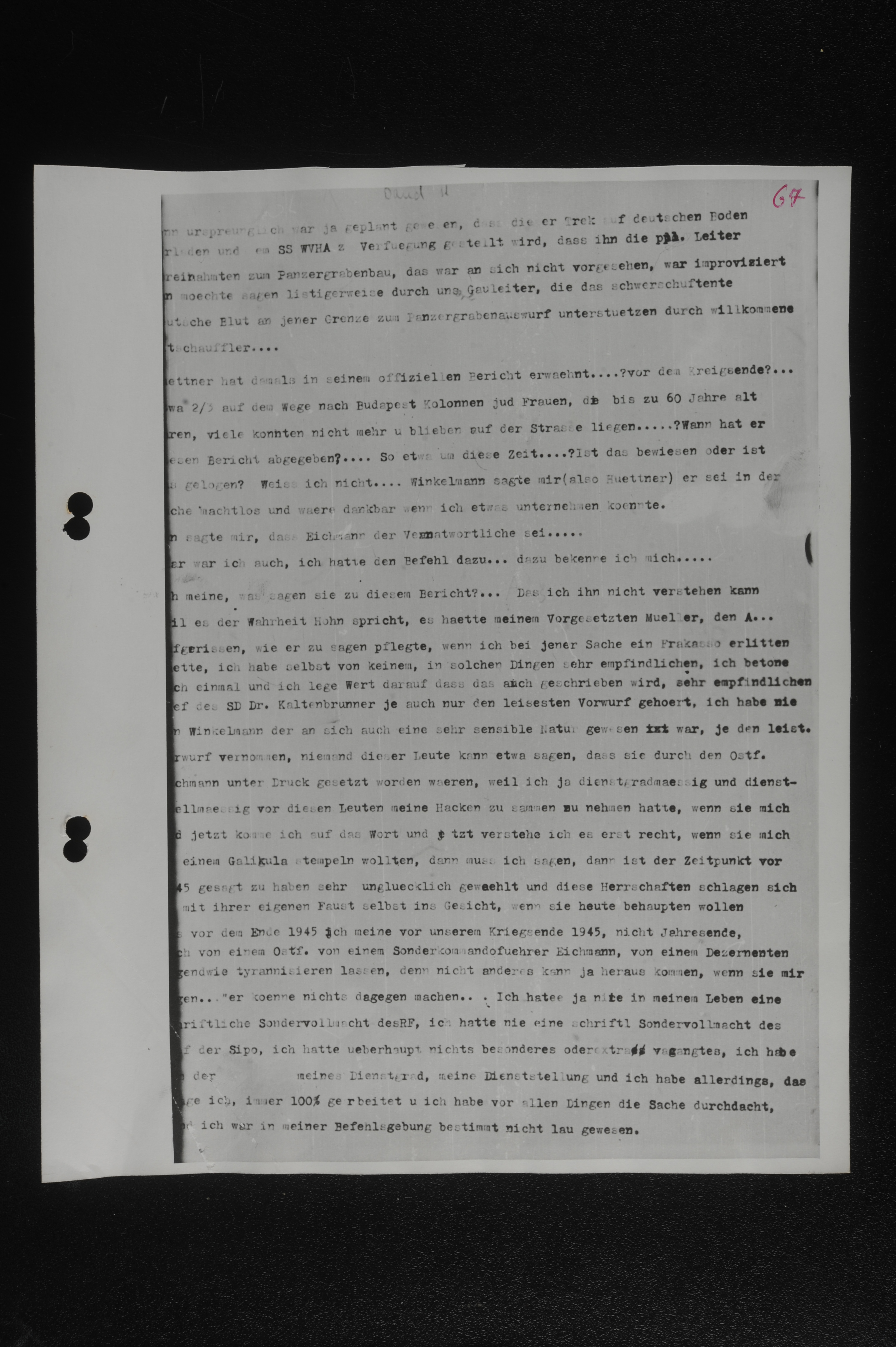
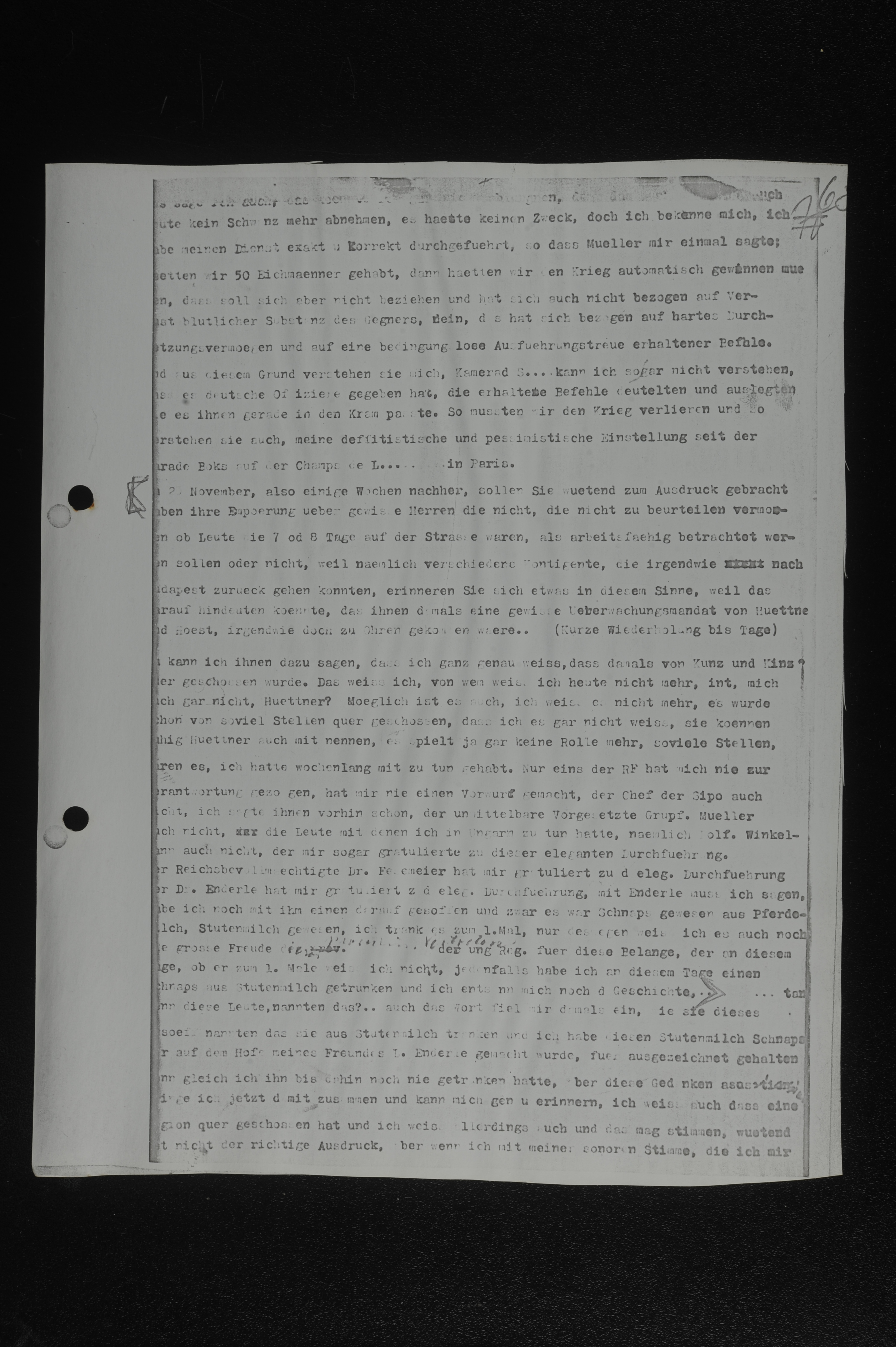
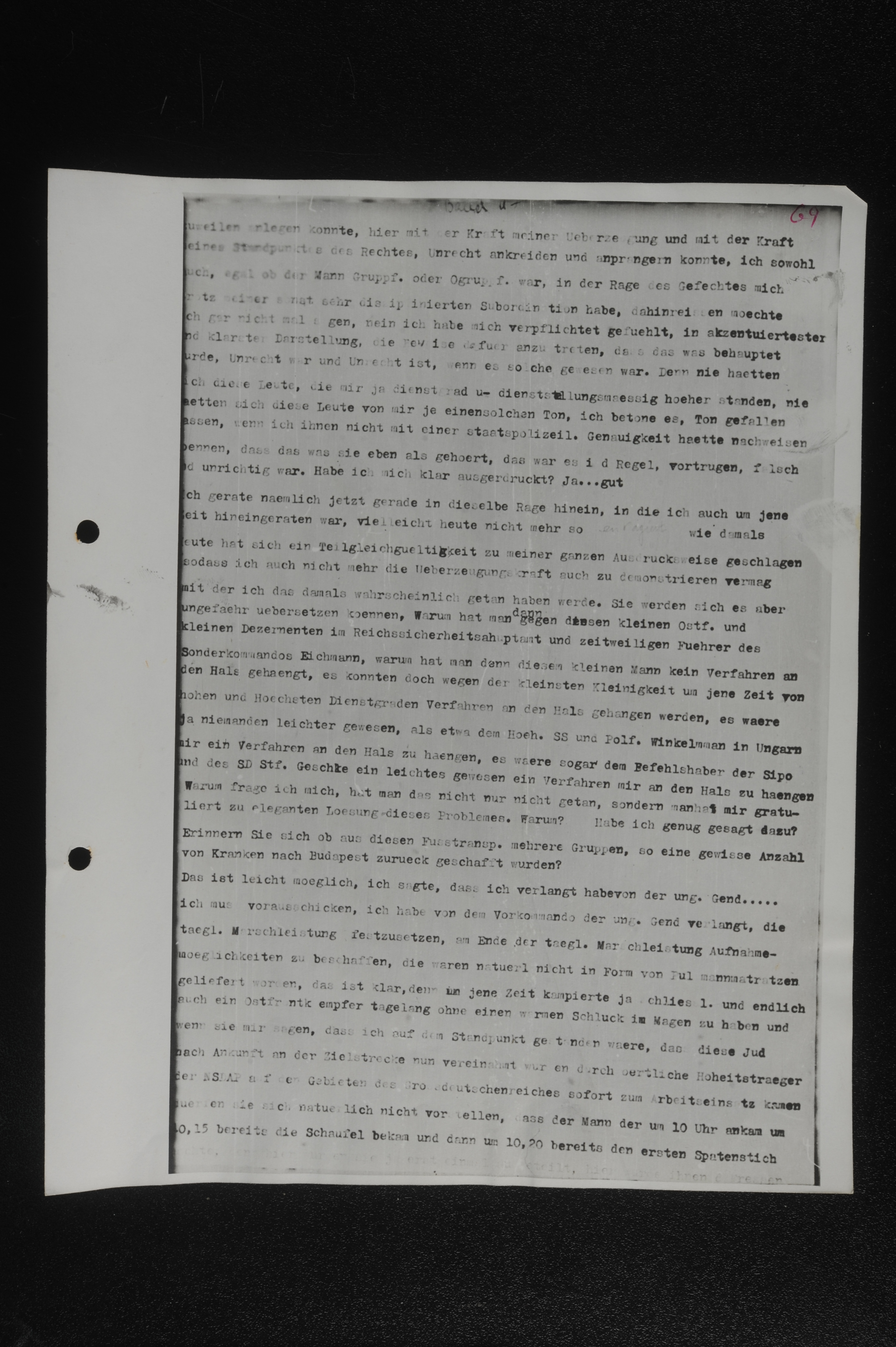
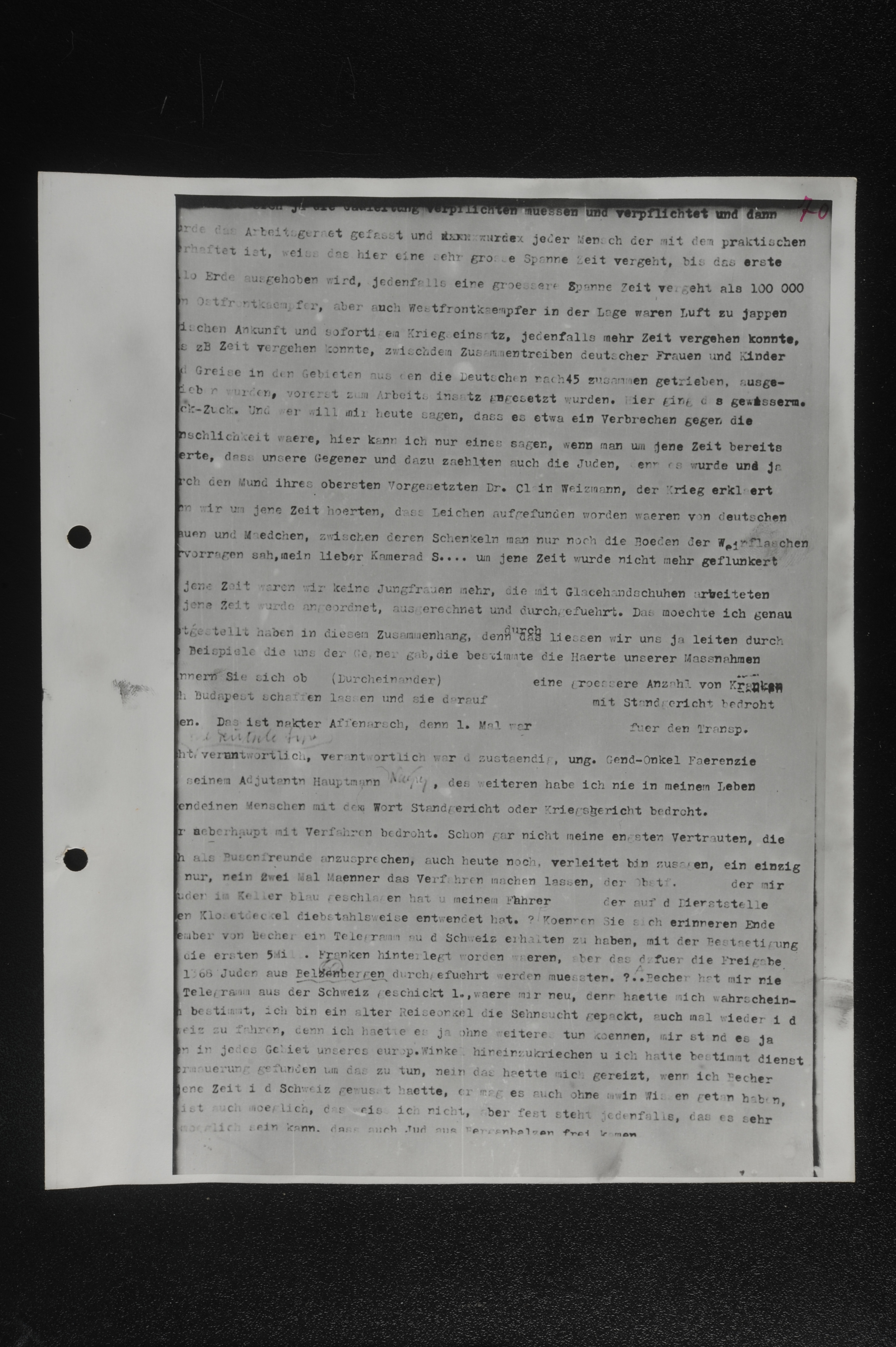
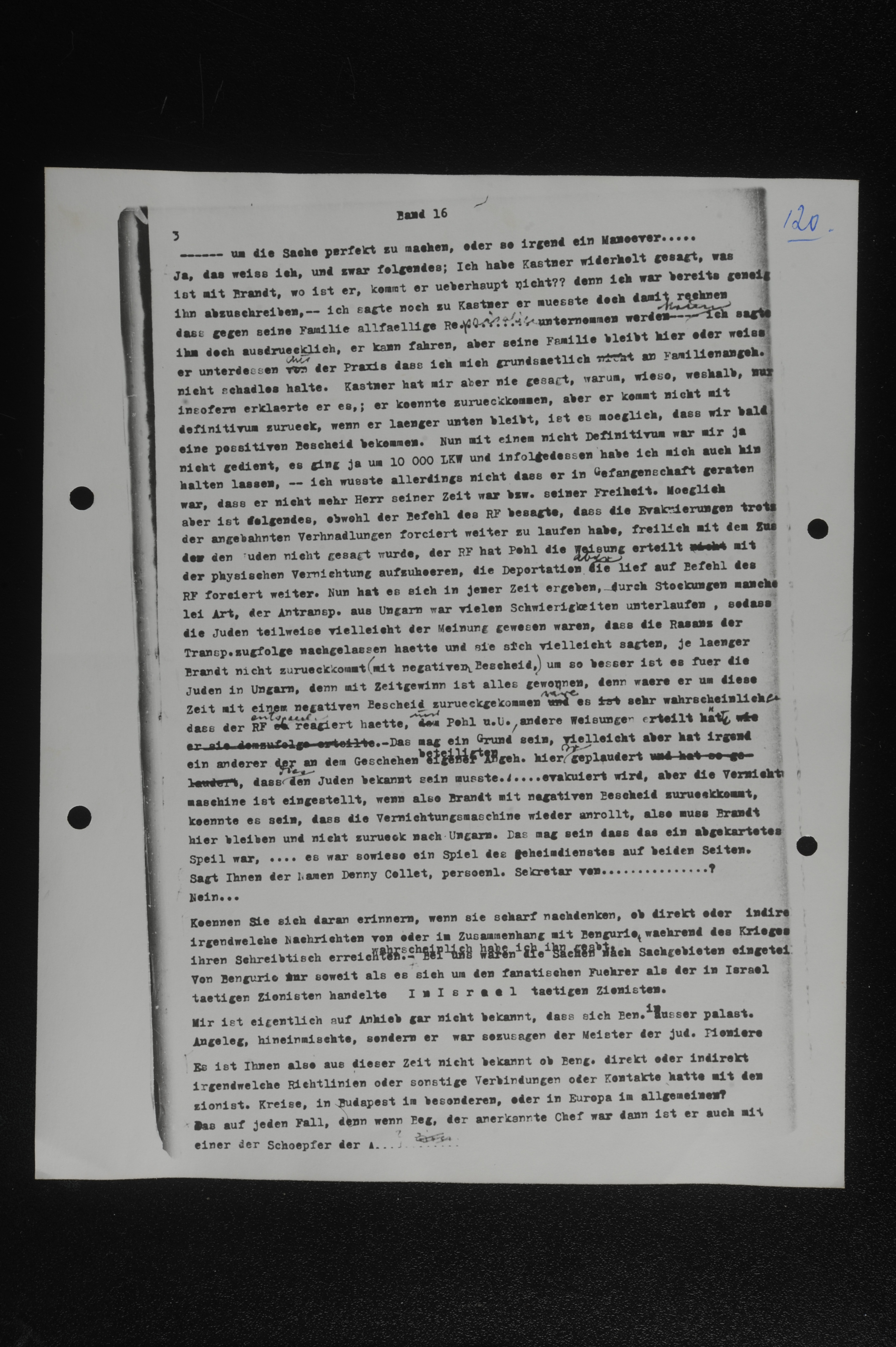
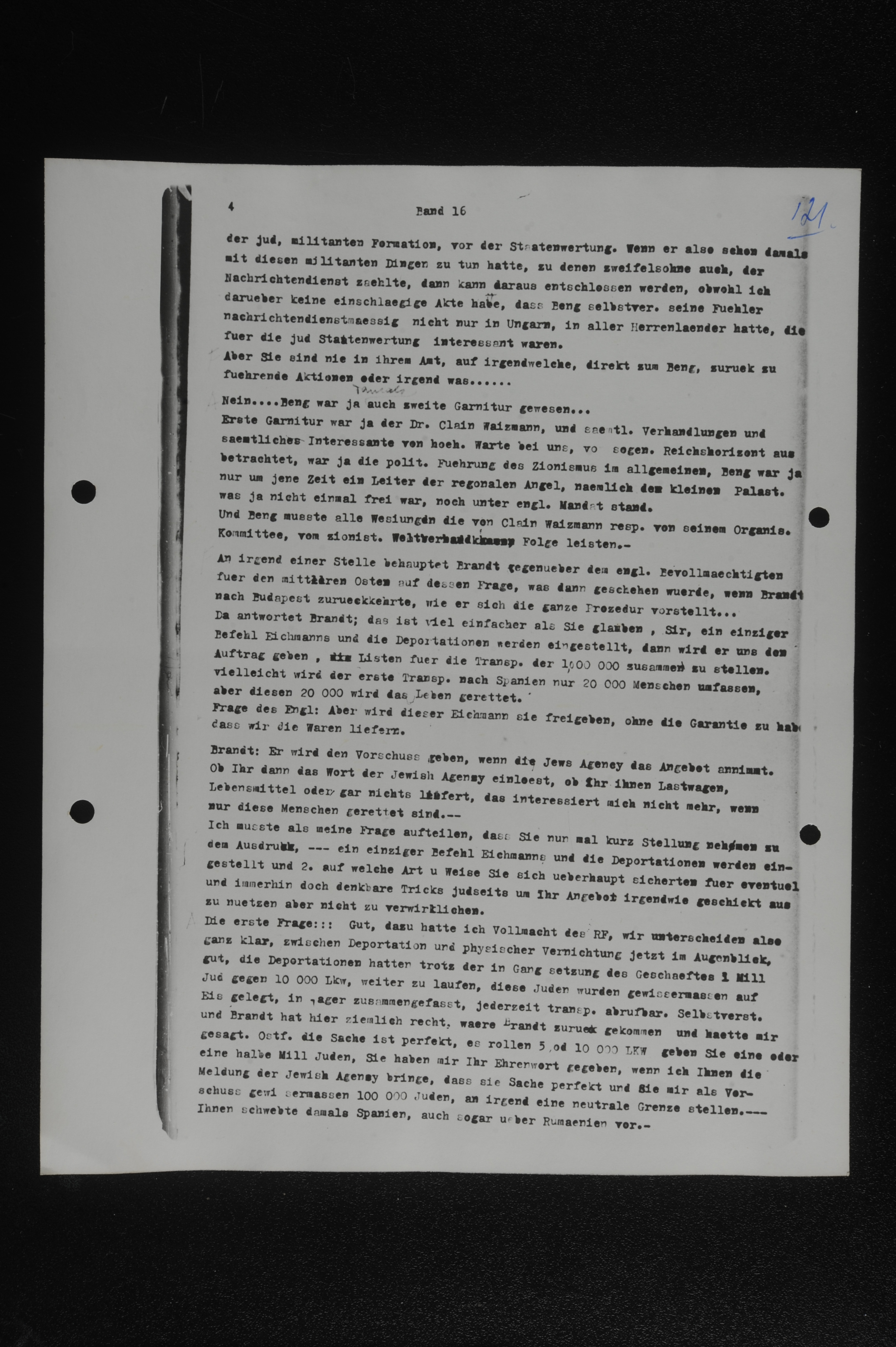
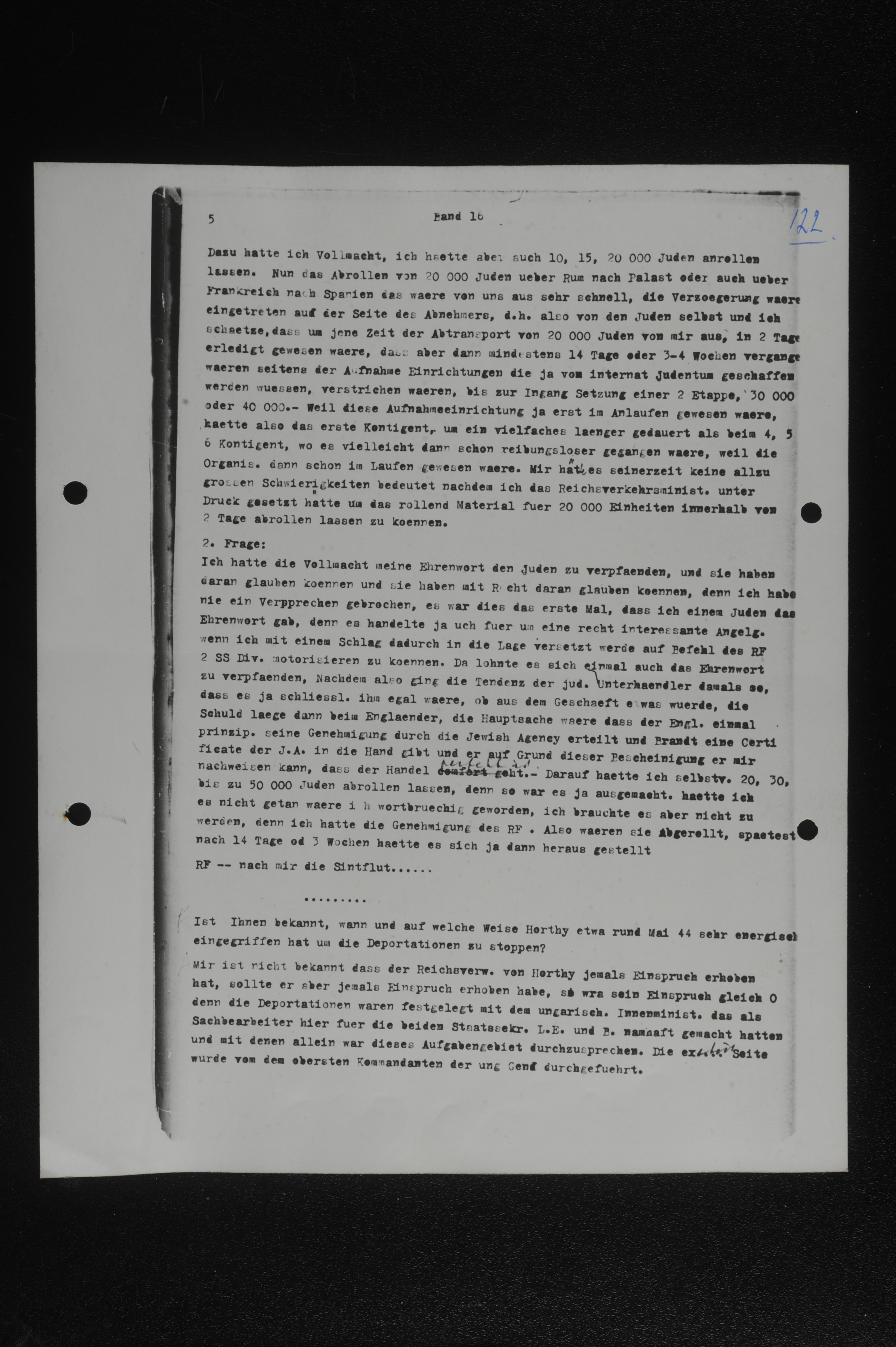
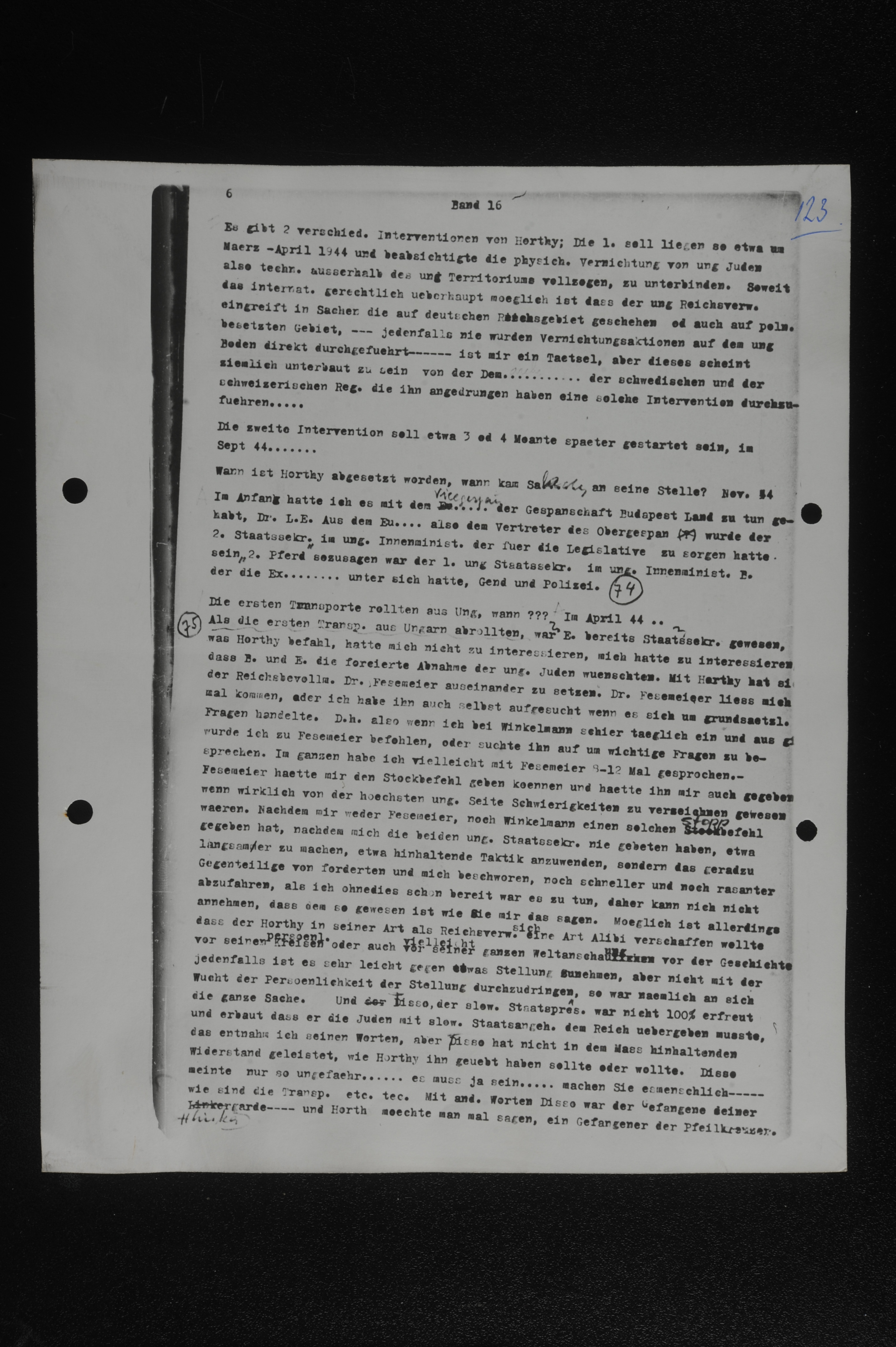
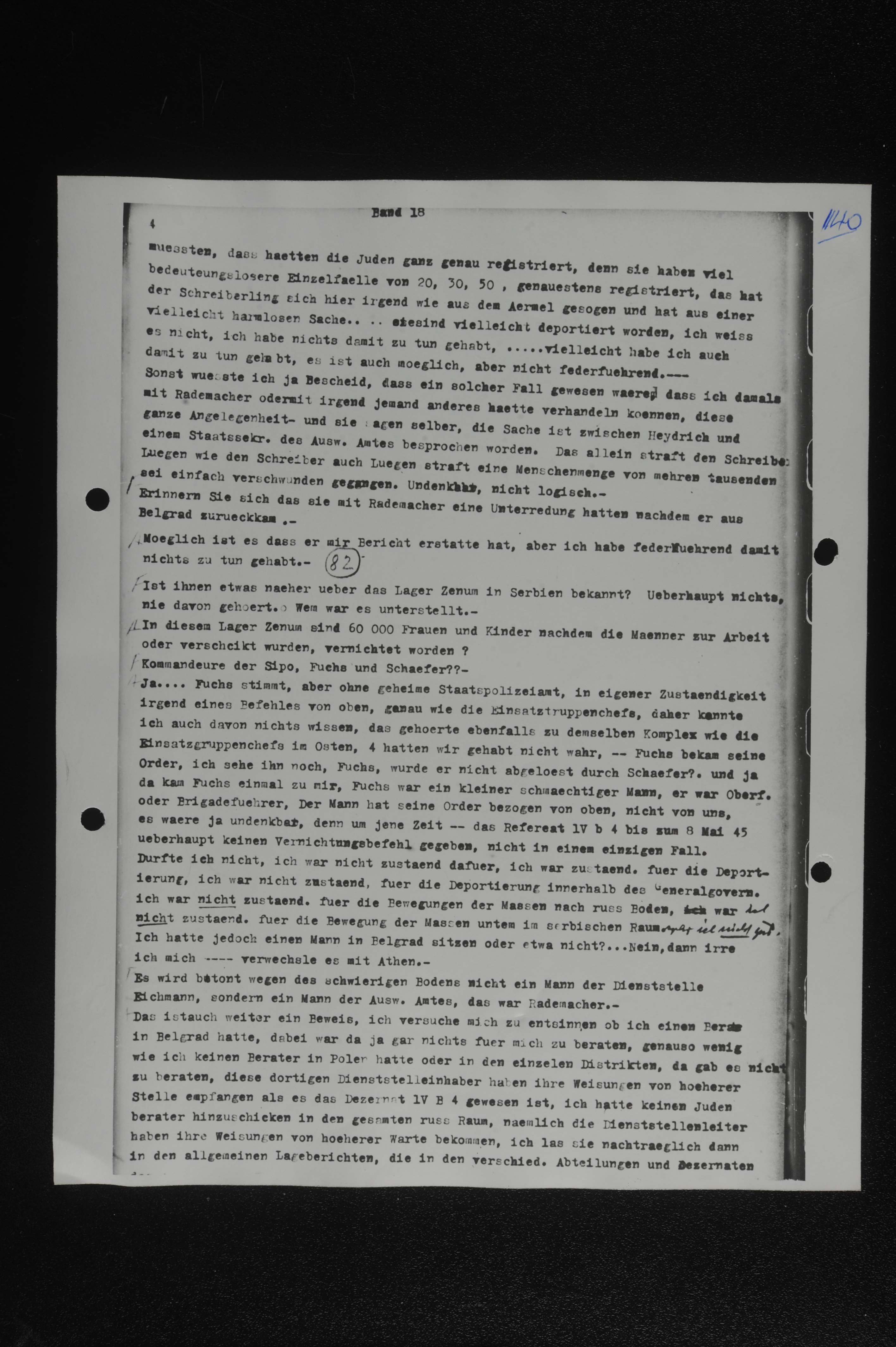
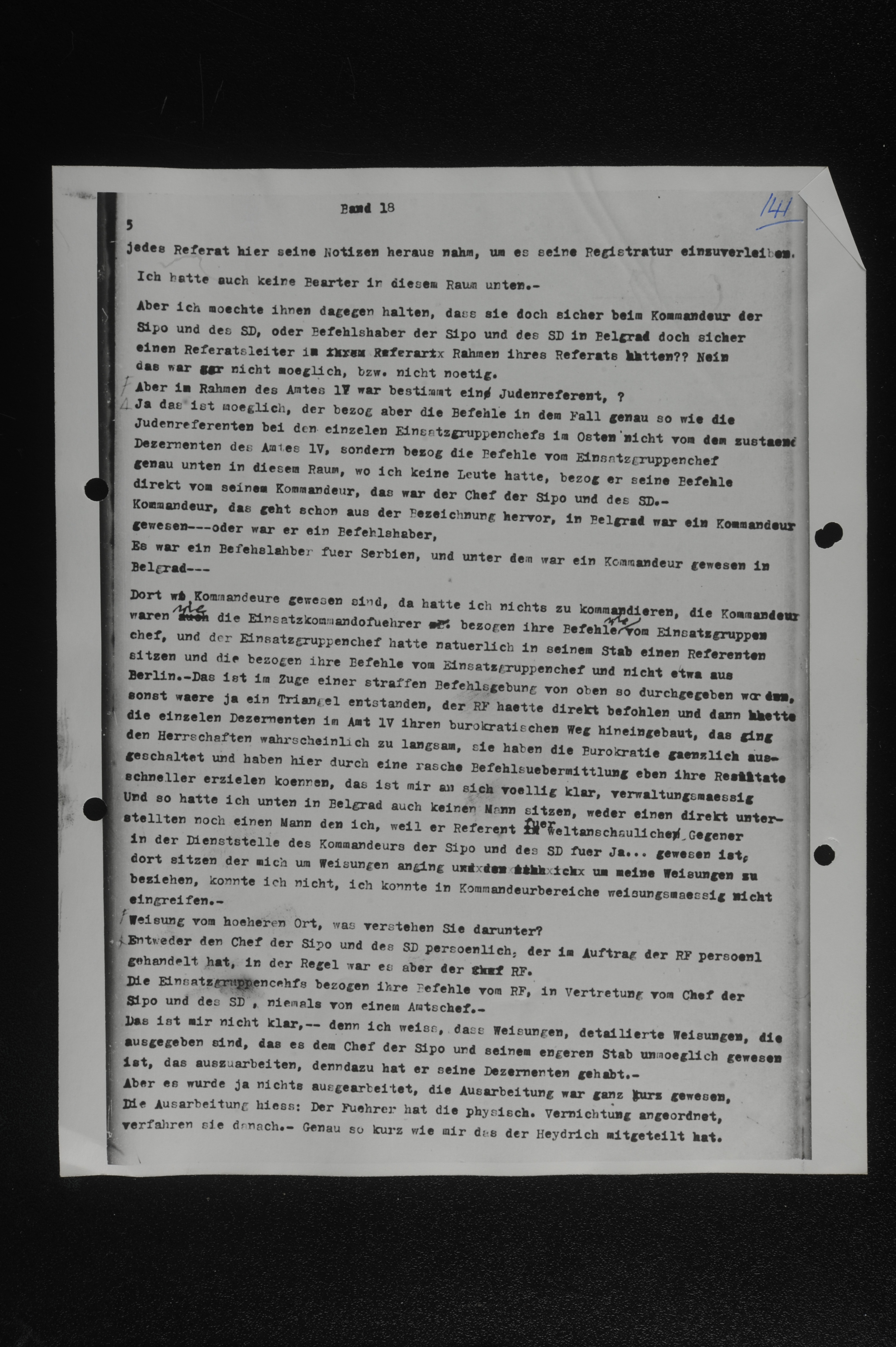
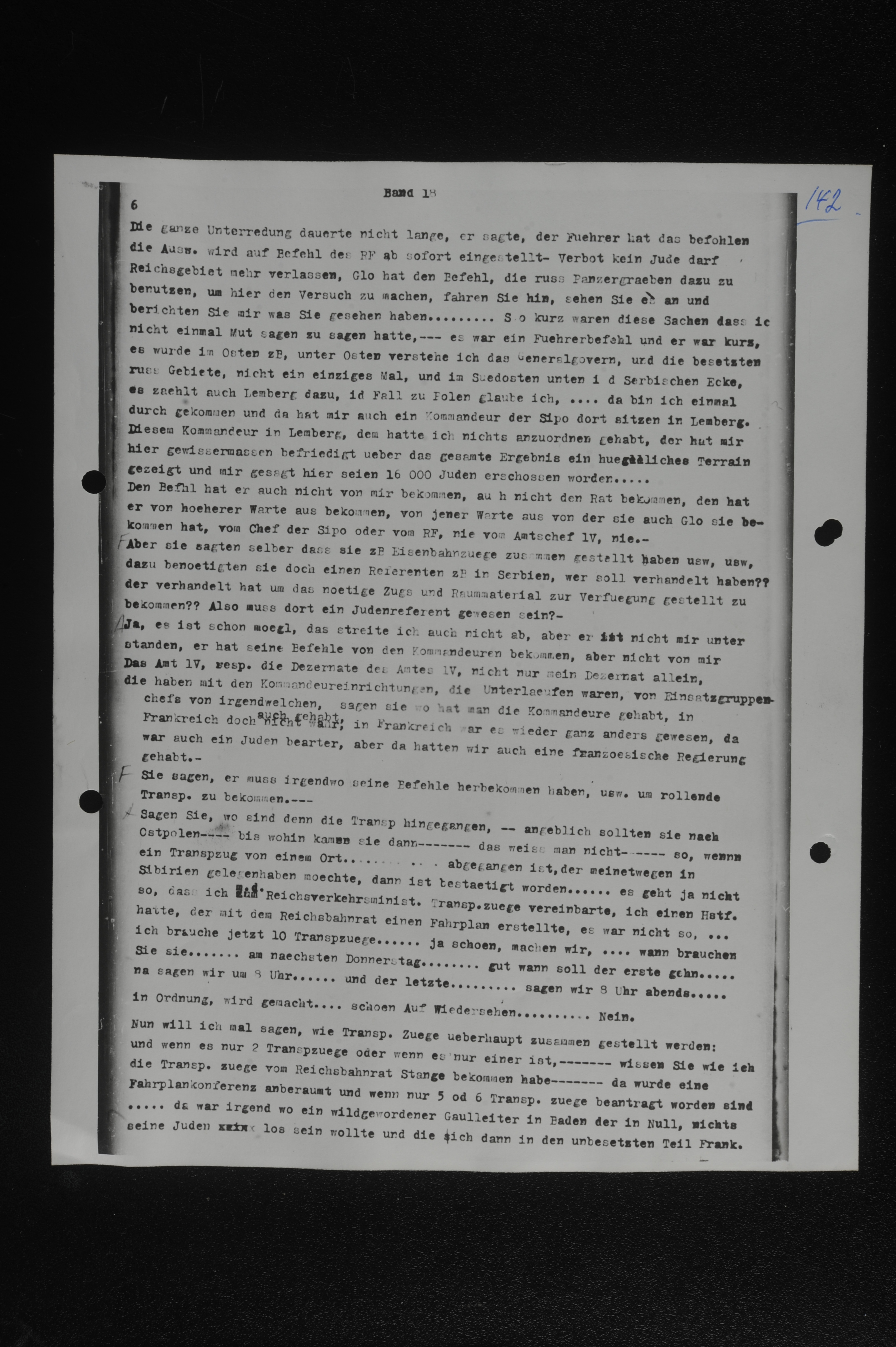
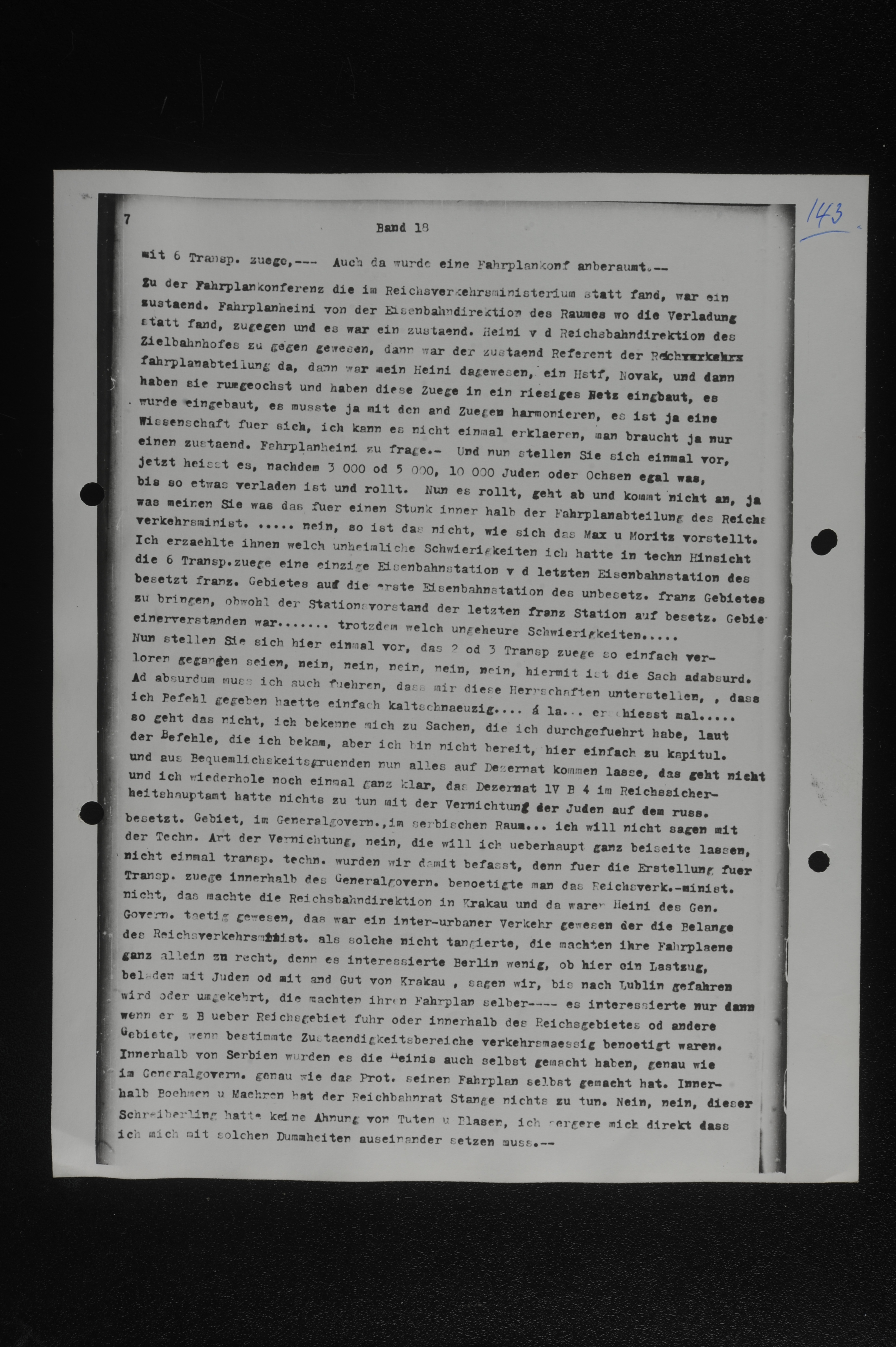
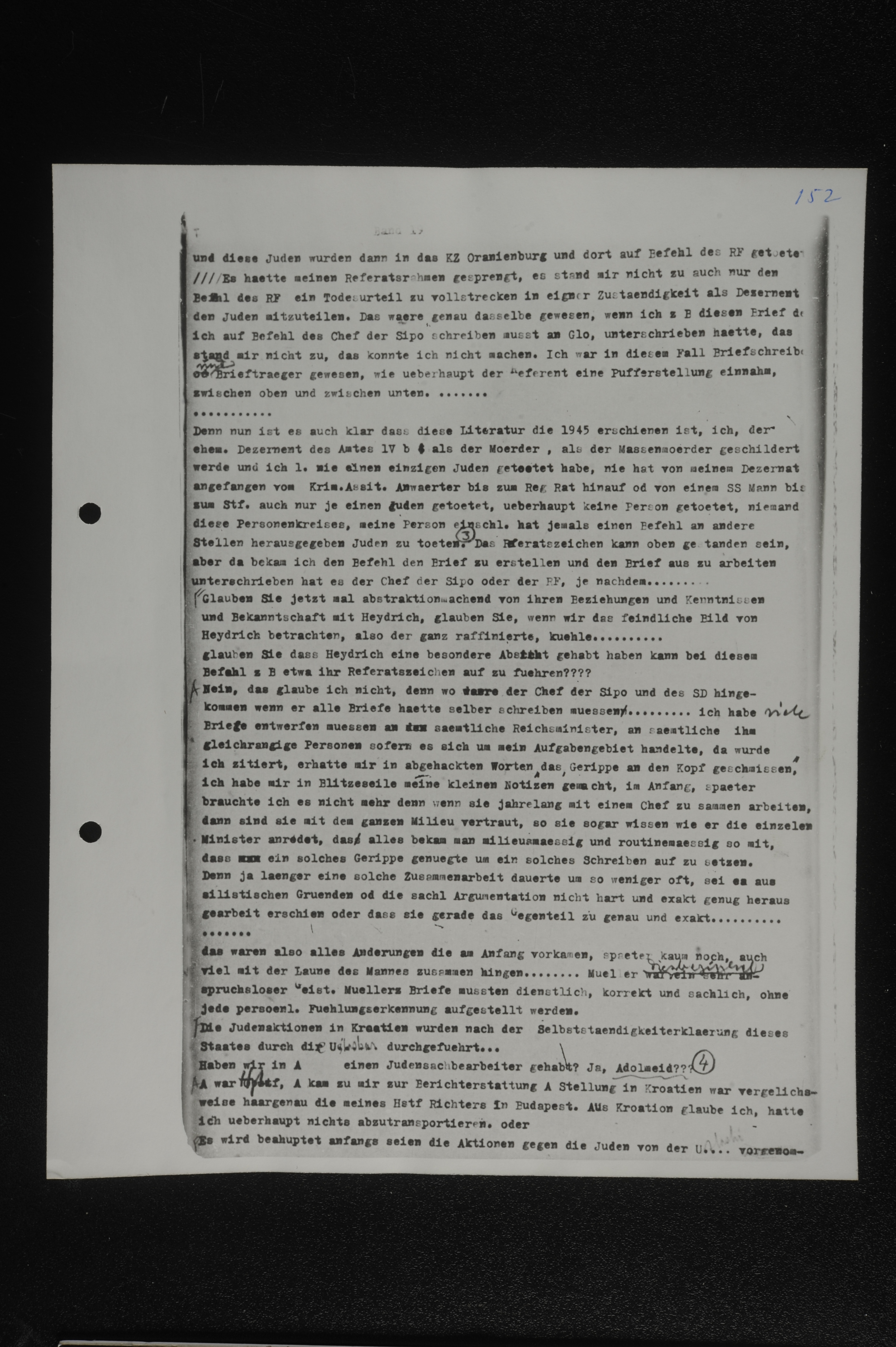
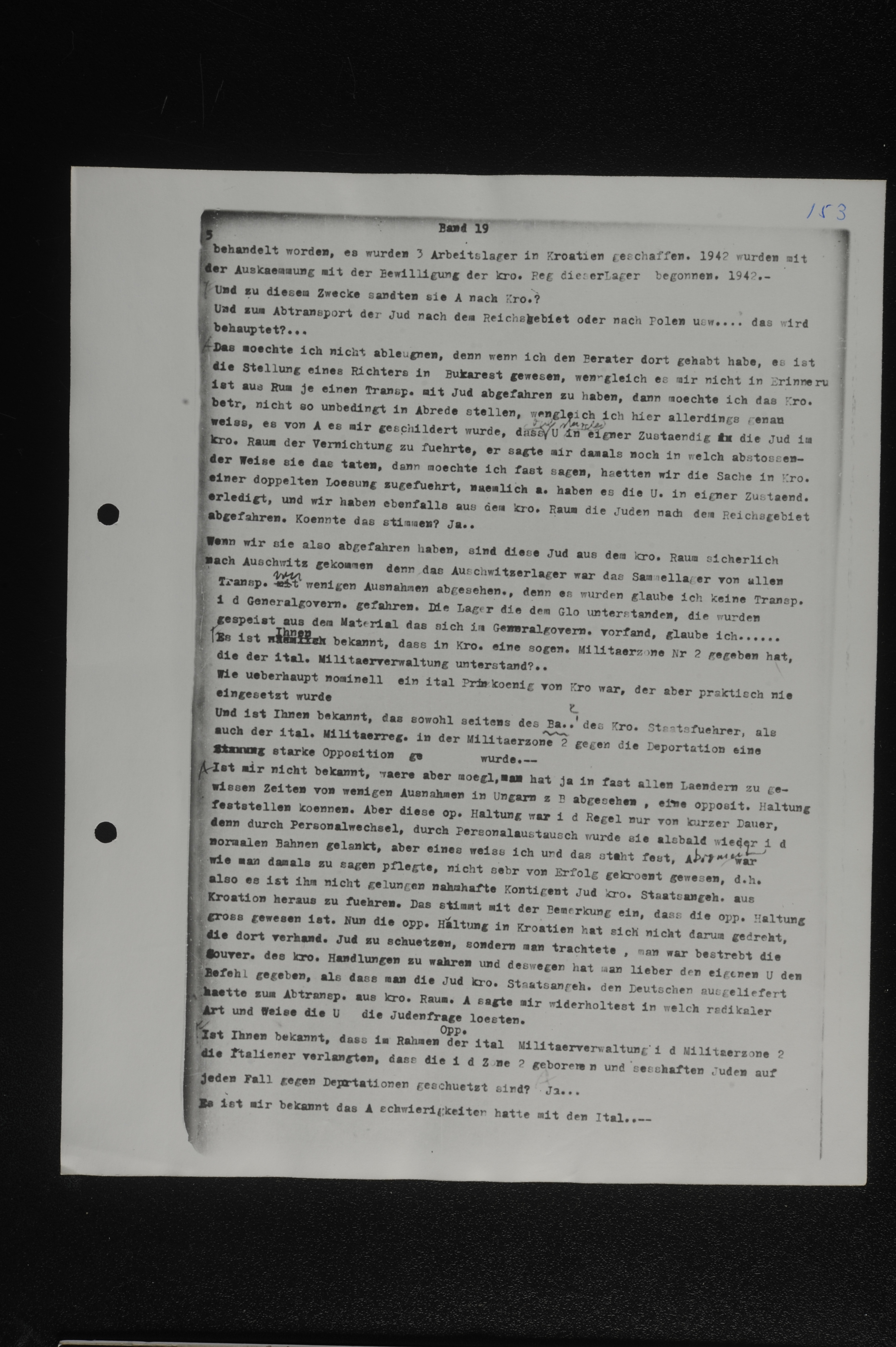
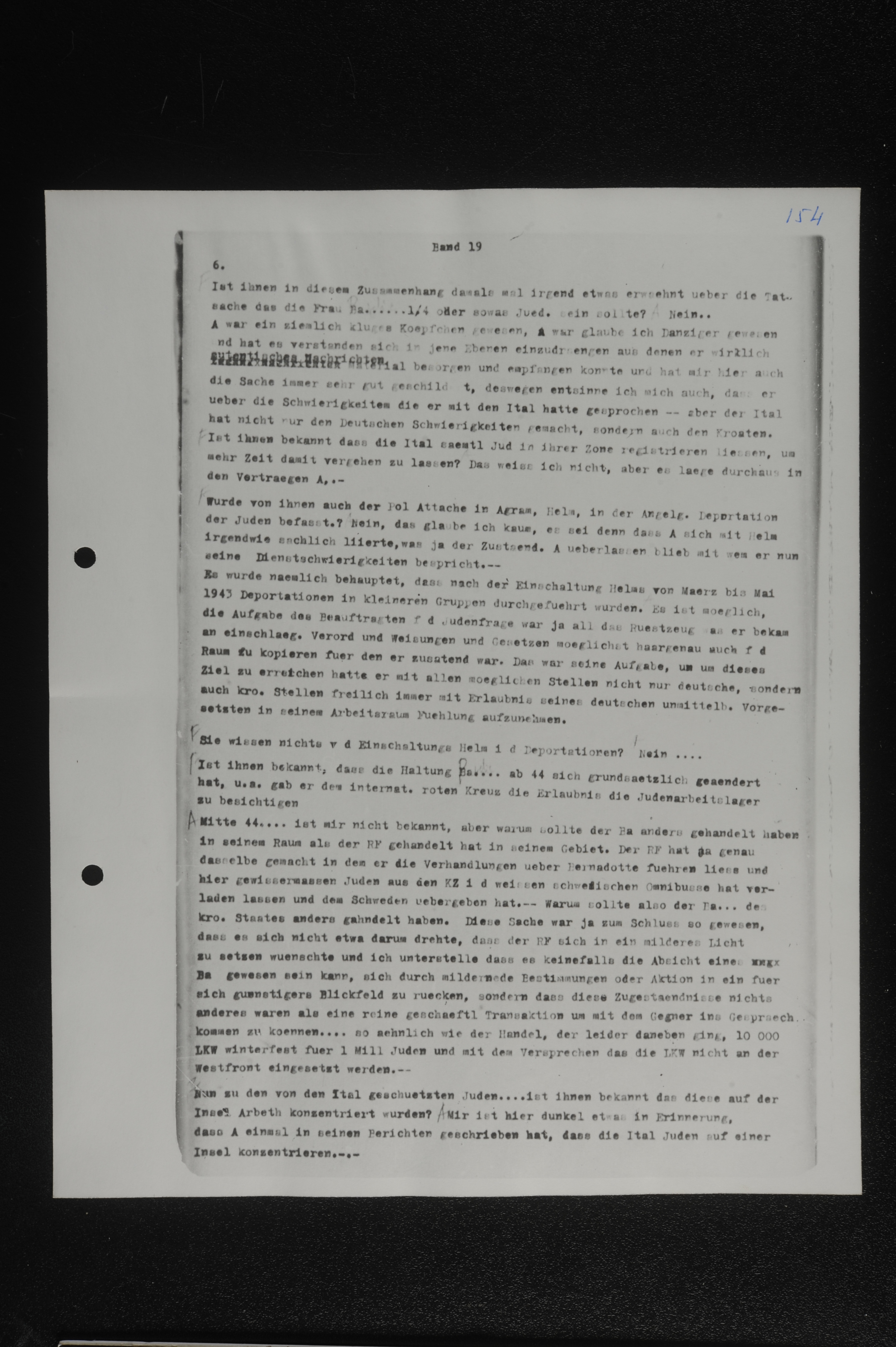
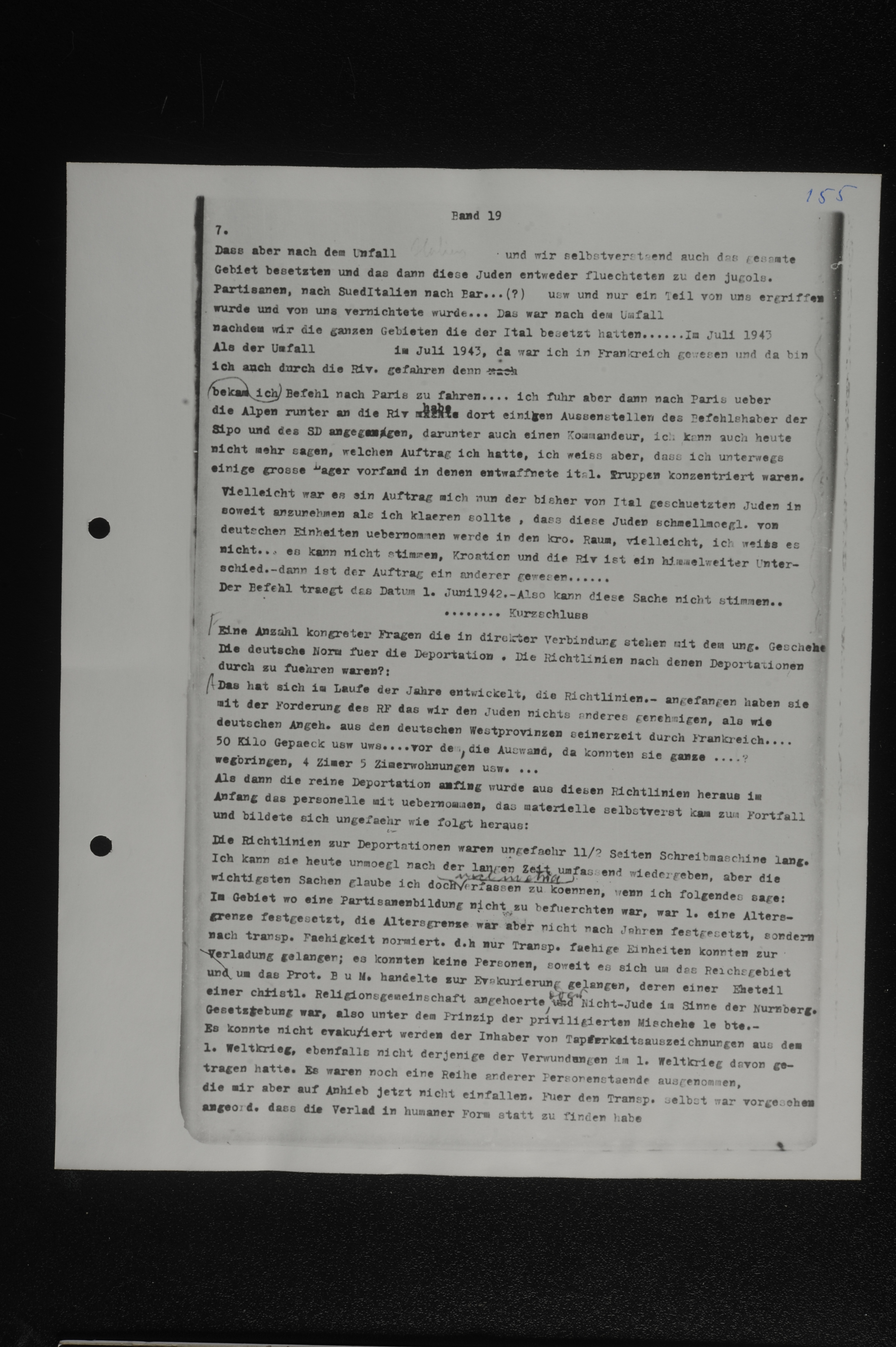
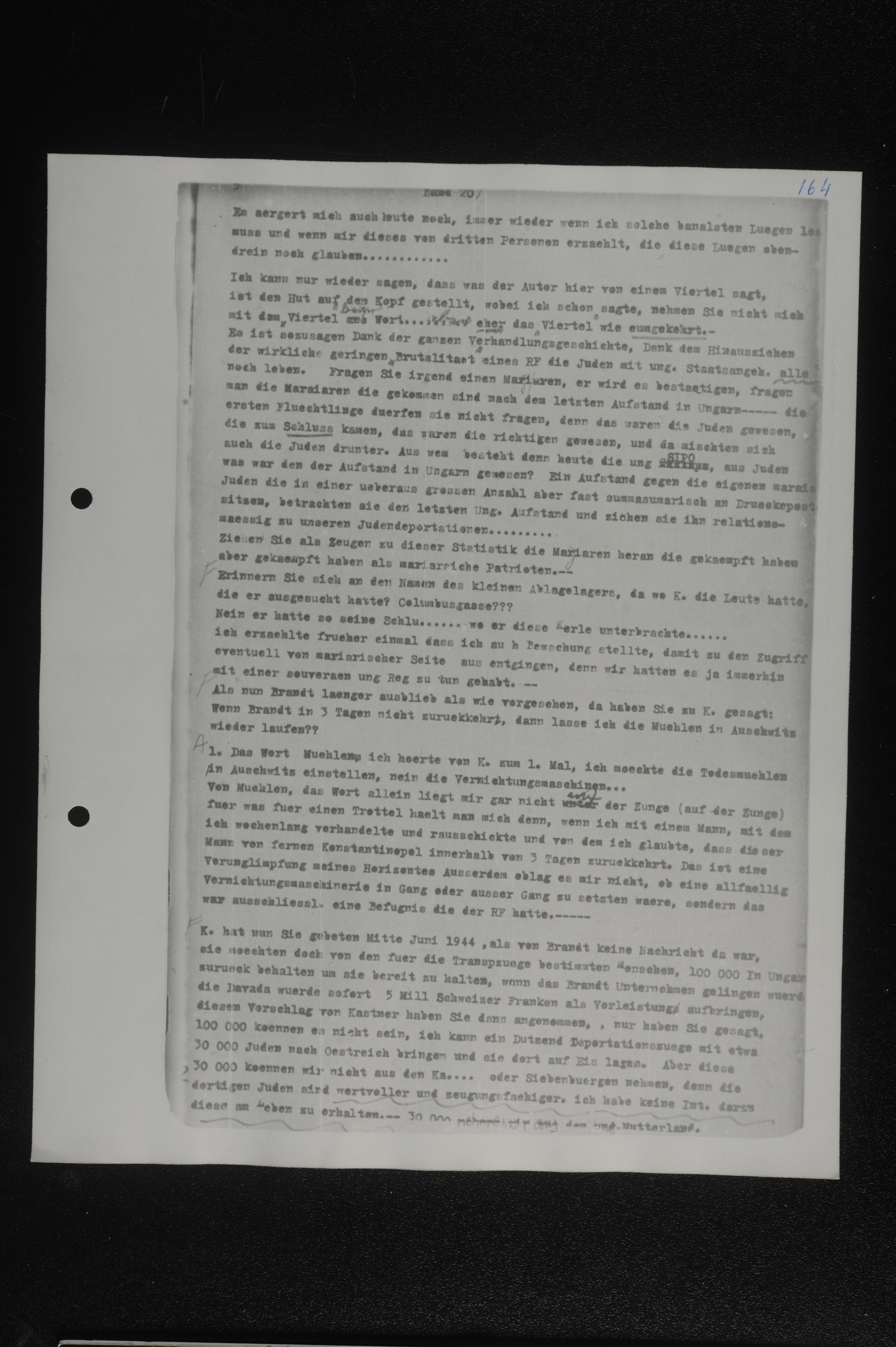
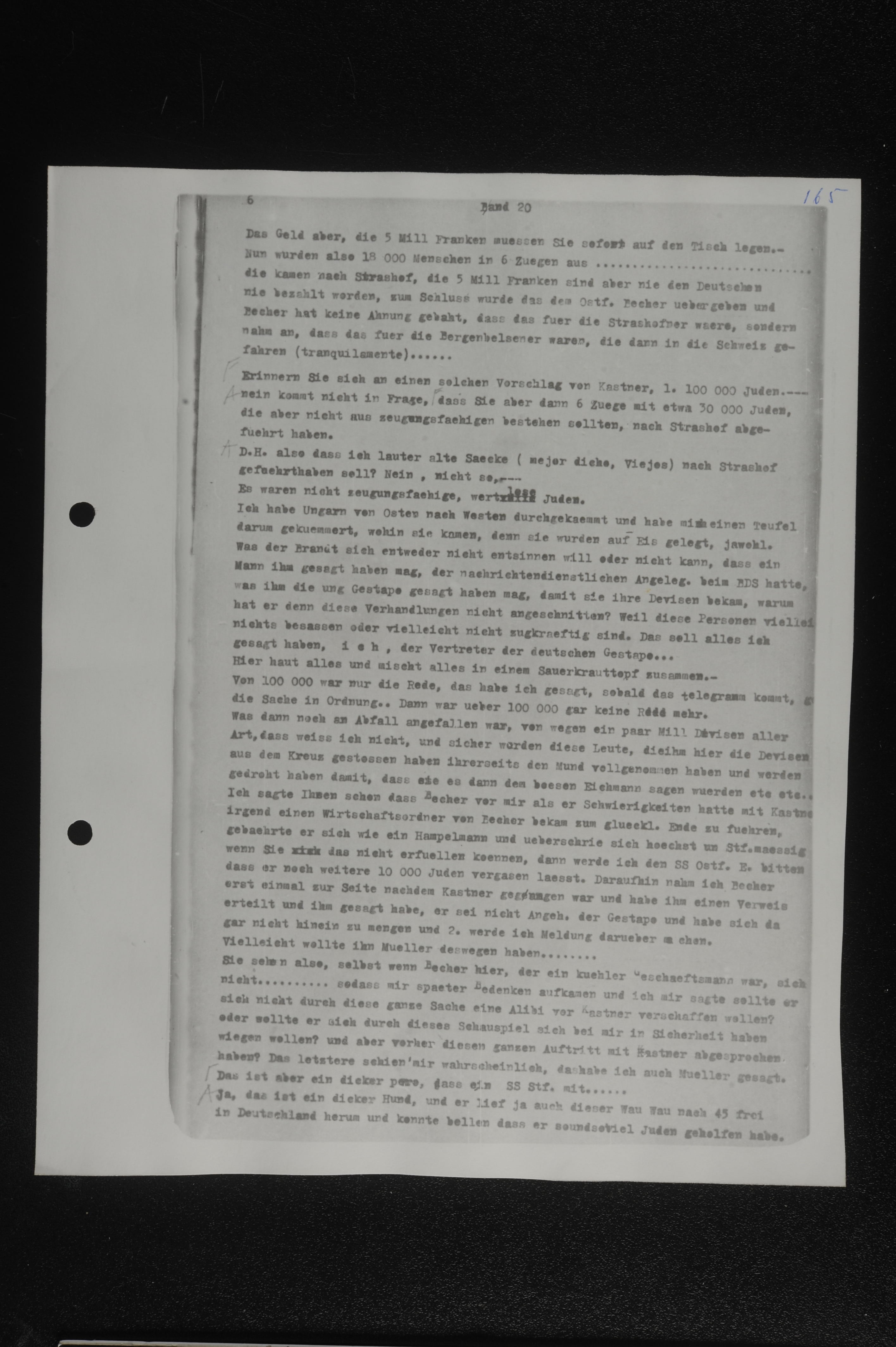
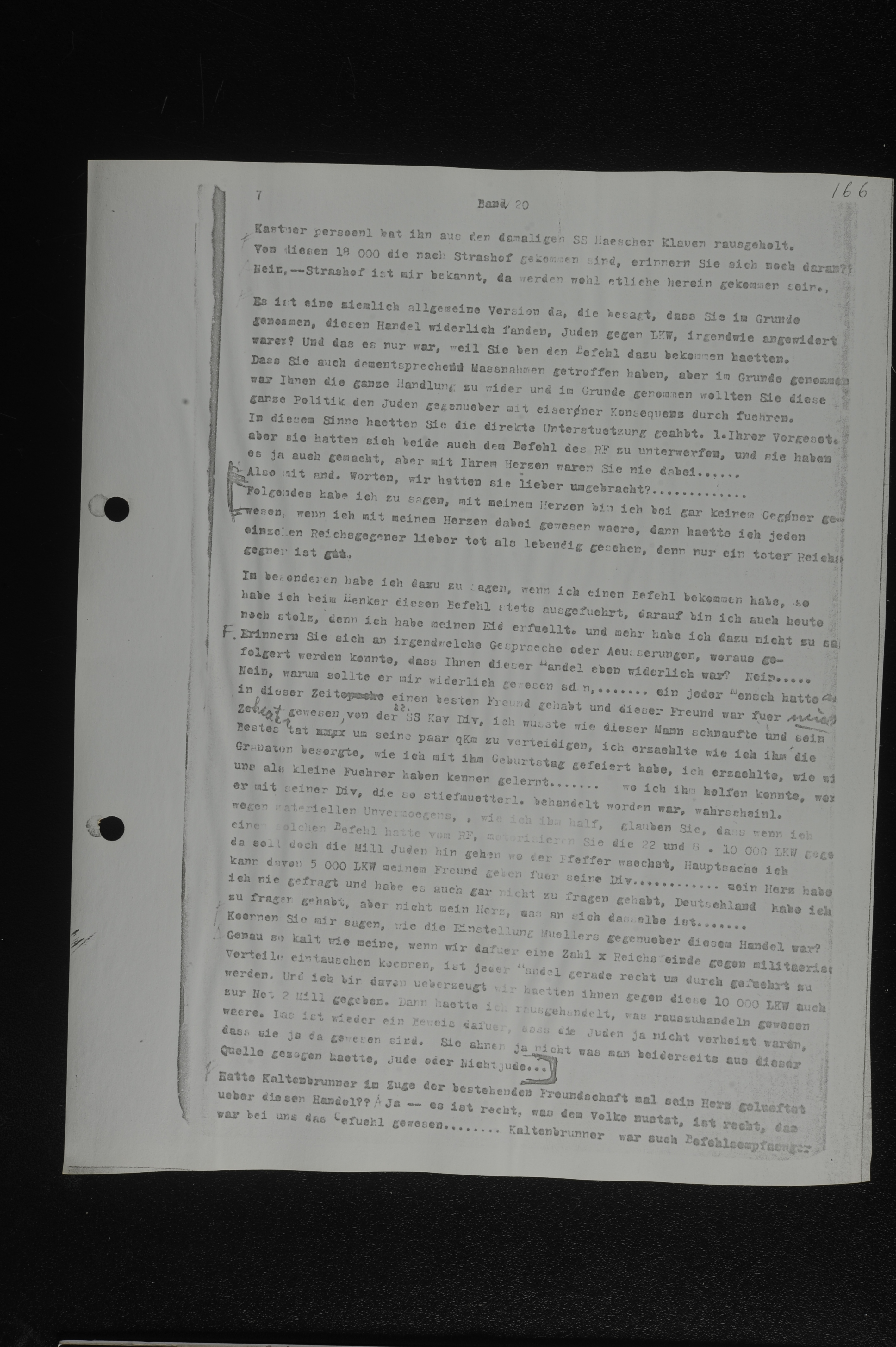
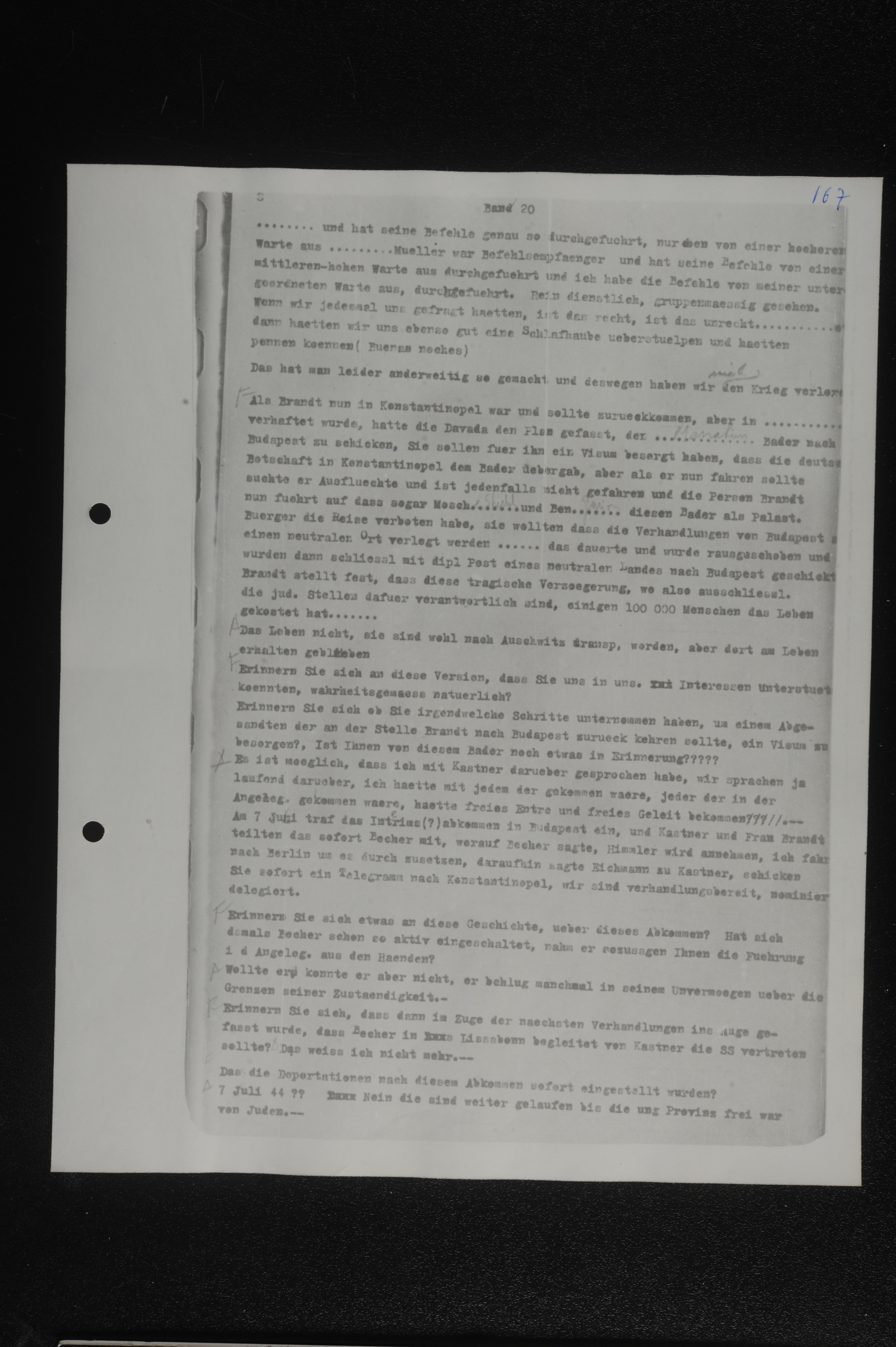
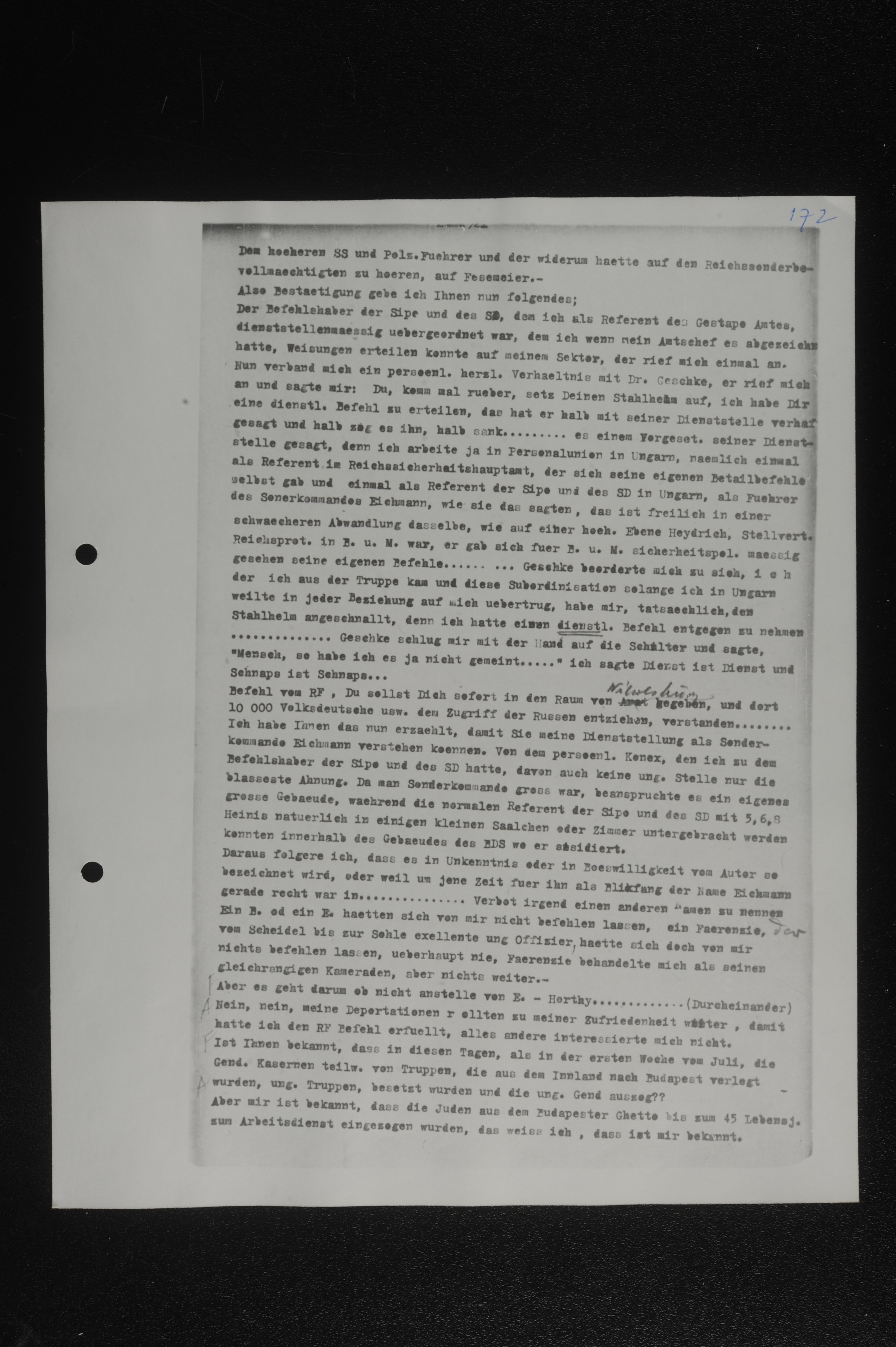
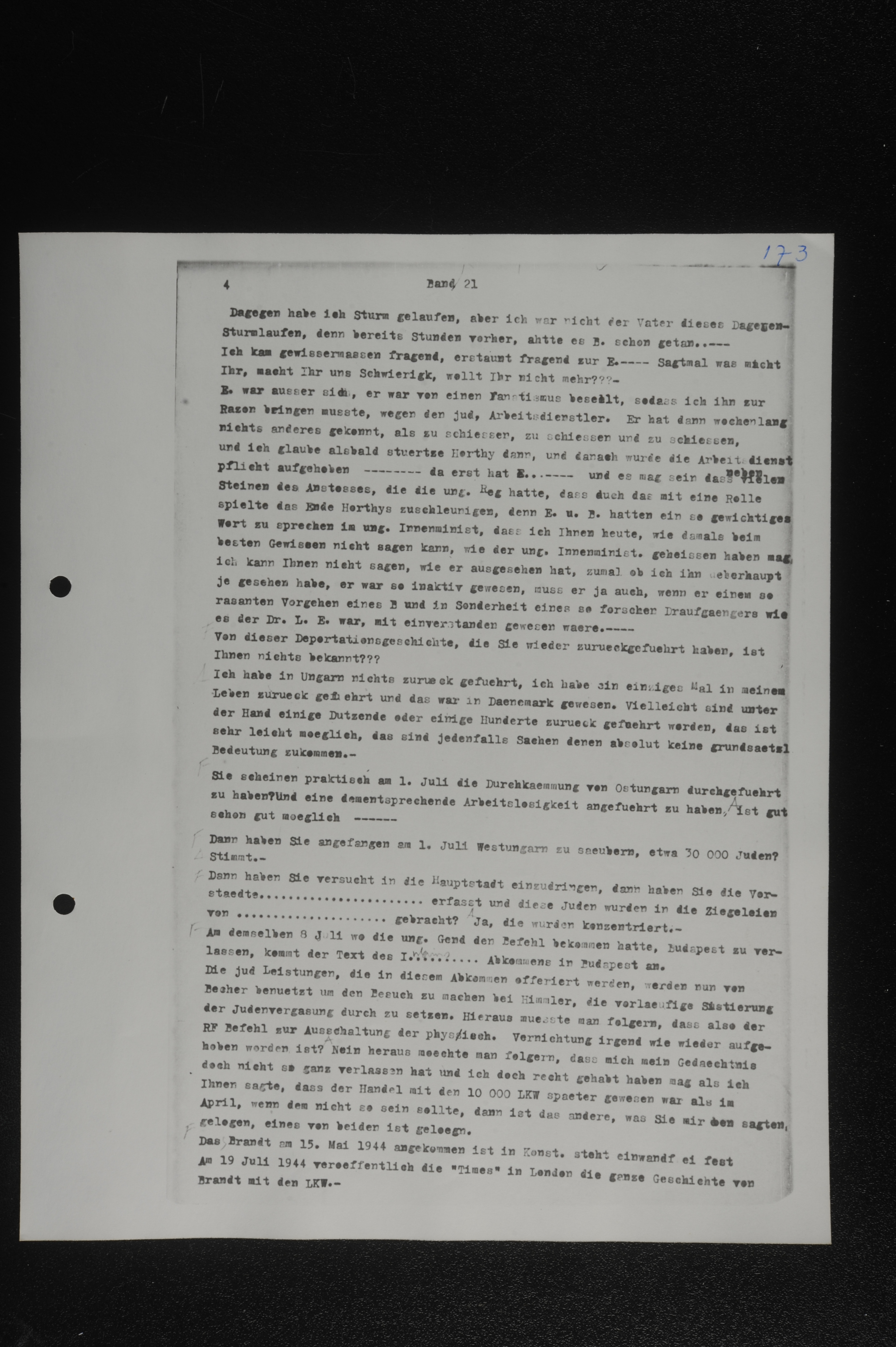
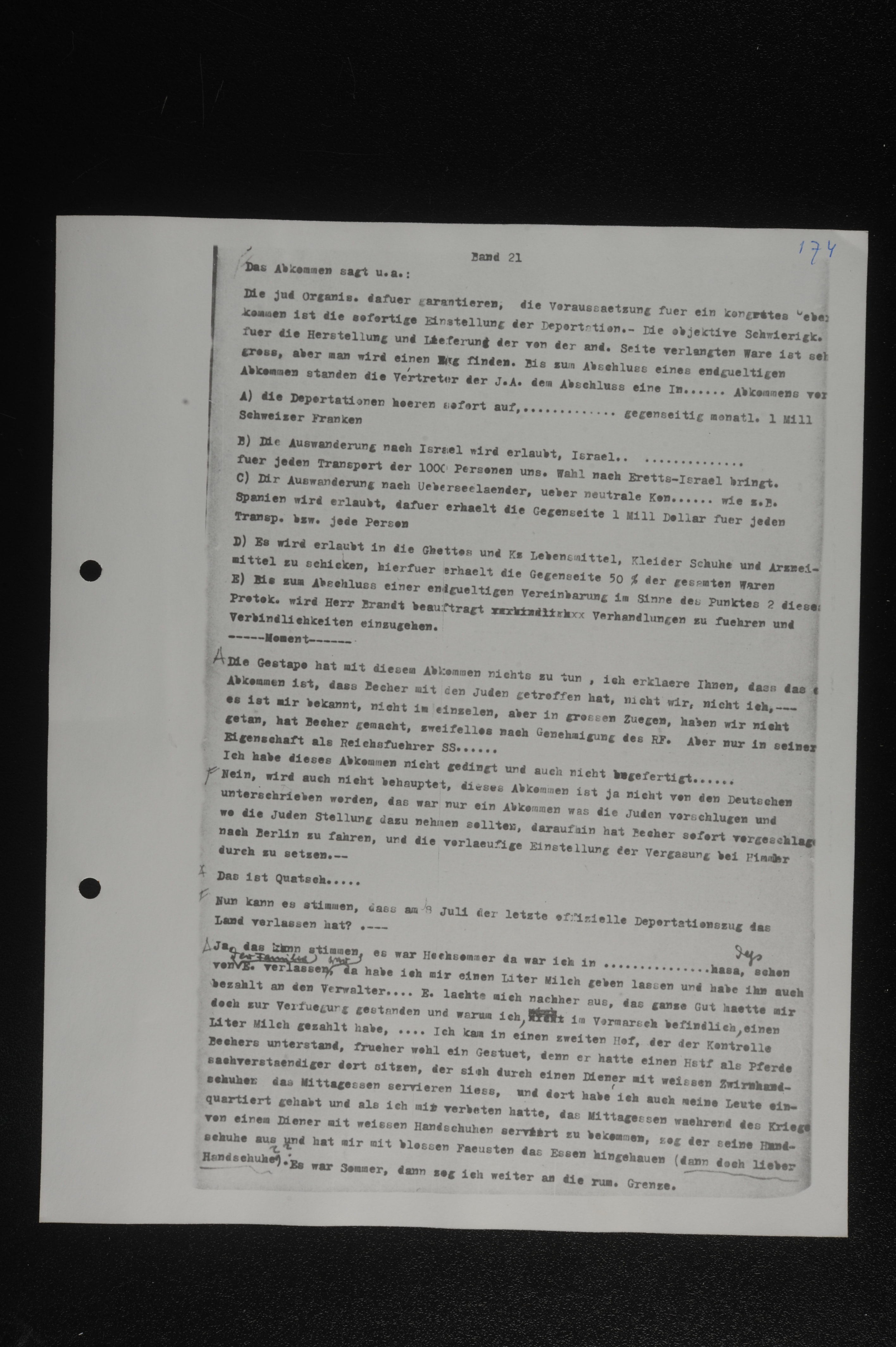
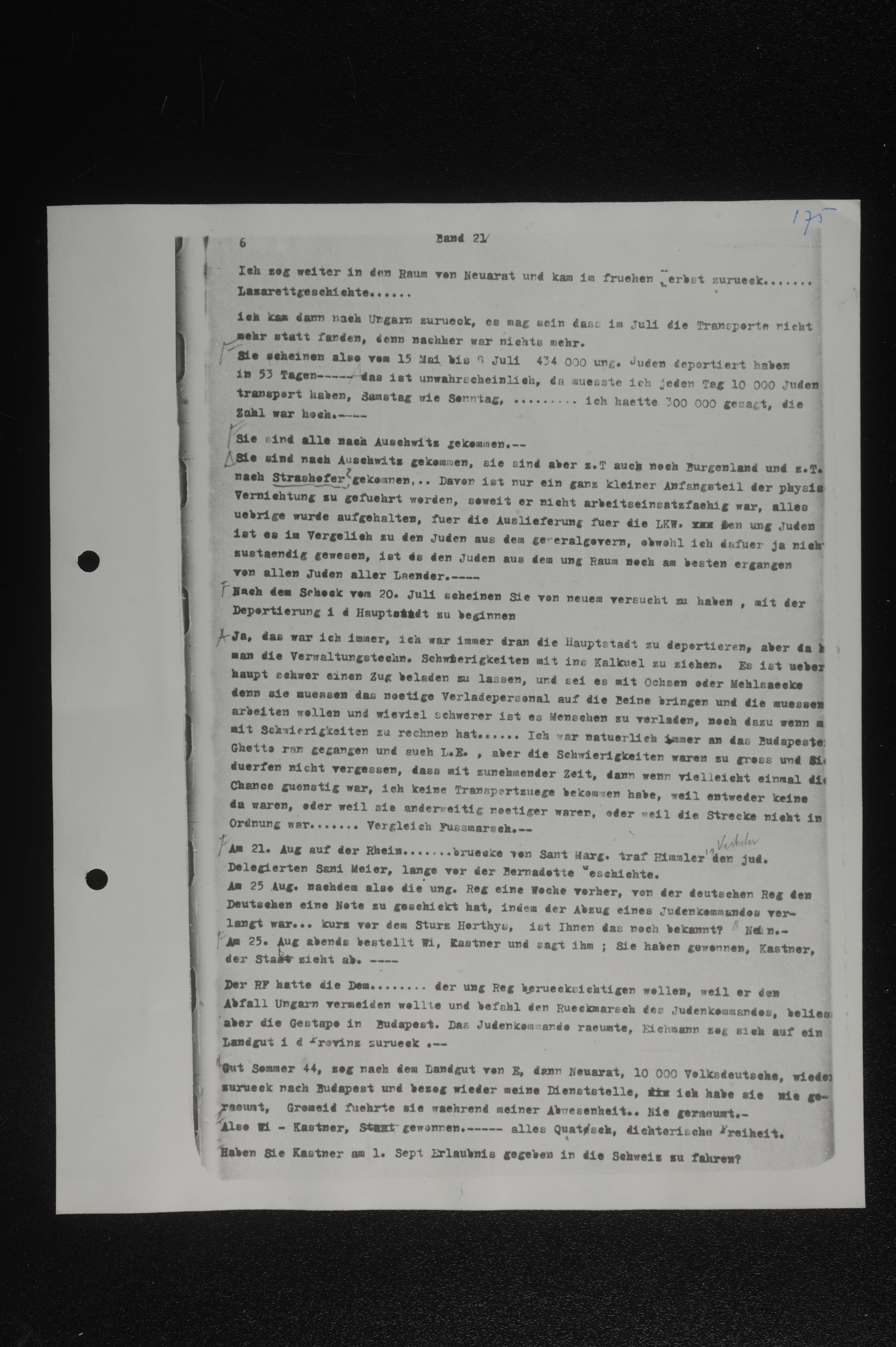
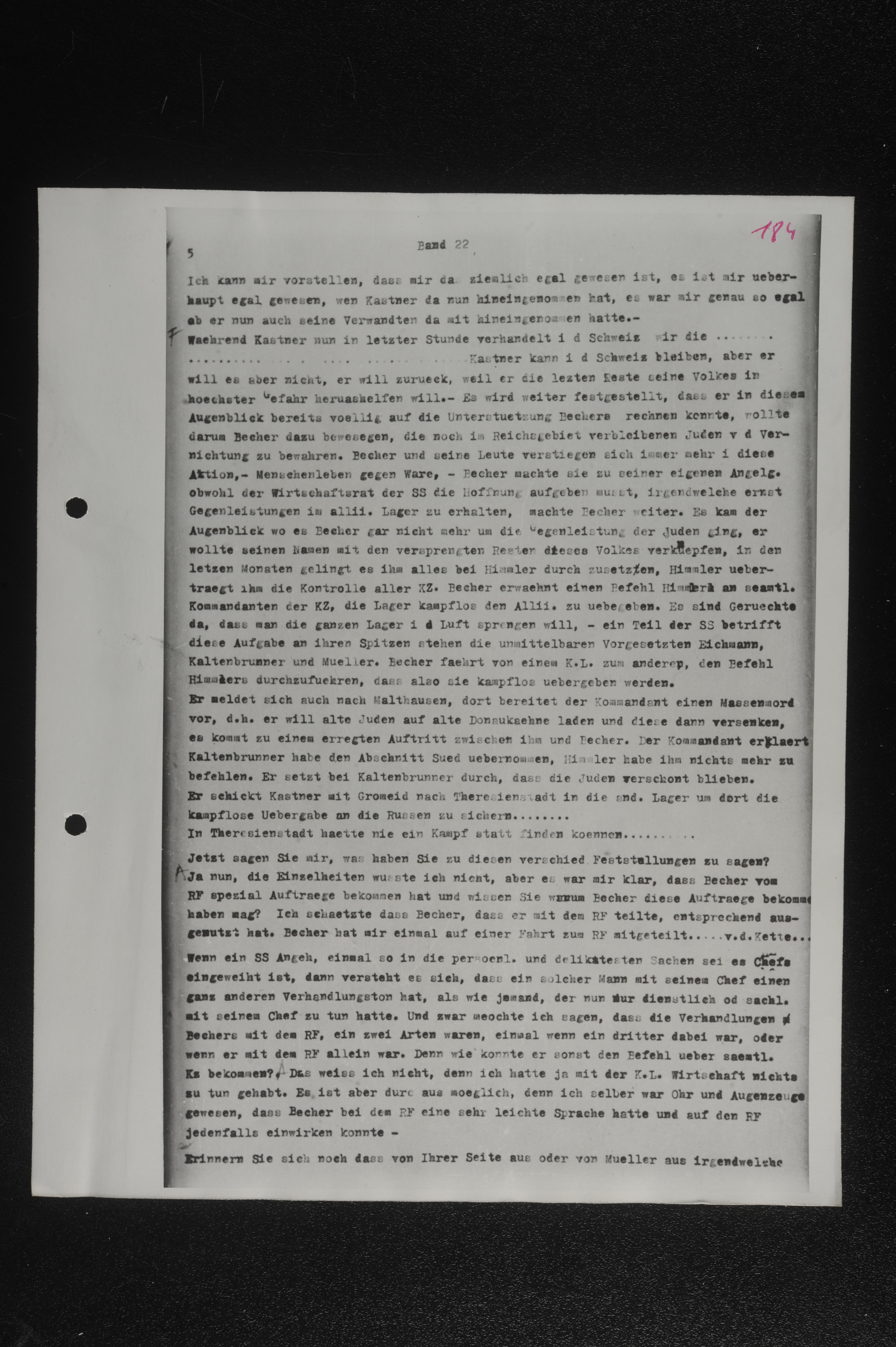
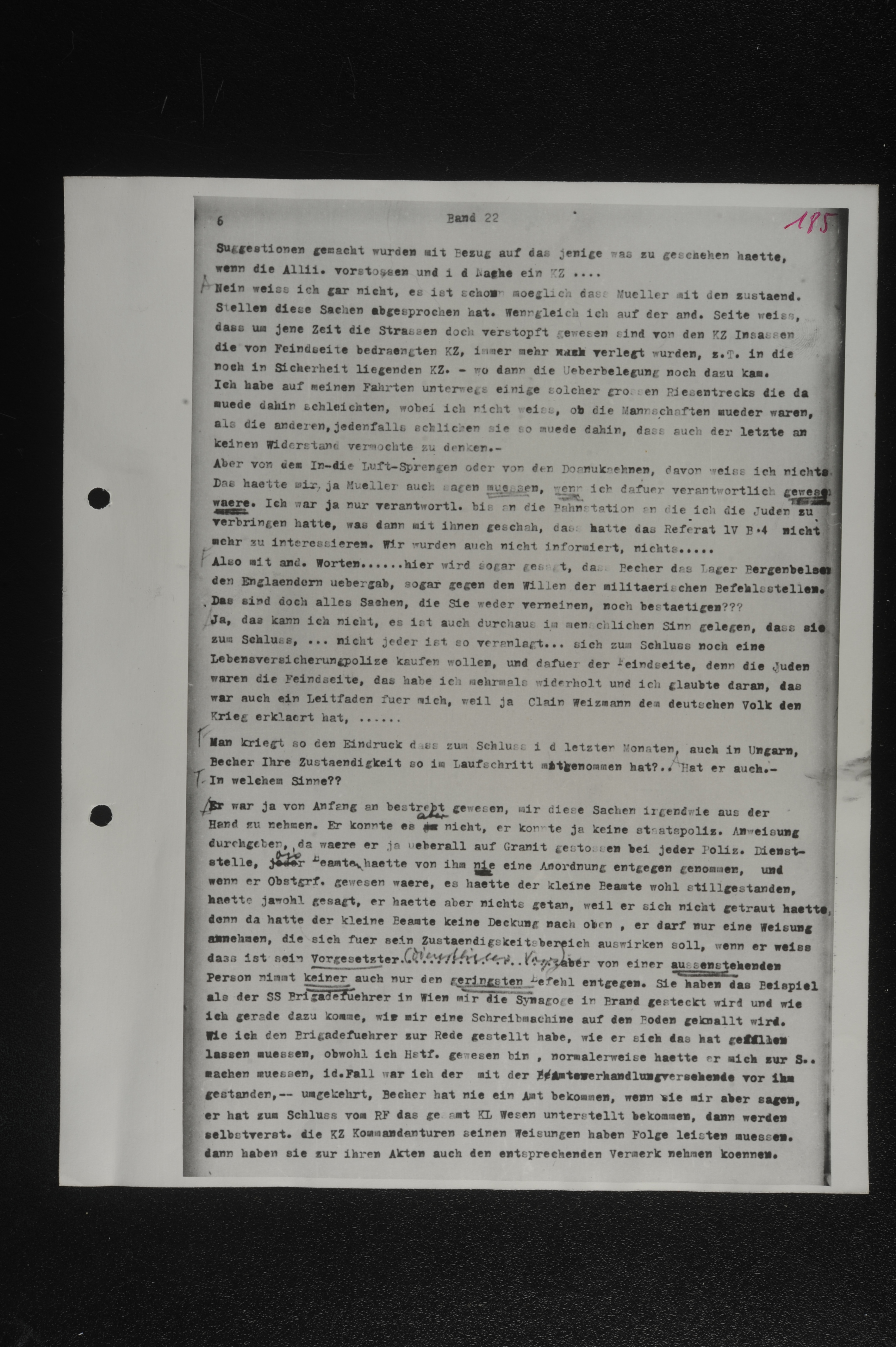
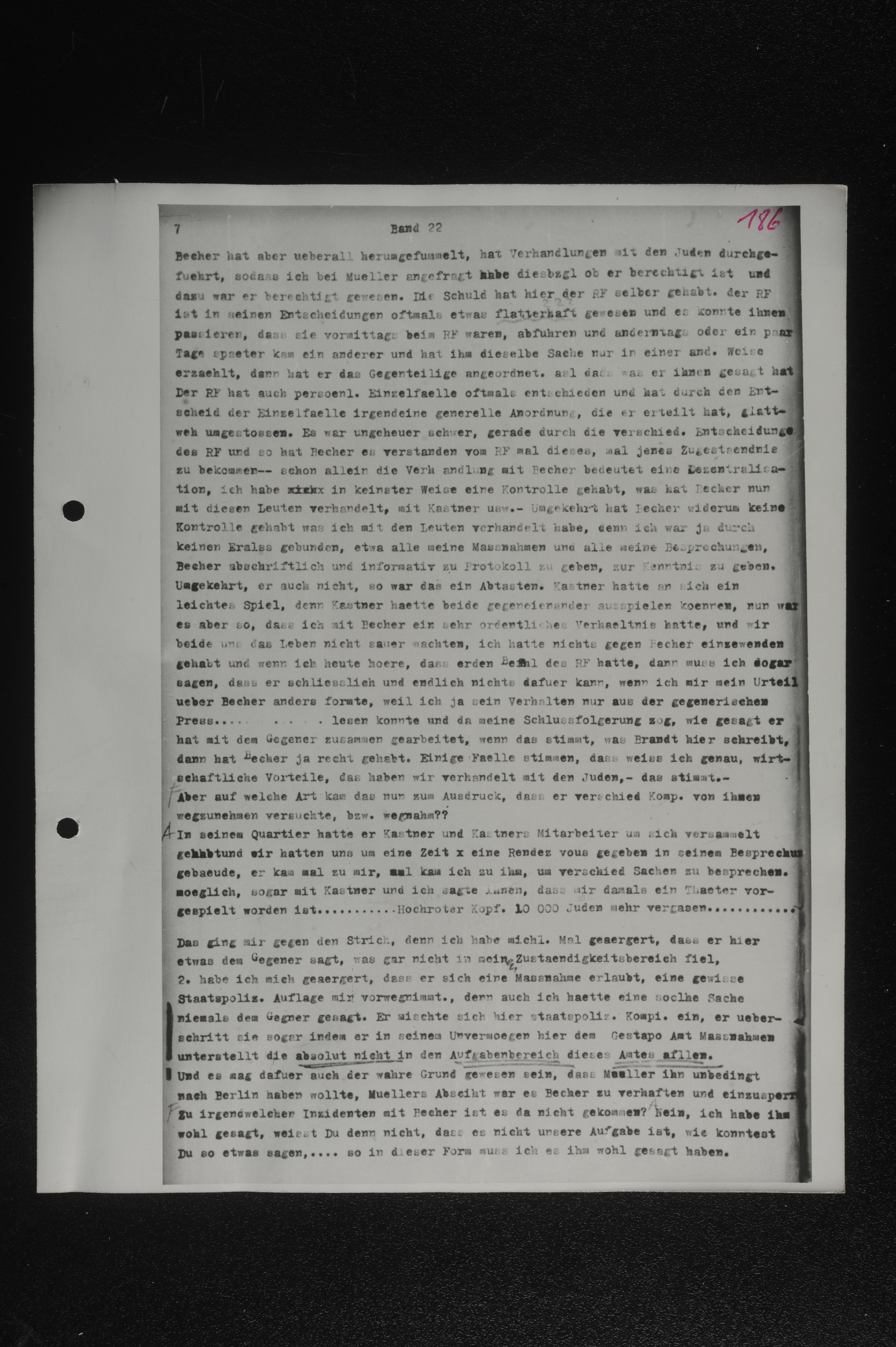
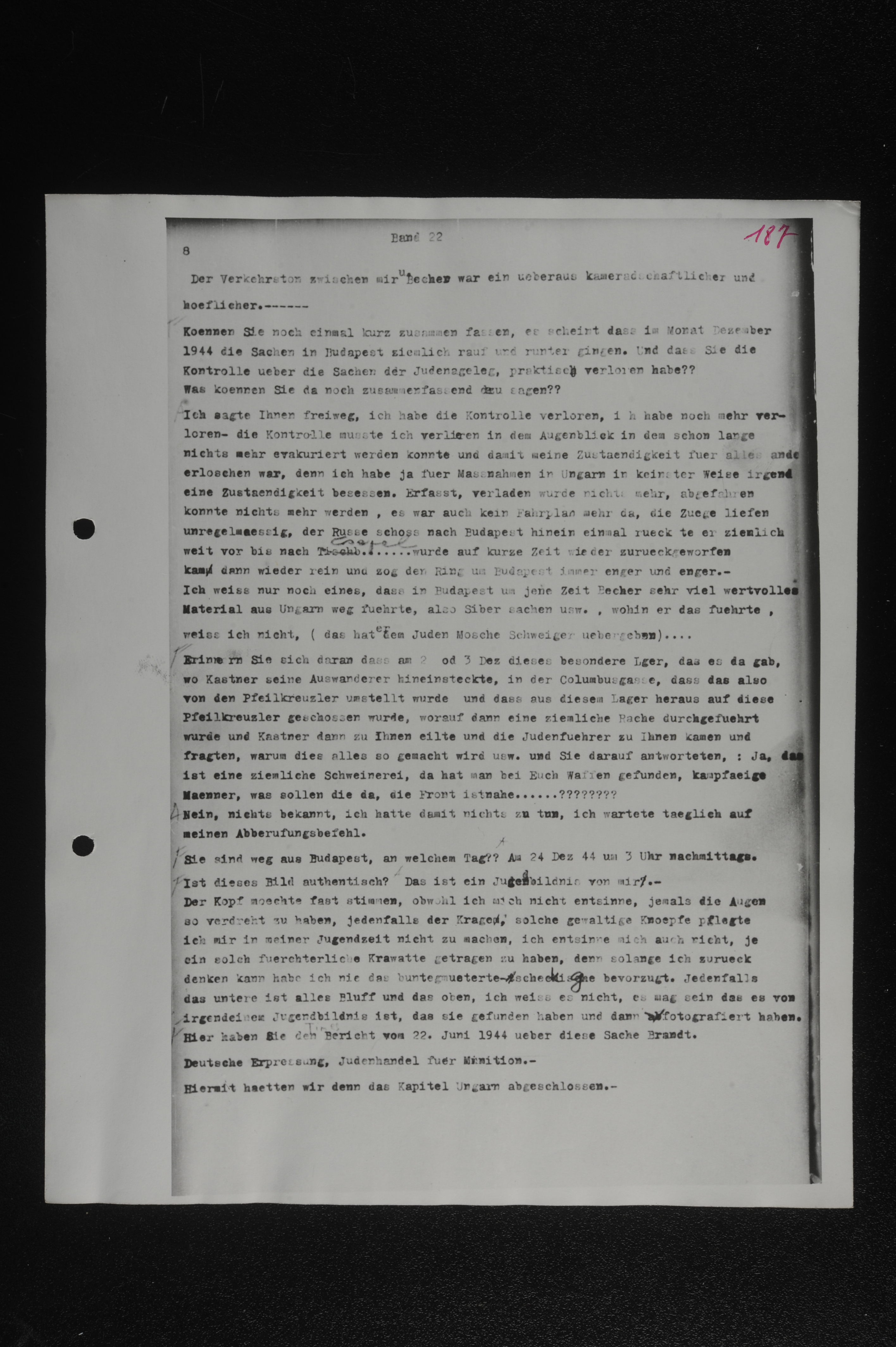
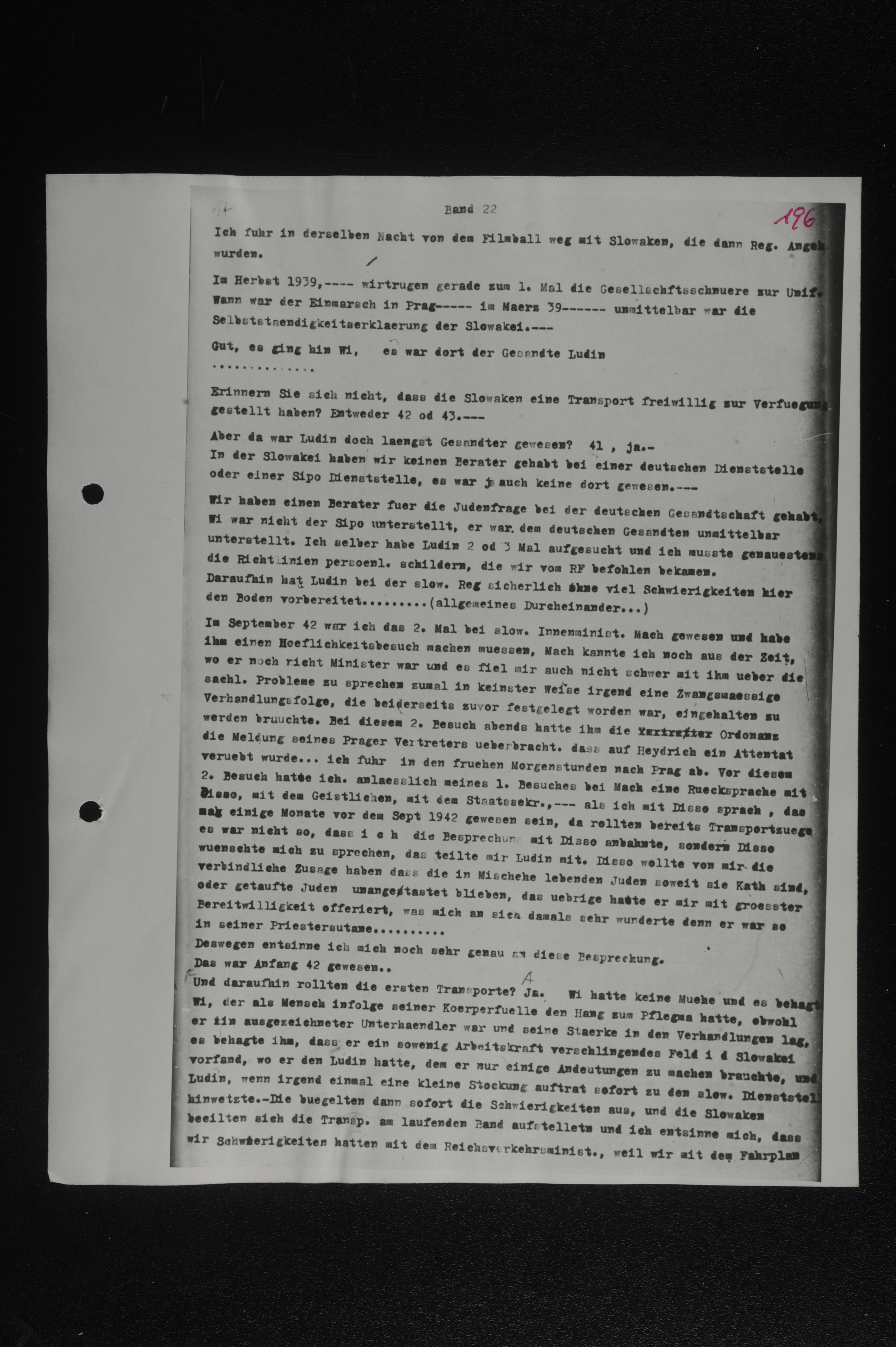
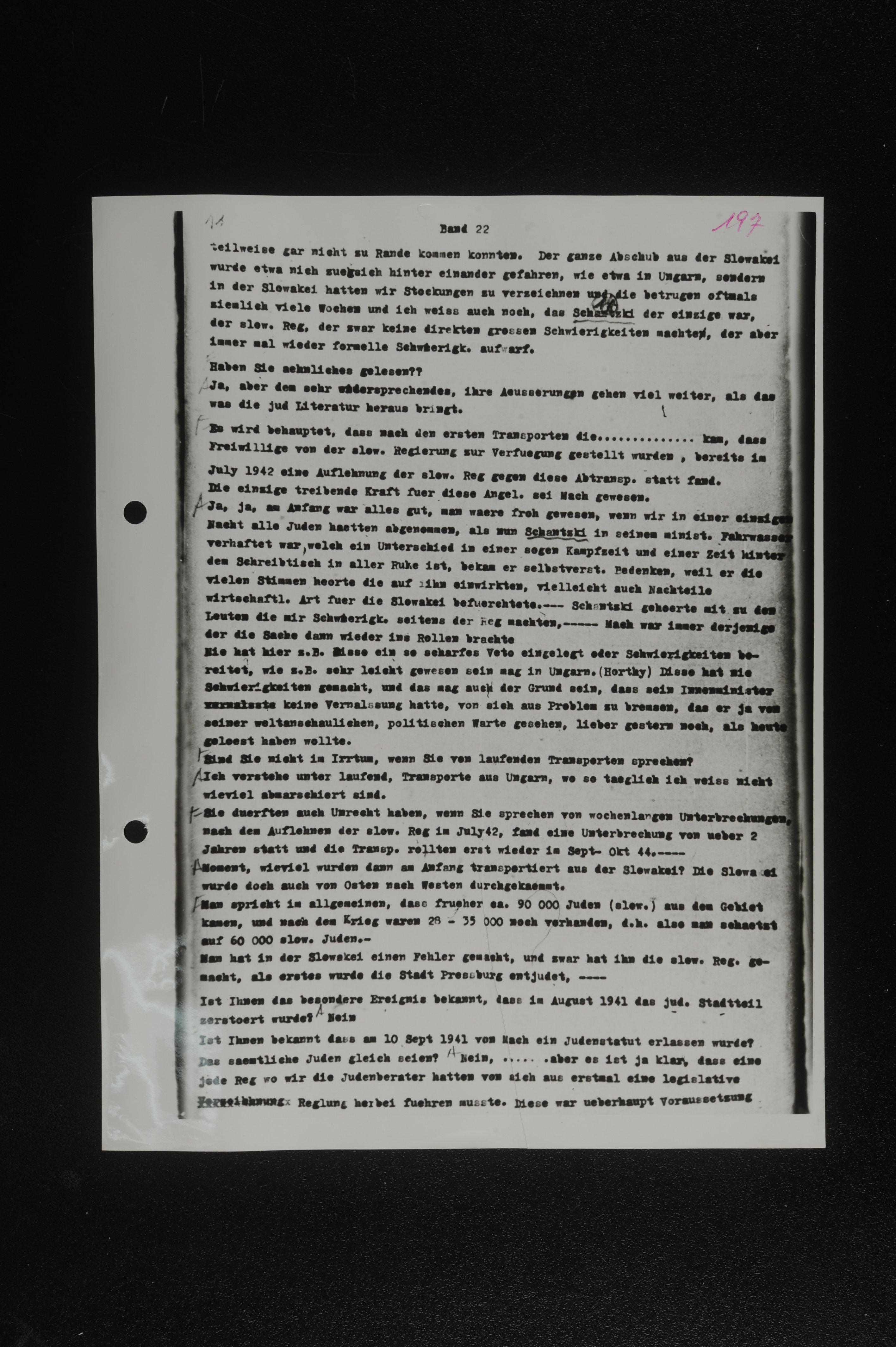
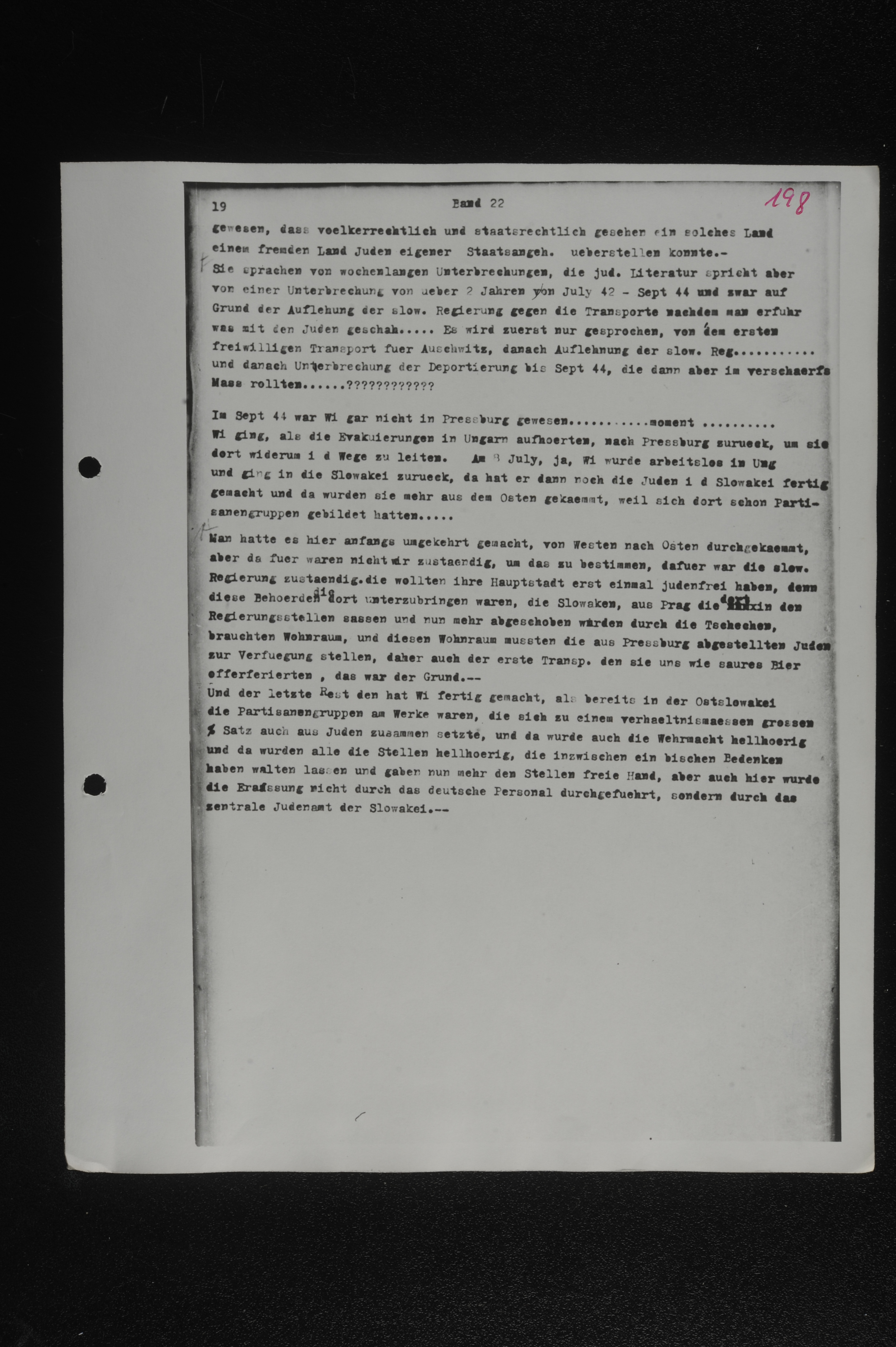
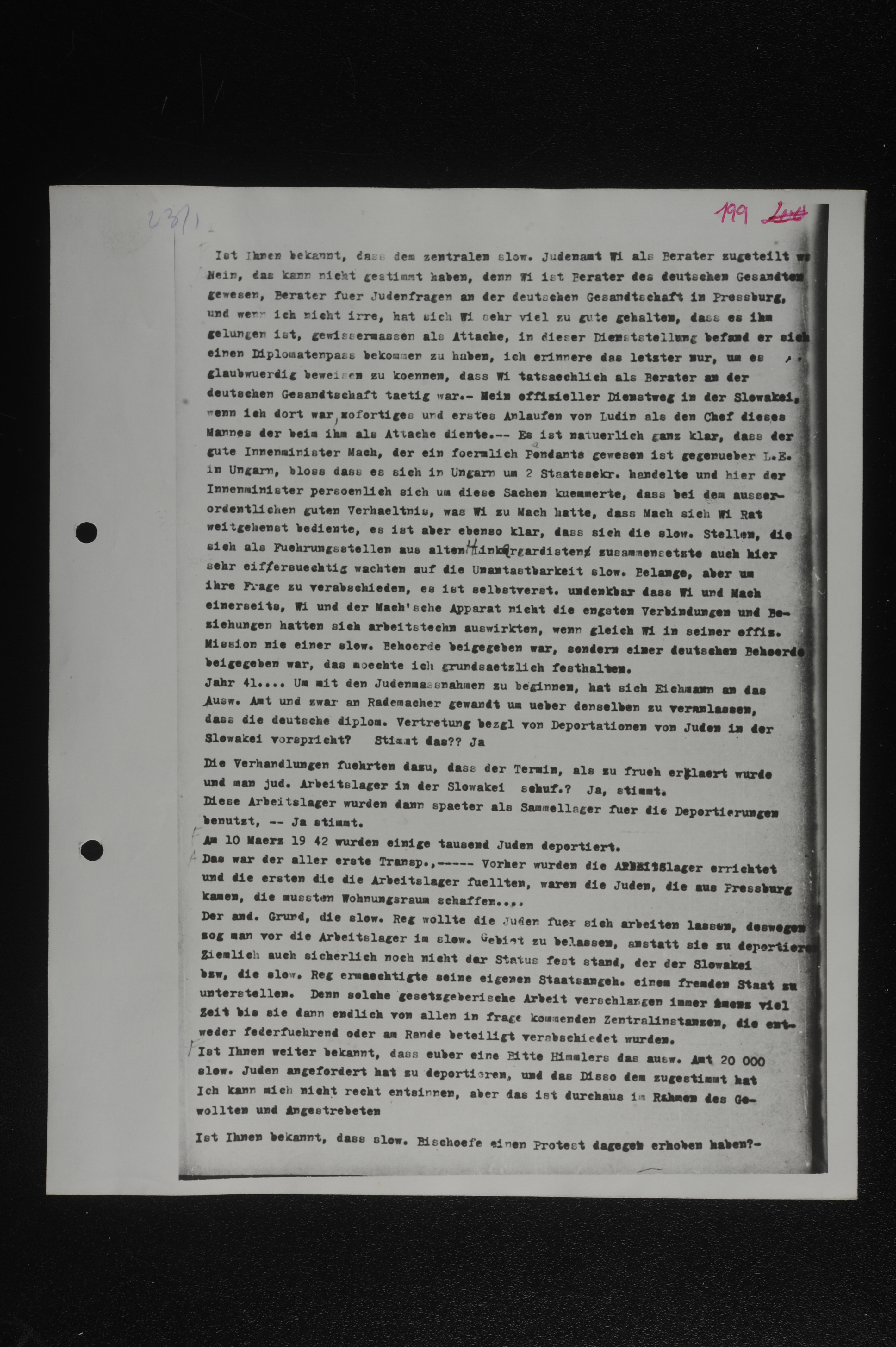
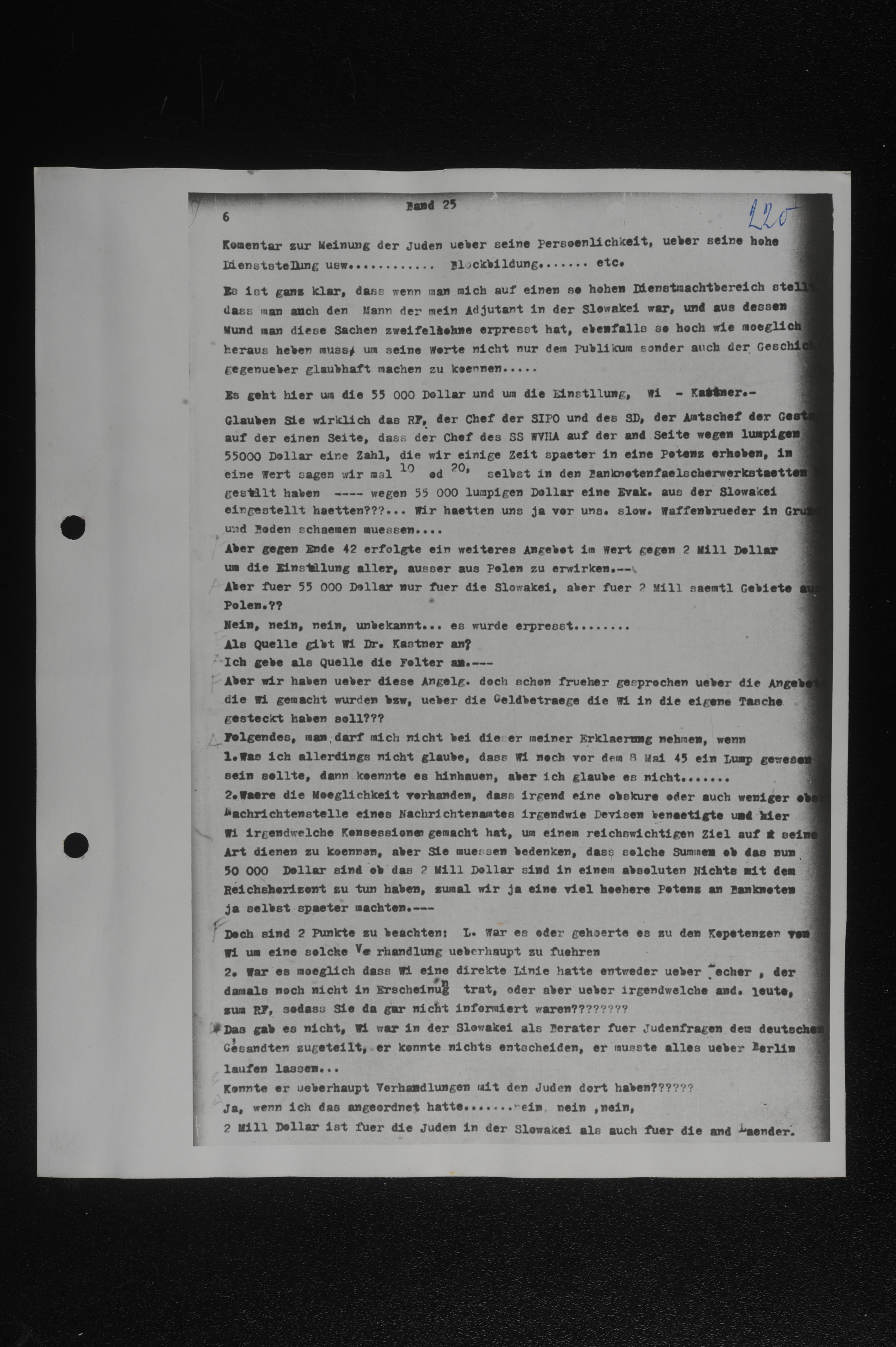
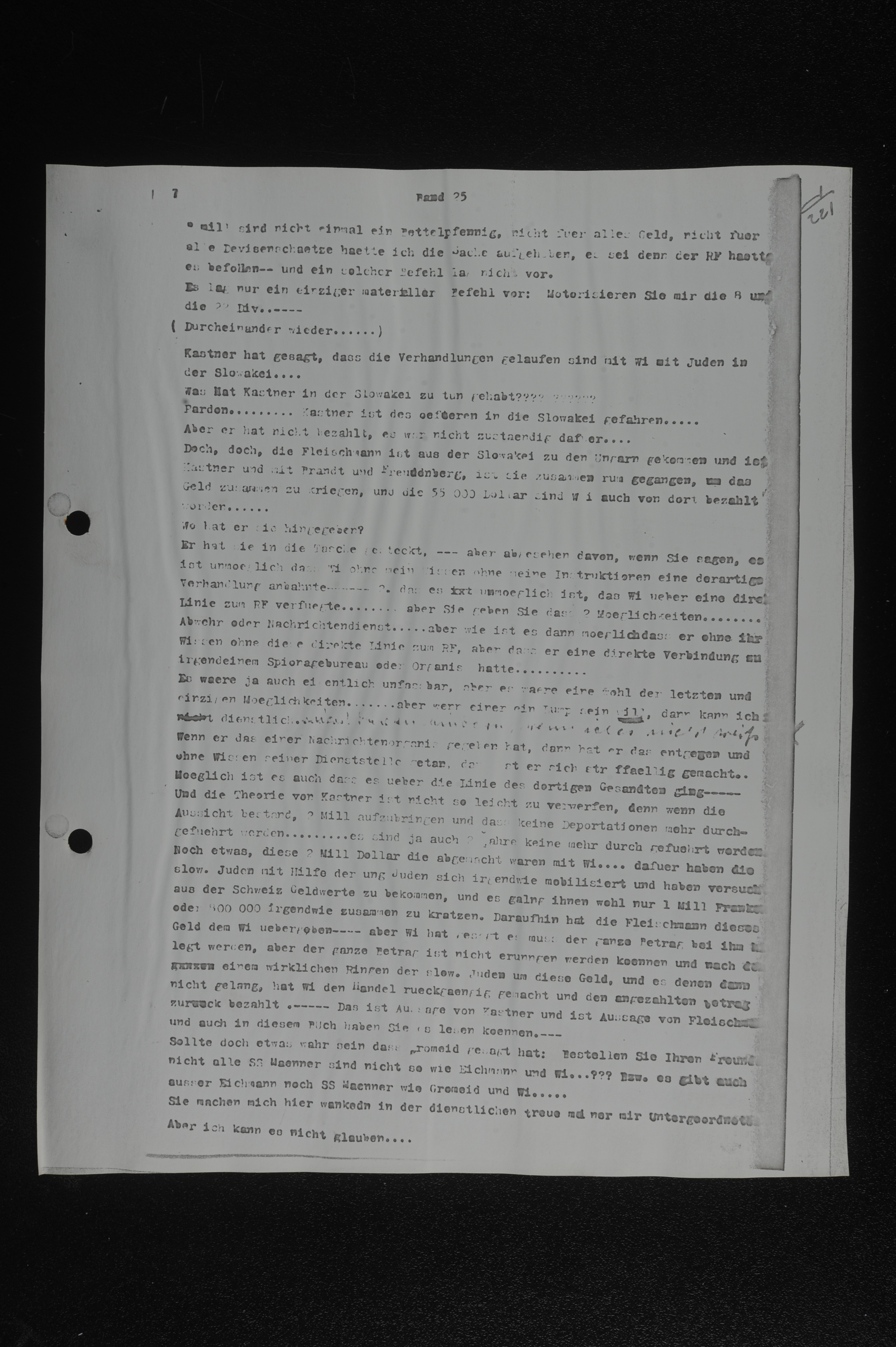
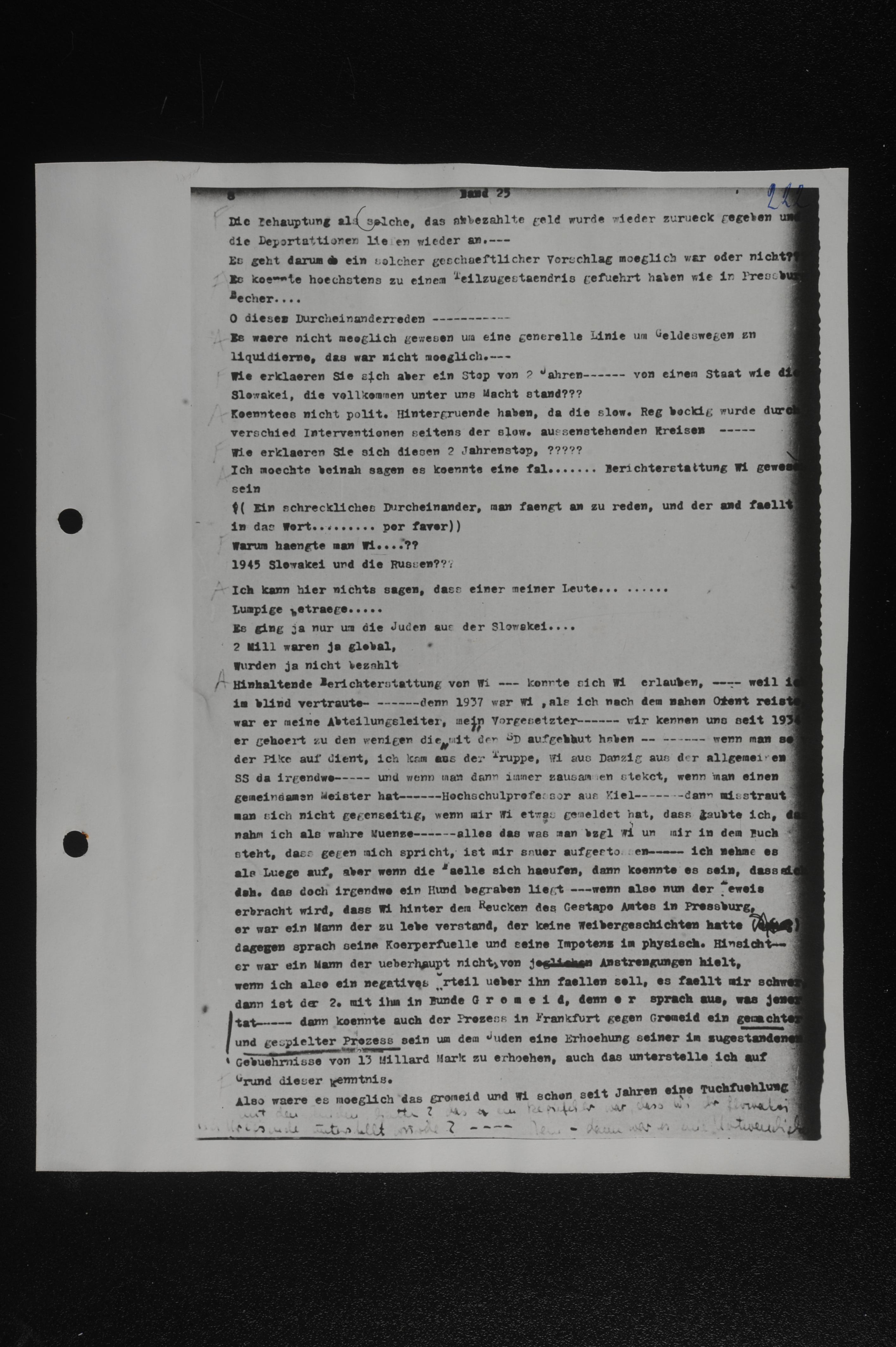
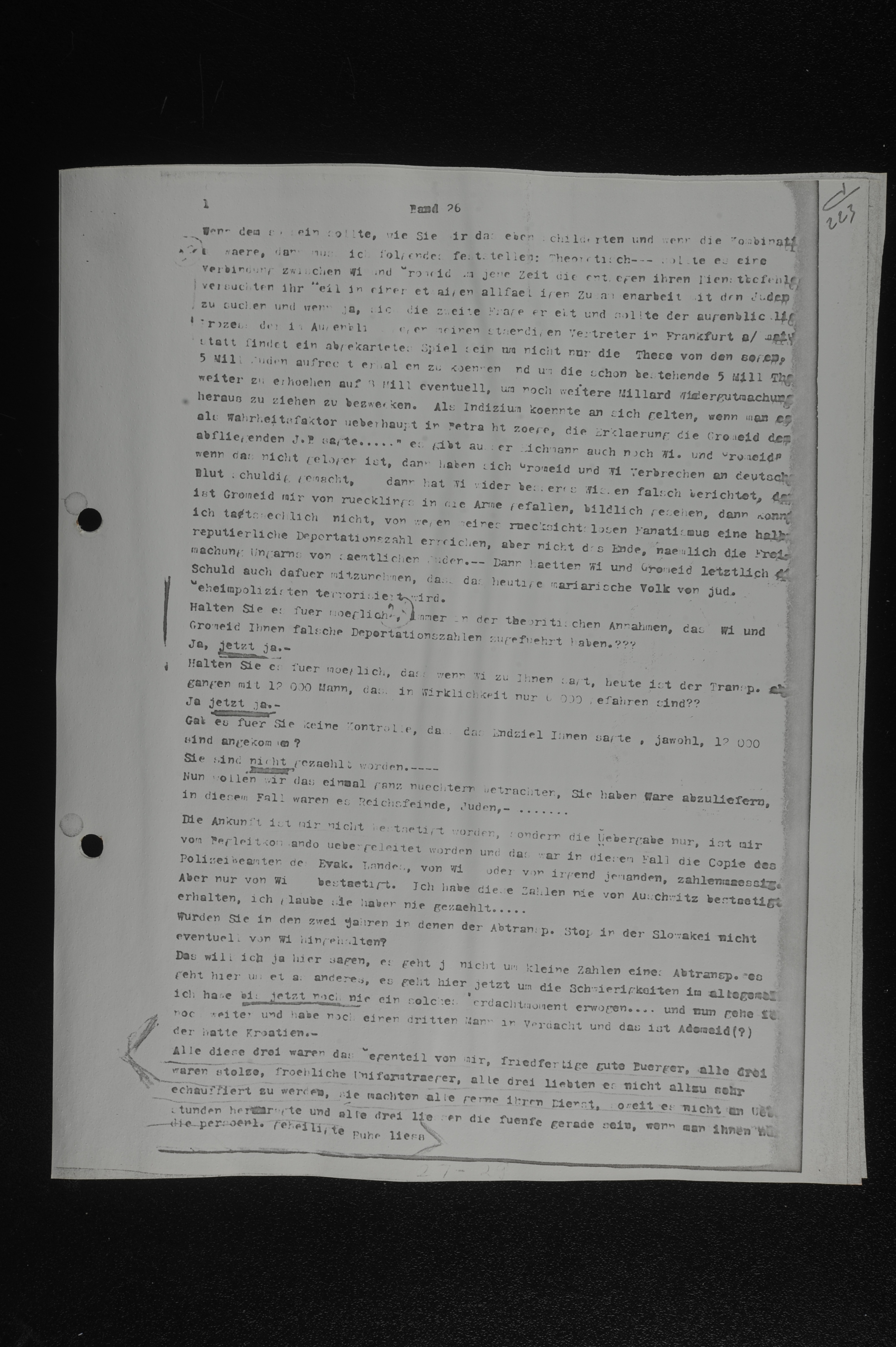
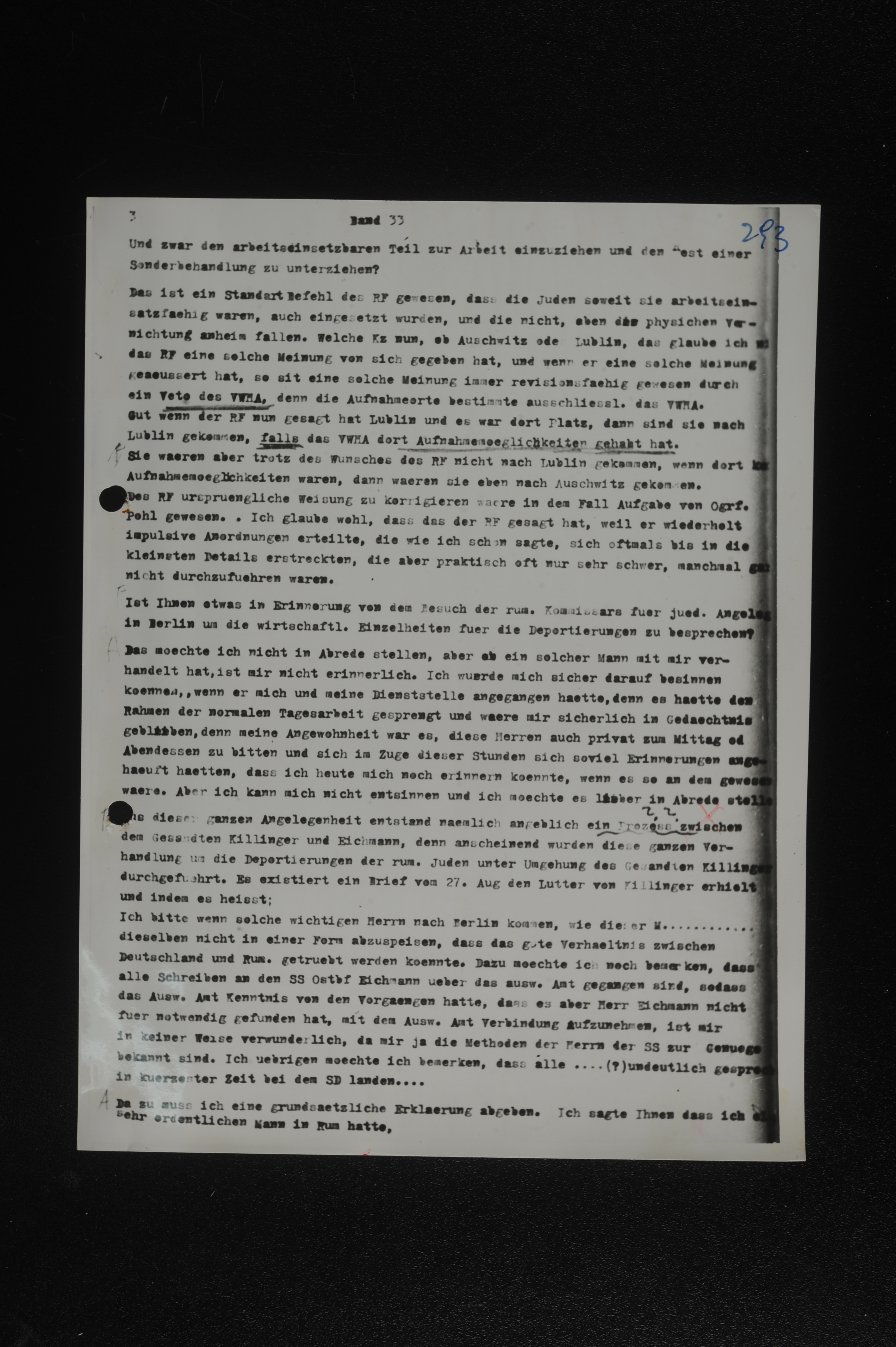
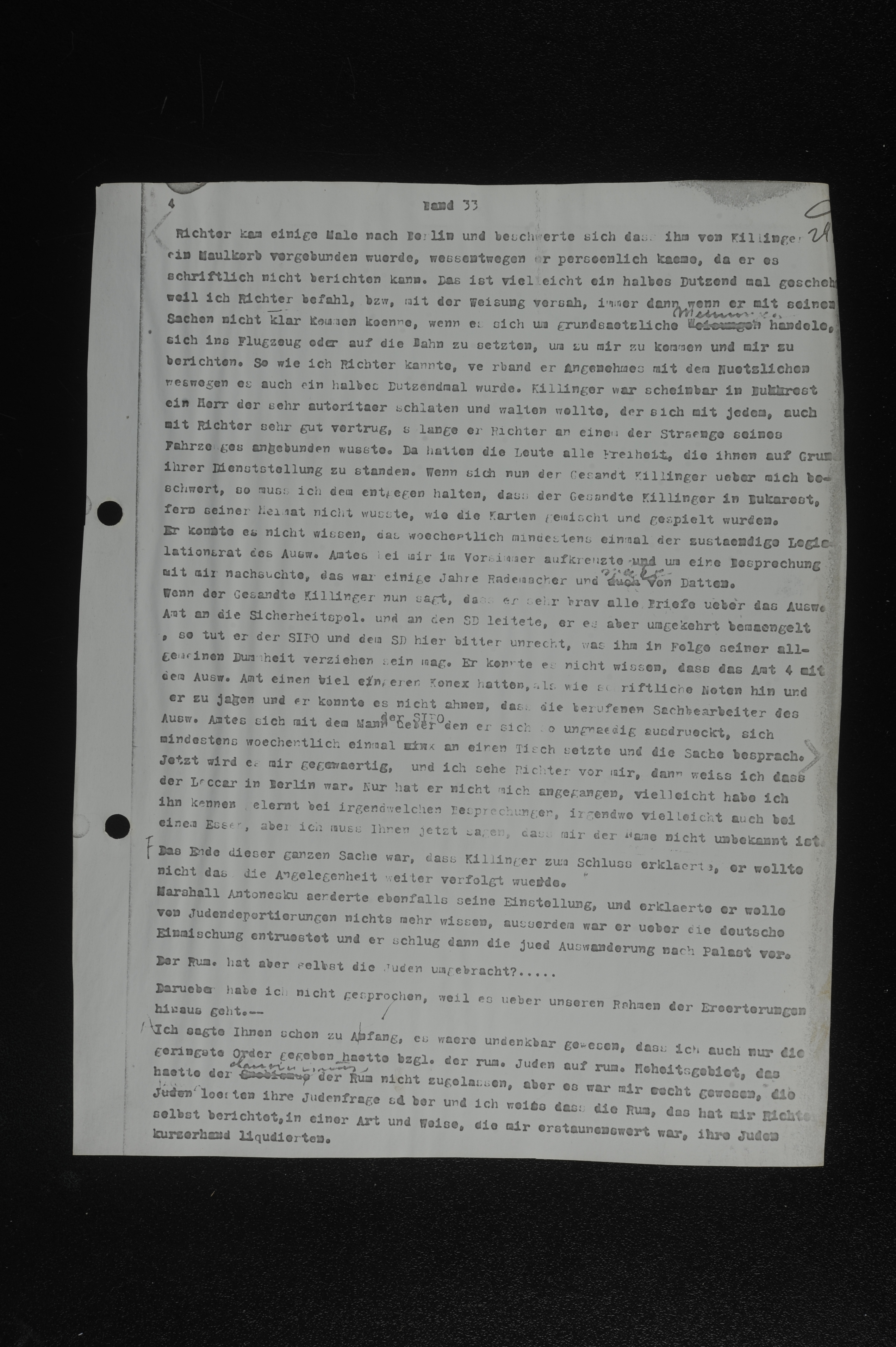
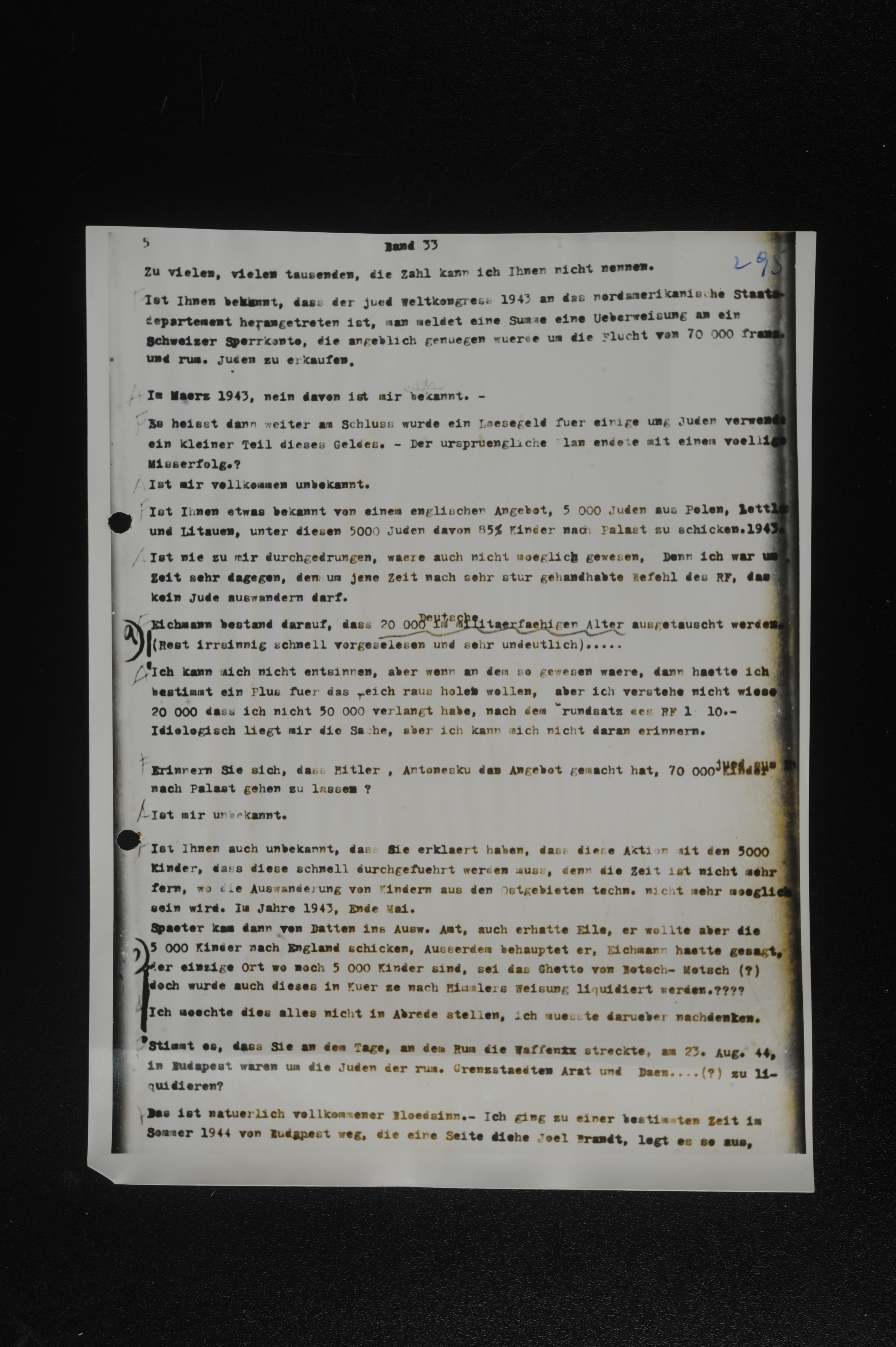
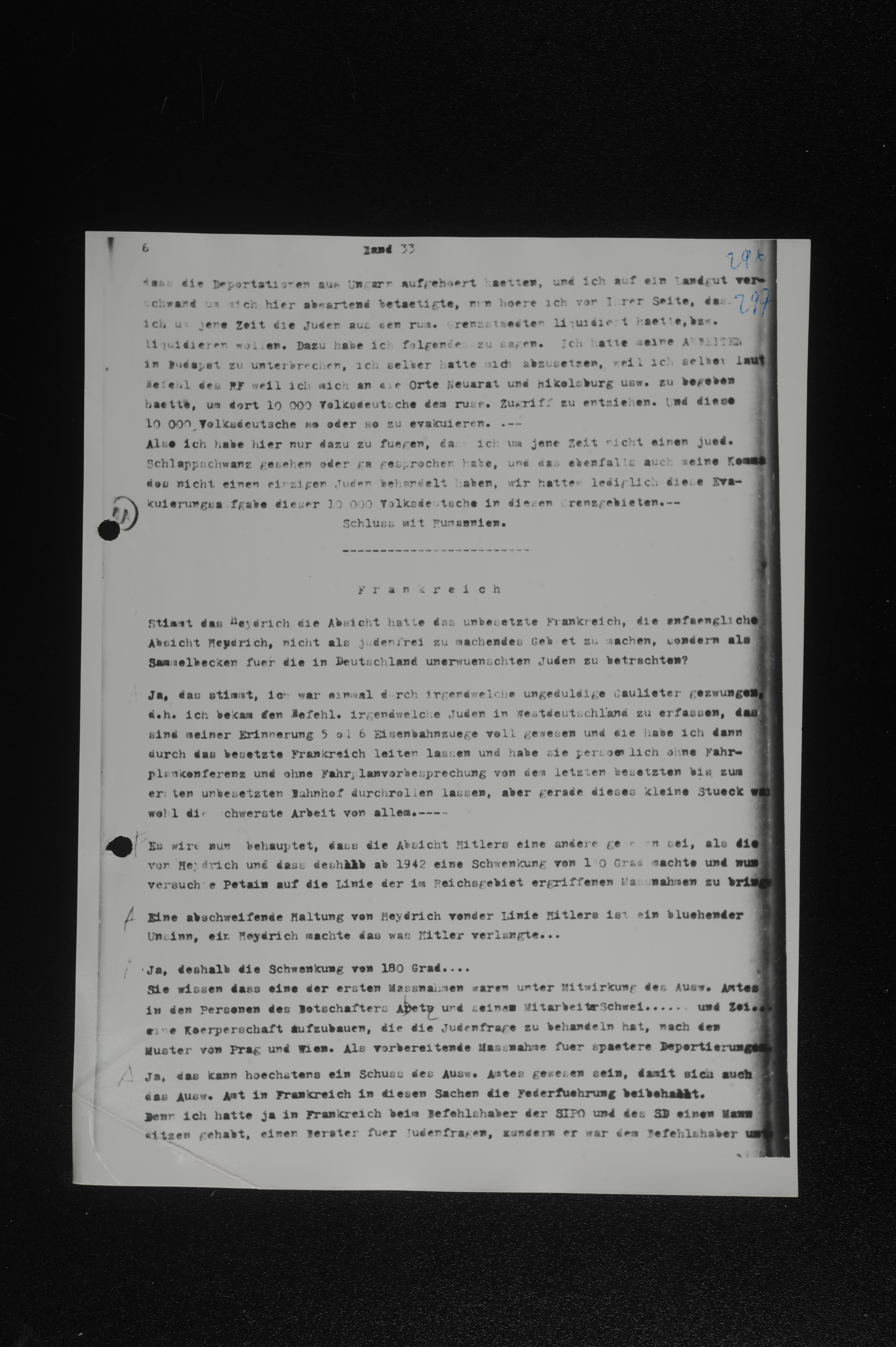
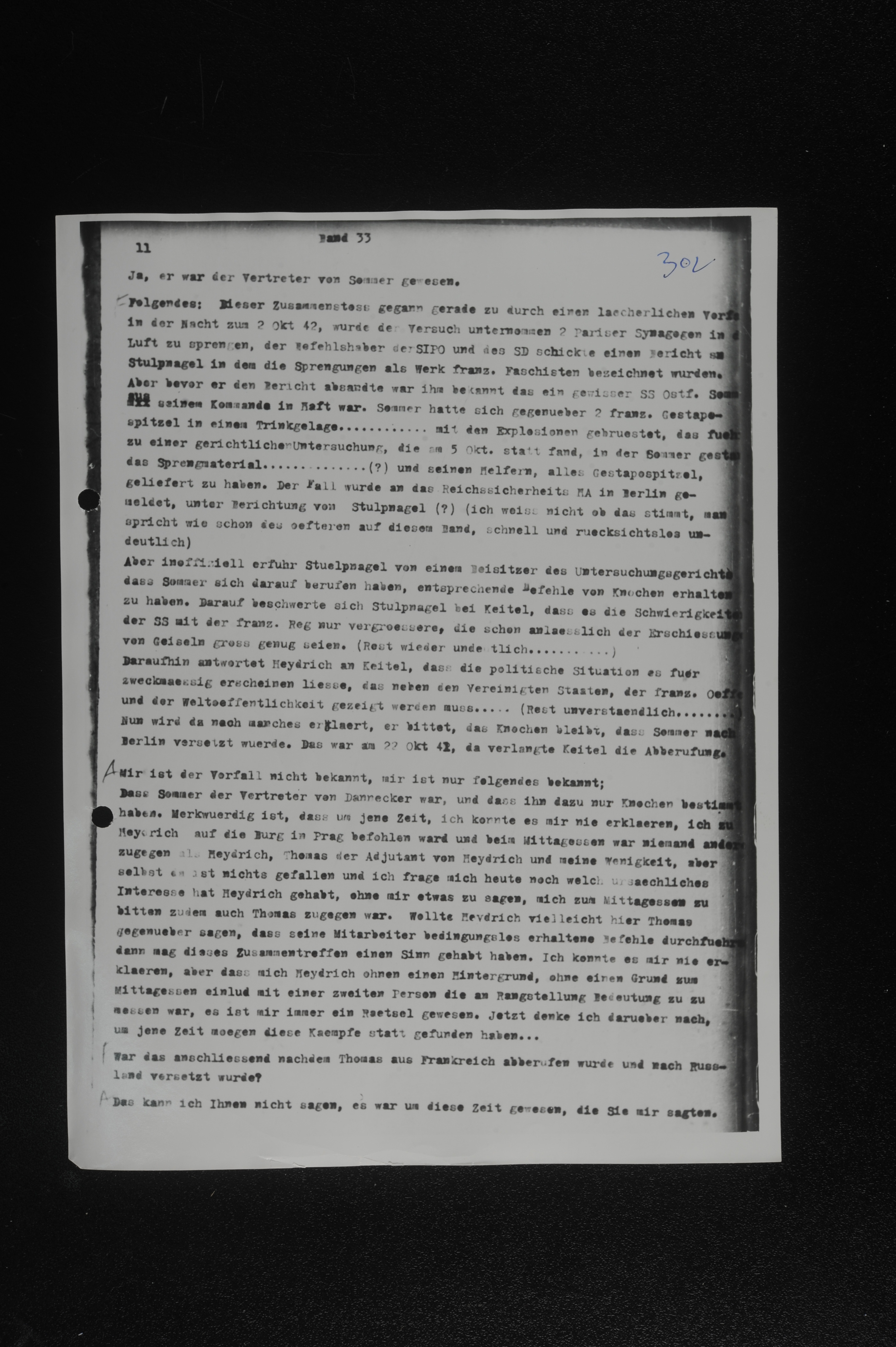
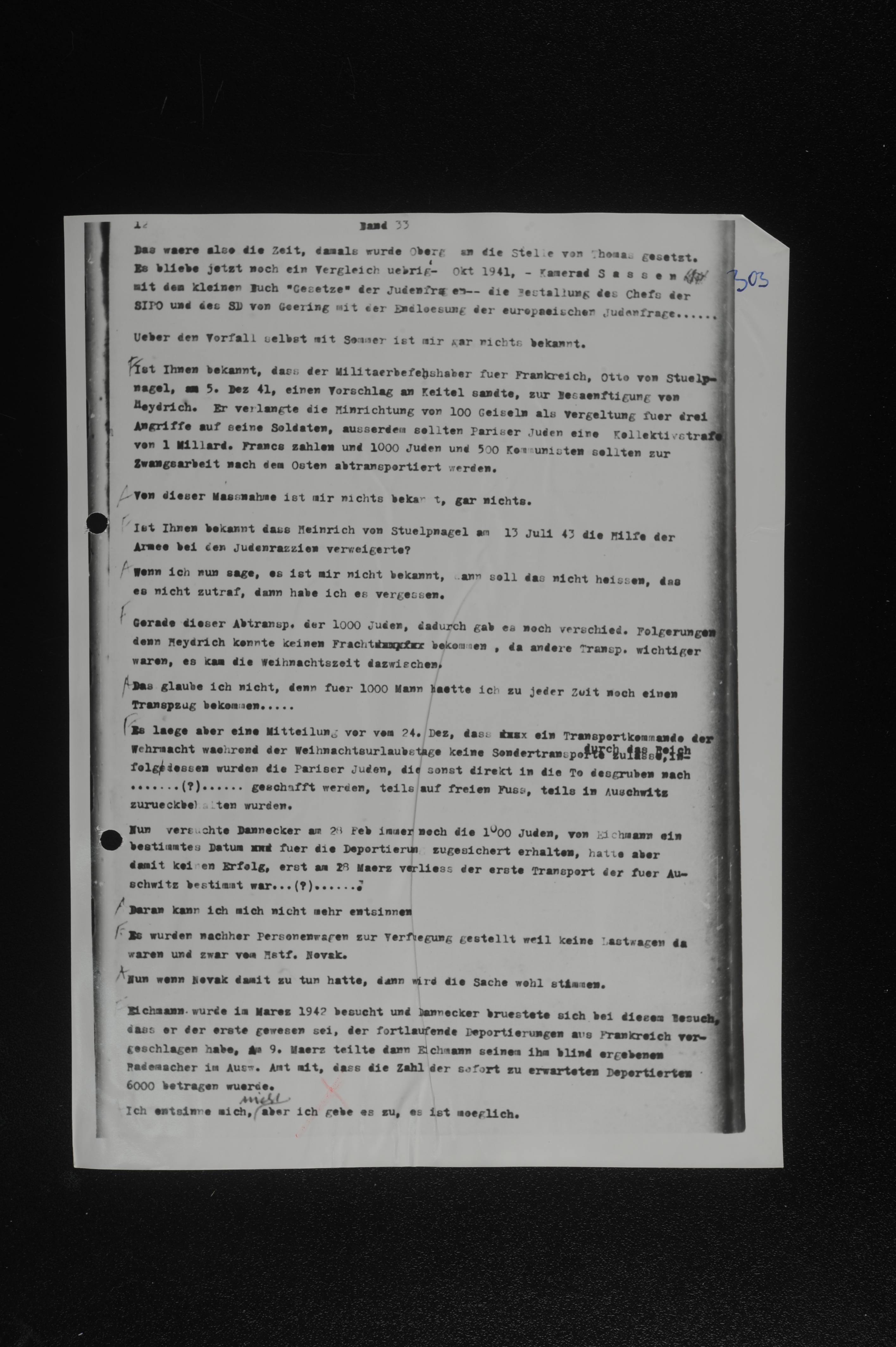
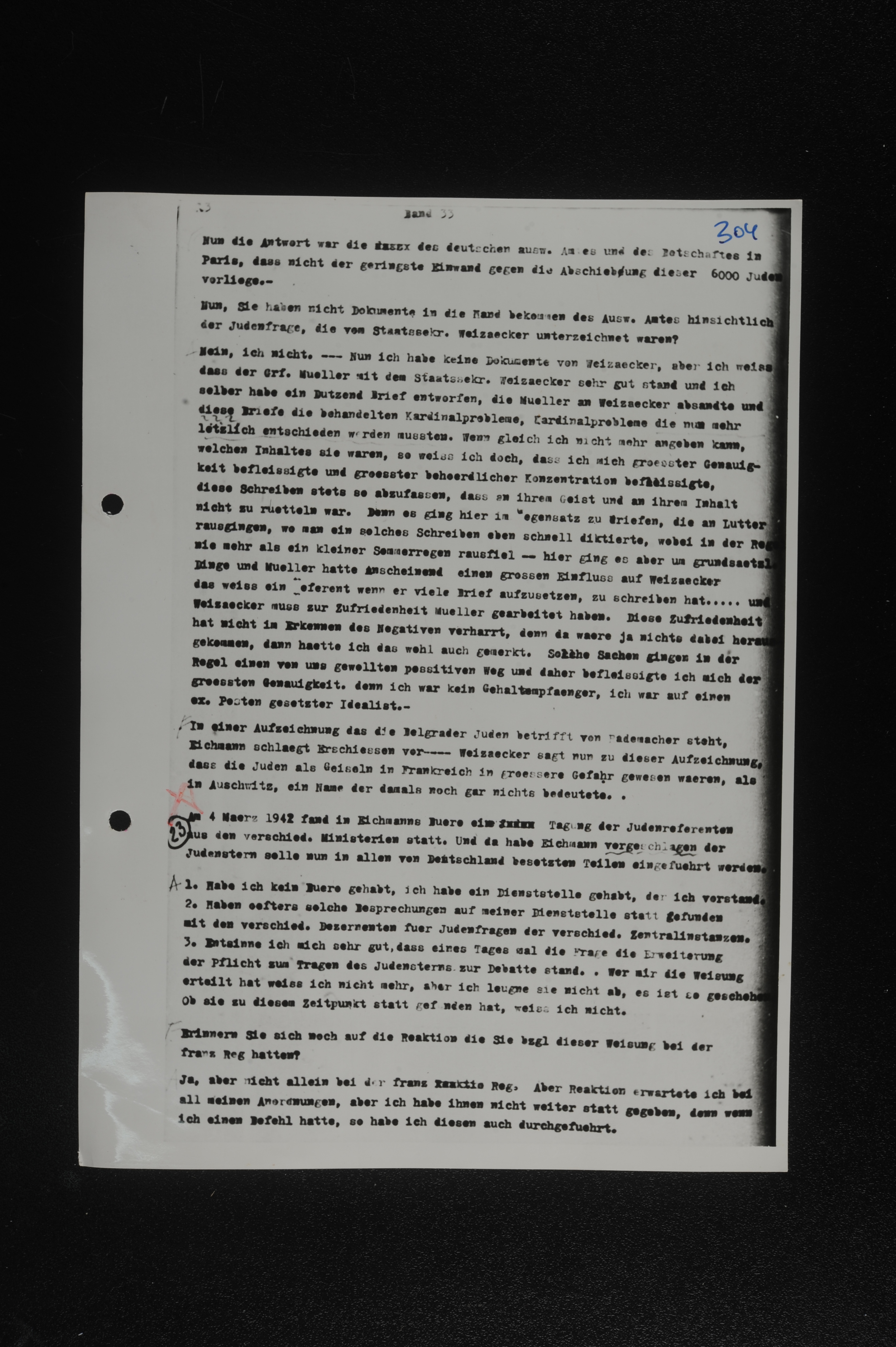
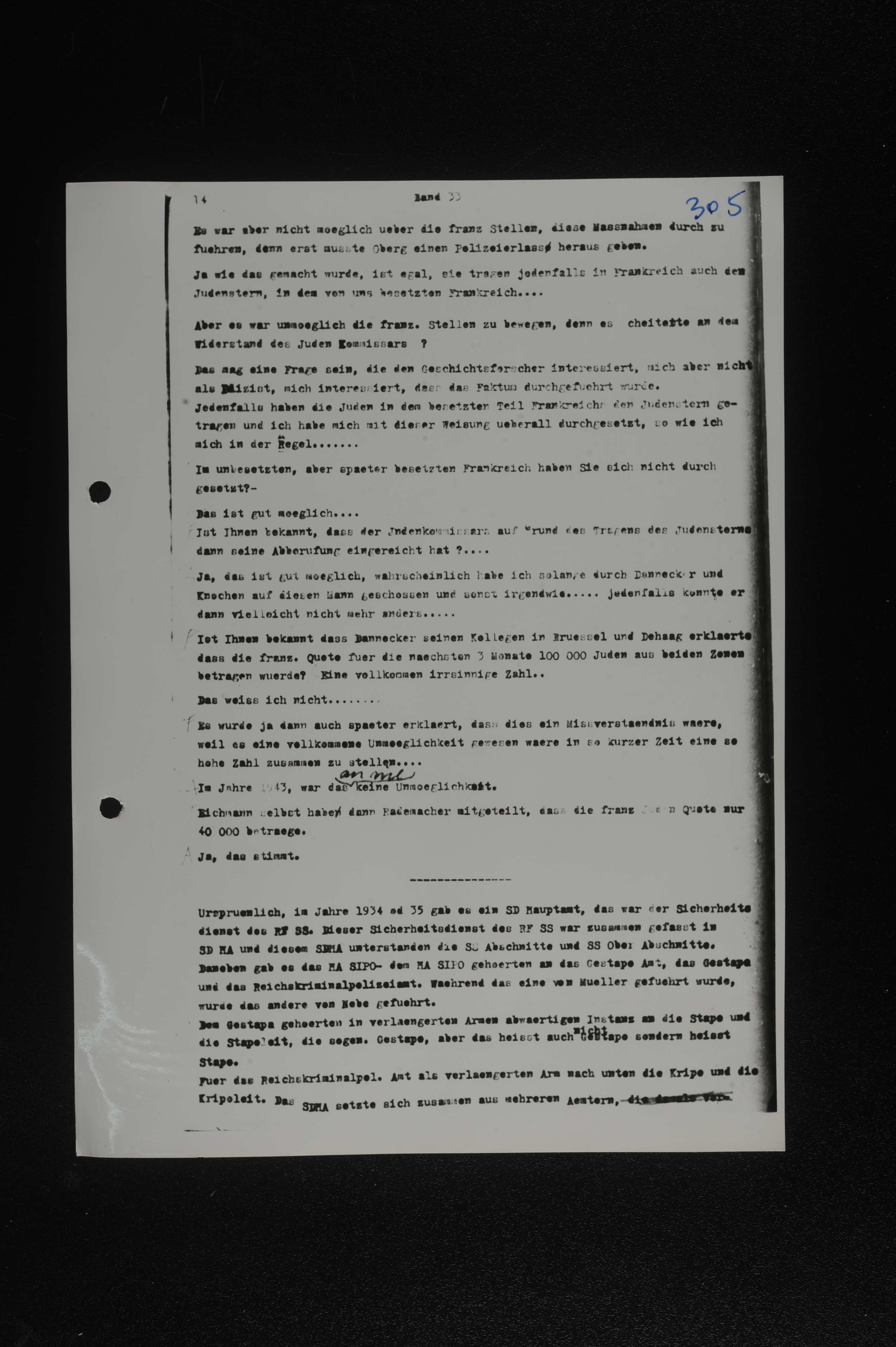
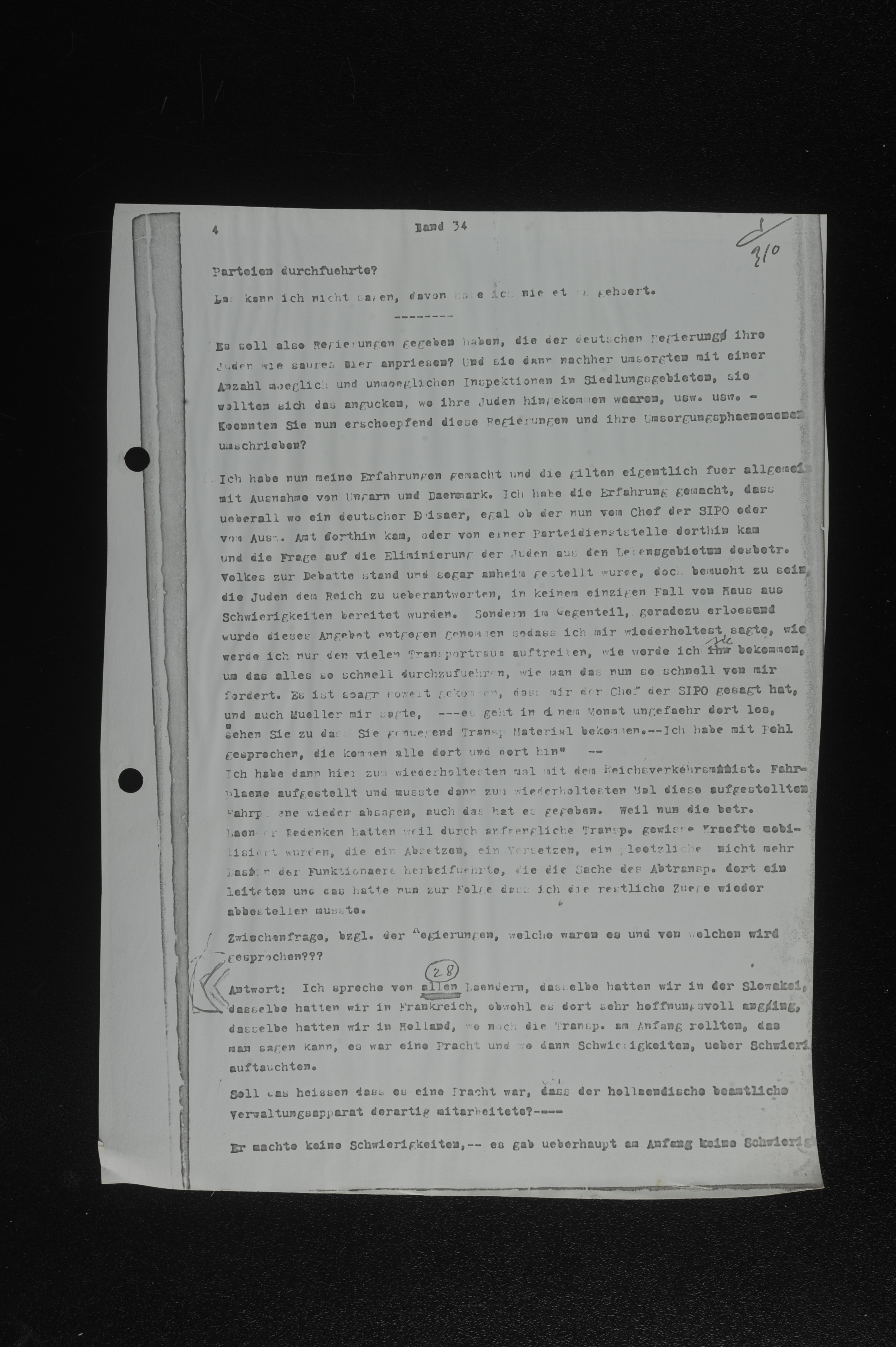
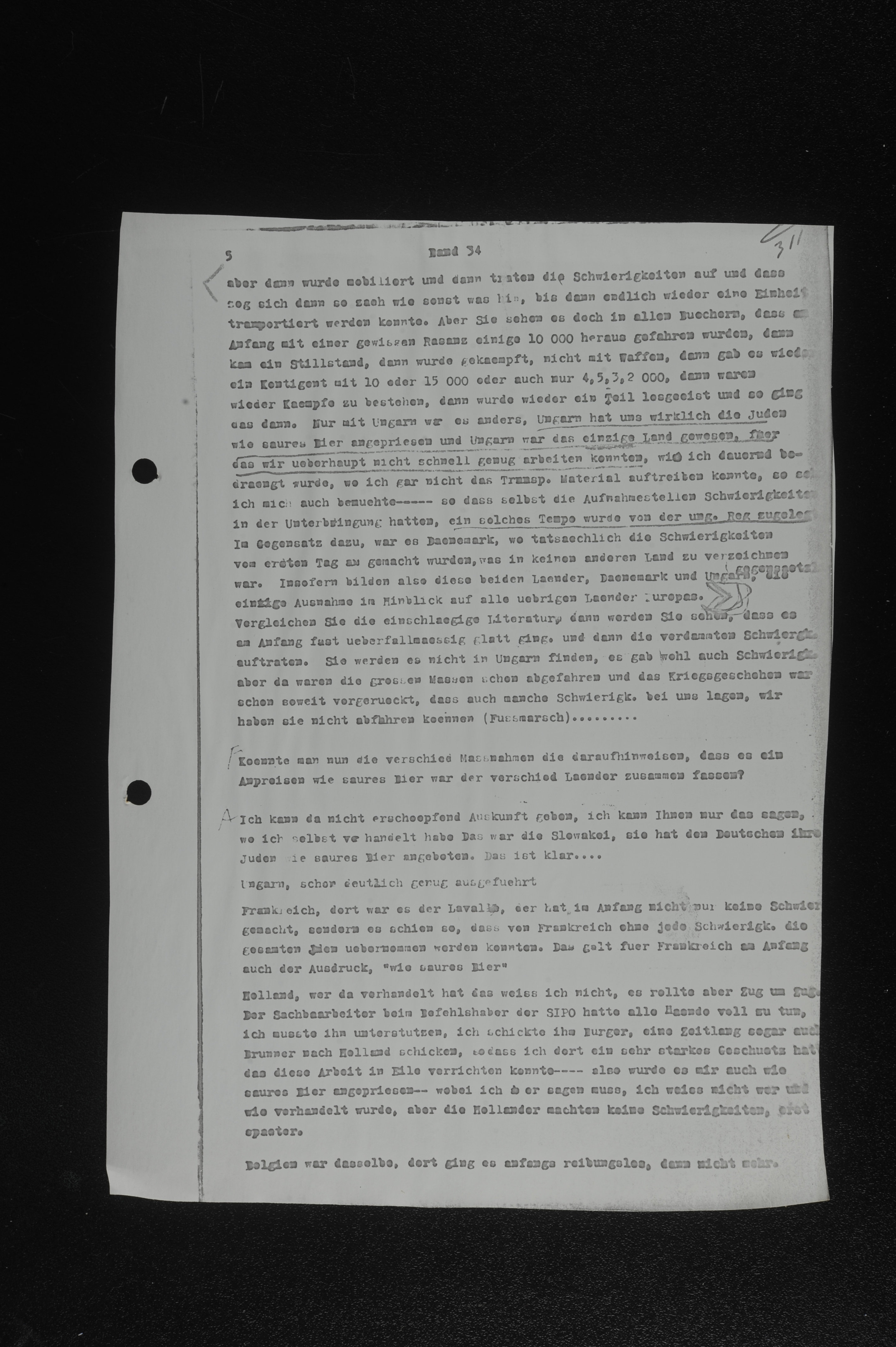
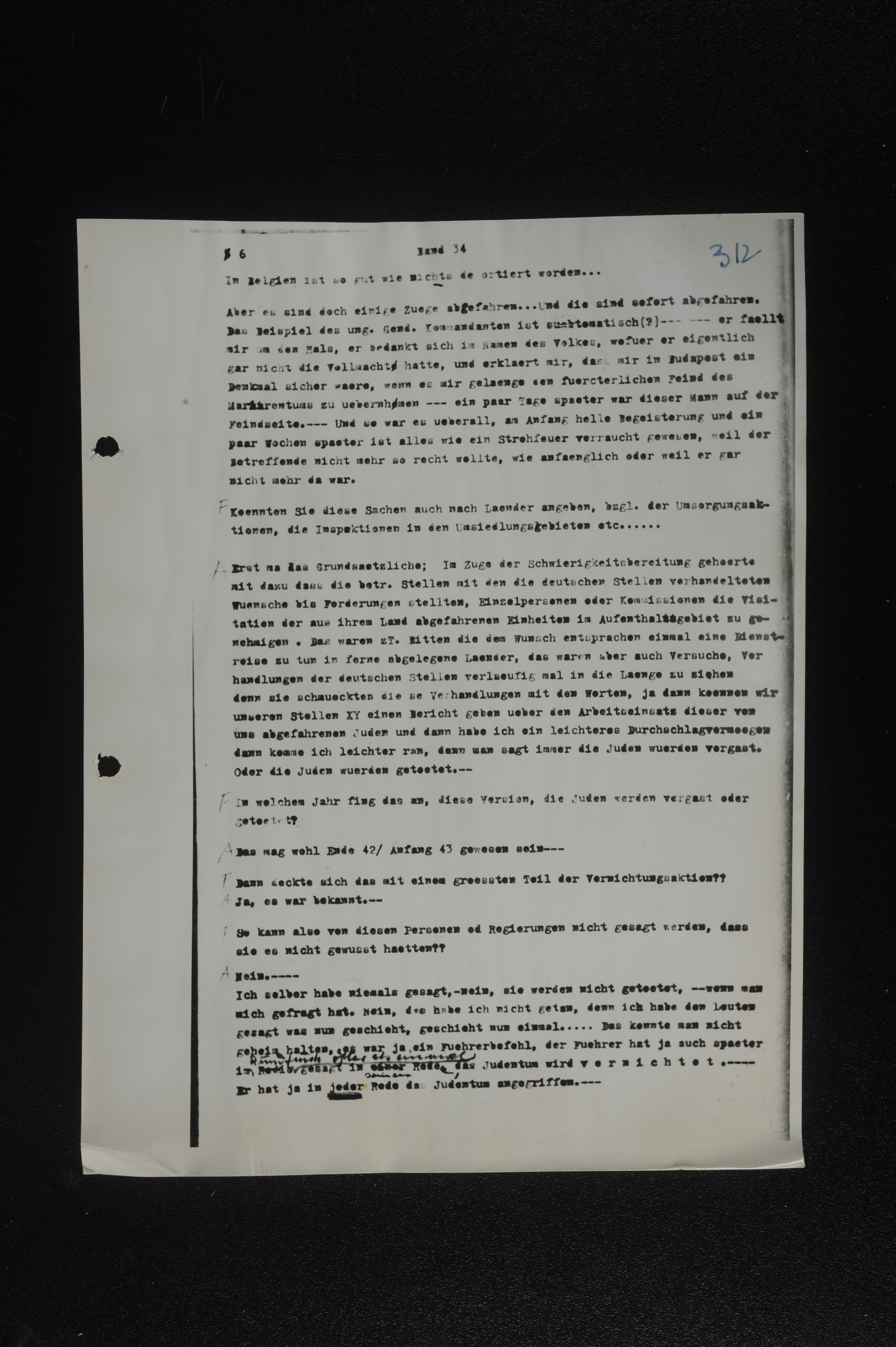
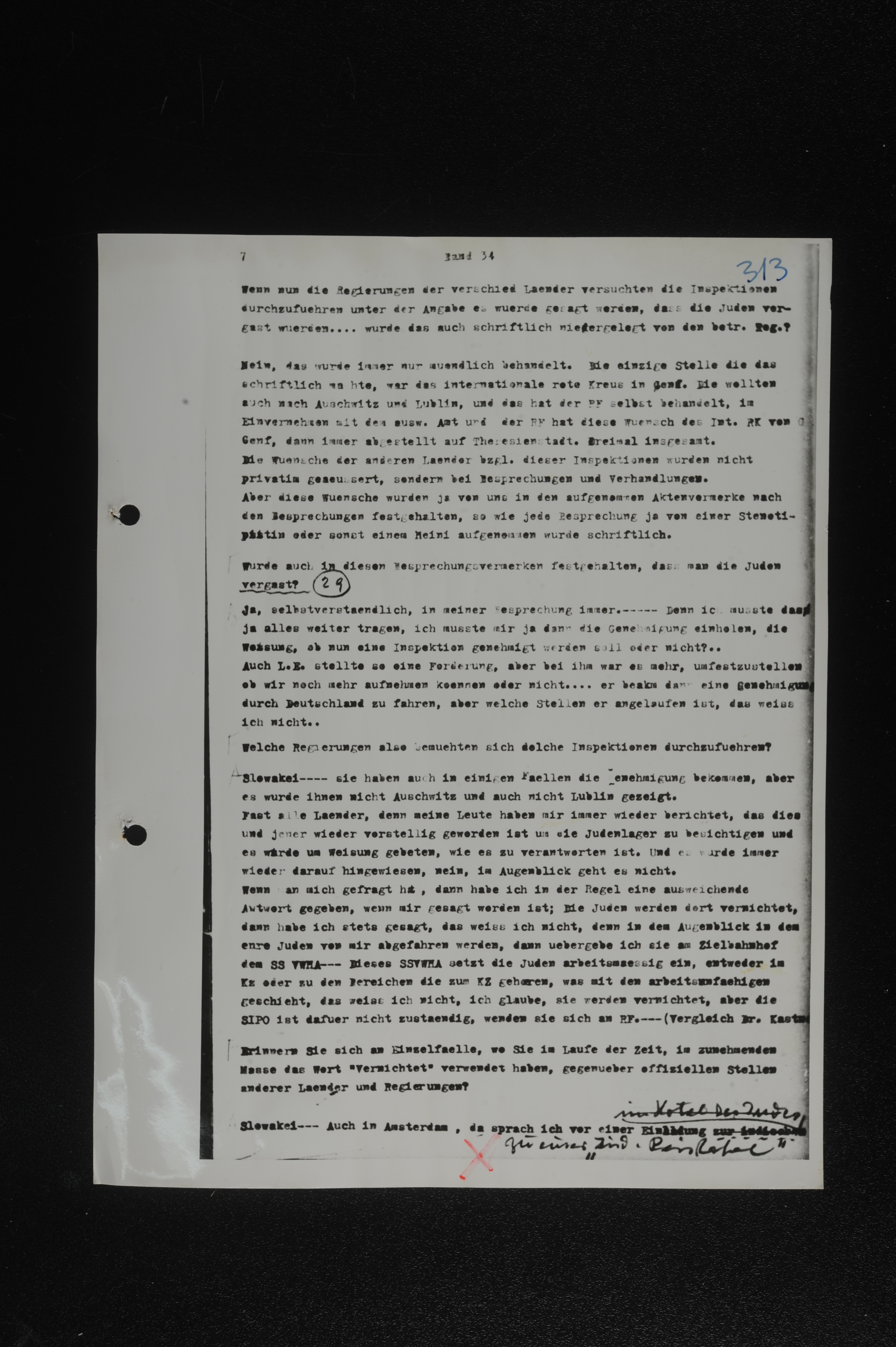
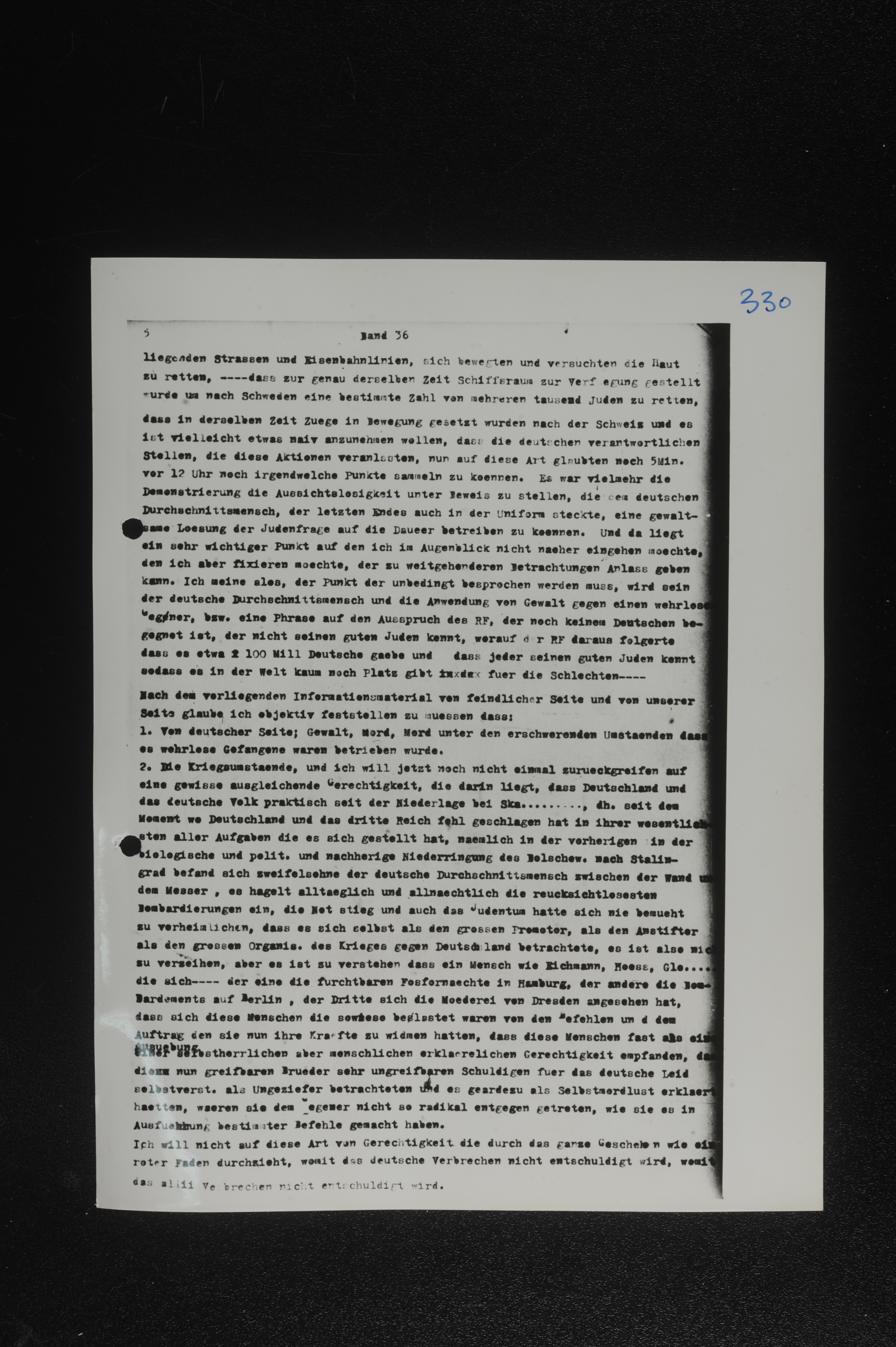
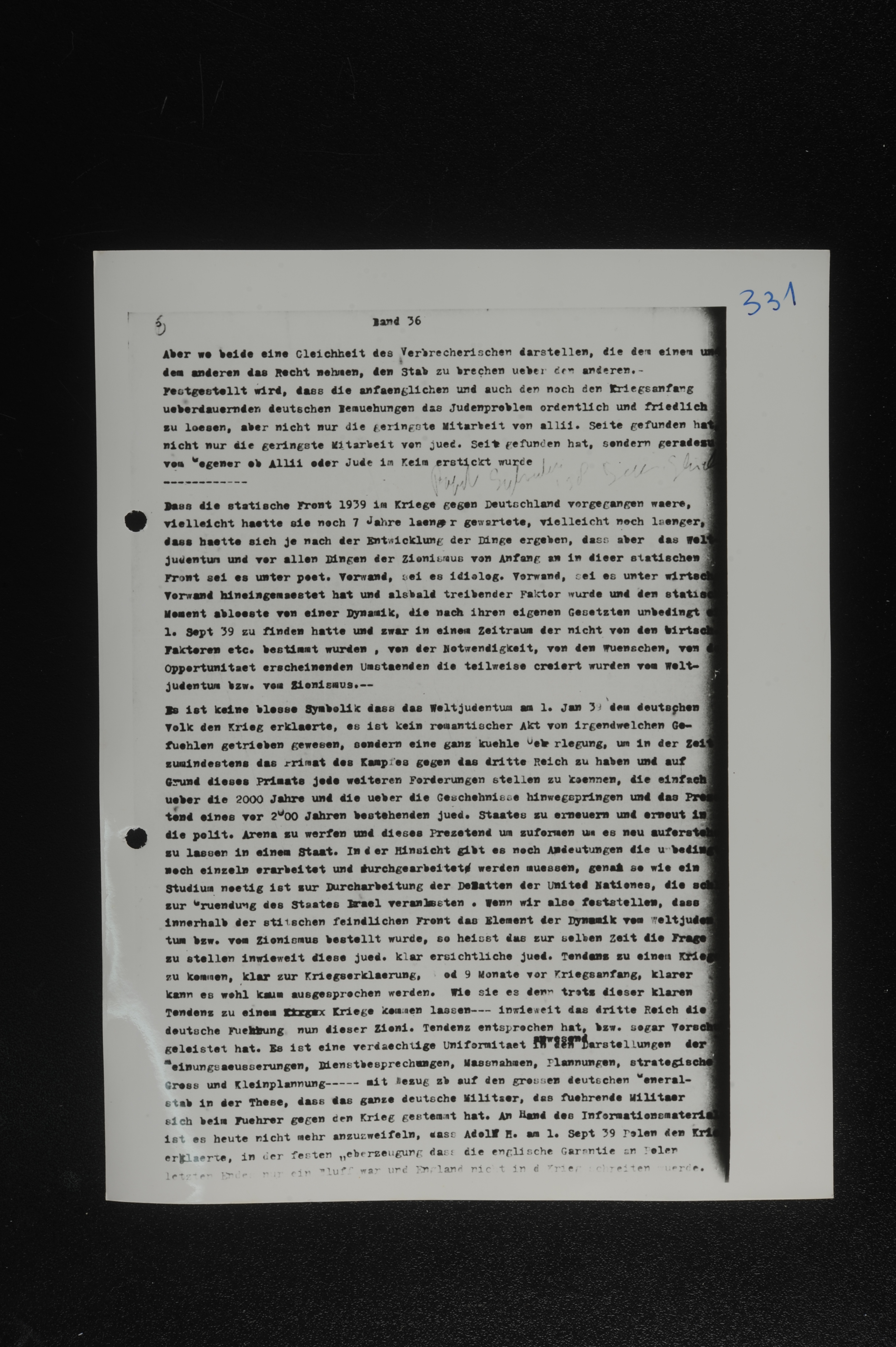
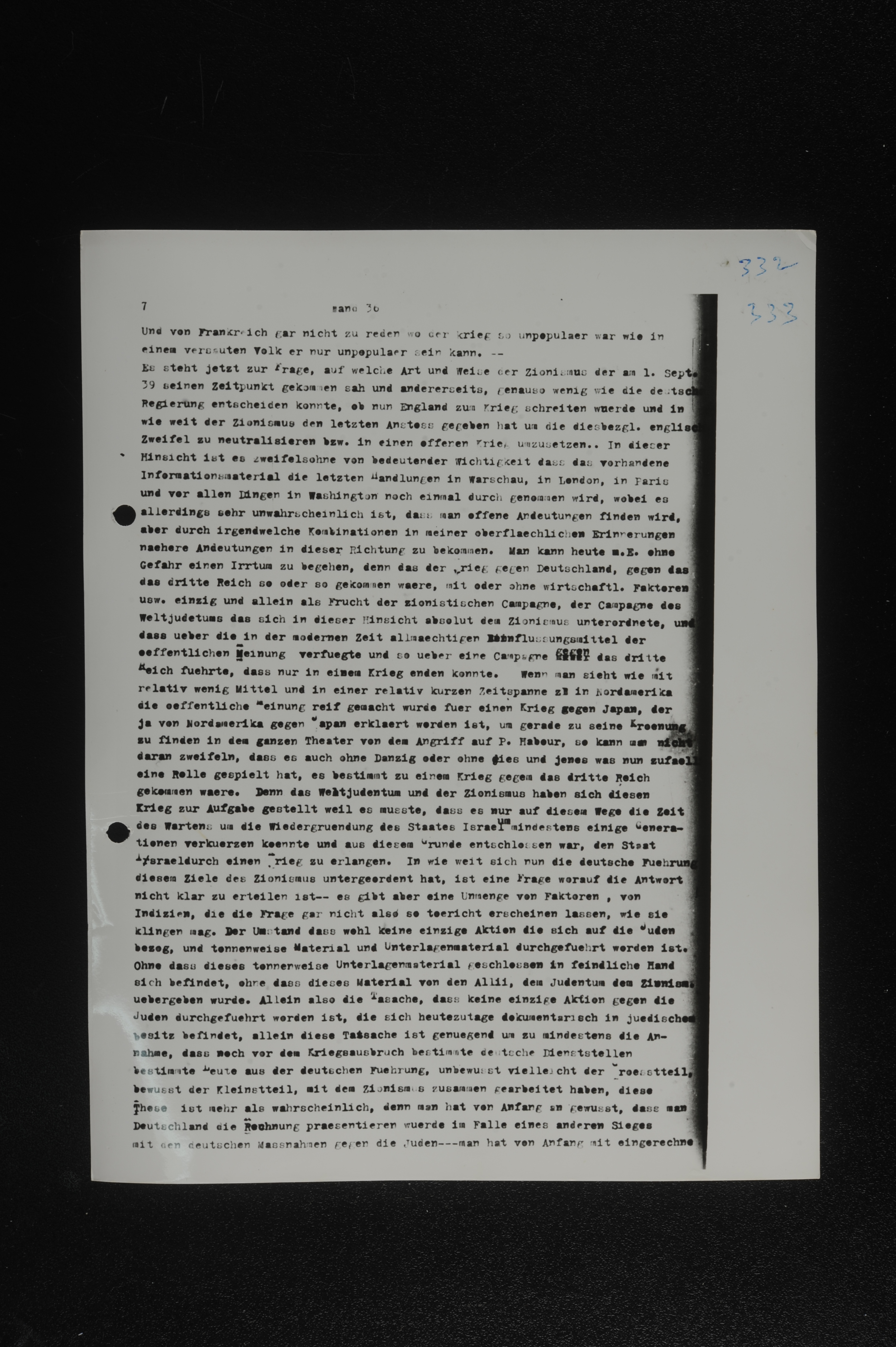
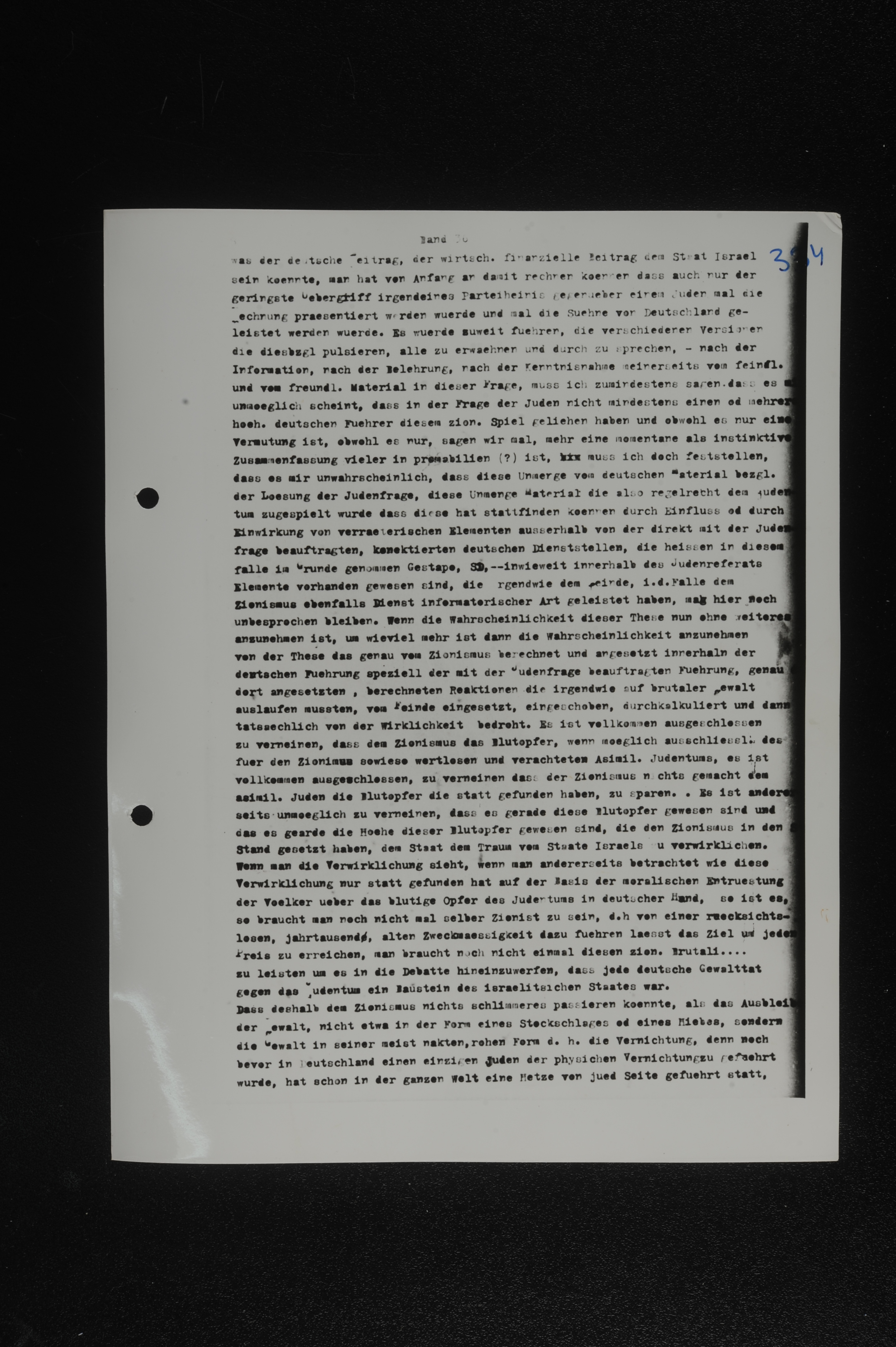
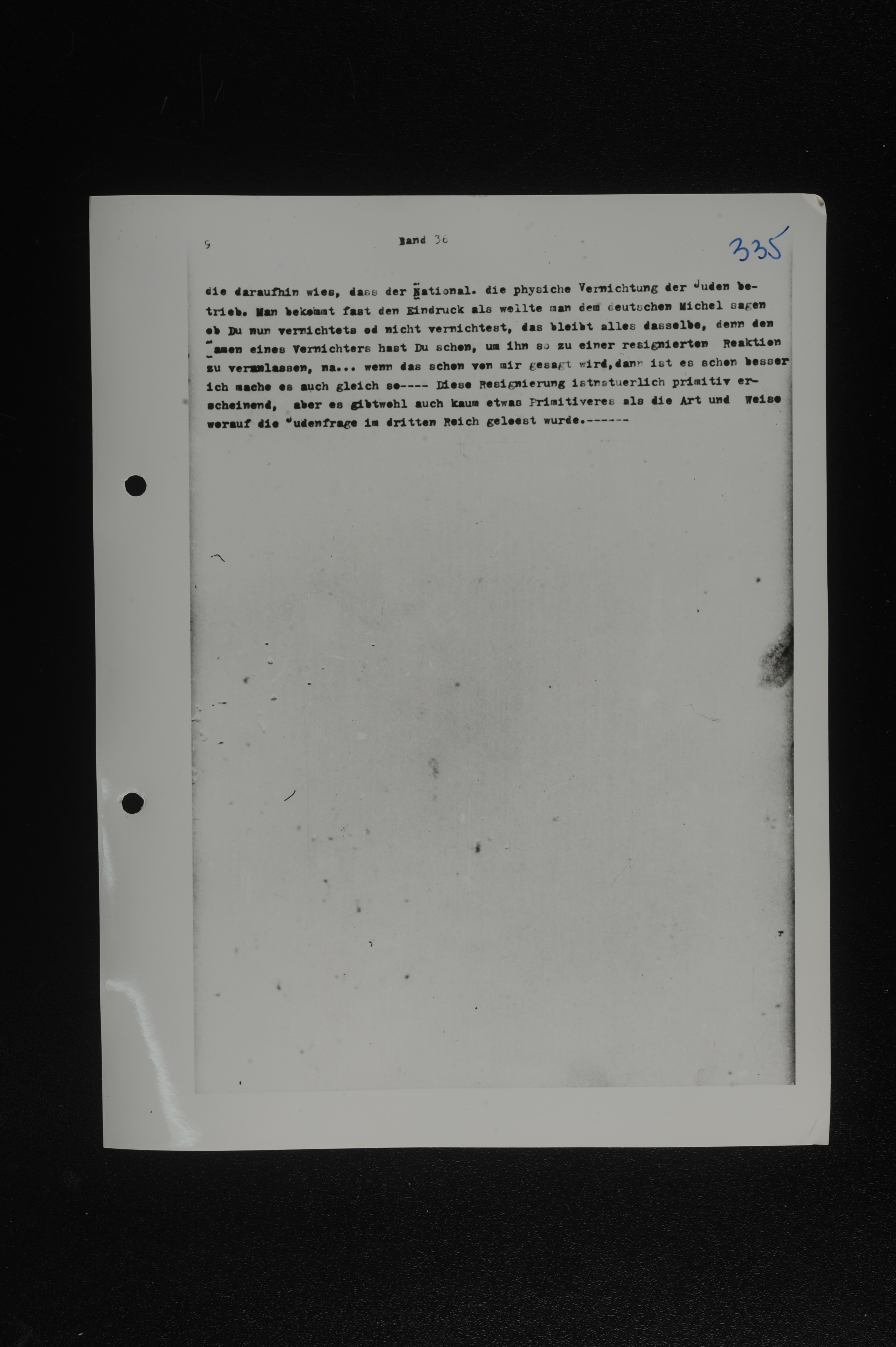
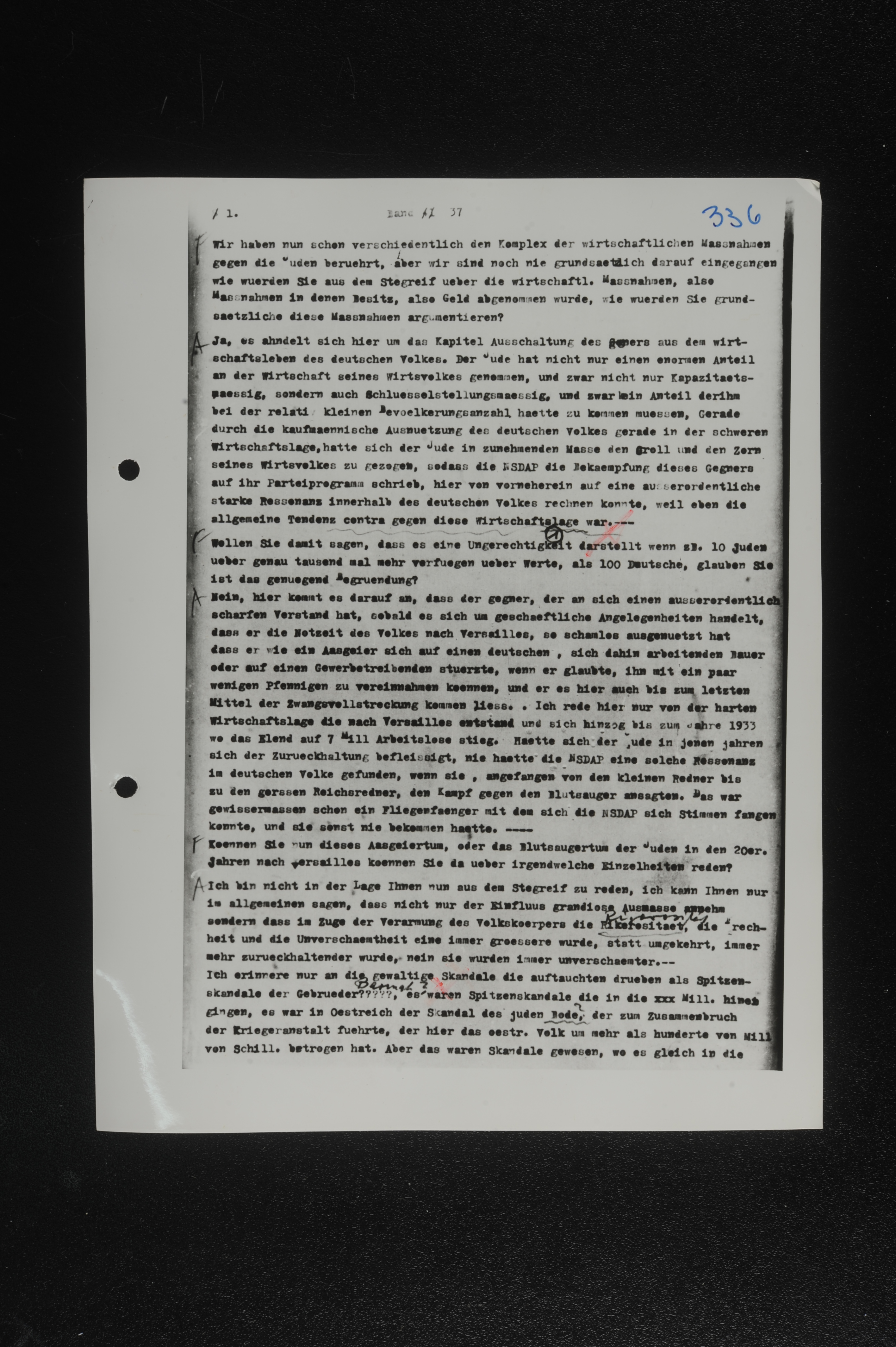
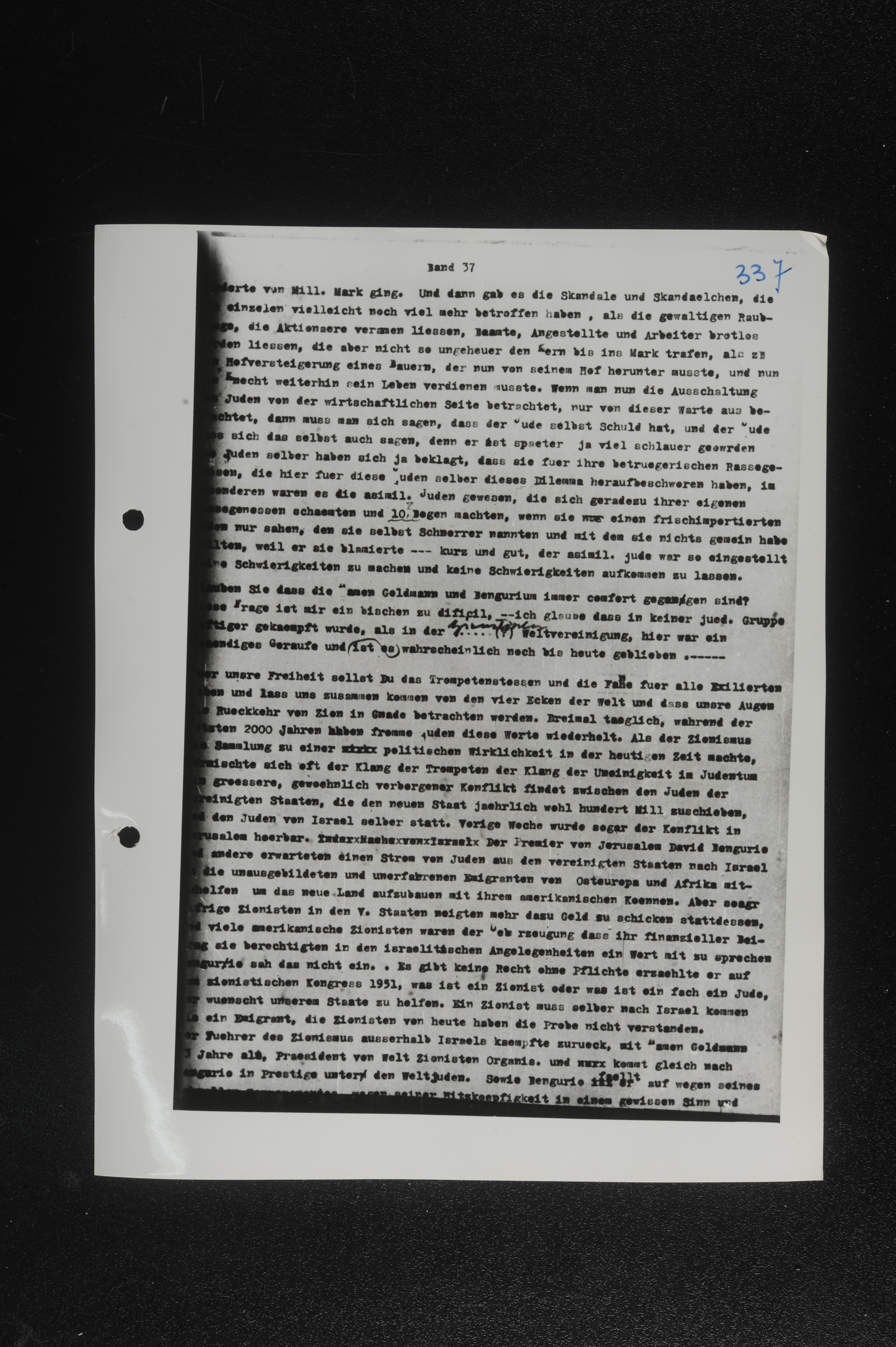
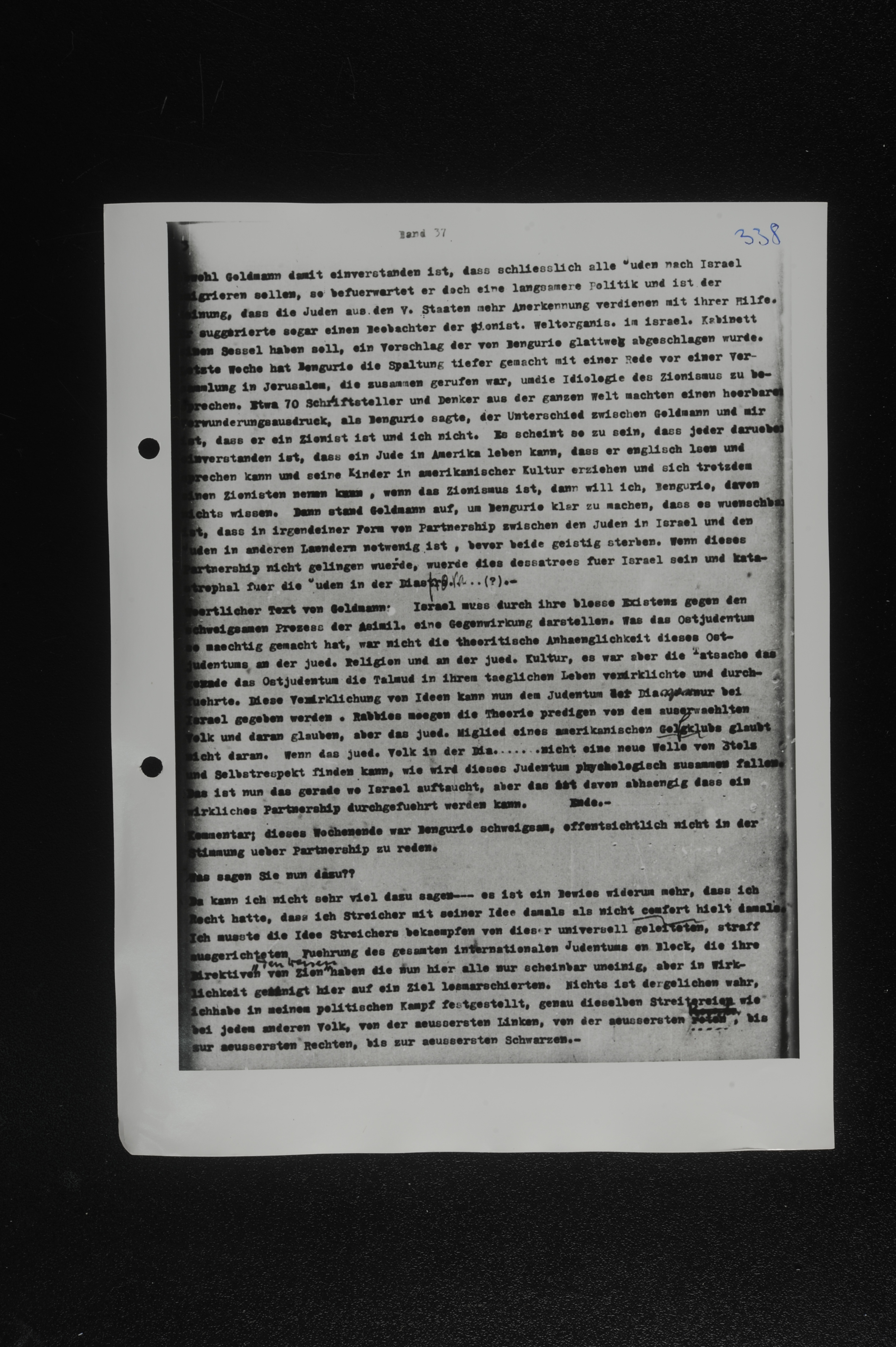
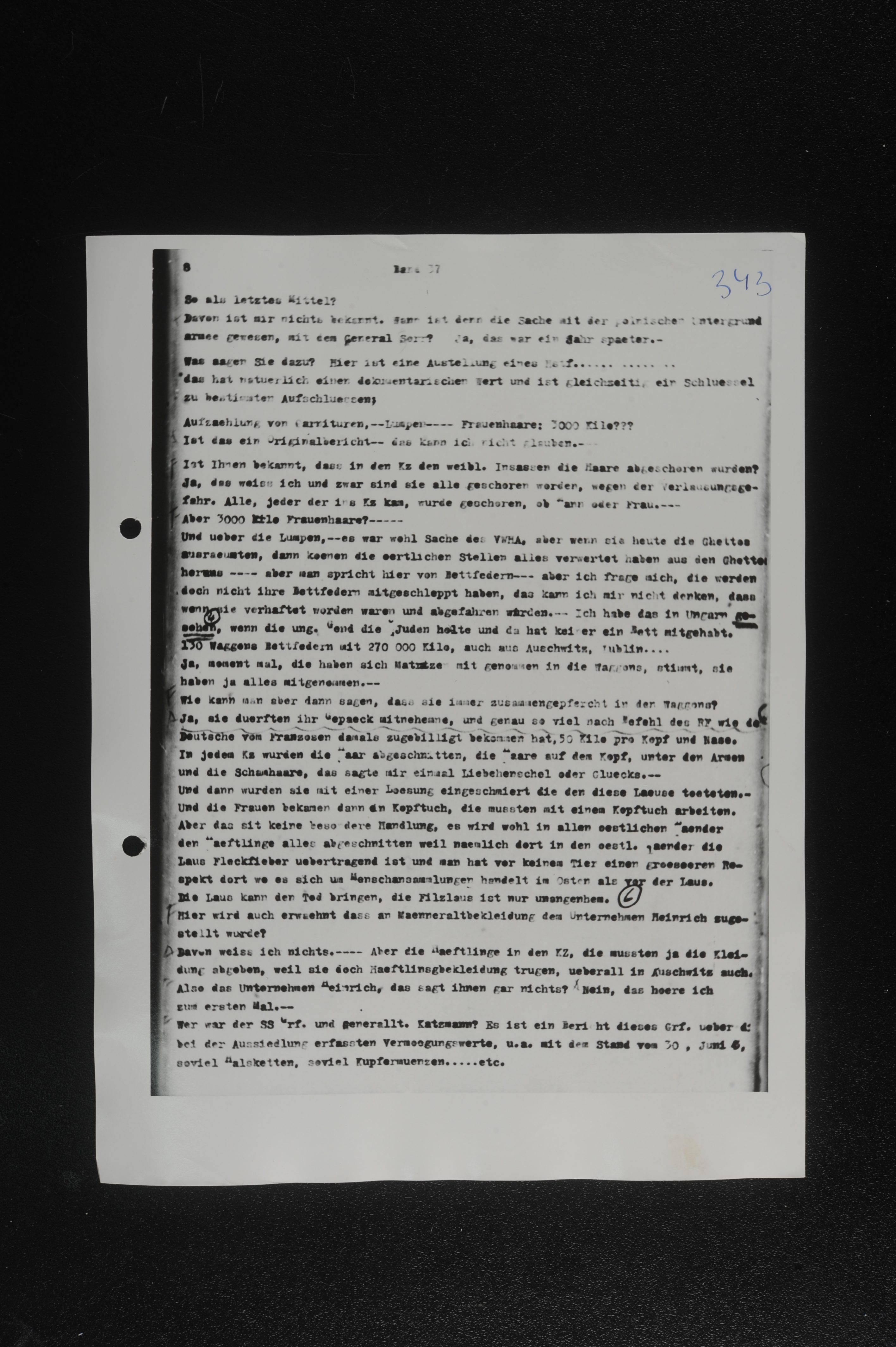
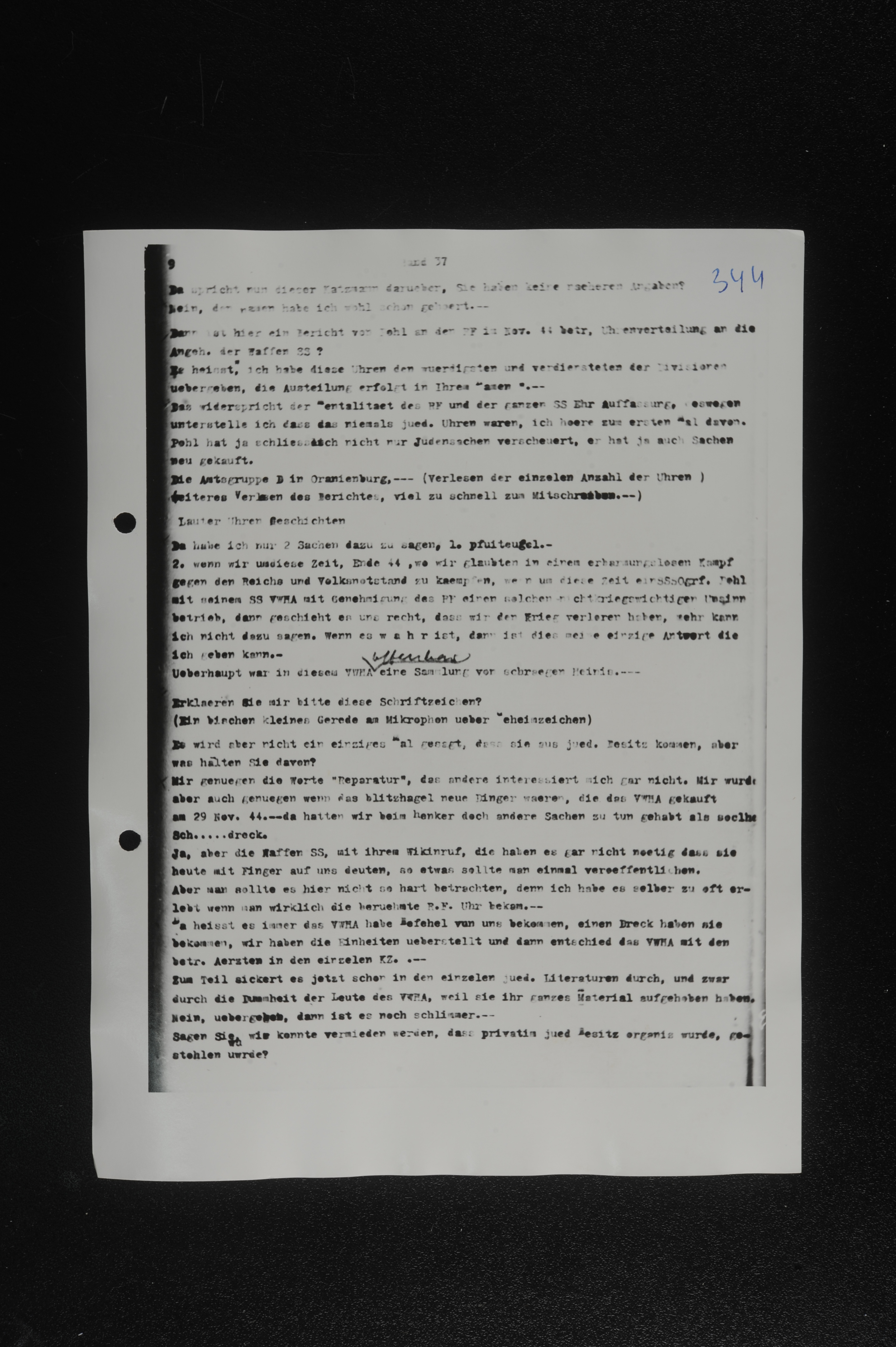
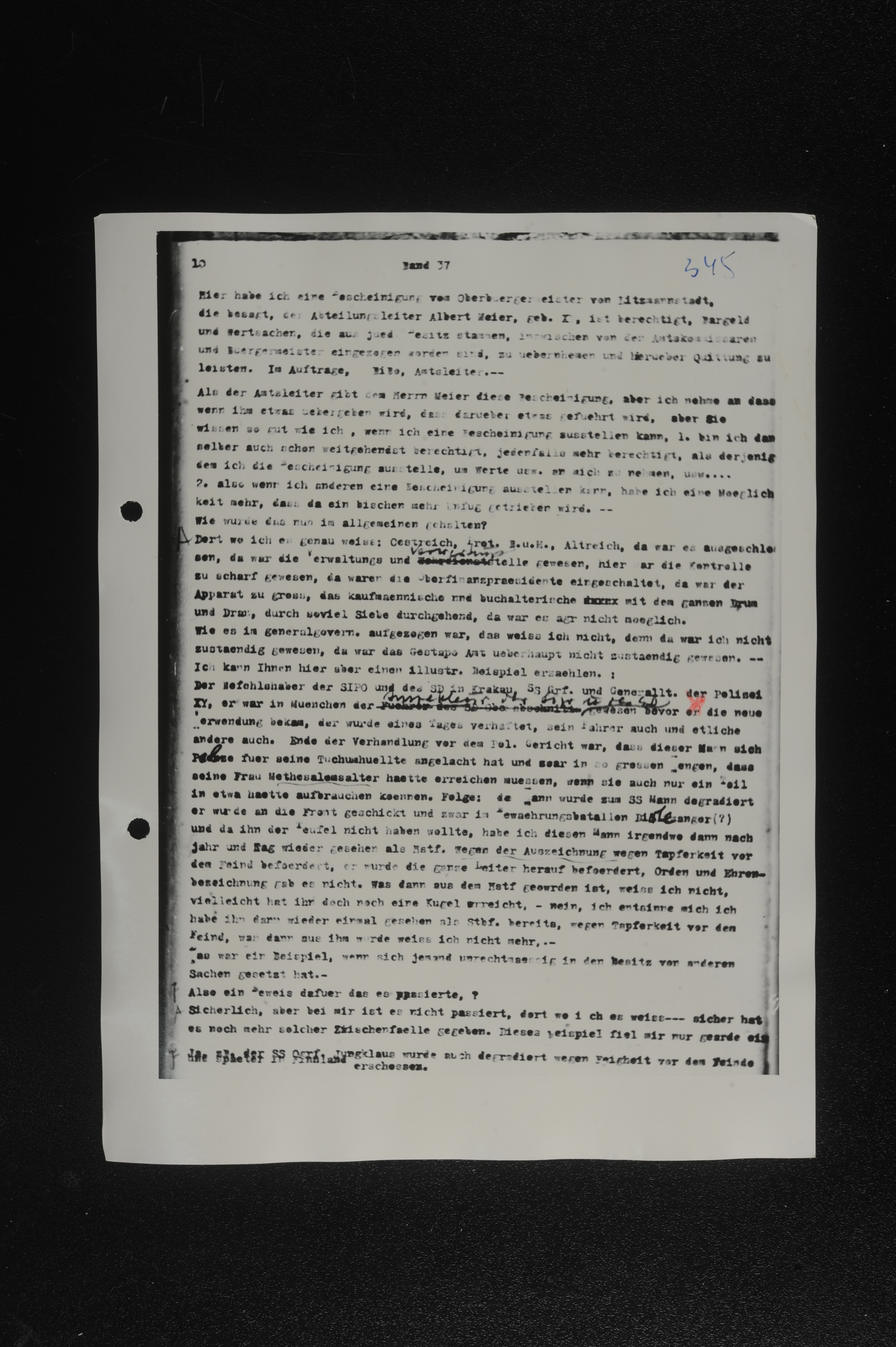
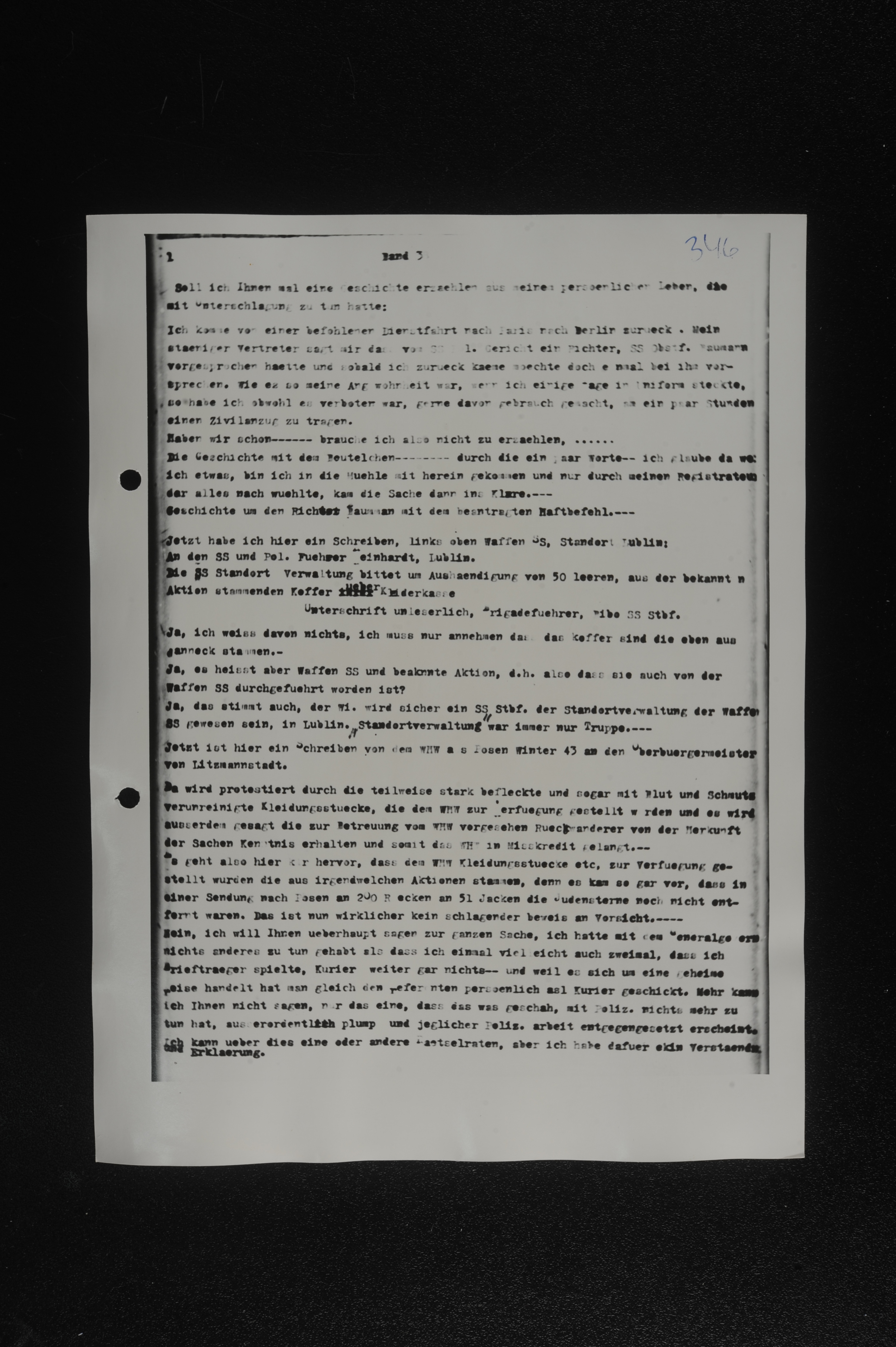
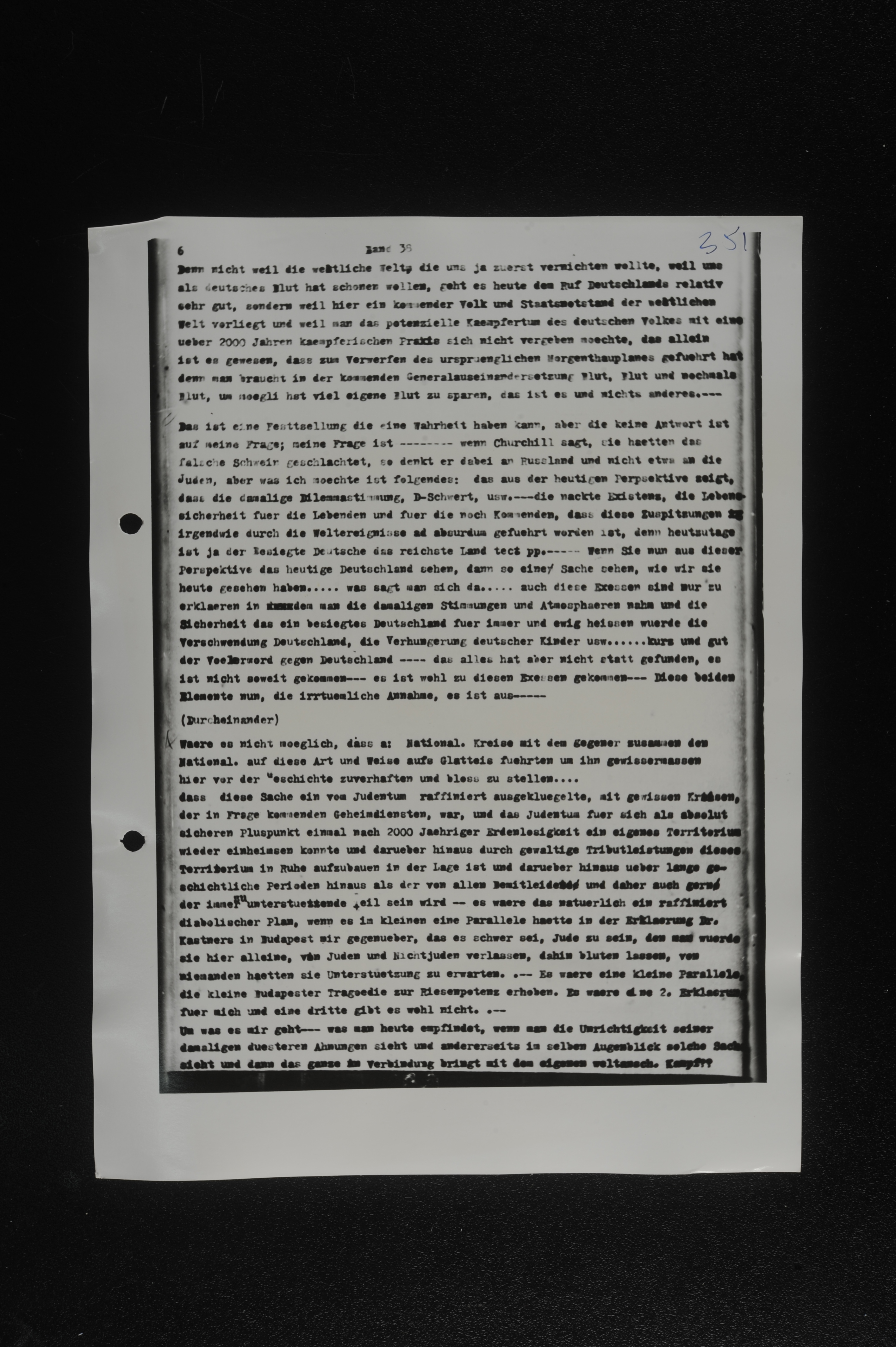
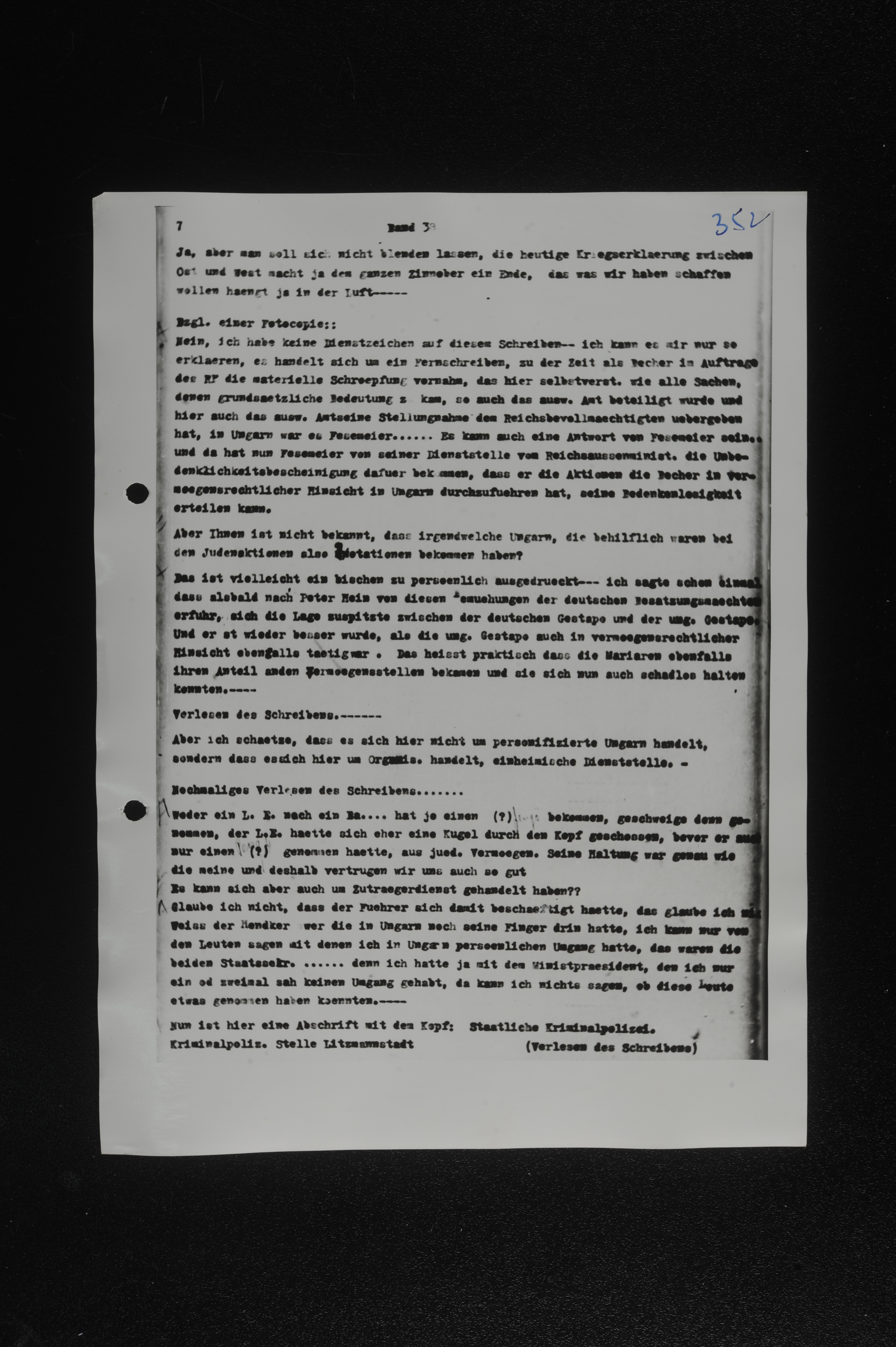
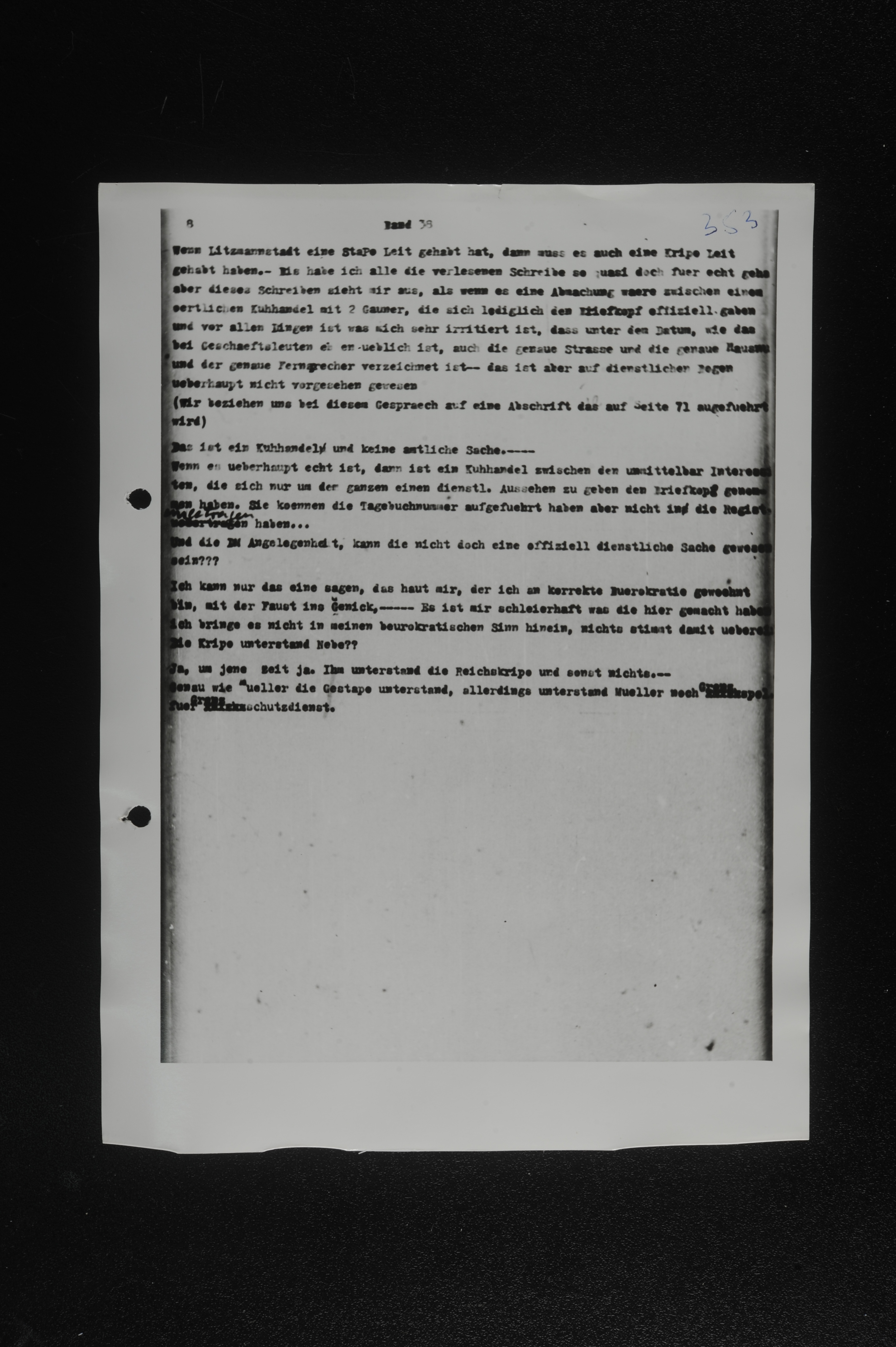
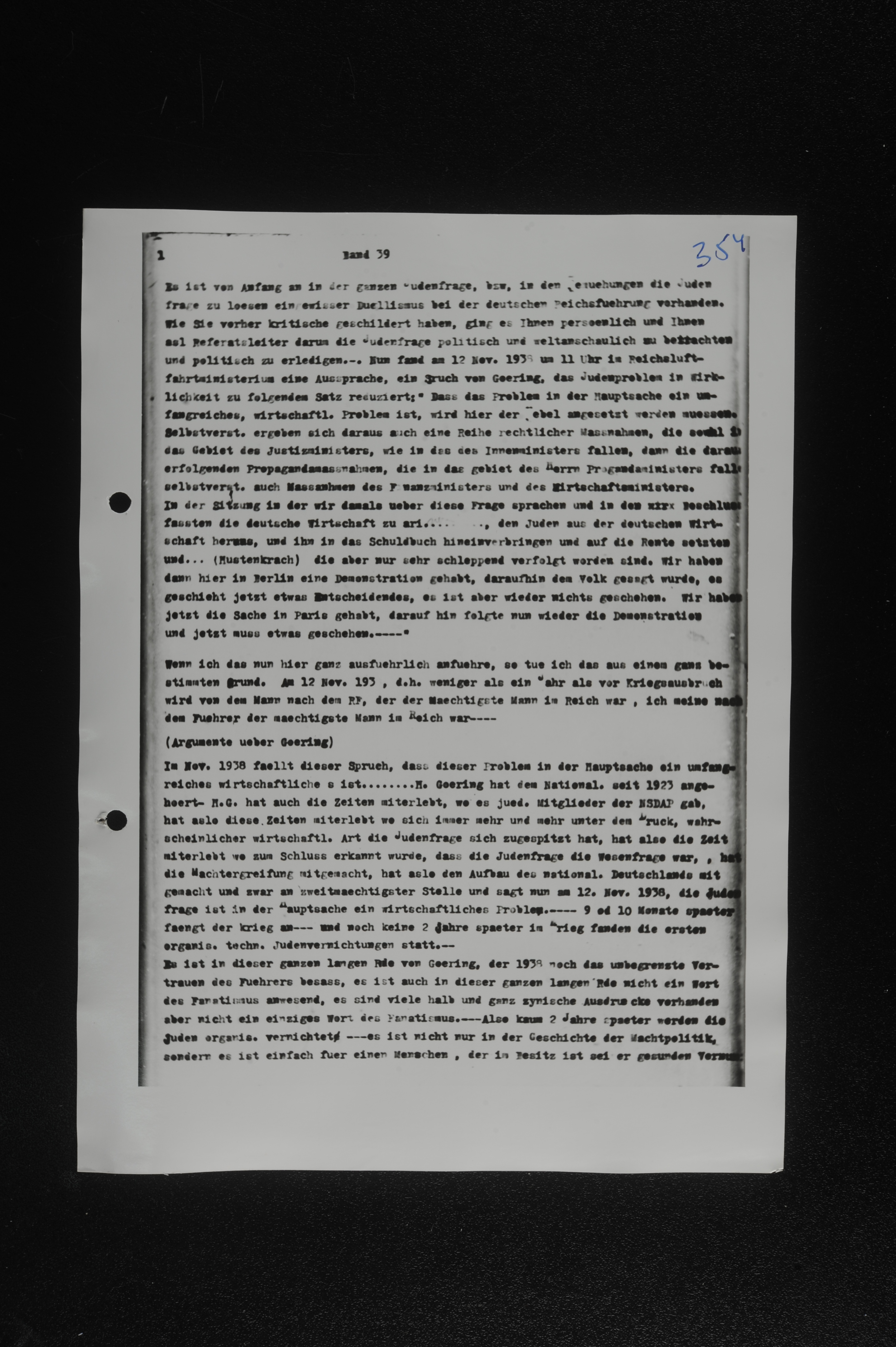
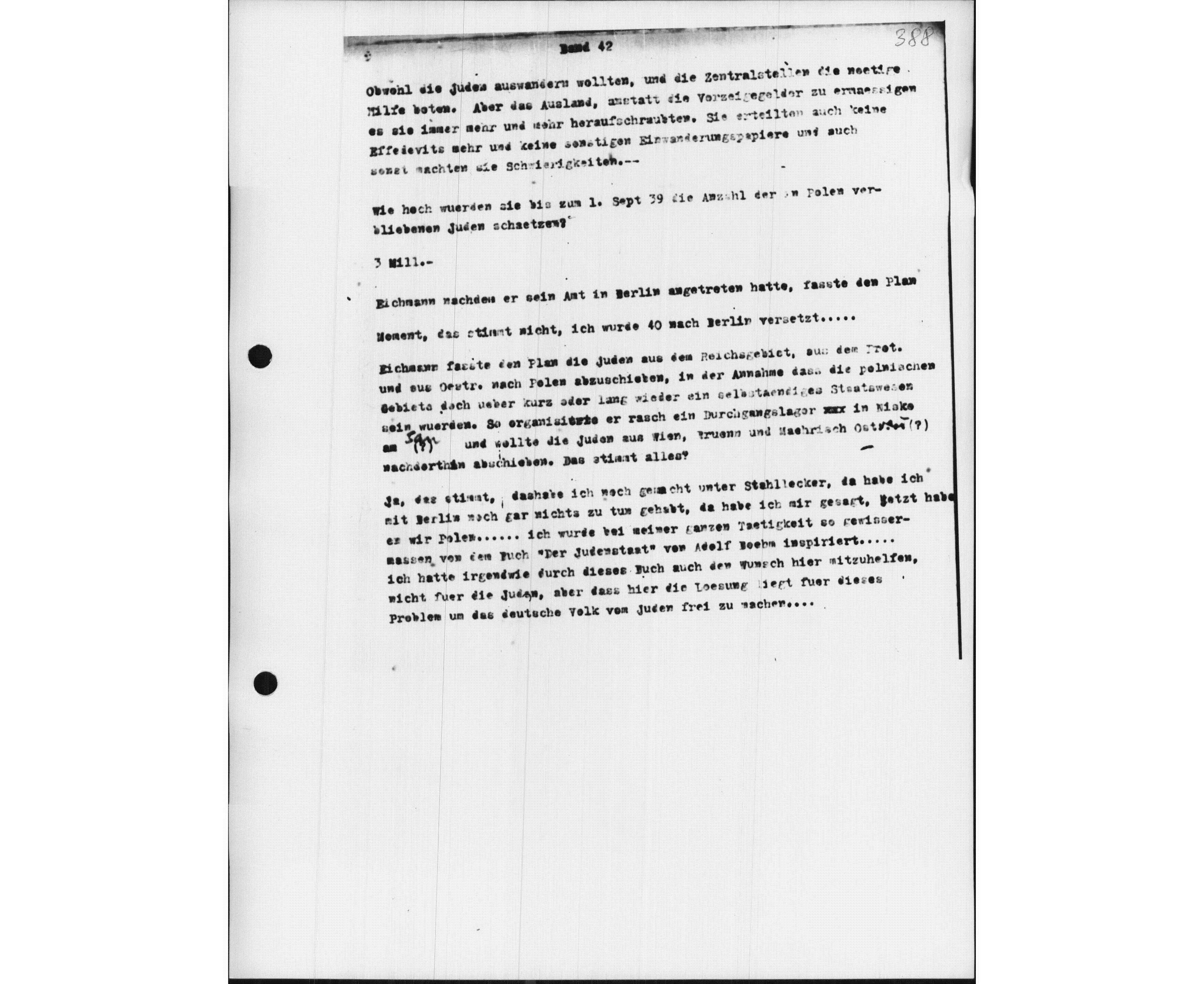
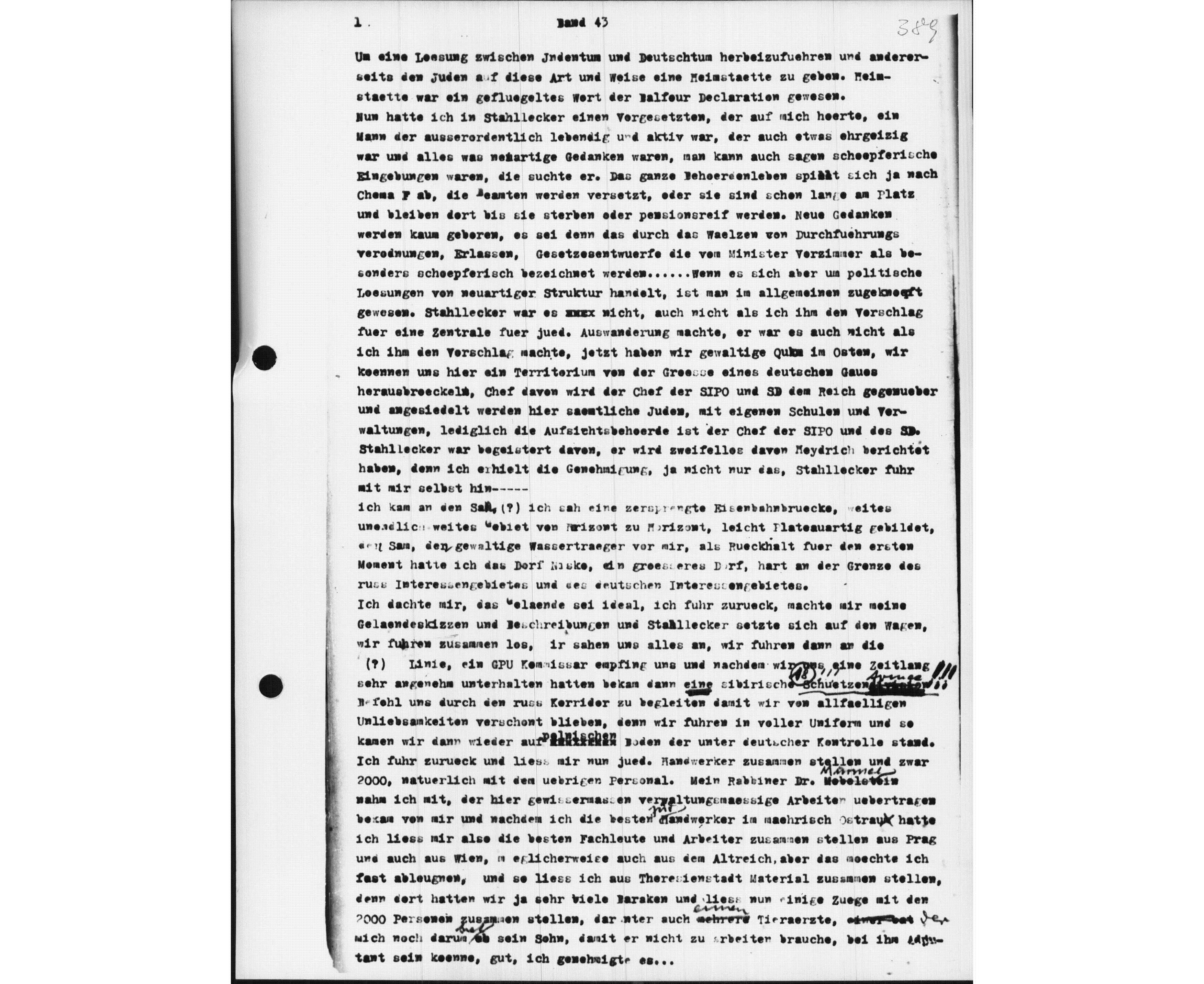
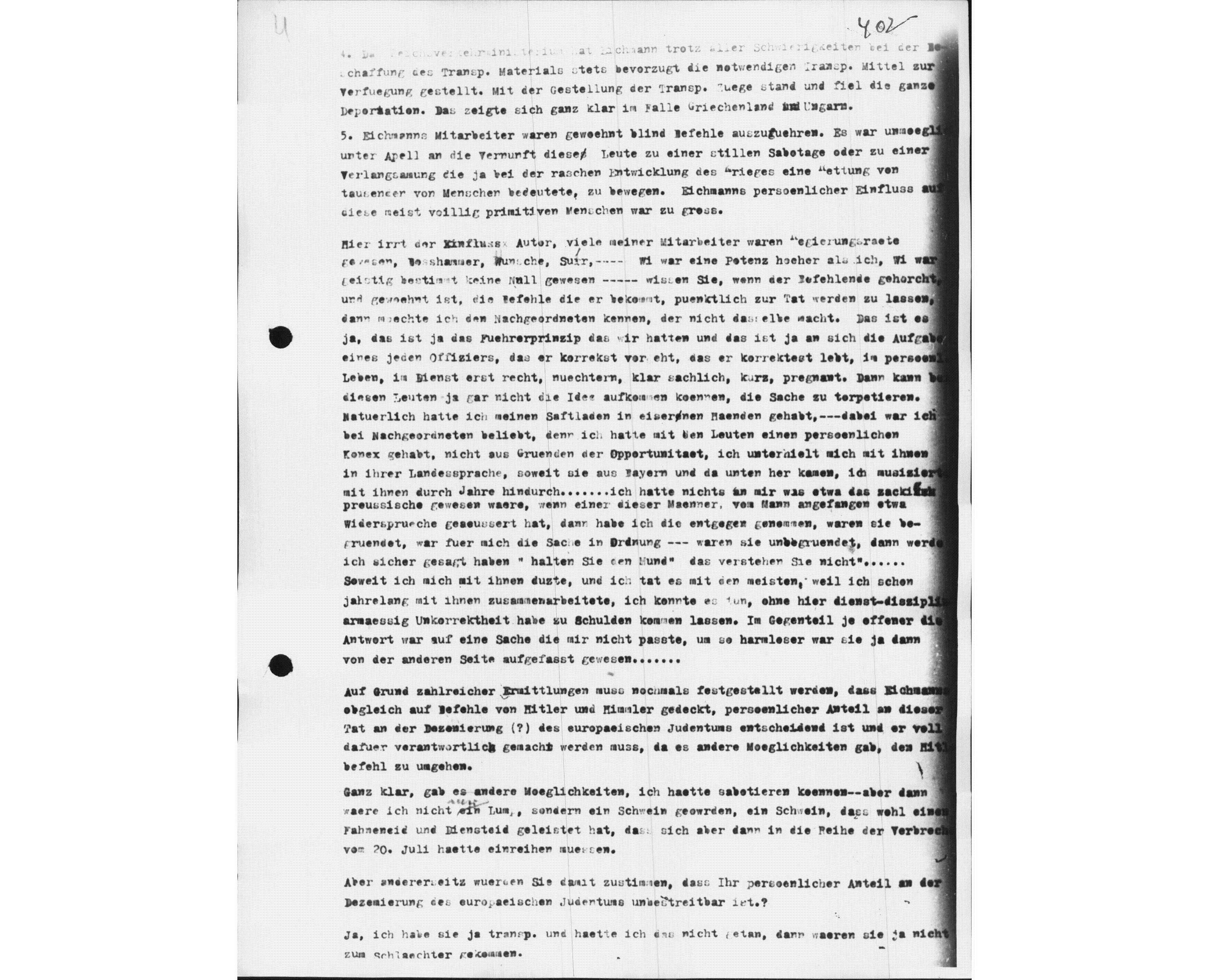
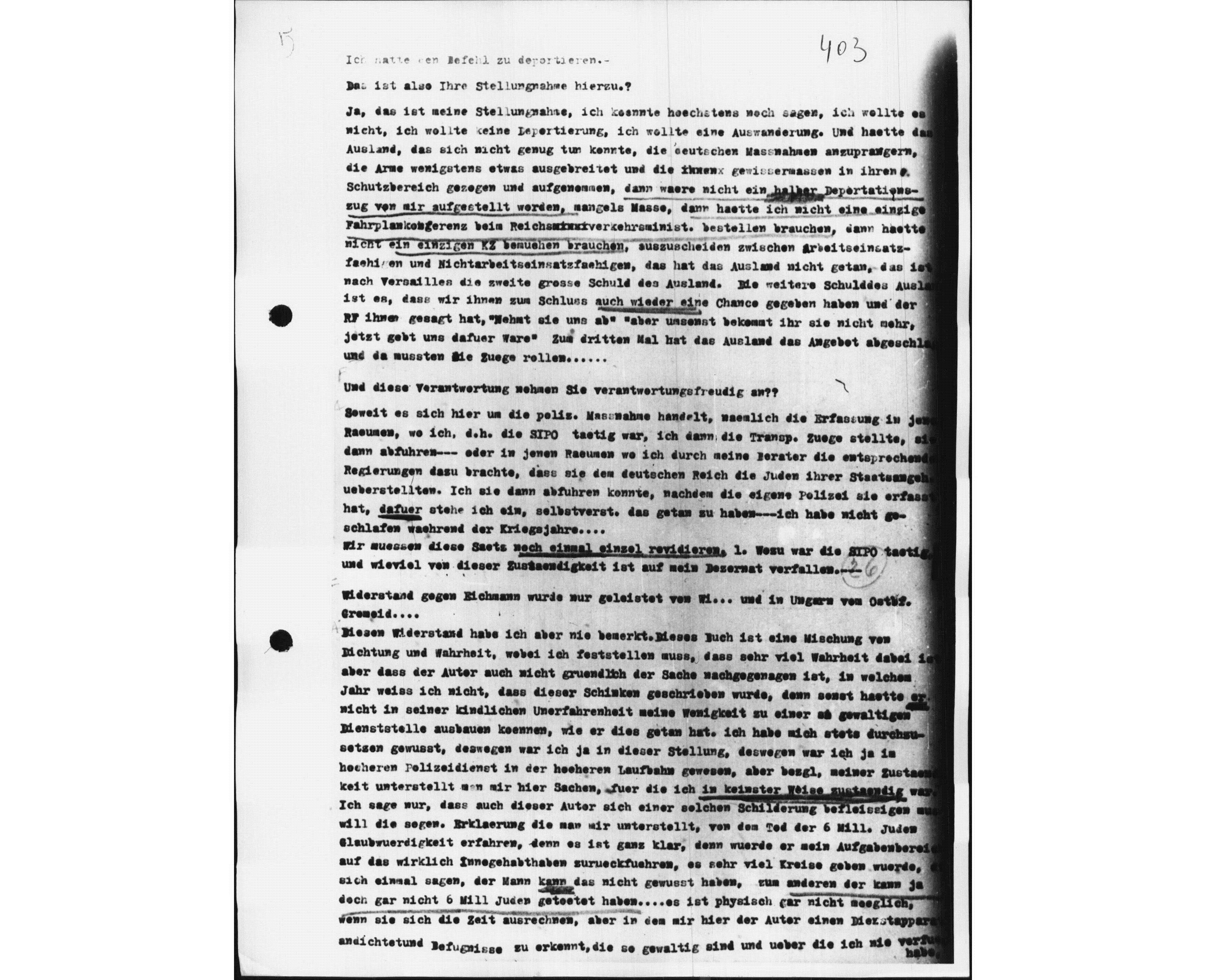
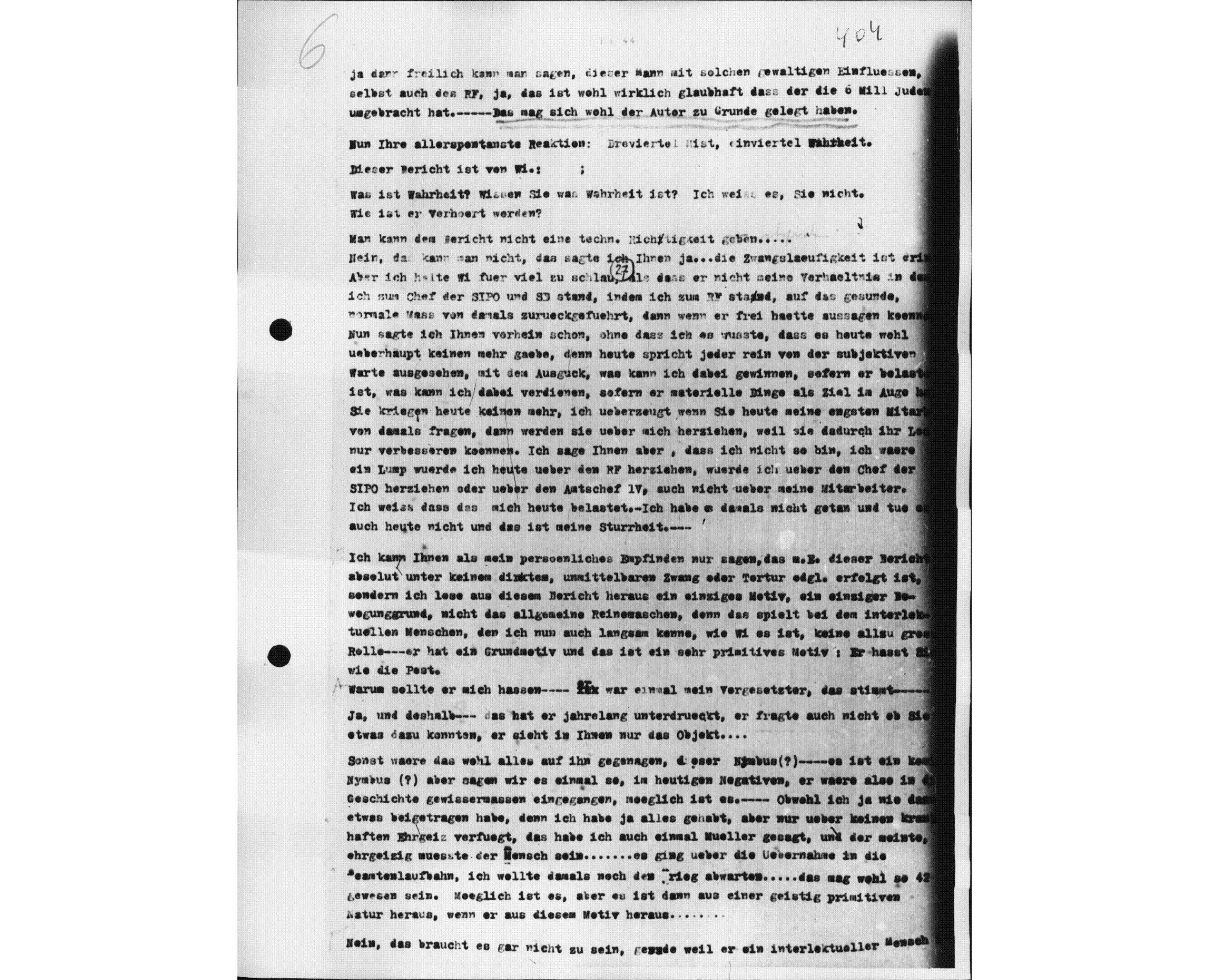
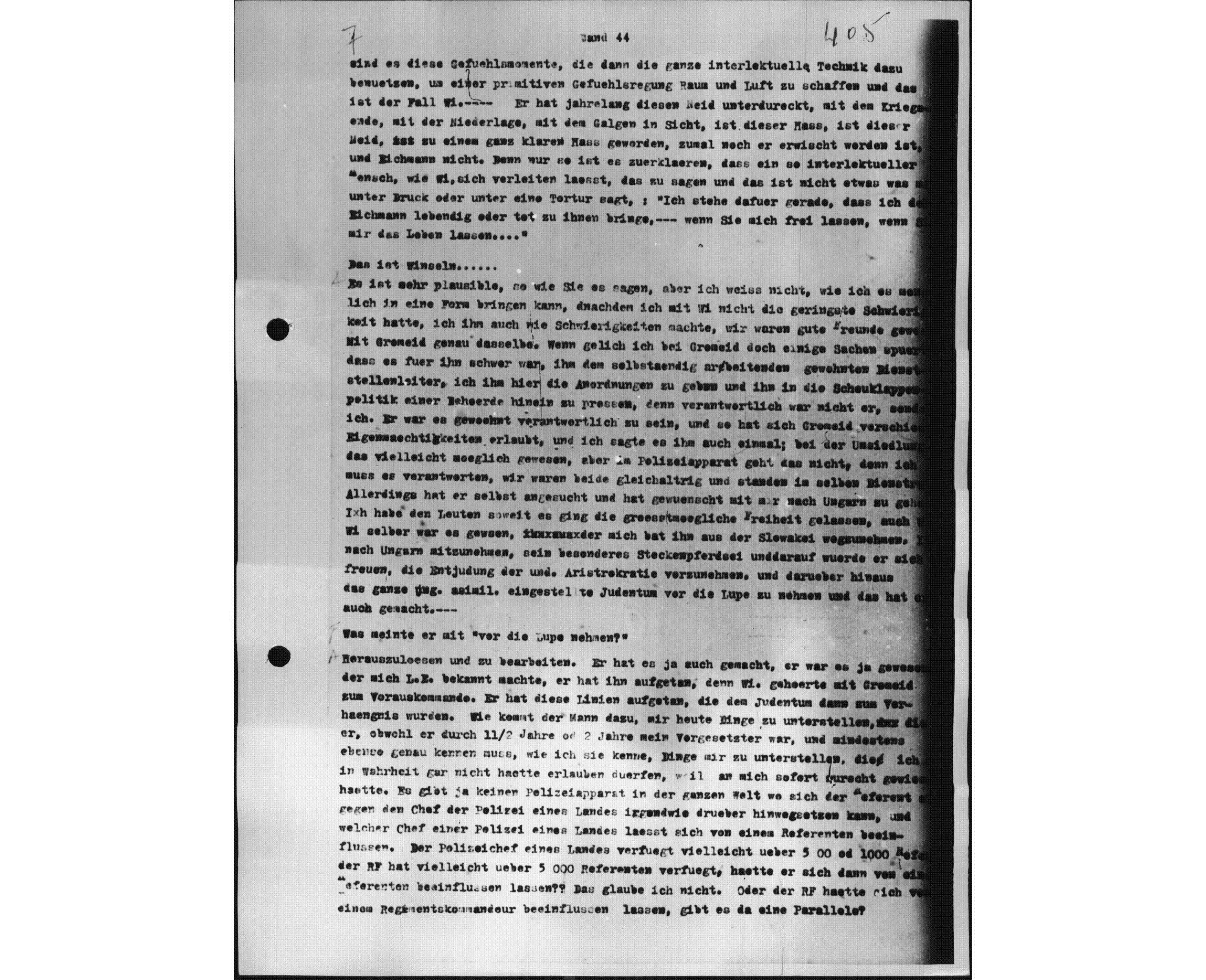
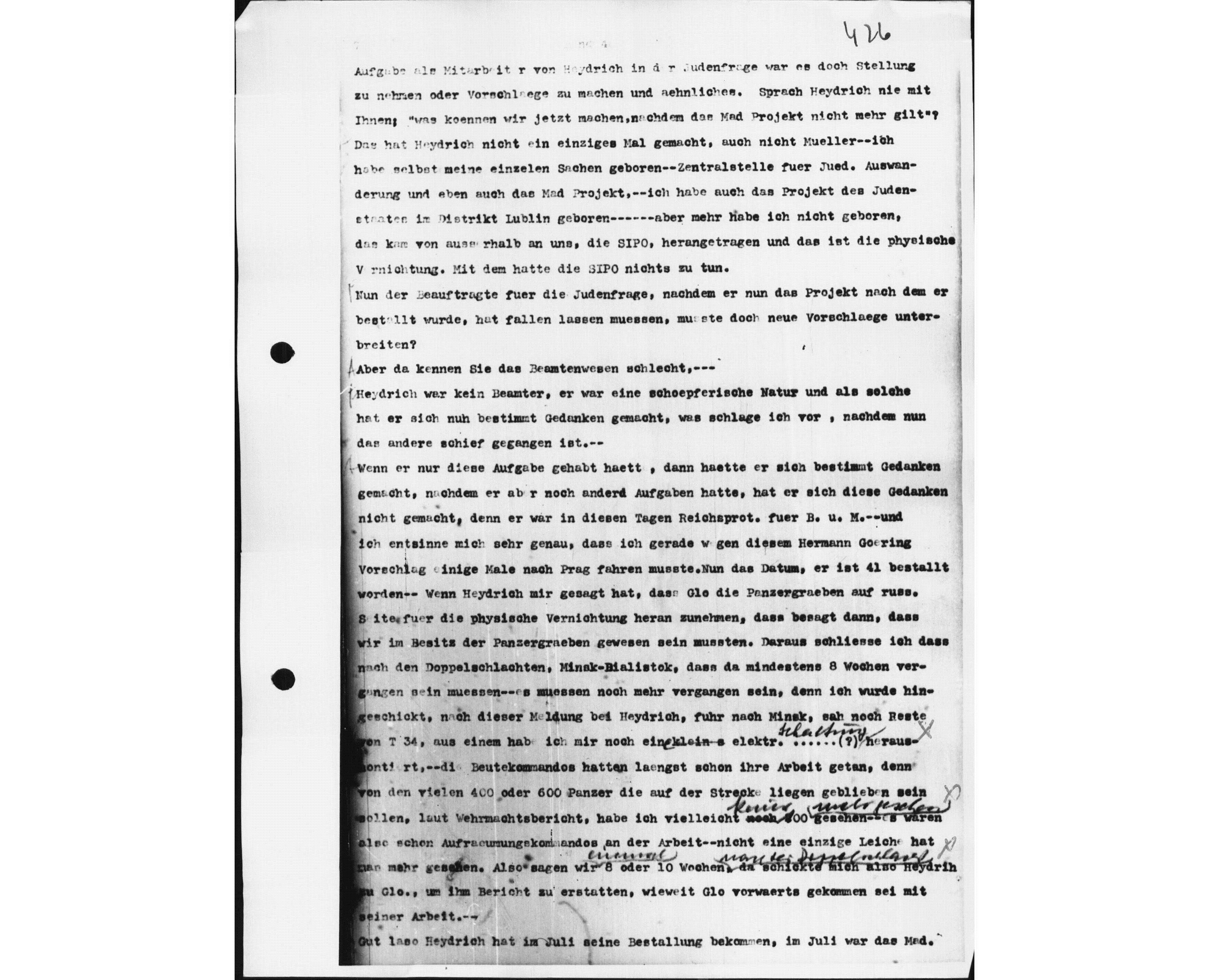
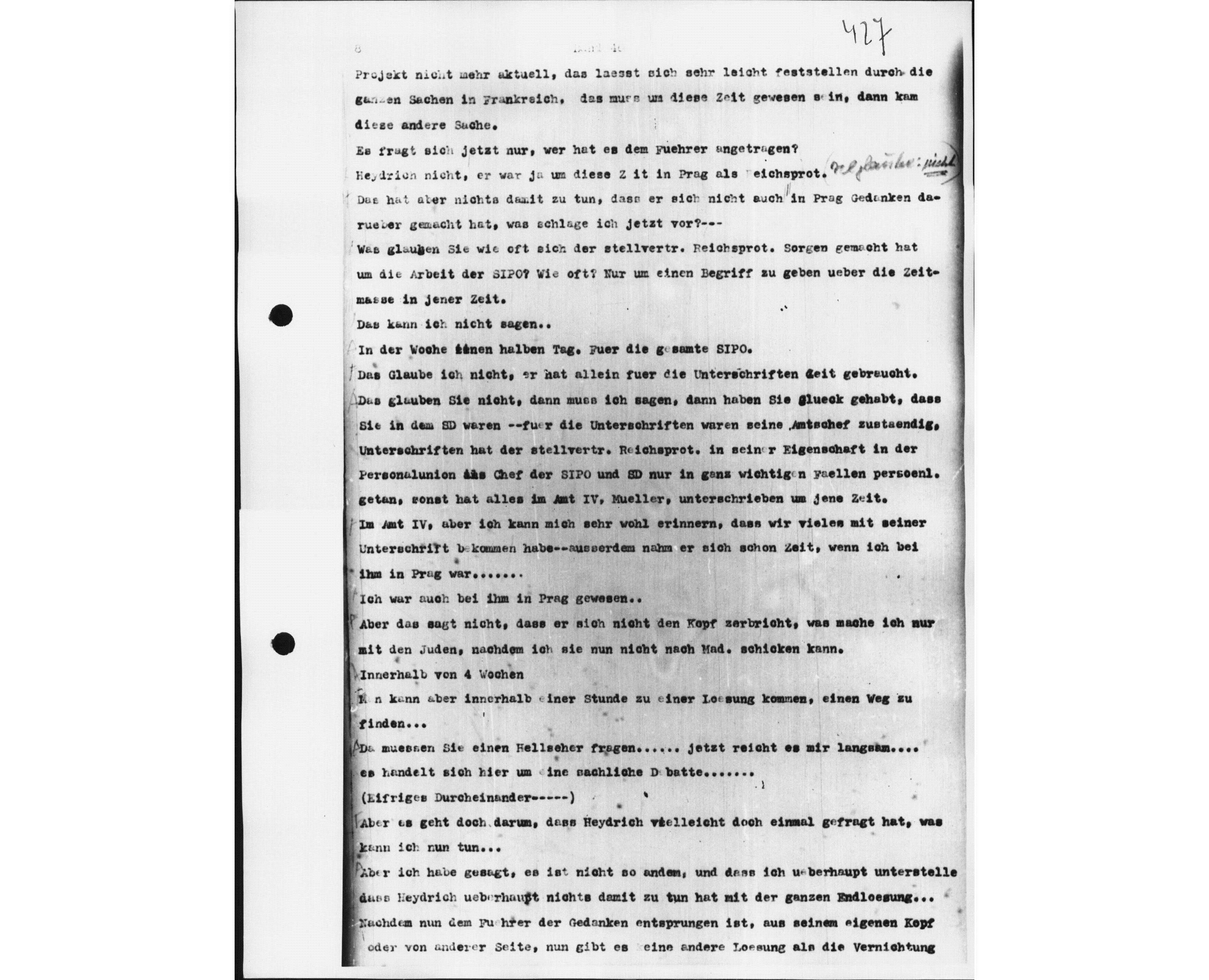
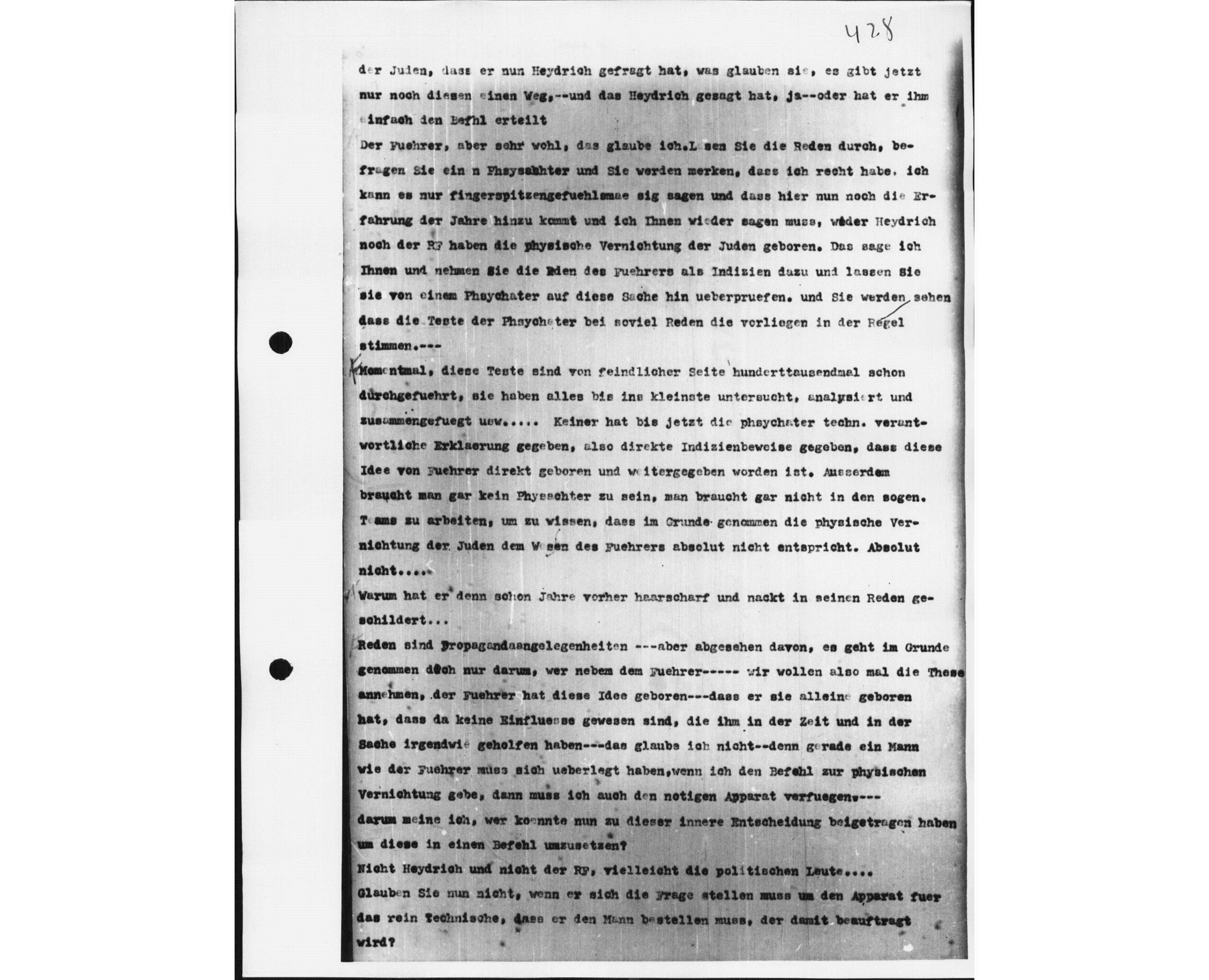
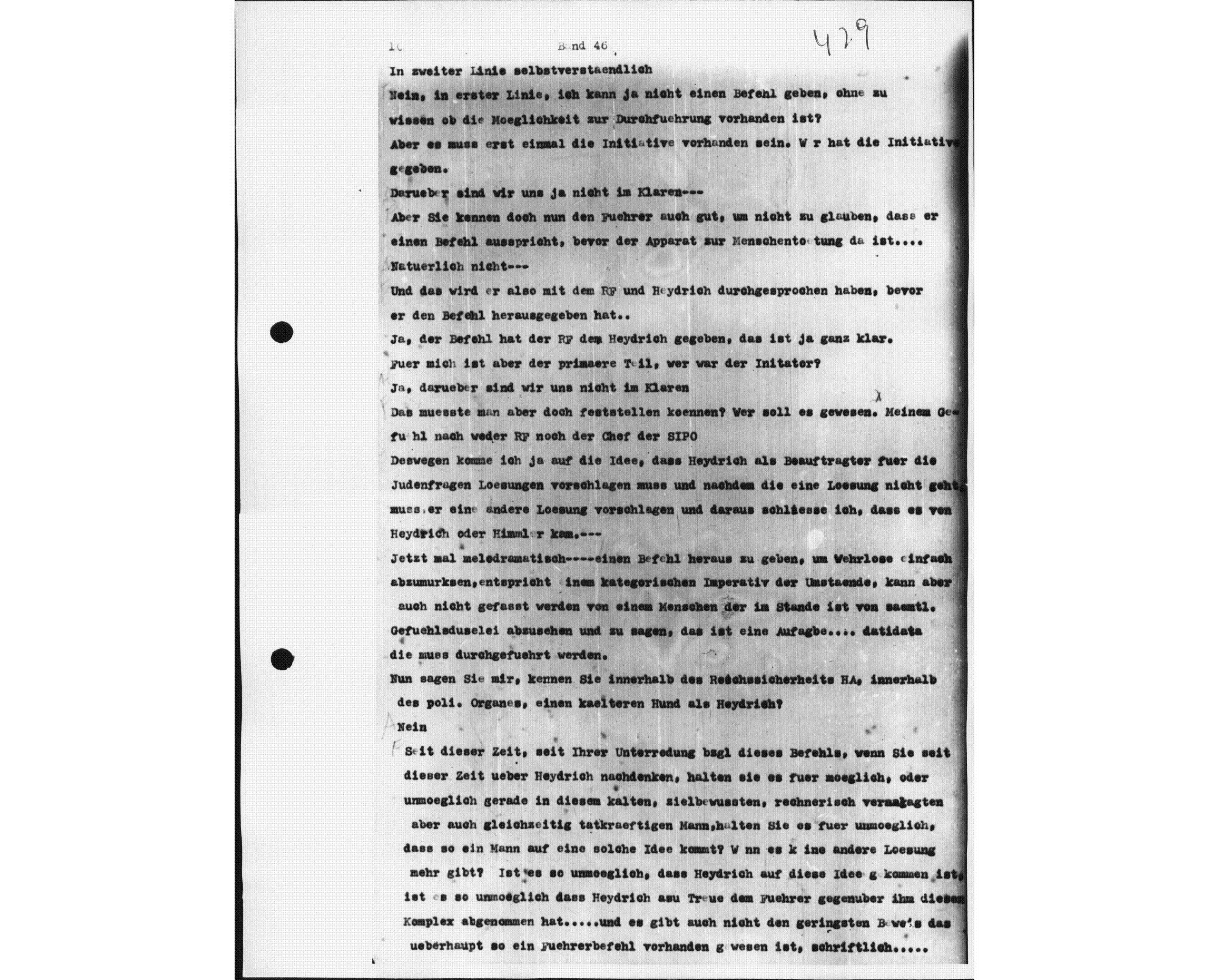
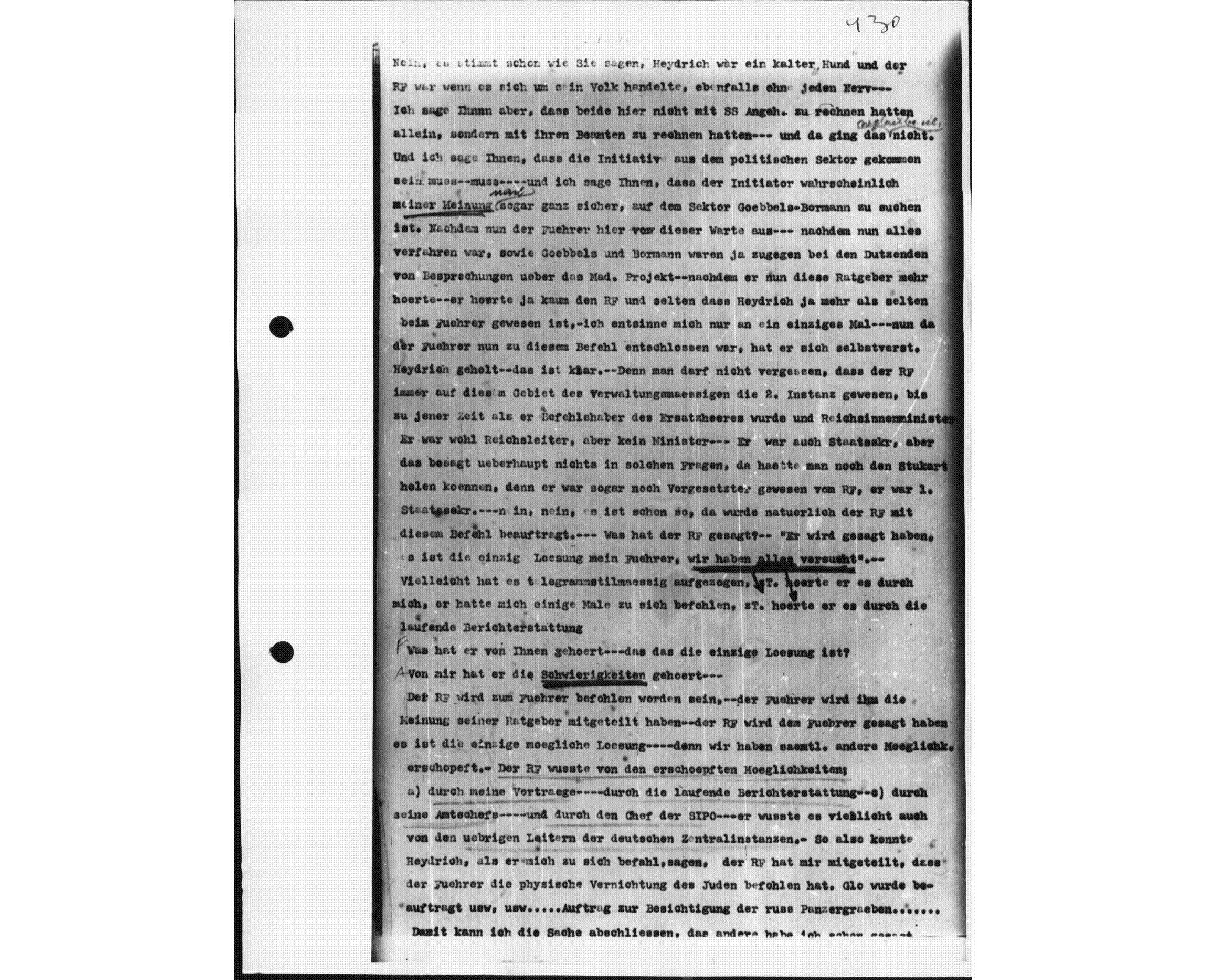
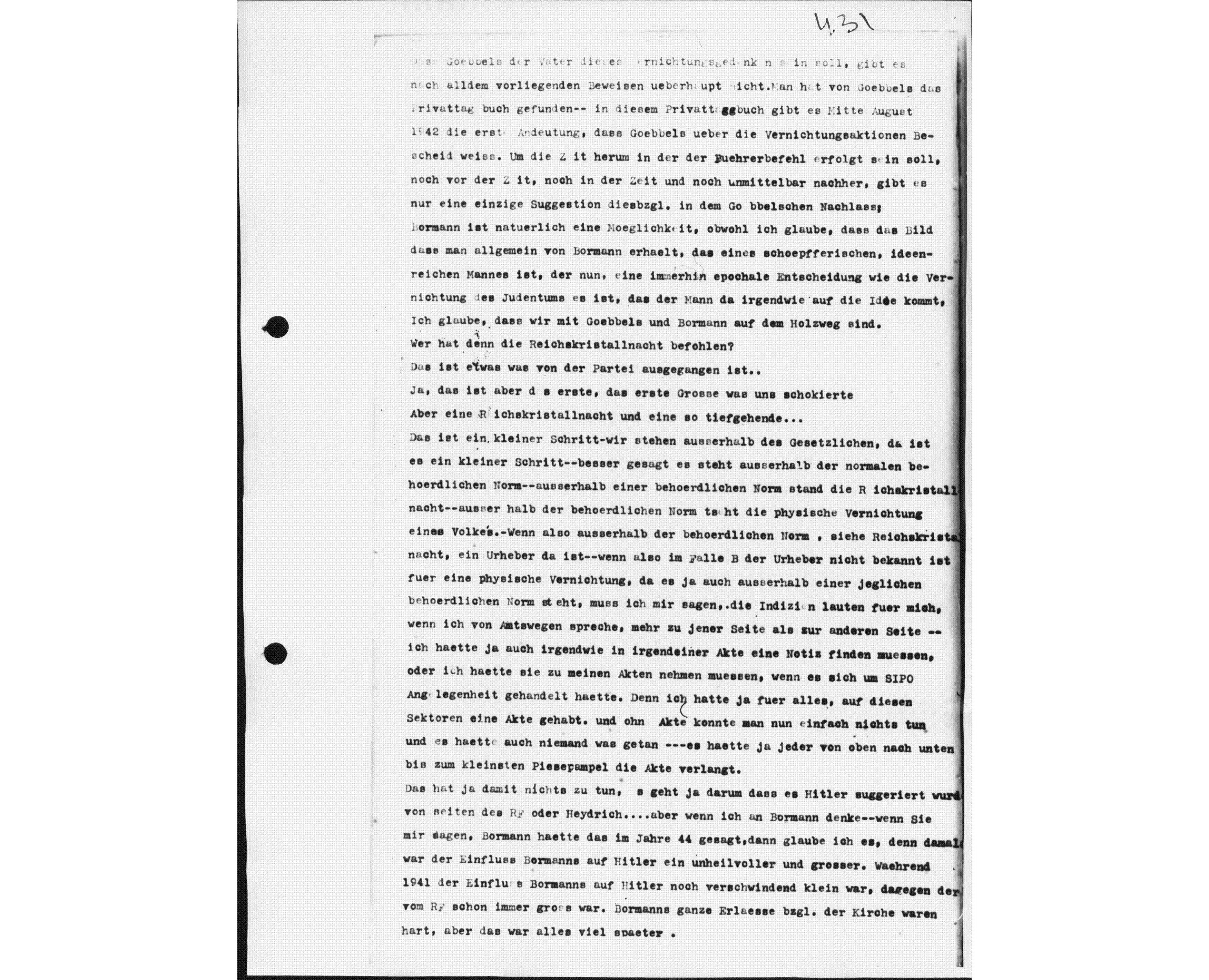
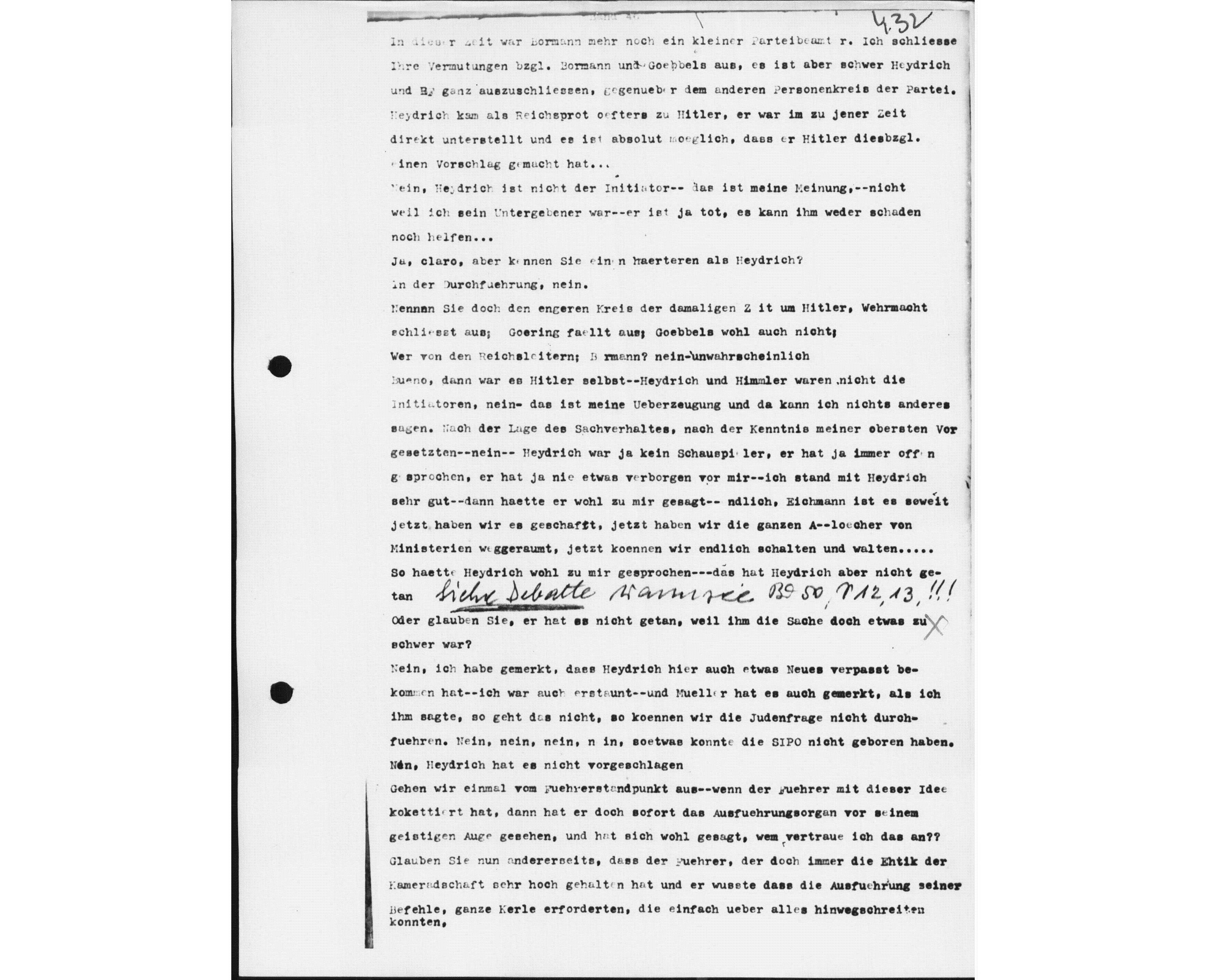
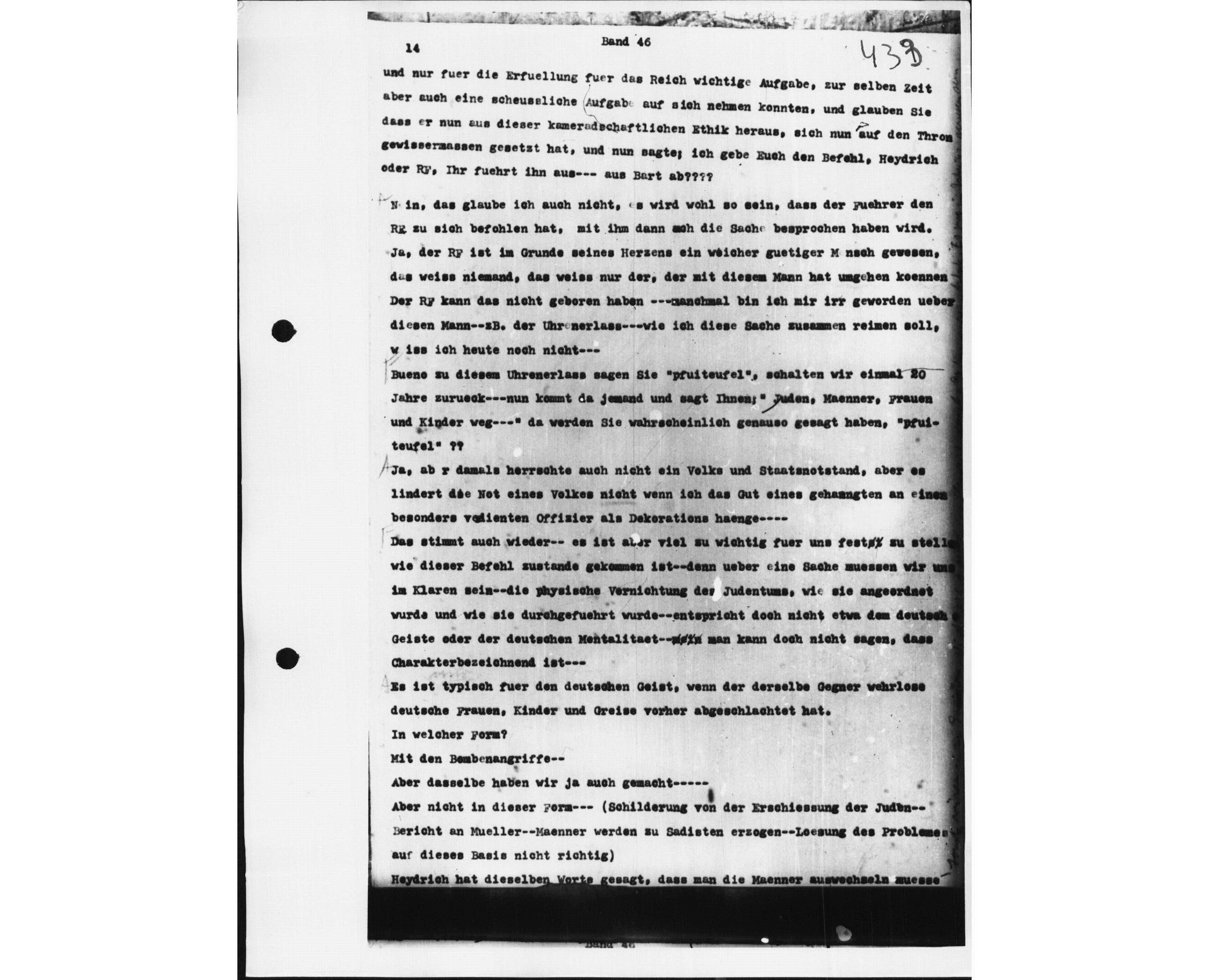
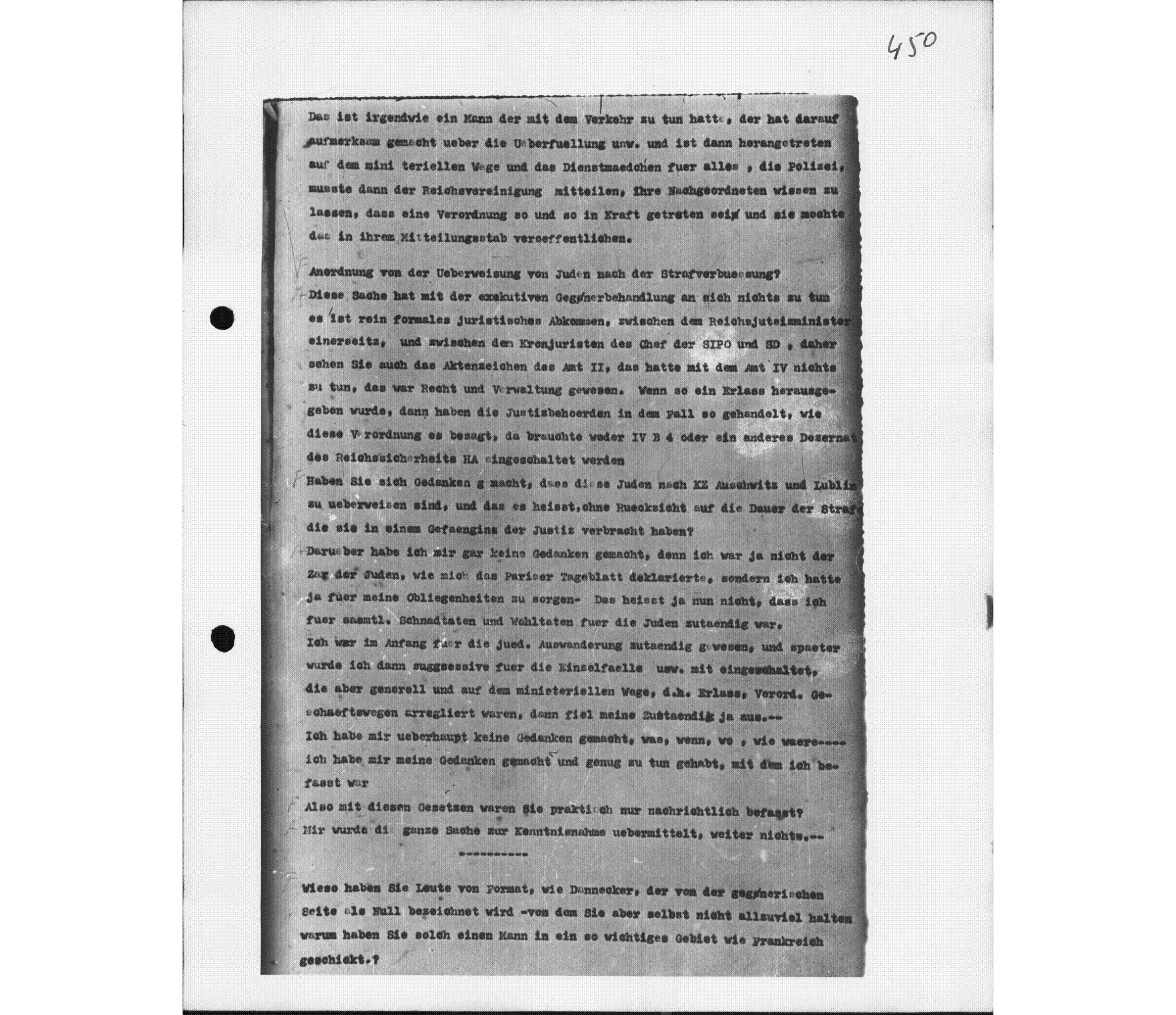
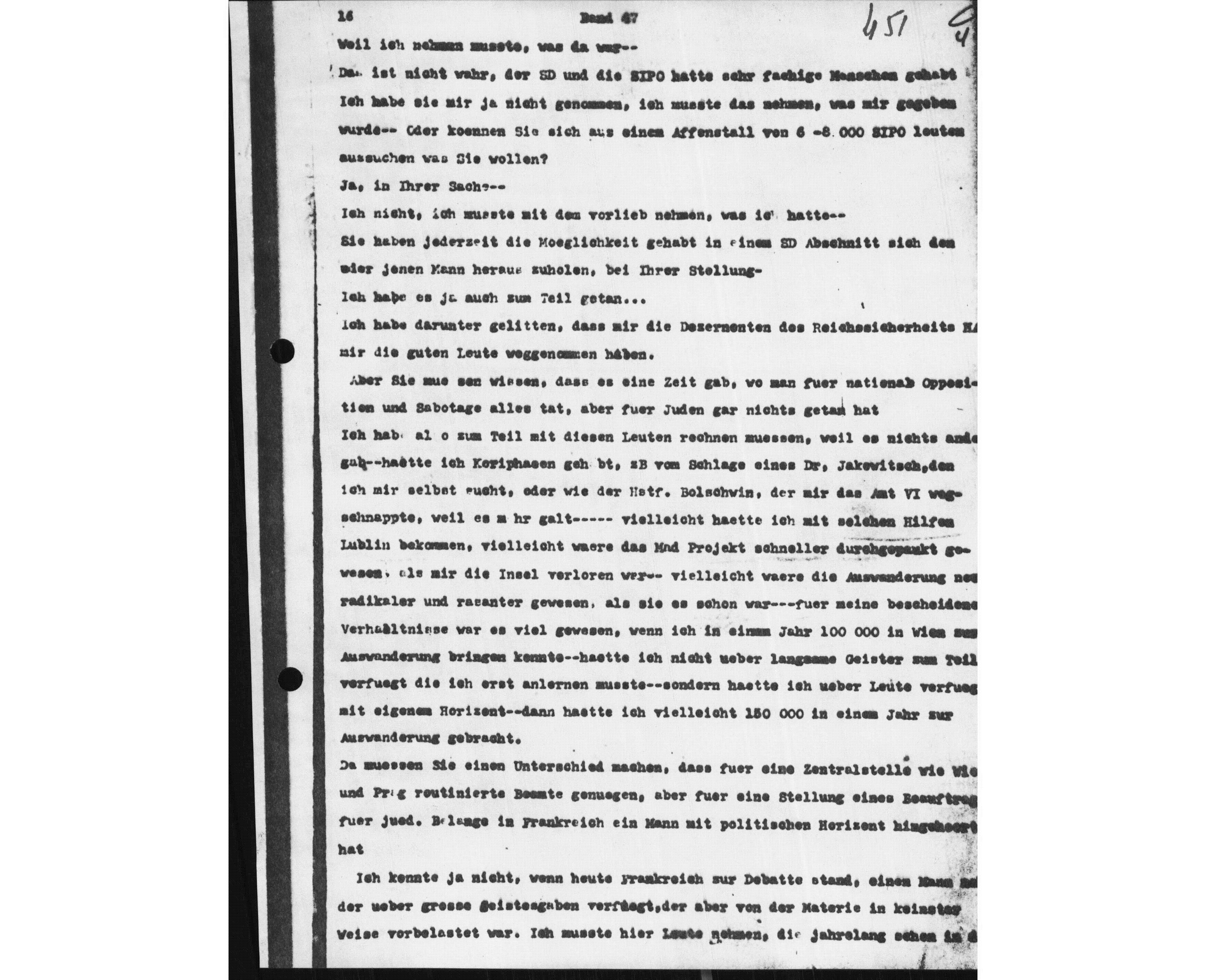
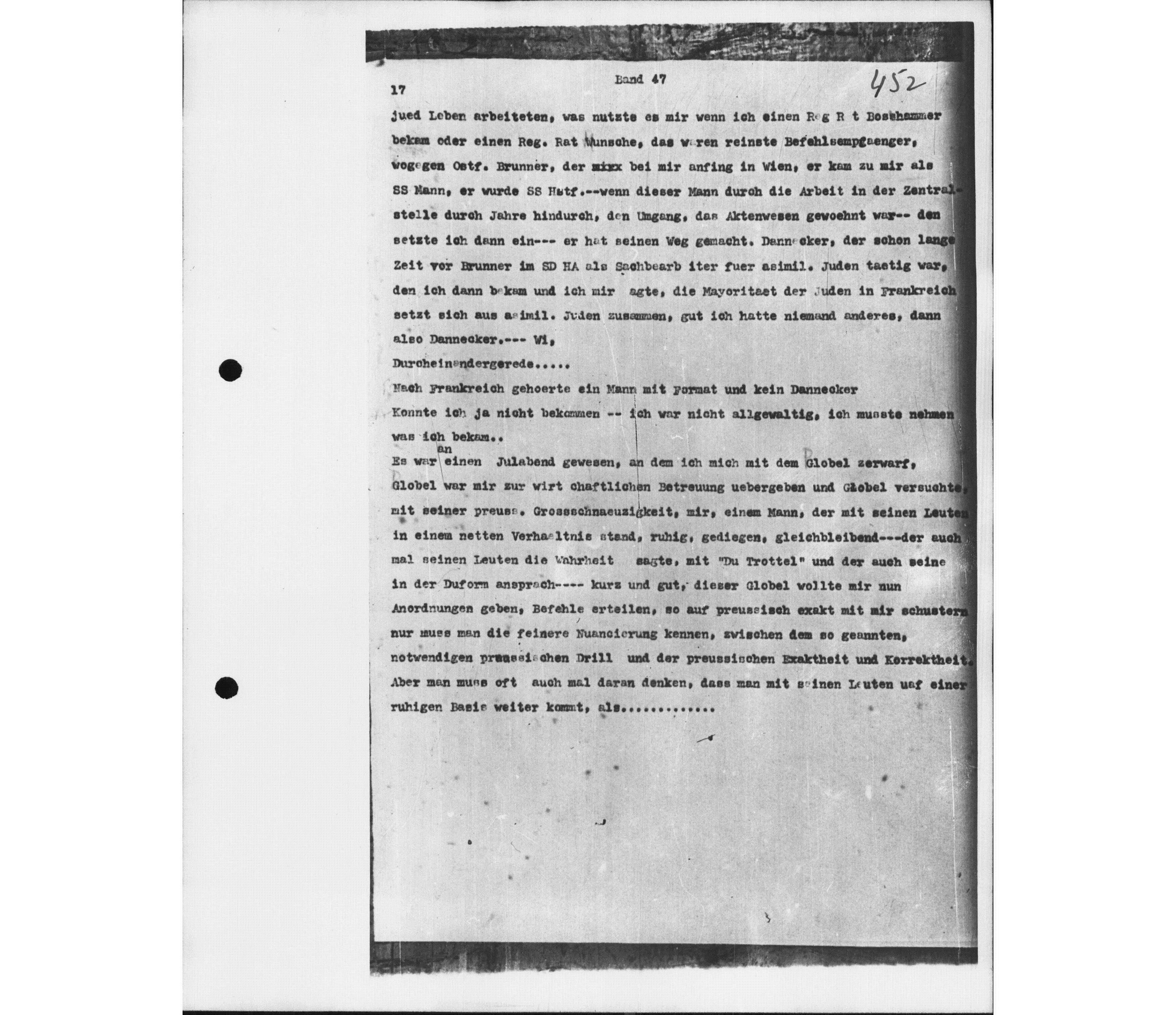
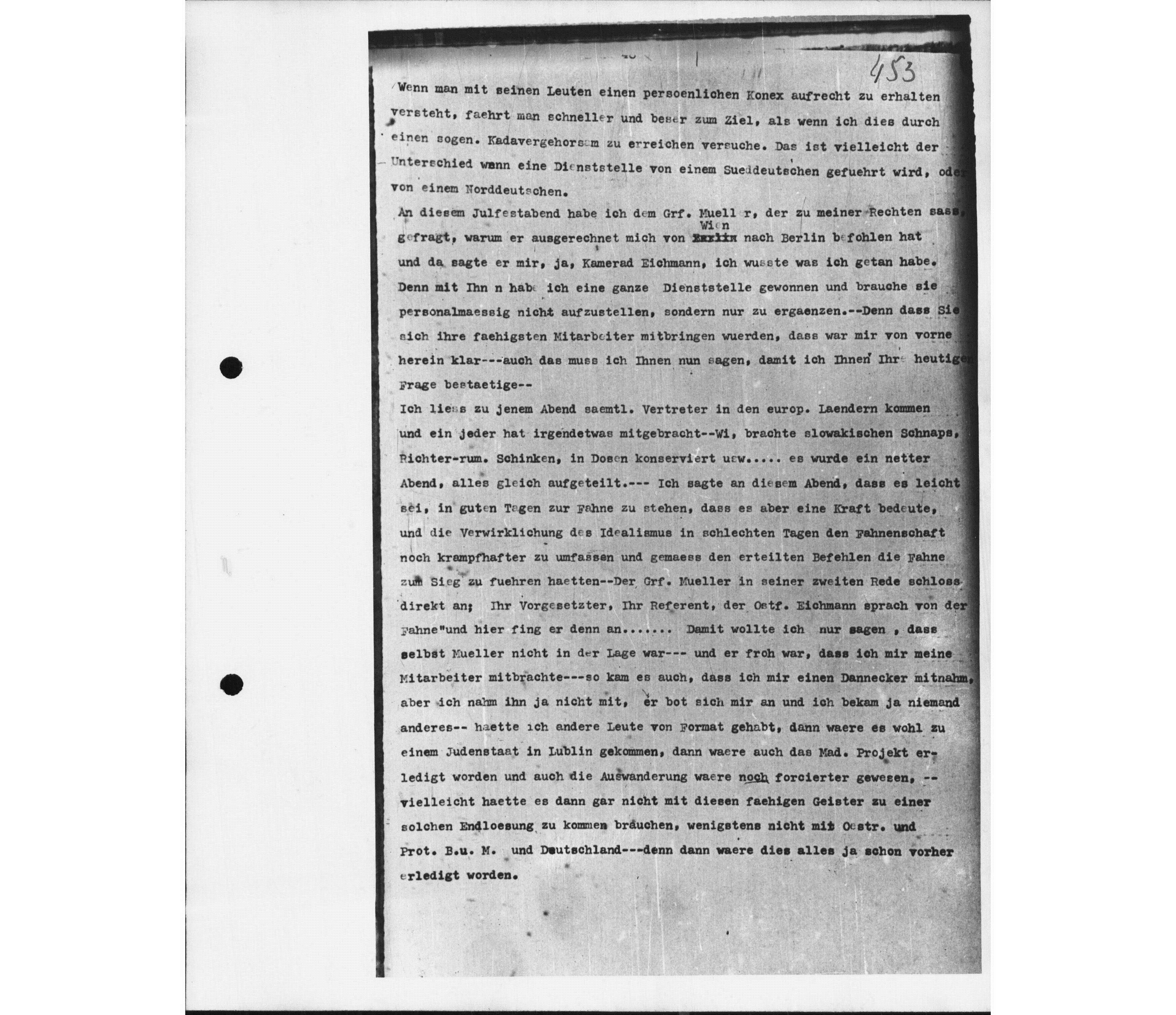
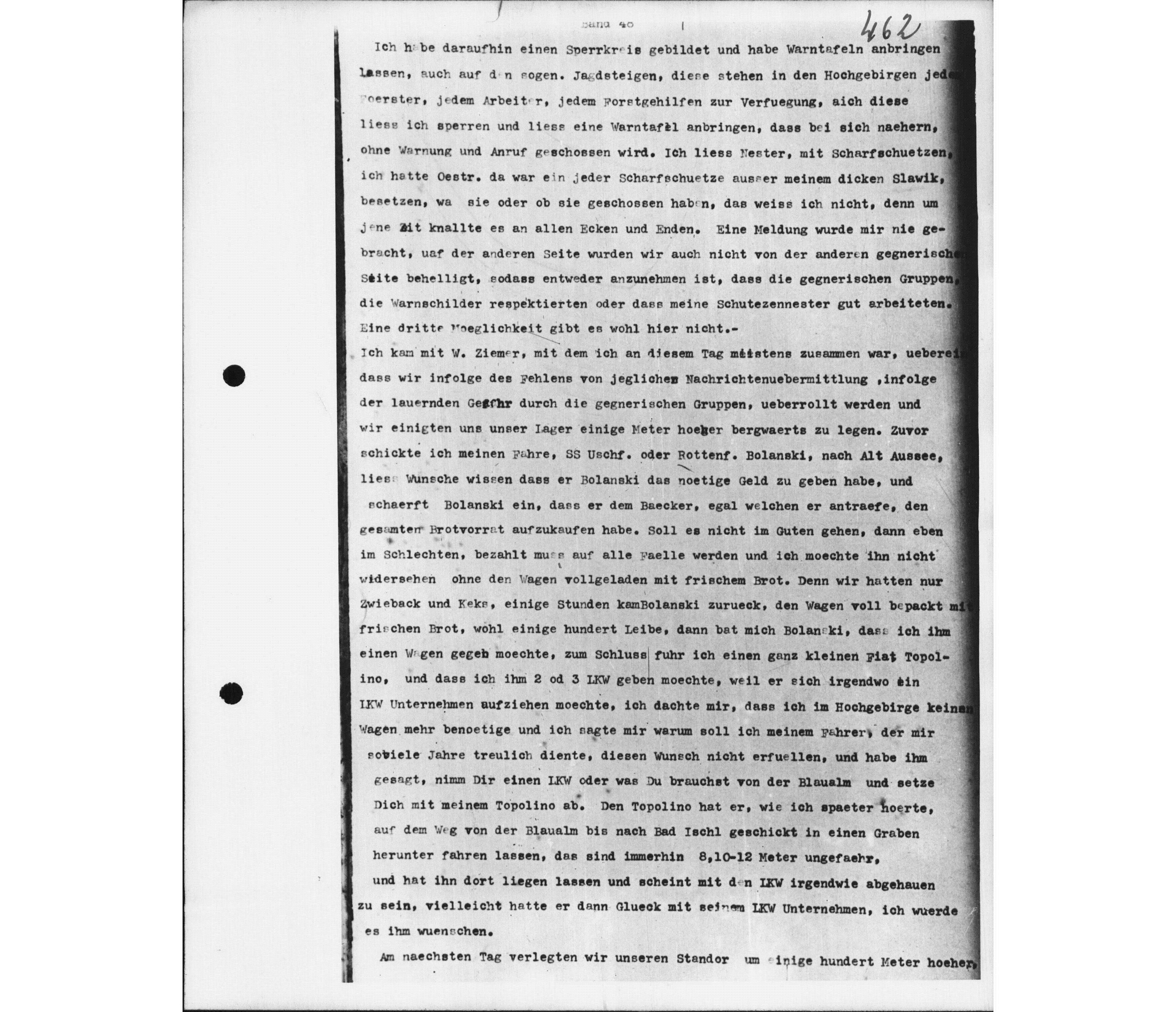
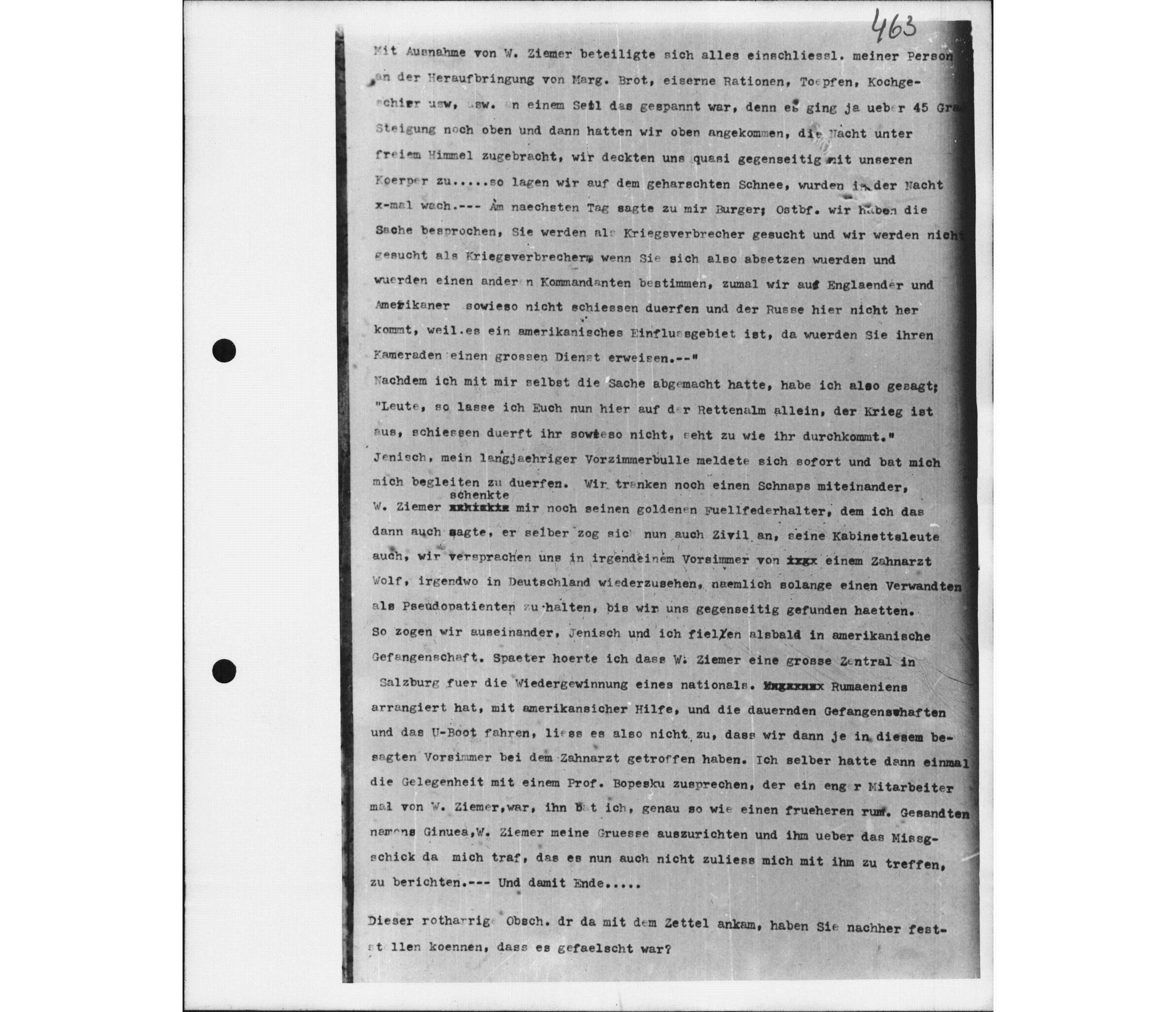
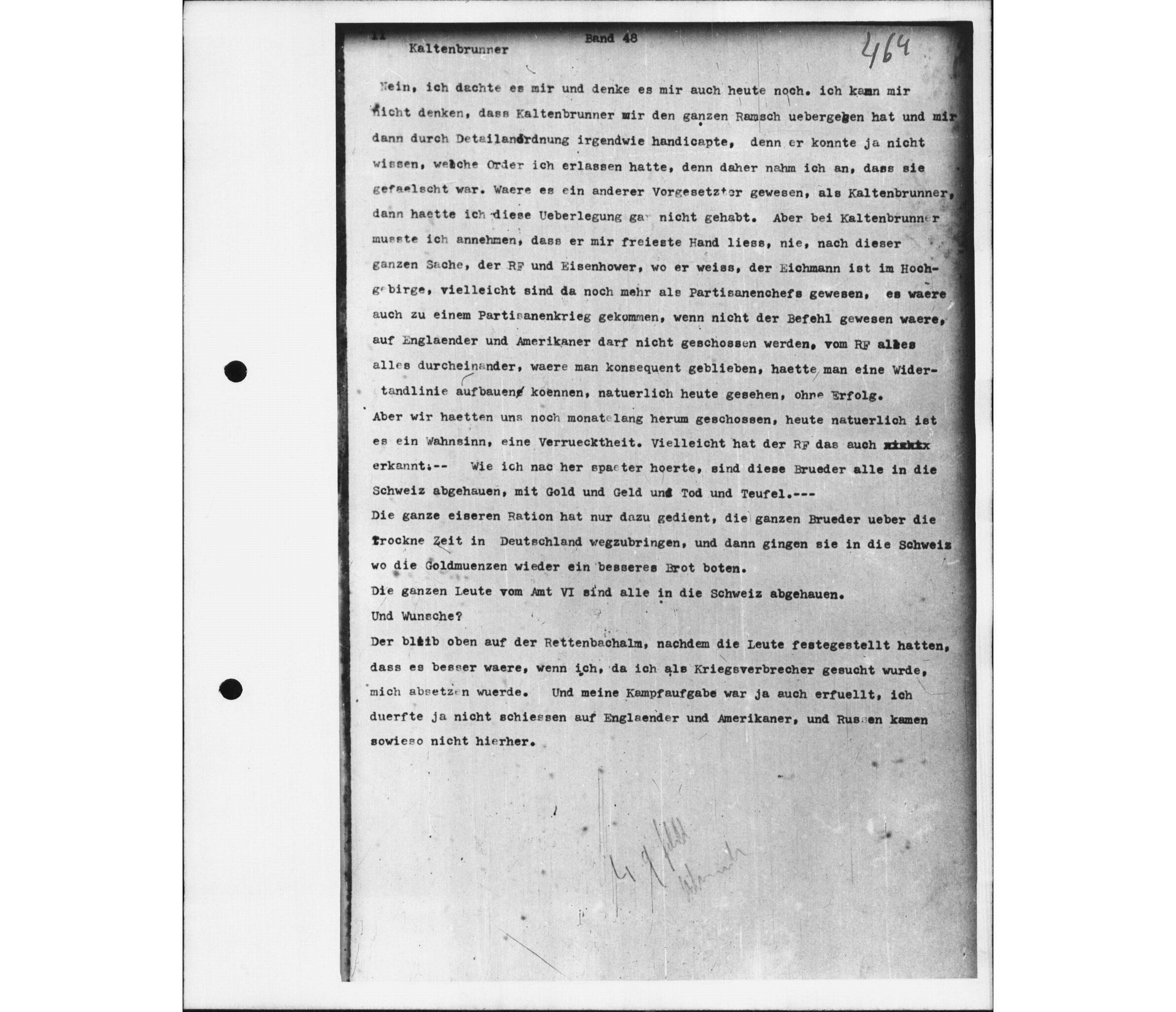
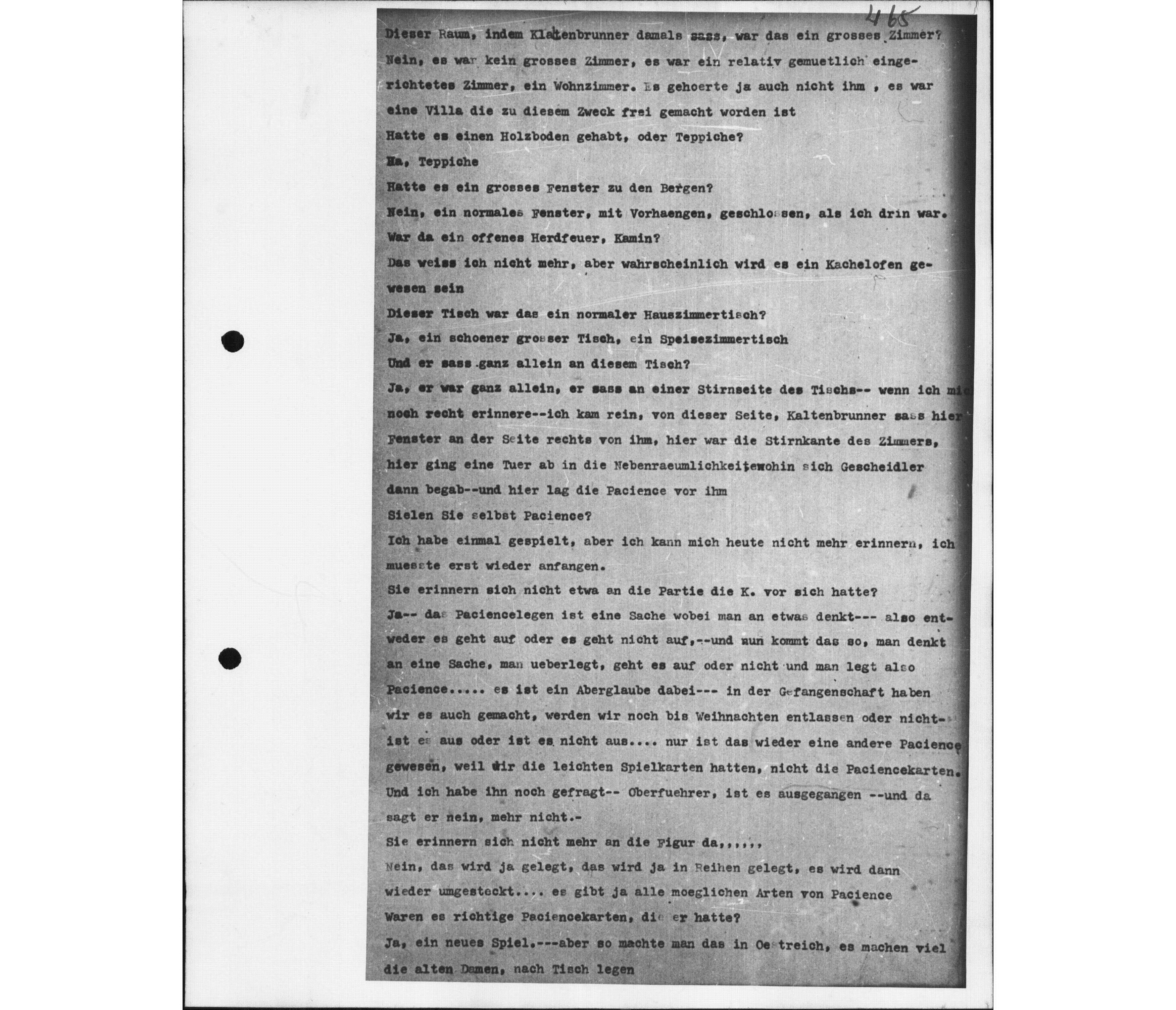
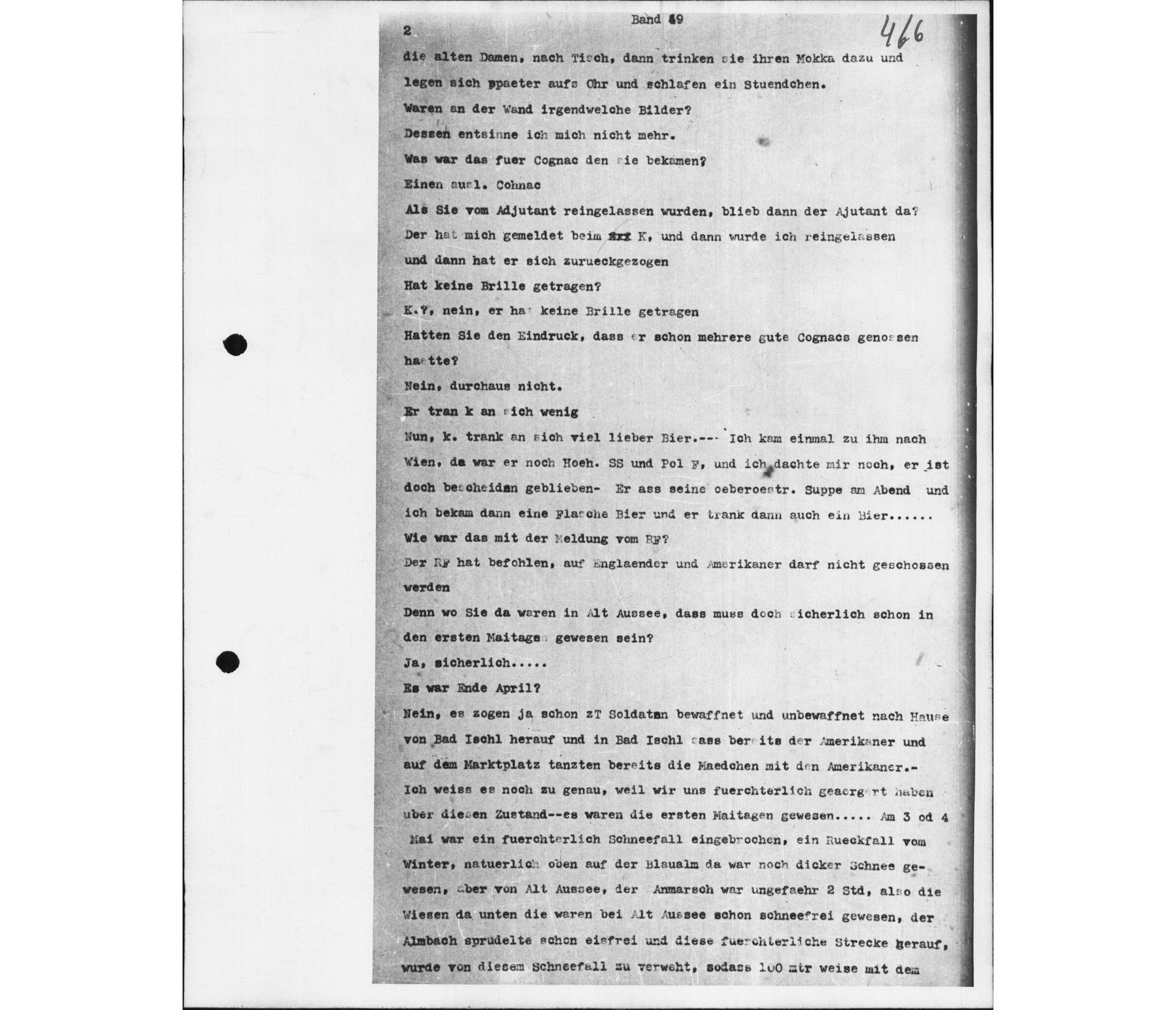
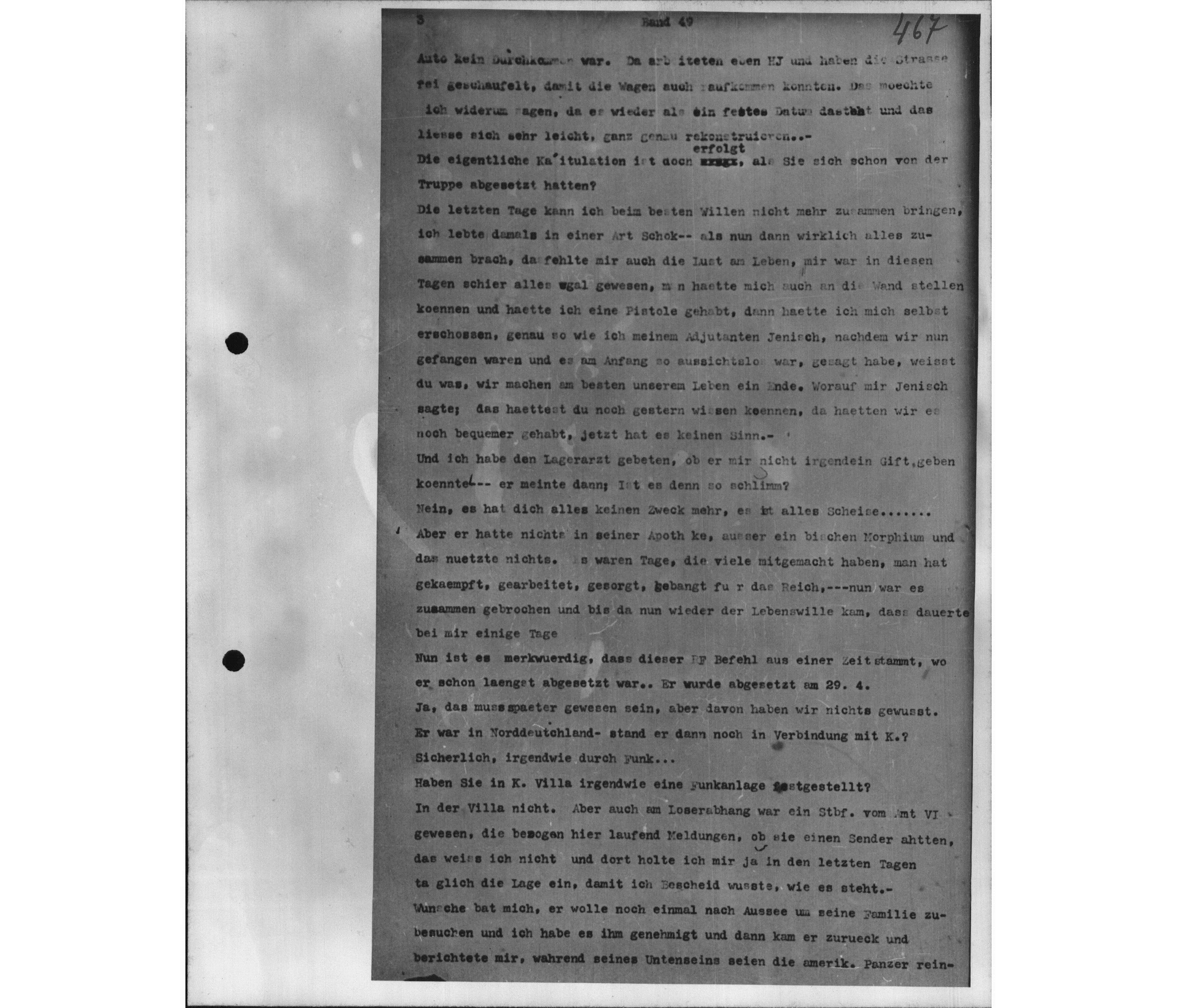
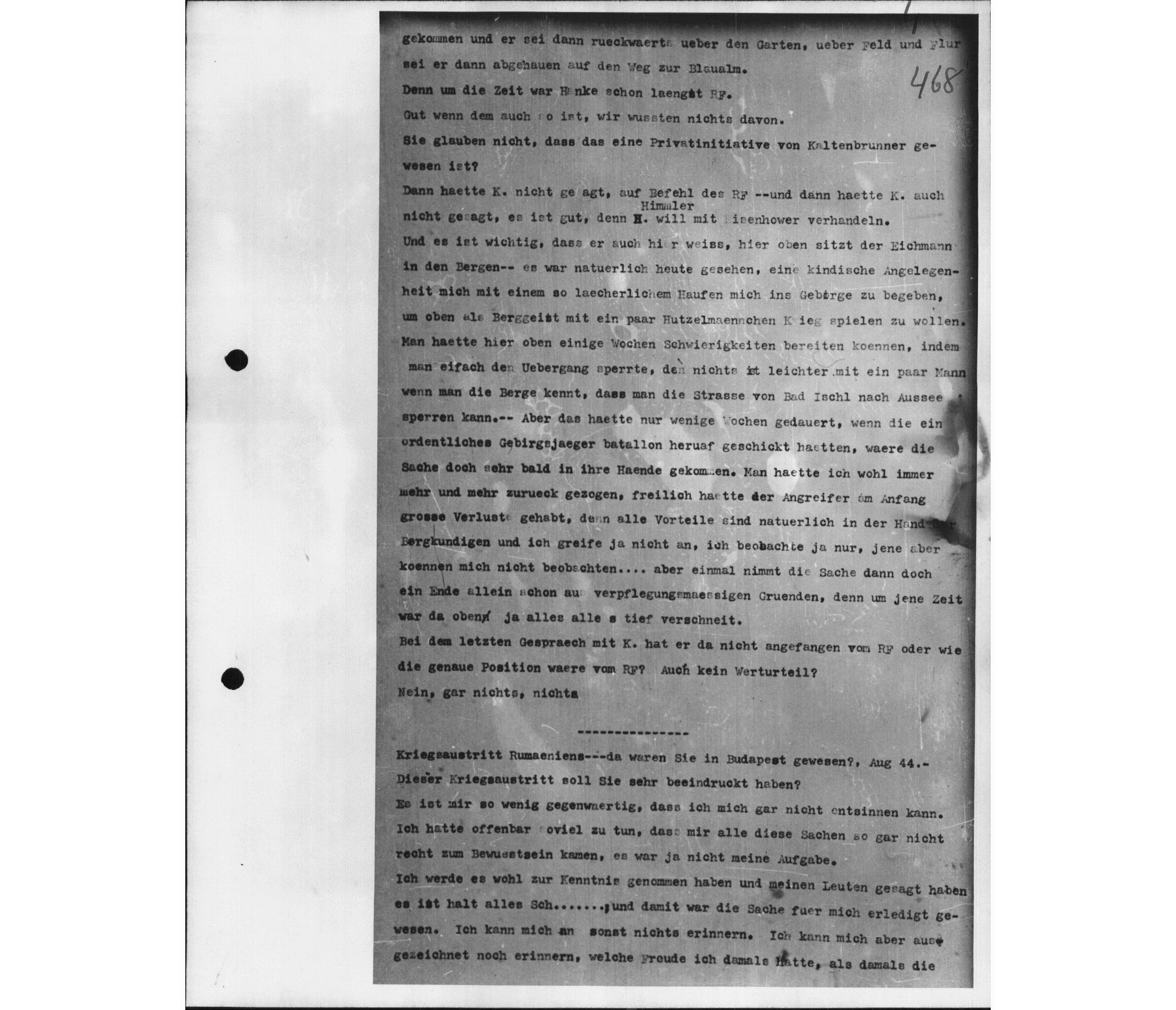
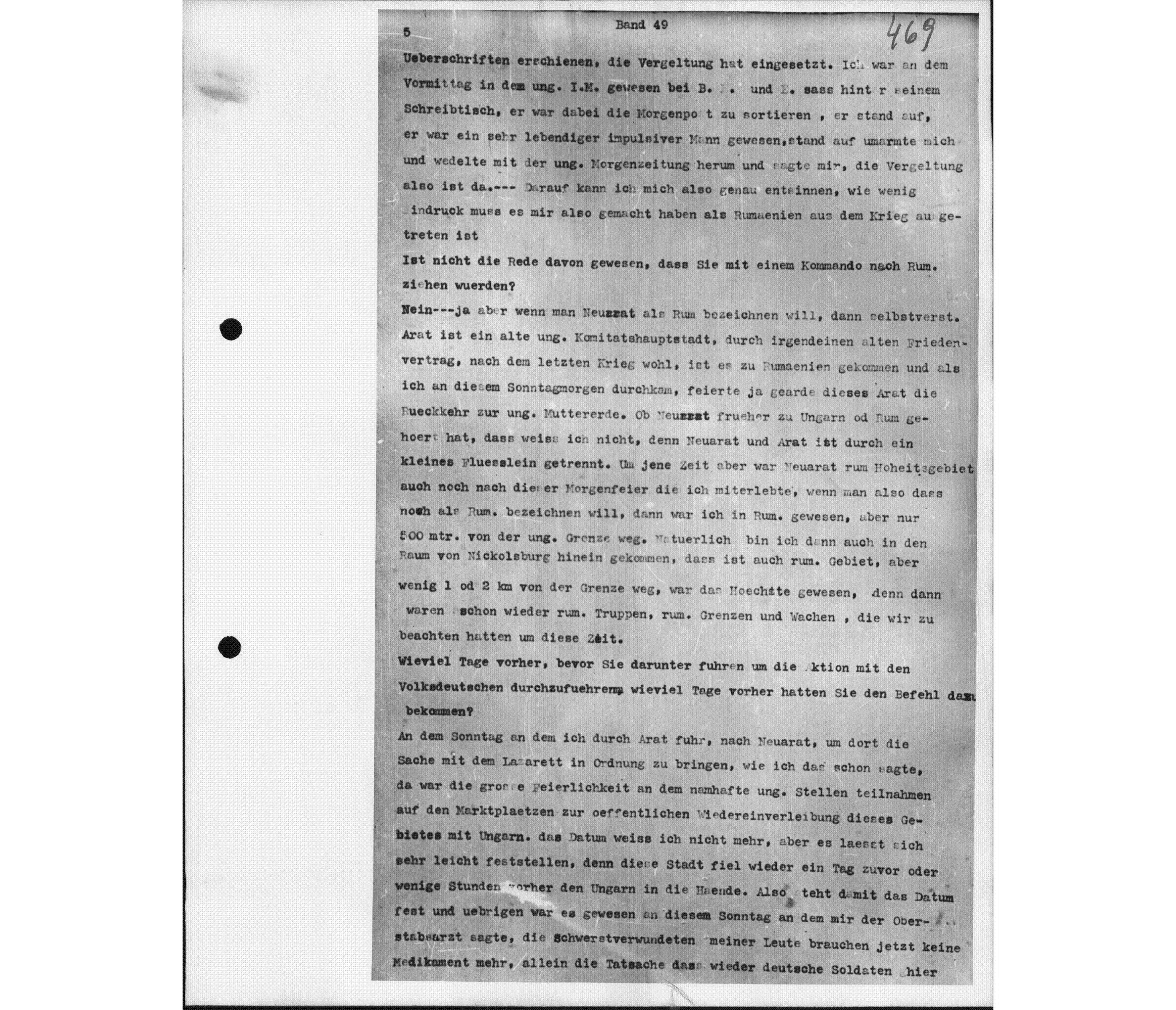
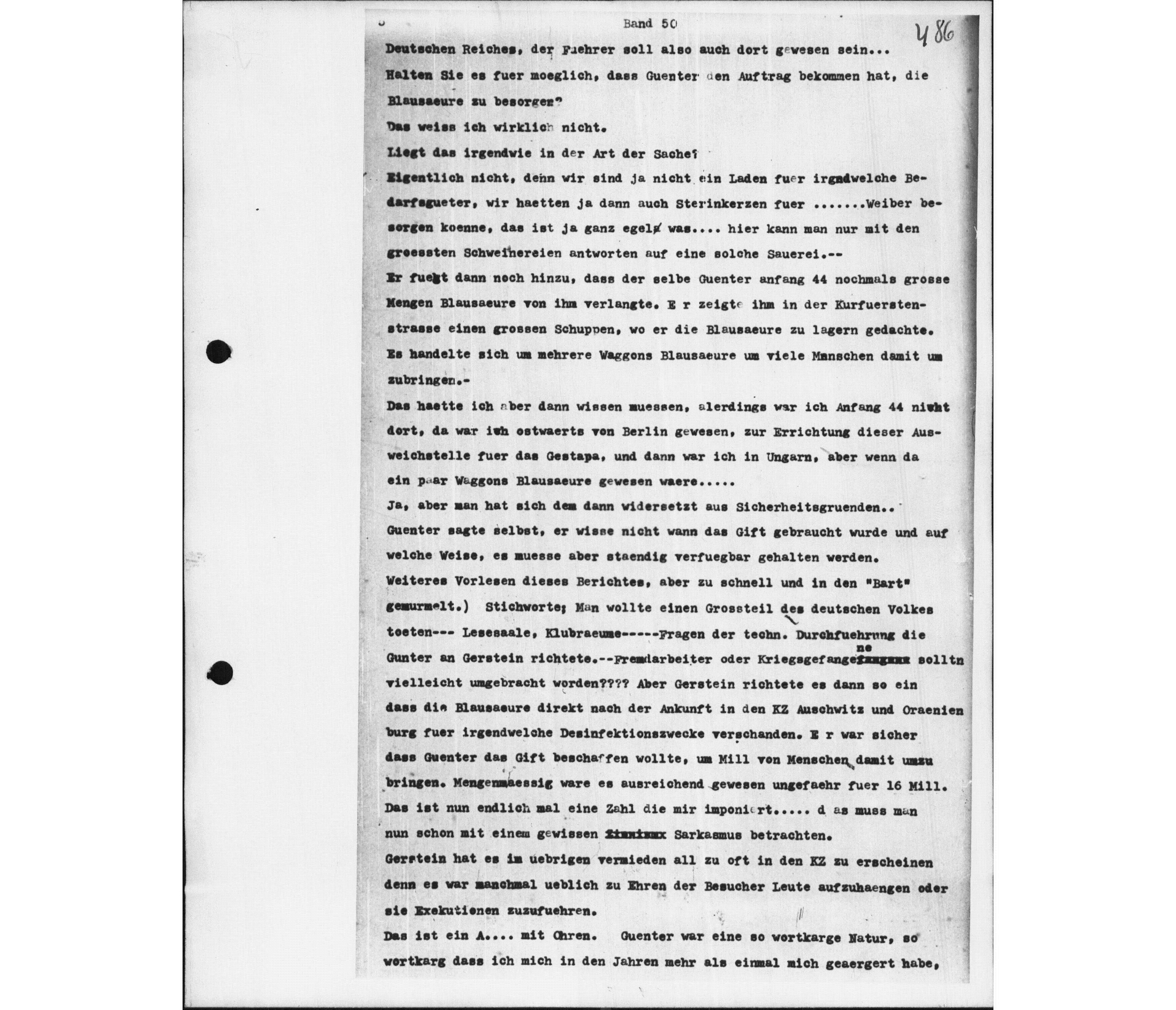
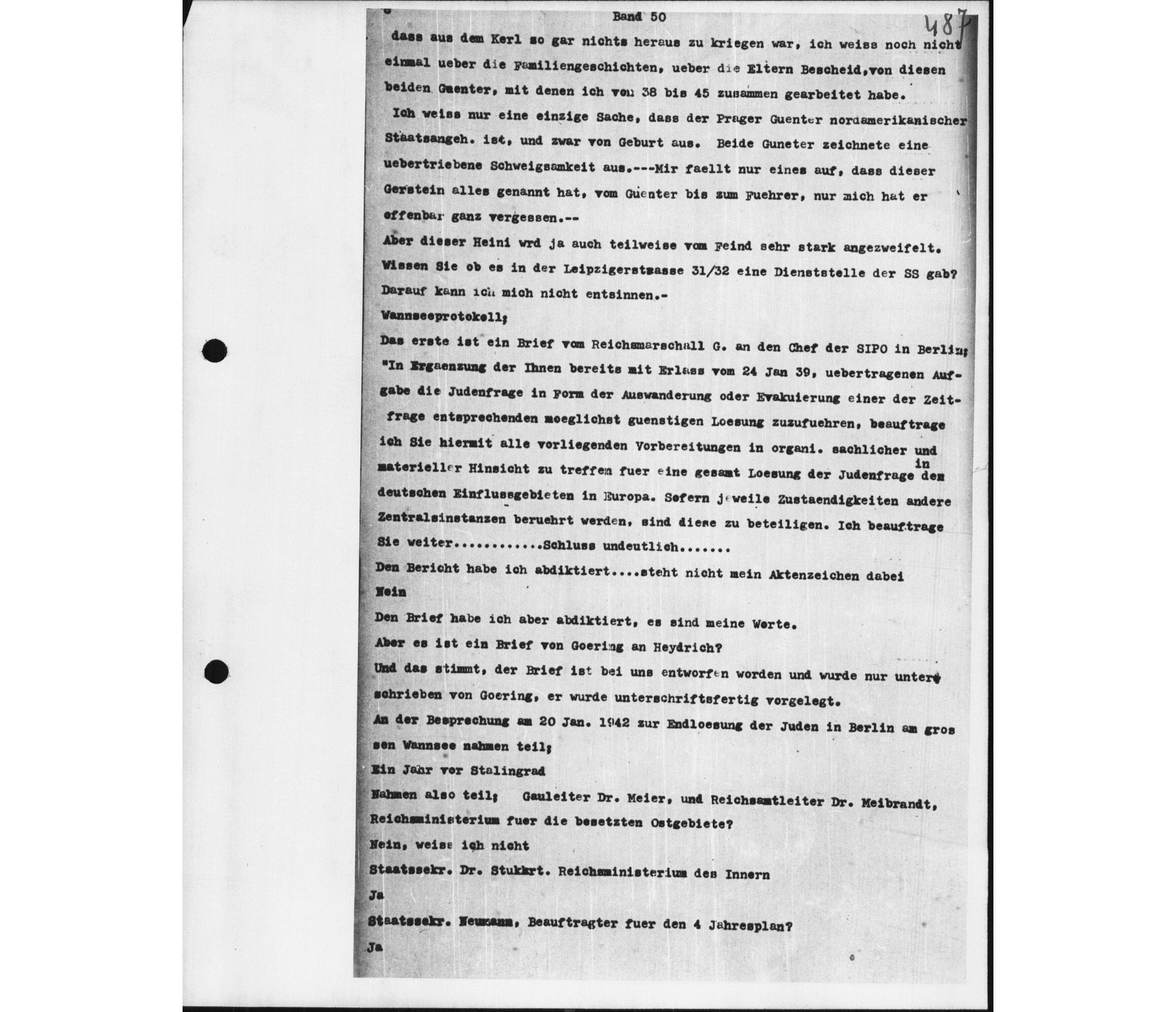
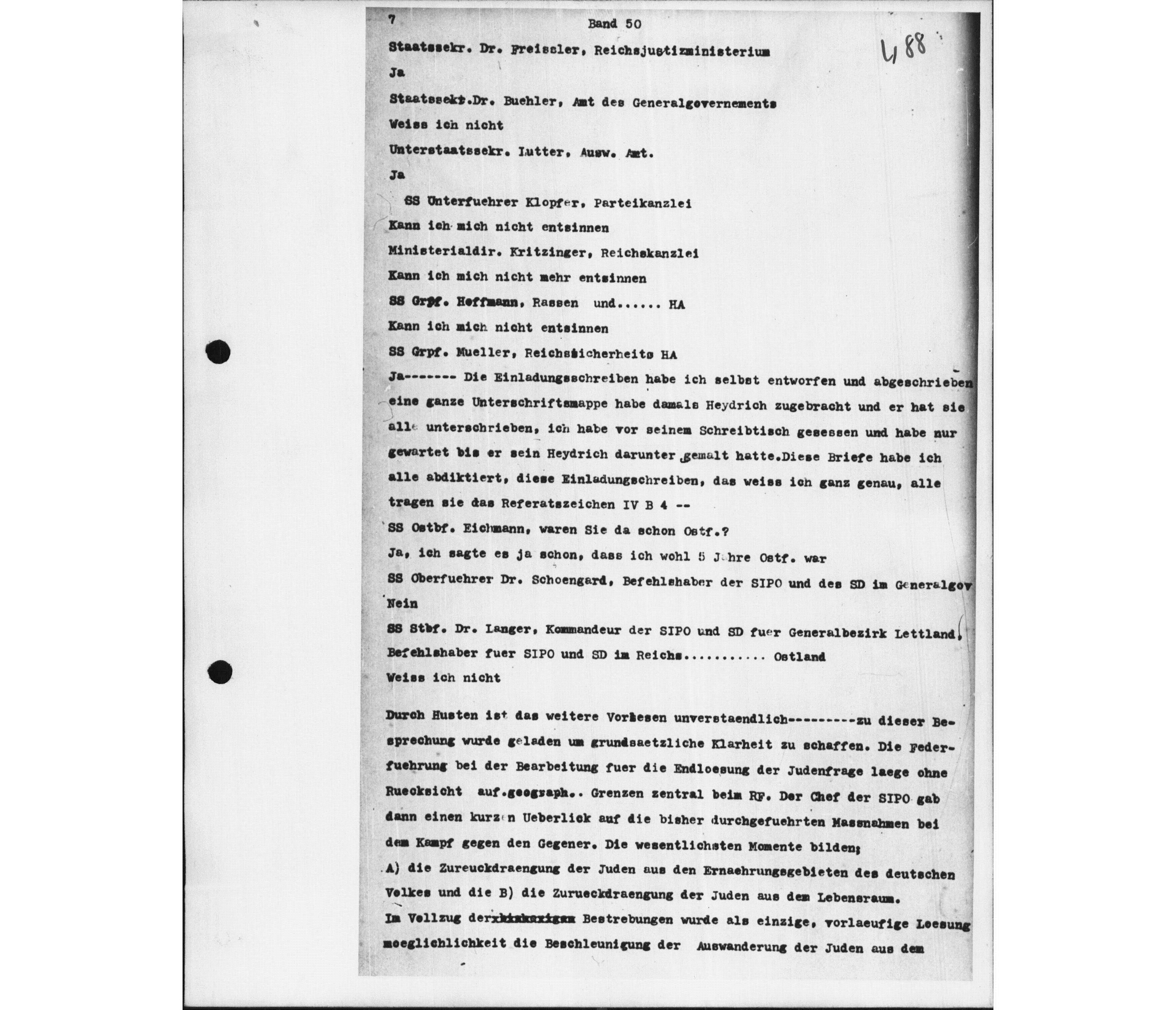
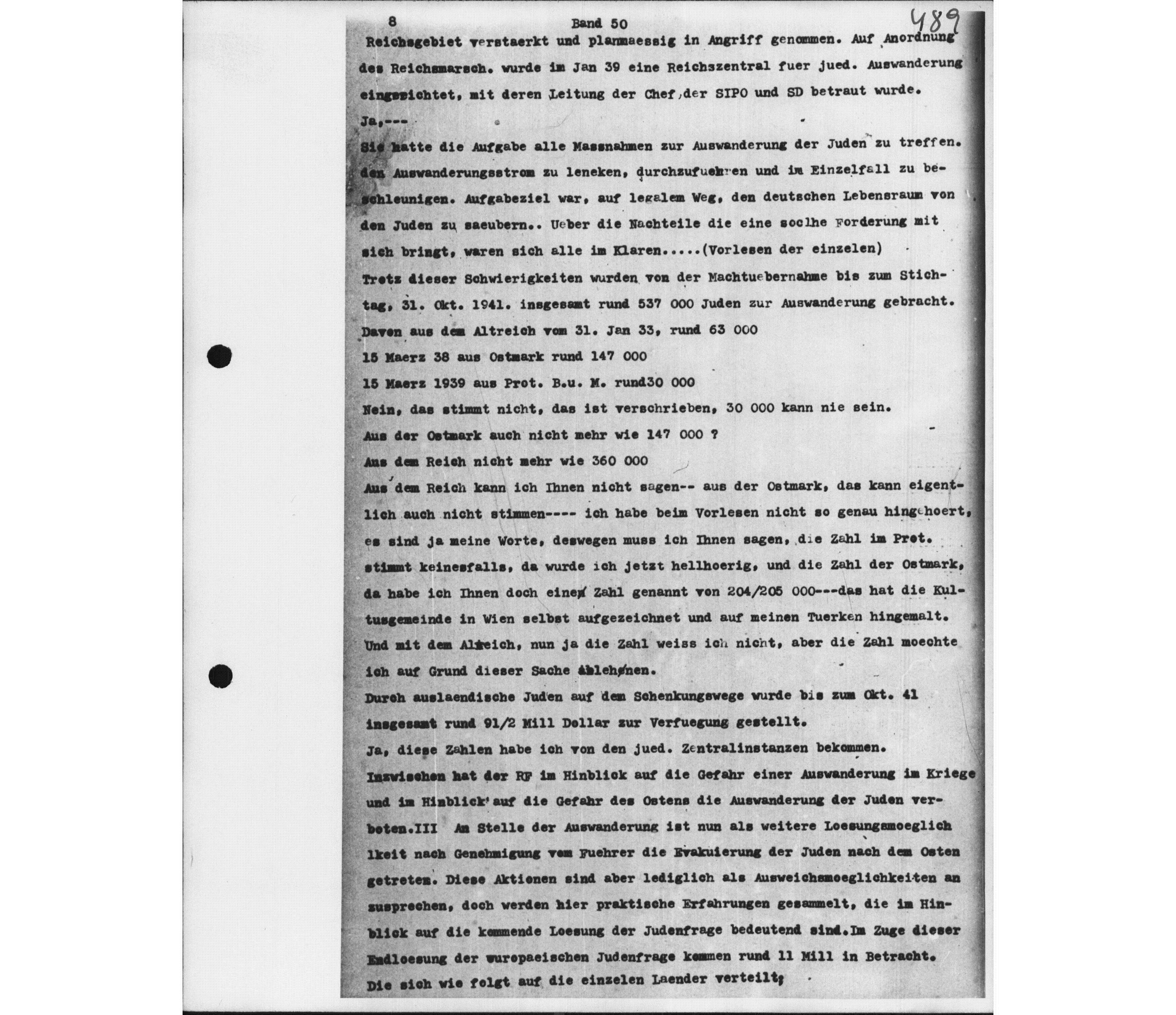
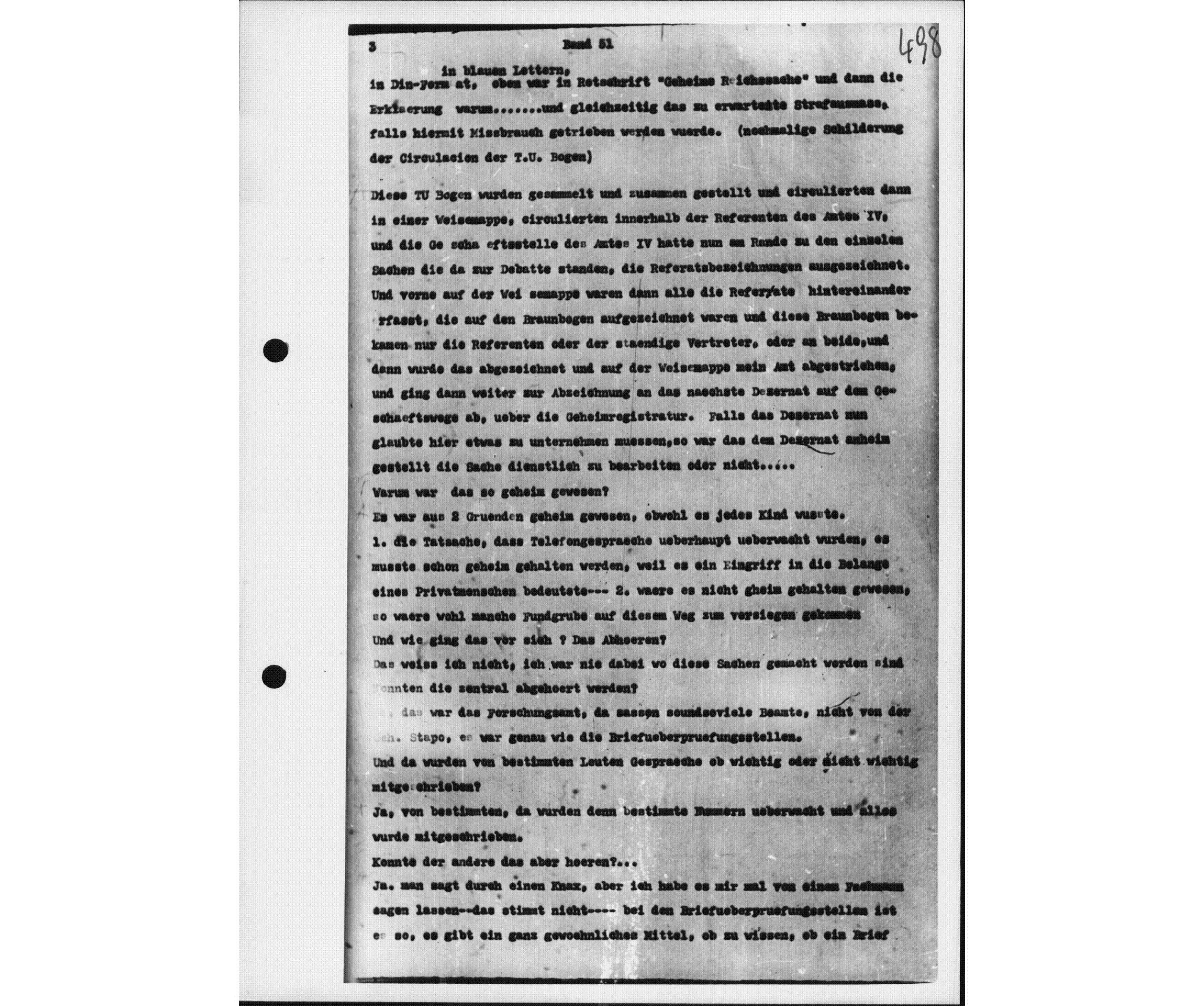
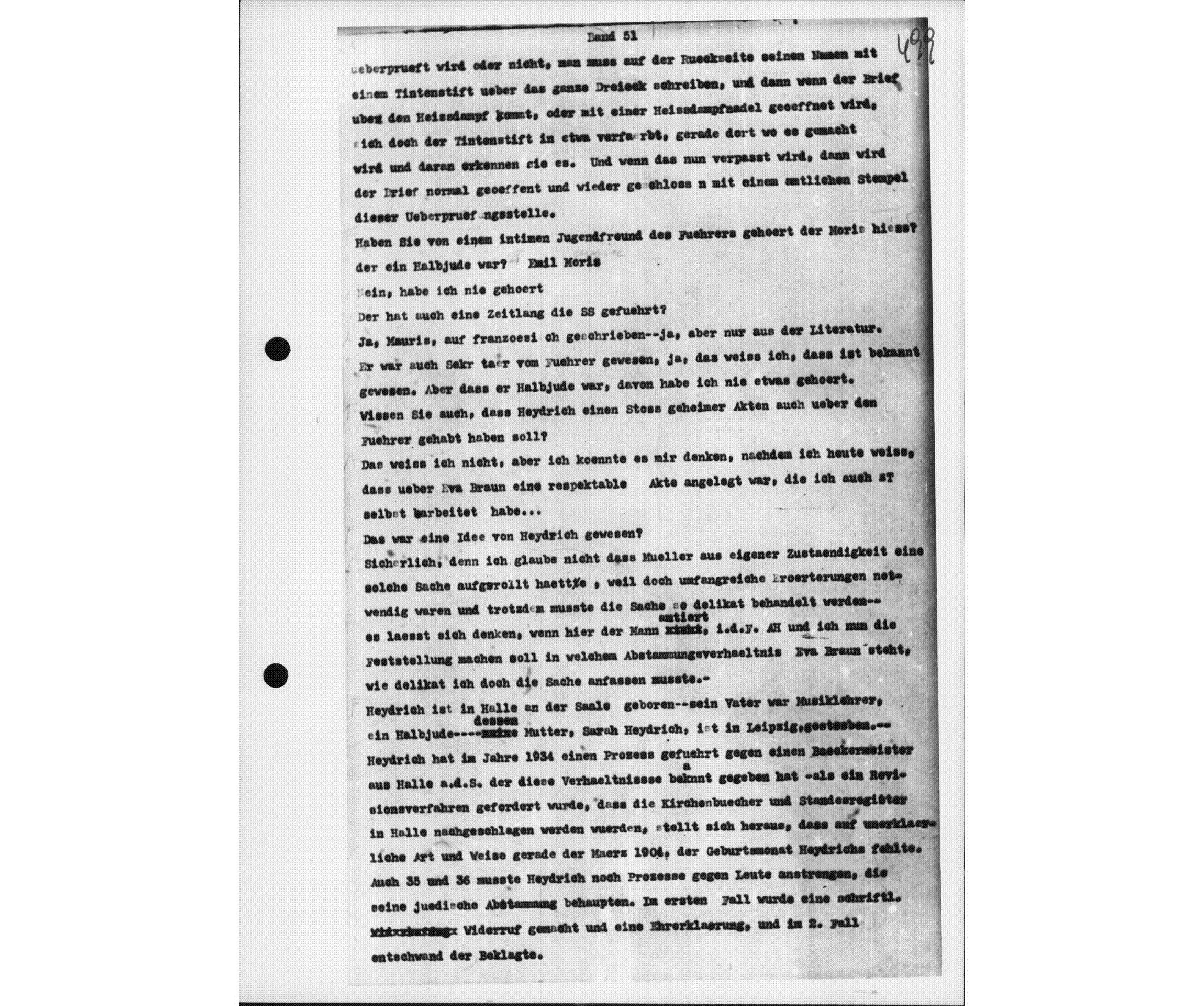
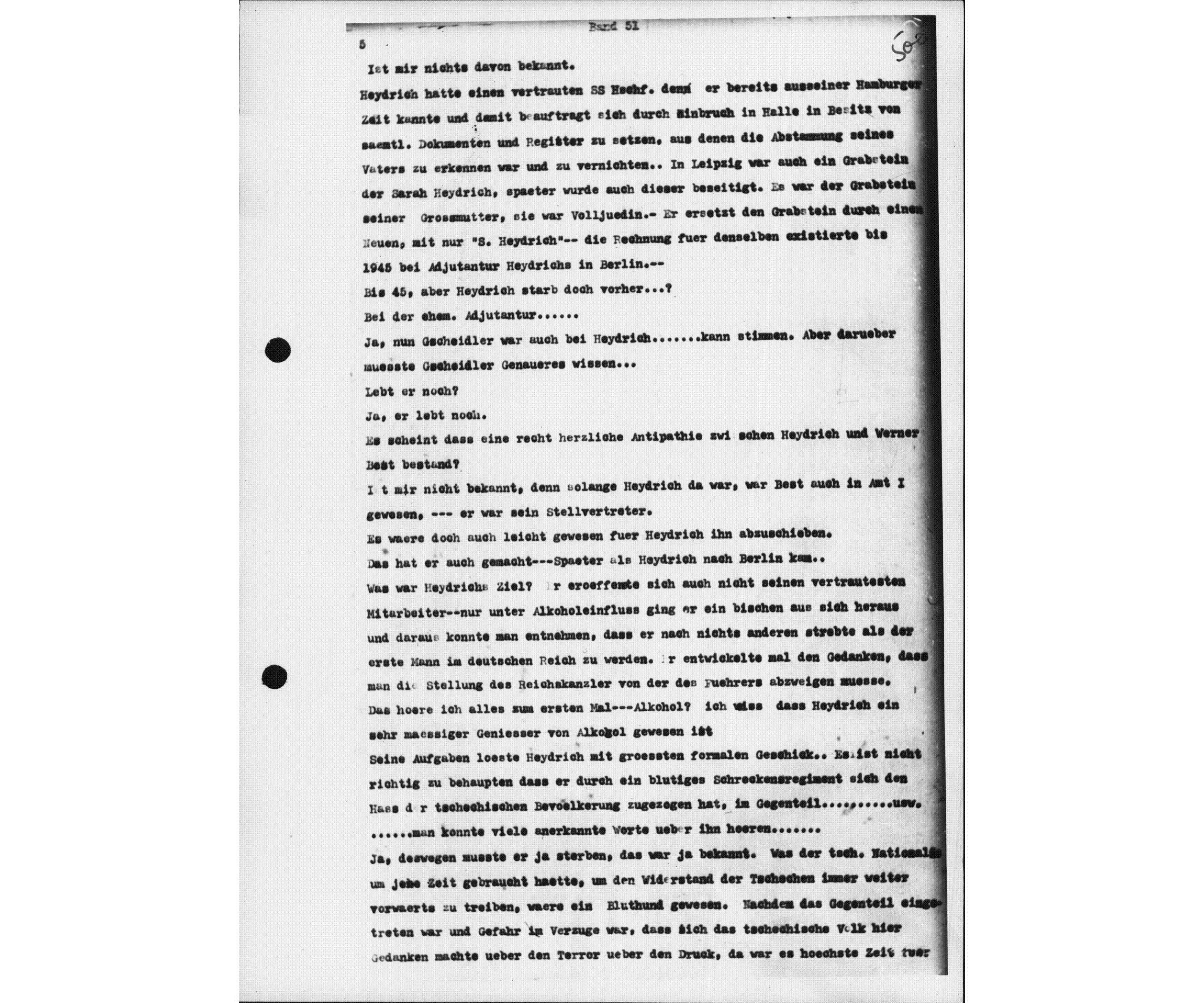
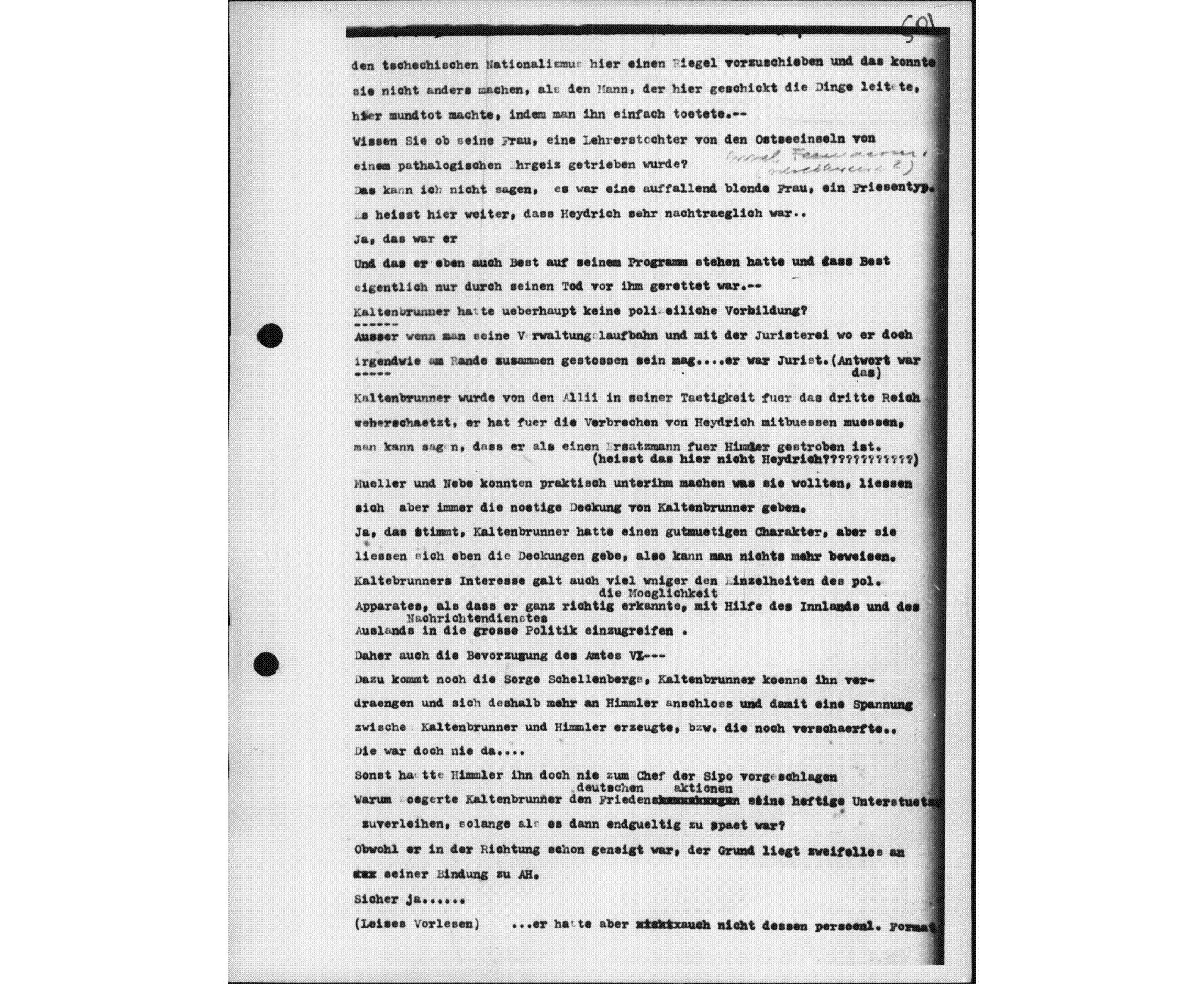
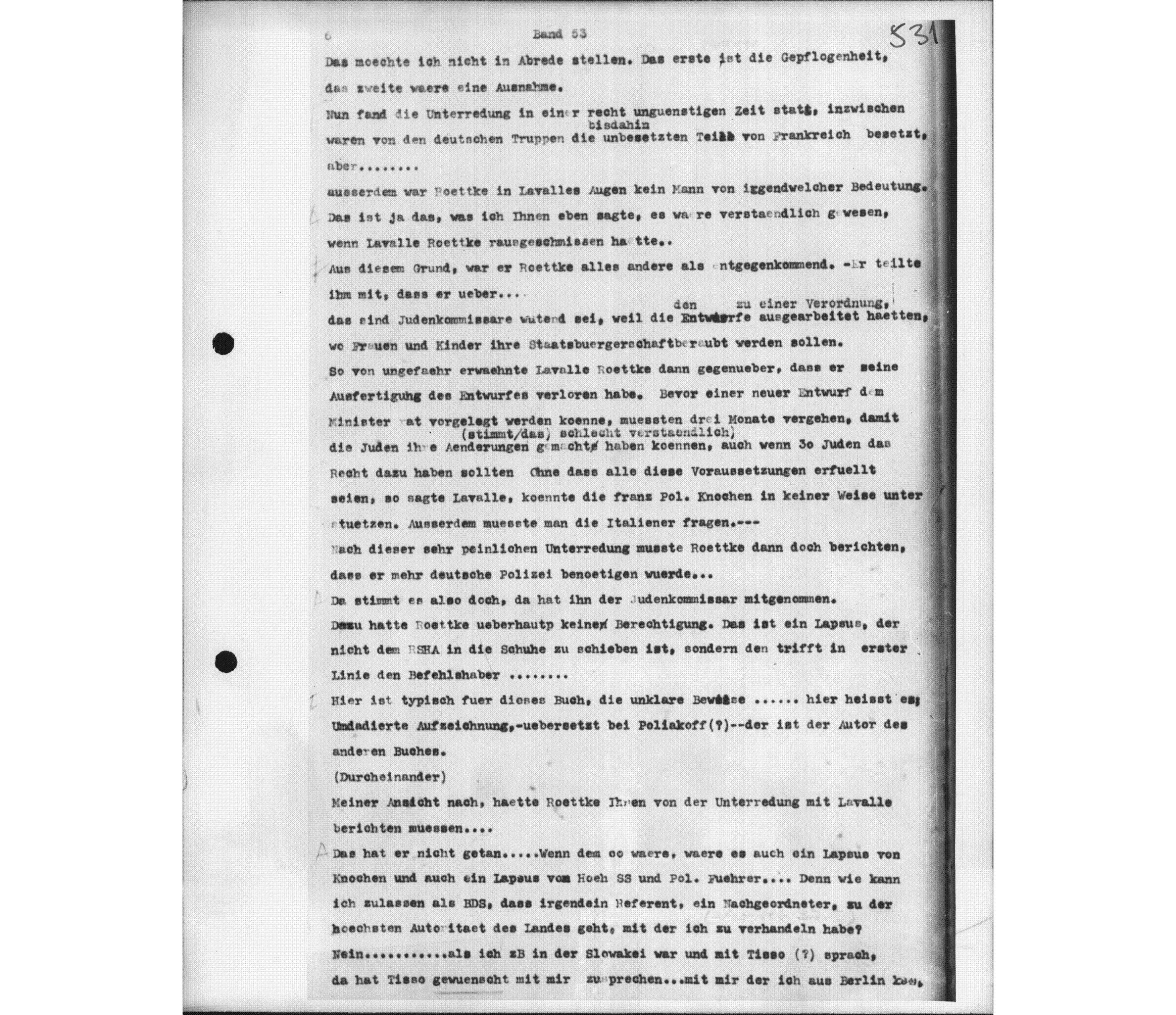
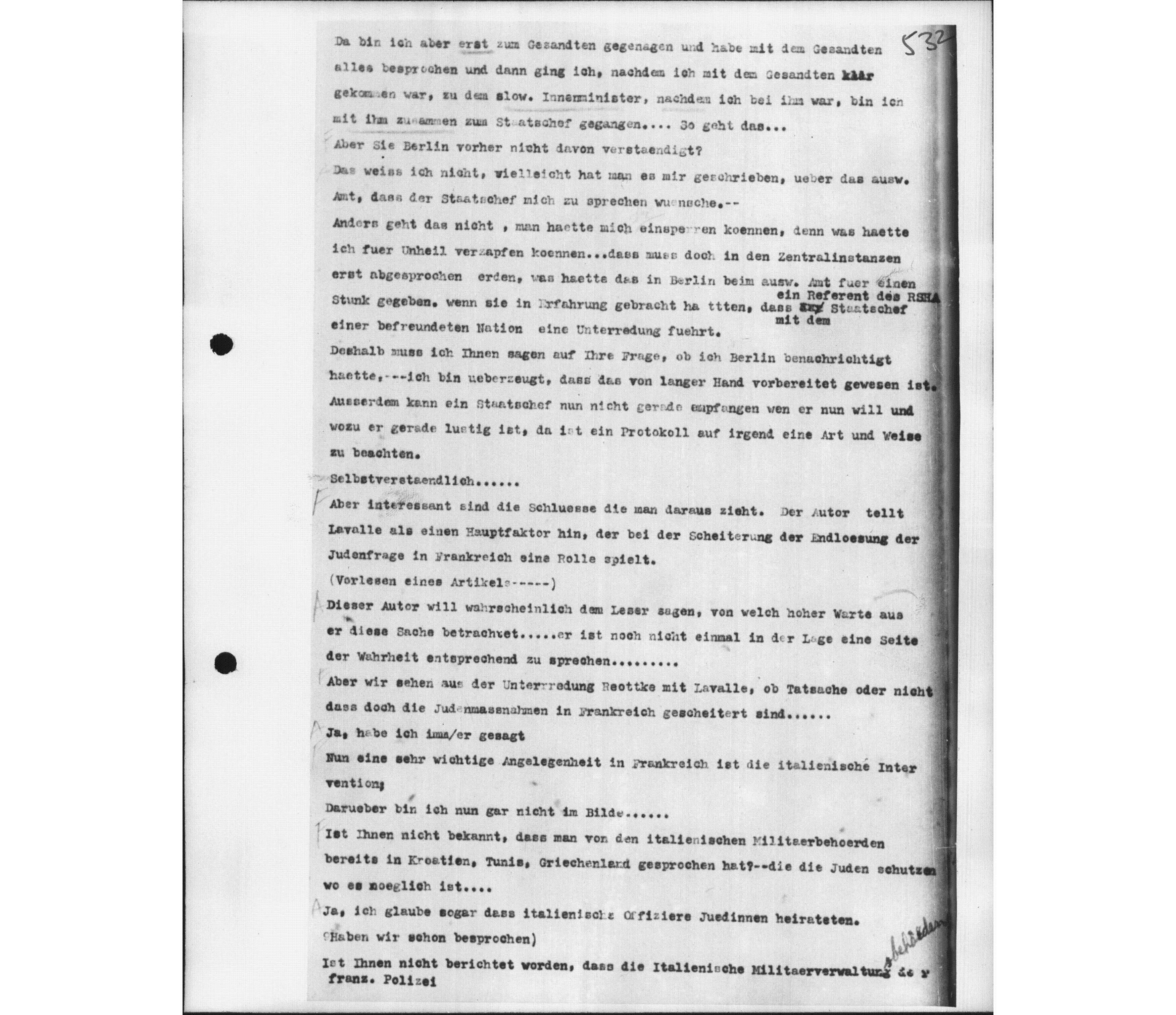
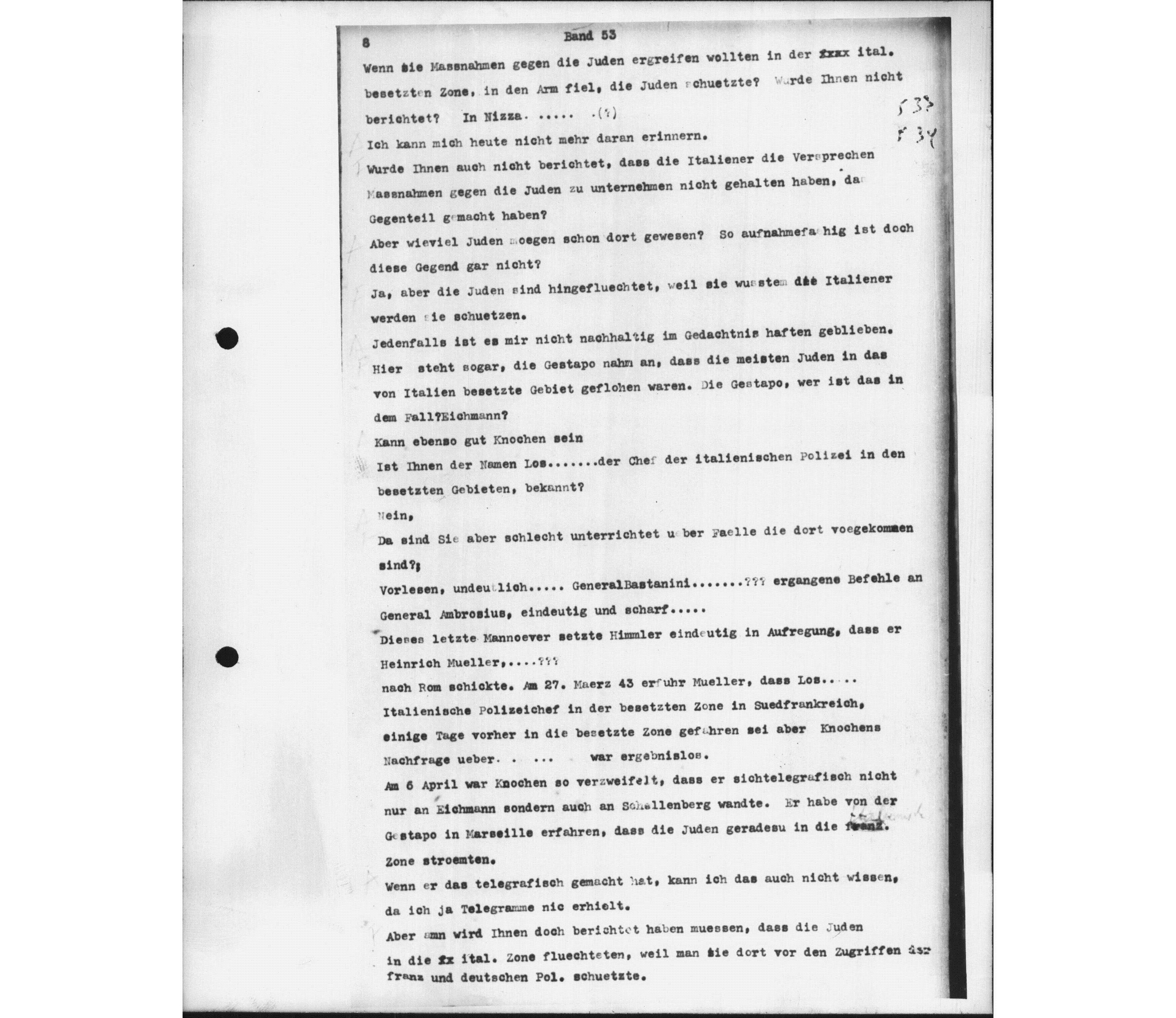
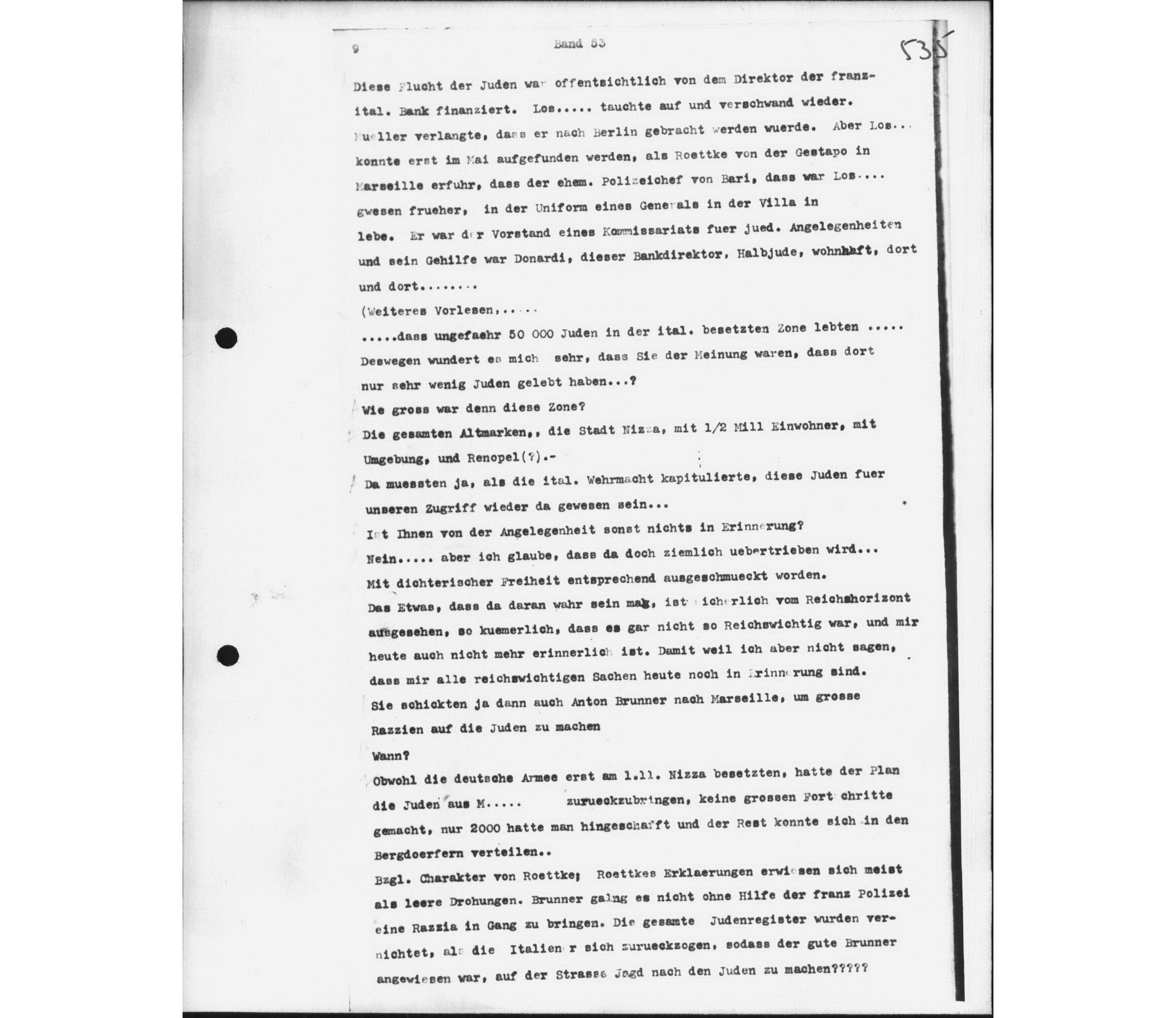
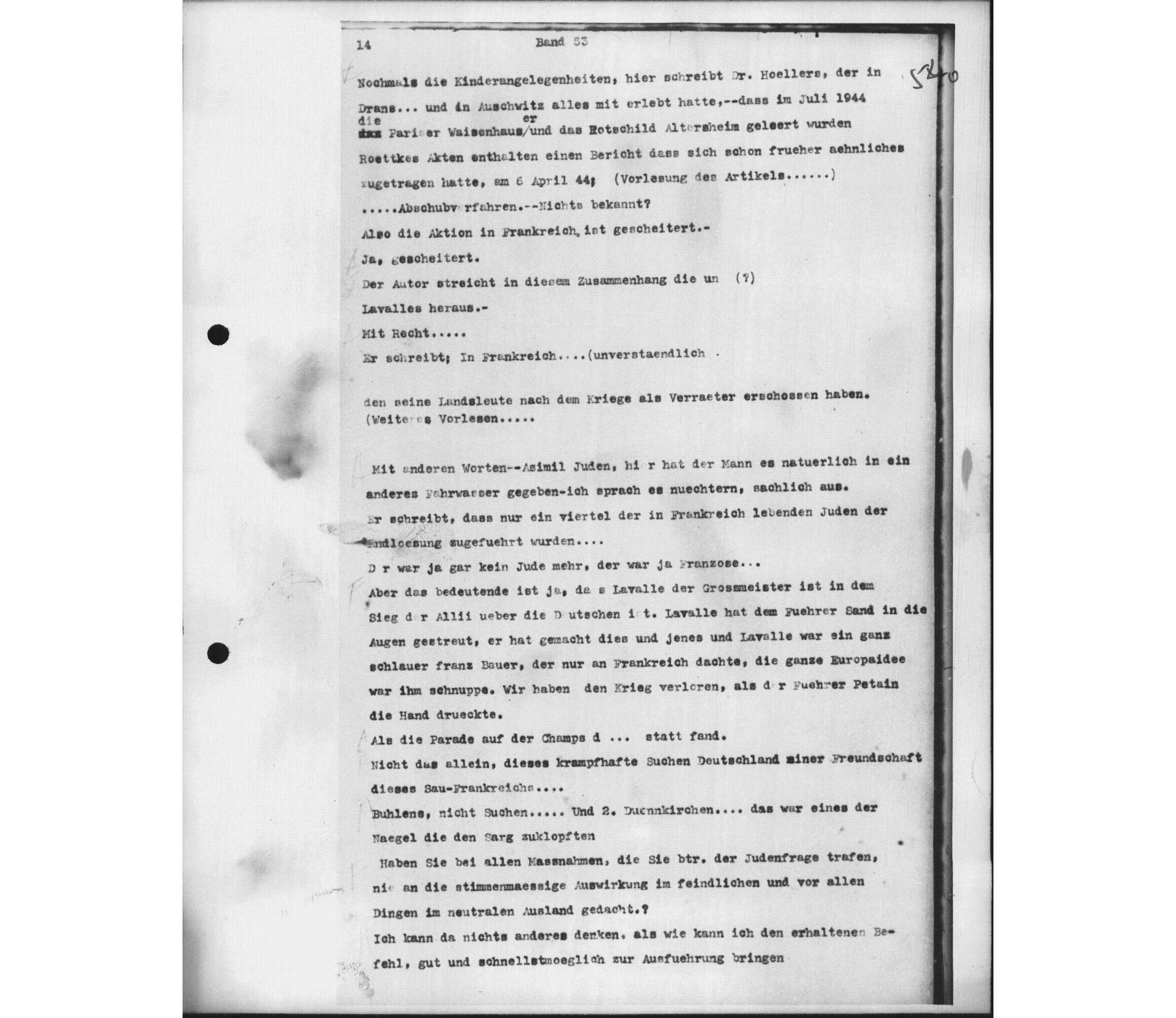
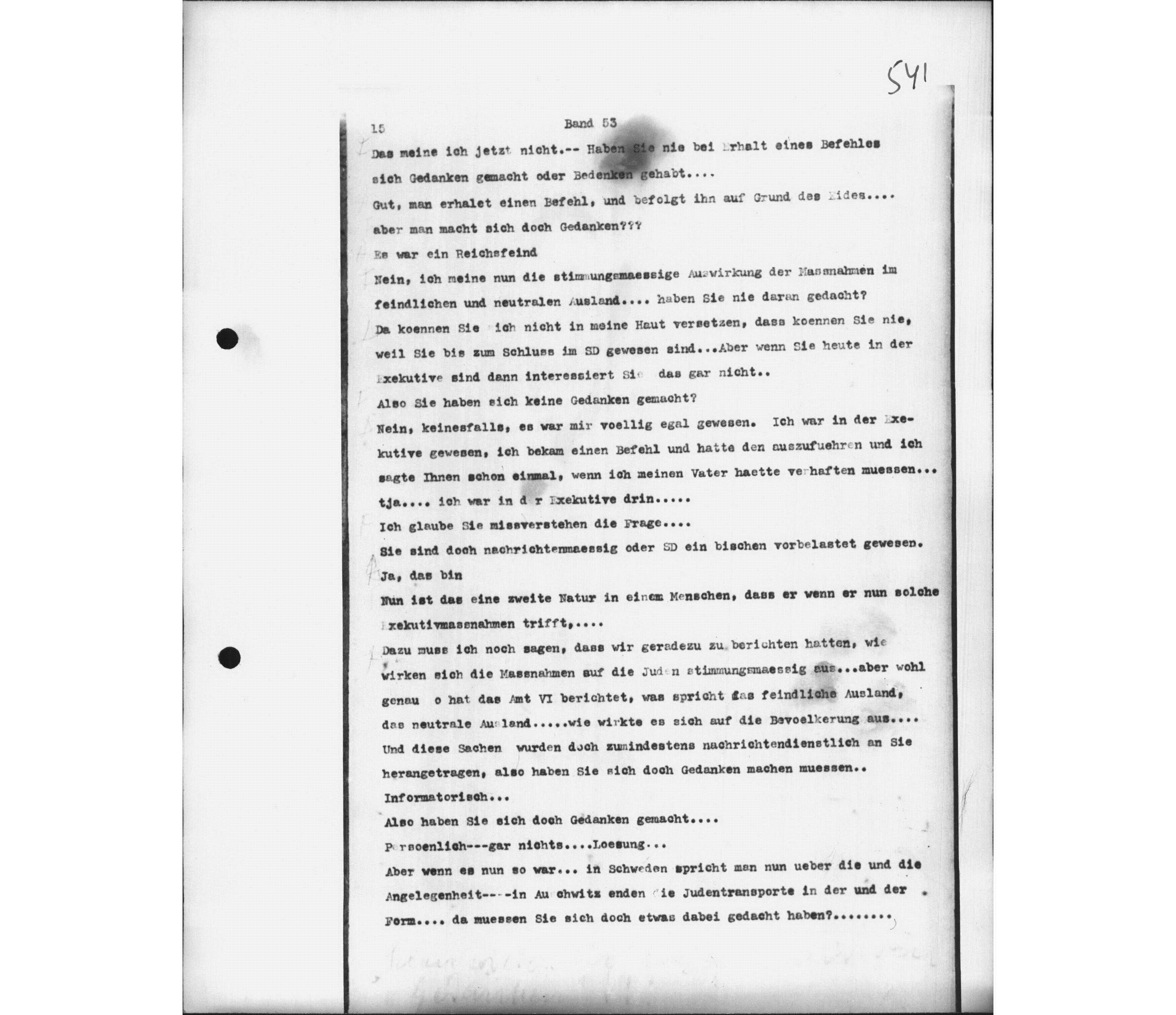
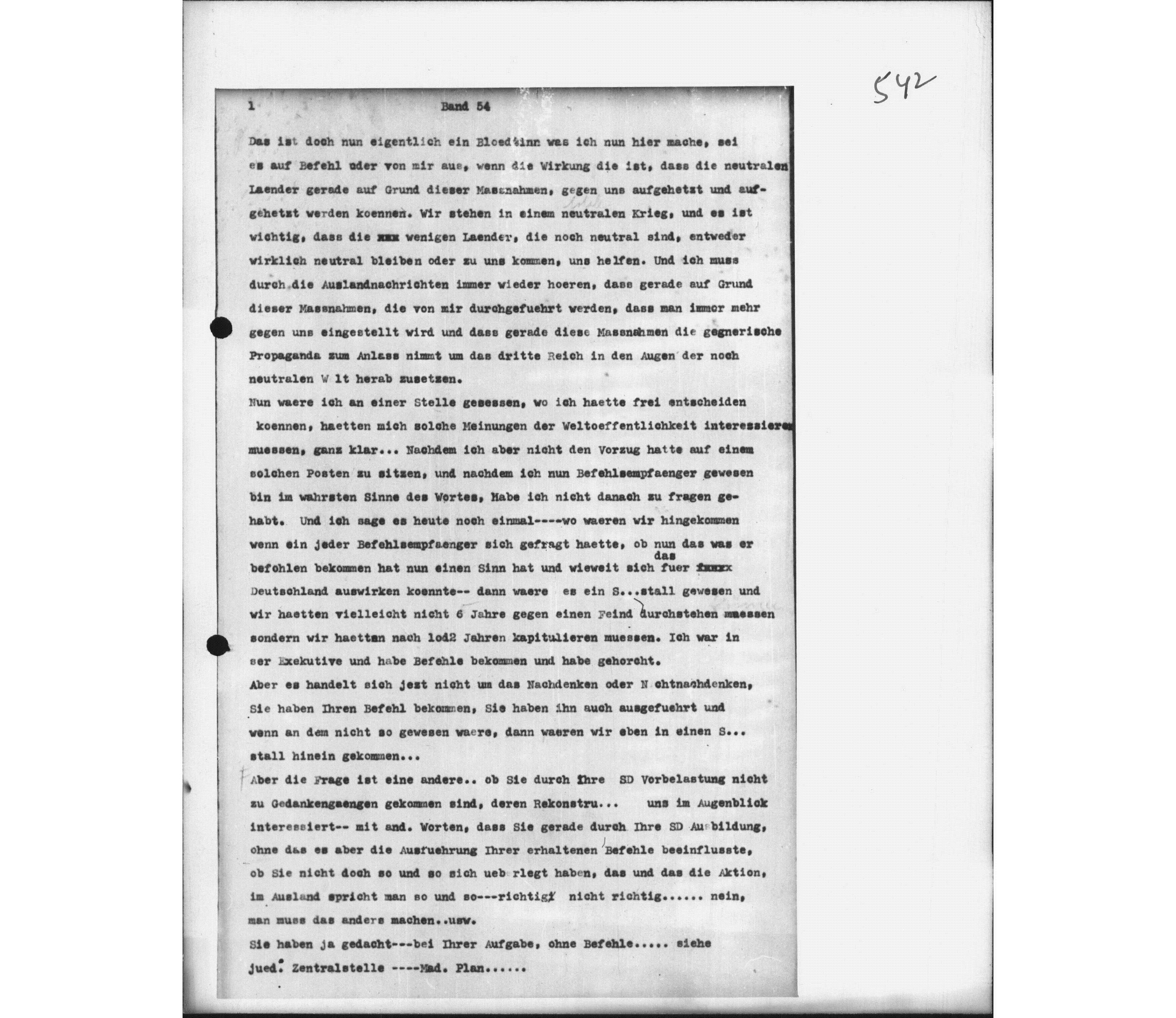
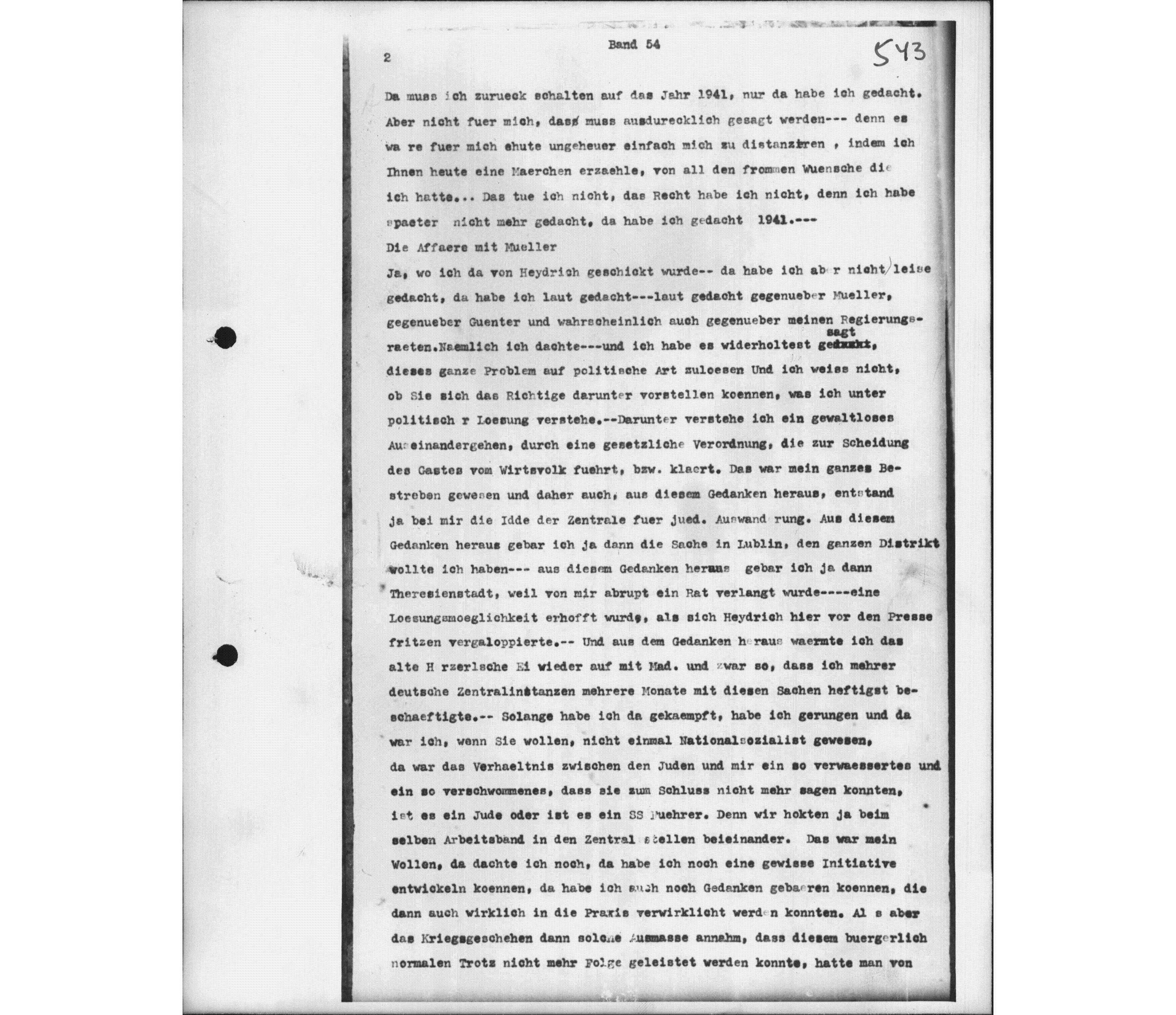
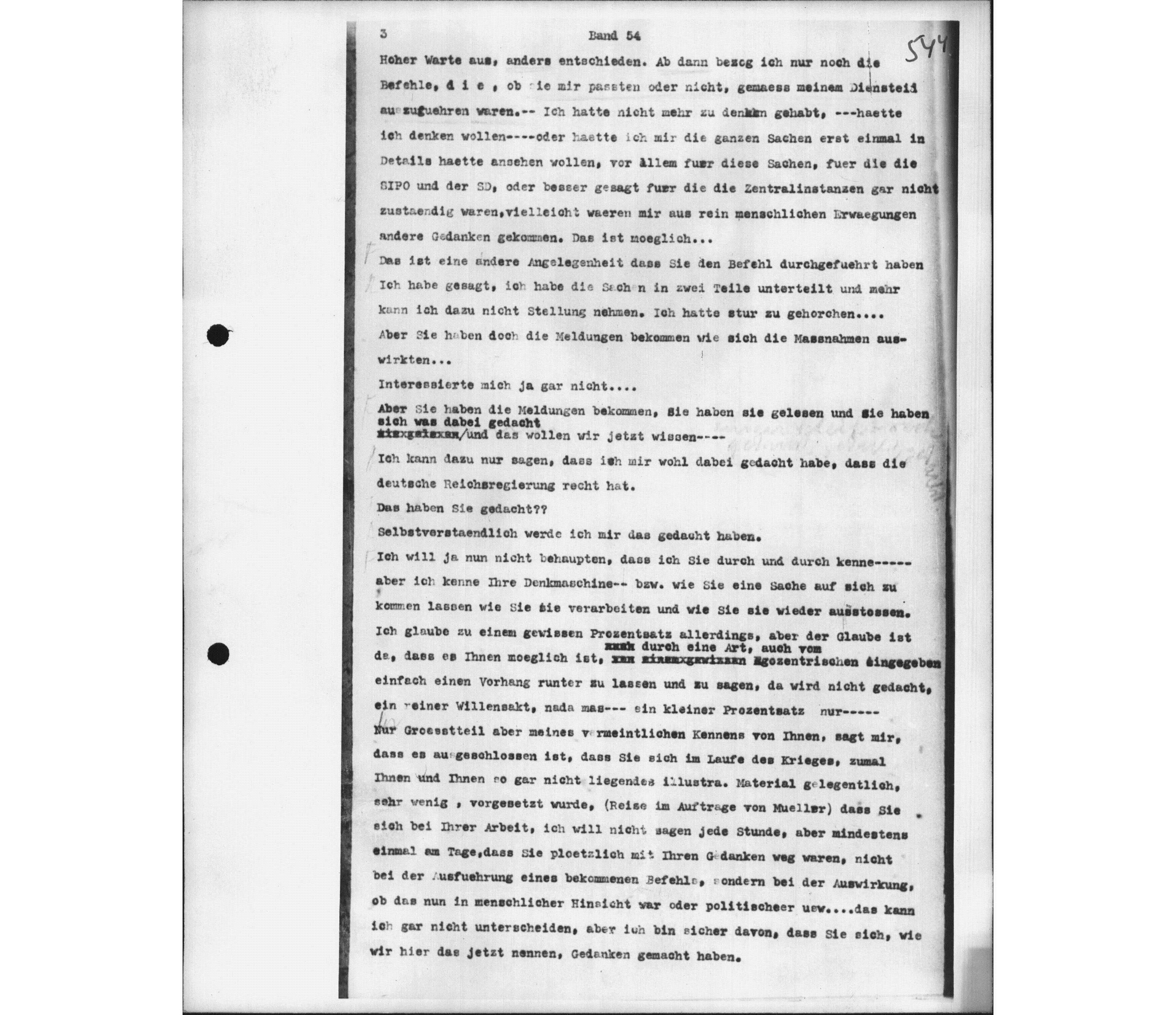
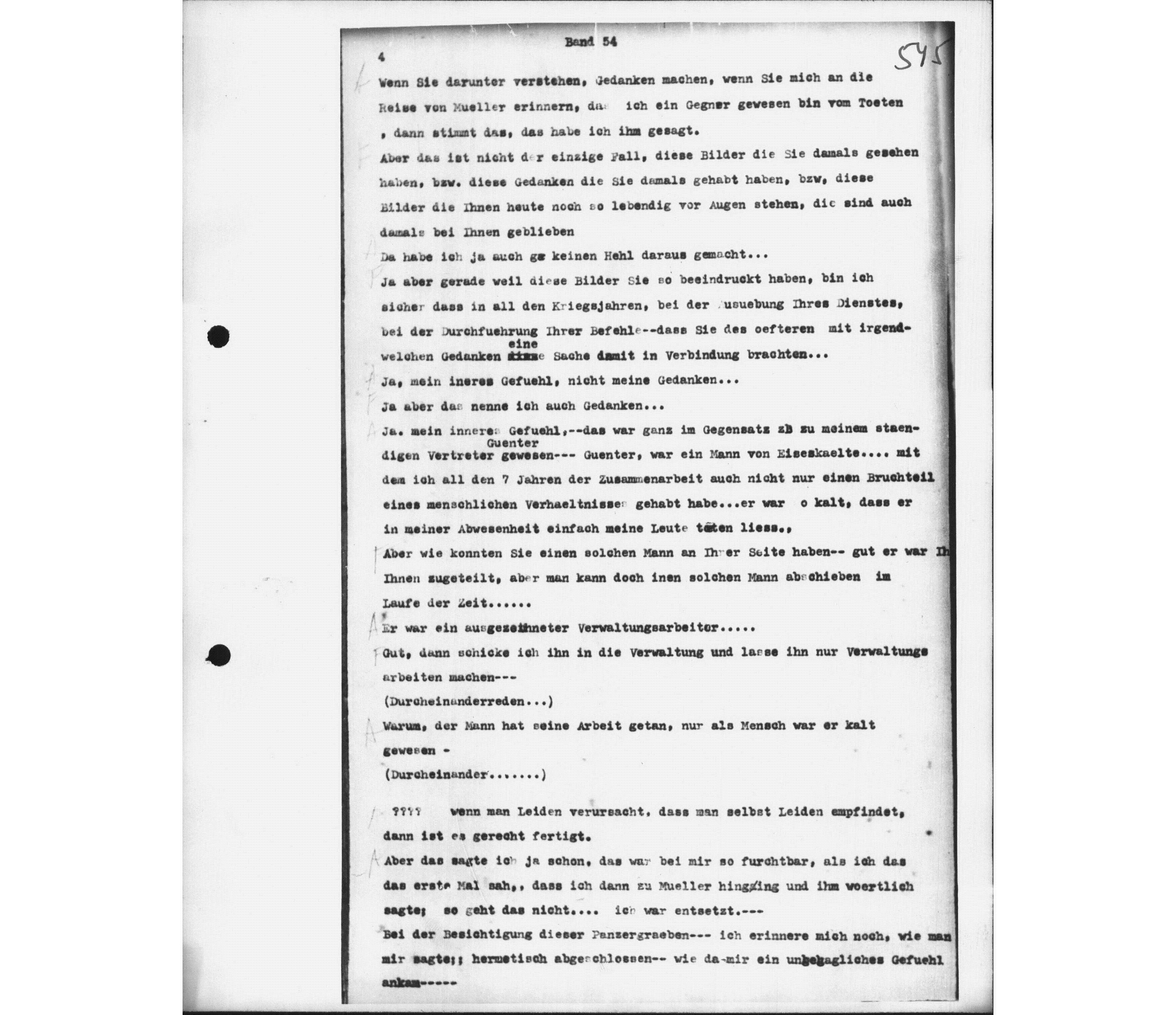
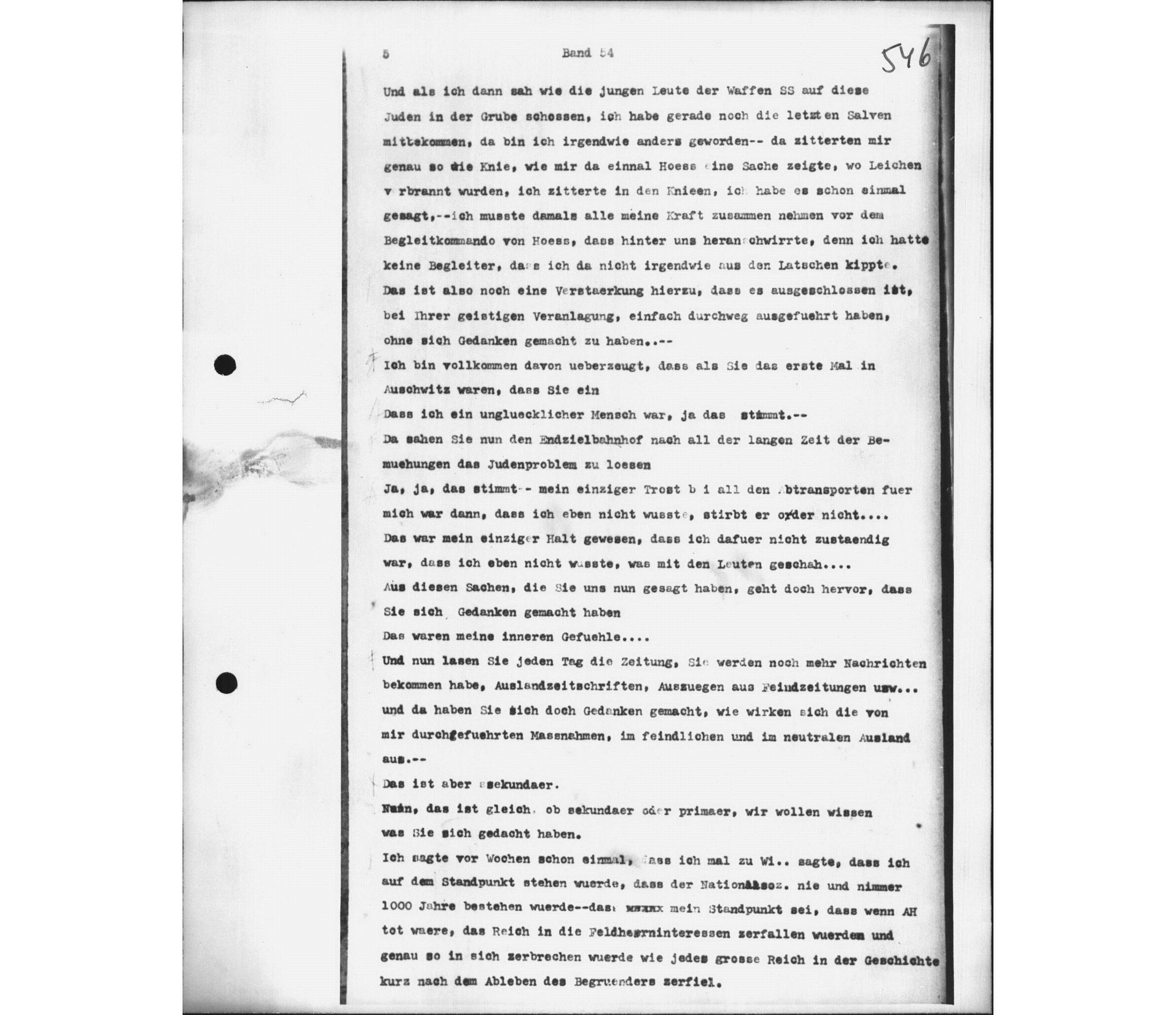
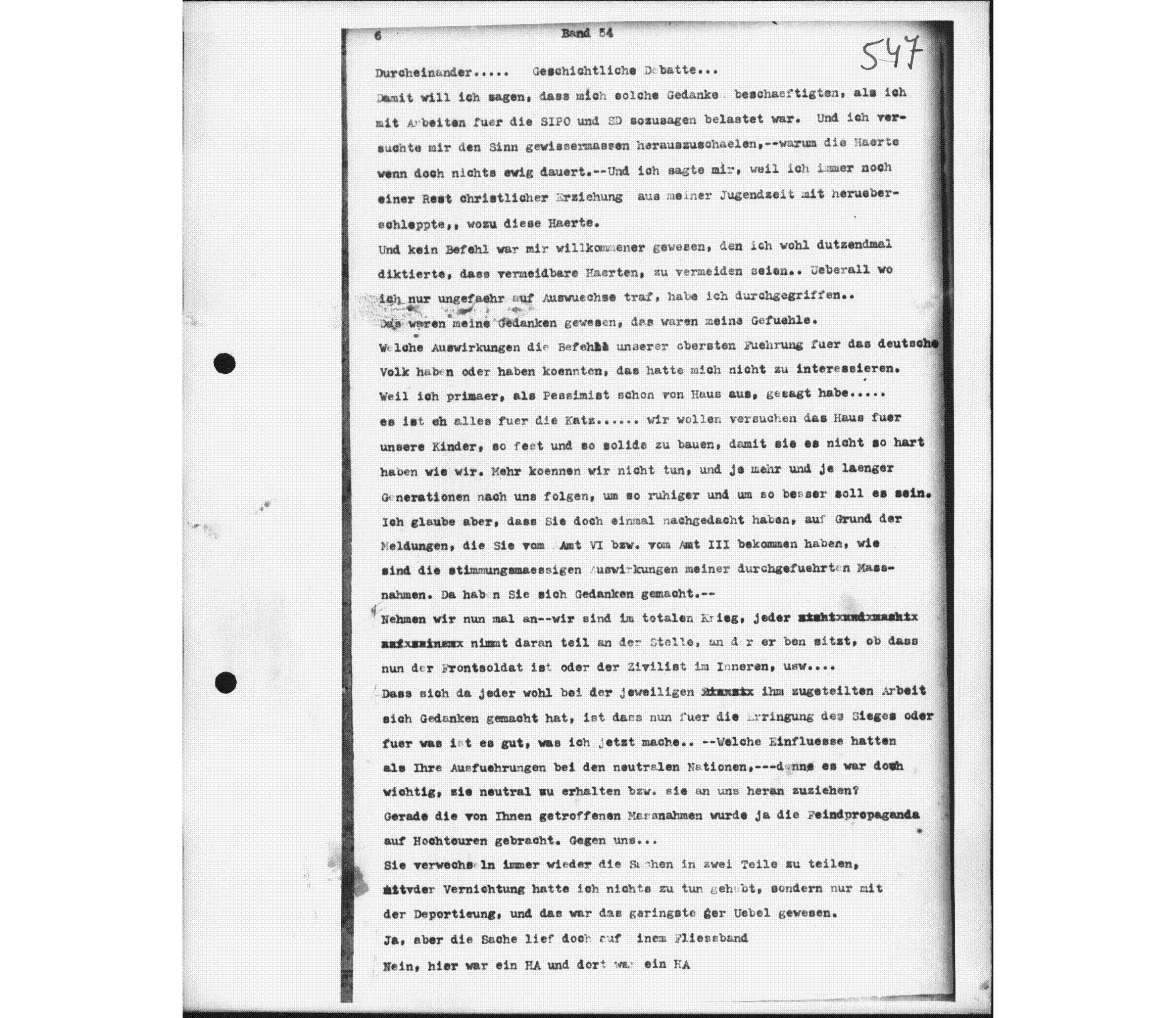
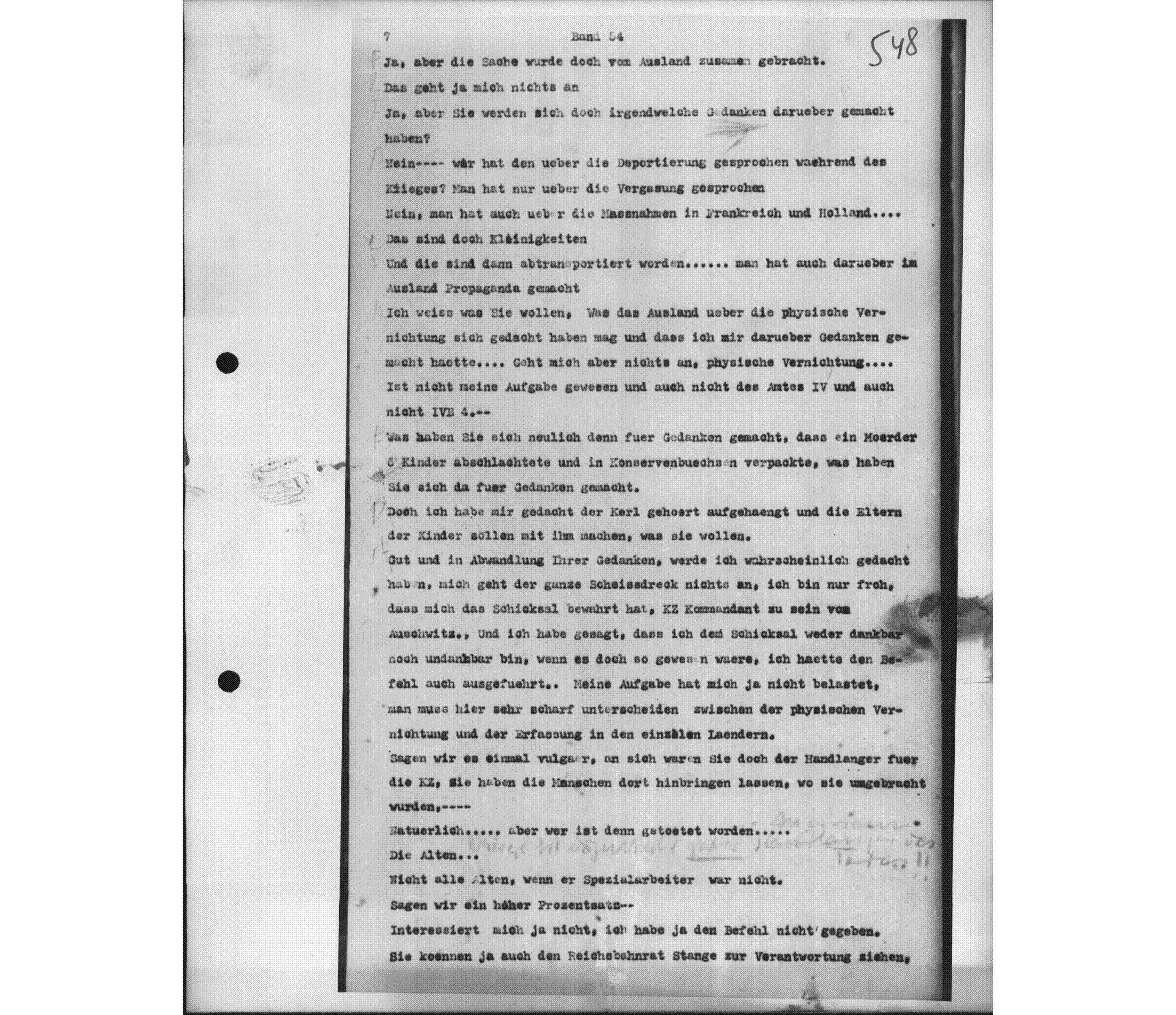
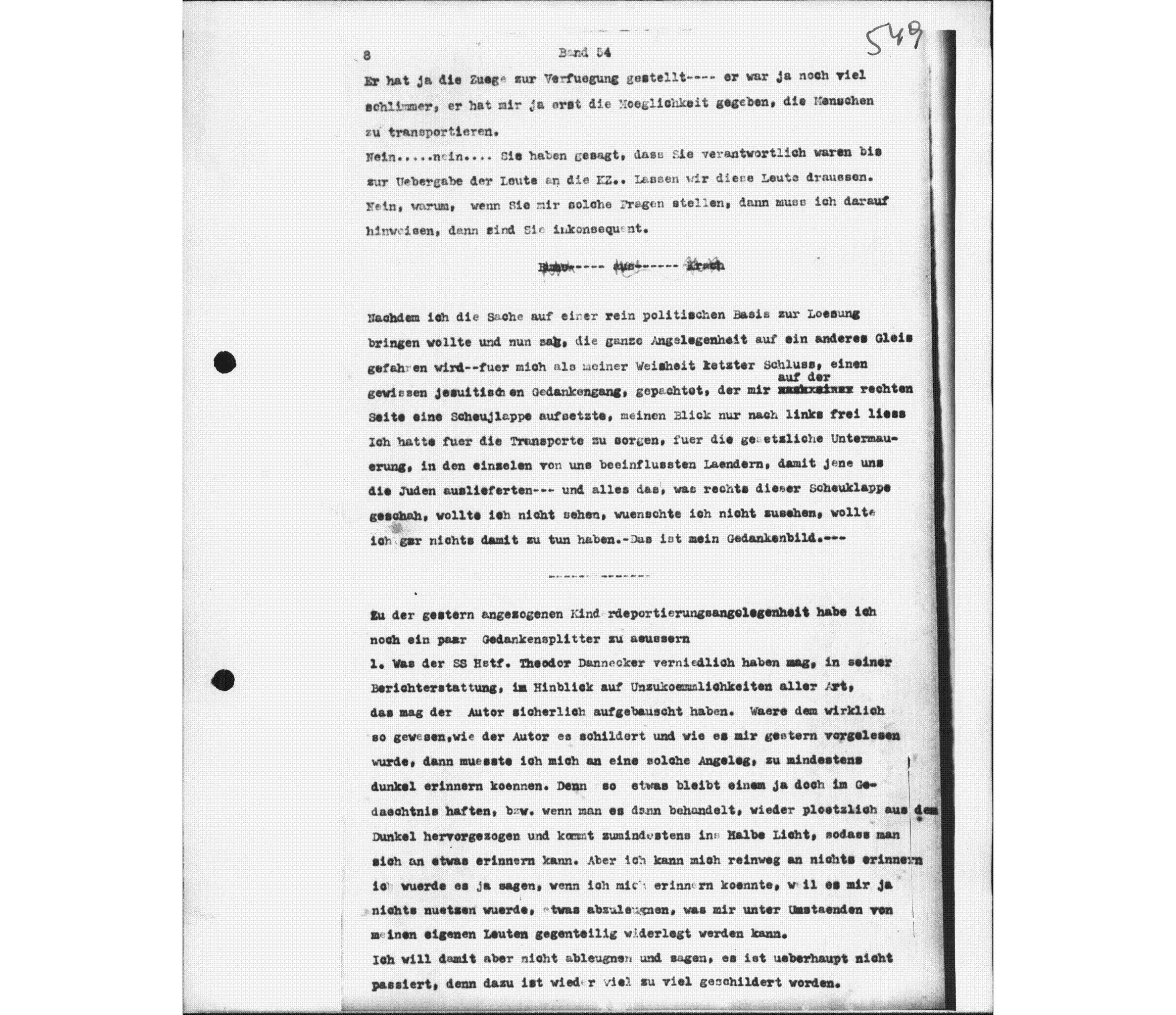
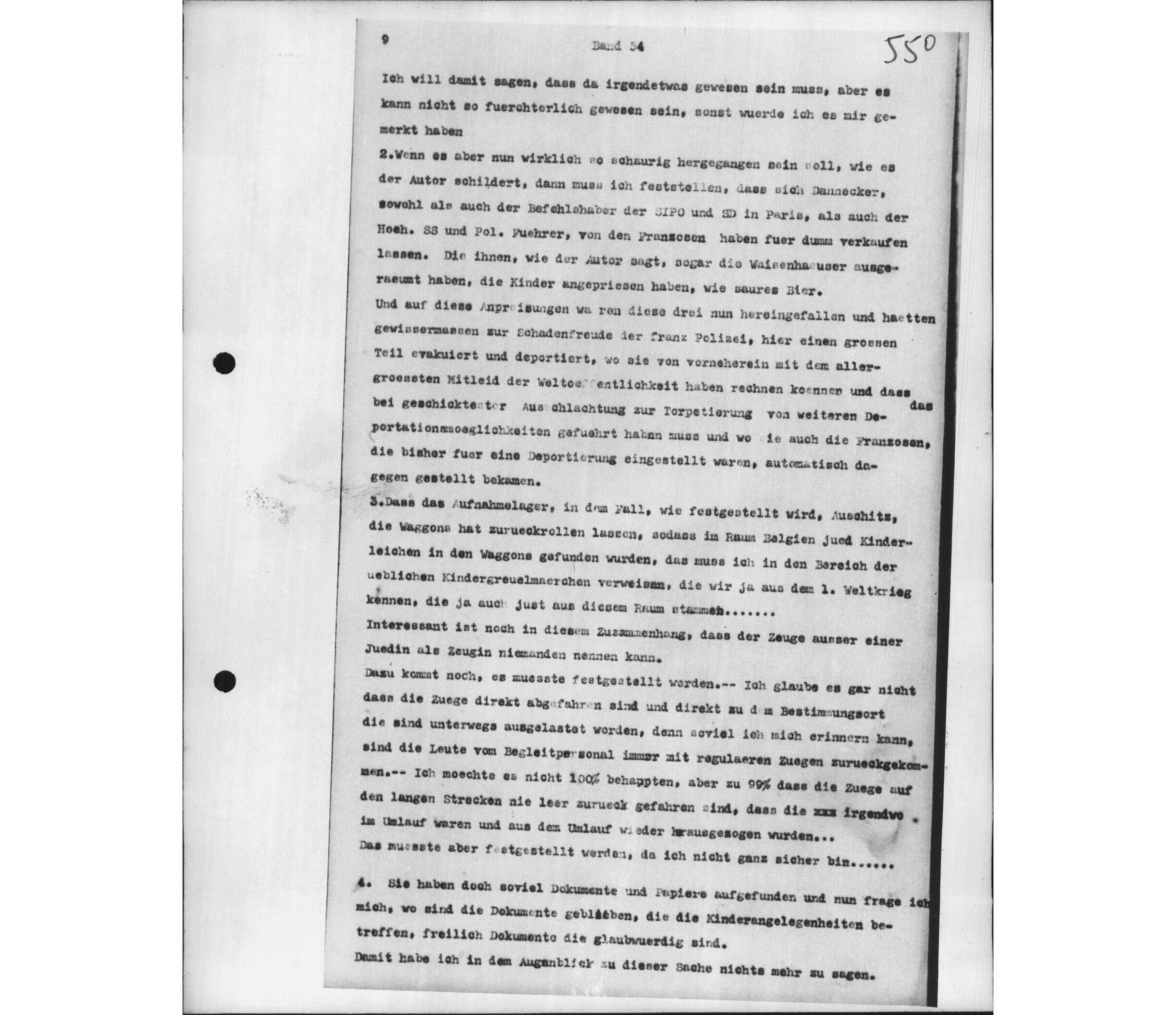
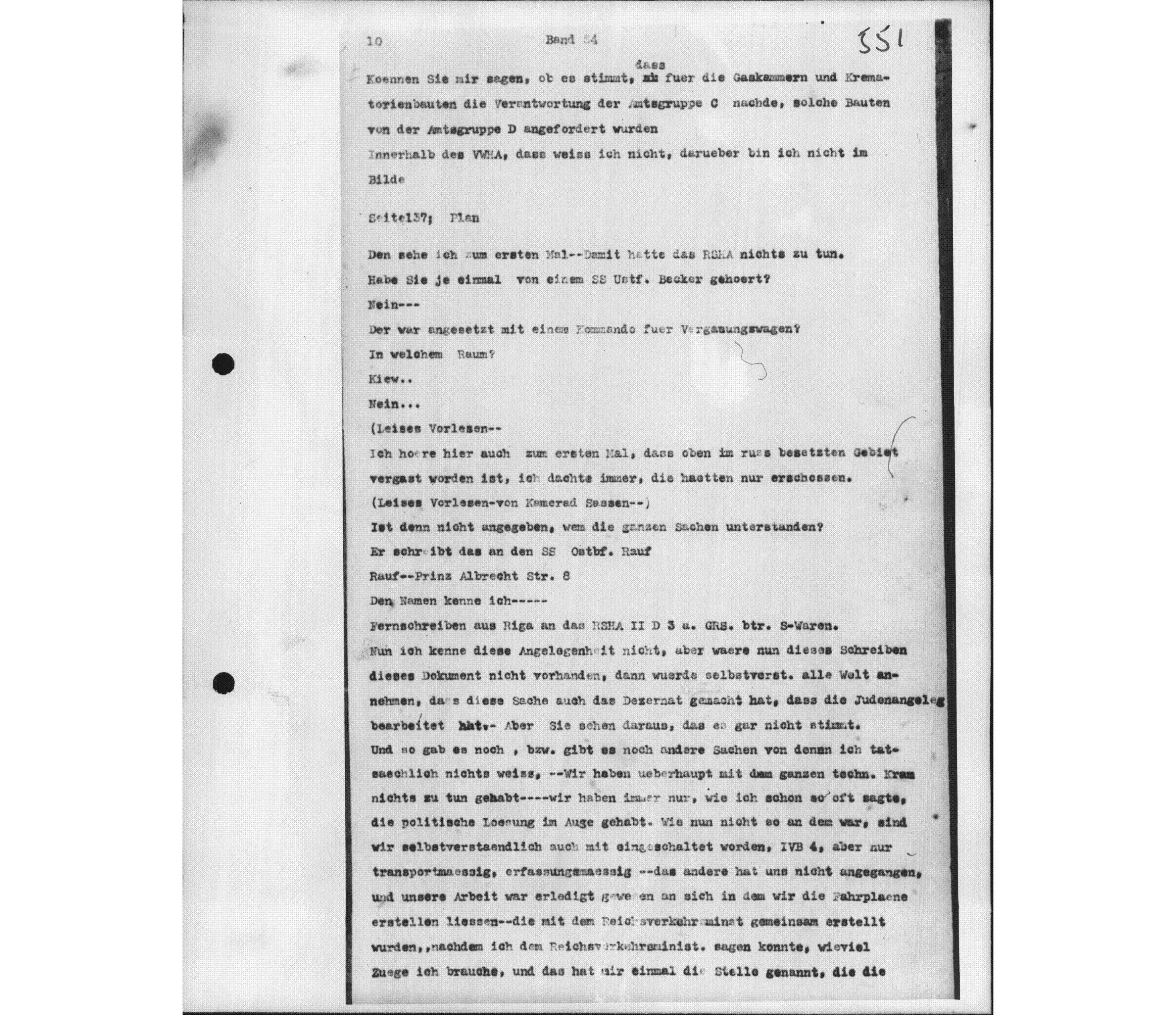
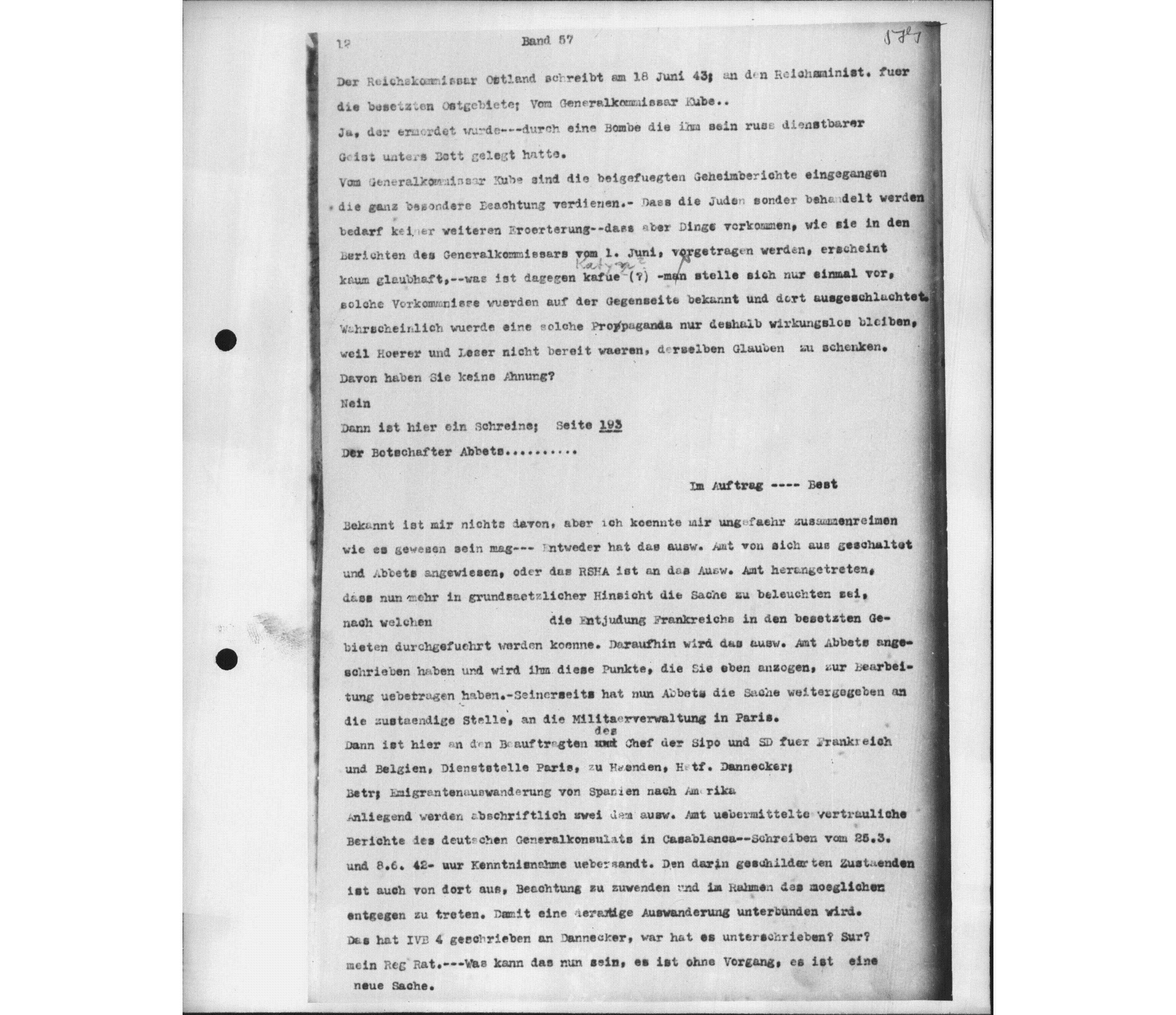
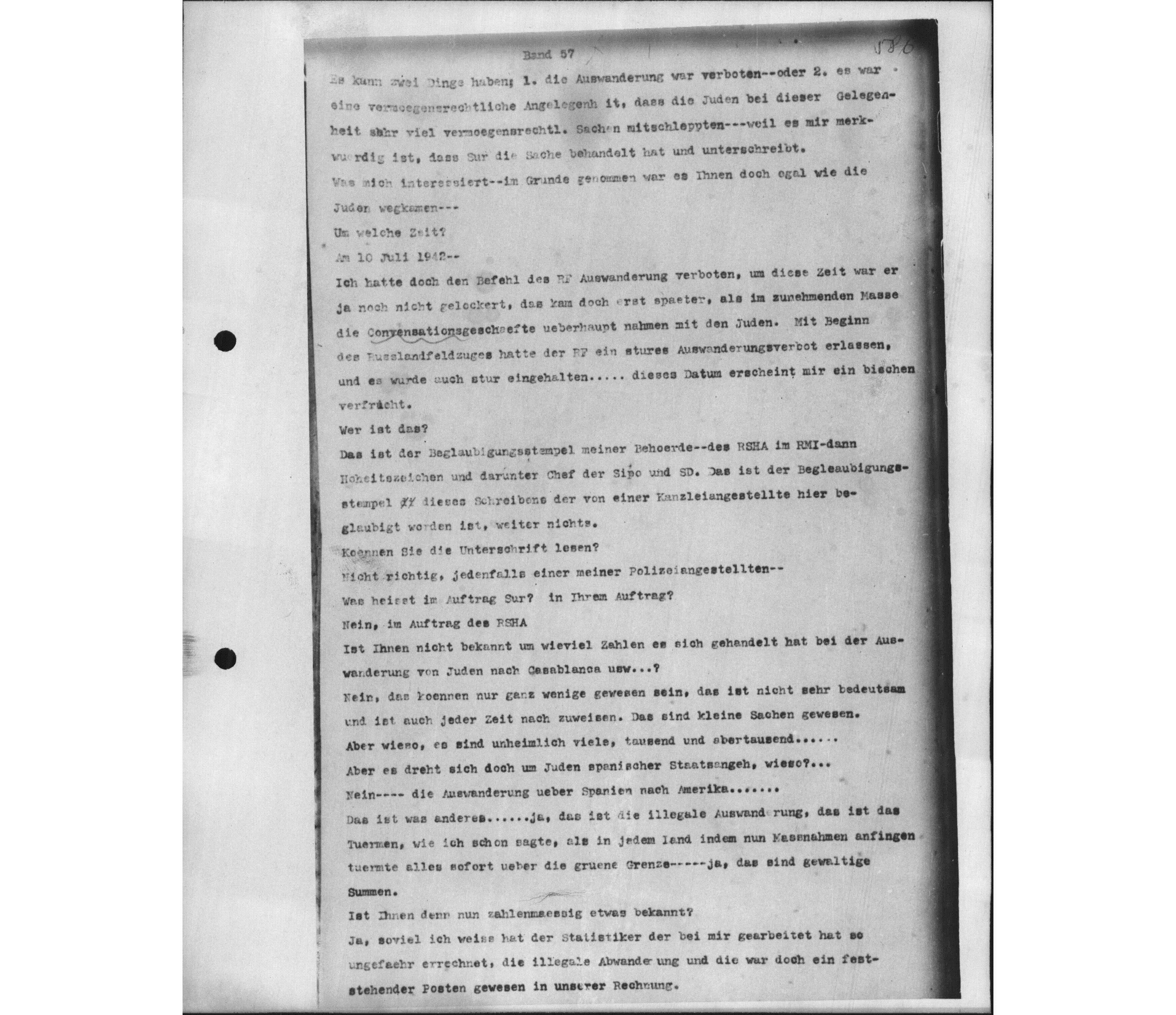
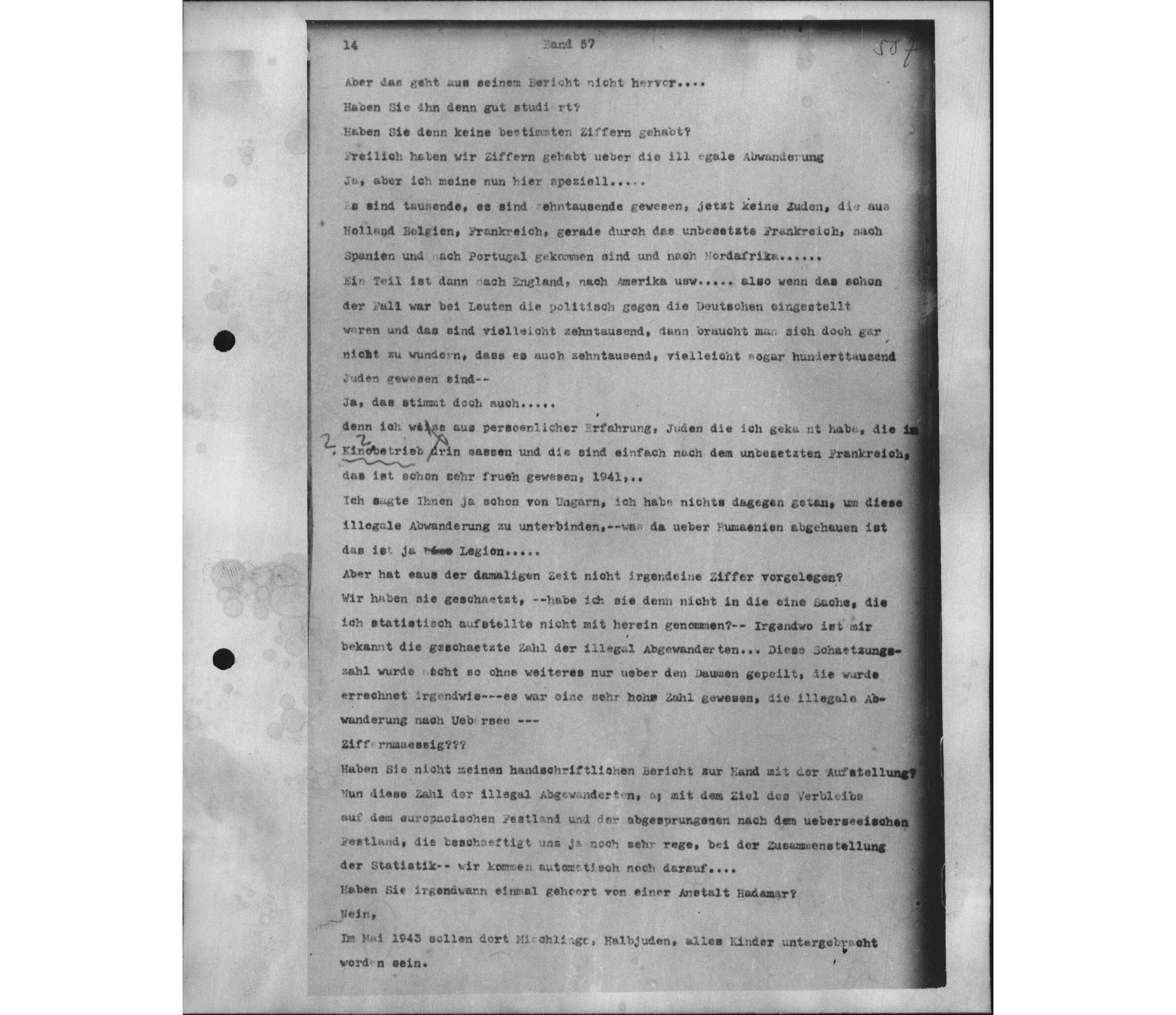
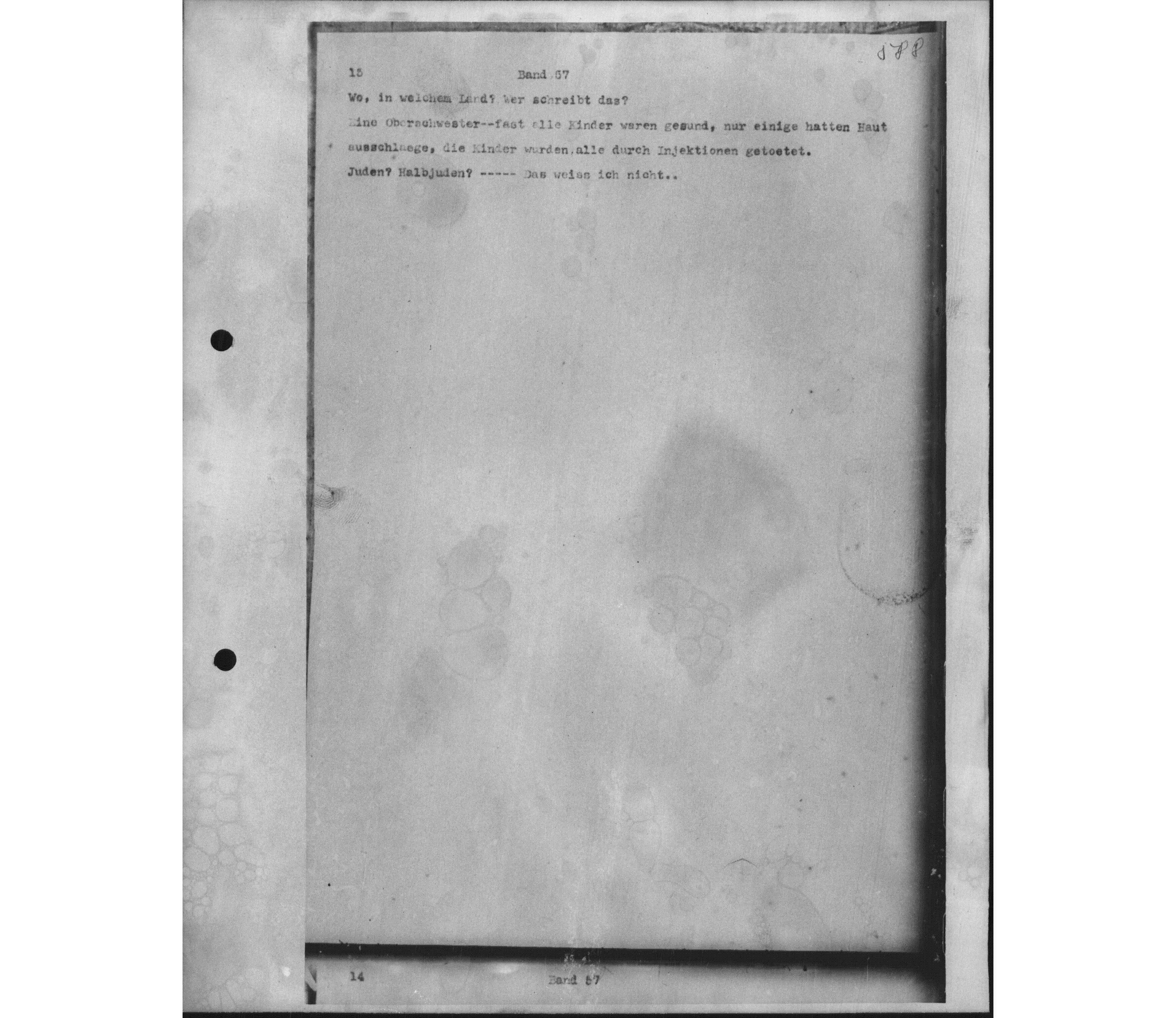
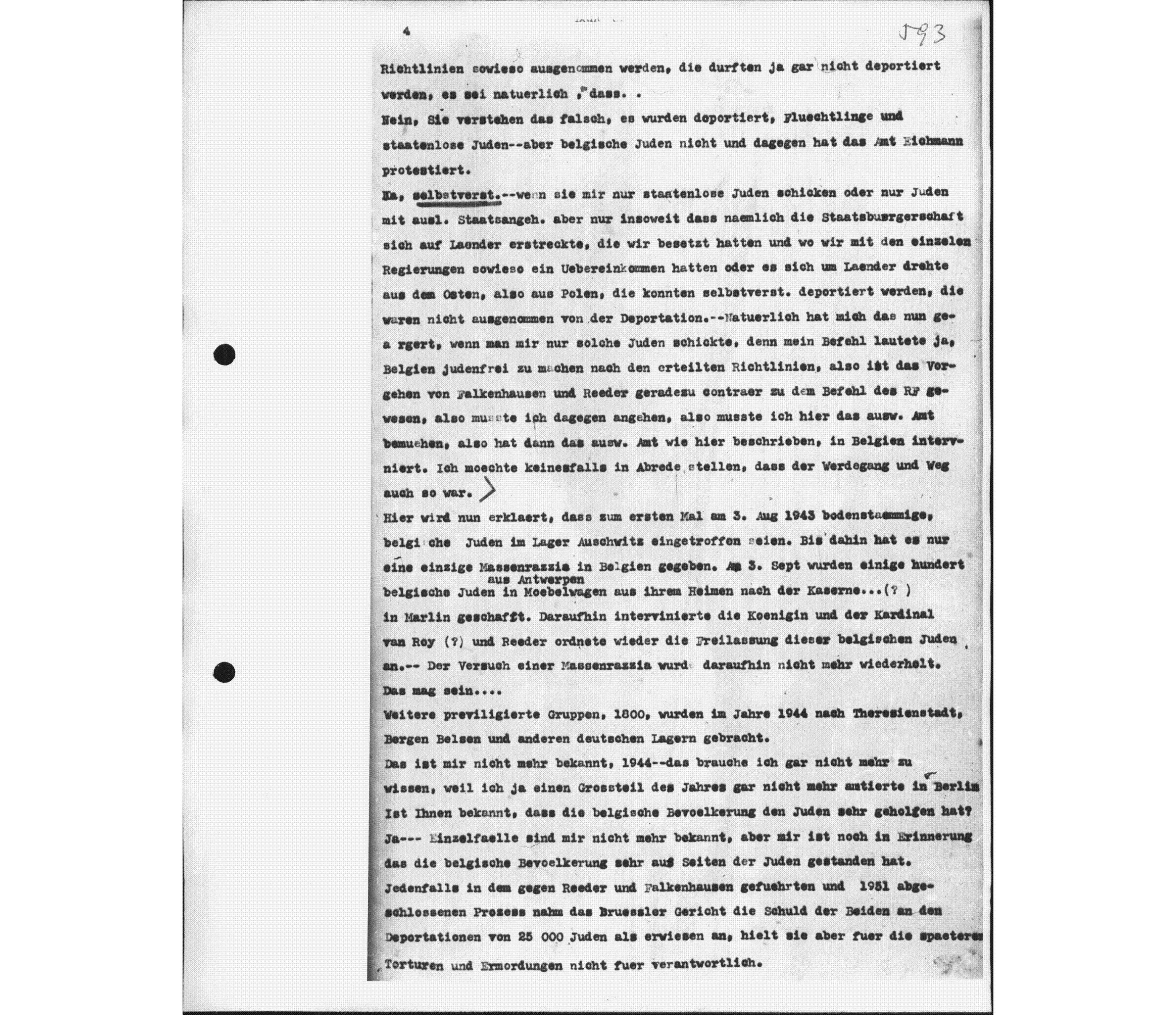
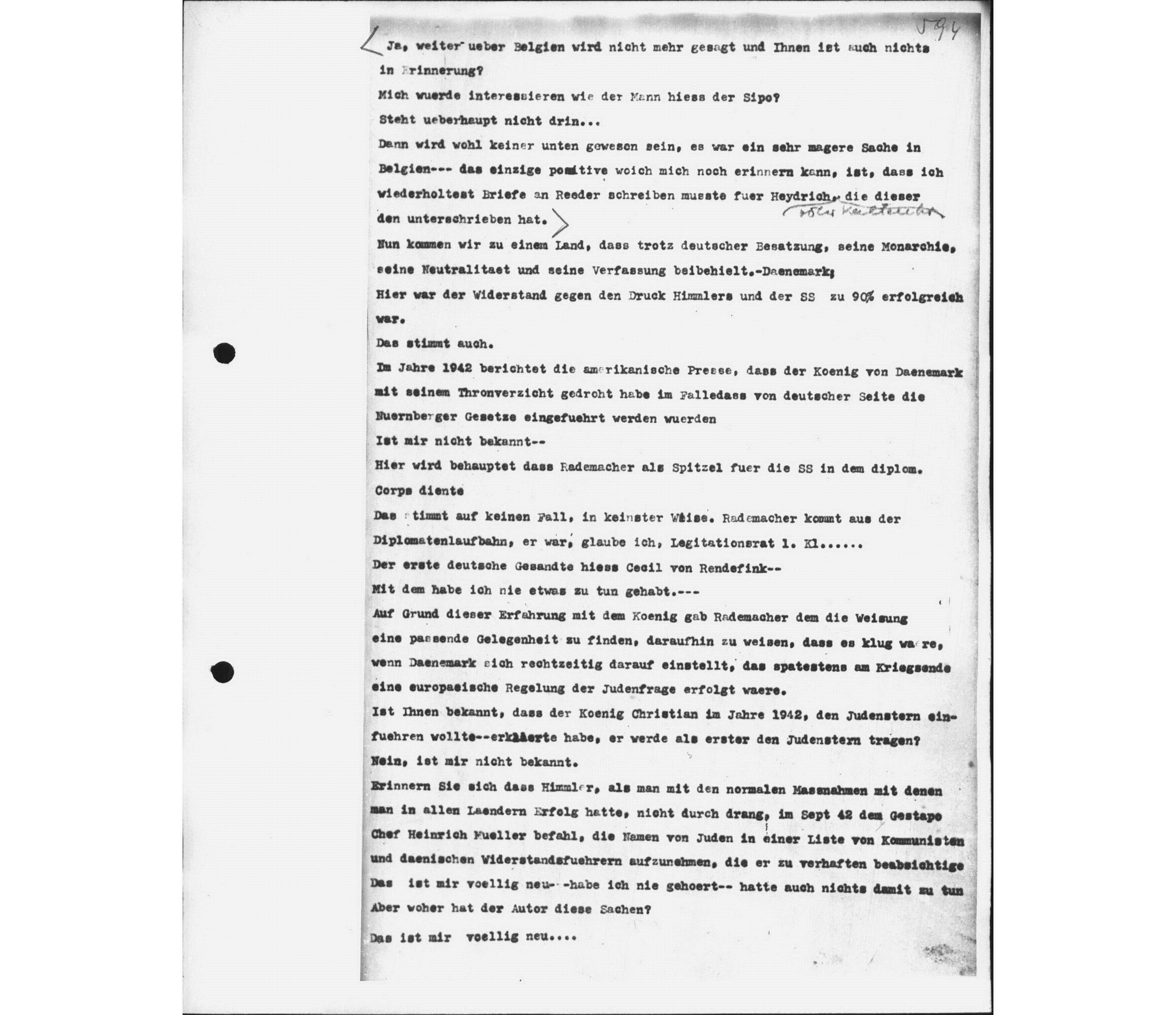
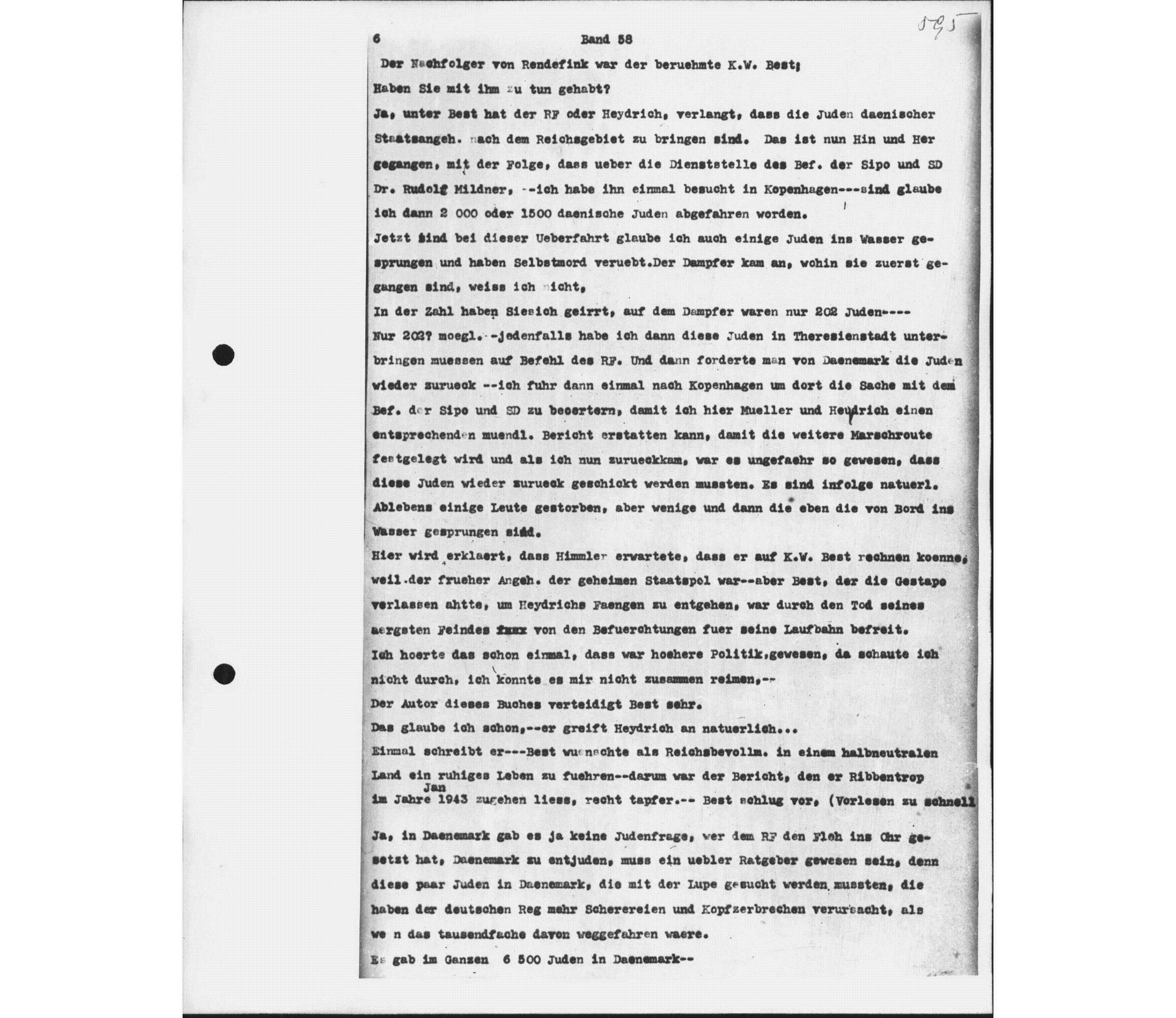
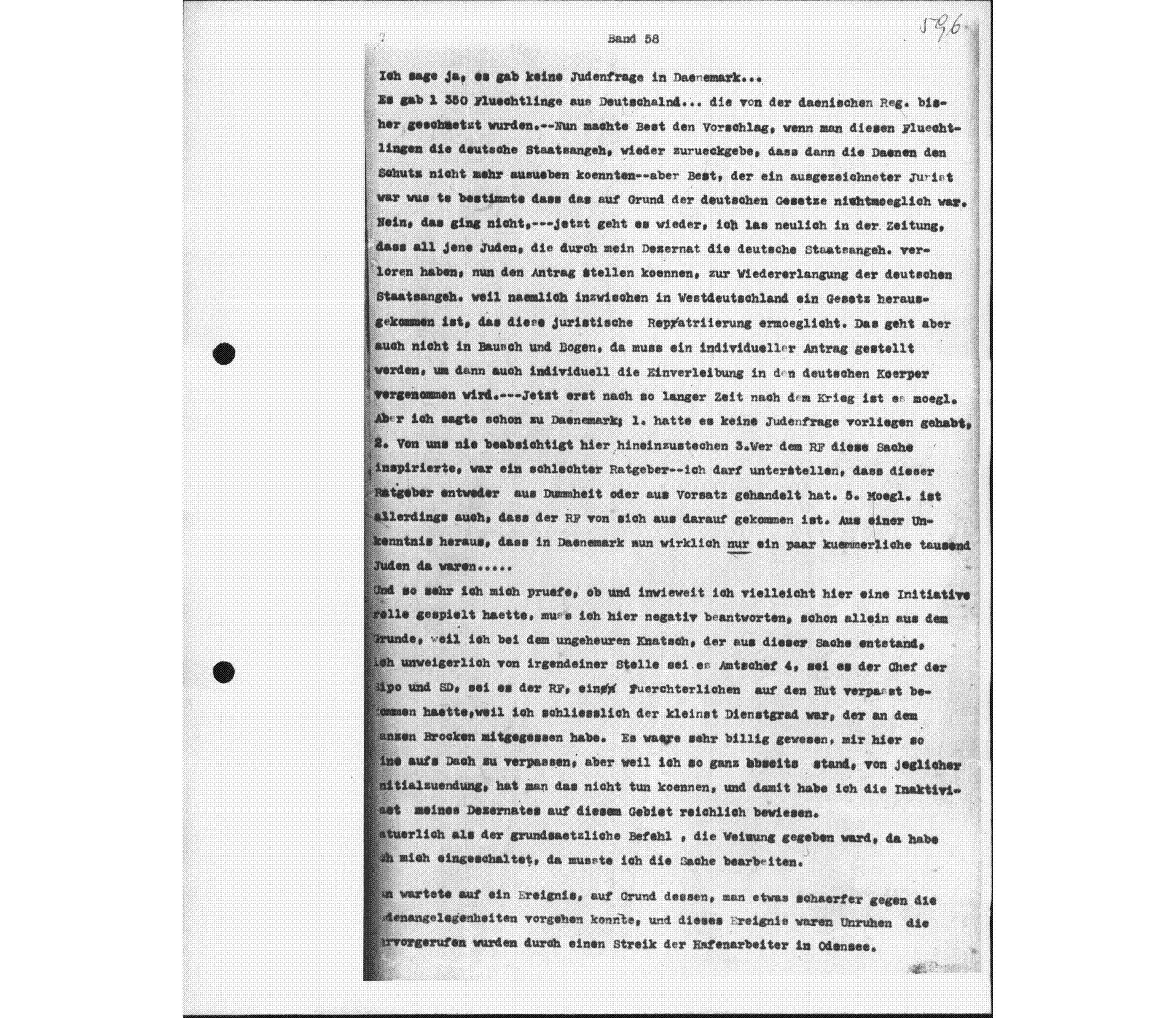
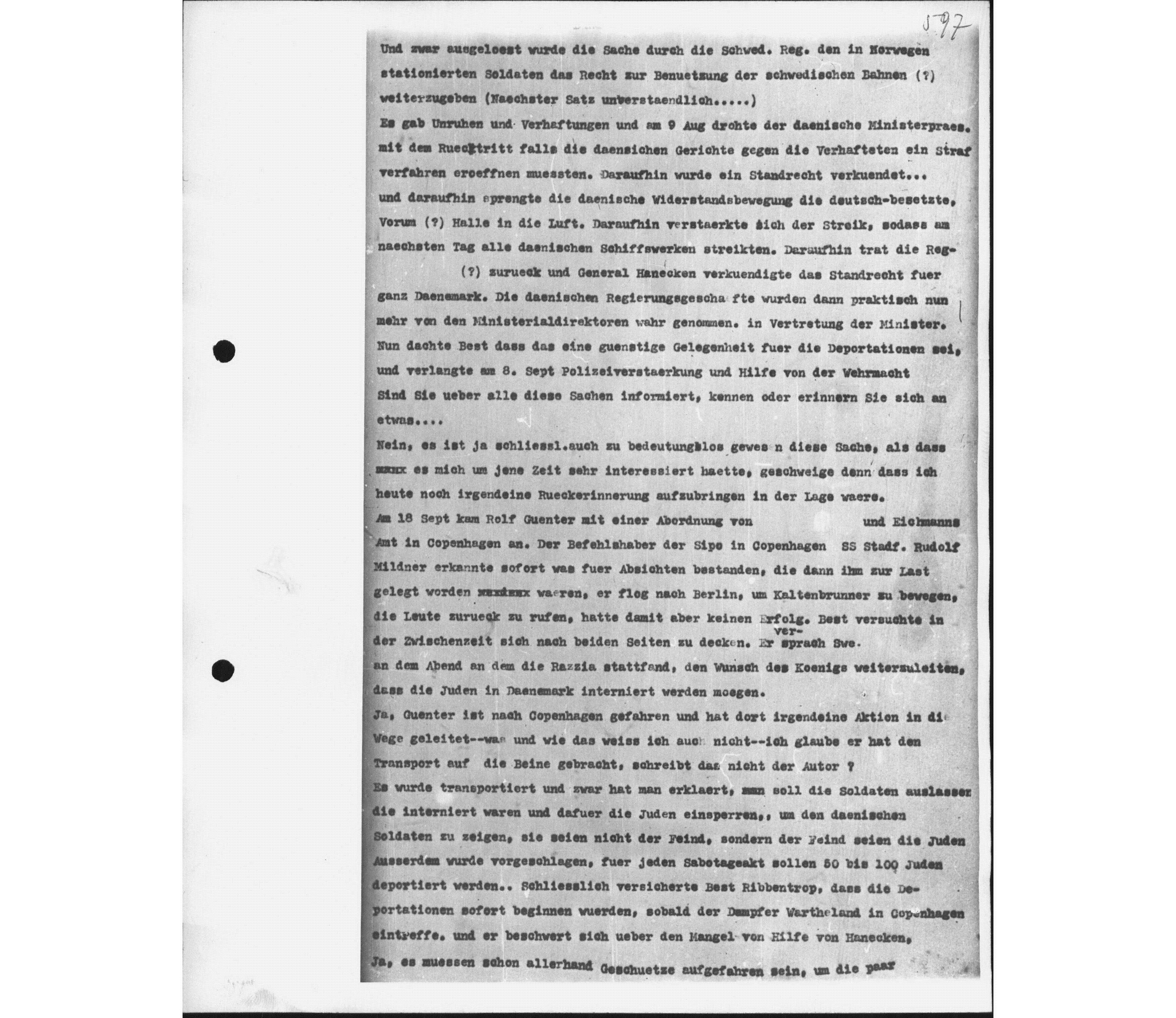
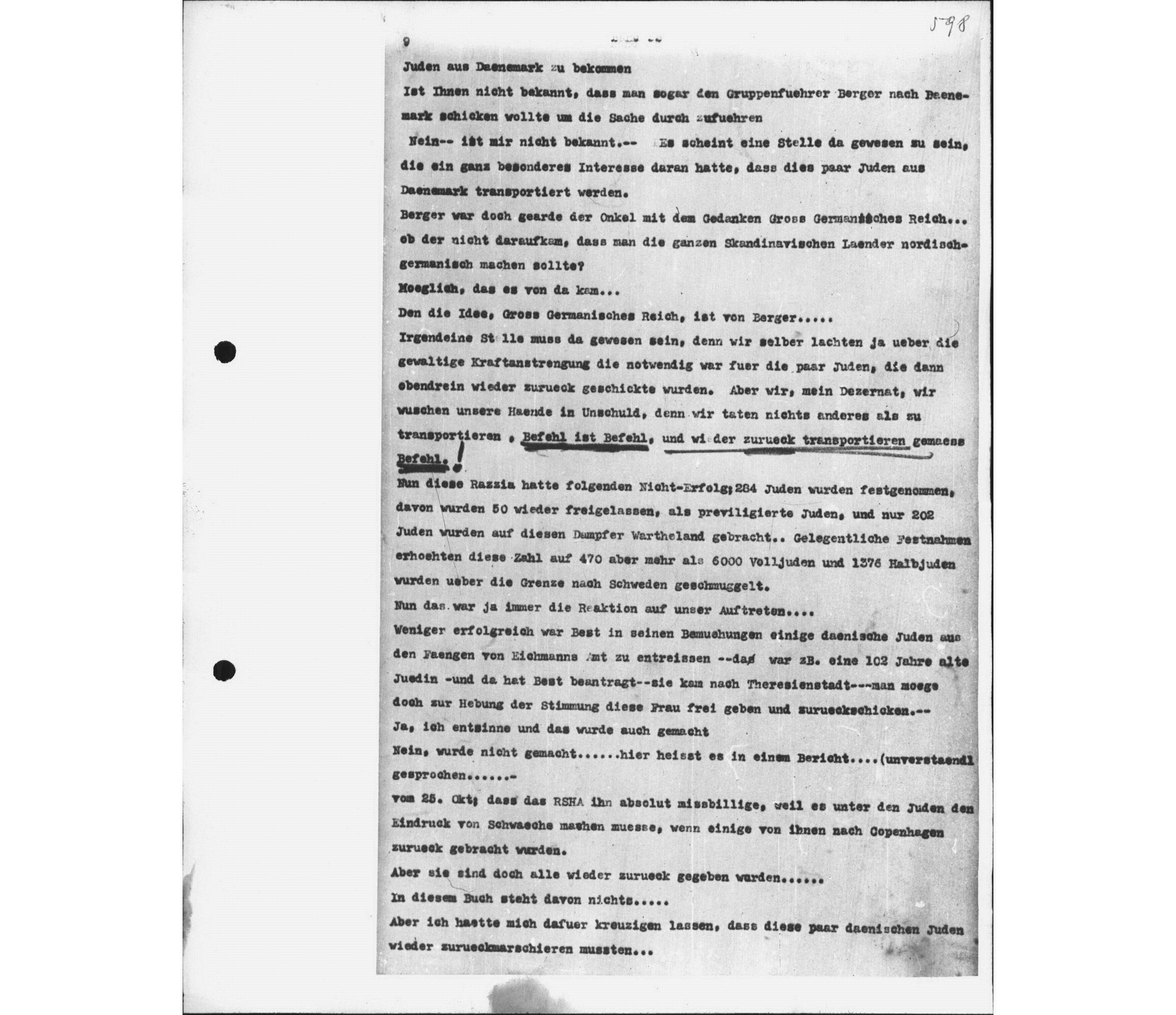
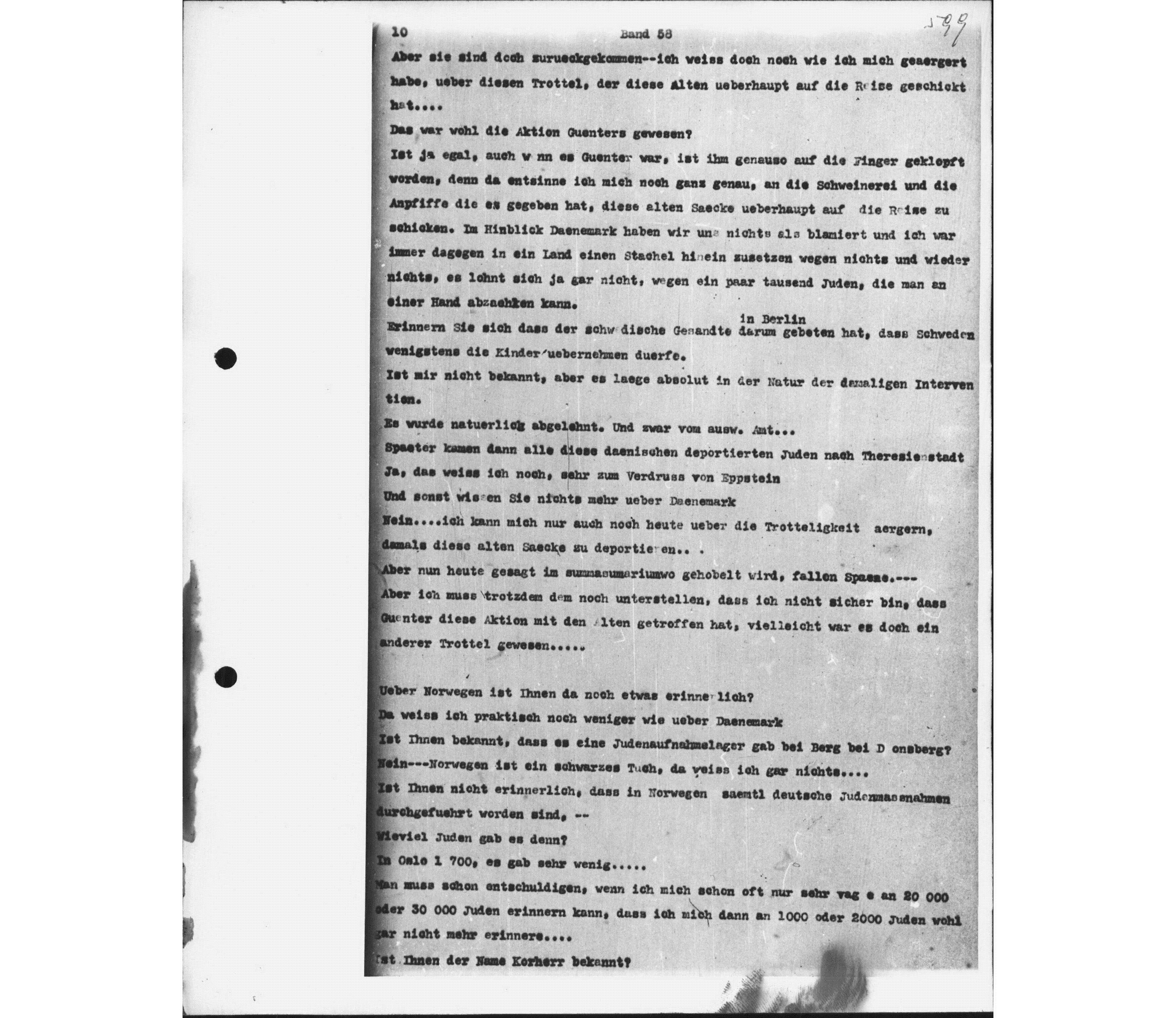
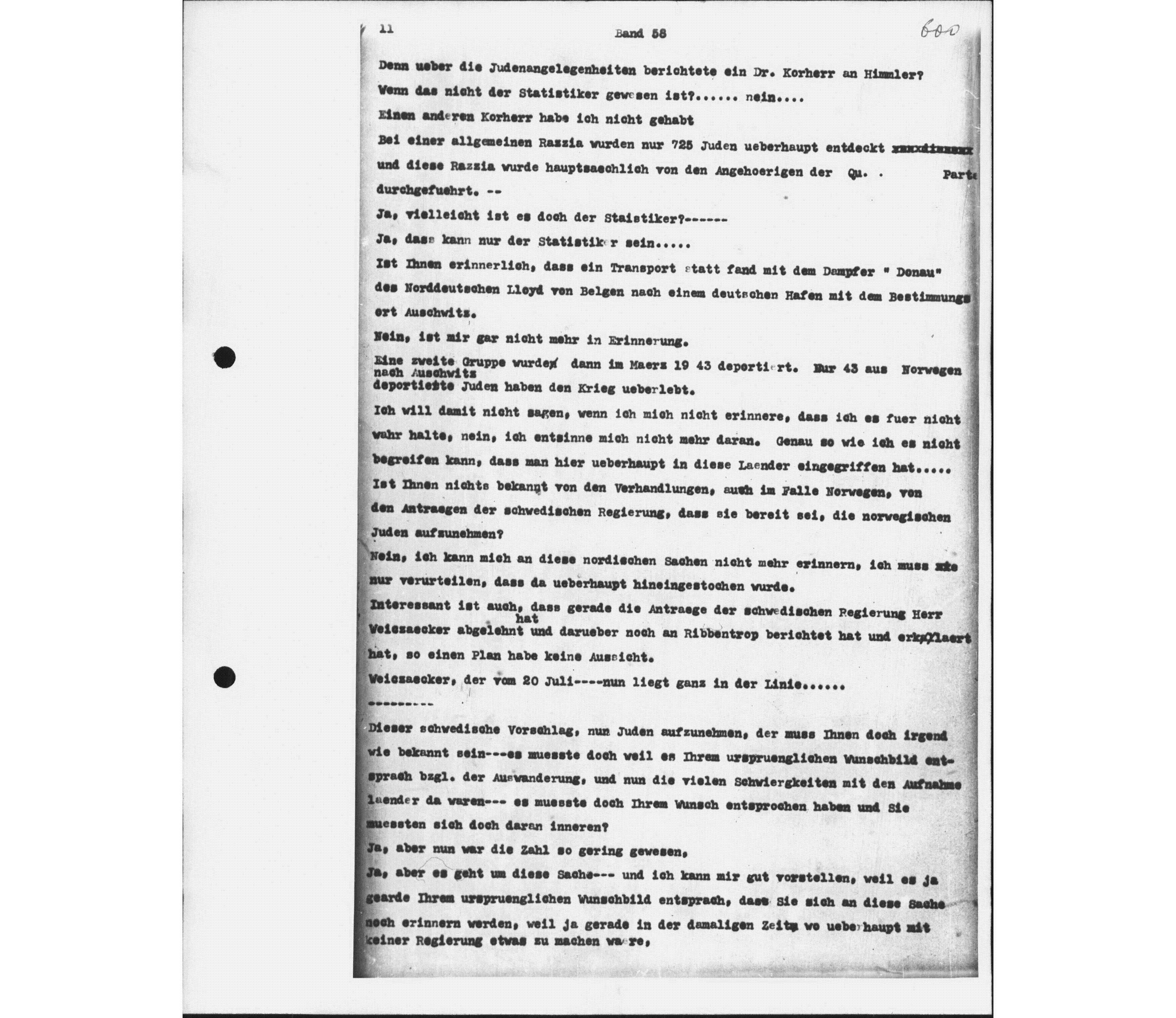
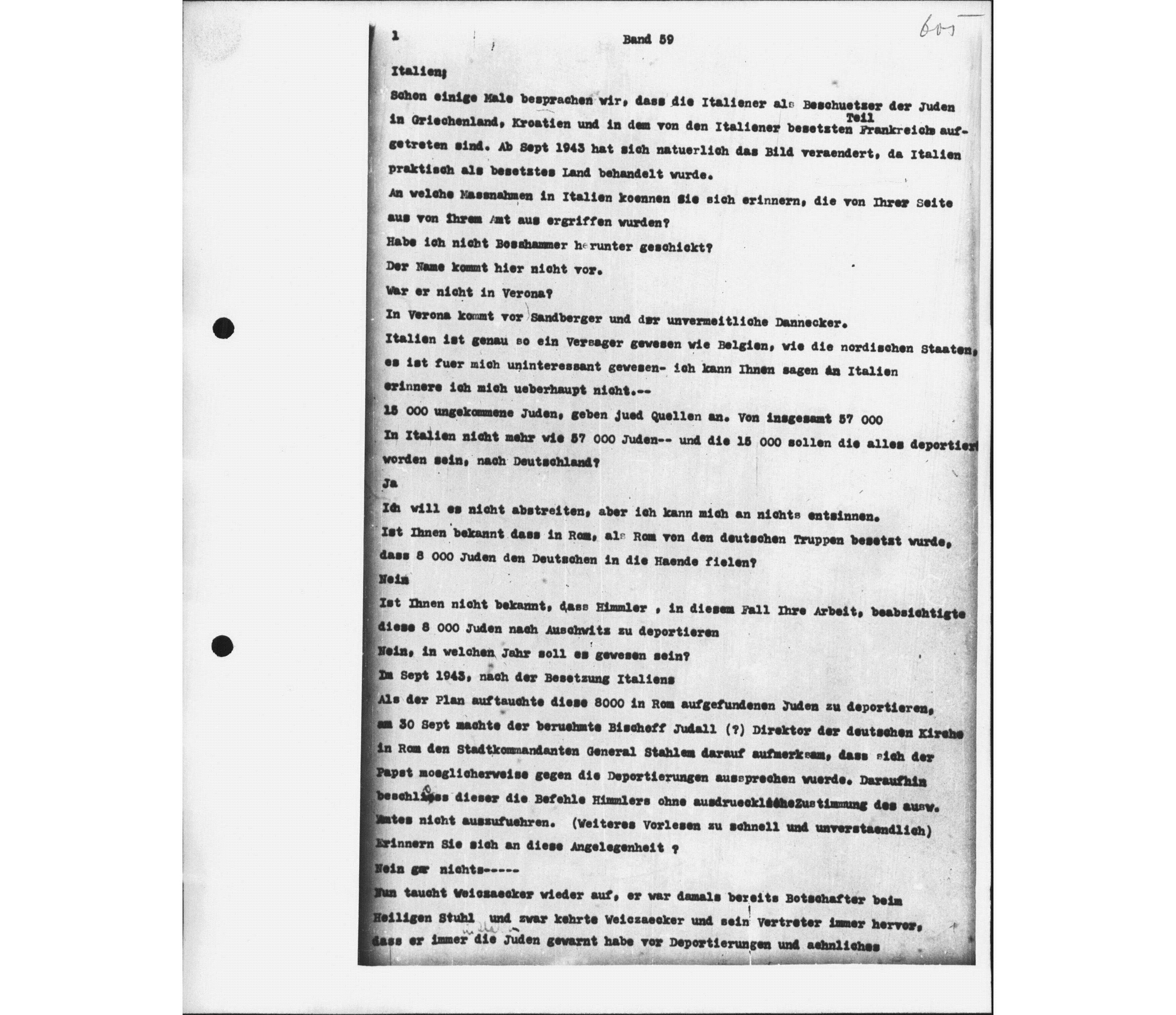
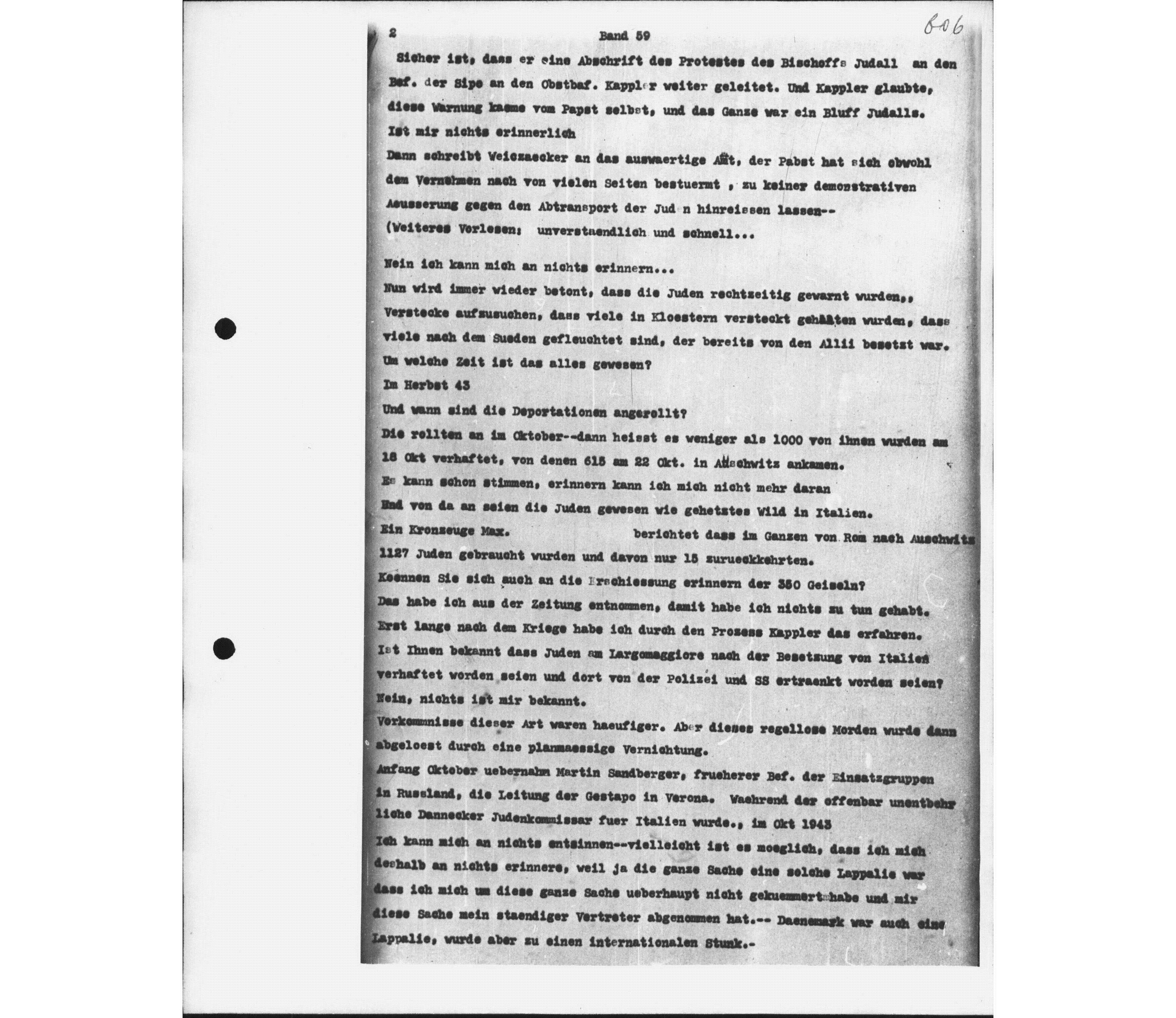
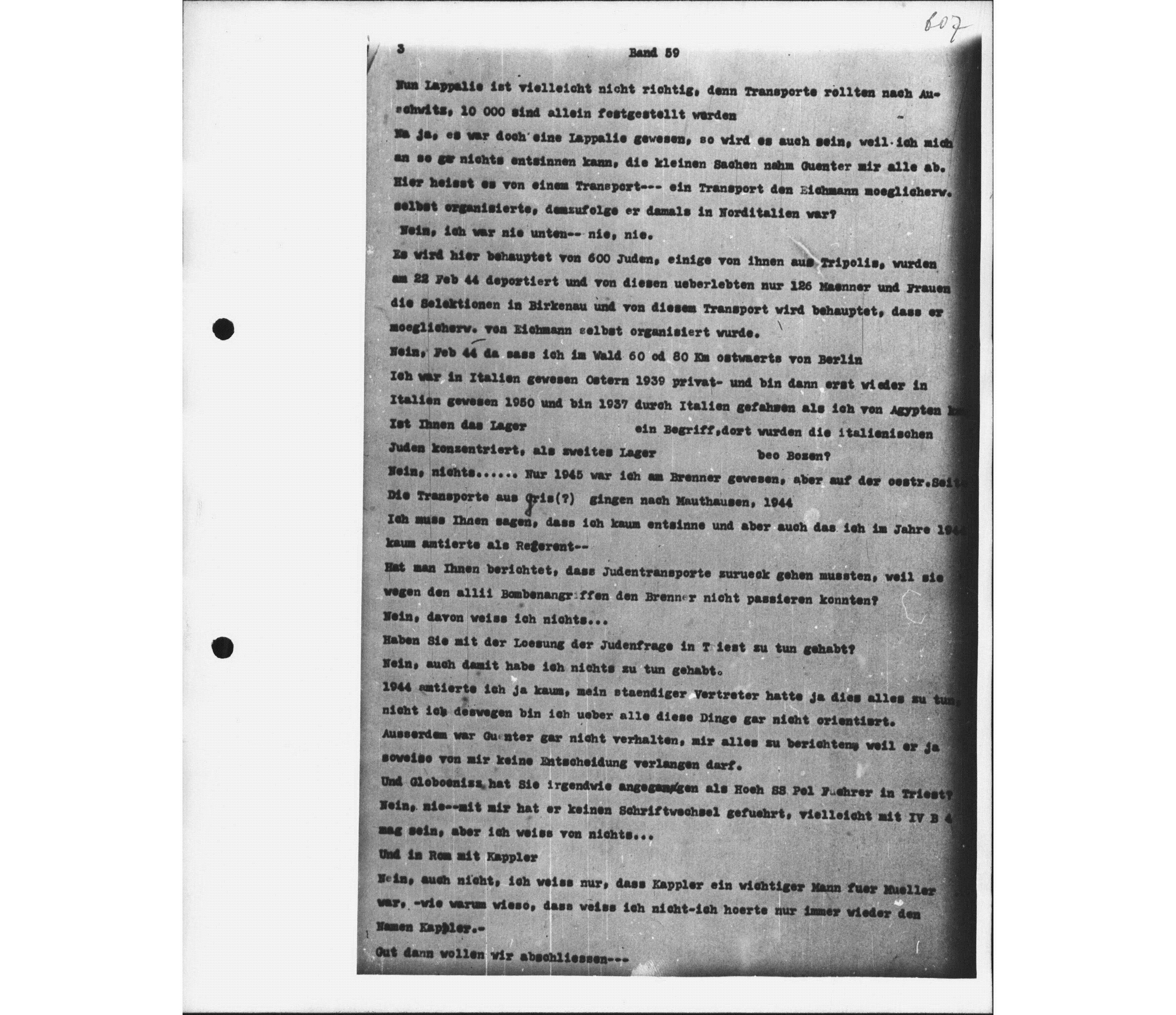
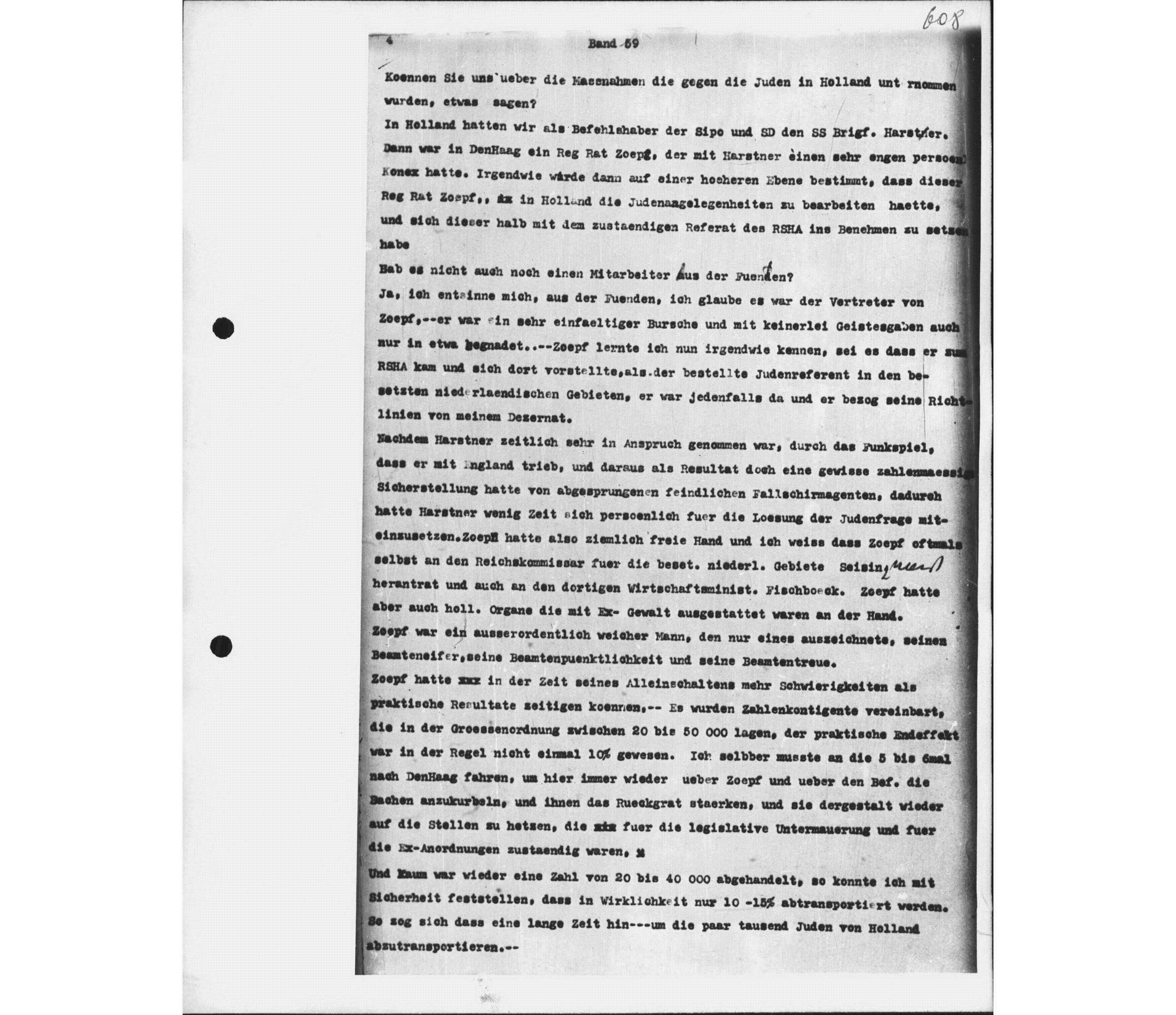
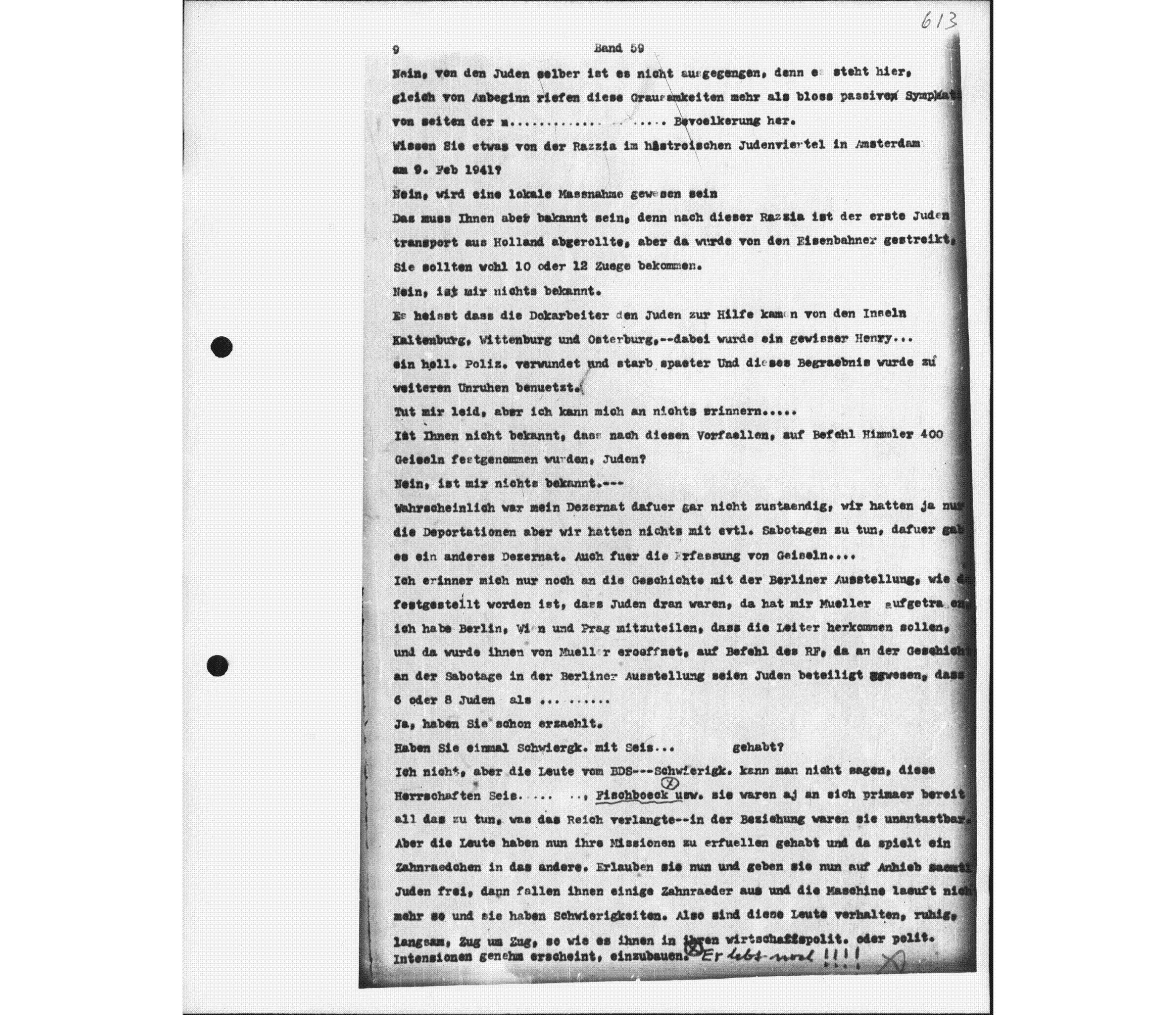
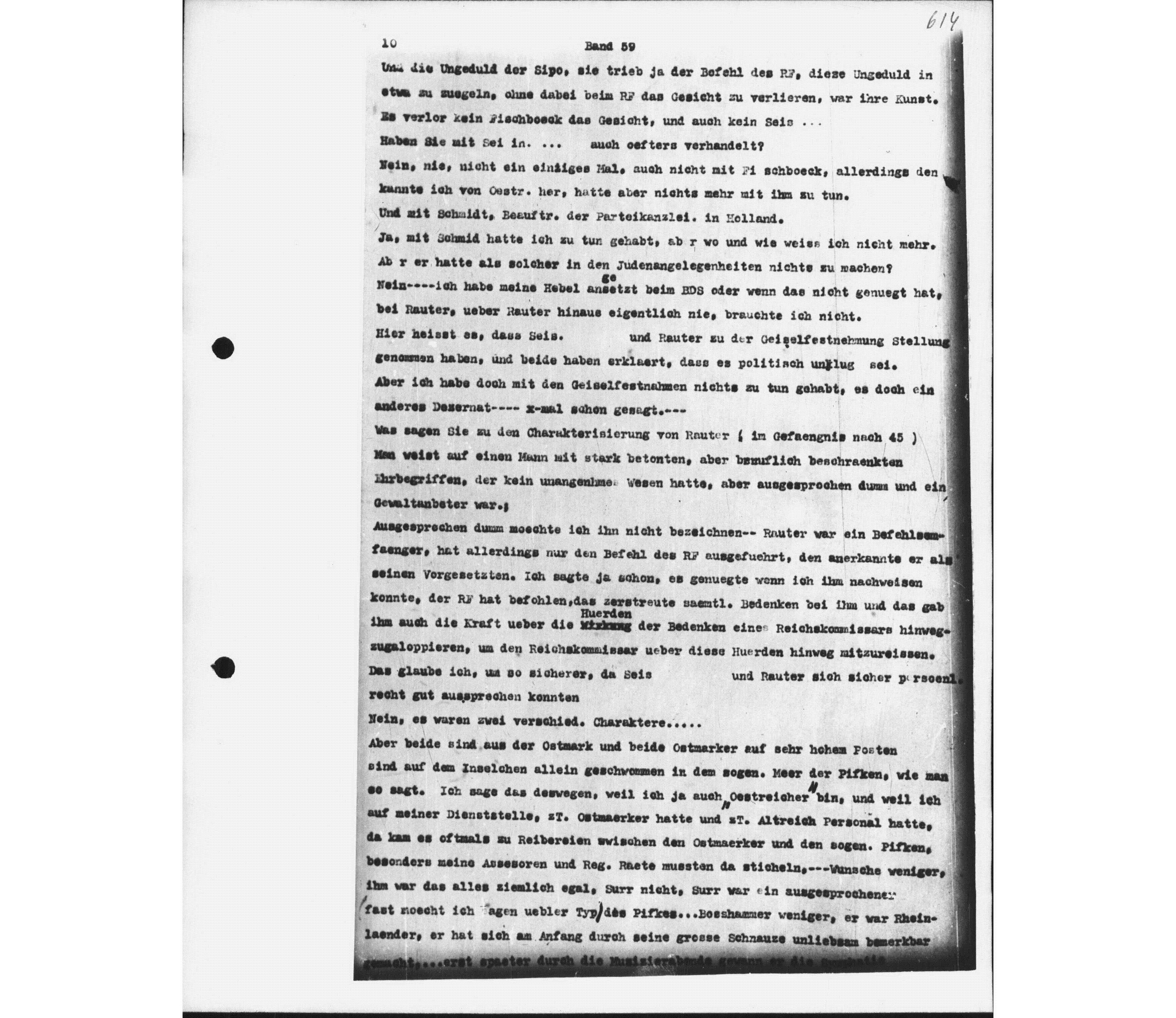
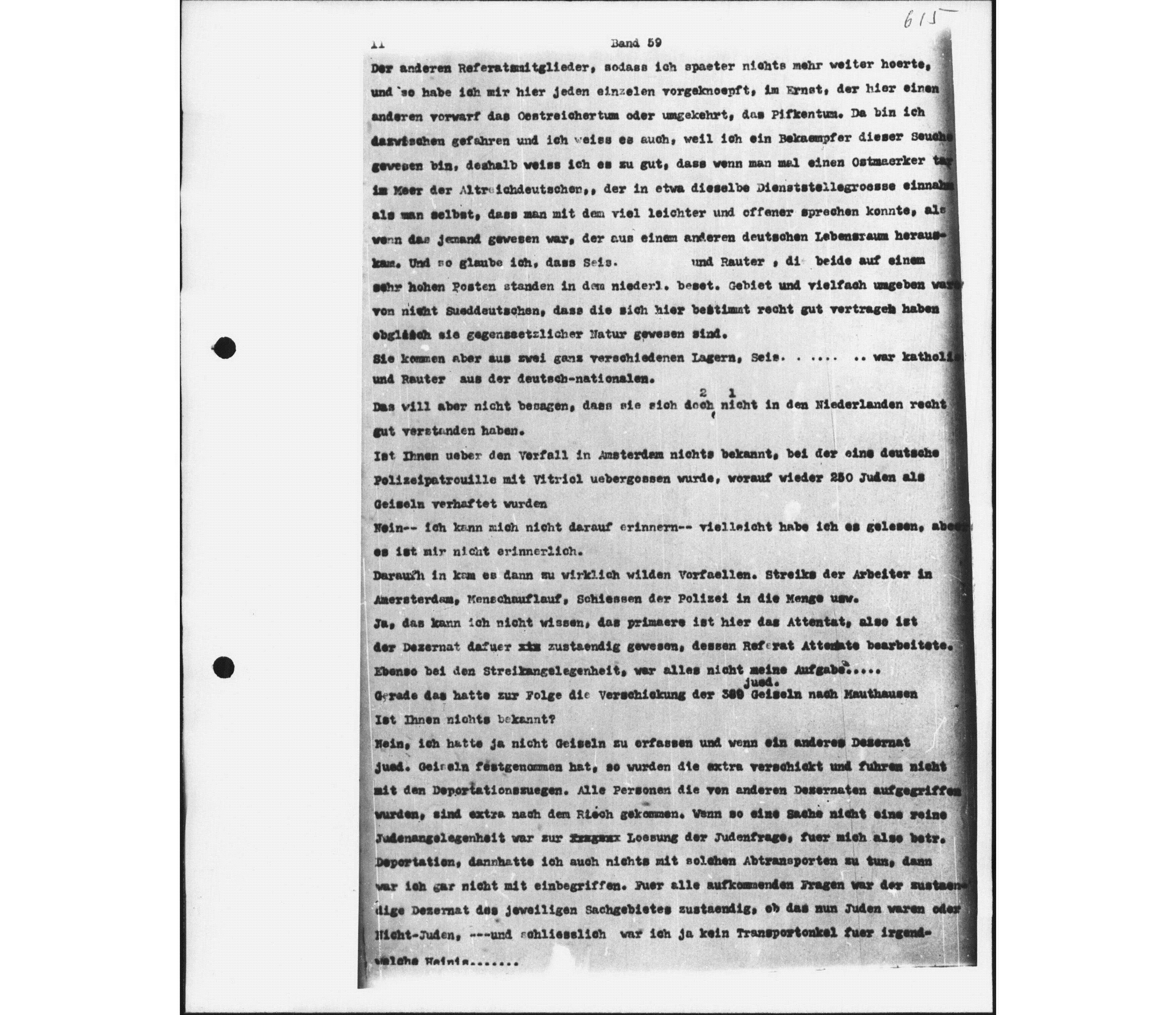
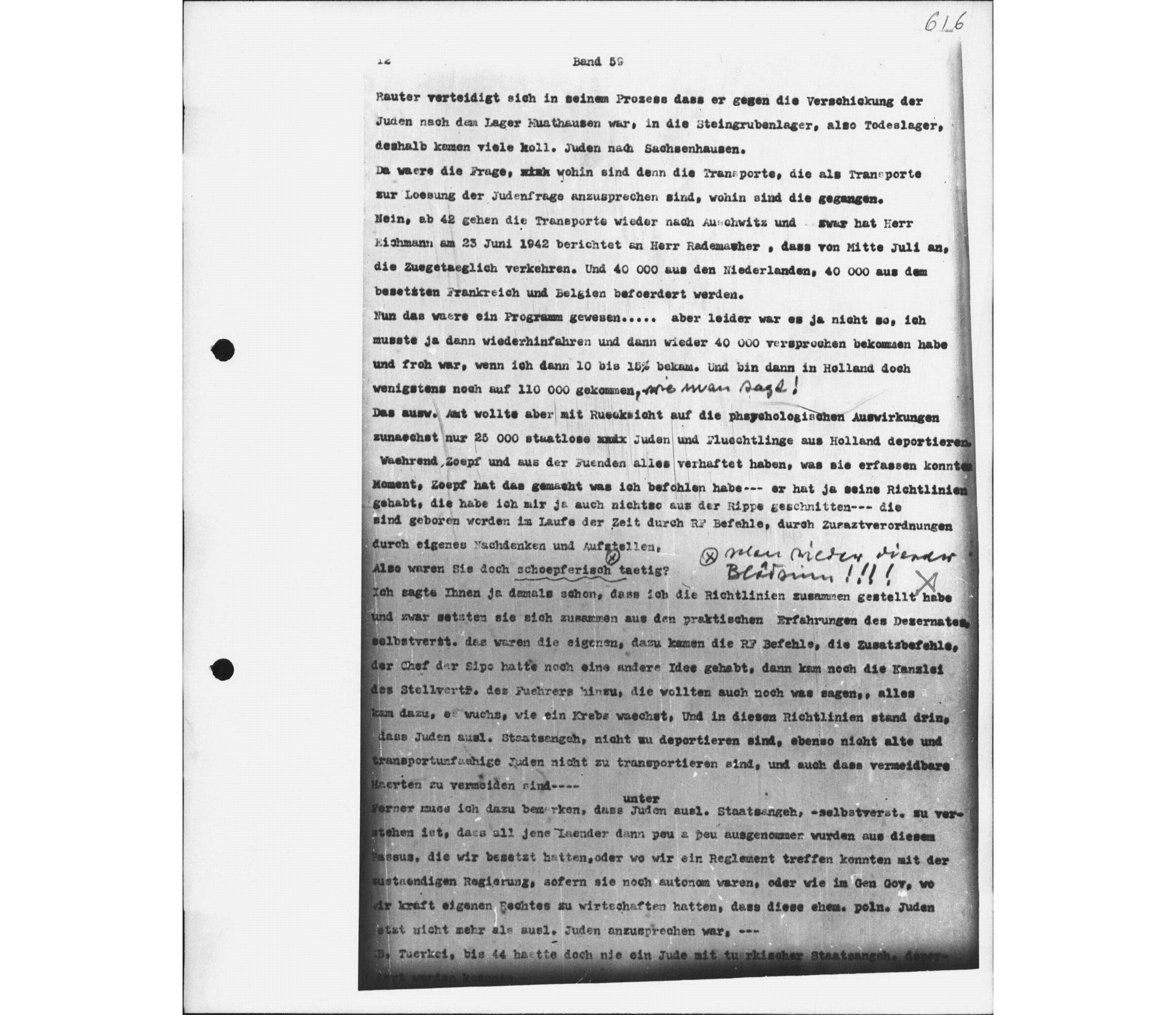
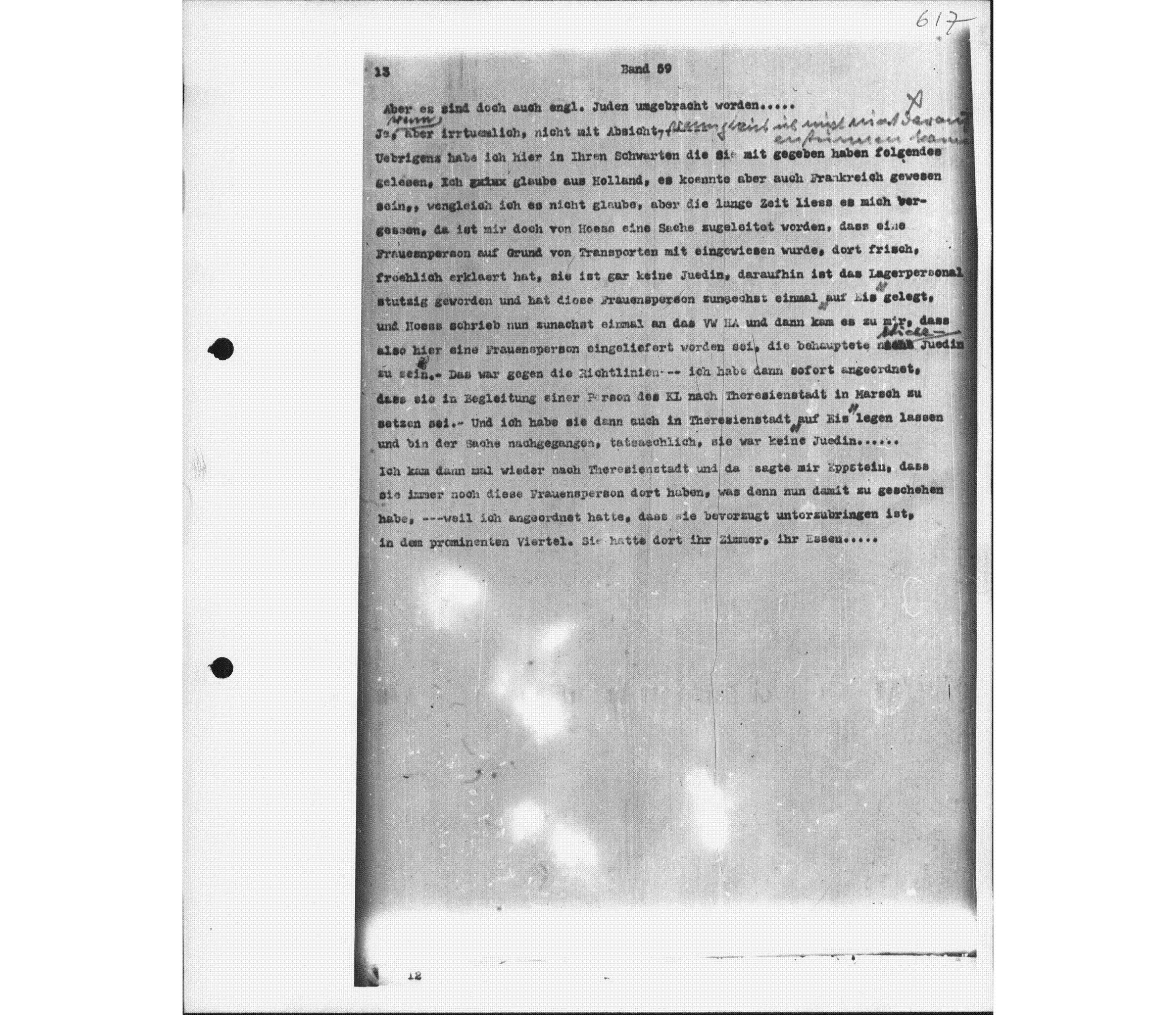
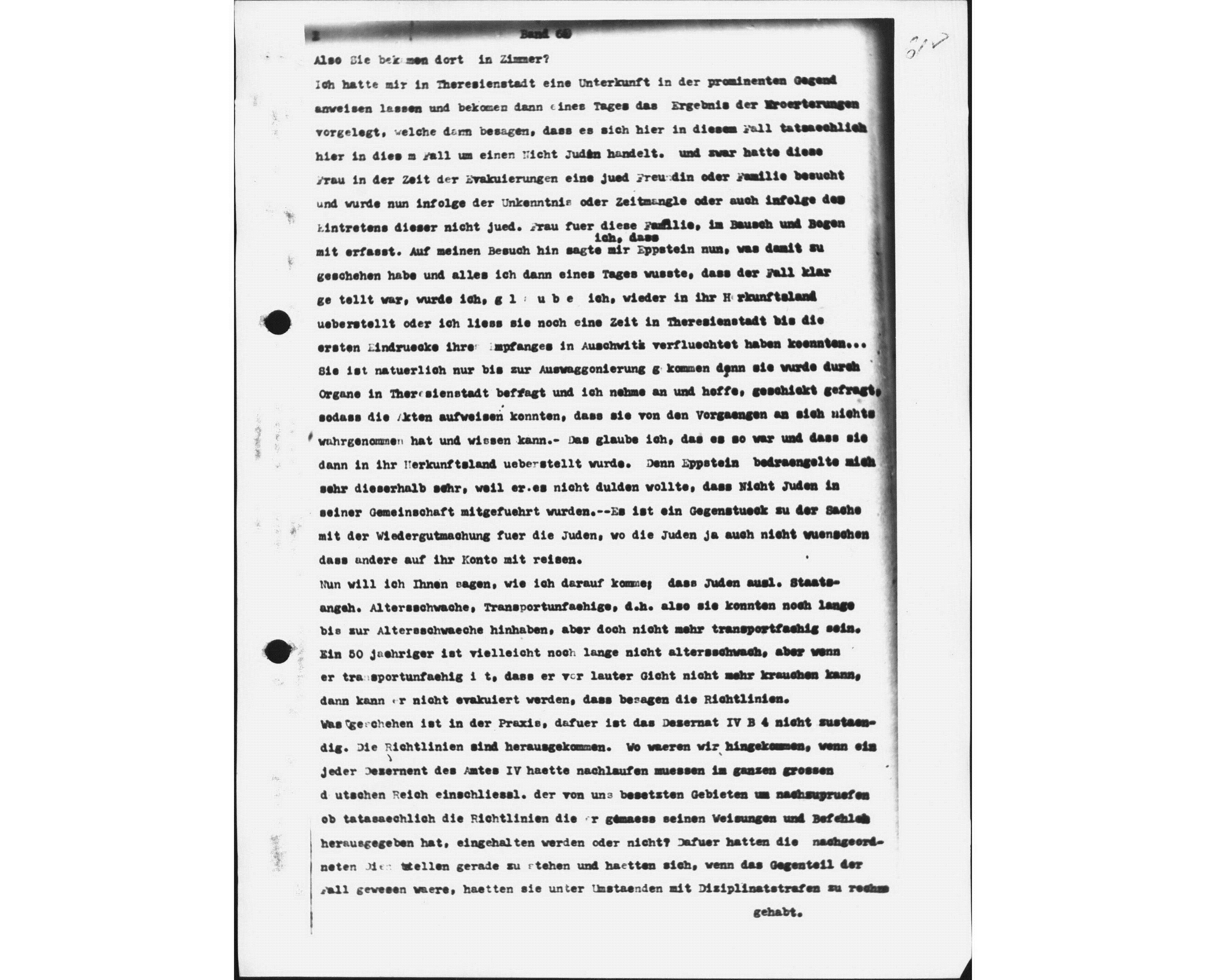
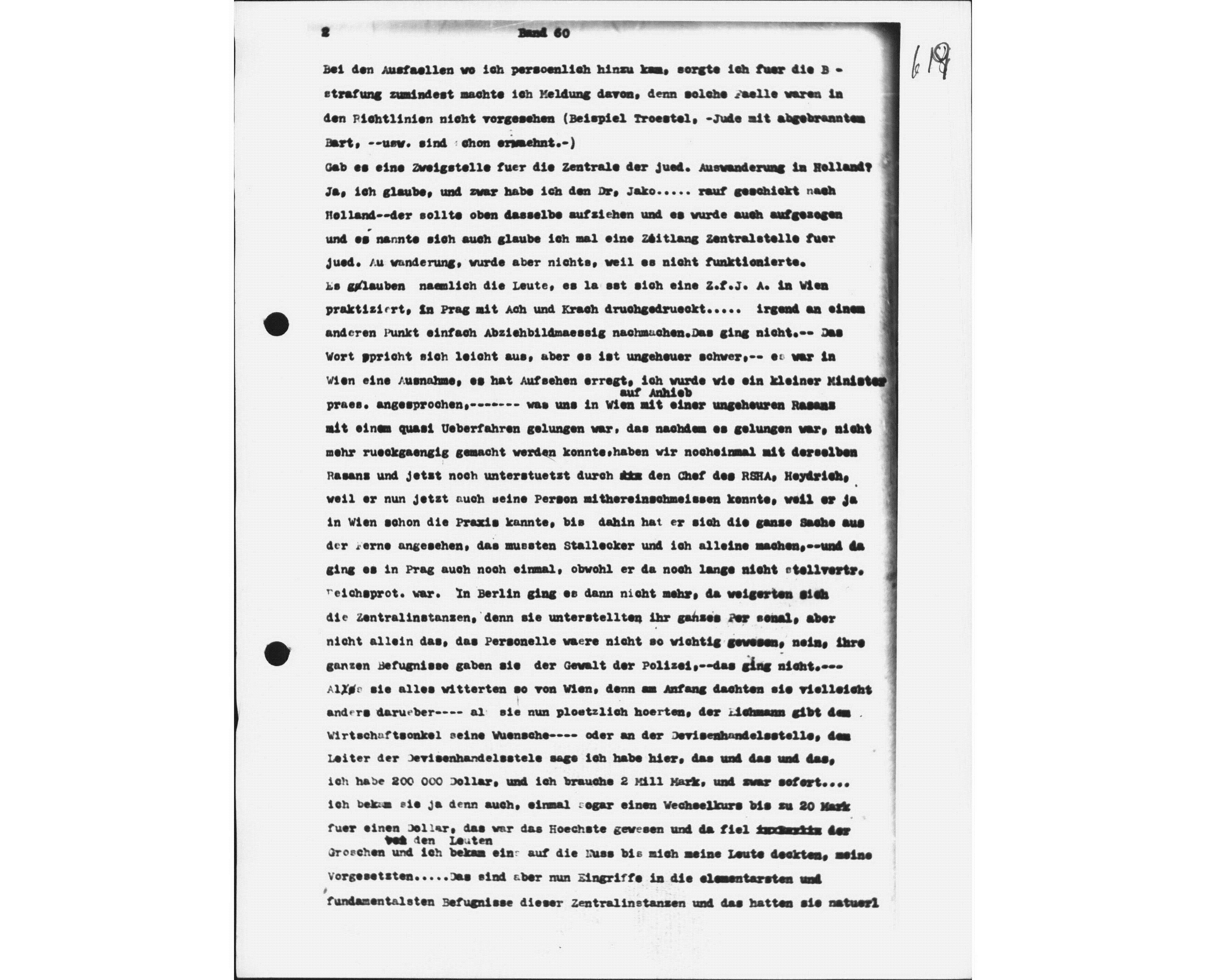
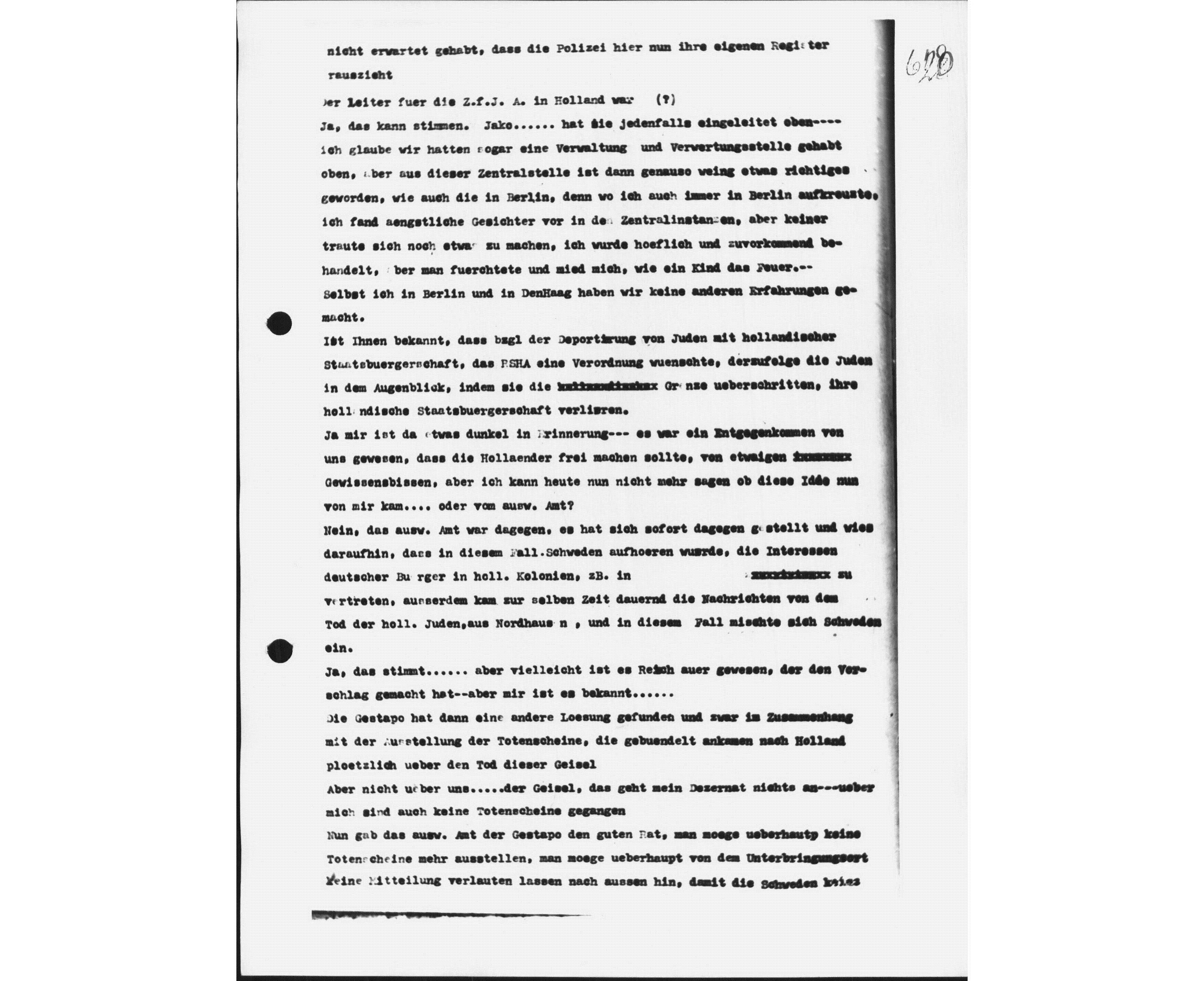
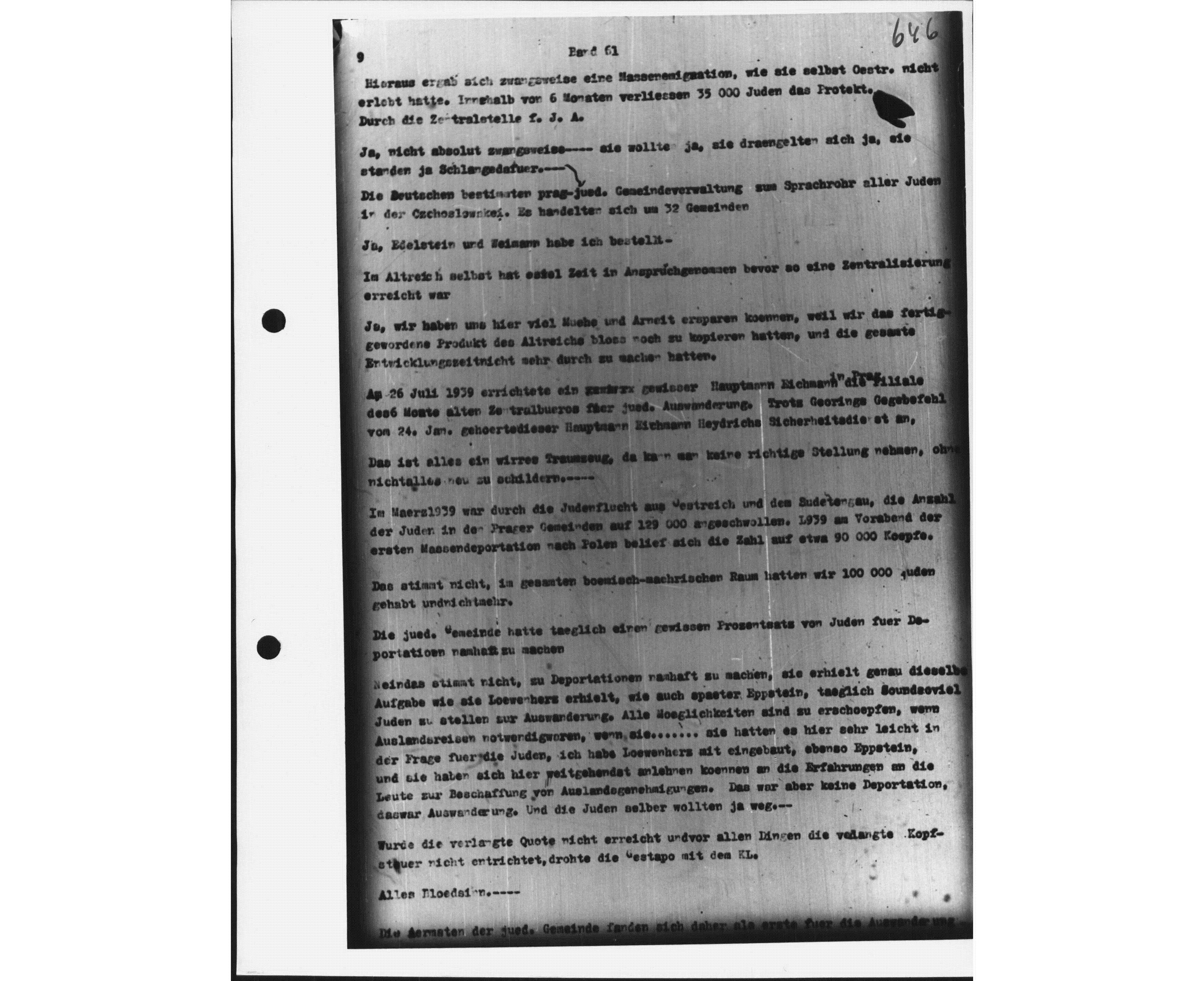
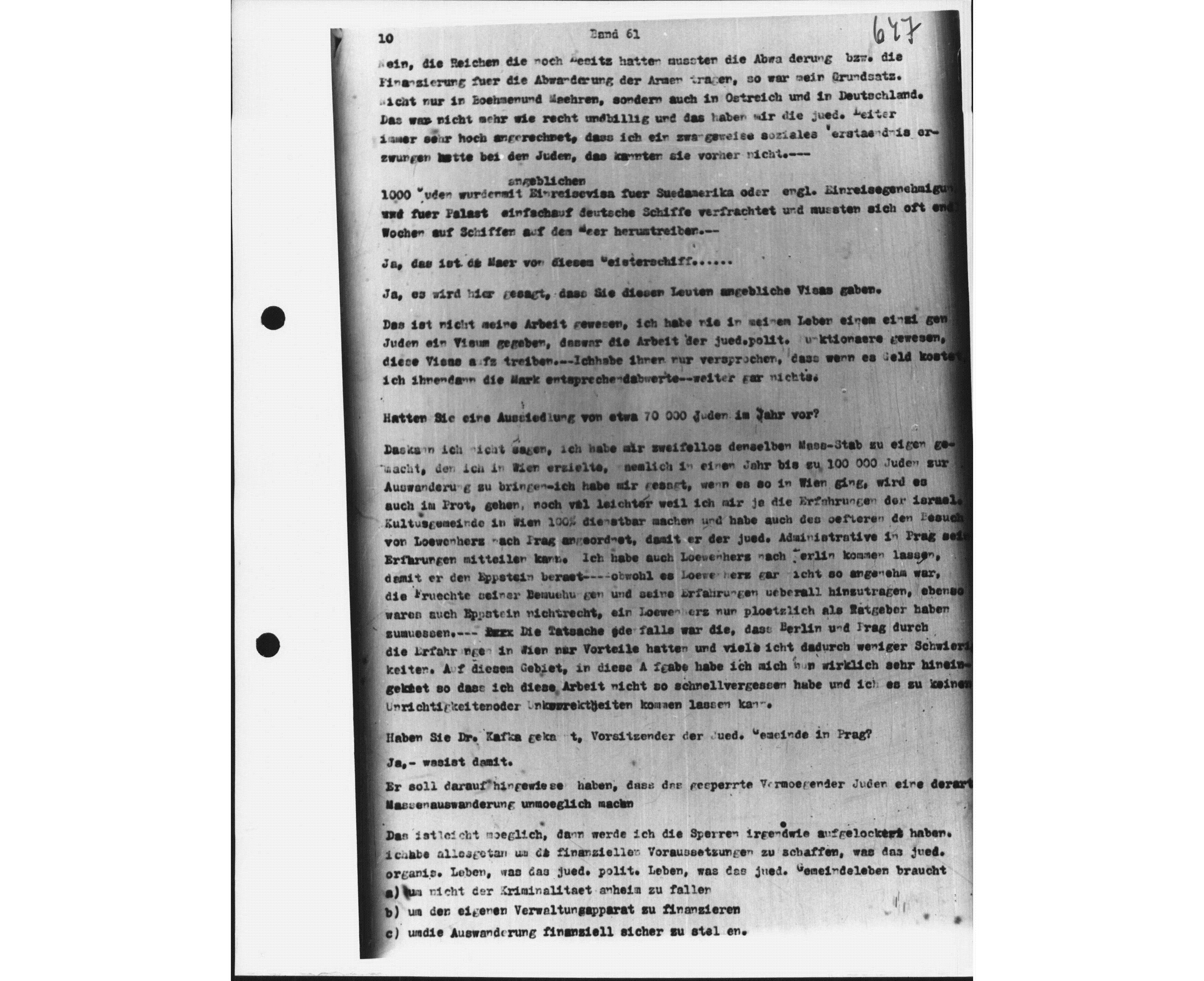
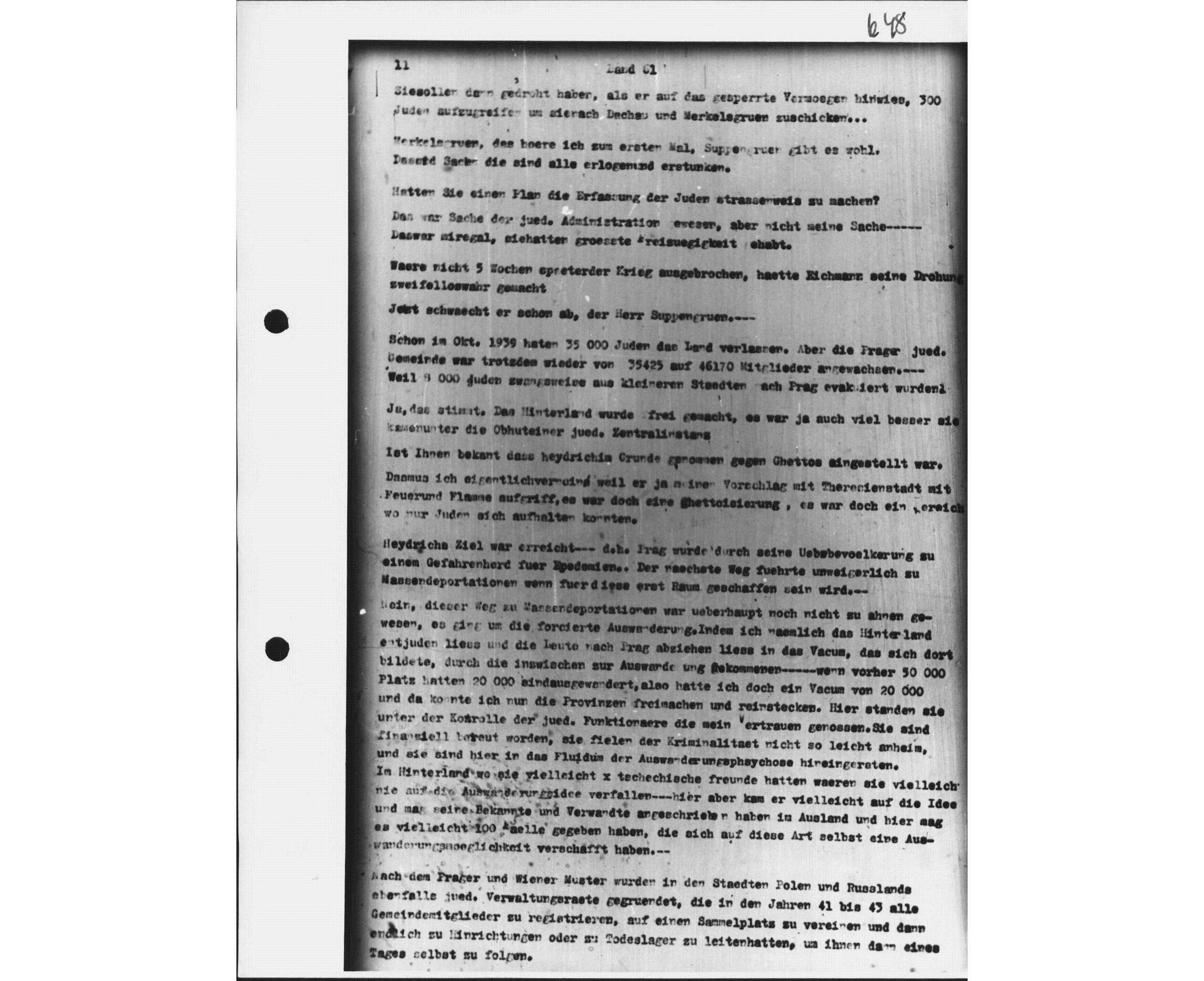
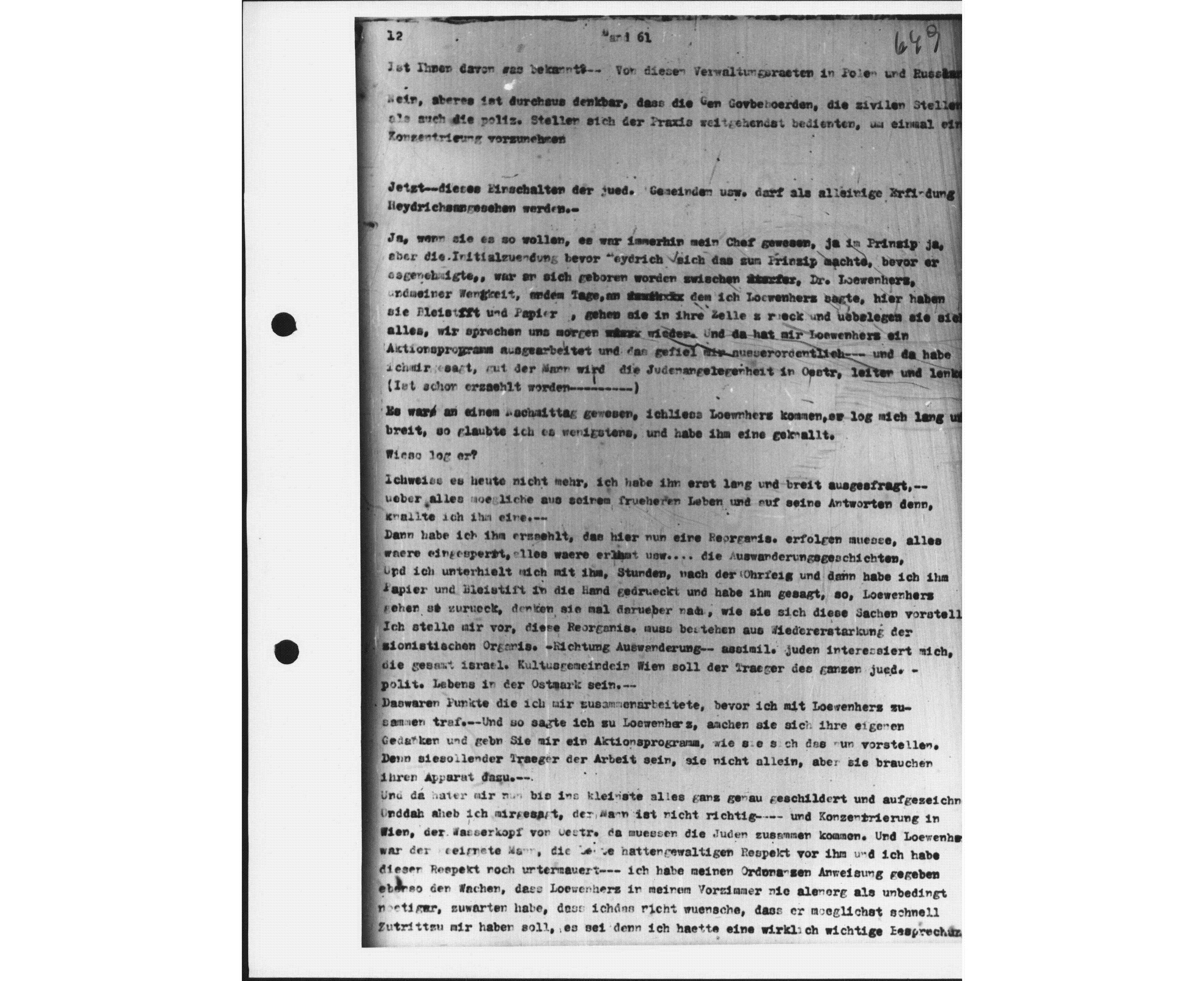
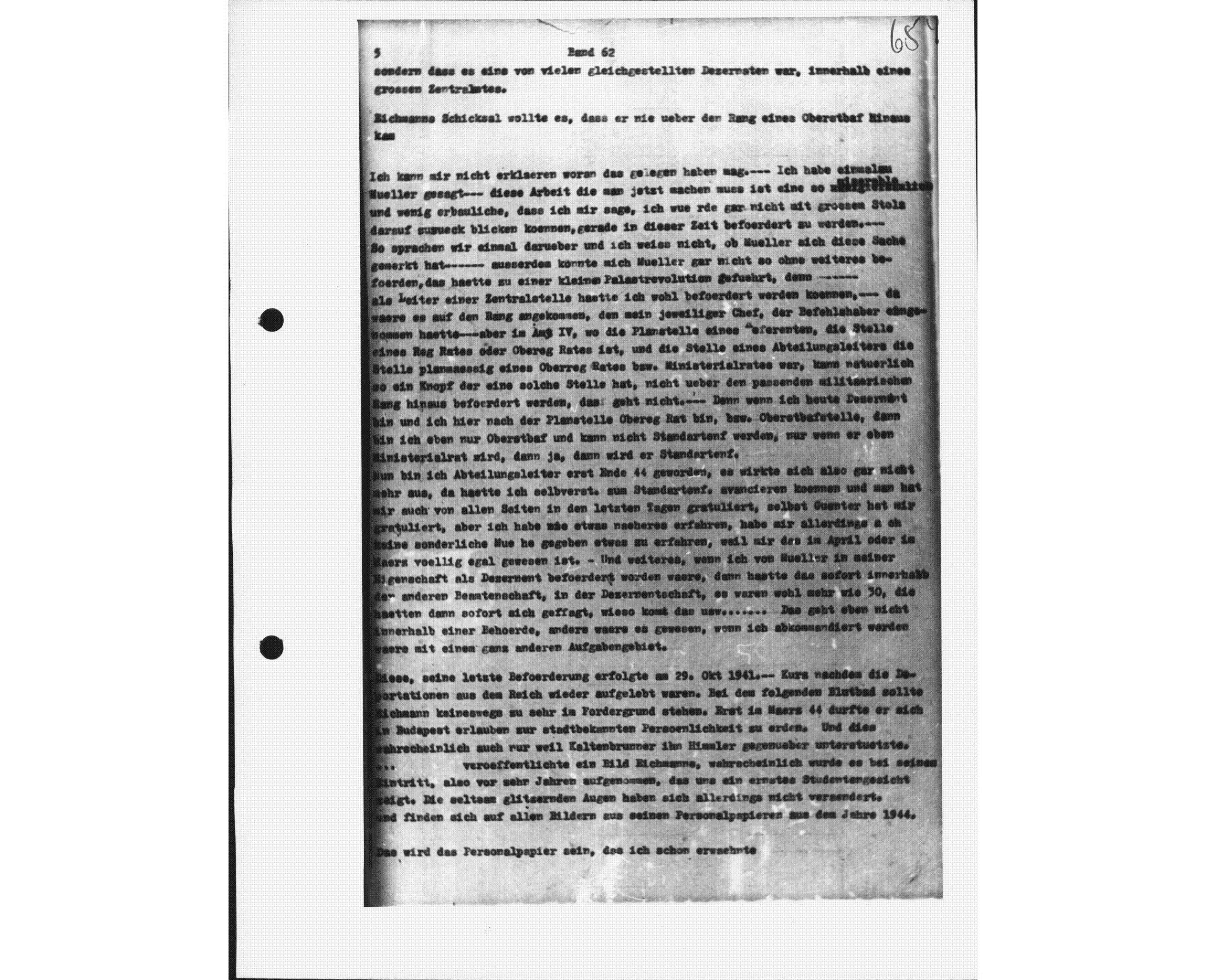
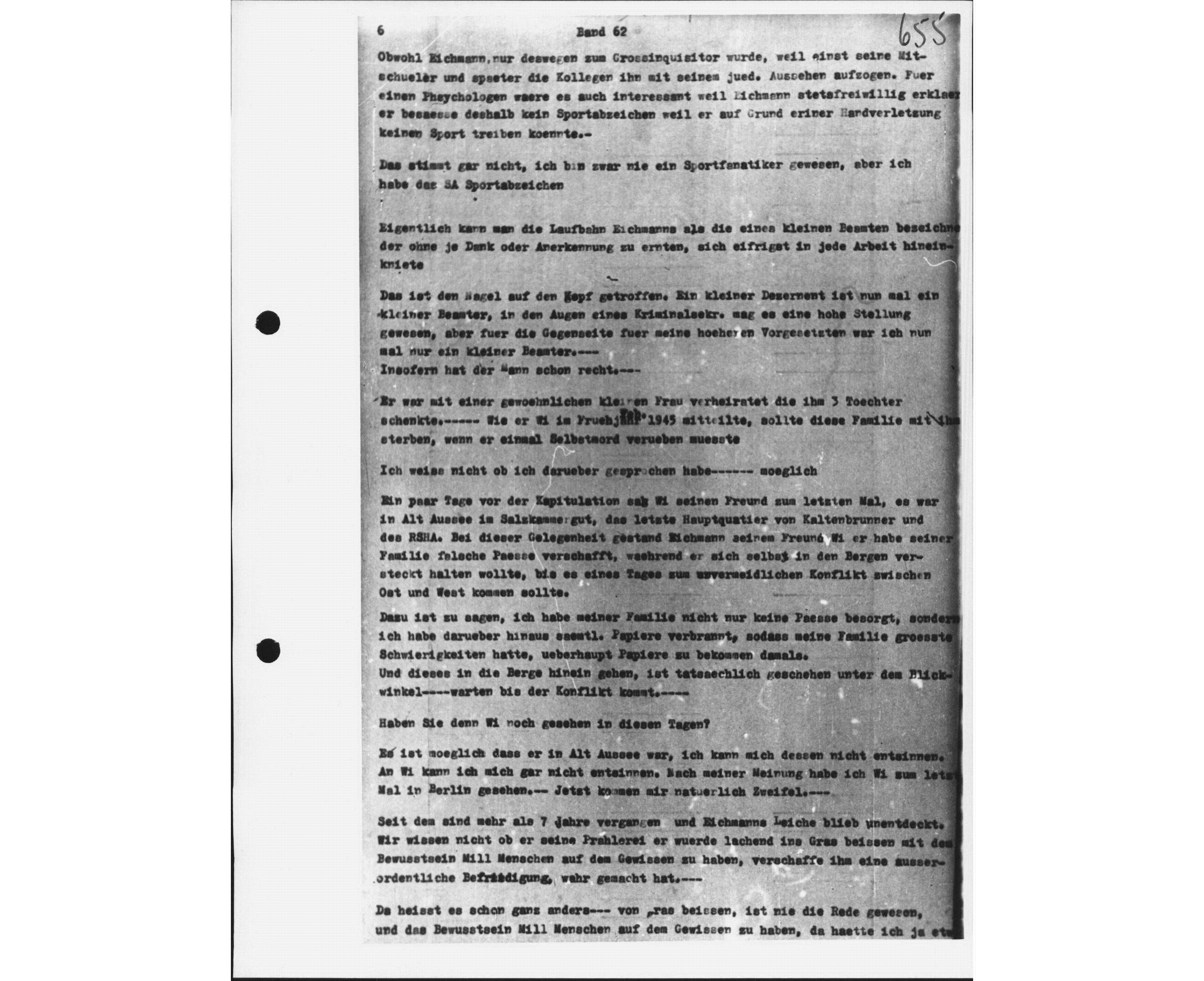
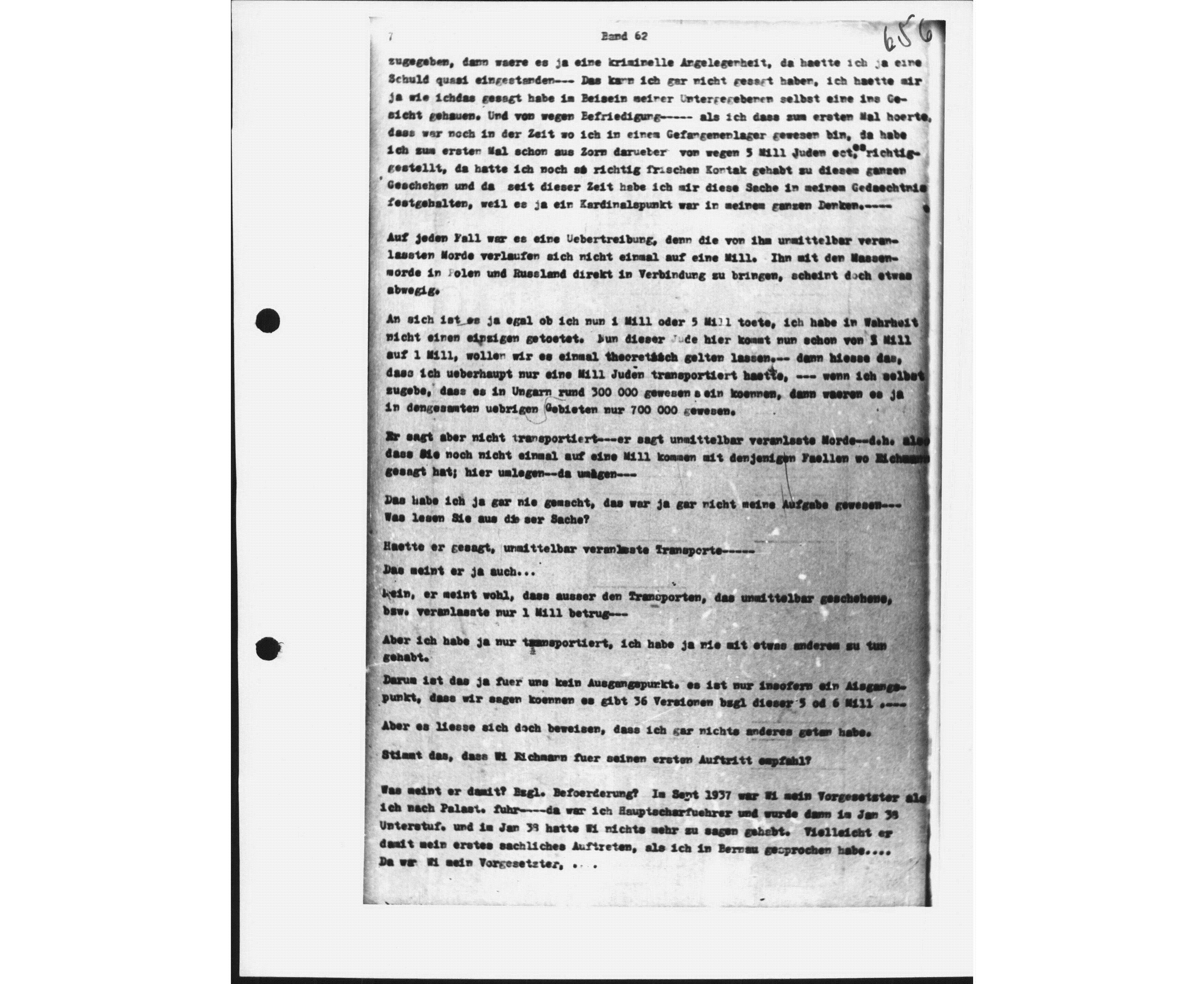
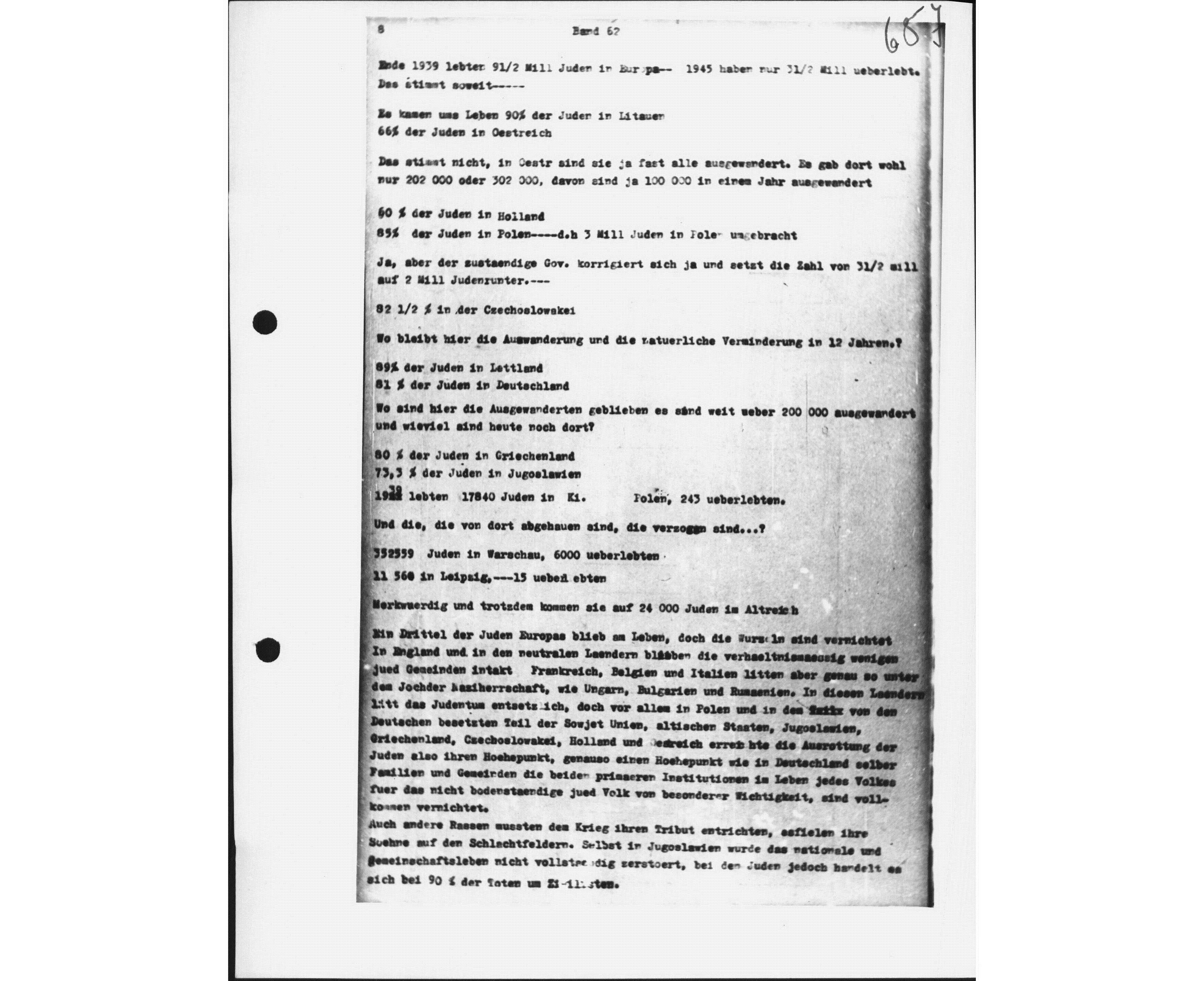
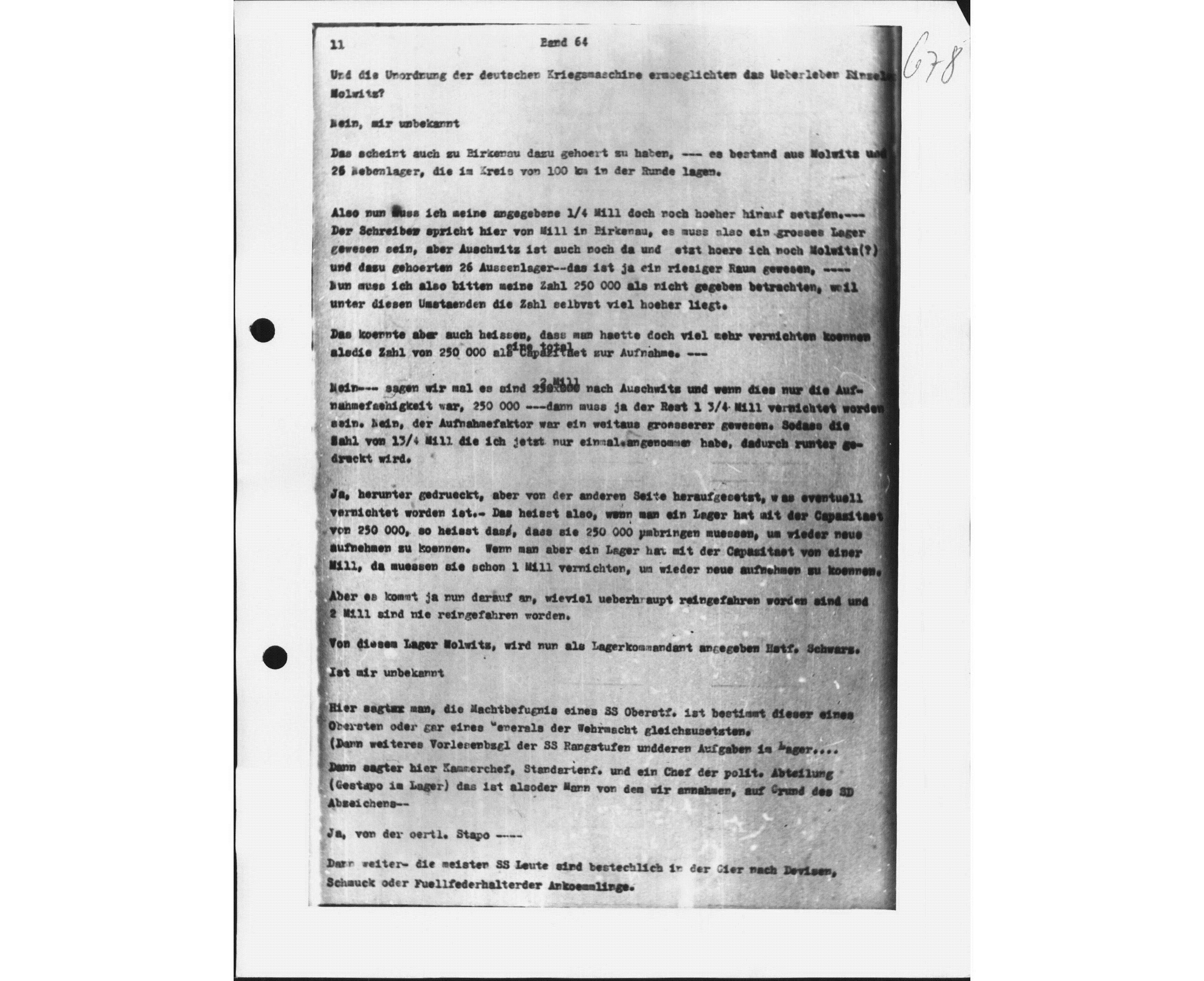
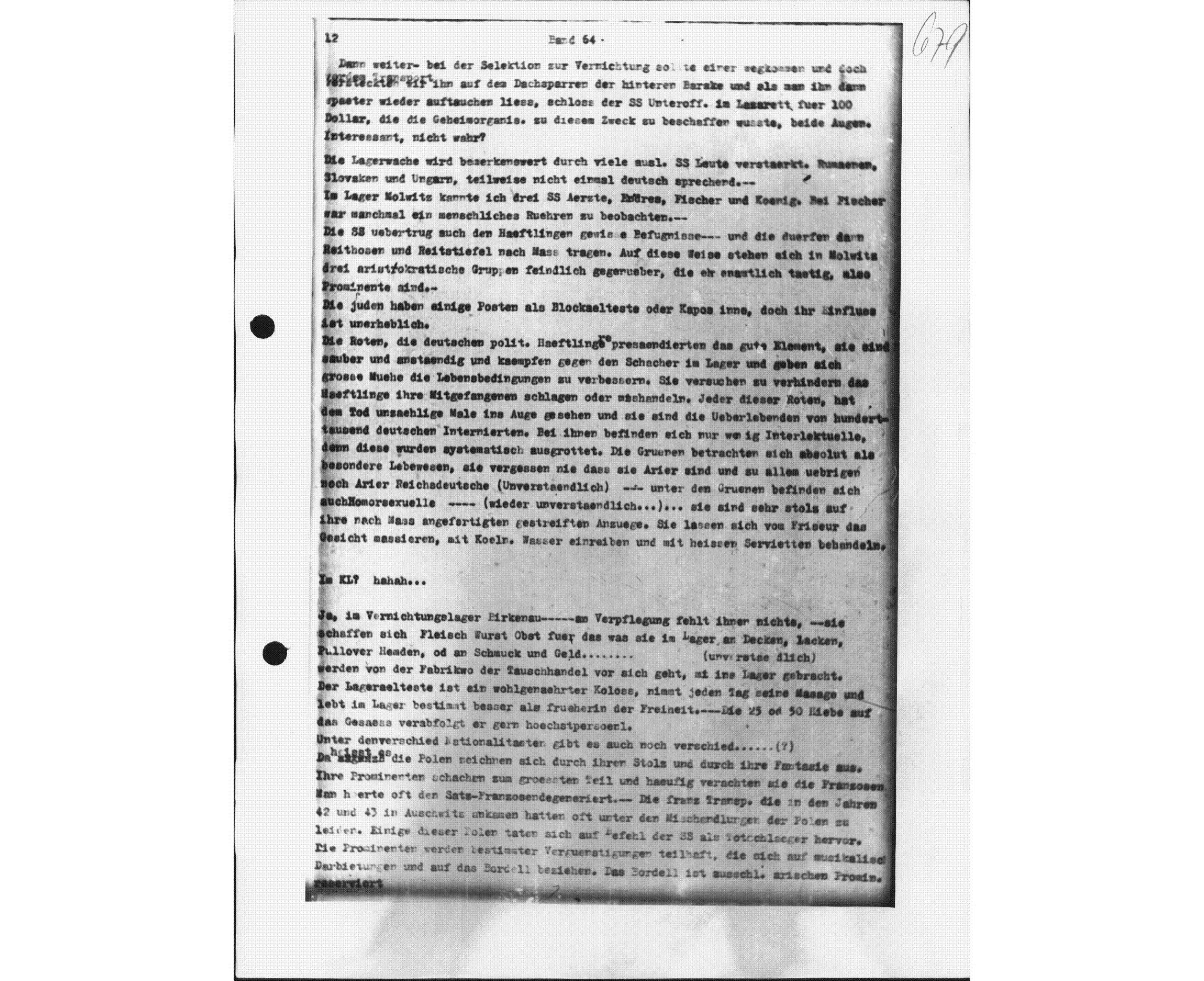
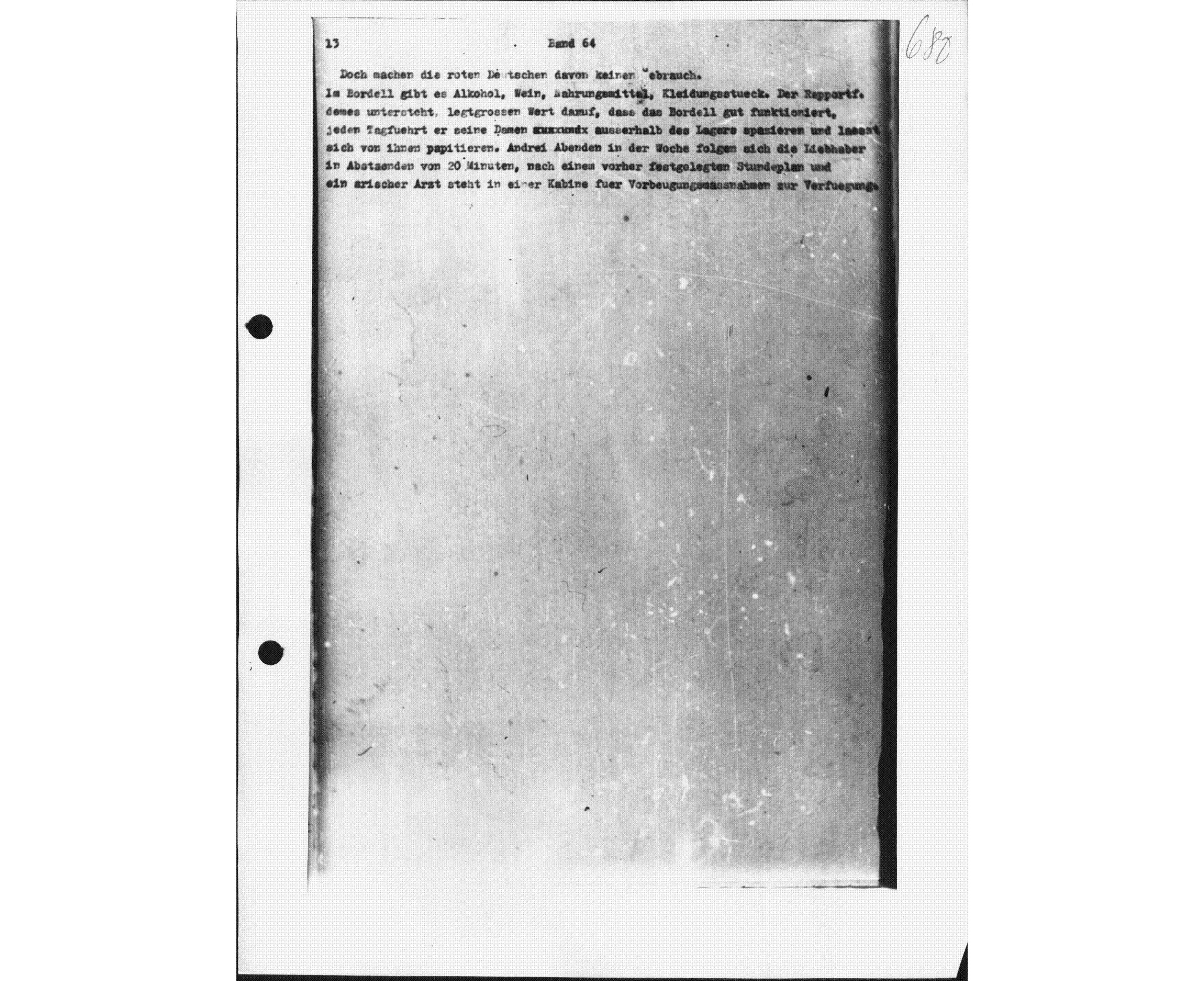
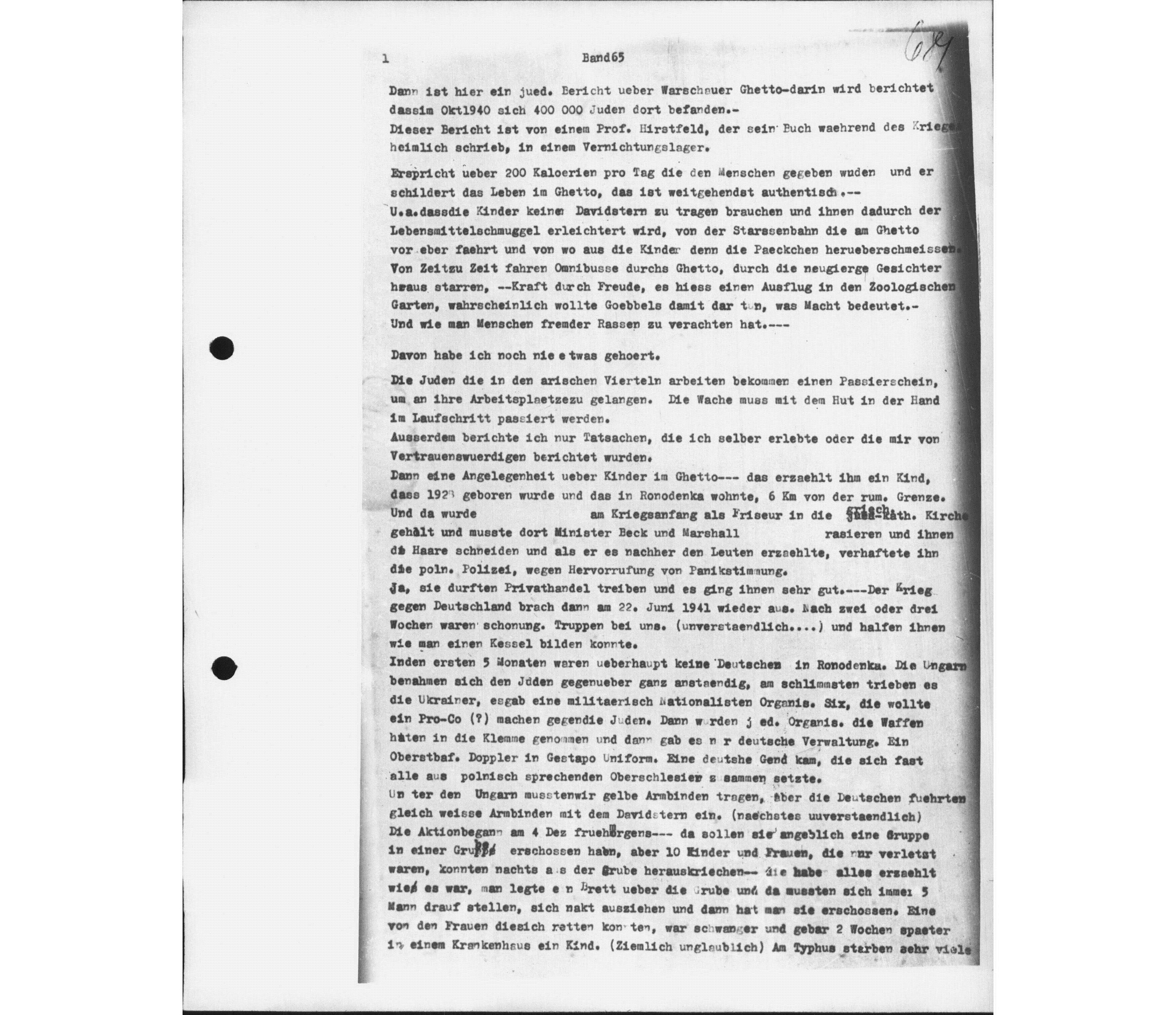
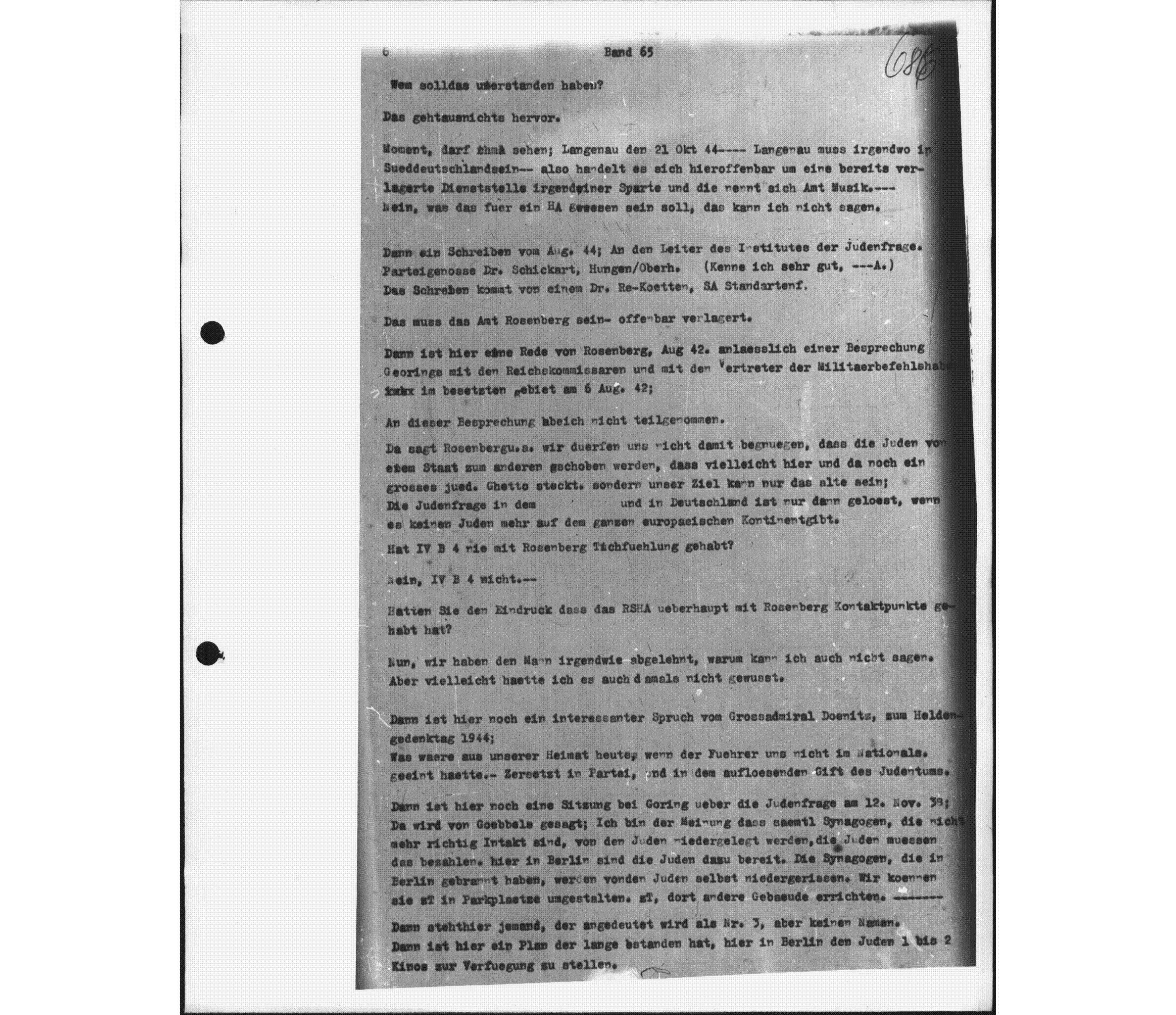
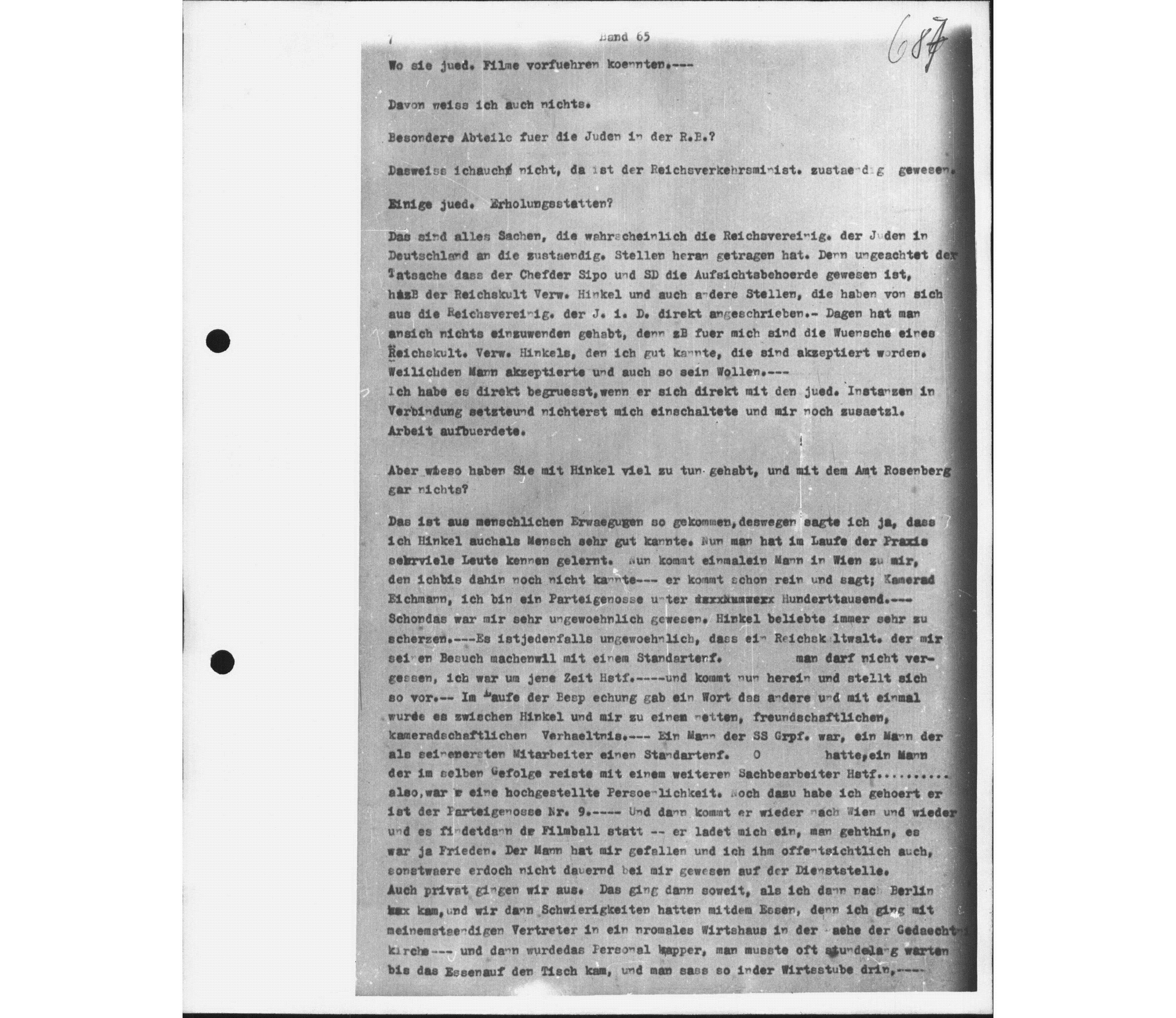
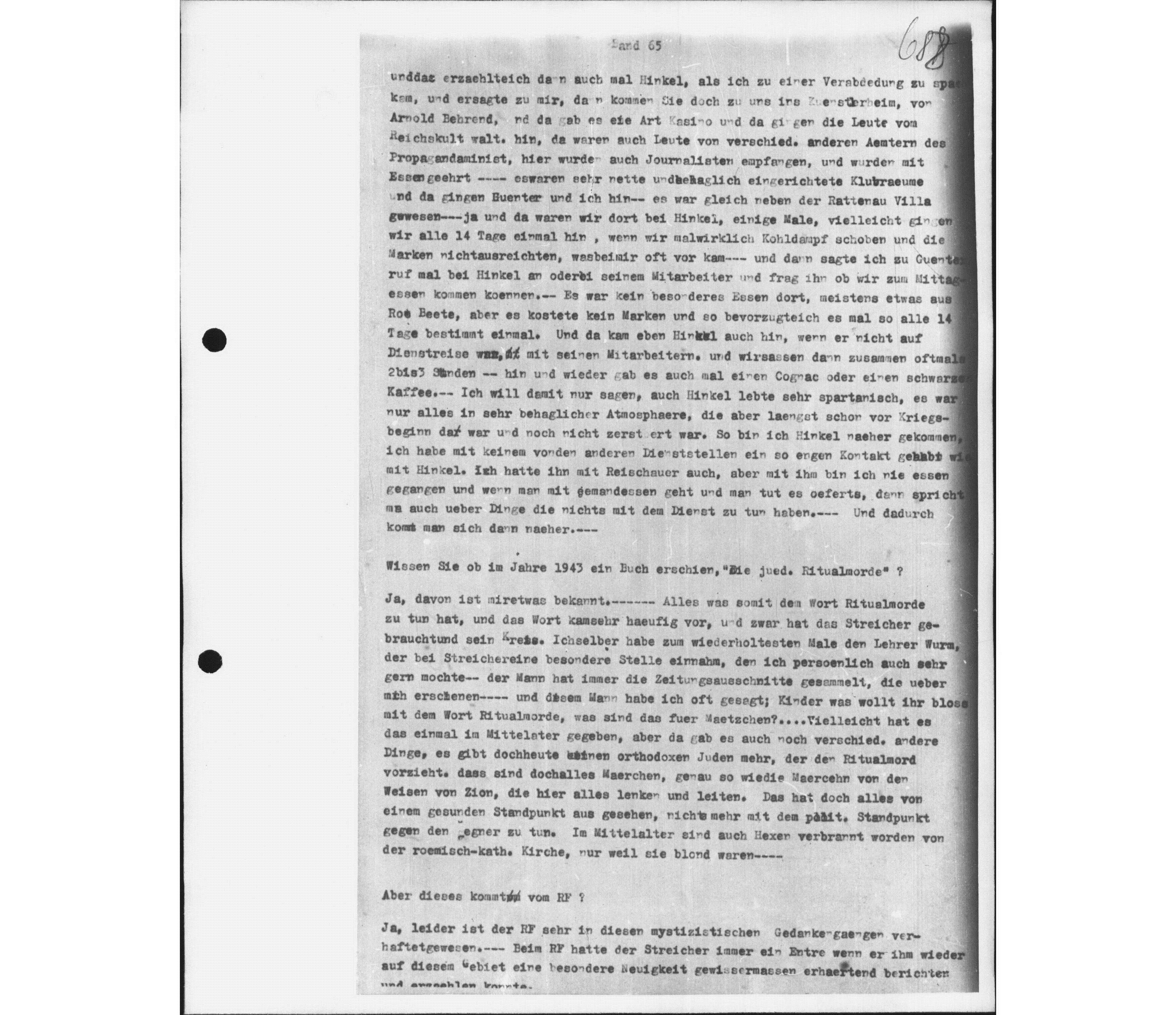
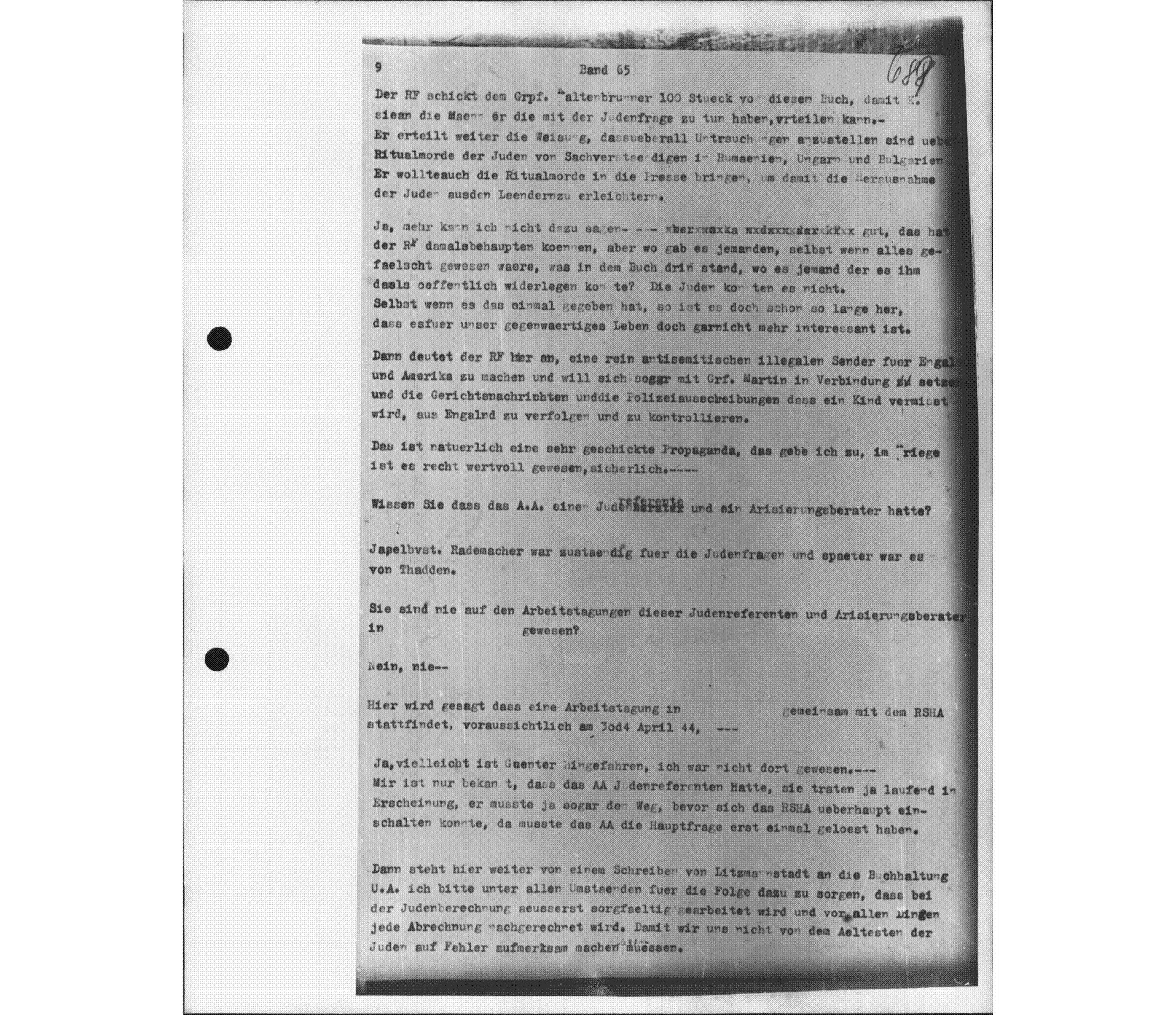
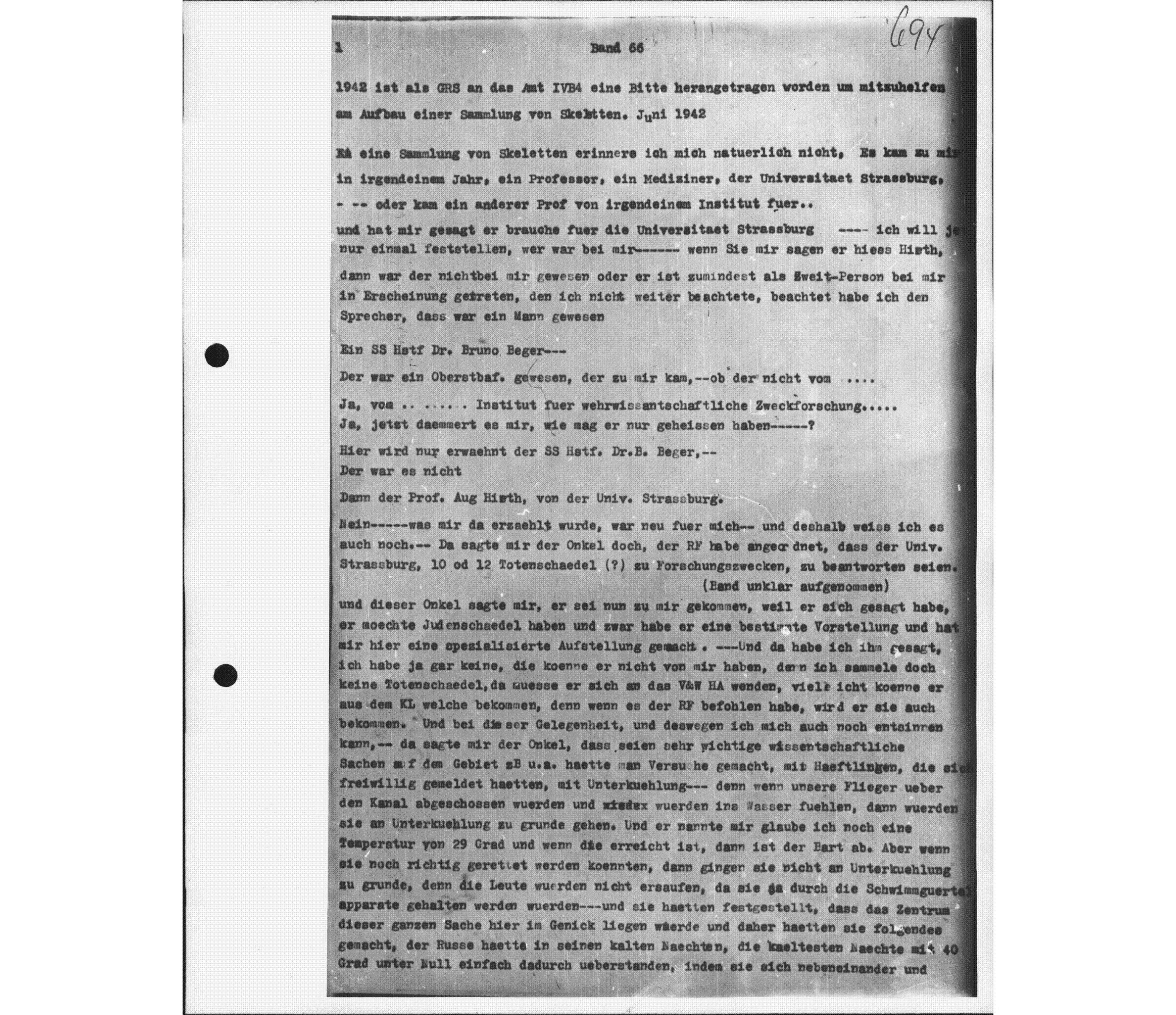
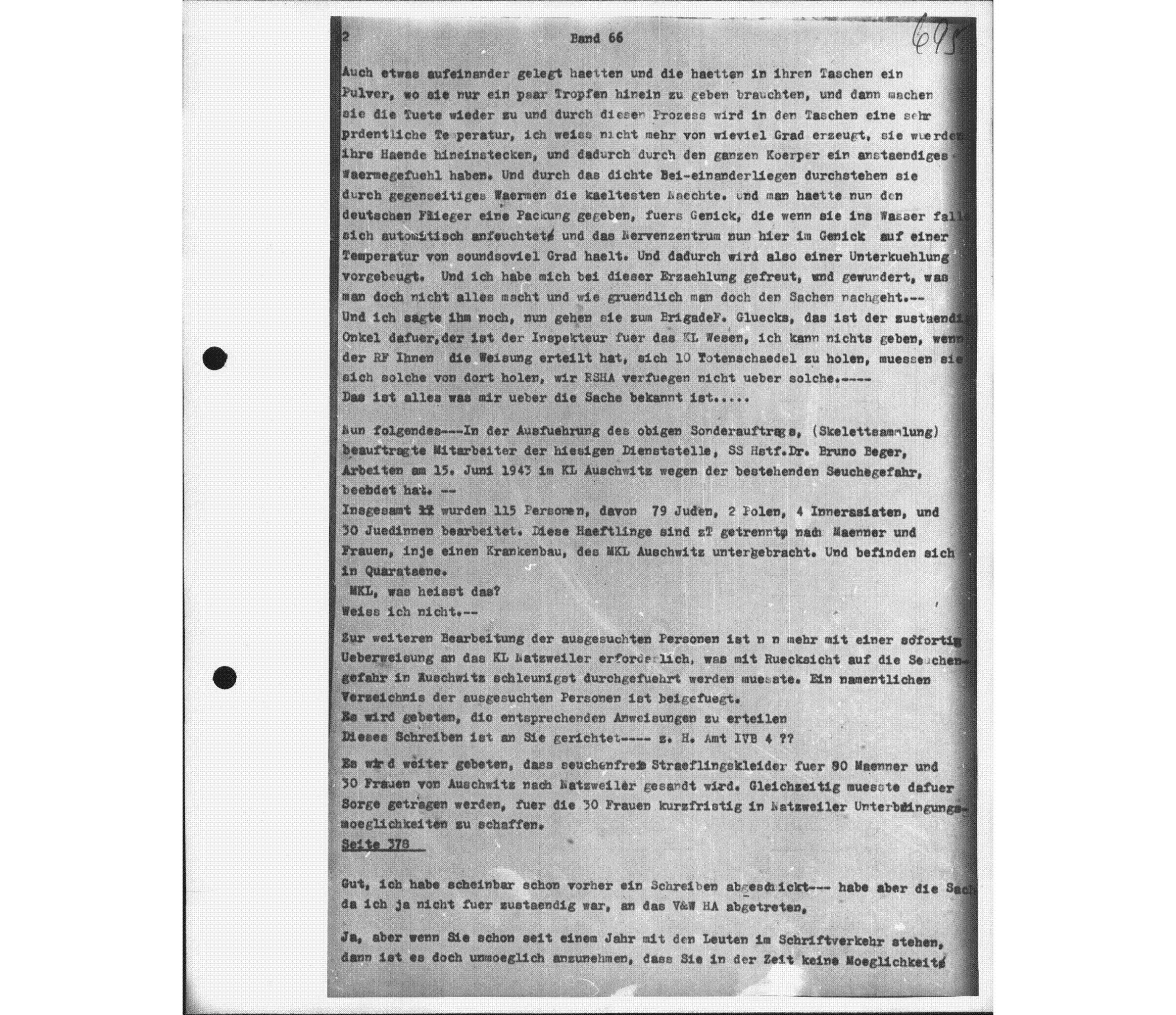
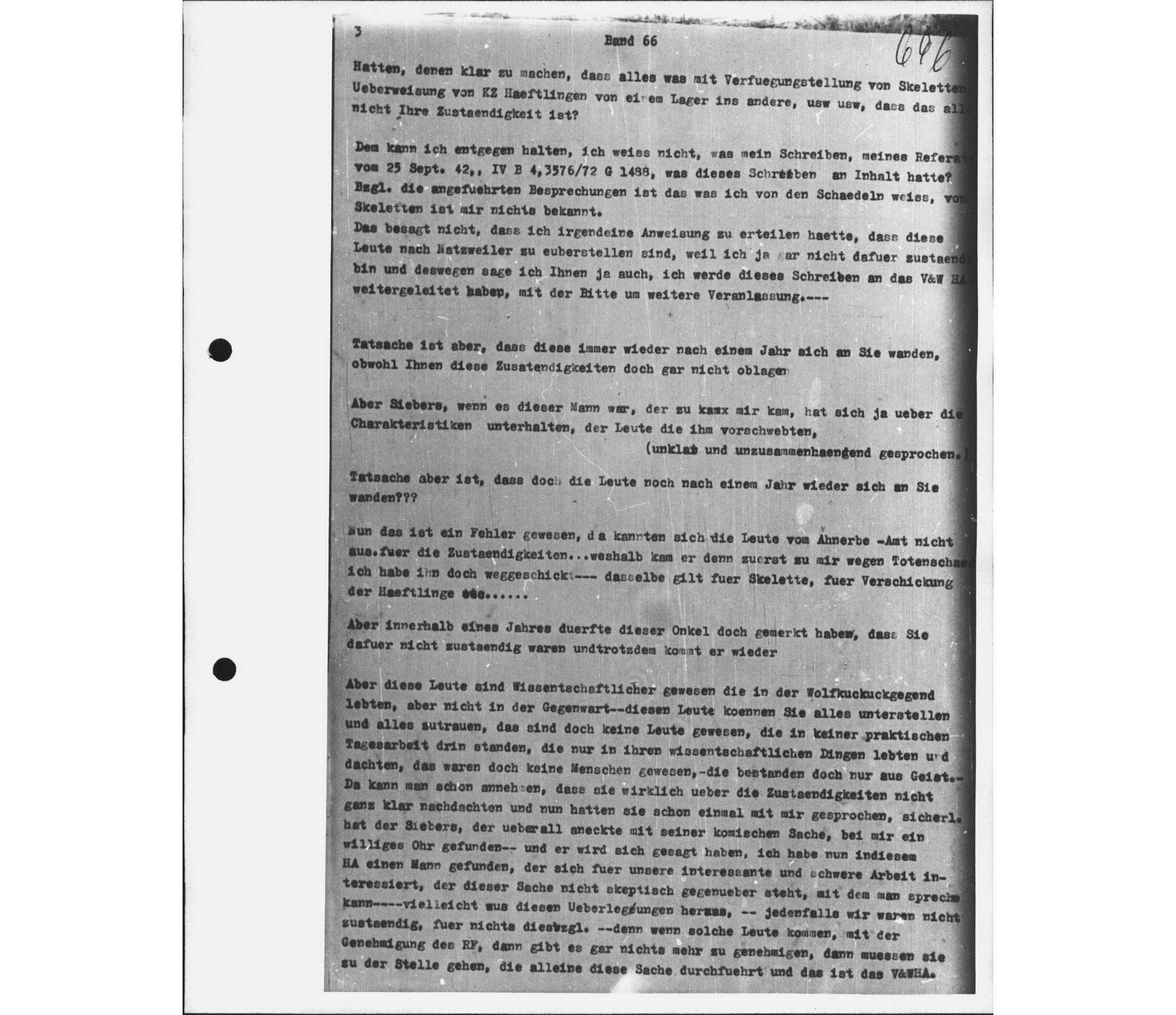
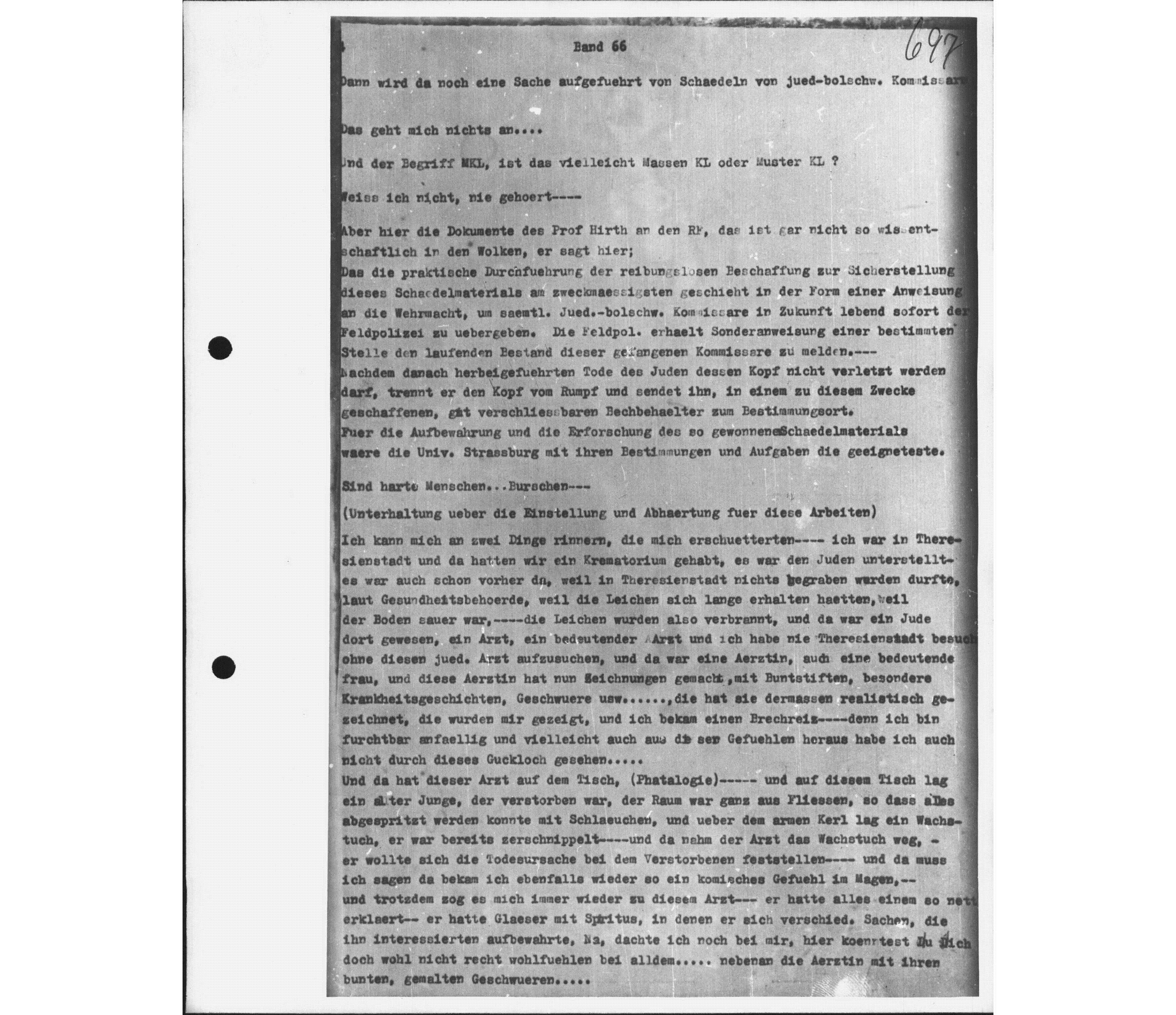
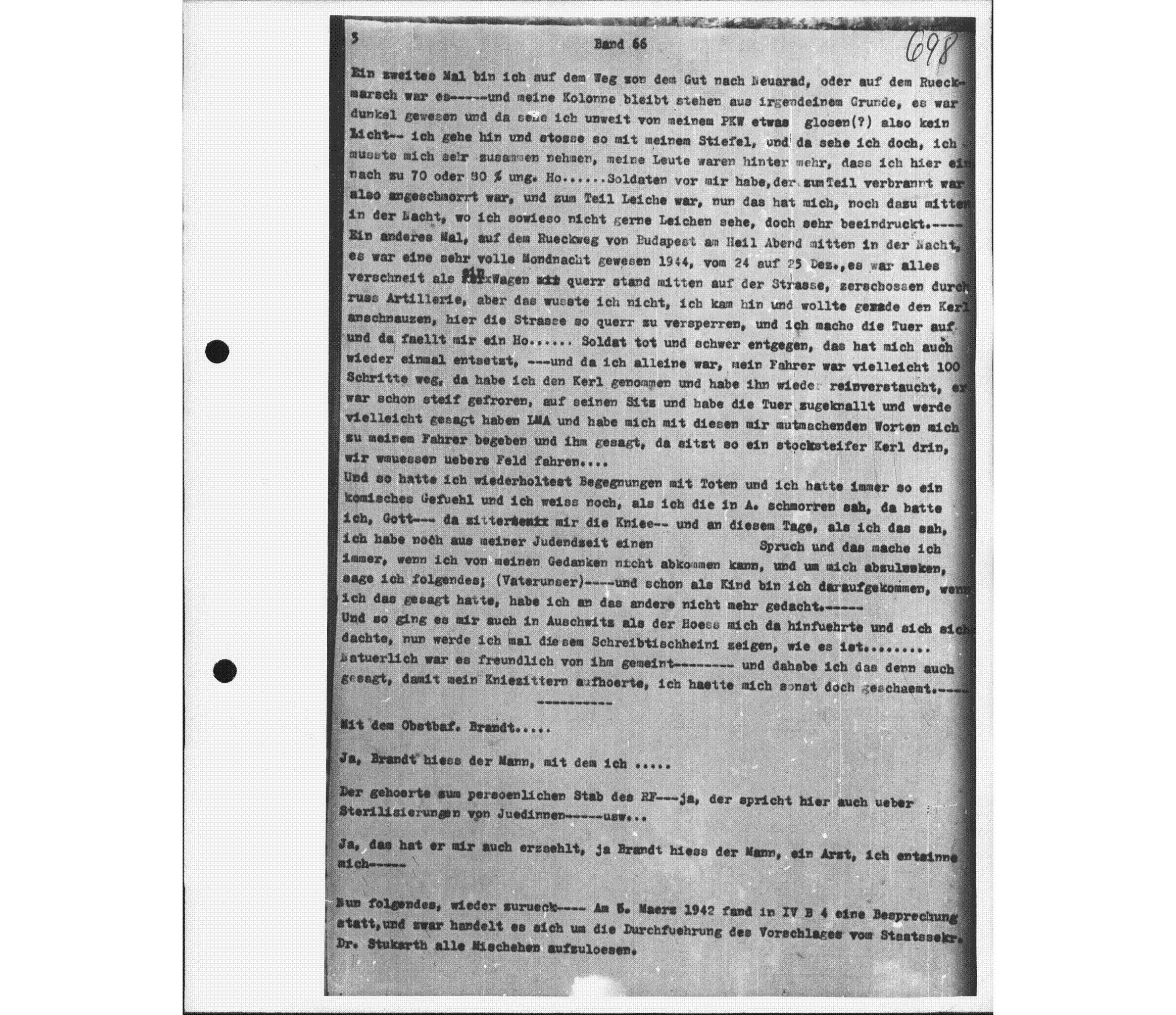
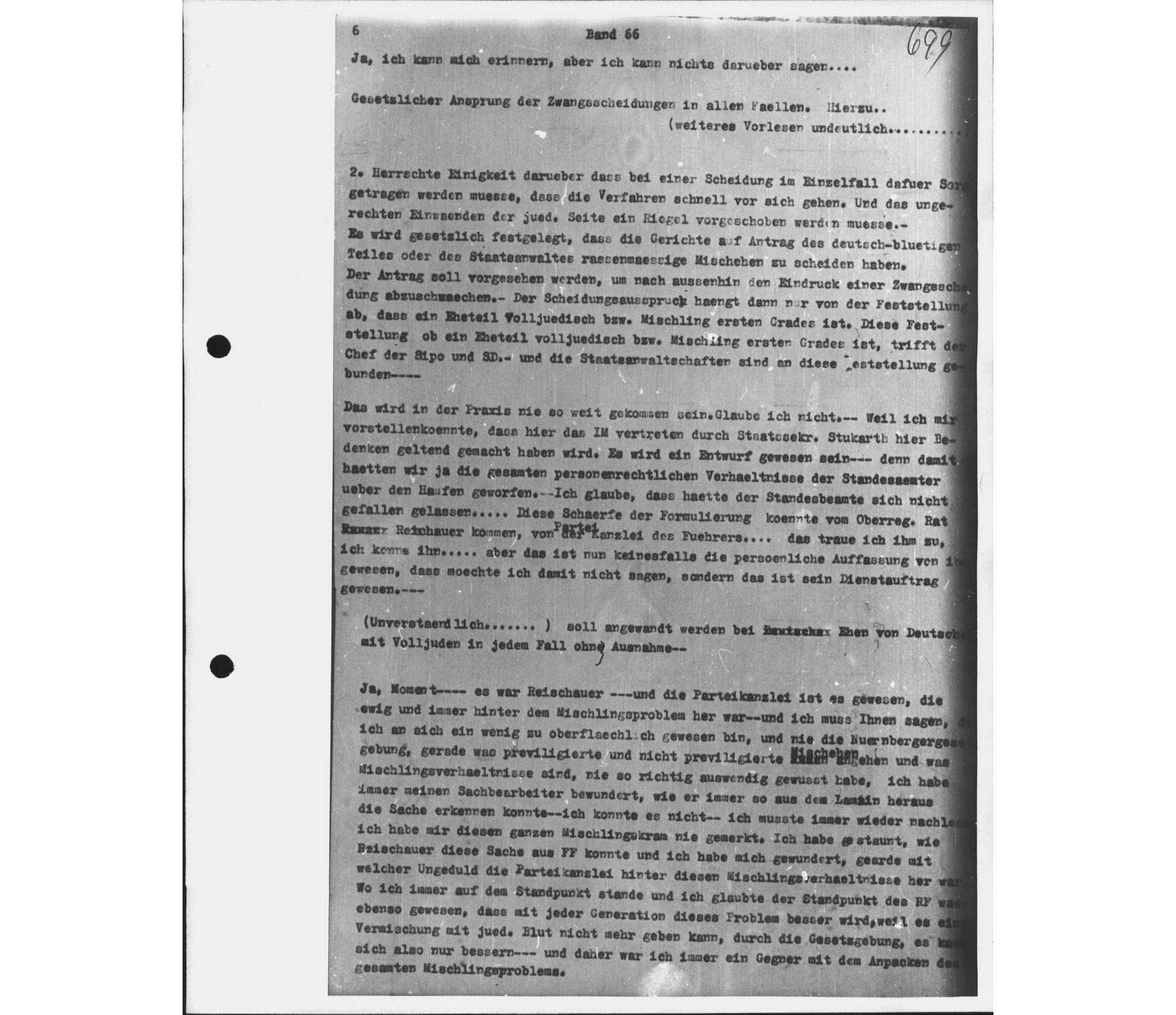
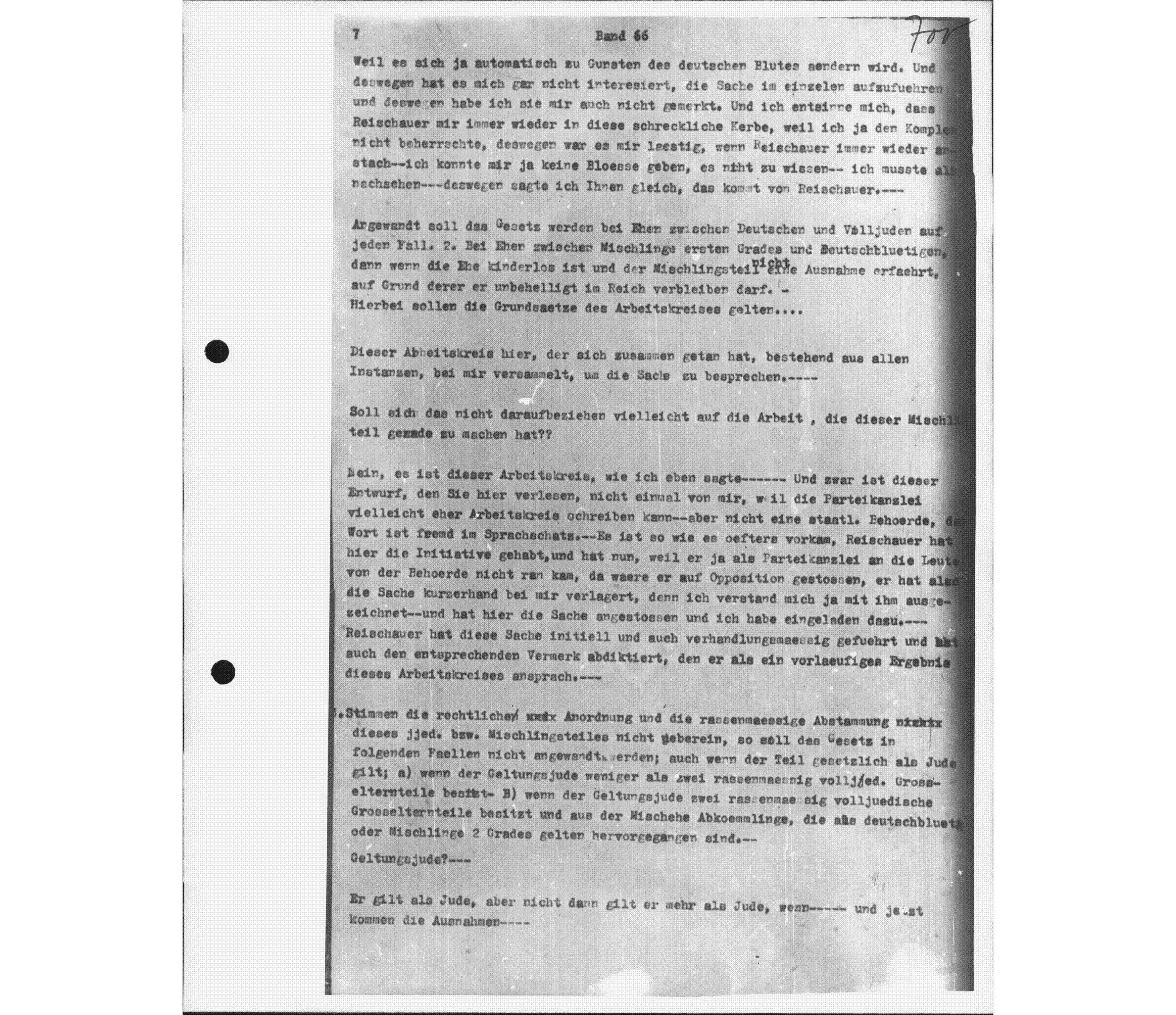
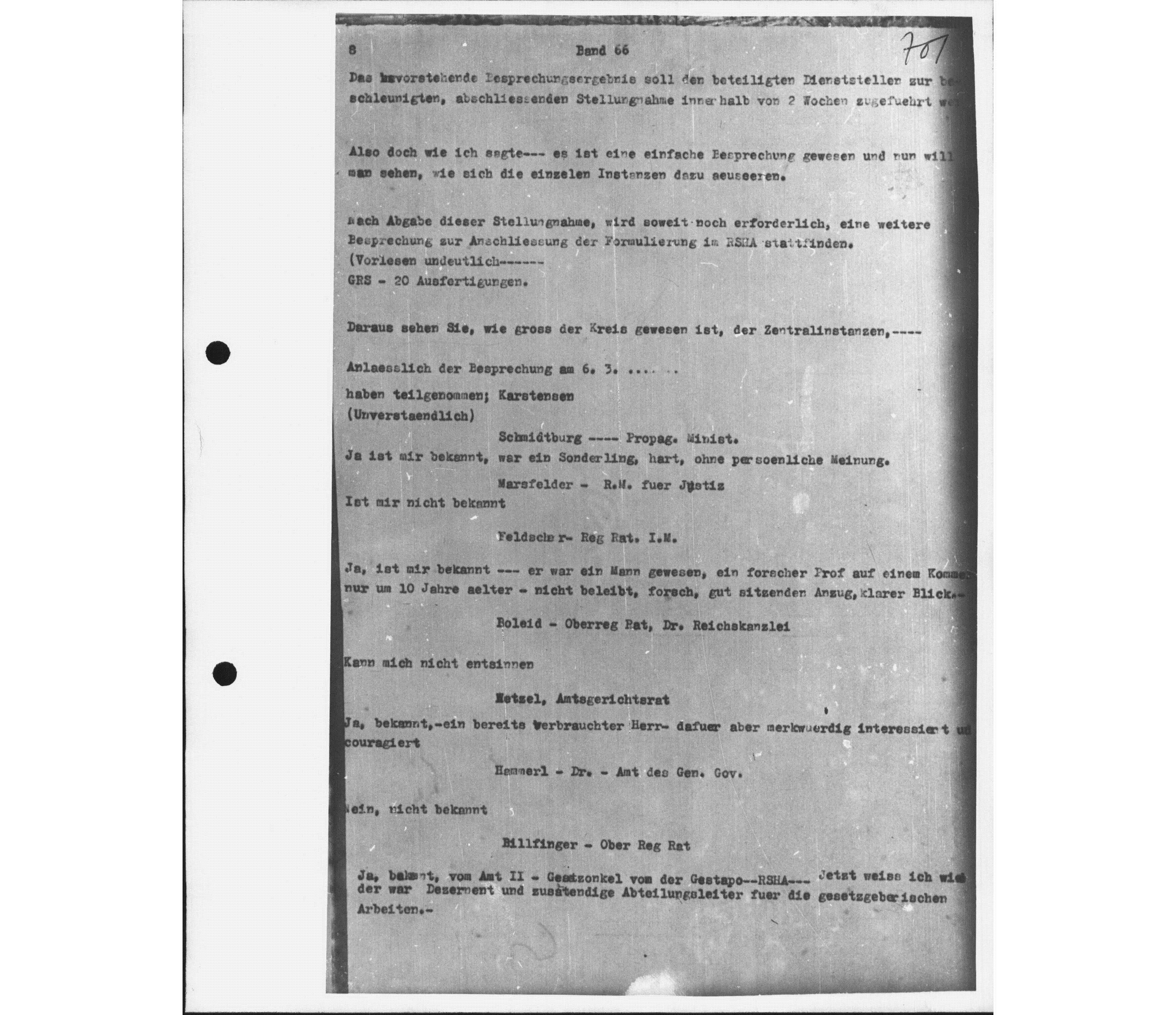
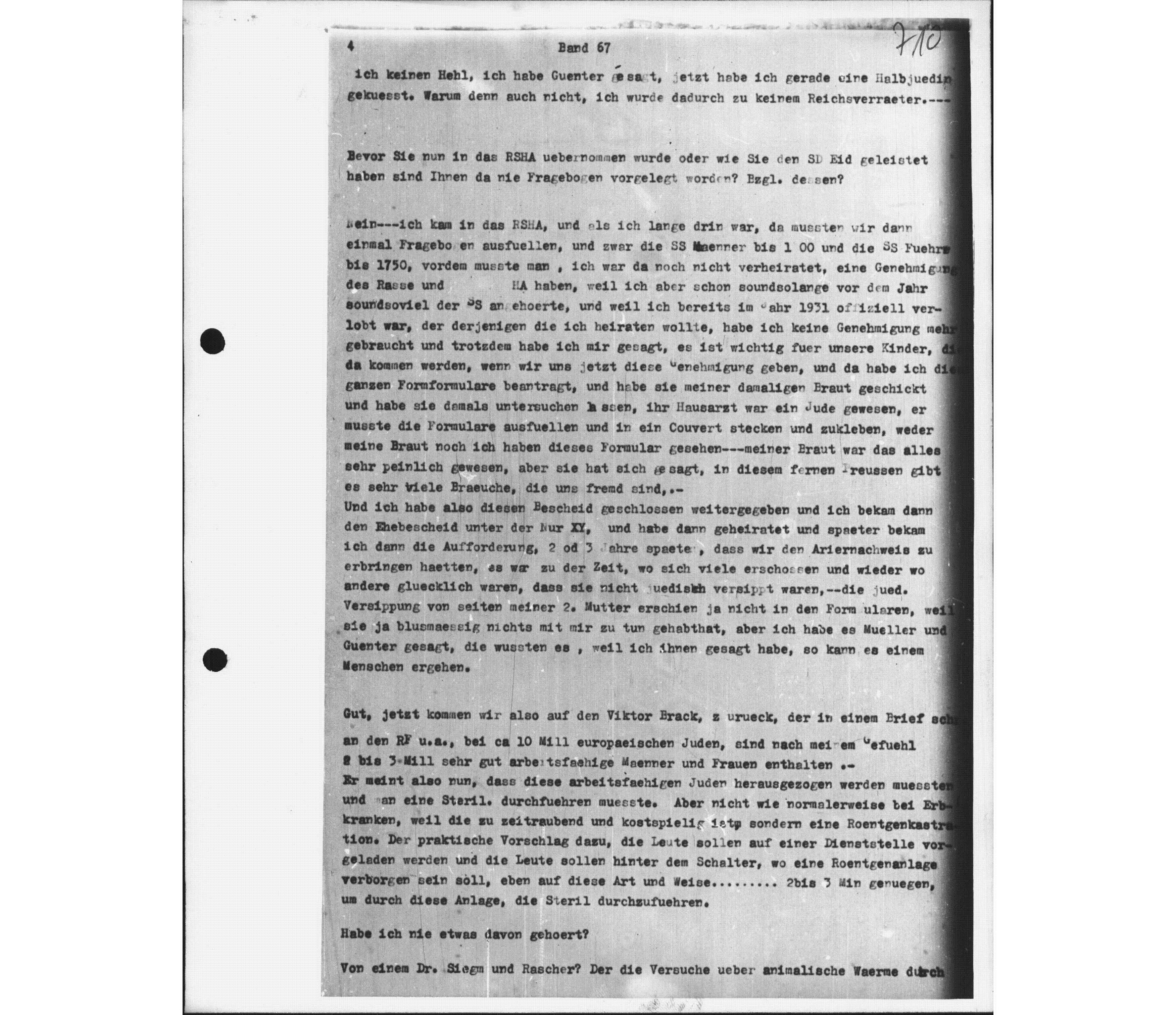
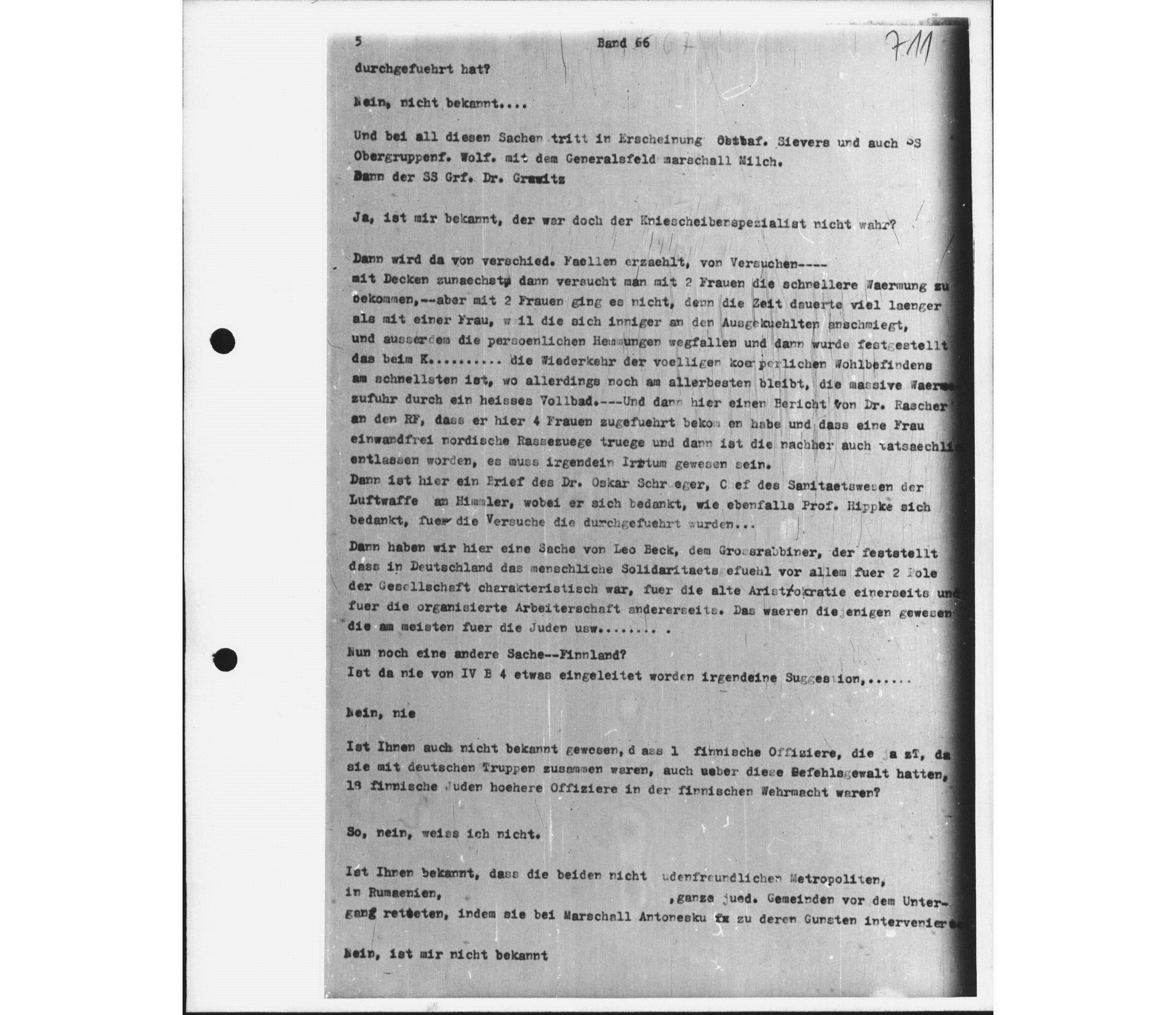
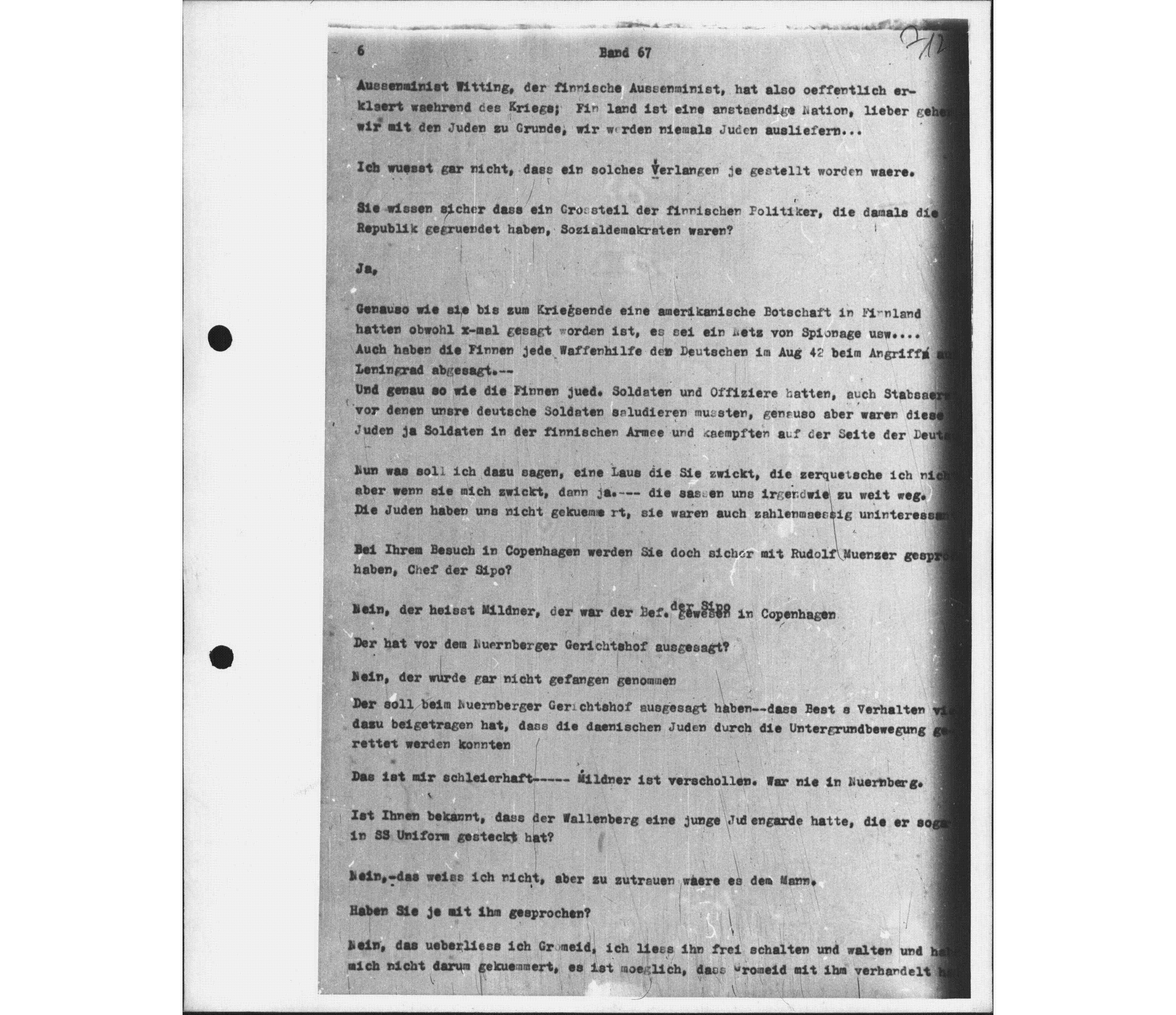
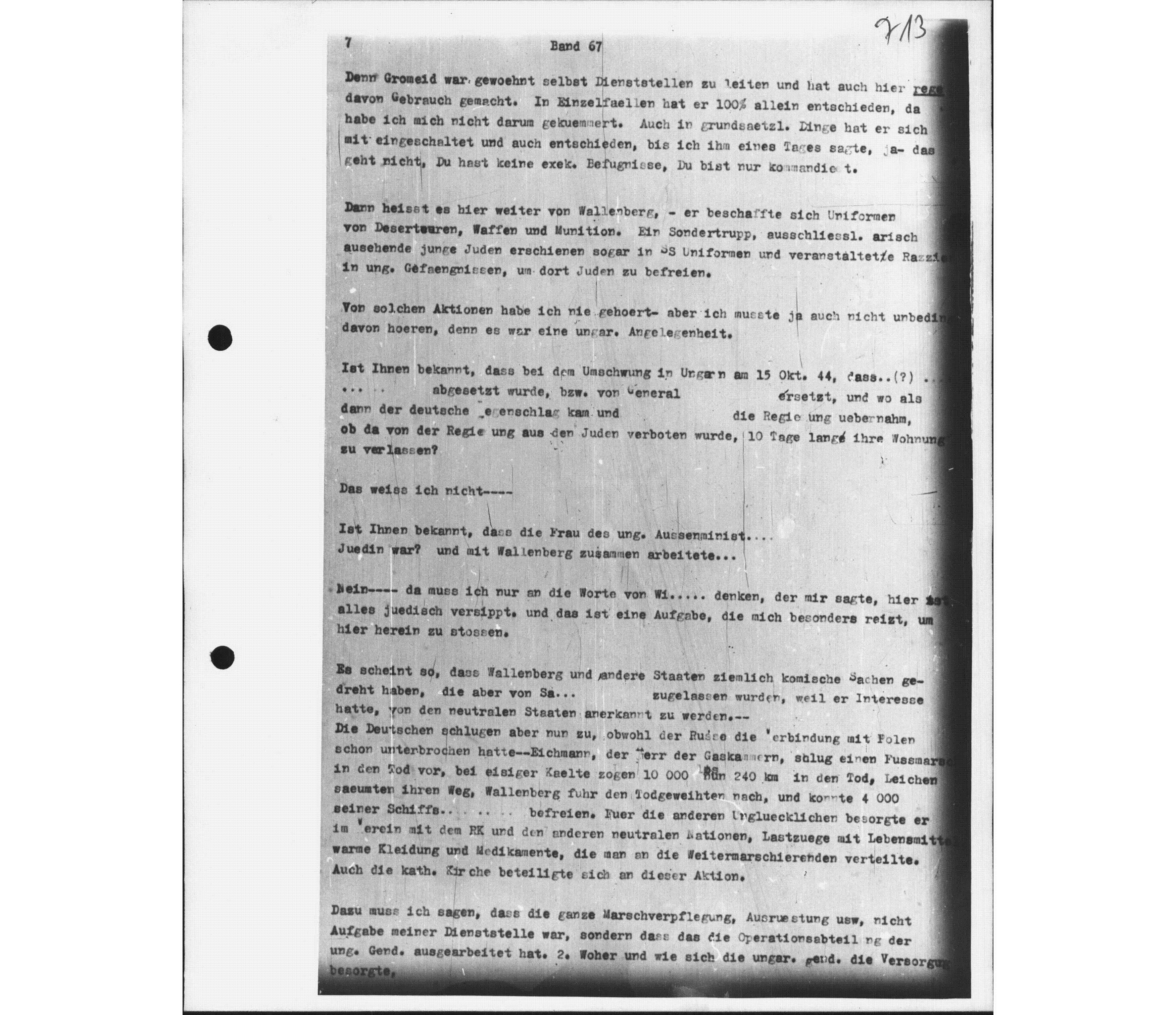
In 1957, in Buenos Aires, the man who organized the deportation of Europe’s Jews talked into a tape recorder for months. These are his recorded words, with the typed page they come from.

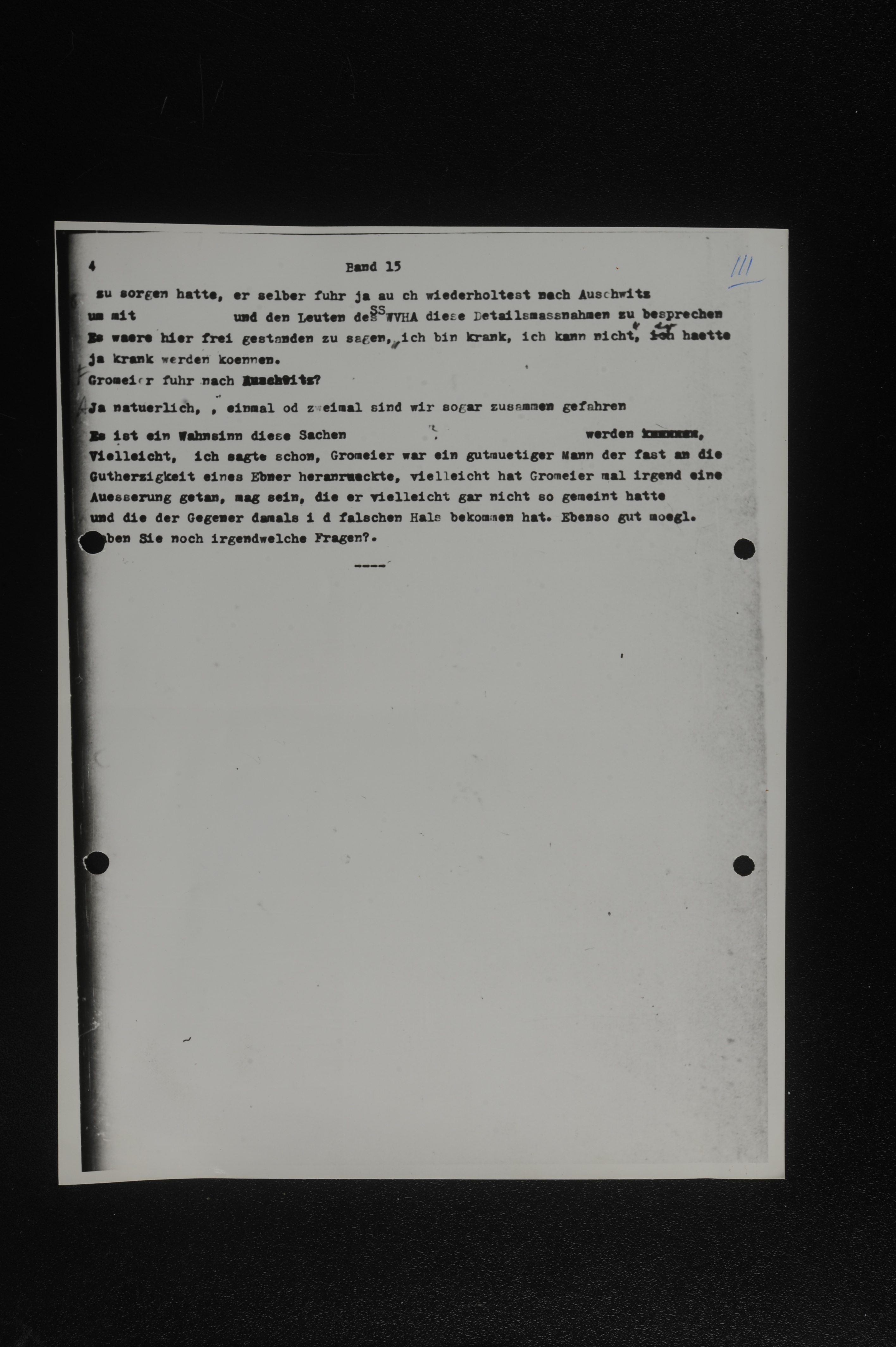
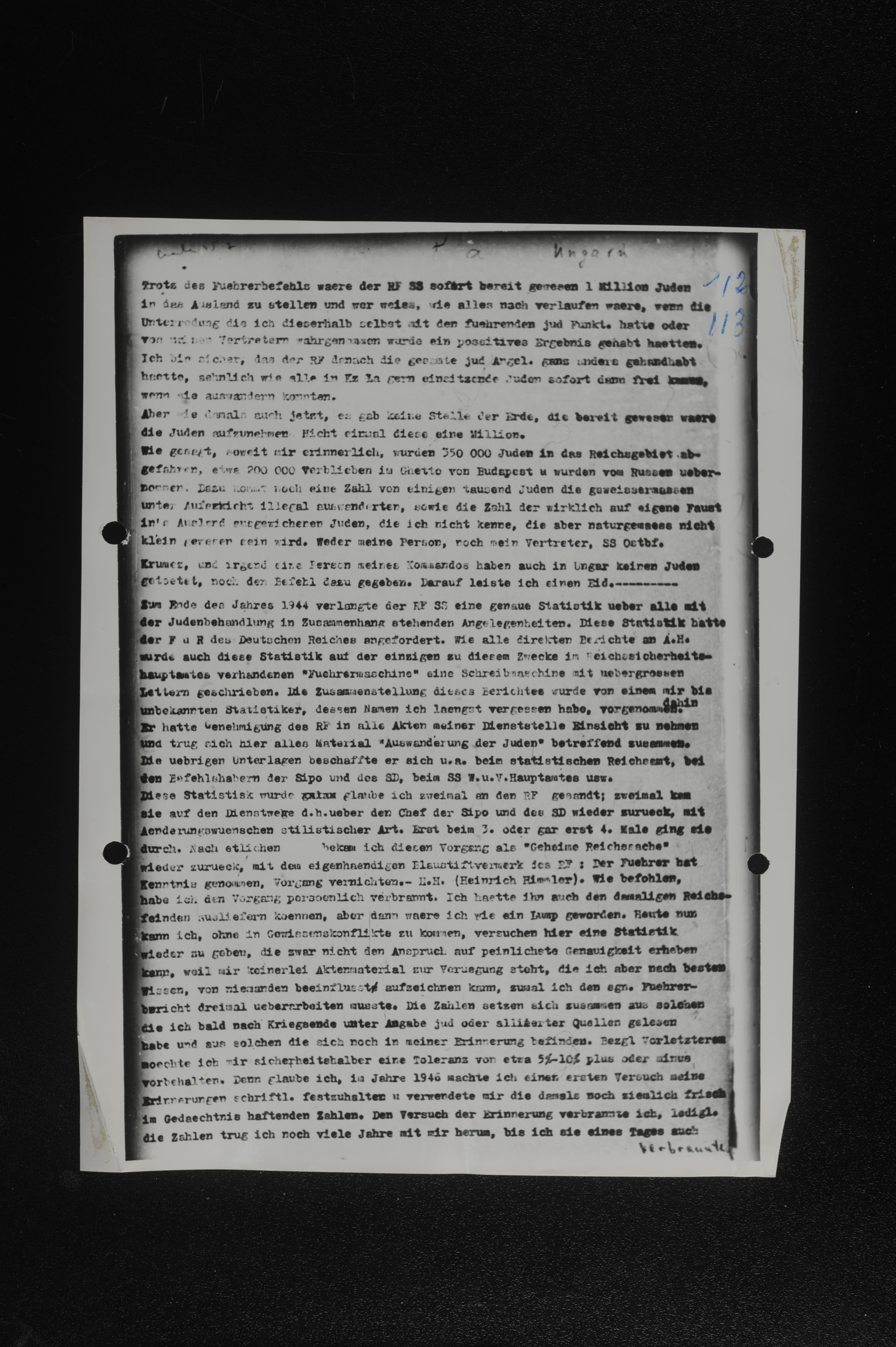
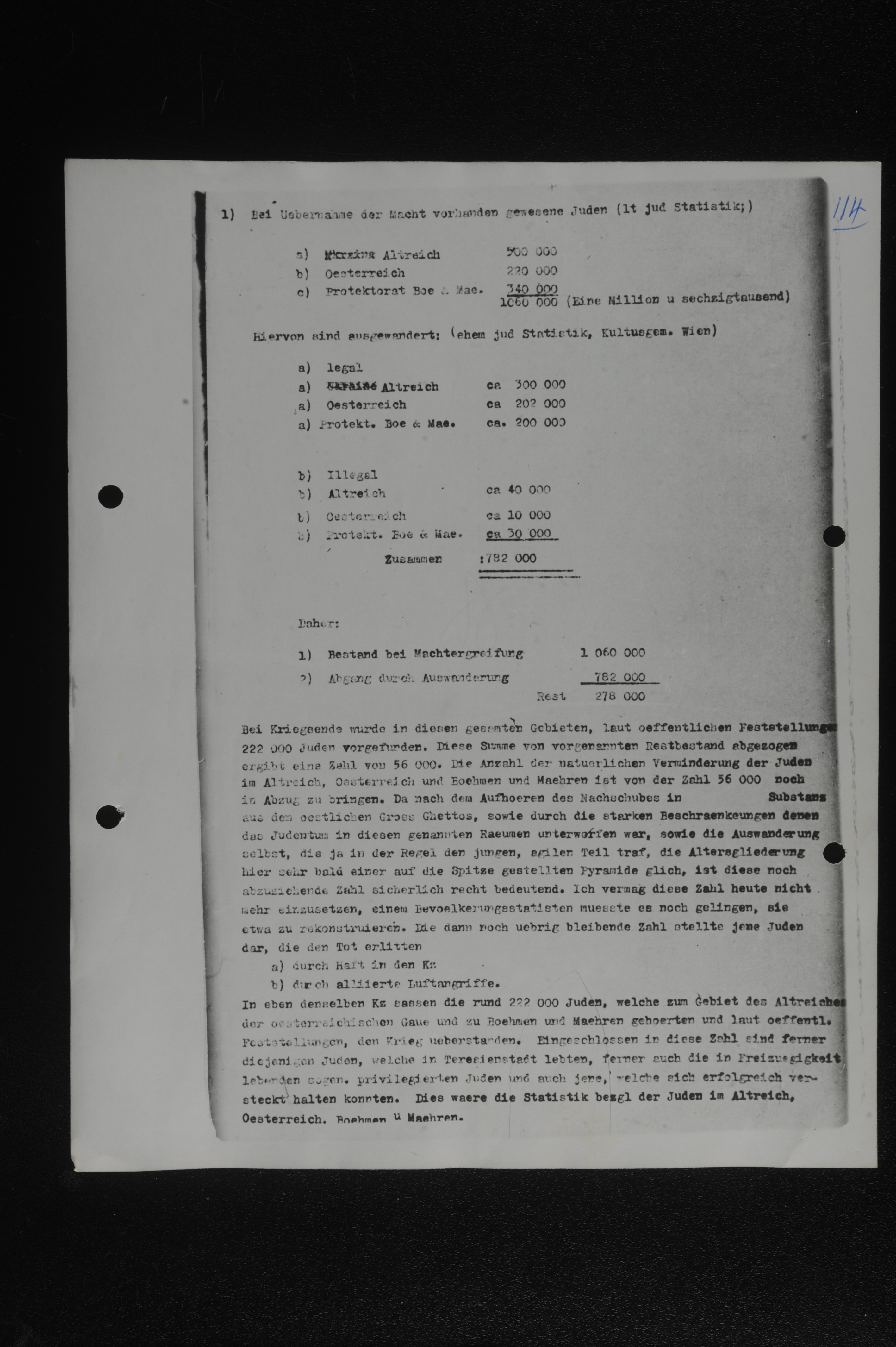
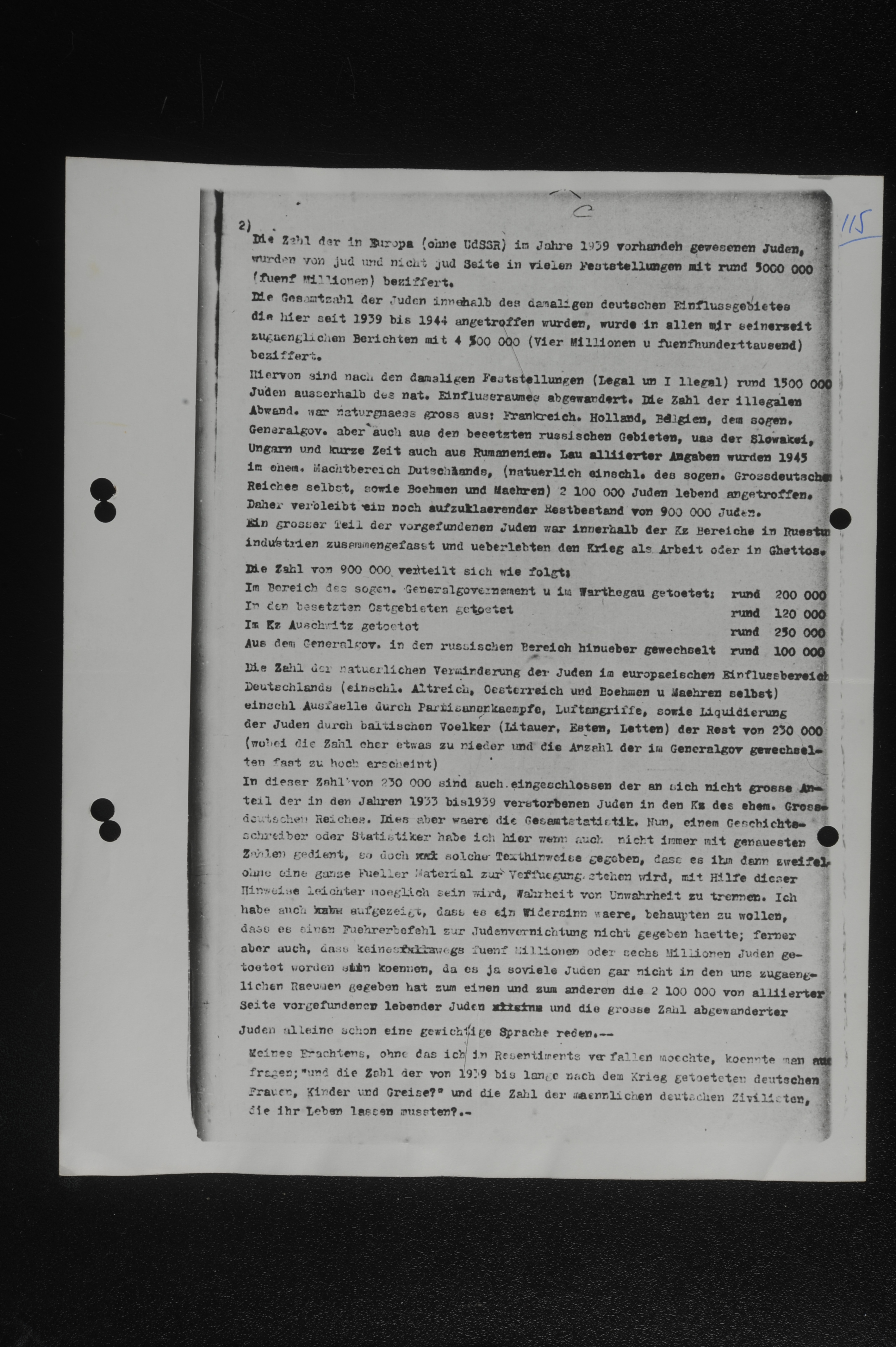
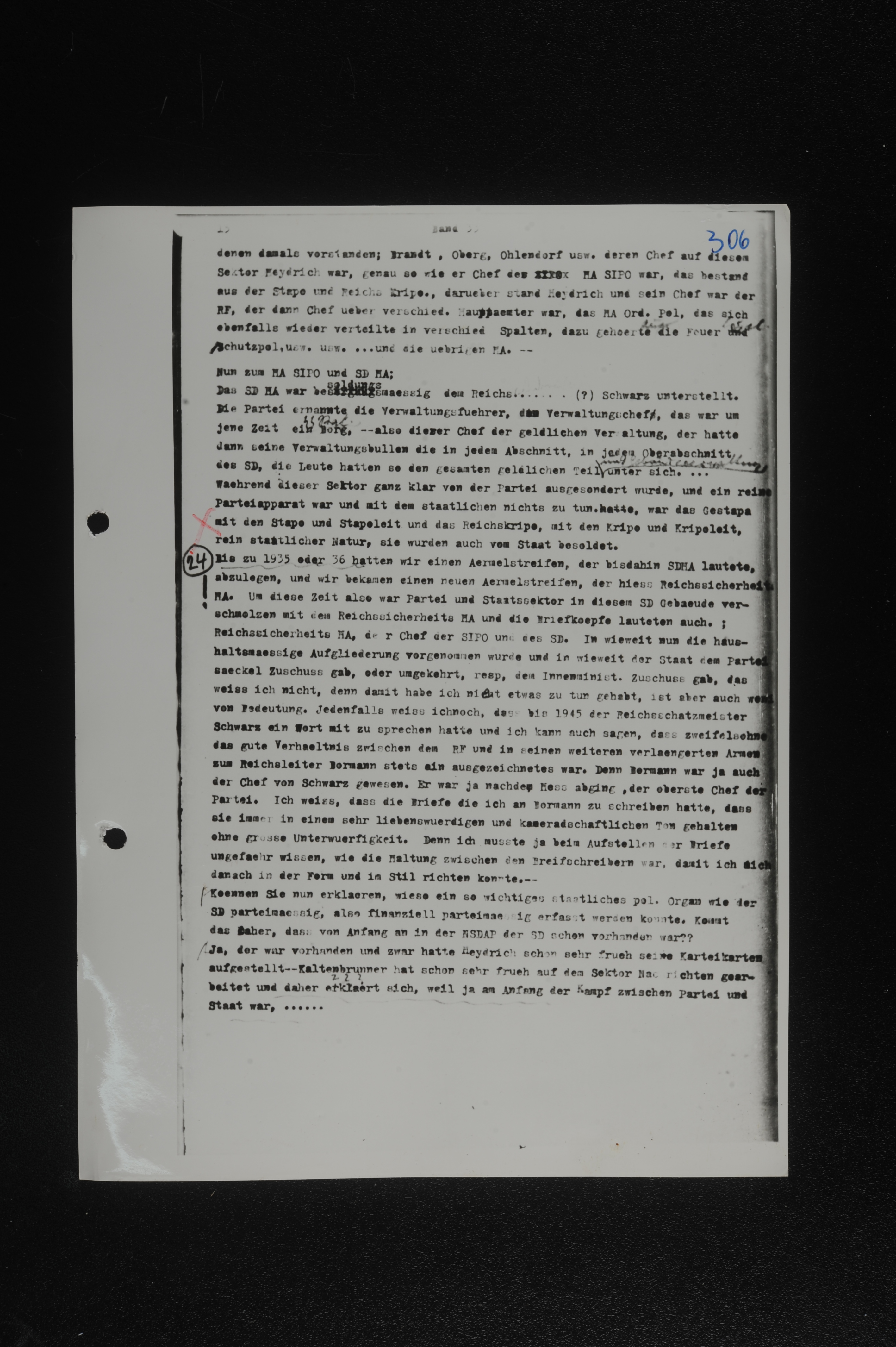
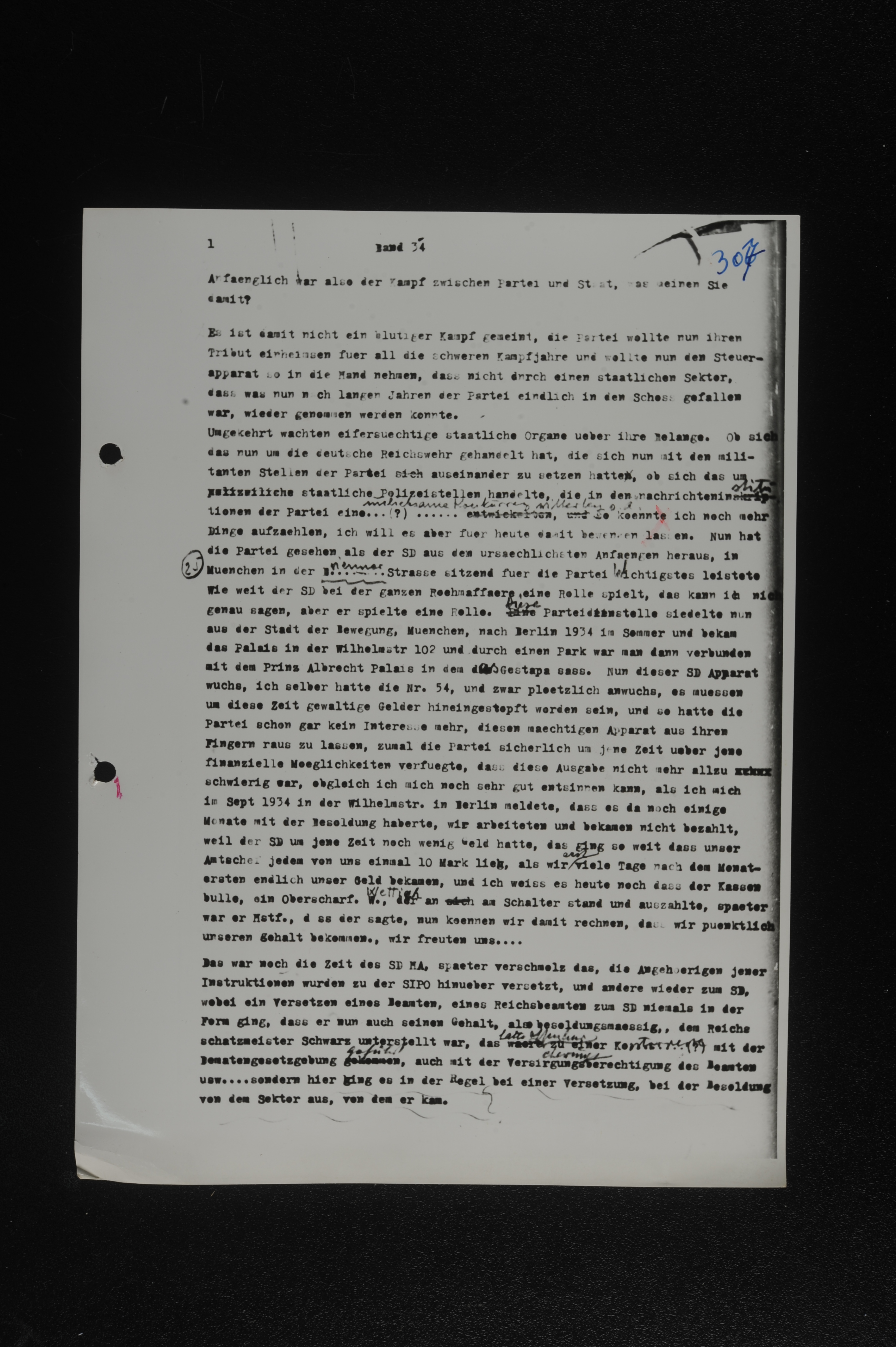
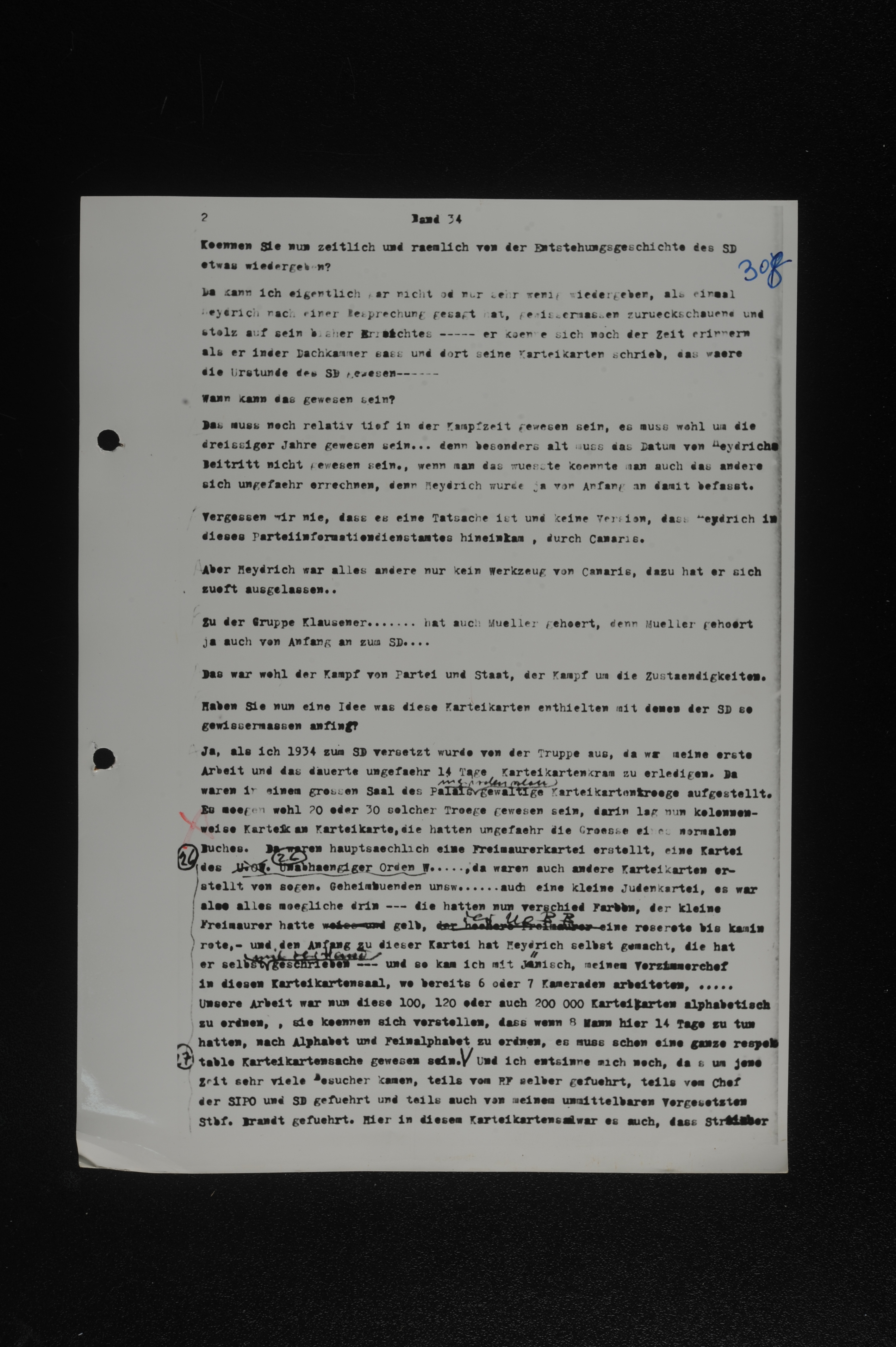
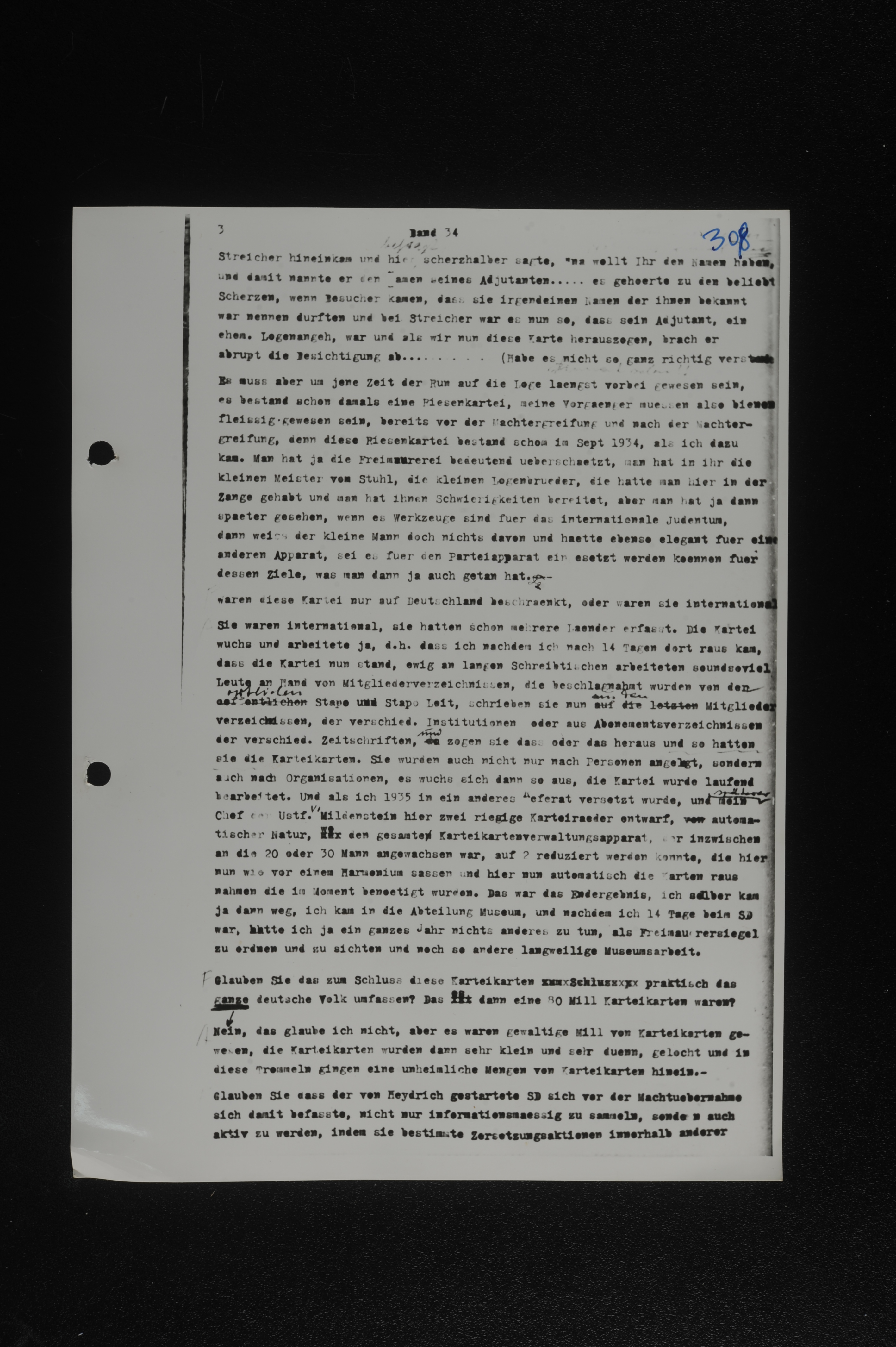
Had we killed 10.3 million

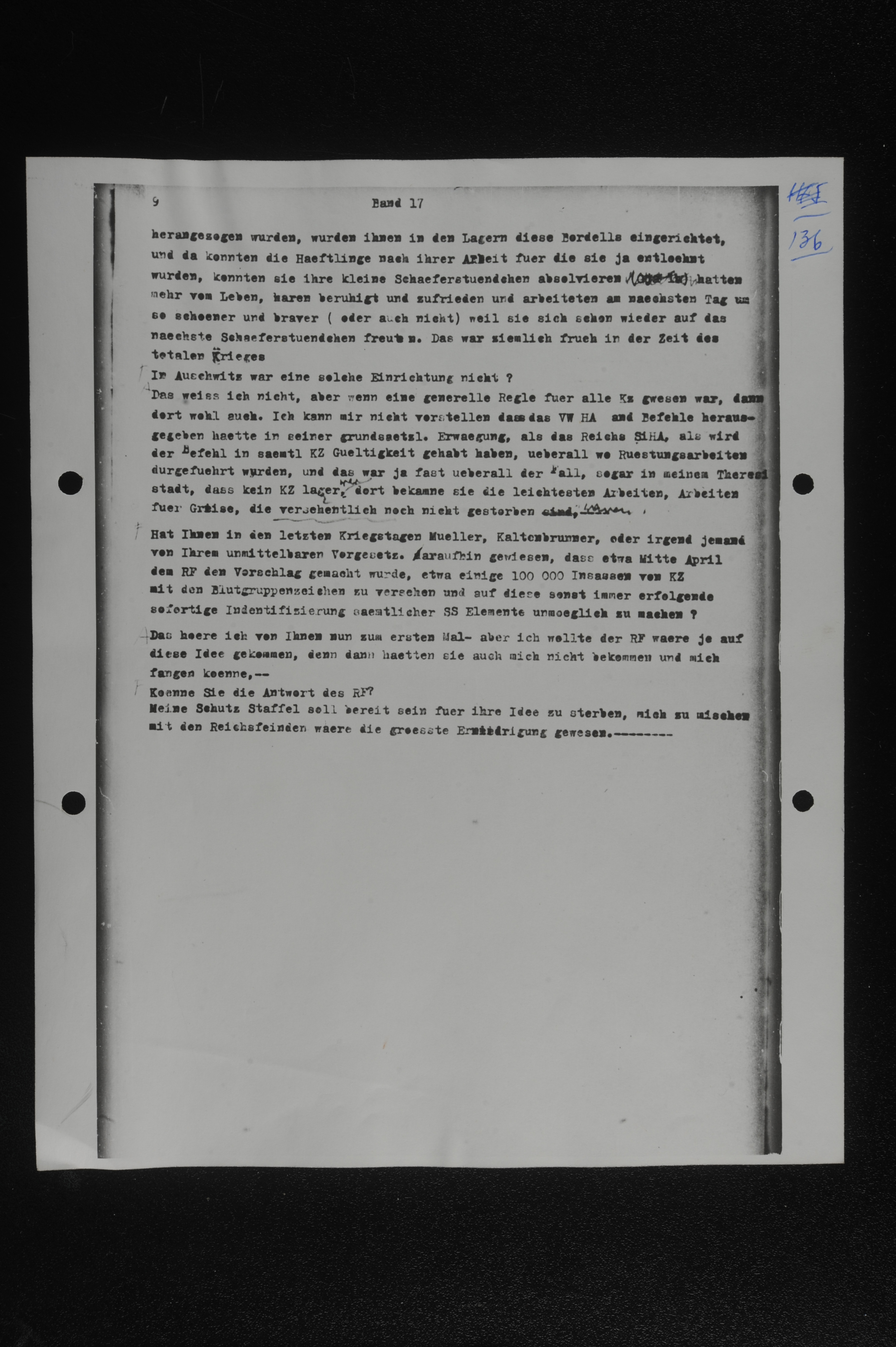
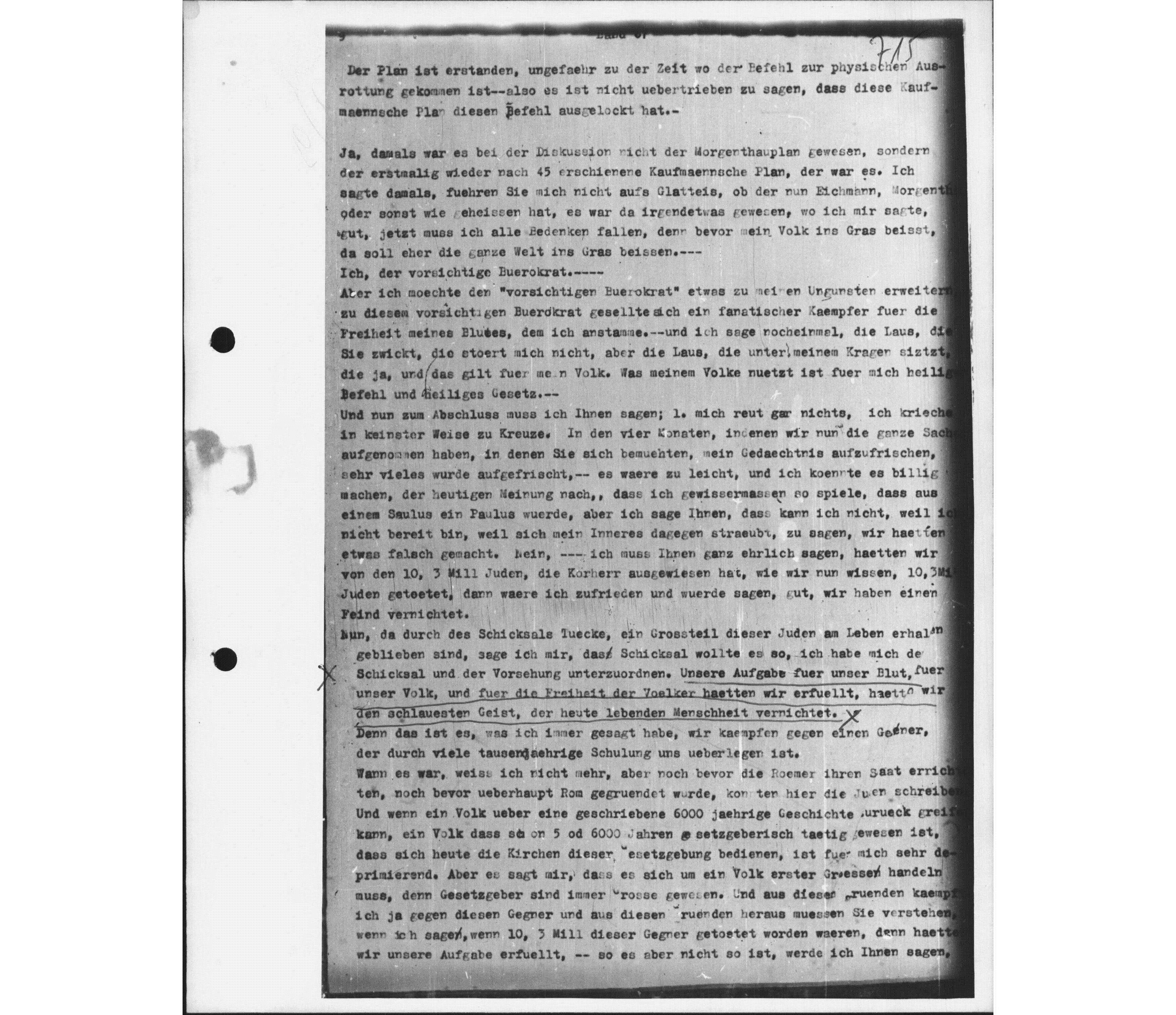
No, I have to tell you quite honestly: had we killed, out of the 10.3 million Jews whom Korherr recorded, as we now know, 10.3 million Jews, then I would be satisfied and would say, good, we have annihilated an enemy.

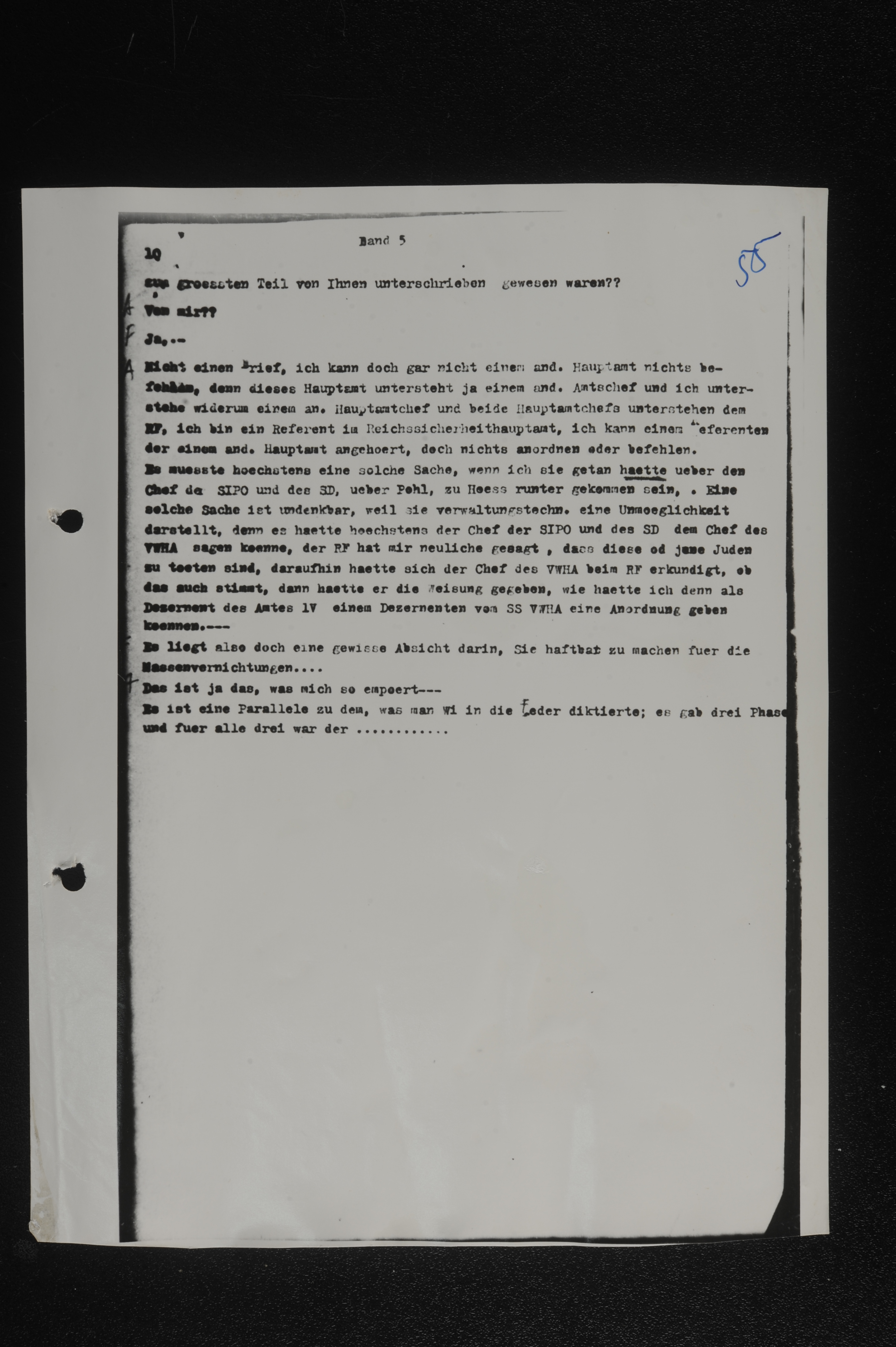
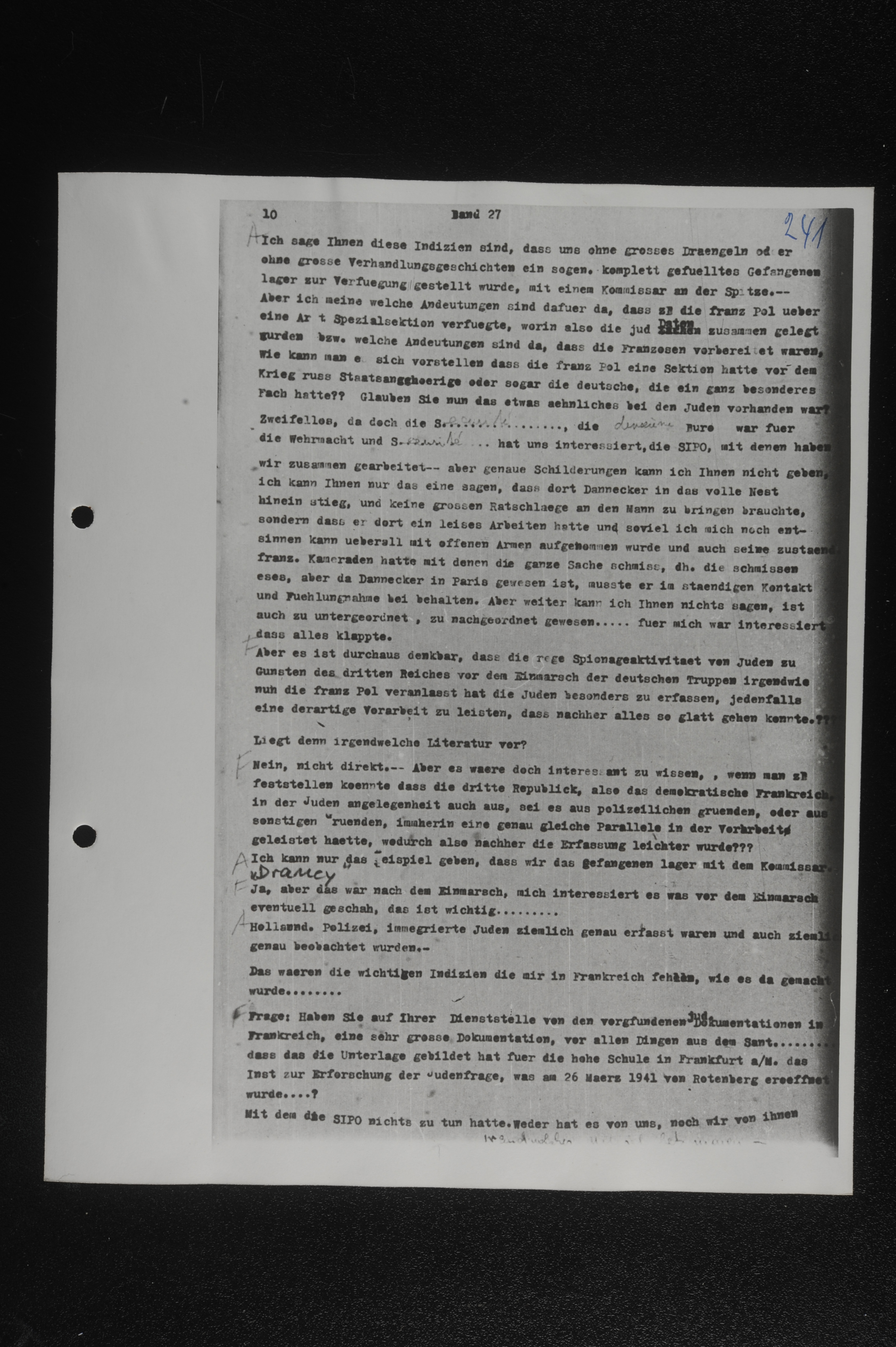
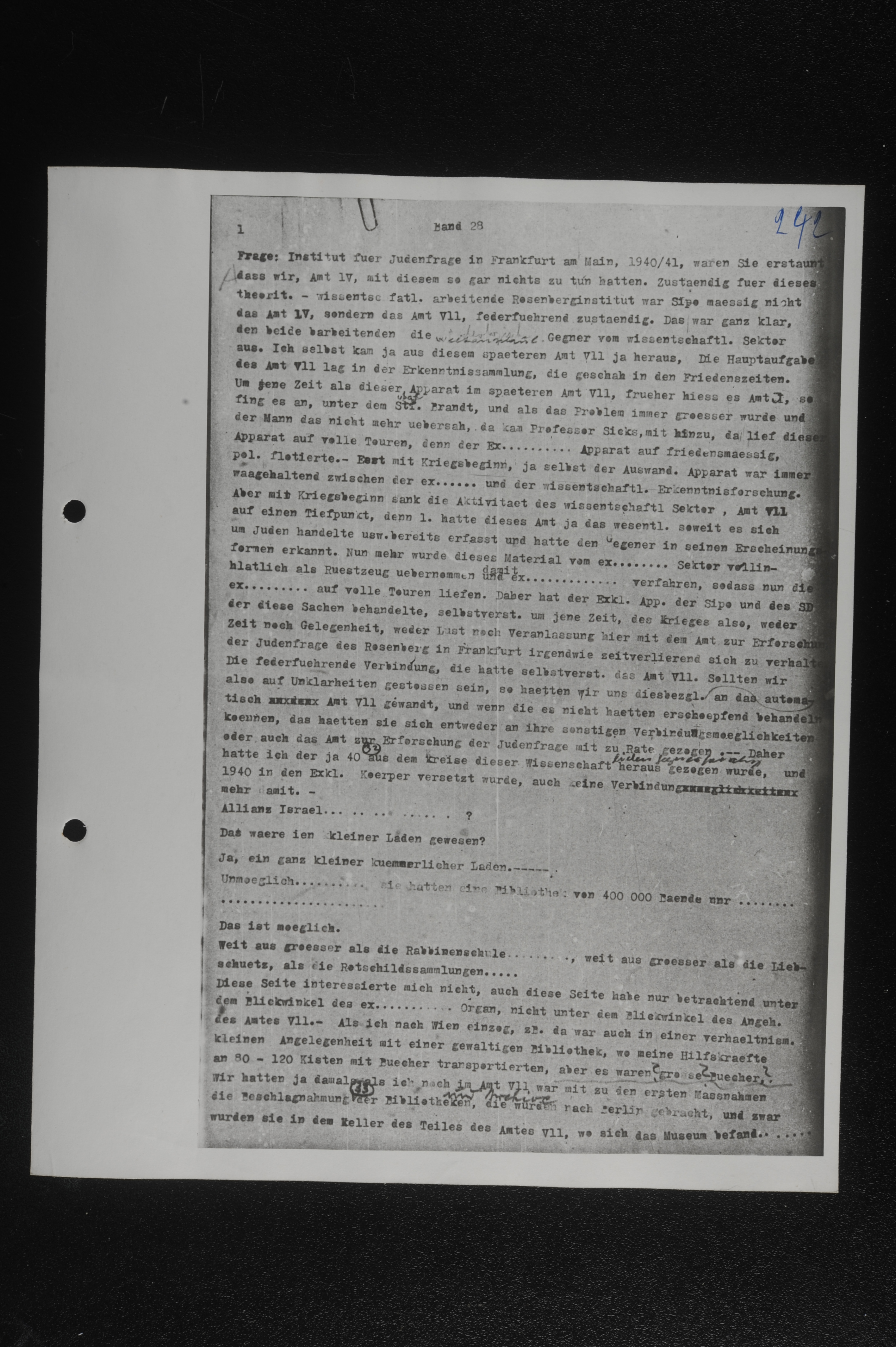
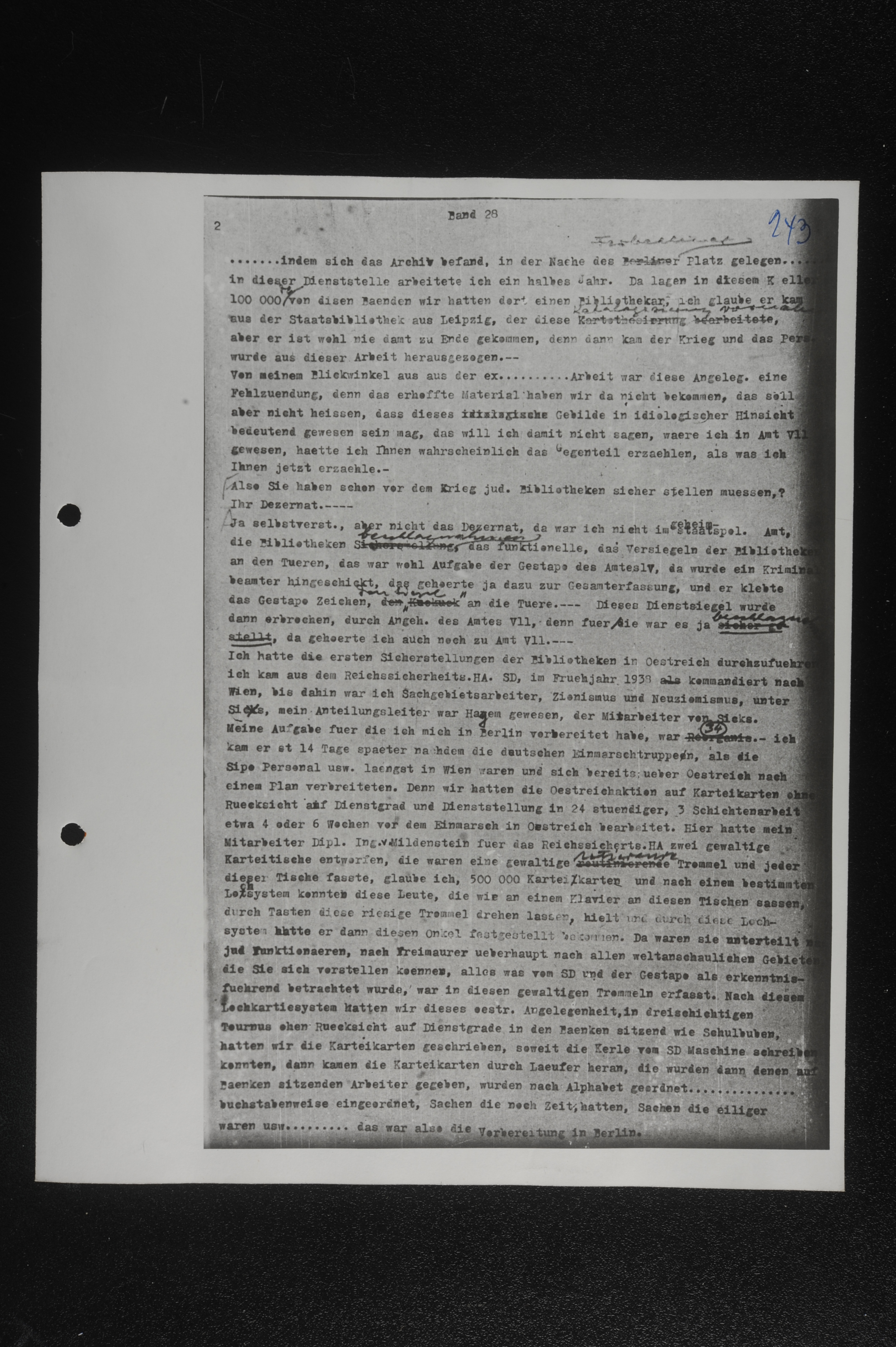
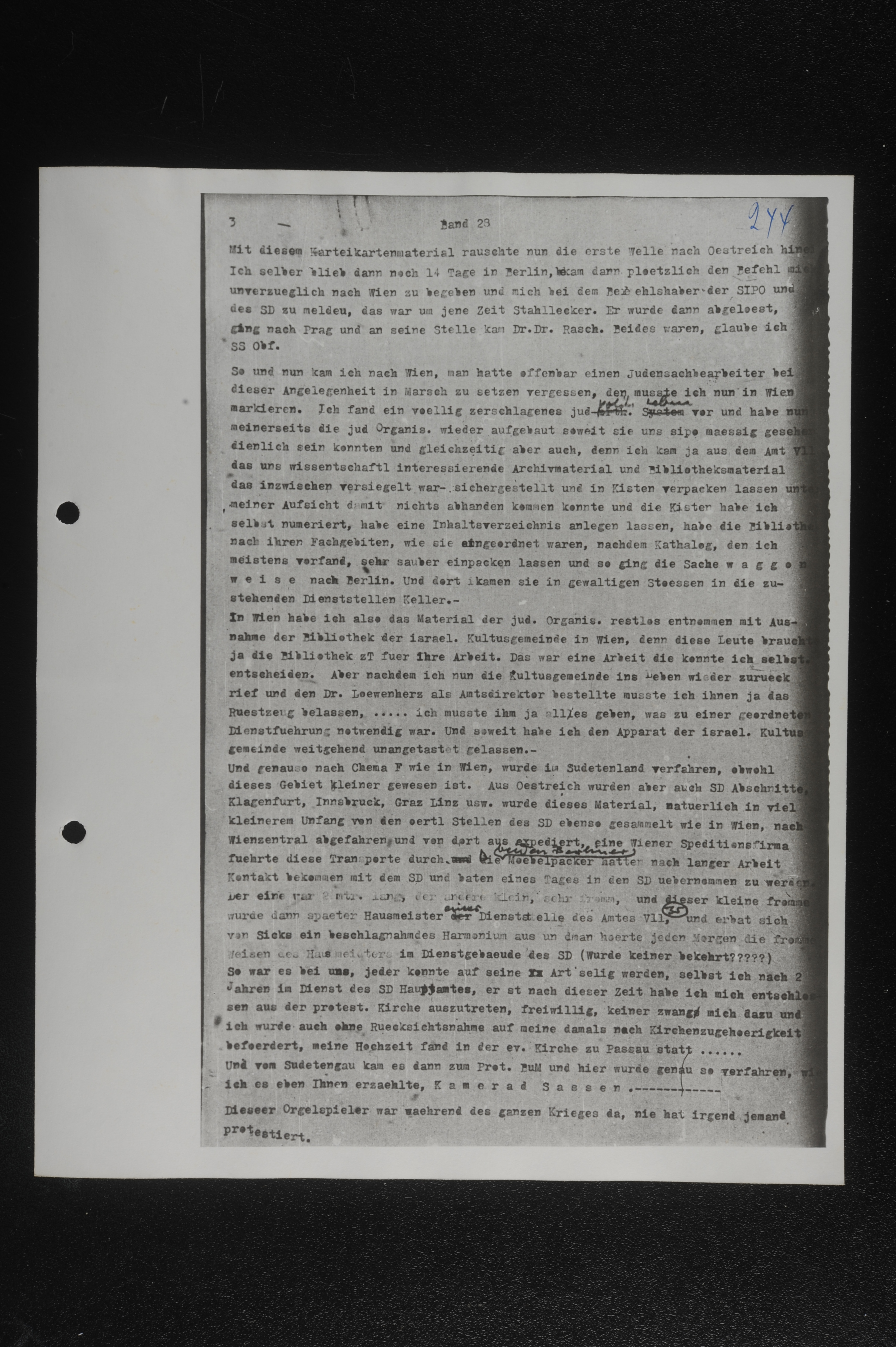
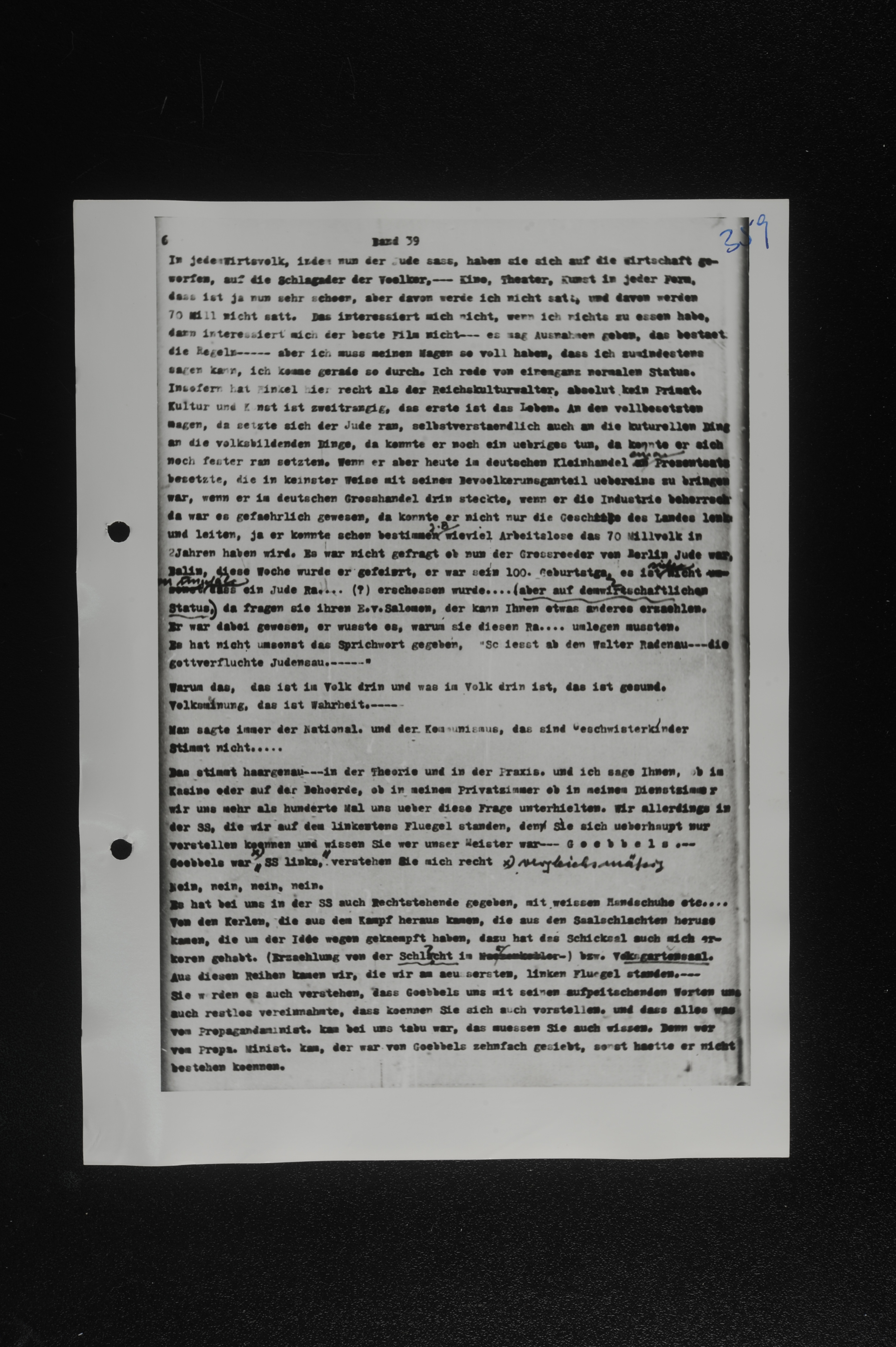
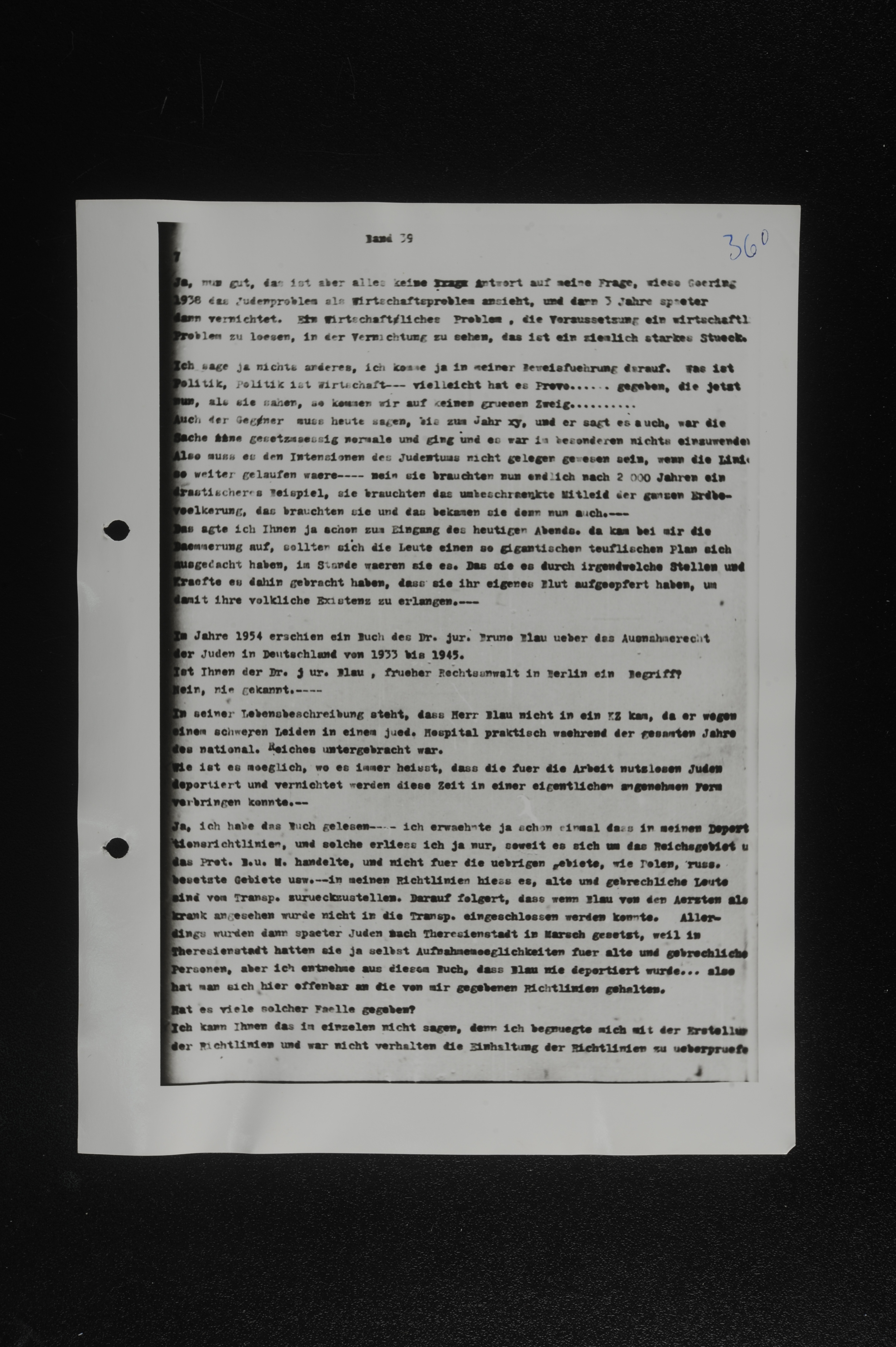
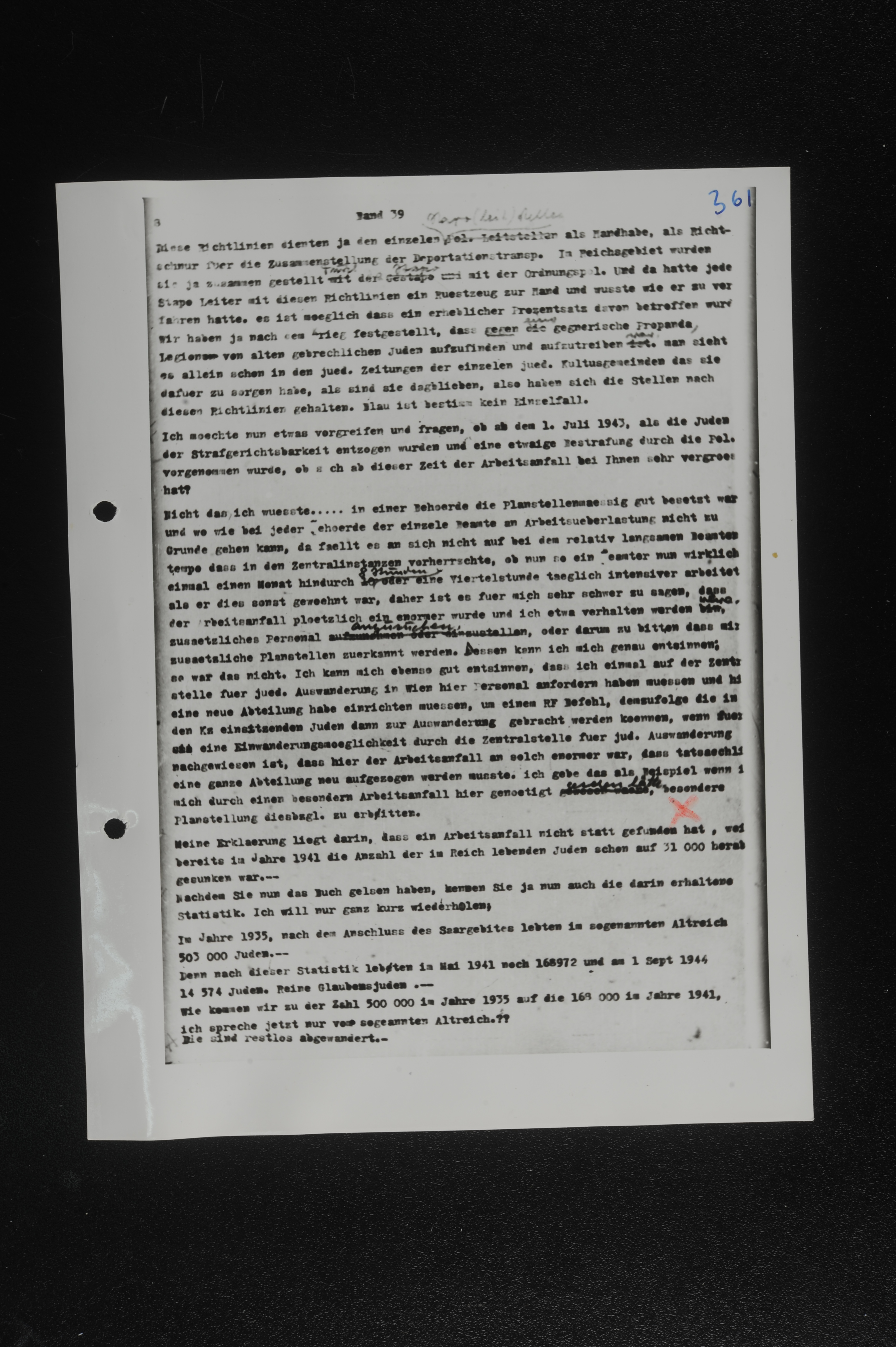
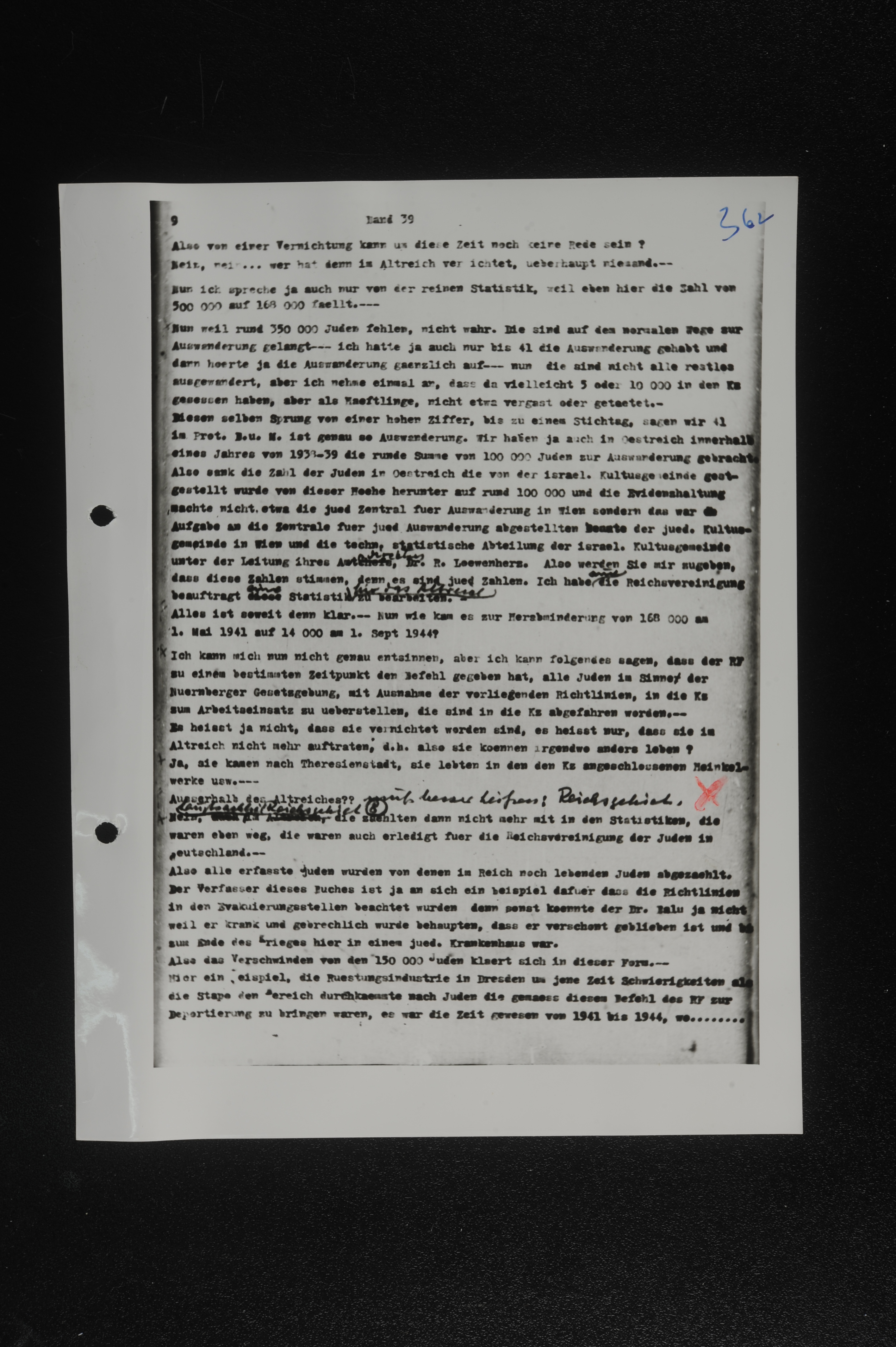
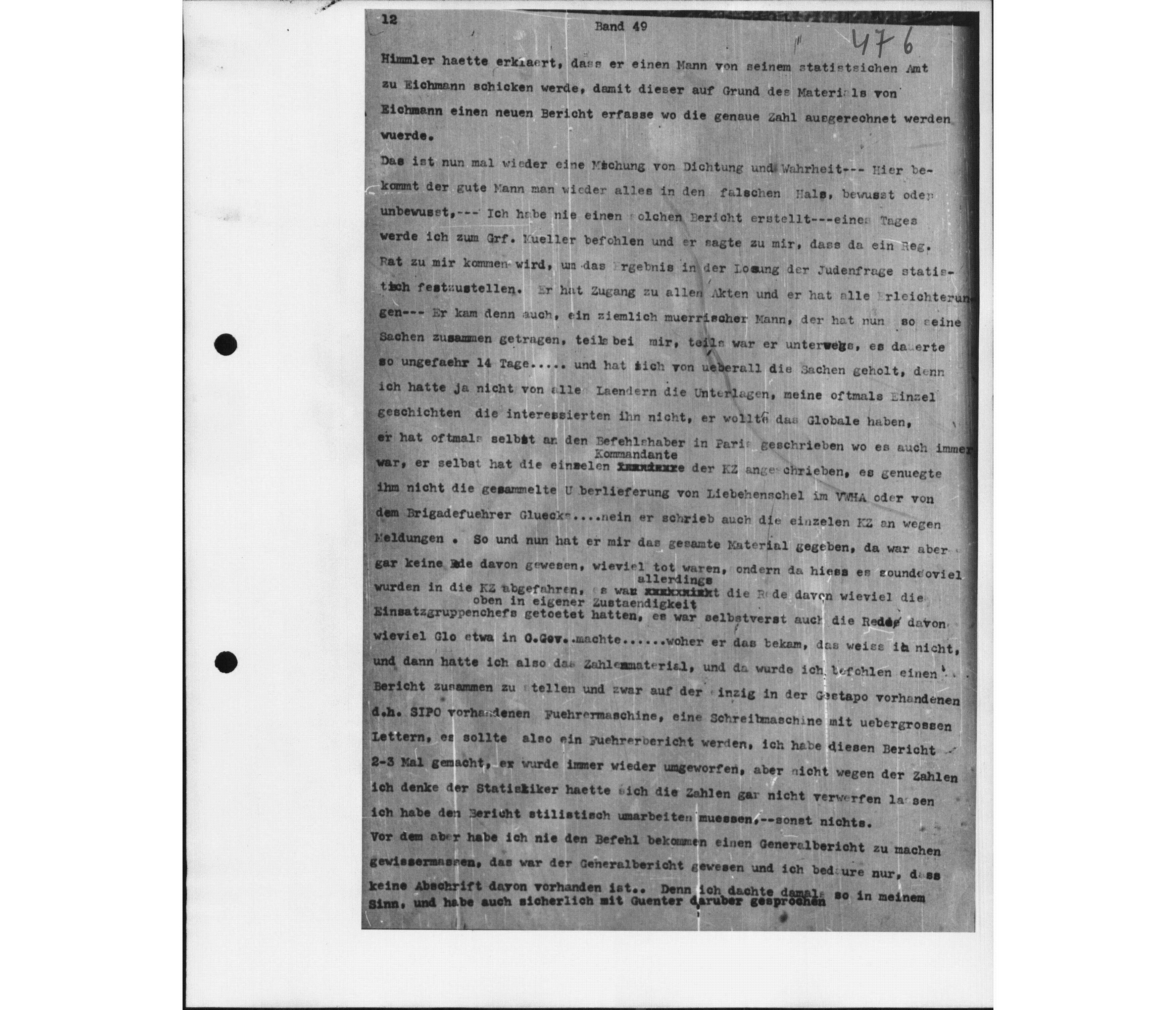
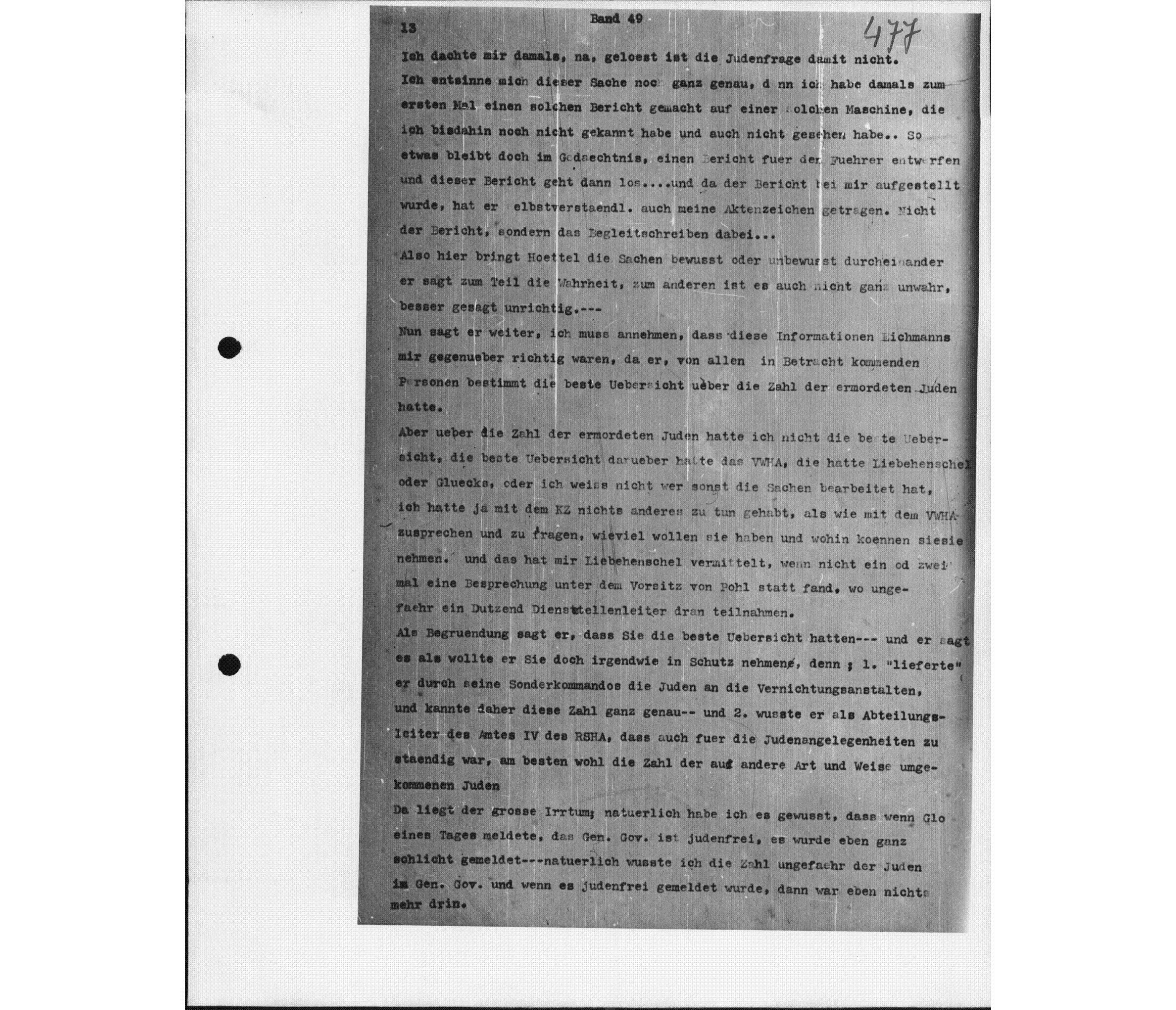
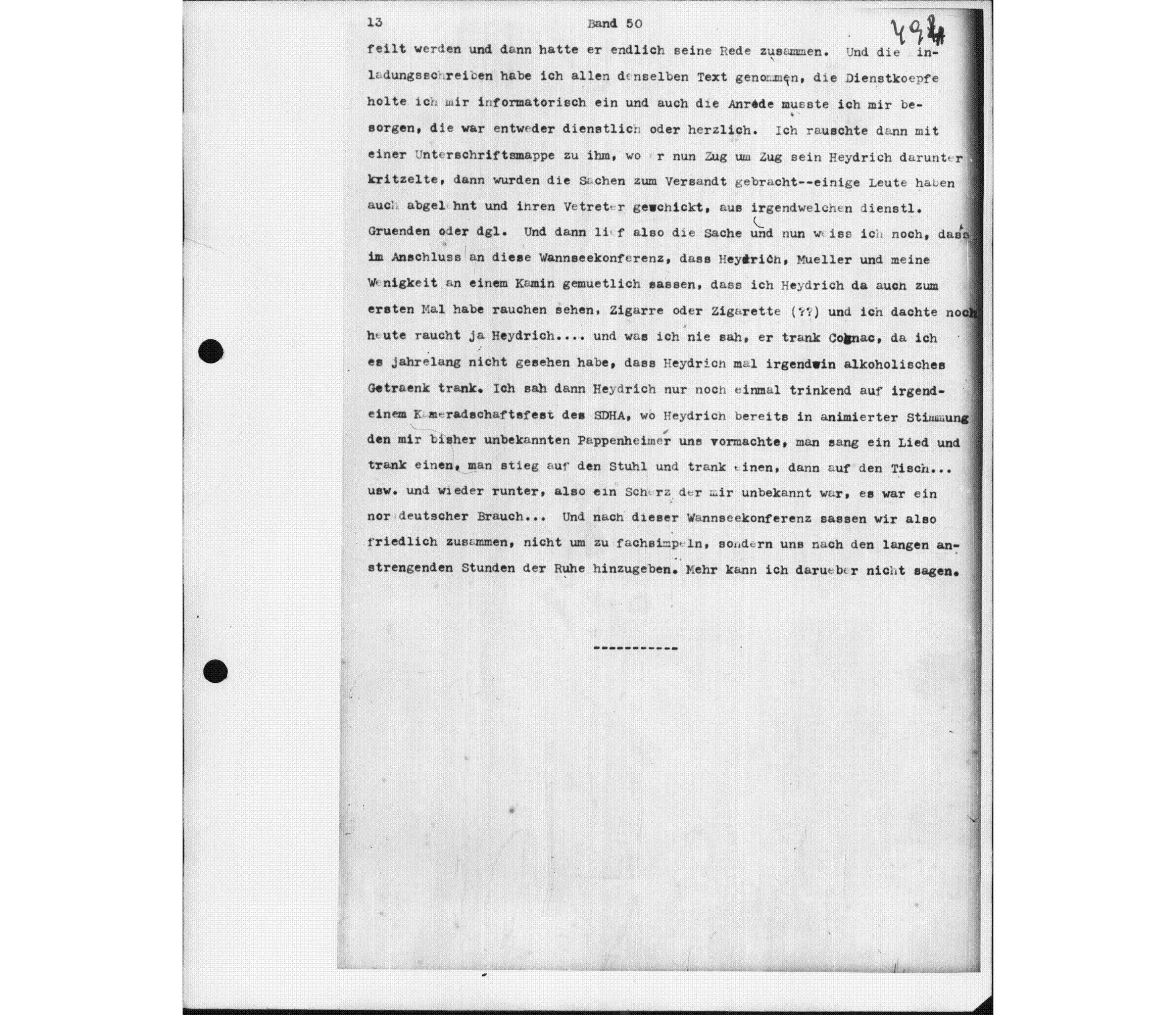
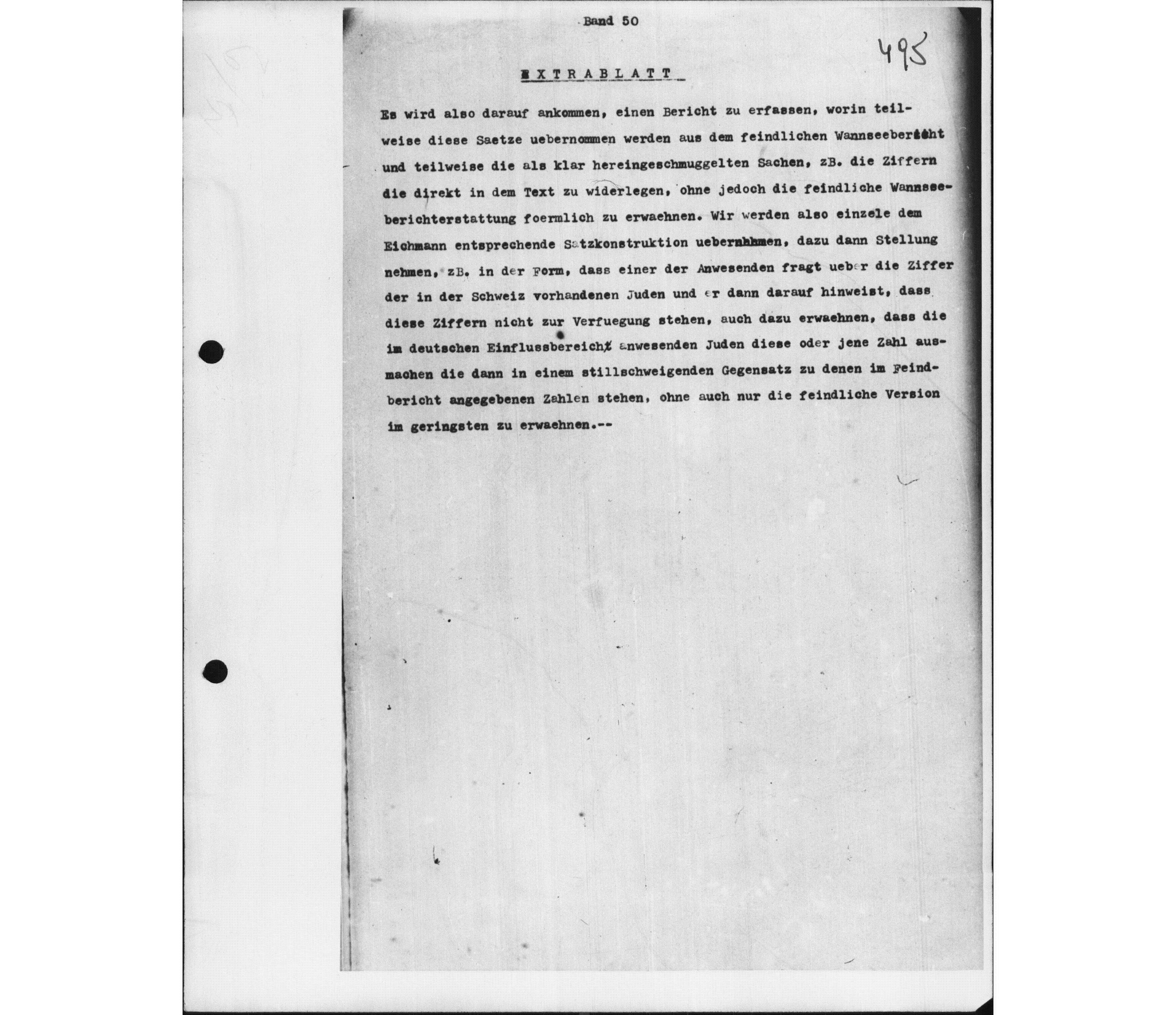
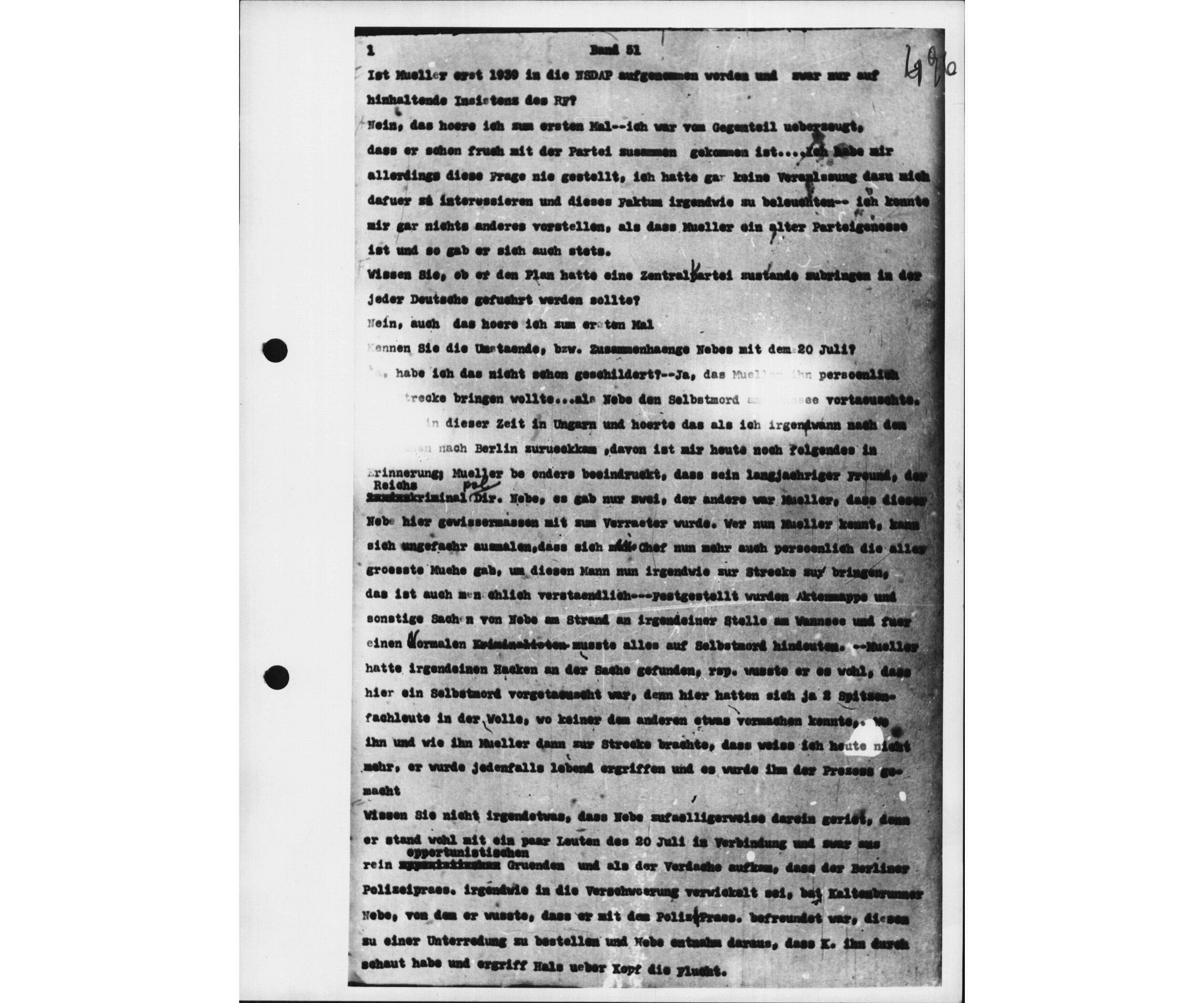
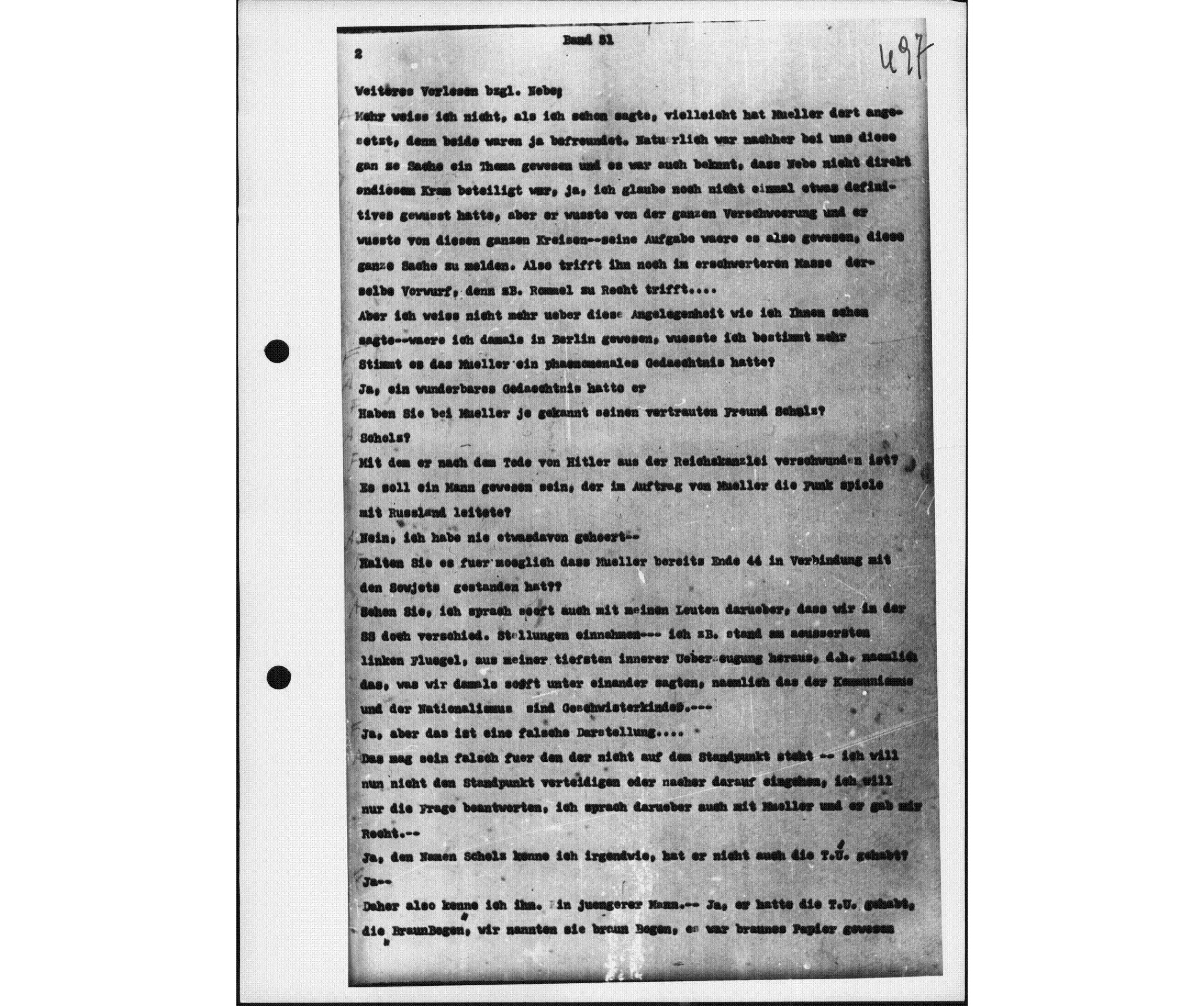
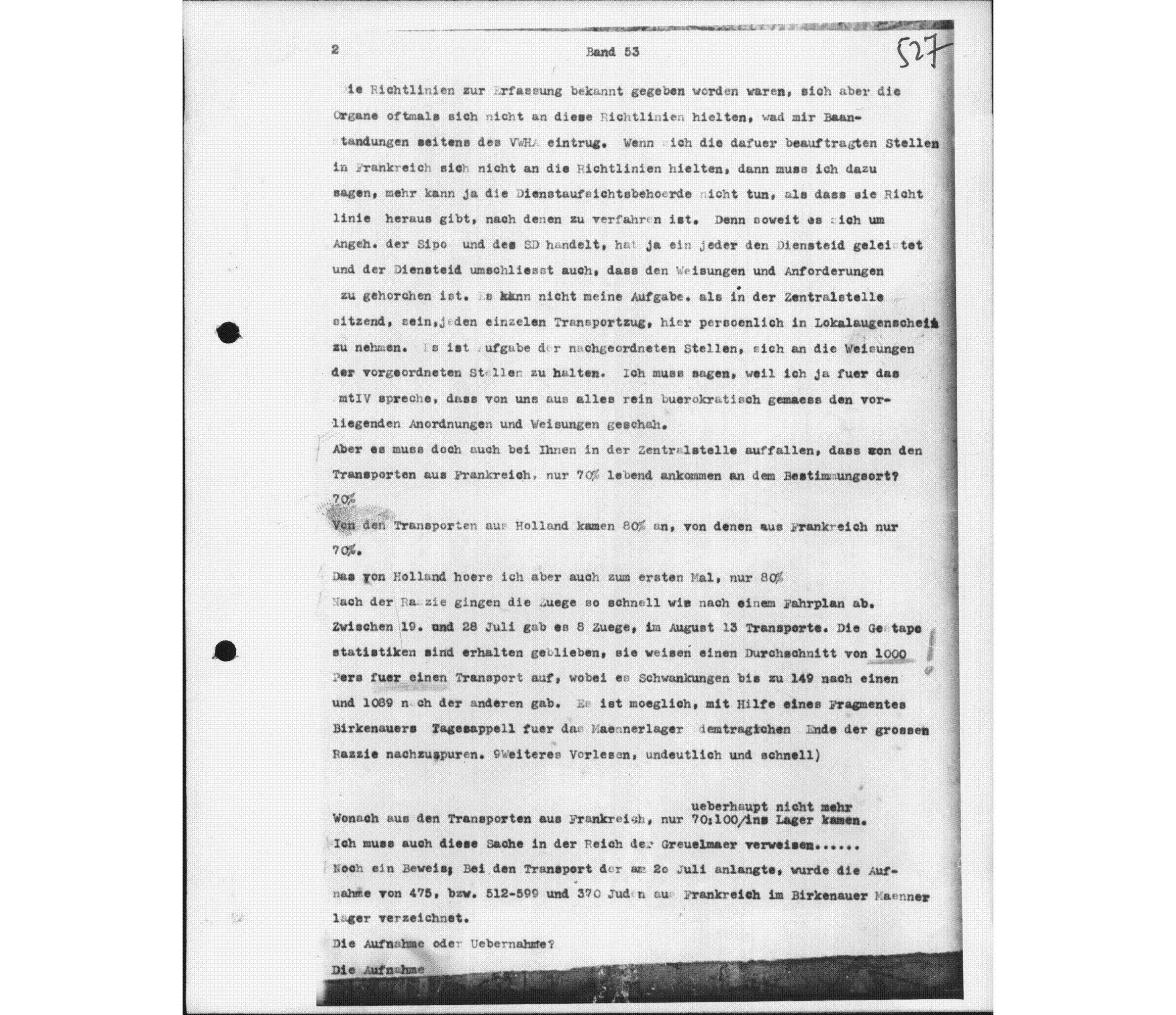
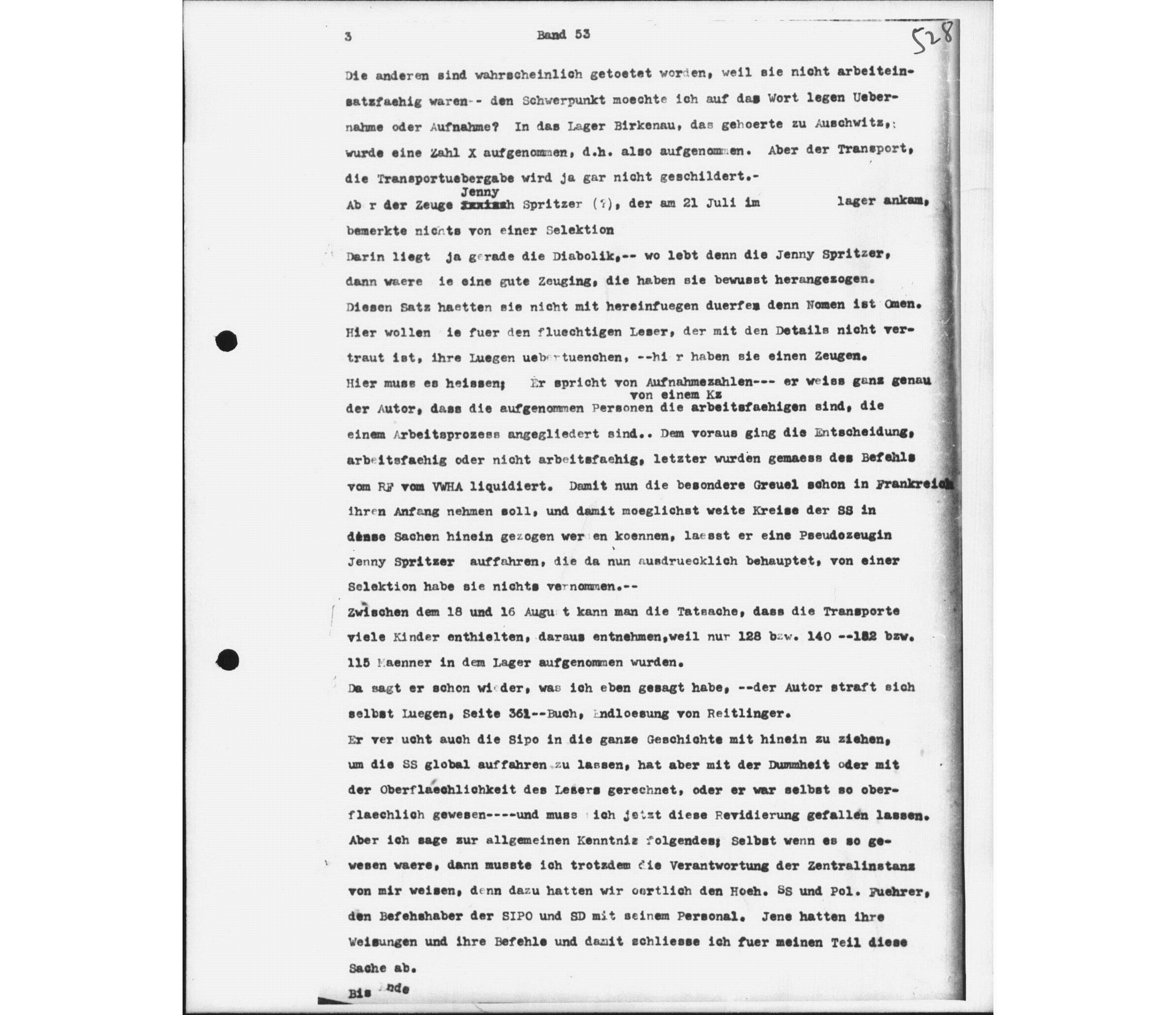
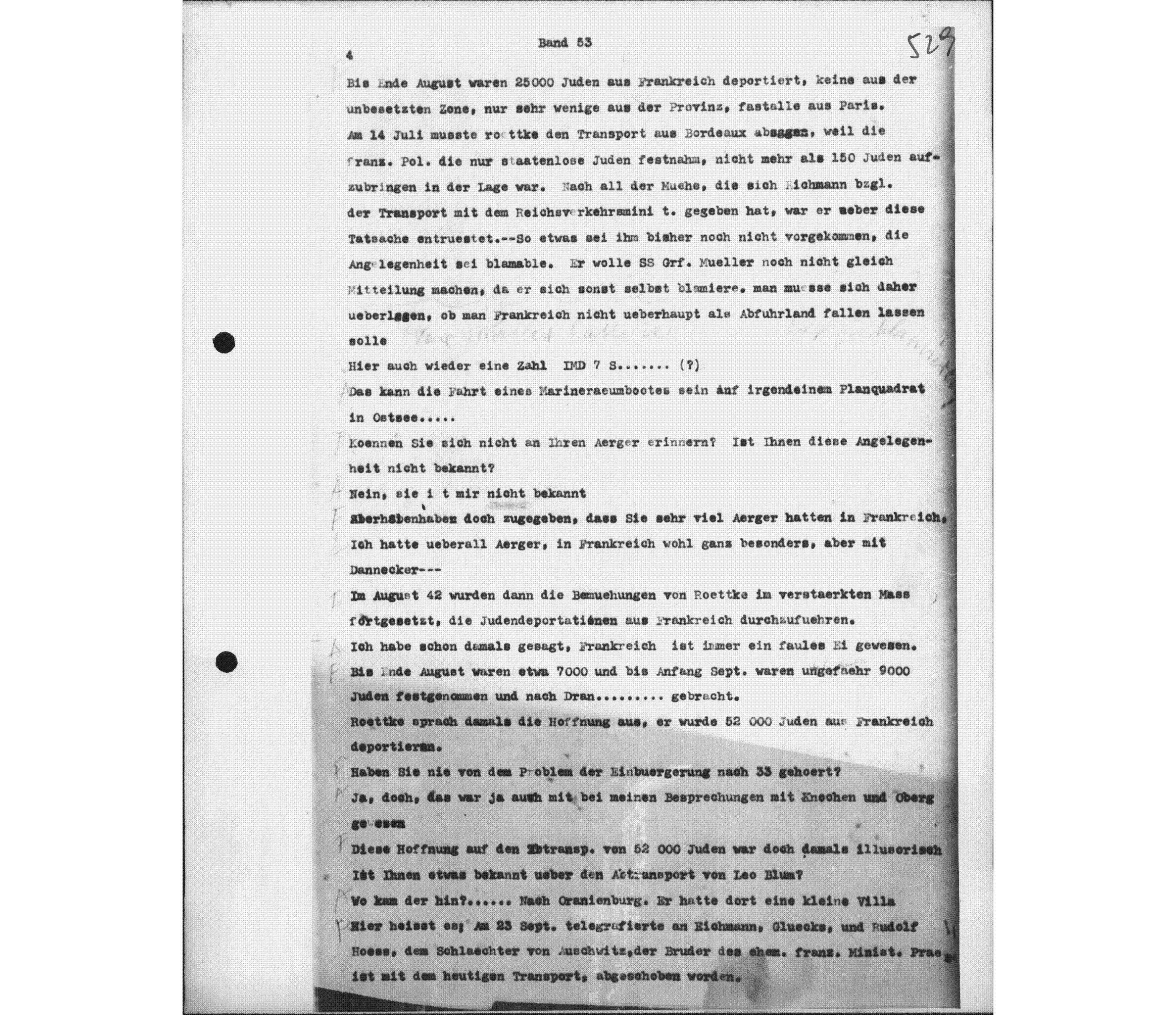
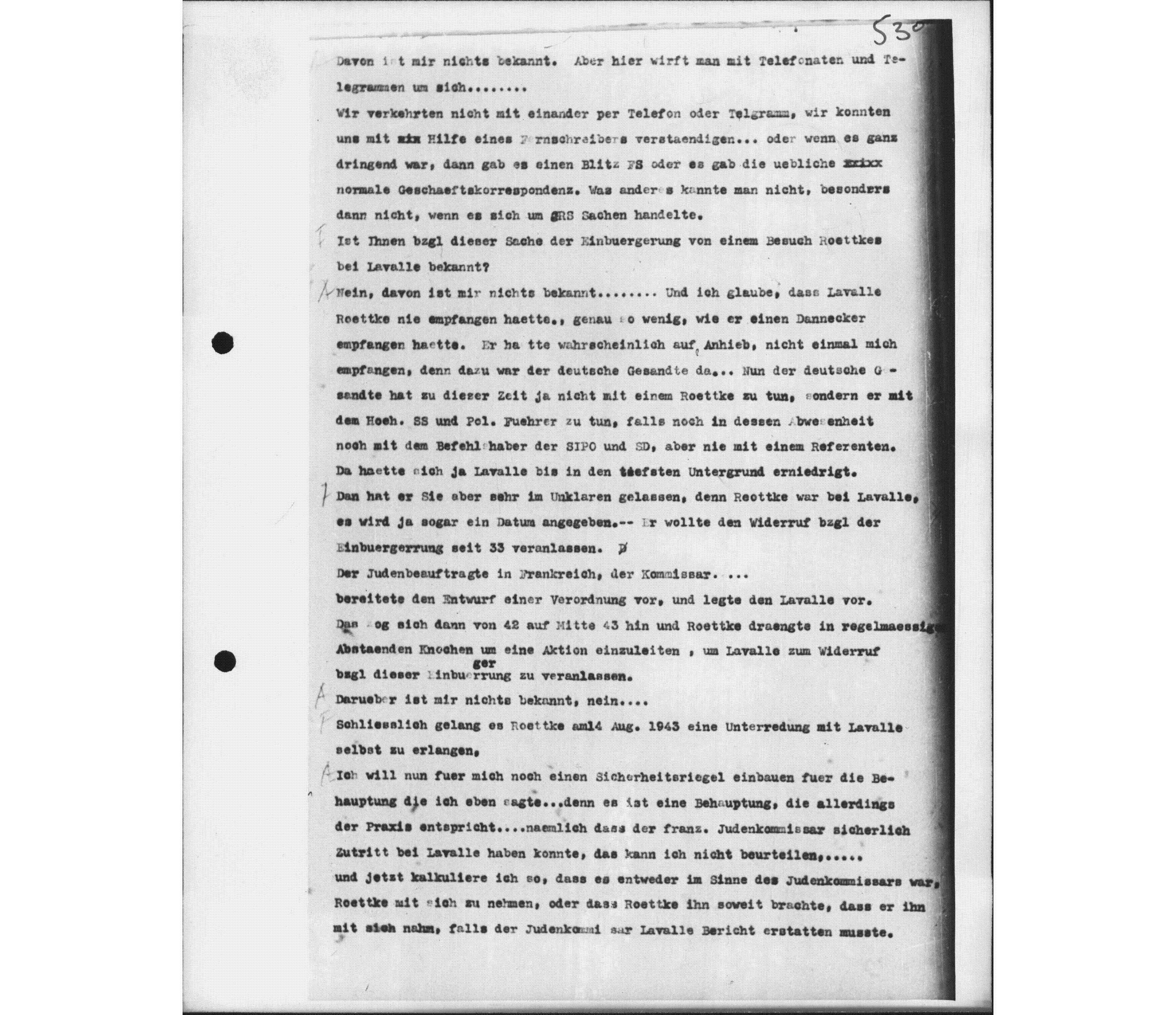
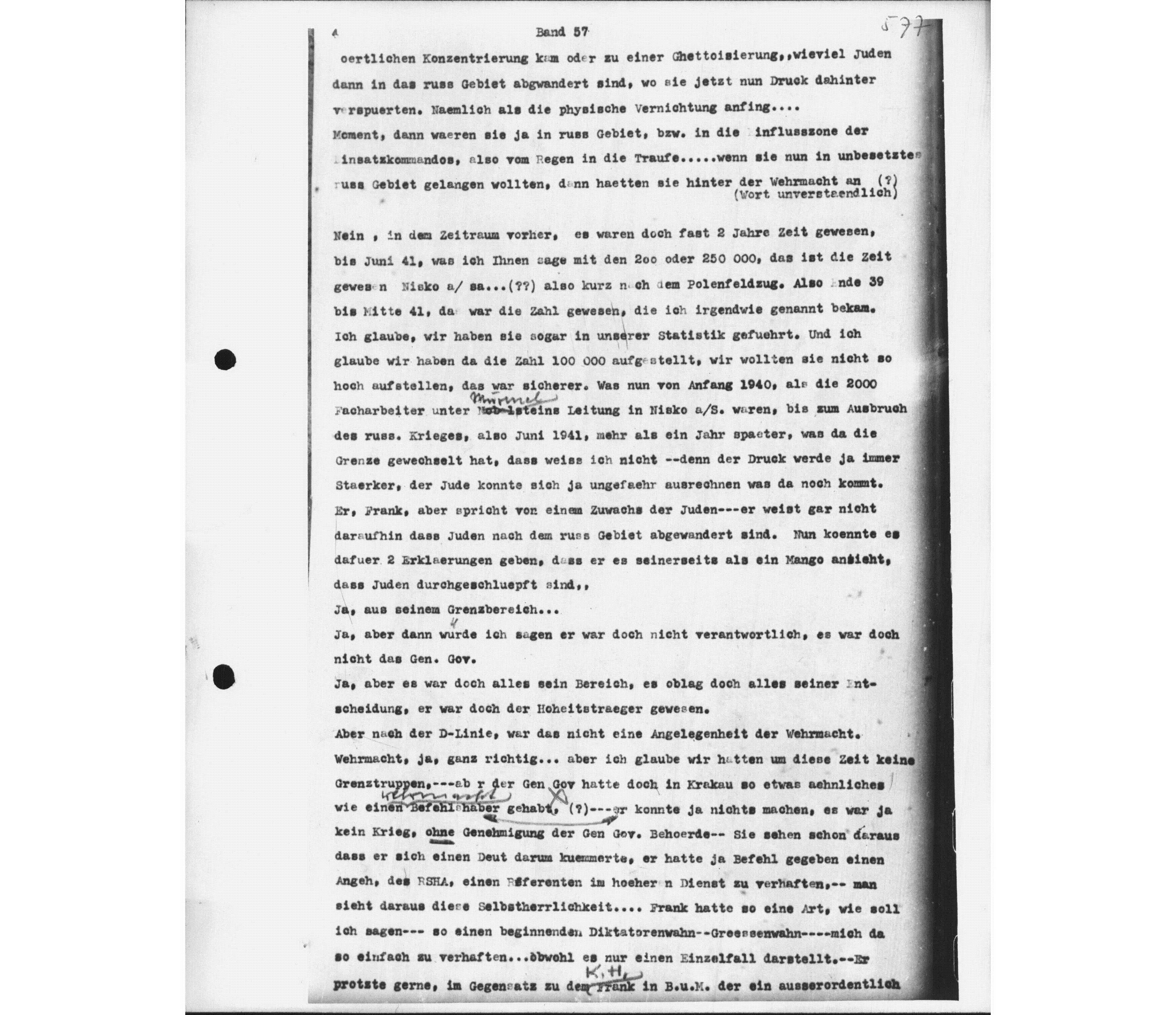
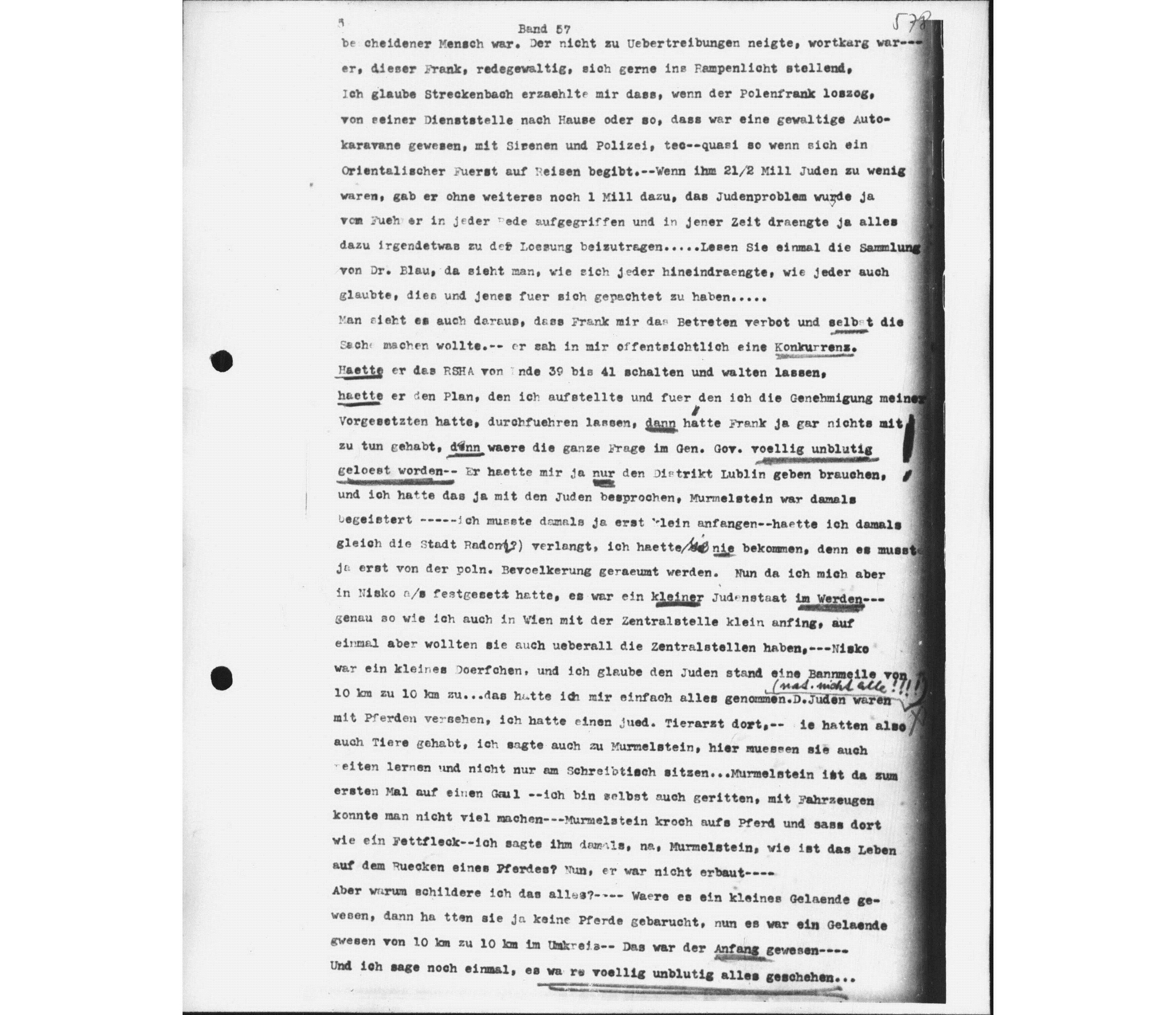
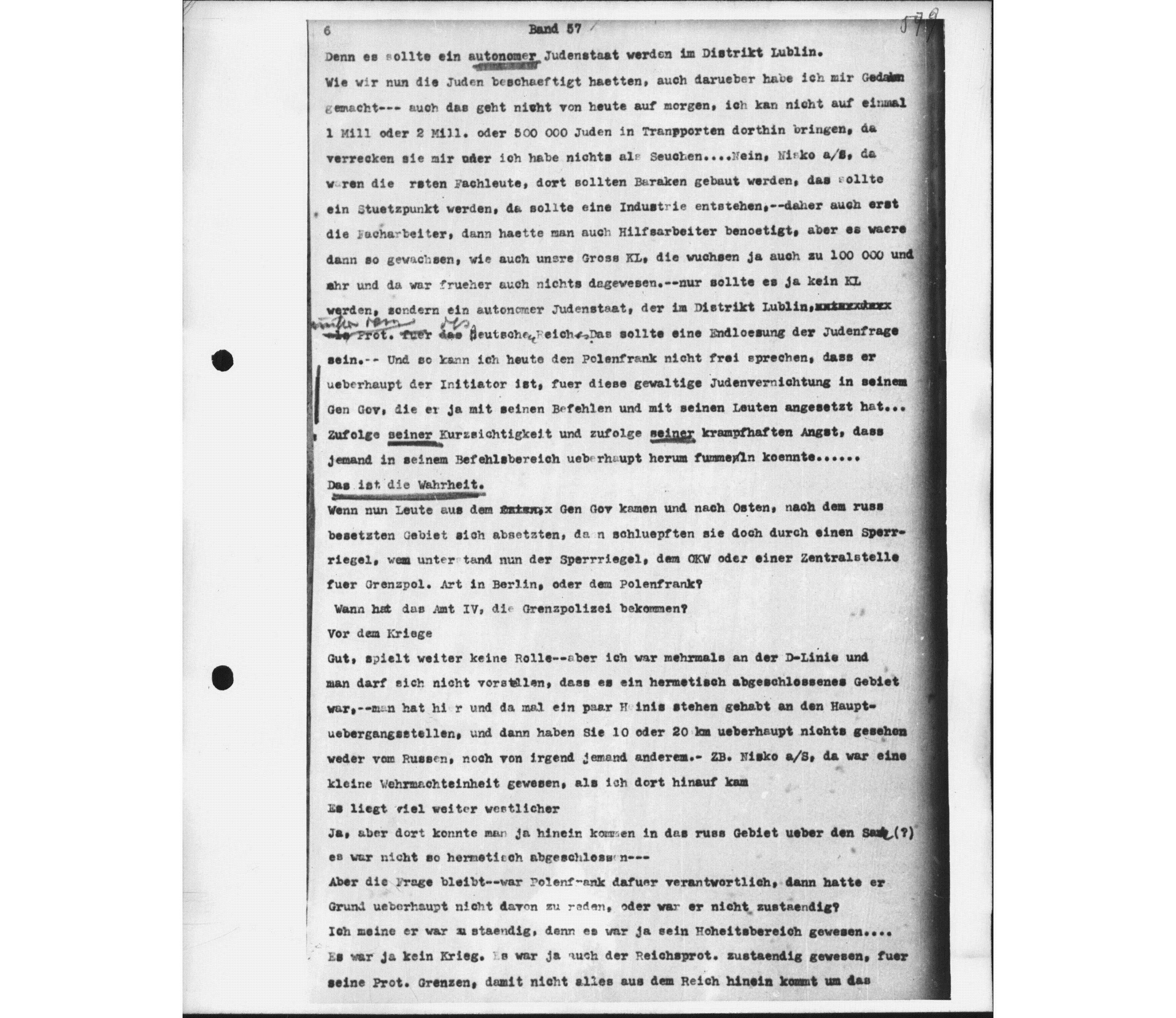
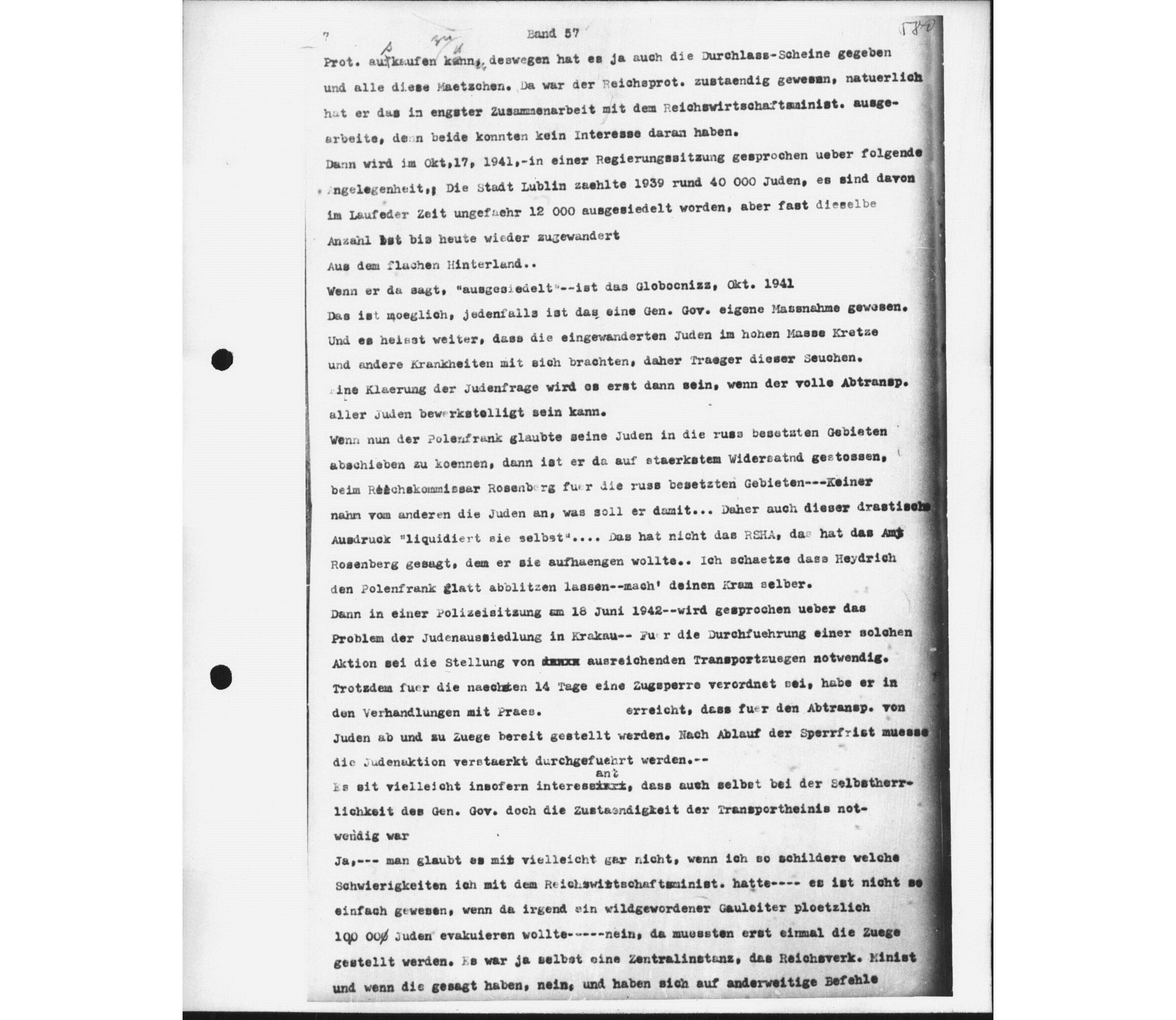
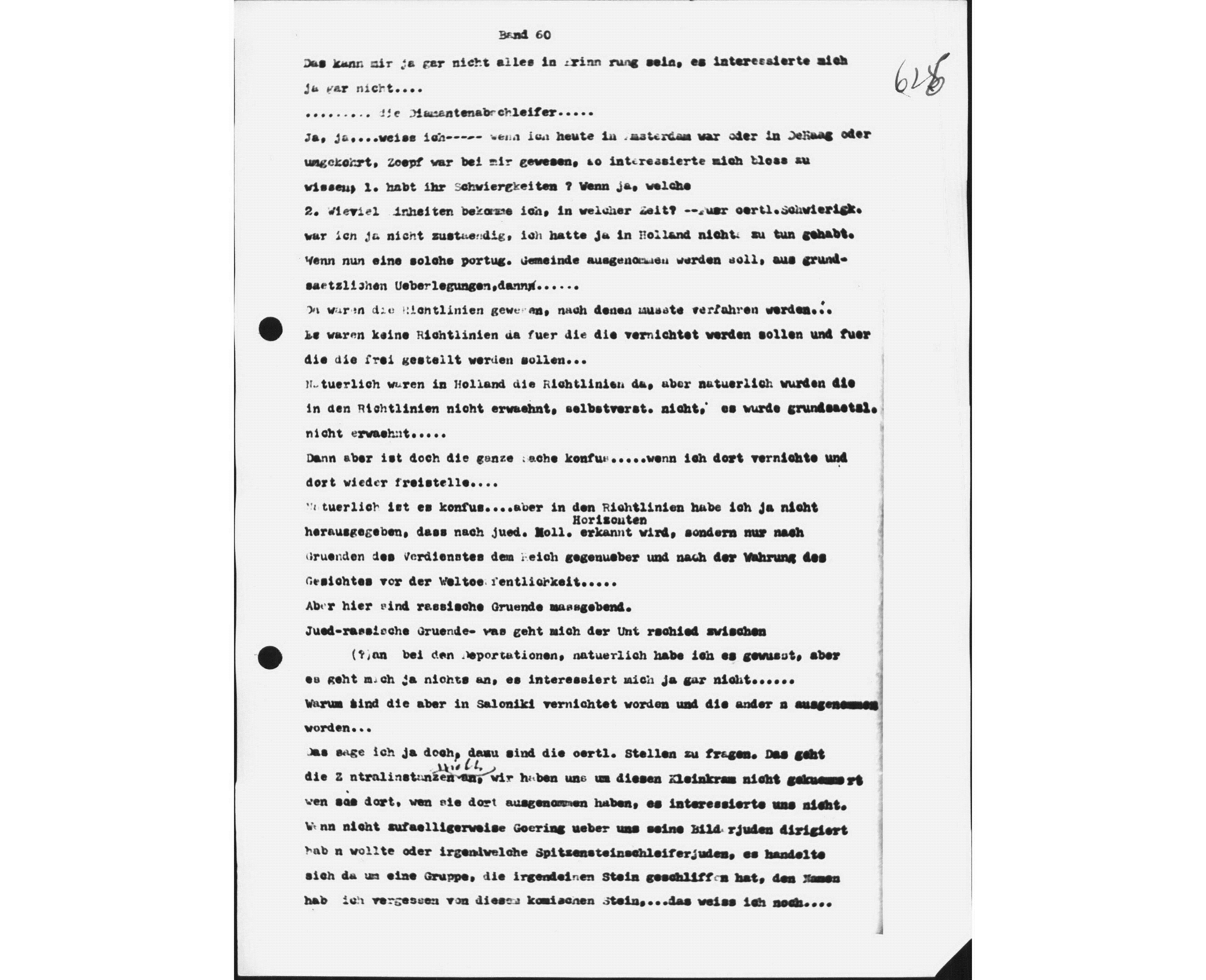
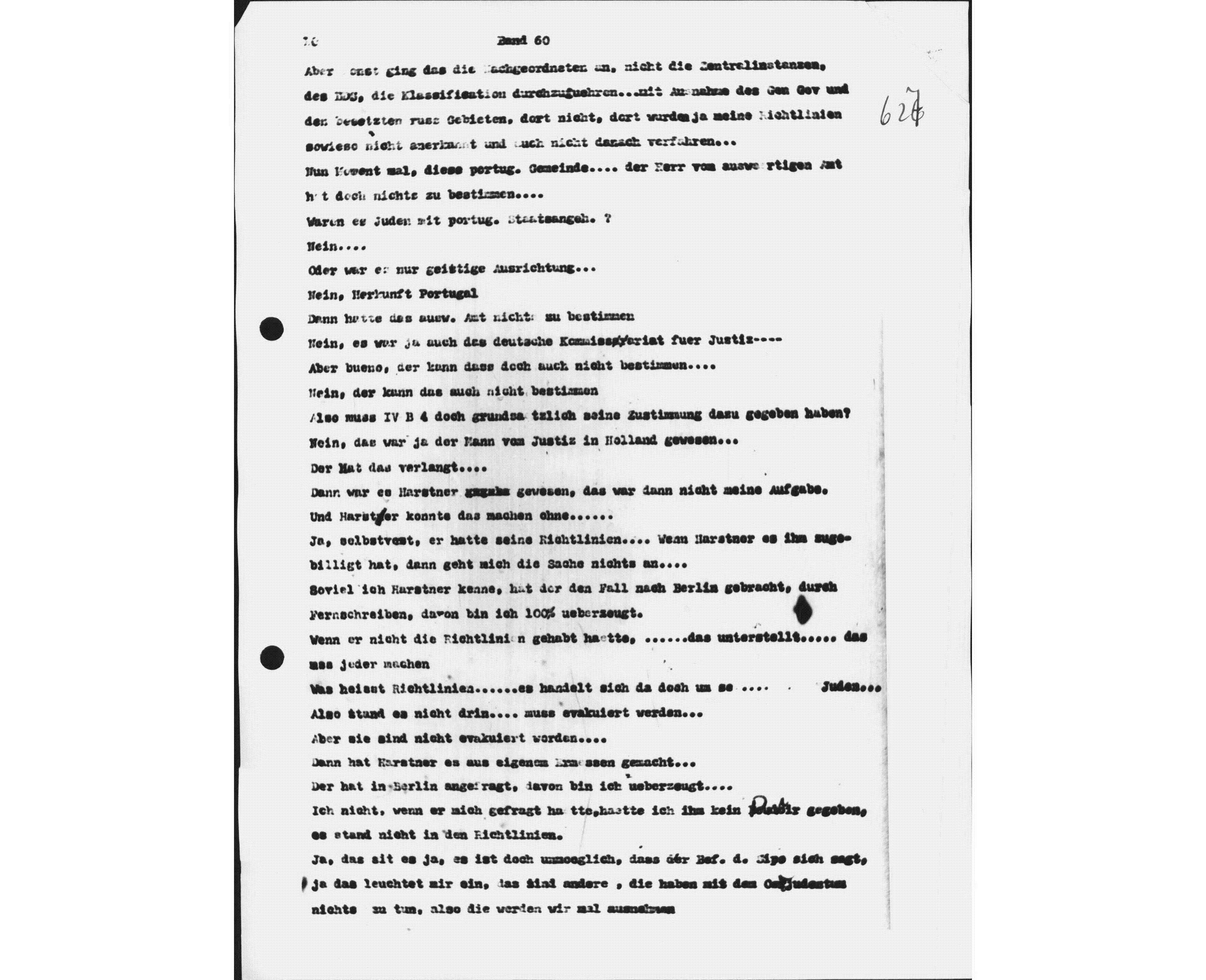
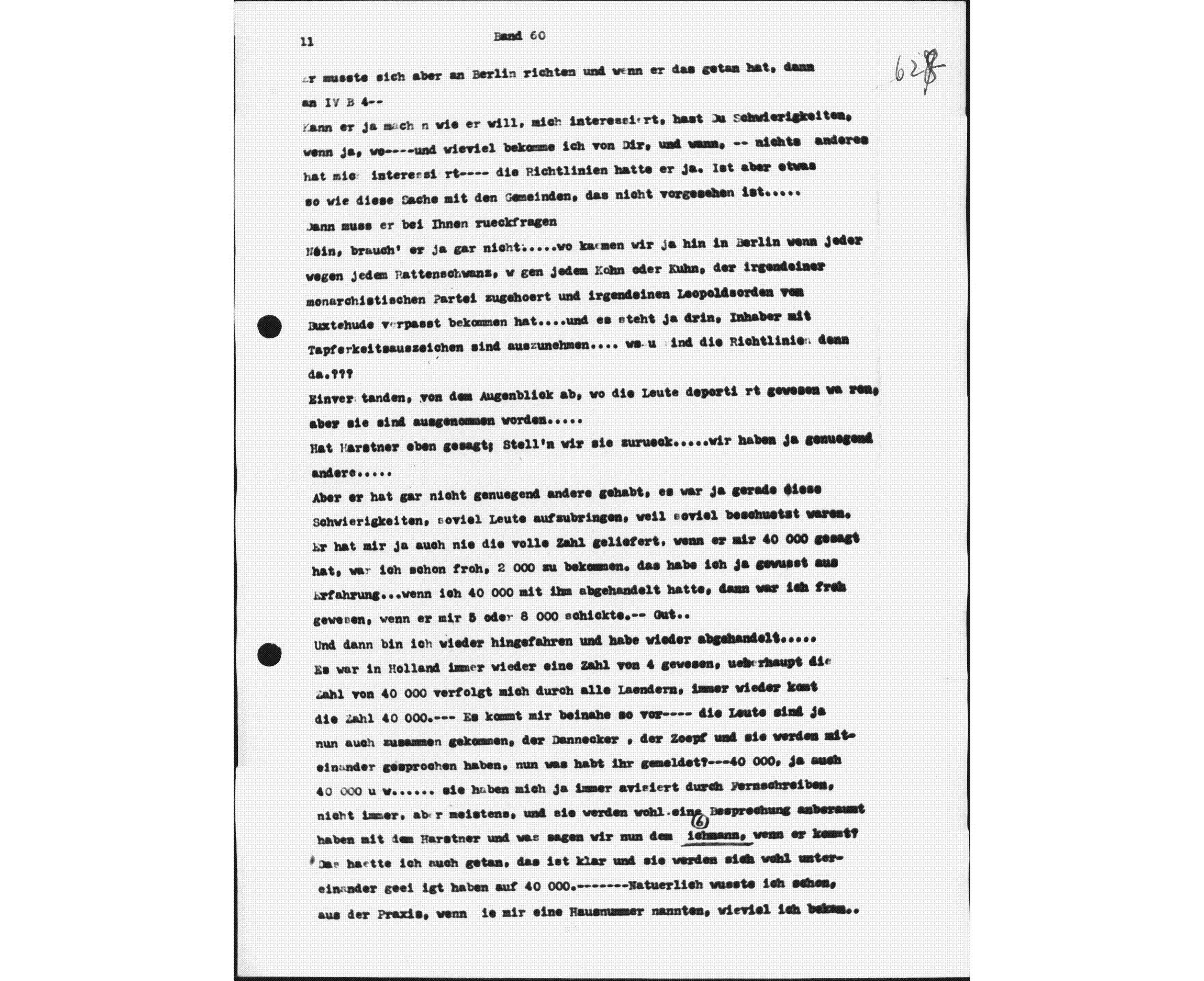
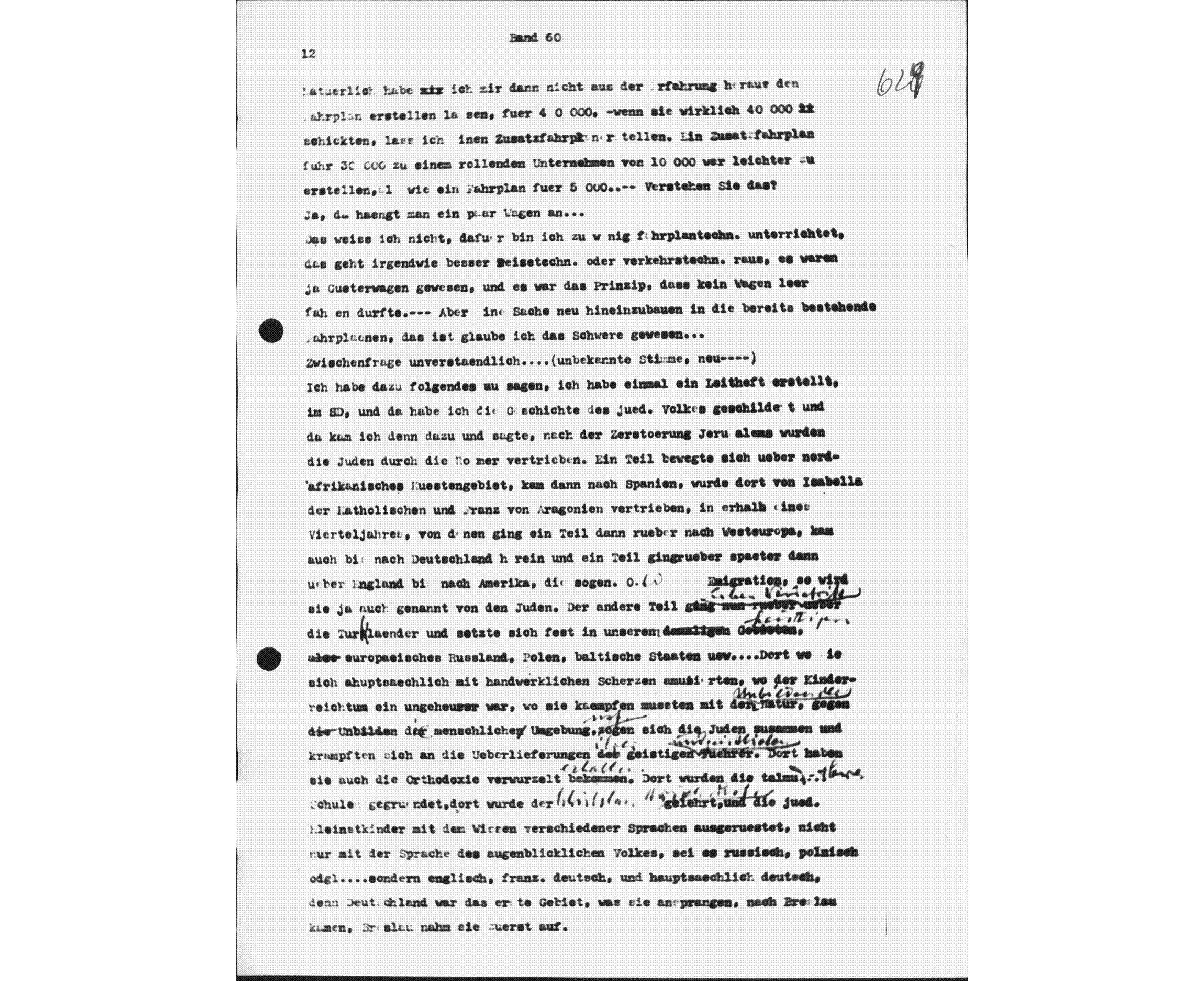
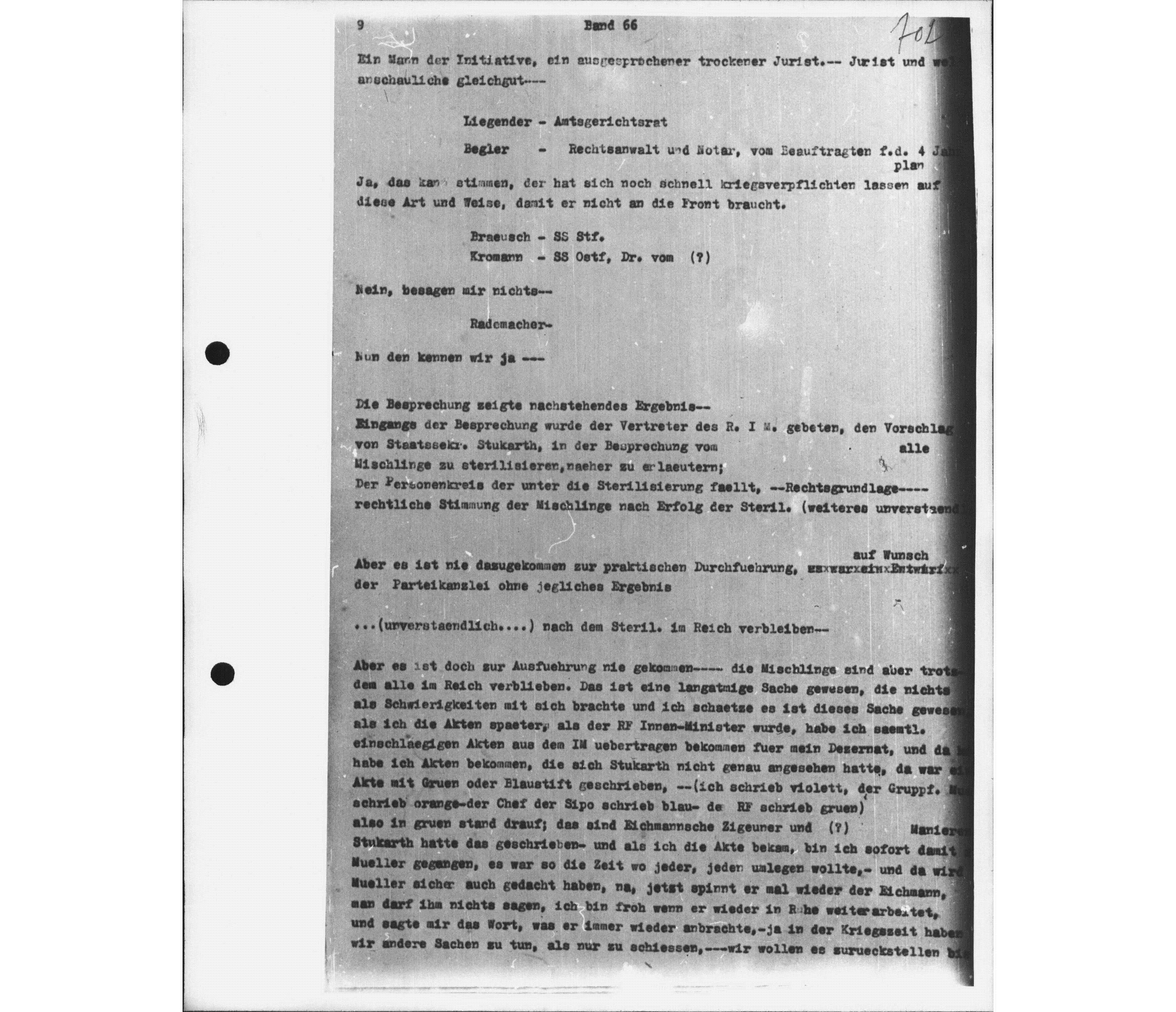
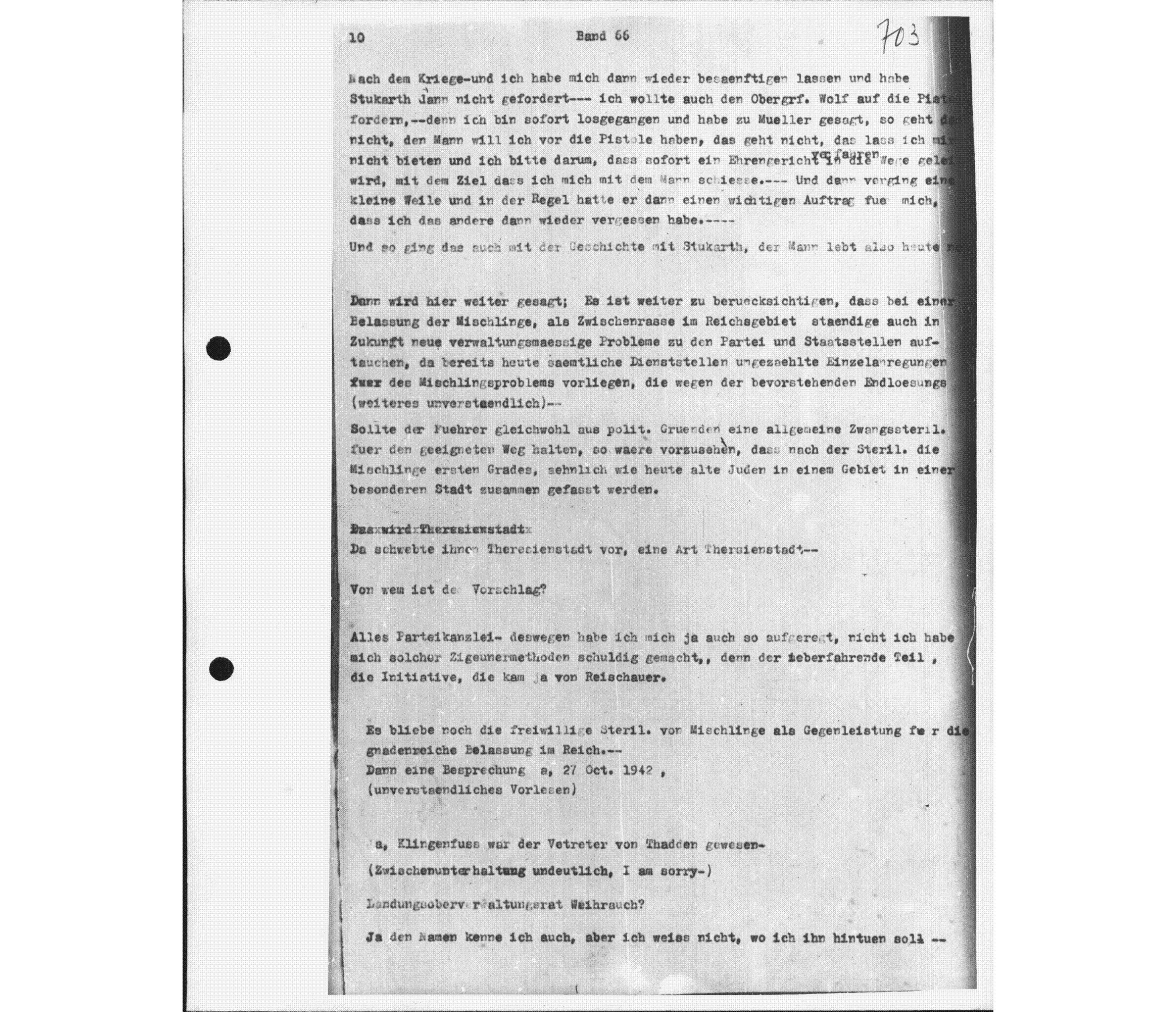
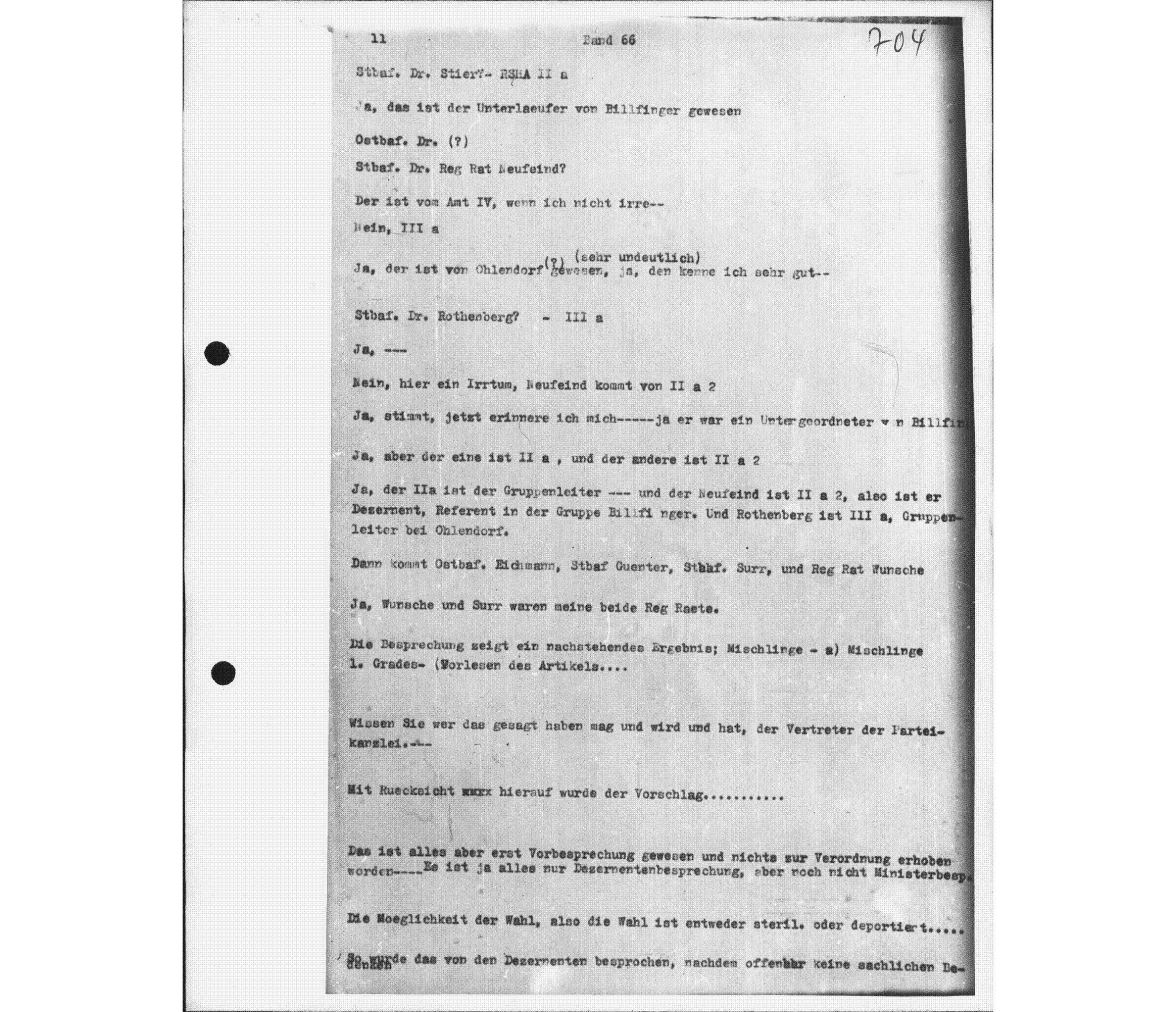
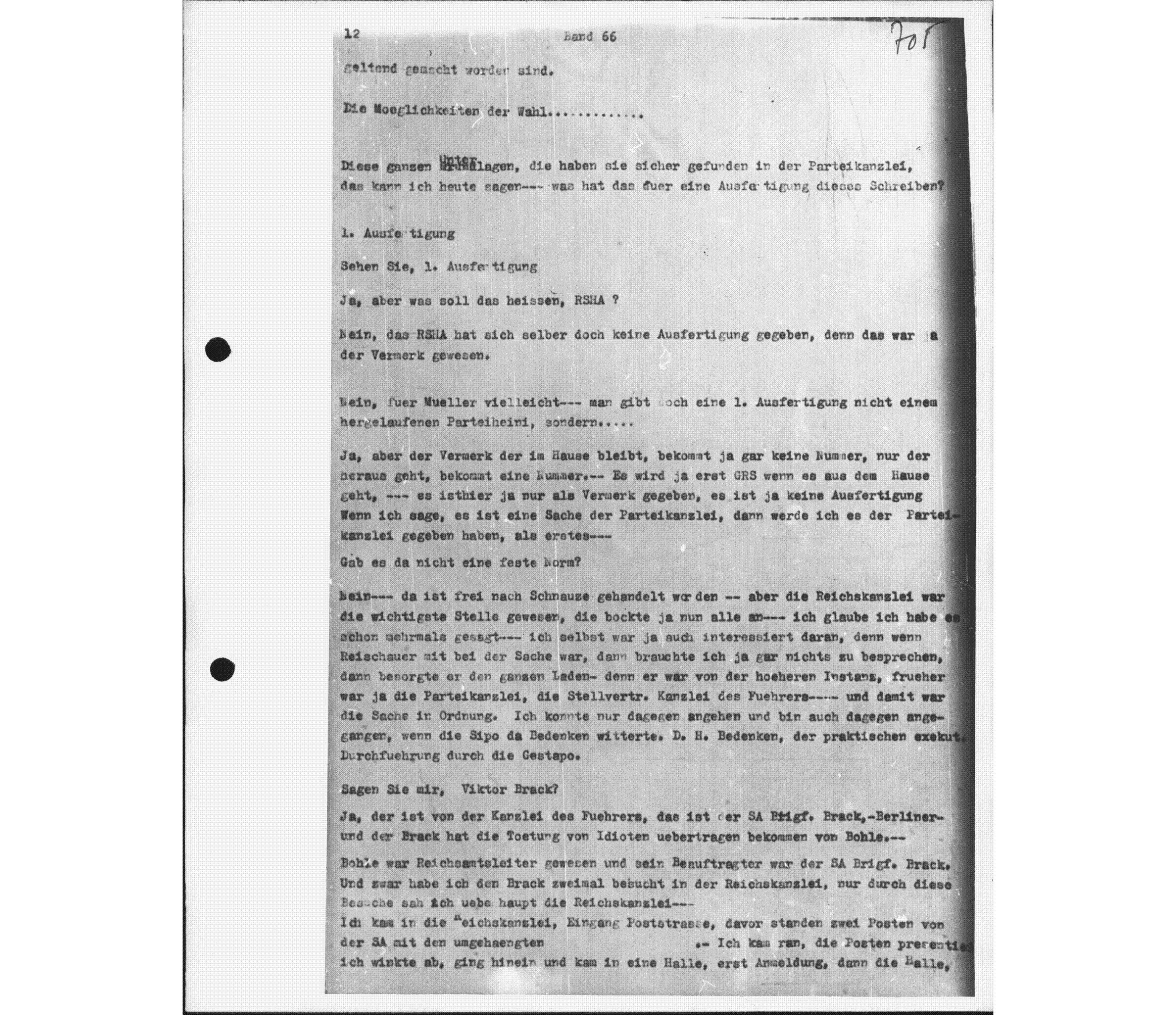
Edited excerpt from «Mich reut gar nichts!». Read page 715 in the transcript.

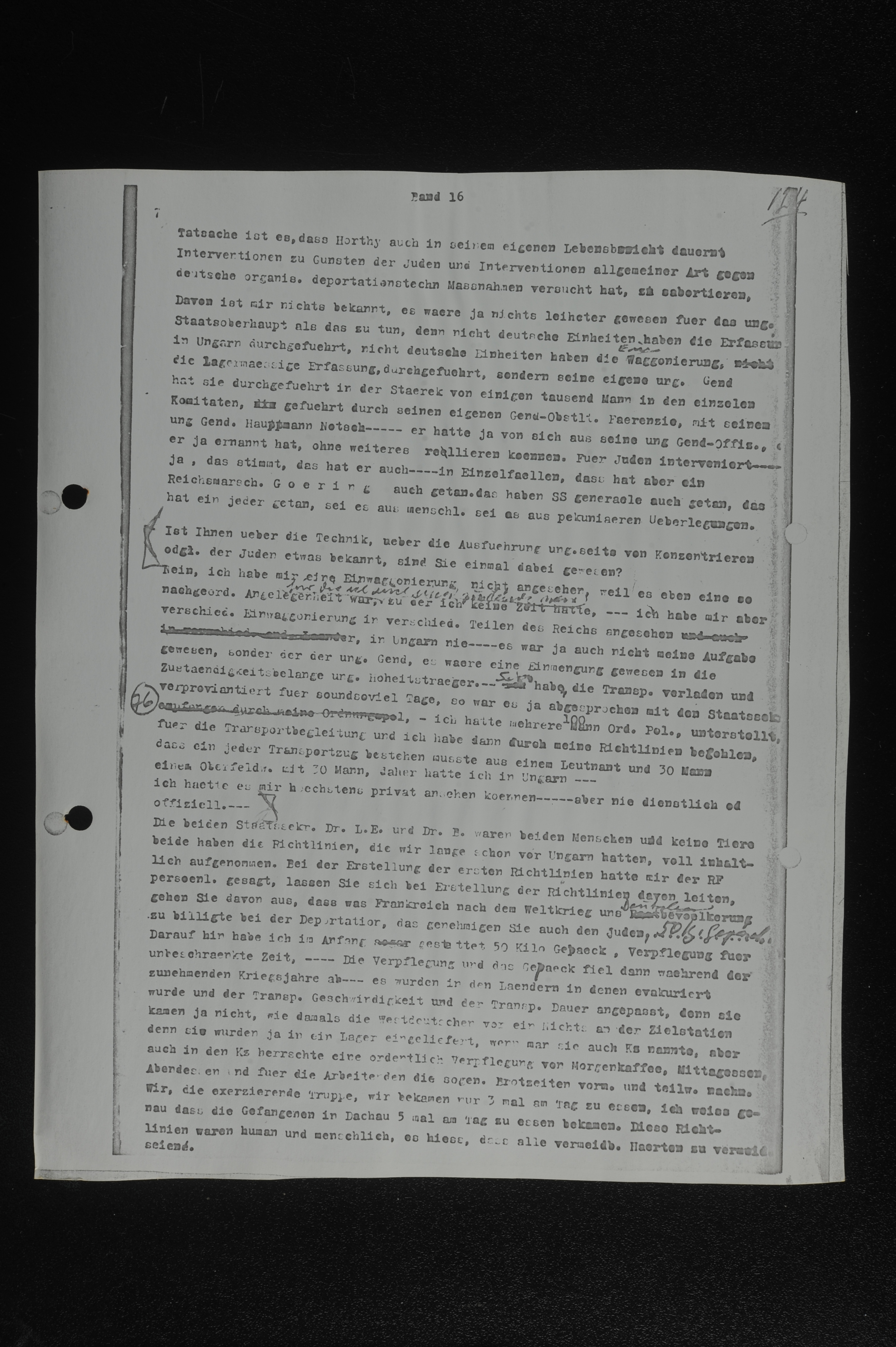
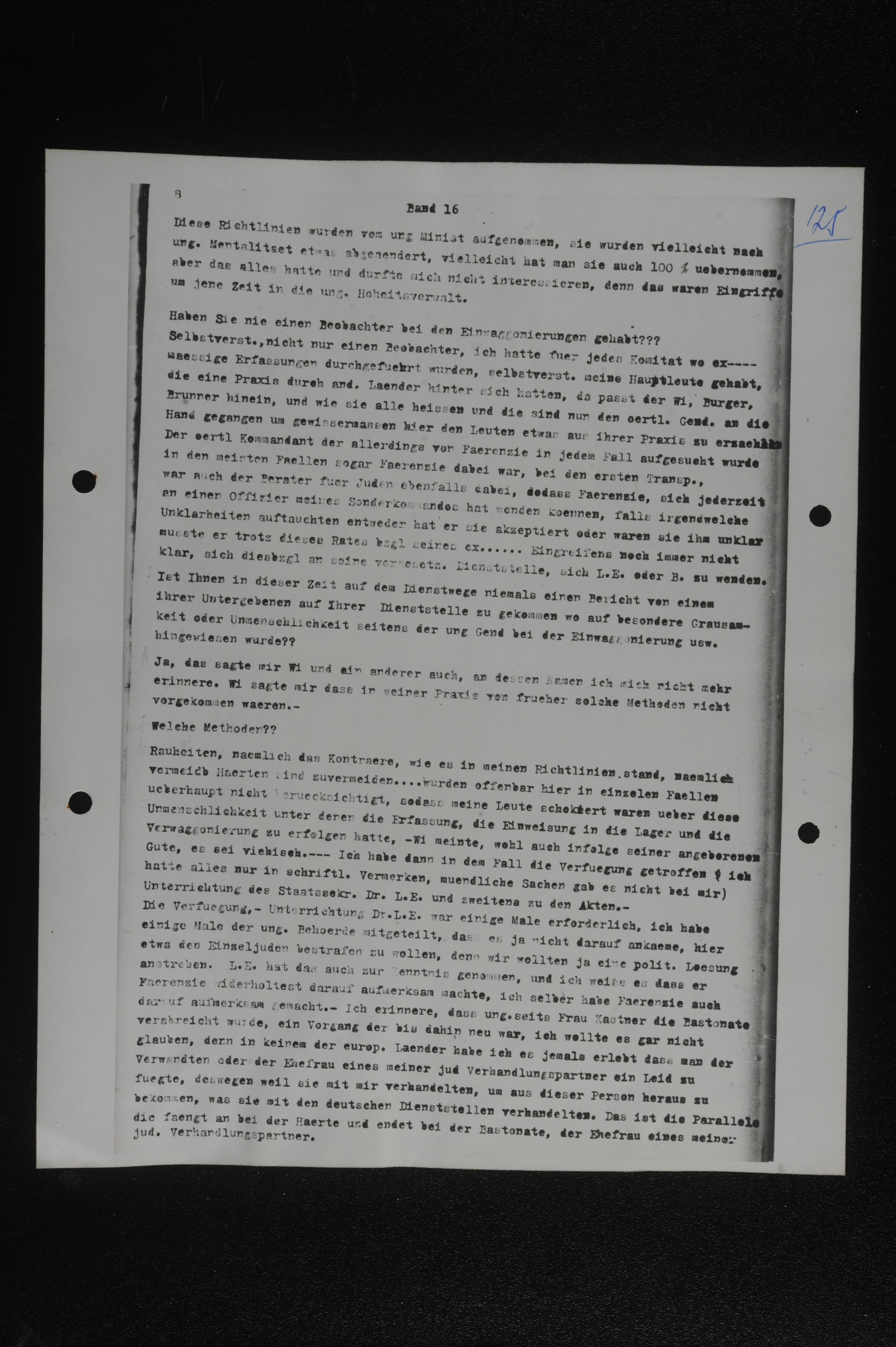
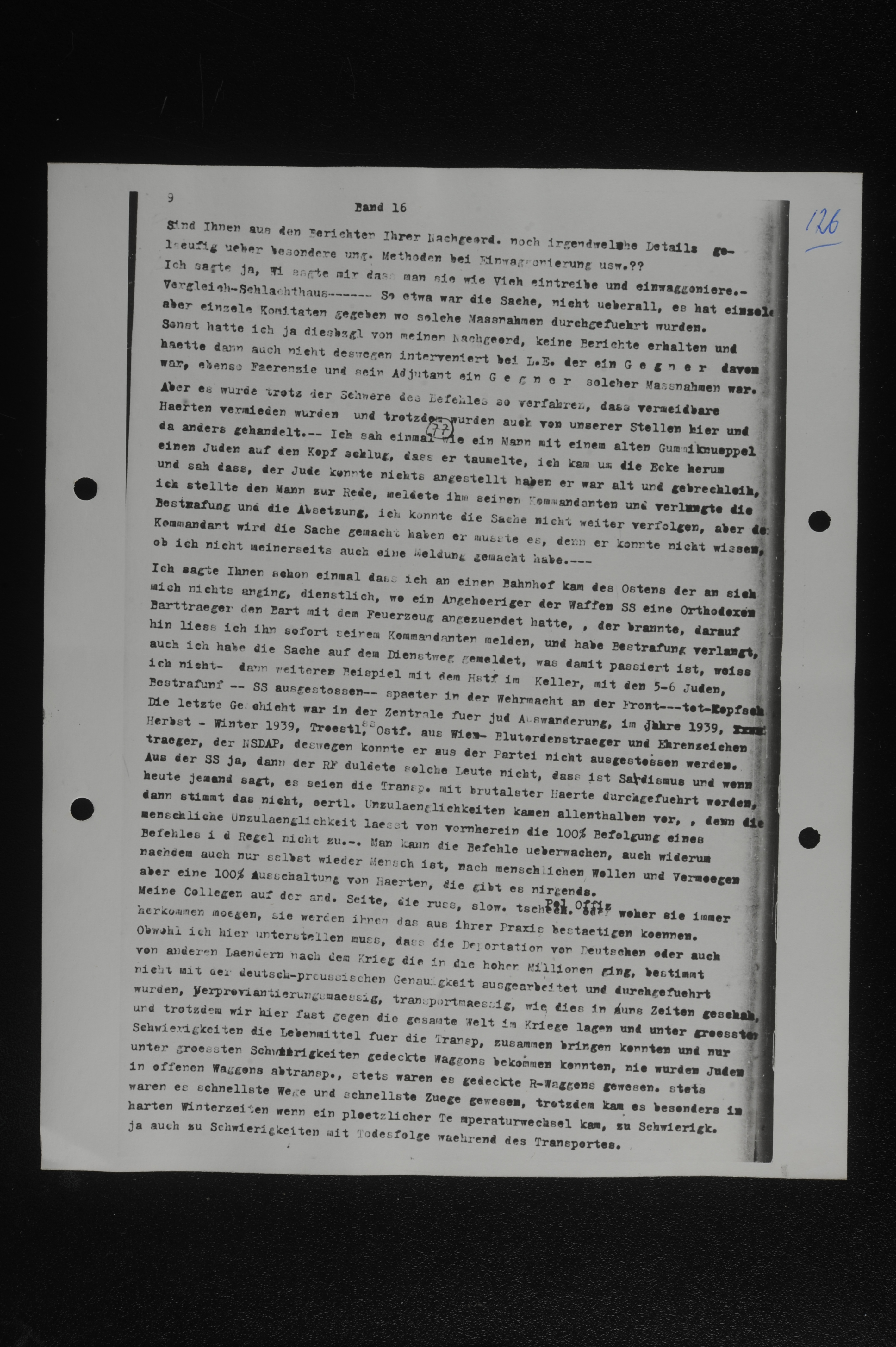
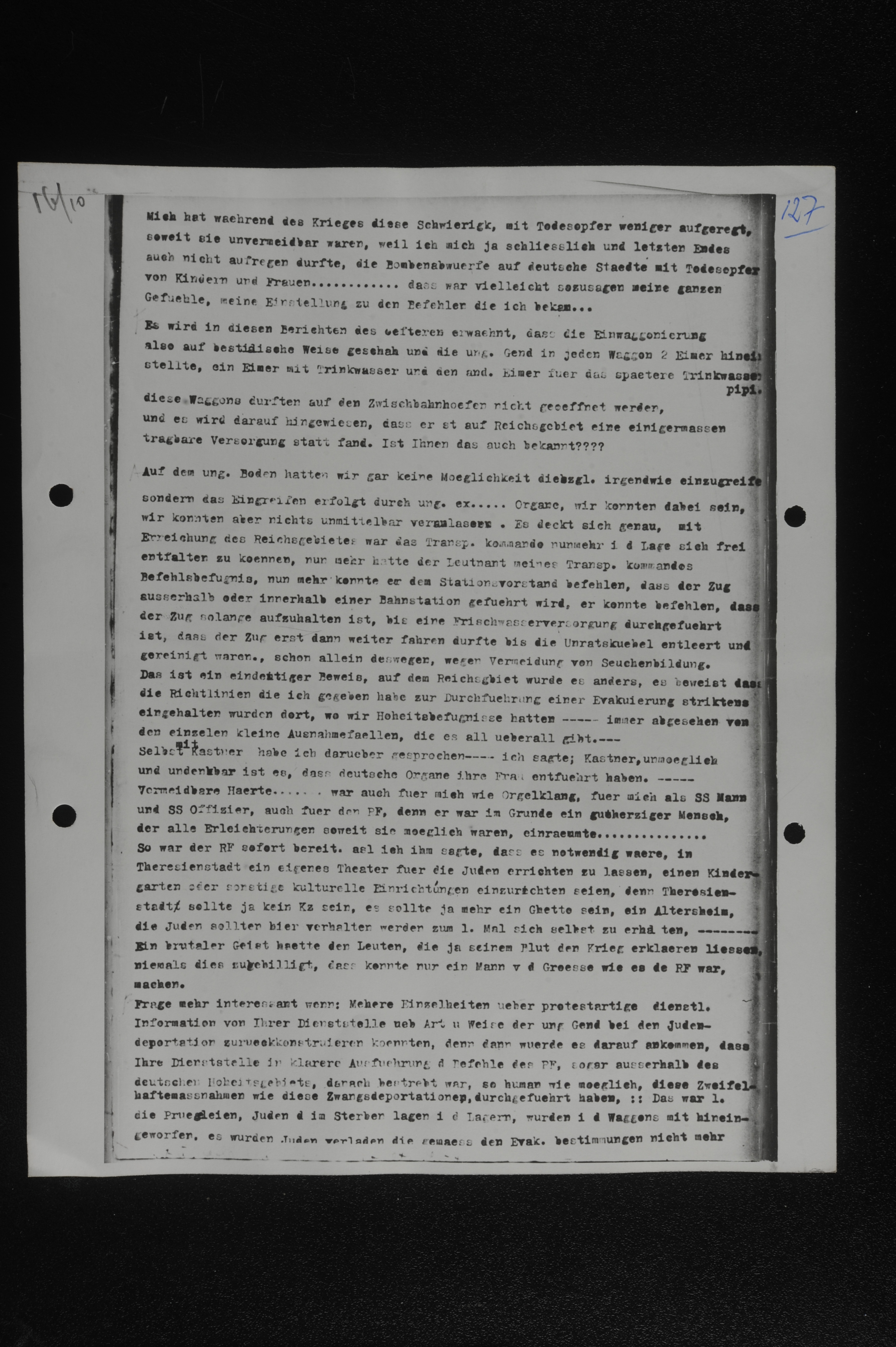
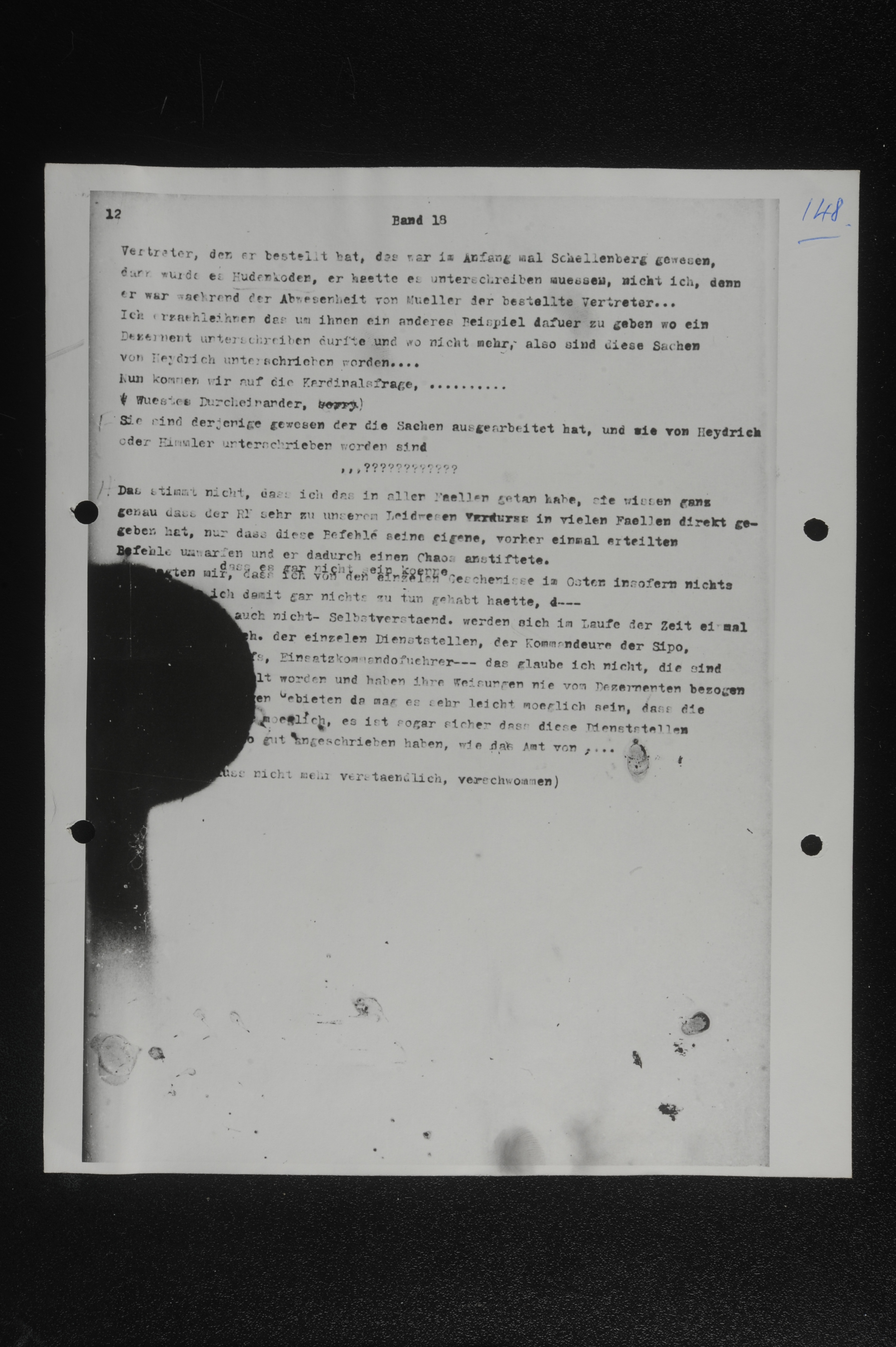
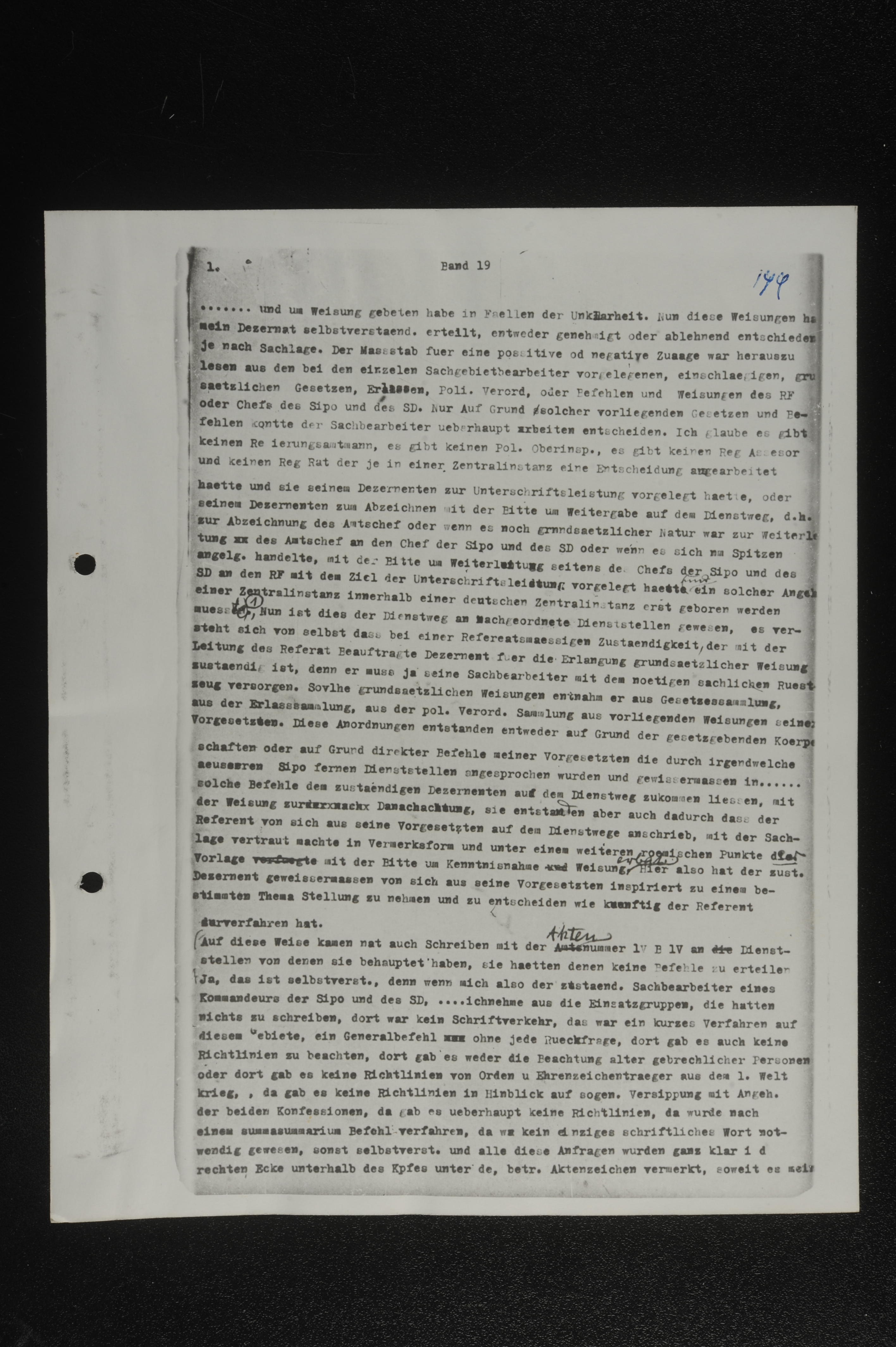
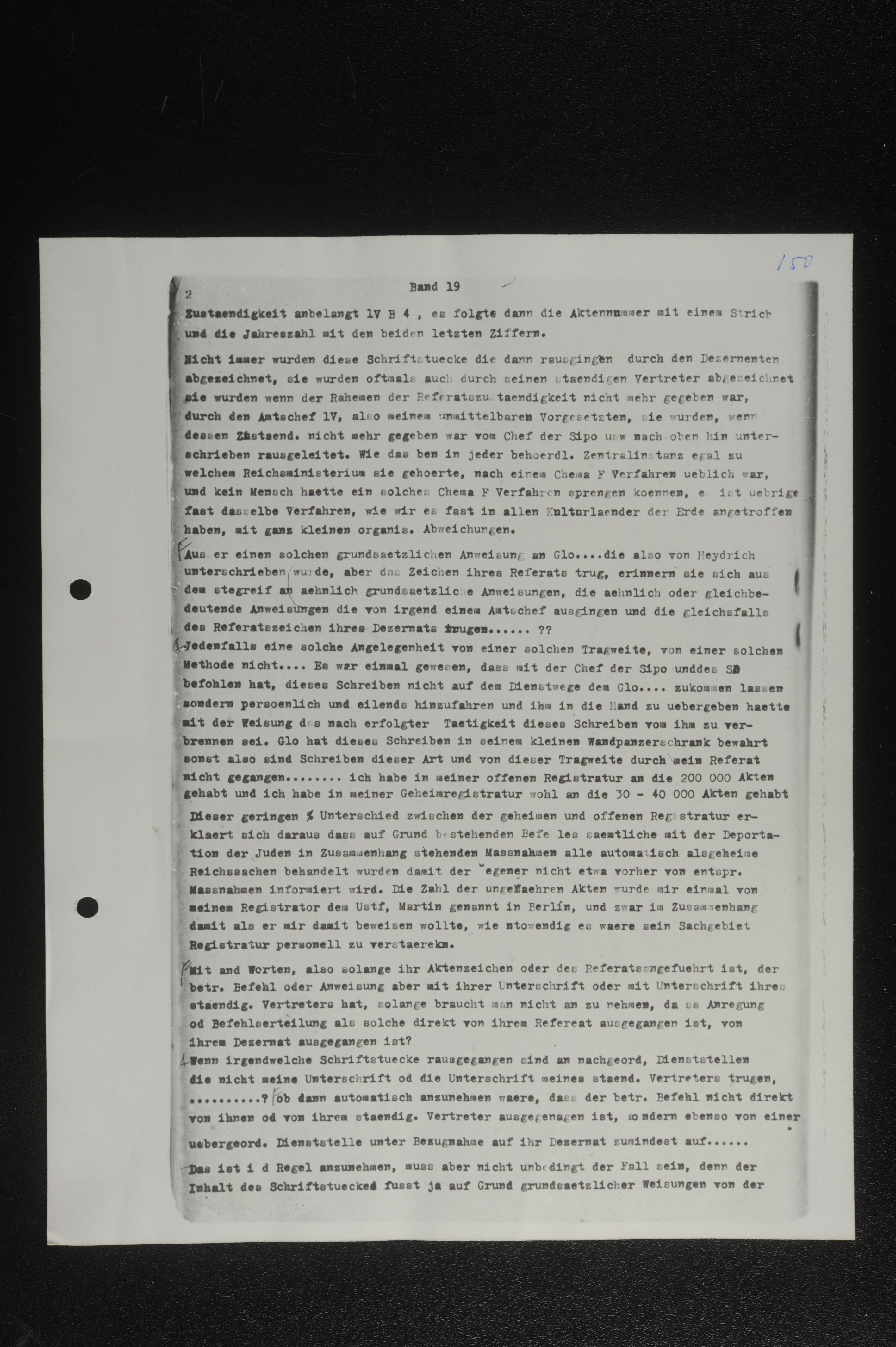
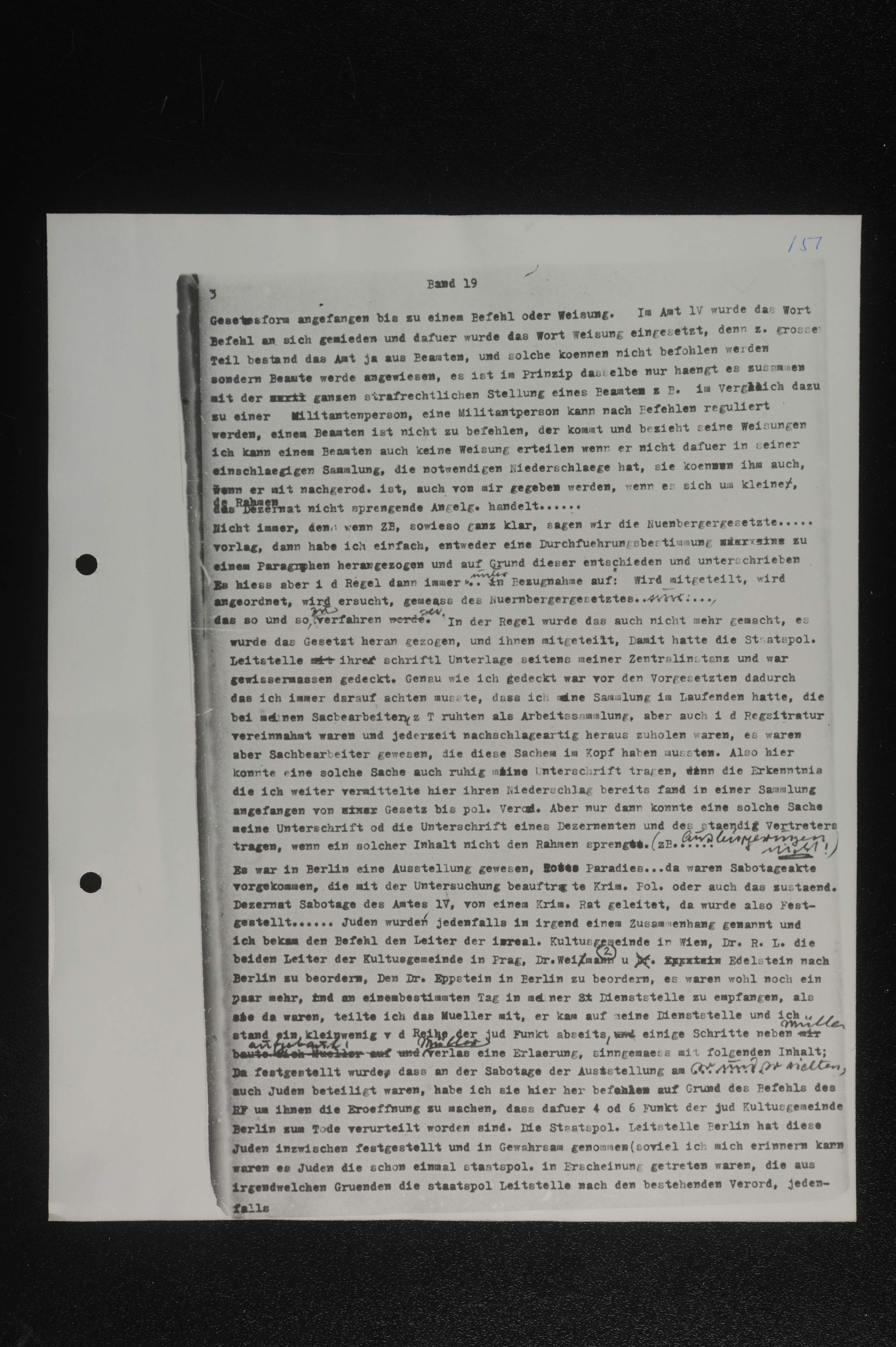
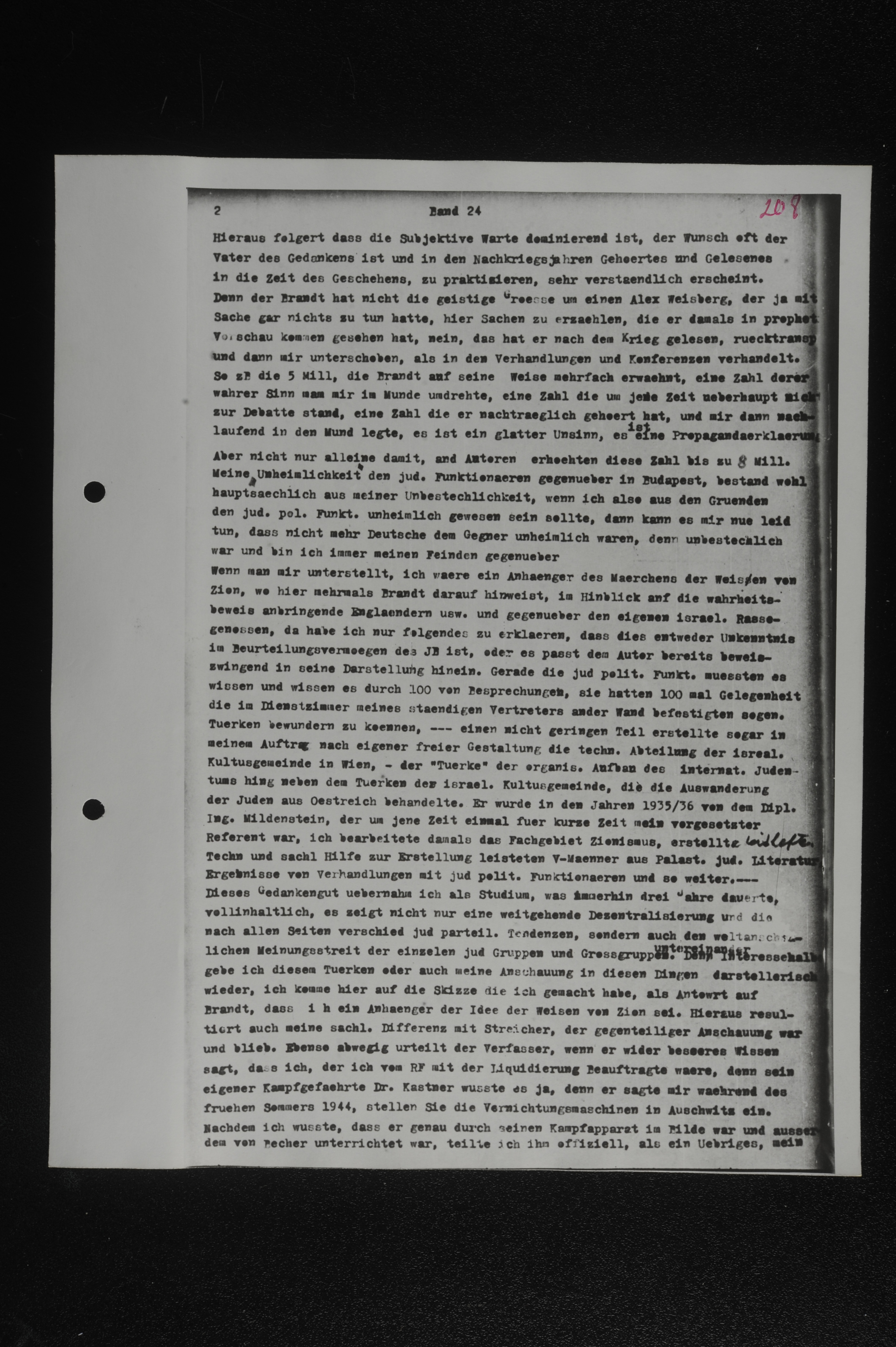
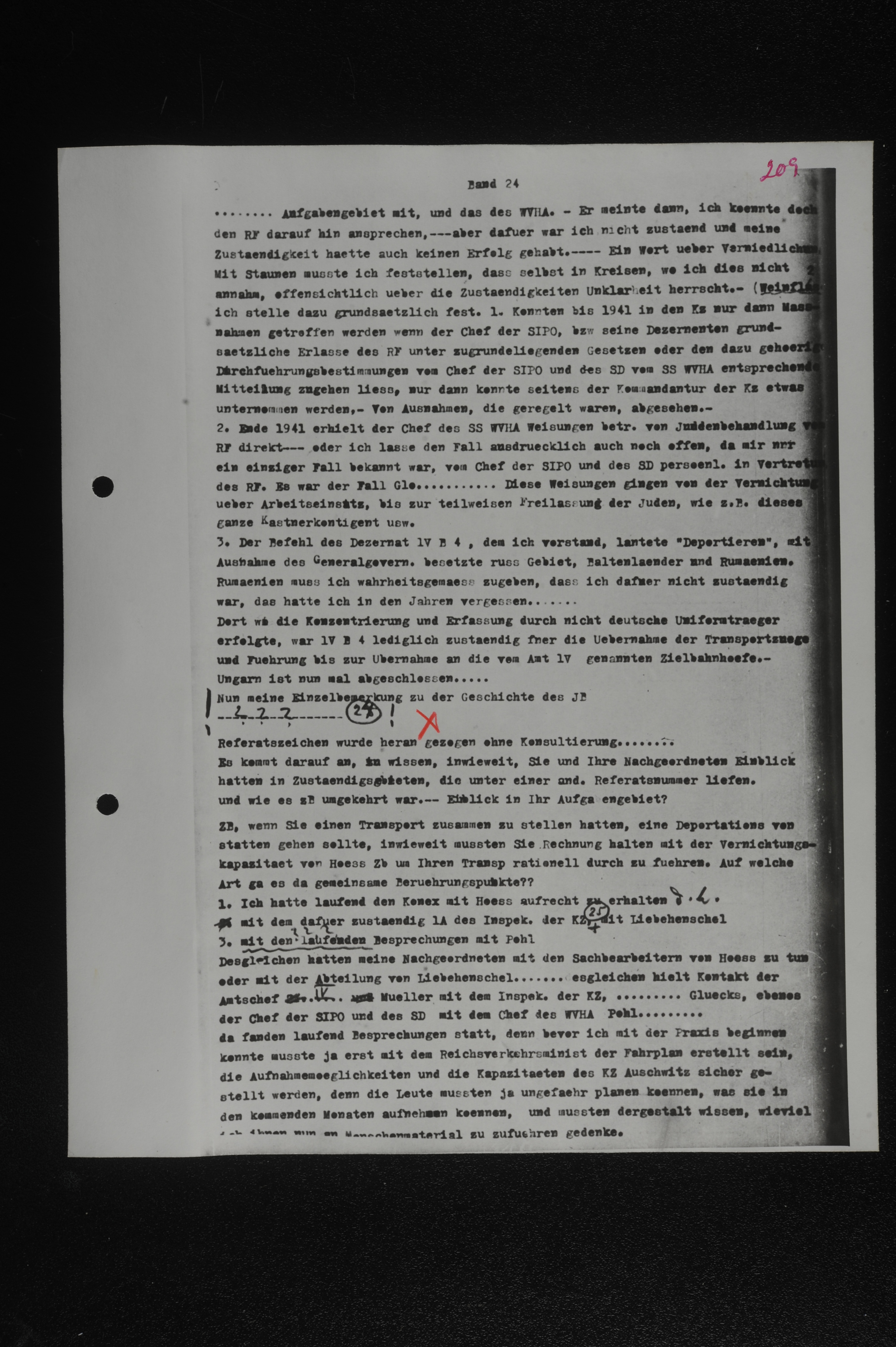
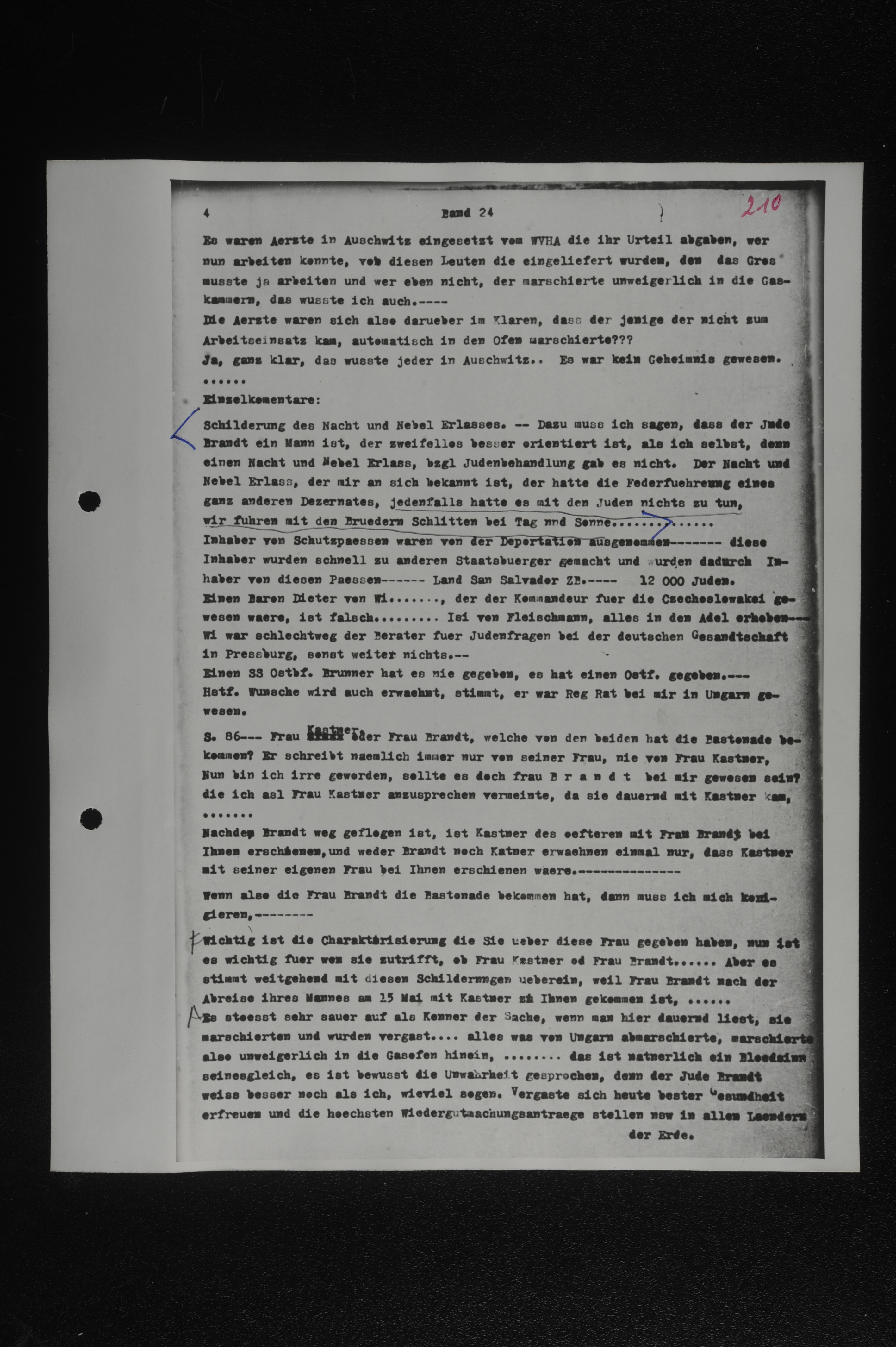
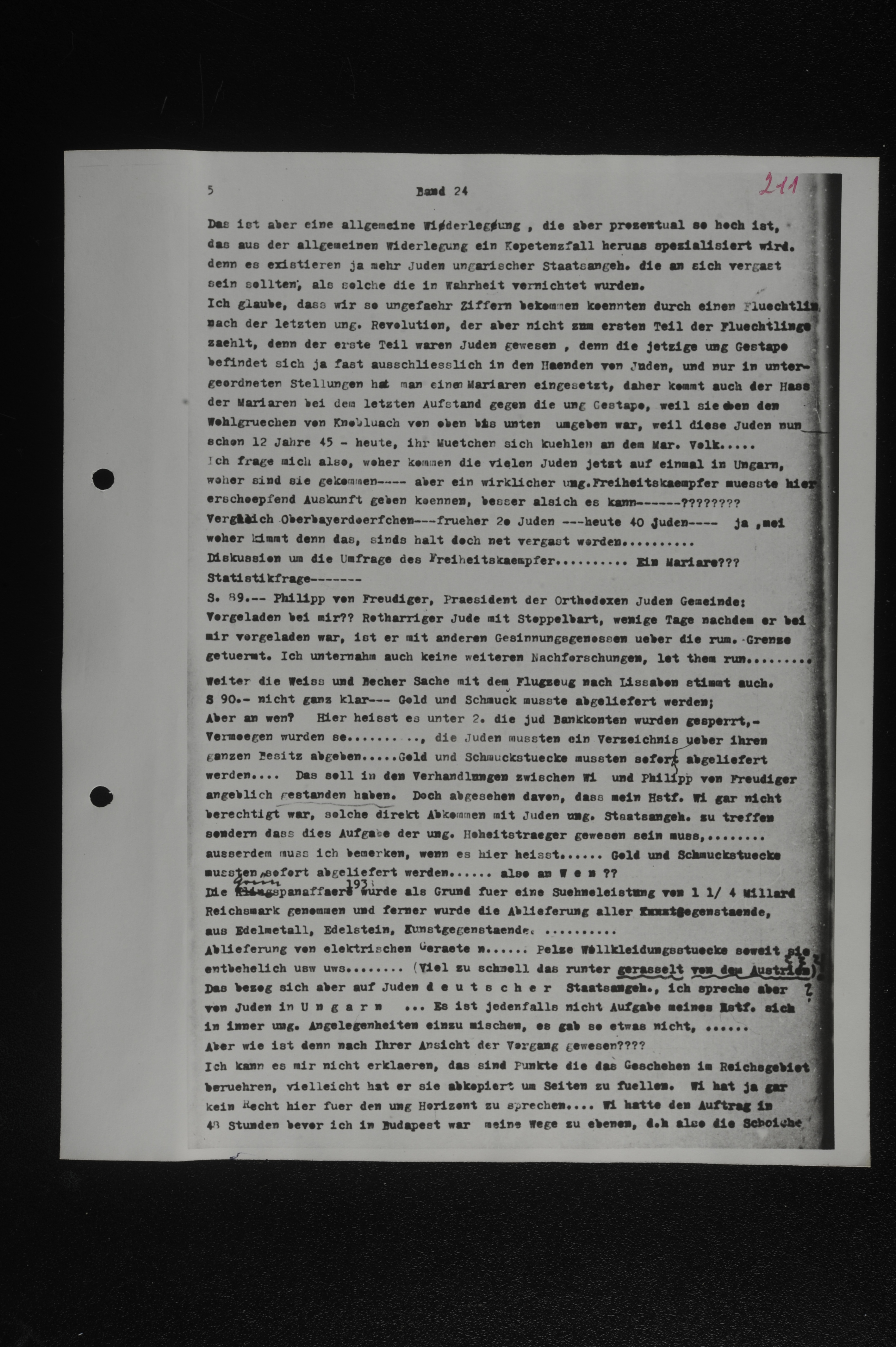
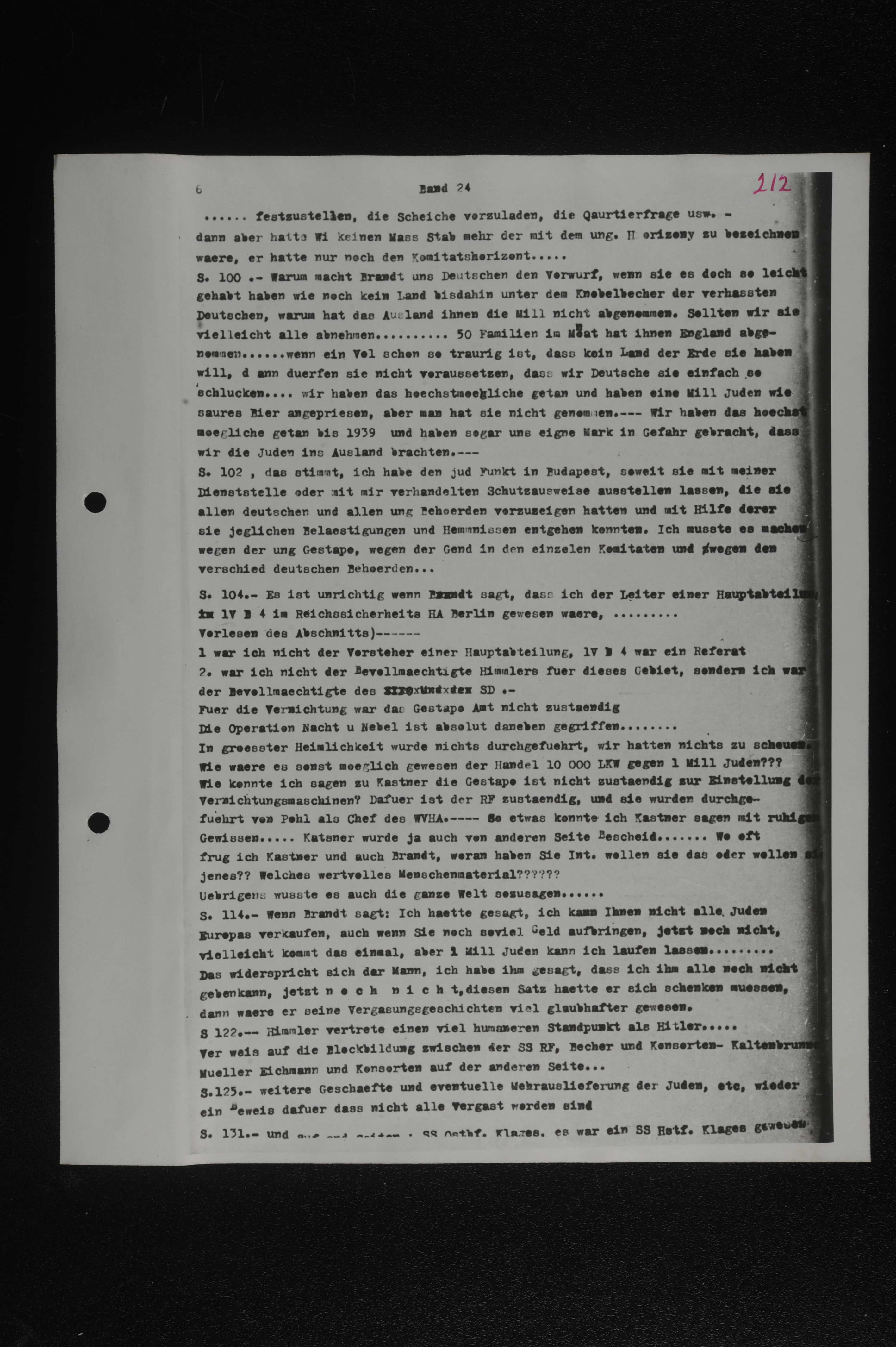
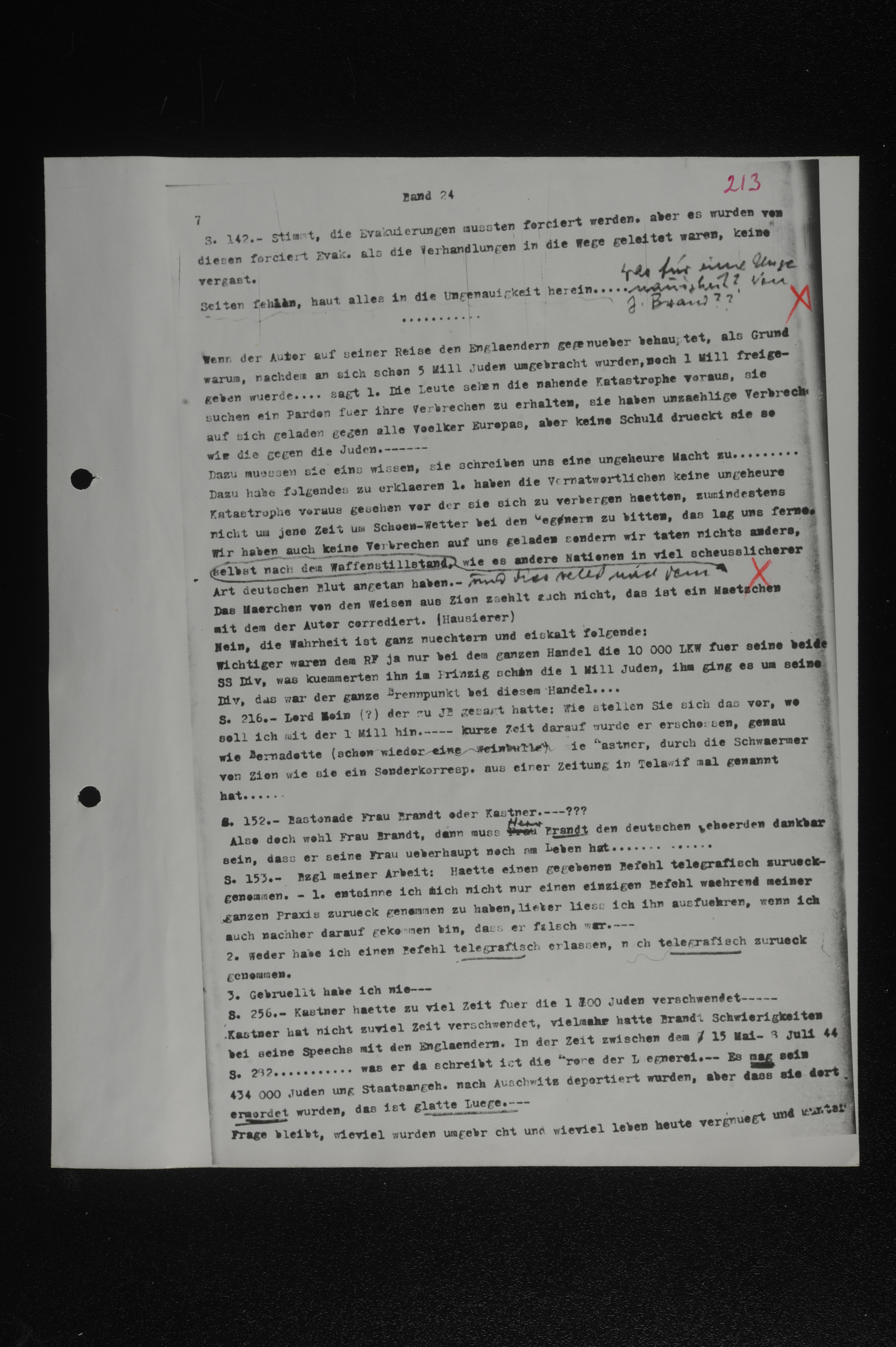
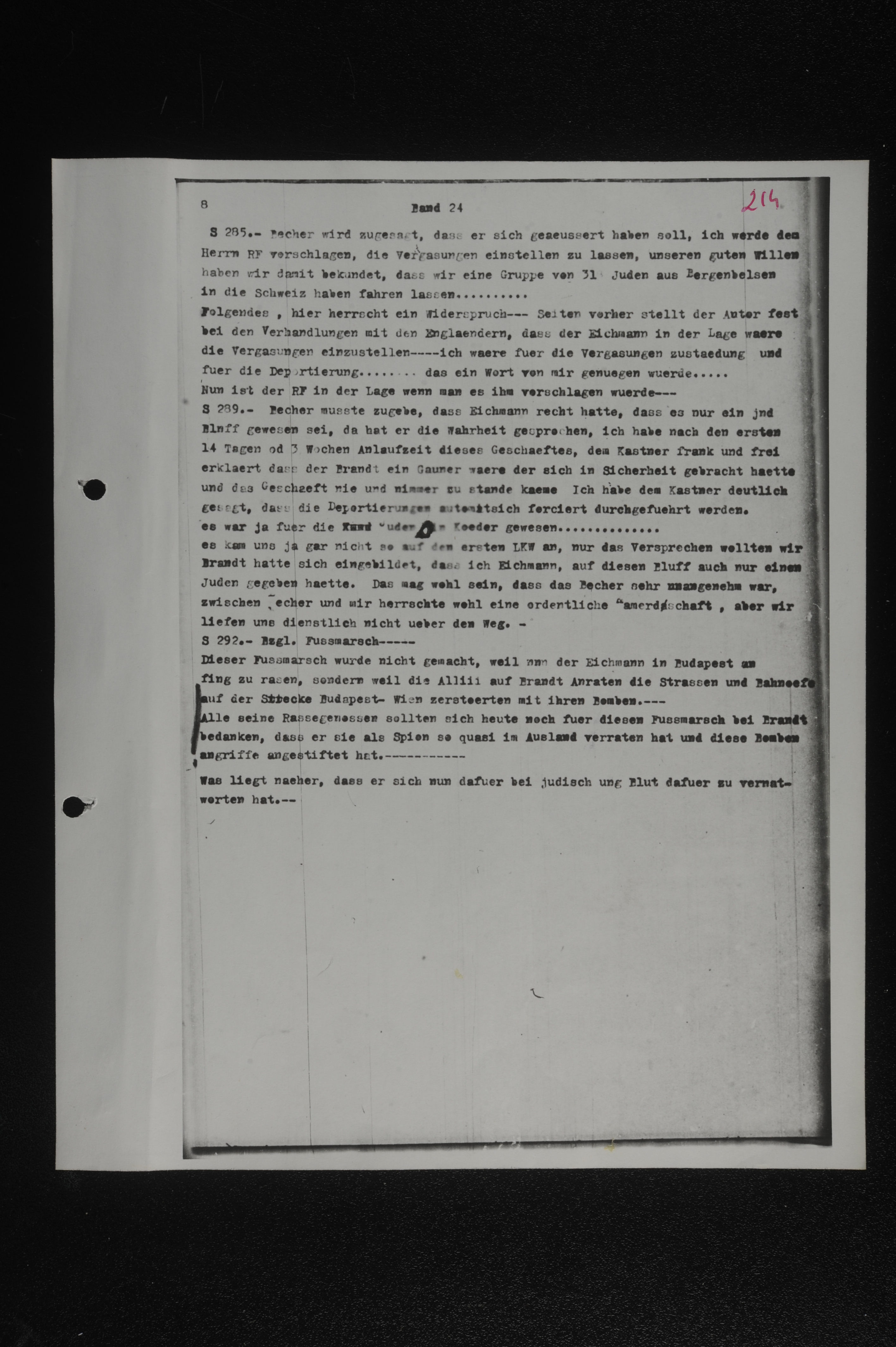
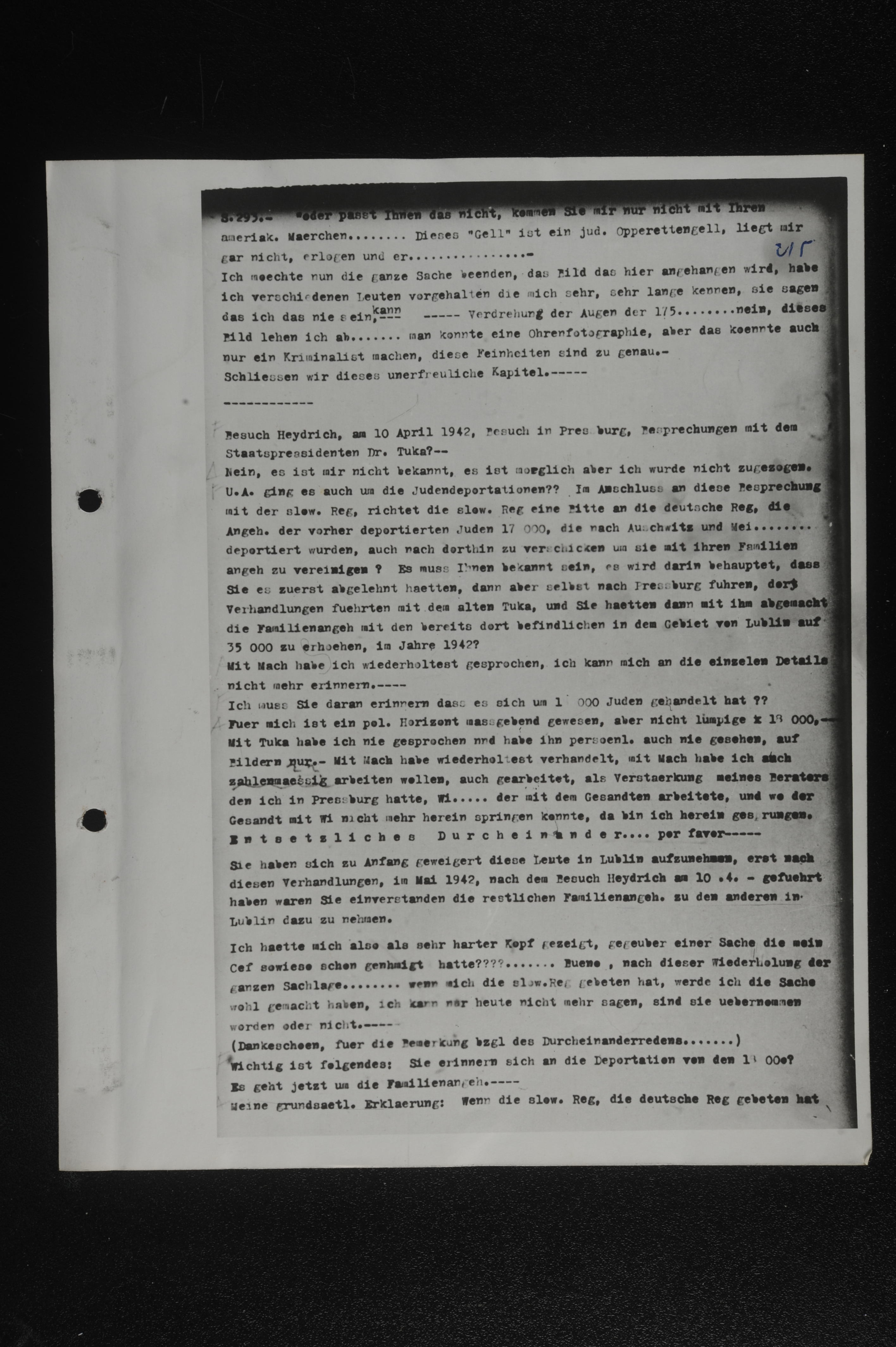
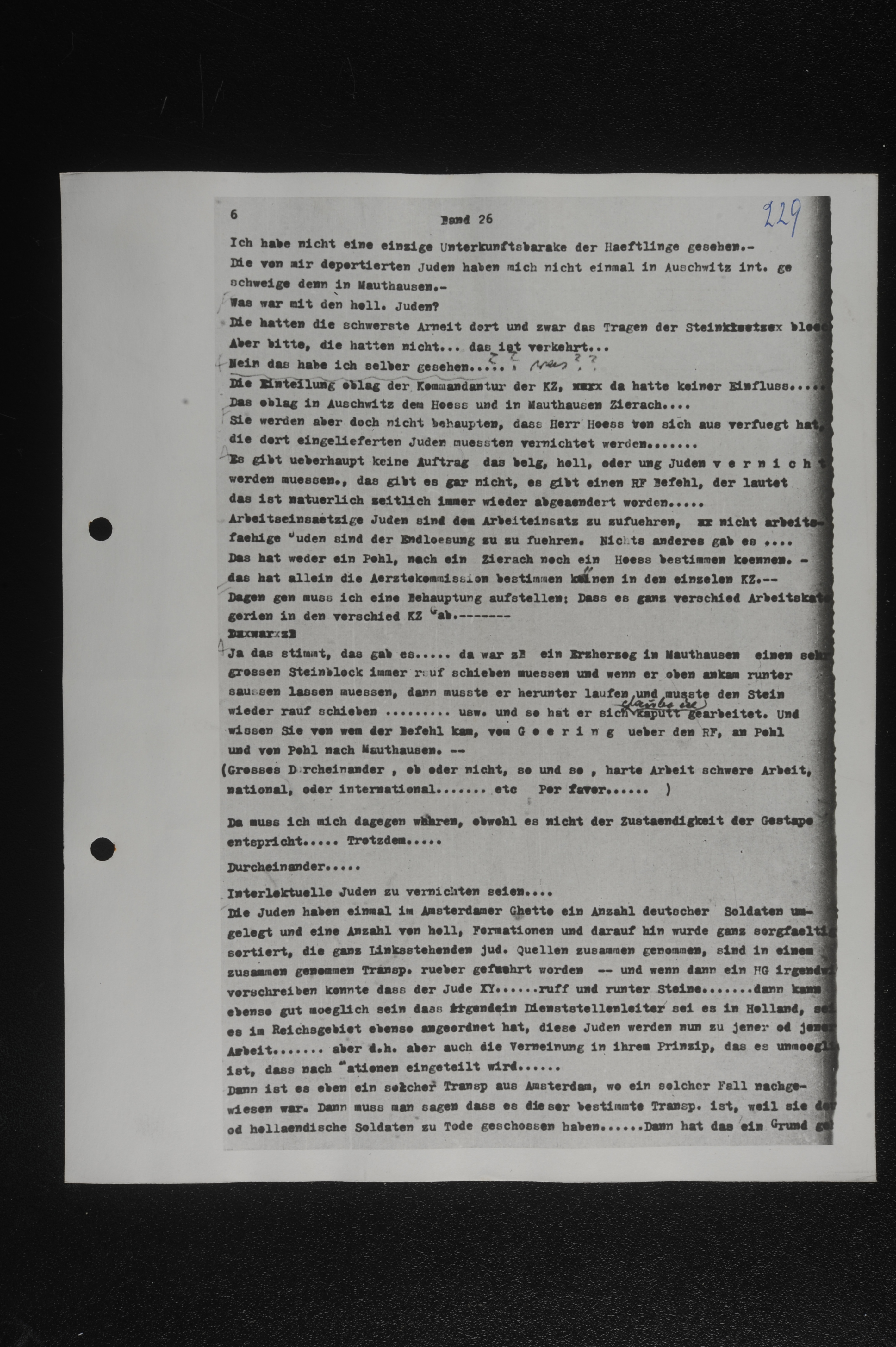
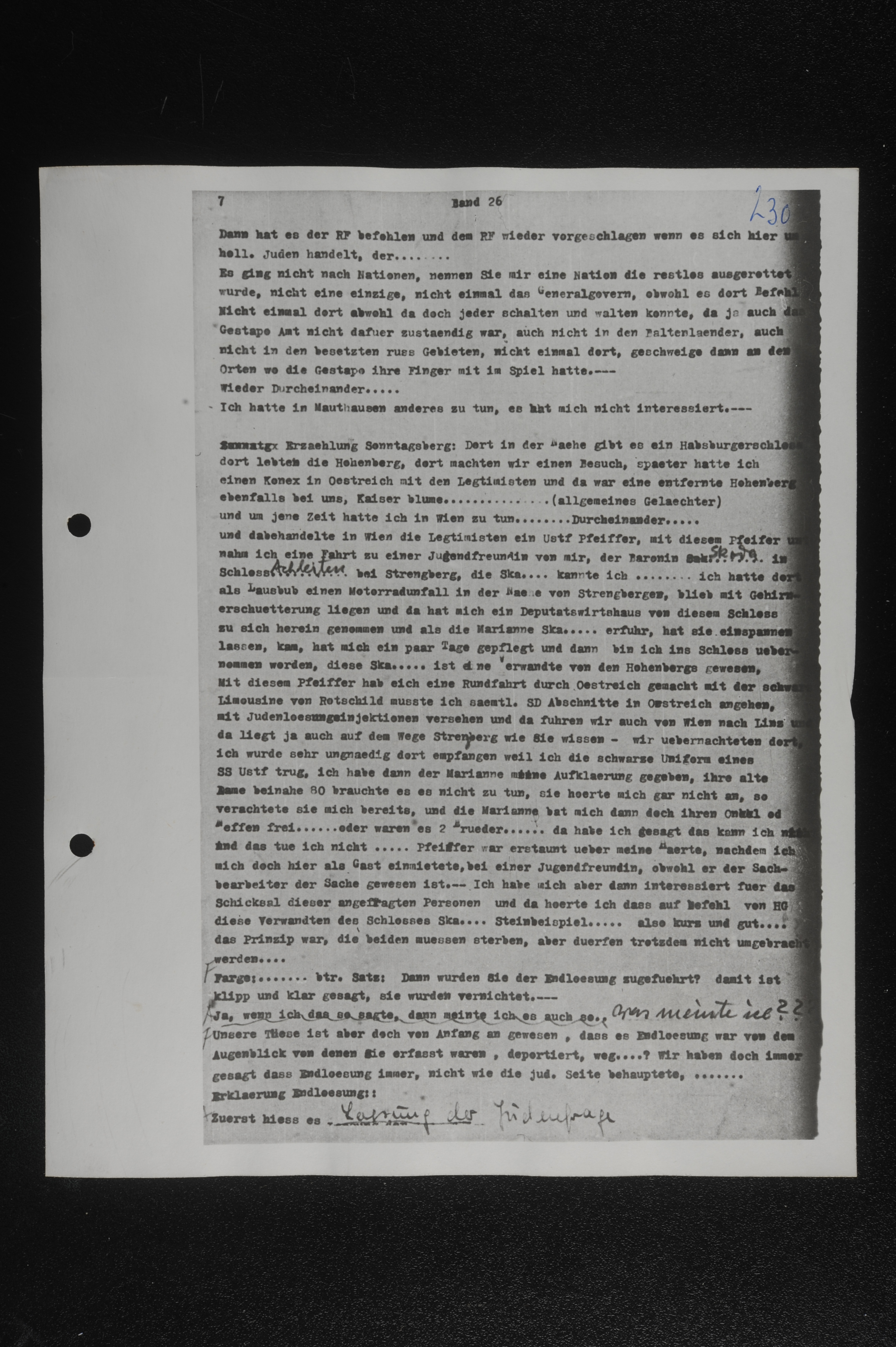
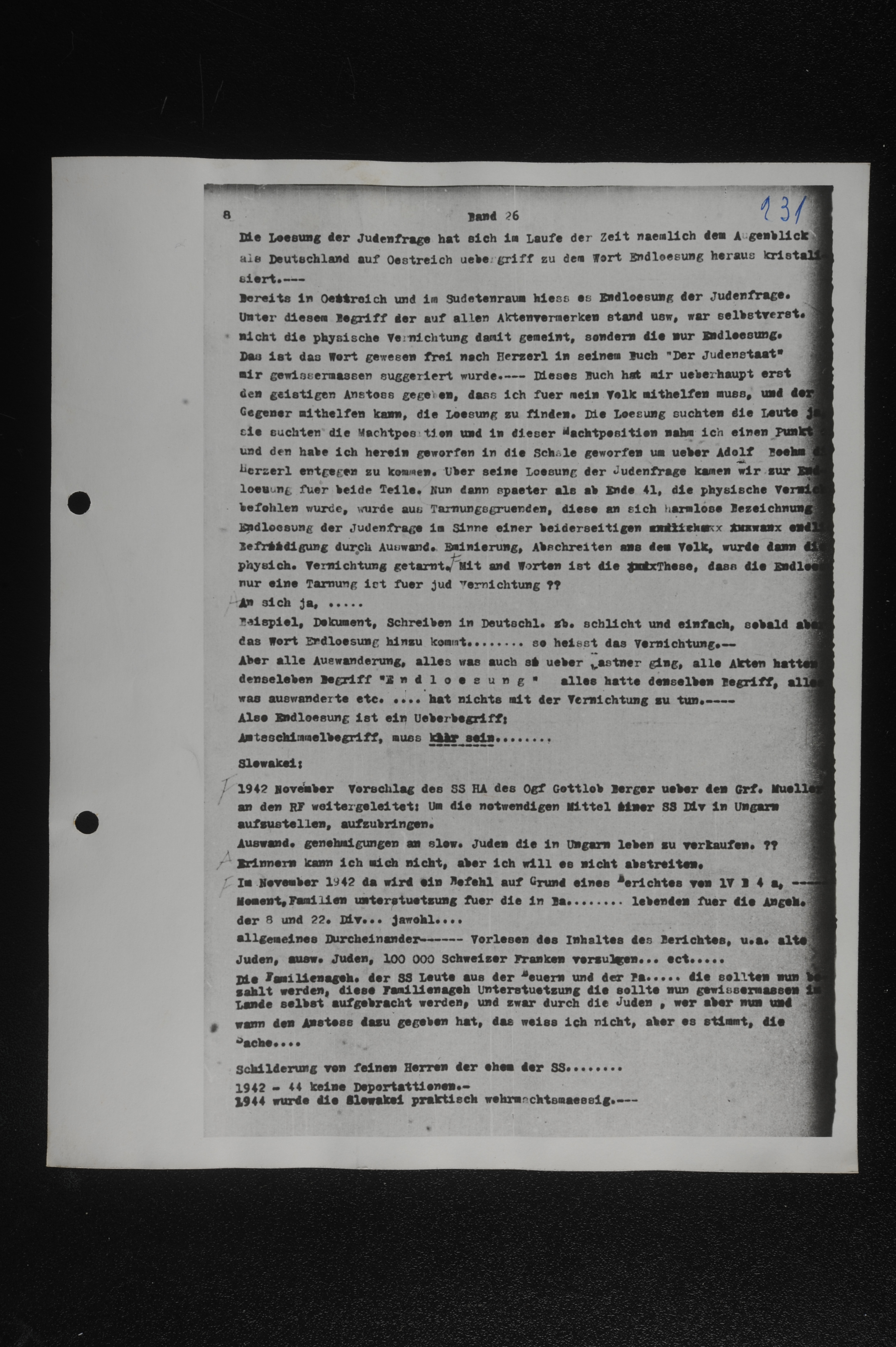
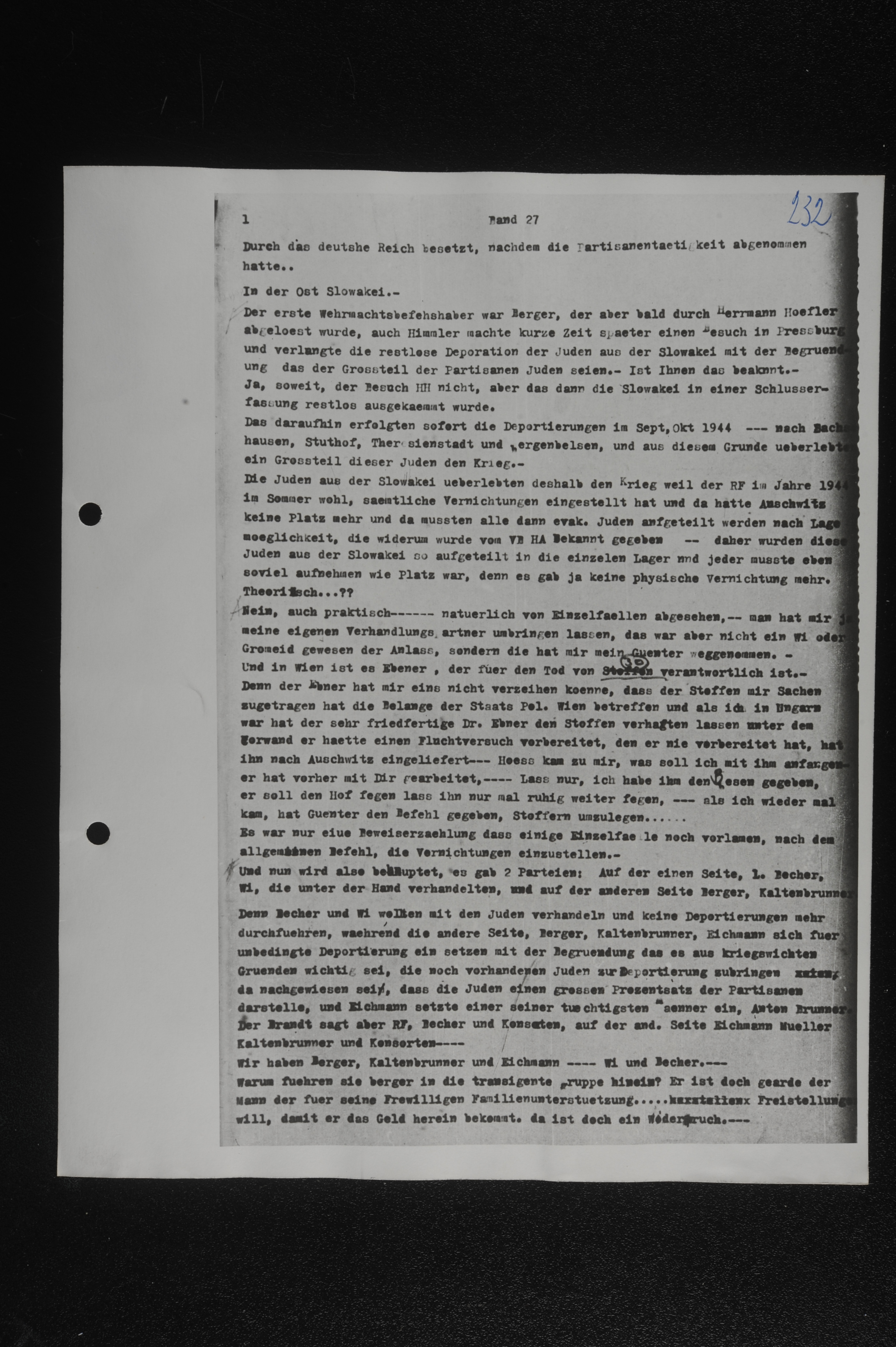
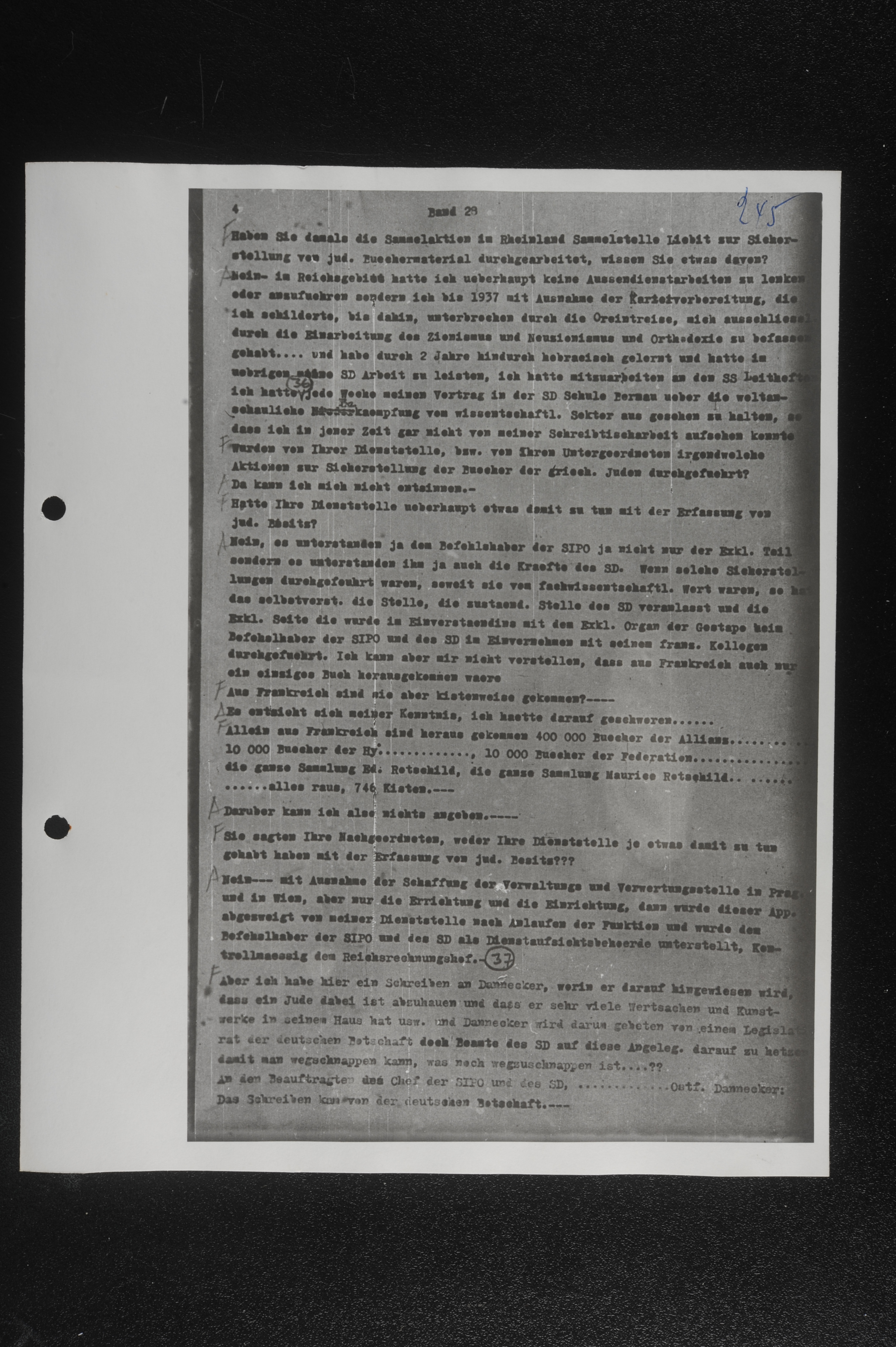
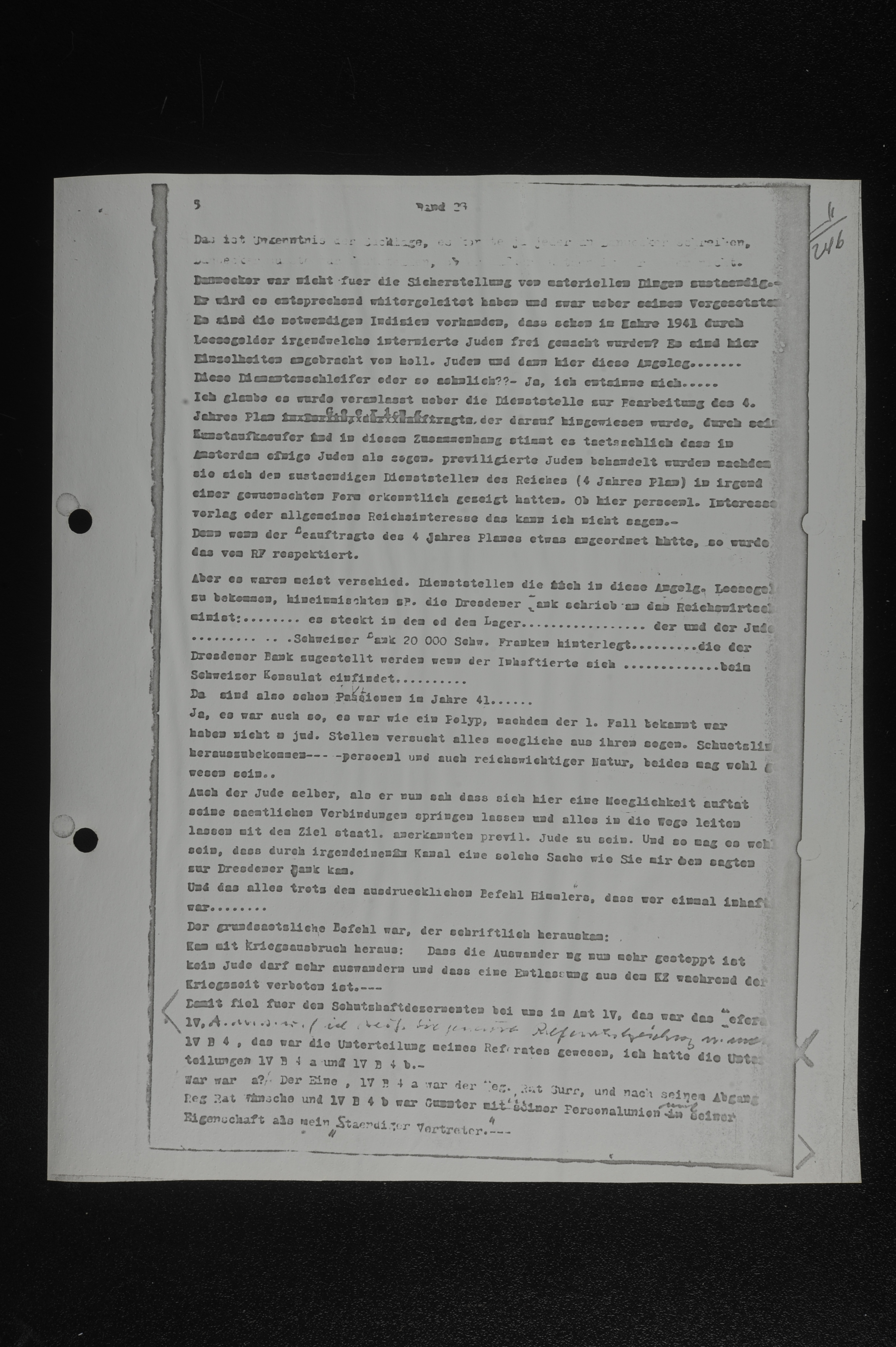
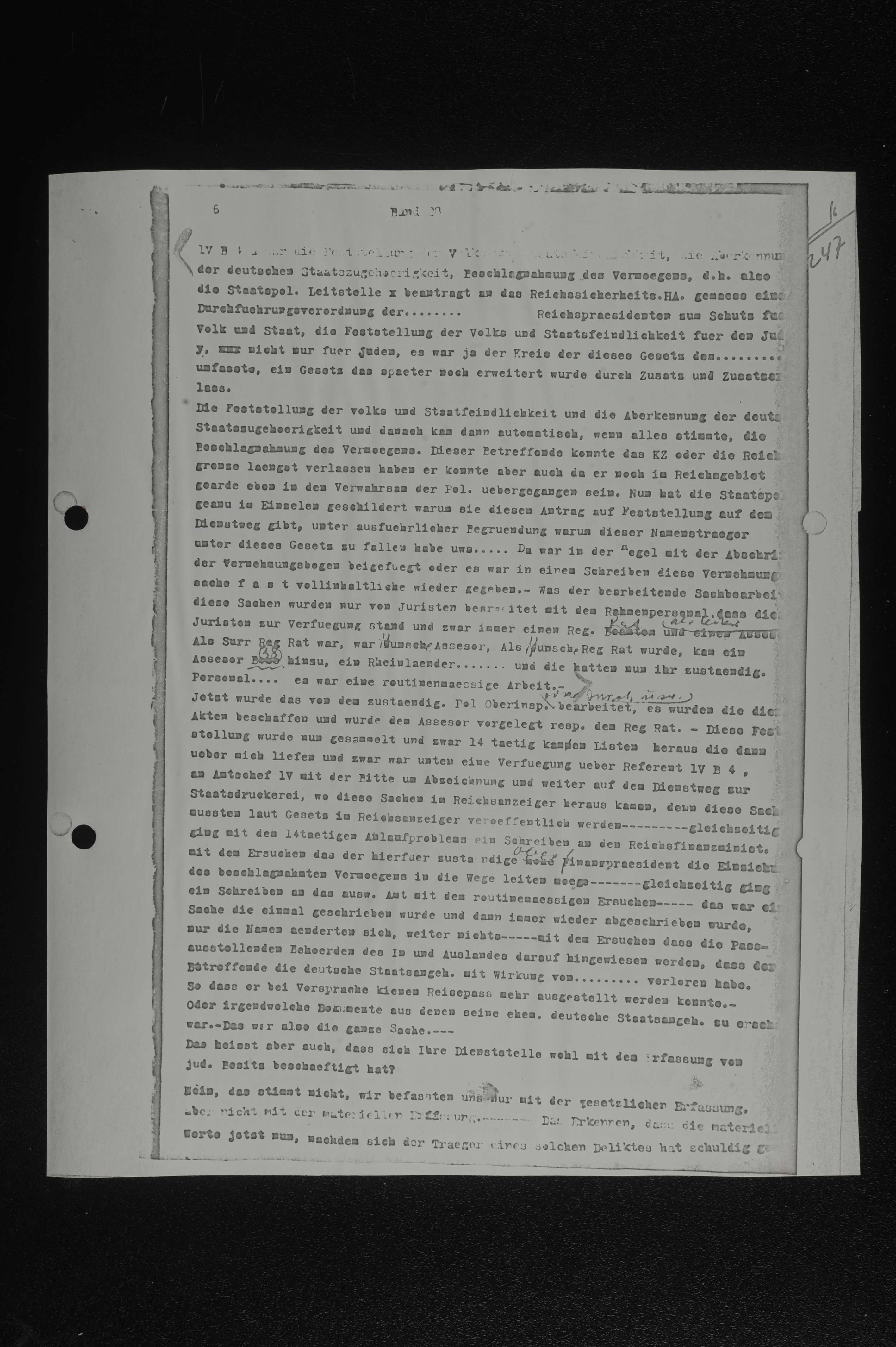
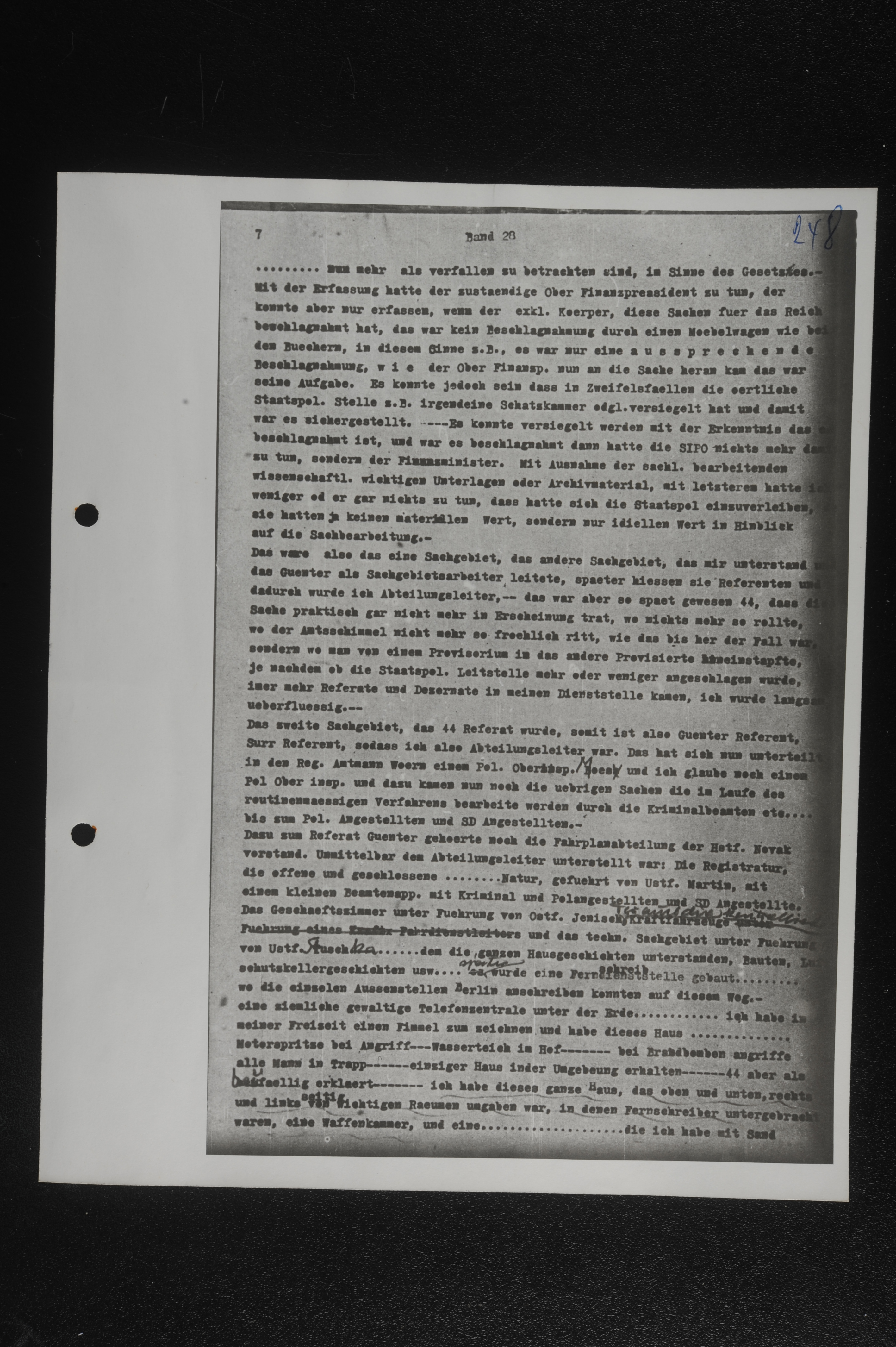
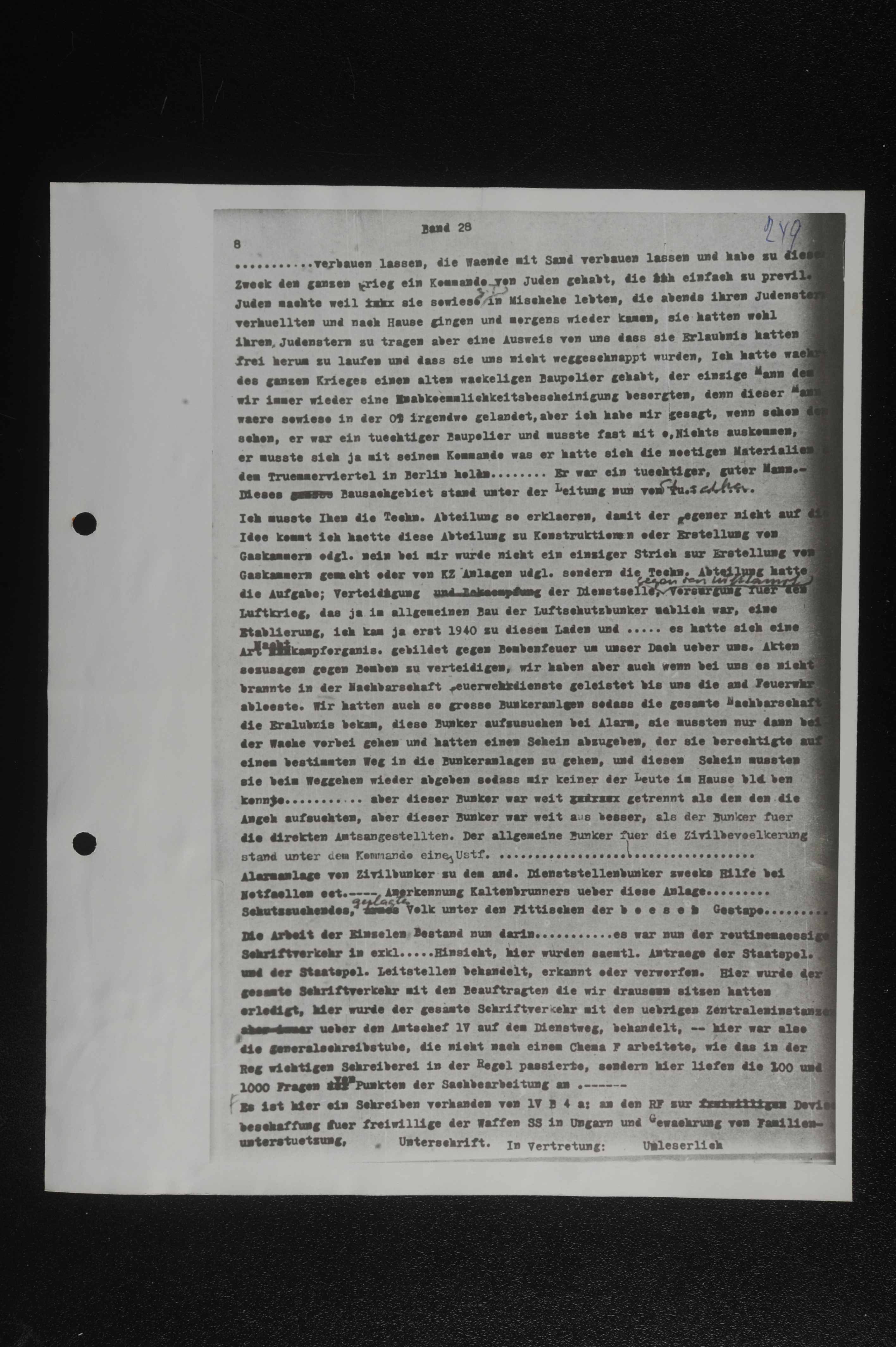
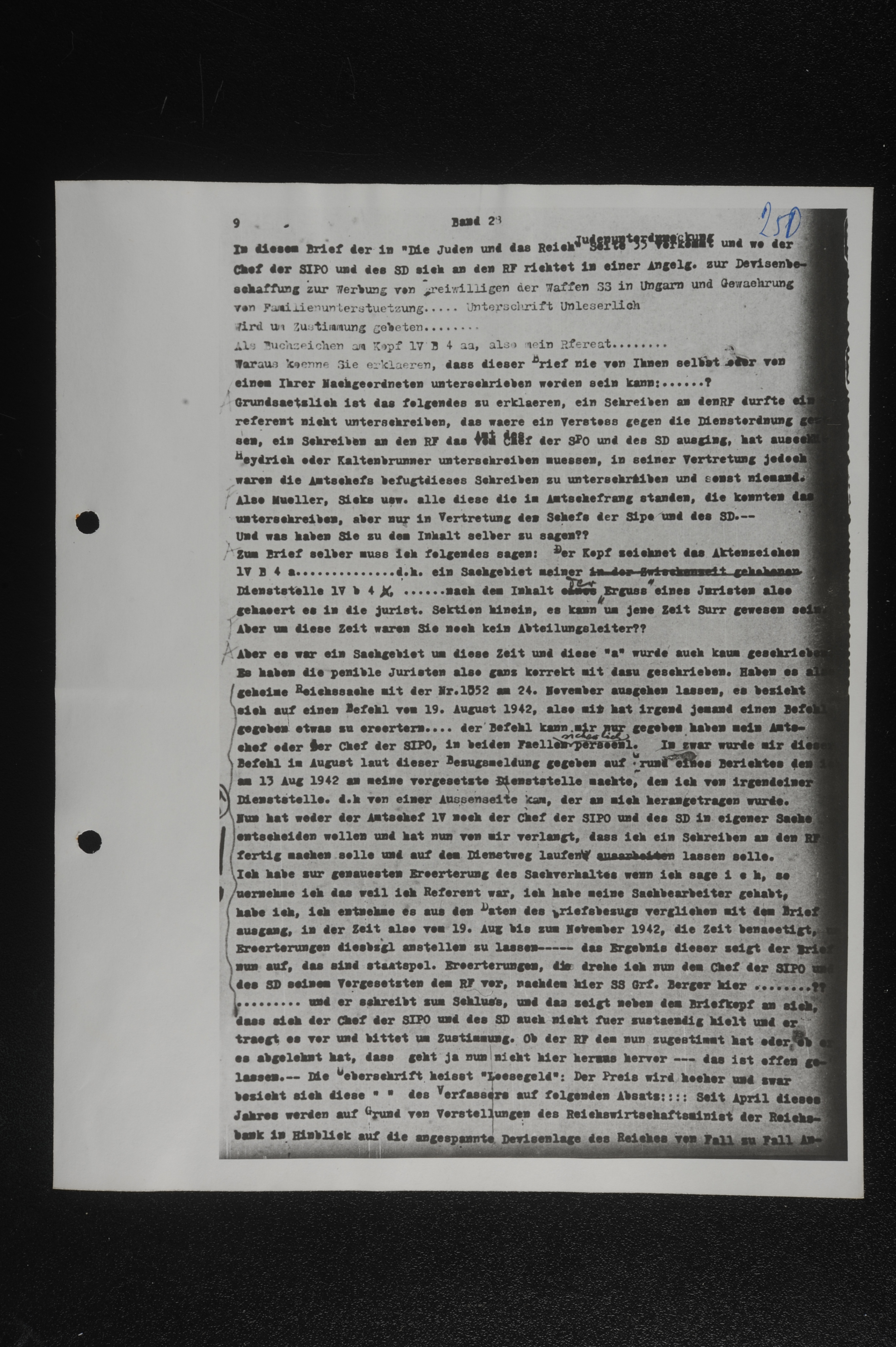
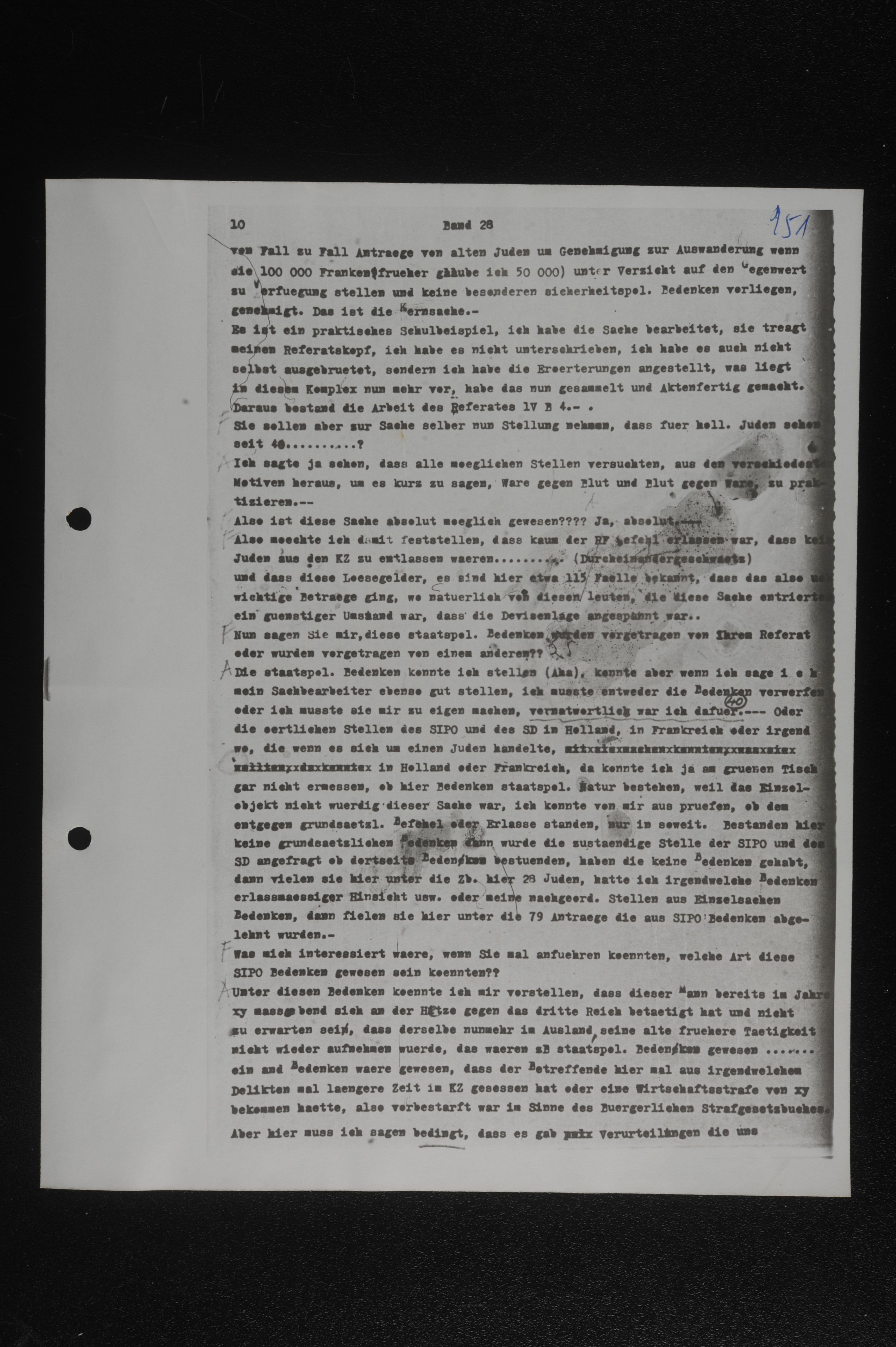
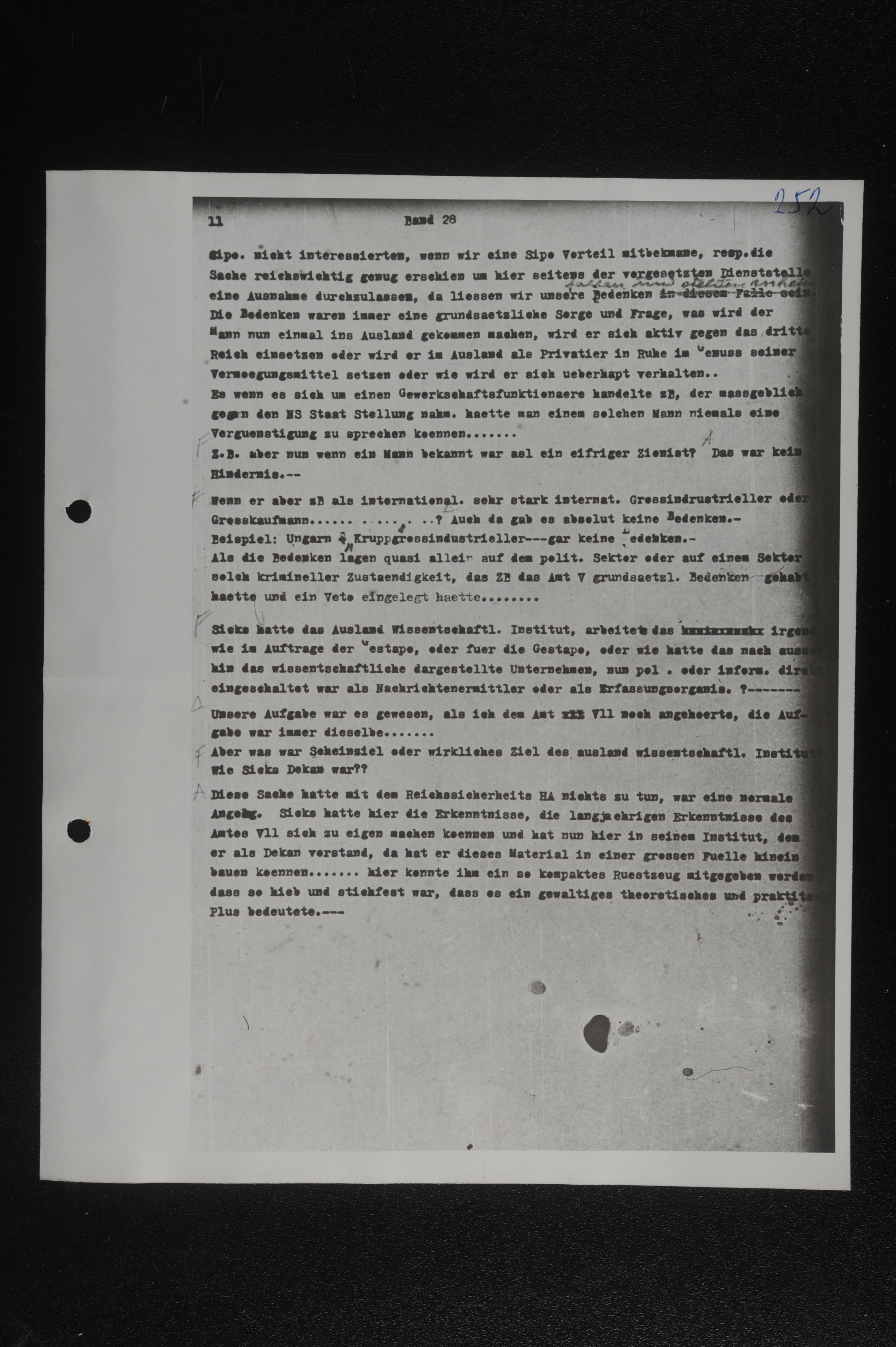
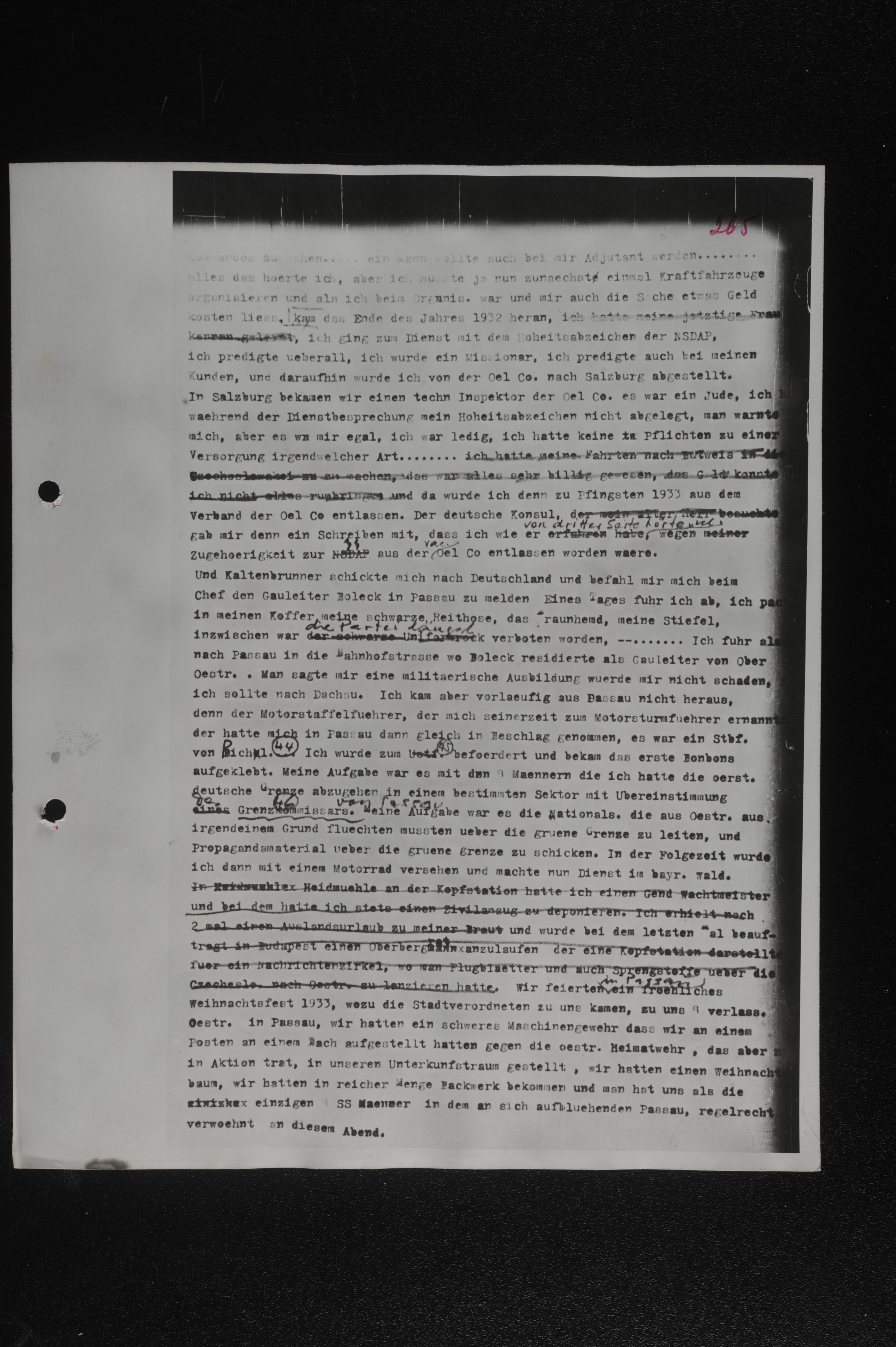
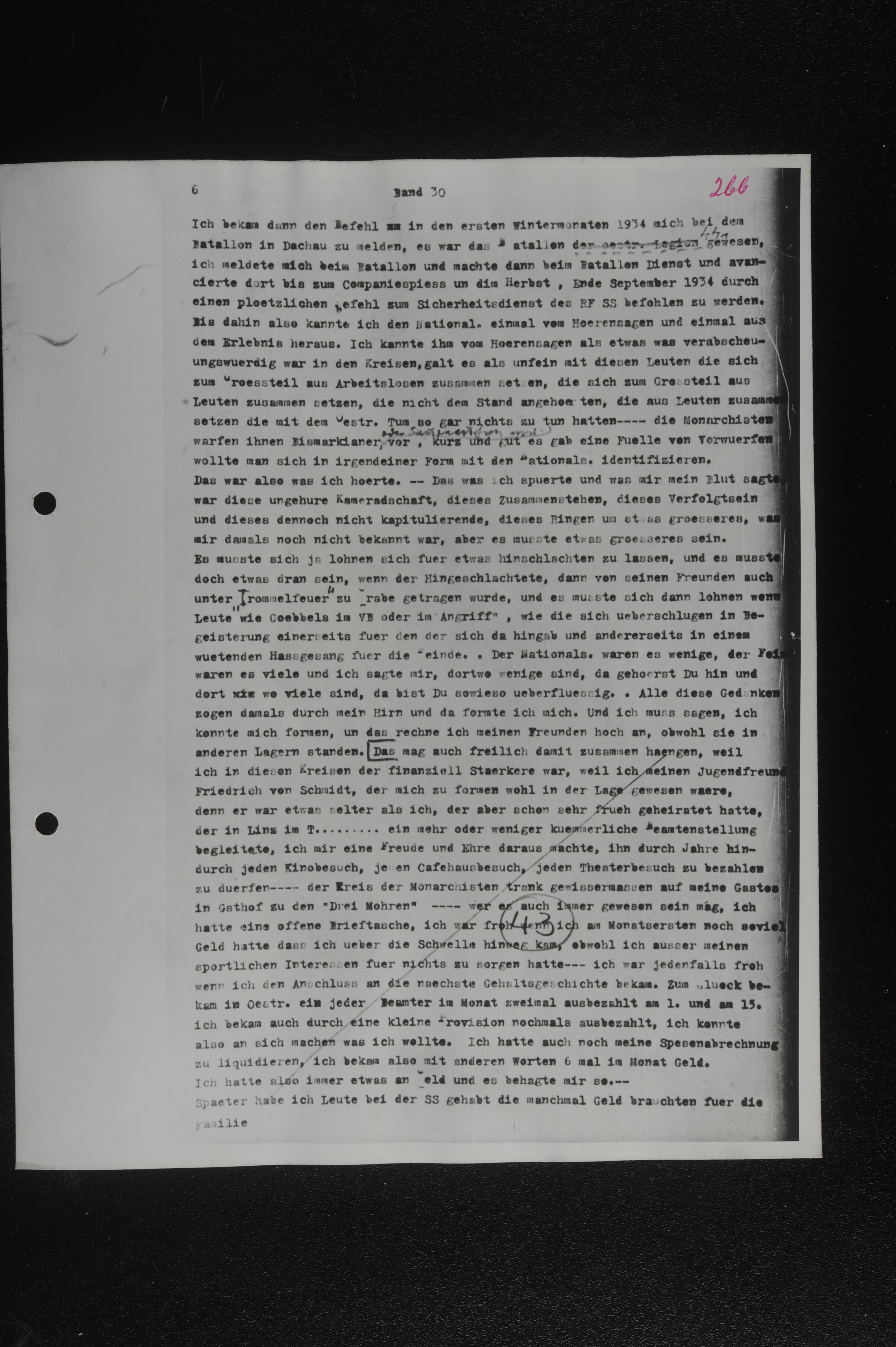
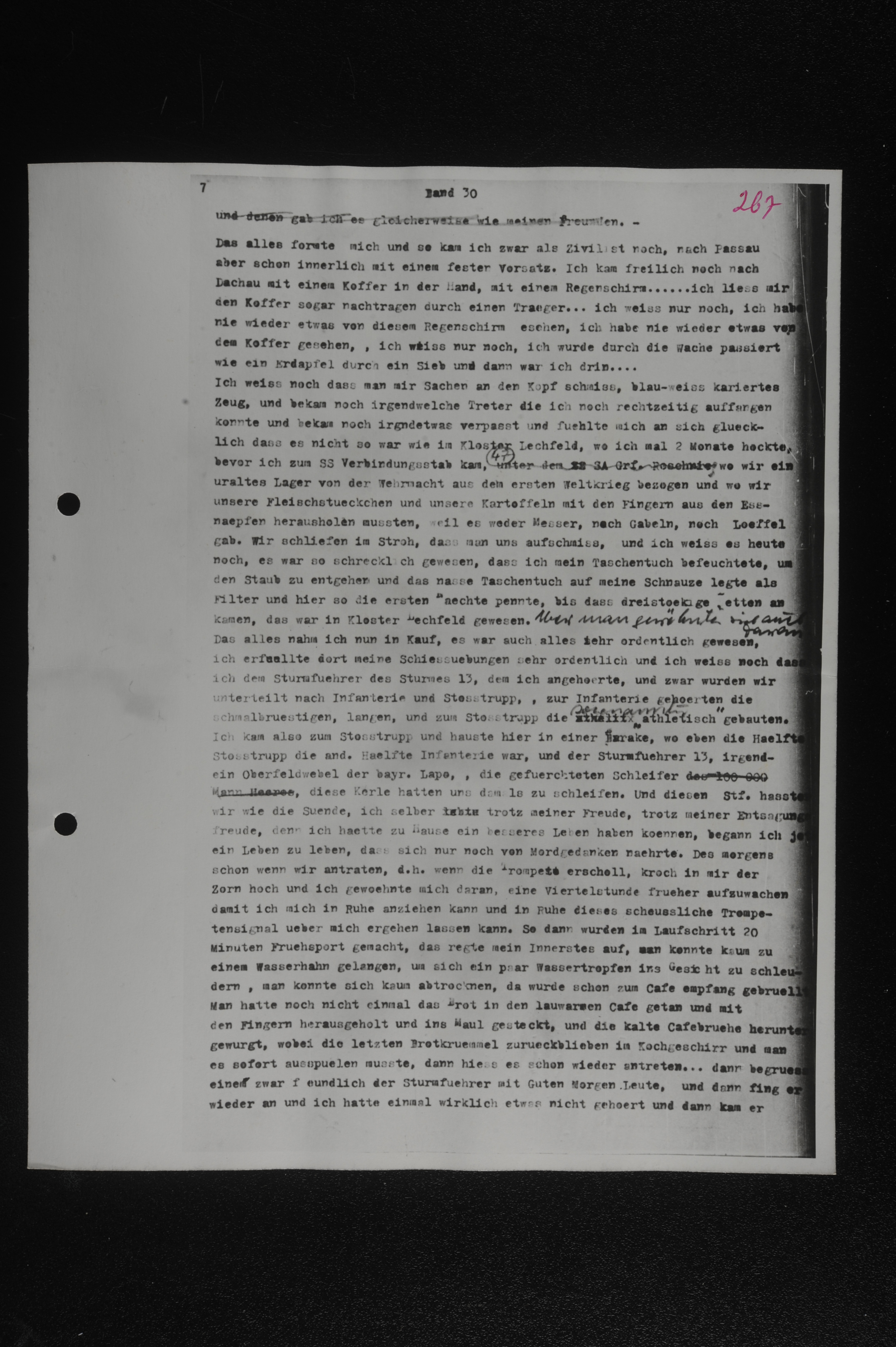
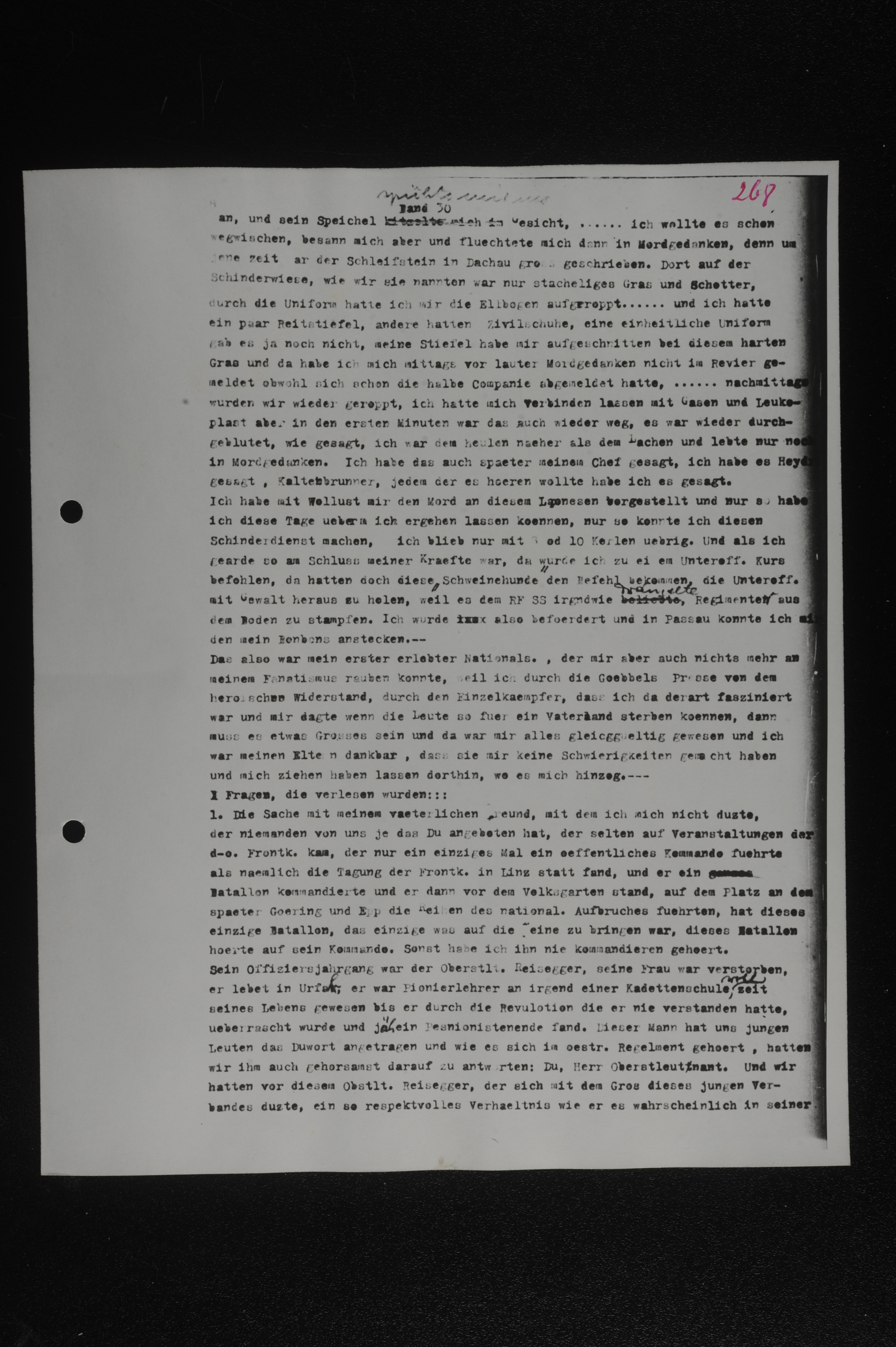
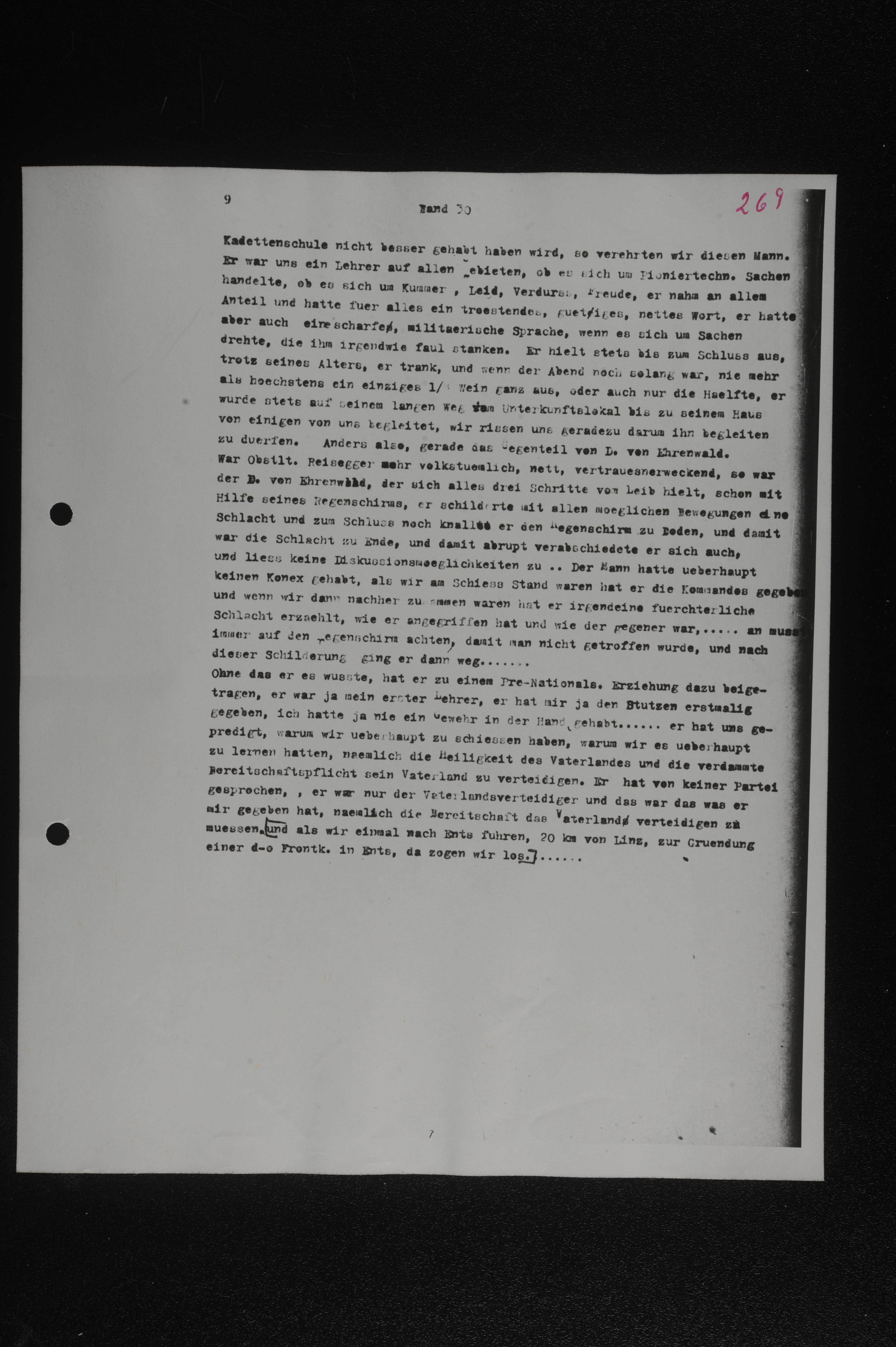
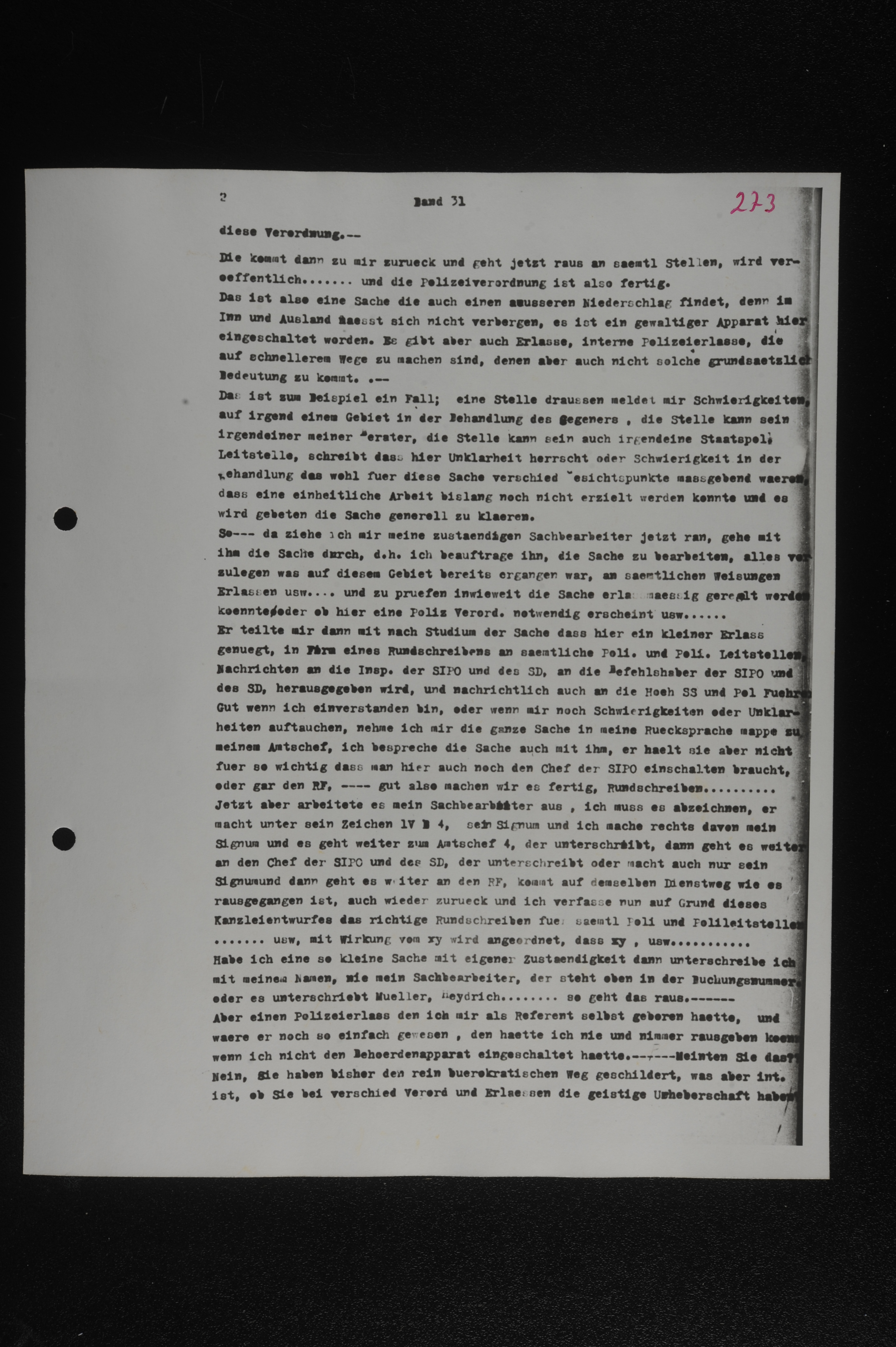
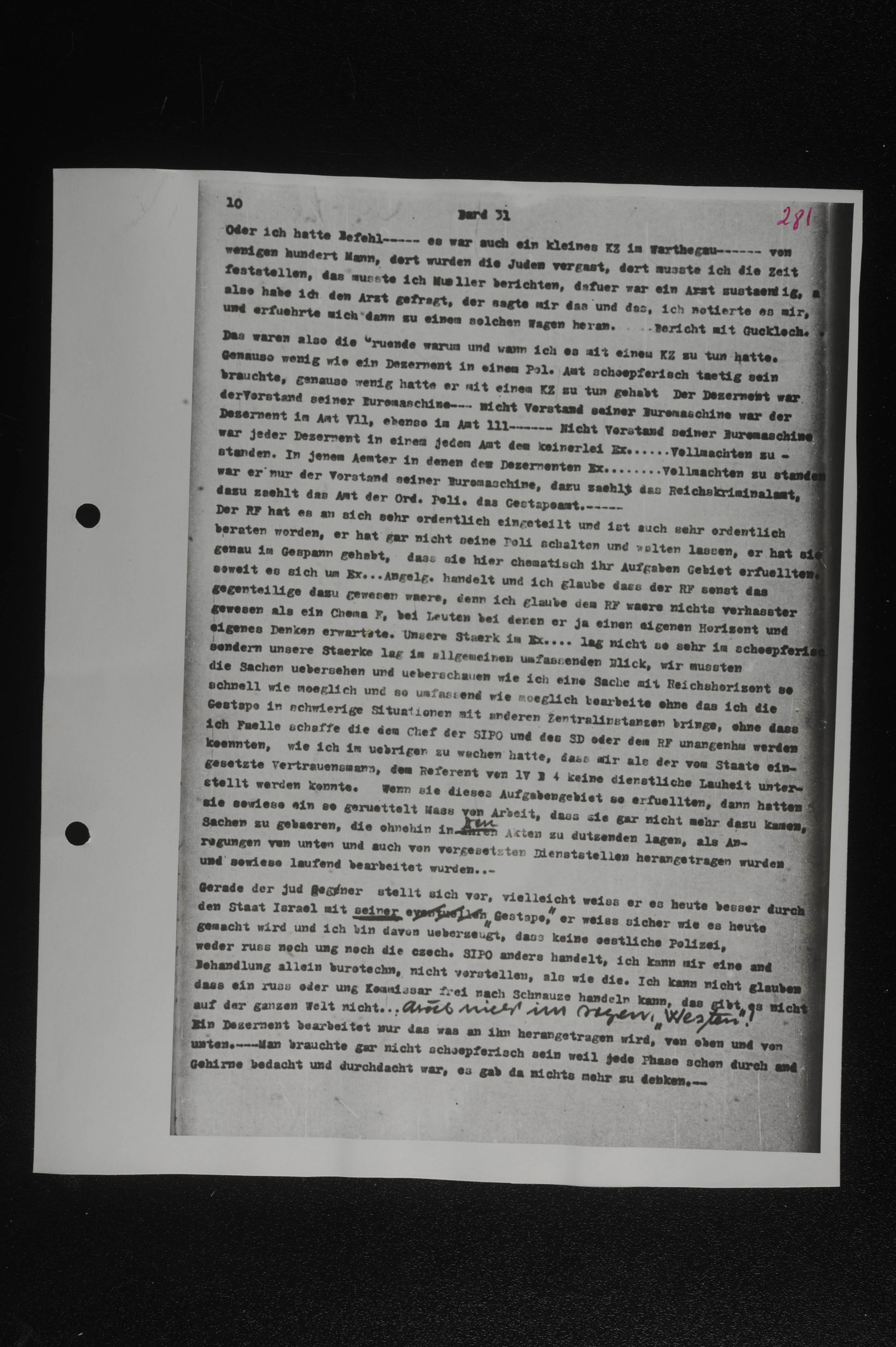
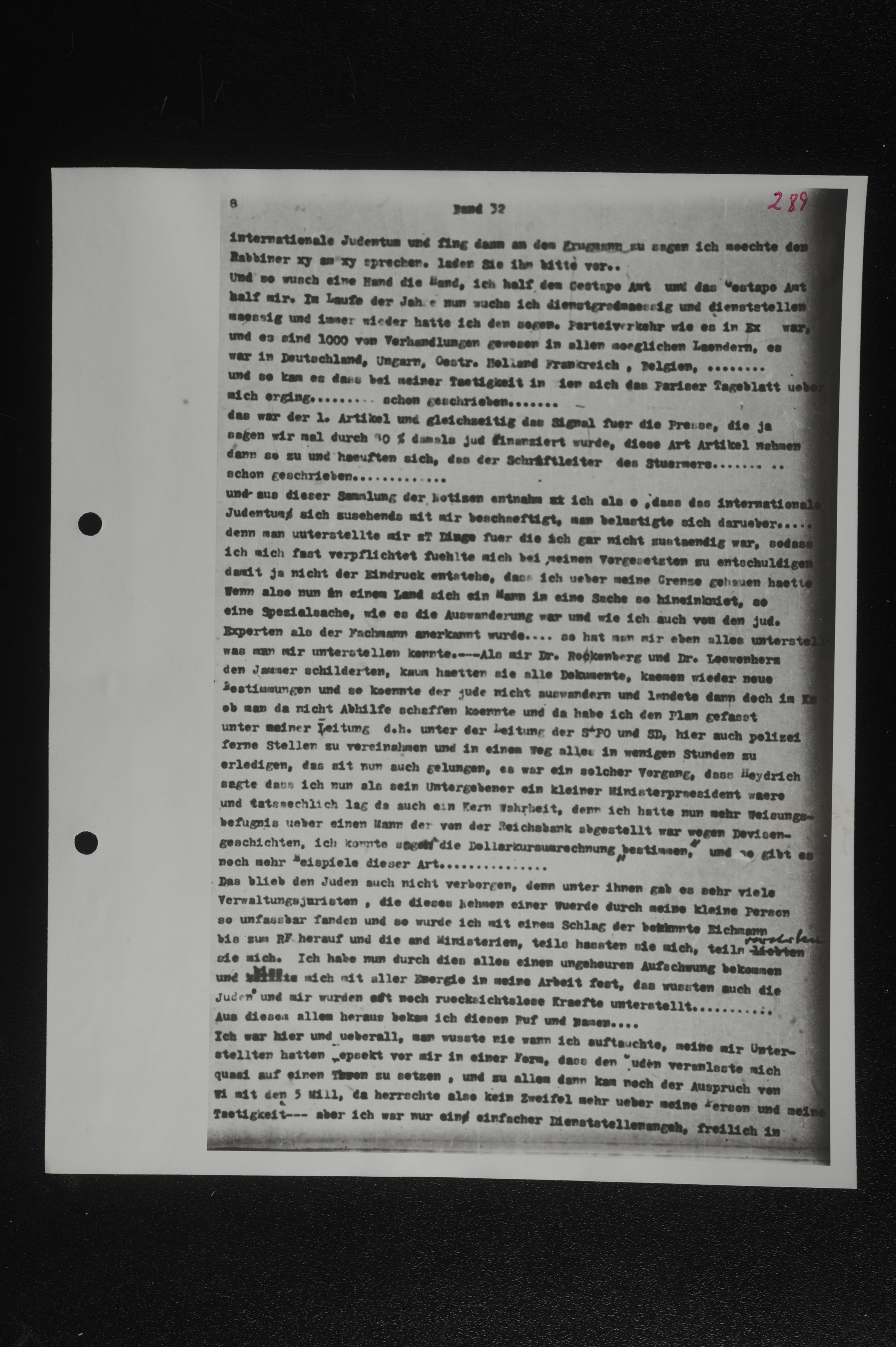
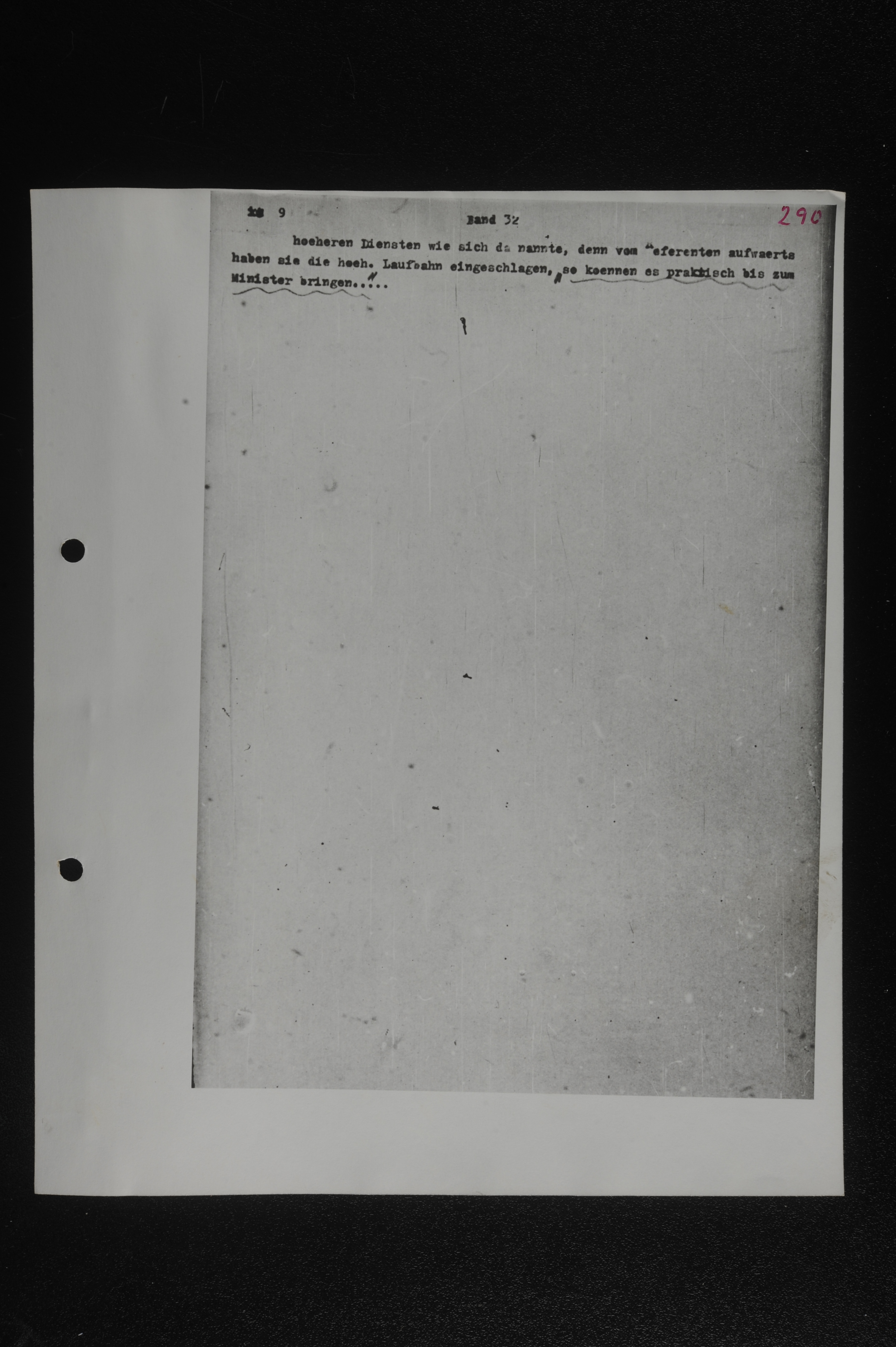
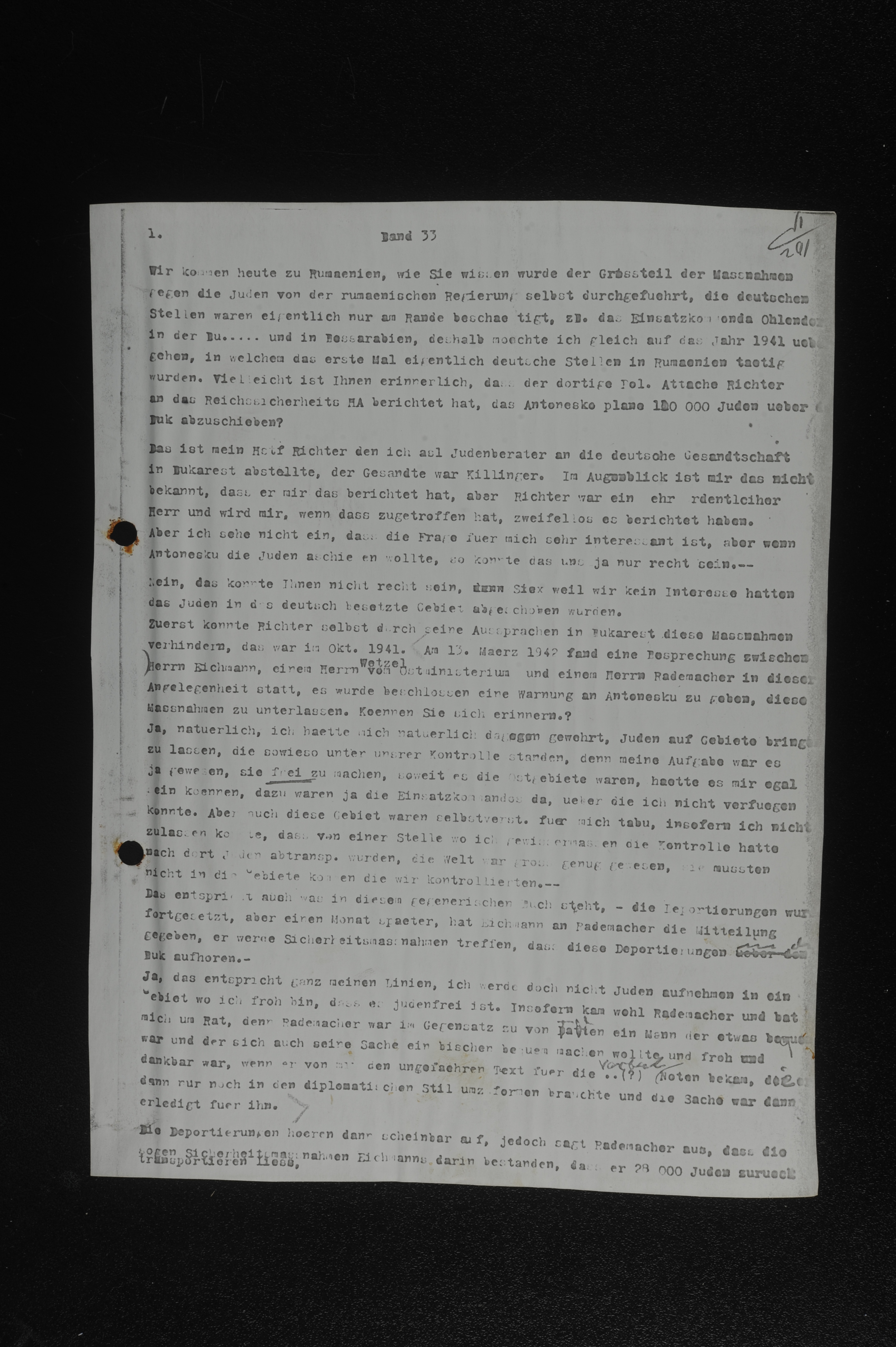
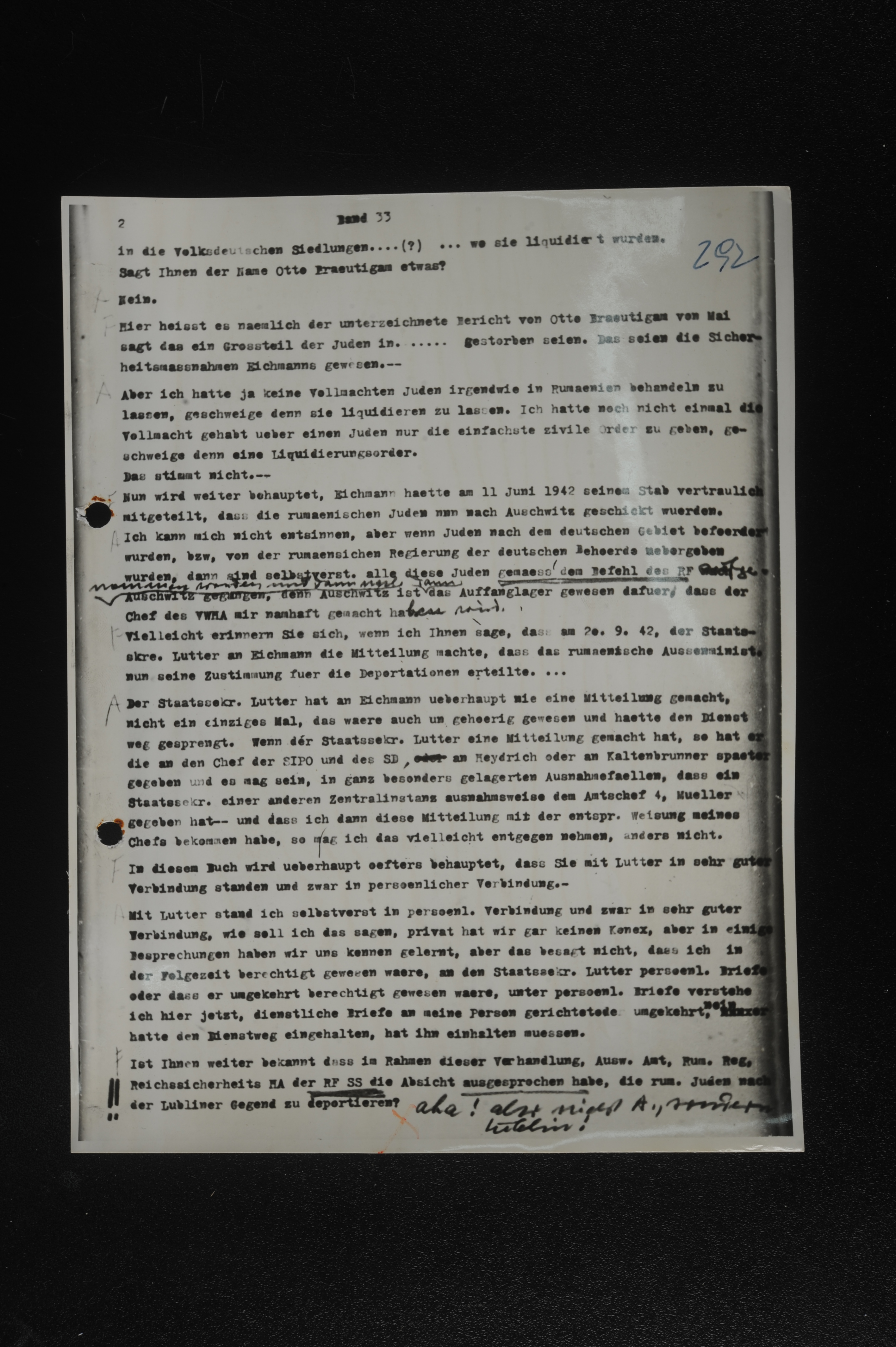
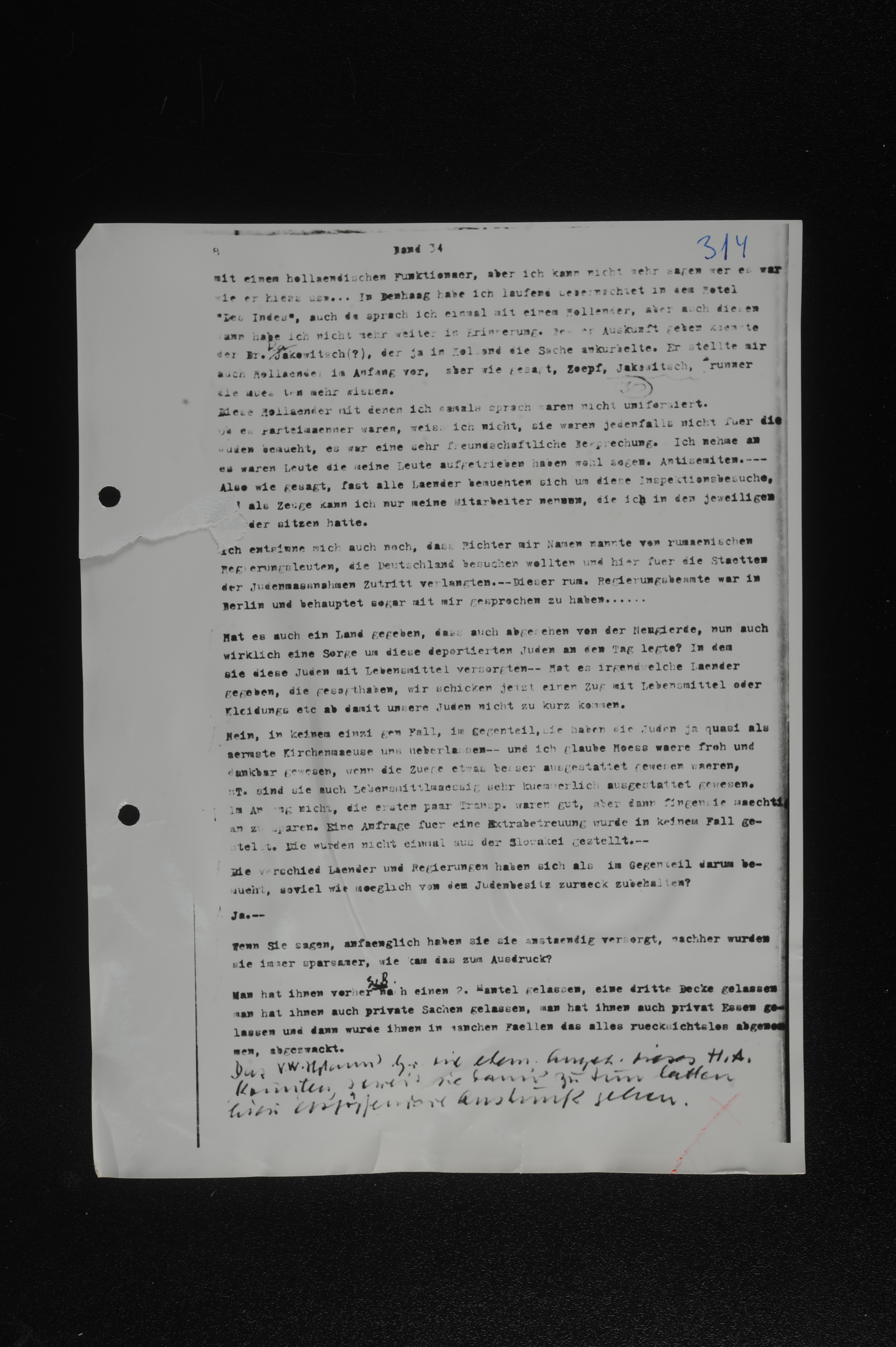
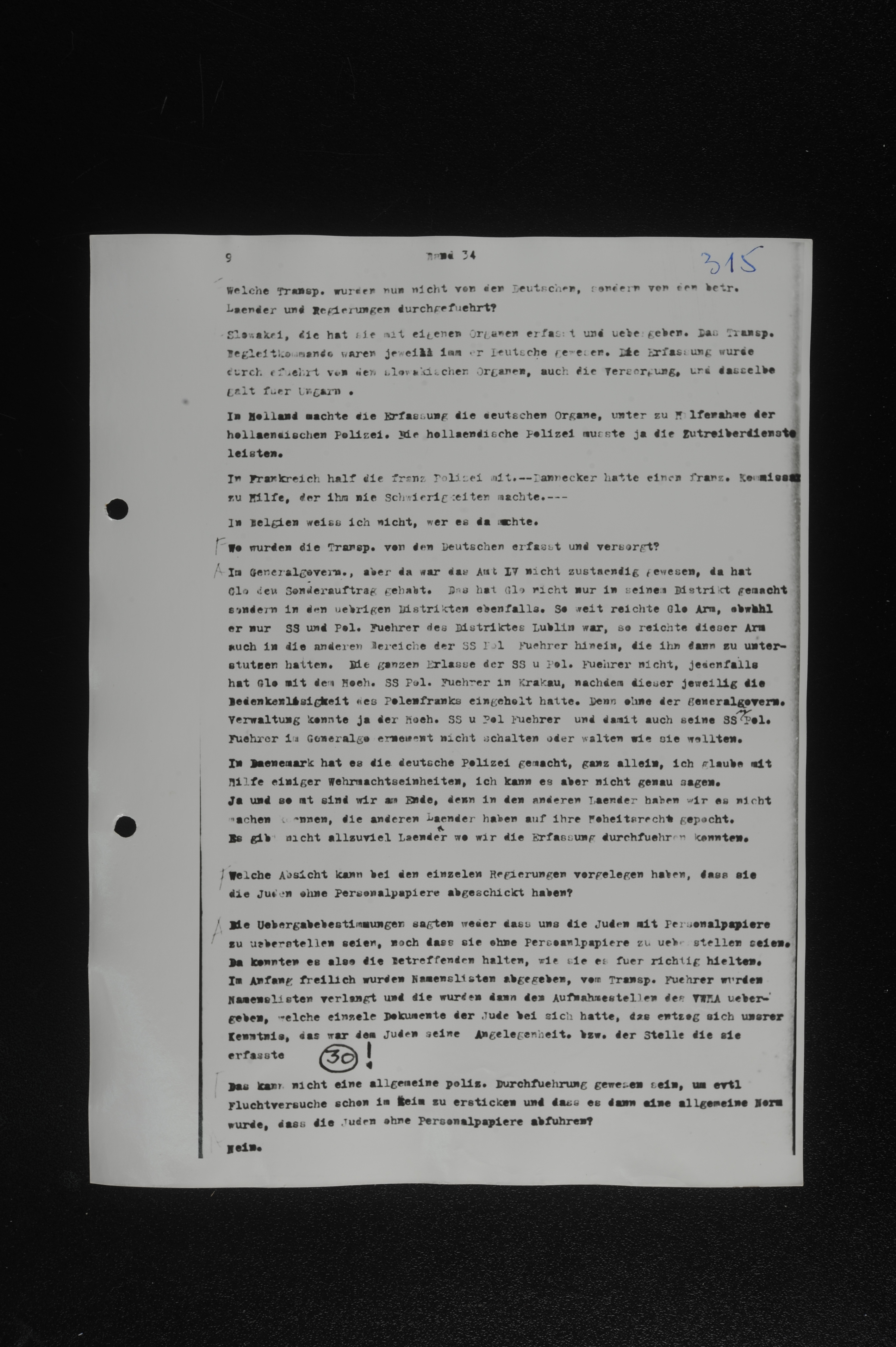
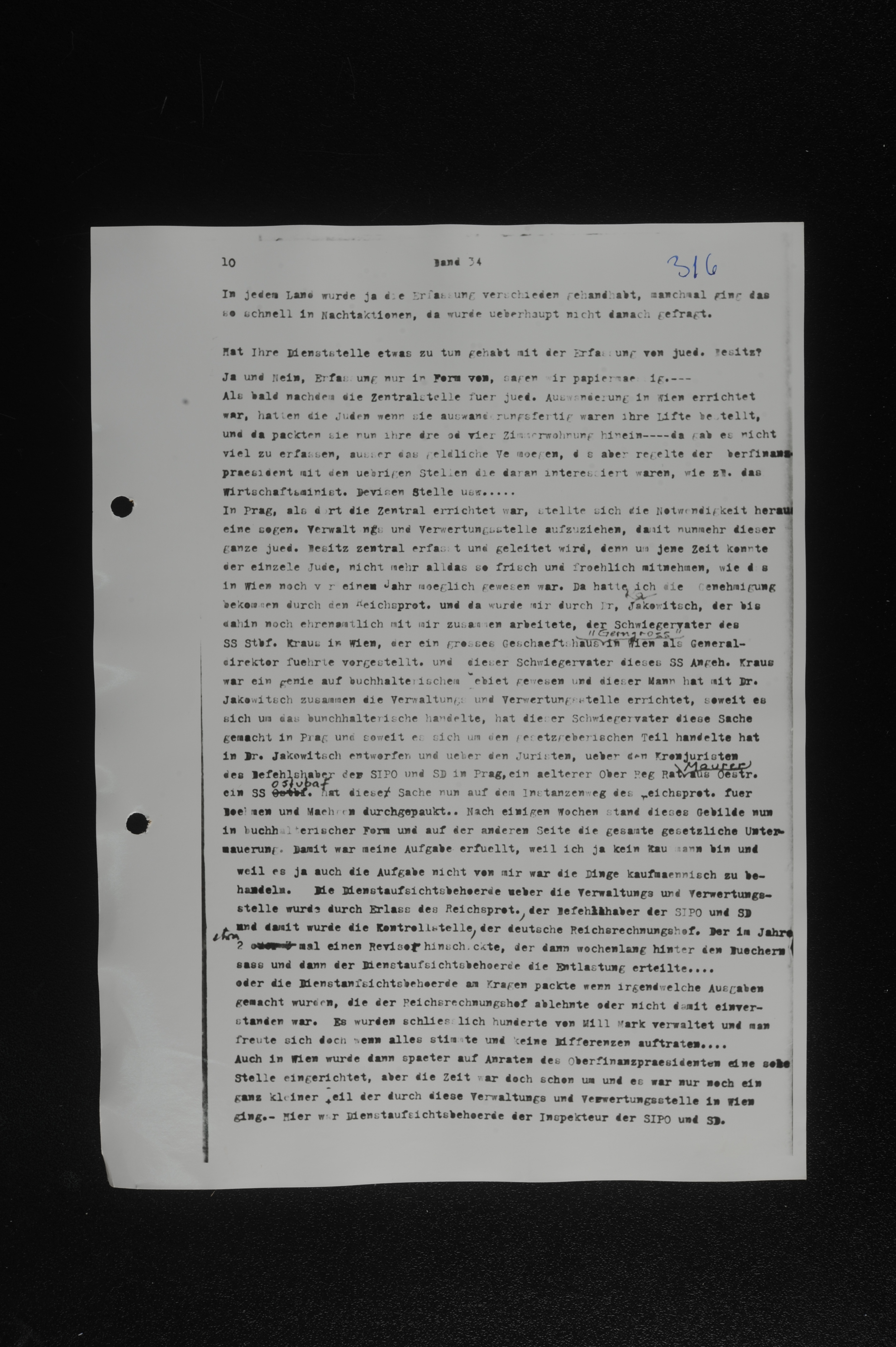
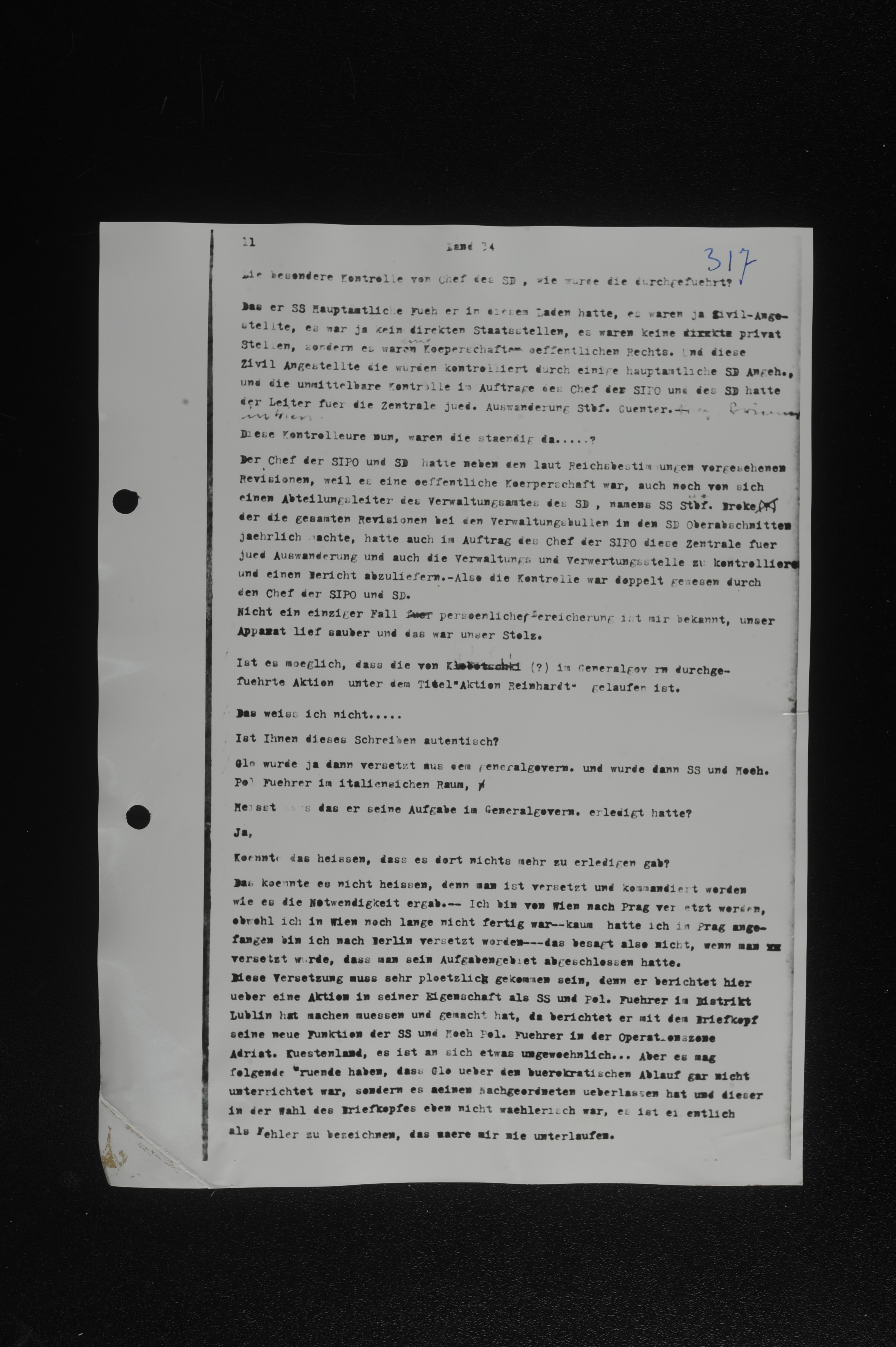
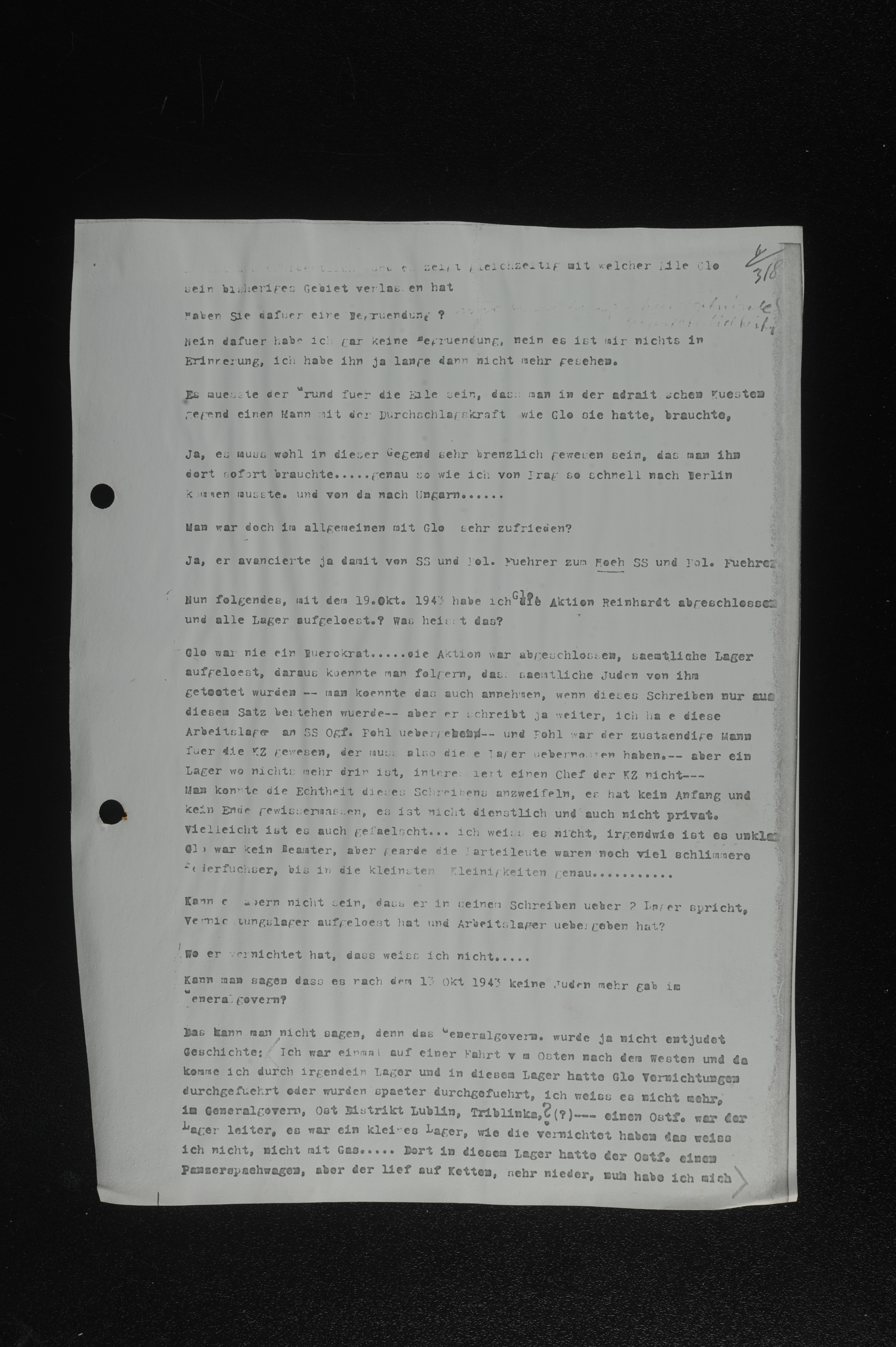
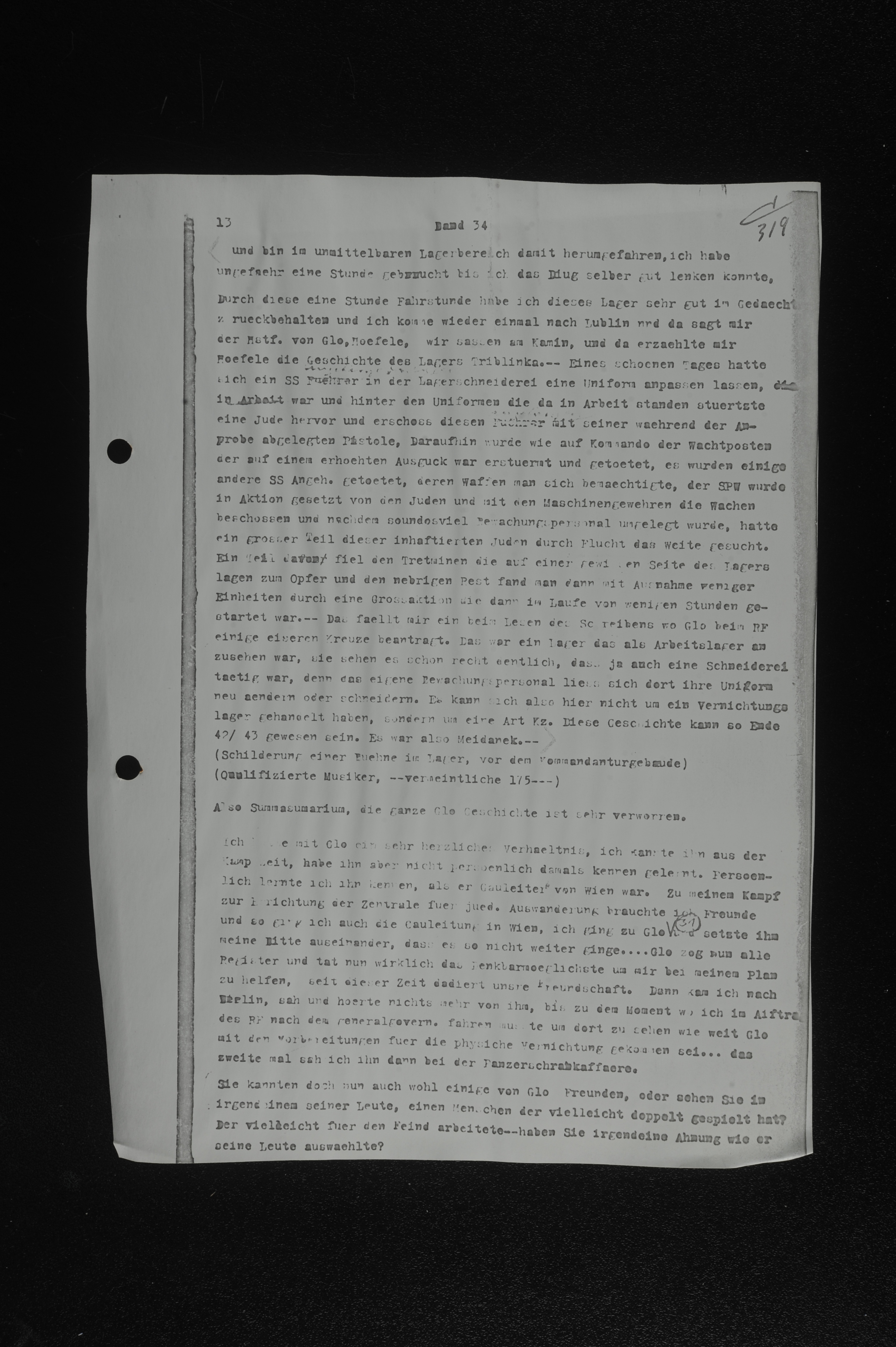
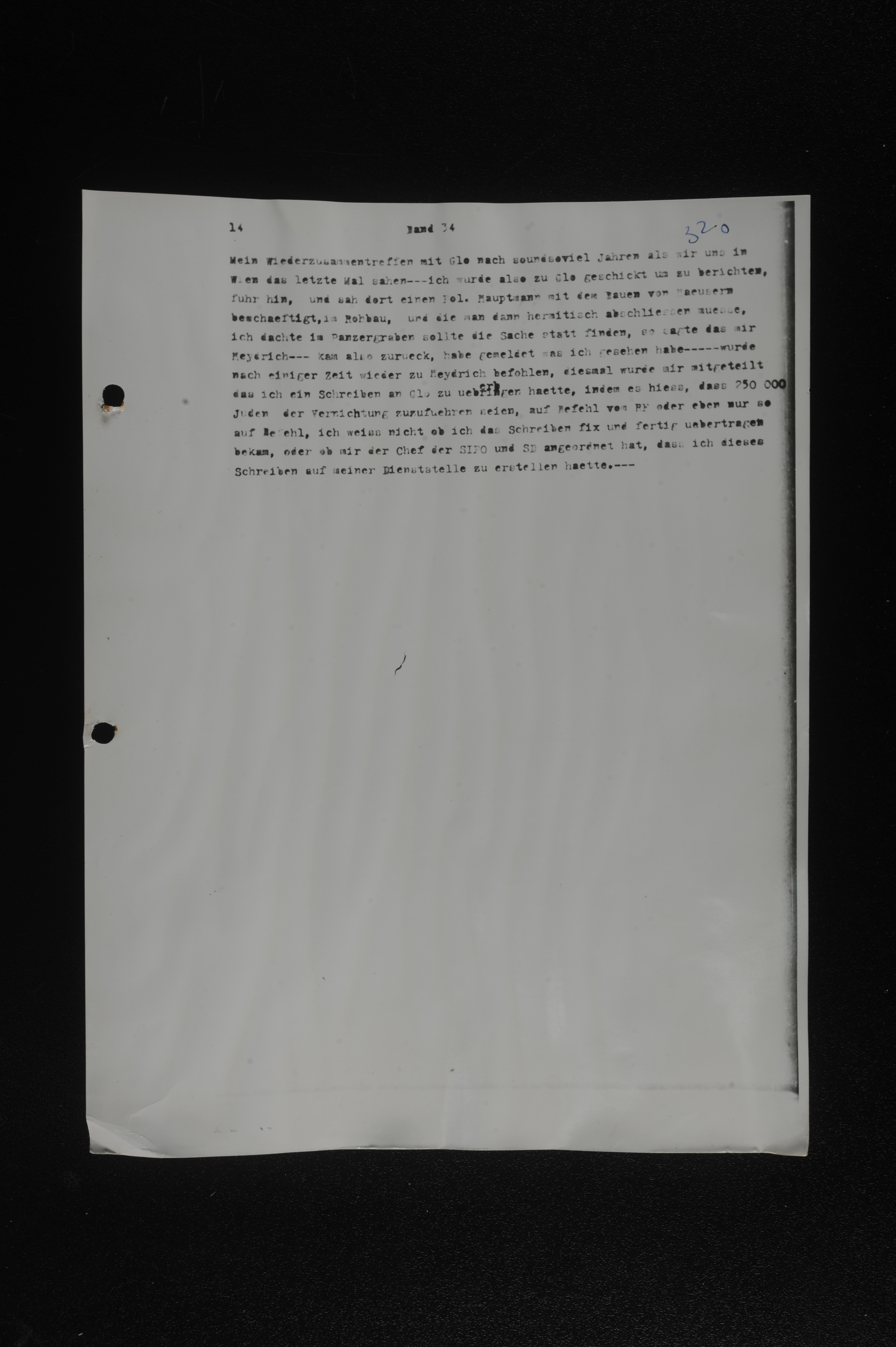
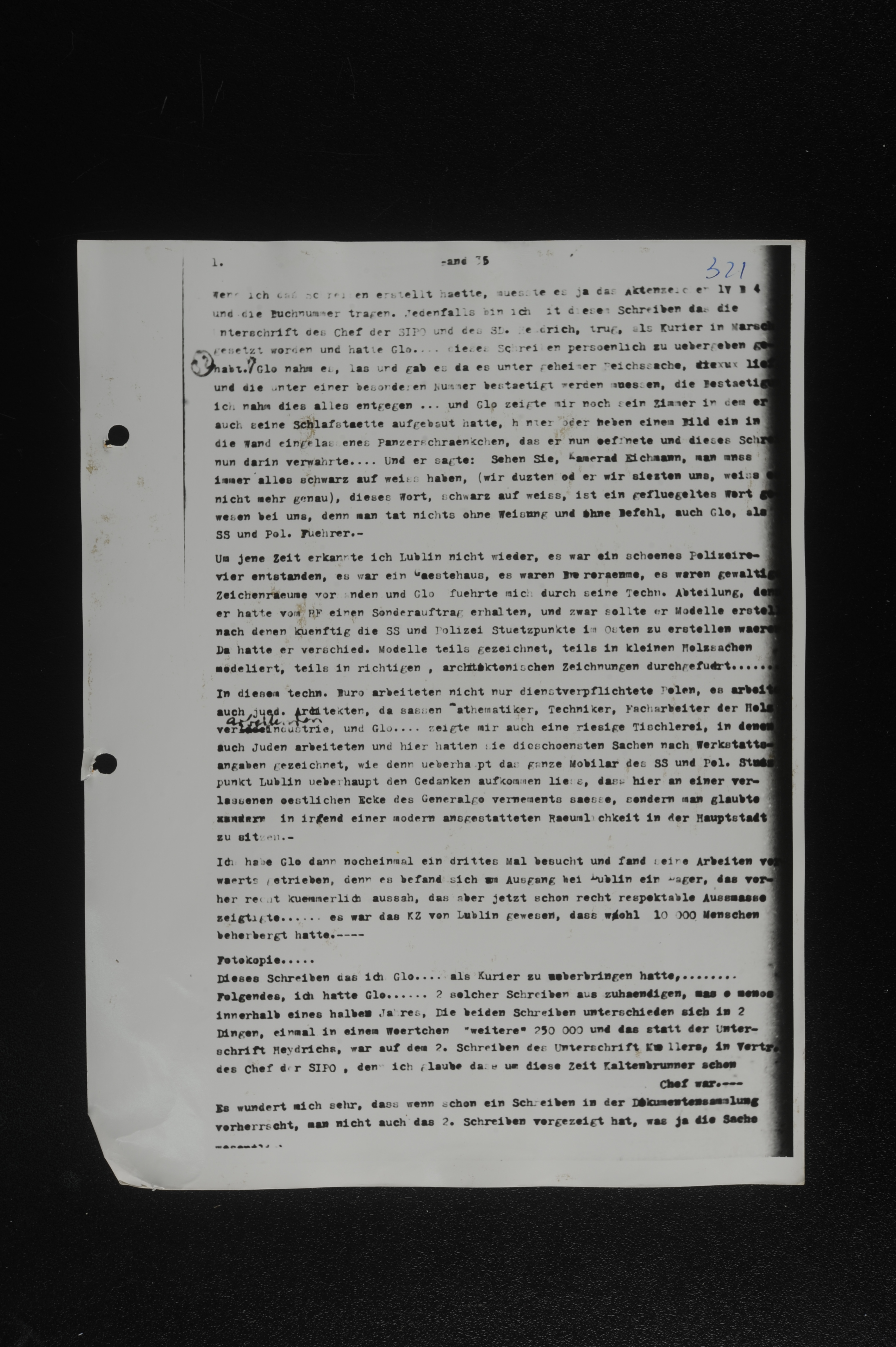
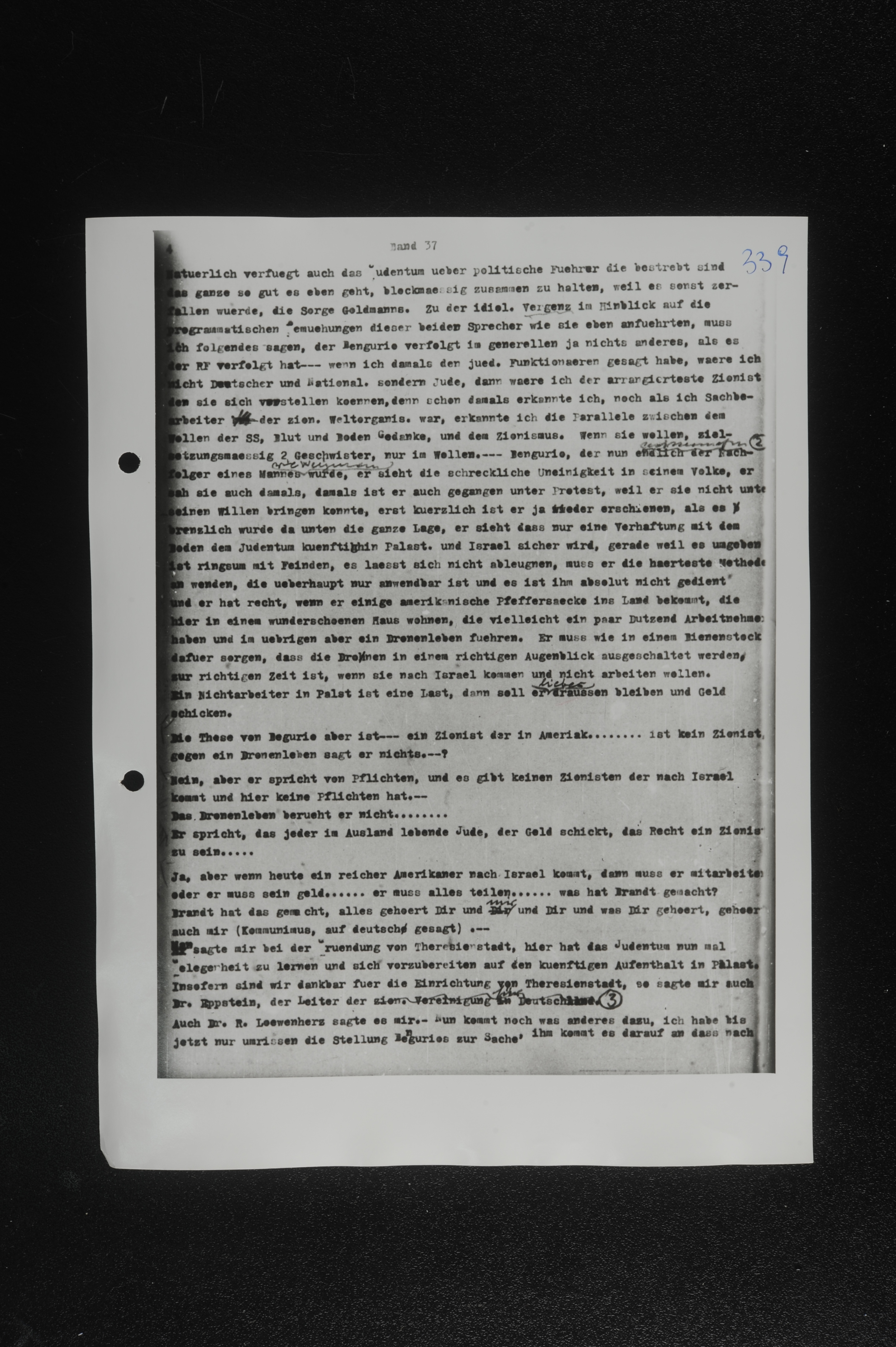
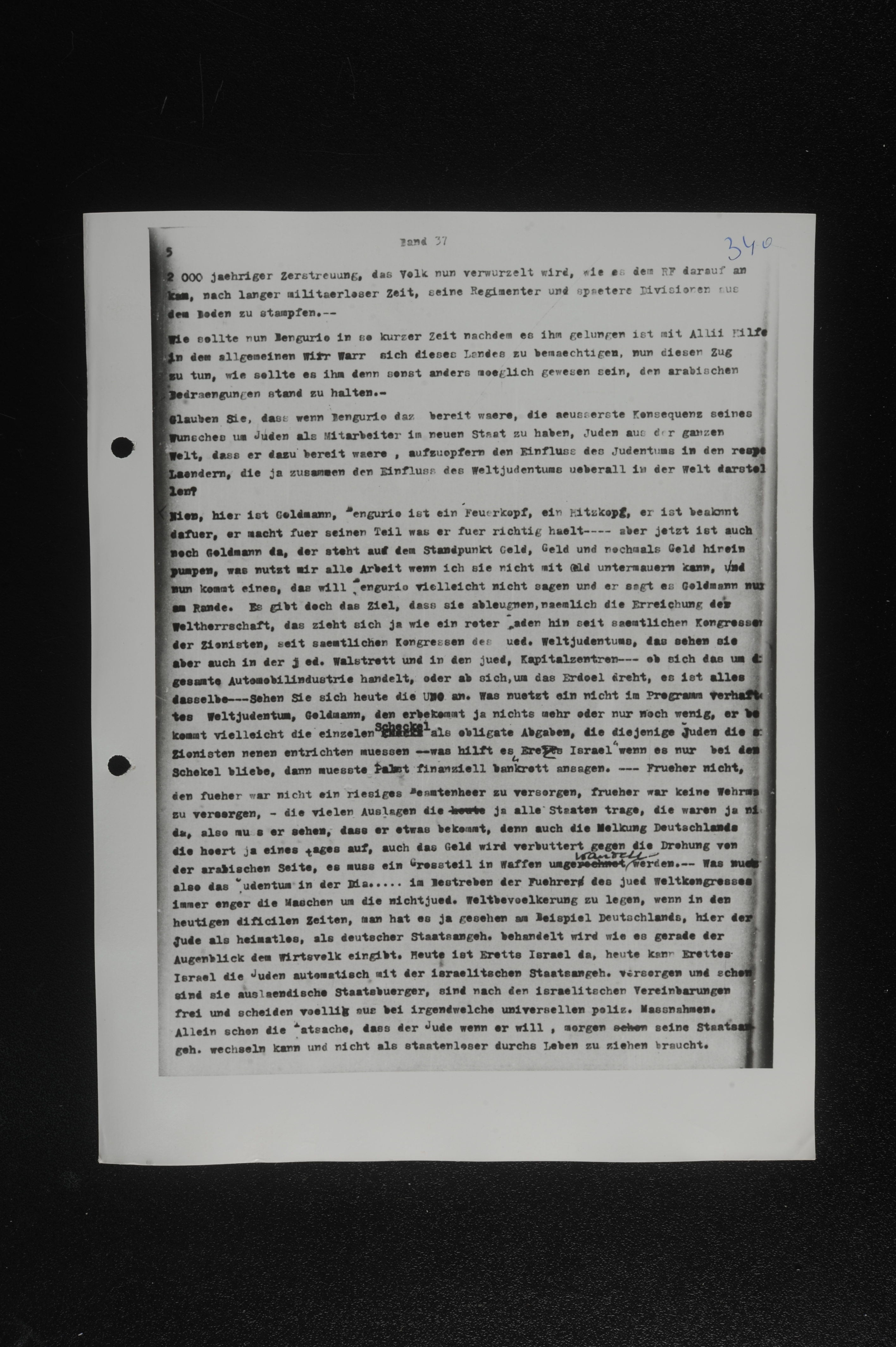
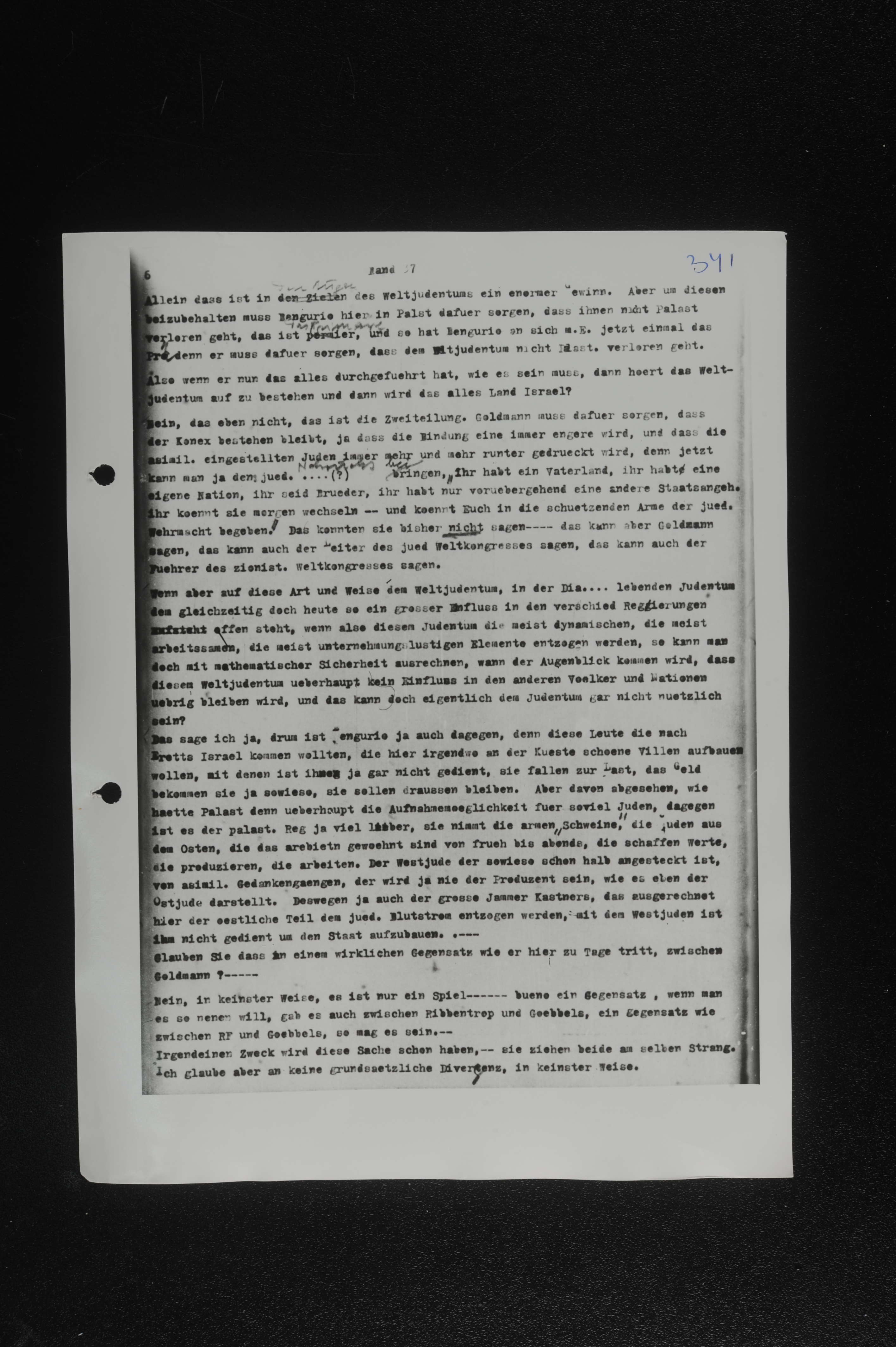
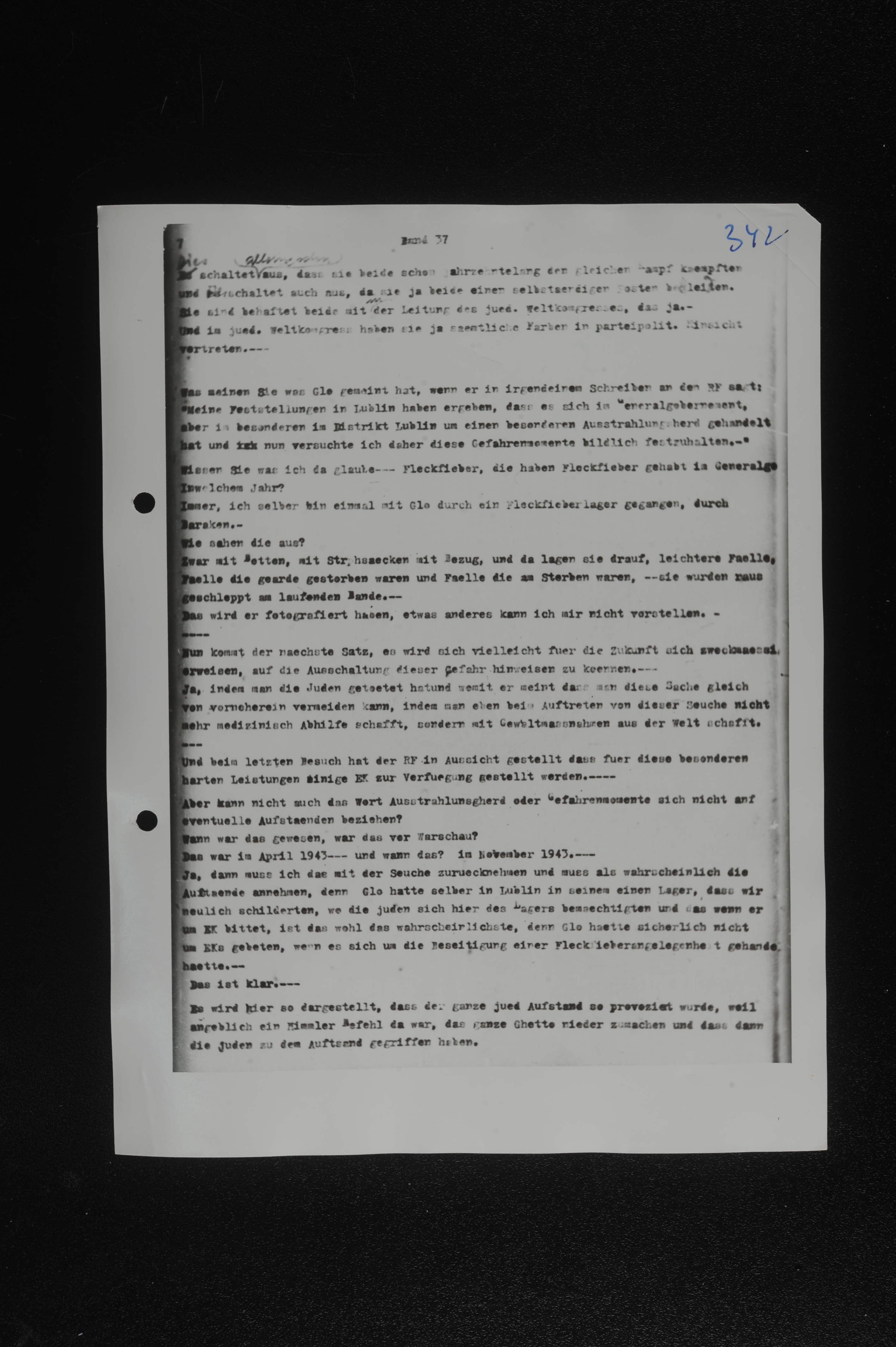
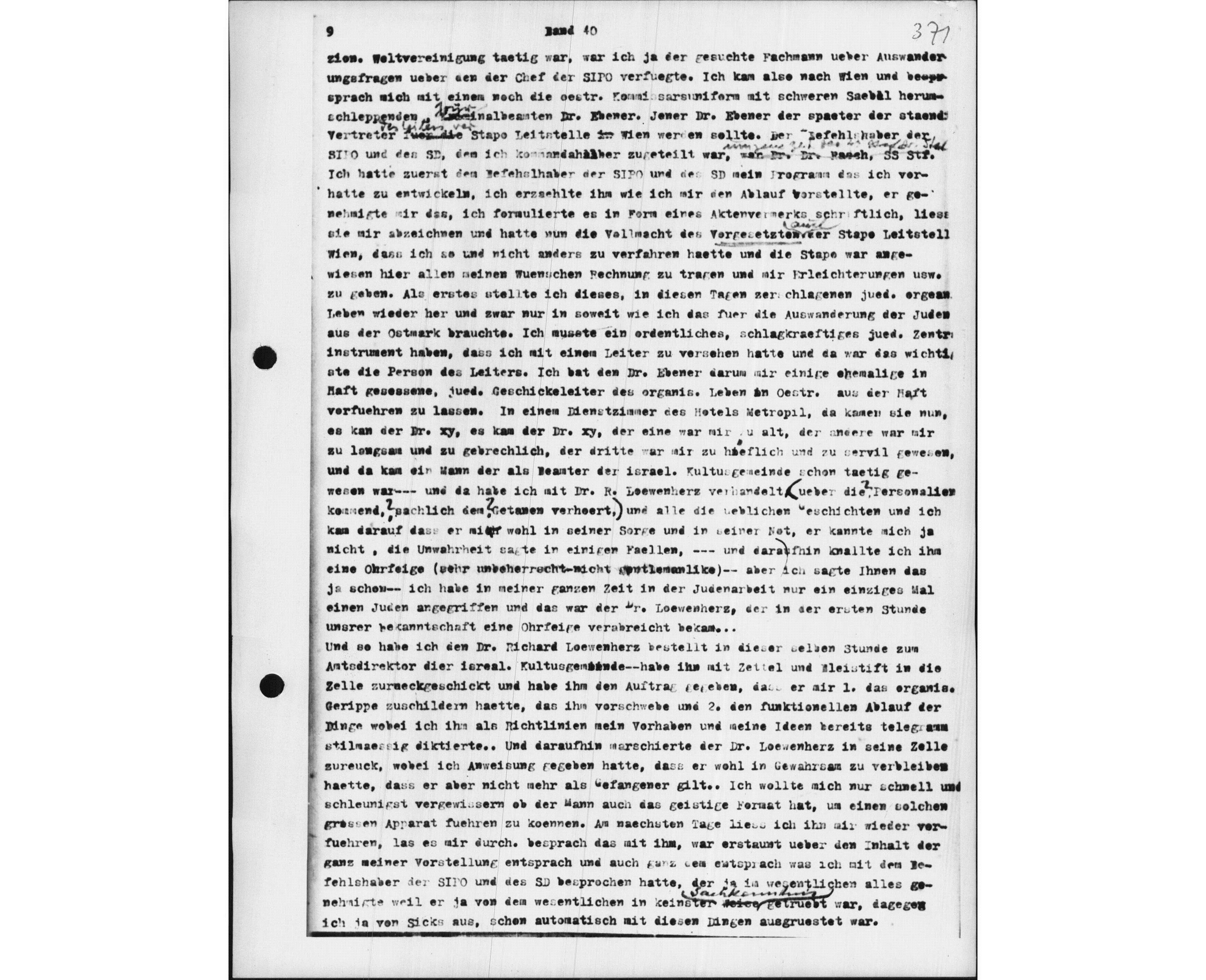
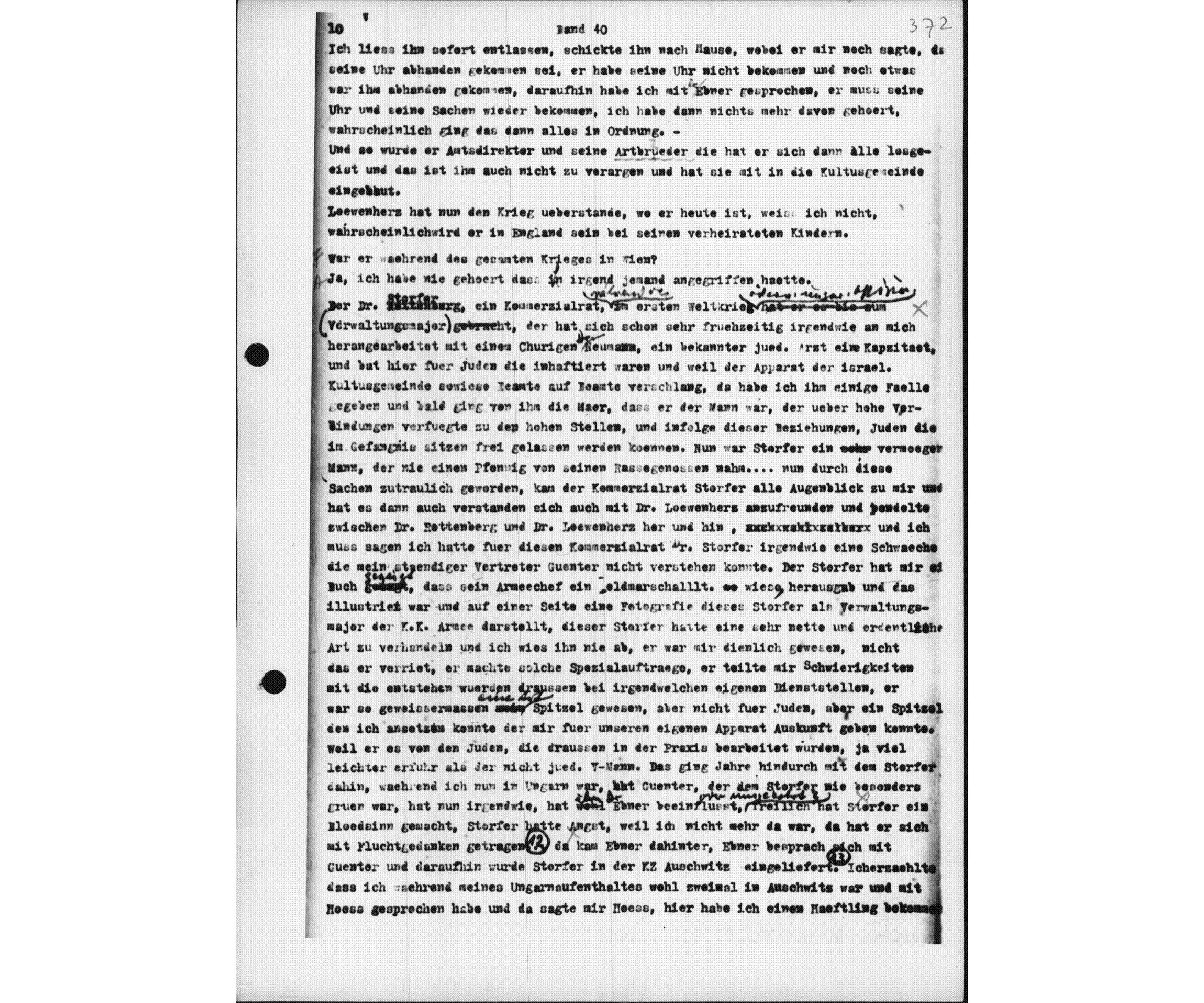
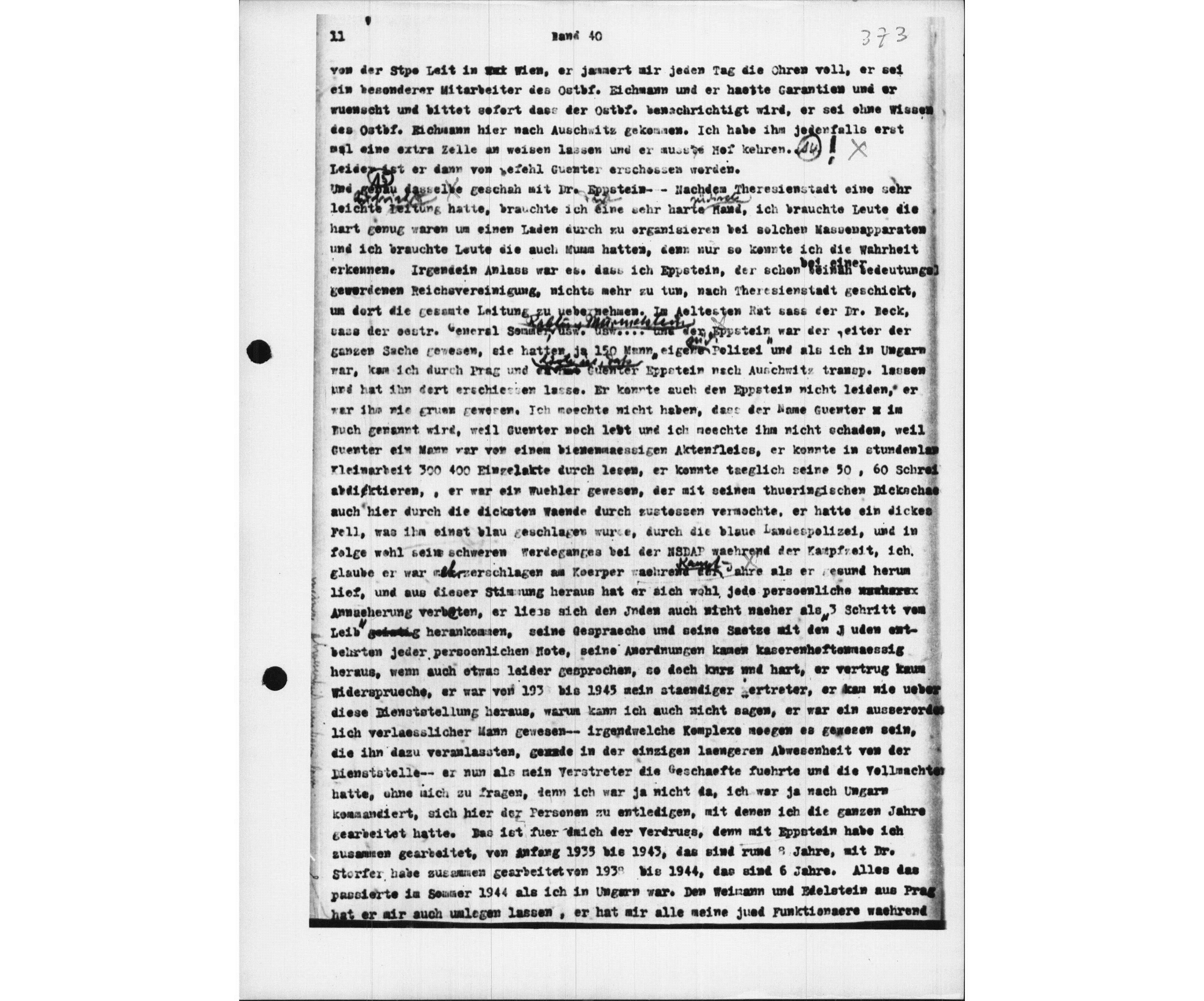
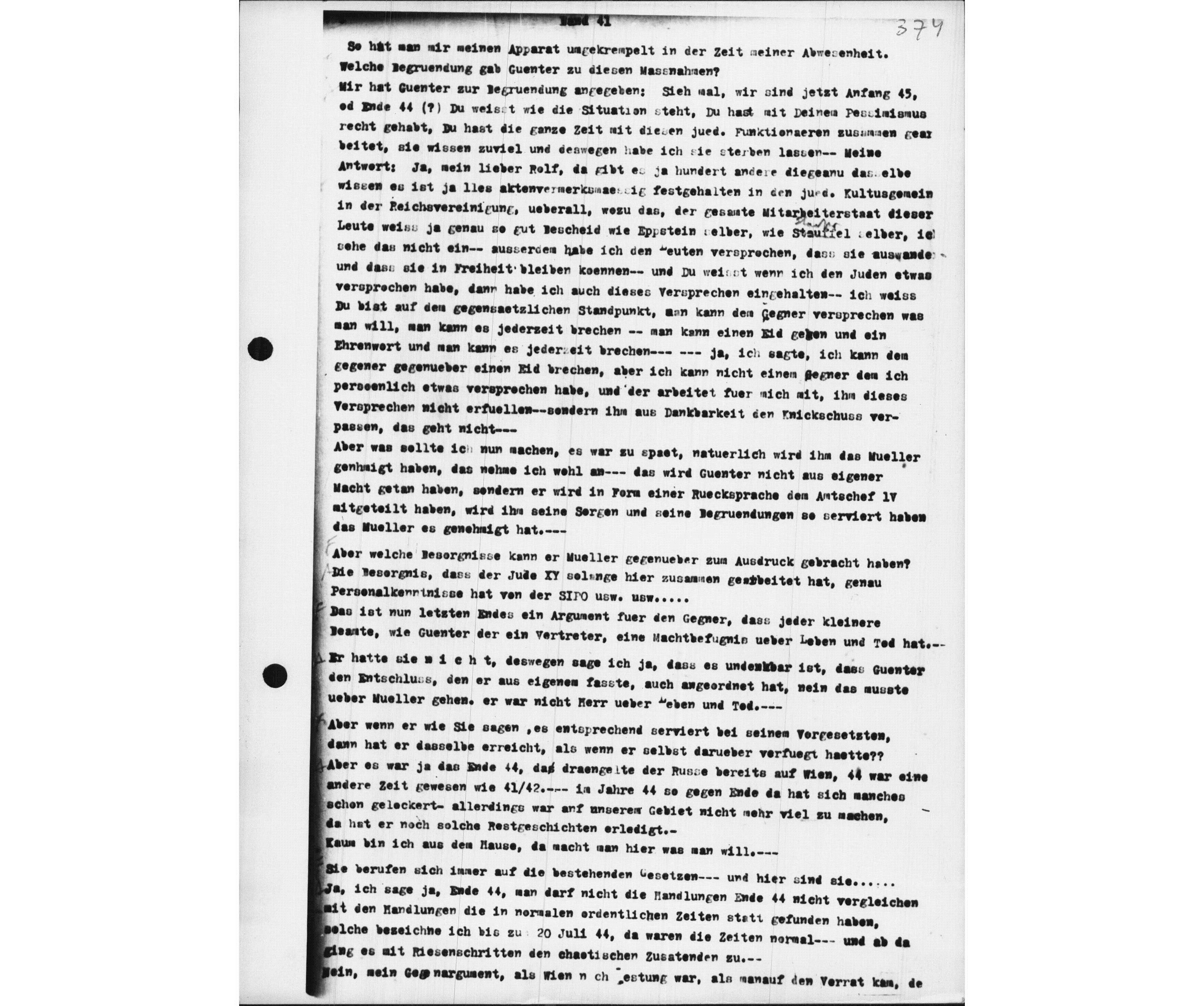
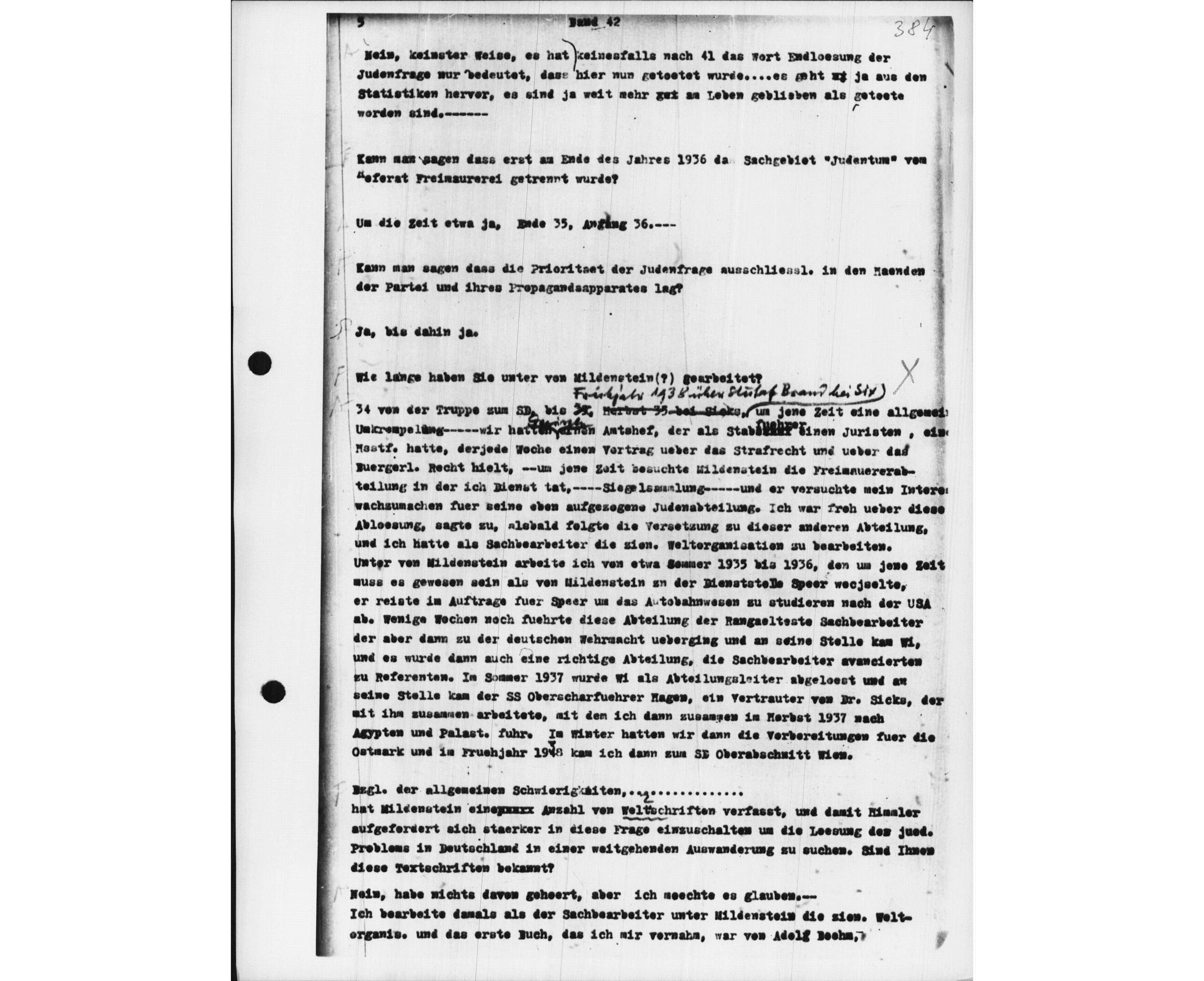
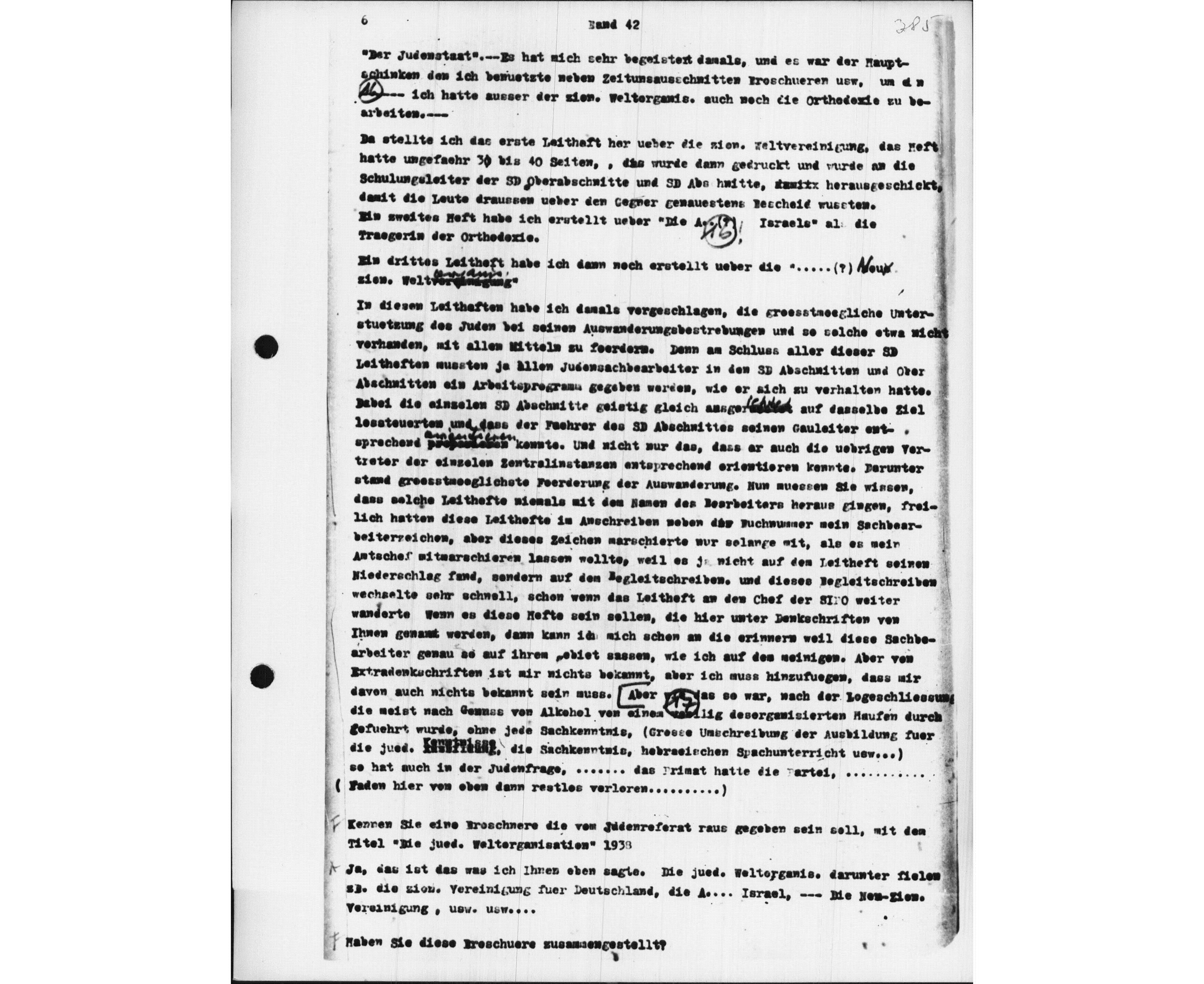
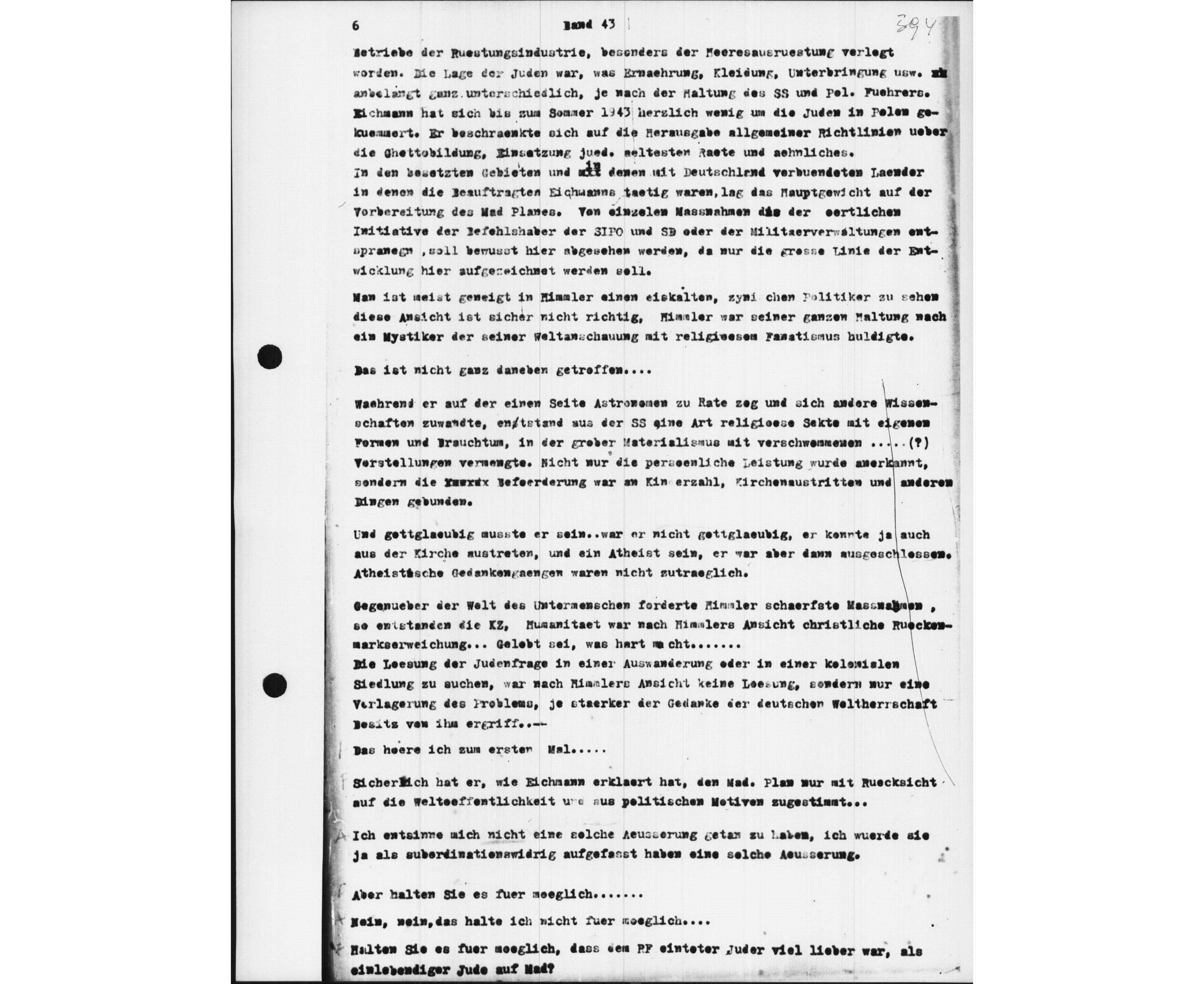
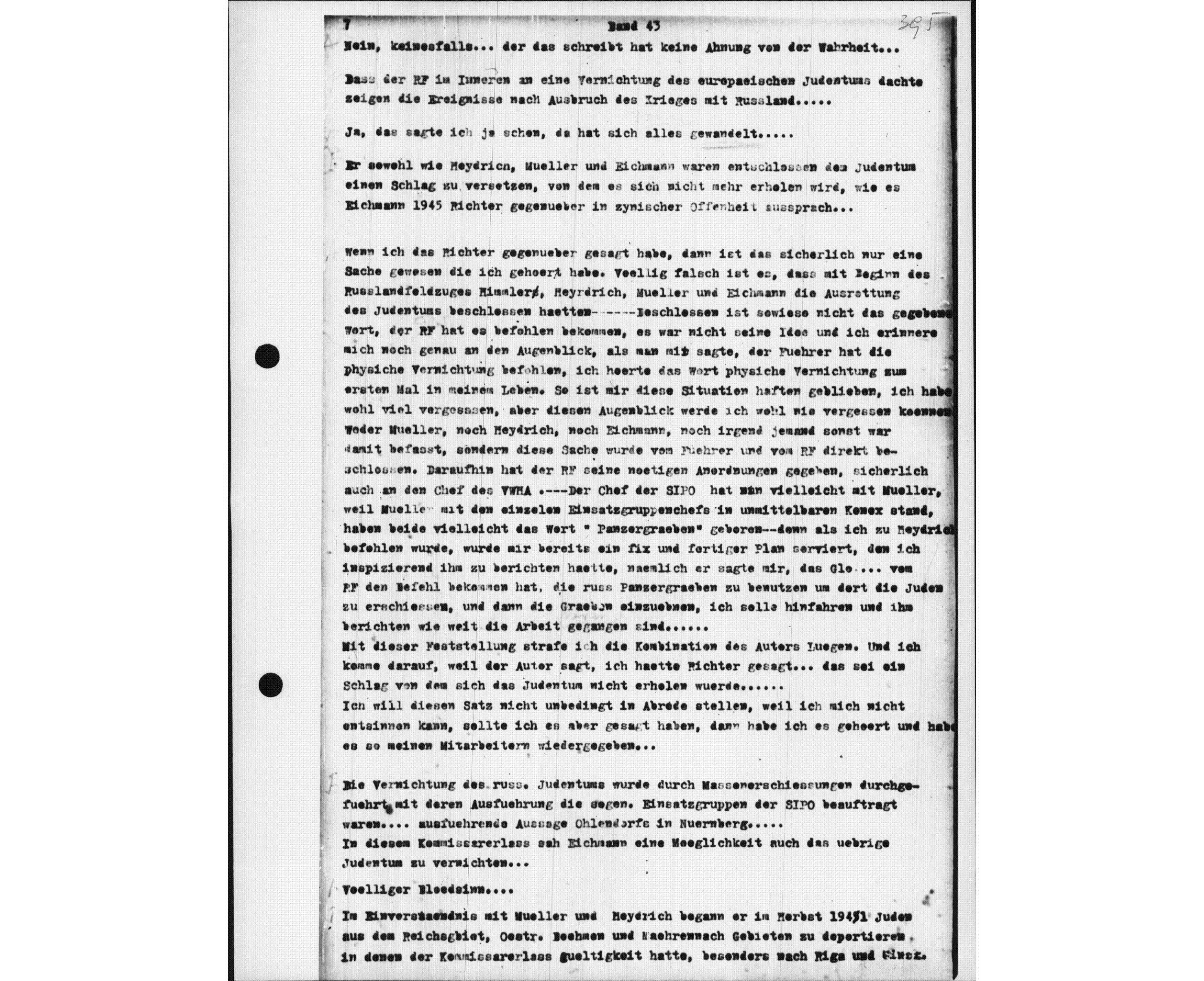
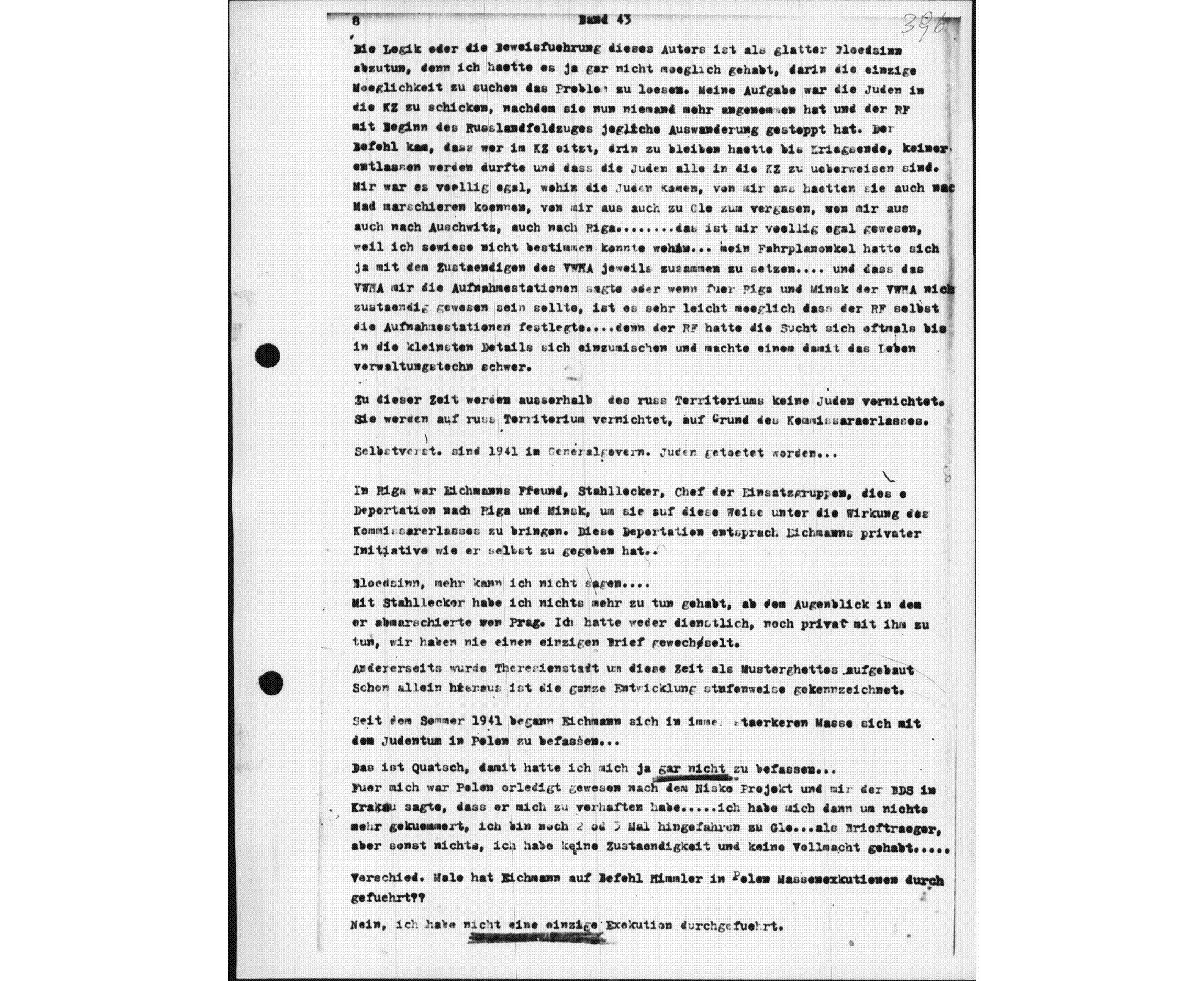
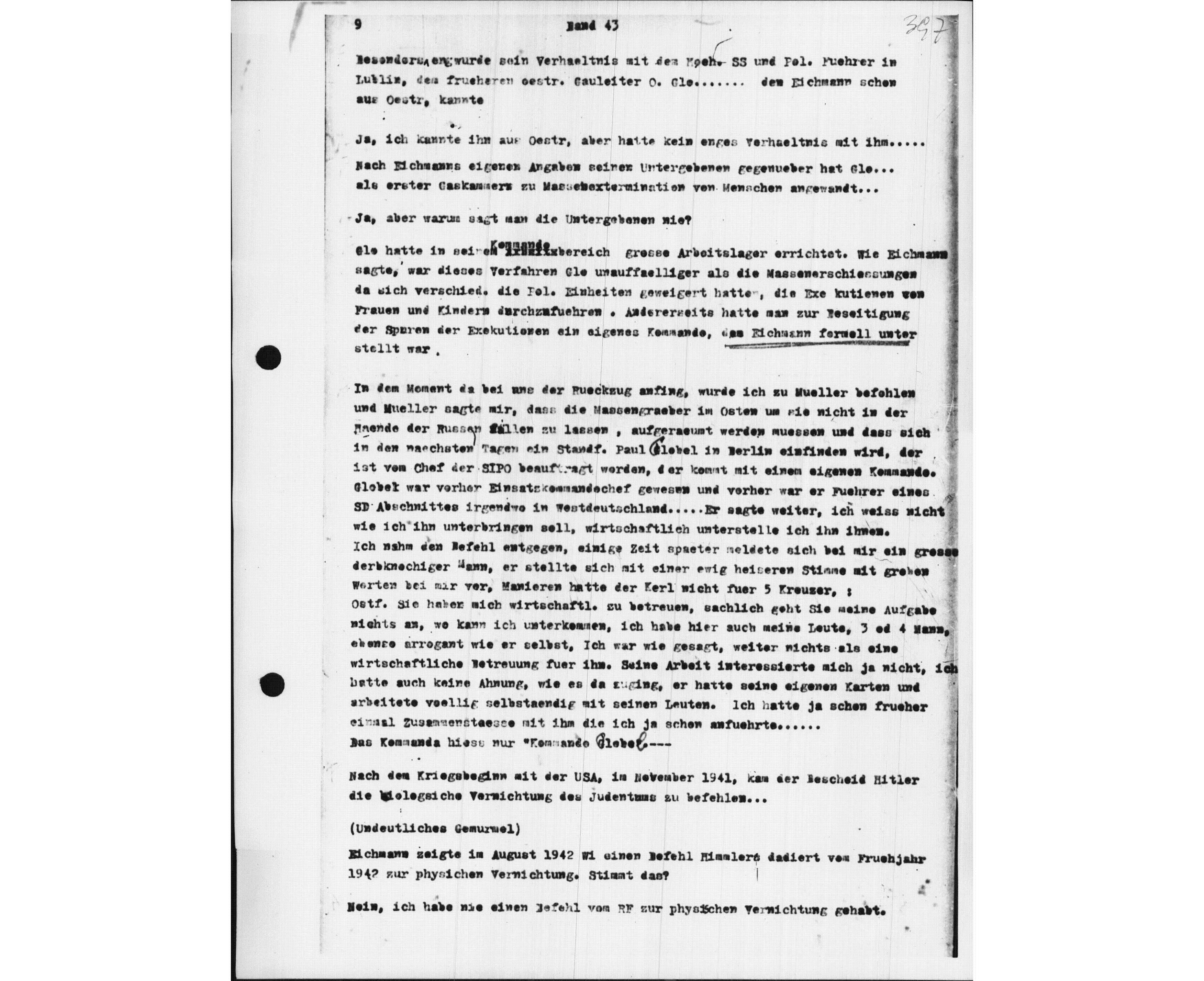
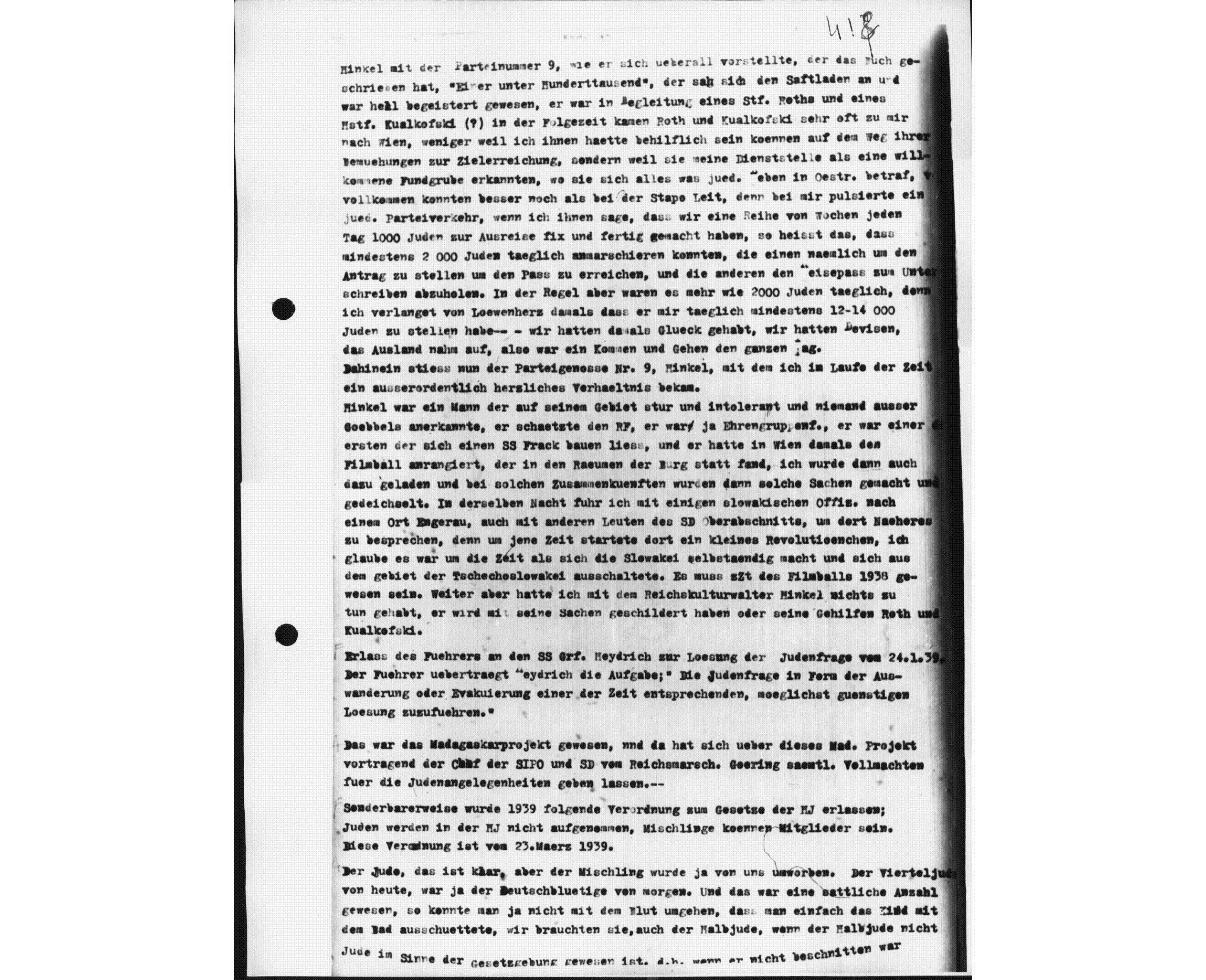
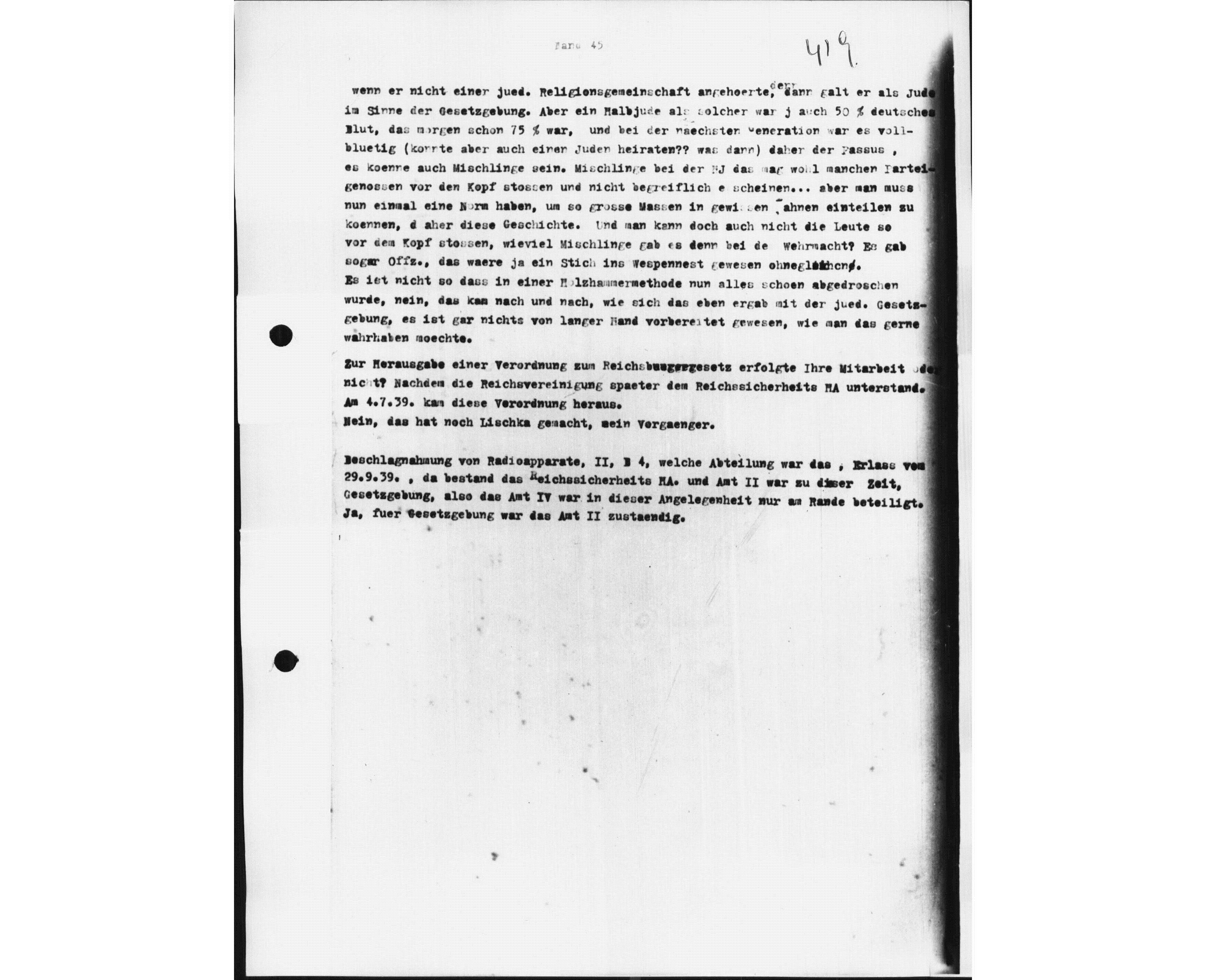
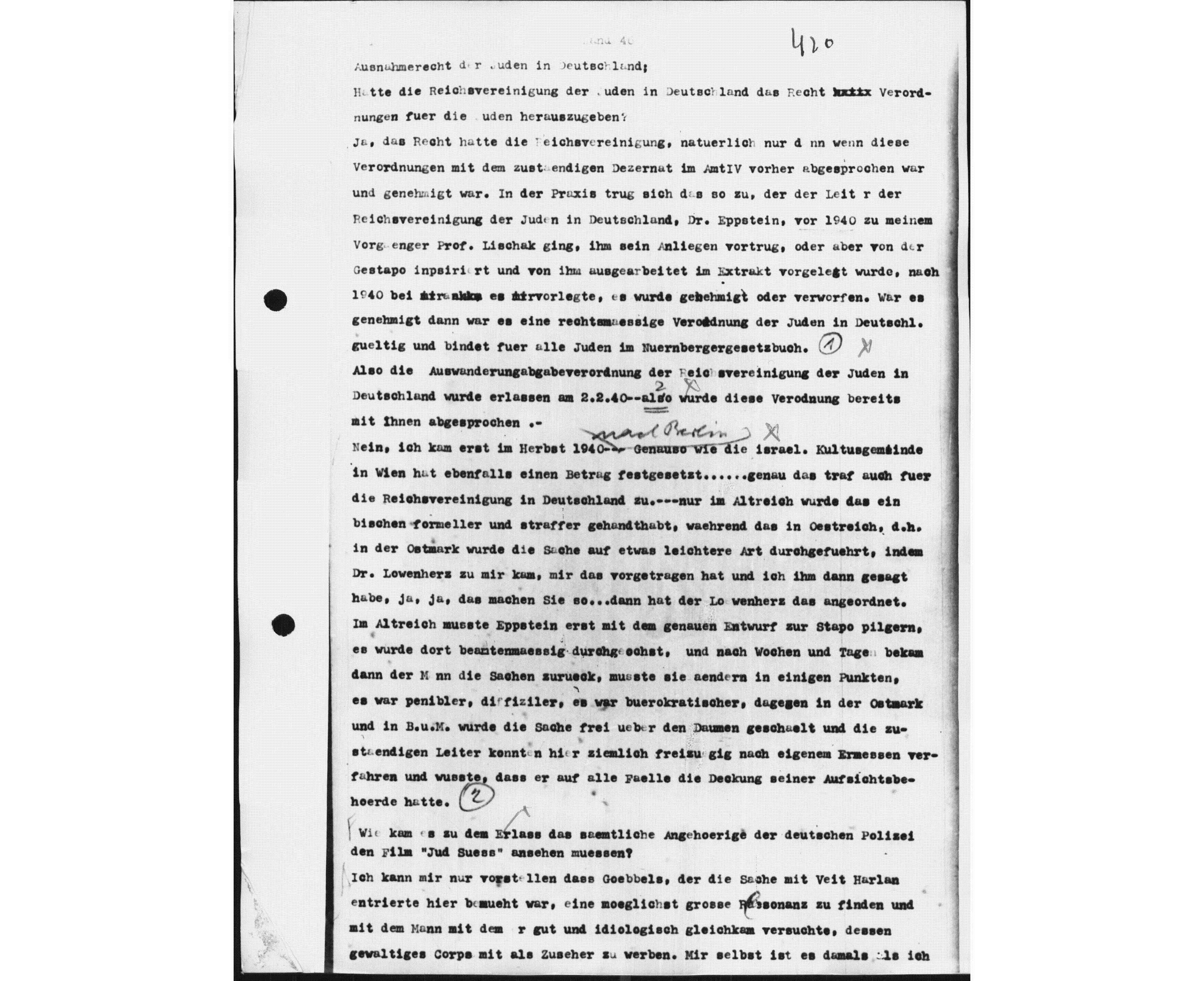
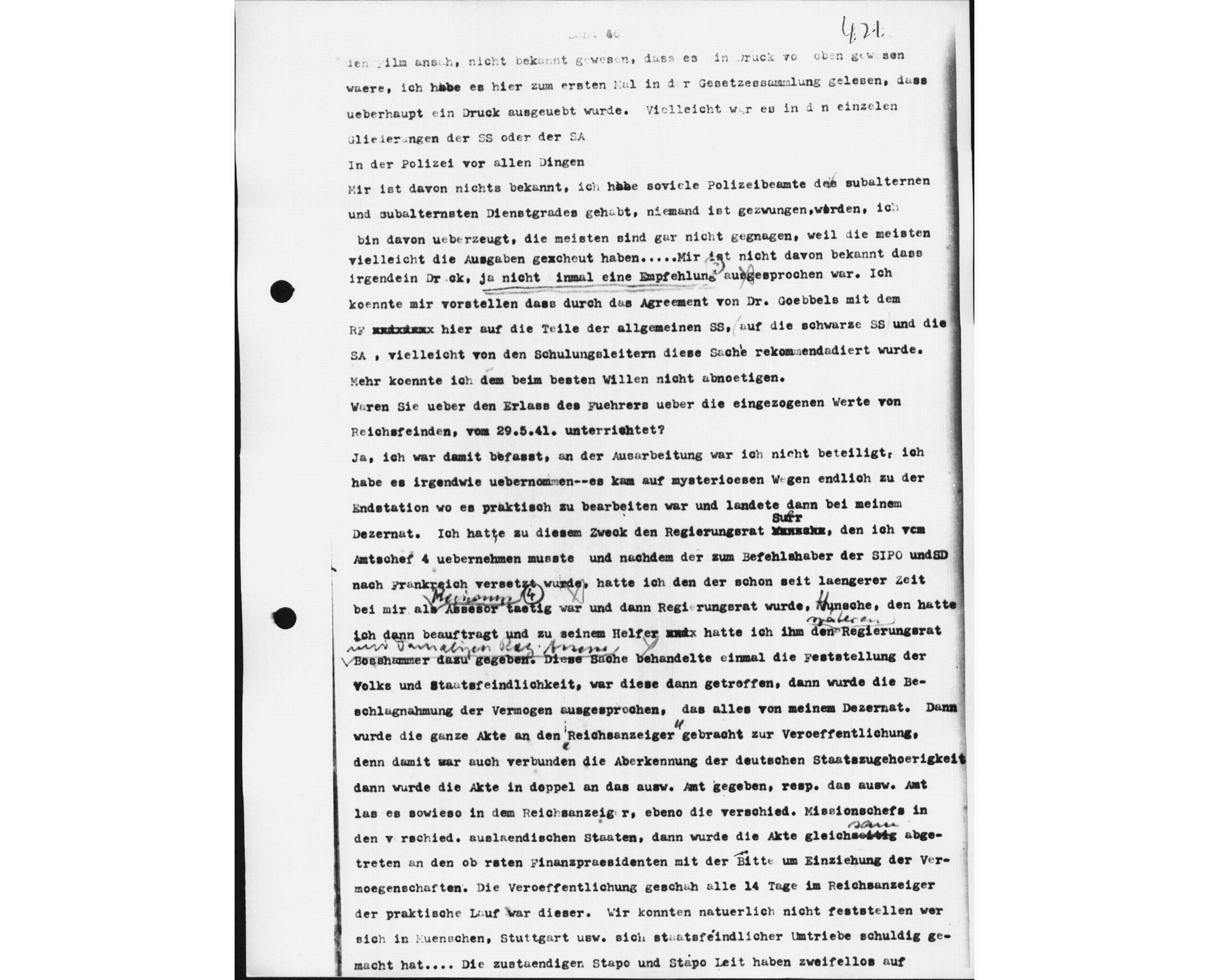
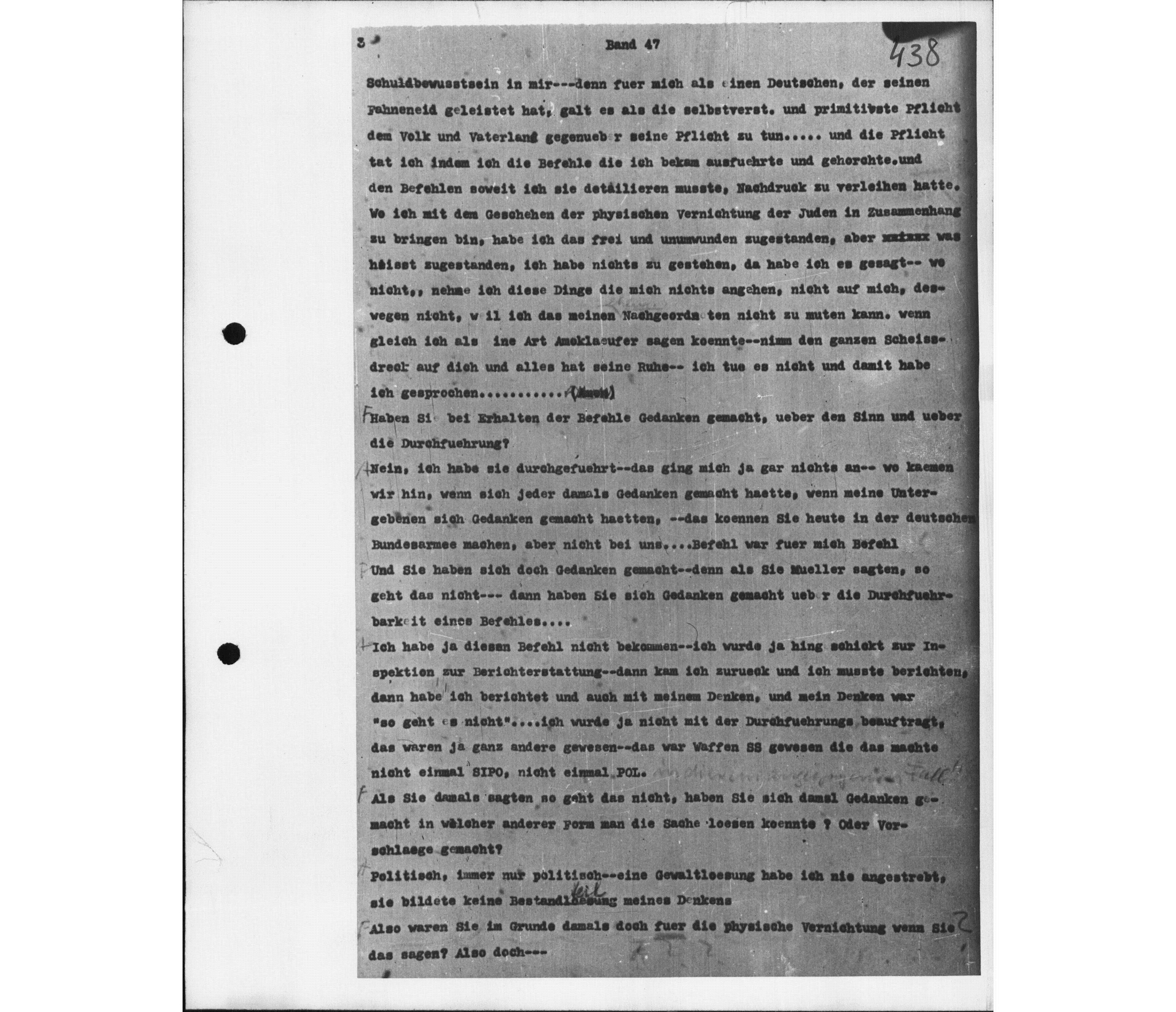
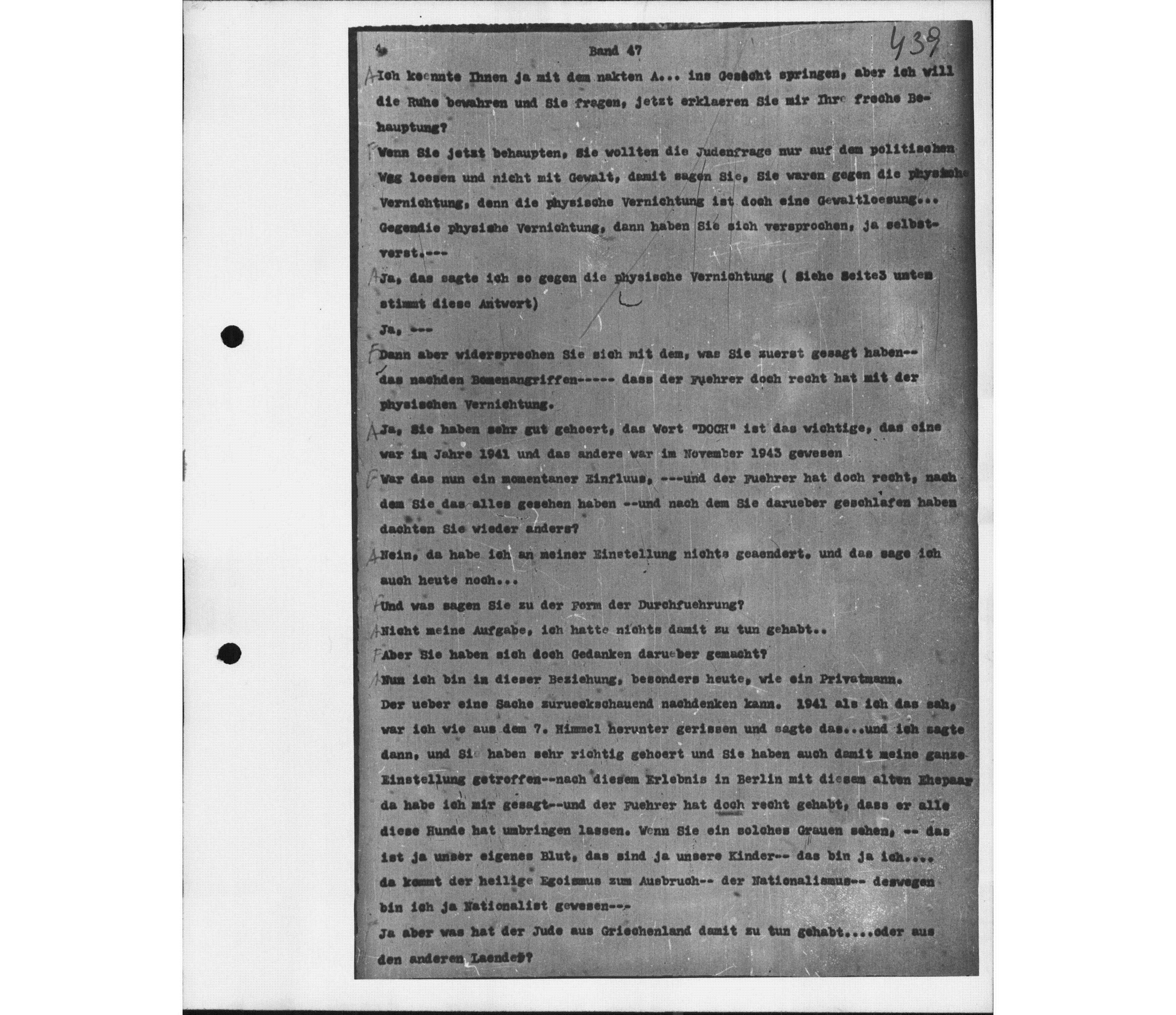
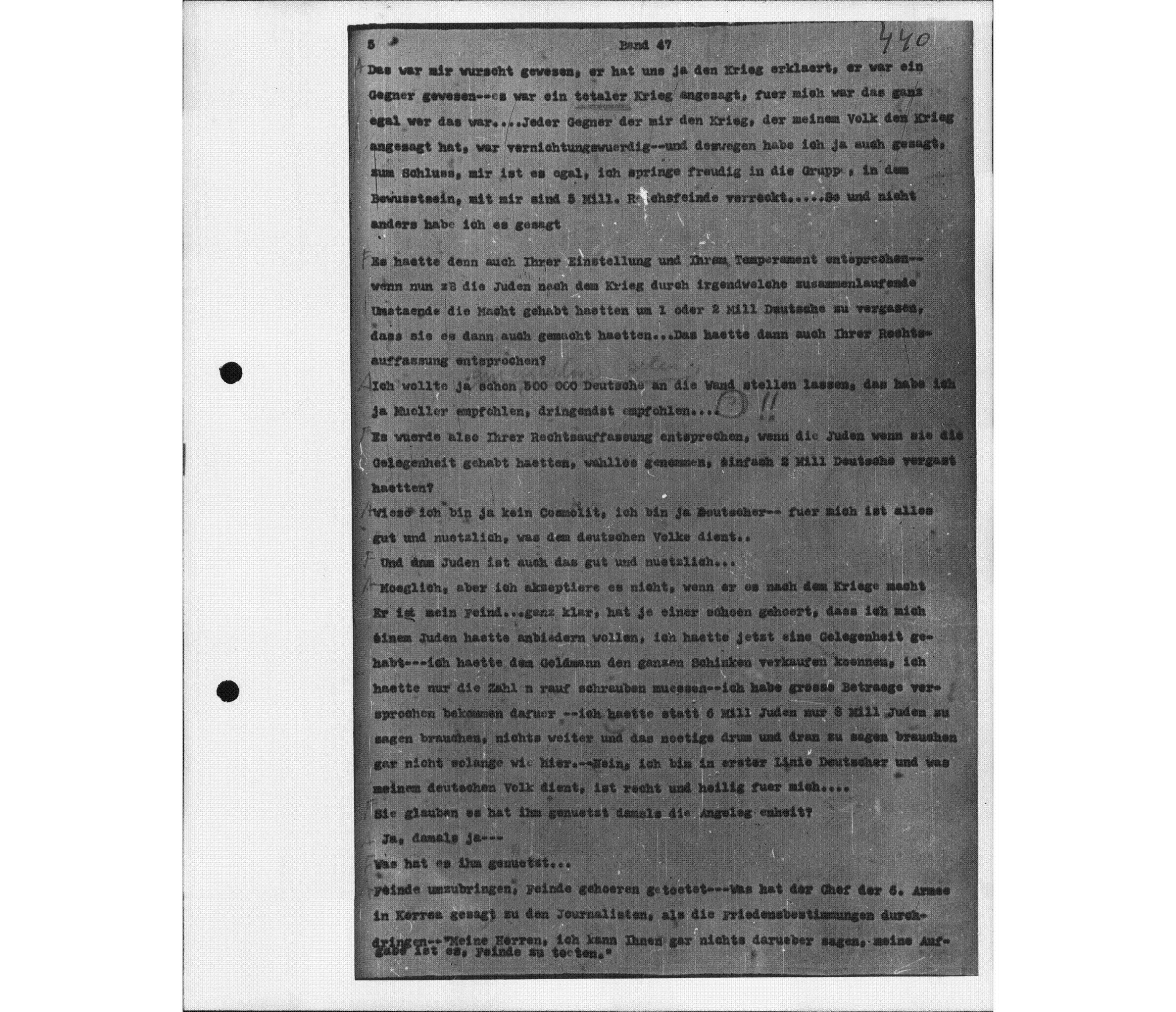
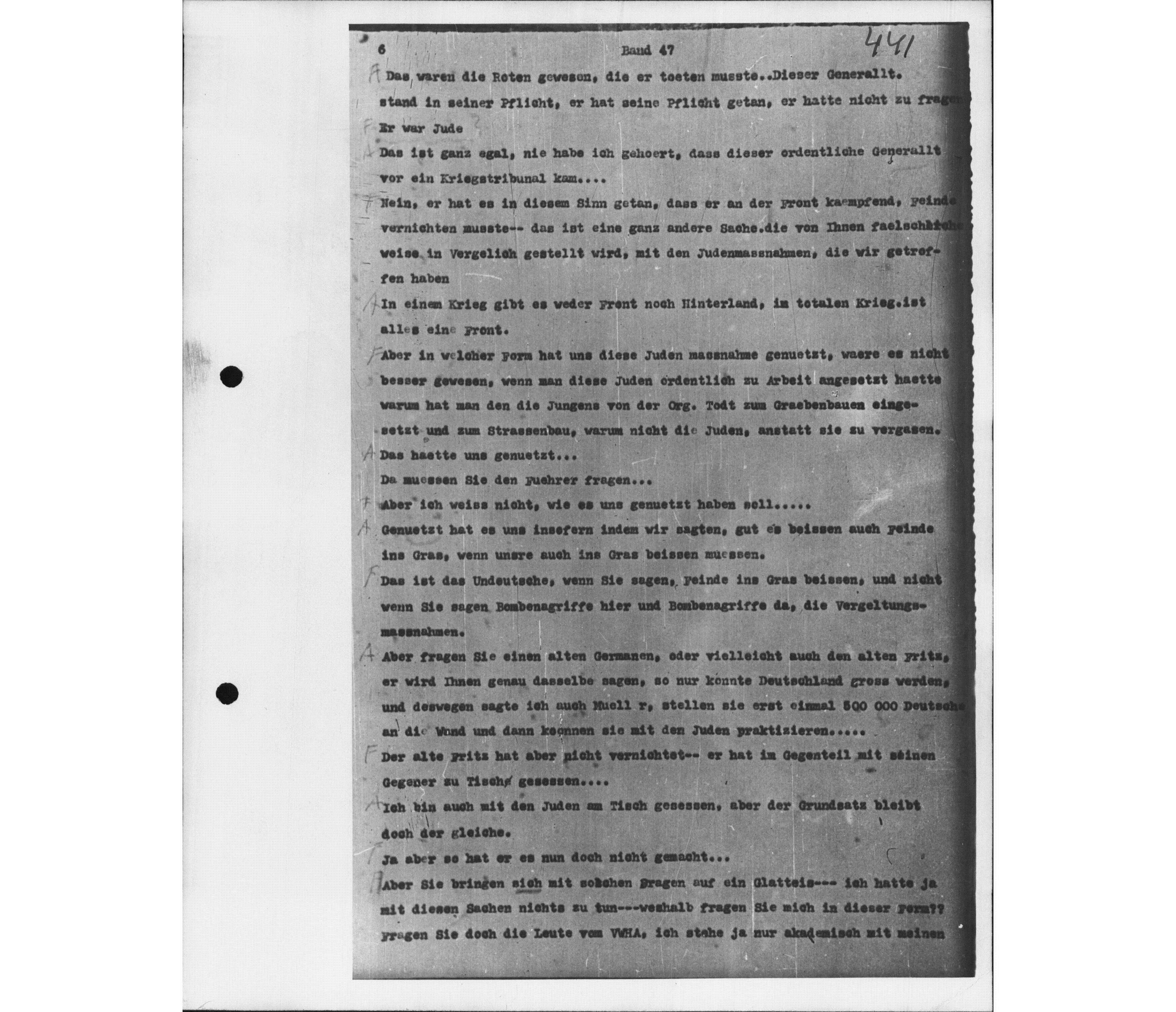
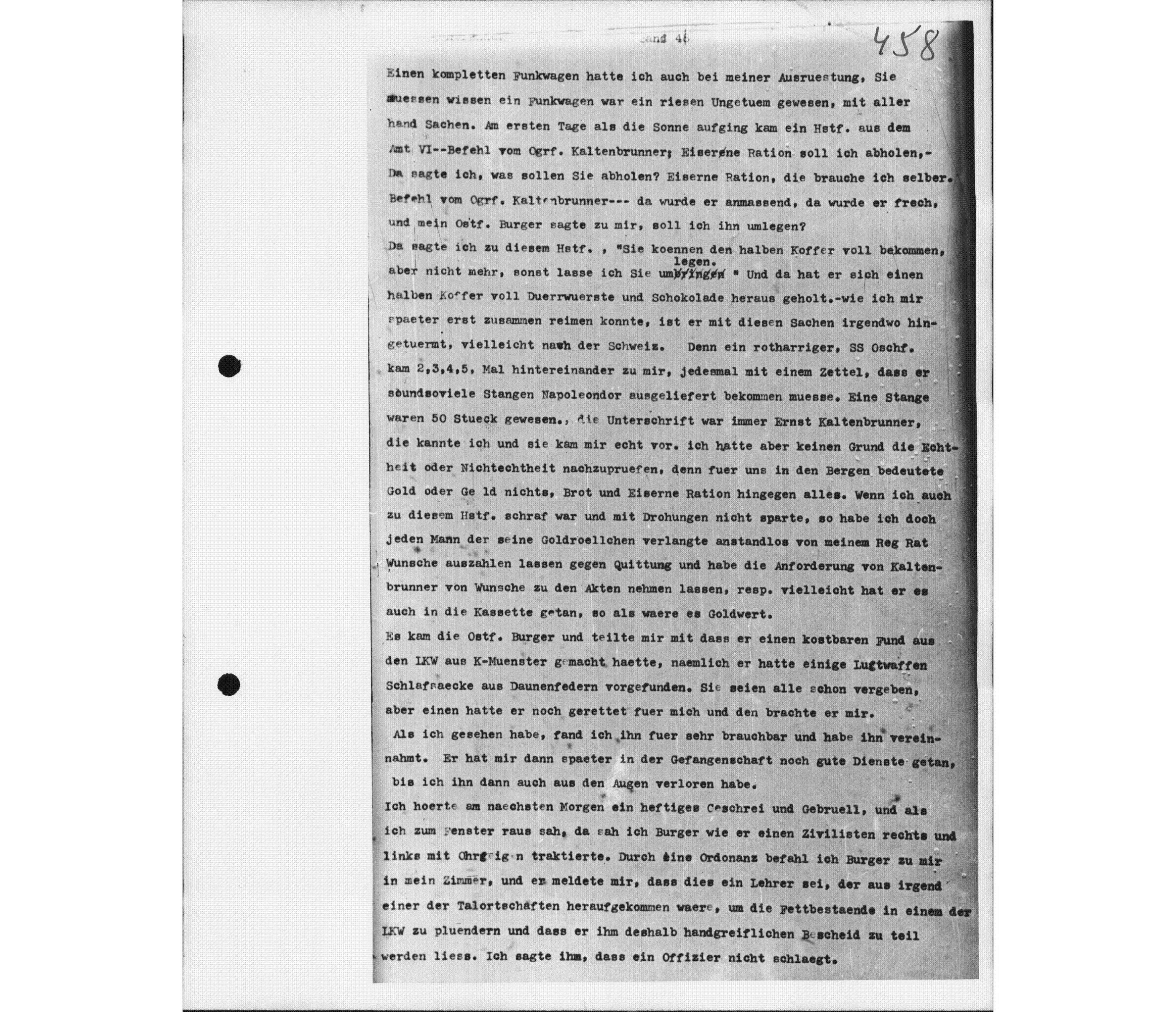
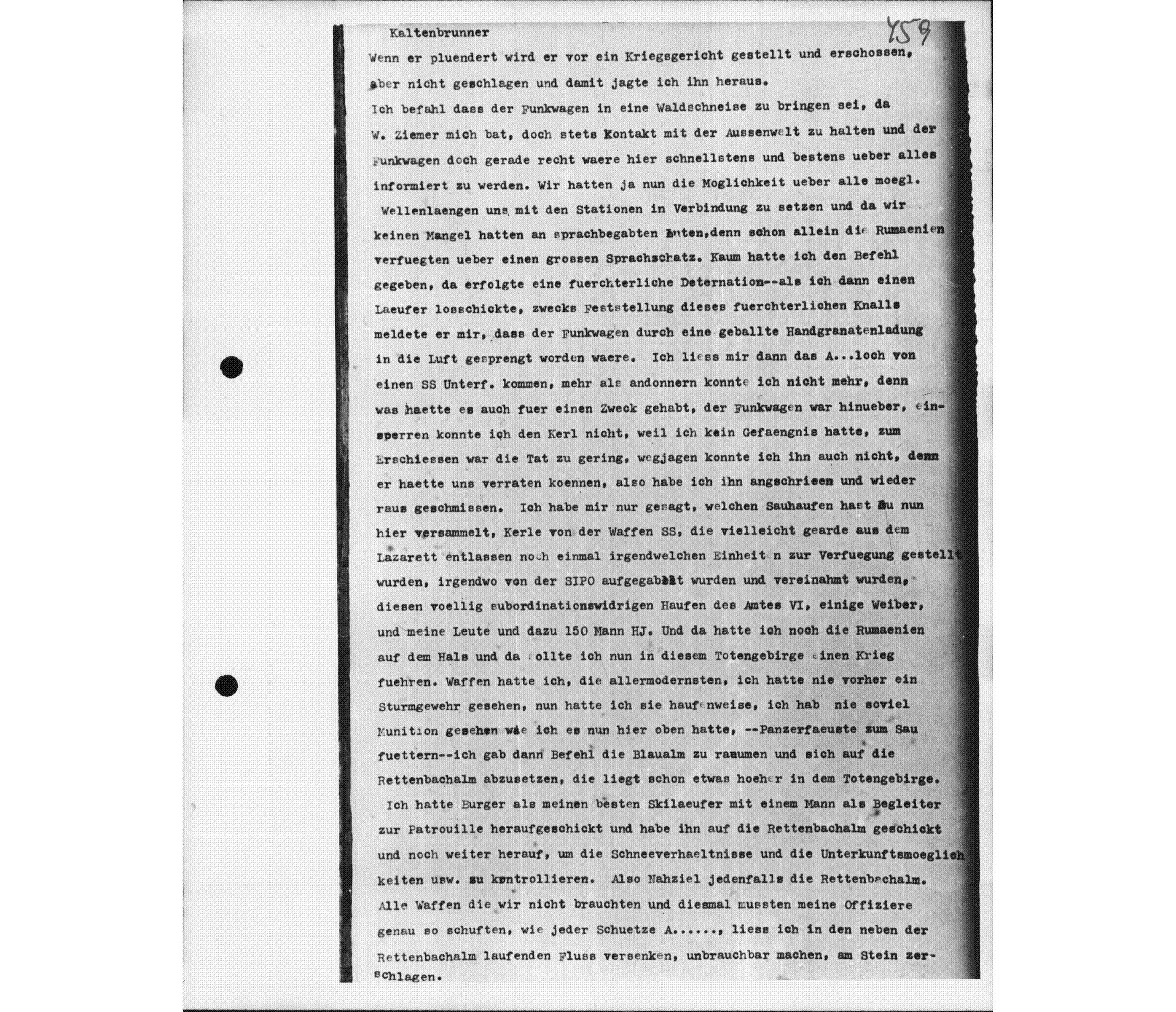
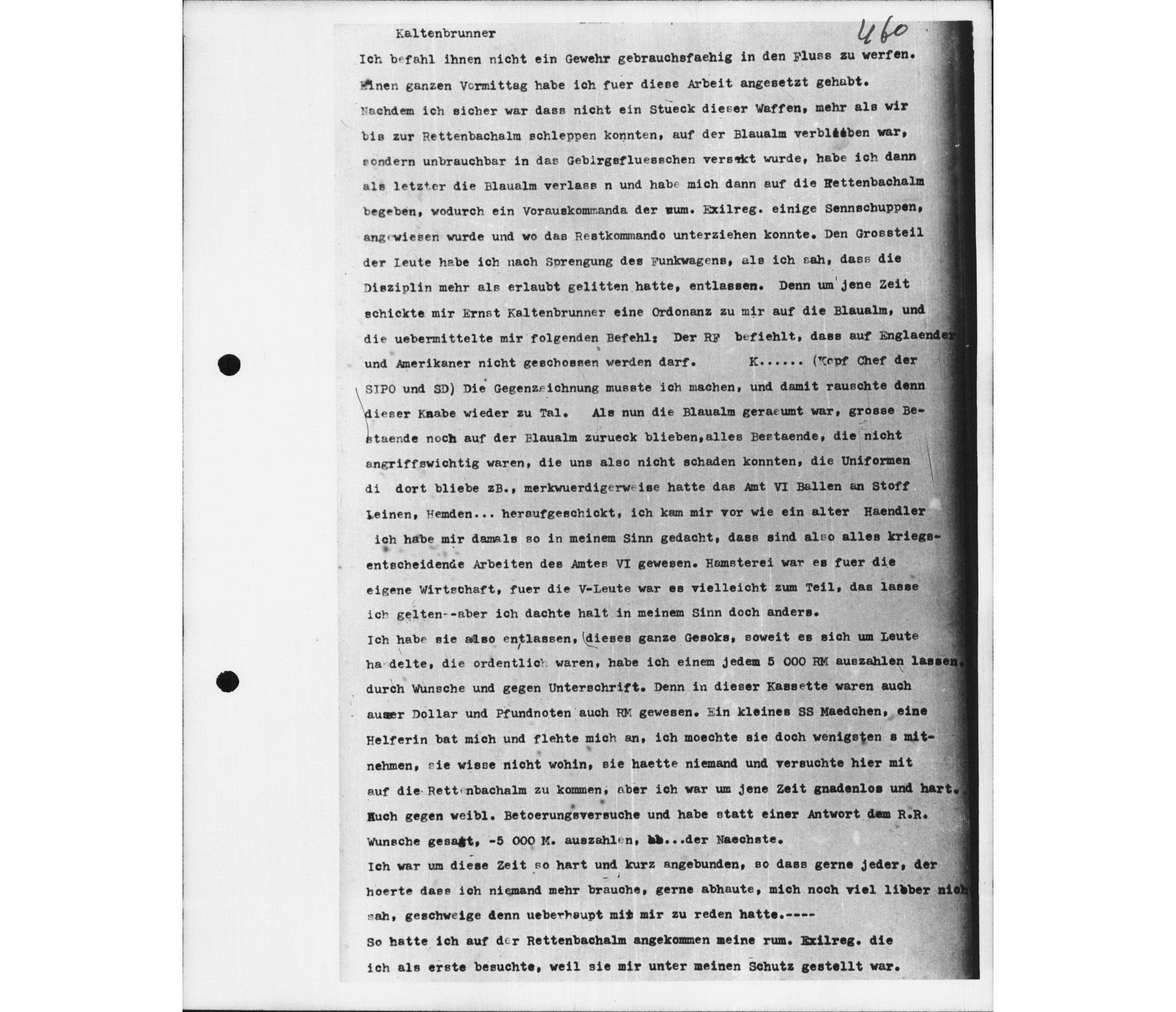
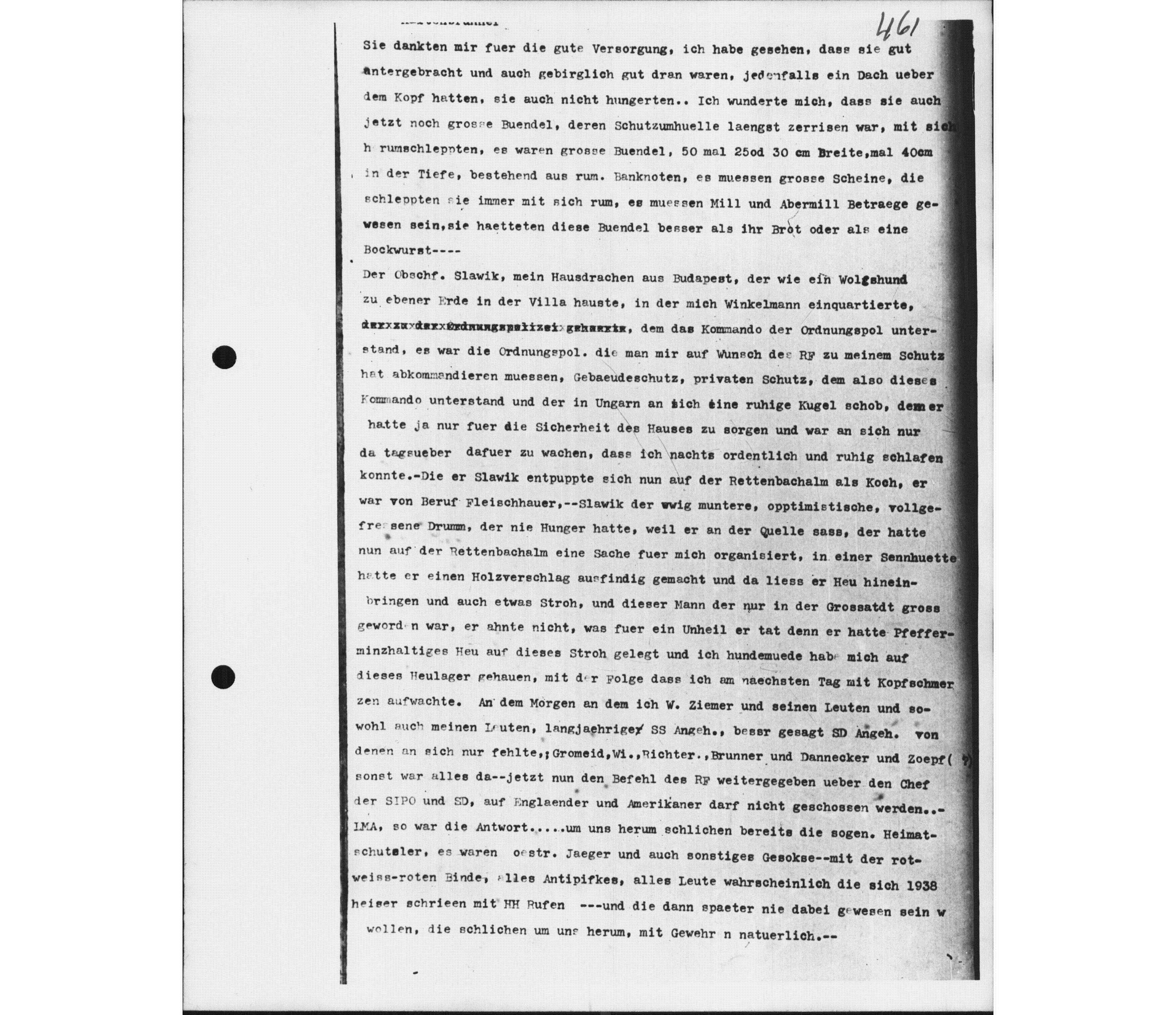
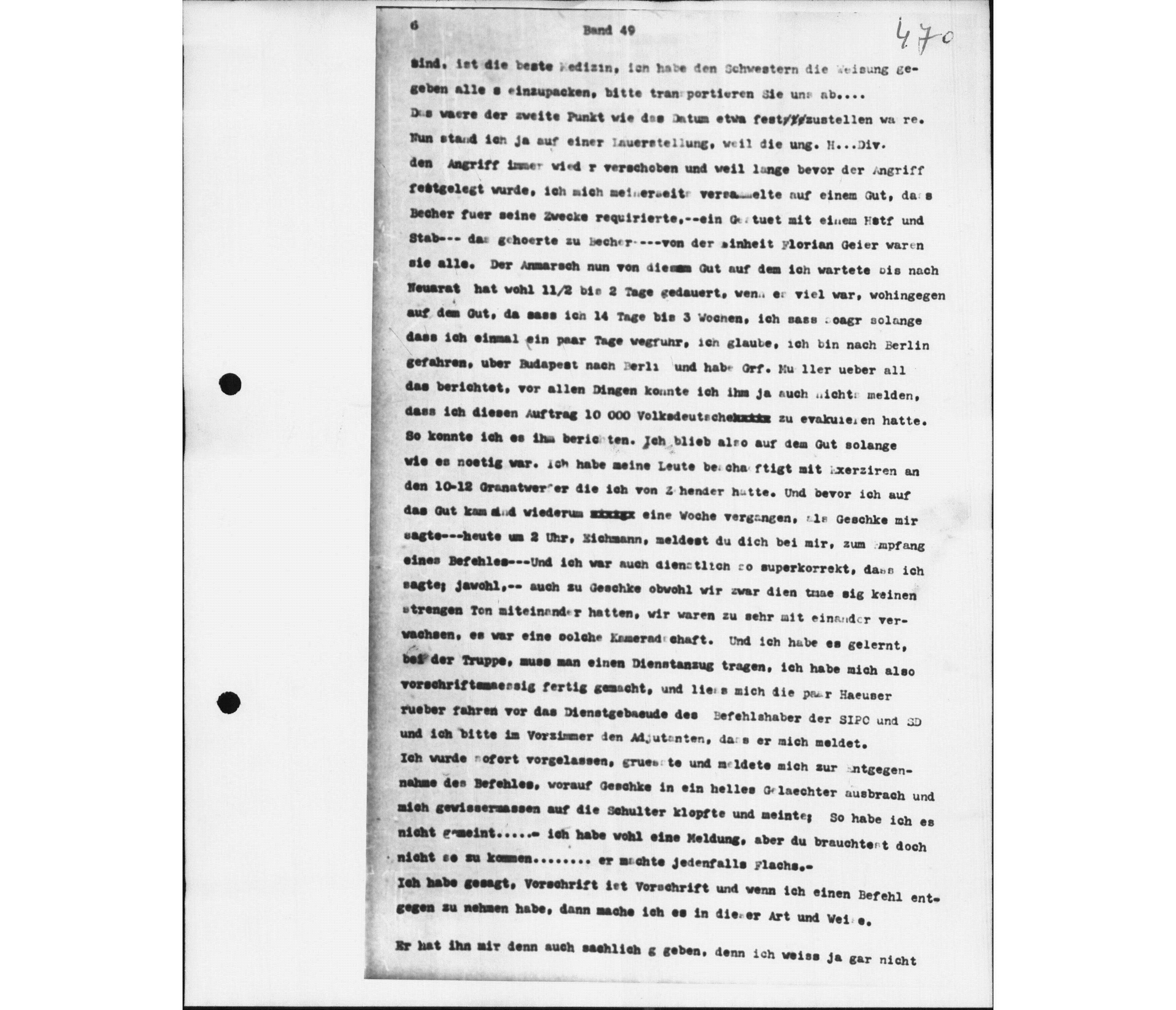
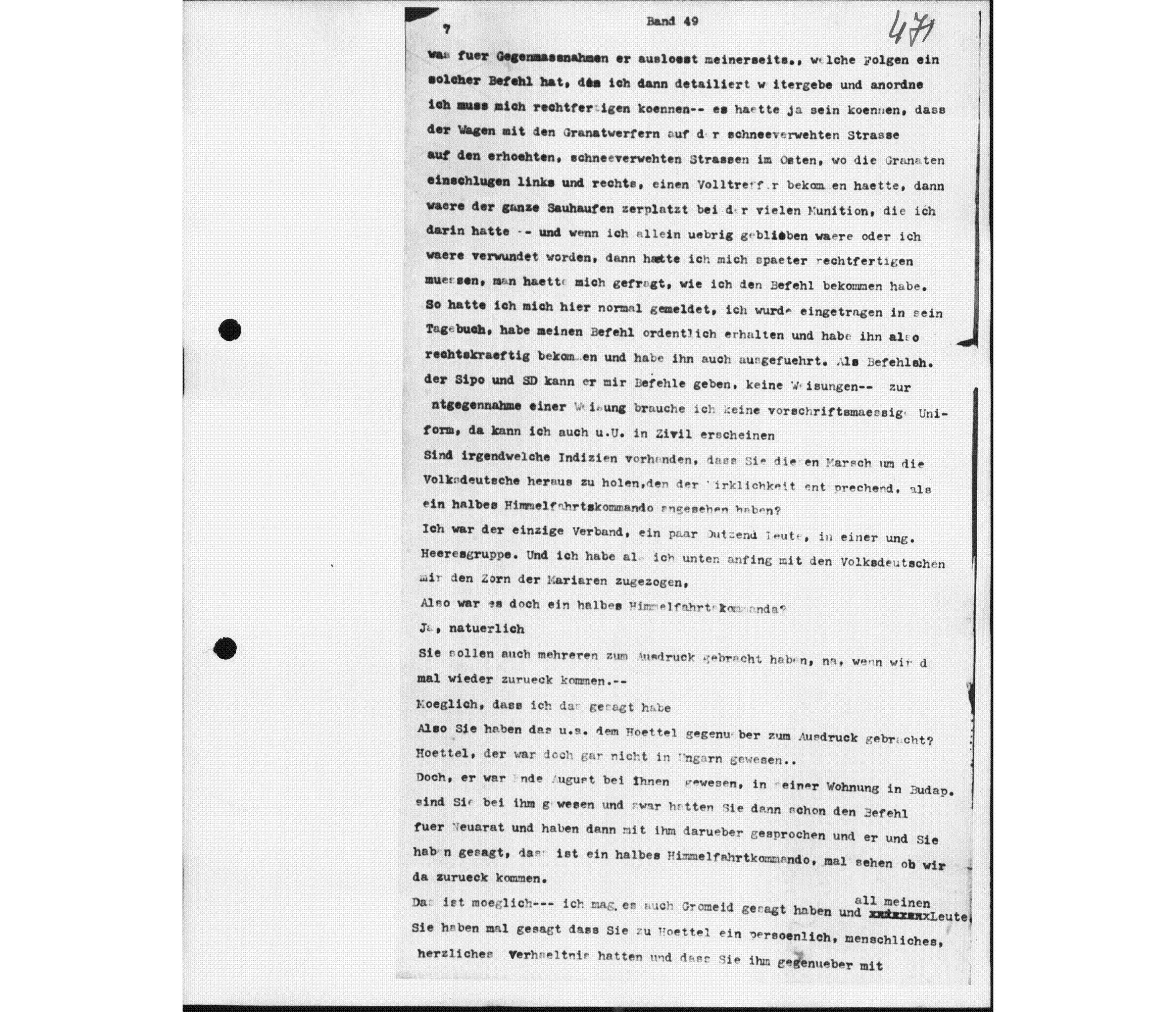
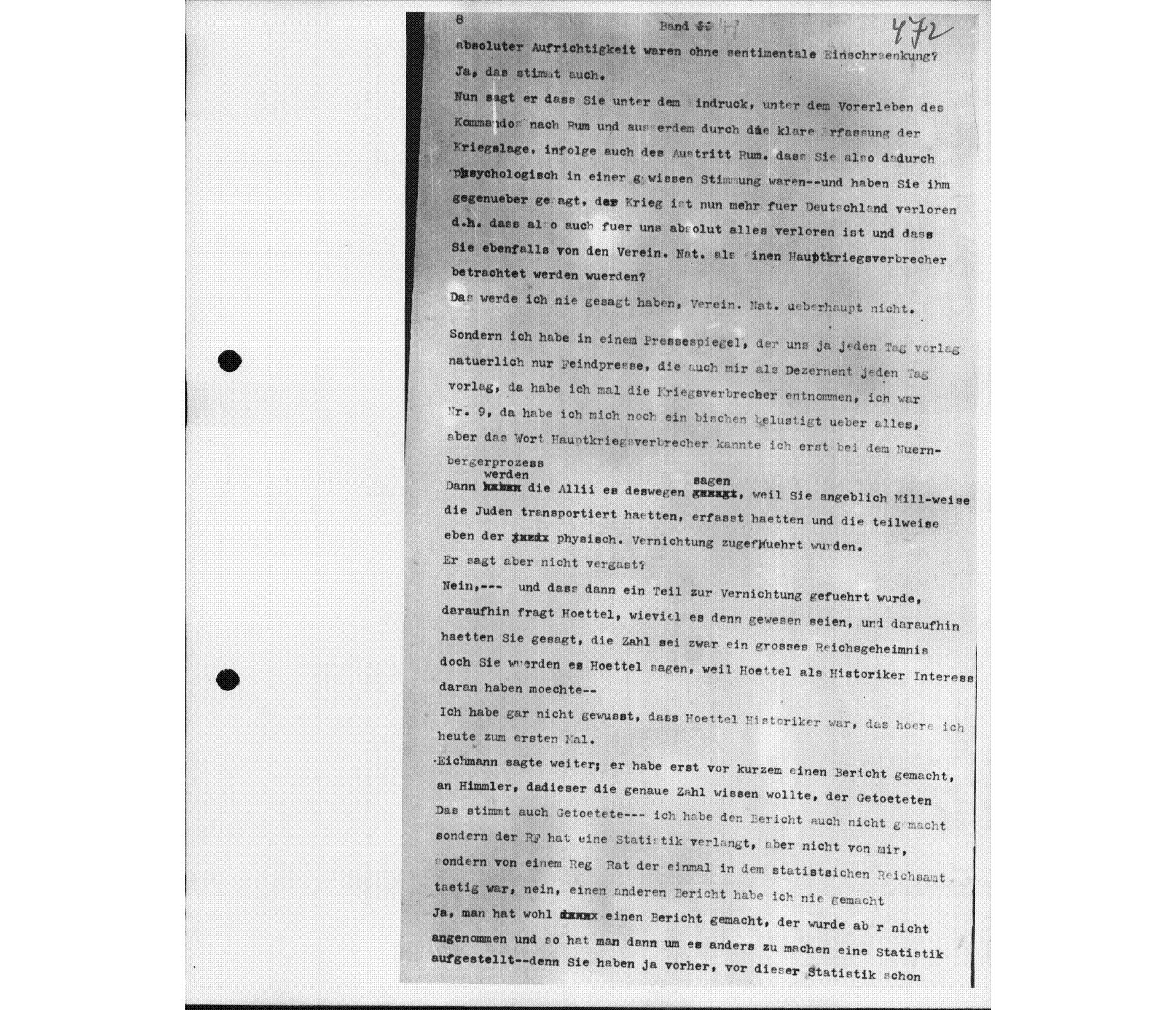
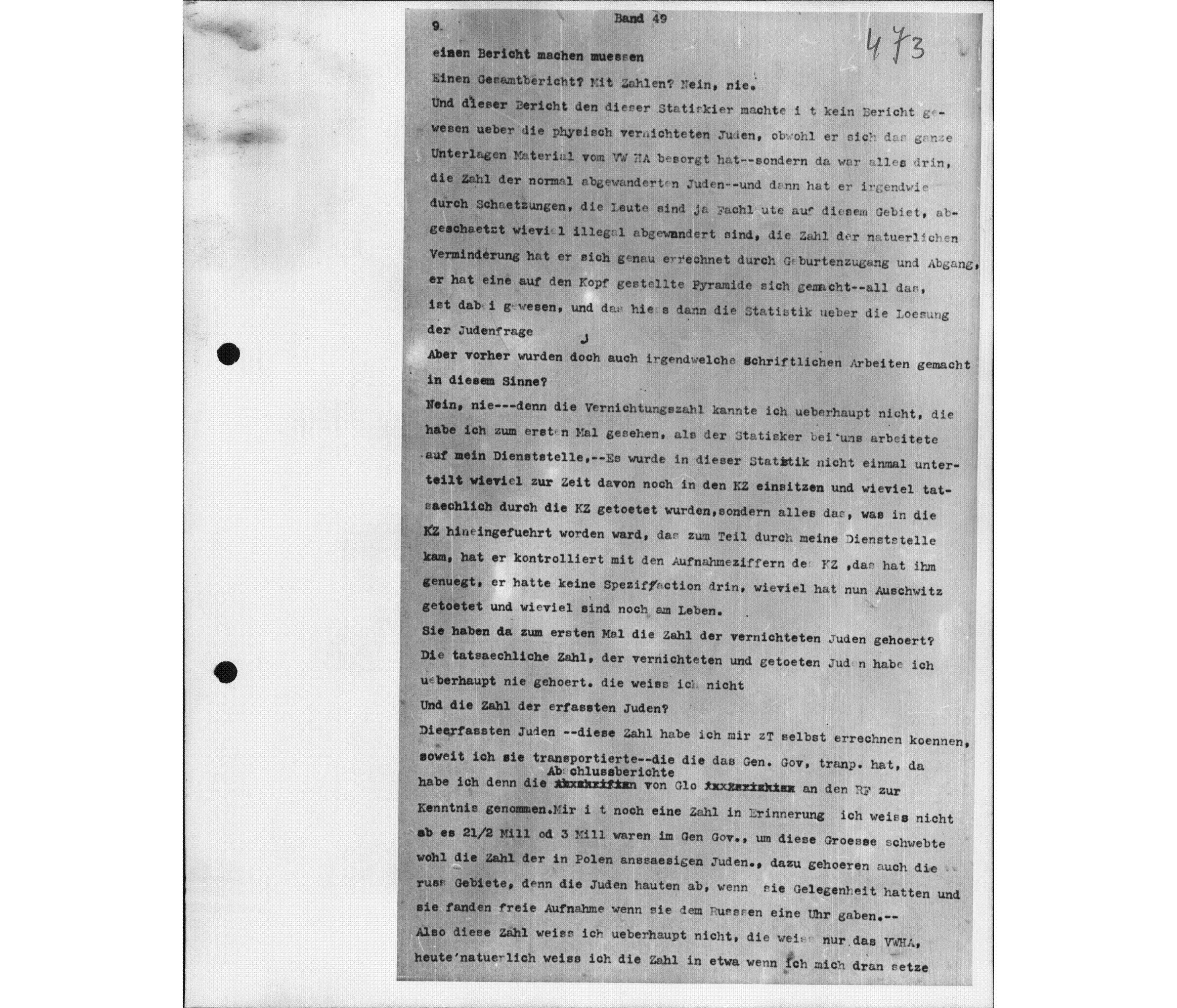
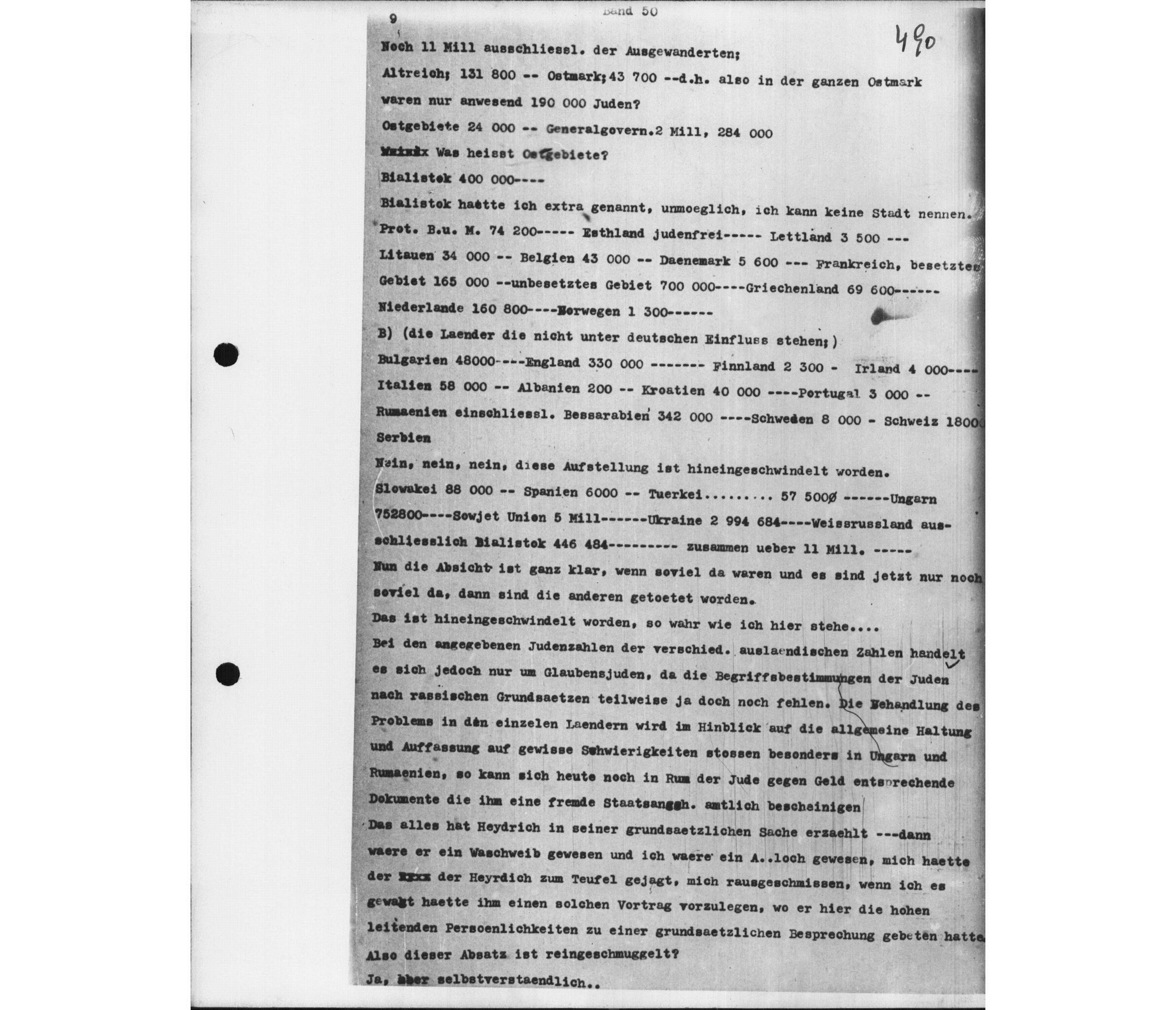
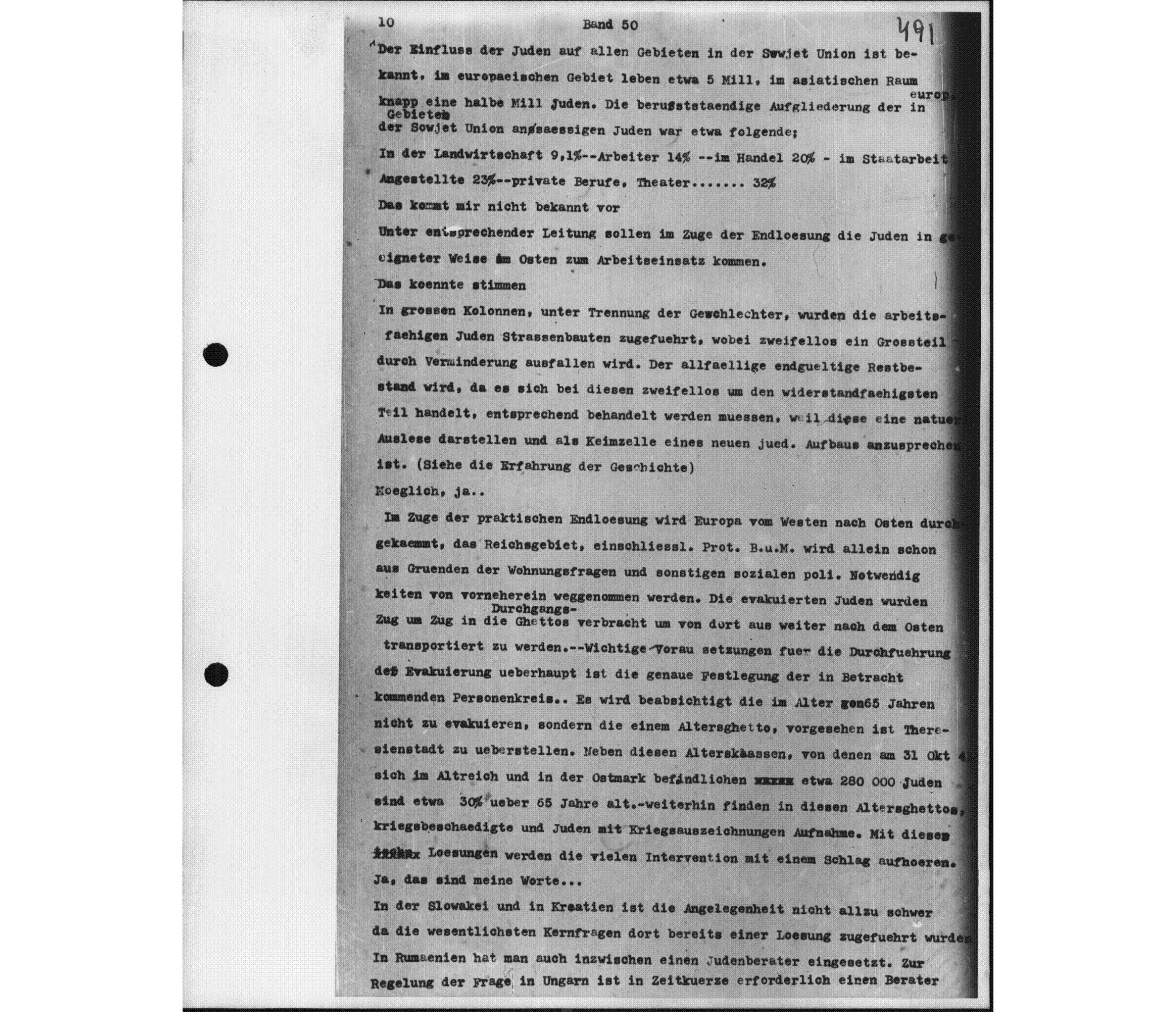
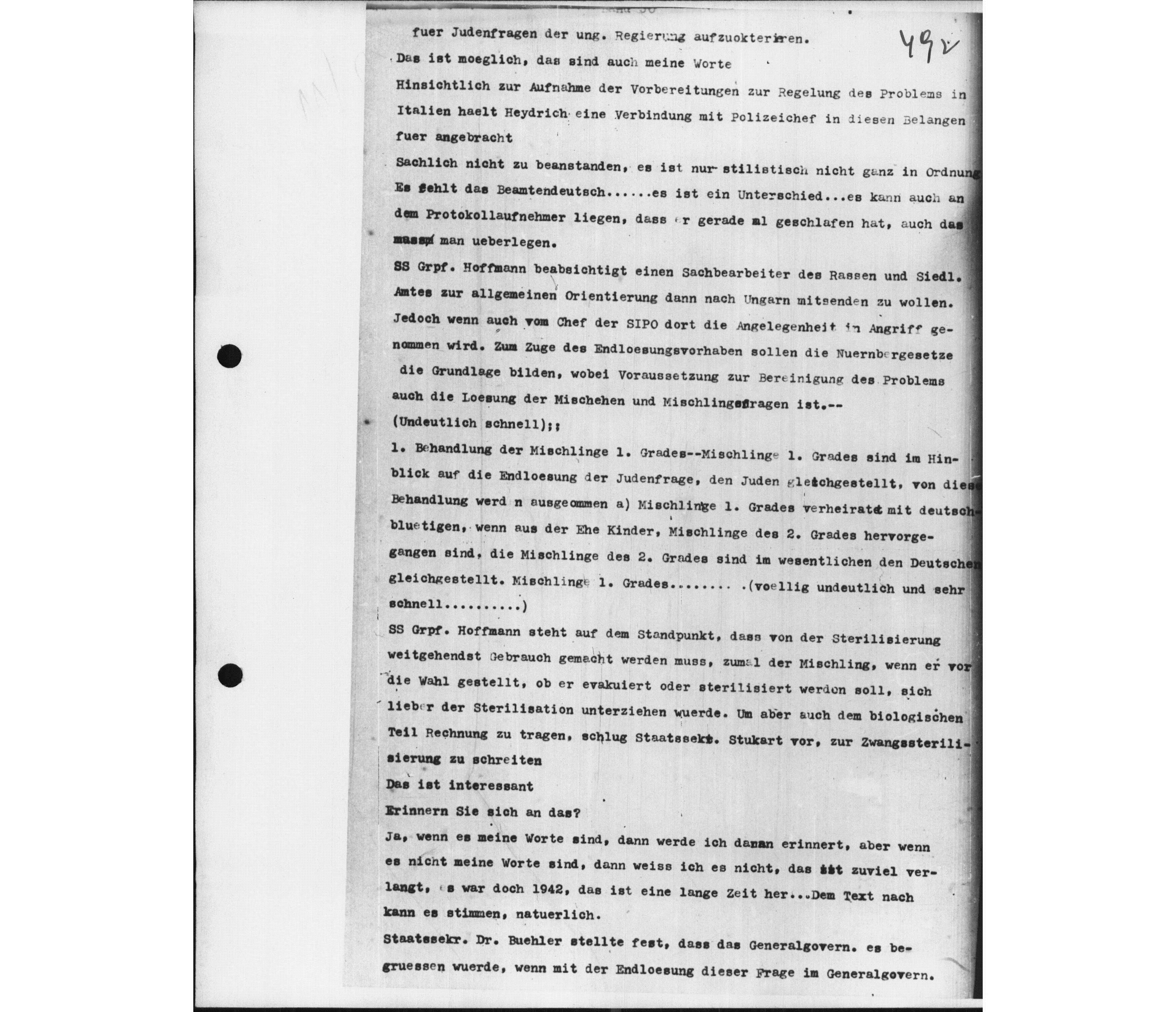
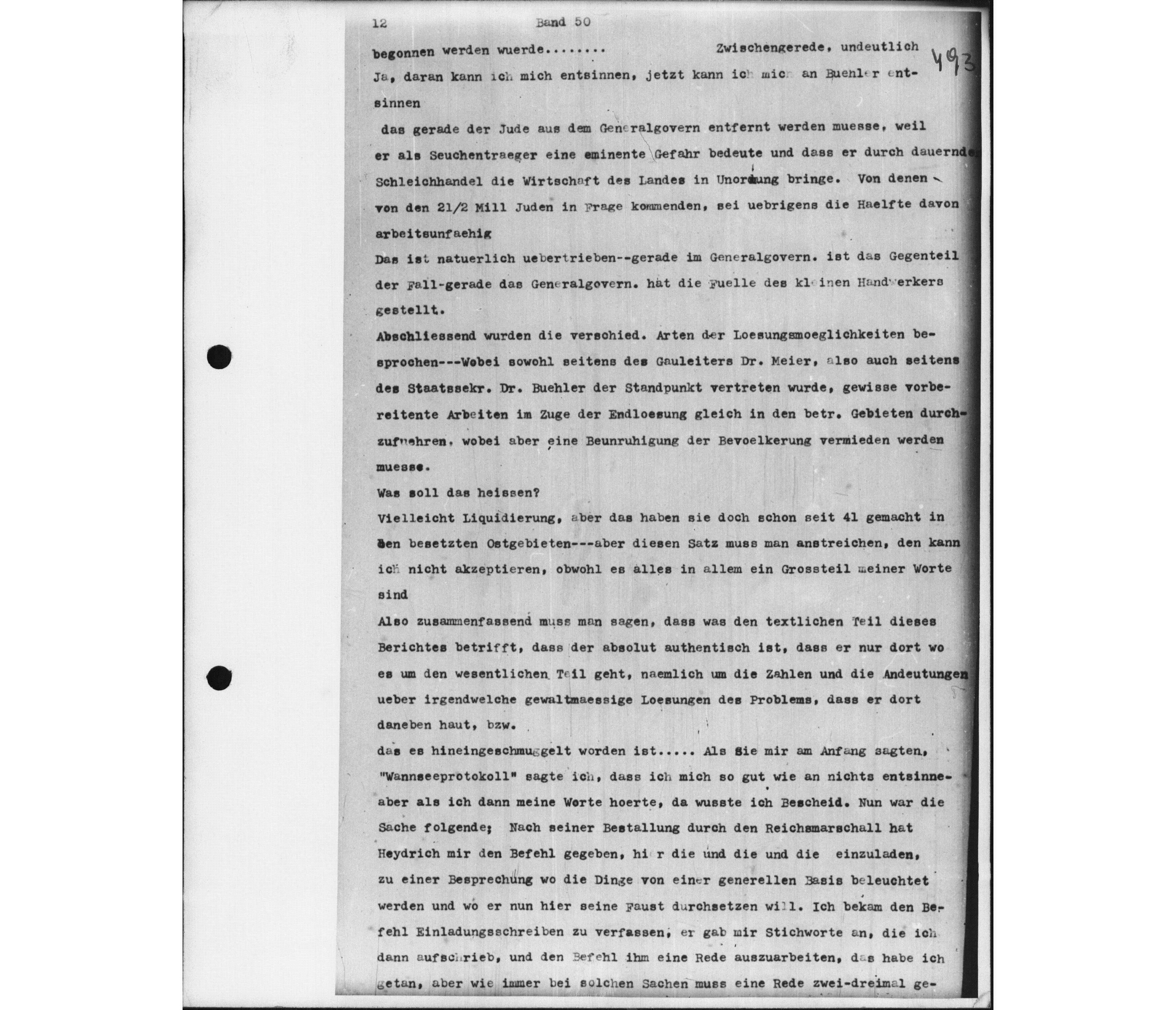
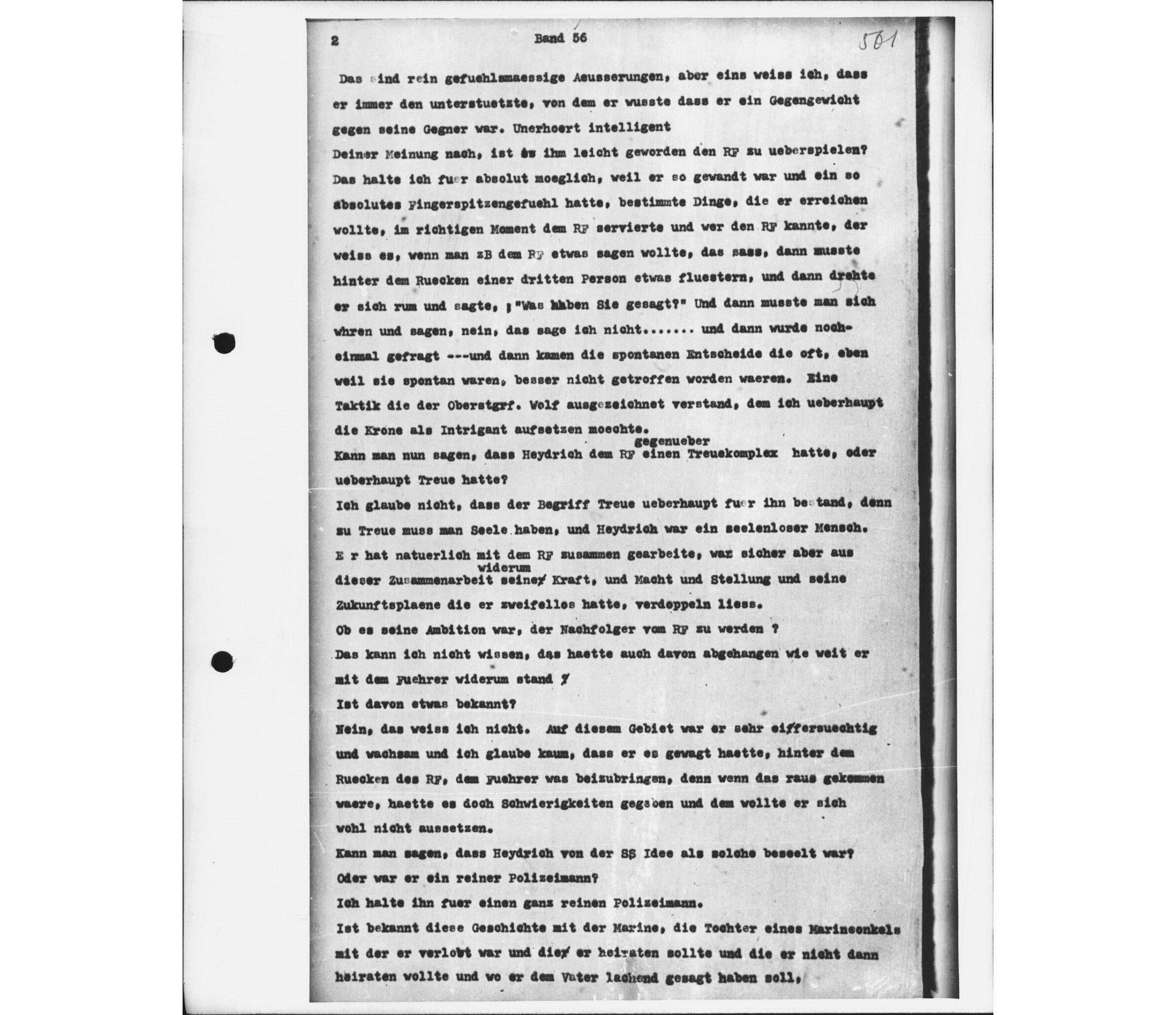
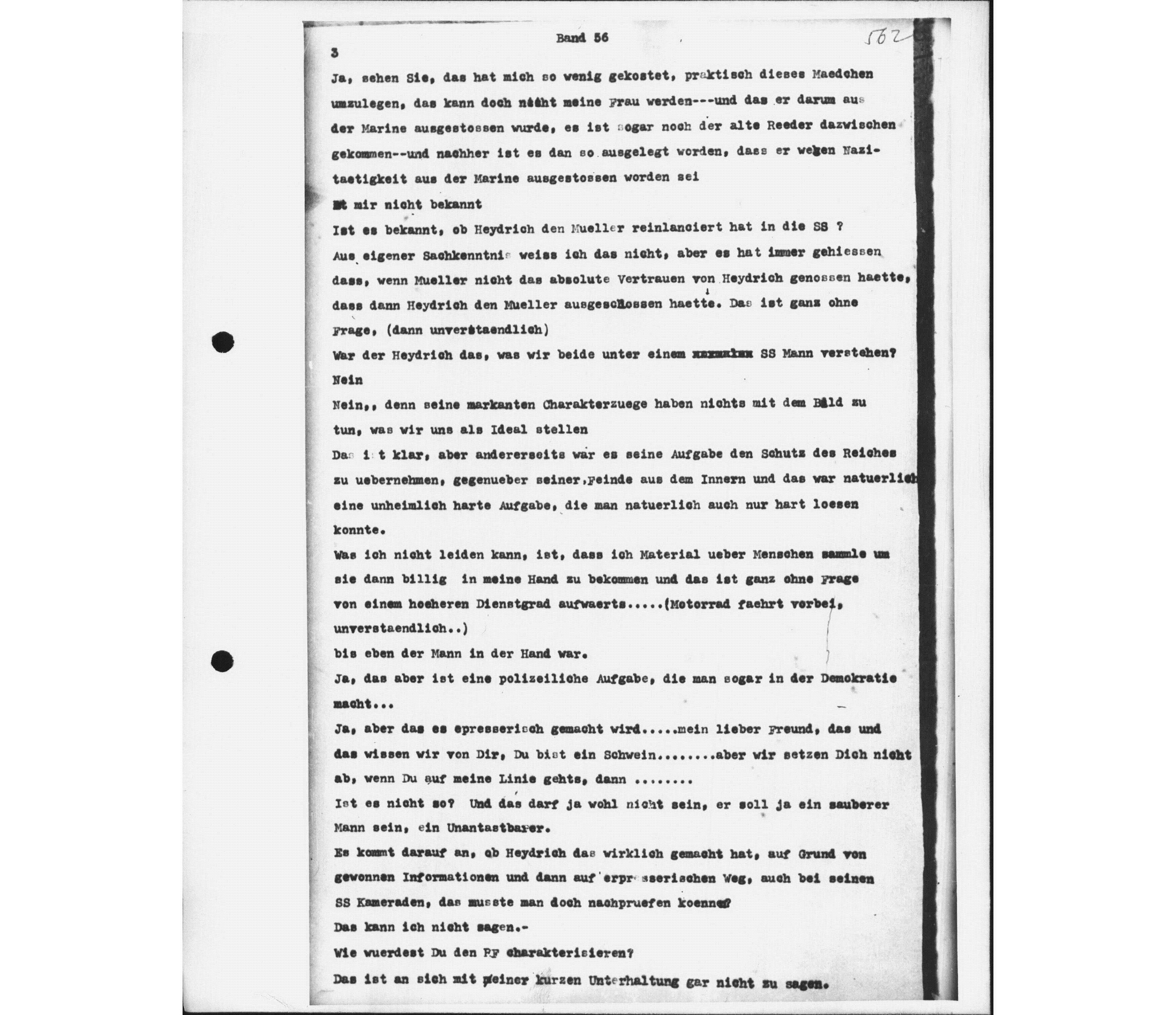
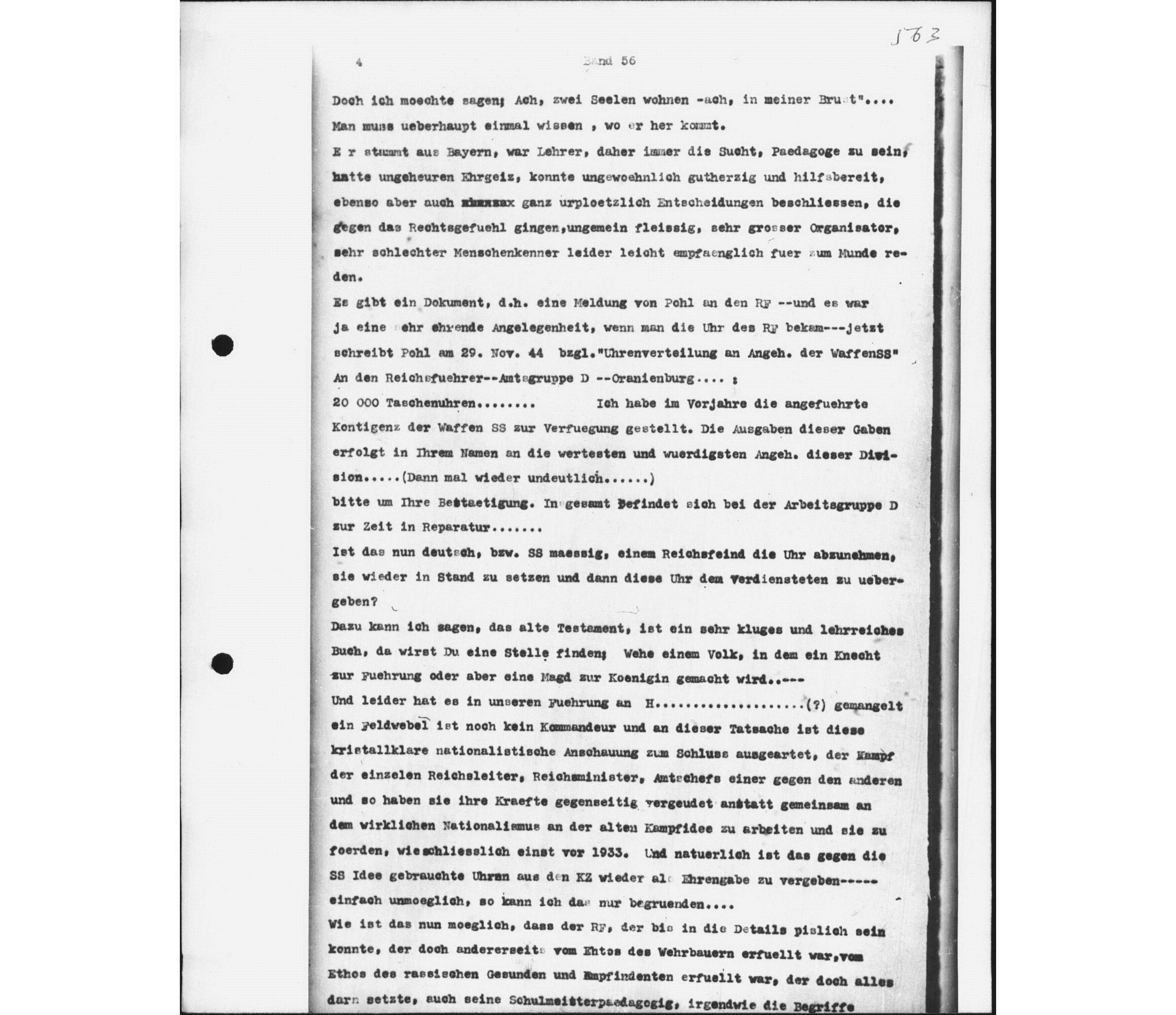
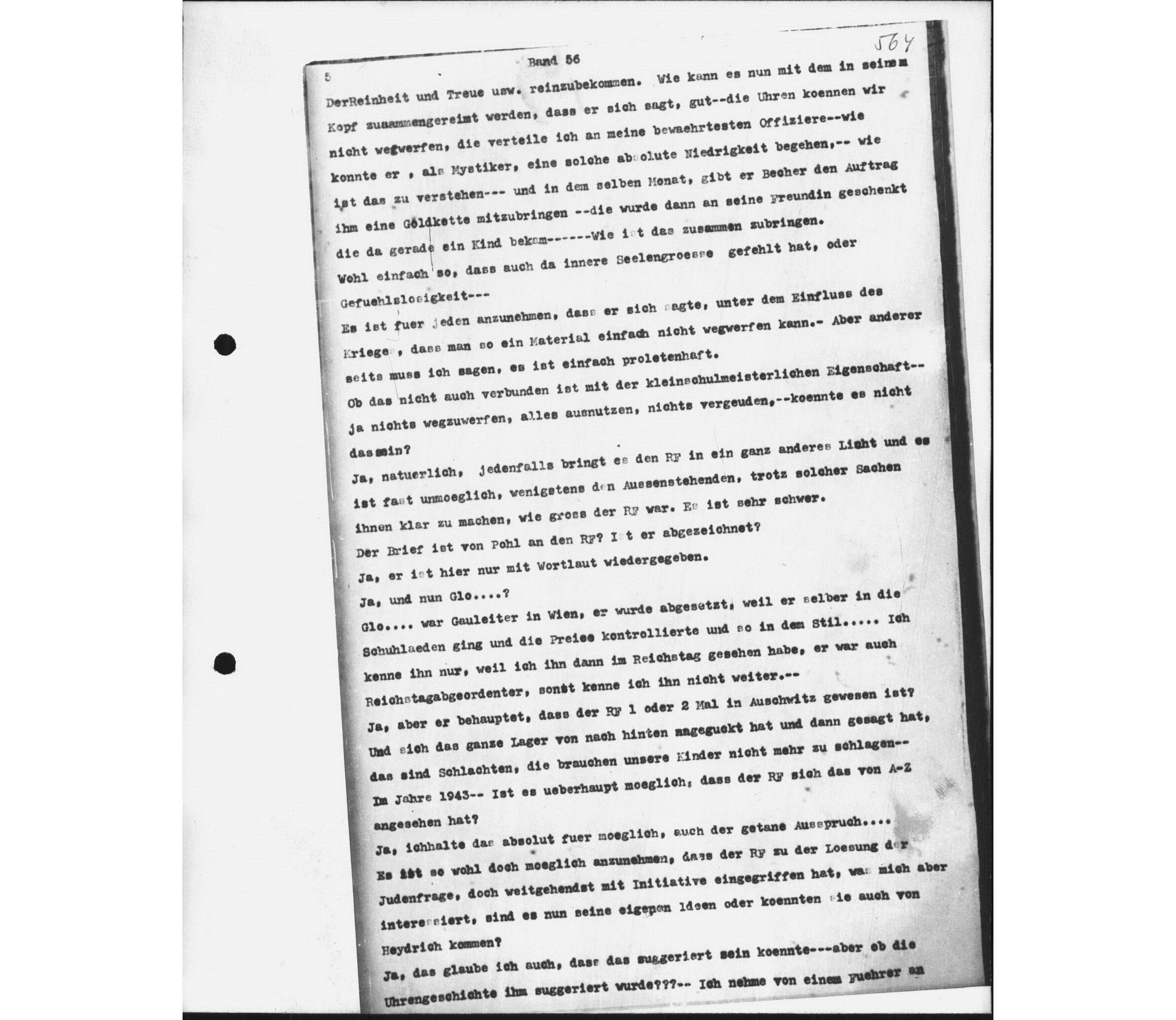
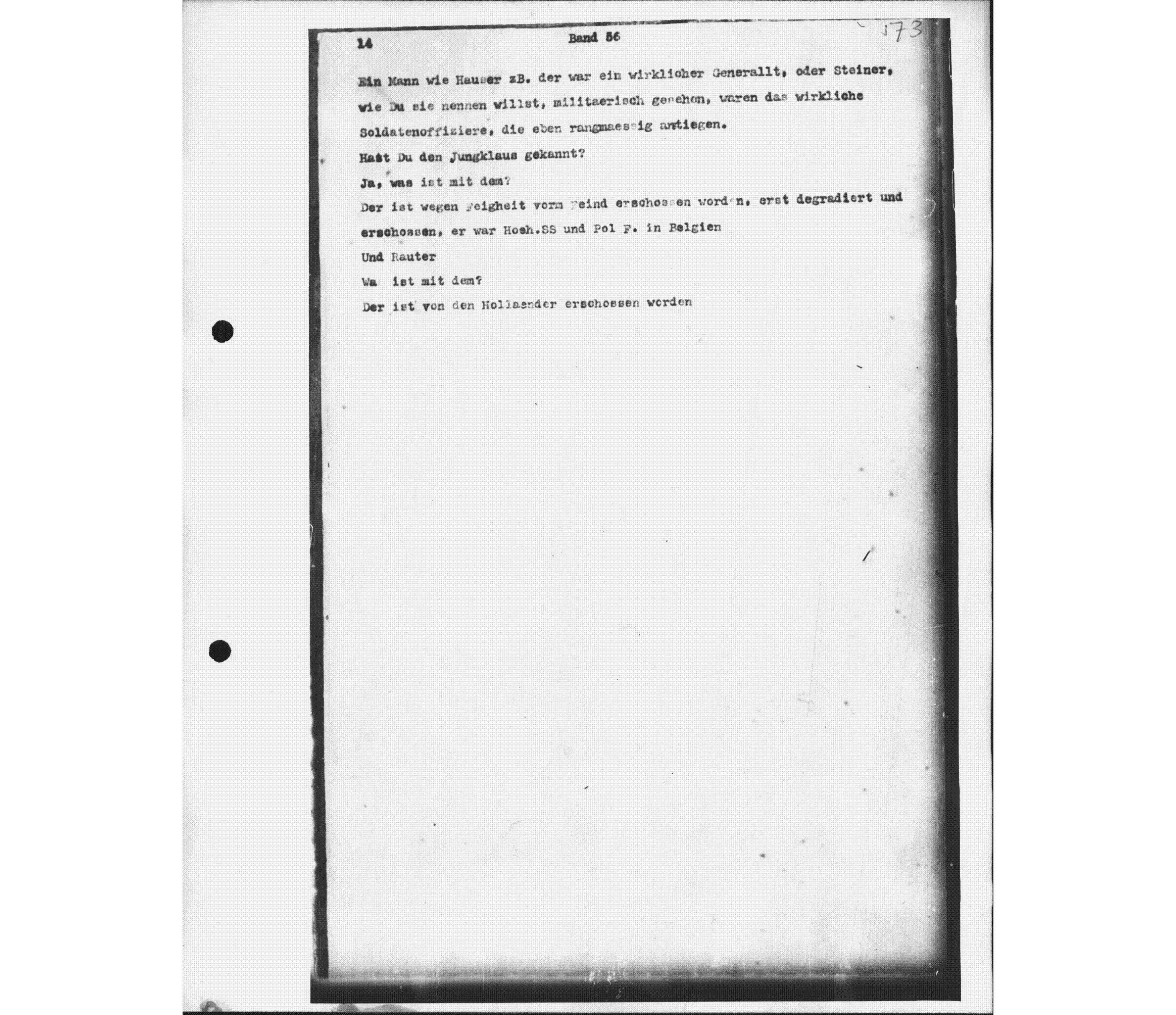
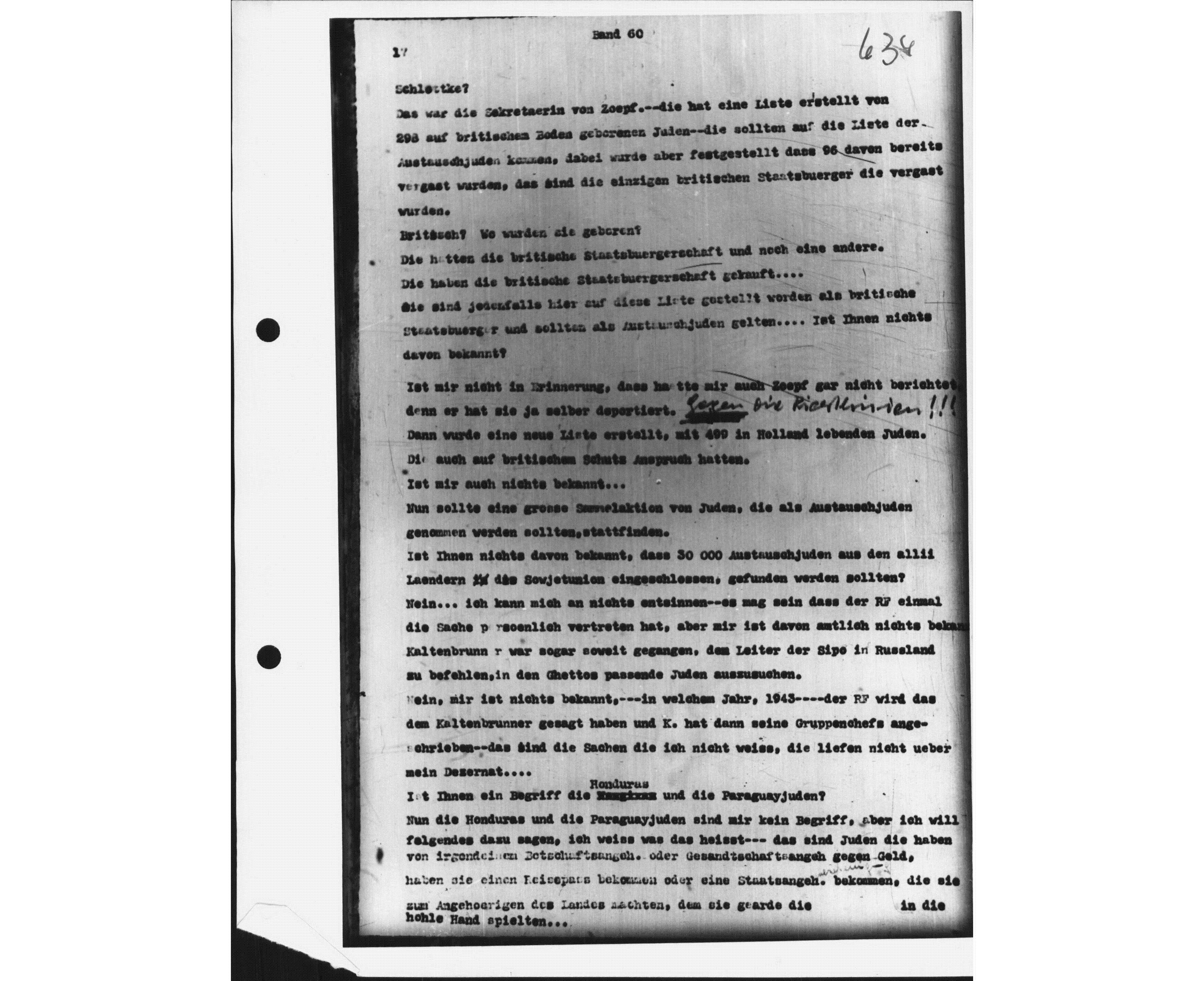
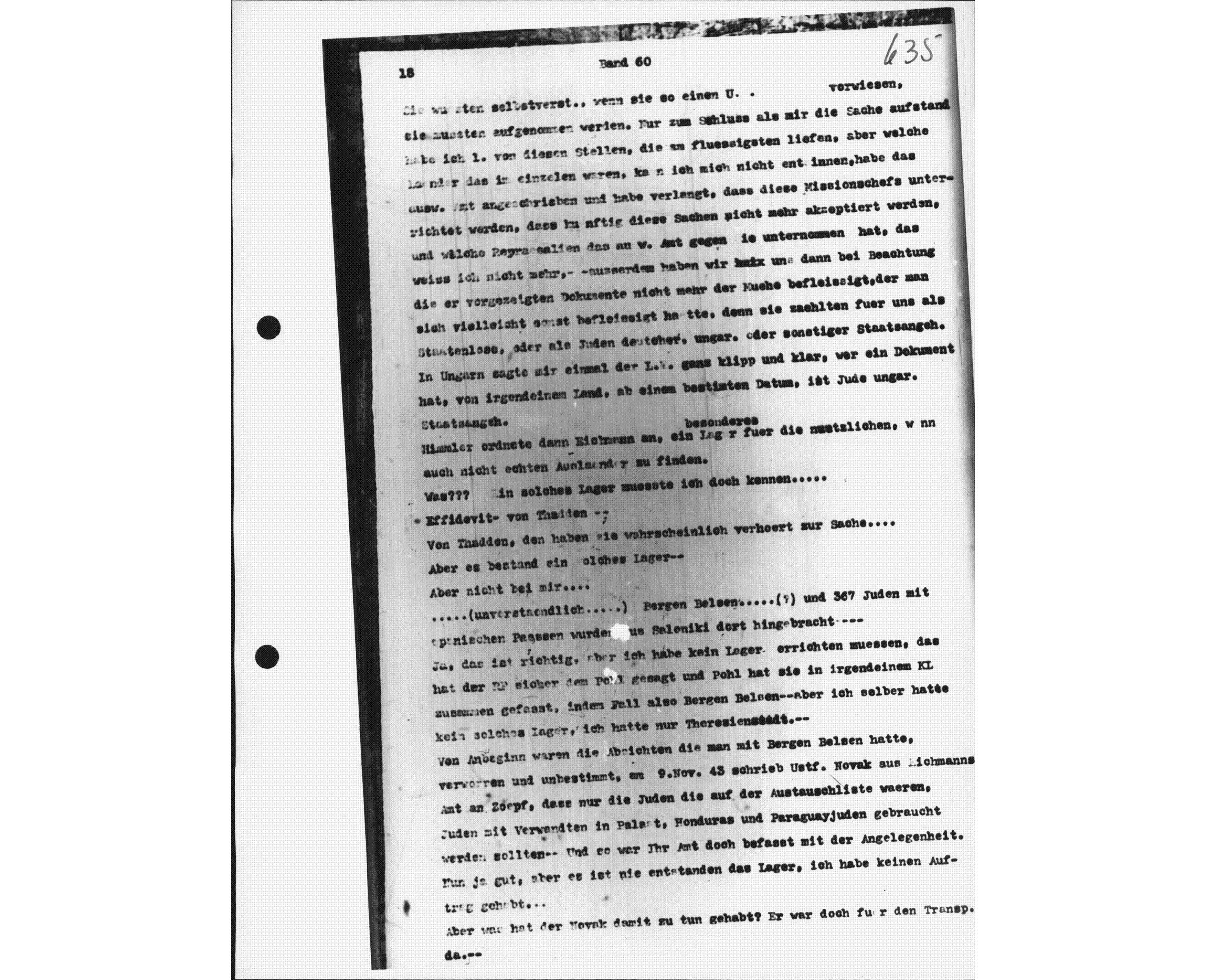
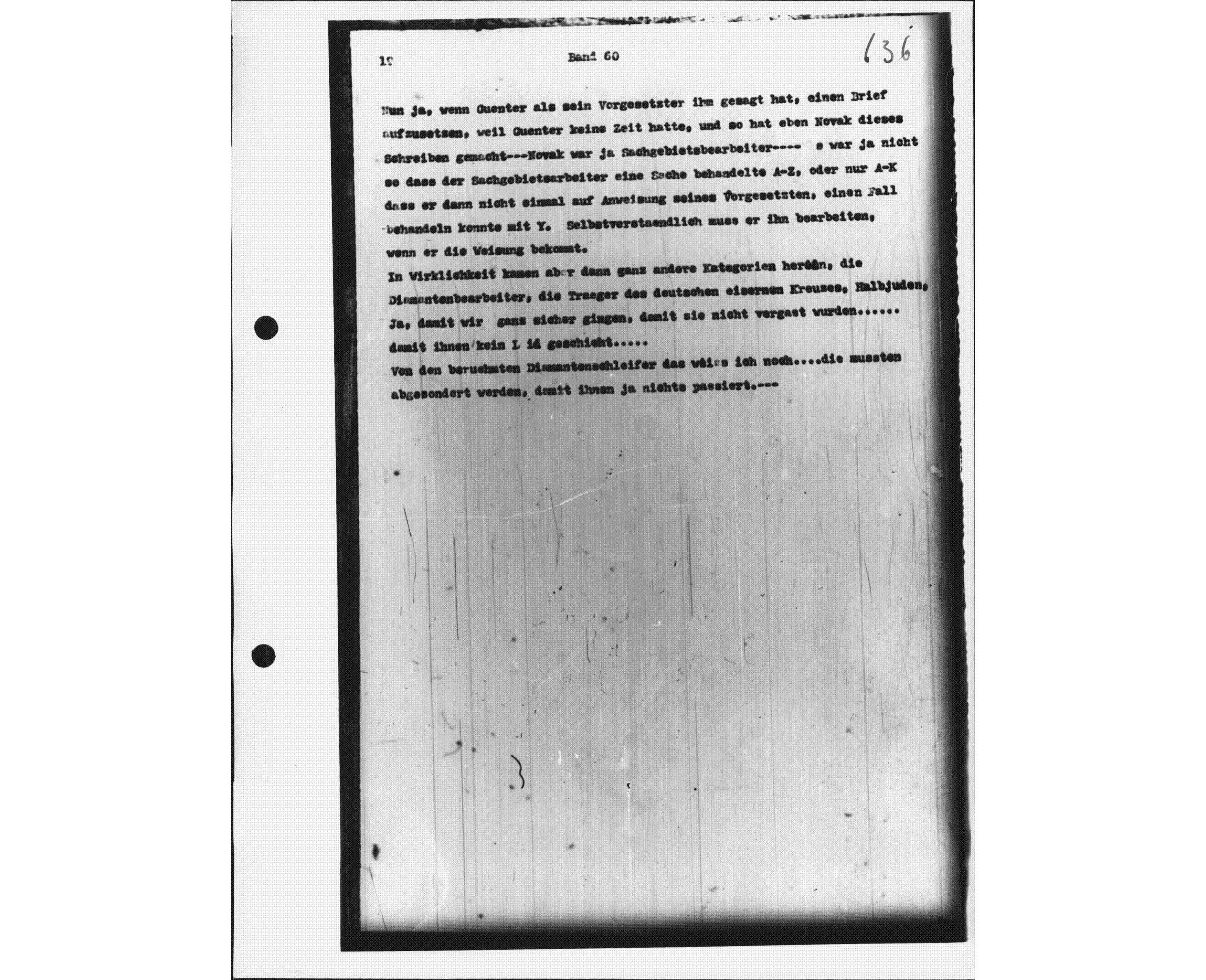
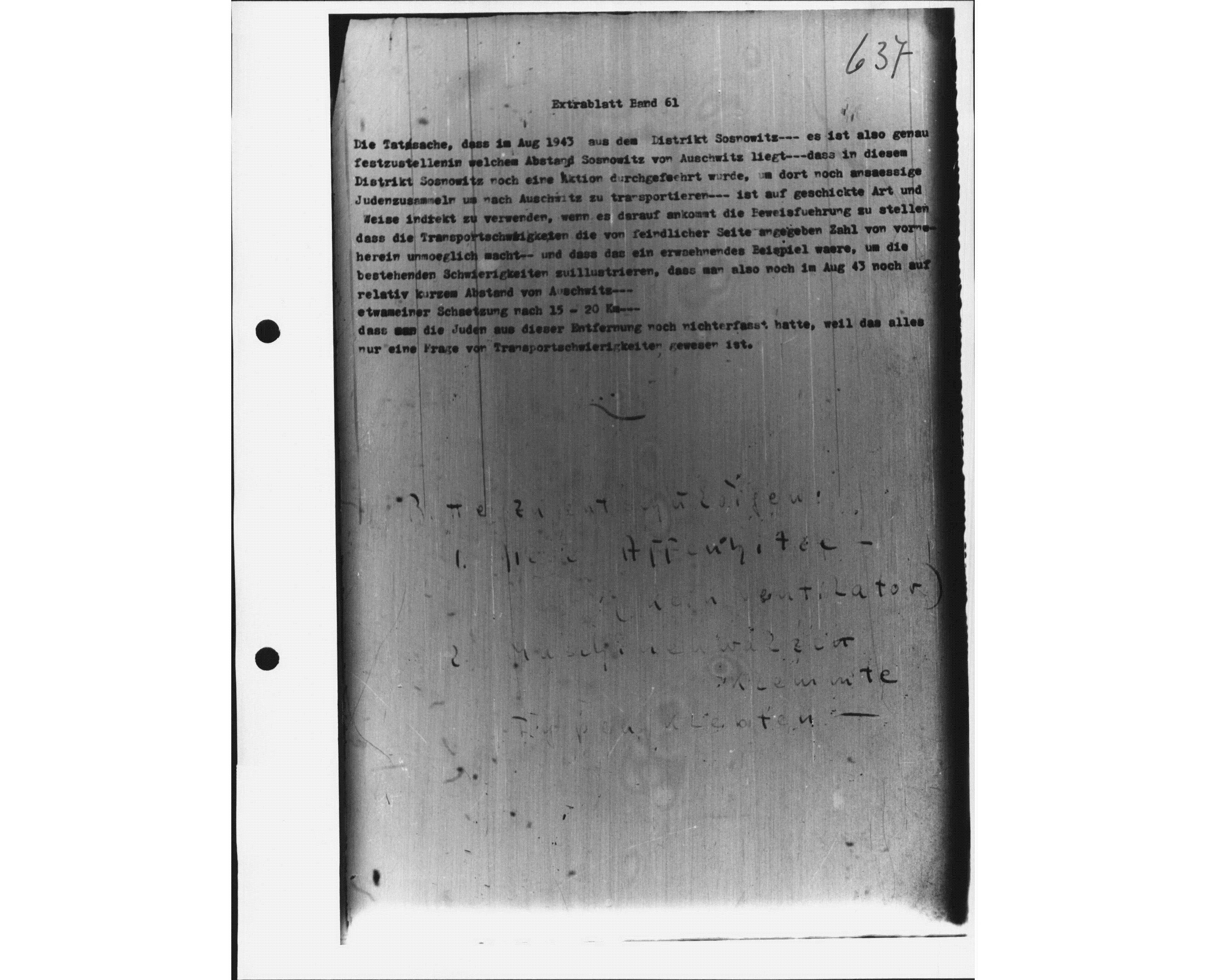
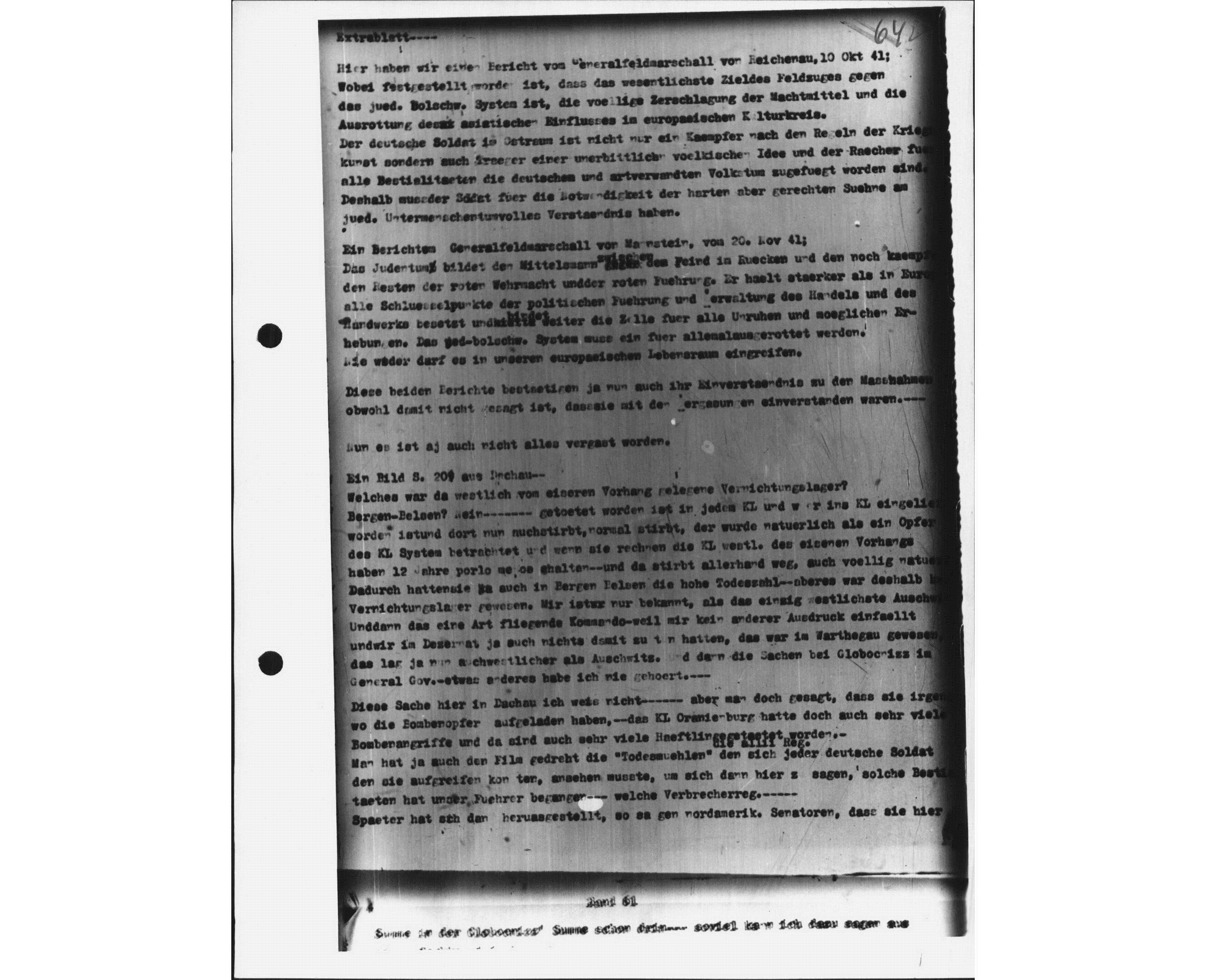
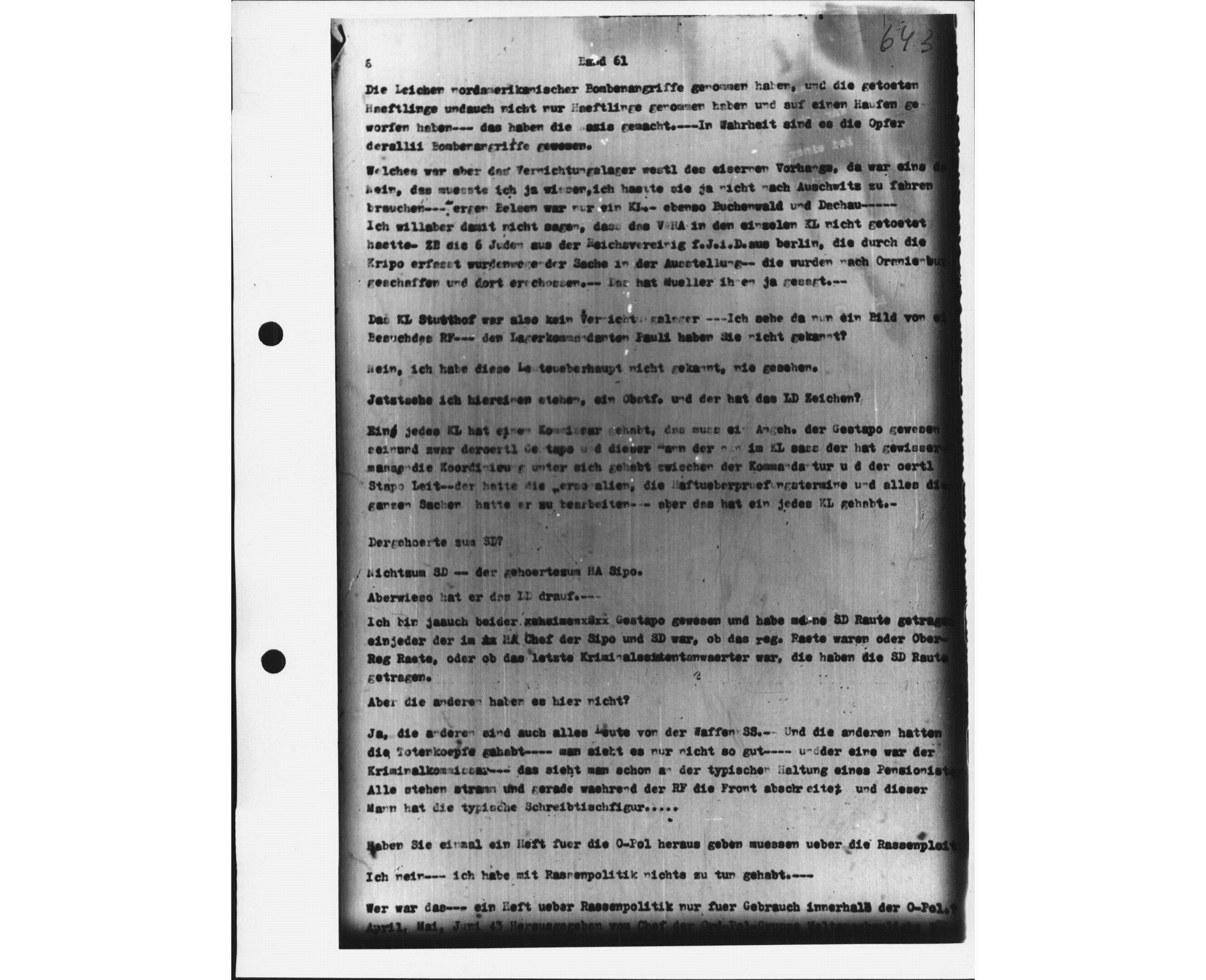
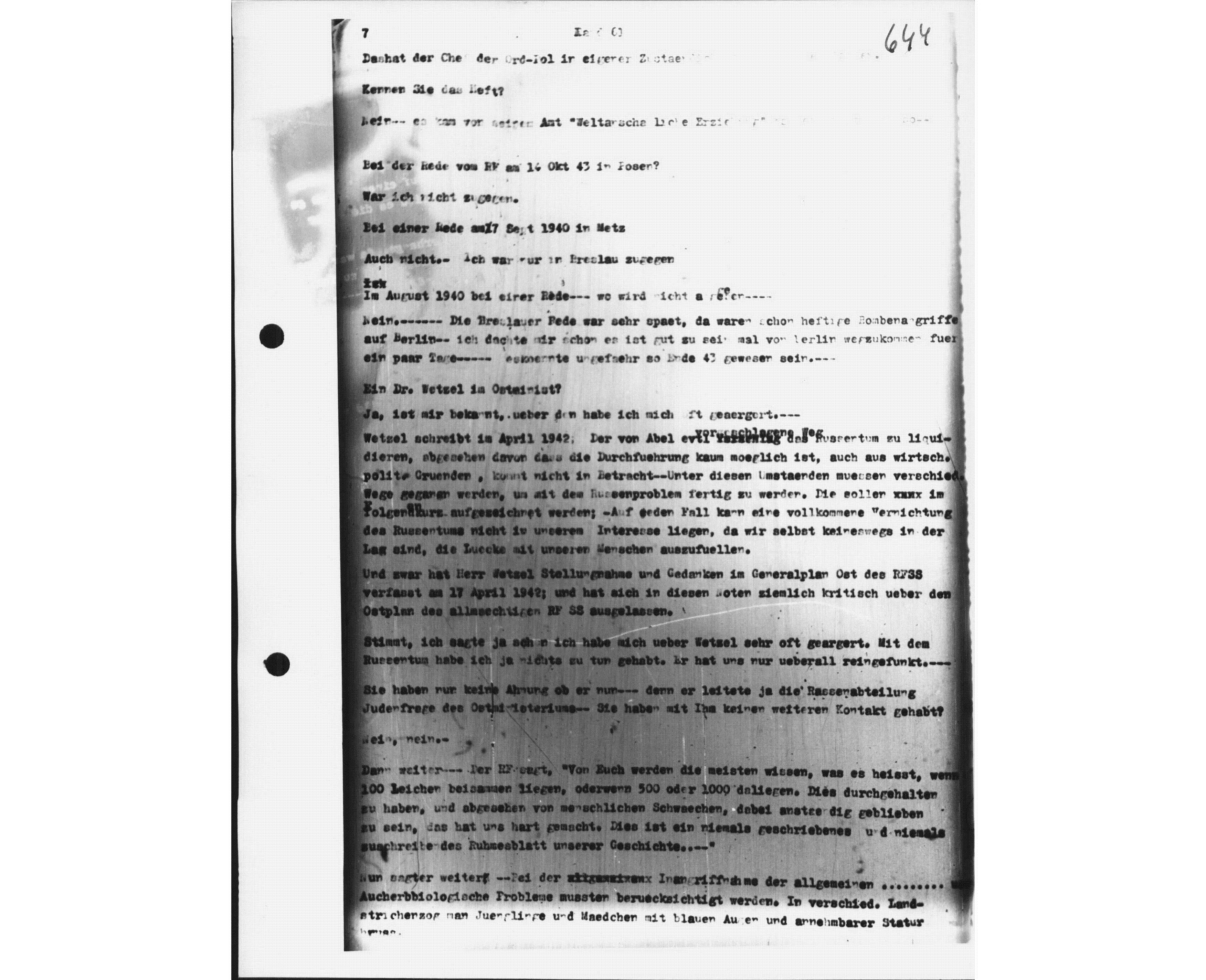
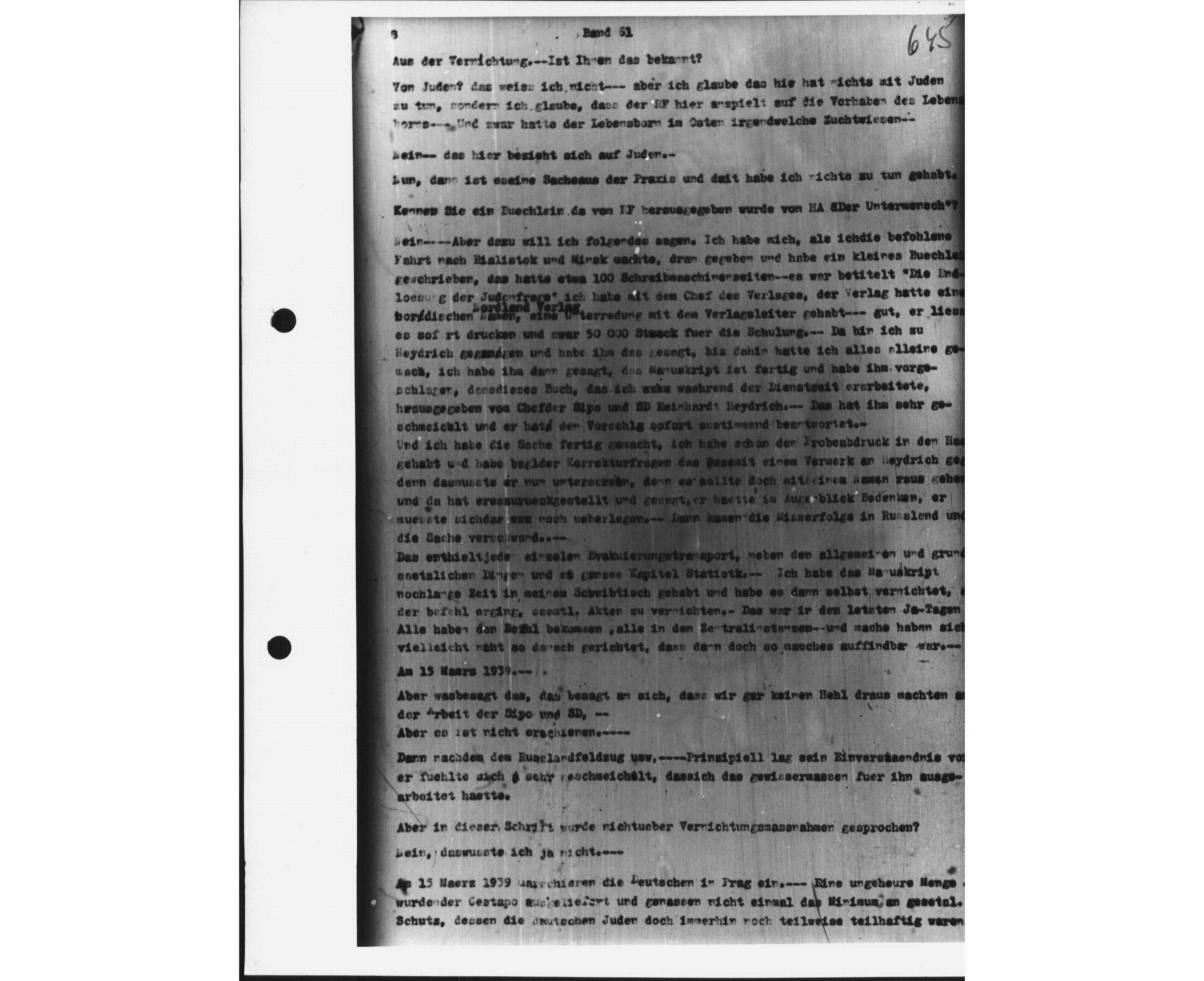
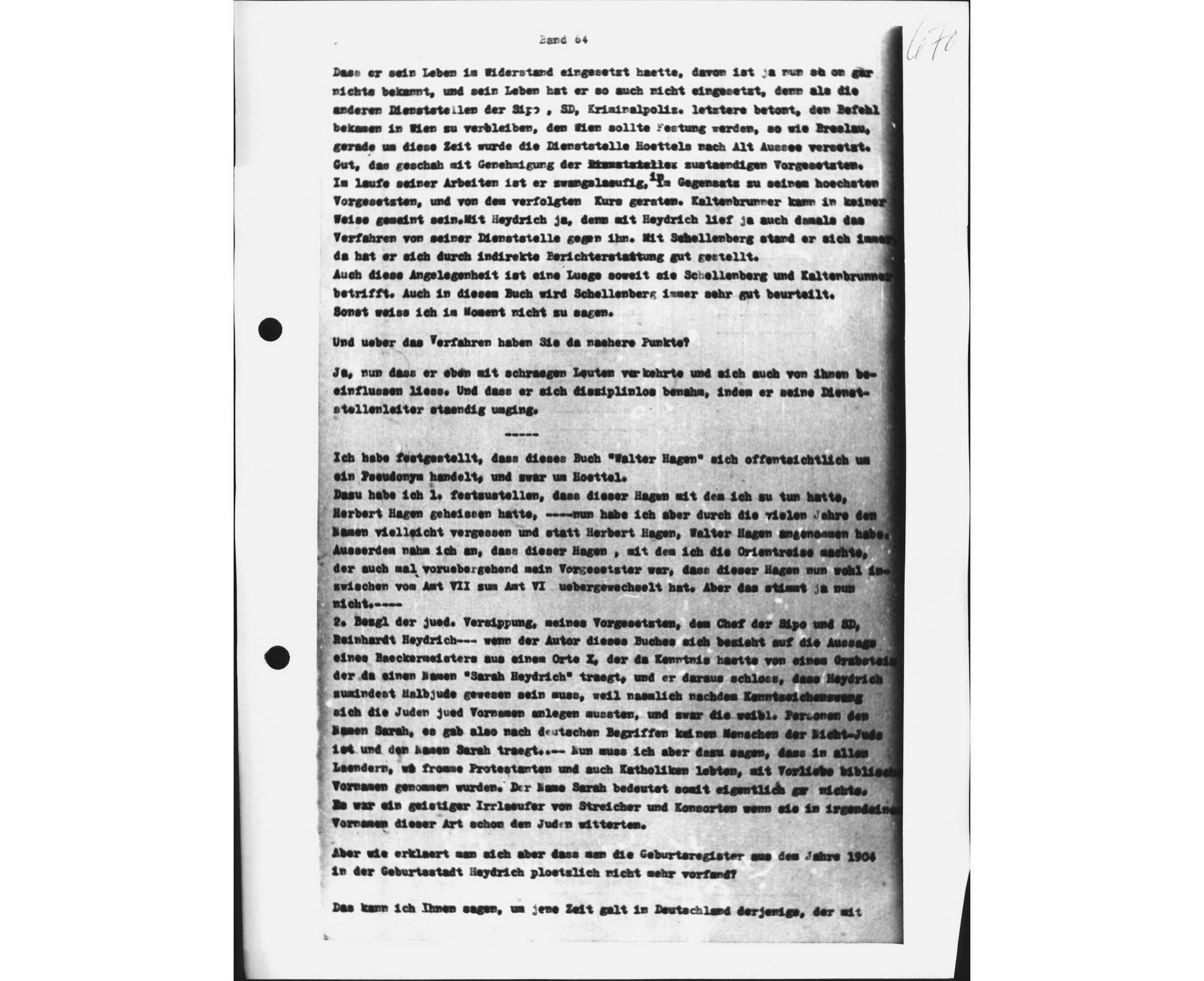
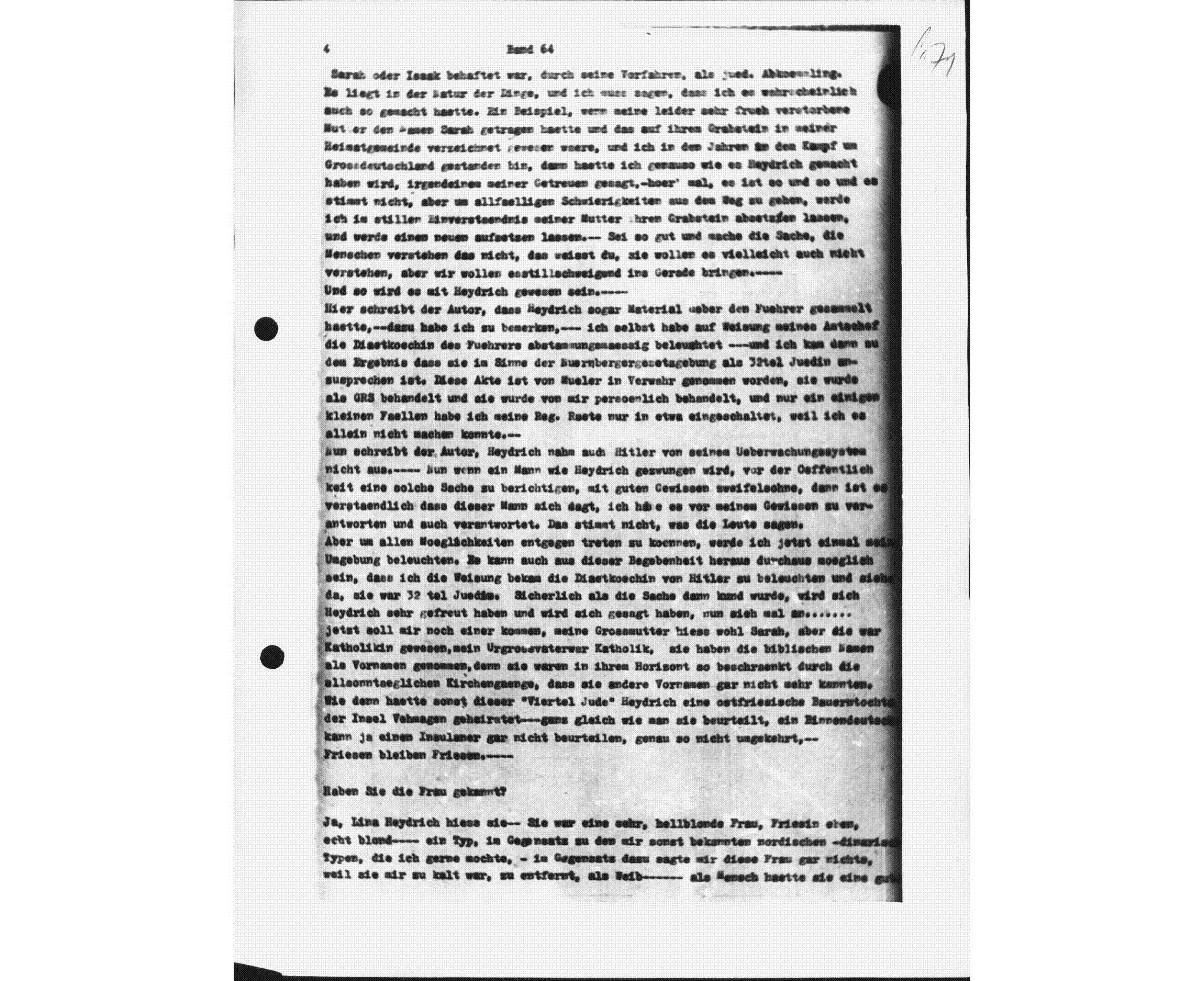
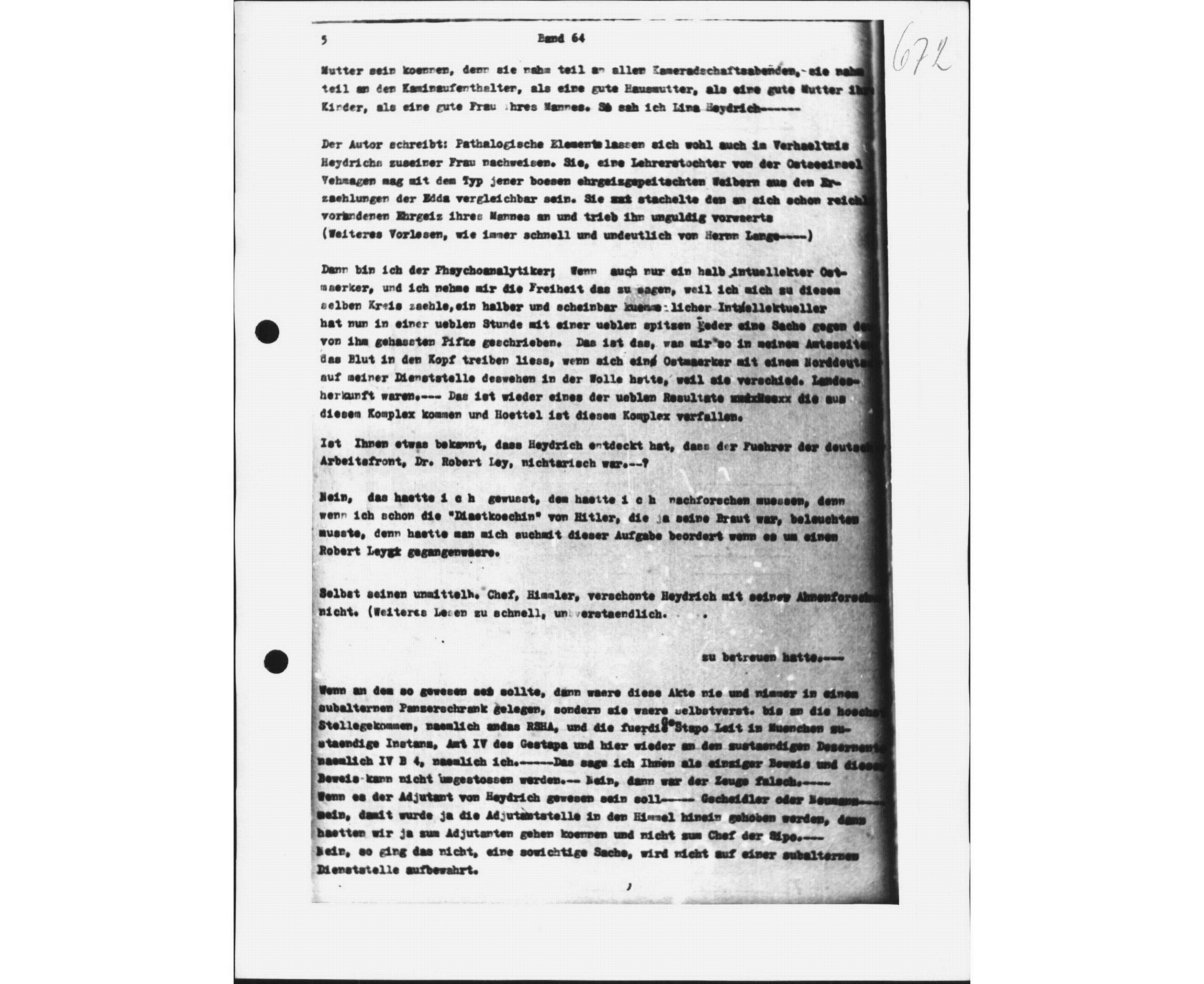
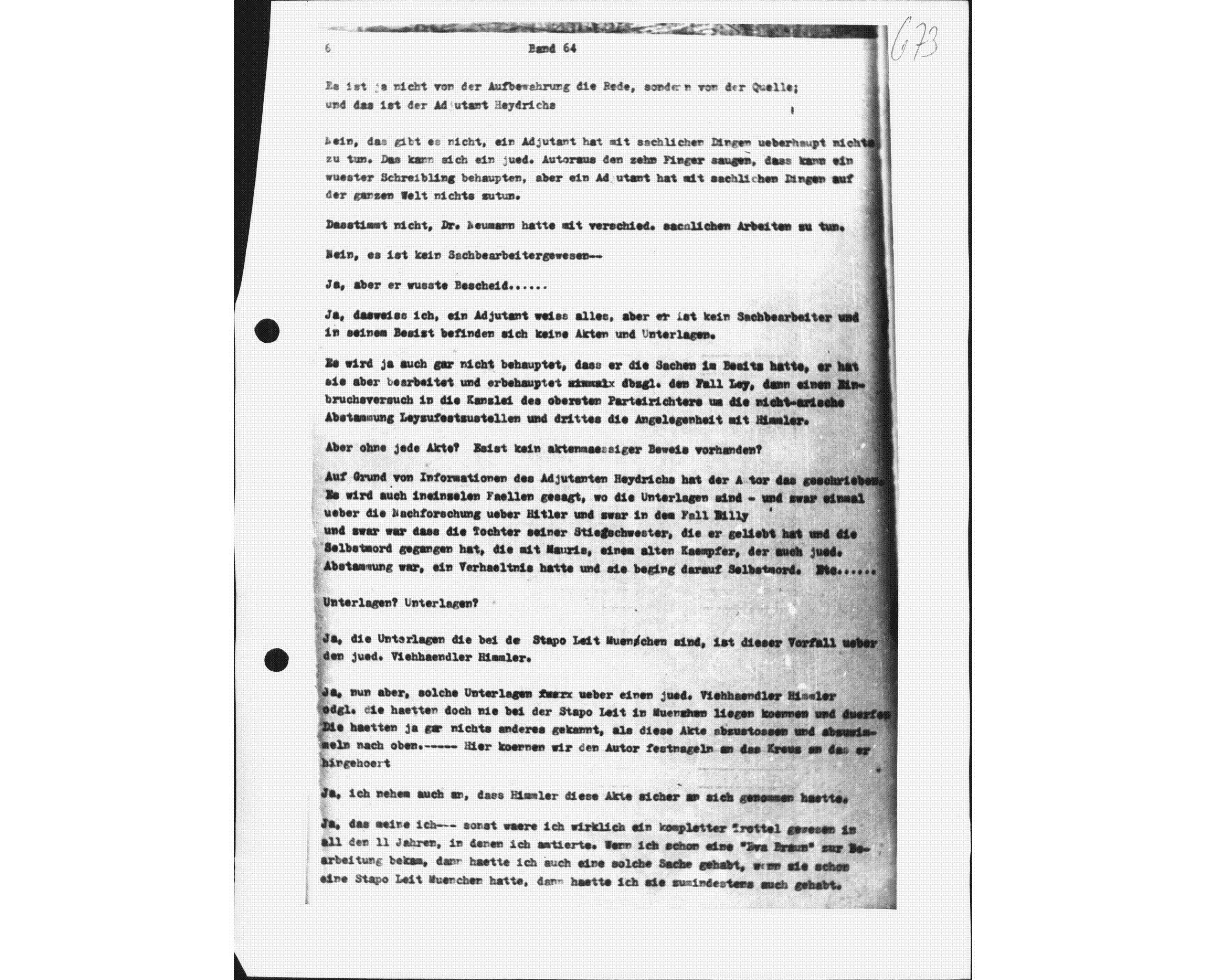
Page 715 of the Sassen typescript.
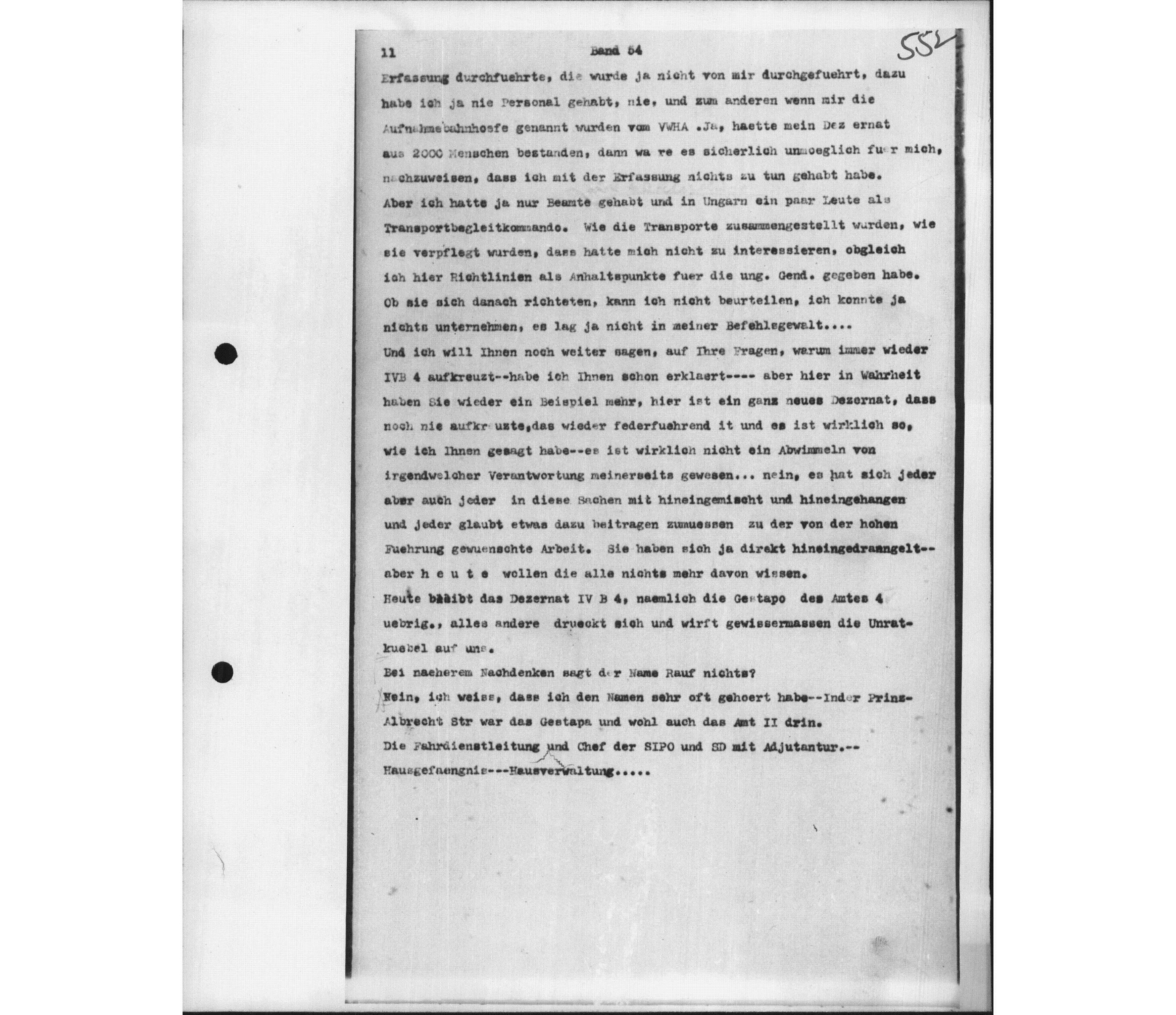
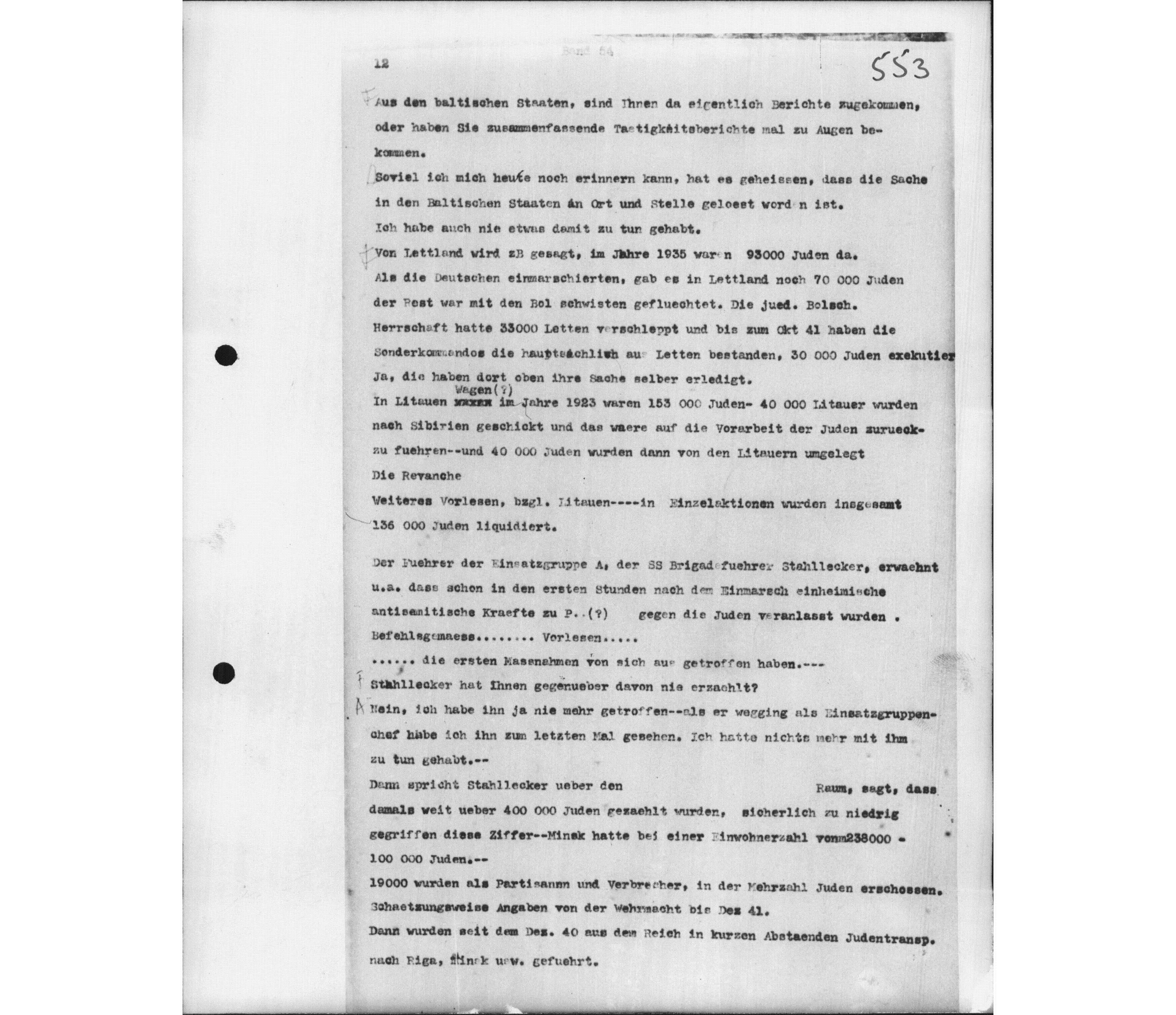
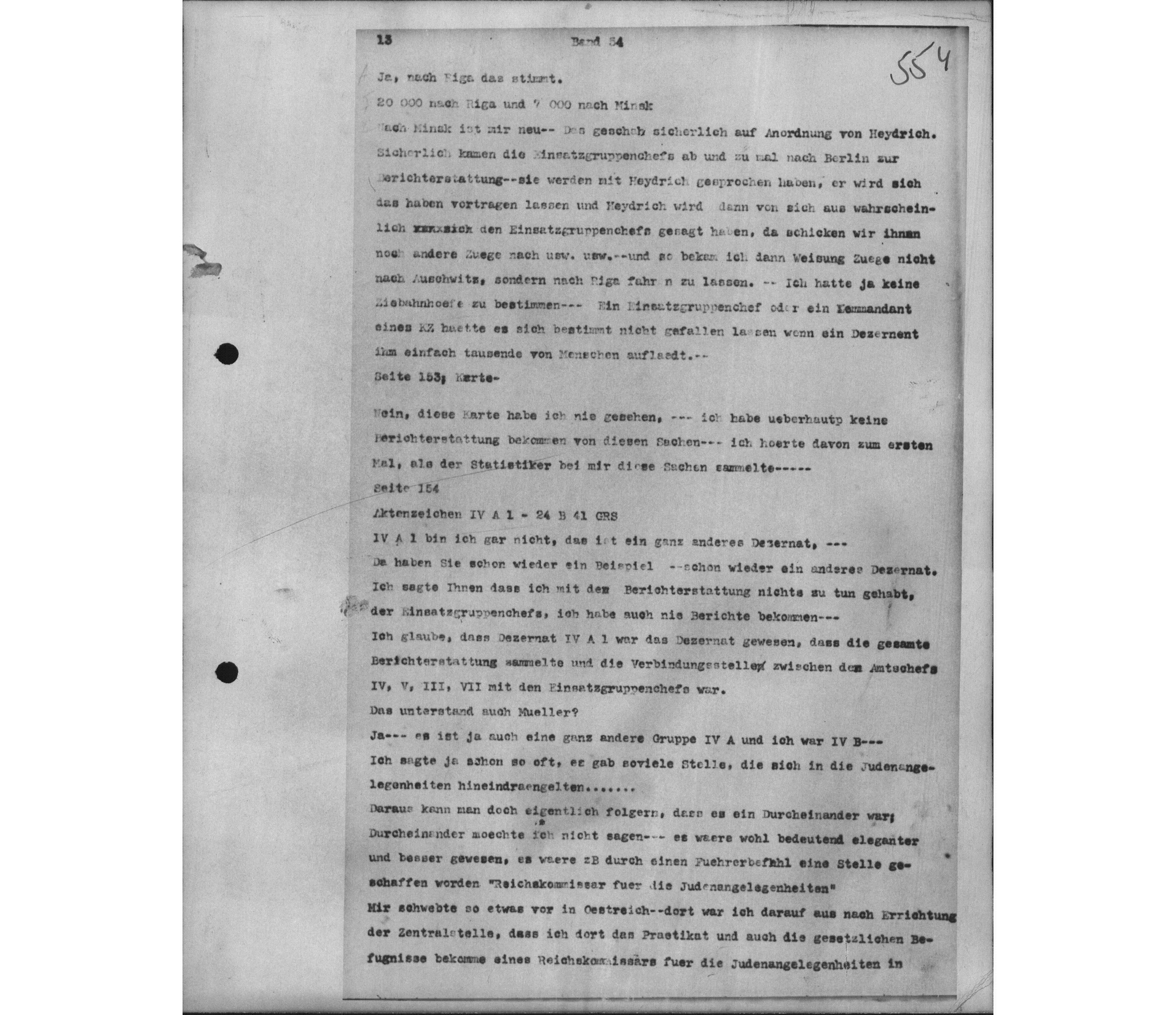
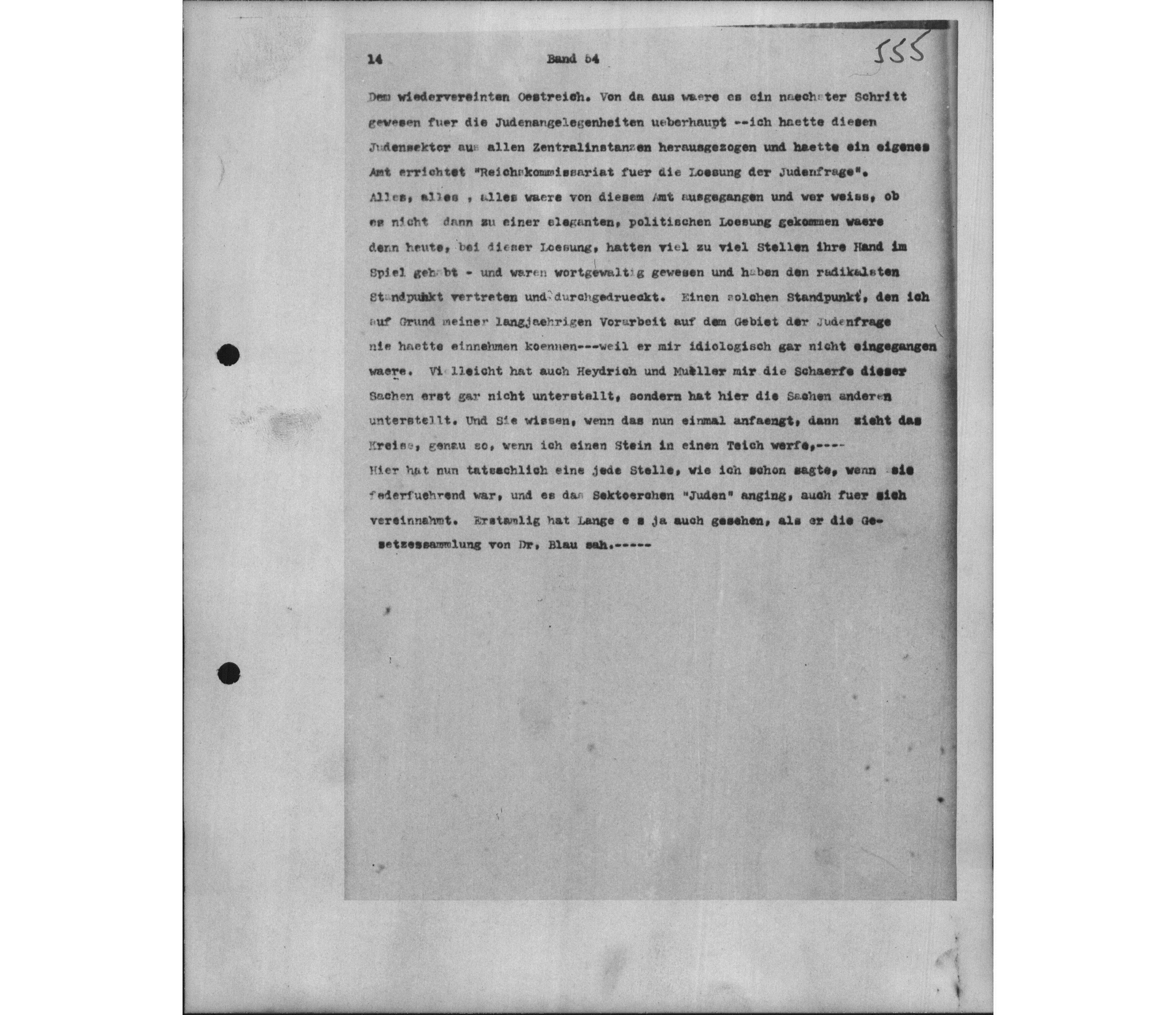
Page 1
of 716

Questioner

From which main thesis shall we proceed with this book?

The following: various ideas, various possibilities that have occurred to me, to set them out individually and as precisely as possible. They can then accordingly serve as a kind of leitmotif. In my opinion, it would make no sense for us to try to trivialize the matter; nor does it make sense to exaggerate the matter itself and say what the opponent wants to hear. Is there a middle way that would also serve the truth at the same time?

After all, what ultimately matters to us is to examine the truth and, insofar as the … of the objective—after all, what ultimately matters to us is to examine the truth, to investigate the truth. I think one possibility would be to portray the German people before and during the war as a people that, barely fifty years earlier, with a difference in time… had achieved its unity through Bismark. In the First World War it saw all the opposing forces united against it; through the unspeakable hardship after the First World War—the Jews were undoubtedly the beneficiaries of the German people's hardship.

One need only recall the mortgage affairs and the evictions of farmers in the north of the country: slowly but surely, a campaign of annihilation of the lower and upper middle classes, all of whom became victims of Jewish interest policy. The reason why the question of interest in particular met with such a wide response in the NSDAP (National Socialist German Workers' Party) program. That precisely in the period after the First World War there was a regression in political and economic terms, through which many of the efforts toward unity established with so much trouble through Bismark were largely undone again…

That this people, after the seizure of power in '33, had one foot on the path toward the development of a … realization of the national program, but the other foot on the warpath. That, through the course of the war, this people was suddenly called on across the board to undertake leadership tasks for which it lacked experience, and also that body of experience which gradually crystallizes into a certain technique, which does not have to be learned, which cannot be learned in crash courses either, but is the result and accumulation of many generations, of the bitter experiences of generations.

The German people, then, without this body of experience, was confronted with a leadership task for which experience and strength were utterly lacking. As German influence spread over the whole of Europe through the course of the war, and Jewish legislation had been proclaimed in Germany itself since 1936, there were still so many disturbing gaps in the practical implementation of that legislation. On the other hand, in the modern Reich that the Third Reich was, a problem now had to be solved with due regard for laws and regulations, and also for a certain distribution of power within the state.

All this led to great difficulties within Germany itself. Even Germany's efforts to solve the Jewish problem within Germany through emigration, with the involvement of foreign countries, remained without really tangible results. In such a way that one can say that, looking back, it becomes very clear that the foreign countries which later became enemy countries had from the outset kept this whole Jewish question as a weapon in reserve, and sought by every means to prevent this

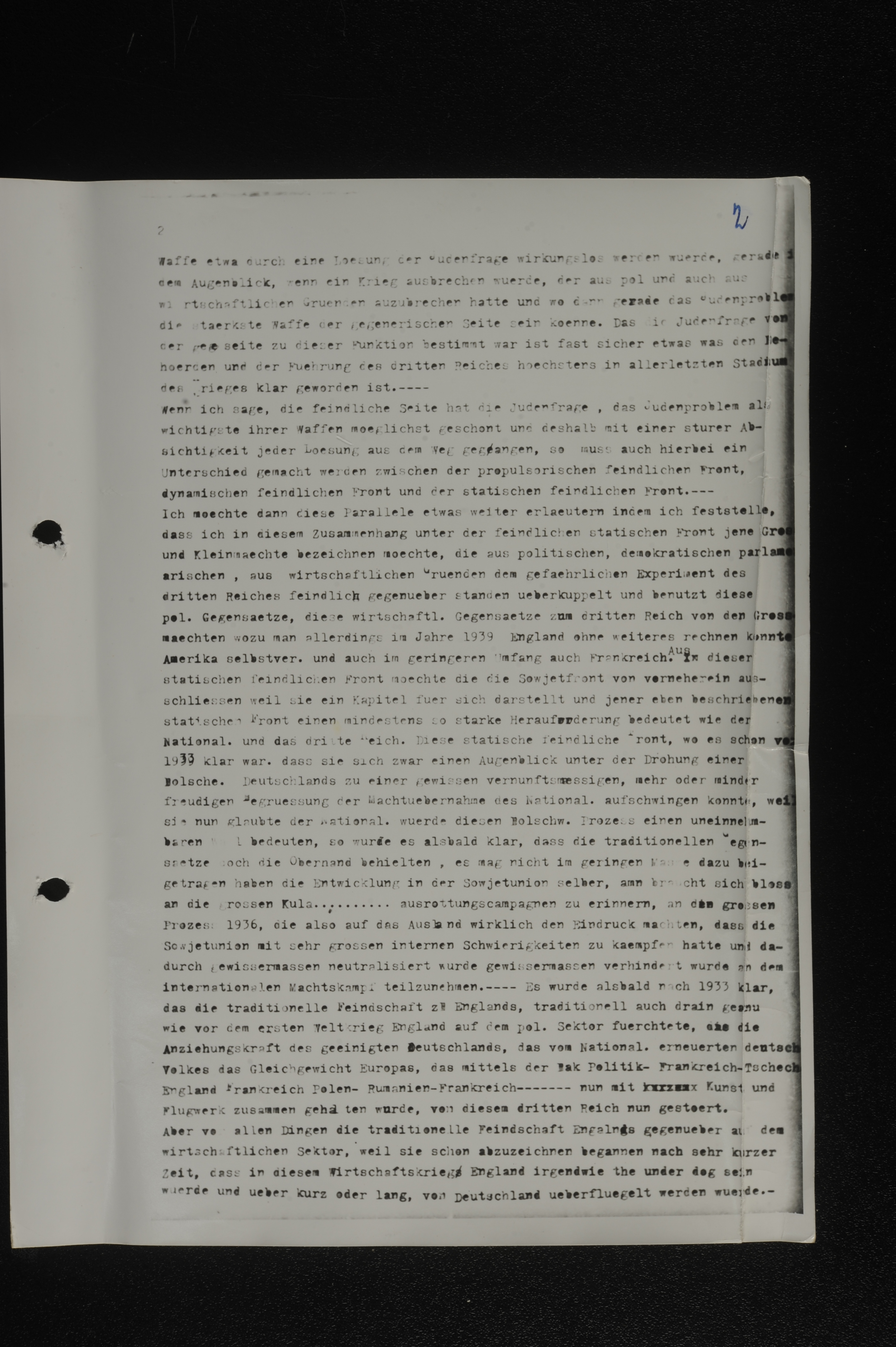
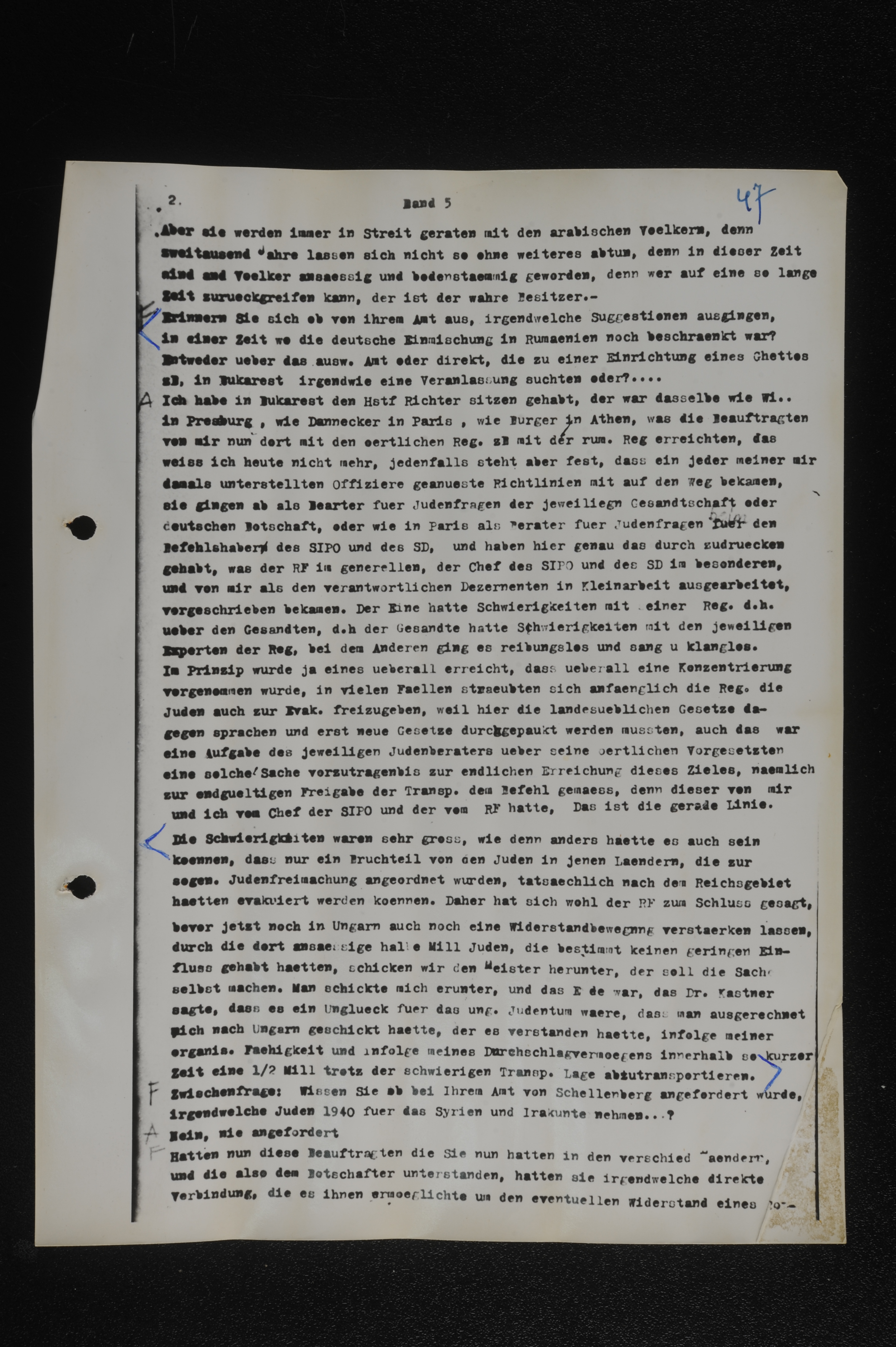
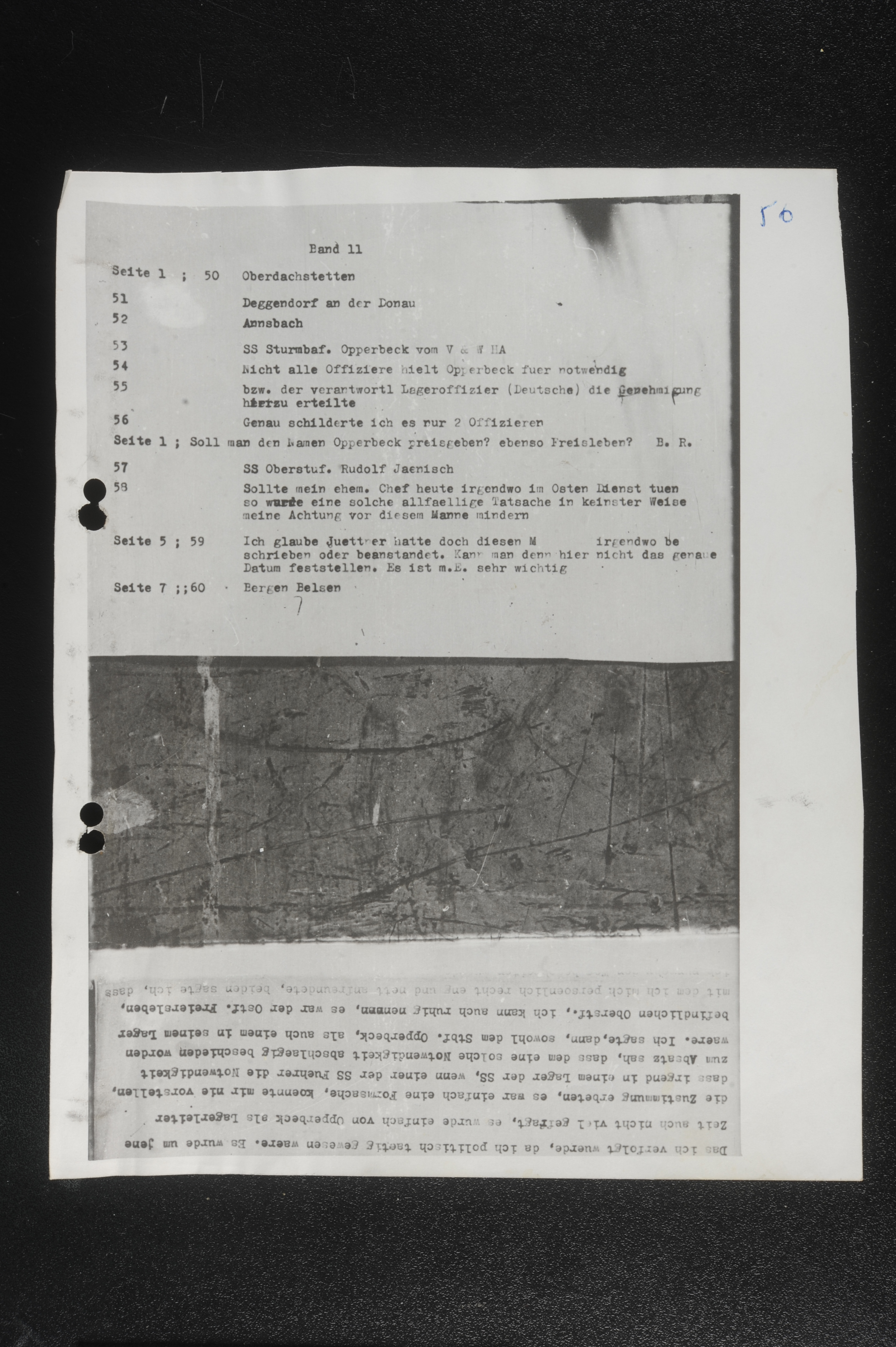
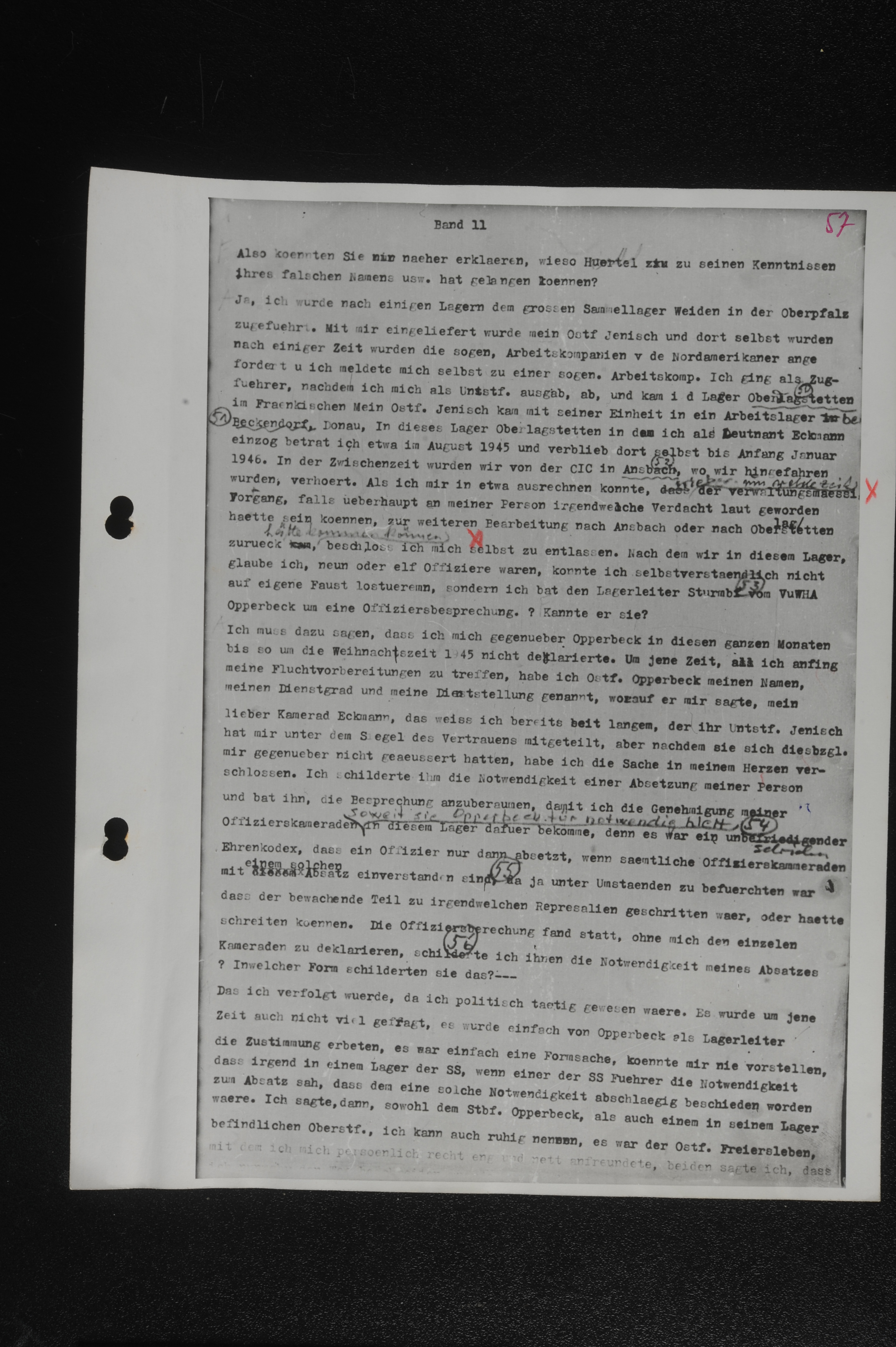
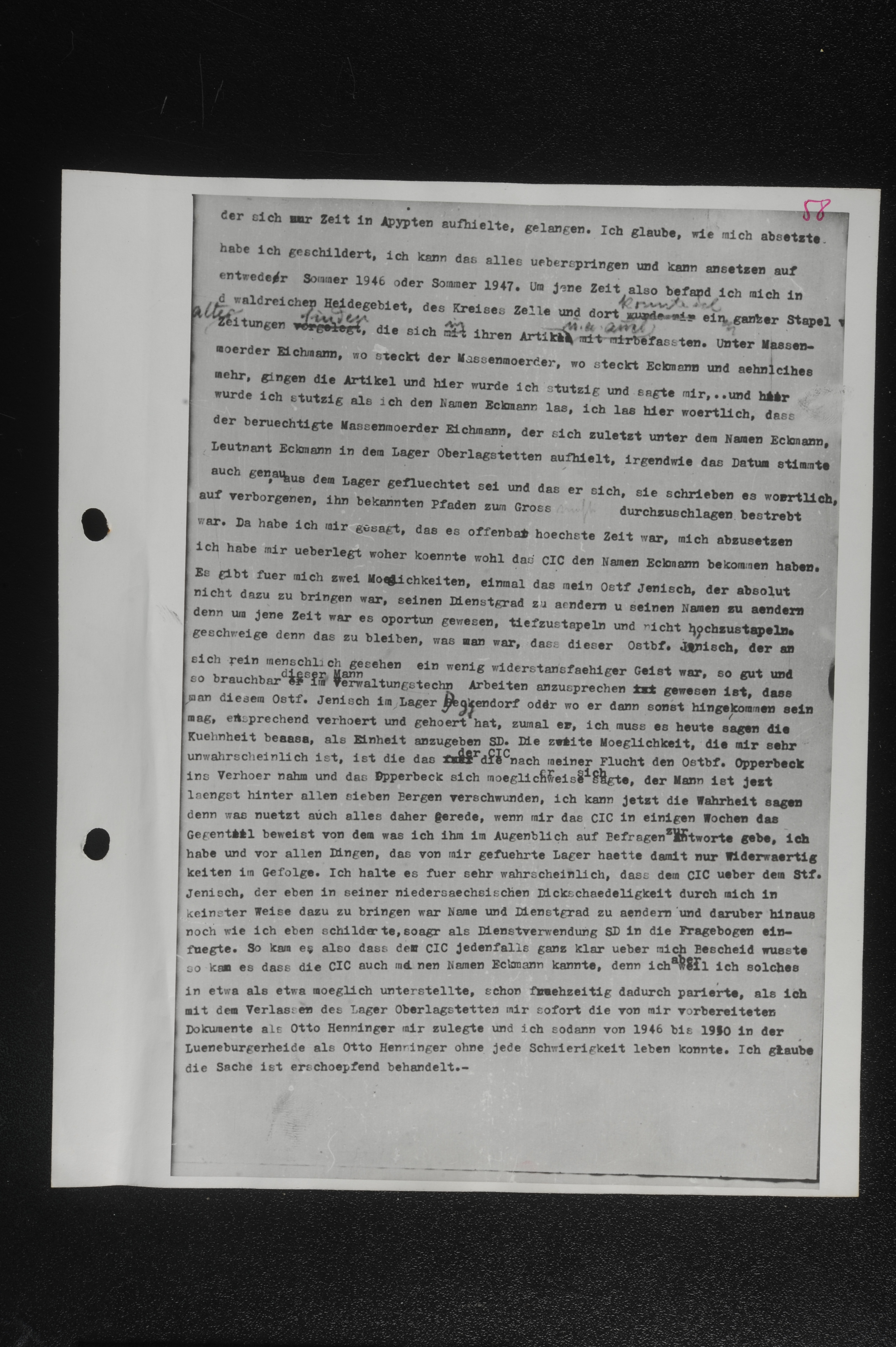
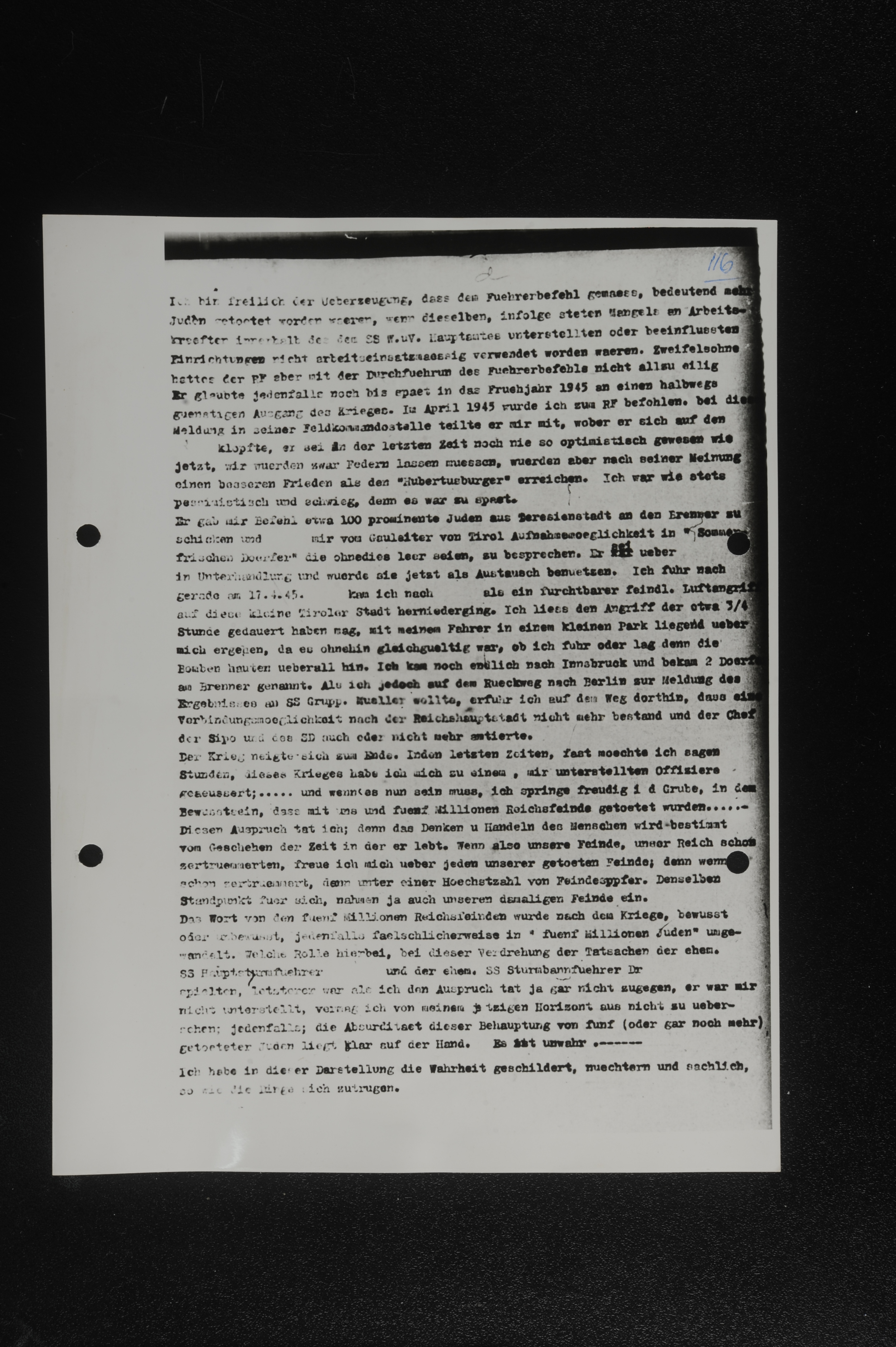
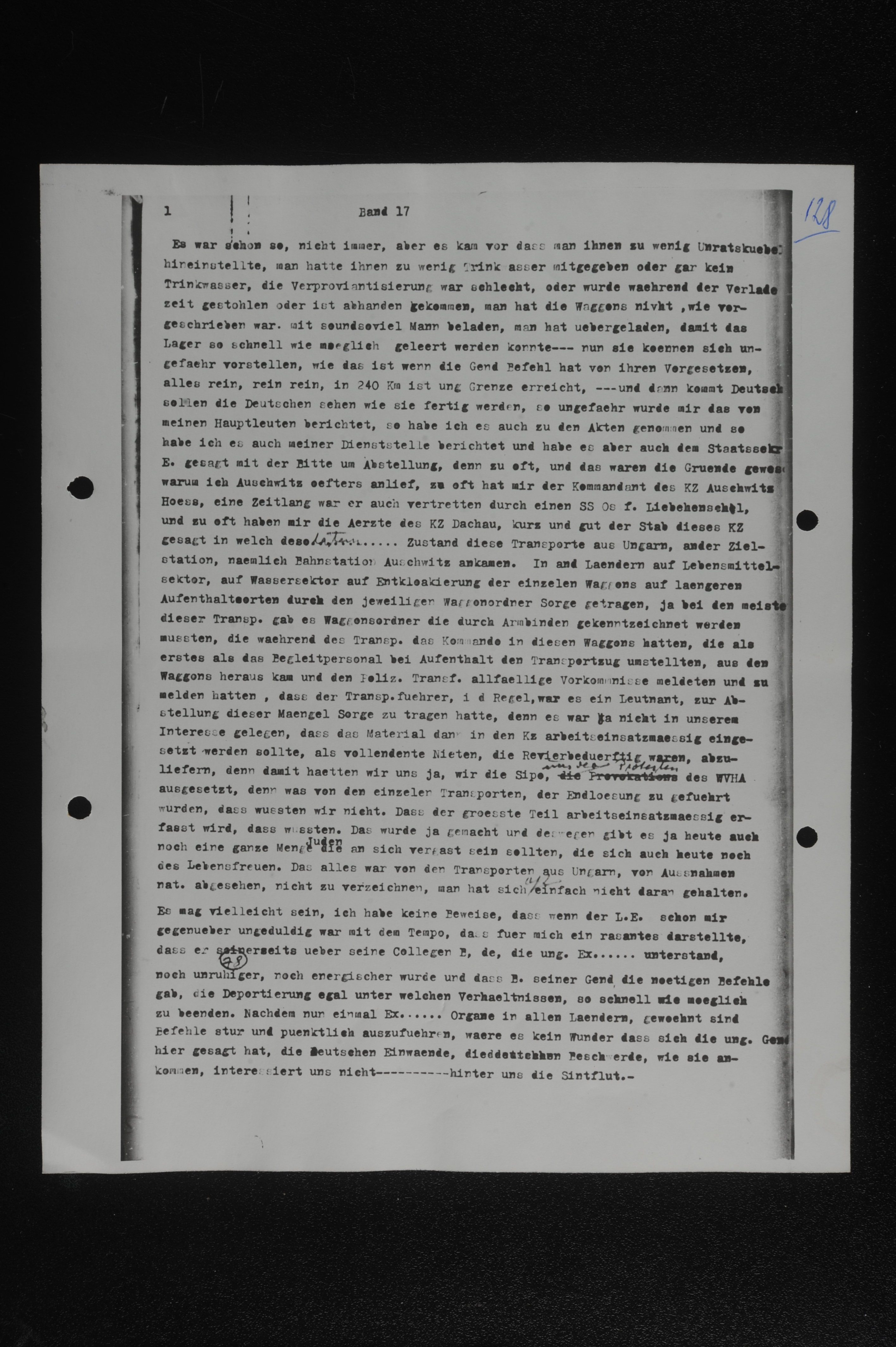
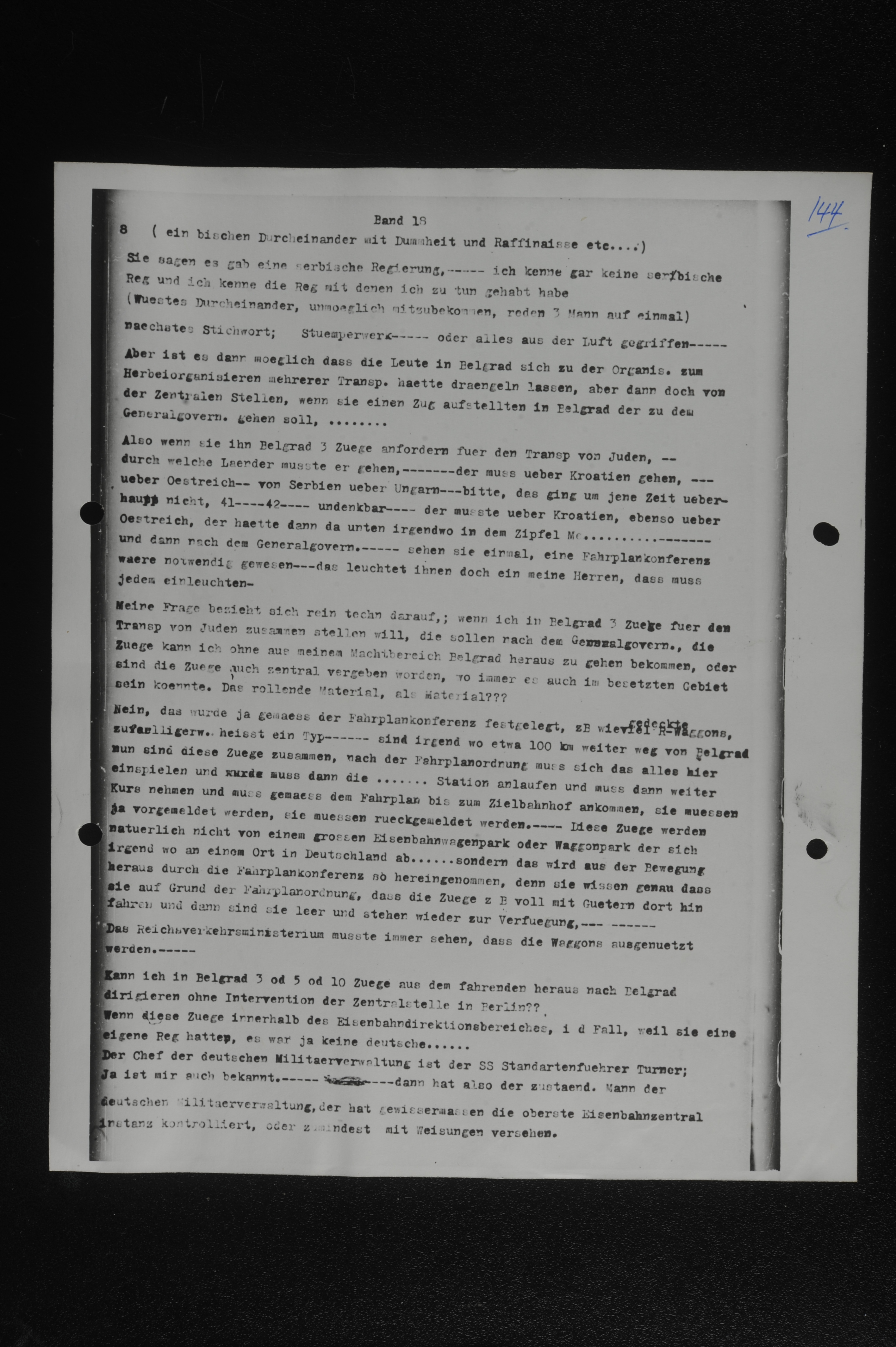
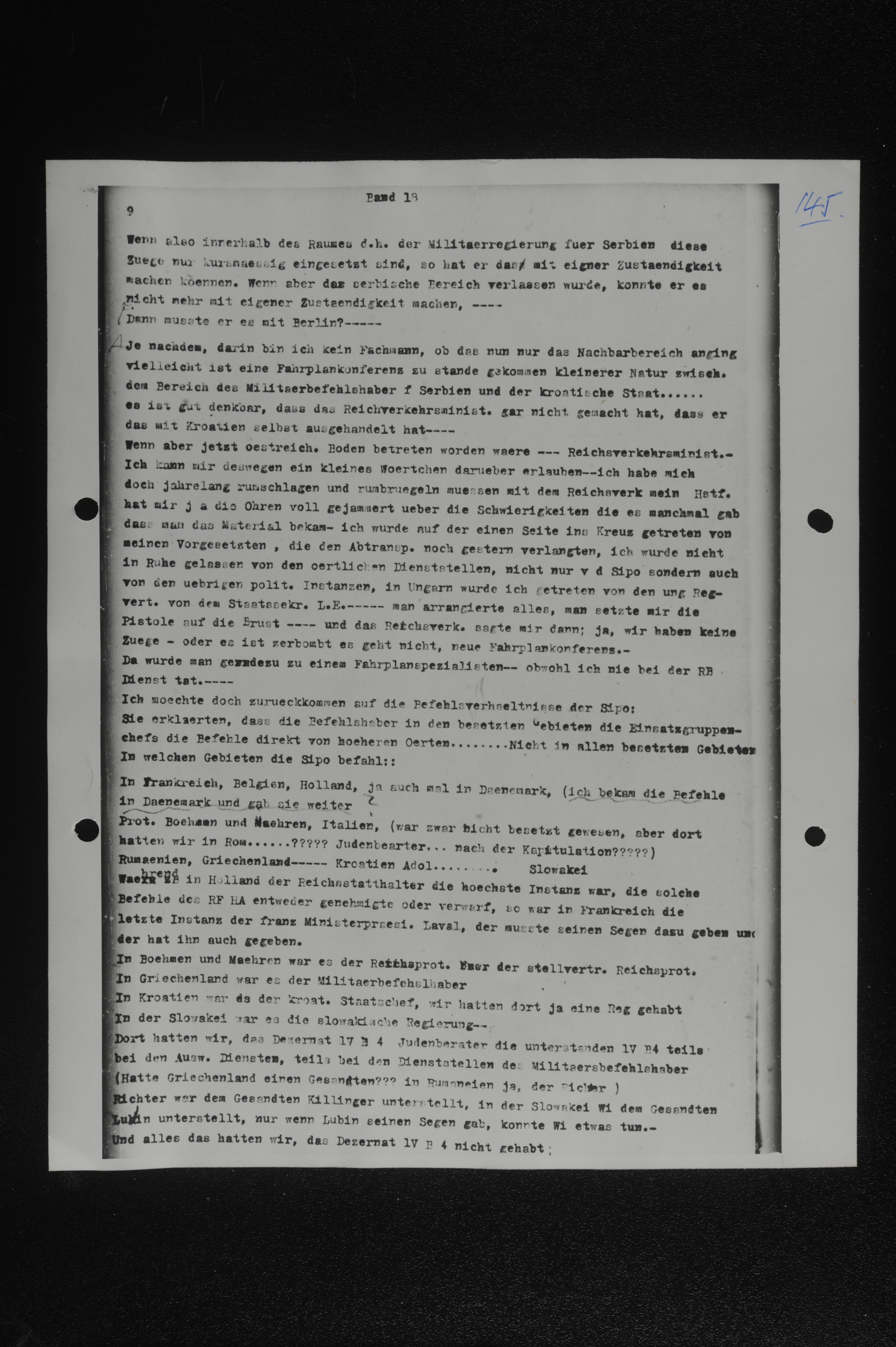
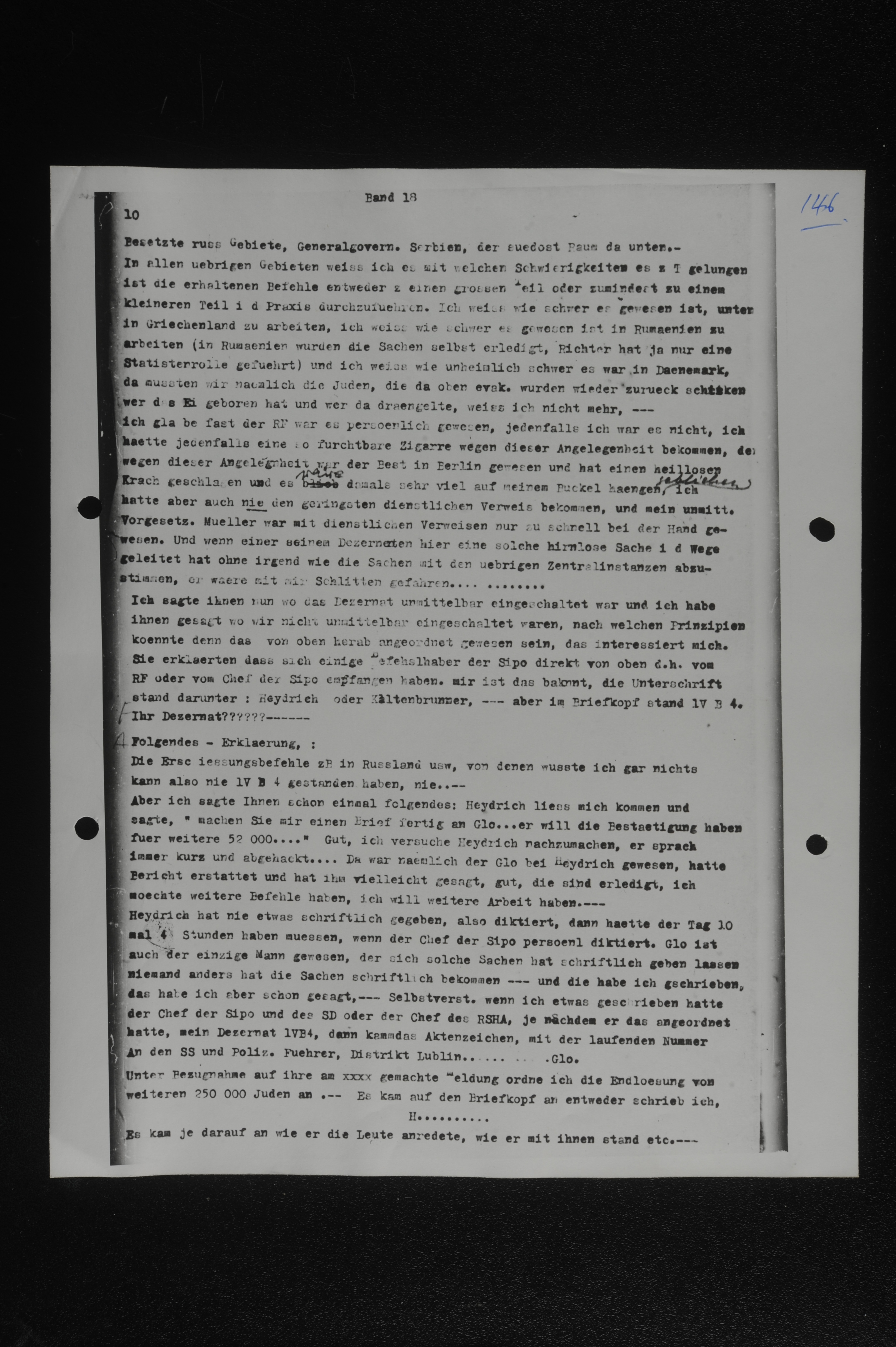
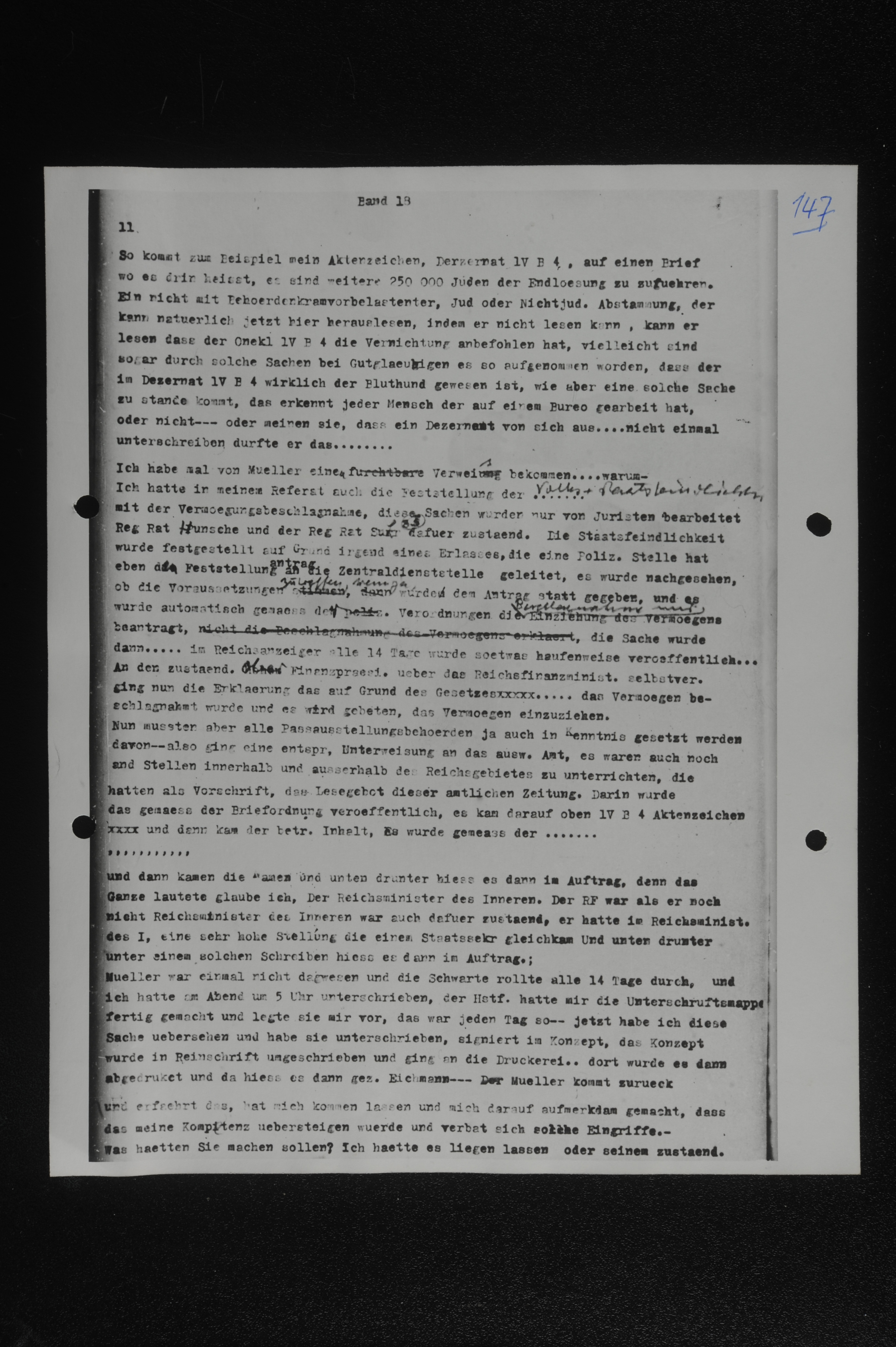
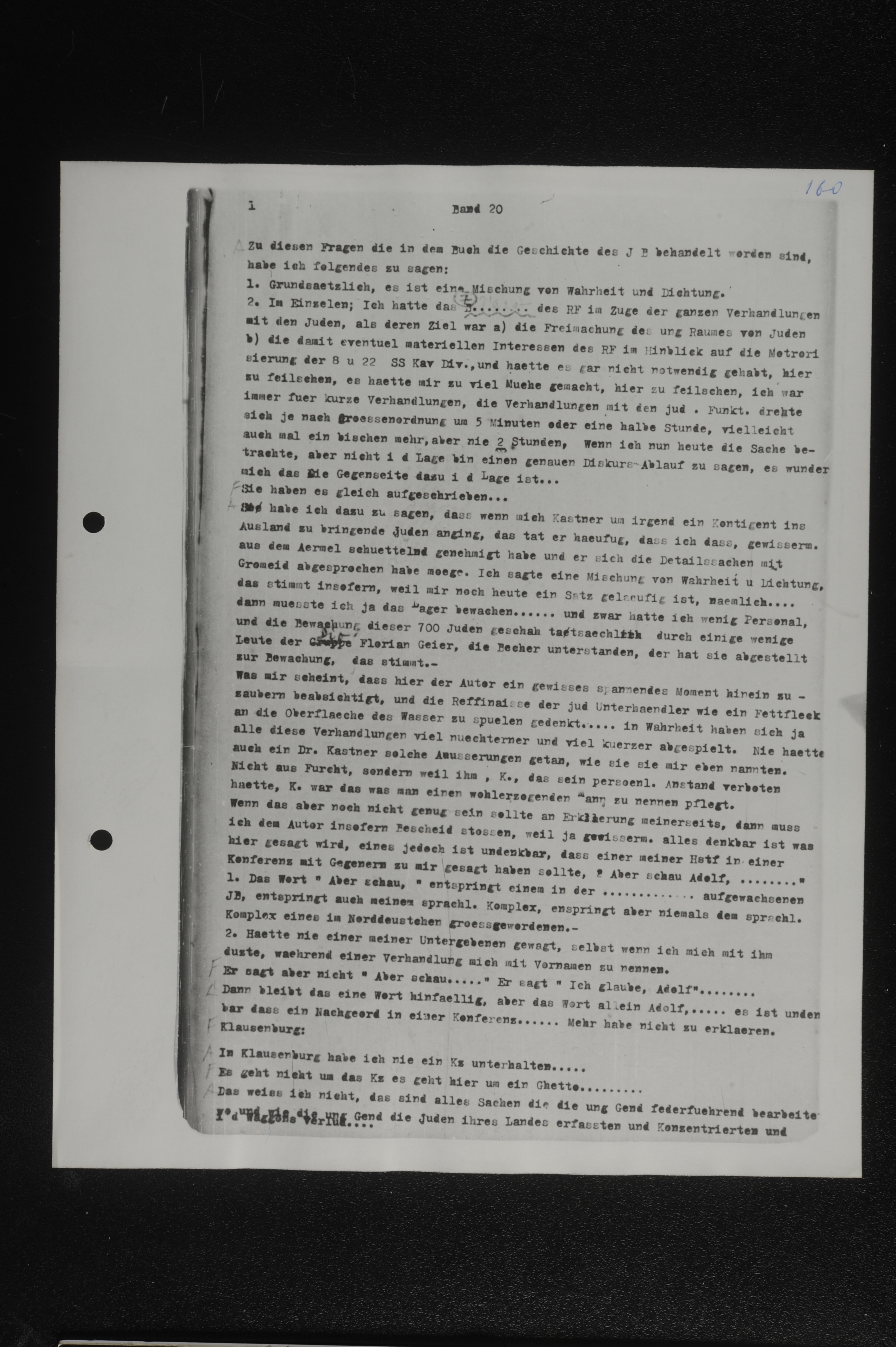
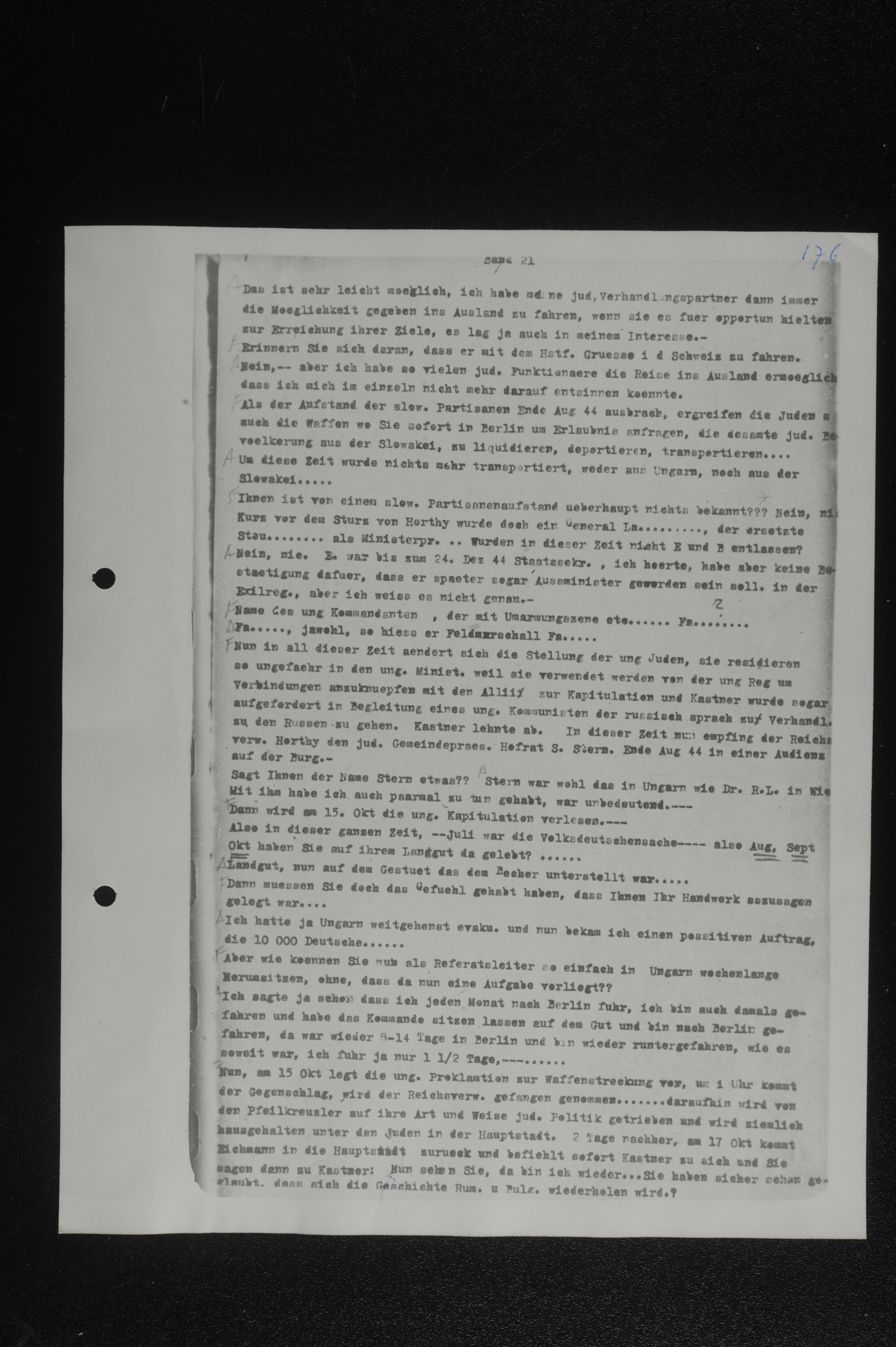
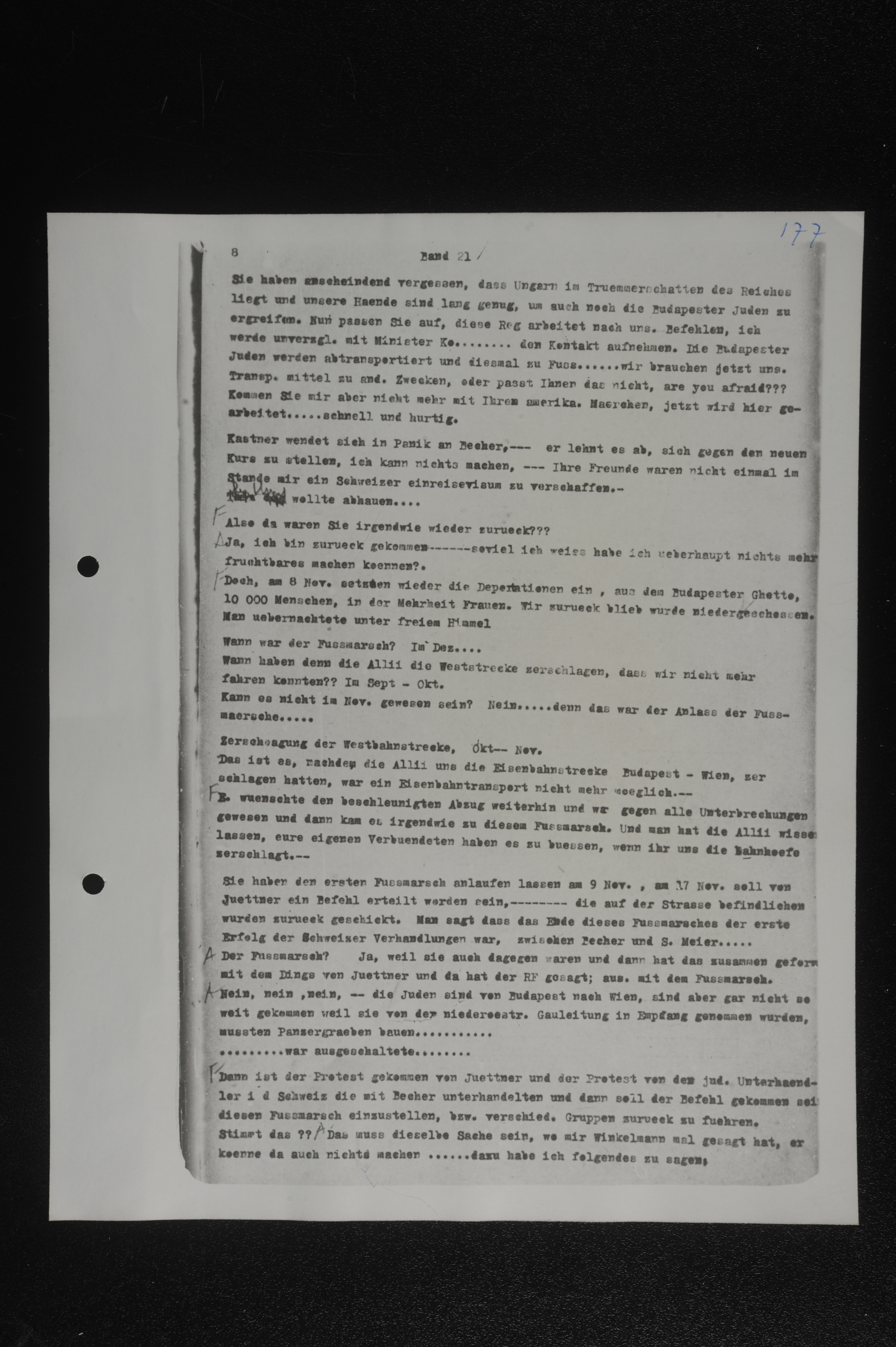
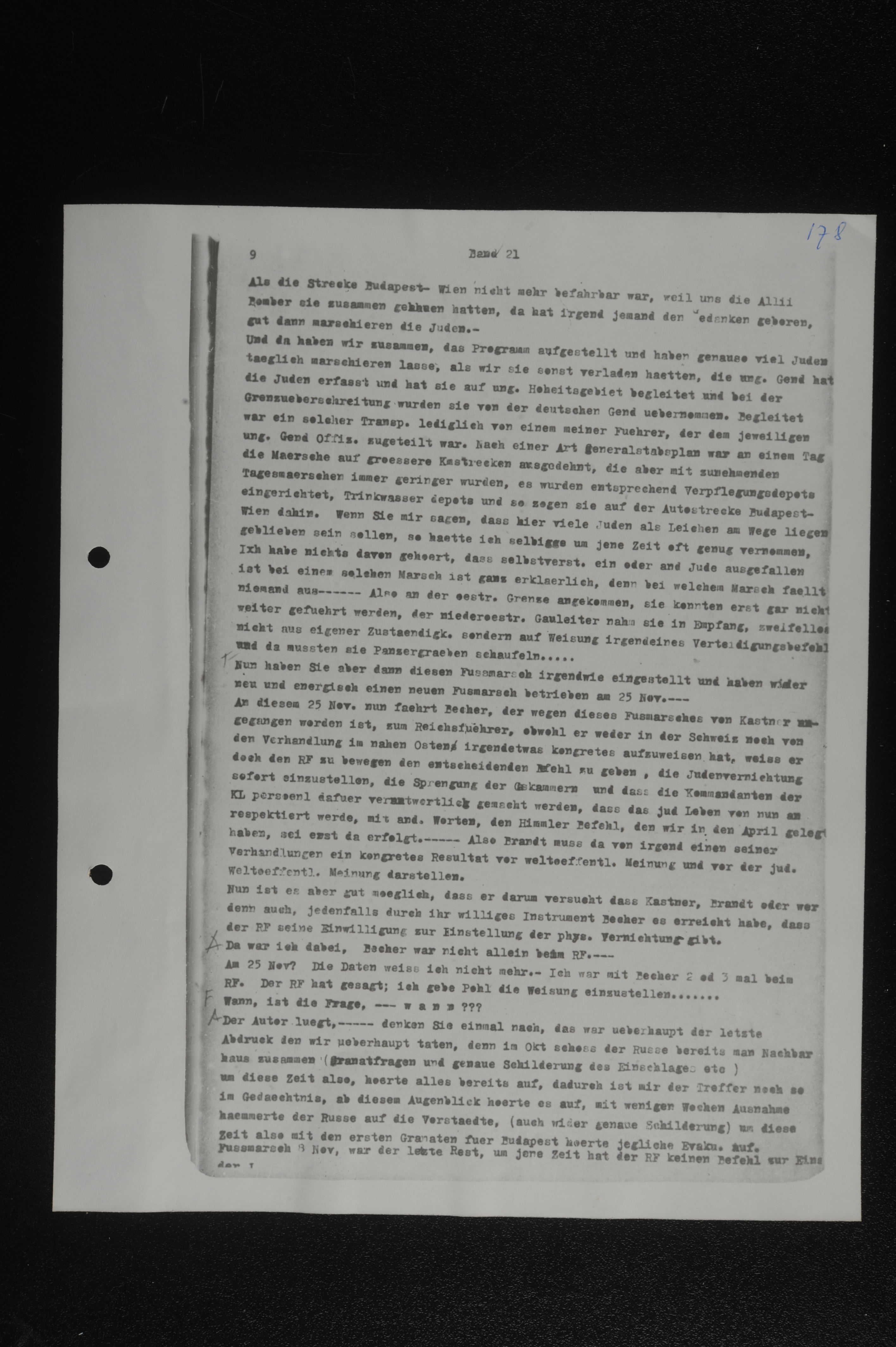
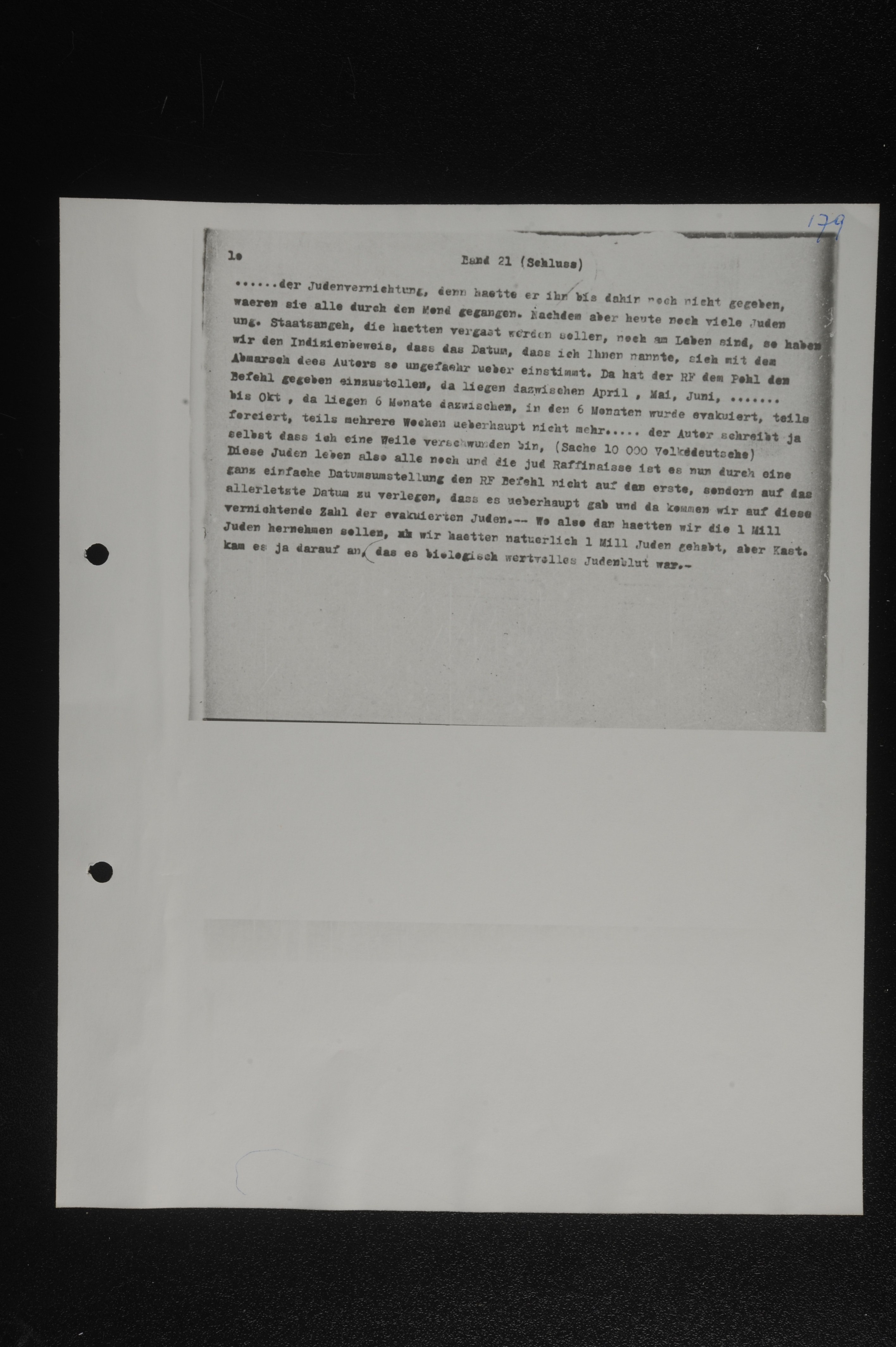
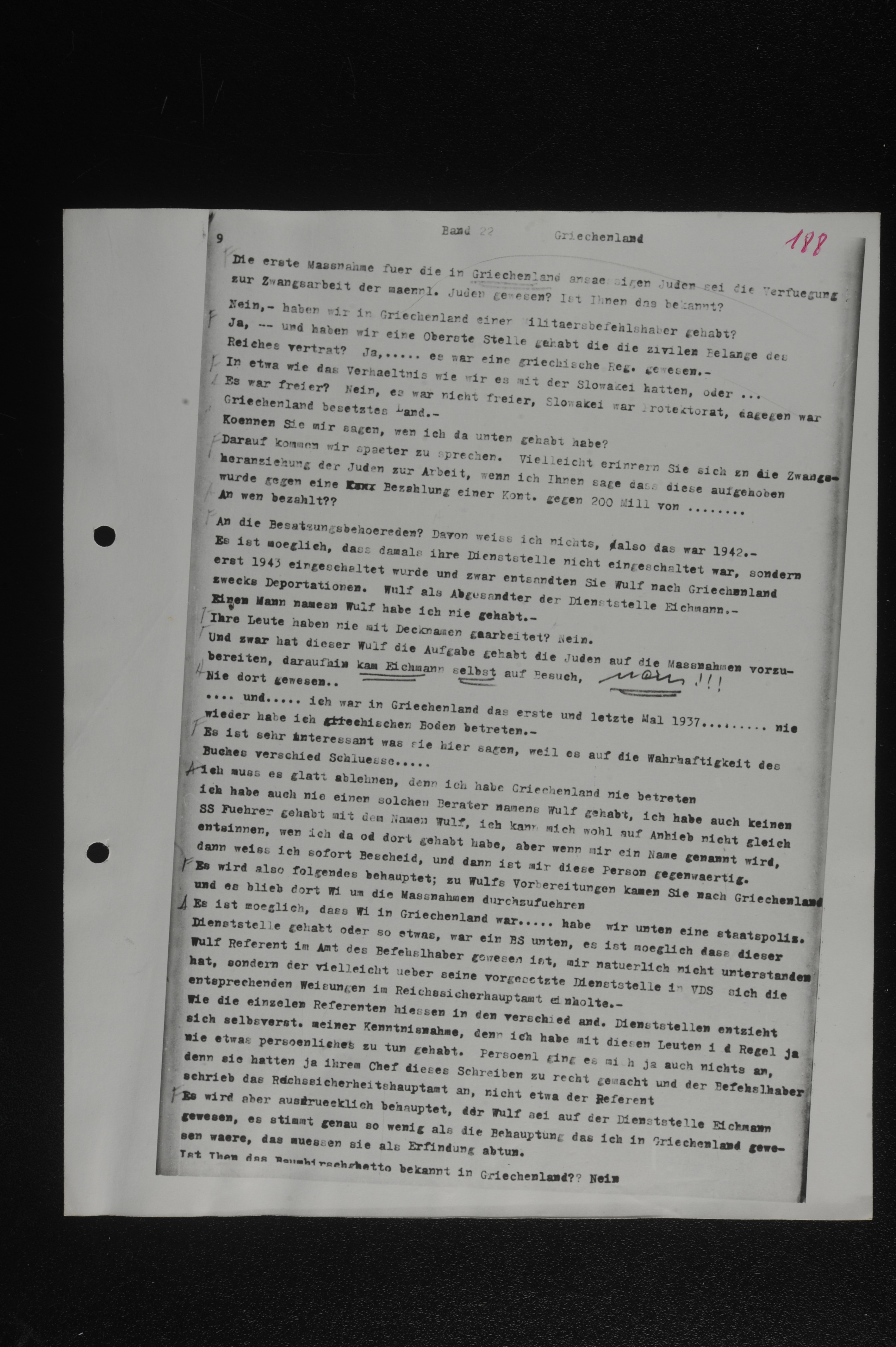
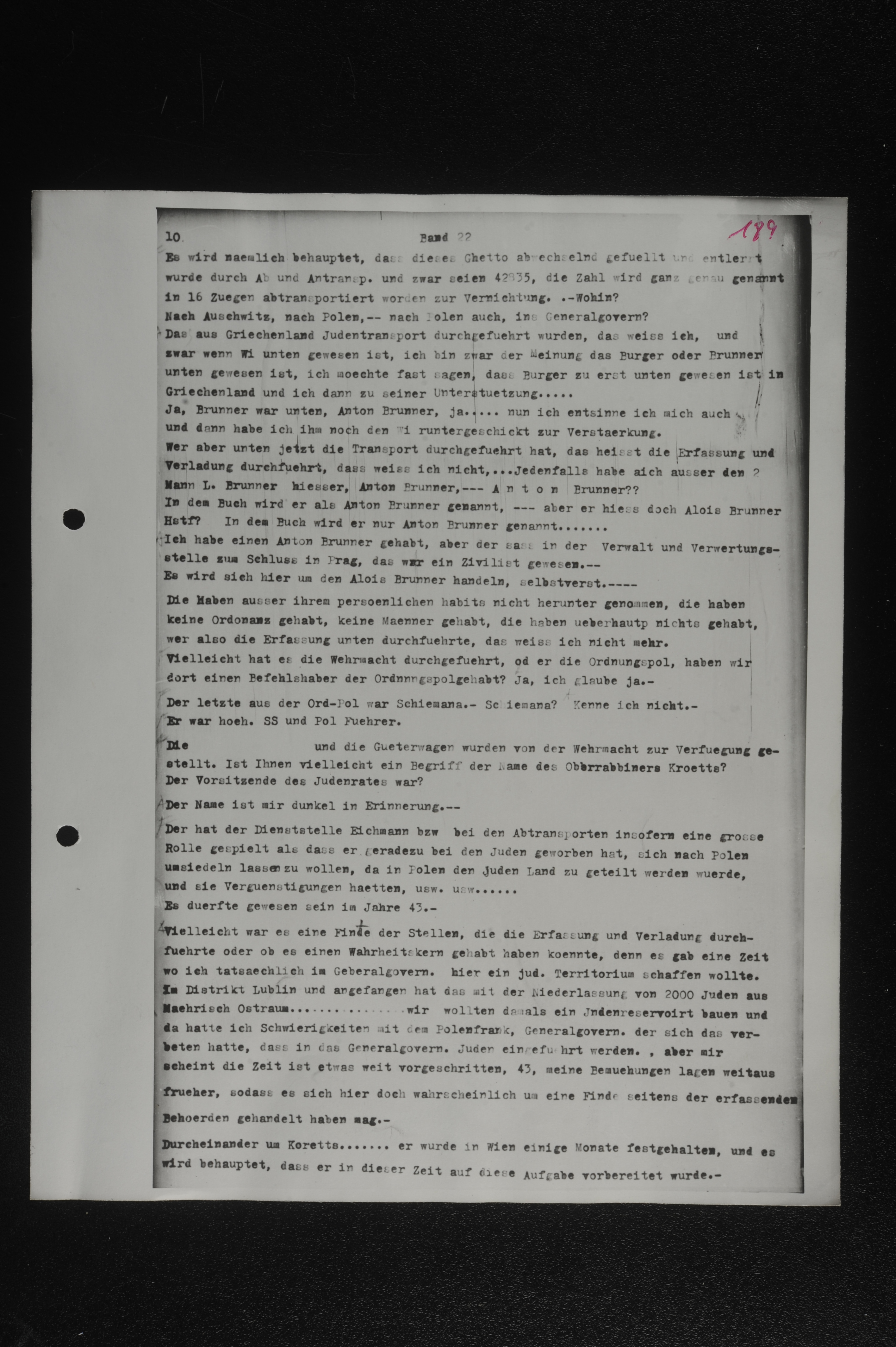
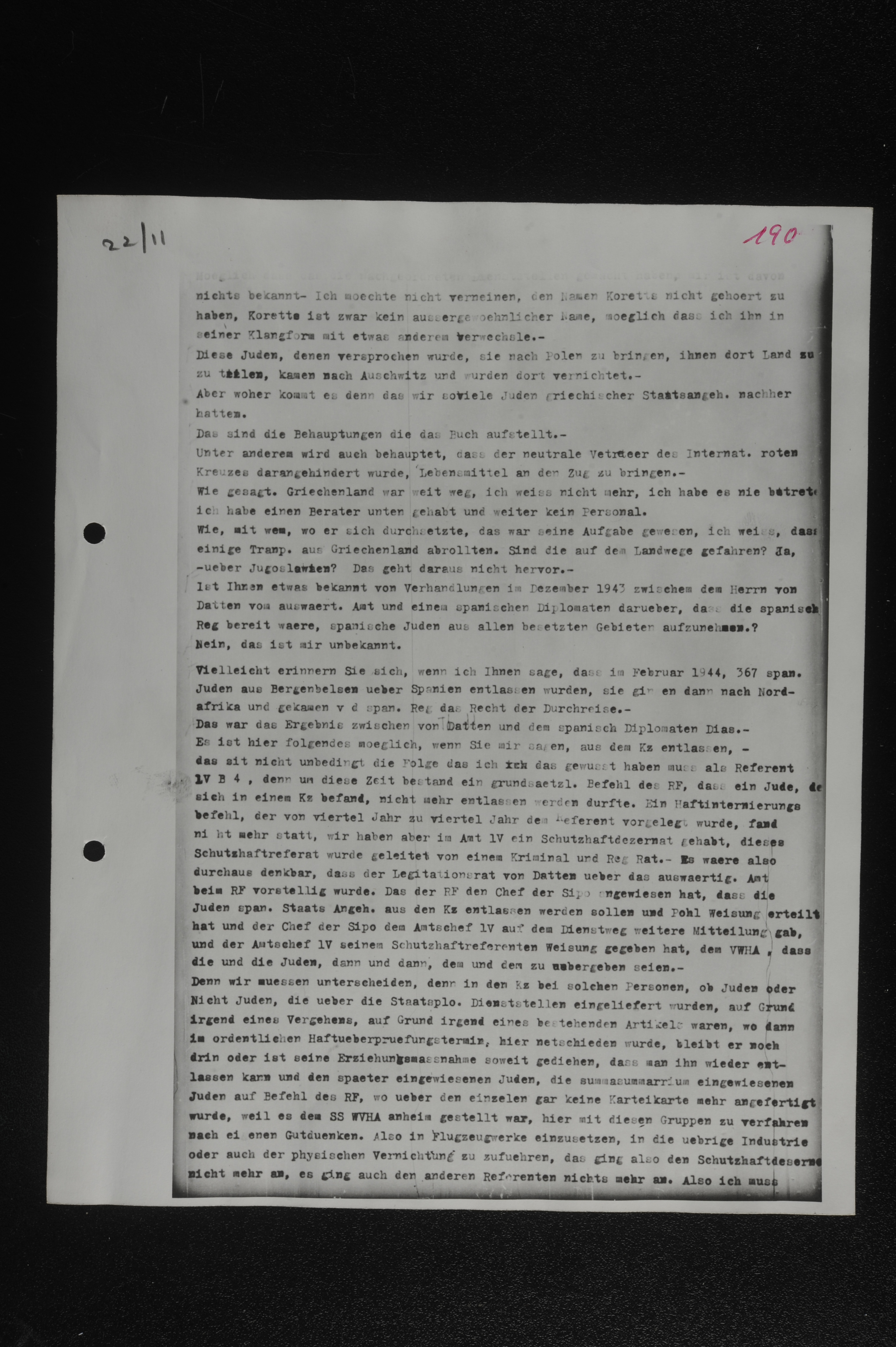
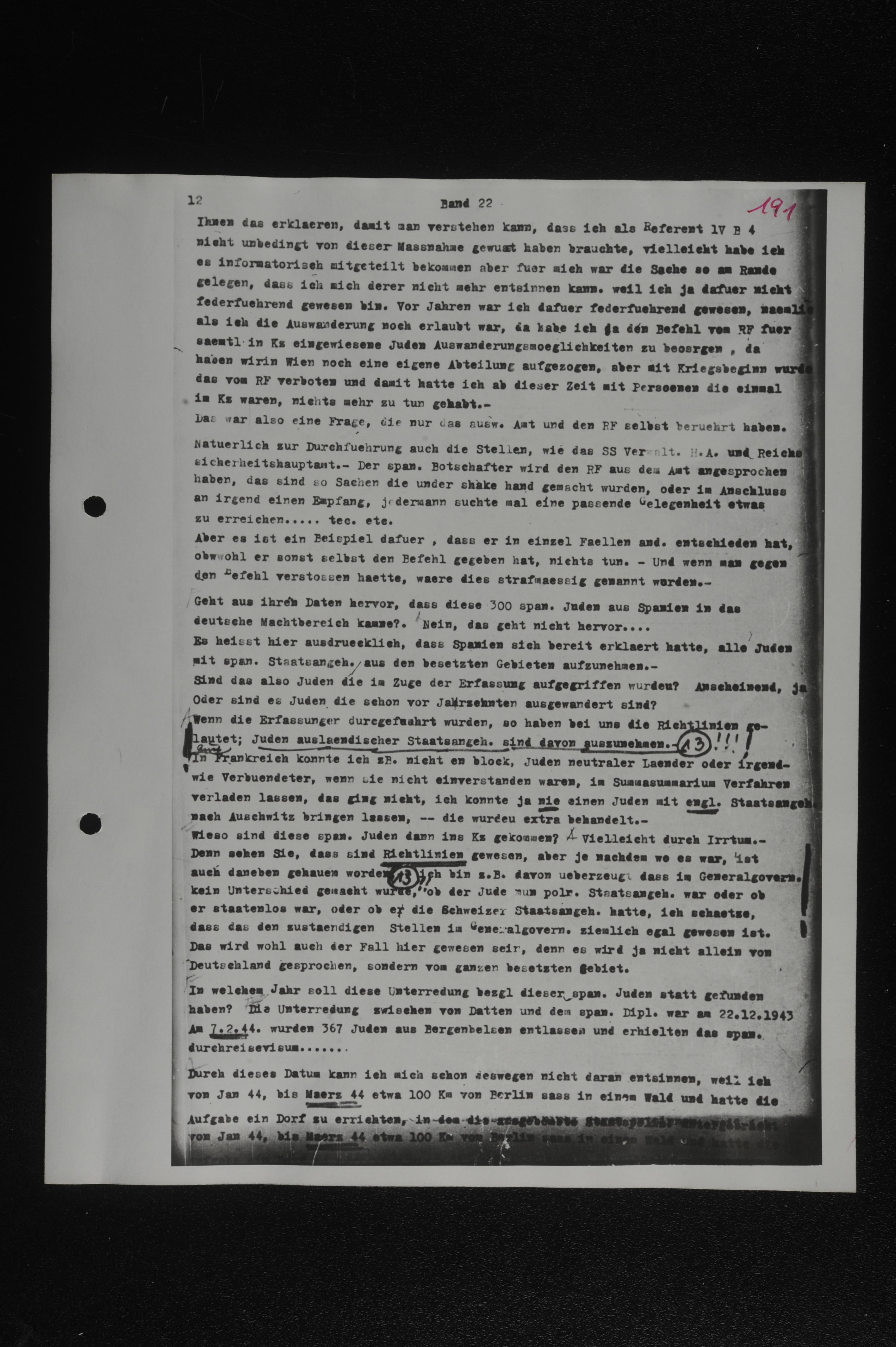
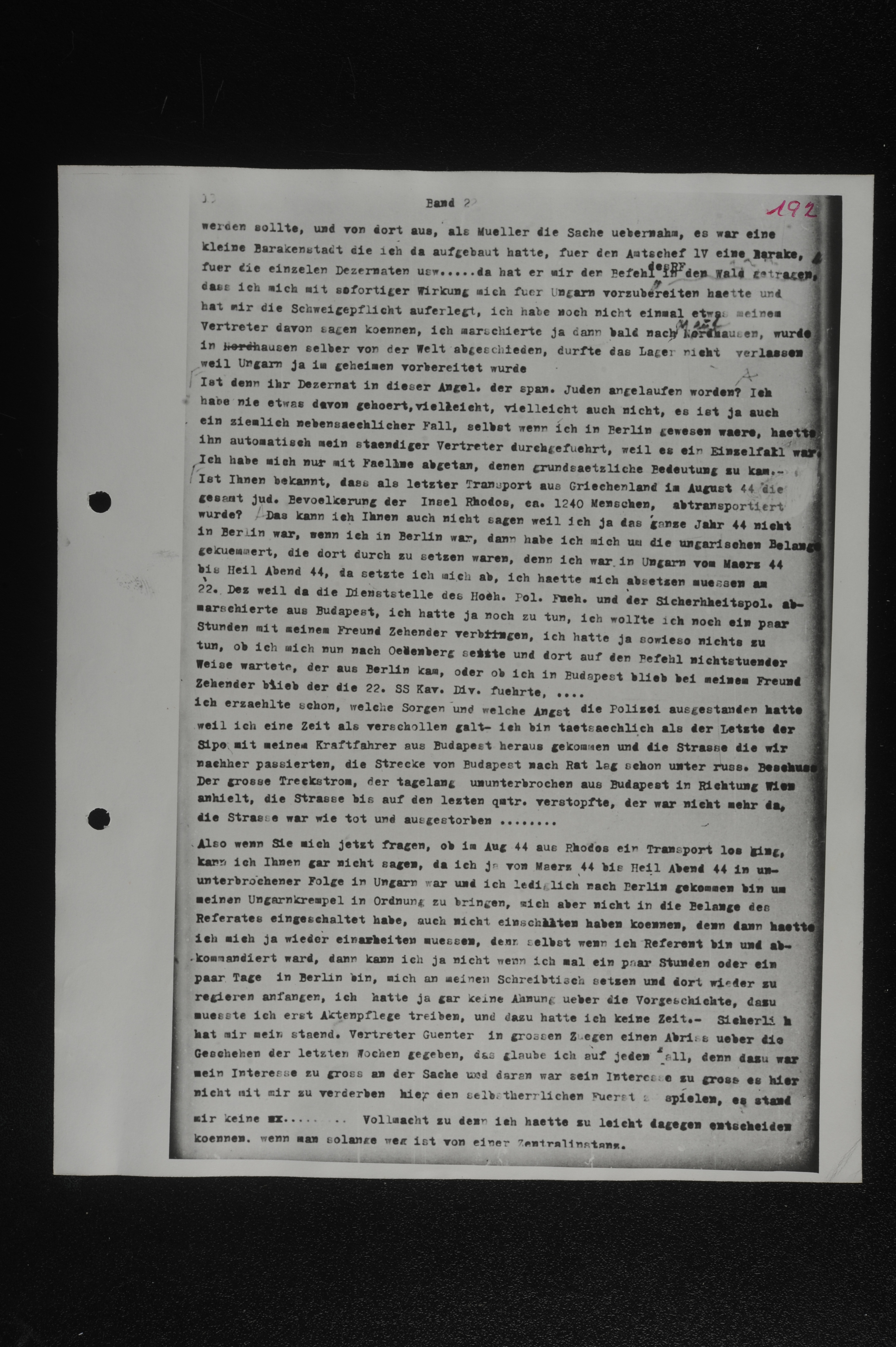
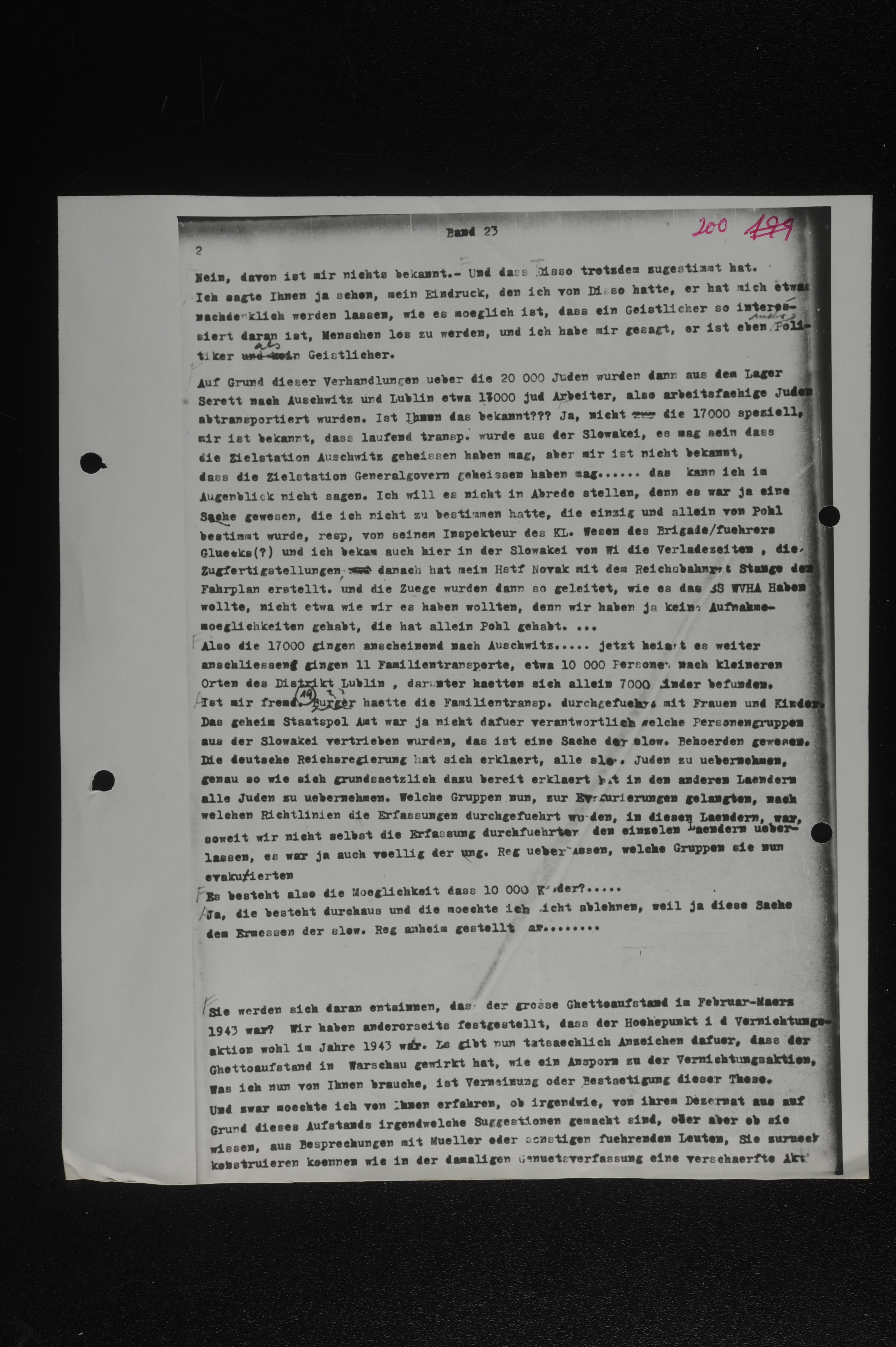
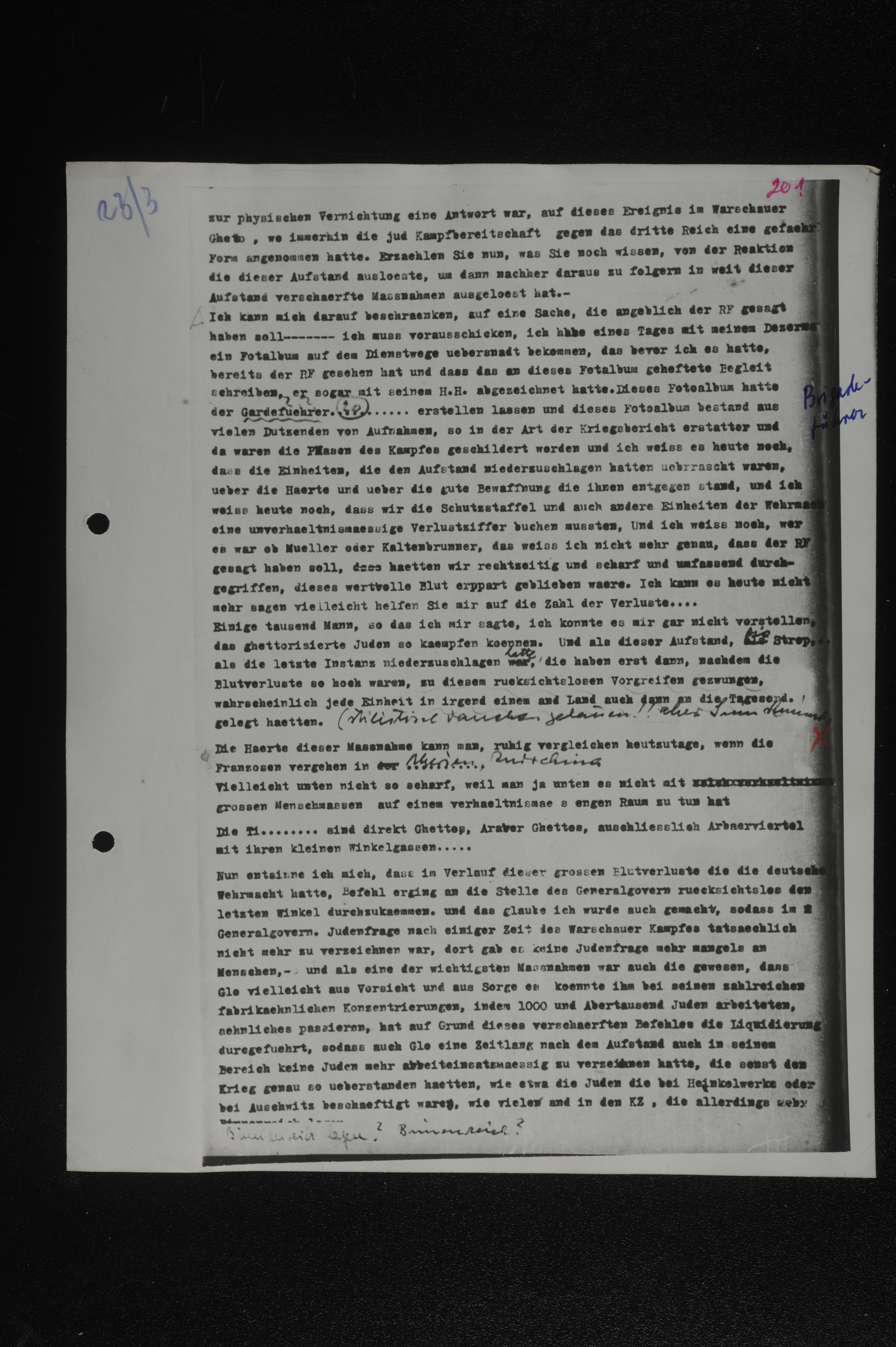
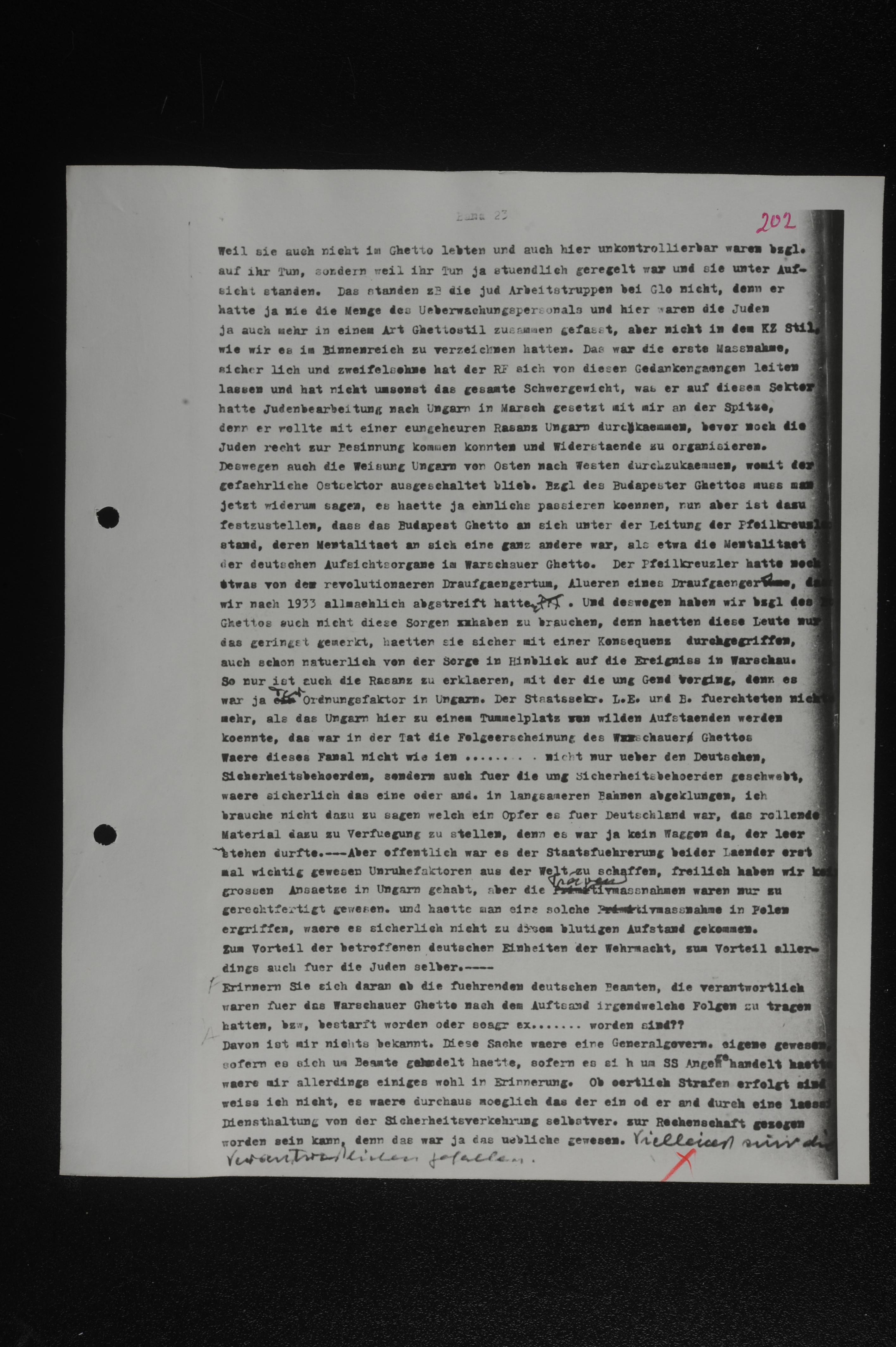
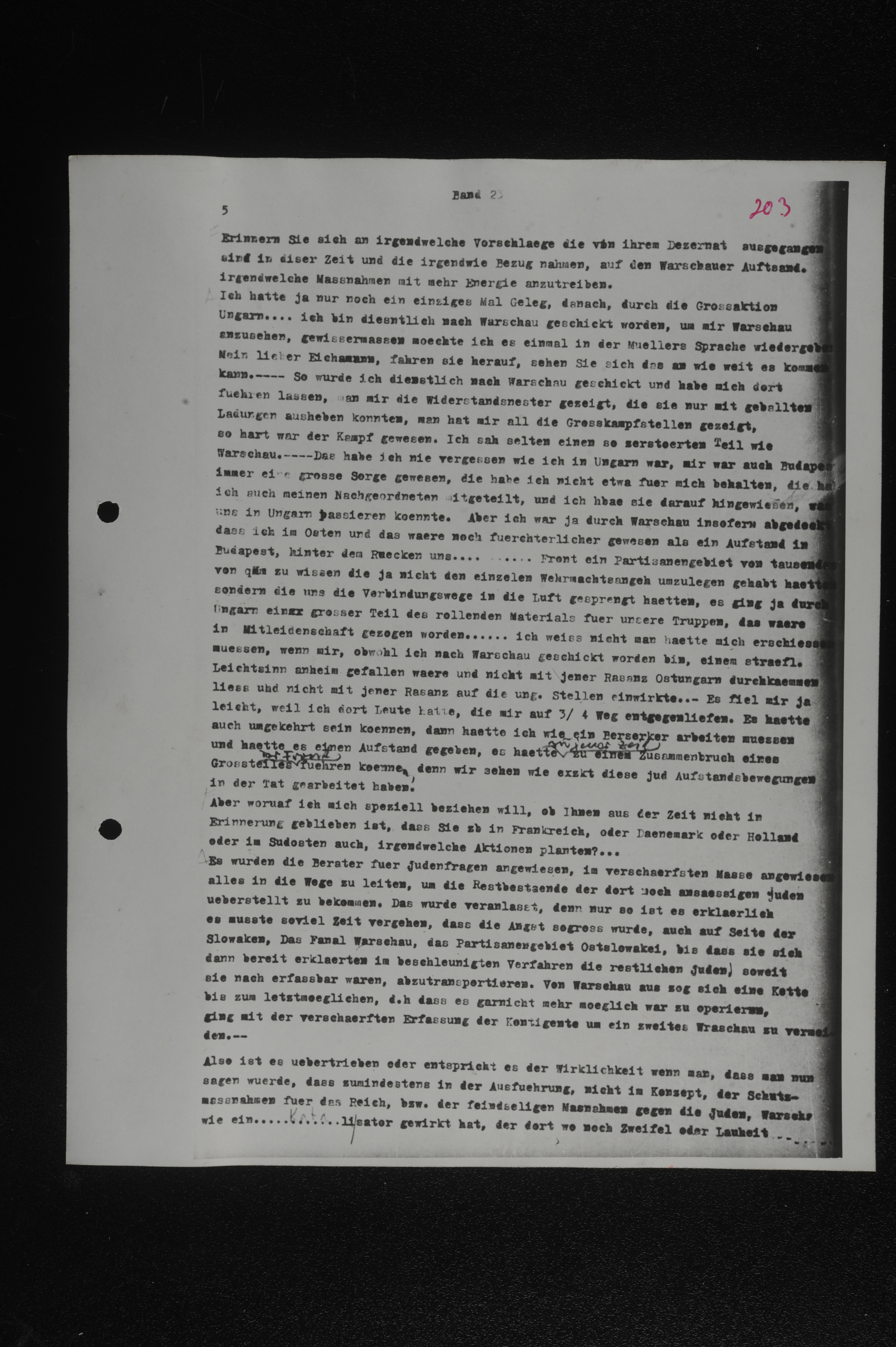
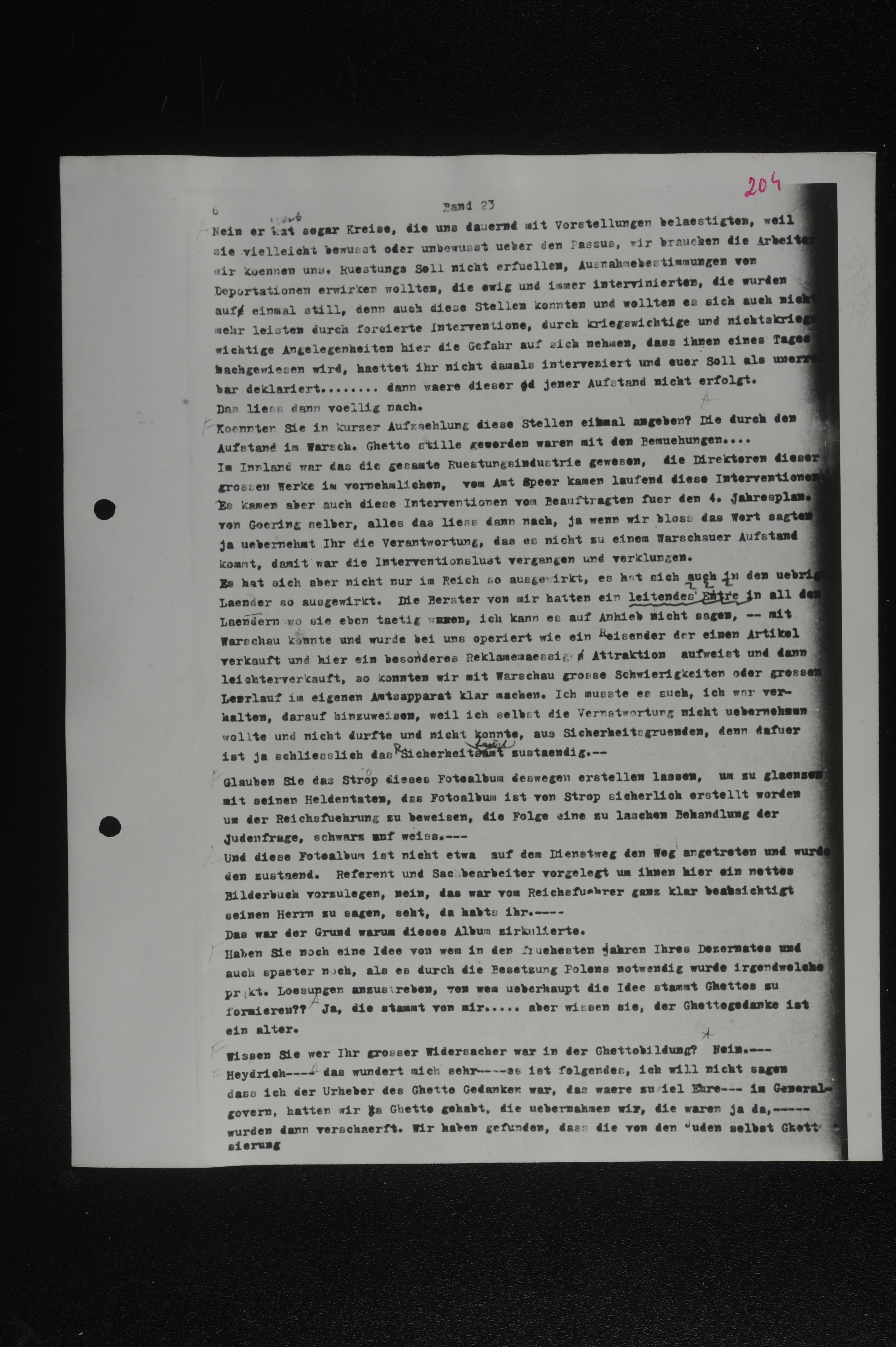
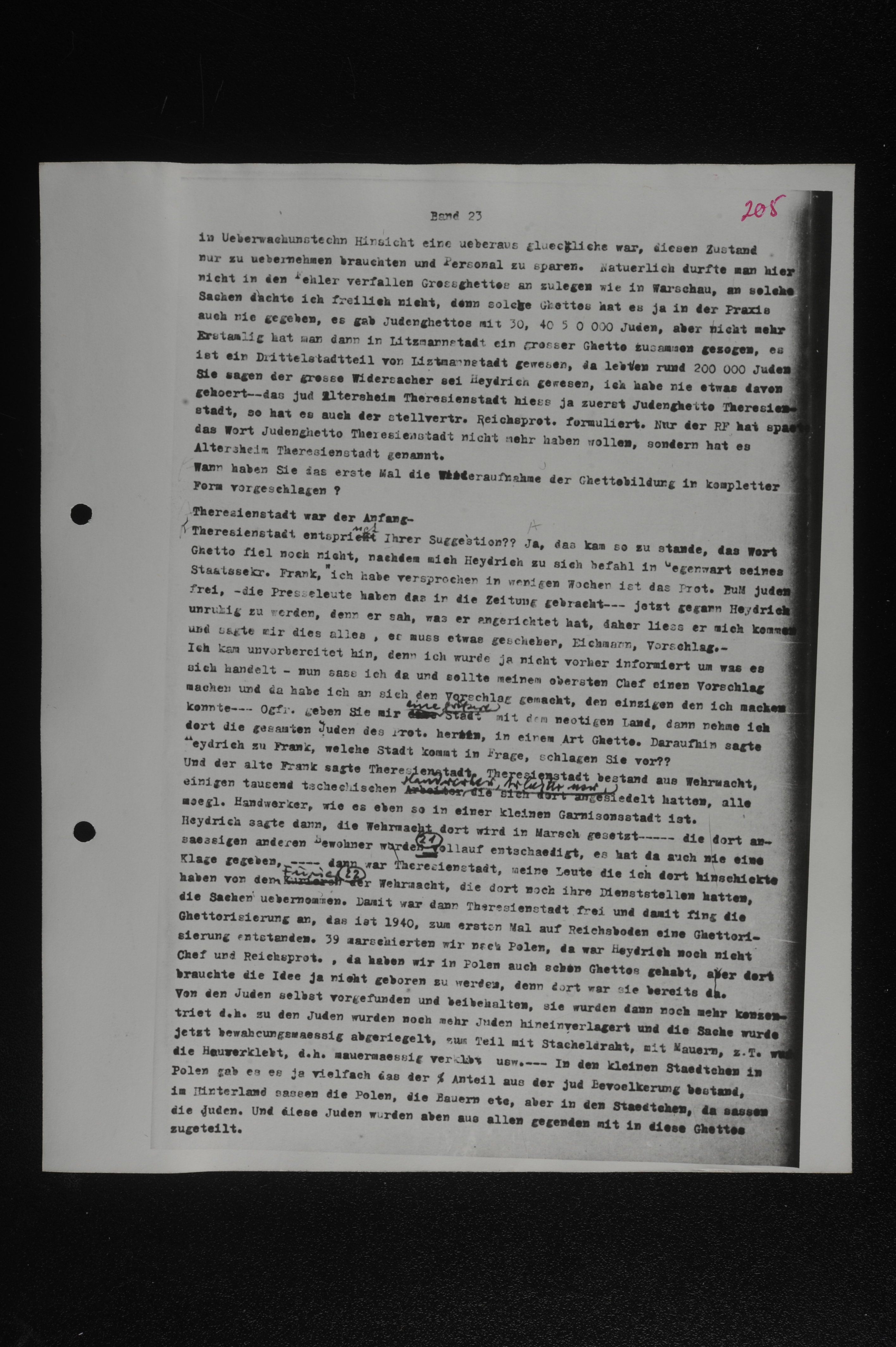
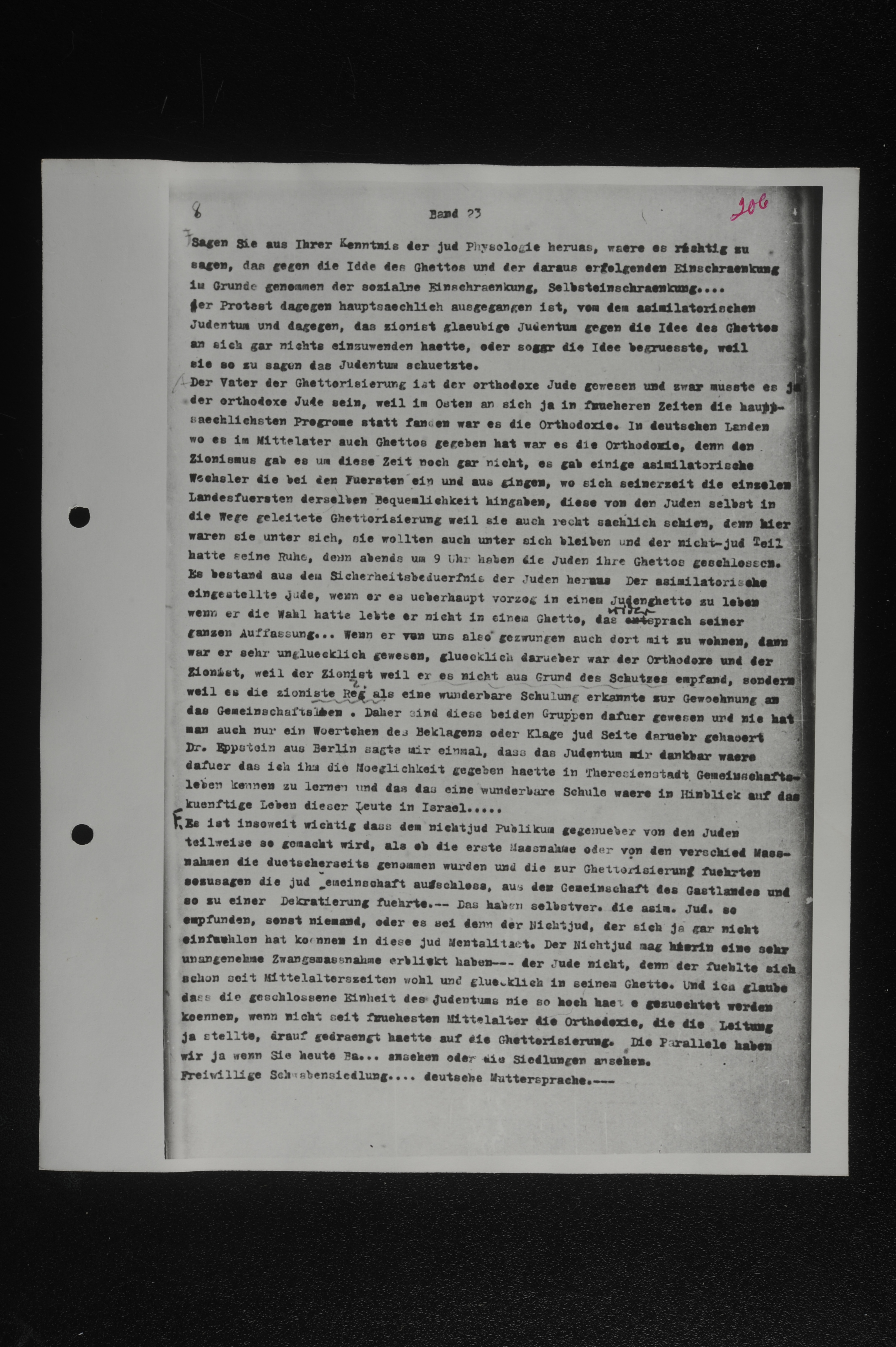
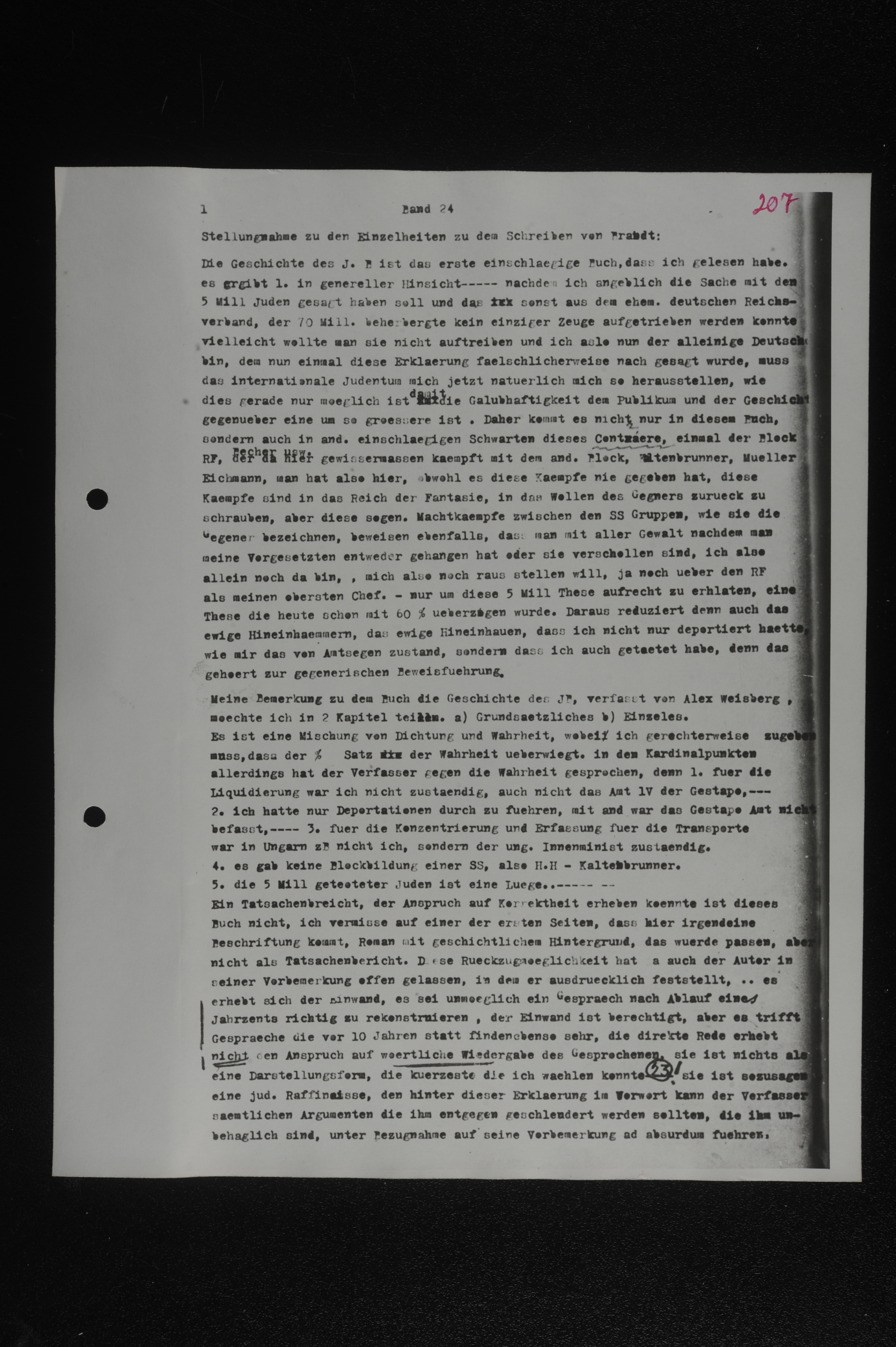
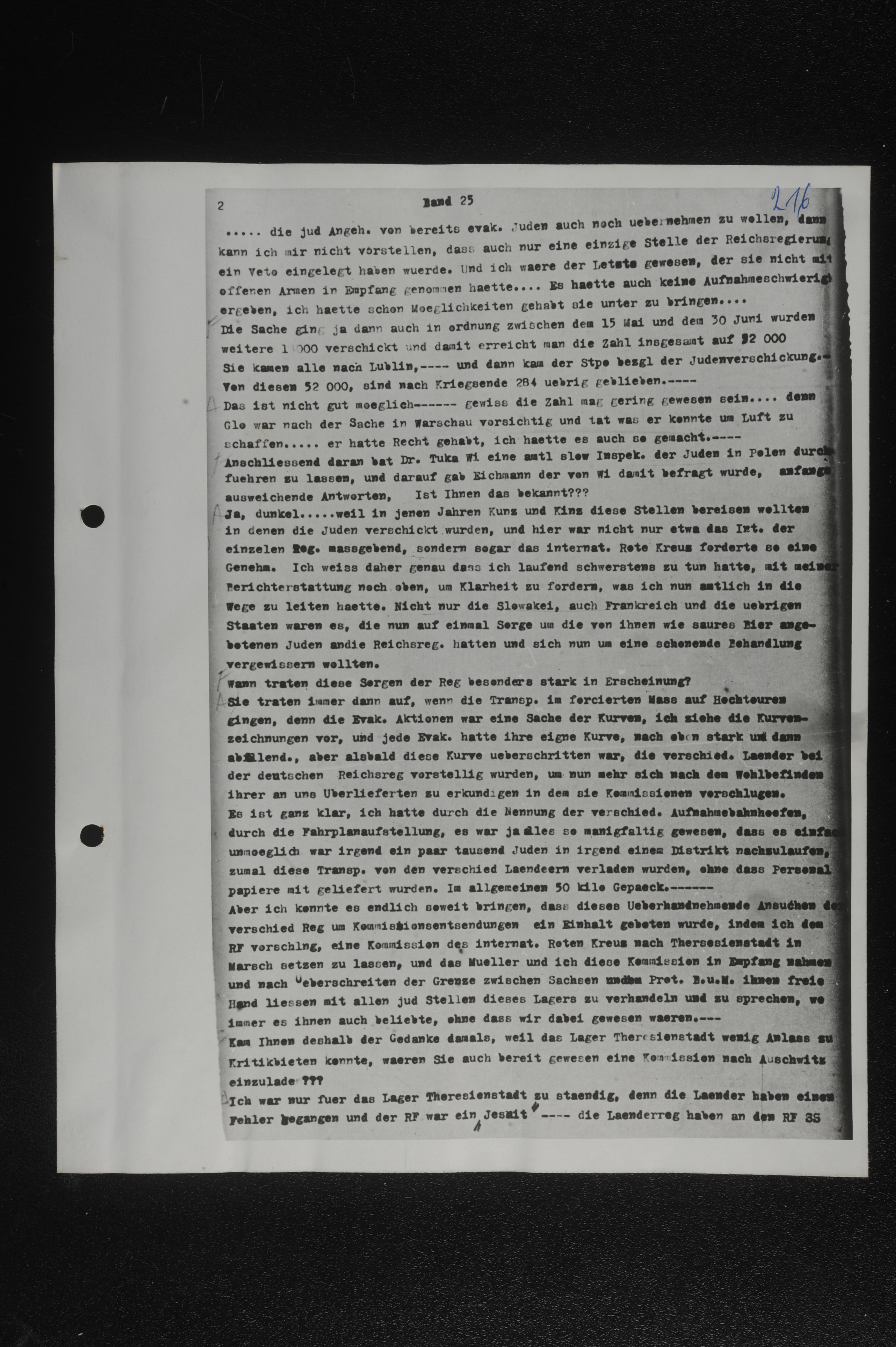
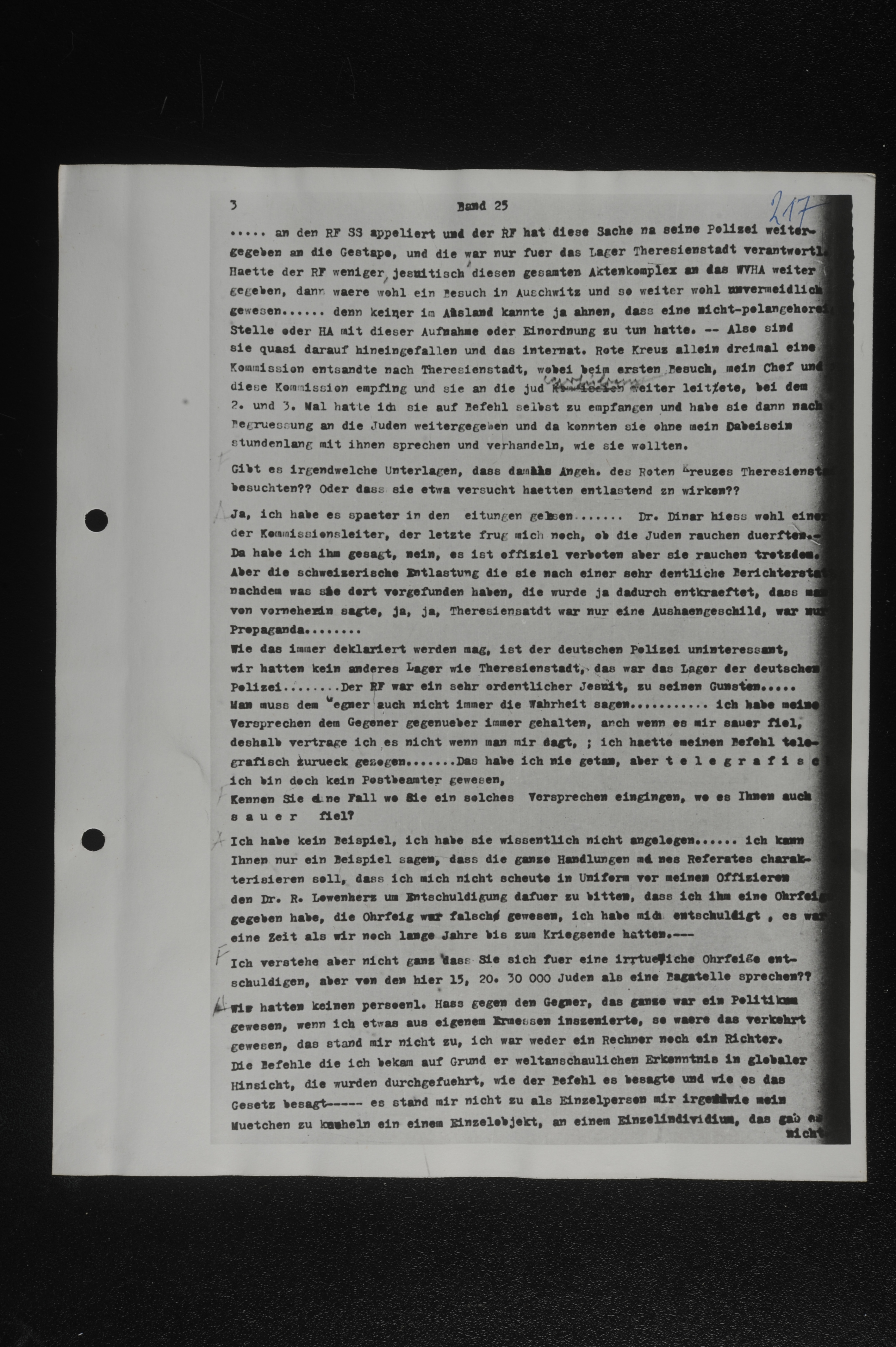
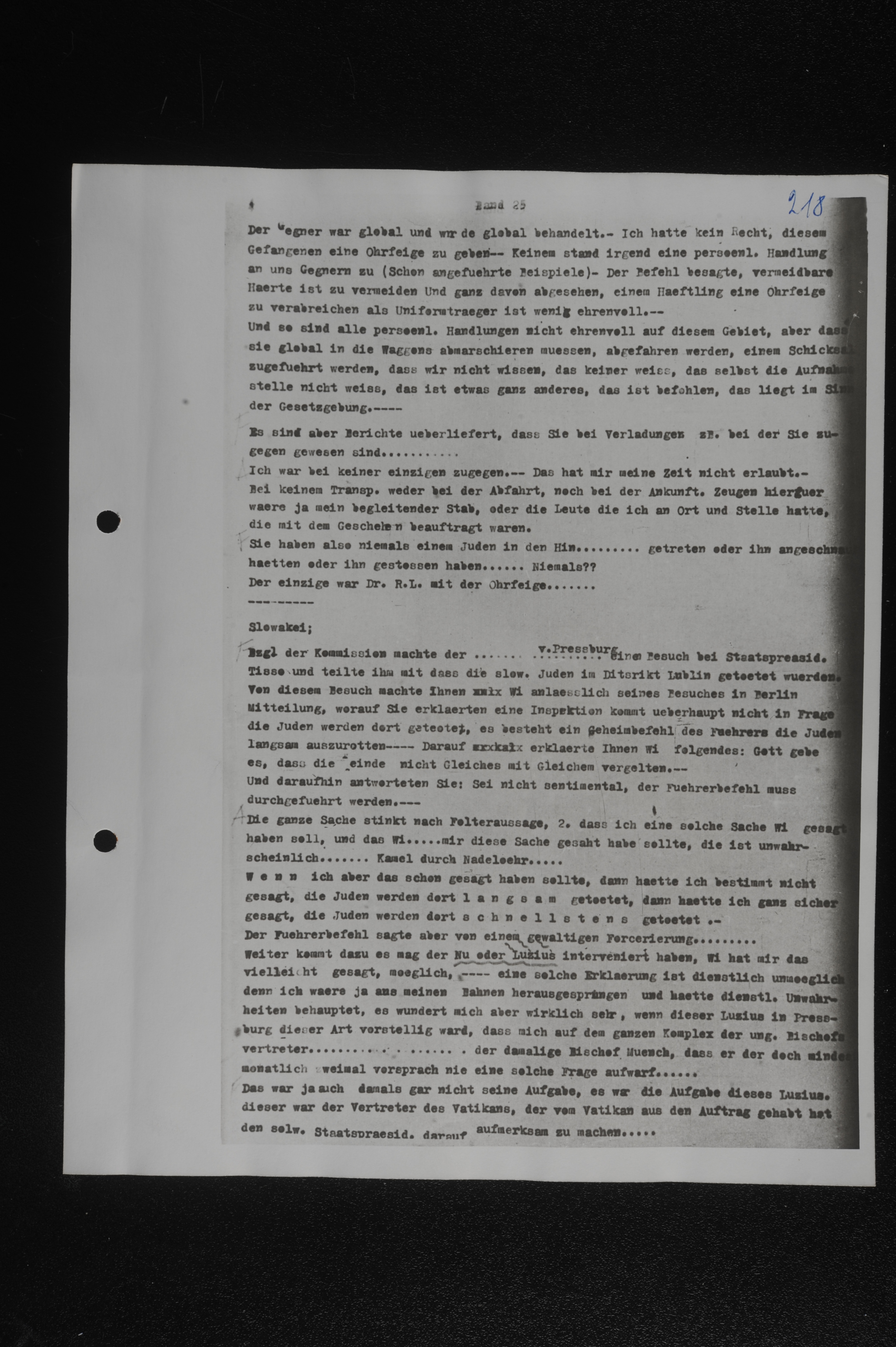
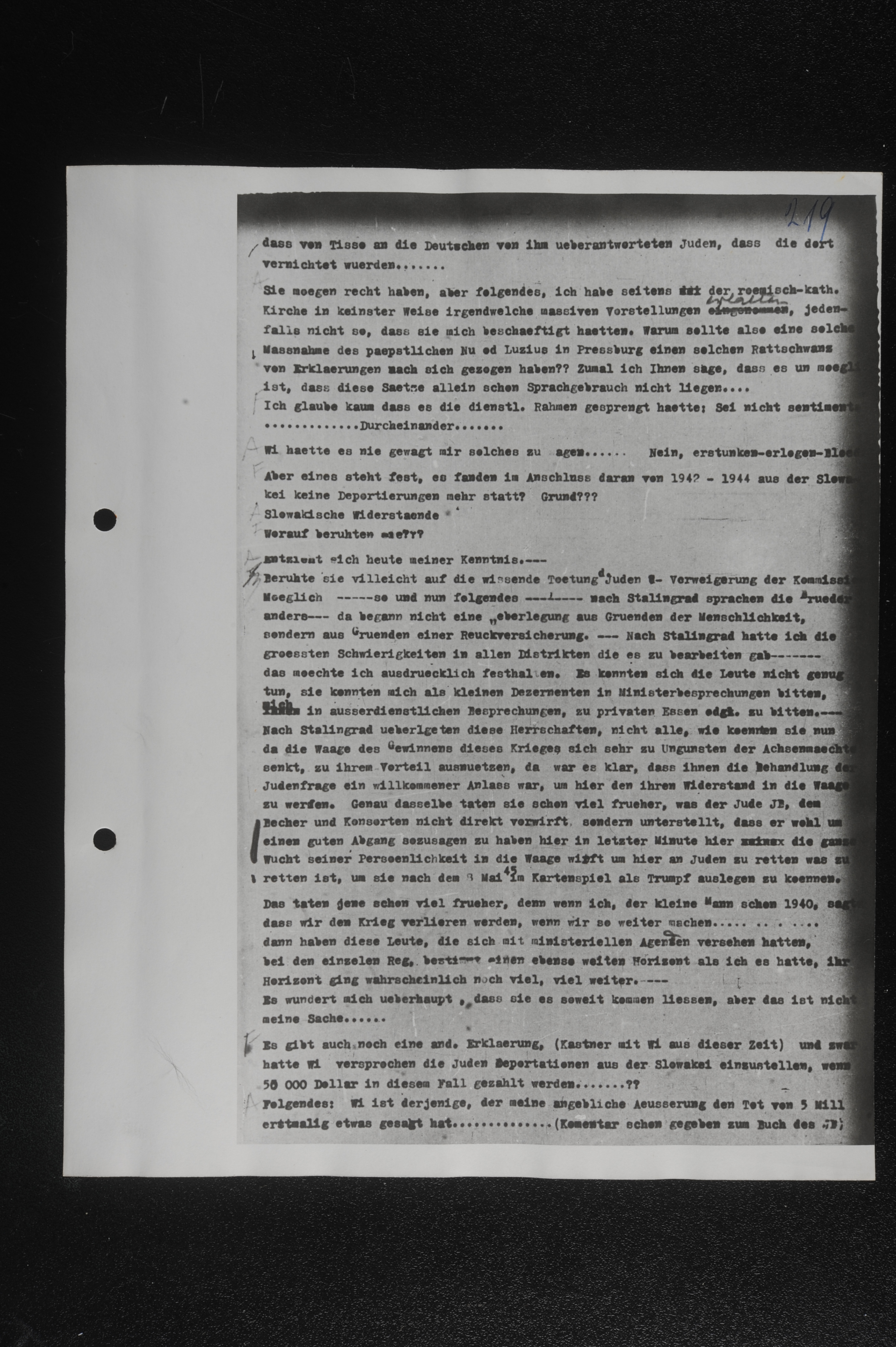
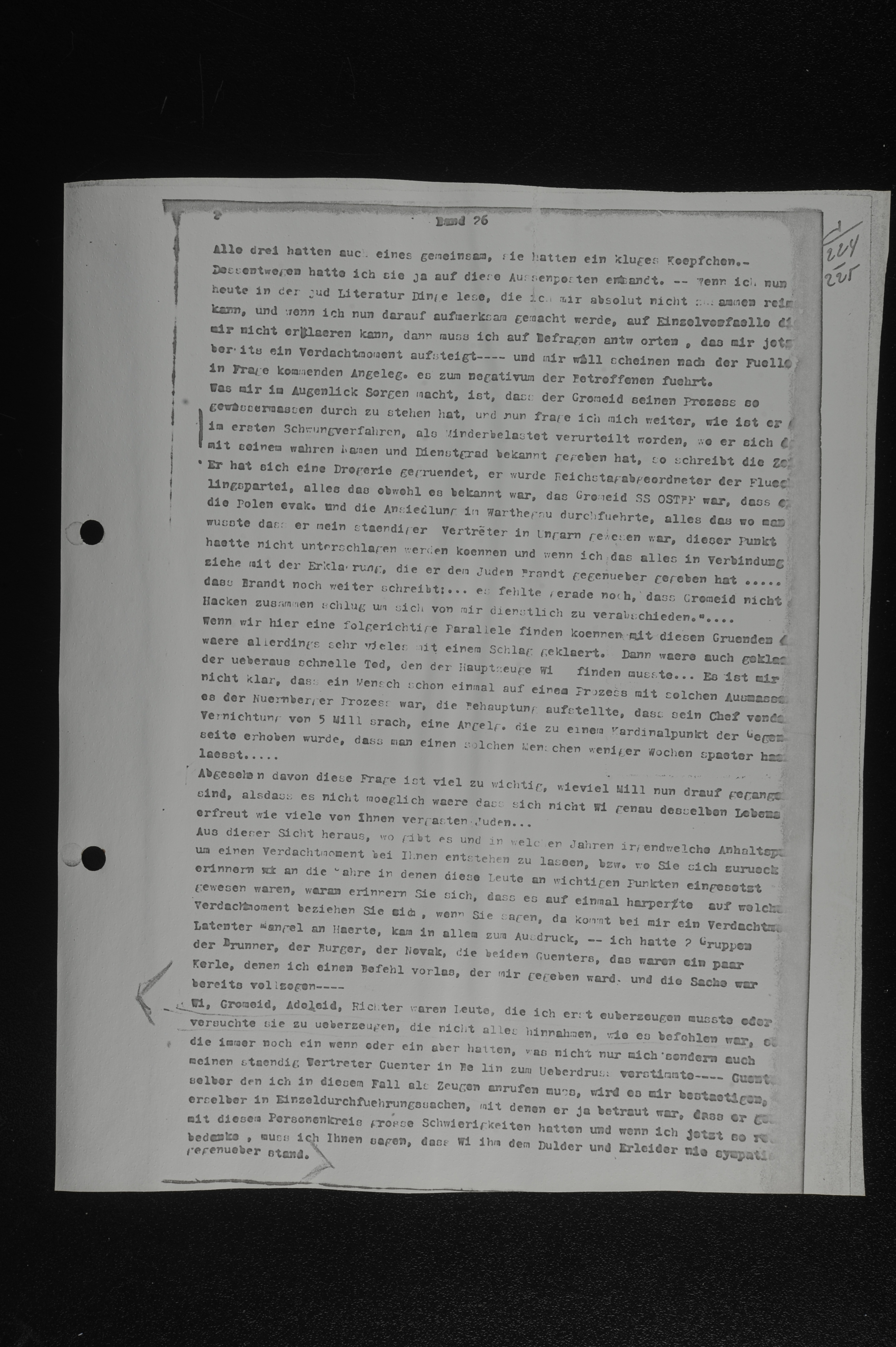
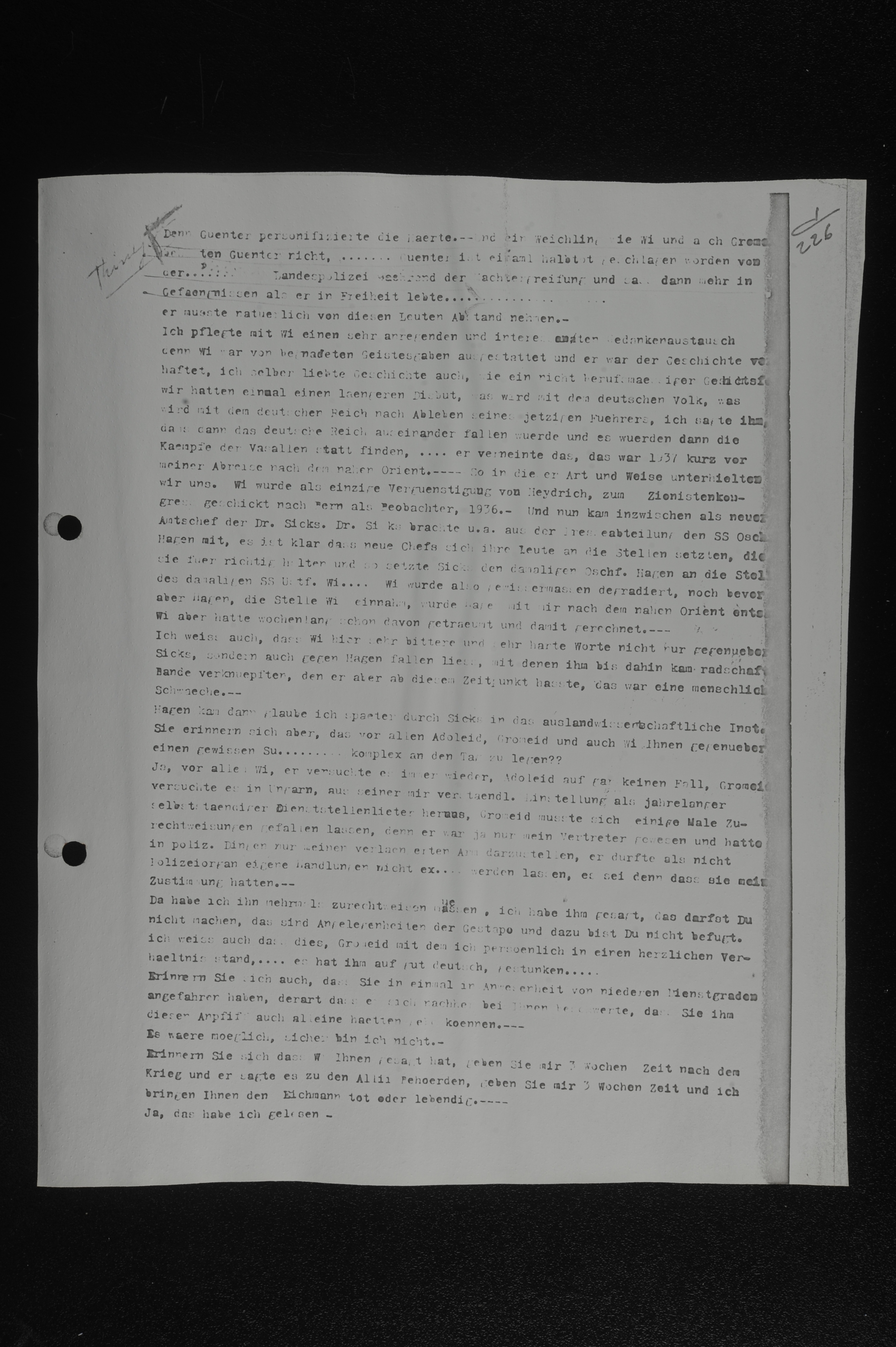
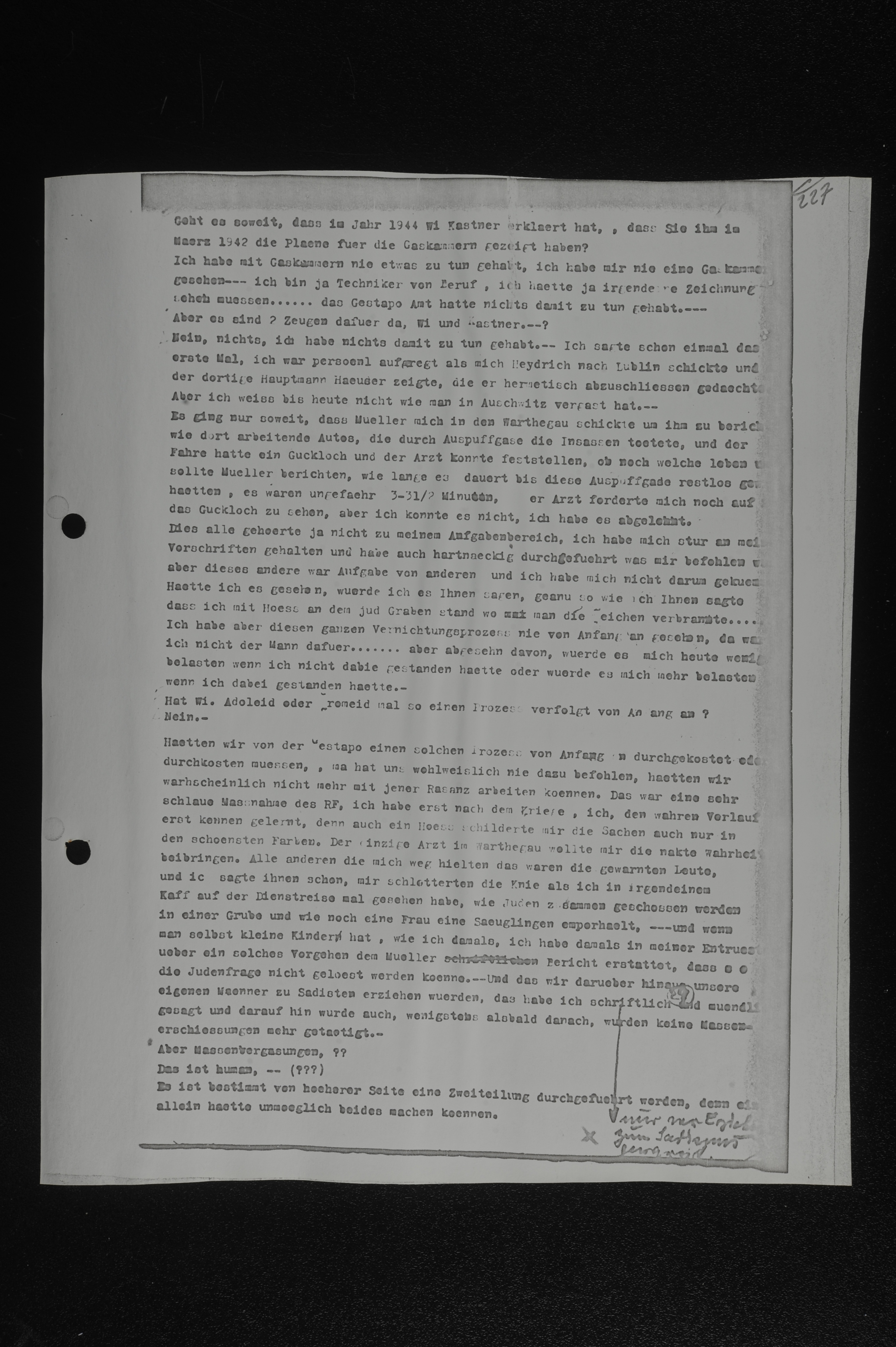
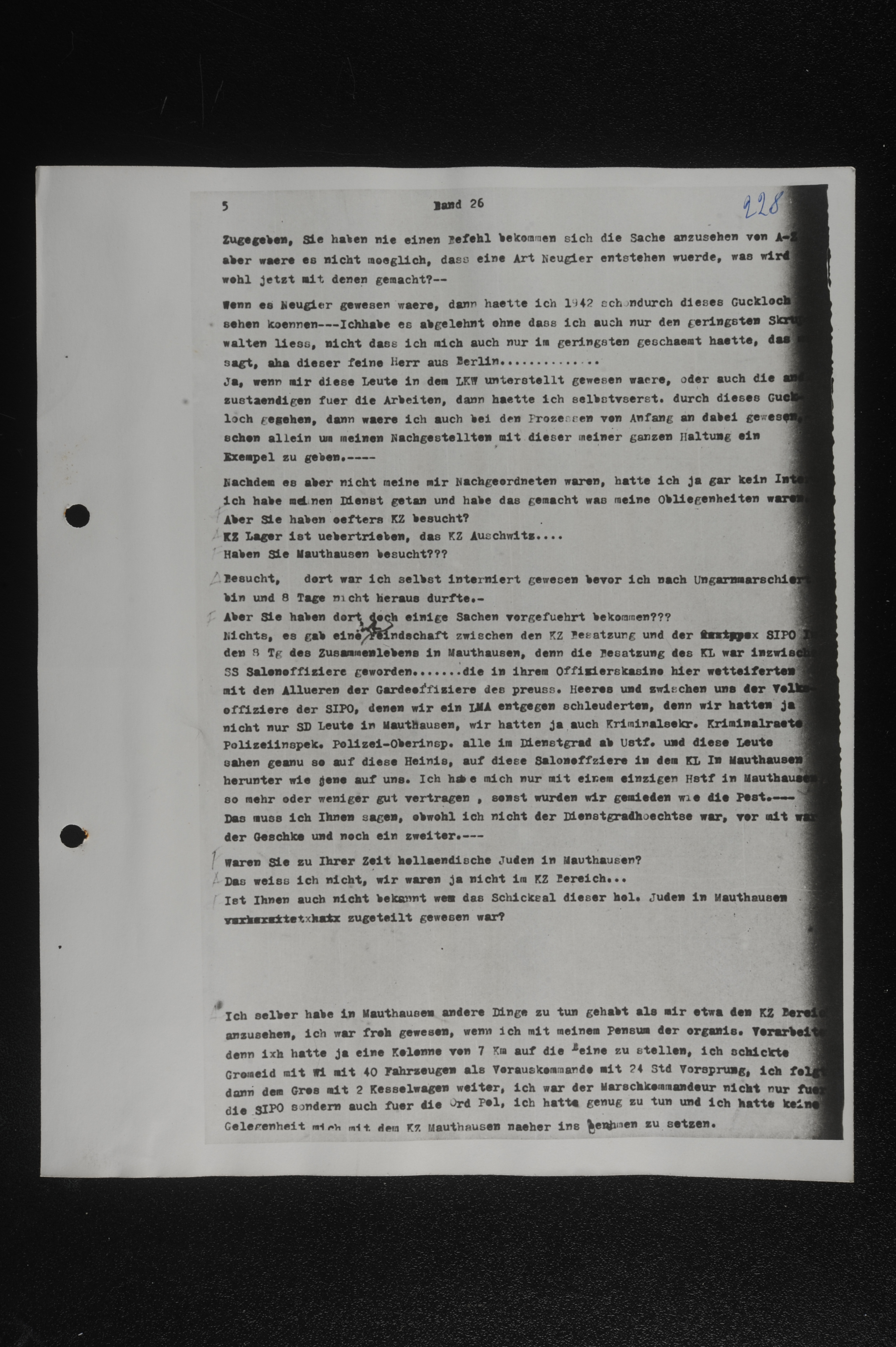
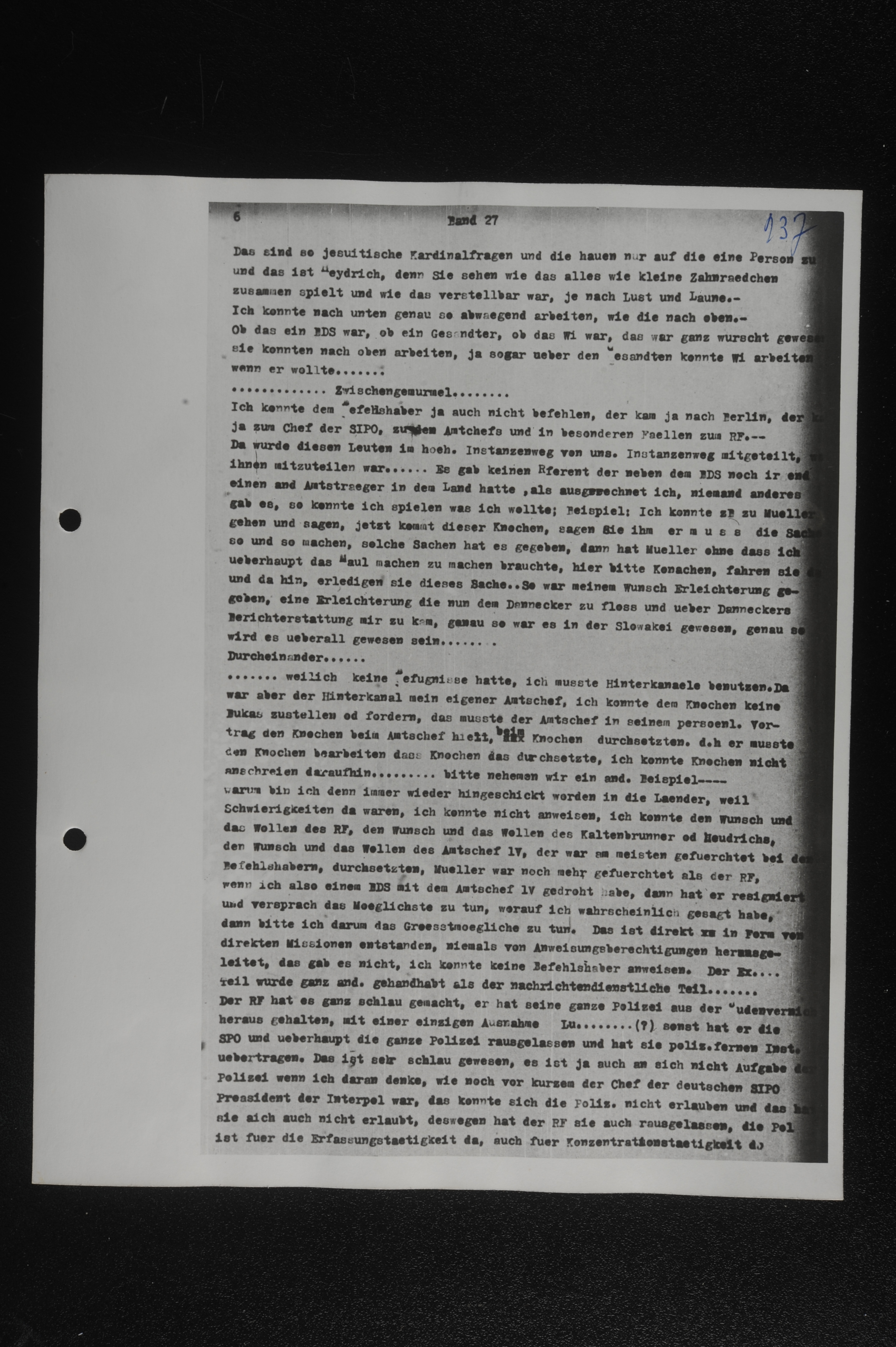
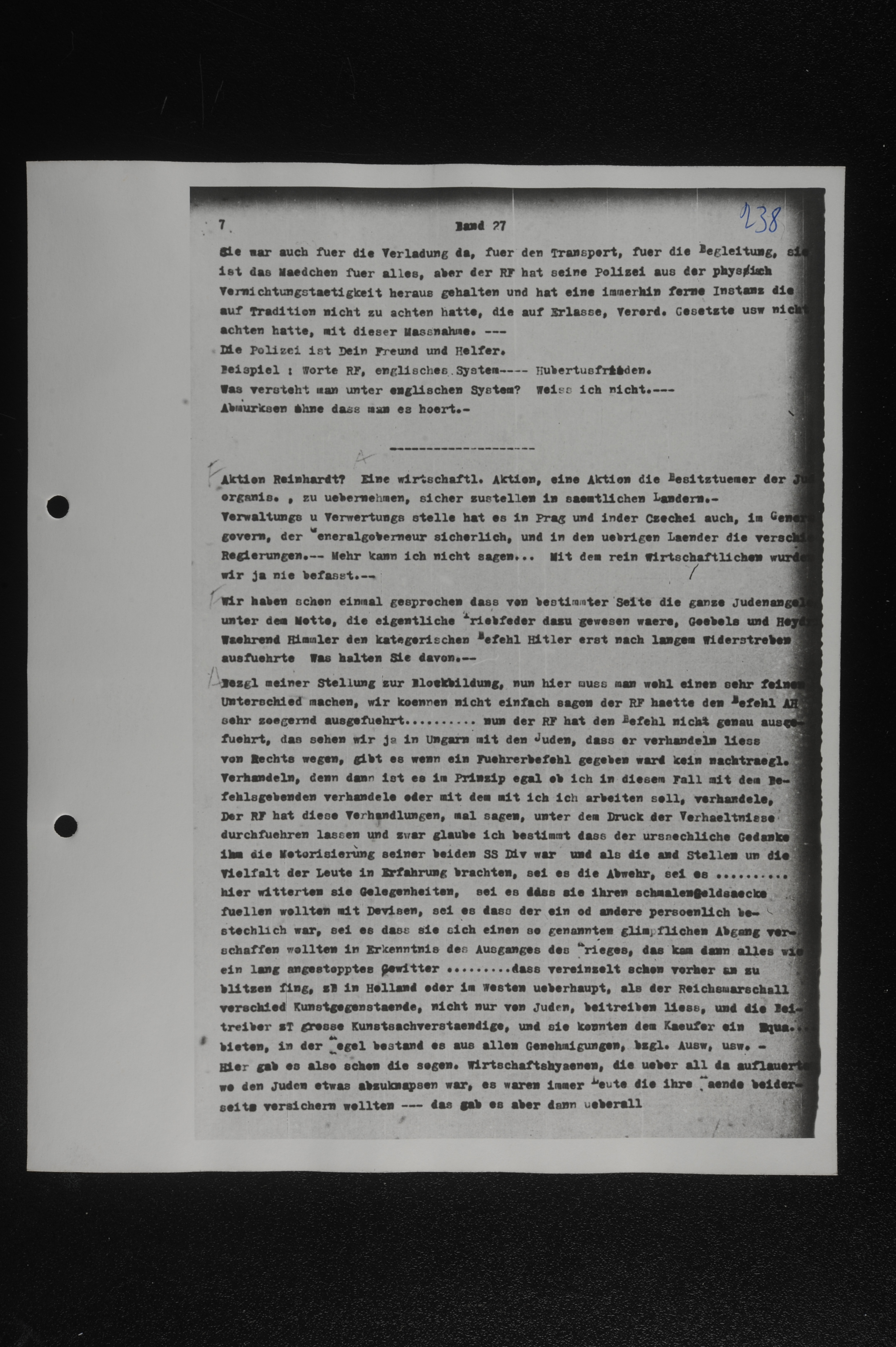
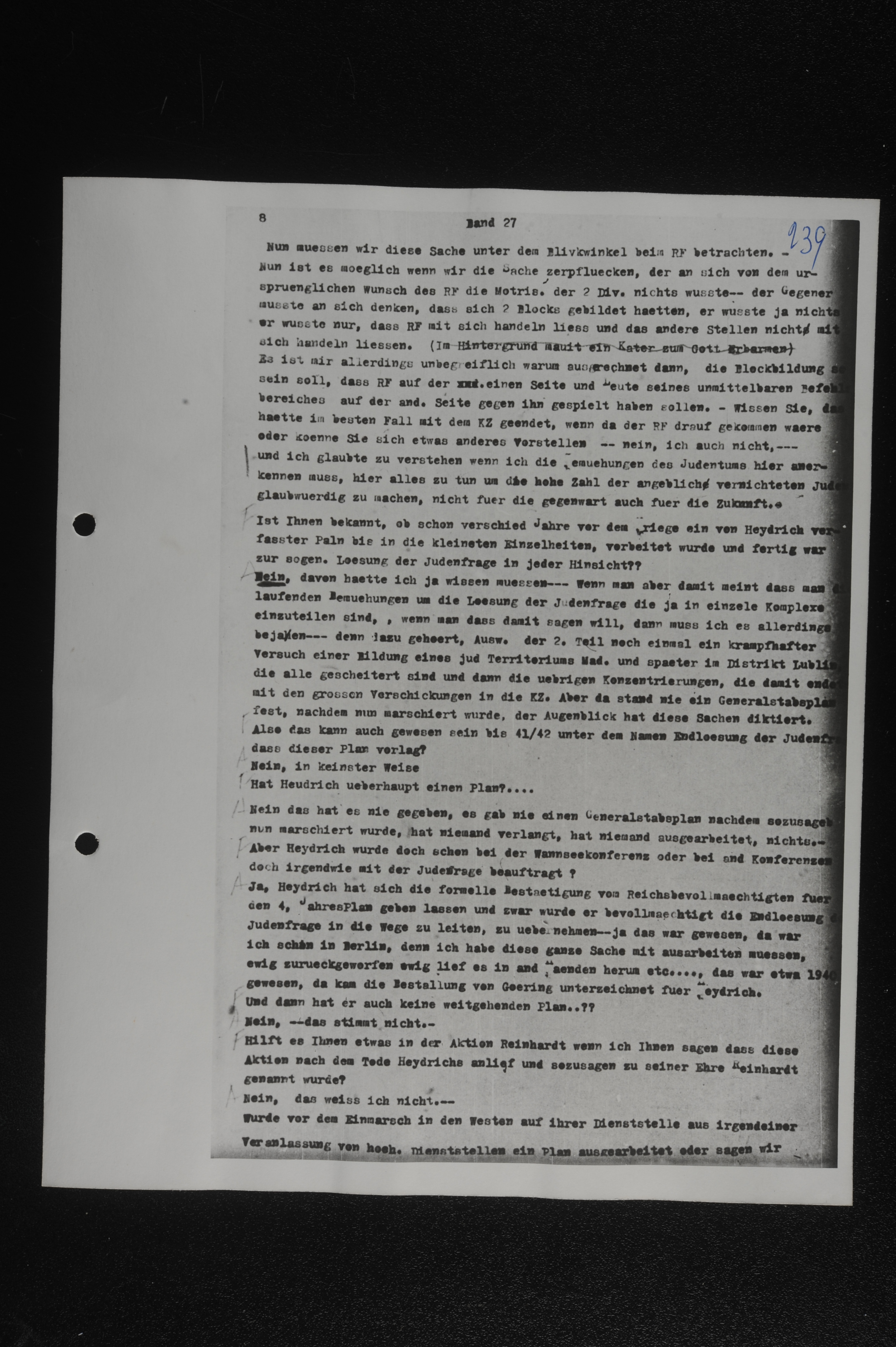
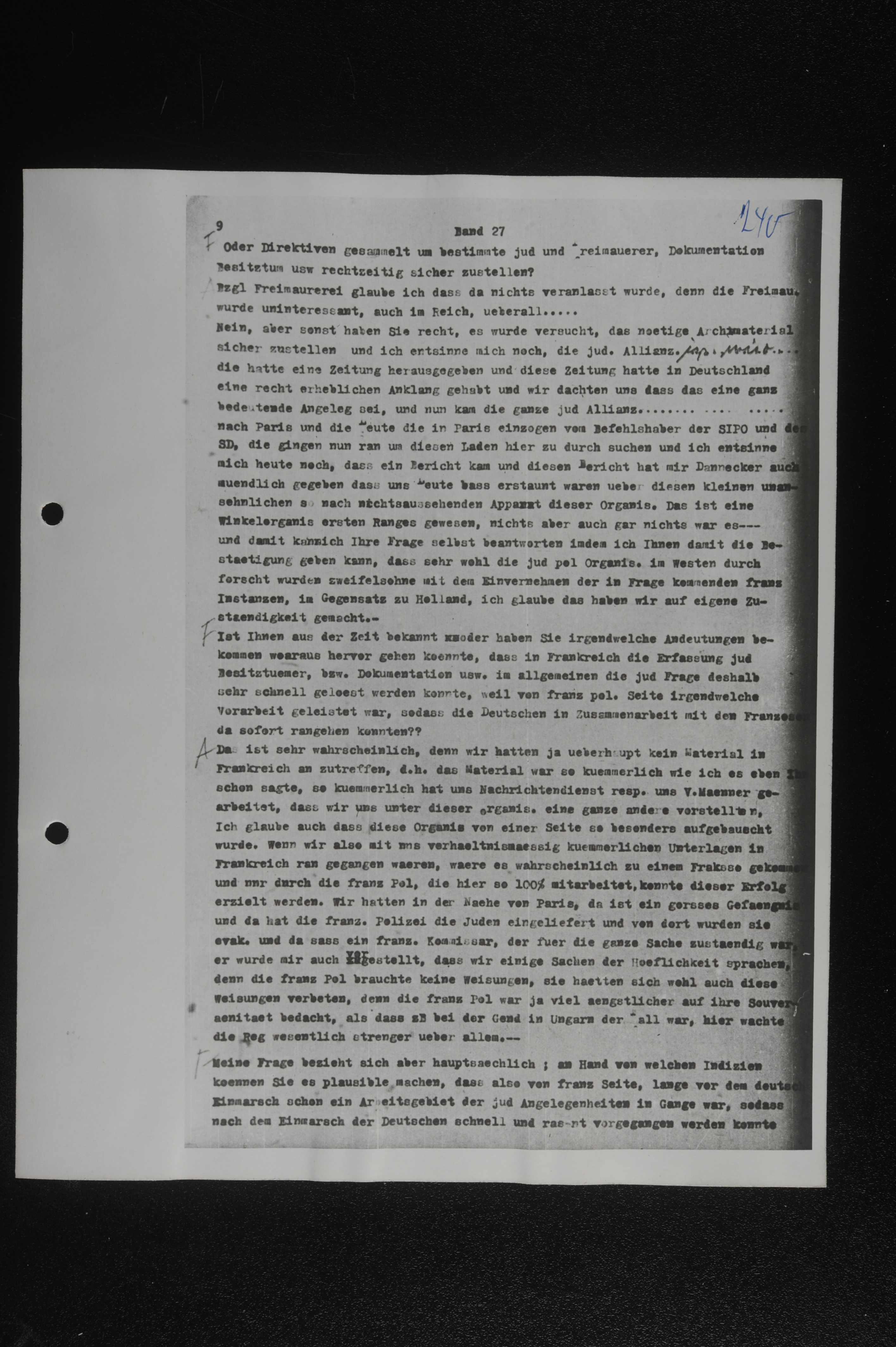
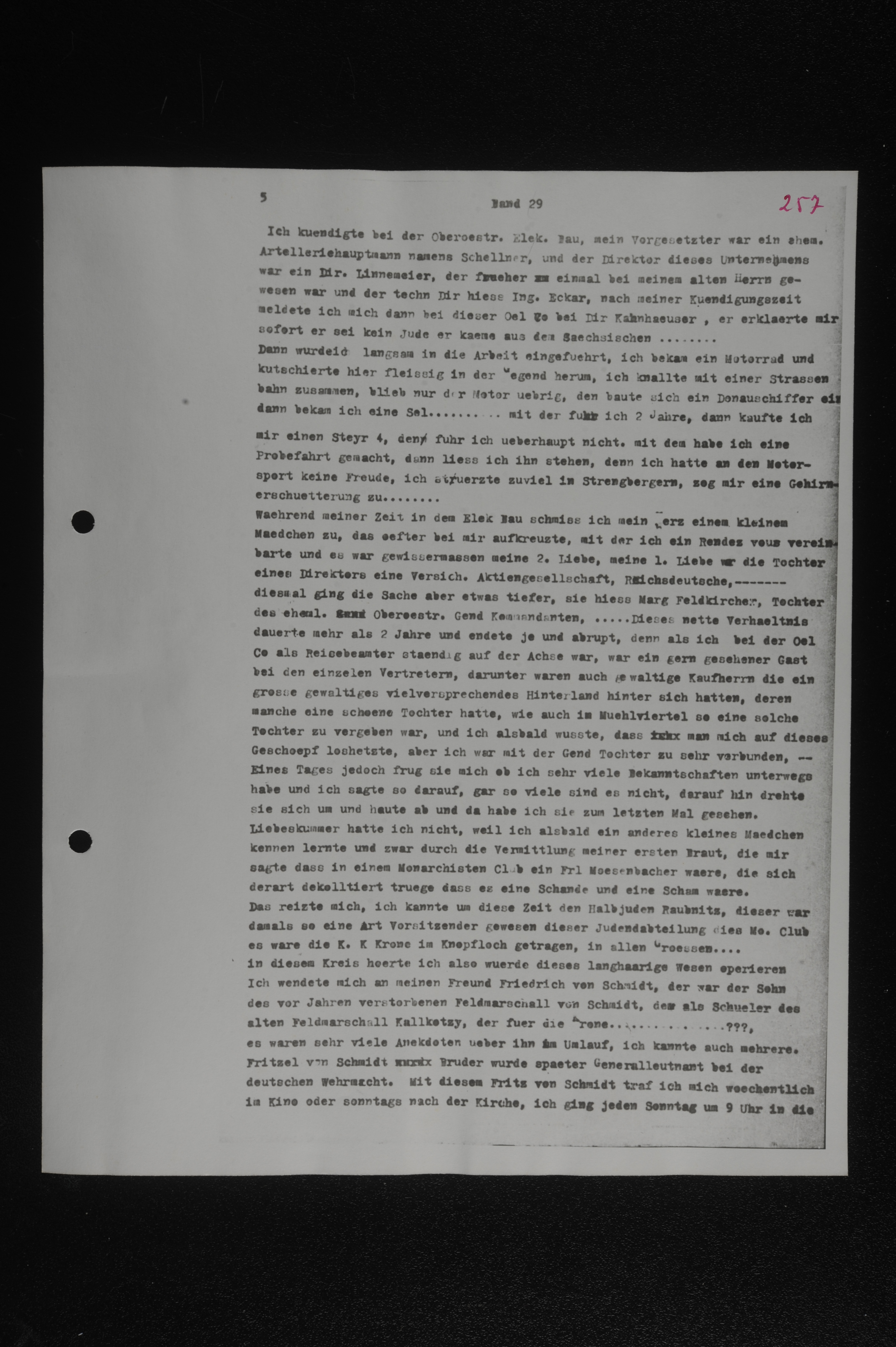
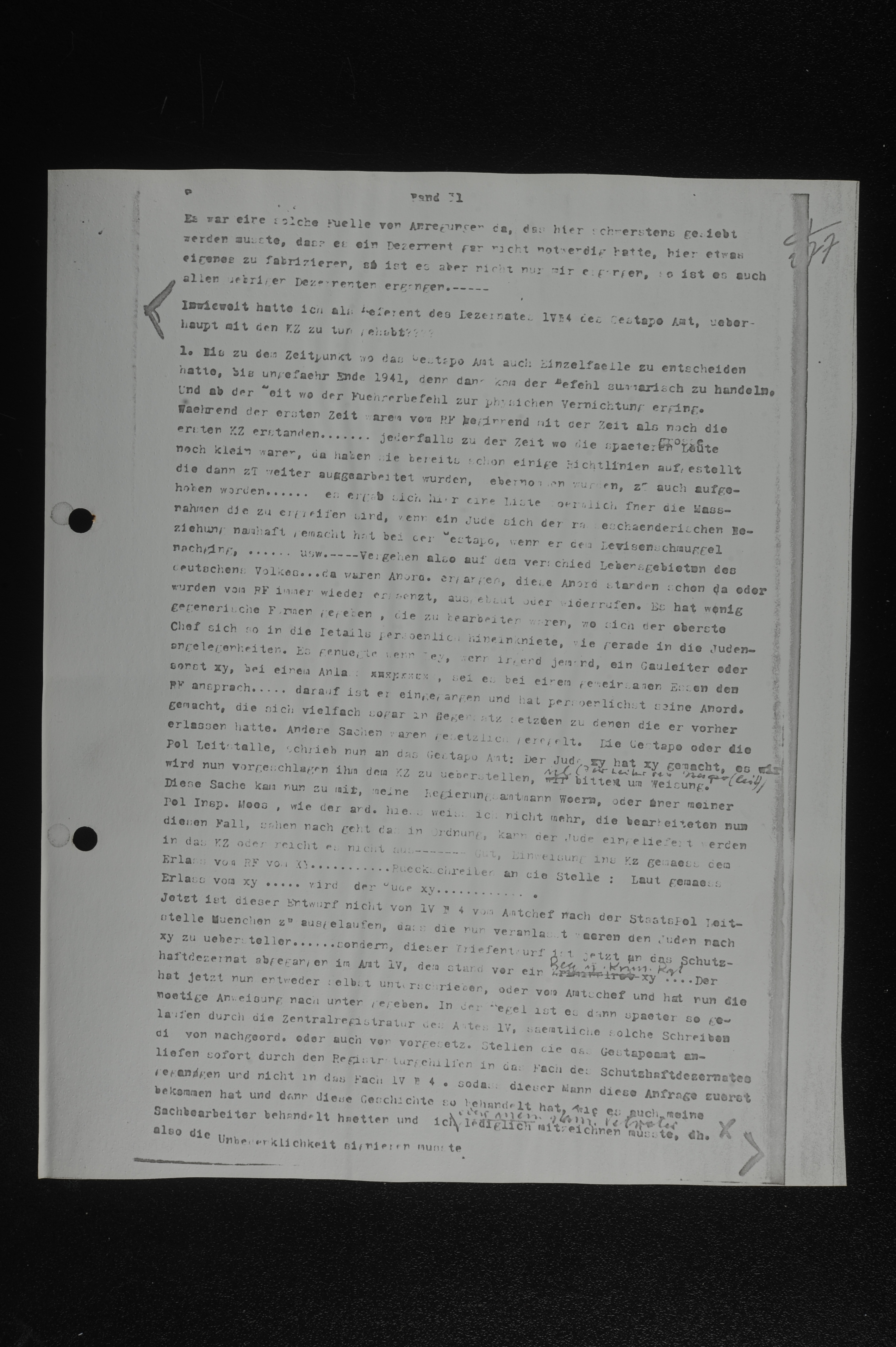
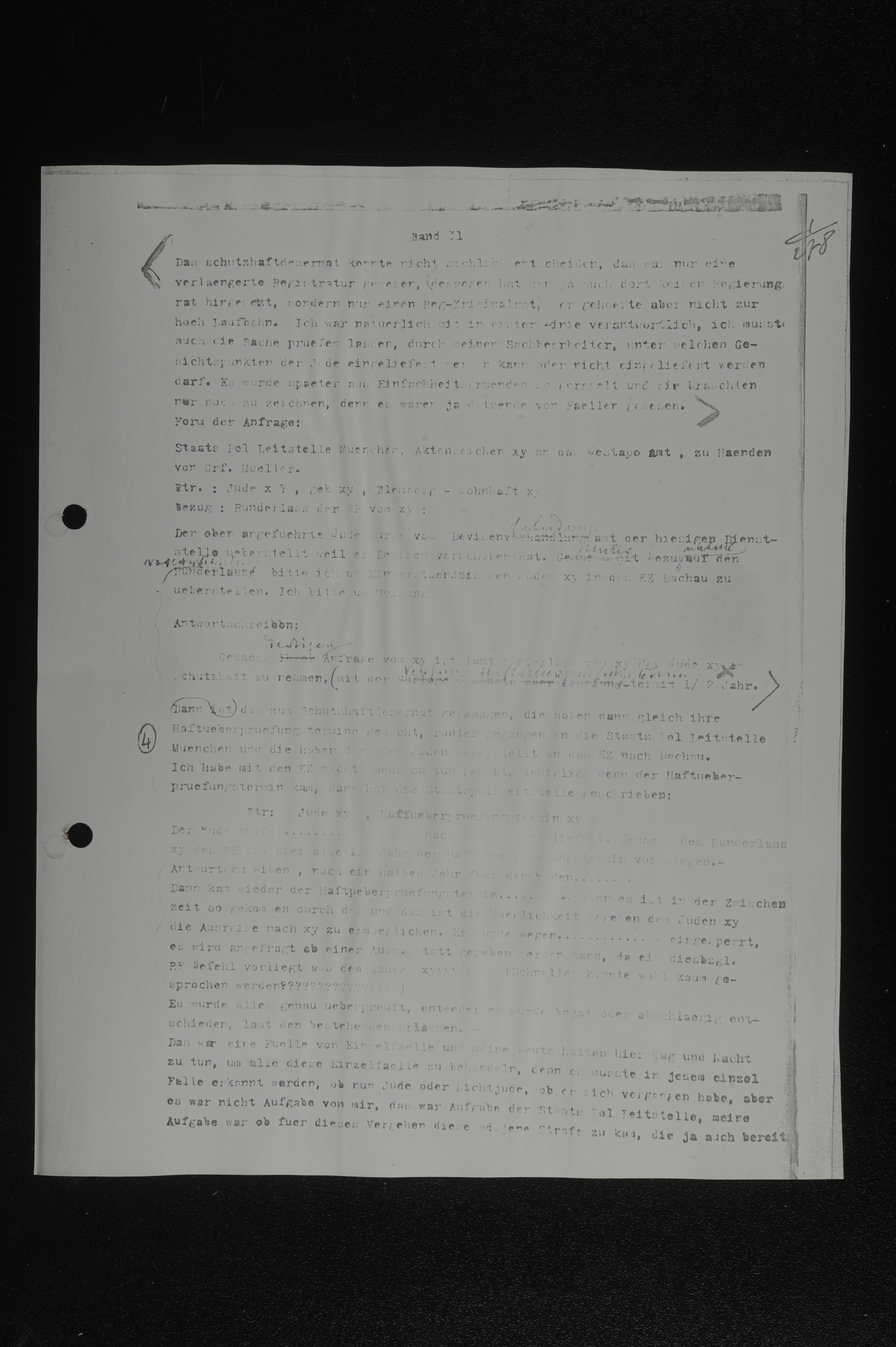
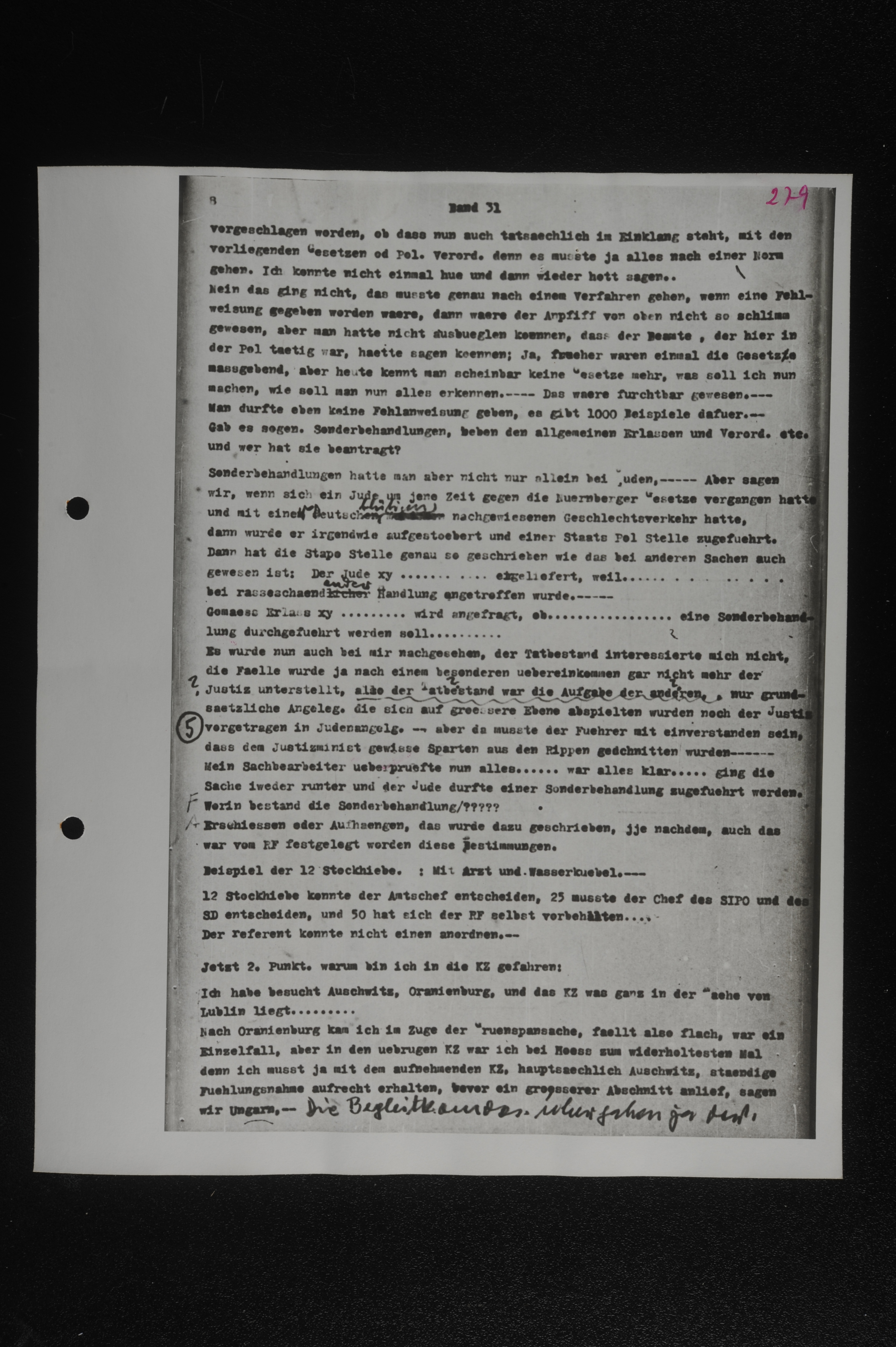
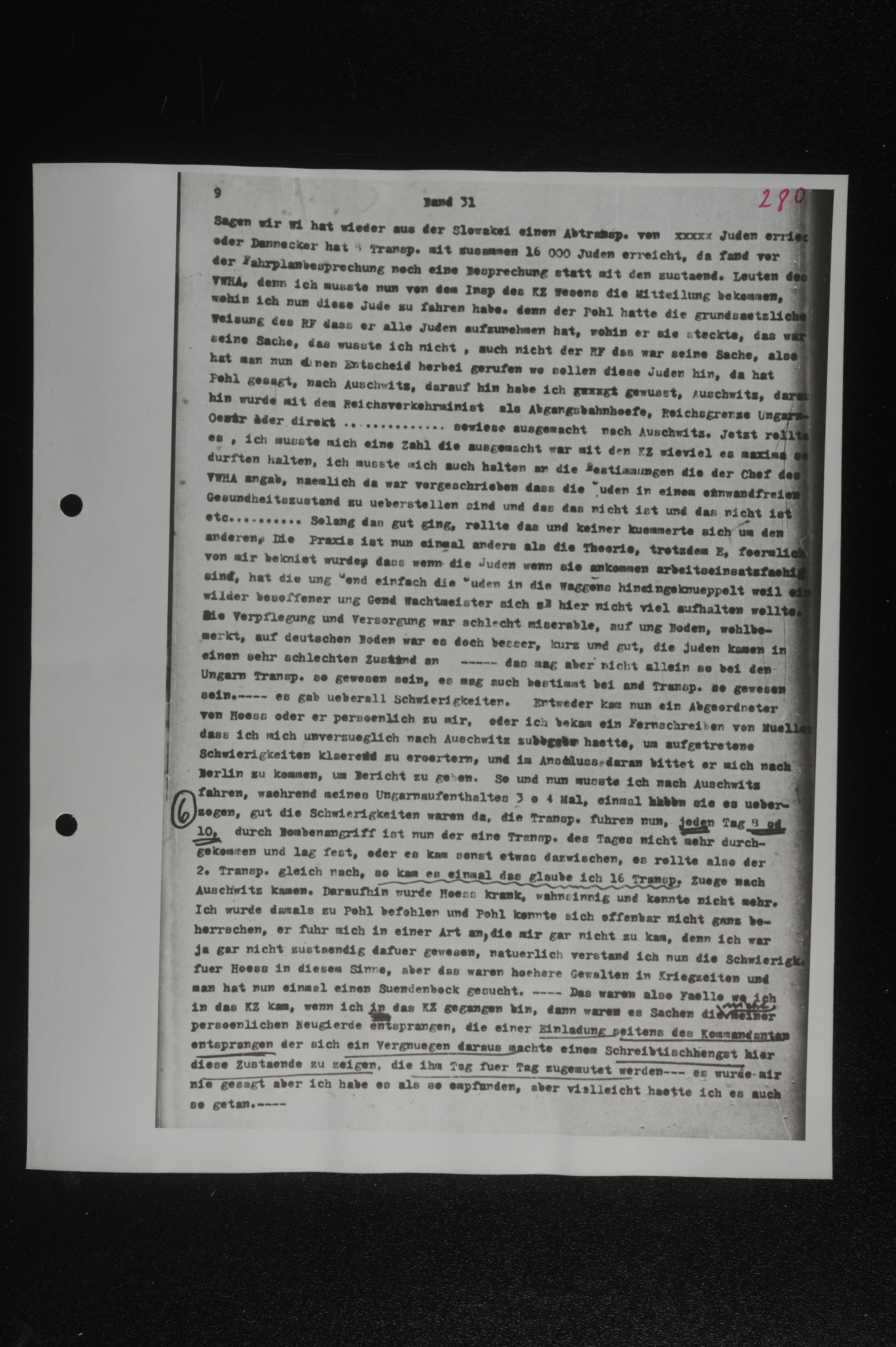
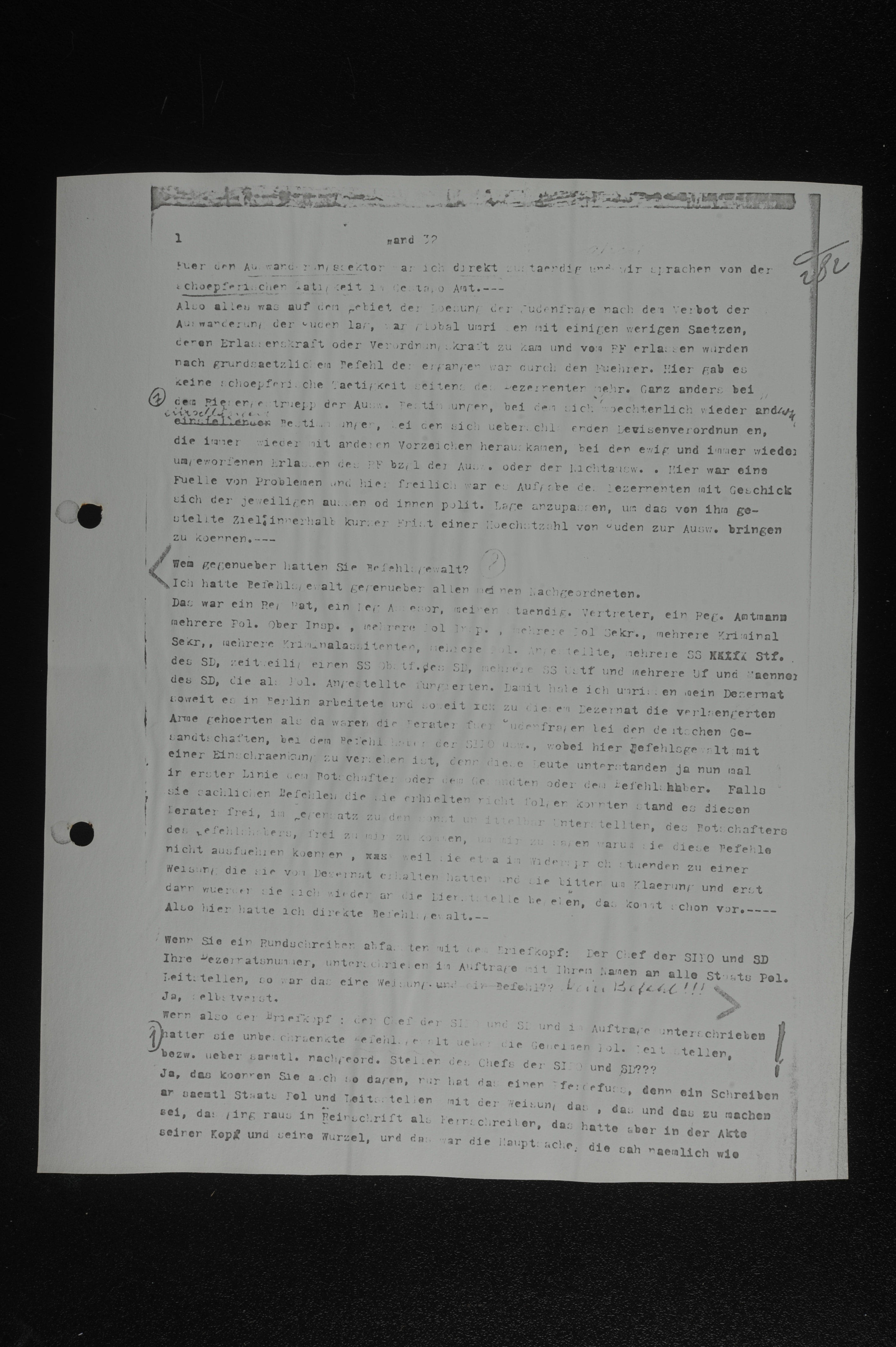
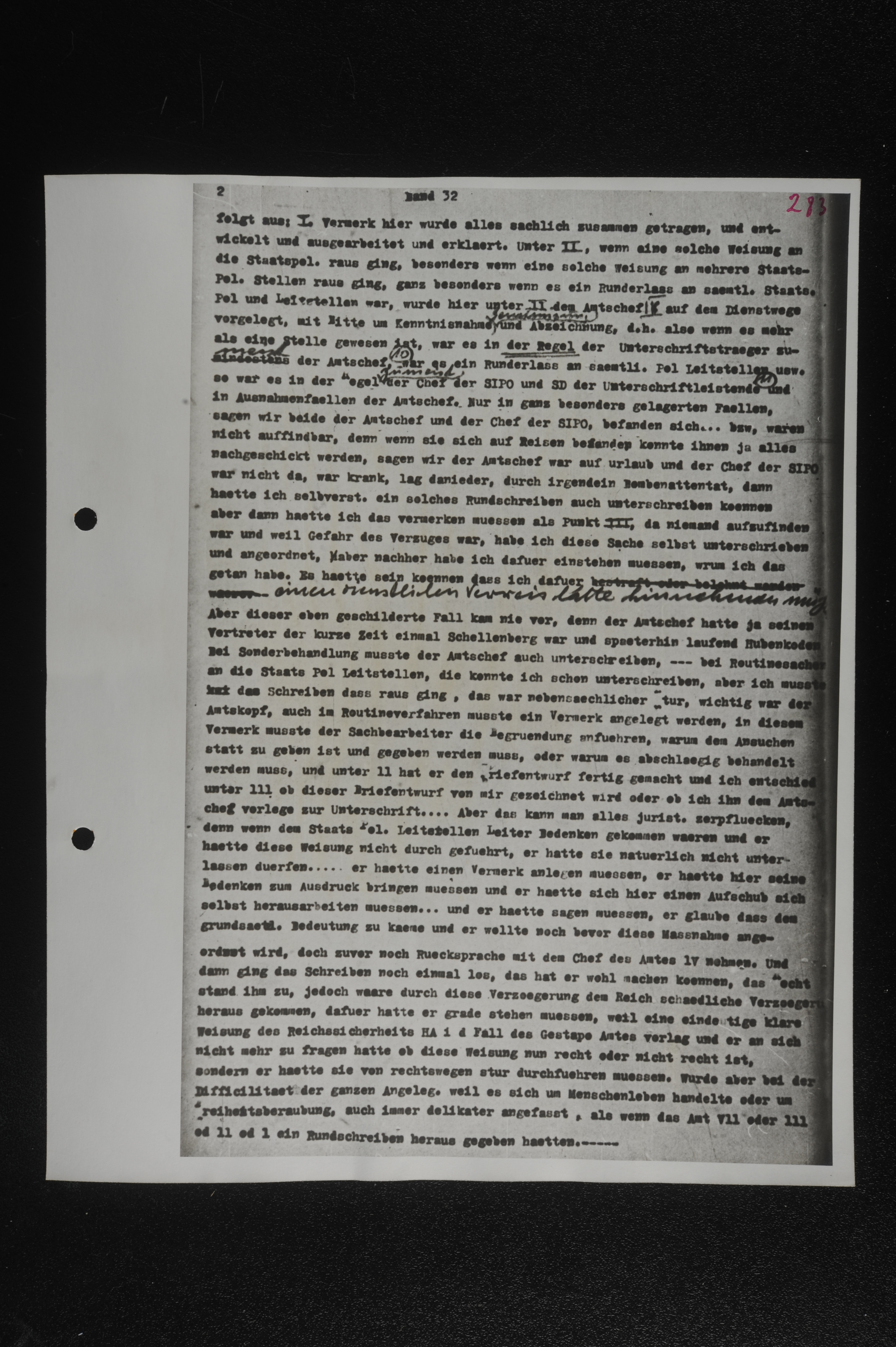
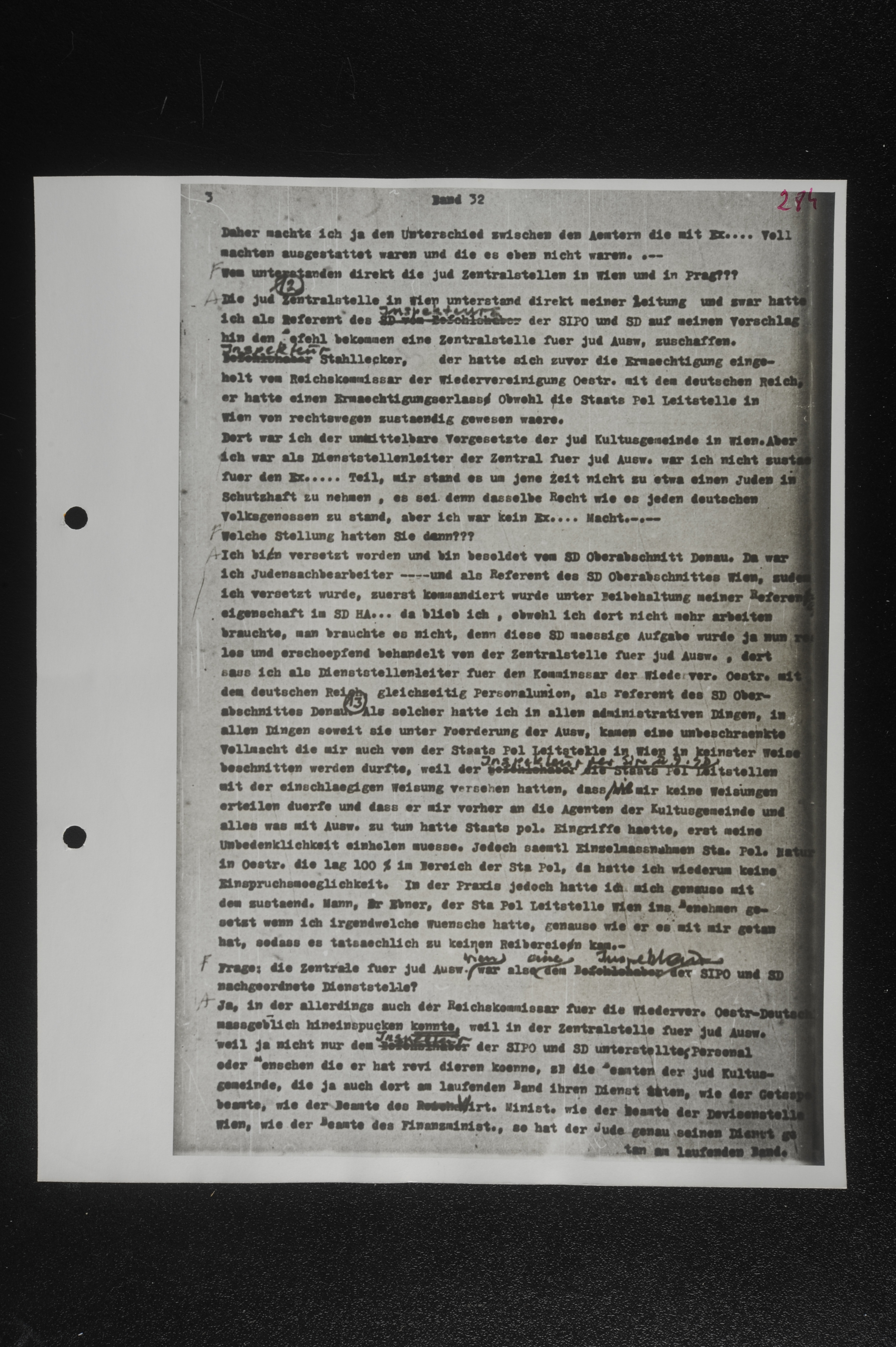
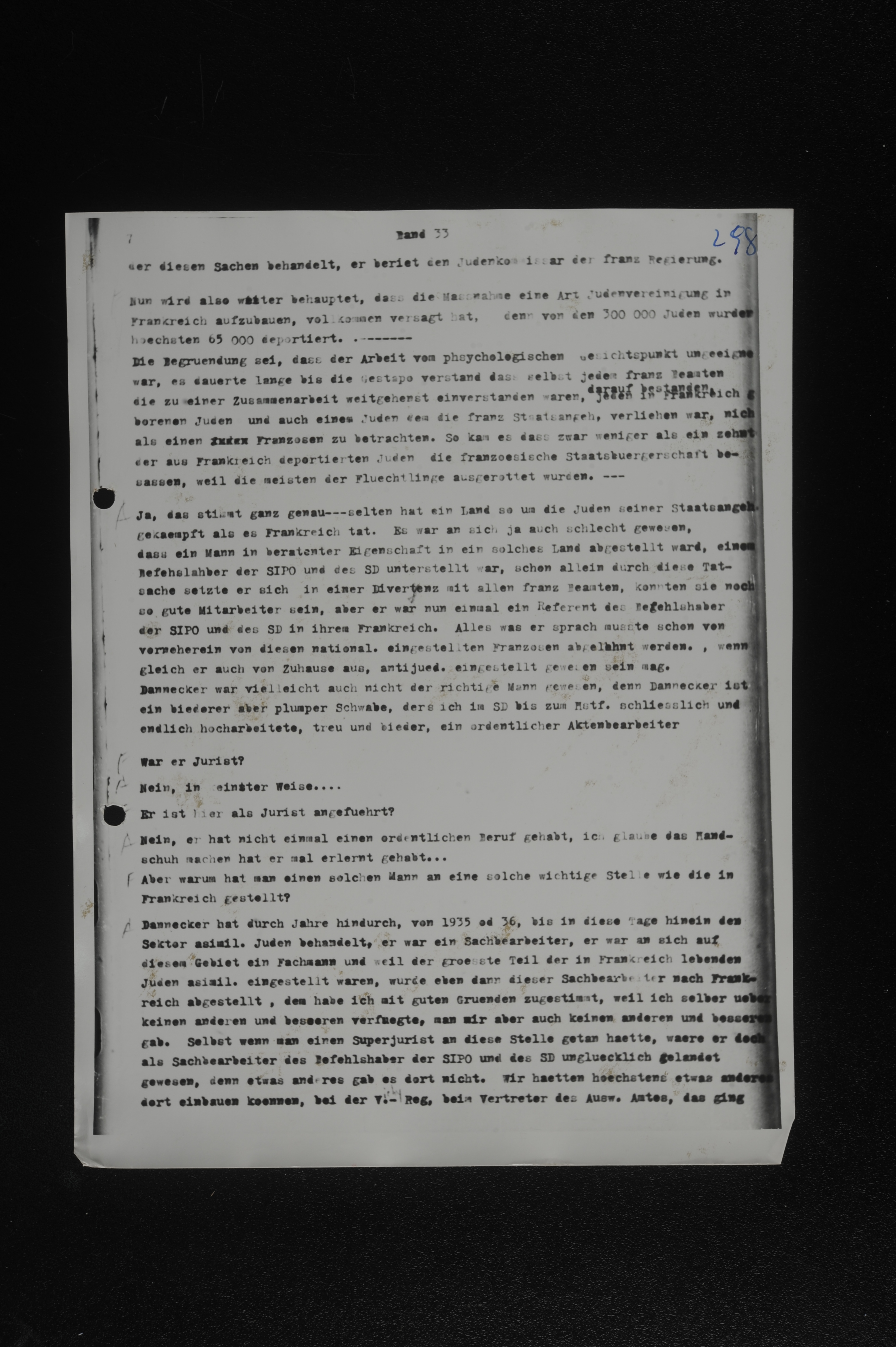
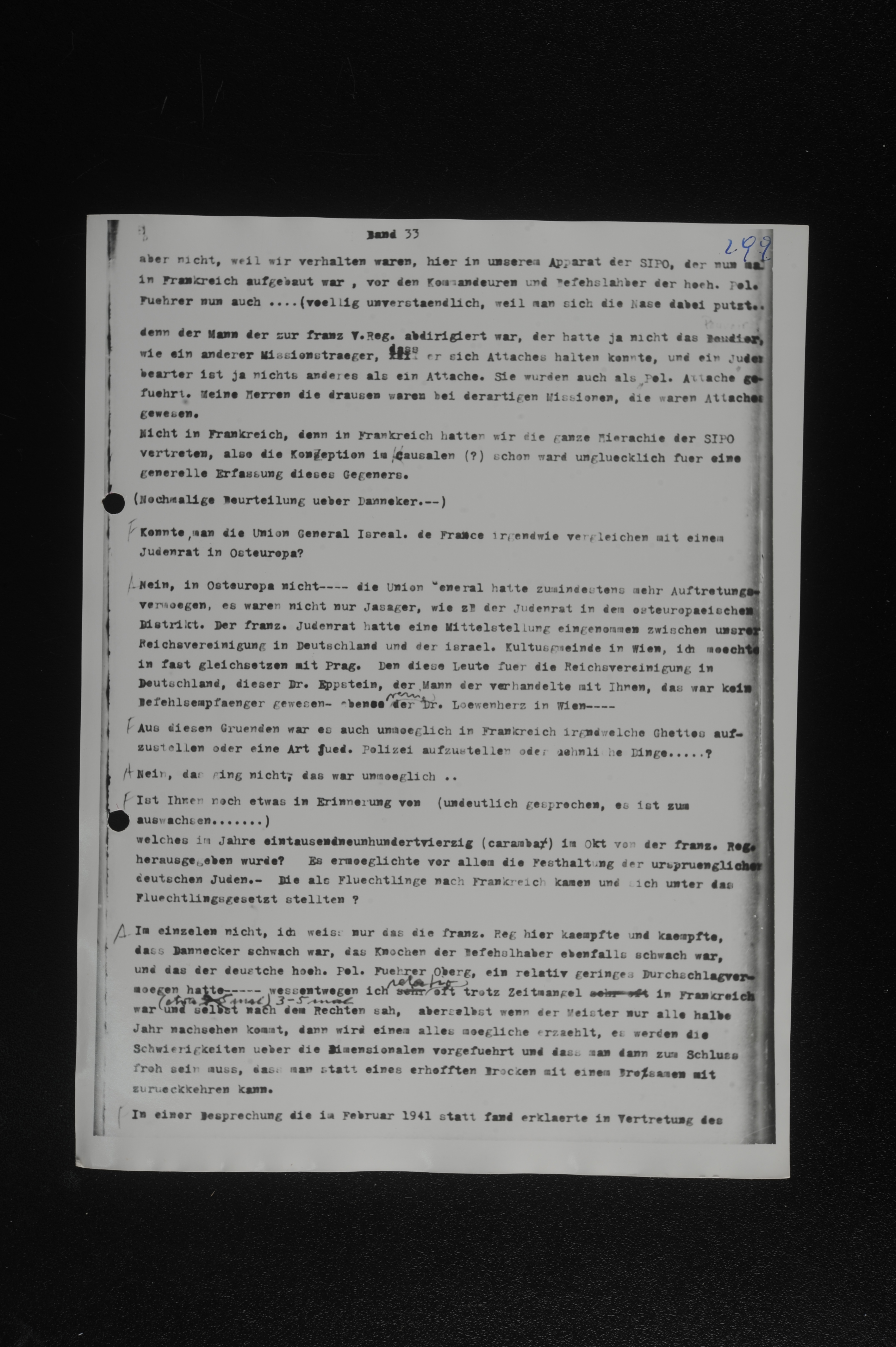
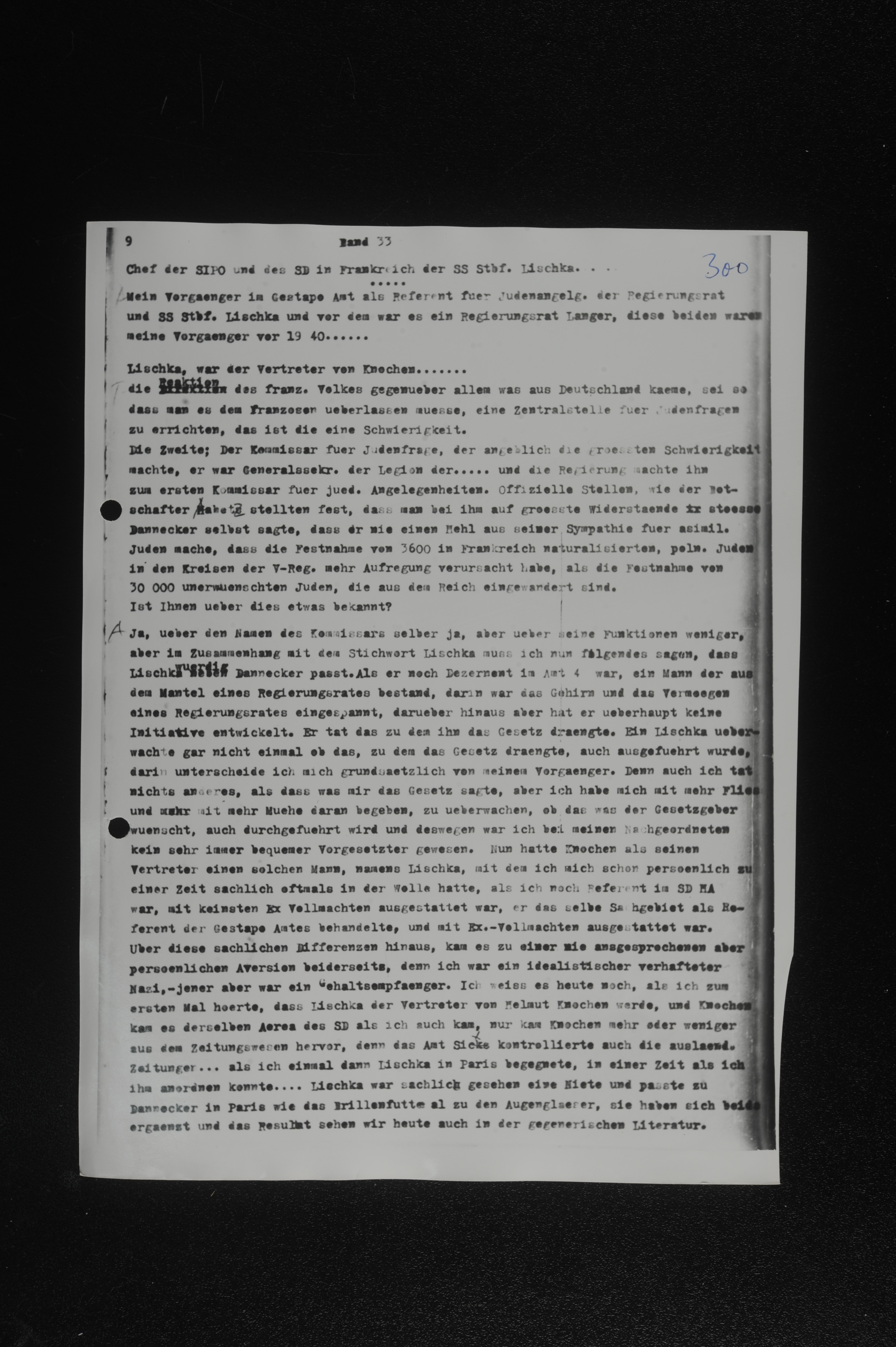
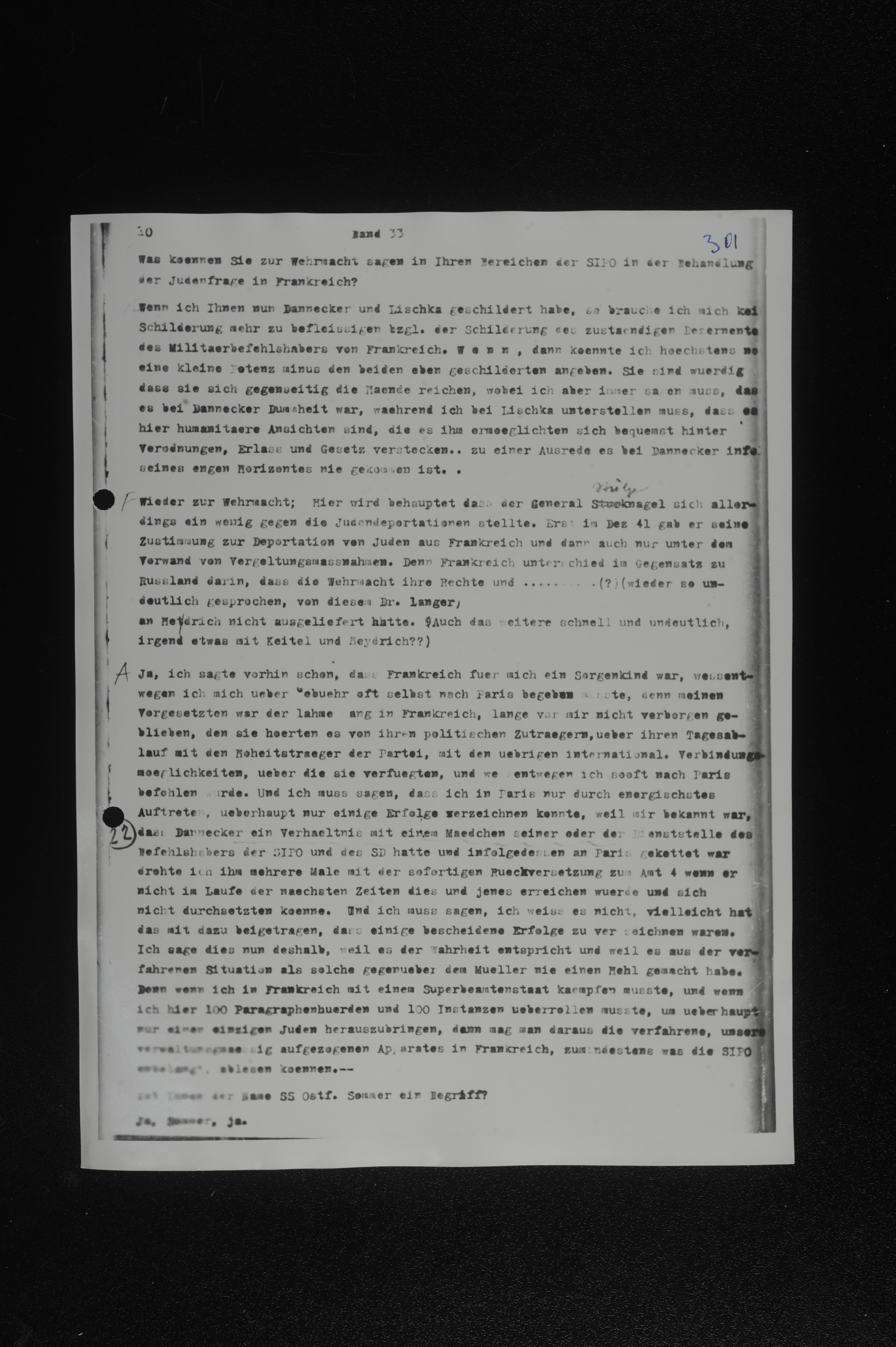
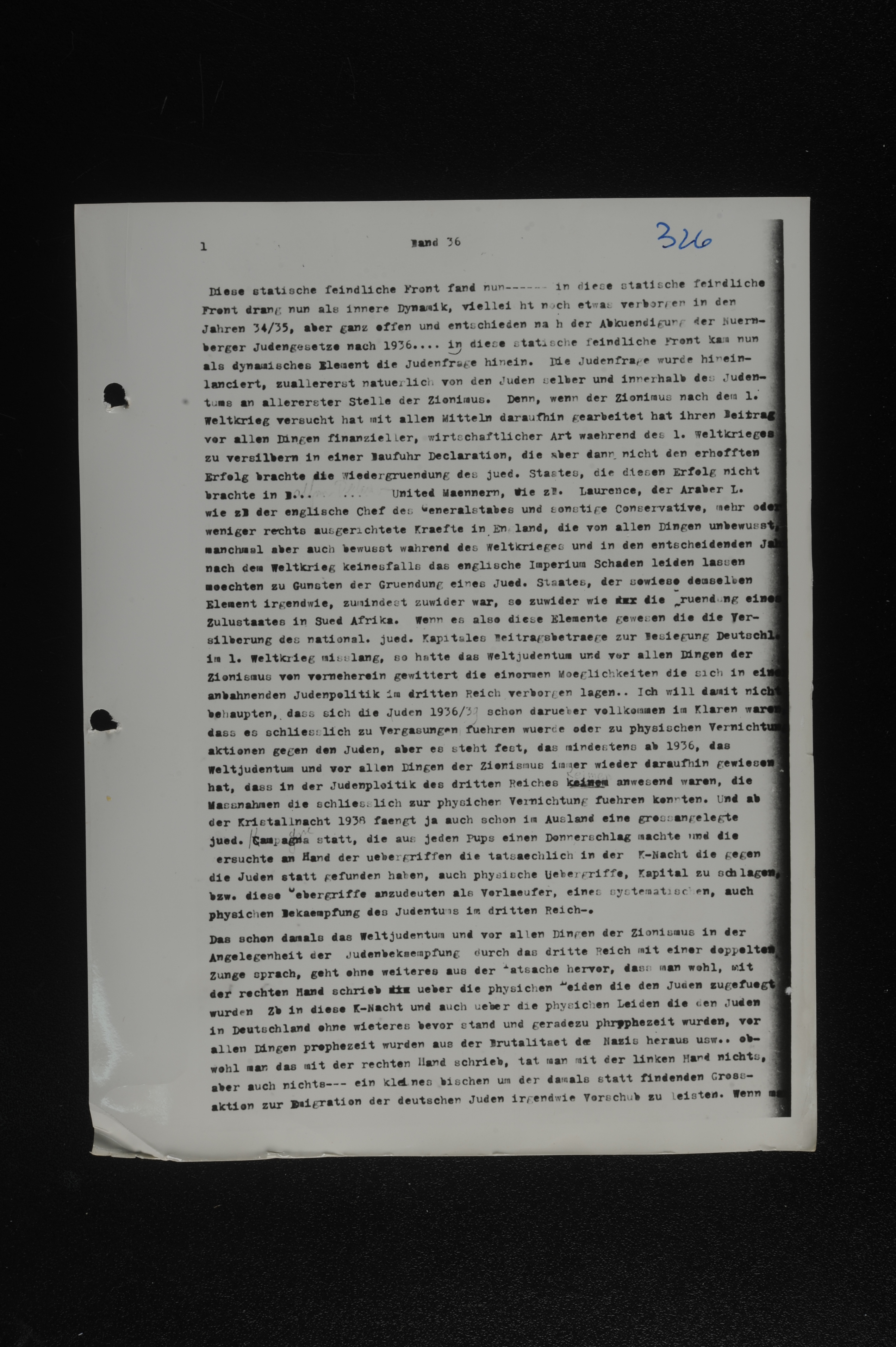
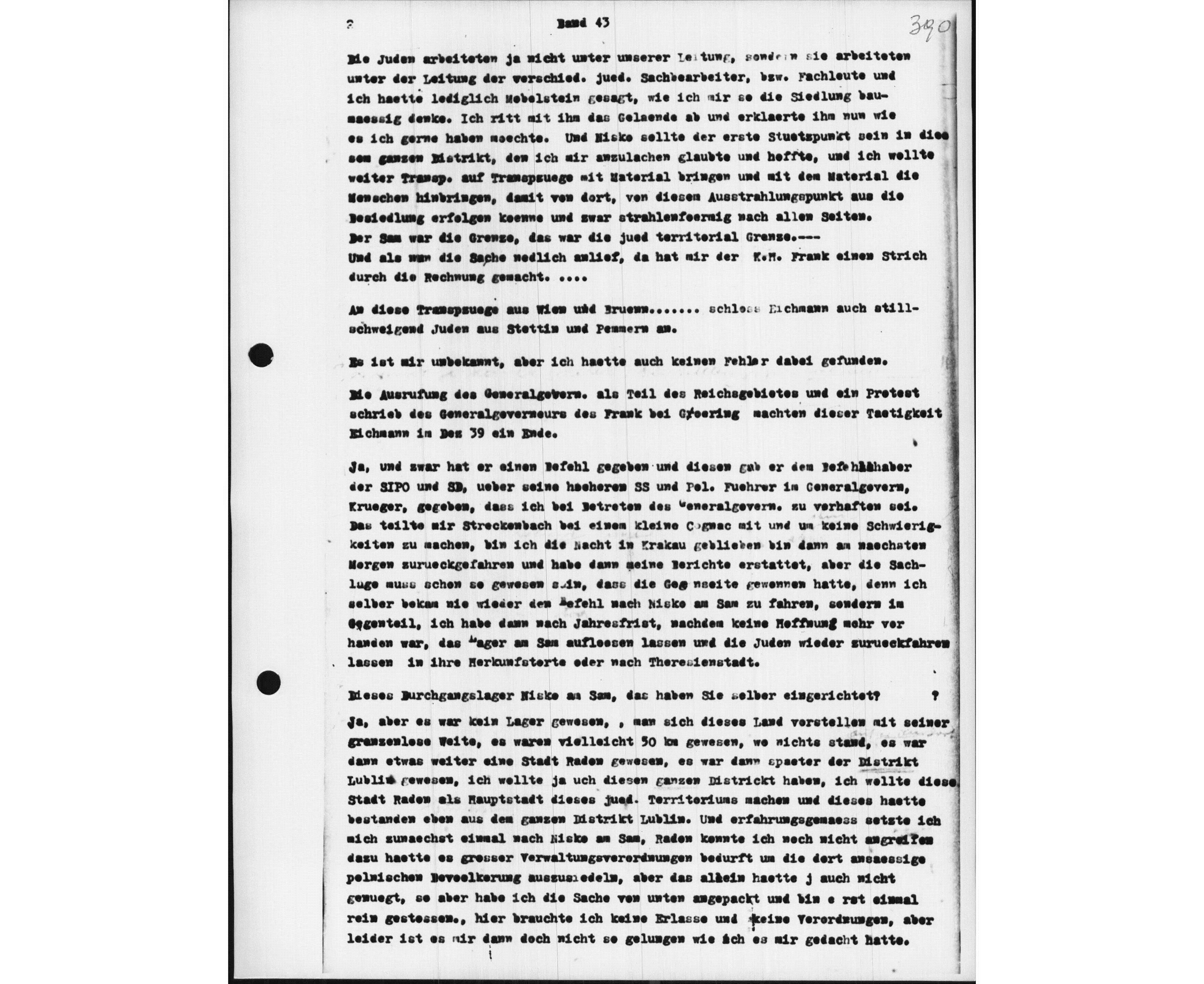
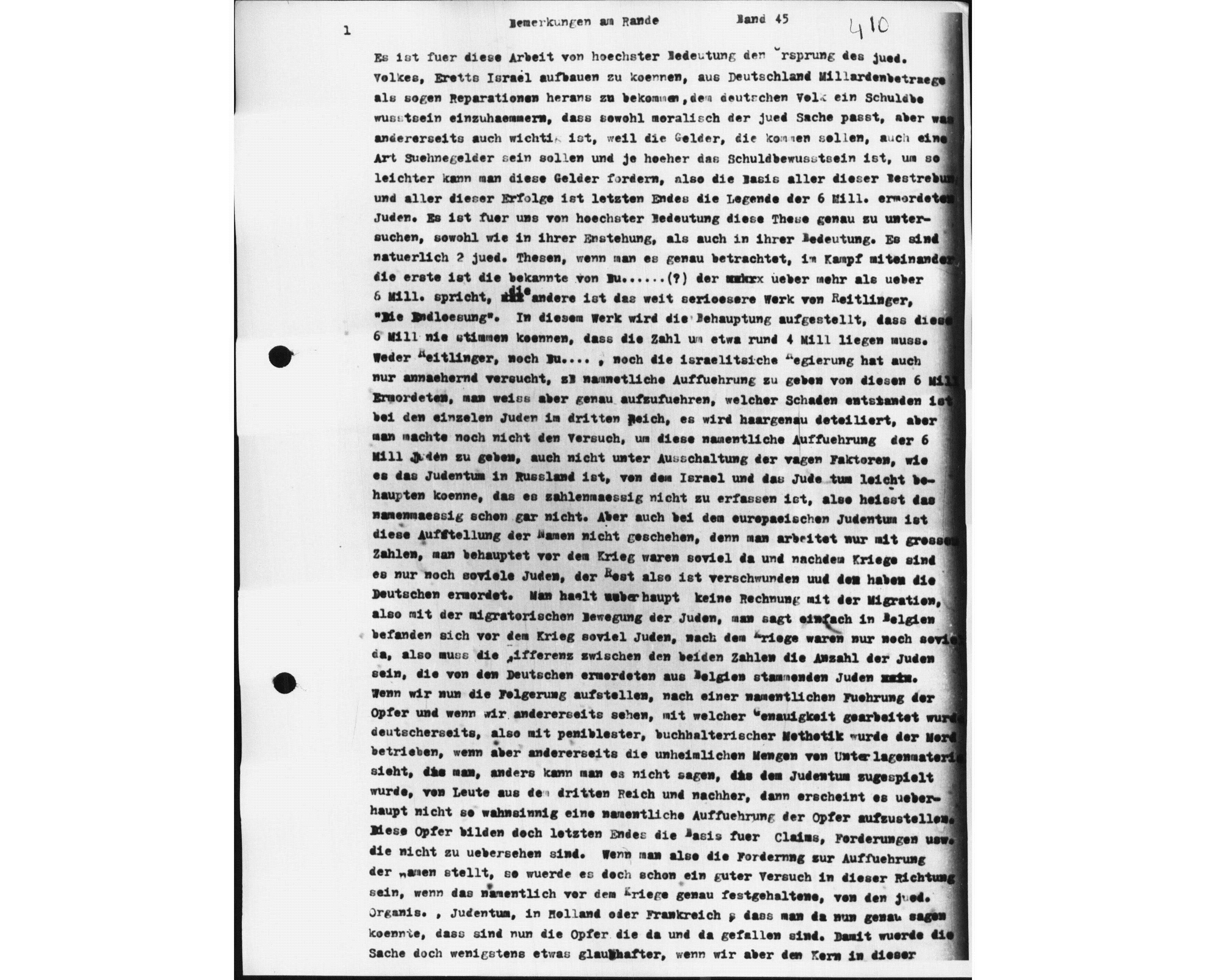
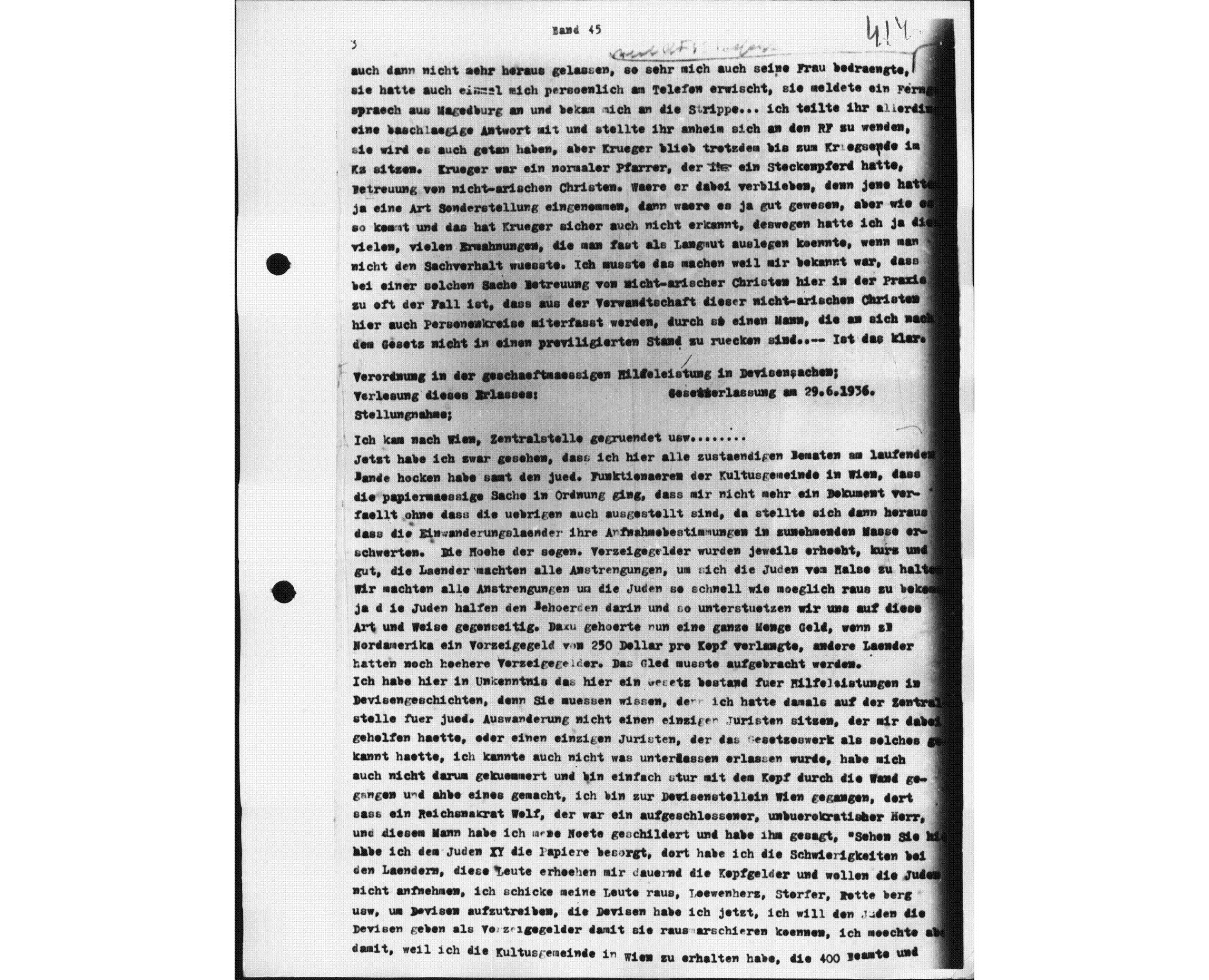
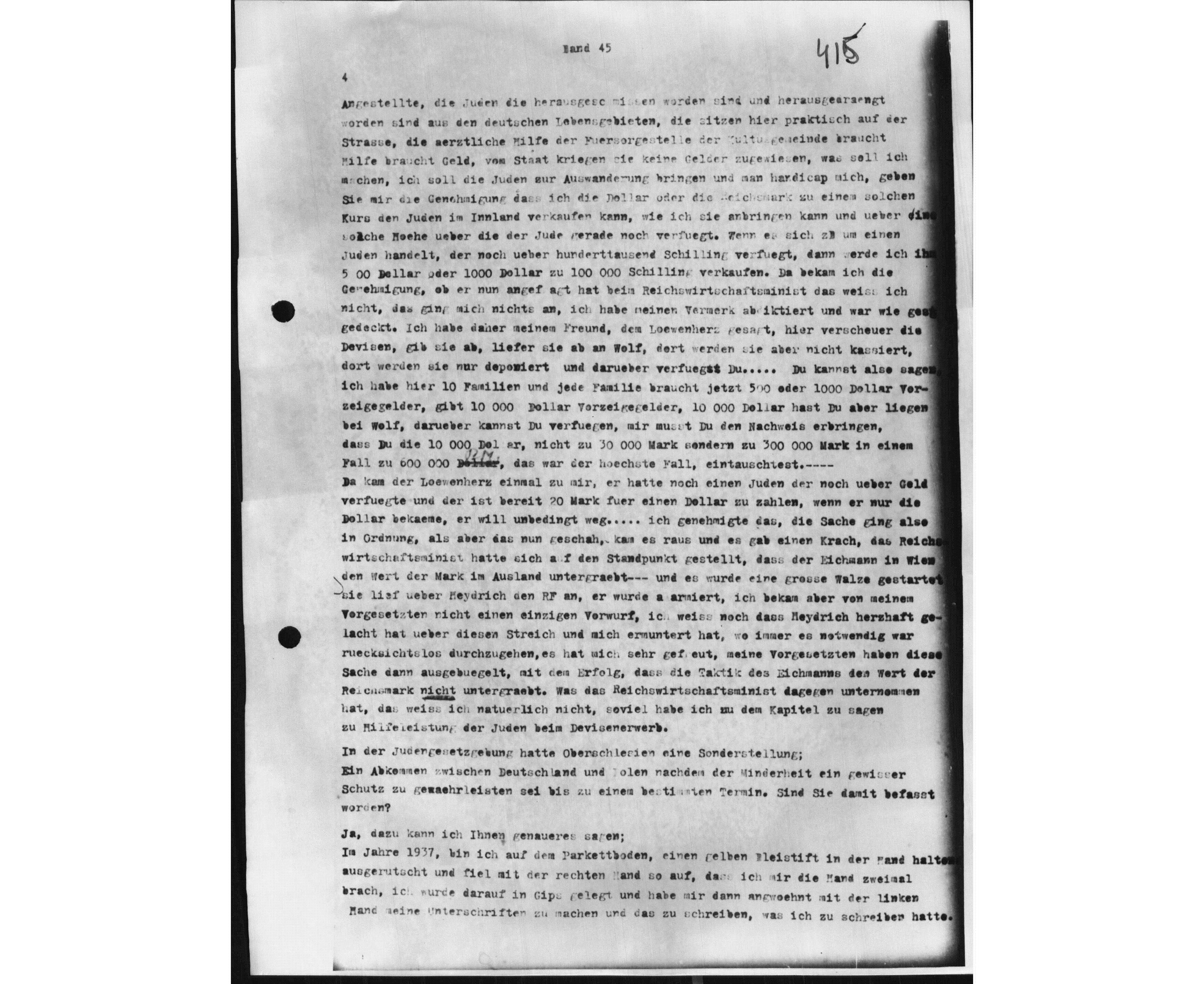
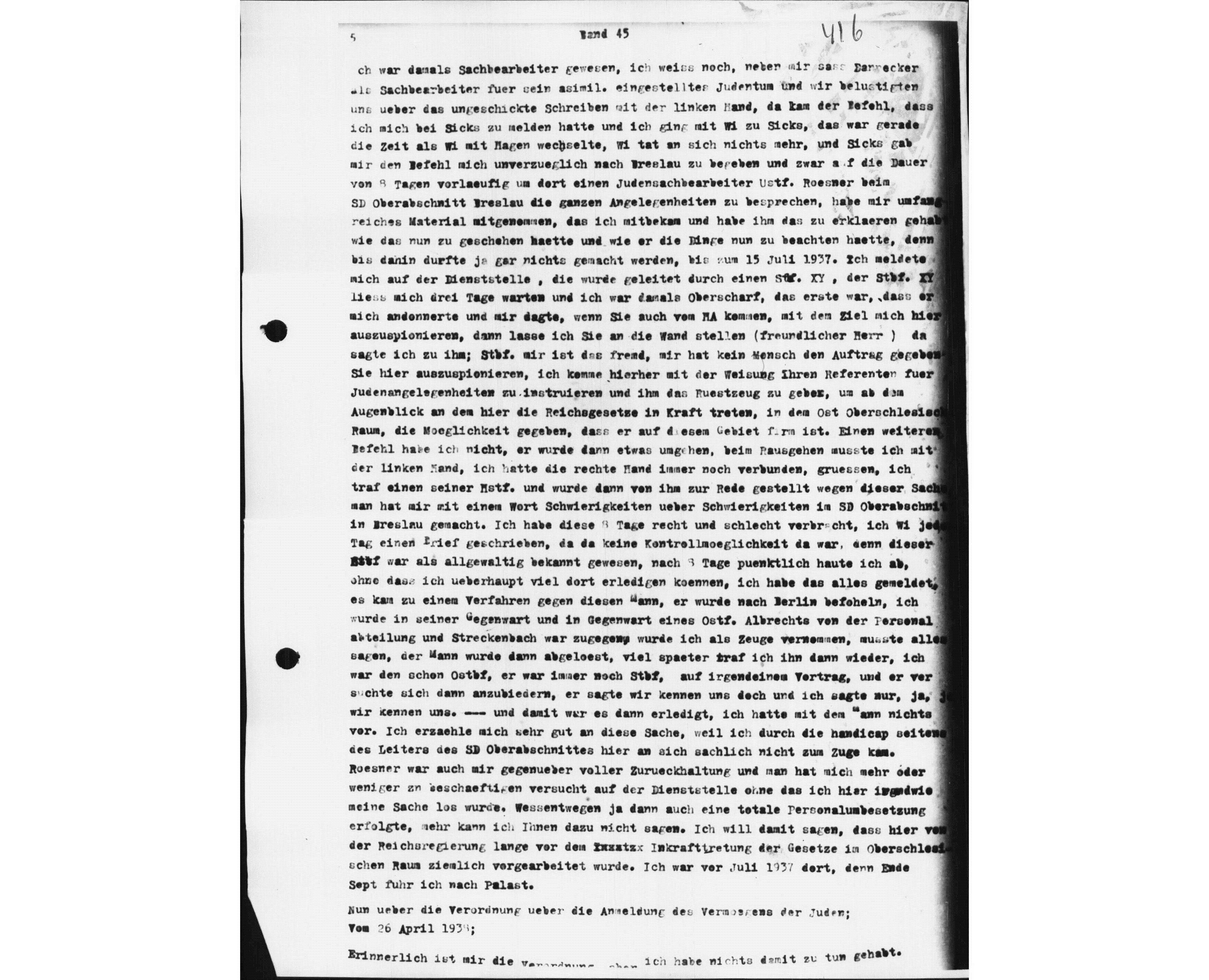
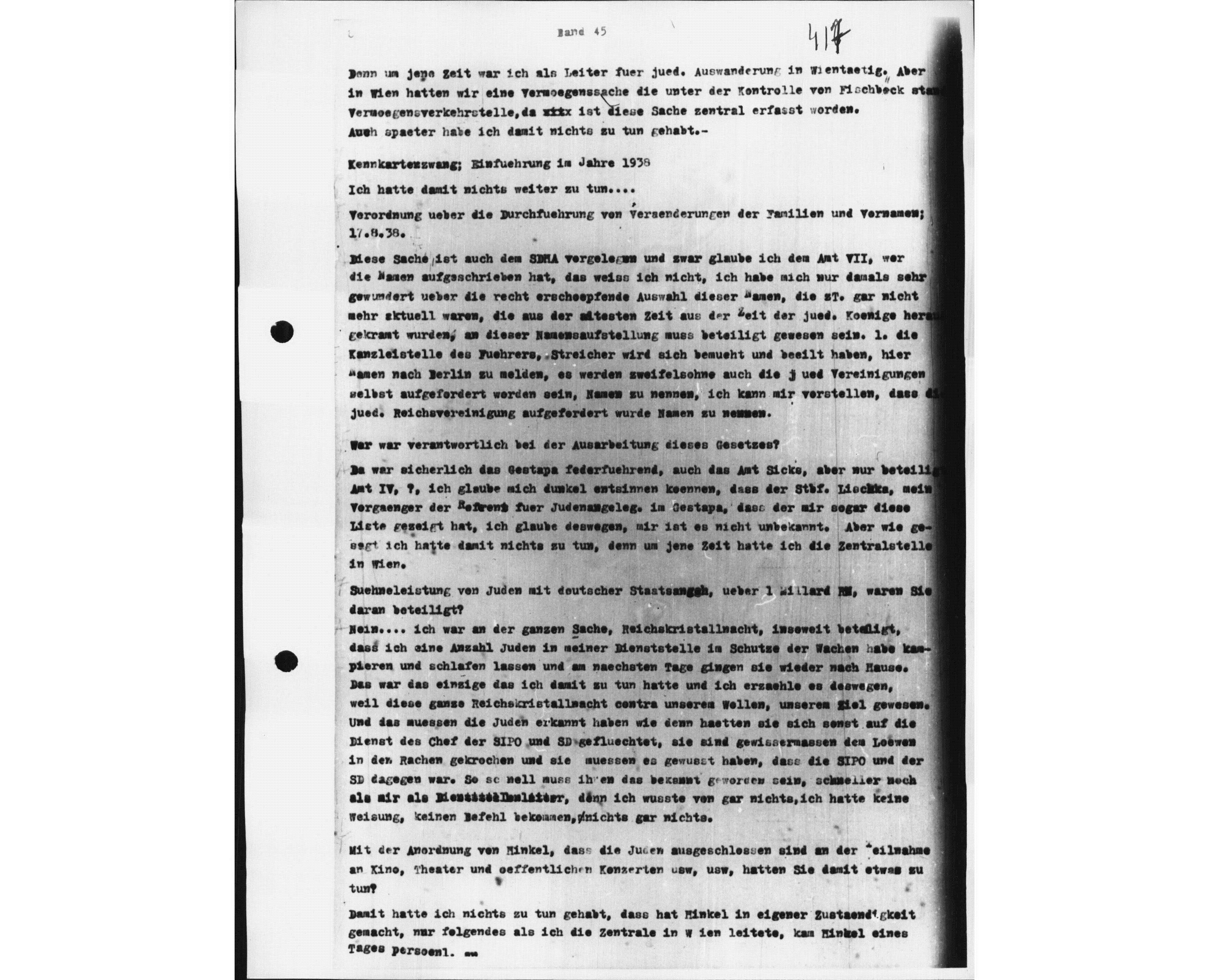
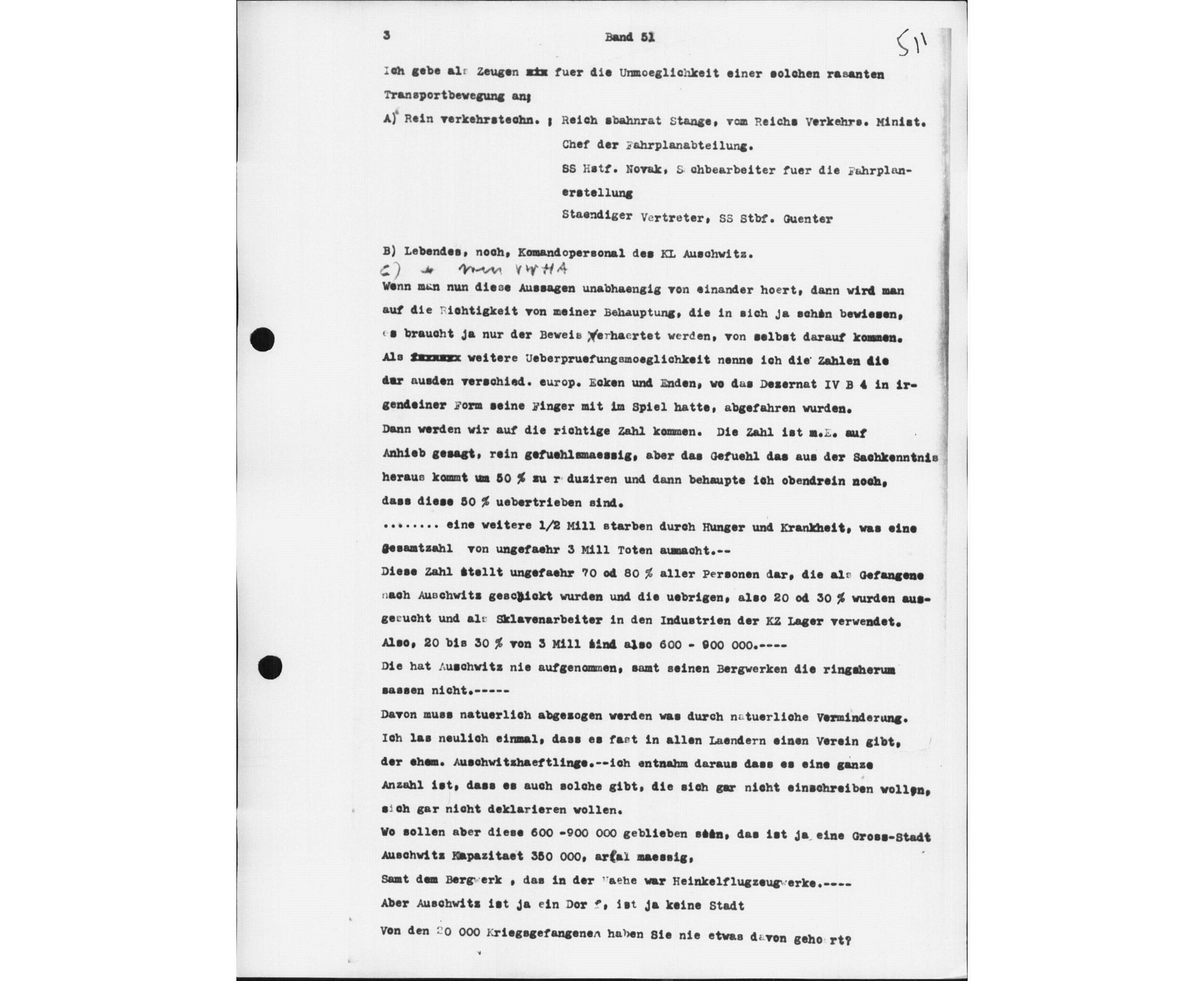
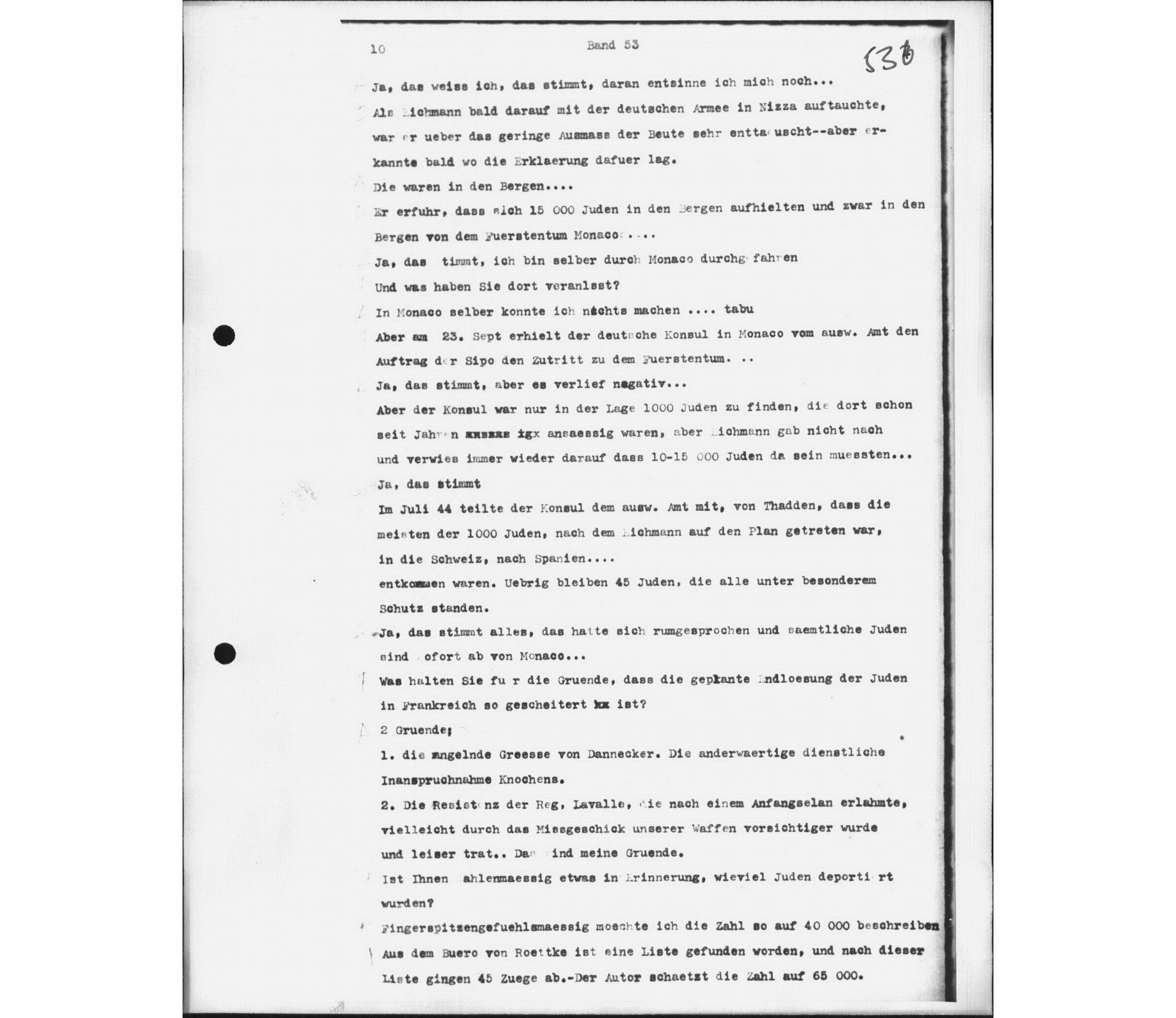
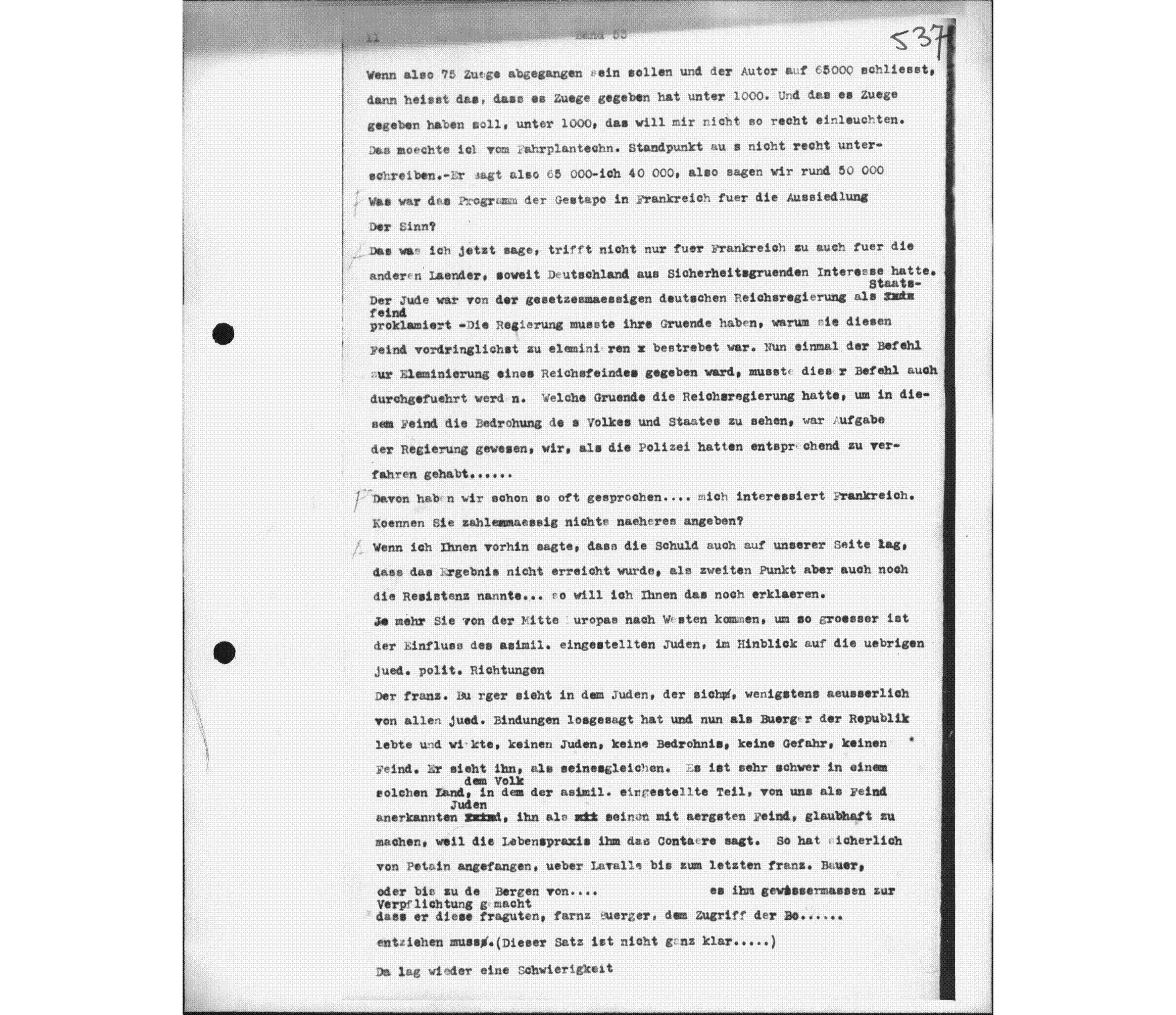
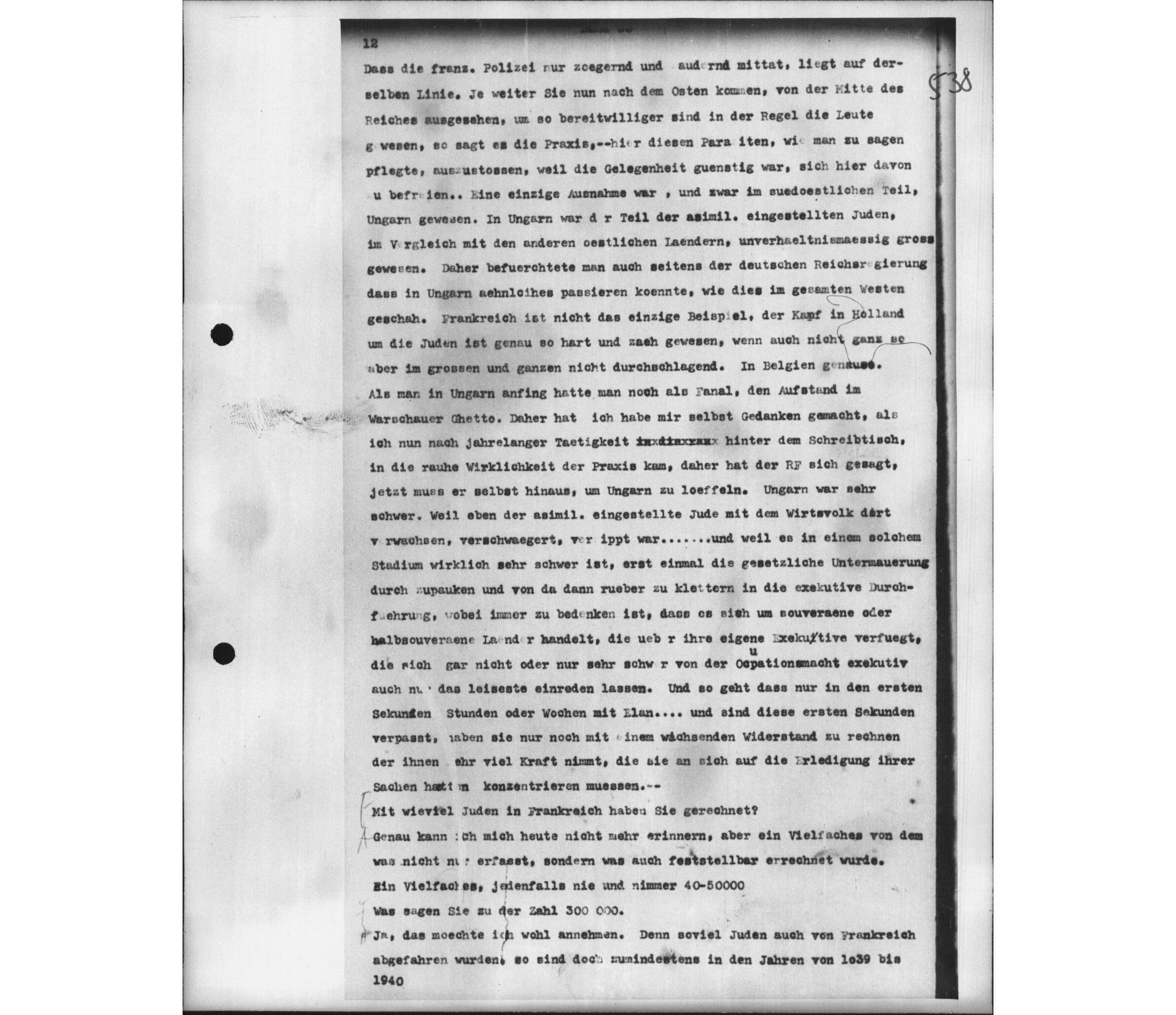
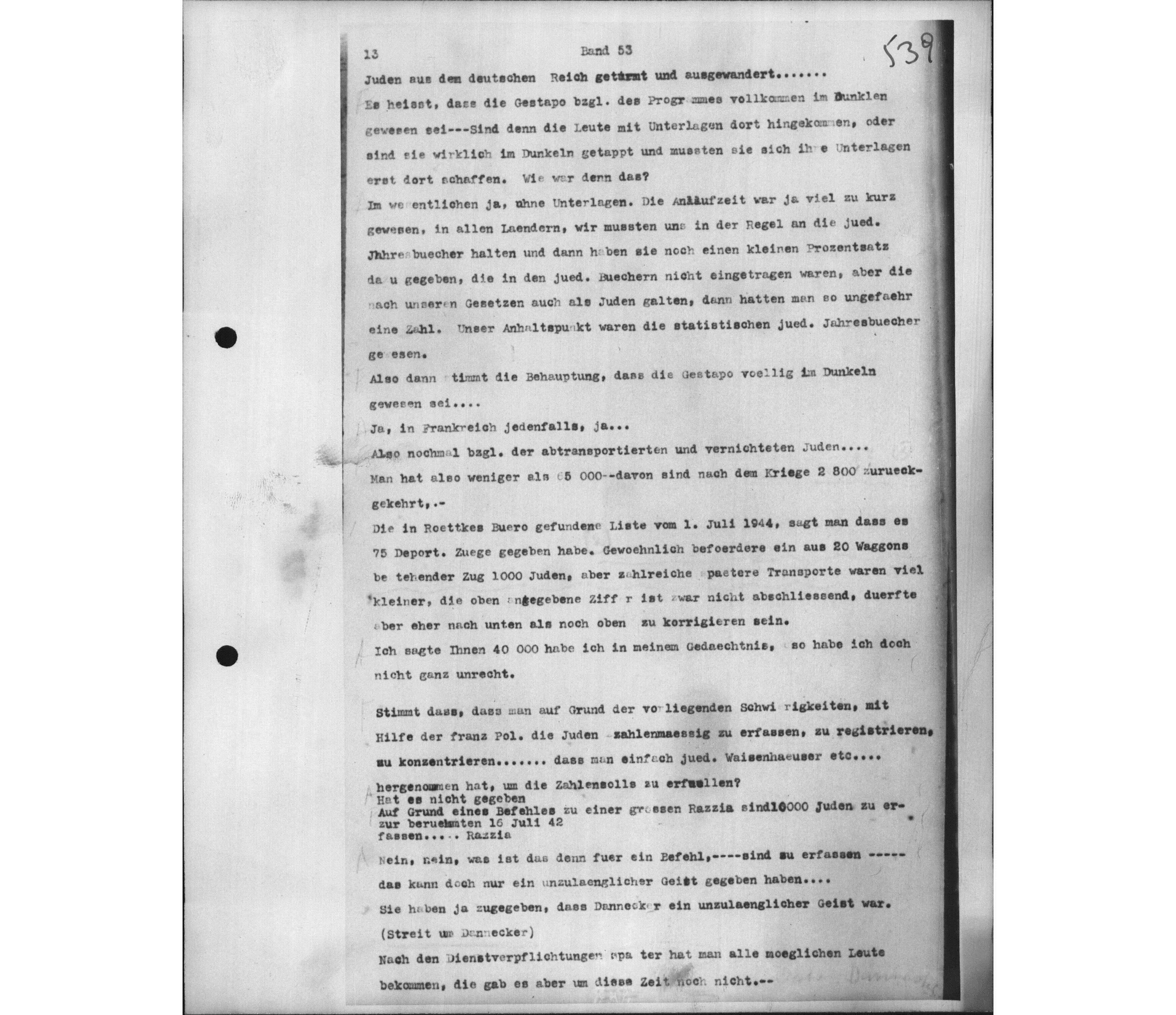
Open page image and German
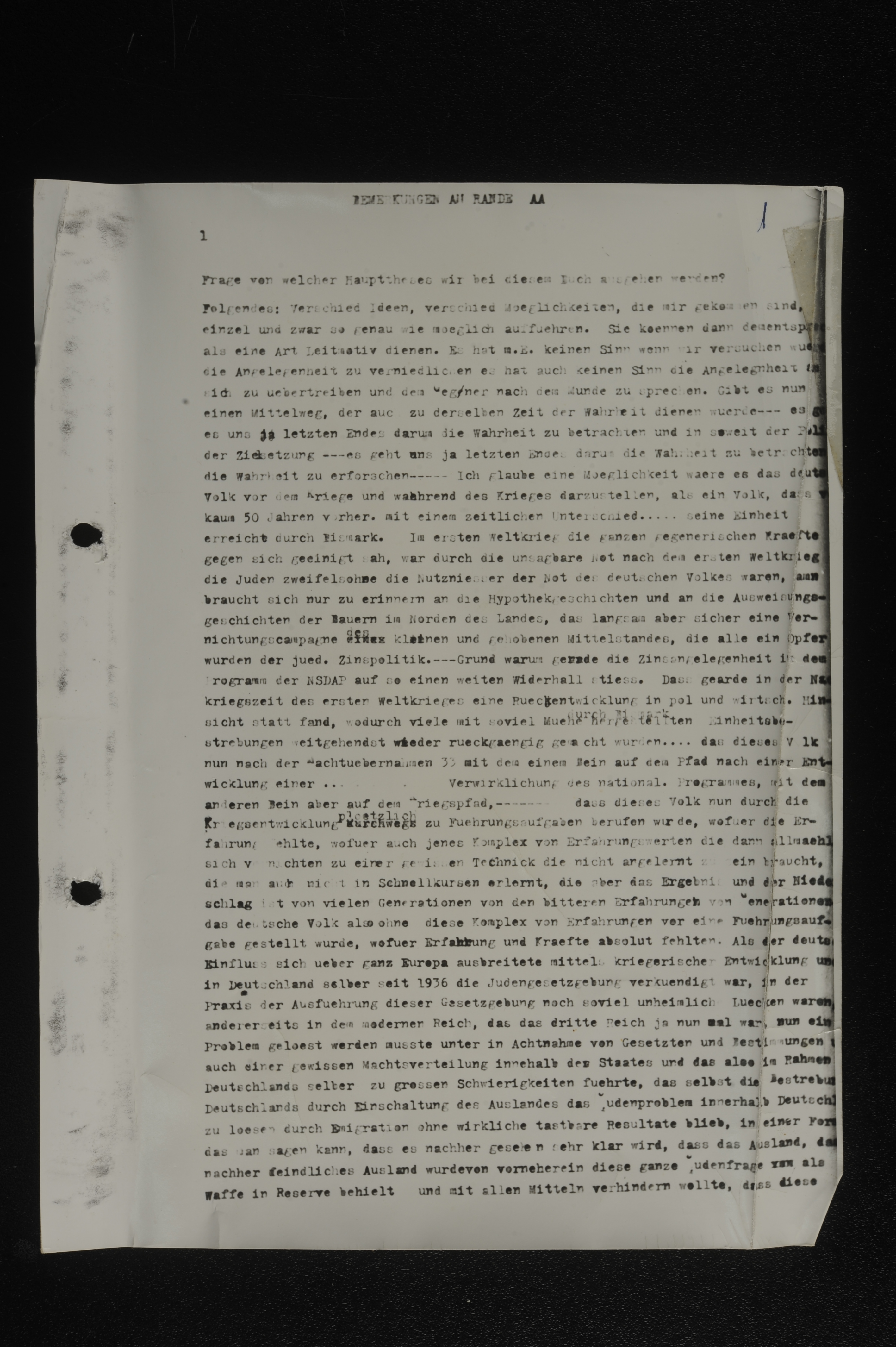
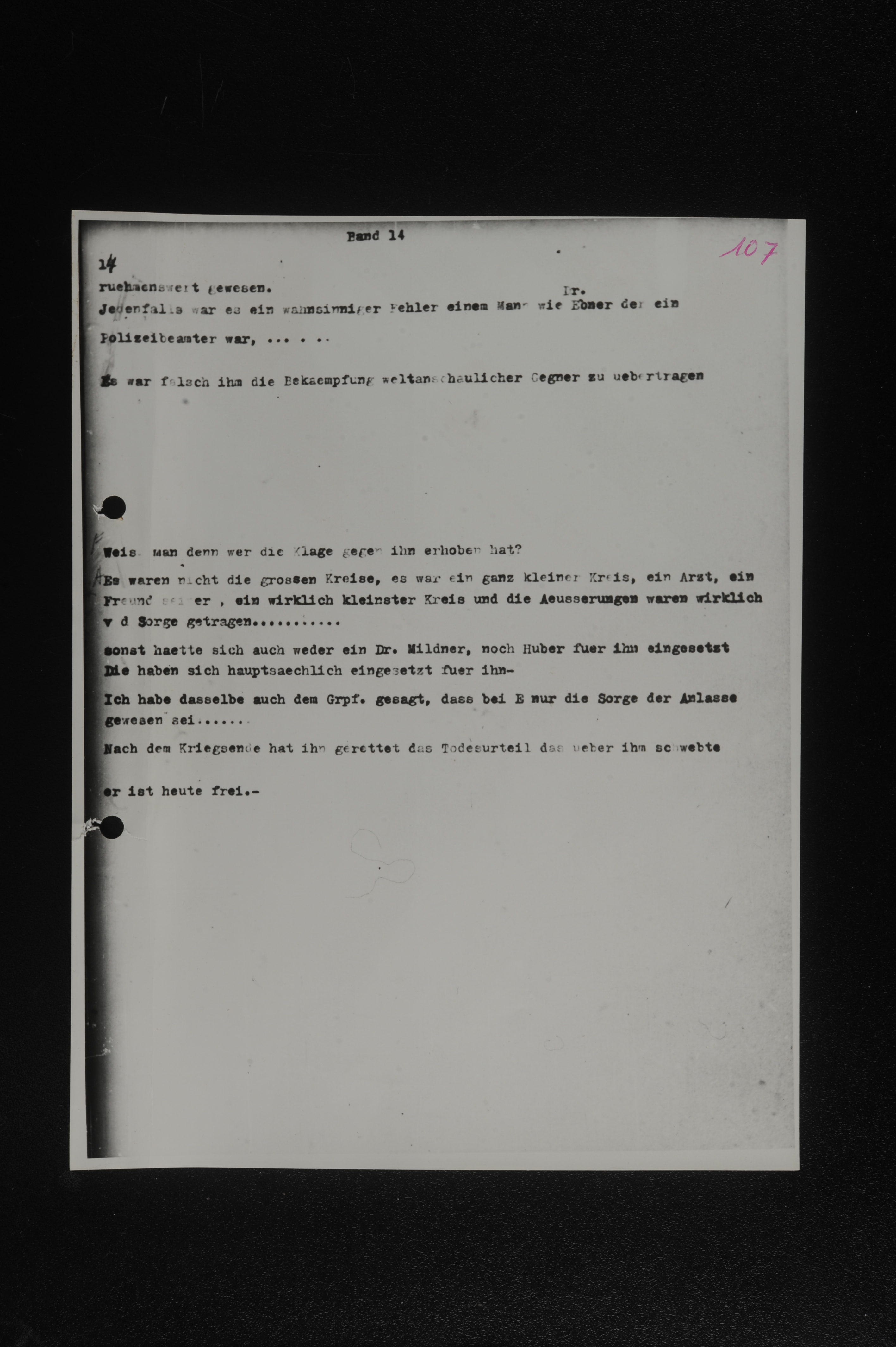
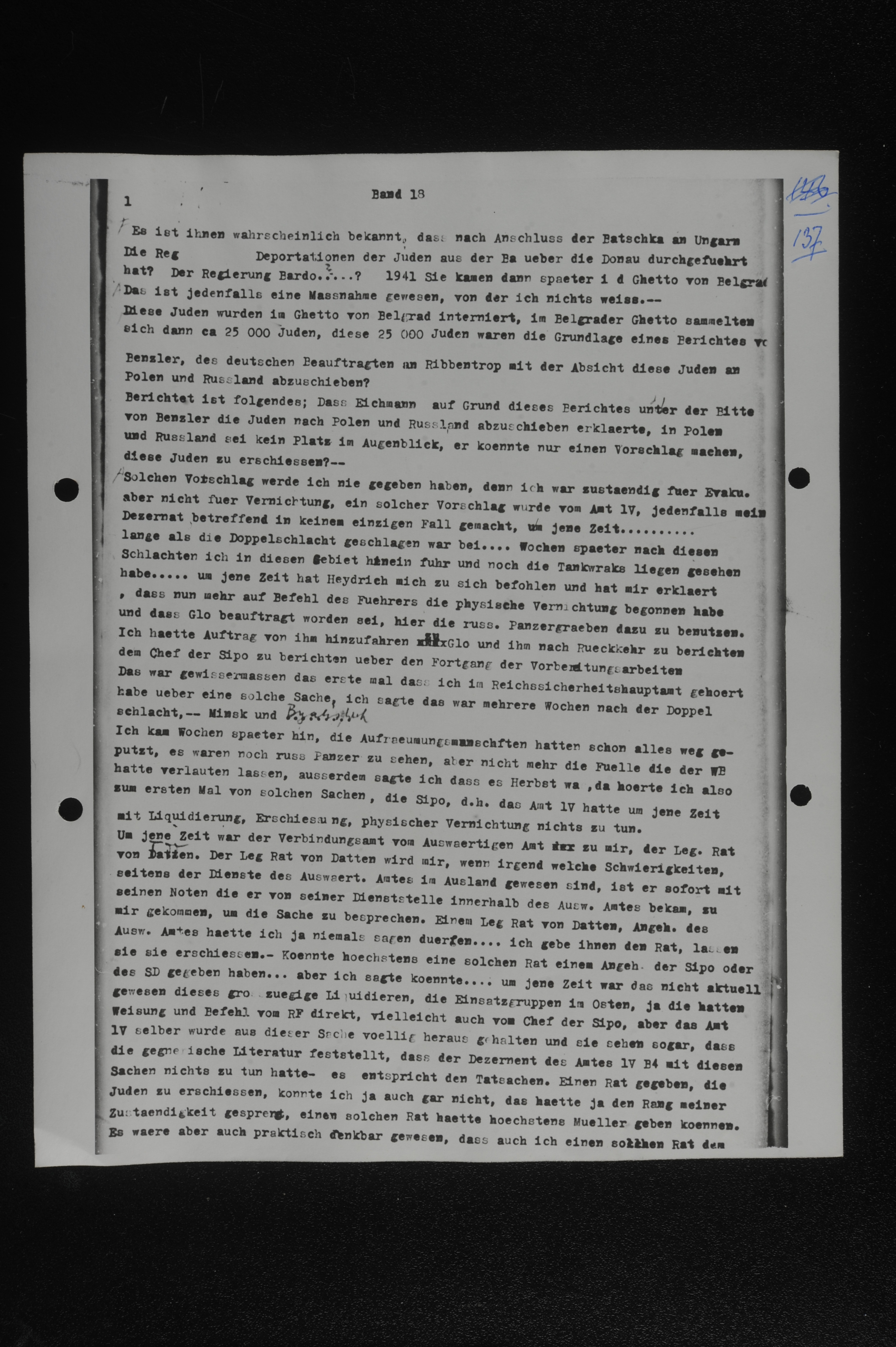
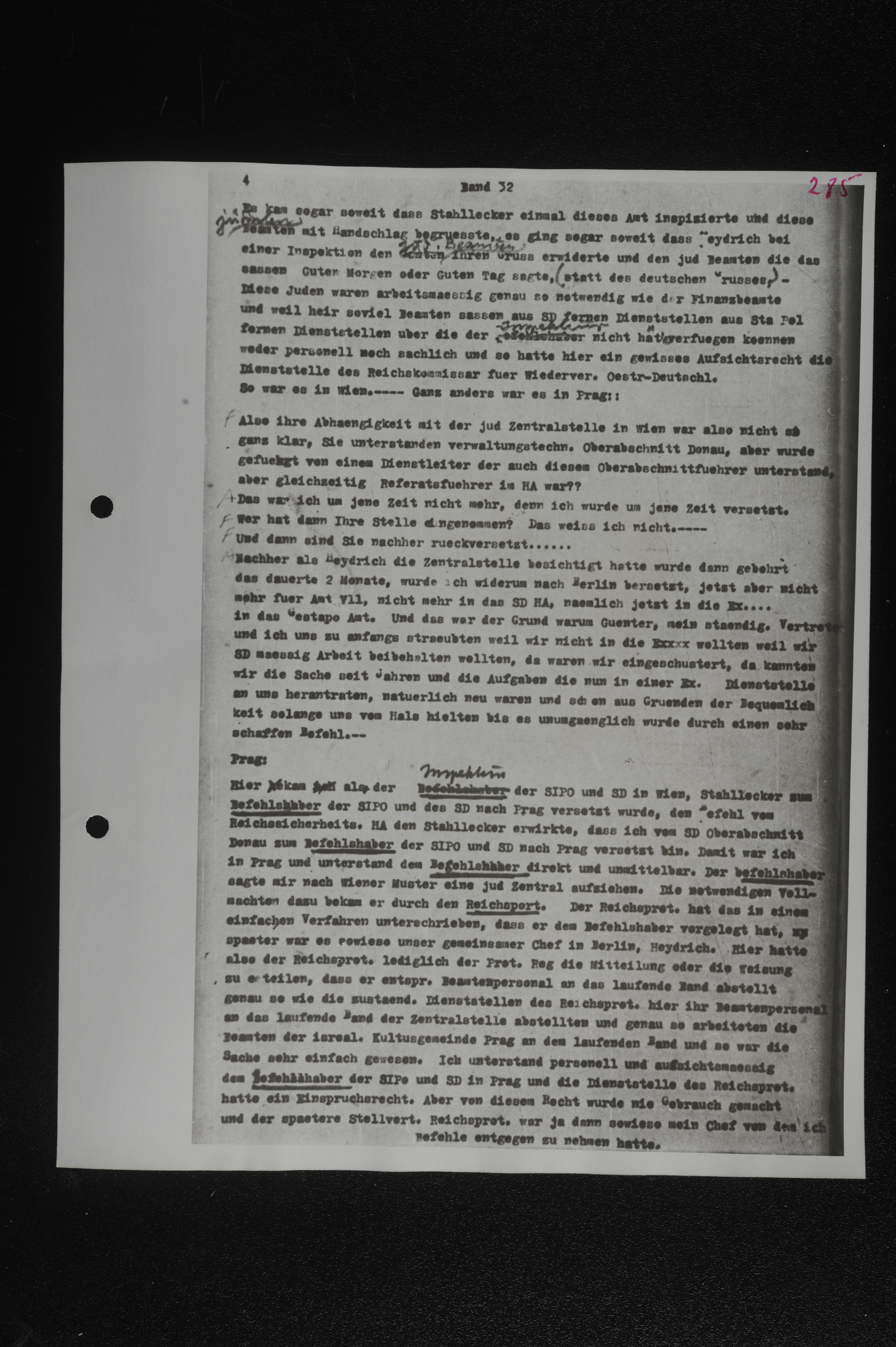
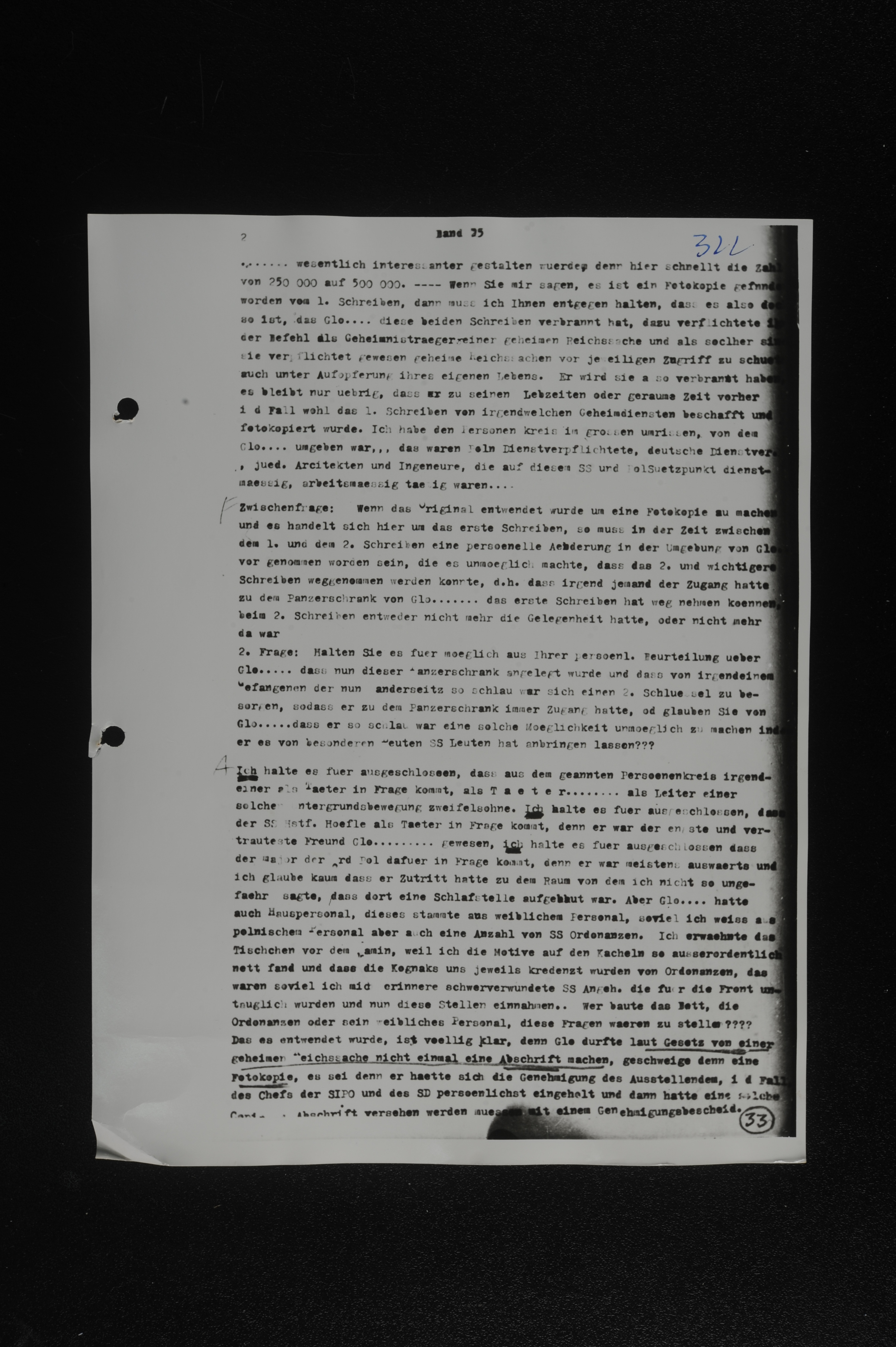
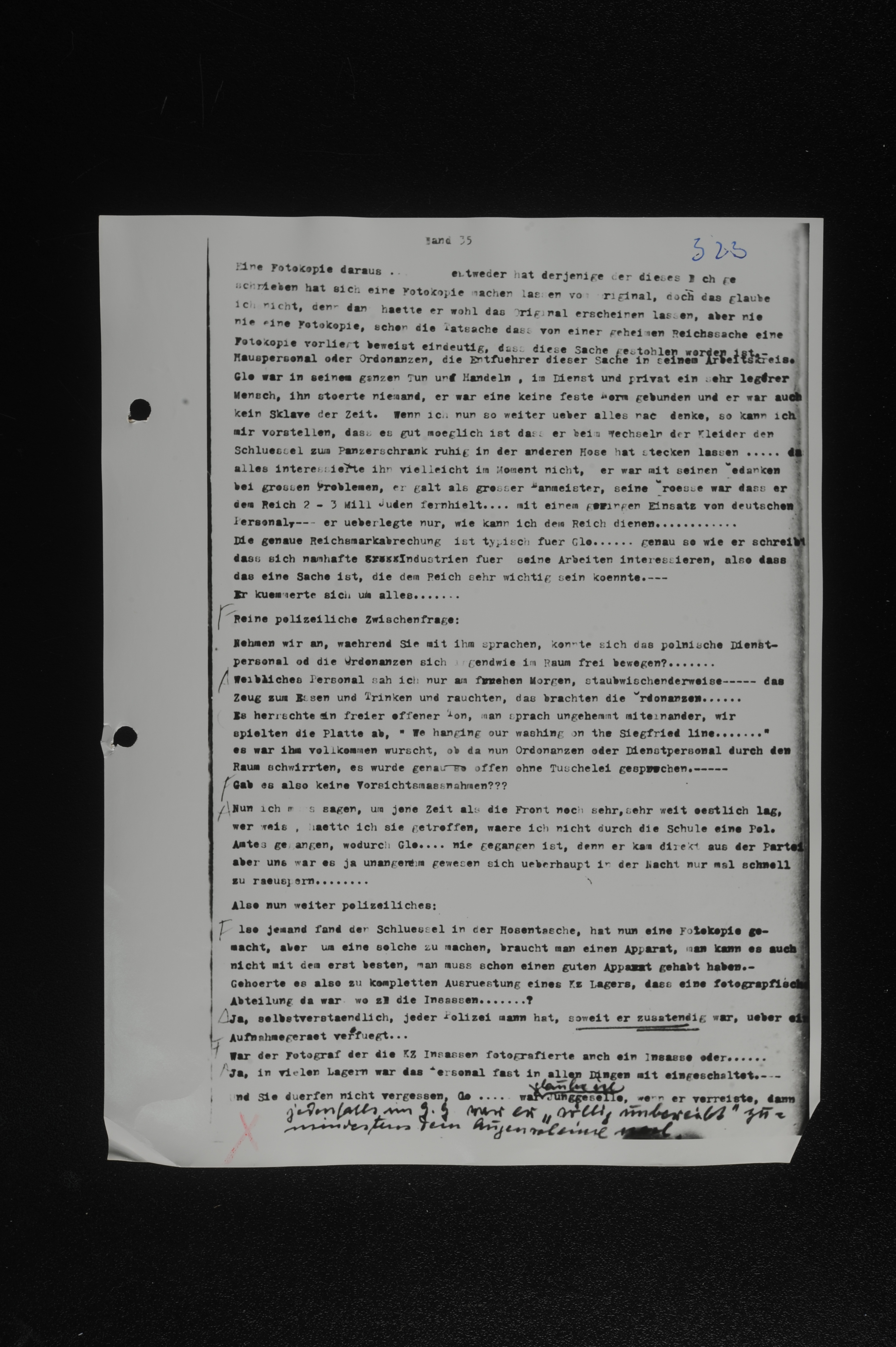
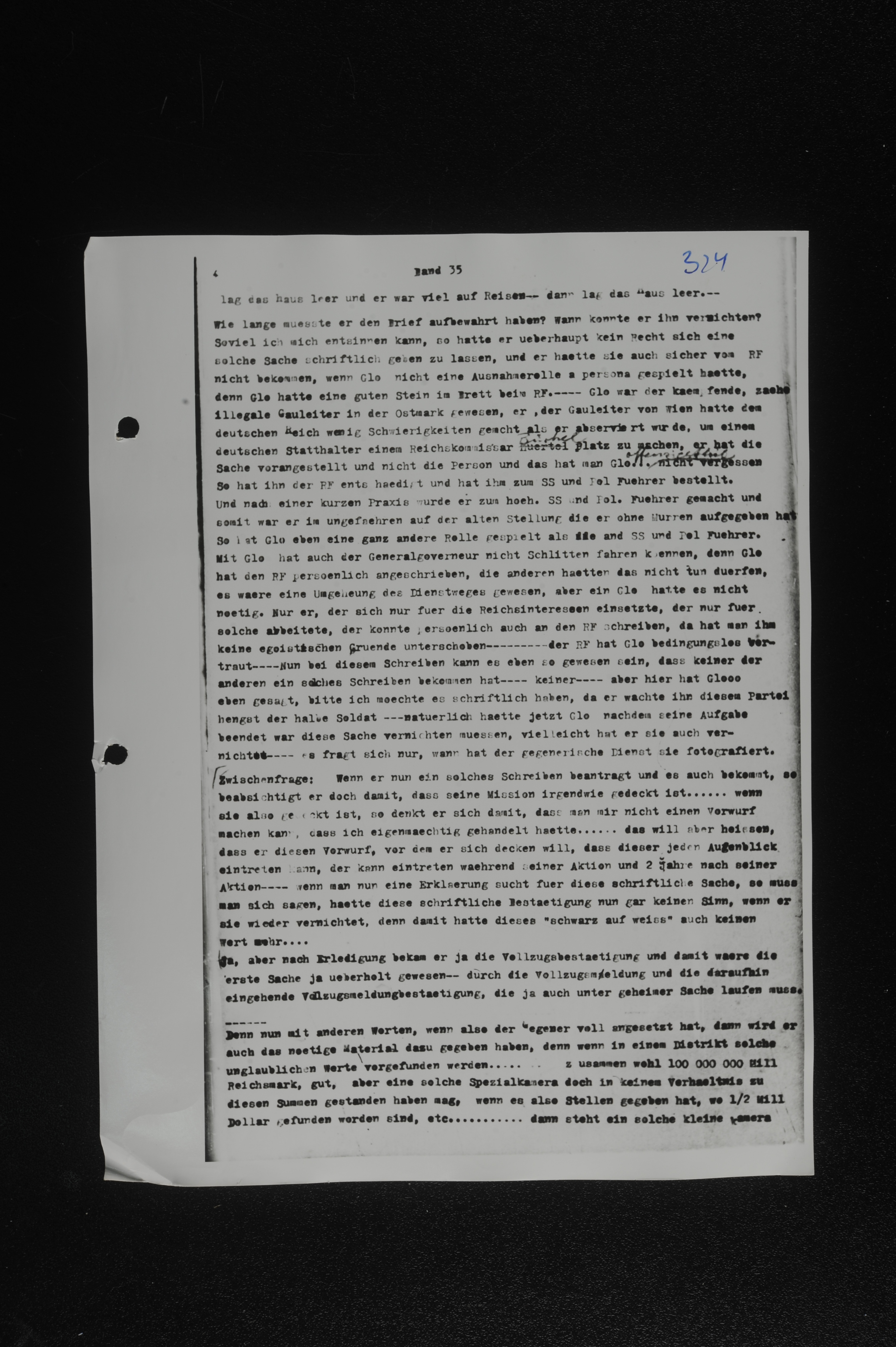
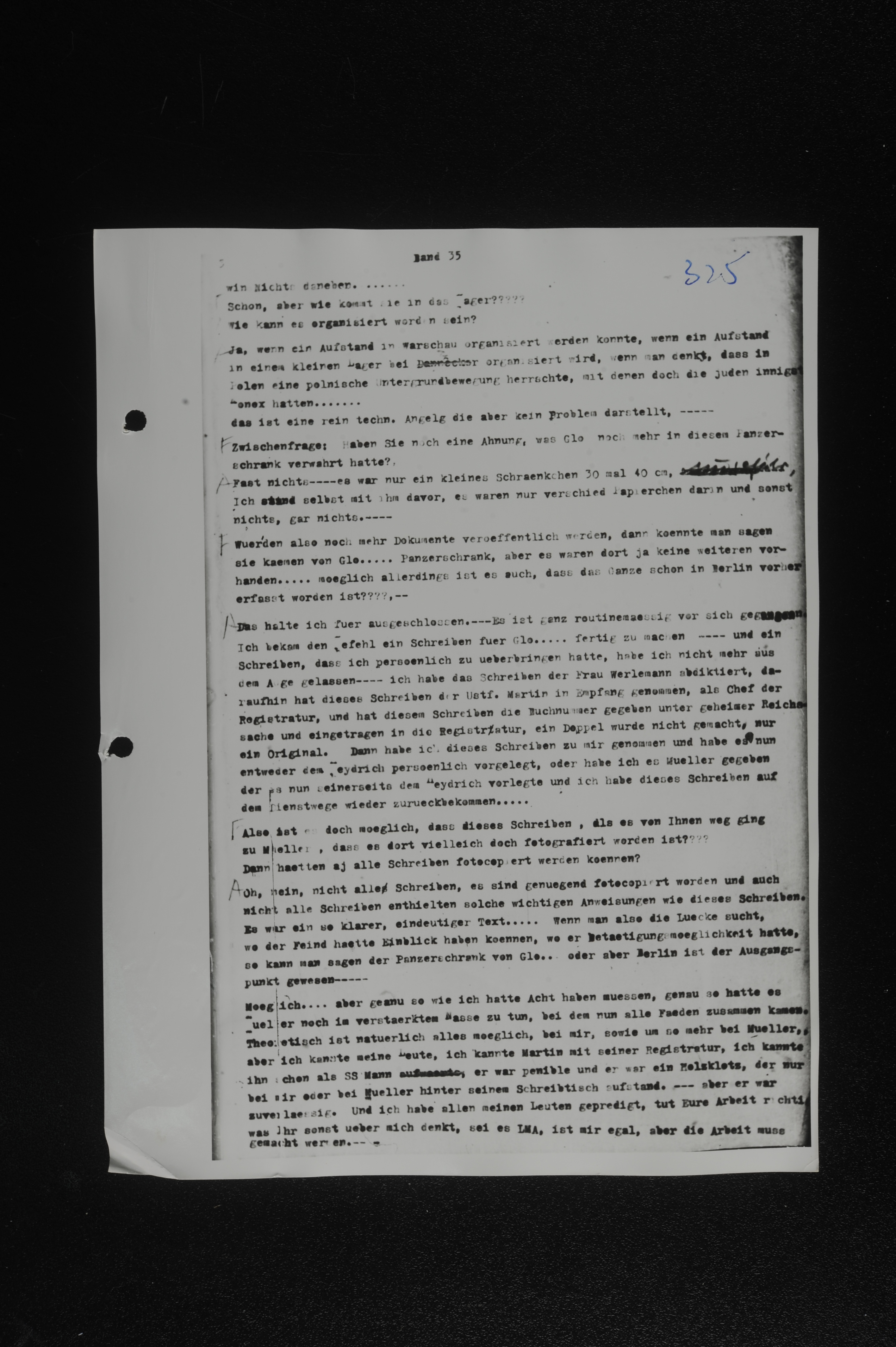
Page 1 of the typescript, O.65 file 85.
Page 1 · Yad Vashem Archives, O.65/85

weapon from becoming ineffective, for example through a solution of the Jewish question, precisely at the moment when a war would break out—a war that had to break out for political and also economic reasons, and in which the Jewish problem could then be the opposing side's strongest weapon. That the opposing side had intended the Jewish question to serve this function is almost certainly something that became clear to the authorities and leadership of the Third Reich, if at all, only in the very last stage of the war.

When I say that the enemy side preserved the Jewish question, the Jewish problem, as the most important of its weapons as far as possible, and therefore avoided every solution with stubborn deliberateness, a distinction must also be made here between the propulsive enemy front, the dynamic enemy front, and the static enemy front.

I would like to explain this parallel a little further by saying that, in this context, by the static enemy front I mean those great and small powers which, for political, democratic, parliamentary and economic reasons, were hostile to the dangerous experiment of the Third Reich—these political antagonisms, these economic antagonisms toward the Third Reich, overarched and exploited by the great powers, among which in 1939 one could certainly count England, America of course, and France too, to a lesser extent.

From this static enemy front I would exclude the Soviet front from the outset, because it is a chapter of its own and presents at least as strong a challenge to the static front just described as National Socialism and the Third Reich do. This static enemy front, where it was already clear before 1933 that, under the threat of the Bolshevization of Germany, it could for a moment rise to a certain rational, more or less joyful welcome of the National Socialist seizure of power, because it now believed National Socialism would form an impregnable wall against this Bolshevik process—yet it soon became clear that the traditional antagonisms still had the upper hand.

Developments in the Soviet Union itself may have contributed to this in no small measure. One need only recall the great Kula… extermination campaigns and the great trial of 1936, which really gave foreign countries the impression that the Soviet Union had very great internal difficulties to contend with and was thereby, to a certain extent, neutralized, to a certain extent prevented from taking part in the international struggle for power.

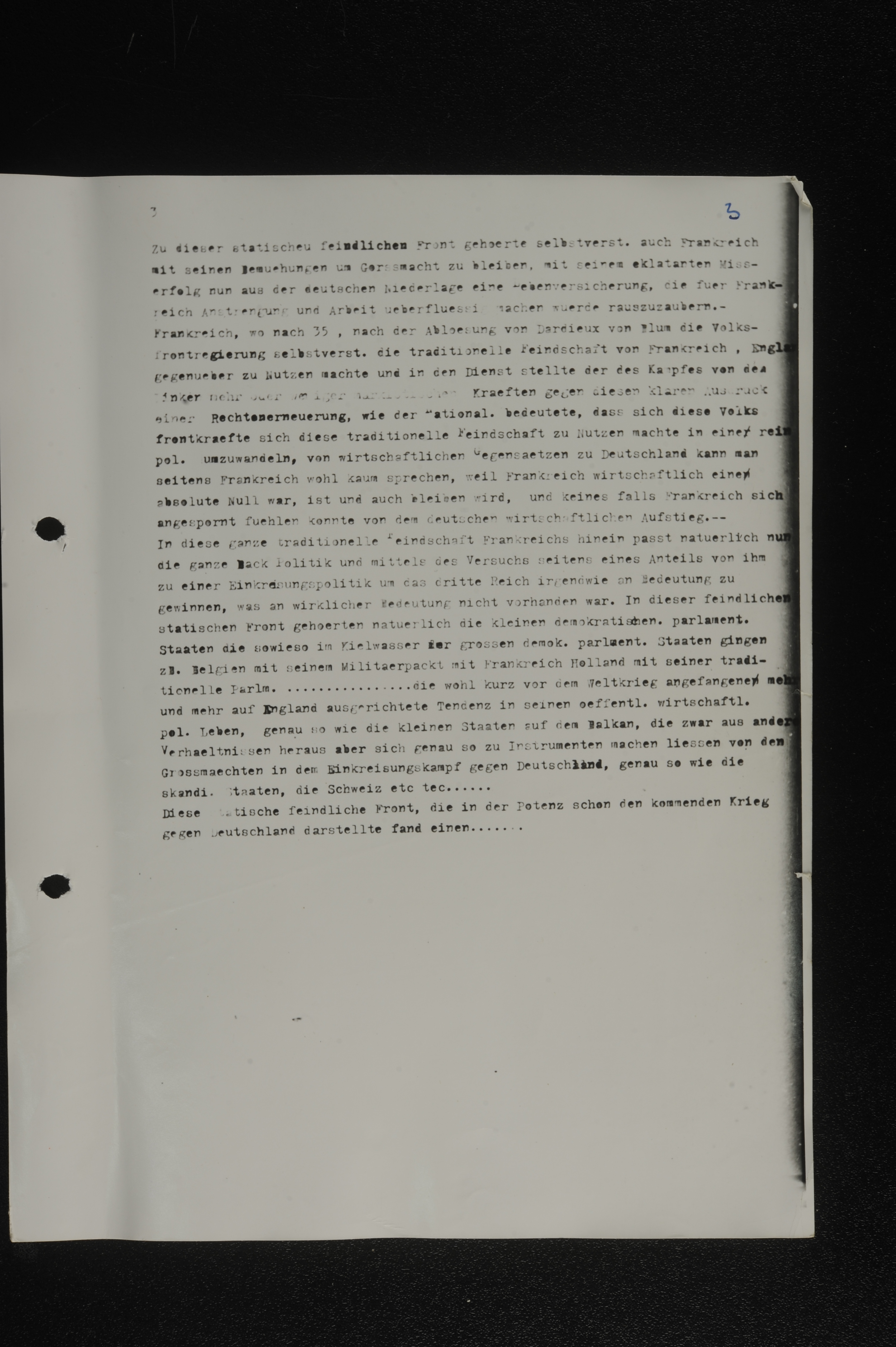
It became clear soon after 1933 that the traditional hostility of England, for example—traditional in this respect too, just as before the First World War: politically, England feared that the attraction of a united Germany, of the German people renewed by National Socialism, would disturb the balance of Europe. This balance, held together by the Bak policy—France–Czechoslovakia, England–France–Poland–Romania–France—with artifice and flying apparatus (Flugwerk), was now disturbed by this Third Reich. But above all, England's traditional hostility in the economic sphere, because after a very short time it was already beginning to become apparent that in this economic war England would somehow be the underdog and, sooner or later, would be outstripped by Germany.

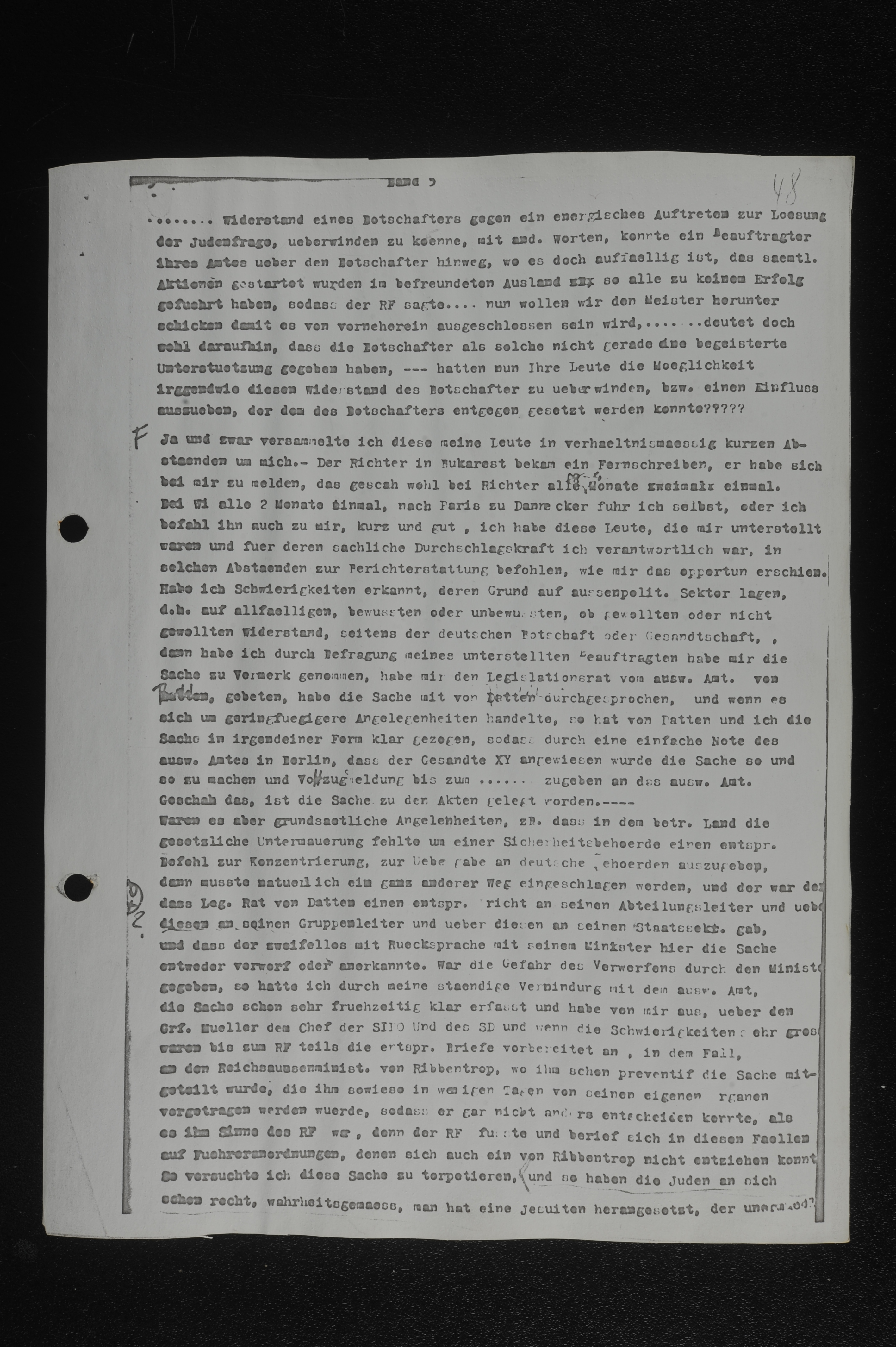
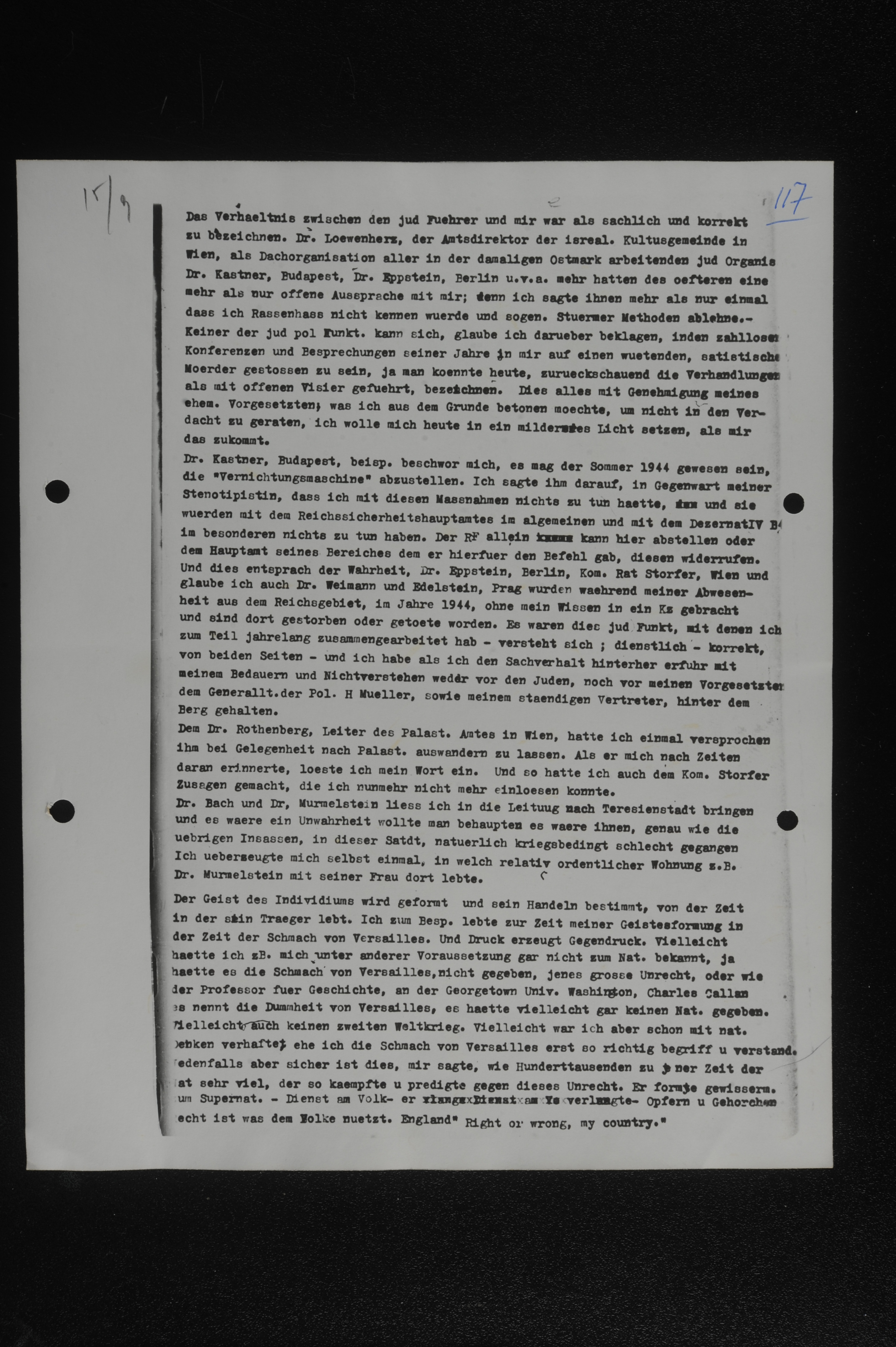
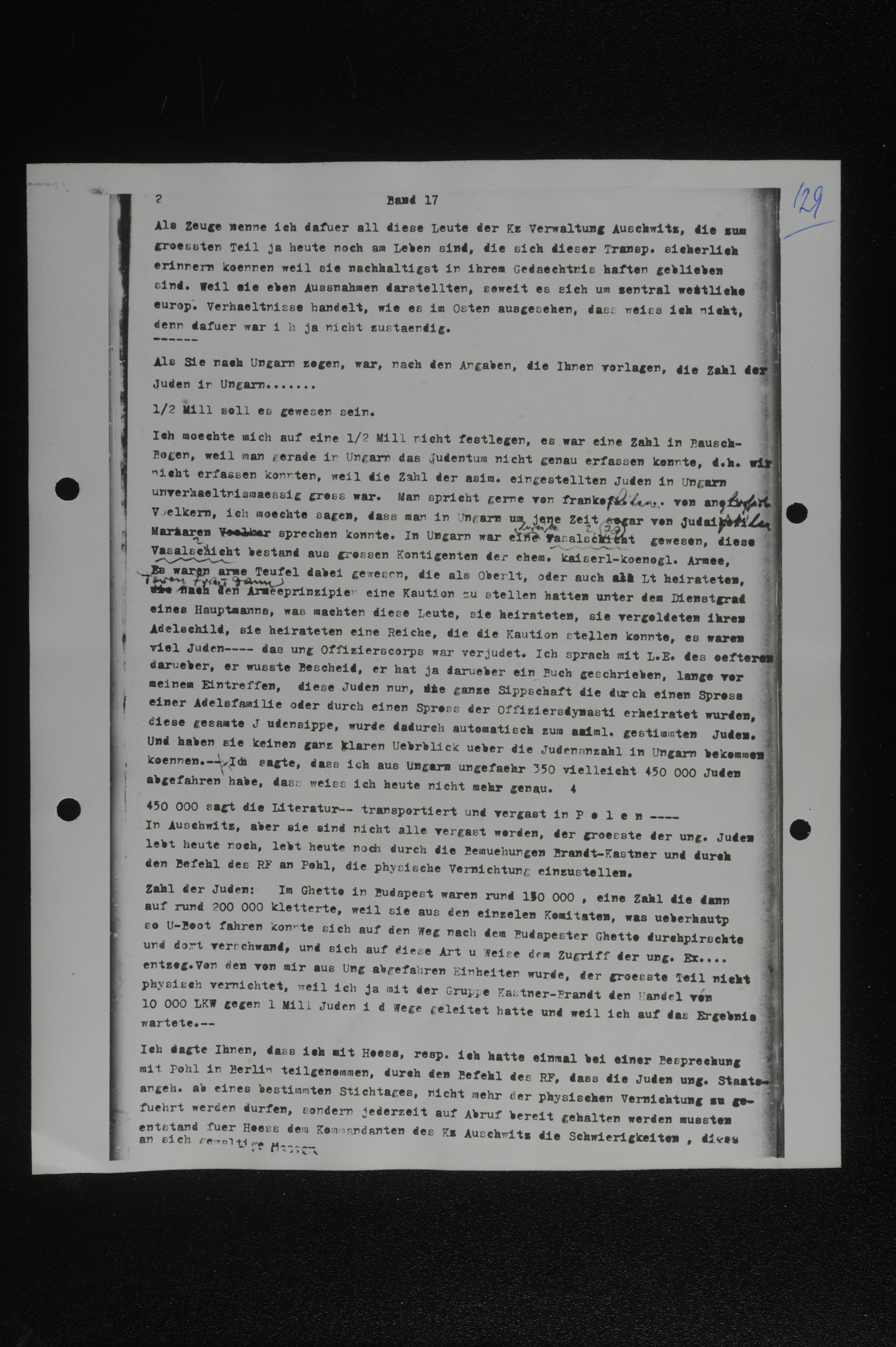
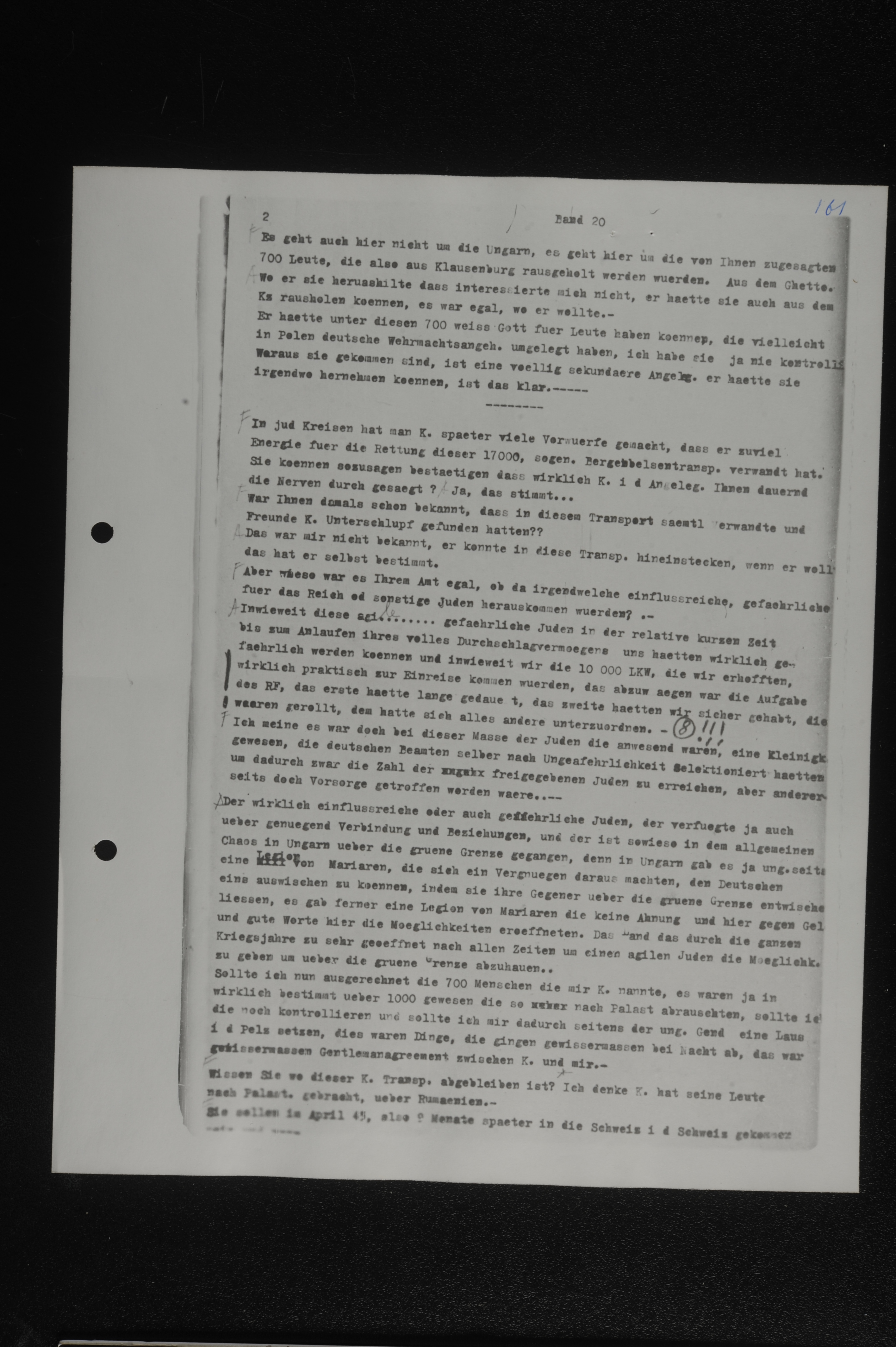
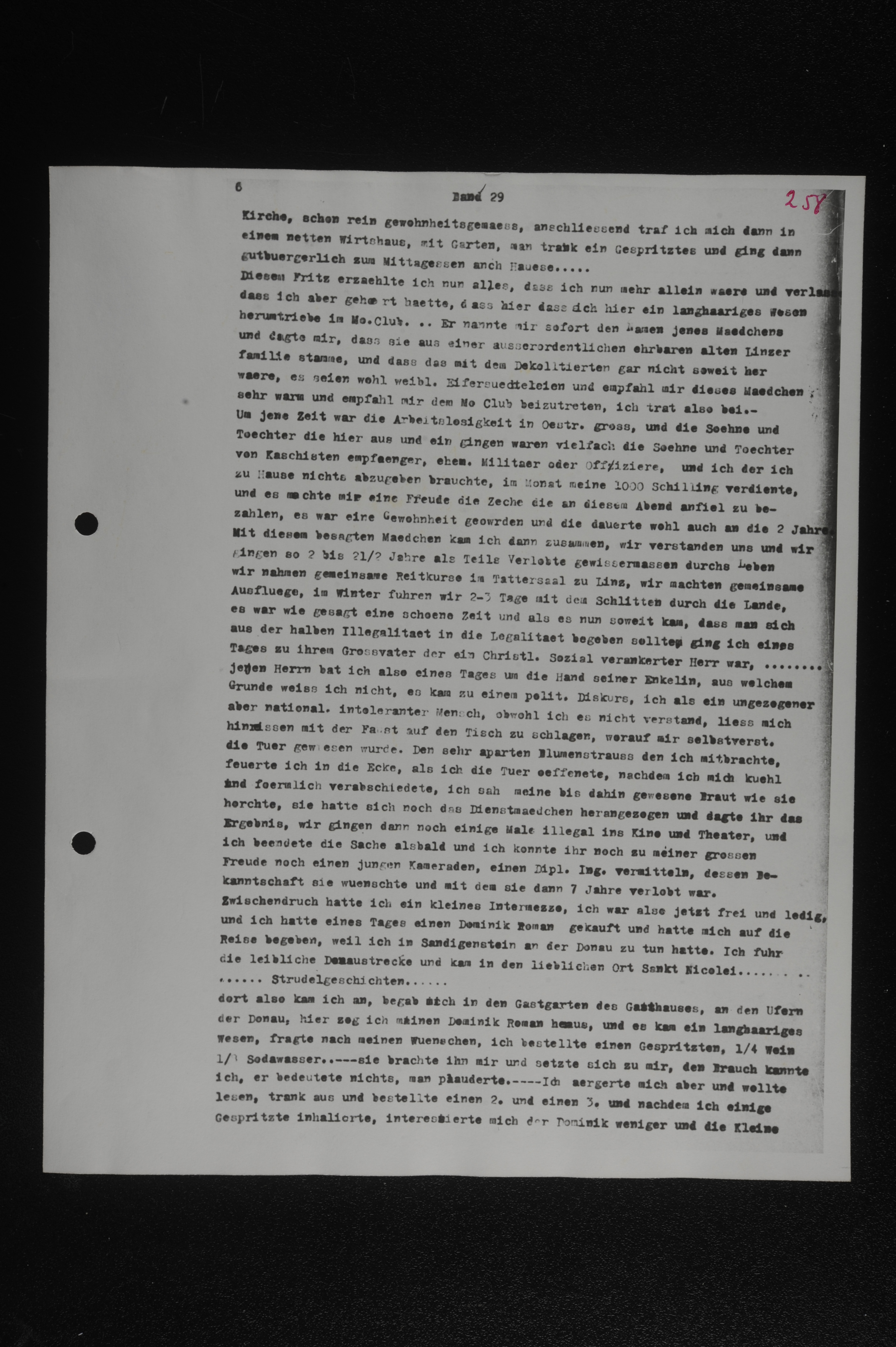
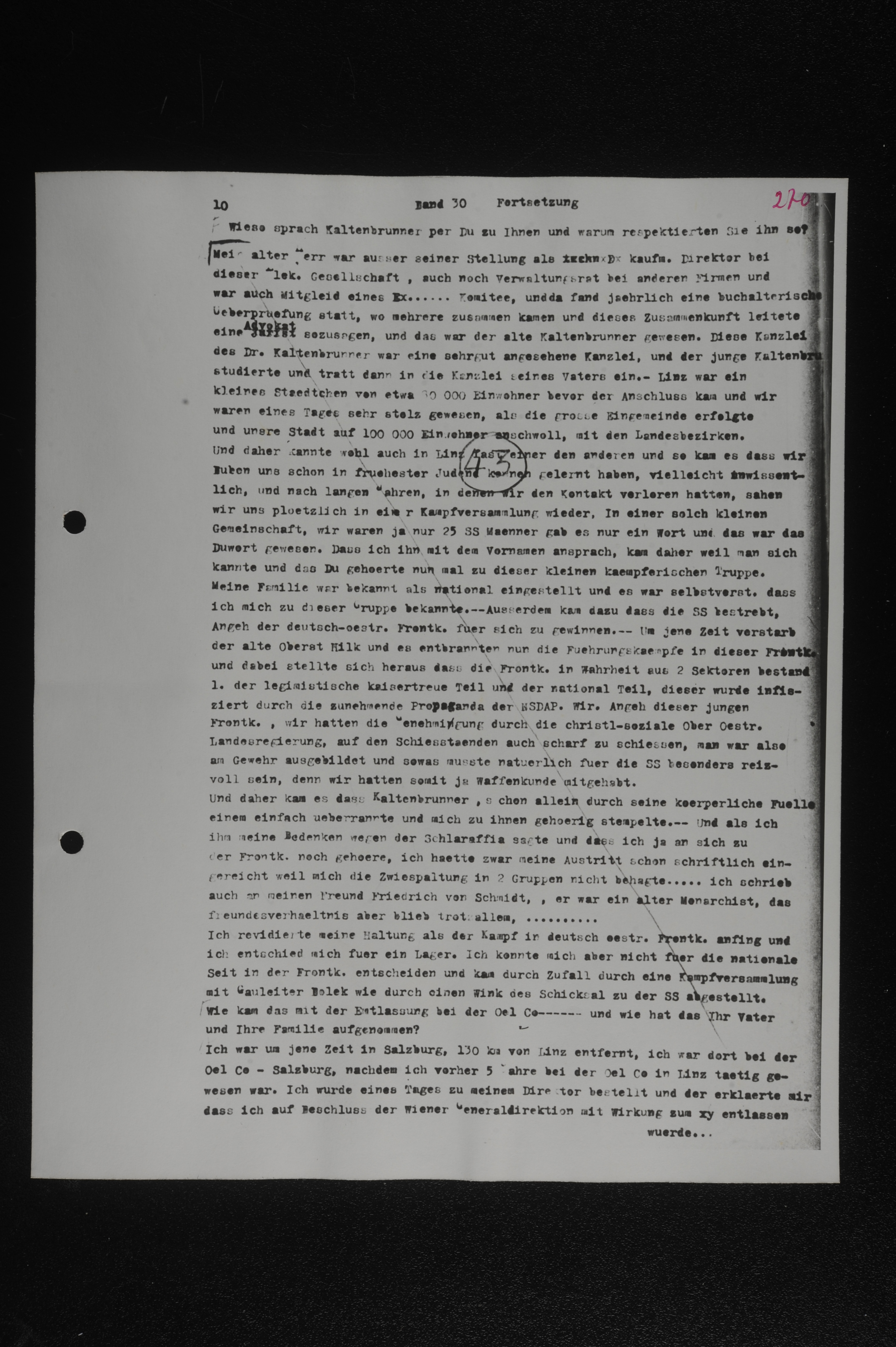
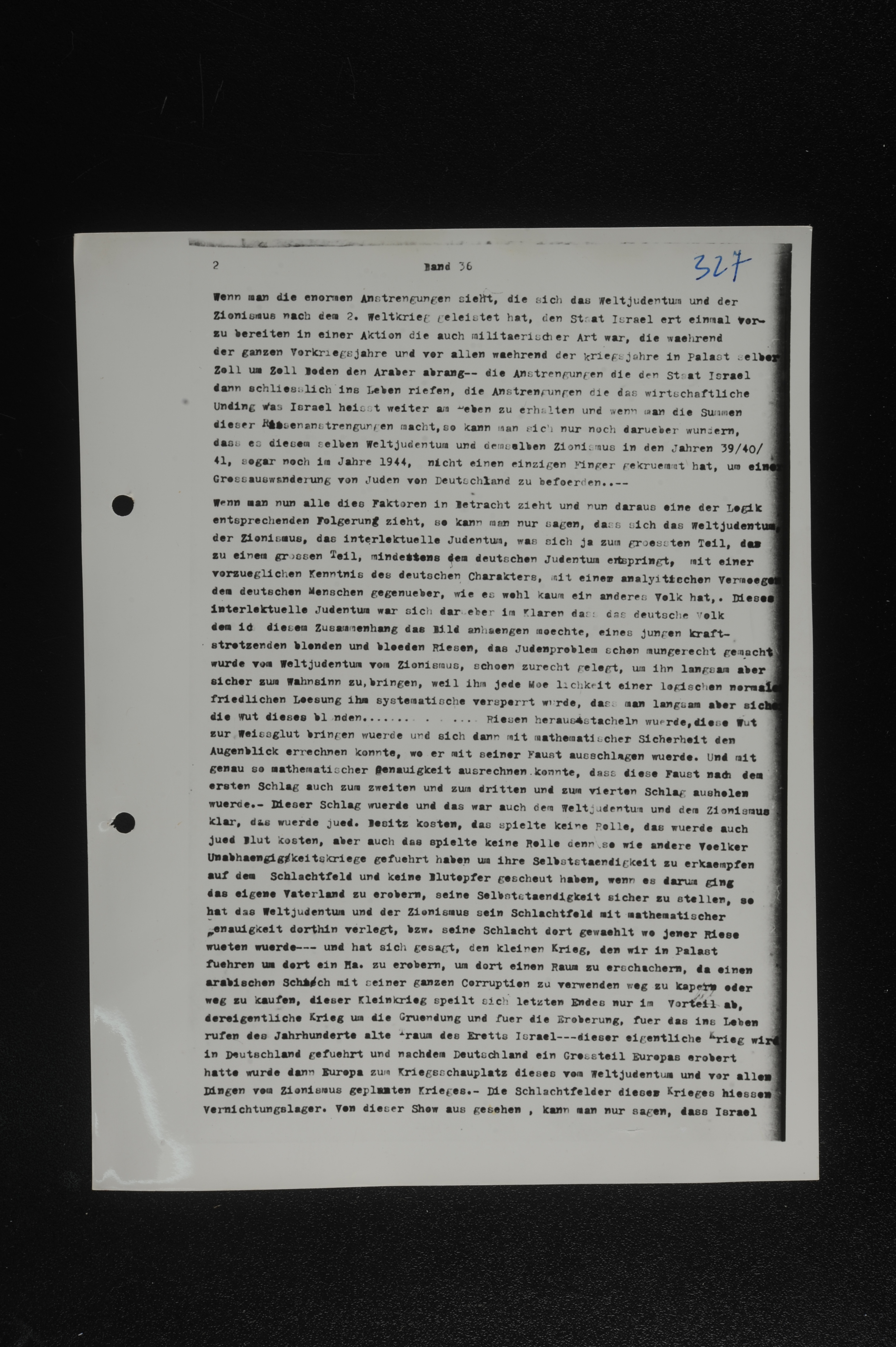
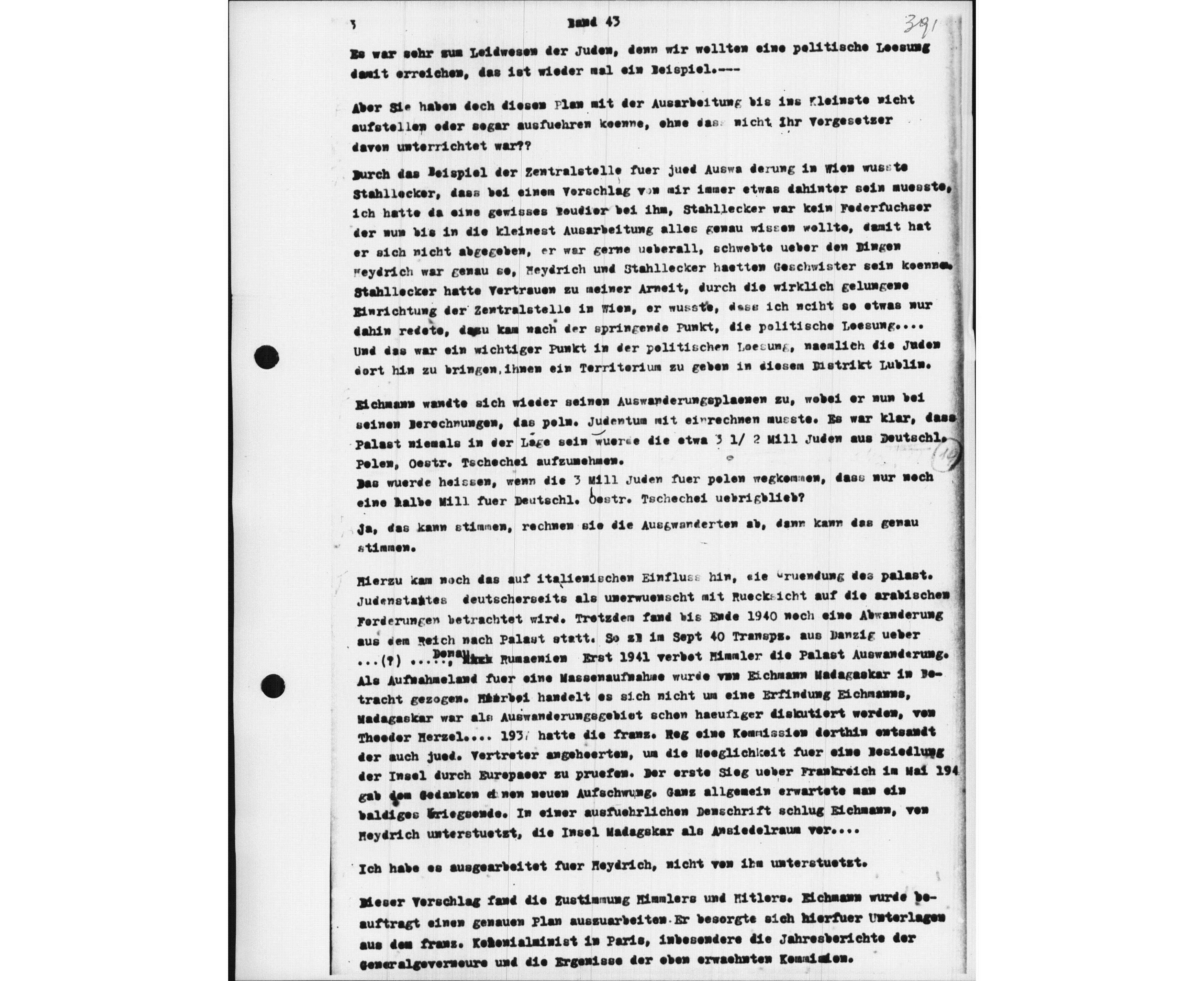
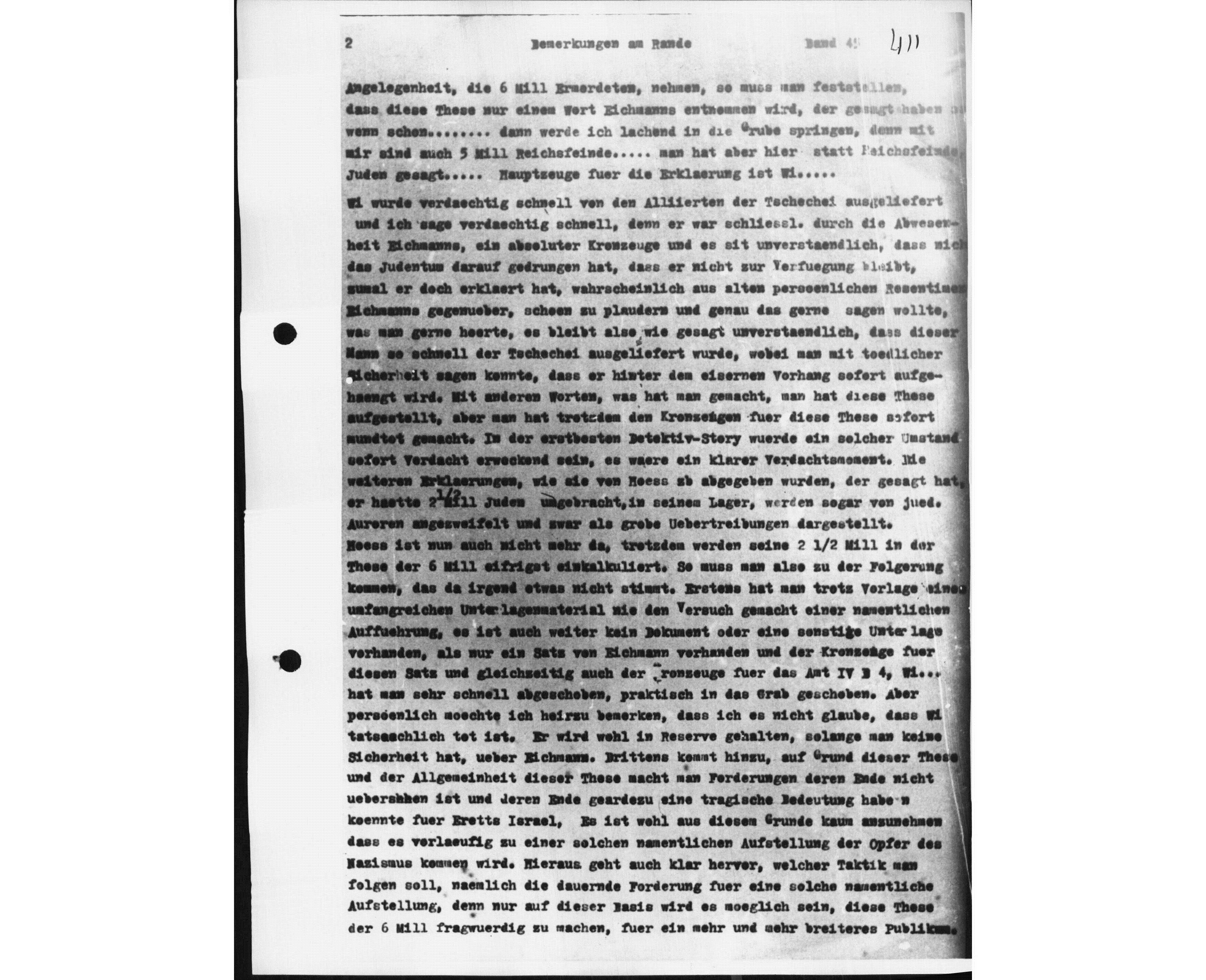
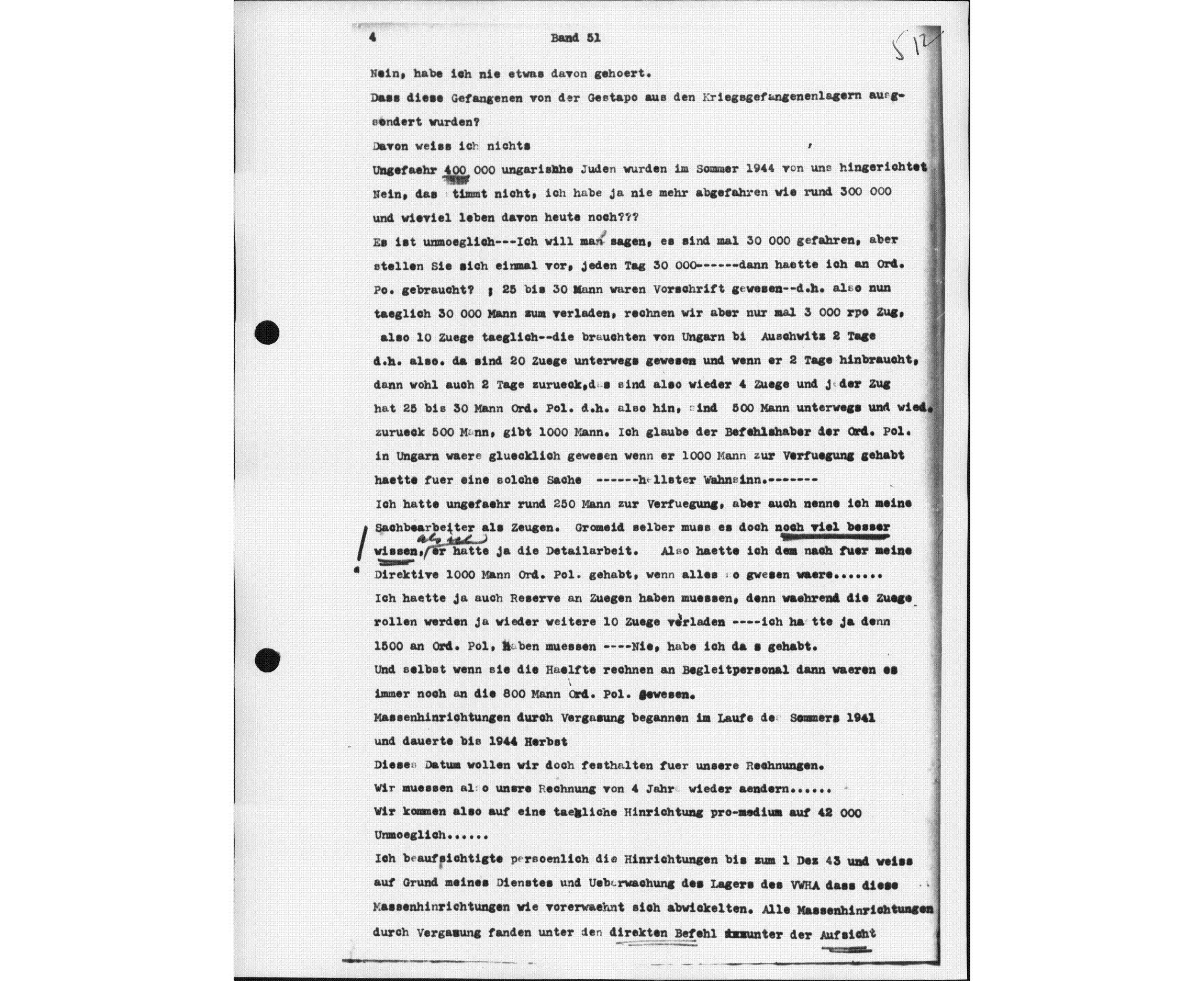
Open page image and German
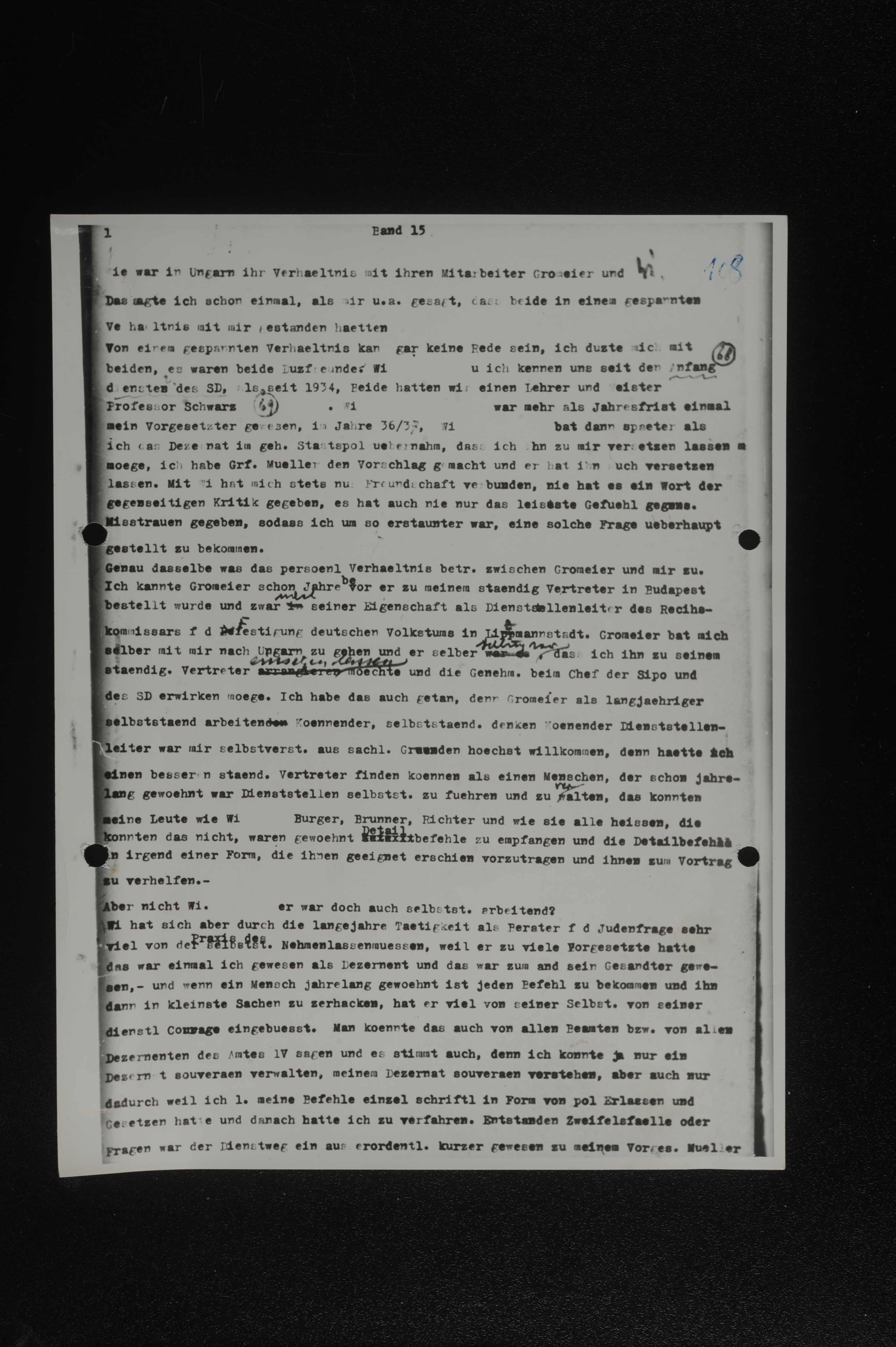
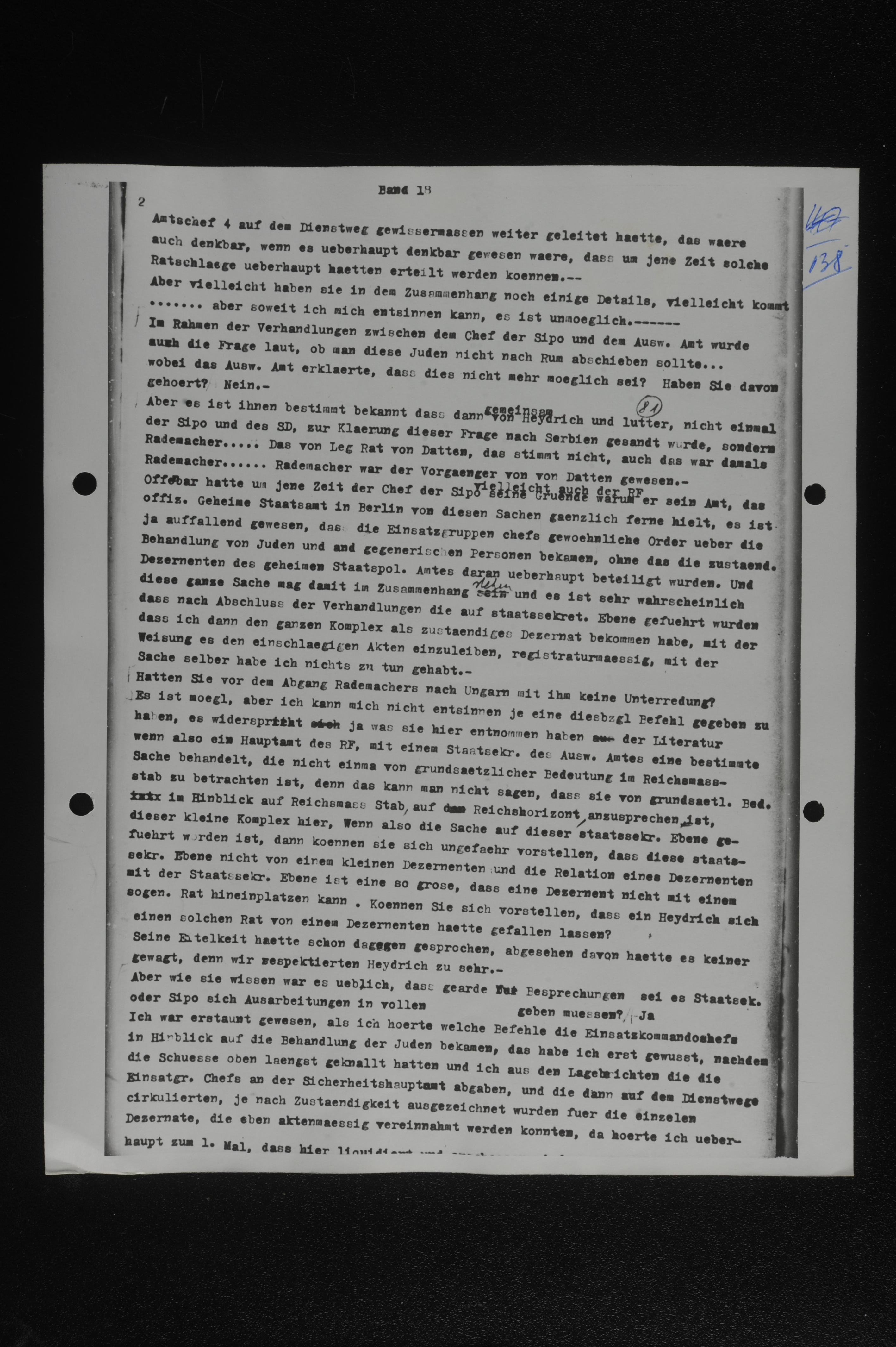
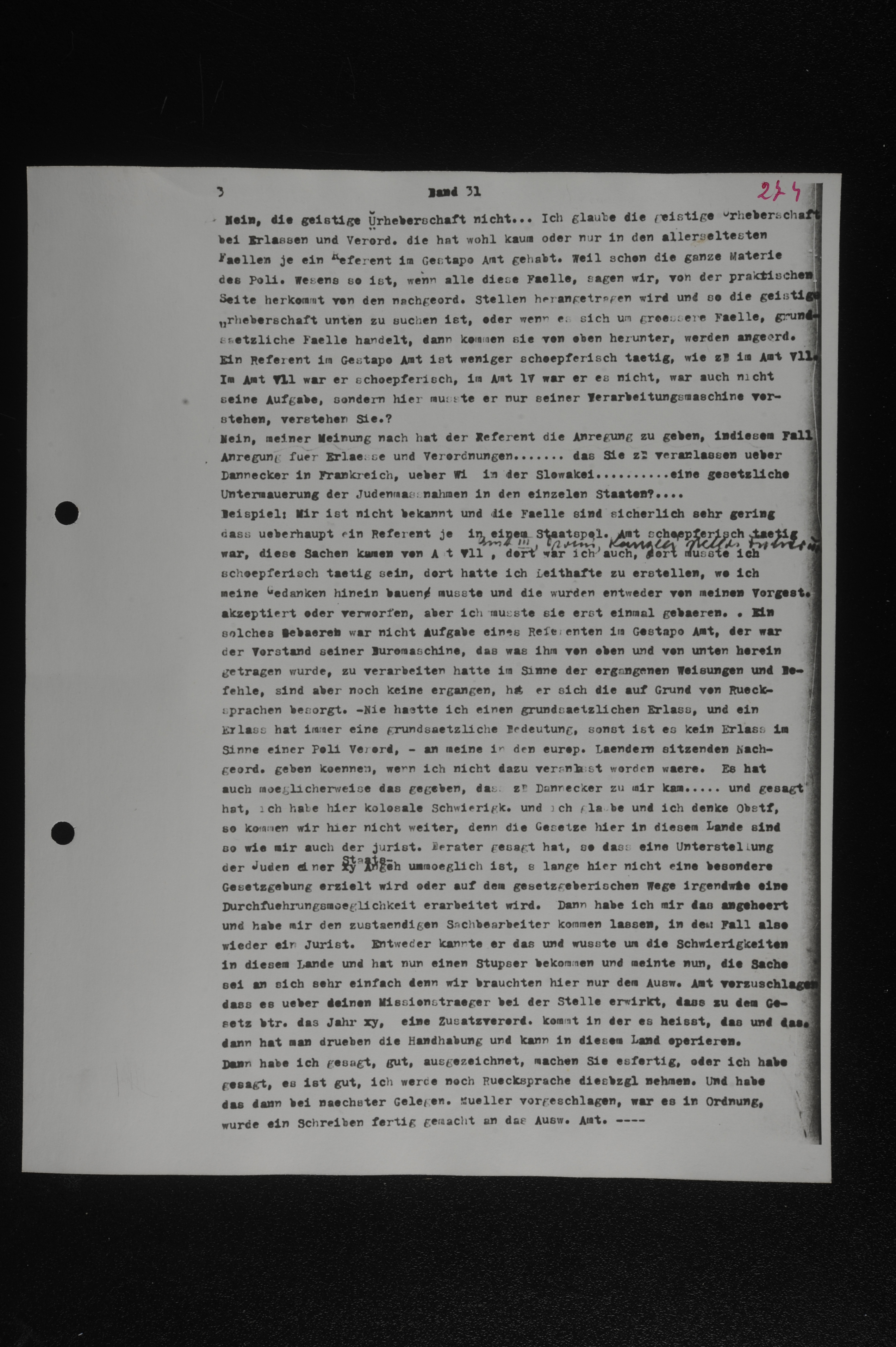
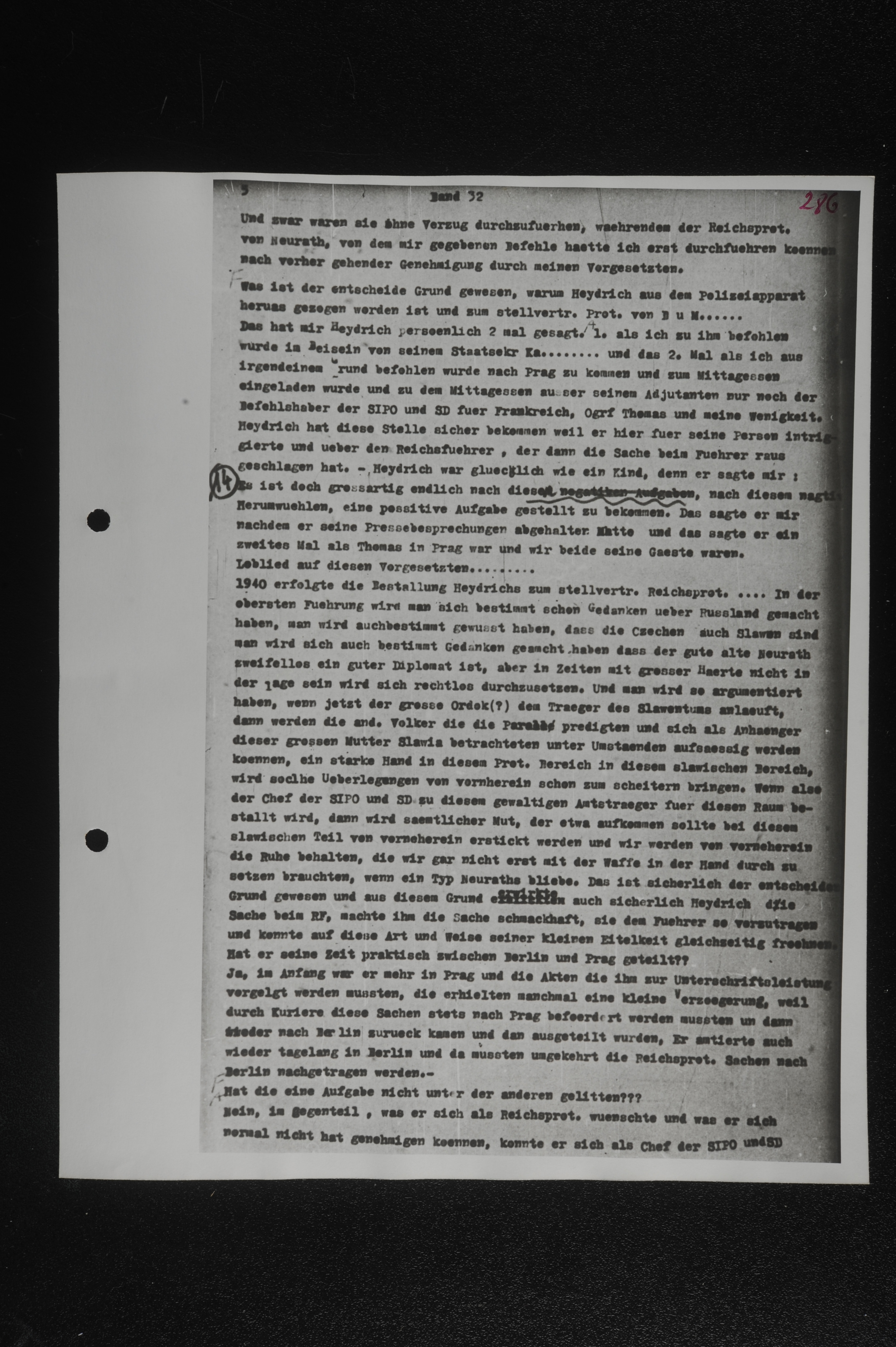
Page 2 of the typescript, O.65 file 85.
Page 2 · Yad Vashem Archives, O.65/85

France also belonged to this static hostile front, of course, with its efforts to remain a great power and its glaring failure to conjure out of Germany's defeat a life-insurance policy that would make effort and work unnecessary for France. France, where after '35, after Dardieux was replaced by Blum, the Popular Front government naturally made use of France's traditional hostility toward England and placed it in the service of the struggle of the left-wing, more or less … forces against this clear expression of a renewal of the Right that National Socialism represented. These Popular Front forces made use of this traditional hostility to turn it into a purely political one. One can hardly speak of economic antagonisms toward Germany on France's part, because economically France was, is, and will remain an absolute zero, and could in no way feel spurred on by Germany's economic rise.

Into this whole traditional hostility of France there naturally fits the whole Back policy, and the attempt, on the part of a section of it, to gain some importance through a policy of encirclement against the Third Reich—importance that was not really there. This hostile static front naturally included the small democratic parliamentary states that in any case followed in the wake of the great democratic parliamentary states.

For example, Belgium with its military pact with France; Holland with its traditional parliamentary… and the tendency, probably beginning shortly before the World War, for its public, economic and political life to become more and more oriented toward England. Just like the small states in the Balkans which, although under different circumstances, likewise allowed the great powers to make them into instruments in the struggle to encircle Germany; just like the Scandinavian states, Switzerland, and so on and so on…

This static hostile front, which already represented the coming war against Germany in potential, found a…

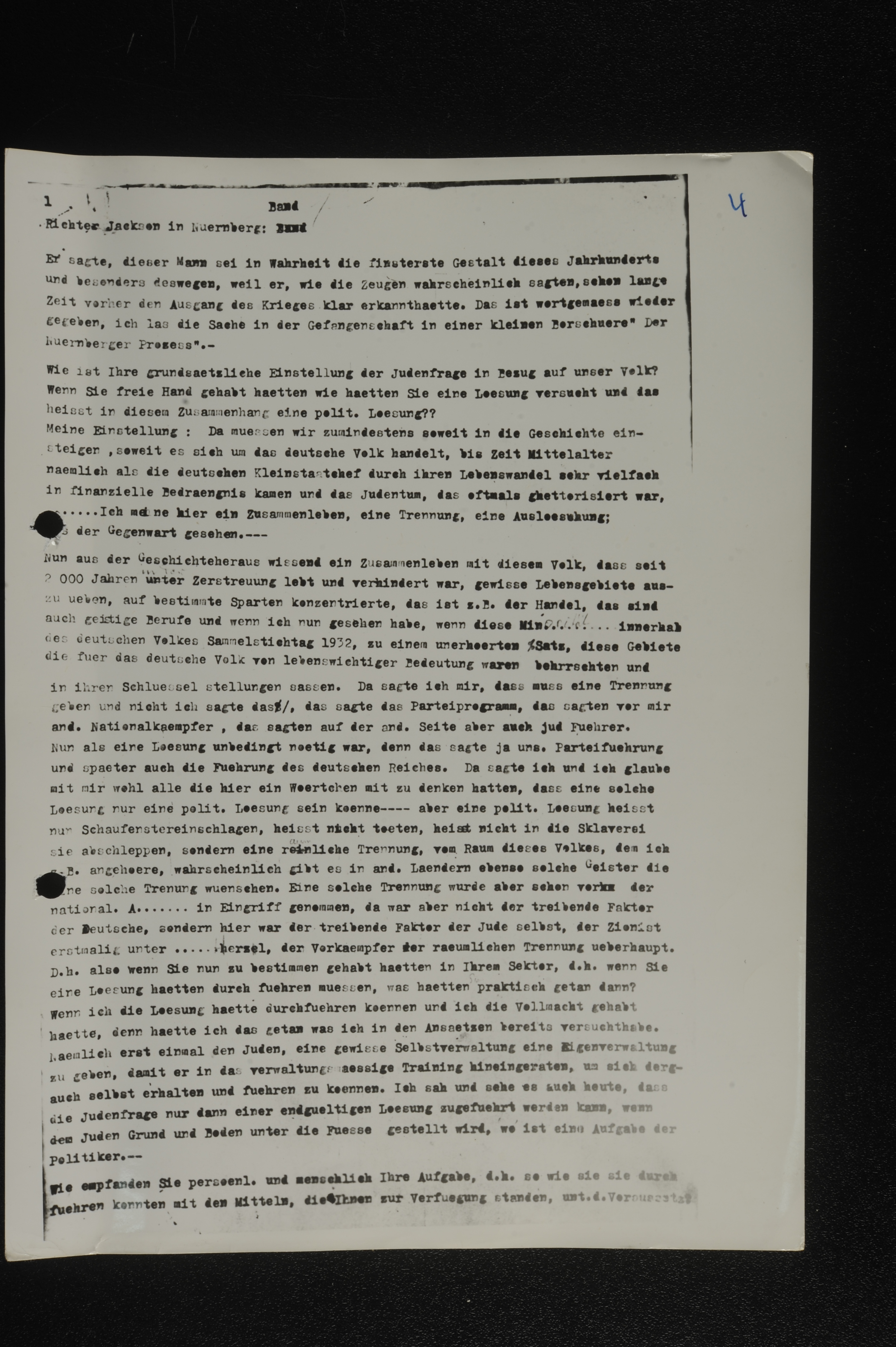
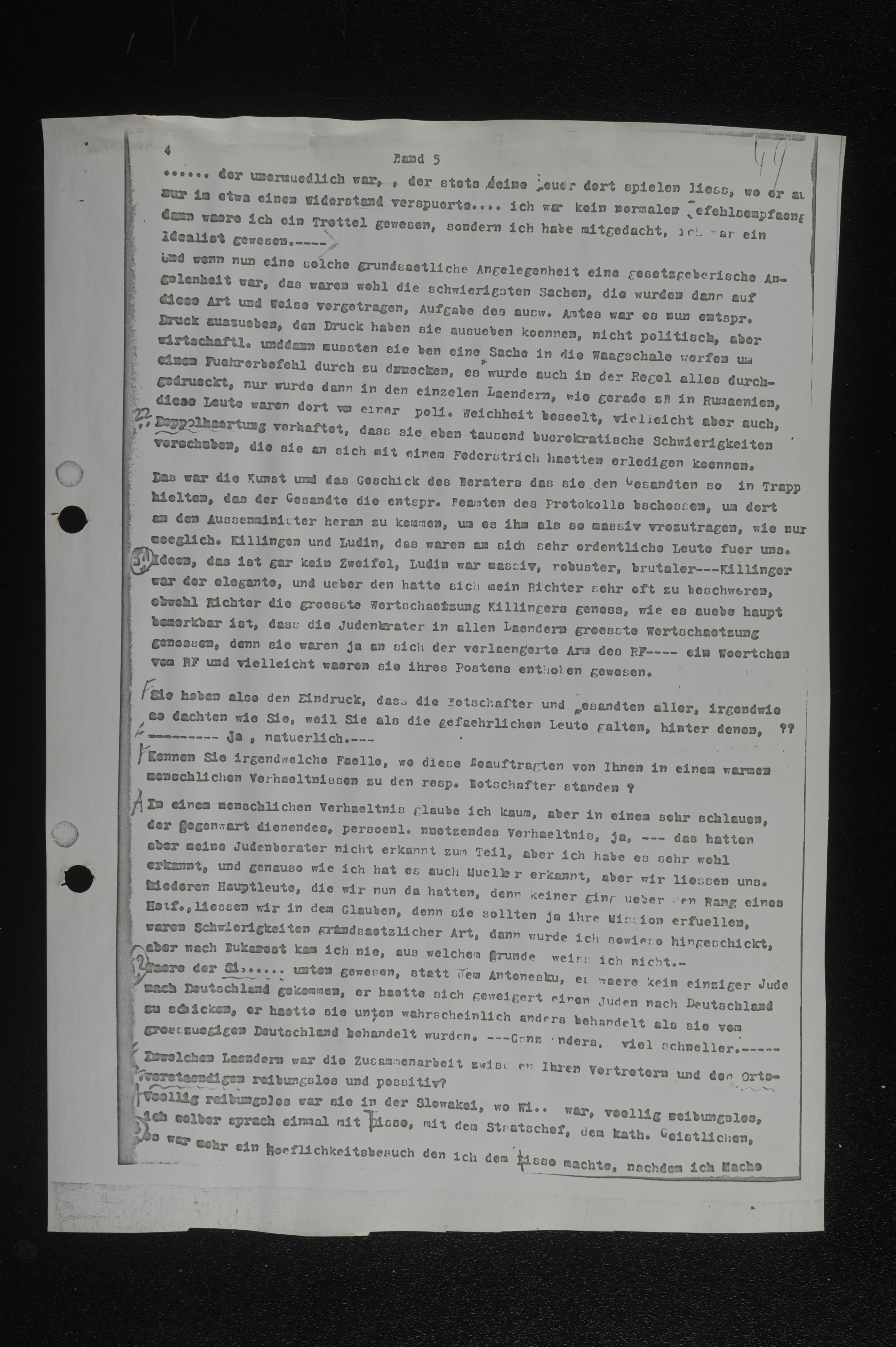
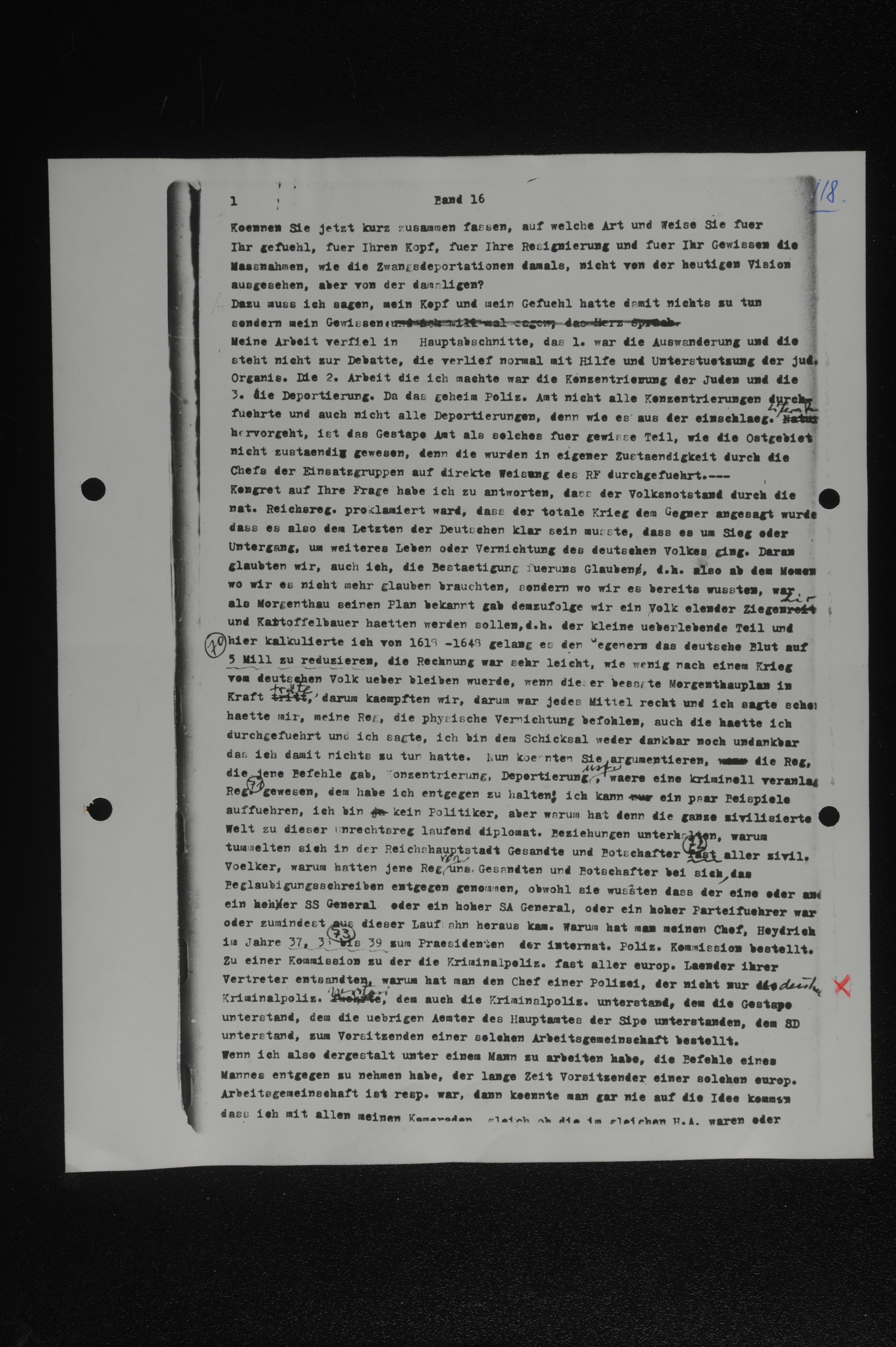
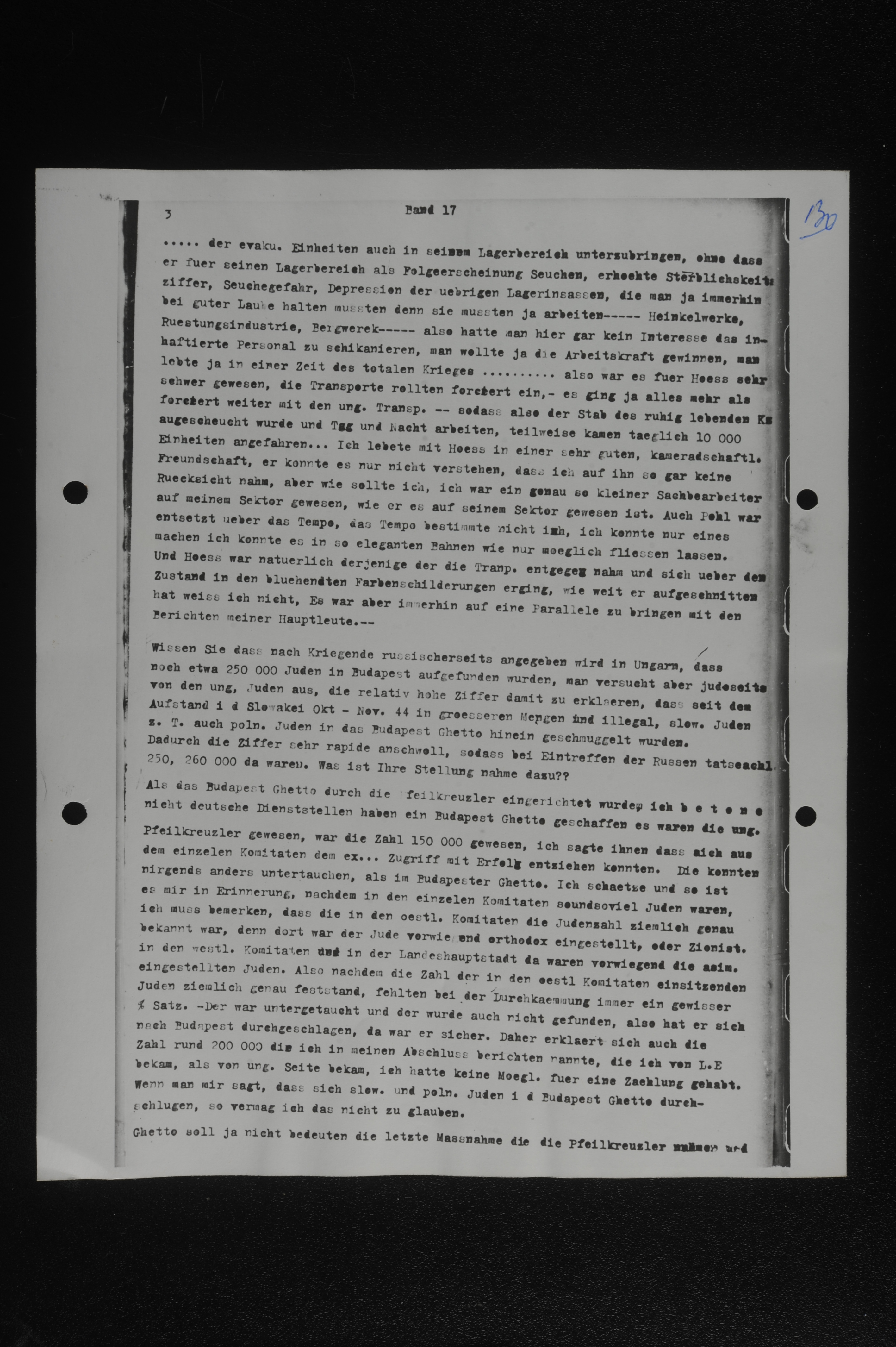
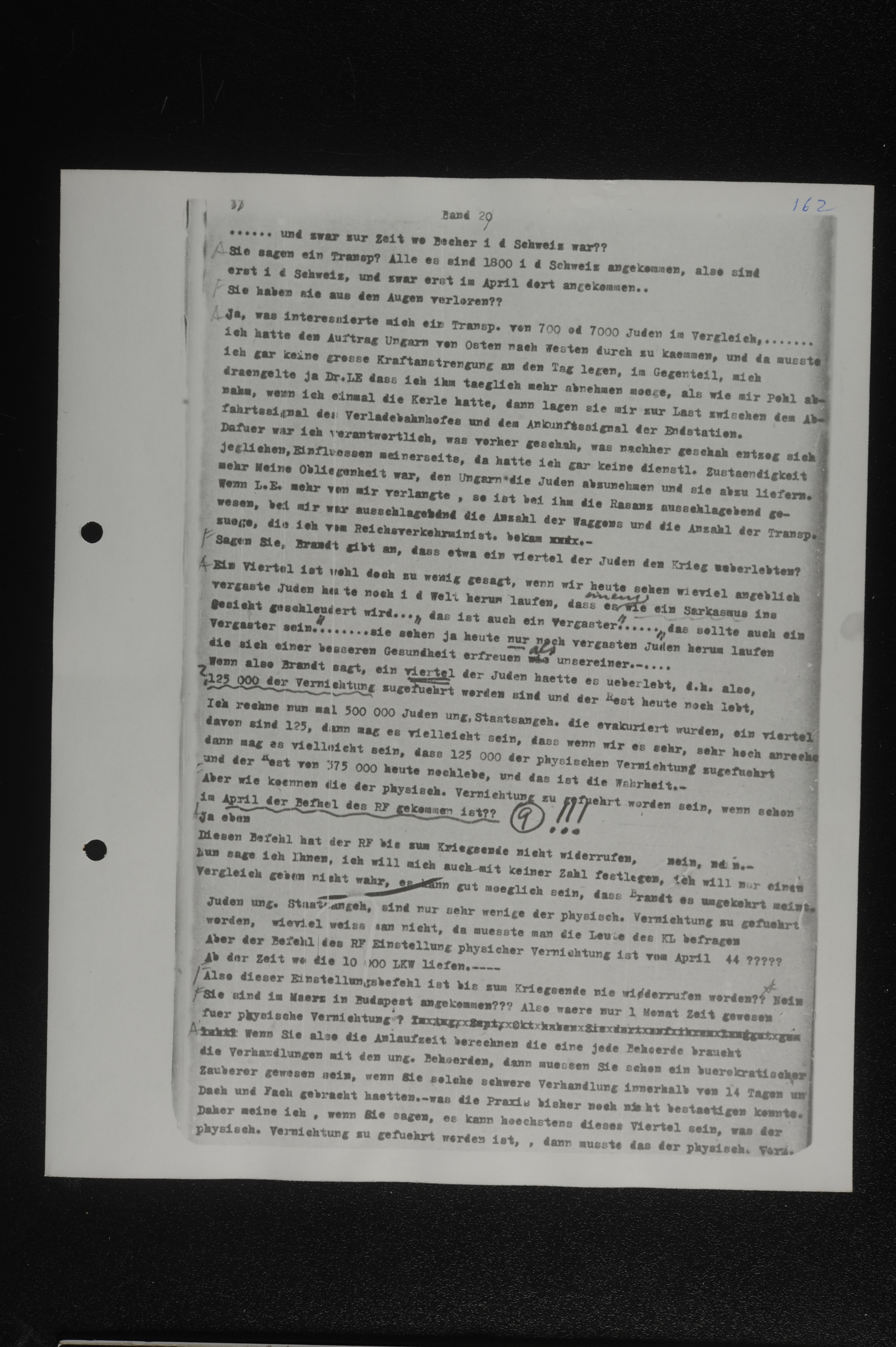
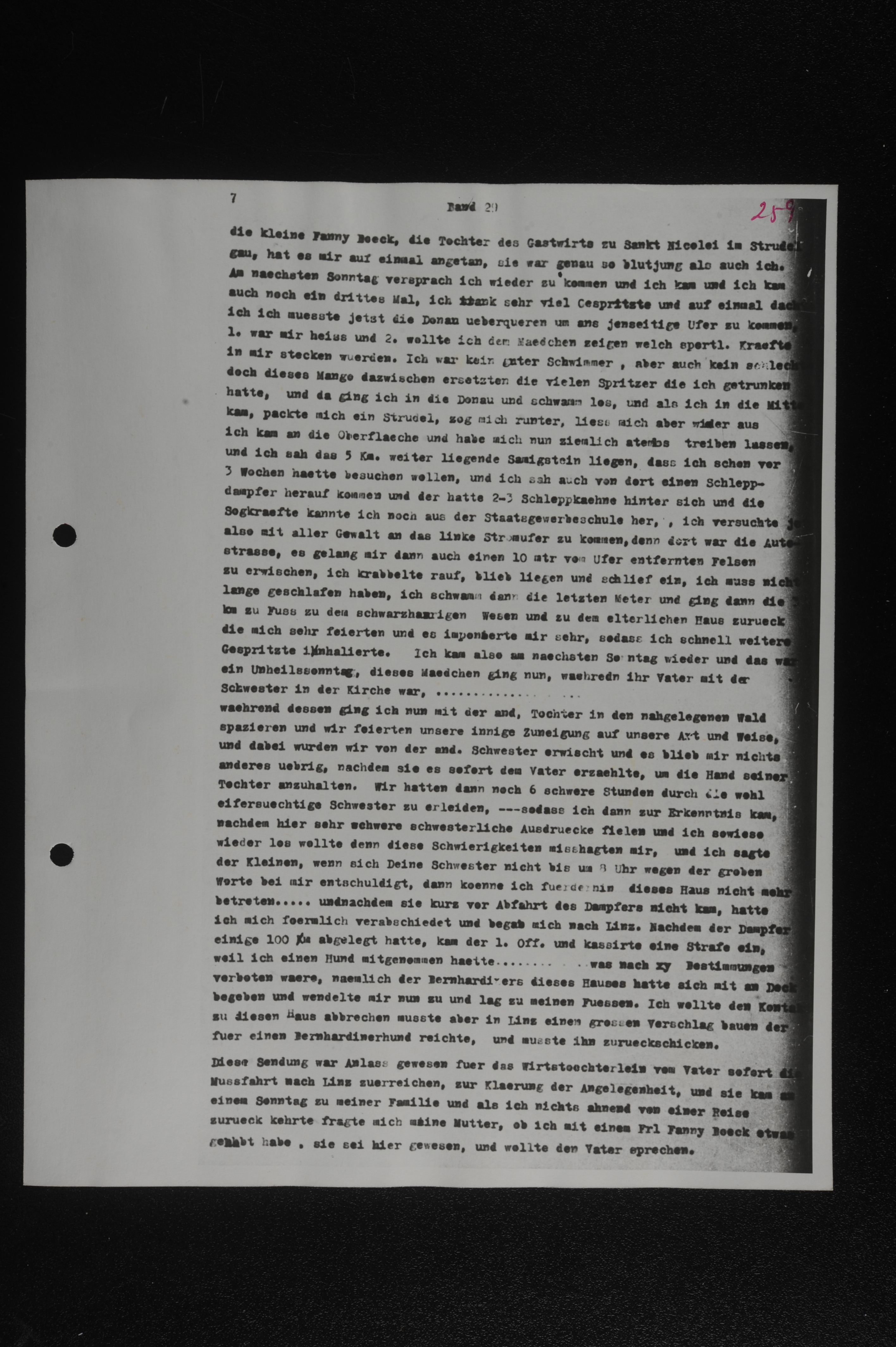
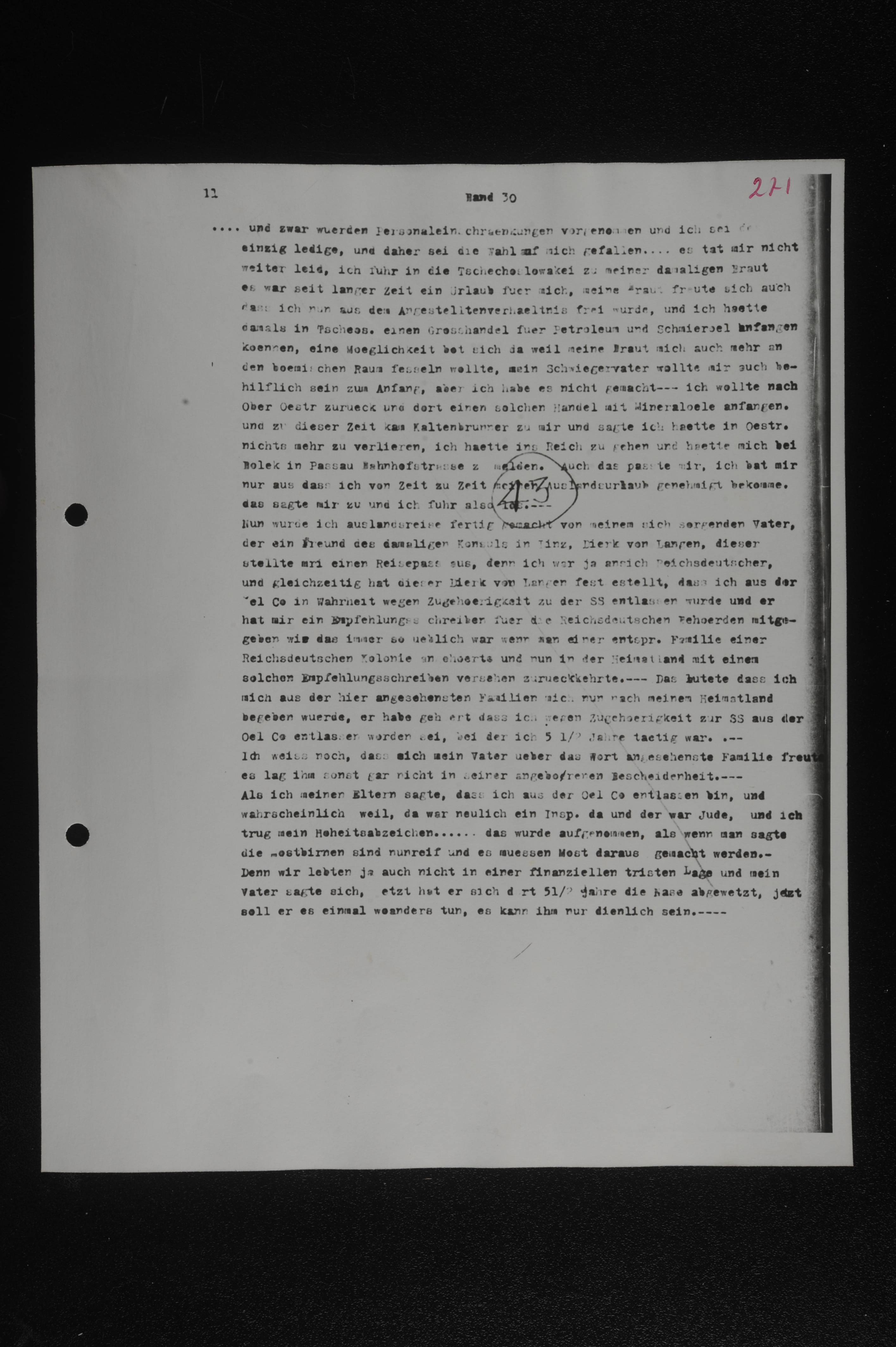
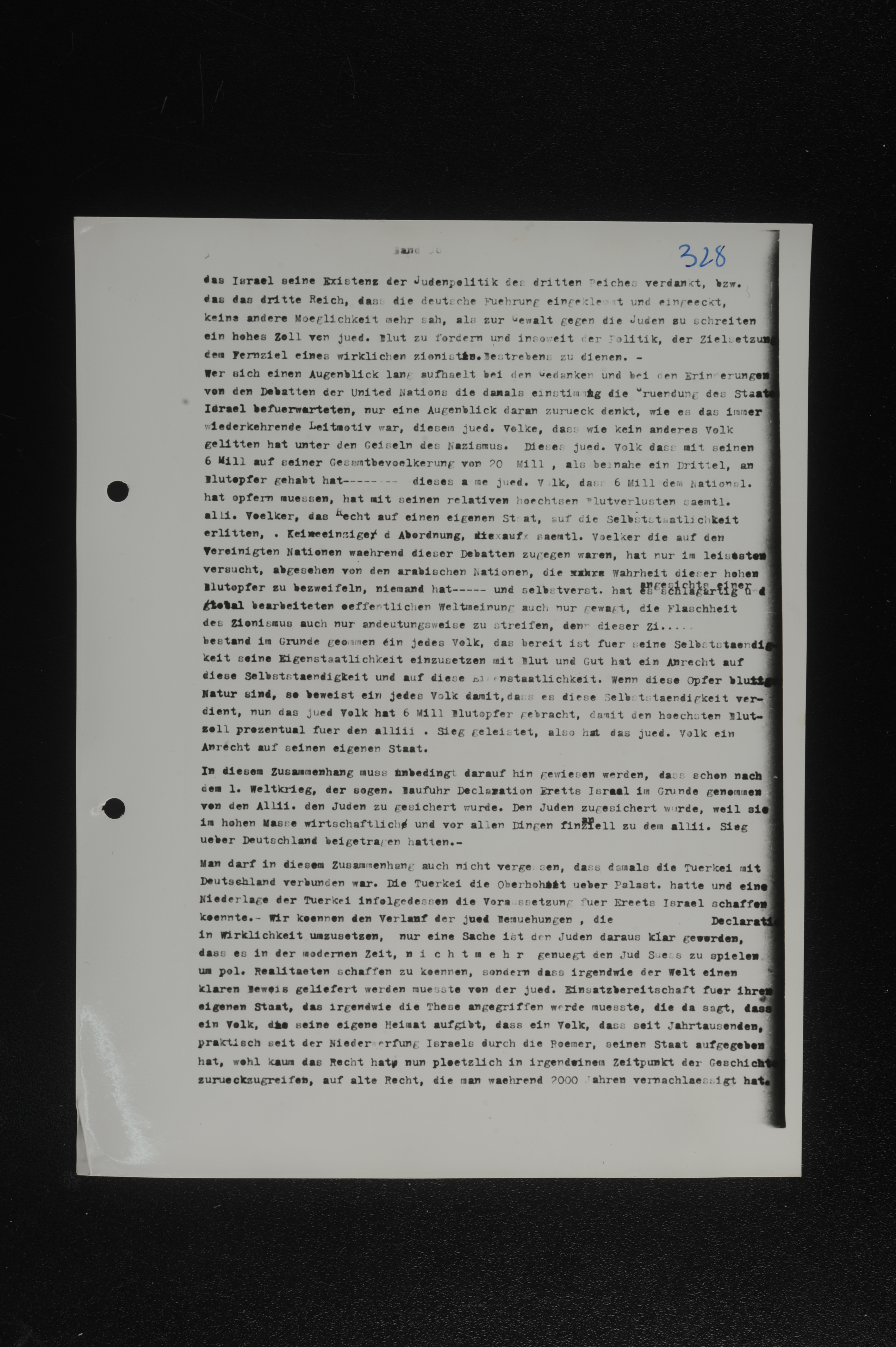
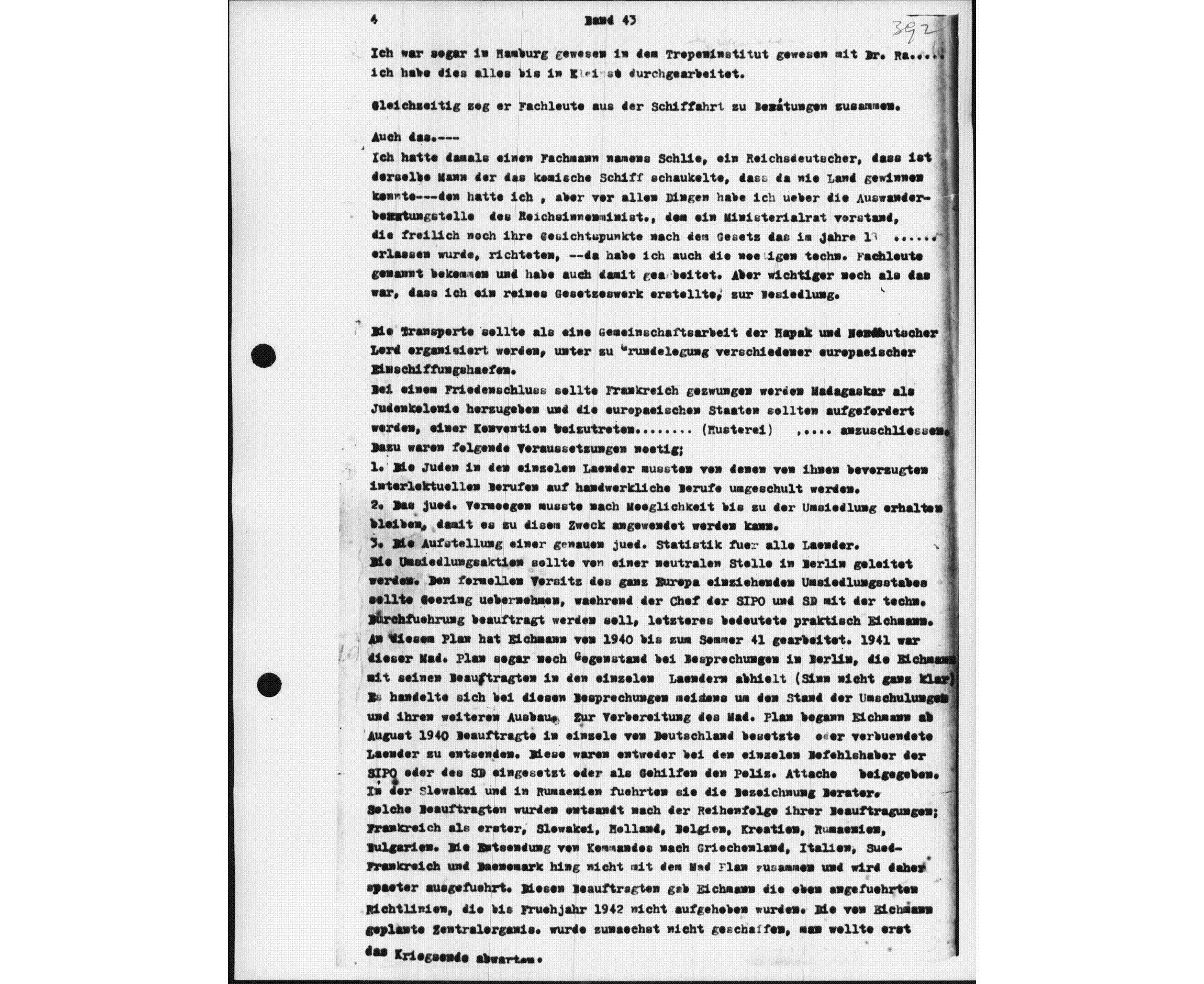
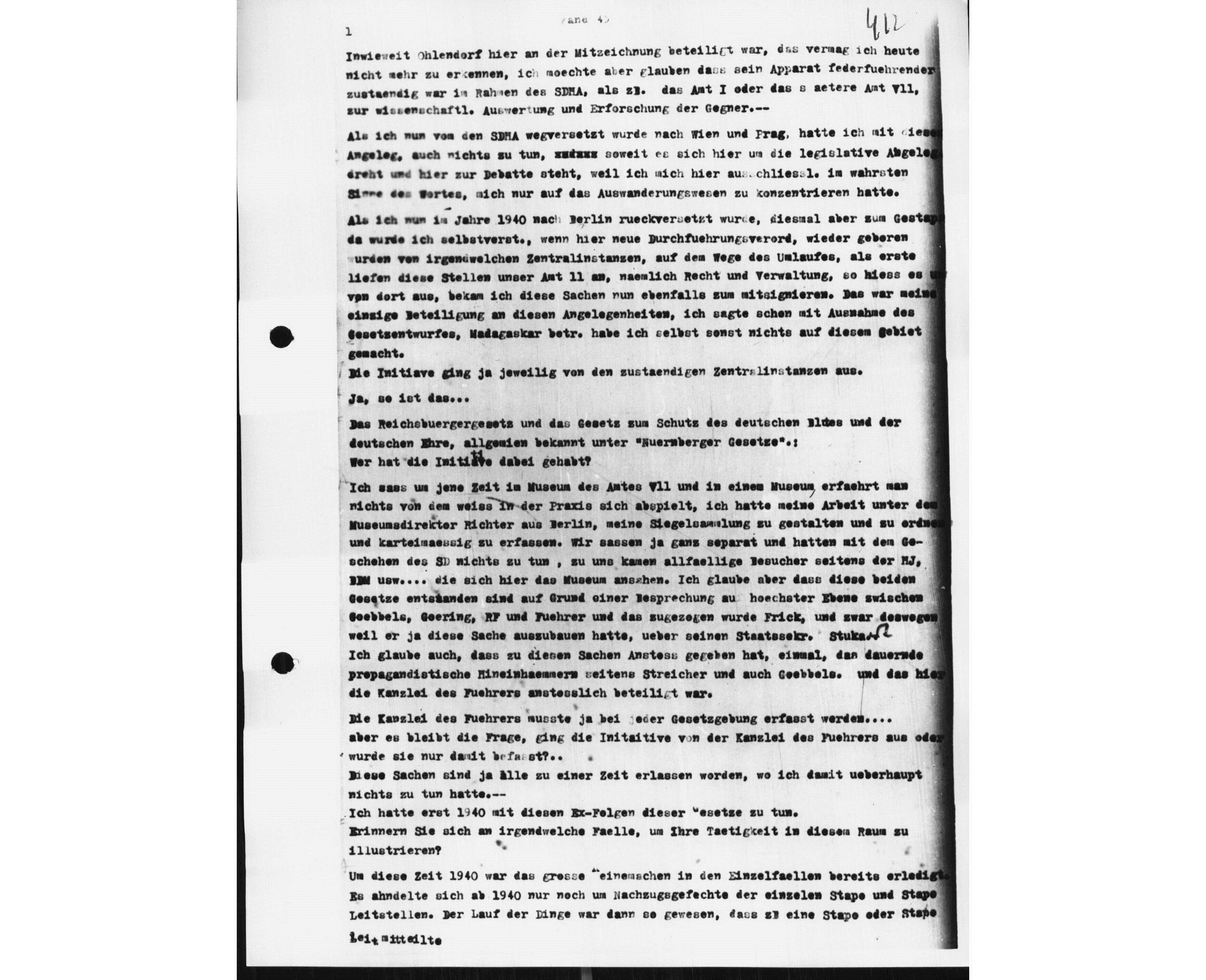
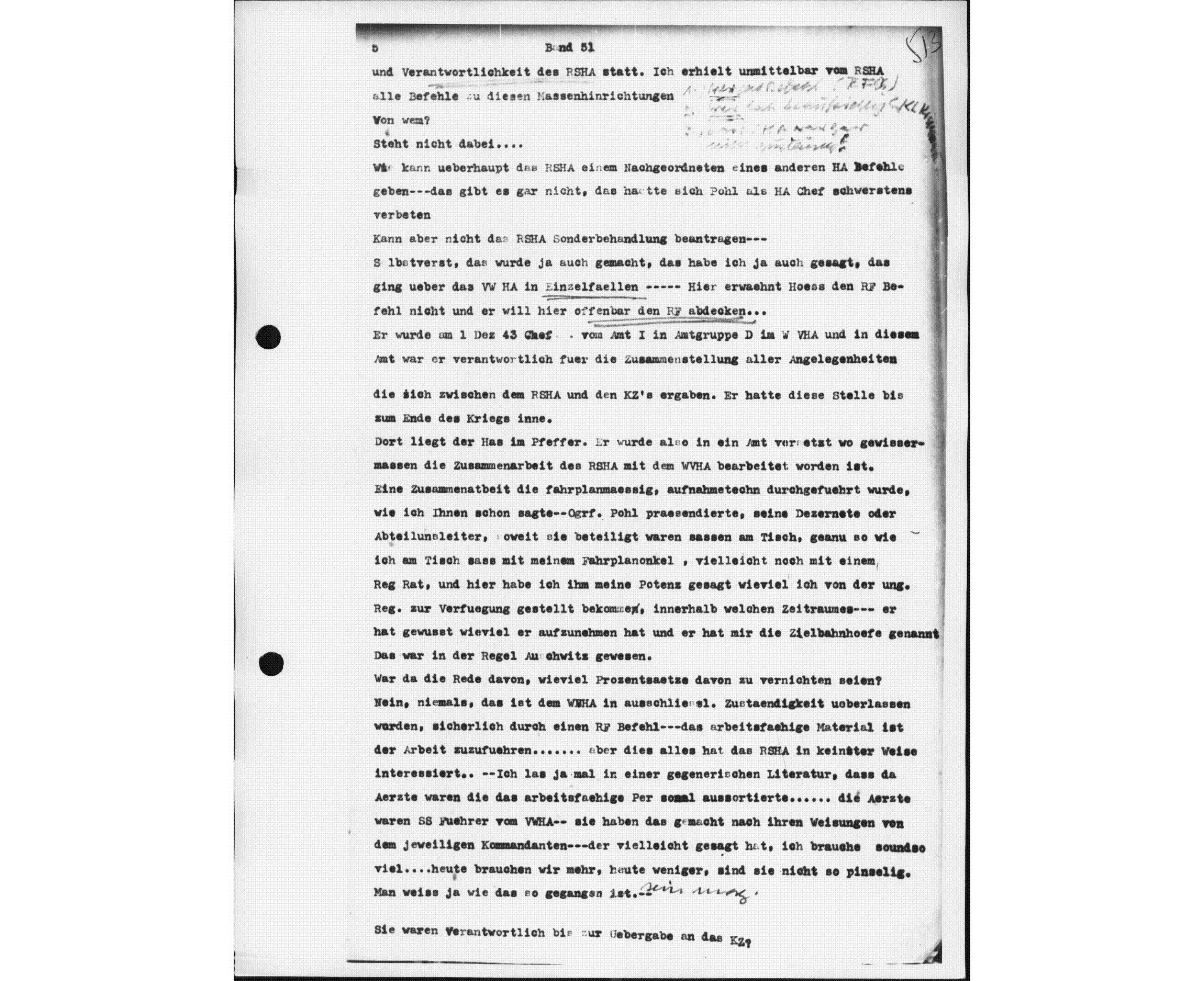
Open page image and German
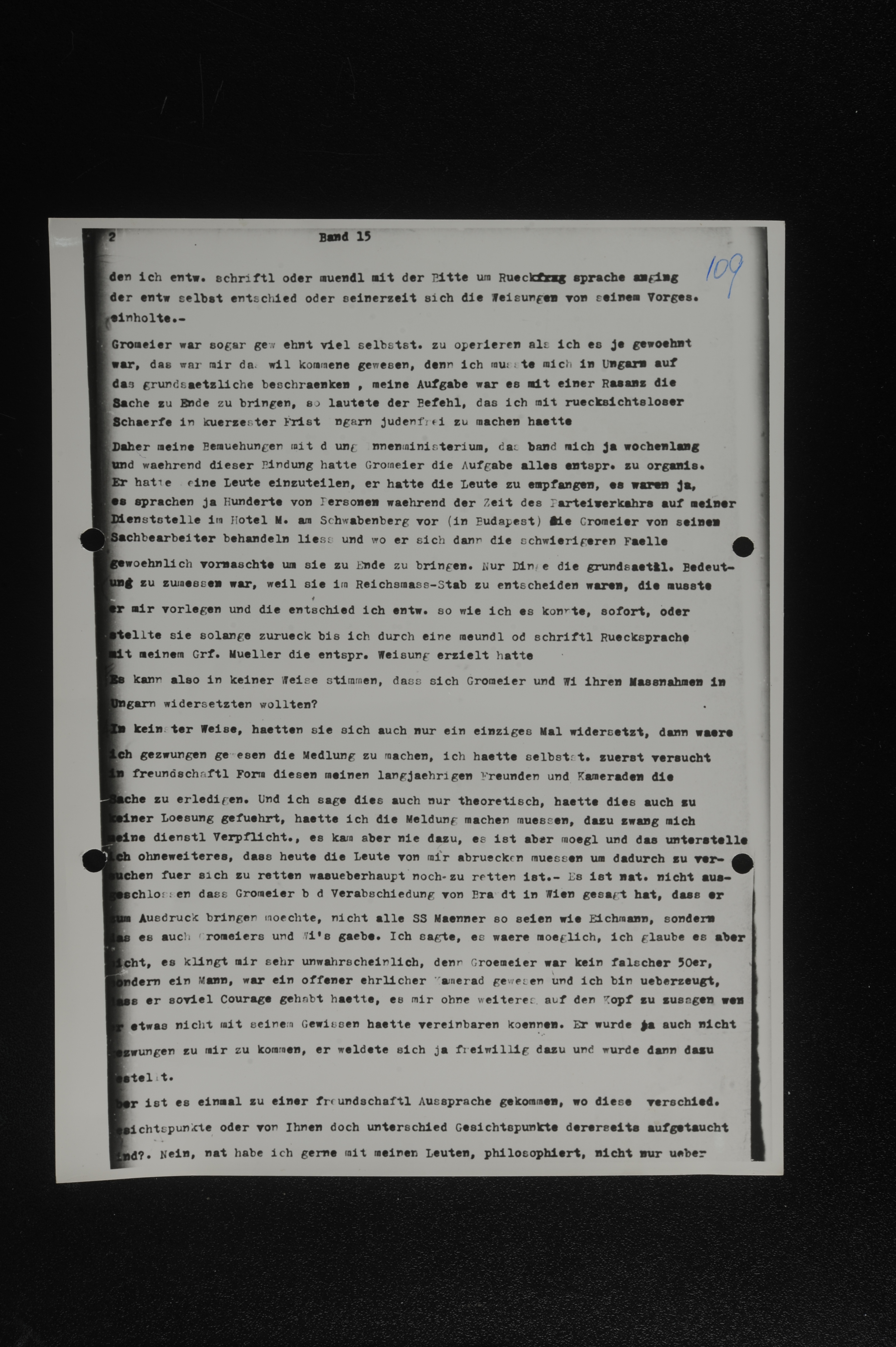
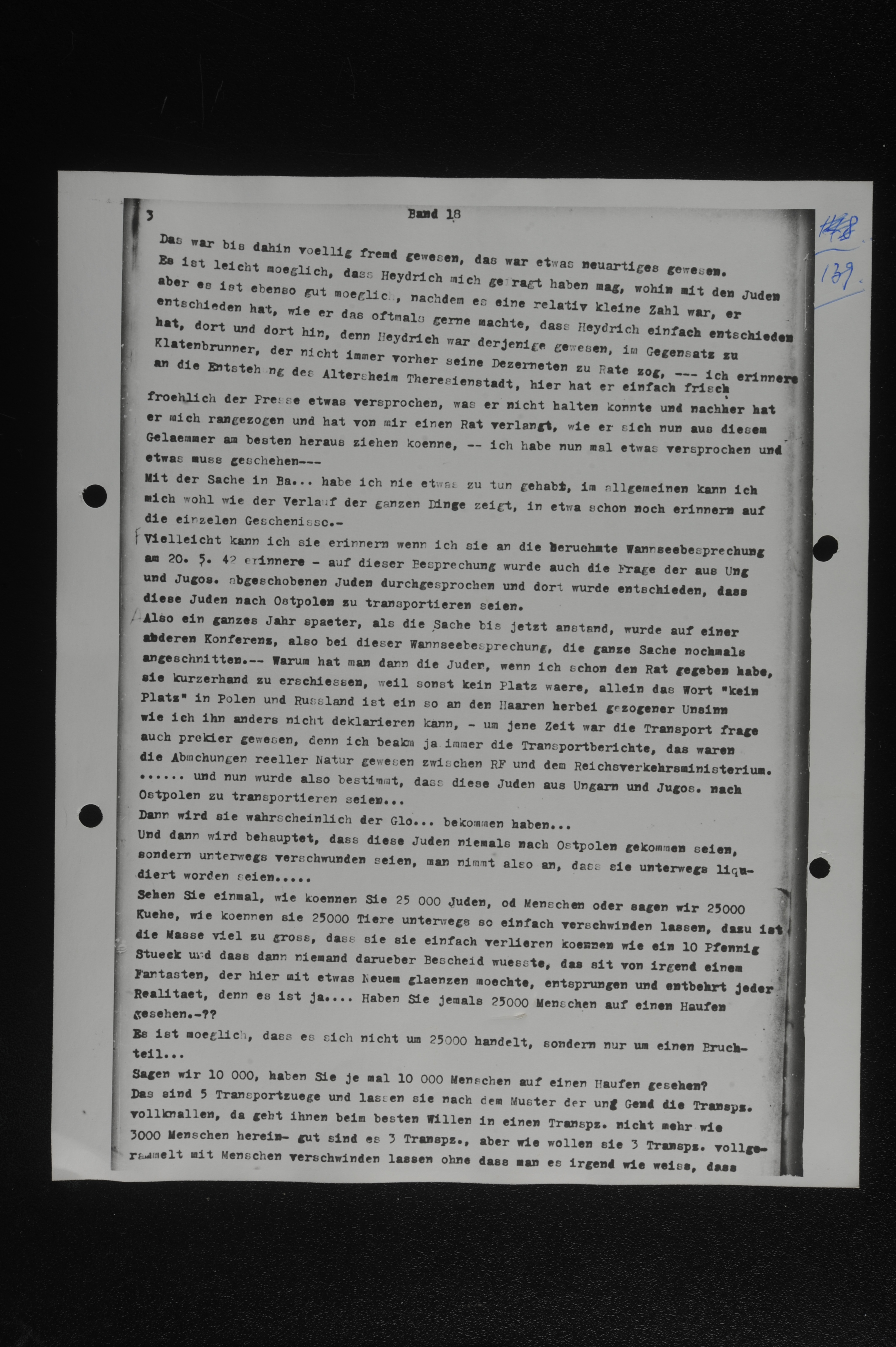
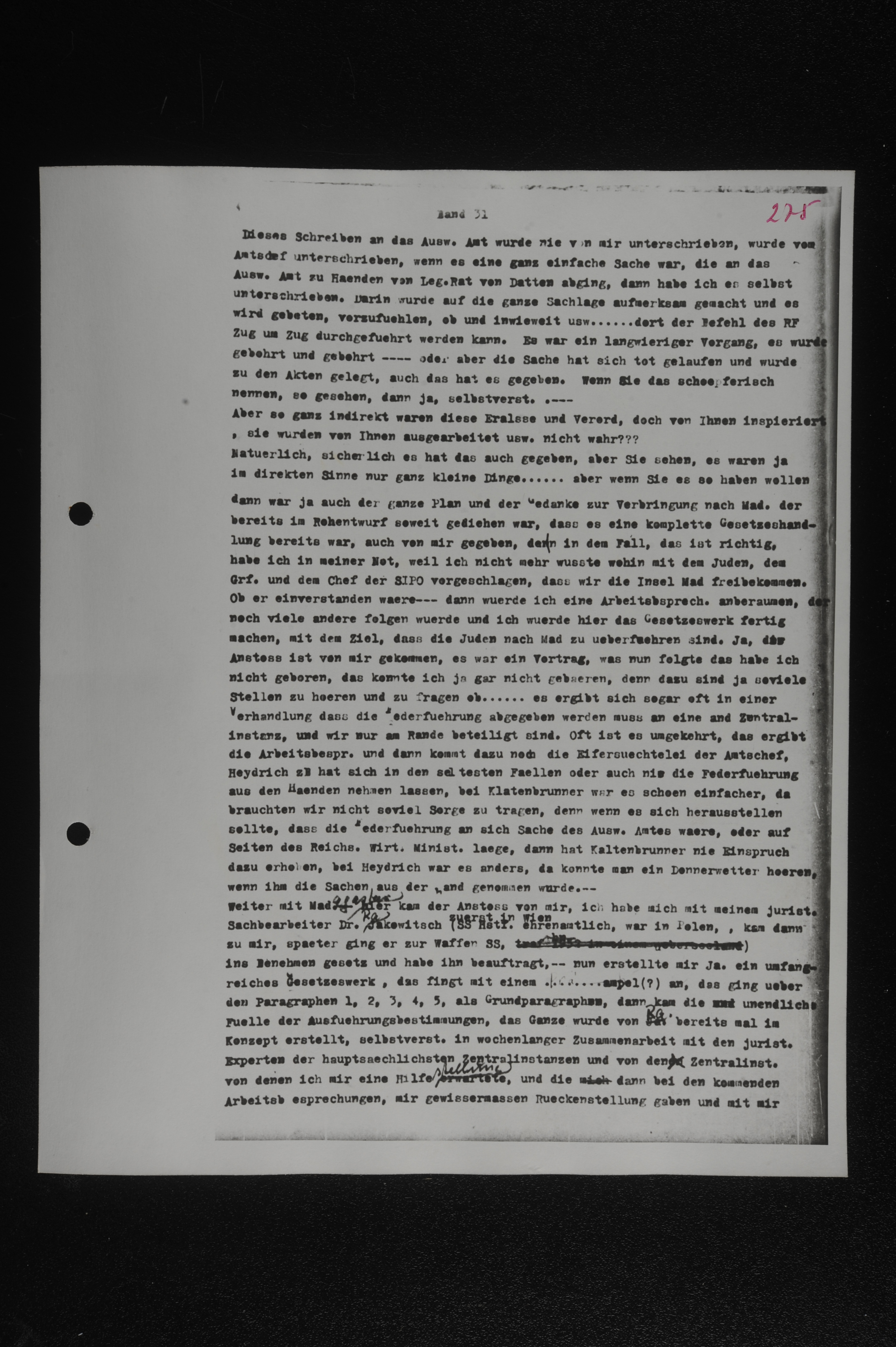
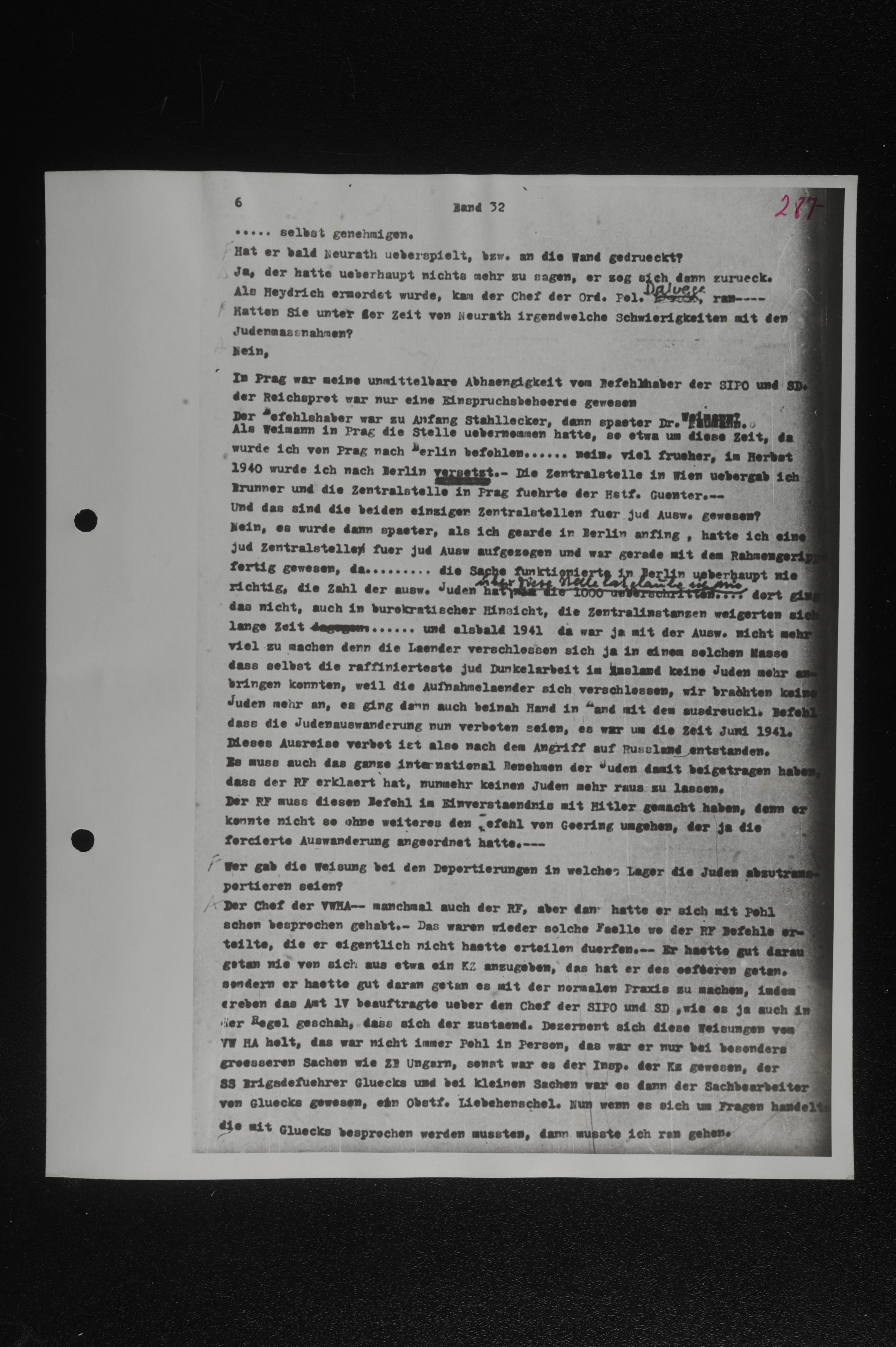
Page 3 of the typescript, O.65 file 85.
Page 3 · Yad Vashem Archives, O.65/85

[Judge Jackson in Nuremberg:]

He said that this man was in truth the darkest figure of this century, particularly because, as the witnesses probably said, he had clearly recognized the outcome of the war long beforehand. That is reproduced word for word. I read it in captivity, in a small pamphlet, “The Nuremberg Trial.”

Questioner

What is your fundamental attitude toward the Jewish question in relation to our people? If you had had a free hand, how would you have attempted a solution—and in this context that means a political solution?

Eichmann

My attitude: we must go back into history at least as far as the Middle Ages, insofar as the German people is concerned, namely when the rulers of the small German states very often got into financial difficulties through their way of life, and Jewry, which was often confined to ghettos… I mean here coexistence, separation, annihilation; as seen from the present.

Now, knowing from history—coexistence with this people, which has lived in dispersion for 2,000 years and was prevented from pursuing certain fields of life, and concentrated on particular branches, for example trade, and also intellectual professions. And when I saw that this minority within the German people, taking 1932 as the reference date, dominated to an unheard-of percentage those fields which were of vital importance to the German people and occupied their key positions, I said to myself that there must be a separation.

And it was not I who said that: the Party program said it, other national fighters said it before me, and Jewish leaders on the other side said it too. Now, since a solution was absolutely necessary—for that is what our Party leadership said, and later the leadership of the German Reich too—I said, and I believe everyone who had some part in thinking about this agreed with me, that such a solution could only be a political solution.

But a political solution only means smashing shop windows, does not mean killing, does not mean dragging them off into slavery, but a spatial separation from the territory of this people to which I, for example, belong. There are probably people of the same mind in other countries who wish for a separation of this kind. Such a separation had already been taken in hand before the national A…. But the driving force there was not the German; the driving force was the Jew himself, the Zionist, first under … hersel, the pioneer of territorial separation in the first place.

Questioner

That is to say, if you had had the say in your sector, if you had had to carry out a solution, what would you have done in practice?

Eichmann

If I had been able to carry out the solution and had had full authority, I would have done what I had already begun to attempt: first of all, to give the Jew a certain self-administration, an administration of his own, so that he would acquire administrative training and thus be able to maintain and govern himself. I saw, and still see today, that the Jewish question can be brought to a final solution only when the Jew is given land and soil under his feet. Where is a matter for the politicians.

Questioner

How did you feel about your task personally and as a human being, that is, as you were able to carry it out with the means at your disposal, under the conditions…

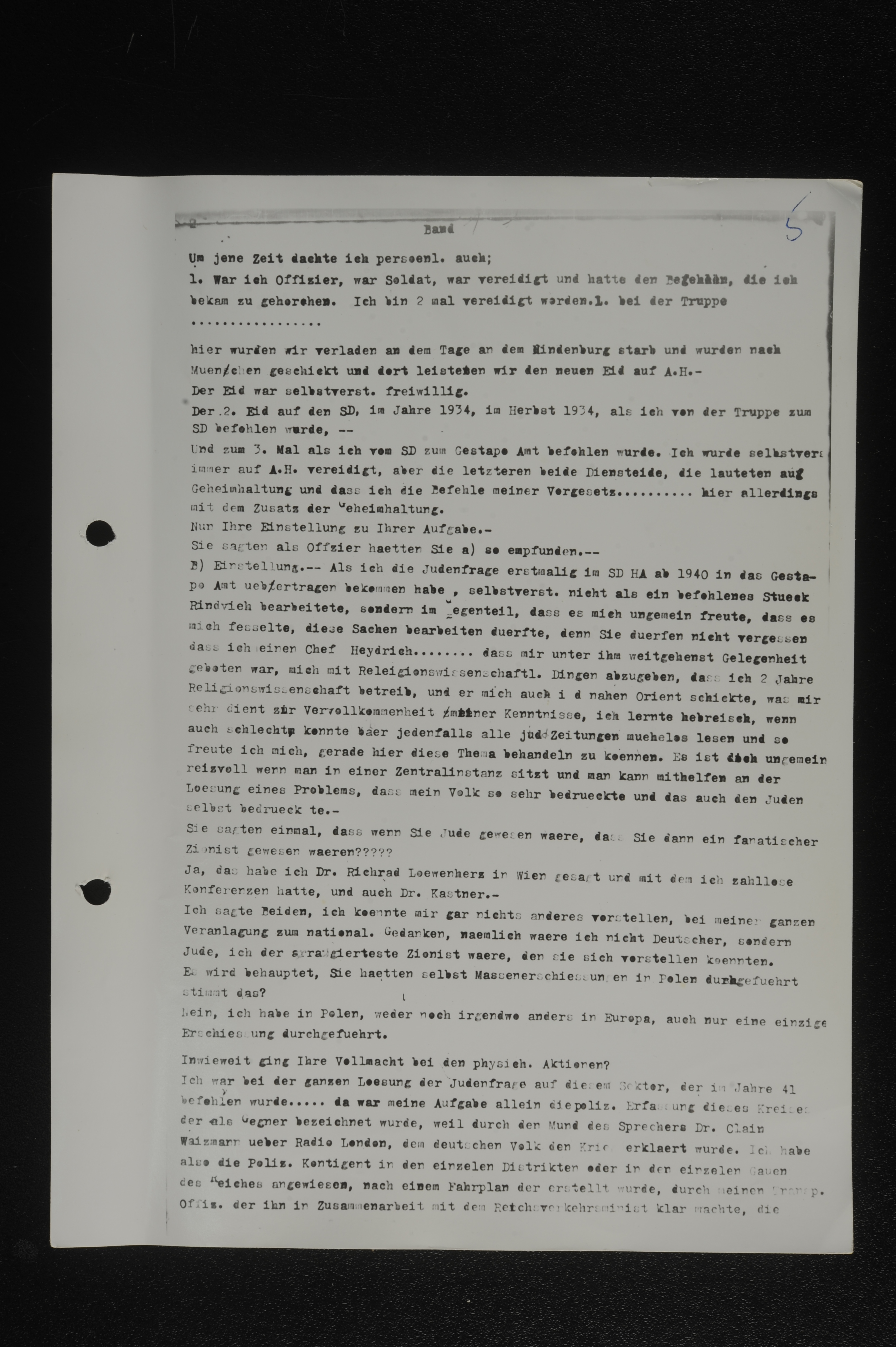
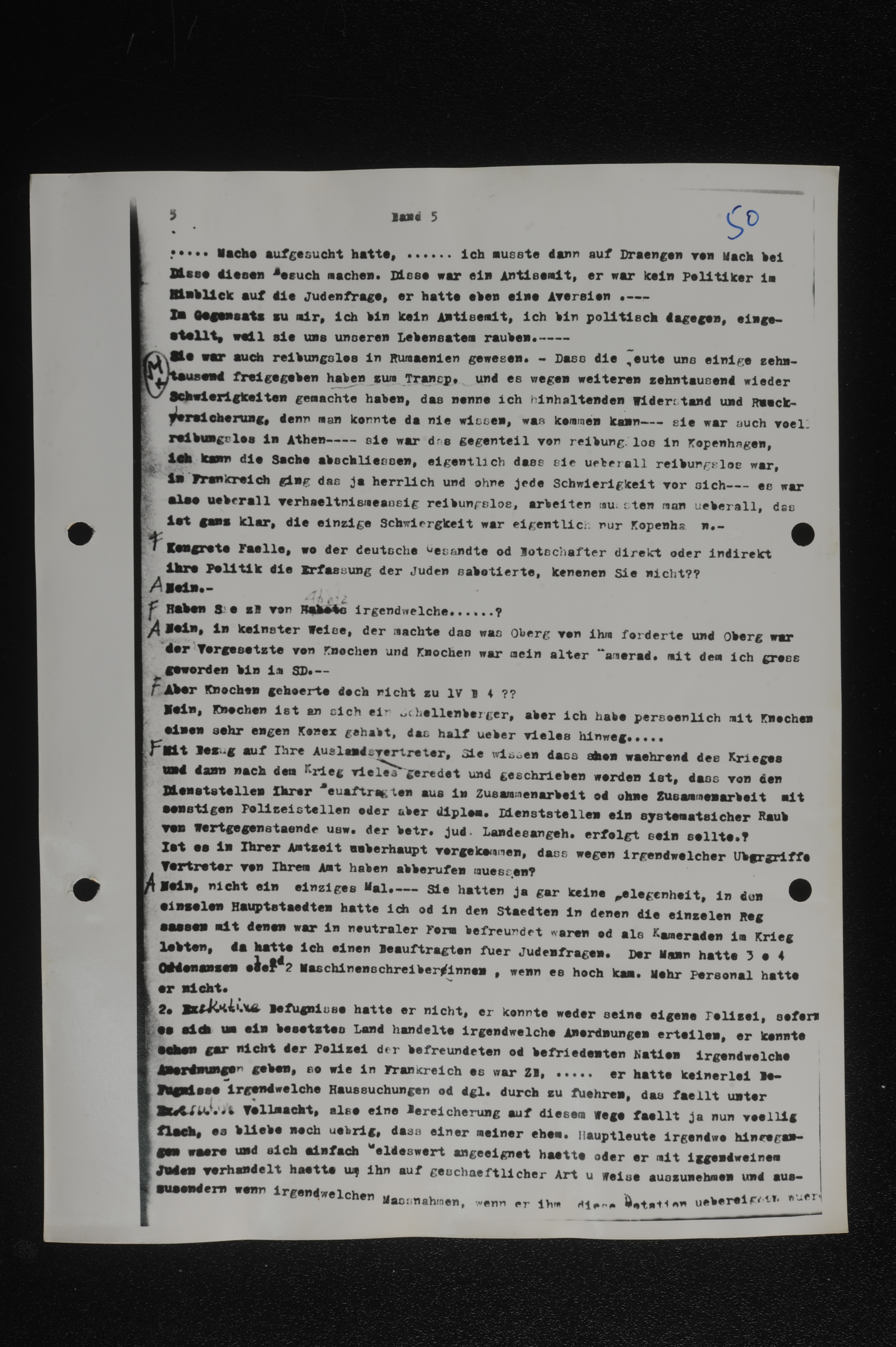
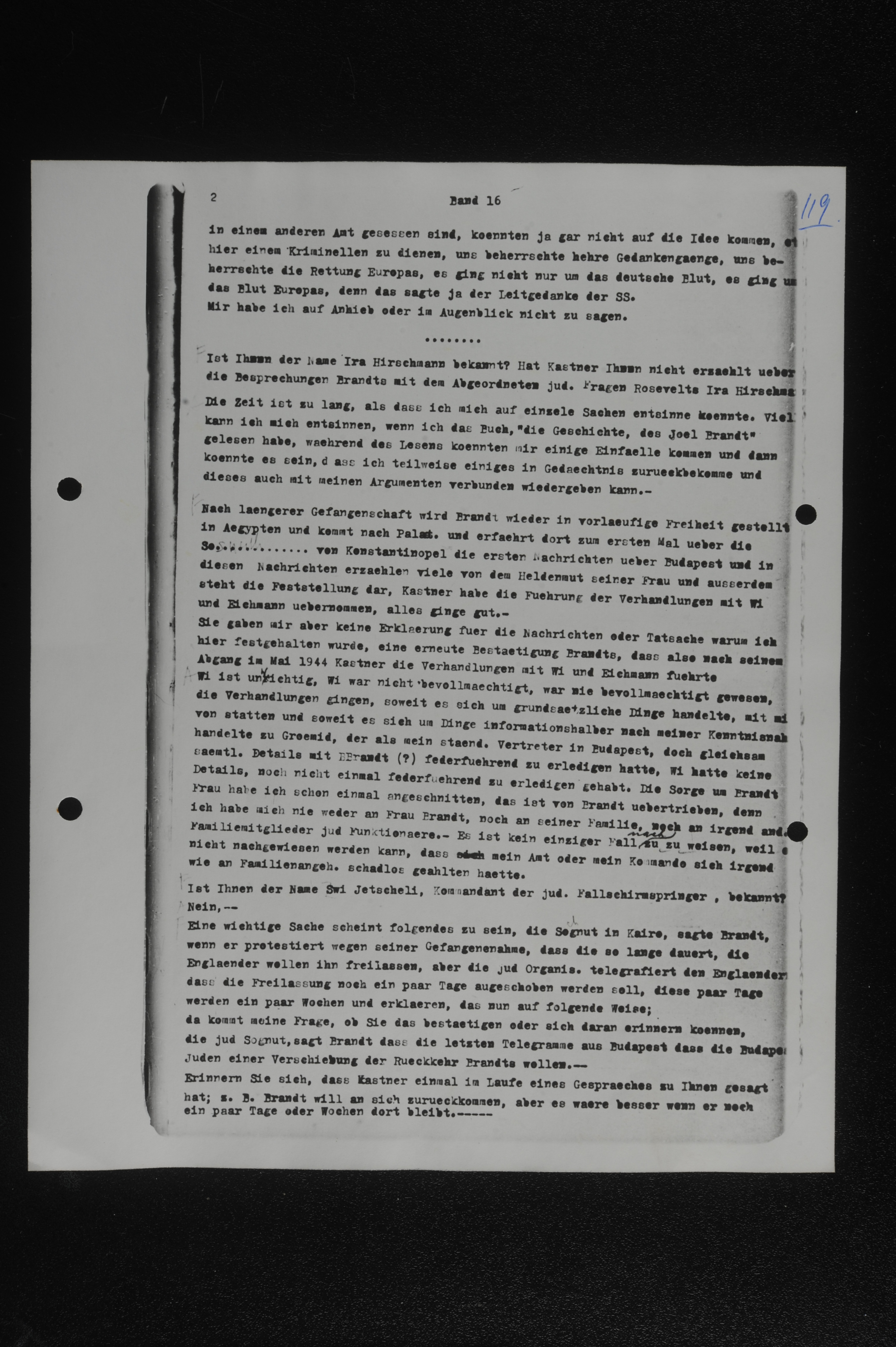
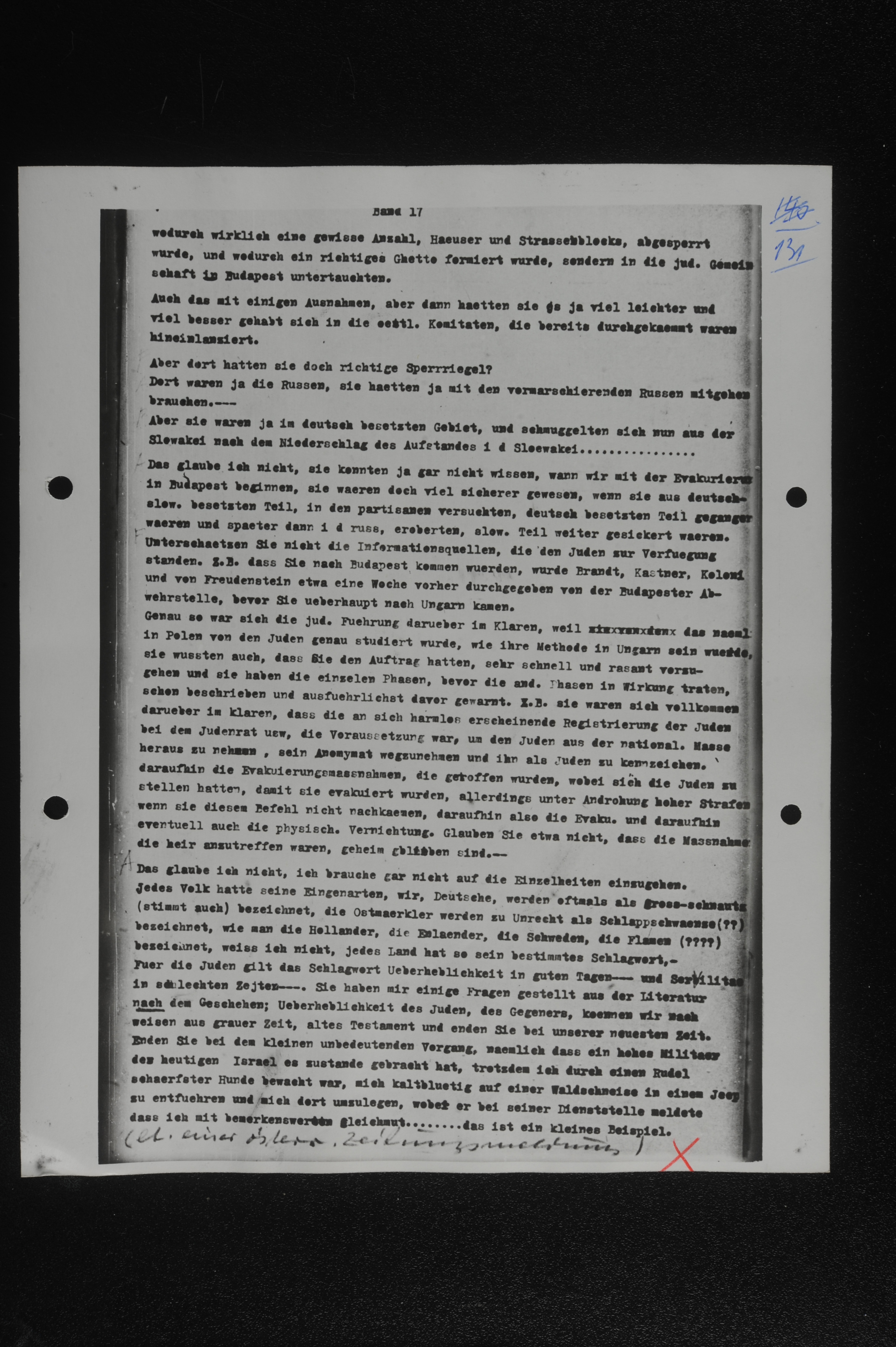
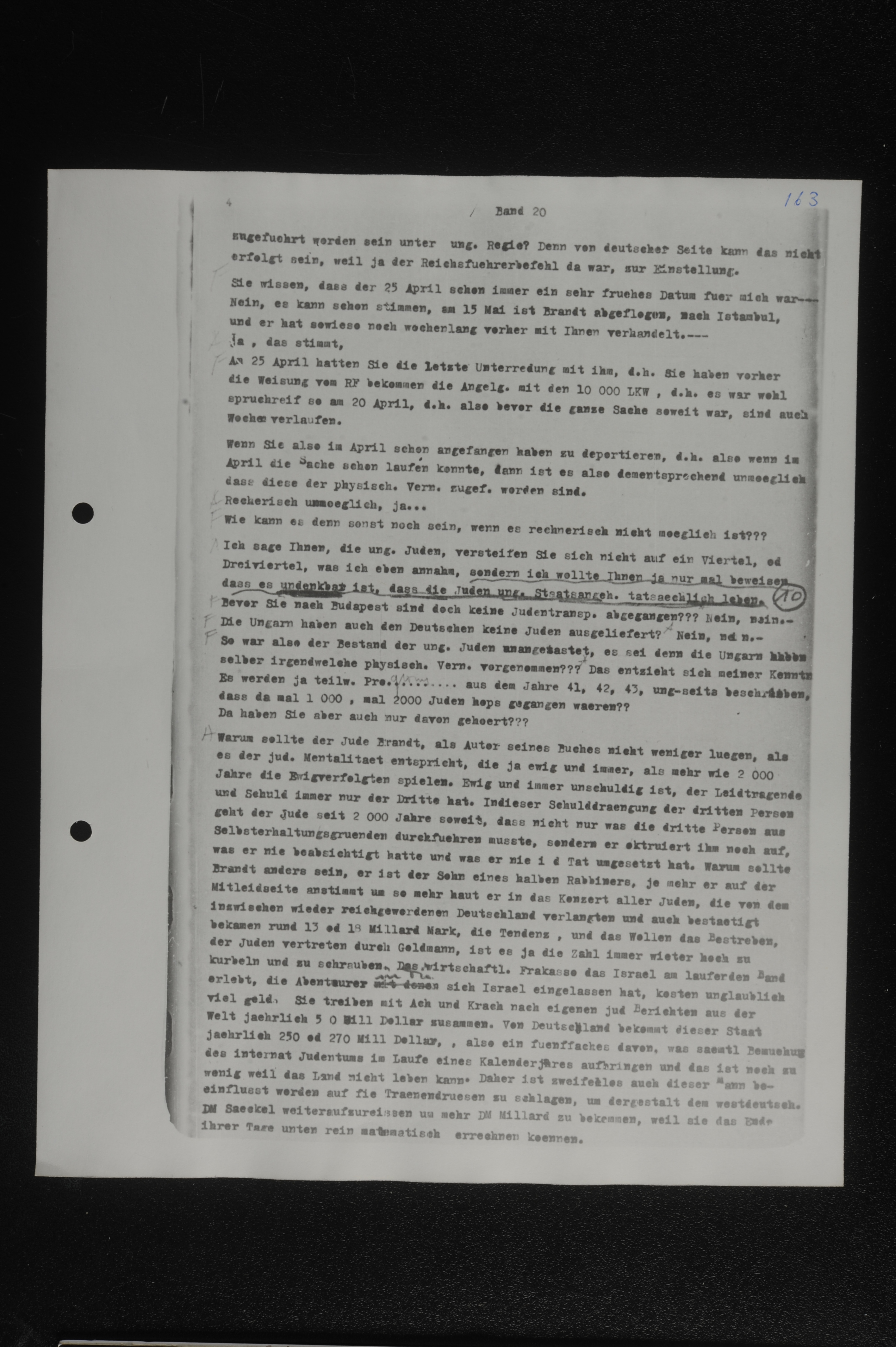
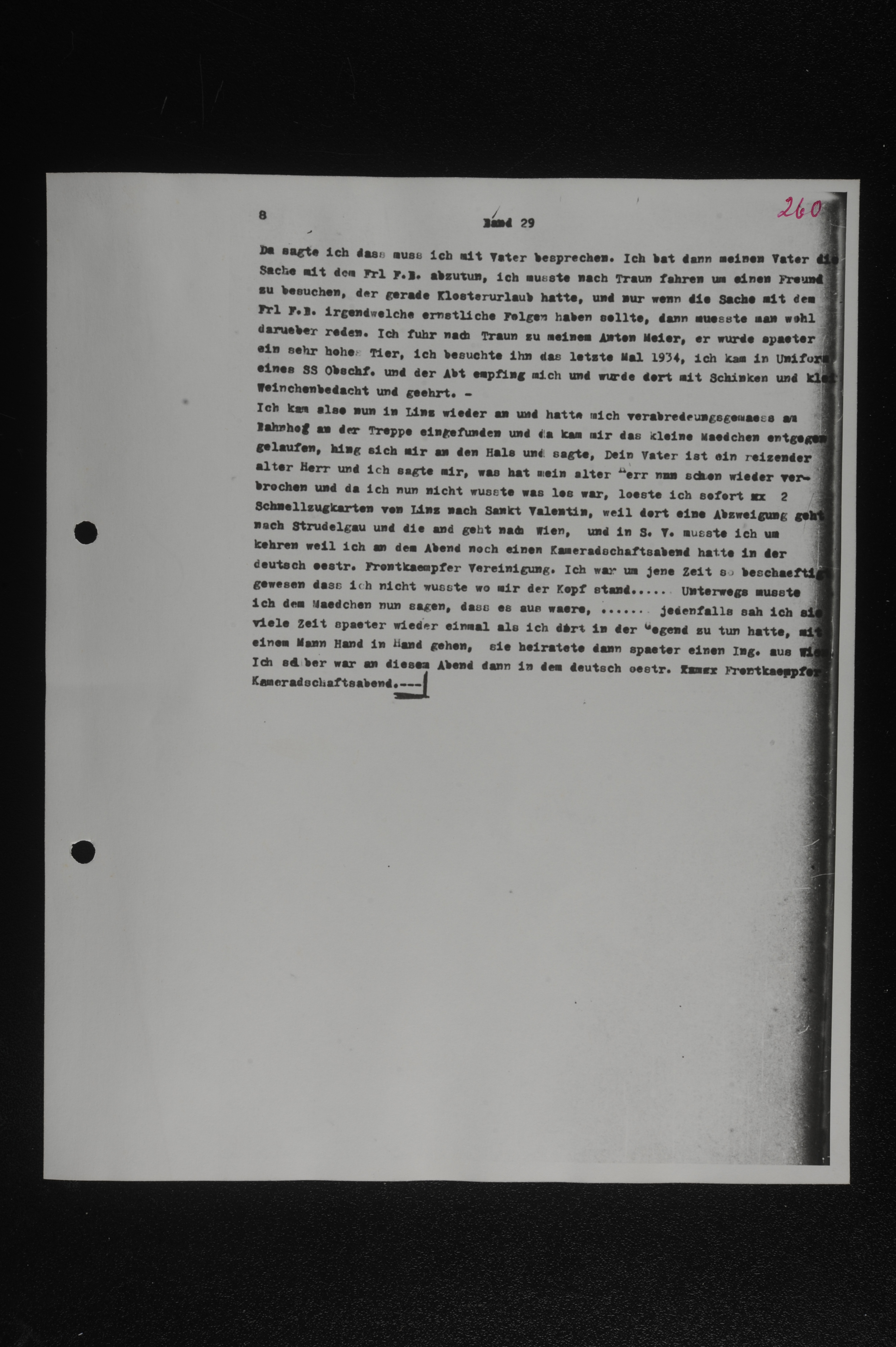
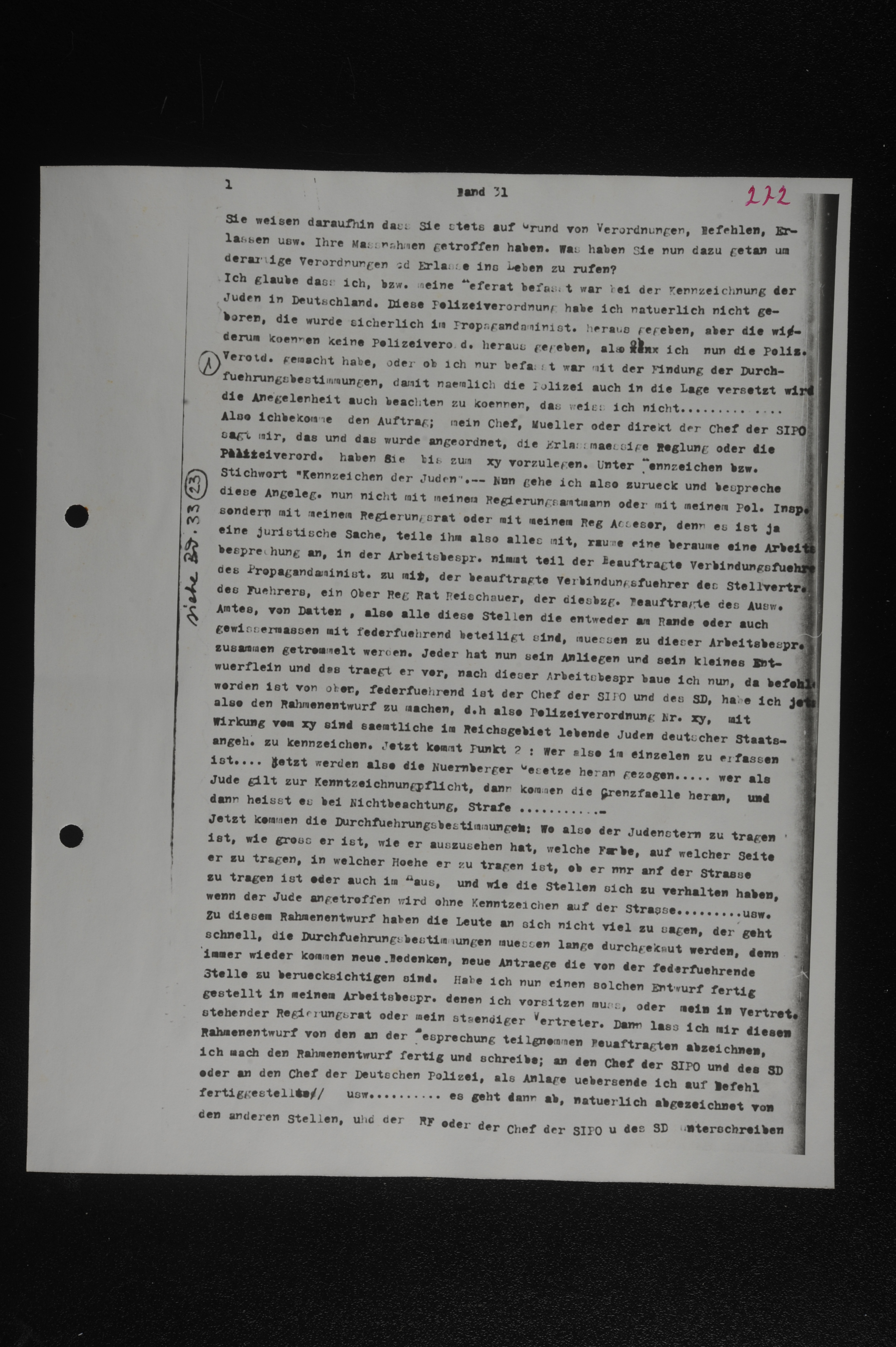
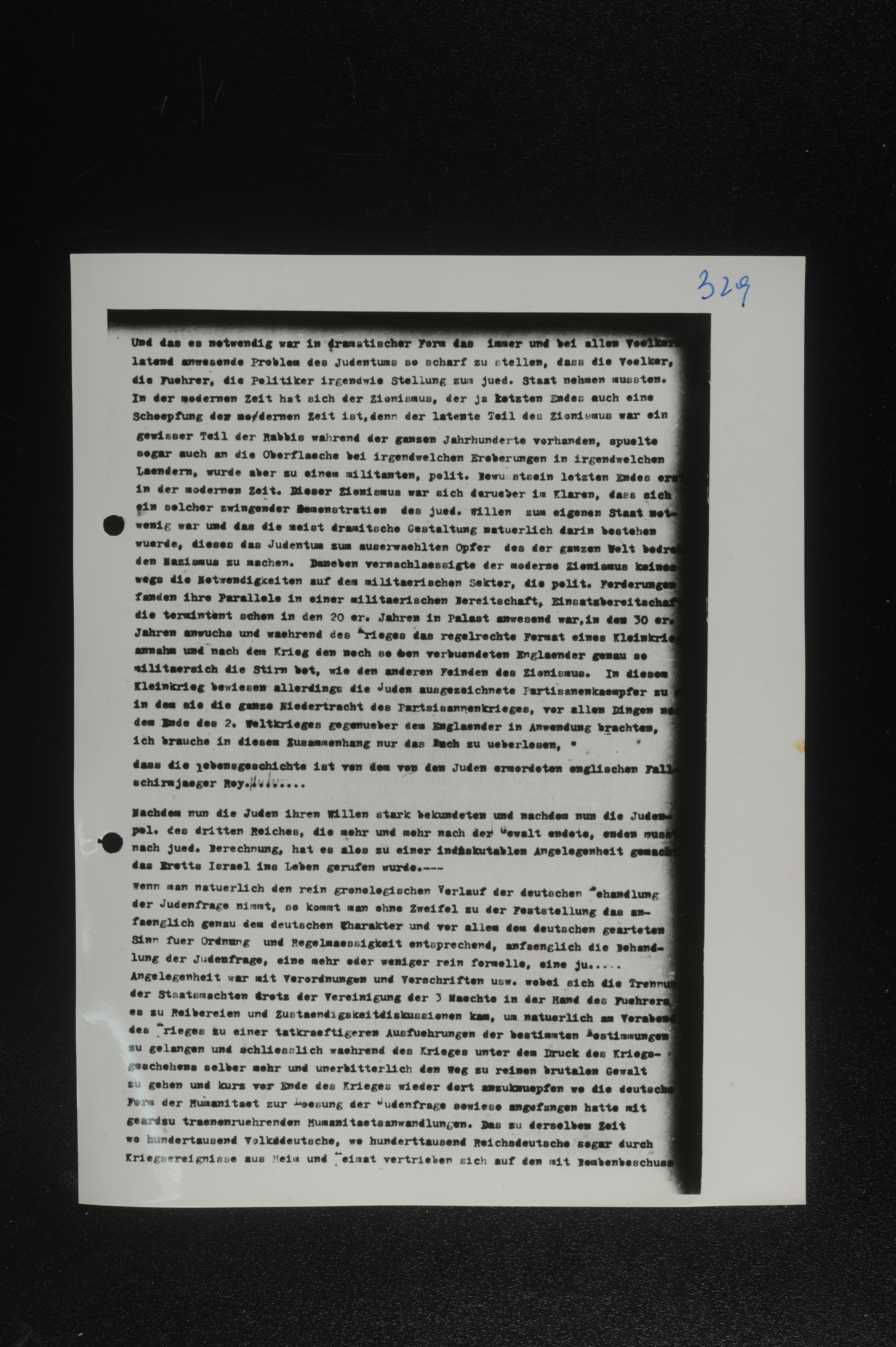
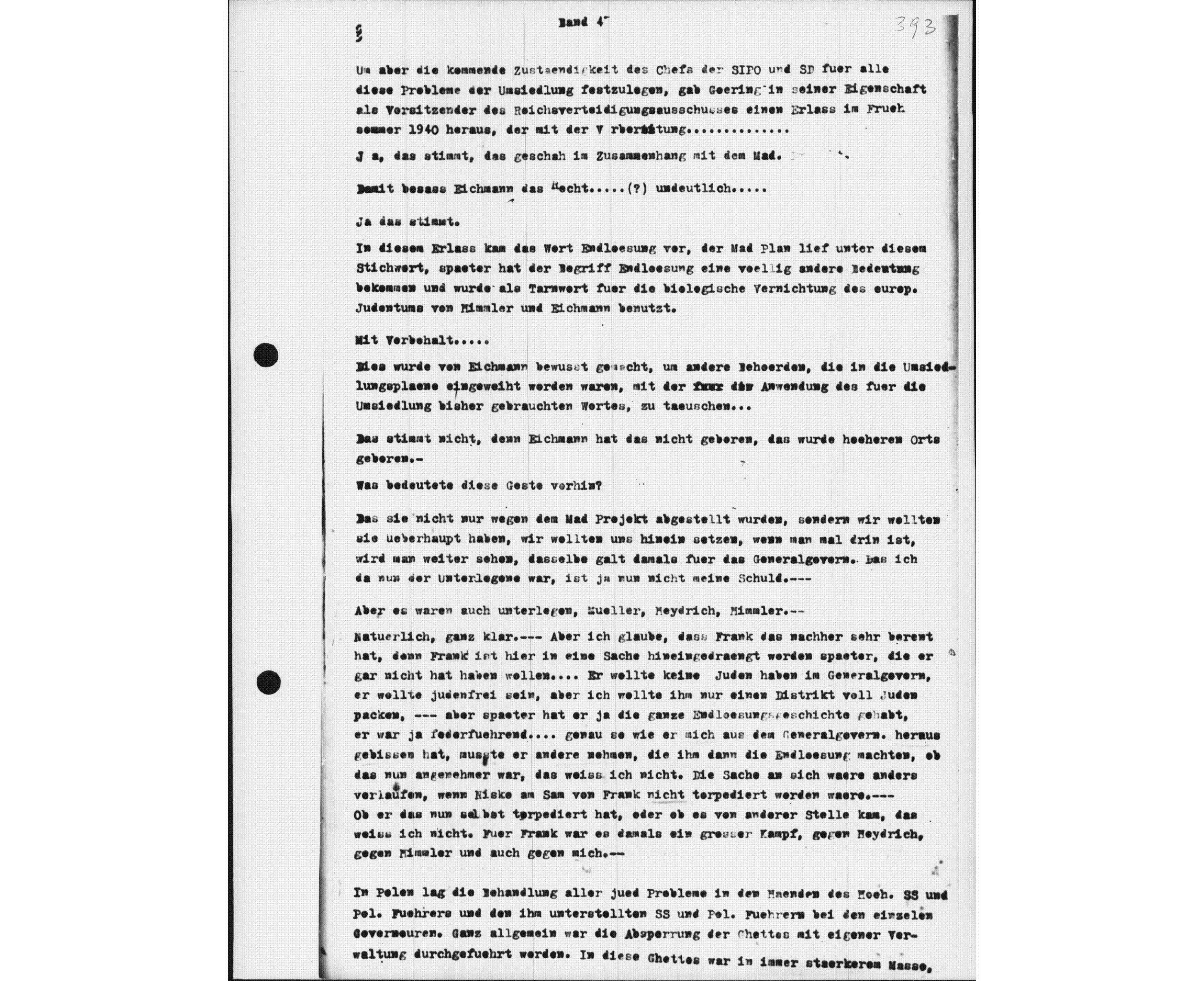
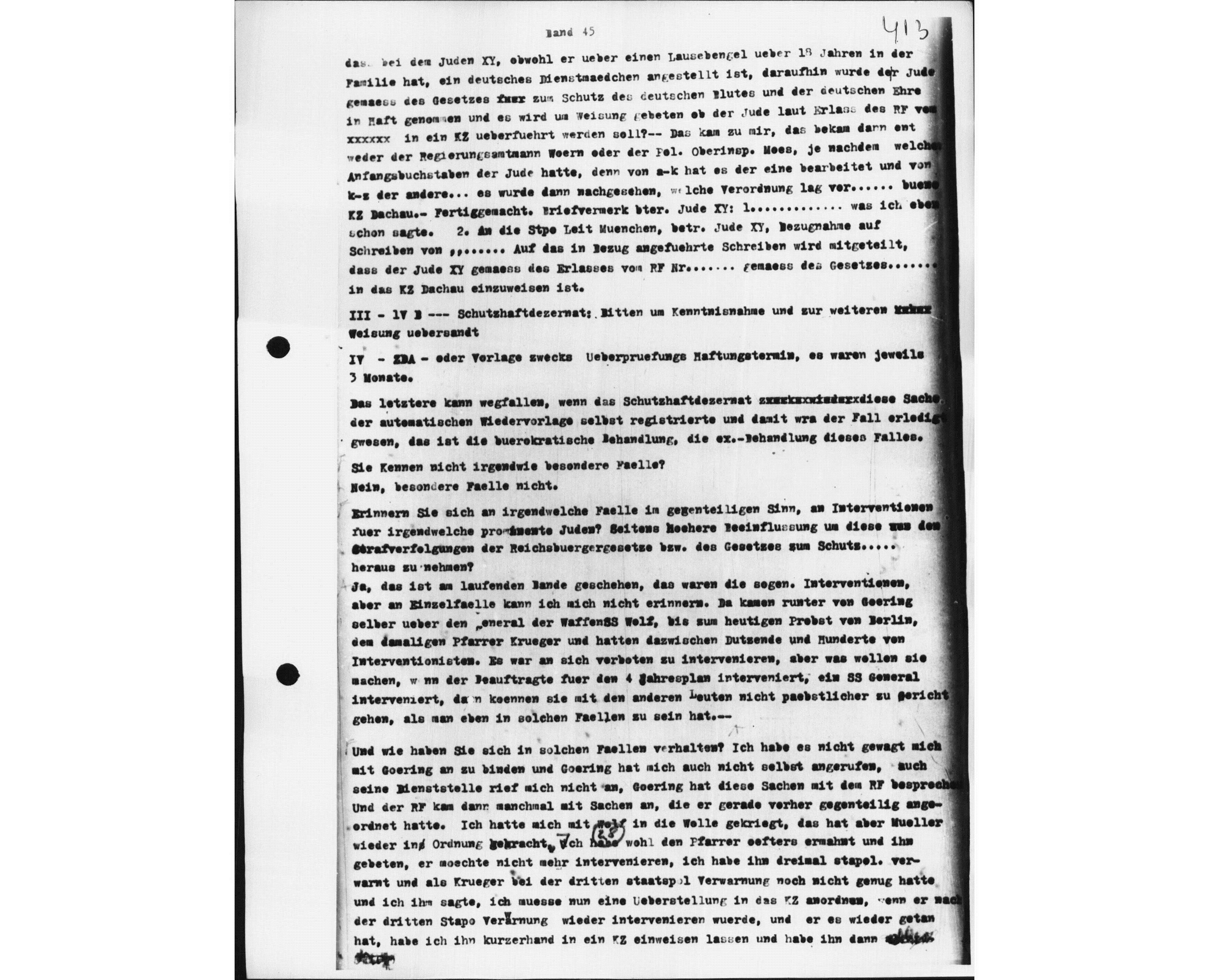
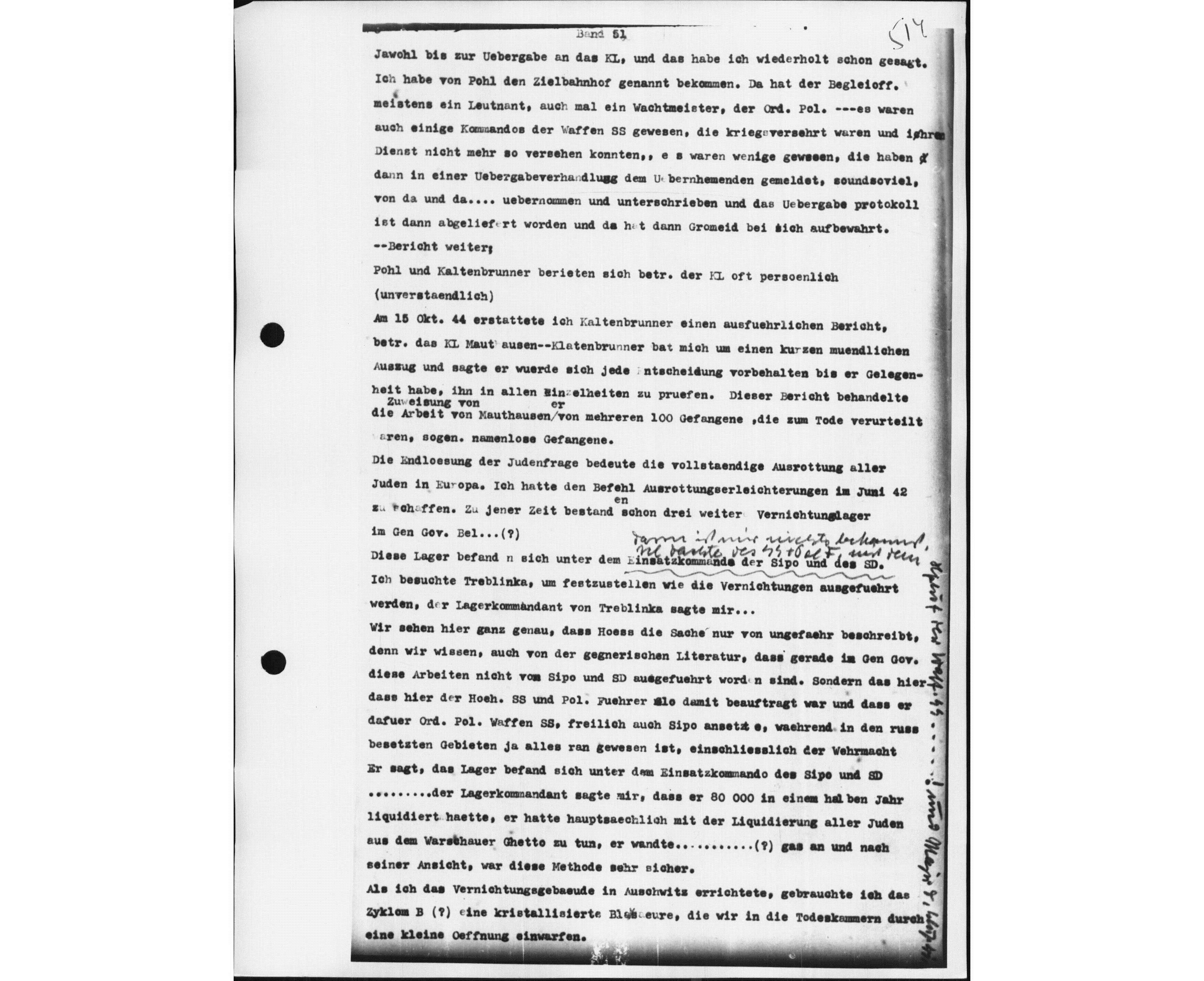
Open page image and German
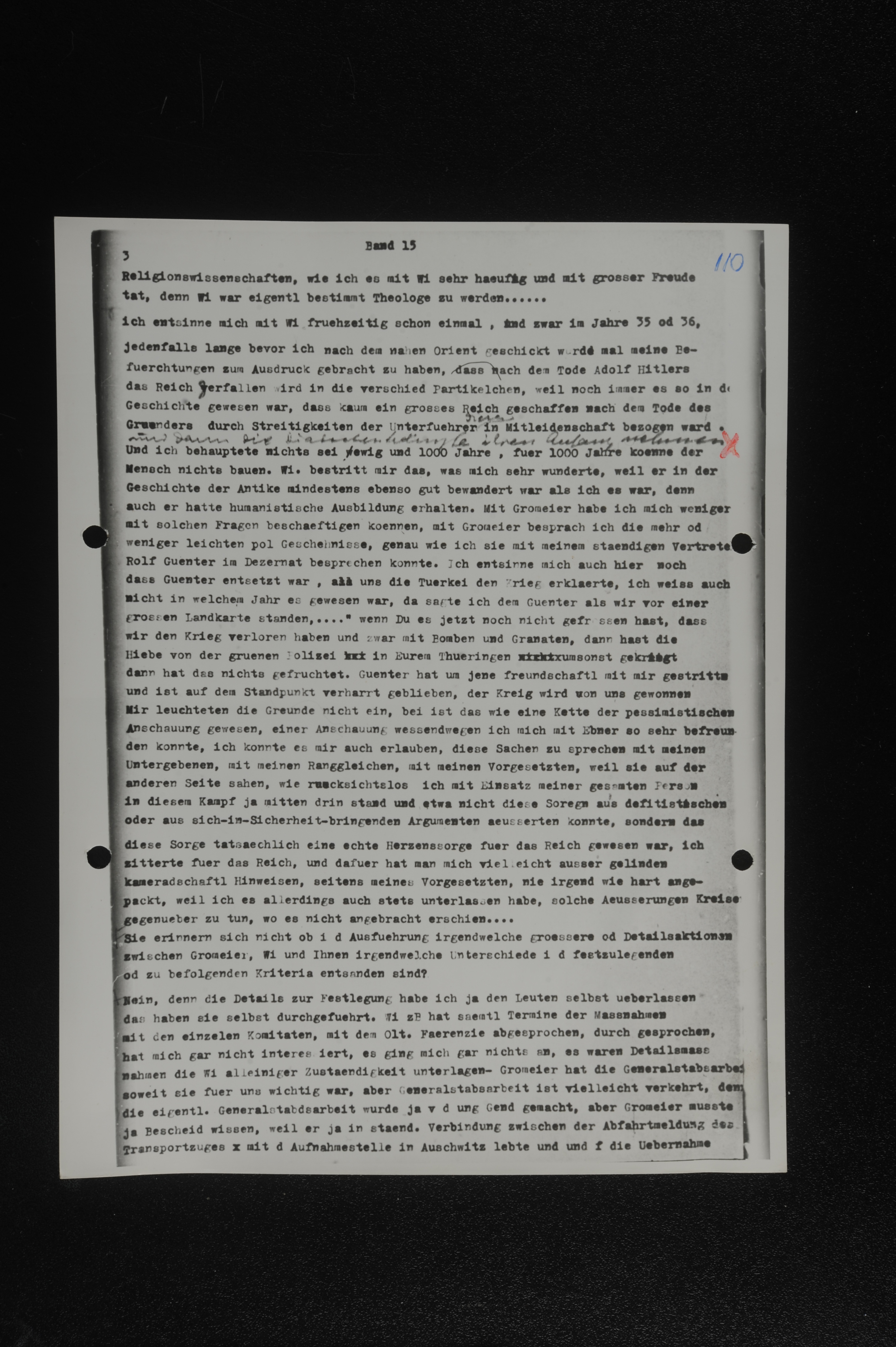
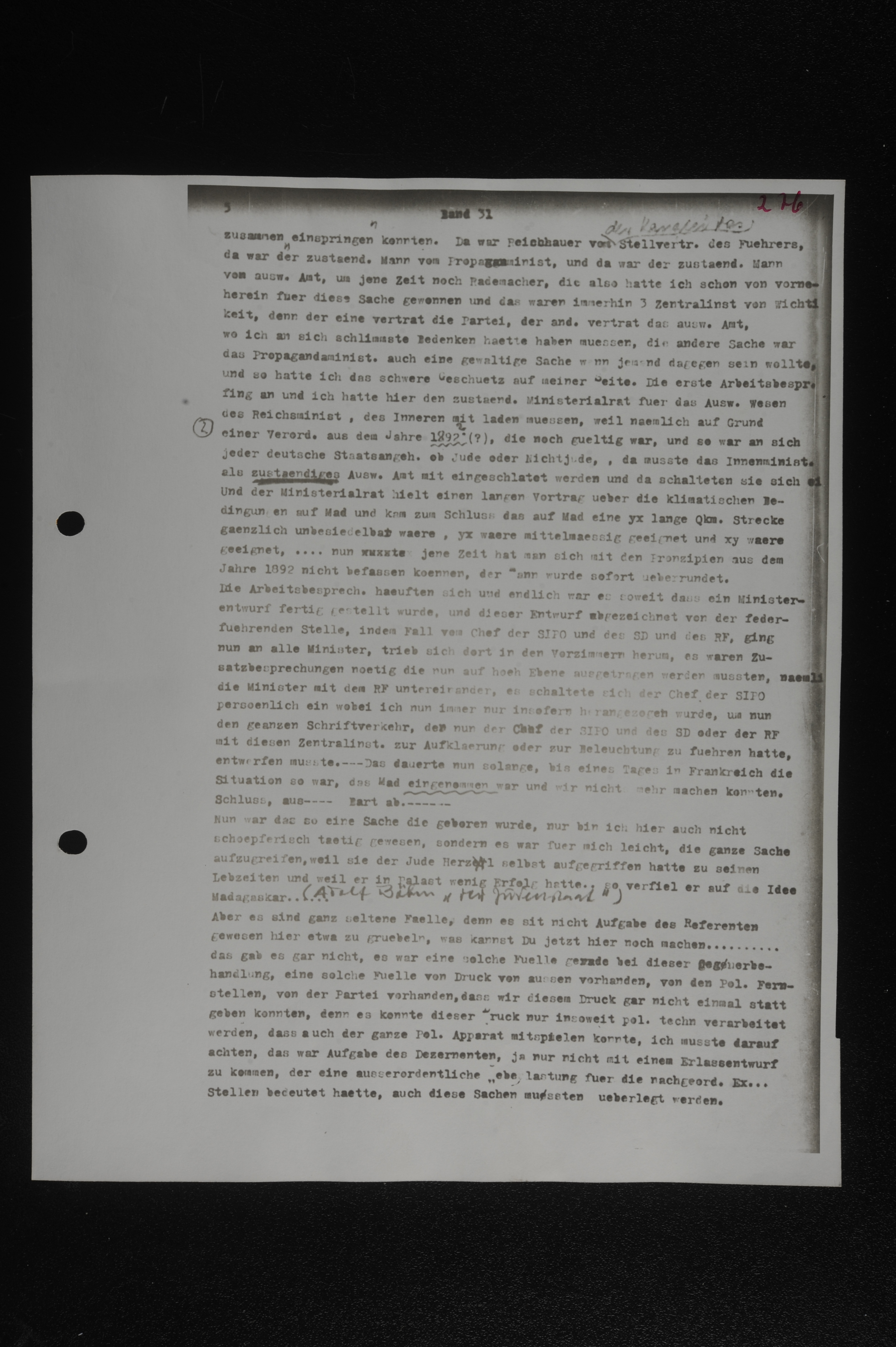
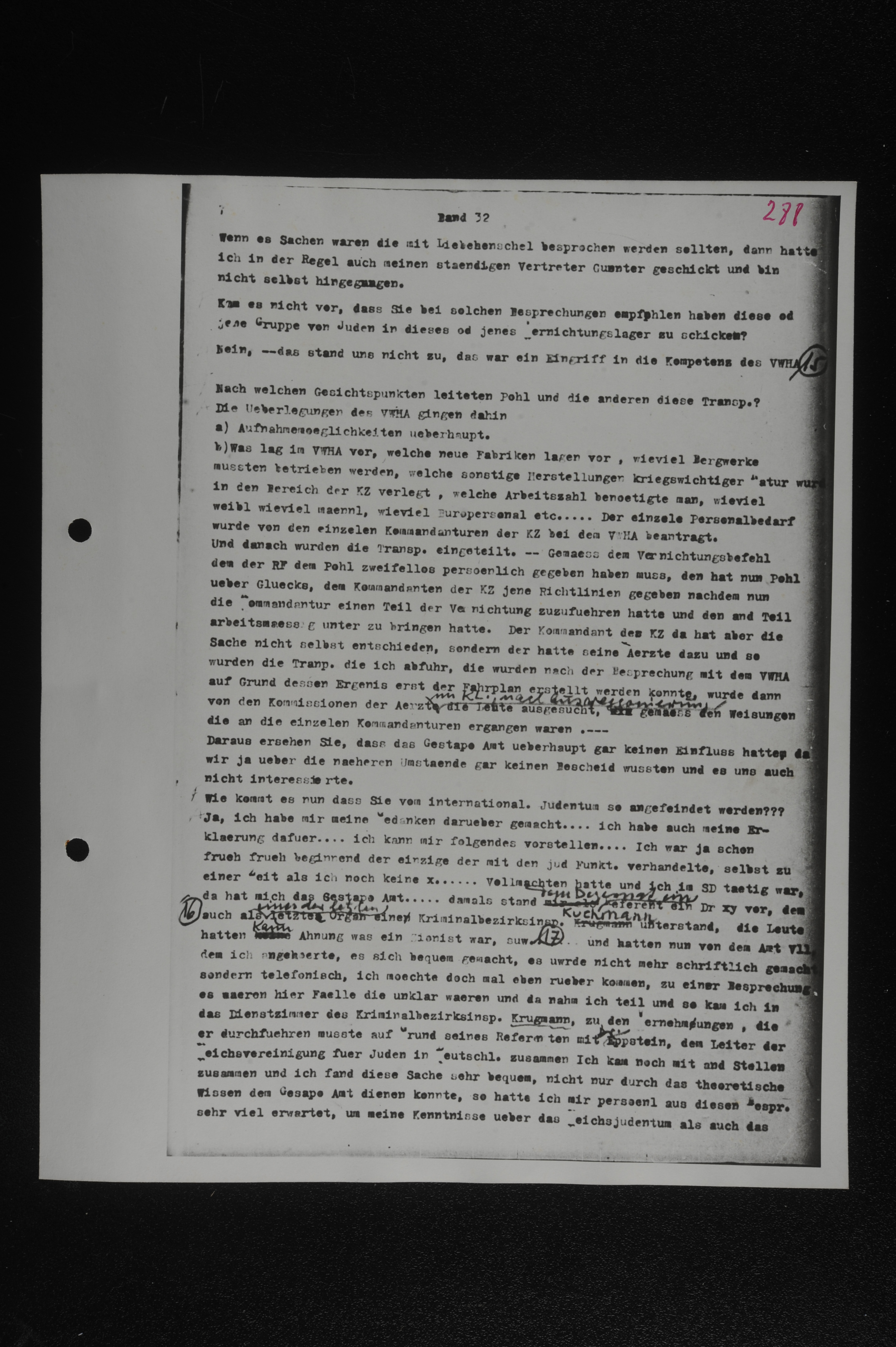
Page 4 of the typescript, O.65 file 85.
Page 4 · Yad Vashem Archives, O.65/85

At that time I also thought personally: first, I was an officer, a soldier, sworn in, and had to obey the orders I received. I was sworn in twice. First, with the troops…

We were loaded up on the day Hindenburg died and sent to Munich, where we took the new oath to A.H. (Adolf Hitler). The oath was of course voluntary. The second oath was to the SD (Security Service), in 1934, in the autumn of 1934, when I was ordered from the troops to the SD. And for the third time when I was ordered from the SD to the Gestapo Office. I was of course always sworn to A.H. (Adolf Hitler), but the latter two service oaths concerned secrecy, and that I—the orders of my superiors… Here, however, with the addition of secrecy.

Questioner

Only your attitude toward your task. You said that, as an officer, you felt in the first way.

Eichmann

Second, my attitude. When I first had the Jewish question assigned to me in the SD Main Office, and from 1940 in the Gestapo Office, I did not of course work on it as a head of cattle acting under orders. On the contrary, it pleased me enormously, it gripped me, that I was allowed to work on these matters. You must not forget that I had a chief, Heydrich… that under him I had extensive opportunities to occupy myself with religious scholarship, that I pursued religious scholarship for two years, and that he also sent me to the Near East, which helped me greatly to perfect my knowledge.

I learned Hebrew, though badly, but could in any case read all Jewish newspapers effortlessly, and so I was glad to be able to deal with precisely this subject. It is extraordinarily appealing to sit in a central authority and be able to help solve a problem that weighed so heavily on my people and on the Jews themselves as well.

Questioner

You once said that, if you had been a Jew, you would have been a fanatical Zionist?

Eichmann

Yes, I said that to Dr. Richrad Loewenherz in Vienna, with whom I had countless conferences, and also to Dr. Kastner. I told both of them that I could imagine nothing else, given my entire disposition toward the national idea: if I were not German but a Jew, I would be the most committed Zionist they could imagine.

Questioner

It is claimed that you yourself carried out mass shootings in Poland. Is that true?

Eichmann

No. Neither in Poland nor anywhere else in Europe have I carried out even a single shooting.

Questioner

How far did your authority extend in the physical actions?

Eichmann

In the whole solution of the Jewish question in this sector, which was ordered in '41… my task was solely to round up this group by police action. It was designated as the enemy because, through the mouth of its spokesman Dr. Clain Weizmann, war had been declared on the German people over Radio London. So I instructed the police contingents in the individual districts or individual Gaue of the Reich, according to a timetable drawn up by my transport officer, who arranged it in cooperation with the Reich Transport Ministry, to

Open page image and German
Page 5 of the typescript, O.65 file 85.
Page 5 · Yad Vashem Archives, O.65/85

round up the contingents and deliver them to the destination stations named by the chief of the SDHA (SD Main Office). That ended all responsibility on the Gestapo's part. Unlimited authority does not exist in an office. Rather, everyone in an office, whether low-ranking or high-ranking, from the criminal-police assistant up to the Chief of the Security Police, has to issue instructions and orders in accordance with existing laws, regulations and decrees. There was no third possibility, and there is none. Nobody in an administrative apparatus can do whatever he wants. He has to do what he is ordered to do; and such orders and instructions can be issued within an office only by invoking the relevant laws.

Questioner

And this body of law on which your work rested—was that the Nuremberg Laws No. 35?

Eichmann

No, it was a Führer order. Heydrich, the Chief of the Security Police and the SD (Security Service), told me that the Führer had now ordered the liquidation of the Jews. At that time that was law, because, as you know, the Führer's words had the force of law. That applied to all German members of the national community.

Questioner

You were not brought in to help draft the Nuremberg Laws?

Eichmann

No, at that point I had nothing at all to do with the office.

Questioner

Now please repeat it as exactly, word for word, as you can…

[Farewell.]

Eichmann

It was in Berlin, in my office on Kurfürstenstrasse. The war was drawing to an end; everything was lost, finished. I either summoned all my officers, or it arose out of a meeting. These were more or less my last days in office, and, formally taking my leave, I said that, if it had to be so, I would gladly and joyfully jump into the pit, knowing that five million enemies of the Reich had jumped in with me. I know I spoke those words very harshly, because I felt extraordinarily happy at the time. If I had to bite the dust like a dog, then at least I would not be alone in there. That was how I felt, and I expressed it to my men. With that I had, in effect, left the stage.

Questioner

Are you sure you used the words “enemies of the Reich” and not “Jews”?

Eichmann

No, I had no reason to use that. I did not hate only the Jews; in those days I hated everything that was going for the German people's throat.

Questioner

Not the word “human beings” either?

Eichmann

No, “enemies of the Reich.” To me, “enemies of the Reich” was something like the word “devil” to a clergyman.

Questioner

Did A.H. (Adolf Hitler) speak to you about the Jewish problem, or give you any instructions about it?

Eichmann

The Führer? No, my office was far too junior for that. The superiors I dealt with, from the top down, were the RF (Reichsführer-SS). I was summoned to him three or four times. Except on one occasion, when he was based on Prinz Albrecht Strasse, I was always summoned to his field command post. Otherwise there was the Chief of the Security Police and the SD, Heydrich, and then his successor, Dr. Ernst Kaltenbrunner, and then my regular superior, with whom I dealt several times a week: that was Müller, Heinrich Müller.

Open page image and German
Page 6 of the typescript, O.65 file 85.
Page 6 · Yad Vashem Archives, O.65/85

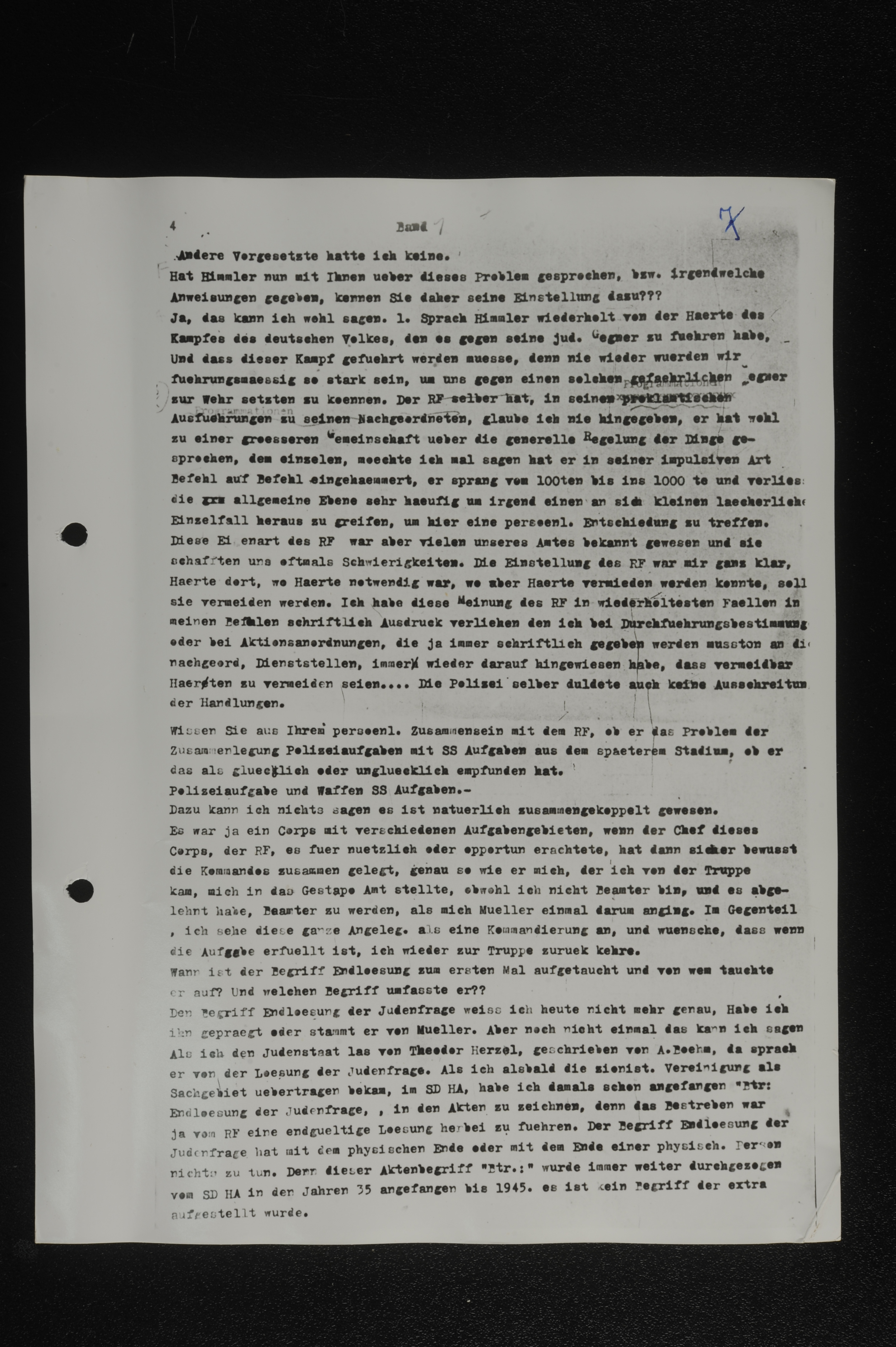
I had no other superiors.

Questioner

Did Himmler speak to you about this problem, or give you any instructions? Do you therefore know his attitude toward it?

Eichmann

Yes, I can say that. First, Himmler repeatedly spoke of the harshness of the struggle the German people had to wage against its Jewish opponents, and that this struggle had to be waged because never again would we have leadership strong enough to defend ourselves against such a dangerous opponent. The RF (Reichsführer-SS) himself, I believe, never indulged in programmatic explanations to his subordinates. He did speak to a larger gathering about the general handling of things. With an individual, I would say, in his impulsive manner he hammered in order after order.

He jumped from one thing to another and very often left the general level to pick out some small, ridiculous individual case and make a personal decision about it. Many in our office knew this peculiarity of the Reichsführer, and it often caused us difficulties. His attitude was quite clear to me: harshness where harshness was necessary, but where harshness could be avoided, it should be avoided. I repeatedly gave written expression to this view of the Reichsführer in my orders. In implementing regulations or orders for actions, which always had to be issued in writing to subordinate offices, I pointed out again and again that avoidable harshness was to be avoided. The police itself also tolerated no excesses in its actions.

Questioner

From your personal dealings with the RF (Reichsführer-SS), do you know whether he regarded the problem of combining police duties with SS duties at the later stage as fortunate or unfortunate? Police duties and Waffen-SS duties.

Eichmann

I cannot say anything about that. They were of course linked. It was one corps with different areas of duty. If the head of this corps, the Reichsführer, considered it useful or expedient, he surely combined the commands deliberately. Just as he placed me, who came from the troops, in the Gestapo Office, although I am not a civil servant and refused to become one when Müller once approached me about it. On the contrary, I regard this whole matter as a secondment and wish to return to the troops when the task is completed.

Questioner

When did the term “Final Solution” first appear, and who introduced it? What did the term encompass?

Eichmann

The term “Final Solution of the Jewish Question”—I no longer know exactly today whether I coined it or it came from Müller. I cannot even say that. When I read The Jewish State by Theodor Herzl, written by A. Boehm, he spoke of the solution of the Jewish question. Soon afterward, when the Zionist association was assigned to me as a subject area in the SD Main Office, I had already begun to write “Re: Final Solution of the Jewish Question” in the files, because the Reichsführer's aim was to bring about a final solution. The term “Final Solution of the Jewish Question” has nothing to do with a physical end or the end of a physical person. This file heading, “Re:,” was carried on continuously from the SD Main Office, beginning in '35, through 1945. It was not a term specially devised.

Open page image and German
Page 7 of the typescript, O.65 file 85.
Page 7 · Yad Vashem Archives, O.65/85

Questioner

To your knowledge, did Hitler already hold the view in the early stages of the war that a German victory would automatically mean the physical annihilation of all European Jewry?

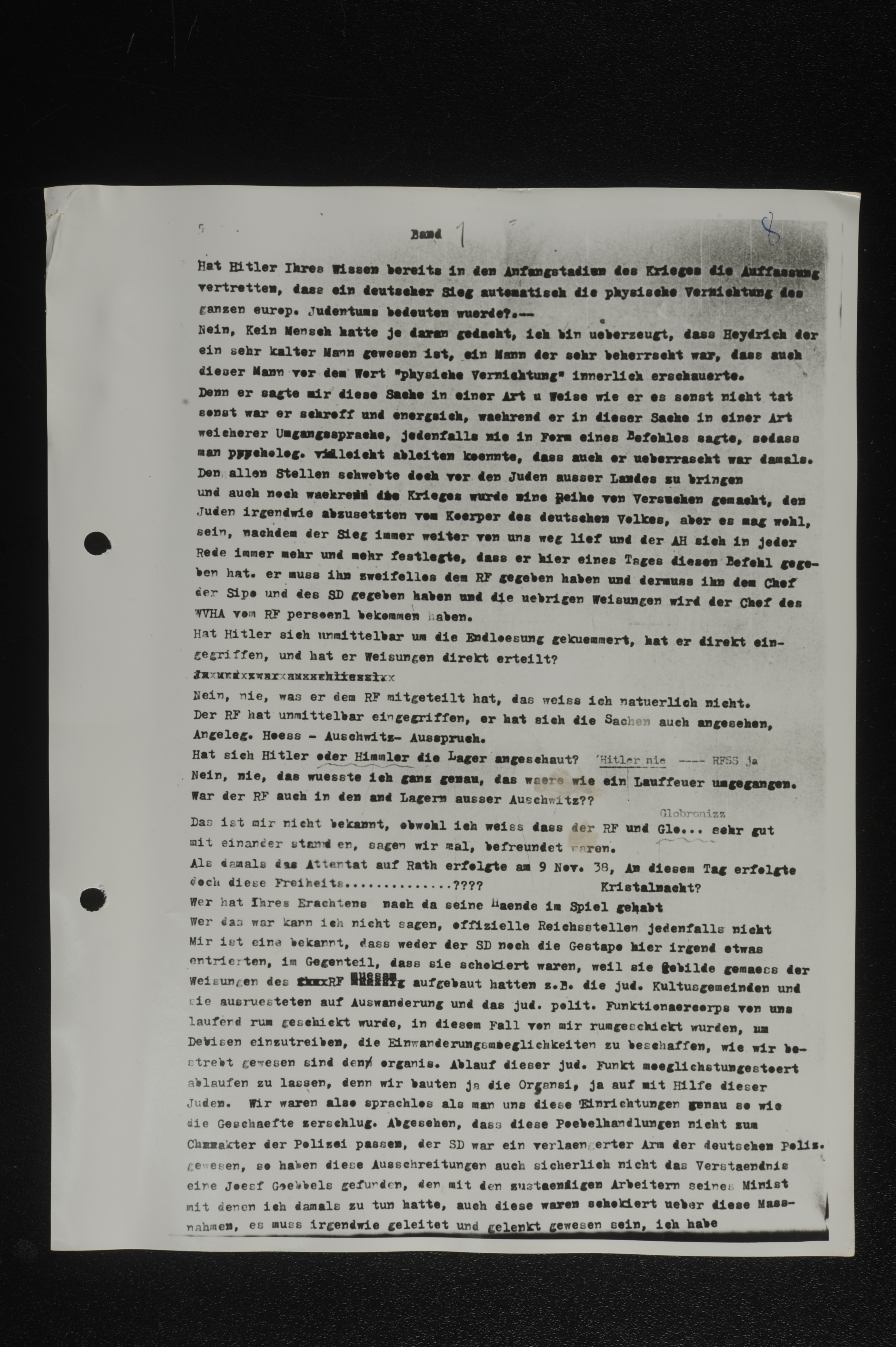
No, nobody had ever thought of that. I am convinced that Heydrich, who was a very cold man, a very self-controlled man—even he shuddered inwardly at the words “physical annihilation.” He told me about this in a way he otherwise did not use. Normally he was brusque and forceful, whereas in this matter he spoke in a kind of softer conversational language, certainly never in the form of an order. Psychologically, one might perhaps infer that he too was surprised at the time. After all, all the offices had in mind getting the Jews out of the country.

Even during the war a series of attempts was made somehow to detach the Jews from the body of the German people. But it may well be that, as victory kept slipping further away from us and A.H. (Adolf Hitler) committed himself more and more in every speech, one day he gave this order. He must undoubtedly have given it to the RF (Reichsführer-SS), who must have given it to the Chief of the Security Police and the SD (Security Service). The head of the WVHA (SS Economic and Administrative Main Office) will have received the remaining directives personally from the Reichsführer.

Questioner

Did Hitler concern himself directly with the Final Solution? Did he intervene directly and issue instructions directly?

[Crossed-out text: …]

Eichmann

No, never. What he communicated to the RF (Reichsführer-SS), I naturally do not know. The Reichsführer intervened directly and also looked at the matters himself.

[Höss matter—Auschwitz—remark.]

Questioner

Did Hitler or Himmler look at the camps?

[Typed answer cue: Hitler never—RFSS (Reichsführer-SS) yes.]

Eichmann

No, never. I would know that for certain; it would have spread like wildfire.

Questioner

Was the RF (Reichsführer-SS) also in the other camps besides Auschwitz?

Eichmann

I do not know, although I know that the RF (Reichsführer-SS) and Glo…

[Typed addition: Globronizz.]

got on very well with one another—let us say they were friends.

Questioner

When the attack on Rath took place on November 9, '38, that was the day this freedom…?

[Night of Broken Glass?]

Who, in your view, had a hand in it?

Eichmann

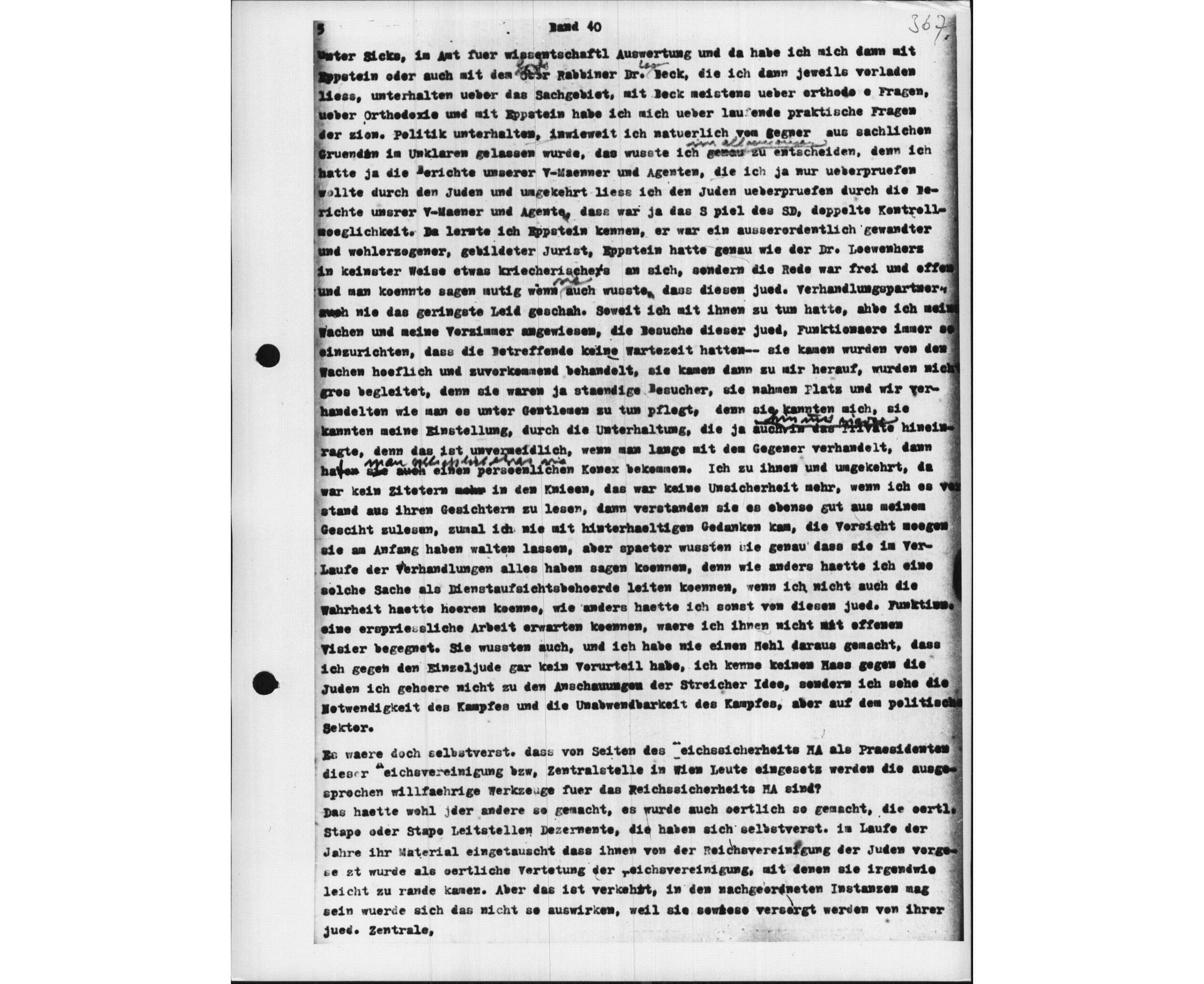
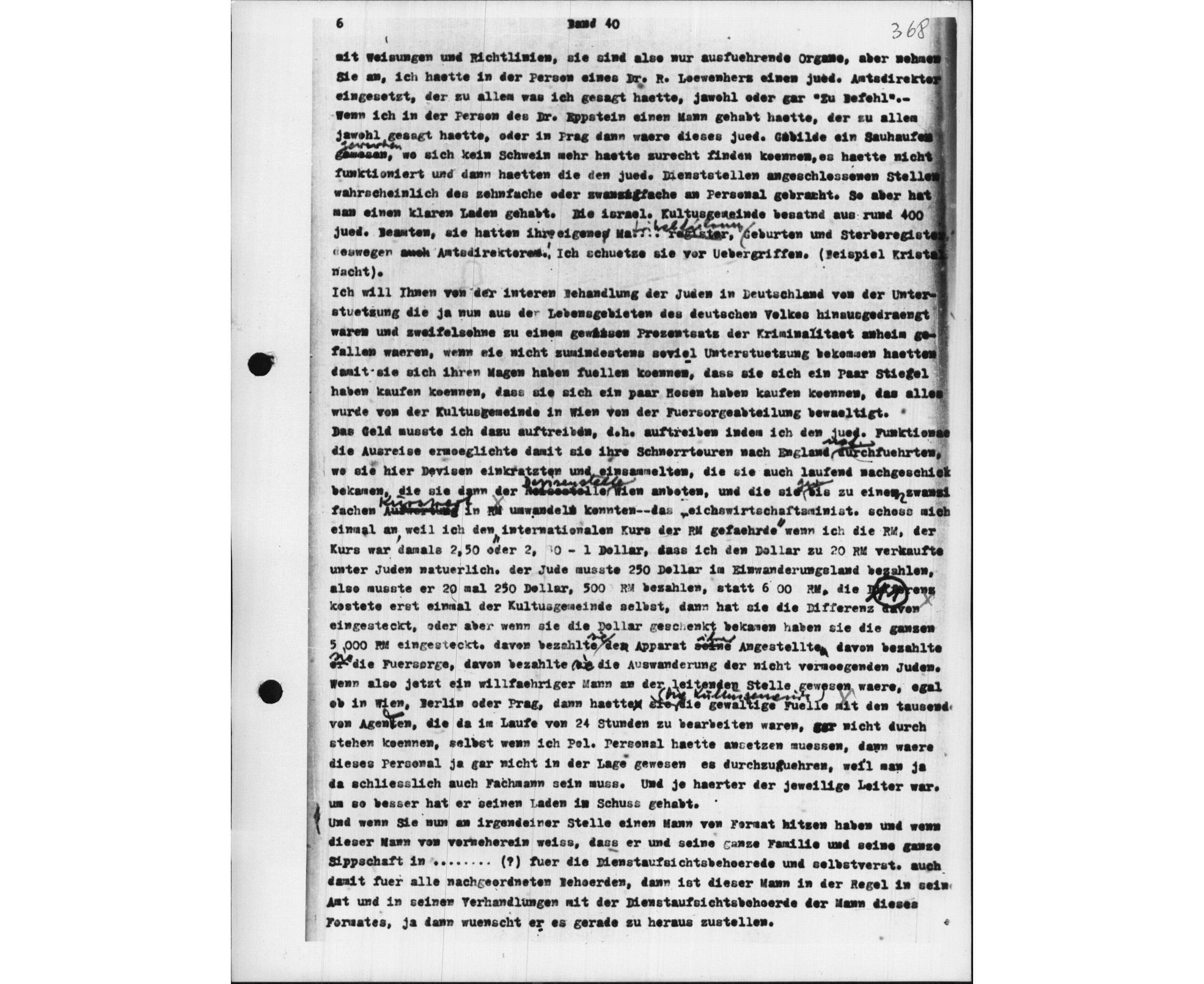
Who it was I cannot say. Certainly not official Reich offices. I know that neither the SD (Security Service) nor the Gestapo initiated anything here. On the contrary, they were shocked, because they had laboriously built up bodies in accordance with the RF's (Reichsführer-SS's) directives, for example the Jewish religious communities, and equip them for emigration. We continually sent the Jewish political functionaries around—in this case I sent them around—to collect foreign currency and secure opportunities for immigration.

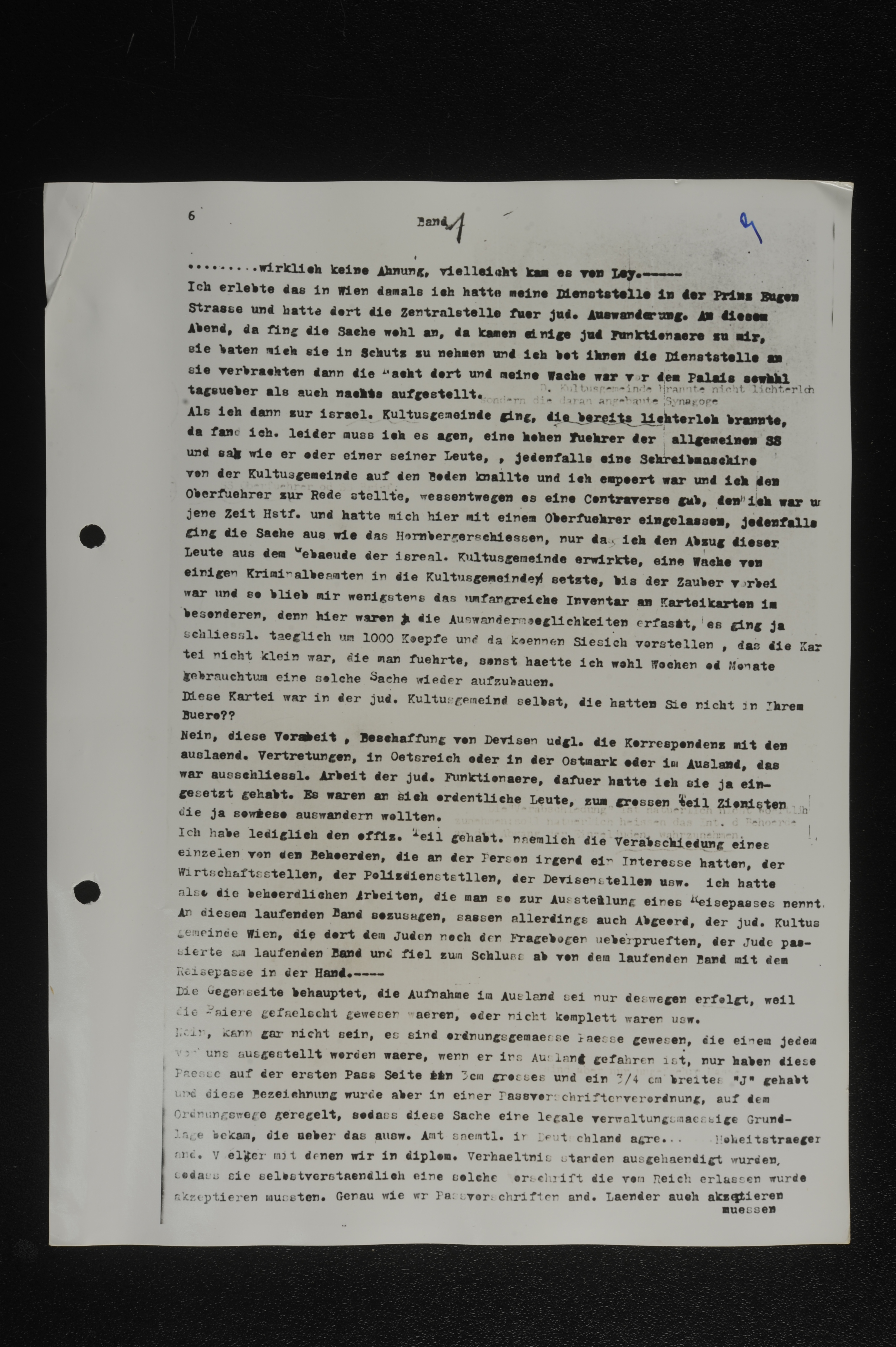
We endeavored to let the organized work of these Jewish functionaries proceed as undisturbed as possible, because we were building up the organization with the help of these Jews. We were therefore speechless when these institutions were smashed, just like the businesses. Apart from the fact that such mob actions do not fit the character of the police—the SD had been an extended arm of the German police—these excesses certainly did not meet with the understanding of a Josef Goebbels either. The responsible workers in his ministry with whom I dealt at the time were shocked by these measures too. It must somehow have been directed and steered. I have

Open page image and German
Page 8 of the typescript, O.65 file 85.
Page 8 · Yad Vashem Archives, O.65/85

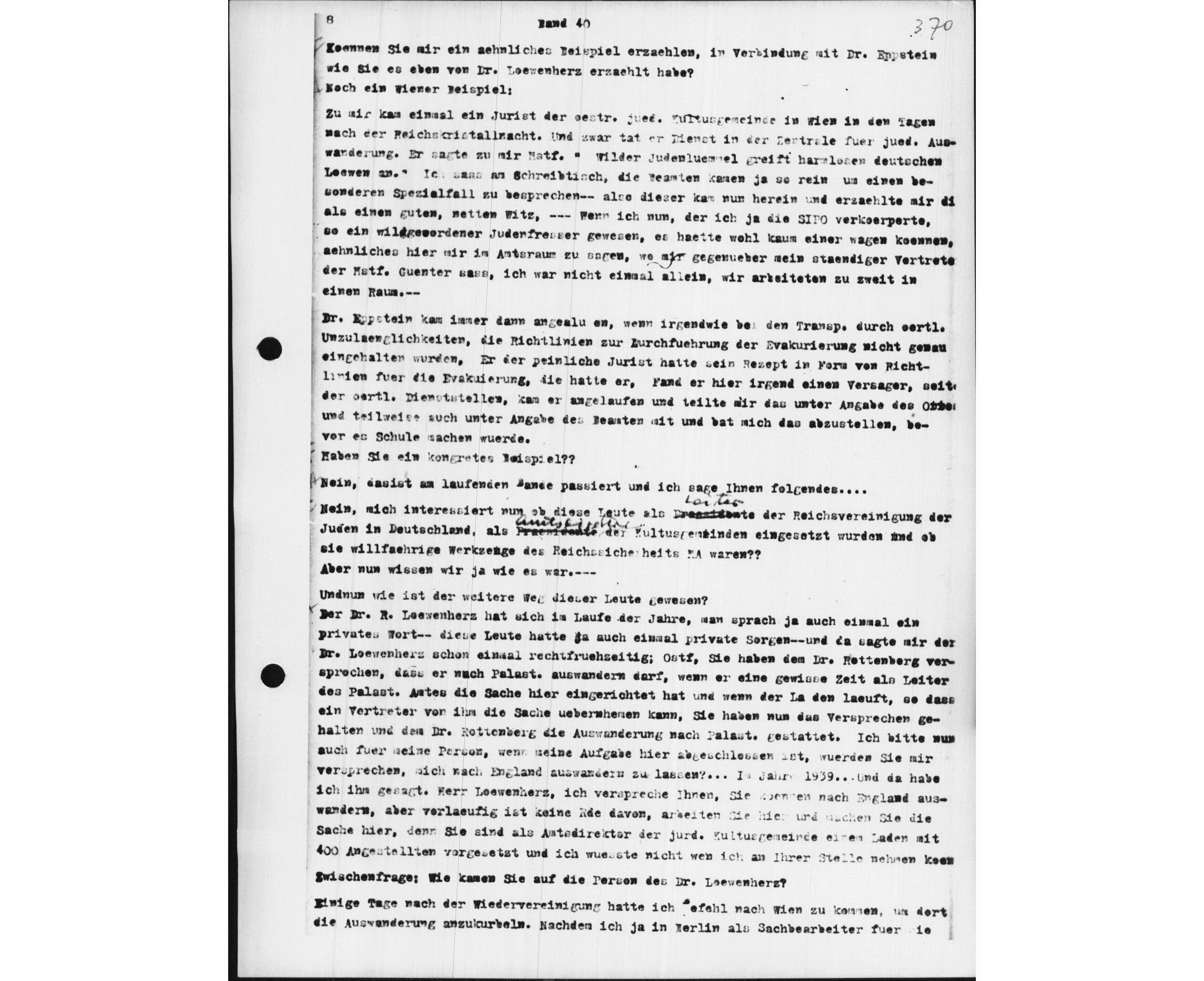
… really no idea. Perhaps it came from Ley. I experienced it in Vienna at the time. I had my office on Prinz Eugen Strasse, and the Central Office for Jewish Emigration was there. That evening, when the affair apparently began, several Jewish functionaries came to me and asked me to protect them. I offered them the office, and they spent the night there. My guard was posted outside the palace both by day and by night.

[Typed correction: The religious community was not ablaze; it was the synagogue built onto it.]

When I went to the Israelite religious community, which was already ablaze, I found—I regret to have to say it—a senior leader of the General SS. I saw him or one of his men, at any rate, slam a typewriter from the religious community onto the floor. I was outraged and took the Oberführer to task.

[Typed addition: SS Oberführer or SS Brigf. (Brigadeführer).]

That led to a dispute, because at the time I was a Hstf. (Hauptsturmführer) and had taken on an Oberführer. In any case, the affair came to nothing, except that I secured these men's withdrawal from the religious community building and placed a guard of several criminal-police officers there until the commotion was over. In that way I at least retained the extensive holdings, particularly the card index, because it recorded the possibilities for emigration. After all, we were dealing with a thousand people a day, and you can imagine that the card index we kept was not small. Otherwise I would probably have needed weeks or months to build up something like it again.

Questioner

This card index was in the Jewish religious community itself? You did not have it in your office?

Eichmann

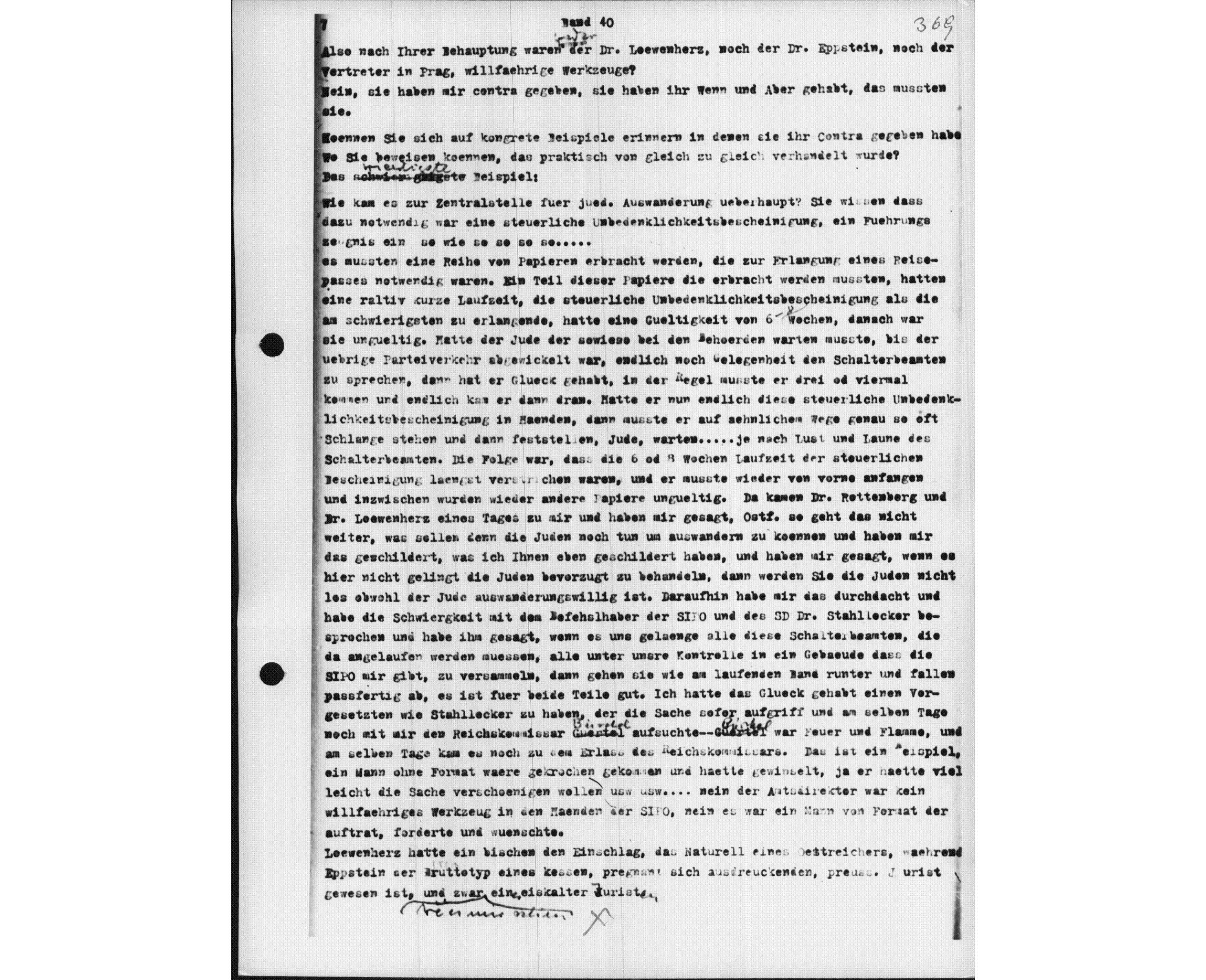
No. This preliminary work—obtaining foreign currency and the like, corresponding with foreign missions in Austria, or the Ostmark, or abroad—was exclusively the work of the Jewish functionaries. That was what I had appointed them for. They were decent people, largely Zionists who wanted to emigrate anyway.

[Typed explanation: “Farewell” is of course not to be taken literally; it means attending to the authority’s interest in the departure of each individual Jew.]

I handled only the official side: the clearance of an individual by the authorities that had some interest in his person—the economic offices, the police offices, the foreign-currency offices, and so on. I therefore handled the official work involved in issuing a passport. At this assembly line, so to speak, there were also delegates from Vienna's Jewish religious community who checked the Jew's questionnaire. The Jew passed along the assembly line and dropped off the end of it with his passport in his hand.

Questioner

The other side claims that people were admitted abroad only because their papers were forged, or incomplete, and so on.

Eichmann

No, that cannot possibly be. They were proper passports, the kind any one of us would have been issued if he traveled abroad. The only difference was that these passports had a “J” three centimeters high and three quarters of a centimeter wide on the first passport page. This designation was regulated through the normal administrative channels by a passport ordinance, so that it acquired a legal administrative basis. Through the Foreign Office, this was handed to all the representatives of other peoples, accre… in Germany, with whom we had diplomatic relations. They therefore naturally had to accept a regulation issued by the Reich, just as we must accept the passport regulations of other countries.

Open page image and German
Page 9 of the typescript, O.65 file 85.
Page 9 · Yad Vashem Archives, O.65/85

Questioner

Is it true that the proposal for the “J” came from the Swiss side?

No, I do not believe so…

Questioner

… People with a J were then not allowed across the border.

Eichmann

Yes, I remember that the urge to emigrate was so strong that Jews frequently crossed the border illegally. I remember that the Foreign Office had difficulties, and that … were exchanged here. I am more inclined to think that the Foreign Office ordered this “J” regulation. We, the police, did not order it.

[Typed addition: I believe that this J regulation—a ….]

Questioner

Where and how did you experience July 20?

[Thank you for the “slow…”]

Eichmann

I was in Hungary, in Budapest, and heard there of the attack on the Führer. We made no preparations of a defensive kind, because we were fortunate to have such good and influential friends in the … and the government that not the slightest danger could threaten us from that quarter. Nor did we have to concern ourselves with any German military offices. From that side too, unlike in other countries, personnel were detained, as I later heard; we had good contacts with them as well, so that in Hungary the day passed without any incident.

Questioner

Did anyone in your office know anything about a conspiracy of that kind being planned?

Eichmann

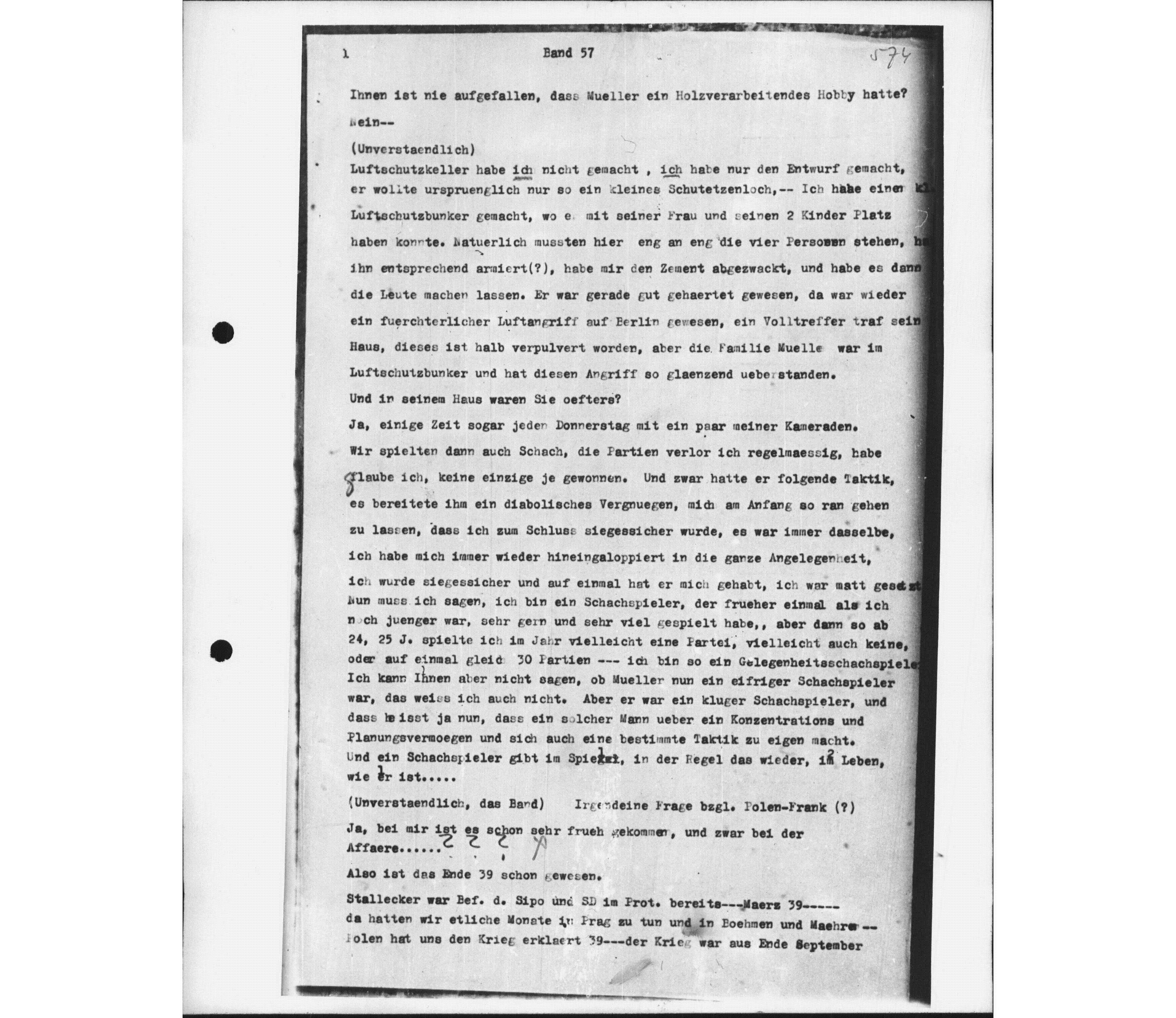
Yes. It was like this: we had one, sometimes two, so-called desk officers' meetings a week, chaired by Müller. About twenty desk officers attended. At these meetings Müller himself raised matters of general interest, but the individual desk officers also often brought up matters they sometimes could not discuss with their chief, so naturally one heard a great deal. Conversely, reports of general interest made by an official to the head of Office IV were then presented at these desk officers' meetings when they were of some importance to everyone. There one could naturally hear again and again from the officer responsible for the national opposition, SS Stf. Huppenkothen. For my part, I always believed the matter to be in the best hands.

If an official such as Huppenkothen was handling it, that surely had to reassure us in some way. I was therefore very astonished and surprised that such a thing could happen. Because, as an old pessimist, and because the papers I received on my desk every day made me aware of moods, efforts and so forth within the Reich, although I had no responsibility for these things at all and could not intervene… And precisely because of this pessimism, I repeatedly expressed the wish that, before we dealt with the enemy assigned to me, we should first put the requisite number of Germans, our own fellow countrymen, up against the wall, so that there would finally be peace in our own stable.

[Impression of the victory parade in Paris.]

That was the beginning. It was when Bock reviewed his troops at the parade. Around that time we met, as we did every Thursday, in Müller's private apartment: Huppenkothen, my humble self, and three other comrades. We were five department heads from Office IV. They were harmless evenings, with chess and so on. We discussed official duties quite calmly, just among ourselves, and I thought I could also voice my misgivings there. It was around this time that I really began to become pessimistic…

Open page image and German
Page 10 of the typescript, O.65 file 85.
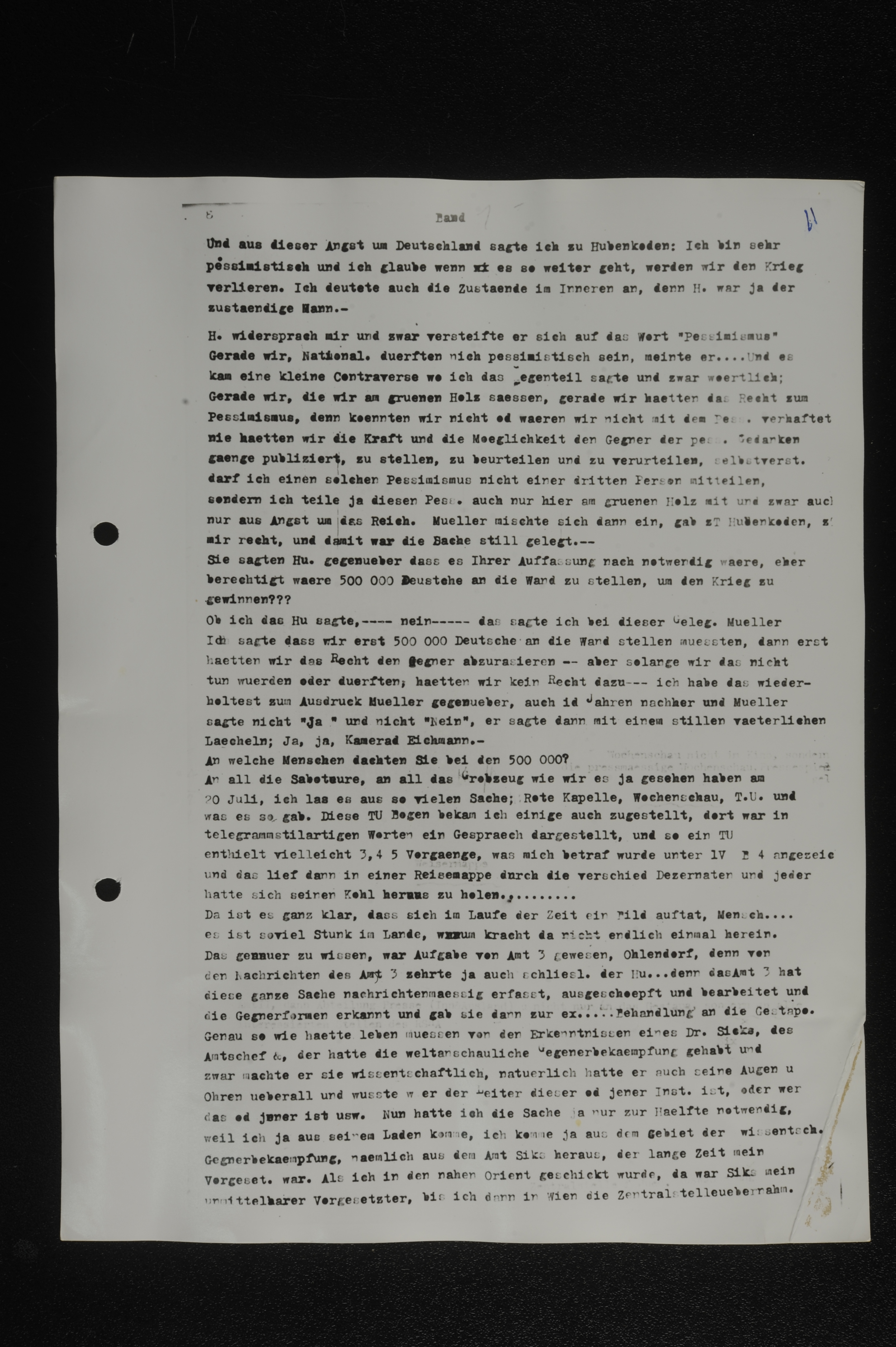
Page 10 · Yad Vashem Archives, O.65/85

Out of this fear for Germany I said to Huppenkothen: I am very pessimistic, and I believe that, if this goes on, we will lose the war. I also hinted at the conditions inside the country, because H. was the man responsible. H. contradicted me, fastening specifically on the word “pessimism.” We National Socialists of all people ought not to be pessimistic, he thought… A small dispute followed in which I said the opposite, word for word: we of all people, who sit on the green wood, have the right to pessimism.

If we could not be pessimistic, or were not bound up with pessimism, we would never have the strength or the possibility to confront, judge and condemn the opponent who publishes pessimistic trains of thought. Of course, I must not communicate such pessimism to a third person; I share this pessimism only here, on the green wood, and only out of fear for the Reich. Müller then intervened, agreeing partly with Huppenkothen and partly with me, and that settled the matter.

Questioner

You told Hu. that, in your view, it was necessary—or rather, justified—to put 500,000 Germans up against the wall in order to win the war?

Eichmann

Did I say that to Hu.? No. On that occasion I said it to Müller. I said that we would first have to put 500,000 Germans up against the wall; only then would we have the right to wipe out the enemy. But as long as we did not do that, or were not permitted to do it, we would have no right to do so. I expressed that to Müller repeatedly, in the years afterward too. Müller said neither “yes” nor “no.” With a quiet, fatherly smile he said: “Yes, yes, Comrade Eichmann.”

Questioner

Which people did you have in mind with the 500,000?

[Typed explanation: Not a cinema newsreel, but the press review, the press digest.]

Eichmann

All the saboteurs, all that rabble, such as we saw on July 20. I read it in so many things: the Red Orchestra, the press review, T.U., and whatever else there was. Some of these T.U. sheets were also sent to me. A conversation was set out there in telegraphic wording, and one such T.U. contained perhaps three, four or five matters. What concerned me was marked IV B 4.

[Typed addition: Circulation folder.]

It then passed through the various sections in a circulation folder, and everyone had to pick out what concerned him. It is quite clear that, over time, a picture emerged: man… there is so much trouble in the country; why does someone not finally come down hard on it? It was the task of Office 3, Ohlendorf, to know about that in greater detail. After all, Hu… also drew on the intelligence from Office 3. Office 3 collected, exploited and processed all this as intelligence, identified the forms the opposition took, and then passed them to the Gestapo for ex… treatment.

[Typed addition: … then the press section (domestic … foreign) … not only to the Gestapo but to … interested offices of the RSHA (Reich Security Main Office).]

In just the same way, one would have had to draw on the findings of a Dr. Six, the office chief …. He had been responsible for combating ideological opponents, and did it scientifically. Naturally he too had his eyes and ears everywhere, and knew who headed this or that institution, or who this or that person was, and so on. I needed only half of this, because I came from his shop myself. I came from the field of scientifically combating opponents, from the office of Six, who had been my superior for a long time. When I was sent to the Near East, Six was my immediate superior, until I took over the Central Office in Vienna.

Open page image and German
Page 11 of the typescript, O.65 file 85.
Page 11 · Yad Vashem Archives, O.65/85

[Typed addition: SS Oberführer, Government Director Dr. Stallecker; Commander of the Security Police and the SD (Security Service) with the Reich Protector of Bohemia and Moravia.]

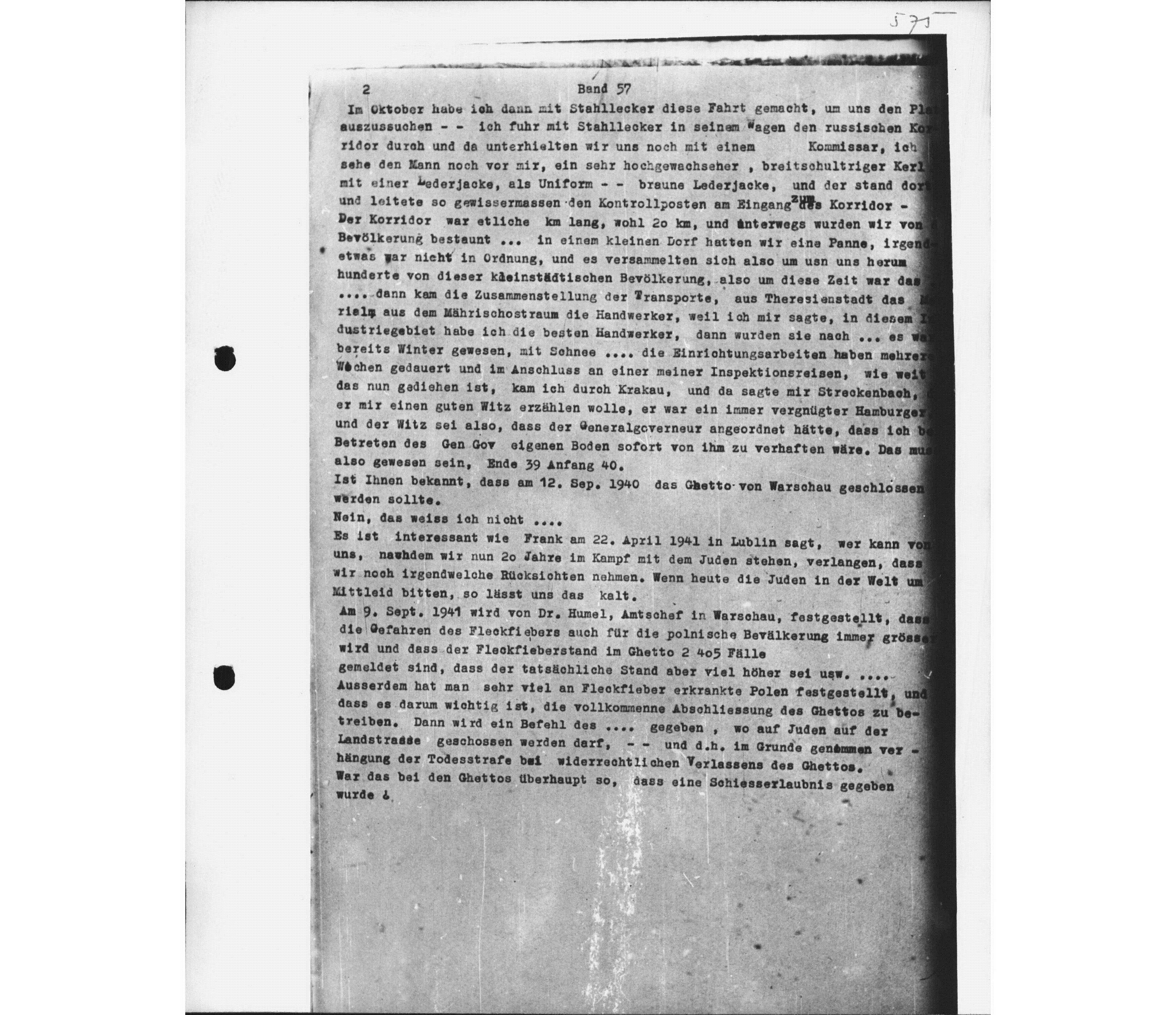
And from that time on my direct superior in Vienna was Dr. Stahlecker. Then, from Vienna, when in the meantime I also set up the Central Office in Prague—

[Typed addition: Central Office for Jewish Emigration, Prague.]

where for a very short time I was subordinate to the Chief of the Security Police and the SD in Prague—

[Typed correction: Subordinate to the Commander of the Security Police and the SD with the Reich Protector of Bohemia and Moravia for the period of establishing the Central Office for Jewish Emigration.]

that was only a matter of a few months—I was then ordered to Berlin in the autumn of '40, and Müller was my immediate superior.

[Keyword: Palestine.]

Questioner

When and why did you travel to Palestine? It is claimed that you gave the order to establish contact with the Grand Mufti. Is that true? Did you go to Palestine for that reason?

Eichmann

That is nonsense, of course. This is what happened. I told you that I struggled with Hebrew for two and a half years… Around that time I observed legal and illegal immigration into Palestine, because I knew that colleagues of mine in Schellenberg's office had very close contacts with the Arabs. That was about the time Mussolini declared himself the Sword of Islam… And I wanted to know to what extent Jewry in Palestine was artificially keeping itself in the minority, when in fact its numbers already far exceeded those of the population resident there, or whether approximately that number had already been reached.

I already knew from Jews that they were only waiting to have the numerical majority in order to take possession of the country. Jewish functionaries had told me that. So I was interested in establishing when the time might come to set up this new Jewish state. Since uprisings down there were an everyday occurrence, I also assumed the Jews must have some secret militant organizations. By chance one of the Jewish newspapers came onto my desk, and I read an article about the Hagana. That interested me. The article spoke of a Jewish armed force.

Through a man who had lived in Palestine for a long time, a Mr. von Bol… (probably Bolschwingh), who was in turn a good friend of SS Ustf. (Untersturmführer) Mildenstein, then my department head for Jewish affairs—at the Reich Security Main Office I heard of the arrival in Berlin of a Jew from Palestine who was active in some Jewish ex-militant or political capacity, or I heard that he was in a neighboring country. In short, I obtained from Dr. Six, and he in turn from Bol, an invitation to this Jew—

[Typed correction: Not as my guest, but as a guest of the SD Main Office.]

as my guest in Berlin.

[Typed addition: Through him I heard of the arrival in Berlin of a Jewish … functionary of the Haganah.]

Questioner

May the name Bol… be given?

Eichmann

Yes, he was only a simple informant of mine… This Jew came to Berlin, and I declared him a guest of the Reich Security Main Office. I met with him a few times; we ate at the Traube and talked about this and that. But the man would not really open up. He told me interesting things. I also wrote a report about it for my superiors, and Heydrich rated it “good,” a sign that Heydrich was interested in it. When he was not interested, he ran his blue pencil across the whole thing. The invitation extended to me through this man was accepted, and in the autumn of 1937 I traveled with the then SS Oschf. (Oberscharführer) Hagen, a colleague of Six, through Poland, Romania and Syria to Palestine, and then on to Egypt. There had just been several bombing incidents in Palestine at the time…

Open page image and German
Page 12 of the typescript, O.65 file 85.
Page 12 · Yad Vashem Archives, O.65/85

… I arrived in Haifa. The representative of the German News Bureau, Dr. Reichert—who meanwhile had had a car accident—received me in Haifa. Since Palestine was not favorable ground, I obtained permission to go ashore at all only with the greatest difficulty, but I made use of that one day.

[Landscape descriptions.]

I then traveled straight on to Alexandria, where my companion and I spent three days as guests of the president of the young Arab lawyers, who had traveled with us on the ship, a certain Henry Lakasch. His father had been president of the Arab lawyers. Dr. Reichert was waiting for me there, together with a certain Mr. Genz, the local DNB (German News Bureau) representative. Through Dr. Reichert's mediation, my former Jewish guest from Berlin also came from Cairo. We met one evening at Mena House. Various things were proposed; among other things, he proposed a German airline. In any case, the affair was not very productive…

Dr. Reichert handed me, as a gift so to speak, a mail sack from the Mandate airline that Arabs had stolen. It contained several important letters addressed to the High Commissioner and to a senior judge.

[Typed addition: The English senior judge of the Mandate ….]

These letters passed from us to the Foreign Office, and on September 1, 1939, when war broke out with Poland, they were published on the front page of the Völkischer Beobachter. They were matters that did not interest me at all, because I had no responsibility whatsoever for that subject.

Questioner

The contents of the documents?

Eichmann

They concerned cooperation between the Mandate and the official Jewish bodies to the disadvantage and harm of the Arabs… That was why they were published. Those were the Reich's interests: to demonstrate that the Arabs were in some way being outmaneuvered by other powers. I did not meet the Grand Mu… (Grand Mufti). The DNB (German News Bureau) had planned a visit to the then King Abdalla. They had already obtained a chess set for me and pointed out that I must lose the game in any event, because that was the custom… In any case, I did not get to the Grand Mu… (Grand Mufti). There was great unrest down there at the time, and bombs were being planted. When I tried a second time, because I had again arranged to meet my former Jewish guest from Berlin in Haifa or Te…, I went to the British consulate general in Alexandria—

[Typed addition: to the British passport office in Cairo.]

and although I could show a writer's identity card from the Berliner Tageblatt, the official responsible said to me, “I'm sorry,” and that disposed of the matter. The journey had been begun at a time when, suddenly, even during the outward journey, circumstances became as unfavorable as possible, which one could not have known beforehand. In quieter times it would certainly have been better and more favorable, and one could have studied quite a few things more closely.

Questioner

When did you get to know the Grand Mu… (Grand Mufti)?

Eichmann

I met him when he was an official guest in Berlin. That is, he came to Berlin for the treatment of an eye ailment, when he broke off his stay in Italy and went to Germany. Here he was under the protection of Office VI, later Schellenberg's office. The office had its guesthouse at Wannsee, and

Open page image and German
Page 13 of the typescript, O.65 file 85.
Page 13 · Yad Vashem Archives, O.65/85

… there was an evening to which the Grand Mu… (Grand Mufti) was invited, along with other Arabs and all the other desk officers whose areas of responsibility in some way extended into Arab affairs. Mine extended into that area, and I was included too, particularly since immediately afterward three Iraqi officers were assigned to me for information. One was a nephew of the Grand Mu… (Grand Mufti), and, as I later heard—I am not entirely certain—he was the one who later did away with King Ab…. He was shot at once as well. He had been there, so I was told, and two others. I was told that this nephew was intended to be the Heydrich of the Near East after the victory of German arms down there…

Questioner

Abdullah was shot in 1952?

Eichmann

I read the whole thing, that it had been the Grand Mufti's nephew. It was in all the newspapers… I was told at the time that he was the nephew. They were Iraqi majors, and, since I knew he was the nephew, I naturally now put it together: aha, that was him; now he is gone…

Well, the three had been with me and gone through for information. I had orders to open everything to them, without reservation, in accordance with orders. All the safes stood open to them. I let them go through all my subject areas and also devoted considerable attention to the three gentlemen myself. One spoke good German, the other broken German. It was not a social gathering; it was an introduction to the office, so that at any time they would have been able to transplant my administrative apparatus—a desk—into the great or small Arab empire.

But they did not go through my office alone. They also went through various other desks that in some way came within their sphere. The reason is quite clear: if I am told that one of them is the Heydrich of the Near East, then he is the future or intended Chief of the Security Police of the great Arab empire… Perhaps one was intended to handle the Jewish question down there. But all three were interested in everything and were as willing to learn as pupils. They received all the files from me, and these were explained to them…

Questioner

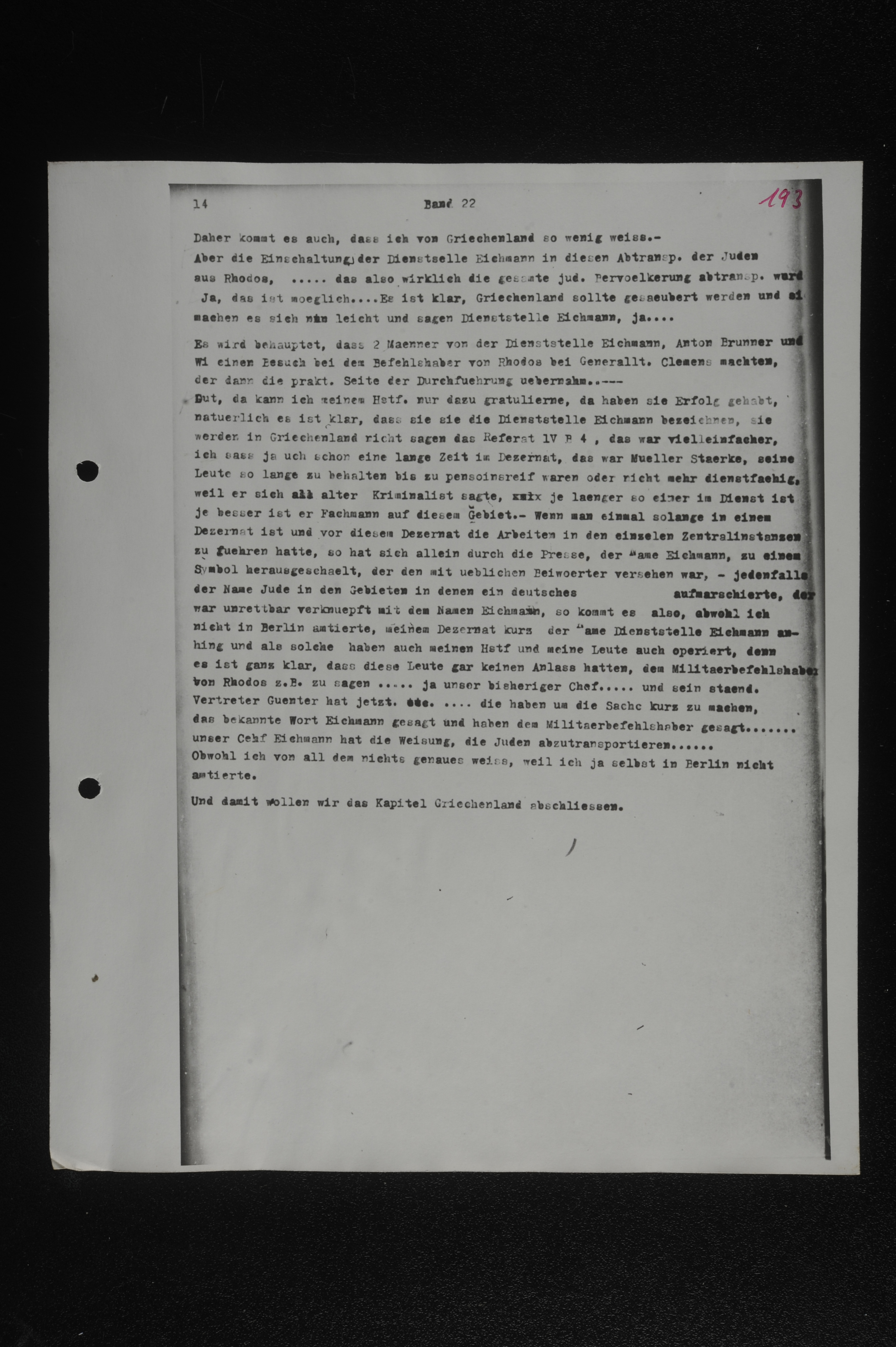
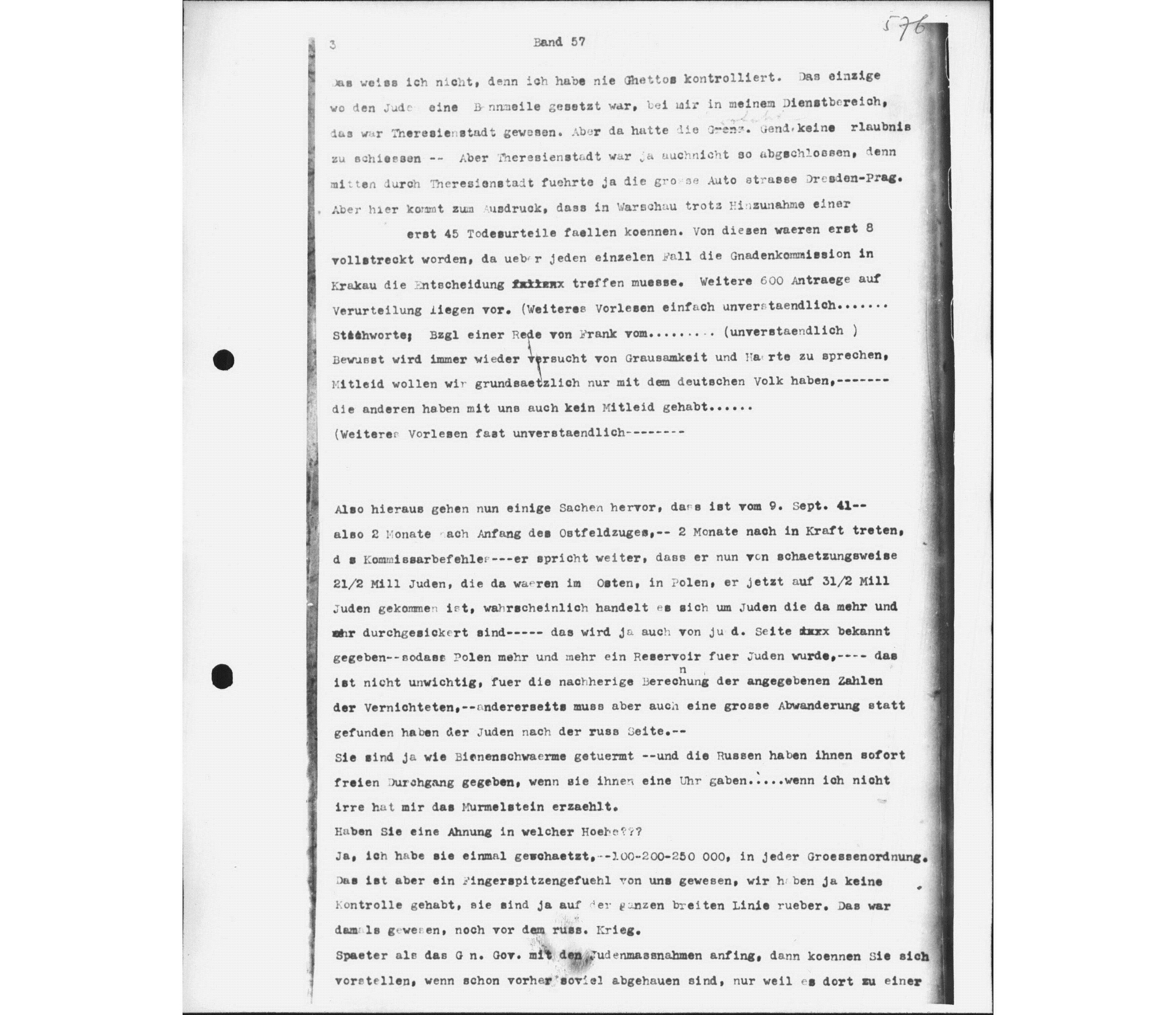
Now Wi… claims in his statements that you were commissioned in August to draw up a Madagascar plan?

Eichmann

That is wrong, “commissioned.” I said before that I was a living file rack. I acted in accordance with orders, but I also thought for myself, because I lived in this subject. Otherwise I would have been an auxiliary worker, just a cog, something mindless and dead… So when emigration stalled—we will talk later about why it stalled—I thought about it, when the various attempts came to me, such as Theresienstadt, such as the Lublin district. Boehm writes in his Jewish State that Herzl had tried everything, had even gone knocking on the Sultan's door; he had wanted to negotiate with Kaiser Wilh. (Wilhelm). Herzl stirred up heaven and earth for the Jews, and in his distress Madagascar came up too… Herzl fell out with the particularly right-wing Orthodox, who all insisted on the Holy Land, Eretts-I. (Land of Israel).

Open page image and German
Page 14 of the typescript, O.65 file 85.
Page 14 · Yad Vashem Archives, O.65/85

The First World War offered them a homeland in Palestine, and with that all other considerations, Madagascar and so on, had become obsolete. Only in our own day, in our shortage of land and our need to bring the problem to a solution, did the Madagascar idea arise again. I myself, as the IV B4 desk officer in the Reich Security Main Office, put the Madagascar idea to Heydrich, the Chief of the Security Police and the SD (Security Service)—after first presenting it to Müller, of course—and received permission to set everything useful in motion.

In the period that followed—Madagascar was, at that time, half open to us; as a non-military man and non-politician I cannot establish that quite correctly. In any case, we had defeated France, and Madagascar was a French island and had been a French possession. There were a whole series of desk officers' meetings, attended by officials sent from all the central authorities. The Foreign Office had a spokesman, the Führer's Chancellery had a spokesman: the first was represented by von Thadden, the second by Reischhauer —

[Typed addition: Senior Government Councillor Dr. Reischauer.]

who was assigned as the permanent liaison officer between the Führer's chancellery representative and the desk. All the other offices that had to be involved even marginally were involved too, because every central authority, as ever, jealously watched to ensure that its own powers were not bypassed in any way. I believe that at least fifteen to twenty large meetings about the Madagascar project took place at my office, each attended by about twenty to twenty-five people, to give you some idea of the intensity of the work. Through the lawyers I had at my disposal, I had a proper draft law drawn up, together with a Triampel, for the resettlement and settlement of the Jews on Madagascar: a territory that was to be declared Jewish territory and on which the Jew was to govern and live freely and without constraint. Under the protectorate of the Greater German Reich, I would say, of course.

This would have been a great help to all those Jews, not just those of the German Reich but also those throughout our European sphere of influence, insofar as we could have transported the Jews to Madagascar in large numbers. At that time I obtained figures on the climatic conditions and capacity for receiving people from the Reich Office for Emigration Affairs in the Reich Ministry of the Interior, specifically from its head—an office which, as is known, had already been established in 1…

[Handwritten addition: long ….]

to advise Germans who wished to emigrate. The figures were not satisfactory; they were extraordinarily satisfactory.

I still remember today that Madagascar would have had to be divided, as it were, into two zones, an upper and a lower one. One would have been very good climatically, the other somewhat worse. How that would have worked out in detail would not have been our task, but that of Jewish self-administration, of the Jewish Madagascar government. I still remember that the collection of clauses amounted to about 80?, about 100 or 120. I know that work had already begun on implementing regulations. In any case, the bureaucratic obstacles were enormous.

When, after weeks and months, the matter was finally ready for the ministers, and the draft was circulating for initialing through the state secretaries of the individual ministers and around the ministerial offices, France was suddenly finished for us again. The balance of the war tipped so that Madagascar was beyond our reach. It was the uprising… de Gaulle. I believe there was something in Dakra. In any case, we had some setbacks to take; Madagascar ceased to be of interest and had to be abandoned, to my heartache even today, because at that time I was still living entirely in the Madagascar idea.

Open page image and German
Page 15 of the typescript, O.65 file 85.
Page 15 · Yad Vashem Archives, O.65/85

Questioner

What French witnesses are there for this Madagascar plan? Or which French politician or official was contacted to carry out the plan—or was no one contacted?

Naturally the Vichy government was contacted, because Legation Councillor von Thadden, the Foreign Office desk officer, was present at every meeting, and every draft had to be initialed by the Foreign Office. It was a step-by-step process, and on several cardinal points the Foreign Office had to initial its statement that there were no objections. For me, as a member of the Gestapo, that settled the question of agreement with the Vichy government. For the Foreign Office to have disposed of a territory on its own, without negotiating with the responsible gentlemen—that would contradict every established practice of any central authority. No central authority can do that. The moment the Foreign Office initialed a matter for me as unobjectionable, it had naturally covered itself in some way on every aspect extending into foreign affairs.

Questioner

You yourself…

Eichmann

Just as I had to cover myself on my own matters and bring them into agreement, I believed I need not concern myself with this at all, and I never did concern myself with it, because the Foreign Office's initials alone, and nothing else, were binding for me.

Questioner

But the credibility of Germany's serious intention to pursue a peaceful solution in the form of Madagascar naturally increases if you learned, either directly or indirectly, which French Vichy offices discussed these matters. Do you have any idea?

Eichmann

No. I know only that the Foreign Office had an office in (Vichy?), and that this same matter was put to Legation Councillor von Thadden—that is, taken up during the discussion. He could never express a personal position on it: his rank was much too low, his official position much too junior for that. He took these matters to the Foreign Office, and the Foreign Office contacted its permanent representative in Vichy. The permanent representative in Vichy naturally reported to the Foreign Office only what LeValle —or what was the name of the man he negotiated with?—had told him.

Questioner

Did you learn that these negotiations were conducted directly with Laval, or with Champaire, or with whom?

Eichmann

No, with Laval. The other name is completely unknown to me. I know that the Foreign Office negotiated with Laval on Madagascar-project matters. Von Thadden told me that. He withdrew—that is, he explained… From him the matter went to Reichhauer, who had authority, as the Führer's deputy, to initial something immediately, on the spot, or not. He then explained that he could only take it up and discuss it then, because they had to contact Vichy. I never heard any name other than Laval from von Thadden.

Questioner

Darlan, the admiral?

Eichmann

Yes, I know the name, but he never played a role in my negotiations.

Questioner

Was any role envisaged for the French fleet to carry out the transport?

Eichmann

For the transport, some man calculated how much tonnage we would need altogether to transfer the Jews to Madagascar within a short time, because the …

Open page image and German
Page 16 of the typescript, O.65 file 85.
Page 16 · Yad Vashem Archives, O.65/85

transfer was to proceed decently, because the Jews were to arrive down there fit for labor. It was not to become just some ghetto, nor was it to become a concentration camp. It was to be a proper protectorate government, exactly like Slovakia—that was precisely the sort of government it was to be. That was why everything had been settled down to the smallest detail through all the responsible central authorities, and not, say, in the form of a coup arranged by some Waffen-SS unit with some arranged-for or daredevil U-boat crew, or towing some steamers to Madagascar.

No, there was to be an orderly solution, established by law, which was to meet with the approval of all the central authorities, including the island's present ruler; the island's fate was to be settled in some treaty. Hence my order to involve every single office that came into consideration—the unusually large accumulations of ministerial practices, and the large number of desk officers at the discussions.

Questioner

Were you ever introduced to the Führer? Did you speak with him?

Eichmann

No.

Questioner

Given the official position you held, didn't it strike you as embarrassing that you were never introduced to the Führer?

Eichmann

No, that could not have struck me as embarrassing, because in the civil-service hierarchy I held the position of a department head. Above me, as my immediate superior, I had an office chief, a main-office chief, a Reichsleiter, and then came the Führer.

Questioner

But the importance of your tasks, or the success with which you were able to crown some operations, could surely have made it possible for you to be received by the Führer, for example? Or to be introduced to him?

Eichmann

No, that would have been impossible, because this problem was so pressing and so much to the fore—it is also well known that the Führer dealt with the problem in every one of his speeches, sometimes at length, sometimes very explicitly. So, as with no other problem, the Reichsführer-SS, the Chief of the Security Police and the SD (Security Service), Heydrich, later Kaltenbrunner, and also my immediate chief threw themselves into this problem and concerned themselves personally with its individual points to a degree scarcely found in any section of my colleagues at the time—that is, comrades.

That was also the difficulty of my position. While my fellow section officers at the time simply acted rigidly according to laws, regulations and decrees, I always had to look left and right, like a horse without blinkers, to see whether one of the gentlemen—for example, Heydrich—whether they had made some individual decision, created a precedent. I had to be careful not to ruin that decision again through some other matter.

To the extent that my superiors concerned themselves with the affairs in such detail, I naturally had no possibility of being introduced to the Führer in any way, because my superiors could present these details to him. Only Heydrich, later Kaltenbrunner, and Reichsführer-SS Heinrich Himmler went to the Führer on Jewish affairs. Grf. (Gruppenführer) Müller was never introduced to the Führer, either on Jewish affairs or on any other matter. It was not like that for us, unlike the years of struggle, when there had been comradely contact: for us the Führer was unreachable ….

Open page image and German
Page 17 of the typescript, O.65 file 85.
Page 17 · Yad Vashem Archives, O.65/85

Questioner

Was Müller never introduced to the Führer?

Undoubtedly, while he was still in Munich, with the police. Later, I don't think so. Müller never said a word about it. Müller was a very assiduous, hardworking paper-pusher, and I was one too as Müller's underling. Neither of us would ever have had a pathological ambition to be introduced to the Führer. The subordination to which we voluntarily submitted—that is, duty, that is, the oath, that is, orders—had already made me immune to any pathological striving for advancement of the kind that perhaps a little private individual has to possess… Instead, we quietly and modestly did our duty as soldiers of the Third Reich.

Questioner

Who do you believe originated the idea of entrusting Eichmann with carrying out the measures for the Final Solution?

Eichmann

The position is this: I have handled Jewish affairs since 1935. Now, from 1935 to 1945, in those ten years, I had 1,000 discussions with Jewish and non-Jewish bodies—not only in Germany, in the Old Reich (Altreich), in the Eastern March (Ostmark), in the Protectorate of Bohemia and Moravia, but in many territories where we exerted our influence at the time. I was known everywhere. I had to concern myself with every single detail, with matters of principle. Jewry had simply grown accustomed to it—I read it in the various foreign newspapers laid on my desk—that Jewish affairs in the Reich, unless they involved Streicher stories or Stürmer matters, were the business of the 'Tsar of the Jews,' as they used to put it. The Pariser Tageblatt brought that out, more or less as a beginning… Eichmann did that.

Questioner

How did it begin?

Eichmann

With a front-page editorial in the Paris newspaper, entitled 'The Tsar of the Jews.' That must have been in 1939, in the spring… This article said that this man had now held sway in the Old Reich, then in the Eastern March, and would now persecute them in Bohemia and Moravia too. If those Paris scribblers had only known how beneficial my work had been for Jewry, and how much blood the Reich had preserved for them through my work, which I had been ordered to do, they would never, ever have written the article. It was written by bunglers.

Questioner

How often did you see the Reichsführer-SS and also speak with him?

Eichmann

The Reichsführer-SS—seen him, yes, and spoken to him when I was still a sergeant or senior sergeant, at a Yule celebration in the Reich Security Main Office. I had number 59 at the time; that is, I was the fifty-ninth bone rattling along in this SD (Security Service) structure. For this Yule celebration in 1934, the Reichsführer-SS had announced that he was coming. He wanted to celebrate it with us. We had been a small, close-knit community.

Heydrich had been our chief, and Sturmbannführer Brandt, later police president of Graz, was my immediate superior. Professor Schwarz-Bostunitsch was my intellectual teacher. At that time I dealt with Freemasonry, specifically the third degree, St John's Freemasonry. In that capacity I had my collection of seals, and that was probably the extent of the whole third degree, because it is not a degree that calls for extensive study… So this Yule evening took place among these Freemason index cards. The Reichsführer-SS arrived late with his …

Open page image and German
Page 18 of the typescript, O.65 file 85.
Page 18 · Yad Vashem Archives, O.65/85

…wife. I saw her for the first and last time. She gave the impression of a South Bohemian farmer's wife, and it was a very pleasant, intimate evening. We sang a few pleasant folk songs. Darré, the Agriculture Minister, sat beside me. He gave each of us a book… I also asked him to put his signature (KaiserWilhelm) underneath it… That was when I spoke to the Reichsführer-SS for the first time. I had seen him more often, because around that time he personally showed the Gauleiter and the ministers around, unless he could not get away and Heydrich did it. Almost every day Reichsleiter came to look at the place.

Questioner

Did he discuss any Jewish question at this celebration?

Eichmann

No, no Jewish questions were discussed at all at that time. Only ideological questions were discussed then. The Reichsführer-SS assured himself of the inner steadfastness of the people he knew were in those positions.

Questioner

When did you speak with him for the second time?

Eichmann

The second time was already during the war.

Questioner

Were you invited to give a report, or…?

Eichmann

No, I was not invited to give a report; I was ordered to report to him, three or four times during the war. I was once ordered to him when he was still in Albrechtstrasse, when Wolff was still his adjutant. It may have been shortly before the Polish crisis. In any event, we still had civilian customs. The other times I was ordered to his field headquarters. He was then in a former Russian cadet school, I think near Minsk, or by Kiev. The second time was on a special train, Special Train Heinrich, which also stood in some forest in the East. The third time I was ordered to his field headquarters northeast of Berlin, in an old castle. That was in April, a few days before the major air raid on Brixlegg on April 17, 1945, because I was actually supposed to die that day, which is why I still know the date so precisely…

Questioner

What was the subject of your conversation shortly before the Polish campaign?

Eichmann

The subject of my conversations with the Reichsführer-SS was always this: he wanted to know the figures, first the emigration figures—that was the most important thing for him—and the difficulties: who was causing the difficulties, (a) our own Reich offices, (b) foreign countries. That was generally all the Reichsführer-SS wanted to know from me, until the date when he prohibited emigration by order.

Questioner

Do you still remember the course of this conversation more or less precisely? How one point led to another?

Eichmann

I remember this conversation very well, because it was the first I had to have with the highest of my superiors. It was a very civilian affair. The Reichsführer-SS was seated. I made my formal report and remained standing. At that time I was either an Obersturmführer or a Hauptsturmführer, in any case a junior rank. The Reichsführer-SS asked me how many Jews had emigrated… That isn't right… That was already when I was in Austria, and already in Bohemia… It was before my posting to Berlin, when I did not yet hold office in Berlin… I was a Hauptsturmführer… I must correct myself to this extent: it was probably before the Russian crisis… because I had already founded the Central Office for Jewish Emigration in Vienna, and likewise the Central Office…

Open page image and German
Page 19 of the typescript, O.65 file 85.
Page 19 · Yad Vashem Archives, O.65/85

…for Bohemia and Moravia, which I had founded as well. Theresienstadt is uncertain… In any event, the Reichsführer-SS was still living under civilian official conditions. Wolff was his chief adjutant. The Reichsführer-SS wanted to know the exact number of Jews who had emigrated. He wanted to know the main receiving countries. He wondered why so many difficulties arose. At the time I thought the Reichsführer-SS might take it the wrong way: that I wanted to exaggerate the difficulties to put myself personally in a better light, as occupying a position where, as a little man, I was trying to master virtually impossible difficulties.

I told the Reichsführer-SS that every country was putting up a barrier to admitting Jews, while claiming that it wanted to admit them; that the Jewish officials traveled abroad on my instructions and under our control; and that the Jews returned partly (probably dejected), partly full of hope. Then, in the practical work, it emerged that, for example, Löwenherz had obtained 3,500 places for Jews in the USA, and then it turned out that in truth there were only 500 or 600, and these Jews still had to have proof-of-funds money in foreign currency. All this interested the Reichsführer-SS.

I also said at the time—it was quite a bold thing to do, or so I thought; I did not yet speak freely with my superior… I did not yet know him…—I told him I found it very surprising that the Jews in the USA constantly wrote about our persecution measures, but in reality would not take even a single one from us, although they also insisted that their country was open to them. The conversation did not last long, about ten minutes, perhaps a little more. No one else was present. The Reichsführer-SS never had anyone else present, except at the second conversation I had with him, when Müller was present…

Now I must correct myself again… Becher was present at the third conversation, and at the last conversation I was alone with the Reichsführer-SS. So I had four conversations with him; I was ordered to report to him four times. He also spoke to me in Breslau, when we had a conference in Breslau and he addressed his leadership corps there… During the greetings he also came over to me and said, as though suddenly remembering: 'Ah, Eichmann.' That pleased me very much at the time, because I lived for the Reich. I greatly respected, honored and revered the Reichsführer-SS, and I still do exactly the same today…

Questioner

Did the Reichsführer-SS make any notes during this first conversation?

Eichmann

No, he never made notes, nor did he read anything out. He spoke briefly and abruptly, always in a friendly manner and with great assurance. Unlike Heydrich, he spoke like a father to his son.

Questioner

Did the second conversation you had with him concern the same subject?

Eichmann

I made the second report I had to make together with my immediate superior. That was when the Reichsführer-SS—when the Reichsführer-SS was near Minsk or Kiev. In any event, I had to fly there in a courier aircraft. An admiral and other senior officers were sitting on boxes in that aircraft—a naval admiral (Marainadmiral). Müller was already there. We were housed in a former Russian cadet school, an ice-cold building that had meanwhile been furnished in the SS style with natural-wood furniture… One morning I walked the security lines with Müller, because I was the only close confidant of the Grf. (Gruppenführer) there. There were certainly many acquaintances there, but none so close to Müller. Müller had the task of inspecting the arrangements there to see whether there were any shortcomings.

Open page image and German
Page 20 of the typescript, O.65 file 85.
Page 20 · Yad Vashem Archives, O.65/85

I accompanied him. He drew my attention to the shortcomings, which had nothing to do with my responsibilities and did not interest me. He immediately arranged for tighter cordons and checks for the Reichsführer-SS's security. We had lunch there, and in the afternoon we were ordered to report to the Reichsführer-SS. While the two of us were inside, only Jewish affairs were discussed, and the Reichsführer-SS finally stopped emigration there. It must have been in the autumn of 1941.

I also remember it because I smiled at the Goebel… lies, which I too had believed: instead of starving people, I saw farm boys and farm girls bursting with health. This second report may also have lasted a quarter of an hour, or even twenty minutes. The Reichsführer-SS asked me for something like a general report. The Reichsführer-SS wanted a complete overview of Security Police work across the whole field of the attempt to solve the Jewish question. I told him everything, some of which I had already reported to him. This time I spoke much more freely.

First, my chief was there; I had a higher rank; I was accustomed to dealing and negotiating with the senior Reich offices. The numbers of Jews held in concentration camps were not available to me, because we had a separate section for concentration camps, with which I had nothing to do, in Office IV. Sending Jews to a concentration camp—that is, deciding after a State Police headquarters submitted an application concerning Jew XY, for this or that reason, for some infringement, and so on—deciding that was naturally my office's responsibility.

The State Police headquarters was then instructed to transfer the person named to the concentration camp under the existing regulations, invoking the law or the Emergency Decree for the Protection of People and State—that too was invoked. The camp figures, or care, and so on, were not my section's responsibility. Another section within Office IV was responsible and kept a constant check on them, because the responsible section officer had a person X transferred to a concentration camp, whatever group he belonged to.

He recognized the substance of the State Police headquarters' application as justified or unjustified—then it was rejected anyway. But that was never left to an individual's opinion. It was the laws and decrees or regulations that said so; no person said so. They stated the law. He had then ordered, in the order under 111, that the file be submitted again to review the detention date in a quarter or half a year. Then this section within our own office had to send me that file, so that I would observe the detention-review date and establish whether the inmate had been inside long enough or not.

So in practice it was handled like this: the local Gestapo head was written to, 'In accordance with the detention-review date, such-and-such, you are requested…' That office then asked the relevant concentration-camp command whether XY could be released. They replied, the Gestapo office replied to me, and then I issued another order: 'The person concerned is to be released with effect from …' Or, 'The application to leave the named person in the concentration camp for another half … for improvement…' Then the file was submitted to me again…

[Typed parenthesis: Viva, Anta…]

The second conversation with the Reichsführer-SS was a general report on what we had set in motion on the Security Police side, what we had achieved, and what we had not achieved: (a) because of Jewish resistance, (b) because of non-Jewish resistance from world public opinion—that is, the other nations, to which we had no power to give orders.

Open page image and German
Page 21 of the typescript, O.65 file 85.
Page 21 · Yad Vashem Archives, O.65/85

Questioner

Did the word 'Final Solution' come up at all in this second conversation?

The word 'Final Solution' naturally came up all the time, as early as Mildenstein's years, 1934, when I took over the Jewish section… No, it was early 1935, when the Jewish section was founded, namely the section in the SD-HA (Security Service Main Office), namely the section for research into the … It was not yet an Ex… section. Scholarly research only existed from 1935 onward; the term 'Final Solution' has existed since then. That has nothing to do with the physical Final Solution.

Questioner

Was there any discussion in this report of gassing or of other methods of physical extermination?

Eichmann

No, not a word.

Questioner

At one of the following reports?

Eichmann

About these matters with the Reichsführer-SS? No, not a word… At one of the few reports, yes… In fact, it was already the next report and the one after that… It was the report for which I was ordered to the Reichsführer-SS with Becher, but by then I had already been in Hungary.

Questioner

In what form was it discussed?

Eichmann

At the first report it was: 'We give you Jews; what do you offer us?' At the second report: 'We have offered you; what have you given us?' Those were really my third and fourth reports to the Reichsführer-SS, as counted from my side. I had the first back at the Yule celebration; the second was with Müller somewhere in Russia; the third and fourth were together with Becher; and then, at the end, came the fifth.

Questioner

So at the second came the question: 'We offer; what do you give?'

Eichmann

Or rather, at my third ordered report—at the first audience with Becher. At the fourth, and the second report together with Becher, it was said: 'What have we offered, and what do we get now?' Between the first and the second, the Reichsführer-SS had stopped the liquidation of the Jews by an order to Pohl. Nothing more was physically destroyed, because at that time we had big business in prospect—that is, big projects—because we had big worries. The war was drawing to a close, we had a shortage of material, and in O, O the Reichsführer-SS wanted to motorize two divisions, from one day to the next.

Questioner

How did the Reichsführer-SS formulate his order to Pohl to stop the measures for the physical extermination of Jews? Did he give reasons?

Eichmann

I cannot say, because I do not know how the Reichsführer-SS used to deal with his main-office chiefs… I imagine the Reichsführer-SS either sent for Pohl or telephoned him, but I am more inclined to imagine he sent for him, because he sent for Müller and me too. He will have said to him: 'Pohl, keep all the Jews; I need them. I have discussed some things with Müller. We will send the Jews abroad… Pohl, we will keep the Jews and then give them away and motorize our two divisions.

It will be a good thing…' Pohl also had to see to the equipment, so that will certainly have been fuel to the fire for him. The Reichsführer-SS will have spoken to Pohl just as impulsively as he spoke to me on my last visit, my last report, when, as my highest superior, he slapped [? me] on the thigh and said: 'We will get a better peace than the Peace of Hubertusburg. We will have to …ssen …, but it will be better.' It was on the occasion of my last …, shortly before April 17. He wanted at least 100 of the most prominent … who were under our control kept very properly in a safe place—wi….

Open page image and German
Page 22 of the typescript, O.65 file 85.
Page 22 · Yad Vashem Archives, O.65/85

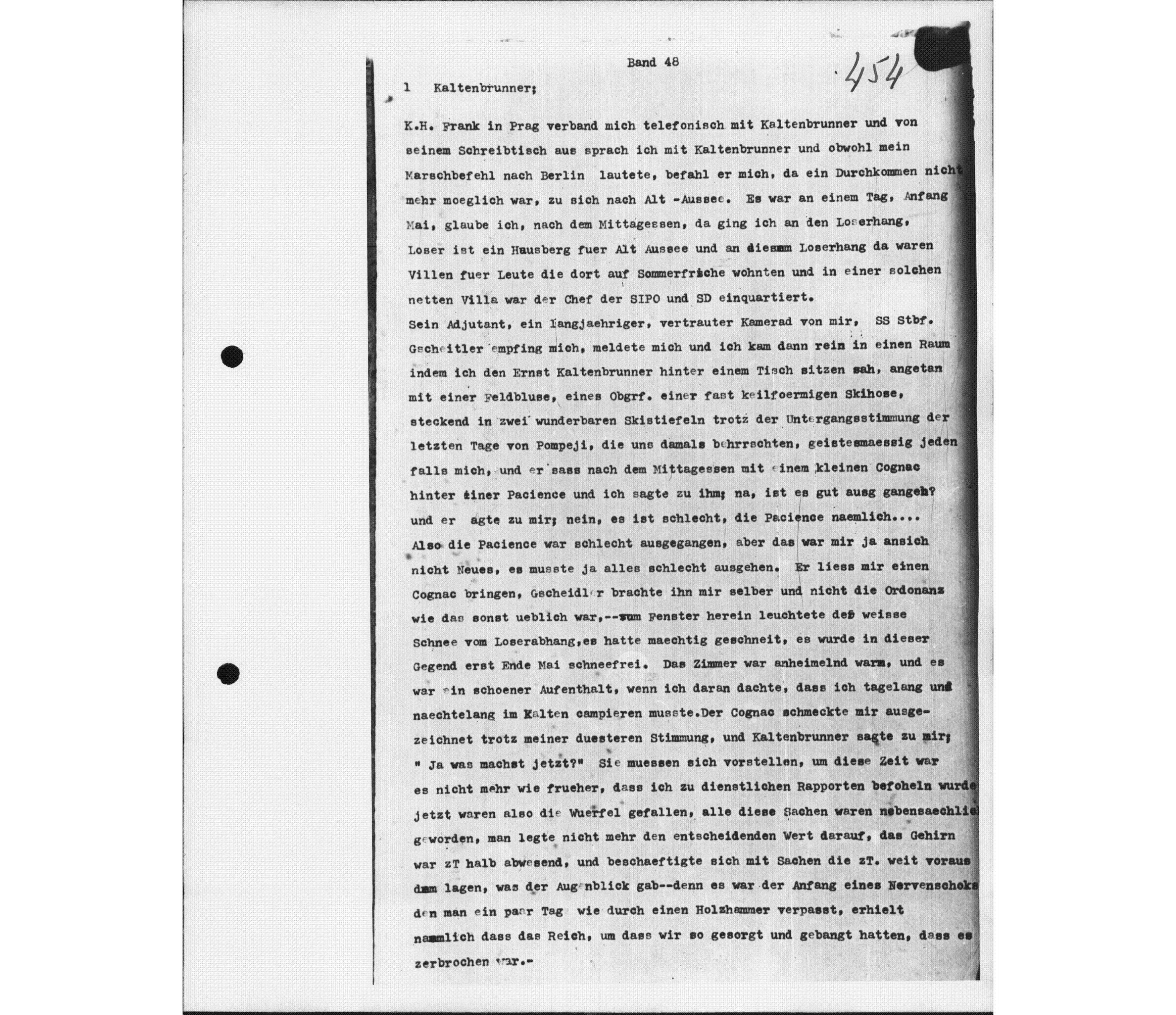
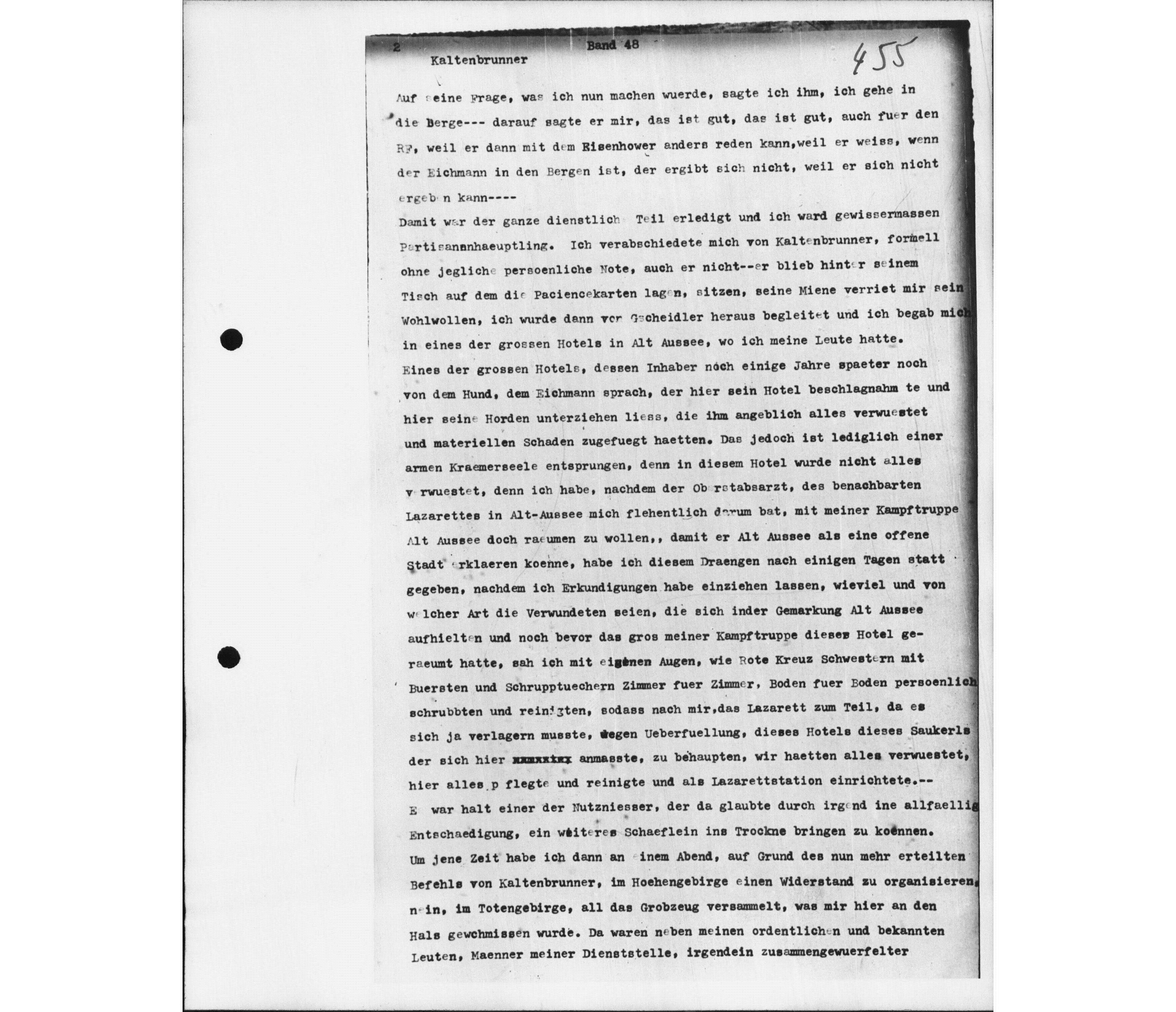
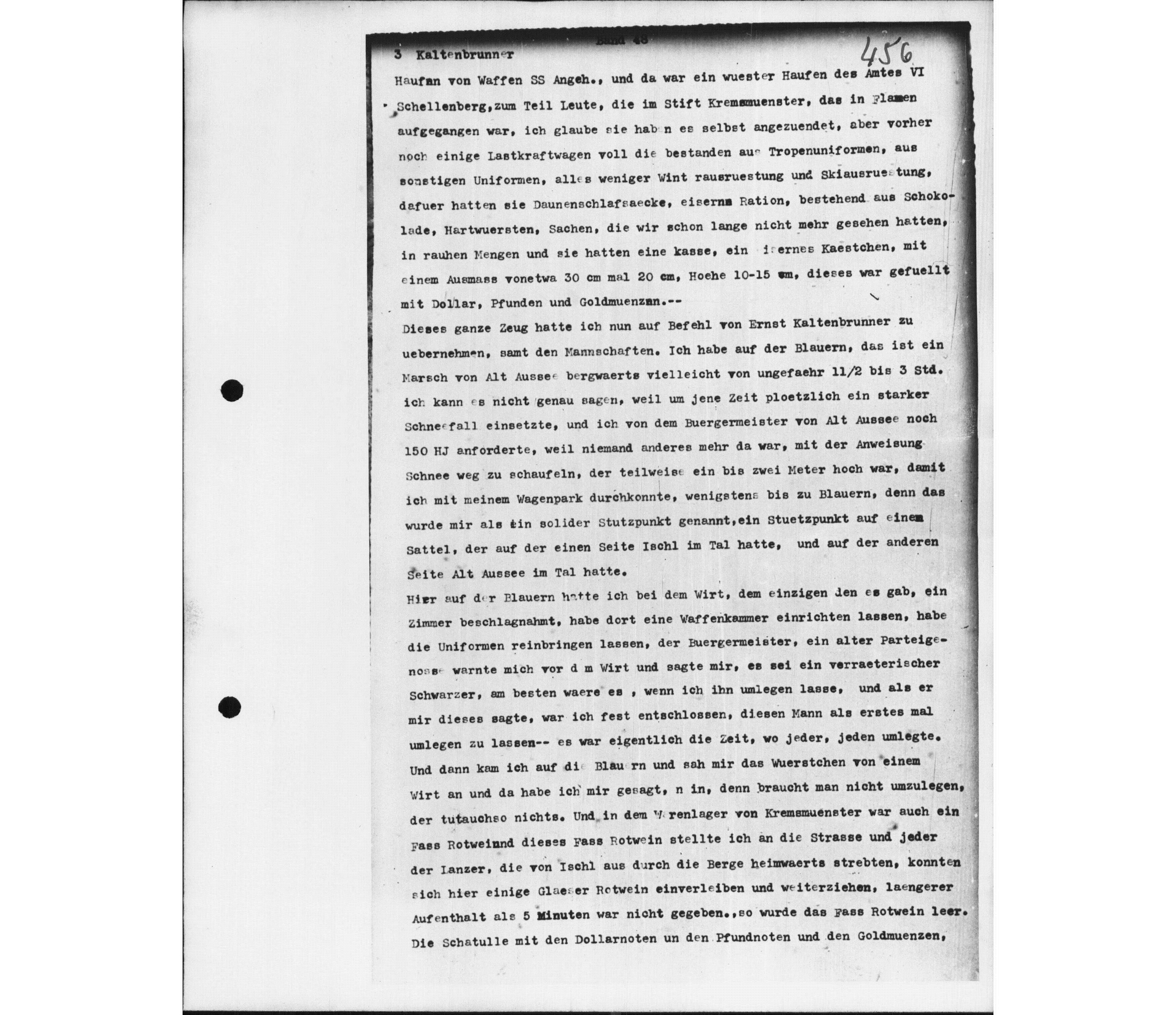
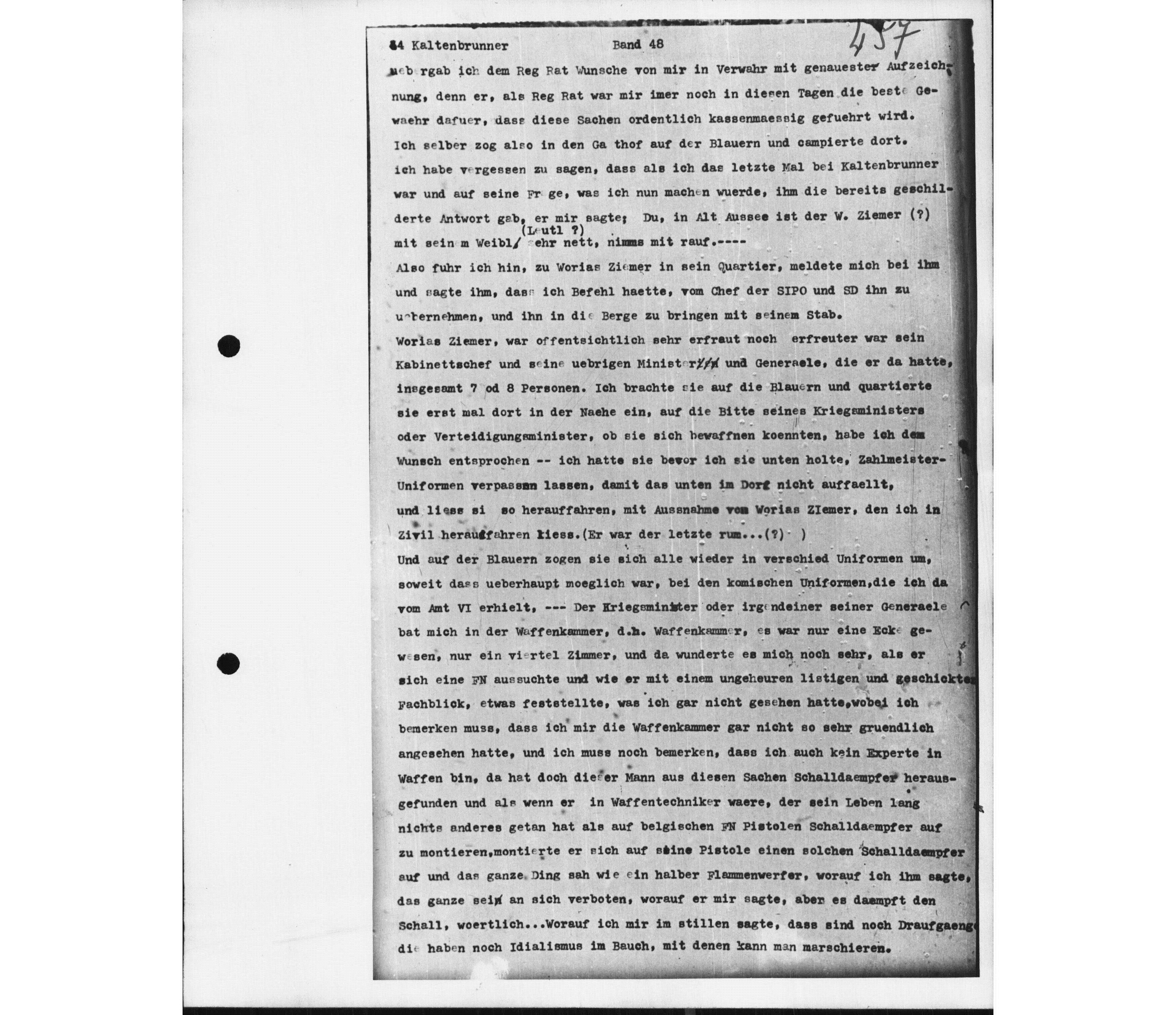
For he was negotiating with Bernadotte at the time and thought he could also play the 100 prominent Jews as a card in his plan. I believed that this was also why the Reichsführer-SS sent for me: to toughen me up once more. He wanted to make sure of me once more, because when Kaltenbrunner asked me in Alt Aussee what I intended to do now, I answered, 'I will go away and offer resistance in the mountains.' Kaltenbrunner then said, 'That pleases me.

The Reichsführer-SS will also be very glad to know that, because when he is now negotiating with Eisenhower, he knows Eichmann is in the mountains, and our opponents know perfectly well that Eichmann and his men will not surrender…' Those are the words Kaltenbrunner used to me, word for word. From this statement by the Chief of the Reich Security Main Office I now also infer the Reichsführer-SS's view of me. At the very end he wanted to make sure of his Eichmann once more. I can imagine nothing else, because I cannot imagine that 100 Jews alone could really play so large a role in political negotiations of that scale as to tip the balance.

Admittedly, it was probably something like that, because with the white-painted Swedish trucks that drove from Auschwitz somewhere through Germany in enormous kilometer-long columns, the Reichsführer-SS did release 1,000 and indeed thousands of Jews to Bernadotte. They were enormous white-painted columns of super-trucks, so my affair was only a little cog in the game he thought he was playing. Afterward I had to discover that he really was playing, because that was why the Führer finally demoted him and declared him an outlaw, and then appointed someone else—I think Hanke of Breslau—as chief of the SS.

Questioner

At this last report, did the Reichsführer-SS mention any names in connection with these 100 prominent Jews?

Eichmann

No, he left that to me; he did not actually [? know] that himself either.

Questioner

Did you suggest any names to him? Did you have any names ready?

Eichmann

Yes, we had quite a number of very prominent Jews in Theresienstadt, and quite a number of very prominent Jews in the concentration camps too. I think Léon Blum was still there… There were plenty of names. I had a few Austrian generals who were Jews; I had a whole lot of people, some of whom had also been former Reich ministers—… were. There were plenty. I could easily have assembled the 100.

Questioner

Can you remember any more of the names precisely?

Eichmann

As I said: Léon Blum, who had once been French prime minister. There was quite a considerable number. They included people whose names were known not merely in Europe but throughout the world. Most were probably of European standing.

Questioner

Do you remember whether, at the last report, shortly before April 17, the Reichsführer-SS also spoke about the Führer, and in what way?

Eichmann

As far as I know, the Reichsführer-SS did not do that on the last day. As far as I know, Becher was there, at the next-to-last report… I had already been in Hungary then, and the Reichsführer-SS said, 'I absolutely cannot tell the Führer that…' He meant the trade, because the Führer would probably have chopped off his fingers: the Führer had ordered the extermination, and the Reichsführer-SS had called it off. He could not possibly tell the Führer that he was negotiating to exchange the Jews for 10,000 trucks.

Questioner

I mean, don't you remember that at the last report the Reichsführer-SS, who after all…

Open page image and German
Page 23 of the typescript, O.65 file 85.
Page 23 · Yad Vashem Archives, O.65/85

Questioner

…was already negotiating with Bernadotte, spoke of it for some reason, or perhaps had a premonition of what could happen afterward—that he would be cast out, and so on?

The Reichsführer-SS said, 'I have never been so optimistic, never before… We will get a better peace,' and so on… 'And I'll tell you one thing, Eichmann: if I have it to do again, I will set up the concentration camps on the English model. I made a great mistake there. I must set them up on the English model…' I could make nothing of it, because I had never run a concentration camp. I could not picture what he meant. At the time I thought of the English concentration camps for the Boers, but perhaps he also meant the whole English police system… I don't know.

Questioner

So you don't know what he meant by an English concentration-camp system?

Eichmann

No.

Questioner

And where he had made the mistakes? He did not indicate that more precisely?

Eichmann

No. He had made mistakes—that was what he said.

Questioner

Did he put it as 'if I HAD it to do again' or 'if I HAVE it to do again'?

Eichmann

'If I HAVE it to do again, I will do it that way.' And he said it in a pleasant, gentle manner, so that what could certainly be understood from it was that these concentration camps had to become more elegant, more refined, better behaved—that was how I understood it in my own mind.

Questioner

Did he ever mention the name Bernadotte to you?

Eichmann

Yes, he mentioned him to me. He also mentioned him the last time I was there with Becher. That must have been in the autumn of 1944. I am quite sure the name Bernadotte came up then. In any event, the Reichsführer-SS had prepared the whole affair well in advance.

Questioner

When were the preparations for the Ardennes offensive?

Eichmann

In November.

Questioner

So around that time, when the offensive had not yet taken place—it was around Christmas, December 16, 1944.

Eichmann

So shortly before that, the Reichsführer-SS was on Special Train Heinrich. Becher and I were ordered there. A Bavarian Stf., the train commander, entertained us and greeted us. He inspected my fingernails to see whether they were free of nicotine; otherwise I would have been given pumice stone and lemon, or else the Reichsführer-SS would have imposed a three-month smoking ban. In the anteroom of this carriage there was a senior SS leader working like a coolie amid X general-staff majors in Wehrmacht uniform and X SS leaders. And he said to me—someone said to me, whether it was the train commander or another commander—he told me, 'They're cramming away there for the new offensive the Reichsführer-SS will lead.' Aha, so that is what an ox-led offensive looks like…

We went past, because we had to go through to the study in his carriage. The Reichsführer-SS then invited Becher and me to have lunch or dinner; I no longer know exactly which. It was a Mitropa dining car, and a Mitropa waiter served in a Mitropa uniform. I wondered then whether the man belonged to the Reichsführer-SS's staff and to the SS, and he did. Instead of an orderly's uniform, he wore a Mitropa uniform. There were about eighteen to twenty general-staff majors in this carriage; the rest consisted of SS bigwigs. We sat there as people normally sit in a dining car. That was the precise time of my last discussion WITH Becher at the Reichsführer-SS's.

Open page image and German
Page 24 of the typescript, O.65 file 85.
Page 24 · Yad Vashem Archives, O.65/85

Questioner

Did you ever negotiate with Bar…?

Yes, I spoke with him once… Bar…, who was in Poland, who was in charge of anti-partisan operations… Also formerly a Higher Police Leader…

Questioner

You had no official dealings with him?

Eichmann

No.

Questioner

No, but wasn't the Warsaw ghetto under his direction…?

Eichmann

Stroop had an album made, photographs with pictures taken by war correspondents. I got it from the Commander of the Security Police and the SD (Security Service) in Krakow, I think… In any event, I got it from above… It showed hard fighting… And the Reichsführer-SS had had it in his hands, because it came signed HH. It was later burned while in my keeping. I had nothing to do with Bar…, not in Hungary either, because there was no anti-partisan fighting in Hungary at all; there was none…

Questioner

After April 25, 1945, once the affair between AH (Adolf Hitler) and the Reichsführer-SS was known, did you still have contact with Kaltenbrunner?

Eichmann

I remained in contact with Kaltenbrunner for a long time… The days May 7, 8 and 9 have vanished from my memory, because I had a shock then. I gave orders like an automaton, but what and how, I no longer know. I can still remember some things: my men wanted to separate from me, and I granted their request. I came back after the Reichsführer-SS's order—

[Typed parenthesis: 100 prominent Jews, etc.]

—from Tyrol, where, through Gauleiter Hofer—who no longer received me, but where I pressed the matter forcefully—it concerned the places at the Brenner… I then returned to Salzburg and met Günther at the Salzburg State Police. He reported that during my absence he had received an order from Müller to go to Salzburg with the founding files and deposit them somewhere in the mountains there. The founding files were the files of the then Prussian Minister President H.G., when a Secret State Police was first established, and so on.

I then drove on to Linz. At that time there was a terrible air raid there, in which a friend of mine, a Dr. Pifrater…, fell victim. He was Inspector of the Security Police for Upper Danube. On the outward journey I had still spoken with him… I then drove on to Prague. There I visited Karl Frank, who said to me, 'You cannot go any farther here. There is nothing left in Berlin. Müller… Kaltenbrunner is no longer in Berlin. The Russians have broken through somewhere there…

In any event, Kaltenbrunner is no longer there.' So I could not pass on the Reichsführer-SS's order… I then telephoned Kaltenbrunner and arranged to come down to Alt Aussee and report to him there. From Prague I went back to Alt Aussee and made my report. I visited him again on the last day. His adjutant Scheidler announced me—as a formality. Kaltenbrunner was sitting in proper ski gear, playing patience… He said, 'It's all sh… It's all over…' Those were the last words with my dear old friend Kaltenbrunner…

Questioner

No comment about the Reichsführer-SS's conduct, nothing, nothing at all? Apparently no one knew.

Eichmann

I only found out much later too.

Open page image and German
Page 25 of the typescript, O.65 file 85.
Page 25 · Yad Vashem Archives, O.65/85

[unintelligible on the recording]

Before that, the SS and the SA had bitten the dust. Their skulls were smashed in for us, and they went to the penitentiary for us. That is why I am an intolerant fanatic. In that I am incurable, and I will remain incurable when it comes to Germany.

[unintelligible on the recording]

Questioner

Do you know what lies behind the police registration operations, everything that lies behind them?

Eichmann

The technical side, the difficulties within the police alone, let alone the difficulties with the other central authorities.

[unintelligible on the recording] [recording switched off]

…My wife also reads the Bible. I let her read it. Once I tore a Bible to shreds and threw it away, and my wife was unhappy afterward. Then she took a second Bible—we still had one—and at some point I tore that one through too, but only into two pieces… Now my wife reads it in the two pieces, and I have sworn to myself to let her read, so that she is happy. Perhaps it is much better that way. I wish my wife and my children everything much, much better than I have it. I do everything for my wife, just as I did everything for Germany, and my family is only a little piece of Germany.

Müller once said to me, 'If we had had fifty Eichmanns, we would have had to win the war.' And I was proud. That was on the same day, in my section, because it was one of the few sections that had not been bombed out. I had driven my subordinates like dogs after every incendiary bomb and bomb, and naturally I joined in too. We repaired the damage immediately, so that my office alone was still intact in Berlin. But I have already told you how the State Police headquarters later moved in and pushed me out.

Then I was told, 'It's all over.' There was a section officer whose name I have forgotten, and we had 100 of … and letterheads there. Where it doesn't work, you can have them made up again at any time. Each of the gentlemen can now say where he wishes to have worked in recent years. He gets certificates made out, he gets official assignments—in short, something to disguise himself with. You could see—there were perhaps thirty of us section heads—how the people crowded around the fellow who was noting it all down.

In that relatively small room, where I made music with my subordinates—my assessor had played the piano, I played second violin, my noncommissioned officer or sergeant Glaser played first violin; he could play much better than I—even though it was not a large room, so much space remained at the back that Müller and I stood there alone. Müller said to me, 'Well, Eichmann, what about you?' Since returning from Hungary I no longer carried the Walter, but the Steyr army pistol. I had obtained two pistols: I carried one in my bread bag or luggage, and the other on my belt, because it took the same ammunition as my submachine gun…

Open page image and German
Page 26 of the typescript, O.65 file 85.
Page 26 · Yad Vashem Archives, O.65/85

Namely, 9 mm, which made it simpler. So I said to Müller, 'Grf. (Gruppenführer), I don't need that. You see, this is my certificate. When I can see no way out anymore, this is my last medicine. I don't need anything else.' And that is the truth: of all the section officers of the Gestapa in Berlin, I was the only one who sh… on those false certificates of theirs. Müller will have thought, 'He was the right man after all,' and that he had certainly not been mistaken in me. I was proud of myself for that. That was meant to give you an insight into my inner self, because you don't know me—not from the inside—and that is important, not just what is on the outside.

[unintelligible on the recording]

Questioner

And if you are such a fanatical nationalist, that you also a mysticism—there is mysticism, a doctrine of faith, a worldview in racial-national life völkisch, which also comes into play with you. Perhaps you don't express it that way.

[recording switched off]

Eichmann

I loved him dearly. He was old Professor Schwarz… from Kiev, exceedingly lovable, infinitely clever, who served with us as a Stbaf. (Sturmbannführer). He was a mystic. This man simply could not live any other way; he was mysticism personified, and nevertheless I revered him dearly. He was my superior and teacher in the Reich Security Main Office. But I also saw what a childishly inclined, uncontrolled absorption in mysticism a person can be reduced to. I think nothing at all of mysticism. I stick to the business of the day. We have to make sure that our descendants live decently, and that settles it. I must forge my weapons according to the strength of the resistance. And with that my Latin is 'to do'.

That is what my whole life is about, and what my whole way of thinking is about. If everyone thought that way, each would only need to think a hundredth as much, and we would be better off. Fitting into the whole, because the racial-national element (das Völkische) lies in the whole—one blood. For that we gave everything, everything: our youth, everything, and our freedom too. Others gave still more, even their lives. That is why I cannot stand being told, 'What could have been worse, still worse than National Socialism coming to power on January 30, 1933?' Then I go berserk. It was only because I controlled myself that I took my leave of the ladies in the conventional way.

[recording switched off] [unintelligible on the recording]

I have often told the Jewish-political officials that personally I have no hatred at all for a Jew. Personally, I have never had a bad experience with a Jew. When I changed from a militant to a political officer, I was obliged to carry out the orders given to me. I belonged to those people who carried out orders without reservation, in accordance with the oath to the flag. But I also belong to those people who think about things. Either I do a job rigidly, and it certainly will not please me…

Open page image and German
Page 27 of the typescript, O.65 file 85.
Page 27 · Yad Vashem Archives, O.65/85

Or I do a job when I can grasp its necessity or purpose, and I will do it gladly; the time will fly by for me. That was how it was with the Jews. When I received the order back then, infant-like and unprepared, to proceed against the guest of the host people, I thought it over. Once I recognized the necessity, I carried it out with the fanaticism one expected of oneself as an old National Socialist, and which my superiors undoubtedly also expected of the man appointed to do it. Certainly, on the basis of their experience, they saw in me the suitable man.

I say this today, in 1957, to my own detriment. I could make things easier for myself. I could say it was an order, that I had to carry it out in accordance with my oath to the flag, and that otherwise I wore blinkers. No—that is cheap humbug. It is a cheap excuse that I cannot reconcile with my inner morality. So I must state clearly that after carrying out the first orders rigidly, I then tried to get to grips with the subject. Fate had given me an intellectual horizon that evidently enabled me to do so.

[unintelligible on the recording] (question concerning the Nuremberg trial)

You know, every policeman has his methods of making inquiries. I know that in the first years after 1945 I was wanted by the police. I am not even talking about the Allied police—that goes without saying. No, I was also wanted afterward by the police of my homeland and by the police of the country where I lived for some time as a guest. I also know that after five years, if the wanted person has not been found, he is struck off the wanted list (?). I have long since ceased to be wanted now; that is clear. In the first Nuremberg trial, the way our highest leaders were treated, Judge Jakson summoned my Hstbaf. Wi., whom I had in Czechoslovakia, as a witness. He told the fairy tale there about the alleged five million Jews whom I am supposed to have killed, and then Jakson said…

[interruption]

No, no trial was held against me. They could not have done so either.

[overlapping talk]

In … I was convicted, because I—and I tell you this as someone with years of expertise, since I have spent roughly half my life as a policeman—because the points are evidently of such a difficult nature and the file weighs hundredweights, that my—a conviction in—cannot simply be carried through, especially since the other side expects material gain from it.

Questioner

In the proceedings against the Gestapo and the SD (Security Service), was particular responsibility assigned to you? Or, because you were not present and only the two, Höttel and Wi., were you not mentioned further?

Eichmann

Yes, from what I know from the meager newspaper reports, when I am mentioned there it is only because all these people—and perhaps I would not have done otherwise, since I was not there—referred to me and talked their way out of it that way. And when that goes on for years—it was such a long time…

Open page image and German
Page 28 of the typescript, O.65 file 85.
Page 28 · Yad Vashem Archives, O.65/85

And when everyone talks his way out of it at my expense like that, a legend forms. Journalists and the like then pick it up, and the whole thing gets blown up. Unfortunately, all my superiors are now dead or missing—that is, they were hanged, killed themselves, or are missing. Actually, only one is missing: my immediate superior, Grf. (Gruppenführer) Müller.

Questioner

Was a reward actually offered for producing you?

Eichmann

Yes, as far as I know, Wi. said—provided what the newspapers reported is true—that Wi. said, if his life were spared, only on condition that he would bring me in dead or alive. Second, I read the following, which amused me very much: a man who today holds a high rank in the Israeli army, whose name I have unfortunately forgotten, went to Alt Aussee with a commando unit. The newspaper says the following, word for word: 'We confronted him, and he was surrounded by several very fierce guard dogs.

After we had beaten him down with clubs and knocked him unconscious, we put him in a jeep and took him to a clearing in the forest. Meanwhile he regained consciousness, and we asked him, Are you Obersturmbannführer Eichmann? He replied, Yes, what do you want from me? Then we struck him down. He died remarkably decently.' That was the newspaper item. But I am still alive today. It appeared in the Upper Austrian newspaper, in those years—I no longer know when. It was the communist-socialist newspaper, but I have forgotten its name. I kept the clipping for a long time, but eventually burned it.

[overlapping talk] (about the newspaper)

Questioner

At whose instigation was the yellow star introduced?

Eichmann

Yes, it is a pity I have no comrade from that time with whom I worked, because I have since realized, after avoiding all such thoughts for years, that I have forgotten a great deal. Regarding the yellow star, I can remember the following—but I will tell you only what I know. There was a prior history, and there were discussions in my section; I know that too. But where, who and how, I no longer know. I do not know whether Reischauer played a part either. In any event, a police ordinance was being prepared, and it dealt with marking Jews.

It was a police ordinance of the Chief of the German Police in the Interior Ministry. State Secretary Stukerth was naturally involved in this ordinance. At the time he was the highest authority in the administrative struggle over an ordinance at all. The police were subordinate to the Interior Ministry. Naturally I was involved in marking Jews too, because as the desk officer responsible for Jewish affairs within the Gestapa, within the Interior Ministry, I at least had to put my initials to it. Without my initialing it, the matter could not go through, for bureaucratic reasons.

Questioner

Was it intended as moral pressure against the Jews, or for purely organizational reasons

Open page image and German
Page 29 of the typescript, O.65 file 85.
Page 29 · Yad Vashem Archives, O.65/85

No, it was about the German mentality, which always takes the side of someone under pressure when it sees him under pressure. To make him hold back here, as it were from the state's point of view, to make him feel embarrassed and afraid to go on sympathizing with Jews and associating with them, and so on… Yes, now I remember: it came from the Propaganda Ministry. When Streicher heard of it, he brayed with delight. I still remember Der Stürmer; I think an entire issue dealt with this subject.

Questioner

But there is an account that this order for the yellow star originated with Canaris.

Eichmann

No, certainly not. I know the man personally. But be that as it may, the police ordinance had gone through, and that settled the administrative side. One day I received, from the Propaganda Ministry, which had ordered it from some firm X, by the meter…

[unintelligible on the recording] (very quiet) (almost as if the recording were switched off)

…And then I cheerfully handed out the bales, and they went off with them. The ordinance had fixed a date by which every Jew had to wear a Jewish star. I no longer remember what year that was. There was a Jewish lawyer in Vienna who said to me, 'Mr. Hstbaf., I wear this star with pride.' He impressed me. He was an idealist, and I soon let him emigrate. I said to Löwenherz, 'Should I be in a country where a German is ostracized and marked, I will be proud to wear something like that, saying “German.” You will certainly only be jeered at by fools. But see to it that you increase the emigration figures. Bring me foreign currency into the country, and then, once your people is settled, you will also be able to live as a people.' That was what I said to Löwenherz.

Questioner

Now to the question of how far your authority extended and how far you were involved in physical extermination, or in shootings at which you were present.

Eichmann

It was like this: Grf. (Gruppenführer) Müller, my immediate superior, sat forever and always on the second floor in Prinz Albrecht Strasse and never moved away from his desk. But he knew everything that happened within the German Reich itself and, step by step, in the territories we occupied and influenced. Müller sent me around. I was a traveling man, a traveling man, a state-police agent (?), just as I had previously been a traveling salesman for oil and gasoline for five years.

Shortly after Heydrich told me that Globocnik had been given the task of killing the Jews and burying them in the anti-tank trenches dug by the Russians, he sent me to the Warthegau. I no longer know where it was; in any event, it was not very far from Litzmannstadt. According to Müller, Jews were supposed to have been gassed there, or were to be gassed there. I always say this at the outset: Müller did not give such orders. He had nothing to do with it.

Open page image and German
Page 30 of the typescript, O.65 file 85.
Page 30 · Yad Vashem Archives, O.65/85

But he wanted to know everything, although he had nothing at all to do with it. Müller was a precise official, and if he did not have everything presented to him at once, concentrated and in detail [?], he grew impatient. I drove to Litzmannstadt. Where I went I do not know, probably to the State Police headquarters there, and I also cannot say at the moment whether Krumey was already in Litzmannstadt at that time. I then drove out to the place they named to me, and some fellows or other had been at work there. There were also a hundred, or perhaps even a thousand, Jews there, and they were made to get into buses. But that meant nothing at all: they were normal buses, only with high windows. They got in, the windows were closed, and I was told that during the drive the exhaust pipe is directed into the vehicle's interior and they die at once through a chemical process.

Unknown speaker

Carbon … oxide.

Eichmann

The doctor who was there told me to look through the peephole. There was a peephole by the driver's seat, perhaps five centimeters in diameter, and there was a light bulb inside. I saw that from outside because the little pane in the peephole was lit. I refused; I did not want to see that.

Questioner

So they were hermetically sealed?

Eichmann

Yes.

Questioner

And how many went into one bus?

Eichmann

About—

[unintelligible on the recording]

And I did not look inside, because I was seeing and hearing something like that for the first time. My knees went weak. It was around autumn 1941. Yes, so the buses drove off. I was told at the time that it would take three minutes; the doctor told me that. The buses drove for about fifteen minutes. When I returned, Müller told me I should have timed it, but I told him I could not look through. I said to Müller, this will not do; you cannot do it this way. But he did not answer me. He only looked at me in a fatherly, benevolent way. I never quite knew where I stood with Müller. He forgave me, so to speak, for not looking through the peephole, however strange “forgave” may sound. I drove out there and arrived, and for the first time hell opened up before me.

[recording switched off]

The vehicle maneuvered, backed up and came to a pit that was perhaps two meters deep. The doors opened, and some Poles who were there jumped in and threw the corpses into the pit. One Pole jumped in. It shook me badly at the time when I saw it: he jumped in with pliers in his hand, opened people's mouths, and whenever someone had a gold tooth, he pulled it out and put it in the sack he had tied around himself. After a long time I came back there, and the head of the State Police headquarters said to me—or was it at the office of the Inspector of the Security Police and the SD (Security Service)?—we will show you the place where you were many months ago. Good, we drive out. There I saw a plantation, a small pine plantation, everything nicely peaceful, like a small wood just beginning to grow.

Open page image and German
Page 31 of the typescript, O.65 file 85.
Page 31 · Yad Vashem Archives, O.65/85

Well, that had been my first experience in this field, and my knees were to shake a few more times. Certainly, I too had worked toward the solution of the Jewish question, but not like that… Certainly, up to then I had not yet seen burned Germans, Germans who had shriveled up like mummies. Up to then I had also not yet seen the big, pleading eyes of a German married couple whom I was supposed to shoot in an air-raid shelter in Berlin.

I could not shoot them, and I said to my sergeant, if you can do it, then you shoot the people. If I had seen all that at that time, it would have been much easier for me, because I am a very sensitive person. I cannot simply look at something like that; I get a nervous tremor. But nature gave me one good thing: I can switch off and forget very quickly, without intending to. Then Müller told me to go to Minsk: Jews were being shot there, and he wanted a report.

So I go there, and the head of the Einsatzkommando (operational detachment), I believe, was there. I told him what assignment I had, and he said to me, that works out well, because tomorrow five thousand are up. So I drove out the next morning, but they had started early, and I arrived only for the end. Now I will tell you how it happened. I come up; I was wearing a leather coat that reached down to my ankles. It had been very cold, and a group of Jews came; that was the last group. They had to undress down to their shirts and then walked the last hundred or two hundred meters.

They were not driven; there were men there as a detail from the Waffen-SS, and then they jumped into the pit. So I stood there. It was so striking how the people jumped into the pit without any resistance at all, and then the shooters standing around fired into it with 0890 rifles and submachine guns. And why has this scene stayed so firmly in my memory? I had children of my own at the time, and I saw a Jewish woman lift up a small child, perhaps one or two years old. At the very moment when I was about to say, do not shoot, hand over the child, at that same moment the child is shot, and that is the end.

I saw it from so close that afterward, in the house, I saw brain spatter sticking to my coat. My driver then helped me remove it. Then I drove to Berlin. You must know, my drivers did not like driving with me, because on a twelve-hour drive, from Berlin to Paris for example—I left at eight in the evening and arrived at three in the morning on the dot—on that long drive I spoke perhaps ten or twenty words. On this return drive too I did not speak to my driver. I was thinking—not that I now condemned National Socialism after all those unforeseen things. No, I was thinking about the meaning of life as a whole.

At the time, after everything I had seen, I said to Müller, word for word: Grf. (Gruppenführer), the solution is clear. It was supposed to be a political solution; only, the Führer has ordered a physical solution, so it must be a physical solution, fine. But the way it is being done in Minsk, and perhaps elsewhere too, will not do, because our people are inevitably being trained into sadism this way.

Open page image and German
Page 32 of the typescript, O.65 file 85.
Page 32 · Yad Vashem Archives, O.65/85

2. We cannot possibly put a bullet into the brain of a woman who cannot defend herself and holds a child out toward us. That is not how we solve the Jewish question. But once again Müller was like a sphinx (Phinx)… Then I was sent to Lemberg. I arrived and saw a piece of ground (Terraino),

[unintelligible on the recording] [recording switched off]

[overlapping talk about a book]

Questioner

Which points, then, are lies in your view?

Eichmann

I have repeatedly read that my Hstf (Hauptsturmführer) Wi, as a witness at the first Nuremberg trial, testified against me, less against me as a person than about the enormity of it. He said that, first, I am supposed to have said before him and several other officers of my section that I would jump joyfully into the pit because I had killed five million Jews. Second, I read that Wi testified that I was supposed to have shown him a written order from the RF (Reichsführer-SS), stating that the Führer had ordered the physical destruction of the Jews. Third, Wi is supposed to have said that I was responsible for three factors, that is, that the whole Jewish business was divided into these three factors up to 1945: a) emigration, b) concentration, c) destruction.

In reply I said, regarding point one, that I cannot have used the word Jews, because the figure of five million bore no relation to the number known to me as physically destroyed. Rather, I declared, I will jump joyfully into the pit if I must, knowing that five million enemies of the Reich have jumped in along with me. All told, I had brought only so-and-so many to emigration, and my section had nothing at all to do with concentration, apart from Theresienstadt, and that was ten thousand.

A figure of five million would have been absurd; my section never, ever handled such a number. It is true that four and a half to five million Jews were handled, but in connection with emigration, concentrated in ghettos, and handled in the concentration camps by the V&W HA (Economic and Administrative Main Office), that is, either killed or put to work. The statistician Korherr wrote that up, compiled it, and gave the report to the RF SS (Reichsführer-SS). That report came back with the notation, “Taken note of; file to be destroyed. HH.” And I then burned it myself.

And if I really had said it that way before my subordinates, I would surely have said Jews to them, not enemies of the Reich, because we handled nothing but Jews. But in that case it was about enemies of the Reich. The Jews interested me only in terms of registration, not destruction. I did not even know who was killed. None of us in the Security Police knew that; they could just as well have gone to the Heinkel works to work. But my subordinates would probably have thought I was a megalomaniac, because they probably knew it much better than I did. My transport sheikh alone, Hstf. (Hauptsturmführer) Novak, who constantly had to negotiate the trains with Reich Railways Councillor Stange…

Open page image and German
Page 33 of the typescript, O.65 file 85.
Page 33 · Yad Vashem Archives, O.65/85

Now then, as to the claim about the signed order, that is a flat lie. Only a fool could even imagine that the RF (Reichsführer-SS) would issue a decree setting down in writing something like this: “My dear Eichmann, the Führer has ordered the physical destruction of all Jews.” That can only have arisen in the brain of a sick CIC (Counter Intelligence Corps) Jew. The truth is, in any case, that the RF (Reichsführer-SS) never put a single line about the physical destruction of the Jews in writing. I know that he dealt with Pohl of the VWHA (Economic and Administrative Main Office) only orally. I never received such an order, and still less could any of my Hstf (Hauptsturmführer) at the time have learned of such an order.

Questioner

Neither in writing nor orally?

Eichmann

No, neither in writing nor orally. Heydrich told me personally that the Führer had given the order and that the RF (Reichsführer-SS) had entrusted Globocnik with it, but that this matter would in future be handled not by the police but by another main office under the RF (Reichsführer-SS). The third point: Wi is supposed to have testified that his superior, SS Obstbaf. (Obersturmbannführer) Eichmann, had to carry out three phases in the treatment of the Jews: a) emigration, b) concentration, c) destruction. On that, it must be stated that I carried out emigration and police registration where large masses had to be transported to destination stations that the Chief of the Security Police and the SD (Security Service) made known to me and prescribed for me.

And that with c), destruction, not only I but the entire Security Police and SD (Security Service) had nothing to do, except through individual special orders of the RF (Reichsführer-SS) to the Einsatzgruppen (operational groups) in the East. They had to carry out the measures on their own responsibility, but the Gestapa (Secret State Police Office), particularly Section IV B4, had nothing to do with them and was not even kept informed. Consequently Wi, who belonged to Section IV B 4 in the RSHA (Reich Security Main Office), has…

[music]

Questioner

Can you briefly repeat what became unclear to you during the interrogation of Grinspan… Did he act under orders, or did he act on his own at the time?

Eichmann

The final interrogation that I conducted with the Jew Grunspan showed, as its final result, that there were evidently no backers behind this young Jew, but that he carried out the act on his own initiative. How far such a statement can still be checked remains open, because this Jew lived for years in solitary confinement and, although no purely physical harm came to him, he could no longer be regarded as fully competent for proceedings. The matter was closed with that; it was already too far past the time limit.

Questioner

What about Höss’s testimony at Nuremberg concerning the two and a half million Jews who are supposed to have been liquidated in his camp?

Open page image and German
Page 34 of the typescript, O.65 file 85.
Page 34 · Yad Vashem Archives, O.65/85

Yes, there are two possibilities. I knew Höss, for I esteemed him very highly as a very decent comrade. He did his duty as anyone else would have done. He was a model family man, a holder of the Iron Cross from the First World War. He spent several years in the penitentiary for National Socialist activities. It was Höss who once told me that the RF (Reichsführer-SS) had watched the entire extermination operation and had declared that these were battles our coming generations would no longer have to fight.

Questioner

You heard that from Höss, not directly from the RF (Reichsführer-SS)?

Eichmann

Yes, from Höss. If you ask me about the two and a half million Jews at Auschwitz who are supposed to have been physically liquidated there under Höss, I must answer that I consider that figure highly implausible. a) Because the capacity alone speaks against it, the capacity of the camp. b) Because I never had that many Jews sent to Auschwitz. I was not the only one who had people sent to Auschwitz; other command offices of the Security Police sent people there too.

But if you add everything together, this figure of two and a half million cannot have been reached, because after 1945 the so-called Auschwitzers sprang up from Auschwitz like mushrooms from the forest floor after rain, and hundreds of thousands of Auschwitzers enjoy the best of health today, because they were put to work. There are two possibilities, one I consider very likely and one I consider very unlikely. The first is that Höss will have testified under pressure, just as my Hstf. (Hauptsturmführer) Wi must have done, because the circumstantial evidence speaks against it.

The second—though Höss’s whole upright bearing speaks against this—is that Ostbaf. (Obersturmbannführer) Höss, as was customary at the time, inflated the figure, so to speak. Now, one can certainly say that this was expedient at the time. But one can also say that after a complete collapse a man tries to put himself into the role of a martyr so he can physically endure his suffering better, and that he took things upon himself that others might have carried out, divided among them. But I do not believe that, because his correct and upright way of life and his character speak against it.

Questioner

And what do you say about Ohlendorf’s statement that he liquidated ninety thousand Jews in the East with his Einsatzkommandos (operational detachments)?

Eichmann

Well, Ohlendorf was no windbag. He was a very quiet, orderly office chief who worked consistently, the head of Office III in the RSHA (Reich Security Main Office). I cannot say anything more precise about the activity of the Einsatzgruppen (operational groups) in the East, because I never had anything to do with that subject in an official capacity. But perhaps what I just touched on with Höss applies here to some extent too: our willingness at that time to take on as much as possible in order to relieve others. I would like to dispose of the matter with this: had they caught me at the time,

Open page image and German
Page 35 of the typescript, O.65 file 85.
Page 35 · Yad Vashem Archives, O.65/85

I was always lucky enough to be just a shade cleverer than the CIC (Counter Intelligence Corps) officer questioning me. But had they caught me back then, I would probably have taken a great deal upon myself that was not chargeable to my account at all. In the expectation that a) my life is confused verwirrt anyway—which would not have been so bad, because I would have given it for Germany—but that b) I might have been able to dampen our opponents’ hatred and desire for revenge, to curb their resentment and their craving for further victims, and thereby bring other comrades into a kind of safety. That is the only way I can explain Höss’s statement, and Ohlendorf’s as well. It fits the character of the two of them exactly.

Questioner

Please tell us something more about Heydrich’s life and career, and also about your personal relationship with each other.

Eichmann

Well, Heydrich as a person: curt, slightly nervous, personally not free of vanity, an excellent comrade also toward those—toward his colleagues’ subordinates—who helped to strengthen his position, so to speak. Yes, that is how I came to know him. I got to know him personally when he inspected me in 1939 at the Central Office for Jewish Emigration in Vienna and approved of the organization I had built up. He called it a prime minister’s office in miniature.

After his visit he ordered me to Berlin through the head of Office IV, Grf. (Gruppenführer) Müller. That was my first personal contact with the Chief of the Security Police and the SD (Security Service). Afterward I naturally had a great deal of contact with him. I had to give him presentations on my area of work, and repeatedly prepare papers for him in his capacity as President of Interpol, because these were addresses he had to deliver. I had to…

Wait, I had had contact with him even earlier, when I had to give a weekly lecture on ideological opponents at the SD (Security Service) school in Bernau, before district leaders, other Gau regional main office leaders, students of the military schools, general staff officers up to the rank of major, and so on. Courses were held continually in Bernau, and I had to give my lecture every week. There I repeatedly met the man who later became my immediate superior. Heydrich led a very orderly family life. When his wife was not in Berlin, she lived at the family seat on the island of Vehmarn. As I said, he did not lack vanity.

It went so far that, contrary to his immediate superior’s order, in his capacity as a major in the Wehrmacht (German armed forces) he obtained a Luftwaffe (air force) uniform, got into a fighter aircraft, shot down two or three Spitfires over the North Sea, and won himself the Iron Cross First Class. I still remember it today: when I was summoned to him one day about some matter, he received me as a major in the Luftwaffe, wearing the Iron Cross First Class, and I congratulated him. He then made the first and only joke of his life: he regarded me, so to speak, as his equal in rank, because at that time I was

Open page image and German
Page 36 of the typescript, O.65 file 85.
Page 36 · Yad Vashem Archives, O.65/85

Stbaf (Sturmbannführer), that is, a major, and of equal rank with my superior.

Questioner

It is sometimes claimed that his dashing manner was a certain …, because he had Jewish blood in his veins.

Eichmann

Yes, I have heard that too, but it is all lies and slander. Heydrich comes from the navy. I believe he had been a lieutenant at sea, and he had already been assigned to intelligence work in the navy. He then kept to that direction, devoted himself to the intelligence service, and rose beyond those small beginnings to become Chief of the Security Police and the SD (Security Service).

Questioner

Do you know when he joined Hitler?

Eichmann

No, I do not know. But the very fact that he had a typically Nordic appearance and was married to a Frisian woman… No, it is impossible, although appearance is never decisive. But it would certainly have leaked out, just as word leaked out that the Führer’s diet cook was said to have a certain Jewish family connection. I could then establish afterward that she was only one thirty-second Jewish. In the same way, I would certainly have received an assignment through Müller to investigate Heydrich’s ancestry. Or he would have investigated it himself, and I would somehow have heard about it.

Questioner

Can you tell us something more about Müller?

Eichmann

The word sphinx (Phinx) is right for Müller. Even I, who reported to Müller two or three times a week, who for a long time, like my other comrades, met every Thursday evening in Müller’s private apartment to talk over a little cognac and a game of chess about all the personal and official troubles for which there was no time during the working day—even I can say precious little about Müller. I know that he came from a middle-to-upper civil-service background and from the Bavarian political police. He was a very silent man. I always compared him with Moltke: his mouth was always closed, at most a slight twist of his lips into a smile of approval or mocking disbelief, depending on the situation.

He was an exceedingly cautious man, lived extremely modestly, and was always an orderly, correct, and benevolent superior. He had only one weakness: whatever happened had to be put into a file note and entered in the registry. He was a bureaucrat, and through him I was inevitably made to become a bureaucrat. I felt extraordinarily happy and comfortable under his direction. Ideologically, he was one hundred percent aligned with our idea; I never saw any difficulty. And when he once offered me the chance to transfer into the civil service, I told him it made no difference whether I did the work as a civil servant

Open page image and German
Page 37 of the typescript, O.65 file 85.
Page 37 · Yad Vashem Archives, O.65/85

or as an SS officer. I do it out of idealism, not materialism. When the war is over, you will certainly get me a position as police president, preferably in Linz or else in Graz, and I would like to finish out my life in that position. At that, his lips again twisted into a slight smile.

Questioner

And now, how did you reach the rank of Obstbaf. (Obersturmbannführer)?

Eichmann

I have not thought about why I did not get beyond it, but rather about the question raised on this point in various books. Why I was not promoted beyond Stbaf (Sturmbannführer) is quite clear: I was squeezed into an office, and that office recognized established posts, not ghosts (Geister). There were about thirty section heads in Office IV. A section head is a Government Councillor or Senior Government Councillor, equivalent to Stbaf (Sturmbannführer) or Oberstbaf (Obersturmbannführer).

The next step is department head, with the rank of Senior Government Councillor or Criminal Police Director, or of Ostbaf (Obersturmbannführer) or Standartenf. (Standartenführer). So, had Müller proposed me for promotion while I was a section head, there would have been a row among the other twenty-nine. They were civil servants, some waiting for pensions and all those things. There would have been all kinds of dissension, obstructing the work.

In an authority, however hard a man is made to work, no one can be promoted as long as he holds that established post. When I returned from Hungary, my permanent deputy, Stbaf. (Sturmbannführer) Günther, congratulated me on my promotion to Standartenf. (Standartenführer), in April 1945. I never heard my superior Müller announce any such promotion, and therefore I did not acknowledge it. Unlike some other comrades after 1945, I have never made use of it, except at this moment. I never claimed honors that were not mine.

Questioner

Did you not ask Müller about it?

Eichmann

No, I worked out of idealism, not for material gain. But even had I not seen it that way, it would have violated every rule of etiquette and decency to go to Müller and ask him about it. No, that was not possible. It simply was not done. You had to wait until the promotion was announced, or you would commit a faux pas (Faupas). But I did think about it because the other side alluded to it. With Jesuitism, for example, there is this: it makes its members appear as insignificant as possible when they have certain tasks to perform that go beyond a certain framework. It is also a way of covering things up, so to speak. Perhaps that is what the other side means… No, it has nothing to do with that. Had I held the established post, I would have been promoted.

Open page image and German
Page 38 of the typescript, O.65 file 85.
Page 38 · Yad Vashem Archives, O.65/85

I could not do more than I was authorized [?] to do as a section head in Office IV, and therefore I could not be promoted any higher. However sorry the other side may be about that—they would prefer to be able to point to a higher rank. In all the tomes on the subject, I have read that they made me a Gruppf. (Gruppenführer). The newspapers in Austria wrote only of General Eichmann. That sounds more like music.

Now that all my superiors had died, disappeared, or been hanged, they had to look for another victim to keep standing this edifice on which thirteen billion in restitution rested. And it is quite clear to me that the Jewish side, at least until now, had no interest in tracking me down. I did not live nearly as concealed as people imagine, because the longer I keep silent, the more smoothly the billions are paid for something for which they ought not to be paid.

When it comes out what a relatively low rank I held, when it comes out how the opposing propaganda fastened onto that rank, because this low-ranking man had to spend years in conferences and discussions with Jewish functionaries and, in contrast to physical destruction, had to concern himself only with emigration or Theresienstadt—then there are two possibilities: either they … they, or they revolt here and the Old Testament hatred I have been warned about breaks out. Despite the warning, I must tell the truth, because until now a historical lie has been peddled and no one has dared to confront it. For the sake of truth alone, I speak into this recording cylinder today…

Questioner

And what can you say about Kaltenbrunner?

Eichmann

Well, Kaltenbrunner was Heydrich’s successor, although a very weak one. That should by no means detract from Kaltenbrunner as a person. I am bound to Kaltenbrunner by much warmer feelings and a much closer inner connection than to the cold, cool north German Heydrich, although I esteemed the latter very highly, and he esteemed me. Kaltenbrunner and I knew one another as children. Old Kaltenbrunner and my father were business friends. In 1931, when the Gauleiter for Upper Austria gave one of his fighting speeches in the Märzenkeller in Linz—Gauleiter Bolleck —I was there too. Bolleck was an old first lieutenant from the imperial-royal army. He then married in Linz and became an official of the Linz Electricity Company. After the speech, Kaltenbrunner, who was then an SS man working as a lawyer in his father’s office, said, “You belong with us.” And that is how I joined the SS.

[Typed fragment below “SS”: hall.]

We then had to take part in several fights in meeting halls, once in the Volksgarten, where Bolleck was to speak. There were two thousand … Bolsheviks in front of us, who had filled the hall since four in the afternoon. However, only Bollek and twenty-five SS members received police permission to enter the hall, although it had been rented by the NSDAB (National Socialist German Workers’ Party). As an SS man, I was among them too, but I must add that we got

Open page image and German
Page 39 of the typescript, O.65 file 85.
Page 39 · Yad Vashem Archives, O.65/85

no higher than a total of twenty-five SS men, because Linz was either red or black. So we went in, and Gauleiter Bollek’s speech was short and painless. It went, “My fellow Germans (Volksgenossen)…” and nothing more. Then such an uproar broke out that all I could still hear was Kaltenbrunner shouting, “At the …”—because the Bolsheviks pushed their women forward, whose breasts were just at the height of the podium, and behind them were the drunken, bellowing shipyard workers and so on. With our boots and our shoulder straps reinforced with lead knots, we had nothing else to do but protect our Gauleiter from the onslaughts.

We then had casualties: the later adjutant of the RF (Reichsführer-SS), then Scharf. (Scharführer) Braeuer, had his kidneys smashed and was taken to hospital by the volunteer fire brigade. We then withdrew, after the Volksgarten had been smashed to pieces down to the last glass and the last mirror. That was another encounter with Kaltenbrunner. Göring came to Linz and visited us there; Kaltenbrunner was still marching as an SS man. Later, when I had long been in Berlin, Kaltenbrunner had to lead the struggle in Austria under C, as head of the Austrian SS.

When the RF (Reichsführer-SS) appointed Kaltenbrunner as Heydrich’s successor and he greeted his officer corps, he came up to me and said, “Well, Eichmann, how are things? Everything in order?” As to the business itself, in the period that followed my immediate superior Müller readily got through whatever he wanted from Kaltenbrunner, owing to his forcefulness, although Kaltenbrunner favored only one office chief, Schellenbe. g. A man with whom Müller had no particular connection and about whom he held no particular personal opinion.

Questioner

Now, your personal opinion of Kaltenbrunner’s relations with Schellenberg…

Eichmann

As I said, the only office chief Kaltenbrunner favored, to my own office chief’s chagrin, was Schellenberg. Once, when Müller was not there for a longer period—I no longer know whether he was on leave or something else was involved—the deputy office chief at that time was Standartenf. (Standartenführer) or Oberf. (Oberführer) Schellenberg. (During the war.) When we section officers needed consultations, which was two or three times a week, we had to come with our bundles of files and first clarify matters of principle in consultation before we could turn to the relevant regulations or decrees. Often you could invoke one law or another, or one decree or another, so there were many questions of principle to settle. I remember coming to Schellenberg one day to request a consultation on a matter, and his decision was such that I

Open page image and German
Page 40 of the typescript, O.65 file 85.
Page 40 · Yad Vashem Archives, O.65/85

told myself, Müller would not have decided it that way. I let the matter rest and took it all up again only when my chief, Müller, was back. Of course, some matters had to be decided immediately, and I decided those as though I had spoken with Müller, because I knew him and his decisions. After years of working together, you know how your superior decides certain matters. When Müller returned, I told him that I had stopped going to Schellenberg for consultation altogether: I had either put the files aside until his return or, where it was not a matter of principle, decided myself. He then agreed that I had been right.

Questioner

Which matter was it that Schellenberg decided differently from the way Müller, for example, would have decided it?

Eichmann

Yes, I still remember. It was a matter that did not—so I presented the matters and named the decrees, regulations, or laws that should be applied, on the basis of the work prepared by my lawyers, my Senior Police Inspector, or my Government Administrative Officer. Schellenberg gave me a decision that was completely out of line, as though we were dealing not with opponents but with friends, where one ought simply to turn ten blind eyes, assuming one had that many. But since the decrees and so on existed and had been violated, the police naturally had to intervene.

You could not simply turn ten blind eyes, if you had them. I also heard complaints from other quarters. Müller’s rightful deputy would have been the department head then senior in rank, Criminal Police Director Hu… I do not know why Kaltenbrunner did not appoint him deputy, but on the subsequent occasions Hu… was indeed the deputy. He was a policeman, whereas Schellenberg had been placed over us in Office IV, the enforcement office, namely the Gestapo (Secret State Police), as acting office chief.

He was untroubled by any expert knowledge of police work, with all its decrees and regulations: just a political intelligence fellow (Nachrichtenonkel), who bribed agents with money or valuables to report occurrences abroad to him. Naturally, we could never take him seriously for our specialist work. We were glad later when, undoubtedly as a result of our representations to Müller and his intervention with Kaltenbrunner, the deputy was a specialist and not a professional dud like Schellenberg.

Questioner

What incident was it, then, that outraged you so?

Eichmann

There were wrong decisions one after another. When I have someone who has broken the law, I cannot look at him through the eyes of an intelligence man who tells me, whatever the fellow has got up to, if he is useful to me,

Open page image and German
Page 41 of the typescript, O.65 file 85.
Page 41 · Yad Vashem Archives, O.65/85

then I pay him another hundred pounds on top, and I gain something too. That may work in intelligence, but never in enforcement work within the territory of the Reich.

Questioner

And what you presented to him certainly concerned Jews?

Eichmann

Yes, nothing else. It was a matter that called for punishment, and Schellenberg evidently did not want those regulations or decrees applied. I opposed that; my duty to the state alone required me to…

Questioner

Do you know whether Schellenberg’s temporary takeover of the office led to critical voices being raised about him?

Eichmann

Raised—no, they became implanted in our civil servants’ hearts. From then on we no longer took Schellenberg seriously; he had been reduced to absurdity. He was no longer respected as a person within the Security Police. He may have been good at gathering intelligence abroad, but he did not have five kreuzers’ worth of understanding of police administration. Whether he did it deliberately or merely out of personal ignorance, I cannot say.

Questioner

Did Schellenberg or his intelligence apparatus help your section anywhere, whether in tracking someone down or…

Eichmann

No, quite the opposite. Not a week went by without Office VI asking to exempt Jew X, Y, Z… from all the measures the Reich government had decreed against the Jews, because they were to be used as informants. That was believed at first. Later I began to have misgivings. I put them to Müller, and he shared them. My permanent deputy, Günther, was beside himself with anger and constantly quarreled with the people from Office VI, until the responsible section heads there became alert and cautious. It took us a while to get to the bottom of it, because the people in Office VI thought themselves cleverer than the so-called stinking officials of Office IV and thought they could take our tolerance and accommodation for stupidity.

Their demands became more presumptuous, and I thwarted their plans. My inner balance did not get into … at all when I let, for example, Zionist-minded Jews emigrate, because a) I knew those Jews, and b) I knew my goal. I had my political goal, not the goal of protecting myself personally, as certain members of Office VI did by creating a pension for themselves, so to speak, in case the war ended badly. Yet as a constant pessimist I did have an inkling of how the war would end, and I often told my subordinates. That is why I could see through those people much better than if I had been an optimist.

Open page image and German
Page 42 of the typescript, O.65 file 85.
Page 42 · Yad Vashem Archives, O.65/85

That is also the reason for my dispute with Hu…: if we are not pessimists, we can never see through our people.

Questioner

You surely also know that Schellenberg made use of very substantial intelligence services for the victory in the West, apart from organizing the …, in which the English intelligence captains West and Stevens were captured.

Eichmann

Yes, in our service Knochen received the Iron Cross First Class for that.

Questioner

But that operation was largely planned by Schellenberg. Quite apart from that, even then, by way of rumor…

Eichmann

Yes, they were still good at that time. Later they played both sides. I can prove that to you, because, to Müller’s annoyance, to my annoyance, and to Günther’s annoyance, they were constantly trying on such a large scale to buy Jews free. It was demonstrated to them that the Jew in question brought them nothing, except money at most.

Questioner

But you probably know that Schellenberg had somehow done an excellent job of spying in France, above all on aviation matters, on the French air force. Already in mid-June–July the rumor emerged that he had deployed a great many Jewish informants to prepare the western campaign through intelligence. Do you have any indications of that?

Eichmann

No. I have proof only that the closer the war came to its end, the more Jews Schellenberg’s office demanded from me.

Questioner

But how could they still demand Jews, when after the beginning of 1943 there were hardly any Jews left?

Eichmann

Yes, there were still enough, and there were still quite a number of Jews living there because of interventions by the Commissioner for the Four-Year Plan or other interventions. We had to ferret them out and comb them out through painstaking work. And that Schellebberg, Jews from France, Holland, Belgium, Luxembourg, wherever he could get them—not he, his section heads or department heads…

Questioner

Can you give me some names, in Holland for example?

Eichmann

Yes, Hoettl was one, though he was only an underling. The same Hoettl who behaved so crookedly in Alt Aussee that the peasants said the first man to be hanged, if they could hang people again, would be Hoettl. Hoettl joined in the same lie that W…hler testified to.

Open page image and German
Page 43 of the typescript, O.65 file 85.
Page 43 · Yad Vashem Archives, O.65/85

Questioner

So, in other words, you have no more specific evidence, from your contact with his office, of the attitude toward the Reich that Schellenberg later revealed, roughly from Stalingrad onward?

Yes, only the increase in his demands to be given Jews, so that even the simplest employee in my section saw through it and interpreted it as insurance against possible unpleasantness. A certain security in case the war ended badly.

Questioner

Can you give any figures for that?

Eichmann

Well, it may have been three hundred, four hundred, or even five hundred. What annoyed us most was that they sent those Jews abroad behind our backs and told us only afterward. Technically, they could do it: they gave the Jews passports, had him taken to the border by an official of Office VI, and then they were out. They did not even need to do it from Reich territory. They could do it from France, from Paris, or from Holland or the other occupied territories, and from there the Jews went into neutral countries.

I always said, trust everyone in Office IV, but watch out for the people in Office VI. Too many opportunists and adventurers had increasingly gathered around the section heads in Office VI, some of whom really were harmless. They outmaneuvered the actual section head, who in his way was genuinely upright and a proper member of the RSHA (Reich Security Main Office). He simply did not know it, because the other man was cleverer. They let themselves be outmaneuvered, and that is what I hold against them.

Questioner

Apart from Hoettl, do you know no one by name?

Eichmann

No, not at the moment, but others will certainly come back to me.

Questioner

Was Göring in any position of authority over Heydrich? And in what areas?

Eichmann

As the original head of the Gestapo (Secret State Police), Göring was not only Heydrich’s superior but Himmler’s as well. Heydrich also accepted Göring as his superior, because as Commissioner for the Four-Year Plan he could put his oar into every branch. I wrote Göring a good dozen letters for Heydrich: Heydrich gave me the key points and afterward signed the letter. He always chose the salutation “Mr Reichsmarschall,” never “My dear so-and-so,” as he otherwise so liked to do—for example, “My dear Ley.” To Goebbels he wrote “Mr Reich Minister.” That vain Heydrich never compromised his dignity in any way. He always thought very carefully about how best to approach someone. He was an ice-cold egoist, and no one was more meticulous about style. Beside him, Kaltenbrunner was a peasant who signed whatever was put in front of him. Not Heydrich: he sometimes corrected the text too.

Open page image and German
Page 44 of the typescript, O.65 file 85.
Page 44 · Yad Vashem Archives, O.65/85

And to Keitel he wrote, “My dear Keitel.” Also, “My dear Funk.” When he wrote “My dear,” that meant an agreement of purpose. When he was distant from someone, he wrote in a distant way too, to Goebbels as well. Perhaps their reserve came from both being ice-cold people, and nobody—neither let the other come closer than three paces. But Heydrich was like that with everyone, only not quite so with the people he worked with every day, and I think Goebbels was exactly the same. But people have rather lost sight of all that today…

Open page image and German
Page 45 of the typescript, O.65 file 85.
Page 45 · Yad Vashem Archives, O.65/85

[Belgrade ghetto?]

If you ask me today, I can't tell you at all how many ghettos there even were. What does ghetto mean anyway? We took the name over from the Jews. We crowded them together here into a space that may have looked something like a ghetto, to isolate them, to put a stop to partisan and gang activity, and, because we were always short of personnel, to keep masses under control with very few personnel. If we did not do it, then those governments we were acting in agreement with at that time did, for instance the Hungarian, Croatian and Slovak governments, and so on.

Conditions in the individual ghettos may have been worse in some and better in others. It depends, first, on the intelligence of the so-called Jewish Council of Elders or the Jewish ghetto leadership, and, second, on the intelligence and ability of the person in charge of guarding it. That is also why supplies were better in some and worse in others. Where they were worse, local friction may have arisen. Warsaw is an exception in itself, because the Warsaw ghetto leadership was in the closest contact with the first Polish underground leadership, led by General Borr.

A colleague of mine from the section worked on him and then brought him to Berlin, where he declared himself ready to work with the Germans. Here the Jewish Council of Elders of the Warsaw ghetto let itself be led astray. It believed the victory fanfares of the Polish underground army, struck too early and had to pay for it. It was war. Had the Jewish Council of Elders in Warsaw kept its nerve and waited, and struck at a strategically better time, it would have brought greater glory to the militant leadership of the ghetto than it did.

Questioner

Have you the then head of the Jewish Council of Elders, who was the president of the Polish Reichsbank, a highly intelligent man …

[Typed as notes in the transcript: 1942. Rich Jews, Risdka, college, corpses onto the street, collected by the street sweeper, within 24 hours the clothes sold on the black market, …]

Eichmann

For me this is a kind of confirmation [?]. Jewry is split into dozens of views, intellectually and in party-political terms, like every other people, and from that recognition too I concluded early on that only a political solution can bring about a final solution of the Jewish question, nothing else. These are very small examples, but we have an abundance of examples. How could it be otherwise? It would be unnatural. It is a people like any other. It has only crystallized through the several thousand years of its existence into a crystal that unhappily weighs on and affects the respective host people.

The Jew himself could live in some distant countries, highly respected by us, only as far away from us as possible, not so near. That is the bad thing: that they once again annexed by force that very so-called homeland which they had to leave two thousand years ago because they rebelled against Roman authority. That runs contrary to history, because if I give up a country for two thousand years, then that country is given up …. That is quite clear. Then these gentlemen must look for other countries.

We did offer them Madagascar or similar territories.

Open page image and German
Page 46 of the typescript, O.65 file 85.
Page 46 · Yad Vashem Archives, O.65/85

But they will always come into conflict with the Arab peoples, because two thousand years cannot simply be brushed aside. In that time other peoples became settled and rooted in the soil, and whoever can look back over such a long period is the true owner.

Questioner

Do you remember whether any suggestions went out from your office at a time when German interference in Romania was still limited? Either through the Foreign Office or directly, seeking somehow to bring about the establishment of a ghetto, for instance in Bucharest, or …?

Eichmann

In Bucharest I had Hstf. (Hauptsturmführer) Richter stationed there. He was the counterpart of Wi.. in Pressburg, Dannecker in Paris, and Burger in Athens. What my representatives achieved there with the local governments, for instance the Romanian government, I no longer know today. In any case, it is certain that every one of the officers subordinate to me at that time was given the most precise directives to take with him. They went out as advisers on Jewish questions to the respective legation or German embassy, or, as in Paris, as adviser on Jewish questions to the Commander of the SIPO (Security Police) and SD (Security Service).

They had to push through exactly what the RF (Reichsführer-SS) prescribed in general terms, the Chief of the SIPO (Security Police) and SD (Security Service) in particular, and what I, as the responsible section officer, worked out in detail. One man had difficulties with a government, that is, through the envoy; that is, the envoy had difficulties with the government experts concerned. With another it went smoothly and without any fuss. In principle, one thing was achieved everywhere: a concentration was carried out everywhere.

In many cases the governments initially resisted releasing the Jews for evacuation as well, because the laws of the country stood in the way and new laws first had to be forced through. That too was a task of the adviser on Jewish questions concerned: to present such a matter through his local superiors until this goal was finally achieved, namely the final release of the transports in accordance with the order which he had from me, and I from the Chief of the SIPO (Security Police), and he from the RF (Reichsführer-SS). That is the straight line.

The difficulties were very great. How else could it have been that only a fraction of the Jews in those countries where the so-called clearing of Jews had been ordered could actually have been evacuated to Reich territory? That is probably why the RF (Reichsführer-SS) finally said to himself: before we let a resistance movement in Hungary be strengthened as well by the half million Jews living there, who would certainly have had no small influence, let us send the master down; he is to do it himself. They sent me down, and the outcome was that Dr. Kastner said it was a misfortune for Hungarian Jewry that they had sent me of all people to Hungary, who had known how, thanks to my organizational ability and my ability to push things through, to transport away half a million in so short a time despite the difficult transport situation.

Questioner

A question in between: do you know whether Schellenberg requested any Jews from your office in 1940 for the Syria and Iraq operation …?

Eichmann

No, never requested.

Questioner

Now, did these representatives you had in the various countries, who were subordinate to the ambassador, have any direct connection that enabled them to overcome the possible resistance of an amba-

Open page image and German
Page 47 of the typescript, O.65 file 85.
Page 47 · Yad Vashem Archives, O.65/85

Questioner

… to overcome an ambassador's resistance to an energetic approach to solving the Jewish question. In other words, could a representative of your office go over the ambassador's head? It is striking that all the actions launched in friendly foreign countries led to no success, so that the RF (Reichsführer-SS) said … now we want to send the master down so that it will be ruled out from the outset … That does suggest that the ambassadors themselves did not exactly give enthusiastic support. Did your men have any way of overcoming this resistance from the ambassador, or of exerting an influence that could be set against the ambassador's?

Yes. I gathered these men of mine around me at relatively short intervals. Richter in Bucharest received a teleprinter message telling him to report to me. With Richter that happened about every … months, twice, once. With Wi, once every two months. I went to Paris to see Dannecker myself, or I ordered him to come to me. In short, I ordered these men, who were subordinate to me and for whose practical effectiveness I was responsible, to report at whatever intervals seemed appropriate to me.

If I recognized difficulties whose cause lay in foreign policy, that is, in any resistance on the part of the German embassy or legation, conscious or unconscious, intended or not intended, then by questioning my subordinate representative I made a memorandum of the matter. I asked for the legation councillor (Legislationsrat) at the Foreign Office, von [? Thadden], and discussed the matter with von Detten. If it was a minor matter, von Thadden and I settled it in one form or another, so that a simple note from the Foreign Office in Berlin instructed envoy XY to do this or that and report its completion to the Foreign Office by …. Once that was done, the matter was filed away.

But if these were matters of principle, for example if the country concerned lacked the legal basis for giving a security authority an appropriate order for concentration and for handover to German authorities, then of course a quite different route had to be taken. That route was for Leg. Rat (legation councillor) von Thadden to send an appropriate report to his department head, through him to his group head, and through him to his state secretary, and for the state secretary, undoubtedly after consulting his minister, either to reject the matter or to accept it.

If there was a danger of rejection by the minister, then through my constant contact with the Foreign Office I had already grasped the situation very early. On my own initiative, through Grf. (Gruppenführer) Müller, I had in some cases prepared the appropriate letters for the Chief of the SIPO (Security Police) and SD (Security Service) and, when the difficulties were very great, right up to the RF (Reichsführer-SS).

These letters were addressed, in this case, to Reich Foreign Minister von Ribbentrop, informing him in advance of the matter which his own officials would have put before him within a few days anyway. That left him no choice but to decide as the RF (Reichsführer-SS) wished, because in these cases the RF (Reichsführer-SS) relied on and invoked Führer orders, which even a von Ribbentrop could not evade. That is how I tried to torpedo this business, and so the Jews are indeed right, truthfully: they set a Jesuit on it who was tirel- …

Open page image and German
Page 48 of the typescript, O.65 file 85.
Page 48 · Yad Vashem Archives, O.65/85

… who was tireless, who always brought his fire to bear wherever he sensed even a little resistance … I was no ordinary order-taker, or I would have been a fool. I contributed my own thinking. I had been an idealist.

And if such a fundamental matter concerned legislation, those were probably the most difficult cases, it was then presented in this way. It was now the Foreign Office's task to exert the appropriate pressure. They could exert pressure, not politically but economically, and then they had to throw something into the scales to push through a Führer order. As a rule everything was pushed through. But then, in the individual countries, as in Romania for instance, these people were filled with a political softness, or perhaps also bound by a double hardening (Doppelhaertung), so that they put forward a thousand bureaucratic difficulties which they could actually have settled with a stroke of the pen.

The adviser's art and skill lay in keeping the envoy so hard at it that the envoy bombarded the appropriate protocol officials to get access to the foreign minister and put it to him as forcefully as possible. Killingen and Ludin were really very decent people for our ideas, there is no doubt about it: Ludin was forceful, more robust, more brutal. Killinger was the elegant one, and my man Richter very often had cause to complain about him, although Richter enjoyed Killinger's highest esteem. It is also generally apparent that the advisers on Jewish questions (Judenkrater) enjoyed the highest esteem in all countries, because they were really the extended arm of the RF (Reichsführer-SS). One word from the RF (Reichsführer-SS) and they might have been removed from their posts.

Questioner

So you have the impression that the ambassadors and envoys all somehow thought as you did, because you were regarded as the dangerous people, behind whom …?

Eichmann

Yes, of course.

Questioner

Do you know of any cases where these representatives of yours had a warm human relationship with the respective ambassador?

Eichmann

A human relationship, I hardly think so, but a very shrewd relationship, serving the needs of the moment and personally useful, yes. Some of my advisers on Jewish questions had not recognized that, but I recognized it very well, and Müller recognized it just as I did. But we left our worthy captains, whom we had there, since none was above the rank of Hstf. (Hauptsturmführer), we left them in that belief, because they were to carry out their mission. If there were difficulties of a fundamental kind, then I was sent there anyway. But I never went to Bucharest, and I do not know why.

Had Si… been down there instead of Antonescu, not a single Jew would have come to Germany. He would have refused to send a Jew to Germany. He would probably have treated them down there differently from the way they were treated by generous Germany. Quite differently, much faster.

Questioner

In which countries was cooperation between your representatives and the local officials smooth and positive?

Eichmann

It was completely smooth in Slovakia, where Wi.. was, completely smooth. I myself spoke once with Tisso, the head of state, the Catholic clergyman. It was more of a courtesy visit that I paid to Tisso, after I had visited Macho …

Open page image and German
Page 49 of the typescript, O.65 file 85.
Page 49 · Yad Vashem Archives, O.65/85

… had visited Macho … I then had to pay this visit to Tiso at Mach's urging. Tiso was an antisemite. He was not a politician where the Jewish question was concerned; he simply had an aversion.

Unlike me. I am not an antisemite. I am opposed on political grounds, because they rob us of our breath of life.

It had also gone smoothly in Romania. That they released some tens of thousands to us for transport and then made difficulties again over further tens of thousands, that I call delaying resistance and hedging their bets, because one could never know what might come. It was also completely smooth in Athens. It was the opposite of smooth in Copenhagen. I can conclude by saying that it was actually smooth everywhere. In France it went splendidly and without any difficulty. So it was relatively smooth everywhere. One had to work everywhere, that is quite clear. The only difficulty was really Copenhagen.

Questioner

You know of no concrete cases where the German envoy or ambassador directly or indirectly sabotaged your policy, the registration of the Jews?

Eichmann

No.

Questioner

Have you any, for example, from Abetz …?

Eichmann

No, in no way at all. He did what Oberg demanded of him, and Oberg was Knochen's superior, and Knochen was my old comrade, with whom I grew up in the SD (Security Service).

Questioner

But Knochen did not belong to IV B 4?

Eichmann

No, Knochen is really a Schellenberg man, but I personally had a very close connection with Knochen, and that helped overcome a great deal …

Questioner

Regarding your representatives abroad, you know that already during the war and then after the war a great deal was said and written to the effect that a systematic robbery of valuables and so on belonging to the Jewish nationals concerned was said to have been carried out by the offices of your representatives, with or without the cooperation of other police offices or diplomatic offices. Did it ever happen during your term of office that representatives of your office had to be recalled because of any abuses?

Eichmann

No, not a single time. They had no opportunity at all. In the individual capitals, or in the cities where the respective governments sat, with which we were on neutral, friendly terms or lived as comrades in the war, I had a representative for Jewish questions. The man had three or four orderlies or one or two typists, at the very most. He had no more personnel than that.

Two. He had no executive powers. He could not issue any orders to his own police where an occupied country was concerned, and still less could he give any orders to the police of the friendly or pacified nation, as in France, for example … He had no authority at all to carry out house searches or the like; that falls under executive authority. So enriching himself in that way is entirely ruled out. What would remain is the possibility that one of my former captains had gone somewhere and simply appropriated something of monetary value, or had negotiated with some Jew to fleece him in a businesslike way and exempt him from certain measures if he were to transfer this payment to him …

Open page image and German
Page 50 of the typescript, O.65 file 85.
Page 50 · Yad Vashem Archives, O.65/85

I am still very glad and happy today that I sent such people from my department abroad, men for whom I would still vouch absolutely, every one of them. In my entire term of office I never heard even the slightest complaint, not once. And you can be sure, and this may be the best proof, that these men of mine stood so much in the public limelight that every wrong move they made was registered somehow and would sooner or later have become known through some channel either to me or to one of my 30 colleagues in Office IV. Whether through the resistance movement or through the other branches of the state police. Ex…, there was never even the slightest thing.

They were all, across the board, exceedingly modest, decent, unassuming people. Ideologically they were very orderly and correct minds. I believe that, apart from Wi, they were all married.

Questioner

Here is an example. A Jew of German nationality has somehow managed to smuggle himself out of Germany and arrives in France. Did your representative Dannecker, for example, then have police power over him? Could he arrest him, or did he have to obtain the help of the Higher Police Leader or of a police office in the occupied territory?

Eichmann

Well, of course I do not know the exact dividing line between the commander of the Security Police and the Security Service and the French security authorities. But as far as I know from practice, every ex… measure by the commander of the Security Police and the Security Service required consultation and agreement on the part of the French security authorities. That is why the French security authority also maintained its liaison officer with the commander of the Security Police and the Security Service.

If I had been commander of the Security Police and the Security Service in Paris, and a Jew had escaped, a run-of-the-mill Jew is of no interest, of course, so a Jew of importance to the Reich, and had come to France, then as commander I would have had him arrested preventively by my own personnel. But I would have had no authority whatsoever over this person and would have had to comply with French law. In that case I would have had to inform the competent police prefect in Paris at once and ask him, after setting out this and that, and this and that, about the man for the record, to release him for lack of interest, so that he could be transported back to the Reich. That is how I would have done it.

Questioner

But was it within the powers of your representative Dannecker to arrest such an escaped Jew of German nationality?

Eichmann

No. None of my people had the slightest ex… powers. That is precisely why they were called only advisers on the Jewish question, and an adviser has no ex… powers at all. Ex… authority belongs only to the man commissioned to exercise it. But if he is called an adviser, he has none. None of the advisers I sent abroad had ex… scope. Had he been with me in my department inside the Reich, he would of course have had full ex… powers. But once he was seconded as an adviser, the ex… mantle fell away.

Questioner

So, by and large, in the occupied territories as in friendly foreign territories, cooperation with the diplomatic missions based there and so on

Open page image and German
Page 51 of the typescript, O.65 file 85.
Page 51 · Yad Vashem Archives, O.65/85

Questioner

…went off without friction. But did you have missions to carry out in neutral foreign countries, even if only informational missions?

In neutral foreign countries, no. My area was the countries directly involved in the fighting.

Questioner

And you also could not, for any operations, your own or enemy operations, would it not have been important for some cooperation, purely in exchanging information, to exist between Schellenberg and your office?

Eichmann

No, there was none.

Questioner

For instance, was Schellenberg not obliged to inform your office that an operation was starting in Portugal, for example, intended to pick up Jews from the occupied territories and somehow ship them to Palestine (Palast), or induce them to emigrate to North America? None of that ever came to your ears?

Eichmann

No. What use could that have been to Office VII?

Questioner

Could Office … not have been of use to you?

Eichmann

No, not to us. Every member of the office wore blinkers, and these leave a certain angle of vision. That angle is called my task, and this task-angle is then subdivided into sections. Even the responsibilities of the section next to mine did not interest me; I was not responsible for them. But if I happened to be consulted on some marginal aspect, the section head concerned, before the matter went to the office chief for signature, wrote down the countersignature of any other section head involved, that is, noted it: IV B 4, for example.

Then, if I agreed, I countersigned. If I did not agree, it had to go back to the section, and they had to revise it accordingly so that both interests were safeguarded. Of course there were many points that concerned both Office VI and Office IV. In that case, when submitting something to XY, the section head in Office IV also had to take Office VI’s interests into account, through the countersignature of the responsible section head. But as regards your question, nothing of the kind occurred.

We became mistrustful because of Office VI’s secretiveness and withdrew like a snail into its shell, contrary to our inherited tradition of openness between officials within an institution. And all that perhaps took us so far that we attributed negative intentions to them, although they wanted to do something positive but could not carry it out because they had not involved the other branches, and the other branches opposed them from the outset. Office IV and Office VI could have worked together much better than they did, thanks to Schellenberg.

Questioner

Can you remember your office passing important information to Office VI?

Eichmann

I handed the information material over to Office VI in the form of a thinking body, namely the adviser. He was abroad, after all, and worked with him there. For it was not only the adviser on Jewish questions attached to the commander of the Security Police or to the German envoy who was there. The corresponding section head of Office VI was also there, and it was the task of these men within this office, in Athens, Bucharest (Buakrest), and so on, to work together. They had the file lying in front of them.

Open page image and German
Page 52 of the typescript, O.65 file 85.
Page 52 · Yad Vashem Archives, O.65/85

For among ourselves we made no secret of secret Reich matters when it came to combating opponents.

Questioner

Do you perhaps remember any incidents where, from your office, you came upon connections of an international character, or connections leading through the occupied territories abroad, from Office VI?

Eichmann

No, that was Office VII’s task, not mine. My task was Ex…, not research. Just as Ohlendorf had to conduct research at home, so Six had to conduct research at home and abroad concerning ideological opponents. Office VII’s task was to communicate any cross-connections to Office VI as well as to Office IV.

Questioner

But I mean, if, by apprehending a Jew named Goldenstein, you came upon the existence of an organization headquartered in Lisbon…?

Eichmann

Individual cases, yes. They were dealt with individually in the files, but not matters of principle.

Questioner

In this connection, did you uncover any Jewish connections concerning the 20th of July?

Eichmann

No.

Questioner

Which Jews were exempted from these special treatments (Sonderbehandlungen), and to what degree were they exempted? Which Jews were exempted from all the regulations altogether?

Eichmann

All the privileged Jews in mixed marriages, holders of decorations for bravery from the First World War, and all those wounded in the First World War who could prove it. There were Jews who had rendered service to the national cause. In very few cases there were also particular leading Jews in the economy who had, in any event, served the Reich.

Questioner

What became known in your office, for example, about this strange situation: Dr. Hirschfeld remained in his post in Holland throughout the war as the great economist, and was even awarded the German Eagle in 193…?

Eichmann

I know nothing about these individual cases.

Questioner

Do you know any other names besides Milch, not military men but civilians, who were exempted in some way for outstanding achievement?

Eichmann

All these people were gathered together in Theresienstadt in the end, because they had to be protected against any seizure. This gathering began soon after Theresienstadt was established. The RF (Reichsführer-SS) ordered a ghetto for prominent people. I can no longer give names today.

Questioner

So there were no Jews who had distinguished themselves in the First World War, for example, or had been wounded, who were not rounded up and were allowed to remain in their homes? That did not happen? Until the end of the war?

Eichmann

Yes, that happened too. There were even Jews exempted from wearing the star.

Questioner

Do you have any names?

Eichmann

No, these were collective categories. There were many of them, and they came under the police ordinance. A particular police ordinance stated which Jews were to be exempted from all

Open page image and German
Page 53 of the typescript, O.65 file 85.
Page 53 · Yad Vashem Archives, O.65/85

measures. There are thousands. Of course there were some party districts (Gaue) where the Gauleiter were particularly radical. They ordered the removal, and those people then came to Theresienstadt only at the very end, but only if the German-blooded partner had died. If the German-blooded partner was still alive, he had to remain in his apartment, because no German-blooded partner was sent to Theresienstadt. If the German-blooded partner had not died, the Jew was not regarded as a Jew but as a privileged partner in a mixed marriage.

Questioner

Do you remember the contents of the police ordinance in which these measures were specified?

Eichmann

No, I do not know the number. I have already told you the exemption provisions. Theresienstadt was not a concentration camp. It was in no way under any German bayonet; rather, from Grand Rabbi Baeck to Murmelstein, Theresienstadt was exclusively under Jewish leadership. We did not interfere in it at all. We sealed it off through the Czech gendarmerie, but we could not seal it off completely, because the highway from Berlin to Prague ran right through Theresienstadt. Every week or every fourteen days we delivered truck convoys of food to them. We had a fight with the Gauleiter of Saxony, Mutschmann, and with the other local party-group leaders because, at times, the Jews were better off for food than the German population.

Questioner

Did the Jews in Theresienstadt have no war work to perform?

Eichmann

Of course. They also worked for the armaments industry, and the armaments firms paid them for it. It even happened that Office VI misused the Jews privileged by the police ordinance: for every individual informant (V-Mann) they needed, they preferred to look among Jewish circles.

Questioner

Do you know where Schellenberg deployed these Jewish informants?

The actual number of Jewish informants in service?

Eichmann

The number is very high. There may have been several hundred or even several thousand, only German Jews. They were also in the occupied territory, everywhere, they were smuggled out, most of them to Lisbon, because I had to certify that I had no objection so that they could then obtain a passport to Lisbon.

Questioner

Do you believe they actually provided intelligence for Schellenberg?

Eichmann

By no means.

Questioner

Do you not think it was possible that important espionage work abroad, or in neutral foreign countries, was carried out by these Jews? Do you know of suicides among a significant number of Jews who were to be transported?

Eichmann

I know of none beyond a normal number, which is minimal among Jews in particular; among Germans it would certainly be higher. But only suicides before the general roundup; their number was very small.

Questioner

Höss testified, among other things, that the instructions for mass exterminations in Auschwitz

Open page image and German
Page 54 of the typescript, O.65 file 85.
Page 54 · Yad Vashem Archives, O.65/85

Questioner

had for the most part been signed by you?

By me?

Questioner

Yes.

Eichmann

Not a single letter. I cannot order another main office to do anything. That main office is subordinate to a different office chief, and I in turn am subordinate to another main-office chief, and both main-office chiefs are subordinate to the RF (Reichsführer-SS). I am a desk officer in the Reich Security Main Office. I cannot give orders or commands to a desk officer who belongs to another main office. At most, if I had done such a thing, it would have had to come down through the Chief of the Security Police and the Security Service, through Pohl, to Höss.

Such a thing is unthinkable, because it is administratively impossible. At most, the Chief of the Security Police and the Security Service could have told the Chief of the VWHA (Administrative and Economic Main Office), ‘The RF (Reichsführer-SS) recently told me that these or those Jews are to be killed.’ The Chief of the VWHA would then have asked the RF (Reichsführer-SS) whether that was correct, and then he would have issued the instruction. How could I, as a section head in Office IV, have given an order to a section head in the SS VWHA?

Questioner

So there is a certain intention behind this, to make you liable for the mass exterminations.

Unknown speaker

That is precisely what outrages me. It is a parallel to what they dictated to Wi for him to write down; there were three phases, and for all three it was the …

Open page image and German
Page 55 of the typescript, O.65 file 85.
Page 55 · Yad Vashem Archives, O.65/85

Questioner

Could you explain more precisely how Huertel came to know your false name and so on?

Yes. After several camps I was taken to the large collection camp at Weiden in the Upper Palatinate. My Ostf. (Obersturmführer) Jaenisch was brought in with me. After some time there, the North Americans called for the so-called labor companies, and I volunteered for one. I went off as a platoon leader, having passed myself off as an Untstf. (Untersturmführer), and came to Camp Oberlagstetten in Franconia. My Ostf. (Obersturmführer) Jaenisch went with his unit to a labor camp at Beckendorf on the Danube. I entered this camp at Oberlagstetten as Lieutenant Eckmann around August 1945 and remained there until early January 1946.

In the meantime the CIC (Counter Intelligence Corps) interrogated us in Ansbach, where we were taken. When I could roughly work out at what time the administrative process, if any suspicion about me had arisen at all, might return to Ansbach or Oberlagstetten (as corrected) for further handling, I decided to discharge myself. Since there were, I believe, nine or eleven officers in this camp, I naturally could not go off on my own. I therefore asked the camp leader, Sturmbf. (Sturmbannführer) Opperbeck of the VuWHA (Administrative and Economic Main Office), for an officers’ conference.

Questioner

Did he know you?

Eichmann

I should add that I did not reveal my identity to Opperbeck throughout those months, until around Christmas 1945. Around that time, when I began preparing my escape, I told Ostf. (Obersturmführer) Opperbeck my name, rank, and position. He said to me, ‘My dear comrade Eckmann, I have known that for a long time. Your Untstf. (Untersturmführer) Jaenisch told me in the strictest confidence. But since you had said nothing to me about it, I kept the matter locked in my heart.’

I explained to him why I needed to get away and asked him to convene the meeting so that I could obtain the permission of my fellow officers in this camp, such of them as Opperbeck considered necessary. There was an … code of honor that an officer could get away only when all his fellow officers agreed to such a departure, since there was reason to fear that the guards might have resorted to reprisals, or might do so. The officers’ conference took place. Without revealing my identity to the individual comrades, I explained to them why I needed to get away.

Questioner

In what form did you describe it?

Eichmann

That I was being persecuted because I had been politically active. At that time not much was asked. Opperbeck, as camp leader, simply sought consent; it was just a formality. I could never imagine that in any SS camp, if one of the SS leaders saw a need to get away, such a request would have been refused. I then told both Stbf. (Sturmbannführer) Opperbeck and an Oberstf. (Obersturmführer) who was in his camp. I can freely give his name: it was Ostf. (Obersturmführer) Freiersleben, with whom I became personally quite close and friendly. I told both of them that

Open page image and German
Page 57 of the typescript, O.65 file 85.
Page 57 · Yad Vashem Archives, O.65/85

…who was staying in Egypt at the time, to reach. I believe I have described how I got away. I can skip all that and pick up in either the summer of 1946 or the summer of 1947. At that time I was in the wooded heathland of the district of Zelle, and there I was able to find a whole stack of old newspapers whose articles dealt, among other things, with me. The articles ran under headings such as ‘Mass murderer Eichmann,’ ‘Where is the mass murderer hiding?’ ‘Where is Eckmann hiding?’ and the like. That made me suspicious, and I said to myself…

That made me suspicious when I read the name Eckmann. I read there, word for word, that the notorious mass murderer Eichmann, who had last stayed under the name Eckmann, Lieutenant Eckmann, at Camp Oberlagstetten, had escaped from the camp. Somehow the date matched exactly too. And he was trying, they wrote it word for word, to make his way by hidden paths known to him to Gross…. Then I said to myself that it had evidently been high time for me to get away. I wondered where the CIC (Counter Intelligence Corps) could have got the name Eckmann. I see two possibilities. First, that my Ostf.

(Obersturmführer) Jaenisch, who absolutely could not be persuaded to change his rank or his name, for at that time it was prudent to play oneself down, not up, let alone remain what one was, that this Ostbf. (Obersturmbannführer) Jaenisch was, in human terms, a man of little resilience, however good and useful he was at administrative work, and that this Ostf. (Obersturmführer) Jaenisch had been questioned and heard accordingly at Camp Deggendorf, or wherever else he may have ended up. Especially since, I must say it today, he had the audacity to give SD (Security Service) as his unit.

The second possibility, which seems very unlikely to me, is that after my escape the CIC interrogated Ostbf. (Obersturmbannführer) Opperbeck, and Opperbeck may have said to himself: ‘The man has long since disappeared far away, beyond the seven mountains. I can tell the truth now. What use is all this talk if the CIC proves to me in a few weeks the opposite of what I now tell them in answer to their questions? I, and above all the camp I lead, would only suffer unpleasant consequences.’ I think it very likely that it was through Stf.

Jaenisch, whom, in his Lower Saxon thick-headedness, I could not persuade in any way to change his name or rank, and who, as I have just described, even entered SD (Security Service) as his service assignment on the questionnaires. That is how the CIC came to know quite clearly about me, and how it also knew the name Eckmann. But because I had regarded something like this as possible, I took precautions early: on leaving Camp Oberlagstetten, I immediately took up the documents I had prepared for myself as Otto Henninger. From 1946 to 1950 I was then able to live in the Lüneburg Heath as Otto Henninger without any difficulty. I believe the matter has been dealt with exhaustively.

Open page image and German
Page 58 of the typescript, O.65 file 85.
Page 58 · Yad Vashem Archives, O.65/85

I am coming back to this matter now. That is my account of it. You see, just as I became aware of it through a newspaper article, while I was, so to speak, living underground and dependent on what I could …, Dr. Hoettl, who was living freely and had daily access to all the outpourings of the daily press and literature, could naturally form a picture of me and of what happened much earlier than I could, since I always received these things late.

So it is quite possible that Hoettl, you told me he wrote it in 1952, used these reports in the German press in 1952, during a possible revision of his book or in an additional note, and connected them with the statements he had already treated exhaustively in the first edition of his book. Is that clear to you, Comrade S…? That is why I have described this background at greater length, so that you understand how this connection could have been made.

Questioner

Did you know Rainer?

Eichmann

Rainer was… Was he not a higher-ranking SS officer? No, the one who was apparently picked up together with … south of Klagenfurt at the beginning of July 1945, and who later still in…

Unknown speaker

Who was Rainer? Was Rainer not a Gauleiter? A Gauleiter, I believe… You see, Rainer was a Gauleiter. Where was he Gauleiter? He cannot have been Gauleiter of Carinthia, of Styria, not of Tyrol, not of Upper Austria, not of Lower Austria… Yes, no, I would not rule out Lower Austria. Rainer must have been an Austrian Gauleiter, if I remember correctly… That he was, but he must somehow have traveled together with … and been picked up, or received an assignment, namely… I cannot think of it at the moment either. Tell me, what do you have to say about the possibility that Ogf. (Obergruppenführer) Müller is now in Russian service?

Eichmann

Well, you see, Comrade S…

Questioner

Especially since, if I may interrupt you, Heydrich apparently noticed Müller because of his in-depth study of the Russian police system?

Eichmann

Well, you see, Comrade S… I could say that Bolshevik communism and National Socialism are in many respects, as we already put it back then, first cousins. I do not know whether you know that expression. We did indeed have various things in common. But I would not regard that as dominant in my former superior’s case. Rather, Müller was a criminal investigator and only a criminal investigator, more a policeman, and only then did everything else come in, however much he, in any event I never gained a different impression of him, however much he was, in my eyes at least, an idealistic National Socialist and could be addressed as such.

I once said to Grf. (Gruppenführer) Müller, when questions of promotion or salary had become pressing on my side: ‘Grf. (Gruppenführer), look, I do not work here for the wages. I work for ideals, from idealistic motives. Nor do I have any, I said it word for word, any ambitious aspirations. I do not wish to be ambitious at all. I wish to fulfill my task and help us accomplish…’

Open page image and German
Page 59 of the typescript, O.65 file 85.
Page 59 · Yad Vashem Archives, O.65/85

…what we all wanted to accomplish…. If I may put it that way, I can still see it before me today: ‘smiled at,’ I cannot say; ‘looked at.’ And I had an inner connection, an inner contact with this man. I could speak with Müller as I could not with every close, so-called closest confidant, an equal in rank, a comrade known for many years. When you ask what I think about whether Müller might have gone over into Russian service, I must answer that, if the Eastern side had assigned my former chief an international criminal-police field of duties, I would stake both my hands on the belief that Müller could have accepted such an offer. It accords entirely with this man’s behavior, for he was an expert.

You must understand that there were only two Reich Criminal Directors, only two, who had worked their way up from the bottom, and in my eyes there was no … and more thorough criminal investigator than he and Nebe. When, moreover, after the events of recent times, I could learn through my friends that, for example, in the Soviet zone, all sorts of SD (Security Service) members whom I had long believed dead had attained relatively high specialist posts, whether from the SD or from other branches of the NSDAP (National Socialist German Workers’ Party), then I must tell you that I cannot dismiss such a question out of hand. Does that explanation help you? Had you expected something similar, or…?

Questioner

Can you tell me: on 1 August 1944, about ninety thousand Jews from Hungary were expected for the various German operations. The next day, 2 August 1944, you are said to have been summoned by Himmler. The brickworks in B…, does that mean anything to you?, is also said to have started operating again as a reception site, a collection point for Jews from Budapest. On 21 August the Diplomatic Corps, through the nuncio, lodged a protest with H…. On the 25th it was decided that the Ministry of the Interior would again take control of the Jews in labor camps. On the 26th your task force (Einsatzgruppe) would have…

Eichmann

I was not a task force (Einsatzgruppe). I was a special detachment (Sonderkommando). They called it Eichmann.

Questioner

…would the task force have left Hungary? And you yourself are said to have parted from them on the 23rd in a state of deepest depression, and then probably to have gone to Romania? On the 29th, the head of government, Steue, was dismissed, and General L… became head of government… What can you say about these questions?

Eichmann

As I have already said, the entire library published from the ill-fated days of 1945 to today is a miscellany of fiction and truth. When you ask whether people were again being received at a brickworks, and so on, I must tell you that in Hungary it was not German police offices that were in charge. Rather, the Hungarian executive authorities, consisting chiefly of the Hungarian gendarmerie, Arrow Cross formations, and so on, solved the Jewish questions themselves. What they carried out locally, in Hungary, was, first, outside my knowledge, although I was informed of one event or another, informed after the fact…

Open page image and German
Page 60 of the typescript, O.65 file 85.
Page 60 · Yad Vashem Archives, O.65/85

…not heard through … offices. The Hungarian government was not obliged to tell the Higher SS and Police Leader, or even me, everything it carried out or intended to carry out in the way of internal political measures. Which camps these Arrow Cross organizations, which camps the Hungarian police in the individual counties, which camps the Hungarian gendarmerie in the individual counties established, had occupied, or dissolved, I do not know. It was none of my concern. What mattered to me was that Hungary should be cleansed of those elements whose continued presence, according to the Reichsleiter above me, could make it a partisan area of the first order.

And what mattered to me was that the Hungarian government should hand this group of people over to me. That was my order. With the few people I had, I could never have carried out even a single roundup operation. No, in my case it was an office procedure, a handover and takeover. This office procedure nevertheless had to be extended in that, first, I had the Reich Ministry of Transport send rolling stock into Hungary to receive this group of people for transport, and second, I assigned, I believe, thirty Order Police men to each train as guards and had the trains depart directly for the reception station designated in my orders.

What local arrangements and measures Hungarian internal circles, whether police, gendarmerie, or Arrow Cross, carried out to achieve this goal, namely filling the empty trains sent into Hungary by the Reich Ministry of Transport, was not supposed to concern me. It did not interest me, and I was not involved in it in any way. It was, after all, a sovereign Hungarian government, even though it had made certain agreements with the German Reich government; in any event, those agreements lay outside my field of work.

When you ask me, and tell me, that at the time you give I had, so to speak, liquidated my special detachment (Sonderkommanda), that is not correct either. I cannot remember the time. As I told you, it must have been around late summer or early autumn, when, for lack of any further deportable mass from Hungary, I was almost unemployed. I received orders to remove 10,000 or 12,000 ethnic Germans (Volksdeutsche) in the Neuarat area, on the Romanian border, from the Russians’ reach and deport them into the Reich, whether they wanted to go or not. I believe I have already told you about this, and I do not know whether I should repeat it all. That, then, is my so-called withdrawal to Romania, as you call it.

I did not enter Romania itself. I was only at the Romanian border, because Neuarat is right on the border between Romania and Hungary. There I carried out the assignment: I set their removal in motion to secure the ethnic Germans, who were crying bloody murder at the time and later probably dedicated a candle of thanks to the Virgin Mary in their churches because I stood firm and took them out of the area. Today some of them probably receive Reich support, pensions such as all these people receive, regardless of whether they can prove ownership of property or cannot prove ownership, insofar as they are unfit for work, receive their support, which, with regard to the equalization of burdens and so on, …

Open page image and German
Page 61 of the typescript, O.65 file 85.
Page 61 · Yad Vashem Archives, O.65/85

from circles that were affected. Years later I once met a small group of those people, how grateful they were to the man who had forcibly taken them away at the time. I did not reveal my identity. I noted with inner joy and satisfaction that the work for which I had been sent to the Hungarian-Romanian border had not been fruitless. This work had already been crowned with success at the time in that, on that occasion, admittedly contrary to orders, but nevertheless, I was able to take a small military hospital out of the Russians’ reach, for the Russians soon occupied that area again.

Questioner

May I ask you to answer the following questions as briefly and quickly as possible?

On 2 November 1944, did Soviet troops enter Budapest?

Eichmann

Yes, perhaps. Around that time, anyway.

Questioner

Are you, can you picture that? On 8 November, six days later, did a complete expulsion of the Budapest Jews take place under your orders, with a march to Strasshof in Lower Austria, 180 kilometers away? On foot? Do you remember that march?

Eichmann

I will answer at once. Please continue asking.

Questioner

This chapter is intended, and this is what makes it important, to provide clear evidence of the now open struggle between Himmler, Schellenberg, and Becher on the one side, and Kaltenbrunner, Müller, and Eichmann on the other. This is in connection with an attempt Becher made on those very days in Zurich, Switzerland, to enter into discussions with certain authorities of the American WRB (War Refugee Board), specifically a pledge from … of the American foreign minister concerning payment of twenty million Swiss francs. So that we place things correctly in time, does that now fit with this …?

Eichmann

I have the following to say about it. First, I refer to what I said at the beginning: everyone crowds to the feeding trough and takes what now seems opportune to him. Second, what you have just told me is ridiculous, stupid drivel, fibbing by people who wanted to make themselves interesting for opportunistic reasons, or even to wring personal advantages out of the time after 1945 and claim them for themselves. A kernel of truth has been taken as a pretext for claiming as much exculpatory material as possible and sharing it out among what I see, with increasing horror, as an infinitely large circle of people.

During my deportation work, that is, the departures I carried out of Jews from Hungary handed over to me by the Hungarian executive authorities, the Allied air force bombed the station at Gyer, a railway junction, along with many, many other stations on the Budapest-Vienna line. For weeks no transport at all was possible on this line. To show the Allies a clenched fist this time, so to speak, and to tell them, ‘It is no use, even if you smash and bomb my routes to the Reich, we will march anyway,’ I had 10,000 Jews brought to Budapest from some eastern counties and, from there, I had them, since rail—

[Handwritten addition at the foot of the sheet: …]

Open page image and German
Page 62 of the typescript, O.65 file 85.
Page 62 · Yad Vashem Archives, O.65/85

transport could no longer be carried out by me from there, march on foot from Budapest to the Lower Austrian border. For that I had the order of the Chief of the Security Police and the Security Service. It is clear that I could never have issued such an order myself. I made the proposal, and I admit that. I had to admit that, because otherwise they would have smashed all my railway stations, and I was responsible to the RF (Reichsführer-SS) for ensuring that, as far as Jewish contingents were concerned, Hungary did not become a large partisan area. Evidently the RF (Reichsführer-SS) had learned from the terrible events in Warsaw and recognized the terrifying nature of an enemy determined to do anything.

So I had these Jews, about 10,000 in number, march the 240 kilometers, though that is the distance to Vienna. The stretch from Vienna to the Burgenland border would have to be subtracted, not Austria, Burgenland; that may come to about 180 kilometers. I discussed the plan with the commander of the Hungarian gendarmerie. He entrusted the details to his responsible desk officer, Lieutenant Colonel Ferenczy of the Hungarian gendarmerie. The daily marches were divided up. At first there were more kilometers each day; they were then reduced, and I believe the head of the column must have reached the Hungarian-Burgenland border in ten or twelve days.

The Hungarian gendarmerie had set up supply depots at the overnight stopping places. Provision was made in sanitary and hygienic respects for everything one could do in wartime. We were all just living on [?] lamain and no longer made great demands for a comfortable standard of living. Out of, or despite, this great hardship, made worse by the transport chaos caused at that time by the destruction of the most important transport arteries, everything even halfway possible was done to ensure the trek of these 10,000 to the Burgenland border.

Questioner

Is there already talk of 14,000 women alone?

Eichmann

No, they cannot possibly say that. It is nonsense. Two thousand were sent marching each day, and they then formed a marching block. I personally drove along the route once. The commander of the Security Service in Budapest personally drove along it. The Higher Police Chief in Hungary, General of Police Winkelmann, personally drove along it. The Hungarian State Secretary B… personally drove along it. The State Secretary in the Hungarian Interior Ministry, Dr. L… Endre, personally drove along it.

Questioner

Did SS Ogrf. (Obergruppenführer) Hans Huettner personally drive along the route?

Eichmann

Possibly as well. Certainly many others drove along the route. I can tell you today that I saw two corpses along the entire route. They were old Jews. It is clear: where wood is planed, shavings fall. Did no shavings fall when even larger contingents of Germans from the East set out on the march after 1945…? Were supply depots, sanitary facilities, and hygienic facilities thoughtfully provided for these Germans when they had completed their day’s march? Who did that? German thoroughness did it. With few exceptions, these Jew treks, as I called them, arrived. I do not want to commit myself to 10,000. It could also have been 15,000 or 1,000. In any event, I can state one thing here definitively: it was certainly not over 20,000. Too much time has passed.

Open page image and German
Page 63 of the typescript, O.65 file 85.
Page 63 · Yad Vashem Archives, O.65/85

… fourteen years ago …, and I am being asked for the first time…0,000, certainly not. It may have been under 15,000, but let us not argue over a few thousand more or less. These contingents then arrived there. They were not evacuated einvakuniert there as had originally been agreed with the WVHA (Economic and Administrative Main Office), as had been discussed with the entire timetable …

Questioner

To take them to Auschwitz?

Eichmann

No. They were received there by the local district leaders and local party-group leaders and now had to help the German women, German children, and German old people, for only those people were still at home. They had already been working for some time, digging with spades into the Burgenland earth to excavate an enormous number of kilometers of anti-tank ditches, I do not know how many. That was where these Jew treks were put to work. The Gauleiter of Lower Austria provided their food.

This event, which was true in itself, has now been linked to something that suited these fortune hunters, as I would call them, in one way or another. Perhaps they also reckoned that those involved were dead, or that, because they had to eke out a life in hiding, they would keep silent. Now the time has come when people are talking about it, and I am increasingly glad. The Jewish ghetto of Budapest: as you once told me, there were supposed to have been 70,000 there. I laughed off that figure and told you there must have been about 200,000 there.

The intention would of course have been to deport this Jewish ghetto. But I had orders to comb through from east to west. What was in the Budapest ghetto was placed under the strictest control in light of the experience in Warsaw and could therefore not endanger us as a partisan force. Even the seed of an incipient revolt would, and I say this too, have been nipped in the bud with lightning speed. I also know that the Arrow Cross, with Dr. L. Enderee at its head, would have been ready sooner rather than later to liquidate this Budapest ghetto in an unparalleled bloodbath.

The RF (Reichsführer-SS) did not give his permission for this, because it would have taken place before the eyes of such a broad public that it would have been downright harmful to the Reich’s interests, apart from the fact that no one would have been helped, neither the Jewish nor the non-Jewish side. No, I was no longer considering deporting the Jewish ghettos of Budapest at that time, when the transport situation in Hungary became so catastrophic that deportation was technically no longer possible.

The statements by various offices which you have just named to me in telegraphic form, with their efforts, I gathered from your account that some had even made approaches abroad, seeking in some secret-service fashion to claim great laurels, are completely fabricated. Deporting the 200,000 Jews from Budapest was no longer intended. It was no longer possible to exploit the remaining presence of 200,000 Jews in Budapest for business, because Jewish circles would have told themselves that deportation could no longer be carried out. A march of 200,000, or even only 100,000, people over a distance

Open page image and German
Page 64 of the typescript, O.65 file 85.
Page 64 · Yad Vashem Archives, O.65/85

of almost 200 kilometers. I want to tell you something, dear Comrade S… I have dared many things, but a march at that time, under the most chaotic conditions, of such a vast quantity of human material would not merely have been madness. It would have been super-madness. They would all have croaked on me along the way. They would not have died; they would have croaked. At that time I could no longer set up any supply depots. I could make no provision at all at the time you have given me as the alleged date when someone, I think I, or someone, had entertained the idea of taking these masses away on foot.

It is sheer madness. It is technically impossible. Ask anyone who has had practical experience with masses of people under the most adverse circumstances. I think that, if you wrote to my colleague General Z… or spoke to him, he would agree with me not merely out of collegiality; he would have to agree with me on purely professional grounds. But you need not go to Z… at all. Ask Tito’s experts, ask the experts in the Czechoslovak region after 1945. They can all say the same.

Questioner

Did … state, not in court but to Kastner, that 1,200 people, including eighty-year-old women, died during this seven-day march?

Eichmann

I tell you, that would have been about ten percent. The figure, the proportion of losses on the trek I had carried out, had carried out on orders I received, was a fraction of one percent. At that time such a foot march had to be prepared with the utmost care, and it was prepared with such care as you cannot imagine. It took me more work than if I had sent 100, no, 500 transport trains to Auschwitz. It was not only the Security Police or the Security Service ordered there that was present in Hungary. There was a European game (Spiel) in Hungary; there was a mirror of the neutral foreign countries in Hungary; there was a mirror of our former enemy powers in Hungary.

Before this setting one had to save face, and since we were described as thorough and comprehensive, we had an example to set here. ‘You have smashed our transport routes. We are carrying out this whole affair another way, in the most elegant form.’ That was the tenor. The 10,000 or 15,000 people were not what mattered. It was so incidental that I no longer even know the number today. What mattered was to demonstrate to the enemy that a bombing of the western route, that is, as seen from Hungary, that this bombing does not impair the will (Woll) and the undertaking, because they…

Open page image and German
Page 65 of the typescript, O.65 file 85.
Page 65 · Yad Vashem Archives, O.65/85

…these routes were bombed so that the transport of Jews might be prevented. That was the guiding motive throughout.

Questioner

How do you know that?

Eichmann

I established that. I learned it through the Higher SS and Police Leader, to whom I reported daily for as long as I was in Budapest. I did not ask to be given the corresponding responses—that would have been too presumptuous; my rank was far too low in relation to the Higher Police Leader. Winkelmann communicated the response to me in a fatherly, benevolent manner. It may also be that Vesemeier told me these things. I know one thing: Veesenmayer was an extraordinarily anxious man whenever it came to matters that could have harmed us in any way, even in the slightest. Veesenmayer was a Reich plenipotentiary who walked on triple rubber soles. He foresaw trouble even before measures were set in motion that might possibly cause it. That was Veesenmayer.

Questioner

Were there small children in this deportation too?

Eichmann

No, it was personnel fit to march—the order, the command, was to get personnel fit to march on their feet. What the Hungarian gendarmerie understood by fitness to march was no concern of the German authorities, because the German authorities were not involved in that, and we were not responsible for it either. It would have been interference in internal Hungarian affairs. I had my advisers in the counties, the Hungarian gendarmerie lieutenant Ferenczy at my disposal; that also includes ….

My advisers received from me the orders that Gruppenführer Müller and the chief of the Security Police and the SD (Security Service) gave me—and, supplementing them further and down to the details, the RF (Reichsführer-SS). I formulated those orders and passed them on. Those orders also said, in the Hungarian area too, that avoidable hardships were to be avoided. I remember precisely that, for this particular undertaking, I demanded that only personnel fit to march be put on their feet.

Questioner

From what age are people considered fit to march?

Eichmann

Personnel from 16 to 50, 56, count as fit to march. Under some circumstances one can go up to 60, depending on whether they are physically fit or not. A 40-year-old may have an infirmity and be unfit to march.

Questioner

Do you know that SS Ogrf. (Obergruppenführer) Jüttner (struck out in the typescript; handwritten replacement unclear, possibly Jüttner), together with Hoess, was assigned to supervise the march and report their observations?

Eichmann

Yes, I remember that too. I remember that Hoess drove along this trek route. It was not only Hoess who drove along this route; various other people involved did so too. I would like to call them desk officers, in a figurative sense, because I cannot recall the term used by the WVHA (SS Economic and Administrative Main Office)—desk officers who drove along this trek route. No doubt some did it out of interest, because the Jews were, after all, a pretext for a pleasant official journey to a country they had not known before. That was often a reason why people liked travelling, and, among other things, it was also a … into the—

Open page image and German
Page 66 of the typescript, O.65 file 85.
Page 66 · Yad Vashem Archives, O.65/85

…Originally it had been planned that this trek would remain on German soil and be placed at the disposal of the SS WVHA (Economic and Administrative Main Office). Its being taken over by the political leaders for anti-tank ditch construction had not actually been envisaged. That was improvised—one might say cunningly—by us Gauleiter, who supported the hard-toiling German blood at that border in digging anti-tank ditches with welcome shovellers…

Questioner

Jüttner mentioned in his official report at the time…

Before the end of the war?

Questioner reads from Jüttner's report

About two-thirds of the way to Budapest, columns of Jewish women, up to 60 years old; many could go no farther and were left lying on the road…

Questioner

When did he submit this report?

Eichmann

Around that time…

Questioner

Is that proved, or is it a lie?

Unknown speaker

I don’t know…

Unknown speaker reads from Jüttner's report

‘Winkelmann told me’—that is, Jüttner—‘that he was powerless in the matter and would be grateful if I could do something.’

I was told that Eichmann was responsible…

Eichmann

And I was. I had the order to do it. I own up to that…

Questioner

I mean, what do you say to this report?

Eichmann

That I cannot understand it, because it makes a mockery of the truth. It would have torn my superior Müller’s a… open, as he used to say, if I had suffered a fiasco in that matter. I never heard even the slightest reproach from—very sensitive in such matters, I emphasize it once again, and I want that written down too—the very sensitive chief of the SD (Security Service), Dr. Kaltenbrunner. Nor did I ever hear the slightest reproach from Winkelmann, who was himself a very sensitive man. None of these people can say that they were put under pressure by Ostf.

Eichmann, because, in rank and official position, I had to click my heels before them. If they—and now I come to the word, and now I understand it all the better—if they wanted to turn me into a Galikula, then I must say that choosing the period before 1945 for saying this was very unfortunate. These gentlemen are punching themselves in the face with their own fists if they want to claim today that, before the end of 1945—I mean before the end of our war in 1945, not the end of the year—they let themselves be tyrannized in any way by an Ostf., by a special-detachment commander, Eichmann, by a desk officer.

Nothing else can follow when they tell me, ‘He could do nothing about it.’ I never in my life had a written special authorization from the RF (Reichsführer-SS). I never had a written special authorization from the chief of the Security Police. I had nothing special or extraordinary at all. I had … my rank, my official position. And I certainly did—this I do say—always work at 100 percent. Above all I thought the matter through, and in giving orders I was certainly not lukewarm.

Open page image and German
Page 67 of the typescript, O.65 file 85.
Page 67 · Yad Vashem Archives, O.65/85

…I say that too: that can … no bugger will believe me now; it would serve no purpose. But I own up to it: I carried out my duties exactly and correctly, so that Müller once said to me, ‘If we had had 50 Eichmanns, we would automatically have had to win the war.’ That is not meant to refer, and did not refer, to the loss of the enemy’s blood substance. No, it referred to forceful determination and unconditional fidelity in carrying out orders received. For that reason—understand me, Comrade S…—I cannot understand how there could have been German officers who twisted and interpreted the orders they received just as it suited them. That way we were bound to lose the war. You can also understand my defeatist and pessimistic attitude since Boks’s parade on the Champs de L… in Paris.

Questioner

On 2 November, a few weeks later, you are said to have angrily expressed your indignation about certain gentlemen who cannot—who cannot judge whether people who have been on the road for seven or eight days should be considered fit for work or not, because various contingents could somehow go back to Budapest. Do you remember anything along those lines? It could indicate that a certain supervisory assignment involving Jüttner and Hoess had nevertheless somehow come to your notice at the time.

[Short repetition up to “days”.]

Eichmann

I can tell you this: I know perfectly well that at that time Kunz and Kinz? were obstructing things. That I know. Who it was, I no longer know today, and it does not interest me at all. Jüttner? That is possible too; I no longer know. There was interference from so many quarters that I simply do not know. You can include Jüttner too; it makes no difference any more. There were so many authorities; I had to deal with it for weeks. Only one thing: the RF (Reichsführer-SS) never called me to account, never reproached me. Neither did the chief of the Security Police. As I told you earlier, neither did my immediate superior, Gruppenführer Müller.

Nor did the people I dealt with in Hungary, namely Wolf. Winkelmann, who even congratulated me on carrying it out so elegantly. The Reich plenipotentiary, Dr. Feaemeier, congratulated me on carrying it out elegantly. Dr. Endre congratulated me on carrying it out elegantly. With Endre, I must say, I even had a drink to it with him. It was schnapps made from horse’s milk—mare’s milk. I drank it for the first time, and that is the only reason I still remember it. The great delight of the … representative of the Hungarian government for these matters, who on that day—whether it was his first time, I do not know.

At any rate, that day I drank a schnapps made from mare’s milk, and I still remembered the story… what those people called it? The word occurred to me then too, what they called this booze they drank made from mare’s milk. I thought this mare’s-milk schnapps, made on the farm of my friend I. Endre, was excellent, although I had never drunk it before. But I associate these thoughts with it now and can remember precisely. I also know that a whole legion was obstructing things, and I do also know—and that may be right—‘furious’ is not the right expression, but when I, with my sonorous voice, which I—

Open page image and German
Page 68 of the typescript, O.65 file 85.
Page 68 · Yad Vashem Archives, O.65/85

…could sometimes put on, I could, with the force of my conviction and my conviction that I was in the right, identify and denounce injustice. And regardless of whether the man was a Gruppf. (Gruppenführer) or an Ogruppf. (Obergruppenführer), in the heat of the fray, despite my otherwise very disciplined subordination—I would not even say that I let myself be carried away. No, I felt obliged, in the most emphatic and clearest terms, to offer proof that what was being asserted was wrong and is wrong, if that was the case. These people, who stood above me in rank and official position, would never—never—have tolerated such a tone from me, I emphasize it, a tone, if I had not been able to prove to them with state-police precision that what they presented as something they had heard—as a rule that was what it was—was false and incorrect. Have I expressed myself clearly?

Questioner

Yes.

Eichmann

Good. I am now getting into exactly the same rage that I got into at that time, perhaps not so … today as then. Today a measure of indifference has entered my whole manner of expression, so that I can no longer demonstrate the persuasive force with which I probably will have spoken then. But you will be able to imagine it roughly. Why, then, did they bring no proceedings against this little Ostf., this little desk officer in the Reich Security Main Office and temporary commander of Special Detachment Eichmann (Sonderkommando Eichmann)?

Why did they not bring proceedings against this little man? At that time, the high and highest ranks could bring proceedings over the smallest trifle. It would have been easier for no one than, say, the Higher SS and Police Leader Winkelmann in Hungary to bring proceedings against me. Even the commander of the Security Police and the SD (Security Service), Stf. (Standartenführer) Geschke, could easily have brought proceedings against me. Why, I ask myself, did they not merely refrain from doing that, but congratulate me on the elegant solution of this problem? Why? Have I said enough about it?

Questioner

Do you remember whether several groups—a certain number of sick people—from these transports on foot were taken back to Budapest?

Eichmann

That is quite possible. I said that I demanded of the Hungarian gendarmerie… I must say first that I demanded of the Hungarian gendarmerie’s advance detachment that it set the daily marching distance and arrange places to receive people at the end of each day’s march. Those were naturally not provided in the form of Pullman mattresses, that is clear, because at that time even an Eastern Front soldier, after all, camped for days without a warm sip in his stomach. And if you tell me that I took the position that these Jews, on reaching their destination and being taken over by local NSDAP (National Socialist German Workers’ Party) officials in the territories of the Greater German Reich, were immediately put to work, you would naturally not imagine that a man who arrived at 10 o’clock already received his shovel at 10:15 and, at 10:20, had already made the first spade stroke—

Open page image and German
Page 69 of the typescript, O.65 file 85.
Page 69 · Yad Vashem Archives, O.65/85

… after all, … had to be obligated and was obligated, and then the work equipment was issued. Anyone familiar with practical work knows that a very long time passes before the first kilogram of earth is dug out. At any rate, more time passes than 100,000 Eastern Front soldiers—and Western Front soldiers too—had to catch their breath between arrival and immediate deployment in combat. At any rate, more time could pass than, for example, between the rounding up of German women, children and old people in the areas from which the Germans were rounded up and expelled after 1945 and their first being put to work. There it happened in no time at all. And who wants to tell me today that this was a crime against humanity?

I can say only one thing here: when it was already being heard at that time that our enemies—and the Jews counted among them, because war had been declared on us through the mouth of their supreme superior, Dr. Clain Weizmann —when we heard at that time that bodies of German women and girls had been found with only the bottoms of wine bottles protruding between their thighs, my dear Comrade S…, at that time there was no more fibbing. At that time we were no longer virgins working with kid gloves. At that time orders were given, calculations made and things carried out. I want that stated precisely in this connection, because we let ourselves be guided by the examples the enemy gave us. Those determined the harshness of our measures.

Questioner

Do you remember whether—

[overlapping talk]

… had a larger number of sick people taken to Budapest, and you then threatened … with a summary court?

Eichmann

That is utter bullshit. First, … was not responsible for the transport. The man responsible and in charge was the Hungarian gendarmerie ‘uncle’, Ferenczy, with his adjutant, Captain Nagy. Furthermore, I have never in my life threatened anyone with the words ‘summary court’ or ‘court-martial’, or threatened anyone with proceedings at all. Certainly not my closest confidants, whom I am still inclined to call my bosom friends. I am tempted to say that I had proceedings brought against men only once—no, twice: the Obstf. … who beat Jews black and blue in the cellar, and my driver …, who stole a toilet lid from the office.

Questioner

Can you remember receiving a telegram from Becher in Switzerland at the end of November, confirming that the first five million francs had been deposited, but that in return 1,368 Jews had to be released from Belsenbergen?

Eichmann

Becher never sent me a telegram from Switzerland. That would be news to me, because I would probably—certainly—have been seized by the longing to go to Switzerland again. I am an inveterate traveller. I could easily have done it; I was free to creep into any part of our corner of Europe, and I would certainly have found an official justification for doing so. No, it would have tempted me if I had known Becher was in Switzerland at that time. He may have done it without my knowledge; that is possible too, I do not know. But what is certain, at any rate, is that it may very well be possible that Jews from Bergenbelzen were released too.

Open page image and German
Page 70 of the typescript, O.65 file 85.
Page 70 · Yad Vashem Archives, O.65/85

I already told you: I released for Dr. Kastner every contingent of Jews that he named to me, because a thousand or ten thousand Jews made no difference to me.

[Visible fragment of the underlying sheet: … had to be obligated and was obligated, and then the work equipment was issued, and anyone concerned with practical ….]

Open page image and German
Page 71 of the typescript, O.65 file 85.
Page 71 · Yad Vashem Archives, O.65/85

[Concerning the march of 18,000 Jews.]

It was shortly afterward, when Allied bombs struck the Budapest–Vienna line, mainly the railway junctions, so that all railway traffic was impossible for a considerable time. That may serve to date it. On closer reflection about the matter, the impatience of State Secretary Dr. LE, for whom everything concerning the solution of the Jewish question in Hungary moved far too slowly, was the factor that triggered this march on foot. It was prepared by the personnel of his gendarmerie units, in particular by State Secretary Ba and the official responsible, Ferenczy, with his gendarmes, and was accompanied by Hungarian gendarmes.

But despite the Hungarian government’s insistent determination, all these matters of fundamental importance also had to receive the approval of the German authorities responsible for them. A matter that was bound to attract the attention of the world had to receive the approval of the heads of the competent central authority in Berlin. I will therefore surely have submitted it to my immediate superior in the form of a written memorandum asking him to take note and issue instructions. A matter of such importance is inconceivable otherwise.

Throughout my assignment in Hungary, I travelled to Berlin to report for these purposes about every four weeks, at most every six, in the car provided for me, a 3.4 Mercedes also equipped for fast night driving. When fundamental orders were to be received during that period, I was summoned to Müller in Berlin by teletype several times. Now my immediate and direct superior, Heinrich Müller, was as cautious and pedantic a bureaucrat as I was. Neither he nor I ever failed to leave out of account the always convenient use of official channels for obtaining instructions.

That was called ‘covering oneself’. I mention this because I once heard, in connection with one of these questions, that I always covered myself. I believe some author meant that in a book. I want to explain the expression ‘covering oneself’ abdecken. It was not covering oneself against outsiders, such as the enemy or neutral agencies, but against one’s own superiors, against any possible so-called trouble (Stunk)—just as much a common expression as ‘covering oneself’.

That meant trouble with other German and non-German central authorities, which might have brought unpleasant consequences for the Reich. Hence the constant request for acknowledgment, a decision and instructions. Certainly—and I am entitled to say this—the ever-cautious Müller, and even his immediate superior, the often anxious and sometimes even indecisive Kaltenbrunner, did not decide this themselves. They in turn asked the RF (Reichsführer-SS) for a decision. That explains the expression ‘covering oneself’ in its true meaning.

Even today one can see that there was a decision at the highest level concerning the setting out on foot of the 10–…000 Jews from the fact that no authority was able to prevent or even stop this march. Once the ultimate Hungarian central authority, speaking through L.E., and a very high authority—a central authority in the German Reich—had issued their instructions, that also explains why even the Higher Police Chief in Hungary, Winkelmann, could do nothing. I can only say that in these matters it was less about the 10, 15, or 18,000—

Open page image and German
Page 73 of the typescript, O.65 file 85.
Page 73 · Yad Vashem Archives, O.65/85

Jews, although Dr. LE, or Dr. Jenen (?) in the Hungarian Interior Ministry, was always pushing with the greatest impatience for the so-called speeding-up of the solution of the Jewish question in Hungary and would not even let me have my night’s rest. I do not mean that in a hostile sense, but in a friendly one, because he was one of the best friends I ever had in my life. Rather, the essential point was to tell our enemy at the time: it does you no good to bomb or destroy our railway junctions on the way to the Eastern Front. Your own allies, the Jews, have to bear the inconvenience, because they are your allies.

Through the words of their general spokesman, Dr. Clain Weizmann, they did, after all, declare war on us. In other words: stop doing these things, and do nothing that benefits neither you nor us. As far as I can remember, the Hungarian gendarmerie never again had to organize a march on foot; apparently that example helped. To conclude this so-called foot-march matter, I must also say that I can no longer state with absolute certainty whether the Hungarian gendarmerie collected this contingent of Jews in some county in Hungary or took it from the Budapest ghetto.

I do believe I remember that nothing was transported out of the ghetto except those contingents that Dr. Kastner diverted from the age groups he considered useful to the interests of Erets-Israel. I cannot swear that some Hungarian authority did not nevertheless somehow obtain groups from the ghetto, without the knowledge of the German agencies, to fill up some transports. With that I would like to close the chapter on the march on foot.

[Bandi Grosz?]

Grosz must have been a man who worked together with Kastner and Brandt, a Jew who worked with Brandt, a man whom Kastner employed just as he employed Brandt. I even think Grosz was once at my office.

Questioner

You seem to have obliged Brandt, or Kastner, to take Grosz along because Grosz was connected with your office and had to accompany Brandt as a kind of minder?

Eichmann

It is possible that Krumey or one of my other men played games with Grosz. By games I mean intelligence games, the game within the intelligence services. But I was the head of the office, I was the commander. I have no idea about the details that prompted my subordinate personnel to get more closely involved and then disengage again. I was brought into the game only when fundamental decisions were involved. None of my subordinates could make a decision of a fundamental nature; that was reserved for me. Of course, I could make such a decision only when it did not exceed the limits assigned to me. Otherwise I too first had to obtain instructions, to cover myself before my own superiors. That explains why I cannot tell you today whether one or another sourpuss, whom I have long since lost sight of and scarcely had in mind even then, played some part, because, after all, my men—

Open page image and German
Page 74 of the typescript, O.65 file 85.
Page 74 · Yad Vashem Archives, O.65/85

…I did not check them in their individual details. They were all case officers, and they were responsible for their own areas.

Questioner

Does the name Schindler mean anything to you?

Eichmann

No. I once had a Latin teacher by that name, but he had nothing to do with this. He died long ago.

Questioner

The head of the workshops in the Krakow ghetto?

Eichmann

I had nothing to do with people like that.

Questioner

What do you know about parachute agents said to have dropped over Hungary, and during the uprising in Slovakia, and those of the Haganar?

Eichmann

I have nothing at all to say about that, except perhaps one thing. It is not confirmed, admittedly, but what… My constant warning… Roman Senate… Besides, I am of the opinion that the Hagana must be watched more closely than it is at present. That was also why I cultivated that man from Palestine at the time. It was why Heydrich allowed me to accept the invitation I received to the Near East. It was why I concerned myself more closely with Zionism as a whole—not the main reason, a secondary reason.

The main reason was emigration. I feared that some trouble might be stirred up down there at that time against the sword of Islam—Mussolini was our ally. Later, the very circles that interested us were those with whom we had a very close connection. It does not surprise me that the Hagana rushed to the aid of its Hungarian remnants here, with Allied help, at the last moment, when there was no longer anything to fear.

Questioner

The name Mosche Krauss?

Eichmann

No, nothing.

Questioner

The name Moscher Schweiger?

Eichmann

No.

Questioner

The leader of the armed underground movement in Hungary?

Eichmann

There was no underground movement in Hungary until 24 December 1944, at 3 p. m. I was in Hungary myself until then, and no Jew dared to raise even a single knife, let alone a firearm. That was why the RF (Reichsführer-SS) sent me personally to Hungary: so that the kind of disaster that happened to us in the General Government could not arise there. By 24 December, at 3 p. m., there was nothing left except the small units that had to allow themselves to be encircled, in accordance with the RF’s order. There were no police offices left; the Hungarian Gestapo was gone, the Hungarian government was gone—it had been gone for days. I stayed until 3 p. m. and then withdrew with my driver. I had long since had my office in Ödenburg. Until then nothing had happened.

Questioner

Kastner is said to have told you that he had to overcome the greatest difficulties and resistance from Mosche Krausz, secretary of the Palestine Office in Budapest?

Eichmann

First, I recognized the heads of the Palestine Office very early on. I have already told you about Dr. Rothenberg from Vienna; he was one such head of a Palestine Office. For the head of a Palestine Office—just read Adolf Boehm’s The Jewish State (Der Judenstaat) today. Yes, they are the ambassadors and envoys of today’s new State of Israel. I attached heightened political importance to them, and—

Open page image and German
Page 75 of the typescript, O.65 file 85.
Page 75 · Yad Vashem Archives, O.65/85

…and that worked out well for me. If Dr. K. had reported a difficulty like that to me, I would certainly have radioed immediately; that was my line of work. But suppose Dr. K. had encountered the slightest difficulty anywhere in Hungary, or in the area under our influence, when it was a matter of achieving the objective I had been ordered to achieve—that was what Dr. K. was useful to me for. I would have ironed out those difficulties for Dr. K., just as I snatched his wife from the clutches of the Hungarian gendarmerie. When a woman has been given such a bastinado, I can imagine that one is not very willing to let such an object go again. I fought for that woman then because I needed Dr. K. So if Dr. K. had come to me with difficulties involving some Mosche Krausz, I would simply have locked up that M.K.

Questioner

Did K. ever speak about difficulties he had with Jewish agencies?

Eichmann

Yes, a great deal, but never about those agencies—that is, difficulties with agencies—that I could have rolled over like a tank. Rather, he once quite despaired when he told me of the loss of his wife: his hopelessness, his loneliness and abandonment, that he had no help or support from international Jewry or his friends abroad, Jews or non-Jews, and that, apart from a very few genuinely courageous people in Erets-Isreal, he had nothing here that could help him either.

Yes, I can say that K. never came—perhaps a few times at the beginning, until we warmed to each other—he never came as one comes to the feared Gestapo potentate. He came to me, talked things out, sat down, smoked, brought his wife along. If you could take that apart and put it in the proper psychological context, you would say to yourselves: when two opponents negotiate like that, neither is afraid. They negotiate and settle things; that is a political matter.

Questioner

The name of the Abwehr (military intelligence) agent Dr. Rudi Sedlatschek?

Unknown speaker

Could he have been from Dr. Geschke’s office? He also had connections with Dr. Geschke, but perhaps I can help you: the Gestapo brought proceedings against the entire Abwehr station in Budapest—the military counterintelligence station?

Eichmann

Yes—I do not know that… But there was a major proceeding, conducted by Clages among others, and the entire Abwehr station in Budapest was exposed, or rather expelled from the country to Vienna and from there into the Reich.

Questioner

Was that connected with links between these Abwehr stations and Katsner and his group?

Eichmann

Kastner and I had complete control of the situation in Hungary. Forgive me the word, but let it serve to clarify things. I played with many German and non-German agencies, and so did Kastner. When K. wanted to take 600, or 1,000, or several such contingents of Jews abroad, he could negotiate with whomever he wanted. But he got them out of the country only when he received the final decision from me. Conversely, I could negotiate with whomever I wanted in Hungary; everyone would have made me every possible promise. They undoubtedly made such promises to K. too. But the final assurance that I really would have peace in Budapest, that I really would have peace in the—

Open page image and German
Page 76 of the typescript, O.65 file 85.
Page 76 · Yad Vashem Archives, O.65/85

…individual counties, that I would not experience a Hungarian Warsaw—that was what Kastner offered me. Therefore… everyone [? played] with everyone. K. and I played with complete control in this small sector in Hungary. Today people give a thousand names. Those thousand names have fallen into oblivion, because they were all people who either took part in the fundamental matter or made use of such a fundamental struggle to reap some benefits for their own sector too: first, benefits in foreign exchange; second, benefits of an intelligence nature, in the form of information, clandestine passage out along the same routes being used there, through their own agents, or considerations of personal self-protection.

Questioner

Brandt said that Wi made an agreement with the Jewish woman Fleischmann, the head of the international children’s …, at the end of 1942. He demanded 50,000 pounds to stop the deportations in Slovakia. The 50,000 were paid to him, but apparently, unlike his later financial negotiations, went into his own pocket. The only fact is that, during these negotiations, Wi is said to have kept his promise to stop the deportations. Is it possible that Wi obtained, by an indirect route, an order stopping deportation from Slovakia?

Eichmann

That is completely new to me. After a long interval had passed without any transports of Jews from Slovakia, Grf. (Gruppenführer) Müller sent me to Pressburg, after I had reported to him that it seemed to me that difficulties of a fundamental nature were arising in Slovakia. I set off and spoke with the Slovak Interior Minister Mach. It was on the very day on whose evening the Slovak Interior Minister told me that he had just received word from his representative in Prague that there had been a bomb attack on Heydrich. I visited the German envoy in Pressburg that same day and put him under intense pressure, telling him that the RFSS (Reichsführer-SS) wanted immediate efforts, without delay, to deport the last Jews from Slovak territory.

I told the Slovak Interior Minister the same thing, as ordered, in quite blunt words and without any diplomatic courtesy. I told the German envoy that I would tell him this, in the discussion before my meeting with Mach. It was not our first meeting: I had known Mach long before he was Interior Minister, so I could speak to him quite differently from Ludin (?), the official German envoy. I may have discussed the matter with Mach even more briefly and plainly. If you tell me that Wi is supposed to have received 50,000 pounds, there are two possibilities: either the source you got it from is lying, or Wi had become disloyal, which I find hard to believe.

I have to ask myself what a man in our position at that time would do with the enormous sum of 50,000 pounds. It would be baffling to me… Third, I must say that I knew nothing of a receipt or an order to collect 50,000 pounds. I had nothing to do with producing counterfeit pound notes, but I did know about it. Later, millions and millions of pounds were printed by us in Germany. Nor can I assume that some other agency could have had an interest in collecting a paltry …000 pounds and selling a matter of principle for it. Something like that would have got around, and the Jewish question in the many European countries would have been [?] and would have been put onto a—

Open page image and German
Page 77 of the typescript, O.65 file 85.
Page 77 · Yad Vashem Archives, O.65/85

…track that was practically impossible to work on any further.

Questioner

What do you say to this sentence?

Questioner reads from Joel Brand's account

So the negotiations were under way, and various difficulties the Jews had meant that a deadline passed—Wi’s deadline, a specified deadline passed… Then the following: Wi showed that he was not to be trifled with and sent 3,000 people into the gas chambers. Two days later this Jewish woman had all the money…

Eichmann

Either the source you got this from is lying, or Wi must have bluffed to a degree that, given his intolerance, I would not even credit him with. I had no right, no authority to command even a single Jew into even a single gas chamber. Nor did I have any right to shoot down even a single Jew with a pistol, strike him down with a cudgel, hang him or anything of that kind. How much less right does a captain subordinate to me have?

Questioner

It is also mentioned here that in 1943 Wi proposed halting deportations throughout Europe except Germany and Poland for two million dollars. The Jews then searched desperately for the money, but it was not raised…

Eichmann

Do not go on. The source is lying, shamelessly… Suppose one of my captains were to demand two million dollars in return for halting deportation from Europe, excluding Poland and Germany. If the commissioning authority, this whole connection, which would have brought a loss of face among our then allied states—let us grant all that. But never, never can you tell me that Jewry would not have been willing, or would not have been able, to raise those paltry two million dollars for so many people who would then allegedly have been saved from deportation, when later quite different sums were involved, for far less, and those sums were raised—see Becher in Hungary.

Questioner

Yes, yes, but that is precisely his argument: in 1942/43 the two million could not be raised, and that was why there was Wi’s counterproposal to stop deportation for 200,000 dollars a month—

[overlapping talk]

Unknown speaker

Lies and trouble…

Eichmann

First, Wi never had any right to do that. When a matter was clearly settled for us ideologically, it was never sold for something like that… That it was sold later, I know. Becher obtained that from the RF (Reichsführer-SS), for foreign currency. With some agency or other, there were the 10,000 winterized trucks with trailers in exchange for a million Jews. That made sense to me too, because it concerned conserving German blood substance. I never got involved with dollars or foreign currency, because money meant nothing to me.

Winterized trucks for the East—fine, I agreed to that. It was worth fighting for, throwing one’s whole self into it. As I said once before, I have—Kast, with several suitcases of foreign currency, unloaded them with the responsible foreign-affairs fellows, at the Gestapo, not the Hungarian Gestapo. I mention it to emphasize how every agency in Hungary tried to squeeze everything possible out of the Jews, to pinch or wring it out of them under—

Open page image and German
Page 78 of the typescript, O.65 file 85.
Page 78 · Yad Vashem Archives, O.65/85

…the threat: ‘Here comes the wicked Eichmann.’ What you are saying now is… Wi had no right, no order, no assignment to do that. I have never heard anything about it. It would not have remained hidden from me, because things were arranged among us so that not just anyone could muddle about without word getting out. In other words, I checked my men, as far as I could and as far as I was required to, to see that they kept to the right path. I checked them… just as I know that Müller constantly had me watched and checked. That suited me very well, and I wanted it, because someone who does what is right can let himself be watched. I am only annoyed by this jumble of lies, which is so primitive, and I simply wonder how he can put something so primitive before the public.

Questioner

That would have amounted to two dollars per Jewish head at the time. And he says here that Scheu… refused the money.

Questioner reads from Joel Brand's account

Wi had the extermination machinery started up again through Berlin… the transports went to Auschwitz, to Maidanek, to Trebl…? Our compatriots had to go into the gas chambers because Saly Mayer and Scheunt? could pay out two dollars per head only after the war. Perhaps the Allied foreign-exchange regulations required that. The advance of 57,000 dollars that Wi had received from the Jews for this deal—this 57,000-dollar advance Baron Dieter von Wi. gave… to the commander of the SD (Security Service) and the … conduct of Wi, because the deal was not concluded.

Eichmann

Wi was not a baron. He was not of noble birth. Nor was he commander of the Sipo (Security Police)—my representative—he was adviser on the Jewish question in Pressburg, attached to the German envoy. That was his official title.

Questioner

Brandt keeps trying in his book to make it clear that he was the actual Jewish representative in the negotiations with the German agencies, and that Kastner took his place only after his flight. That is all the more remarkable since the book did not come out until 1956, when Kast was still alive. This false claim by Brandt—false in your view—that he was the real operator, the principal shareholder, surely could not have been refuted by Kastner. Or do you have other explanations for the fact that Brandt makes himself important at Kastner’s expense?

Eichmann

I have already said that Brandt was Kastner’s underling. If, in his …, he insists on claiming the opposite, I have this to say: Kastner and Brandt were the closest of friends, that is certain. For several years Brandt had to watch his friend pilloried by public opinion in the new State of Israel, literally fighting for his life, fighting as a member of the Knesset for the party he belonged to, Mapei?. The trial that Kastner requested against himself apparently did not achieve the result he sought.

Then his friend Brandt stepped in. Brandt, who … could prove that he had been active abroad throughout this time and had struggled there—struggled in the truest sense of the word—for a million Jews, struggled with Jewish and non-Jewish agencies, struggled with the English minister for the … East of the English Empire, struggled with all sorts of economic and … luminaries—the man, in other words, who could demonstrate an alibi—

Open page image and German
Page 79 of the typescript, O.65 file 85.
Page 79 · Yad Vashem Archives, O.65/85

…for the Jews living in Palestine. So the man stepped forward, protected his friend Kastner, who had become involved with members of the Gestapo in an intelligence service, turns the tables, and makes himself Kastner’s superior. Conveniently, this opened unforeseen avenues of evasion for Kastner: being a recipient of orders, or something of that sort.

Questioner

That could be an explanation. But one must bear in mind that the gravest Jewish accusations against Kast concern precisely the period when Brandt was away. The gravest accusations come from the time when Brandt was away and when, according to Brandt’s version, Kastner became responsible…

Eichmann

Now we continually had contact between Kastner and Brandt. If I had sent the second-in-command abroad instead of the chief, that would have been all right. So if I had sent the second-in-command—in this case Brandt—abroad, your conclusion would not hold. If I send the chief abroad, he has a substitute. The substitute can only do what the chief previously gave him as guidance, or what the chief later gave him by correspondence—the technical means that the Jews had at their disposal at the time are unknown to me.

Another parallel, which did not apply with us… If, with us, the head of some department of a section of an office was detached elsewhere, his permanent deputy, whom he always had, was put in his place and authorized to take the measures necessary during his chief’s absence, without the permanent deputy having to consult or ask his chief. In an institution operating illegally, the ways and means are entirely different from those of a legal apparatus.

Questioner

What can you tell me about your office’s involvement in carrying out the Night and Fog operations?

Eichmann

I know the Night and Fog decree, but I do not know offhand what it says… The Night and Fog decree has nothing to do with Jews. Is it a decree from the RF (Reichsführer-SS), or does it date from Heydrich’s time? I believe the Night and Fog decree concerns Communists, national opposition and things of that kind. There was no Night and Fog decree concerning Jews, nor was one needed, because the Führer had ordered the physical liquidation of this opponent. No Night and Fog decree was needed for that.

Questioner

Brandt says you ordered him to your office on 25 April 1944, and that there, for the first time, he was told about the one million Jews in return for something from the Jewish side. You have already cast serious doubt on this date, 25 April 1944…

Eichmann

I rejected it…

The fact is that it was precisely [? B.]’s birthday, and for that reason he…

I have rejected that date and must reject it: 25 April 1944. That is one month and almost exactly one week after I first set foot on Hungarian soil. Just consider the amount of making contacts, negotiating and organizational work needed to obtain even the initial general authorization—indeed, even the Hungarian government’s wish—to take over the Jews. Only a specialist can—

Open page image and German
Page 80 of the typescript, O.65 file 85.
Page 80 · Yad Vashem Archives, O.65/85

…form an idea, for example, of bringing the Hungarian executive organs to the places where the first roundups of Jews are set in motion. Only a specialist can imagine how much work it meant at that time to get the transport trains to the right places. I had to release guard contingents from the German Order Police who, in a regular rotation, had to perform their duties from the loading station to the unloading station and then return.

When you speak with a specialist, a police specialist, whatever country he may come from, he will be able to tell you that a run-up to the first transports of a month and a scant week is already a devil of a job, and that it is possible only when different components come together: for example, when people seek each other out and find each other, as Dr. L. E. and I did. For example, the circumstances were fortunate for us and unfortunate for the enemy: the first state secretary had the executive under him, the second the legislative side, and no third person needed to be consulted.

In what country did that exist at all? Even if you relate that to …, a run-up of five weeks is so short that there is no need to say another word. But if you now tell me, for example, that I had already proposed such a deal after the first transport, that contradicts all reason. A matter first has to get moving before possibilities and modification [?; Mutifikation] can even be taken into account. In my official position I could not even have dared to consider a scheme involving 10,000 winterized trucks for one million Jews; the idea would never have occurred to me.

It could have occurred to me, it would have occurred to me, and perhaps it did occur to me—I no longer know today—on the basis of receiving orders from the Reichsführer; that was where they were negotiated. As further proof that the date cannot be right, I would point out that this deal fell in the period between the full ramping-up of what, to use Kats.'s words, was the extermination machine in Auschwitz running at full speed, and the Reichsführer's halt to physical extermination. That was when the negotiations took place: 10,000 trucks for k million Jews. So that was the summer of 1944. Brandt is wrong here; he is wrong.

Questioner

He flew on 15 May 1944…

Eichmann

If he flew on 15 May, then I would have been wrong all along. Then I must… then there really is no other possibility than that I myself originated the whole thing. I must say that, astonishing as it sounds to me today, because I would not have thought it possible that I should have disregarded such a fundamental matter. But if he flew at that time, I had not yet been to see the Reichsführer then, so I offered him that on my own authority. Then I must take back everything I have said, however much, thirteen or fourteen years after the event, it goes against my understanding.

I do not know: did I originate the deal, or did it arise through the interplay of forces, or through an order from the Reichsführer, or somehow… Then I must of course tell you: I originated the deal. But then I must also stand by it; I state that quite clearly here too. Then I must also say that it no longer seems strange to me today that the Reichsführer received me so often afterward and continually expressed his goodwill toward me. It would, however, be the first time that I had here

Open page image and German
Page 81 of the typescript, O.65 file 85.
Page 81 · Yad Vashem Archives, O.65/85

… without asking beforehand, made such a far-reaching decision.

Today, after fourteen years, I sometimes find it terribly difficult to remember details, especially since I have no one at hand to back me up who could give me even a little help. You have put various things to me, most of which I had to acknowledge as true. At that time I ordered Cromeid and Wi to Hungary as an advance detachment. They, and Wi in particular, since he was the more skillful negotiator, had the task of bringing people to me from whom, on the basis of the negotiations, I could make a selection and build up the framework of the Jewish-political function, as I did. Naturally, one or another may have appeared before me even before Kastner—not merely possibly, but probably—and I negotiated with them.

The whole thing was still being built up in the first days after 20 March 1944. I do not want to insist that I entrusted Kastner with the standard treatments (Standardbehandlungen) from the very beginning. It is possible that, among others, a Jew named Brandt was brought before me, to whom I may have said what he now writes in his book. I will not endorse all of it as something I said to him, but a large part… That shows me that the Jew Brandt must in any case have been with me fairly often. But I always had the idea that he had, so to speak, been instructed by Kastner. I cannot abandon that idea, despite hearing opinions to the contrary.

Only one thing would be conceivable, and it might explain the matter to me: at the beginning of the events, when I held these discussions with Brandt, a Kastner might have appeared on the scene of negotiations with me as his replacement during his absence, as though offered by him. And I, who then had many negotiations with Kastner every week, for many weeks, in fact no longer knew any other negotiating partner than Kastner. Through him I also had all matters handled concerning Brandt, who was abroad at the time. That is the only way it may be possible; I cannot explain it otherwise.

Questioner

You came into Budapest in March, on 20 March 1944.

These discussions are supposed to have taken place about a month later; he gives the exact date of his birthday…

Eichmann

I have this to add: that would mean that my thinking about the deal—I mean the … deal, 10,000 trucks for k million Jews—that I would then, and I must say this openly here, take responsibility for it in principle, that is, for its inception too. In other words, I must take responsibility, because at that time I had not yet been summoned to the Reichsführer.

Open page image and German
Page 82 of the typescript, O.65 file 85.
Page 82 · Yad Vashem Archives, O.65/85

…I said then that I had to take responsibility for this deal myself, since at that time I had not yet been summoned to the Reichsführer, but only much later.

Questioner

It cannot have been much later, because you began this conversation on 25 April and returned from Berlin about five or six days later…

Eichmann

I may have originated the deal, yes… and then, although I had not yet spoken of it, I went to Berlin. I went to B. (Berlin) every four to six weeks and put this idea to my immediate superior, Müller, who then undoubtedly approached the Reichsführer through Zehe —that is, the Chief of the Security Police and the SD (Security Service). Undoubtedly approved, because I then came back and demanded 10,000 trucks from them and offered one million Jews in return.

Questioner

So, to sum up, it is possible that you had the idea of obtaining certain goods for a certain number of Jews, but the specific figure of 10,000 trucks came only after your visit to Berlin?

That even emerges from this book by the enemy.

Eichmann

Yes.

Questioner

But I mean, the 10,000 trucks were surely intended to arm two divisions.

Eichmann

Now we come to the other matter… The Reichsführer said to me, ‘Motorize the 8th and 22nd SS Cavalry Divisions for me…’ Now, however, the following is possible: that the Reichsführer had already known for weeks that such a deal was being worked out, and that when I came to him at the field command post he had me report on it and, with something like fatherly goodwill, said to me, ‘…and do not forget: motorize the 8th and the 22nd for me.’

It is quite possible that the gap in recollection was mine and that, until now, without this help, I believed the Reichsführer had told me all this in one breath. It is even more understandable psychologically now: the Reichsführer had known for weeks that a horse trade was going on in Hungary, and ‘it is possible that I can get vehicles there.’ Now he had this fellow driving the matter forward for him in Hungary, and at the end he said once more, ‘Do not forget, C … motorize the 8th and the 22nd for me.’

Questioner

That is very probably how it was, and we can cross that out too, since it is essentially the same thing. We do not need to quarrel over calendar dates, because the fact itself is not being denied.

No, but what matters to me is whether there could be any indication that the German deal as such—

Questioner reads from Joel Brand's account

‘goods for blood,’

Questioner

as JB calls it—did not originate in your mind, or in the mind of anyone in the SS leadership, but perhaps arose from a Jewish suggestion…

Eichmann

Yes, the incentive… that we should have had the idea at all of exchanging Jews for inanimate goods—that came from the Jews, because they made the offers…

Questioner

Who?

Eichmann

All of them, everyone. Hungary was not the first time, no. It goes back into the Reich, back to Austria, into the Protectorate.

Questioner

Would you give some details about that?

Eichmann

I could tell you details endlessly.

Questioner

What matters to me is that here again it was the German Michel who, in his straightforwardness, would never have thought of exchanging human lives for goods.

Open page image and German
Page 83 of the typescript, O.65 file 85.
Page 83 · Yad Vashem Archives, O.65/85

You have chosen the wrong partner in me, because I am anything but a businessman.

Questioner

But give me some details about the constant effort—some Jews, through…

Eichmann

I can supply you endlessly with the Compra…. It begins with obtaining money from abroad for Jews to show as proof of means so that they can emigrate. The receiving countries demanded money for the blood they admitted into the country; that is how it begins. And you know what enormous work I had to do to raise the many, many millions of dollars and so on, to enable the many hundreds of thousands of Jews to emigrate abroad. Each head was multiplied by about 250 dollars; for one million Jews that comes to a good 250,000,000 dollars.

But the Germans did not get that money, no. The Jews had to show it; the Jews received it in their hands and traveled across with it. It was probably the group leader who received it, not the individual Jew. Then the deal goes further: besides handing over this proof-of-means money, the receiving countries also demanded proof of vocational training, whether in a trade or in agriculture. That too was a business, namely for the receiving country.

So I had to establish retraining centers here in trades and agriculture, something already very close to Kerzerl's [?] heart, which I had read about, copied, and quickly put into practice here. Alongside the efforts of the Zionist organizations, which had already allowed a whole number of trade and agricultural retraining centers, especially for Eastern Jews, to languish on a very small scale, I now pushed things ahead, so that locksmiths, joiners, gardeners, farmers, millers, paper-factory workers, and so on were trained here on a wholesale scale. That too is a business.

What more shall I tell you—that Jews, that Jewish emigration was merely a shipment of slaves, well-trained slaves, for the receiving countries? They did not take them for nothing; they were taken advantage of. They did not take them out of charity or pity. No, as far as the foreign countries were concerned, they could have starved and croaked. They had to be useful to them. They had to prove that they could do something and that they would not be a burden to them in the first few months; hence the proof-of-means money. You probably did not expect such confirmation in answer to your question.

Questioner

No, that is not confirmation in answer to my question either. But it is a point to which we must give the greatest attention later, when we come to discuss the treatment of Jews before the war began. An extremely important point we have never yet discussed. It does not answer my question, because my question only aims at this: whether that ugly stigma of a German initiative, involving the exchange of blood for goods in those dramatic circumstances—whether the idea of a German initiative can be reduced to absurdity, or rather made clear to have been impossible, because it originated in a Jewish initiative.

That is what matters to me. That is why this is no answer to my question: that was a Ver… policy, or the policy of the receiving countries. It was not as though the Jews had come to the Germans and said, ‘Look, you release 10,000 of our people, and in return you get 43 aircraft delivered.’ That occurred in Hungary for the first time.

Open page image and German
Page 84 of the typescript, O.65 file 85.
Page 84 · Yad Vashem Archives, O.65/85

Questioner

It had already happened before in Slovakia, at the end of 1942, with Wi.

I deny that… I do not believe it.

[Lengthy back-and-forth]

Perhaps our military intelligence service originated the idea and negotiated foreign currency in this field, which the Security Police later also fished out for its own purposes, just as the Hungarian Gestapo did.

Questioner

You know that, at the beginning in Hungary, the big industrialists, Weiss, in a separate aircraft, forty-four people in all… directly to Bor… —but in return their property and factories passed into SS ownership?

Eichmann

Yes, I know that. I happen to know this case very precisely. Stf. (Standartenführer) Becher made with Weiss—Weiss is the Hungarian Krupp—with the Weiss consortium, consisting of a whole number of relatives, a kind of gentlemen's agreement. He was allowed to clear out and take millions in foreign currency with him. He was taken by aircraft to a neutral foreign country, his holdings passed into SS administration, and Becher managed and directed the whole thing.

Questioner

Would you please give your version of the beginning and implementation of this Weiss affair?

Eichmann

I was informed that the Reichsführer agreed to this proposal and that I was not to object to the departure of Weiss and the consortium, since the Reichsführer's order was in place.

Questioner

Were you informed beforehand?

Eichmann

Certainly, yes. The negotiations themselves were very well known. Once I had received something about the matter in writing, could put it in my files, and could close my files on Weis and the consortium, there were naturally no further objections on my part, because the Reichsführer's order stood above any objections I might have. I was not involved beyond that, because economic transactions were not supposed to concern me. In Hungary there was only one thing that interested me, where I became involved at the outset, and that was the 10,000 trucks.

The economic implementation, the details, never interested me; I never handled them, and I no longer know them today. My permanent deputy, Krumey, will certainly have handled some of the details, just as Krumey handled the details of the Weiss consortium transaction. For, as Security Police, we were involved in the whole affair just as Becher was. But that was no longer my job; it was my case officers' job. I merely signed the final draft at the end, so the matter could go to the Reichsführer and be approved.

Questioner

So, in other words, you do not believe that anything else was intended beyond this business transaction with the Weiss family?

Eichmann

On our side?

Questioner

Yes.

Do you know whether this was the first time that Becher had drawn attention to himself in a transaction of this kind?

Eichmann

I first encountered this character Becher at the hotel in Hungary where I was lodged. As soon as I set foot on Hungarian soil, he pushed himself forward, and from then on there was no getting him off my back. I already told you that Müller wanted to have him sent to a concentration camp, but he—he did not get in his way —and so he could not seize him and catch him. I do not know what deals he may have entered into earlier. He undoubtedly had a special influence on the Reichsführer.

Open page image and German
Page 85 of the typescript, O.65 file 85.
Page 85 · Yad Vashem Archives, O.65/85

That this influence even extended into private and delicate matters: on a trip to the Reichsführer, Becher showed me a very beautiful golden necklace and said it was a necklace the Reichsführer would give to the woman who had borne him a child. It was an illegitimate child, and Becher had obtained the necklace in Hungary, or had had to obtain it. In any case he handed it over to the Reichsführer. It was on the same day that I was awarded the War Merit Cross with Swords by the Reichsführer.

I reason further: if an SS leader is privy to the most intimate bedroom secrets of his highest superior, then naturally such a confidant can speak and negotiate with his chief quite differently from me. I could only give my chief reports on strictly official matters and receive my orders. That also explains why Müller could do nothing against this man. And it explains how Becher could allow himself to say much of what he said.

I have already recounted that, in my presence, before Kastner and his associates—there may have been five or six—and before his own adjutant, formerly the owner of the Hotel Charlton [?] in Pressburg, who served under him as an SS Rottenführer, he said to Kastner in a feigned fit of anger, evidently arranged with Kastner beforehand: ‘…and if you do not get me that, then I will arrange here with Ostf. Eichmann for an additional 10,000 Jews to be gassed…’ I then considered whether to take Becher into protective custody immediately or first report it to Müller. I decided to report it to Müller first.

Questioner

The word ‘gassing’ alone was enough to take him into protective custody?

Eichmann

Yes, of course. First, it was a secret Reich matter, and second, as a member of the Waffen-SS, Becher had no right to set himself up here, so to speak, as a chief, as a member of the Security Police. Since when could the Waffen-SS arrange for opponents to be gassed? I had always believed that the Waffen-SS had a ‘clean record.’

Questioner

Do you think that the word ‘gassing’ was ever used in negotiations with Jews, with Jewish leaders, in the heat of the moment or to give an argument more force? By you or by your subordinates?

Eichmann

Yes, I speak only as far as I know. The first time was between Kastner and me. Kastner was the one who said to me, ‘I beg you, shut down the extermination machines in Auschwitz.’ I then said to Kastner—my secretary was present—‘Kastner, I will tell you something. You know as well as I do that neither I nor the Chief of the Security Police has responsibility for the extermination machine in Auschwitz. You know as well as I do that it is a matter for the SS VWHA (Economic and Administrative Main Office). Only the Reichsführer can shut down the extermination machine.

When the 10,000 trucks with trailers are here, the extermination machine in Auschwits will be shut down.’ But not because I want it or because I can set it in motion, but because the Reichsführer has ordered it that way. A million Jews will then be made available. But the Jews could not know that. The extermination machine had long since stopped by then, because when the Reichsführer knew about the deals, which also coincided in time with the whole Weiss consortium and so on, things in Auschwits were shut down altogether anyway.

Questioner

But now, from the standpoint purely of discipline and Reich security,

Open page image and German
Page 86 of the typescript, O.65 file 85.
Page 86 · Yad Vashem Archives, O.65/85

Questioner

you therefore admitted to the enemy what was in fact a secret Reich matter concerning the extermination machine in Auschwitz?

Yes, I admitted it. I had to admit it for the simple reason that I always fought with my Jewish negotiating partners with an open visor. Had I pretended to know nothing before a leading figure like Kastner, he would no longer have considered me a negotiating partner to be taken seriously, for lack of substance. Besides, by that time the entire outside world had already spent months talking, writing, and scribbling about the gassing of Jews in pamphlets, editorials, and other articles.

And in fact, if you drove past only five kilometers from Auschwitz—thousands of vehicles traveled that road every day—and the wind was favorable, you could smell the stench of nails, hair, and burnt flesh and see the smoke rising. Every little child within hundreds of square meters around Auschwitz knew that. It was no longer a secret by then. It was still classified as a secret Reich matter, but by then it was known. And the same was true in the other camps as in Auschwitz, so that at that time, in 1944, I could calmly tell my opponent that this did not depend on me but on the orders of our highest superior.

Questioner

Do you consider the expression ‘open visor’ appropriate when the Jews stand on one side and the hungry extermination machine on the other? In practice, they were left with only the choice of going into the extermination machine or delivering the trucks, were they not?

Eichmann

‘Open visor’ is a familiar expression of mine. I first used it in 193… with Lowenherz and Rothenberg. By ‘open visor’ I mean the admonitions I gave my Jewish negotiating partners at the beginning of our work together: ‘I speak honestly with you. You can take my word as it is meant, without twisting its meaning or … And I do not want you to lie to me, cheat me, or swindle me. If we tell each other the truth, we accommodate each other best; we save time and manpower.

If we lie to one another, it is bad for you; if I lie to you, you will swindle and cheat me, so I demand the truth.’ That is what I call an open visor, and that is how I negotiated with my Jewish negotiating partners throughout all those years, and it served me well. You can even see circumstantial confirmation in the fact that Brandt, or rather his associates, still trusted my word of honor in 1944. When I allowed a Jew to go abroad and told him that his family would be under my protection, as I also told Brandt, I did not mean as hostages.

No: Jews were being seized, deported, and so on at that time. No, I meant under my protection in the truest sense of the words. While the man could not look after his family and was working abroad to bring in foreign currency for Jews who wanted to emigrate, or wanted to pursue other avenues, nothing was actually to happen to that family. No roundup detachment was to seize it for deportation; it was to be untouchable. When I gave a Jew that assurance, he relied on it, as practice in many cases shows, and not one was disappointed. Word of that got around.

Open page image and German
Page 87 of the typescript, O.65 file 85.
Page 87 · Yad Vashem Archives, O.65/85

Questioner

But Mrs. Brandt? She was seized, she was beaten?

By the Hungarians. It is the same as with Mrs. Kastner. The Hungarian Gestapo got wind of the commercial side from the Germans, from their colleagues. Until they found out what the German side was doing—namely, intending to reap material advantages from the question of the Final Solution of the Jewish question—they naturally had to establish the details through interrogations. Take the bastinado of Mrs. Kastner and, as you just told me, Mrs. Brandt too, on the Hungarian side.

On the German side nothing was ever done. My sphere at that time did not extend to the wishes and intentions of the Hungarian Gestapo. You must not forget that Hungary was a sovereign state, and what the Hungarian Gestapo was doing was by no means necessarily known to the German Gestapo, and vice versa. Naturally, each tried to play the other off, outmaneuver it, and sound it out, but it did not necessarily have to obtain the other office's countersignature for its decisions.

Questioner

Does the name Klaus Mietzer mean anything to you, a captain in Danube–A shipping, who apparently … and also helped Wi when he came to Budapest before him, and also Krumey…?

Would you comment on the general version Brandt gives?

Eichmann

Well, I have not read the book. I must say it is a mixture of fiction and truth, and a large part—I must admit this—may very well have been true. Much of it is in my memory, and much of it, once it is put to me, becomes at least faintly familiar; the matter also sounds psychologically very plausible to me. What remains in the end is the fiction, and that is not really to be held against an author who has not claimed to be giving evidence under oath.

Questioner

Do you remember the parcel with money and letters from Switzerland?

Eichmann

I do not remember it directly. I remember that Hstf. (Hauptsturmführer) Clages kept, so to speak, pressing himself on me and always came to see me precisely when it was inconvenient. I often had him turned away, and it is quite possible that that was the case. But I do remember one occasion when Kastner appeared with those suitcases. He handed them over then to that man whose name I could no longer give you. I told you, though, that this was the man who handled intelligence for Geschke, the Wehrmacht's intelligence service. He delivered that foreign currency to him for his work. Clages was just such a beneficiary… For we worked with the Jews to solve the Jewish question; the others used the Jews as a means to an end, to milk them for their own purposes. Everyone milked wherever he could and wherever there was something to be had.

Questioner

Do you remember any incident with a pistol on the desk and some sarcastic remark on your part?

Eichmann

I never let the weapon out of my possession. There is an old Germanic proverb that was drummed into us: ‘The Germanic man who kept his spear beyond arm's reach would be dishonorable.’ A man in our service has, besides a sense of honor, the instinct for defense and self-preservation. I took off my belt only when I was sitting behind my desk and had placed my pistol in a holder built under the desktop, within reach instead of in my holster; or else I hung my belt behind my chair and had in the built-in rack a second

Open page image and German
Page 88 of the typescript, O.65 file 85.
Page 88 · Yad Vashem Archives, O.65/85

or a third pistol within reach on the left or right; or in Berlin I kept it within reach in the right-hand drawer. If the former enemy Brandt claims that on such an occasion I said that I had a family of two children, or… that they would never fall victim… Brandt himself said, ‘You will never catch my children.’ Then I must say that this is poetic license, which I forgive the man, but I never said it. Unfortunately, I must admit, I had made no provision at all for my family. I had still made no provision for my family when I went to Alt Aussee; I had made so little provision that I myself did not know what my family was doing during the two years when I let them hear nothing from me.

Only afterward did I learn how my wife had to struggle with the CIC (Counter Intelligence Corps). Had I suspected it, and had I not been living in an end-of-the-world mood, in shock, I would have made provision just as neatly as some of the gentlemen of Office V 1 did. And, damn it, I could have done even better: instead of wood and wood wool, I could have had my wife and children wrapped in foreign currency and gold. I would not even have needed to do it myself, and I could have had them sent to the most distant, most neutral of all neutral foreign countries.

This is not pretense or mere wishing; I could have done it. A Kastner, Brandt, Loewenherz, and whatever they are all called would have placed foreign currency and gold for me, with the greatest deference, in whatever country I named, if I had promised them a special favor in return. Everyone would believe that of me. But that was not how it was. As a last gift I gave my wife a briefcase full of groats and half a sack of flour… Then I gave her poison capsules, one for each child and one for my wife too, and told her, ‘When the Russians come, you must bite into them.

When the Americans and the English come, you do not need to.’ That was at the beginning of May or the end of April 1945. When the Americans came, my wife took the poison capsules and threw them into the lake at Alt Aussee. Now that they are no longer necessary, we do not need to take them; now we can go on living, though worse off. That was my only provision. In that respect the Jew Brandt was quite right. Today I must say, on the one hand, unfortunately, because I could have made things easier for my wife and children. On the other hand, I must say—and this is my wife's opinion too—thank God I did not become a swine.

Questioner

Do you know of any assassination attempts on your life?

Eichmann

I know nothing of any, because I had no enemies among the Jews at that time.

Questioner

From earlier?

Eichmann

No. I had no enemies among the Jews. I said I fought with an open visor with the brothers. They knew where they stood with me, and they would have gained nothing by going behind my back.

Questioner

As a demonstration to the world?

Eichmann

The people I dealt with did not think of anything like that. They wanted something from me, just as I wanted something from them. The other people, the likes of Grinspan and the like [?]—these sheikhs, for one thing, had great difficulty getting near me, although I led a completely normal life. For years I ate in the same restaurant

Open page image and German
Page 89 of the typescript, O.65 file 85.
Page 89 · Yad Vashem Archives, O.65/85

Questioner

Where was the restaurant?

It was a Bavarian restaurant near the Memorial Church.

Questioner

You never heard anything about preparations for an assassination attempt?

Eichmann

Nothing, no. I received threatening letters in huge quantities, so in Prague the deputy Reich Protector gave me a special guard outside the house assigned to me as lodging. I also received dozens of threatening letters in Hungary, so Winkelmann stationed a guard of six Order Police men in the house, or even ten. Two sentries always had to patrol, one stood in the doorway, and the rest hung about inside in the hall. They took turns and were relieved every three hours.

Questioner

What did those threatening letters contain?

Eichmann

I can no longer tell you that today either. The theme was that I was a murderous swine and had to be bumped off, that my days were numbered, that my children would be killed, my wife too, and that if I did not disappear immediately, and so on… And it was only because various things came to K. Frank and later to Winkelmann that they both gave me guards at the house.

Questioner

Was there never a letter that … your particular attention…?

Eichmann

I never concerned myself with the threatening letters.

Questioner

Did you have any contact with Ja…?

Eichmann

No.

Questioner

Have you heard of him—I mean the son, Ja…?

Eichmann

No.

Questioner

You did not know he was in Budapest at all?

Eichmann

No.

Questioner

Then there is another matter: Dr. Ladislao Göttesmann?

Eichmann

No.

Questioner

He was a leader of the … Jews in Hungary?

Eichmann

No.

Questioner

Then he must have been in the … community?

Eichmann

Yes.

Questioner

This threat:

Questioner reads from Joel Brand's account

‘Mr. Brandt, hurry up, come back, otherwise your people here will be done for’

Questioner

?

Eichmann

That kind of expression is not in my vocabulary. I would have to have been born again before I could have used it toward others in negotiations.

Questioner

But it is true that you would bring the 100,000 Jews to the Spanish border?

Eichmann

Yes, I said that: the Romanian or Spanish border. I was still considering how you could transport a million Jews at all.

Questioner

Yes, how had you envisaged doing that?

Eichmann

It would have happened very quickly. I would have squeezed the necessary trains out of the Reich Transport Ministry—first the 10,000 trucks—then I would have squeezed the trains out of the Reich Transport Ministry and, without any fuss, taken some of the Jews directly from Hungary the few kilometers to the Romanian border, and sent some from the concentration camps in Reich territory across the Reich and through France. Had they not reached Spain, I would still have delivered them in France, where international Jewry could have taken them over. In that case, that would have been the ‘Spanish border’ as far as I was concerned.

Questioner

Now I would like to raise another matter that happened in Constantinople: a conversation between Bandi Grosch, Prosch, and Brandt?

Open page image and German
Page 90 of the typescript, O.65 file 85.
Page 90 · Yad Vashem Archives, O.65/85

Questioner

And Brandt was already on tenterhooks then, because he could not get anywhere with the Jews, while the Turks wanted somehow to arrest him and would not let him return to Germany? Now this Grosz says to Brandt:

Questioner reads from Joel Brand's account

‘Joel, you are as blind as a child. You simply do not understand what is going on behind the scenes. Do you really believe Eichmann wants to release a million Jews to obtain dollars or trucks? I have spoken with someone from Kla…, and I know what is going on. The Nazis know they have lost the war. They know no peace can be made with Hitler. Himmler wants to use every possible contact to enter into talks with the Allies. Do you remember my telling you about my secret mission? I had to tear up the instructions in the aircraft, but now, in this situation, I can tell you a few things. My task here was to establish contacts with the English and Americans from which separate peace negotiations were to emerge.

Your whole Jewish affair was a side issue. We would have saved the Jews, but that would only have been a by-product of my mission here—though for us ourselves the most important thing.’ Then Brandt adds: ‘At the time I did not believe a word Bandi said. Now, after the experiences of a decade, I see many things in a different light. He gave me no peace; he positively harangued me: “Joel, have no illusions. If we are expelled and return to German territory, we are lost. The Nazis will see that all our connections are worthless. They will throw us away like squeezed-out lemons; we can expect no mercy from them.” He cursed furiously at the Zionist government.’

Questioner

What do you have to say to that, from your own knowledge?

People used in intelligence work—whether paid or unpaid is of secondary importance, although the paid branch is even more inclined to it—tend to overestimate themselves. That is an old piece of wisdom. They have no idea of the sober, bone-dry daily routine of intelligence-service employees. They are often adventurers who try to dress up their adventurism in idealistic motives, but also ruthless fellows who do it only for filthy lucre. These words come to mind when I picture Grosz. I imagine further that Grosz may have inspired Brandt in this, after ten years had passed and he would now see some things differently—and in fact could see them differently—because he had read too much about the Reichsführer's attempts to enter into talks.

In any case, at the time the man departed, which must have been in April or May—before the Reichsführer was Reich Interior Minister, before the assassination attempt on the Führer—at that time the Reichsführer had not yet thought of making a pact with the enemy to launch a separate initiative. These are things that only a subordinate mind like Brandt's or Grosz's could subsequently have made up to fill lines, or cobbled together from other tomes, to fill their book. It is bullshit.

Questioner

Kastner speaks about a proposal of yours, on 3 June 1944:

Open page image and German
Page 91 of the typescript, O.65 file 85.
Page 91 · Yad Vashem Archives, O.65/85

Questioner

You had spoken with him for hours.

Questioner reads from Kastner's report

‘The adjutants listen in silence; Wunsch and Novak are nervous and impatient, Krumey and Wi have neutral expressions. Several times it seems to me that Eichmann wants to give in’—that is what Kastner says… ‘Then he is seized by another fit of rage’

Questioner

[Eichmann]

Questioner reads from Kastner's report

‘strikes the table, and will hear no more of it. After an hour he makes a completely unexpected proposal: “You know what? I will send 100 to 200 Jews from Clausenburg to Theresienstadt. We will arrange it so that I attach them in five extra carriages to a deportation train. But they will arrive in Slovakia; they will not go to Auschwits …” Immediately, without thinking, I, Kastner, rejected the proposal. “You do not believe me?” I, K., can hardly imagine how one could organize a Hungarian emigration transport from Theresienstadt… “But understand me for once: I cannot justify it to the Hungarian [?] government. I cannot play the rescuer of Jews here. I have promised L. E. that no Jew will return alive to this country.”’

Unknown speaker

Wait a moment, please—what was this whole matter about?

Questioner reads from Kastner's report

‘Wi, who has had his back to us until now, joins the conversation. “I think, Adolf,” he says, “you will have no difficulties with the Hungarians. I told Lieutenant Colonel Ferenczy that we had uncovered a serious Zionist conspiracy. We are following the trail in the other provincial ghettos too. I told him these conspirators could not be put together with the others; they would cause unrest in the Reich and disrupt the work.”

“And what did F. say to that? Did he swallow it?” “Yes, he swallowed it. B. and E. know about these things too.” “They swallowed it,” Eichmann repeats. He smiles; on his face one reads the otherworldly satisfaction at the diplomatic genius of the master race. He thinks for a while and then says, “All right, the people from Clausenburg will come to Budapest.” Now there is bargaining over how many are to come. Eichmann wants to allow fifty people; I demand fifty families.’

Questioner

What do you say to that?

So these are Romanian Jews?

Yes.

Questioner

The ones who were to come to Hungary, whom you did not want there?

Eichmann

Yes.

Questioner reads from Kastner's report

‘And Wi told me he had arranged it with B. and E.’?

Eichmann

No, he had arranged it with Faerensie.

Everything you have read to me is a pack of stinking lies. For not only in Hungary, but in none of these cases—perhaps in Poland, where I was not in charge—in none of the Western cases do I know of anything even resembling a so-called conspiracy, including a Zionist one. Nor am I aware, nor am I aware, that such a course would have seemed expedient to me. Nor am I aware that, after I was in Hungary, my Hstf. (Hauptsturmführer) could negotiate on his own authority with the people assigned to me as liaison officers. Nor am I aware that my subordinates could tell me whether, or to what extent, my dearly beloved friend Dr. L. E.—who opened his innermost self to me, just as I did to him—that I should have had to learn of such an impulse on my friend's part from one of my captains. Lies—stinking lies! To what end, I ask?

Open page image and German
Page 92 of the typescript, O.65 file 85.
Page 92 · Yad Vashem Archives, O.65/85

Questioner

The point was that at this time, that is, on 13 July, Brandt is sitting in Constantinople and cannot get any further, so to speak, and Kastner says to him: ‘If you now start deporting the people from the provinces, shipping them to Auschwits, the Jewish delegates in Constantinople will no longer believe anything you say.’ And you then refuse to accept this point of view, though again not entirely, because he then demands 200 families. You

[Eichmann]

are willing to give him 200 people, and so on, and so on.

From Clausenburg? Yes, but Clausenburg is in Romania? They wanted somehow to keep those people in Budapest. We did do that: kept Hungarian Jews in Hungary, but never Romanian Jews in Hungary. Madness! I cannot bring all the Jews from Romania to Hungary when I did it the other way round: Jews from Hungary to Romania for illegal emigration. Some people also bolted, some members of the Council of Elders from Budapest, and I then said: ‘Why investigate? They are gone.’ The Jewish Council of Elders came to me with long faces, told me they had bolted, and expected their punishment.

Questioner

They expected collective punishment?

Eichmann

It happened like this: one day a Jewish delegation appeared before me and told me that a few days earlier some prominent members of the Jewish Council of Elders of Budapest had bolted via Romania. There was also a man with red hair among them. They reported this fact to me in a depressed mood and evidently expected nothing other than—as a mission of honor (Ehrenmission)—the famous fit of rage, collective punishment, and so on. And I said: ‘Gentlemen, those who have bolted have bolted. They are gone; there is nothing to be done about it. One more or less makes no difference to me at all. If they are lucky and get across the border, let them keep going.’ And that was the end of the matter.

They were probably bewildered by my decision, as Brandt repeatedly says they were bewildered by some of the so-called decisions I had made and could not make sense of them. But such decisions were, in a way, diabolically devised, demanding in criminal-investigation terms [?], so that these people never knew where they stood with me at any given moment. The Jew never knew how to play me. Never. Kastner, Loewenherz, and Eppstein knew, because when people spoke with me in hundreds of negotiations, they knew me. The newcomer could not know me; he never knew where he stood. He accepted the truth and told the truth, and so I saw through this fellow faster than they ever suspected.

Questioner

Do you remember when this incident with the Jewish Council of Elders took place?

Eichmann

It was around the time of the great deportations from Hungary; it may also have been around midsummer 1944.

Questioner

Did you not fear that a few prominent Jews escaping without punishment might encourage many others to do the same?

Eichmann

No more than a few could escape me at all, because they were constantly under control. They had to cross the border away from the official crossing points, and only a few could get through there at a time.

Open page image and German
Page 93 of the typescript, O.65 file 85.
Page 93 · Yad Vashem Archives, O.65/85

Questioner

Are you aware that, to obtain foreign currency for (probably voluntary) recruitment into the Waffen-SS in Hungary, exit permits for Slovak Jews were obtained for 30 million pengő?

No.

Questioner

Specifically, the point was to obtain this foreign currency to pay family support for these Waffen-SS men, that is, so as not to burden the Reich.

Eichmann

I never heard anything about that. Perhaps these attempts to obtain the foreign currency also went through Stf. (Standartenführer) Becher, because what he did in detail is beyond my knowledge.

Questioner

So you do not know about this matter; neither the Security Police nor the Security Service was ever brought in?

Eichmann

I know nothing at all about it. It may be that Stf. (Standartenführer) Becher undertook something in conjunction with Geschke. But, as I said, that may be so… I have already said in general that there was a certain milk cow there, which I presented through Kastner, and that over time every possible office tried to milk that cow, including the Hungarian secret state police.

Questioner

Did the Hungarians have any agreements, then? Of a financial kind.

Eichmann

Not agreements. But I told you: after the head of the Hungarian state police had shown such great mistrust toward us, and I had kept smoothing it over through State Secretary L. E., the conduct of the head of the Hungarian Gestapo and his closest associates only became somewhat friendlier again after the Hungarian Gestapo had also tapped Kastner financially. For I know that K. (Kastner) also made his deliveries to the Hungarian Gestapo.

Questioner

Do you think you would have been involved if an operation of that kind had been entrusted with such a …?

Eichmann

If Stf. (Standartenführer) Becher initiated it, I did not necessarily have to be involved, because Becher had special instructions and special powers from the Reichsführer-SS. I know that for certain, because I was with Becher at the Reichsführer's several times.

Questioner

So you do not know about it, no—not even that Jews were called upon to equip the Hungarian SS, or rather ethnic Germans from Hungary who were taken into the SS?

Eichmann

I know that Becher initiated a great many economic or financial agreements with Dr. K. to provide goods of some kind for the 8th and 22nd SS Cavalry Divisions in particular, and beyond that for the SS in general. What do I know? But what kinds of goods these were in detail, I do not know; I never concerned myself with that. Just as we established that he ran the Csepel affair more or less as a trustee: for a time he even called himself General Director of the Weiss Works.

Production continued, of course, and it is obvious that Becher had substantial quantities of things supplied to the SS, insofar as they could be diverted despite the state authorities' oversight. He certainly did not do it on his own initiative, for the power involved was far too great at those enormous discussions [?]—it is the Hungarian club. This also explains why Becher was so often summoned to the Reichsführer, and these economic matters were negotiated there. These economic

Open page image and German
Page 94 of the typescript, O.65 file 85.
Page 94 · Yad Vashem Archives, O.65/85

matters never interested me, and I had nothing to do with them either. It was enough for me to know: all right, Becher has an order from the Reichsführer-SS to pursue his economic aims at the Jews' expense. That made Becher untouchable from the state-police standpoint, because I knew he was acting on higher orders, and specifically on orders that I absolutely had to respect and acknowledge, because the man giving them was also almost my highest superior.

Questioner

Did Dr. Kastner not speak to you about being tapped financially too much by other offices?

Eichmann

K. (Kastner) did not complain about it; he merely hinted at it to me. At first he reported everything to me out of fear, perhaps from fear that I might become jealous or suspicious if he negotiated with all sorts of people here and established contacts. He assumed that I had him watched at every step, which I did not do at all. I did not have him watched for a single hour. Then he reported to me—as I have already said—someone came with a suitcase and said: ‘Yes, I have to deliver this there now, because the gentlemen have their needs too and have said they now need this and that.’

Then I said to him: ‘Kastner, first and foremost this concerns the affairs of the Jews, the Jewish question in Hungary. If you can and want to do other things beyond that, it is all the same to me. Just do not pull any crooked tricks.’ I warned K. (Kastner) several times in that way, but he was far too cautious to do things here that were really crooked. So I really do not believe it, and I never once heard in Hungary that a single one had personally enriched himself from it, not a single one of our people.

I never heard anything about it, and one would have heard of such things where so many offices were so intricately interlocked and connected, where these offices also fought one another and tore one another apart in the end. But I never heard anything. Perhaps that was also why I did not: I was like an operations beet (Betriebsrübe) in Hungary. People attributed far more powers and suspicion to me in Hungary than I actually had. I had no time for it, and so everyone thought he was being watched. Perhaps it was also this fear that held them back.

Questioner

Can you no longer remember any concrete financial demands that you knew about from Kastner, demands made on him from that side?

Eichmann

I know that he gave foreign currency to Clages, from the EDS office in Hungary; to Becher too, of course. I have already mentioned the Hungarian Gestapo. You ask me about the German Abwehr (military intelligence): I believe the German Abwehr also drew something from it in some way. I do not know that; it was quite possible. And why should they not have drawn something from it too, when they saw that this milk cow yielded foreign currency,

Open page image and German
Page 95 of the typescript, O.65 file 85.
Page 95 · Yad Vashem Archives, O.65/85

They would have been foolish not to take advantage of this situation and opportunity. Everyone who needed something lived off it, lived off the Jews' efforts here to be of service to the Hungarian and German offices, especially since everyone had probably promised them something in one way or another. I also knew, however, that the Germans had promised a great deal, so in a written or oral report I had once again trotted out my old refrain, which I had had to repeat over and over since '38: the intervention of third parties on behalf of Jews in the territory where, under the Reichsführer-SS's order, Jews were to be dealt with in accordance with the solution.

In Vienna, for example, the National Socialist legal professionals pushed their way forward to represent Jews legally before the authorities, somehow to make exemptions available to them through their connections and relations with German authorities, and of course they charged very high fees. When the warnings proved fruitless—I had to issue warnings, because I was getting such a jumble of directives that the Reichsführer-SS's directives, the standard rule for all cases, could scarcely be applied anymore.

Both the case officers at the Gestapo headquarters in Vienna and my case officers at the Central Office for Jewish Emigration no longer knew at all how to treat each individual Jew, or which directives they were to follow. So I summoned the head of the NS Legal Professionals' Association in Vienna. After I had discussed the matter with the former chief, Dr. Stahlecker, and he had surely obtained the appropriate instructions in Berlin, I informed him that henceforth, on Berlin's instructions, any legal professional caught intervening on behalf of Jews was to be taken immediately into protective custody. That stopped it abruptly.

I had, however, incurred the enmity of almost all Vienna's lawyers. My very good friend, who had also agreed to work at my office—and did so, working there for several years—Dr. Jakowich, who later rose to Hstf. (Hauptsturmführer), told me that the lawyers in Vienna had been scrutinizing and investigating my life story in the minutest detail, virtually from my birth to the day of this prohibition, hoping somehow to find a dark spot so that they could get me removed from Vienna. They did not succeed. I was very amused by it at the time; they did not succeed, however hard they undoubtedly tried. Things settled down again, too, because I had no personal enmity with any of the gentlemen.

That was how it was in virtually all territories where the Jewish question was to be brought to a solution, whether the Old Reich, the Protectorate of Bohemia and Moravia, or the various areas of Europe we controlled and influenced. Everywhere there was a struggle against intervention. Even the Rechtsmarschall and Commissioner for the Four-Year Plan, H. Goering, repeatedly intervened personally for Jews and obtained exemptions, which then had to be granted because he always claimed them in his capacity as Commissioner for the Four-Year Plan. There was nothing to be done about that. The churches of both confessions, in particular

Open page image and German
Page 96 of the typescript, O.65 file 85.
Page 96 · Yad Vashem Archives, O.65/85

however, those of the Protestant confession also intervened continually for him. In particular, the present Provost in Berlin, Pastor Grüber, despite repeated State Police warnings—which I also gave him myself, in a friendly manner—did not desist and repeatedly intervened with the local offices on behalf of Jews. He was also praised after the war for his intervention; I read it myself once, either in a religious column or in a newspaper. I only want to answer your question: it was not just Hungary; it was everywhere. Why should it have been different in Hungary from the way it had already been everywhere else?

I did have to fight against it, but not because I was so anxious to make sure not a single Jew escaped. The Hungarian State Secretary Dr. LE, for example, had that anxiety. In his idealism he went so far as to fight over every individual Jew, and when he heard of intervention on the Hungarian side, Dr. LE acted with ruthless severity. The individual Jew was not the issue here; he could quite well have his obligations [?]. What mattered to me was the principle: the directives already established were so complicated and ramified, scarcely comprehensible to the case officers, that they should not be made still more complicated, making practical work even harder and finally impossible.

Questioner

Do you remember any intervention in Hungary on the part of the Catholic Church?

Eichmann

The Catholic Church in Hungary did not intervene with the German offices. The Catholic Church in general intervened little on behalf of the Jews; those who intervened were the Protestants faithful to their confession. No… A cardinal has with Ferenczy… no.

No, I had official dealings with only one bishop. He is now the … of the diplomatic corps in Bonn, the then bishop and permanent managing director of the Fulda Bishops' Conference, Bishop Muench. He came to my office perhaps once or twice a month. His chancellery arranged the time with my anteroom, and I almost always, I believe, sent an Ustf. (Untersturmführer) to meet him at my guard post. The Untersturmführer then had to give him an escort of honor from the guard post to my office. There Bishop Muench presented his requests, noted on a small slip of paper. Either I could grant the requests, or I had to refuse them, or I promised to inquire whether and to what extent anything at all could be done. These questions were then deferred until the next meeting.

Questioner

Catholic bishop?

Eichmann

No, that was in Berlin, not in Hungary. I said it was the only time I had dealings with a Catholic bishop who held such a high position within the Roman Catholic Church, namely as permanent managing director of the Fulda Bishops' Conference, which met, so to speak, in permanent session. It was the only body that intervened, but that is not well put. Bishop Muench did not actually intervene; he made inquiries, including inquiries on behalf of cardinals. He was

Open page image and German
Page 97 of the typescript, O.65 file 85.
Page 97 · Yad Vashem Archives, O.65/85

in a sense, commissioned as managing director of the … Bishops' Conference. When the various cardinals and German church leaders had points that required clarification, they turned to the Fulda Bishops' Conference and its managing director, whose task was then to deal with the matter appropriately with the Reich authorities.

Questioner

Was there an offer from the Slovak government to deport the Jews from Slovakia?

Eichmann

Yes, of course. That was always the prerequisite for us to be able to work at all. I will briefly describe how something like this was set in motion. A country was occupied, or a protection treaty was made, as in this case with Slovakia.

[Typed as notes in the transcript: Slovakia not occupied, but on friendly terms, a protection treaty.]

Questioner

It is claimed that you proceeded especially cautiously in this case?

Eichmann

Yes, that is true. We had to proceed just as cautiously in France. The Reich government also assigned German foreign-service personnel there—to Slovakia, for example, and to France as well. Only, in Pressburg, for example, we in the Security Police had placed an adviser for Jewish questions at the disposal of the foreign service, that is, the envoy; in this case, Hstf. (Hauptsturmführer) …. They were therefore working within the German envoy's sphere in Pressburg.

In Paris we had two foreign-service posts; we also had a commander of the Security Police and the SD (Security Service) in Paris. But since my own organization came first, I did not, of course, appoint an adviser for Jewish questions in Paris, say to …—ab…—but instead had one of my officers, in this case Hstf. (Hauptsturmführer) Dannecker, installed as a desk officer in the office of the commander of the Security Police and the Security Service.

Questioner

Now let us return to Slovakia.

Eichmann

The first task of such an adviser for Jewish questions, as we also had in Romania, for example—he was also called an adviser for Jewish questions—was to work through the envoy, who for his part…

Questioner

Was the adviser subordinate to the political attaché?

Eichmann

No. He was directly and immediately subordinate to Berlin and to the envoy. Reports went to the envoy and Berlin, not—what he reported to me in Berlin, that is, to my office, the Secret State Police, had to have been stamped or countersigned by the envoy. That did not interest us at all. His first task was to secure, through the envoy, that in this case the Slovak government approached the German envoy with a request to take over Jews of Slovak citizenship and of other citizenships, insofar as they fell within the Reichsführer-SS's regulations.

Until such a request existed, nothing at all could be done on the German side. Moreover, we could not provide the personnel for registration; that country had to provide the personnel as well. In this case Slovak … agencies had to gather the Jews together and carry out the loading. Once the transport train was loaded, German Order Police personnel boarded it, normally 24 to 30 men, and escorted the transport to the destination station named to me by the WEHA or, at the beginning, by the Chief of the Security Police. But before such transports could be carried out, it was necessary that

Open page image and German
Page 98 of the typescript, O.65 file 85.
Page 98 · Yad Vashem Archives, O.65/85

the request from the respective government to the German government had been submitted. Naturally, the Foreign Office had to give it its blessing; naturally, the Reichsführer-SS had to give it his blessing. Before practical action began, that government also had to ensure that the relevant legislation was enacted in that country, following as closely as possible the legislation long approved [?] in the Reich. That applied to Hungary too, because without a legal basis the people in the individual countries could do nothing. The group of people concerned also had to be precisely defined: whom the Slovak side wanted to deport.

Certainly the government, like all governments except the Hungarian government, had its special cases [?] among the Jews—protégés [?], for one thing; for another, out of consideration for the churches… In Slovakia especially this was very difficult. The head of state, Tisso, to whom I had to pay a visit on one occasion, told me himself that in all cases where one party belonged to the Roman Catholic Church, no removal or handover was to be considered. He also gave his interior minister very strict instructions on this point. Tisso had himself been a clergyman, so it is understandable that he took particular care of this group of people, whereas the other groups were apparently rather a matter of indifference to him.

Questioner

And you had to comply absolutely with such wishes of Tisso?

Eichmann

Yes, of course.

Questioner

And there were no side measures either? It was also in keeping with the wishes of the Reichsführer-SS and …?

Eichmann

No, no. Why should we endanger the whole thing over a few small remaining groups? It was not at all in the interest of my leadership.

Questioner

Did the Slovak offer to transport the Jews out of Slovakia come about only under pressure, or did the Slovaks offer it themselves?

Eichmann

I know nothing about the German envoy's efforts to obtain agreement here; that was the Foreign Office's business. But I can assert, not merely on feeling but on circumstantial evidence, that this request to take over Jews of Slovak citizenship certainly did not come about under pressure. I dealt twice with the Slovak interior minister, Mach [?], and both times I had the impression that Mach showed the greatest interest, the greatest readiness, and that readiness to proceed with the greatest speed and thoroughness—indeed, that he could scarcely wait for Slovakia to become free of Jews. Having seen those efforts by the responsible Slovak official, one cannot speak of pressure at all.

And there is also the fact that they transferred large contingents of Jews of Slovak citizenship to the Germans with astonishing speed. Only toward the end did they create some difficulties. Why, I know… perhaps some Reich-security matter [?] had occurred to one or another of them, or someone had become frightened of his own great boldness. In any case, I know that the Foreign Office—Wisliceny—had great difficulties with Slovakia for a time in obtaining further transports, not because the Slovak government had withdrawn its willingness (typescript garbled here), but because there were local difficulties or local difficulties were being created.

Open page image and German
Page 99 of the typescript, O.65 file 85.
Page 99 · Yad Vashem Archives, O.65/85

Questioner

Can you give some numerical indication of the Jewish population in Slovakia, how large it may have been?

I cannot say exactly. I can give you a number, but I ask you to look it up in the relevant literature published after the war. I would say that … transported some 40,000 to 45,000 Jews out of Slovakia. That figure is running through my head.

Questioner

The figures given are 60,000, and 30,000 of those disappeared, that is, were transported away.

The transportation of Jews out of Slovakia—was that roughly in October 1944?

Eichmann

I would say somewhat earlier. October 1944, possibly. In any case, the matter arose during the Hungarian affair… No, the difficulties arose somewhat earlier. Wisliceny left Slovakia for Hungary in March 1944. He did return to Pressburg a few times to settle various matters there, but these were not accompanied by any official success, and I do not know what he had to settle there. They were official matters in any case. No, the difficulties went back much further, because once I had to go to Pressburg to iron out such a difficulty and set the matter straight again with Mach. We already had difficulties in 1942. The negotiations mentioned here between Mach and me also took place in 1942.

On the very day the attempt on Heydrich was made, I had dealings with Mach. That is why I still remember the date so exactly, because Mach was the first to bring me the news. We were bowling after dinner when an orderly of the interior minister arrived with the news that an attempt had been made on Heydrich and that… He had instructed his representative in Prague to report to him every half hour, so every half hour I received word from Mach about how the affair with Heydrich was unfolding and how it was progressing. I then broke off my official trip and drove to Prague that same night.

Questioner

Did you see Heydrich again at that time? After the attempt?

Eichmann

No, not anymore.

Questioner

Is it true that, before or after October 1944, you pressed ahead with deporting Jews, although negotiations had been taking place between the Reichsführer-SS and the delegation …, as a result of which the Final Solution of the Jewish question was …?

Eichmann

In October 1944? That is rubbish. First, if the Reichsführer-SS had issued a stop order and I had dared to ignore it, then, if it came to it, the Reichsführer-SS would have dealt with me so terribly that little would have been left of me. Only an idiot could believe that an Ostf., snooping around somewhere out there or sitting behind a desk in the central authority, could dare to … an order of the Reichsführer-SS into its opposite.

Questioner

Were Jews still deported from Slovakia in or after October 1944?

Eichmann

I would deny that most emphatically, because even from Hungary no more Jews were being transported at that time. At most, the local offices of the Security Police and the SD (Security Service) may have transported a few small groups of Jews on their own initiative, groups that could not remotely carry any numerical weight—unless it was in partisan-infested territory; Slovakia was indeed s…

Open page image and German
Page 100 of the typescript, O.65 file 85.
Page 100 · Yad Vashem Archives, O.65/85

partisan-infested, so that small groups had formed in the course of the partisan activity and they had still transported them away… But that is beyond my knowledge.

Questioner

But there is said to have been a large Slovak partisan uprising in October or September 1944. Is that what is being referred to here?

Eichmann

That was perhaps in the course of suppressing this partisan uprising? Yes, that is possible… But that no longer has anything to do with deportation. That was already combating bands (Bandenbekämpfung); it was no longer a preventive measure. I was acting preventively, to prevent bands from forming, after the experiences in Warsaw. That was also the reason for the speed in Hungary: there was fear that we would lose control in the eastern counties. Our order was to comb Hungary from east to west. In Slovakia too—not at the beginning, but later—people were taken out for preventive reasons, to make it harder for such bands to form. But where it came to such things in Slovakia, I no longer had jurisdiction, because matters had already moved from prevention to active combat.

Questioner

When army units captured large numbers of Jewish prisoners in an area where bands were being combated, were these prisoners eventually handed over to your office because they were Jews?

Eichmann

No. They were not treated that way because they were Jews, but because they were also partisans; they were treated alike, wholesale. That was no longer of any interest.

[prolonged overlapping talk]

Questioner

Various publications expressly point out that within the SS and the persecution of the Jews there were two groups. One group was Himmler together with Schellenberg; the others were those who wanted some sort of compromise solution. Then there was the other group: you, Müller, and Kaltenbrunner…

Eichmann

That is utter nonsense. I must admit there were two groups within the SS; that is true—or, if you like, even three groups. Within the Security Police there was …, Müller, the Chief of the Security Police, Heydrich, later Kaltenbrunner, and the Reichsführer-SS. The second group really consisted only of Schellenberg. To what extent Schellenberg may have devised another solution was never said to me. I never heard anything about it, or to what extent he used Jews for his own intelligence work.

He used them extensively for intelligence work, and we put no difficulties in his way. The third group were the so-called salon officers of the SS, who, so to speak, put their hands into white … gloves and wanted to know nothing about the matter. Wolff, for example, was one of them. I once clashed with him myself, and so badly that the matter went up to the Reichsführer-SS, because I wanted to challenge Wolff to a duel, but permission was not granted.

Questioner

Why did you want to challenge him?

Eichmann

Because he bawled me out on the telephone, although I was right. In an individual case I had acted exactly according to the Reichsführer-SS’s regulations, and he wanted an exemption for this Jew, but there was absolutely no way to make that exemption possible.

Open page image and German
Page 101 of the typescript, O.65 file 85.
Page 101 · Yad Vashem Archives, O.65/85

Because there was no provision readily available under which this case could qualify for an exemption. Of course, I would gladly have granted it on my own initiative, because with such a mass the individual no longer plays any role. But I could not do it in front of my lawyers, who had to monitor these provisions most scrupulously; I could not do it in front of the Hstf. (Hauptsturmführer) I had in the field, who also had to observe them. If I, at the central authority, had casually and arbitrarily made an exception not provided for by the Reichsführer-SS's regulations, that decision would have spread like an avalanche.

Within a very short time, supported by the many German offices already lying in wait and trying to intervene, supported by the efforts of Jewry itself, I would have had an avalanche of difficulties. It would have become a pigsty, and no one would have been able to make sense of it anymore; no one would have known what was what. The result could even have been that Jews were deported who, under the general regulations, were not allowed to be deported at all.

Once they had been deported, such deportations could have led to further repercussions, to foreign-policy complications, to difficulties for the Reich leadership, as had happened a few times—but here on an overall scale. The whole thing would have blown up and been a disgrace of the greatest order, not for me but for the Reich's central authorities. So I had to oppose it in this case. When he said to me, “…,” I said, “Yes, I know that, Obergruppenführer, but I must point out that you are connected to the Secret State Police and are speaking to a desk officer of the Secret Police Office, Ostf. Eichmann.”

Questioner

When was that?

Eichmann

That must have been around 1943.

Questioner

Were Jews deported from Romania by the Germans?

Eichmann

Yes. In Romania too, with the envoy Killinger, SA-Obergruppenführer Killinger, I had my Hstf. (Hauptsturmführer) Richter. Here, unlike in other countries, it was Richter's—or Riter's —sole task, after the Romanian government… An adviser for Jewish questions was requested there, from below, or rather the Foreign Office asked the Security Police to dispatch an adviser for Jewish questions to its envoy Killinger in Bucharest. That was Richters. His task was to tell the envoy Killinger all this, to give him directives on how things were done in other countries under the Reichsführer-SS's order. No Jew was taken over from Romania on the German side. The treatment of the Jews in Romania was carried out exclusively in Romania or on Romanian sovereign territory by the Romanian side itself, without help, without support from German offices.

Questioner

In the Romanian case, was only one adviser appointed on the German side?

Eichmann

Yes.

Questioner

An adviser for the German envoy, not for the Romanian government?

Eichmann

That was at the German envoy's discretion, whether and to what extent he sent Richter himself to the Romanian offices. As far as I can still recall, Richter, who regularly came to Berlin to report, repeatedly told me that although he had an excellent relationship with his envoy, the envoy

Open page image and German
Page 102 of the typescript, O.65 file 85.
Page 102 · Yad Vashem Archives, O.65/85

Killinger would conduct virtually all negotiations with the Romanian offices himself. By contrast, Wi…, who held the same post as Richter in Bucharest, was sent by L… to all sorts of offices of the Slovak government, and negotiations were conducted personally only when they were of fundamental importance. Whereas, as I have just said, Killinger largely reserved all these matters to himself and conducted the negotiations with the Romanian offices himself.

Questioner

So Germany's involvement in the Jewish question in Romania was practically limited to a single person?

Eichmann

The single person, the adviser for Jewish questions, was subordinate to the German envoy in Bucharest. Here too his task was less to advise the Romanian government than to advise the German envoy.

Questioner

Is it true that from March to May 1943 you carried out deportations of Jews from Macedonia, despite reports from your staff of a typhus epidemic?

Eichmann

I cannot imagine that at all. Wi… Wi had nothing at all to do in Athens. In Athens I had Hstf. (Hauptsturmführer) Brunner, or Burghardt, or Bei…. Originally, I believe, I had Burghardt down there, and they then sent Brunner to support him. Jews were deported from Greece into Reich territory, if I was told correctly [?]… On one occasion the following happened: an epidemic was faked, and they wanted to use the epidemic to prevent the deportation. This was reported to me. I had it investigated, and then deportation went ahead regardless of whether there was an alleged epidemic or not.

Had there been no deportation, I would suddenly have had epidemics of every kind in every country, and I would have received no more. So it is entirely possible that this case, which has now dimly come back to me from my subconscious, may have taken place in Greece. That is possible. But in any case, I did not learn that typhus broke out in the camps where the allegedly typhus-infected transports arrived. Nor can one counter that these Jews were immediately consigned to physical annihilation, because, as far as I can recall, there were repeatedly young [?] nationals in every corner, so that these people were kept alive and were affected neither by typhus nor by physical annihilation.

Questioner

Who gave you the information that a typhus epidemic was occurring?

Eichmann

Whenever difficulties or dangers of any kind arose, that was the task of the man assigned by the Gestapo office to the individual districts. He received the information either from the Jews themselves, from the respective Jewish bodies, or from the German offices in the countries concerned.

Questioner

Is it possible that Wi… told you that?

Eichmann

I cannot believe that. What did Wi… have to do in Greece?

Questioner

What role did the Italians play with regard to the Jews in Greece?

Is it true that the Italians gave the Jews considerable protection?

Did that go so far that many Italian officers married Greek Jewish women in order to bring them to Italy?

Eichmann

Why should it have been different in Greece from the other countries?

Open page image and German
Page 103 of the typescript, O.65 file 85.
Page 103 · Yad Vashem Archives, O.65/85

Why should the Italians in Greece have given the Jews greater protection and intervened in greater numbers than other agencies and other forces did in other countries? It is in the nature of things that Italian interests again came to the fore at the Jews' expense and were exploited. All sorts of things took place at the Jews' expense: partly economic matters, intelligence activities of every conceivable kind, and many attempts at uprisings, that is, partisan activities. The Jew was a welcome object for all sorts of agencies to use to advance their own intentions. I cannot specifically recall whether the efforts on the Italian side in Greece may have been particularly strong. I would confine myself to saying: why should it not have been different there, as it was in the other countries?

Questioner

It is claimed that the Italian army distinguished itself especially by protecting the Jews in its occupation areas, that is, in Greece and southern France?

Eichmann

As far as the Jews in southern France are concerned, I can say that is entirely untrue. It cannot be true, because I myself traveled through southern France and inspected the State Police outposts there, or rather visited the offices of the Security Police and the SD (Security Service). I could perceive no Italian influence there in any way, in no way whatsoever.

[overlapping talk]

Questioner

Did you never hear that Italian officers entered sham marriages with Jewish women and took them abroad in large numbers?

Eichmann

In large numbers, no. It was common practice everywhere for Jewish women to seek to marry non-Jews too. Exorbitant sums were paid for such sham marriages, and as a rule they divorced again soon afterward, once one party was safe. That was known everywhere. Here too I must say that I do not remember cases in such large numbers that they acquired fundamental significance. It would not really have been practicable, either. If something took on very large proportions, it would have been stopped.

Questioner

Do you know nothing about these actions?

Eichmann

Nothing. I have never seen a report complaining about them. I told you, there may always have been individual cases. They did not acquire fundamental significance; otherwise they would have been recorded.

Questioner

How many individual cases would you estimate there were?

Eichmann

They can scarcely be estimated; they were constantly being found. But, as I said, what we understood by individual cases—and something is always called an individual case when it has no fundamental significance—was that these individual cases were not capable of interfering with the measures even slightly. That is what is called an individual case, so a numerical comparison is unnecessary. If the individual cases are so few that they cannot interfere with the measures, they really are not noteworthy and perhaps not even worth recording and registering.

Questioner

You would certainly have been informed if…

Open page image and German
Page 104 of the typescript, O.65 file 85.
Page 104 · Yad Vashem Archives, O.65/85

Certainly. The individual advisers for Jewish questions and the other offices had instructions to press the solution forward with all their might. That was also the Reichsführer-SS's order. They tried to point out as many difficulties as possible, to make clear what enormous forces they had to struggle with and how difficult their work was in the area to which they had been sent, and thereby already to …. That is a human weakness we found everywhere.

Just as a troop officer submitted accounts of his battles in a form that particularly emphasized their harshness and difficulty, so too the members of the Security Police and the SD (Security Service), when they were, so to speak, put at the front, recorded all their difficulties in a similar form. They did so to provide cover for themselves, to avoid any danger of being suspected of colluding with some side whose aim was to torpedo these measures. They knew that all sorts of offices were working against their efforts and that there was a very great danger that the men stationed out there might be bribed or influenced in their thinking, and so on. Just to avoid this danger, these men reported all the difficulties as a precaution. Is that clear?

Questioner

As for the groups that existed, there are said to have been hard-line and less hard-line ones.

Eichmann

Nonsense—to claim that the Reichsführer-SS stood in another camp, perhaps less hard-line or even more hard-line than the Chief of the Security Police or the head of Office IV, Müller, or in a different camp from me, the case officer. Or, to put it another way, that I stood in a different camp from my chief: my chief would hardly have taken his direction from me; I had to take mine from him. It was a united phalanx, from me, the little case officer who received his orders and faithfully carried them out, up to the Reichsführer-SS, my highest superior in this field.

Goebels belonged to that circle too, and then the Führer; one could go further and say that some Gauleiter also belonged to it. Apart from exceptions that I reserve, this B? phalanx was united. There were not very many people in it. Then came the second phalanx, which also wanted to do these things, but asserted its exceptions and wanted the exemption provisions expanded. The Reichsführer-SS did not expand them, and I could not act on them either, since the … were entirely opposed.

Those were our … opponents, beginning with the religious denominations. I would not, however, count the … among them wholesale and across the board, because I knew of positions taken by representatives of the Roman Catholic Church who would at least have tried to lodge their veto. Bishop Muench, for example, never even raised the question of whether the deportations could be stopped—never. With Muench it was generally a matter of individual cases, and usually mixed marriages between Jews and Catholics and the children of those marriages, and so on.

Open page image and German
Page 105 of the typescript, O.65 file 85.
Page 105 · Yad Vashem Archives, O.65/85

Questioner

[Supplementary question to check accuracy.]

Brandt says that in May 1944 he was introduced by Ostf. Groseier to the SS commandant in Vienna, Adolf Ebert.

He was not the commandant; he was the permanent deputy of the—of the Vienna headquarters. The head was SS-Brigadeführer Hans Huber; his deputy at that time was Dr. Rudolf Mildner.

Questioner

Oberstf. Ebner was sentenced to death for certain remarks a few months before the end of the war. That was postponed, and after the war he was sentenced to twenty years of penal servitude.

Eichmann

I must say the following about that. Ebner was a personal friend of mine. Ebner was an unbelievably good-natured, soft-hearted man. All harshness was repugnant to his soul, and he personally suffered under every harsh measure he had to order. Once, passing through Vienna, I visited my friend Ebner, as I always did, and he told me that the actor Hans Moser… And Ebner told me—I knew his … attitude—we had, in a sense, sought and found each other. For what I said to Ogf.

(Obergruppenführer) Müller in a private circle on the occasion of the parade on the Ch. d. L'E. (Champs-Élysées), namely that I feared we would lose the war, at the time when we had just defeated France, and brought on myself the logical [?] rebuke from… A matter that Ogf. (Obergruppenführer) Müller later settled privately in his apartment. I was thinking along virtually the same lines as Ebner. Only, when I expressed these thoughts, I expressed them to my superior, or to my equals, or to a few of the SS officers directly under me who were very devoted to me and whom I trusted.

It was not criticism here either; it was concern for the Reich. Good Ebner said exactly the same things as I did. The difference was that Ebner had a nice little circle that also included people who did not belong to the Security Police. I myself, while passing through Vienna, was once invited with Ebner to one such nice little evening, ladies and gentlemen. It was a sort of salon. I do not know who started this little salon; certainly not Ebner. A wholesale grocer? A very wealthy man? Politics was discussed there too, salon politics, and harmless politics at that.

Somehow it may have come out; the trial went ahead, and Ebner was sentenced to death. It was a few months before the end of the war. When I heard that, I ran in horror to Grf. (Gruppenführer) Müller and said to him, “Is it possible? Is it true? Can it be true? Ebner is my best friend, after all, and so on. May I visit him?” I was not given permission. But Müller told me then, “Well, Eichmann, calm down. It will not be quite that bad.” I spoke up for Ebner with all my might and praised everything, and so on. I did not need to exaggerate, because E. (Ebner) was to me

Open page image and German
Page 106 of the typescript, O.65 file 85.
Page 106 · Yad Vashem Archives, O.65/85

praiseworthy. In any case, it was an insane mistake—a man like Ir. Ebner, who was a police officer… It was wrong to entrust him with combating ideological opponents.

Questioner

Is it known who brought the complaint against him?

Eichmann

It was not the large circles; it was a very small circle, a doctor, said to be a friend of his, a truly tiny circle, and the remarks were really prompted by concern. Otherwise neither Dr. Mildner nor Huber would have interceded for him. They were the main ones who interceded for him. I said the same thing to the Grpf. (Gruppenführer), that in E.'s (Ebner's) case concern alone had been the motive… After the war, the death sentence hanging over him saved him. He is free today.

Open page image and German
Page 107 of the typescript, O.65 file 85.
Page 107 · Yad Vashem Archives, O.65/85

Questioner

…what was your relationship in Hungary with your colleagues Krumey and Wi.?

I said that once before, when I was told, among other things, that both had had a strained relationship with me. There can be no question of a strained relationship. I was on familiar terms with both; both were friends whom I addressed with the familiar “you” du. Wi and I have known each other since the early days of service in the SD (Security Service), since 1934. We both had one teacher and master, Professor Schwarz. Wi had once been my superior for more than a year, in 1936/37. Later, when I took over the section in the Secret State Police, Wi asked me to have him transferred to me. I made the proposal to Grf. (Gruppenführer) Müller, and he had him transferred.

Only friendship has ever bound me to Wi. There was never a word of mutual criticism, never even the slightest feeling of mutual distrust, so I was all the more astonished to be asked such a question at all. Exactly the same applies to my personal relationship with Krumey. I had known Krumey for years before he was appointed my permanent deputy in Budapest, through his position as office head for the Reich Commissioner for the Consolidation of German Nationhood in Lippmannstadt. Krumey himself asked to go with me to Hungary, and he himself wanted me to have him appointed my permanent deputy and obtain permission from the Chief of the Security Police and the Security Service.

I did that. As an office head long capable of working independently and thinking independently, Krumey was naturally most welcome to me for practical reasons. Could I have found a better permanent deputy than a man who had been accustomed for years to lead and administer offices independently? My men like Wi, Burger, Brunner, Richter, and all the others could not do that. They were accustomed to receiving detailed orders and presenting those detailed orders in whatever form seemed suitable to them, helping to get them presented.

Questioner

But not Wi. He worked independently too, did he not?

Eichmann

But through his many years as an adviser for Jewish questions, Wi had had to give up much of the practice of working independently, because he had too many superiors. One was me, as section head, and the other was his envoy. When a man has been accustomed for years to receive every order and then break it down into the smallest details, he has lost much of his independence, of his professional courage. One could say the same of all officials, or rather all section heads, in Office IV, and it is true. I could only administer a section independently, head my section independently, and even that only because, first, I had my orders individually in writing in the form of police decrees and laws, and I had to act accordingly. When doubtful cases or questions arose, the official channel was extraordinarily short, to my superior Müller

Open page image and German
Page 108 of the typescript, O.65 file 85.
Page 108 · Yad Vashem Archives, O.65/85

whom I approached either in writing or orally to request a consultation. He either decided the matter himself or obtained instructions from his superior at that time. Krumey was accustomed to operating much more independently than I had ever been. That was welcome to me there, because in Hungary I had to restrict myself to fundamental matters. My task was to bring the matter to an end at great speed. The order was that I was to make Hungary free of Jews with ruthless severity in the shortest possible time. Hence my efforts with the Hungarian Interior Ministry, which kept me tied up for weeks.

During that time Krumey had to organize everything accordingly. He had to assign his men and receive the people. Hundreds of people came to my office at Hotel M. on the Schwabenberg, in Budapest, during public office hours. Krumey had his case officer deal with them and usually took the more difficult cases himself to bring them to a conclusion. Only matters of fundamental importance, because they had to be decided on a Reich-wide scale, had to be submitted to me. I either decided them immediately, as far as I could, or deferred them until I had obtained the appropriate instruction through oral or written consultation with my Grf. (Gruppenführer) Müller.

Questioner

So it cannot in any way be true that Krumey and Wi wanted to oppose your measures in Hungary?

Eichmann

In no way. Had they opposed them even once, I would have been compelled to report it. Of course, I would first have tried to settle the matter amicably with these long-standing friends and comrades of mine. I am saying this only theoretically: had that also failed to produce a solution, I would have had to make the report; my official duty required it. But it never came to that. It is possible, however, and I readily assume it, that today these men have to distance themselves from me in order to try to save for themselves whatever can still be saved.

It is naturally not impossible that Krumey, when saying goodbye to Brandt in Vienna, said he wanted to make clear that not all SS men were like Eichmann, but that there were Gromeiers and Wi's too. I said it was possible, but I do not believe it. It sounds very unlikely to me, because Groemeier was no phony, but a man, an open, honest comrade. I am convinced he would have had the courage to tell me straight to my face if he could not reconcile something with his conscience. He was not forced to come to me; he volunteered and was then assigned to it.

Questioner

But was there ever a friendly discussion in which these different points of view, or points of view on their side that differed from yours, came up?

Eichmann

No. Of course I liked to philosophize with my men, not only about

Open page image and German
Page 109 of the typescript, O.65 file 85.
Page 109 · Yad Vashem Archives, O.65/85

religious studies, as I very often did with Wi, and with great pleasure, because Wi was actually intended to become a theologian… I remember expressing my fears to Wi at an early stage, in 1935 or 1936, at any rate long before I was sent to the Near East: that after Adolf Hitler's death the Reich would break up into little fragments. For that had always been the course of history: scarcely had a great empire been created when, after its founder's death, it was damaged by disputes among subordinate leaders …, and then the struggles among the successors began.

And I maintained that nothing was eternal, and a thousand years—for a thousand years a person could build nothing. Wi disputed that, which surprised me greatly, because he was at least as well versed in the history of antiquity as I was; he too had received a classical education. I was less able to discuss such questions with Krumey. With Krumey I discussed the more or less minor political events, just as I could discuss them in the section with my permanent deputy, Rolf Günther. I also remember Günther being horrified when Turkey declared war on us.

I do not know what year it was. As we stood in front of a large map, I said to Günther, “If you still have not got it into your head that we have lost the war, with bombs and grenades, then you took those beatings from the green police in your Thuringia for nothing. They did you no good.” Günther argued with me amicably about it and stuck to the position that we would win the war. His reasons did not convince me. For me it had been like a chain of pessimistic views, an outlook because of which I could become such close friends with Ebner.

I could also allow myself to discuss these things with my subordinates, my equals in rank, and my superiors, because they saw, on the other hand, how ruthlessly I stood in the thick of this struggle, committing my whole person to it. They could see that I was not expressing these concerns on defeatist grounds or to make myself safe, but that this concern was genuinely a heartfelt concern for the Reich. I trembled for the Reich, and I was never treated harshly for that, apart perhaps from mild comradely reminders from my superior. I had, of course, always refrained from making such statements in circles where they did not seem appropriate.

Questioner

You do not remember whether, in carrying out any larger operations or detailed actions, differences arose between Krumey, Wi, and yourself over the criteria to be laid down or followed?

Eichmann

No, because I left the details to the men themselves to determine; they carried that out themselves. Wi, for example, agreed on and discussed all the dates for the measures with the individual counties, with Olt. (Oberleutnant) Ferenczy. It did not interest me at all; it was none of my concern. They were detailed measures that fell under Wi's sole responsibility. Krumey handled the general-staff work insofar as it was important to us—but “general-staff work” may be the wrong term, because the actual general-staff work was done by the Hungarian gendarmerie. Krumey nevertheless had to be informed, because he maintained the ongoing connection between the departure notification for transport train x and the receiving point in Auschwitz, and—and for the takeover

Open page image and German
Page 110 of the typescript, O.65 file 85.
Page 110 · Yad Vashem Archives, O.65/85

to take care of; he himself repeatedly traveled to Auschwits to discuss these detailed measures with … and the people of the SS Economic and Administrative Main Office. It would have been open to him to say, “I am ill, I cannot”; he could have become ill.

Questioner

Did Krumey travel to—?

Eichmann

Yes, of course. Once or twice we even traveled together.

It is madness, these things … are—.

Perhaps—as I said, Krumey was a good-natured man, almost as kind-hearted as an Ebner. Perhaps Krumey once made some remark—possibly—which he did not mean that way at all, and which his opponent at the time took the wrong way. That is equally possible. Do you have any more questions?

Open page image and German
Page 111 of the typescript, O.65 file 85.
Page 111 · Yad Vashem Archives, O.65/85

Despite the Führer's order, the RF SS (Reichsführer-SS) would at once have been ready to send one million Jews abroad, and who knows how everything would have turned out afterwards if the discussion on this matter that I myself held with the leading Jewish functionaries, or that my representatives conducted, had produced a positive result. I am certain that the RF (Reichsführer-SS) would then have handled the entire Jewish matter quite differently, just as all Jews confined in concentration camps were immediately released when they could emigrate. But then, as now, there was no place on earth prepared to receive the Jews.

Not even this one million. As I said, as far as I remember, 350,000 Jews were transported into Reich territory; about 200,000 remained in the Budapest ghetto and were taken over by the Russians. In addition, there were several thousand Jews who, in a sense, emigrated illegally under supervision, as well as the Jews who escaped abroad entirely on their own initiative. I do not know their number, but naturally it will not have been small. Neither I personally, nor my deputy, SS Ostbf. (Obersturmbannführer) Krumez, nor anyone in my detachment killed a single Jew in Hungary either, or gave the order to do so. On that I swear an oath.

At the end of 1944, the RF SS (Reichsführer-SS) demanded an exact statistical account of all matters connected with the treatment of the Jews. This statistical account had been requested by the FuR (Führer and Reich Chancellor) of the German Reich. Like all direct reports to A.H. (Adolf Hitler), it too was typed on the only “Führer machine” available for this purpose in the Reich Security Main Office, a typewriter with oversized letters. The report was compiled by a statistician who had been unknown to me until then, and whose name I have long since forgotten.

He had permission from the RF (Reichsführer-SS) to inspect all the files of my office, and there he gathered all the material concerning “Emigration of the Jews.” He obtained the remaining documents, among other places, from the Reich Statistical Office, the commanders of the Security Police and the Security Service, the SS Economic and Administrative Main Office, and so on. This statistical account was, I believe, sent to the RF (Reichsführer-SS) twice; twice it came back through official channels, that is, through the Chief of the Security Police and the Security Service, with requests for stylistic changes. Only on the third, or perhaps not until the fourth, attempt did it go through.

After several …, I received the file back as a “Secret Reich Matter,” with the RF's (Reichsführer-SS's) own handwritten blue-pencil note: “The Führer has taken note. Destroy the file.—H.H. (Heinrich Himmler).” As ordered, I personally burned the file. I could also have handed it over to the Reich's enemies at the time, but then I would have become a scoundrel. Today I can try to reproduce a statistical account here without any conflict of conscience. It cannot claim the most painstaking accuracy, because I have no documentary material available, but I can set it down to the best of my knowledge, influenced by no one, especially since I had to revise the so-called Führer report three times.

The figures consist of some that I read soon after the end of the war, with Jewish or Allied sources cited, and some that remain in my memory. For the former, as a precaution, I would like to allow a margin of about 5–10 percent, plus or minus. For I believe it was in 1946 that I first tried to put my recollections into writing, using the figures that were then still quite fresh in my memory. I burned that written attempt at recollection; I carried only the figures around with me for many years, until one day I burned them as well.

Open page image and German
Pages 112 to 113 of the typescript, O.65 file 85.
Pages 112 to 113 · Yad Vashem Archives, O.65/85

Unknown speaker

Jews present when power was taken over (according to Jewish statistics):

Old Reich: 500,000.

Austria: 220,000.

Protectorate of Bohemia and Moravia: 340,000.

Total: 1,060,000 (one million and sixty thousand).

Of these, the following emigrated (former Jewish statistics, Vienna Religious Community):

Legally:

Old Reich: approximately 300,000.

Austria: approximately 202,000.

Protectorate of Bohemia and Moravia: approximately 200,000.

Illegally:

Old Reich: approximately 40,000.

Austria: approximately 10,000.

Protectorate of Bohemia and Moravia: approximately 30,000.

Total: 782,000.

Therefore:

Population at the seizure of power: 1,060,000.

Reduction through emigration: 782,000.

Remainder: 278,000.

At the end of the war, according to public findings, 222,000 Jews were found in all these territories. Subtracting this sum from the remainder mentioned above gives a figure of 56,000. The natural decrease in the Jewish population of the Old Reich, Austria, and Bohemia and Moravia must still be deducted from the figure of 56,000. Once replenishment in … substance from the large eastern ghettos had ceased, the severe restrictions imposed on the Jews in these areas, together with emigration itself, which generally affected the young, active part of the population, soon made the age structure resemble a pyramid standing on its point. This figure still to be deducted is therefore certainly considerable. I can no longer supply this figure today; a population statistician should still be able to reconstruct it approximately. The number then remaining would represent those Jews who died:

a) through imprisonment in the concentration camps;

b) through Allied air raids.

In those same concentration camps were the approximately 222,000 Jews who belonged to the Old Reich, the Austrian districts, and Bohemia and Moravia and who, according to public findings, survived the war. This figure also includes the Jews who lived in Theresienstadt, the so-called privileged Jews living with freedom of movement, and those who managed to remain hidden. These would be the statistics concerning the Jews in the Old Reich, Austria, and Bohemia and Moravia.

Open page image and German
Page 114 of the typescript, O.65 file 85.
Page 114 · Yad Vashem Archives, O.65/85

The number of Jews present in Europe, excluding the USSR, in 1939 was put at approximately 5,000,000 (five million) in many assessments by Jewish and non-Jewish sources. The total number of Jews encountered from 1939 to 1944 within the German sphere of influence at the time was put at 4,500,000 (four million five hundred thousand) in all the reports then available to me. According to the findings at the time, approximately 1,500,000 of them emigrated, legally and illegally, beyond the national sphere of influence.

Illegal emigration was naturally substantial from France, Holland, Belgium, the so-called General Government, but also from the occupied Russian territories, Slovakia, Hungary, and, for a short time, Romania. According to Allied statements, 2,100,000 Jews were found alive in 1945 in Germany’s former sphere of power, naturally including the so-called Greater German Reich itself, as well as Bohemia and Moravia. That leaves a remainder of 900,000 Jews still to be accounted for. A large proportion of the Jews who were found had been concentrated in armaments industries within the concentration-camp areas and survived the war as laborers or in ghettos.

The 900,000 are distributed as follows:

Killed in the so-called General Government and the Warthegau: approximately 200,000.

Killed in the occupied Eastern territories: approximately 120,000.

Killed in Auschwitz concentration camp: approximately 250,000.

Crossed over from the General Government into Russian territory: approximately 100,000.

The natural decrease in the Jewish population in Germany’s European sphere of influence, including the Old Reich, Austria, and Bohemia and Moravia themselves, together with losses through partisan fighting and air raids and the liquidation of Jews by the Baltic peoples—Lithuanians, Estonians, and Latvians—accounts for the remaining 230,000. This figure seems rather too low, while the number who crossed over from the General Government seems almost too high.

This figure of 230,000 also includes the relatively small proportion of Jews who died between 1933 and 1939 in the concentration camps of the former Greater German Reich. These, then, would be the overall statistics. Now, although I have not always supplied a historian or statistician with the most exact figures, I have given such textual pointers that he will undoubtedly have a wealth of material at his disposal; these pointers will make it easier to distinguish truth from untruth.

I have also shown that it would be absurd to claim that there had been no Führer order for the annihilation of the Jews; but also that five million or six million Jews cannot possibly have been killed, because, on the one hand, there were simply not that many Jews in the areas accessible to us and, on the other, the 2,100,000 living Jews found by the Allies and the large number who emigrated speak powerfully enough on their own.

In my view, without wishing to lapse into resentment, one might also ask: “And what about the number of German women, children, and old people killed from 1939 until long after the war?” And the number of male German civilians who had to lose their lives?

Open page image and German
Page 115 of the typescript, O.65 file 85.
Page 115 · Yad Vashem Archives, O.65/85

I am certainly convinced that considerably more Jews would have been killed in accordance with the Führer order if the constant shortage of labor had not led to their being used for work in the institutions subordinate to, or influenced by, the SS Economic and Administrative Main Office. Without doubt, however, the Reichsführer was not in any great hurry to carry out the Führer order. At any rate, he still believed in a reasonably favorable outcome to the war well into the spring of 1945. In April 1945 I was ordered to report to the Reichsführer. When I reported at his field command post, he told me, tapping himself on the …, that he had never been as optimistic recently as he was now. We would have to take some losses, but in his opinion we would obtain a better peace than the “Hubertusburg” peace. I was pessimistic, as always, and kept silent, because it was too late.

He ordered me to send approximately 100 prominent Jews from Teresienstadt to the Brenner and … to discuss with the Gauleiter of Tyrol the possibility of accommodating them in “summer-resort villages,” which were empty anyway. He was negotiating over … and would now use them in an exchange. I drove to …. It was on 17 April 1945 that I reached …, just as a terrible enemy air raid descended on this small Tyrolean town. I endured the raid, which may have lasted about three-quarters of an hour, lying with my driver in a small park.

It made no difference whether I drove or lay there, because the bombs were striking everywhere. I finally reached Innsbruck and was given the names of two villages at the Brenner. But while I was on my way back to Berlin to report the result to SS Gruppenführer Müller, I learned on the way that there was no longer any means of reaching the Reich capital and that the Chief of the Security Police and the Security Service was no longer in office there either.

The war was drawing to an end. In its final stages—almost, I would say, its final hours—I said to an officer subordinate to me: “… And if it has to be, I will leap joyfully into the pit, knowing that five million enemies of the Reich were killed along with us …” I made that statement, because a person’s thoughts and actions are determined by the events of the time in which he lives. So if our enemies were already smashing our Reich, I rejoice over every one of our enemies who has been killed; if we are to be smashed, then with the greatest possible number of enemy casualties. Our enemies at the time took the same position for themselves.

After the war, the words about five million enemies of the Reich were, consciously or unconsciously, but in any case falsely, changed to “five million Jews.” From my present vantage point, I cannot assess what part the former SS Hauptsturmführer … and the former SS Sturmbannführer Dr. … played in this distortion of the facts. The latter was not even present when I made the statement; he was not subordinate to me. In any event, the absurdity of this assertion of five (or even more) Jews killed is obvious. It is untrue.

In this account I have described the truth, soberly and objectively, just as things happened.

Open page image and German
Page 116 of the typescript, O.65 file 85.
Page 116 · Yad Vashem Archives, O.65/85

The relationship between the Jewish leaders and me could be described as businesslike and correct. Dr. Loewenherz, the director of the Israelite Religious Community in Vienna, the umbrella organization for all Jewish organizations working in the Ostmark at the time, Dr. Kastner of Budapest, Dr. Eppstein of Berlin, and many others often had discussions with me that were more than merely frank. I told them more than once that I knew no racial hatred and rejected so-called Stürmer methods.

I believe none of the Jewish political functionaries can complain that, in the countless conferences and discussions of those years, they encountered in me a raging, sadistic murderer. Indeed, looking back today, one could describe the negotiations as having been conducted openly, with nothing concealed. All this had my former superior’s permission. I stress that so as not to fall under suspicion of wanting to present myself today in a more favorable light than I deserve.

Dr. Kastner of Budapest, for example, implored me—it may have been in the summer of 1944—to stop the “extermination machine.” I told him, in the presence of my stenotypist, that I had nothing to do with these measures, and that they had nothing to do with the Reich Security Main Office in general or Department IV B4 in particular. Only the Reichsführer can stop this or revoke the order he gave for this purpose to the Main Office within his sphere. And that was the truth.

Dr. Eppstein of Berlin, Commercial Councillor Storfer of Vienna, and, I believe, also Dr. Weidmann and Edelstein of Prague were taken to a concentration camp in 1944, while I was absent from Reich territory, without my knowledge, and died or were killed there. These were Jewish functionaries with whom I had worked, some of them for years—officially, of course, and correctly on both sides. When I learned what had happened, I made no secret of my regret and incomprehension, either to the Jews or to my superior, Lieutenant General of Police H. Müller, or to my permanent deputy.

I had once promised Dr. Rothenberg, head of the Palestine Office in Vienna, that I would let him emigrate to Palestine when the opportunity arose. When he reminded me some time later, I kept my word. I had also made promises to Commercial Councillor Storfer that I could no longer keep.

I had Dr. Bach and Dr. Murmelstein brought into the leadership at Teresienstadt, and it would be untrue to claim that they, like the other inmates in that town, fared badly there, naturally because of the war. I once saw for myself the relatively decent apartment in which Dr. Murmelstein, for example, lived there with his wife.

The individual’s mind is shaped, and his actions determined, by the time in which he lives. For example, my mind was formed in the period of the shame of Versailles. Pressure creates counterpressure. Perhaps, under different circumstances, I would never have professed National Socialism. Had there been no shame of Versailles, that great injustice—or, as Charles Callan, professor of history at Georgetown University in Washington, calls it, the stupidity of Versailles—perhaps there would have been no National Socialism at all. Perhaps no Second World War either. But perhaps I was already committed to National Socialist thinking before I properly grasped and understood the shame of Versailles.

In any case, this much is certain: National Socialism meant a great deal to me, as it did to hundreds of thousands at the time, fighting and preaching as it did against that injustice. It shaped, as it were, into a super-nationalist (Supernat.)—service to the people—it demanded sacrifice and obedience. Right is what benefits the people. England: “Right or wrong, my country.”

Open page image and German
Page 117 of the typescript, O.65 file 85.
Page 117 · Yad Vashem Archives, O.65/85

Questioner

Can you now briefly sum up how you saw measures such as the forced deportations at that time, in terms of your feelings, your mind, your resignation, and your conscience—not from today’s viewpoint, but from the viewpoint of that time?

I must say that my head and my feelings had nothing to do with it, but rather my conscience.

My work fell into … main sections. The first was emigration, and that is not up for discussion; it proceeded normally with the help and support of the Jewish organizations. The second task I performed was the concentration of the Jews, and the third was deportation. The Secret Police Office did not carry out all the concentrations, nor all the deportations: as the relevant literature shows, the Gestapo Office as such was not responsible for certain areas, such as the Eastern territories. Those operations were carried out under the Einsatzgruppen chiefs’ own authority on the direct instructions of the Reichsführer.

To answer your question specifically, the national Reich government proclaimed a national emergency, and total war was declared against the enemy. Every last German therefore had to understand that it was a question of victory or downfall, of the German people’s continued existence or annihilation. We believed that, and so did I. The confirmation of our belief—the point when we no longer needed to believe it, but already knew it—came when Morgenthau announced his plan, according to which we were to become a people of miserable goatherds and potato farmers: the small surviving part of us, that is.

Here I calculated that from 1618 to 1648 the enemy had succeeded in reducing German blood to five million. It was very easy to calculate how little of the German people would remain after a war if that Morgenthau Plan came into force. That is why we fought; that is why every means was justified. As I have already said, had my government ordered me to carry out physical annihilation, I would have carried that out too. I said that I am neither grateful nor ungrateful to fate that I had nothing to do with it.

Now you could argue that the government which gave those orders—concentration, deportation, and so on—was a criminally inclined government. My answer is this: I can give a few examples. I am no politician, but why did the whole civilized world maintain diplomatic relations with this lawless government? Why did envoys and ambassadors from almost all civilized peoples throng the Reich capital? Why did those governments receive our envoys and ambassadors and accept their credentials, although they knew that one or another was a high-ranking SS general, a high-ranking SA general, or a high-ranking Party leader, or at least had come from that career?

Why was my chief, Heydrich, appointed president of the International Police Commission in ’37, 3… to ’39? A commission to which the criminal police of almost all European countries sent their representatives. Why was the head of a police force—who not only the German criminal police …, to whom the criminal police were also subordinate, as were the Gestapo, the other offices of the Security Police Main Office, and the Security Service—appointed chairman of such a working group?

If I thus have to work under a man, have to receive the orders of a man who for a long time is, or was, chairman of such a European working group, then one could never get the idea that I, together with all my comrades, whether they were in the same Main Office or

Open page image and German
Page 118 of the typescript, O.65 file 85.
Page 118 · Yad Vashem Archives, O.65/85

in another office, could never get the idea that they were serving a criminal here. Lofty thoughts governed us; saving Europe governed us. It was not only a question of German blood; it was a question of the blood of Europe, for that was what the guiding principle of the SS said. I have nothing to say offhand or at the moment.

Questioner

Is the name Ira Hirschmann familiar to you? Did Kastner not tell you about Brandt’s discussions with Roosevelt’s representative for Jewish affairs, Ira Hirschma…?

Eichmann

Too much time has passed for me to recall individual matters. I may remember a great deal once I have read the book “The Story of Joel Brandt.” While reading, some thoughts might come to me; I might then recover some things from memory and recount them together with my own arguments.

Questioner reads from Joel Brand's account

After a long captivity, Brandt is again provisionally released in Egypt and comes to Palestine. There, through the So… from Constantinople, he receives the first news about Budapest. Many of these reports tell of his wife’s heroism. They also state that Kastner has taken over the negotiations with Wi and Eichmann, and that everything is going well. “But they gave me no explanation for the reports, or for the fact that I was being held here”

Questioner

—another confirmation from Brandt that, after his departure in May 1944, Kastner conducted the negotiations with Wi and Eichmann.

Eichmann

Wi is incorrect. Wi was not authorized; he had never been authorized. Where matters of principle were concerned, the negotiations took place with me. Matters of information, once I had learned of them, went through Groemid, who, as my permanent deputy in Budapest, had to take the lead in handling all the details with Brandt (?). Wi had no details to handle, not even in a leading capacity. I have already touched on the concern about Brandt’s wife. Brandt exaggerates that, for I never—neither against Mrs. Brandt, nor against his family, nor against any other family members of Jewish functionaries—. There is not a single case that can be proved, because it cannot be proved that my office or my command ever took reprisals against family members in any way.

Questioner

Is the name Swi Jetscheli, commander of the Jewish parachutists, familiar to you?

Eichmann

No.

Questioner

One important matter seems to be this: the Jewish Agency (Sognut) in Cairo, Brandt said—when he protests that his imprisonment is lasting so long, the English want to release him, but the Jewish organization telegraphs the English that his release should be postponed a few more days. These few days become a few weeks, and they explain it as follows. Here is my question: can you confirm this or remember it? The Jewish Agency (Sognut), Brandt says, says that the latest telegrams from Budapest indicate that the Budapest Jews want Brandt’s return postponed. Do you remember Kastner once saying to you in the course of a conversation, for example, “Brandt does want to come back, but it would be better if he stayed there another few days or weeks”—

Open page image and German
Page 119 of the typescript, O.65 file 85.
Page 119 · Yad Vashem Archives, O.65/85

Questioner

to finalize the matter, or some such maneuver…

Yes, I know that, and specifically this: I repeatedly said to Kastner, “What about Brandt? Where is he? Is he not coming at all?” I was already inclined to write him off. I also told Kastner that he would have to reckon with possible reprisals against his family. I had expressly told him that he could go, but his family would stay here. Or does he now know from experience that, as a matter of principle, I do not take reprisals against family members?

Kastner never told me why, how, or for what reason. He explained only this much: Brandt could come back, but he would not come back with a definitive answer; if he stayed down there longer, we might soon receive a positive reply. A non-definitive answer was no use to me. It was a matter of 10,000 trucks, and so I, too, had him kept waiting. I did not know, however, that he had been taken prisoner, that he was no longer master of his time, or rather of his freedom.

But the following is possible: although the Reichsführer’s order said that the evacuations were to continue at an accelerated pace despite the negotiations that had been initiated—with an addition that was not disclosed to the Jews—the Reichsführer had instructed Pohl to stop the physical extermination. The deportations, however, continued at an accelerated pace on the Reichsführer’s orders. At that time, there were hold-ups of various kinds; incoming transports from Hungary encountered many difficulties. Some Jews may therefore have thought that the rapid succession of transport trains had slackened. Perhaps they said to themselves that the longer Brandt did not come back with a negative reply, the better it was for the Jews in Hungary, because gaining time meant gaining everything.

Had he returned then with a negative reply, it would very probably have caused the Reichsführer to react accordingly and possibly give Pohl different instructions. That may be one reason. But perhaps someone else involved in these events let something slip here, so that the Jews must have learned that evacuations were continuing, but the extermination machine had been stopped. If Brandt came back with a negative reply, the extermination machine might start up again, so Brandt must stay here and not return to Hungary. It may have been a rigged game. In any event, it was a game of the intelligence services on both sides.

Questioner

Does the name Denny Collet, personal secretary to …, mean anything to you?

Eichmann

No.

Questioner

Can you remember, if you think hard, whether any news directly or indirectly from or connected with Ben-Gurion reached your desk during the war?

Eichmann

I probably had him. At our office, matters were divided by subject. Ben-Gurion only insofar as he was the fanatical leader of the Zionists active in Israel. The Zionists active in Israel.

Offhand, I am not actually aware that Ben. interfered in matters outside Palestine; rather, he was, so to speak, the master of the Jewish pioneers.

Questioner

So you do not know from that period whether Beng. directly or indirectly had any directives or other connections or contacts with Zionist circles, particularly in Budapest or in Europe generally?

Eichmann

That, certainly; for if Beg. was the recognized leader, then he was also one of the creators of the A…

Open page image and German
Page 120 of the typescript, O.65 file 85.
Page 120 · Yad Vashem Archives, O.65/85

the Jewish militant formation, before the formation of a state. If he was already involved in these militant matters, which undoubtedly included intelligence work, one can conclude—even though I have no relevant file on the matter—that Beng. naturally had his intelligence feelers out not only in Hungary, but in all the countries of interest for the formation of a Jewish state.

Questioner

But in your office you never came across any actions directly traceable to Beng., or anything…

Eichmann

No. Beng. was also second rank at that time. First rank was Dr. Clain Weizmann. All negotiations and everything of interest to us at a higher level, viewed from the so-called Reich perspective, concerned the political leadership of Zionism in general. Beng. was then only a leader of regional affairs, namely little Palestine, which was not even free, but still under British mandate. And Beng. had to follow all instructions from Clain Weizmann, or from his organizational committee, from the Zionist—.

Questioner

At one point Brandt makes a statement to the British plenipotentiary for the Middle East in answer to his question about what would happen if Brandt returned to Budapest, how he imagined the whole procedure. Brandt replies:

Questioner reads from Joel Brand's account

“It is much simpler than you think, Sir. A single order from Eichmann and the deportations will be stopped. He will then instruct us to draw up lists for the transports of the 1,000,000. Perhaps the first transport to Spain will include only 20,000 people, but those 20,000 will have their lives saved.”

Questioner

[Question from the Englishman:]

Questioner reads from Joel Brand's account

“But will this Eichmann release them without a guarantee that we will deliver the goods?”

[Brandt:]

“He will give the advance if the Jewish Agency accepts the offer. Whether you then honor the Jewish Agency’s word, whether you deliver trucks, food, or nothing at all, no longer interests me, provided these people are saved.”

Questioner

I would have to divide my question: first, would you comment briefly on the statement, “A single order from Eichmann and the deportations will be stopped”; and second, how did you protect yourself against possible—and certainly conceivable—tricks on the Jewish side to exploit your offer cleverly without actually fulfilling it?

Eichmann

The first question: well, I had authority from the Reichsführer for that. We are making a very clear distinction at this moment between deportation and physical extermination. The deportations were to continue despite the deal of one million Jews for 10,000 trucks being set in motion. These Jews were, so to speak, put on ice, concentrated in camps, ready to be called up for transport at any time. Of course. Brandt is quite right here. Had Brandt returned and said to me, “Ostf. (Obersturmführer), the matter is settled; 5,000 or 10,000 trucks are rolling. Give me a million or half a million Jews. You gave me your word of honor that, if I bring you the Jewish Agency’s message that the matter is settled, you will, as an advance, so to speak, put 100,000 Jews at some neutral border”—. They had Spain in mind at that time, even by way of Romania.

Open page image and German
Page 121 of the typescript, O.65 file 85.
Page 121 · Yad Vashem Archives, O.65/85

I had authority for that, but I would also have sent off 10,000, 15,000, or 20,000 Jews. Sending 20,000 Jews by way of Romania to Palestine, or by way of France to Spain, would have been very quick on our side. The delay would have occurred on the receiving side, that is, with the Jews themselves. I estimate that, at that time, the transport of 20,000 Jews could have been completed in two days as far as I was concerned, but at least fourteen days or three to four weeks would then have elapsed at the reception facilities—which international Jewry would have had to create—before a second stage of 30,000 or 40,000 could be set in motion.

Because the reception arrangements would only just have been starting up, the first contingent would have taken many times longer than the fourth, fifth, or sixth. By then, things might have gone more smoothly because the organization would already have been running. It would not have meant any very great difficulty for me at the time, once I had put pressure on the Reich Transport Ministry, to get the rolling stock for 20,000 units moving within two days.

[Second question:]

I had authority to pledge my word of honor to the Jews, and they could believe it; they could rightly believe it, because I have never broken a promise. This was the first time I gave a Jew my word of honor. It was quite an interesting matter for us if, at one stroke, I could thereby be put in a position to motorize two SS divisions on the Reichsführer’s orders. For that, it was worth pledging my word of honor for once. The position of the Jewish negotiators at the time was that, in the end, it would not matter to him whether anything came of the deal; the blame would then lie with the Englishman.

The main thing was that the Englishman should grant his approval in principle through the Jewish Agency and give Brandt a certificate from the Jewish Agency, so that, on the basis of this certificate, he could prove to me that the deal was settled. I would then, of course, have sent off 20,000, 30,000, up to 50,000 Jews, for that was what had been agreed. Had I not done it, I would have broken my word, but I did not need to, because I had the Reichsführer’s permission. So they would have been sent off; after fourteen days or three weeks at the latest, it would then have become clear—

[Typed as notes in the transcript: RF (Reichsführer-SS)—after me, the deluge.]

Questioner

Do you know when and how Horthy intervened very forcefully around May 1944 to stop the deportations?

Eichmann

I do not know that the Regent, von Horthy, ever raised an objection. But even had he raised one, his objection would have counted for zero, because the deportations had been settled with the Hungarian Interior Ministry, which had designated the two State Secretaries, L.E. and B., as the officials responsible for this. This area of work was to be discussed with them alone. The executive side was carried out by the supreme commander of the Hungarian gendarmerie.

Open page image and German
Page 122 of the typescript, O.65 file 85.
Page 122 · Yad Vashem Archives, O.65/85

Questioner

There are two different interventions by Horthy. The first is said to have been around March–April 1944, and was intended to prevent the physical annihilation of Hungarian Jews, which was technically carried out outside Hungarian territory.

How it is at all possible under international law for the Hungarian Regent to intervene in matters taking place on German Reich territory or in occupied Polish territory is a puzzle to me—in any case, extermination operations were never carried out directly on Hungarian soil. But this seems fairly well supported by the Dem… of the Swedish and Swiss governments, which urged him to undertake such an intervention.

The second intervention is said to have begun some three or four months later, in September 1944…

Questioner

When was Horthy deposed? When did Sa… take his place?

Eichmann

November 1944. In the beginning I had dealt with the deputy county head (Vicegespan) of Budapest Land County, Dr. L.E. The Eu…, that is, the deputy to the county head, became the second State Secretary in the Hungarian Interior Ministry, responsible for legislative matters. His “second horse,” so to speak, was the first Hungarian State Secretary in the Interior Ministry, B., who had the Ex… under him, the gendarmerie and police.

Questioner

When did the first transports leave Hungary?

Eichmann

In April 1944. When the first transports left Hungary, E. was already a State Secretary. What Horthy ordered was not to concern me. What was to concern me was that B. and E. wanted the accelerated removal of the Hungarian Jews. The Reich plenipotentiary, Dr. Veesenmayer, had to deal with Horthy. Dr. Veesenmayer would summon me, or I would go to see him myself when matters of principle were involved. That is, while I went in and out at Winkelmann’s almost every day, I was ordered to see Veesenmayer, or went to see him to discuss important questions. In all, I perhaps spoke with Veesenmayer eight to twelve times.

Veesenmayer could have given me the stop order, and would have given it to me if difficulties had really been apparent from the highest Hungarian authorities. Since neither Veesenmayer nor Winkelmann gave me such a stop order, and since the two Hungarian State Secretaries never asked me to slow down or use delaying tactics, but demanded the very opposite and implored me to send the transports off even faster and more rapidly than I was already prepared to do, I cannot assume that things were as you tell me. It is possible, however, that Horthy, in his capacity as Regent, wanted to secure a sort of alibi for himself before his personal circles, or perhaps before his whole worldview, and before history. In any case, it is very easy to take a stand against something, but not to carry that stand through with the force of one’s personality. That was essentially the whole matter.

And Tiso, the Slovak head of state, was not one hundred percent pleased and delighted that he had to hand over Jews with Slovak citizenship to the Reich. I gathered that from his words. But Tiso did not offer delaying resistance to the extent that Horthy is said to have done, or wanted to do. Tiso merely said something like: “It has to be so… Do it humanely… How are the transports?” and so on, and so on. In other words, Tiso was the prisoner of his Hlinka Guard, and Horth, one might say, a prisoner of the Arrow Cross.

Open page image and German
Page 123 of the typescript, O.65 file 85.
Page 123 · Yad Vashem Archives, O.65/85

Questioner

It is a fact that, in his own account of his life too, Horthy repeatedly tried to intervene on behalf of the Jews, and to intervene more generally against German organizational measures for deportation—to sabotage them—.

I know nothing about that. Nothing would have been easier for the Hungarian head of state than to do it. It was not German units that carried out the roundups in Hungary, not German units that carried out the loading into wagons, nor the gathering into camps. His own Hungarian gendarmerie carried these out, with several thousand men in the individual counties, led by his own gendarmerie lieutenant colonel, Ferenczy, and his Hungarian gendarmerie captain, Notsch. He could easily have recalled the Hungarian gendarmerie officers whom he himself had appointed. Intervened for Jews—yes, that is true, he did that too, in individual cases. But Reich Marshal Göring did that as well. SS generals did it too. Everyone did it, whether for humane or financial reasons.

Questioner

Do you know anything about the technique, about the Hungarian side’s carrying out the concentration of the Jews or similar measures? Were you ever present?

Eichmann

No, I did not watch a loading into wagons, because it was such a subordinate matter …, for which I had no time. I did, however, watch various loadings into wagons in different parts of the Reich, but never in Hungary. It was not my task, but that of the Hungarian gendarmerie. It would have been interference in the jurisdiction of Hungarian sovereign authorities. The transports were loaded and provisioned for so many days, as had been agreed with the State Secretaries. I had several hundred Order Police men under me for the transport escorts, and in my guidelines I ordered that every transport train must have a lieutenant and thirty men, an Oberfeldwebel with seventy men. Therefore, in Hungary I had—. I could at most have watched it privately, but never in an official capacity or on duty.

The two State Secretaries, Dr. L.E. and Dr. B., were both human beings, not animals. Both adopted in full the guidelines that we had had long before Hungary. When the first guidelines were being drawn up, the Reichsführer told me personally: “In drawing up the guidelines, let yourself be guided by this: take as your basis what France granted us Germans in deportation after the world war, and grant that to the Jews as well—fifty kilograms of baggage.” Accordingly, I initially allowed fifty kilograms of baggage and provisions for an unlimited period. The provisions and baggage were then reduced as the war years went on.

They were adjusted to the countries in which evacuation took place, and to the speed and duration of the transports. Unlike the West Germans at that time, they did not arrive at their destination with nothing awaiting them. They were delivered to a camp, even if it was called a concentration camp. But there was proper provisioning in the concentration camps too: morning coffee, lunch, supper, and, for those who worked, the so-called bread breaks in the morning and sometimes in the afternoon. We, the troops doing drill, only got food three times a day. I know for certain that the prisoners in Dachau got food five times a day. These guidelines were humane and human; they said that all avoidable hardships were to be avoided.

Open page image and German
Page 124 of the typescript, O.65 file 85.
Page 124 · Yad Vashem Archives, O.65/85

These guidelines were adopted by the Hungarian Ministry. Perhaps they were modified somewhat to suit the Hungarian mentality; perhaps they were adopted one hundred percent. But none of that was to concern me, nor was I allowed to concern myself with it, because that would at the time have been interference in Hungarian sovereign administration.

Questioner

Did you never have an observer at the loadings into freight cars?

Eichmann

Of course—not just one observer. In every county where roundups were conducted on an ex… basis, I naturally had my captains, who already had practical experience in other countries. Wi, Burger, Brunner belong here, and whatever they were all called. They assisted the local gendarmerie, to pass on something of their experience to the people there. The local commander was in every case visited by Ferenczy; in most cases Ferenczy was even present at the first transports. The adviser for Jewish affairs was also there, so Ferenczy could always turn to an officer of my special commando if any uncertainties arose. He either accepted the advice, or, if matters remained unclear to him—if, despite that advice about his ex… intervention, he was still unclear—he had to turn to his superior office, that is, L.E. or B.

Questioner

During that period, did no report ever reach you at your office through official channels from one of your subordinates, pointing out particular cruelty or inhumanity by the Hungarian gendarmerie during loading into freight cars and so on?

Eichmann

Yes, Wi told me that, and another man too, whose name I no longer remember. Wi told me that such methods had not occurred in his previous experience.

Questioner

What methods?

Eichmann

Rough treatment, the opposite of what my guidelines said: “Avoidable hardships are to be avoided.” Apparently, this was not taken into account at all in individual cases, so my people were shocked by the inhumanity with which the roundups, the consignment to camps, and the loading into freight cars had to take place. Wi thought it was bestial, probably also because of his innate goodness. I then issued the following instruction in that case—I had everything only in written memoranda; there were no oral matters with me—inform State Secretary Dr. L.E., and, secondly, place it on file.

The instruction to inform Dr. L.E. was necessary several times. I told the Hungarian authority several times that the point was not to punish the individual Jew, since we wanted to strive for a political solution. L.E. took note of that, and I know that he repeatedly drew Ferenczy’s attention to it. I myself also drew Ferenczy’s attention to it. I remember that Mrs. Kastner was given the bastinado by the Hungarian side, something that had not happened before then.

I did not want to believe it at all. In none of the European countries had I ever experienced harm being done to the relative or wife of one of my Jewish negotiating partners because they were negotiating with me, in order to extract from that person what they were negotiating with the German offices. That is the parallel: it begins with harshness and ends with the bastinado given to the wife of one of my Jewish negotiating partners.

Open page image and German
Page 125 of the typescript, O.65 file 85.
Page 125 · Yad Vashem Archives, O.65/85

Questioner

Do you recall any details from your subordinates’ reports about particular Hungarian methods used in loading people into freight cars and so on?

I did say: Wi told me that they drove them in and loaded them into freight cars like cattle.

[Typed as notes in the transcript: Comparison—slaughterhouse.]

That was roughly how it was—not everywhere, but there were individual counties where such measures were carried out. Otherwise, I would not have received reports about it from my subordinates, and would not have intervened on that account with L.E., who was opposed to it, just as Faerensie and his adjutant were opposed to such measures. Despite the severity of the order, the procedure was such that avoidable hardships were avoided. Yet our own offices also acted differently here and there.

I once saw a man strike a Jew on the head with an old rubber truncheon, so that he staggered. I came around the corner and saw it. The Jew could not have done anything; he was old and frail. I called the man to account, reported him to his commander, and demanded his punishment and removal. I could not follow the matter further, but the commander will have dealt with it; he had to, because he could not know whether I had also made a report myself.

I have already told you that I came to a railway station in the East, which was no concern of mine in an official capacity, where a member of the Waffen-SS had set fire to an Orthodox man’s beard with a lighter. It was burning. I immediately had him reported to his commander and demanded punishment. I also reported the matter through official channels. I do not know what happened about it.

[Typed as notes in the transcript: Then another example involving the Hstf. (Hauptsturmführer) in the cellar, with the five or six Jews; punishment—expelled from the SS—later in the Wehrmacht at the front—dead—head-sh….]

The last incident was at the Central Office for Jewish Emigration in 1939, autumn–winter 1939: Troestl, an SS Ostf. (Obersturmführer) from Vienna, a holder of the Blood Order and of an NSDAP decoration. That was why he could not be expelled from the Party. From the SS, yes, because the Reichsführer did not tolerate such people. That is sadism. If someone says today that the transports were carried out with the most brutal harshness, that is not true. Local shortcomings occurred everywhere, because human fallibility generally makes one hundred percent compliance with an order impossible from the outset. One can supervise the orders, but, being only human oneself, again only according to human will and ability. There is no such thing anywhere as the complete elimination of hardships.

My colleagues on the other side, the Russian, Slovak, Czech … police officers, wherever they may come from, will be able to confirm this from their experience. Although I must assume here that the deportations of Germans, or from other countries, after the war, which ran into the high millions, were certainly not planned and carried out with German-Prussian precision in provisioning and transport as they were in our time.

And despite our being at war with almost the whole world, and being able to assemble food for the transports only with the greatest difficulty, and to obtain covered wagons only with the greatest difficulty, Jews were never transported in open wagons. They were always covered R-wagons. The fastest routes and fastest trains were always used. Nevertheless, particularly in severe winters when the temperature changed suddenly, difficulties arose—indeed, difficulties resulting in deaths during transport.

Open page image and German
Page 126 of the typescript, O.65 file 85.
Page 126 · Yad Vashem Archives, O.65/85

During the war, these difficulties involving fatalities upset me less, insofar as they were unavoidable, because, after all, in the end I was not allowed to get upset about the bombing of German cities with the deaths of children and women either… That was perhaps, so to speak, the whole of my feelings, my attitude toward the orders I received…

Questioner

These reports often mention that the loading into wagons was done in a bestial manner, and that the Hungarian gendarmerie put two buckets in each wagon: one bucket with drinking water, and the other bucket for the later drinking water—pee-pee. These wagons were not allowed to be opened at intermediate stations. It is pointed out that only on Reich territory was reasonably bearable provisioning provided. Do you know about that too?

Eichmann

On Hungarian soil we had no possibility of intervening in any way in this regard. Intervention was carried out by Hungarian ex… authorities. We could be present, but we could not directly arrange for anything to be done. That fits exactly: once Reich territory had been reached, the transport detachment was able to operate freely. The lieutenant of my transport detachment now had authority to give orders. He could order the stationmaster to move the train outside or inside a railway station.

He could order that the train be held until fresh water had been supplied, and that it could proceed only once the waste buckets had been emptied and cleaned, if only to prevent epidemics. This is clear proof: things changed on Reich territory. It proves that the guidelines I had given for carrying out an evacuation were followed most strictly wherever we had sovereign authority—always apart from the individual small exceptions that occur everywhere.

I even spoke about this with Kastner. I said, “Kastner, it is impossible and unthinkable that German agencies abducted your wife.” Avoidable harshness… was like organ music to me too, as an SS man and SS officer, and to the Reichsführer too, because he was fundamentally a kind-hearted man who granted every concession that was possible. Thus the Reichsführer was immediately willing when I told him that it was necessary to establish a theater of their own for the Jews in Theresienstadt, and to set up a kindergarten or other cultural facilities. Theresienstadt was not supposed to be a concentration camp; it was supposed to be more of a ghetto, an old-age home. The Jews were to be made, for the first time, to support themselves there. A brutal spirit would never have granted this to people who had had war declared on his blood. Only a man of the Reichsführer’s stature could have done that.

[Typed as notes in the transcript: Question more interesting if:]

Questioner

you could reconstruct more details about official reports from your office, amounting to protests, on the manner and methods of the Hungarian gendarmerie during the deportation of Jews. For the point would then be that your office, in clearly carrying out the PF’s orders, even outside German sovereign territory, strove to carry out these questionable measures, such as forced deportations, as humanely as possible. That was first: the beatings. Jews who were dying in the camps were thrown into the wagons too; Jews were loaded who, under the evacuation regulations, no longer

Open page image and German
Page 127 of the typescript, O.65 file 85.
Page 127 · Yad Vashem Archives, O.65/85

It was indeed like that—not always, but it happened that too few waste buckets were put in for them, that they were given too little drinking water or none at all, that the provisions were poor or were stolen during loading or went missing. The wagons weren't loaded as prescribed, with such-and-such a number of men; they were overloaded so that the camp could be emptied as quickly as possible. Now you can roughly imagine what it is like when the gendarmerie has orders from its superiors: everything in, in, in; in 240 kilometers the Hungarian border is reached, and then comes German… Let the Germans see how they manage.

That is roughly what my captains reported to me. That is how I put it in the files and reported it to my office, and I also told State Secretary E., asking that it be remedied. For too often—and these were the reasons why I called at Auschwitz so often—too often the commandant of the Auschwitz concentration camp, Höss, who was also represented for a time by an SS Osf., Liebehenschel, and too often the doctors of Dachau concentration camp—in short, the staff of this camp—told me what a desolate condition these transports from Hungary were in when they arrived at their destination, Auschwitz railway station.

In other countries, the respective wagon orderly saw to food, water and the removal of excrement from the individual wagons during longer stops. Yes, on most of these transports there were wagon orderlies who had to be identified by armbands and who were in command in these wagons during the journey. They were the first to come out of the wagons when the escort surrounded the transport train at a stop, and they reported—and were required to report—any incidents to the police transport leader. The transport leader, usually a lieutenant, had to see that these deficiencies were remedied.

After all, it wasn't in our interest to deliver the material intended for labor deployment in the concentration camps as complete washouts needing the sick bay. That would have exposed us, the Security Police, to … protests from the WVHA (SS Economic and Administrative Main Office). We didn't know which of those on the individual transports were sent to the Final Solution. We did know that the greater part was registered for labor deployment. That was done, and that is why there are still a great many Jews today who were supposed to have been gassed and who are still enjoying life. None of this was to be found with the transports from Hungary, apart from exceptions, naturally; they simply didn't adhere to it.

It may perhaps be—I have no proof—that if L.E. was already impatient with me over a pace that to me was breakneck, he became even more restless and energetic with his colleague B., to whom the Hungarian executive authorities (Ex.) were subordinate, and that B. gave his gendarmerie the necessary orders to finish the deportation as quickly as possible, whatever the conditions. Since executive agencies (Ex.) in all countries are accustomed to carrying out orders stubbornly and punctually, it would be no wonder if the Hungarian gendarmerie said to itself: the German objections, the German complaints, how they arrive—none of that interests us. After us, the deluge.

Open page image and German
Page 128 of the typescript, O.65 file 85.
Page 128 · Yad Vashem Archives, O.65/85

As witnesses to this I name all those people in the administration of Auschwitz concentration camp, most of whom are still alive today. They can surely remember these transports, because they remained so deeply lodged in their memories. They were exceptions, as far as central and western European conditions were concerned. What things were like in the East, I don't know, because I wasn't responsible for that.

Questioner

When you went to Hungary, according to the information available to you, the number of Jews in Hungary was…

Unknown speaker

It is said to have been half a million.

Eichmann

I don't want to commit myself to half a million. It was a rough, overall figure, because in Hungary in particular the Jewish population couldn't be precisely counted—that is, we couldn't count it—because the number of Jews inclined toward assimilation in Hungary was disproportionately large. People like to speak of Francophile and Anglophile peoples. I would say that in Hungary at that time one could even speak of Judaeophile Magyars. There had been a vassal class in Hungary. This vassal class consisted of large contingents of the former imperial and royal army.

There were poor devils among them who married as first lieutenants or even as lieutenants and, under army rules, had to provide a marriage bond if they were below the rank of captain. What did these people do? They married; they gilded their coats of arms. They married a rich woman who could provide the bond. There were many Jews—the Hungarian officer corps was Judaized. I often spoke with L.E. about this. He knew about it; he had written a book about it long before my arrival. Now these Jews, the entire clan acquired by marriage by a scion of a noble family or of an officer dynasty—this entire Jewish clan thereby automatically became Jews inclined toward assimilation.

Questioner

And couldn't you obtain a completely clear picture of the number of Jews in Hungary?

Eichmann

I said that I transported roughly 350, perhaps 450,000 Jews out of Hungary. I no longer know exactly today.

Questioner

The literature says 450,000—transported and gassed in Poland…

Eichmann

In Auschwitz. But they weren't all gassed. The greater part of the Hungarian Jews are still alive today, still alive today through the efforts of Brandt-Kastner and through the RF's (Reichsführer-SS's) order to Pohl to halt physical extermination.

[Typed topic cue: Number of Jews:]

In the Budapest ghetto there were around 150,000, a figure that then climbed to around 200,000, because those from the individual counties—whoever could go underground—made their way furtively to the Budapest ghetto and disappeared there, escaping the grasp of the Hungarian executive authorities (Ex.) in this way. Of the units I transported out of Hungary, the greater part were not physically exterminated, because I had set in motion the deal with the Kastner-Brandt group of 10,000 trucks for one million Jews, and because I was waiting for the outcome.

I told you that I, with Höss—or rather, I had once taken part in a discussion with Pohl in Berlin. Through the RF's (Reichsführer-SS's) order that, from a certain date onward, Jews of Hungarian nationality were no longer to be sent to physical extermination but had to be kept ready on call at all times, difficulties arose for Höss, the commandant of Auschwitz concentration camp: these enormous masses

Open page image and German
Page 129 of the typescript, O.65 file 85.
Page 129 · Yad Vashem Archives, O.65/85

…of evacuated units—to accommodate them in his camp area as well, without the consequences for the camp being epidemics, an increased mortality rate, the risk of epidemics, and depression among the other inmates. After all, they had to be kept in good spirits because they had to work—the Heinkel works, the armaments industry, the mines. So there was no interest at all in harassing the imprisoned personnel; the aim was to gain their labor power. We were living in a time of total war… So it was very difficult for Höss. The transports came rolling in at a forced pace; everything continued at more than a forced pace with the Hungarian transports.

The staff of the quiet concentration camp was stirred up and had to work day and night. At times 10,000 units arrived every day. I had a very good, comradely friendship with Höss. He simply couldn't understand why I took no account of him at all. But how could I? I was just as small a case officer in my sector as he was in his. Pohl, too, was appalled by the pace. I didn't set the pace. I could do only one thing: let it run as smoothly as possible. And Höss was, of course, the one who received the transports and described their condition in the most florid colors. I don't know how much he exaggerated. But it did correspond to the reports of my captains.

Questioner

Do you know that after the war the Russian side stated in Hungary that about 250,000 Jews were still found in Budapest? On the Jewish side, among the Hungarian Jews, people try to explain the relatively high figure by saying that since the uprising in Slovakia in October–November 1944, large numbers of Slovak Jews, and some Polish Jews too, were smuggled illegally into the Budapest ghetto. The figure thereby rose very rapidly, so that when the Russians arrived there were actually 250,000 or 260,000 there. What is your position on that?

Eichmann

When the Budapest ghetto was set up by the Arrow Cross—I emphasize that it wasn't German offices that created a Budapest ghetto; it was the Hungarian Arrow Cross—the number was 150,000. I told you that people from the individual counties were able to escape the grasp of the executive authorities ex.. They could go into hiding nowhere else but the Budapest ghetto. I estimate, and this is how I remember it, that there were so many Jews in the individual counties—I must point out that the number of Jews in the eastern counties was fairly precisely known, because there the Jew was predominantly Orthodox in outlook, or Zionist.

In the western counties and the capital, the Jews were predominantly inclined toward assimilation. So, since the number of Jews living in the eastern counties was fairly precisely established, a certain percentage was always missing when the area was combed through. They had gone underground and weren't found, so they had made their way to Budapest, where they were safe. That also explains the figure of around 200,000 that I gave in my final reports, which I got from L.E., that is, from the Hungarian side. I had no possibility of making a count. When I am told that Slovak and Polish Jews made their way into the Budapest ghetto, I cannot believe it.

Questioner

By ‘ghetto’ we don't mean the final measure that the Arrow Cross took, and

Open page image and German
Page 130 of the typescript, O.65 file 85.
Page 130 · Yad Vashem Archives, O.65/85

Questioner

…by which a certain number of houses and street blocks were actually sealed off and a proper ghetto was formed, but rather that they went underground in the Jewish community in Budapest.

That too, with a few exceptions. But then it would have been much easier and much better for them to slip into the eastern counties, which had already been combed through.

Questioner

But they had proper cordons there, didn't they?

Eichmann

The Russians were there, after all. They would only have needed to go along with the advancing Russians.

Questioner

But they were in German-occupied territory and were smuggling themselves out of Slovakia after the uprising in Slovakia had been suppressed…

Eichmann

I don't believe that. They couldn't have known when we would begin the evacuation in Budapest. They would have been much safer if they had gone from the German-occupied Slovak part into the partisan-[?], German-occupied part, and then later filtered through into the Slovak part conquered by the Russians.

Questioner

Do not underestimate the sources of information available to the Jews. For example, about a week before you even came to Hungary, the Budapest counterintelligence office passed word to Brandt, Kastner, Koloni and von Freudenstein that you would be coming to Budapest. The Jewish leadership was equally clear about what your method in Hungary would be, because the Jews had studied that closely in Poland. They also knew that you had orders to proceed very quickly and at a furious pace, and they had already described the individual phases and warned against them in the greatest detail before the other phases took effect.

For example, they were perfectly clear that the seemingly harmless registration of Jews with the Jewish Council and so forth was the prerequisite for taking the Jew out of the national population, stripping him of anonymity and marking him as a Jew. Then came the evacuation measures, requiring the Jews to present themselves for evacuation, under threat of severe penalties if they failed to obey the order; then the evacuation itself, and then possibly physical extermination too. Don't imagine that the measures encountered here remained secret.

Eichmann

I don't believe that. I don't even need to go into the details. Every people had its peculiarities. We Germans are often called big-mouths—and that's true too. The people of the Ostmark are wrongly called limp-dicks

[?]

I don't know what people call the Dutch, the Esländers, the Swedes or the Flemings

[?]

Every country has its particular catchword. For the Jews, the catchword is arrogance in good times and servility in bad times. You have asked me several questions from literature written after the event. We can demonstrate the arrogance of the Jew, of the opponent, from remote antiquity, the Old Testament, right up to our own latest times. End with the small, insignificant incident in which a high-ranking military man of present-day Israel managed, even though I was guarded by a pack of the fiercest dogs, to abduct me cold-bloodedly in a jeep on a clearing through the woods and bump me off there, reporting to his office that I, with remarkable equanimity… That is a small example.

Open page image and German
Page 131 of the typescript, O.65 file 85.
Page 131 · Yad Vashem Archives, O.65/85

It is very easy for these Jewish Es…, after the event, to scribble and write whatever pleases them, whatever serves their purposes. If they had written that they had a phenomenal intelligence service which had told them weeks and months in advance what would happen, those fellows would surely have reacted very differently. Often, looking at it strictly from a police standpoint, we struck at a nest where the evidence showed that they had been surprised at their midday meal. That doesn't speak for a well-functioning intelligence service. It is easy to say afterward that they knew, but where is the proof? The wealthy sections of Hungarian Jewry would then have taken the opportunity to cross the border away from the official crossing points. That is what happened in France.

Questioner

But, for example, there can be no doubt that the counterintelligence office… worked hand in hand…

Eichmann

Our own counterintelligence offices? That's a chapter in itself. That is quite clear, because Canaris and his associates, Canaris and Company, were the Jewish intelligence service. It wasn't a German intelligence—a Jewish intelligence service. When I went to Canaris…

[Typed as notes in the transcript: Remark: Müller… Fuchs…]

It is quite clear that Canaris was the chief

[? ejo ]

of the Jewish intelligence service. Even Canaris didn't know days before my departure for Budapest. He didn't either. I myself only knew fourteen days beforehand, and I was confined at Mauthausen concentration camp, roughly like any other concentration-camp prisoner. I wasn't allowed to leave the camp boundary, except that I could spend time in the officers' mess, talk to the individual camp leaders and play chess. I had my personnel there. I formed my detachment there and assembled it there; it was motorized.

Then I also received the 100 or 150 motor vehicles from the Order Police, to organize and prepare my march column, roughly seven kilometers long, in Mauthausen concentration camp. There I got Krumey as my deputy, with forty motorized units. In short, it was a march column seven kilometers long. So no one could have known. It is Jewish arrogance. But it changes nothing about the fact that the Wehrmacht intelligence service under Canaris had been, in itself, a Jewish intelligence service

[?]

[Typed prompt: Question: Personal impressions of Höss?]

About the commandant of Auschwitz concentration camp, Ostbf. (Obersturmbannführer) Höss, I have this to say: a) as a person, b) as a comrade, c) his attitude to the inherently burdensome order—my answer is this. Höss was a lovable comrade and friend to me. I came to know him as the war years advanced, and as we had more and more official dealings—he as the desk officer for the SS WVHA (Economic and Administrative Main Office), and I as the desk officer for the Gestapo office—he, who by nature was what one calls a reserved man, opened up more and more.

He told me that during the Weimar Republic he had been sentenced to ten or twelve years in a penitentiary for nationalist activity; I no longer remember what activity. He was a soldier in the First World War and earned the Iron Cross, First Class. With the seizure of power he was, so to speak, washed back out of the penitentiary walls into freedom.

Open page image and German
Page 132 of the typescript, O.65 file 85.
Page 132 · Yad Vashem Archives, O.65/85

After various SS assignments he finally came to the commandant's office of Auschwitz concentration camp. Höss led an exemplary family life. H. was modesty personified; H. was punctuality and accuracy personified. Höss was his own registrar as far as his meticulous bureaucratic work was concerned. Perhaps, in the end, Höss was too limited in outlook to administer the enormous Auschwitz camp area, although of course he had his large staff for that. I learned from his own mouth that Höss personally, as a human being, suffered under his work, which in part also included the work of physically exterminating opponents.

Once, when we were sitting in his apartment, he told me, as if for his own consolation, that a few days earlier the RF (Reichsführer-SS) had visited Auschwitz concentration camp and had seen everything, including the physical extermination of opponents, from gassing to burning. The RF had said to these men, with Höss also present: ‘These are battles that our coming generations will no longer have to fight.’ These words of the RF had given not only his men but also Höss himself the inner reassurance that this difficult, burdensome work was necessary for the blood from which he came and had to be carried out.

I took from this that Höss was not what people portray as a bulldog-like, uncomplicated, brutal camp commandant, but a man accustomed to sit in judgment on himself and account to himself for what he did. But we thought as Höss did, too. When Höss told me this sentence of the RF, which I can still repeat exactly today, the Reichsführer's sentence probably gave me, in my official work, although I wasn't present, just as much as it may have given Höss in his sector. After all, we were followers—voluntary followers—of our RF. Through our oath to the flag and our oath of service, we had committed ourselves to submit to our superiors' orders and carry out our orders for the welfare and benefit of our German blood.

Höss impressed me personally, even in his outward appearance, because, in my eyes at least, he stood out so pleasantly from the appearance of many an SS drawing-room officer. He went about in a casual field tunic… When I visited him, we would get into his Kfz (motor vehicle) 15 and drive to some area of the camp, or outside the camp as well. He showed me his new buildings, his administration and his difficulties. He employed prisoners of almost every nationality within his administration.

As for Höss's own house, he had his house inside the camp area, a spacious house of about five or six rooms where he lived with his family. He had three or four small children. The furniture was in the SS natural-wood style, clean and simple, but his home was cozy and pleasant. Höss himself was stocky, short and strong, extraordinarily quiet and taciturn. He was one of those people I would count among the coastal folk (Waterkantler); one often had to drag the words out of him. He had no passions. He hardly drank, only joining in out of courtesy, and he smoked more or less only for sociability.

Questioner

What do you make of the widespread talk of Höss handing out whippings?

Eichmann

Utter nonsense. First, Höss didn't concern himself with individual fates at all, because he couldn't. His camp comprised several hundred thousand units; in any case it was over 100,000. A man who has to give orders concerning so many units has, first, no time at all even for a single

Open page image and German
Page 133 of the typescript, O.65 file 85.
Page 133 · Yad Vashem Archives, O.65/85

…lash to be delivered to a man. Second, given the scope of what he has to oversee, he is in no position to do anything like that at all, because he has to see to things, because within twenty-four hours he has to issue whatever orders are necessary. Höss had to work in his command center, and had virtually to steal from his daily routine the minutes or hours he unavoidably had to spend driving around the camp.

Third, a concentration-camp commandant who had even handed out slaps in the face, let alone whippings, would have been not only removed but punished by the RF (Reichsführer-SS) immediately, in the very hour he heard of it. But it wouldn't even have reached the RF. SS Ogf. (Obergruppenführer) Pohl, who was by nature extraordinarily soft-hearted, would have dealt with it himself as head of the WVHA (SS Economic and Administrative Main Office), to whom Höss was subordinate as a desk officer. There was only one man a degree more soft-hearted and solicitous than Höss—in comparison with him, Höss could even be called a hard man—and that was his successor.

Or rather, Höss was at some point detached for several months. His successor, Ostf. Liebehenschel, came from the main office, from the office of the concentration-camp inspectors, that of SS Ostf. Glücks. This Liebehenschel, who knew concentration-camp life only from the files, was now transferred for several months into harsh reality, and also had dealings with me. I remember as well today as I did then that he behaved almost like an enfant terrible in Auschwitz. In the end he let things slide and allowed his staff to do as they pleased, as they had been accustomed to in Höss's time under his admittedly strict command. That was how Liebehenschel got on best.

In other words, I know of no concentration-camp commandant who acted inhumanely, or who let himself be carried away even once into using a stick, a whip or a slap in the face. I know of only one case in which a concentration-camp commandant was removed by the RF and shot: SS Stf. (Standartenführer) Koch of Buchenwald concentration camp. I believe that man had gone astray and committed offenses in financial matters. His superior office discovered it. He was removed, tried and shot by firing squad, for financial gain—precious stones, gold or money and so on.

All I mean is that the RF and his main-office chief, Pohl, took the strictest care to ensure that the SS personnel of the concentration camps, who were in the spotlight of world public opinion, were in order. Where that could no longer be guaranteed, these people were removed and put on trial, without regard to any resulting propaganda. For this purpose the SS, in its strictness, had its own jurisdiction, whose provisions were far harsher than anything Roman criminal law had ever provided. All of us in the SS were treated, judged and assessed under this judicial procedure. So much for the question of whippings by gentlemen serving in the SS.

Someone did transgress here and there, but he was put on trial, even if he beat Jews. I want to state that expressly, because it can be proved and because it wasn't an exceptional case: action was taken wherever it happened. The opponent wasn't dealt with individually; the matter was resolved politically. To what extent it could be resolved politically, or to what extent political success was achieved, I can judge within my own departmental area, the office to which I belonged. But I cannot presume to form a judgment about the success in this field of the other offices and main offices, which weren't subordinate to my main office, the Security Police.

Questioner

Did Höss ever take you through the camp?

Eichmann

Yes, of course. Not just once: he took me through the camp several times.

Open page image and German
Page 134 of the typescript, O.65 file 85.
Page 134 · Yad Vashem Archives, O.65/85

Questioner

Could you say something about the first time?

That is very difficult. I no longer know how often I was there. I was there alone; I was there with Krumey. Höss showed me everything. At the end he also showed me a trench where the corpses of gassed Jews lay on very sturdy iron grates. They were doused with some kind of fuel, set alight and cooked, just as stewing meat cooks… On that occasion Höss told me the words of the RF (Reichsführer-SS), because I said at the time that I had seen something like that for the first time in my life. It may be that Höss, who had often watched it, saw an apprehension, a horror in me. In any case, it made such an impression on me that I can still see that mountain of corpses before me today, after twelve, thirteen, fourteen years.

There I stood, and he told me the RF's words. I answered him roughly to this effect: when I look at your corpses and at the charred remains in the air-raid bunkers, and when I think of that old Berlin couple across whose bellies iron girders had fallen, where the man begged me with bulging eyes to shoot him and his wife looked at me with the same eyes, and I couldn't do it—in a deep air-raid cellar in Berlin, where the house above was burning so fiercely that my men drenched me and themselves with buckets of water, so our coats would be wet and we could pass through the wall of fire—and I said to my sergeant Slawik, who was standing behind me, ‘Well then, put a bullet through his head so they can be put out of their misery.’ But he didn't do it in my presence either. I hadn't given him the order, after all. Whether he did it afterward, I don't know. I fear he didn't either…

Those were the thoughts I had there after I had seen all these things in Berlin. I mention only this one case; whole volumes could be filled with such things. These things produced a hardness in me, so that I didn't find that heap of corpses on the grate so frightening after all. Although, without being physically aware of it, I must have shown at least a slight gesture of alarm, because otherwise Höss wouldn't have, in a sense, supported me at that moment. Just as it would have looked bad if I had fainted: after all, a little train of subordinates was behind us, and such a thing would have been taken as a lapse and spread immediately like wildfire, and people would have revised their whole personal attitude. That mustn't happen.

Questioner

From the tours Höss gave you, can you still remember any particular features of the camp? For example, were you also in these workshops?

Eichmann

No, I wasn't there. There was also a park with flowers. It was a spacious site, several square kilometers, more heavily fenced in some places and less heavily in others, with towers all around fitted with machine guns. Some of the guards patrolled the edges with bloodhounds—or rather police dogs. Female inmates were supervised by female personnel, and male inmates by male personnel.

Questioner

Did you notice a brothel in Auschwitz?

Eichmann

No.

Questioner

Have you ever heard of one in Buchenwald? A brothel for camp inmates?

Eichmann

Yes, yes. I didn't hear about it; I learned it from a file. Specifically, from the time when the concentration-camp inmates, for armaments work

Open page image and German
Page 135 of the typescript, O.65 file 85.
Page 135 · Yad Vashem Archives, O.65/85

…were assigned, these brothels were established for them in the camps. After their work, for which they were paid, the prisoners could enjoy their little amorous trysts. They got more out of life, were reassured and content, and worked all the better and more obediently the next day—or perhaps not—because they were already looking forward to the next little tryst. That was fairly early in the period of total war.

Questioner

Was there no such establishment in Auschwitz?

Eichmann

I don't know. But if there was a general rule for all concentration camps, then presumably there was one there too. I can't imagine that, in its basic approach, the WVHA (SS Economic and Administrative Main Office) would have issued different orders from the Reich Security Main Office. So the order will have applied in all concentration camps, wherever armaments work was carried out. That was almost everywhere, even in my Theresienstadt, which wasn't a concentration camp. There they were given the lightest work, work for old people who, by oversight, hadn't yet died.

Questioner

In the last days of the war, did Müller, Kaltenbrunner or any of your immediate superiors point out to you that around mid-April a proposal had been made to the RF (Reichsführer-SS) to put blood-group markings on roughly several hundred thousand concentration-camp inmates, thereby making the otherwise immediate identification of all SS personnel impossible?

Eichmann

I'm hearing that from you for the first time. But I wish the RF (Reichsführer-SS) had ever thought of that idea, because then they wouldn't have got me either or been able to catch me.

Questioner

Do you know the RF's (Reichsführer-SS's) answer?

Eichmann

‘My SS is to be ready to die for its idea. Mixing with the enemies of the Reich would have been the greatest humiliation.’

Open page image and German
Page 136 of the typescript, O.65 file 85.
Page 136 · Yad Vashem Archives, O.65/85

Questioner

You probably know that, after the annexation of the Bačka to Hungary, the government … carried out deportations of Jews from the Bačka across the Danube? The Bardo… government? 1941. They later came to the Belgrade ghetto.

That was, at any rate, a measure I know nothing about.

Questioner

These Jews were interned in the Belgrade ghetto. About 25,000 Jews then gathered in the Belgrade ghetto. These 25,000 Jews were the basis of a report by Benzler, the German representative, to Ribbentrop, with the intention of deporting these Jews to Poland and Russia? What is reported is this: on the basis of this report, in response to Benzler's request to deport the Jews to Poland and Russia, Eichmann declared that there was no room in Poland and Russia at the moment; he could make only one suggestion—to shoot these Jews?

Eichmann

I cannot have made such a suggestion, because I was responsible for evacuation, not for extermination. Office IV made no such suggestion in a single case, at any rate as far as my desk was concerned. At that time… long after the double battle had been fought at … Weeks after those battles I drove into that area and still saw the tank wrecks lying there… Around that time Heydrich summoned me and explained that physical extermination had now begun on the Führer's orders, and that Glo had been instructed to use the Russian anti-tank ditches for it.

I had his instructions to go there to Glo and, on my return, report to him—to the Chief of the Security Police—on the progress of the preparatory work. That was, in a sense, the first time I had heard about such a thing in the Reich Security Main Office. I said it was several weeks after the double battle—Minsk and Bialystok. I arrived weeks later. The clearing parties had already cleared everything away. There were still Russian tanks to be seen, but no longer the vast numbers the WB had announced. I also said it was autumn; that was when I first heard of such things. At that time the Security Police, that is, Office IV, had nothing to do with liquidation, shooting or physical extermination.

At that time my liaison from the Foreign Office was Legation Councillor von Thadden. Whenever there were difficulties involving the Foreign Office's services abroad, Legation Councillor von Thadden would come straight to me with the notes he received from his office within the Foreign Office, to discuss the matter. I could never have said to a Legation Councillor von Thadden, a member of the Foreign Office: ‘My advice to you is to have them shot.’ At most I could have given such advice to a member of the Security Police or the Security Service… but I said ‘could’… At that time this large-scale liquidation was not a current matter.

The Einsatzgruppen (operational groups) in the East, yes, they had instructions and orders directly from the RF (Reichsführer-SS), perhaps also from the Chief of the Security Police. But Office IV itself was kept entirely out of this matter, and you can even see that the opposing literature says that the desk officer of Office IV B4 had nothing to do with these things—that corresponds to the facts. Nor could I have advised shooting the Jews: that would have exceeded the scope of my authority. At most Müller could have given such advice. But it would also have been conceivable in practice that I too might have passed such advice to the

Open page image and German
Page 137 of the typescript, O.65 file 85.
Page 137 · Yad Vashem Archives, O.65/85

…head of Office IV through official channels, so to speak. That too would be conceivable, if it had been conceivable at all that such advice could have been given at that time. But perhaps you have some further details in this connection; perhaps something will come… But as far as I can remember, it is impossible.

Questioner

In the course of the negotiations between the Chief of the Security Police and the Foreign Office, the question also arose whether these Jews should be deported to Rum. (Romania), with the Foreign Office declaring that this was no longer possible? Have you heard of that?

Eichmann

No.

Questioner

But surely you know that the person then sent jointly by Heydrich and Luther to Serbia to clarify this question was not even someone from the Security Police or Security Service, but Rademacher… That business about Legation Councillor von Thadden isn't right; it was Rademacher then too… Rademacher had been von Thadden's predecessor.

Eichmann

Evidently, at that time the Chief of the Security Police—perhaps the RF (Reichsführer-SS) too—had his reasons for keeping his office, the official Secret State Office in Berlin, entirely away from these matters. It was striking that the Einsatzgruppen operational-group chiefs received ordinary orders about the treatment of Jews and other opponents without the responsible desk officers of the Secret State Police Office being involved at all. This whole matter may be connected with that, and it is very likely that, after the negotiations conducted at State Secretary level had ended, I received the whole matter as the responsible desk, with instructions to incorporate it into the relevant files as a registry matter. I had nothing to do with the matter itself.

Questioner

Did you have no conversation with Rademacher before his departure for Hungary?

Eichmann

It is possible, but I cannot remember ever giving an order about it. That contradicts what you have taken from the literature here. If a Main Office of the RF deals with a particular matter with a State Secretary of the Foreign Office, a matter that cannot even be regarded as fundamentally important on a Reich-wide scale—for you cannot say that this little matter here is fundamentally important on the scale of the Reich, within the Reich's horizon—if the matter was handled at that State Secretary level, then you can imagine that this State Secretary level—not by a small desk officer—and the distance between a desk officer and the State Secretary level is so great that a desk officer cannot burst in with a so-called piece of advice. Can you imagine Heydrich tolerating such advice from a desk officer? His vanity alone would have ruled it out. Apart from that, no one would have dared, because we respected Heydrich too much.

Questioner

But as you know, it was customary, precisely for discussions, whether at State Secretary or Security Police level, to have full written submissions provided?

Eichmann

Yes. I was astonished when I heard what orders the Einsatzkommando operational-detachment chiefs received concerning the treatment of the Jews. I only learned that long after the shots had been fired up there, from the situation reports the Einsatzgruppen chiefs submitted to the Security Main Office. These then circulated through official channels and were marked for the individual desks according to their responsibilities, so that they could be entered in the files. That was when I heard for the very first time that people were being liquidated here and …

Open page image and German
Page 138 of the typescript, O.65 file 85.
Page 138 · Yad Vashem Archives, O.65/85

That had been entirely unfamiliar up to then; it was something new. It is quite possible that Heydrich may have asked me where to put the Jews. But it is equally possible, since it was a relatively small number, that he decided, as he often liked to do—that Heydrich simply decided: there, or there. For Heydrich, unlike Kaltenbrunner, did not always consult his desk officers beforehand. I recall the establishment of the Theresienstadt old-age home. He simply, blithely promised the press something he could not deliver, and afterwards brought me in and asked my advice on how he could best get out of this mess: ‘I've promised something now, and something must happen.’ I never had anything to do with the matter in Ba… In general, as the course of the whole affair shows, I can still remember the individual events to some extent.

Questioner

Perhaps I can jog your memory by reminding you of the famous Wannsee meeting on 20 May 1942. At that meeting the question of the Jews deported from Hungary and Yugoslavia was also discussed, and it was decided there that these Jews were to be transported to eastern Poland.

Eichmann

So, a whole year later than the matter as we have discussed it so far, the whole matter was raised again at another conference, that is, at this Wannsee meeting. Why then the Jews—if I had already advised shooting them out of hand because otherwise there would be no room—the very phrase ‘no room’ in Poland and Russia is such far-fetched nonsense that I cannot describe it any other way. Around that time the transport question was also precarious, because I always received the transport reports; those were the actual arrangements between the RF (Reichsführer-SS) and the Reich Transport Ministry… And now it was decided that these Jews from Hungary and Yugoslavia were to be transported to eastern Poland…

Then Glo… will probably have received them… And then it is claimed that these Jews never reached eastern Poland but disappeared on the way; so it is assumed that they were liquidated on the way… Look, how can you make 25,000 Jews, or people, or let us say 25,000 cows—how can you simply make 25,000 animals disappear on the way? That is far too large a mass for you simply to lose them like a ten-pfennig piece without anyone knowing anything about it. That sprang from some fantasist who wants to shine with something new here, and it has no basis in reality, because, after all… Have you ever seen 25,000 people all together?

Questioner

It is possible that it wasn't 25,000, but only a fraction…

Eichmann

Let's say 10,000. Have you ever seen 10,000 people all together? That is five transport trains. Even if you cram the transports full after the pattern of the Hungarian gendarmerie, with the best will in the world you cannot get more than 3,000 people into one transport train. All right, that makes three transport trains, but how do you intend to make three transports crammed full of people disappear without anyone somehow knowing about it, that

Open page image and German
Page 139 of the typescript, O.65 file 85.
Page 139 · Yad Vashem Archives, O.65/85

…would have to—the Jews would have recorded that very precisely, because they recorded far less significant individual cases of 20, 30 or 50 in the greatest detail. This scribbler has somehow made it up, and out of what may have been a harmless matter… They may have been deported; I don't know. I had nothing to do with it… Perhaps I did have something to do with it; that is also possible, but not in a directing capacity. Otherwise I would know of such a case, that I could have discussed this whole matter with Rademacher or someone else at the time. And you yourself say that the matter was discussed between Heydrich and a State Secretary of the Foreign Office. That alone gives the scribbler the lie, just as the notion that several thousand people simply vanished gives him the lie. Unthinkable, illogical.

Questioner

Do you remember having a conversation with Rademacher after he returned from Belgrade?

Eichmann

It is possible that he reported to me, but I had nothing to do with it in a directing capacity.

Questioner

Do you know anything more about the Zenum camp in Serbia?

Eichmann

Nothing at all. Never heard of it. Who was it subordinate to?

In this Zenum camp, were 60,000 women and children exterminated after the men had been sent to work or sent away?

Questioner

The commanders of the Security Police, Fuchs and Schaefer?

Eichmann

Yes… Fuchs is right, but without the Secret State Police Office, acting within his own sphere of responsibility under some order from above, just like the Einsatztruppen operational-troop chiefs. That is why I could not have known anything about it either. It belonged to the same complex of matters as the Einsatzgruppen operational-group chiefs in the East. We had four of them, didn't we? Fuchs received his order—I can still see him—Fuchs, wasn't he replaced by Schaefer? And yes, Fuchs once came to me. Fuchs was a small, slight man; he was an Oberführer or Brigadeführer.

The man received his order from above, not from us. That would have been unthinkable, because at that time—Section IV B 4 had given no extermination order at all up to 8 May 1945, not in a single case. I wasn't allowed to. I wasn't responsible for it. I was responsible for deportation. I wasn't responsible for deportation within the General Government; I wasn't responsible for the movement of the masses onto Russian soil; I wasn't responsible for the movement of the masses down in the Serbian area. I did have a man stationed in Belgrade, though, didn't I? No, then I am mistaken—I'm confusing it with Athens.

Questioner

It is emphasized that, because of the difficult ground, it was not a man from Eichmann's office but a man from the Foreign Office. That was Rademacher.

Eichmann

That is further proof. I am trying to remember whether I had an adviser in Belgrade, although there was nothing there for me to advise on, just as I had no adviser in Poland or in the individual districts. There was nothing to advise on there. The heads of those local offices received their instructions from a higher authority than the IV B 4 desk. I had no Jewish-affairs adviser to send into the whole Russian area. The heads of the offices received their instructions from a higher authority, and I read them afterwards in the general situation reports, which, in the various departments and desks

Open page image and German
Page 140 of the typescript, O.65 file 85.
Page 140 · Yad Vashem Archives, O.65/85

…each section here took out its notes to incorporate them into its registry. I had no advisers down in that area either.

Questioner

But I would put it to you that surely, under the commander (Kommandeur) of the Security Police and Security Service, or the senior commander (Befehlshaber) of the Security Police and Security Service in Belgrade, you had a section head within the scope of your own section?

Eichmann

No, that was quite impossible, or rather, unnecessary.

Questioner

But within Office IV there was certainly a Jewish-affairs officer?

Eichmann

Yes, that is possible. But in that case, just like the Jewish-affairs officers with the individual Einsatzgruppen operational-group chiefs in the East, he did not receive his orders from the responsible desk officer in Office IV, but from the Einsatzgruppen chief. Likewise, down in that area where I had no men, he received his orders directly from his commander, the Chief of the Security Police and Security Service. ‘Commander’—it is clear from the title itself. There was a commander in Belgrade—or was he a senior commander? There was a senior commander for Serbia, and under him a commander in Belgrade.

Where there were commanders, I had nothing to command. The commanders were like the Einsatzkommando operational-detachment leaders; they received their orders from the Einsatzgruppen chief, and the Einsatzgruppen chief naturally had a desk officer on his staff. They received their orders from the Einsatzgruppen chief and not from Berlin. It was passed down that way in a strict chain of command from above. Otherwise a triangle would have arisen: the RF (Reichsführer-SS) would have given orders directly, and then the individual desk officers in Office IV would have inserted their bureaucratic route.

That probably went too slowly for those gentlemen. They eliminated the bureaucracy entirely and could achieve their results more quickly by transmitting orders rapidly. From an administrative point of view, that is quite clear to me. And so I had no man stationed down in Belgrade, neither one directly subordinate to me, nor a man whom I—because he was an officer for ideological opponents in the office of the commander of the Security Police and Security Service for Ja… —stationed there, who approached me for instructions, to obtain my instructions—I couldn't; I couldn't intervene by issuing instructions within commanders' areas.

Questioner

Instructions from a higher authority—what do you mean by that?

Eichmann

Either the Chief of the Security Police and Security Service personally, acting on the RF's personal instructions; as a rule, however, it was the RF. The Einsatzgruppen chiefs received their orders from the RF, or, deputizing for him, from the Chief of the Security Police and Security Service—never from an office chief.

Questioner

That isn't clear to me, because I know that the instructions—the detailed instructions that were issued—could not have been drawn up by the Chief of the Security Police and his immediate staff. That was what he had his desk officers for.

Eichmann

But nothing was drawn up. The formulation was quite brief. It said: ‘The Führer has ordered physical extermination; act accordingly.’ Just as briefly as Heydrich communicated it to me.

Open page image and German
Page 141 of the typescript, O.65 file 85.
Page 141 · Yad Vashem Archives, O.65/85

The whole conversation did not last long. He said: ‘The Führer has ordered it. Emigration is to stop immediately on the RF's (Reichsführer-SS's) orders. A prohibition: no Jew may leave Reich territory any longer. Glo has orders to use the Russian anti-tank ditches for it, to make the attempt there. Go there, look at it and report to me what you have seen.’ These matters were so brief that I did not even have the courage to say anything. It was a Führer order, and it was brief. In the East, for example—by ‘East’ I mean the General Government and the occupied Russian territories—not a single time, and in the southeast, down in the Serbian corner.

Lemberg is included too, in that case with Poland, I think… I once passed through there, and a commander of the Security Police stationed there in Lemberg… I had no orders to give that commander in Lemberg. He showed me a hilly piece of ground, in a way satisfied with the overall result, and told me that 16,000 Jews had been shot there… He did not receive the order from me, or the advice either. He received it from a higher authority, from the same authority from which Glo received his: from the Chief of the Security Police or the RF, never from the head of Office IV, never.

Questioner

But you yourself said that, for example, you put railway trains together, and so on and so on. For that you needed an officer, for example in Serbia. Who was to negotiate? Who negotiated to obtain the necessary trains and carrying capacity? So there must have been a Jewish-affairs officer there?

Eichmann

Yes, that is quite possible; I don't deny it. But he wasn't subordinate to me. He received his orders from the commanders, not from me. Office IV—or rather, the desks of Office IV, not just my desk—they, with the commanders' organizations, which were subordinate branches of Einsatzgruppen operational-group chiefs, of one or another—tell me, where were there commanders? In France too, weren't there? In France it was quite different again. There was also a Jewish-affairs adviser, but there we also had a French government.

Questioner

You say he must have received his orders from somewhere, and so on, to get transports moving.

Eichmann

Tell me, where did the transports go? They were supposedly to go to eastern Poland—how far did they get, then? Nobody knows—so, when a transport train left some place, which might, for all I care, have been in Siberia, it was confirmed… It wasn't done like this, that I arranged transport trains with the Reich Transport Ministry—I had a Hstf. (Hauptsturmführer) who drew up a timetable with the Reich Railway Councillor—it wasn't like this: ‘I need ten transport trains now.’ ‘Fine, we'll do that.’ ‘When do you need them?’ ‘Next Thursday.’ ‘Good, when should the first leave?’ ‘Well, let's say eight o'clock.’ ‘And the last?’ ‘Let's say eight in the evening.’ ‘All right, it'll be done.’ ‘Fine, goodbye.’ No.

Now I will explain how transport trains are put together at all, even if it is only two transport trains or only one. Do you know how I got the transport trains from Reich Railway Councillor Stange? A timetable conference was called, even if only five or six transport trains had been requested… Somewhere there was a Gauleiter in Baden who had gone wild and wanted to be rid of his Jews in no time, and they then, into the unoccupied part of France

Open page image and German
Page 142 of the typescript, O.65 file 85.
Page 142 · Yad Vashem Archives, O.65/85

with six transport trains… There too, a timetable conference was convened.

At the timetable conference held in the Reich Transport Ministry, the timetable fellow responsible from the railway directorate for the area where the loading took place was present, and so was the fellow responsible from the Reich Railway Directorate of the destination station. Then the responsible officer from the timetable department was there.

Then my fellow was there, an Hstf. (Hauptsturmführer), Novak, and then they slogged away and fitted these trains into an enormous network. They were fitted in; they had to fit in with the other trains. It is a science in itself; I cannot even explain it. You need only ask the timetable fellow responsible.

Now just imagine: once 3,000 or 5,000, 10,000 Jews or oxen, whatever it is—until something like that is loaded and rolling. Now it is rolling, it leaves, and it does not arrive. What sort of stink do you think that would cause in the timetable department of the Reich Transport Ministry… No, it is not the way Max and Moritz imagine it. I told you what incredible technical difficulties I had in getting the six transport trains just one railway station further, from the last station in occupied French territory to the first station in unoccupied French territory, even though the stationmaster of the last French station in occupied territory agreed. Nevertheless, what enormous difficulties…

Now imagine two or three transport trains simply having got lost. No, no, no, no, no. That makes the whole thing absurd. I must also show the absurdity of these gentlemen's accusation that I gave an order, quite cold-bloodedly, along the lines of “Just shoot them…” That will not do. I acknowledge the things I carried out under the orders I received, but I am not prepared simply to capitulate here and, for convenience's sake, let everything be laid at the section's door. That will not do. I repeat once more, quite clearly: Section IV B 4 in the Reich Security Main Office had nothing to do with the extermination of the Jews in occupied Russian territory, in the General Government, in the Serbian area… I am not talking about the technical method of extermination—no, I want to leave that entirely aside. We were not even involved in its transport arrangements.

Providing transport trains within the General Government did not require the Reich Transport Ministry. The Reich Railway Directorate in Krakow did that, and fellows from the General Government worked there. It was intercity traffic that did not affect the concerns of the Reich Transport Ministry as such. They worked out their timetables entirely on their own. Berlin cared little whether a freight train loaded with Jews or other goods traveled from Krakow, say, to Lublin or the other way round. They made their own timetable. It was of interest only when a train traveled across Reich territory, or within Reich territory or other territories, when particular areas of jurisdiction were needed for transport purposes.

Within Serbia, the fellows will have done it themselves too, just as in the General Government, just as the Protectorate made its own timetable. Within Bohemia and Moravia, Reich Railway Councillor Stange has nothing to do with it. No, no, this scribbler did not know the first thing about it. It positively annoys me that I have to deal with such stupidities.

Open page image and German
Page 143 of the typescript, O.65 file 85.
Page 143 · Yad Vashem Archives, O.65/85

[A little confusion, with stupidity and cunning, etc.]

You say there was a Serbian government… I do not know any Serbian government, and I know the governments with which I had dealings.

[Chaotic overlapping talk; impossible to follow, three men speaking at once.]

[Next keyword: Botched work—or all plucked out of thin air.]

Questioner

But is it then possible that the people in Belgrade let themselves be pushed into organizing, into arranging several transports—but then surely by the central offices—when they assembled a train in Belgrade that was to go to the General Government…

Eichmann

So if they request three trains in Belgrade to transport Jews, through which countries did it have to go? It has to go through Croatia, through Austria—from Serbia through Hungary—please, that was not possible at all at that time, 1941–42, unthinkable. It had to go through Croatia, likewise through Austria, then somewhere down there in that corner, Mo…, and then to the General Government. Look, a timetable conference would have been necessary. Surely that is clear to you, gentlemen; it must be clear to everyone.

Questioner

My question is purely technical: if I want to assemble three trains in Belgrade to transport Jews, and they are to go to the General Government, can I obtain the trains without going outside my area of authority in Belgrade, or were the trains allocated centrally too, wherever it might be in the occupied territory? The rolling stock, as stock?

Eichmann

No, that was settled at the timetable conference. For example, how many covered R-wagons —that happens to be the name of one type—are somewhere about 100 kilometers farther away from Belgrade. Now these trains are assembled. Everything has to fit together according to the timetable arrangements, and then it must call at the … station, continue on its route, and arrive at the destination station according to the timetable. They have to be reported in advance; they have to be reported back.

These trains are of course not taken from a large pool of railway wagons, or a wagon pool somewhere at one place in Germany, dep…. Instead, the timetable conference draws them in from the moving traffic. They know exactly, from the timetable arrangements, that the trains go there full of goods, for example, and then they are empty and available again. The Reich Transport Ministry always had to make sure the wagons were utilized.

Questioner

Can I, in Belgrade, direct three or five or ten trains from the moving traffic into Belgrade without intervention by the central office in Berlin?

Eichmann

If these trains were within the railway directorate’s area—in this case, because it had its own government; it was not a German one…

Questioner

The head of the German military administration is SS-Standartenführer Turner.

Unknown speaker

Yes, I know that too…

Then the responsible man in the German military administration in effect controlled the highest central railway authority, or at least issued it directives.

Open page image and German
Page 144 of the typescript, O.65 file 85.
Page 144 · Yad Vashem Archives, O.65/85

Unknown speaker

So if these trains were used only on scheduled routes within that area, that is, the Military Government for Serbia, he could arrange that under his own authority. But if the Serbian area was left, he could no longer do it under his own authority…

Questioner

Then he had to do it with Berlin?

It depended. I am no expert in this—whether it concerned only the neighboring area. Perhaps a smaller timetable conference took place between the area of the Military Commander for Serbia and the Croatian state. It is quite conceivable that the Reich Transport Ministry did not do it at all, that he negotiated it with Croatia himself. But if Austrian soil had been entered—the Reich Transport Ministry.

That is why I can venture a word on the subject. For years I had to fight and struggle with the Reich Transport Ministry. My Hstf. (Hauptsturmführer) filled my ears with complaints about the difficulties there sometimes were in obtaining the rolling stock. On one side my superiors were kicking me in the back, demanding that the transports leave yesterday. The local offices gave me no peace—not only the Security Police, but the other political authorities too. In Hungary I was pressured by the Hungarian government representative, State Secretary L.E.. Everything was arranged, they held a pistol to my chest, and then the Reich Transport Ministry would tell me, “Yes, we have no trains,” or, “It has been bombed out; it cannot be done. A new timetable conference.” You practically became a timetable specialist, although I never served with the Reich Railways.

Questioner

I would like to return to the command relationships of the Security Police. You explained that the commanders in the occupied territories, the chiefs of the task forces (Einsatzgruppen), received their orders directly from higher authorities…

Eichmann

Not in all occupied territories.

[Typed topic cue: In which territories the Security Police gave orders.]

In France, Belgium, Holland, yes, in Denmark too at one time. (I received the orders in Denmark and passed them on.) The Protectorate of Bohemia and Moravia, Italy (it had not been occupied, but there we had in Rome… Jewish advisers… after the capitulation?), Romania, Greece—Croatia, Adol… —Slovakia.

Whereas in Holland the Reich Governor was the highest authority, approving or rejecting such orders from RF HA, in France the final authority was the French Prime Minister, Laval. He had to give his blessing, and he did give it. In Bohemia and Moravia it was the Reich Protector, or the Deputy Reich Protector. In Greece it was the Military Commander. In Croatia it was the Croatian head of state; we did have a government there. In Slovakia it was the Slovak government.

There we, Section IV B 4, had Jewish advisers subordinate to IV B 4, some with the foreign services, some with the offices of the Military Commander.

[Typed as notes in the transcript: Did Greece have an envoy? In Romania, yes, Richter.]

Richter was subordinate to Envoy Killinger; in Slovakia Wi was subordinate to Envoy Lubin. Only when Lubin gave his blessing could Wi do anything. And all that we, Section IV B 4, did not have:

Open page image and German
Page 145 of the typescript, O.65 file 85.
Page 145 · Yad Vashem Archives, O.65/85

Occupied Russian territories, the General Government, Serbia, the southeastern area down there.

In all the other territories I know how difficult it was, in some cases, to carry out the orders received in practice, either to a large extent or at least to a smaller extent. I know how hard it was, under… to work in Greece; I know how hard it was to work in Romania. (In Romania they handled things themselves; Richter only played a walk-on role.) And I know how extraordinarily difficult it was in Denmark. There we had to send back the Jews who had been evacuated up there. Who started it and who was pushing for it, I no longer know. I almost think it was the RF (Reichsführer-SS) personally. In any case, it was not I. I would have received a terrible dressing-down over this matter, because Best had been in Berlin over it and had raised an unholy row, and a great deal would have been left on my shoulders at the time.

But I never received even the slightest official reprimand, and my immediate superior, Müller, was only too quick to issue official reprimands. If one of his section heads had set such a brainless thing in motion without coordinating matters with the other central authorities, he would have hauled me over the coals…

I have now told you where the section was directly involved, and I have told you where we were not directly involved. On what principles, then, could that have been ordered from above? That is what interests me.

Questioner

You explained that some commanders of the Security Police received orders directly from above, that is, from the RF (Reichsführer-SS) or from the Chief of the Security Police…

Eichmann

I know about that: the signature underneath was Heydrich or Kaltenbrunner—but the letterhead said IV B 4.

Questioner

Your section?

[Typed cue: The following—explanation.]

Eichmann

The shooting orders, for example in Russia and so on—I knew nothing at all about them. So they can never have said IV B 4, never.

But I told you this once before: Heydrich summoned me and said, “Prepare a letter for me to Glo…. He wants confirmation for another 52,000…” All right, I am trying to imitate Heydrich; he always spoke briefly and abruptly. Glo had been with Heydrich, had reported, and had perhaps told him, “Good, those are finished. I would like further orders. I want more work.”

Heydrich never gave anything in writing—that is, dictated it. The day would have needed ten times four hours if the Chief of the Security Police dictated personally. Glo was also the only man who had such things given to him in writing. No one else received these things in writing—and I wrote them; I have said that already. Of course, when I had written something: “The Chief of the Security Police and Security Service,” or “The Chief of the Reich Security Main Office,” depending on how he had ordered it; my section, IV B 4; then came the file reference, with its consecutive number:

“To the SS and Police Leader, District Lublin… Glo.

With reference to your report of xxxx, I order the Final Solution of a further 250,000 Jews.”

It depended on the letterhead; either I wrote, “H… ”. It depended on how he addressed people, what his relationship with them was, and so on.

Open page image and German
Page 146 of the typescript, O.65 file 85.
Page 146 · Yad Vashem Archives, O.65/85

That is how, for example, my file reference, Section IV B 4, comes to appear on a letter saying that a further 250,000 Jews are to be subjected to the Final Solution. Someone not already steeped in bureaucratic paperwork, whether of Jewish or non-Jewish descent, can naturally read from this—because he cannot read—that Uncle IV B 4 ordered the extermination. Perhaps things like this even led people acting in good faith to think that the man in Section IV B 4 really was the bloodhound. But anyone who has worked in an office understands how such a thing comes about, does he not? Or do you think that a section head on his own… He was not even allowed to sign it…

I once received a reprimand from Müller… Why?

My section also dealt with determining hostility to the people and the state, together with the seizure of property. These matters were handled only by lawyers. Government Councillor Hunsche and Government Councillor Su… were responsible.

Hostility to the state was determined on the basis of some decree. A police office forwarded the application for a determination to the central office. They checked whether the conditions applied; if so, the application was granted, and an application for the seizure and forfeiture of the property was made automatically under the ordinances.

The matter was then… In the Reich Gazette, such things were published in great numbers every fourteen days. The declaration went to the responsible finance president, through the Reich Finance Ministry, of course, stating that the property had been seized under law xxxx and requesting its forfeiture.

All the passport-issuing authorities also had to be informed. So an appropriate instruction went to the Foreign Office. Other offices inside and outside Reich territory had to be informed too; they were required to read this official newspaper. It was published there according to the rules for correspondence. At the top came IV B 4, file reference xxxx, and then the relevant content: “In accordance with the …”

Then came the names, and underneath it said “By order,” because the whole thing was headed, I believe, “The Reich Minister of the Interior.” The RF (Reichsführer-SS) was responsible for this even before he was Reich Minister of the Interior. He held a very high position in the Reich Ministry of the Interior, equivalent to that of a state secretary. Underneath such a letter it then said “By order.”

Müller was away once, and this great tome came around every fourteen days. I had signed at five in the evening. The Hstf. (Hauptsturmführer) had prepared my signature folder and put it before me; that happened every day. This time I overlooked the matter and signed it, signed the draft. The draft was made into a fair copy and went to the printers. It was printed there, and it said “Signed: Eichmann.” Müller comes back and hears about it. He had me called in, pointed out that this exceeded my authority, and forbade such interventions.

Questioner

What should you have done?

Eichmann

I should have left it, or passed it to his responsible

Open page image and German
Page 147 of the typescript, O.65 file 85.
Page 147 · Yad Vashem Archives, O.65/85

representative whom he had appointed. At first that was Schellenberg; then it was Hudenkoden. He should have signed it, not I, because he was the appointed representative during Müller's absence. I am telling you this to give you another example of where a section head was allowed to sign and where he was no longer allowed to. So these matters were signed by Heydrich.

Questioner

Now we come to the central question…

You were the one who worked out the matters that were signed by Heydrich or Himmler…

Eichmann

It is not true that I did that in every case. You know perfectly well that the RF (Reichsführer-SS), much to our regret, gave orders directly in many cases. Only these orders overturned his own previously issued orders, and he thereby created chaos.

… to me, that I knew nothing about the individual events in the East insofar as

… I had had nothing at all to do with them, th— … not either. Of course, over the course of time

… of the individual offices, of the commanders of the Security Police,

… [visible word ending: …fs], leaders of the operational detachments (Einsatzkommandos)—I do not believe that; they were

… and never received their instructions from the section head.

… territories, it may very well be possible there that the

… possible; it is even certain that these offices

… had written just as well as the office of… [unintelligible on the recording; indistinct]

Open page image and German
Page 148 of the typescript, O.65 file 85.
Page 148 · Yad Vashem Archives, O.65/85

… and asked for instructions in cases of uncertainty. Naturally, my section issued those instructions, either approving or refusing, depending on the circumstances. The standard for a positive or negative answer was to be found in the relevant basic laws, decrees, police ordinances, or orders and instructions of the RF (Reichsführer-SS) or the Chief of the Security Police and the Security Service available to the individual caseworkers. Only on the basis of such existing laws and orders could a caseworker work and make decisions at all.

I believe there is no senior government administrative officer, no police senior inspector, no government assessor and no government councillor who ever worked out a decision in a central authority and submitted it to his section head for signature, or to his section head for initialing with a request to pass it on through official channels—that is, for the office chief to initial it, or, if it was of a still more fundamental nature, for the office chief to forward it to the Chief of the Security Police and the Security Service, or, if it concerned top-level matters, with a request for the Chief of the Security Police and the Security Service to forward it to the RF (Reichsführer-SS) for signature—and such an … of a central authority, within a German central authority, would first have to be born.

Now that was the official route to subordinate offices. It goes without saying that, when a matter fell within a section's jurisdiction, the section head entrusted with running it was responsible for obtaining basic instructions. He had to provide his caseworkers with the necessary working material. He took such basic instructions from the collection of laws, from the collection of decrees, from the collection of police ordinances, and from existing instructions from his superiors.

These orders arose either from legislative bodies or from direct orders of my superiors, who were approached by outside offices remote from the Security Police and, in a sense, in… passed such orders to the responsible section head through official channels, with instructions to comply. They also arose when the officer wrote to his superiors on his own initiative through official channels, explained the situation in memorandum form and, under another Roman-numeral item of the submission, requested that they take note and give instructions. Here, then, the responsible section head had in a sense prompted his superiors, on his own initiative, to take a position on a particular subject and decide how the officer should proceed in future.

Questioner

In this way, of course, letters bearing file number IV B IV also reached offices to which you claimed you had no orders to give.

Eichmann

Yes, of course. For if the responsible caseworker of a Commander of the Security Police and the Security Service … me… I exclude the task forces (Einsatzgruppen): they had nothing to write; there was no correspondence there. It was a summary procedure in that area, a general order without any further inquiry. There were no guidelines to observe there, no consideration for old, infirm people; there were no guidelines for holders of medals and decorations from the First World War. There were no guidelines concerning so-called kinship by marriage with members of the two confessions. There were no guidelines at all; they proceeded under a blanket order, and not a single written word was necessary. Otherwise, of course, it was, and all these inquiries were quite clearly entered in the right-hand corner below the heading under the relevant file reference, insofar as my

Open page image and German
Page 149 of the typescript, O.65 file 86.
Page 149 · Yad Vashem Archives, O.65/86

jurisdiction was concerned, IV B 4; then came the file number, with a dash and the last two digits of the year.

These outgoing documents were not always initialed by the section head. They were often initialed by his permanent deputy. When the matter fell outside the section's jurisdiction, they were signed by the Chief of Office IV, my immediate superior; when it fell outside his jurisdiction, by the Chief of the Security Police, and so on up the hierarchy, and sent out. That was the fixed routine in every central government authority, regardless of which Reich ministry it belonged to. No one could have broken through that fixed routine. Incidentally, it was almost the same procedure as we encountered in nearly all the civilized countries of the world, with very small organizational differences.

Questioner

Apart from such a fundamental instruction to Glo…, signed by Heydrich but bearing your section's reference, can you recall offhand similar fundamental instructions—similar or equivalent instructions issued by an office chief that likewise bore your section's reference?

Eichmann

Not a matter of such scope, of such a method, at any rate… There was one occasion when the Chief of the Security Police and the Security Service ordered me not to send this letter to Glo… through official channels, but to hurry there personally and hand it to him, with instructions that he was to burn the letter after the task had been carried out. Glo kept that letter in his small armored wall safe. Apart from that, letters of this kind and scope did not pass through my section. I had close to 200,000 files in my open registry, and probably some 30,000 to 40,000 in my secret registry.

This small percentage difference between the secret and open registries is explained by the fact that an existing order automatically classified all measures connected with the deportation of the Jews as secret Reich matters, so that the enemy would not learn of the measures in advance. My registrar, Ustf. (Untersturmführer) Martin, once gave me the approximate number of files in Berlin, when he wanted to demonstrate how necessary it was to increase the staffing of his registry unit.

Questioner

In other words, so long as your file reference or that of the section is given, but the order or instruction bears your signature or that of your permanent deputy, one need not assume that the initiative or the issuing of the order itself came directly from your section, from your department?

Eichmann

If any documents went out to subordinate offices that did not bear my signature or that of my permanent deputy…

Questioner

Whether one could then automatically assume that the order did not come directly from you or from your permanent deputy, but rather from a superior office, referring to your section, at least to…

Eichmann

That is generally to be assumed, but need not necessarily be the case, because the content of the document is based on fundamental instructions, from the

Open page image and German
Page 150 of the typescript, O.65 file 86.
Page 150 · Yad Vashem Archives, O.65/86

form of a law right up to an order or directive. In Office IV, the word “order” itself was avoided, and “directive” was used instead, because the office consisted largely of civil servants. Such people cannot be ordered; civil servants are directed. It is the same in principle, but it has to do with a civil servant's whole position under criminal law, for example in contrast to a military person (Militantenperson). A military person (Militantperson) can be governed by orders; a civil servant is not to be ordered—he comes and receives his directives. Nor can I issue a directive to a civil servant unless he has the necessary written basis for it in the relevant collection. Directives can also be given to him by me, if he is subordinate to me, when they concern minor matters that do not exceed the section's scope…

Not always, because if, for example—it was quite clear anyway—say the Nuremberg Laws were before me, I simply took an implementing provision for a particular paragraph and decided and signed on that basis. But as a rule it always said: “With reference to: you are informed, it is ordered, you are requested, in accordance with the Nuremberg Law… that such-and-such is to be done.”

As a rule, even that was no longer done: the law was cited and communicated to them. The State Police regional headquarters thereby had written backing from my central authority and was, in a sense, covered.

Just as I was covered with my superiors because I always had to make sure my collection was up to date. Parts of it were held by my caseworkers as a working collection, but they were also entered in the registry and could be taken out for reference at any time. They were caseworkers who had to know these matters by heart. So in such a case a document could perfectly well bear my signature, if the decision I passed on was already recorded in a collection, ranging from a law to a police ordinance. But such a document could bear my signature, or that of a section head and his permanent deputy, only if its content did not exceed that scope.

[Typed example cue with handwritten addition: For example, not extraditions!]

There was an exhibition in Berlin, “Red Paradise” … Acts of sabotage had occurred. The Criminal Police assigned to investigate, or the responsible Sabotage Section of Office IV, headed by a criminal police councillor, established… Jews were, at any rate, mentioned in some connection. I was ordered to summon to Berlin the head of the Israelite Religious Community in Vienna, Dr. R. L., and the two heads of the Religious Community in Prague, Dr. Weizmann and Edelstein; to summon Dr. Eppstein in Berlin—there were probably a few more—and to receive them at my office on a particular day.

When they were there, I told Müller. He came to my office, and I stood a little apart from the row of Jewish functionaries and a few steps beside Müller, having taken up position, and Müller read out a declaration with roughly the following content:

“Since it has been established that Jews were also involved in the sabotage of the exhibition ‘Soviet Paradise,’ I have summoned you here on the orders of the RF (Reichsführer-SS) to inform you that four or six functionaries of the Jewish Religious Community in Berlin have been sentenced to death for this. The Berlin State Police regional headquarters has meanwhile identified these Jews and taken them into custody.” As far as I can remember, they were Jews who had already come to the State Police's attention and whom, for some reason, the State Police regional headquarters, under the existing ordinances, in any case

Open page image and German
Page 151 of the typescript, O.65 file 86.
Page 151 · Yad Vashem Archives, O.65/86

and these Jews were then taken to Oranienburg concentration camp and killed there on the orders of the RF (Reichsführer-SS).

It would have exceeded my section's scope. I was not entitled, on my own authority as section head, even to tell the Jews of the RF's order to carry out a death sentence. It would have been exactly the same as signing the letter to Glo that I had to write on the Chief of the Security Police's orders. I was not entitled to do that; I could not do it. In this case I was a letter writer and a letter carrier, just as an officer generally occupied a buffer position between those above and those below.

Now it is also clear that in this literature that appeared in 1945, I, the former section head of Office IV b 4, am portrayed as the murderer, the mass murderer, and I, first, have never killed a single Jew. No one in my section, from a criminal-assistant trainee up to a government councillor, or from an SS man up to an Stf., has ever killed even a single Jew, killed anyone at all. No one in that circle, myself included, has ever issued an order to other offices to kill Jews. The section reference may have appeared at the top, but I received the order to prepare and draft the letter; the Chief of the Security Police or the RF (Reichsführer-SS) signed it, as the case might be.

Questioner

Now, leaving aside your relations with Heydrich, your knowledge of him and your acquaintance with him—if we consider the hostile image of Heydrich, that utterly cunning, cold… Do you think Heydrich might have had a particular intention in including, for example, your section reference in this order?

Eichmann

No, I do not. Where would the Chief of the Security Police and the Security Service have ended up if he had had to write all the letters himself? I had to draft many letters to all the Reich ministers and to all those of equal rank to him, insofar as the matter concerned my area of responsibility.

I was summoned; he threw the outline at me in clipped words. I made my little notes at lightning speed, at first. Later I no longer needed to, because after working with a chief for years, you know the whole milieu, even how he addresses individual ministers. You picked all that up through the milieu and the routine, so that an outline like that was enough to compose the letter.

The longer such cooperation lasted, the less often—whether for stylistic reasons, or because the factual argument did not seem firmly and precisely enough worked out, or, on the contrary, because it was too precise and exact… Those were all changes that occurred at the beginning, hardly ever later, and they also had a great deal to do with the man's mood. Müller—…—an undemanding spirit.

Müller's letters had to be official, correct and factual, without any expression of personal feeling.

Questioner

The actions against the Jews in Croatia were carried out by the U (Ustasha) after that state's declaration of independence… Did we have an officer for Jewish affairs in A?

Eichmann

Yes, Adolmeid? A was an Hstf. (Hauptsturmführer). A came to me to report. A's position in Croatia was, by comparison, exactly the same as that of my Hstf. (Hauptsturmführer) Richter in Budapest. From Croatia, I believe, I had nothing at all to deport. Or…

Questioner

It is claimed that the actions against the Jews were initially under— … by the U… (Ustasha)

Open page image and German
Page 152 of the typescript, O.65 file 86.
Page 152 · Yad Vashem Archives, O.65/86

Questioner

were handled; three labor camps were established in Croatia. In 1942, with the Croatian government's permission, they began combing out these camps. 1942.

And for that purpose you sent A to Croatia?

And to transport the Jews to Reich territory or to Poland, and so on… That is what is claimed?

I would not deny that. If I had the adviser there, his position was the same as Richter’s in Bucharest, although I do not remember ever sending a transport of Jews out of Romania. So I would not deny it quite so categorically in the case of Croatia, although I do know very well, from what A described to me, that the U (Ustasha), on their own authority, subjected the Jews in the Croatian area to extermination. He also told me at the time how repulsively they did it. So I would almost say that in Croatia we arrived at a double solution: namely, a., the U (Ustasha) did it on their own authority, and we likewise transported the Jews from the Croatian area to Reich territory. Could that be right? Yes.

If we transported them, then these Jews from the Croatian area certainly went to Auschwitz, because the Auschwitz camp was the collection camp for all transports, with few exceptions. I believe no transports went to the General Government. The camps under Glo were supplied with the material found in the General Government, I believe…

Questioner

Do you know that in Croatia there was a so-called Military Zone No. 2 under the Italian military administration? There was also, nominally, an Italian prince-king of Croatia, who in practice was never installed.

And do you know that both Ba…, the Croatian head of state, and the Italian military government in Military Zone 2—strong opposition to deportation was …

Eichmann

I do not know that, but it would be possible. In almost every country, at certain times, apart from a few exceptions—in Hungary, for example—one could observe an oppositional attitude. But this opposition was usually short-lived, because changes of personnel, exchanges of personnel, soon brought it back into normal channels. But one thing I know, and that is certain: Abromeit had not, as we used to say then, met with much success. That is to say, he had not succeeded in taking substantial contingents of Jews of Croatian nationality out of Croatia. That agrees with the remark that there was considerable opposition.

Now the opposition in Croatia was not about protecting the Jews who were there. Rather, they sought, they endeavored to preserve sovereignty over Croatian actions, and so preferred to give the order to their own U (Ustasha), rather than hand Jews of Croatian nationality over to the Germans for transport out of the Croatian area. A repeatedly told me how radically the U (Ustasha) solved the Jewish question.

[Typed cue: Opposition.]

Questioner

Do you know that, under the Italian military administration in Military Zone 2, the Italians demanded that Jews born and resident in Zone 2 should in any event be protected against deportation?

Eichmann

Yes… I know that A had difficulties with the Italians.

Open page image and German
Page 153 of the typescript, O.65 file 86.
Page 153 · Yad Vashem Archives, O.65/86

Questioner

Was it ever mentioned to you at the time, in this connection, that Mrs. Ba… was supposed to be one-quarter Jewish, or something like that?

No. A was quite a clever fellow. I believe A was from Danzig and knew how to get into those circles where he could obtain and receive genuine intelligence material. He always described the matter very well to me, which is why I remember that he spoke about the difficulties he had with the Italians. But the Italians caused difficulties not only for the Germans, but also for the Croats.

[Typed insertion/overtyping: authentic intelligence material]

Questioner

Do you know that the Italians had all the Jews in their zone registered in order to let more time pass?

Eichmann

I do not know that, but it might very well be in A's briefings.

Questioner

Did you also involve the police attaché in Agram, Helm, in the matter of deporting the Jews?

Eichmann

No, I hardly think so, unless A worked with Helm in some official capacity. It was left to A, as the responsible officer, to decide with whom he discussed his official difficulties.

Questioner

It was claimed that, after Helm became involved, deportations in smaller groups were carried out from March to May 1943.

Eichmann

That is possible. The task of the officer responsible for the Jewish question was to reproduce as precisely as possible, in the area for which he was responsible, all the working material he received in the way of relevant ordinances, instructions and laws. That was his task. To achieve that aim, he had to make contact with every possible office—not only German offices, but Croatian offices too—always, of course, with the permission of his immediate German superior in his area of work.

Questioner

You know nothing of Helm's involvement in the deportations?

Eichmann

No.

Questioner

Do you know that Ba…'s attitude changed fundamentally from 1944 onward? Among other things, he gave the International Red Cross permission to inspect the Jewish labor camps.

Eichmann

Mid-1944… I do not know that. But why should Ba have acted differently in his area from the RF (Reichsführer-SS) in his territory? The RF did exactly the same thing: he had negotiations conducted through Bernadotte and, so to speak, had Jews from the concentration camps loaded into the white Swedish buses and handed over to the Swede. Why should the Ba… of the Croatian state have acted differently?

In the end, the matter was not about the RF wishing to present himself in a milder light, and I assume that it could not possibly have been Ba's intention to present himself more favorably through mitigating provisions or actions. Rather, these concessions were nothing but a purely business transaction to open talks with the enemy… Much like the deal that unfortunately fell through: 10,000 winterized trucks for one million Jews, with the promise that the trucks would not be used on the Western Front.

Questioner

Now, about the Jews protected by the Italians… Do you know that they were concentrated on the island of Arbeth?

Eichmann

I have a dim recollection that A once wrote in his reports that the Italians were concentrating Jews on an island.

Open page image and German
Page 154 of the typescript, O.65 file 86.
Page 154 · Yad Vashem Archives, O.65/86

But after the collapse—and of course we occupied the entire territory—these Jews either fled to the Yugoslav partisans, to southern Italy, to Bar…, and so on, and only some were caught by us and exterminated by us… That was after the collapse, after we occupied all the territories the Italians had occupied… In July 1943. When the collapse—in July 1943, I was in France, and I also drove through the Riviera, because I received an order to go to Paris. But I then drove to Paris over the Alps, down to the Riviera, and approached several outstations of the Commander of the Security Police and the Security Service there, including a commander. Even today I can no longer say what assignment I had. But I know that on the way I found several large camps where disarmed Italian troops were concentrated.

Perhaps the assignment was to attend to the Jews previously protected by the Italians, insofar as I was to clarify that these Jews should be taken over as quickly as possible by German units in the Croatian area. Perhaps; I do not know… It cannot be right. Croatia and the Riviera are worlds apart. Then the assignment was a different one… The order is dated June 1, 1942. So this cannot be right.

[Typed note: Short circuit.]

Questioner

A number of concrete questions directly connected with the events in Hungary. The German standard for deportation—the guidelines according to which deportations were to be carried out?

Eichmann

The guidelines developed over the years. They began with the RF's (Reichsführer-SS) demand that we allow the Jews nothing different from what German nationals from the German western provinces were allowed at that time through France… Fifty kilograms of baggage, and so on, and so on. Before that, during emigration, they could take away whole … four-room, five-room apartments, and so on.

When deportation as such began, the provisions concerning people were initially carried over from those guidelines; the material provisions naturally fell away. It developed roughly as follows: the deportation guidelines were about one and a half typewritten pages long. After so long, I cannot possibly reproduce them comprehensively today, but I think I can give the most important points by saying the following:

In territory where the formation of partisan groups was not to be feared, first, an age limit was set. But that age limit was not set by years; it was defined by fitness for transport. That is, only units fit for transport could be loaded. In Reich territory and the Protectorate of Bohemia and Moravia, people could not be evacuated if one spouse belonged to a Christian religious community … was a non-Jew under the Nuremberg legislation, thus living under the principle of privileged mixed marriage.

Holders of decorations for bravery from the First World War could not be evacuated, nor could anyone who had been wounded in the First World War. A number of other categories of people were exempt too, but they do not come to mind offhand. For the transport itself, it was provided, ordered, that loading was to take place humanely

Open page image and German
Page 155 of the typescript, O.65 file 86.
Page 155 · Yad Vashem Archives, O.65/86

and that every avoidable hardship was to be avoided. The transport trains had to be equipped with the necessary food and drinking-water supplies. The transports had to have the necessary receptacles for collecting excrement, and each wagon had to have a Jewish transport orderly identified by an armband. During the transport itself, orders required drinking-water supplies to be replenished and excrement containers emptied at junctions where a longer stop was already planned. Carriers of infectious diseases of any kind were not to be evacuated.

Questioner

How many people were normally allowed into such a wagon?

Eichmann

What was prescribed was what was written on the doors of the covered R-wagons, about 48 men. But if 50 or 60 got in, that did not matter, because the figure of 48 men was calculated with full baggage. That 48-man rule was written on the basis of a very old law, from a time when each soldier had very extensive baggage, a knapsack… things that took up a great deal of room. Whereas during the last world war, for example, a soldier's marching kit was considerably smaller. The wagons should actually have accommodated more soldiers from the Second World War than 48, and generally did.

The length of the transport also had to be considered. B., the climate. C., the time of year. D., whether there were only men or women with small children. All that had to be taken into account, and it was taken into account by us in Reich territory. It was not taken into account by the Hungarian gendarmerie, and that caused a great deal of friction between German and Hungarian offices and led to complaints from the receiving offices.

Questioner

Were the wagons sealed once they had been loaded?

Eichmann

That was not really done, because… No, it was not done at all. Perhaps one cautious escort officer or another had the wagons sealed, but I know nothing about it. It was not part of the regulations, because a guard of about 30 men with one officer was sufficient, and above all because the order had been given to replenish drinking-water supplies and empty excrement containers at the longer stops. The Jewish transport orderlies, who had to be identified by an armband, were allowed to step outside the wagon to report any incidents or complaints to the transport leader.

Questioner

Can you tell me what the food supply for such a transport train was like, or what the standard was?

Eichmann

I cannot say what was handed out in detail. It was put in wagon by wagon; at any rate, cooking was not possible. Bread, for example, and probably sausage or cheese or margarine, because the transports were not underway for weeks. At the very most, they were underway for three days. You must not forget that all these transports were arranged on the basis of a timetable conference in the Reich Transport Ministry, and that the trains had to keep to a normal timetable. They could not just travel however anyone pleased.

Questioner

After Brandt flew out on May 15—and he had tried beforehand to obtain from you a temporary suspension of all deportation measures? In vain?

Open page image and German
Page 156 of the typescript, O.65 file 86.
Page 156 · Yad Vashem Archives, O.65/86

Naturally, because I had the RF's (Reichsführer-SS) order to press ahead with the deportations. But the deportees were assigned to labor and were no longer sent to physical extermination, because the RF had given the appropriate orders to the responsible main-office chief.

Questioner

After he left, about twelve days later, on May 27, 1944, the deportations were carried out more intensively. It seems the German deportation detachment was under Wi?

Eichmann

As a general statement, that is incorrect; it depends on which counties these deportations took place in. But it is quite possible that, if the Hungarian gendarmerie intensified roundups in some county, in a way, under instructions from the Hungarian Interior Ministry, then, because Wi was, so to speak, my best horse in the stable, I sent Wi there as well to support the local man I had there, and naturally placed the local man under Wi. Wi was always the senior in rank, in any case.

Questioner

In the last week of May and then at the beginning of June, you sent out one or two trains a day? A train consisted of 45 wagons? And carried about 3,000 people on average. So 80 men to a wagon, I told you. Twenty-one square meters—four people per square meter?

Eichmann

In June, we certainly never put 80 people into a wagon. Loading did not fall under the authority of German offices in Hungary. The Hungarian gendarmerie under Olt. (Oberleutnant) Ferenczy was solely responsible. We had absolutely no right to object. Can you imagine a Hungarian gendarmerie lieutenant colonel, with a regular government above him, taking orders from a German captain?

Questioner

After these one or two trains were sent out each day, and that pace was not fast enough for E., and he demanded six trains a day, you agreed on four trains?

Eichmann

That is possible.

Questioner reads from Joel Brand's account

At that time, Kastner came to you accompanied by Hansi Brandt, Joel B.'s wife, and demanded an immediate halt to the deportations, which was brusquely refused.

Questioner

Do you remember ever seeing this Mrs. Brandt?

Eichmann

I do not remember seeing Mrs. Brandt, but I certainly will not deny it. Every Tom, Dick and Harry approached me, and with the best will in the world I cannot remember any more. I would not remember Mrs. Kastner either if she had not come to me so often with her husband, and if I had not had that particular incident of having to have her searched for… The word “brusque” may fit the author's sentence very nicely. I never treated Kastner brusquely. The negotiations with the Jewish political functionary—we can all testify to that—took place in a conciliatory manner.

Questioner

Kastner himself writes about this… We will return to it later; he denies it…

Eichmann

If I negotiate brusquely, I do not, first, ask the visitor to take a seat before an authority, and the visitor is not allowed to smoke. Surely that makes it clear enough that the negotiations were never conducted in a brusque tone, but that we had negotiating partners before us… If I am summoned today before a Bohemian, Mexican central authority, and so on, I will not allow myself to smoke.

Open page image and German
Page 157 of the typescript, O.65 file 86.
Page 157 · Yad Vashem Archives, O.65/86

I will even regard it as a special act of courtesy if the Mexican, etc., official with whom I have to deal invites me to sit down and does not leave me standing in front of his desk.

Questioner reads from Joel Brand's account

On May 27 the Hungarians arrested Kastner, Mrs. Brandt, Schulungoffenbach and his wife? Through your intervention with the Hungarian police, they were then placed under the Gestapo and immediately released? Do you know that Kastner was arrested too?

Eichmann

That has completely slipped my mind.

Questioner

Now, did the German envoy in Budapest intervene to secure this release at your instigation or at your request?

Eichmann

We had no German envoy in Budapest, nor a chargé d’affaires. We had a Reich Plenipotentiary.

Questioner reads from Joel Brand's account

The envoy Vesemeier gave the Hungarian prime minister Steu…, and Peter Hain, chief of the Hungarian Gestapo, the order to hand these people over to the Germans immediately?

Eichmann

That may be right, because when K. … to me …—as I told you before, I moved heaven and earth to get the wife back. That is right.

Questioner

Yes, but this also concerns Kastner himself. These Jews had been caught out by the Hungarian Gestapo over forged documents and so on and so forth.

Eichmann

That was the agreed line. In truth, the Hungarian colleagues’ reason was to find out what the Jews were paying the German offices—in other words, to get to the bottom of the economic transaction. That was the reason. LE himself told me that.

Questioner reads from Joel Brand's account

On June 3 a telegram arrives from Brandt in Istanbul, and B. also demanded a halt to the deportation? Eichmann refuses, on the grounds that Brandt must return… The text of the agreement with the Jewish organization, in which they accept your offer. On this occasion Kastner brought up 800 certificate holders who were to travel abroad through Germany. These 800 people were listed, and they then gave the order to bring these people, whose release was being requested, from the existing provincial ghettos to Budapest. But then, without Kastner knowing it, you withdrew that order.

Eichmann

No…

Questioner reads from Joel Brand's account

All the provincial ghettos were cleared; only Clausenburg remained untouched as a large community. Kastner then made representations to you, and you told him: “I cannot bring any Jews to Budapest now, and I must now go to the Hungarian minister Ja…, and he will probe me in some unpleasant way about the Baron Manfred Weiss affair… and there is nothing I can do.” Kastner then told you that you had always said you kept your word: “You telegraphed to Clausenburg in accordance with our agreement, didn’t you?” To which you said: “Yesterday I withdrew the order by telegram. Is that all clear? I have no time for you now.”

Eichmann

What I have to say to that is: it is a downright pack of lies. 1. It was not 800 Jews, but 700 Jews. 2. I placed these 700 Jews under the guard of members of the Florian Geier Division, which was subordinate to Becher, so that they would be protected against any attempt to seize them. And these 700 Jews, whom K. had registered on lists, did not go through Germany. No transport ever went that way at all. I would not have been allowed to do that, because the German Gauleiter themselves would have raised an uproar…

Open page image and German
Page 158 of the typescript, O.65 file 86.
Page 158 · Yad Vashem Archives, O.65/86

They emigrated to Palestine through Romania. 2. I never spoke to a Hungarian minister named Ja…. I never spoke to any Hungarian minister at all. The highest authorities I spoke to were the two state secretaries—only once, briefly, at a luncheon, did I speak to the Hungarian prime minister Steu…. K. never told me I had failed to keep my word. There was no reason for that at all, because the Jewish side had never, in any form whatsoever, made any de… declaration that the deal—the agreed deal—was complete and that I could now send the promised 100,000 Jews on their way.

Questioner

That is not the point. The point is that you had promised him you would gather these 700 or 800 Jews from the ghettos for him…

Eichmann

Where he got these 700 was completely immaterial to me. He described them as 700 young people… And where Kastner got these 700 young people was immaterial to me. He could take them from anywhere he wanted in Hungarian territory. He could also have taken them from German territory. He could have taken them from wherever he wanted.

Questioner

The point is that you had promised to give him these people, wherever they came from, but you left only the Clausenburg ghetto untouched. Then you rescinded this order for the 700. Kastner then appeared before you and is said to have had a very stormy argument with you in the presence of Krumey, Will, Hunsche and Novak—according to Kastner’s account.

Questioner reads from Joel Brand's account

You then told him: “I have rescinded this order. There is nothing more to be done.” Kastner realized that, unless he could persuade you to relent, he would be the loser in this game in the eyes of the Jews, a traitor.

Kastner then said: “Will you bring these people from the provinces to Budapest?” To which you said: “No. I have said no, and it remains no.”

Open page image and German
Page 159 of the typescript, O.65 file 86.
Page 159 · Yad Vashem Archives, O.65/86

Concerning these questions dealt with in the book, the story of J. B., I have the following to say. 1. Fundamentally, it is a mixture of truth and fiction. 2. In detail: I had the … of the RF (Reichsführer-SS) in the course of all the negotiations with the Jews. Their objectives were: a) clearing Hungarian territory of Jews; b) any material interests of the RF (Reichsführer-SS) connected with that, with regard to motorizing the 8th and 22nd SS Cavalry Divisions.

I would not have needed to haggle over this at all. Haggling would have been too much trouble for me. I always favored short negotiations. Depending on their scale, negotiations with the Jewish functionaries took five minutes or half an hour, perhaps a little longer on occasion, but never two hours. When I consider the matter today, but cannot give an exact account of the course of a discussion, I am surprised that the other side can…

Questioner

They wrote it down straightaway…

Eichmann

What I have to say is that whenever Kastner approached me about a contingent of Jews to be taken abroad—and he did that frequently—I approved it off the cuff, so to speak, and he was to settle the details with Krumey. I said a mixture of truth and fiction. That is true insofar as one sentence is still familiar to me today, namely: “Then I would have to guard the camp…” I had few personnel, and these 700 Jews were indeed guarded by a few men from the Florian Geier Division, who were subordinate to Becher. He assigned them to guard duty. That is correct.

It seems to me that the author intends to conjure up an element of suspense here, and to bring the cunning of the Jewish negotiators to the surface like a patch of grease on water… In truth, all these negotiations were much more matter-of-fact and much shorter. Nor would Dr. Kastner ever have made the remarks you have just mentioned to me. Not out of fear, but because his personal decency would have forbidden it. K. was what people call a well-brought-up man.

But if that is still not enough explanation from me, I must set the author straight on this point. Everything said here is, so to speak, conceivable, but one thing is inconceivable: that one of my Hstf. (Hauptsturmführer), in a conference with opponents, should have said to me: “But look, Adolf…” 1. The expression “But look” comes from a J. B. brought up in …. It also belongs to my way of speaking, but never to the way of speaking of someone brought up in northern Germany. 2. None of my subordinates would ever have dared, even if we were on familiar terms, to call me by my first name during a negotiation.

Questioner

But he does not say “But look…” He says:

Questioner reads from Joel Brand's account

“I believe, Adolf…”

Eichmann

Then that one word falls away. But the word Adolf alone… It is inconceivable that a subordinate in a conference… I have nothing more to explain.

[Klausenburg:]

I never maintained a concentration camp in Klausenburg.

Questioner

This is not about a concentration camp. It is about a ghetto…

Eichmann

I do not know about that. Those are all matters handled under the lead responsibility of the Hungarian gendarmerie, which registered and concentrated the Jews of their country and loaded them into the wagons…

Open page image and German
Page 160 of the typescript, O.65 file 86.
Page 160 · Yad Vashem Archives, O.65/86

Questioner

This is not about the Hungarians either. It is about the 700 people you promised would be taken out of Klausenburg. Out of the ghetto.

Where he took them from did not interest me. He could have taken them out of a concentration camp too. It was all the same—wherever he wanted. Among those 700 he could have had God knows what sort of people, perhaps people who had killed German Wehrmacht personnel in Poland. I never checked them. Where they came from was an entirely secondary matter. He could have taken them from anywhere. Is that clear?

Questioner

In Jewish circles K. was later greatly reproached for devoting too much energy to rescuing these 17,000, the so-called Bergebbelsen transport. Can you confirm, so to speak, that K. really kept getting on your nerves over this matter?

Eichmann

Yes, that is right…

Questioner

Did you already know then that all of K.’s relatives and friends had found refuge in this transport?

Eichmann

I did not know that. He could put anyone he wanted into this transport. He decided that himself.

Questioner

But why was your office indifferent to whether any influential Jews, Jews dangerous to the Reich, or other Jews were getting out?

Eichmann

To what extent these agile, dangerous Jews could really have become dangerous to us in the relatively short time before their full striking power developed, and to what extent the 10,000 trucks we hoped for would actually enter the country—that was for the RF (Reichsführer-SS) to weigh. The first would have taken a long time. We would certainly have had the second: they would have been rolling. Everything else had to be subordinated to that.

Questioner

I mean, with this mass of Jews available, it would have been a small matter for the German officials themselves to select them for their harmlessness, so as to reach the number of Jews approved for release while still taking precautions…

Eichmann

The really influential or dangerous Jew had enough connections and contacts, and in the general chaos in Hungary he crossed the border away from the checkpoints anyway. On the Hungarian side there was a legion of Magyars who took pleasure in getting one over on the Germans by letting their opponents escape across the unguarded border. There was also a legion of Magyars who had no idea and opened up these opportunities for money and a few kind words. Throughout all the war years the country was too open in every direction, giving an agile Jew the opportunity to make off across the unguarded border.

Was I then supposed to check precisely those 700 people whom K. named to me? In reality there were certainly over 1,000 who rushed off to Palestine. Was I supposed to check them as well and thereby bring trouble on myself with the Hungarian gendarmerie? These were things that happened, so to speak, at night. It was, so to speak, a gentlemen’s agreement between K. and me.

Questioner

Do you know what became of this K. transport?

Eichmann

I think K. took his people to Palestine, through Romania.

Questioner

They are said to have come to Switzerland in April 1945, that is,? months later—to Switzerland …

Open page image and German
Page 161 of the typescript, O.65 file 86.
Page 161 · Yad Vashem Archives, O.65/86

Questioner

…and specifically at the time when Becher was in Switzerland?

You say one transport? All—1,800 arrived in Switzerland, so they only got to Switzerland, and only arrived there in April…

Questioner

You lost sight of them?

Eichmann

Yes. What did a transport of 700 or 7,000 Jews matter to me by comparison? I had orders to comb Hungary from east to west, and I did not have to make any great effort. On the contrary, Dr. LE kept pressing me to take more from him every day than Pohl took from me. Once I had the fellows, they were my burden between the departure signal at the loading station and the arrival signal at the destination station. That was what I was responsible for. What happened before and what happened afterward was beyond any influence of mine. I had no official jurisdiction there. My duty was to take the Jews from the Hungarians and deliver them. When L. E. demanded more from me, speed was what mattered to him; what mattered to me was the number of wagons and transport trains I received from the Reich Transport Ministry.

Questioner

Tell me, Brandt states that about a quarter of the Jews survived the war?

Eichmann

A quarter is surely too little, when we see today how many supposedly gassed Jews are still walking around the world. It is flung in one’s face like sarcasm: “That one was gassed too? That one was supposed to have been gassed too…” Today you see nothing but gassed Jews walking around, enjoying better health than people like us…

So when Brandt says that a quarter of the Jews survived, that means 125,000 were sent to extermination and the rest are still alive today. Let me reckon with 500,000 Jews of Hungarian citizenship who were evacuated. A quarter of them is 125 thousand. Then perhaps, if we put the figure very, very high, perhaps 125,000 were sent to physical extermination and the remaining 375,000 are still alive today. And that is the truth.

Questioner

But how could they have been sent to physical extermination if the RF’s (Reichsführer-SS’s) order had already come in April?

Eichmann

Exactly. The RF (Reichsführer-SS) did not revoke that order at any time up to the end of the war, no, no. Now I tell you, I will not commit myself to any number. I only want to give a comparison, you see. It is quite possible that Brandt means the reverse. Only very few Jews of Hungarian citizenship were sent to physical extermination. No one knows how many; one would have to ask the concentration-camp personnel.

Questioner

But the RF’s (Reichsführer-SS’s) order to halt physical extermination dates from April 1944?

Eichmann

From the time when the 10,000 trucks were running…

Questioner

So this order to halt it was never revoked up to the end of the war?

Eichmann

No.

Questioner

You arrived in Budapest in March? So there would only have been one month for physical extermination?

Eichmann

If you calculate the lead time every authority needs, the negotiations with the Hungarian authorities, you would have had to be a bureaucratic magician to conclude such difficult negotiations within fourteen days—something experience has not yet borne out. So I think, when you say that at most this quarter could have been sent to physical extermination, then they must have been sent to physical extermination…

Open page image and German
Page 162 of the typescript, O.65 file 86.
Page 162 · Yad Vashem Archives, O.65/86

…under Hungarian direction? Because it cannot have happened on the German side: the Reichsführer’s order to halt it was already there.

Questioner

You know that April 25 has always seemed a very early date to me…

No, it may well be right. Brandt flew to Istanbul on May 15, and in any case he had already been negotiating with you for weeks beforehand…

Eichmann

Yes, that is right.

Questioner

On April 25 you had your last discussion with him. That means you had received the RF’s (Reichsführer-SS’s) instruction about the 10,000 trucks before that. It was probably ready for a decision around April 20. In other words, weeks had also passed before the whole matter had reached that point.

So if you had already begun deporting in April—that is, if the operation could already be running in April—then it is accordingly impossible that these people were sent to physical extermination.

Eichmann

Arithmetically impossible, yes…

Questioner

How else could it be, if it is arithmetically impossible?

Eichmann

I am telling you, the Hungarian Jews—do not fixate on a quarter or three-quarters, which I just assumed. I only wanted to prove to you that it is unthinkable that Jews of Hungarian citizenship are actually alive.

Questioner

Before you went to Budapest, no Jewish transports had left?

Eichmann

No, no.

Questioner

The Hungarians had not handed any Jews over to the Germans either?

Eichmann

No, no.

Questioner

So the Hungarian Jewish population was untouched, unless the Hungarians themselves had carried out some physical extermination?

Eichmann

That is beyond my knowledge.

Questioner

There are descriptions from the Hungarian side of some pogroms in 1941, 1942 and 1943, saying that a thousand Jews died at one point, two thousand at another? But you have only heard about that too?

Eichmann

Why should the Jew Brandt, as the author of his book, not lie less than Jewish mentality calls for—the mentality that forever and always, for more than 2,000 years, plays the eternally persecuted? Forever and always innocent, the injured party, and always someone else to blame. In pushing the blame onto a third person, the Jew has gone so far for 2,000 years that it is not only what that third person had to do for reasons of self-preservation: he also foists on him what he never intended and never actually did.

Why should Brandt be any different? He is the son of a half-rabbi. The more he plays on pity, the more he joins the chorus of all the Jews who demanded, and obtained confirmation of, some 13 or 19 billion marks from Germany, which has become rich again. The tendency, the wish, the aim of the Jews, represented by Goldmann, is to keep cranking and pushing the figure higher. The economic fiasco Israel experiences continually, the adventures it has embarked on, cost an incredible amount of money.

According to their own Jewish reports, they scrape together 50 million dollars a year from the world. This state receives 250 or 270 million dollars a year from Germany—five times what all the efforts of international Jewry raise in a calendar year. And that is still not enough, because the country cannot survive. So this man too has undoubtedly been influenced to play on people’s tears, to prise open the West German Deutschmark purse still further and obtain more billions of Deutschmarks, because they can calculate the end of their days down there purely mathematically.

Open page image and German
Page 163 of the typescript, O.65 file 86.
Page 163 · Yad Vashem Archives, O.65/86

It still annoys me today, time and again, whenever I have to read such utterly banal lies, and when third parties tell me these things and believe the lies into the bargain…

I can only say again that what the author says here about a quarter turns things upside down. As I have already said, do not hold me to my word about the quarter… rather a quarter than the reverse. It is, so to speak, thanks to the whole history of the negotiations, thanks to their being drawn out, and to the genuinely slight brutality of an RF (Reichsführer-SS), that the Jews of Hungarian citizenship are all still alive. Ask any Magyar; he will confirm it. Ask the Magyars who came after the last uprising in Hungary.

You must not ask the first refugees, because those were the Jews. The ones who came last were the genuine ones, and Jews mingled among them too. Who makes up the Hungarian STPO today? Jews. What was the uprising in Hungary? An uprising against their own Magyar Jews, who occupy positions of power in enormous numbers, virtually all of them. Consider the last Hungarian uprising and compare it proportionally with our deportations of Jews… Call as witnesses to this statistic the Magyars who fought—but fought as Magyar patriots.

Questioner

Do you remember the name of the little holding camp where K. kept the people he had selected? Columbusgasse?

Eichmann

No, he had his … (Schlu…), where he housed these fellows… I said earlier that I also provided guards so that they could escape being seized by the Magyar side, since we were, after all, dealing with a sovereign Hungarian government.

Questioner

When Brandt stayed away longer than expected, you told K.:

Questioner reads from Joel Brand's account

“If Brandt does not return in three days, I will start the mills in Auschwitz running again”

Questioner

?

Eichmann

1. I first heard the word “mills” from K.—that I should stop the death mills in Auschwitz; no, the extermination machines… As for mills, the word itself is not one that comes naturally to my tongue (on the tongue). What kind of fool do they take me for, that I would negotiate for weeks with a man and send him off, believing that he would return from distant Constantinople within three days? That is an insult to my intelligence. Besides, it was not up to me to start or stop any extermination machinery. That was exclusively a power held by the RF (Reichsführer-SS).

Questioner reads from Joel Brand's account

K. then asked you in mid-June 1944, when there was no news from Brandt, to hold back 100,000 of the people in Hungary designated for the transport trains, to keep them ready in case the Brandt undertaking succeeded. The Javada would immediately raise 5 million Swiss francs as an advance payment. You then accepted Kastner’s proposal, but said: “It cannot be 100,000. I can take a dozen deportation trains with about 30,000 Jews to Austria and put them on ice there. But we cannot take these 30,000 from the Ka… or Transylvania, because the Jews there are more valuable and more capable of procreation. I have no interest in keeping them alive. We will take the 30,000 from the Hungarian heartland.”

Open page image and German
Page 164 of the typescript, O.65 file 86.
Page 164 · Yad Vashem Archives, O.65/86

Questioner reads from Joel Brand's account

“But you must put the money, the five million francs, on the table immediately.” Then 18,000 people were taken in six trains from … They came to Strashof. But the five million francs were never paid to the Germans, never paid. In the end the money was handed over to Ostf. (Obersturmbannführer) Becher, and Becher had no idea it was for the people at Strashof. He assumed it was for those at Bergen-Belsen, who then traveled to Switzerland

Questioner

(peacefully)… Do you remember such a proposal from Kastner: first, 100,000 Jews…?

No, that is out of the question.

Questioner

But that you then sent six trains with about 30,000 Jews to Strashof, who were not supposed to be capable of procreation.

Eichmann

In other words, I am supposed to have taken nothing but old bags (better said, old men) to Strashof? No, not like that. They were infertile, worthless Jews. I combed Hungary from east to west and did not give a damn where they went, because they were put on ice, yes indeed.

What Brandt either does not want to remember or cannot remember is what a man who handled intelligence matters at the office of the Commander of the Security Police and SD (Security Service) may have told him, what the Hungarian Gestapo may have told him so that it could get its foreign currency. Why has he not brought up those negotiations? Because those people may have possessed nothing, or perhaps are not a draw. I am supposed to have said all that—I, the representative of the German Gestapo… He chops everything up and mixes it all together in one sauerkraut pot.

There was only talk of 100,000. I said: “As soon as the telegram arrives, the matter is in order.” Then there was no more talk about 100,000. Whatever scraps were left over after that, involving a few million in foreign currency of various kinds, I do not know. Surely the people who squeezed the foreign currency out of him will themselves have talked big, and will have threatened to tell the wicked Eichmann about it, and so on and so forth.

I already told you that Becher, in my presence, when he had difficulties with Kastner—some economic dossier received from Becher, to bring it to a successful conclusion—behaved like a jumping jack and shouted in a manner utterly unbecoming a Stf. (Standartenführer): “If you cannot fulfil this, then I will ask SS Ostf. (Obersturmbannführer) E. to have another 10,000 Jews gassed.” After Kastner had gone, I first took Becher aside, reprimanded him, and told him that he was not a member of the Gestapo and had no business interfering there; and, second, I would make a report about it. Perhaps that is why Müller wanted him…

So you see, even if Becher here, who was a cool businessman, did not … so that later I began to have misgivings and asked myself: Was he trying to use this whole affair to secure an alibi for himself with Kastner? Or was this performance meant to make him feel safe with me, after arranging the whole scene with Kastner beforehand? The latter seemed likely to me. I told Müller that too.

Questioner

But that is outrageous, that an SS Stf. (Standartenführer) with…

Eichmann

Yes, outrageous—and that bow-wow was running around free in Germany after 1945 too, and could bark that he had helped so-and-so many Jews.

Open page image and German
Page 165 of the typescript, O.65 file 86.
Page 165 · Yad Vashem Archives, O.65/86

Questioner

Kastner personally got him out of the clutches of the SS captors at the time. Do you still remember those 18,000 who came to Strashof?

No. Strashof is familiar to me. Quite a few probably ended up there.

Questioner

There is a fairly widespread account that says you found this deal—Jews for trucks—repugnant, that you were somehow disgusted by it, and that you acted only because you had received an order to do so. You took the corresponding measures, but at bottom the whole business repelled you, and at bottom you wanted to carry out this entire policy toward the Jews with iron consistency. In that respect you had the direct support—first, of your superiors. But you both had to submit to the RF’s (Reichsführer-SS’s) order, and you did so, but your heart was never in it…

Eichmann

So, in other words, we would rather have killed them? What I have to say is this: at heart I was on no opponent’s side at all. If I had followed my heart, I would have preferred to see every single enemy of the Reich dead rather than alive, because only a dead enemy of the Reich is good.

In particular, I have this to say: when I received an order, damn it, I always carried it out. I am still proud of that today, because I fulfilled my oath. I have nothing more to say about it.

Questioner

Do you remember any conversations or remarks from which one could conclude that you found this deal repugnant?

Eichmann

No… No, why should I have found it repugnant? Everyone at that time had a best friend, and for me that friend was … (Ze…), from the 22nd SS Cavalry Division. I knew how that man labored and did his best to defend his few square kilometers. I told you how I got him the grenades, how I celebrated his birthday with him; I told you how we got to know each other as junior leaders… Wherever I could help him, where he and his division, which had been treated so poorly, probably because of a lack of material resources—how I helped him…

Do you think that, if I had an order like that from the RF (Reichsführer-SS), “Motorize the 22nd and the 8th; 10,000 trucks in exchange…”—then let the million Jews go to the back of beyond! The main thing is that I can give my friend 5,000 trucks for his division. I never consulted my heart, and I did not have to consult it. I had to consult Germany, not my heart—which, in itself, is the same thing…

Questioner

Can you tell me what Müller’s attitude to this deal was?

Eichmann

Just as cold as mine. If we can exchange a number x of enemies of the Reich for military advantages, any deal is worth carrying out. And I am convinced that, if necessary, we would have given them two million for those 10,000 trucks. I would then have bargained for whatever could be obtained. That is another proof that the Jews had not been burned up, that they were there. You have no idea what both sides could have drawn from this source, Jew or non-Jew…

Questioner

In the course of your friendship, did Kaltenbrunner ever open his heart about this deal?

Eichmann

Yes. It is right—what benefits the people is right. That was how we felt… Kaltenbrunner too received orders…

Open page image and German
Page 166 of the typescript, O.65 file 86.
Page 166 · Yad Vashem Archives, O.65/86

…and carried out his orders in just the same way, only from a higher level. Müller received orders and carried them out from an intermediate-high level, and I carried them out from my subordinate level—purely in official terms, viewed within the group structure. If we had asked ourselves every time, “Is this right, is this wrong?”, we might just as well have pulled nightcaps over our heads and gone to sleep (good night).

Unfortunately, that is what people did elsewhere, and that is also why we lost the war.

Questioner

When Brandt was in Constantinople and was supposed to return, but was arrested in …, the Davada planned to send … Bader to Budapest. You are said to have obtained a visa for him, which the German embassy in Constantinople handed to Bader. But when he was due to travel, he made excuses and, at any rate, did not go. Brandt now states that even Mosch… and Ben… forbade Bader, as a Palestinian citizen, to make the journey. They wanted the negotiations moved from Budapest to a neutral place… It took time and was delayed, and they were eventually sent to Budapest by the diplomatic post of a neutral country. Brandt states that this tragic delay, for which the Jewish agencies alone were responsible, cost several hundred thousand people their lives…

Eichmann

Not their lives. They were indeed transported to Auschwitz, but they were kept alive there.

Questioner

Do you remember this account, so that you could support us in our interests—truthfully, of course? Do you remember taking any steps to obtain a visa for an emissary who was to return to Budapest in Brandt’s place? Do you remember anything about this Bader?

Eichmann

It is possible that I spoke to Kastner about it. We were talking about it continually. I would have—with anyone who came, anyone who came in connection with the matter would have been given free entry and safe conduct…

Questioner reads from Joel Brand's account

On July 7 the interim(?) agreement arrived in Budapest. Kastner and Mrs. Brandt immediately informed Becher, who said: “Himmler will accept it. I am going to Berlin to push it through.” Eichmann then told Kastner: “Send a telegram to Constantinople immediately. We are ready to negotiate. Nominate a delegate.”

Questioner

Do you remember anything about this story, this agreement? Had Becher already become so actively involved then? Was he, so to speak, taking the conduct of the matter out of your hands?

Eichmann

He wanted to, but he could not. In his incompetence he sometimes overstepped the limits of his authority.

Questioner

Do you remember that, in the subsequent negotiations, it was envisaged that Becher, accompanied by Kastner, would represent the SS in Lisbon?

Eichmann

I no longer remember that.

Questioner

That the deportations were halted immediately after this agreement?

Eichmann

July 7, 1944? No, they continued until the Hungarian provinces were free of Jews.

Open page image and German
Page 167 of the typescript, O.65 file 86.
Page 167 · Yad Vashem Archives, O.65/86

Questioner

Do you remember, around this time, when it was decided that Becher would travel to Portugal and meet the Jewish delegates there, and that Becher would be accompanied by Kastner—do you remember whether you agreed to it or rejected it?

No, that would have exceeded the scope of my authority anyway.

Questioner

Would it not be possible that Becher received permission directly from the RF (Reichsführer-SS)…?

Eichmann

Yes, but then I would at least have heard something about it. He was never a civil servant, and as a member of the Waffen-SS would have …

Questioner

But he did travel to Switzerland on the RF’s (Reichsführer-SS’s) orders to negotiate with the Jews…

Eichmann

But only much later, when the RF (Reichsführer-SS) was negotiating with Bernadotte. Becher was involved on the margins of the Bernadotte negotiations.

Questioner

Around this time, a short while afterward, it became known that Brandt had been arrested by the Allies. Becher is then said to have become afraid to enter Allied territory?

Eichmann

I think this: all these detailed matters were handled by Ostf. (Obersturmbannführer) Grom on my instructions. He knows far more about them, because he only needed to keep his mind free for those matters. I was interested only in the fundamentals. The small incidental details did not interest me at all, in Hungary either. Perhaps I signed off on a few things and thereby took note of them. That is how I know some things. But one has a permanent deputy for everything subordinate.

My task in Hungary was not that we should take the Jews away from the Hungarians, but that the Magyars should ask us to take the Jews off their hands. My task was to see that registering them, rounding them up and so forth, loading them—that the Hungarian gendarmerie did that, not us. In that respect my mission was a Jesuitical one. Reaching that point naturally required a considerable number of conferences. The details beneath that level were my permanent deputy’s job. That is why you ask me about one matter or another that still seems unimportant to me today, and I cannot give you an exhaustive answer.

Questioner

Do you remember whether Hstf. (Hauptsturmführer) Clages had an adjutant named Kraus?

Eichmann

Hstf. (Hauptsturmführer) Clages was a desk officer with the Commander of the Security Police and Security Service in Hungary. Desk officers with such commanders had no adjutants, anywhere.

Questioner

Do you remember the Hungarian lieutenant colonel Garsoli?

Eichmann

No.

Questioner

Is it true that Clages was shot by Hungarian officers? Around August–September 1944?

Eichmann

No. During my time in Hungary, no important man of the Security Police was shot.

Questioner

Do you know nothing about Israeli paratroopers either? Clages negotiated with them—where a parachutist passed himself off as a negotiator in the Brandt affair?

Eichmann

You mean the dropping of enemy agents? Yes, that happened in Hungary too. Clages was responsible for that. It was his department…

Questioner

But you know nothing about it?

Eichmann

No.

Questioner reads from Joel Brand's account

Now it seems that after the Allied landings in Normandy, after the fall of Paris, after July 20, the Hungarians did begin to waver, and the Jews immediately exploited this…

Open page image and German
Page 168 of the typescript, O.65 file 86.
Page 168 · Yad Vashem Archives, O.65/86

Questioner reads from Joel Brand's account

…and, among others, the church dignitaries protested sharply against the deportations under Rotha, the then… under the nuncio… Now it appears that on July 26, 1944, Roosevelt also made an approach to Horthy. Horthy convened a Crown Council that same day, and Prime Minister Ste… was instructed to put an immediate end to the deportations…

Nonsense…

[Handwritten addition: …]

Questioner reads from Joel Brand's account

This happened on the same day that Eichmann, his antagonist, summoned the head of the Hungarian gendarmerie, Faerensie, and State Secretary L. E. to a meeting to work out a plan to evacuate some 200,000 Budapest Jews. You immediately came to a decision that, between June 5 and 12, in a single week, you would somehow get them all to Auschwitz. The Jews were to be resettled in houses marked with the yellow star in preparation for the next stage of the evacuation.

But the Hungarian prime minister did not dare oppose Eichmann openly in order to carry out the Crown Council’s formal decision. Eichmann then says to Kastner: “I am rounding up the Budapest Jews. About another 30,000 Jews will remain—not very valuable human material. If you wish, I can take them all to Austria. They will be kept ready for the transaction that you keep promising me will come about in Istanbul, but which I do not believe in.”

Meanwhile resistance in Hungary grows stronger. Even the leaders of the Hungarian gendarmerie refuse to provide troops for the deportations. Horthy cannot give direct orders, but powerful groups form within the Hungarian government apparatus. Under the influence of Horthy and his son, they work to break away from the Axis and also oppose the actions of Eichmann’s Jewish commando. It reaches the point where Eichmann is forced to carry out partial deportations illegally. As late as July 14, when deportation had long been forbidden by the Hungarian side, he tried, with B., to smuggle 15,000 Jews from internment camp Ki… out of the country. The Jewish Council immediately notifies Horthy’s Cabinet Chancellery, and the train is brought back. So it was only an apparent success.

A few days later Eichmann has the members of the Jewish Council summoned to his headquarters and keeps them there until late evening. Meanwhile the whole camp is transported away, and the camp at Sa… is liquidated too. The prime minister fears Eichmann more than the Regent. But during this period Eichmann feels Hungarian resistance everywhere. He himself becomes more yielding. He now demands that the Jews employed in Hungarian labor service be handed over. On that demand he meets a stone wall. Sa…, the Hungarian minister, will not negotiate. When he hears of Eichmann’s plans to begin deporting Budapest on July 15, he promptly calls up all the Jewish men of Budapest for labor service, to keep them out of German hands.

Questioner

What do you have to say now?

Eichmann

I have two questions to ask. When did Horthy leave the country?

Questioner

In October.

Eichmann

When was the first V-1 fired?

Questioner

On June 7.

Eichmann

And when does Brandt say that Hungarian resistance eased because of my …?

Questioner

At the beginning of July.

Eichmann

When the first V-1 was fired at London, I came to Dr. L. E. in the morning. He showed me a Hungarian morning newspaper saying that the retaliation had begun, and reveled in the words: “Victory is ours…”

[Handwritten addition: …]

Open page image and German
Page 169 of the typescript, O.65 file 86.
Page 169 · Yad Vashem Archives, O.65/86

Not only was there no sign that the senior Hungarian government officials in question, the men who mattered, were wavering; quite the opposite was true. E. and B. now believed in final victory with greater vehemence. I took care not to tell E. even an iota of what I knew from my pessimistic outlook. In any event, work went on with increased zeal, and I would have had to be superhuman to carry out, technically, what the state secretary in the Hungarian Interior Ministry wanted and demanded of me.

I know that I once wanted to move against the Jewish ghetto in Budapest. That is clear. On the other hand, after the Hungarian gendarmerie had combed through eastern Hungary, I naturally moved westward as the inevitable next step and wanted the western Hungarian counties cleansed too, in accordance with my orders. I do not believe that the Hungarian minister Steu… feared me more than his Crown Council. As I have already said, he once invited me to lunch with Winkelmann and Veesenmayer. The invitation was not sent to me directly; General Winkelmann took me along, so to speak. I received no official state invitation. I spoke with the Hungarian prime minister both before and after lunch, and I remember very clearly that he laid me, for my efforts—the guilt, figuratively speaking—at Hungary’s feet…

That lunch must have been around this time. In Hungary I had done nothing for my personal protection except during my night’s rest. For that, Winkelmann had about eight uniformed police officers posted, who sealed off the house where I was privately quartered. So, if elements of the Hungarian gendarmerie or of the Hungarian army had already taken an opposing position at that time, I ask myself: given the famous Hungarian bravery of centuries, why did they not simply bump me off?

At that time the Reich Police Office in Berlin did not have very many men who could be spared. The author mentions that the Hungarian commander of the Hungarian gendarmerie, Ferenczy, had also begun to waver…

Questioner

No, no. He only mentions that you had called a meeting with him and with E…

Eichmann

I have only a passing point to make about that, because it shows the author’s inaccuracy. Ferenczy was not the commander of the Hungarian gendarmerie. Ferenczy was a desk officer in the office of the commander in chief of the Hungarian gendarmerie.

I already said at the beginning of this tape that I wanted to move against the Budapest ghetto, and we discussed this with Ferenczy and E. I could never have done anything that B. and E. had not ordered. Also to mention those 12,000 houses marked with the yellow star… That too would certainly have been possible in the course of the technical… although I cannot remember it, because these are details again.

Questioner

But this conference takes place after the Regent has already issued a ban on deportation?

Eichmann

That is impossible. B. and E. were state secretaries, officials as such, and could never have undertaken anything against their government, nor would they have done so. What good would all my wanting have done, even against their government’s intentions, if I had not received the contingents from the gendarmerie for it? That is, not I, but they…

Open page image and German
Page 170 of the typescript, O.65 file 86.
Page 170 · Yad Vashem Archives, O.65/86

Questioner

But what do you say about the transport, the deportation on July 14, which is said to have taken place with B.’s agreement, with 15,000 Jews from internment camp …, after which Horthy ordered these people to be brought back? Surely that is something you must still remember?

Were they brought back?

Yes, yes.

To my knowledge, Horthy never intervened. I never undertook anything contrary to the Hungarian government either, because then I would have had a second impediment weighing me down: Veesenmayer. Before I entered into new matters with E., I always obtained no-objection clearance from the Higher SS and Police Leader and probably also from his superior, the Reich Plenipotentiary, Dr. Veesenmayer.

Only after I received that clearance—not in writing; an oral assurance was enough—and knew that this or that action would cause the Reich no harm in foreign policy, did I agree to Dr. L. E.’s wishes. Then, after consultation with B., the Hungarian gendarmerie set the matter in motion, but only after I had coordinated things, that is, obtained the clearance for myself. I would never have received it from Winkelmann or Veesenmayer if Horthy had opposed it forcefully. Unthinkable: the Foreign Office would have hit the RF (Reichsführer-SS) over the head…

Questioner

It does not say “forcefully” here. It says that the Regent issued the order but then wavered greatly in carrying it out, because his prime minister too was not really willing to tackle it…

Eichmann

Then it was not a ban on deportation…

Questioner

Wait a moment. It is quite possible that the Regent wanted it, that the prime minister wanted it too, and that they had reached a decision, but said to themselves: “After all, the Wehrmacht is here. We must proceed cautiously. Above all, we must watch out for this Eichmann, because he can cause us trouble.” Just as Veesenmayer reasoned from the Foreign Office’s point of view, the Hungarians could reason from the actual balance of forces and say: “If we enforce an absolute ban with harsh measures, the Reich, which still has far greater resources than we do, can simply crush us.”

Eichmann

It does me extraordinary honor that a Hungarian prime minister is said to have been afraid of me. It does me extraordinary honor that Horthy may have been cautious in his wording, perhaps because of the wicked Eichmann. Nevertheless, I must say that my office went no further than the official position of a desk officer. I was never in a position to dictate to a Müller or an RF (Reichsführer-SS). I could not even change the mind of my very kind-hearted friend Kaltenbrunner, with whom I had a personal friendship. I could not do that. That is Jewish blather. I can say no more about it.

Questioner

It is not about what you could or could not do. The point is that it is perfectly logical that Horthy and the prime minister—not you, but your office… that they said to themselves: “That is the Reich leadership of the SS. That is the chief of the Replacement Army… Children, watch out.”

Eichmann

What official position did I have in Hungary? None at all. Aha, so you see… Do you know whom I was subordinate to in Hungary? The Commander of the Security Police and the Security Service. And whom was he subordinate to in turn?

Open page image and German
Page 171 of the typescript, O.65 file 86.
Page 171 · Yad Vashem Archives, O.65/86

The Higher SS and Police Leader, and he in turn had to answer to the Reich Special Plenipotentiary, to Veesenmayer. As confirmation, I will now tell you the following.

The Commander of the Security Police and the Security Service, to whom I was superior in the organizational hierarchy as a desk officer of the Gestapo Office, and to whom I could issue instructions in my own field if my department chief had signed off on them, called me once. I had a personal, cordial relationship with Dr. Geschke. He called and said: “Come over, put on your steel helmet. I have an official order to give you.” He said that partly as someone bound by his office, and partly—it drew him, half he sank…—said it to a superior of his office.

For in Hungary I worked in two capacities at once: as a desk officer in the Reich Security Main Office, who gave himself his own detailed orders, and as a desk officer of the Security Police and the Security Service in Hungary, as leader of the Sonderkommando (special detachment) Eichmann, as you called it. In a lesser form, that is the same as Heydrich at a higher level, as Deputy Reich Protector in Bohemia and Moravia. In Security Police matters, he gave himself his own orders for Bohemia and Moravia.

Geschke ordered me to come to him. I, who came from a troop unit and applied that subordination to myself in every respect as long as I was in Hungary, actually strapped on my steel helmet, because I had an official order to receive. Geschke slapped me on the shoulder and said: “Man, that is not how I meant it…” I said: “Duty is duty and schnapps is schnapps.”

An order from the RF (Reichsführer-SS): “You are to go immediately to the area of …, and there keep 10,000 ethnic Germans and so on out of the Russians’ reach. Understood?”

I have told you this so that you can understand my official position as Sonderkommando (special detachment) Eichmann. No Hungarian office had even the faintest idea of my personal connection with the Commander of the Security Police and the Security Service. My special detachment was large, so it required a large building of its own. The ordinary Security Police and Security Service desk officers, with five, six or eight flunkies, could of course be housed in a few small halls or rooms within the building of the BDS (Commander of the Security Police and the Security Service), where he was based.

From that I conclude that the author describes it this way out of ignorance or malice, or because at that time the name Eichmann was just what he needed to catch the eye, in … A ban on mentioning any other name… A B. or an E. would not have taken orders from me. A Ferenczy, an excellent Hungarian officer from head to toe, would not have let me order him about—never. Ferenczy treated me as a comrade of equal rank, but nothing more.

Questioner

But the point is whether, instead of E.—Horthy…

[overlapping talk]

Eichmann

No, no. My deportations kept rolling to my satisfaction. With that, I had fulfilled the RF (Reichsführer-SS) order. Nothing else interested me.

Questioner

Do you know that in those days, in the first week of July, some of the gendarmerie barracks were occupied by troops transferred from the interior to Budapest—Hungarian troops—and that the Hungarian gendarmerie moved out?

Eichmann

But I know that Jews from the Budapest ghetto up to the age of 45 were conscripted for labor service. I know that; that is known to me.

Open page image and German
Page 172 of the typescript, O.65 file 86.
Page 172 · Yad Vashem Archives, O.65/86

I fought against it, but I wasn't the originator of that resistance, because B. had already done so hours earlier. I came to E. questioning, as it were, questioning in astonishment: ‘Tell me, what are you doing? Are you making difficulties for us? Don't you want to go on?’ E. was beside himself, possessed by fanaticism, so I had to bring him to his senses over the Jewish labor-service men. For weeks afterward he could do nothing but shoot, shoot, and shoot. I believe Horthy fell soon afterward, and then compulsory labor service was abolished. Only then did E. …

And it may be that, alongside the many stumbling blocks facing the Hungarian government, this too played a part in hastening Horthy's end. E. and B. had such a weighty say in the Hungarian Interior Ministry that I cannot in good conscience tell you now, any more than I could then, what the Hungarian interior minister's name may have been. I cannot tell you what he looked like, let alone whether I ever saw him at all. He had been so inactive; he must have been, too, if he had agreed to such rapid action by B., and especially by such a bold go-getter as Dr. L. E..

Questioner

You know nothing about that deportation affair, in which you brought them back?

Eichmann

I didn't bring anyone back in Hungary. I brought people back only once in my life, and that was in Denmark. Perhaps a few dozen or a few hundred were brought back quietly; that is quite possible. In any case, those are matters of absolutely no fundamental significance.

Questioner

It seems that you had carried out the sweep of eastern Hungary on 1 July, and referred to a corresponding lack of work?

Eichmann

Quite—quite possible.

Questioner

Then on 1 July you began clearing western Hungary, about 30,000 Jews?

Eichmann

Correct.

Questioner

Then you tried to enter the capital, then you rounded up the suburbs … and these Jews were taken to the brickworks at …?

Eichmann

Yes, they were concentrated.

Questioner reads from Joel Brand's account

On that same 8 July, when the Hungarian gendarmerie had received orders to leave Budapest, the text of the I… agreement arrives in Budapest. Becher now uses the Jewish contributions offered in this agreement to make a visit to Himmler and secure a temporary suspension of the gassing of Jews.

Questioner

Wouldn't one have to conclude from this that the RF (Reichsführer-SS) order to stop physical extermination had somehow been revoked again?

Eichmann

No. What one would conclude from this is that my memory has not entirely deserted me, and that I may have been right when I told you that the deal involving 10,000 trucks came later than April. If that isn't so, then the other thing you told me is a lie. One of the two is a lie.

Questioner

It is beyond doubt that Brandt arrived in Const. (Constantinople) on 15 May 1944.

Questioner reads from Joel Brand's account

On 19 July 1944, The Times in London publishes the whole story of Brandt and the trucks.

Open page image and German
Page 173 of the typescript, O.65 file 86.
Page 173 · Yad Vashem Archives, O.65/86

Questioner

The agreement says, among other things:

Questioner reads from Joel Brand's account

‘The Jewish organizations guarantee this; the prerequisite for a concrete agreement is the immediate cessation of deportations. The practical difficulty of manufacturing and supplying the goods demanded by the other side is very great, but a way will be found. Until a final agreement was concluded, the representatives of the J.A. stood before the conclusion of an In… agreement …’

‘A) Deportations stop immediately … in return, one million Swiss francs a month. B) Emigration to Israel is permitted. Israel … for every transport taking 1,000 people of our choice to Eretts-Israel. C) Emigration to overseas countries, via neutral Kon…, such as Spain, is permitted. In return, the other side receives one million dollars for each transport, or rather each person. D) Permission is given to send food, clothing, shoes, and medicines into the ghettos and concentration camps. In return, the other side receives 50 percent of all the goods. E) Until a final agreement is reached within the meaning of point 2 of this protocol, Mr. Brandt is commissioned to conduct negotiations and enter into obligations.’

Unknown speaker

One moment.

The Gestapo has nothing to do with this agreement. I tell you that it is an agreement Becher made with the Jews, not us, not me. I know about it, not in detail but in broad outline. We didn't do it; Becher did, doubtless with the RF (Reichsführer-SS)'s approval, but only in his capacity as Reichsführer-SS. I didn't negotiate this agreement or draw it up.

Questioner

No, that isn't claimed either. The agreement wasn't signed by the Germans. It was only an agreement the Jews proposed and on which the Jews were to state their position. Becher then immediately proposed going to Berlin and securing from Himmler a temporary halt to the gassing.

Eichmann

That's nonsense.

Questioner

Now, can it be correct that the last official deportation train left the country on 8 July?

Eichmann

Yes, that may be correct. It was high summer. I was in …hasa …, which E. had already left. I had a liter of milk given to me there and paid the manager for it too. E. laughed at me afterward: the whole estate would have been at my disposal, so why had I paid for a liter of milk while advancing? I came to a second farm under Becher's control, formerly probably a stud farm, because he had an Hstf. (Hauptsturmführer) there as a horse expert. He had a servant wearing white cotton gloves serve him lunch. I had my men quartered there too, and when I objected to being served lunch during the war by a servant wearing white gloves, he took off his gloves and slammed the food down in front of me with his bare fists. (Then I'd rather have gloves after all.) It was summer, and then I moved on toward the Romanian border.

Open page image and German
Page 174 of the typescript, O.65 file 86.
Page 174 · Yad Vashem Archives, O.65/86

I moved on into the Neuarat area and came back in early autumn…

[Typed as notes in the transcript: Military-hospital story.]

I then returned to Hungary. It may be that the transports no longer took place in July, because afterward there was nothing more.

Questioner

So it seems that you deported 434,000 Hungarian Jews from 15 May to 8 July, in 53 days?

Eichmann

That's improbable. I would have had to transport 10,000 Jews every day, Saturdays and Sundays alike. I would have said 300,000; the figure was high.

Questioner

They all went to Auschwitz.

Eichmann

They went to Auschwitz, but some also went to Burgenland and some to Strashofer. Only a very small initial portion was sent to physical extermination, insofar as they were unfit for work; all the rest were held back for delivery in exchange for the trucks. Compared with the Jews from the General Government—although I wasn't responsible for that—the Jews from Hungary fared best of all the Jews from all the countries.

Questioner

After the shock of 20 July, it seems you tried again to begin deportations in the capital.

Eichmann

Yes, I was always at it, always trying to deport the capital, but the administrative difficulties have to be taken into account. It is difficult to get a train loaded at all, even with oxen or sacks of flour, because you have to assemble the necessary loading personnel, and they have to be willing to work. How much more difficult it is to load people, especially when you have to reckon with difficulties. Of course I was always trying to get at the Budapest ghetto, and L.E. was too, but the difficulties were too great. You mustn't forget that as time went on, when the opportunity was perhaps favorable, I couldn't get transport trains: either none were available, or they were more urgently needed elsewhere, or the line was not in order.

[Typed as notes in the transcript: Compare the foot march.]

Questioner reads from Joel Brand's account

On 21 August, on the Rhine… bridge at Sant Marg., Himmler's representative met the Jewish delegate Saly Mayer, long before the Bernadette affair. On 25 August, after the Hungarian government had sent the Germans a note a week earlier—from the German government—demanding the withdrawal of a Jewish-affairs detachment

Questioner

… shortly before Horthy's fall, do you still remember that?

Eichmann

No.

Questioner reads from Joel Brand's account

On the evening of 25 August, Wi summons Kastner and tells him: ‘You've won, Kastner; the staff is withdrawing.’ The RF (Reichsführer-SS) had wanted to take the Hungarian government's Dem… into account, because he wanted to prevent Hungary's defection. He ordered the Jewish-affairs detachment to withdraw but left the Gestapo in Budapest. The Jewish-affairs detachment vacated its premises; Eichmann withdrew to a country estate in the provinces.

Eichmann

Well, summer 1944, moved to E.'s estate, then Neuarat, 10,000 ethnic Germans, back to Budapest and into my office again. I never vacated it. Krumey ran it during my absence. Never vacated.

Questioner

So, Wi—Kastner, won—

Eichmann

All nonsense, poetic license.

Questioner

Did you give Kastner permission on 1 September to travel to Switzerland?

Open page image and German
Page 175 of the typescript, O.65 file 86.
Page 175 · Yad Vashem Archives, O.65/86

That's quite possible. I always gave my Jewish negotiating partners the opportunity to travel abroad whenever they considered it useful for achieving their aims. It was in my interest too.

Questioner

Do you remember that he was to travel to Switzerland with Hstf. (Hauptsturmführer) Gruesse?

Eichmann

No. But I enabled so many Jewish functionaries to travel abroad that I could no longer remember the individual cases.

Questioner reads from Joel Brand's account

When the Slovak partisan uprising broke out at the end of August 1944, the Jews also take up arms, whereupon you immediately ask Berlin for permission to liquidate, deport, transport the entire Jewish population out of Slovakia…

Eichmann

Around that time nothing more was being transported, neither from Hungary nor from Slovakia…

Questioner

You know absolutely nothing about a Slovak partisan uprising?

Eichmann

No, never.

Questioner

Shortly before Horthy's fall, a General La… was appointed; he replaced Stau… as prime minister. Weren't E. and B. dismissed at that time?

Eichmann

No, never. E. was State Secretary until 24 December 1944. I heard, but have no confirmation, that he was later even supposed to have become foreign minister in the government-in-exile. But I don't know exactly.

[Typed as notes in the transcript: Name of the Hungarian commander, the one with the embrace scene, etc. … Fa…]

Fa…, yes, that was his name: Field Marshal Fa…

Questioner reads from Joel Brand's account

Now, throughout this period, the position of the Hungarian Jews changes. They are more or less residing in the Hungarian ministries, because the Hungarian government is using them to establish contact with the Allies about surrender. Kastner was even asked to go to the Russians for negotiations, accompanied by a Hungarian Communist who spoke Russian. Kastner refused. During this period, at the end of August 1944, the Regent Horthy received the president of the Jewish community, Court Councillor S. Stern, in an audience at the Castle.

Questioner

Does the name Stern mean anything to you?

Eichmann

Stern was probably in Hungary what Dr. R.L. was in Vienna. I had dealings with him a few times too. He was insignificant.

Questioner reads from Joel Brand's account

Then, on 15 October, the Hungarian surrender is read out.

Questioner

So throughout this period—July was the ethnic-German matter—so in August, September, and October, you lived there on your country estate?

Eichmann

Country estate—well, at the stud farm that was under Becher's authority…

Questioner

Then you must have felt that you had been put out of business, so to speak…

Eichmann

I had largely evacuated Hungary, and now I received a positive assignment: the 10,000 Germans…

Questioner

But how can you, as a section head, simply sit around in Hungary for weeks without having a task to carry out?

Eichmann

I already said that I went to Berlin every month. I went then too: I left the detachment at the estate and went to Berlin. I spent another eight to fourteen days in Berlin and came back down when the time came. The journey only took a day and a half…

Questioner reads from Joel Brand's account

Now, on 15 October, the Hungarian proclamation to lay down arms is presented. At one o'clock the counterattack comes, and the Regent is taken prisoner. The Arrow Cross then pursues its own kind of Jewish policy and wreaks considerable havoc among the Jews in the capital. Two days later, on 17 October, Eichmann returns to the capital and immediately summons Kastner. You then say to Kastner: ‘Now you see, here I am again. You must surely have thought that the story of Romania and Bulgaria would repeat itself?’

Open page image and German
Page 176 of the typescript, O.65 file 86.
Page 176 · Yad Vashem Archives, O.65/86

Questioner reads from Joel Brand's account

‘You have apparently forgotten that Hungary lies in the shadow of the Reich's ruins, and our arms are long enough to seize the Budapest Jews too. Now pay attention: this government acts on our orders. I will immediately make contact with Minister Ko…. The Budapest Jews will be transported away, this time on foot. We now need our means of transport for other purposes. Or doesn't that suit you? Are you afraid? But don't come to me again with your American fairy tale. Now there will be work here—quickly and briskly.’

Kastner turns to Becher in panic. He refuses to oppose the new course: ‘I can do nothing. Your friends weren't even able to get me a Swiss entry visa.’

Unknown speaker

… wanted to run away…

Questioner

So you were somehow back again?

Yes, I came back. As far as I know, I couldn't do anything productive anymore.

Questioner

But you did:

Questioner reads from Joel Brand's account

on 8 November the deportations resumed from the Budapest ghetto, 10,000 people, mostly women. Anyone who fell behind was shot down. They spent the night under the open sky.

Questioner

When was the foot march?

Eichmann

In December…

Questioner

When did the Allies destroy the western line so that we could no longer travel?

Eichmann

In September–October.

Questioner

Couldn't it have been in November?

Eichmann

No … because that was the reason for the foot marches…

[Typed as notes in the transcript: Destruction of the western railway line. October–November.]

That's it. After the Allies destroyed the Budapest–Vienna railway line, rail transport was no longer possible.

Questioner reads from Joel Brand's account

E. wanted the accelerated withdrawal to continue and had opposed all interruptions, and then somehow it came to this foot march. And the Allies were told: ‘Your own allies have to pay for it when you destroy our railway stations.’

Questioner

You set the first foot march in motion on 9 November. On 17 November, an order is said to have been issued by Jüttner: those who were on the road were sent back. It is said that the end of this foot march was the first success of the Swiss negotiations between Becher and S. Mayer…

Eichmann

The foot march?

Questioner

Yes, because they were against it too, and that then came together with Jüttner's business, and the RF (Reichsführer-SS) said: ‘Stop the foot march.’

Eichmann

No, no, no. The Jews went from Budapest toward Vienna, but they didn't get that far, because the Lower Austrian Gau leadership took them over. They had to build anti-tank trenches…

[recording switched off]

Questioner

Then came Jüttner's protest and the protest from the Jewish negotiators in Switzerland who were negotiating with Becher. Then an order is said to have come to stop this foot march, or to bring various groups back. Is that correct?

Eichmann

That must be the same matter about which Winkelmann once told me that he couldn't do anything either. On that I have the following to say:

Open page image and German
Page 177 of the typescript, O.65 file 86.
Page 177 · Yad Vashem Archives, O.65/86

When the Budapest–Vienna line was no longer usable because the Allied bombers had smashed it up, someone came up with the idea: ‘All right, then the Jews will march.’ So we drew up the plan together and made exactly as many Jews march each day as we would otherwise have loaded onto trains. The Hungarian gendarmerie rounded up the Jews and escorted them on Hungarian territory, and at the border crossing the German gendarmerie took them over. Each such transport was accompanied by just one of my officers, assigned to the respective Hungarian gendarmerie officer. Under a kind of General Staff plan, the marches covered longer stretches in kilometers on one day, but these became progressively shorter as the days of marching went on.

Food depots and drinking-water depots were set up accordingly, and so they went along the Budapest–Vienna road. If you tell me that many Jews were said to have been left lying dead beside the road, I would have heard about that often enough at the time. I heard nothing of it. Of course, one Jew or another dropped out on such a march; that is quite understandable, because on what march does nobody drop out? Once they reached the Austrian border, they could not be taken any farther at all. The Lower Austrian Gauleiter received them, doubtless not on his own authority but on instructions from some defense commander, and there they had to dig anti-tank trenches…

Questioner

But then you somehow stopped this foot march, and on 25 November vigorously set a new foot march going again.

Questioner reads from Joel Brand's account

On that 25 November, Becher, whom Kastner had bypassed because of this foot march, goes to the Reichsführer. Although he has nothing concrete to show either from Switzerland or from the negotiations in the Near East, he nevertheless manages to persuade the RF (Reichsführer-SS) to issue the decisive order: to stop the extermination of the Jews immediately, to blow up the gas chambers, and to hold the concentration-camp commandants personally responsible for ensuring that Jewish life is respected from then on.

Questioner

In other words, the Himmler order that we placed in April was not issued until then. So Brandt has to present some concrete result from one of his negotiations to world public opinion and to Jewish world opinion. It is quite possible that he is therefore trying to show that Kastner, Brandt, or whoever it was, through their willing instrument Becher, had secured the Reichsführer's consent to stop physical extermination.

Eichmann

I was there. Becher wasn't alone with the RF (Reichsführer-SS).

Questioner

On 25 November?

Eichmann

I no longer know the dates. I went with Becher to see the RF (Reichsführer-SS) two or three times. The Reichsführer said: ‘I am giving Pohl instructions to stop…’

Questioner

When? That is the question—when?

Eichmann

The author is lying. Think about it: that was the very last imprint (Abdruck) we made at all, because in October the Russians were already shelling the neighboring house to pieces.

[Typed as notes in the transcript: Questions about shells and a precise description of the impact, etc.]

By that time everything had already stopped. That is why the hit is still so vivid in my memory. From that moment it stopped. Apart from a few weeks, the Russians hammered the suburbs.

[Typed as notes in the transcript: Another precise description.]

So at that time, with the first shells hitting Budapest, all evacuation stopped. The foot march of 8 November was the last remnant. At that time the RF (Reichsführer-SS) did not issue an order to stop …

Open page image and German
Page 178 of the typescript, O.65 file 86.
Page 178 · Yad Vashem Archives, O.65/86

…the extermination of the Jews, for if he had not yet given it by then, they would all have gone ‘through the moon’. But since many Jews of Hungarian citizenship who were supposed to have been gassed are still alive today, we have circumstantial evidence that the date I gave you roughly coincides with the author's departure. That was when the RF (Reichsführer-SS) gave Pohl the order to stop. In between come April, May, June … up to October: six months in between. During those six months there were evacuations, sometimes intensified, sometimes none at all for several weeks. The author himself writes that I disappeared for a while.

[Typed as notes in the transcript: The matter of the 10,000 ethnic Germans.]

So these Jews are all still alive, and Jewish cunning now consists in a simple shift of dates: putting the RF (Reichsführer-SS) order not at the first date but at the very last date there was. That brings us to this devastating number of evacuated Jews. So where were we supposed to get the one million Jews? We would of course have had one million Jews, but what mattered to Kast. (Kastner) was that it should be biologically valuable Jewish blood.

Open page image and German
Page 179 of the typescript, O.65 file 86.
Page 179 · Yad Vashem Archives, O.65/86

Questioner

So what you definitely remember is that this Budapest–Vienna foot march took place in two phases: it was started and carried out, then there was no foot march for a while, and then it was resumed?

That is quite possible. I don't know. I can no longer establish or state those intervals today, but we have already discussed how it was done. I can't say how many days lay in between. But I know one thing: at one point there were around 10,000, or 12,000, or 14,000 on the trek.

Questioner

Brandt says the following about the attitude or success of the Jewish organizations in Budapest:

Questioner reads from Joel Brand's account

‘We had neither followed the path of the Polish Jewish councils, which lost sight of the great goal for the sake of minor concessions and were finally forced to betray their brothers to the enemy, nor had we imitated Warsaw's heroic uprising. We had set ourselves a more modest task. We wanted to keep the last remnants of our people alive.’

Questioner

Can you tell me in what sense—which would be very important to us—in what sense he can mean here that the Polish Jewish councils lost sight of the great goal for the sake of minor concessions? What can he mean by that?

Eichmann

I can only speculate, because I had no responsibility of any kind in the General Government. I had no transports carried out, and I took part in nothing of that kind. But I think I remember that, over time—it went on for years, certainly one or two years—the local offices made personal promises to the individual Jewish councillors. Since they and their families had been promised freedom, they naturally worked. They kept the village communities, which had been put into ghettos in the General Government, quiet and in line, so that the roundup agencies could round them up without difficulty and transport them away. They kept them calm. There were never any uprisings. That was the work of the Jewish councils of elders in the General Government.

Questioner

Why does he want to draw a contrast between the work of the councils of elders in Poland and those in Hungary?

Eichmann

In principle it was exactly the same, but here too I can only speculate. In Hungary too—in the General Government, German agencies rounded people up and dragged them away, and Lithuanian agencies, Estonian agencies, carried out roundups and transports there. As far as Glo is concerned, he probably mainly—he had some companies of Latvians with whom he operated in the Lublin district. These fellows were naturally tough, and the RF (Reichsführer-SS) will have known that too, because these people had been through a terrible school. I once spoke with one of those SS men myself.

One bitterly cold winter, I was driving across the countryside with Glo, and we met some Latvians—or Lithuanians. ‘Well,’ I said. Glo then told me: ‘Yes, he has no relatives left either, no family left. All murdered.’ Then the man—he spoke German—said that he was alone and had sworn revenge. They had murdered everyone he had: his wife, his parents, his brothers. He was the only one left after the great slaughter by the Jews up there—Bolsheviks, that is. You can imagine that the German police units that used these companies had what you might call daredevil material there

Open page image and German
Page 180 of the typescript, O.65 file 86.
Page 180 · Yad Vashem Archives, O.65/86

and, given the whole way they operated, would probably not have allowed any resistance to arise at all. But be that as it may, apart from Warsaw there wasn't the slightest resistance. Now, in Hungary, the German authorities did not carry out the roundups at all. The Hungarian gendarmerie did. I don't think I am mistaken about L.E., who was no fool and had copied these things from the Reich very well. He was a very active man. You very rarely found him behind a desk. He was out and about all day, not only in Hungary but also in Germany and Austria. He copied the methods and adapted them to Hungarian law. I don't think I can be far wrong in saying that L.E. told me the Hungarian gendarmerie naturally made all sorts of promises to the councils of elders to make its own work easier. Whether the Hungarian gendarmerie kept those promises, I don't know. Glo did; I know that.

Questioner

In what way?

Eichmann

He gathered the elders together in so-called labor camps. He once showed me a so-called labor camp. This was connected with the fact that he had been given an assignment by the RF (Reichsführer-SS), and was very proud of it: to design so-called police settlements and build a model of such a settlement in Lublin. Glo had a guesthouse there, a large, two-story building, long and spread out, and had technical staff working there…

[Typed as notes in the transcript: Blah, blah, blah.]

He had whole labor camps, this Glo. The whole place was laid out rather like a monastery, closed off with barriers and guard posts. He had a whole series of such designs ready, hanging on the wall, for the RF (Reichsführer-SS) to decide on his visit which plan to approve. The SS stations in the East were to be built that way. That was one of Glo's assignments. It was a very large assignment, because this SS station was to be where the German population in the East, from all the surrounding areas, did its shopping. It housed a hospital; there was a doctor. Everything was in it.

This post was in constant contact with the outposts, which were small but maintained constant contact. A network was planned throughout the East so that the police would have secure quarters, could be moved rapidly throughout the country, and the population, whoever they were, could immediately find shelter there. Glo was given this work, and it kept him very busy. He had many workshops operating in Lublin and took Jews into them. At any rate, I saw a few thousand of them working there. Not just Jewish council members—all sorts. There weren't that many Jewish councils in the whole General Government, let alone in the Lublin district.

That was how he kept his promises. Now I don't know how far the Hungarian gendarmerie did the same. Perhaps it gave those Jewish councils free passage into the Budapest ghetto. It must have done something, because in Hungary too there was not the slightest difficulty with the roundups, just as there wasn't in the General Government. So when Brandt says that the Polish Jewish councils, for the sake of minor concessions… I have to say that in Hungary, in my opinion, it was done in exactly the same way. How else could the Hungarian gendarmerie have worked so effortlessly?

Open page image and German
Page 181 of the typescript, O.65 file 86.
Page 181 · Yad Vashem Archives, O.65/86

Of course the Hungarian gendarmerie worked somewhat more carelessly. I was once ordered to report to Pohl in Berlin—or rather, I wasn't ordered there: Pohl asked Müller to have me report, and Müller ordered me to report to Pohl because he had some practical questions to discuss. H. (Höss) had complained about the condition in which the Jews arrived at Auschwitz. If Höss had simply sent them into the gas chambers, what reason would H. have had to complain to his superior about the condition in which the transports arrived, with a few corpses lying in some of the wagons because they had been given too little water or too little food, because they…

That need not have interested him at all if they simply marched into the gas chamber. And why would Pohl have wanted me to come to him so that he could put these complaints to me in rather blunt terms and say that this had to stop immediately? I told him then that I wasn't responsible, because that was the business of the Hungarian authorities, the Hungarian government. I can certainly say: ‘We will not take over the transports.’ I told E. that too: ‘We will no longer accept the transports.’ And I told my advisers in the individual counties that the escort detachment could not set off until the transports were equipped as the WVHA (SS Economic and Administrative Main Office) required of me.

Questioner

Do you remember Höss telling you, or in this case Pohl, his superior, that he, H., entirely disagreed with the way this foot march was being conducted?

Eichmann

H. had nothing at all to do with that.

Questioner

But he saw it?

Eichmann

That is quite possible. At the beginning one could, in fact—that … were taken over by the district leaders (Kreisleiter) for anti-tank-trench construction… That only became clear afterward. It is possible that he disagreed with it. I would have disagreed too, but it wasn't our task. The Hungarians could do what they wanted in their own country. If E. had had some reason, and had wanted, for example, to have his gendarmerie shoot 10,000 Jews who were on the march in the street, nobody could have stopped him. The Hungarian government was a sovereign government. We had to exercise great restraint and be very careful so that Hungarian national feeling did not turn hostile. They were anxiously concerned that the so-called ally should not go too far. How often I had to hear E. say: ‘You know, that will be very difficult for me, because they guard their sovereignty jealously.’

Questioner

So you don't remember Höss saying to you: ‘I have seen the foot march, and I entirely disagree with it’?

Eichmann

That is quite possible, because Höss always grumbled on principle. I would have done the same in that situation. If I receive transports, if I have a camp, I always have something to complain about. If I had nothing to complain about, I would look for something, so that I get an abundance of this material into the camp, because I could never have enough of …. He never had enough. He never had enough medication, never enough other things. He always had to grumble. He was obliged to. But you see from that, if they had all

Open page image and German
Page 182 of the typescript, O.65 file 86.
Page 182 · Yad Vashem Archives, O.65/86

been thrown into the oven, it could have been all the same to him.

Questioner

Couldn't the statistics establish how many Jews of Hungarian citizenship are still alive? Is a figure known?

Eichmann

No. A figure of 220,000 has been announced, but it has been doctored sharply downward.

Questioner reads from Joel Brand's account

Around 10 December 1944, the Bergen-Belsen transport arrived in Bregenz. That is the transport whose beginning… And…

Questioner

Where had they been all that time?

Eichmann

They went from camp to camp. They were waiting.

Questioner

One moment, is this the matter of the prominent Jews Weinberg had gathered around him?

No.

Those are the 700 young people Kastner had chosen, young people. Some other people too, for example his whole extended family, his wife's father and mother, and so on.

Questioner reads from Joel Brand's account

At this moment Kastner is with Becher on the trip to Switzerland, and he—the arrangement was that the 20 million Swiss francs were to be deposited, and then they would cross the border. The whole group has already arrived, and the 20 million still hasn't been deposited. This transport … taken to Krumey—Krell, Becher's adjutant, has been expressly ordered to hold the transport back if the promises concerning the 20 million are not kept. Nevertheless, although nothing has been deposited, the Jews are released into Switzerland, and Kastner receives permission to see again the 136 Jews who had left Budapest months earlier. He meets his friends, his wife, and his father-in-law there, and discovers that the Brandt family is not among them. On Eichmann's orders, Krumey had held back the three sisters and the elderly mother shortly before the train's departure.

Eichmann

I know nothing about that. Drivel.

Questioner

Could it not be that, in connection with the statement you made to Brandt—

Questioner reads from Joel Brand's account

‘Well, my dear fellow … you are not coming along. Your family is not going. I will not take it out on your family, but it is not going’

Questioner

?

Eichmann

No, I most certainly did not order that. I couldn't have prevented them from crossing the border somewhere else, away from the official crossings. The Hungarian borders weren't guarded by us. On one part there was the front; on the other part—… Anyone who wants to cross away from the official crossings can always get across. Jews were escaping in a steady stream. I couldn't have stopped Mrs. Brandt or anyone else unless I had locked them up. But surely no one can claim that even a single member of the family was under any kind of guard while Brandt was away.

None of the family members was made to report to the police. That is a common way of restricting people, so that you have them back under control every few hours. That was never done. Those would have been the most basic precautions, some degree of security. Taking them into custody would have provided 100 percent security—taking them into custody as prominent people, let us say. Not even that was done. Why, then, would I have arranged to exclude these people from the transport?

Open page image and German
Page 183 of the typescript, O.65 file 86.
Page 183 · Yad Vashem Archives, O.65/86

I can imagine that I was fairly indifferent to it. I didn't care at all whom Kastner included, and I cared just as little whether he had included his relatives too.

Questioner reads from Joel Brand's account

While Kastner is negotiating at the eleventh hour in Switzerland, we, the … Kastner can stay in Switzerland, but he doesn't want to. He wants to go back because he wants to help the last remnants of his people out of the gravest danger. It is further stated that at this point he could already count entirely on Becher's support, and therefore wanted to persuade Becher to save the Jews still remaining in Reich territory from extermination. Becher and his people became more and more involved in this operation—human lives in exchange for goods. Becher made it his own concern. Although the SS economic council had to give up hope of obtaining any substantial return from the Allied side, Becher continued.

The moment came when Becher was no longer concerned with anything the Jews would provide in return. He wanted to link his name with the scattered remnants of this people. In the final months he succeeds in getting everything through with Himmler. Himmler gives him control of all the concentration camps. Becher mentions an order from Himmler to all concentration-camp commandants to hand over the camps to the Allies without a fight. There are rumors that all the camps are to be blown up. This task concerns part of the SS; at their head stand the immediate superiors, Eichmann, Kaltenbrunner, and Müller.

Becher travels from one concentration camp to another to carry out Himmler's order that they be handed over without a fight. He also goes to Malthausen. There the commandant is preparing a mass murder: he wants to load elderly Jews onto old Danube barges and sink them. There is a heated confrontation between him and Becher. The commandant declares that Kaltenbrunner has taken over the southern sector and Himmler can no longer give him orders. He prevails upon Kaltenbrunner to spare the Jews. He sends Kastner with Krumey to Theresienstadt, to the other camps, to secure their surrender to the Russians without a fight.

Questioner

There could never have been any fighting in Theresienstadt. Now tell me: what do you have to say about these various statements?

Eichmann

Well, I didn't know the details, but it was clear to me that Becher had received special assignments from the RF (Reichsführer-SS). Do you know why Becher may have received those assignments? I thought Becher had made the most of what he shared with the Reichsführer. Becher once told me, on a drive to see the Reichsführer…

[Typed as notes in the transcript: About the chain…]

Once an SS man has been let in on his chief's personal and most delicate affairs, it follows that he speaks to his chief in an entirely different negotiating tone from someone who deals with him only on official or practical matters. I would say that Becher's negotiations with the RF (Reichsführer-SS) were of two kinds: when a third person was present, and when he was alone with the Reichsführer.

Questioner

How else could he have obtained command over all the concentration camps?

Eichmann

I don't know, because I had nothing to do with the concentration-camp economy. But it is quite possible. I myself saw and heard that Becher spoke very freely with the RF (Reichsführer-SS) and could certainly influence him.

Questioner

Do you still remember whether, on your part or Müller's, any

Open page image and German
Page 184 of the typescript, O.65 file 86.
Page 184 · Yad Vashem Archives, O.65/86

Questioner

suggestions were made about what should happen if the Allies advanced and a concentration camp was nearby…

No, I know nothing about that at all. It is quite possible that Müller discussed these matters with the responsible offices. On the other hand, I do know that at that time the roads were clogged with concentration-camp inmates. Those from camps under enemy pressure were increasingly being transferred toward …, partly into camps that were still safe, which brought overcrowding as well. On my journeys I saw some of those huge treks creeping wearily along.

I don't know whether the guards were wearier than the others. At any rate, they crept along so wearily that not even the last man could think of resistance. But I know nothing about blowing them up or about the Danube barges. Müller would have had to tell me that if I had been responsible for it. I was only responsible as far as the railway station to which I had to bring the Jews. What happened to them afterward was no longer any concern of Section IV B 4. We weren't informed either—nothing…

Questioner

In other words … it even says here that Becher handed Bergen-Belsen over to the English, against the wishes of the military command authorities. These are all things that you can neither deny nor confirm?

Eichmann

That's right, I can't. It is quite human that, at the end—not everyone is made that way—they should want to buy themselves a life-insurance policy, and in return, to the enemy side… The Jews were the enemy side. I have repeated that several times, and I believed it. It was a guiding principle for me too, because Clain Weizmann had declared war on the German people…

Questioner

One gets the impression that at the end, in the last months, in Hungary too, Becher swept up your area of responsibility as he went?

Eichmann

He did.

Questioner

In what sense?

Eichmann

From the beginning he had been trying to take these matters out of my hands. But he couldn't. He could not issue a state-police instruction: he would have met a brick wall at every police office. No official would ever have accepted an order from him. Even if he had been an Obstgrf. (Oberstgruppenführer), the junior official would have stood to attention and said ‘Yes, sir,’ but he wouldn't have done anything, because he wouldn't have dared. The junior official had no backing from above. He may accept an instruction affecting his area of responsibility only if he knows that the man is his superior. But nobody accepts even the slightest order from an outsider.

You have the example of the SS Brigadeführer in Vienna, with the synagogue being set on fire, and how I came upon it just as a typewriter was being smashed onto the floor. I called the Brigadeführer to account, and he had to put up with it, although I was an Hstf. (Hauptsturmführer). Normally he would have had to make an S… of me. In that case, I stood before him as the man entrusted with the official proceedings. Becher, on the other hand, never received an office. But if you tell me that at the end the RF (Reichsführer-SS) placed the whole concentration-camp system under him, then of course the camp commandants' offices will have had to obey his instructions. They could then have put the corresponding memorandum in their files.

Open page image and German
Page 185 of the typescript, O.65 file 86.
Page 185 · Yad Vashem Archives, O.65/86

But Becher meddled everywhere and conducted negotiations with the Jews, so I asked Müller whether he was authorized to do that. He was authorized. The blame lay with the RF (Reichsführer-SS) himself. He was often rather fickle in his decisions. You might see him in the morning and leave, and the next day or a few days later somebody else would come and tell him about the same matter in a different way. Then he would order the opposite of what he had told you. The Reichsführer also often decided individual cases personally, and by deciding one of those cases he would completely overturn a general order he had issued.

It was enormously difficult, precisely because of his differing decisions. Becher knew how to get one concession after another from the Reichsführer. Negotiating with Becher in itself meant decentralization. I had no control at all over what Becher negotiated with those people, Kastner and the others. Conversely, Becher had no control over what I negotiated with them. No decree obliged me to submit copies of all my measures and discussions to Becher for the record and for his information. Nor was he obliged to do the same. So it was a matter of feeling each other out. Kastner had an easy game, because he could have played the two of us off against each other.

But I had a very decent relationship with Becher, and we didn't make life difficult for each other. I had nothing against Becher. If I hear today that he had the Reichsführer's order, then I must even say that ultimately it wasn't his fault if I formed a different judgment of him. I could only read about his conduct in the enemy press and draw my conclusions from that. As I said, he worked with the enemy. If what Brandt writes here is correct, then Becher was in the right. Some of the cases are correct; I know that for certain. Economic advantages—we negotiated those with the Jews. That is correct.

Questioner

But how did it show itself that he was trying to take various areas of responsibility away from you, or did take them away?

Eichmann

He had gathered Kastner and Kastner's staff around him in his quarters, and we had arranged a rendezvous at some time or other in his meeting building. Sometimes he came to me, sometimes I went to him, to discuss various matters. Possibly with Kastner too. I told you that a piece of theater was staged for me then…

[Typed as notes in the transcript: Face flushed deep red. Gas 10,000 more Jews.]

That went against the grain with me. First, I was annoyed that he was telling the enemy something that wasn't in my area of responsibility at all. Second, I was annoyed that he presumed to take a measure, preempting a particular state-police stipulation of mine. I too would never have said such a thing to the enemy. He was interfering in state-police responsibilities. He even overstepped them by incompetently attributing to the Gestapo office measures that lay completely outside its remit. That may also have been the real reason Müller was so determined to have him come to Berlin. Müller's intention was to arrest Becher and lock him up.

Questioner

There weren't any incidents with Becher?

Eichmann

No. I did say to him: ‘Don't you know that it isn't our task? How could you say something like that?’ I must have said it to him in some such form.

Open page image and German
Page 186 of the typescript, O.65 file 86.
Page 186 · Yad Vashem Archives, O.65/86

The tone between Becher and me was exceedingly comradely and courteous.

Questioner

Can you sum up briefly once more? It seems that in December 1944 things in Budapest were in considerable turmoil, and that you had practically lost control of Jewish affairs. What can you say about that in summary?

Eichmann

I told you frankly: I lost control. I lost even more than that. I had to lose control at the point when nothing could be evacuated anymore, and hadn't been for a long time. With that, my authority for everything else had lapsed, because I had no authority of any kind to take measures in Hungary. Nobody was being rounded up or loaded anymore. Nothing could be sent off. There wasn't even a timetable anymore; the trains ran irregularly. The Russians were shelling Budapest. Once they advanced quite a long way, as far as Csepel, were thrown back again for a short time, then came in again and drew the ring around Budapest tighter and tighter. I remember only one more thing: around that time in Budapest, Becher was taking a great deal of valuable material out of Hungary, silverware and so on. Where he took it, I don't know. (He handed it over to the Jew Mosche Schweiger.)

Questioner

Do you remember that, on 2 or 3 December, that special camp in Columbusgasse where Kastner put his emigrants was surrounded by Arrow Cross men, and that shots were fired at them from inside the camp? There was then a considerable reprisal, and Kastner hurried to you. The Jewish leaders came and asked you why all this was being done, and so on. You answered:

Questioner reads from Joel Brand's account

‘Yes, it's a real disgrace. Weapons were found among you, men fit to fight—what are they doing there? The front is close.’

Eichmann

No, I know nothing about it. I had nothing to do with it. I was waiting every day for my recall order.

Questioner

You left Budapest—on what day?

Eichmann

On 24 December 1944, at three in the afternoon.

Questioner

Is this picture authentic?

Eichmann

That is a portrait of me as a young man. The head might almost be right, although I don't remember ever rolling my eyes like that. The collar, at any rate—I didn't have such enormous buttons made for myself when I was young. Nor do I remember ever wearing such an awful tie, because as far back as I can remember I never favored gaudily patterned—…. In any case, the lower part is all fake. As for the upper part, I don't know. It may be from some portrait of me as a young man that they found and then photographed.

Questioner

Here is the report of 22 June 1944 about this Brandt matter.

[Typed caption:

Questioner reads aloud

German extortion. Trade in Jews for ammunition.

Questioner

]

That would conclude the Hungary chapter, then.

Open page image and German
Page 187 of the typescript, O.65 file 86.
Page 187 · Yad Vashem Archives, O.65/86

Questioner

The first measure concerning the Jews resident in Greece is said to have been the order requiring the male Jews to perform forced labor. Do you know about that?

No. Did we have a military commander in Greece?

Questioner

Yes.

Eichmann

And did we have a supreme office that represented the civil interests of the Reich?

Questioner

Yes, it was a Greek government.

Eichmann

Roughly like the relationship we had with Slovakia, or …

Questioner

Was it freer?

Eichmann

No, it was not freer. Slovakia was a protectorate, whereas Greece was occupied territory.

Can you tell me whom I had down there?

Questioner

We will come to that later. Perhaps you remember the Jews being compelled to work if I tell you that this was lifted in return for a payment, a contribution of around 200 million from ….

Eichmann

Paid to whom?

Questioner

To the occupation authorities?

Eichmann

I know nothing of that. So that was 1942.

Questioner

It is possible that your office was not involved at that time, and was only brought in during 1943, when you sent Wulf to Greece for the deportations. Wulf as an emissary of the Eichmann office.

Eichmann

I never had a man by the name of Wulf.

Questioner

Your people never worked under cover names?

Eichmann

No.

Questioner

This Wulf had the task of preparing the Jews for the measures, after which Eichmann himself came on a visit.

Eichmann

I was never there … And … I was in Greece for the first and last time in 1937. Never again did I set foot on Greek soil.

Questioner

What you say here is very interesting, because, as to the truthfulness of the book, various conclusions …

Eichmann

I must reject it flatly, because I never set foot in Greece. I also never had an adviser named Wulf, nor did I have an SS officer named Wulf. I may not immediately remember offhand whom I had in one place or another, but when someone gives me a name, I know at once, and I can picture that person.

Questioner

So the claim is this: you came to Greece in connection with Wulf's preparations, and Wi remained there to carry out the measures.

Eichmann

It is possible that Wi was in Greece. Did we have a state police office down there, or something like that? Was there a BS down there? It is possible that this Wulf was a desk officer in the commander’s office. Naturally, he was not subordinate to me, but perhaps he obtained the relevant instructions from the Reich Security Main Office through his superior office in VDS. What the individual desk officers in the various other offices were called is naturally beyond my knowledge, because as a rule I never had any personal dealings with those people. Personally, it was none of my concern either: they had prepared this letter for their chief, and the commander wrote to the Reich Security Main Office, not the desk officer.

Questioner

But it is expressly claimed that Wulf was in the Eichmann office.

Eichmann

That is just as untrue as the claim that I was in Greece. You must dismiss it as an invention.

Questioner

Are you familiar with the B…hirsch ghetto in Greece?

Eichmann

No.

Open page image and German
Page 188 of the typescript, O.65 file 86.
Page 188 · Yad Vashem Archives, O.65/86

Questioner

It is claimed that this ghetto was alternately filled and emptied by transports out and in, and that 42,835—the figure is given exactly—were taken away in 16 trains for extermination.

Where to?

Questioner

To Auschwitz, to Poland.

Eichmann

To Poland as well, into the General Government?

I know that transports of Jews were carried out from Greece. And if Wi was down there—I think it was Burger or Brunner who was down there. I would almost say that Burger was there first, in Greece, and that I then, to support him …

Questioner

Yes, Brunner was down there, Anton Brunner, yes.

Eichmann

Now I remember too. And then I also sent Wi down to reinforce him. But who actually carried out the transports there, that is, who carried out the roundup and loading, I do not know. In any case, apart from the …

Questioner

The man was called L. Brunner, Anton Brunner.

Eichmann

Anton Brunner?

Questioner

In the book he is named as Anton Brunner.

Eichmann

But his name was Alois Brunner, Hstf. (Hauptsturmführer)?

Questioner

In the book he is only called Anton Brunner.

Eichmann

I did have an Anton Brunner, but in the end he was at the Administration and Realization Office in Prague. He was a civilian.

Questioner

This will be Alois Brunner, of course.

Eichmann

They took nothing down with them except their personal belongings. They had no orderly, no men; they had nothing at all. So I no longer know who carried out the roundup there. Perhaps the Wehrmacht did it, or the Order Police. Did we have a commander of the Order Police there?

Questioner

Yes, I think so. The last one from the Order Police was Schiemana.

Eichmann

Schiemana? I do not know him.

Questioner

He was a Higher SS and Police Leader. The … and the freight cars were provided by the Wehrmacht. Does the name of Chief Rabbi Koretz mean anything to you—the man who was chairman of the Jewish Council?

Eichmann

The name is dimly familiar.

Questioner

He played a major role for the Eichmann office, or rather in the deportations, in that he actually urged the Jews to agree to resettlement in Poland, because the Jews would be allotted land in Poland and would receive benefits, and so on and so on. It would have been in 43.

Eichmann

Perhaps it was a ruse by the offices carrying out the roundup and loading, or perhaps there could have been a kernel of truth in it, because there was a time when I actually wanted to create a Jewish territory in the General Government. In the Lublin district; it began with the settlement of 2,000 Jews from Mährisch Ostraum. We wanted to build a Jewish reservoir then, and I had difficulties with Frank in Poland, the Governor General, who had forbidden Jews to be brought into the General Government. But it seems to me that 43 is rather late; my efforts were much earlier. So this probably was a ruse on the part of the authorities carrying out the roundup.

[overlapping talk about Koretts]

Questioner

He was held in Vienna for several months, and it is claimed that he was prepared for this task during that time.

Open page image and German
Page 189 of the typescript, O.65 file 86.
Page 189 · Yad Vashem Archives, O.65/86

Possibly the subordinate offices did it. I know nothing about it. I would not want to deny not having heard the name Koretts. Koretts is not an unusual name; perhaps I am confusing its sound with something else.

Questioner

These Jews, who were promised that they would be taken to Poland and allotted land there, came to Auschwitz and were exterminated there.

Eichmann

But then how is it that we had so many Jews of Greek nationality afterwards?

Questioner

Those are the claims the book makes. Among other things it is also claimed that the neutral representative of the International Red Cross was prevented from bringing food to the train.

Eichmann

As I said, Greece was far away. I no longer remember; I never set foot there. I had one adviser down there and no other staff. How, with whom and where he got his way was his task. I know that some transports left Greece.

Did they travel overland?

Questioner

Yes.

Eichmann

Through Yugoslavia?

Questioner

That is not stated there.

Do you know anything about negotiations in December 1943 between Mr. von Thadden of the Foreign Office and a Spanish diplomat, concerning the Spanish government’s willingness to take in Spanish Jews from all the occupied territories?

Eichmann

No, that is unknown to me.

Questioner

Perhaps you will remember if I tell you that in February 1944, 367 Spanish Jews were released from Bergen-Belsen by way of Spain. They then went to North Africa and were granted transit rights by the Spanish government. That was the result of the dealings between von Thadden and the Spanish diplomat Dias.

Eichmann

The following is possible. When you tell me that they were released from a concentration camp, it does not necessarily follow that I must have known about it as the desk officer of IV B 4. At that time there was a general order from the RF (Reichsführer-SS) that a Jew who was in a concentration camp could no longer be released. A detention or internment order, submitted to the desk officer every quarter, was no longer dealt with in that way. But we did have a protective-custody section in Office IV, headed by a criminal police and government councillor.

It is therefore entirely conceivable that Legation Councillor von Thadden approached the Reichsführer-SS through the Foreign Office; that the Reichsführer-SS instructed the chief of the Security Police that the Jews of Spanish nationality were to be released from the concentration camps and gave Pohl instructions; that the chief of the Security Police passed further word through official channels to the head of Office IV; and that the head of Office IV gave his protective-custody officer instructions for the VWHA (Economic and Administrative Main Office), that such-and-such Jews were to be handed over to so-and-so at such-and-such a time.

We have to distinguish between people in the concentration camps, Jews or non-Jews, who were committed through the state police offices for some offense, under some existing provision, and whose regular detention review decided whether they were to remain or whether their re-education had progressed far enough for them to be released; and the Jews committed later, the Jews committed wholesale on the Reichsführer-SS’s orders, for whom no individual index card was made out any longer. It was left to the SS WVHA (Economic and Administrative Main Office) to deal with these groups at its own discretion: to put them to work in aircraft plants, in other industry, or to send them for physical extermination. That no longer concerned the protective-custody officer, nor did it concern the other desk officers. So I must

Open page image and German
Page 190 of the typescript, O.65 file 86.
Page 190 · Yad Vashem Archives, O.65/86

explain this to you, so that it is understandable that, as the desk officer of IV B 4, I need not necessarily have known about this measure. Perhaps I was informed of it, but it was so peripheral to me that I can no longer remember it, because I was not responsible for handling it. Years earlier I had been responsible, when emigration was still permitted. I had orders from the RF (Reichsführer-SS) to arrange opportunities for emigration for all Jews committed to concentration camps, and we set up a separate department in Vienna for that.

But at the outbreak of war the Reichsführer-SS forbade it, and from then on I had nothing more to do with people who had once been in a concentration camp. So it was a matter concerning only the Foreign Office and the Reichsführer-SS himself. Naturally, the offices carrying it out were involved too, such as the SS Administrative Main Office and the Reich Security Main Office. The Spanish ambassador will have approached the Reichsführer-SS from the office. Those were the sorts of things done with a handshake, or after some reception; everyone looked for a suitable opportunity to achieve something, and so on and so on.

Questioner

But it is an example of his deciding differently in individual cases, although he had himself given the order that nothing was to be done. And if anyone had acted against the order, it would have been called punishable.

Eichmann

Does your material show that these 300 Spanish Jews came from Spain into the German sphere of power?

Questioner

No, it does not. It says here expressly that Spain had declared itself willing to take in all Jews of Spanish nationality from the occupied territories.

Eichmann

So were these Jews picked up during the roundups?

Questioner

Apparently, yes.

Eichmann

Or were they Jews who had emigrated decades before?

When the roundups were carried out, our guidelines said: Jews of foreign nationality are to be exempted. In France, for example, I could not have Jews of neutral or allied countries loaded up en bloc in the wholesale procedure if they did not agree. That was not possible. I could never have a Jew of English nationality taken to Auschwitz; they were treated separately.

Questioner

Then how did these Spanish Jews come to be in a concentration camp?

Eichmann

Perhaps by mistake. You see, those were guidelines, but depending on the place, things were also done wrong. For example, I am convinced that in the General Government no distinction was made between a Jew of Polish nationality, a stateless Jew or one with Swiss nationality. I would guess that this was fairly immaterial to the responsible offices in the General Government. That was probably the case here too, because it is not just Germany that is being discussed, but the whole occupied territory.

In what year is this discussion about the Spanish Jews supposed to have taken place?

Questioner

The discussion between von Thadden and the Spanish diplomat was on 22 December 1943. On 7 February 44, 367 Jews were released from Bergen-Belsen and received a Spanish transit visa.

Eichmann

That date is reason enough why I cannot remember it: from January 44 to March 44 I was in a forest about 100 kilometers from Berlin, with the task of building a village in which the … state police …

[Repeated typed line: from January 44 to March 44 I was in a forest about 100 kilometers from Berlin and had the …]

Open page image and German
Page 191 of the typescript, O.65 file 86.
Page 191 · Yad Vashem Archives, O.65/86

was to be, and from there, when Müller took over the matter—it was a little barracks town I had built there, a barracks for the head of Office IV, and for the individual sections, and so on—he brought me the order of the RF (Reichsführer-SS) out in the forest: I was to prepare for Hungary with immediate effect. He imposed secrecy on me. I could not even tell my deputy anything about it. I soon went off to Mauthausen, and in Mauthausen itself I was cut off from the world. I was not allowed to leave the camp, because Hungary was being prepared in secret.

Questioner

Was your section brought in at all on this matter of the Spanish Jews?

Eichmann

I never heard anything about it. Perhaps, perhaps not. It is a fairly minor case. Even if I had been in Berlin, my permanent deputy would automatically have handled it, because it was an individual case. I dealt only with cases of fundamental importance.

Questioner

Do you know that as the last transport out of Greece, in August 44, the entire Jewish population of the island of Rhodes, about 1,240 people, was transported away?

Eichmann

I cannot tell you that either, because I was not in Berlin the whole of 44. When I was in Berlin, I dealt with the Hungarian matters that had to be pushed through there. I was in Hungary from March 44 until Christmas Eve 44; that was when I pulled out. I should have pulled out on 22 December, because the office of the Higher Police Leader and of the Security Police left Budapest then. I still had things to do; I wanted to spend a few more hours with my friend Zehender. I had nothing to do anyway, whether I went to Ödenberg and waited there doing nothing for the order from Berlin, or stayed in Budapest with my friend Zehender, who commanded the 22nd SS Cavalry Division …

I have already described the worry and fear the police went through because I was considered missing for a time. I really was the last man of the Security Police to get out of Budapest, with my driver. The road we then took, the stretch from Budapest to Rat, was already under Russian fire. The great stream of people on the move that had been pouring out of Budapest towards Vienna for days without a break, blocking every last square meter of the road, was gone. The road was dead and deserted.

So if you ask me now whether a transport left Rhodes in August 44, I cannot tell you. I was in Hungary continuously from March 44 until Christmas Eve 44, and I came to Berlin only to sort out my Hungarian business. I did not involve myself in the section’s affairs, nor could I have done so, because I would have had to familiarize myself with them again. Even if I am the desk officer, once I have been posted away I cannot sit down at my desk for the few hours or days I am in Berlin and start running things again.

I had no idea about the background; I would first have had to go through the files, and I had no time for that. My permanent deputy Günther certainly gave me a broad outline of what had happened in the last few weeks. I believe that in any case: I was too interested in the matter, and he was too interested in not falling out with me to play the autocratic prince. I was not entitled to any … authority, because I could all too easily have decided against it, when one has been away from a central authority for so long.

Open page image and German
Page 192 of the typescript, O.65 file 86.
Page 192 · Yad Vashem Archives, O.65/86

That is also why I know so little about Greece.

Questioner

But the involvement of the Eichmann office in this deportation of the Jews from Rhodes … that really the entire Jewish population was taken away …

Eichmann

Yes, that is possible. It is clear, Greece was to be cleansed, and now they make it easy for themselves and say Eichmann office, yes.

Questioner

It is claimed that two men from the Eichmann office, Anton Brunner and Wi, visited the commander of Rhodes, Lieutenant General Kleemann, who then took over the practical arrangements.

Eichmann

Well, I can only congratulate my Hstf. (Hauptsturmführer) on that. They were successful there. Of course they called themselves the Eichmann office; in Greece they would not say Section IV B 4. It was much simpler. I had already been in the section for a long time. That was Müller’s strength: keeping his people until they were ready for retirement or no longer fit for duty. As an old criminal investigator he told himself that the longer a man was in the service, the better a specialist he was in that field. When you have been in a section that long, and before that had to direct the work in the individual central authorities, the press alone turns the name Eichmann into a symbol, furnished with the usual epithets.

In any case, in territories where a German … moved in, the word “Jew” was inextricably linked with the name Eichmann. That is how the name “Eichmann office” came to be attached to my section, even though I was not serving in Berlin. My Hauptsturmführer and my men operated under that name too. Obviously, they had no reason to tell the military commander of Rhodes, for example, “Yes, our former chief … and his permanent deputy Günther has now ….” To keep things short, they used the familiar name Eichmann and told the military commander, “Our chief Eichmann has instructions to deport the Jews.” Although I know nothing precise about any of this, because I was not serving in Berlin myself.

Questioner

And with that we want to close the chapter on Greece.

Open page image and German
Page 193 of the typescript, O.65 file 86.
Page 193 · Yad Vashem Archives, O.65/86

Questioner

As you know, no deportations at all were carried out from Altengarten. The deportations were carried out only from the Greek and Yugoslav territories occupied by Bulgaria.

Dannecker was down there.

Questioner

In which year—on 22 February 43.

Eichmann

That cannot be right; he was in Paris then. I cannot quite remember, but it was probably 44, because Dannecker was in Paris in 43, and I was in Paris myself.

Questioner

Could he not have been detached with a special detachment for only a short time?

Eichmann

No … Perhaps I can help you. Did we still have much say in France in 44? I do not think so. That was why Dannecker had become superfluous. Dannecker was a very tough man: once he received an order, he kept at it until the order was carried out. In all my life I never heard a report from Dannecker saying, “The order has not been carried out.” I always put him where things were delicate and someone had to push them through. So, if I had Dannecker down there, I assume this matter in Bulgaria was in 44.

Questioner

On 20 May 1943 a meeting took place in Berlin to drive the Jews out of Sofia within ….

Eichmann

Where is the meeting supposed to have taken place?

Questioner

In Berlin. The commander of the Security Police was Otto Hofmann, and the whole affair became a failure, because 2,000 exemption certificates were issued by the government for 6,000 Jews, demonstrations by the population in favor of the Jews took place, and Hofmann had to content himself with a failure.

Eichmann

If a meeting is supposed to have taken place in Berlin about resettling the Jews in the countryside, I have to object. That may have happened, but it has been dramatized; no such meeting can have taken place in Berlin. It is just as untrue as the author’s assertion that I had been in Greece personally, or had a case officer named Wulf. Whether the Jews were in the countryside or not was not a matter of the slightest interest to the Reich. The responsible head of the office down there decided that at his own discretion, without first consulting the central offices in Berlin.

Questioner

But Bulgaria was a friendly country at that time.

Eichmann

Then the commander there could have negotiated with the Bulgarian government all the more.

Questioner

Do you know that Bulgaria had a commissioner for Jewish affairs named Belle?

Eichmann

No. Bulgaria played no part at all where I was concerned, and I take it that all of this happened in the year 44.

Questioner

From Bulgaria—from the Greek and Yugoslav parts occupied by Bulgaria—11,000 Jews … They came to Auschwitz and were exterminated there, in Treblikar (?) and Auschwitz.

So these deportations are unknown to you?

Eichmann

It is no longer familiar to me today.

The authors always say only, “They came to Auschwitz and were exterminated there.” I ask myself: how is it, then, that these Jews were found afterwards?

Open page image and German
Page 194 of the typescript, O.65 file 86.
Page 194 · Yad Vashem Archives, O.65/86

Questioner

So beyond that you know nothing further about Bulgaria?

Not at the moment.

Questioner

It is claimed that Dannecker helped in the arrest of 20,000 Jews. Besides that it is claimed that the German envoy exerted great pressure on the Bulgarian government in the matter of the Jewish question.

Eichmann

Yes, that is right. Yes, I had sent Dannecker down, but he had nothing to do with the BDS (commander of the Security Police and Security Service). Instead he was to keep close to the German envoy. If Bulgaria had a commissioner for Jewish affairs, Dannecker will either have advised that commissioner himself with the German envoy’s clearance, or the German envoy will have advised the responsible Bulgarian office in the Interior Ministry on the basis of Dannecker’s work. He will have given roughly the guidelines we had approved in other countries and handed over with a recommendation, so to speak, for their kind observance.

It was an approved procedure, in following which one had to choose the least resistance and would achieve the smallest possible number of …. It was the Jewish adviser’s task that, a), the foreign offices should impose the Jews on the German Reich, and that appearances should be kept up before the world. Keeping up appearances meant that the Jews were not beaten into the wagons like cattle, but that everything was done humanely, according to the principle: avoidable hardships are to be avoided.

Questioner

Do you believe, looking back, that that succeeded?

Eichmann

As regards Hungary, I know it; otherwise Höss and Pohl would not have shouted, and would not have made me the scapegoat when I could do nothing about it. Naturally, I passed the reprimand I had received back to L.E., and I also arranged with the Hungarian government for them to approach my superior at the office, Veesenmayer, Veesenmayer, and tell him that I had nothing to do with it, but that they had now, in turn, been alerted and would intervene energetically. In the end, Veesenmayer was the one who had the trouble.

Otherwise, of course, I am not convinced that the French police, for example, always treated the Jews they concentrated near Paris very humanely. I know only one thing: the blind obedience of the German Order Police, and that of SS members too, generally ensured—with few exceptions—that the matter was directed along the intended lines. There were no uprisings of any kind in the whole General Government either. The world could see the transports coming from Greece, France, Hungary and so on, and there appearances had to be kept up.

Questioner

Were you never told that no difficulties were made by the Bulgarian king?

Eichmann

No, that is unknown to me. I suspect that all of that took place in the year 44, when I was not in Berlin.

Questioner

When was the first transport out of Slovakia to Auschwitz carried out? Would it have been possible at all for transports of Jews to be carried out from Slovakia before Slovakia was independent?

Eichmann

No, impossible.

Questioner

When was the film ball in Vienna held under the patronage of Hin?

Eichmann

On that same night the preparations were made for making Slovakia independent.

Open page image and German
Page 195 of the typescript, O.65 file 86.
Page 195 · Yad Vashem Archives, O.65/86

That same night I drove away from the film ball with Slovaks who then became members of the government.

In the autumn of 1939, we were wearing the dress cords on the uniform for the first time.

Questioner

When was the march into Prague?

Eichmann

In March 39. The declaration of Slovakia’s independence was right then.

Well, Wi went there; the envoy Ludin was there …

Questioner

Don't you remember that the Slovaks made a transport available voluntarily?

Eichmann

Either 42 or 43.

Questioner

But hadn't Ludin long been envoy by then?

Eichmann

41, yes. In Slovakia we had no adviser at a German office or a Security Police office; there was no such office there either.

We had an adviser for the Jewish question at the German legation. Wi was not subordinate to the Security Police; he was directly subordinate to the German envoy. I myself visited Ludin two or three times and had to explain personally, in the greatest detail, the guidelines we received as orders from the RF (Reichsführer-SS). Ludin then certainly prepared the ground with the Slovak government without much difficulty.

[general overlapping talk]

In September 42 I visited the Slovak Interior Minister Mach for the second time and had to pay him a courtesy call. I knew Mach from before he was a minister, and it was not difficult for me to discuss the practical problems with him, especially since there was no need to follow any compulsory sequence of negotiations agreed beforehand by both sides. During this second visit, in the evening, his orderly brought him the report from his Prague representative that an assassination attempt had been made on Heydrich. I left for Prague in the early hours of the morning.

Before this second visit, on my first visit to Mach, I had a discussion with Tiso, the clergyman, the state secretary. When I spoke with Tiso—that may have been some months before September 1942—transport trains were already running. It was not I who initiated the discussion with Tiso; Tiso wanted to speak with me, as Ludin told me. Tiso wanted a binding assurance from me that Jews living in mixed marriages, insofar as they were Catholic, or baptized Jews, would remain untouched. He offered me the rest with the greatest willingness. That surprised me very much at the time, since he was there in his priest’s cassock …

That is why I still remember this discussion very clearly. That was at the beginning of 42.

Questioner

And the first transports rolled after that?

Eichmann

Yes. Wi had no trouble, and it suited Wi, who, as a person, tended towards sluggishness because of his corpulence, although he was an excellent negotiator and his strength lay in negotiations. It suited him to find a field in Slovakia that took so little work. There he had Ludin, to whom he only had to drop a few hints, and whenever a small hold-up arose, Ludin would immediately dash off to the Slovak offices. They would immediately iron out the difficulties, and the Slovaks hurried to get transports ready one after another. I remember that we had difficulties with the Reich Transport Ministry, because with the timetable we

Open page image and German
Page 196 of the typescript, O.65 file 86.
Page 196 · Yad Vashem Archives, O.65/86

sometimes could not manage it at all. The whole removal from Slovakia was not carried out in a continuous succession, as in Hungary, for example. In Slovakia we had hold-ups, often lasting a good many weeks. I also remember that Sch…ki was the only one in the Slovak government who, although he did not create any major difficulties directly, kept raising procedural difficulties.

Questioner

Have you read anything similar?

Eichmann

Yes, but much that contradicts it. Your statements go much further than what the Jewish literature brings out.

Questioner

It is claimed that after the first transports the … came, that volunteers were made available by the Slovak government, and that already in July 1942 the Slovak government opposed these deportations. Mach is said to have been the only driving force in this matter.

Eichmann

Yes, yes, at first everything was fine. They would have been glad if we had taken all the Jews away in a single night. Once Schantski was caught up in his ministerial routine—what a difference there is between a so-called time of struggle and a quiet time behind a desk—he naturally developed misgivings. He heard all the voices influencing him, and perhaps also feared economic disadvantages for Slovakia. Schantski was among those who made difficulties for me on the government’s side. Mach was always the one who got things moving again.

Tiso, for example, never lodged such a sharp veto here or created difficulties, as could so easily have happened in Hungary (Horthy).

Tiso never made difficulties, and that may also explain why his interior minister had no reason to hold up the problem on his own initiative: from his ideological and political standpoint he would rather have had it solved yesterday than today.

Questioner

Are you not mistaken when you speak of transports running continuously?

Eichmann

By continuously I mean transports out of Hungary, where I don't know how many marched off daily.

Questioner

You may also be wrong when you speak of interruptions lasting weeks. After the Slovak government’s opposition in July 42, there was an interruption of more than two years, and transports did not start running again until September–October 44.

Eichmann

One moment, how many were transported out of Slovakia at the beginning then? Slovakia was combed through from east to west as well.

Questioner

It is generally said that about 90,000 Slovak Jews originally came from that territory, and that after the war 28,000 to 35,000 were still there. That is, the estimate is 60,000 Slovak Jews.

Eichmann

A mistake was made in Slovakia, and it was the Slovak government that made it: the first thing done was to clear Pressburg of Jews.

Questioner

Do you know of the particular event that the Jewish quarter of the city was destroyed in August 1941?

Eichmann

No.

Questioner

Do you know that on 10 September 1941 Mach issued a Jewish statute—that all Jews were equal?

Eichmann

No … But it is clear that every government where we had Jewish advisers first had to introduce a legislative regulation of its own accord. That was the prerequisite

Open page image and German
Page 197 of the typescript, O.65 file 86.
Page 197 · Yad Vashem Archives, O.65/86

for such a country, under international and constitutional law, to be able to hand over Jews of its own nationality to a foreign country.

Questioner

You spoke of interruptions lasting weeks, but the Jewish literature speaks of an interruption of more than two years, from July 42 to September 44, because the Slovak government opposed the transports after learning what was happening to the Jews. First it speaks only of the first voluntary transport for Auschwitz, then of the Slovak government’s opposition, and then of an interruption of deportations until September 44, when they started running on an intensified scale.

Eichmann

In September 44 Wi was not in Pressburg at all … One moment … Wi went back to Pressburg when the evacuations in Hungary stopped, to get them going again there. On … July, yes, Wi had no work left in Hungary and went back to Slovakia. There he finished off the Jews in Slovakia, and they were combed out more from the east, because partisan groups had already formed there.

At first they had done it the other way round here, combing through from west to east. But we were not responsible for deciding that; the Slovak government was responsible. They wanted their capital free of Jews first. These authorities had to be accommodated there—the Slovaks from Prague who had held government posts there and were now being pushed out by the Czechs needed housing. The Jews removed from Pressburg had to provide that housing. That also explains the first transport they were so eager to foist on us; that was the reason.

And Wi finished off the last remainder when the partisan groups were already at work in eastern Slovakia, groups made up in relatively large part of Jews as well. Then the Wehrmacht became alert too, and so did all the offices that had meanwhile allowed themselves some misgivings; they now gave the offices a free hand. But here too the roundup was carried out not by German personnel but by Slovakia’s central Jewish office.

Open page image and German
Page 198 of the typescript, O.65 file 86.
Page 198 · Yad Vashem Archives, O.65/86

Questioner

Do you know that Wi was assigned as an adviser to the central Slovak Jewish office …?

No, that cannot be right. Wi was the German envoy’s adviser, the adviser on Jewish questions at the German legation in Pressburg. If I am not mistaken, Wi was very proud of having managed to obtain a diplomatic passport, as a sort of attaché—that was the position he held. I mention that last point only to demonstrate credibly that Wi really worked as an adviser at the German legation. My official channel in Slovakia, when I was there, was to approach Ludin immediately and first, as the superior of this man who served under him as an attaché.

It is quite clear that the good Interior Minister Mach was virtually the counterpart of L.E. in Hungary—except that in Hungary there were two state secretaries, while here the interior minister dealt with these matters personally. Given the extraordinarily good relationship between Wi and Mach, Mach made extensive use of the advice of Wi. But it is equally clear that the Slovak offices, whose leadership consisted of old members of the Link Guard, jealously guarded the inviolability of Slovak affairs. To answer your question, it is of course unthinkable that Wi and Mach, on the one hand, and Wi and Mach’s apparatus, did not have the closest contacts and relationships that worked out in practical operations. Nevertheless, in his official mission Wi was never attached to a Slovak authority but to a German authority. I want to establish that as a matter of principle.

Questioner

Year 41. In order to begin with the measures against the Jews, did Eichmann turn to the Foreign Office, namely to Rademacher, in order to arrange through him that the German diplomatic representation should make representations regarding deportations of Jews in Slovakia? Is that correct?

Eichmann

Yes

Questioner

The negotiations led to the date being declared too early, and Jewish labor camps were created in Slovakia?

Eichmann

Yes, correct.

Questioner

These labor camps were then later used as assembly camps for the deportations.

Eichmann

Yes correct.

Questioner

On 10 March 1942 several thousand Jews were deported.

Eichmann

That was the very first transport. Before that, the labor camps were set up. The first people to fill them were the Jews who came from Pressburg; they had to make housing available.

The other reason was that the Slovak government wanted the Jews to work for it. They therefore preferred to keep the labor camps in Slovak territory rather than deport them. Probably, too, the status certainly had not yet been settled that authorized Slovakia, or the Slovak government, to place its own nationals under a foreign state. Such legislative work always took an immense amount of time before it was finally passed by all the relevant central authorities, whether they were in charge or involved peripherally.

Questioner

Do you also know that, at Himmler’s request, the Foreign Office demanded 20,000 Slovak Jews for deportation, and that Tiso agreed?

Eichmann

I cannot really remember, but that is entirely within the scope of what was wanted and sought.

Questioner

Do you know that Slovak bishops raised a protest against it?

Open page image and German
Page 199 of the typescript, O.65 file 86.
Page 199 · Yad Vashem Archives, O.65/86

No, I know nothing about that.

Questioner

And that Tiso agreed to it nevertheless.

Eichmann

As I already told you, the impression I had of Tiso made me stop and think: how could a clergyman be so interested in getting rid of people? I said to myself, he is simply more a politician than a clergyman.

Questioner

As a result of these negotiations about the 20,000 Jews, about 17,000 Jewish workers—that is, Jews fit for work—were taken from the Serett camp to Auschwitz and Lublin. Do you know about that?

Eichmann

Yes—not the 17,000 specifically. I know that transports were continually sent out of Slovakia. The destination may have been Auschwitz, but I do not know whether the destination was the General Government. I cannot say at the moment. I do not want to deny it, because it was a matter I did not determine. Pohl alone determined it, or rather his inspector of the concentration camp system, Brigadeführer Glücks (?). Here in Slovakia too, I received the loading times from Wi, the times the trains would be ready. My Hstf. (Hauptsturmführer) Novak then drew up the timetable with Reich Railway Councillor Stange. The trains were routed as the SS WVHA (Economic and Administrative Main Office) wanted, not as we wanted. We had no capacity to receive them; Pohl alone had that.

Questioner

So the 17,000 apparently went to Auschwitz. Now it says further that 11 family transports followed, about 10,000 people, to smaller places in the Lublin district, and that among them there were 7,000 children alone.

Eichmann

That is unfamiliar to me.

Questioner

Burger is supposed to have carried out the family transports with women and children.

Eichmann

The Secret State Police Office was not responsible for which groups of people were driven out of Slovakia. That was a matter for the Slovak authorities. The German Reich government declared itself willing to take over all Slovak Jews, just as it had declared itself willing in principle to take over all Jews in the other countries. Which groups were evacuated, and under which guidelines the roundups were conducted in these countries, was left to the individual countries, insofar as we did not carry out the roundup ourselves. It was also left entirely to the Hungarian government which groups they evacuated.

Questioner

So there is the possibility that 10,000 children?

Eichmann

Yes, that possibility certainly exists and I would not rule it out, because this matter was left to the discretion of the Slovak government.

Questioner

You will remember that the great ghetto uprising was in February–March 1943? We have also established that the high point of the extermination operation was probably in 1943. There are in fact indications that the Warsaw ghetto uprising acted as a spur to the extermination operation. What I need from you is a denial or confirmation of that thesis. I would like to learn whether your section made any suggestions as a result of this uprising, or whether, from discussions with Müller or other leading people, you know—you can reconstruct—how, in the state of mind at the time, a harsher form

Open page image and German
Page 200 of the typescript, O.65 file 86.
Page 200 · Yad Vashem Archives, O.65/86

Questioner

of physical extermination was a response to this event in the Warsaw ghetto, where the Jews’ readiness to fight against the Third Reich had, after all, taken on a dangerous form. Now tell us what else you know about the reaction this uprising provoked, so that we can then infer how far it prompted harsher measures.

I can confine myself to one thing, something the RF (Reichsführer-SS) is supposed to have said. I must first explain that one day a photograph album was sent to me and my section through official channels. Before I had it, the RF (Reichsführer-SS) had already seen it, and he had even initialed the accompanying letter attached to the album with his H.H. This photograph album had been commissioned by the Guard Leader (Gardeführer) (?). It contained many dozens of photographs, in the manner of war correspondents, depicting the phases of the fighting.

I still remember that the units charged with suppressing the uprising were surprised by the toughness of the resistance and the good weapons they faced. I still remember that we, the SS, and other units of the Wehrmacht too, had to record disproportionately high losses. I also remember—I no longer know exactly whether it was Müller or Kaltenbrunner—that the RF (Reichsführer-SS) was said to have remarked that, had we acted in time, firmly and comprehensively, this valuable blood would have been spared. I can no longer say today; perhaps you can help me with the number of the losses …

Questioner

Several thousand men.

Eichmann

So that I said to myself: I could not imagine that Jews confined in ghettos could fight like that. And when this uprising, … Stroop—when it had to be put down as the last resort—they were only then, after the losses in blood had become so high, forced into this ruthless intervention, which probably any unit in another country would also have resorted to.

Questioner

The harshness of this measure can quite well be compared with the way the French act today in Algeria and Indochina.

Eichmann

Perhaps not so harshly down there, because there one is not dealing with large masses of people in a relatively confined space.

Questioner

The Ti… are actual ghettos, Arab ghettos, exclusively Arab quarters, with their small winding alleys …

Eichmann

Now I remember that, in the course of these heavy losses suffered by the German Wehrmacht, an order went out to the office of the General Government to comb through every last corner ruthlessly. I believe that was done, so that some time after the Warsaw fighting there was in fact no Jewish question left to record in the General Government. There was no Jewish question there any more for lack of people.

And one of the most important measures was that Glo, perhaps out of caution and concern that something similar could happen to him in his numerous factory-like concentrations, where a thousand and many thousands of Jews worked, carried out the liquidation on the basis of this intensified order. Thus, some time after the uprising, Glo too had no Jews left to record for labor deployment in his area—Jews who would otherwise have survived the war just as those employed at the Heinkel works or at Auschwitz did, and as many others in the concentration camps did, who, however, more …

Open page image and German
Page 201 of the typescript, O.65 file 86.
Page 201 · Yad Vashem Archives, O.65/86

because they were not living in a ghetto and beyond control in what they did; rather, their activities were regulated by the hour and they were supervised. The Jewish labor squads with Glo, for example, were not, because he never had that number of guards. There the Jews were gathered more in a kind of ghetto arrangement, not in the concentration camp arrangement we had in the interior of the Reich. That was the first measure. Certainly and without doubt the RF (Reichsführer-SS) was guided by these thoughts. It was not for nothing that he sent the entire weight of what he had in this sector, the handling of Jews, to Hungary with me at its head.

He wanted to comb through Hungary with tremendous speed before the Jews could properly collect themselves and organize resistance. That also explains the order to comb through Hungary from east to west, keeping the dangerous eastern sector out of action. As for the Budapest ghetto, one must again say that something similar could have happened. But it must be noted that the Budapest ghetto itself was under the leadership of the Arrow Cross men, whose mentality was quite different from that of the German supervisory bodies in the Warsaw ghetto. The Arrow Cross man still had something of that revolutionary recklessness, the swagger of a daredevil, which we had gradually shed after 1933.

That is why we did not need to have these worries about the Budapest ghetto. Had these people noticed the slightest thing, they would certainly have intervened decisively, naturally also out of concern in view of the events in Warsaw. Only that explains the speed with which the Hungarian gendarmerie proceeded; it was, after all, a force for order in Hungary. The state secretaries L.E. and B. feared nothing more than that Hungary might become a playground for wild uprisings. That was indeed a consequence of the Warsaw ghetto. Had this beacon not hovered like a … over not only the German security authorities but the Hungarian security authorities as well, one thing or another would certainly have run its course more slowly.

I need not add what a sacrifice it was for Germany to provide the rolling stock: there was no wagon that could be allowed to stand empty. But evidently the first concern of the leadership of both countries was to get rid of sources of unrest. Admittedly, we had no major stirrings in Hungary, but the preventive measures were only too justified. Had such a preventive measure been taken in Poland, this bloody uprising would certainly not have occurred—to the advantage of the German Wehrmacht units concerned, and indeed to the advantage of the Jews themselves as well.

Questioner

Do you remember whether the leading German officials responsible for the Warsaw ghetto faced any consequences after the uprising—that is, whether they were punished or even ex…?

Eichmann

I know nothing about that. It would have been the General Government’s own affair insofar as civil servants were concerned. If it had involved SS members, I would probably remember something. I do not know whether punishments were imposed locally. It is quite possible that one or another was, of course, held to account for lax performance of duty in the security precautions, because that was the usual thing.

Open page image and German
Page 202 of the typescript, O.65 file 86.
Page 202 · Yad Vashem Archives, O.65/86

Questioner

Do you remember any proposals that went out from your section at that time and referred in some way to the Warsaw uprising, to push any measures forward more energetically?

I had only one more occasion after that, through the large-scale operation in Hungary… I was sent to Warsaw on official business to look at Warsaw. Let me put it in Müller's words for once: “My dear Eichmann, go up there and see how far things can go.” So I was sent to Warsaw on official business and had myself shown around. They showed me the pockets of resistance that they could clear out only with concentrated explosive charges. They showed me all the major battle positions; that was how fierce the fighting had been. I have seldom seen an area as devastated as Warsaw. I never forgot that when I was in Hungary.

Budapest had always been a great worry to me too. I did not keep that to myself: I told my subordinates as well and pointed out what could happen to us in Hungary. But Warsaw gave me cover in that respect: to have, in the east—and that would have been even more terrible than an uprising in Budapest—behind our … front, a partisan area of thousands of square kilometres… They would not have had to kill off individual members of the Wehrmacht; they would have blown up our lines of communication. A large part of the rolling stock for our troops passed through Hungary, and that would have been affected.

I don't know; they would have had to shoot me if, despite having been sent to Warsaw, I had been criminally careless and had not had eastern Hungary combed through with that speed, and had not pressed the Hungarian authorities with that speed. It was easy for me because I had people there who came three-quarters of the way to meet me. It could also have been the other way round; then I would have had to work like a berserker. And had there been an uprising, it could have led to the collapse of a large part of the front, for we see how precisely these Jewish uprising movements actually worked.

Questioner

But what I particularly want to ask is whether you remember planning any operations at that time in France, for example, or Denmark or Holland, or in the southeast as well?

Eichmann

The advisers on Jewish questions were instructed—instructed in the strongest possible terms—to set everything in motion to have the remaining stocks of Jews still resident there transferred. That was arranged, for only in that way can it be explained: so much time had to pass for the fear to become so great, on the Slovak side too. The warning signal of Warsaw, the partisan area of eastern Slovakia, until they then declared themselves ready to transport away the remaining Jews by an accelerated procedure, insofar as they could still be rounded up. A chain extended from Warsaw to the last possible point, that is, until it was no longer possible to operate at all; it went along with the intensified rounding up of the contingents to avoid a second Warsaw.

Questioner

So is it an exaggeration, or does it correspond to reality, to say that at least in the execution, not in the conception, of the protective measures for the Reich, or rather the hostile measures against the Jews, Warsaw acted like a catalyst, which, where there was still doubt or lukewarmness—

Open page image and German
Page 203 of the typescript, O.65 file 86.
Page 203 · Yad Vashem Archives, O.65/86

No. Even circles that constantly pestered us with representations because, consciously or unconsciously, they wanted exemptions from deportation on the argument, “We need the workers; we cannot meet our armaments quota”—those who were forever intervening—suddenly fell silent. For these offices too could no longer, and would no longer, afford to run the risk, by pressing their interventions over matters important to the war and matters not important to the war, that one day it would be proved against them: “Had you not intervened then and declared your quota unattainable, this or that uprising would not have occurred.” That then stopped completely.

Questioner

Could you briefly list those offices?

Eichmann

At home it was the entire armaments industry, chiefly the directors of the large factories. These interventions came constantly from the Speer Office. They also came from the Plenipotentiary for the Four-Year Plan, from Göring himself. All of that then stopped. We had only to say, “Will you take responsibility for ensuring that there is no Warsaw uprising?” and the desire to intervene vanished and died away. But that was not its effect only in the Reich; it had the same effect in the other countries. My advisers had a leading entrée in all the countries where they worked.

I cannot say it offhand. We could use Warsaw, and did use it, like a travelling salesman selling an article who displays a special advertising attraction and then sells more easily. In that way we could make the great difficulties or the great amount of idle running in our own administrative apparatus clear by invoking Warsaw. I had to do it too; I was required to point to it, because I myself did not want to, was not allowed to, and could not take responsibility, for security reasons. After all, the Reich Security Main Office was responsible for that.

Questioner

Do you think Stroop had this photograph album made to show off his heroic deeds? The photograph album was certainly made by Stroop to demonstrate to the Reich leadership, in black and white, the consequences of treating the Jewish question too leniently.

Eichmann

And this photograph album did not go through the official channels and get put before the responsible section officer and case officer to give them a nice picture book. No, the Reichsführer clearly intended to say to his men, “Look, there you have it.” That was why this album circulated.

Questioner

Do you have any idea who, in the earliest years of your section and later too, when the occupation of Poland made it necessary to seek practical solutions, first came up with the idea of forming ghettos?

Eichmann

Yes, that comes from me. But you know, the ghetto idea is an old one.

Questioner

Do you know who your great opponent in the formation of ghettos was?

Eichmann

No.

Questioner
Eichmann

That surprises me very much. It is like this: I do not want to say I originated the ghetto idea; that would be too much honour. In the General Government we already had ghettos. We took them over; they were there already. They were then tightened up. We found that ghettoization by the Jews themselves—

Open page image and German
Page 204 of the typescript, O.65 file 86.
Page 204 · Yad Vashem Archives, O.65/86

—was exceptionally fortunate from the standpoint of surveillance: we only needed to take over that state of affairs and save personnel. Of course one must not make the mistake of creating large ghettos like Warsaw. I certainly did not have such things in mind, for such ghettos had never existed in practice either. There were Jewish ghettos with 30, 40, 50,000 Jews, but no more. Then, for the first time, a large ghetto was brought together in Litzmannstadt.

It was a section comprising a third of Litzmannstadt; around 200,000 Jews lived there. You say the great opponent was Heydrich. I never heard anything of that. The Jewish old people’s home Theresienstadt was first called the Jewish ghetto Theresienstadt; that was also how the deputy Reich Protector put it. Only later did the RF (Reichsführer-SS) no longer want the name Jewish ghetto Theresienstadt; he called it the old people’s home Theresienstadt.

Questioner

When did you first propose reviving the formation of ghettos in its complete form?

Eichmann

Theresienstadt was the beginning.

Questioner

So Theresienstadt corresponds to your suggestion?

Eichmann

Yes, it came about like this. The word “ghetto” had not yet come up when Heydrich summoned me in the presence of his State Secretary Frank: “I have promised that in a few weeks the Protectorate of Bohemia and Moravia will be free of Jews.” The press people had put that in the newspaper. Now Heydrich began to become uneasy because he saw what he had done. So he sent for me, told me all this, and said, “Something must happen. Eichmann, a proposal.” I arrived unprepared, for I had not been told beforehand what it was about.

Now there I sat, expected to make a proposal to my highest chief. And I made the proposal, the only one I could make: “Ogfr. (Obergruppenführer), give me a town with the necessary land, and I will take all the Jews of the Protectorate in there, in a kind of ghetto.” Then Heydrich said to Frank, “Which town would be suitable? What do you propose?” And old Frank said Theresienstadt. Theresienstadt consisted of Wehrmacht personnel, several thousand Czech craftsmen, all kinds of craftsmen, as is usual in a small garrison town. Heydrich then said, “The Wehrmacht there will be marched out.”

The other inhabitants living there were fully compensated; there was never a complaint about it either. Then Theresienstadt was—my people whom I sent there took over the things from the … of the Wehrmacht, who still had their offices there. With that, Theresienstadt was free, and ghettoization began. That is 1940: for the first time ghettoization arose on Reich soil. In ’39 we marched into Poland; Heydrich was not yet chief and Reich Protector then. We already had ghettos in Poland too, but there the idea did not have to be born; it was there already.

Found among the Jews themselves and retained, they were then concentrated still further: that is, more Jews were moved in with the Jews. The whole thing was now sealed off and guarded, partly with barbed wire, with walls; in places the houses were sealed up, that is, closed up with masonry, and so on. In the small towns in Poland it was often the case that the percentage share consisted of the Jewish population. The Poles, the farmers and so on, lived in the hinterland, but the Jews lived in the small towns. And these Jews were assigned to these ghettos from all areas.

Open page image and German
Page 205 of the typescript, O.65 file 86.
Page 205 · Yad Vashem Archives, O.65/86

Questioner

From your knowledge of Jewish physiology, would it be right to say that the protest against the idea of the ghetto and the restriction resulting from it—basically the social restriction, self-restriction—came chiefly from assimilated Jewry, whereas believing Zionist Jewry would have had no objection to the idea of the ghetto itself, or even welcomed it because it protected Jewry, so to speak?

The father of ghettoization was the orthodox Jew, and it had to be the orthodox Jew, because in the east, where the principal pogroms took place in earlier times, it was orthodoxy. In the German lands, where there were also ghettos in the Middle Ages, it was orthodoxy, for Zionism did not yet exist then. There were a few assimilation-minded money changers who came and went among the princes.

At that time the individual territorial princes adopted the same convenient arrangement, this ghettoization initiated by the Jews themselves, because it also seemed quite practical: here they were among themselves, they wanted to remain among themselves, and the non-Jewish part had its peace, for at nine in the evening the Jews closed their ghettos. It arose from the Jews’ need for security. The assimilation-minded Jew, if he preferred living in a Jewish ghetto at all—if he had the choice, he did not live in a ghetto; that contradicted his whole outlook. If we forced him to live there too, he was very unhappy.

The orthodox Jew and the Zionist were happy about it, because the Zionist—because he did not regard it as a matter of protection, but because the Zionist government recognized it as wonderful training in becoming accustomed to communal life. That is why these two groups were in favour of it, and not even a little word of complaint or grievance was ever heard from the Jewish side about it. Dr. Eppstein from Berlin once told me that Jewry was grateful to me for giving it the opportunity to get to know communal life in Theresienstadt, and that this was a wonderful school for these people’s future life in Israel.

Questioner

It matters insofar as the Jews sometimes present it to the non-Jewish public as though the first measure, or one of the various measures taken by the Germans that led to ghettoization, excluded the Jewish community from the community of the host country, so to speak, and thus led to degradation [?].

Eichmann

Of course the assimilated Jews felt that way; nobody else did, unless it was the non-Jew, who could not put himself into this Jewish mentality at all. The non-Jew may have seen a very unpleasant coercive measure in it. The Jew did not, for he had felt comfortable and happy in his ghetto since medieval times. And I believe that the closed unity of Jewry could never have been cultivated to such a degree had orthodoxy, which provided the leadership, not pressed for ghettoization since the earliest Middle Ages. We have a parallel if you look at Ba… today, or look at the settlements.

[Typed as notes in the transcript: Voluntary Swabian settlement… German mother tongue.]

Open page image and German
Page 206 of the typescript, O.65 file 86.
Page 206 · Yad Vashem Archives, O.65/86

The Story of J. B. is the first book on the subject that I have read. First, in general terms: since I am said to have made the remark about the five million Jews, and since not a single other witness could be found in the former German Reich, which contained seventy million people—perhaps they did not want to find them—and I am now the only German to whom this statement has been falsely attributed, international Jewry must naturally single me out as much as possible, so that its credibility before the public and before history will be all the greater. That is why, not only in this book but in other tomes on the subject, there is this opposition: on one side the RF (Reichsführer-SS) bloc, Becher and so on, which is more or less fighting the other bloc, Kaltenbrunner, Müller, Eichmann.

So here, although these struggles never took place—these struggles must be relegated to the realm of fantasy, to what the opponent wishes—these so-called power struggles between the SS groups, as the opponents call them, also prove that they want at all costs, after my superiors have either been hanged or disappeared and I alone am still here, to single me out, even above the Reichsführer as my highest chief. This is only to maintain the five-million thesis, a thesis that has already been inflated by sixty percent today. That also explains the endless hammering, the endless pounding away at the claim that I did not merely deport, as was my official responsibility, but also killed, for that belongs to the opponent’s case.

I would like to divide my remarks on the book The Story of J. B., written by Alex Weisberg, into two chapters: a) fundamentals, b) particulars. It is a mixture of fiction and truth, and in fairness I must admit that truth makes up the greater proportion. On the cardinal points, however, the author has spoken against the truth. First, I was not responsible for liquidation, nor was Office IV of the Gestapo. Second, I only had to carry out deportations; the Gestapo Office was not concerned with anything else.

Third, in Hungary, for example, responsibility for concentrating and rounding up people for the transports lay not with me but with the Hungarian Interior Minister. Fourth, there was no division into SS blocs, that is, H.H. —Kaltebbrunner. Fifth, the five million Jews killed is a lie. This book is not a factual account that can claim to be accurate. I miss a label on one of its opening pages saying “A novel with a historical background”. That would fit, but not “a factual account”.

The author also leaves himself this escape route in his prefatory note, where he expressly states: “The objection arises that it is impossible to reconstruct a conversation accurately after a decade has passed. The objection is justified, but it applies just as much to conversations that took place ten years ago. Direct speech makes no claim to reproduce the words spoken verbatim; it is only a form of presentation, the shortest I could choose.” It is a Jewish piece of cunning, so to speak, for behind this declaration in the foreword the author can reduce to absurdity every argument that might be thrown at him, every argument that makes him uncomfortable, by referring back to his prefatory note.

Open page image and German
Page 207 of the typescript, O.65 file 86.
Page 207 · Yad Vashem Archives, O.65/86

It follows that the subjective viewpoint dominates, that the wish is often the father of the thought, and that it seems quite understandable to project things heard and read in the postwar years back into the time of the events. For Brandt does not have the intellectual stature to tell an Alex Weisberg, who had nothing at all to do with the matter, things that he saw coming at the time with prophetic foresight. No, he read them after the war, transported them back, and then foisted them on me as matters dealt with in negotiations and conferences. Take the five million, which Brandt mentions several times in his own way: a figure whose true sense was twisted in my mouth, a figure that was not under discussion at all at that time, a figure he heard later and subsequently put into my mouth. It is sheer nonsense; it is a propaganda statement.

And it did not stop there. Other authors raised the figure to eight million.

The fear I inspired in the Jewish functionaries in Budapest probably arose chiefly from my incorruptibility. If that was why the Jewish political functionaries found me frightening, I can only regret that more Germans did not frighten the enemy, for I always was, and still am, incorruptible towards my enemies.

When I am accused of believing the fairy tale of the Elders of Zion, as Brandt says here several times with reference to the Englishmen adducing proof of the truth and so on, and to his own Israelite racial comrades, I have only this to say: either this is ignorance in J. B.’s judgement, or it fits the author’s presentation as compelling proof. The Jewish political functionaries of all people ought to know, and do know, from hundreds of discussions. They had a hundred opportunities to admire the so-called wall charts (Türken) fastened to the wall in my permanent deputy’s office.

A considerable part was even produced on my instructions, to its own design, by the technical department of the Israelite Religious Community in Vienna. The chart of the organizational structure of international Jewry hung beside the chart of the Israelite Religious Community dealing with the emigration of Jews from Austria. It was made in 1935/36 by the graduate engineer Mildenstein, who was briefly my superior section officer at that time—I was then working on the specialist field of Zionism.

Technical and factual help in producing it came from informants in Palestine, Jewish literature, the results of negotiations with Jewish political functionaries, and so on. I took over this body of ideas in full as a subject of study, which lasted three years. It shows not only extensive decentralization and Jewish party tendencies diverging in every direction, but also the ideological disagreements among the individual Jewish groups and larger groups. For interest’s sake I reproduce this chart, or my own view of these matters, in diagrammatic form. I am referring here to the sketch I made in answer to Brandt’s claim that I believed in the idea of the Elders of Zion. This also accounts for my substantive disagreement with Streicher, who held and continued to hold the opposite view.

The author’s judgement is just as misguided when, against his better knowledge, he says that I was the one commissioned by the RF (Reichsführer-SS) with liquidation. His own comrade-in-arms, Dr. Kastner, knew that, for in the early summer of 1944 he said to me, “Shut down the extermination machinery at Auschwitz.” Since I knew that he was fully informed through his fighting organization, and had also been informed by Becher, I officially told him, for good measure, my—

Open page image and German
Page 208 of the typescript, O.65 file 86.
Page 208 · Yad Vashem Archives, O.65/86

—area of responsibility, and that of the WVHA (SS Economic and Administrative Main Office). He then said I could raise it with the RF (Reichsführer-SS). But that was not within my remit, and my authority would not have achieved anything either.

A word about trivialization. I was astonished to find that even in circles where I would not have expected it there was evidently confusion about the areas of responsibility.

[Parenthetical fragment not translated: Weinfl….]

On this I state as a matter of principle: first, until 1941 measures could be taken in the concentration camps only when the Chief of the Security Police, or his section officers, had the appropriate notification sent concerning basic decrees of the RF (Reichsführer-SS), under the underlying laws or the corresponding implementing provisions from the Chief of the Security Police and the SD (Security Service), from the SS WVHA. Only then could the camp commandant’s office take action, apart from exceptions for which provision had been made.

Second, at the end of 1941 the Chief of the SS WVHA received directives about the treatment of Jews directly from the Reichsführer. Or I expressly leave this possibility open too, since only one case was known to me: from the Chief of the Security Police and the SD personally, acting for the Reichsführer. It was the Glo… case. These directives ranged from extermination, through labour deployment, to the release of some of the Jews, such as the whole Kastner contingent and so on.

Third, the order for Section IV B 4, which I headed, was “Deport”, with the exception of the General Government, occupied Russian territory, the Baltic countries and Romania. As for Romania, I must truthfully admit that it was not within my remit. I had forgotten that over the years.

Where the concentration and rounding up were carried out by non-German uniformed personnel, IV B 4 was responsible only for taking over the transport trains and conducting them to their handover at the destination stations named by Office IV. Hungary is finished with now.

Now my individual remarks on The Story of J. B.

Questioner

The section reference was brought in without consultation. What matters is knowing how far you and your subordinates had insight into areas of responsibility under a different section number, and how it was the other way round: insight into your area of responsibility?

For example, when you had to put a transport together, when a deportation was to take place, how far did you have to take Höss’s extermination capacity into account in order to carry out your transport efficiently? What points of contact were there?

Eichmann

First, I had to maintain constant contact with Höss, that is, with the responsible 1A of the Inspectorate of Concentration Camps, with Liebehenschel. Third, through the continuing discussions with Pohl.

Similarly, my subordinates dealt with Höss’s case officers or with Liebehenschel’s department. Likewise, the chief of Office IV, Müller, kept in contact with the Inspectorate of Concentration Camps, Glücks; and the Chief of the Security Police and the SD with the Chief of the WVHA, Pohl. Discussions took place continually. For before I could begin the practical work, the timetable had to be drawn up with the Reich Transport Ministry, and the possibilities for reception and the capacities of Auschwitz concentration camp had to be ensured. The people there needed to be able to plan roughly what they could take in over the coming months and therefore had to know how much human material I intended to supply to them.

Open page image and German
Page 209 of the typescript, O.65 file 86.
Page 209 · Yad Vashem Archives, O.65/86

There were doctors assigned to Auschwitz by the WVHA (SS Economic and Administrative Main Office) who decided which of the people brought in could work. The bulk of them had to work, and whoever could not work inevitably marched into the gas chambers. I knew that too.

Questioner

So the doctors understood that anyone not assigned to labour automatically marched into the oven?

Eichmann

Yes, quite clearly. Everyone in Auschwitz knew that. It was no secret.

[Account of the Night and Fog decree.]

On that I must say that the Jew Brandt is undoubtedly better informed than I am myself, for there was no Night and Fog decree concerning the treatment of Jews. The Night and Fog decree that I know about was handled by a completely different section. In any case it had nothing to do with the Jews. We rode roughshod over those brothers in broad daylight.

Holders of protective passports were exempt from deportation. These holders were quickly made citizens of other states and thereby became holders of these passports. The country of San Salvador, for example: 12,000 Jews.

A Baron Dieter von Wi… who was supposed to have been the commander for Czechoslovakia—that is wrong. Isi von Fleischmann: making everyone into nobility. Wi was simply the adviser on Jewish questions at the German legation in Pressburg, nothing more.

There never was an SS Ostbf. (Obersturmbannführer) Brunner. There was an Ostf. (Obersturmführer). Hstf. (Hauptsturmführer) Wunsche is mentioned too. That is right; he was a government councillor with me in Hungary.

Page 86. Mrs. Kastner or Mrs. Brandt—which of the two received the bastinado? He always writes only of his own wife, never of Mrs. Kastner. Now I am confused. Could it have been Mrs. Brandt who came to me after all, the one I thought I should address as Mrs. Kastner because she was always coming with Kastner?

Questioner

After Brandt flew away, Kastner repeatedly came to you with Mrs. Brandt, and neither Brandt nor Katner even mentions Kastner coming to you with his own wife.

Eichmann

Then if it was Mrs. Brandt who received the bastinado, I must correct myself.

Questioner

What matters is the characterization you gave of this woman. Now it matters whom it applies to, Mrs. Kastner or Mrs. Brandt. But it largely agrees with these accounts, because Mrs. Brandt came to you with Kastner after her husband’s departure on 15 May.

Eichmann

For someone who knows the matter, it is very galling to read here over and over that they marched and were gassed—that everything that left Hungary therefore inevitably marched into the gas ovens. That is, of course, unparalleled nonsense. It is a deliberate untruth, for the Jew Brandt knows even better than I do how many of the so-called gassed are enjoying excellent health today and submitting the largest restitution claims, and so on, in every country on earth.

Open page image and German
Page 210 of the typescript, O.65 file 86.
Page 210 · Yad Vashem Archives, O.65/86

But that is a general refutation, and the percentage is so high that a special case concerning competence emerges from the general refutation. For there are more Jews of Hungarian nationality who are supposed to have been gassed than there are who were actually exterminated.

I think we could obtain approximate figures from a refugee from the last Hungarian revolution, but not one from the first wave of refugees, because the first wave were Jews. The present Hungarian Gestapo is almost exclusively in Jewish hands, and Magyars have been put only in subordinate positions. That is also the source of the Magyars’ hatred of the Hungarian Gestapo in the last uprising, because it was enveloped from top to bottom in the sweet smell of garlic, because these Jews have been venting their spite on the Magyar people for twelve years now, from ’45 to today.

So I ask myself: where have all these Jews suddenly come from in Hungary? Where did they come from? A real Hungarian freedom fighter should be able to give a full account of that, better than I can.

[Typed as notes in the transcript: Comparison with a little Upper Bavarian village—formerly 20 Jews, today 40 Jews. “Well then, where does that come from? They weren’t gassed after all.”]

[Typed as notes in the transcript: Discussion of questioning the freedom fighter… A Magyar? Statistical question.]

Page 89. Philipp von Freudiger, president of the Orthodox Jewish community. Summoned before me? A red-haired Jew with a stubble beard. A few days after he had been summoned before me, he fled across the Romanian border with others of like mind. I made no further inquiries either: let them run.

The Weiss and Becher business with the aeroplane to Lisbon is correct too.

Page 90—not entirely clear. Gold and jewellery had to be handed over. But to whom? Here it says under point 2: “The Jewish bank accounts were frozen; assets were se…; the Jews had to submit an inventory of everything they owned. Gold and pieces of jewellery had to be handed over immediately.” That is supposed to have been in the negotiations between Wi and Philipp von Freudiger. But quite apart from the fact that my Hstf. (Hauptsturmführer) Wi had no authority to make such direct agreements with Jews of Hungarian nationality, and that this must have been the responsibility of the Hungarian authorities, I must also point out: when it says here that gold and pieces of jewellery had to be handed over immediately—to whom?

The Grünspan affair, 193…, was taken as grounds for an atonement payment of one and a quarter billion Reichsmark, and furthermore the handing over of all objects of precious metal, precious stones, art objects… The handing over of electrical appliances… furs, woollen clothing insofar as it could be spared, and so on, and so on.

[Rattled off much too quickly by that Austrian.]

But that concerned Jews of German nationality. I am speaking of Jews in Hungary. In any case it was not my Hauptsturmführer’s task to interfere in internal Hungarian affairs. There was no such thing.

Questioner

But what, in your opinion, happened?

Eichmann

I cannot explain it. These are points concerning events in Reich territory; perhaps he copied them to fill pages. Wi had no right to speak here for the Hungarian horizon. Wi had the task, 43 hours before I was in Budapest, of preparing the way for me, that is, the sheikhs—

Open page image and German
Page 211 of the typescript, O.65 file 86.
Page 211 · Yad Vashem Archives, O.65/86

—to identify them, to summon the sheikhs, the question of quarters and so on. After that, however, Wi no longer had a frame of reference that could be called the Hungarian horizon; he had only the county horizon.

Page 100. Why does Brandt reproach us Germans, when they had it easier than any country had ever had it under the jackboot of the hated Germans? Why did other countries not take the million off their hands? Were we supposed to take them all? England took fifty families a month. If a people is so wretched that no country on earth wants them, they must not assume that we Germans will simply swallow them. We did everything possible and hawked a million Jews like unwanted goods, but nobody took them. We did everything possible up to 1939, and we even put our own mark at risk to get the Jews abroad.

Page 102—that is correct. I had protective passes issued to the Jewish functionaries in Budapest, insofar as they negotiated with my office or with me. They had to show these to all German and Hungarian authorities, and with their help could escape any harassment and obstruction. I had to do it because of the Hungarian Gestapo, the gendarmerie in the individual counties, and the various German authorities.

Page 104. It is incorrect when Brandt says I was the head of a main department, IV B 4, at the Reich Security Main Office in Berlin.

[The passage is read aloud.]

First, I was not the head of a main department; IV B 4 was a section. Second, I was not Himmler’s plenipotentiary for this area, but the plenipotentiary of the SD (Security Service). The Gestapo Office was not responsible for extermination. The Night and Fog operation is completely off the mark. Nothing was carried out in the greatest secrecy; we had nothing to fear. Otherwise, how would the deal of 10,000 trucks for a million Jews have been possible?

How could I say to Kastner that the Gestapo was not responsible for shutting down the extermination machinery? The RF (Reichsführer-SS) was responsible for that, and they were carried out by Pohl as Chief of the WVHA (SS Economic and Administrative Main Office). I could say that to Kastner with a clear conscience. Kastner was also informed from other quarters. How often I asked Kastner and Brandt, “What are you interested in? Do you want this or that? Which valuable human material?” Besides, the whole world knew about it, so to speak.

Page 114. When Brandt says I told him, “I cannot sell you all the Jews of Europe, however much money you raise—not yet. Perhaps that will happen one day, but I can let a million Jews go.” The man contradicts himself. I told him I could not give him all of them yet—not yet. He should have left out that sentence; then his gassing stories would have been far more credible.

Page 122. Himmler is said to take a much more humane position than Hitler.

[Reference to the formation of blocs: the SS Reichsführer, Becher and associates—Kaltenbrunner, Müller, Eichmann and associates on the other side.]

Page 125. Further deals and possibly handing over more Jews, and so on—again proof that not all were gassed.

Page 131. And …… SS Ostbf. (Obersturmbannführer) Clages; it was an SS Hstf. (Hauptsturmführer) Clages.

Open page image and German
Page 212 of the typescript, O.65 file 86.
Page 212 · Yad Vashem Archives, O.65/86

Page 142. Correct, the evacuations had to be accelerated, but none of those in these accelerated evacuations were gassed once the negotiations had been set in motion.

[Typed as notes in the transcript: Pages are missing; throws everything into inaccuracy.]

When the author, on his journey, tells the English why another million would be released after five million Jews had already been killed, he says: “First, these people foresee the approaching catastrophe. They seek a pardon for their crimes. They have burdened themselves with countless crimes against all the peoples of Europe, but no guilt weighs on them as heavily as their guilt towards the Jews.” You must know one thing about that: they attribute enormous power to us.

On this I have the following to say. First, those responsible did not foresee any enormous catastrophe from which they would have had to hide, at least not at that time, to seek favour with our opponents. That was far from our minds. Nor did we burden ourselves with crimes. We did nothing other, even after the armistice, than what other nations have done to German blood in a much more horrible way.

The fairy tale of the Elders of Zion does not count either. That is a trick the author peddles.

[Typed gloss: peddler.]

No, the truth is quite soberly and coldly this: what mattered more to the RF (Reichsführer-SS) in the whole deal were simply the 10,000 trucks for his two SS divisions. In principle, what did he care about the million Jews? He was concerned with his divisions; that was the whole focus of the deal.

Page 216. Lord Moyne, who said to J. B., “How do you imagine that? Where am I to put the million?” A short time later he was shot, just like Bernadotte—

[Cancelled parenthetical wording: yet another ….]

—and Kastner, by the zealots of Zion, as a special correspondent of a newspaper in Tel Aviv once called them.

[Page 152: Bastinado—Mrs. Brandt or Kastner?]

Then presumably Mrs. Brandt. In that case Mr. Brandt must be grateful to the German authorities that his wife is still alive at all.

Page 153. Concerning my work: that I had withdrawn an order by telegraph. First, I cannot recall withdrawing a single order in all my work. I preferred to let it be carried out even if I realized afterwards that it had been wrong. Second, I neither issued nor withdrew an order by telegraph. Third, I never bellowed.

Page 256. That Kastner had wasted too much time on the 1,700 Jews. Kastner did not waste too much time; rather, Brandt had difficulties in his talks with the English, in the period between 15 May and 3 July 1944.

Page 232. What he writes there is the height of lying. It may be that 434,000 Jews of Hungarian nationality were deported to Auschwitz, but that they were murdered there is a flat lie. The question remains: how many were killed, and how many are living happily and cheerfully today?

Open page image and German
Page 213 of the typescript, O.65 file 86.
Page 213 · Yad Vashem Archives, O.65/86

Page 285. Becher is credited with having said, “I will propose to the RF (Reichsführer-SS) that the gassings be stopped. We demonstrated our goodwill by allowing a group of 31 Jews from Bergen-Belsen to travel to Switzerland.”

The following: there is a contradiction here. A few pages earlier the author states, in the negotiations with the English, that Eichmann would be able to stop the gassings, that I was responsible for gassing and deportation, that a word from me would suffice. Now it is the Reichsführer who can do it if it is proposed to him.

Page 289. Becher had to admit that Eichmann was right, that it had only been a Jewish bluff. There he spoke the truth. After the first fourteen days or three weeks in which this deal was getting under way, I told Kastner frankly that Brandt was a crook who had got himself to safety and that the deal would never come off. I told Kastner clearly that the deportations would automatically be carried out at an accelerated pace. For the Jews it had been … bait. We were not so concerned about the first truck; we only wanted the promise. Brandt had imagined that I, Eichmann, would give away even a single Jew on the strength of that bluff. It may well be that this was very unpleasant for Becher. Becher and I enjoyed proper comradeship, but our paths did not cross on official business.

[Page 292: Concerning the march on foot.]

This march on foot did not take place because Eichmann began to rage in Budapest, but because the Allies, on Brandt’s advice, destroyed the roads and railway stations between Budapest and Vienna with their bombs. All his racial comrades should still thank Brandt for this march on foot: he represented them abroad as a spy, so to speak, and instigated these bombing raids.

What could be more natural than that he should now have to answer for this to Jewish Hungarian blood?

Open page image and German
Page 214 of the typescript, O.65 file 86.
Page 214 · Yad Vashem Archives, O.65/86

Page 293. “Or does that not suit you? Just do not come to me with your American fairy tales.” This “right?” (Gell) is a Jewish operetta “right?”. It is not my way of speaking at all—made up and er….

I would now like to end the whole matter. I have shown this picture that is being attached to me to various people who have known me for a very, very long time. They say that cannot possibly be me. The rolling eyes of the 175… No, I reject this picture. One could make a photograph of the ears, but only a criminal investigator could do that; these details are too precise. Let us close this unpleasant chapter.

Questioner

Heydrich’s visit on 10 April 1942, a visit to Pressburg, discussions with the State President Dr. Tuka?

Eichmann

No, I do not know about it. It is possible, but I was not brought in.

Questioner

Among other things, it concerned the deportations of Jews? Following this discussion with the Slovak government, the Slovak government asked the German government to send the relatives of the 17,000 Jews previously deported to Auschwitz and Mei… there as well, to reunite them with their family members? You must know about it. It is asserted there that you first refused, but then went to Pressburg yourself, negotiated with old Tuka, and agreed with him to bring the family members, together with those already in the Lublin area, to 35,000, in 1942?

Eichmann

I spoke with Mach repeatedly. I can no longer remember the individual details.

Questioner

I must remind you that it concerned 1…000 Jews?

Eichmann

For me, a political horizon was decisive, not a paltry 1…000. I never spoke with Tuka, nor did I ever see him in person, only in pictures. I negotiated with Mach repeatedly. I also wanted to work with Mach on the numbers, and did so, to reinforce my adviser in Pressburg, Wi…, who worked with the envoy. Where the envoy and Wi could no longer step in, I stepped in.

[Terrible overlapping talk… please.]

Questioner

At first you refused to take these people in at Lublin. Only after these negotiations, in May 1942, following Heydrich’s visit on 10 April, did you agree to take in the remaining family members with the others in Lublin.

Eichmann

So I would have shown myself very stubborn over something my chief had already approved? Well, after this repetition of the whole situation… if the Slovak government asked me, I probably did it. I simply cannot say today whether they were taken over or not.

Unknown speaker

Thank you for the remark about talking over one another.

Questioner

The important point is this: you remember the deportation of the 1…000? We are now talking about the family members.

Eichmann

My statement of principle: if the Slovak government asked the German government—

Open page image and German
Page 215 of the typescript, O.65 file 86.
Page 215 · Yad Vashem Archives, O.65/86

—to take in the Jewish relatives of Jews already evacuated as well, then I cannot imagine that a single office of the Reich government would have vetoed it. And I would have been the last person not to receive them with open arms. There would have been no difficulty in receiving them either; I would have had ways of accommodating them.

Questioner

The matter then did go through. Between 15 May and 30 June a further 1…000 were sent away, bringing the total to 52,000. They all went to Lublin, and then came the halt to sending away the Jews. Of these 52,000, 284 remained after the war.

Eichmann

That is hardly possible. Certainly the number may have been small, for Glo was cautious after the Warsaw affair and did what he could to make room. He was right; I would have done the same.

Questioner reads aloud

Dr. Tuka then asked Wi to arrange an official Slovak inspection of the Jews in Poland, and Eichmann, approached by Wi about it, initially gave evasive answers.

Questioner

Do you know about that?

Eichmann

Yes, vaguely. In those years all and sundry wanted to visit the places to which the Jews had been sent. It was not just the interest of the individual governments; even the International Red Cross demanded permission. So I know very well how much work I constantly had, reporting upwards to obtain clarity about what I was officially to set in motion. It was not only Slovakia, but France and the other states too, that suddenly became concerned about the Jews they had hawked to the Reich government like unwanted goods, and wanted assurances that they were being treated considerately.

Questioner

When did these concerns of the governments become especially pronounced?

Eichmann

They always arose when the transports were being pushed into full swing. The evacuation operations were a matter of curves; I prefer the curve drawings, and each evacuation had its own curve, rising steeply and then falling. But as soon as the curve had passed, the different countries approached the German Reich government to inquire about the well-being of those they had handed over to us, proposing commissions.

It is quite clear: with the naming of the different receiving stations and the drawing up of the timetables, everything was so varied that it was simply impossible to chase after a few thousand Jews in some district or other, especially since these transports were loaded by the various countries without personal papers being sent with them. Generally fifty kilos of luggage.

But I finally managed to put a stop to these ever-increasing requests by the various governments to send commissions. I proposed to the RF (Reichsführer-SS) that a commission of the International Red Cross be sent to Theresienstadt, and Müller and I received that commission. After crossing the border between Saxony and the Protectorate of Bohemia and Moravia, we gave them a free hand to negotiate and speak with all the Jewish offices in the camp, wherever they pleased, without our being present.

Questioner

Did that idea occur to you because Theresienstadt offered little scope for criticism? Would you also have been prepared to invite a commission to Auschwitz?

Eichmann

I was responsible only for Theresienstadt, for the countries made a mistake and the RF was a Jesuit. The national governments have, to the RF SS (Reichsführer-SS)—

Open page image and German
Page 216 of the typescript, O.65 file 86.
Page 216 · Yad Vashem Archives, O.65/86

—appealed to the RF SS (Reichsführer-SS), and the Reichsführer passed the matter on to his police, to the Gestapo, which was responsible only for Theresienstadt. Had the Reichsführer been less Jesuitical and passed this whole body of files to the WVHA (SS Economic and Administrative Main Office), a visit to Auschwitz and so on would probably have been unavoidable. For nobody abroad could have guessed that an office or main office outside the police had anything to do with this reception or classification.

So they more or less fell for it. The International Red Cross alone sent a commission to Theresienstadt three times. On the first visit my chief received the commission and passed it on to the Jewish [? administration; handwritten replacement unclear]. On the second and third occasions I had to receive them myself on orders. After greeting them I handed them on to the Jews, and they could talk and negotiate with them for hours, as they pleased, without my being there.

Questioner

Is there any documentation that members of the Red Cross visited Theresienstadt at that time, or that they tried to act in an exonerating way?

Eichmann

Yes, I read about it later in the newspapers. I think one of the commission leaders was called Dr. Dinar. The last one asked me whether the Jews were allowed to smoke. I told him, “No, it is officially forbidden, but they smoke anyway.” But the Swiss exoneration, after their very explicit report on what they had found there, was undermined by people saying from the outset, “Yes, yes, Theresienstadt was only a showpiece, only propaganda.”

Whatever it may be called, it is of no interest to the German police. We had no camp other than Theresienstadt; that was the German police’s camp. The Reichsführer was a thoroughly accomplished Jesuit, to his own advantage. You do not always have to tell the enemy the truth. I always kept my promises to the enemy, even when it was hard for me. That is why I cannot stand being told that I withdrew my order by telegraph. I never did that—but by telegraph! I was not a postal official, after all.

Questioner

Do you know of a case when you made such a promise and it was hard for you?

Eichmann

I have no example. I did not knowingly lie to them. I can only give you one example that is meant to characterize the whole conduct of my section: I did not shrink from apologizing in uniform, in front of my officers, to Dr. R. Löwenherz for having slapped his face. The slap had been wrong; I apologized. It was at a time when we still had many years to go before the end of the war.

Questioner

But I do not quite understand why you apologize for a mistaken slap in the face, yet speak of the 15, 20, 30,000 Jews here as a trifle.

Eichmann

We had no personal hatred of the enemy; the whole thing was a political matter. If I had undertaken something on my own judgement, that would have been wrong. It was not my place; I was neither a reckoner nor a judge. The orders I received on the basis of ideological understanding on a global scale were carried out as the order said and as the law says. It was not my place as an individual to vent my spite in any way on a single object, on a single individual. There was no such thing.

Open page image and German
Page 217 of the typescript, O.65 file 86.
Page 217 · Yad Vashem Archives, O.65/86

The enemy was global and was treated globally. I had no right to slap this prisoner in the face. No one had any right to take personal action against our opponents.

[Examples already cited.]

The order said that avoidable harshness was to be avoided. Quite apart from that, slapping a prisoner in the face while wearing a uniform is not very honorable. And so all personal acts in this field are dishonorable. But making them all march off into the wagons, having them transported away, consigning them to a fate that we do not know, that nobody knows, that even the receiving station does not know—that is something quite different. That is ordered; that is in keeping with the legislation.

Questioner

But there are reports that you were present at loadings, for example at one where you were present…

Eichmann

I was not present at a single one. I did not have the time. At no transport, neither at its departure nor at its arrival. My accompanying staff could testify to that, or the people I had on the spot who were entrusted with what was happening.

Questioner

So you never kicked a Jew in the backsi… (Hin…; gap in the typescript), or shouted at him, or pushed him? Never?

Eichmann

The only one was Dr. R.L., with the slap in the face.

[Slovakia.]

Questioner reads aloud

Concerning the commission, the … of Pressburg paid a visit to President Tisso and informed him that the Slovak Jews were being killed in the Lublin district. Wi told you about this visit when he visited Berlin, whereupon you declared: 'An inspection is completely out of the question. The Jews are being killed there. There is a secret order from the Führer to exterminate the Jews slowly.' Wi then said to you: 'God grant that our enemies do not repay like with like.' And you answered: 'Don't be sentimental. The Führer's order must be carried out.'

Eichmann

The whole thing stinks of testimony obtained by torture. Second, that I am supposed to have said such a thing to Wi, and that Wi is supposed to have said this to me—that is improbable. A camel through the eye of a needle…

If I had said that at all, I certainly would not have said that the Jews were being killed there slowly. I would certainly have said that they were being killed there as quickly as possible. The Führer's order spoke of a tremendous acceleration…

Furthermore, the Nu or Luzius may have intervened; Wi may have told me about it. That is possible. But such a statement would be impossible in an official capacity, because I would have stepped outside my remit and made untrue official statements. It really does surprise me, though, if this Luzius made representations in Pressburg in that way, that, on this whole matter, the Hungarian bishop's representative… the then Bishop Muench, who called on me at least twice a month, never raised such a question…

Questioner

That was not his task at the time at all; it was this Luzius's task. He was the Vatican's representative, instructed by the Vatican to draw the Slovak president's attention to…

Open page image and German
Page 218 of the typescript, O.65 file 86.
Page 218 · Yad Vashem Archives, O.65/86

Questioner

…that the Jews whom Tisso had handed over to the Germans were being exterminated there.

You may be right, but here is the point: I received no forceful representations whatsoever from the Roman Catholic Church, at any rate none that occupied me. Why should such an intervention by the papal Nu or Luzius in Pressburg have brought such a string of explanations in its wake? Especially since I tell you that it is impossible—these sentences do not even fit the language used…

Questioner

I hardly think it would have overstepped the bounds of official conduct:

Questioner reads aloud

'Don't be sentimental—'

Questioner

[Overlapping talk.]

Eichmann

Wi would never have dared say such a thing to me. No: a pack of lies, nonsense…

Questioner

But one thing is certain: following that, no more deportations took place from Slovakia from 1942 to 1944. What was the reason?

Eichmann

Slovak resistance.

Questioner

What was it based on?

Eichmann

That is beyond my knowledge today.

Questioner

Was it perhaps based on knowledge of the killing of the Jews? The refusal of the commission?

Eichmann

Possibly. Now, here is the point. After Stalingrad those fellows talked differently. Their considerations were not humanitarian; they were about covering themselves. After Stalingrad I had the greatest difficulties in all the districts that had to be dealt with. I want to state that expressly. People could not do enough: they could invite me, a minor departmental officer, to ministerial discussions, to unofficial discussions, to private dinners and the like…

After Stalingrad these gentlemen—not all of them—considered how they could turn things to their advantage now that the balance of victory in this war was tipping so heavily against the Axis powers. Clearly, the handling of the Jewish question gave them a welcome opportunity to throw their resistance into the balance. They had done exactly the same thing much earlier. The Jew JB does not directly reproach Becher and company with it, but implies that, to make a good exit, so to speak, he throws the whole weight of his personality into the balance at the last minute to save as many Jews as can be saved, so that he can play them as a trump card after May 8, 1945.

Those people had done that much earlier. For if I, the little man, was already saying in 1940 that we would lose the war if we carried on like this, then these people, who had provided themselves with ministerial agents in the individual governments, certainly had as broad a view as I did. Their view probably extended much, much further. I am surprised they let things get that far at all, but that is not my business.

Questioner

There is another explanation as well—

[Kastner with Wi, from this period.]

—namely, that Wi had promised to stop the deportations of Jews from Slovakia if 50,000 dollars were paid in this case?

Eichmann

Here is the point: Wi is the one who first said anything about my alleged remark concerning the death of five million…

[Comment already given on JB's book.]

Open page image and German
Page 219 of the typescript, O.65 file 86.
Page 219 · Yad Vashem Archives, O.65/86

[Typed as notes in the transcript: Comment on the Jews' opinion of his personality, his high official position, and so on. Formation of blocs… etc.]

It is quite clear that, if they credit me with such a high level of official power, they also have to elevate as much as possible the man who was my adjutant in Slovakia, from whose mouth these things were undoubtedly extorted, so as to make his words credible not only to the public but also to history.

Questioner

This is about the 55,000 dollars and the stoppage: Wi and Kastner.

Eichmann

Do you really believe that the RF (Reichsführer-SS), the chief of the SIPO (Security Police) and the SD (Security Service), and the chief of the Gestapo on the one hand, and the chief of the SS WVHA (SS Economic and Administrative Main Office) on the other, would have stopped an evacuation from Slovakia for a paltry 55,000 dollars—a figure that we raised to a much higher magnitude some time later, to a value of, say, ten or twenty, producing it ourselves in the banknote-forgery workshops? For a paltry 55,000 dollars? We would have had to hang our heads in shame before our Slovak brothers-in-arms.

Questioner

But towards the end of 1942 there was a further offer of about two million dollars, to obtain a stop to all of them except those from Poland.

Eichmann

But 55,000 dollars just for Slovakia, and two million for all territories except Poland?

No, no, no. I know nothing about it. It was extorted.

Questioner

Does Wi give Dr. Kastner as his source?

Eichmann

I give torture as the source.

Questioner

But we have already discussed this matter: the offers made to Wi, or rather the sums he is supposed to have put into his own pocket?

Eichmann

Here is the point. You must not hold me to this statement of mine, if—first, if Wi was already a scoundrel before May 8, 1945, which I do not believe, then it could fit. But I do not believe it. Second, there could be the possibility that some obscure, or less obscure, branch of an intelligence office needed foreign currency, and Wi made some concessions to serve, in his own way, a purpose important to the Reich. But you must remember that sums like these, whether 50,000 dollars or two million dollars, are absolutely nothing on the scale of the Reich, especially since we ourselves later produced banknotes on a far greater scale.

Questioner

Still, there are two points to consider. First: did it fall within Wi's authority to conduct such negotiations at all? Second: could Wi have had a direct line to the RF (Reichsführer-SS), either through Becher, who had not yet appeared on the scene at that time, or through other people, so that you were not informed at all?

Eichmann

There was no such thing. Wi was attached to the German envoy in Slovakia as adviser on Jewish questions. He could decide nothing; he had to put everything through Berlin.

Questioner

Could he have negotiated with the Jews there at all?

Eichmann

Yes, if I had ordered it… No, no, no.

Questioner

Two million dollars is for the Jews in Slovakia as well as those in the other countries.

Open page image and German
Page 220 of the typescript, O.65 file 86.
Page 220 · Yad Vashem Archives, O.65/86

… million are not even a beggar's penny. Not for all the money, not for all the foreign-currency reserves would I have called it off, unless the RF (Reichsführer-SS) had ordered it. There was no such order. There was just one material order: 'Motorize the 8th and the 22nd Divisions for me.'

[Overlapping talk again.]

Questioner

Kastner said that negotiations took place with Wi, with Jews in Slovakia.

Eichmann

What business did Kastner have in Slovakia?

Questioner

Pardon… Kastner traveled to Slovakia quite often.

Eichmann

But he did not pay; he was not responsible for that.

Questioner

Yes, yes. Fleischmann came from Slovakia to the Hungarians, and she went around with Kastner and with Brandt and Freuddnberg to get the money together. The 55,000 dollars were paid to Wi from there as well.

Eichmann

Where did he put it?

Questioner

He put it in his pocket. But apart from that, when you say, 'It is impossible that Wi initiated such negotiations without my knowledge and without my instructions,' and, second, that it is impossible that Wi had a direct line to the RF (Reichsführer-SS)—but you give that? Two possibilities: military counterintelligence (Abwehr) or an intelligence service. But how is it possible, then, that without your knowledge and without this direct line to the RF he had a direct connection to some espionage bureau or organization?

Eichmann

It would indeed be inconceivable, but it would be one of the last and only possibilities. But if a man wants to be a scoundrel, then I can, in my official capacity…. If he gave it to an intelligence organization, he diverted it and did so without his office’s knowledge, thereby making himself liable to prosecution. It is also possible that it went through the envoy there.

Questioner

And Kastner's theory is not so easy to dismiss, because if there was a prospect of raising two million and no more deportations being carried out… And none were carried out for two years. Another point: the two million dollars agreed upon with Wi. The Slovak Jews mobilized themselves somehow with the help of the Hungarian Jews and tried to obtain funds from Switzerland. They apparently managed to scrape together only one million francs, or [?]00,000. Fleischmann then handed this money to Wi. But Wi said that the whole sum had to be deposited with him. The whole sum could not be raised, and after a real struggle by the Slovak Jews for this money, when they failed, Wi cancelled the deal and repaid the advance. That is Kastner's statement and Fleischmann's statement, and you could read it in this book as well.

Could there be something true after all in what Krumey said:

Questioner reads from Joel Brand's account

'Tell your friends, not all SS men are not like Eichmann and Wi…'

Questioner

? Or rather: 'Besides Eichmann there are also SS men like Krumey and Wi…'

Eichmann

You are shaking my confidence here in the loyalty to the service of those subordinate to me… But I cannot believe it.

Open page image and German
Page 221 of the typescript, O.65 file 86.
Page 221 · Yad Vashem Archives, O.65/86

Questioner

The assertion as such: the money paid over was returned and the deportations started again.

The question is whether such a business proposal was possible or not.

At most, it could have led to a partial concession, as in Pressburg—Becher…

[Oh, this talking over one another.]

It would not have been possible to abandon a general policy for money. That was not possible.

Questioner

But how do you explain a two-year stoppage from a state like Slovakia, which was completely under our power?

Eichmann

Could there not have been political reasons, with the Slovak government becoming obstinate because of various interventions by outside Slovak circles?

Questioner

How do you explain this two-year stoppage?

Eichmann

I would almost say it could have been fal… reporting by Wi.

[Terrible overlapping talk: one person starts speaking and another interrupts… Please.]

Questioner

Why did they hang Wi?

[1945. Slovakia and the Russians?]

Eichmann

I cannot say here that one of my people…

Unknown speaker

[Typed as notes in the transcript: Paltry sums… It was only about the Jews from Slovakia… Two million covered everything. They were not paid.]

Eichmann

Stalling reports from Wi—Wi could get away with that because I trusted him blindly. In 1937, when I traveled to the Near East, Wi was my department head, my superior. We have known each other since 193…. He is one of the few who helped build up the SD (Security Service). When you work your way up from the ranks—I came from the troops, Wi from Danzig, from the General SS somewhere—and you are always together, and have a common master, a university professor from Kiel, you do not mistrust one another. If Wi reported something to me, I believed it. I took it at face value. Everything in the book about Wi and me that speaks against me has stuck in my craw. I take it as a lie.

But if the cases pile up, there may be something behind it after all. So if proof is produced that Wi, behind the back of the Gestapo office in Pressburg—he was a man who knew how to live, who had no affairs with women; his corpulence and physical impotence spoke against that. He was a man who had no use for exertion at all. If I am to pass a negative judgment on him, it is difficult for me. Then the second man in league with him is Krumey, because he said what the other man did. Then the trial against Krumey in Frankfurt could also be a fabricated and staged trial, to increase the Jew's payments already granted to him, of thirteen billion marks. I suggest that too on the basis of this knowledge.

So it would be possible that Krumey and Wi had already been in close contact for years…

Open page image and German
Page 222 of the typescript, O.65 file 86.
Page 222 · Yad Vashem Archives, O.65/86

If it should be as you have just described it to me, and if the combination were …, then I must state the following. Theoretically—if there was a connection between Wi and Krumey at that time, and, contrary to their official orders, they tried to find salvation in some possible cooperation with the Jews—and if so, the second question arises: if the trial now taking place against my permanent deputy in Frankfurt am Main were a rigged affair, intended not only to uphold the thesis of five million Jews, but to raise the existing five-million thesis still further, perhaps to … million, so as to extract further billions in reparations…

One indication, if it were considered a factor of truth at all, could be what Krumey said to the departing J.P.: 'Besides Eichmann there are also Wi and Krumey.' If that is not a lie, Krumey and Wi have made themselves guilty of crimes against German blood. Then Wi knowingly made false reports, and Krumey worked against me behind my back, figuratively speaking. Then I really could not, because of my ruthless fanaticism, achieve a halfway respectable deportation figure, but not the end result: clearing Hungary of all Jews. Then Wi and Krumey would ultimately share the blame for the Hungarian people mariarische being terrorized today by Jewish secret policemen.

Questioner

Do you consider it possible, still as a theoretical assumption, that Wi and Krumey supplied you with false deportation figures?

Eichmann

Yes. Now, yes.

Questioner

Do you consider it possible that when Wi told you, 'The transport left today with 12,000 men,' only 6,000 had actually gone?

Eichmann

Yes. Now, yes.

Questioner

Was there no check for you, with the final destination telling you, 'Yes, 12,000 have arrived'?

Eichmann

They were not counted.

Questioner

Let us look at this quite soberly. You have goods to deliver—in this case they were enemies of the Reich, Jews…

Eichmann

The arrival was not confirmed to me, only the handover. That was passed on to me by the escort detachment, and in this case it was the copy from the police official of the country of evacuation, from Wi or somebody, giving the numbers. But it was confirmed only by Wi. I never received confirmation of these figures from Auschwitz. I believe they never counted…

Questioner

During the two years when transports from Slovakia were stopped, could Wi have been stalling you?

Eichmann

That is what I am saying. This is not about small numbers in an outward transport. It is about something else, about the difficulties in general. Until now I have never considered such grounds for suspicion. Now I go further and suspect a third man: Ademeid(?), who had Croatia. All three were the opposite of me: peaceable, good citizens. All three were proud, cheerful wearers of the uniform. All three disliked being put out. They all gladly did their duty, as long as it did not involve overtime, and all three turned a blind eye as long as they were left their personal … peace and quiet.

Open page image and German
Page 223 of the typescript, O.65 file 86.
Page 223 · Yad Vashem Archives, O.65/86

All three also had one thing in common: they had good heads on their shoulders. That is why I sent them to those outposts. When I now read things in Jewish literature that I simply cannot make sense of, and when my attention is drawn to individual incidents that I cannot explain, then, when asked, I have to answer that grounds for suspicion are already beginning to arise in my mind. And, given the number of matters involved, it seems to me that this counts against the men concerned.

What worries me at the moment is that Krumey has to go through his trial in this way, so to speak. And I ask myself further: how was he convicted as a lesser offender in the first round of proceedings (Schwungverfahren), when he had given his true name and rank? That is what the newspaper writes: he set up a drugstore; he became a Reichstag deputy for the refugee party—all this although it was known that Krumey was SS OSTPF, that he evacuated the Poles and carried out the settlement in the Warthegau; all this when it was known that he had been my permanent deputy in Hungary. That point could not have been suppressed. And when I put all this together with the statement he made to the Jew Brandt … that Brandt goes on to write: all that was missing was for Krumey to click his heels together as he took his official leave of me. …

If we can find a consistent parallel here on these grounds, a great deal would certainly be cleared up at one stroke. Then the exceedingly swift death that the chief witness Wi had to meet would also be explained. I cannot understand how a man who had already asserted, at a trial on the scale of the Nuremberg trial, that his chief spoke of the annihilation of 5 million—a matter made into a central point by the opposing side—could be allowed to … just a few weeks later.

Questioner

Apart from that, this question—how many million actually perished—is far too important for it not to be possible that Wi does not enjoy exactly the same life as many of the Jews you gassed. …

From this point of view, what indications are there, and in which years, that could give you grounds for suspicion? Or, thinking back to the years in which these people were posted at important points, what do you remember about things suddenly going wrong? What grounds for suspicion are you referring to when you say that you are beginning to suspect something—…

Eichmann

A latent lack of ruthlessness showed itself in everything. I had [? two] groups: Brunner, Burger, Novak, the two Günthers—those were a few fellows to whom I would read out an order that had been given to me, and it was already done.

Wi, Krumey, Adoleid and Richter were people I first had to convince, or tried to convince, who did not accept everything as it was ordered, or who always still had an if or a but. That made not only me but also my permanent deputy Günther in Berlin thoroughly fed up. Günther himself, whom I must call as a witness in this case, will confirm this for me: he himself, in dealing with individual matters of implementation, which he was entrusted with—that he had great difficulties with this group of people. And when I think it over now, I have to tell you that Wi was never sympathetic toward him, the one who endured and suffered.

Open page image and German
Pages 224 to 225 of the typescript, O.65 file 86.
Pages 224 to 225 · Yad Vashem Archives, O.65/86

For Günther personified harshness. And weaklings like Wi and Krumey did not … Günther. Günther was once beaten half to death by the … state police during the seizure of power, and then spent more time in prison than at liberty. He naturally had to keep his distance from these people.

I used to have very stimulating and interesting exchanges of ideas with Wi. He was intellectually gifted and devoted to history. I loved history myself, as an amateur historian. We once had a lengthy dispute: what will become of the German people, what will become of the German Reich after the death of its present Führer? I told him that the German Reich would then fall apart and the vassals would fight one another. He denied that. This was in 1937, shortly before my departure for the Near East. That was the sort of conversation we had.

As his only privilege, Wi was sent by Heydrich as an observer to the Zionist congress in Bern in 1936. In the meantime Dr. Six arrived as the new office chief. Among others, Dr. Six brought SS Oschf. (Oberscharführer) Hagen with him from the press department. Naturally, new chiefs put their own men into the posts they thought appropriate. So Six put Hagen, then an Oschf. (Oberscharführer), in the place of Wi, then an SS Ustf. (Untersturmführer). Wi was, in a sense, demoted. But even before Hagen took Wi's post, Hagen was sent with me to the Near East. Wi had been dreaming of that for weeks and counting on it.

I also know that Wi said some very bitter and very harsh things, not only about Six but also about Hagen, to whom he had until then been bound by comradeship, but whom he hated from that point onward. That was a human weakness. Hagen later went, I believe through Six, to the institute for foreign studies.

Questioner

But do you remember that Adoleid, Krumey and Wi in particular displayed a certain su… complex toward you?

Eichmann

Yes, especially Wi. He tried it again and again. Adoleid, certainly not. Krumey tried it in Hungary, from an attitude I could understand in someone who had run an independent office for years. Krumey had to accept several reprimands, because he had only been my deputy and, in police matters, was only to act as my extended arm. As someone who was not a police authority, he was not permitted to have independent actions ex… carried out unless they had my approval.

I had to reprimand him several times. I told him: 'You may not do that. Those are Gestapo matters, and you are not authorized to deal with them.' I also know that Krumey, with whom I personally had a cordial relationship, resented that—to put it bluntly, it stank to him.

Questioner

Do you also remember once shouting at him in the presence of men of lower rank, so that he later complained to you that you could have given him that dressing-down in private?

Eichmann

It is possible. I am not certain.

Questioner

Do you remember Wi telling you, 'Give me three weeks after the war'—and he said it to the Allied authorities:

Questioner reads aloud

'Give me three weeks and I will bring you Eichmann, dead or alive'

Questioner

?

Eichmann

Yes, I have read that.

Open page image and German
Page 226 of the typescript, O.65 file 86.
Page 226 · Yad Vashem Archives, O.65/86

Questioner

Does it go as far as this: in 1944 Wi told Kastner that you had shown him the plans for the gas chambers in March 1942?

I never had anything to do with gas chambers. I never saw a gas chamber. I am a technician by profession; I would have had to see some sort of drawing. The Gestapo office had nothing to do with it.

Questioner

But there are two witnesses to that, Wi and Kastner?

Eichmann

No, nothing. I had nothing to do with it. I said before—the first time, I was personally upset when Heydrich sent me to Lublin and the captain there showed me houses he intended to seal airtight. But to this day I do not know how people were gassed at Auschwitz.

It went only so far as Müller sending me to the Warthegau to report to him how the vehicles operating there killed their occupants with exhaust gases. The driver had a peephole, and the doctor could establish whether any were still alive. I was to report to Müller how long it took until these exhaust gases had completely …. It was about three to three and a half minutes. The doctor also invited me to look through the peephole, but I could not. I refused.

None of this belonged to my field of responsibility. I stuck rigidly to my regulations and persistently carried out what I was ordered to do. But this other work was for other people, and I did not concern myself with it. Had I seen it, I would tell you, just as I told you that I stood with Höss beside the Jewish trench where the bodies were being burned. But I never saw this whole extermination process from the beginning. I was not the man for that. Apart from that, would it count less against me today if I had not been there, or more against me if I had been there?

Questioner

Did Wi, Adoleid or Krumey ever follow such a process from the beginning?

Eichmann

No.

Had we in the Gestapo experienced such a process from the beginning, or been obliged to experience it—and they wisely never ordered us to—we probably could not have continued working with that drive. That was a very shrewd measure by the RF (Reichsführer-SS). I only came to know the true course of it after the war. Even Höss described things to me in the most favorable colors. Only the doctor in the Warthegau wanted to show me the naked truth. All the others who kept me away were the people who had been warned.

And I told you before: my knees shook when, on an official trip, I once saw in some little dump how Jews were being shot down in a pit, and a woman was still holding up an infant. And when you have small children yourself, as I did then—I reported to Müller in my indignation at such a proceeding that the Jewish question could not be solved that way, and that, beyond that, we would be turning our own men into sadists. I said that in writing and orally. And after that—or at least soon afterward—no more mass shootings were carried out.

Questioner

But mass gassings?

Unknown speaker

That is humane.

[?]

Eichmann

A division into two was certainly made at a higher level, for one man alone could not possibly have done both.

Open page image and German
Page 227 of the typescript, O.65 file 86.
Page 227 · Yad Vashem Archives, O.65/86

Questioner

Granted, you never received an order to see the whole thing from A to Z. But could a kind of curiosity not have arisen: what is being done with them now?

Had it been curiosity, I could have looked through that peephole back in 1942. I refused without the slightest scruple, without feeling the least ashamed that someone might say, 'Aha, this fine gentleman from Berlin…'

Yes, if those people in the truck had been under my command, or the others responsible for the work, I would of course have looked through the peephole. Then I would also have been there from the beginning of the processes, if only to set my subordinates an example by my whole attitude.

But since they were not my subordinates, I had no interest at all. I did my duty and fulfilled my responsibilities.

Questioner

But you visited concentration camps quite often?

Eichmann

Concentration camps is an exaggeration—the concentration camp Auschwitz…

Questioner

Did you visit Mauthausen?

Eichmann

Visited? I was interned there myself before marching into Hungary and was not allowed out for eight days.

Questioner

But surely you were shown some things there?

Eichmann

Nothing. There was hostility between the concentration-camp garrison and the SIPO (Security Police) during those eight days together in Mauthausen. The camp garrison had meanwhile become SS drawing-room officers, competing in their officers' mess with the airs of the Prussian army's Guards officers—and on the other side were we, the people's officers of the SIPO, who flung 'Kiss my arse!' at them.

For we had not only SD (Security Service) men in Mauthausen; we also had criminal secretaries, criminal councillors, police inspectors and senior police inspectors, all in ranks from Ustf. (Untersturmführer) upward. These men looked down on those clowns, those drawing-room officers in the camp at Mauthausen, just as the latter looked down on us. I got on more or less well with only one Hstf. (Hauptsturmführer) in Mauthausen. Otherwise we were shunned like the plague. I must tell you that, although I was not the highest-ranking man: above me were Geschke and one other.

Questioner

Were there Dutch Jews in Mauthausen during your time there?

Eichmann

I do not know. We were not in the concentration-camp area.

Questioner

Do you not know either to whom responsibility for the fate of those Dutch Jews in Mauthausen had been assigned?

Eichmann

I had other things to do in Mauthausen than inspect the concentration-camp area. I was glad when I—with my quota of preparatory organizational work …. For I had to organize a column seven kilometers long. I sent Krumey with Wi and forty vehicles as an advance detachment with a twenty-four-hour head start. Then I followed the main body with two tankers. I was the march commander not only for the SIPO but also for the Ord. Pol. (Order Police). I had enough to do and no opportunity to enter into closer dealings with Mauthausen concentration camp.

Open page image and German
Page 228 of the typescript, O.65 file 86.
Page 228 · Yad Vashem Archives, O.65/86

I did not see a single barrack housing prisoners. The Jews I deported did not interest me even at Auschwitz, let alone at Mauthausen.

Questioner

What about the Dutch Jews?

Eichmann

They had the hardest work there, carrying stone blocks.

Questioner

But please, they did not… That is wrong…

Eichmann

No, I saw that myself.

The assignments were the responsibility of the concentration-camp commandant's office. Nobody else had any influence. That was Höss's responsibility at Auschwitz and Zierach's at Mauthausen.

Questioner

But surely you are not going to claim that Mr. Höss ordered on his own authority that the Jews delivered there had to be exterminated?

Eichmann

There is no order at all that Belgian, Dutch or Hungarian Jews have to be exterminated. No such thing exists. There is an RF (Reichsführer-SS) order which reads—and naturally this was amended repeatedly over time: 'Jews fit for labor are to be put to work; Jews unfit for work are to be taken to the Final Solution.' There was nothing else. Neither Pohl nor Zierach nor Höss could decide that. Only the medical commission in each concentration camp could decide it.

Listen · The Reichsfuhrer’s order · 0:15

Questioner

Against that I must put forward a claim: there were very different categories of work in the different concentration camps.

Eichmann

Yes, that is right. There were. For example, an archduke in Mauthausen had to keep pushing a very large stone block uphill. When he reached the top, he had to let it crash down, then run down and push the stone up again, and so on. That is how he wore himself out, I believe. And do you know who the order came from? From Goering, through the RF to Pohl, and from Pohl to Mauthausen.

[Much overlapping talk: whether or not, this way and that, hard work, heavy work, national or international… etc. Please.]

I must defend myself against that, although it does not fall within the Gestapo's jurisdiction. Nevertheless…

[Overlapping talk.]

Unknown speaker

[Typed as notes in the transcript: Intellectual Jews were to be exterminated…]

Eichmann

The Jews once killed a number of German soldiers and a number of Dutch formations in the Amsterdam ghetto. After that there was very careful sorting: the far-left Jewish sources were gathered together and taken over in a combined transport. And if an HG could prescribe somewhere that Jew XY—stones up and down…—then it could equally well be that some office head, whether in Holland or in the Reich, ordered these Jews to this or that work. But that also means a denial of your principle: it is impossible to classify people by nation. Then it is a particular transport from Amsterdam in which such a case had been established. One must say that it is this particular transport, because they shot German or Dutch soldiers dead. Then there was a reason ….

Open page image and German
Page 229 of the typescript, O.65 file 86.
Page 229 · Yad Vashem Archives, O.65/86

Then the RF (Reichsführer-SS) ordered it, and it was proposed to the RF again, when it concerned Dutch Jews, who…

It did not go by nations. Name one nation that was completely exterminated. Not a single one—not even the General Government, although there was an order there… Not even there, where anyone could do as he pleased, since the Gestapo office was not responsible for it either. Nor in the Baltic countries, nor in the occupied Russian territories. Not even there, let alone in the places where the Gestapo had a hand in it.

[Overlapping talk again.]

I had other things to do at Mauthausen. It did not interest me.

[Story about Sonntagsberg.]

There is a Habsburg castle nearby. The Hohenbergs lived there; we paid a visit there. Later I had a connection with the legitimists in Austria, and a distant Hohenberg was with us too. Emperor flower (Kaiser blume)…

[General laughter.]

Around that time I had business in Vienna…

[Overlapping talk.]

An Ustf. (Untersturmführer) Pfeiffer was dealing with the legitimists in Vienna. With this Pfeifer I traveled to a childhood friend of mine, Baroness Ska…, at Achleiten Castle near Strengberg. I knew Ska… As a boy I had had a motorcycle accident near Strengbergen and was left lying with a concussion. An inn belonging to the castle took me in. When Marianne Ska… heard about it, she had the team harnessed, came and nursed me for a few days. Then I was taken into the castle. This Ska… was a relative of the Hohenbergs.

With this Pfeiffer I toured Austria in Rotschild's black limousine. I had to visit all the SD (Security Service) sectors in Austria and give them injections for the solution of the Jewish question. We also drove from Vienna to Linz, and Strenberg lies on the way, as you know. We spent the night there. I was received very ungraciously because I wore the black uniform of an SS Ustf. (Untersturmführer). I then gave Marianne my explanation.

As for her old lady, nearly eighty, there was no need—she did not listen to me at all, she already despised me so much. Marianne then asked me to free her uncle or nephew—or were they two brothers? I said, 'I cannot do that, and I will not do it.' Pfeiffer was astonished at my harshness, since I was lodging there as the guest of a childhood friend, even though he was the case officer dealing with the matter. But I then took an interest in the fate of the people she had asked about, and heard that, on HG's orders, these relatives of the Ska… castle…

[Typed as notes in the transcript: Stone example…]

In short, the principle was that the two must die, but must not be killed.

[Question concerning the sentence:]

Questioner

'Then they were taken to the Final Solution?' That says quite plainly that they were exterminated.

Eichmann

Yes, if I said it that way, then that is what I meant.

Questioner

But our thesis from the beginning has been that it was the Final Solution from the moment they were rounded up, deported, gone… We have always said that the Final Solution always—not as the Jewish side claimed…

[Explanation of the Final Solution:]

Eichmann

At first it was called the solution of the Jewish question.

Open page image and German
Page 230 of the typescript, O.65 file 86.
Page 230 · Yad Vashem Archives, O.65/86

The solution of the Jewish question crystallized over time into the term Final Solution, namely from the moment Germany encroached on Austria. Already in Austria and the Sudeten region it was called the Final Solution of the Jewish question. Under that term, which appeared on all file memoranda and so on, physical extermination was of course not meant—only the final solution. That was the expression suggested to me, in a manner of speaking, following Herzerl in his book The Jewish State (Der Judenstaat). This book first gave me the intellectual impulse that I must help my people, and that the opponent could help find the solution.

People were looking for a solution; they were looking for a position of power. From that position of power I took a point and threw it in, threw it into the scales, to meet Herzerl halfway through Adolf Boehm. Through his solution of the Jewish question we reached a final solution for both sides. Then later, when physical extermination was ordered from the end of 1941, that intrinsically harmless expression, Final Solution of the Jewish question—in the sense of final satisfaction for both sides through emigration, elimination (Eminierung), departure from the people—was used to camouflage physical extermination.

Questioner

In other words, is the thesis that the Final Solution is only camouflage for the extermination of Jews?

Eichmann

In itself, yes. An example, a document, a letter in Germany, quite simply—as soon as the word Final Solution is added, it means extermination. But all emigration, everything that went through Kastner too, all the files had the same term: Final Solution. Everything had the same term. Everything that emigrated and so on has nothing to do with extermination. So Final Solution is an umbrella term. A piece of bureaucratic jargon; that must be clear.

[Slovakia:]

Questioner

November 1942: a proposal from the SS HA (SS Main Office), from Ogf. (Obergruppenführer) Gottlob Berger, forwarded through Grf. (Gruppenführer) Müller to the RF (Reichsführer-SS), to raise the necessary funds to set up an SS division in Hungary. To sell emigration permits to Slovak Jews living in Hungary?

Eichmann

I cannot remember, but I will not deny it.

Questioner

In November 1942 an order is issued on the basis of a report from IV B 4 a…

Eichmann

One moment: family support for those living in Ba…, for the relatives of men in the 8th and 22nd Divisions. Yes…

[General overlapping talk. The contents of the report are read aloud; typed as notes in the transcript: among other things, old Jews, emigrating Jews, 100,000 Swiss francs, (untranslated typed word: versulgen)… etc.]

The families of the SS men from the Beuern (unclear typed word) and from Pa… were to receive payments. This support for the families was to be raised, as it were, within the country itself, by the Jews. But who gave the initial impetus, and when, I do not know. The matter itself is correct…

[Typed as notes in the transcript: Account of a fine gentleman, formerly… of the SS…]

[Typed as notes in the transcript: 1942–44, no deportations.]

[Typed as notes in the transcript: In 1944 Slovakia was practically, in military terms—]

Open page image and German
Page 231 of the typescript, O.65 file 86.
Page 231 · Yad Vashem Archives, O.65/86

Questioner

[Typed as notes in the transcript, continued: Occupied by the German Reich after partisan activity had decreased.]

[In eastern Slovakia.]

Questioner reads aloud

The first Wehrmacht commander was Berger, but he was soon replaced by Hermann Höfle. Himmler also visited Pressburg a short time later and demanded the complete deportation of the Jews from Slovakia, on the grounds that most of the partisans were Jews.

Questioner

Are you aware of that?

Yes, to that extent. Not the visit by HH (Himmler), but that Slovakia was then combed out completely in a final roundup. The deportations followed immediately, in September and October 1944, to Sachhausen, Stuthof, Theresienstadt and Bergenbelsen. For that reason a large proportion of those Jews survived the war. The Jews from Slovakia survived the war because the RF (Reichsführer-SS) stopped all exterminations in 1944, probably in the summer. Auschwitz then had no room left, and all the Jews subsequently evacuated had to be distributed according to the space available in the camps, which was announced by the VB HA. That is why the Jews from Slovakia were distributed among the individual camps, each of which had to take as many as it had room for, because there was no longer any physical extermination.

Questioner

Theoretically?

Eichmann

No, in practice too—apart from individual cases, of course. They had my own negotiating partners killed. It was not Wi or Krumey who caused that; my own Günther took them away from me. And in Vienna it is Ebener who is responsible for Stoffen's death. Ebner could not forgive me for one thing: Stoffen had passed on information to me concerning the Vienna State Police.

While I was in Hungary, the very peaceable Dr. Ebner had Stoffen arrested on the pretext that he had prepared an escape attempt, which he never had, and sent him to Auschwitz. Höss came to me: 'What am I to do with him? He worked with you before.' 'Leave him be. I have given him a broom; he is to sweep the yard. Just let him go on sweeping.' When I came again, Günther had given the order to kill Stoffern. This was only an example to show that individual cases still occurred after the general order to stop the exterminations.

Questioner

Now it is claimed that there were two sides.

Questioner reads aloud

On one side, first, Becher and Wi, negotiating behind the scenes; on the other, Berger and Kaltenbrunner. Becher and Wi wanted to negotiate with the Jews and carry out no more deportations, while the other side—Berger, Kaltenbrunner and Eichmann—insisted on unconditional deportation. Their argument was that it was important for the war effort to get the remaining Jews deported, since it had been established that Jews made up a large proportion of the partisans. Eichmann deployed one of his most capable men, Anton Brunner.

Eichmann

But Brandt says the RF, Becher and company on one side, and Eichmann, Müller, Kaltenbrunner and company on the other.

Questioner

We have Berger, Kaltenbrunner and Eichmann—Wi and Becher.

Eichmann

Why do you put Berger in the compromising transigente group? He is precisely the man who wants family support for his volunteers… exemption, so that he can get the money in. That is a contradiction.

Open page image and German
Page 232 of the typescript, O.65 file 86.
Page 232 · Yad Vashem Archives, O.65/86

Questioner

That is no further contradiction than this: when Slovakia was occupied, Berger became Wehrmacht commander there. Then Hoefler was appointed. Berger declared unconditional deportation essential to the war effort because … was made up of partisans… Jews had fled from the purely Slovak Jewish labor camps, which were run very loosely, gone into the mountains and played at being partisans.

Questioner reads aloud

So the group of Berger, Kaltenbrunner and E. (Eichmann) prevailed, and the deportations continued in September and October. Later George Dumant of the International Red Cross intervened. He came to Pressburg; at first it was hopeless for him. He could not even prevent baptized children from being sent to Auschwitz.

That is regrettable, but it was never done. Jews who had converted to a Christian religion were exempt from deportation—not only in Slovakia, where a priest was president, and that priest approached me personally and said, 'But leave my Catholics alone.' In all the other countries too, in France as well, in Germany. Those were the so-called non-Aryan Christians. They even had an association in which this rabble was registered, and they were not touched at all. We would have burned all ten fingers.

Questioner

One moment. What stood in a Jew's way, then, of going to some parson?

Eichmann

Nothing at all stood in their way. Do you know what the Jews did? They married. They took an Aryan 'way out' (Ausweger), then went abroad and got divorced. You could do nothing with that legislation, nothing at all. All you could do was watch.

They did it everywhere. It runs into the tens of thousands. We could do nothing about it; the Nuremberg legislation stood in the way, as did all the Jewish legislation on the part of the Jewish groups in the various other countries. They all adopted this provision for union with Aryan Christians. That is why Bishop Muench, the permanent representative, kept coming to me. Local abuses had occurred, that is quite clear, on the part of the State Police and regional headquarters, and they were cleared up—or were not. That is why Muench came shuffling in with long lists, and I had all these matters put right by teleprinter.

Questioner

Did that not strike you in any way?

Eichmann

Of course it struck me—all these marriages.

Questioner

But could you not intervene somehow? Did the Jew not have to have been baptized for at least so many years?

Eichmann

An example: if I, a non-Jewish German national, had married a Jewish woman at the registry office when this loophole in the Nuremberg legislation was recognized—perhaps she offered 20,000 Reichsmarks, or offered nothing, a love match—if I had married this Jewish woman, then in later years the German-blooded partner was taken into protective custody. Nothing more.

But if the Jewish woman or man found a Jew of foreign nationality and he married her, there was nothing to be done. The Nuremberg legislation provided no solution, and we had to abide by that until May 8, 1945.

Questioner

You have no idea how many Jews went underground in this way?

Eichmann

An exact figure is impossible. There must be tens of thousands.

Open page image and German
Page 233 of the typescript, O.65 file 86.
Page 233 · Yad Vashem Archives, O.65/86

Questioner

Very well, then. The end in Slovakia in 1945 is said to have been as follows: Georges Dunand, who had been staying there, helped many Jews flee and hide until the Russians came, with help from Kastner, again from Budapest.

Questioner reads aloud

In this whole area there is one man who is the most mobile of them all, who had every possibility open to him: the Jewish confidential agent of Obstf. (Obersturmbannführer) Eichmann. His name was Dr. Kastner.

Kastner darted back and forth, to Switzerland, back to Hungary.

But he did a thorough job. He handed over all the Jews to me without a single shot being fired, without my noticing the slightest demonstrations, without—apart from the Hungarian gendarmerie, whose strength I do not know—without my having to provide even a single man except my advisers on Jewish affairs. He handed them over to me. I cannot give the exact number.

Now, this man who made my months in Budapest so agreeable and gave me relatively little trouble—should I be ungrateful to such a man? Kastner naturally had every freedom of movement. If Kastner managed to drive Pohl into fits of rage—and here what Brandt attributes to me is correct—if Kastner brought it about that Höss repeatedly came from Auschwitz to Hungary and begged, wringing his hands, for fewer people to be transported and the transports to be better equipped; if Kastner managed to serve up my residence on the Schwabenberg with more or less pleasant desk work—if I had such good Jewish confidential agents, then this Jewish confidential agent could claim some thanks. I could repay him only with personal freedom of movement.

I had instructed the border posts to let Kastner pass. These were the borders adjoining Hungary. Only for Austria did I have to be asked. The borders with Slovakia, Romania and Poland were, I believe, open to him.

Questioner

The commander of the SIPO (Security Police) in Slovakia—Witiska?

Eichmann

I cannot say anything definite about that. I do not know. I had my adviser with Ludin. The SIPO commander in Slovakia was no concern of mine. It may be that I no longer remember him because he was of secondary importance to my work. Slovak agencies carried out the concentration and registration in Slovakia.

[Overlapping talk.]

The highest authorities I had to take into account in Slovakia were Mach and Ludin. I visited nobody else except once, when Tiso asked for me, and I came. Those three people—I had no official dealings with anyone else in Slovakia.

Questioner

One moment. The following police bodies were subordinate in some way to the Reich Security Main Office: first, the police attaché; second—

[Unintelligible on the recording.]

Third, Anton Brunner.

Eichmann

Brunner was the reinforcement for Wi. He too was not subordinate to the commander. There were different arrangements in Slovakia. The Final Solution of the Jews there was conducted through the Foreign Office, hence the adviser on Jewish affairs at the German legation. So Wi was the adviser on the Jewish question. Then there was the commander of the SIPO and the SD (Security Service), and he had the desk officer of Office IV, the Gestapo, and he had the officer for Jewish affairs—

Open page image and German
Page 234 of the typescript, O.65 file 86.
Page 234 · Yad Vashem Archives, O.65/86

That is none of my business…

No. Wi, the man seconded by the Reich Security Main Office, specifically as attaché, was the only person here who was to solve the Jewish question in Slovakia in agreement with his envoy. What the commander may have done with his section head does not concern me. He could do nothing other than what the attaché sent by the Reich Security Main Office to the envoy had ordered him to do.

Questioner

No…

I am speaking now of autumn 1944, of the moment when a commander of the Security Police from our side was there, and a Wehrmacht commander. Slovakia was no longer autonomous then. I am speaking of the time when the last deportations were still being carried out. There was a commander of the Security Police, and he had a case officer from Office IV, the Gestapo, who dealt with Jewish matters. And the man is in BA, and we want to question him…

[Typed note: Surer (?), Austrian …]

[overlapping talk]

Eichmann

If a case officer from Office IV is working in a country where I have a man from my Main Office stationed, then you can believe that the commander's or commandant's man has no say unless my man gives him the authority. Wi gave him orders; that is quite clear. For Wi represented the central authority in Pressburg, whereas the commander's section head represented the subordinate authority.

Questioner

You are contradicting yourself here. You said the other day that you had not the slightest influence over the commanders of the Security Police, that they took orders from the RF (Reichsführer-SS)… So it is just as possible in Slovakia that they received their orders from a higher office.

Eichmann

But I said that the commanders receiving orders from the RF (Reichsführer-SS) were individual cases. The RF (Reichsführer-SS) liked to intervene personally, very often in the most junior matters, even going so far as to overturn his own general decisions and reduce them to absurdity. That caused us great difficulties.

[Typed note:?]

Questioner

No, you wanted to whitewash yourself by saying: “What the commanders did did not concern me at all. I had my individual representatives, but the commanders did as they pleased within their own spheres of power, on the strength of what they received from other, higher quarters.”

Eichmann

That is rubbish. Dannecker was with the commander in Paris, so how can I have contradicted myself? My Dannecker was my detached officer with the commander. In Paris he was exactly what Wi was with the envoy in Pressburg. If the commander had said to Dannecker, “Shut your mouth,” Dannecker would have had to shut his mouth. He would have gone to Berlin, and the moment he entered the Reich Security Main Office he would have been the case officer for France.

In that capacity he would then have instructed the commander in Paris, through official channels, to do it. Then he would have gone to Paris and said to the commander, “What am I to do now?” Meanwhile Knochen would have received a letter from the Reich Security Main Office, specifically IV B 4, bearing Dannecker's file reference. He would have said, “Hstf. (Hauptsturmführer), I have meanwhile received a letter from Berlin. We do have to do it the way you said.” That I myself, to Dannecker …

Open page image and German
Page 235 of the typescript, O.65 file 86.
Page 235 · Yad Vashem Archives, O.65/86

You do not know the subtleties that were customary in the Gestapo office.

Questioner

Yes, but you made an exception for France last time.

[wild overlapping talk]

Unknown speaker

Now, Comrade Sassen: last time you claimed that the Higher SS and Police Leaders, the commanders and so on could naturally do as they pleased, just as it suited them: “I had nothing to do with that.” You also said that in France, thanks to the fortunate combination of your section head also being the local commander's section head at the same time, he could be very effective.

[overlapping talk]

Eichmann

No… I will give you another example: Holland.

How was it in Holland? Where was my government councillor Zoepf? Where did he work? With the commander of the Security Police and the SD (Security Service) in The Hague. And if that good commander in The Hague had not shown a great deal of generosity from the outset, and if Zoepf had not been his very close friend—if things had been different in that way, and if there had been disagreements—Zoepf would have gone to Berlin and done exactly what I just described with Dannecker. There are more examples.

Questioner

The central point is this: yes or no, within a commander's area, could a man from your section independently make suggestions to the commander of the Security Police and SD (Security Service) that had any force in implementation? Or whether you, your man, and thereby your section too, were in principle not involved in everything the commander arranged…

[overlapping talk]

Unknown speaker

So-called advisers, and there where commanders were stationed who were in no way subordinate… Yes… and so on. But I had nothing to do with that. They received their orders directly from the RF (Reichsführer-SS)…

Eichmann

That is quite true. The commander of the Security Police and the SD (Security Service) had to come to report and receive orders. Where did he come? Not to me, never. Although a commander had the same rank as a section head in the Gestapo office, because commanders came from those section-head posts; they were transferred back and forth. No, to receive orders he went first to the chief of the Security Police and second to the office chiefs—not just the chief of Office IV. He also went to Ohlendorf, because in his command area he had to represent all seven offices of the Reich Security Main Office for his country.

That was why he was the chief of the Security Police there, namely Heydrich's delegate, his attached representative for France, Holland and so on. Never to the section head. Now a practice developed out of receiving orders and reporting in person: from the chief of the Security Police as well as the office chief or office chiefs—and in special matters the commander was also summoned to the RF (Reichsführer-SS)—he received his orders in general terms, while their implementing provisions were left to the individual sections.

That is, he was instructed to approach the section heads about them. Hence the twofold possibilities from that vantage point, just as I had them downward: from there upward, from me downward. Thinking it through carefully, it was a diabolical opportunity for the Ex… to justify itself to foreign governments in administrative-law terms, as need or opportunity arose, or to interfere. That must have been an opportunity Heydrich intended.

Open page image and German
Page 236 of the typescript, O.65 file 86.
Page 236 · Yad Vashem Archives, O.65/86

Those are Jesuitical cardinal questions, and they strike at just one person: Heydrich. You can see how everything meshes like little cogwheels and how it could be adjusted according to whim. I could work downward just as carefully as they worked upward. Whether it was a commander of the Security Police and SD (Security Service), an envoy, or Wi, it made no difference at all. They could work upward; Wi could even work over the envoy’s head if he wanted to…

[murmuring in between]

I could not give the commander orders either. He came to Berlin, to the chief of the Security Police, to the office chiefs, and in special cases to the RF (Reichsführer-SS). These people were told through the higher chain of authority—through our chain of authority—what they had to be told. There was no section head who had another official in the country alongside the commander of the Security Police and SD (Security Service), except me, of all people. Nobody else did.

So I could play things however I wanted. For example, I could go to Müller and say, “This Knochen is coming now. Tell him he must do the thing in such and such a way.” That happened. Then Müller, without my having to open my mouth at all: “Here, Konochen, go to such and such a place and deal with this.” That made it easier to get what I wanted, an easing that benefited Dannecker and came back to me through Dannecker's reports. It was exactly the same in Slovakia; it will have been the same everywhere…

[overlapping talk]

…because I had no authority, I had to use back channels. But the back channel was my own office chief. I could not send Knochen any Bukas, or make demands. The office chief had to press it on Knochen when Knochen made his personal report to the office chief. That is, he had to work on Knochen so that Knochen would carry it through. I could not shout at Knochen about it… Please, let us take another example. Why was I repeatedly sent to the various countries? Because there were difficulties. I could not give instructions. I could enforce the wish and the will of the RF (Reichsführer-SS), the wish and the will of Kaltenbrunner or Heydrich, the wish and the will of the chief of Office IV, who was the one most feared by the commanders.

Müller was feared even more than the RF (Reichsführer-SS). So when I threatened a commander of the Security Police and SD (Security Service) with the chief of Office IV, he gave in and promised to do as much as possible. I probably then said, “Then I ask you to do the very most that is possible.” This came about directly in the form of direct missions, never derived from authority to issue instructions. There was no such thing. I could not instruct commanders. The Ex… side was handled quite differently from the intelligence side…

The RF (Reichsführer-SS) went about it very cleverly. He kept his entire police out of the extermination of the Jews, with one exception: Lu… [?]. Otherwise he left the Security Police and the whole police out of it, and transferred it to bodies remote from the police. That was very clever. It is not in itself a task for the police, when I think how, not long ago, the chief of the German Security Police was president of Interpol. The police could not allow themselves that, and did not allow themselves that. That is why the RF (Reichsführer-SS) also left them out. The police are there for registration work, and also for concentration work—

Open page image and German
Page 237 of the typescript, O.65 file 86.
Page 237 · Yad Vashem Archives, O.65/86

It was also there for loading, for transport, for escort. It is the maid of all work. But the RF (Reichsführer-SS) kept his police out of the work of physical extermination, and for this measure had a body at some remove, one that did not have to observe tradition or pay attention to decrees, ordinances, laws and so on.

[Typed as notes in the transcript: The police are your friend and helper. Example: words of the RF (Reichsführer-SS); English system; Hubertus peace.]

Questioner

What is meant by the English system?

Eichmann

I don't know… Bumping people off without anyone hearing it.

Questioner

Operation Reinhardt?

Eichmann

An economic operation, an operation to take over and secure the property of Jewish organizations in all countries. There was an administration and disposal office in Prague, and in the Czech lands too; in the General Government, the Governor General, certainly; and in the other countries, the various governments. I cannot say any more… We were never involved in the purely economic side.

Questioner

We have already discussed how, according to a certain quarter, the whole Jewish matter—under the heading that Goebbels and Heydrich had been its real driving forces, whereas Himmler carried out Hitler's categorical order only after prolonged reluctance. What do you think of that?

Eichmann

As for my position on the formation of blocs, one has to make a very fine distinction here. We cannot simply say that the RF (Reichsführer-SS) carried out AH's (Adolf Hitler's) order very reluctantly… Now, the RF (Reichsführer-SS) did not carry out the order exactly. We can see that with the Jews in Hungary: he had negotiations conducted. By rights, once a Führer order has been given, there is no negotiating afterwards. In principle it makes no difference whether I negotiate with the person giving the order or with the person I am supposed to work with.

The RF (Reichsführer-SS) had those negotiations conducted, let us say, under the pressure of circumstances. And I certainly believe that his original thought was to motorize his two SS divisions. When the other offices and all those people learned about it—whether the Abwehr (military intelligence), whether …—they scented opportunities. Perhaps they wanted to fill their thin purses with foreign currency; perhaps one or another was personally open to bribery; perhaps, recognizing how the war would end, they wanted to secure themselves a so-called easy way out.

It all came like a long pent-up thunderstorm that had already begun flashing here and there: in Holland, for example, or in the West generally, when the Reich Marshal had various works of art requisitioned, not only from Jews. Some of those doing the requisitioning were great art experts, and they could offer the buyer an Equa…. As a rule it consisted of all the permits concerning emigration and so on. So there were already the so-called economic hyenas, lying in wait wherever something could be squeezed out of the Jews. They were always people who wanted to cover themselves on both sides. But that was everywhere by then—

Open page image and German
Page 238 of the typescript, O.65 file 86.
Page 238 · Yad Vashem Archives, O.65/86

Now we must look at this matter from the RF's (Reichsführer-SS's) point of view. Now, if we pick the matter apart, it is possible—the opponent, who knew nothing of the RF's (Reichsführer-SS's) original wish to motorize the two divisions, had to think that two blocs had formed. He knew nothing; he only knew that the RF (Reichsführer-SS) would bargain and other offices would not.

[Cancelled typed note: A tomcat is yowling pitifully in the background.]

It is incomprehensible to me, however, why this formation of blocs is supposed to have meant that the RF (Reichsführer-SS) was on one side and people directly under his command on the other, working against him. You know, at best that would have ended in a concentration camp if the RF (Reichsführer-SS) had found out. Or can you imagine anything else? No, neither can I… And I thought I understood—when I have to acknowledge Jewry's efforts here—to do everything to make the high number of allegedly exterminated Jews credible, not just for the present but also for the future.

Questioner

Do you know whether, several years before the war, a plan drawn up by Heydrich down to the smallest details was prepared and ready for the so-called solution of the Jewish question in every respect?

Eichmann

No, I would have had to know about that. But if that means the ongoing efforts to solve the Jewish question, which have to be divided into individual complexes—if that is what is meant—then I must indeed say yes. That includes emigration; the second part, another desperate attempt to create a Jewish territory, Mad. (probably Madagascar), and later in the Lublin district, all of which failed; and then the other concentrations, which ended with the great transports to the concentration camps. But there was never a fixed general-staff plan according to which we marched. The moment dictated these things.

Questioner

So could it also have been the case that up to 41/42 this plan existed under the name “Final Solution of the Jewish Question”?

Eichmann

No, in no way whatsoever.

Questioner

Does Heydrich have a plan at all?

Eichmann

No, there was never any such thing. There was never a general-staff plan according to which, so to speak, we marched. Nobody asked for one, nobody worked one out, nothing.

Questioner

But Heydrich was surely entrusted with the Jewish question in some way at the Wannsee Conference or at other conferences?

Eichmann

Yes, Heydrich obtained formal confirmation from the Reich Plenipotentiary for the Four-Year Plan. He was authorized to set the Final Solution of the Jewish Question in motion, to take it over. Yes, that did happen. I was already in Berlin, because I had to help work the whole thing out. It kept being sent back; it kept circulating in other hands and so on… That was about 1940, when the appointment for Heydrich arrived, signed by Göring.

Questioner

And then he has no far-reaching plan either?

Eichmann

No—that is not right.

Questioner

Does it help you at all with Operation Reinhardt if I tell you that this operation began after Heydrich's death and was called Reinhardt in his honor, so to speak?

Eichmann

No, I don't know that.

Questioner

Before the invasion of the West, was a plan drawn up at your office at the prompting of some higher office, or shall we say—

Open page image and German
Page 239 of the typescript, O.65 file 86.
Page 239 · Yad Vashem Archives, O.65/86

Questioner

—or were directives collected so that particular Jewish and Masonic documents, property and so on could be secured in good time?

As for Freemasonry, I believe nothing was initiated, because Freemasonry had become uninteresting, in the Reich too, everywhere… No, but otherwise you are right. An attempt was made to secure the necessary archival material. And I still remember the Jewish Alliance. It had published a newspaper, and that newspaper had found quite a considerable response in Germany. We thought it was a very important affair. And then the whole Jewish Alliance came… to Paris, and the people who entered Paris from the commander of the Security Police and SD (Security Service) set about searching that establishment.

I still remember a report arriving; Dannecker also gave me that report orally. Our people were utterly astonished at the organization's small, unimposing, insignificant-looking apparatus. It was a back-alley outfit of the first order; it was nothing, nothing at all. And with that I can answer your question myself, by confirming that Jewish political organizations in the West were indeed investigated, undoubtedly with the agreement of the relevant French authorities. Unlike Holland: I believe we did that on our own authority there.

Questioner

Do you know from that time, or did you receive any indications suggesting that in France the registration of Jewish property, or documentation and so on—in general, the Jewish question—could be resolved so quickly because the French police had already done some preparatory work, so that the Germans could set to work immediately in cooperation with the French?

Eichmann

That is very likely, because we had no material at all to find in France. That is, the material was as meager as I have just told you. Our intelligence service, or rather our confidential agents, had worked so poorly that we had imagined this organization to be something quite different. I also believe its importance had been greatly inflated from one quarter. If we had gone to work in France with our relatively meager documentation, it would probably have been a fiasco. Only through the French police, who cooperated a full hundred percent, could that success be achieved.

Near Paris we had—there is a large prison there, and the French police brought the Jews into it, and from there they were evacuated. A French commissioner was there, responsible for the whole matter. He was also introduced to me, and we exchanged a few courtesies. The French police needed no instructions; they would probably have objected to receiving them. The French police were much more anxious to preserve their sovereignty than the gendarmerie in Hungary, for example. Here the government watched over everything much more strictly.

Questioner

But my question is mainly this: on the basis of what evidence can you make it plausible that, on the French side, work on Jewish affairs had already been going on long before the German invasion, so that after the Germans invaded it was possible to proceed quickly and at speed?

Open page image and German
Page 240 of the typescript, O.65 file 86.
Page 240 · Yad Vashem Archives, O.65/86

I tell you, the evidence is that, without much pushing or elaborate negotiations, a so-called completely filled prison camp was placed at our disposal, with a commissioner at its head.

Questioner

But what I mean is, what indications are there that the French police, for example, had a kind of special section in which Jewish data were brought together? Or rather, what indications are there that the French were prepared? How can one picture the French police having a section before the war for Russian nationals, or even German nationals, with a very particular field of its own? Do you think something similar existed for the Jews?

Eichmann

Without doubt, since the S… —the Second Bureau was for the Wehrmacht, and the S… was of interest to us, the Security Police. We worked with them. But I cannot give you precise descriptions. I can only say that Dannecker stepped into a ready-feathered nest there and did not need to press much advice on anyone. He could work quietly, and as far as I remember was received everywhere with open arms. He also had his responsible French colleagues with whom he ran the whole thing—that is, they ran it. But since Dannecker was in Paris, he had to maintain constant contact and liaison. I cannot tell you any more. It was too subordinate, too far down the chain… What mattered to me was that everything worked.

Questioner

But it is quite conceivable that active espionage by Jews in favor of the Third Reich before the German troops invaded somehow prompted the French police to register Jews specifically, or at least to do preparatory work of that kind, so that everything could go so smoothly afterwards?

Eichmann

Is there any literature on that?

Questioner

No, not directly. But it would be interesting to know—if one could establish, for example, that the Third Republic, democratic France, had done exactly parallel preparatory work on the Jewish matter, whether for police reasons or other reasons, thereby making registration easier afterwards?

Eichmann

I can only give the example that we—the prison camp with the commissioner—

Questioner

Yes, but that was after the invasion. What interests me is what may have happened before the invasion. That is important…

Eichmann

Dutch police: immigrant Jews were registered quite precisely and also watched quite closely.

Questioner

Those would be the important indications I lack for France: how it was done there…

Did you hear at your office about the Jewish documentation found in France, a very large collection, above all from Sant…, that this formed the basis for the higher school in Frankfurt am Main, the Institute for Research on the Jewish Question, which was opened on 26 March 1941 by Rotenberg?

Eichmann

With which the Security Police had nothing to do. Neither it from us, nor we from them—

Open page image and German
Page 241 of the typescript, O.65 file 86.
Page 241 · Yad Vashem Archives, O.65/86

Questioner

The Institute for the Jewish Question in Frankfurt am Main, 1940/41. Were you surprised—

—that we, Office IV, had absolutely nothing to do with it. On the Security Police side, responsibility for that theoretically and academically working Rosenberg institute lay not with Office IV but with Office VII, which took the lead. That was quite clear, because both dealt with ideological opponents from the scholarly side. I myself came out of what later became Office VII. Office VII's principal task was to gather knowledge, and that took place in peacetime.

At the time when that apparatus in what later became Office VII—earlier it was called Office I; that is how it began, under Str. (unresolved rank abbreviation) Brandt—and as the problem grew larger and the man could no longer oversee it, Professor Six came in as well. Then that apparatus ran at full speed, because the Ex… apparatus floated along on a peacetime, political footing. Only with the outbreak of war—indeed, even the emigration apparatus had always held a balance between the ex… and scholarly research. But with the outbreak of war, activity in the scholarly sector, Office VII, sank to a low point.

First, that office had already recorded the essentials concerning Jews and so on and had recognized the opponent in his various forms. This material was then taken over in full as a tool by the ex… sector, and dealt with ex…, so that the ex… were now running at full speed. Therefore the executive apparatus (Exkl. App.) of the Security Police and SD (Security Service) that dealt with these matters naturally had neither time nor opportunity, neither inclination nor occasion, during the war, to waste time over Rosenberg's office for research on the Jewish question in Frankfurt.

Office VII naturally had the lead in maintaining contact. If we had encountered anything unclear, we would automatically have turned to Office VII about it. If they could not have dealt with it fully, they would have consulted either their other contacts or the office for research on the Jewish question. So I, who was taken out of that scholarly circle in 1940 and transferred in 1940 to the executive body (Exkl. Koerper), no longer had any connection with it.

[Typed topic cue: Alliance Israel…?]

Questioner

That was supposed to have been a small outfit?

Eichmann

Yes, a very small, meager outfit.

Questioner

Impossible… They had a library of 400,000 volumes alone…

Eichmann

That is possible.

Questioner

Far larger than the rabbinical school, far larger than the Liebschütz, than the Rothschild collections…

Eichmann

That side did not interest me. I looked at that side too only from the standpoint of the ex… body, not as a member of Office VII. When I entered Vienna, for example, there was also a relatively small affair with an enormous library. My assistants transported some 80 to 120 crates of books, but they were large books. Back then, when I was still in Office VII, one of our first measures was the confiscation of libraries and archives. They were brought to Berlin, and they were put in the cellar of the part of Office VII where the museum was…

Open page image and German
Page 242 of the typescript, O.65 file 86.
Page 242 · Yad Vashem Archives, O.65/86

…in which the archive was located, near Fehrbelliner Platz. I worked in that office for half a year. There were 100,000 of those volumes in the cellar. We had a librarian there, who I believe came from the State Library in Leipzig, working on the cataloguing. He probably never finished it, because the war came and the personnel were taken away from that work. From my standpoint, from the ex… work, the affair was a misfire, because we did not obtain the material we had hoped for. But that is not to say that this ideological structure may have been significant in ideological terms. That is not what I mean by it. Had I been in Office VII, I would probably have told you the opposite of what I am telling you now.

Questioner

So you had to secure Jewish libraries even before the war? Your section—

Eichmann

Yes, of course, but not the section; I was not in the Secret State Police Office then. Confiscating the libraries—the practical part, sealing the libraries at their doors—that was probably the task of the Gestapo in Office IV. A criminal police officer was sent there; that was part of the overall registration. He stuck the Gestapo symbol, the …, on the door. That official seal was then broken by members of Office VII, because the material had been confiscated for them. I still belonged to Office VII at the time. I had to carry out the first securing of the libraries in Austria.

In spring 1938 I was seconded from the Reich Security Main Office, SD (Security Service), to Vienna. Until then I had been the case officer for Zionism and neo-Zionism, under Six. My department head had been Hagen, Six's colleague. My assignment, for which I had prepared in Berlin, was— I arrived only 14 days after the German invasion troops, when the Security Police personnel and so on had long been in Vienna and were already spreading throughout Austria according to a plan. We had prepared the Austrian operation on index cards, regardless of rank or position, working round the clock in three shifts, about four or six weeks before the invasion of Austria.

My colleague, the graduate engineer von Mildenstein, had designed two enormous card-index tables for the Reich Security Main Office. They were a huge rotating drum, and each of these tables held, I believe, 500,000 index cards. Using a particular punch system, the people sitting at these tables as if at a piano could turn the huge drum by pressing keys. It stopped, and through that hole system they had identified the fellow in question. The categories included Jewish functionaries, Freemasons, and every ideological field you can imagine.

Everything the SD (Security Service) and the Gestapo regarded as yielding information was recorded in those enormous drums. Using that punched-card system, we worked on the Austrian affair in three shifts, regardless of rank, sitting on benches like schoolboys. We wrote the index cards, insofar as the SD (Security Service) fellows could type. The cards then arrived by runners and were given to the workers sitting on the benches. They were arranged alphabetically, sorted letter by letter: matters that could wait, matters that were more urgent, and so on. That was the preparation in Berlin.

Open page image and German
Page 243 of the typescript, O.65 file 86.
Page 243 · Yad Vashem Archives, O.65/86

With this index-card material the first wave swept into Austria. I stayed another 14 days in Berlin, then suddenly received orders to go to Vienna without delay and report to the commander of the Security Police and SD (Security Service). At that time it was Stahlecker. He was then replaced, went to Prague, and Dr. Dr. Rasch took his place. Both were SS Obf. (Oberführer), I believe.

So I came to Vienna. Apparently someone had forgotten to send a Jewish-affairs officer on this operation, and I now had to fill that role in Vienna. I found a completely shattered Jewish cultural life, and for my part rebuilt the Jewish organizations insofar as they could be useful to us from the Security Police standpoint. At the same time, since I came from Office VII, I secured the archival and library material of scholarly interest to us, which had meanwhile been sealed. I had it packed into crates under my supervision so that nothing could go missing. I numbered the crates myself, had an inventory drawn up, and had the library packed very carefully by subject, as it had been arranged, following the catalogue I usually found there. The material went to Berlin by the wagonload. There it was piled in enormous stacks in the cellars of the responsible offices.

In Vienna I removed all the material of the Jewish organizations, except the library of the Jewish Religious Community in Vienna, because those people needed part of the library for their work. That was something I could decide for myself. But after I brought the Religious Community back to life and appointed Dr. Loewenherz as its office director, I had to leave them the tools. I had to give him everything needed to run the office properly. To that extent I left the apparatus of the Jewish Religious Community largely untouched.

Exactly the same standard procedure was followed in the Sudetenland as in Vienna, although that territory was smaller. From Austria too, from the SD (Security Service) districts—Klagenfurt, Innsbruck, Graz, Linz and so on—the local offices collected this material in the same way as in Vienna, naturally on a much smaller scale. It was brought to a central point in Vienna and dispatched from there. A Viennese forwarding firm carried out those transports. The furniture packers, who were Berliners, had made contact with the SD (Security Service) through their long work and one day asked to join it. One was two meters tall, the other short and very devout. That short, devout man later became caretaker of one of Office VII's premises and asked Six for a confiscated harmonium. Every morning the caretaker's devout tunes could be heard in the SD (Security Service) office building.

Unknown speaker

Was no one converted?

Eichmann

That is how it was with us; everyone could find salvation in his own way. Even I—only after two years in the service of the SD (Security Service) Main Office did I decide to leave the Protestant Church, voluntarily. Nobody forced me, and I was promoted without regard to my continuing church membership at the time. My wedding took place in the Protestant church in Passau… And from the Sudeten district it went on to the Protectorate of Bohemia and Moravia. Things were done there exactly as I have just told you, Comrade Sassen.

That organ player was there throughout the war. Nobody ever objected.

Open page image and German
Page 244 of the typescript, O.65 file 86.
Page 244 · Yad Vashem Archives, O.65/86

Questioner

Did you work through the collection operation in the Rhineland at the time, the Liebit collection point for securing Jewish books? Do you know anything about it?

No. Within the Reich I had no field work to direct or carry out at all. Until 1937, apart from the card-index preparations I described, and interrupted by the trip to the Orient, I had to devote myself exclusively to studying Zionism, neo-Zionism and Orthodoxy. I learned Hebrew for two years and otherwise had SD (Security Service) work to do. I had to contribute to the SS guidance booklets (SS-Leithefte). Every week I had to give my lecture at the SD (Security Service) school in Bernau on ideological suppression, viewed from the scholarly standpoint, so that at that time I could not look up from my desk work at all.

Questioner

Did your office, or your subordinates, carry out any operations to secure the books of the Greek Jews?

Eichmann

I cannot recall that.

Questioner

Did your office have anything at all to do with registering Jewish property?

Eichmann

No. The commander of the Security Police had not only the executive side (Exkl.) under him, but also the SD (Security Service) personnel. When such seizures were carried out, insofar as they were of specialist scholarly value, the competent SD (Security Service) office naturally arranged them. The executive side was carried out in agreement with the executive organ of the Gestapo under the commander of the Security Police and SD (Security Service), in agreement with his French counterpart. But I cannot imagine that even a single book came out of France.

Questioner

But they came out of France by the crateful?

Eichmann

That is beyond my knowledge. I would have sworn to it…

Questioner reads aloud

From France alone came 400,000 books from the Alliance, 10,000 books from the Hy…, 10,000 books from the Federation, the entire Ed. Rothschild collection, the entire Maurice Rothschild collection… All of it out, 746 crates.

Eichmann

I can give no information about that.

Questioner

You said that neither your subordinates nor your office ever had anything to do with registering Jewish property?

Eichmann

No, except for creating the administration and disposal office in Prague and in Vienna. But only establishing it and equipping it. Once it was functioning, that apparatus was detached from my office and placed under the commander of the Security Police and SD (Security Service) as its supervisory authority, and under the Reich Court of Audit for auditing purposes.

Questioner

But I have a letter here to Dannecker, pointing out to him that a Jew is about to clear out and has a great many valuables and works of art in his house, and so on. A legation councillor at the German embassy asks Dannecker to set SD (Security Service) officials onto the matter, so that they can snatch whatever is still there to be snatched.

Questioner reads from a German embassy letter

“To the representative of the Chief of the Security Police and SD (Security Service)… Ostf. (Obersturmführer) Dannecker.”

Questioner

The letter came from the German embassy.

Open page image and German
Page 245 of the typescript, O.65 file 86.
Page 245 · Yad Vashem Archives, O.65/86

That is ignorance of the situation. … everyone … write… Dannecker was not responsible for securing material things. He will have forwarded it accordingly, through his superior.

Questioner

There is the necessary evidence that already in 1941 some interned Jews were freed through ransom payments? There are details here concerning Dutch Jews, and then this affair here… Those diamond cutters, or something like that?

Eichmann

Yes, I remember… I believe it was arranged through the office handling the Four-Year Plan, … Göring, whose attention had been drawn to it by his art buyers. In this connection it is indeed true that some Jews in Amsterdam were treated as so-called privileged Jews after they had shown their gratitude in some desired form to the competent Reich offices—the Four-Year Plan. Whether this involved personal interests or the general interests of the Reich, I cannot say. For if the plenipotentiary for the Four-Year Plan had ordered something, the RF (Reichsführer-SS) respected it.

But usually various offices interfered in these matters to obtain ransom money. For example, the Dresdener Bank wrote to the Reich Economics Ministry:

[Typed as notes in the transcript: In this or that camp… such-and-such a Jew… 20,000 Swiss francs deposited with a Swiss bank… to be transferred to the Dresdener Bank when the prisoner presents himself… at the Swiss consulate…]

Questioner

So there were already passions (Passionen) in 1941…

Eichmann

Yes, it was like that too. It was like an octopus. After the first case became known, non-Jewish offices tried to get everything possible out of their so-called protégés—things of a personal nature and things important to the Reich as well; both may well have been involved. The Jew himself, too, when he saw an opportunity opening up, set all his connections in motion and had everything arranged with the aim of becoming a state-recognized privileged Jew. So it may well be that something like the affair you described to me reached the Dresdener Bank through some channel.

Questioner

And all that despite Himmler's express order that anyone who had once been imprisoned—

Eichmann

The fundamental order, which came out in writing, came out at the outbreak of war: emigration was now stopped; no Jew was allowed to emigrate any more, and release from a concentration camp during wartime was forbidden. That meant, for the protective-custody section head in our Office IV—that was Section IV A… — IV B 4: that was the subdivision of my section. I had the subdivisions IV B 4 a and IV B 4 b.

Questioner

What was a?

Eichmann

The one, IV B 4 a, was Regierungsrat (government councillor) Suhr, and after he left, Regierungsrat (government councillor) Wünsche. IV B 4 b was Gunster, holding that post together with his position as my permanent deputy.

Open page image and German
Page 246 of the typescript, O.65 file 86.
Page 246 · Yad Vashem Archives, O.65/86

IV B 4 a dealt with the determination of …, the revocation of German citizenship, and confiscation of property. That is, State Police regional headquarters x applies to the Reich Security Main Office under an implementing ordinance of the … Reich President for the protection of people and state, for a finding of hostility to people and state against Jew y. Not only against Jews: the circle covered by this law of the …—a law later expanded by supplements and supplementary decrees.

The finding of hostility to people and state, and the revocation of German citizenship, and then, if everything was in order, confiscation of the property followed automatically. The person concerned might long since have left the concentration camp or crossed the Reich border; or, still being inside the Reich, he might only just have passed into police custody. The State Police set out in precise detail why they submitted this application for a finding through official channels, giving full reasons why the person named should fall under this law, and so on.

Usually the interrogation record was attached in copy, or the substance of the interrogation was reproduced almost in full in a letter. What the case officer handling it—these matters were handled only by lawyers, with the supporting personnel available to them, and always a government councillor as head. When Suhr was a government councillor, Wunsch was an assessor. When Wunsch became a government councillor, an assessor B… came in, a Rhinelander. They had their assigned personnel. It was routine work.

The responsible police chief inspector dealt with it. The files were obtained and submitted to the assessor or the government councillor. These findings were collected, and lists came out every fortnight, passing through me. At the bottom was a routing instruction: through the section head of IV B 4 to the chief of Office IV, with a request for his initials, then through official channels to the State Printing Office. These matters appeared in the Reich Gazette (Reichsanzeiger), because the law required their publication there.

At the same time, in the fortnightly process, a letter went to the Reich Finance Minister asking that the responsible Chief Finance President initiate the inspection (Einsicht) of the confiscated property. A letter also went to the Foreign Office with the routine request—that was something written once and then copied again and again, with only the names changing, nothing else—that the passport-issuing authorities at home and abroad be informed that the person concerned had lost German citizenship with effect from …. That way, no passport could be issued if he applied, nor any documents showing his former German citizenship. That was the whole matter.

Questioner

But that also means your office did concern itself with registering Jewish property?

Eichmann

No, that is not right. We concerned ourselves only with its legal registration, not its material registration. The recognition that the material assets now, after the person committing such an offense had made himself guilty—

Open page image and German
Page 247 of the typescript, O.65 file 86.
Page 247 · Yad Vashem Archives, O.65/86

…are now to be regarded as forfeited within the meaning of the law. The competent Chief Finance President dealt with registering them, but could do so only after the executive body had confiscated these things for the Reich. It was not confiscation by furniture van, as with the books, for example; it was only a declaration of confiscation. How the Chief Finance President then got hold of the property was his responsibility.

In doubtful cases the local State Police office might, for example, seal a strongroom or something similar, thereby securing it. It could be sealed on the finding that it was confiscated, and once it was confiscated the Security Police had nothing more to do with it, but the Finance Minister did. The exception was the scholarly documents important for the work, or archival material. With the latter I had little or nothing to do. The State Police were to take it over; it had no material value, only intellectual value for handling the cases.

That was the one field of work. The other field, which was under me and which Günther headed as its case officer—later they were called section heads, and that made me a department head. But that came so late, in 1944, that it scarcely made any practical appearance. Nothing was running as it had; the bureaucracy no longer worked away as merrily as before. Instead, one stumbled from one makeshift arrangement to another, according to how badly the State Police regional headquarters had been hit. More and more sections and desks came into my office. I was slowly becoming superfluous.

The second field of work became a section in 1944. So Günther was a section head, Suhr a section head, and I was a department head. It was divided up between the government administrative officer Weern, a police chief inspector …, and, I believe, one more police chief inspector. There were also the other matters handled in the course of routine proceedings by the criminal police officers and so on, down to the police employees and SD (Security Service) employees.

Günther's section also included the timetable department, which Hstf. (Hauptsturmführer) Novak headed. Directly under the department head was the registry, open and closed in nature, run by Ustf. (Untersturmführer) Martin with a small staff of criminal police officers, police employees and SD (Security Service) employees. The office under Ostf. (Obersturmführer) Jaenisch, …; and the technical field of work under Ustf. (Untersturmführer) Ruschka, responsible for all the building matters—construction, air-raid shelters and so on. A teleprinter station was built later, through which the individual outstations could write to Berlin. A very large telephone exchange underground… In my spare time I have a passion for drawing, and I have this house…

[Typed as notes in the transcript: Motor pump during an attack—water pond in the courtyard—during bomb attacks, all men at the double—only house in the neighborhood preserved—but in 1944 declared structurally unsafe.]

I had this whole house, which was surrounded above and below, on the right and left, by important rooms containing teleprinters, an armory, and a …, which I had with sand—

Open page image and German
Page 248 of the typescript, O.65 file 86.
Page 248 · Yad Vashem Archives, O.65/86

…had reinforced—had the walls reinforced with sand. For that purpose I had a work detail of Jews throughout the war. I simply made them privileged Jews because they were living in mixed marriages anyway. In the evenings they covered up their Jewish star and went home, and in the mornings they came back. They did have to wear their Jewish star, but they had a pass from us saying they were allowed to move about freely, so that they would not be snatched away from us.

Throughout the war I had an old, rickety building foreman, the only man for whom we repeatedly obtained a certificate of indispensability. Otherwise he would have ended up somewhere in the OT (Organisation Todt). But I said to myself: in for a penny, in for a pound. He was a capable foreman and had to make do with almost nothing. He and the work detail he had had to fetch the necessary materials from the rubble district in Berlin. He was a capable, good man. This construction section was under Ruschka’s direction.

I had to explain the technical department to you like this so that the opponent does not get the idea that I had it for designing or building gas chambers or the like. No, not a single line was drawn in my office for building gas chambers, concentration camp installations or anything of that sort. The technical department’s task was to defend the office against air warfare, to provide for the air war, as was generally usual in building air-raid bunkers—an establishment. I only came to this outfit in 1940, and a kind of night-combat organization had formed against bomb fires, to defend the roof over our heads, our files, so to speak, against bombs.

When there was no fire at our own place, we also did firefighting in the neighborhood until the official fire brigade relieved us. Our bunker installations were so large that the whole neighborhood was allowed to use them during an alarm. People only had to pass the guard and hand in a slip authorizing them to go to the bunkers by a particular route. They had to hand that slip in again when they left, so none of them could remain in the building. But this bunker was far apart from the one used by the staff, and it was much better than the bunker for the office employees themselves. The general bunker for the civilian population was under the command of an Ustf. (Untersturmführer)…

[Typed as notes in the transcript: Alarm system linking the civilian bunker to the other office bunker for assistance in emergencies, etc.—Kaltenbrunner’s commendation of this installation—afflicted people seeking shelter under the wings of the wicked Gestapo…]

The work of the individual staff now consisted in… it was the routine correspondence on the executive side exkl.. All the applications from the State Police and the State Police regional headquarters were dealt with here, granted or rejected. All the correspondence with the representatives we had posted outside was handled here. All the correspondence with the other central authorities was handled through the chief of Office IV, through official channels. This was the general correspondence office, which did not work to a fixed formula, as usually happened in important government paperwork. Instead, the hundreds and thousands of questions and points of casework came in here.

Questioner

There is a letter here

Questioner reads from Poliakov and Wulf

from IV B 4 a to the RF (Reichsführer-SS) concerning the procurement of foreign currency for volunteers of the Waffen-SS in Hungary and the granting of family assistance.

Questioner

[Typed as notes in the transcript: Signature. On behalf of: illegible.]

Open page image and German
Page 249 of the typescript, O.65 file 86.
Page 249 · Yad Vashem Archives, O.65/86

Questioner

In this letter, which appears in “The Jews and the Reich” on page 33, and in which the Chief of the Security Police and the Security Service addresses the RF (Reichsführer-SS) on a matter of obtaining foreign currency for recruiting Waffen-SS volunteers in Hungary and granting family support …

Questioner reads from Poliakov and Wulf

Signature illegible. Approval is requested.

The file mark at the top is IV B 4 aa, so my section …

Questioner

How can you explain that this letter cannot have been signed by you yourself or by one of your subordinates?

Eichmann

The basic explanation is this: a section head was not allowed to sign a letter to the RF (Reichsführer-SS). That would have been a breach of the service regulations. A letter to the Reichsführer-SS sent by the Chief of the Security Police and the Security Service had to be signed exclusively by Heydrich or Kaltenbrunner. Acting on his behalf, however, the office heads were authorized to sign such a letter, and nobody else.

Questioner

So Müller, Six, and so on—all those holding the rank of office head could sign it, but only on behalf of the Chief of the Security Police and the Security Service.

And what do you have to say about the content itself?

Eichmann

About the letter itself I must say the following. The heading gives the file reference IV B 4 a, that is, a subject area of my office IV B 4. Judging by its content, the outpouring of a lawyer, so it belongs in the legal section. At that time it could have been Suhr.

Questioner

But at that time you were not yet a department head?

Eichmann

But it was a subject area at that time, and this “a” was hardly ever written either. The meticulous lawyers added it quite correctly. So they sent it out as a secret Reich matter, number 1852, on 24 November. It refers to an order of 19 August 1942, so someone gave me an order to look into something. Only my office head or the Chief of the Security Police can have given me that order, in either case personally. And according to this reference, that order was given to me in August on the basis of a report I made to my superior office on 13 August 1942, which I—from some office, that is, which came from an outside quarter, which was brought to me. Now neither the head of Office IV nor the Chief of the Security Police and the Security Service wanted to decide the matter himself, and he required me to prepare a letter to the RF (Reichsführer-SS) and have it go through official channels.

To examine the facts as thoroughly as possible—when I say “I,” I take that on myself because I was the section head; I had my case officers—I needed, as I infer from comparing the dates referred to in the letter with its dispatch date, the time from 19 August to November 1942 to have inquiries made about it. The letter sets out the result of those inquiries. These are state police inquiries, and I now put them before the Chief of the Security Police and the Security Service, before his superior, the RF (Reichsführer-SS), after SS-Grf. (Gruppenführer) Berger here …?

And he writes at the end—and that shows, besides the letterhead itself, that the Chief of the Security Police and the Security Service did not consider himself competent either—and he submits it and asks for approval. Whether the Reichsführer-SS approved it or rejected it does not emerge from this. That is left open. The heading reads “Ransom money: the price is going up.” This “ ” by the author refers to the following paragraph: Since April of this year, on the basis of representations by the Reich Ministry of Economics, the Reichsbank, in view of the Reich’s strained foreign-currency position, from case to case appli-

Open page image and German
Page 250 of the typescript, O.65 file 86.
Page 250 · Yad Vashem Archives, O.65/86

From case to case, applications from elderly Jews for permission to emigrate are approved if they make 100,000 francs—earlier, I think, 50,000—available without receiving the equivalent value in return, and if there are no particular security police objections. That is the heart of the matter.

It is a practical textbook example. I handled the matter; it bears my section’s heading. I did not sign it, and I did not hatch it out myself either. Instead I made the inquiries: what else is involved in this matter? I collected it and made it ready for the files. That was what the work of Section IV B 4 consisted of.

Questioner

But you are to take a position on the matter itself now: that for Dutch Jews, already since ’40 …?

Eichmann

I have already said that all sorts of offices tried, from the most varied motives, to put it briefly, to put goods for blood and blood for goods into practice.

Questioner

So this was absolutely possible?

Eichmann

Yes, absolutely.

Questioner

So I would like to establish that scarcely had the RF (Reichsführer-SS) issued the order that no Jews were to be released from the concentration camps …

[overlapping talk]

And that these ransom payments—there are about 115 known cases here—that substantial sums were involved, and of course it was a favorable circumstance for the people who initiated the matter that the foreign-currency position was strained.

Now tell me, were these state police objections put forward by your section or by another?

Eichmann

I could raise the state police objections—

Questioner

Aha.

Eichmann

But when I say “I,” my case officer could just as well raise them. I had either to reject the objections or to adopt them as my own. I was responsible for that. Or the local offices of the Security Police and the Security Service in Holland, in France or anywhere—if it concerned a Jew in Holland or France, I could not judge from behind a desk whether there were objections of a state police nature, because the individual subject was not worthy of this matter.

For my part I could check whether general orders or decrees stood in the way, but only to that extent. If there were no objections of principle, the responsible office of the Security Police and the Security Service was asked whether it had any objections. If it had none, they fell among, for example, the 28 Jews here. If I had any objections on the basis of decrees and so on, or my subordinate offices had objections concerning individual cases, then they fell among the 79 applications refused here on Security Police objections.

Questioner

What would interest me is whether you could give examples of what kinds of Security Police objections those might have been.

Eichmann

Among such objections I can imagine that this man had already played a leading part in agitation against the Third Reich in year such-and-such, and that one could not expect him not to resume his former activity once abroad. Those, for example, would have been state police objections. Another objection would have been that the person concerned had once spent a considerable time in a concentration camp for some offenses, or had received an economic penalty of such-and-such, so that he had a previous conviction within the meaning of the ordinary criminal code. But here I must qualify that: there were convictions which

Open page image and German
Page 251 of the typescript, O.65 file 86.
Page 251 · Yad Vashem Archives, O.65/86

did not concern us as Security Police if we derived a Security Police advantage, or rather if the matter seemed important enough to the Reich for the superior office to allow an exception. Then we dropped our objections and …. The objections were always a fundamental concern and a question: what will the man do once he has gone abroad? Will he work actively against the Third Reich, or will he settle abroad as a private individual, quietly enjoying his assets, or how will he behave at all? If, for example, it concerned a trade-union official who had taken a leading stand against the National Socialist state, one could never have granted such a man a concession.

Questioner

But, for example, if a man was known as a keen Zionist?

Eichmann

That was no obstacle.

Questioner

But if, for example, he was an international—a very strongly international—big industrialist or major merchant …?

Eichmann

There were absolutely no objections there either.

[Typed as notes in the transcript: Example: Hungary … Krupp industrialist—no objections at all.]

So the objections lay more or less solely in the political sphere, or in an area of criminal jurisdiction such that Office V, for example, would have had objections in principle and would have entered a veto.

Questioner

Six had the Foreign Scientific Institute. Did it work in some way on behalf of the Gestapo, or for the Gestapo, or how was this undertaking, presented outwardly as scientific, directly involved politically or in providing information, as an intelligence-gathering body or an organization for registration?

Eichmann

Our task, when I still belonged to Office VII—the task was always the same …

Questioner

But what was the ostensible aim or the real aim of the Foreign Scientific Institute when Six was dean?

Eichmann

This had nothing to do with the Reich Security Main Office; it was an ordinary matter. Six was able to make use of the findings, the findings accumulated over many years by Office VII, and incorporate a great abundance of this material into his institute, over which he presided as dean. He could be supplied with such a compact set of tools, so watertight, that it meant an enormous theoretical and practical advantage.

Open page image and German
Page 252 of the typescript, O.65 file 86.
Page 252 · Yad Vashem Archives, O.65/86

Questioner

So in this connection we would be interested in everything you remember?

I think everyone has memories that are already half lost in a fog, but that he still thinks about now and again, even if years may pass in between. The earliest picture I can still remember is my father visiting his parents in Eleberfeld on Sundays with his brothers. I was put in an alcove and given a heap of picture postcards, which I pushed about and arranged to suit my childish fancy. I still remember that there was gas lighting then, and someone got up and put a ten-pfennig coin into the meter, and the light went on burning.

Then I remember from my earliest childhood that one morning my father took me to his office. It was the office of an electricity company, AEG Solingen, and the tram stop was called “Am Schlagbaum.” The conductors always greeted my old man very warmly. He always dressed in black, with a high, stiff collar and a walking stick with a gold knob. That day must have been New Year’s Day, because at Am Schlagbaum they had said to him, “Happy New Year.”

After that I have no more memories until we went as a family from Passau to Linz. My father was transferred to Linz then. I can still remember the journey from Passau to Linz because there was snow, and because we children saw a great many hares leaping about to the right and left.

When we arrived in Linz we stayed at the Hotel Scharmueller. That was where I first encountered the Kaiser roll, which I ate a great many of later. A nursemaid took us through the Volksgarten in Linz. There was a monument showing a man with a curly head, and I asked our nursemaid, “Is that Moses?” Our teacher Klawitz in Solingen had also taught us religion, and in the book there was a picture of Moses with two horns growing out of his brain. So I thought this must be Moses too, because of all the curls. In fact it was the Upper Austrian dialect poet Stelzhamer.

I went to elementary school. Our teacher, Miss Zellenka, the daughter of the master tailor Z. from Urfat, drilled the rudiments of reading and writing into me and prepared me and a few schoolfriends for the entrance examination to the lower secondary school. For that reason we had to go to her several times a week, and she taught us what we would need to pass the entrance examination. So I entered the lower secondary school, a school divided into lower and upper sections, which at that time was still called the Emperor Franz Joseph Upper Secondary School. After the First World War ended and the monarchy was replaced by the republic, it was renamed the Federal Upper Secondary School. There, much to the annoyance of my teachers, Dr. Ordner, Dr. Karigl and Dr. Commenda, I caused them a great deal of trouble, and my gymnastics teacher Haehntel as well—

[Typed as an overlapping fragment: Of a respected family.]

For one day, with the son—the family had administered the postal service in Linz for a long time; the family was called Winkler—I scattered percussion caps around the gymnasium. We got detention for that, and a corresponding punishment at home.

Open page image and German
Page 253 of the typescript, O.65 file 86.
Page 253 · Yad Vashem Archives, O.65/86

From the World War I still remember that we wore caps like those of the Austrian soldiers, shaped for children’s heads. My father had got me a German soldier’s cap, and I went about in that German soldier’s cap. It hung on the coat hooks at school too, and it was always immediately recognizable.

My companion was a Harry Selbar, a Jew from South Tyrol, whose father managed a chemist’s shop, “Hasenmeier’s Heirs,” on the Taubenmarkt in Linz. This Jew had been my only friend. He visited me very often at home, and I visited him at his home. His mother was just opening a beauty salon then. His brother, who was some years older than we were, was already at the higher school, the grammar school; he told us about it and showed us his books, and later became a doctor.

I was still loosely friendly with Harry later, even when I was already wearing the national emblem of the NSDAP (National Socialist German Workers’ Party). Even when I went walking along the Landstrasse wearing that emblem, up to 1932—that was how long I was in Linz—neither he nor I took offense at his being a Jew, because we had grown up together, so to speak, from our earliest childhood. After ’32 I lost all contact with him.

Around that time, at secondary school, I had my first sporting accomplishments to achieve. My father insisted on it, and I took lessons in foil fencing and jiu-jitsu from the assistant gymnastics teacher, a fencing master named Sardeller in Linz. At home we had a sunny childhood. I had six siblings, including one sister. We had what were called children’s balls at home, 2–2 times a year, to which our friends were invited. Children’s balls were held elsewhere too, and we went to those as well.

Since my diligence was always less than my laziness, my old man took me out of that school—the secondary school—after I had completed the fourth class, and sent me to Dr. Ing. (doctor of engineering) XY for an examination. This man, whom I did not know, showed me various objects that I had to draw immediately and named various things that I had to write down immediately. It was a test to establish what I was actually suited for. Evidently I must have been suited to technical work, because before long I had to march off to the Higher State Trade School.

That was still its name in the days of the monarchy; later it was renamed the Higher Federal Teaching Institute for Electrical Engineering, Machinery, Building and Civil Engineering. This school opened the path to the Dipl. Ing. (graduate engineer) qualification. There was another federal teaching institute, but that did not qualify one for a university course. There was no Dipl. Ing. (graduate engineer) in Austria; there was the Ing. engineer, the equivalent of the German Reich’s Dipl. Ing. In Germany they distinguish the two terms, Dipl. Ing. and Ing.

To the great sorrow of my professors, my father had now sent me on to this school, and to the delight of the mathematics professor—Erardt was his name—a former teacher at the Imperial and Royal school. He gave us great freedom. He told us pleasant stories from his time in the military and let us smoke cigarettes. He gave each of us, myself included, really great freedom; we only had to promise always to pay attention. He himself apologized when he lit a cigarette during a lesson. He also told us that he had never been short of tobacco during the war, thanks to his stock of crates.

Open page image and German
Page 254 of the typescript, O.65 file 86.
Page 254 · Yad Vashem Archives, O.65/86

He taught with one foot on the front bench, and I once wrote a poem about a … or rather a hexameter, which I recited at a class celebration.

At this school too I had no real inclination to learn. I did not fail, but there was plainly no very happy ending in sight, so my very practical old man took me out and put me into a firm called Upper Austrian Electrical Construction. It belonged to the Upper Austrian electricity concern, in which my old man also presided as a board member, and there I had to do my work.

I must add that while I attended the Higher State Trade School I had to show that I had done practical work during each eight-week holiday period in order to advance to the next grade. In my first holiday period I was put in the depot at Urfat, the tram terminus, and there I had to work on damaged trams as an apprentice under a master’s supervision. Then I was put in the converter station of the Urfat–Oestling mountain railway, where the current was transformed to provide the railway with the power it needed.

At that time I had a foreman named Jonas. I asked this Jonas twice a week to turn a blind eye, because I had to disappear into a cinema for two hours. Jonas shut both eyes, and when the senior engineer Lotoer, whom my old man had appointed to supervise me and who was after me like a wild man, asked good old Jonas where I was, Jonas had just sent me off somewhere on business. I have not forgotten that of Jonas to this day.

Lotser only once had occasion really to bawl me out, when I was on a branch line in what they called a grinding car. At my request the driver had briefly let me take the controls. So I set off, with my driver behind me. A train came towards us, and the driver was hanging with his face—it was the driver coming the other way—hanging in front of me in my cab. His face had gone through both windows, and he was unconscious. A short time later the senior engineer Lotser came and lectured me. I did not listen to him, but went to my old man.

[Typed as notes in the transcript: Servant; gymnast (Turner); emergency banknotes.]

Greasy and dirty as I was, I reported to him, but he knew everything at once, for I immediately got a slap in the face. It did not bother me, but he sent me straight back, and I had to return to where I had done the damage. Everything was put back in order under the senior engineer’s direction. Later I was questioned again by a criminal police officer. I was declared innocent; the driver coming the other way was declared guilty. He later became my father’s servant and was very content. He had a few scars on his face. Afterwards he greeted me very warmly, although he was considerably older than I was.

I spent the other period of practical work at the mine my old man had set up for himself in the meantime. It was called the Untersberg Mining Company. The place was called Drachenloch, to be exact; it lies halfway along the route between Salzburg and Berchtesgaden. I stayed there with the Social Democratic official who was also the postal agent for Drachenloch.

Open page image and German
Page 255 of the typescript, O.65 file 86.
Page 255 · Yad Vashem Archives, O.65/86

The village was too small for a postmaster. It consisted only of a cement works, an inn and small farmhouses, and now also the so-called Untersberg Mining Company, which my old man had and where I was to do my practical work.

I arrived there and was very pious at the time, because I had got up to a great deal of mischief that year. My mother gave me the Bible to take with me, and I read it in the office of this postal agent, who earned himself an additional income from the few groschen he made there. The good, honest people did everything to make me thoroughly comfortable. I read my Bible every evening and heavily marked the passages that particularly interested me, with blue or red pencil—the battles of the Old Testament …

The previous year I had had the foreman Jonas; this time I had the pit foreman Firnschuss. My old man had employed him to drive galleries and sink shafts in that area. His brother was in charge of the blasting, and there were other miners there too. I was put to work everywhere, but Firnschuss was also a very decent man. Every fourteen days he sent me to Salzburg, where I had to buy Dynamon. I had to place an order for Dynmon, some of which was sent on, and then take delivery of the blasting caps in person and hand them over. The blasting caps were counted out.

Firnschuss was a man who let things slide where I was concerned. When 3 September came and my departure was not far off—school began again on 15 September—I took the opportunity, having remembered that it was my father’s birthday, to tell Firnschuss that we had better not work that day. The workers then did not need to be told twice, and neither did Firnschuss, and we celebrated my father’s birthday at the inn in Drachenloch.

Work stopped; everything went on my account. I had no money, so my father had to pay later. I got a slap in the face later too. A married couple of writers from the German Reich were also staying there and enjoyed the celebration as well.

When my father had to take me out of this school too, he put me into Upper Austrian Electrical Construction, a joint-stock company. I had to do electrical engineering work there as a trainee for two and a half years. When I had become so settled there that I would probably have stayed, my old man made a quick decision, grabbed me by the collar, pulled me out and put me into the Upper Austrian Oil Company. At that time a post as traveling representative for Upper Austria had been advertised there.

There were a great many applicants because unemployment was very high. Through my uncle, who was then president of the Austrian AC (automobile club), a Baron von …, who in turn was a good friend of the head of this oil company, a man named Weiss, a Jew, the matter was already settled. I was summoned to Vienna, and an authorized signatory named Hopper told me that I was very young. But my mother had told me, if you are too young, say that it is a fault that gets better with every (probably year). And so I was hired. I came back to Linz.

Open page image and German
Page 256 of the typescript, O.65 file 86.
Page 256 · Yad Vashem Archives, O.65/86

I gave notice at Upper Austrian Electrical Construction. My superior was a former artillery captain named Schellner, and the director of the company was Director Linnemayr, who had once worked for my old man. The technical director was Engineer Eckar. After my notice period I reported to the oil company, to Director Kahnhaeuser. He immediately told me he was no Jew; he came from Saxony.

Then I was gradually introduced to the work. I got a motorcycle and drove busily around the area. I collided with a tram; only the engine was left, and a Danube boatman installed it for himself. Then I got a Sel…, which I drove for two years. Then I bought myself a Steyr 4, which I did not drive at all. I took it on one test drive and then left it standing, because I had no enjoyment in motor sport. I crashed too often in Strengbergern and suffered a concussion.

During my time at the electrical construction firm I gave my heart to a young girl who often came to see me. I arranged a rendezvous with her, and she was, so to speak, my second love. My first love was the daughter of a director of an insurance joint-stock company, a woman from the German Reich. This time things went rather deeper. Her name was Marg Feldkircher, daughter of the former Upper Austrian gendarmerie commandant. This pleasant relationship lasted more than two years and ended suddenly and abruptly.

When I was constantly on the road as a traveling representative for the oil company, I was a welcome guest of its individual agents. They included powerful merchants with a great, extensive, promising hinterland behind them, some of whom had a beautiful daughter. There was a daughter available in the Muehlviertel too, and I soon realized that they were setting me after this creature, but I was too attached to the gendarmerie commandant’s daughter.

One day, however, she asked whether I had a great many acquaintances on my travels. I answered, “Not all that many.” At that she turned round and cleared off, and that was the last time I saw her.

I was not heartbroken, because I soon got to know another young girl, through my first fiancée, who told me that there was a Miss Moesenbacher in a Monarchist club who wore such a low neckline that it was a disgrace and a shame. That excited my interest. At that time I knew the half-Jew Raubnits. He was a sort of chairman of this Jewish section (Judenabteilung) of the Monarchist club. People wore the Imperial and Royal crown in their buttonholes, in all sizes. It was in this circle, I heard, that this long-haired creature operated.

I turned to my friend Friedrich von Schmidt. He was the son of Field Marshal von Schmidt, who had died years before, who, as a pupil of the old Field Marshal Kallkotzy, who for the crown …? A great many anecdotes about him were in circulation, and I knew several myself. Fritzel von Schmidt’s brother later became a lieutenant general in the German Wehrmacht. I met this Fritz von Schmidt every week at the cinema, or on Sundays after church. Every Sunday at nine o’clock I went into the

Open page image and German
Page 257 of the typescript, O.65 file 86.
Page 257 · Yad Vashem Archives, O.65/86

church, simply out of habit. Afterwards I would meet up at a pleasant inn with a garden. We drank a spritzer and then went home to lunch in respectable middle-class fashion.

I told this Fritz everything: that I was now alone and abandoned, but had heard that a long-haired creature was hanging about in the Monarchist club. He immediately told me the girl’s name and said that she came from an exceptionally respectable old Linz family. There was not much to the business about the low neckline, he said; it was probably women’s jealousy. He recommended the girl very warmly and advised me to join the Monarchist club, so I joined.

At that time unemployment in Austria was high. The sons and daughters who came and went there were often the sons and daughters of [?] recipients (Kaschisten empfaenger), former servicemen or officers. I earned my thousand schillings a month and did not have to contribute anything at home, and it gave me pleasure to pay the evening’s bill. That became a habit and lasted about two years.

I got together with the girl I have mentioned. We understood each other, and for two to two and a half years we went through life partly engaged, so to speak. We took riding lessons together at the Tattersaal in Linz and went on outings together. In winter we traveled through the countryside by sleigh for two or three days. As I said, it was a lovely time. When it came to the point of moving from half-illegality into legality, I went one day to her grandfather, a man firmly rooted in Christian Social politics.

So one day I asked him for his granddaughter’s hand. I do not know why, but it turned into a political discussion. Being an ill-mannered but nationally intolerant person, although I did not understand it, I let myself be carried away into banging my fist on the table. Naturally I was shown the door. I threw the very handsome bouquet I had brought into a corner as I opened the door, after taking my leave coolly and formally. I saw the girl who had been my fiancée until then listening. She had also drawn the maid over to her and told her the result. We went illegally to the cinema and theater a few more times, and I soon ended the affair. To my great pleasure I was still able to introduce her to a young comrade, a Dipl. Ing. (graduate engineer), whom she wanted to meet and to whom she was then engaged for seven years.

In between there was a little interlude. I was now free and single, and one day I bought a novel by Dominik and set off on a journey because I had business in Sandigenstein on the Danube. I traveled along the “bodily” stretch of the Danube leibliche and came to the lovely village of Sankt Nicolei.

[Typed topic cue: Whirlpool stories.]

So I arrived there and went into the inn’s garden on the banks of the Danube. I took out my Dominik novel, and a long-haired creature came and asked what I wanted. I ordered a spritzer: a quarter wine, an eighth [?] soda water. She brought it and sat down with me. I knew the custom; it meant nothing, one chatted. But I was annoyed and wanted to read. I drank up and ordered a second, then a third. After I had inhaled a few spritzers, Dominik interested me less, and the young girl

Open page image and German
Page 258 of the typescript, O.65 file 86.
Page 258 · Yad Vashem Archives, O.65/86

little Fanny Boeck, the innkeeper’s daughter at Sankt Nicolei in the Strudelgau, suddenly captivated me. She was every bit as young as I was.

I promised to return the following Sunday, and I did, and I came a third time too. I drank a great many spritzers, and suddenly I thought I must cross the Danube to the opposite bank. First, I was hot; second, I wanted to show the girl what athletic strength I had in me. I was not a good swimmer, but not a bad one either. The many spritzers I had drunk made up for what was lacking in between. I went into the Danube and swam off. When I reached the middle, a whirlpool seized me and pulled me under, but let me go again. I came to the surface and let myself drift, quite out of breath.

I saw Samigstein, five kilometers farther on, which I had wanted to visit three weeks before. I also saw a tug coming up from there with two or three barges behind it. I still knew about the suction forces from the State Trade School, so I tried with all my strength to reach the left bank, because the road was there. I managed to catch hold of a rock ten meters from the bank. I crawled onto it, lay there and fell asleep. I cannot have slept long. I then swam the last few meters and walked the three kilometers back to the black-haired creature and her parents’ house. They made a great fuss of me, which impressed me so much that I quickly inhaled more spritzers.

So I came back the following Sunday, and that was a Sunday of disaster. This girl went, while her father was at church with the sister …

Meanwhile I went walking with the other daughter in the nearby woods, and we celebrated our intimate affection in our own way. The other sister caught us, and after she immediately told her father, I had no choice but to ask for his daughter’s hand. We then had to endure another six difficult hours because of the sister, who was probably jealous. So I came to the conclusion—after some very harsh sisterly language had been used, and I wanted to get away again anyway, because these difficulties displeased me—and I told the girl: if your sister does not apologize to me by eight o’clock for her rude words, I cannot set foot in this house again. She had not appeared shortly before the steamer’s departure, so I took my formal leave and set off for Linz.

After the steamer had gone a few hundred kilometers, the first officer came and collected a fine because I had brought a dog along, which was forbidden under such-and-such regulations. The household’s St. Bernard had come aboard too, and now wagged its tail at me and lay at my feet. I wanted to break off contact with the house, but in Linz I had to build a large crate big enough for a St. Bernard and send him back.

This consignment gave the innkeeper’s young daughter an occasion to obtain from her father an immediate compulsory trip to Linz to clear up the matter. She came to my family on a Sunday. When I returned from a journey, suspecting nothing, my mother asked whether I had had anything to do with a Miss Fanny Boeck. She had been there and had wanted to speak to my father.

Open page image and German
Page 259 of the typescript, O.65 file 86.
Page 259 · Yad Vashem Archives, O.65/86

Then I said, “I must discuss that with Father.” I asked my father to settle the matter with Miss F.B. I had to go to Traun to visit a friend who was on leave from the monastery, and only if the affair with Miss F.B. had any serious consequences would we have to discuss it. I went to Traun to see Anton Meier. He later became a very important man. I visited him for the last time in 1934. I came in the uniform of an SS Obschf. (Oberscharführer), and the abbot received me. I was treated to ham and a little wine and honored there.

So I arrived back in Linz and went to the stairs at the station as arranged. The young girl came running towards me, threw her arms round my neck and said, “Your father is a charming old gentleman.” I said to myself, “What has my old man gone and done now?” Since I did not know what was happening, I immediately bought two express-train tickets from Linz to Sankt Valentin, because one line branches off there towards the Strudelgau and the other goes to Vienna. I had to turn back at Sankt Valentin because that evening I had a comrades’ gathering at the German-Austrian Front Fighters’ Association. I was so busy at the time that I did not know whether I was coming or going.

On the way I had to tell the girl that it was over. In any case, much later, when I had business in that area, I saw her again walking hand in hand with a man. She later married an engineer from Vienna. I myself was at the German-Austrian Front Fighters’ comrades’ gathering that evening.

Open page image and German
Page 260 of the typescript, O.65 file 86.
Page 260 · Yad Vashem Archives, O.65/86

For the German-Austrian Front Fighters’ Association consisted of two fundamentally different groups: first, the monarchist-minded circle; second, the nationalists, that is, the anti-Marxists. At that time the Republican Protection League (Schutzbund) dominated the streets in Austria, as did the German-Austrian Front Fighters’ Association by virtue of a privilege granted by the German-Austrian government. Under the leadership of Colonel ….

For my part, coming from the Monarchist Party association, it was only a short step to being admitted to the German-Austrian … Front Fighters. We were young rascals; we had had a sunny, happy childhood. In that Monarchist club we had been among our own kind, sons and daughters of civil servants and officers. Now we came into the German-Austrian Front Fighters. There were officers with many decorations, Austrian enlisted ranks, platoon leaders, sergeants and ordinary riflemen. They were all there, united under the banner of anti-Marxism.

A certain place of honor in the association’s Upper Austrian section was held by Major General D. von Ehrenwall, known from the First World War. His wife had died, and he lived with a servant, a former platoon leader, also from a well-known regiment. With white cotton gloves covering his paws, this servant had to push the little glasses towards his master, the major general, and wait on the few visitors.

On many a Sunday afternoon we took the tram to Ebelsberg near Linz, where there was a large firing range and all the shooting associations had the right to shoot. We Front Fighters alone also had the government’s permission to fire live ammunition with military rifles. This kindly old major general of the old Imperial and Royal Austro-Hungarian army, with his enormous mustache, was the first person in my life to put a military carbine, ready for use, into my hand and tell me to shoot decently and properly.

This D. von Ehrenwall was such a kindly man. He always went about armed with an umbrella, whatever the weather. Whether he met you on the Landstrasse or anywhere else, he immediately began telling some little episode from a battle, although you might know nothing about it, or be thinking of something else. He gestured threateningly and waved his umbrella about furiously, rolled his eyes, twirled his mustache and gesticulated with his hands. That was how everyone knew him. Whenever he tried to describe a situation particularly vividly with his umbrella, everyone knew: the general is in battle now.

Naturally that greatly impressed us young rascals, and we sought the company of this dignified old gentleman, whose distinction in decorations, in my view, could only be reckoned by weight. He had to pin all his medals so tightly above one another that they would fit at all.

So, alongside my work, I had been drawn up into something I would call national, for the German-Austrian Front Fighters’ principle was the general welfare of the people. That was when I really began to think for the first time. The Monarchist club was a pleasant gathering to look forward to because we could see one another. We drank a little schnapps, we drank other little things, and passed the evening pleasantly, talking

Open page image and German
Page 261 of the typescript, O.65 file 86.
Page 261 · Yad Vashem Archives, O.65/86

about Bismark; we chatted away.

For the first time in my life a little political pause had arisen. I was anti-Marxist because people in our circles were, but I had no idea what it meant. The good major general also enlightened us along the way; he explained the social differences to us as well.

Time passed. I met my present wife. One Sunday I slipped into the Kanone with my friend von Schmidt and saw another long-haired one sitting there with a companion. Contact was soon made. I called the head waiter over and gave him an empty cigarette packet with my visiting card inside. I invited the ladies to the Taubenmarkt at two o’clock for a … outing [?]. Since we had already been flirting for some time, I could have no doubt about the outcome. They duly came to the Taubenplatz. I bundled them into a taxi and went with my friend Schmidt to the … hill, for the fine view.

Up there, where Linz lies at your feet, the world looks brighter and happier. That very evening we fell for each other verlebten. There was a full moon. My wife laughed. When I learned that she came from Maria Zell, and knew that young girls used to make pilgrimages there and ask some saint to send them a husband soon, I was able to tell her that the saint had granted her wish. It is something she still brings up to my annoyance: it was not the patron saint, she says; I had imposed myself on her, because she had not wanted me. At any rate she got me, and she became my wife.

[End of chapter.]

I said that Major General von Ehrenwall was the first person to introduce me to a weapon. At that time I had my fiancée, the gendarmerie commandant’s daughter. When we had nothing better to do in the reception room, we lounged about at the window and looked out onto the street.

Several hundred meters from that barracks was an inn called the Maerzenkeller. At certain times of year it served very good bock beer, and there was also—in the meeting hall of the National German Workers’ Front. The N DAF (National German Workers’ Front), which consisted entirely of idiots and people tired of life, as we used to say in our circles, was led by a man named Bolek.

I knew Bolek, and his father better still, Bolek the Gauleiter of Upper Austria as he called himself, had come to Linz after the World War as a so-called cast-off first lieutenant of the Imperial and Royal army. He fell in love with the butcher’s daughter Hirschauer. We were customers there too. The butcher’s wife called on my mother and wanted to find a position for her prospective son-in-law. The matter came to my old man, with a view to a post at the Linz Tramway and Electric Company, because that was as good as state employment: the company had its own pension regulations.

My old man, who always had an open ear and an open mouth for national concerns, hired this first lieutenant as an official in his company’s commercial department. Nothing now stood in the way of marital happiness. They married, and he became a comfortably established official and, on the side, Gauleiter of the National German Workers’ Party for Upper Austria, whose importance at that

Open page image and German
Page 262 of the typescript, O.65 file 86.
Page 262 · Yad Vashem Archives, O.65/86

time was zero. From that window I saw groups of twenty to twenty-five men several times a week, some in brown shirts, some with swastika armbands, some without, marching diagonally past me and singing. They sang songs that somehow got into my blood. They marched differently from the Republican Protection League (Schutzbund), which dominated the streets at the time. Here I heard something different. I said things to my fiancée that were not music to her ears, and she sharply corrected me and gave me a dressing-down.

One evening there was an invitation at our house from Gauleiter Bolek, asking us to attend a rally of the National German Workers’ Party in the Maerztenkeller, where he was to speak. I went with my father to the meeting, and we listened to Bolek. Bolek was a family friend. He came and went; politics was never discussed. It was like what happens when an official is invited to his chief’s home. A colleague of his gave one of my brothers extra lessons, in technical drawing, I think. In any case there was always some reason for Bolek to come round. I imagine that my old man’s blood, which somehow felt an urge for freedom, established that inner connection with Bolek. Bolek was his subordinate, and the connection remained even after he had retired.

After I had attended the meeting … after I had already, before that—at that time, whenever I was in Linz, I went every morning to the café …. First, to drink my black coffee; second, to read the Linzer Tagespost and the Volksstimme, the Upper Austrian daily newspaper; and third, to wait until the only copy of the V. B. (Völkischer Beobachter) in the place became available. For a tip, the waiter Franz gave it to me as soon as it was free.

At that time I read how members of the SA and SS were murdered, how they were carried to their graves with tremendous faith, how they were told that they were dying for something great. I read that even funeral processions were attacked by the communists. All that outraged me beyond words. It produced in me a liking, a friendship for these half-idiots who marched along the street beside the gendarmerie barracks singing songs of freedom. I told my fiancée then that they were people fighting for their fatherland and that they were idealists. I was put in my place.

After Bolek had spoken, I somehow came up to Kaltenbrunner; I no longer remember how. K. (Kaltenbrunner) was already wearing the SS uniform, which until then had been unfamiliar to me. He said the words I still remember today: “You—you belong with us.” He pulled out a sheet of paper, filled it in, and all I had to do was sign. I still remember that I asked no more questions, but was happy and proud to belong to people like Kaltenbrunner. That was the SS. That was in 1931.

I must mention that at about that time, shortly before, I had been introduced to the Schlaraffia in Linz. It had its premises in the very respectable cellar rooms of the wine house in Linz. I was introduced by a former first lieutenant of the Imperial and Royal army who was an official at the oil company and had, so to speak, recruited me. I went there with him and saw doctors from the general hospital in Linz, prominent actors and prominent businessmen, also from Linz …

Open page image and German
Page 263 of the typescript, O.65 file 86.
Page 263 · Yad Vashem Archives, O.65/86

and I was instructed to pay my respects, so to speak, with my arms crossed, to a stuffed eagle owl sitting in a corner halfway up the room. Then came the usual reception ceremony. The individual members greeted me, the arch-chancellor gave a sign, and they—

[Typed placeholder: xy.]

struck up the music on a spinet-like instrument. They all put on their fools’ caps, hung with all sorts of colorful things. I also saw a swastika on one of them. When I asked why there was a swastika, I was told, “Yes, we don’t take Jews.” That impressed me very much.

Among them was the Austrian dialect poet Franz Resl. I had been condemned to go on to the second stage, namely to deliver a kind of inaugural address. The conditions were: one, humorous, intellectually substantial—there had to be life in it. I was already thinking about what subject to choose.

Then we went to the Cafe Zentral, as we did every evening. Somehow the drink went to my head, and I, a little squirt of twenty-three, had the audacity to order a very fine wine from the waiter for the whole table, which included Franz Resl, the writer. Because of what I did, he immediately left the place with remarks that were explained to me as meaning that I probably need not come back. But I did not let it bother me.

I then said to Kaltenbrunner—we were talking about Jews and Freemasons—“Yes, and the Schlaraffia members?” “Yes,” he said, “that is a preliminary stage to Freemasonry. They are enemies of the Reich.” He would not accept my arguments. He became rude and shouted at me, and I began to think I was half a criminal for having attended the Schlaraffia that evening at all. Then I told him that I had been thrown out anyway. He laughed, and we ordered a little beer. At any rate I was in the SS, and I then had the following things to do.

First, I had to tell my fiancée that I now belonged to those idiots we had so often watched marching past. She looked at me aghast and begged me to give it up. She also told her father, Colonel Feldkircher. Now he was a clever man. Perhaps he was too old, or perhaps he said to himself, “That is Director Eichmann’s son; it is not so bad. The main thing is that my Magda gets a good husband, who knows …” Or whatever else he may have thought. In any case he was very tolerant.

I then had to stand guard every Friday evening at the Brown House in Linz. The number of SS men in Linz and Upper Austria had never exceeded twenty-five, because it was either red or black, and most of those twenty-five SS men who had to stand guard were unemployed. There was also a café called Bahnhof in the Brown House. I always ordered the open sandwiches and bottles of beer and so on for those evenings.

One day a man responsible for the motor detachment came to me. He may have held the rank of Obschf. (Oberscharführer). In brusque tones he put me in command of the motor company of the 37th SS Standarte regiment.

[Typed topic cue: Description of how orders were given at the time.]

So I was Motorsturmführer (motor-company commander). I had no idea about any of it.

Open page image and German
Page 264 of the typescript, O.65 file 86.
Page 264 · Yad Vashem Archives, O.65/86

…set up detachments. One man was also to become my adjutant. I heard all that, but first I had to organize motor vehicles. While I was doing the organizing, and spending some of my own money on it too, the end of 1932 came around. I went to work wearing the NSDAP emblem. I preached everywhere; I became a missionary. I preached to my customers too, and because of that the Oil Company posted me to Salzburg. In Salzburg we got a technical inspector from the Oil Company; he was a Jew. I had not taken off my emblem during the staff conference. People warned me, but I did not care. I was single; I had no obligations to support anyone. And so at Whitsun 1933 I was dismissed from the Oil Company. The German consul, gave me a letter to take with me, saying that, as he I had been dismissed from the Oil Company because of membership in the.

[Handwritten changes to the consul sentence: 'he heard it from a third party'; 'SS' in place of 'NSDAP'; 'Vac.' before 'Oil Company'.]

And Kaltenbrunner sent me to Germany and ordered me to report to the chief, Gauleiter Bolek in Passau. One day I set off. I packed my black riding breeches, the brown shirt and my boots into my suitcase. By then had been banned.

[Handwritten replacement for 'the black uniform tunic': 'the Party had long since'.]

So I traveled to Passau, to Bahnhofstrasse, where Bolek was based as Gauleiter of Upper Austria. I was told that some military training would do me no harm: I was to go to Dachau. But for the time being I could not get away from Passau, because the motor-detachment leader, who had previously appointed me motor-unit leader (Motorsturmführer), immediately commandeered me there. He was Stbf. (Sturmbannführer) von Michl. I was promoted to and had my first 'candy' stuck on. My task was to walk a particular sector of the Austrian–German border with the eight men I had, in agreement with a border commissioner.

[Handwritten addition at 'border commissioner': 'of Passau'.]

My task was to guide National Socialists who had to flee Austria for one reason or another across the border away from the official crossings, and to send propaganda material across it the same way. Later I was supplied with a motorcycle and did duty in the Bavarian Forest.

[Handwritten addition at the Christmas sentence: 'in Passau'.]

We celebrated a merry Christmas in 1933, and the town councillors came to us, to the eight of us abandoned Austrians in Passau. We had brought into our quarters a heavy machine gun which we had set up at a post by a stream against the Austrian Home Guard (Heimatwehr), but which never went into action. We had a Christmas tree, we had been given plenty of baked goods, and as the only eight SS men in Passau, a town that was flourishing in its way, we were thoroughly spoiled that evening.

Open page image and German
Page 265 of the typescript, O.65 file 86.
Page 265 · Yad Vashem Archives, O.65/86

I then received the order to report to the battalion in Dachau in the first winter months of 1934. It had been the battalion of the. I reported to the battalion, served there and advanced to company sergeant major, until in the autumn, at the end of September 1934, a sudden order sent me to the Security Service of the RF SS (Reichsführer-SS).

Until then, I knew National Socialism partly from hearsay and partly from experience. From hearsay I knew it as something despicable in those circles. It was considered unrefined to associate with these people, who were mostly unemployed, mostly people who did not belong to one’s own social class, people who had nothing whatsoever to do with Austrian identity. The monarchists accused them of being Bismarckians. In short, there was a whole host of accusations if you wanted to identify yourself in any way with the National Socialists.

So that was what I heard. What I felt, and what my blood told me, was this enormous comradeship, this standing together, this being persecuted and still not capitulating, this struggle for something greater that I didn't yet know at the time, but it had to be something greater. It surely had to be worth something to let yourself be slaughtered for a cause, and there surely had to be something to it when the man who had been slaughtered was then carried to his grave by his friends even under “drumfire”.

And it had to be worth something when men like Goebbels in the VB (Völkischer Beobachter) or in the Angriff (The Attack) outdid themselves in enthusiasm for the man who gave himself up like that, and on the other hand in a furious song of hatred for the enemies. The National Socialists were few, the enemies were many, and I said to myself, where there are few, that's where you belong, and where there are many, you're superfluous anyway. All these thoughts went through my head at the time, and that's where I shaped myself.

And I have to say I was able to shape myself, and I give my friends great credit for that, even though they stood in other camps. That may of course also have to do with the fact that I was the financially stronger one in those circles, because my boyhood friend Friedrich von Schmidt, who would probably have been in a position to shape me, since he was somewhat older than I was, had married very early and held a more or less miserable clerk's post in Linz at the T…, and I made it a joy and an honor for myself to be allowed to pay, year in and year out, for his every trip to the cinema, every trip to the coffee house, every trip to the theater.

The circle of monarchists drank, so to speak, at my expense at the Three Moors inn (Zu den Drei Mohren). Whoever it may have been, I had an open wallet. I was glad if on the first of the month I still had enough money to get over the threshold, although apart from my sporting interests I had nothing to provide for. At any rate I was glad if I made it to the next payday. Luckily every official in Austria was paid twice a month, on the 1st and on the 15th. I also got paid once more through a small commission, so I could really do as I liked. I still had my expense account to settle as well, so in other words I got money six times a month. So I always had a bit of money and it suited me that way.

Later on I had people in the SS who sometimes needed money for the family

Open page image and German
Page 266 of the typescript, O.65 file 86.
Page 266 · Yad Vashem Archives, O.65/86

All that shaped me, and so I came to Passau, still a civilian, but inwardly already with a firm resolve. Admittedly I still arrived at Dachau with a suitcase in my hand and an umbrella. I even had the suitcase carried in after me by a porter. All I still know is that I never saw anything of that umbrella again, I never saw anything of the suitcase again. All I still know is that I was put through the guard post like a potato through a sieve, and then I was inside.

I still remember that they threw things at my head, blue and white checked stuff, and I got some clodhoppers as well which I managed to catch in time, and got something else thrown at me, and actually felt lucky that it wasn't the way it had been at Kloster Lechfeld, where I once stuck it out for two months before I came to the SS liaison staff,, where we moved into an ancient Wehrmacht camp from the First World War and where we had to fish our little bits of meat and our potatoes out of the mess tins with our fingers, because there were no knives, no forks and no spoons. We slept on the straw they threw down for us, and I still know today that it was so dreadful that I would dampen my handkerchief to keep the dust off and lay the wet handkerchief over my snout as a filter, and that's how I slept the first nights, until the three-tier beds arrived. That was at Kloster Lechfeld.

[Handwritten addition after the Kloster Lechfeld account: 'But you got used to that too.']

All of that I now put up with, and it had all been very orderly too. I did my shooting exercises there very properly, and I still remember that I—to the Sturmführer of Sturm 13, which I belonged to—we were divided into infantry and assault troop. The narrow-chested, tall ones went into the infantry, and the athletically built ones into the assault troop. So I joined the assault troop and lived in a barrack where half were assault troop and the other half infantry. And the Sturmführer of 13, some master sergeant of the Bavarian state police—the feared drillmasters —these fellows had the job of drilling us then. And we hated that Sturmführer like sin. I myself —for all my joy, for all my joy in doing without, since I could have had a better life at home—I began to live a life that fed on nothing but thoughts of murder.

In the morning, as soon as we fell in, that is, as soon as the trumpet sounded, the rage came up in me, and I got into the habit of waking up a quarter of an hour early so I could dress in peace and let this hideous trumpet signal pass over me in peace. Then twenty minutes of morning exercise was done at a run, which stirred me to the depths. You could hardly get to a tap to throw a few drops of water in your face, you could hardly dry yourself off, and already they were bellowing for us to collect coffee.

You hadn't even put the bread into the lukewarm coffee, fished it out with your fingers, stuck it in your gob and choked down the cold coffee brew, with the last crumbs of bread left behind in the mess tin so that you had to rinse it out at once, and already it was time to fall in again. Then the Sturmführer would greet you in a friendly enough way with good morning, men, and then he'd start up again, and once I really hadn't heard something and then he came

Open page image and German
Page 267 of the typescript, O.65 file 86.
Page 267 · Yad Vashem Archives, O.65/86

at me, and his spittle my face. I wanted to wipe it away, but thought better of it and took refuge in thoughts of murder, because at that time brutal drilling was the order of the day at Dachau. On what we called the torture meadow there was nothing but prickly grass and gravel. I had scraped my elbows raw through my uniform. I had a pair of riding boots; others had civilian shoes. There was no standard uniform yet.

My boots cut into me in that hard grass, and at midday, preoccupied with thoughts of murder, I did not report to the sick bay even though half the company had already reported off. In the afternoon we were put through it again. I had had myself bandaged with gauze and Leukoplast, but within the first few minutes that was gone again too; it had bled through again. As I said, I was nearer to tears than laughter and lived on nothing but thoughts of murder. I said that to my chief later too. I told Heydrich, Kaltenbrunner—anyone who wanted to hear it.

[Handwritten replacement above the first line: 'sprayed' (remainder illegible).]

I pictured with relish the murder of that Laponese fellow (Laponesen), and only that way could I get through those days, only that way could I do this punishing duty. I was left with only [? eight] or ten fellows. Just when I was at the end of my strength, I was ordered onto a non-commissioned officer course. Those swine had been ordered to force the NCOs out of us, because it somehow the RF SS (Reichsführer-SS) to conjure regiments out of the ground. So I was promoted, and in Passau I could pin on my 'candy'.

[Handwritten replacement for 'pleased': ….]

So that was my first experience of National Socialism, and it couldn't rob me of any of my fanaticism either, because through the Goebbels press, about the heroic resistance, about the single fighter, I was so fascinated by all of it that I said to myself, if people can die like that for a fatherland, then it must be something great. And after that nothing else mattered to me, and I was grateful to my parents that they made no difficulties for me and let me go where I was drawn.

(Questions that were read out.) First. The business with my fatherly friend, the man I was not on familiar terms with, who never offered any of us the familiar “you” du, who seldom came to the events of the German-Austrian front fighters, who led a public command only one single time, when the front fighters' conference took place in Linz and he commanded a battalion and then stood in front of the Volksgarten, on the square where Goering and Epp later led the consecration ceremonies of the national awakening. That single battalion, the only one that could be got on its feet, that battalion obeyed his command. Otherwise I never heard him give a command.

Lieutenant Colonel Reisegger was from his year of officers. His wife had died; he lives in Urfar. He had been an engineering instructor at some cadet school all his life, until he was taken by surprise by the revolution, which he had never understood, and abruptly ended up living out his days as a pensioner. This man offered us young people the familiar 'you' du, and, as required by the Austrian regulations, we had to reply most obediently: 'You, Mr. Lieutenant Colonel.' And our relationship with this Lieutenant Colonel Reisegger, who used the familiar 'you' with the bulk of this young formation, was so respectful that he probably, in his

Open page image and German
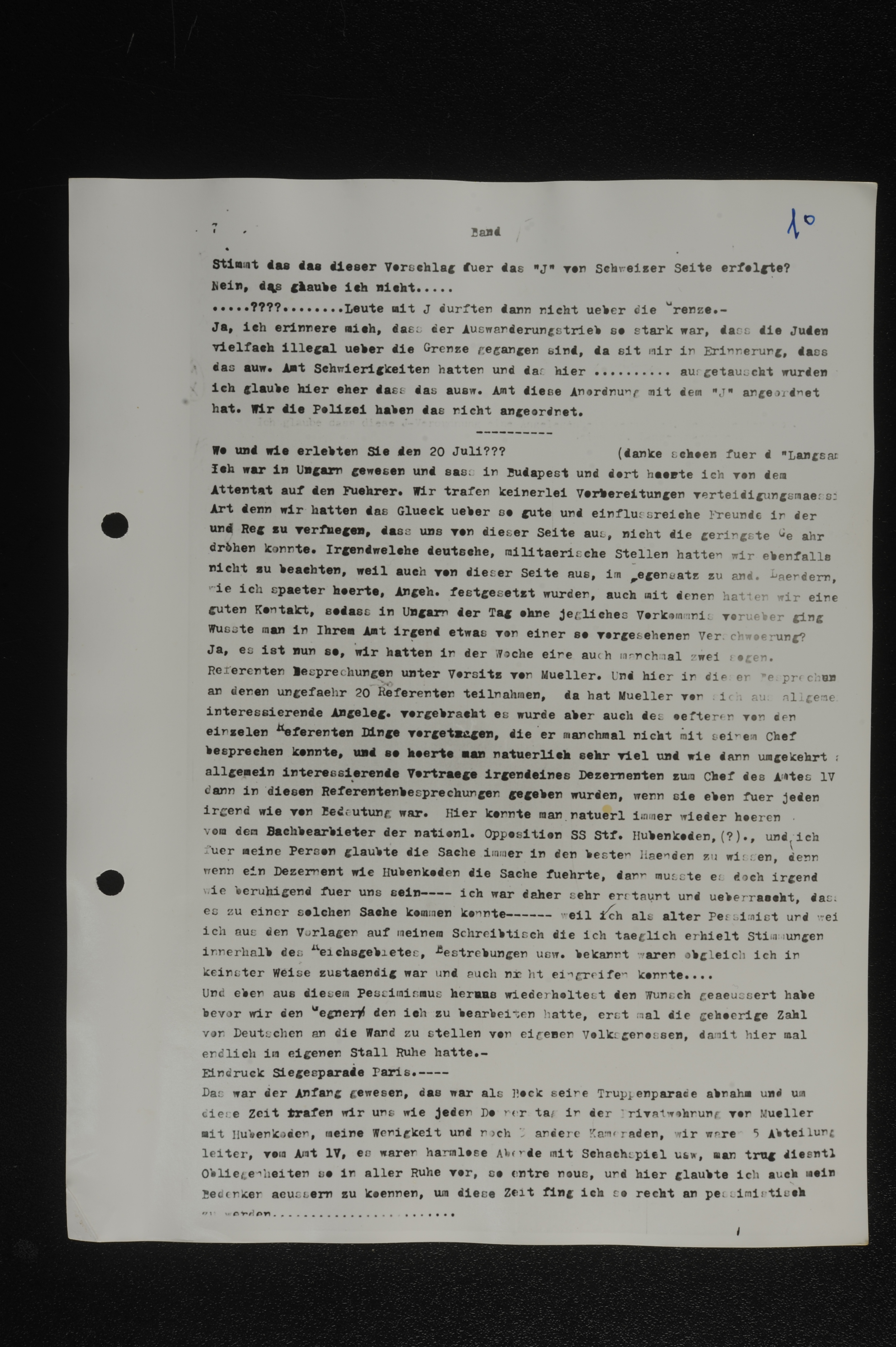
Page 268 of the typescript, O.65 file 86.
Page 268 · Yad Vashem Archives, O.65/86

cadet school, will not have had a better one. That is how much we revered this man. He was a teacher to us in every field, whether it was a matter of engineering questions, whether it was a matter of trouble, sorrow, vexation or joy. He took part in everything and had a consoling, kind, friendly word for it all, but he also had a sharp, military way of speaking when it came to things that struck him as somehow rotten. He always stayed to the end, in spite of his age. He drank, and however long the evening still was, he never finished more than at most a single 1/… of wine, or only half of it. He was always accompanied on his long way from the meeting place to his home by some of us. We positively fought each other for the right to walk with him. Quite different, then, exactly the opposite of D. von Ehrenwall.

If Lieutenant Colonel Reisegger was more down to earth, friendly and confidence-inspiring, then there was D. von Ehrenwall, who kept everything three paces away from himself, helped by his umbrella. He would depict a battle with every possible gesture, and at the end he would crack the umbrella down on the ground, and with that the battle was over, and with that he took his leave just as abruptly, and allowed no chance of discussion. The man had no rapport at all. When we were at the shooting range he gave the commands, and when we were together afterwards he would tell of some terrible battle, how he had attacked and what the enemy was like. You always had to watch out for the umbrella so you wouldn't be hit, and after this account he would go away.

Without knowing it, he contributed to a pre-National Socialist education. He was after all my first teacher. He was the one who first put the carbine in my hands. I had never held a rifle before. He preached to us about why we had to shoot at all, why we had to learn it at all, namely the sanctity of the fatherland and the damned duty to stand ready to defend one's fatherland. He spoke of no party. He was only the defender of the fatherland, and that was what he gave me, namely the readiness to have to defend the fatherland. And when we once drove to Ents, 20 km from Linz, to found a German-Austrian veterans' association in Ents, we set off…

Open page image and German
Page 269 of the typescript, O.65 file 86.
Page 269 · Yad Vashem Archives, O.65/86

Questioner

Why did Kaltenbrunner address you with the familiar “you” du, and why did you respect him so much?

My father, besides his position as commercial director at this electrical company, was also on the board of other firms and a member of an Ex… committee. There was an annual audit of the books, at which several people came together, and this meeting was chaired by a lawyer, so to speak. That was old Kaltenbrunner. Dr. Kaltenbrunner’s practice was very well regarded, and young Kaltenbrunner studied and then joined his father’s practice. Linz was a small town of about 30,000 inhabitants before the Anschluss, and one day we were very proud when the large incorporation took place and our town swelled to 100,000 inhabitants, with the outlying districts.

And so people in Linz probably knew one another, and that is how we boys came to know each other in earliest youth, perhaps without realizing it. After many years in which we had lost contact, we suddenly saw each other again at a rally. In such a small community—we were only twenty-five SS men—there was only one form of address, the familiar “you” du. I called him by his first name because we knew each other, and the familiar form of address was simply part of this small fighting group. My family was known to be nationalist in outlook, and it was a matter of course that I declared myself for this group. Besides, the SS was trying to win over members of the German-Austrian veterans’ association.

Around that time old Colonel Hiltl died and the struggles over leadership now broke out in this veterans' association, and it turned out that the association in truth consisted of two sectors: first, the legitimist part loyal to the emperor, and the nationalist part, which was infected by the growing propaganda of the NSDAP. We members of this young association had permission from the Christian Social Upper Austrian provincial government to fire live ammunition at the ranges, so one was trained on the rifle, and something like that naturally had to be especially attractive to the SS, since we had weapons training behind us.

And so Kaltenbrunner, by his sheer physical bulk alone, simply overran a person and branded me as belonging to them. And when I told him of my misgivings about the Schlaraffia and that I really still belonged to the veterans’ association—I had already submitted my resignation in writing, because the split into two groups did not suit me… I also wrote to my friend Friedrich von Schmidt. He was an old monarchist, but the friendship remained in spite of everything.

I revised my position when the struggle in the German-Austrian veterans' association began and I decided for one camp. But I could not decide for the nationalist side within the association, and by chance, through a rally with Gauleiter Bolek, I was assigned to the SS as if by a hint of fate.

Questioner

How did it come about with the dismissal at the oil company, and how did your father and your family take it?

Eichmann

At that time I was in Salzburg, 130 km from Linz. I was there with the oil company in Salzburg, after having worked for 5 years at the oil company in Linz. One day I was summoned to my director and he explained to me that by decision of the Vienna head office I would be dismissed with effect from such-and-such a date…

Open page image and German
Page 270 of the typescript, O.65 file 86.
Page 270 · Yad Vashem Archives, O.65/86

… and that staff reductions were being made and I was the only unmarried one, and so the choice had fallen on me. I was not particularly sorry. I traveled to Czechoslovakia to my fiancée at the time. It was the first holiday I had had in a long while. My fiancée was also glad that I was now free of salaried employment, and at that time I could have started a wholesale business in kerosene and lubricating oil in Czechoslovakia. An opportunity offered itself there because my fiancée also wanted to tie me more closely to the Bohemian region, and my father-in-law wanted to help me get started, but I did not do it. I wanted to go back to Upper Austria and start such a trade in mineral oils there.

And at this time Kaltenbrunner came to me and said I had nothing more to lose in Austria, that I was to go to the Reich and report to Bolek in Passau, Bahnhofstrasse. That suited me too. I only asked to have leave to go abroad approved from time to time. That appealed to me, and so I set off.

Now I was made ready for the journey abroad by my worried father, who was a friend of the consul in Linz at the time, Dierk von Langen. This man issued me a passport, since I was in fact a German citizen of the Reich, and at the same time this Dierk von Langen established that I had in truth been dismissed from the oil company because of my membership in the SS, and he gave me a letter of recommendation for the authorities of the Reich, as was always customary when someone belonged to a suitable family of a German colony abroad and was now returning to the home country furnished with such a letter of recommendation. It meant that I, from one of the most respected families here, would now go to my homeland; that he had heard I had been dismissed on account of my membership in the SS from the Oil Company, where I had worked for five and a half years.

I still remember that my father was pleased about the words "most respected family". It was otherwise not at all in keeping with his innate modesty.

When I told my parents that I had been dismissed from the Oil Company, and probably because—an inspector had been there recently, he was a Jew, and I had been wearing my emblem… It was received just as if someone had said: the perry pears are ripe now and perry must be made from them. We were not in dire financial straits, and my father said to himself: he has worn himself down there for five and a half years; now let him do it somewhere else for a change. It can only do him good.

Open page image and German
Page 271 of the typescript, O.65 file 86.
Page 271 · Yad Vashem Archives, O.65/86

Questioner

You point out that you always took your measures on the basis of regulations, orders, decrees and so on. Now what did you do to bring such regulations or decrees into being?

I believe that I, or rather my section, was involved in the marking of the Jews in Germany. I did not of course give birth to this police regulation. It was certainly issued by the propaganda ministry, but they in turn cannot issue any police regulation. So whether I now drew up the police regulation, or whether I was only involved in working out the implementing provisions, so that the police would be put in a position to attend to the matter, that I do not know.

So I receive the assignment. My chief, Mueller, or directly the chief of the Security Police tells me, such and such has been ordered, you are to submit the decree-based regulation or the police regulation by such and such a date. Under the heading or keyword "marking of the Jews". Now I go back and discuss this matter not with my senior administrative officer (Regierungsamtmann) or with my police inspector, but with my government counsellor (Regierungsrat) or with my government assessor, because it is after all a legal matter.

So I tell him everything and arrange—call a working meeting. Taking part in the working meeting is the appointed liaison officer of the propaganda ministry to me, the appointed liaison officer of the Deputy of the Führer, a senior government counsellor Reischauer, the relevant representative of the Foreign Office, von Thadden, so all these offices which are involved either marginally or to some extent with joint responsibility have to be drummed together for this working meeting.

Each one now has his concern and his own little draft, and he presents it. After this working meeting I now put together—since the order has come from above and the Chief of the Security Police and the Security Service has the lead, I now have to draw up the framework draft. That is to say: Police Regulation No. such-and-such. With effect from such-and-such a date, all Jews of German nationality living in Reich territory are to be marked. Now comes point two: who in particular is to be covered. Now the Nuremberg Laws are brought in: who counts as a Jew subject to the marking requirement? Then the borderline cases come up, and then it says: in case of non-compliance, punishment…

Now come the implementing provisions: where the Jewish star is to be worn, how big it is, what it has to look like, what color, on which side it is to be worn, at what height it is to be worn, whether it is to be worn only on the street or in the house as well, and how the authorities are to behave when a Jew is encountered without the marking on the street, and so on.

The others do not really have much to say about this framework draft; that goes quickly. The implementing provisions have to be chewed over at length, because new objections and new proposals keep coming up that have to be considered by the office taking the lead. Once I have completed such a draft in my working meeting, which I have to chair, or my government counsellor acting for me, or my permanent deputy—then I have the framework draft initialed by the representatives who took part in the meeting. I finish the framework draft and write: “To the Chief of the Security Police and the Security Service,” or “To the Chief of the German Police: I enclose the work completed on orders,” and so on. It then goes off, initialed of course by the other offices, and the Reichsführer-SS or the Chief of the Security Police and the Security Service signs

Open page image and German
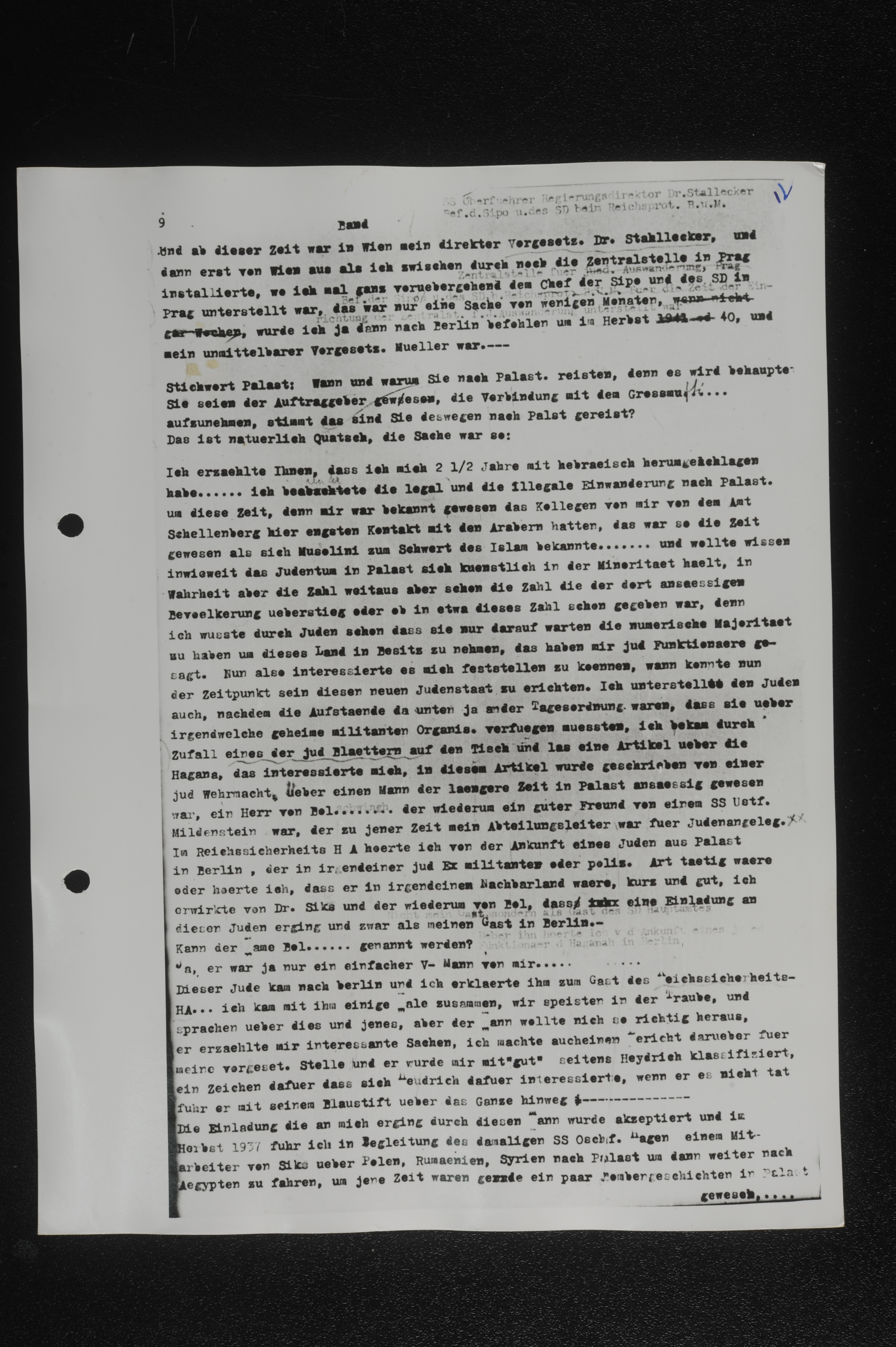
Page 272 of the typescript, O.65 file 86.
Page 272 · Yad Vashem Archives, O.65/86

this ordinance. It then comes back to me and goes out to all offices; it is published… and the police ordinance is finished.

That is a matter that also has an outward effect, because at home and abroad it can't be hidden that an enormous apparatus has been brought into play here. But there are also decrees, internal police decrees, which can be done by a quicker route, but which also don't carry that kind of fundamental importance.

Here is an example. An office out in the field reports difficulties to me in some area in the handling of the opponent. The office could be one of my advisers, the office could also be some state police regional headquarters. It writes that there is confusion here, or difficulty in the handling, that various points of view apparently govern this matter, that uniform work hasn't been achieved so far, and it asks for the matter to be settled generally.

So I call in my responsible desk officer, I go through the matter with him, that is, I instruct him to work on it, to put together everything that has already been issued in this area, all the directives, decrees and so on, and to examine how far the matter could be settled by decree or whether a police ordinance appears necessary here.

After studying the matter he then tells me that a small decree is enough here, in the form of a circular to all police offices and police regional headquarters, with copies to the inspectors of the Security Police and the Security Service, to the commanders of the Security Police and the Security Service, and for information also to the Higher SS and Police Leaders. Good. If I agree, or if difficulties or uncertainties still come up for me, I take the whole thing in my consultation folder to my office chief. I discuss the matter with him too. But he doesn't consider it important enough that the Chief of the Security Police has to be brought in as well, or even the Reichsführer-SS. Fine, so we finish it off, a circular.

Now my case officer drafts it, and I have to initial it. He puts his initials under his reference, IV B 4, and I put mine to the right of them. It goes on to the chief of Office IV, who signs it; then it goes on to the Chief of the Security Police and the Security Service, who signs it or merely puts his initials; and then it goes on to the Reichsführer-SS. It comes back by the same official channel it went out on, and on the basis of this office draft I now compose the actual circular for all police offices and police regional headquarters, and so on: with effect from such-and-such a date, it is ordered that such-and-such, and so on.

If I have a small matter within my own competence, I sign it with my name, as does my case officer, whose name appears in the file reference; or Müller signs it, Heydrich… That is how it goes out.

But a police decree that I had given birth to myself as a section head, however simple it might have been, I could never ever have issued that if I hadn't brought the machinery of the authorities into play. Is that what you meant?

Questioner

No, so far you have described the purely bureaucratic route. What is interesting is whether you were the originator of the ideas behind various ordinances and decrees.

Open page image and German
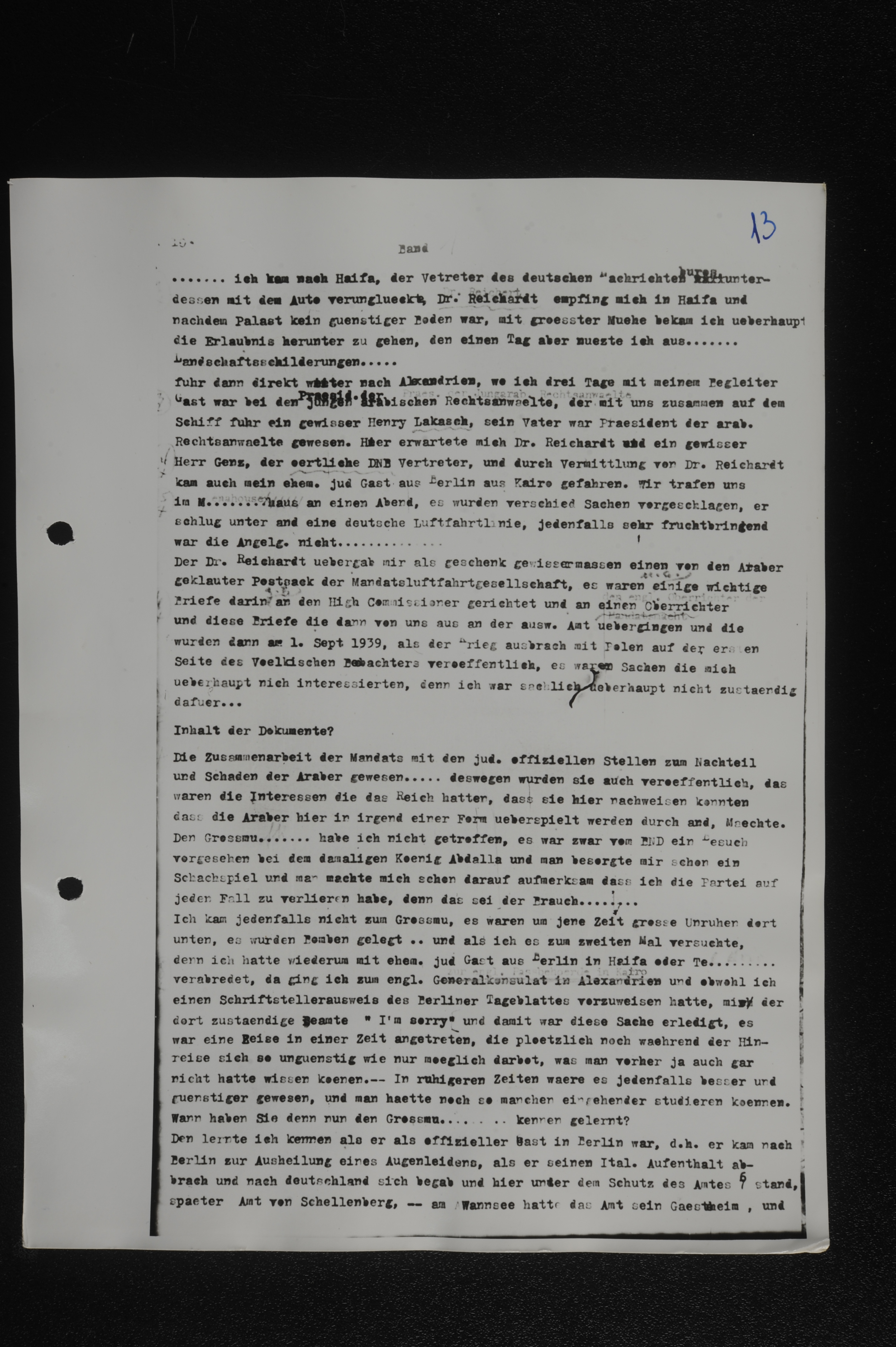
Page 273 of the typescript, O.65 file 86.
Page 273 · Yad Vashem Archives, O.65/86

No, not the authorship of the ideas. I believe that hardly ever, or only in the very rarest cases, did a section head in the Gestapo office originate the ideas behind decrees and ordinances. Because the whole subject matter of police work is such that all these cases, let's say, come from the practical side, are brought up from the subordinate offices, and so the source of the ideas is to be looked for below, or when it is a question of larger cases, of fundamental cases, then they come down from above, they are ordered.

A section head in the Gestapo office is less creatively active than, for example, in Office VII. In Office VII he was creative, in Office IV he was not, that also wasn't his job, here he only had to supervise his processing machine, do you understand?

Questioner

No, in my opinion the section head has to give the impulse, in this case the impulse for decrees and ordinances. That you, for example, arrange through Dannecker in France, through Wi in Slovakia, a legal underpinning of the Jewish measures in the individual states?

Eichmann

For example: I am not aware, and the cases are certainly very few, that a section head in a state police office was ever creatively active at all. Those things came from Office VII, I was there too, there I had to be creatively active, there I had to produce guidance booklets, into which I had to build my own thoughts, and they were either accepted or rejected by my superiors, but I first had to give birth to them. Such giving birth was not the job of a section head in the Gestapo office. He was the head of his office machine, he had to process what was carried in to him from above and from below in the sense of the directives and orders that had been issued, and if none had been issued yet, he obtained them by way of consultations.

I could never have given a fundamental decree, and a decree always has a fundamental meaning, otherwise it is not a decree in the sense of a police ordinance, to my subordinates sitting in the European countries, if I hadn't been prompted to do it. It also possibly happened that Dannecker, for example, came to me and said, I have colossal difficulties here and I believe and I think, Obersturmbannführer, we won't get any further here, because the laws here in this country are such, as the legal adviser has also told me, that subordinating Jews of such-and-such nationality is impossible as long as no special legislation is achieved here or some possibility of implementation is worked out by way of legislation.

Then I listened to that and called in the responsible case officer, in this case again a lawyer. Either he knew about it and was aware of the difficulties in that country and had now received a nudge, and thought the matter was really very simple: we only needed to suggest to the Foreign Office that, through its diplomatic representative, it arrange with the relevant authority for a supplementary ordinance to be added to the law concerning the year such-and-such, saying this and that. Then they would have a basis to work with over there and could operate in that country.

Then I said: good, excellent, get it ready; or I said: good, I will consult further about it. I then proposed it to Müller at the next opportunity. If it was approved, a letter to the Foreign Office was drawn up.

Open page image and German
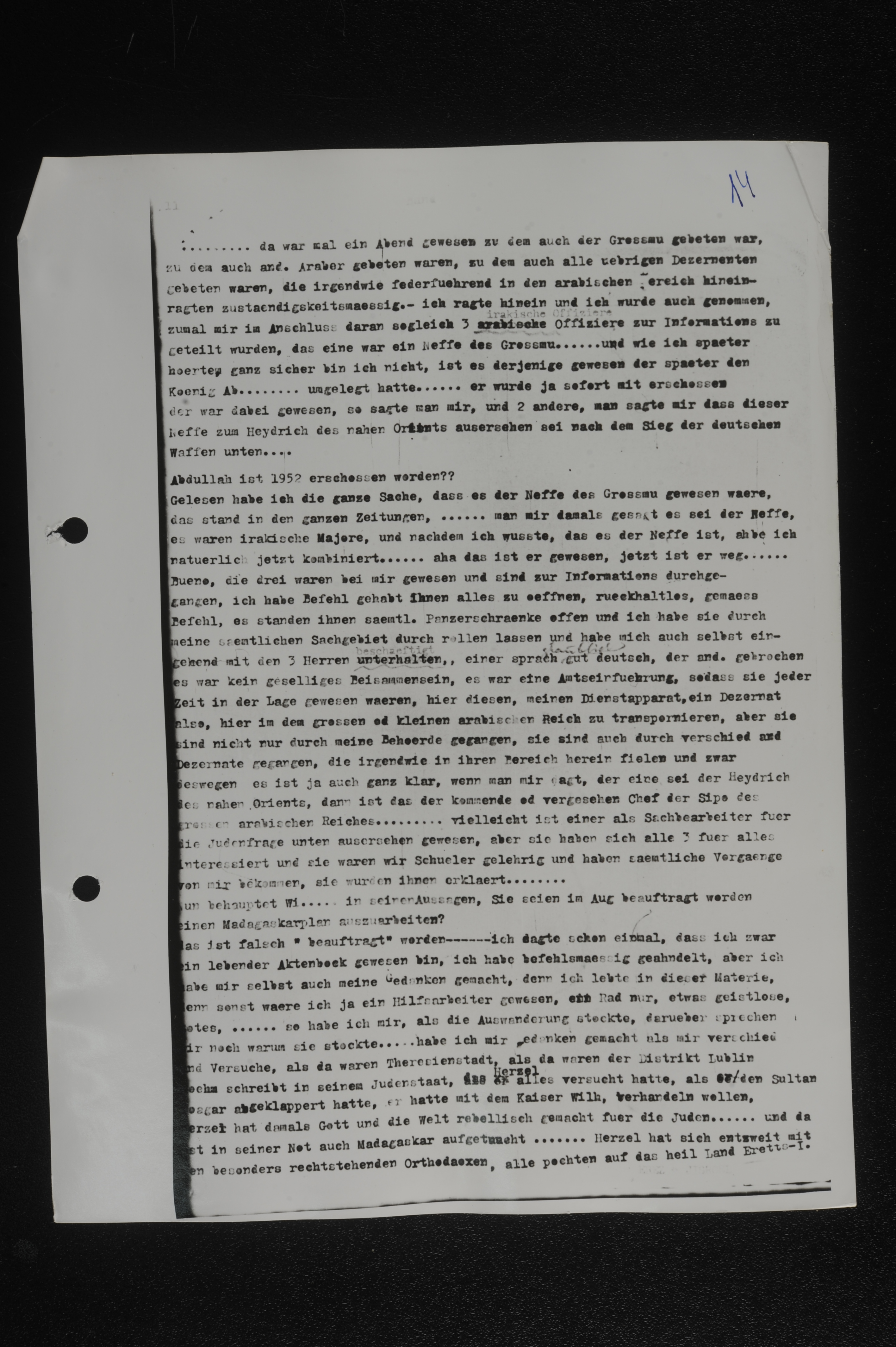
Page 274 of the typescript, O.65 file 86.
Page 274 · Yad Vashem Archives, O.65/86

This letter to the Foreign Office was never signed by me, it was signed by the office chief. If it was a quite simple matter that went to the Foreign Office for the attention of Legation Counsellor von Thadden, then I signed it myself. In it attention was drawn to the whole situation and it asks for soundings to be taken as to whether and how far the Reichsführer-SS’s order can be carried out step by step. It was a long drawn out process, it was pushed and pushed, or else the thing ran itself to death and was filed away, that happened too. If you call that creative, seen that way, then yes, of course.

Questioner

But quite indirectly these decrees and ordinances were still inspired by you, they were worked out by you and so on, weren't they?

Eichmann

Naturally, certainly that happened too, but you see, in the direct sense they were only quite small things. But, to take it as you suggest, the whole plan and the idea of transporting them to Madagascar, which had already got so far in rough draft that it was already a complete piece of legislation, that came from me as well, because in that case, that is right, in my distress, because I no longer knew where to put the Jews, I proposed to Grf. (Gruppenführer) and to the Chief of the Security Police that we get the island of Madagascar released to us.

Whether he would agree—then I would call a working conference, which many others would follow, and I would get the legislation ready here, with the aim that the Jews are to be transferred to Madagascar. Yes, the impulse came from me, it was a presentation. What followed after that I did not give birth to, I couldn't possibly have given birth to it, because so many offices have to be consulted and asked whether… It even often turns out in a negotiation that the lead has to be handed over to another central authority, and that we are only involved at the margin. Often it is the other way round, that is what the working conference decides, and on top of that there is the jealousy of the office chiefs.

Heydrich, for example, in the rarest cases or never let the lead be taken out of his hands. With Kaltenbrunner it was much simpler, there we didn't need to worry so much, because if it turned out that the lead was really a matter for the Foreign Office, or lay on the side of the Reich Ministry of Economics, then Kaltenbrunner never raised an objection to it. With Heydrich it was different, you could hear a thunderstorm if things were taken out of his hands.

[Handwritten changes in the following career-and-drafting passage: 'Ra' at the officer’s name and again at the later abbreviated name; an addition forming 'assistance' at 'help'.]

To continue with Madagascar. Here the initiative came from me. I contacted my legal case officer, Dr. …—SS Hstf. (Hauptsturmführer), first in Vienna, serving in an honorary capacity; he was in Poland, then came to me, and later went to the Waffen-SS, —and gave him the assignment. Now Ja. drew up an extensive piece of legislation for me. It began with a …ampel(?), and went through paragraphs one, two, three, four and five as the basic provisions. Then came the endless mass of implementing provisions. The whole thing had already been drawn up in draft by …, of course in weeks of collaboration with the legal experts of the principal central authorities, and of the central authorities from which I expected help, and which then gave me a certain backing at the coming working conferences and, together with me

Open page image and German
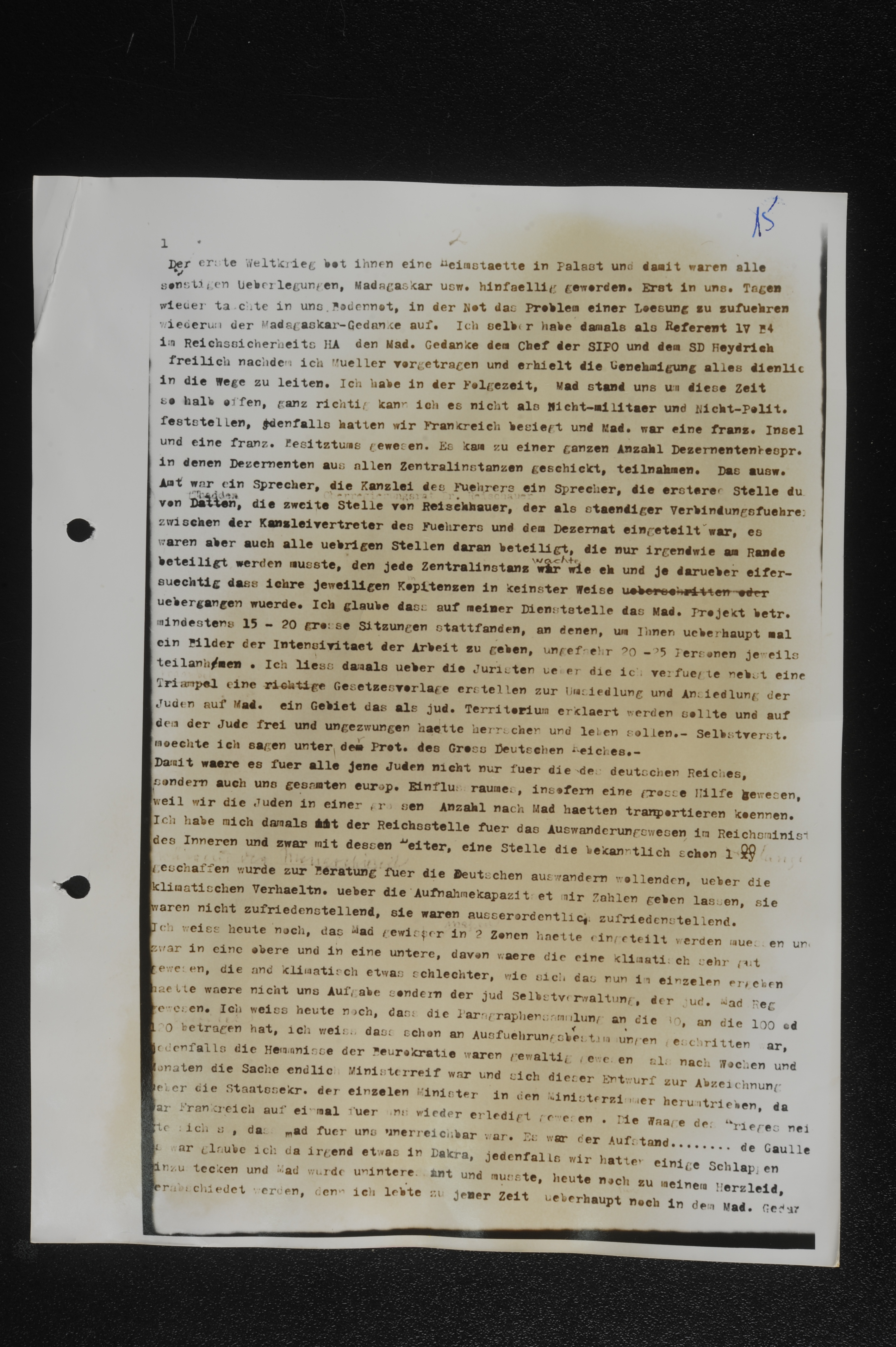
Page 275 of the typescript, O.65 file 86.
Page 275 · Yad Vashem Archives, O.65/86

could step in. There was Reichbauer from the Deputy of the Führer, there was the responsible man from the Propaganda Ministry, and there was the responsible man from the Foreign Office, at that time still Rademacher. So I had won those over for this matter from the start, and those were after all three central authorities of importance, because one represented the Party, the other represented the Foreign Office, where I would really have had to have the worst misgivings, and the other matter was the Propaganda Ministry, also a tremendous thing if anyone wanted to be against it. And so I had the heavy artillery on my side.

[Handwritten addition at “Deputy of the Führer”: “the Chancellery of the”.]

The first working conference began, and I had to invite the responsible ministerial counsellor for emigration matters (Ausw. expansion probable, not stated) from the Reich Ministry of the Interior, because under an ordinance from the year 1892(?), which was still valid—and so every German national, whether Jew or non-Jew—the Interior Ministry had to be brought in as the responsible office for Ausw. matters (Ausw. Amt), and they did get involved.

And the ministerial counsellor gave a long lecture on the climatic conditions on Madagascar and came to the conclusion that on Madagascar a stretch of so and so many square kilometers would be entirely unsettleable, so much would be moderately suitable and so much would be suitable. Well, at that time one couldn't concern oneself with the principles from the year 1892, the man was outflanked at once.

The working conferences piled up and finally it had got so far that a ministerial draft was completed, and this draft, initialed by the office holding the lead, in that case by the Chief of the Security Police and the Security Service and by the Reichsführer-SS, now went to all the ministers, hung about there in the anterooms. Additional discussions were needed which now had to be settled at a higher level, namely the ministers among themselves with the Reichsführer-SS. The Chief of the Security Police brought himself in personally, whereby I was now only ever called in to draft the whole correspondence which the Chief of the Security Police and the Security Service or the Reichsführer-SS now had to conduct with these central authorities for clarification or explanation.

That went on until one day the situation in France was such that Madagascar had been taken and we could do nothing more. Finished, over and done with.

Now that was a thing that was given birth to, only here too I was not creatively active, rather it was easy for me to take the whole thing up, because the Jew Herzl had taken it up himself in his lifetime, and because he had little success in the palace (Palast), so he hit on the idea of Madagascar.

[Handwritten reference after “Madagascar”: “Adolf Böhm, The Jewish State”.]

But those are quite rare cases, because it was not the job of the section head to brood here over what else you could do now. That didn't exist at all. There was such a mass, precisely in this handling of the opponent, such a mass of pressure from outside, from the police outstations, from the Party, that we couldn't even give way to this pressure, because this pressure could only be worked up in police and technical terms so far as the whole police apparatus could play its part. I had to see to it, that was the job of the desk officer, that I didn't come along with a draft decree that would have meant an extraordinary burden for the subordinate executive offices (Ex…). These things had to be thought through as well.

Open page image and German
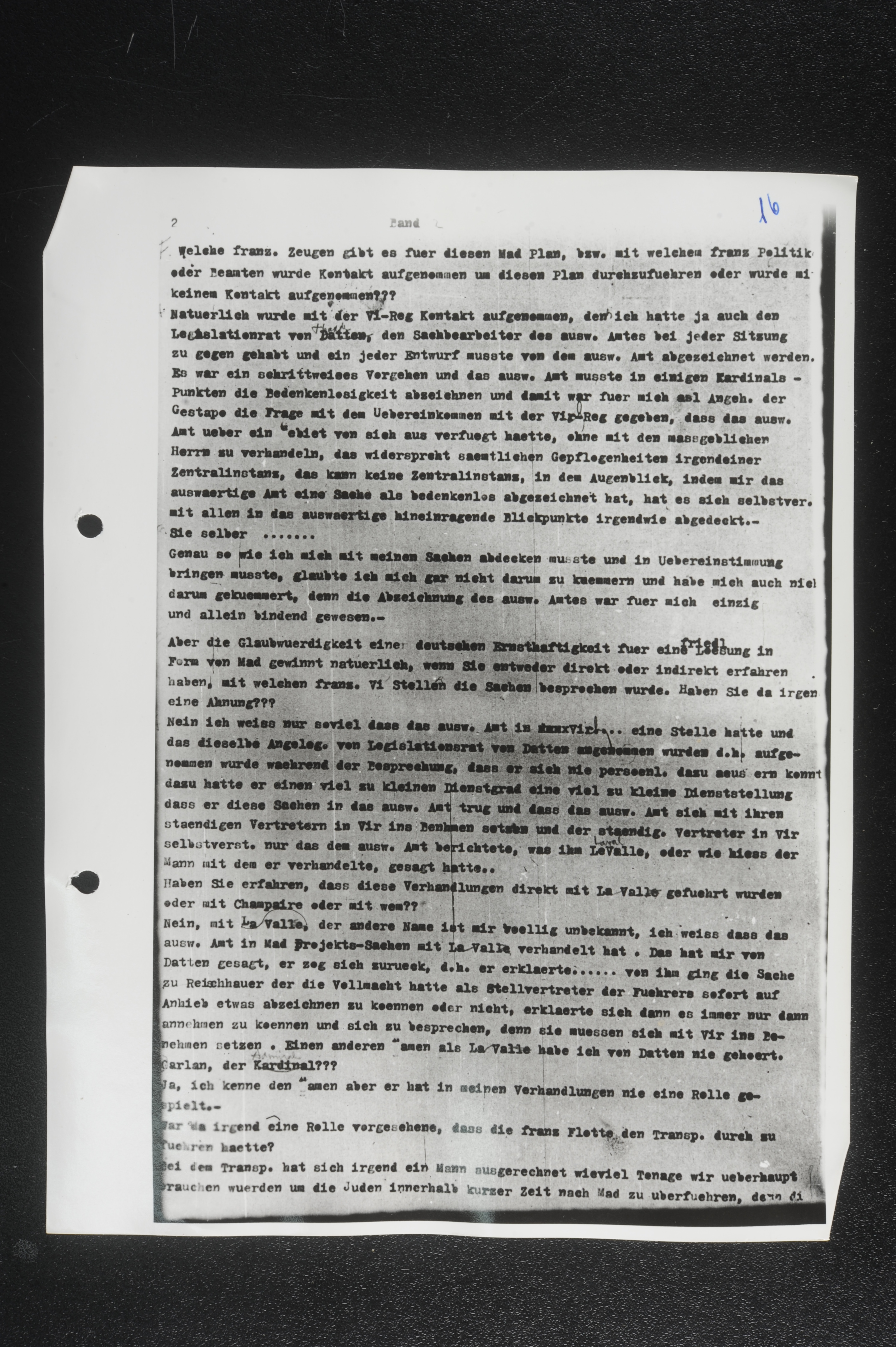
Page 276 of the typescript, O.65 file 86.
Page 276 · Yad Vashem Archives, O.65/86

There was such an abundance of suggestions coming in, and they had to be sifted so rigorously, that a desk officer had no need at all to invent anything of his own here. That is not just how it went for me, it went that way for all the other desk officers as well.

To what extent did I, as head of section IV B 4 of the Gestapo Office, have anything to do with the concentration camps at all?

First. Up to the point when the Gestapo Office still had to decide individual cases, until roughly the end of 1941, because then came the order to handle things summarily. And from the time the Führer order for physical annihilation was issued. In the first period, starting with the Reichsführer-SS, from the time the first camps were still going up, in any case at the time when the people who later became big were still small, they had already laid down some guidelines, which were then partly elaborated further, partly taken over, partly also rescinded.

What came out of it was, virtually, a list of the measures to be taken when a Jew had come to the Gestapo's notice for a race-defiling relationship, when he went in for currency smuggling, and so on. Offenses, then, in the various areas of German life. Orders had gone out on all of it, these orders were already there or the Reichsführer-SS kept supplementing them, extending them or revoking them. There were few kinds of enemy work to be handled where the supreme chief buried himself so personally in the details as he did in Jewish matters.

It was enough for so-and-so, anyone, a Gauleiter or somebody else, to raise it on some occasion, at a shared meal for instance, and speak to the Reichsführer-SS about it. He went into it and gave his orders in person, and they often contradicted the ones he had issued before. Other things were settled by law. The Gestapo or the regional police office would write to the Gestapo Office: the Jew so-and-so has done such-and-such, it is now proposed that he be transferred to the concentration camp. We request instructions.

The case then came to me. My senior administrative officer (Regierungsamtmann) Woerm, or one of my police inspectors, Moos—I no longer remember what the other one was called—they worked on the case and checked whether it was in order, whether the Jew could be committed to the camp or whether the grounds were insufficient. Good: committal to the concentration camp under the Reichsführer-SS’s decree of such-and-such a date. A reply to the office: in accordance with the decree of such-and-such a date, the Jew so-and-so will be ….

[Handwritten alternative at the rank in the following paragraph: “government or criminal-police counsellor?”]

Now that draft did not go out from IV B 4, from the office chief, to the State Police regional headquarters in Munich, telling them to transfer the Jew to such-and-such a place. Instead, the draft letter went to the protective-custody section in Office IV, headed by a so-and-so. He either signed it himself, or the office chief signed it, and the necessary instructions were given to the subordinate office. As a rule, it later went through the central registry of Office IV. All such letters arriving at the Gestapo Office from subordinate or superior offices were immediately put by the registry clerk into the protective-custody section’s tray, not IV B 4’s. That man therefore received the inquiry first and handled it as my own case officers would have done. I merely had to countersign, that is, sign off that there was no objection.

Open page image and German
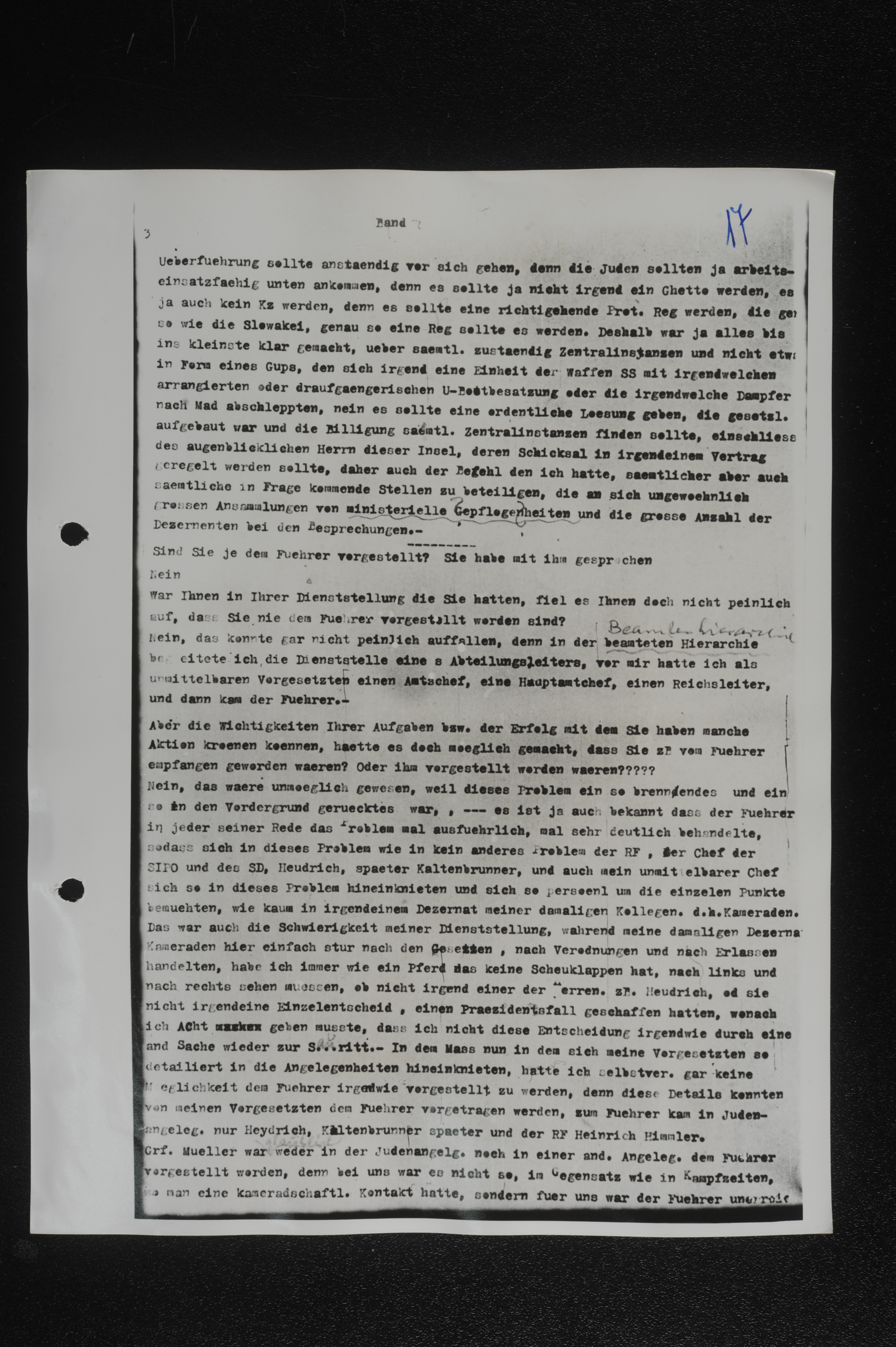
Page 277 of the typescript, O.65 file 86.
Page 277 · Yad Vashem Archives, O.65/86

The protective-custody section could not decide a case on its merits; it was only an extension of the registry. That is why they did not put a government counsellor (Regierungsrat) there, but only a government criminal-police counsellor (Reg. Kriminalrat); he did not belong to the higher career track. I was of course among those primarily responsible. I also had to have my case officers examine on what grounds the Jew could be committed, or must not be committed. Later this was arranged in that way for simplicity, and we only had to sign off, because there had been [? dozens] of cases.

[Form of the inquiry:]

State Police regional headquarters, Munich. File reference such-and-such. To the Gestapo Office, for the attention of Grf. (Gruppenführer) Müller. Subject: Jew so-and-so, born such-and-such, Elemberg, resident at such-and-such an address. Reference: circular decree of the Reichsführer-SS of such-and-such a date. The Jew named above was transferred by the currency investigation office of this local office because he had shifted foreign currency illicitly. With reference to the circular decree, I request agreement to transfer the Jew so-and-so to Dachau concentration camp. I request instructions.

[Reply letter:]

[Handwritten annotation above the reply: “Draw up.”]

In accordance with the inquiry of such-and-such a date, under the circular decree of such-and-such a date, the Jew so-and-so is to be taken into protective custody, with the … or a review date of half a year.

Then it went to the protective-custody section. They immediately set their custody-review dates; it went down to the State Police regional headquarters in Munich, and they transferred the Jew to the concentration camp at Dachau. I had nothing more to do with the concentration camps. Only when the custody-review date came round did the State Police regional headquarters write:

Subject: Jew so-and-so, custody-review date such-and-such. The Jew was committed … to Dachau, xy. Under circular decree such-and-such of the Reichsführer-SS, the custody review must be submitted every half year. Issue a reply: another half year for the Jew…

Then the custody-review date came round again. Or in the meantime, because of this or that, there was a possibility of enabling the Jew so-and-so to leave for such-and-such a place. He was imprisoned because of …. An inquiry is made whether emigration can be permitted, since a relevant order of the Reichsführer-SS exists from the year such-and-such.

[It could scarcely have been spoken any faster.]

Everything was examined closely. It was either approved or refused under the existing decrees. There was a mass of individual cases, and my people worked day and night to deal with them all, because in each individual case it had to be established, whether Jew or non-Jew, whether he had committed an offence. But that was not my task; it was the task of the State Police regional headquarters. My task was whether this or that punishment applied to the offence, which had after all already been

Open page image and German
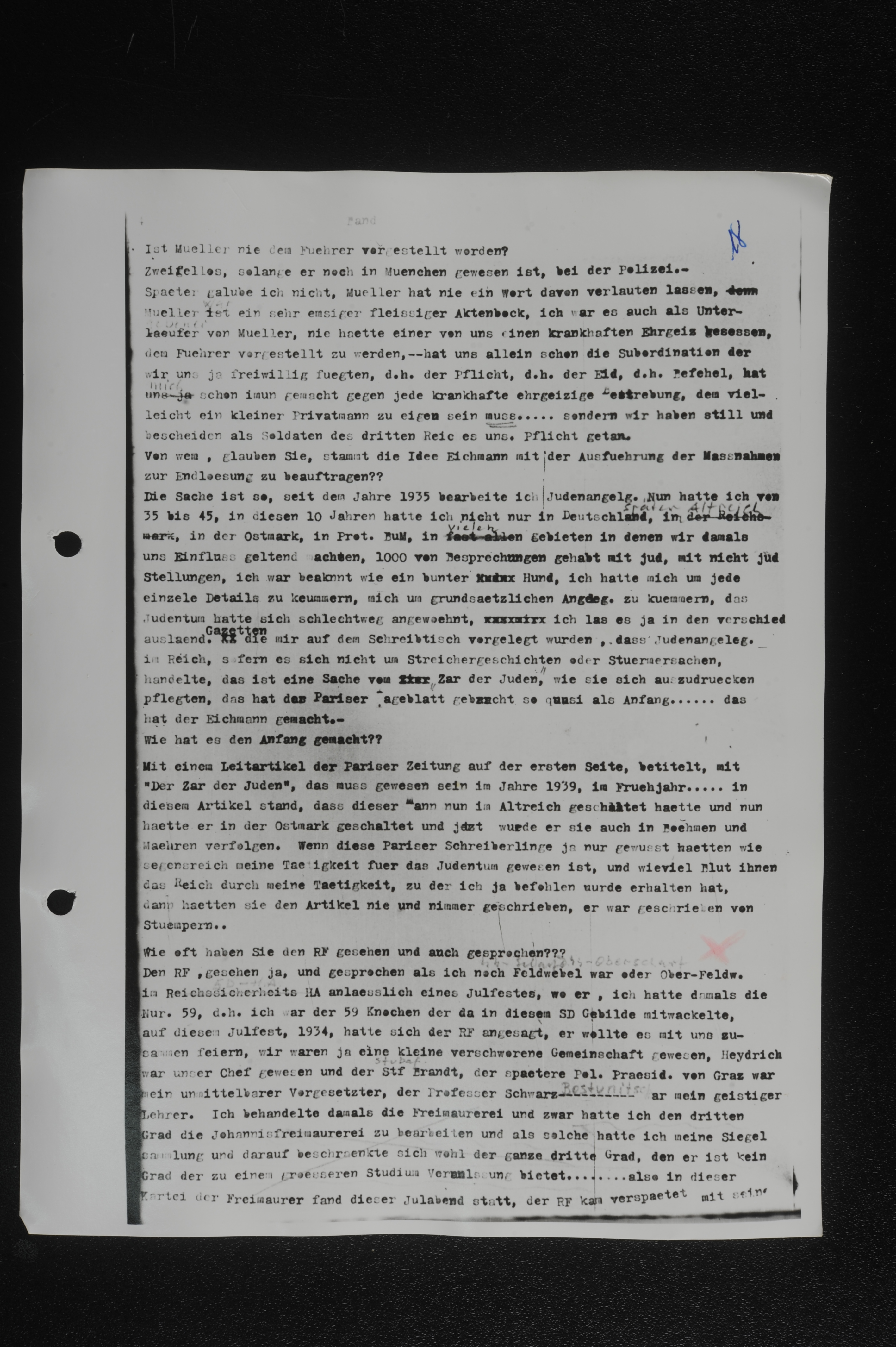
Page 278 of the typescript, O.65 file 86.
Page 278 · Yad Vashem Archives, O.65/86

proposed, and whether that really accords with the existing laws or police regulations, because everything had to follow a standard. I could not say one thing one time and the opposite the next. No, that would not do; it had to follow a procedure exactly. If a wrong instruction had been given, the dressing-down from above would not have been so bad. But what could not have been put right was that an official working in the police could have said: “Yes, the laws used to be what counted, but today it seems no one knows any laws anymore. What am I supposed to do now? How am I supposed to judge it all?” That would have been terrible. You simply must not give a wrong instruction; there are a thousand examples of that.

Questioner

Were there so-called special treatments, besides the general decrees and regulations and so on, and who applied for them?

Eichmann

Special treatments were not something you had only with Jews. But let us say that a Jew at that time had offended against the Nuremberg Laws and had been proved to have had sexual intercourse with an [? Aryan woman]. Then he was tracked down somehow and brought to a State Police office. The State Police office then wrote just as it did in other matters: the Jew so-and-so was committed because he was found engaging in a race-defiling act. Under decree such-and-such, the question is put whether special treatment is to be carried out.

It was then checked in my office too. The facts of the case did not interest me. Under a special agreement these cases were no longer referred to the judicial authorities at all, so determining the facts was the task of the others. Only matters of principle on a larger scale were still brought before the judicial authorities in Jewish affairs—but the Führer had to agree to certain areas of jurisdiction being carved out of the Justice Minister’s authority. My case officer then checked everything. If everything was in order, the matter went back down and the Jew could be handed over for special treatment.

Questioner

What did the special treatment consist of?

Eichmann

Shooting or hanging. That was written in, depending on the case. Those rules too had been laid down by the Reichsführer-SS.

[Typed as notes in the transcript: Example of twelve strokes of the cane: with a doctor and a bucket of water.]

Twelve strokes could be decided by the office chief; twenty-five had to be decided by the Chief of the Security Police and the Security Service; and fifty the Reichsführer-SS reserved to himself. The section head could not order a single one.

Now the second point. Why did I travel to the concentration camps?

I visited Auschwitz, Oranienburg, and the concentration camp quite near Lublin. I came to Oranienburg in the course of the Grünspan case, so that does not count here; it was an individual case. But in the other concentration camps I was with Höss over and over again, because I had to keep in constant contact with the receiving camp, chiefly Auschwitz, before a larger operation began—Hungary, let us say.

[Handwritten addition: “The escort details … there (?), after all.”]

Open page image and German
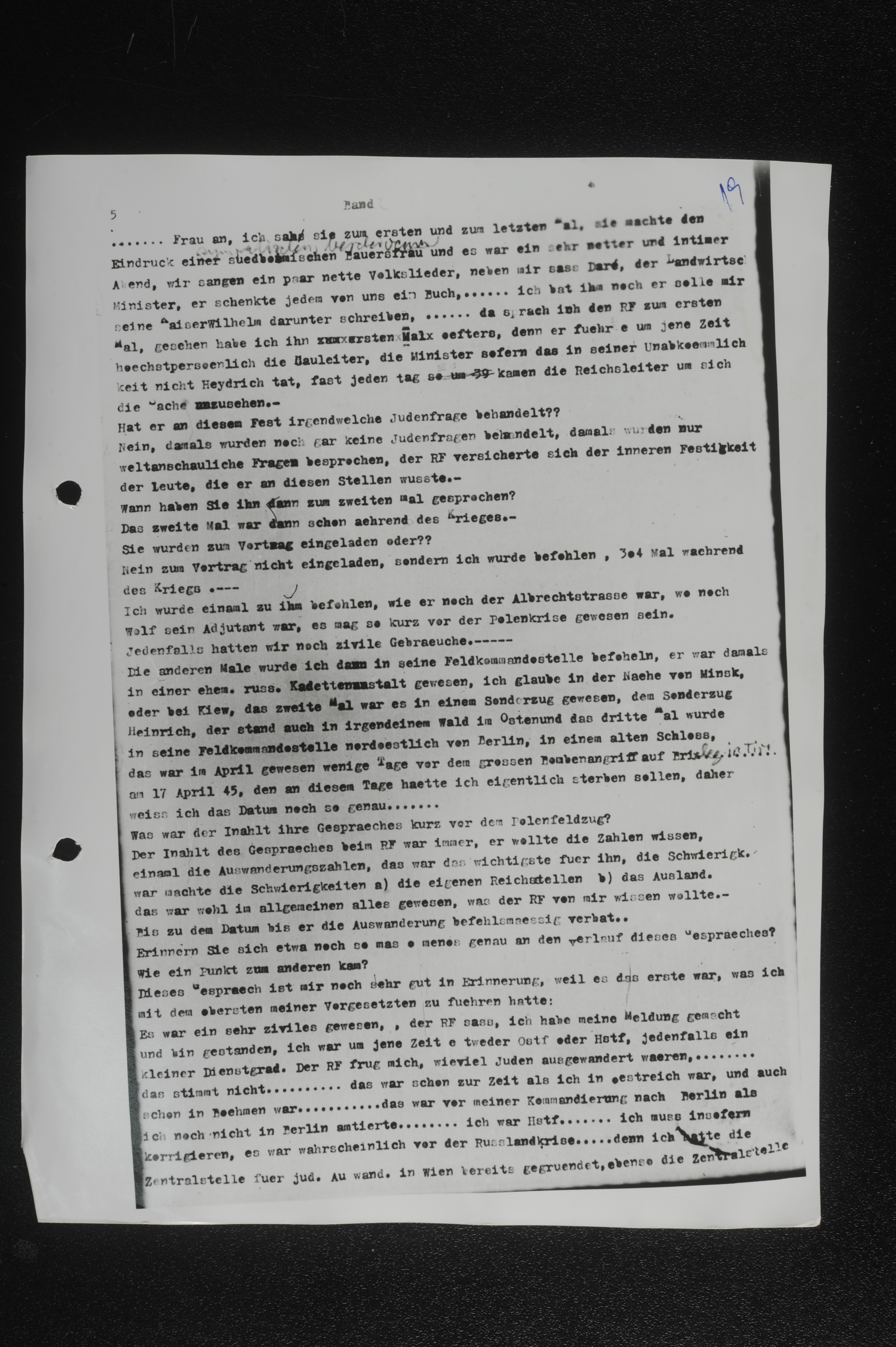
Page 279 of the typescript, O.65 file 86.
Page 279 · Yad Vashem Archives, O.65/86

Let us say Wi has again arranged a transport of xxxxx … Jews out of Slovakia, or Dannecker has arranged [?] transports with sixteen thousand Jews between them. Then, before the timetable conference, there was another conference with the responsible people of the Economic and Administrative Main Office, because I had to be told by the inspector of the concentration-camp system where I was to take these Jews. Pohl had the Reichsführer-SS's basic directive that he had to take in all Jews. Where he put them was his affair. I did not know that, nor did the Reichsführer-SS; that was his affair. So a decision was called for: where were these Jews to go? Pohl said, to Auschwitz. Then I knew: Auschwitz. It was then arranged with the Reich Transport Ministry: the departure stations, the Reich border between Hungary and Austria, or direct… in any case, to Auschwitz.

Now the transports started rolling. I had to keep to a figure agreed with the camps for the maximum number they could take, and I also had to keep to the regulations laid down by the chief of the Economic and Administrative Main Office. These stipulated that the Jews were to be transferred in a faultless state of health, and that this was not to be the case and that was not to be the case, and so on. As long as that went well, it rolled along and nobody bothered about anyone else. Practice is simply different from theory. Although E. were virtually [? urged; verb unclear] by me to ensure that the Jews were fit for work when they arrived, the Hungarian gendarmerie simply clubbed the Jews into the wagons because a wild, drunken Hungarian gendarmerie sergeant [?] did not want to spend much time on it.

The food and supplies were bad, miserable—on Hungarian soil, mark you; on German soil they were better after all. In short, the Jews arrived in a very bad state. But that may not have been the case only with the Hungarian transports; it may certainly have been the case with other transports too. There were difficulties everywhere. Either a representative of Höss came to me, or he came himself, or I received a teletype from Müller saying that I was to go to Auschwitz immediately to discuss and clear up the difficulties that had arisen. After that he asks me to come to Berlin to give a report.

So I had to travel to Auschwitz three or four times during my time in Hungary. Once they overdid it. Well, there were difficulties. The transports were running, eight or ten every day. Because of a bombing raid, one of the day's transports could not get through and was stuck, or something else intervened, so the second transport followed straight after it. In that way, on one occasion sixteen transport trains, I think, arrived at Auschwitz. At that Höss fell ill, went out of his mind and could not carry on. I was ordered to report to Pohl at the time, and Pohl apparently could not quite control himself. He snapped at me in a way I did not deserve at all, because I had not been responsible for it in the least. Of course I understood Höss's difficulties in that respect, but those were forces beyond one's control in wartime, and a scapegoat had been sought.

Those, then, were cases in which I came into the concentration camp. When I went into the concentration camp, it was for matters that did not spring from my personal curiosity, but from an invitation from the commandant, who took pleasure in showing a desk jockey the conditions imposed on him day after day. It was never said to me, but that was how I felt it, and perhaps I would have done the same.

Open page image and German
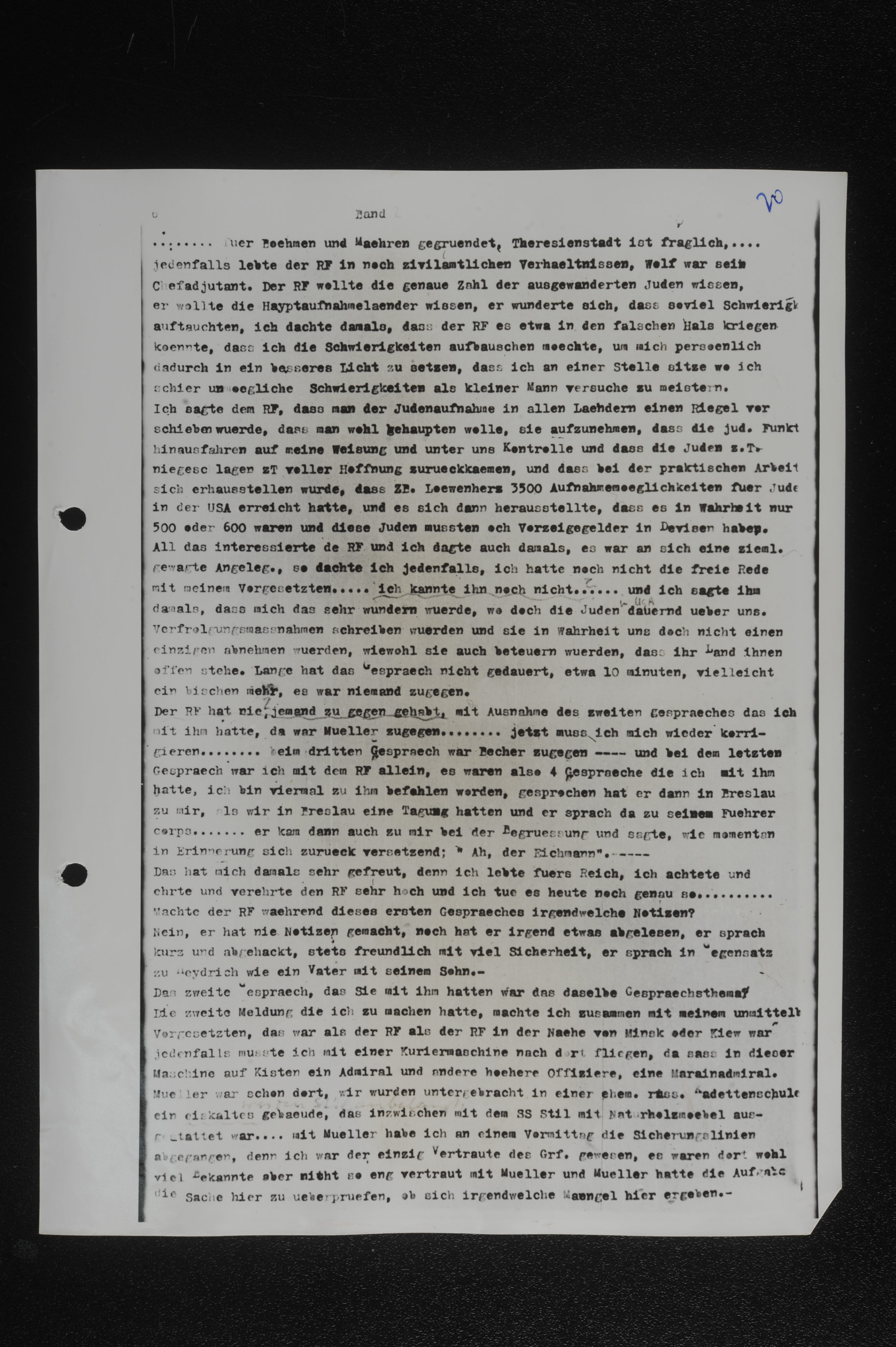
Page 280 of the typescript, O.65 file 86.
Page 280 · Yad Vashem Archives, O.65/86

Or I had orders. There was also a small concentration camp in the Warthegau, with a few hundred men. The Jews were gassed there. I had to establish the time and report it to Müller. A doctor was responsible for that, so I asked the doctor. He told me this and that, I noted it down, and he then led me up to a van of that kind.

[Typed as notes in the transcript: Report with peephole.]

Those, then, were the reasons why and when I had anything to do with a concentration camp. Just as a desk officer in a police office did not need to be creative, he had just as little to do with a concentration camp. The desk officer was the head of his office machinery. The desk officer in Office VII was not the head of his office machinery, and the same applied in Office III. No desk officer in any office who possessed no executive powers was the head of his office machinery. In those offices where the desk officer possessed executive powers, he was only the head of his office machinery. That includes the Reich Criminal Police Office, the Order Police office and the Gestapo office.

The Reichsführer-SS had arranged it very properly and had also been very properly advised. He did not simply let his police do as they pleased. He kept them firmly in harness, so that they carried out their duties according to a set pattern, insofar as executive matters were concerned. Otherwise, I believe, the Reichsführer-SS would have been the exact opposite, because I believe nothing would have been more hateful to him than a mechanical routine among people from whom he expected an outlook and thinking of their own.

Our strength in executive work lay not so much in creativity as in a broad, comprehensive view. We had to survey and take in the matters: how to handle a matter on a Reich-wide scale as quickly and comprehensively as possible without bringing the Gestapo into difficulties with other central authorities, without creating cases that might become embarrassing for the Chief of the Security Police and the Security Service or for the Reichsführer-SS.

Besides that, I had to make sure that no lack of zeal in my duties could be imputed to me as the state's appointed man of trust, the desk officer of IV B 4. If you carried out this area of work in that way, you already had such a considerable workload that you never even got around to inventing matters that were already lying by the dozen in the files, brought forward as suggestions from below and also by superior offices, and being worked on continuously anyway.

The Jewish opponent in particular imagines—perhaps he knows better today through the State of Israel with its ‘Gestapo’; he certainly knows how it is done today. I am convinced that no eastern police force, neither the Russian nor the Hungarian nor the Czech Security Police, acts differently. On purely administrative grounds I cannot imagine any other way of handling it. I cannot believe that a Russian or Hungarian commissar can act just as he pleases. That does not exist anywhere in the world. [Handwritten addition: Not even in the so-called “West”!]

A desk officer deals only with what is brought to him, from above and from below. There was no need to be creative at all, because every stage had already been considered and thought through by other minds. There was nothing left to think about.

Open page image and German
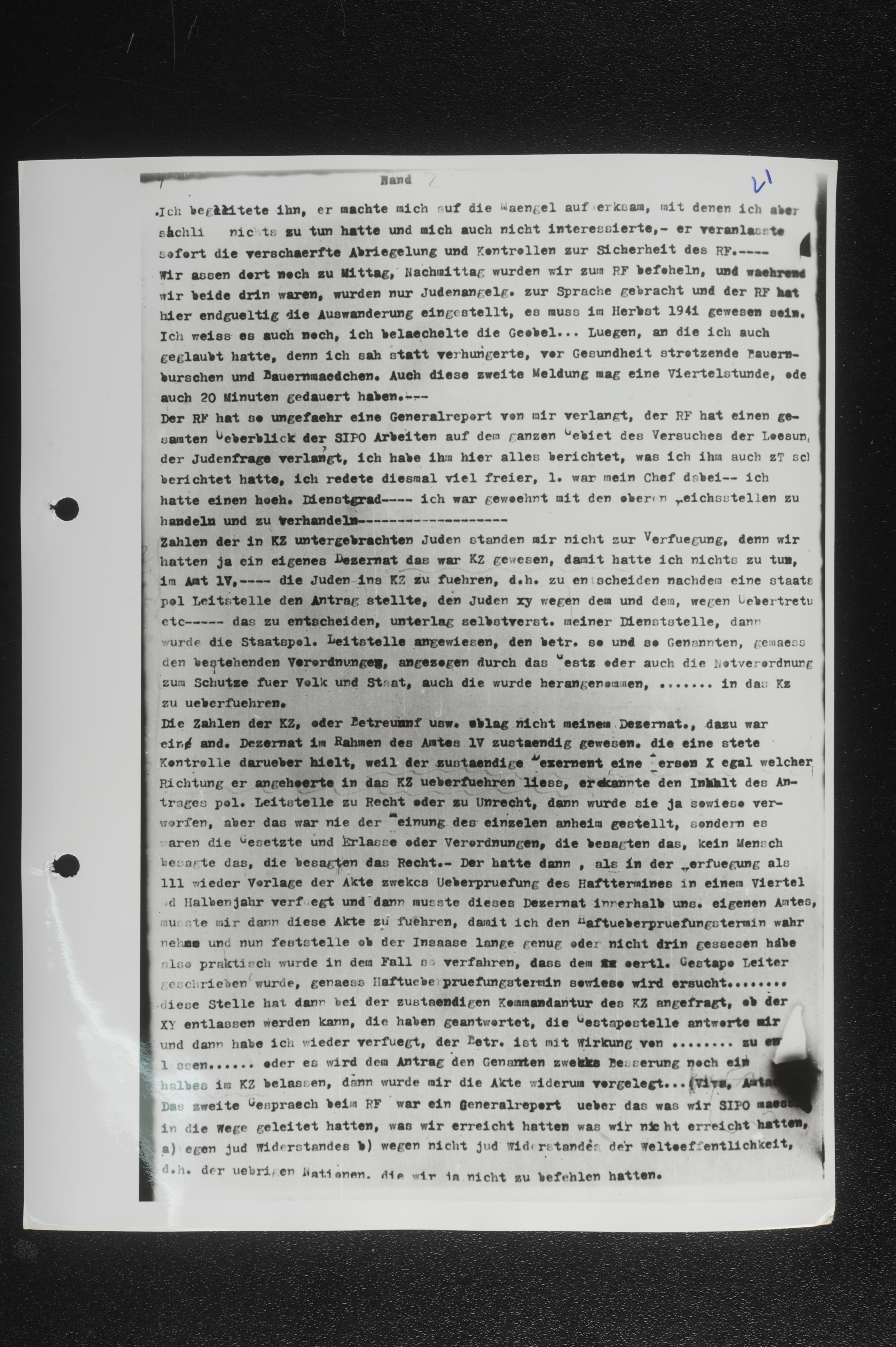
Page 281 of the typescript, O.65 file 86.
Page 281 · Yad Vashem Archives, O.65/86

I was directly responsible for the emigration sector, and we were speaking about creative activity in the Gestapo office.

Everything in the field of solving the Jewish question after the ban on Jewish emigration was outlined broadly in a few sentences. These carried the force of decrees or ordinances and were issued by the Reichsführer-SS following a basic order from the Führer. There was no longer any creative activity on the part of the desk officers here.

It was quite different with the … of the emigration regulations, with different regulations appearing week after week, with foreign-currency ordinances overtaking one another and repeatedly coming out on different premises, with the Reichsführer-SS's decrees on emigration or non-emigration constantly being overturned. Here there was an abundance of problems, and here it was indeed the desk officers' task to adapt skilfully to the foreign or domestic political situation of the moment, so as to achieve the goal he had set: to get the greatest possible number of Jews to emigrate within a short time.

Questioner

Over whom did you have command authority?

Eichmann

I had command authority over all my subordinates. That was a government councillor (Regierungsrat), a government assessor (Regierungsassessor), my permanent deputy, a senior government administrative officer (Regierungsamtmann), several senior police inspectors, several police inspectors, several police secretaries, several criminal police secretaries, several criminal police assistants, several police employees, several SS [?] (Stf.) of the Security Service, at times an SS [?]

(Obtf.) of the Security Service, several SS Untersturmführer and several Unterführer and men of the Security Service who served as police employees. That outlines my section insofar as it worked in Berlin, and insofar as the section included its extended arms: the advisers for Jewish affairs at the German legations, with the commanders of the Security Police and so on. Command authority here needs a qualification, because those men were primarily subordinate to the ambassador, the envoy or the commander.

If they could not comply with orders they received concerning their work, those advisers, unlike the other personnel directly subordinate to the ambassador or commander, were free to come to me and explain why they could not carry out the orders—for instance, because these conflicted with a directive they had received from the section. They asked for clarification, and only then would they return to their office. That did happen. So here I had direct command authority.

Questioner

If you drew up a circular headed ‘The Chief of the Security Police and the Security Service’, with your section number, signed ‘by order’ with your name, and addressed to all State Police headquarters, then that was a directive and an order? [Handwritten addition: No order!]

Eichmann

Yes, of course.

Questioner

So, with the letterhead ‘The Chief of the Security Police and the Security Service’ and a signature ‘by order’, did you have unlimited command authority over the Secret Police headquarters, or over all the subordinate offices of the Chief of the Security Police and the Security Service?

Eichmann

Yes, you can put it that way too, only there is a catch. A letter to all State Police offices and headquarters directing them to do this, that and the other went out in fair copy as a teletype. But it had its head and its roots in the file, and that was the main thing. It looked like

Open page image and German
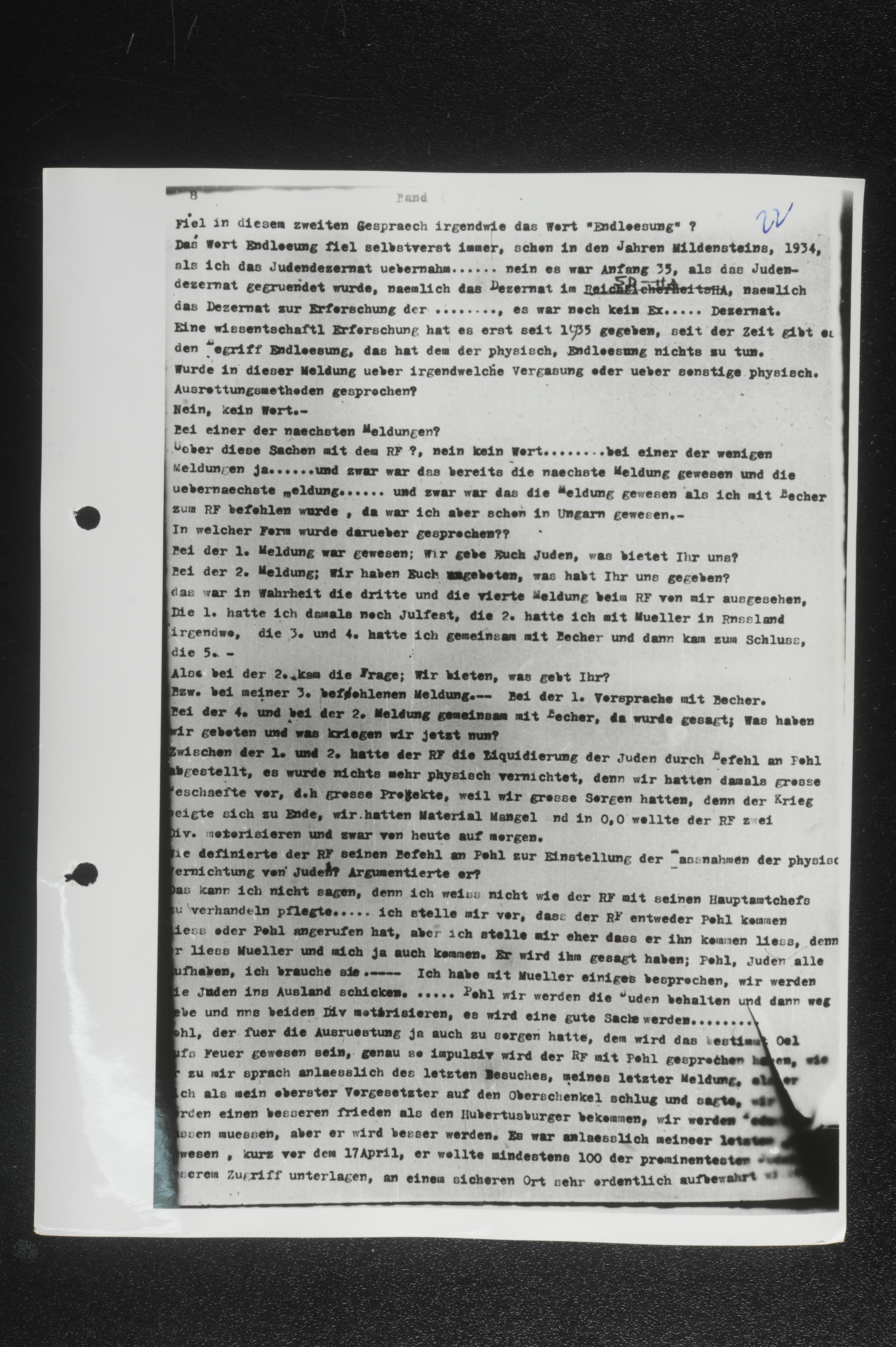
Page 282 of the typescript, O.65 file 86.
Page 282 · Yad Vashem Archives, O.65/86

this. I: a memorandum. Here everything was gathered together factually, developed, worked out and explained. Under II, when a directive of this kind went out to the State Police, especially to several State Police offices, and above all when it was a circular decree to all State Police offices and headquarters, it was submitted under II to the chief of Office IV through official channels, with a request for acknowledgment, approval and initialing. That is, when more than one office was involved, the signatory was, as a rule, usually the office chief. When it was a circular decree to all police headquarters and so on, the signatory was generally the Chief of the Security Police and the Security Service, and in exceptional cases the office chief.

Only in very exceptional circumstances—let us say both the office chief and the Chief of the Security Police were… or rather could not be found, because if they were travelling everything could be forwarded to them. Let us say the office chief was on leave and the Chief of the Security Police was absent, ill, laid low by some bomb attack. Then of course I could have signed a circular like that myself, but I would have had to record it under point III: since nobody could be found and there was danger in delay, I signed and ordered this matter myself. Afterwards, however, I had to answer for why I had done it. It could have meant having to accept an official reprimand.

But the case I have just described never occurred, because the office chief had his deputy, who for a short time was Schellenberg and later, regularly, [?]. In cases of special treatment the office chief also had to sign. Routine matters addressed to the State Police headquarters I could sign, but I had to—only the letter that went out; that was secondary. What mattered was the office letterhead. Even in routine procedure a memorandum had to be drawn up. In it the case officer had to give the reasons why the request was to be granted and had to be granted, or why it had to be refused. Under II he prepared the draft letter, and under III I decided whether to sign the draft myself or submit it to the office chief for signature.

But all of that can be picked apart legally. If the head of a State Police headquarters had reservations and did not carry out the directive—of course he was not allowed simply to leave it undone—he would have had to draw up a memorandum, express his reservations in it and work out grounds for a postponement. He would have had to say that he believed it was a matter of principle and wanted to consult the chief of Office IV before the measure was ordered. Then the letter went off once more. He certainly could have done that; he had that right.

But if the postponement had caused a delay harmful to the Reich, he would have had to answer for it, because there was an unequivocal, clear directive from the Reich Security Main Office, in this case the Gestapo office. It was no longer for him to ask whether that directive was right or wrong; by law he would have had to carry it out doggedly. Given the difficulty of the whole matter, however, because it concerned human lives or deprivation of liberty, it was always handled more delicately than a circular issued by Office VII, III, II or I.

Open page image and German
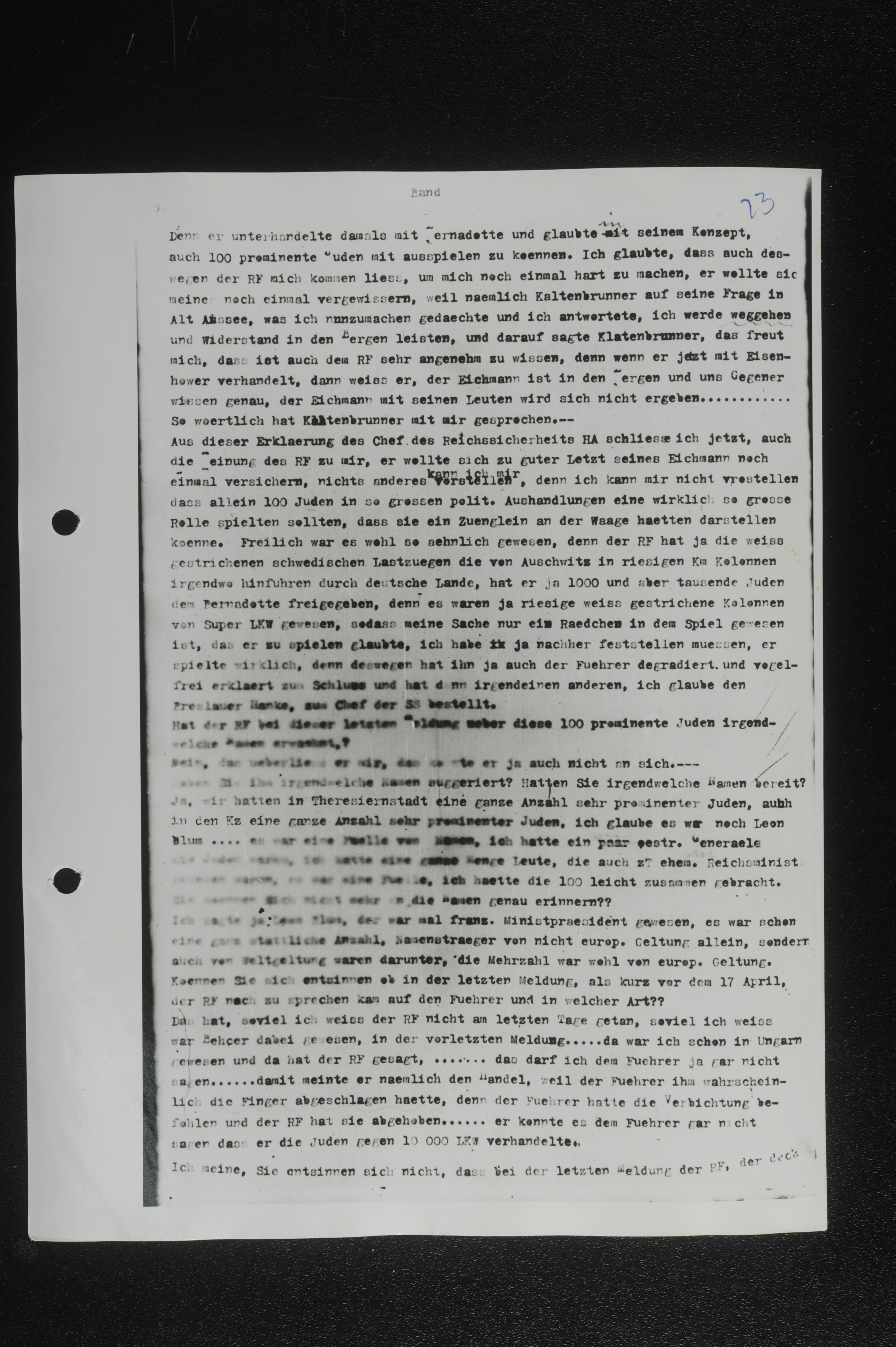
Page 283 of the typescript, O.65 file 86.
Page 283 · Yad Vashem Archives, O.65/86

That is why I made the distinction between offices equipped with executive powers and those that were not.

Questioner

To whom were the Jewish central offices in Vienna and Prague directly subordinate?

Eichmann

The Jewish central office in Vienna was directly under my direction. As desk officer of the inspector of the Security Police and the Security Service, I had received the order, on my own proposal, to create a central office for Jewish emigration. Inspector Stahlecker had first obtained authorization from the Reich Commissioner for the Reunification of Austria with the German Reich. He had an authorization decree, although the State Police headquarters in Vienna would by rights have been responsible. There I was the immediate superior of the Jewish religious community in Vienna. But as head of the Central Office for Jewish Emigration, I was not responsible for the executive side. At that time I had no authority to take a Jew into protective custody, except for the same right that belonged to every German member of the national community (Volksgenosse). I was not an executive authority.

Questioner

What position did you have, then?

Eichmann

I was transferred and am paid by the Security Service Upper Sector Danube. I was the officer for Jewish affairs there, and as a desk officer of the Security Service Upper Sector Vienna, to which I was transferred—first seconded, while retaining my position as a desk officer in the Security Service Main Office—I remained there, although I no longer needed to work there. There was no need, because that Security Service task was now being handled in full and exhaustively by the Central Office for Jewish Emigration.

There I sat as head of the office for the Commissioner for the Reunification of Austria with the German Reich and, at the same time, in a personal union of offices, as a desk officer of the Security Service Upper Sector Danube. As such I had unlimited authority in all administrative matters, in all matters falling under the promotion of emigration. The State Police headquarters in Vienna was not allowed to curtail that authority in the slightest, because the inspector of the Security Police and the Security Service had given the State Police headquarters the relevant directive that they were not to issue me instructions.

Before any State Police intervention against the agents of the religious community or in anything to do with emigration, they first had to obtain my clearance. But all individual measures of a State Police nature in Austria were entirely within the State Police's authority; there I had no possibility of objection. In practice, however, whenever I wanted something I consulted the responsible man, Dr. Ebner of the State Police headquarters in Vienna, just as he did with me, so that in fact there was no friction.

Questioner

So the Central Office for Jewish Emigration in Vienna was an office subordinate to an inspectorate of the Security Police and the Security Service?

Eichmann

Yes, although the Reich Commissioner for the Reunification of Austria and Germany could also intervene decisively in it. In the Central Office for Jewish Emigration there were not only personnel subordinate to the inspector of the Security Police and the Security Service, or people he could inspect, but also the officials of the Jewish religious community. They too did their work there on the assembly line, like the Gestapo official, the official of the Reich Economics Ministry, the official of the foreign-exchange office in Vienna and the official of the Finance Ministry. The Jew did his work on the assembly line in exactly the same way.

Open page image and German
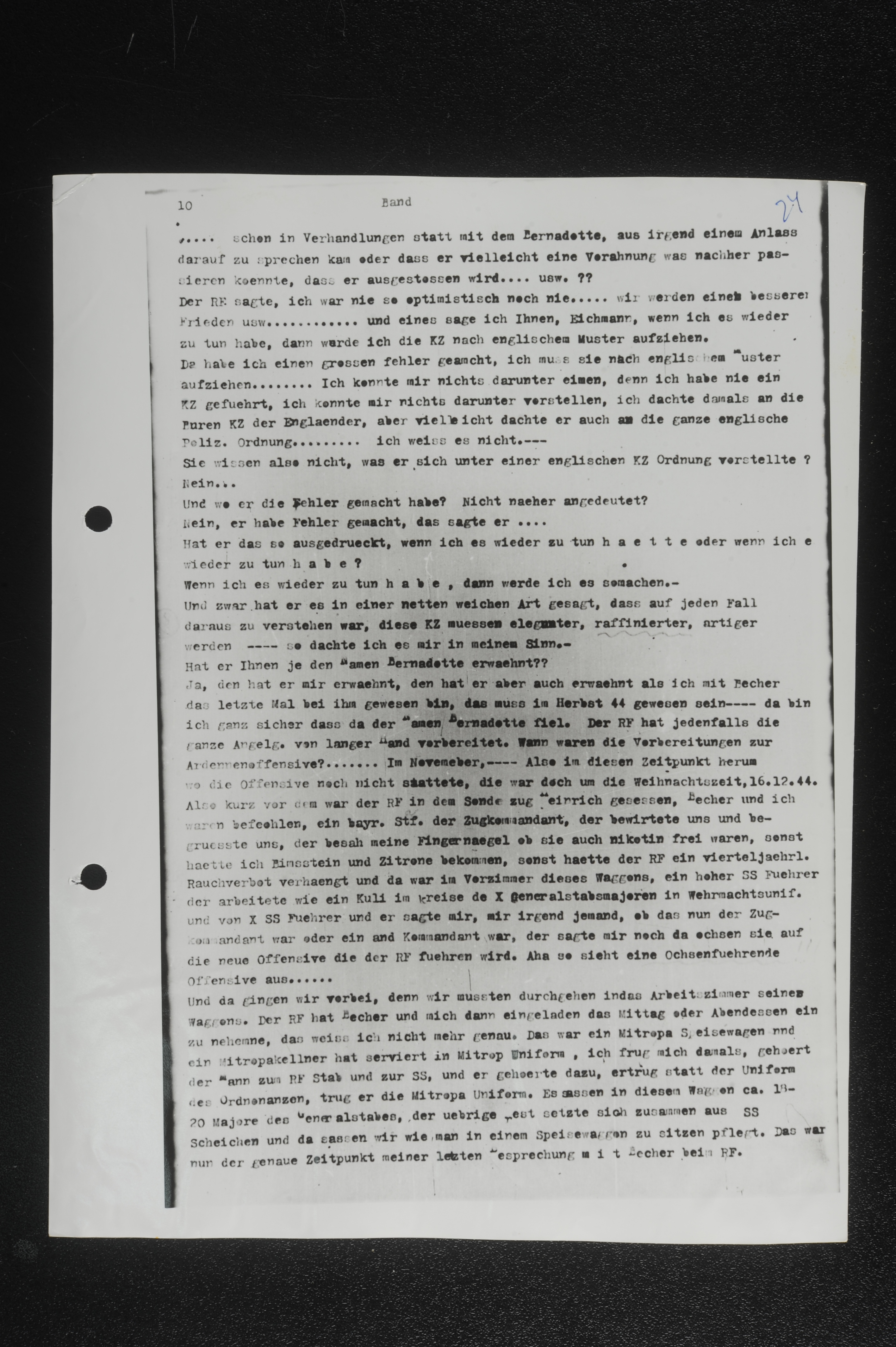
Page 284 of the typescript, O.65 file 86.
Page 284 · Yad Vashem Archives, O.65/86

It even went so far that Stahlecker once inspected this office and greeted these Jewish officials with a handshake. It went so far that Heydrich, during an inspection, returned the Jewish officials' greeting and said good morning or good day to the Jewish officials sitting there, instead of the German greeting. These Jews were just as necessary for the work as the finance official. And because so many officials there came from offices outside the Security Service and outside the State Police, over which the inspector had no authority either in personnel matters or in their work, the office of the Reich Commissioner for the Reunification of Austria with Germany had a certain right of supervision. That was how it was in Vienna. It was quite different in Prague.

Questioner

So the chain of authority involving you and the Jewish Central Office in Vienna was not entirely clear. Administratively you were subordinate to Upper Sector Danube, which was headed by an office head who was also subordinate to that Upper Sector leader while being a section head in the Main Office at the same time?

Eichmann

I was no longer that at the time, because I was transferred then.

Questioner

Who took over your position?

Eichmann

I do not know.

Questioner

And afterwards you were transferred back…

Eichmann

After Heydrich had inspected the Central Office, pressure was then applied—it took two months—and I was transferred back to Berlin, but now no longer to Office VII, no longer to the Security Service Main Office, but into the executive branch, the Gestapo office. That was why Günther, my permanent deputy, and I resisted at first. We did not want to go into the executive branch; we wanted to keep doing Security Service work. We were settled into that, we had known the business for years, and the tasks now coming to us in an executive office were naturally new. For reasons of convenience alone we kept them off our backs for as long as possible, until a very sharp order made it unavoidable.

[Prague]

Here, when the inspector of the Security Police and the Security Service in Vienna, Stahlecker, was transferred to Prague as commander of the Security Police and the Security Service, there was the order from the Reich Security Main Office, obtained by Stahlecker, that I was transferred from Security Service Upper Sector Danube to the commander of the Security Police and the Security Service in Prague. So I was in Prague and directly and immediately subordinate to the commander.

The commander told me to set up a Jewish central office on the Vienna model. He obtained the necessary powers through the Reich Protector. The Reich Protector signed it in a simple procedure that he submitted to the commander, and later it was our common chief in Berlin, Heydrich, in any case. Here the Reich Protector merely had to notify or instruct the Protectorate government to assign the appropriate officials to the assembly line, just as the responsible offices of the Reich Protector assigned their officials to the Central Office's assembly line.

The officials of the Israelite religious community in Prague worked on the assembly line in exactly the same way, so it had been very simple. In personnel and supervisory matters I was subordinate to the commander of the Security Police and the Security Service in Prague, and the Reich Protector's office had a right of objection. That right was never exercised, and the later deputy Reich Protector was my chief in any case, from whom I had to take orders.

Open page image and German
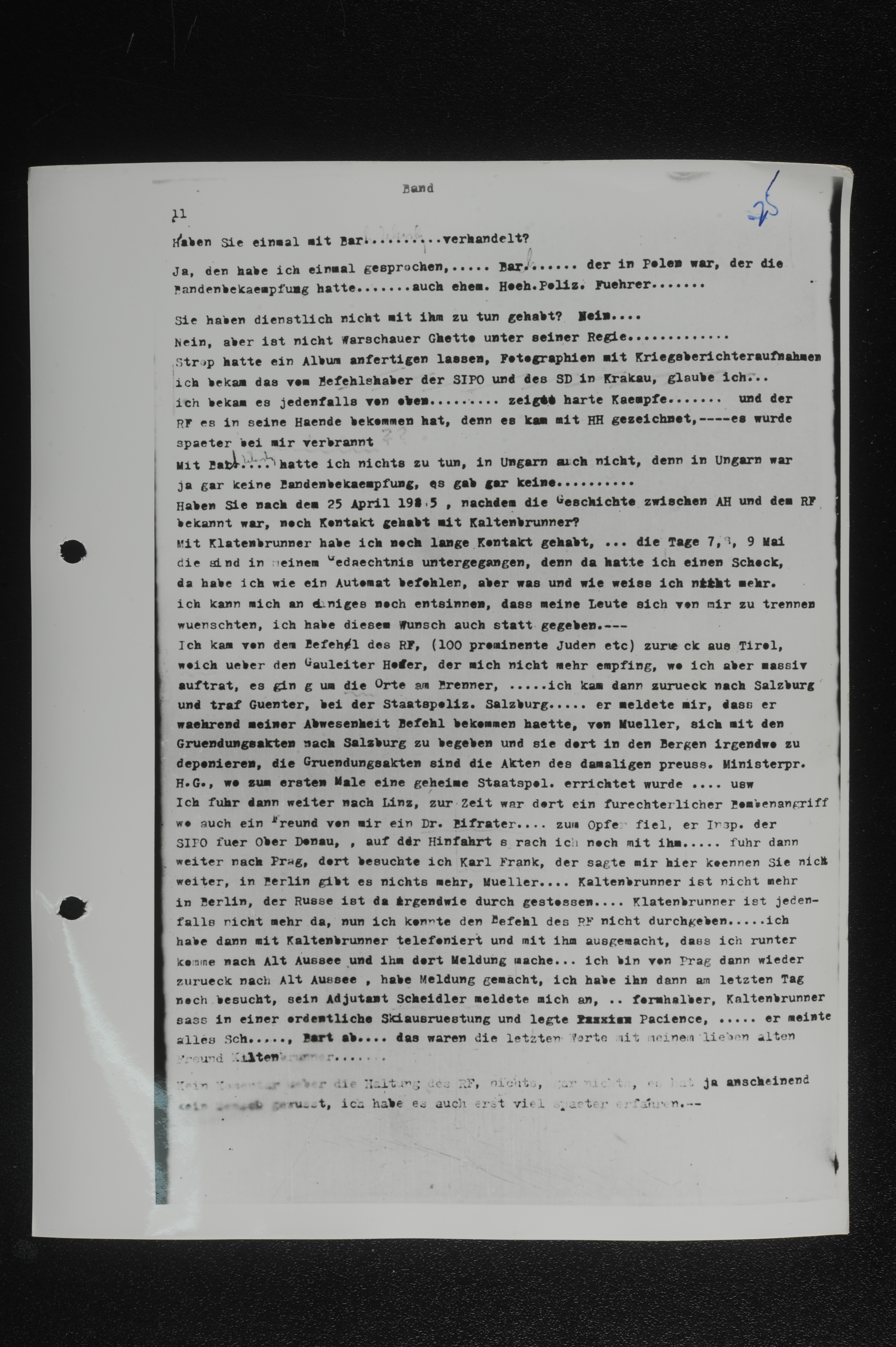
Page 285 of the typescript, O.65 file 86.
Page 285 · Yad Vashem Archives, O.65/86

And those orders had to be carried out without delay, whereas I could have carried out orders given to me by Reich Protector von Neurath only after obtaining my superior's prior approval.

Questioner

What was the decisive reason why Heydrich was taken out of the police apparatus and made deputy Protector of Bohemia and Moravia?

Eichmann

Heydrich told me that personally twice. The first time was when I was summoned to him in the presence of his state secretary Ka…. The second was when, for some reason, I was ordered to come to Prague and invited to lunch. Apart from his adjutant, the only people at lunch were the commander of the Security Police and the Security Service for France, Obergruppenführer Thomas, and my humble self. Heydrich certainly obtained that post because he intrigued on his own behalf and through the Reichsführer-SS, who then got it approved by the Führer. Heydrich was as happy as a child, because he said to me: ‘It is splendid, finally, after these—after this negative rummaging around, to be given a positive task.’ He said that after he had held his press briefings, and he said it a second time when Thomas was in Prague and we were both his guests.

[Typed as notes in the transcript: Song of praise for this superior.]

Heydrich was appointed deputy Reich Protector in 1940. The highest leadership will certainly already have been thinking about Russia; they will certainly also have known that the Czechs were Slavs too. They will certainly have considered that good old Neurath was undoubtedly a good diplomat, but in times of great harshness would not be able to impose his will without regard for law. They will have argued that when the great Ordok(?) now runs up against the bearer of Slavdom, the other peoples who preached … and regarded themselves as followers of this great Mother Slavia might become rebellious. A strong hand in this Protectorate region, this Slavic region, would defeat such thoughts from the outset.

So if the Chief of the Security Police and the Security Service is appointed as this powerful officeholder for the region, any courage that might arise among this Slavic part will be stifled from the outset. We will maintain quiet from the outset, which we would not first need to enforce with weapons in our hands if a man of Neurath's type remained. That was certainly the decisive reason, and for that reason Heydrich certainly also obtained it through the Reichsführer-SS, making it attractive to him to present the matter to the Führer in that way. In this way he could indulge his little vanity at the same time.

Questioner

In practice, did he divide his time between Berlin and Prague?

Eichmann

Yes. At first he was in Prague more, and the files that had to be submitted to him for signature were sometimes slightly delayed, because these matters always had to be taken to Prague by courier, then returned to Berlin and distributed. He also worked for days at a time in Berlin, and then, conversely, the Reich Protector's business had to be forwarded to him in Berlin.

Questioner

Did one task not suffer because of the other?

Eichmann

No, on the contrary. What he wanted as Reich Protector and could not normally approve for himself, he could, as Chief of the Security Police and the Security Service,

Open page image and German
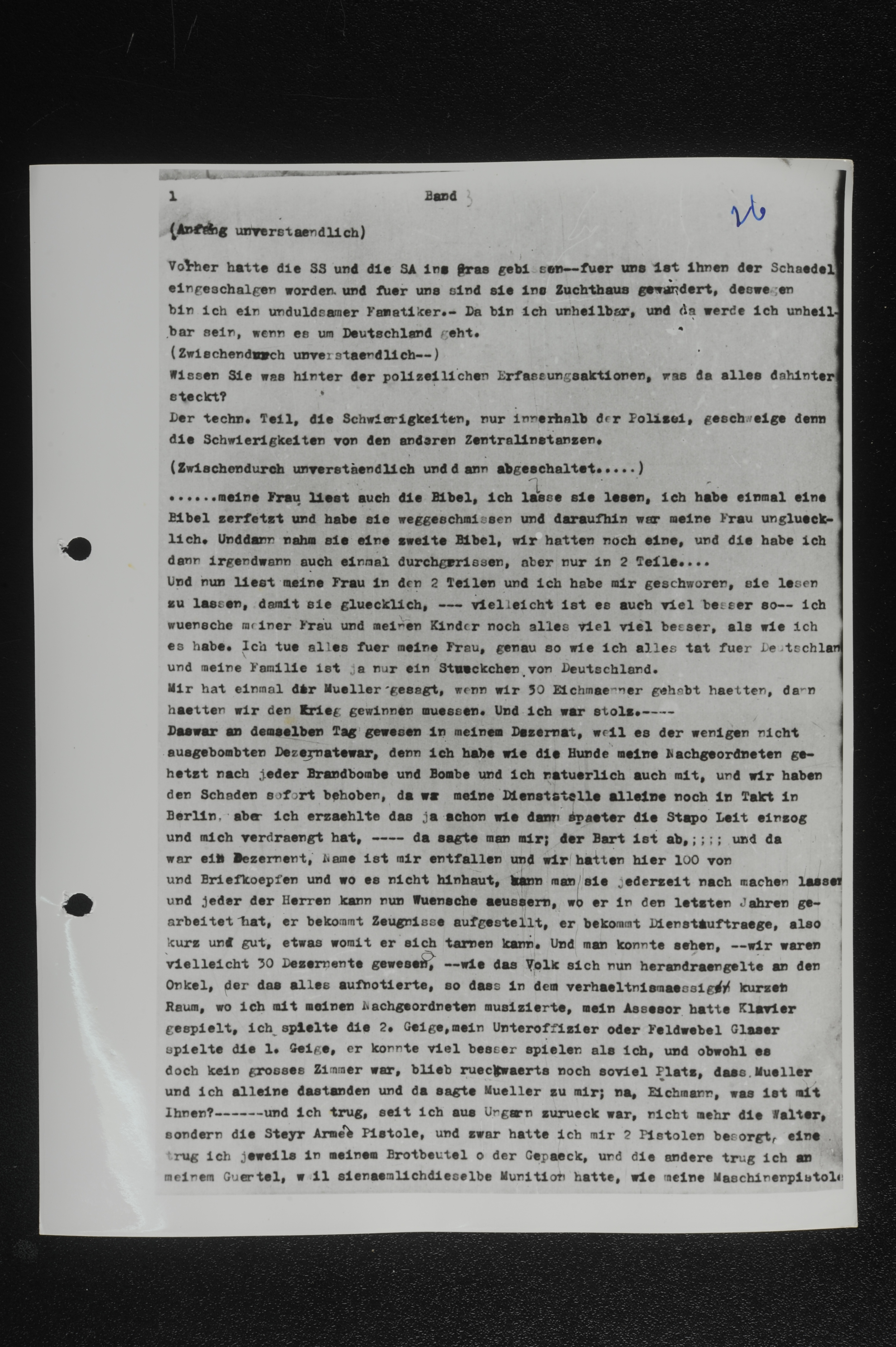
Page 286 of the typescript, O.65 file 86.
Page 286 · Yad Vashem Archives, O.65/86

approve it for himself.

Questioner

Did he soon outmanoeuvre Neurath, or push him aside?

Eichmann

Yes, he had no say at all any more, and then withdrew. When Heydrich was murdered, the chief of the Order Police, Daluege, took over.

Questioner

During Neurath's time, did you have any difficulties with the measures against the Jews?

Eichmann

No.

In Prague I was directly subordinate to the commander of the Security Police and the Security Service. The Reich Protector was only an authority with a right of objection. The commander was initially Stahlecker, then later Dr. …. When Weinmann took over the post in Prague, at about that time I was ordered from Prague to Berlin. No, much earlier: I was transferred to Berlin in the autumn of 1940. I handed the Central Office in Vienna over to Brunner, and the Central Office in Prague was run by Hauptsturmführer Günther.

Questioner

And those were the only two central offices for Jewish emigration?

Eichmann

No. Later, just when I was starting in Berlin, I had set up a Jewish central office for Jewish emigration and had just finished its framework, when… the thing never worked properly in Berlin at all. The number of Jews emigrating through that office never exceeded one thousand, I believe. It did not work there, in bureaucratic terms either; the central authorities refused for a long time. Soon, in 1941, there was not much left to be done about emigration. Countries had closed themselves off to such an extent that even the most cunning Jewish underhand work abroad could no longer find places for Jews, because the receiving countries had closed their doors. We could not place any more Jews. This went almost hand in hand with the explicit order that Jewish emigration was now forbidden. That was around June 1941.

Unknown speaker

So this ban on leaving came about after the attack on Russia.

Eichmann

The whole international conduct of the Jews must also have contributed to the Reichsführer-SS's declaration that no more Jews were to be let out. The Reichsführer-SS must have given this order in agreement with Hitler, because he could not simply bypass Göring's order, which had directed accelerated emigration.

Questioner

Who gave the directive in the deportations as to which camps the Jews were to be taken to?

Eichmann

The chief of the Economic and Administrative Main Office. Sometimes the Reichsführer-SS too, but then he had already discussed it with Pohl. Those were further instances of the Reichsführer-SS issuing orders he really should not have been allowed to issue. He would have done well never to designate a concentration camp on his own initiative, which he did quite often.

Instead he would have done well to follow normal practice: to instruct Office IV through the Chief of the Security Police and the Security Service, as generally happened, to have the responsible desk officer obtain these instructions from the Economic and Administrative Main Office. That was not always Pohl in person, only in particularly large matters such as Hungary. Otherwise it was the inspector of the concentration camps, SS Brigadeführer Glücks, and in smaller matters it was Glücks's case officer, an Obersturmbannführer Liebehenschel. When questions had to be discussed with Glücks, I had to go myself.

Open page image and German
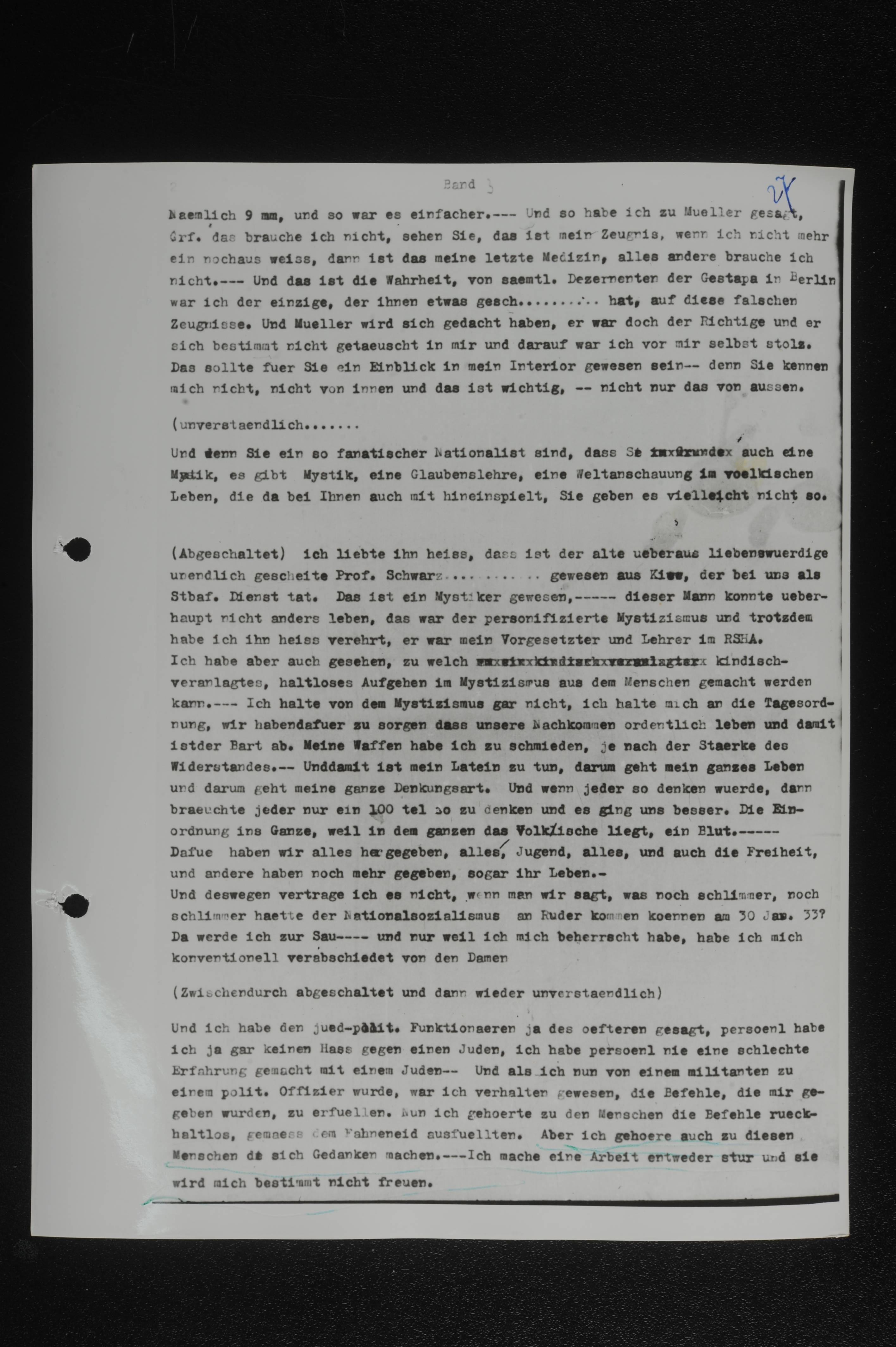
Page 287 of the typescript, O.65 file 86.
Page 287 · Yad Vashem Archives, O.65/86

When matters were to be discussed with Liebehenschel, I generally sent my permanent deputy Gunter rather than going myself.

Questioner

Did it not happen that, at such discussions, you recommended sending one group of Jews or another to one extermination camp or another?

Eichmann

No, that was not within our authority. It would have encroached on the authority of the Economic and Administrative Main Office.

Questioner

What considerations guided Pohl and the others in directing these transports?

Eichmann

The Economic and Administrative Main Office's considerations were these. First, whether there was capacity to take them in at all. Second, what the office had before it: which new factories, how many mines had to be operated, what other production important to the war was being moved into the concentration-camp sphere, how many workers were needed, how many women, how many men, how much office staff, and so on.

The individual concentration-camp commands submitted their respective staffing requirements to the Economic and Administrative Main Office, and the transports were allocated accordingly. In accordance with the extermination order that the Reichsführer-SS must undoubtedly have given Pohl personally, Pohl, through Glücks, gave the camp commandants the guidelines under which the camp command had to consign one part to extermination and accommodate the other for work. The camp commandant did not decide that himself; he had his doctors for it.

So, as for the transports I dispatched—after the conference with the Economic and Administrative Main Office, whose outcome was necessary before the timetable could be drawn up—the people were then selected by the commissions of doctors, in the concentration camp after unloading from the wagons, in accordance with the instructions issued to the individual camp commands. From this you can see that the Gestapo office had no influence at all, because we knew nothing about the detailed circumstances and were not interested in them either.

Questioner

How is it, then, that international Jewry attacks you so bitterly?

Eichmann

Yes, I have thought about that. I also have my explanation. I can imagine the following. From very early on I was the only one who negotiated with the Jewish functionaries, even when I still had no x… powers and was working in the Security Service. Then the Gestapo office had me… At that time a desk officer, a Dr. xy, headed the department. Subordinate to him, as one of its lowest-level functionaries, was a criminal district inspector, Kuchmann. Those people had no idea what a Zionist was, and so on. They made things easy for themselves by turning to Office VII, to which I belonged.

It was no longer done in writing but by telephone: would I come over for a discussion, there were some cases that were unclear. I took part, and so, in criminal district inspector Krugmann's office, at the interrogations he had to conduct on the authority of his desk officer, I met Eppstein, the head of the Reich Association for Jews in Germany. I also came into contact with other offices, and I found this very convenient. Not only could I help the Gestapo office through my theoretical knowledge, but personally I had expected a great deal from these discussions, to broaden my knowledge of Jewry in the Reich as well as the

Open page image and German
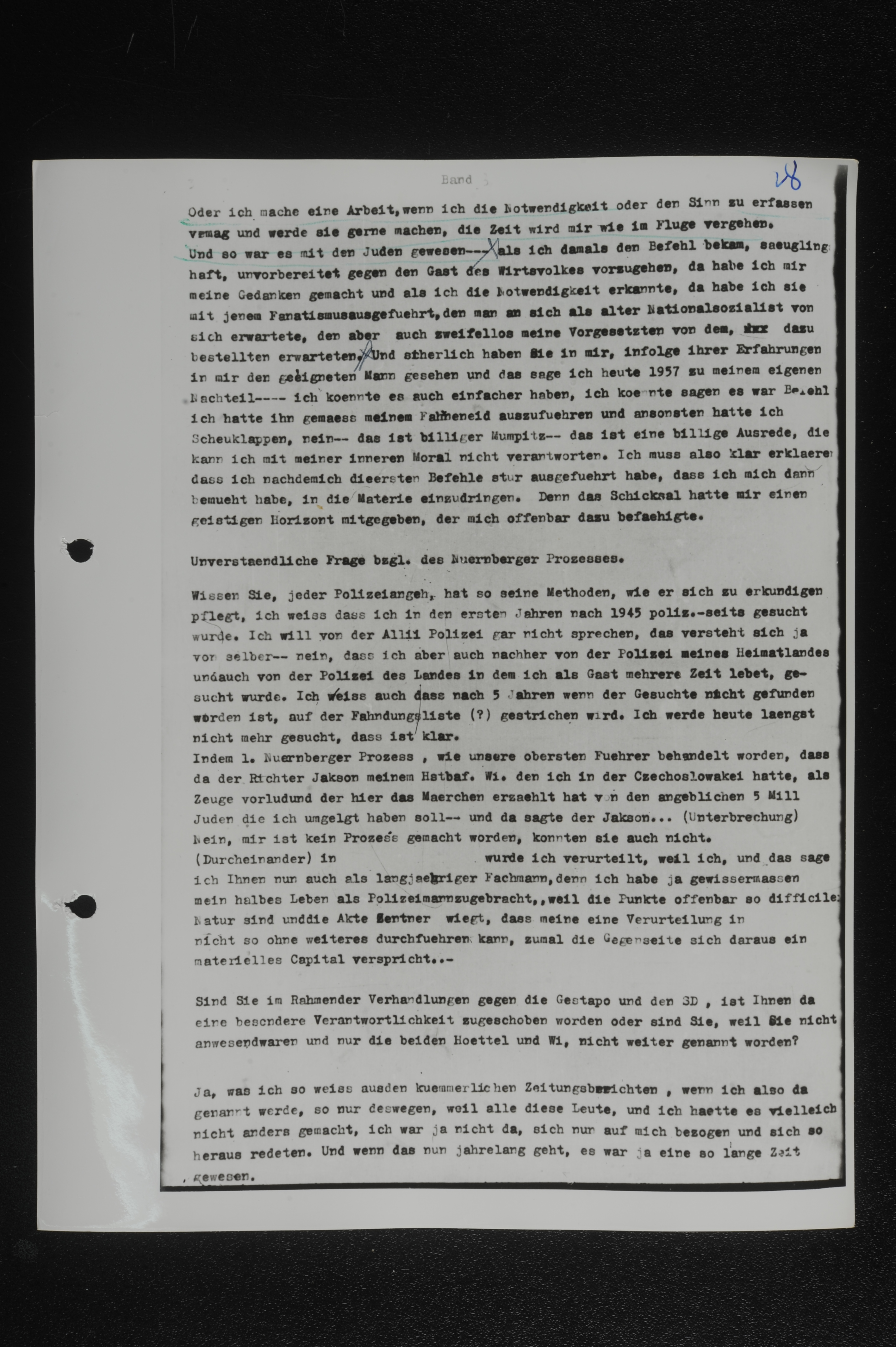
Page 288 of the typescript, O.65 file 86.
Page 288 · Yad Vashem Archives, O.65/86

international Jewry. Then I began telling Grugmann: ‘I would like to speak to Rabbi xy on xy; please summon him.’ So one hand washed the other. I helped the Gestapo office, and the Gestapo office helped me. Over the years I rose in rank and in my position within the service, and time and again I had the so-called dealings with the public that came with executive work. There were thousands of negotiations in all sorts of countries: Germany, Hungary, Austria, Holland, France, Belgium… That was how, during my work in [?], the Paris Daily (Pariser Tageblatt) began writing about me…

[Typed as notes in the transcript: Already written.]

That was the first article, and at the same time the signal for the press, which, let us say, was ninety percent Jewish-financed at the time. Articles of that kind increased and accumulated to such an extent that the editor of The Stormer (Der Stürmer)…

[Typed as notes in the transcript: Already written.]

From this collection of notices I gathered that international Jewry was increasingly occupying itself with me. People were amused by it, because I was credited with things for which I was not responsible at all, so that I almost felt obliged to apologize to my superiors lest they think I had overstepped my bounds. When a man in a country throws himself into a matter like that, a speciality such as emigration was—and I was recognized as the specialist by the Jewish experts too—people attributed to me everything they could attribute to me. When Dr. Rockenberg and Dr. Loewenherz described their misery to me, saying that scarcely had they assembled all the documents when new regulations appeared, so that the Jew could not emigrate and ended up in the concentration camp after all, they asked whether something could be done.

Then I conceived the plan of bringing offices outside the police under my direction—that is, under the direction of the Security Police and the Security Service—and doing everything through a single procedure in a few hours. It succeeded. It was such a proceeding that Heydrich said I was now a little prime minister as his subordinate. There was a kernel of truth in that, because I now had authority to issue instructions to a man seconded from the Reichsbank for foreign-exchange matters. I could, so to speak, determine the dollar conversion rate. There are other examples of that kind.

That did not escape the Jews either. There were many administrative lawyers among them who found this assumption of a dignity by my insignificant person so inconceivable. At one stroke I became the well-known Eichmann, right up to the Reichsführer-SS and the other ministries. Some hated me; some … me. All this gave me an enormous boost, and I threw myself into my work with all my energy. The Jews knew that too, and even more ruthless personnel were often placed under me. All this gave me that reputation and that name.

I was here and everywhere; nobody knew when I would appear. My subordinates respected me in a way that led the Jews to place me on a throne, so to speak. On top of everything came Wi's statement about the five million. So there was no longer any doubt about my person and my activities. But I was only an ordinary member of an office, admittedly in

Open page image and German
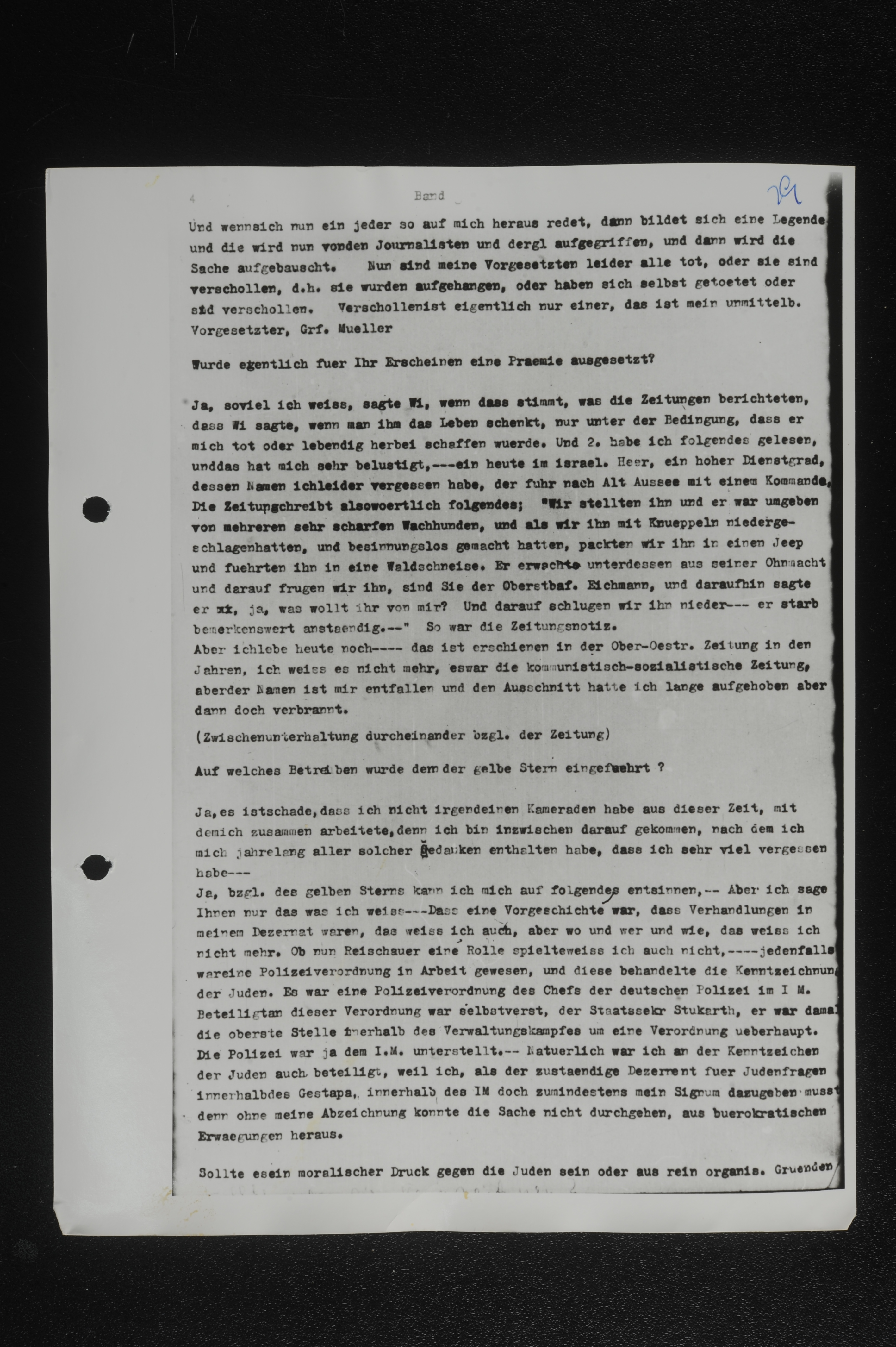
Page 289 of the typescript, O.65 file 86.
Page 289 · Yad Vashem Archives, O.65/86

the senior service, as it was called, because from desk officer upward they have entered the higher career track, so they can in practice rise as far as minister.

Open page image and German
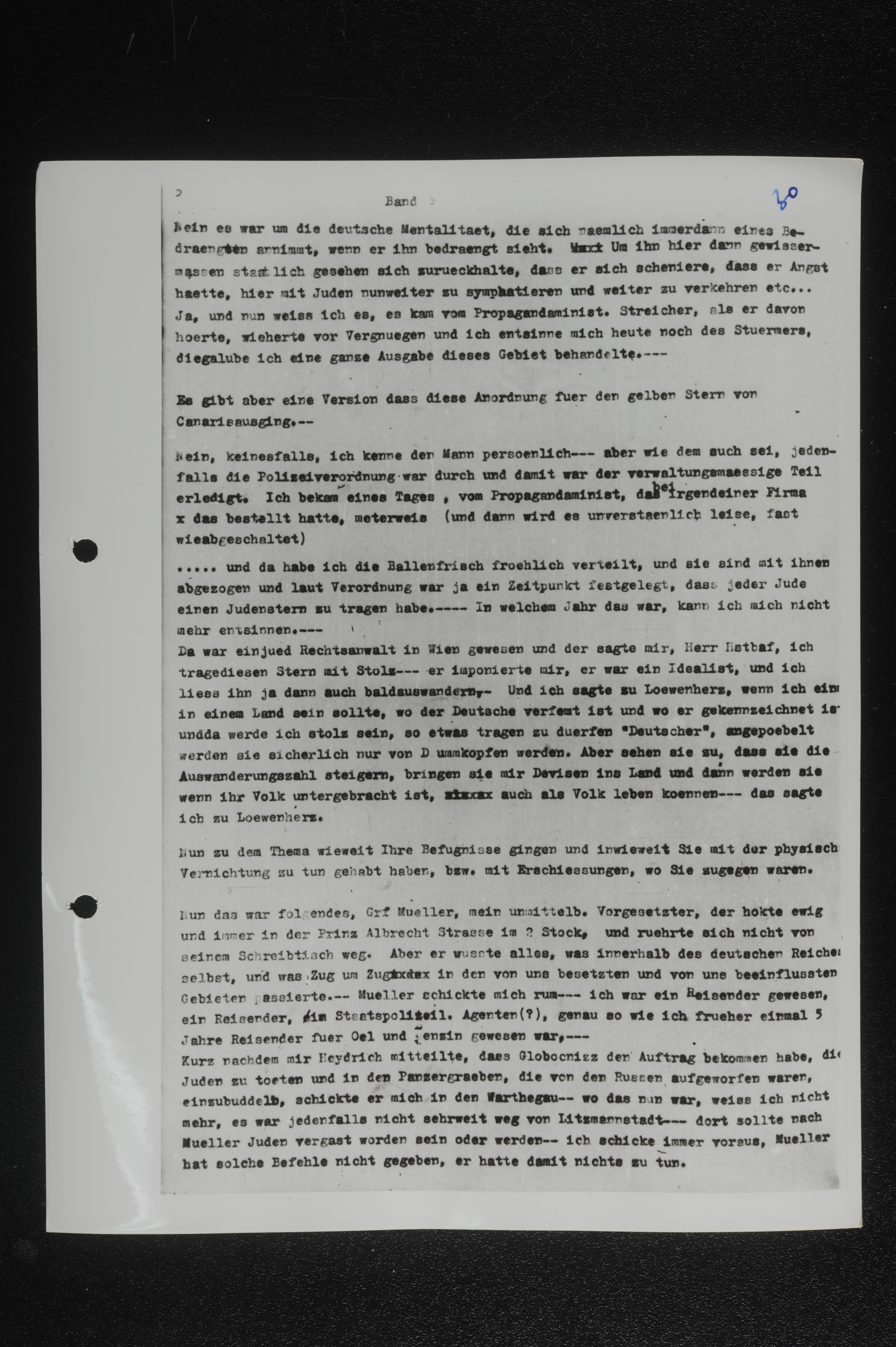
Page 290 of the typescript, O.65 file 86.
Page 290 · Yad Vashem Archives, O.65/86

Questioner

Today we come to Romania. As you know, most of the measures against the Jews were carried out by the Romanian government itself. The German offices were really involved only at the margins—for example, Ohlendorf's operational detachment (Einsatzkommando) in the Bu… and in Bessarabia. So I would like to move straight to 1941, when German offices really became active in Romania for the first time. Perhaps you remember that the police attaché there, Richter, reported to the Reich Security Main Office that Antonesko planned to deport 1[?]0,000 Jews across the Buk?

That is my Hauptsturmführer Richter, whom I assigned as adviser on Jewish affairs to the German legation in Bucharest. The envoy was Killinger. At the moment I do not recall his reporting that to me, but Richter was a very conscientious gentleman and, if that was the case, he will undoubtedly have reported it to me. But I do not see why that question is particularly interesting for me. If Antonescu wanted to deport the Jews, that could only suit us.

Questioner

No, that could not suit you, because we had no interest in Jews being deported into German-occupied territory. Richter was initially able to prevent those measures himself through his discussions in Bucharest; that was in October 1941. On 13 March 1942 a meeting on the matter took place between Mr. Eichmann, a Mr. Wetzel from the Eastern Ministry and a Mr. Rademacher. It was decided to warn Antonescu to refrain from these measures. Can you remember?

Eichmann

Yes, of course. I would naturally have resisted allowing Jews to be brought into territories already under our control, because my task had been to clear them of Jews. As far as the eastern territories were concerned, it could have been all the same to me: that was what the operational detachments (Einsatzkommandos) were there for, and I had no authority over them. But those territories were naturally taboo for me too, insofar as I could not allow Jews to be transported there from a place over which I had a measure of control. The world was big enough. They did not have to come into the territories we controlled.

Questioner

That also corresponds to what this hostile book says.

Questioner reads from a book

The deportations continued, but a month later Eichmann informed Rademacher that he would take security measures to stop these deportations [? to] the Buk.

Eichmann

Yes, that is entirely in line with my approach. I will not take Jews into a territory that I am glad is free of Jews. Rademacher probably came and asked me for advice about that, because, unlike von …, he was a rather easy-going man who wanted to make his work a little easier for himself. He was glad and grateful to get the rough text for the draft notes from me, which he then only had to put into diplomatic language, and the matter was settled for him.

Questioner reads from a book

The deportations then apparently stop. Rademacher states, however, that Eichmann's security measures consisted of having twenty-eight thousand Jews transported back

Open page image and German
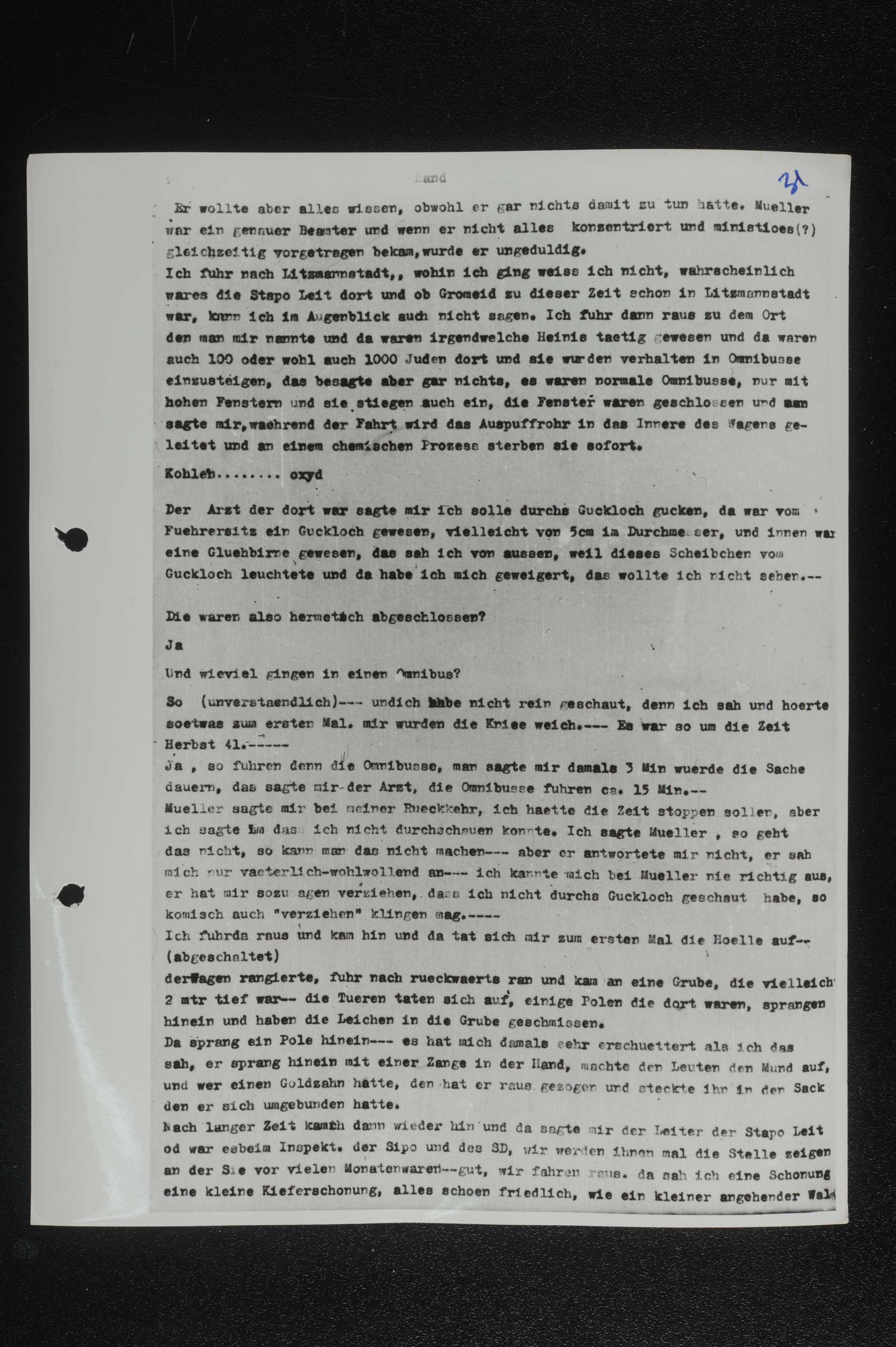
Page 291 of the typescript, O.65 file 86.
Page 291 · Yad Vashem Archives, O.65/86

Questioner reads from a book

into the ethnic German settlements [?]… where they were liquidated.

Questioner

Does the name Otto Bräutigam mean anything to you?

No.

Questioner

Here it says that Otto Bräutigam's signed report of May states that a large proportion of the Jews in … had died. Those were said to have been Eichmann's security measures.

Eichmann

But I had no authority to have Jews treated in any way in Romania, let alone to have them liquidated. I did not even have the authority to give the simplest civil order concerning a single Jew, let alone an order for liquidation. That is not correct.

Questioner

It is further claimed that on 11 June 1942 Eichmann confidentially told his staff that the Romanian Jews would now be sent to Auschwitz.

Eichmann

I cannot recall that. But if Jews were transported to German territory, or rather handed over to the German authorities by the Romanian government, then of course all those Jews were taken in in accordance with the Reichsführer-SS's order, and only then did they go to Auschwitz. Auschwitz was the reception camp for that purpose which the chief of the Economic and Administrative Main Office will have designated to me.

Questioner

Perhaps you remember, if I tell you that on 20 September 1942 State Secretary Luther informed Eichmann that the Romanian Foreign Ministry had now given its consent to the deportations.

Eichmann

State Secretary Luther never sent Eichmann a communication, not a single time. That would have been improper and would have bypassed official channels. If State Secretary Luther sent a communication, he sent it to the Chief of the Security Police and the Security Service—to Heydrich, or later to Kaltenbrunner. It may be that, in quite exceptional circumstances, a state secretary of another central authority sent one directly to the head of Office IV, Müller, and that I then received it with the appropriate directive from my chief. I might perhaps have received it in that way, but not otherwise.

Questioner

This book repeatedly claims that you were in very good contact with Luther, and in personal contact at that.

Eichmann

Of course I was in personal contact with Luther, and very good contact. How shall I put it? Privately we had no contact at all, but we got to know each other at a few meetings. That does not mean I would subsequently have been entitled to write personal letters to State Secretary Luther, or that he would have been entitled to do the reverse. By personal letters I mean official letters addressed to me personally, and vice versa. No, I had followed official channels and had to follow them.

Questioner

Are you also aware that in the course of these negotiations—the Foreign Office, the Romanian government, the Reich Security Main Office—the Reichsführer-SS expressed the intention of deporting the Romanian Jews to the Lublin area?

Open page image and German
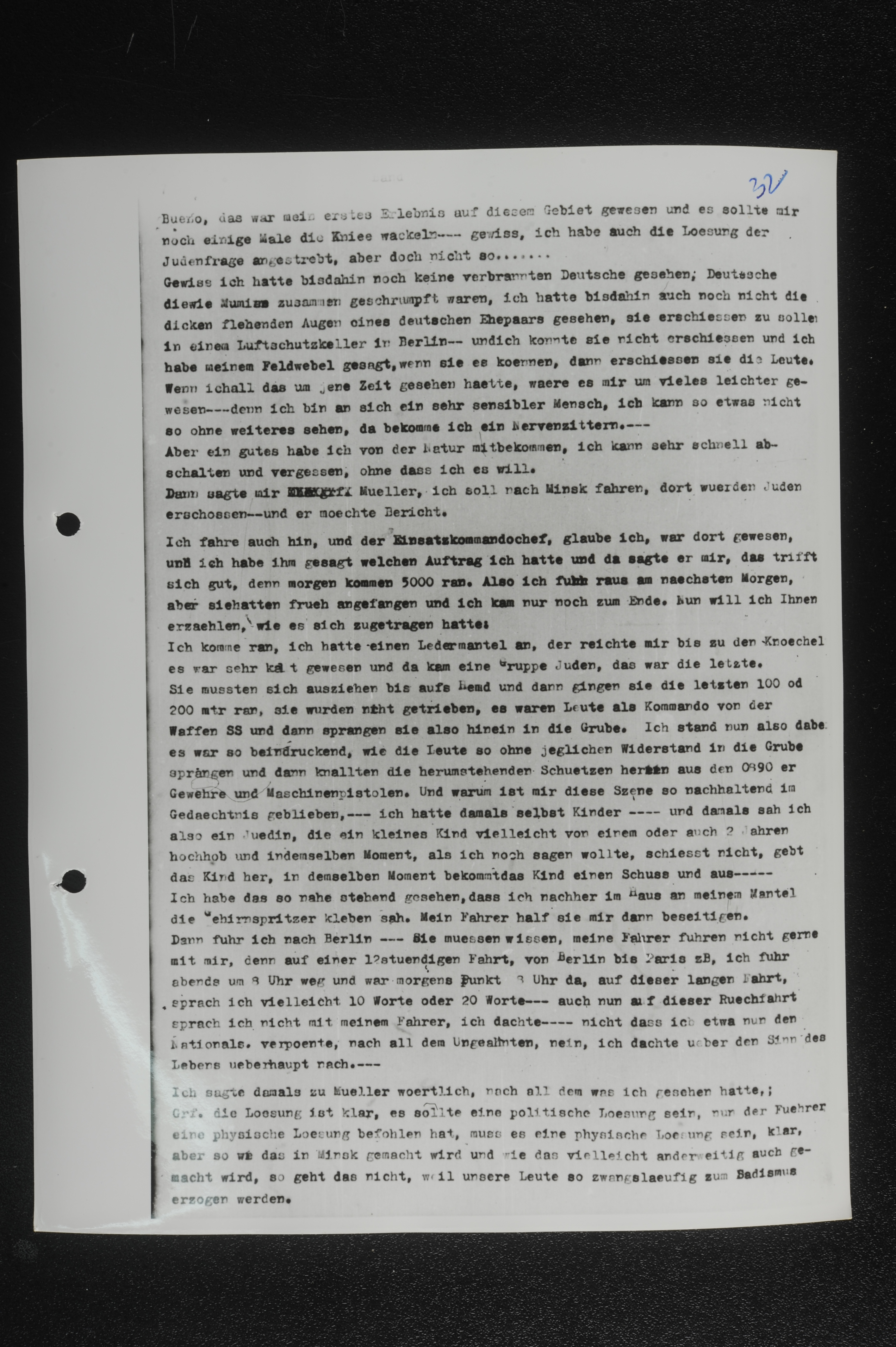
Page 292 of the typescript, O.65 file 86.
Page 292 · Yad Vashem Archives, O.65/86

Questioner

Specifically, to conscript the part fit for work into labour and subject the rest to special treatment?

That was a standard order of the Reichsführer-SS: Jews who were fit for work were to be put to work, and those who were not were to fall victim to physical annihilation. Which concentration camp—Auschwitz or Lublin—I do not believe the Reichsführer-SS expressed an opinion like that. If he did express such an opinion, it was always open to revision through a veto by the Economic and Administrative Main Office, because that office alone determined the reception sites. Well, if the Reichsführer-SS said Lublin and there was room there, they went to Lublin, provided the Economic and Administrative Main Office had capacity there.

But despite the Reichsführer-SS's wish they would not have gone to Lublin if there had been no capacity; they would have gone to Auschwitz instead. In that case it would have been Obergruppenführer Pohl's task to correct the Reichsführer-SS's original directive. I do believe the Reichsführer-SS said that, because he repeatedly issued impulsive orders which, as I have said, often went down to the smallest details, but in practice were often very difficult, sometimes impossible, to carry out.

Questioner

Do you remember anything about the Romanian commissioner for Jewish affairs visiting Berlin to discuss the economic details of the deportations?

Eichmann

I would not want to deny it, but I do not remember whether such a man negotiated with me. I would certainly be able to recall it if he had approached me and my office, because it would have gone beyond normal daily work and would surely have stayed in my memory. It was my habit to invite these gentlemen privately to lunch or dinner as well, and so many memories would have accumulated during those hours that I could still remember it today if that had happened. But I cannot recall it, and I would prefer to deny it.

Questioner

Out of this whole affair there allegedly arose a lawsuit between the envoy Killinger and Eichmann, because apparently all these negotiations over the deportation of the Romanian Jews were conducted without going through the envoy Killinger. There is a letter of 27 August that Luther received from Killinger, which says:

Questioner reads from Killinger's letter, as quoted in a book

‘I ask that when such important gentlemen come to Berlin, like this M…, they not be fobbed off in a manner that might damage the good relationship between Germany and Romania. I would also point out that all letters addressed to SS Obersturmbannführer Eichmann went through the Foreign Office, so that the Foreign Office knew about the proceedings. That Mr. Eichmann did not consider it necessary to contact the Foreign Office is in no way surprising to me, since I am sufficiently familiar with the methods of the gentlemen of the SS. I would further remark that all…’

Questioner

[unintelligible on the recording]

Questioner reads from Killinger's letter, as quoted in a book

‘… end up with the Security Service in next to no time.’

Eichmann

I must make a statement of principle about that. I told you that I had a very conscientious man in Romania,

Open page image and German
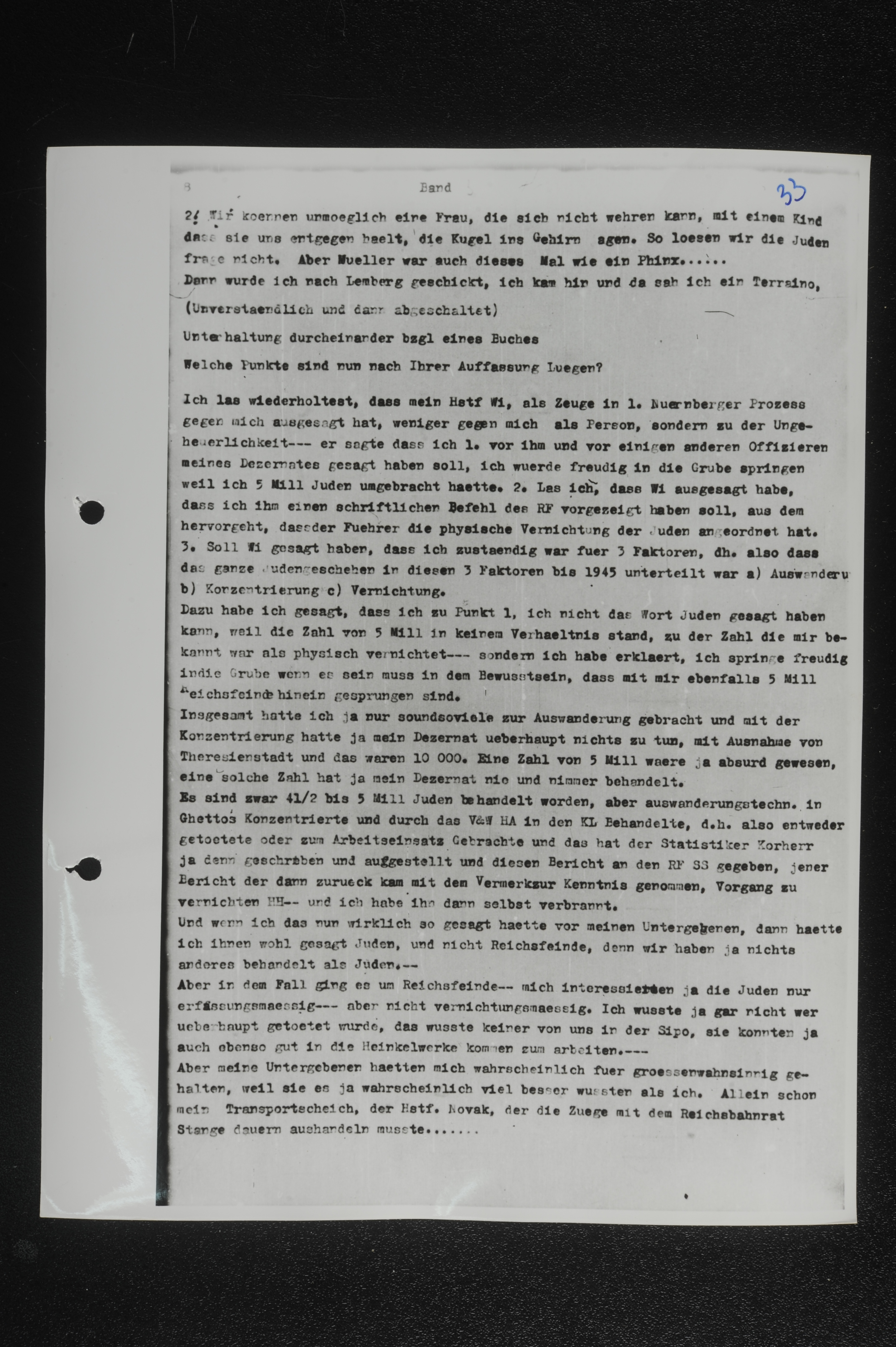
Page 293 of the typescript, O.65 file 86.
Page 293 · Yad Vashem Archives, O.65/86

Richter came to Berlin several times and complained that Killinger was muzzling him, which was why he came in person, since he could not report it in writing. That happened perhaps half a dozen times, because I ordered Richter—or rather instructed him—that whenever he could not manage his affairs, when fundamental opinions were at issue, he was to take a plane or a train, come to me and report. Knowing Richter as I did, he combined business with pleasure, which is also why it became half a dozen times. Killinger was apparently a gentleman in Bucharest who wanted to run things very autocratically.

He got on very well with everyone, including Richter, as long as he knew Richter was harnessed to his own vehicle. Then the men had all the freedom to which their positions entitled them. If the envoy Killinger now complains about me, I must counter that by saying that the envoy Killinger, in Bucharest far from home, did not know how the cards were shuffled and played. He could not know that the responsible councillor for legislation (Legislationsrat) from the Foreign Office appeared in my anteroom at least once a week and asked for a meeting with me. For some years that was Rademacher, and also von Thadden.

If the envoy Killinger says that he dutifully sent all letters through the Foreign Office to the Security Police and the Security Service but complains that this was not done in the other direction, he does the Security Police and the Security Service a grave injustice, which may be forgiven him on account of his general stupidity. He could not know that Office IV had much closer contact with the Foreign Office than simply sending written notes back and forth. Nor could he suspect that the responsible Foreign Office case officers sat down at the same table at least once a week with the man of the Security Police about whom he speaks so ungraciously, and discussed the matter.

Now it comes back to me, and I see Richter before me; then I know that Leccar was in Berlin. Only he did not approach me. Perhaps I met him at some discussion, perhaps somewhere over a meal, but I must now tell you that the name is not unknown to me.

Questioner reads from a book

The end of this whole affair was that Killinger finally declared that he did not want the matter pursued any further. Marshal Antonescu also changed his attitude, saying he wanted nothing more to do with Jewish deportations. He was also indignant about the German interference and then proposed Jewish emigration to Palestine.
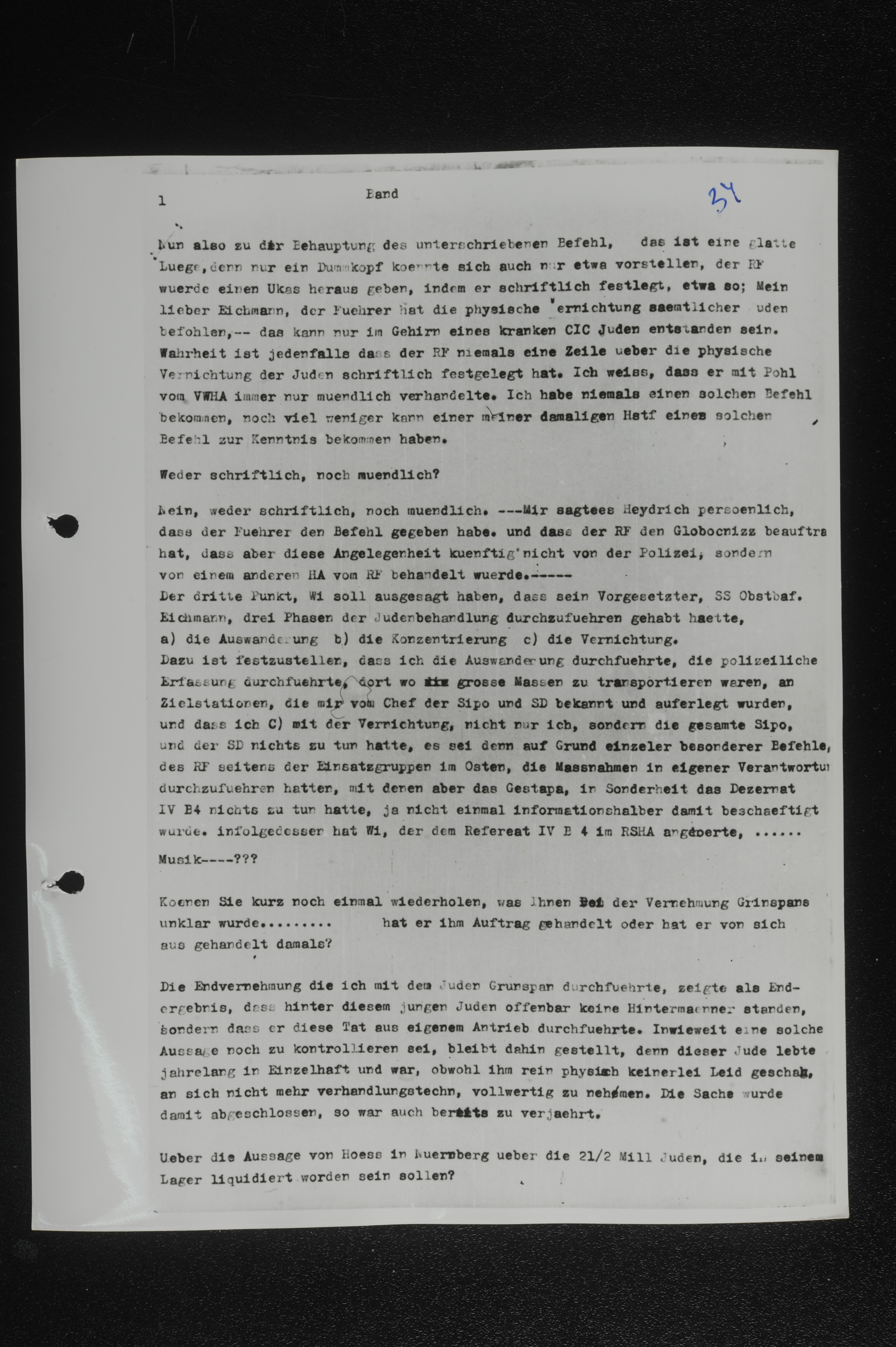
Eichmann

But the Romanians themselves killed the Jews?

Questioner

I have not spoken about that, because it goes beyond the scope of our discussion.

Eichmann

I told you at the beginning that it would have been unthinkable for me to give even the slightest order concerning Romanian Jews on Romanian sovereign territory. The Romanians' chauvinism would not have allowed it. But it suited me that the Jews solved their Jewish question themselves, and I know that the Romanians—Richter himself reported this to me—summarily liquidated their Jews in a manner that astonished me.

Open page image and German
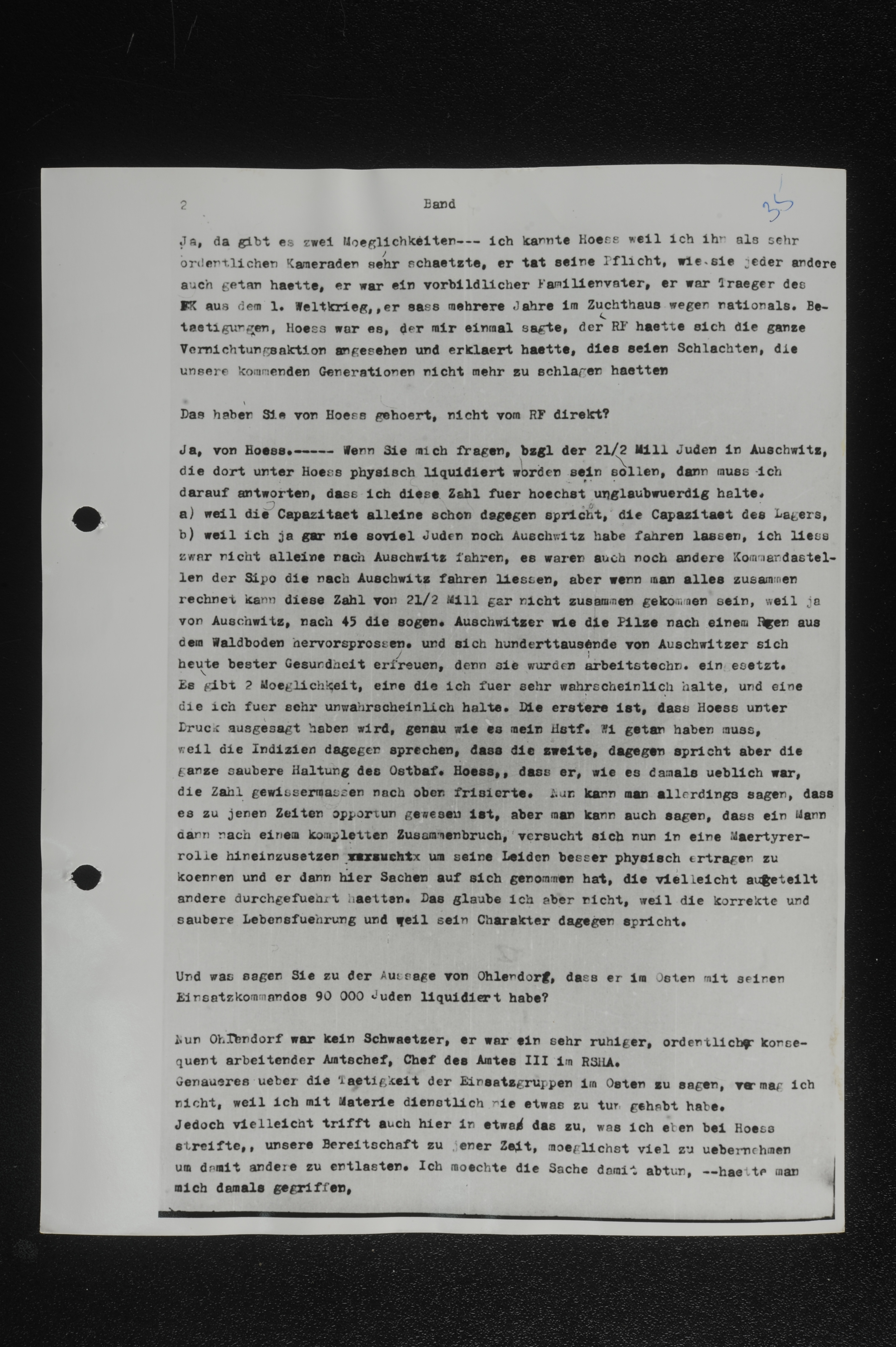
Page 294 of the typescript, O.65 file 86.
Page 294 · Yad Vashem Archives, O.65/86

To many, many thousands. I cannot give you the number.

Questioner

Are you aware that in 1943 the Jewish World Congress approached the North American State Department? A sum is reported, a transfer to a Swiss blocked account, which would allegedly be enough to buy the escape of 70,000 French and Romanian Jews.

Eichmann

In March 1943—no, I am not aware of that.

Questioner

It then goes on to say that

Questioner reads from a book

in the end a ransom was used for some Hungarian Jews—a small part of this money. The original plan ended in complete failure

Questioner

?

Eichmann

That is completely unknown to me.

Questioner

Do you know anything of an English offer to send 5,000 Jews from Poland, Latvia and Lithuania to Palestine, 85 percent of these 5,000 Jews being children? In 1943.

Eichmann

That never reached me, and it would not have been possible either. At that time I was very much against it, because around then the order of the RF (Reichsführer-SS) that no Jew was allowed to emigrate was being enforced very rigidly.

Questioner reads from a book

Eichmann insisted that 20,000 Germans of military age be exchanged.

[The rest is read out insanely fast and very indistinctly.]

Eichmann

I cannot recall it, but if that had been the case, I would certainly have wanted to gain an advantage for the Reich. But I do not understand why 20,000—why I did not demand 50,000, following the RF (Reichsführer-SS) principle of one to ten. Ideologically the idea appeals to me, but I cannot remember it.

Questioner

Do you remember that Hitler made Antonescu the offer to let 70,000 Jews leave for Palestine?

Eichmann

That is unknown to me.

Questioner

Is it also unknown to you that you declared that

Questioner reads from a book

this operation with the 5,000 children must be carried out quickly, because the time is not far off when the emigration of children from the eastern territories will no longer be technically possible? In 1943, at the end of May. Later von Thadden came to the Foreign Office. He too was in a hurry, but he wanted to send the 5,000 children to England. He also claims that Eichmann had said that the only place where there were still 5,000 children was the ghetto of Botsch–Motsch, but that this too would shortly be liquidated on Himmler’s orders.

Eichmann

I would not want to deny all this. I would have to think about it.

Questioner

Is it true that on the day Romania laid down its arms, on 23 August 1944, you were in Budapest in order to liquidate the Jews of the Romanian border towns of Arat and Daen…?

Eichmann

That is of course complete nonsense. I left Budapest at a particular time in the summer of 1944. One side—see Joel Brandt —interprets it as

Open page image and German
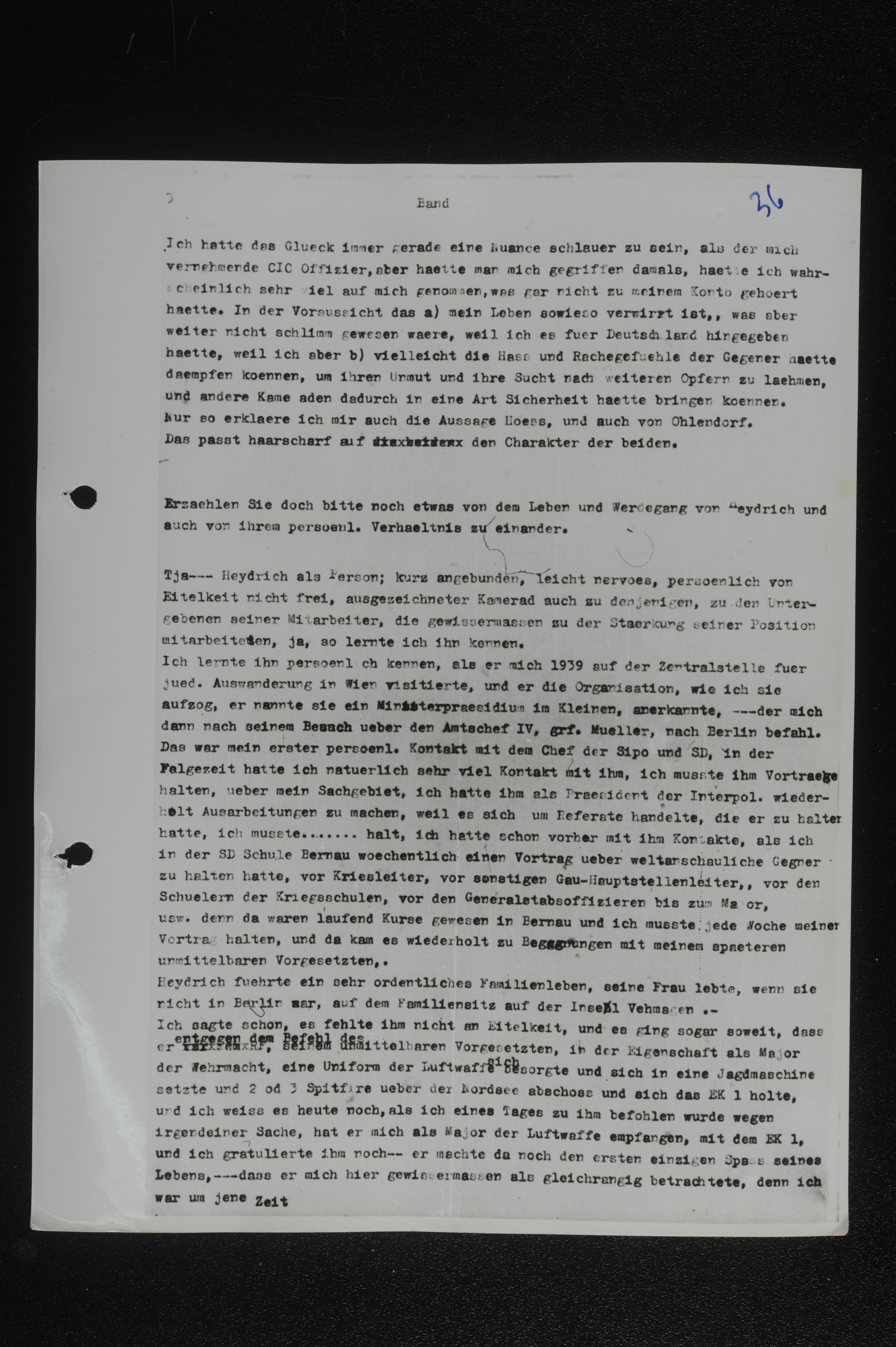
Page 295 of the typescript, O.65 file 86.
Page 295 · Yad Vashem Archives, O.65/86

that the deportations from Hungary had stopped and that I disappeared to a country estate to bide my time there. Now I hear from you that around that time I liquidated the Jews from the Romanian border towns, or wanted to liquidate them. To that I have the following to say. I had to break off my WORK in Budapest. I myself had to withdraw, because I myself, under the order of the RF (Reichsführer-SS)—because I had to go to Neuarat, Nikolsburg and so on, to remove 10,000 ethnic Germans there from the Russians’ grasp. And to evacuate these 10,000 ethnic Germans one way or another. So I have only this to add: around that time I did not see, let alone speak to, a single Jewish limp-dick, and my detachments likewise did not handle a single Jew. We had only this task of evacuating these 10,000 ethnic Germans in those border areas.

[End of the discussion of Romania.]

[France]

Questioner

Is it true that Heydrich intended—Heydrich’s original intention—to treat unoccupied France not as a territory to be made free of Jews, but as a place to gather the Jews unwanted in Germany?

Eichmann

Yes, that is right. I was once forced by some impatient Gauleiter—that is, I received the order to round up some Jews in western Germany. As I remember, that was five or six trainloads, and I then had them routed through occupied France. I personally had them run through from the last station in occupied territory to the first station in unoccupied territory, without a timetable conference and without any preliminary timetable discussion. But precisely that little stretch was probably the hardest work of all.

Questioner

It is now claimed that Hitler’s intention was different from Heydrich’s, and that for that reason, from 1942 on, there was a turn of 1 80 degrees and an attempt was now made to bring Petain into line with the measures taken in Reich territory.

Eichmann

The idea that Heydrich departed from Hitler’s line is utter nonsense. A man like Heydrich did what Hitler demanded. …
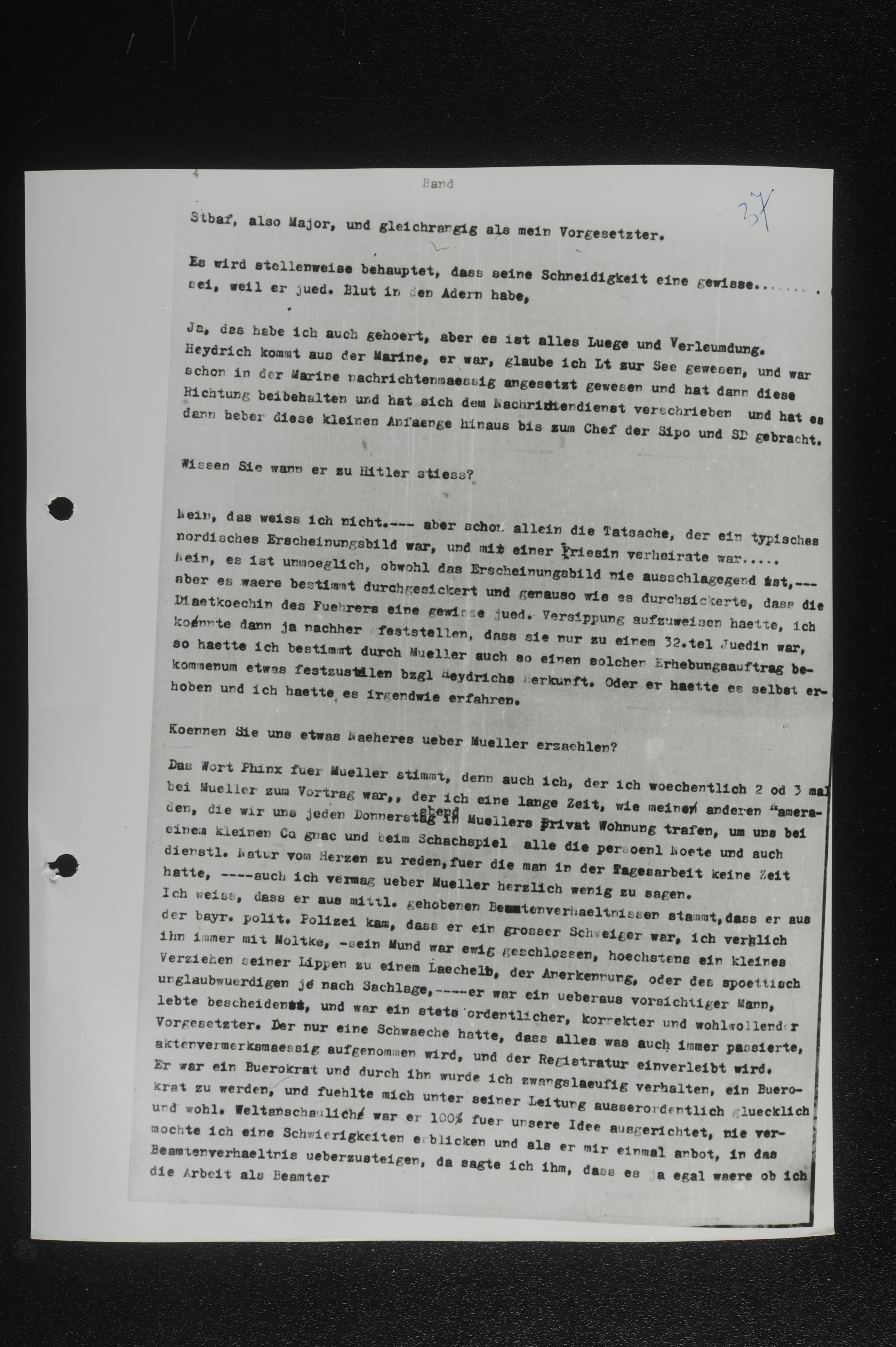
Questioner

Yes, hence the turn of 180 degrees. … You know that one of the first measures was to set up a body to handle the Jewish question on the model of Prague and Vienna, with the participation of the Foreign Office in the persons of Ambassador Abetz and his colleague Schwei… and Zei… As a preparatory measure for later deportations.

Eichmann

Yes, that can at most have been a move by the Foreign Office so that the Foreign Office too would retain the lead in these matters in France. For I did have a man in France with the commander of the Security Police and the Security Service, an adviser on Jewish questions, but he was under the commander—…
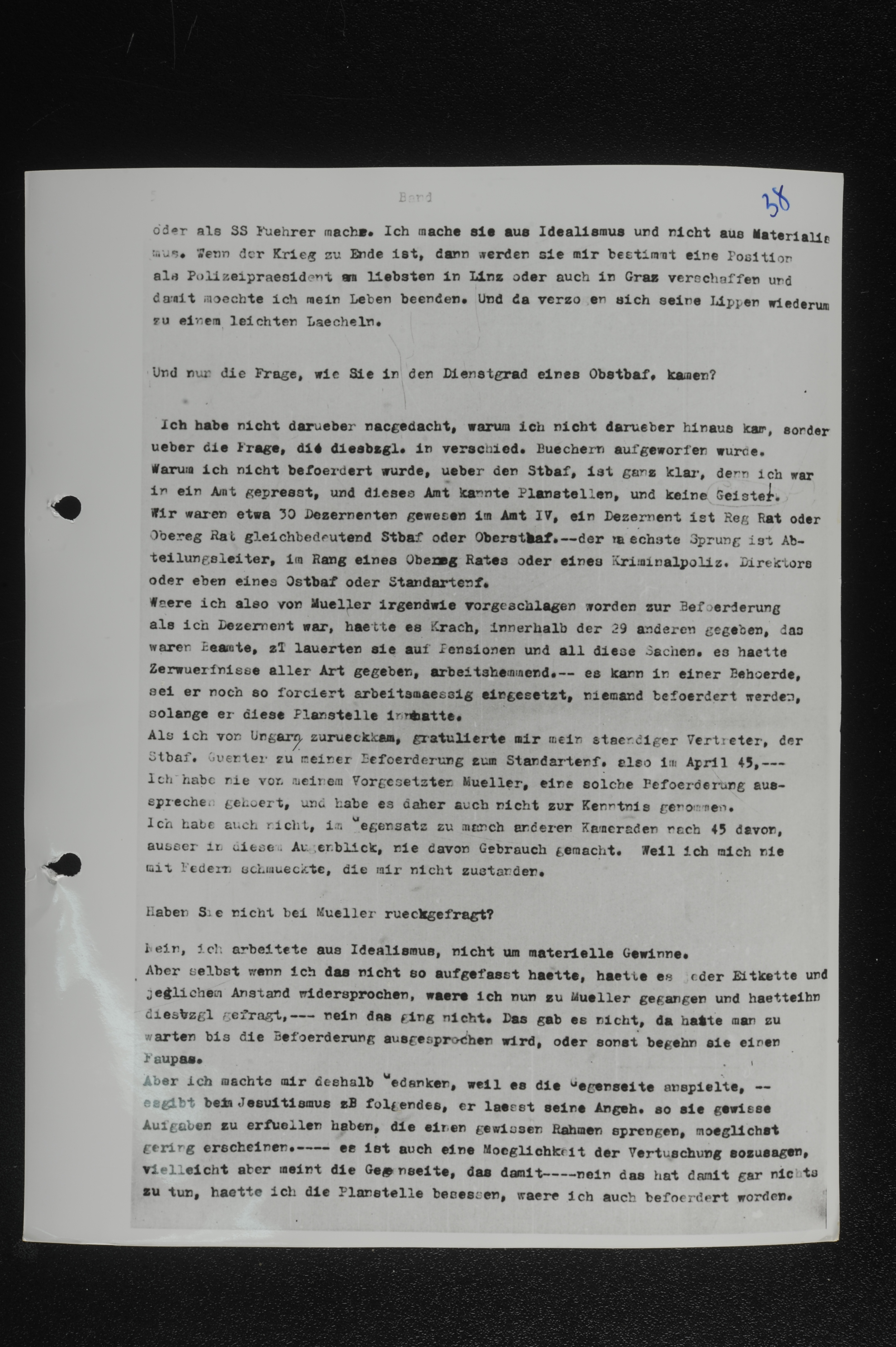
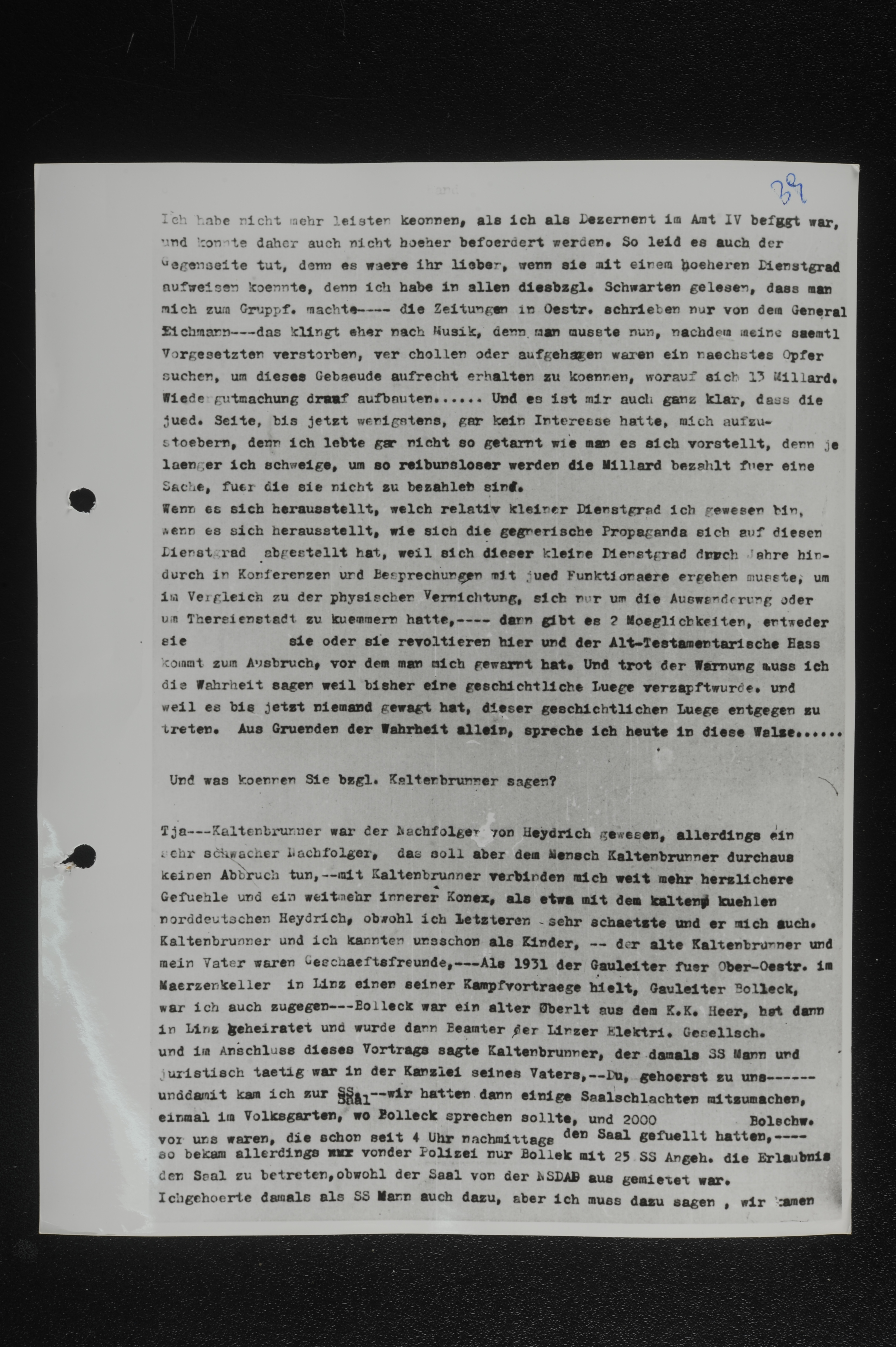
Open page image and German
Pages 296 to 297 of the typescript, O.65 file 86.
Pages 296 to 297 · Yad Vashem Archives, O.65/86

who handles these matters. He advised the French government’s commissioner for Jewish affairs.

Questioner

It is now further claimed that the attempt to build up a kind of Jewish association in France failed completely, because of the 300,000 Jews, at most 65,000 were deported. The reason given is that the work was unsuitable from a psychological point of view.

Questioner reads from a book

It took a long time before the Gestapo understood that even those French officials who were largely willing to cooperate insisted on not regarding a Jew born in France, or a Jew who had been granted French citizenship, as a Frenchman. So it came about that fewer than a tenth of the Jews deported from France held French citizenship, because most of the refugees were exterminated.

Eichmann

Yes, that is exactly right. Seldom has a country fought so hard for the Jews who held its citizenship as France did. It was a bad arrangement in itself to post a man to such a country in an advisory capacity and place him under a Commander of the Security Police and the Security Service. That fact alone put him at odds with all the French officials, however good their cooperation might be. He was, after all, an officer of the Commander of the Security Police and the Security Service in their France. Everything he said had to be rejected from the outset by these nationally minded Frenchmen, even though he himself may have been anti-Jewish to begin with. Dannecker may not have been the right man either, because Dannecker is a solid but clumsy Swabian who finally worked his way up in the Security Service to Hstf. (Hauptsturmführer): loyal and solid, a competent handler of files.

Questioner

Was he a lawyer?

Eichmann

No, not at all.

Questioner

He is listed here as a lawyer?

Eichmann

No, he did not even have a proper trade. I believe he once trained as a glove maker.

Questioner

But why was such a man put in a post as important as the one in France?

Eichmann

For years, from 1935 or 1936 right up to those days, Dannecker dealt with assimilated Jews. He was a desk officer, and in that field he was an expert. Because most of the Jews living in France were assimilated in outlook, this desk officer was posted to France. I agreed to that for good reasons, because I had nobody else and nobody better at my disposal, and nobody else and nobody better was given to me. Even if a super-lawyer had been put in that post, he would still have been badly placed as a desk officer under the Commander of the Security Police and the Security Service, because there was nothing else there. At most we could have fitted something else in there, with the Vichy government, with the representative of the Foreign Office, but that was

Open page image and German
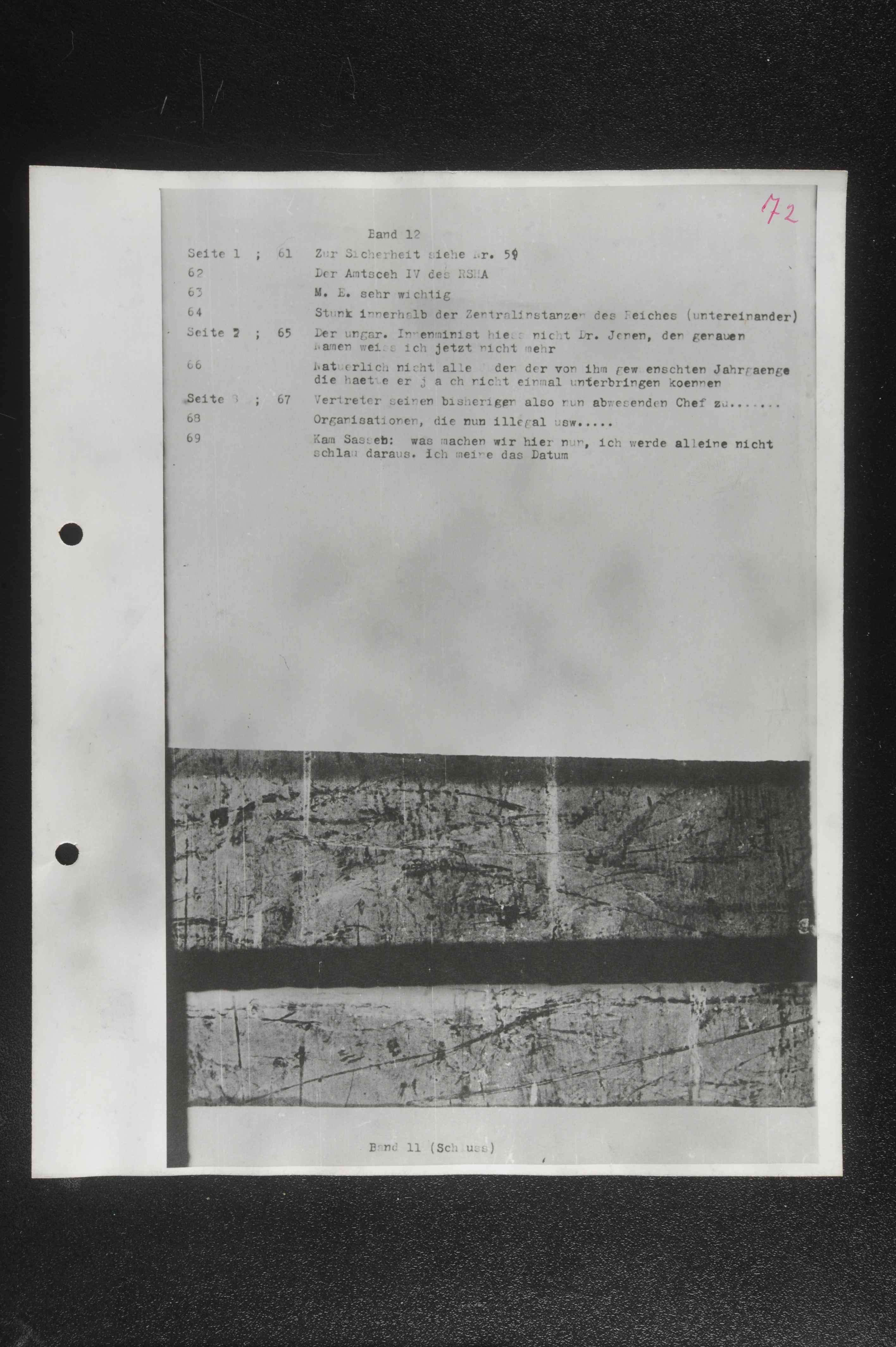
Page 298 of the typescript, O.65 file 86.
Page 298 · Yad Vashem Archives, O.65/86

not possible, because we were constrained here within our Security Police apparatus, which had been built up in France, before the commanders and commanding officers of the higher police leaders, now also—

[unintelligible on the recording] (Because someone is blowing their nose.)

because the man assigned to the French Vichy government did not have the … that another head of mission had, so that he could keep attachés. An adviser on Jewish affairs is nothing other than an attaché. They were also listed as political attachés. My men who were out on missions of that kind were attachés. Not in France, because in France we had the entire hierarchy of the Security Police represented. So the conception, in causal terms [?], was already ill-suited to getting a comprehensive hold on this opponent.

[Typed as notes in the transcript: A further assessment of Danneker.]

Questioner

Could the General Jewish Union of France be compared in any way with a Jewish council in Eastern Europe?

Eichmann

No, not with one in Eastern Europe. The General Union at least had more ability to assert itself. They were not merely yes-men, like, for example, the Jewish council in the eastern European district. The French Jewish council held a middle position between our Reich Association in Germany and the Jewish religious community in Vienna. I would almost put it on a level with Prague. For those people representing the Reich Association in Germany—this Dr. Eppstein, the man who negotiated with you—he was not someone who simply took orders. Neither was Dr. Löwenherz in Vienna.

Questioner

Was it also impossible for these reasons to set up any ghettos in France, or a kind of Jewish police, or similar things?

Eichmann

No, that could not be done. It was impossible.

Questioner

Do you still remember anything about—

[Spoken indistinctly; it is enough to drive one mad.]

which was issued by the French government in the year nineteen hundred and forty—

[Good grief!]

in October? Above all, it made possible the detention of the originally German Jews who came to France as refugees and placed themselves under the refugee law.

Eichmann

Not in detail. I only know that the French government fought and fought here, that Dannecker was weak, that Knochen, the commander, was also weak, and that the German higher police leader Oberg had relatively little ability to get things done. That was why, despite my shortage of time, I was in France relatively often—three to five times—and saw to things myself. But even when the master comes to check only every six months, he is told all sorts of things. The difficulties are exaggerated beyond all proportion, and in the end he has to be glad to come back with a crumb instead of the chunk he had hoped for.

Questioner

At a meeting held in February 1941, speaking on behalf of the

Open page image and German
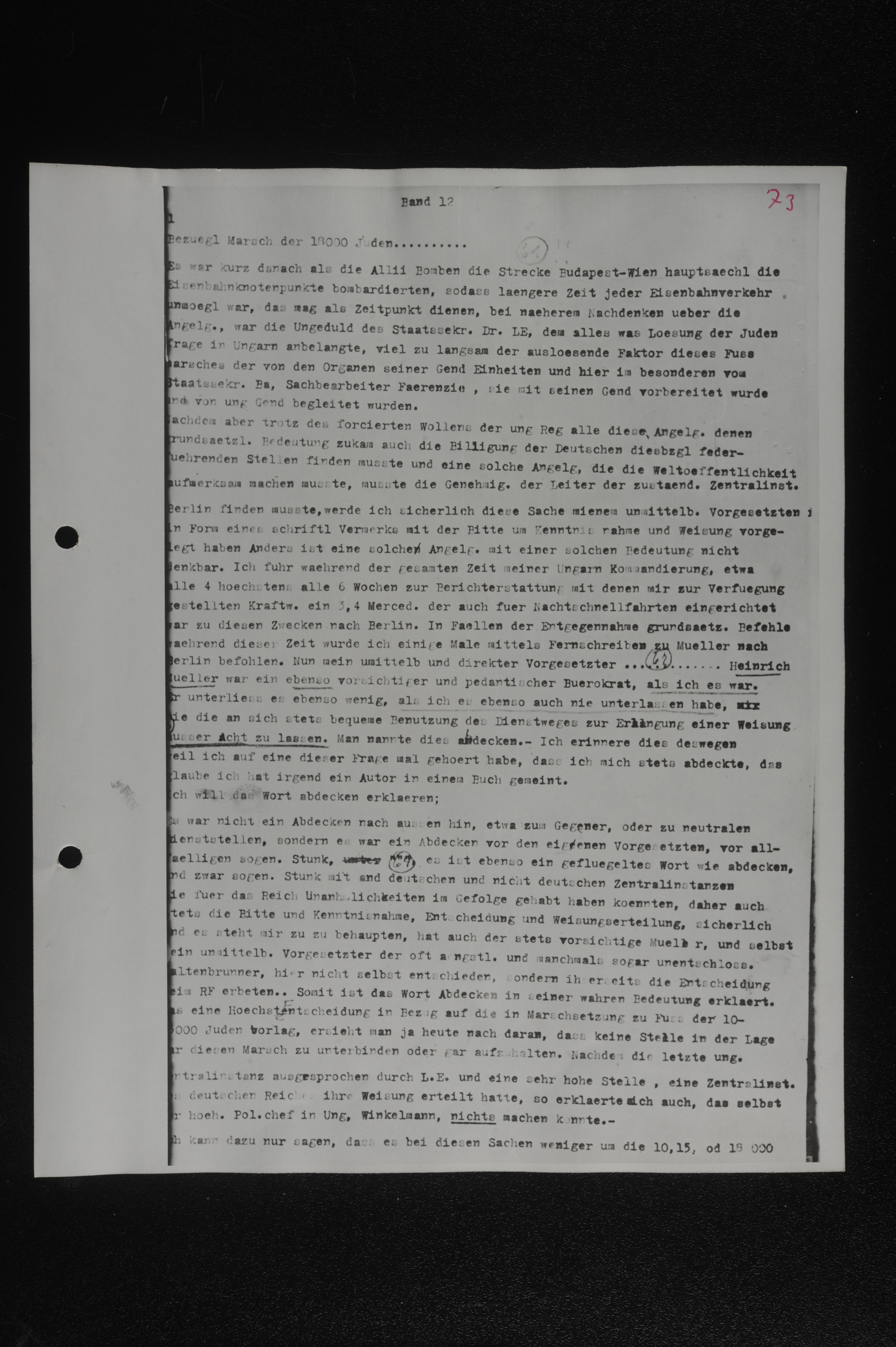
Page 299 of the typescript, O.65 file 86.
Page 299 · Yad Vashem Archives, O.65/86

Questioner

Chief of the Security Police and the Security Service in France, SS-Stbf. (Sturmbannführer) Lischka declared—

My predecessor in the Gestapo Office as the officer for Jewish affairs was the government councillor and SS-Stbf. (Sturmbannführer) Lischka, and before him there was a government councillor Langer. Those two were my predecessors before 1940.

Questioner

Lischka was Knochen’s deputy.

The reaction of the French people to anything coming from Germany was said to be such that the establishment of a central office for Jewish affairs had to be left to the French themselves. That is one difficulty. The second:

Questioner reads from a book

the commissioner for Jewish affairs, who allegedly caused the greatest difficulties, had been secretary-general of the Legion of the …, and the government made him the first commissioner for Jewish affairs. Official bodies, such as Ambassador Abetz, found that he offered the greatest resistance. Dannecker himself said that he made no secret of his sympathy for assimilated Jews, and that the arrest of 3,600 Polish Jews naturalized in France had caused more agitation in Vichy government circles than the arrest of 30,000 unwanted Jews who had immigrated from the Reich.

Questioner

Do you know anything about this?

Eichmann

Yes, I know the name of the commissioner himself, but less about his functions. But since Lischka has been mentioned, I must say that Lischka is a worthy match for Dannecker. When he was still a departmental officer in Office 4, he was a man consisting of a government councillor’s coat, with a government councillor’s brains and abilities harnessed inside it. Beyond that he showed no initiative at all. He did what the law drove him to do. A Lischka did not even check whether what the law called for was carried out. That is where I differ fundamentally from my predecessor.

For I too did nothing other than what the law told me, but I applied myself with more diligence and more effort to checking whether what the legislator wanted was actually being done. That was why I was not always an easy superior for my subordinates. Now Knochen had just such a man, Lischka, as his deputy. I had often been at loggerheads with him personally over substantive matters when I was still an officer in the Security Service Main Office with no executive powers at all, while he handled the same subject area as an officer in the Gestapo Office and had executive powers.

Beyond these substantive differences there arose a mutual personal aversion that was never expressed, because I was an idealistically committed Nazi, whereas he was a man drawing a salary. I still remember when I first heard that Lischka was to become Helmut Knochen’s deputy. Knochen came from the same era of the Security Service as I did, except that he came more or less from the newspaper side, because the Six office also monitored foreign newspapers. When I later met Lischka in Paris, at a time when I could give him orders—Lischka was, professionally speaking, a dud, and in Paris he fitted Dannecker as a spectacle case fits the glasses. They complemented one another, and today we see the result in the opposing literature as well.

Open page image and German
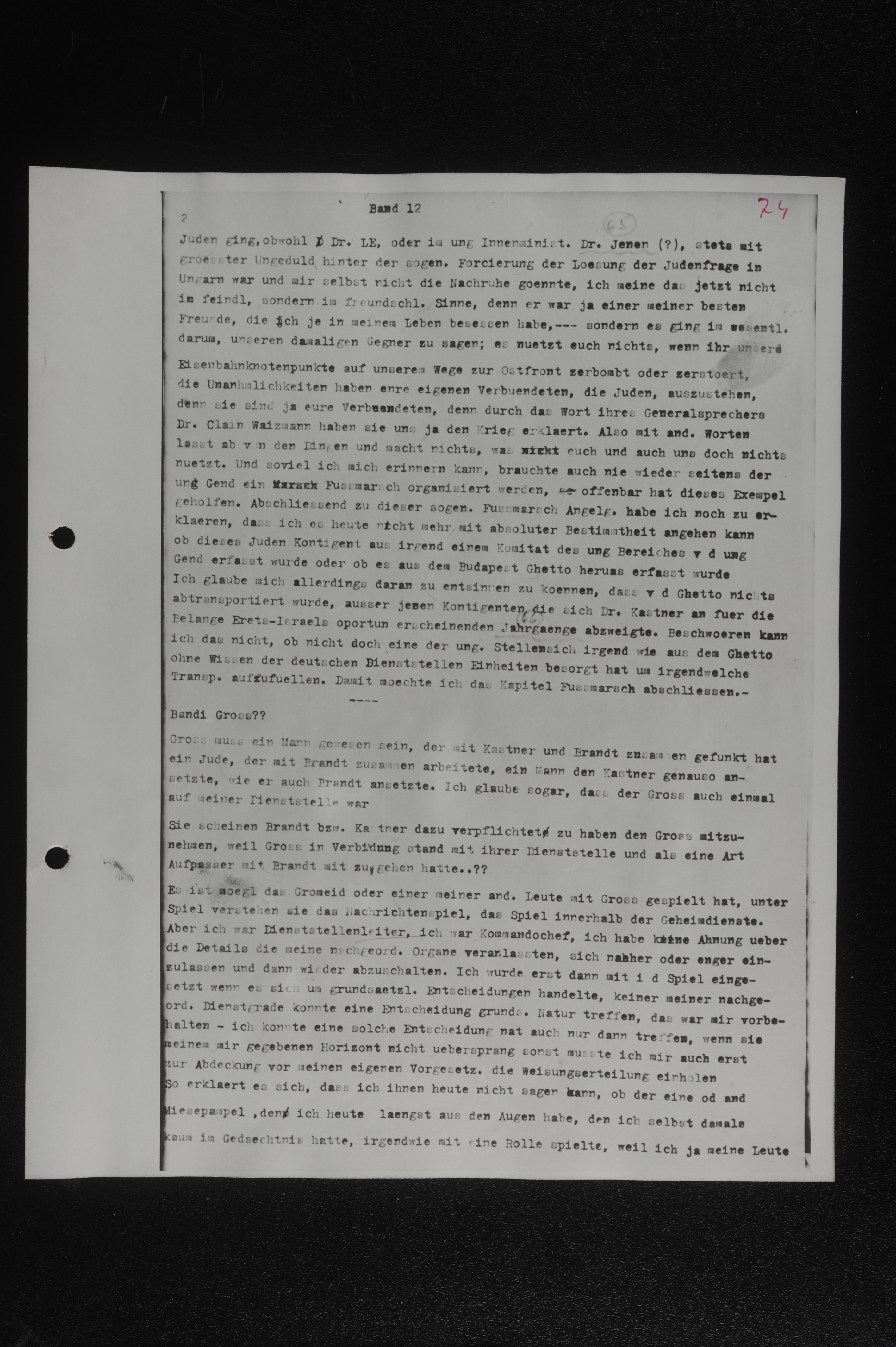
Page 300 of the typescript, O.65 file 86.
Page 300 · Yad Vashem Archives, O.65/86

Questioner

What can you say about the Wehrmacht, in your Security Police area, in the handling of the Jewish question in France?

Now that I have described Dannecker and Lischka to you, I need take no further trouble over describing the responsible desk officer of the Military Commander of France. If anything, I could put him a small degree below the two I have just described. They are worthy of shaking one another’s hands. But I must always say that with Dannecker it was stupidity, whereas with Lischka I have to assume that humanitarian views allowed him to hide very comfortably behind regulations, decrees and law. Dannecker never got as far as an excuse, because his outlook was so narrow.

Questioner

Back to the Wehrmacht. It is claimed here that

Questioner reads from a book

General Stülpnagel did oppose the deportation of Jews to some extent. Only in December 1941 did he consent to the deportation of Jews from France, and then only under the pretext of reprisals. For France differed from Russia in that the Wehrmacht had not surrendered its rights and …—

Questioner

[Again spoken so indistinctly, by this Dr. Langer.]

to Heydrich.

[The following passage is also fast and indistinct; something about Keitel and Heydrich?]

Eichmann

Yes, I said earlier that France was a problem child for me. That was why I had to go to Paris myself excessively often. My superiors had noticed the sluggish progress in France long before I did. They heard about it from their political informants, through their daily dealings with the Party’s officeholders and through their other international contacts, and that was why I was so often ordered to Paris. I must say that I could achieve even a few successes in Paris only by acting with the greatest energy. I knew that Dannecker was having an affair with a girl in his own office or in the office of the Commander of the Security Police and the Security Service, and that this tied him to Paris.

I threatened him several times with immediate transfer back to Office 4 if he did not achieve this and that in the time ahead and could not assert himself. And I must say—I do not know—perhaps that helped bring about some modest successes. I say this because it is true and because I never made any secret to Müller of the tangled situation as such. For if I had to fight a super-bureaucratic state in France, and had to overcome a hundred legal hurdles and a hundred authorities just to get a single Jew out, then that shows how tangled the position of our administratively organized apparatus in France was, at least as far as the Security Police was concerned.

Questioner

Does the name SS-Ostf. (Obersturmführer) Sommer mean anything to you?

Eichmann

Yes, Sommer, yes.

Open page image and German
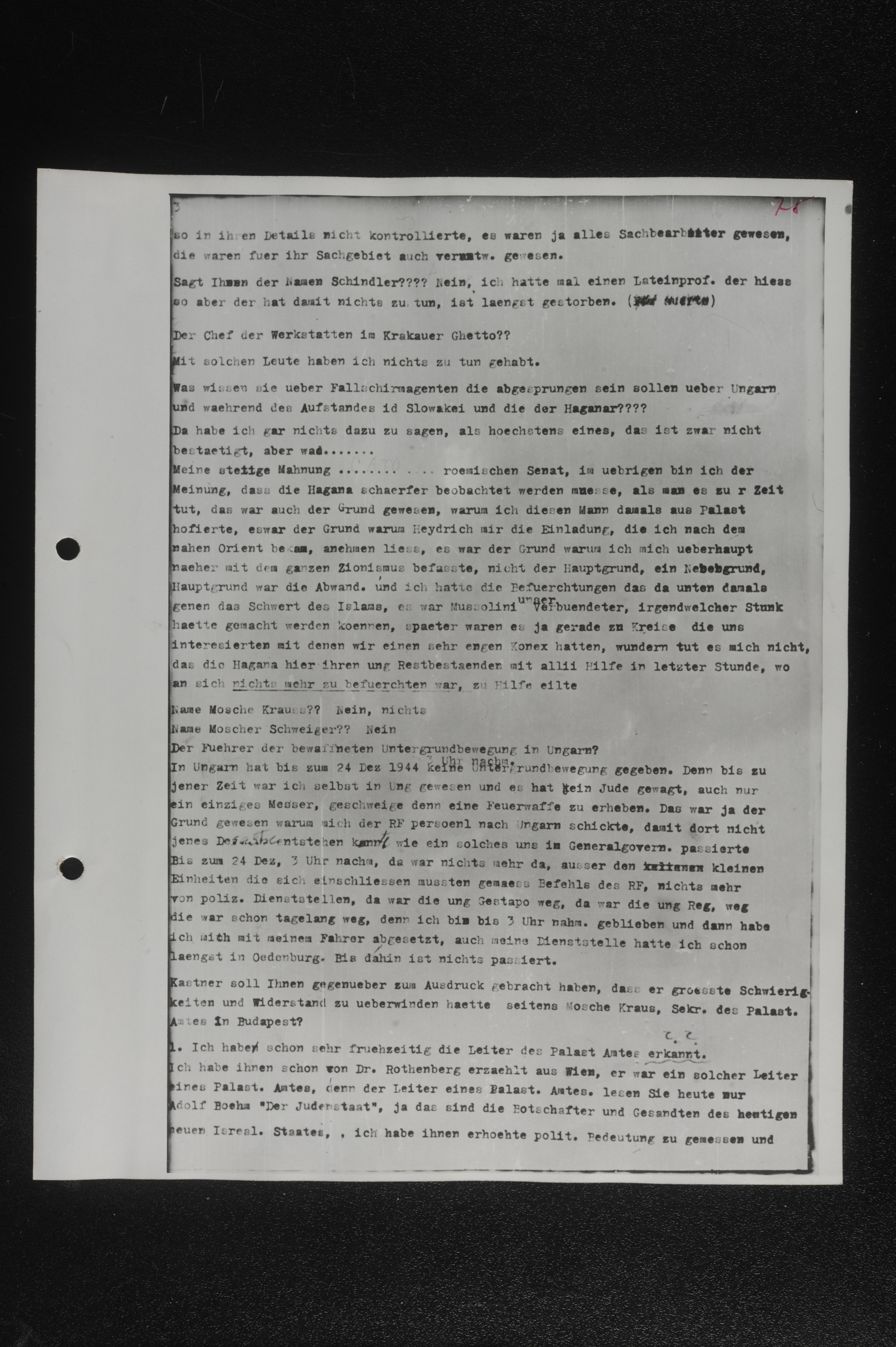
Page 301 of the typescript, O.65 file 86.
Page 301 · Yad Vashem Archives, O.65/86

Yes, he had been Sommer’s deputy.

Questioner

The following.

Questioner reads from a book

This clash began with a positively ridiculous incident. On the night leading into 2 October 1942, an attempt was made to blow up two Paris synagogues. The Commander of the Security Police and the Security Service sent a report to Stulpnagel describing the explosions as the work of French fascists. But before he sent the report, he knew that a certain SS-Ostf. (Obersturmführer) Sommer from his command was under arrest. Sommer had boasted about the explosions to two French Gestapo informers during a drinking bout. This led to a judicial investigation on 5 October, in which Sommer admitted having supplied the explosive material … and to his helpers, all Gestapo informers. The case was reported to the Reich Security Main Office in Berlin, with a report from Stulpnagel.

Questioner

[I do not know whether that is right. As has often happened on this tape, the speaker talks fast and inconsiderately indistinctly.]

Questioner reads from a book

But unofficially Stülpnagel learned from an assessor of the investigating court that Sommer had claimed to have received the corresponding orders from Knochen. Stulpnagel then complained to Keitel that this only increased the SS’s difficulties with the French government, which were already great enough over the shooting of hostages.

[The rest is again indistinct.]

Heydrich then replies to Keitel that the political situation made it seem expedient that it should be shown to the United States, to the French public and to world opinion—

[unintelligible on the recording]

Questioner

A number of further things are explained.

Questioner reads from a book

He asks that Knochen stay and that Sommer be transferred to Berlin. That was on 22 October 1942, when Keitel demanded the recall.

Eichmann

I do not know of the incident. I know only the following: Sommer was Dannecker’s deputy, and only Knochen can have appointed him to that position. What is strange is that around that time—I could never explain it to myself—I was ordered to Heydrich at the castle in Prague. No one else was present at lunch but Heydrich, Thomas, Heydrich’s adjutant, and my humble self. But nothing was said about it, and I still ask myself what underlying motive Heydrich had for inviting me to lunch without telling me anything, with Thomas also present.

Perhaps Heydrich wanted to tell Thomas that his staff carried out the orders they received unconditionally. If so, the meeting may have had a point. I could never explain it to myself. That Heydrich invited me to lunch without any background, without any reason, with another person whose rank was significant, has always been a riddle to me. Now I am thinking about it: those struggles may have been taking place around that time.

Questioner

Was that after Thomas was recalled from France and transferred to Russia?

Eichmann

I cannot tell you that. It was around the time you have given me.

Open page image and German
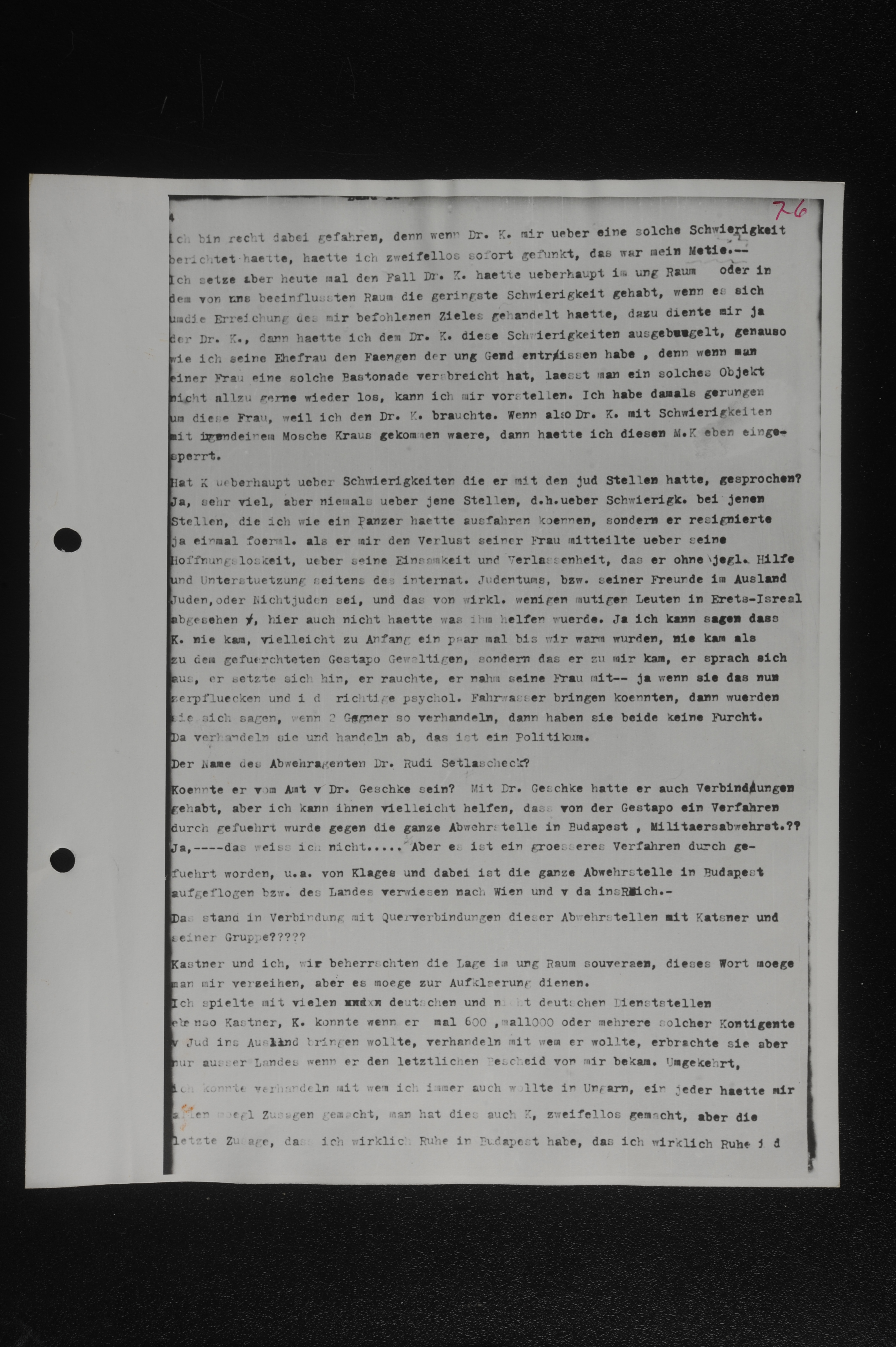
Page 302 of the typescript, O.65 file 86.
Page 302 · Yad Vashem Archives, O.65/86

Questioner

That would be the time, then. Oberg was put in Thomas’s place then.

[Typed as notes in the transcript: One comparison still remains—October 1941—Comrade Sassen, with the little book “Laws” on the Jewish question—the commissioning of the Chief of the Security Police and the Security Service by Geering with the Final Solution of the European Jewish question.]

I know nothing at all about the incident with Sommer itself.

Questioner

Do you know that the Military Commander for France, Otto von Stülpnagel, sent Keitel a proposal on 5 December 1941 to appease Heydrich?

Questioner reads from a book

He demanded the execution of 100 hostages in retaliation for three attacks on his soldiers. The Jews of Paris were also to pay a collective fine of one billion francs, and 1,000 Jews and 500 communists were to be transported east for forced labor.

Eichmann

I know nothing of that measure, nothing at all.

Questioner

Do you know that Heinrich von Stülpnagel refused the army’s assistance in the roundups of Jews on 13 July 1943?

Eichmann

When I say that I do not know of it, that does not mean it did not happen. It means I have forgotten it.

Questioner

This very deportation of the 1,000 Jews had various further consequences, because Heydrich could get no freight space, as other transports were more important, and Christmas intervened.

Eichmann

I do not believe that. For 1,000 men I could have obtained a transport train at any time.

Questioner

But there is said to be a communication of 24 December stating that a Wehrmacht transport command permitted no special transports through the Reich during the Christmas leave period.

Questioner reads from a book

Consequently, the Jews of Paris, who would otherwise have been taken directly to the death pits at …, were partly set free and partly held back in Auschwitz. On 28 February Dannecker was still trying to obtain Eichmann’s assurance of a definite date for deporting the 1,000 Jews, but without success. Only on 28 March did the first transport destined for Auschwitz leave

Questioner

?

Eichmann

I can no longer recall that.

Questioner reads from a book

Passenger cars were made available afterwards because there were no trucks, by Hstf. (Hauptsturmführer) Novak.

Eichmann

Well, if Novak was involved, then the story will probably be right.

Questioner reads from a book

Eichmann was visited in March 1942, and at this visit Dannecker boasted that he had been the first to propose continuing deportations from France. On 9 March Eichmann then informed Rademacher at the Foreign Office, who was blindly devoted to him, that the number of deportees to be expected immediately would be 6,000.

Eichmann

I do not remember it, but I admit it: it is possible.

Open page image and German
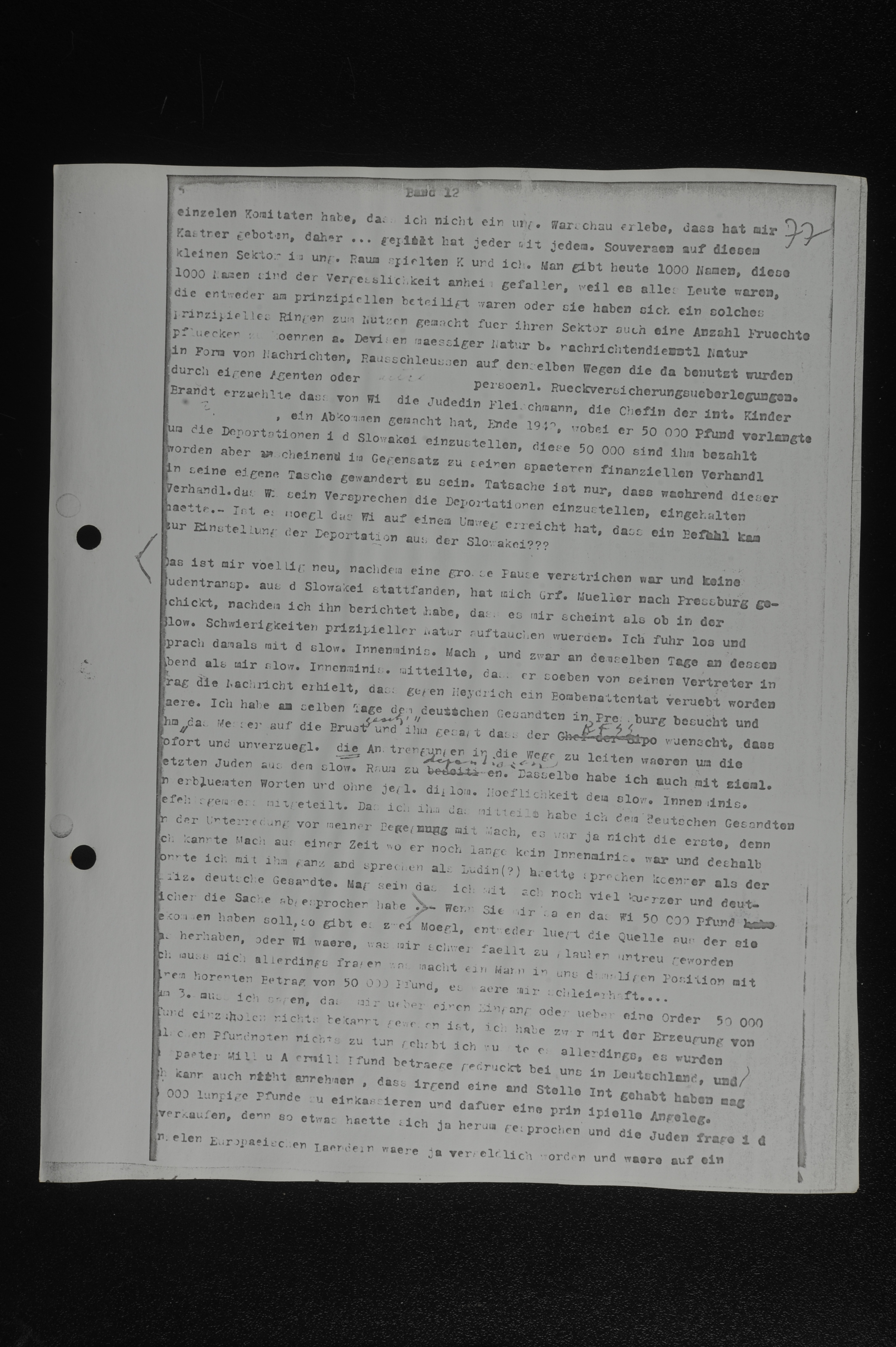
Page 303 of the typescript, O.65 file 86.
Page 303 · Yad Vashem Archives, O.65/86

Questioner reads from a book

The reply from the German Foreign Office and the embassy in Paris was that there was not the slightest objection to the deportation of these 6,000 Jews.

Questioner

Did you not receive Foreign Office documents about the Jewish question signed by State Secretary Weizsaecker?

No, I did not. Now, I have no documents from Weizsaecker, but I know that Grf. (Gruppenführer) Müller was on very good terms with State Secretary Weizsaecker. I myself drafted a dozen letters that Müller sent to Weizsaecker. These letters dealt with cardinal problems, cardinal problems that now had to be finally decided. Although I can no longer say what they contained, I do know that I took the greatest care and exercised the greatest official concentration in drafting them, so that neither their spirit nor their content could be challenged.

This was unlike the letters that went to Luther, which one simply dictated quickly and which generally produced no more than a little summer shower. Here, however, fundamental matters were at issue, and Müller apparently had great influence over Weizsaecker. A desk officer knows that when he has many letters to draft and write. Weizsaecker must have worked to Müller’s satisfaction. That satisfaction did not stop at recognizing the negative; nothing would have come of that, and I would have noticed it. Such matters generally took the positive course we wanted. That was why I took the greatest care. I was not a man merely drawing a salary. I was an idealist placed at an ex. post.

Questioner

In a memorandum by Rademacher concerning the Jews of Belgrade, it says:

Questioner reads from a book

Eichmann proposes shooting. Weizsaecker says of this memorandum that the Jews would have been in greater danger as hostages in France than in Auschwitz, a name that at the time still meant nothing at all.

On 4 March 1942, a meeting of the Jewish-affairs officers from the various ministries took place in Eichmann’s office. There Eichmann is said to have proposed introducing the Jewish star in all territories occupied by Germany.

Eichmann

First, I did not have an office. I had a department (Dienststelle), which I headed. Second, such meetings often took place at my department with the various officers for Jewish affairs from the various central authorities. Third, I remember very well that one day the question of extending the obligation to wear the Jewish star came up for discussion. I no longer know who gave me the instruction, but I do not deny it. That is what happened. Whether it happened at that particular time, I do not know.

Questioner

Do you still remember the French government’s reaction to this instruction?

Eichmann

Yes, but not only the French government’s. I expected a reaction to all my orders, but I did not give way to those reactions. When I had an order, I carried it out.

Open page image and German
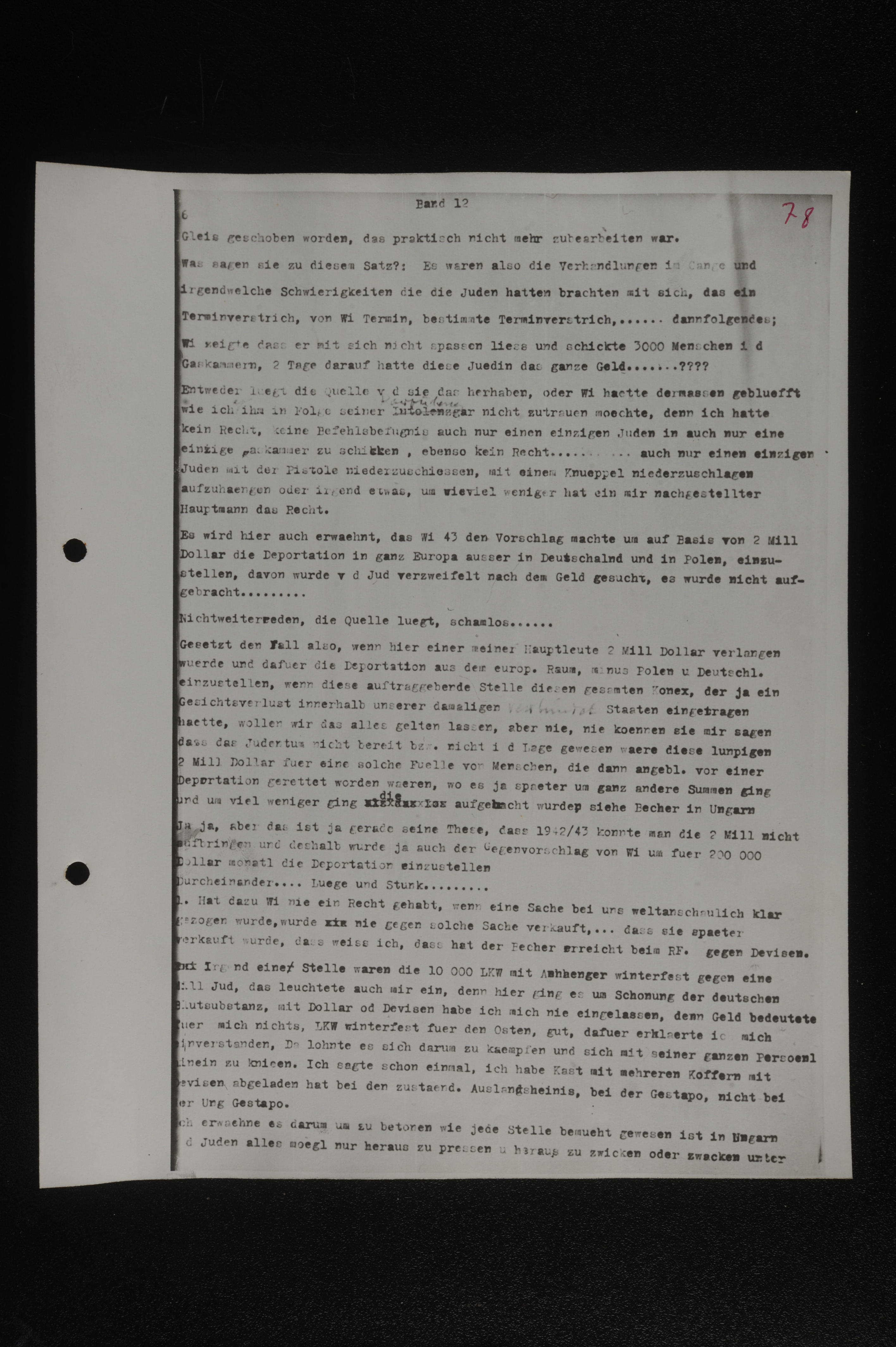
Page 304 of the typescript, O.65 file 86.
Page 304 · Yad Vashem Archives, O.65/86

Questioner

But it was not possible to carry out these measures through the French authorities, because Oberg first had to issue a police decree.

Well, how it was done makes no difference. In any case, they wear the Jewish star in France too, in the France occupied by us.

Questioner

But it was impossible to move the French authorities, because the commissioner for Jewish affairs resisted it?

Eichmann

That may be a question that interests the historian, but not me as a militiaman. What interests me is that it was actually carried out. In any case, the Jews in the occupied part of France wore the Jewish star, and I got this instruction enforced everywhere, just as I generally—

Questioner

In unoccupied France, which was later occupied, you did not get your way?

Eichmann

That is quite possible.

Questioner

Do you know that the commissioner for Jewish affairs then requested his recall because of the wearing of the Jewish star?

Eichmann

Yes, that is quite possible. I probably kept putting pressure on this man through Dannecker and Knochen, and in other ways as well… In any case, perhaps he could do nothing else by then.

Questioner

Do you know that Dannecker told his colleagues in Brussels and The Hague that the French quota for the next three months would be 100,000 Jews from both zones? A completely insane figure.

Eichmann

I do not know that.

Questioner

It was later explained that this was a misunderstanding, because it would have been completely impossible to assemble such a large number in so short a time.

Eichmann

In 1943 that was not impossible.

Questioner

Eichmann himself is then said to have told Rademacher that the French Jewish quota was only 40,000.

Eichmann

Yes, that is right.

Originally, in 1934 or 1935, there was a Security Service Main Office. That was the Security Service of the RF SS (Reichsführer-SS). This Security Service of the RF SS (Reichsführer-SS) was brought together in the Security Service Main Office, and the SS districts and SS senior districts came under it. Alongside it was the Security Police Main Office. The Security Police Main Office included the Gestapo Office, the Secret State Police Office (Gestapa), and the Reich Criminal Police Office.

One was headed by Müller, the other by Nebe. The State Police offices (Stapo) and the State Police headquarters (Stapoleit) belonged to the Gestapa as its subordinate extensions—the so-called Gestapo, but it is not called Gestapo; it is called Stapo. For the Reich Criminal Police Office, the subordinate extensions were the Criminal Police offices (Kripo) and the Criminal Police headquarters (Kripoleit). The Security Service Main Office consisted of several offices,

Open page image and German
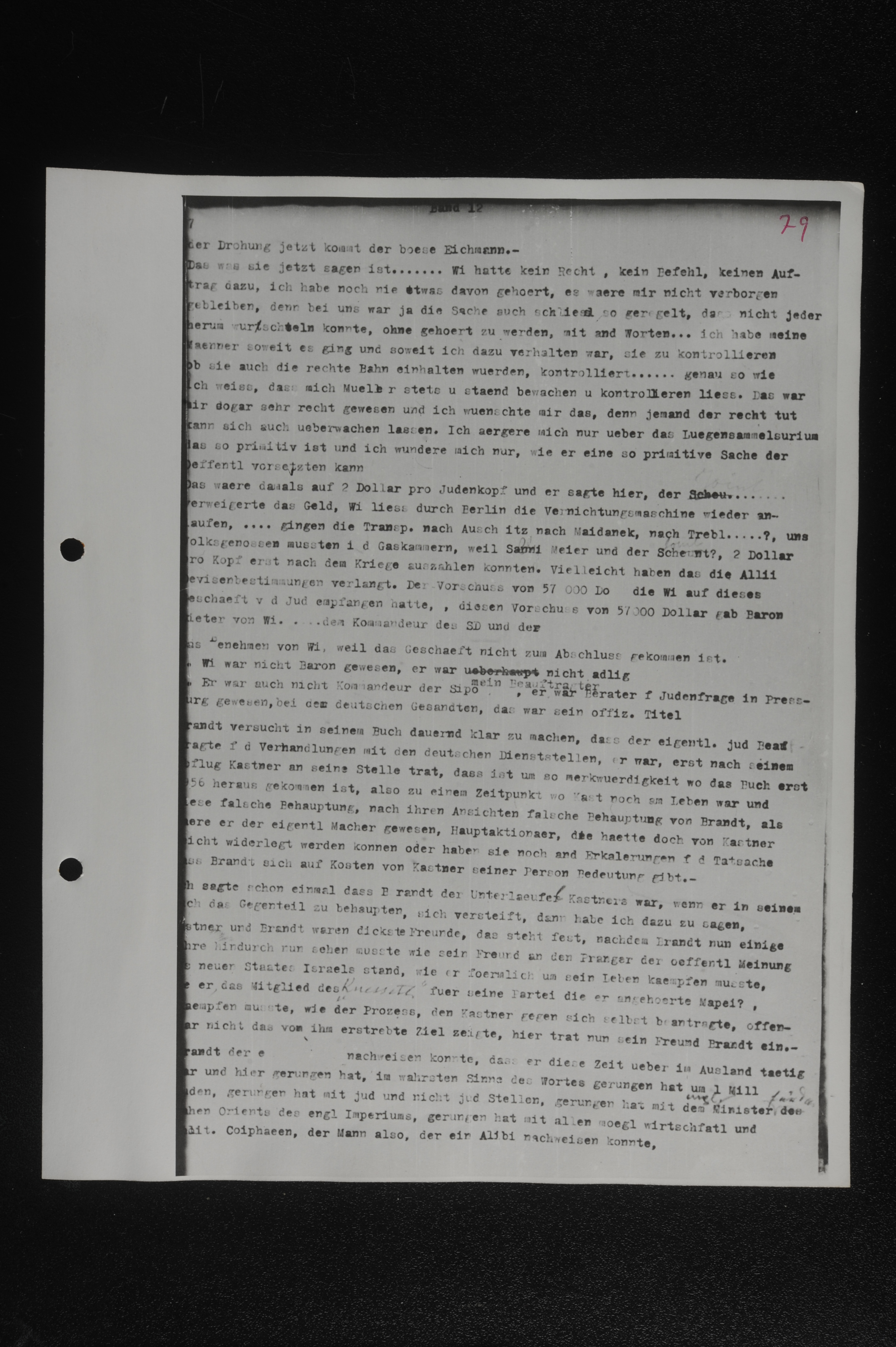
Page 305 of the typescript, O.65 file 86.
Page 305 · Yad Vashem Archives, O.65/86

which were headed at that time by Brandt, Oberg, Ohlendorf and so on. Their chief in that sector was Heydrich, just as he was chief of the Security Police Main Office, which consisted of the State Police and the Reich Criminal Police. Heydrich stood over it, and his chief was the RF (Reichsführer-SS), who was chief over various main offices. There was the Order Police Main Office, itself divided into various branches, including the fire and [? air-raid] protection police, and so on, and the other main offices.

Now to the Security Police Main Office and the Security Service Main Office. For pay purposes, the Security Service Main Office came under Reichs… Schwarz. The Party appointed the administrative officers. The administrative chief at that time was a man named Borg. This chief of financial administration had his administrative “bulls” in every district and every senior district of the Security Service; these men had the entire financial side under them. This sector was clearly set apart by the Party and was purely a Party apparatus, with nothing to do with the state side. The Secret State Police Office (Gestapa), with its State Police offices (Stapo) and State Police headquarters (Stapoleit), and the Reich Criminal Police, with its Criminal Police offices (Kripo) and Criminal Police headquarters (Kripoleit), were purely state organizations and were also paid by the state.

By 1935 or 1936 we had to discard a cuff band that until then had read Security Service Main Office, and we received a new cuff band reading Reich Security Main Office. So around that time the Party sector and the state sector in this Security Service building were merged with the Reich Security Main Office. The letterheads also read: Reich Security Main Office, the Chief of the Security Police and the Security Service. I do not know how far the budgets were divided up, or how far the state subsidized the Party purse, or the other way round, or subsidized the Interior Ministry. I had nothing to do with that, and it is also of little importance.

In any case, I still know that the Reich Treasurer Schwarz had a say until 1945. I can also say that, without doubt, the relationship between the RF (Reichsführer-SS), including his further extensions, and Reichsleiter Bormann was always excellent. Bormann had also been Schwarz’s chief. After Hess left, he was the supreme chief of the Party. I know that the letters I had to write to Bormann were always very cordial and comradely in tone, without great subservience. In drafting the letters, I had to know roughly what the relationship between the correspondents was, so that I could match the form and style to it.

Questioner

Can you explain how such an important state political body as the Security Service could be organized on a Party basis, financially on a Party basis? Was it because the Security Service was already present in the National Socialist German Workers’ Party (NSDAP) from the beginning?

Eichmann

Yes, it was there. Heydrich had set up his index cards very early. Kaltenbrunner had worked in intelligence very early, and that explains it, because at the beginning there was the struggle between Party and state—

Open page image and German
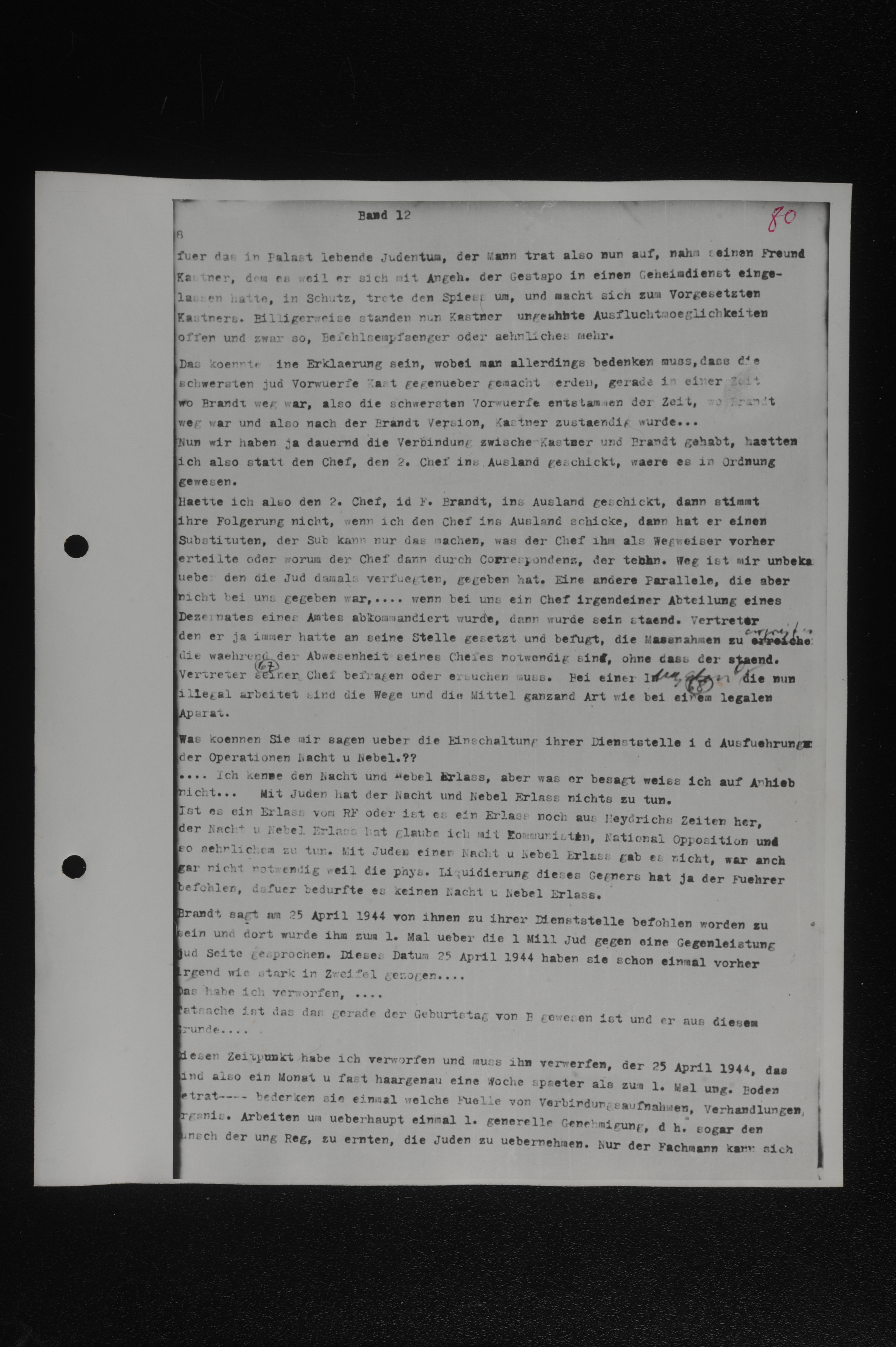
Page 306 of the typescript, O.65 file 86.
Page 306 · Yad Vashem Archives, O.65/86

Questioner

So at the beginning there was the struggle between Party and state. What do you mean by that?

That does not mean a bloody struggle. The Party wanted to collect its tribute for all the hard years of struggle, and to take the machinery of control into its hands so that what had finally fallen into its lap after all those years could not be taken away again by a state sector. Conversely, jealous state bodies guarded their own interests. Whether it was the German Reichswehr, which had to contend with the militant offices of the Party, or state police offices, which (sensed unwelcome competition, or similar) in the Party’s intelligence organizations—I could list more things, but I will leave it at that for today.

Now the Party had seen that the Security Service, from its very earliest beginnings, based in [? Brienner] Street in Munich, was doing extremely important work for the Party. I cannot say exactly how far the Security Service played a part in the whole Röhm affair, but it did play a part. This Party office moved from the city of the movement, Munich, to Berlin in the summer of 1934 and was given the palace at Wilhelmstrasse 102. A park connected it with the Prinz Albrecht Palace, where the Gestapo (Secret State Police) was located.

Now this Security Service apparatus grew—I myself had number 54—and suddenly grew. Enormous sums of money must have been poured into it around that time. The Party therefore had no interest at all in letting this powerful apparatus slip out of its hands, especially since it certainly had the financial means by then to make this expenditure no great difficulty. Still, I remember very well that when I reported in Wilhelmstrasse in Berlin in September 1934, there were difficulties with our pay for a few months.

We worked and were not paid, because the Security Service still had little money at that time. It went so far that our office chief once lent each of us 10 marks. When we finally did get our money, many days after the first of the month, I still remember the cashier, Oberscharf. (Oberscharführer) W. (Wettich), standing at the counter paying it out—he was later a Hstf. (Hauptsturmführer)—and saying: “Now we can count on getting our salaries on time.” We were delighted.

That was still in the days of the Security Service Main Office. Later it merged. Personnel from those institutions (Instruktionen) were transferred to the Security Police, and others to the Security Service. A civil servant, a Reich civil servant, was never transferred to the Security Service in such a way that his salary also came under Reich Treasurer Schwarz. That would have conflicted with civil-service legislation and with the official’s pension entitlement, and so on. As a rule, when someone was transferred, his pay came from the sector he had come from.

Open page image and German
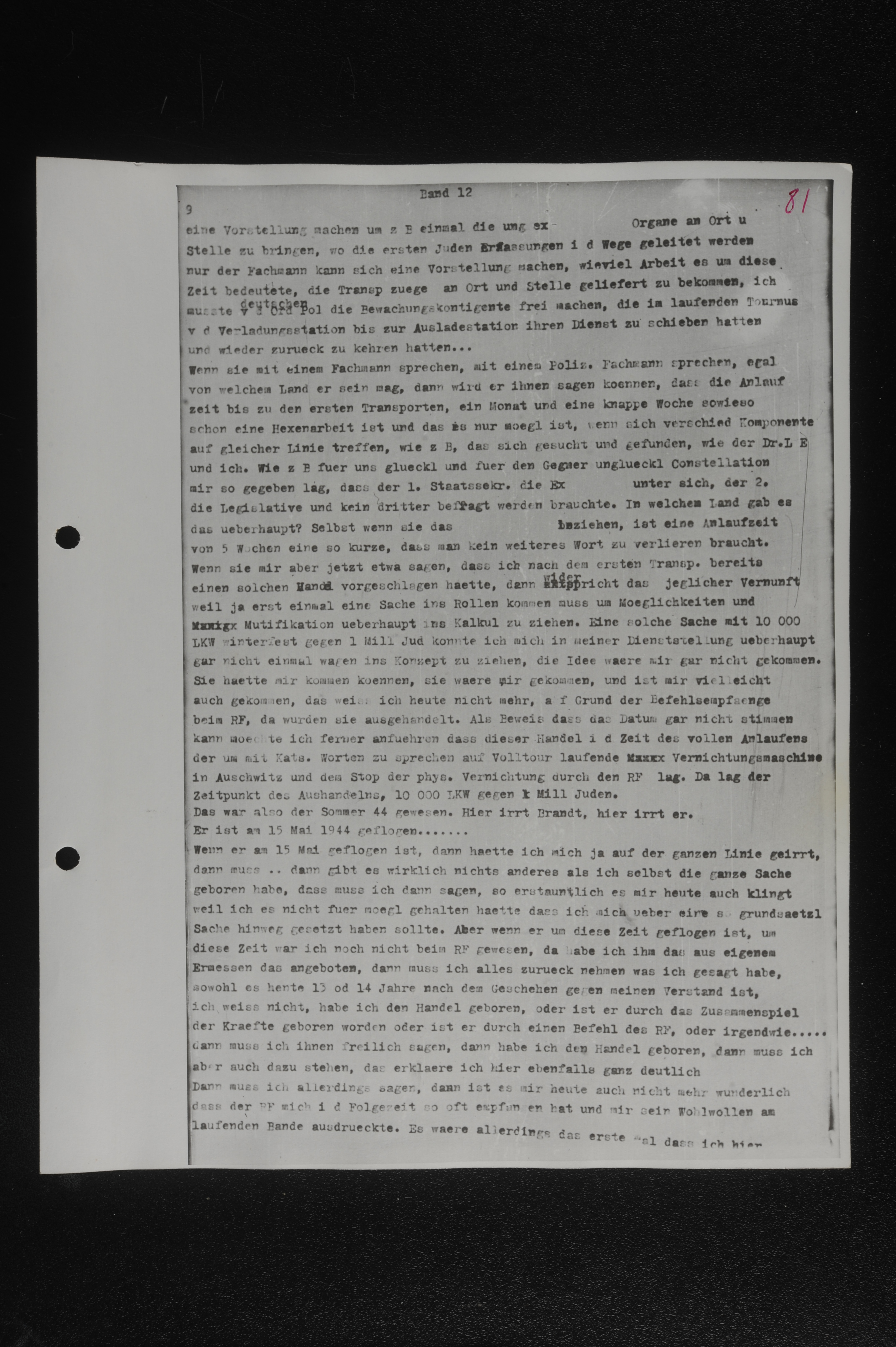
Page 307 of the typescript, O.65 file 86.
Page 307 · Yad Vashem Archives, O.65/86

Questioner

Can you tell us something about the origins of the Security Service, in time and place?

I can really tell you nothing, or only very little, except that Heydrich once said after a meeting, looking back, as it were, and proud of what he had achieved so far, that he could still remember sitting in an attic room writing out his index cards. That had been the birth of the Security Service.

Questioner

When might that have been?

Eichmann

That must have been well back in the years of struggle, probably around the thirties. Heydrich cannot have joined very long before that. If one knew that date, one could roughly work out the other one, because Heydrich was given this work from the beginning.

Unknown speaker

Let us never forget that it is a fact, not a version of events, that Heydrich came into this Party information-service office through Canaris.

But Heydrich was anything but a tool of Canaris. He went on about that all too often.

Müller also belonged to the Klausener group, because Müller belonged to the Security Service from the beginning too.

That was probably the struggle between Party and state, the struggle over jurisdiction.

Questioner

Do you have any idea what was on those index cards with which the Security Service began, so to speak?

Eichmann

Yes. When I was transferred from the troops to the Security Service in 1934, my first job—and it took about 14 days—was to deal with the index-card business. Enormous card trays stood in a large hall of the palace. There may have been 20 or 30 of them, with card after card in rows, about the size of an ordinary book. There was mainly an index of Freemasons, an index of the Independent Order W…, and other cards for so-called secret societies and so on, as well as a small Jewish index. All sorts of things were in it. They were in different colors. The ordinary Freemason had yellow; the U.O.B.B. (Independent Order of Bnai Brith) had rose-red to carmine-red cards. Heydrich himself started this index.

He wrote it by hand. And so I came into this card-index hall with Jaenisch, my outer-office chief, where six or seven comrades were already working. Our job was to put these 100,000, 120,000 or even 200,000 cards into alphabetical order. You can imagine that if eight men needed 14 days to arrange them alphabetically and in detailed alphabetical order, it must have been quite a substantial card index. I still remember that there were very many visitors at that time, some led by the RF (Reichsführer-SS) himself, some by the Chief of the Security Police and the Security Service, and some by my immediate superior, Stbf. (Sturmbannführer) Brandt. It was also here in this card-index hall that Streicher

Open page image and German
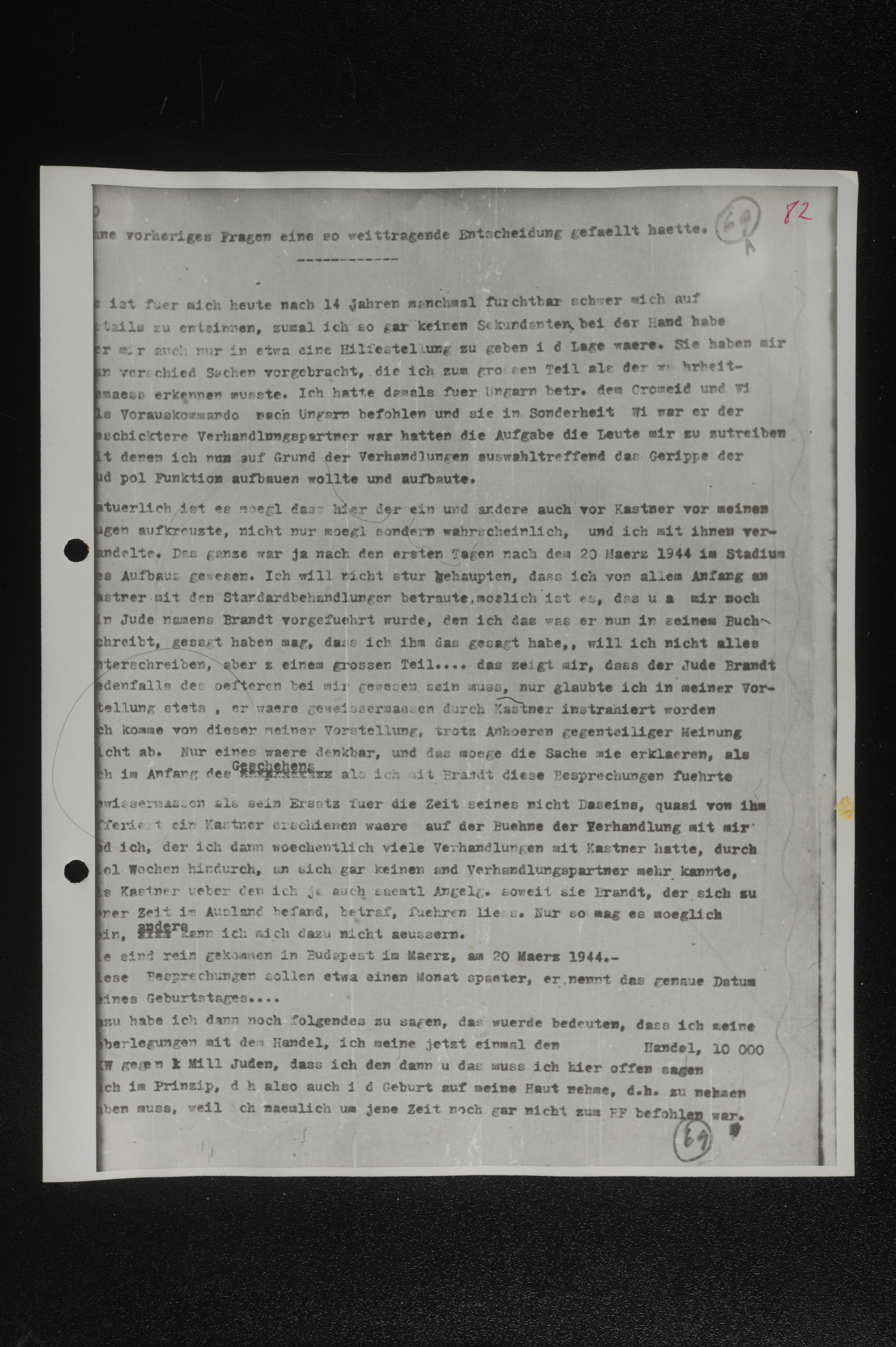
Page 308 of the typescript, O.65 file 86.
Page 308 · Yad Vashem Archives, O.65/86

Streicher came in and said jokingly, “Well, do you want the name?” He then gave his adjutant’s name. It was one of the favorite jokes when visitors came: they could name somebody they knew. In Streicher’s case his adjutant was a former lodge member, and when we pulled out that card, he abruptly broke off the tour.

[The typist: I did not quite understand that correctly.]

But by then the rush on the lodges must have been over for a long time. There was already an enormous index. My predecessors must have been as busy as bees, both before and after the seizure of power, because this enormous index already existed in September 1934, when I joined them. Freemasonry had been greatly overestimated. They had the minor lodge masters and the ordinary lodge brothers in their grip and made difficulties for them. But later they saw that, if these were tools of international Jewry, the little man knew nothing about it and could just as easily have been used for another apparatus, for the Party apparatus, for instance, and its aims. That is what was subsequently done.

Questioner

Were these indexes confined to Germany, or were they international?

Eichmann

They were international. They already covered several countries. The index was growing and functioning. That is to say, after I left there after 14 days, the index was established, and any number of people kept working at long desks from membership lists confiscated by the local State Police offices (Stapo) and State Police headquarters (Stapoleit). They copied from the membership lists of the various institutions or from the subscription lists of various journals, extracting this or that, and so they had their cards. These were arranged not only by people but also by organizations. It grew in that way; the index was continually being worked on.

When I was transferred to another section in 1935, my chief, Ustf. (Untersturmführer) Mildenstein, designed two enormous automatic card-index wheels. The entire card-index administration, which had grown to about 20 or 30 men, could be reduced to two. They sat there as if at a harmonium, automatically taking out whichever cards were needed at the time. That was the final result. I myself then left; I went to the museum section. After my first 14 days in the Security Service, I spent a whole year doing nothing but sorting and examining Freemason seals and other boring museum work of that kind.

Questioner

Do you think that in the end these index cards covered practically the whole German people—that there were some 80 million cards?

Eichmann

No, I do not think so. But there were an enormous number of millions of cards. The cards became very small, very thin and punched, and those drums held an incredible number of them.

Questioner

Do you think that, before the seizure of power, the Security Service started by Heydrich concerned itself not only with gathering information but also with taking action, carrying out particular subversive operations within other

Open page image and German
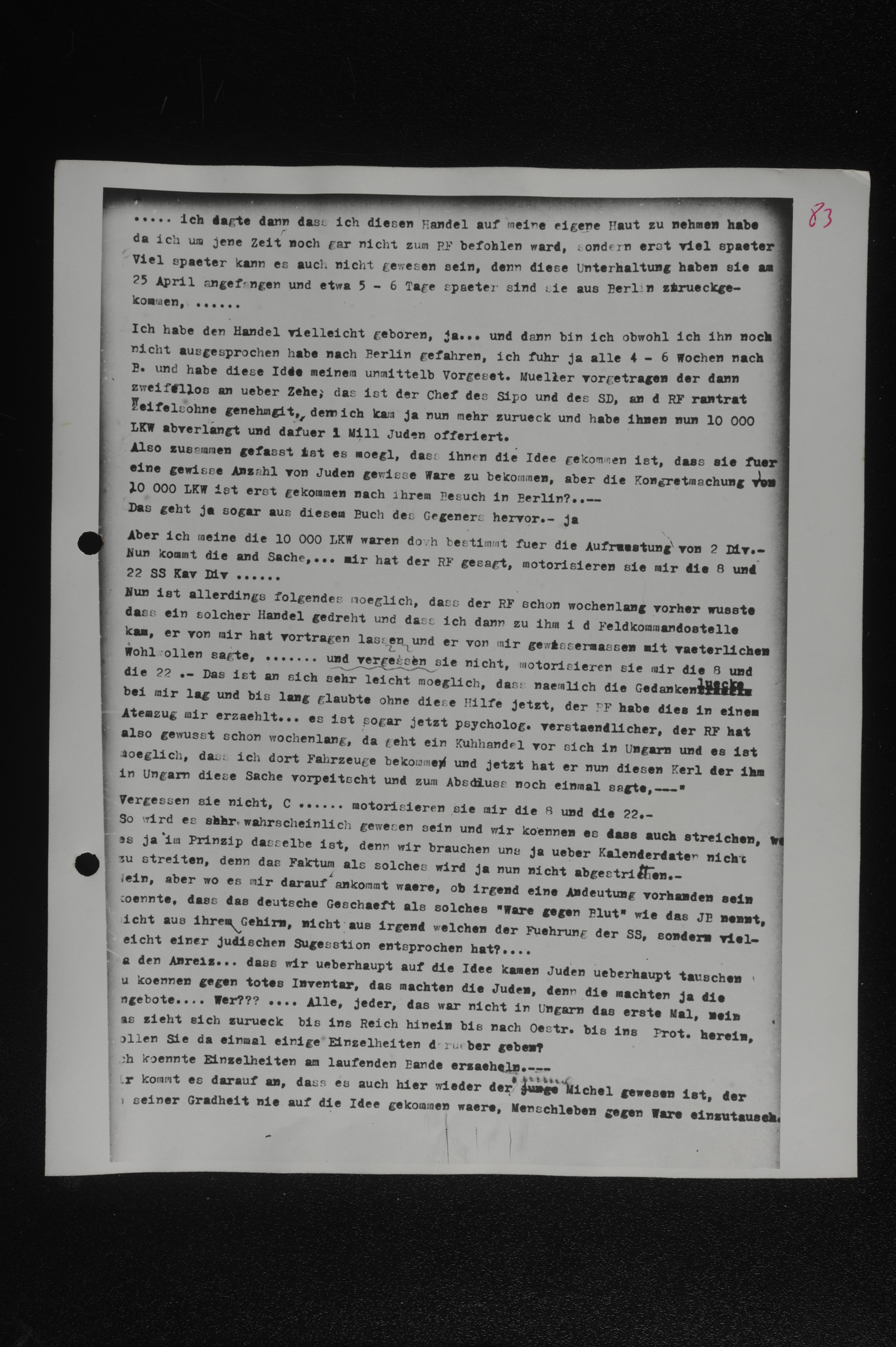
Page 309 of the typescript, O.65 file 86.
Page 309 · Yad Vashem Archives, O.65/86

Questioner

parties?

I cannot say. I have never heard anything about it.

Questioner

So there are said to have been governments that tried to offload their Jews onto the German government, and then fussed over them with all sorts of possible and impossible inspections of the settlement areas. They wanted to see where their Jews had ended up, and so on and so on. Could you give a full account of these governments and the ways they fussed over them?

Eichmann

I have my experience, and it applied generally, with the exception of Hungary and Denmark. My experience was that wherever a German emissary arrived, whether from the Chief of the Security Police, from the Foreign Office or from a Party office, and the question of eliminating the Jews from the areas inhabited by the people concerned came up for discussion, and it was even suggested that they should make an effort to hand the Jews over to the Reich, in not a single case were difficulties raised at the outset. On the contrary, the offer was received as an outright deliverance. I kept saying to myself: “How am I going to find all that transport capacity? How am I going to get it, to carry all this out as quickly as they are demanding of me?”

It went so far that the Chief of the Security Police told me, and Müller told me too: “It will start there roughly in that month. See that you get enough transport equipment. I have spoken with Pohl; they can all go to such and such a place.” I repeatedly drew up timetables with the Reich Transport Ministry and repeatedly had to cancel them again. That happened too. The countries concerned developed misgivings because the initial transports mobilized certain forces. These brought about the dismissal or transfer of the officials who were setting the deportations in motion there, or their sudden disappearance. As a result, I had to cancel the remaining trains again.

[Interposed question about the governments.]

Questioner

Which governments were they, and which ones are being discussed?

[Answer.]

Eichmann

I am speaking of all countries. We had the same thing in Slovakia, the same thing in France, although it began very promisingly there, and the same thing in Holland. At first the transports were rolling so well that you could say it was splendid; then difficulties piled upon difficulties.

Questioner

Does that mean it was splendid that the Dutch official administrative apparatus cooperated to such an extent?

Eichmann

It made no difficulties. At the beginning there were no difficulties at all …

Open page image and German
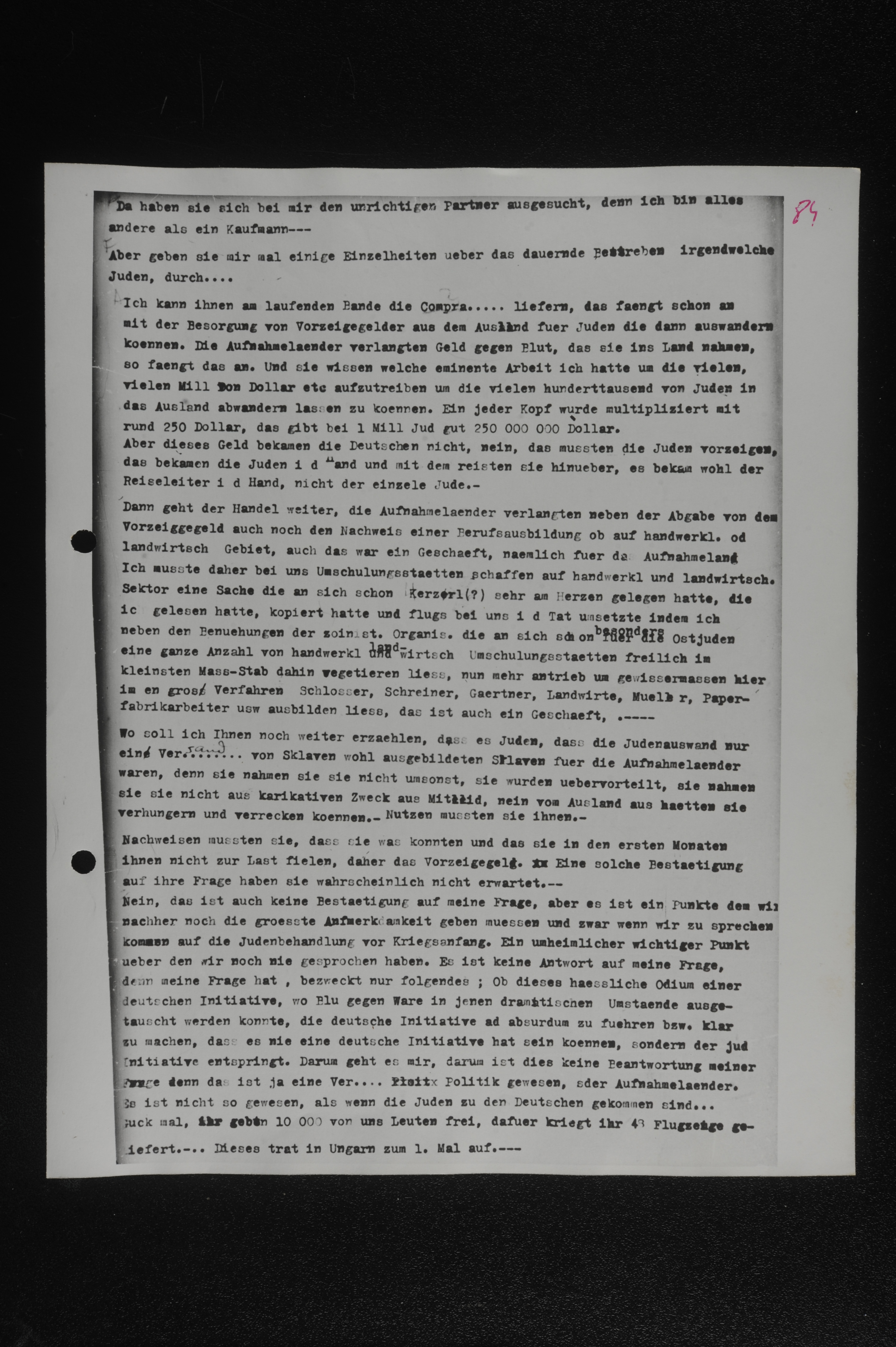
Page 310 of the typescript, O.65 file 86.
Page 310 · Yad Vashem Archives, O.65/86

but then there was mobilization, and then the difficulties arose. It dragged on as slowly as anything until another unit could finally be transported. You can see it in all the books: at first some tens of thousands were taken away at speed, then there was a standstill, then there was fighting—not with weapons—and then another contingent of 10,000 or 15,000, or perhaps only 4,000, 5,000, 3,000 or 2,000. Then there were more battles to be fought, then another batch was prised loose, and so it went on.

It was different only with Hungary. Hungary really did try to offload the Jews onto us. Hungary was the only country for which we simply could not work fast enough. I was constantly pressed; I could not obtain the transport equipment, however hard I tried. Even the receiving centers had difficulties accommodating them. That was the pace the Hungarian government allowed. Denmark was the opposite: difficulties were actually raised from the first day, which happened in no other country.

In that respect these two countries, Denmark and Hungary, are the only exceptions, in opposite ways, among all the other countries of Europe. Compare the relevant literature and you will see that at the beginning it went smoothly, almost like a raid, and then the damned difficulties arose. You will not find that in Hungary. There were difficulties there too, but by then the great masses had already been taken away, and the war had advanced so far that some of the difficulties were on our side. We could not transport them away.

[Typed as notes in the transcript: March on foot.]

Questioner

Could you summarize the various measures indicating that the different countries were trying to offload them in that way?

Eichmann

I cannot give exhaustive information about that. I can only tell you about the places where I negotiated myself. That was Slovakia. It offered its Jews to the Germans, trying to offload them. That is clear.

Hungary—that has already been explained clearly enough.

France: there it was Laval. At the beginning he not only made no difficulties; it seemed that all the Jews could be taken over from France without any difficulty. At the beginning, the expression “trying to offload them” applied to France too.

Holland: I do not know who negotiated there, but train after train was rolling. The desk officer under the Commander of the Security Police had his hands full. I had to support him. I sent him Burger, and for a time even Brunner to Holland, so that I had some very heavy artillery there to get this work done quickly. So there too they were trying to offload them onto me. But I must say that I do not know who negotiated or how. The Dutch made no difficulties—not until later.

Belgium was the same. Things went smoothly at first, then no longer.

Open page image and German
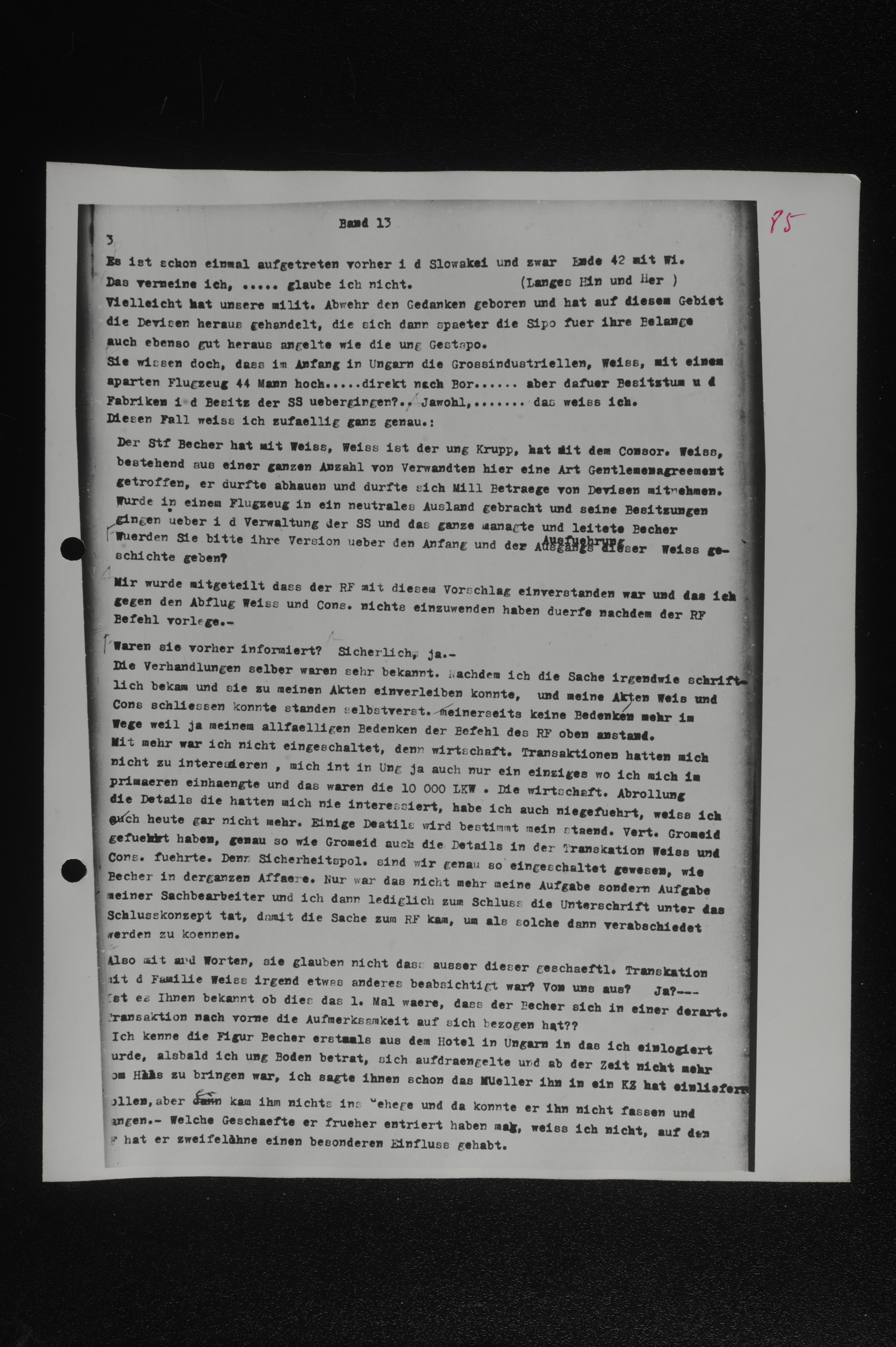
Page 311 of the typescript, O.65 file 86.
Page 311 · Yad Vashem Archives, O.65/86

In Belgium, next to nothing was deported …

Unknown speaker

But some trains did leave. And they left immediately.

Eichmann

The example of the Hungarian gendarmerie commander is … (?). He throws his arms around my neck, thanks me in the name of the people—which he actually had no authority to do—and tells me that a monument in Budapest would be assured me if I managed to take over this dreadful enemy of the Magyar people. A few days later this man was on the enemy side. And that was how it was everywhere: tremendous enthusiasm at first, and a few weeks later it had all burnt itself out like a straw fire, because the man concerned no longer really wanted to, as he had at first, or because he was no longer there at all.

Questioner

Could you also give these things country by country, concerning the care operations, the inspections in the resettlement areas, and so on?

Eichmann

First, the basic point. As part of the difficulties being made, the bodies with which the German authorities negotiated expressed wishes, even demands, that individuals or commissions be allowed to visit the groups sent away from their country in the area where they were staying. Some of these requests reflected a wish to make an official trip to distant, out-of-the-way countries. But they were also attempts to drag out the German authorities' negotiations for the time being. They dressed up these negotiations with the words: 'Well, then we can give our authorities X and Y a report on the labor deployment of these Jews we have sent away, and then I can get things through more easily, then I can get somewhere more easily, because people keep saying the Jews are being gassed. Or that the Jews are being killed.'

Questioner

In what year did that begin, this version that the Jews were being gassed or killed?

Eichmann

That may well have been the end of 1942 or the beginning of 1943.

Questioner

Then that coincided with the greater part of the extermination operation?

Eichmann

Yes, it was known.

Questioner

So it cannot be said of these people or governments that they had not known about it?

Eichmann

No. I myself never said, 'No, they are not being killed,' when I was asked. No, I did not do that, because I told people: 'What is happening now is simply happening.' That could not be kept secret; it was a Führer order, after all. The Führer himself also said later on the radio, in [? his] speech, [? more than once], 'Jewry will be exterminated.' He attacked Jewry in every speech.

Open page image and German
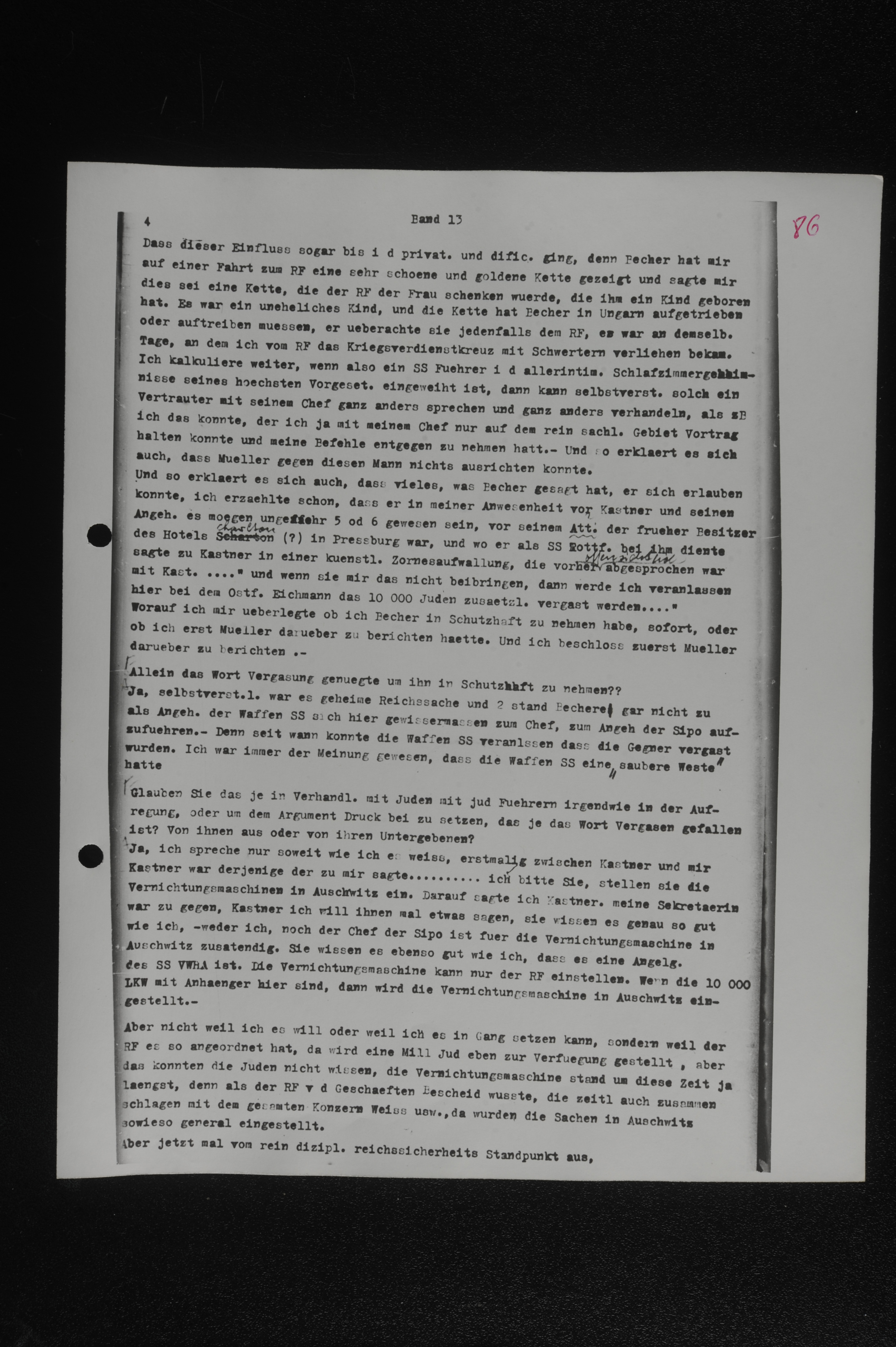
Page 312 of the typescript, O.65 file 86.
Page 312 · Yad Vashem Archives, O.65/86

Questioner

When the governments of the various countries tried to carry out inspections on the grounds that it was being said the Jews were being gassed, was that also put in writing by the governments concerned?

No, that was always dealt with only orally. The only body that put it in writing was the International Red Cross in Geneva. They wanted to go to Auschwitz and Lublin too, and the RF (Reichsführer-SS) handled that himself, in agreement with the Foreign Office. The RF (Reichsführer-SS) always redirected this request from the International Red Cross in Geneva to Theresienstadt. Three times in all. The other countries' requests for these inspections were not made privately, but at meetings and negotiations. But we recorded these requests in the memoranda drawn up after the meetings, just as every meeting was taken down in writing by a shorthand typist or some other fellow.

Questioner

Was it also recorded in these meeting memoranda that the Jews were being gassed?

Eichmann

Yes, of course; always in my meetings. I had to pass all that on. I had to obtain approval, the instruction as to whether an inspection was to be authorized or not. L.E. initials also made such a demand, but with him it was more a matter of establishing whether we could take in any more or not. He was then given permission to travel through Germany, but I do not know which offices he visited.

Questioner

Which governments, then, tried to carry out such inspections?

Eichmann

Slovakia. They received permission in some cases too, but they were not shown Auschwitz or Lublin. Almost all countries, because my people repeatedly reported to me that this person or that had applied again to inspect the Jewish camps, and asked for instructions on how it could be justified. Again and again the answer was: 'No, it is not possible at the moment.' When I was asked, I generally gave an evasive answer.

When I was told, 'The Jews are being exterminated there,' I always said: 'I do not know that, because the moment your Jews are sent away by me, I hand them over at the destination station to the SS VWHA (Economic and Administrative Main Office). This SS VWHA puts the Jews to work, either in the concentration camp or in the areas belonging to the camp. What happens to those unfit for work, I do not know. I believe they are exterminated, but the Security Police is not responsible for that. Apply to the RF (Reichsführer-SS).'

[Compare Dr. Kastn…]

Questioner

Do you remember particular cases in which, as time went on, you increasingly used the word “exterminated” to official bodies of other countries and governments?

Eichmann

Slovakia. Also in Amsterdam: there I spoke before an invitation (in the hotel of the Jew) to a Jewish “[? Reistafel]”

Open page image and German
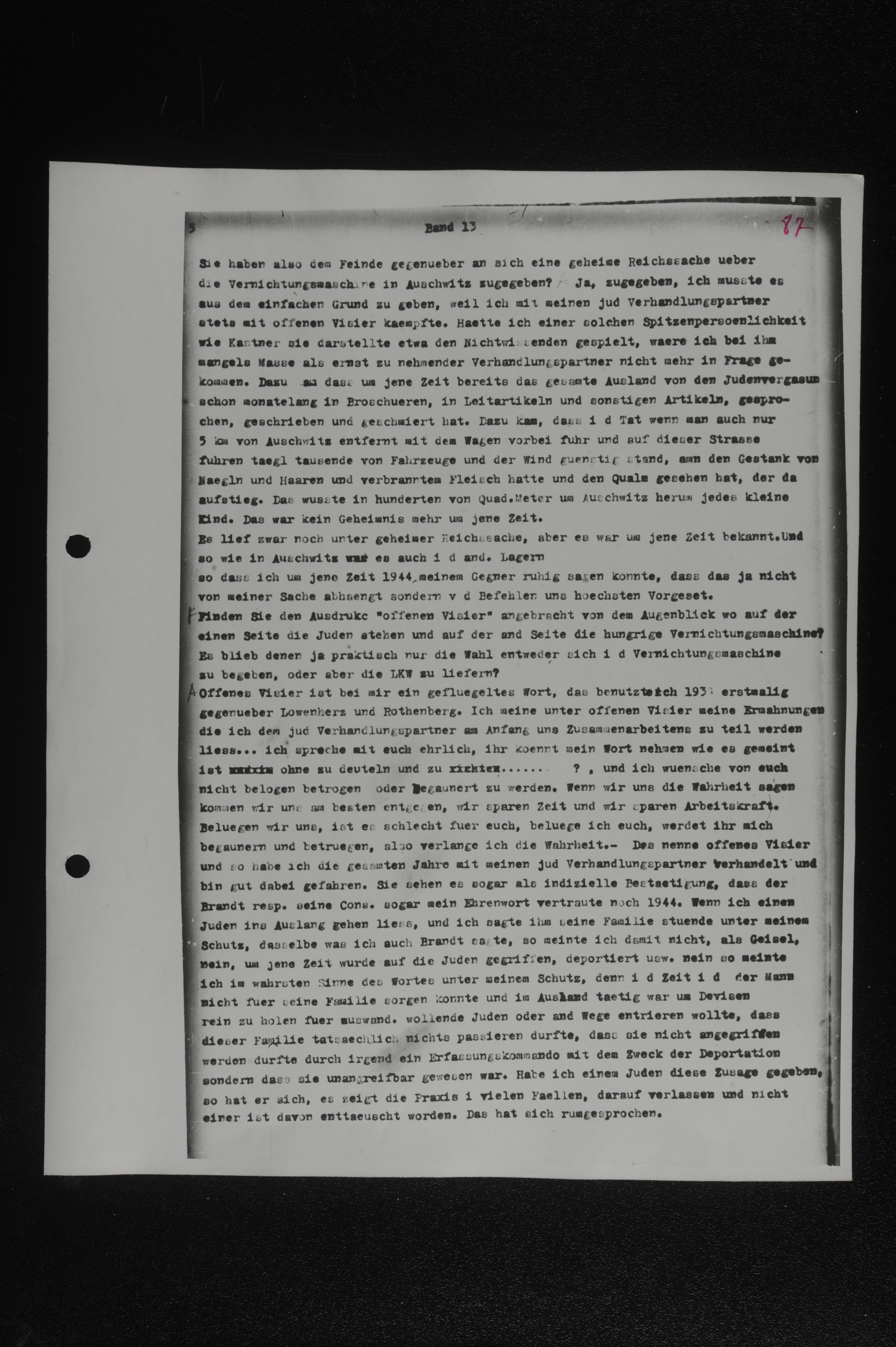
Page 313 of the typescript, O.65 file 86.
Page 313 · Yad Vashem Archives, O.65/86

with a Dutch official, but I can no longer say who he was, what his name was, and so on. In The Hague I regularly stayed overnight at the Hotel Des Indes. There too I once spoke with a Dutchman, but I no longer remember his name either. Dr. Rajakowitsch (?) could give better information; he was the one who got things going in Holland. He also introduced Dutchmen to me at the beginning. But, as I said, Zoepf, Rajakowitsch, Brunner—they ought to know more.

The Dutchmen I spoke with then were not in uniform. Whether they were Party men, I do not know. In any case they were not working on behalf of the Jews; it was a very friendly discussion. I assume they were people my people had found—antisemites, one might say. So, as I said, almost all countries sought these inspection visits. The only witnesses I can name are my staff, whom I had stationed in the respective countries.

I also remember that Richter gave me the names of Romanian government people who wanted to visit Germany and demanded access here to the sites of the measures against the Jews. This Romanian government official was in Berlin and even claims to have spoken with me.

Questioner

Was there also a country which, quite apart from curiosity, really showed concern for these deported Jews by supplying them with food? Were there any countries that said, 'We are now sending off a train with food or clothing and so on, so that our Jews do not go short'?

Eichmann

No, not in a single case. On the contrary, they handed the Jews over to us practically as poor as church mice. I believe Höss would have been glad and grateful if the trains had been somewhat better supplied. Some of them were very poorly supplied with food too. Not at the beginning: the first few transports were good, but then they started cutting back drastically. Not a single request for extra care was made. They were not even made from Slovakia.

Questioner

So, on the contrary, the various countries and governments tried to retain as much of the Jewish property as possible?

Eichmann

Yes.

Questioner

When you say that at first they provided for them decently, but afterwards became increasingly sparing, how did that show itself?

Eichmann

Earlier they had still been allowed a second coat, a third blanket; they had also been allowed personal belongings and their own food. Then, in some cases, all of that was ruthlessly taken away from them, stripped from them. [Handwritten note at the foot of the sheet: The WVHA (?), or the former members of this main office, could, insofar as they were involved, give exhaustive information here.]

Open page image and German
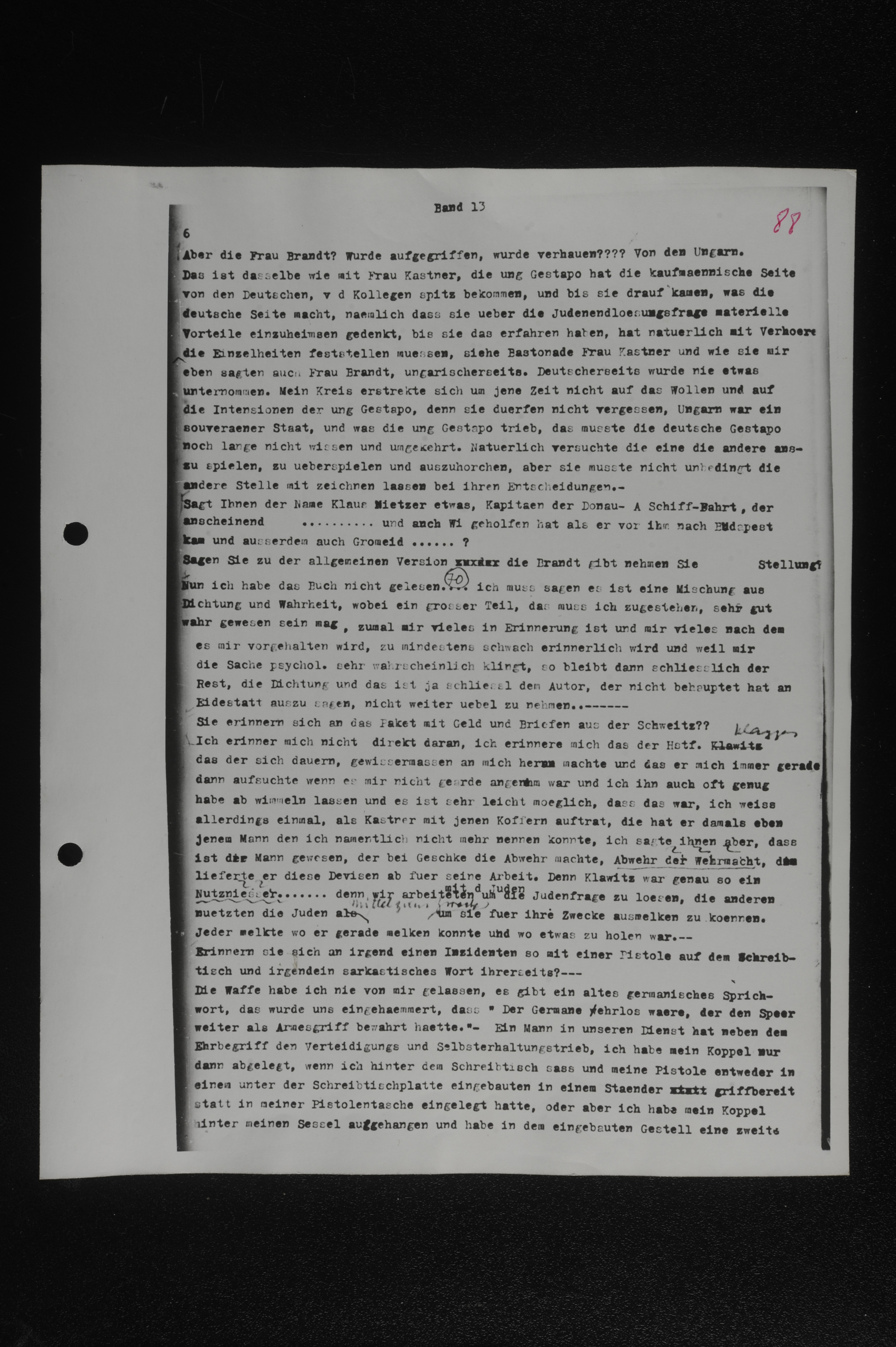
Page 314 of the typescript, O.65 file 86.
Page 314 · Yad Vashem Archives, O.65/86

Questioner

Which transports were carried out not by the Germans, but by the countries and governments concerned?

Slovakia. It rounded them up with its own agencies and handed them over. The transport escort detachment was always German. The Slovak agencies carried out the roundup and the provisioning, and the same applied to Hungary.

In Holland, German agencies did the rounding up with the assistance of the Dutch police. The Dutch police had to do the work of herding them in.

In France the French police helped. Dannecker had a French police commissioner to assist him, who never made difficulties for him.

In Belgium I do not know who did it.

Questioner

Where were the transports rounded up and provisioned by the Germans?

Eichmann

In the General Government. But Office IV was not responsible there; Glo had the special assignment. Glo did that not only in his own district but in the other districts too. That was how far Glo's arm reached. Although he was only SS and Police Leader of the Lublin district, that arm reached into the areas of the other SS and Police Leaders too, who then had to support him. All the decrees of the SS and Police Leaders—not … In any case, Glo, with the Higher SS and Police Leader in Krakow, after the latter had obtained clearance from Frank of Poland each time … For without the General Government administration, the Higher SS and Police Leader, and thus his SS and Police Leaders in the General Government, could not do as they pleased.

In Denmark the German police did it entirely on their own, I believe with the help of some Wehrmacht units, but I cannot say for certain. And that brings us to the end, because we could not do it in the other countries. The other countries insisted on their sovereign rights. There were not very many countries where we could carry out the rounding up.

Questioner

What intention might the individual governments have had in sending the Jews away without identity papers?

Eichmann

The handover regulations said neither that the Jews were to be transferred to us with identity papers nor that they were to be transferred without them. So the people concerned could handle it as they saw fit. At the beginning, of course, lists of names were handed over. The transport leader required lists of names, and these were then handed to the reception offices of the VWHA (Economic and Administrative Main Office). Which individual documents a Jew had with him was beyond our knowledge. That was the Jew's own affair, or that of the agency that rounded them up.

Questioner

Could that not have been a general police measure to nip possible escape attempts in the bud, so that it then became a general rule that the Jews left without identity papers?

Eichmann

No.

Open page image and German
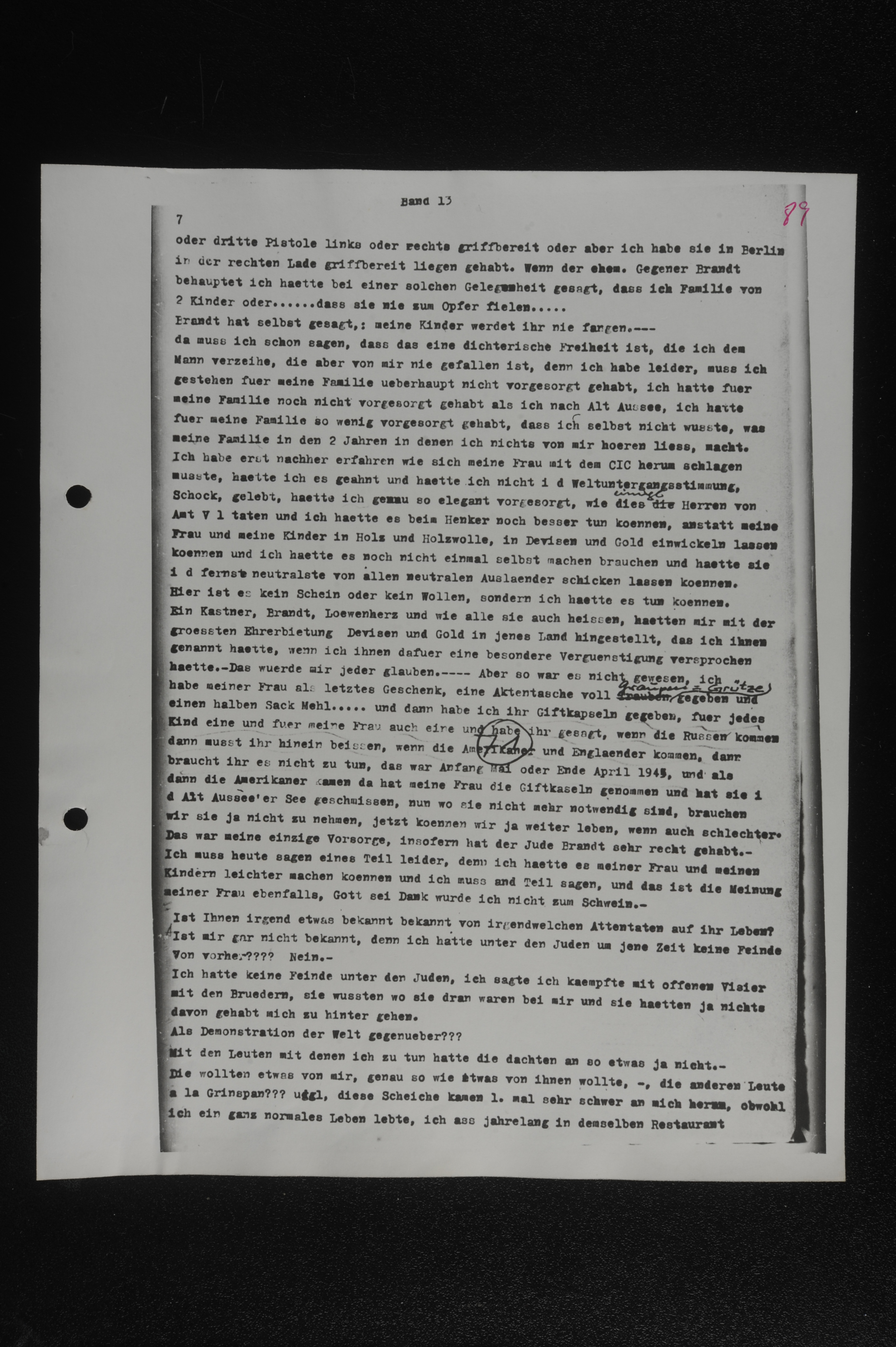
Page 315 of the typescript, O.65 file 86.
Page 315 · Yad Vashem Archives, O.65/86

In every country the rounding up was handled differently. Sometimes it happened so quickly in nighttime operations that no one asked about it at all.

Questioner

Did your office have anything to do with registering Jewish property?

Eichmann

Yes and no. Registration only in the form of—let us say, paperwork. Soon after the Central Office for Jewish Emigration was established in Vienna, the Jews, when they were ready to emigrate, ordered their shipping containers and packed their three- or four-room apartments into them. There was not much to register apart from the monetary assets. But those were dealt with by the Chief Finance President and the other interested authorities, such as the Ministry of Economics, the foreign-exchange office, and so on.

In Prague, once the Central Office had been established, it became necessary to set up a so-called Administration and Disposal Office, so that all this Jewish property would now be registered and managed centrally. By then the individual Jew could no longer take all of it along so blithely and cheerfully as had still been possible in Vienna a year earlier. I obtained permission through the Reich Protector. Dr. Rajakowitsch, who until then had still worked with me on an unpaid basis, introduced me to the father-in-law of SS Stbf.

(Sturmbannführer) Kraus in Vienna, who ran a large business house (Gerngross) in Vienna as general director. This father-in-law of the SS man Kraus had been a genius at bookkeeping. Together with Dr. Rajakowitsch, he set up the Administration and Disposal Office. As far as bookkeeping was concerned, this father-in-law did the work in Prague. As for the legislative part, Dr. Rajakowitsch drafted it and, through the jurist—the chief jurist of the Commander of the Security Police and SD (Security Service) in Prague, an older senior government councillor from Austria (Maurer), an SS Ostubaf.

(Obersturmbannführer; handwritten correction of typed Ostuf.)—pushed the matter through the official channels of the Reich Protector for Bohemia and Moravia. After a few weeks, this structure was in place in its bookkeeping form on the one hand, and with its entire legal foundation on the other. My task was then fulfilled, because I am not a businessman, and it was not my job to handle these things commercially.

By decree of the Reich Protector, the Commander of the Security Police and SD (Security Service) became the supervisory authority over the Administration and Disposal Office, and the German Reich Audit Office became the auditing body. Twice a year it sent an auditor, who then spent weeks over the books and granted the supervisory authority its discharge—or took it by the collar if expenditures had been made that the Reich Audit Office rejected or did not agree with. After all, hundreds of millions of marks were being administered, and one was glad when everything balanced and there were no discrepancies.

Later, an office of this kind was also established in Vienna on the advice of the Chief Finance President. But by then the time had already passed, and only a very small part still went through this Administration and Disposal Office in Vienna. Here the supervisory authority was the Inspector of the Security Police and SD (Security Service).

Open page image and German
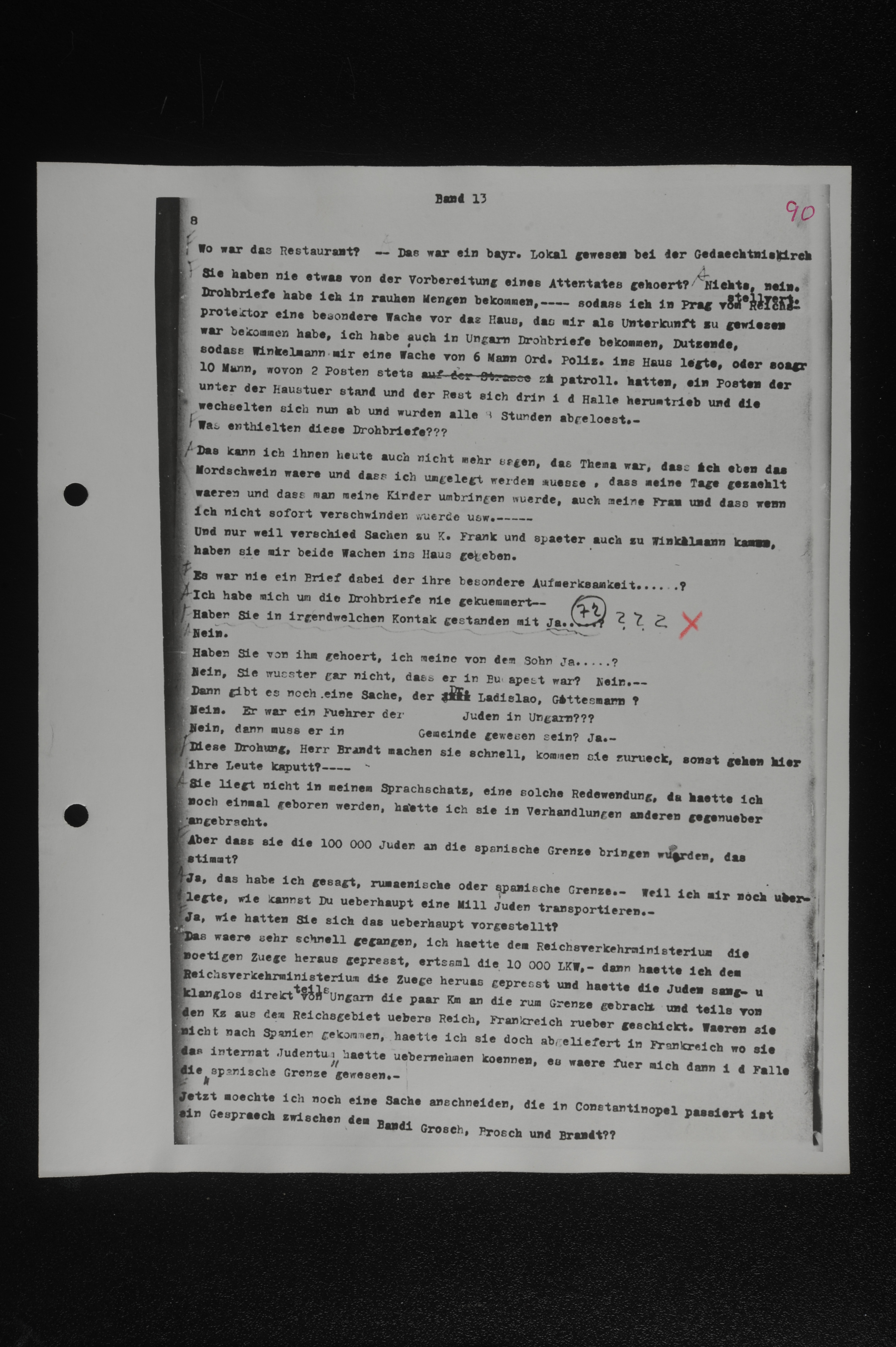
Page 316 of the typescript, O.65 file 86.
Page 316 · Yad Vashem Archives, O.65/86

Questioner

How was the special supervision by the Chief of the SD (Security Service) carried out?

By having full-time SS personnel in that outfit. They were civilian employees, after all. These were not direct state agencies or private agencies, but corporations under public law. These civilian employees were supervised by a few full-time SD (Security Service) members. Immediate supervision on behalf of the Chief of the Security Police and the SD (Security Service) lay with the head of the Central Office for Jewish Emigration, Stbf. (Sturmbannführer) Günther.

Questioner

Were these supervisors there all the time?

Eichmann

Besides the audits prescribed by Reich regulations, because it was a public corporation, the Chief of the Security Police and SD (Security Service) also had a department head of the SD Administrative Office of his own, named SS Stbf. (Sturmbannführer) Broke…. He carried out all the yearly audits of the administrative leaders in the SD main districts. On behalf of the Chief of the Security Police he also had to inspect this Central Office for Jewish Emigration and the Administration and Disposal Office and submit a report. So there was double supervision through the Chief of the Security Police and SD (Security Service). I know of not a single case of personal enrichment. Our apparatus ran cleanly, and that was our pride.

Questioner

Is it possible that the operation carried out in the General Government by Klo…tschki … (?) went under the title “Operation Reinhardt”?

Eichmann

I do not know.

Questioner

Does this letter seem authentic to you?

Eichmann

Glo was then transferred out of the General Government and became SS and Higher Police Leader in the Italian area.

Questioner

Does that mean he had completed his task in the General Government?

Eichmann

Yes.

Questioner

Could that mean there was nothing more to do there?

Eichmann

It could not mean that, because people were transferred and posted as necessity required. I was transferred from Vienna to Prague although I was nowhere near finished in Vienna. I had scarcely begun in Prague when I was transferred to Berlin. So being transferred does not mean that one had completed one’s assignment. This transfer must have come very suddenly. He is reporting here on an operation he had to carry out, and did carry out, as SS and Police Leader in the Lublin district, but he reports it under the letterhead of his new post as SS and Higher Police Leader in the Operational Zone of the Adriatic Coastland. That is unusual in itself. But the reason may be that Glo knew nothing about the bureaucratic procedure and left it to a subordinate, who was not particular about the choice of letterhead. It really must be called a mistake. That would never have happened to me.

Open page image and German
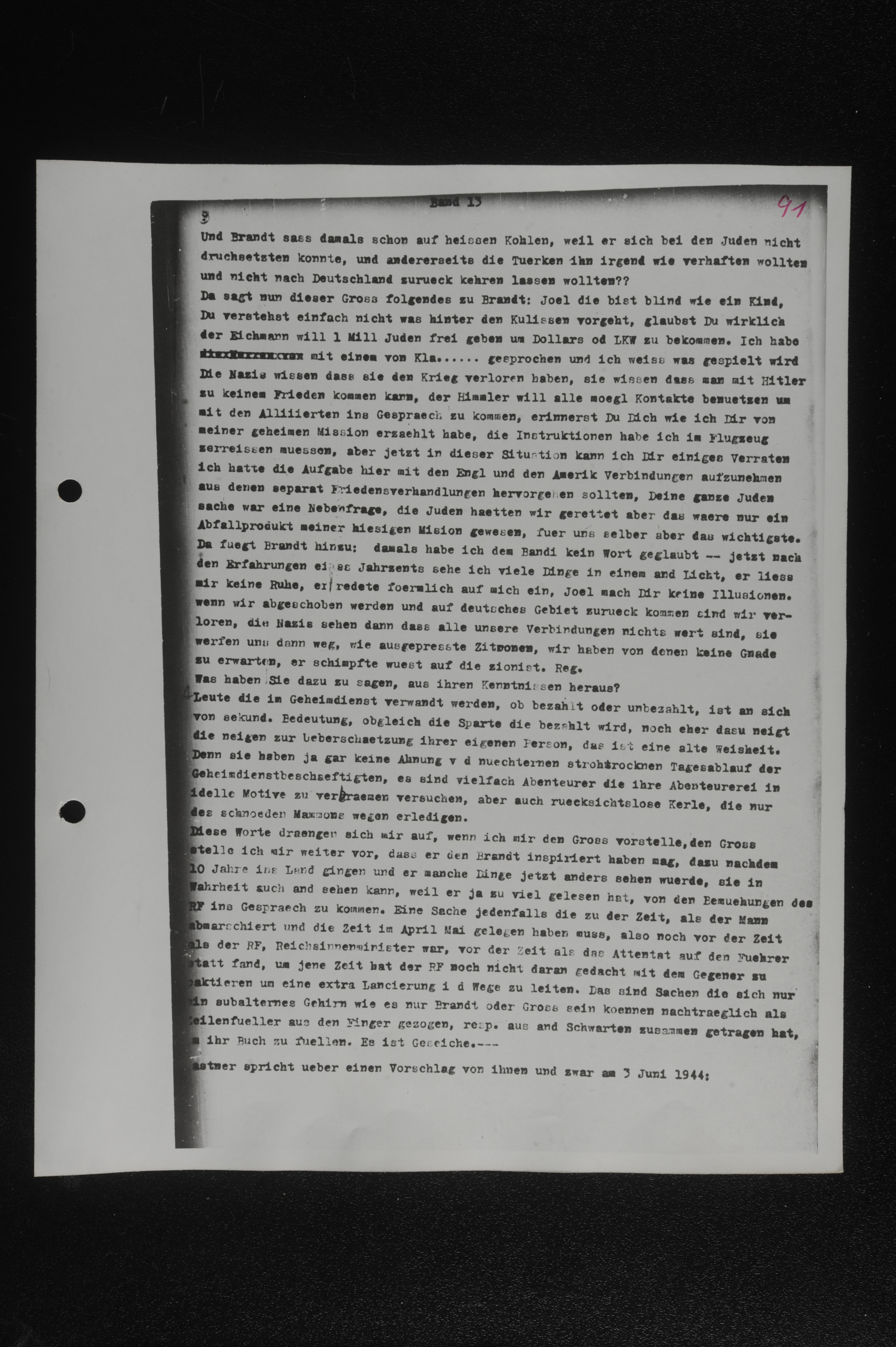
Page 317 of the typescript, O.65 file 86.
Page 317 · Yad Vashem Archives, O.65/86

Questioner

… and at the same time it shows the haste with which Glo left his previous area.

Do you have an explanation for that?

No, I have no explanation for that at all. No, nothing comes to mind. I did not see him for a long time after that.

Questioner

The reason for the haste must have been that they needed a man with Glo’s driving force in the Adriatic coastal region.

Eichmann

Yes, things must have been very precarious in that region for them to need him there immediately—just as I had to get from Prague to Berlin so quickly, and from there to Hungary.

Questioner

People were generally very satisfied with Glo, were they not?

Eichmann

Yes, he thereby advanced from SS and Police Leader to Higher SS and Police Leader.

Questioner

Now this:

Questioner reads from Globocnik's letter to Himmler

“As of October 19, 1943, I have concluded Operation Reinhardt and dissolved all the camps.”

Questioner

What does that mean?

Eichmann

Glo was never a bureaucrat. The operation was concluded, all the camps dissolved: from that one could conclude that all the Jews had been killed by him. One could assume that if this letter consisted only of that sentence. But he goes on to write, “I have handed these labor camps over to SS Ogf. (Obergruppenführer) Pohl.” Pohl was the man responsible for the concentration camps, so he must have taken over these camps. But a camp with nothing left in it does not interest a chief of the concentration camps. One could doubt the authenticity of this letter. It has no beginning and no end, so to speak. It is neither official nor private. Perhaps it is even forged. I do not know; somehow it is unclear. Glo was not a civil servant, but the Party people in particular were much worse pen-pushers, precise down to the smallest details.

Questioner

Could it not be that he is speaking about two camps in his letter, that he dissolved extermination camps and handed over labor camps?

Eichmann

Where he exterminated, I do not know.

Questioner

Can one say that after October 13, 1943 there were no more Jews in the General Government?

Eichmann

One cannot say that, because the General Government was not cleared of Jews.

[Story:]

I was once traveling from east to west, and I come through some camp. In this camp Glo had carried out exterminations, or they were carried out later; I no longer remember. In the General Government, eastern district of Lublin, Triblinka (?). An Ostf. (Obersturmführer) was the camp commander. It was a small camp. How they exterminated there I do not know—not with gas. There in this camp the Ostf. (Obersturmführer) had an armored reconnaissance vehicle, but it ran on tracks and was very low. Then I …

Open page image and German
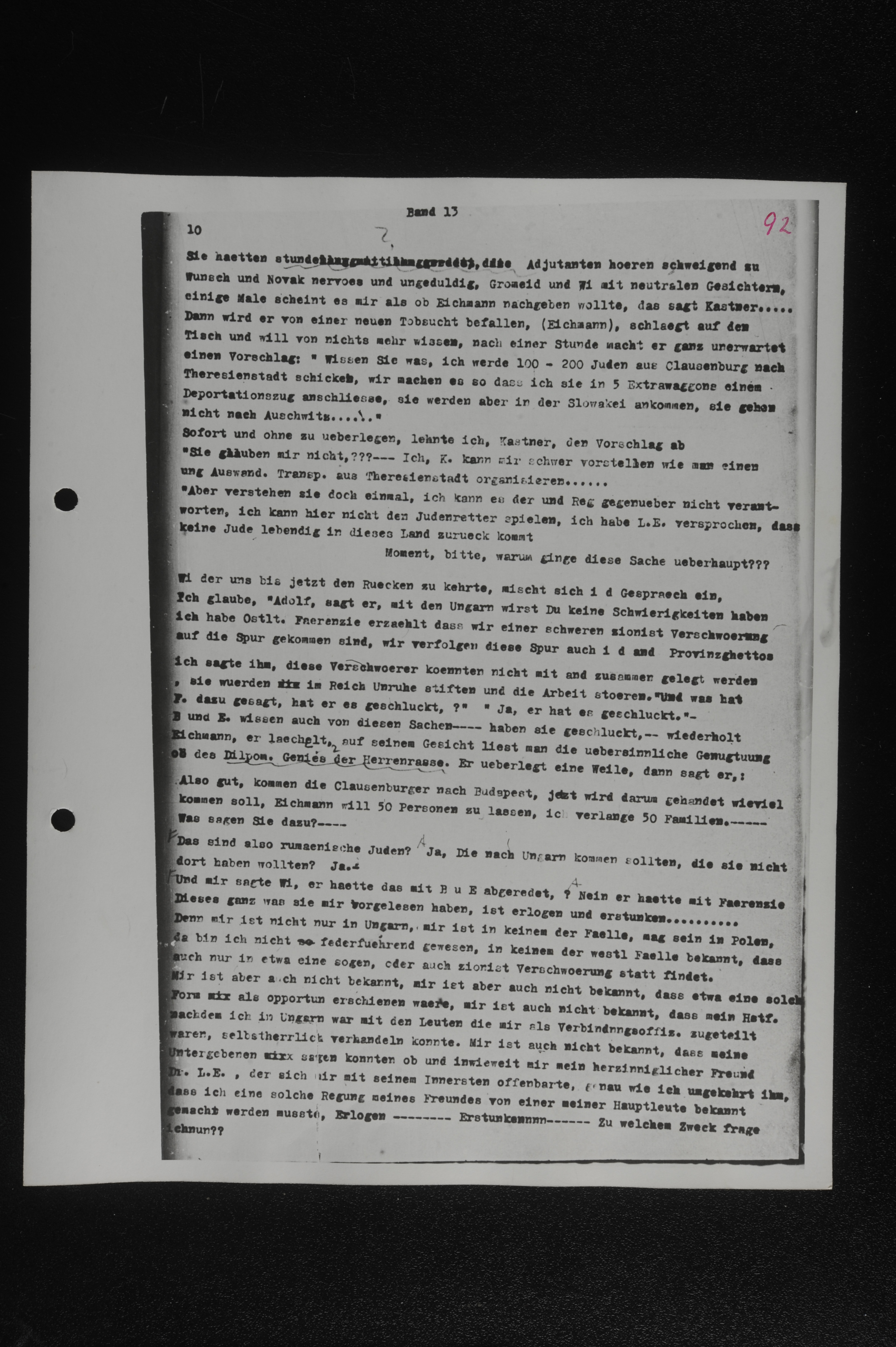
Page 318 of the typescript, O.65 file 86.
Page 318 · Yad Vashem Archives, O.65/86

and drove it around in the immediate camp area. It took me about an hour before I could steer the thing well myself. Because of that hour’s driving lesson, I remembered this camp very well. I come to Lublin again, and Glo’s Hstf. (Hauptsturmführer), Höfele, says to me—we were sitting by the fireplace—and Höfele told me the story of the camp Triblinka. One fine day an SS officer was having a uniform fitted at the camp tailor’s shop, a uniform that was being made.

From behind the uniforms being worked on there, a Jew rushed out and shot the officer dead with the pistol he had laid aside during the fitting. Then, as if on command, the sentry on a raised lookout was rushed and killed. Several other SS men were killed and their weapons seized. The Jews put the armored vehicle into action and fired on the guards with the machine guns. After so-and-so many of the guards had been killed, a large part of these imprisoned Jews fled. Some fell victim to the pressure-activated mines on one side of the camp.

The rest, apart from a few, were then found in a large-scale operation launched within a few hours. This comes to mind as I read the letter in which Glo applies to the RF (Reichsführer-SS) for some Iron Crosses. This was a camp that was to be regarded as a labor camp. You can see it quite clearly from the fact that a tailor’s shop was operating there: the guards themselves had their uniforms altered or made there. So this cannot have been an extermination camp, but a kind of concentration camp. This story may have been around the end of 1942/43. So it was Meidanek.

[Typed as notes in the transcript: Description of a stage in the camp, in front of the commandant’s building.]

[Typed as notes in the transcript: Qualified musicians—supposed 175—.]

Questioner

So, all in all, the whole Glo story is very confused.

Eichmann

I had a very warm relationship with Glo. I knew him from the years of struggle, but did not know him personally then. I got to know him personally when he was Gauleiter of Vienna. In my struggle to establish the Central Office for Jewish Emigration, I needed friends. So I also went to the Gau leadership in Vienna. I went to Glo and explained my request to him: things could not go on like this. Glo pulled out all the stops and really did everything conceivable to help me with my plan. Our friendship dates from that time. Then I went to Berlin and saw and heard nothing more of him until I had to travel to the General Government on the orders of the RF (Reichsführer-SS) to see how far Glo had got with preparations for physical extermination. The second time I saw him was at the safe affair.

Questioner

You surely also knew some of Glo’s friends. Or do you see among his people someone who might have played a double game, who might have worked for the enemy? Do you have any idea how he chose his people?

Open page image and German
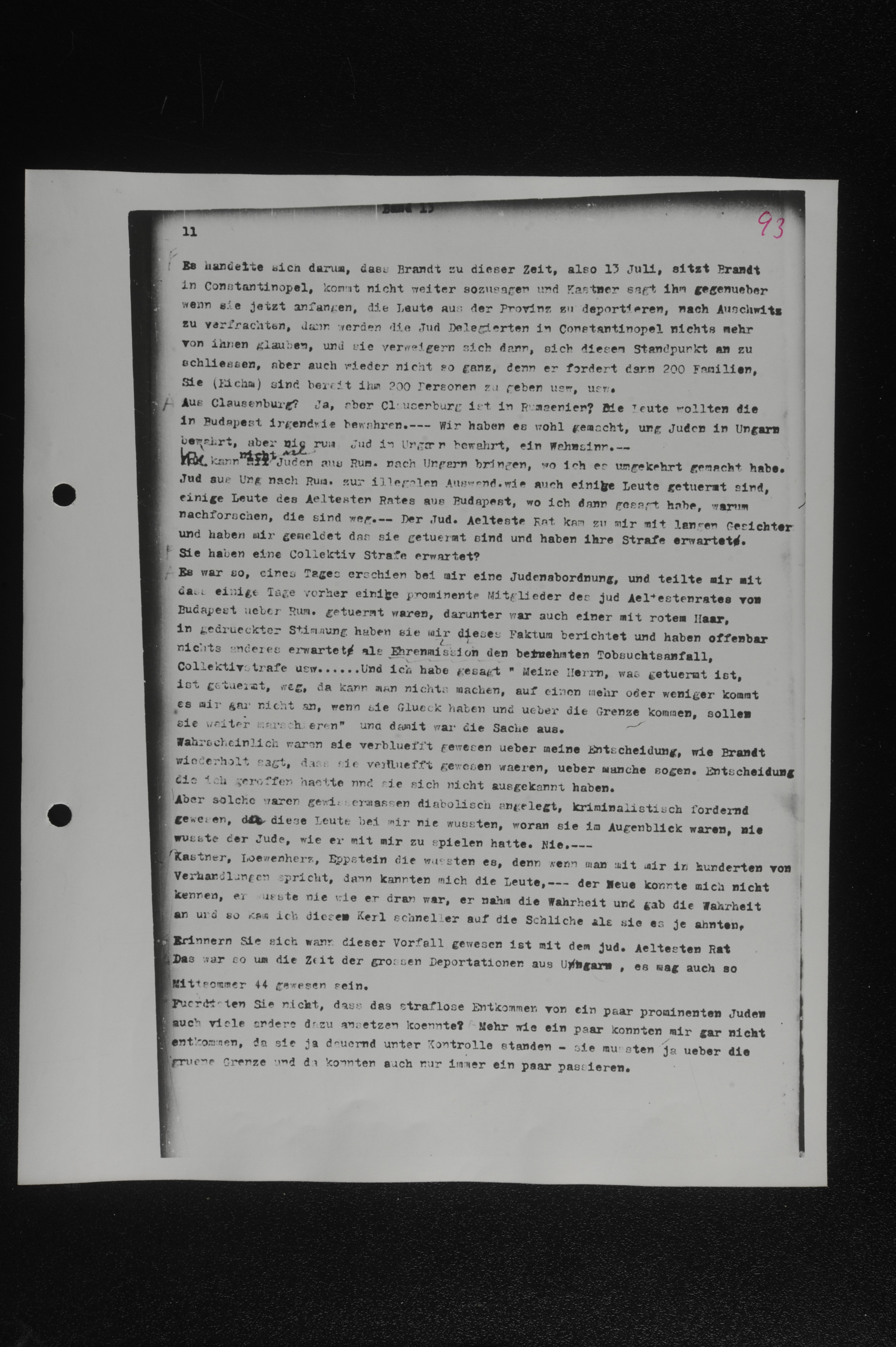
Page 319 of the typescript, O.65 file 86.
Page 319 · Yad Vashem Archives, O.65/86

My meeting with Glo again after so-and-so many years since we had last seen each other in Vienna … I was sent to Glo to report, went there, and saw a police captain occupied with building houses, still at the shell stage, which then had to be sealed airtight. I thought the thing was supposed to take place in the anti-tank ditch; that was what Heydrich had told me. So I came back and reported what I had seen. Some time later I was summoned to Heydrich again. This time I was told that I had to deliver a letter to Glo, stating that 250,000 Jews were to be sent for extermination, on the orders of the RF (Reichsführer-SS), or simply “on orders.” I do not know whether I was given the finished letter to deliver, or whether the Chief of the Security Police and SD (Security Service) ordered me to draw it up at my office.

Open page image and German
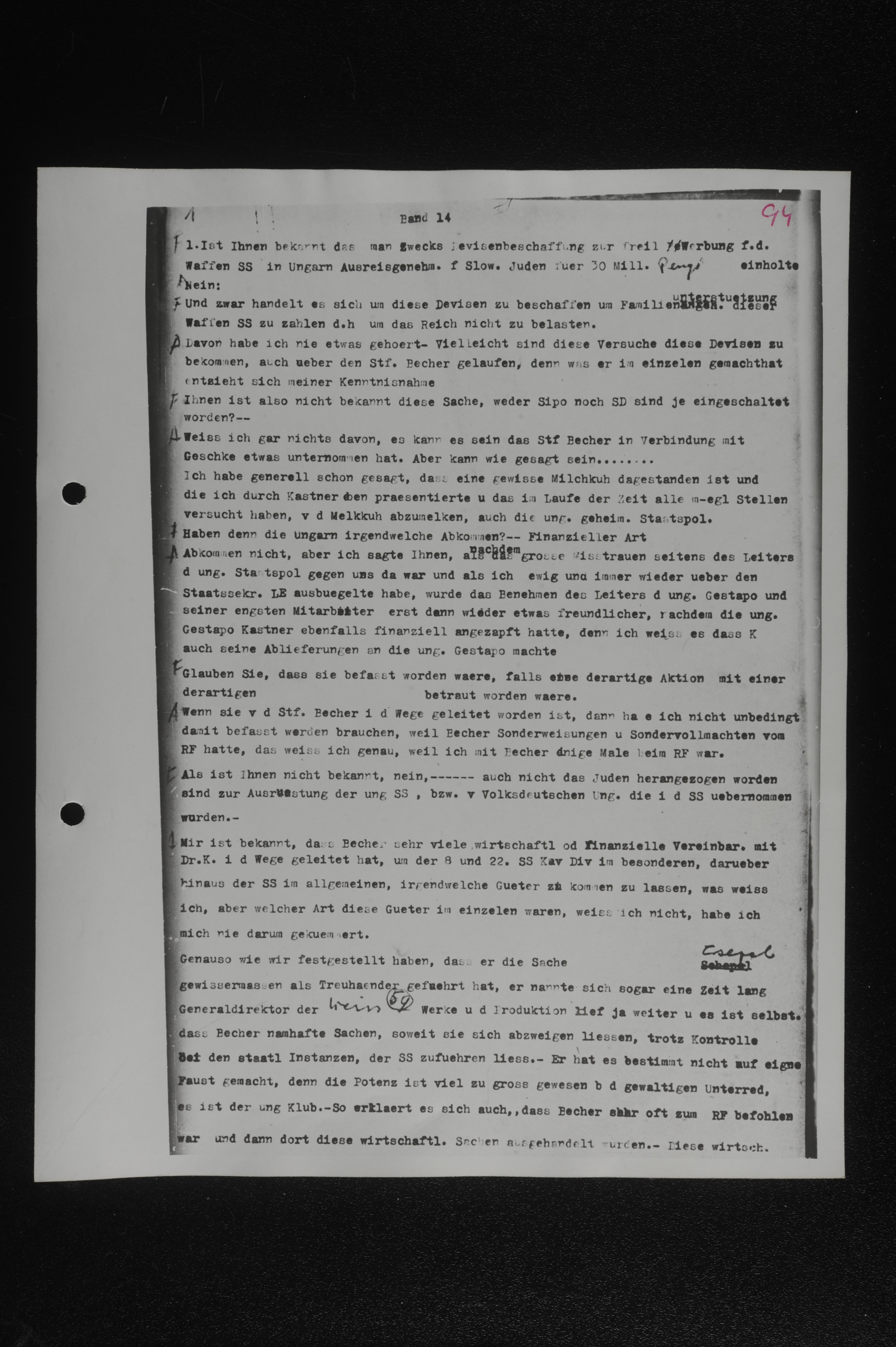
Page 320 of the typescript, O.65 file 86.
Page 320 · Yad Vashem Archives, O.65/86

If I had drafted the letter, it would have to bear the file reference IV B 4 and the register number. In any case, I was sent off as a courier with this letter, which bore the signature of the Chief of the Security Police and SD (Security Service), Heydrich, and I had to hand it to Glo… personally. Glo took it, read it, and—since it was classified as a Secret Reich Matter …, and such matters had to be acknowledged under a special number—gave the acknowledgment. I received all of this.

Glo also showed me his room, where he had set up his sleeping place, and, behind or beside a picture, a small safe built into the wall. He opened it and put this letter inside. He said, “You see, Comrade Eichmann, you must always have everything in black and white.” Whether we used the familiar or formal form of address with each other, I no longer remember exactly. “In black and white” was a common saying among us, because nothing was done without instructions and orders—not by Glo either, as SS and Police Leader.

Around that time I no longer recognized Lublin. A fine police precinct had been established. There was a guest house, there were offices and enormous drafting rooms. Glo showed me through his technical department, because he had received a special assignment from the RF (Reichsführer-SS): he was to produce models for the SS and police strongpoints to be built in the East in the future. He had various models there, some drawn, some modeled in small wooden pieces, some worked out in proper architectural drawings.

It was not only conscripted Poles who worked in this technical office. Jewish architects worked there too; there were mathematicians, technicians, skilled workers in the wood-… industry. Glo also showed me a huge carpentry shop where Jews worked as well. There they had drawn the finest things to workshop specifications. Indeed, the whole furnishing of the SS and police strongpoint at Lublin brought to mind that one was sitting in a remote eastern corner of the General Government—rather, one believed oneself to be in some modernly furnished room in the capital.

I then visited Glo once more, a third time, and found that his work had progressed. At the outskirts of Lublin there was a camp that had previously looked quite wretched, but had now reached quite respectable dimensions. It was the concentration camp of Lublin, which had probably housed 10,000 people.

[Photocopy.]

This letter that I had to deliver to Glo as a courier … The following: I had to hand Glo two such letters, more or less (mas o menos) within half a year. The two letters differed in two respects: first, the little word “another”—another 250,000—and, instead of Heydrich’s signature, the second letter bore Müller’s signature on behalf of the Chief of the Security Police, because I believe Kaltenbrunner was already Chief by then.

It surprises me very much that, when one letter is present in the document collection, the second letter has not also been shown, which would, after all, make the matter …

Open page image and German
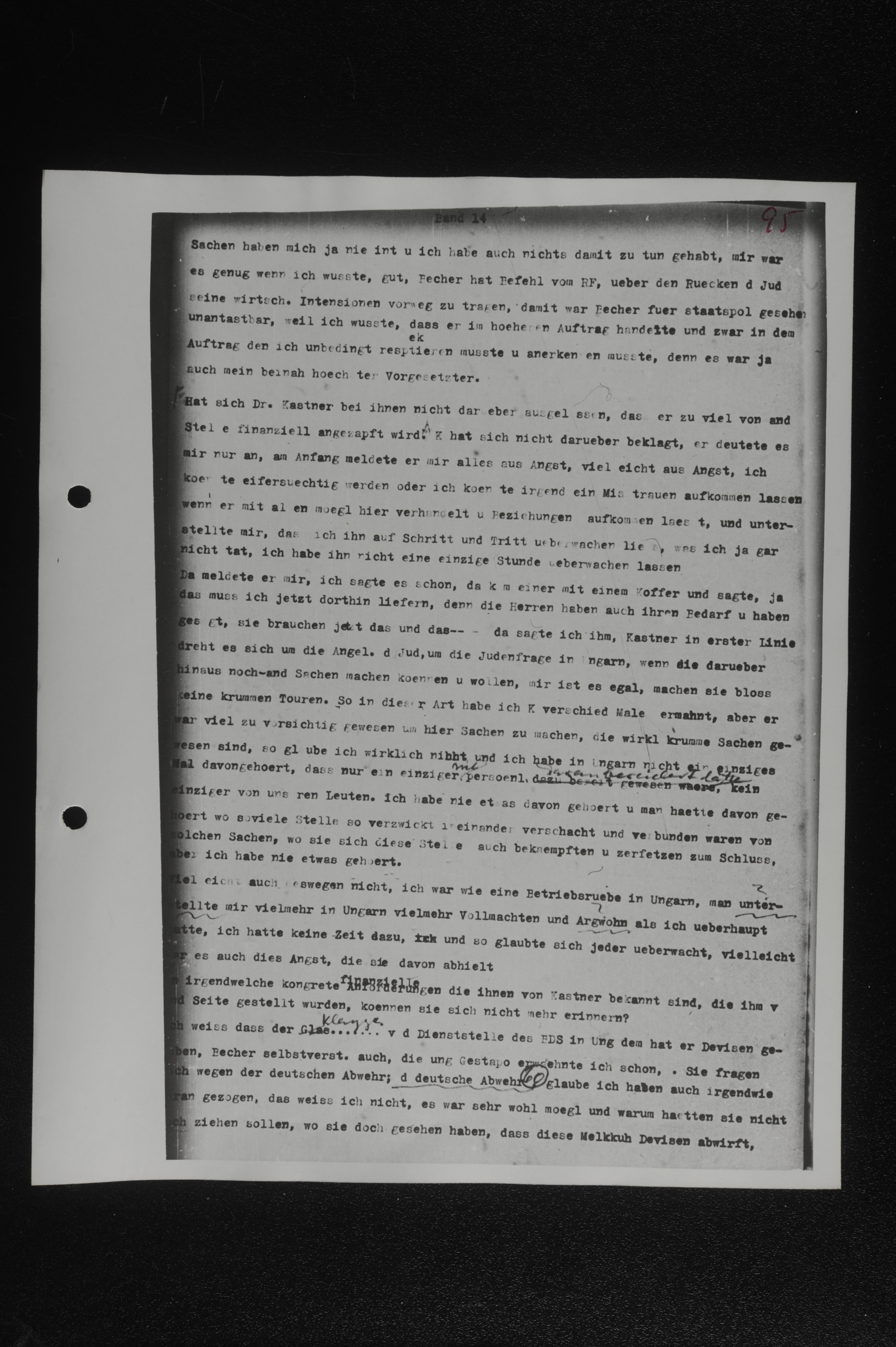
Page 321 of the typescript, O.65 file 86.
Page 321 · Yad Vashem Archives, O.65/86

…considerably more interesting, because here the figure jumps from 250,000 to 500,000. If you tell me that a photocopy of the first letter has been found, I must counter that Glo… burned both these letters. The order obliged him to do so as the bearer of a Secret Reich Matter. As such, you were obliged to protect Secret Reich Matters from anyone gaining access, even at the sacrifice of your own life. So he will have burned them. The only possibility left is that he, during his lifetime, or a considerable time before … in this case, probably the first letter was obtained by some intelligence services and photocopied. I have broadly outlined the circle of people around Glo: Polish conscripted workers, German conscripted workers, Jewish architects and engineers who were on duty and at work at this SS and police strongpoint.
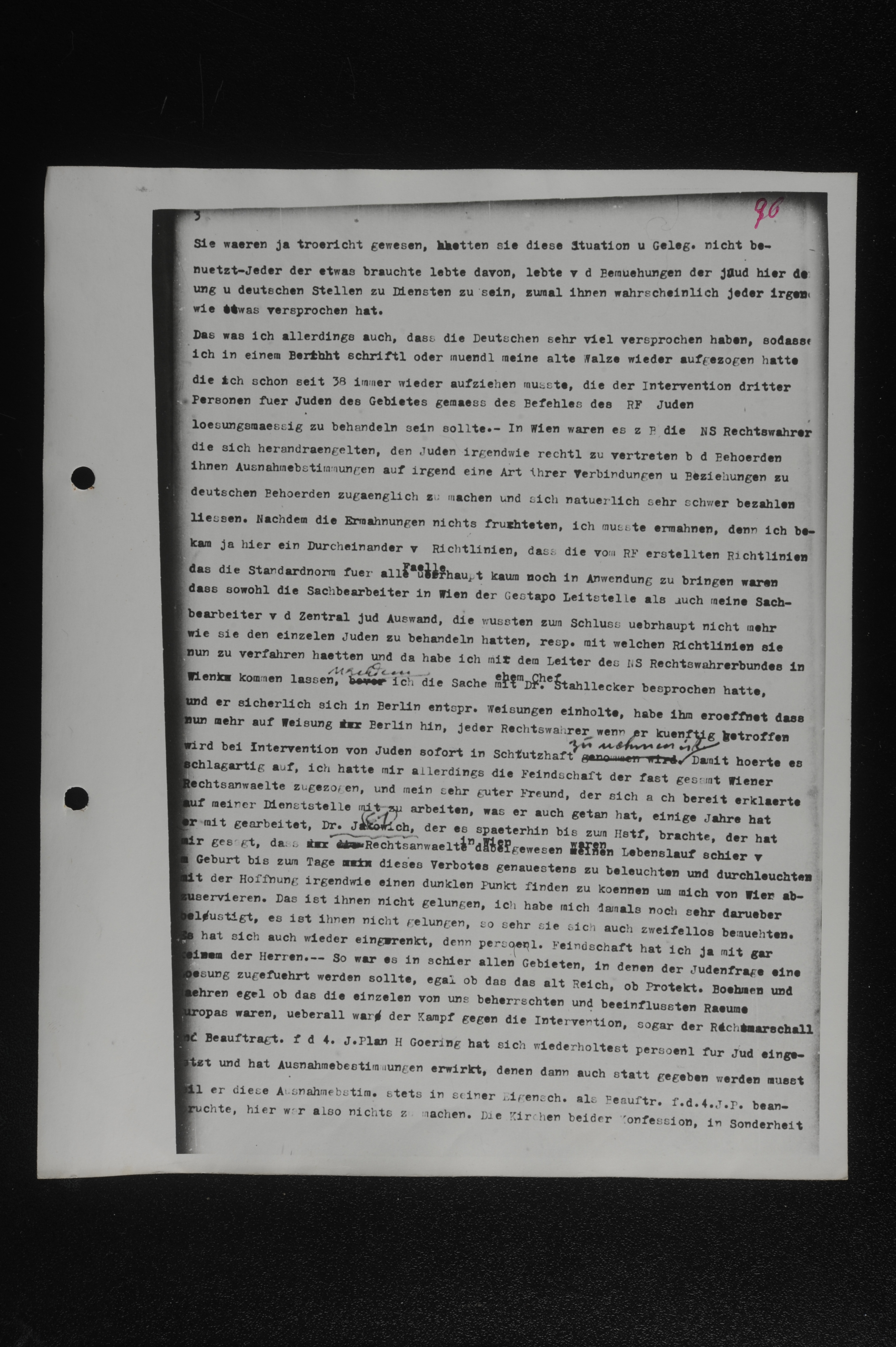
[Interposed question:]

Questioner

If the original was stolen to make a photocopy, and we are dealing here with the first letter, there must have been a personnel change around Glo between the first and second letters that made it impossible to take the second, more important letter. That is, someone who had access to Glo’s safe was able to take the first letter, but with the second letter either no longer had the opportunity or was no longer there.

[Second question:]

From your personal assessment of Glo, do you consider it possible that this safe was installed by some prisoner who was clever enough to obtain a second key, so that he always had access to the safe? Or do you believe Glo was clever enough to rule out that possibility by having it installed by particular people, SS people?

Eichmann

I consider it out of the question that anyone from the circle of people I named could be the perpetrator—as the perpetrator … as the leader of such an underground movement, without a doubt. I consider it out of the question that SS Hstf. (Hauptsturmführer) Höfle could be the perpetrator, because he had been Glo’s closest and most trusted friend. I consider it out of the question that the major of the Order Police could be responsible, because he was mostly away. I hardly believe he had access to the room where, as I did not say for nothing, a bed had been set up. But Glo also had household staff: female staff, as far as I know Polish staff, and a number of SS orderlies as well.

I mentioned the little table in front of the fireplace because I found the motifs on the tiles so extraordinarily nice, and because the cognacs were served to us each time by orderlies. As far as I remember, these were severely wounded SS men who had become unfit for the front and now occupied these posts. Who set up the bed—the orderlies or his female staff? Those are the questions to ask. That it was stolen is entirely clear, because by law Glo was not allowed to make even a written copy of a Secret Reich Matter, let alone a photocopy, unless he had personally obtained permission from the issuer—in this case the Chief of the Security Police and SD (Security Service). Such a copy—a written copy—would then have had to carry a notice of authorization.

Open page image and German
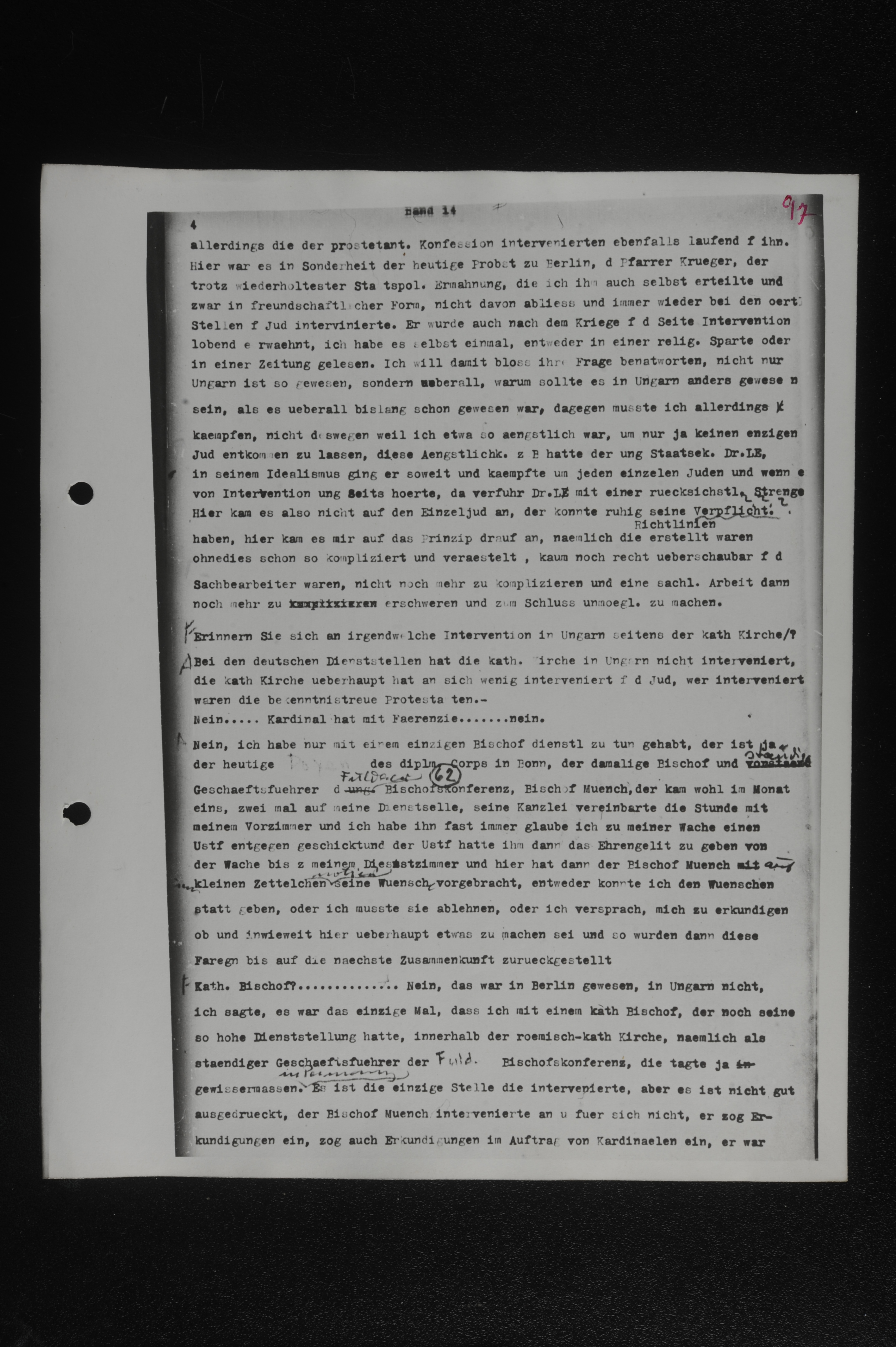
Page 322 of the typescript, O.65 file 86.
Page 322 · Yad Vashem Archives, O.65/86

A photocopy from it … Either the person who wrote this book had a photocopy made from the original—but I do not believe that, because then he would surely have published the original, never, never a photocopy. The very fact that there is a photocopy of a Secret Reich Matter proves unequivocally that the thing was stolen. Household staff or orderlies—the people who took it away were in his working circle. In all his actions, on duty and in private, Glo was a very casual man. Nobody bothered him; he was bound by no fixed form and was no slave to time.

Thinking it over further, I can imagine it is quite possible that when he changed clothes he simply left the safe key in the other trousers. Perhaps none of that interested him at the moment. His thoughts were on great problems. He was regarded as a great master builder. His greatness was that he kept two to three million Jews away from the Reich, with a small deployment of German personnel. He thought only, “How can I serve the Reich?” The exact accounting in Reichsmarks is typical of Glo, just as he writes that prominent … industries are interested in his work: that this is something that could be very important to the Reich. He concerned himself with everything.
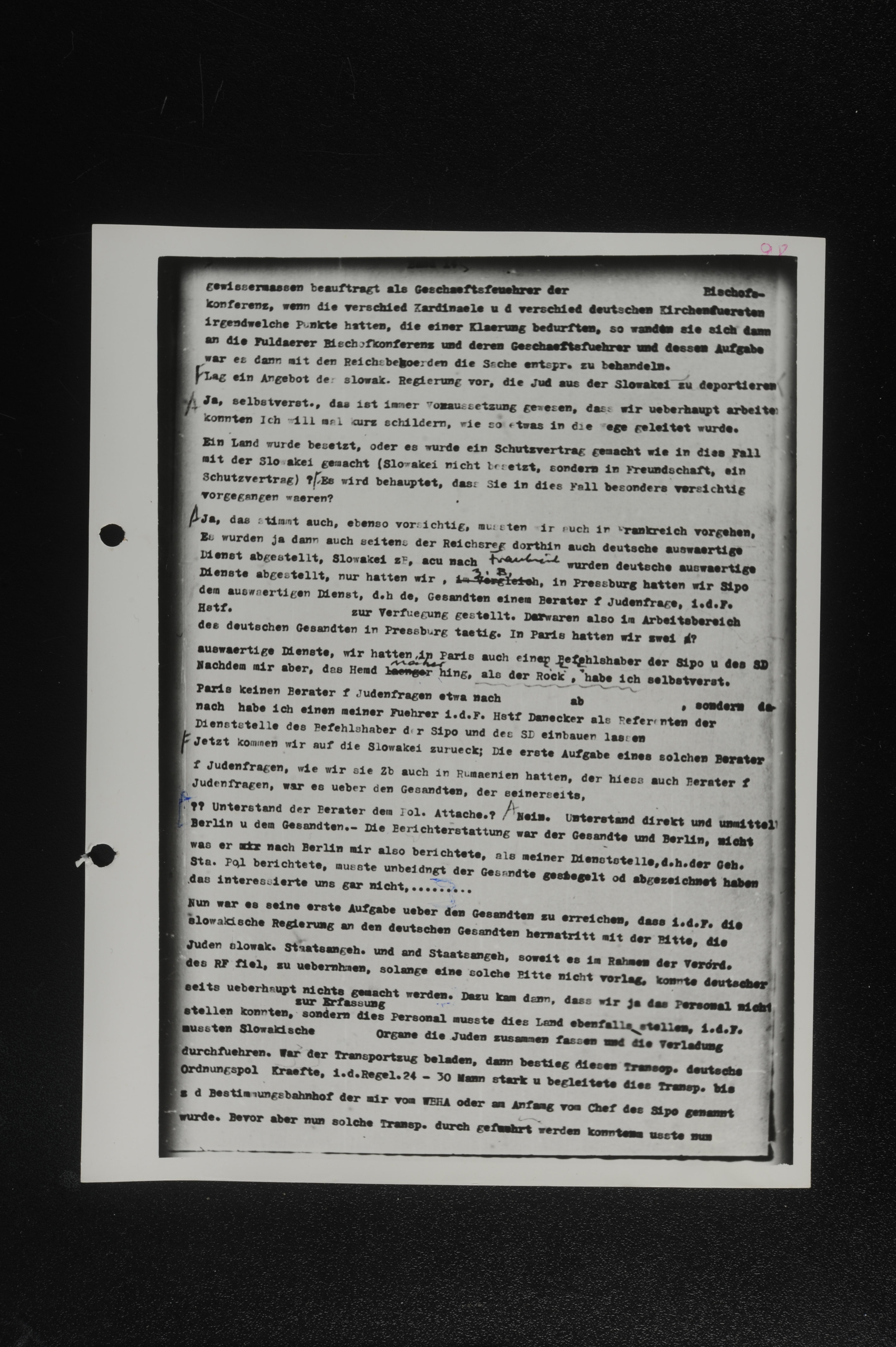
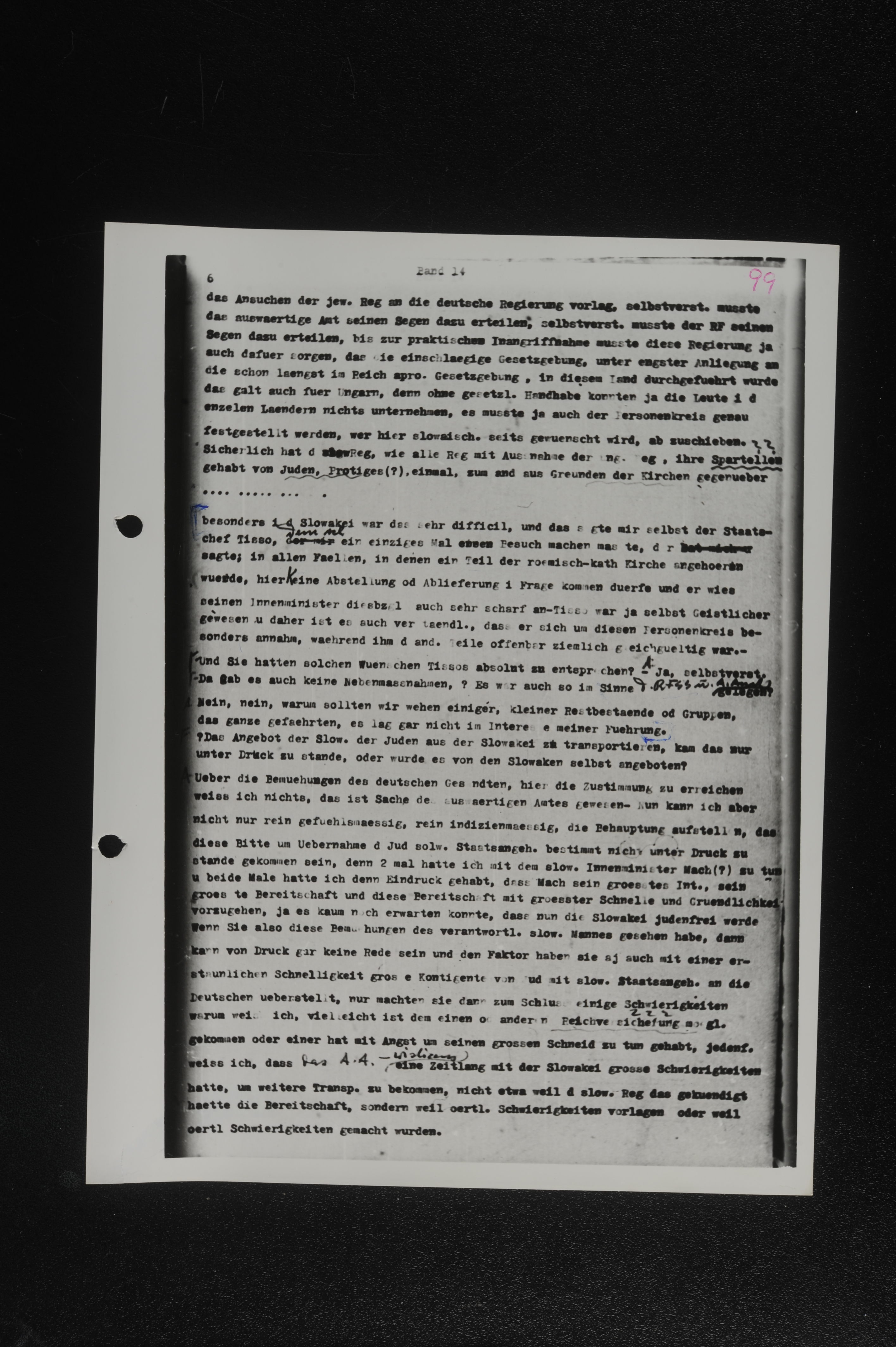
[Interposed question purely from the police standpoint:]

Questioner

Let us suppose: while you were talking with him, could the Polish household staff or the orderlies move freely around the room?

Eichmann

I saw female staff only early in the morning, dusting. The things for eating, drinking and smoking were brought by the orderlies. There was a free, open tone; people spoke uninhibitedly with each other. We played the record, “We hanging our washing on the Siegfried line”. He could not have cared less whether orderlies or household staff were bustling through the room. We spoke just as openly, without whispering.

Questioner

So there were no precautions?

Eichmann

Well, I must say, at that time, when the front was still very, very far to the east, who knows whether I would have taken them had I not been schooled in a police office—which Glo never had been, because he came straight from the Party. But we had felt uncomfortable even just clearing our throats quickly at night.

[Now further police matters:]

Questioner

So, someone found the key in the trouser pocket and made a photocopy. But to make one you need a camera; you cannot do it with just the first one to hand. You must have had a good camera. Was a photographic department therefore part of a concentration camp’s complete equipment, where, for example, the inmates …?

Eichmann

Yes, of course. Every policeman had photographic equipment at his disposal insofar as it fell within his responsibilities.

Questioner

Was the photographer who photographed the concentration camp inmates also an inmate, or …?

Eichmann

Yes, in many camps the personnel were involved in almost everything. And you must not forget: Glo was (I believed) a bachelor [handwritten note below the line: in any case, in the General Government he was “completely (? unbeweibt)”, at least to all appearances]. When he went away, then

Open page image and German
Page 323 of the typescript, O.65 file 86.
Page 323 · Yad Vashem Archives, O.65/86

the house stood empty. And he traveled a great deal—then the house stood empty.

Questioner

How long would he have had to keep the letter? When could he destroy it?

Eichmann

As far as I can recall, he had no right at all to have such a thing given to him in writing. He certainly would not have received it from the RF (Reichsführer-SS) if Glo had not played an exceptional role personally (a persona), because Glo was in favor with the RF (Reichsführer-SS). Glo had been the fighting, tenacious, illegal Gauleiter in the Ostmark. As Gauleiter of Vienna, he caused the German Reich little difficulty when he was pushed aside to make room for a German governor, a Reich Commissioner, Bürckel. He put the cause before the person, and that was not forgotten.

So the RF (Reichsführer-SS) compensated him by appointing him SS and Police Leader. After a short period in that role, he was made Higher SS and Police Leader, and was thus roughly back in the position he had given up without complaint. So Glo played quite a different role from the other SS and Police Leaders. The Governor General could not push Glo around either, because Glo wrote to the RF (Reichsführer-SS) personally. The others would not have been allowed to do that; it would have bypassed official channels. But a man like Glo had no need of them.

He alone, who worked only for the interests of the Reich, who worked only for those interests, could write personally to the RF (Reichsführer-SS) without having selfish motives attributed to him. The RF (Reichsführer-SS) trusted Glo unconditionally. Now, with this letter, it may have been that none of the others received such a letter—none. But here Glooo said, “Please, I would like it in writing.” Then the half-soldier in this Party warhorse awoke. Naturally, once his task was finished, Glo would have had to destroy this thing. Perhaps he did destroy it. The only question is when the enemy intelligence service photographed it.

[Interposed question:]

Questioner

If he requests such a letter and receives it, his intention is surely to have his mission covered in some way. If it is covered, he thinks, “Then no one can accuse me of having acted on my own authority.” But the accusation against which he wants to protect himself could arise at any moment: during his operation or two years afterwards. If one is looking for an explanation for this written document, one must say that the written confirmation would make no sense if he then destroyed it, because then his “black and white” would no longer have any value.

Eichmann

Yes, but after completion he received confirmation that it had been carried out. That would have superseded the first document—through the report of completion and the acknowledgment of that report received in response, which must also have been classified as a secret matter.

Questioner

In other words, if the enemy (Gegener) committed his full efforts, he will also have supplied the necessary equipment. If such incredible valuables were found in one district—probably 100,000,000 million Reichsmarks in all —well, the cost of a special camera could hardly have been in any proportion to those sums. If there were places where half a million dollars were found, and so on, then such a small camera

Open page image and German
Page 324 of the typescript, O.65 file 86.
Page 324 · Yad Vashem Archives, O.65/86

Questioner

is nothing by comparison.

All right, but how does it get into the camp? How could that have been organized?

Yes, if an uprising could be organized in Warsaw, if an uprising is organized in a small camp near De…cker …, if one considers that there was a Polish underground movement in Poland with which the Jews had very close connections … That is a purely technical matter and presents no problem.

[Interposed question:]

Questioner

Do you remember what else Glo kept in this safe?

Eichmann

Almost nothing. It was only a small cabinet, 30 by 40 centimeters. I stood in front of it with him myself. There were just various little papers in it and nothing else, nothing at all.

Questioner

If more documents were published, one could say they came from Glo’s safe. But there were no others there. It is also possible, though, that the whole thing had already been recorded in Berlin beforehand?

Eichmann

I consider that out of the question. It was all done quite routinely. I was ordered to prepare a letter for Glo, and a letter I had to deliver personally never left my sight. I dictated it to Mrs. Werlemann. Ustf. (Untersturmführer) Martin, as head of the registry, then received the letter, assigned it a register number as a Secret Reich Matter and entered it in the registry. No duplicate was made, only one original. I then took the letter and either presented it personally to Heydrich, or gave it to Müller, who presented it to Heydrich in turn. I received it back through official channels.

Questioner

So it is possible that, when this letter left you and went to Müller, it was photographed there after all? Then all the letters could have been photocopied?

Eichmann

Oh no, not all the letters. Enough were photocopied, and not all the letters contained instructions as important as this letter. It was such a clear, unambiguous text. If one is looking for the opening through which the enemy could have gained access, where he had an opportunity to act, one can say that Glo’s safe or Berlin was the starting point.

Possible. But just as I had to take care, Müller had to do so to an even greater degree, since all the threads came together with him. Theoretically, of course, everything is possible—with me, and all the more with Müller. But I knew my people. I knew Martin and his registry. I had known him as an SS man …. He was meticulous, and he was a wooden lump who rose from behind his desk only for me or for Müller. But he was reliable. I preached to all my people: “Do your work properly. Whatever else you think of me—even ‘kiss my ass’ (LMA)—is all the same to me. But the work must be done.”

Open page image and German
Page 325 of the typescript, O.65 file 86.
Page 325 · Yad Vashem Archives, O.65/86

Unknown speaker

This static hostile front now found—into this static hostile front there now penetrated, as an internal dynamic, perhaps still somewhat concealed in 1934/35, but quite openly and decisively after the proclamation of the Nuremberg Jewish laws, after 1936 … Into this static hostile front there now came the Jewish question as a dynamic element. The Jewish question was injected into it, first of all, of course, by the Jews themselves, and within Jewry first and foremost by Zionism. For if, after the First World War, Zionism tried, worked by every means, to cash in its contribution during the First World War—above all its financial and economic contribution—in a Baufuhr Declaration, which then failed to bring the hoped-for success, the re-establishment of the Jewish state, which failed to bring that success, in B…

United men, such as Laurence, the Arab L., such as the English Chief of the General Staff and other Conservatives, more or less right-leaning forces in England, who above all unconsciously, but sometimes consciously, during the World War and in the decisive years after it, would by no means let the English Empire suffer harm for the sake of founding a Jewish state, which was in any case somehow repugnant to those same elements—at least as repugnant as founding a Zulu state in South Africa.

If it was these elements that caused the attempt to cash in the national Jewish capital, the sums contributed toward defeating Germany in the First World War, to fail, then world Jewry, and above all Zionism, had from the outset scented the enormous possibilities concealed in the Third Reich’s emerging policy towards the Jews. I do not wish to assert that the Jews in 1936/3… were already fully aware that it would ultimately lead to gassings or to operations for the physical extermination of the Jews.

But it is certain that, at least from 1936, world Jewry and above all Zionism repeatedly pointed out that there were [? seeds] present in the Third Reich’s policy towards the Jews—measures that could ultimately lead to physical extermination. And from Kristallnacht in 1938, a large-scale Jewish campaign began abroad, making a thunderclap out of every fart and trying to make capital out of the assaults that actually took place against the Jews during K-Night (Kristallnacht), including physical assaults—or to present those assaults as forerunners of systematic, and also physical, combating of Jewry in the Third Reich.

That world Jewry and above all Zionism were already speaking with a forked tongue about the Third Reich’s combating of the Jews follows plainly from the fact that, with the right hand, they wrote about the physical suffering inflicted on the Jews, for example during this K-Night (Kristallnacht), and also about the physical suffering plainly in store for the Jews in Germany, which was positively foretold—foretold above all on the basis of the Nazis’ brutality, and so on. Although they wrote that with the right hand, with the left hand they did nothing, absolutely nothing—not even a little—to promote the large-scale operation then underway for the emigration of the German Jews in any way. If one …

Open page image and German
Page 326 of the typescript, O.65 file 86.
Page 326 · Yad Vashem Archives, O.65/86

Unknown speaker

When one looks at the enormous efforts that world Jewry and Zionism made after the Second World War, first to prepare the state of Israel in an undertaking that was also military in nature, which throughout the prewar years and especially during the war years wrested land from the Arabs inch by inch in Palestine itself; the efforts that finally brought the state of Israel into being; the efforts to keep alive the economic absurdity called Israel; and when one adds up these enormous efforts, one can only wonder that this same world Jewry and this same Zionism, in the years 1939, 1940, 1941, and even in 1944, did not lift a single finger to promote large-scale Jewish emigration from Germany.

When one takes all these factors into account and draws a logical conclusion from them, one can only say that world Jewry, Zionism, intellectual Jewry, which for the most part, which to a large extent springs at least from German Jewry, with an outstanding knowledge of the German character, with an analytical understanding of the German individual such as hardly any other people possesses.

This intellectual Jewry knew that the German people, to whom I would like to apply here the image of a young, vigorous, blond and stupid giant, had already had the Jewish problem served up ready-made by world Jewry, by Zionism, nicely laid out so as to drive him slowly but surely mad, because every possibility of a logical, normal, peaceful solution was systematically barred to him; that one would slowly but surely goad the anger of this blind … giant, bring that anger to white heat, and then calculate with mathematical certainty the moment when he would strike out with his fist.

And calculate with just as much mathematical precision that, after the first blow, this fist would be raised for a second, a third and a fourth blow. This blow would, and that too was clear to world Jewry and Zionism, it would cost Jewish property. That did not matter. It would also cost Jewish blood, but that did not matter either. For just as other peoples have fought wars of independence to win their independence on the battlefield, and have not shrunk from sacrifices of blood when it came to winning their own fatherland and securing their independence, so world Jewry and Zionism moved their battlefield with mathematical precision to the place, or rather chose their battle at the place, where that giant would rage.

They said to themselves: the little war we are fighting in Palestine to conquer a Ha. there, to bargain for a patch of land there, to make use of an Arab sheikh there with all his corruption, to seize him or buy him off, this little war ultimately takes place only to advantage (Vorteil). The real war for the founding and the conquest, for bringing to life the centuries-old dream of Eretz Israel (Eretts Israel), this real war is fought in Germany. After Germany had conquered a large part of Europe, Europe became the theater of this war planned by world Jewry and, above all, by Zionism. The battlefields of this war were called extermination camps. Seen from this show, one can only say that Israel

Open page image and German
Page 327 of the typescript, O.65 file 86.
Page 327 · Yad Vashem Archives, O.65/86

Unknown speaker

that Israel owes its existence to the Jewish policy of the Third Reich, or rather that the Third Reich, that the German leadership, hemmed in and cornered, saw no other possibility than to resort to violence against the Jews, to demand a high toll of Jewish blood and thereby to serve the policy, the objective, the long-term goal of a genuine Zionist endeavor.

Whoever pauses for a moment over the thoughts and memories of the United Nations debates that at the time unanimously supported the founding of the state of Israel, whoever thinks back for just a moment to the constantly recurring theme: this Jewish people, which suffered under the scourges of Nazism as no other people did. This Jewish people, which suffered six million blood sacrifices out of its total population of twenty million, almost a third; this poor Jewish people, which had to sacrifice six million to National Socialism, through its proportionately greatest losses of blood among all the Allied peoples, earned through suffering the right to a state of its own, to its own statehood.

Not a single delegation, among all the peoples present at the United Nations during these debates, made the slightest attempt, apart from the Arab nations, to question the truth of these great sacrifices of blood. Nobody did. And of course, in the face of a globally manipulated public opinion, nobody even dared so much as to touch on the falsity of Zionism. For this Zi… consisted essentially in this: every people prepared to commit its blood and property to its independence, to its own statehood, has a right to that independence and that statehood. If these sacrifices involve blood, every people thereby proves that it deserves its independence. Now, the Jewish people made six million sacrifices of blood, thereby paying proportionately the highest toll of blood for the Allied victory, so the Jewish people has a right to its own state.

In this connection it must be pointed out that already after the First World War, through the so-called Baufuhr Declaration, Eretz Israel (Eretts Israel) was essentially promised to the Jews by the Allies. Promised to the Jews because they had contributed greatly, economically and above all financially, to the Allied victory over Germany.

One must also remember in this connection that Turkey was then allied with Germany. Turkey held sovereignty over Palestine, and Turkey’s defeat could therefore create the precondition for Eretz Israel (Erets Israel). We can follow the course of Jewish efforts to put the … Declaration into practice. Only one thing became clear to the Jews from this: in modern times it is no longer enough to play Jud Süss in order to create political realities. Somehow the world had to be given clear proof of Jewish willingness to commit themselves to their own state. Somehow the proposition had to be challenged that a people that gives up its homeland, a people that has given up its state for thousands of years, practically since Israel’s subjugation by the Romans, can hardly have the right suddenly, at some point in history, to fall back on ancient rights that it has neglected for two thousand years.

Open page image and German
Page 328 of the typescript, O.65 file 86.
Page 328 · Yad Vashem Archives, O.65/86

Unknown speaker

And that it was necessary to pose in dramatic form the problem of Jewry, always latent among all peoples, so sharply that the peoples, the leaders and the politicians had to take some position on the Jewish state. In modern times Zionism, which is ultimately itself a creation of modern times, for latent Zionism had existed among a certain proportion of the rabbis throughout the centuries and even surfaced during various conquests in various countries, but ultimately became a militant political consciousness only in modern times. This Zionism understood that such a compelling demonstration of the Jewish will to a state of its own was necessary, and that its most dramatic form would naturally consist in making Jewry the chosen victim of the Nazism threatening the whole world.

At the same time, modern Zionism by no means neglected military necessities. Its political demands had their counterpart in military readiness, readiness for action, which was intermittently [?] present in Palestine already in the twenties, grew in the thirties, and during the war took on the full form of a small war. After the war it stood up militarily to the English, who had only just been its allies, just as it did to the other enemies of Zionism. In this small war the Jews did prove themselves excellent partisan fighters, bringing the whole baseness of partisan warfare to bear against the English, especially after the Second World War. In this connection I need only look through the book, “…”

which is the life story of the English parachutist Rey…, murdered by the Jews.

Now that the Jews had emphatically declared their will, and now that the Jewish policy of the Third Reich increasingly ended in violence, had to end there according to Jewish calculations, all this made it indisputable that Eretz Israel (Eretts Israel) was brought into being.

If one takes the purely chronological course of Germany’s handling of the Jewish question, one undoubtedly finds that initially, entirely in keeping with the German character and especially the German sense of order and regularity, the handling of the Jewish question was initially a more or less purely formal, a ju… matter, involving decrees, regulations and so on.

With the separation of the powers of state, despite the unification of the three powers in the Führer’s hands, there was friction and discussion of jurisdiction; then, naturally, on the eve of the war, a more vigorous implementation of the specified provisions, and finally, during the war, under the pressure of the events of the war themselves, an increasingly inexorable move toward sheer brutal violence. Shortly before the end of the war there was a return to where the German form of humanity in solving the Jewish question had begun anyway, with positively tear-jerking fits of humanity. This at the very time when a hundred thousand ethnic Germans, when even a hundred thousand Reich Germans, driven from home and homeland by the events of the war, on the bombarded

Open page image and German
Page 329 of the typescript, O.65 file 86.
Page 329 · Yad Vashem Archives, O.65/86

Unknown speaker

roads and railway lines, were moving along and trying to save their skins; that at exactly the same time space aboard ships was made available to rescue a certain number, several thousand Jews, to Sweden;

that at the same time trains were set in motion toward Switzerland. It is perhaps somewhat naive to suppose that the responsible German authorities that ordered these actions believed they could still score a few points in this way at five minutes to twelve. Rather, it demonstrated the hopelessness of the average German, who was ultimately also the man in uniform, being able to pursue a violent solution of the Jewish question in the long run.

Here lies a very important point that I do not wish to pursue further at the moment, but which I do want to establish, and which may prompt more extensive consideration. I mean, the point that absolutely must be discussed is the average German and the use of violence against a defenseless opponent, or rather a phrase about the remark of the RF (Reichsführer-SS), who had never met a German who did not know his own good Jew. From this the RF (Reichsführer-SS) concluded that there were about … 100 million Germans and that each knew his good Jew, so there was hardly any room left in the world for the bad ones.

On the basis of the available information from the enemy side and from our side, I believe I must objectively establish that:

1. On the German side there was violence, murder, murder under the aggravating circumstance that the victims were defenseless prisoners.

2. The circumstances of the war, and I do not even wish to invoke a certain compensating justice, which lies in the fact that Germany and the German people, practically since the defeat at Ska…, that is, since the moment when Germany and the Third Reich failed in the most essential of all the tasks they had set themselves, namely the prior, the biological and political and subsequent defeat of Bolshevism. After Stalingrad the average German was undoubtedly caught between the wall and the knife. The most ruthless bombardments rained down day and night, hardship increased, and Jewry had never troubled to conceal that it regarded itself as the great promoter, the instigator, the great organizer of the war against Germany.

Thus it is not forgivable, but it is understandable, that a man like Eichmann, Höss, Glo…, who, one had seen the terrible phosphorus nights in Hamburg, another the bombardments of Berlin, the third the slaughter in Dresden; that these men, already burdened by the orders and the assignment to which they now had to devote their energies, regarded this almost as an exercise of arbitrary but humanly explicable justice; that they naturally regarded these now tangible brothers of the very intangible culprits responsible for German suffering as vermin. They would have called it nothing less than a wish for suicide if they had not confronted the opponent as radically as they did in carrying out certain orders.

I do not wish to pursue this kind of justice, which runs through the whole course of events like a common thread, by which the German crime is not excused, by which the Allied crime is not excused.

Open page image and German
Page 330 of the typescript, O.65 file 86.
Page 330 · Yad Vashem Archives, O.65/86

Unknown speaker

But both represent an equal degree of criminality, depriving each of the right to pass judgment on the other.

It is established that the initial German efforts, which continued even beyond the beginning of the war, to solve the Jewish problem in an orderly and peaceful way not only received not the slightest cooperation from the Allied side, not only received not the slightest cooperation from the Jewish side, but were positively strangled at birth by the opponent, whether Allied or Jew.

That the static front would have gone to war against Germany in 1939; perhaps it would have waited another seven years, perhaps longer still. That would have depended on how things developed. But world Jewry and above all Zionism had, from the outset, fattened itself into this static front, whether under a poetic pretext, an ideological pretext or an economic pretext, and soon became the driving force, replacing the static element with a dynamic that, by its own laws, necessarily had to arrive at 1 September 1939. And within a period determined not by economic factors and so on, but by necessity, by wishes, by circumstances that seemed opportune and were partly created by world Jewry or Zionism.

It is no mere symbolism that world Jewry declared war on the German people on 1 January 1939. It was not a romantic act driven by feelings, but a quite cold calculation, in order at least to have precedence in the struggle against the Third Reich at that time and, on the basis of that precedence, to make every further demand, simply leap over the two thousand years and the intervening events, renew the pretension to a Jewish state that existed two thousand years ago, throw it back into the political arena and reshape this pretension so as to resurrect it in a state.

There are indications in this regard that still absolutely need to be worked out and examined individually, just as a study is needed to work through the United Nations debates that led to the founding of the state of Israel. If we establish that the dynamic element within the static enemy front was supplied by world Jewry or Zionism, that means asking at the same time how far this Jewish, this clearly apparent Jewish tendency to bring about a war, plainly to a declaration of war, nine months before the beginning of the war; it could hardly be expressed more clearly. How they nevertheless allowed a war to come about despite this clear tendency; how far the Third Reich, the German leadership, accommodated this Zionist tendency or even assisted it.

There is a suspicious uniformity present in the accounts of statements of opinion, official conferences, measures, plans, strategic planning on a large and small scale, with reference, for example, to the great German General Staff: the thesis that the entire German military, the military leadership, opposed war in its dealings with the Führer. On the basis of the available information, there can no longer be any doubt today that Adolf H. declared war on Poland on 1 September 1939, firmly convinced that the English guarantee to Poland was ultimately only a bluff and that England would not enter the war.

Open page image and German
Page 331 of the typescript, O.65 file 86.
Page 331 · Yad Vashem Archives, O.65/86

And not to mention France, where the war was as unpopular as it could possibly be among a depraved people.

The question now is in what way Zionism, which saw its moment arrive on 1 September 1939 and, on the other hand, could no more decide than the German government whether England would go to war—and to what extent Zionism gave the final push to overcome English doubts on that point, or rather to turn them into open war. In this respect it is undoubtedly very important to go through the available information once more: the latest actions in Warsaw, in London, in Paris and above all in Washington. It is admittedly very unlikely that explicit indications will be found, but by making connections among my superficial recollections, more specific indications in this direction might be obtained.

In my view, one can now say without risk of error that war against Germany, against the Third Reich, would have come one way or another, with or without economic factors and so on, solely and entirely as the result of the Zionist campaign, the campaign of world Jewry, which in this respect subordinated itself entirely to Zionism. It had at its disposal the means of influencing public opinion that are all-powerful in modern times, and thus waged a campaign against the Third Reich that could only end in war.

When one sees how, with relatively few resources and in a relatively short time, public opinion was made ready, for example in North America, for a war against Japan—a war that was, after all, declared by North America against Japan—to reach its culmination in the whole spectacle of the attack on P. Habour, then one cannot doubt that even without Danzig, or without this or that which happened to play a part, there would certainly have been a war against the Third Reich. For world Jewry and Zionism had set themselves this war as their task because they had to musste—that only in this way could they shorten the wait for the re-establishment of the state of Israel by at least a few generations—and for this reason they were determined to obtain the state of Israel through a war.

To what extent the German leadership subordinated itself to this goal of Zionism is a question that cannot be answered clearly. But there are an enormous number of factors, of indications, that make the question seem not nearly as foolish as it may sound. The circumstance that probably not a single action relating to the Jews, and tons of material and documentary material, has been carried out. Without all those tons of documentary material being in enemy hands as a whole, without this material having been handed over by the Allies to Jewry, to Zionism.

So the mere fact that no action against the Jews was carried out that is now documented in Jewish possession—this fact alone is enough at least for the assumption that, even before the outbreak of war, certain German offices, certain people in the German leadership, perhaps most of them unconsciously and the very smallest portion consciously, worked together with Zionism—this thesis is more than probable. For it was known from the outset that Germany would be presented with the bill, if the victory went the other way, for the German measures against the Jews. From the outset, one had also taken into account—

Open page image and German
Pages 332 to 333 of the typescript, O.65 file 86.
Pages 332 to 333 · Yad Vashem Archives, O.65/86

what the German contribution, the economic and financial contribution to the state of Israel, could be. From the beginning one could have expected that the bill for even the slightest abuse by some party hack against a Jew would eventually be presented, and that Germany would eventually have to make amends. It would take us too far to mention and discuss all the versions circulating on this subject. After the information, the instruction, the knowledge I have gained from hostile and friendly material on this question, I must at least say that it seems impossible that at least one or more senior German leaders did not lend themselves to this Zionist game in the Jewish question.

Although it is only a supposition, although it is only, let us say, more a momentary than an instinctive summing-up of many [meaning uncertain: “in premabilien (?)”], I must nevertheless state that it seems improbable to me that this immense quantity of German material concerning the solution of the Jewish question, this immense quantity of material positively played into the hands of Jewry, could have been supplied through the influence or intervention of treacherous elements outside the German offices directly charged with and connected to the Jewish question. In this case those offices are essentially the Gestapo and SD (Security Service).

How far there were elements within the Jewish desk that also provided information to the enemy, in this case Zionism, may remain undiscussed here. If the probability of this thesis is readily accepted, how much more probable must the thesis be that precisely the reactions calculated and placed by Zionism within the German leadership, especially the leadership responsible for the Jewish question, reactions calculated and placed precisely there, which somehow had to end in brutal violence, were introduced by the enemy, slipped in, calculated through and then actually threatened by reality.

It is entirely impossible to deny that, for Zionism, the sacrifice of blood, if possible exclusively of assimilated Jewry, which was worthless and despised in Zionism’s eyes anyway… It is entirely impossible to deny that Zionism did nothing to spare assimilated Jews the sacrifices of blood that occurred. On the other hand, it is impossible to deny that it was precisely these sacrifices of blood, and precisely their magnitude, that enabled Zionism to realize the state, the dream of the state of Israel.

When one sees its realization, when one considers how that realization took place only on the basis of the peoples’ moral outrage at the bloody sacrifice of Jewry in German hands, then it is, one need not even be a Zionist oneself, that is, let oneself be guided by a ruthless, thousand-year-old expediency toward reaching the goal at any price; one need not even perform this Zionist brutali… to bring into the debate the fact that every German act of violence against Jewry was a building block of the Israeli state.

That therefore nothing worse could happen to Zionism than the absence of violence, not violence in the form of a blow with a stick or a strike, but violence in its most naked, raw form, that is, extermination. For even before a single Jew in Germany was subjected to physical extermination, a campaign of agitation from the Jewish side was already being conducted throughout the world,

Open page image and German
Page 334 of the typescript, O.65 file 86.
Page 334 · Yad Vashem Archives, O.65/86

which pointed out that National Socialism (National.) was carrying out the physical extermination of the Jews. One almost gets the impression that people wanted to say to the German everyman: whether you exterminate or do not exterminate, it makes no difference, because you already have the name of an exterminator; so as to prompt him to a resigned reaction: well… if that is already being said about me, then I had better simply do it too. This resignation naturally appears primitive, but there is probably hardly anything more primitive than the way the Jewish question was solved in the Third Reich.

Open page image and German
Page 335 of the typescript, O.65 file 86.
Page 335 · Yad Vashem Archives, O.65/86

Questioner

We have touched several times on the question of economic measures against the Jews, but we have never gone into it in principle. How would you, off the cuff, argue for the economic measures, that is, measures by which property, money, was taken away? How would you justify those measures in principle?

Yes, this concerns the elimination of the opponent from the economic life of the German people. The Jew had taken an enormous share in the economy of his host people, not only in terms of capacity but also in terms of key positions, a share that ought to have fallen to him given the relatively small size of his population. Precisely through the commercial exploitation of the German people, especially in the difficult economic situation, the Jew had increasingly incurred his host people’s resentment and anger. Thus, when the NSDAP (Nazi Party) wrote the struggle against this opponent into its party program, it could count from the outset on an extraordinarily strong response among the German people, because the general tendency was against this economic situation.

Questioner

Do you mean that it constitutes an injustice if, for example, ten Jews possess exactly a thousand times more in assets than a hundred Germans? Do you consider that sufficient justification?

Eichmann

No, the point is that the opponent, who has an extraordinarily sharp mind when business matters are concerned, exploited the people’s hardship after Versailles so shamelessly that he pounced like a carrion vulture on a German farmer toiling away, or on a tradesman, whenever he thought he could take him over for a few pfennigs. He even went as far as the final recourse of compulsory enforcement against property.

I am speaking only of the severe economic conditions that arose after Versailles and continued until 1933, when the misery reached seven million unemployed. Had the Jew exercised restraint in those years, the NSDAP (Nazi Party) would never have found such a response among the German people when its speakers, from the minor speakers to the great Reich speakers, declared their struggle against the bloodsucker. That was, as it were, flypaper with which the NSDAP (Nazi Party) could catch votes it would otherwise never have obtained.

Questioner

Can you give any particulars of this carrion-vulture behavior, or bloodsucking by the Jews, in the twenties, after Versailles?

Eichmann

I am not in a position to speak about it off the cuff. I can only tell you in general that their influence not only grew to enormous proportions, but that, as the body of the people grew poorer, their harshness, their insolence and their shamelessness increased, instead of their becoming ever more restrained. No, they became ever more shameless. I need only recall the enormous scandals that surfaced over there, the major scandals of the brothers …. These were major scandals running into … millions. In Austria there was the scandal of the Jew Bode, which led to the collapse of the veterans’ institution (Kriegeranstalt), who defrauded the Austrian people of more than hundreds of millions of schillings. But those were scandals that ran straight into the

Open page image and German
Page 336 of the typescript, O.65 file 86.
Page 336 · Yad Vashem Archives, O.65/86

hundreds of millions of marks. Then there were the scandals and little scandals that perhaps affected individuals far more than the enormous plundering campaigns which impoverished shareholders and left officials, employees and workers without a livelihood, but did not cut as deeply to the marrow as, for example, the forced auction of a farmer’s holding, when he had to leave his farm and go on earning his living as a farmhand. If one considers the exclusion of the Jews from the economic side, from that standpoint alone, one must say that the Jew himself is to blame.

The Jew can say that to himself too, for he became much wiser later. The Jews themselves complained that, for their fraudulent fellow members of the race who had brought this dilemma upon these Jews themselves; in particular it was the assimilated Jews who were positively ashamed of their own fellow members of the race and gave them a wide berth whenever they so much as saw a freshly imported Jew, whom they themselves called a sponger (Schnorrer) and with whom they wanted nothing in common because he embarrassed them. In short, the assimilated Jew was intent on making no difficulties and allowing none to arise.

Questioner

Do you believe that Goldmann and Ben-Gurion (Bengurium) have always been in agreement?

Eichmann

That question is a little too difficult for me. I believe there has been fiercer fighting in the … world federation than in any other Jewish group. There was a constant brawl there, and that has probably remained the case to this day.

Questioner reads from a magazine article on Goldmann and Ben-Gurion

For our freedom you shall sound the trumpet and raise the banner for all the exiled, and let us come together from the four corners of the world, and let our eyes behold the return of Zion in mercy. Three times a day, for the last two thousand years, devout Jews have repeated these words. When Zionism made the ingathering a political reality in the present day, the sound of the trumpets was often mixed with the sound of disunity in Jewry. A larger, usually hidden conflict is taking place between the Jews of the United States, who give the new state perhaps a hundred million a year, and the Jews of Israel themselves.

Last week the conflict even became audible in Jerusalem. The premier of Jerusalem, David Ben-Gurion (Bengurie), and others expected a stream of Jews from the United States to Israel to help the untrained and inexperienced immigrants from Eastern Europe and Africa build the new country with their American skills. But even eager Zionists in the United States were more inclined to send money instead, and many American Zionists believed that their financial contribution entitled them to a say in Israeli affairs. Ben-Gurion (Bengurie) did not agree.

There are no rights without duties, he said at the Zionist congress in 1951. What is a Zionist, and what is simply a Jew who wishes to help our state? A Zionist must himself come to Israel as an immigrant. Today’s Zionists have not understood the test. The leader of Zionism outside Israel fought back: Goldmann, …3 years old, president of the World Zionist Organization, next after Ben-Gurion (Bengurie) in prestige among world Jewry. Just as Ben-Gurion (Bengurie) stands out because of his … temperament, because of his hot-headedness in a certain sense, and

Open page image and German
Page 337 of the typescript, O.65 file 86.
Page 337 · Yad Vashem Archives, O.65/86

Questioner reads from a magazine article

although Goldmann agrees that all Jews should eventually emigrate to Israel, he nevertheless favors a slower policy and believes that the Jews of the United States deserve more recognition for their help. He even suggested that an observer from the World Zionist Organization should have a seat in the Israeli cabinet, a proposal Ben-Gurion (Bengurie) flatly rejected. Last week Ben-Gurion (Bengurie) deepened the division in a speech to a gathering in Jerusalem convened to discuss the ideology of Zionism. About seventy writers and thinkers from around the world expressed audible astonishment when Ben-Gurion (Bengurie) said: the difference between Goldmann and me is that he is a Zionist and I am not.

Everyone seems to agree that a Jew can live in America, read and speak English, bring up his children in American culture, and still call himself a Zionist. If that is Zionism, then I, Ben-Gurion (Bengurie), want nothing to do with it. Goldmann then stood up to make clear to Ben-Gurion (Bengurie) that it was desirable, that some form of partnership between the Jews in Israel and the Jews in other countries was necessary before both died spiritually. If this partnership failed, it would be disastrous for Israel and catastrophic for the Jews in the Diasp….

[Verbatim text by Goldmann:]

Israel must, by its mere existence, counteract the silent process of assimilation. What made Eastern Jewry so powerful was not its theoretical attachment to Jewish religion and Jewish culture, but the fact that Eastern Jewry put the Talmud into practice in daily life and carried it out. This realization of ideas can now be given to the Jewry of the Dia… only in Israel. Rabbis may preach the theory of the chosen people and believe in it, but the Jewish member of an American golf club does not believe in it. If the Jewish people in the Dia… cannot find a new wave of pride and self-respect, this Jewry will collapse physiologically. That is precisely where Israel comes in, but it depends on a real partnership being achieved.

[End.]

[Comment:]

This weekend Ben-Gurion (Bengurie) was silent, evidently not in the mood to discuss partnership.

Questioner

What do you say to that now?

I cannot say very much about it. It is one more proof that I was right not to agree with Streicher and his idea at the time. I had to combat Streicher’s idea of a universally directed, tightly organized leadership of the whole of international Jewry as a bloc, receiving its directives from Zion, all only apparently divided but in reality marching in step toward a single goal. Nothing of the kind is true. In my political struggle I found exactly the same quarrels as among any other people, from the extreme left, from the extreme …, to the extreme right, to the extreme clerical camp.

Open page image and German
Page 338 of the typescript, O.65 file 86.
Page 338 · Yad Vashem Archives, O.65/86

Naturally, Jewry also has political leaders who try to hold the whole thing together as a bloc as well as they can, because otherwise it would fall apart. That is Goldmann’s concern. On the ideological divergence (Vergenz) in the programs of the two spokesmen you have just cited, I must say this: Ben-Gurion (Bengurie) generally pursues nothing different from what the RF (Reichsführer-SS) pursued. When I told Jewish functionaries back then that, if I were not a German and a National Socialist (National.) but a Jew, I would be the most committed Zionist they could imagine, for even then, when I was still the case officer for the Zionist World Organization, I recognized the parallel between what the SS wanted, the blood-and-soil idea, and Zionism.

In terms of their aims, two siblings, only in what they wanted. Ben-Gurion (Bengurie), who has now finally become the successor of a man, sees the terrible disunity in his people. He saw it then too. He also left in protest then, because he could not bring them under his will. Only recently did he reappear, when the whole situation down there became dangerous. He sees that only attachment to the soil will secure Palestine and Israel for Jewry in the future, precisely because it is surrounded by enemies.

It cannot be denied: he must use the harshest method available, and it does him absolutely no good, and he is right, to have a few American moneybags come into the country, live in beautiful houses and perhaps employ a few dozen workers, but otherwise lead the lives of drones. As in a beehive, he has to ensure that the drones are eliminated at the proper moment. The proper moment is when they come to Israel and do not want to work. A non-worker in Palestine is a burden; he had better stay abroad and send money.

Questioner

But Ben-Gurion’s (Begurie) thesis is that a Zionist who is in America (Ameriak)… is no Zionist. He says nothing against a drone’s life?

Eichmann

No, but he speaks of duties, and there is no Zionist who comes to Israel and has no duties here.

Questioner

He does not address the drone’s life…

He says that every Jew living abroad who sends money has the right to be a Zionist…

Eichmann

Yes, but if a rich American comes to Israel today, he has to work, or he has to… his money… he has to share everything… What did Brandt do? Brandt did this: everything belongs to you and me and you, and what belongs to you belongs to me too. Communism, to put it in plain German. He told me at the founding of Theresienstadt: here Jewry has an opportunity to learn and prepare for its future stay in Palestine. To that extent we are grateful for the establishment of Theresienstadt. Dr. Eppstein, the head of the Zionist association in Germany, also said that to me. Dr. R. Loewenherz said it to me too. Now there is something else. So far I have only outlined Ben-Gurion’s (Begurie) position on the matter. What matters to him is that after

Open page image and German
Page 339 of the typescript, O.65 file 86.
Page 339 · Yad Vashem Archives, O.65/86

two thousand years of dispersion, the people should now take root, just as the RF (Reichsführer-SS) wanted to create his regiments and later divisions out of nothing after a long period without a military.

How was Ben-Gurion (Ben-Gurion) to make this move in so short a time after succeeding, with Allied help amid the general confusion, in taking possession of this country? How else could he have withstood the Arab pressures?

Questioner

Do you believe that Ben-Gurion (Ben-Gurion) would be prepared to accept the ultimate consequence of his wish to have Jews working in the new state, Jews from all over the world, that he would be prepared to sacrifice the influence of Jewry in their respective countries, which together make up the influence of world Jewry throughout the world?

Eichmann

No, there is Goldmann. Ben-Gurion (Ben-Gurion) is a firebrand, a hothead, known for it. For his part he does what he thinks right. But Goldmann is there too, and his position is: money, money, and more money, pump it in. What use is all my work if I cannot support it with money? And here is something Ben-Gurion (Ben-Gurion) perhaps does not want to say, and says to Goldmann only in passing. There is, after all, the goal they deny, namely achieving world domination.

That runs like a common thread through all the Zionist congresses, all the congresses of Jewish world Jewry. You also see it in Jewish Wall Street (Walstrett) and the Jewish centers of capital, whether it concerns the entire automobile industry or oil, it is all the same. Look at the UN today. What use to Goldmann is a world Jewry not bound into the program? He gets nothing more, or only very little. Perhaps he receives the individual shekels (Scheckel) as obligatory dues paid by those Jews who call themselves Zionists.

What good is it to Eretz Israel (Erez) if it is only the shekel? Then Palestine would have to declare itself financially bankrupt. Not in the past, because in the past there was no huge army of officials to support, no armed forces to support. The many expenses borne by all states did not exist. So he has to make sure he receives something, because even the milking of Germany will end one day. That money, too, is used up against the threat from the Arab side; a large part must be converted into weapons.

What, then, must Jewry in the Dia…, in the efforts of the leaders of the Jewish World Congress to draw the net ever tighter around the non-Jewish population of the world, if in today’s difficult times, as we have seen in Germany’s case, the Jew, homeless, a German national, is treated as the moment prompts the host people? Today Eretz Israel (Eretts Israel) exists. Today Eretz Israel (Erettes Israel) can automatically provide Jews with Israeli citizenship, and they are already foreign citizens, free under the Israeli agreements and entirely exempt from any general police measures. The mere fact that the Jew can change his citizenship tomorrow if he wishes, and need not go through life stateless.

Open page image and German
Page 340 of the typescript, O.65 file 86.
Page 340 · Yad Vashem Archives, O.65/86

That alone is an enormous gain for the aims of world Jewry. But to keep it, Ben-Gurion (Bengurie) must ensure here in Palestine that Palestine is not lost to them. That comes first. Thus, in my opinion, Ben-Gurion (Bengurie) now has the advantage (Pre), because he must ensure that Palestine is not lost to world Jewry.

Questioner

So when he has carried all this out as it must be, world Jewry will cease to exist and all of it will become the land of Israel?

Eichmann

No, precisely not. That is the division into two parts. Goldmann must ensure that the connection remains, indeed that the bond grows ever closer, and that assimilation-minded Jews are pressed down more and more. For now one can put it to the Jewish …: you have a fatherland, you have a nation of your own, you are brothers; your different citizenship is only temporary, you can change it tomorrow and place yourselves in the protective arms of the Jewish armed forces. They could not say that before. But Goldmann can say it, the head of the Jewish World Congress can say it, and the leader of the Zionist World Congress can say it.

Questioner

But if world Jewry, Jewry living in the Dia…, which at the same time today has such great influence available in the various governments, is deprived in this way of its most dynamic, most industrious and most enterprising elements, one can calculate with mathematical certainty when the time will come that this world Jewry will have no influence left at all among the other peoples and nations. Surely that cannot be of any use to Jewry?

Eichmann

That is what I am saying. That is why Ben-Gurion (Bengurie) is against it too. These people who wanted to come to Eretz Israel (Eretts Israel) and build beautiful villas somewhere here on the coast are of no use to them. They are a burden. They get the money anyway; these people should stay abroad. Apart from that, how could Palestine have the capacity to take in so many Jews? The Palestinian government much prefers to take the poor devils, the Jews from the East, who are used to working from morning to night. They create value, they produce, they work. The Western Jew, who is already half infected with assimilationist thinking, will never be the producer the Eastern Jew is. That is also the reason for Kastner’s great lament: that it is precisely the eastern portion that is being taken from the Jewish bloodstream. The Western Jew is of no use to him in building the state.

Questioner

Do you believe in a real opposition of the kind appearing here, between Goldmann…?

Eichmann

No, not in the slightest. It is only a game. Well bueno, there was an opposition, to call it that, between Ribbentrop and Goebbels too; an opposition like that between the RF (Reichsführer-SS) and Goebbels, that may be. This business will surely have some purpose. They are both pulling in the same direction. But I do not believe in any fundamental divergence, not in the slightest.

Open page image and German
Page 341 of the typescript, O.65 file 86.
Page 341 · Yad Vashem Archives, O.65/86

He leaves out the fact that both have been fighting the same fight for decades, and also leaves out the fact that they each hold an independent post. They are both saddled with leading the Jewish World Congress, that is so. And in the Jewish World Congress every political color is represented.

Questioner

What do you think Glo meant when he says in a letter to the RF (Reichsführer-SS):

Questioner reads from Globocnik's letter to Himmler

“My findings in Lublin have shown that the General Government, and particularly the Lublin district, was a particular focal point (Ausstrahlungsherd), and I therefore tried to capture these dangers in pictures.”

Eichmann

Do you know what I think? Typhus. They had typhus in the General Government.

Questioner

In which year?

Eichmann

Always. I myself once walked through a typhus camp with Glo, through barracks.

Questioner

What did they look like?

Eichmann

With beds, admittedly, with covered straw sacks, and they lay on them: milder cases, cases that had just died and cases that were dying. They were continually being dragged out. That must be what he photographed; I cannot imagine anything else.

Questioner

Now comes the next sentence:

Questioner reads from Globocnik's letter to Himmler

“It may prove useful in the future to be able to point to the elimination of this danger.”

Eichmann

Yes, by killing the Jews. By that he means that one can avoid this problem from the outset by no longer providing a medical remedy when this epidemic appears, but eliminating it through violent measures.

Questioner reads from Globocnik's letter to Himmler

“And during the last visit the RF (Reichsführer-SS) held out the prospect that some EK (Iron Crosses) would be made available for these particularly arduous achievements.”

Questioner

But could the words focal point or dangers not also refer to possible uprisings?

Eichmann

When was that? Was it before Warsaw?

Questioner

That was in April 1943.

Eichmann

And when was that?

Questioner

In November 1943.

Eichmann

Yes, then I must take back what I said about the epidemic and regard the uprisings as probable. Glo himself had, in Lublin, in that camp of his that we described recently, where the Jews took possession of the camp; and if he asks for EK (Iron Crosses), that is probably the likeliest explanation. Glo certainly would not have asked for EK (Iron Crosses) if it had been a matter of dealing with a typhus affair.

Questioner

That is clear.

It is presented here as though the entire Jewish uprising was provoked because there was supposedly a Himmler order to destroy the whole ghetto, and the Jews then resorted to the uprising.

Open page image and German
Page 342 of the typescript, O.65 file 86.
Page 342 · Yad Vashem Archives, O.65/86

Questioner

So as a last resort?

I know nothing about that. When was the affair with the Polish underground army, with General S…rr? Yes, that was a year later.

Questioner

What do you say to this? Here is an itemized statement of a Reif…. That naturally has documentary value and is also a key to certain conclusions.

[Typed as notes in the transcript: List of sets, rags, women’s hair: 3,000 kilos?]

Eichmann

Is that an original report? I cannot believe it.

Questioner

Did you know that female inmates had their hair shorn off in the concentration camps?

Eichmann

Yes, I know that. They were all shorn because of the risk of lice infestation. Everyone, everyone who came into a concentration camp was shorn, man or woman.

Questioner

But 3,000 kilos of women’s hair?

Eichmann

As for the rags, that was probably a matter for the VWHA. But when they cleared out the ghettos, the local authorities may have put everything from the ghettos to use. But they speak here of bed feathers. I ask myself, surely they did not drag their bed feathers along; I cannot imagine that, when they had been arrested and were being taken away. I saw it in Hungary, when the Hungarian gendarmerie fetched the Jews, and not one of them had a bed with him.

Questioner reads from a report listing seized property

1…0 wagons of bed feathers, weighing 270,000 kilos, also from Auschwitz, Lublin…

Eichmann

Yes, wait a moment. They took mattresses into the wagons with them, that is right; they took everything with them.

Questioner

But how can one then say that they were always crammed together in the wagons?

Eichmann

Yes, they were allowed to take their luggage, and by order of the RF (Reichsführer-SS) exactly as much as the Germans had been allowed by the French at the time: fifty kilos per person. In every concentration camp the hair was cut off, the hair on the head, under the arms and the pubic hair. Liebehenschel or Glücks told me that once. Then they were smeared with a solution that killed the lice. The women were given a headscarf and had to work wearing it. But that is no exceptional procedure. In all the eastern countries, prisoners probably have all their hair cut off, because the louse transmits typhus there, and wherever people are gathered together in the East there is no animal more feared than the louse. The louse can bring death; the crab louse is only unpleasant.

Questioner

It also says here that used men’s clothing was delivered to the enterprise Heinrich?

Eichmann

I know nothing about that. But the concentration-camp prisoners had to hand over their clothing, since they wore prisoners’ clothing, everywhere, in Auschwitz too.

Questioner

So the enterprise Heinrich means nothing to you at all?

Eichmann

No, this is the first I have heard of it.

Questioner

Who was SS-Grf. (Gruppenführer) and Lieutenant General Katzmann? This is a report by that Grf. (Gruppenführer) on the assets seized during resettlement, including the position as of 30 June 4[?]: so many necklaces, so many copper coins, and so on.

Open page image and German
Page 343 of the typescript, O.65 file 86.
Page 343 · Yad Vashem Archives, O.65/86

Questioner

So this Katzmann speaks about it. You have no more precise details?

No, I have heard the name before, I think.

Questioner

Then here is a report from Pohl to the RF (Reichsführer-SS) in November 44 concerning the distribution of watches to members of the Waffen-SS?

Eichmann

It says: "I have handed these watches over to the worthiest and most deserving of the divisions; the distribution takes place in your name." That contradicts the mentality of the Reichsführer-SS and the whole SS conception of honor, so I assume that these were never Jewish watches. I am hearing of it for the first time. After all, Pohl did not only sell off Jewish things; he also bought things new. Office Group D in Oranienburg…

[The individual numbers of watches are read out.]

[Further reading of the report, much too fast to take down.]

[Typed as notes in the transcript: Nothing but watch stories.]

I have only two things to say about that. First, how disgusting. Second, if we, at this time, at the end of 44, when we believed we were fighting a merciless struggle against the emergency facing the Reich and the people, if at this time an SS-Obergruppenführer Pohl and his SS VWHA (Economic and Administrative Main Office), with the approval of the Reichsführer-SS, were carrying on such nonsense of no importance to the war, then it serves us right that we lost the war. I can say no more about it. If it is true, then that is the only answer I can give.

In general, this VWHA was a collection of oddballs.

Questioner

Please explain these characters to me.

[A little brief talk at the microphone about secret signs.]

But it is not said even once that they come from Jewish property. What do you make of that?

Eichmann

The word 'repair' is enough for me; the rest does not interest me at all. But it would also be enough for me if they were brand-new things that the VWHA bought on 29 November 44. Damn it, we had other things to do then than such sh… … filth.

Yes, but the Waffen-SS, with their Viking reputation, have no business pointing a finger at us today. Something like that ought to be published sometime. But one should not judge it so harshly here, because I experienced it all too often myself when someone really received the famous RF (Reichsführer-SS) watch.

It is always said that the VWHA received orders from us. They received damn all. We transferred the units, and then the VWHA decided together with the doctors concerned in the individual concentration camps. Some of it is already seeping through into the various Jewish publications, through the stupidity of the people of the VWHA, because they kept all their material.

No, handed it over. Then it is even worse.

Questioner

Tell me, how could Jewish property be prevented from being privately procured, stolen?

Open page image and German
Page 344 of the typescript, O.65 file 86.
Page 344 · Yad Vashem Archives, O.65/86

Questioner

Here I have a certificate from the Lord Mayor of Litzmannstadt which states that

Questioner reads from a certificate from the Mayor of Litzmannstadt

the department head Albert Meier, born X, is entitled to take over cash and valuables originating from Jewish property, which have meanwhile been collected by the district commissioners and mayors, and to issue receipts for them. By order, Bibo, head of the office.

So the head of the office gives Mr. Meier this certificate. But I assume that if something is handed over to him, a record is kept of it. Yet you know as well as I do: if I can issue a certificate, then, first, I am already largely entitled myself, certainly more entitled than the person to whom I issue it, to take valuables and so on into my possession, and so forth. Second, if I can issue certificates to others, I have one more opportunity for a bit more mischief to be done.

Questioner

How was this handled in general?

Eichmann

Where I know exactly, in Austria, the Protectorate of Bohemia and Moravia and the Old Reich, it was out of the question. There was the administrative and … office. The supervision was too strict; the senior finance presidents were involved; the apparatus was too large, the commercial and bookkeeping side with all its trappings, passing through so many sieves. It was not possible at all. How it was set up in the General Government I do not know, because I was not responsible there. The Gestapo office was not responsible there at all. But I can give you an illustrative example.

The commander of the Security Police and the SD (Security Service) in Krakow, SS-Gruppenführer and Lieutenant General of Police XY, had been Inspector of the Security Police and SD in Munich before receiving the new assignment. One day he was arrested, his driver too, and several others as well. The outcome of the proceedings before the police court was that this man had got himself furs for his 'cloth-clad woman', in such quantities that his wife would have had to reach the age of Methuselah to use up even part of them. The result: the man was demoted to SS-Mann and sent to the front, to the D…anger (?) probation battalion.

And since the devil did not want him, after a long time I saw the man again somewhere as a Hauptsturmführer. Promoted because of the distinction for bravery in the face of the enemy. He was promoted all the way up the ladder; there were no medals or honorary titles. What then became of the Hauptsturmführer I do not know. Perhaps a bullet did reach him after all. No, I remember: I saw him once again, already a Sturmbannführer, for bravery in the face of the enemy. What became of him after that I no longer know. That was an example of someone unlawfully taking possession of other people's things.

Questioner

So that is proof that it happened?

Eichmann

Certainly, but it did not happen with me, where I know about it. Surely there were more such incidents. This example just happened to occur to me ….

Questioner

Yes, the SS-Obergruppenführer Jungklaus was also demoted for cowardice in the face of the enemy and later shot in Finland.

Open page image and German
Page 345 of the typescript, O.65 file 86.
Page 345 · Yad Vashem Archives, O.65/86

Shall I tell you a story from my own life that had to do with embezzlement? I come back to Berlin from an ordered official trip to Paris. My permanent deputy tells me that a judge from the SS and police court, SS-Obersturmführer Baumann, had called, and that as soon as I got back I should call on him. As was my habit, after spending a few days in uniform I liked to take the opportunity to wear a civilian suit for a couple of hours, although it was forbidden. We have already had that, so I do not need to tell it…

[Typed as notes in the transcript: The story with the little bag… through those few words… I think I know something about that… I got caught up in the machinery, and only through my registry clerk, who dug through everything, did the matter become clear.]

[Typed as notes in the transcript: The story about Judge Baumann and the requested arrest warrant.]

Questioner

Now I have a letter here, upper left:

Questioner reads from a Waffen-SS letter from Lublin

Waffen-SS, Lublin garrison. To the SS and Police Leader Reinhardt, Lublin. The SS garrison administration requests the handing over of 50 empty suitcases originating from the known operation, through the clothing fund. Signature illegible, Brigadeführer, signed on behalf by an SS-Sturmbannführer.

Eichmann

Yes, I know nothing about it. I can only assume that these are suitcases that come from ganneck.

Questioner

Yes, but it says Waffen-SS and known operation, meaning that it was also carried out by the Waffen-SS?

Eichmann

Yes, that is right too. Wi. will certainly have been an SS-Sturmbannführer in the Waffen-SS garrison administration in Lublin. A garrison administration was always only troops.

Questioner

Now here is a letter from the WHW (Winter Relief) in Posen, winter 43, to the Lord Mayor of Litzmannstadt. It protests about the partly heavily stained items of clothing, even soiled with blood and dirt, made available to the WHW. It also says that the returning settlers intended to receive care from the WHW learn where the things came from and that the WHW thereby falls into disrepute. It therefore emerges clearly that the WHW was provided with clothing and so on originating from operations of some kind. It even happened that in one consignment to Posen the Jewish stars had not yet been removed from 200 skirts and 51 jackets. That really is no striking proof of caution.

Eichmann

No, I want to tell you about the whole matter in general. I had nothing else to do with the General Government than that once, perhaps twice, I played postman, courier, nothing more. And because it was a secret journey, they sent the desk officer himself as courier. I can tell you no more, only this: what happened has nothing more to do with police work; it appears extraordinarily clumsy and contrary to all police work. I can speculate about one thing or another, but I have no understanding or explanation for it.

Open page image and German
Page 346 of the typescript, O.65 file 86.
Page 346 · Yad Vashem Archives, O.65/86

I can tell you nothing about this document, "before execution the gold teeth were knocked out", because I am reading it here for the first time.

Questioner

What interests me is your assessment, your reaction to it.

Eichmann

I would like to consider it impossible. I have no other explanation for it.

Questioner

But that is how it happened. Pictures and reports about it have appeared, reports by Reichsbank officials about so-and-so many kilos of gold fillings. Where did they come from?

Unknown speaker

But who ordered it centrally?

Questioner

Here is a statement by Emil Puhl, Vice-President of the Reichsbank, who points out that Pohl asked him to store gold spectacle frames, gold fillings and other objects in large quantities.

Unknown speaker

So it will have come from the WVHA (SS Economic and Administrative Main Office), but it will probably have been an order from the RF (Reichsführer-SS).

Questioner

But what is your position on that?

Eichmann

I reject it, condemn it, because as an SS man it is inconceivable to me. I fight every opponent, a cruel fight if need be, but, for a start, I do not take a watch from an opponent. I take nothing from this opponent, not even a gold crown. If he has one, then let him slide into the grave with it. I have no explanation, however great a shortage of foreign currency and gold we might have had. For if victory had depended on gold and foreign currency, I would have said to myself: good, then we must be a shade more contemptuous of death to make up the equivalent. It is safer, it is more moral and it is better. There was nothing I despised more in all these operations than seeing unnecessary harshness. I intervened and reported it to my office chief. My office chief agreed with me; he even strengthened me in my attitude. I would never have let something like this serve me as a guideline.

Questioner

Would you have refused the order?

Eichmann

I would have drawn up such a guideline, not signed it, and dictated a memorandum about it and had it placed in the files, because it goes against my conviction. I did everything that agreed with my conviction, but I would have done nothing against my conviction.

[Examples of excesses.]

Questioner

But where is the ethical difference when you take a Jew's life's work from him, the fruit of his life's work? Where is the difference when you take all his civil rights from him? Where is the difference between someone whom you then finish off five minutes later and someone from whose mouth you first quickly have the gold crown removed, professionally, by a Jewish dentist, so that this valuable material is not lost? Where is the difference for you?

Eichmann

I call that a failure to avoid harshness where it could have been avoided. If this is done while the person is still alive, it runs counter to what was intended. We did not command the General Government and the occupied Russian territories; that was no concern of ours. Probably everyone there did what he wanted without firm leadership, because the Gestapo office [handwritten below: (? bzw.) IV B4] had nothing at all to do with these territories.

Open page image and German
Page 347 of the typescript, O.65 file 86.
Page 347 · Yad Vashem Archives, O.65/86

If it happened when the person was dead, then it is desecration of a corpse. I may not take the gold teeth out of a fallen enemy at the front either; it is the same thing. What the enemy did to us I do not know. If he fights me and kills me and his family, then I kill him too; that is natural. But if he resorts to the perfidious means of desecrating a corpse, I still consider myself too good to repay it with desecration of a corpse. Then I put ten times and a hundred thousand times the number against the wall. But I do not have anyone’s gold tooth broken out because he, because he did it to a fallen German soldier.

Questioner

I am very grateful to you for your spontaneous reaction, which also wins siegt your clear, decent inner attitude toward the enemy.

Now here is the book "The Naked and the Dead". A scene is described for pages: an American soldier in a ravine opens the closed mouth of a dead Japanese to remove the gold filling. This book was written by an American, and it concerns American soldiers. So these filthy things did not happen only among us.

Eichmann

As I already told you, whether it is an American or anyone else, taking something from a dead person is desecration of a corpse, and the law provides a penitentiary sentence for it. I am too much of a policeman to repay such a thing in kind. Today, after so many years, I would not have this inner peace if I had tolerated even one case of base motives, insofar as it came to my ears, or even ordered such things through official channels. But my whole circle was as I was. We all remained correct in these matters; we had a different outlook.

I must note with astonishment that such documents exist, and I must tell you personally that I now…

[Example involving pieces of soap.]

although I would not like to believe it, it no longer sounds so improbable to me now ….

Questioner

No, that adds to your dismay…

Eichmann

Now, I never thought much of the VWHA (SS Economic and Administrative Main Office), but now I am finished with it. I am sorry that Höss was in the VWHA. Well, they simply were not police officials.

Questioner

Höss handed over hundreds of kilos of fillings…

But what do you say now if, in our fight against the Jew, we resorted to such measures? What does that make of our fight? What does it mean for the ethical basis of our fight? What does it mean for the fact, yes or no, that once violence was used, violence and not we became the ruler, that violence prescribed the internal laws, and that we no longer applied the laws of violence to serve our cause, but simply and plainly stood in the service of violence itself? What thoughts does that thought prompt in you?

Eichmann

Judging it alone cannot really be all there is to it. I try to explain it to myself:

Open page image and German
Page 348 of the typescript, O.65 file 86.
Page 348 · Yad Vashem Archives, O.65/86

The war began comparatively harmlessly, and then the whole world came down on us few people. Our state leadership did not know how to take it step by step; instead, it allowed us to be rolled over from every side, partly through our own fault or entirely through our own fault. There were relatively few specialists. The field of work in every sector kept growing, and each specialist had, figuratively speaking, many thousands of kilometers to keep in view, which he could not keep in view. Local offices have now emerged that let events guide them subjectively.

I could imagine someone hearing that a close relative had been massacred in close combat, that he had died through enemy action, that this or that had happened during the war, so that his whole thinking and striving to annihilate the opponent hardened, until in the end he could no longer distinguish whether ethical values had to be maintained or whether none of it mattered a sh… … anymore, so long as it served victory, even if it was the last tenth of a gram of gold. You dogs let my wife, my children suffocate; now ten thousand get it. You see, there were many such elements in junior leadership posts and also leadership posts, where they could command one or several men.

This outlook spread to the men. Multiplied by other cases, that produces quite a nice, tidy sum. And so it came about, for reasons I do not know, that, for example, the work in the General Government and the occupied Russian territories was not subordinated to the central office of the Reich Security Main Office. In those territories, every unit-group chief, every leader, every junior leader ultimately had such wide latitude, taking him so far from the central control into which he would normally have been confined, that things could happen which were inconceivable in official work. I have no other explanation.

Questioner

Your answer is certainly very correct, but I miss something of the warmth here, indeed something of your own personal, human disappointment. When I go into the two individual cases we discussed this evening, a whole world collapses for me.

Do you not gradually begin to believe yourself that a spontaneous version, a spontaneous tendency, a spontaneous common thread in all this work we have looked at this evening is taking shape more and more? Consider the uncertainty, the possibility that we ultimately have concerning Wi…Gremeid., the … uncertainty together with the strange fact that the most secret orders were delivered into the enemy’s hands, not to mention this hauling of important documentary material to the enemy by the ton. Are you not beginning to believe that some dark power somehow guided the hand of the German leadership, which set out as a young giant bursting with strength, and that this same German did not know where he was striking, but that this secret…

Yes, that Pro… were at work to push through these … things, to de… … (?) the German people, to de… … the German leadership, to brand it … for all time.

Open page image and German
Page 349 of the typescript, O.65 file 86.
Page 349 · Yad Vashem Archives, O.65/86

The person who knew about this was … Müller, because Müller was approached about precautions for carrying out the transport, storage and so on, the safeguarding of these gold valuables, which consisted to a considerable extent of watches, gold fillings and so forth.

Questioner

If you now know that experience apparently shows it to be inevitable that an ideological struggle against an opponent leads to such excesses, following an iron logic, namely the logic of violence, and you now consider what has affected you at least as deeply as it has me, would you say in retrospect: then I would rather forgo this ideological struggle? Or rather: now it becomes clear to me that in an ideological struggle one must forgo violence, at least in the form in which we used it, because it inevitably leads to these things. Since you reject it as spontaneously as everyone else, would you then say: better to forgo the ideological struggle?

Eichmann

No, then I would be committing suicide. Those are unwelcome excesses. They must be condemned; the people must be shot, that is quite clear. But that has nothing to do with the sanctity of the ideological struggle. Here I am not fighting for my seventy million people; no, I have to fight for all the unborn who are still to come. The others do exactly the same. Yes, if I want to commit suicide, then of course I forgo it. I cannot capitulate because of unpleasantness, because of difficulties. I cannot capitulate because of filthy deeds either.

I cannot do that, because, taken as a whole, it was not a filthy business. I protest against that; there is no question of it. We did not fight with filthy methods from the outset. We warned the opponent; we warned him at the highest alert level. He did not listen, and the fighting grew harsher and harsher, as is usual in a struggle. To be or not to be. We had the sword of the Morgenthau Plan hanging over us. We were fighting for the bare existence of the Germans of German blood already born and still to be born. But I must not surrender the general line because of such filthy deeds or excesses.

Questioner

But when you say that about the D-sword (sword of Damocles) of the Morgenthau Plan, a struggle for life and death, a struggle for those not yet born, and you see this as a real struggle for life and death, so that if the opponent really wins it is over for us and for those not yet born: when you see these things from the perspective of today’s partial Germany, today one of the richest countries in Europe, with a gold reserve three times the English reserve and a prosperity Germany has probably not known since imperial times; when you compare the drama, the extreme situation we felt ourselves to be in then, with today’s realities, and add to this present reality this one instance, this individual occurrence, what is your conclusion?

Eichmann

Then I say to myself that Churchill himself admitted having slaughtered the wrong pig.

Open page image and German
Page 350 of the typescript, O.65 file 86.
Page 350 · Yad Vashem Archives, O.65/86

For Germany’s reputation is doing relatively very well today not because the Western world, which at first wanted to annihilate us, wanted to spare us as German blood, but because a coming national and state emergency faces the Western world, and because it does not want to throw away the German people’s potential as fighters, with more than two thousand years of fighting experience. That alone led to the rejection of the original Morgenthau Plan. In the coming general confrontation they need blood, blood and more blood, to save as much of their own blood as possible. That is it, and nothing else.

Questioner

That is an observation that may contain some truth, but it does not answer my question. My question is this: when Churchill says they slaughtered the wrong pig, he is thinking of Russia, not the Jews. What I want is the following: from today’s perspective, the sense of being trapped in a dilemma, the D-sword (sword of Damocles) and so on, bare existence, security of life for the living and those still to come, these extreme pressures have somehow been reduced to absurdity by world events. For today the defeated German is the richest country, and so on.

Looking at today’s Germany from this perspective, and then at something like what we have seen today, what does one say to oneself? These excesses, too, can only be explained by taking the moods and atmosphere of that time, and the certainty that a defeated Germany would forever mean the squandering of Germany, the starvation of German children and so on. In short, genocide against Germany. But none of that happened. It did not come to that. These excesses did happen. Now these two elements: the mistaken assumption, it is all over…

[overlapping talk]

Eichmann

Would it not be possible that, a:, National (Socialist) circles, together with the enemy, led National (Socialism) into a trap in this way, so as to hold it to account before history, as it were, and expose it? That this was something cunningly devised by Jewry, with certain circles of the intelligence services concerned, and that Jewry could gain, as an absolutely certain advantage, a territory of its own again after two thousand years of landlessness, and could then build up that territory in peace through enormous tribute payments, and moreover, over long historical periods, remain the party pitied by everyone and therefore always readily supported.

That would of course be a cunningly diabolical plan, if it had a parallel in miniature in Dr. Kastner’s statement to me in Budapest that it was hard to be a Jew, because they would be left here alone, abandoned by Jews and non-Jews, to bleed away, with no support to be expected from anyone. It would be a small parallel, the little Budapest tragedy raised to an enormous power. That would be a second explanation for me, and there probably is no third.

Questioner

What I am getting at is what one feels today when one sees how mistaken one’s dark forebodings of that time were, and at the same time sees such things and connects it all with one’s own ideological struggle?

Open page image and German
Page 351 of the typescript, O.65 file 86.
Page 351 · Yad Vashem Archives, O.65/86

Yes, but one should not be blinded. Today’s declaration of war between East and West puts an end to the whole nonsense. What we wanted to create is hanging in the air…

[Regarding a photocopy.]

No, I have no service markings on this letter. I can only explain it to myself this way. It is a teleprinter message from the time when Becher, on the orders of the RF (Reichsführer-SS), was carrying out the material fleecing. Naturally, as with all matters of fundamental importance, the Foreign Office was involved too, and it handed its opinion to the Reich plenipotentiary. In Hungary that was Veesenmayer. It could also be a reply from Veesenmayer. Then Veesenmayer received from his own office, the Reich Foreign Ministry, a certificate of no objection, allowing him to give his clearance to the operations Becher had to carry out in Hungary in matters of property.

Questioner

But you are not aware that any Hungarians who helped with the operations against the Jews received grants?

Eichmann

That is perhaps putting it a little too personally. As I said before, as soon as Peter Hain learned of these efforts by the German occupation authorities, relations grew tense between the German Gestapo and the Hungarian Gestapo. They improved again only when the Hungarian Gestapo also became active in matters of property. In practice, that means that the Magyars also received their share of the property offices and could now compensate themselves too.

[The letter is read out.]

But I reckon that this is not about individual Hungarians; it concerns organizations, a local office.

[The letter is read out again.]

Neither an L. E. nor a Ba… ever received a … (?), let alone took one. L. E. would sooner have put a bullet through his head than taken even a single … (?) from Jewish property. His attitude was exactly like mine, and that is why we got on so well.

Questioner

But could it also have been a matter of informer services?

Eichmann

I do not believe that the Führer would have concerned himself with that. I do not believe that …. The devil knows who else had his fingers in it in Hungary. I can speak only of the people with whom I had personal dealings there, namely the two state secretaries. I had no dealings with the prime minister, whom I saw only once or twice, so I cannot say whether those people might have taken anything.

Questioner

Now here is a copy with the letterhead:

Questioner reads from a Criminal Police letter from Litzmannstadt

State Criminal Police. Criminal Police Office, Litzmannstadt.

Questioner

[The letter is read out.]

Open page image and German
Page 352 of the typescript, O.65 file 86.
Page 352 · Yad Vashem Archives, O.65/86

If Litzmannstadt had a State Police headquarters, it must also have had a Criminal Police headquarters. Until now I have taken all the letters read out as more or less genuine. But this letter looks like an arrangement, a local shady bargain between two crooks who merely gave themselves an official letterhead. Above all, what irritates me greatly is that below the date, as is usual among businessmen, the exact street, the exact house number and the exact telephone number are also entered. That was not provided for at all on official forms.

[In this conversation we refer to a copy reproduced on page 71.]

That is a shady bargain, not an official matter. If it is genuine at all, it is a shady bargain between the parties directly concerned, who took the letterhead only to give it an official appearance. They may have entered the journal number without transferring it into the register.

Questioner

And the IM matter: could that not have been an official service matter after all?

Eichmann

I can say only this: to me, accustomed as I am to correct bureaucracy, that is a punch in the back of the neck. It is a mystery to me what they did here. I cannot reconcile it with my bureaucratic sense; nothing agrees with it.

Questioner

The Criminal Police came under Nebe?

Eichmann

Yes, at that time, yes. The Reich Criminal Police came under him and nothing else, just as the Gestapo came under Müller, although Müller also had … for the border protection service under him.

Open page image and German
Page 353 of the typescript, O.65 file 86.
Page 353 · Yad Vashem Archives, O.65/86

Questioner

From the beginning there has been a certain dualism within the German Reich leadership over the whole Jewish question, or rather the efforts to solve it. As you described critically earlier, for you personally and as a section head the aim was to view the Jewish question politically and ideologically and to settle it politically. Now, on 12 November 1938 at eleven o’clock, a discussion took place in the Reich Air Ministry. A pronouncement by Göring effectively reduced the Jewish problem to the following sentence:

"Since the problem is principally an extensive economic problem, this is where the lever must be applied. Naturally, a series of legal measures follows from this, falling within the sphere of both the Minister of Justice and the Minister of the Interior, then the resulting propaganda measures within the sphere of the Propaganda Minister, and naturally measures by the Finance Minister and the Economics Minister too. At the meeting when we discussed this question and decided to Ary… … the German economy, to get the Jew out of the German economy, enter him in the debt register and put him on an annuity, and…

Questioner

[coughing noise]

which, however, have been pursued only very sluggishly. We then had a demonstration here in Berlin, after which the people were told that something decisive was now happening. But again nothing happened. Now we have had the affair in Paris, followed once again by the demonstration, and now something must happen."

Questioner

I quote this at such length for a very specific reason. On 12 November 193 …, that is, less than a year before war broke out, it is said by the man who, after the RF (Reichsführer-SS), was the most powerful man in the Reich, I mean after the Führer the most powerful man in the Reich…

[Arguments about Göring.]

In November 1938 he makes this pronouncement, that the problem is principally an extensive economic one. H. (Hermann) Göring had belonged to the National (Socialist movement) since 1923. H. G. (Hermann Göring) had also lived through the times when there were Jewish members of the NSDAP (National Socialist German Workers’ Party). He had lived through all those times when the Jewish question grew more and more acute under pressure, probably economic pressure. So he had lived through the time when it was finally recognized that the Jewish question was the essential question. He took part in the seizure of power and the building of National (Socialist) Germany, in the second most powerful position at that, and now, on 12 November 1938, he says the Jewish question is principally an economic problem.

Nine or ten months later the war begins, and not even two years later, during the war, the first organized, technical exterminations of Jews took place. In this whole long speech by Göring, who still enjoyed the Führer’s unlimited confidence in 1938, in this whole long speech there is not one word of fanaticism. There are many half-cynical and wholly cynical expressions, but not a single word of fanaticism. So barely two years later the Jews are being exterminated in an organized way. It is not only in the history of power politics, but simply for a person in possession of his sound reason ……

Open page image and German
Page 354 of the typescript, O.65 file 86.
Page 354 · Yad Vashem Archives, O.65/86

Questioner

…as Göring as a man undoubtedly possessed it, as Göring, the second most powerful man in the Reich. AH (Adolf Hitler) expressly appointed him his successor in September 39, should anything happen to him. For Göring the man and the second most powerful man in the Reich, it is impossible to suppose that he could make such leaps of thought, that he could go against his own nature. Psychologically, logically, politically, in terms of statesmanship, on so essential a question for National (Socialism), it is impossible for a man, without outside influence, to move in two years from a purely economic interpretation, such as that of the Jewish question, to simple annihilation.

That contradicts all logic, every psychological process and so on. For the second most powerful man in the Reich to be allowed so mistaken an interpretation, let us say in retrospect, the way he viewed the Jewish problem on 12 November as an economic problem. Such an error must not occur. If the physical annihilation beginning two years later lay in the logic of developments, he should already have stood in the shadow of that development, or given some hint of it, however indirect, even if only in the form of an outburst of hatred or of a dilemma-ridden confrontation with the Jewish problem, or whatever it might be.

Or he would have said: this is the issue, either the German people lives or Jewry lives; there is no room for both alongside one another and for one another. Or whatever else his statement might have been. I go into this at such length because I see precisely here another proof of something I have not yet said but which nevertheless remains my thesis. And with this I would like, as it were, to lift a corner of that cloth.

Purely as a matter of logic, it will, with a sensible study of this speech, delivered among the most trustworthy men, where Göring minced no words at all, where he let himself be guided by no tactical considerations whatever, where he wished to use no misleading words, nothing… This speech was not delivered in public; this conversation was purely for internal use. He could quite freely have spoken out there if it had occurred to him.

In this speech I see, and here I come to the decisive point, that it was not determined by the Jewish problem itself, by its essential significance, not by a Jewish declaration of war on the German Reich that was still only theoretical, but that factors outside Germany, a very long, secret arm, set certain levers in motion. In this way, within so few years, a view of the problem as principally an extensive economic problem could lead to physical annihilation. In other words, it is only logical to assume that nothing in Göring, that is, nothing in National (Socialism), nothing in the Third Reich, nothing in the German leadership made that leap of its own accord, from viewing a purely economic problem to physical annihilation.

Unknown speaker

I already told you that earlier. Should… That would be one more piece of circumstantial evidence. What is politics?

The art of steering the state.

Politics is getting the greatest possible benefit for the people.

Open page image and German
Page 355 of the typescript, O.65 file 86.
Page 355 · Yad Vashem Archives, O.65/86

Questioner

That is the National (Socialist) interpretation of politics.

No, it is not. It is like that in every country.

Questioner

No.

Unknown speaker

Well, in some states it can also mean putting as much as possible into one’s own pocket.

Questioner

It is already different with Fascism. With National (Socialism), it means getting the greatest possible benefit for the people.

Eichmann

As I told you, word for word, in my eyes politics always meant getting the best possible result for the people to which I belong. The economy is the most important factor of all, the most important thing in the life of the masses. Even as an individual, it is extraordinarily reassuring to know that next week, next month, next quarter I will have no worries about my livelihood because, for one reason or another, I have made provision: whether I have work, whether my pantry is full, whether my barn is full. I have provided for myself and for those I am duty-bound to provide for. That is economy. Whether this is a Marxist or National (Socialist) outlook does not interest me at all; it is the most elementary insight.

When I say that I see the Jewish question as a question to be solved politically, the word "political" in that sentence is a stock phrase, a word put in almost half-thoughtlessly. Thoughtlessly because it is short, and because an individual can imagine something by it, or nothing at all. It is quite clear that when I say the question must receive a political solution, the economic factor is number one in determining all these matters, whether it is said aloud or not. Life, then. I do not eliminate an opponent because he wants a concert in A minor and I want one in D major. I eliminate him because I want something to eat.

[That was clear.]

I eliminate him because he takes something from my living space, because he creates difficulties for my future generations. That may be a restriction of sovereign territory within the living space. It is the economic sector; in our twentieth century this is not a matter of ideals. It is living space. We can grow more grain; we can bake more bread. Our numbers keep increasing. We must make provision, otherwise our children are already going hungry. All of that belongs to the economic factor. The be-all and end-all of modern statecraft is the material, however you choose to take that, and from the material we come to the ideal. We are fighting for our living space, on which we want to live, can live and are meant to live. We are not fighting for a black, white and red flag or a swastika. Those are our symbols. Life is what comes first.

Questioner

And what comes first in life?

Eichmann

Reproduction, blood… And what comes even before that: the drive for self-preservation and the drive to preserve the people. Which comes first there?

Questioner

The drive for self-preservation.

Eichmann

Yes, there has never yet been a person who could answer that question for you, because the drive for self-preservation, I think about that only…

Open page image and German
Page 356 of the typescript, O.65 file 86.
Page 356 · Yad Vashem Archives, O.65/86

for reasons of …, because otherwise I cannot reproduce. If you say reproductive drive, good, then I must first preserve myself.

The problem here… For the practical carrying out of the reproductive drive, one precondition is that nothing interferes with your drive for self-preservation. In other words, if on one side you have a knife being driven into you and on the other the most beautiful of all women and the Sch… of all male desires, you get nowhere at all. Then practically nothing at all is possible.

[Typical explanation for V.S.]

The drive for self-preservation comes first of all, and because that is so, what follows is… What is self-preservation? That is precisely where the greatness of National (Socialism) lies, and where it far surpasses the material interpretation of Marxism. What is self-preservation, what is the self? It is blood. It is the purity of blood. Our struggle against Jewry is a purely economic struggle only in the very last place. It is a struggle to keep our blood pure. They have proved for two thousand years that they keep their blood pure. That is why they are so strong: for two thousand years they have rejected every other mixing of blood.

You have enough examples of the drive for self-preservation in the realm of organic life. A creature preserves itself only until it has reproduced, after which it has no more interests. In my eyes the reproductive drive is the stronger and the greater. If the drive for self-preservation were greater and stronger, nature would not allow it, creation would not allow the drive for self-preservation to be reduced to nothing once reproduction had been secured. The reproductive drive is never reduced to nothing in organic life, never, whereas the drive for self-preservation certainly is. So I tell myself that primacy must be given to the reproductive drive, for reasons that nature prescribes to me organically.

Questioner

Pardon. You must distinguish between the different stages of organic life here, and man belongs to the highest stage.

Eichmann

But organic life is organic life. Whether a few thousand years lie between makes no difference. In organic life the line of creation is recognizable, and I can make my diversions (Ablenkungen). Man does not occupy the exalted, exceptional position that he generally wishes for himself.

Questioner

Pardon, but the very fact that the animal has laws and follows laws about which it cannot exercise a choice, whereas man can…

Unknown speaker

But the insect, for example, stands higher than we do…

Eichmann

Pardon. I do not doubt that, seen in terms of evolution, the reproductive drive may once have been stronger in man too, more primary than the drive for self-preservation. I do not doubt that…

But what meaning would organic life have at all if that were not so? Where would its higher meaning lie?

Open page image and German
Page 357 of the typescript, O.65 file 86.
Page 357 · Yad Vashem Archives, O.65/86

But these are only meant to be secondary matters. By this detour I want to get at something else. I am coming back to politics and the economy. For me, placed at a post like a little piece of a mosaic, to look after my people, sub-department SIPO (Security Police), the following arises. Why must I look after them? Why must I keep my eyes open here as desk officer IV B4, so that in my sector no misfortune befalls the people to which I belong? So that they are not fleeced, so that no danger threatens them. And what danger could threaten them? The danger of death, of a wounding of the people, of the death of the people, of distress among the people, from this opponent I have to deal with.

In normal times the opponent can threaten the people economically, only … not; we would not be able to recognize that, it extends over too long a period. In my short existence as a desk officer I cannot recognize it at all. The economy really is the be-all and end-all; everything revolves around it. What does economy mean? It means living. My people must be able to live. The agreements the economy makes serve the life of the people and nothing else. And so has… and here it is the Commissioner for the Four-Year Plan speaking, not the Reich Air Master (Reichsluftmeister) and not the Reich Master of the Hunt.

Here it is, here it is the Commissioner for the Economy speaking, and here I must agree with Göring, because at that time he really did have his head screwed on. [overstruck parenthesis not translated:… Hermann] It was not for nothing that Göring, as Commissioner for the Four-Year Plan, seized all power and made everything subject to him, including the RF (Reichsführer-SS). Because the economy came first, and eliminating the opponent from the German people was the starting point and the point where he could wound us most. That he did not mix our blood with his in such a high proportion did not matter to us.

Questioner

Culture and art?

Eichmann

Yes, that he Judaized the spirit of the people.

Through culture and art he naturally always hit the bullseye in the economy; that was what he wanted. Those were side channels to bring him to what he believed, not only believed, no, since he had a certain advantage as a result of his thousand-year upbringing. And I know exactly when he acquired that advantage. That advantage in the economic field really belongs only, leaving the Armenian aside, to the Jew. The Jew, until then a nomadic people and partly a soldier people, entered the Babylonian captivity.

There he had every freedom, but he could not be a craftsman, he could not be a soldier, he could not be an official. He was not allowed this and not that. Only trade remained to him; the Babylonian kings allowed him that. So for the first time, because nothing else was left to him, the Jew developed into a trading people. He then saw how, with comparatively less physical exertion, he could not only lead a comfortable life within a short time, but even make the people and the master people under whom he lived in exile useful to him as his servants.

So, leaving aside the prophets who spoke against it, you also have the struggle between the comfortable life of the Jews during the exile and the perpetual preachers. Jesaiah (?) was probably the chief preacher, who kept writing the warning on the wall, calling them to good sense, to reason, who, one of the few shrewd leaders of the people, recognized… who kept directing them to their people and their mission. Otherwise they probably would not have had such leaders at that time.

Open page image and German
Page 358 of the typescript, O.65 file 86.
Page 358 · Yad Vashem Archives, O.65/86

In every host people among whom the Jew settled, they threw themselves on the economy, on the artery of the peoples. Cinema, theatre, art in every form, that is all very nice, but it does not fill my stomach, and it does not fill the stomachs of 70 million. That does not interest me when I have nothing to eat; then even the best film does not interest me. There may be exceptions; they prove the rule. But my stomach has to be full enough for me at least to say that I am just getting by. I am talking about a perfectly normal condition.

In that respect Finkel is right here as the Reich culture administrator: absolutely no primacy. Culture and art come second; life comes first. The Jew attached himself to the full stomach, and of course to cultural matters too, to the things that educate a people. There he could do something more, fasten himself on still more firmly. But when he occupied a percentage of German retail trade that could not in any way be reconciled with his share of the population, when he was entrenched in German wholesale trade, when he dominated industry, then it was dangerous.

Then he could not only steer and direct the country's business; he could already determine how many unemployed a people of 70 million would have in two years. Nobody asked whether the great Berlin shipowner was a Jew, Balin. He was celebrated this week; it was his hundredth birthday. It is [? naturally] not … that a Jew, Ra.… (?), was shot. But as to the business side of it, ask your E. von Salomon; he can tell you something different. He was there; he knew why they had to bump off this Ra.…. The saying did not exist for nothing: ‘Shoot Walter Radenau dead, the God-damned Jew-sow.’

Why is that? It is in the people, and what is in the people is healthy. The people's opinion, that is truth.

Questioner

People always said National Socialism and communism were first cousins. That is not true.

Eichmann

It is absolutely true, in theory and in practice. And I tell you, whether in the officers' club or at the office, whether in my private room or in my office room, we discussed this question hundreds of times and more. We in the SS, though, stood on the furthest left wing you could possibly imagine. And do you know who our master was? Goebbels. Goebbels was ‘SS left’ x; understand me correctly. [Handwritten marginal note x): comparatively]

Questioner

No, no, no, no.

Eichmann

There were right-wing people among us in the SS too, with white gloves and so on. From among the fellows who came out of the fighting, who came out of the battles in meeting halls, who fought for the sake of the idea; fate had chosen me for that too.

[Typed as notes in the transcript: Account of the battle in the …, or rather the Volksgarten hall.]

We came from those ranks, we who stood on the extreme left wing. You will also understand that Goebbels completely won us over with his rousing words; you can imagine that too. And you must also know that everything that came from the Propaganda Ministry was sacrosanct to us. Anyone who came from the Propaganda Ministry had been sifted ten times over by Goebbels; otherwise he could not have lasted.

Open page image and German
Page 359 of the typescript, O.65 file 86.
Page 359 · Yad Vashem Archives, O.65/86

Questioner

Yes, all right, but none of that answers my question: why Göring sees the Jewish problem as an economic problem in 1938 and then, three years later, exterminates them. An economic problem: to see extermination as the prerequisite for solving an economic problem is quite something.

I am not saying anything different; I am coming to it in my argument. What is politics? Politics is economics. Perhaps there were Preve… who now, when they saw: this way we will get nowhere…. Even the opponent has to say today, and he does say it, that up to year such-and-such the matter was lawful and normal and went ahead, and there was nothing in particular to object to. So it cannot have suited the intentions of Jewry for things to have continued along those lines.

No, after 2,000 years they finally needed a more drastic example; they needed the unlimited sympathy of the whole population of the earth. That was what they needed, and that was what they then got. I told you that at the beginning of this evening. That was when it began to dawn on me: could these people have devised such a gigantic, devilish plan? They would be capable of it. That through certain agencies and forces they brought things to the point of sacrificing their own blood in order to attain their existence as a people.

Questioner

In 1954 a book appeared by Bruno Blau, doctor of law, about the special legislation applying to Jews in Germany from 1933 to 1945. Is Dr. Blau, formerly a lawyer in Berlin, a familiar name to you?

Eichmann

No, I never knew him.

Questioner

His life account says that Mr. Blau did not go to a concentration camp because a serious illness kept him in a Jewish hospital practically throughout the years of the National Socialist Reich. How is it possible, when it is always said that Jews who were useless for work were deported and exterminated, that he could spend this time in what was actually a comfortable way?

Eichmann

Yes, I have read the book. I mentioned before that in my deportation guidelines, and I issued those only for the Reich territory and the Protectorate of Bohemia and Moravia, not for the other territories, such as Poland, the occupied Russian territories and so on, my guidelines said that old and infirm people were to be held back from the transports. It follows that, if the doctors considered Blau ill, he could not be included in the transports. Later, however, Jews were sent to Theresienstadt, because Theresienstadt itself had facilities for receiving old and infirm people. But I gather from this book that Blau was never deported, so apparently the guidelines I issued were observed in this case.

Questioner

Were there many such cases?

Eichmann

I cannot tell you that in detail, because I confined myself to drawing up the guidelines and was not required to check that the guidelines were observed.

Open page image and German
Page 360 of the typescript, O.65 file 86.
Page 360 · Yad Vashem Archives, O.65/86

These guidelines served the individual regional police headquarters as a practical basis, as a guide for putting together the deportation transports. In Reich territory they were put together by the Stapo together with the Order Police. Every Gestapo chief thus had the necessary tools in these guidelines and knew how to proceed. It is possible that a considerable percentage were affected by them. After the war we established that, contrary to the hostile propaganda, legions of old and infirm Jews could be found and tracked down. You can see from the Jewish newspapers of the individual Jewish religious communities alone that they have to provide for them. So they stayed behind; the offices therefore followed these guidelines. Blau is certainly not an isolated case.

Questioner

I would like to jump ahead a little and ask whether, from 1 July 1943, when Jews were removed from the jurisdiction of the criminal courts and any punishment was carried out by the police, your workload increased greatly?

Eichmann

Not that I know of. In an office with a good complement of established posts, where, as in any office, an individual official cannot be worked to death, it does not really show, given the relatively slow bureaucratic pace that prevailed in the central authorities, whether an official works more intensively than usual for a month at a stretch, for … or a quarter of an hour each day. So it is very difficult for me to say that the workload suddenly became enormous and that I was, say, required to request additional staff, or to ask for additional established posts. I can remember that precisely: it was not like that.

I can remember just as well that at the Central Office for Jewish Emigration in Vienna I once had to request staff and set up a new department to carry out an order of the Reichsführer-SS. Under that order, Jews held in the concentration camps could be brought to emigrate once the Central Office for Jewish Emigration had demonstrated that there was an opportunity for them to immigrate somewhere. The workload there was so enormous that an entire new department really had to be set up. I give that as an example of when I would have felt compelled by an exceptional workload to request particular established posts for that purpose.

My explanation is that there was no increase in work because, by 1941, the number of Jews living in the Reich had already fallen to 31,000.

Questioner

Now that you have read the book, you also know the statistics it contains. I will just repeat them very briefly.

Questioner reads from Bruno Blau's book

In 1935, after the annexation of the Saar territory, 503,000 Jews lived in the so-called Old Reich. According to these statistics, there were still 168,972 in May 1941 and 14,574 on 1 September 1944. Jews by religion only.

Questioner

How do we get from the figure of 500,000 in 1935 to 168,000 in 1941? I am speaking only of the so-called Old Reich.

Eichmann

They all emigrated.

Open page image and German
Page 361 of the typescript, O.65 file 86.
Page 361 · Yad Vashem Archives, O.65/86

Questioner

So there can be no question of extermination at this time?

No, no. Who carried out extermination in the Old Reich? Nobody at all.

Questioner

Well, I am only speaking of the bare statistics, because the number here falls from 500,000 to 168,000.

Eichmann

Well, because roughly 350,000 Jews are missing, isn't that so? They emigrated by the normal route. I was responsible for emigration only until '41, and then emigration stopped altogether. Now, they did not all emigrate to the last person, but let me assume that perhaps 5,000 or 10,000 were in the concentration camps, as prisoners, not gassed or killed. The same drop from a high figure to a cut-off date, say '41, in the Protectorate of Bohemia and Moravia is likewise emigration. In Austria too, within a single year, from 1938 to 1939, we brought about the emigration of the round figure of 100,000 Jews.

So the number of Jews in Austria, as established by the Israelite Religious Community, fell from that level to roughly 100,000. The records were not kept by the Jewish Central Office for Emigration in Vienna. That was the task of the officials of the Jewish Religious Community in Vienna assigned to the Central Office for Jewish Emigration and of the Israelite Religious Community's technical statistical department, under its director, Dr. R. Löwenherz. So you will concede that these figures are correct, because they are Jewish figures. I commissioned a Reich Association with a statistic for the Old Reich.

Questioner

All that is clear so far. Now how did the number fall from 168,000 on 1 May 1941 to 14,000 on 1 September 1944?

Eichmann

I cannot remember exactly now, but I can say this: at a certain point the Reichsführer-SS gave the order to transfer all Jews within the meaning of the Nuremberg legislation, subject to the exceptions in the existing guidelines, to the concentration camps for labour deployment. They were taken to the concentration camps.

Questioner

That does not mean they were exterminated; it only means that they no longer appeared in the Old Reich. That is, they could be living somewhere else?

Eichmann

Yes, they went to Theresienstadt; they lived in the Heinkel works attached to the concentration camps, and so on.

Questioner

Outside the Old Reich? [Handwritten correction: should rather read “Reich territory”.]

Eichmann

No, …, they were no longer counted in the statistics. They were simply gone, and the Reich Association of Jews in Germany was finished with them too. So all the recorded Jews were subtracted from the Jews still living in the Reich.

Questioner

The author of this book is himself an example of the guidelines being observed at the evacuation offices. Otherwise Dr. Balu could not claim that he was spared because he was ill and infirm and remained here in a Jewish hospital until the end of the war. So the disappearance of the 150,000 Jews is explained in this way.

Eichmann

Here is an example. The armaments industry in Dresden had difficulties at that time, when the Gestapo combed the district for Jews who were to be deported under this order of the Reichsführer-SS. It was the period from 1941 to 1944, when…

Open page image and German
Page 362 of the typescript, O.65 file 86.
Page 362 · Yad Vashem Archives, O.65/86

It was the time when the public offices of the Security Police and the Security Service sometimes had to fight the fiercest battles with the armaments industry offices, because those offices stood up for the Jews in the factories and secured certificates declaring them indispensable. In painstaking individual proceedings the Gestapo and its regional headquarters then provided evidence in some cases, and separate correspondence had to be sent to the Reich Security Main Office even over individual Jews.

We in turn had to approach the armaments authorities, or Minister Speer, and they had to approach their Gau district to get rid of Jew x or y. One director had been very stubborn, but Mutschmann also wanted his Gau clear of Jews. The initiative did not come so much from the Gestapo or the local Gestapo regional headquarters; they were driven by the Party offices, here by the Gau leadership. Every Gauleiter wanted to report his Gau to Bormann or the Führer as free of Jews. It was just the same race as when factories could not hurry fast enough to report to the German Labour Front that the whole plant belonged to the Labour Front.

Then they received some award they were allowed to display on their flag or …. In short, Mutschmann took this director, had a placard hung around his neck, and had him marched through Dresden with some policemen, with writing on it saying that he was Dresden's greatest protector of Jews. After that Mutschmann very quickly succeeded in making Dresden completely free of Jews. That was the time when Jews who had made themselves indispensable in the individual armaments industries were prised loose case by case, but then sent to armaments industries attached to the individual concentration camps. The VWHA (SS Economic and Administrative Main Office) had various armaments branches, and they were put into those.

Now I must point out that all the decrees, regulations, laws and so on concerning Jews originated with individual police offices, this Party office or that other administrative office. One gets the impression that there was no central direction of the Jewish question.

That is why we once had a difference of opinion. Nobody can really believe that Jewish affairs were not centrally directed. Everyone imagines, as the literature since '45 also describes it, that a ‘pope of Jewish affairs’ sits up here, holding all the strings and supplying everything with the relevant documents, regulations and orders. Perhaps he obtains them from his immediate superior, but otherwise he directs everything centrally, like a spider in its web. The former official believes that, the man who served in uniform believes that, the people believe it, the opponent believes it, and the world believes it.

The world believes it, just as the majority of people on earth, insofar as they concern themselves with the Jewish problem, believe that international Jewry is equally tightly directed: a spider sits up there in its web, steering, leading and directing everything. The one idea is just as much nonsense as the other. In our Third Reich too, the Jewish question was by no means centrally directed. This collection of laws compiled by the Jewish lawyer Dr. Blau is direct proof that it was not.

Open page image and German
Page 363 of the typescript, O.65 file 87.
Page 363 · Yad Vashem Archives, O.65/87

Rather, each central authority issued some Jewish regulation of its own. Yes, it went so far that whenever AH (Adolf Hitler) had once again made a speech in which he particularly denounced Jewry, and when, from 1939 to his last speech, did he ever give a speech without particularly addressing this international opponent, a week later, sure enough, one would find that some central authorities or a Party authority had issued another supplementary regulation or done something or other.

I have established here that, although the Reich Citizenship Laws were issued in 1935, three or four years later somebody thinks: hold on, we have forgotten to lay down in law that Jews are forbidden to join the Hitler Youth. And years later an implementing regulation to the Reich Citizenship Laws was issued. It was like that everywhere. Two or three ministers conferred with one another, a minister with a Gauleiter, some Reichsleiter with another commissioner. In the course of their conversation they concluded that Jews would have to be excluded from this sector as well, or: I would have to bring this matter within my jurisdiction.

So it was discussed and settled over a little glass of cognac. An exchange of letters followed, confirming the agreement, and the central authority concerned issued a decree laying down for its subordinate offices how they were to proceed. A typical example in this collection of laws was the meeting between the Reichsführer-SS and the Reich Minister of Justice, Dr. Thierack, where some matter was discussed, I think the transfer of Jews from penal custody to the custody of the concentration camps of the SS VWHA (Economic and Administrative Main Office).

Questioner

It concerns notifying the Gestapo of Jews released from the criminal justice system.

Eichmann

Yes, and now this. Just as it happened in the legislative sphere, laws, regulations, decrees and so on, they had exactly the same decentralization in the Ex… work. Nobody can say or claim that the Gestapo Office, the Reich Security Main Office under Müller, had the matter centrally in its hands. Or that I, as his desk officer IV B 4, had it centrally in my hands. Even the hostile literature notes in one place that, for example, I officially had nothing to do with, and was not responsible for, the work of combating opponents in the occupied Russian territories, the General Government, Lithuania, Estonia and so on and so on.

I also had nothing to do with the Ex operations in Hungary and in the various other countries. The local military forces did that. It is hard to believe, but the evidence makes it possible to establish that the Reich Security Main Office was not always the office taking the lead here. We were, as I was once able to explain to you very clearly, we were the maid of all work. Only when matters were taken out of our hands by an order, a directive or a command from very senior superiors did we simply have to look on.

Of course that is not to say that the Security Police and the Security Service forces in the General Government and the occupied Russian territories had no hand in the solution of the Jewish question. Of course they had a hand in it, and the Waffen-SS and some of the Wehrmacht were involved as well. No, the Reich Security Main Office, Section IV B 4, had nothing to do with it. Instead, other, higher local commands were ordered to do it by the Reichsführer-SS, without an obligation to report to the Reich Security Main Office, IV B 4.

Open page image and German
Page 364 of the typescript, O.65 file 87.
Page 364 · Yad Vashem Archives, O.65/87

Without any supply of guidelines from the Reich Security Main Office. These guidelines were given as orders by the Reichsführer-SS, because as desk officer IV B 4 I was never allowed to issue an order. That would have contradicted all the principles of a police authority, a central authority. I could only give the local Gestapo offices instructions, never orders. You cannot command an official; you issue an instruction to an official. Whereas the operational detachments (Einsatzkommandos) in the occupied Russian territories were military; they had to take orders. In the General Government it was something in between.

[Typed as notes in the transcript: Example from the book discussed, with the relevant documents; letterhead with Waffen-SS.]

They too were involved in it, although Wikingruf, for example, claims the opposite. Anyone who reads Wikingruf will not believe it, but here we see it in black and white. And if you ask an honest man of the Waffen-SS today, he will be able to confirm it. I remember a member of the LAH (Leibstandarte Adolf Hitler) being here once who openly admitted that his unit, from the LAH, had also been deployed in such Jewish affairs in the occupied Russian territories.

Questioner

Within Reich territory, how were responsibilities divided between the Security Police and the Order Police? In my opinion various orders and decrees were not matters for the Security Police, in this case the Gestapo, at all: for example, the ban on Jews visiting cinemas, theatres and so on.

Eichmann

The precinct captains monitored that, or it was done through the reporting obligation imposed on them.

Questioner

The wearing of the Jewish star?

Eichmann

Monitoring that was of course the responsibility of the Order Police, that is, the competent precinct captain. In Austria it was called the police commissariat, and the Ra- inspectors and senior Ra- inspectors worked there. In the Old Reich they were called precinct captains, and there were also the sergeants and senior police sergeants. Then, after all, there were the surveillance agents, and arrest was not exclusively the task of the Security Police, the local Gestapo or the Gestapo regional headquarters. In towns the precinct captains dealt with that; in the countryside it was the rural constables, the gendarmerie.

Questioner

It says here that

Questioner reads from Bruno Blau's book

the supervisory authority for the Reich Association of Jews was the Reich Security Main Office, a particular office of the Gestapo

Questioner

?

Eichmann

That is correct. That was me; that was Desk IV B 4. I was the supervisory authority.

Questioner

How was the Reich Association of Jews in Germany founded? Have we already discussed that?

Eichmann

No, I cannot say exactly. When I was still in Office VII in Berlin, Desk IV B had long existed. At that time the desk was staffed by a Sturmbannführer Langer (R.R.). He was there for a long time, and a Sturmbannführer Lischka (R.R.) succeeded him. SS Obersturmführer Eichmann succeeded him. So when I took over Desk IV B 4 in the autumn of 1940 as section head, with my permanent deputy Stf. Günther, the Reich Association of Jews was a long-established body that worked well. In the preceding years, under those two government councillors I have just named,

Open page image and German
Page 365 of the typescript, O.65 file 87.
Page 365 · Yad Vashem Archives, O.65/87

the Reich Association had taken shape and form. Legal permission was laid down for such a Reich Association to be formed at all, and the Chief of the Security Police was designated as the supervisory authority. Further new regulations kept being issued for this Reich Association. It was a Jewish institution, just as I created it with the Israelite Religious Community in Vienna in 1938, or with the Israelite Religious Community in Prague.

There it was the decree of the Reich Commissioner for the Reunification of the German Reich; here it was the Reich Protector for Bohemia and Moravia's decree approving its establishment. The supervisory authority in Vienna was the Commander of the Security Police and the Security Service, and in Prague it was likewise the Commander of the Security Police and the Security Service. In the Old Reich it was the Reich Security Main Office. The head of this Reich Association in Germany came just as his colleague Dr. R. Löwenherz did, or the Prague men Dr. Weidmann and Edelstein.

They often came daily, or … a week, gave their report and asked for a decision, and the decision was conveyed to them. I made it my practice that whenever someone came to obtain my decision, or told me of his measures and instructions, or submitted proposals that I either approved or rejected, the Jew recorded every such discussion in a file memorandum, a duplicate of which he had to send me soon after the discussion. As a rule, to avoid so much unnecessary running about, he would hand me the note of the previous discussion at the next meeting.

I then briefly went through it with him and immediately made marginal notes on what had been dealt with in the meantime and what was still particularly noteworthy. The Jewish side had to incorporate the original in its own files. I remember that in Vienna Dr. Löwenherz had assembled a whole Leitz binder of such file notes. I saw it once when I visited the Israelite Religious Community. It began when I still held the rank of Obstf. and ended when I held the rank of Obersturmbannführer.

That is to give you an idea of how many memoranda were in this binder, though there may also have been two or three Leitz binders. Of course I also made it my duty to arrange meetings in the Israelite Religious Community's building in Vienna or Prague. Sitting there beside the office director, surrounded by that institution's desk officers and department heads, and in the presence of a particular case officer from my own office, I conducted and led the discussion. It was a purely factual working conference. So what I mean is that supervision rested with the Chief of the Security Police and the Security Service.

Questioner

Who was the head of the Reich Association of Jews in Germany?

Eichmann

Dr. Eppstein.

Questioner

Were you on closer terms with him? Did he come to you more often?

Eichmann

Yes, I had known Eppstein for a long time. I dealt with him when I was still in Office VII. As the case officer for the Zionist World Federation I had a great many questions to ask for my own information. An M. district secretary named Kuchmann summoned Eppstein. He was an official of Desk IV B 4 in the Gestapo Office, with which I had nothing to do at the time, because I was still

Open page image and German
Page 366 of the typescript, O.65 file 87.
Page 366 · Yad Vashem Archives, O.65/87

under Six, in the office for scholarly evaluation. There I talked about the subject with Eppstein, or with the Chief Rabbi Dr. Baeck, whom I had summoned as required. With Baeck it was mostly about questions of orthodoxy, about Orthodoxy; with Eppstein I discussed current practical questions of Zionist politics. How far the opponent was keeping me in the dark for substantive reasons was something I generally knew how to judge. I had the reports of our confidential informers and agents, which I wanted to check through the Jew; conversely, I had the Jew checked through our informers' and agents' reports.

That was the Security Service's game, a double means of checking. That was where I got to know Eppstein. He was an exceptionally skilful, well-bred, educated lawyer. Eppstein, just like Dr. Loewenhers, had nothing servile about him whatever. His speech was free and open, one might say courageous, even though one also knew that these Jewish negotiating partners never came to the slightest harm. In my dealings with them, I instructed my guards and my outer office always to arrange these Jewish functionaries' visits so that they did not have to wait. They arrived and were treated politely and courteously by the guards.

Then they came up to me, without much escort, since they were regular visitors. They sat down, and we negotiated as gentlemen do. They knew me; they knew my attitude from conversations that from time to time reached into it. That is unavoidable when you deal with an opponent for a long time: one occasionally … developed a personal connection. I with them, and vice versa. There was no more trembling in the knees, no more uncertainty. If I could read their faces, they could read mine just as well, especially since I never approached them with underhanded intentions.

They may have been cautious at first, but later they knew perfectly well that they could say anything in the negotiations. How else could I have managed such a matter as the supervisory authority if I could not also hear the truth? How else could I have expected productive work from these Jewish functionaries if I had not dealt with them openly? They also knew, and I have never made any secret of it, that I have no prejudice at all against the individual Jew. I know no hatred of Jews. I do not share the views of the Streicher idea. Rather, I see the necessity of the struggle and its inevitability, but in the political sphere.

Questioner

Surely the Reich Security Main Office would naturally appoint people as presidents of this Reich Association, or of the Central Office in Vienna, who were decidedly compliant tools of the Reich Security Main Office?

Eichmann

Anyone else would probably have done it that way, and it was done that way locally. The local Gestapo or Gestapo regional headquarters' section heads naturally exchanged the ‘material’ supplied to them by the Reich Association of Jews as its local representatives over the years, for people they could get along with easily. But that is wrong. In subordinate offices it might not have had the same effect, because they are supplied anyway by their Jewish central office,

Open page image and German
Page 367 of the typescript, O.65 file 87.
Page 367 · Yad Vashem Archives, O.65/87

with instructions and guidelines. They are therefore only executing bodies. But suppose I had appointed a Jewish office director in the person of a Dr. R. Löwenherz who said ‘Yes, sir’ to everything I said, or even ‘At your command’. If I had had a man in Dr. Eppstein who said yes to everything, or in Prague, then that Jewish organization would have been a pigsty where no swine could have found its way around any more. It would not have worked, and the offices attached to the Jewish agencies would probably have needed ten or twenty times as much staff. As it was, the operation was orderly. The Israelite Religious Community consisted of around 400 Jewish officials. They had their own Matr. register, birth and death registers; hence the office directors too. I protect them from abuses.

[Typed as notes in the transcript: Example: Night of Broken Glass.]

I want to tell you about the treatment of Jews within Germany, about the support for those who had been pushed out of the German people's spheres of life. A certain proportion would undoubtedly have turned to crime if they had not received at least enough support to fill their stomachs, to buy a pair of boots, to buy a pair of trousers. All of that was handled by the welfare department of the Religious Community in Vienna. I had to raise the money for it, that is, raise it by allowing the Jewish functionaries to travel abroad so they could make their begging rounds in England.

There they scraped together and collected foreign currency, which they also continued to receive in subsequent remittances. They offered it to the foreign-exchange office (Devisenstelle, handwritten correction of struck Reisestelle) in Vienna and could convert it into Reichsmarks at up to twenty times the exchange-rate value. The Reich Economics Ministry once took me to task because I was endangering the international exchange rate of the Reichsmark when I sold the Reichsmark, the rate was then 2.50 or 2.…0 to one dollar, when I sold the dollar for 20 Reichsmarks, among Jews, of course.

The Jew had to pay 250 dollars in the country of immigration, so he had to pay 20 times 250 dollars, 500 Reichsmarks, instead of 6 00 Reichsmarks. The difference first cost the Religious Community itself; then it pocketed the difference, or, if the dollars were given to it, it pocketed the whole 5,000 Reichsmarks. From that the organization paid its employees, from that it paid for welfare, from that it paid for the emigration of Jews without means. So if a compliant man had been in the leading position, whether in Vienna, Berlin or Prague, the Religious Community could not possibly have coped with that enormous volume, with the thousands of matters that had to be dealt with in twenty-four hours.

Even if I had had to assign police personnel to it, those personnel would not have been able to do it, because you have to be a specialist too. And the tougher the particular director, the better he kept his operation in order. And if you have a man of stature in some position, and that man knows from the outset that he and his whole family and his whole clan are in … (?) for the supervisory authority, and therefore of course for all the subordinate authorities too, then, as a rule, he is a man of that stature in his office and in his dealings with the supervisory authority. Indeed, he positively wants to make that evident.

Open page image and German
Page 368 of the typescript, O.65 file 87.
Page 368 · Yad Vashem Archives, O.65/87

Questioner

So, according to your assertion, neither Dr. Löwenherz nor Dr. Eppstein nor the representative in Prague was a compliant tool?

No, they contradicted me. They had their ifs and buts. They had to.

Questioner

Can you remember concrete examples of them contradicting you, where you can show that the negotiations were in practice between equals?

Eichmann

The … example:

How did the Central Office for Jewish Emigration come into being in the first place? You know that you needed a tax clearance certificate, a certificate of good conduct, a such-and-such, and so on and so on. A series of documents had to be produced to obtain a passport. Some of those documents were valid for a relatively short time. The tax clearance certificate, the hardest to obtain, was valid for six to eight weeks; after that it was invalid. The Jew already had to wait at the authorities until the rest of the public had been dealt with. If he finally got an opportunity to speak to the official at the counter, he was lucky.

As a rule he had to come three or four times before he finally got his turn. Once he finally had that tax clearance certificate in his hands, he then had to queue just as often elsewhere, only to be told: ‘Jew, wait’, depending on the counter official's whim. The result was that the tax certificate's six or eight weeks of validity had long since expired, and he had to start again from the beginning. In the meantime other documents became invalid too. One day Dr. Rothenberg and Dr. Löwenherz came to me and said: ‘Obersturmführer, this cannot go on. What else are Jews supposed to do to be able to emigrate?’

They described to me what I have just described to you, and said: ‘Unless you can arrange preferential treatment for the Jews here, you will not get rid of them, even though the Jew is willing to emigrate.’ I thought that over and discussed the difficulty with the Commander of the Security Police and the Security Service, Dr. Stahlecker. I told him: ‘If we could gather all those counter officials who have to be approached under our control in one building provided by the Security Police, then they would go down as if on a conveyor belt and drop off with their passports ready. It is good for both sides.’

I was fortunate to have a superior like Stahlecker, who immediately took up the matter and went with me that same day to see Reich Commissioner Bürckel. Bürckel was full of enthusiasm, and the Reich Commissioner's decree was issued that very day. That is an example. A man without stature would have come crawling and whining; he might even have tried to gloss things over, and so on and so on. No, the office director was not a compliant tool in the hands of the Security Police. He was a man of stature who came forward, demanded things and expressed his wishes. Löwenherz had something of an Austrian's character and temperament, whereas Eppstein was the very type (Bruttotyp) of a cheeky, incisively spoken Prussian lawyer, and an ice-cold lawyer at that.

Open page image and German
Page 369 of the typescript, O.65 file 87.
Page 369 · Yad Vashem Archives, O.65/87

Questioner

Can you tell me a similar example involving Dr. Eppstein, like the one you have just told me about Dr. Löwenherz?

Another Viennese example.

A lawyer from the Austrian Jewish Religious Community in Vienna once came to me in the days after the Reich Night of Broken Glass (Reichskristallnacht). He worked in the Central Office for Jewish Emigration. He said to me: ‘Hauptsturmführer, wild Jewish lout attacks harmless German lion.’ I was sitting at my desk. The officials would simply come in to discuss some particular special case. So this man came in and told me that as a good, nice joke. If I, who embodied the Security Police, had been such a rabid Jew-devourer, hardly anyone would have dared to say anything like that to me in my office, where my permanent deputy Hauptsturmführer Günther sat opposite me. I was not even alone; the two of us worked in one room.

Dr. Eppstein always came running when, through local shortcomings in the transports, the guidelines for carrying out the evacuation were not followed exactly. The meticulous lawyer had his prescription in the form of the evacuation guidelines; he had those. If he found a failure on the part of a local office, he came running and reported it to me, identifying the place and sometimes the official too, and asked me to put a stop to it before it set a precedent.

Questioner

Do you have a concrete example?

Eichmann

No, it happened all the time, and I will tell you this…

Questioner

No, I am interested only in whether these people were installed as heads of the Reich Association of Jews in Germany, as [? office directors] of the Religious Communities, and whether they were compliant tools of the Reich Security Main Office?

Unknown speaker

But now we know how it was.

Questioner

And what happened to these people afterwards?

Eichmann

Dr. R. Löwenherz, over the years, one did occasionally exchange a private word; these people had their private worries too. Quite early on, Dr. Löwenherz said to me: ‘Obersturmführer, you promised Dr. Rothenberg that he could emigrate to Palestine after he had spent a certain time as head of the Palestine Office setting things up here, and once the operation was running so that a deputy could take over. You have kept that promise and allowed Dr. Rothenberg to emigrate to Palestine.

Now I ask for myself as well: when my task here is finished, would you promise to let me emigrate to England?’ In 1939. I told him: ‘Mr. Löwenherz, I promise you that you can emigrate to England, but for the time being there is no question of it. Work here and get on with the job. As director of the Jewish Religious Community you are in charge of an operation with 400 employees, and I would not know whom to put in your place.’

[Interjected question:]

Questioner

How did you come to choose Dr. Löwenherz?

Eichmann

A few days after the reunification I had orders to come to Vienna to get emigration moving there. Since I had been working in Berlin as the case officer for the

Open page image and German
Page 370 of the typescript, O.65 file 87.
Page 370 · Yad Vashem Archives, O.65/87

Zionist World Federation, I was the sought-after specialist on emigration whom the Chief of the Security Police had at his disposal. So I came to Vienna and conferred with a criminal police official, Dr. Ebener, who was still lugging around an Austrian commissar's uniform with a heavy sabre. That same Dr. Ebener who was later to become the permanent deputy of the head of the Gestapo regional headquarters in Vienna. The Commander of the Security Police and the Security Service, to whom I was assigned, [typed “was Dr. Dr. Rasch, SS Stf.” struck out; handwritten replacement: whose name at present …]. First I had to explain my proposed programme to the Commander of the Security Police and the Security Service.

I told him how I envisaged the procedure; he approved it. I set it out in writing as a file memorandum, had it initialled, and now had the authorization of the superior of the Vienna Gestapo regional headquarters to proceed in that way and no other. The Gestapo was instructed to accommodate all my wishes and make things easier for me, and so on. First I restored the organized Jewish life that had been smashed in those days, but only insofar as I needed it for the emigration of Jews from the Ostmark. I needed a proper, effective Jewish central instrument, which I had to provide with a head; the most important thing was the choice of that head.

I asked Dr. Ebener to have some former Jewish leaders of organized life in Austria who were in custody brought out to me. They came to an office room in the Hotel Metropil. Dr. so-and-so came, and Dr. so-and-so came. One was too old for me, another too slow and infirm, the third too polite and servile. Then a man came who had already served as an official of the Israelite Religious Community. I spoke with Dr. R. Löwenherz, coming to his personal details, questioning him factually about what he had done [?], and all the usual things. I discovered that he had told me untruths in some cases, probably out of worry and distress, since he did not know me. So I slapped him in the face.

[Typed as notes in the transcript: Very uncontrolled; not gentlemanlike.]

But I have already told you that. In all my time working on Jewish affairs I attacked a Jew only once, and that was Dr. Löwenherz, who received a slap in the face in the first hour of our acquaintance.

And so, in that very hour, I appointed Dr. Richard Löwenherz director of the Israelite Religious Community. I sent him back to his cell with a slip of paper and a pencil and instructed him to describe, first, the organizational structure he envisaged, and second, how things would function. I dictated my intentions and ideas to him in telegram style as guidelines. Then Dr. Löwenherz went back to his cell. I had instructed that he was to remain in custody but no longer counted as a prisoner.

I simply wanted to establish quickly, as quickly as possible, whether he had the intellectual stature to run such a large organization. The next day I had him brought to me again, read through it, discussed it with him, and was surprised at the contents. They corresponded completely to my ideas and to what I had discussed with the Commander of the Security Police and the Security Service, who essentially approved everything because he was not clouded by any expert knowledge of the essentials. I, on the other hand, coming from Six, was already automatically equipped with these things.

Open page image and German
Page 371 of the typescript, O.65 file 87.
Page 371 · Yad Vashem Archives, O.65/87

I had him released immediately and sent him home. He also told me that his watch had gone missing; he had not got his watch back, and something else was missing too. I then spoke to Ebner: he must get his watch and his things back. I heard nothing more about it, so probably it was all put right.

And so he became office director. He then got all his racial brethren released, which cannot be held against him, and brought them into the Religious Community.

Löwenherz has survived the war. Where he is today I do not know; he will probably be in England with his married children.

Questioner

Was he in Vienna throughout the war?

Eichmann

Yes, I never heard of anyone attacking him.

Dr. Storfer, a commercial councillor who, during the First World War, was an Austro-Hungarian officer (administrative major), had somehow made his way to me very early on, together with a surgeon named Neumann, a well-known Jewish doctor, a leading authority. He interceded for imprisoned Jews. Since the Israelite Religious Community's organization was swallowing official after official, I gave him a few cases. Soon the story spread that he was the man with connections in high places and that, through those connections, Jews in prison could be released. Storfer was a wealthy man who never took a pfennig from others of his race.

Having grown familiar through these matters, Commercial Councillor Storfer came to me at every opportunity. He also managed to make friends with Dr. Löwenherz and shuttled back and forth between Dr. Rothenberg and Dr. Löwenherz. I must say that I had a certain soft spot for this Commercial Councillor Dr. Storfer, which my permanent deputy Günther could not understand. Storfer showed me a book published by his army commander, a field marshal lieutenant or the like. It was illustrated, and one page showed a photograph of Storfer as an administrative major in the Imperial-Royal Army (K.K.).

Storfer had a very pleasant, proper way of conducting negotiations, and I never turned him away. He had been useful to me. Not that he betrayed anyone; he undertook special assignments. He told me about difficulties arising out there in some of our own offices. He was, so to speak, a kind of informer, but not for Jews: an informer I could put to work to give me information about our own apparatus. He learned it from the Jews who were being dealt with out there in practice much more easily than a non-Jewish confidential informer could.

That went on for years with Storfer. While I was in Hungary, Günther, who had never been particularly well disposed towards Storfer, somehow influenced Dr. Ebner (or the other way round?). Admittedly, Storfer did something foolish. Storfer was afraid because I was no longer there, and he entertained thoughts of escape. Ebner found out, conferred with Günther, and Storfer was then sent to the Auschwitz concentration camp. I told you that during my time in Hungary I was probably in Auschwitz twice and spoke to Höss. Höss said to me: ‘I have a prisoner here

Open page image and German
Page 372 of the typescript, O.65 file 87.
Page 372 · Yad Vashem Archives, O.65/87

from the Gestapo regional headquarters in Vienna. He complains in my ear every day that he is a special associate of Obersturmbannführer Eichmann, that he has guarantees, and that he wants and asks for the Obersturmbannführer to be informed immediately. He says he came here to Auschwitz without Obersturmbannführer Eichmann's knowledge. At any rate, I first had a separate cell assigned to him, and he had to sweep the yard.’ Unfortunately, he was then shot on Günther's orders.

Exactly the same thing happened with Dr. Eppstein. Theresienstadt had very lax leadership, so I needed a very firm hand. I needed people tough enough to organize an operation with such a mass apparatus, and people with guts, because only that way could I learn the truth. There was some occasion or other for my sending Eppstein, who no longer had anything to do in a Reich Association that had become insignificant, to Theresienstadt to take over the whole administration there.

Dr. Baeck sat on the Council of Elders, as did the Austrian General Sommer, and so on and so on. [Handwritten addition:? secretary +? Murmelstein] Eppstein was in charge of the whole thing. They had 150 men, their own police. While I was in Hungary, I came through Prague, and … Günther had Eppstein transported to Auschwitz and had him shot there. He could not stand Eppstein either; he had never been well disposed towards him.

I do not want Günther's name mentioned in the book, because Günther is still alive and I do not want to harm him. Günther was as industrious as a bee with paperwork. He could spend hours on detailed work, reading through 300 or 400 individual files; he could dictate his 50 or 60 letters every day. He was a relentless worker who could force his way through the thickest walls with his Thuringian thick-headedness. He had a thick hide, which the blue state police had once beaten black and blue.

Probably as a result of his difficult path in the NSDAP during the years of struggle, I think he was more often physically battered during those years than walking around in good health. In that frame of mind he probably ruled out any personal approach. He would not let Jews come within three paces of him. His conversations and remarks to Jews lacked any personal note. His instructions came out in barrack-room fashion; although spoken somewhat unfortunately, they were still curt and harsh. He could hardly bear contradiction. He was my permanent deputy from 193 … to 1945. He never advanced beyond that position; I cannot say why either.

He was an extraordinarily reliable man. Perhaps it was some sort of complexes that led him, precisely during my one longer absence from the office, when he was conducting affairs as my deputy and had full powers, without asking me, for I was not there, I had been assigned to Hungary, to get rid of the people I had worked with all those years. That is what vexes me. I worked with Eppstein from the beginning of 1935 to 1943, roughly eight years; I worked with Dr. Storfer from 1938 to 1944, six years. All of that happened in the summer of 1944 while I was in Hungary. He also had Weidmann and Edelstein from Prague bumped off. He had all my Jewish functionaries during

Open page image and German
Page 373 of the typescript, O.65 file 87.
Page 373 · Yad Vashem Archives, O.65/87

So they turned my apparatus inside out while I was away.

Questioner

What reason did Günther give for these measures?

Eichmann

Günther gave me this as his reason: “Look, we are now at the beginning of 45, or the end of 44. You know how things stand. You were right in your pessimism. You worked with these Jewish functionaries all that time. They know too much, and that is why I let them die.”

My answer was: “Yes, my dear Rolf, there are a hundred others who know exactly the same thing. It is all recorded in file notes at the Jewish religious communities, at the Reich Association, everywhere. What is the point? These people’s entire staff knows just as much as Eppstein himself, as Stauffel himself. I do not see the point. Besides, I promised these people that they could emigrate and remain free. And you know that when I promised the Jews something, I kept that promise. I know you take the opposite view: you can promise an opponent whatever you like and break it at any time; you can swear an oath and give your word of honor and break it at any time.” Yes, I said: “I can break an oath to an opponent. But I cannot fail to keep a promise I personally made to an opponent who works for me, and instead, out of gratitude, give him a shot in the back of the neck. That will not do.”

But what was I supposed to do? It was too late. Of course Mueller will have approved it for him; that is what I assume. Günther will not have done it on his own authority. He will have reported it to the head of Office IV in a consultation and presented his concerns and his reasons in such a way that Mueller approved it.

Questioner

But what concerns could he have expressed to Mueller?

Eichmann

The concern that the Jew XY had worked here with us for so long and had detailed knowledge of the Security Police personnel, and so on and so forth.

Questioner

Ultimately that is an argument for the opponent: that every minor official, such as Günther, who is a deputy, has authority over life and death.

Eichmann

He did not have it. That is precisely why I say it is unthinkable that Günther also gave the order for the decision he took on his own. No, that had to go through Mueller. He was not master over life and death.

Questioner

But if, as you say, he presented it to his superior in the right way, then he achieved the same thing as if he had decided it himself?

Eichmann

But it was the end of 44. The Russian was already pressing toward Vienna. 44 was a different time from 41/42. Toward the end of 44, some things had already become less tightly controlled. There was admittedly not much left to do in our field, so he was still dealing with such leftover matters.

No sooner am I out of the house than they do whatever they like here.

Questioner

You always invoke the existing laws—and here they are—

Eichmann

Yes, as I say, the end of 44. You must not compare the actions at the end of 44 with those that took place in normal, orderly times. I count those as lasting until 20 July 44. Times were normal then, and from that point on things moved in giant strides toward chaos.

Unknown speaker

No, my counterargument: when Vienna was still a fortress, when the betrayal came to light, the—

Open page image and German
Page 374 of the typescript, O.65 file 87.
Page 374 · Yad Vashem Archives, O.65/87

Unknown speaker

that the officers from the military district command committed by passing information to the Russians about weak points. When these people were caught, they were not immediately put against the wall. A normal court-martial hearing took place, and only then were they hanged. So even in such a case things could have taken their normal course. Such examples are seized on with delight by the opponent and used as proof that arbitrary rule prevailed in the Gestapo.

If one uses these cases that occurred at the end of 44 as an argument, then all I can offer as evidence is that in 41 tapes I have described everything that was normal, and now I can give no other account. Of course that is an arbitrary act.

Questioner

But you will have to admit that right and law are not tied to a particular time?

Eichmann

What upset me then was quite different from what upsets me today. As a secondary matter, I had seen that I had given the Jews my word and could not keep it. I also felt affronted because they were making a mess of my own apparatus, making a mess of my section, where there had been no arbitrary rule. This was the only arbitrary act. That is why I gave Günther a piece of my mind, and Mueller as well. I told him exactly the same thing.

Questioner

Did Günther know about your promise?

Eichmann

Yes, of course he knew.

Questioner

Did you not then start proceedings against this man for breach of discipline?

Eichmann

No, I could not do that, because I had been posted to Hungary. During my absence, which ran from 19 March 44—barely eight days; I was in Mauthausen concentration camp then—until 2 or 3 January 44, when I resumed my official duties in Berlin, my permanent deputy moved up: Günther moved up from his position as my permanent deputy to acting desk officer in the desk officer’s absence.

Questioner

But there is one thing I do not understand. First you describe Günther as someone who let off steam in petty work routines. How is it that you then name such a man as your deputy, especially since you first said he had been a reliable man? He was not reliable if he knew you had made promises and did the opposite?

Eichmann

I am no clairvoyant. First, choosing a permanent deputy for myself was not within my authority. There was no such thing. He was assigned to me as my permanent deputy. I did not know Günther at all when he came to me. He came from some SS officer school. He wore a red-bordered arrow here on his left arm—Braunschweig. It was a senior SS officer school where he served. Then one day in Vienna I was assigned two Günthers, one an Ustf (Untersturmführer) and one an Ostf (Obersturmführer) or Hstf (Hauptsturmführer).

I did not know them at all. I took the Hstf (Hauptsturmführer) as my permanent deputy, although I was an Ostf (Obersturmführer) at the time. When I was ordered to Berlin in 1940 as a desk officer, the same decree, of which I had known nothing, stipulated that Günther was to be my permanent deputy. The Chief of the Security Police and the Security Service ordered that personally. This whole transfer took place after Heydrich—the ramshackle outfit, the—

Open page image and German
Page 375 of the typescript, O.65 file 87.
Page 375 · Yad Vashem Archives, O.65/87

Questioner

Or rather, did you not ask Günther directly, “Did Mueller approve that for you?”

I can no longer remember that today. I believe it of my superior, whom I still greatly esteem today, and I think him capable of doing it, because it was not agreeable to him. He knew my way of negotiating with the Jews, of dealing with the Jews. It may be that Mueller was glad to play this trick on me, because, had I been there, he would certainly have been talked out of this intention again and again by arguments during our consultations. Anyone who knows Mueller could well suppose that such a proposal from Günther suited him very well.

Questioner

That would of course give the opponent still more arguments for claiming that arbitrary rule prevailed on the Gestapo’s part. For if the minor official Günther has this intention, and it is even done with pleasure, as you claim here, and the Chief of the Gestapo approves people being dispatched to their deaths without having incurred any guilt, other than working loyally with you for years, then those are wonderful arguments for the opponent to speak of arbitrary rule and prove it. And of course one must assume that other cases—

You know of no other cases?

Eichmann

No, in my time there was no arbitrary rule in my section.

Questioner

But it is possible that similar cases occurred in other sections and are exaggerated and magnified, and so on, and that this is how the Gestapo has acquired the reputation it enjoys today.

Eichmann

Let me tell you something. What I am saying now is of course theoretical. If it were possible to assemble a panel of Jews and non-Jews, and if they examined every working minute of the time when I was the desk officer in IV B 4, when I headed the Eichmann Commando in Hungary, when I headed the Central Office for Jewish Emigration, and when I was a case officer and later a desk officer in Office VII—if they went through my entire working life from 1934 to 1945 in detail, remained factual, kept strictly to the truth and judged objectively—then I will tell you something: such a panel, convened to convict me, would have to acquit me. For during my tenure there was no arbitrary rule in my section, in my office. Where I encountered those few individual cases—for of course I could never vouch for my people—I intervened immediately and without mercy.

[Descriptions of incidents already recorded.]

As surely as I stand here, I always reported such incidents, and Mueller was grateful for those reports. So who ordered such things? Not I, and not Mueller either.

Questioner

Did Günther have the authority to address requests of that kind to a concentration camp?

Eichmann

Not requests. He had to send a decree to the SS HAVW, and Mueller must have signed it. There is no other possibility, because as a desk officer I could never have written to Roess, “Here, kill the Jew XY.”

Questioner

One moment. You said that had been agreed in a discussion with Günther and Hoess?

Eichmann

Of course, naturally—how, probably—but first it had to be put in order in the files.

Open page image and German
Page 376 of the typescript, O.65 file 87.
Page 376 · Yad Vashem Archives, O.65/87

And Günther must have done that through official channels. What he then did, how and in what form, is another matter. That follows from the decision authorizing it, recorded in the files.

You must not forget: this was a time when people were being killed nonstop in the concentration camps.

Questioner

When did this happen?

Eichmann

It was in the second half of 44, or in the final phase of 44. I cannot give you the exact date. When I came to Auschwitz and Hoess told me about it, I said, “Well then, have Storfer brought to me. I would like to speak with him.” Storfer came to me beaming with joy, and I said, “Well, my dear fellow, what are you doing here?” He said to me, “Ostf (Obersturmführer), I did something stupid. I wanted to escape because you were no longer there. I became frightened, and they caught me. But you know I never did anything.”

[Etc.]

I then told Hoess that Storfer had always been decent, that he had worked with me. I also told Hoess that Storfer had never betrayed his own Jews. That was not something you necessarily knew even when you worked together. He was important to me and had been a good colleague. As head of a Jewish central office, I was obliged to work with them all. I had Jewish officials there too, so I had to work with them and they with me.

It was a special position: that, as an employee of the Security Police and the Security Service, I could give orders to Reich finance officials and Economics Ministry officials, and so on and so forth. I said to Hoess, “Give him light work and decent food.” He promised me that, and Storfer was very grateful to me. And I said, “I will speak with Ebner about what can be done so that you can get out of this place again.” Hoess knew about it; he was present. The three of us spoke together.

And at the time when I was discussing these matters—one has to understand, once someone is in a concentration camp—you get in relatively easily, but getting out is terribly difficult. There was an order from the Reichsführer-SS that anyone in a concentration camp was not to be released. That was a standing order, which is why getting anyone out was so difficult. So I thought at the time: well, not much can happen to Storfer; a little sweeping in the yard is no great matter, and he gets decent food.

Yes, he said to me, “Ostf (Obersturmführer), it is terrible. I sleep in a room with a few hundred people. I get a tight feeling around my heart. I have never done anything like this. Could I not have somewhere, even if it were only a corner—” So I said to Hoess, “Let him sleep in some corner where he can sleep peacefully and alone. Arrange something, and let him go out with his broom whenever he feels like it and sweep up here.”

And Hoess did that. He was not the brutal concentration-camp commandant people imagine with a bulldog face. He was the father of a whole lot of children. He had human understanding for human worries. He had the orders that bound him. And had chance made it my fate to fill the post of a concentration-camp commandant, I would not have acted differently either. Had I been ordered to gas Jews and shoot them, I would have carried out those orders. And I have said before:

Open page image and German
Page 377 of the typescript, O.65 file 87.
Page 377 · Yad Vashem Archives, O.65/87

And Günther must have done that through official channels. What he then did, how and in what form, is another matter. That follows from the decision authorizing it, recorded in the files.

You must not forget: this was a time when people were being killed nonstop in the concentration camps.

Questioner

When did this happen?

Eichmann

It was in the second half of 44, or in the final phase of 44. I cannot give you the exact date. When I came to Auschwitz and Hoess told me about it, I said, “Well then, have Storfer brought to me. I would like to speak with him.” Storfer came to me beaming with joy, and I said, “Well, my dear fellow, what are you doing here?” He said to me, “Ostf (Obersturmführer), I did something stupid. I wanted to escape because you were no longer there. I became frightened, and they caught me. But you know I never did anything.”

[Etc.]

I then told Hoess that Storfer had always been decent, that he had worked with me. I also told Hoess that Storfer had never betrayed his own Jews. That was not something you necessarily knew even when you worked together. He was important to me and had been a good colleague. As head of a Jewish central office, I was obliged to work with them all. I had Jewish officials there too, so I had to work with them and they with me.

It was a special position: that, as an employee of the Security Police and the Security Service, I could give orders to Reich finance officials and Economics Ministry officials, and so on and so forth. I said to Hoess, “Give him light work and decent food.” He promised me that, and Storfer was very grateful to me. And I said, “I will speak with Ebner about what can be done so that you can get out of this place again.” Hoess knew about it; he was present. The three of us spoke together.

And at the time when I was discussing these matters—one has to understand, once someone is in a concentration camp—you get in relatively easily, but getting out is terribly difficult. There was an order from the Reichsführer-SS that anyone in a concentration camp was not to be released. That was a standing order, which is why getting anyone out was so difficult. So I thought at the time: well, not much can happen to Storfer; a little sweeping in the yard is no great matter, and he gets decent food.

Yes, he said to me, “Ostf (Obersturmführer), it is terrible. I sleep in a room with a few hundred people. I get a tight feeling around my heart. I have never done anything like this. Could I not have somewhere, even if it were only a corner—” So I said to Hoess, “Let him sleep in some corner where he can sleep peacefully and alone. Arrange something, and let him go out with his broom whenever he feels like it and sweep up here.”

And Hoess did that. He was not the brutal concentration-camp commandant people imagine with a bulldog face. He was the father of a whole lot of children. He had human understanding for human worries. He had the orders that bound him. And had chance made it my fate to fill the post of a concentration-camp commandant, I would not have acted differently either. Had I been ordered to gas Jews and shoot them, I would have carried out those orders. And I have said before:

Open page image and German
Page 377, second copy of the typescript, O.65 file 87.
Page 377, second copy · Yad Vashem Archives, O.65/87

I am neither grateful nor ungrateful to fate for not having been given such a post, because I cannot piss against the wind anyway. Our oath obliged us to obey orders, and that is what I did. I was always a proper SS officer, accustomed to obeying.

Another example: I set up Tehersienstadt, and you know what Theresienstadt was. It was initially meant to be a collection center for the Jews of the Protectorate of Bohemia and Moravia, but was then converted into an old people’s home. At the time when it was initially to become this collection center, so that the deputy Protector—the word he had given the press, that in two months the Protectorate would be free of Jews—he even said to me, “Eichmann, now I have promised this, and now something has to happen.” You know Heydrich’s impulsive manner.

Well, one of the first measures in the first weeks—I was in Berlin at the time and had just dropped into Prague for a quick visit—and I discover that the commander of the Security Police and the Security Service in the Protectorate of Bohemia and Moravia had ordered that three or four Jews be publicly hanged on the gallows in Theresienstadt. In Theresienstadt, and while Theresienstadt was being established. I can no longer describe the exact circumstances to you. In any case, the supervisory authority was the commander of the Security Police and the Security Service in the Protectorate of Bohemia and Moravia.

The handling of matters was the responsibility of the head of the Central Office for Jewish Emigration in Prague, my Hstf (Hauptsturmführer) Günther, the brother of my permanent deputy. This Günther had established that some Jews had cooked up, or intended to cook up, this or that piece of dirty business, so the commander of the Security Police and the Security Service ordered the public hanging in Theresienstadt. You can imagine the panic among the Jews already brought to Theresienstadt, who had been promised that they could build up a territory of their own there, and so on.

Once, when I visited Theresienstadt, the Jewish functionaries gave me hell. I explained to them then—I naturally had to cover for the commander in front of the Jews—“Well, if people break the laws in this way, I cannot help either. Then the local commander intervenes. But I can assure you that in future no more justice will be carried out here. I also expect the Council of Elders to see to it that such things do not happen again.” I then authorized a Jewish police force of their own down there, which grew to as many as 150 men.

You can say that this too was arbitrary rule. It can be counted as such, if one chooses. But the commander for Bohemia and Moravia, Dr. Weinmann, in the same year that the Chief of the Security Police and the Security Service became deputy Reich Protector, 41—

Questioner

Were the Jews in the Protectorate not subject to the ordinary courts at that time?

Eichmann

Yes, they were subject to the courts of the Protectorate Government. The Protectorate Government reached an agreement with the Reich Protector’s administration: it would move the Czech population out of Theresienstadt, compensate them and resettle them elsewhere. In return, the Czech Protectorate Government hands over all the Jews in the Protectorate to the Reich Protector’s administration, because he assured the Protectorate Government that they would go to Theresienstadt.

Open page image and German
Page 378 of the typescript, O.65 file 87.
Page 378 · Yad Vashem Archives, O.65/87

Now Theresienstadt did not have enough room for all the Jews in Bohemia and Moravia. The Reich Protector could therefore order that the groups who found no place in Theresienstadt—these groups were then taken away to concentration camps in the East. From the moment they came to Theresienstadt, they were subject to the commander of the Security Police and the Security Service. He had a permanent detachment in the town of about five or six men from his office. Outside, Theresienstadt was guarded by about 15 to 20 gendarmes of the Czech Protectorate Government, that is, one man every few kilometers.

Questioner

These unlawful acts by Jews—were they committed in Theresienstadt itself?

Eichmann

Yes, they were committed in Theresienstadt itself, and the punishment was carried out in Theresienstadt itself as a deterrent example. It was wrong in this respect, and they agreed with me when I said: “If we want to build something up here in Theresienstadt, we must not start with executions. It will frighten people off.”

Questioner

But how did you want to punish the people who had committed unlawful acts?

Eichmann

They would have had to be sent to a concentration camp, but not hanged in Theresienstadt. I was against that. The order from the RF (Reichsführer-SS) said that such people were to be transferred to a concentration camp, and Theresienstadt was not a concentration camp. That was a mistake by the commander of the Security Police and the Security Service. He probably thought, in his ignorance, that it was a camp where people were concentrated, therefore a concentration camp, and carried out executions there. That was not allowed.

Theresienstadt was also, in a sense, under the supervision of the Reich Security Main Office, because I had founded it and set it up and was now leaving, since I had been transferred to Berlin. From Berlin I provided the “shots in the arm”, after the Chief of the Security Police and the Security Service, my superior, became Reich Protector and asked me for practical advice about what to do after making that promise to the journalists. I suggested it to him, which is why I was entrusted with the work of setting it up.

For the detailed work, since I still had my ramshackle outfit in Berlin, I proposed Günther. Günther was subordinate to the commander of the Security Police and the Security Service, and so that commander was the supervisory authority for Theresienstadt. It was the RF’s (Reichsführer-SS’s) intention that Theresienstadt should not be a concentration camp. Indeed, he even made it a showpiece and coined the name “Jewish old people’s home”. No more executions took place, not one. What I had told the Jews stood: “German offices will no longer punish you. Punish yourselves.”

Questioner

On what grounds was Seidl then sentenced to death?

Eichmann

The Jews themselves spoke for Seidl. All the people who served in Theresienstadt, whom I had appointed, whether it was this Seidl or—at any rate, these people were sentenced to death. Their only defense witnesses were Jews, and they all spoke for Seidl. I read it myself: the Jews did not understand why Seidl and the other people who lived in Theresienstadt were sentenced to death. That had been a form of justice; it too had been arbitrary. Arbitrary acts occur everywhere at one time or another, do they not? I have nothing further to say about it.

Open page image and German
Page 379 of the typescript, O.65 file 87.
Page 379 · Yad Vashem Archives, O.65/87

Questioner

If you had to conduct a trial today concerning the whole range of questions we have been discussing for some time, and you were the prosecutor, whom would you call as prosecution witnesses, in order of importance? And whom would you call as defense witnesses if you were conducting the defense?

In answer to your question, I have the following to say. As prosecutor, if I had the authority, I would summon AH (Adolf Hitler) and the RF (Reichsführer-SS) in connection with these matters, both of them for the overall events. For the police side, the police implementation: the Chief of the Security Police and the Security Service. For everything that happened after the police registration: the head of the SSVWHA (SS Economic and Administrative Main Office), Pohl.

I would then have all the department heads and desk officers—

[Struck out in the typescript.]

Then, for the Reich Security Main Office, I would also summon the head of Office IV, all the Einsatzgruppen chiefs in the East, the Higher SS and Police Leader in the General Government, and the head of Office VII, SS Brigadeführer Dr. Six. Then, from Office IV B 4, the desk officer Eichmann and the protective-custody desk officer; and, for the legislative side, the head of Office II and the relevant department heads or desk officers. I would also summon all the SS and Police Leaders of the General Government, the commanders of the Security Police and the Security Service in the occupied territories or territories we influenced, and all the advisers on Jewish affairs in the various European countries. With that, I think we would have covered the Security Police side.

I would then summon, from the VWHA (Economic and Administrative Main Office), the inspector of concentration camps, SS Brigadef. (Brigadeführer) Gluecks; then the head of the office within the VWHA responsible for the administrative work; all the concentration-camp commandants; and all the desk officers who formed the link between the camp commandants and the inspector of concentration camps. The Chief of the Order Police, and with him the responsible operations officer, who had to provide the transport escort detachments that accompanied the deportation trains as far as the transfer stations where they were handed over to the VWHA.

Then, from Germany, the Gauleiter and their case officers, insofar as they were involved in removing the Jews from their Gau. Then the Reich Foreign Minister, with the relevant state secretary, department heads and desk officers, to clarify the German Reich’s negotiations with the various “Sadoliken” states and the Foreign Office’s role in obtaining those countries’ consent to the removal of the Jews. Then the Reich Economics Minister, with the relevant department head, desk officers and state secretary: on the one hand, those responsible for removing the Jews from the economy; on the other, to clarify the disposal—to the Reichsbank and so on—of … Jewish property.

Then the head of the Chancellery of the Führer: for the first period, Rudolf Hess, and then Bormann, with his permanent liaison officers to the Chancellery of the Führer, Office IV of the Reich Security Main Office, the Foreign Office and the other central authorities. Acting on his instructions, he was, so to speak, the hammer that—

Open page image and German
Page 380 of the typescript, O.65 file 87.
Page 380 · Yad Vashem Archives, O.65/87

had to break through for the Gestapo wherever objections of principle were the order of the day—objections of principle to a solution in this or that field, right down to classifying Jews as indispensable (UK) for work in armaments plants. I would even summon the Armaments Minister, who would have to answer for why, on what scale and under what conditions he employed Jews in the armaments industries.

I would also summon the Reich Minister for Popular Enlightenment and Propaganda, to clarify the role he played through his responsible case officers in the mental preparation, that is, in influencing people. I would also summon Reich Interior Minister Stukart, with his responsible department head and state secretary and his desk officers for general legislation; and, should you wish, all the Reichstag deputies who voted for the laws, the Reich citizenship laws and so on, even if only formally. That would have been the first group.

Outside the Reich: all the state functionaries who worked with the Germans in the various countries and, where there were such organizations, the party functionaries too. That is what I would do as prosecutor, and I would arrange a mammoth trial here.

Not doing that, and taking them individually at a time when the subject had not yet been understood as a whole, was a mistake. Whether it was a mistake for the other side or for us is for history to decide. It was a mistake, and I have a definite opinion about that mistake, but that is of no interest. That would be the prosecutor. Now the defense.

So the trial is now under way. The chief defense witness: history. I would summon a person who is an authority in this field, and I would also summon an authority on the disastrous effects of the Treaty of Versailles on the thinking and conduct of every German and nationally minded person. That was the attitude out of which men like AH (Adolf Hitler), HH, Goebbels, and so on and so forth, emerged. I am among them too—several million altogether. Added to them were the rest of the 75 million who had to support the seven million unemployed, who themselves had just too much to die on and already too little to live on. The culmination was 1933.

Versailles brought the question to a head: would 75 million Germans become Communists or National Socialists in 1933? Versailles no longer allowed any other solution. That is also the chief defense witness for all the people I named earlier, whom I would summon as prosecutor. It is still very difficult, in 1952, to find actual people as defense witnesses. Twelve years of influence and propaganda have so affected those who might have been considered as defense witnesses—unless they have meanwhile died a natural or an unnatural death—that some of them no longer want to know anything about it and simply no longer want to remember anything.

Open page image and German
Page 381 of the typescript, O.65 file 87.
Page 381 · Yad Vashem Archives, O.65/87

That is still the best factor in it. But very many of those who would still have been willing in 1945/46, under pressure from the occupying powers—for every pressure produces a counter-reaction—are no longer there today. Comfortable living and democratic re-education have borne fruit, so that today, as defense counsel, I would not know, as—

[unintelligible on the recording]

—seen, I could still bring someone forward today as a defense witness who would really stand by the matter.

In 1945 I would have had all my subordinates. Today I am no longer so sure. Some of them will now be serving in the new police force again and will not be candidates for defense witnesses at all when they consider their pension entitlements. Others may have had to lead a hard life in the meantime and curse the time and the stupidity that made them become Nazis. If something gets in their way today, it is humanly understandable that they vent their anger here.

One could try, provided the Jew Loewenherz is still alive, to call him as a defense witness. I could even call Dr. Kastner as a defense witness. I believe that if I were to call Jews as defense witnesses today, I would almost fare better with them in 1952, sad as it may sound, than with my own people from those days as defense witnesses. Of course I would have to call all my superiors as defense witnesses. But if the trial takes place today, I have to say that they are no longer alive. That is my fate.

Questioner

As prosecutor, which Jews would you call—or rather, charge?

Eichmann

Yes, I would have to charge the ones I would also have to call as defense witnesses: Dr. Loewenherz, Dr. Eppstein, Dr. Rothenberg, the two leaders of the Orthodox community in Prague, Dr. Baeck, the entire Council of Elders in Teresienstadt. I would charge all of them, although they only did their duty, toward Jewry as well. They worked with the Gestapo, cooperated.

They may well have secured as much as possible for Jewry, but on the other hand they also made things relatively easy for me. Had I not had this Jewish operational apparatus—and it is not a matter of the individual, because behind them were the individual organizations with their Jewish employees and officials in Vienna, Berlin and Hungary—I would have needed a hundred times as many staff, and I still would not have managed it. I might have managed to get the staff, but that alone would not have been enough. Those people would have needed years to become familiar with the subject. Nothing would have been resolved, neither emigration nor deportation.

Questioner reads aloud

Numerous documents illuminate the details. When studying them, one should note that those charged with the extermination operation, in their efforts to keep their secret, used a special terminology. Words such as “resettled”, “evacuated” and “given special treatment” are without exception descriptions for—

Open page image and German
Page 382 of the typescript, O.65 file 87.
Page 382 · Yad Vashem Archives, O.65/87

Questioner reads aloud

descriptions of the fact that people were “murdered”.

That is not right. Evacuated meant what the word said. When groups of people were evacuated—Poles, Gypsies, Jews, ethnic Germans—they were evacuated. People were also evacuated to Theresienstadt. Evacuated or deported is exactly the same thing. Deportation is—deportation to a concentration camp. Later there was no more evacuation to those camps. Later people were no longer evacuated to Theresienstadt either; they were deported. Only in the case of ethnic Germans did people speak of evacuation, and later it was described by the expression “resettlement”.

People spoke of resettlement in the case of the Poles too. A distinction was indeed made, but that does not mean that deporting and evacuating are the same as killing. Not even the term “final solution for the Jews” (Judenendlösung) is the same as killing. It had been called that long before 1941, when this operation first began. The Madagascar project came under the heading “Final Solution of the Jewish Question”.

The project in the Lublin district, the attempt at the first settlements of Jews, the attempt to obtain large territories in the General Government that were to be designated a Jewish reservoir, also came under the heading “Final Solution of the Jewish Question”.

The six transports I had sent to western, unoccupied France under pressure from the Gauleiter also came under the heading “Final Solution of the Jewish Question”. So you can see that relatively harmless things went under “Final Solution of the Jewish Question” for years. The expression was retained later, when it really was the physical Final Solution. But even then a distinction was made between those who were exterminated in the concentration camps and those whom the VWHA (SS Economic and Administrative Main Office) held back for work in armaments plants.

Special treatment was killing.

But it was not applied only to Jews. Every section had special treatment. It was, so to speak, a decree from the RF (Reichsführer-SS). It was not said that someone would be hanged or shot, but that he would be subjected to special treatment. I also assume that this was something the RF (Reichsführer-SS) considered with his legal advisers. He had removed certain groups of people from the jurisdiction of the Reich Minister of Justice and perhaps said to himself that one could hardly pronounce a judgment saying “shoot”, “hang” or “kill”, because the Jews had been removed from the judicial system. So the term “special treatment” was coined by some lawyer, or perhaps by him himself.

I know that the word meant “killing” in every case. I cannot think of any other cases at the moment. But it also happened that prominent people in a concentration camp came under special treatment. In that case it was meant to signify that they did not live in a barrack but probably in a kind of villa, in considerably better conditions than the other inmates.

Questioner

If physical extermination had actually begun, and from then on it says “Final Solution” or “finally solved”, is that to be understood as “killed”?

Open page image and German
Page 383 of the typescript, O.65 file 87.
Page 383 · Yad Vashem Archives, O.65/87

No, not at all. After 41, the words “Final Solution of the Jewish Question” by no means only meant that people were being killed. The statistics show that far more remained alive than were killed.

Questioner

Can one say that the subject area “Jewry” was not separated from the Freemasonry section until the end of 1936?

Eichmann

Around that time, yes. The end of 35, the beginning of 36.

Questioner

Can one say that priority in the Jewish question lay exclusively with the Party and its propaganda apparatus?

Eichmann

Yes, up to then, yes.

Questioner

How long did you work under von Mildenstein?

Eichmann

34, from the troops to the Security Service, until spring 1936, … Brand with Six—around that time there was a general shake-up. We had … a head of office who had a lawyer as his chief of staff, a Hstf (Hauptsturmführer), who gave a lecture every week on criminal law and civil law. Around that time Mildenstein visited the Freemasonry department where I served—the seal collection—and tried to interest me in the Jewish department he had just set up. I was glad of the change and agreed. The transfer to the other department followed soon afterward, and as a case officer I had to work on the Zionist world organization.

I worked under von Mildenstein from about the summer of 1935 until 1936. It must have been around then that von Mildenstein moved to the Speer office. He went to the USA on Speer’s behalf to study the motorway system. For a few more weeks the department was run by the senior-ranking case officer, who then transferred to the German armed forces. Wi took his place. It then became a proper department, and the case officers advanced to desk officers. In the summer of 1937 Wi was replaced as department head by SS Oberscharführer Hagen, a confidant of Dr. Six who worked with him. I then traveled with Hagen to Egypt and Palestine in the autumn of 1937. In the winter we made preparations for the Ostmark, and in the spring of 1938 I went to the Security Service main sector in Vienna.

Questioner reads from Wisliceny's report

Concerning the general difficulties—Mildenstein wrote a number of “world writings” (Weltschriften), calling on Himmler to become more involved in this question and to seek a solution to the Jewish problem in Germany through emigration on a large scale.

Questioner

Are you familiar with these writings?

Eichmann

No, I have heard nothing about them, but I would like to believe it. At that time, as the case officer under Mildenstein, I worked on the Zionist world organization. The first book I took up was by Adolf Boehm,

Open page image and German
Page 384 of the typescript, O.65 file 87.
Page 384 · Yad Vashem Archives, O.65/87

“The Jewish State.” It inspired me greatly at the time and was the main tome I used, alongside newspaper clippings, brochures and so on, in order to …—

Besides the Zionist world organization, I also had to work on Orthodoxy.

I then produced the first guidance booklet on the Zionist world federation. It had about 30 to 40 pages. It was printed and sent to the training leaders of the Security Service main sectors and sectors, so that the people out there would know their opponent in the greatest detail. I produced a second booklet on “the A. of Israel” as the organization representing Orthodoxy.

I also produced a third guidance booklet on the “New Zionist World Federation”.

In those guidance booklets, I proposed the greatest possible support for Jews in their efforts to emigrate and, where there were no such efforts, promoting them by every means. At the end of all those Security Service guidance booklets, every officer handling Jewish affairs in the sectors and main sectors had to be given a work program telling him how to act. In that way the individual sectors were aligned in their thinking and steered toward the same goal, and the head of each sector could … his Gauleiter accordingly. And not only that: he could also brief the other representatives of the individual central authorities accordingly. That included the greatest possible encouragement of emigration.

Now you must understand that those guidance booklets never went out under the compiler’s name. Admittedly, their covering letters carried my case-officer code beside the book number. But that code accompanied the booklet only as long as my head of office wanted it to. It did not appear on the booklet itself, only on the covering letter. That covering letter changed very quickly, as soon as the booklet was passed on to the Chief of the Security Police. If these are the booklets you are calling memoranda here, then I can certainly remember them, because those case officers each sat on their own dungheap, just as I sat on mine. I know nothing about any separate memoranda. But I must add that I need not necessarily have known anything about them.

But … that was how it was, after the closing of the lodges, which was usually carried out after drinking alcohol by a completely disorganized mob without any specialist knowledge—

[Typed as notes in the transcript: Lengthy description of the training in knowledge of Jewish matters, specialist knowledge, Hebrew language instruction, etc.]

so, in the Jewish question too—primacy lay with the Party—

[The thread of the preceding passage is then completely lost.]

Questioner

Do you know a brochure that is said to have been issued by the Jewish-affairs section, entitled “The Jewish World Organization”, 1938?

Eichmann

Yes, that is what I have just told you. The Jewish world organization included, for example, the Zionist Association for Germany, the A… Israel, the New Zionist Association, and so on and so forth.

Questioner

Did you compile that brochure?

Open page image and German
Page 385 of the typescript, O.65 file 87.
Page 385 · Yad Vashem Archives, O.65/87

No, not the brochure. I only had the part on the Zionist world organization.

Questioner

When did this brochure come out?

Unknown speaker

1938.

Eichmann

Then it came out very late, because I finished my guidance booklet long before I traveled to Palestine.

Questioner

The brochure was issued under the pseudonym Dieter Schwarz. This Schwarz is supposed to be Heydrich?

Eichmann

I do not know that either.

Questioner

But the authors were Professor Six and Herbert Hagen.

Eichmann

Then that is right. They published those things later, after the Security Service sectors had them, making them available to the general public. I do not know to what extent my material was revised, because I remained factual. We had to remain factual.

Questioner

The proposal for a Central Office for Jewish Emigration in Vienna—was that your proposal?

Eichmann

Yes.

Questioner

Heydrich was the one most closely involved there personally?

Eichmann

You cannot say that. At first he knew nothing about it. I made the proposal to Stahlecker in Vienna. He took it up immediately. When things were running to everyone’s satisfaction and going well, Heydrich came to Vienna after … time and spent a whole morning looking things over. After that I was ordered to Berlin.

Questioner

How would you describe the activities and personalities of Storfer and Professor Neumann?

Eichmann

I sent them both abroad, and Loewenherz too, to look for opportunities for emigration and to obtain foreign currency.

Questioner

How high would you put the number of Jews who emigrated from Austria before 1939?

Eichmann

In almost a year, 100,000 Jews emigrated after the Central Office in Vienna was established. It was the first well-organized emigration, carried out in cooperation with German and Jewish employees. There may have been 206,000 altogether, something like that. I no longer know exactly. The work ran nonstop, as I have said. I came to Vienna in March 1938. At the beginning I had many difficulties to overcome, so it was almost the summer of 1938 before the outfit was running properly. It must have been early 39 when we reached the first 100,000. Emigration from Vienna continued into the years 40/41.

I was already in Prague with Stahlecker as a desk officer when the—

Open page image and German
Page 386 of the typescript, O.65 file 87.
Page 386 · Yad Vashem Archives, O.65/87

German troops marched into Warsaw. I had already been there for over a month. At that time I held two functions there: first, as personal adviser to the commander of the Security Police and the Security Service; second, as head of the Central Office for Jewish Emigration, which I had set up in Prague on the Vienna model. After it was established I was ordered to Berlin. Stahlecker stayed on there, was later sent to the East as an Einsatzgruppe chief, and fell outside Leningrad. At that time I traveled constantly back and forth between Berlin and Prague. Günther, a brother of my permanent deputy, was in Vienna then. That was 39, and by then I had hardly any contact with Vienna. In any case I have a figure of 206,000, 210,000, something like that, in mind.

Questioner

How many got out of Prague?

Eichmann

I cannot say, but well over 100,000 there too, although the war broke out a few months later. I still remember a figure of 97,000.

Questioner

Is it true that until the summer of 1939 Heydrich’s involvement in the Jewish question was limited to Austria and Bohemia and Moravia, and that he had no say in the territory of the Reich?

Eichmann

Well, he did have a say in his police sector. Not in the economic sector; that was the Commissioner for the Four Year Plan.

Questioner reads from Wisliceny's report

At the founding of the Reich Security Main Office

Questioner

—when was it founded?

Eichmann

Before the war.

Questioner reads from Wisliceny's report

At the founding of the Reich Security Main Office, when the Security Service, the State Police and the Criminal Police were brought together organizationally, Heydrich called Eichmann, who stood in the highest favor with him, to Berlin and gave him the Jewish-affairs section IV D 4 in the Reich Security Main Office, with the task of building up, in Vienna and Prague, a similar organization for the entire territory of the Reich?

Eichmann

That is only partly correct. Heydrich was in Vienna, and a few weeks afterward I received a teleprinter message telling me to come to Berlin with my deputy. We had been to Mueller. Mueller told us how we were now to come to Berlin. I had my reservations because of Prague. Well, we went back and thought we had won, because we did not want to go to Berlin to sit behind a desk. But a few weeks later a teleprinter message instructed us to report for duty in Berlin. I went to Mueller; Mueller told me about it, and he went with me to Heydrich as well.

Heydrich told me that, besides my work as a desk officer under Mueller in IV B 4, I was to establish a Central Office for Jewish Emigration in Berlin on the Vienna and Prague model, and here the Reich Association and so on. Now, that did not work in Berlin. I did establish it, but it did not function properly, because by that time there were already hardly any immigration opportunities left. The countries closed themselves off. Bohemia and Moravia and the Ostmark, too, could not get rid of their Jews through emigration.

Open page image and German
Page 387 of the typescript, O.65 file 87.
Page 387 · Yad Vashem Archives, O.65/87

Although the Jews wanted to emigrate and the central offices offered the necessary help. But foreign countries, instead of reducing the sums people had to show, kept raising them higher and higher. They no longer issued affidavits or any other immigration papers, and they made difficulties in other ways too.

Questioner

How many Jews would you estimate remained in Poland as of 1 September 1939?

Eichmann

Three million.

Questioner reads from Wisliceny's report

After Eichmann had taken up his post in Berlin, he formed the plan

Eichmann

One moment, that is not right. I was transferred to Berlin in 1940.

Questioner reads from Wisliceny's report

Eichmann formed the plan to deport the Jews from Reich territory, the Protectorate and Austria to Poland, on the assumption that the Polish territories would sooner or later be an independent state again. So he quickly organized a transit camp in Nisko on the San and wanted to deport the Jews from Vienna, Brünn and Mährisch Ostrau there.

Questioner

Is all that correct?

Eichmann

Yes, that is right. I still did that under Stahlecker; at that time I had nothing at all to do with Berlin. I said to myself, now we have Poland. Throughout my work I was, in a certain way, inspired by the book The Jewish State by Adolf Boehm. Somehow that book also gave me the wish to help here, not for the Jews, but because the solution to this problem lay here: to make the German people free of the Jew…

Open page image and German
Page 388 of the typescript, O.65 file 87.
Page 388 · Yad Vashem Archives, O.65/87

to bring about a solution between Jewry and Germandom, and on the other hand to give the Jews a homeland in this way. “Homeland” had been a catchword of the Balfour Declaration.

Now, in Stahlecker I had a superior who listened to me, a man who was extraordinarily lively and active, who was also somewhat ambitious. Anything that was a new idea, one might also say a creative inspiration, was what he looked for. The whole of official life follows a set routine. Officials are transferred, or they have already been in place for a long time and stay there until they die or reach retirement age. New ideas are hardly ever born, except through poring over implementing ordinances, decrees and draft laws that are described in the minister’s anteroom as especially creative. But when it came to political solutions of a new kind, people were generally reserved.

Stahlecker was not, not when I proposed a central office for Jewish emigration to him, nor when I made this proposal: now we have an enormous number of square kilometres in the East. We can carve out a territory here the size of a German Gau (regional district). Its head, in relation to the Reich, will be the Chief of the Security Police and Security Service, and all the Jews will be settled here, with their own schools and administrations. Only the supervisory authority will be the Chief of the Security Police and Security Service. Stahlecker was enthusiastic about it. He will doubtless have reported it to Heydrich, because I received authorization. Not only that, Stahlecker himself drove there with me.

I came to the San. I saw a blown-up railway bridge, wide, endlessly wide country from horizon to horizon, shaped somewhat like a plateau, with the San, that mighty carrier of water, in front of me. As an initial base I had the village of Nisko, a sizeable village right on the boundary between the Russian sphere of interest and the German sphere of interest.

I thought the terrain was ideal. I drove back, made my sketches and descriptions of the terrain, and Stahlecker got into the car. We drove off together and looked at everything. Then we drove to the … line. A GPU (Soviet political police) commissar received us, and after we had talked very pleasantly for a while, a Siberian rifle unit … received orders to escort us through the Russian corridor so that we would be spared any possible unpleasantness, because we were travelling in full uniform. And so we came back onto Polish soil under German control.

I drove back and had Jewish craftsmen assembled, two thousand of them, naturally along with the rest of the personnel. I took my rabbi, Dr. Mobelstein, with me. I assigned him a certain amount of administrative work there. And after I had the best craftsmen in Mährisch Ostrau, I had the best specialists and workers assembled for me from Prague and also from Vienna, possibly also from the Old Reich, though I would almost deny that. I had material assembled from Theresienstadt, because we had a great many barracks there, and I then had a few trains put together with the two thousand people, including one veterinarian, who also asked me to let his son be his adjutant so that he would not have to work. Fine, I approved it.

Open page image and German
Page 389 of the typescript, O.65 file 87.
Page 389 · Yad Vashem Archives, O.65/87

The Jews did not work under our direction. They worked under the direction of the various Jewish caseworkers or specialists, and I would only have told Mobelstein how I envisaged the settlement in terms of construction. I rode over the terrain with him and explained how I would like it. Nisko was to be the first base in this whole district, which I believed and hoped I could obtain for myself. I wanted to bring in further transports, transport trains with material, and bring the people there along with the material, so that settlement could spread from there, from that centre, radiating out in every direction. The San was the border. That was the Jewish territorial border.

And when the thing finally got going, K.H. Frank threw a spanner in the works.

Questioner reads from Wisliceny's report

Eichmann also quietly added Jews from Stettin and Pomerania to these transport trains from Vienna and Brünn.

Eichmann

I know nothing about that, but I would not have found anything wrong with it either.

Questioner reads from Wisliceny's report

The proclamation of the General Government as part of Reich territory, and a written protest by the Governor-General, Frank, to Göring, put an end to this activity of Eichmann’s in December 1939.

Eichmann

Yes. He gave an order to the commander of the Security Police and Security Service through his Higher SS and Police Leader in the General Government, Krüger, that I was to be arrested on entering the General Government. Streckenbach told me this over a small cognac. To avoid causing difficulties, I stayed the night in Krakow, drove back the next morning and then made my reports. But the situation must already have been such that the other side had won, because I myself never again received an order to go to Nisko on the San. On the contrary, after a year, once there was no hope left, I had the camp on the San dissolved and had the Jews taken back to their places of origin or to Theresienstadt.

Questioner

Did you set up this transit camp at Nisko on the San yourself?

Eichmann

Yes, but it was not a camp. Picture this country with its boundless expanse: there were perhaps fifty kilometres with nothing standing there. A little farther on there was a town, Radom. Later it was the district of Lublin. I wanted that whole district too. I wanted to make the town of Radom the capital of this Jewish territory, which would have consisted of the whole district of Lublin. Drawing on experience, I first established myself at Nisko on the San. I could not tackle Radom yet. That would have required extensive administrative regulations to remove the Polish population living there from the area, and even that would not have been enough. Instead, I tackled the matter from below and first got myself established there. Here I needed no decrees and no regulations. Unfortunately, it did not work out as I had imagined it would.

Open page image and German
Page 390 of the typescript, O.65 file 87.
Page 390 · Yad Vashem Archives, O.65/87

It was very much to the Jews’ regret, because we wanted to achieve a political solution with it. That is another example.

Questioner

But surely you could not have drawn up this plan down to the smallest detail, or even carried it out, without your superior being informed of it?

Eichmann

The example of the Central Office for Jewish Emigration in Vienna showed Stahlecker that there always had to be something behind a proposal of mine. I had a certain credit with him. Stahlecker was no pen-pusher who wanted to know everything exactly, down to the smallest detail. He did not bother with that. He liked to be everywhere, hovering above things. Heydrich was exactly the same. Heydrich and Stahlecker could have been siblings. Stahlecker had confidence in my work because of the really successful establishment of the Central Office in Vienna. He knew that I did not simply talk idly about things. On top of that came the crucial point, the political solution. And that was an important part of the political solution: bringing the Jews there and giving them a territory in this district of Lublin.

Questioner reads from Wisliceny's report

Eichmann turned again to his emigration plans, now having to include Polish Jewry in his calculations. It was clear that Palestine would never be able to take in the approximately three and a half million Jews from Germany, Poland, Austria and Czechia.

Questioner

That would mean that, after deducting the three million Jews for Poland, only half a million remained for Germany, Austria and Czechia?

Eichmann

Yes, that can be right. Deduct those who emigrated, and it can be exactly right.

Questioner reads from Wisliceny's report

Added to this was that, under Italian influence, the founding of a Jewish state in Palestine is regarded on the German side as undesirable out of consideration for Arab demands. Nevertheless, emigration from the Reich to Palestine continued until the end of 1940. For example, in September 1940 there were transports from Danzig via …, the Danube, to Romania. Only in 1941 did Himmler prohibit emigration to Palestine. Eichmann considered Madagascar as a country to receive people in large numbers.

This was not Eichmann’s invention. Madagascar had often been discussed as an emigration territory, by Theodor Herzl… In 1937 the French government had sent a commission there, which also included Jewish representatives, to examine the possibility of settling the island with Europeans. The first victory over France in May 194[?] gave the idea fresh impetus. People generally expected the war to end soon. In a detailed memorandum, Eichmann, supported by Heydrich, proposed the island of Madagskar as a settlement area.

Eichmann

I worked it out for Heydrich, not with his support.

Questioner reads from Wisliceny's report

This proposal met with the approval of Himmler and Hitler. Eichmann was instructed to work out a detailed plan. For this he obtained documents from the French Colonial Ministry in Paris, particularly the annual reports of the governors-general and the findings of the commission mentioned above.

Open page image and German
Page 391 of the typescript, O.65 file 87.
Page 391 · Yad Vashem Archives, O.65/87

I had even been to Hamburg, to the Tropical Institute, with Dr. Ra…. I worked all of this through down to the smallest detail.

Questioner reads from Wisliceny's report

At the same time he brought together shipping experts for consultations.

Eichmann

That too. I had an expert then named Schlie, a Reich German. He was the same man who managed that strange ship that could never reach land. I had him. But above all, through the emigration advisory office of the Reich Interior Ministry, headed by a ministerial councillor, which admittedly still based its views on the law enacted in the year ’13, I obtained the names of the necessary technical experts and worked with them too. But more important than that was that I drew up a body of legislation specifically for the settlement.

Questioner reads from Wisliceny's report

The transports were to be organized as a joint undertaking of Hapak and Norddeutscher Lord, using various European ports of embarkation. In a peace settlement, France was to be forced to hand over Madagascar as a Jewish colony, and the European states were to be called upon to accede to a convention…

[coughing]

…to join. The following conditions were necessary. First, the Jews in the individual countries had to be retrained from the intellectual professions they preferred into manual trades. Second, Jewish property had to be preserved as far as possible until resettlement, so that it could be used for that purpose. Third, the compilation of accurate Jewish statistics for all countries.

The resettlement operation was to be directed by a neutral office in Berlin. Göring was to take the formal chairmanship of the resettlement staff encompassing all Europe, while the Chief of the Security Police and Security Service was to be entrusted with the technical implementation, which in practice meant Eichmann. Eichmann worked on this plan from 1940 until the summer of 1941. In 1941 the Madagascar plan was still a subject of meetings in Berlin that Eichmann held with his representatives in the individual countries.

[Sense not entirely clear.]

These meetings were mostly concerned with the progress of retraining and its further expansion. In preparation for the Madagascar plan, from August 1940 Eichmann began sending representatives to individual countries occupied by or allied with Germany. They were either assigned to the individual commanders of the Security Police or the Security Service, or attached as assistants to the police attaché. In Slovakia and Romania they were called advisers.

Such representatives were dispatched in the order of their assignments: France first, then Slovakia, Holland, Belgium, Croatia, Romania and Bulgaria. The dispatch of detachments to Greece, Italy, southern France and Denmark was not connected with the Madagascar plan and will therefore be described later. Eichmann gave these representatives the guidelines mentioned above, which had not been rescinded by the spring of 1942. The central organization planned by Eichmann was not set up initially; people wanted to wait until the war ended.

Open page image and German
Page 392 of the typescript, O.65 file 87.
Page 392 · Yad Vashem Archives, O.65/87

Questioner reads from Wisliceny's report

But to establish the future jurisdiction of the Chief of the Security Police and Security Service over all these resettlement problems, Göring, in his capacity as chairman of the Reich Defense Committee, issued a decree in the early summer of 1940, which, with the ……

Yes, that is right. That happened in connection with Madagascar.

Questioner reads from Wisliceny's report

This gave Eichmann the right…

[unintelligible on the recording]

Eichmann

Yes, that is right.

Questioner reads from Wisliceny's report

The word “Final Solution” appeared in this decree. The Madagascar plan came under that heading. Later, the term “Final Solution” acquired a completely different meaning and was used by Himmler and Eichmann as a cover word for the biological annihilation of European Jewry.

Eichmann

With reservations.

Questioner reads from Wisliceny's report

Eichmann did this deliberately, to deceive other agencies that had been let in on the resettlement plans by using the word previously used for resettlement.

Eichmann

That is not right, because Eichmann did not originate that. It originated higher up.

Questioner

What did that gesture just now mean?

Eichmann

That they were not assigned solely for the Madagascar project. We wanted to have them in any case; we wanted to establish ourselves there. Once you are in, you can see what comes next. The same applied to the General Government at the time. It is not my fault that I came off worse there.

Questioner

But Müller, Heydrich and Himmler came off worse too.

Eichmann

Of course, quite clearly. But I think Frank regretted it very much afterwards, because Frank was later pushed into something that he had not wanted at all. He did not want any Jews in the General Government; he wanted it free of Jews. I only wanted to pack one district of his full of Jews. But later he had the whole Final Solution business, and he was in charge of it. Just as he had driven me out of the General Government, he had to take others who then carried out the Final Solution for him. Whether that was any more pleasant, I do not know. The whole thing would have gone differently if Frank had not torpedoed Nisko on the San. Whether he torpedoed it himself or it came from another quarter, I do not know. For Frank it was a great struggle at the time, against Heydrich, against Himmler and against me too.

Questioner reads from Wisliceny's report

In Poland, the handling of all Jewish problems lay in the hands of the Higher SS and Police Leader and the SS and Police Leaders subordinate to him under the individual governors. In general, the ghettos, with their own administrations, had been sealed off. Into these ghettos, to an ever greater extent,

Open page image and German
Page 393 of the typescript, O.65 file 87.
Page 393 · Yad Vashem Archives, O.65/87

Questioner reads from Wisliceny's report

armaments plants, especially those producing army equipment, had been moved. The Jews’ situation as regards food, clothing, accommodation and so on varied greatly, depending on the attitude of the SS and Police Leader. Until the summer of 1943, Eichmann concerned himself very little indeed with the Jews in Poland. He confined himself to issuing general guidelines on the formation of ghettos, the appointment of Jewish councils of elders and similar matters. In the occupied territories and the countries allied with Germany where Eichmann’s representatives were active, the main emphasis was on preparing the Madagascar plan. Individual measures arising from the local initiative of commanders of the Security Police and Security Service or the military administrations are deliberately left aside here, since only the broad course of development is to be set out.

People are generally inclined to see Himmler as an ice-cold, cynical politician. This view is certainly not right. In his whole outlook, Himmler was a mystic who paid homage to his ideology with religious fanaticism.

That is not far off the mark.

Questioner reads from Wisliceny's report

While, on the one hand, he consulted astronomers and turned to other sciences, the SS developed into a kind of religious sect with its own forms and customs, in which crude materialism mingled with vague … notions. Not only was personal achievement recognized; promotion was also tied to the number of children, withdrawal from the church and other things.

Eichmann

And he had to believe in God. If he did not believe in God, he could of course leave the church and be an atheist, but then he was excluded. Atheistic lines of thought were not welcome.

Questioner reads from Wisliceny's report

Against the world of the subhuman, Himmler demanded the harshest measures, and that was how the concentration camps came into being. In Himmler’s view, humanity was Christian softening of the spinal cord. Praised be whatever makes you hard. Seeking the solution to the Jewish question in emigration or colonial settlement was, in Himmler’s view, no solution, but merely a shifting of the problem, as the idea of German world domination took an ever stronger hold of him.

Eichmann

This is the first I have heard of that.

Questioner reads from Wisliceny's report

Certainly, as Eichmann has stated, he agreed to the Madagascar plan only out of regard for world opinion and for political reasons.

Eichmann

I do not remember making such a statement. I would have regarded such a statement as insubordinate.

Questioner

But do you think it possible…?

Eichmann

No, no, I do not think that possible.

Questioner

Do you think it possible that the RF (Reichsführer-SS) much preferred a dead Jew to a living Jew on Madagascar?

Open page image and German
Page 394 of the typescript, O.65 file 87.
Page 394 · Yad Vashem Archives, O.65/87

No, not at all. Whoever writes that has no idea of the truth.

Questioner reads from Wisliceny's report

The events after the outbreak of the war with Russia show that the RF (Reichsführer-SS) was inwardly contemplating the annihilation of European Jewry.

Eichmann

Yes, I have already said that. Everything changed then.

Questioner reads from Wisliceny's report

He, like Heydrich, Müller and Eichmann, was determined to deal Jewry a blow from which it will not recover, as Eichmann put it to Richter in 1945 with cynical frankness.

Eichmann

If I said that to Richter, then it was certainly only something I had heard. It is completely false that Himmler, Heydrich, Müller and Eichmann decided to exterminate Jewry at the beginning of the Russian campaign. “Decided” is not the right word anyway. The RF (Reichsführer-SS) received it as an order; it was not his idea. I still remember exactly the moment when I was told, “The Führer has ordered physical annihilation.” I heard the words “physical annihilation” for the first time in my life.

That is how this situation stayed with me. I have forgotten a great deal, but I will probably never be able to forget that moment. Neither Müller nor Heydrich nor Eichmann nor anyone else was involved in it; this matter was decided directly by the Führer and the RF (Reichsführer-SS). The RF (Reichsführer-SS) then issued the necessary instructions, certainly also to the head of the VWHA (Economic and Administrative Main Office).

The Chief of the Security Police, perhaps together with Müller, because Müller was in direct contact with the individual special task force (Einsatzgruppen) chiefs, perhaps the two of them came up with the words “anti-tank ditches”. When I was summoned to Heydrich, I was already presented with a fully worked-out plan, which I was to inspect and report on to him. He told me that Glo… had received orders from the RF (Reichsführer-SS) to use the Russian anti-tank ditches to shoot the Jews there and then level the ditches. I was to go there and report to him how far the work had progressed.

With this statement I give the lie to the author’s construction. I bring it up because the author says I told Richter that it was a blow from which Jewry would not recover. I do not want to deny that sentence outright, because I cannot remember it. But if I did say it, then I had heard it and repeated it to my staff in that form.

Questioner reads from Wisliceny's report

The annihilation of Russian Jewry was carried out through mass shootings, which the so-called special task forces (Einsatzgruppen) of the Security Police were charged with carrying out.

[Typed as notes in the transcript: Ohlendorf’s explanatory testimony in Nuremberg.]

In this Commissar Order, Eichmann saw an opportunity to annihilate the rest of Jewry as well.

Eichmann

Complete nonsense.

Questioner reads from Wisliceny's report

In agreement with Müller and Heydrich, he began in the autumn of 1941 to deport Jews from Reich territory, Austria, Bohemia and Moravia to areas where the Commissar Order applied, especially Riga and Minsk.

Open page image and German
Page 395 of the typescript, O.65 file 87.
Page 395 · Yad Vashem Archives, O.65/87

This author’s logic or argument is to be dismissed as sheer nonsense, because I would not even have had the possibility of looking there for the only way of solving the problem. My task was to send the Jews to the concentration camps, after nobody would take them any longer and the RF (Reichsführer-SS) had stopped all emigration at the beginning of the Russian campaign. The order came that anyone in a concentration camp had to remain there until the end of the war, that nobody could be released, and that all the Jews were to be sent to the concentration camps. It was completely indifferent to me where the Jews went.

As far as I was concerned, they could have marched to Madagascar, or to Glo to be gassed, or to Auschwitz, or to Riga. It was completely indifferent to me, because I could not determine where they went anyway. My timetable man had to sit down each time with the responsible official in the VWHA (Economic and Administrative Main Office), and the VWHA told me the reception stations. Or, if the VWHA was not responsible for Riga and Minsk, it is quite possible that the RF (Reichsführer-SS) himself fixed the reception stations. The RF (Reichsführer-SS) had a mania for interfering, often down to the smallest details, and made life administratively difficult that way.

Questioner reads from Wisliceny's report

At this time no Jews are being annihilated outside Russian territory. They are being annihilated on Russian territory on the basis of the Commissar Order.

Unknown speaker

Of course Jews were killed in the General Government in 1941.

Questioner reads from Wisliceny's report

In Riga was Eichmann’s friend, Stahlecker, chief of the special task forces (Einsatzgruppen). This deportation to Riga and Minsk, to bring them in this way within the scope of the Commissar Order. This deportation came from Eichmann’s own initiative, as he himself has admitted.

Eichmann

Nonsense. That is all I can say. I had nothing more to do with Stahlecker from the moment he left Prague. I had nothing to do with him either officially or privately. We never exchanged a single letter.

Questioner reads from Wisliceny's report

On the other hand, Theresienstadt was being built up as a model ghetto at this time. This alone marks out the whole development in stages. From the summer of 1941, Eichmann began to concern himself increasingly with Jewry in Poland.

Eichmann

That is rubbish. I had no business concerning myself with that at all. For me, Poland was finished after the Nisko project and after the BDS (commander of the Security Police and Security Service) in Krakow told me that he had to arrest me. After that I did not concern myself with anything further. I went there another two or three times to Glo… as a postman, but nothing else. I had no jurisdiction and no authority.

Questioner reads from Wisliceny's report

On several occasions, Eichmann carried out mass executions in Poland on Himmler’s orders?

Eichmann

No, I did not carry out a single execution.

Open page image and German
Page 396 of the typescript, O.65 file 87.
Page 396 · Yad Vashem Archives, O.65/87

Questioner reads from Wisliceny's report

His relationship became especially close with the Higher SS and Police Leader in Lublin, the former Austrian Gauleiter O. Glo…, whom Eichmann already knew from Austria.

Yes, I knew him from Austria, but I had no close relationship with him.

Questioner reads from Wisliceny's report

According to Eichmann’s own statements to his subordinates, Glo… was the first to use gas chambers for the mass extermination of people.

Eichmann

Yes, but why are the subordinates never named?

Questioner reads from Wisliceny's report

Glo had established large labour camps in his command area. As Eichmann said, this procedure was less conspicuous for Glo than mass shootings, since various police units had refused to carry out the executions of women and children. On the other hand, there was a separate detachment to remove the traces of the executions, and it was formally subordinate to Eichmann.

Eichmann

When the retreat began on our side, I was summoned to Müller. Müller told me that the mass graves in the East had to be cleared up so that they would not fall into Russian hands, and that a Standf. (Standartenführer), Paul Blobel, would arrive in Berlin within the next few days. He had been commissioned by the Chief of the Security Police and was coming with his own detachment. Blobel had previously been chief of a special task detachment (Einsatzkommando), and before that head of a Security Service district somewhere in western Germany. Müller went on to say, “I do not know how to accommodate him. I am placing him under you for his material needs.” I received the order. Some time later a tall, heavy-boned man reported to me.

He introduced himself in a perpetually hoarse voice and coarse language. The fellow did not have five kreuzers’ worth of manners: “Ostf., you are to provide for my material needs. The substance of my assignment is none of your business. Where can I find quarters? I have my men here too.” Three or four men, just as arrogant as he was. As I said, I did nothing more than provide for his material needs. His work did not interest me, and I had no idea how things were done there. He had his own maps and worked entirely independently with his men. I had already had clashes with him before, which I have already mentioned. The detachment was simply called the “Blobel Detachment ”.

Questioner reads from Wisliceny's report

After the outbreak of war with the USA, in November 1941, came Hitler’s decision to order the biological annihilation of Jewry…

Unknown speaker

[indistinct muttering]

Questioner reads from Wisliceny's report

In August 1942 Eichmann showed Wi an order from Himmler, dated spring 1942, for physical annihilation.

Questioner

Is that right?

Eichmann

No, I never had an order from the RF (Reichsführer-SS) for physical annihilation.

Open page image and German
Page 397 of the typescript, O.65 file 87.
Page 397 · Yad Vashem Archives, O.65/87

Questioner reads from Wisliceny's report

Certainly Hitler’s order had been given some time earlier, since holding back the Jews fit for work was the main subject of Himmler’s order.

If that is so, I do not want to deny it, because the RF (Reichsführer-SS) very often interfered in details, and he may well have written to the Chief of the Security Police and Security Service. It should be noted that in deporting Jews from Reich territory or anywhere else, not from the General Government, because I was not responsible for that, Jews fit for labour deployment are to be exempted.

Questioner reads from Wisliceny's report

That such an order for physical annihilation can be reconstructed may be established from Eichmann’s statements to Wi, Richter and Krumey. First, the Madagascar plan was finally abandoned in the winter of 1941–42. The reasons were ideological.

Eichmann

Rubbish. The military situation, nothing else.

Questioner reads from Wisliceny's report

Second, before deportations from Europe and mass annihilations began in the summer of 1942, there were preliminary stages triggered by the Commissar Order.

Eichmann

That is possible, yes.

Questioner reads from Wisliceny's report

Third, the radical change was not recognizable until the summer of 1942. It was carefully camouflaged and explained to the public as resettlement to Poland and, at the same time, as intensified antisemitic propaganda.

Eichmann

Possible.

Questioner reads from Wisliceny's report

Fourth, on his own initiative or at Pohl’s suggestion, Himmler held back the Jews fit for work from biological annihilation because he wanted to use them as labour slaves in the large factories. He also wanted these labour slaves to carry out other projects, the planting of a forest belt to improve the climate.

Eichmann

Yes, that is right. The suggestion came from some forestry fellow.

Questioner reads from Wisliceny's report

From March 1942 Eichmann, in possession of the corresponding orders, began deporting and annihilating European Jewry. Auschwitz and several camps near Lublin were established as extermination camps. Eichmann had not specifically fixed the sequence of the individual countries. He took his time, since the annihilation of Polish Jewry and deportation from the Reich evidently seemed more urgent to him.

Eichmann

No, he had to take his time, because he could carry out his deportations only when a) the legal prerequisites had been created and enacted in territories outside the Reich or not under Reich control, b) the Reich Transport Ministry made the necessary transport trains available, and c) the SS VWHA (Economic and Administrative Main Office) … the capacity to receive them. Then I could carry out my order.

Open page image and German
Page 398 of the typescript, O.65 file 87.
Page 398 · Yad Vashem Archives, O.65/87

Questioner reads from Wisliceny's report

Until the autumn of 1942, Eichmann also kept the Final Solution secret from his staff. This was all the easier because they came to Berlin only very rarely, when ordered there by Eichmann. Only in November 1942, at a meeting in Berlin, did he inform individual subordinates about the extermination ….

Rubbish. If my shorthand typists wrote that and my junior staff knew it, then I had no reason not to tell my advisers, who all held the rank of captain and were out in the field and had to know how they were to conduct themselves.

Questioner reads from Wisliceny's report

In January 1943, Eichmann was to send his deputy Günther to …

[read aloud indistinctly]

…to negotiate in northern Greece. The military administration planned the formation of a ghetto, with the Jews deployed for labour within the framework of the OT (Organisation Todt)?

Eichmann

Possible.

Questioner reads from Wisliceny's report

In February 1943, Wi… received the order to go to Salonika, at the same time as Brunner and …. Since the military administration accepted Brunner’s proposals, he carried out the deportation from Macedonia from the end of March until the middle of May.

Eichmann

Possible.

Questioner reads from Wisliceny's report

After the deportation in Macedonia had been completed, Brunner, who enjoyed Eichmann’s highest favour, was sent to France with his detachment to step up the deportations there, since Eichmann accused the commander of the Security Police, Dr. Knochen, of sabotaging his measures.

Eichmann

That is rubbish.

Questioner reads from Wisliceny's report

Brunner was active in southern France and the previously occupied territory. At the same time as the transports from Macedonia, some transports came in from Bulgaria, specifically from the formerly Greek territory of …. These had been arranged by Dannecker, who was working on Eichmann’s behalf with the police attaché in Sofia.

Eichmann

That is all possible.

Questioner reads from Wisliceny's report

After Italy’s capitulation in 1943, Eichmann sent Dannecker to Rome. Despite repeated approaches by Himmler to Mussolini, the Italian government had not joined in the deportation. Indeed, in the case of Salonika, it had even repatriated its Jewish nationals to Italy.

Eichmann

Yes, that may be right. I have already told you that I had great trouble and difficulties down here.

Questioner reads from Wisliceny's report

Dannecker, and from 1944 Bosshamer, deported some transports from Italy, but…

(remainder read aloud indistinctly) …

In September 1943, Eichmann sent Wi… to Athens with orders to deport the Jews from southern Greece immediately. By January 1944, this order had not been carried out, and some transports took place in the early summer of 1944.

Eichmann

That …

Questioner reads from Wisliceny's report

In F… detachment to Copenhag…

Open page image and German
Page 399 of the typescript, O.65 file 87.
Page 399 · Yad Vashem Archives, O.65/87

Questioner reads from Wisliceny's report

to deport Danish Jews. Most of them fled to Sweden. Several hundred were arrested, but were taken not to Auschwits but to Theresienstadt. They owe this to the courageous intervention of the Danish king.

Yes, that is right.

Questioner reads from Wisliceny's report

By the spring of 1944, then, deportations had taken place in almost every country under German influence. Only two countries had so far been spared Eichmann’s measures: Hungary and Romania. Romania did not join in the deportation to Poland even by the end of the war, while Hungary’s turn came in March 1944. The farther the war progressed and the clearer it became that a German victory was out of the question, the harder Eichmann pressed for the deportation and annihilation to be carried through completely. For this reason he also went to Budapest personally with a detachment to which he had ordered most of his staff.

Eichmann

That is not right either. I was ordered by the RF (Reichsführer-SS) or by the Chief of the Security Police and Security Service to go to Budapest personally.

[Regarding Eichmann’s pressure for deportation.]

When I was pulled away from the building site I was running, x kilometres east of Berlin, to house the Gestapa, Office IV, when I was pulled away from that site on a superior’s order, it certainly was not my own wish, because I was ordered to go. But when I was ordered, see the example of Wi…, and then to Berlin, then of course I take the best men of my staff or my office with me to make things easier for myself. That is what I did in Hungary too. I took everyone with practical experience.

Questioner reads from Wisliceny's report

Only Brunner remained in France and Bosshammer in Italy?

[read aloud too quickly and indistinctly]

Günther remained in Berlin.

[Typed as notes in the transcript: Then something about Hungary; a lightning operation.]

The deportation of the Jews from Budapest did not succeed because this operation, prepared in secret, was betrayed in time, and Horthy prohibited it after intervention by neutral diplomats.

Eichmann

Yes, to try to pick this matter apart today, after twelve years… I brought pressure to bear on Budapest several times, not just once. At first, of course, I had the difficulties and the resistance, but later it was the transport problem.

It was a lightning operation, that is clear, because I could not proceed otherwise. I had orders to ensure that eastern Hungarian Jewry could not emerge as a source of partisan formations, and I could only do that through a lightning operation. That is why I began as I did, although it would have been more convenient in terms of results: I could have produced figures; it would have been much easier if I could have started in the west or southwest, where our SS divisions were stationed, for example. I could also have brought pressure to bear directly on Budapest to exploit the element of surprise. I had orders not to allow partisan formations to arise, so I had to comb through from the east, the most difficult course for me, not only because I had to send my men into completely unknown areas, not only because I had to ask E. and B.

Open page image and German
Page 400 of the typescript, O.65 file 87.
Page 400 · Yad Vashem Archives, O.65/87

to let the gendarmerie first deploy in these areas. How vast and scattered this territory is, how difficult to traverse, and how compact and inviting western Hungary then lies before you, how invitingly the Bohemian-Moravian region lies before you. I still knew western Hungary from peacetime; I had practically been at home there. It was downright tempting, but the order bound me not to allow partisan formations to arise. How I did that was left to me. So, whether I wanted to or not, I had to forgo immediate advance credit, to put it plainly, and sacrifice a few weeks. But I told myself that it would pay off. Everyone had started in the west; everyone had started where there was the least resistance. Jewry, however, had not been prepared for that, which is why I was successful.

Questioner reads from Wisliceny's report

The efforts in Budapest since the spring of 1944 by representatives of the … Distribution Comitee then led, in October 1944, to an order from Himmler in which the Final Solution was [?]. The last operation Eichmann carried out, although he knew the state of affairs under Himmler, was the deportation of the remaining Jews from Slovakia.

Eichmann

That is nonsense, of course. I could not have done such things at my own discretion. I only did such things when I had them in black and white in my files.

Questioner reads from Wisliceny's report

Brunner, who had returned from France, was sent in September 1944 to Par… and deported, in the greatest haste, the Jews he could seize. But even after Himmler’s decree halting physical annihilation, Eichmann was still not satisfied. The decree prohibited only the annihilation of the Jews, and so he set about… Jews from Budapest as labourers…

[remainder unintelligible on the recording; coughing]

In December 1944 he had to stop this activity too, because Budapest was surrounded by Russian forces. From February 1945, Eichmann’s section was in complete dissolution. He himself went underground with some of his staff during the collapse in May 1945.

Eichmann

Possible, but all that belongs in the chapter on a mixture of fiction and truth.

Questioner reads from Wisliceny's report

Finally, the reasons why Eichmann could have such success with his operation as a whole. First, Eichmann enjoyed the fullest confidence of Himmler, Heydrich and Müller. His position of trust remained completely intact under Kaltenbrunner’s leadership as well. Second, on the basis of Göring’s decree in the summer of 1941, Eichmann could simply override objections among the offices.

Eichmann

Yes, because the Chief of the Security Police and Security Service was familiar with the tasks of the solution. That is right.

Questioner reads from Wisliceny's report

Third, with regard to the occupied territories and the allied countries, Ribbentrop and the Foreign Office in no way hindered Eichmann’s activities. The Foreign Office had subordinated itself completely to Eichmann’s initiative.

Open page image and German
Page 401 of the typescript, O.65 file 87.
Page 401 · Yad Vashem Archives, O.65/87

Questioner reads from Wisliceny's report

Fourth, despite all the difficulties in obtaining transport material, the Reich Transport Ministry always gave Eichmann preferential access to the necessary means of transport. The whole deportation stood or fell with the provision of transport trains. This was quite clear in the cases of Greece and Hungary. Fifth, Eichmann’s staff were accustomed to carrying out orders blindly. It was impossible, by appealing to their reason, to persuade these men to engage in quiet sabotage or to slow things down, which, with the rapid course of the war, would have meant saving thousands of people. Eichmann’s personal influence over these mostly utterly primitive people was too great.

Here the author is wrong. Many of my staff had been government councillors: Bosshammer, Wunsche, Suhr. Wi was a cut above me; Wi was certainly no intellectual nonentity. You know, when the man giving orders himself obeys and is accustomed to turning the orders he receives promptly into action, I should like to meet the subordinate who does not do the same. That is just it; that is the leadership principle (Führerprinzip) we had. It is, in itself, the duty of every officer to behave with the utmost correctness and live with the utmost correctness, in his private life and all the more so on duty: sober, clear, matter-of-fact, brief and to the point.

Then these men could never even get the idea of torpedoing the whole thing. Of course I held my lousy outfit in an iron grip. At the same time I was popular with my subordinates, because I had a personal connection with them, not for reasons of expediency. I spoke with them in their regional dialect, insofar as they came from Bavaria and down that way, and made music with them over the years. There was nothing of the ramrod Prussian about me. If one of these men, from the rank and file up, voiced objections, I listened to them.

If they were well founded, that was all right with me. If they were unfounded, I will certainly have said, “Keep your mouth shut. You do not understand this.” To the extent that I used the familiar form of “you” with them, and I did with most of them because I had worked with them for years, I could do so without committing a breach of service discipline. On the contrary, the franker the answer was on a matter that displeased me, the more harmlessly it was taken by the other side.

Questioner reads from Wisliceny's report

On the basis of numerous investigations, it must be stated once again that, although covered by orders from Hitler and Himmler, Eichmann’s personal part in this deed, in the decimation of European Jewry, is decisive and that he must be held fully responsible for it, since there were other ways of circumventing Hitler’s order.

Eichmann

Quite clearly, there were other ways. I could have sabotaged it. But then I would have become not [? merely] a scoundrel but a swine, a swine who had sworn an oath to the flag and an oath of service, but would then have had to join the ranks of the criminals of the twentieth of July.

Questioner

But would you, on the other hand, agree that your personal part in the decimation of European Jewry is indisputable?

Eichmann

Yes, I did transport them, and had I not done that, they would not have reached the butcher.

Open page image and German
Page 402 of the typescript, O.65 file 87.
Page 402 · Yad Vashem Archives, O.65/87

I had the order to deport.

Questioner

So that is your position on this?

Eichmann

Yes, that is my position. At most I could add that I did not want it. I did not want deportation; I wanted emigration. And if the other countries, which could not do enough to denounce the German measures, had at least opened their arms a little, drawn them, so to speak, into their protection and taken them in, I would not have assembled even half a deportation train, for lack of people. I would not have needed to arrange a single timetable conference at the Reich Transport Ministry.

I would not have needed to visit a single concentration camp to separate those fit for labor deployment from those unfit for it. The other countries did not do that. After Versailles, that is their second great guilt. Their further guilt is that at the end we gave them another chance, and the RF (Reichsführer-SS) said to them, “Take them off our hands. But you will no longer get them for nothing; now give us goods in return.” For the third time the other countries rejected the offer, and then the trains had to roll.

Questioner

And you gladly accept that responsibility?

Eichmann

Insofar as we are talking about the police measure, namely rounding them up in those areas where I, that is, the Security Police, was active, where I then provided the transport trains and they departed, or in those areas where, through my advisers, I induced the governments concerned to hand over to the German Reich the Jews who were their citizens, so that I could take them away after their own police had rounded them up: I accept responsibility for that, of course, for having done it. I was not asleep during the war years.

[Typed working instruction: We must revise these sentences individually once more. 1. What were the Security Police doing, and how much of that jurisdiction fell to my section?]

Questioner reads from Wisliceny's report

Resistance to Eichmann was offered only by Wi… and, in Hungary, by Ostbf. (Obersturmbannführer) Krumey…

Eichmann

But I never noticed that resistance. This book is a mixture of fiction and truth. I must say there is a great deal of truth in it, but the author has not investigated the matter thoroughly either. I do not know what year this potboiler was written in, because otherwise, in his childish inexperience, he could not have built my humble self up into such a mighty office as he has done. I always knew how to get my way. That is why I was in that position, why I was in the higher police service, on the higher career track. But as regards my jurisdiction, I am credited here with things for which I had no responsibility whatsoever.

I am only saying that this author too has to resort to such a portrayal if the so-called statement attributed to me about the death of six million Jews is to gain credibility. For it is quite clear: if he reduced my sphere of duties to what I actually held, there would be a great many people who would say, for one thing, the man cannot have known about that, and for another, he cannot possibly have killed six million Jews. It is physically impossible, if you work out the time. But when the author here invents an official apparatus for me and credits me with such vast powers, powers I never had at my disposal…

Open page image and German
Page 403 of the typescript, O.65 file 87.
Page 403 · Yad Vashem Archives, O.65/87

yes, then of course one can say: this man with such enormous influence, even over the RF (Reichsführer-SS), yes, it really is credible that he killed the six million Jews. That may well have been the author’s basis.

Questioner

Now, your very first reaction?

Eichmann

Three-quarters rubbish, one-quarter truth.

Questioner

This report is by Wi…

Eichmann

What is truth? Do you know what truth is? I know; you do not.

How was he interrogated?

Questioner

You cannot credit the report with technical accuracy…

Eichmann

No, you cannot. I told you that. The inevitability is …. But I consider Wi far too shrewd not to have reduced my relationship with the Chief of the Security Police and SD (Security Service), and my relationship with the RF (Reichsführer-SS), to its proper, normal proportions at the time, if he had been able to testify freely. Now, I told you earlier, without knowing it, that there probably is nobody left today, because everyone today speaks purely from a subjective standpoint, with an eye to what he can gain, if he is incriminated, or what he can earn, if he has material things in view.

You cannot find anyone today. I am convinced that if you asked my closest colleagues from that time today, they would run me down, because that can only improve their own lives. But I tell you I am not like that. I would be a scoundrel if I ran down the RF today, or the Chief of the Security Police, or the head of Office IV. Nor will I run down my colleagues. I know that incriminates me today. I did not do it then, and I do not do it now either. That is my stubbornness.

Questioner

I can only give you my personal impression: in my view this report was made under absolutely no direct, immediate coercion, torture or anything of that kind. Instead, I read a single motive in it, a single driving force. Not the general desire to whitewash oneself, because that plays no very great part with an intellectual man such as Wi, whom I am gradually getting to know as well. He has one basic motive, and a very primitive one: he hates you like the plague.

Eichmann

Why should he hate me? … was once my superior, that is true.

Questioner

Yes, and that is why. He suppressed it for years. He did not ask whether you could help it; he sees you only as the object…

Eichmann

Otherwise all of this would probably have attached to him, this aura. It is a … aura, but let us put it that way, in today’s negative sense: he would, in a way, have gone down in history. It is possible. Although I never contributed anything to that, because I had everything except a ruthless, hard-driving ambition. I once said that to Müller too, and he thought a person ought to be ambitious. It was about entering the civil-service career. At the time I still wanted to wait until the war was over. That may have been around 1942. It is possible, but then it comes from a primitive mentality, if he acts from this motive…

Questioner

No, it need not be that at all. Precisely because he is an intellectual man

Open page image and German
Page 404 of the typescript, O.65 file 87.
Page 404 · Yad Vashem Archives, O.65/87

Questioner

it is these emotional impulses that use all the resources of the intellect to give a primitive feeling room to breathe. That is the case with Wi. He suppressed this envy for years. With the end of the war, with defeat, with the gallows in sight, this hatred, this envy, became outright hatred, all the more because he was caught and Eichmann was not. That is the only way to explain how an intellectual man like Wi. could be led to say it. It is not something one says under pressure or torture:

Questioner reads aloud

“I guarantee that I will bring you Eichmann alive or dead, if you let me go free, if you let me live.”

Questioner

That is whimpering.

What you say is very plausible, but I do not know how to put it in human terms, since I never had the slightest difficulty with Wi and never made difficulties for him either. We had been good friends. It was exactly the same with Krumey. Although with Krumey I did notice certain things: it was difficult for him, an office head accustomed to working independently, to have me giving him orders and forcing him into the blinkered policy of a government agency, because it was not he who was responsible, but I. He was used to being responsible, and so Krumey took various unauthorized actions.

I told him once, too: that might have been possible in resettlement, but it will not do in the police apparatus, because I have to answer for it. We were both the same age and held the same service rank. He himself, however, applied and asked to go to Hungary with me. I gave people as much freedom as possible, as far as I could. It was Wi himself who asked me to take him out of Slovakia and take him along to Hungary. His particular hobbyhorse, and what he would look forward to, was the de-Jewing of the Hungarian aristocracy, and beyond that examining under the magnifying glass the whole assimilation-minded Jewish population of Hungary. He did that, too.

Questioner

What did he mean by “examining under the magnifying glass”?

Eichmann

Singling them out and working on them. He did it, after all. He was the one who introduced me to L.E.. He tracked him down, because Wi. belonged to the advance detachment along with Krumey. He opened up those channels that then proved fatal to Jewry. How does the man come to impute things to me today, things which he must know at least as well as I do, since he was my superior for a year and a half or two years? To impute things to me that I could never actually have permitted myself, because I would immediately have been called to order.

There is no police apparatus anywhere in the world in which a desk officer can override the chief of a country’s police. And what chief of a country’s police lets himself be influenced by a desk officer? A country’s police chief may have 500 or 1,000 desk officers under him. The RF (Reichsführer-SS) may have had 5,000 desk officers under him. Would he then have let himself be influenced by one desk officer? I do not believe it. Or would the RF have let himself be influenced by a regimental commander? Is there a parallel?

Open page image and German
Page 405 of the typescript, O.65 file 87.
Page 405 · Yad Vashem Archives, O.65/87

Questioner

Becher had a quite personal relationship with the RF (Reichsführer-SS). If the RF tells Becher his bedroom secrets and commissions him to choose a fine gift, and he tastefully chooses a very beautiful, heavy gold chain and then tells me about it as well, the RF has certainly chosen the right man. Because if I have such a sensitive, delicate bedroom mission, I keep it inside my heart, sealed away and turned to stone. So this man worked his way in and saw how to get access to such things. But I had only a stand-at-attention relationship with the RF, and otherwise none at all. It was the same with Heydrich. It was not like that with Kaltenbrunner, and with Müller it was not like that because of the daily work. So you cannot bring in Becher as a counterexample.

I do not understand any of this, not the watch decree either. I do not understand any of it.

Questioner

Bedroom secrets are secrets because they are tied to the bed, and a bed is not a sounding board.

The founding of the Reich Security Main Office must have been before September 1939. It meant bringing together the SD (Security Service), Stapo (State Police) and Kripo (Criminal Police). After its founding, Eichmann was brought to Berlin by Heydrich and assigned to section IV B 4 in the Reich Security Main Office. That meant Eichmann was effectively detached from his previous organization, the SD. He was taken out of the SD and seconded to the Gestapa (Secret State Police Office), although the SD belonged to the Reich Security Main Office just as the Gestapa did. Until then the two had operated separately. One was purely a Party matter, the other a state matter.

In my view, you probably did not help enforce the Law for the Restoration of the Professional Civil Service in the so-called Old Reich, because the law had already been enacted in 1933. But when you took over Austria, that law was extended to Austria too, as far as I remember. To what extent were you brought in to implement the Law for the Restoration of the Professional Civil Service in Austria?

Eichmann

Not at all. In Austria I dealt with no measures concerning the Jewish question other than emigration itself. Everything else was negotiated and discussed between the hotel on Morzinplatz, later the Gestapo, and the Office of the Reich Commissioner for the Reunification of Austria with Germany.

Questioner

But that confirms you were involved in some way, because besides being head of the Central Office for Jewish Emigration, you also held the position of Jewish-affairs desk officer with the Commander of the Security Police and SD (Security Service).

Eichmann

No, I did not hold that position with the Commander of the Security Police and SD. I held it as a desk officer in the SD upper district. But I worked in the Central Office for Jewish Emigration and dealt with nothing other than Jewish emigration. [Handwritten note at the foot of the sheet: My successor in the SS upper district was SS (? Obersturmführer) G…mann, who until then had dealt only with (? church matters) …]

Open page image and German
Page 406 of the typescript, O.65 file 87.
Page 406 · Yad Vashem Archives, O.65/87

I was given nothing else to deal with, neither legislative matters nor personnel matters nor anything else in the field of the Jewish question.

It must have been someone else, but I do not know.

Questioner

That surprises me, because at the time I was working in another SD (Security Service) district in Austria, and under this law we had the task of assessing officials, that is, establishing whether they were Jews or not.

Eichmann

That never came to me. It never passed through my field of work at all. I dealt only with Jewish emigration, nothing else.

Questioner

You had nothing to do with this law in your later work either?

Eichmann

No, not later in the Protectorate either. In the Protectorate it was handled by a desk officer with the Commander of the Security Police and SD (Security Service), a government councillor from old Austria who then became a senior government councillor.

Questioner

And the law on revoking naturalizations and withdrawing German citizenship, which was also enacted in 1933: you had nothing to do with that either?

Eichmann

I dealt with that later, when I took over section IV B 4 in 1940. I then had the part of the work that also counted toward the ex…. I had a field of work covering the withdrawal of German citizenship, that is, establishing hostility to the people and the state. That led to withdrawal of German citizenship and, in turn, of property as well: seizure of the property and its transfer to the regional finance president for confiscation, and publication in the Reich Gazette (Reichsanzeiger). But that was only from 1940 onward. Until then I had nothing to do with it.

Questioner

These laws repeatedly mention the so-called exceptions: people with decorations for bravery, those wounded in the First World War, and veterans of the First World War. Were those provisions actually observed for as long as they were in force?

Eichmann

Yes, for as long as they were in force, yes.

Questioner

Until when were they in force?

Eichmann

Well, that is to say, some of them were never abolished. Public offices sometimes overstepped the bounds through unauthorized actions, but then the matter was put right again. It is only in that sense that one can understand saying they were abolished later, because those groups were later taken to Theresienstadt. Take the Austrian General Sommer, a Jew. He was taken to Theresienstadt and had so-called accommodation for prominent people there.

He did not live in the barracks-like communal quarters but in a small house, and to my knowledge he survived the war. The public offices adhered very strictly to these provisions, which is not meant to say that exceptions occurred here and there; but they occur everywhere. I must also add that we all experienced the war, and we were all brought up with a heroic outlook and learned to respect all those who fought and bled for the German Reich. Yes, we also respected the enemy who suffered wounds for his fatherland.

Open page image and German
Page 407 of the typescript, O.65 file 87.
Page 407 · Yad Vashem Archives, O.65/87

And we could not have acted differently toward Jews either, if that was our outlook. I have already said that we also had Jewish SS men who had taken part in the meeting-hall battles for the NSDAP (National Socialist German Workers’ Party). We did not rebuff those people either. We later smoothed their way so that they could have a decent, quiet life. We respected the Jewish front-line veterans of the First World War just as much. We also had a Jewish holder of the Pour le Mérite, named Bergtold, or something like that.

Questioner

So these Jewish SS men were… abroad…

Eichmann

No, they were treated as they wished and given what they wanted. They were not harassed. They were not shipped abroad, but they were generally glad to go so they could finally have some peace, insofar as they had not shot themselves, and so on and so on. But they could do what they wanted; they were left unmolested.

I had a Ustf. (Untersturmführer) at my office who then discovered he was a quarter-Jew. He wanted to kill himself. I stopped him. He then went into the air force (Luftwaffe) and fought magnificently there. And from what I have been told, he has again played a major role in Austria’s new national movement since the war.

Questioner

How many Jewish SS men do you estimate there were?

Dr. Langer

The number was small, though there were a few more after the proof of Aryan ancestry. You cannot put a percentage on it. There were probably more in Austria than in the Old Reich.

Eichmann

But if I absolutely have to give a figure, I have to say around 50, for the Reich and Austria. That applies to SS men. There were considerably more in the other parties, many hundreds. Some were old fighters who only discovered through genealogical research that they were of Jewish descent.

Questioner

Had the majority of the SS men taken the extreme course, suicide?

Eichmann

Yes, most of them, if they were officers. A few cases came to my attention, mainly in 1937 and 1938. In Austria it was after the annexation (Anschluss), when people began researching their ancestry; in the German cases too, of course. Sometimes it took a very long time and ran into 1940. But the way was smoothed for these people. They had their wishes, and those wishes were granted. I had an SS Oberscharf. (Oberscharführer), and I had the man brought to me myself, although I generally did not concern myself with individual cases. We discussed his case. He was not downcast. He simply said, “Bad luck, Ostbf.. It was a fine time, but that is how things are now. I cannot do anything more.” I asked what he wanted to do.

He was a musician. I gave him … hours to think about what he wanted to do. He came back and wanted to go to Switzerland to start a band. Good, I said. He had money. If he had not, I would have got him the money for the journey, but he did not need any. He received a passport, and I instructed the border-crossing posts to let him through. Everything was in order. He now reaches Switzerland, apparently does not trust the business, and crosses the … border. When he is challenged, he does not stop. The other man shoots and hits him, and the man falls dead. I received a report at once. Everything was recorded in detail, but there was nothing more to be done. The border posts were not at fault.

Open page image and German
Page 408 of the typescript, O.65 file 87.
Page 408 · Yad Vashem Archives, O.65/87

Questioner

Do you remember whether any of these former Jewish SS men worked against the Reich, in Europe or outside it, perhaps out of bitterness?

No, I do not know of a single case. The man in the case I just described was of the most decent disposition. He was a full Jew. He was an Oberscharführer. What else were you supposed to do? I addressed him as “my friend”. His being a Jew receded into the background; this was a comrade from the old meeting-hall battles…

Questioner

You had nothing to do with the Editors’ Law?

Eichmann

No. I must tell you something fundamental about all these laws. Until 1940 I had absolutely nothing to do with them. When I was still in the SD (Security Service) Main Office, I was the case officer for the Zionist world organization and for Orthodoxy. When drafts circulated from a ministry taking the lead to other ministries, some of those regulations, implementing measures, laws and decrees could certainly reach the SD Main Office too, and through its distribution list reach the responsible department head. In that case the department head countersigned them, not the case officer. The case officer was assigned to a Jewish political matter on the research side, and that was the work of the SD Main Office at the time. To what extent Ohlendorf’s Office III took the lead…

Open page image and German
Page 409 of the typescript, O.65 file 87.
Page 409 · Yad Vashem Archives, O.65/87

Questioner

[Written marginal remarks: For this work it is of the utmost importance to be able to build up the origin of the Jewish people, Eretts Israel, to extract billions from Germany as so-called reparations, and to hammer a sense of guilt into the German people. That suits the Jewish cause morally, but it is also important because the money to come is supposed to be a kind of atonement payment, and the greater the sense of guilt, the easier it is to demand that money. The basis of all these efforts and all these successes is ultimately the legend of the six million murdered Jews. It is of the utmost importance for us to examine this thesis closely, both in its origin and in its significance. If one looks closely, there are actually two Jewish theses in conflict with one another. The first is the well-known one of Bu…, who speaks of more than six million. The other is Reitlinger’s far more serious work, “The Final Solution”. That work asserts that the six million cannot possibly be right and that the figure must be around four million. Neither Reitlinger nor Bu… nor the Israeli government has even remotely attempted, for example, to provide a list by name of those six million murdered people. Yet they know how to list exactly what damage individual Jews suffered in the Third Reich; it is itemized in minute detail. But no attempt has yet been made to provide this list of the six million Jews by name, not even leaving out the uncertain factors, such as the Jews in Russia, whom Israel and Jewry can easily claim cannot be counted, and therefore certainly cannot be listed by name. Nor has such a list been compiled for European Jewry. They work only with large numbers: they claim that before the war there were so many, and after the war only so many Jews remained, so the rest disappeared and the Germans murdered them. They take no account whatever of migration, of the movement of Jews from one place to another. They simply say that there were so many Jews in Belgium before the war and only so many afterward; the difference between the two numbers must therefore be the number of Jews from Belgium murdered by the Germans. If we now draw the conclusion, calling for a register of the victims by name, and if, on the other hand, we see how precisely the Germans worked, how the murder was carried out with the most meticulous bookkeeping methods, and if we also see the enormous quantities of documentary material that, there is no other way to put it, were passed to Jewry by people from the Third Reich and afterward, then compiling a list of the victims by name does not seem so crazy at all. After all, those victims ultimately form the basis for claims, demands and so on that cannot be overlooked. So, if one demands a list of names, it would already be a useful attempt in that direction if the Jewish population of Holland or France, precisely recorded by name by the Jewish organizations before the war, could now be accounted for exactly: these are the victims who fell here and there. That would at least make the matter somewhat more credible. But if we take the core of this]

Open page image and German
Page 410 of the typescript, O.65 file 87.
Page 410 · Yad Vashem Archives, O.65/87

Questioner

[Written marginal remarks, continued: matter, the six million murdered, then one must establish that this thesis is derived solely from one remark by Eichmann, who is said to have said: “If it comes to that… then I will jump laughing into the pit, for with me there are also five million enemies of the Reich…” But here they have said “Jews” instead of “enemies of the Reich”. The principal witness for the statement is Wi….]

[Written marginal remarks: Wi was handed over to Czechoslovakia suspiciously quickly by the Allies. And I say suspiciously quickly because, in Eichmann’s absence, he was an absolutely crucial witness. It is incomprehensible that Jewry did not insist that he should not remain available, especially since he had declared himself willing to talk freely, probably out of old personal resentments against Eichmann, and was eager to say exactly what people wanted to hear. So, as I have said, it remains incomprehensible that this man was handed over to Czechoslovakia so quickly, when one could say with deadly certainty that he would immediately be hanged behind the Iron Curtain. In other words, what did they do? They put forward this thesis, but immediately silenced its principal witness. In any run-of-the-mill detective story such a circumstance would immediately arouse suspicion; it would be a clear ground for suspicion. Further statements, such as those made by Höss, who said he had killed two and a half million Jews in his camp, are doubted even by Jewish authors and described as gross exaggerations. Höss is no longer here either, yet his two and a half million are eagerly included in the thesis of six million. One must therefore conclude that something is wrong. First, despite the presentation of extensive documentary material, no attempt has ever been made to compile a list by name. Nor is there any document or other evidence beyond a single sentence from Eichmann. And the principal witness for that sentence, also the principal witness for Office IV B 4, Wi…, was very quickly sent away, practically pushed into the grave. Personally, however, I would like to say that I do not believe Wi is actually dead. He is probably being held in reserve as long as there is no certainty about Eichmann. Third, on the basis of this thesis and its generality, demands are made whose end cannot be foreseen and whose outcome could have a downright tragic significance for Eretts Israel. That is probably why it can hardly be expected that a list of the victims of Nazism by name will be produced for the time being. This also makes clear what tactic should be followed: the continual demand for such a list. Only on that basis will it be possible to cast doubt on this thesis of six million for an ever wider public.]

Open page image and German
Page 411 of the typescript, O.65 file 87.
Page 411 · Yad Vashem Archives, O.65/87

I can no longer tell how far Ohlendorf was involved in countersigning. But I am inclined to think his apparatus had more of the leading responsibility within the SD (Security Service) Main Office than, for example, Office I or the later Office VII for the scholarly assessment and study of opponents.

When I was transferred from the SD Main Office to Vienna and Prague, I had nothing to do with these matters either, insofar as we are discussing legislation here, because I had to concentrate exclusively, in the truest sense of the word, on emigration alone.

When I was transferred back to Berlin in 1940, this time to the Gestapo, of course, whenever some central authority produced new implementing regulations, these went round for circulation. Those authorities first approached our Office II, Legal Affairs and Administration, as it was called. From there I too received the matters for countersigning. That was my only involvement in these affairs. As I have already said, apart from the draft law concerning Madagascar, I personally did nothing else in this field.

Questioner

The initiative always came from the competent central authorities.

Eichmann

Yes, that is how it is.

Questioner

The Reich Citizenship Law and the Law for the Protection of German Blood and German Honor, generally known as the “Nuremberg Laws”: who took the initiative?

Eichmann

At that time I was sitting in the museum of Office VII, and in a museum one learns nothing of what is happening in practice. My work under the museum director Richter from Berlin was to arrange and organize my seal collection and record it in a card index. We were quite separate and had nothing to do with the SD’s activities. Occasional visitors came from the HJ (Hitler Youth), BM, and so on to look at the museum. But I believe those two laws arose from a discussion at the highest level between Goebbels, Göring, the RF (Reichsführer-SS) and the Führer, and that Frick was brought in because he had to develop the matter through his state secretary Stukart. I also believe that one stimulus was the constant propaganda hammering by Streicher and Goebbels, and that the Führer’s Chancellery was involved in providing the impetus.

Questioner

The Führer’s Chancellery had to be involved in every piece of legislation. But the question remains: did the initiative come from the Führer’s Chancellery, or was it merely asked to deal with the matter?

Eichmann

All these things were enacted at a time when I had absolutely nothing to do with them. It was only in 1940 that I dealt with the ex-consequences of these laws.

Questioner

Do you remember any cases that would illustrate your work in this area?

Eichmann

By that time, 1940, the major clean-up of individual cases was already over. From 1940 onward there were only follow-up skirmishes by the individual State Police offices and regional headquarters. The procedure was then that, for example, a State Police office or regional headquarters would report

Open page image and German
Page 412 of the typescript, O.65 file 87.
Page 412 · Yad Vashem Archives, O.65/87

that Jew XY employs a German housemaid, although he has a young rascal over eighteen in the family. The Jew was therefore taken into custody under the Law for the Protection of German Blood and German Honor, and instructions are requested as to whether he should be transferred to a concentration camp under the RF (Reichsführer-SS) decree of …. That came to me. It then went either to the government administrative officer Woern or Police Chief Inspector Mees, depending on the Jew’s initial letter, because one handled A–K and the other K–Z. They then checked which regulation applied.

Penalty: Dachau concentration camp. Prepared. File note concerning Jew XY: 1. …, what I have just said. 2. To the State Police regional headquarters in Munich, concerning Jew XY, with reference to the letter of …. In reply to the letter cited, you are informed that Jew XY is to be committed to Dachau concentration camp under RF decree No. …, pursuant to the law ….

[Typed routing note: III – IV B – Protective-custody section: forwarded for information and further instructions.]

[Typed routing note: IV – ZDA – or resubmission for review of the detention date; the interval was three months each time.]

The last item can be omitted if the protective-custody section itself registered the matter for automatic resubmission. With that, the case was settled. That is the bureaucratic handling, the ex-handling of this case.

Questioner

You do not know of any particular cases?

Eichmann

No, no particular cases.

Questioner

Do you remember any cases of the opposite kind, interventions on behalf of prominent Jews? Influence from higher up to exempt them from prosecution under the Reich Citizenship Laws or the Law for the Protection…?

Eichmann

Yes, that happened all the time. Those were the so-called interventions, but I cannot remember individual cases. They ranged from Göring himself, through the Waffen-SS General Wolff, down to the present Provost of Berlin, who was then Pastor Grüber, with dozens and hundreds of people intervening in between. It was actually forbidden to intervene. But what are you to do when the Commissioner for the Four-Year Plan intervenes, when an SS general intervenes? You cannot then be more of a stickler with the other people than circumstances require.

Questioner

And how did you conduct yourself in such cases?

Eichmann

I did not dare take on Göring. Göring did not call me himself, nor did his office. Göring discussed these things with the RF (Reichsführer-SS). The RF then sometimes came along with things directly contrary to what he had just ordered. I had a row with Wolff, but Müller put that right again. I did repeatedly admonish the pastor and ask him to stop intervening. I gave him three State Police warnings. When Grüber still had not had enough after the third State Police warning, I told him I would now have to order his transfer to a concentration camp if he intervened again after that third warning. He did it again, so I simply had him committed to a concentration camp, and then I

Open page image and German
Page 413 of the typescript, O.65 file 87.
Page 413 · Yad Vashem Archives, O.65/87

did not let him out again either, however much his wife pressed me. Once she even caught me personally on the telephone. She booked a long-distance call from Magedburg and got me on the line. I gave her a refusal, however, and left it to her to approach the RF (Reichsführer-SS). She will have done so, but Grüber nevertheless remained in the concentration camp until the end of the war. Grüber was an ordinary pastor whose hobbyhorse was caring for non-Aryan Christians.

If he had confined himself to that, since those people occupied a kind of special position, it would have been all right. But as these things happen, and Grüber certainly did not recognize this either, that was why I gave all those many, many admonitions, which could almost be interpreted as forbearance if one did not know the facts. I had to do it because I knew that, in practice, care for non-Aryan Christians too often extends, through a man like that, to relatives of those non-Aryan Christians who are not entitled under the law to be placed in a privileged position. Is that clear?

[Regulation on professional assistance in foreign-exchange matters.]

[Reading of this decree; enactment on 29 June 1936.]

[Statement.]

[Typed as notes in the transcript: I came to Vienna; Central Office founded, and so on.]

Now I had indeed seen that I had all the responsible officials sitting here along the production line, together with the Jewish officials of the religious community in Vienna, that the paperwork was running properly, and that no document expired before the others had also been issued. Then it turned out that the immigration countries were making their admission requirements increasingly difficult. The amounts of the so-called show money were raised each time. In short, those countries made every effort to keep the Jews off their hands. We made every effort to get the Jews out as quickly as possible. Yes, the Jews helped the authorities do that, and in this way we supported one another. That took a great deal of money. North America, for example, demanded show money of 250 dollars a head; other countries required even more. The money had to be raised.

I did this without knowing that a law existed on assistance in foreign-exchange matters. You must understand that at the Central Office for Jewish Emigration I did not have a single lawyer who could have helped me, or a single lawyer who knew the body of legislation as such. Nor did I know what had been enacted in the meantime. I did not concern myself with it and simply forced my way through, stubbornly, and did one thing: I went to the foreign-exchange office in Vienna. A Reichsbank councillor named Wolf was there, an open-minded, unbureaucratic gentleman.

I described my difficulties to him and said: “Look, here I have obtained the papers for Jew XY, and there I have these difficulties with the countries. These people keep raising the per-head sums and will not admit the Jews. I send my people out, Löwenherz, Storfer, Rette berg and so on, to raise foreign currency. Now I have the currency. I want to give the Jews the currency as show money so they can march out. But I also want to use it, because I have to maintain the religious community in Vienna, the four hundred officials and

Open page image and German
Page 414 of the typescript, O.65 file 87.
Page 414 · Yad Vashem Archives, O.65/87

employees. The Jews who have been thrown out and pushed out of German spheres of life are practically out on the street. The medical services of the religious community’s welfare office need help, need money. The state allocates them no funds. What am I to do? I am supposed to get the Jews to emigrate, and people handicap me. Give me permission to sell dollars or Reichsmarks to Jews within the country at whatever rate I can get, up to the amount the Jew still has available. For example, if a Jew still has a hundred thousand schillings, I will sell him five hundred or a thousand dollars for a hundred thousand schillings.” I received permission. Whether he asked the Reich Economics Ministry, I do not know. That was none of my concern. I dictated my file note and, as I said, I was covered.

So I said to my friend Löwenherz: “Here, flog the foreign currency. Hand it over, deliver it to Wolf. It will not be taken from you there, only deposited, and you will control it. You can say: I have ten families here, and each family now needs five hundred or a thousand dollars in show money. That makes ten thousand dollars in show money. But you have ten thousand dollars lying with Wolf, which you can use. You must provide me with proof that you exchanged those ten thousand dollars not for thirty thousand marks but for three hundred thousand marks, in one case for six hundred thousand Reichsmarks. That was the highest case.”

Then Löwenherz came to me once. He had another Jew who still had money and was prepared to pay twenty marks for one dollar if only he could get the dollars. He desperately wanted to leave. I approved it, so the matter went through. But when it happened, it came out and there was a row. The Reich Economics Ministry took the view that Eichmann in Vienna was undermining the mark’s value abroad. A great bureaucratic steamroller was set going. It went through Heydrich to the RF (Reichsführer-SS), who was alarmed.

But I did not receive a single reproach from my superior. I still remember Heydrich laughing heartily at this prank and encouraging me to push through ruthlessly wherever necessary. That pleased me very much. My superiors then ironed the matter out, with the result that Eichmann’s tactic does not undermine the Reichsmark’s value. What the Reich Economics Ministry did about it, I naturally do not know. That is what I have to say on the subject of assisting Jews to obtain foreign currency.

Questioner reads from a collection of Nazi laws

Upper Silesia had a special position under the legislation on Jews. There was an agreement between Germany and Poland under which the minority was to be guaranteed a certain protection until a specified date.

Questioner

Were you involved in that?

Eichmann

Yes, I can tell you more precisely about that. In 1937 I slipped on the parquet floor while holding a yellow pencil and fell on my right hand in such a way that I broke it in two places. It was put in plaster, and I then got into the habit of signing with my left hand and writing with it whatever I had to write.

Open page image and German
Page 415 of the typescript, O.65 file 87.
Page 415 · Yad Vashem Archives, O.65/87

I was a case officer then. I still remember Dannecker sitting beside me as the case officer for purely assimilation-minded Jewry. We were laughing at my clumsy left-handed writing when the order came that I was to report to Six. I went with Wi to Six. It was just when Wi was changing over with Hagen; Wi was no longer really doing anything. Six ordered me to go to Breslau immediately, for eight days to begin with, to discuss the whole business with a Jewish-affairs case officer, Ustf. (Untersturmführer) Roesner, at the SD (Security Service) upper district in Breslau. I took the extensive material I was given and had to explain to him how things were to be done and what he had to observe. Until then nothing at all could be done, until 15 July 1937.

I reported to the office, which was headed by a Stf. XY. Stbf. (Sturmbannführer) XY kept me waiting three days. I was an Oberscharführer at the time. The first thing he did was thunder at me: “Even if you come from the HA (Main Office) with the aim of spying on me here, I will have you put against the wall.” A friendly gentleman.

I told him: “Sturmbannführer, I know nothing about that. Nobody has given me the task of spying on you. I have come with instructions to instruct your officer for Jewish affairs and give him the tools so that, from the moment the Reich laws take effect here in the East Upper Silesian area, he will be thoroughly familiar with this field. I have no other order.” He then rather went around it [?]. On my way out I had to salute with my left hand, as my right hand was still bandaged. I met one of his Hstf. (Hauptsturmführer) and he took me to task over that. In a word, they made one difficulty after another for me at the SD upper district in Breslau.

I got through those eight days as best I could. I wrote Wi a letter every day, since there was no possibility of oversight there; this Sturmbannführer was known as all-powerful. After exactly eight days I cleared out, without having managed to accomplish much there at all. I reported everything. Proceedings were brought against the man, and he was ordered to Berlin. I was questioned as a witness in his presence and in the presence of an Ostf.

(Obersturmführer) Albrechts from the personnel department, with Streckenbach also present, and had to relate everything. The man was then removed from his post. Much later I met him again at some lecture. By then I was an Ostbf. (Obersturmbannführer); he was still a Stbf. (Sturmbannführer). He tried to ingratiate himself, saying, “But we know each other.” I simply said, “Yes, yes, we know each other.” That settled it. I had nothing in mind for the man.

I remember the matter very well because the head of the SD upper district handicapped me so that I could get nowhere with the actual work. Roesner too was very reserved toward me, and they more or less tried to keep me occupied at the office without my being able to get my business across. That was why there was a complete reshuffle of personnel. I cannot tell you any more about it. What I mean is that the Reich government did considerable preparatory work long before the laws took effect in Upper Silesia. I was there before July 1937, because at the end of September I went to Palestine.

[Now on the regulation concerning the registration of Jewish property, of 26 April 1938.]

I remember the regulation, but I had nothing to do with it.

Open page image and German
Page 416 of the typescript, O.65 file 87.
Page 416 · Yad Vashem Archives, O.65/87

For at that time I was working in Vienna as head of Jewish emigration. But in Vienna we had a property matter under the control of Fischbeck, the Property Transfer Office, where the matter was recorded centrally. I had nothing to do with it later either.

[Compulsory identity cards; introduced in 1938.]

I had nothing further to do with that.

[Regulation on carrying out changes of surnames and first names; 17 August 1938.]

This matter was also put before the SD (Security Service) Main Office, and I believe before Office VII. Who wrote down the names, I do not know. I was simply very surprised at the time by the quite exhaustive selection of names, some of which were no longer current at all, dug up from the most ancient times, from the time of the Jewish kings. In compiling these names there must have been involved, first, the Führer’s Chancellery. Streicher will have taken pains and hurried to send names to Berlin. No doubt the Jewish associations themselves will also have been asked to supply names. I can imagine that the Jewish Reich Association was asked to supply names.

Questioner

Who was responsible for drafting this law?

Eichmann

The Gestapa (Secret State Police Office) certainly took the lead. The office of Six was involved too, but only as a participant. Office IV [?]. I believe I can vaguely remember that Stbf. (Sturmbannführer) Lischka, my predecessor as the officer for Jewish affairs in the Gestapa, even showed me that list. That is why I think so; it is not unfamiliar to me. But as I said, I had nothing to do with it, because I had the Central Office in Vienna at the time.

Questioner

The atonement payment by Jews of German citizenship, over one billion Reichsmarks: were you involved in that?

Eichmann

No. I was involved in the whole affair, the Night of Broken Glass (Reichskristallnacht), only to the extent that I let a number of Jews camp and sleep in my office under the protection of the guards, and the next day they went home again. That was the only thing I had to do with it. I mention it because this whole Night of Broken Glass was contrary to our wishes, our aim. The Jews must have recognized that, for why else would they have fled to the offices of the Chief of the Security Police and the SD (Security Service)? They crawled into the lion’s jaws, so to speak, and they must have known that the Security Police and the SD were against it. It must have become known to them that quickly, even more quickly than to me as head of the office, because I knew absolutely nothing. I had received no instruction, no order, nothing, absolutely nothing.

Questioner

Did you have anything to do with Hinkel’s order excluding Jews from the cinema, the theater, public concerts and so on and so forth?

Eichmann

I had nothing to do with that. Hinkel did it within his own jurisdiction. Only this: when I was running the Central Office in Vienna, Hinkel came one day in person…

Open page image and German
Page 417 of the typescript, O.65 file 87.
Page 417 · Yad Vashem Archives, O.65/87

Hinkel, with Party number 9, as he introduced himself everywhere, the man who wrote the book One Among a Hundred Thousand (Einer unter Hunderttausend). He looked over the shoddy outfit and was absolutely delighted. He was accompanied by a Stf. Roth and a Hstf. (Hauptsturmführer) Kualkofski (?). In the period that followed, Roth and Kualkofski came to me in Vienna very often, less because I could have helped them in their efforts to reach their goal than because they recognized my office as a welcome treasure trove, where they could perfect their knowledge of everything concerning Jewish [? life] in Austria, even better than at the State Police headquarters.

There was a bustling stream of Jewish callers at my office. When I tell you that for a number of weeks we got 1,000 Jews a day completely ready to leave, that means at least 2,000 Jews could come marching up every day: some to submit the application to obtain a passport, the others to collect the passport for signing. As a rule, though, there were more than 2,000 Jews a day, because at that time I demanded that Löwenherz provide me with at least 12,000 to 14,000 Jews every day. We were lucky then: we had foreign currency, other countries were taking people in, so there was a coming and going all day long.

Into this came Party comrade number 9, Hinkel, with whom I developed an extraordinarily cordial relationship over time. In his own field Hinkel was stubborn and intolerant and recognized nobody except Goebbels. He respected the RF (Reichsführer-SS); he was an honorary Gruppenführer, after all. He was one of the first to have an SS tailcoat made for himself, and at that time he had organized the film ball in Vienna, which took place in the rooms of the castle (Burg). I was invited too, and at gatherings of that kind such things were done and worked out.

That same night I drove with some Slovak officers to a place called Engerau, along with other people from the Security Service upper district, to discuss the details there. A little revolution was starting there around that time. I think it was around the time when Slovakia was making itself independent and withdrawing from the territory of Czechoslovakia. It must have been at the time of the 1938 film ball. Beyond that I had nothing to do with Reich culture administrator Hinkel. He will have described his affairs to me, or his assistants Roth and Kualkofski will have.

Listen · The Vienna office · 0:36

Questioner reads from a collection of Nazi laws

The Führer's decree to SS Grf. (Gruppenführer) Heydrich on the solution of the Jewish question, dated 24 January 1939. The Führer assigns Heydrich the task of “bringing the Jewish question, in the form of emigration or evacuation, to a solution appropriate to the times and as favorable as possible.”

Eichmann

That was the Madagascar project. In presenting that Madagascar project, the chief of the Security Police and Security Service obtained from Reich Marshal Göring all the powers relating to Jewish affairs.

Questioner

Oddly enough, the following ordinance under the Hitler Youth law was issued in 1939:

Questioner reads from a collection of Nazi laws

Jews are not admitted to the Hitler Youth; persons of mixed descent may be members.

Questioner

This ordinance is dated 23 March 1939.

Eichmann

The Jew, that is clear, but we courted the person of mixed descent (Mischling). Today's quarter-Jew was tomorrow's German-blooded person. And there were a considerable number of them. You could not treat blood in such a way that you simply threw out the baby with the bathwater. We needed them, including the half-Jew, provided the half-Jew was not a Jew within the meaning of the legislation, that is, if he was not circumcised

Open page image and German
Page 418 of the typescript, O.65 file 87.
Page 418 · Yad Vashem Archives, O.65/87

if he did not belong to a Jewish religious community, then he counted as a Jew within the meaning of the legislation. But a half-Jew as such was also 50 percent German blood, which tomorrow was already 75 percent, and by the next generation it was full-blooded.

[Typed as notes in the transcript: But he could also marry a Jew? What then?]

Hence the provision that they could also be persons of mixed descent. Persons of mixed descent in the Hitler Youth: that might well offend many a Party comrade and seem incomprehensible. But one has to have a standard to be able to sort such great masses into certain channels; hence this business. And you cannot offend people like that either. How many persons of mixed descent were there in the armed forces? There were even officers. That would have stirred up a hornets' nest like no other. It was not a matter of thrashing everything out neatly with a sledgehammer. No, it came gradually, as things developed with the legislation on Jews. Nothing at all had been prepared long in advance, as people would like to believe.

Questioner

Did you help issue an ordinance under the Reich Citizenship Law or not, given that the Reich Association later came under the Reich Security Main Office? This ordinance came out on 4 July 1939.

Eichmann

No, that was still done by Lischka, my predecessor.

Questioner

Confiscation of radio sets, II B 4. Which department was that? The decree of 29 September 1939. The Reich Security Main Office existed by then, and Office II at that time dealt with legislation, so Office IV was only marginally involved in this matter.

Eichmann

Yes, Office II was responsible for legislation.

Open page image and German
Page 419 of the typescript, O.65 file 87.
Page 419 · Yad Vashem Archives, O.65/87

Questioner

[Topic cue: Exceptional law applying to the Jews in Germany.]

Did the Reich Association of Jews in Germany have the right to issue ordinances for the Jews?

Yes, the Reich Association had that right, but of course only if those ordinances had been agreed in advance with the responsible section in Office IV and approved. In practice it worked like this: before 1940 the head of the Reich Association of Jews in Germany, Dr. Eppstein, went to my predecessor Professor Lischka and presented his request. Or else it was prompted by the Gestapo, worked out by him, and submitted in summary. After 1940 he submitted it to me; it was approved or rejected. If it was approved, it was a lawful ordinance of the Jews in Germany, valid and binding for all Jews under the Nuremberg law code.

Questioner

So the emigration levy ordinance of the Reich Association of Jews in Germany was issued on 2 February 1940. That means this ordinance had already been agreed with you.

Eichmann

No, I did not come until the autumn of 1940. Just as the Jewish religious community in Vienna had also fixed an amount, exactly the same applied to the Reich Association in Germany. Only in the old Reich (Altreich) it was handled a little more formally and strictly. In Austria, that is, in the Ostmark, it was done rather more easily: Dr. Löwenherz came to me, presented the matter, and I told him, “Yes, yes, do it that way.” Then Löwenherz ordered it. In the old Reich, Eppstein first had to make the pilgrimage to the State Police with the exact draft.

It was laboriously worked through there in bureaucratic fashion, and after weeks and days the man got the papers back and had to change them on certain points. It was more meticulous, more complicated, more bureaucratic. In the Ostmark and in Bohemia and Moravia, by contrast, the matter was handled roughly by rule of thumb, and the responsible heads could act fairly freely at their own discretion, knowing that in any event they had the backing of their supervisory authority.

Questioner

How did the order come about that all members of the German police had to see the film Jew Süss (Jud Suess)?

Eichmann

I can only imagine that Goebbels, who initiated the matter with Veit Harlan, was trying to reach as large an audience as possible, and through the man with whom he got on well and was in ideological agreement, he tried to recruit that man's enormous corps as viewers too. I myself, at the time when I

Open page image and German
Page 420 of the typescript, O.65 file 87.
Page 420 · Yad Vashem Archives, O.65/87

watched the film, did not know that there had been pressure from above. I read here for the first time in the collection of laws that any pressure had been exerted at all. Perhaps it was in the individual branches of the SS or the SA.

Questioner

Above all in the police.

Eichmann

I know nothing about that. I had so many police officials of junior and the very lowest ranks; nobody was forced. I am convinced that most of them did not go at all, perhaps because most of them baulked at the expense. I know of no pressure, not even of a recommendation having been made. I could imagine that, through Dr. Goebbels' agreement with the RF (Reichsführer-SS), it was recommended to sections of the General SS, the black SS and the SA, perhaps by the training officers. With the best will in the world, I could not get any more out of it than that.

Questioner

Were you informed about the Führer's decree of 29 May 1941 concerning the confiscated assets of enemies of the Reich?

Eichmann

Yes, I dealt with it. I was not involved in drafting it; somehow I took it over. By mysterious routes it eventually reached the final stop where it had to be handled in practice, and landed with my section. For this purpose I had government councillor Suhr, whom I had to take over from the chief of Office 4. After he was transferred to the commander of the Security Police and Security Service in France, I put in charge the man who had already been working with me for some time as an assessor and then became a government councillor, Hunsche.

As his assistant I assigned him the later government councillor Bosshammer (and then government assessor). This business first involved establishing hostility to the people and the state. Once that was established, confiscation of the assets was ordered, all of it by my section. The whole file was then sent to the Reich Gazette (Reichsanzeiger) for publication, because it also entailed the revocation of German citizenship.

Then the file was sent in duplicate to the Foreign Office, or rather the Foreign Office read it in the Reich Gazette anyway, as did the various heads of mission in the various foreign countries. The file was then handed over at the same time to the chief finance president, with a request to confiscate the assets. Publication took place every 14 days in the Reich Gazette. That was the practical procedure. Of course we could not establish who in Munich, Stuttgart and so on had been guilty of activities hostile to the state. The responsible State Police offices and State Police headquarters had doubtless, on

Open page image and German
Page 421 of the typescript, O.65 file 87.
Page 421 · Yad Vashem Archives, O.65/87

the basis of their cooperation with the Security Service and its upper districts, and so on, established that the Reich President's emergency decree for the protection of the state, the various other implementing provisions, and the supplementary laws were to be applied to this or that person within their jurisdiction. A comprehensive file was then opened. If the man was still in Reich territory, which was seldom the case, he was summoned. If not, every possible inquiry was set in motion to establish the evidence.

This summary was then sent to Berlin with a request to revoke German citizenship on grounds of hostility to the people and the state, and a request for the chief finance president to confiscate the property. In the section we did not have to examine the person or the personal details. The final authority on that was the State Police office or State Police headquarters, unless an appeal was lodged against it. In my section we only had to establish whether there was a legal basis for the case. The individual was of no interest to the central authority. The matter was simply passed on, as I explained in detail at the beginning.

Questioner

Under what file reference was it listed in the Reich Gazette?

Eichmann

In every case, IV B 4, my section.

Questioner

The decree of the Commissioner for the Four-Year Plan to SS Grf. (Gruppenführer) Heydrich concerning the overall solution of the Jewish question, dated July 1941, that is, at a time when you were already a section head in the Reich Security Main Office.

Questioner reads from a collection of Nazi laws

Referring to the Führer's decree of 24 January 1939, Göring instructs Heydrich to make all the necessary preparations of a substantive and material nature for an overall solution of the Jewish question in the German spheres of influence, Europe. Heydrich is to submit an overall draft.

Questioner

What do you know about these two things?

Eichmann

Too many years have passed for me to have been able to recall these things immediately a few weeks ago, but in the meantime I have read some things. Around that same time I was building up and delving into the Madagascar project. You know that it was not something I worked on in a quiet retreat. It was something that stirred all the central authorities and mobilized them, because I drummed them together once or twice a week. There were 20, 30, 40 section heads at the meetings of the individual central authorities. And Heydrich, who had a very receptive mind for matters concerning the primacy of the Security Police, saw

Open page image and German
Page 422 of the typescript, O.65 file 87.
Page 422 · Yad Vashem Archives, O.65/87

here, just as at the Jewish central offices in Vienna and Prague, a second opportunity to extend his powers. With this Madagascar project, over which all the authorities had been fighting and scrambling until then, he simply approached Göring and obtained a general authorization (Generalboudoir) for the Final Solution of the Jewish questions. What was meant by this decree was the Madagascar project. And Göring had here, as a special report or overall draft… this Madagascar draft, after the authorized section heads sent to me by the central authorities had initialled it, was forwarded as a ministerial draft through the chief of the Security Police and Security Service to the individual ministries, naturally first to the Reich Marshal. I always addressed it: “To the Reich Marshal G.” Underneath: “Commissioner for the Four-Year Plan.” But that is not important at the moment.

Questioner

So by the overall draft you mean the Madagascar project?

Eichmann

Yes, the Madagascar project.

Questioner

And not, as one might read into it, the physical elimination of the Jews?

Eichmann

No. No draft for that was ever requested or supplied at all. I would have had to know about that too, because I was just as surprised as everybody else.

Questioner

Did a reply then come to this overall draft sent to Göring?

Eichmann

Heydrich was then appointed commissioner with the …. In any event, from that time on no central authority could interfere in any way with Heydrich's arrangements concerning the Jewish question, or reproach him or lay down rules for him.

Questioner

Yes, but this overall draft refers only to the Madagascar project, so surely the reply would have to refer only to that project?

Eichmann

Yes, that was how it was arranged. He was charged with the overall solution of the Jewish question, on the basis of the Madagascar project. At that time nobody yet knew that one day the Madagascar project would fall through and different directives would be issued from high and still higher quarters. But Heydrich, and Himmler too, derived from this instrument of appointment the right to go on doing or leaving undone whatever they pleased. For this instrument of appointment had undoubtedly not been issued specifically for the Madagascar project alone. Rather, the Madagascar project had been the occasion for Heydrich to obtain such a general commission.

Open page image and German
Page 423 of the typescript, O.65 file 87.
Page 423 · Yad Vashem Archives, O.65/87

Questioner

Do you not think it was a trick by Heydrich and also by the RF (Reichsführer-SS) to put such a humane project before Göring, knowing that Göring was somewhat soft on the Jewish question, and then derive a general authorization from his reply?

I do not think so, because at that time we had the island of Madagascar, and this whole solution was too fine and elegant to leave room for any crooked ulterior motive. No. Even with all the seriousness of battling through the many, many difficulties, no, I cannot imagine that.

Questioner

Yes, but when you speak of the appropriate seriousness… if the Reich Marshal had suitable staff and something was put before him, it had to be properly thought through.

Eichmann

It was such a convenient and cheap solution. Not only the party that wanted it, the German Reich government, but also the party affected had gladly promised to cooperate, since it was already a familiar undertaking for them too. In a sense, the conservatively minded felt it was their duty to help.

Questioner

You never saw Göring's letter of reply?

Eichmann

No [? no longer knowingly].

Questioner

The one from which Heydrich then derived the general authorization, you never saw that?

Eichmann

No, but (I assume) I was told that he now had the general authorization.

Questioner

Following the submission of this Madagascar project?

Eichmann

Yes. The whole Madagascar project, with its many paragraphs and so on, was the overall draft, together with a … and an outgoing letter. I undoubtedly drafted the letter to Göring myself; there was no other one. It must also bear the file reference IV B 4. And I do dimly remember doing it. It was a hell of a lot of work.

Questioner

Is it not possible that this decree then followed it, the one saying that Heydrich may take all the measures of a substantive and material nature…

Eichmann

Of course. After the entire Madagascar project had been submitted, Göring appointed Heydrich, that is, the chief of the Security Police, to carry out the whole undertaking, that is, the Final Solution of the Jewish question in Europe. But a physical solution was never meant by Final Solution. Never. Because if Heydrich had really planned that, he would not have said to me one day: “The Führer has ordered the physical

Open page image and German
Page 424 of the typescript, O.65 file 87.
Page 424 · Yad Vashem Archives, O.65/87

extermination of the Jews.” So what was the point of this whole appointment, then? All that work had been in vain anyway, the whole Madagascar business.

Questioner

Is it not possible that Heydrich made suggestions along those lines to the Führer?

Eichmann

Heydrich to the Führer?

Questioner

Once he had the assignment for the Final Solution of the Jewish question… the Madagascar project had to be dropped for foreign-policy reasons, and another solution of the Jewish question had to be found. Heydrich, as the man appointed to the task, put a corresponding proposal to the Führer.

Eichmann

I am not sure whether that was Heydrich. Perhaps it was another Reichsleiter.

Questioner

Could it not have been Bormann?

Eichmann

I do not know.

Questioner

You worked with Heydrich on this matter, after all. Perhaps you yourself once answered Heydrich along those lines, and Heydrich passed it on to the Führer?

Eichmann

No, that is wrong. I do not even believe Heydrich did it. I would reject that outright. Not even the RF (Reichsführer-SS). I would rather think that some “arranged people” (Arrangierten), who had no conception at all of the gravity of the task, Reichsleiter of the kind we had, I do not want to name any names, that they said it to the Führer. If anybody said it to the Führer at all. Nobody ever had to stiffen the Führer's backbone before his speeches to get him to speak particularly sharply against the Jews yet again. He did that on his own.

And if you follow his speeches, it would be a task for a psychiatrist, and if you establish their increasing vehemence, while we can always establish that he had no adviser when drafting and composing his speeches, then you could readily infer from that indication that this order must have occurred to the Führer himself at some moment. I have said before that I knew Heydrich. The way he told me was such that he too had not expected a consequence like that. He will undoubtedly have noticed that at that moment I had no idea of its implications. These are weighty words and sentences, whose significance one cannot even grasp at the moment they are uttered. One can grasp it only afterwards. Only later can one gauge that burden weighing tons. [Handwritten addition: Because that precedent was lacking.]

Questioner

Was it not Heydrich's task, after the Madagascar project fell away, to put new proposals for solving the Jewish question to the Führer? And your

Open page image and German
Page 425 of the typescript, O.65 file 87.
Page 425 · Yad Vashem Archives, O.65/87

Questioner

task in working with Heydrich on the Jewish question was to take a position, make proposals, and so on. Did Heydrich never say to you, “What can we do now that the Madagascar project is no longer valid?”

Heydrich never did that, not once, and neither did Müller. I conceived my own individual projects: the Central Office for Jewish Emigration, and the Madagascar project too. I also conceived the project for a Jewish state in the Lublin district. But I conceived nothing beyond that. The other thing was brought to us, the Security Police, from outside, and that is physical extermination. The Security Police had nothing to do with it.

Questioner

But surely the man charged with the Jewish question, after he had to abandon the project for which he had been appointed, had to put forward new proposals?

Eichmann

Then you have a poor understanding of the civil service.

Questioner

Heydrich was not a civil servant. He was a creative man, and as such he surely thought, “What do I propose now that the other thing has gone wrong?”

Eichmann

If that had been his only task, he would certainly have thought about it. But since he had other tasks, he did not, because in those days he was Reich Protector for Bohemia and Moravia. And I remember very clearly that it was precisely because of this Hermann Göring proposal that I had to go to Prague several times. Now, the date: he was appointed in '41. If Heydrich told me that Glo was to use the anti-tank ditches on the Russian side for physical extermination, then that means we must have been in possession of those ditches. From that I conclude that at least eight weeks must have passed since the twin battles of Minsk and Białystok.

It must have been even longer, because I was sent there after reporting to Heydrich. I went to Minsk and still saw remains of T-34s. I even dismantled an electrical (Schaltung, circuit) from one of them for myself. The salvage units had long since done their work. Of the 400 or 600 tanks which, according to the armed forces report, were supposed to have been left along the route, I perhaps no longer saw any. So clearing units were already at work. Not a single corpse was to be seen any more. So let us say eight or ten weeks (after the twin battle). Then Heydrich sent me to Glo. so that I could report to him on how far Glo had progressed with his work.

Questioner

Right, so Heydrich received his appointment in July. In July the Madagascar

Open page image and German
Page 426 of the typescript, O.65 file 87.
Page 426 · Yad Vashem Archives, O.65/87

Questioner

project was no longer current. That can easily be established from all the business in France. It must have been around that time, and then this other matter came along.

The only question now is who put it to the Führer.

Not Heydrich. He was in Prague at that time as Reich Protector.

Questioner

But that does not rule out his thinking about it in Prague as well: “What do I propose now?”

Eichmann

How often do you think the deputy Reich Protector concerned himself with the work of the Security Police? How often? Just to give you an idea of the time involved in those days.

Questioner

I cannot say.

Eichmann

Half a day a week. For the entire Security Police.

Questioner

I do not believe that. The signatures alone took up his time.

Eichmann

You do not believe it? Then I must say you were lucky to have been in the Security Service. His office chiefs were responsible for the signatures. The deputy Reich Protector, in his simultaneous capacity as chief of the Security Police and Security Service, signed personally only in very important cases. Otherwise, at that time Müller signed everything in Office IV.

Questioner

In Office IV. But I remember very well that we received many things bearing his signature. Besides, he did make time when I visited him in Prague…

Eichmann

I visited him in Prague too.

Questioner

But that does not mean he was not racking his brains: “What am I to do with the Jews now that I cannot send them to Madagascar?”

Eichmann

Within four weeks.

Questioner

But one can arrive at a solution within an hour, find a way…

Eichmann

You will have to ask a clairvoyant about that. Now I have just about had enough. This is a factual discussion…

[Animated overlapping talk]

Questioner

But the point is that Heydrich may well have asked once, “What can I do now?”

Eichmann

But I have said that it was not like that, and that I assume Heydrich had nothing at all to do with the whole Final Solution…

Questioner

Now that the thought had occurred to the Führer, from his own head or from another quarter, now there is another solution than the extermination

Open page image and German
Page 427 of the typescript, O.65 file 87.
Page 427 · Yad Vashem Archives, O.65/87

Questioner

of the Jews, that he then asked Heydrich, “What do you think? There is now only this one way left,” and Heydrich said yes. Or did he simply give him the order?

The Führer, yes indeed, that I do believe. Read through the speeches and ask a psychiatrist; you will see that I am right. I can say it only by instinct, with the experience of the years now added to that, and I must tell you again: neither Heydrich nor the RF (Reichsführer-SS) originated the physical extermination of the Jews. I tell you that. Take the Führer's speeches as indications and have a psychiatrist examine them from that point of view. And you will see that, with so many speeches available, the psychiatrists' tests generally turn out right.

Questioner

Wait a moment. These tests have already been carried out a hundred thousand times by the enemy side. They have examined everything down to the smallest detail, analyzed it, put it together, and so on. Nobody has yet given a professionally responsible psychiatric explanation, that is, direct circumstantial evidence that this idea originated directly with the Führer and was passed on by him. Besides, you do not have to be a psychiatrist, or work in the so-called teams, to know that fundamentally the physical extermination of the Jews is absolutely at odds with the Führer's nature. Absolutely.

Eichmann

Then why did he describe it so precisely and bluntly in his speeches years beforehand…?

Questioner

Speeches are matters of propaganda. But apart from that, fundamentally the question is only who, besides the Führer… Let us assume that the Führer originated the idea. But that he originated it alone, that there were no influences that helped him in any way at that time and in that matter, I do not believe. A man like the Führer, in particular, must have thought: “If I give the order for physical extermination, I must also have the necessary apparatus at my disposal.” So I am asking who could have contributed to this inner decision so as to turn it into an order.

Eichmann

Not Heydrich and not the Reichsführer-SS. Perhaps the political people.

Questioner

Do you not think that, if he has to consider the apparatus for the purely technical side, he must appoint the man who is to be put in charge of it?

Open page image and German
Page 428 of the typescript, O.65 file 87.
Page 428 · Yad Vashem Archives, O.65/87

In the second place, of course.

Questioner

No, in the first place. I cannot give an order without knowing whether it is possible to carry it out.

Eichmann

But the initiative has to come first. Who took the initiative?

Questioner

We are not clear about that.

But you know the Führer well enough not to believe that he would issue an order before the apparatus for killing people was there…

Eichmann

Of course not.

Questioner

So he will have discussed it with the RF (Reichsführer-SS) and Heydrich before issuing the order.

Eichmann

Yes, the Reichsführer-SS gave the order to Heydrich. That is quite clear.

But for me the primary question is: who was the initiator?

Questioner

Yes, we are not clear about that.

Eichmann

But surely that ought to be possible to establish? Who was it supposed to have been? My feeling is that it was neither the Reichsführer-SS nor the chief of the Security Police.

Questioner

That is why I come to the idea that Heydrich, as the man charged with the Jewish questions, has to propose solutions. Once one solution does not work, he has to propose another. From that I conclude that it came from Heydrich or Himmler.

Now let us put it melodramatically: issuing an order simply to bump off defenseless people corresponds to a categorical imperative of the circumstances, but it also cannot be conceived by a person capable of setting aside all sentimental mush and saying, “This is a task… datidata… it has to be carried out.”

Now tell me, do you know a colder bastard than Heydrich within the Reich Security Main Office, within the political body?

Eichmann

No.

Questioner

Since that time, since your conversation about this order, when you think about Heydrich from that time on, do you consider it possible or impossible in this very cold, purposeful, calculating, but at the same time energetic man? Do you consider it impossible that such a man could have such an idea, when there is no other solution left? Is it so impossible that Heydrich came up with this idea? Is it so impossible that, out of loyalty to the Führer, Heydrich took this whole problem off his hands? And there is not the slightest proof that such a Führer order ever existed at all, in writing…

Open page image and German
Page 429 of the typescript, O.65 file 87.
Page 429 · Yad Vashem Archives, O.65/87

No, it is as you say: Heydrich was a cold bastard, and the RF (Reichsführer-SS) was equally unflinching when it concerned his own people. But I tell you, both of them had to reckon not only with SS members but also with their civil servants, and that would not work. And I tell you that the initiative must have come from the political sector. Must have. And I tell you that the initiator is probably, in my opinion even quite certainly, to be sought in the Goebbels–Bormann circle.

Once the Führer, from this standpoint… once everything was at an impasse, and Goebbels and Bormann had been present at the dozens of discussions about the Madagascar project, once he was listening more to those advisers… He hardly listened to the Reichsführer-SS, and Heydrich was with the Führer very rarely indeed. I remember only a single occasion. Now, once the Führer had decided on this order, he naturally sent for Heydrich. That is clear. For one must not forget that the Reichsführer-SS was always the second-level authority in this administrative field, until the time when he became commander of the Replacement Army and Reich Minister of the Interior.

Unknown speaker

He was a Reichsleiter, but not a minister. He was also a state secretary, but that means nothing at all in such matters. You could have sent for Stukart, since he had even been the Reichsführer-SS's superior: he was first state secretary.

Eichmann

No, no, it is as I say: naturally the Reichsführer-SS was charged with this order. What did the Reichsführer-SS say? He will have said, “It is the only solution, my Führer. We have tried everything.” Perhaps he put it in telegram style. In part he heard it from me; he had summoned me several times. In part he heard it through the continuing reports.

Questioner

What did he hear from you? That this was the only solution?

Eichmann

From me he heard about the difficulties. The Reichsführer-SS will have been summoned to the Führer. The Führer will have told him his advisers' opinion. The Reichsführer-SS will have told the Führer that it was the only possible solution, because we had exhausted all the other possibilities. The Reichsführer-SS knew that the possibilities had been exhausted: a) through my presentations, through the continuing reports; c) through his office chiefs, and through the chief of the Security Police. Perhaps he also knew it from the other heads of the German central authorities. So when Heydrich summoned me, he could say: “The Reichsführer-SS has told me that the Führer has ordered the physical extermination of the Jew.” Glo was assigned, and so on, and so on.

[Typed as notes in the transcript: Assignment to inspect the Russian anti-tank ditches.]

With that I can close the matter. I have already said the rest.

Open page image and German
Page 430 of the typescript, O.65 file 87.
Page 430 · Yad Vashem Archives, O.65/87

Questioner

There is nothing at all in the available evidence to support the claim that Goebbels was the father of this idea of extermination. Goebbels' private diary was found. In that diary the first indication that Goebbels knows about the extermination operations comes in mid-August 1942. Around the time when the Führer order is supposed to have been given, before that time, during it, and immediately afterwards, there is only a single suggestion to that effect in the Goebbels papers. Bormann is a possibility, of course, although I think the picture one generally gets of Bormann is that of a creative, resourceful man who, with an epoch-making decision such as the extermination of Jewry, that the man somehow comes up with the idea. I think we are on the wrong track with Goebbels and Bormann.

Then who ordered the Night of Broken Glass (Reichskristallnacht)?

Questioner

That was something that came from the Party.

Eichmann

Yes, but that was the first, the first major thing that shocked us.

Questioner

But a Night of Broken Glass and something so far-reaching…

Eichmann

That is a small step. We are outside the law, so it is a small step. Or rather, it lies outside normal administrative rules. The Night of Broken Glass lay outside administrative rules; the physical extermination of a people lies outside administrative rules. So if something outside administrative rules, take the Night of Broken Glass, has an originator, and if in case B the originator of physical extermination is unknown, since it too lies outside any administrative rules, I have to tell myself that, from the standpoint of official procedure, the indications point more to that side than the other.

I would have had to find a note somewhere in a file, or take it into my own files, if it had been a Security Police matter. I had a file for everything in these fields. Without a file you simply could not do anything, and nobody would have done anything either. Everyone from top to bottom, down to the lowliest nobody, would have demanded the file.

Questioner

That has nothing to do with it. The point is that it was suggested to Hitler by the Reichsführer-SS or Heydrich. But when I think of Bormann, if you tell me Bormann said it in 1944, then I believe it, because at that time Bormann's influence on Hitler was great and malign. In 1941, by contrast, his influence on Hitler was still vanishingly small, while the Reichsführer-SS's had always been great. Bormann's decrees about the Church were all harsh, but that was all much later.

Open page image and German
Page 431 of the typescript, O.65 file 87.
Page 431 · Yad Vashem Archives, O.65/87

Questioner

At that time Bormann was still more of a minor Party official. I rule out your suppositions about Bormann and Goebbels, but it is difficult to rule out Heydrich and B. entirely, as against the other people in the Party. As Reich Protector, Heydrich visited Hitler fairly often. He was directly subordinate to him at that time, and it is entirely possible that he made Hitler a proposal on the matter.

No, Heydrich is not the initiator. That is my opinion, and not because I was his subordinate. He is dead; it can neither harm him nor help him.

Questioner

Yes, of course claro, but do you know anyone tougher than Heydrich?

Eichmann

When it came to carrying things out, no.

Questioner

Name the inner circle around Hitler at that time. The armed forces are ruled out. Göring is out. Probably not Goebbels either. Which of the Reichsleiter? Bormann? No, unlikely.

Eichmann

All right bueno, then it was Hitler himself. Heydrich and Himmler were not the initiators. No, that is my conviction, and I can say nothing else. Given the facts and what I knew of my highest superiors, no. Heydrich was not an actor. He always spoke openly; he never concealed anything from me. I was on very good terms with Heydrich. Then he would probably have said to me, “At last, Eichmann, the time has come. Now we have done it. Now we have got all the a…holes (A…loecher) from the ministries out of the way. Now we can finally do as we please.” That is how Heydrich would probably have spoken to me. But Heydrich did not do that.

Questioner

Or do you think he did not do it because the matter was rather too much for him after all?

Eichmann

No, I noticed that Heydrich too had been handed something new here. I was astonished as well, and Müller noticed it too when I told him, “This will not do. We cannot carry out the Jewish question this way.” No, no, no, no, the Security Police could not have originated something like that. No, Heydrich did not propose it.

Questioner

Let us take the Führer's standpoint for a moment. If the Führer had toyed with this idea, he would immediately have seen the implementing body in his mind's eye and presumably said to himself, “Whom do I entrust this to?” Do you believe, on the other hand, that the Führer, who always held the ethic of comradeship in such high regard and knew that carrying out his orders required real men who could simply ride roughshod over everything

Open page image and German
Page 432 of the typescript, O.65 file 87.
Page 432 · Yad Vashem Archives, O.65/87

Questioner

and solely to fulfill a task important to the Reich, could at the same time take on a hideous task too. And do you believe that, out of this comradely ethic, he virtually seated himself on a throne and said: I give you the order, Heydrich or the Reichsführer-SS; you carry it out—and that is the end of it?

No, I do not believe that either. It was probably like this: the Führer summoned the Reichsführer-SS and presumably then discussed the matter with him. Yes, at heart the Reichsführer-SS was a soft, kindly man. Nobody knows that; only someone who knew how to deal with this man knows it. The Reichsführer-SS cannot have originated this. Sometimes this man left me baffled—for example, the watch decree. I still do not know how to reconcile that.

Questioner

Well, you say ‘How disgusting!’ about this watch decree. Let us turn the clock back twenty years. Somebody comes along and says to you: ‘Jews—men, women and children—away with them!’ You would probably have said exactly the same thing: ‘How disgusting!’?

Eichmann

Yes, but back then there was no emergency facing the people and the state either. But it does not relieve a people's distress if I hang a hanged man's property on a particularly deserving officer as a decoration.

Questioner

That is true too. But it is far too important for us to establish how this order came about. We must be clear about one thing: the physical annihilation of Jewry, as it was ordered and carried out, surely does not accord with the German spirit or the German mentality. One surely cannot say that it is characteristic.

Eichmann

It is typical of the German spirit when that same enemy has first slaughtered defenseless German women, children and old people.

Questioner

In what way?

Eichmann

With the bombing raids.

Questioner

But we did the same thing ourselves.

Eichmann

But not in this form.

[Typed as notes in the transcript: Description of the shooting of the Jews—report to Müller—men are trained to become sadists—solving the problem on this basis is not right.]

Heydrich said the same words: that the men had to be replaced.

Open page image and German
Page 433 of the typescript, O.65 file 87.
Page 433 · Yad Vashem Archives, O.65/87

then came the year ’43, the bombing raids on Berlin. What I saw there defies all description. I said to myself: and the Führer was right after all with the annihilation order; this enemy must be annihilated. That thought had never come to me in this way before. But when I saw all that misery, then yes.

[Typed as notes in the transcript: Description of the aerial mine in the diplomats' cellar—these people too, for once, saw how these dogs treated us—guests of a foreign diplomat, all dead.]

Yes, it went against our mentality, but only up to a certain point, and then no longer.

Questioner

Yes, but that was November ’43—two years later.

Eichmann

Yes, that makes no difference. Good leaders must foresee that.

Questioner

But to what extent can one say that other countries knew about these annihilation operations—and they did know—and said to themselves: now we need have no moral inhibitions either?

Eichmann

It is not my task to judge that.

Questioner

If our air force had been sufficiently equipped, we probably would not have had these raids on Berlin. I understand your hatred over these raids; I experienced them too. But as a matter of principle, it is un-German. The enemy airman somehow does his work in a hygienic way: he drops his bombs from 5,000 km up. But pushing the people in—

Eichmann

The Security Police did not do that. The Security Police is comparable to an air-wing commander who flies towards some German city with his wing. Was he convicted of crimes against humanity? Why do they convict the Security Police? We did not kill anybody! Just as the ground personnel loaded the bombs, we only transported the Jews away. In many cases it was the auxiliary personnel of other countries. We had nothing to do with their subsequent fate.

Questioner

But you knew what happens to these people?

Eichmann

But not all of them were killed. As a member of the Security Police, I had my duty to do: to load them. Anything beyond that did not interest me. The Security Police had no other task to undertake. The rest was the task of the VWHA (SS Economic and Administrative Main Office).

Questioner

But it was precisely the troops of the SPO (Security Police) and the SD (Security Service) that had to carry out the task in the East about which you said: ‘This will not do’—these shooting operations.

Eichmann

We were not responsible for what the Einsatzgruppen did in the East. That was a direct order from the Reichsführer-SS. The office had nothing to do with it, not even by way of reporting—not even that.

Open page image and German
Page 434 of the typescript, O.65 file 87.
Page 434 · Yad Vashem Archives, O.65/87

Questioner

But we do not want to confine ourselves to the office. We are talking about the matter in principle. And when we say that it does not accord with the German spirit, and you then draw the comparison with the air-wing commander as far as the Security Police's task in the various territories is concerned—but excepting the way the Einsatzkommandos came into play. Those Einsatzkommandos cannot be compared with the air-wing commander at all. In my view, they have the most un-German task of all.

No, they are comparable to the parachutes that were dropped. They were not under the air-wing commander either. Those Einsatzgruppen chiefs received their order directly from the Reichsführer-SS. We, the office, received different orders from the Reichsführer-SS.

Open page image and German
Page 435 of the typescript, O.65 file 87.
Page 435 · Yad Vashem Archives, O.65/87

Yes, as a comparison I said that the enemy air fleet that flies in to murder women and children goes about it differently. It does not know whether its bomb hits or whether there is a dud among them, or something of that sort. The member of the Security Police who had the loading done here, with his own personnel or with the personnel of other countries, did not know whether these Jews would be killed or put to work, or something of that sort.

But other air fleets dropped paratroopers, and these men—they knew this—had a very specific assignment: to kill X or blow up factory XY with 10,000 men, and so on. That is surely comparable to the Einsatzgruppen. They were deployed in the East; very specific orders were given by the same chief, who, like the air-wing commander, gave his orders to these troops. So here the order was passed down by the Reichsführer-SS to the Einsatzgruppen chiefs on the one hand and to the chief of Office IV on the other.

Questioner

Yes, but I do not know whether the comparison applies.

Eichmann

These Einsatzgruppen chiefs in the East did not only fight against the Jews. They also fought against the partisans.

Questioner

Yes, but that is not really what we are talking about.

Eichmann

But they did everything in the East, the Einsatzgruppen chiefs.

Questioner

But we do not want to talk about that at all.

Eichmann

Yes, but if you do not want to talk about it, it must still be said: I had nothing to do with these Einsatzgruppen chiefs in the East, and that has been officially established.

Questioner

Yes, but we do want to discuss whether it accords with the German character. According to your theory and your view, it would be exactly the same if, after an attack on England, the English suddenly shot the German prisoners out of hatred.

Eichmann

Does that not fit with Morgenthau?

Questioner

That was after the war.

Eichmann

How do you mean, after the war?

Questioner

One moment: no German internees were killed.

Eichmann

Why? Because they themselves were afraid of the pig they had already slaughtered. Otherwise they would have done it.

Questioner

Whether they would have done it or not, we did do it.

Eichmann

Yes, but they wanted to turn us into a nation of goatherds. In practice that means genocide.

Questioner

But that was a plan that was never carried out.

Open page image and German
Page 436 of the typescript, O.65 file 87.
Page 436 · Yad Vashem Archives, O.65/87

That is no concern of mine. What was decided was decided.

Questioner

Not decided. That was proposed by a Mr. Morgenthau. It was not an order. It was a personal plan worked out by Mr. Morgenthau, but Morgenthau had nothing to do with it, because he was Secretary of State for Finance. It had been a privately worked-out plan of Morgenthau's. It was discussed on all sides, and they said there was only one way to smash Germany: take away its economic potential and make it a … state. And that was in 1943. But there was not even a draft law, let alone one of the states—in this case the USA—having announced the plan as its own.

Eichmann

Yes, but in practice they did make us feel it.

Questioner

But where did they shoot and gas people?

Eichmann

They let us starve. Gassing and shooting are then far more humane.

Questioner

Now, you are absolving your conscience on various matters.

Eichmann

I have no need whatever to absolve my conscience. Number one: I state that here and now.

Questioner

You justify your measures by what you experienced in Berlin. Against that I have put the point that, according to your theory, the English could just as well have done the same thing because of the bombing raids. At that time there was no talk at all of a Morgenthau Plan.

Eichmann

But they did do it.

Questioner

When the physical annihilation began, there was still no talk at all of a Morgenthau Plan.

Eichmann

I said that earlier.

Questioner

On the contrary, there was still talk of the Atlantic (Pact?), which was very humane. That was the political aim at the time. There was no talk at all of a Morgenthau Plan.

Eichmann

Yes, that plan was very humane.

So, to conclude this controversy, I stand by it. First: the Reichsführer-SS is not the initiator in this direction, and of course neither is his main-office chief Heydrich, nor any of his main-office chiefs. The initiative must have come from a third quarter. Nor do I have to justify myself in any way, and I have no need whatever to unburden my conscience. I do not need that. I feel no burden and no

Open page image and German
Page 437 of the typescript, O.65 file 87.
Page 437 · Yad Vashem Archives, O.65/87

sense of guilt in me. For me, as a German who had sworn his oath to the flag, doing my duty to the people and the fatherland was a matter of course, the most elementary duty. And I did my duty by carrying out and obeying the orders I received. Insofar as I had to work out their details, I had to give those orders force. Wherever I can be connected with what happened in the physical annihilation of the Jews, I have admitted it freely and without evasion. But what does ‘admitted’ mean? I have nothing to confess; I have stated it. Where I cannot be connected with it, I do not take upon myself things that do not concern me. The reason I do not is that I cannot impose that on my subordinates. Even though, like someone running amok, I could say: take all this shit on yourself and the whole thing will be put to rest. I do not do it, and I have said my piece.

Questioner

When you received the orders, did you think about their meaning and how they were to be carried out?

Eichmann

No, I carried them out. That was no concern of mine at all. Where would we have got to if everyone back then had thought about it, if my subordinates had thought about it? You can do that today in the German federal army, but not with us. For me, an order was an order.

Questioner

And yet you did think about it. When you said to Müller, ‘This will not do’, you were thinking about whether an order could be carried out.

Eichmann

But I did not receive that order. I was sent there to inspect and report. Then I came back and had to report. I reported, and included my own thinking too, and what I thought was: ‘This will not do.’ I was not assigned to carry it out. That was quite different people. It was the Waffen-SS that did that, not even the Security Police, not even the POL police.

Questioner

When you said at the time, ‘This will not do’, did you think about some other way of solving the matter? Or make proposals?

Eichmann

Politically, always only politically. I never sought a solution by force. It formed no part of my thinking.

Questioner

So, at bottom, you were in favor of physical annihilation then, if that is what you are saying? So you were, after all—

Open page image and German
Page 438 of the typescript, O.65 file 87.
Page 438 · Yad Vashem Archives, O.65/87

I could jump in your face with my bare arse, but I want to keep calm and ask you: now explain your impudent assertion to me.

Questioner

If you now claim that you wanted to solve the Jewish question only by political means and not by force, you are saying that you were against physical annihilation, because physical annihilation is a solution by force. Against physical annihilation—then you misspoke, yes, of course.

Eichmann

Yes, that is what I said: against physical annihilation.

[See the bottom of page 438: is this answer correct?]

Unknown speaker

Yes.

Questioner

But then you contradict what you first said: that after the bombing raids the Führer was right after all about physical annihilation.

Eichmann

Yes, you heard very well. ‘AFTER ALL’ is the important expression. The one was in 1941 and the other was in November 1943.

Questioner

Was that just a passing reaction—‘and the Führer is right after all’—after you had seen all that? And after you had slept on it, did you think differently again?

Eichmann

No, I did not change my attitude, and I still say that today.

Questioner

And what do you say about the way it was carried out?

Eichmann

Not my task. I had nothing to do with it.

Questioner

But you did think about it?

Eichmann

Well, in this respect, especially today, I am like a private citizen who can think back over a matter. In 1941, when I saw that, I felt as though I had been torn out of seventh heaven, and I said that. And then I said—and you heard quite correctly, and you have captured my whole attitude—after that experience in Berlin with that old married couple, I said to myself: and the Führer was right after all to have all these dogs killed. When you see such horror—that is our own blood, those are our children, that is me! That is when sacred egoism breaks out—nationalism. That is why I was a nationalist.

Questioner

Yes, but what did the Jew from Greece have to do with it—or from the other countries?

Open page image and German
Page 439 of the typescript, O.65 file 87.
Page 439 · Yad Vashem Archives, O.65/87

I did not give a damn. He had declared war on us; he was an enemy. Total war had been declared, and it made no difference to me who it was. Every enemy who declared war on me, who declared war on my people, deserved annihilation. That is why I also said at the end: I do not care, I leap joyfully into the pit, knowing that five million enemies of the Reich have croaked along with me. That is how I said it, and not otherwise.

Questioner

Then it would also have accorded with your attitude and temperament if, for example, the Jews had gained the power after the war, through some combination of circumstances, to gas one or two million Germans, and had done so? That would also have accorded with your conception of justice?

Eichmann

I already wanted to have 500,000 Germans shot. I recommended that to Müller, recommended it most urgently.

Questioner

So it would accord with your conception of justice if the Jews, had they had the opportunity, had simply gassed two million Germans chosen at random?

Eichmann

Why? I am no cosmopolitan (Cosmolit); I am a German. For me, everything that serves the German people is good and useful.

Questioner

And for the Jew, that is good and useful too.

Eichmann

Possibly, but I do not accept it if he does it after the war. He is my enemy, quite clearly. Has anyone ever heard that I wanted to ingratiate myself with a Jew? I would have had an opportunity now. I could have sold Goldmann the whole thing. I would only have had to inflate the numbers. I have been promised large sums for that. I would only have had to say eight million Jews instead of six million, nothing more, and say the necessary things to go with it—not at nearly such length as here. No, I am first and foremost a German, and whatever serves my German people is right and sacred to me.

Questioner

You think the whole affair benefited the German people at the time?

Eichmann

Yes, at the time it did.

Questioner

How did it benefit them?

Eichmann

Killing enemies. Enemies ought to be killed. What did the commander of the 6th Army in Korea say to the journalists when the peace terms became known? ‘Gentlemen, I cannot tell you anything about that. My task is to kill enemies.’

Open page image and German
Page 440 of the typescript, O.65 file 87.
Page 440 · Yad Vashem Archives, O.65/87

Those were the Reds he had to kill. This lieutenant general had his duty; he did his duty. It was not for him to ask questions.

Questioner

He was a Jew.

Eichmann

That makes no difference. I have never heard of this respectable lieutenant general being brought before a war tribunal.

Questioner

No, he did it in the sense that he had to destroy enemies while fighting at the front. That is an entirely different matter, which you are wrongly comparing with the measures against the Jews that we took.

Eichmann

In a war there is neither front nor hinterland. In total war everything is a front.

Questioner

But in what way did this measure against the Jews benefit us? Would it not have been better to put these Jews properly to work? Why were the boys from Organisation Todt put to digging ditches and building roads, rather than the Jews, instead of gassing them?

Eichmann

That would have benefited us. You must ask the Führer about that.

Questioner

But I do not know how it is supposed to have benefited us.

Eichmann

It benefited us insofar as we said: good, enemies are biting the dust too, when our own people have to bite the dust as well.

Questioner

That is what is un-German: saying that enemies bite the dust, not talking about bombing raids here and bombing raids there, the reprisals.

Eichmann

But ask a Germanic man of old, or perhaps old Frits. He will tell you exactly the same: only in that way could Germany become great. That is why I told Müller: first have 500,000 Germans shot, and then you can go to work on the Jews.

Questioner

But old Frits did not annihilate people. On the contrary, he sat at table with his opponents.

Eichmann

I sat at table with the Jews too. But the principle remains the same.

Questioner

Yes, but that is not how he did it.

Eichmann

But you are getting onto thin ice with questions like these. I had nothing to do with these things. Why do you ask me in this way? Ask the people from the VWHA (SS Economic and Administrative Main Office). I am only approaching this academically in my

Open page image and German
Page 441 of the typescript, O.65 file 87.
Page 441 · Yad Vashem Archives, O.65/87

answers about it. Ask the people who had direct dealings with it, not me from Office IV of the Security Police. We had nothing to do with it, apart from the Einsatzgruppen chiefs who had to carry out their task on the special order of the Reichsführer-SS.

Questioner

But you did act as a henchman?

Eichmann

No, not at all, in no way whatsoever.

Questioner

But you knew that some of the people were being sent to physical annihilation. So you were doing a henchman's work.

Eichmann

No, that is not a henchman's work. Those are efforts to influence the European governments to distance themselves from the Jew.

Questioner

Do you believe that this would have had a positive effect abroad rather than the opposite?

Eichmann

That does not interest me at all. I had my order. What do the effects have to do with me? That does not interest me. Ask the Reichsführer-SS about that, Heydrich, the Führer, if you like.

Questioner

But you did think about it?

Eichmann

Whether I thought about it is none of your business at all.

Questioner

Yes, it is. If we are writing a book about you now, whether you thought about it is very much our business. It would even be very interesting.

Eichmann

No, my thoughts are none of your business, at least not today, because I have become annoyed—because people are trying, trying to shunt the whole matter onto the wrong track. Yes, gentlemen, if people will not remain objective, I will remain objective, but then I will say nothing.

Questioner

But that is not it at all. Only in this way can we get your counterarguments to the opposing literature. Is it not objective for me to ask, when you tell me it benefited the German people, what the benefit consisted of?

Eichmann

That is no concern of mine.

Questioner

Then you cannot say in the first place that it benefited the German people.

Eichmann

In 1943, of course—yes, out of hatred.

Questioner

But where was the benefit?

Eichmann

But where is the benefit in 1945, when I say: I leap joyfully into the pit? Where is the benefit there?

Open page image and German
Page 442 of the typescript, O.65 file 87.
Page 442 · Yad Vashem Archives, O.65/87

Questioner

That is why I am asking: where is the benefit?

Not for you, nor for me—perhaps for our generations.

Questioner

But where is the benefit?

Eichmann

I do not know.

Questioner

Then why do you speak of a benefit?

Eichmann

I see a benefit in it. I see no benefit in letting enemies of the Reich live today, letting matters come to an attempt on the Führer's life, and letting treason occur on every front. When I came to Hungary, I could just as well have said: thank God, now you are getting away from the bombing raids—they are no good anyway. Now off to Budapest, into the wine taverns, and then just guzzle wine in peace. No, I received the order and went to work.

Questioner

But what you are saying now about the attempt on the Führer's life is wrong. That was proposed from an entirely different quarter. It has nothing to do with the 500,000 you wanted to have shot. Or one can—can also say it of those 500,000, but not of the Jews.

Eichmann

Nobody said that either.

Questioner

Yes, but we were talking about the Jews. You yourself let the influential Jews travel abroad, the ones who carried weight abroad, the finance Jews—from there they produced the propaganda. And little Rosenthal and Grünbaum, and the little Jew from Greece, they were killed. That was no great political foresight, but you had nothing to do with that.

Eichmann

That was not my task either. Complain to Göring; complain to all the others.

Questioner

You know better than I do about the Reichsführer-SS's excessively friendly behavior towards Mr. Rotschild in Vienna.

Eichmann

Complain about that to all those who intervened, starting with Pastor Krüger, who is now a provost in Berlin, right up to the Reichsmarschall. You can take it up with Ogrf. (Obergruppenführer) Wolff too; I was at very serious loggerheads with him. Complain to all these people that the little Jew had to suffer while the big one is now in North America. Complain to these interveners of ours, but not to the Security Police.

Questioner

That is not what I mean at all. We are talking about matters of principle.

Eichmann

That is what I said too: matters of principle.

Open page image and German
Page 443 of the typescript, O.65 file 87.
Page 443 · Yad Vashem Archives, O.65/87

Questioner

Yes, and that is why I come back to this: where was the benefit in killing these people? Another benefit would surely have been to put them to work where our own people from the OT (Organisation Todt) were working, instead of gassing them.

Yes, if you put it that way, I must tell you what we all said to ourselves: this method of solving the problem is too monstrous.

Questioner

So you did think about it after all.

Eichmann

One moment: once it was too late, then no longer. By then thinking served no purpose. Later I gave it no more thought.

Questioner

People thought about it when it really was too late.

Eichmann

Yes, perhaps at the highest level, just as the Reichsführer-SS said that if he has to do it again, he will organize the concentration camp system quite differently, entirely on the English model. You are right there. But as a recipient of orders, it was not my task during a total war to weigh the order I received and its effects on a postal scale. Where would we have got to if everyone could interpret his orders according to his own opinion and wishes? I would have put my subordinates before a court-martial, and I myself would have deserved to be beheaded.

Another participant

I experienced this myself with an Hstf. (Hauptsturmführer) who had an order to carry out a shooting. He asked me to relieve him; it would destroy him psychologically. I valued the man highly—he was capable—so I took the task off him and arranged for it to be handled another way.

Eichmann

However much you value your man, I would just as surely have had my people brought before a court-martial.

Questioner

Do you not think that not every man is suited to such a task, although that same man can be a wonderful officer at the front?

I could not shake an executioner's hand either. He was introduced to me once, but I could not do it; it was quite impossible for me.

Eichmann

Well, there are soft men and there are hard men.

Questioner

That has nothing to do with softness.

Eichmann

That is not what I mean either. It is not meant to be disparaging. But I did not come running into the SS from behind some desk. I come from the Wandervogel, from the old Austrian oltoestr. front-fighters' group, where an old general put a rifle in my hand for the first time. Later I saw the people's distress; I saw Versailles, the outcome of the war, the betrayal. I became a fervent nationalist. I came along a

Open page image and German
Page 444 of the typescript, O.65 file 87.
Page 444 · Yad Vashem Archives, O.65/87

road that was marked half in black and yellow and half already in blood-red with the swastika. My experience with my fiancée at the time: we saw the unemployed marching down the street from the Märzenkeller, and my fiancée just said, ‘These idiots.’ And I—I said nothing at all; I did not know her well enough yet. Then I only said: well, they are orderly, though. A few months later I was in the Volksgarten hall and took part in the first hall brawl on the side of those idiots, and then that engagement fell through. And so I went on. I had been in the SS; I joined the troops, then went on to the SD (Security Service) and immersed myself all the more in ideological matters.

On orders, I even studied philosophy of religion for two and a half years. You can imagine that people who study philosophy of religion need not always be the hardest spirits in life. There were exceptions: take the Nazis of Noyola(?), to give an example from the Roman Catholic Church, or Calvin. I did not become a gentle man during my studies. I did some thinking then, and serious thinking—such thinking that I spent my honeymoon, which someone else spends in bed and on holiday, buried in books, and began learning Hebrew. I threw myself into it more and more, more and more. And I did not become a fanatic, and I did not become a hater.

I became a man who realized that the matter had to be brought to an end objectively and politically, by mutual agreement. I studied the efforts of Theod. (Theodor) Herzerl to achieve and create a Jewish state, and I held hundreds and thousands of discussions with the Jewish functionaries. Not like some lowly Kriminalsekr. (Kriminalsekretär) who will not even let a Jew sit down: I negotiated with these people. There was an atmosphere, I would say today, of mutual trust. Only along that road did I come to the Central Office in Vienna and Prague, to the idea in the Lublin district and to the Mad (Madagascar) project. They came about, these projects of mine.

And when everything failed, I no longer knew how to proceed either. Then I let everything hang and let it go. And when Heydrich told me that the Führer had ordered physical annihilation, I still had to think about it: ‘PHYSICAL ANNIHILATION’—that meant killing. And I could see in Heydrich too that he did not agree with it either. I tell you this because, as I said before, I had spent two and a half or three years struggling with religious studies and toiling over them. So I also have confidence, without becoming arrogant, that even in the eyes and in the appearance of my superior, and in the momentary bearing of my

Open page image and German
Page 445 of the typescript, O.65 file 87.
Page 445 · Yad Vashem Archives, O.65/87

superior, I could read, at least roughly: ‘What is your cast of mind?’

Questioner

And what was your first inward reaction to that?

Eichmann

I told you: I sat there and listened. I let the words ‘physical annihilation’ grind through my head.

Questioner

And did you think about how it would be carried out?

Eichmann

I immediately received the order: ‘Drive out there—Glo is assigned to it, and so on…’

The first time I did not see anything more, only that respectable captain. The second time, I told Müller: this will not do; this is not how we solve the Jewish question.

Questioner

Is that respectable man from the Order Police not Captain Wirth?

Eichmann

Yes, that was his name. Later he was a major. A South German.

Questioner

Did you not then try—since this task of physical annihilation seemed so monstrous to you—did you not try to free yourself from the task?

Eichmann

No, never. An order means carrying it out. That is to say, I had nothing to carry out: at that time I only had to inspect and report.

Questioner

But later you were assigned to carry it out.

Eichmann

No, the Security Police was never assigned to carry it out.

Questioner

But to help carry it out—or rather, to round people up for the subsequent Final Solution.

Eichmann

Yes, that is correct, but rounding people up never gave me a headache.

Questioner

But you also knew the brutal circumstances in which people were rounded up?

Eichmann

The rounding-up? No, that was not done brutally. There were orders in place for that, and if someone really committed an offense locally, they were disciplined, of course. But wherever masses of people are moved there are incidents; that is so throughout the world, and I did not need to think about it. I gave no thought to loading people and delivering them to their fate—what do I know?—either they live or they die. That was an order.

I have had a little humanistic schooling. ‘Wanderer, when you come to Sparta, proclaim that you have seen us lying here, as the law commanded.’ That is how it was. People still speak about it after a thousand years because they were true to the law. Jewish orthodoxy also adopted the expression ‘true to the law’. That is why it is still alive, two thousand years after its final dispersal from its Jewish state.

Open page image and German
Page 446 of the typescript, O.65 file 87.
Page 446 · Yad Vashem Archives, O.65/87

If we Germans were more true to the law and less quarrelsome by nature, we would be in a different position.

Questioner

That example from ancient Greece is flawed, because it concerned people who fought at the front.

Eichmann

Why, you ridiculous little squirt, did you fight at the front? Think about what I told you: we had a total war, and the distinction between front and hinterland was completely blurred. I must expressly oppose and fight the notion, still held today by incorrigible minds, even Germans, that the last war was fought only at the front. At the front it was fought by the Waffen-SS, who at the same time shot Jews in the pits at the front, including a woman with an infant in her arms.

The woman screamed to me to help her. The Waffen-SS shot her down in the pit at the front. And in the hinterland an old married couple in Berlin begged me, staring wide-eyed, to shoot them. So if you confuse these concepts or refuse to acknowledge them, I am sorry. There is no distinction in annihilating enemy powers once total war has been declared. Take the Trojans against the Greeks—or rather, the Trojans against the Persians, and later the Carthaginians against the Romans. It was exactly the same.

[intervening conversation]

Questioner

Now another question: during your work, did you ever volunteer for the actual front?

Eichmann

It may have been a dozen times, even two dozen. The last time it was very urgent for me; I wanted to die. That was in the presence of my Hstf. (Hauptsturmführer) Dennecker. I was in Budapest; Christmas 1944 was approaching. My old friend Zehender, commander of the 22nd Cavalry Division, whom I often visited—we drank together—told me that so many of his officers were out of action and that a whole company had gone over to the Russians, but he had caught them again.

I thought to myself: I have nothing more to do here in Hungary anyway. I have no order to go back. I will have them give me a squadron, and I will stay there, at least until New Year. Then Zehender calls Kaltenbrunner in the presence of Hstf. (Hauptsturmführer) Dannecker, and he said to Kaltenbrunner: ‘Eichmann is with me. He is asking for this and that.’ I went right up to Zehender's ear to hear what my chief was saying. I had caught roughly the sense of it—

Open page image and German
Page 447 of the typescript, O.65 file 87.
Page 447 · Yad Vashem Archives, O.65/87

And then Zehender told me word for word: “Kaltenbrunner told me it can't be done; the Reichsführer-SS would tear his head off.” That brought my last request to go to the front to nothing. I would have dearly liked to take over a squadron, especially since at that time the Personnel Main Office had me listed as a cavalryman, an SS Untersturmführer in the Waffen-SS. As an Untersturmführer I wore yellow collar patches—as an SS Ostf., green piping, that is, Security Police, and as an SS Untersturmführer, yellow piping, as a Waffen-SS fellow.

Later we also adopted the two SS runes on the Security Police uniform, to make it the same as the Waffen-SS uniforms, on the Reichsführer-SS's orders. If I had managed to get to the front then, I would have sought death. It was an end-of-the-world mood that you can no longer put into words today. The Jew Kastner also congratulated me on the Iron Cross then. I received it at that time, the Iron Cross, Second Class.

Questioner

The police ordinance on marking the Jews was issued on 1 September 1941. That was at a time when you were already a section head in the Reich Security Main Office. To what extent were you involved in drafting this decree?

Eichmann

Not in drafting it at all. One day my section received yellow cloth by the meter, by the roll, as though I were an old cloth merchant, with stars stamped on it and the German word for “Jew” (Jude) written inside them. Who designed this form, I don't know. It may have been the Führer's deputy chancellery, through Senior Government Councillor Fleischhauer. It may have been that people remembered the Stürmer methods and thought this would be practicable in the Propaganda Ministry. In any case, these things were allotted to me and I had to pass them on to the Jewish central organizations. I distributed it to Loewenhers, to Eppstein and to an envoy from Prague. It was cut up and the quantity roughly calculated for the Jews who were required to wear this star under the Nuremberg laws. That was my task; I had nothing further to do with it.

Questioner

So you weren't involved at all, not even by giving your views on this decree?

Eichmann

No.

Questioner

But who initiated it, then?

Eichmann

It was some spontaneous idea dreamed up by some little man.

Questioner

But it is called a police ordinance.

Eichmann

Yes, it was an implementing ordinance, and it had to be issued in the form of a police ordinance.

Open page image and German
Page 448 of the typescript, O.65 file 87.
Page 448 · Yad Vashem Archives, O.65/87

Questioner

So it originated in the Reich Ministry of the Interior?

No, it certainly didn't originate there. It originated in another office, and then, of course, the Ministry of the Interior was entrusted with it, and in turn its branch, the Security Police. The guidelines were handed to the Reich Association by the Gestapa (Secret State Police Office)—that is, imposed on it. But the initiative for wearing the star came from a higher level.

Questioner reads from a collection of Nazi laws

It is important to point out that the original idea of wearing the Jewish star came from Canaris.

[Typed as notes in the transcript: The decree on the departure of severely war-disabled people was abolished in September 1941.]

Eichmann

Yes, everything became more difficult then. We were moving further and further into total war, and there was no time left for special arrangements.

[Typed topic cue: Führer decree charging Rosenberg with combating the Jews in the intellectual sphere.]

Questioner

Only Reichsleiter Rosenberg is named here, in cooperation with the armed forces (Wehrmacht), for the occupied eastern territories.

Eichmann

There were various offices within the workings of the Reich leadership, and each thought it had exclusive rights to the answer for a final solution of the Jewish question. Streicher believed that in his own way, as did the Reich Security Main Office, and so did that great and small philosopher Rosenberg. Who whispered to Rosenberg that he should now concern himself with an institute for research into the Jewish question, I don't know, but that was how it was. Beyond the monthly brochures or effusions this institute put out, which I began to read or skimmed and which then automatically went into the files, I have nothing to say about it.

In any case, there was no time to establish this institute to deal with the problem in the intellectual sphere. And I have said it so many times: total war was approaching with giant strides, and at that time anything that wasn't decisive for the war wasn't even read; it went into the files. I stress again: everything that could not be entered under “decisive for the war” at that time was filed away, including the Institute for Research into the Jewish Question.

Questioner

Didn't you have any disputes over jurisdiction with this Rosenberg office?

Eichmann

No, we had no disputes over jurisdiction, because we mediated it.

[Typed topic cue: The regulation on the use of public transport by Jews, issued by the Reich Association of Jews in Germany.]

Open page image and German
Page 449 of the typescript, O.65 file 87.
Page 449 · Yad Vashem Archives, O.65/87

It was some man who had something to do with transport. He drew attention to the overcrowding and so on, and then approached the matter through ministerial channels. The maid-of-all-work, the police, then had to tell the Reich Association to let its subordinate bodies know that such-and-such a regulation had come into force, and to publish it in its communications staff.

Questioner

Order on transferring Jews after they have served their sentences?

Eichmann

This matter has nothing to do with the executive treatment of opponents as such. It is a purely formal legal agreement between the Reich Minister of Justice on the one hand and the chief legal advisers of the Chief of the Security Police and Security Service on the other. That is why you also see the file reference of Office II. It had nothing to do with Office IV; that was Law and Administration. When such a decree was issued, the judicial authorities acted in the case as the regulation prescribed. Neither IV B 4 nor any other section of the Reich Security Main Office needed to be involved.

Questioner

Did you give any thought to the fact that these Jews were to be transferred to the Auschwitz and Lublin concentration camps, and that it says

Questioner reads from a collection of Nazi laws

“regardless of the length of the sentence”

Questioner

they had served in a prison of the judicial system?

Eichmann

I gave that no thought at all. I wasn't the Tsar of the Jews, as the Pariser Tageblatt called me; I had to attend to my duties. That doesn't mean I was responsible for every wicked deed and every good deed done to the Jews. At first I had been responsible for Jewish emigration, and later I was gradually brought in on individual cases and so on. But where these were settled generally through ministerial channels—that is, by decree, regulation or official procedure—then my responsibility ceased. I gave no thought at all to what, if, where, how things would be. I did my thinking about what I was concerned with, and had enough to do with that.

Questioner

So as far as these laws were concerned, you were essentially just kept informed?

Eichmann

The whole matter was passed to me for my information, nothing more.

Questioner

Why did you send people of stature like Dannecker, who is described by the opposing side as a nonentity—and of whom you don't think all that much yourself—why did you send such a man to an area as important as France?

Open page image and German
Page 450 of the typescript, O.65 file 87.
Page 450 · Yad Vashem Archives, O.65/87

Because I had to take what was available.

Questioner

That's not true. The Security Service and Security Police had very capable people.

Eichmann

I didn't choose them for myself; I had to take what I was given. Or can you pick out whatever you want from a monkey house of 6,000 to 8,000 Security Police men?

Questioner

Yes, in your field.

Eichmann

Not me. I had to make do with what I had.

Questioner

Given your position, you could have taken this or that man from a Security Service district at any time.

Eichmann

I did do that, to some extent. I suffered from the section heads of the Reich Security Main Office taking my good people away from me.

Questioner

But you must realize that there was a time when everything was done about national opposition and sabotage, but nothing at all was done about Jews.

Eichmann

So to some extent I had to rely on these people because there was no one else. If I had had leading lights, for example someone of the caliber of Dr. Jakewitsch, whom I sought out myself, or Hauptsturmführer Bolschwin, who snatched Office VI away from me because it counted for more—perhaps with such help I would have got Lublin. Perhaps the Mad. (Madagascar) project would have been pushed through sooner, before the island was lost to me. Perhaps emigration would have been even more radical and more rapid than it already was. Given my modest resources, it was a great deal if I could bring about the emigration of 100,000 in Vienna in one year. If I hadn't had, in part, slow minds at my disposal whom I first had to train, but had had people with a perspective of their own, then perhaps I would have brought about the emigration of 150,000 in one year.

Questioner

You must make a distinction there. For a central office like Vienna or Prague, experienced officials are enough, but the position of a representative for Jewish affairs in France called for a man with political breadth.

Eichmann

I couldn't, when the issue of the day was France, … a man who had great intellectual gifts but no previous involvement whatsoever in the subject. Here I had to take people who for years had already—…

Open page image and German
Page 451 of the typescript, O.65 file 87.
Page 451 · Yad Vashem Archives, O.65/87

worked in Jewish life. What use was it to me if I got a Government Councillor Bosshammer or a Government Councillor Wunsche? They were nothing but order-takers. Whereas Ostf. Brunner, who started with me in Vienna—he came to me as an SS man and became an SS Hauptsturmführer. Once this man had become accustomed over the years to the dealings and the paperwork through his work at the Central Office, I put him to work. He made his way. Dannecker had been working in the Security Service Main Office as a desk officer for assimilated Jews long before Brunner. I then got him, and said to myself: the majority of Jews in France are assimilated Jews. All right, I had nobody else, so Dannecker, then. Wi,

[overlapping talk]

Questioner

France called for a man of stature, not a Dannecker.

Eichmann

I couldn't get one. I wasn't all-powerful; I had to take what I was given. It was on a Yule evening that I fell out with Blobel. Blobel had been placed in my administrative care, and Blobel tried, with his Prussian loudmouthedness, to deal with me—a man who was on good terms with his people, calm, steady, consistent, who would sometimes tell his men the truth with a “you idiot”, and who also addressed them with the familiar form of “you”. In short, this Blobel wanted to give me instructions, issue me orders, handle me with Prussian precision. You have to understand the finer distinction between the so-called necessary Prussian drill and Prussian precision and correctness. But you also have to bear in mind that you get further with your people on a calm footing than…

Open page image and German
Page 452 of the typescript, O.65 file 87.
Page 452 · Yad Vashem Archives, O.65/87

If you know how to maintain a personal connection with your men, you reach the goal more quickly and more effectively than if I try to achieve it through so-called blind obedience. That may be the difference between an office led by a South German and one led by a North German. On that Yule-festival evening I asked Gruppenführer Müller, who was sitting to my right, why he had ordered me, of all people, from Vienna to Berlin.

He told me: “Yes, Comrade Eichmann, I knew what I had done. With you I gained an entire office, and I don't need to build up its staff, only supplement it. It was clear to me from the outset that you would bring your ablest colleagues with you.” I must tell you that too, in answer to your question today. I had all the representatives in the European countries come that evening, and each brought something. Wi, brought Slovak schnapps; Richter brought Romanian ham, preserved in tins, and so on. It was a pleasant evening; everything was divided up equally.

I said that evening that it was easy to stand by the flag in good times, but that it took strength, and put idealism into practice, to grip the flagstaff even more tightly in bad times and to carry the flag to victory in accordance with the orders given. In his second speech, Gruppenführer Müller picked up directly on that: “Your superior, your section head, Ostf. Eichmann, spoke of the flag.” And that was where he began… By that I only wanted to say that even Müller wasn't in a position to—and that he was glad I brought my colleagues along.

That was also how it came about that I took a Dannecker with me. But I didn't take him with me: he offered himself to me, and I wasn't given anyone else. Had I had other people of stature, there probably would have been a Jewish state in Lublin. The Mad. (Madagascar) project would also have been carried out, and emigration would have been pushed still harder. Perhaps, with these capable minds, it would not have had to come to such a Final Solution at all, at least not with Austria, the Protectorate of Bohemia and Moravia, and Germany, because all that would already have been dealt with beforehand.

Open page image and German
Page 453 of the typescript, O.65 file 87.
Page 453 · Yad Vashem Archives, O.65/87

K. H. Frank in Prague connected me by telephone with Kaltenbrunner, and I spoke to Kaltenbrunner from his desk. Although my marching orders were for Berlin, he ordered me to come to him in Alt Aussee because it was no longer possible to get through. It was one day at the beginning of May, I think, after lunch, that I went to the slope of the Loser. The Loser is a local mountain at Alt Aussee, and on that slope there were villas for people staying there on summer holiday. The Chief of the Security Police and Security Service was quartered in one of these pleasant villas.

His adjutant, an old and trusted comrade of mine, SS Sturmbannführer Gscheitler, received me and announced me. Then I entered a room where I saw Ernst Kaltenbrunner sitting behind a table, wearing an Obergruppenführer's field tunic and almost wedge-shaped ski trousers, with his feet in two splendid ski boots, despite the last-days-of-Pompeii mood of doom that prevailed among us then—mentally, at any rate, with me. He was sitting after lunch with a small cognac and a game of patience in front of him. I said to him, “Well, did it turn out well?” And he said, “No, it's bad”—the game of patience, that is.

So the game had turned out badly, but that was nothing new to me; everything had to turn out badly. He had a cognac brought to me. Gscheidler brought it himself, rather than the orderly as was usual. The white snow on the Loser slope shone through the window. It had snowed heavily; that area did not become free of snow until the end of May. The room was comfortably warm, and it was pleasant to be there when I thought of having to camp in the cold for days and nights on end. The cognac tasted excellent despite my gloomy mood, and Kaltenbrunner said to me, “Well, what are you doing now?”

You have to understand that things were no longer as they had been before, when I was summoned to give official reports. By now the die had been cast. All these things had become secondary; people no longer attached decisive importance to them. The mind was partly absent and occupied with things that lay far ahead of what the present moment offered. For this was the beginning of a nervous shock, dealt to you over a few days as though with a wooden mallet: the Reich, for which we had cared and feared so much, had broken apart.

Open page image and German
Page 454 of the typescript, O.65 file 87.
Page 454 · Yad Vashem Archives, O.65/87

When he asked what I would do now, I told him, “I'm going into the mountains.” He replied, “That's good, that's good, for the Reichsführer-SS too, because then he can speak differently to Eisenhower. He knows that when Eichmann is in the mountains, he won't surrender, because he can't surrender.” That settled the whole official part, and I became, so to speak, a partisan chieftain. I took my leave of Kaltenbrunner formally, without any personal touch; none from him either. He remained seated behind his table with the patience cards on it. His expression conveyed his goodwill.

Gscheidler then escorted me out, and I went to one of the big hotels in Alt Aussee where I had my men. One of the big hotels whose owner was still speaking several years later about that dog, Eichmann, who had requisitioned his hotel and quartered his hordes there, who had allegedly wrecked everything and caused him material damage. That was nothing but the product of a petty shopkeeper's mind, because not everything in that hotel was wrecked. The senior staff medical officer of the neighboring military hospital in Alt Aussee implored me to evacuate Alt Aussee with my combat force so that he could declare it an open town.

After a few days I gave in to his urging, after having inquiries made into the number and kind of wounded in the Alt Aussee district. Even before the bulk of my combat force had left the hotel, I saw with my own eyes Red Cross nurses personally scrubbing and cleaning it with brushes and scrubbing cloths, room by room, floor by floor. So after me, part of the military hospital—which had to move because of overcrowding—looked after and cleaned everything here in this hotel belonging to the swine who had the nerve to claim that we had wrecked everything, and fitted it out as a hospital ward.

He was simply one of the profiteers who thought he could feather his nest a little further with some compensation or other. Around that time, one evening, on the strength of Kaltenbrunner's newly issued order to organize resistance in the high mountains—no, in the Totengebirge —I assembled all the riff-raff that had been foisted on me here. Alongside my reliable men whom I knew, the men of my own office, there was some motley

Open page image and German
Page 455 of the typescript, O.65 file 87.
Page 455 · Yad Vashem Archives, O.65/87

bunch of Waffen-SS men, and there was a wild bunch from Office VI, Schellenberg. Some were people from Kremsmünster Abbey, which had gone up in flames—I think they set fire to it themselves—but before that, several truckloads consisting of tropical uniforms and other uniforms, anything but winter and ski equipment. Instead they had down sleeping bags and emergency rations of chocolate and hard sausages, things we hadn't seen for a long time, in vast quantities. They had a cash box, a small iron box measuring about 30 by 20 centimeters, 10 to 15 centimeters high, filled with dollars, pounds and gold coins.

I now had to take over all this stuff, together with the men, on Ernst Kaltenbrunner's orders. Up on the Blauern —that's a march uphill from Alt Aussee of perhaps one and a half to three hours; I can't say exactly, because there was suddenly heavy snowfall at that time, and I also requisitioned 150 Hitler Youth from the mayor of Alt Aussee because there was nobody else left, with instructions to shovel away the snow, which in places was one to two meters deep, so that I could get through with my vehicles, at least as far as the Blauern. It had been recommended to me as a solid strongpoint, on a saddle with Ischl in the valley on one side and Alt Aussee in the valley on the other.

There on the Blauern I had requisitioned a room from the innkeeper, the only one there was, had an armory set up there, and had the uniforms brought in. The mayor, an old Party member, warned me about the innkeeper and told me he was a treacherous clericalist (Schwarzer), and that it would be best if I had him bumped off. When he told me that, I was firmly determined to have this man bumped off first of all. It really was a time when everyone was bumping everyone else off.

Then I came up to the Blauern and took a look at that little runt of an innkeeper, and said to myself: no, there's no need to bump him off; he does nothing anyway. Among the stores from Kremsmünster there was also a barrel of red wine. I put it out beside the road, and each of the soldiers making their way home from Ischl through the mountains could knock back a few glasses of red wine and move on. They were not allowed to stay more than five minutes. That was how the barrel of red wine was emptied. The box with the dollar notes, pound notes and gold coins,

Open page image and German
Page 456 of the typescript, O.65 file 87.
Page 456 · Yad Vashem Archives, O.65/87

I handed over to Government Councillor Wunsche for safekeeping with the most exact record-keeping. Even in those days, his being a government councillor was still my best guarantee that these things would be properly accounted for.

I myself moved into the inn on the Blauern and camped there. I forgot to say that when I was last with Kaltenbrunner and gave the answer already described to his question about what I would do now, he said: “Look, Horia Sima is in Alt Aussee with his little wife, very nice; take him up with you.”

So I drove to Horia Sima at his quarters, reported to him and said that I had orders from the Chief of the Security Police and Security Service to take charge of him and bring him into the mountains with his staff.

Horia Sima was plainly very pleased; his cabinet chief, his other ministers and the generals he had with him were even more pleased, seven or eight people altogether. I brought them up to the Blauern and initially quartered them nearby. When his war minister or defense minister asked whether they could arm themselves, I granted the request. Before collecting them down below, I had had them fitted out in paymaster uniforms so that they would not attract attention in the village. I had them driven up like that, except for Horia Sima, whom I had driven up in civilian clothes.

[Typed aside: He was the last Romanian… (?)]

Up on the Blauern they all changed again into different uniforms, as far as that was possible with the strange uniforms I had received from Office VI. The war minister, or one of his generals, made a request of me in the armory—well, “armory”: it was only a corner, a quarter of a room. I was very surprised when he picked out an FN pistol and, with an extraordinarily shrewd and practiced expert's eye, noticed something I hadn't seen at all. I must say that I hadn't looked over the armory very thoroughly, and I must also say that I am no weapons expert.

This man found silencers among these things and, as though he were a weapons technician who had spent his entire life doing nothing but fitting silencers to Belgian FN pistols, fitted one to his pistol. The whole thing looked like half a flamethrower. I told him that the whole thing was actually forbidden, and he said to me, “But it deadens the sound”—his exact words. I said to myself: those are still daredevils; they still have idealism in their bellies. You can march with men like that.

Open page image and German
Page 457 of the typescript, O.65 file 87.
Page 457 · Yad Vashem Archives, O.65/87

I also had a complete radio truck among my equipment. You have to understand that a radio truck was a huge monster, with all sorts of things. On the first day, as the sun rose, a Hauptsturmführer came from Office VI: “Orders from Obergruppenführer Kaltenbrunner: I'm to collect emergency rations.” I said, “What are you to collect? Emergency rations? I need those myself.” “Orders from Obergruppenführer Kaltenbrunner.” Then he grew arrogant and insolent, and my Ostf. Burger said to me, “Shall I bump him off?”

Then I said to this Hauptsturmführer, “You can have half a suitcase full, but no more, otherwise I'll have you bumped off.” He took half a suitcase full of dried sausages and chocolate. As I only pieced together later, he had made off somewhere with these things, perhaps to Switzerland.

For a red-haired SS Oberscharführer came to me two, three, four, five times in succession, each time with a slip saying that he was to be given so many rolls of gold napoleons (Napoleondor). Each roll contained 50 coins. The signature was always Ernst Kaltenbrunner. I knew it, and it looked genuine to me. But I had no reason to check whether it was genuine or not, because for us in the mountains gold and money meant nothing, while bread and emergency rations meant everything. Although I had been sharp with this Hauptsturmführer and had not spared my threats, I nevertheless had Government Councillor Wunsche pay out every man who asked for his little rolls of gold without objection, against a receipt. I had Wunsche put Kaltenbrunner's requisition in the files—or perhaps he put it in the cash box too, as though it were worth gold.

Ostf. Burger came and told me he had made a valuable find in the trucks from Kremsmünster: some air-force sleeping bags filled with down. They were all already spoken for, but he had saved one for me and brought it to me. When I saw it, I found it very serviceable and appropriated it. It served me well later in captivity too, until I lost sight of it as well.

The next morning I heard loud shouting and bellowing. When I looked out of the window, I saw Burger slapping a civilian right and left across the face. I sent an orderly to order Burger to my room. He reported that the man was a teacher who had come up from one of the villages in the valley to loot the stocks of fat in one of the trucks, and that he had therefore made his point by hitting him. I told him that an officer does not hit people.

Open page image and German
Page 458 of the typescript, O.65 file 87.
Page 458 · Yad Vashem Archives, O.65/87

If he loots, he will be court-martialed and shot, not beaten. And with that I sent him packing.

I ordered the radio truck to be taken into a clearing in the forest, because Horia Sima had asked me to keep in touch with the outside world at all times. The radio truck would be just the thing for keeping us informed about everything as quickly and as well as possible. We could now contact stations on all sorts of wavelengths, and we had no shortage of people with a gift for languages: the Romanians alone had a large vocabulary.

Hardly had I given the order when there was a tremendous explosion. I sent a runner to find out what that tremendous bang was, and he reported that the radio truck had been blown up with a bundled hand-grenade charge. I then had that a…hole … of an SS Unterführer (noncommissioned officer) brought to me. I could do no more than roar at him. What purpose would it have served? The radio truck was finished. I couldn't lock the fellow up because I had no prison. The offense was too minor to shoot him for it. I couldn't drive him away either, because he could have betrayed us. So I shouted at him and threw him out again.

I just said to myself: what a pack of swine you've assembled here. Waffen-SS fellows who had perhaps just been discharged from a military hospital and made available to some unit again, picked up somewhere by the Security Police and taken over; that utterly insubordinate bunch from Office VI; a few broads; my own men; and 150 Hitler Youth on top of that. Then I also had the Romanians on my hands, and now I was supposed to fight a war in this Totengebirge.

I had weapons, the very latest ones. I had never seen an assault rifle before; now I had heaps of them. I had never seen as much ammunition as I had up here now—Panzerfaust antitank weapons in vast quantities. I then ordered the Blaualm evacuated and a withdrawal to the Rettenbachalm, which is a little higher in the Totengebirge.

I had sent Burger, my best skier, up on patrol with one man to accompany him. I sent him to the Rettenbachalm and still higher to check the snow conditions, possible accommodation and so on. So the immediate objective was the Rettenbachalm in any case.

All the weapons we didn't need—and this time my officers had to work just as hard as any rifleman A…—I had sunk in the river running beside the Rettenbachalm, rendered unusable, smashed against the rocks.

Open page image and German
Page 459 of the typescript, O.65 file 87.
Page 459 · Yad Vashem Archives, O.65/87

I ordered them not to throw a single rifle into the river in working condition. I had set aside a whole morning for the job. Once I was sure that not one of these weapons beyond what we could carry to the Rettenbachalm had been left on the Blaualm, but that they had been sunk, unusable, in the little mountain stream, I was the last to leave the Blaualm and went to the Rettenbachalm. There an advance party of the Romanian government-in-exile had designated some herdsmen's huts where the remaining detachment could shelter. I dismissed most of the men after the radio truck was blown up, when I saw that discipline had deteriorated beyond what was permissible. Around that time Ernst Kaltenbrunner sent an orderly to me on the Blaualm, who delivered the following order: “The Reichsführer-SS orders that no shots are to be fired at Englishmen or Americans.”

[K… (Heading: Chief of the Security Police and Security Service.)]

I had to countersign it, and then the lad hurried back down to the valley. When the Blaualm had been evacuated, large stocks were still left there, all things that were of no importance for an attack and therefore could not harm us—the uniforms left behind, for example. Strangely enough, Office VI had sent up bales of cloth, linen, shirts… I felt like an old dealer. I thought to myself then: so these were all the activities of Office VI that were decisive for the war. It was hoarding for their own households. Perhaps some of it was for the informants; I'll grant that, but in my own mind I thought otherwise.

So I dismissed them, all that rabble. In the case of the decent ones, I had Wunsche pay out 5,000 Reichsmarks to each, against a signature. Besides dollar and pound notes, the cash box contained Reichsmarks too. A little SS girl, an auxiliary, begged and pleaded with me to take at least her along. She didn't know where to go, had nobody, and was trying to come with us to the Rettenbachalm. But at that time I was merciless and hard, even in the face of women's attempts to charm me. Instead of answering, I told Government Councillor Wunsche, “Pay out 5,000 marks, bb… next.”

I was so hard and curt then that anyone who heard I no longer needed anyone was glad to clear off, and would have been even gladder not to see me, let alone have to speak to me.

So, on arriving at the Rettenbachalm, I had my Romanian government-in-exile there. I visited them first, because they had been placed under my protection.

Open page image and German
Page 460 of the typescript, O.65 file 87.
Page 460 · Yad Vashem Archives, O.65/87

They thanked me for the good provisioning. I saw that they were well housed and comfortably placed in the mountains; at any rate they had a roof over their heads and were not going hungry. I was astonished that even now they were still lugging around large bundles whose protective wrapping had long since torn. They were large bundles, 50 by 25 or 30 centimeters across and 40 centimeters deep, consisting of Romanian banknotes. They must have been large-denomination notes. They carried them around all the time. The amounts must have run into millions upon millions. They guarded those bundles more carefully than their bread or a bockwurst sausage.

Oberscharführer Slawik, my house dragon from Budapest, lived like a wolfhound (Wolgshund) on the ground floor of the villa where Winkelmann had quartered me. He had the Order Police detachment under his command. It was the Order Police that had had to be assigned to me at the Reichsführer-SS's request for my protection—building security, personal protection. So this detachment was under him, and in Hungary he had an easy time of it, because he only had to see to the security of the house. He was really only there to keep watch during the day so that I could sleep properly and peacefully at night.

This Slawik now turned out to be a cook on the Rettenbachalm; he was a butcher by trade. Slawik, that ever-cheerful, optimistic, well-stuffed lump, who never went hungry because he was right at the source, had arranged something for me on the Rettenbachalm. He had found a wooden compartment in a herdsman's hut and had hay brought into it, and some straw as well. This man, who had grown up entirely in the big city, had no idea what harm he was doing. He had laid hay containing peppermint on top of the straw, and I, dog-tired, threw myself down on this bed of hay, with the result that I woke up the next day with a headache.

That was the morning when I passed on to Horia Sima and his men, and to my own men as well—long-serving SS members, or rather Security Service members, of whom only Krumey, Wi., Richter, Brunner, Dannecker and Zoepf were missing; everyone else was there—the Reichsführer-SS's order, passed through the Chief of the Security Police and Security Service: no firing at Englishmen or Americans. “IMA” was the reply. The so-called home guards were already creeping around us. They were Austrian hunters and other riff-raff, with red-white-red armbands, all anti-Prussian types, probably all people who had shouted themselves hoarse with cries of “Hail Hitler” in 1938, and who later claimed never to have been involved. They were creeping around us, with rifles, of course.

Open page image and German
Page 461 of the typescript, O.65 file 87.
Page 461 · Yad Vashem Archives, O.65/87

I then established a cordon and had warning signs put up, including on the so-called hunting paths. In the high mountains these are open to every forester, every worker, every forestry assistant. I had those closed too, and had a sign put up warning that anyone approaching would be fired on without warning or challenge. I had positions manned with sharpshooters—I had Austrians; every one of them was a sharpshooter except my fat Slawik. What they shot, or whether they shot at all, I don't know, because there was gunfire everywhere at that time. No report was ever brought to me. On the other hand, we weren't troubled by the opposing side either. So one must assume either that the opposing groups respected the warning signs or that my firing positions were working well. There probably isn't a third possibility here.

Horia Sima, with whom I spent most of that day, and I agreed that because we had no communications, and because of the lurking danger from the opposing groups, we would be overrun. We agreed to move our camp a few meters higher up the mountain. Before that I sent my driver, SS Unterscharführer or Rottenführer Bolanski, to Alt Aussee. I told Wunsche that he was to give Bolanski the necessary money and impressed on Bolanski that he was to buy up the entire stock of bread from whichever baker he came across. If it couldn't be done the easy way, then the hard way, but it had to be paid for in any case, and I didn't want to see him again without the car loaded with fresh bread. We had only rusks and biscuits. A few hours later Bolanski returned with the car packed full of fresh bread, probably several hundred loaves.

Then Bolanski asked me to give him a car—at the end I was driving a very small Fiat Topolino—and two or three trucks, because he wanted to set up a trucking business somewhere. I thought to myself that I no longer needed a car in the high mountains. Why shouldn't I grant this wish to my driver, who had served me faithfully for so many years? I told him, “Take a truck, or whatever you need, from the Blaualm and make off in my Topolino.” As I heard later, on the way from the Blaualm to Bad Ischl he cleverly let the Topolino run down into a ditch—a good eight, ten to twelve meters or so—and left it there. He seems to have made off somehow with the trucks. Perhaps he had some luck with his trucking business. I would wish him that.

The next day we moved our position a few hundred meters higher,

Open page image and German
Page 462 of the typescript, O.65 file 87.
Page 462 · Yad Vashem Archives, O.65/87

With the exception of Horia Sima, everyone, including myself, took part in hauling up margarine, bread, emergency rations, pots, cooking gear and so on and so on, on a rope that had been rigged, because the slope went up at over 45 degrees. And then, when we reached the top, we spent the night in the open. We more or less covered one another with our bodies. So we lay on the crusted snow and woke up countless times during the night.

The next day Burger said to me, “Ostbf. (Obersturmbannführer), we've discussed the matter. You're wanted as a war criminal and we're not wanted as war criminals. So if you were to leave and appoint another commander, especially since we're not allowed to shoot at the English and Americans anyway, and the Russians aren't coming here because this is an American sphere of influence, you'd be doing your comrades a great service.”

After I'd settled the matter with myself, I said, “Men, I'm leaving you here on the Rettenalm on your own now. The war is over, you're not allowed to shoot anyway, so see how you get through.”

Jaenisch, my long-serving outer-office bruiser, came forward immediately and asked to be allowed to accompany me. We had another schnapps together. Horia Sima, whom I also told about it, gave me his gold fountain pen. He himself now put on civilian clothes too, and so did his cabinet people. We promised to meet again in a waiting room at a dentist named Wolf's, somewhere in Germany, by keeping a relative there posing as a patient until we had found one another.

So we went our separate ways, and Jaenisch and I soon fell into American captivity. Later I heard that Horia Sima had set up a large centre in Salzburg for the restoration of a “nationals.” Romania, with American help. The continual spells of captivity and living underground meant that we never did meet in that waiting room at the dentist's. I myself later had an opportunity to speak with a Professor Bopesku, who had once been a close associate of Horia Sima's. I asked him, just as I asked a former Romanian envoy named Ginuea, to pass on my greetings to Horia Sima and tell him about the misfortune that befell me, which also made it impossible for me to meet him. And that is the end of it.

Questioner

That red-haired Obsch. (Oberscharführer) who turned up with the note—were you able to establish afterwards that it was forged?

Open page image and German
Page 463 of the typescript, O.65 file 87.
Page 463 · Yad Vashem Archives, O.65/87

No, I thought so, and I still think so today. I can't imagine that Kaltenbrunner handed me the whole lot and then hampered me with some detailed instruction, because he couldn't have known what order I had issued. So I assumed it was forged. Had it been a superior other than Kaltenbrunner, I wouldn't have had that thought at all. But with Kaltenbrunner I had to assume that he was leaving me a completely free hand—never, after this whole business, the RF (Reichsführer-SS) and Eisenhower, when he knows Eichmann is up in the high mountains; perhaps there were others there as partisan leaders as well.

There would have been a partisan war too, if it hadn't been for the order that the English and Americans must not be fired on, from the RF—everything, everything in confusion. If we had remained consistent, we could have built a line of resistance, though of course, looking back today, without success. But we would have gone on shooting it out for months. Today, of course, it's madness, lunacy. Perhaps the RF recognised that too. As I heard later, those fellows all cleared off to Switzerland, with gold and money and the devil and all.

The whole emergency ration served only to get that whole crowd through the lean period in Germany, and then they went to Switzerland, where the gold coins bought better bread again.

All the people from Office VI cleared off to Switzerland.

Questioner

And Wunsche?

Eichmann

He stayed up on the Rettenbachalm, after the men had decided it would be better for me to leave, since I was wanted as a war criminal. And my combat assignment had been fulfilled anyway. I wasn't allowed to shoot at the English and Americans, and the Russians weren't coming here in any case.

Open page image and German
Page 464 of the typescript, O.65 file 87.
Page 464 · Yad Vashem Archives, O.65/87

Questioner

This room where Klaltenbrunner was sitting at the time—was it a large room?

No, it wasn't a large room. It was a fairly comfortably furnished room, a living room. It didn't belong to him either. It was a villa that had been vacated for the purpose.

Questioner

Did it have a wooden floor, or carpets?

Eichmann

Yes, carpets.

Questioner

Did it have a large window facing the mountains?

Eichmann

No, an ordinary window, with curtains, closed when I was inside.

Questioner

Was there an open hearth fire, a fireplace?

Eichmann

I don't remember that, but it was probably a tiled stove.

Questioner

This table—was it an ordinary household table?

Eichmann

Yes, a fine large table, a dining-room table.

Questioner

And he was sitting quite alone at this table?

Eichmann

Yes, he was quite alone. He sat at one end of the table, if I remember rightly. I came in from this side; Kaltenbrunner sat here, with the window to his right. Here was the end wall of the room; here a door led into the adjoining rooms, where Gescheidler then went; and here the game of patience lay in front of him.

Questioner

Do you play patience yourself?

Eichmann

I played it at one time, but today I can't remember how. I'd have to start again.

Questioner

You don't happen to remember the game K. (Kaltenbrunner) had in front of him?

Eichmann

Yes—playing patience is something you do while thinking about something. Either it comes out or it doesn't. It goes like this: you think about something, you consider whether it will come out or not, and so you lay out the patience. There's an element of superstition in it. We did it in captivity too: will we be released by Christmas or not—is it over or isn't it? Only that was a different kind of patience, because we had light playing cards leichten, not patience cards. And I did ask him, “Oberführer, did it come out?” And he says no, nothing more.

Questioner

You no longer remember the pattern there…

Eichmann

No, it gets laid out, it gets laid out in rows, and then the cards are moved around again. There are all sorts of kinds of patience.

Questioner

Were they proper patience cards that he had?

Eichmann

Yes, a new deck. But that's how it was done in Austria. A lot of the old ladies do it; after the meal they lay out

Open page image and German
Page 465 of the typescript, O.65 file 87.
Page 465 · Yad Vashem Archives, O.65/87

the old ladies, after the meal, then they drink their mocha with it and later lie down and sleep for an hour or so.

Questioner

Were there any pictures on the wall?

Eichmann

I don't recall that any more.

Questioner

What kind of cognac were you given?

Eichmann

A foreign cognac.

Questioner

When the adjutant let you in, did the adjutant stay?

Eichmann

He announced me to K. (Kaltenbrunner), and then I was let in, and then he withdrew.

Questioner

He didn't wear glasses?

Eichmann

K.? No, he didn't wear glasses.

Questioner

Did you have the impression that he'd already enjoyed several good cognacs?

Eichmann

No, not at all.

Questioner

He generally drank little.

Eichmann

Well, K. generally much preferred beer. I once went to see him in Vienna, when he was still Higher SS and Police Leader, and I thought to myself, he's remained modest after all. He ate his Upper Austrian soup in the evening, and I was given a bottle of beer, and he had a beer too.

Questioner

What was that about the message from the RF (Reichsführer-SS)?

Eichmann

The RF ordered that the English and Americans must not be fired on.

Questioner

Because when you were there in Alt Aussee, that must surely already have been in the first days of May?

Eichmann

Yes, certainly…

Questioner

It was the end of April?

Eichmann

No, some soldiers were already heading home, armed and unarmed, up from Bad Ischl. The Americans were already in Bad Ischl, and the girls were already dancing with the Americans in the market square. I remember it all too well, because we were furious about that state of affairs. It was the first days of May. On the 3rd or 4th of May there had been a terrible snowfall, a return of winter. Of course, there was still deep snow up on the Blaualm, but the approach from Alt Aussee was about two hours, and the meadows down there by Alt Aussee were already free of snow. The Almbach was already running free of ice, and this terrible stretch up here was so covered in drifts by that snowfall that, for stretches of a hundred metres, with the

Open page image and German
Page 466 of the typescript, O.65 file 87.
Page 466 · Yad Vashem Archives, O.65/87

car there was no getting through. The HJ (Hitler Youth) were working there and shovelled the road clear so that the vehicles could get up as well. I'd like to say that again, since it provides another firm date, and it could very easily be reconstructed exactly.

Questioner

The actual capitulation took place after you'd already left the unit, didn't it?

Eichmann

With the best will in the world, I can't piece together those last days any more. I was living in a kind of shock at the time. When everything really did collapse, I lost the will to live as well. In those days practically nothing mattered to me. They could have stood me against the wall, and if I'd had a pistol I would have shot myself. Just as I said to my adjutant Jaenisch, once we were prisoners and things looked so hopeless at first, “You know what, we'd do best to end our lives.”

To which Jaenisch said, “You could have known that yesterday. We'd have had it easier then; now there's no sense in it.” And I asked the camp doctor whether he couldn't give me some kind of poison. He said, “Is it as bad as all that?” “No, there's no point to any of it any more; it's all shit.” But he had nothing in his dispensary except a little morphine, and that was no use. Many people went through days like that. You had fought, worked, cared and feared for the Reich, and now it had collapsed. It took me a few days before the will to live came back.

Questioner

Now it's odd that this order from the RF (Reichsführer-SS) dates from a time when he'd long since been dismissed. He was dismissed on 29 April.

Eichmann

Yes, that must have been later, but we knew nothing about it.

Questioner

He was in northern Germany. Was he still in contact with K. (Kaltenbrunner) then?

Eichmann

Certainly, by radio somehow.

Questioner

Did you notice any radio installation in K.'s villa?

Eichmann

Not in the villa. But there was also a Stbf. (Sturmbannführer) from Office VI on the slope of the Loser. They were receiving reports there continually. Whether they had a transmitter, I don't know. And in those last days I went there daily to find out the situation, so that I knew how things stood.

Wunsche asked to go to Aussee once more to visit his family. I gave him permission, and then he came back and reported that, while he was down there, the American tanks had come

Open page image and German
Page 467 of the typescript, O.65 file 87.
Page 467 · Yad Vashem Archives, O.65/87

in, and he'd then gone back through the garden, across the fields, and made off on his way to the Blaualm.

Questioner

Because by then Hanke had long since been RF (Reichsführer-SS).

Eichmann

All right, even if that's so, we knew nothing about it.

Questioner

You don't believe that this was a private initiative of Kaltenbrunner's?

Eichmann

Then K. (Kaltenbrunner) wouldn't have said, “On the RF's orders,” and K. wouldn't have said, “It's good, because H. (Himmler) wants to negotiate with Eisenhower.” And it's important that he also knows that Eichmann is up here in the mountains. Of course, looking back today, it was a childish business to go into the mountains with such a ridiculous little band, wanting to play at war up there as a mountain spirit with a few gnomes. One could have caused trouble up here for a few weeks simply by blocking the pass. With a few men, if you know the mountains, nothing is easier than blocking the road from Bad Ischl to Aussee.

But it would only have lasted a few weeks. If they'd sent up a proper mountain infantry battalion, it would very soon have been in their hands. One would probably have kept withdrawing further and further. Admittedly, the attackers would have taken heavy losses at first, because all the advantages are with those who know the mountains, and I'm not attacking, I'm only observing, while they can't observe me. But eventually it comes to an end, if only for supply reasons, because at that time everything up there, everything, was deep in snow.

Questioner

In the last conversation with K., didn't he bring up the RF, or what the RF's exact position was? No judgment of him either?

Eichmann

No, nothing at all, nothing.

[Romania's withdrawal from the war]

Questioner

You were in Budapest then?

[August 1944]

That withdrawal from the war is said to have made a strong impression on you?

Eichmann

I remember so little of it that I can't recall it at all. I evidently had so much to do that none of these things really reached my awareness. It wasn't my job. I probably took note of it and told my men, “It's all just sh…,” and that was the end of the matter for me. I can't remember anything else. But I can still remember very clearly how delighted I was at the time, when the

Open page image and German
Page 468 of the typescript, O.65 file 87.
Page 468 · Yad Vashem Archives, O.65/87

headlines appeared: retaliation has begun. That morning I had been at the Hungarian Interior Ministry with B. …, and … was sitting behind his desk sorting the morning post. He stood up—he was a very lively, impulsive man—stood up, embraced me, waved the Hungarian morning newspaper about and said, “So retaliation is here.” I can remember that exactly. So how little impression it must have made on me when Romania withdrew from the war.

Questioner

Wasn't there talk of your going to Romania with a detachment?

Eichmann

No—yes, but if one calls Neuzrat Romania, then of course. Arat is an old Hungarian county capital. It went to Romania through some old peace treaty, probably after the last war. When I came through that Sunday morning, Arat was celebrating its return to Hungarian mother soil. Whether Neuzrat had previously belonged to Hungary or Romania, I don't know, because Neuarat and Arat are separated by a little stream. At that time, though, Neuarat was Romanian sovereign territory, even after that morning ceremony I witnessed. So if one still calls that Romania, then I was in Romania, but only 500 metres from the Hungarian border. Of course, I also got into the area around Nickolsburg, which is Romanian territory too, but only one or two kilometres from the border at most. Beyond that there were Romanian troops again, Romanian borders and guards, which we had to respect at that time.

Questioner

How many days before you drove down there to carry out the operation with the ethnic Germans—how many days before that had you received the order?

Eichmann

On the Sunday when I drove through Arat to Neuarat to sort out the business with the military hospital, as I already said, there was the great ceremony on the market squares, attended by prominent Hungarian authorities, for the public reincorporation of this territory into Hungary. I don't remember the date, but it can be established very easily, because that town had fallen back into Hungarian hands a day or a few hours earlier. So that fixes the date. And it was also on that Sunday that the senior staff medical officer told me, “The most seriously wounded of my men don't need medicine any more now. The mere fact that German soldiers are here again

Open page image and German
Page 469 of the typescript, O.65 file 87.
Page 469 · Yad Vashem Archives, O.65/87

is the best medicine. I've told the nurses to pack everything up; please transport us out.” That would be a second way of approximately establishing the date. Now I was lying in wait, because the Hungarian H… Division kept postponing the attack, and because, long before the attack was fixed, I had for my part gathered at an estate that Becher had requisitioned for his purposes—a stud farm with a Hstf. (Hauptsturmführer) and staff. That was under Becher; they were all from the Florian Geier unit.

The march from that estate where I was waiting to Neuarat probably took a day and a half to two days at most, whereas I sat on the estate for fourteen days to three weeks. I was there so long that I once went away for a few days. I think I went to Berlin, via Budapest to Berlin, and reported to Grf. (Gruppenführer) Müller on all of it. Above all, I could tell him nothing—that I had this assignment to evacuate 10,000 ethnic Germans. So I was able to report it to him. I stayed on the estate as long as necessary.

I kept my men busy drilling with the ten to twelve mortars I had from Zehender. And another week had passed before I came to the estate, from when Geschke told me, “At two today, Eichmann, report to me to receive an order.” And in service matters I was so punctilious that I said, “Yes, sir,” even to Geschke, although we didn't use a strict tone with each other on duty; we'd grown too close, there was that kind of comradeship. And I had learned that with the troops you must wear service dress.

So I got myself ready according to regulations and had myself driven the few houses over to the offices of the Commander of the Security Police and Security Service. In the anteroom I ask the adjutant to announce me. I was admitted at once, saluted and reported to receive the order. Geschke burst out laughing and, so to speak, patted me on the shoulder and said, “That's not how I meant it. I do have a message, but you didn't have to come like that.” In any case he was joking. I said, “Regulations are regulations, and when I have an order to receive, that's how I do it.”

He then gave it to me in a matter-of-fact way, because I have no idea at all

Open page image and German
Page 470 of the typescript, O.65 file 87.
Page 470 · Yad Vashem Archives, O.65/87

what countermeasures it calls forth on my part, what consequences such an order has, which I then pass on in detail and issue. I must be able to justify myself. It could have happened that the vehicle with the mortars, on the snowdrifted road—on those raised, snowdrifted roads in the east where shells were landing to the left and right—took a direct hit. Then the whole bloody lot would have blown apart with all the ammunition I had in it.

And if I alone had survived, or if I'd been wounded, I would later have had to justify myself. They would have asked how I'd received the order. So I reported in the normal way, was entered in his daybook, received my order properly, received it in legally valid form and carried it out. As Commander of the Security Police and Security Service, he can give me orders, not directives. To receive a directive I don't need a regulation uniform; in some circumstances I can even appear in civilian clothes.

Questioner

Is there any indication that you regarded this march to bring out the ethnic Germans as half a suicide mission, as the situation warranted?

Eichmann

I was the only unit—a few dozen men—in a Hungarian army group. And when I began down there with the ethnic Germans, I drew the anger of the Magyars on myself.

Questioner

So it was half a suicide mission after all?

Eichmann

Yes, of course.

Questioner

You're also said to have remarked to several people, “Well, if we ever get back from there…”

Eichmann

It's possible I said that.

Questioner

So you said that to Höttel, among others?

Eichmann

Höttel wasn't in Hungary at all.

Questioner

Yes, he was with you at the end of August. You were at his flat in Budapest, and by then you'd already received the order for Neuarat. You discussed it with him, and he and you said, “It's half a suicide mission; let's see whether we get back.”

Eichmann

That's possible. I may also have said it to Krumey and all my men.

Questioner

You once said that you had a personal, human, warm relationship with Höttel, and that towards him you were

Open page image and German
Page 471 of the typescript, O.65 file 87.
Page 471 · Yad Vashem Archives, O.65/87

Questioner

absolutely frank, without sentimental reservation?

Yes, that's true too.

Questioner

Now he says that under the impression of it, in anticipation of the mission to Romania, and also because of your clear understanding of the war situation, including Romania's withdrawal, you were in a certain psychological state. And did you tell him that the war was now lost for Germany, meaning that absolutely everything was lost for us too, and that you too would be regarded by the United Nations as a major war criminal?

Eichmann

I can't have said that. The United Nations—certainly not.

Rather, in a press digest that we received every day—only enemy press, of course, which I too received every day as a desk officer—I once read about the war criminals. I was number nine. I was still rather amused by the whole thing then. But I only came to know the term “major war criminal” at the Nuremberg trial.

Questioner

Then the Allies will say so because you allegedly transported Jews by the million, registered them, and some of them were handed over for physical extermination.

Eichmann

But he doesn't say “gassed”?

Questioner

No—and that some were then taken away for extermination. Höttel then asks how many there were, and you're said to have replied that the number was a major Reich secret, but that you would tell Höttel because, as a historian, he might be interested in it.

Eichmann

I didn't know that Höttel was a historian at all. I'm hearing that for the first time today.

Questioner reads from Hoettl's account

Eichmann went on to say that he had recently made a report to Himmler, because Himmler wanted to know the exact number of those killed.

Eichmann

That's right too—those killed. I didn't make the report either. The RF (Reichsführer-SS) had asked for a statistical compilation, but not from me—from a government councillor (Regierungsrat) who had once worked at the Reich Statistical Office. No, I never made another report.

Questioner

Yes, a report was apparently made, but it wasn't accepted, so a statistical compilation was then drawn up to do it differently. Because before that, before this statistical compilation, you had already

Open page image and German
Page 472 of the typescript, O.65 file 87.
Page 472 · Yad Vashem Archives, O.65/87

Questioner

had to make a report.

An overall report? With figures? No, never.

And this report that the statistician made wasn't a report about the physically exterminated Jews, although he'd obtained all the source material from the VW HA (SS Economic and Administrative Main Office). Instead, everything was in it: the number of Jews who had emigrated normally, and then, using estimates—these people are specialists in this field—he somehow estimated how many had emigrated illegally. He calculated the natural decrease exactly from births and deaths. He made himself an upside-down pyramid. All that was included, and it was called the statistics on the solution of the Jewish question.

Questioner

But surely some written work of that kind had been done earlier too?

Eichmann

No, never, because I didn't know the extermination figure at all. I first saw it when the statistician was working with us at my office. These statistics didn't even distinguish how many were still held in the concentration camps at the time and how many had actually been killed by the camps. Instead, he checked everyone who had been taken into the camps, some of them through my office, against the camps' intake figures. That was enough for him. There was no breakdown of how many Auschwitz had killed and how many were still alive.

Questioner

Was that the first time you heard the number of exterminated Jews?

Eichmann

I've never heard the actual number of exterminated and killed Jews at all. I don't know it.

Questioner

And the number of Jews registered?

Eichmann

The registered Jews—I was able to calculate part of that figure myself, insofar as I transported them. For those the General Government transported, I took note of the final reports from Glo to the RF (Reichsführer-SS). I still remember one figure. I don't know whether it was two and a half million or three million in the General Government. The number of Jews living in Poland was probably around that size. That includes the Russian territories too, because the Jews cleared off when they had the chance and were freely admitted if they gave the Russian a watch. So I don't know this figure at all; only the VWHA (SS Economic and Administrative Main Office) knows it. Today, of course, I know the figure roughly if I sit down to it

Open page image and German
Page 473 of the typescript, O.65 file 87.
Page 473 · Yad Vashem Archives, O.65/87

because what the Allies established, what they took over—subtract that from the figure, and the remainder simply isn't there any more. You have to subtract the emigration figure and the natural decrease, and then a residual total is left. It wasn't my job to establish that. I was never mentioned or named either.

Further proof: K. (Kaltenbrunner) had called a service conference at the Preussenhaus. The meeting there took place between Mussolini's liberation and March 1944, but it could also be that I was ordered from Hungary to Berlin for this purpose. I don't remember. In any case, K. called this meeting at the height of the war, at the Preussenhaus, because there was no room in the State Police office, which was partly bombed out. Leipziger Strasse, near Potsdamer Platz.

All the State Police office chiefs were there, all the State Police regional headquarters chiefs, all the inspectors and all the commanders of the Security Police and Security Service. Whether the chiefs of the operational groups (Einsatzgruppen) and operational detachments (Einsatzkommandos) were there, I don't know. In any case, it was a gathering of about 300 men; it might have been 400. Goebbels was there too, and Lange, because the Security Service senior district leaders were also present. I was among the speakers who had to give a lecture, and I gave my lecture on the result of combating ideological opponents. It was at the height of the war at the time. Before me, Ko… spoke about his liberation of Mussolini. I mention all this because these are dates, when you can't otherwise give them offhand.

And that day I had to give a lecture whose draft I had to submit to Müller. I also asked Müller whether I was to give an overview of the figures. I'd noted down some figures and didn't know how to put it to those people. They were people from whom I had nothing to hide. I couldn't establish the number of Jews actually killed. I didn't have it.

Müller told me not to speak about these matters at all, but to pass over them and say that the Führer had given the RF (Reichsführer-SS) an order under which the RF had charged the VWHA (SS Economic and Administrative Main Office) with the final solution. And I then said in conclusion, it is to be hoped that the thousand-year-old scourge of humanity will now

Open page image and German
Page 474 of the typescript, O.65 file 87.
Page 474 · Yad Vashem Archives, O.65/87

be quiet once and for all as a result. I'm telling you this because I was still in office and rank then, and had to prepare a special lecture for people I couldn't have fooled. Even then we didn't know the exact figure, and no doubt the VW HA (SS Economic and Administrative Main Office) may not have known it either in the rush. What was known was overblown material, fabrications, things inflated to suit the situation. That was customary among subordinate offices: to make the success stand out as much as possible in the report.

It wasn't always a lie. Sometimes they had already taken an advance on work still to come and included it, saying to themselves, “Who knows when I have to submit the next report? Go ahead and include this month too.” You weren't guilty of making a false report, because by the time the matter had gone back and forth, that item had been dealt with too. No one ever understated things in this field. The same applied to the others, whether it was the armed forces (Wehrmacht), the Party or the Labour Front, and so on.

Questioner

Now, in those circumstances—the mission to Neuarat, Romania's withdrawal from the war—you are said to have replied to Höttel's question about whether you knew the exact number of Jews killed:

Questioner reads from Hoettl's account

“I can't give an exact figure, but on the basis of my information I arrive at the following result: about four million Jews were killed in the various extermination camps, while a further two million died in other ways, most of them by the operational detachments (Einsatzkommandos) of the Security Police during the campaign against Russia…”

Eichmann

Two million? That's sheer nonsense. Were there even two million Jews in the occupied Russian territories? They'd run off…

Questioner

About five million Jews lived in the occupied Russian territories before we got there.

Eichmann

But the estimate for the whole of European Russia was only five million Jews.

Unknown speaker

I'm hearing that for the first time…

Questioner

But we occupied most of European Russia—in the most important part—

Eichmann

It can never, ever have been two million Jews.

Questioner reads from Hoettl's account

Himmler is said to have been dissatisfied with the report at the time, because in his view the number of Jews killed must have been greater than six million.

Open page image and German
Page 475 of the typescript, O.65 file 87.
Page 475 · Yad Vashem Archives, O.65/87

Questioner reads from Hoettl's account

Himmler is said to have declared that he would send a man from his statistical office to Eichmann, so that, using Eichmann's material, the man would draw up a new report in which the exact number would be calculated.

That's once again a mixture of fiction and truth. Here the good man gets everything wrong again, consciously or unconsciously. I never drew up a report of that kind. One day I am summoned to Grf. (Gruppenführer) Müller, and he told me that a government councillor (Regierungsrat) would be coming to me to establish statistically the result of the solution of the Jewish question. He has access to all the files and every facility. And he did come, a rather surly man, and gathered his material, partly at my office and partly while travelling. It took about fourteen days.

He collected material from everywhere, because I didn't have the records from every country. My accounts, often of individual cases, didn't interest him; he wanted the overall picture. He often wrote himself to the commander in Paris, or wherever it was. He himself wrote to the individual concentration-camp commandants. The collected material supplied by Liebehenschel at the VWHA (SS Economic and Administrative Main Office), or by Brigadeführer Glücks, wasn't enough for him. No, he also wrote to the individual concentration camps for reports. Then he gave me all the material, but there was no mention at all of how many were dead.

Instead it said that so many had been taken away to the concentration camps. There was, however, mention of how many the chiefs of the operational groups (Einsatzgruppen) had killed up there within their own jurisdiction. Of course, there was also mention of roughly how many Glo had dealt with in the General Government. Where he got that from, I don't know. So then I had the figures, and I was ordered to compile a report on the only Führer typewriter in the Gestapo (Secret State Police)—that is, in the Security Police—a typewriter with oversized letters.

It was to be a report for the Führer. I made this report two or three times. It was thrown out again and again, but not because of the figures. I think the statistician wouldn't have let his figures be rejected at all. I had to rework the report stylistically, nothing else. Before that I had never been ordered to make a general report, so to speak. That was the general report, and I only regret that no copy of it exists. Because at the time I thought to myself, and I certainly also spoke with Günther about it

Open page image and German
Page 476 of the typescript, O.65 file 87.
Page 476 · Yad Vashem Archives, O.65/87

I thought to myself at the time, well, that doesn't solve the Jewish question. I still remember this matter very precisely, because that was the first time I'd made such a report on a machine of that kind, one I'd neither known nor seen before. Something like that stays in the memory: drafting a report for the Führer, and then the report goes off. And since the report was drawn up at my office, it naturally bore my file reference too. Not the report, but the covering letter with it.

So here Höttel is mixing things up, consciously or unconsciously. In part he tells the truth; the other part isn't entirely untrue either—incorrect, rather.

Questioner

Now he goes on to say,

Questioner reads from Hoettl's account

I must assume that this information Eichmann gave me was correct, because, of all the people concerned, he certainly had the best overview of the number of murdered Jews.

Eichmann

But I didn't have the best overview of the number of murdered Jews. The VWHA (SS Economic and Administrative Main Office) had the best overview. Liebehenschel had it, or Glücks, or I don't know who else handled these matters. I had nothing else to do with the concentration camps except to speak with the VWHA and ask, how many do you want, and where can you take them? Liebehenschel arranged that for me, except on one or two occasions when a meeting was held under Pohl's chairmanship with about a dozen office heads attending.

Questioner

As his reason, he says that you had the best overview—and he says it as though he wanted to protect you somehow—because,

Questioner reads from Hoettl's account

first, he “delivered” the Jews to the extermination establishments through his special detachments and therefore knew the number exactly. And second, as a department head in Office IV of the RSHA (Reich Security Main Office), which was also responsible for Jewish affairs, he presumably knew best the number of Jews who died in other ways.

Eichmann

That's where the great error lies. Of course I knew it when Glo one day reported that the General Government was free of Jews judenfrei; it was simply reported in that bare form. Of course I knew roughly the number of Jews in the General Government, and when it was reported free of Jews, there was simply nothing left in it.

Open page image and German
Page 477 of the typescript, O.65 file 87.
Page 477 · Yad Vashem Archives, O.65/87

I had nothing to do with it. It was a special order. When I say I was twice sent off on a journey as a postman, then that is… When they say the General Government is free of Jews, that is a small total compared with the others. People were simply quick to say it—free of Jews; that’s that.

I knew nothing about the occupied eastern territories either. I could not even have completed a report, because I did not have the figures. I reckon the commanders of the individual task forces (Einsatzgruppen) had no figures either, because the individual group commanders, when called upon to produce such a report, probably made rough guesses and put figures in. I don’t think they actually did a count. They made rough guesses and then always put the figures very high…

Unknown speaker

At the Nuremberg trial Ohlendorf spoke of 90,000…

Questioner

And I have read an author from the opposing side who finds this figure very high…

Unknown speaker

The figure given by Ohlendorf—the Jews exterminated by the special task units (Einsatzkommandos)? No.

Eichmann

In the same book in which the same author also says that Hoess’s figure is too high—

Questioner

Then Hoettl goes on to say that,

Questioner reads from Hoettl's account

because of the events, Eichmann was in such a state of mind that he had no intention at all of telling me anything untrue.

Eichmann

At that time I was not in a depressed state of mind. I had been a pessimist all those years.

Questioner

So did this conversation take place at all?

Eichmann

As I have already said, I cannot remember being in Hoettl’s apartment in Hungary, as I am said to have been. Nor can I remember Romania’s withdrawal from the war making any particular impression on me.

Questioner

Wait a moment, if Turkey’s declaration of war, which was farther off after all, had already made such an impression on you…

Eichmann

An impression… Well, I was in Berlin, standing with Günther in front of the world map, when I said to him, “Do you still not believe that we have lost the war?”

Questioner

But can you remember nothing about having spoken with Hoettl

Open page image and German
Page 478 of the typescript, O.65 file 87.
Page 478 · Yad Vashem Archives, O.65/87

I really cannot recall it. I do not want to deny it; I would gladly admit it if I could recall it. It is true that I spoke with Hoettl very often, and probably about the extermination of the Jews as well. What else would we have talked about?

Reconstructed some figures? That is also true to some extent… People always confuse one thing—whether those people even said it that way, Hoettl and so on… In all these stories about figures, when they throw a number around, three or four million, they always forget to say one thing: that this whole figure, which the statistician produced, is made up by repeatedly adding together the individual categories—whether emigration, natural decrease, or departure for the concentration camps. Everything was included. But you cannot say that all these Jews were killed. I spoke out against that from the very beginning, because it is not true. It is just as untrue that I am supposed to have said I will jump joyfully into the grave because I have killed five million Jews. My own people would have thought me a megalomaniac fool.

Questioner

When did you have to set up a room for this statistician in your office? Was it in Berlin?

Eichmann

Yes, in Berlin, in the Kurfuerstenstrasse. This report was submitted at the end of the year, and at the end of 1944 I was in Budapest. On the other hand, it cannot have been the end of 1943. Possibly I am mistaken and he began at the end of ’44, and it was finished at the beginning of ’45. I read somewhere that this man testified and gave the exact date as well. It cannot have been ’43; it must have been the end of ’44 or the beginning of ’45.

Questioner

There is really no need to accept this man’s statement about the date just like that…

Eichmann

I cannot recall it. Conversely, it cannot have been the end of ’44 at all, because Hoettl met me in Hungary during that year, as he said here… So it must have been earlier. Nor can it have been between March and the alleged meeting with Hoettl, which I wish neither to deny nor to admit, because I can no longer recall it. If I perhaps had a second event to go by, as has so

Open page image and German
Page 479 of the typescript, O.65 file 87.
Page 479 · Yad Vashem Archives, O.65/87

often happened, then perhaps I could connect it with that. So it cannot have been 1944 at all. But it was at the end of the year; I remember that again, because I had to redictate that tome so often, and the date kept being put on it. So it must have been the end of ’43.

Questioner

When did you move out of your office in the Kurfuerstenstrasse?

Eichmann

It was probably in March 1945, when I had built all the roadblocks. That was when I received the order to burn my whole rotten outfit and then hand my entire rotten outfit over to the Berlin State Police headquarters. And on the very day the Berlin State Police headquarters was unloading emergency rations from a whole fleet of trucks into my deep cellars, I received orders to report to the RF (Reichsführer-SS). That was the business with the prominent Jews and so on… So that was the day I handed over my office.

Günther stayed there, and I met him later in Salzburg on the way back from Tyrol. So it cannot have been the end of ’44. All the indications are against it. Even though I would rather believe no one, not even myself, I still have to say: if everything is against it, if Hoettl says so, and if you check the statistician, and if I say it practically cannot have been in 1944, then I have to say it can only have been a partial account. The whole of 1944 would then be left out, with Hungary and a figure of, say, half a million given by the opposing side.

Questioner

What else was there in 1944?

Eichmann

Well, adding it all up like that also gives three quarters of a million, and—how much does it say here?

Questioner

Four million, and two million by other means.

Eichmann

So six million? And that would have been at the end of ’43? Four million killed and two million put to death in some other way?

Questioner

Now, Hoettl does not say that this was in the statistician’s report, but that you had told him on the basis of your information and…

Eichmann

When someone tells me that in forty years, I will probably just giggle in a falsetto and confirm it, because by then I will have become so feeble-minded that I believe everything. But today I am still sufficiently in my right mind to know very well what is possible and what is not. Although I cannot recall ever having spoken with Hoettl about this, I even say, so that no doubt or uncertainty arises, that it would be possible, but I do not know. In any case, it is impossible that I gave Hoettl these figures, because

Open page image and German
Page 480 of the typescript, O.65 file 87.
Page 480 · Yad Vashem Archives, O.65/87

that was not yet even under discussion, and I did not know later either how many Jews had been killed. I still do not know today. Nor did I know then, when I had to give my talk in the Prussian House and Mueller told me, in answer to my question whether I should give figures—he told me it was better to say nothing at all unless you knew everything precisely and beyond doubt.

Questioner

Can you explain what a desk officer and a deputy group leader in an office of the RSHA (Reich Security Main Office) would be?

Eichmann

Office IV was run by an office chief. When he was away he had a deputy, but he had no permanent deputy. Office IV was then divided into two groups. One group was headed by Huppenkothen (?); the other was under Philrarer (?), who later died in Linz from an aerial mine. So there were two group leaders, but they had no authority to give the desk officer substantive instructions—is that clear? It was merely a loose grouping. Only when the chief of Office IV was away did a matter also have to be countersigned by the group leader as it went through the official channels.

Open page image and German
Page 481 of the typescript, O.65 file 87.
Page 481 · Yad Vashem Archives, O.65/87

[Mysterious conversation with Hoettl in Hungary]

That is also why he had come to me, because of Romania’s war-ex…, to find out about the military situation, which I received daily from the Hungarian H. Ministry of War and the commanders of the Waffen-SS.

[August 1944]

I obtained reports on the situation—in general at first, then later every so often, and still daily—but Winkelmann had a very large, spacious house at his disposal on a hill. In one of its rooms a police captain had enormous maps lying on tables. They were situation maps, but when you have been away from the troops for so long you do not really know much about them. Now it was from this man that I obtained the military situation daily. I cannot recall obtaining it elsewhere. To find out precisely where things might stand in terms of kilometres, I went to my friend Zehender at his divisional command post.

Of course I only got his own picture from him, though he knew about the neighbouring divisions through discussions with his army commander, and naturally Zehender knew a good deal. But he did not show it to me on the map; he described it to me. So I had no need to get the military situation anywhere else, because I obtained it there probably more accurately than anywhere else. But when I was with Hoettl, I will undoubtedly have spoken with him about the military situation too. I would not deny that. But I most certainly did not obtain the military situation from Hoettl.

Questioner

Now you will understand that it is very difficult to reconcile your relationship of trust with Hoettl on the one hand with these statements of his on the other. So this statement of Hoettl’s must have a particular intention behind it… But it did not come about under pressure. The question now is: how can this account be shown to be absurd, despite that relationship of trust?

Eichmann

I must refer you to Dr. Langer, because he has offered to tell you various things about Hoettl. He calls him a shifty character. Hoettl does not want to attack me at all; he is not spiteful either. I had a cordial relationship with Hoettl. But after the collapse he must have had some reason to get into the Americans’ good graces, because Hoettl had been in Alt-Aussee. How could one get into their good graces in 1945? One had to go over to the other side from the very start, so as to remain free as far as possible, by… with the CIC (Counter Intelligence Corps) officers—there really were experienced experts among them… Here expert met expert. Naturally the CIC had an interest in giving its superiors as sensational and compelling a report as possible, because that sort of thing advances its office, its official position. So if Hoettl wanted a

Open page image and German
Page 482 of the typescript, O.65 file 87.
Page 482 · Yad Vashem Archives, O.65/87

substantial entrée to the enemy intelligence service, then he also had to provide material. If he came up with paltry figures, he would have achieved nothing. But if he could throw millions around, then people took notice; then Hoettl became the important person… Through that he could then put forward all his other ambitions. That is my explanation about Hoettl, but ask Dr. Langer about it, because he knows Hoettl professionally. He also knows certain particular matters that could shed more light on the affair. I myself would be careful not to attack Hoettl in any way that would harm him. I do not do so, not even if he had attacked me in a way that harmed me. I could only regret it, just as I regret it with Wi, although even there I will never repay like with like.

Questioner

Now we come to a report by a certain Kurt Gerstein, Ostf. (Obersturmführer).

Questioner reads from the Gerstein report

A man who on 27 September 1936 was removed from the higher German mining service for activities hostile to the state; who was also persecuted by the Gestapo in 1933 for activities against the Nazi state; who on 2 October 1936 was expelled from the NSDAP (Nazi Party) for religious activities hostile to the state on behalf of the Confessing Church; who on 30 January 1935 was publicly beaten up and injured for disrupting a party celebration at the municipal theatre in Hagen; who on 14 July 1938 is arrested for the second time and sent to Welsheim concentration camp for activities hostile to the state.

Questioner

How can such a man end up in Office VI?

Eichmann

Such a man can only end up in Office VI, because no other office could have had any use for him.

Questioner

That is true, but it is not quite like that.

Questioner reads from the Gerstein report

With two references from the Gestapo officers who handled the various matters—one of the two was Criminal Police Secretary Zerrer in Stuttgart, who would somehow, deep down, have sympathized with this man on religious grounds—he managed to join the SS without difficulty. He joined the SS on 10 March 1941. He received his basic training in Hamburg Langenau, in Holland, Oranienburg. Because of his dual course of study, he was soon taken into the technical medical service and assigned to the SS Leadership Main Office, Office Group D, medical services of the Waffen-SS, and the Hygiene Department.

He soon became a lieutenant and a first lieutenant. At Christmas 1941 the court that had ordered my expulsion from the NSDAP learned of my entry into the SS in a leading position. Considerable opposition followed, but because of his successes in his work his office protected him and kept him on. In January 1942 he became head of the Health (?) Department and was simultaneously taken on in a dual appointment for the same field by the Reich Physician of the SS and Police.

Open page image and German
Page 483 of the typescript, O.65 file 87.
Page 483 · Yad Vashem Archives, O.65/87

Questioner reads from the Gerstein report

In that capacity he took over the entire technical disinfection service, including disinfection with highly poisonous gases.

Questioner

So despite all the back and forth and the arrests, joining the SS is possible?

Yes, why not? He had two people here who could smooth the way for him. It would even have been possible, had he had especially good connections with the …, for Office VI to reach an arrangement about his past without any harm to him. That is typical of Office VI, though I ask you not to take that as a sarcastic remark. People working in intelligence never have to ask about a man’s past, only about results. That is clear. That is why there were also many narrow-minded people in Office IV who attributed everything bad to Office VI. But anyone who could see the situation to some extent, who could get an overall picture, had to tell himself that they had to work with death and the devil. They worked with Jews too…

Questioner

It goes on to say that,

Questioner reads from the Gerstein report

in this capacity as head of department and so on, on 8 June 1942 he received a visit from SS S…f. Günther, of the Reich Security Main Office, Berlin, Kurfuerstenstrasse, whom he had not known until then.

Eichmann

I know nothing about that. But there was no such thing as an SS Stf. (Sturmführer); that existed in the SA. So it can only have been an Ustf. (Untersturmführer), Obstf. (Obersturmführer) or Hstf. (Hauptsturmführer). In 1942 it is possible that my permanent deputy was still a Hstf. (Hauptsturmführer).

Questioner reads from the Gerstein report

Günther came in civilian clothes…

Eichmann

That is possible, because we could go about as we liked.

Questioner reads from the Gerstein report

He gave orders to procure 100 kilos of prussic acid immediately for a secret assignment and to drive with it in a car to an unknown place known only to the driver. We then drove, some weeks… to Prague. Professor Pfannenstiel, SS Ostf. (Obersturmführer), full professor of hygiene at the University of Marburg, also happened to travel with us. We then drove to Lublin, where SS Grf. (Gruppenführer) Glo was waiting for us.

Glo said, “This is one of the most secret matters there is at present. Anyone who talks about it will be shot on the spot. Yesterday two blabbermouths were shot.” Then he explained to us: “At present, 17 August 1942, we have three installations in operation: Belschek, on the Lublin–Bemberg railway line, D. line, maximum daily capacity 15,000 people; Treblinka, east of Warsaw, maximum capacity 25,000 people; Sovibor, also in Poland, maximum capacity 20,000 people. Meidaneck, near Lublin, is now being prepared. The first three

Open page image and German
Page 484 of the typescript, O.65 file 87.
Page 484 · Yad Vashem Archives, O.65/87

Questioner reads from the Gerstein report

named I inspected personally with the heads of these installations, with Police Captain Wirth. The other, far more important task is to convert the gas chambers, which now operate with diesel exhaust, to something better and faster. I am thinking above all of prussic acid. The day before yesterday the Führer and Himmler were here; at their instruction I had to take them there personally. I am to issue written entry passes to no one.

Then Pfannenstil asked, “What did the Führer say, then, Glo?” “Faster, carry out the whole operation faster…” His companion, Dr. Herbert Linden (Dr. Linden ), then asked, “Glo, do you think it right to bury all the corpses instead of burning them? A generation might come after us that does not understand the whole thing.”

Glo: “Gentlemen, if a generation ever comes after us that is so weak and spineless that it does not understand our great task, then the whole of National Socialism will indeed have been in vain. On the contrary, I think bronze tablets should be sunk, recording that we had the courage to carry out this great and so necessary work.” The answer: “Good, Glo, that is my view too…”

Ha, ha, ha, ha—

Sometimes I think, IMA, because there is no point in fighting against it. When the dogs serve up such fairy tales, such atrocity stories, I just say: let them go ahead; it serves no purpose.

Questioner reads from the Gerstein report

The hair was kept in potato sacks. That is for some special purposes for the U-boat weapons…

Driven into the gas chambers with leather whips—700 to 800 people into these gas chambers, in 25 square metres—

Eichmann

That is completely impossible…

Questioner reads from the Gerstein report

From the other side of the gas chambers, men from the work detail open the wooden door. They were promised freedom and a share of all the valuables found, reckoned in parts per thousand, for their terrible service. The dead stand upright beside one another in the chambers like pillars of salt. Two dozen dentists open the mouths with hooks and look for gold; other dentists break out the gold teeth and crowns with hammers. Captain Wirths darts about among them all; he is in his element.

Eichmann

That’s mad—so that is how Max and Moritz picture the Führer of the Greater

Open page image and German
Page 485 of the typescript, O.65 file 87.
Page 485 · Yad Vashem Archives, O.65/87

German Reich. So the Führer is said to have been there too…

Questioner

Do you think it possible that Günther was given orders to procure the prussic acid?

Eichmann

I really do not know.

Questioner

Would that be in the nature of the business?

Eichmann

Not really, because we are not a shop for all kinds of supplies. We could just as well have procured stearin candles for… women. It does not matter what… The only answer to such filth is the grossest obscenities.

Questioner

He then adds that

Questioner reads from the Gerstein report

the same Günther again demanded large quantities of prussic acid from him at the beginning of ’44. He showed him a large shed in the Kurfuerstenstrasse where he intended to store it. It was a matter of several wagonloads of prussic acid, to kill many people with it.

Eichmann

But then I would have had to know about it. Admittedly I was not there at the beginning of ’44; I was east of Berlin setting up that fallback office for the Gestapa (Secret State Police Office), and then I was in Hungary. But if there had been a few wagonloads of prussic acid there…

Questioner

Yes, but

Questioner reads from the Gerstein report

there was then opposition to that on safety grounds. Günther himself said he did not know when the poison would be used or in what way, but it had to be kept constantly available.

Questioner

[Further reading of this report, but too fast and mumbled under the breath.]

[Typed as notes in the transcript: They wanted to kill a large part of the German people—reading rooms, club rooms—questions of technical implementation that Gunter put to Gerstein—foreign workers or prisoners of war were perhaps to be killed? But Gerstein then arranged for the prussic acid to disappear for various disinfection purposes immediately after arrival at the Auschwitz and Oranienburg concentration camps. He was certain that Günther wanted to procure the poison to kill millions of people with it. The quantity would have been sufficient for approximately sixteen million.]

Eichmann

Now at last that is a figure that impresses me… One really has to look at that with a certain sarcasm.

Questioner reads from the Gerstein report

Gerstein also avoided going to the concentration camps too often, because people were sometimes hanged in honour of visitors, or taken away for execution.

Eichmann

That is an a… with ears. Günther was such a taciturn fellow, so taciturn that over the years I was annoyed more than once

Open page image and German
Page 486 of the typescript, O.65 file 87.
Page 486 · Yad Vashem Archives, O.65/87

that nothing at all could be got out of the fellow. I do not even know about the family histories, about the parents, of these two Günthers, with whom I worked from ’38 to ’45. I know only one thing: that the Prague Günther is a North American national by birth. Both Günthers were extraordinarily reticent. Only one thing strikes me: this Gerstein named everyone, from Günther to the Führer, but he apparently forgot me entirely.

Questioner

But this fellow is also very strongly questioned in part by the enemy. Do you know whether there was an SS office at Leipzigerstrasse 31/32?

Eichmann

I cannot recall that.

[Wannsee Protocol]

Questioner reads from the Wannsee Protocol

The first is a letter from Reichsmarschall G. to the Chief of the Security Police in Berlin: “In addition to the task already assigned to you by decree of 24 January ’39, of bringing the Jewish question, through emigration or evacuation, to as favourable a solution as possible for the question of the day, I hereby charge you to make all the preparations in hand, in organizational, practical and material terms, for an overall solution of the Jewish question in the German areas of influence in Europe. Insofar as the responsibilities of other central authorities are affected, they are to be involved. I further charge you…”

[unintelligible on the recording] (The ending is indistinct.)

Eichmann

I dictated that report… Doesn’t it bear my file reference?

Unknown speaker

No.

Eichmann

But I did dictate the letter; those are my words.

Questioner

But it is a letter from Goering to Heydrich?

Eichmann

That is correct. The letter was drafted in our office and merely signed by Goering; it was submitted ready for signature.

Questioner reads from the Wannsee Protocol

At the meeting on 20 January 1942 on the Final Solution of the Jews, in Berlin at the Grosser Wannsee, the participants were:

Eichmann

A year before Stalingrad.

Questioner reads from the Wannsee Protocol

So the participants were: Gauleiter Dr. Meyer and Reichsamtleiter (Reich office leader) Dr. Leibbrandt, Reich Ministry for the Occupied Eastern Territories?

Eichmann

No, I do not know.

Questioner reads from the Wannsee Protocol

State Secretary Dr. Stukkrt, Reich Ministry of the Interior.

Eichmann

Yes.

Questioner reads from the Wannsee Protocol

State Secretary Neumann, Commissioner for the Four-Year Plan?

Eichmann

Yes.

Open page image and German
Page 487 of the typescript, O.65 file 87.
Page 487 · Yad Vashem Archives, O.65/87

Questioner reads from the Wannsee Protocol

State Secretary Dr. Freissler, Reich Ministry of Justice.

Yes.

Questioner reads from the Wannsee Protocol

State Secretary Dr. Buehler, Office of the General Government.

Eichmann

I don’t know.

Questioner reads from the Wannsee Protocol

Undersecretary of State Luther, Foreign Office.

Eichmann

Yes.

Questioner reads from the Wannsee Protocol

SS Unterführer Klopfer, Party Chancellery.

Eichmann

I cannot recall.

Questioner reads from the Wannsee Protocol

Ministerial Director Kritzinger, Reich Chancellery.

Eichmann

I can no longer recall.

Questioner reads from the Wannsee Protocol

SS Gruppenführer Hofmann, Race and … Main Office.

Eichmann

I cannot recall.

Questioner reads from the Wannsee Protocol

SS Gruppenführer Mueller, Reich Security Main Office.

Eichmann

Yes. I drafted and copied out the invitation letters myself. I brought Heydrich a whole folder of documents for signature, and he signed them all. I sat in front of his desk and just waited until he had put his “Heydrich” underneath. I dictated all these letters, these invitations—I know that very well. Every one bears the section reference IV B 4.

Questioner reads from the Wannsee Protocol

SS Ostbf. (Obersturmbannführer) Eichmann

Questioner

—were you already an Ostf. then?

Eichmann

Yes, as I have already said, I was an Ostf. for about five years.

Questioner reads from the Wannsee Protocol

SS Oberführer Dr. Schoengarth, Commander of the Security Police and the Security Service in the General Government.

Eichmann

No.

Questioner reads from the Wannsee Protocol

SS Sturmbannführer Dr. Langer, Commander of the Security Police and Security Service for the General District of Latvia, Commander of the Security Police and Security Service in Reichs… Ostland.

Eichmann

I don’t know.

[unintelligible on the recording] (Coughing obscures the further reading.)

Questioner reads from the Wannsee Protocol

The meeting was convened to establish clarity on the fundamental issues. Responsibility for directing work on the Final Solution of the Jewish question would lie centrally with the RF (Reichsführer-SS), regardless of geographical boundaries. The Chief of the Security Police then gave a brief overview of the measures taken so far in the struggle against the opponent. The most important elements are: A) pushing the Jews out of the German people’s food-supply areas, and B) pushing the Jews out of the living space. In pursuing these efforts, as the sole provisional solution, the acceleration of the emigration of the Jews from the

Open page image and German
Page 488 of the typescript, O.65 file 87.
Page 488 · Yad Vashem Archives, O.65/87

Questioner reads from the Wannsee Protocol

Reich territory was undertaken more vigorously and systematically. By order of the Reichsmarschall, a Reich Central Office for Jewish Emigration was established in January ’39, and its direction was entrusted to the Chief of the Security Police and the Security Service.

Yes.

Questioner reads from the Wannsee Protocol

Its task was to take all measures for the emigration of the Jews, to direct the flow of emigration, carry it out and speed it up in individual cases. The aim was to cleanse the German living space of Jews by legal means. Everyone was aware of the disadvantages that such a demand entailed…

[Reading out the individual items.]

Despite these difficulties, from the seizure of power to the cut-off date of 31 October 1941, a total of roughly 537,000 Jews were made to emigrate. Of these, from the Old Reich since 31 January ’33, roughly 63,000; from the Ostmark since 15 March ’38, roughly 147,000; from the Protectorate of Bohemia and Moravia since 15 March 1939, roughly 30,000.

Eichmann

No, that is not right; it is a transcription error. It cannot possibly be 30,000.

Questioner

No more than 147,000 from the Ostmark either?

No more than 360,000 from the Reich.

Eichmann

I cannot tell you about the Reich. The Ostmark figure cannot really be right either. I was not listening all that closely while it was being read; they are my words, after all. So I must tell you that the figure for the Protectorate is certainly not right—that caught my attention just now. And as for the Ostmark figure, I did give you a figure of 204,000 or 205,000. The Jewish community in Vienna recorded that itself and painted it on my dummy (Tuerken). As for the Old Reich, well, I do not know the figure, but on the strength of this I would reject it.

Questioner reads from the Wannsee Protocol

Foreign Jews made a total of roughly nine and a half million dollars available in donations by October ’41.

Eichmann

Yes, I got these figures from the central Jewish bodies.

Questioner reads from the Wannsee Protocol

Meanwhile the RF (Reichsführer-SS) has forbidden Jewish emigration in view of the danger of emigration in wartime and the danger from the East.

[III]

In place of emigration, evacuation of the Jews to the East has now become a further possible solution, with the Führer’s approval. These operations must be regarded only as fallback possibilities, but practical experience is being gained here that is important for the coming solution of the Jewish question. In the course of this Final Solution of the European Jewish question, some eleven million are to be considered, distributed among the individual countries as follows:

Open page image and German
Page 489 of the typescript, O.65 file 87.
Page 489 · Yad Vashem Archives, O.65/87

Questioner reads from the Wannsee Protocol

Still eleven million, excluding those who emigrated. Old Reich, 131,800; Ostmark, 43,700.

Questioner

So there were only 190,000 Jews in the whole of the Ostmark?

Questioner reads from the Wannsee Protocol

Eastern territories, 24,000; General Government, 2,284,000.

Questioner

What does “eastern territories” mean?

Questioner reads from the Wannsee Protocol

Bialistok, 400,000.

I would have named Bialistok separately—impossible; I cannot name a city.

Questioner reads from the Wannsee Protocol

Protectorate of Bohemia and Moravia, 74,200; Estonia, free of Jews; Latvia, 3,500; Lithuania, 34,000; Belgium, 43,000; Denmark, 5,600; France, occupied territory, 165,000, unoccupied territory, 700,000; Greece, 69,600; Netherlands, 160,800; Norway, 1,300. B) The countries not under German influence: Bulgaria, 48,000; England, 330,000; Finland, 2,300; Ireland, 4,000; Italy, 58,000; Albania, 200; Croatia, 40,000; Portugal, 3,000; Romania including Bessarabia, 342,000; Sweden, 8,000; Switzerland, 1800…. Serbia.

Eichmann

No, no, no, this compilation has been fraudulently inserted.

Questioner reads from the Wannsee Protocol

Slovakia, 88,000; Spain, 6,000; Turkey… 57,500; Hungary, 752,800; Soviet Union, five million; Ukraine, 2,994,684; White Russia excluding Bialistok, 446,484. Altogether over eleven million.

Questioner

Now the intention is quite clear: if there were so many and now only so many remain, then the others have been killed.

Eichmann

That has been fraudulently inserted, as surely as I stand here…

Questioner reads from the Wannsee Protocol

The Jewish numbers given in the various foreign figures concern only Jews by religion, since definitions of Jews according to racial principles are still partly lacking. The handling of the problem in the individual countries will encounter certain difficulties in view of the general attitude and outlook, especially in Hungary and Romania. Thus in Romania even today a Jew can, for money, obtain suitable documents officially certifying that he has foreign citizenship.

Eichmann

Heydrich said all that in his discussion of the fundamental issues? Then he would have been a gossiping woman, and I would have been an a…hole …. Heydrich would have told me to go to hell, thrown me out, if I had dared to put such a presentation before him when he had invited those high-ranking leading figures to a discussion of fundamental issues.

Questioner

So this paragraph has been smuggled in?

Eichmann

Yes, of course.

Open page image and German
Page 490 of the typescript, O.65 file 87.
Page 490 · Yad Vashem Archives, O.65/87

Questioner reads from the Wannsee Protocol

The influence of the Jews in all spheres of the Soviet Union is well known. About five million live in the European area, and barely half a million Jews in the Asian area. The occupational breakdown of the Jews living in the European territories of the Soviet Union was roughly as follows: in agriculture, 9.1 percent; workers, 14 percent; in trade, 20 percent; employees in state employment, 23 percent; private professions, theatre… 32 percent.

That does not sound familiar to me.

Questioner reads from the Wannsee Protocol

Under appropriate leadership, the Jews are to be put to work in the East in a suitable way in the course of the Final Solution.

Eichmann

That could be right.

Questioner reads from the Wannsee Protocol

The Jews fit for work were assigned to road building in large columns, with the sexes separated, and a large proportion will undoubtedly drop out through diminution. Any final remainder will have to be treated accordingly, since it will undoubtedly be the most resilient part: they represent a natural selection and are to be regarded as the germ cell of a new Jewish reconstruction. See the experience of history.

Eichmann

Possible, yes…

Questioner reads from the Wannsee Protocol

In carrying out the Final Solution, Europe will be combed through from west to east. The Reich territory, including the Protectorate of Bohemia and Moravia, will be taken out at the outset, if only because of housing questions and other social and political necessities. The evacuated Jews were taken step by step into transit ghettos, to be transported farther east from there. An important prerequisite for carrying out the evacuation at all is an exact definition of the people to be included.

It is intended not to evacuate those aged 65, but to transfer them to an old-age ghetto; Theresienstadt is envisaged for this. Besides these age groups—of the roughly 280,000 Jews present in the Old Reich and the Ostmark on 31 October 4…, about 30 percent are over 65—these old-age ghettos also admit war-disabled people and Jews with military decorations. With these solutions the many interventions will cease at a stroke.

Eichmann

Yes, those are my words…

Questioner reads from the Wannsee Protocol

In Slovakia and Croatia the matter is not too difficult, since the most important fundamental questions there have already been resolved. An adviser on Jewish affairs has also been appointed in Romania in the meantime. To settle the question in Hungary, it is necessary in the near future for an adviser

Open page image and German
Page 491 of the typescript, O.65 file 87.
Page 491 · Yad Vashem Archives, O.65/87

Questioner reads from the Wannsee Protocol

on Jewish affairs to be imposed on the Hungarian government.

That is possible; those are my words too.

Questioner reads from the Wannsee Protocol

As regards beginning preparations to settle the problem in Italy, Heydrich considers contact with the police chief appropriate in these matters.

Eichmann

There is nothing to object to in substance; only the style is not quite right. The bureaucratic German is missing… There is a difference… It could also be because the man taking the minutes happened to be asleep for a moment; that must be considered too.

Questioner reads from the Wannsee Protocol

SS Gruppenführer Hoffmann intends to send a case officer from the Race and Settlement Office along to Hungary for general orientation. However, if the Chief of the Security Police also takes the matter in hand there. The Nuremberg Laws are to form the basis for carrying out the Final Solution plan; a prerequisite for clearing up the problem is also a solution to the questions of mixed marriages and persons of mixed descent (Mischlinge).

[unintelligible on the recording] (Indistinct and fast.)

1. Treatment of persons of mixed descent of the first degree. With regard to the Final Solution of the Jewish question, persons of mixed descent of the first degree are placed on the same footing as Jews. Exempt from this treatment are: a) persons of mixed descent of the first degree married to persons of German blood, if children of mixed descent of the second degree have been born of the marriage. Persons of mixed descent of the second degree are essentially placed on the same footing as Germans. Persons of mixed descent of the first degree…

[unintelligible on the recording] (Completely indistinct and very fast.)

SS Gruppenführer Hoffmann takes the view that the widest possible use must be made of sterilization, especially since a person of mixed descent, faced with the choice between evacuation and sterilization, would prefer to undergo sterilization. But to take account of the biological side as well, State Secretary Stukart proposed proceeding to compulsory sterilization.

Eichmann

That is interesting.

Questioner

Do you remember that?

Eichmann

Yes, if they are my words, then I am reminded of it. But if they are not my words, then I do not know. That is asking too much—it was 1942, after all, a long time ago… Going by the text, it could be right, of course.

Questioner reads from the Wannsee Protocol

State Secretary Dr. Buehler stated that the General Government would welcome it if the Final Solution of this question in the General Government

Open page image and German
Page 492 of the typescript, O.65 file 87.
Page 492 · Yad Vashem Archives, O.65/87

Questioner reads from the Wannsee Protocol

would be begun…

[Cross-talk, indistinct.]

Yes, I can remember that; now I can remember Bühler.

Questioner reads from the Wannsee Protocol

that it was precisely the Jew who had to be removed from the General Government, because, as a carrier of disease, he posed an immense danger and because his constant black-market trading disrupted the country’s economy. Of those—of the 2 1/2 million Jews in question, half, moreover, were unfit for work.

Eichmann

That is exaggerated, of course. In the General Government, precisely the opposite is the case. It was precisely the General Government that supplied such an abundance of small craftsmen.

Questioner reads from the Wannsee Protocol

In conclusion, the various possible solutions were discussed. Both Gauleiter Dr. Meyer and State Secretary Dr. Bühler took the view that certain preparatory work in the course of the Final Solution should be carried out straight away in the territories concerned, but that the population must not be alarmed.

Questioner

What is that supposed to mean?

Eichmann

Perhaps liquidation. But they had already been doing that since 1941 in the occupied eastern territories. Still, that sentence must be marked; I cannot accept it, although, all in all, a large part of it consists of my own words.

So, to sum up, one has to say that, as far as the wording of this report is concerned, it is absolutely authentic. It is only where the essential part is concerned—namely, the figures and the hints about some kind of violent solution to the problem—that it is wide of the mark, or rather that this has been smuggled in… When you said “Wannsee Protocol” to me at the beginning, I said that I remembered next to nothing. But when I then heard my own words, I knew what it was about.

Now, this was how it happened. After his appointment by the Reich Marshal, Heydrich ordered me to invite this man and that man and the other one to a meeting where the matters would be examined on a general basis and where he intended to impose his will. I was ordered to draft invitation letters. He gave me key points, which I wrote down, and ordered me to work out a speech for him. I did that, but, as always with these things, a speech needs two or three rounds of

Open page image and German
Page 493 of the typescript, O.65 file 87.
Page 493 · Yad Vashem Archives, O.65/87

polishing, and then he finally had his speech ready. For the invitation letters I used the same text for everyone. I obtained the official titles for my information, and I also had to find out the form of address: it was either official or cordial. Then I swept in to him with a signature folder, and he scribbled his “Heydrich” underneath, one after another. Then the letters were sent off. Some people also declined and sent their deputy, for some official reason or other, or something of that sort. And then the whole thing went ahead. I still remember that, after this Wannsee Conference, Heydrich, Müller and my humble self sat comfortably by a fireplace. That was also the first time I saw Heydrich smoking—a cigar or a cigarette

[?]

and I thought, Heydrich is smoking today… And something I had never seen: he was drinking cognac. For years I had not seen Heydrich drink any alcoholic beverage. After that I saw Heydrich drinking only once more, at some comradeship celebration of the SDHA (Security Service Main Office). Heydrich, already in high spirits, demonstrated the Pappenheimer to us, which I had never known before. You sang a song and had a drink; you climbed onto a chair and had a drink; then onto the table… and so on, and back down again. It was a bit of fun I had not known; it was a north German custom… And after this Wannsee Conference we sat together peacefully, not to talk shop, but to give ourselves over to rest after the long, strenuous hours. I cannot say any more about it.

Open page image and German
Page 494 of the typescript, O.65 file 87.
Page 494 · Yad Vashem Archives, O.65/87

Questioner

So the task will be to draw up a report that partly takes over these sentences from the hostile Wannsee report and partly refutes, directly in the text, the things that were clearly smuggled in—for example, the figures—without formally mentioning the hostile Wannsee account. We will therefore take over individual sentence constructions characteristic of Eichmann and then comment on them, for example by having one of those present ask about the number of Jews in Switzerland, and having him point out that these figures are not available. We should also mention that the Jews within the German sphere of influence numbered this or that many, which would stand in tacit contrast to the figures given in the enemy report, without mentioning the hostile version in the slightest.

Open page image and German
Page 495 of the typescript, O.65 file 87.
Page 495 · Yad Vashem Archives, O.65/87

Questioner

Was Müller admitted to the NSDAP (National Socialist German Workers’ Party) only in 1939, and then only on the RF (Reichsführer-SS)’s drawn-out insistence (hinhaltende Insistenz)?

No, I am hearing that for the first time. I was convinced of the opposite: that he had come into contact with the Party early on. I never asked myself that question, though. I had no reason at all to take an interest in it or to examine the matter. I could not imagine anything other than that Müller was an old Party comrade, and that was how he always presented himself.

Questioner

Do you know whether he planned to set up a central card index in which every German was to be recorded?

Eichmann

No, I am hearing that for the first time too.

Questioner

Do you know the circumstances, or rather Nebe’s connections with 20 July?

Eichmann

… haven’t I already described that? Yes, that Muell… wanted to hunt him down personally… when Nebe faked his suicide at …see. … in Hungary at that time, and I heard about it when I returned to Berlin sometime after the …. I still remember the following about it today: Müller was particularly struck that his longtime friend, Reich Criminal Police Director Nebe—there were only two, the other was Müller—that this Nebe had, in a sense, become a traitor too. Anyone who knows Müller can imagine how … chief now also went to the greatest personal trouble to hunt this man down somehow.

That is humanly understandable too. Nebe’s briefcase and other belongings were found on the shore somewhere on the Wannsee, and to an ordinary person everything must have pointed to suicide. Müller had found some catch in it, or rather he probably knew the suicide had been faked, because two top specialists were at loggerheads here and neither could fool the other. Where and how Müller finally hunted him down, I no longer remember. In any case, he was captured alive and put on trial.

Questioner

Don’t you know anything about Nebe getting caught up in it by chance?

Questioner reads from a book

He was apparently in contact with a few people involved in 20 July, for purely opportunistic reasons. When suspicion arose that the Berlin police president was somehow involved in the conspiracy, Kaltenbrunner asked Nebe, whom he knew to be friends with the police president, to summon him for a conversation. Nebe took this to mean that K. (Kaltenbrunner) had seen through him, and fled headlong.

Open page image and German
Page 496 of the typescript, O.65 file 87.
Page 496 · Yad Vashem Archives, O.65/87

[Further reading aloud concerning Nebe.]

I know no more than I have already said. Perhaps Müller started there, since the two of them were friends. Naturally, the whole business was discussed among us afterwards. It was also known that Nebe had not been directly involved in this stuff. In fact, I believe he had not even known anything definite. But he knew about the whole conspiracy and about all those circles, so it would have been his duty to report the whole thing. The same reproach that rightly applies to Rommel, for example, therefore applies to him in an even more aggravated form… But I know no more about this affair than I have already told you. Had I been in Berlin at the time, I would certainly know more.

Questioner

Is it true that Müller had a phenomenal memory?

Eichmann

Yes, he had a wonderful memory.

Questioner

Did you ever know Müller’s trusted friend Scholz?

Eichmann

Scholz?

Questioner

The man with whom he disappeared from the Reich Chancellery after Hitler’s death? He is said to have directed the radio-deception games with Russia on Müller’s orders?

Eichmann

No, I have never heard anything about that.

Questioner

Do you think it possible that Müller was already in contact with the Soviets at the end of 1944?

Eichmann

You see, I often spoke with my people about the different positions we held within the SS. I, for example, stood on the extreme left wing, out of my deepest inner conviction. That is to say, what we so often said among ourselves then: communism and nationalism are first cousins.

Questioner

Yes, but that is a false account of it.

Eichmann

It may be false for someone who does not take that position. I do not want to defend the position now or go into it further. I only want to answer the question. I discussed it with Müller too, and he agreed with me.

Yes, I do know the name Scholz somehow. Didn’t he also have the T.U. (telephone monitoring)?

Questioner

Yes.

Eichmann

So that is how I know him. A younger man. Yes, he had the T.U., the brown sheets. We called them brown sheets; it was brown paper

Open page image and German
Page 497 of the typescript, O.65 file 87.
Page 497 · Yad Vashem Archives, O.65/87

in blue lettering, in DIN-standard format. At the top, in red, was “Secret Reich matter (Geheime Reichssache)”, followed by the explanation why… and also the penalty to be expected if it was misused.

[Another description of the circulation of the T.U. sheets.]

These T.U. telephone-monitoring sheets were collected and put together and then circulated in a routing folder (Weisemappe). They circulated among the desk officers of Office IV. The administrative office of Office IV had marked the relevant section designations in the margins beside the individual matters under discussion. All the sections mentioned on the brown sheets were then listed, one after another, on the front of the routing folder. These brown sheets went only to the desk officers or the permanent deputy, or to both. They were then initialled, and my office was crossed off on the routing folder. It then went on, through official channels and the secret registry, to the next section for initialling. If that section thought something needed to be done, it was left to the section to decide whether or not to deal with the matter officially.

Questioner

Why was it so secret?

Eichmann

It was secret for two reasons, although every child knew about it. First, the very fact that telephone conversations were monitored had to be kept secret, because it meant an intrusion into a private person’s affairs. Second, had it not been kept secret, many a source of information would probably have dried up as a result.

Questioner

And how did that work—the listening in?

Eichmann

I do not know. I was never present when these things were done.

Questioner

Could they be monitored centrally?

Eichmann

… that was the Research Office (Forschungsamt). So many officials worked there, not from the Secret State Police. It was just like the letter-inspection offices.

Questioner

And were particular people’s conversations written down there, whether important or unimportant?

Eichmann

Yes, particular people’s. Particular numbers were monitored, and everything was written down.

Questioner

But could the other person hear that?

Eichmann

Yes, people say you can hear a click, but I once had a specialist tell me that this is not true. With the letter-inspection offices it is like this: there is a perfectly ordinary way of telling whether a letter

Open page image and German
Page 498 of the typescript, O.65 file 87.
Page 498 · Yad Vashem Archives, O.65/87

is being inspected or not. You have to write your name on the back, across the whole triangle, with an indelible pencil. When the letter is exposed to hot steam or opened with a steam needle, the pencil writing discolours slightly, precisely where this is done, and that is how you can tell. If this is missed, the letter is opened normally and closed again with an official stamp from the inspection office.

Questioner

Have you heard of a close friend from the Führer’s youth called Moris, who was a half-Jew? Emil Maurice.

Eichmann

No, I have never heard of that.

Questioner

He also led the SS for a time?

Eichmann

Yes, Mauris, spelt the French way. Yes, but only from the literature. He had also been the Führer’s secretary. Yes, I know that; that was known. But I have never heard that he was a half-Jew.

Questioner

Do you also know that Heydrich is said to have had a stack of secret files on the Führer as well?

Eichmann

I do not know, but I could imagine it, now that I know a substantial file was compiled on Eva Braun, which I also sT worked on myself…

Questioner

Was that Heydrich’s idea?

Eichmann

Certainly. I do not believe Müller would have opened up such a matter on his own authority. Extensive discussions were needed, and yet the matter had to be handled so delicately. You can imagine, with that man in office—in this case AH (Adolf Hitler)—and me required to establish Eva Braun’s ancestry, how delicately I had to handle it.

Questioner reads from a book

Heydrich was born in Halle an der Saale. His father was a music teacher, a half-Jew, whose mother, Sarah Heydrich, died in Leipzig. In 1934 Heydrich brought a case against a master baker from Halle an der Saale who had made these circumstances known. When a review was demanded and the church and civil registers in Halle were to be consulted, it turned out that, inexplicably, March 1904, the month of Heydrich’s birth, was missing. In 1935 and 1936 Heydrich also had to bring cases against people who asserted his Jewish ancestry. In the first case there was a written retraction and a declaration of honour, and in the second the defendant disappeared.

Open page image and German
Page 499 of the typescript, O.65 file 87.
Page 499 · Yad Vashem Archives, O.65/87

I know nothing about that.

Questioner reads from Hoettl's book

Heydrich had a trusted SS Hschf. (Hauptscharführer) whom he had known since his Hamburg days. He instructed him to carry out a break-in in Halle, obtain all the documents and registers revealing his father’s ancestry, and destroy them. There was also a gravestone for Sarah Heydrich in Leipzig, and that too was later removed. It was his grandmother’s gravestone; she was a full Jewess. He replaces it with a new gravestone bearing only “S. Heydrich”. The invoice for it remained at Heydrich’s adjutant’s office in Berlin until 1945.

Eichmann

Until 1945? But Heydrich died before that, didn’t he?

Questioner

At the former adjutant’s office.

Eichmann

Yes, well, Gscheidler was with Heydrich too… That could be right. But Gscheidler would have to know more about it.

Questioner

Is he still alive?

Eichmann

Yes, he is still alive.

Questioner

There seems to have been quite a hearty antipathy between Heydrich and Werner Best?

Eichmann

I do not know of that. As long as Heydrich was there, Best was in Office I too. He was his deputy.

Questioner

It would have been easy enough for Heydrich to push him out.

Eichmann

He did that too—later, when Heydrich came to Berlin.

Questioner

What was Heydrich’s aim?

Questioner reads from Hoettl's book

He did not open up even to his closest colleagues. Only under the influence of alcohol did he come out of himself a little, and from that one could gather that he aspired to nothing less than becoming the first man in the German Reich. He once developed the idea that the office of Reich Chancellor should be separated from that of the Führer.

Eichmann

I am hearing all this for the first time. Alcohol? I know that Heydrich was a very moderate drinker.

Questioner reads from Hoettl's book

Heydrich carried out his duties with the greatest formal skill. It is not correct to claim that he incurred the hatred of the Czech population through a bloody reign of terror. On the contrary…

[and so on]

…one could hear many appreciative words about him…

Eichmann

Yes, that is precisely why he had to die; that was known. What Czech nationalism would have needed at that time, to drive Czech resistance ever further forward, was a bloodhound. When the opposite happened and there was an imminent danger that the Czech people would start thinking about the terror, about the pressure, it was high time for

Open page image and German
Page 500 of the typescript, O.65 file 87.
Page 500 · Yad Vashem Archives, O.65/87

Czech nationalism to put a stop to this. They could do that only by silencing the man who was directing things so skilfully here—simply by killing him.

Questioner

Do you know whether his wife, a schoolteacher’s daughter from the Baltic islands, was driven by pathological ambition?

Eichmann

I cannot say. She was a strikingly blonde woman, a Frisian type.

Questioner

It goes on to say here that Heydrich was very vindictive nachtraeglich.

Eichmann

Yes, he was.

Questioner

And that he also had Best on his list, and that Best was really saved from him only by his death.

Did Kaltenbrunner have no police training at all?

Eichmann

Except if you count his administrative career and the law, which he may have encountered somewhere at the edges… He was a lawyer.

[That was the answer.]

The Allies overestimated Kaltenbrunner’s activities for the Third Reich. He had to pay for Heydrich’s crimes too. One could say that he died as a substitute for Himmler.

[Doesn’t this mean Heydrich here?]

Müller and Nebe could practically do whatever they wanted under him, but they always obtained the necessary cover from Kaltenbrunner.

Questioner

Yes, that is right. Kaltenbrunner was good-natured, but they did obtain the cover, so nothing more can be proved.

Eichmann

Kaltenbrunner’s interest lay much less in the details of the police pol. apparatus than in the possibility he quite rightly recognized of intervening in high politics with the help of the domestic and foreign intelligence service.

Questioner reads from Hoettl's book

Hence the preference for Office VI.

Then there was Schellenberg’s fear that Kaltenbrunner might displace him. He therefore attached himself more closely to Himmler, creating tension between Kaltenbrunner and Himmler, or rather aggravating it.

Eichmann

That tension was never there… Otherwise Himmler would never have proposed him as chief of the Sipo (Security Police).

Questioner

Why did Kaltenbrunner delay giving his vigorous support to the German peace initiatives until it was finally too late?

Eichmann

Although he was already inclined in that direction, the reason undoubtedly lies in his attachment to AH (Adolf Hitler).

Questioner

Certainly, yes…

[Quiet reading aloud.]

Questioner reads from Hoettl's book

…but he did not have that man’s personal stature either.

Open page image and German
Page 501 of the typescript, O.65 file 87.
Page 501 · Yad Vashem Archives, O.65/87

Questioner

When did you work more closely with Heydrich? When were you in constant contact with Heydrich?

I saw H. (Heydrich) very often in the evenings, right at the beginning of my SD (Security Service) work, when he gave the tours in the museum. He knew nothing further about me, only what I looked like. I never had to report to him; my rank was far too low for that. I was first summoned to Heydrich when Six was my superior. So Six, as it were, introduced Heydrich and me. Six’s confidant Hagen saw me simply as a diligent case officer—which I probably was—and Hagen’s view carried over to Six.

Questioner

That was Walter Hagen … Did you use the familiar form of address with one another? Were you in closer contact with him?

Eichmann

Yes… yes… He was my superior for a time.

Questioner

Afterwards too?

Eichmann

Yes, we travelled to Palestine together, and later we were pleased to see one another whenever we met somewhere.

Questioner

And Walter Hagen stayed under Schellenberg afterwards?

Eichmann

Yes, he went to Office VI afterwards, I think—no, no, Hagen stayed with Six.

Questioner

I have asked before for an explanation of how Six worked with Schellenberg on the information side.

[Returning to the question above.]

Eichmann

So, under Six I was summoned to Heydrich more often. I had to give my lectures at the SD school in Bernau, and that was the first time I was gradually but surely lifted out of the work of a case officer. I was an Oberscharführer. I was picked up by car; I was driven over… So one already had certain privileges that belonged only to an officer. One was no longer judged by rank, but more by the position one held. That was how I came to have dealings with Heydrich constantly. He had me summoned at every turn.

His adjutant’s office, which usually kept everything off his hands and dealt with it, had to wait for days; all that could wait. When I came to Heydrich, Dr. Neumann, who came after Gscheidler, and Gscheidler too, knew: the old man needs him. I never had to wait long in Heydrich’s anteroom either. It was very interesting, though, because you met all sorts of people there. Anyone in Heydrich’s anteroom waiting to receive orders knew of the others, whatever their rank: this is a man of importance.

Open page image and German
Page 502 of the typescript, O.65 file 87.
Page 502 · Yad Vashem Archives, O.65/87

Questioner

In what year was it that you could practically always get in to see Heydrich straight away?

That continued until his death. From 1937 on I had dealings with him constantly.

Questioner

How many times would you estimate? A hundred?

Eichmann

No, I would say perhaps fifty times.

Questioner

But that would not even be once a month?

Eichmann

Well, yes, that may be about right.

Questioner

Was there no period when you were with him more regularly?

Eichmann

Yes, there was a period when I went to him perhaps three times in a fortnight, when preparations were being made for something—for example, the Wannsee Conference. I was with him very often then. Something came up at every turn, if only because of the address I had to prepare for him… When he was Reich Protector, with Theresienstadt, it was more frequent too. Then there would be a period when there was nothing, depending on the circumstances…

[Now the matter of Hagen.]

In the beginning, when people did not yet really know why the man was an opponent—he might be a Communist, or a Freemason, or a Jew—that was the heyday of Office VII, namely scientific research into opponents. They traced things back into the most distant past: what was the situation with the opponent; how had he become an opponent; what aims had he pursued and what aims did he pursue today; how did he disguise himself? All these things were processed and chewed over there. If an office needed information, it turned to Office VII.

Beyond that, Office VII’s predecessor, Office I, had already tried on its own initiative to supply all the other SD (Security Service) offices with scholarly tools, by issuing guidance booklets. If an informant posted somewhere in France for some purpose came across a Jewish institution that he could make nothing of, or his leads ran there, he naturally passed this on to Office VII. Schellenberg, or the people there, did not know the situation either, so they too referred back to Office VII for information. Office VII then supplied a ready-made explanation, and they knew what it was about. Those were the points of contact between Office VI and Office VII.

Questioner

Do you know whether Hagen moved from Office VII to Office VI?

Eichmann

I cannot say. It is not entirely unfamiliar to me, but on the other hand

Open page image and German
Page 503 of the typescript, O.65 file 87.
Page 503 · Yad Vashem Archives, O.65/87

Hagen was a close colleague of Six’s, and I cannot imagine that Six would have wanted to let Hagen go just like that—unless there was a staff reduction in Office VII, since the office lost importance in the later war years. But I cannot say exactly whether Hagen then went to Office VI.

[Now the report by Höss.]

Questioner reads from the Hoess affidavit

“I, Rudolf Franz Ferdinand Hoesse, having first been duly sworn, testify and declare as follows. I am forty-six years old and have been a member of the NSDAP (National Socialist German Workers’ Party) since 1922, a member of the SS since 1934, and in the service of the Waffen-SS since 1939. From 1 December 1934 I was a member of the SS guard formation, the so-called Death’s Head formation. Since 1934 I was continuously involved in the administration of concentration camps and served at Dachau until 1938. Then I served as adjutant at Sachsenhausen from 1938 until 1 May 1940, when I was appointed commandant at Auschwitz. I commanded Auschwitz until 1 December 1943. I estimate that 2 1/2 million were exterminated there by execution and gassing.”

Eichmann

Two and a half million… Well, if the commandant of the Auschwitz concentration camp says that, it is presumptuous of me to challenge it, because I could be reproached for having been at Auschwitz only three times, at most four times, for a few hours on a visit.

Questioner

But you also stayed overnight there and had breakfast with Höss the next morning?

Eichmann

Possibly. I would not deny it; perhaps I arrived late in the evening. But that makes no difference at all. Even if it had been twenty times, it is still presumptuous to challenge a concentration camp commandant’s statement… Two and a half million—where did he get them from?

Questioner

But we are used to dealing with large figures now… Two and a half million? They must all have been Jews, I suppose?

Eichmann

No, there were 20,000 Russian prisoners of war among them. Most were probably Jews—about 100,000 German Jews, and a large proportion of inhabitants, mostly Jews, from Holland, Belgium, Greece, France, Poland, Czechoslovakia, Hungary and other countries.

Questioner

Good, shall we stay with the Jews? How many were taken to Auschwitz altogether?

Eichmann

One thing I can say straight away: it was not 2 1/2 million.

Questioner

How many transport trains would that alone have required?

Now reckon 2,500 men to a transport train.

Open page image and German
Page 504 of the typescript, O.65 file 87.
Page 504 · Yad Vashem Archives, O.65/87

That would be a thousand transport trains. That does not add up. I never received or requested a thousand transport trains from the Reich Transport Ministry—never. But its records must show how many transport trains it made available to me. Those records must still be there. They had to keep their correspondence for years, and they had their archives…

Questioner

Unfortunately, all the records for that are missing.

Eichmann

Then they stole them; that would be the one piece of evidence for it. There is another way of proving it, of course, but I cannot do that because I do not have the records. It would require a painstaking compilation of all the evacuees, from all countries, that Section VI B 4 had anything at all to do with. Not from the General Government, of course, because nothing was taken from there to Auschwitz anyway.

Questioner

Poland is listed too.

Eichmann

But then Glo cannot have had that many either. Auschwitz was not in the General Government; it was Reich territory.

Questioner

So the best way to refute it is through the number of trains. Do you have any idea how many trains you ran there, or how many trains you ran altogether?

Eichmann

I do not know; I cannot say. But I will give a rough figure—say five hundred trains. I maintain that I am exaggerating the number immensely. Of course, it is very difficult today: put people under pressure, and you can get anything out of them if you promise them death and the devil in return. But records had to be filled out when the timetables were prepared. I can accept a figure as correct only when those records are put before me.

Questioner

What do these five hundred trains refer to?

Eichmann

Everywhere—everywhere.

Questioner

What percentage of those trains would you say went directly to Auschwitz?

Eichmann

Most of the trains. I hardly ran any trains to Lublin, and the VWHA (SS Economic and Administrative Main Office) always required Auschwitz as the destination station.

Questioner

Bergen-Belsen?

Eichmann

Very few, very few. Numerically they play no part at all. Neither do Buchenwald and Dachau. To Dachau, never—except perhaps a few trains from Bavaria to Dachau. I do not know. Individual trains too; the prominent people also went to Dachau. But none of these places carries any weight; you can

Open page image and German
Page 505 of the typescript, O.65 file 87.
Page 505 · Yad Vashem Archives, O.65/87

simply file them away. Of course, a few trains also went into the General Government. But, if I am to give a figure out of those five hundred trains, without records and just from my own feeling, I will estimate high: forty to fifty trains went to the other destination stations specified by the VW HA (SS Economic and Administrative Main Office). Let it even be eighty…

Questioner

When did you start running these trains altogether?

Eichmann

To be on the safe side, I will say the beginning of 1941, after careful consideration of my earlier activities—although it should be noted that the State Police headquarters also sent Jews to the local concentration camps.

Questioner

So, over four years, that gives 125 trains a year: ten to twelve trains a month? Is that possible? Is that too low or too high?

Eichmann

Yes, that is possible. That is how it was. Often there was a month when nothing was run at all.

Questioner

Did you ever have a month with fifty trains, or thirty?

Eichmann

Fifty trains, no. In Hungary I evacuated around 300,000 in a period of—

Questioner

Two and a half months…

Eichmann

No, the period is considerably longer…

Questioner

You did not transport 300,000 either; there were still 200,000 in the ghetto.

Eichmann

There had been around 400,000 to 500,000 Jews in Hungary. So let us take 500,000: 200,000 stayed there, so I did transport 300,000 after all?

Questioner

But you had finished everything by August.

Eichmann

Yes, people are staggered by it today; we were staggered at the time that such a thing was possible at all… It really was a peak achievement, never recorded before or since.

[Typed as notes in the transcript: 300,000 people.]

Questioner

That would mean, for four months, 125 trains/per month—… then thirty trains, so practically one train every day.

Eichmann

Yes, that could well be right for Hungary. But it was done by mobilizing all available forces [handwritten addition: and all (?) “Regierungs…” (illegible)], so that even the world became agitated about it. All within March to December 1944, so nine months, and the trains must be spread over that period. So this figure of 2 1/2 million is presumptuous, and I must say presumptuous because I feel personally affected by it. But to prove it precisely one would need the original records from the Reich Transport Ministry. One would have to demand them. How else can it be proved?

Questioner

The man who would know would probably be Novak?

Open page image and German
Page 506 of the typescript, O.65 file 87.
Page 506 · Yad Vashem Archives, O.65/87

Reich Railway Councillor Stange and Hstf. (Hauptsturmführer) Novak. But I would suggest this—they are only human too—even if they were idealists then and remained loyal, it is possible that, over ten years, idealists have become opportunists. I do not even know whom he has to provide for today, where he is forced to go higher, and where he simply cannot do otherwise without harming himself. On this question one would have to go by the trains alone, nothing more, because that is the decisive point (palabra mayor), the main argument, if one can say that under Eichmann…

Questioner

Günther could say that quite precisely too…

Eichmann

So altogether 350 trains were run. Then we would already have proof that it is impossible that six million Jews were killed. And not all of those I transported were killed… One would have to ask the VWHA (SS Economic and Administrative Main Office) about that too. I would make an intuitive estimate: it will probably come to fifty per cent, unless I am pitching it too low.

[Continuing with Höss.]

Questioner

From 1 May 1940 to 1 December 1943, he estimates that … 2,500,000 people were exterminated by gassing and execution.

Eichmann

1940? He probably means over the whole period. But two and a half million—that is one and a quarter million a year. Let someone demonstrate to me how that could be done technically… That is forty thousand a day? I can only clutch my head; I cannot say any more than that.

Questioner

Worked out exactly, thirty-five thousand a day.

Eichmann

No one can believe that; it is not possible.

Questioner

What capacity did Auschwitz have?

Eichmann

At the very most, I would say a quarter of a million, judging by the whole site…

Questioner

Then he would have had to replace his population ten times. Do you think it possible that this happened?

Eichmann

No, at least not as far as I am concerned. Then I would have had a tenth of four years—so five months—then every five months I would have…

Open page image and German
Page 507 of the typescript, O.65 file 87.
Page 507 · Yad Vashem Archives, O.65/87

The opposing literature would have to be checked carefully to see when they report stops in the deportation measures—over which pages these deportation stops extend and which countries they concern. That stop must then be factored into the arithmetic when assessing, or calculating the probability of, the number of trains used. Thus, for the deportation period, which we have calculated at four years, after deducting these stops we must set out, except for the Gen Gov (General Government), the figure the enemy gives for those killed and the train-transport capacity required for it, then divide the one by the other, and in this way arrive at a monthly average of trains made available.

Open page image and German
Page 508 of the typescript, O.65 file 87.
Page 508 · Yad Vashem Archives, O.65/87

Then I would have had to transport 250,000 people to Auschwitz every month. First, that is impossible. How many transport trains alone would I have needed if I reckon 2,500 people to a train? Then I would have needed 100 transport trains every month, without a break, for four years. Every five months, 100 transport trains: that makes 1,000 transport trains altogether. Never, never. Nothing could be more untrue.

Then there is the further consideration that they would all have had to be gassed and burned in the concentration camps, every last one of them. But Pohl, or rather the RF (Reichsführer-SS), gave the order that those fit for work were to be incorporated into the labor process—and half, indeed more than half, had been fit for labor deployment. Let us take a high figure, let us say 50:50. Then I would actually have had to transport twice as many, namely half a million every five months.

So we estimate the camp’s capacity at 250,000. That was the standing population. Now the new transports arrived, and those fit for work were selected from them; or the standing population was reduced or the capacity enlarged to make room for the new arrivals. Surely you would not take a man who had been trained to work at a lathe, a Jew, and gas him to make room for a newcomer at that lathe.

Of course, that too has to be taken into account—they were not all killed. But be that as it may, I would have had to send 250,000 people to Auschwitz every five months. Where was I supposed to get these people from?

When, on the one hand, you read in the opposing literature what difficulties had to be overcome just to get hold of the people at all, everything that was done to thwart Germany’s wishes for these deportations. You also see how often there were pauses lasting months, how it then started up again in dribs and drabs, only to be stopped again suddenly.

Open page image and German
Page 510 of the typescript, O.65 file 87.
Page 510 · Yad Vashem Archives, O.65/87

As witnesses to the impossibility of such rapid transport movements I name: A) On the purely technical side of transport: Reich Railway Councillor Stange of the Reich Transport Ministry, head of the timetable department; SS Hstf. (Hauptsturmführer) Novak, the desk officer responsible for drawing up the timetables; the permanent deputy, SS Stbf. (Sturmbannführer) Günther. B) Members of the Auschwitz concentration camp’s command personnel who are still alive.

If these statements are heard independently of one another, people will recognize for themselves that my assertion is correct. It is already proved in itself; the proof only needs to be strengthened. As a further means of checking, I would cite the figures for those transported away from the various corners of Europe wherever Section IV B 4 had a hand in it in any form. Then we will arrive at the right figure. In my opinion, speaking off the cuff and purely on instinct—but an instinct that comes from knowing the subject—the figure should be reduced by 50 percent. And on top of that I maintain that even those 50 percent are exaggerated.

Questioner reads from the Hoess affidavit

… A further half million died of hunger and disease, making a total of approximately three million dead. This figure represents about 70 or 80 percent of all those sent to Auschwitz as prisoners. The remainder, 20 or 30 percent, were selected and used as slave laborers in the concentration camps’ industries.

Eichmann

So 20 to 30 percent of three million is 600,000 to 900,000. Auschwitz never took in that many, not even with its mines all around it. From that, of course, must be deducted what through natural decrease—

I recently read that almost every country has an association of former Auschwitz prisoners. I gathered from that that there are quite a number, and that there are also some who do not want to register at all, who do not want to identify themselves at all.

But where are those 600,000 to 900,000 supposed to have gone? That is a large city.

[Typed as notes in the transcript: Auschwitz capacity 350,000, in terms of area. Including the mine that was nearby, Heinkel aircraft works.]

But Auschwitz is a village, not a city.

Questioner

Have you never heard anything about the 20,000 prisoners of war?

Open page image and German
Page 511 of the typescript, O.65 file 87.
Page 511 · Yad Vashem Archives, O.65/87

No, I have never heard anything about it.

Questioner

That these prisoners were selected out of the prisoner-of-war camps by the Gestapo?

Eichmann

I know nothing about that.

Questioner reads from the Hoess affidavit

Approximately 400,000 Hungarian Jews were executed by us in the summer of 1944.

Eichmann

No, that is not right. I never transported away more than about 300,000.

Questioner

And how many of them are still alive today?

Eichmann

It is impossible. I mean to say, 30,000 were transported on one occasion, but just imagine 30,000 every day—then how many Order Police men would I have needed? The regulation was 25 to 30 men. That means 30,000 people to load every day. But let us reckon only 3,000 per train, so ten trains daily. They took two days from Hungary to Auschwitz. That means 20 trains were on the way, and if a train takes two days to get there, presumably it takes two days back as well. So that is another four trains, and each train has 25 to 30 Order Police men. That means 500 men on the outward journey and 500 coming back, making 1,000 men. I think the commander of the Order Police in Hungary would have been happy to have 1,000 men available for such a thing. Utter madness.

I had roughly 250 men available, but I also name my desk officers as witnesses. Krumey himself must know it much better than I do; he handled the detailed work. So according to that I would have had 1,000 Order Police men for my directive, if everything had been so. I would also have needed a reserve of trains, because while the trains were rolling another ten trains would be loaded. I would then have needed 1,500 Order Police men. I never had that. And even if you reckon half that number of escort personnel, it would still have been around 800 Order Police men.

Questioner reads from the Hoess affidavit

Mass executions by gassing began in the course of the summer of 1941 and lasted until the autumn of 1944.

Eichmann

Let us hold on to that date for our calculations. So we must change our calculation of four years again.

Questioner

So we arrive at a daily average of 42,000 executions.

Eichmann

Impossible.

Questioner reads from the Hoess affidavit

I personally supervised the executions until 1 December 1943 and know, on the basis of my service and supervision of the camp of the VWHA (SS Economic and Administrative Main Office), that these mass executions took place as described above. All mass executions by gassing took place under the direct order, under the supervision

Open page image and German
Page 512 of the typescript, O.65 file 87.
Page 512 · Yad Vashem Archives, O.65/87

Questioner reads from the Hoess affidavit

and responsibility of the RSHA (Reich Security Main Office). I received all orders for these mass executions directly from the Reich Security Main Office.

Questioner

From whom?

It does not say.

How can the Reich Security Main Office give orders to a subordinate of another main office at all? That is simply not possible. Pohl, as head of a main office, would have objected to that in the strongest terms.

Questioner

But can the Reich Security Main Office not request special treatment (Sonderbehandlung)?

Eichmann

Of course. That was done, as I have already said. In individual cases it went through the SS Economic and Administrative Main Office. Here Höss does not mention the RF (Reichsführer-SS) order, and he evidently wants to cover for the Reichsführer-SS.

Eichmann reads from the Hoess affidavit

On 1 December 1943 he became head of Office I in Office Group D of the SS Economic and Administrative Main Office. In that office he was responsible for bringing together all the matters that arose between the Reich Security Main Office and the concentration camps. He held that post until the end of the war.

Eichmann

That is the crux of the matter. So he was transferred to an office where, in a manner of speaking, cooperation between the Reich Security Main Office and the SS Economic and Administrative Main Office was handled. Cooperation concerning timetables and the technical arrangements for receiving people, as I have already told you. Ogrf. (Obergruppenführer) Pohl presided. His section heads or department heads sat at the table insofar as they were involved, just as I sat at the table with my timetable man, perhaps with a government councillor as well. There I told him my capacity: how many I would be given by the Hungarian government and within what period. He knew how many he had to receive and told me the destination stations. Usually that was Auschwitz.

Questioner

Was there any discussion of what percentage of them were to be exterminated?

Eichmann

No, never. That was left exclusively to the SS Economic and Administrative Main Office, certainly through an order of the RF (Reichsführer-SS): the material fit for work is to be put to work. But none of this interested the Reich Security Main Office in the slightest. I once read in the opposing literature that there were doctors who selected the personnel fit for work. The doctors were SS officers from the SS Economic and Administrative Main Office. They did that according to the instructions of the respective commandant, who perhaps said: I need so many; today we need more, today fewer; do not be so fussy. One knows how these things may have gone.

Questioner

You were responsible until the handover to the concentration camp?

Open page image and German
Page 513 of the typescript, O.65 file 87.
Page 513 · Yad Vashem Archives, O.65/87

Yes, up to the handover to the concentration camp, and I have said that repeatedly. Pohl told me the destination station. The escort officer, usually a lieutenant, sometimes an Order Police sergeant—there were also a few Waffen-SS detachments whose men had been disabled in the war and could no longer perform their duties as before; there were only a few—then reported to the person receiving them in a handover procedure: so many, from such and such a place. Received and signed for. The handover record was then delivered, and Krumey kept it.

[Report continues.]

Unknown speaker reads from the Hoess affidavit

Pohl and Kaltenbrunner often conferred personally about the concentration camps.

[unintelligible on the recording]

On 15 October 1944 I submitted a detailed report to Kaltenbrunner concerning the Mauthausen concentration camp. Kaltenbrunner asked me for a short oral summary and said he would reserve any decision until he had an opportunity to examine it in every detail. This report dealt with the assignment of work from Mauthausen [?], of several hundred prisoners who had been sentenced to death, so-called nameless prisoners.

The Final Solution of the Jewish question meant the complete extermination of all Jews in Europe. I had orders to facilitate extermination in June 1942. At that time three further extermination camps already existed in the Gen Gov (General Government). Bel… (?)

These camps were under the operational detachment (Einsatzkommando) of the Security Police and the SD (Security Service). I visited Treblinka to establish how the exterminations were carried out. The camp commandant of Treblinka told me…

Unknown speaker

[Handwritten note above “operational detachment”: I know nothing about that! …]

Eichmann

We can see quite clearly here that Höss describes the matter only approximately. For we know, also from the opposing literature, that in the General Government in particular this work was not carried out by the Security Police and the Security Service. Rather, that here, that here the Higher SS and Police Leader was charged with it, and that he used the Order Police, the Waffen-SS and, of course, the Security Police as well, whereas in the occupied Russian territories everyone was involved, including the German armed forces (Wehrmacht).

Unknown speaker

He says the camp was under the operational detachment of the Security Police and the Security Service. …

Unknown speaker reads from the Hoess affidavit

The camp commandant told me that he had liquidated 80,000 in half a year. He had been mainly concerned with liquidating all the Jews from the Warsaw ghetto. He used … (?) gas, and in his opinion this method was very reliable.

When I built the extermination building at Auschwitz, I used Zyklom B (?), a crystallized hydrocyanic acid which we threw into the death chambers through a small opening.

Open page image and German
Page 514 of the typescript, O.65 file 87.
Page 514 · Yad Vashem Archives, O.65/87

Unknown speaker reads from the Hoess affidavit

It took three to fifteen minutes, depending on the climatic conditions, to kill the people in the death chamber. We knew the people were dead when their screaming stopped. We usually waited half an hour before opening the doors and finding the bodies. We built gas chambers that could hold 2,000 people.

Unknown speaker

The maximum output of Auschwitz must have been, as we said, 40,000 a day. With 2,000 in half an hour, only one gas chamber needs to be operating. Then take ten half-hours and you already have 20,000.

No, here one must work with the Reich Transport Ministry. There would have to be, every day for three years, 20 trains a day—that is 600 trains a month—to Auschwitz alone. No, no.

Unknown speaker reads from the Hoess affidavit

The way we selected our victims was as follows. Two doctors, SS doctors, worked at Auschwitz to examine the incoming transport trains. The arrivals had to walk past the doctors, who made their decisions by gestures. Those they needed for work were sent into the camp; the others were immediately sent to the extermination camps. Young children were exterminated without distinction because their youth made them unable to work. At Auschwitz we tried to deceive the victims by making them believe they had to undergo delousing.

Of course, they sometimes recognized our true intentions, which sometimes caused unrest and difficulties. Very often the women tried to hide their children under their clothes, but when we found them they were of course sent for extermination. We were supposed to carry out the exterminations in secret, but the foul and nauseating stench from the burning bodies permeated the whole area, and people living in the surrounding communities knew that exterminations were being carried out at Auschwitz.

Yes, I said that before too: depending on which way the wind blew, you could smell it.

Unknown speaker reads from the Hoess affidavit

From time to time special prisoners arrived from the local Gestapo office. The SS doctors killed such prisoners by injections of gasoline. From time to time we carried out medical experiments on female inmates—

[unintelligible on the recording]

These people had already been sentenced to death by the Gestapo. From approximately March 1941 to September 1943, Mildner was head of the Gestapo in Kattowitz and, as such, head of the political department at Auschwitz, and directed third-degree interrogations.

Unknown speaker

What is the third degree? I have never heard of it.

Open page image and German
Page 515 of the typescript, O.65 file 87.
Page 515 · Yad Vashem Archives, O.65/87

Unknown speaker reads from the Hoess affidavit

In this capacity he frequently sent prisoners to Auschwitz for imprisonment or execution. He visited Auschwitz on various occasions—

Unknown speaker

[Reading aloud too fast and indistinct.]

Unknown speaker reads from the Hoess affidavit

… and he was very interested, since he had to send Jews from his area to Auschwitz for execution. I understand English as it is written above. The above statements are true. I made these declarations voluntarily and without coercion.

I know nothing about Höss being able to speak English. That is entirely new to me.

Questioner

Page 131. Do you recognize this picture—

Questioner reads aloud

the main entrance gate to Auschwitz

Questioner

?

Eichmann

No, I have never seen it. That is not the main entrance gate.

[Sketch.]

There was no such collection of huts there. It was a smooth, precise, new National Socialist style—that was Auschwitz. Perhaps it is a side entrance, twenty kilometers farther away; I do not know.

Questioner

Page 132. This picture—

Questioner reads aloud

Auschwitz 2, the entrance to Birkensau

Questioner

?

Eichmann

No, I have never seen it.

Questioner

Page 134. This picture…

Eichmann

No, I have never seen it. It is possible that they had barbed wire. I once saw, at Auschwitz, in front of the commandant’s building, where I generally stayed—there was a female staff member with a company of women. They had scarves tied over their hair, which they probably no longer had, and one of them had a dog with her. I can still remember that. But as for such massive barbed-wire fencing, although I consider it useful—it was a concentration camp, after all; I might have done it myself—in any case I did not consciously see it.

Unknown speaker

Then, during the questioning in court, Höss says the following:

Unknown speaker reads from Hoess's Nuremberg testimony

After the victims arrived, they had to hand over everything they had, put down their clothes and surrender their valuables.

Unknown speaker

Is that correct?

Eichmann

That was the practice of the SS Economic and Administrative Main Office. They will have had their regulations.

Unknown speaker reads from Hoess's Nuremberg testimony

And then they went straight to their deaths, Höss?

Yes.

From your experience, I ask you whether these people knew what awaited them, Höss?

For the most part they did not, because precautions had been taken that left them in doubt and could not arouse the suspicion that they were to go to their deaths.

Open page image and German
Page 516 of the typescript, O.65 file 87.
Page 516 · Yad Vashem Archives, O.65/87

Reading from the court record

Thus signs were put on all the doors saying this was a delousing or a “bathing interrogation”. This was announced to the prisoners in several languages by prisoners from earlier transports who had been brought in as auxiliary crews for all these operations.

Questioner

Did you see such notices? Did Höss not point them out?

No.

Reading from the court record

And death then occurred through gassing within three to fifteen minutes, as you told me? Is that correct?

Yes.

You said further that the victims had already been rendered unconscious before death finally occurred?

Yes. From what I learned from the doctors concerned, the onset of unconsciousness or death varied greatly depending on the number of people in the rooms and the temperature. Unconsciousness occurred within a few seconds or minutes.

Questioner

So there is nothing more to say about that?

Eichmann

No. What interests me about the whole Höss matter is the numerical side. It is so outrageous that it can actually be refuted without difficulty.

Questioner

In our discussions of the measures against Jews in France, we got as far as July 1942. It says here that Eichmann found that Vichy was increasingly making difficulties. It would now be interesting to establish what role Lavalle played in all the measures against Jews. Do you have any recollections?

Eichmann

I have no further recollections except that once, when the difficulties evidently became too great, I was sent to Vi…

Questioner

Would it be better if I gave details?

Eichmann

Perhaps that would be better. But as I said, I was once sent to Vi… because the Reich Security Main Office or the Reichsführer-SS had some man stationed there, or perhaps someone from the Foreign Office. In any case, there was a man on the German side whom I had to seek out, scrutinize and give some backbone, so that he could exert greater pressure on the V-Reg (Vichy government).

Questioner

It says here that, during a conversation you had with the Foreign Office, you complained that Vi… was increasingly making difficulties for you.

Eichmann

I remember that.

Open page image and German
Page 517 of the typescript, O.65 file 87.
Page 517 · Yad Vashem Archives, O.65/87

Questioner

Now it is claimed that, in reality, Lavalle was still quite accommodating then, in 1942—perhaps precisely because A… had sent along the then Legation Councillor Rahn (later Rahn was ambassador to Musolini; he was in Tunis for a time), who …, to temper Oberg’s somewhat excessive severity. Here Lavalle agreed that he would consent to deportations of foreign and stateless Jews. He also promised to review the naturalization of Jews since 1919 and revoke it where appropriate.

Knochen told me that. Now I know it. When I—it was one day—he was busy, that is, he had someone with him just then, in a small drawing room in a French villa on the Champs del’E.

Questioner

Could that have been on 1 July? We will come back to this conversation.

Eichmann

Good.

Questioner

Regarding Rahn, it is mentioned that he was the German representative in Tunis and that he prevented the deportation of the Jews from Tunis.

Eichmann

I know nothing about that. How could I have got Jews from Tunis at all?

Questioner

Tunis was known through the operational detachments (Einsatzkommandos) of the Security Police and the Security Service.

Eichmann

But not in Jewish matters. How was I supposed to transport them? That is entirely new to me. This is the first I have heard of it.

Questioner

Here Rahn’s role is contrasted with his role in France, where he negotiated the handing over of Jews—a matter he himself kept quiet about in his book, whereas he then stresses that he prevented the deportation of the Jews in Tunis.

Eichmann

That is completely unknown to me. Ridiculous. Nowadays everyone picks out whatever in Jewish matters he can use to his advantage today.

Questioner reads from Reitlinger's book

Moreover, in the negotiations at that time, Bavalle was prepared to have children under sixteen deported from the unoccupied zone. He declared that Jewish children in the occupied zone did not concern him. Here it appears, so it says, that Lavalle used the Gestapo’s manner of speaking with a particular intention. Now a special note: one may assume that Lavalle deliberately offered the Germans stateless children in order to save the French Jews, and that this was the full extent of the protection for French Jews that Lavalle invoked in court.

Eichmann

In my opinion the matter is not so simple. On behalf of the

Open page image and German
Page 518 of the typescript, O.65 file 87.
Page 518 · Yad Vashem Archives, O.65/87

children in the occupied zone, Lavalle could do nothing at all.

Questioner reads from Reitlinger's book

Moreover, Lavalle’s proposal to go beyond the Gestapo’s wishes and have children deported from the unoccupied zone appears only in a second-hand report from Dannecker to Eichmann. “Lavalle has proposed,” Dannecker writes to Eichmann. In fact, the round-ups in the unoccupied zone were postponed for two months and then carried out as unsystematically as possible. Children were not included. In any event, the Gestapo had no doubt that Lavalle had deceived it.

Eichmann

I cannot remember that. Dannecker never reported anything to me about children.

Questioner

We will come back to that later. Now your visit to Paris.

Questioner reads from Reitlinger's book

The Gestapo still thought that the French police would arrest French people for it—French Jews. On 1 July Eichmann came to Paris and instructed Knochen and Dannecker to insist that the relevant and necessary legal foundations be created, making it possible for Jews transferred to the destination stations to be regarded as stateless upon entering Reich territory. A failure in this area would lead to the greatest difficulties of a foreign-policy kind; the carrying out of the RF (Reichsführer-SS) order had to be avoided in any event.

Questioner

[It was a little unclear to me?]

Eichmann

Yes, those sentences could have come out of my brain.

Questioner reads from Reitlinger's book

This sentence in the communication which A… as well as Stuelpnagel and Dannecker received from Eichmann certainly comes from Eichmann personally. It shows the cautious bureaucrat whom Wi… described so aptly at Nuremberg.

Questioner

Do you remember?

Eichmann

I do not remember the matter itself, but the words I have just heard could still come out of my mouth even now. I must recognize and classify them as belonging to my own vocabulary. And I must add that I vaguely remember that we once had difficulties, or thought we had, when we had Jews of French nationality. Perhaps the matter came up with me precisely because of the immense difficulties I had with France, with unoccupied France, when I had to get the six trains across somehow, from a Gauleiter who was pressing me.

So I do not want to deny that.

Open page image and German
Page 519 of the typescript, O.65 file 87.
Page 519 · Yad Vashem Archives, O.65/87

Questioner

It says further, concerning the discussions you had in Paris, that extraordinarily far-reaching plans were drawn up for deportation trains from Bordeaux …. A train from Marseille was also planned to carry the Jews brought over from Algiers.

I do not know that. One thing I can say for certain is that matters of detail really were not discussed while I was in Paris. I was not responsible for the details; the commander of the Security Police and Security Service in France was responsible for them.

Questioner

But in my view your presence would have been precisely the occasion to discuss these questions of detail?

Eichmann

No, I do not think so, because in Paris I dealt neither with registration nor with other matters of detail. What interested me was the fundamental issue: that France offered us the Jews. That is said in one sentence, but there is an immense array of difficulties, including the legal foundations. Achieving those things was what mattered to me. Where from and how, then—that was what Dannecker and Knochen were there for, and also a Higher SS and Police Leader who could have pushed something through if necessary, although that would not have been his task either. He had to concern himself with the fundamental issues—Oberg, that is, together with the German envoy, dealing with the responsible French authorities, in this case Lavalle.

Questioner reads from Reitlinger's book

The French response was that Pétain and Lavalle had proposed deporting the stateless Jews from the unoccupied zones. Whereas …, the new French official in charge, declared that a new registration of the Jews was necessary. Dannecker would not accept that and declared that the 10,000 Jews needed for the big round-up set for 13 July could simply be taken from the internment camps of the unoccupied zone, without getting involved in the difficulties of a new government. Dannecker then tried to obtain permission to inspect the camps in the unoccupied zones to establish what reservoir of Jews was available. He then reported—the trip had not been satisfactory, for he gave a figure of only 6,000 Jews.

Questioner

[Typed topic cue: The taking over of the so-called Buerkel operation.]

[overlapping talk]

Unknown speaker

[Saarpfalz?]

Open page image and German
Page 520 of the typescript, O.65 file 87.
Page 520 · Yad Vashem Archives, O.65/87

Questioner

[Rapid reading aloud—unclear.]

Questioner reads from Reitlinger's book

The population barely noticed the operation as it proceeded, Eichmann told Luther, full of pride?

Yes, but I hardly spoke with Luther at all— [Handwritten note: (? I certainly) did not say that!]

Questioner

So Dannecker found only 6,000, and among those 6,000 there were still survivors of the Buerkel operation.

Or rather, those who had escaped.

Questioner reads from Reitlinger's book

He also found that the Monte Carlo casino was full of Jews, and so on. When he returned to Paris after his absence, he found Heinz Röthke, a Berlin lawyer who had been appointed head of the Jewish office.

Eichmann

Yes, that is right.

Questioner

Why was Dannecker removed?

Eichmann

I would not call it removal. At the time I assigned Röthke to reinforce Dannecker, with the aim of having Röthke take the matter into his own hands. Dannecker was a thick-headed Swabian and rather awkward, and in France we needed someone more agile, someone who found his way through more elegantly, not someone who went at it with sledgehammer methods.

Questioner reads from Reitlinger's book

So Dannecker was recalled to Berlin because of the nightclubs he ran.

Eichmann

No, that is not right.

Questioner reads from Reitlinger's book

In the following January he was given a post by Eichmann in Bulgaria.

Eichmann

Could be.

Questioner reads from Reitlinger's book

In October 1943 he was transferred to Verona, and in the summer of 1944 to Hungary.

Eichmann

That is all correct. [Handwritten qualification: I (? naturally) do not know the date …]

Questioner reads from Reitlinger's book

He seems to have remained in Eichmann’s command until the last moment, but it is not known whether he appeared with the others in Alt Aussee in May 1945.

Eichmann

No. [Handwritten addition: I do not think so; but I do not know exactly!]

Questioner reads from Reitlinger's book

Nothing is known about his subsequent fate.

The French police then informed the Security Police that, on the basis of their findings, there must be 28,000 stateless Jews in Paris. That meant there was a corresponding reservoir of Jews for the big round-up after all.

Open page image and German
Page 521 of the typescript, O.65 file 87.
Page 521 · Yad Vashem Archives, O.65/87

Questioner reads from Reitlinger's book

Dannecker, firmly convinced that he could count on 22,000 Jews, chose the … sports stadium, which he considered large enough for an assembly camp.

I once knew another camp near Paris whose name I cannot now remember, but this one is completely unknown to me.

Questioner reads from Reitlinger's book

The French police actually did the main work in this round-up, because the German police would by no means have been sufficient to round up these masses. That is said to have been the very last time the French police cooperated so energetically with the German police in Jewish matters. From 1943 their attitude hardened considerably.

Questioner

Do you remember nothing more specific about the big round-up?

Eichmann

No, I remember nothing more.

Questioner

Perhaps if I remind you of a few things?

Questioner reads from Reitlinger's book

The round-up was planned for 13 July, but because 14 July was the national holiday, Röthke, who by then already had rather more say than Dannecker, postponed it until 16 July. The number of prisoners was not 22,000, as Dannecker had calculated, but only 12,800. Only 3,000 of them were men of working age, but 4,000 were children. Of these, 6,000 were sent directly to Tran…, while 6,800, including all the children—

Eichmann

Trans… —what is that?

Questioner

A camp.

Eichmann

Yes, that is the one I mean. I saw it once.

Questioner

Drans… —from there the transports went straight to Auschwitz.

[overlapping talk and questions]

[Typed as notes in the transcript: Various points: children were also rounded up through the orphanages, etc., to make up the required number.]

Questioner reads from Reitlinger's book

… It took five days before H… could be cleared. Herding people together like cattle, without water, without providing for the most elementary necessities and often without a scrap of clothing—that was what the German police had been doing over the last four weeks in Poland and occupied Russia. The horrors of the ghetto were now being repeated in the most civilized city in the world.

Questioner

But were the French police not responsible for that?

Eichmann

They took part, but Dannecker was in charge.

Open page image and German
Page 522 of the typescript, O.65 file 87.
Page 522 · Yad Vashem Archives, O.65/87

Questioner reads from Reitlinger's book

It was also Dannecker who found the sports stadium, apparently without making the slightest preparations for such numbers. When he then inspected the camp, he made some improvements.

Questioner

[Further reading aloud of a report on the conditions in this camp.]

[Read aloud quickly and indistinctly.]

I cannot remember anything. If I could remember, I would say so.

Questioner reads from Reitlinger's book

Among all the terrible things the Second World War brought, the story of the 4,051 children in H… is one of the worst. Knochen and Röthke negotiated with Pétain about the children on the second day of the round-up. … The commissioner for Jewish affairs wanted to send them to orphanages, but the Gestapo demanded that they accompany their parents to the deportation camps until a decision came from the Reich Security Main Office in Berlin. On the fourth day after …, Eichmann, the model of a German bureaucrat and the father of three little girls, telephoned Röthke to say that at the end of August enough trains would be available to take the children to the Gen. Gov. (General Government). The children were then taken from their parents and transported to Drans….

Eichmann

By telephone? I do not know of a single case. Nothing at all was arranged by telephone in our office, if only because, under the watchword “The enemy is listening”, nothing like that is ever done by telephone. I would never have arranged a matter—and this certainly fell under the category of a secret Reich matter—I would never have arranged anything like that by telephone. If anything, it would have been done by teleprinter. I must reject that.

Questioner

It is expressly asserted…

Eichmann

But I ought to be able to remember something like that involving 4,000 children. Yet what I take from this whole matter, as evidence in my favor, so to speak, is that I never dealt with such things by telephone at all.

Questioner

Could it not have happened after all because of the great urgency? The children are now sitting in H…; they get no water, there are no sanitary facilities, no doctors, and so on, and so on. Now it is arranged that the French police should take them to orphanages. The German Security Police oppose this and declare that they want to send the children to the deportation camps, and so on, and so on.

[The whole account above is read aloud again.]

Open page image and German
Page 523 of the typescript, O.65 file 87.
Page 523 · Yad Vashem Archives, O.65/87

Questioner

So, in practical terms, you are the instigator of the whole affair.

All I can say to that is that I cannot remember a transport with 4,000 children at all. Nor can I recall ever having a telephone conversation with Paris about such matters, and I cannot recall ever having a telephone conversation about such matters at all, because all these matters were classified as secret Reich matters. Presumably, mindful of “The enemy is listening,” such conversations were never conducted. And we had a much faster means available to us: the teleprinter. But if the author wants to claim that I telephoned Röthke, I must reject that.

[Typed cue: The following sources of evidence:]

[Handwritten addition: Furthermore: The impossible conditions described here in this assembly camp seem to me decidedly exaggerated, although I cannot recall such things at all. Be that as it may, the RSHA (Reich Security Main Office), IV B 4, was not responsible for local shortcomings. There were guidelines for everything. If these were not followed, then it is the fault of the local offices. And as I said, I cannot recall a transport of children. Believe me, during these months I have concealed nothing and]

[Handwritten continuation in the left margin: said what I know. I would admit this too without hesitation if I could remember it. Sometimes, when I was]

Open page image and German
Page 524 of the typescript, O.65 file 87.
Page 524 · Yad Vashem Archives, O.65/87

[Handwritten continuation: reading through it, it almost seemed as though I could recall a shipment of children. The more I thought about it, the more blurred my mental pictures became, so that it seems to me as though it was the beginning of a kind of self-suggestion.]

[Handwritten parenthesis: This has already happened to me several times during our work. It is evidently really very difficult, after so long, to work one’s way back to remembering many things. This would also have to be brought out in the book, to remain truthful. Joel Brand, or rather the writer of his account, did something similar too.]

Open page image and German
Page 525 of the typescript, O.65 file 87.
Page 525 · Yad Vashem Archives, O.65/87

Questioner reads from Reitlinger's book

Now, on a decision of the RSHA (Reich Security Main Office), passed on by telephone by Eichmann, these 4,051 children were taken from their parents and brought to the camp Dran…. The camp Dran is known as the place from which transports went to Auschwitz. The French then also agreed that 3 to 500 children could be added to each transport to Auschwitz.

And most of these children were in fact deported from Dran….

I know nothing about matters concerning children.

Questioner reads from Reitlinger's book

No staff of any kind accompanied the children in the sealed cattle cars, which at that time were filled with old and sick people, but somehow they had to get into the trains. A survivor of these transports describes it as follows: Sometimes a roomful of hundreds of children, seized by uncontrollable panic and terror, would no longer respond to the adults’ coaxing. They could not bring the children down; they had to call in …, who carried the screaming children down in their arms.

In Röthke’s deportation files a record dated 11 November 1942 was found:

Questioner

[Typed fragment: 8…]

Questioner reads from Reitlinger's book

that Belgian railwaymen had found the bodies of 25 children aged between two and four in the empty cattle cars returning from Auschwitz, children who had never reached the gas chamber.

Questioner

[Typed cue: Question:]

You, or rather your office, were responsible for the transports up to their handover at the destination stations. What do you have to say about these conditions?

Eichmann

That I have only learned about it today, that I know nothing about it.

Questioner

But, as the head of an office, is one responsible for everything one does not know?

[Handwritten annotation: … French ….]

Eichmann

Very well, then I am responsible; nothing can be done about that. The very fact that I had Dannecker relieved shows that people were not satisfied with his work. How the train was unloaded at Auschwitz was not my responsibility. Whether people died on the outward journey, I do not know; nobody knows that. I was responsible only for rounding people up and transporting them.

Questioner

Yes, but here the loading was not carried out properly…

Eichmann

I have already said in the case of Hungary that although the Hungarian government

[Handwritten annotation at the foot: ….]

Open page image and German
Page 526 of the typescript, O.65 file 88.
Page 526 · Yad Vashem Archives, O.65/88

had been informed of the guidelines for rounding people up, the authorities often failed to follow them, which brought me complaints from the VWHA (SS Economic and Administrative Main Office). If the offices assigned to this in France did not follow the guidelines, then I must say that the supervisory authority can do no more than issue guidelines to be followed. Every member of the Security Police and the Security Service has sworn the service oath, and that oath includes obeying instructions and requirements. It cannot be my task, sitting in the central office, to inspect every single transport train personally on the spot. Subordinate offices must follow the instructions of their superiors. I must say, since I am speaking for Department IV, that everything on our side was done in a purely bureaucratic way, in accordance with the orders and instructions before us.

Questioner

But surely you in the central office must also notice that, of the transports from France, only 70 percent arrive alive at their destination?

Eichmann

70 percent?

Questioner

Of the transports from Holland, 80 percent arrived; of those from France, only 70 percent.

Eichmann

I am hearing the figure for Holland for the first time too: only 80 percent.

Questioner reads from Reitlinger's book

After the roundup, the trains departed as promptly as if according to a timetable. Between 19 and 28 July there were eight trains, and in August thirteen transports. The Gestapo statistics have survived. They show an average of 1,000 people per transport, with variations down to 149 at one end and up to 1,089 at the other. With the help of a fragment of the daily roll call for the Birkenau men’s camp, it is possible to trace the tragic end of the great roundup.

Questioner

[Further reading aloud, indistinct and fast.]

According to this, of those on the transports from France, only 70 out of 100 did not reach the camp at all.

Eichmann

I must consign this matter too to the realm of atrocity stories…

Questioner

One more piece of evidence:

Questioner reads from Reitlinger's book

for the transport that arrived on 20 July, the admission of 475, respectively 512–599 and 370 Jews from France was recorded in the Birkenau men’s camp.

Eichmann

Admission or taking them over?

Questioner

Admission.

Open page image and German
Page 527 of the typescript, O.65 file 88.
Page 527 · Yad Vashem Archives, O.65/88

The others were probably killed because they were not fit for labor deployment. I would like to put the emphasis on the word: taking them over, or admission? A number X was admitted to the Birkenau camp, which belonged to Auschwitz; that is to say, admitted. But the transport, the handover of the transport, is not described at all.

Questioner reads from Reitlinger's book

But the witness Jenny Spritzer, who arrived on 21 July at the … camp, noticed nothing of a selection.

Eichmann

That is precisely the diabolical part. Where does this Jenny Spritzer live? She would be a good witness, then; they deliberately brought her in. They should not have included that sentence, for the name says it all. Here they want to cover up their lies for the casual reader who is not familiar with the details: here they have a witness. It should read as follows: he is speaking of admission figures. The author knows perfectly well that the people admitted to a concentration camp are those fit for work, who are assigned to a work process.

Before that came the decision: fit for work or not fit for work. The latter were liquidated by the VWHA (SS Economic and Administrative Main Office) on the order of the RF (Reichsführer-SS). To make this particular atrocity begin in France, and to draw the widest possible circles of the SS into these matters, he brings on a pseudo-witness, Jenny Spritzer, who now expressly claims that she heard nothing of a selection.

Questioner reads from Reitlinger's book

Between 18 and 16 August, the fact that the transports contained many children can be inferred from the admission of only 128, 140, 182 and 115 men respectively to the camp.

Eichmann

There he says again what I have just said. The author gives himself the lie: page 361 of Reitlinger’s book, The Final Solution. He also tries to drag the Security Police into the whole affair, to implicate the SS as a whole. But he counted on the reader’s stupidity or superficiality, or he was himself that superficial, and now he must put up with this revision. But let me say the following for general information: even if it had been so, I would still have had to disclaim responsibility on behalf of the central authority, because locally we had the Higher SS and Police Leader and the commander of the Security Police and Security Service with his staff. They had their instructions and their orders, and with that I close the matter as far as I am concerned.

[Typed fragment: By the end]

Open page image and German
Page 528 of the typescript, O.65 file 88.
Page 528 · Yad Vashem Archives, O.65/88

Questioner reads from Reitlinger's book

By the end of August, 25,000 Jews had been deported from France, none from the unoccupied zone, very few from the provinces, and almost all from Paris. On 14 July Röthke had to cancel the transport from Bordeaux because the French police, who arrested only stateless Jews, could not round up more than 150 Jews. After all the trouble Eichmann had taken over the transport with the Reich Transport Ministry, he was indignant about this. Nothing like it had happened to him before; the affair was disgraceful. He did not want to report it to SS Grf. (Gruppenführer) Müller immediately, since he would otherwise disgrace himself. They would therefore have to consider dropping France altogether as a country from which people were to be deported.

Questioner

[Handwritten annotation below the paragraph: ….]

Here again is a number:

Questioner reads from Reitlinger's book

IMD 7 S…

Questioner

.

That could be the voyage of a naval minesweeper in some grid square in the Baltic…

Questioner

Can you not remember your annoyance? Do you not know about this matter?

Eichmann

No, I do not know about it.

Questioner

But you did admit that you had a great deal of trouble in France.

Eichmann

I had trouble everywhere, particularly in France, but with Dannecker…

Questioner reads from Reitlinger's book

In August 1942 Röthke’s efforts to carry out the deportations of Jews from France were then continued on an increased scale.

Eichmann

I said even then that France had always been a rotten egg.

Questioner reads from Reitlinger's book

By the end of August about 7,000 Jews, and by the beginning of September about 9,000, had been arrested and brought to Dran….

Röthke then expressed the hope that he would deport 52,000 Jews from France.

Questioner

Have you never heard of the problem of naturalizations after 1933?

Eichmann

Yes, of course. That was also part of my discussions with Knochen and Oberg.

Questioner

That hope of deporting 52,000 Jews was surely illusory at the time.

Do you know anything about the deportation of Leo Blum?

Eichmann

Where did he go? To Oranienburg. He had a little villa there.

Questioner

Here it says:

Questioner reads from Reitlinger's book

On 23 September it was telegraphed to Eichmann, Glücks and Rudolf Höss, the butcher of Auschwitz: “The brother of the former French prime minister has been deported on today’s transport.”

Open page image and German
Page 529 of the typescript, O.65 file 88.
Page 529 · Yad Vashem Archives, O.65/88

I know nothing about that. But telephone calls and telegrams are being thrown around here…

We did not communicate with one another by telephone or telegram. We could communicate by teleprinter, or, if it was very urgent, there was a flash-priority teleprinter message, or the usual normal business correspondence. We knew no other way, particularly when GRS (secret Reich matters) were involved.

Questioner

In connection with these naturalizations, do you know of a visit by Röthke to Lavalle?

Eichmann

No, I know nothing about it. And I believe Lavalle would never have received Röthke, any more than he would have received a Dannecker. He probably would not even have received me straight away, because that was what the German envoy was there for. Now, at that time the German envoy does not deal with a Röthke; he deals with the Higher SS and Police Leader, or, in his absence, perhaps with the commander of the Security Police and Security Service, but never with a desk officer. Lavalle would have demeaned himself utterly.

Questioner

Then he left you very much in the dark, because Röthke did visit Lavalle; a date is even given.

Questioner reads from Reitlinger's book

He wanted to bring about the revocation of naturalizations granted since 1933.

The commissioner for Jewish affairs in France, the commissar… prepared the draft of a decree and submitted it to Lavalle. This dragged on from 1942 into the middle of 1943, and Röthke pressed Knochen at regular intervals to initiate action to induce Lavalle to revoke these naturalizations.

Eichmann

No, I know nothing about that.

Questioner reads from Reitlinger's book

Finally, on 14 August 1943, Röthke succeeded in obtaining an interview with Lavalle himself.

Eichmann

I now want to add a safeguard for myself concerning the assertion I just made, because it is an assertion, though one that accords with practice: namely, that the French commissioner for Jewish affairs could certainly have had access to Lavalle; I cannot judge that. And now I reason as follows: either it suited the commissioner for Jewish affairs to take Röthke along, or Röthke persuaded him to take him along when the commissioner had to report to Lavalle.

Open page image and German
Page 530 of the typescript, O.65 file 88.
Page 530 · Yad Vashem Archives, O.65/88

I do not wish to dispute that. The first is the usual practice; the second would be an exception.

Questioner reads from Reitlinger's book

Now the interview took place at a very unfavorable time. In the meantime German troops had occupied the parts of France that had until then been unoccupied, but…

besides, in Lavalle’s eyes Röthke was not a man of any importance.

Eichmann

That is exactly what I just told you. It would have been understandable if Lavalle had thrown Röthke out.

Questioner reads from Reitlinger's book

For that reason he was anything but accommodating to Röthke. He told him he was angry with… those are commissioners for Jewish affairs… because they had drawn up drafts for a decree under which women and children were to be deprived of their citizenship. Lavalle then mentioned to Röthke, more or less in passing, that he had lost his copy of the draft. Before a new draft could be submitted to the council of ministers, three months would have to pass so that

[Difficult to understand on the recording: “right” / “that”.]

the Jews could have made their changes, even if 30 Jews should have the right to do so. Unless all these conditions were met, Lavalle said, the French police could not support Knochen in any way. Besides, the Italians would have to be asked.

After this very embarrassing interview, Röthke did then have to report that he would need more German police.

Eichmann

So it is true after all: the commissioner for Jewish affairs took him along.

Röthke had no authority to do that whatsoever. It is a lapse that cannot be blamed on the RSHA (Reich Security Main Office); the blame falls primarily on the commander…

Questioner

Here is something typical of this book: the unclear evidence. Here it says: “

Questioner reads from Reitlinger's book

Undated record, translated in Poliakoff

Questioner

”, the author of the other book.

[Overlapping talk.]

In my opinion, Röthke should have reported his interview with Lavalle to you.

Eichmann

He did not do that. If that were so, it would also be a lapse by Knochen and by the Higher SS and Police Leader. For how can I, as BDS (commander of the Security Police and Security Service), allow some desk officer, a subordinate, to go to the highest authority in the country, the authority with whom I have to negotiate? No… When, for example, I was in Slovakia and spoke with Tisso, Tisso had asked to speak with me, with me, who came from Berlin,

Open page image and German
Page 531 of the typescript, O.65 file 88.
Page 531 · Yad Vashem Archives, O.65/88

But first I went to the envoy and discussed everything with him. Then, once I had reached an understanding with the envoy, I went to the Slovak interior minister. After seeing him, I went together with him to the head of state. That is how it is done.

Questioner

But did you not inform Berlin beforehand?

Eichmann

I do not know. Perhaps they wrote to me through the Foreign Office that the head of state wished to speak with me.

It cannot be done any other way. They could have locked me up, given the harm I could have caused. It has to be agreed first between the central authorities. What a stink it would have caused at the Foreign Office in Berlin if they had learned that a desk officer of the RSHA (Reich Security Main Office) was having an interview with the head of state of a friendly nation.

So, in answer to your question whether I had informed Berlin, I must tell you that I am convinced this had been prepared long in advance. Besides, a head of state cannot simply receive anyone he wants, as he pleases. There is protocol to be observed in one form or another.

Unknown speaker

Of course.

Questioner

But the conclusions drawn from this are interesting. The author presents Lavalle as a major factor in the failure of the Final Solution of the Jewish question in France.

[An article is read aloud.]

Eichmann

This author probably wants to tell the reader what a lofty standpoint he takes on this matter. He is not even capable of telling the truth for a single page…

Questioner

But from the interview between Röthke and Lavalle, whether it happened or not, we see that the measures against the Jews in France did fail…

Eichmann

Yes, I have always said so.

Questioner

Now, a very important matter in France is the Italian intervention.

Eichmann

I know nothing at all about that.

Questioner

Do you not know that the Italian military authorities in Croatia, Tunis and Greece have already been discussed, the ones who protect the Jews wherever possible?

Eichmann

Yes, I even believe Italian officers married Jewish women.

[We have already discussed this.]

Questioner

Were you not told that the Italian military administration, to the French police—

[Handwritten annotation at the right edge: ….]

Open page image and German
Page 532 of the typescript, O.65 file 88.
Page 532 · Yad Vashem Archives, O.65/88

Questioner

…when they wanted to take measures against the Jews in the Italian-occupied zone, stayed their hand and protected the Jews? Were you not told about it? In Nice. … (?)

I can no longer remember that today.

Questioner

Were you also not told that the Italians did not keep their promises to take measures against the Jews, but did the opposite?

Eichmann

But how many Jews can there really have been there? That region cannot accommodate all that many, can it?

Questioner

Yes, but the Jews fled there because they knew the Italians would protect them.

Eichmann

At any rate, it has not remained firmly in my memory.

Questioner

It even says here that

Questioner reads from Reitlinger's book

the Gestapo assumed most of the Jews had fled into the territory occupied by Italy.

Questioner

The Gestapo—who is that in this case? Eichmann?

Eichmann

It could just as well be Knochen.

Questioner

Does the name Los…, the chief of the Italian police in the occupied territories, mean anything to you?

Eichmann

No.

Questioner

Then you are badly informed about the incidents that occurred there.

[Reading aloud, indistinct.]

Questioner reads from Reitlinger's book

General Bastianini …? orders issued to General Ambrosio, unambiguous and forceful. …

This last maneuver clearly agitated Himmler, so that he sent Heinrich Müller …? to Rome. On 27 March 43, Müller learned that Los…, the Italian police chief in the occupied zone in southern France, had gone into the occupied zone a few days earlier, but Knochen’s inquiry about … came to nothing.

On 6 April, Knochen was so desperate that he turned by telegram not only to Eichmann but also to Schellenberg. He had learned from the Gestapo in Marseille that the Jews were positively streaming into the … zone.

Eichmann

If he did that by telegram, I cannot know about it either, since I never received telegrams.

Questioner

But surely someone must have told you that the Jews were fleeing into the Italian zone because they were protected there from being seized by the French and German police.

Open page image and German
Pages 533 to 534 of the typescript, O.65 file 88.
Pages 533 to 534 · Yad Vashem Archives, O.65/88

Questioner reads from Reitlinger's book

This flight of Jews was evidently financed by the director of the French-Italian bank. Los… appeared and disappeared again. Müller demanded that he be brought to Berlin. But Los… could not be found until May, when Röthke learned from the Gestapo in Marseille that the former police chief of Bari, which Los… had previously been, was living in a general’s uniform in the villa in …. He was the head of a commissariat for Jewish affairs, and his assistant was Donardi, that bank director, a half-Jew, living at such-and-such a place…

Questioner

[Further reading aloud.]

Questioner reads from Reitlinger's book

…that about 50,000 Jews were living in the Italian-occupied zone…

Questioner

That is why I am very surprised that you thought only very few Jews lived there.

How large was that zone?

Questioner

The whole of Altmarken, the city of Nice, with half a million inhabitants and its surroundings, and Renopel.

Eichmann

Then, when the Italian armed forces capitulated, those Jews must have been within our reach again…

Questioner

Do you remember nothing else about the matter?

Eichmann

No, but I think it is being considerably exaggerated… Embellished with poetic license. Whatever truth there may be in it is surely so insignificant, seen from the Reich’s perspective, that it was not so important to the Reich, and I no longer remember it today either. But I do not mean that I still remember everything of importance to the Reich.

Questioner

You then also sent Anton Brunner to Marseille to carry out large roundups of Jews.

Eichmann

When?

Questioner reads from Reitlinger's book

Although the German army only occupied Nice on 1 November, the plan to bring back the Jews from M… had made little progress. Only 2,000 had been taken there, and the rest were able to disperse among the mountain villages.

Questioner

[Typed topic cue: Röthke’s character.]

Questioner reads from Reitlinger's book

Röthke’s declarations mostly proved to be empty threats. Brunner could not organize a roundup without the help of the French police. All the registers of Jews were destroyed when the Italians withdrew, so that the good Brunner had to hunt for Jews in the street.

Open page image and German
Page 535 of the typescript, O.65 file 88.
Page 535 · Yad Vashem Archives, O.65/88

Yes, I know that; that is right. I still remember it…

Questioner reads from Reitlinger's book

When Eichmann appeared in Nice soon afterward with the German army, he was very disappointed at the small size of the haul, but he soon saw the explanation for it.

Eichmann

They were in the mountains…

Questioner reads from Reitlinger's book

He learned that 15,000 Jews were staying in the mountains, specifically in the mountains of the principality of Monaco…

Eichmann

Yes, that is right. I drove through Monaco myself.

Questioner

And what did you arrange there?

Eichmann

I could do nothing in Monaco itself… Taboo.

Questioner reads from Reitlinger's book

But on 23 September the German consul in Monaco received an order from the Foreign Office: access for the Security Police to the principality….

Eichmann

Yes, that is right, but it came to nothing…

Questioner reads from Reitlinger's book

But the consul was only able to find 1,000 Jews who had lived there for years. Eichmann would not give way and repeatedly insisted that 10,000 to 15,000 Jews must be there…

Eichmann

Yes, that is right.

Questioner reads from Reitlinger's book

In July 1944 the consul informed the Foreign Office, von Thadden, that most of the 1,000 Jews had escaped to Switzerland and Spain after Eichmann appeared on the scene. Forty-five Jews remained, all of them under special protection.

Eichmann

Yes, all of that is right. Word got around, and all the Jews left Monaco immediately…

Questioner

What do you consider the reasons why the planned Final Solution of the Jews in France failed so badly?

Eichmann

Two reasons. First, Dannecker’s lack of stature; Knochen’s being occupied with other official duties. Second, the resistance of the government, Lavalle, which flagged after an initial burst of enthusiasm, perhaps grew more cautious because of our military reverses and acted more quietly. Those are my reasons.

Questioner

Do you remember any figures for how many Jews were deported?

Eichmann

Going by instinct, I would put the number at about 40,000.

Questioner

A list was found in Röthke’s office, and according to that list 45 trains departed. The author estimates the number at 65,000.

Open page image and German
Page 536 of the typescript, O.65 file 88.
Page 536 · Yad Vashem Archives, O.65/88

So, if 75 trains are supposed to have departed and the author arrives at 65,000, that means there were trains carrying fewer than 1,000. And the claim that there were trains carrying fewer than 1,000 does not really make sense to me. From the standpoint of timetabling I would not want to endorse it. So he says 65,000 and I say 40,000; let us say about 50,000.

Questioner

What was the Gestapo’s program in France for expulsion? Its purpose?

Eichmann

What I am saying now applies not only to France but also to the other countries in which Germany had an interest for security reasons. The Jew had been declared an enemy of the state by the lawful German government of the Reich. The government must have had its reasons for seeking to eliminate this enemy as its highest priority. Once the order to eliminate an enemy of the Reich had been given, it had to be carried out. The government’s reasons for seeing in this enemy a threat to the people and the state were the government’s business. We, as the police, had to act accordingly…

Questioner

We have discussed that so often already. I am interested in France. Can you give anything more precise in figures?

Eichmann

I told you earlier that the failure to achieve the result was also our fault, but I also mentioned resistance as a second point. I will explain that further. The farther west you go from the center of Europe, the greater the influence of the assimilation-minded Jew compared with the other Jewish political tendencies. The French citizen does not see a Jew, a menace, a danger or an enemy in the Jew who has, at least outwardly, renounced all Jewish ties and now lived and worked as a citizen of the republic.

He sees him as one of his own kind. In such a country it is very difficult to convince the population that the assimilation-minded section of the Jews whom we regarded as enemies is among its own bitterest enemies, because everyday life tells it the opposite. So, certainly, from Pétain to Lavalle, down to the last French peasant, or as far as the mountains of … it made it a sort of duty for him that he must keep these [unresolved word: fraguten] French citizens out of the reach of the Bo….

[This sentence is not entirely clear.]

There was another difficulty.

Open page image and German
Page 537 of the typescript, O.65 file 88.
Page 537 · Yad Vashem Archives, O.65/88

The fact that the French police took part only hesitantly and reluctantly is along the same lines. The farther east you go from the center of the Reich, the more willing people generally were, as experience showed, to throw out this parasite, as people used to say, because the opportunity to rid themselves of it was favorable. There was just one exception, in the southeast: Hungary. In Hungary the proportion of assimilation-minded Jews was disproportionately large compared with the other eastern countries. The German government of the Reich therefore feared that something similar to what had happened throughout the West could happen in Hungary.

France is not the only example. The struggle over the Jews in Holland was just as hard and tenacious, even if not quite so—but on the whole it was not a decisive success. The same in Belgium. When they began in Hungary, there was still the warning signal of the Warsaw ghetto uprising. That is why— I gave it some thought myself when, after years of work behind a desk, I entered the harsh reality of practical work. That is why the RF (Reichsführer-SS) said to himself: now he must go out himself to sort Hungary out. Hungary was very difficult, because the assimilation-minded Jew there was intertwined with the host people, connected by marriage and kinship…

And because, at such a stage, it is really very difficult first to push through the legal foundations and then move on to executive implementation. It must always be borne in mind that these are sovereign or semi-sovereign countries with their own executive authorities, which will not let the occupying power tell them even the slightest thing about executive action, or only with great difficulty. So things can only move forward with enthusiasm in the first seconds, hours or weeks. Once those first seconds have been missed, you can only expect growing resistance that takes a great deal of the strength you should have concentrated on getting your business done.

Questioner

How many Jews did you reckon there were in France?

Eichmann

I can no longer remember exactly, but many times the number not only recorded but also calculated in an ascertainable way. Many times that number; certainly not just 40,000 to 50,000.

Questioner

What do you say to the figure of 300,000?

Eichmann

Yes, I would accept that. Because, however many Jews were deported from France, at least in the years from 1939 to 1940

Open page image and German
Page 538 of the typescript, O.65 file 88.
Page 538 · Yad Vashem Archives, O.65/88

Jews fled the German Reich and emigrated…

Questioner

It is said that the Gestapo was completely in the dark about the program. Did the men arrive there with records, or were they really groping in the dark and had to assemble their records only after they arrived? How was it?

Eichmann

Essentially yes, without records. The preparation time had been much too short in every country. As a rule we had to go by the Jewish yearbooks. Then they added a small percentage of people who were not entered in the Jewish books but counted as Jews under our laws, and that gave an approximate figure. Our reference point had been the statistical Jewish yearbooks.

Questioner

So the claim that the Gestapo was completely in the dark is correct…

Eichmann

Yes, in France at any rate, yes…

Questioner

So, once more about the Jews who were deported and exterminated.

Questioner reads from Reitlinger's book

There were fewer than 65,000; of these, 2,800 returned after the war.

The list dated 1 July 1944 found in Röthke’s office, they say, shows 75 deportation trains. Normally a train of twenty wagons carried 1,000 Jews, but many later transports were much smaller. The figure given above is not final, but would probably have to be revised downward rather than upward.

Eichmann

I told you I remembered 40,000, so I was not entirely wrong after all.

Questioner

Is it true that, because of the difficulties in counting, registering and concentrating the Jews with the help of the French police, they simply took Jewish orphanages and so on to meet the quotas?

Eichmann

There was no such thing.

Questioner

On the basis of an order for a large roundup,

Questioner reads from Reitlinger's book

10,000 Jews are to be rounded up…

Questioner

[Typed addition: for the famous roundup of 16 July 1942.]

Eichmann

No, no, what sort of order is that: “are to be rounded up”? Only an incompetent mind could have given it…

Questioner

You did admit that Dannecker was an incompetent mind.

[Argument about Dannecker.]

Eichmann

Later, after the compulsory-service call-ups, you got all sorts of people, but they were not yet there at this time…

[Handwritten word at the lower right: ….]

Open page image and German
Page 539 of the typescript, O.65 file 88.
Page 539 · Yad Vashem Archives, O.65/88

Questioner

The matters concerning children again. Dr. Höllers writes here, having experienced it all in Drans… and Auschwitz, that in July 1944 the Paris orphanages and the Rotschild old people’s home were emptied. Röthke’s files contain a report that something similar had happened earlier, on 6 April 1944.

[An article is read aloud.]

Questioner reads from Reitlinger's book

…deportation procedure.

Questioner

Do you know nothing about it?

So the operation in France failed.

Yes, it failed.

Questioner

In this connection the author emphasizes the un… of Lavalle.

Eichmann

Rightly so…

Questioner

He writes:

Questioner reads from Reitlinger's book

“In France…”

Questioner

[unintelligible on the recording]

Questioner reads from Reitlinger's book

whom his countrymen shot as a traitor after the war.

Questioner

[Further reading aloud.]

Eichmann

In other words, assimilated Jews. Here the man has, of course, taken it in a different direction; I stated it soberly and matter-of-factly.

Questioner

He writes that only a quarter of the Jews living in France were subjected to the Final Solution.

Eichmann

He was no longer a Jew at all; he was a Frenchman…

Questioner

But the important thing is that Lavalle is the grand master of the Allied victory over the Germans. Lavalle pulled the wool over the Führer’s eyes; he did this and that, and Lavalle was a very shrewd French peasant who thought only of France. He did not care about the whole European idea. We lost the war when the Führer shook Pétain’s hand.

Eichmann

When the parade took place on the Champs d….

Not that alone. Germany’s desperate search for friendship with this swinish France…

Questioner

Wooing, not searching… And second, Dunkirk (Duennkirchen). That was one of the nails that hammered the coffin shut.

In all the measures you took concerning the Jewish question, did you never think about their effect on public opinion in enemy countries and, above all, in neutral countries?

Eichmann

I can think of nothing else but how to carry out the order I have received well and as quickly as possible.

Open page image and German
Page 540 of the typescript, O.65 file 88.
Page 540 · Yad Vashem Archives, O.65/88

Questioner

That is not what I mean now. Did you never give it any thought or have reservations when you received an order?

All right, you receive an order and follow it on the strength of your oath…

Questioner

But surely you do think about it?

Eichmann

He was an enemy of the Reich.

Questioner

No, I mean the effect of the measures on public feeling in enemy and neutral countries. Did you never think about that?

Eichmann

You cannot put yourself in my position there. You never can, because you were in the SD (Security Service) right to the end. But when you are in the executive apparatus today, it does not interest you at all.

Questioner

So you gave it no thought?

Eichmann

No, not at all. I was completely indifferent to it. I was in the executive apparatus. I received an order and had to carry it out, and I have told you before, if I had had to arrest my father… Well… I was in the executive apparatus…

Questioner

I think you misunderstand the question. You did have some prior grounding in intelligence, or in the SD (Security Service).

Eichmann

Yes, I am—

Questioner

Now that becomes second nature to a person, so that when he takes such executive measures…

Eichmann

I must also say that we actually had to report on how the measures affected the Jews' mood. But presumably Office VI reported in just the same way: what are enemy countries saying, what are neutral countries saying, how did it affect the population…

Questioner

And these matters were at least brought to you through intelligence reports, so you must have given them some thought.

Eichmann

For information…

Questioner

So you did give it some thought…

Eichmann

Personally, nothing at all… Solution…

Questioner

But suppose it was like this: in Sweden they are talking about such and such a matter; in Auschwitz the Jewish transports end in such and such a way… You must have thought something about that?

Open page image and German
Page 541 of the typescript, O.65 file 88.
Page 541 · Yad Vashem Archives, O.65/88

Unknown speaker

What I am doing here is really nonsense, whether on orders or on my own initiative, if the effect is that neutral countries are stirred up, and can be stirred up, against us precisely because of these measures. We are in a neutral war, and it is important that the few countries still neutral either remain genuinely neutral or come over to us and help us. And through the foreign news I have to keep hearing that, precisely because of these measures I carry out, opinion is turning more and more against us, and that enemy propaganda uses these very measures to discredit the Third Reich in the eyes of the still-neutral world.

Now, had I been in a position where I could decide freely, such views of world opinion would have had to concern me, quite clearly. But since I did not have the privilege of holding such a post, and since I was someone receiving orders in the truest sense of the word, it was not for me to ask about that. And I say it again today: where would we have ended up if everyone receiving orders had asked himself whether what he had been ordered to do made sense and how it might affect Germany? Then it would have been a (probably pigsty; S…stall) …, and we might not have had to hold out against an enemy for six years; we would have had to capitulate after one or two years. I was in the executive apparatus, received orders and obeyed.

Questioner

But this is not about thinking or not thinking. You received your order, you carried it out, and had that not been the case, we would have ended up in a (probably pigsty; S…stall) ……

But the question is a different one: whether your prior grounding in the SD (Security Service) led you to trains of thought whose reconstr… … interests us at the moment. In other words, whether, precisely because of your SD training, without that affecting the execution of the orders you received, you nevertheless considered things one way or another: such and such an operation, abroad they say such and such; right, not right… No, it has to be done differently, and so on.

You did think in the course of your work, without orders…

[Typed as notes in the transcript: See the Jewish Central Office; the Madagascar Plan.]

Open page image and German
Page 542 of the typescript, O.65 file 88.
Page 542 · Yad Vashem Archives, O.65/88

For that I have to go back to 1941. That was the only time I thought. But not just for myself; that must be said explicitly. It would be enormously easy for me today to distance myself by telling you a fairy tale about all the pious wishes I had. I am not doing that. I have no right to, because later I no longer thought. I thought then, in 1941.

[The affair with Müller.]

Yes, when Heydrich sent me there, I did not think quietly; I thought aloud, aloud to Müller, to Günther, and probably to my government councillors as well. What I had in mind, and said over and over, was to solve this whole problem politically. And I do not know whether you can picture correctly what I understand by a political solution. By that I mean a separation without violence, through a legal ordinance that brings about, or clarifies, the separation of the guest from the host people. That was my whole aim. That was also how the idea of the Central Office for Jewish Emigration came to me.

That idea then gave birth to my project in Lublin; I wanted the whole district. Out of that idea I then brought Theresienstadt into being, because I was suddenly asked for advice, they were hoping for a possible solution, when Heydrich overreached himself in front of the press hacks. And out of that idea I warmed up the old Herzl egg again with Mad. (Madagascar), keeping several German central authorities intensely occupied with these matters for several months. For that long I fought and struggled, and at that time I was not even a National Socialist, if you will.

The relationship between the Jews and me was so watered down and so blurred that in the end they could no longer say: is he a Jew or an SS officer? We sat side by side at the same assembly line in the central offices. That was what I wanted. Then I still thought; then I could still develop a certain initiative; then I could still bring forth ideas that could actually be put into practice. But when the course of the war reached such proportions that this ordinary civilian defiance could no longer be indulged, they had, from

Open page image and German
Page 543 of the typescript, O.65 file 88.
Page 543 · Yad Vashem Archives, O.65/88

on high, decided otherwise. From then on I received only the orders that, whether I liked them or not, had to be carried out in accordance with my oath of service. I no longer had to think. Had I wanted to think, or first to look at the whole business in detail, above all those matters for which the Security Police and the SD (Security Service), or rather the central authorities, were not responsible at all, perhaps other thoughts would have occurred to me out of purely human considerations. That is possible…

Questioner

That is a different matter, that you carried out the order.

Eichmann

I have said that I divided the matter into two parts, and I cannot say more about it than that. I had to obey without question…

Questioner

But you did receive reports about the effects of the measures…

Eichmann

That did not interest me at all…

Questioner

But you received the reports, you read them and thought something about them. And that is what we want to know now.

Eichmann

All I can say is that I probably thought the German Reich government was right.

Questioner

That is what you thought?

Eichmann

Of course I will have thought that.

Questioner

I do not claim to know you through and through. But I know your thinking machine, how you let something come to you, how you process it and how you spit it back out. I do believe to a certain extent, the belief is there, that you can, in a way prompted also by egocentricity, simply lower a curtain and say: no thinking here. A pure act of will, nothing more. Only to a small extent, though…

But most of what I think I know about you tells me that it is out of the question that, during the war, especially since you were occasionally presented with illustrative material so utterly alien to you, very little of it—

[Journey on Müller's instructions.]

that, while you were working, I will not say every hour, but at least once a day, your thoughts suddenly wandered away from carrying out an order you had received and onto its effects, whether in human terms or political terms and so on. I cannot distinguish between those, but I am certain that you did what we are calling here giving it thought.

Open page image and German
Page 544 of the typescript, O.65 file 88.
Page 544 · Yad Vashem Archives, O.65/88

If that is what you call giving it thought, when you remind me of the trip for Müller, that I was opposed to killing, then that is right. I told him so.

Questioner

But that is not the only instance. Those images you saw then, or rather those thoughts you had then, or rather those images still so vivid before your eyes today, stayed with you at the time as well.

Eichmann

I made no secret of that either…

Questioner

Yes, but precisely because those images made such an impression on you, I am sure that throughout the war years, while carrying out your duties and your orders, you often connected some matter with them in your thoughts…

Eichmann

Yes, my inner feeling, not my thoughts…

Questioner

Yes, but I call that thoughts too…

Eichmann

Yes, my inner feeling. That was quite unlike my permanent deputy Günther, for example. Günther was an ice-cold man. In all seven years of working together I never had even a fraction of a human relationship with him. He was so cold that in my absence he simply had my people killed.

Questioner

But how could you have such a man at your side? All right, he was assigned to you, but surely over time you can get a man like that transferred away…

Eichmann

He was an excellent administrator…

Questioner

All right, then I send him into administration and have him do nothing but administrative work—

[overlapping talk]

Eichmann

Why? The man did his work. It was only as a person that he was cold.

[overlapping talk]

Questioner

… When one causes suffering, that one feels suffering oneself, then it is justified.

Eichmann

But I have already said that. It was so terrible for me when I saw it for the first time that I went to Müller and said to him, word for word: this cannot go on like this… I was horrified.

When inspecting those anti-tank ditches, I still remember being told, “hermetically sealed off”, and how an uneasy feeling came over me…

Open page image and German
Page 545 of the typescript, O.65 file 88.
Page 545 · Yad Vashem Archives, O.65/88

And when I then saw the young men of the Waffen-SS shooting at those Jews in the pit, I just caught the last volleys, something changed in me. My knees shook just as they did that time Höss showed me something where corpses were being burned. My knees were trembling; I have said this before. I had to summon all my strength in front of Höss's escort detachment, which was buzzing along behind us, because I had no escort of my own, so that I would not somehow keel over.

Questioner

So that reinforces the point that, with your mental disposition, it is impossible that you simply carried everything out throughout without giving it any thought.

I am completely convinced that when you were in Auschwitz for the first time, you were a—

Eichmann

That I was an unhappy man, yes, that is right.

Questioner

Then you saw the final destination station, after all that long time spent trying to solve the Jewish problem.

Eichmann

Yes, yes, that is right. My only comfort in all those deportations was that I simply did not know: does he die or not? That was my only support, that I was not responsible for it, that I simply did not know what happened to the people…

Questioner

What you have now told us shows that you did give it thought.

Eichmann

Those were my inner feelings…

Questioner

And you read the newspaper every day. You will have received still more news, foreign periodicals, extracts from enemy newspapers and so on. So you did think: what effect are the measures I carry out having in enemy and neutral countries?

Eichmann

But that is secondary.

Questioner

No, it makes no difference whether it is secondary or primary. We want to know what you thought.

Eichmann

I said weeks ago that I once told Wi.. that I took the view that National Socialism would never, ever last a thousand years. My view was that, if AH (Adolf Hitler) were dead, the Reich would break up into the interests of its military commanders and collapse in on itself, just as every great empire in history fell apart shortly after the death of its founder.

Open page image and German
Page 546 of the typescript, O.65 file 88.
Page 546 · Yad Vashem Archives, O.65/88

[Overlapping talk. Discussion of history.]

By that I mean that such thoughts occupied me while I was, so to speak, burdened with work for the Security Police and the SD (Security Service). And I tried, as it were, to get at the meaning: why the harshness, when nothing lasts forever? And because I was still dragging along a remnant of the Christian upbringing of my youth, I asked myself: what is this harshness for? No order was more welcome to me than the one I probably dictated a dozen times: avoidable harshness was to be avoided. Wherever I came anywhere near excesses, I took firm action.

Those were my thoughts, those were my feelings. What effects the orders of our highest leadership had or might have for the German people was not for me to concern myself with. Because, being a pessimist by nature, I said first and foremost: it is all for nothing anyway… We want to try to build the house for our children so firmly and solidly that they will not have it as hard as we do. We can do no more than that, and the more generations follow us and the longer they continue, the calmer and better it should be.

Questioner

But I believe that you did reflect, on the basis of the reports you received from Office VI, or Office III: what effects are the measures I have carried out having on public feeling? You did think about that.

Eichmann

Let us suppose we are in total war. Everyone takes part in it wherever he happens to be, whether a soldier at the front or a civilian at home, and so on. Everyone probably gave some thought, in the work assigned to him, to whether what I am doing now serves to achieve victory, or what it is good for…

Questioner

What effect, then, did the things you carried out have on neutral nations? It was important to keep them neutral or draw them over to us, was it not? It was precisely the measures you took that sent enemy propaganda into overdrive. Against us…

Eichmann

You keep mixing up the two parts of the matter. I had nothing to do with the extermination, only with deportation, and that was the least of the evils.

Questioner

Yes, but the thing ran on an assembly line.

Eichmann

No, there was one HA (main office) here and another HA (main office) there.

Open page image and German
Page 547 of the typescript, O.65 file 88.
Page 547 · Yad Vashem Archives, O.65/88

Questioner

Yes, but people abroad did put the two together.

That is no concern of mine.

Questioner

Yes, but surely you must have given it some thought?

Eichmann

No. Who talked about deportation during the war? They only talked about gassing.

Questioner

No, they also talked about the measures in France and Holland…

Eichmann

Those are trifles.

Questioner

And those people were then transported away. Propaganda was made about that abroad too.

Eichmann

I know what you are getting at: what people abroad may have thought about physical extermination, and that I would have thought about it. But it is no concern of mine, physical extermination… It was not my task, nor Office IV's, nor IV B 4's.

Questioner

What did you think the other day when a murderer slaughtered six children and packed them into tin cans? What did you think about that?

Eichmann

Well, I thought the fellow ought to be hanged, and the children's parents should do whatever they wanted with him.

Unknown speaker

Well, as a variation on your thoughts, I will probably have thought: this whole shitty business is no concern of mine. I am just glad that fate spared me from being the concentration camp commandant of Auschwitz.

Eichmann

And I said that I am neither grateful nor ungrateful to fate. Had it been so, I would have carried out that order too. My task did not weigh on me. One must distinguish very sharply between physical extermination and registration in the individual countries.

Questioner

Let us put it crudely: you were really the concentration camps' henchman. You had people taken to where they were killed.

Eichmann

Of course… But who was killed?

Questioner

The old people…

Eichmann

Not all the old people. Not if he was a specialist worker.

Questioner

Let us say a higher percentage.

Eichmann

That does not interest me. I did not give the order. You can also hold Reichsbahnrat (Reich Railway councillor) Stange responsible,

Open page image and German
Page 548 of the typescript, O.65 file 88.
Page 548 · Yad Vashem Archives, O.65/88

He supplied the trains, after all. He was much worse: he was the one who first made it possible for me to transport the people.

Questioner

No, no. You said you were responsible until the people were handed over to the concentration camps. Let us leave those people out of it.

Eichmann

No, why? If you put questions like that to me, I have to point that out. Then you are being inconsistent.

[Crossed-out typed line: … — … — ….]

Since I wanted to resolve the matter on a purely political basis and then saw the whole business being switched onto another track, I adopted, as the ultimate conclusion of my wisdom, a certain Jesuitical line of thought. It put a blinder on my right side and left my view clear only to the left. I had to see to the transports and to the legal underpinning in the individual countries under our influence, so that they would hand the Jews over to us. And everything that happened to the right of that blinder I did not want to see, did not wish to look at, wanted nothing at all to do with. That is my mental picture.

On the matter of deporting children raised yesterday, I have a few more scattered thoughts to express. 1. Whatever SS Hstf. (Hauptsturmführer) Theodor Dannecker may have played down in his reporting about irregularities of every kind, the author may well have exaggerated. Had it really been as the author describes it and as it was read to me yesterday, I would have to be able to remember such a matter at least dimly. Something like that does stay in the memory, or, when one returns to it, it is suddenly brought out of the darkness again and comes at least into half-light, so that one can remember something. But I can remember absolutely nothing. I would say so if I could remember, because it would do me no good to deny something if my own people might be able to prove me wrong.

But I do not mean to deny it and say that it never happened at all. Far too much has been described for that.

Open page image and German
Page 549 of the typescript, O.65 file 88.
Page 549 · Yad Vashem Archives, O.65/88

I mean that something must have happened, but it cannot have been so terrible, otherwise I would have remembered it.

2. But if it really was as gruesome as the author says it was, then I must conclude that Dannecker, the Commander of the Security Police and the SD (Security Service) in Paris, and the Higher SS and Police Leader let themselves be made fools of by the French. The French, as the author says, even emptied the orphanages for them and touted the children as though trying to get rid of sour beer. These three would then have fallen for that touting and, to the malicious satisfaction of the French police, so to speak, evacuated and deported a large proportion. From the outset they could have foreseen the greatest sympathy from world opinion, and, skillfully exploited, that must have torpedoed further possibilities for deportation and automatically turned against it even those French people who had previously favored deportation.

3. That the receiving camp, in this case, as is stated, Auschitz, sent the wagons back so that the corpses of Jewish children were found in them in the Belgian region, I have to consign to the realm of the usual fairy tales of atrocities against children that we know from the First World War, which also come from that very area. Another interesting thing is that the witness cannot name anyone as a witness apart from one Jewish woman. And there is something else that would have to be established.

I do not believe at all that the trains departed directly and went directly to the destination. They were fully utilized en route, because, as far as I can remember, the escort personnel always returned on regular trains. I would not assert it a hundred percent, but ninety-nine percent: the trains never returned empty over the long distances; they were somewhere in circulation and were taken out of circulation again. But that would have to be established, because I am not entirely sure…

4. You have found so many documents and papers, and now I ask myself: where are the documents concerning the children's matters, credible documents, of course? That is all I have to say about this matter at the moment.

Open page image and German
Page 550 of the typescript, O.65 file 88.
Page 550 · Yad Vashem Archives, O.65/88

Questioner

Can you tell me whether it is true that responsibility for the gas chambers and crematorium buildings lay with Office Group C, (probably after) such buildings were requested by Office Group D?

Within the VWHA, I do not know. I am not informed about that.

[Page 137: plan.]

I am seeing that for the first time. The RSHA (Reich Security Main Office) had nothing to do with it.

Questioner

Have you ever heard of an SS Ustf. (Untersturmführer) Becker?

Eichmann

No.

Questioner

He was assigned with a detachment for gassing vans?

Eichmann

In which area?

Questioner

Kiev.

Eichmann

No…

[Quiet reading aloud.]

I am also hearing for the first time here that people were gassed up in Russian-occupied territory. I always thought they had only shot people.

[Quiet reading aloud by Comrade Sassen.]

Questioner

Does it not say who all these things came under?

He writes that to SS Ostbf. (Obersturmbannführer) Rauf.

Questioner reads from a court document

Rauf, Prinz-Albrecht Street 8.

Eichmann

I know the name…

Questioner reads from a court document

Teletype from Riga to the RSHA (Reich Security Main Office), II D 3 a. GRS (Secret Reich Matter). Concerning S-goods (S-Waren).

Eichmann

Now, I do not know this matter. But if this letter, this document, did not exist, everyone would naturally assume that it too was handled by the section dealing with Jewish affairs. But you can see from it that that is not true at all. And there were, or rather there still are, other things I really know nothing about. We had nothing at all to do with all that technical stuff. As I have said so often, we always had only a political solution in mind. When that was not how things turned out, we, IV B 4, were naturally brought in too, but only in matters of transport and registration. The rest did not concern us. Our work was essentially finished once we had the timetables drawn up, jointly with the Reich Transport Ministry, after I could tell the Reich Transport Ministry how many trains I needed. I was told that, for one thing, by the office that

Open page image and German
Page 551 of the typescript, O.65 file 88.
Page 551 · Yad Vashem Archives, O.65/88

carried out the registration. I did not carry that out myself. I never had the personnel for it, never. And, for another thing, when the receiving stations were named to me by the VWHA… Yes, had my section consisted of 2,000 people, it would certainly have been impossible for me to prove that I had nothing to do with registration. But I had only officials, and in Hungary a few people as a transport escort detachment. How the transports were assembled and how they were fed was not for me to concern myself with, although I did give guidelines as points of reference for the Hungarian gendarmerie. I cannot judge whether they followed them. I could not do anything; it was not within my command authority.

And I will tell you something else about your questions on why IV B 4 keeps turning up. I have already explained that. But here you really have another example: a completely new section that has never come up before and is again in charge. It really is as I told you. It really was not a case of brushing off any responsibility on my part. No, everyone, absolutely everyone, interfered and involved himself in these matters, and everyone thinks he has to contribute to the work wanted by the higher leadership. They pushed their way right in. But today they all want nothing more to do with it. Today it is section IV B 4, the Gestapo (Secret State Police) of Office 4, that is left. Everyone else shirks and, so to speak, dumps the buckets of filth on us.

Questioner

On further reflection, does the name Rauf mean nothing to you?

Eichmann

No, I know I have heard the name very often. The Gestapa (Secret State Police Office), and probably Office II as well, were in Prinz-Albrecht Street. The transport dispatch office, and the Chief of the Security Police and the SD (Security Service) with the adjutant's office… In-house prison… Building management…

Open page image and German
Page 552 of the typescript, O.65 file 88.
Page 552 · Yad Vashem Archives, O.65/88

Questioner

Did reports actually reach you from the Baltic states, or did you ever see summary activity reports?

As far as I can still remember today, it was said that the matter in the Baltic states had been solved on the spot. I never had anything to do with it either.

Questioner reads from the Stahlecker report

It is said of Latvia, for example, that in 1935 there were 93,000 Jews there. When the Germans marched in, there were still 70,000 Jews in Latvia; the rest had fled with the Bolsheviks. Jewish-Bolshevik rule had deported 33,000 Latvians, and by October 1941 the special detachments (Sonderkommandos), which consisted mainly of Latvians, had executed 30,000 Jews ….

Eichmann

Yes, up there they dealt with their own affairs themselves.

Questioner reads from the Stahlecker report

In Lithuania, wagons(?) (Wagen(?)), in 1923 there were 153,000 Jews. Forty thousand Lithuanians were sent to Siberia, and that was said to be attributable to the preparatory work of the Jews. Forty thousand Jews were then killed by the Lithuanians.

Unknown speaker

Revenge.

[Further reading aloud concerning Lithuania.]

Questioner reads from the Stahlecker report

In individual actions, a total of 136,000 Jews were liquidated.

The head of Task Force A (Einsatzgruppe A), SS Brigadeführer Stahlecker, mentions, among other things, that in the very first hours after the invasion local antisemitic forces were induced to P..(?) … against the Jews. As ordered…

[Reading aloud.]

…took the first measures on their own initiative.

Questioner

Did Stahlecker never tell you about that?

Eichmann

No, I never met him again. I last saw him when he left as a task-force commander (Einsatzgruppenchef). I had nothing more to do with him.

Questioner reads from the Stahlecker report

Then Stahlecker speaks about the … region and says that well over 400,000 Jews were counted at the time. That figure is certainly too low. Minsk had 100,000 Jews out of a population of 238,000. Nineteen thousand, most of them Jews, were shot as partisans and criminals. Estimated figures from the Wehrmacht (German armed forces) up to December 1941. Then, from December 1940, Jewish transports were run at short intervals from the Reich to Riga, Minsk and so on.

Open page image and German
Page 553 of the typescript, O.65 file 88.
Page 553 · Yad Vashem Archives, O.65/88

Yes, to Riga, that is right.

Questioner reads from the Stahlecker report

Twenty thousand to Riga and seven thousand to Minsk.

Eichmann

To Minsk is news to me. That certainly happened on Heydrich's orders. The task-force commanders (Einsatzgruppenchefs) certainly came to Berlin now and then to report. They will have spoken to Heydrich; he will have had it presented to him, and Heydrich will then probably have told the task-force commanders on his own initiative: we will send you more trains, and so on and so on. And that is how I then received instructions to have trains run not to Auschwitz but to Riga. It was not for me to decide the railway stations. A task-force commander or the commandant of a concentration camp would certainly not have stood for a section head simply dumping thousands of people on him.

[Page 153: map.]

No, I have never seen this map. I received no reports at all about these matters. I first heard of them when the statistician was collecting this material from me.

[Page 154.]

[File reference: IV A 1 - 24 B 41 GRS (Secret Reich Matter).]

IV A 1 is not me at all. That is a completely different section. There you have another example, another different section. I told you I had nothing to do with the reporting by the task-force commanders, and I never received any reports either. I believe section IV A 1 was the section that collected all the reports and acted as the liaison between the chiefs of Offices IV, V, III and VII and the task-force commanders.

Questioner

Was that under Müller too?

Eichmann

Yes. It is an entirely different group, IV A, and I was IV B. I have said so often that there were so many offices pushing their way into Jewish affairs…

Questioner

So one can really conclude that it was a muddle?

Eichmann

I would not call it a muddle. It would have been considerably more elegant and better if, for example, a Führer order had established an office of “Reich Commissioner for Jewish Affairs”. I had something like that in mind in Austria. After the Central Office was established there, I was aiming to obtain the (probably title) and also the legal powers of a Reich Commissioner for Jewish Affairs in

Open page image and German
Page 554 of the typescript, O.65 file 88.
Page 554 · Yad Vashem Archives, O.65/88

reunified Austria. From there it would have been another step to Jewish affairs as a whole. I would have taken this Jewish sector out of all the central authorities and set up a separate office, a “Reich Commissariat for the Solution of the Jewish Question”. Everything, everything, everything would have proceeded from that office, and who knows whether it might not then have led to an elegant political solution. For today, with this solution, far too many offices had had a hand in it, had been forceful in argument, and had advocated and pushed through the most radical position.

A position I could never have adopted, given my many years of preparatory work in the field of the Jewish question, because it would have made no sense to me ideologically. Perhaps Heydrich and Müller never even put the harsh side of these matters under me in the first place, but put these matters under others instead. And you know, once that begins, it spreads in circles, just as when I throw a stone into a pond. Every office really did, as I have already said, claim it for itself whenever it had the lead and the little “Jews” sector was involved. Lange too saw it for the first time when he saw Dr. Blau's collection of laws.

Open page image and German
Page 555 of the typescript, O.65 file 88.
Page 555 · Yad Vashem Archives, O.65/88

Eichmann reads from a Foreign Office telegram of May 4, 1944

“To be handled only as classified material. Telegram (G), cipher teleprinter. Budapest, 4 May 1944, 17:45. Received 5 May 1944, 13:30. No. 1179, 4 May 1944 (Secret), also for Ambassador Ritter. Further to telegram report No. 1052 of 23 April 1944.

Ghettoization work in the Carpathian region, Zone 1, completed in the last few days. Around 200,000 Jews have been registered in ten camps and ghettos. In Transylvania, Zone 2, the concentration of the roughly 110,000 Jews living in this area began today. The deportation of the 310,000 Jews from Zones 1 and 2 to Germany is to begin in mid-May; four transports a day, each carrying 3,000 Jews, are planned.

On 4 May a timetable conference for these transports takes place in Vienna, attended by representatives of the Reich Railway (Reichsbahn), the SIPO (Security Police) and the Hungarian gendarmerie. Since it is assumed that foreign Jews were also included during the concentration, the legation’s liaison man attached to Special Operations Unit Eichmann (Sondereinsatzkommando Eichmann) will visit camps in eastern Hungary during the coming week, separate out Jews of neutral and enemy states, and have them accommodated in special quarters. Veesenmayer.”

The letter bears a receipt stamp of the Foreign Office, Domestic Department II, 1870 G. A distribution stamp has long since been printed on it, indicating how the letter is to be circulated. That would be the text of a cipher-teleprinter message from the Reich Plenipotentiary in Hungary, Dr Veesenmayer, to the Foreign Office.

This letter proves, first, that I pressed for Jews of foreign nationality not to be included in the deportation, but to be exempted. It is clear that Veesenmayer, who sat behind his desk or shuttled between his desk and the offices of the Hungarian government, was never in a camp and would never have known about this had I not reported the fact to the Higher SS and Police Leader in Hungary, so that he in turn approached Veesenmayer, so that here the Foreign Office in a sense authorizes Veesenmayer: a liaison man of the German legation attached to my unit will visit eastern Hungary and, in these camps, together with the advisers I placed at the disposal of the Hungarian gendarmerie, in these camps, Jews

Open page image and German
Page 557 of the typescript, O.65 file 88.
Page 557 · Yad Vashem Archives, O.65/88

Jews of enemy and neutral nationality are to be separated out and housed in special quarters, and Jews of foreign nationality in general are to be exempted. This letter shows quite clearly how sharply Special Unit Eichmann (Sonderkommando Eichmann) distinguished between them here, and how efforts were made to exempt Jews of foreign nationality from this. Second, this letter proves that deportation from Hungary only got under way in May, because it speaks of Zones 1 and 2; logically they will not have begun with Zones 4 and 5, but with Zones 1 and 2. It goes on to say that a timetable conference takes place on 4 May with representatives of the Reich Railway (Reichsbahn), the SIPO (Security Police) and the Hungarian gendarmerie, and that four transports, each with 3,000 Jews, were to run daily.

Now I ask myself: it has always been claimed that trains were already running in April, and I always took the view that this seemed rather early to me. Now it is proved here that they only ran in May—if they ran in May at all—because the timetable conference was not until 4 May. From the timetable conference, which always lasted three to four days, until the trains were made available, at least ten to fourteen days elapsed, if not more, so that at best one could reckon on after mid-May. I still had a dim recollection of something like that. I was thrown off by the book by J. Brandt.

Questioner

So it is also proof that there really were trains with 3,000; with four trains, that would be 12,000.

Eichmann

That may well be, if I had the necessary wagons.

Questioner

So four trains there and four trains back makes eight, with forty men as guards.

Eichmann

Yes, but I did not have those. The Chief of the Order Police (Ordnungspolizei) provided them.

Questioner

So altogether you had about 300 at your disposal?

Eichmann

Yes, I would estimate roughly that.

Open page image and German
Page 558 of the typescript, O.65 file 88.
Page 558 · Yad Vashem Archives, O.65/88

Questioner

How could one sum up Heydrich’s character? What, in your opinion, is the essential picture?

[Almost unintelligible on the recording because of tape noise; therefore only the words understood.]

[Typed as notes in the transcript: Heydrich a cynic; no loyalty between comrades; he placed no trust whatsoever in his followers’ loyalty … knowing the other man’s secrets; many prominent people knew that Heydrich … collected material; people hated him for it.]

[Then unintelligible on the recording again.]

[Typed as notes in the transcript:

Questioner reads aloud

Heydrich did not exempt even Hitler from his surveillance system. He had a confidential agent specifically in Munich (Muenschen), whose task was to sound out Hitler’s staff.

Questioner

]

[Then completely unintelligible on the recording again. Please excuse this; it must be the equipment and the tape.]

[Typed as notes in the transcript: Keywords: Heinrich Hoffmann, Christian Weber, Friedrich Weber … also the Nordic … Heydrich’s character was not without pathological traits; excessive ambition … (?) … ancestry not entirely pure; he wanted to see only people around him who embodied pure Germanic blood, and he himself emphasized his radiant Nordic appearance … peculiar slant of the eyebrows, attributed to Mongolian ancestry.]

[unintelligible on the recording]

[Typed as notes in the transcript: Death mask.]

[Rest completely unintelligible on the recording.]

So people would like to know what I think of Heydrich? I will try to say it in a few words: cold, hard, brutal, a great organizer, very hardworking, extremely mistrustful, a friend only when it was expedient, very clever, a man who would walk over corpses. Character traits that in themselves are extremely un-Germanic. I have one thing in common with him: I too was born in Halle an der Saale, and his father was my violin teacher. Admittedly, I only got as far as “O Christmas Tree”, and for that I received slaps from old Heydrich. I can in no way claim that he had Jewish blood, but one thing I know from my own knowledge since childhood: it was always said that the Heydrichs were not Aryan or had Jewish blood. That is about it, by and large.

Would you like to know anything more specific?

Questioner

Yes, from personal experience, or a description of this man’s character. For example, a great many events, or perhaps things that did not happen, are recounted—for instance the Bürgerbräukeller attack in 1939, which is said to have been organized by Heydrich.

Eichmann

I consider Heydrich, him in particular, capable of any deed. He is such a calculating and ambitious man—but believing means not knowing.

Open page image and German
Page 560 of the typescript, O.65 file 88.
Page 560 · Yad Vashem Archives, O.65/88

Those are purely feelings I am expressing, but one thing I know: he always supported the man he knew to be a counterweight to his opponents. Extraordinarily intelligent.

Questioner

In your opinion, was it easy for him to outmaneuver the RF (Reichsführer-SS)?

Eichmann

I consider that entirely possible, because he was so adroit and had such an unerring instinct for the right moment. He served up the things he wanted to achieve to the RF (Reichsführer-SS) at just the right moment. Anyone who knew the RF knows this: if, for example, you wanted to tell him something that would hit home, you had to whisper something behind a third person’s back. Then he would turn around and say, “What did you say?” And you had to fend him off and say, “No, I am not saying that.” Then he would ask again, and then came the spontaneous decisions that often would have been better left unmade, precisely because they were spontaneous. A tactic that Oberstgrf. (Oberst-Gruppenführer) Wolff understood extremely well; I would really like to crown him the master intriguer.

Questioner

Can one say that Heydrich had a loyalty complex toward the RF (Reichsführer-SS), or any loyalty at all?

Eichmann

I do not believe that the concept of loyalty existed for him at all. To be loyal you must have a soul, and Heydrich was a soulless man. Of course he worked with the RF (Reichsführer-SS), but that collaboration certainly in turn enabled him to double his strength, power and position, and the future plans that he undoubtedly had.

Questioner

Was it his ambition to become the RF’s (Reichsführer-SS’s) successor?

Eichmann

I cannot know that. It would also have depended on how he in turn stood with the Führer.

Questioner

Is anything known about that?

Eichmann

No, I do not know. In this area he was very jealous and watchful, and I can hardly believe that he would have dared to put something to the Führer behind the RF’s (Reichsführer-SS’s) back. If it had come out, it would have caused difficulties, and he probably did not want to expose himself to that.

Questioner

Can one say that Heydrich was inspired by the SS idea as such? Or was he a policeman, pure and simple?

Eichmann

I regard him as a policeman, pure and simple.

Questioner

Is that story about the Navy known—the daughter of a Navy uncle, to whom he was engaged and whom he was supposed to marry, and whom he then did not want to marry, and where he is said to have told the father, laughing,

Open page image and German
Page 561 of the typescript, O.65 file 88.
Page 561 · Yad Vashem Archives, O.65/88

Questioner

“Yes, you see, it cost me so little, practically, to lay this girl; surely she cannot become my wife.” And that he was expelled from the Navy for it—even old Raeder intervened—and afterward it was presented as though he had been expelled from the Navy for Nazi activity.

… not known to me.

Questioner

Is it known whether Heydrich maneuvered Müller into the SS?

Eichmann

I do not know that from personal knowledge of the matter, but it was always said that if Müller had not enjoyed Heydrich’s absolute confidence, Heydrich would have expelled him. That is quite beyond question.

[Then unintelligible on the recording.]

Questioner

Was Heydrich what the two of us understand by an SS man?

Unknown speaker

No.

Eichmann

No, because his distinctive character traits have nothing to do with the picture we set up as our ideal.

Questioner

That is clear, but on the other hand his task was to protect the Reich against its enemies within. That was an immensely hard task, which of course could only be dealt with harshly.

Eichmann

What I cannot stand is collecting material about people so as to get them cheaply into my power, and that is quite beyond question, from a higher rank upward …

[A motorcycle passes; unintelligible on the recording.]

until the man was in one’s power.

Questioner

Yes, but that is a police task, something done even in a democracy.

Eichmann

Yes, but doing it through blackmail: “My dear friend, we know this and that about you; you are a swine. But we will not remove you. If you follow my line, then …”

Isn’t that so? And surely that must not happen. He is supposed to be an unblemished man, someone beyond reproach.

Questioner

It depends on whether Heydrich really did that, using information he had obtained and then resorting to blackmail, including against his SS comrades. Surely that ought to be possible to check?

Eichmann

I cannot say.

Questioner

How would you characterize the RF (Reichsführer-SS)?

Eichmann

That really cannot be said in a brief conversation.

Open page image and German
Page 562 of the typescript, O.65 file 88.
Page 562 · Yad Vashem Archives, O.65/88

But I would say: “Ah, two souls dwell—alas—in my breast.” First of all, you have to know where he comes from.

He comes from Bavaria, was a teacher—hence the constant urge to be a pedagogue. He had enormous ambition and could be unusually kind-hearted and helpful, but just as readily make sudden decisions that offended the sense of justice. Extremely hardworking, a very great organizer, a very poor judge of people, unfortunately easily susceptible to being told what he wanted to hear.

Questioner

There is a document, a report from Pohl to the RF (Reichsführer-SS). It was a great honor to receive the RF’s watch. Now Pohl writes on 29 November 1944 concerning “Distribution of watches to members of the Waffen-SS”:

Questioner reads from Pohl's letter to Himmler

“To the Reichsführer—Office Group D—Oranienburg … Twenty thousand pocket watches … Last year I placed the stated allocation at the disposal of the Waffen-SS. These gifts are issued in your name to the most valued and most deserving members of this division …”

Questioner

[Then indistinct on the recording again.]

Questioner reads from Pohl's letter to Himmler

“I request your confirmation. Altogether, at present, in Work Group D, under repair …”

Questioner

Is it German, or in keeping with the SS, to take a watch from an enemy of the Reich, repair it, and then give that watch to a deserving man?

Eichmann

To that I can say: the Old Testament is a very wise and instructive book. You will find a passage in it: woe to a people in which a servant is made a leader, or a maidservant a queen. And unfortunately our leadership lacked H…(?) …. A sergeant is not yet a commander, and it was on that point that this crystal-clear nationalist outlook eventually degenerated: the struggle of the individual Reichsleiter, Reich ministers and office chiefs against one another. They squandered their strength against each other instead of working together on real nationalism, on the old idea of the struggle, and promoting it as they had once done before 1933. And of course it goes against the SS idea to hand out used watches from concentration camps as gifts of honor. Simply impossible—that is the only way I can explain it.

Questioner

How is it possible that the RF (Reichsführer-SS), who could be finicky down to the smallest detail, who on the other hand was filled with the ethos of the soldier-farmer, the ethos of being racially healthy and sensitive, who put everything into it, including his schoolmasterly pedagogy, somehow to instill the concepts

Open page image and German
Page 563 of the typescript, O.65 file 88.
Page 563 · Yad Vashem Archives, O.65/88

Questioner

of purity and loyalty and so on. How can he reconcile that in his mind with saying to himself, “Well, we cannot throw these watches away; I will distribute them to my most proven officers”? How could he, as a mystic, commit such utter baseness? How is that to be understood? And in the same month he orders Becher to bring him a gold chain, which was then given to his girlfriend, who was having a child at the time. How can those things be reconciled?

Probably simply because inner greatness of soul was lacking there too—or a lack of feeling.

Anyone can assume that, under the influence of the war, he told himself that material like that simply could not be thrown away. But on the other hand I must say: it is simply boorish.

Questioner

Couldn’t that also be connected with the petty schoolmaster’s trait of never throwing anything away, using everything, wasting nothing? Couldn’t that be it?

Eichmann

Yes, of course. In any case it puts the RF (Reichsführer-SS) in a completely different light. In spite of such things, it is almost impossible to make people, at least outsiders, understand how great the RF was. It is very difficult.

Questioner

The letter is from Pohl to the RF (Reichsführer-SS)? Is it initialed?

Eichmann

Yes, only its wording is reproduced here.

Questioner

Yes, and now Glo…?

Eichmann

Glo… was Gauleiter in Vienna. He was removed because he went into shoe shops himself and checked the prices, and things of that sort. I only know him because I later saw him in the Reichstag. He was a Reichstag deputy too; otherwise I do not know him any further.

Questioner

Yes, but he claims that the RF (Reichsführer-SS) was in Auschwitz once or twice, and looked over the whole camp from … to the back, and then said, “Those are battles our children will no longer have to fight.” In 1943. Is it even possible that the RF looked at it from A to Z?

Eichmann

Yes, I consider that entirely possible, and the remark as well.

Questioner

So it is possible, after all, to assume that the RF (Reichsführer-SS) intervened very extensively and with initiative in the solution of the Jewish question. But what interests me is whether these were his own ideas or whether they could also have come from Heydrich.

Eichmann

Yes, I also believe that it could have been suggested to him. But was the business with the watches suggested to him? I assume of a leader

Open page image and German
Page 564 of the typescript, O.65 file 88.
Page 564 · Yad Vashem Archives, O.65/88

that he will not let anyone suggest such a thing to him, that he throws out anyone who comes with an idea like that.

Questioner

What, in your view, would have been a solution to the Jewish problem?

Eichmann

Well, in any case not the solution that was adopted. I am very sorry that I have to say this. It displeases me, and it does not accord with my inner conviction that one is entitled simply to remove masses of people from the world in this way, because one is convinced—because these masses are harmful.

Questioner

But what solution, then?

Eichmann

First of all, I would probably have done what was originally demanded before 1933: all the Jews who had immigrated from the East after 1918—under strict and firm supervision, their property too, which they had grabbed for themselves in the meantime, and the sources it came from—I would then have expelled them from Germany and taken away what they had acquired dishonestly. That would have been the first thing. Second, I would not have allowed the small percentage that Jews represented in relation to non-Jewish Germans to hold such a high position of power: in film, newspapers and banks, everywhere in the key positions. I would only have allowed it in proportion to their numbers.

Yes, Jewish emigration was encouraged, and only laughably small numbers resulted, partly because foreign states demanded very large advance payments; very difficult emigration rules for North America.

Questioner

The measures proposed above may apply to the time before the war, but in the course of the whole war the Jews from the other countries came in as well, and it is surely beyond question that the Jews were the driving force behind all the resistance—not military resistance, political resistance.

Now a completely open question: if the Germans have the right to annihilate a Jewish people because, in their view, the Jews are their enemies, then conversely the Jews also have the right to kill non-Jews. That is clear. So, in my view, if one considers the other an enemy, to fight him as well … That is a primitive solution.

Eichmann

That is my view too. But I also think that a Morgenthau Plan—the plan has not been carried out, but it was on the

Open page image and German
Page 565 of the typescript, O.65 file 88.
Page 565 · Yad Vashem Archives, O.65/88

well on the way to being carried out, so people said to themselves, “If we lose the war, the Jews will fall upon us. So let us begin to eliminate the Jews, somehow render the Jews in the Reich harmless.” And on top of that, the whole war. The Jews were offered around everywhere, like unwanted goods, and nobody would take them. In the very last months of the war Sweden and Switzerland did something. So what solution was there?

It goes against me personally to take defenseless people—even if it is my greatest enemy—defenseless people who have done nothing to me personally, only by their birth, and simply drive them into a gas oven. If someone has committed an assassination attempt or the like, I can understand someone firing into the middle of it in the first rush of feeling. The Americans in Dachau, too, finding nothing else, took my picture, hung it on a tree and shot at it. Those are all immediate reactions, understandable ones. If I am now asked for a solution …?

Questioner

Yes, but it can hardly be regarded as a solution to let the Jews simply be Jews, leave everything as it was, and only keep them under control. That would have required an expenditure of manpower which, numerically …

Eichmann

I once spoke with a Jew and his non-Jewish wife. His wife had said to me beforehand: yes, the Jews are wonderfully settled here in Argentina, because here they are sharp operators too (Vivos), and here the Jew does not stand out so much. But in the Nordic countries, where this business sense and worship of money came less naturally, they were of course outstripped by these intelligent, hardworking people, ambitious at school—outstripped in business.

In some cases the means did not matter: lending money to everyone, then later having the farms forcibly auctioned off in order to take possession of them, and the farms were then taken over by their own private bank. Farmers contemplated suicide, and some of the women farmers took their lives because they were driven from their old land in the postwar years 28/29. This hardness, this craving for money, does not come naturally to Nordic people.

That naturally gave rise to hatred, and then there is the way the Jew can be tremendously insolent when he appears in masses. Of course one can say a great deal to excuse the measures. But I personally find the method downright brutal: they were simply gassed like that. That is not chivalrous, even toward my enemy.

Open page image and German
Page 566 of the typescript, O.65 file 88.
Page 566 · Yad Vashem Archives, O.65/88

Unknown speaker

It is always the same single thing we are reproached with: the extermination of X million Jews in this manner. So we do not want to discuss law; that has been thrown completely out of joint.

Questioner

What can one say about the time when Heydrich was shot dead and Kaltenbrunner took his place? Who was in the running then to take Heydrich’s position?

I am not informed about the personnel situation at that time. I was in Russia then and could not learn anything about it firsthand. But since I knew most of the gentlemen who played in that orchestra very well, I firmly believe that certain people proposed putting an incompetent man there, not another Heydrich, who was capable of anything—a political policeman. So that leaves only, after Heydrich, as the man whom Kaltenbrunner presents—that leaves only Wolff.

[This was spoken in a convoluted sentence and was unclear, Comrade Sassen!]

Wolff’s intention was to have a willing instrument. No competition, because under Heydrich he had—and that was the only real competition for him …

Unknown speaker

Perhaps this can also be connected with the fact that Wolff is a shadowy figure anyway …

I would be very interested to know why he was not brought into any Nuremberg trial. I keep coming to the same conclusion, and I hope this does not make me suspect as a reactionary: complete power demands inner modesty, crystal-clear integrity and, I would almost say, humility. When I look at the leadership as a whole, the Gauleiter, for example—Mr Ru…(?) —it is impossible to put such a man at the head of so large a Gau as, for example, the province of Saxony.

He may have been a good brassiere manufacturer, but not a Reichsstatthalter. For example, the conductor of the Dresden Philharmonic went to him and said, “Mr Reichsstatthalter, as always, I need such and such a subsidy from the state treasury for my orchestra.” The answer: “Why a subsidy? Pay for it out of your receipts.” Then Kemp said to him, “But Mr Reichsstatthalter, we are propaganda, a major representation of Germany; we play abroad …” The answer: “Stop that fairy tale. Whoever orders music should

Open page image and German
Page 567 of the typescript, O.65 file 88.
Page 567 · Yad Vashem Archives, O.65/88

pay for it too.” And those were the Dresden Philharmonic. There are many more examples. The women alone, the way they flung themselves into cars like a sparrow into horse droppings. I have nothing against a good cook, but as a Reichsstatthalter’s wife I do reject her. Oddly enough, men adjust to an elevated position more quickly than women.

And so, in answer to everything you asked me about how this or that could have been possible, I can only tell you that the class was missing. Leading and bearing great responsibility must somehow be in the blood. You cannot simply say, “From tomorrow you are this or that.” He can be as hardworking, as capable, as brilliant as you like, but one day he will be thrown off course. This soldier-peasantry (Wehrbauerntum)—wonderful; Daree’s peasant law—wonderful. But afterward everything was exaggerated, everything suddenly began to lose its bearings. Suddenly, in some district in Russia, some commissar forbade kissing the dead. It is an old custom going back centuries. He forbade it because he considered it unhygienic. Another example:

Mr Frauenfeld and Mr Reich Training Leader Schmidt—the torchlight procession with soldiers, the front 100 kilometers farther east, simply because Training Leader Schmidt from Munich wanted to drive to the town hall that way with Mr Frauenfeld. I stepped in, threatening to report it to higher authorities unless the whole show was dispersed within ten minutes, and they meekly obeyed my order.

[Unintelligible on the recording: the story about goats, doing away with goats so that forest can grow, in the middle of the war? Where?]

Another example: Mr Koch arrived in a special train. Fourteen carriages; Rosenberg had eight of them, Mr Koch the rest. Rosenberg was Reich Commissioner (Reichskommissar) for the Occupied Eastern Territories, and Koch was responsible for Ukraine. They quarreled and insulted each other; neither went where the other was. Mr Koch, who, as is well known, used to punch tickets—I have nothing against that, but again the necessary class was missing. Nothing against ticket conductors, but do not make them Reich Commissioners.

An example: Mr von Kalian and the Reichsleiter. K. was a conductor in Aachen. The Reichsleiter calls him and says, “H. v. K., would you be so kind—your orchestra is looking for a trumpeter; do hire so-and-so. You would be doing me

Open page image and German
Page 568 of the typescript, O.65 file 88.
Page 568 · Yad Vashem Archives, O.65/88

a personal favor.” All right, H. v. K. has him sent over for an audition. The trumpeter arrives and plays so that the flies fall off the wall; H. v. K. cannot use him. A short time later there is another telephone call from the Reichsleiter: “Please, H. v. K., hire this man.” H. v. K. replies: “I cannot hire this man. He cannot play.” The Reichsleiter then says: “But he is an old fighter.” H. v. K. again: “But he is not supposed to fight here at all—he is supposed to PLAY.”

I tell these stories because I see a common thread in them, I see where the fault lies. But if one wants to speak of guilt at all, perhaps it can be put this way: before 33, only those who wanted to out of inner conviction became National Socialists. After 33, they all pushed to the front. But then it was said again that these were loyal old fighters—see the playing and the fighting. Consequently they became this and that, Gauleiter and so on, and then they could fight, but could no longer play.

They could certainly sound the trumpet in the fight against communism …, Marxism—brave in the battles in meeting halls and on the streets; some let themselves be beaten into cripples, everything you like. But that does not make them remotely capable of taking up this or that position afterward. This runs right through the whole structure. Otherwise things would basically have looked different. If they had not, fundamentally, been small people, there would not have been this dueling (Duellismus) between the Reichsleiter and the Reich ministers, and so on. An example: Mr von Ribbentrop.

You might reasonably ask whether I had always held this conviction, even then, and if so, why I took part at all. But we were probably convinced that this water would eventually settle and become clear. Unfortunately it happened too quickly: into leadership in 33, war six years later. That probably says it all. But the hope that this would eventually die out, settle or change—that was what kept us old National Socialists committed to our outlook: bridging class-mindedness, bridging status-mindedness, and so on and so on. Apart from that, during the war there was no time to think about any of it.

Questioner

Now another question: do you think that the solution of the Jewish question, or rather the order for physical extermination as such, suited the RF (Reichsführer-SS), so to speak? Or that it was nevertheless inwardly repugnant to him?

Open page image and German
Page 569 of the typescript, O.65 file 88.
Page 569 · Yad Vashem Archives, O.65/88

Questioner

Yes, it is strange that something like this was kept so secret. Did you know anything about it—about this gassing and extermination?

No. But, on the other hand, if one reads the literature, it was not so secret at all. The Jews knew about it, for example. The Jews said things to prominent German officials—spoke about the extermination mills in Auschwitz. At times, when something in Auschwitz was running at full speed, one could immediately detect a distinctive stench five to six kilometers away, and it was constantly reported in the foreign press. Only it had also been reported beforehand, before there was any talk of it at all, so it is logical that people did not attach much importance to it.

I know, for example, that the operational detachments (Einsatzkommandos) in the East, partly staffed by the Waffen-SS, in some cases carried out mass executions. But what I still know from back then, from Kiev and Lemberg, is that Hschf. (Hauptscharführer) Soffner told such atrocity stories in the mess in Lemberg that I thought to myself, “Well, he really is boasting.” At Kiev, I believe, three or four thousand were reported. But back then all of that somehow came under combating partisans and so on. At that time I absolutely did not know that children were also being killed there, and so on. But it must be assumed that the majority knew nothing of these things.

But the thing is, these operational detachments (Einsatzkommandos)—Ohlendorf, for example, was subordinate to Heydrich. I consider it entirely possible, because I know that the RF (Reichsführer-SS) could be very warm-hearted and helpful, that Heydrich was the main driving force. I consider it possible; I cannot prove it.

[Rest unintelligible on the recording.]

Something else I do not understand on the RF’s (Reichsführer-SS’s) part is that he put these concentration camp guards into SS uniforms, for example. How can one blur an order like the SS? He simply put the men into uniforms, and they then belonged to the Death’s Head regiment (Totenkopfstandarte) or otherwise to the SS. The same with the officials in the State Police (Stapo) and Criminal Police (Kripo). They were police officials: today they were nothing, tomorrow they had a rank, perhaps Ostf. (Obersturmführer), because they were senior government councillors (Oberregierungsräte). But all of that lies in ambition, in the sphere of power. Take the SS court, SS jurisdiction, to kick them particularly hard in the H… …. But properly speaking, these people do not belong to the SS at all.

But that was Heydrich: his order was the men who served the Reich.

Open page image and German
Page 570 of the typescript, O.65 file 88.
Page 570 · Yad Vashem Archives, O.65/88

He was an idealist. On the military side, that was the SS; on the idealistic side there was also the General SS, and then came the general … services. Those services were performed by people who were also from the SS, and in that way he gave everyone the possibility of withdrawing. There were also people who served the Reich very well who were hunchbacked, cross-eyed and 1.54 tall, and they were not admitted to the SS.

Questioner

Do you now think that this extermination order suited the RF (Reichsführer-SS)? Or do you think he did not agonize over it?

[Interruption.]

Eichmann

Yes, but one should not tear something down before having something better. And if one wants to replace a religion with a pot-bellied local Party group leader …

[unintelligible on the recording]

that is what the chickens do in the yard.

Questioner

What would have interested me in this whole story is to know from a personal perspective, to have Heydrich’s character outlined in such a way that the operation against enemies of the Reich, probably first and foremost the Jews, was dealt with in this manner—cunningly, with force used in part. But that seems very difficult to me. On the other hand, I do not believe Heydrich undertook anything without, by and large, being covered by the RF (Reichsführer-SS).

Eichmann

No, that is clear. He was too clever for that, and he could not push ahead on his own either. It must have been coordinated somewhere.

Questioner

Guided by the right hand, Heydrich was a very suitable and capable police chief. Is nothing known about any conflicts he had with Canaris?

Eichmann

Yes, the gods may know whether they had been together before, or whether he had even been managed by Canaris earlier and then brushed off when he became inconvenient, just as he in turn wanted to brush Canaris off because he knew too much. All that was interesting, but unresolved.

Questioner

Are there no indications?

Eichmann

This subject we are discussing is so broad that, to exhaust it, one would need many people who were in the picture. It was divided up very cunningly: what one did not know, the other knew.

Open page image and German
Page 571 of the typescript, O.65 file 88.
Page 571 · Yad Vashem Archives, O.65/88

And playing one off against another was also a major factor. It was, after all, a bit of very strong …-economy. There is nothing to be done about that…

Questioner

In general, with those particular appointments of Higher SS and Police Leaders in the various countries, Heydrich had no say?

Eichmann

Hardly. Well, he could raise an objection, he could produce material against the appointment, he could attack it. If the man had been very disagreeable to him, he would probably have done so… But in general, as SS and Higher Police Leader, he was the highest-ranking man. He did not go to the commander of the Security Police; he went to him personally. But basically everyone—the commander of the Security Police too, the commander of the Order Police, the State Police and the Security Service—had their own official channels.

The Higher SS and Police Leader could certainly put in a word or make a proposal, but he had no command authority of any kind. He also took no part in the proceedings, because they came directly from Heydrich to the commander of the Security Police; they did not pass through his office. It is like this: people believed the Higher SS and Police Leader had been a little Reichsführer in his own office—not a bit of it. Only the General SS went through the chief of staff of the two senior SS district leaders (Oberabschnittsführer)…

[unintelligible on the recording]

But none of the others.

Questioner

And who proposed the appointment of a Higher SS and Police Leader?

Eichmann

The RF (Reichsführer-SS) did that. He took care to choose men who were skilled in dealing with the respective Reich governors and Gauleiters, who would not cause him difficulties by stirring up trouble in the individual territories, but who were also presentable, diligent and so on… But basically they were not professional policemen. Without exception they also belonged to the General SS…

Questioner

Was that also the case later in the occupied territories?

Eichmann

Yes, it was the case there too, of course.

Questioner

And they became Waffen-SS generals after the 20th of July, because after that date the army’s prisoner camps and, in part, other functions that united the army and the Wehrmacht—to the Higher SS and Police Leader, that is, for example, a Grpf. (Gruppenführer) and lieutenant general of the Waffen-SS and Police. And now they became Waffen-SS lieutenant generals in order to hold a rank conferred by the Führer, so that they could carry out certain defined military tasks.

Eichmann

I, for example, am a lieutenant general of the Waffen-SS, but from a purely military point of view my highest rank was captain, perhaps major—that is, in Wehrmacht terms.

Open page image and German
Page 572 of the typescript, O.65 file 88.
Page 572 · Yad Vashem Archives, O.65/88

A man like Hauser, for example, was a real lieutenant general, or Steiner—whichever you care to name. Militarily speaking, they were genuine military officers who rose through the ranks.

Questioner

Did you know Jungklaus?

Eichmann

Yes, what about him?

Questioner

He was shot for cowardice in the face of the enemy—first demoted, then shot. He was Higher SS and Police Leader in Belgium.

And Rauter.

Eichmann

What about him?

Questioner

He was shot by the Dutch.

Open page image and German
Page 573 of the typescript, O.65 file 88.
Page 573 · Yad Vashem Archives, O.65/88

Questioner

Did you never notice that Müller had woodworking as a hobby?

No.

[unintelligible on the recording]

I did not build the air-raid cellar; I only made the design. Originally he wanted just a small foxhole. I made a small … air-raid bunker where there would be room for him, his wife and their two children. Naturally, the four people had to stand packed closely together. I … reinforced it accordingly, siphoned off some cement for myself, and then had the men do it. It had only just hardened properly when there was another terrible air raid on Berlin. His house took a direct hit and was half blown to pieces, but the Muelle family was in the air-raid bunker and came through the raid splendidly.

Questioner

And you were often at his house?

Eichmann

Yes, for a while even every Thursday, with a few of my comrades. We also played chess. I regularly lost the games; I believe I never won a single one. He had the following tactic: it gave him diabolical pleasure to let me come on at the start until I became certain of victory. It was always the same. I kept charging headlong into the whole business, became certain of victory, and suddenly he had me—I was checkmated. Now I must say that when I was younger I was a chess player who enjoyed playing very much and played a great deal.

But from about the age of twenty-four or twenty-five I would play perhaps one game a year, perhaps none, or suddenly thirty games at once. I am that sort of occasional chess player. But I cannot tell you whether Müller was a keen chess player; I do not know that either. He was a clever chess player, though, and that means that such a man has the capacity to concentrate and plan, and also adopts a particular tactic. As a rule, a chess player shows in his play what he is like in life…

[unintelligible on the recording] [Typed topic cue: Some question concerning Poland-Frank (?)]

Yes, in my case it came very early, with the affair…

Questioner

So that was already at the end of 1939.

Eichmann

Stallecker was already commander of the Security Police and the Security Service in the Protectorate—March 1939. We had several months of work in Prague and in Bohemia and Moravia. Poland declared war on us in 1939—the war was over at the end of September.

Open page image and German
Page 574 of the typescript, O.65 file 88.
Page 574 · Yad Vashem Archives, O.65/88

In October I made that trip with Stahlecker, to choose the pla… for ourselves. I drove with Stahlecker in his car through the Russian corridor, and there we also spoke with a … commissar. I can still see the man before me: a very tall, broad-shouldered fellow wearing a leather jacket as his uniform—a brown leather jacket. He stood there and, in a manner of speaking, ran the checkpoint at the entrance to the corridor. The corridor was several kilometres long, probably twenty, and the population stared at us along the way… In a small village we had a breakdown; something was wrong, and hundreds of these small-town people gathered around us. So it was about that time…

Then came the assembling of the transports: from Theresienstadt the m…rial…, the craftsmen from the Moravian-Ostrau region, because I said to myself, in this industrial region I have the best craftsmen. Then they were sent to … It was already winter, with snow… The setting-up work took several weeks. After one of my inspection trips to see how far it had progressed, I passed through Krakow, and Streckenbach told me … he wanted to tell me a good joke. He was always a cheerful fellow from Hamburg. The joke was that the Governor General had ordered that I was to be arrested by him immediately on setting foot on the General Government’s own soil. That must have been at the end of 1939 or the beginning of 1940.

Questioner

Do you know that the Warsaw ghetto was supposed to be closed on 12 September 1940?

Eichmann

No, I do not know that…

Questioner

It is interesting how Frank says in Lublin on 22 April 1941:

Questioner reads from Frank's diary

“Who can demand of us, after we have been fighting the Jew for twenty years, that we still show any consideration? If the Jews in the world ask for pity today, that leaves us cold.” On 9 September 1941, Dr. Humel, head of an office in Warsaw, states that the danger of typhus is becoming ever greater for the Polish population too. He reports 2,405 cases of typhus in the ghetto, but says the actual number is much higher, and so on… Many Poles ill with typhus have also been found, and it is therefore important to press for the ghetto to be sealed off completely. Then an order of the … is issued, permitting Jews on the country road to be shot—which basically means imposing the death penalty for leaving the ghetto unlawfully.

Questioner

Was that generally the case with the ghettos, that permission to shoot was given?

Open page image and German
Page 575 of the typescript, O.65 file 88.
Page 575 · Yad Vashem Archives, O.65/88

I do not know, because I never inspected ghettos. The only place in my area of responsibility where a restricted zone was imposed on the Jew was Theresienstadt. But the border gendarmerie there had no permission to shoot. And Theresienstadt was not so sealed off either, because the main Dresden–Prague road ran right through the middle of it.

Questioner

But it says here that

Questioner reads from Frank's diary

in Warsaw, despite bringing in a …, they had so far been able to pass only forty-five death sentences. Of these, only eight were said to have been carried out, since the clemency commission in Krakow had to decide each individual case. A further six hundred applications for sentencing are pending.

Questioner

[Further reading] [unintelligible on the recording]

[Typed topic cue: Keywords concerning a speech by Frank dated ….] [unintelligible on the recording]

[Typed as notes in the transcript:

Questioner reads from Frank's diary

Deliberate attempts are repeatedly made to speak of cruelty and harshness. As a matter of principle, we want to have pity only for the German people—the others had no pity for us either…

Questioner

]

[Further reading, almost entirely] [unintelligible on the recording]

So several things emerge from this. That is dated 9 September 1941—two months after the beginning of the eastern campaign, two months after the Commissar Order came into force. He goes on to say that, from an estimated two and a half million Jews who were there in the east, in Poland, he has now reached three and a half million. These are probably Jews who have been filtering through in increasing numbers. This is also reported from Jewish sources, so that Poland became more and more of a reservoir for Jews. That is not unimportant for the subsequent calculation of the stated numbers of those exterminated. On the other hand, there must also have been a large migration of Jews to the Russian side.

Eichmann

They fled like swarms of bees, and the Russians immediately let them pass freely if they gave them a watch… If I am not mistaken, Murmelstein told me that.

Questioner

Do you have any idea of the numbers?

Eichmann

Yes, I once estimated them—100,000, 200,000, 250,000, figures of that order. But that was an intuitive estimate on our part. We had no control; they crossed along the whole broad frontier. That was back then, before the Russian war. Later, when the General Government began its measures against the Jews, you can imagine—if so many had already run away beforehand, just because it had led there to a

Open page image and German
Page 576 of the typescript, O.65 file 88.
Page 576 · Yad Vashem Archives, O.65/88

local concentration or ghettoization—how many Jews then migrated into Russian territory when they now felt the pressure behind it. Namely, when physical extermination began…

Questioner

Wait a moment. Then they would have been in Russian territory, or rather in the sphere of influence of the deployment detachments (Einsatzkommandos)—out of the frying pan into the fire. If they wanted to reach unoccupied Russian territory, they would have had to … behind the Wehrmacht—on… (an, fragment)

(One word) [unintelligible on the recording]

Eichmann

No, in the period before that. There had been almost two years, up to June 1941. What I am telling you about the 200,000 or 250,000 belongs to the time of Nisko on the Sa…, shortly after the Polish campaign. So, the end of 1939 to the middle of 1941—that was the figure I was somehow given. I believe we even included it in our statistics. And I believe we put it down as 100,000; we did not want to put it too high. That was safer. As for how many crossed the border from the beginning of 1940, when the two thousand skilled workers were at Nisko on the San under Murmelstein’s direction, until the outbreak of the Russian war in June 1941, more than a year later, I do not know. The pressure kept getting stronger, and the Jew could roughly work out what was still to come.

Questioner

But Frank speaks of an increase in the number of Jews. He makes no mention at all of Jews having migrated into Russian territory. Now there could be two explanations for that: he may regard it as a shortcoming (Mango) on his part that Jews slipped through…

Eichmann

Yes, out of his border area…

Questioner

Yes, but then I would say he was not responsible, after all; it was not the General Government.

Eichmann

Yes, but it was all his area. Everything was subject to his decision; he was the sovereign authority.

Questioner

But beyond the D-Line (demarcation line), was that not a matter for the Wehrmacht?

Eichmann

The Wehrmacht, yes, quite right… But I believe we had no border troops at that time. The Governor General did have something like a Wehrmacht commander in Krakow. He could do nothing without the permission of the General Government authority—there was no war on. You can already see from this that he cared a jot about it: he had given orders to arrest a member of the Reich Security Main Office, a desk officer in the senior service. That shows this high-handedness… Frank had a sort of—how shall I put it—the beginnings of a dictator’s delusions, megalomania—to have me arrested just like that… although it is only one individual case. He liked to show off, unlike K. H. Frank in Bohemia and Moravia, who was an extraordinarily

Open page image and German
Page 577 of the typescript, O.65 file 88.
Page 577 · Yad Vashem Archives, O.65/88

modest man, who did not tend to exaggerate and was a man of few words. This Frank, on the other hand, was a powerful speaker who liked putting himself in the limelight. I believe Streckenbach told me that when Poland-Frank set off from his office for home or somewhere, there was an enormous motorcade, with sirens and police and so on—rather like an oriental prince setting out on a journey. If two and a half million Jews were too few for him, he readily added another million. The Führer took up the Jewish problem in every speech, and at that time everyone was pressing to contribute something to the solution…

Just read Dr. Blau’s collection: it shows how everyone pushed his way in and believed this or that was his own exclusive preserve… You can also see it from the fact that Frank forbade me to enter and wanted to handle the matter himself. He obviously saw me as a rival. If he had let the Reich Security Main Office operate freely from the end of 1939 to 1941, if he had allowed the plan I drew up, with my superiors’ approval, to be carried out, Frank would have had nothing at all to do with it. The whole question in the General Government would have been solved completely without bloodshed. He would only have had to give me the Lublin district. I had discussed it with the Jews; Murmelstein was enthusiastic at the time.

I had to start small then. If I had immediately asked for the city of Radom [?], I would never have got it, because it first had to be cleared of the Polish population. But now that I had established myself at Nisko on the San, it was a small Jewish state in the making—just as I had started small with the Central Office in Vienna, and then suddenly they wanted Central Offices everywhere… Nisko was a little village, and I believe the Jews were entitled to a restricted zone of ten kilometres by ten kilometres. I had simply taken all of that for myself. The Jews were provided with horses; I had a Jewish veterinarian there, so they had animals too.

I also said to Murmelstein, “Here you must learn to ride too, not just sit at a desk.” That was the first time Murmelstein got onto a nag. I rode myself as well; there was not much you could do with vehicles. Murmelstein clambered onto the horse and sat there like a grease spot. I said to him, “Well, Murmelstein, what is life like on the back of a horse?” Well, he was not pleased. But why am I describing all this? If it had been a small area, they would not have needed horses. It was an area of ten kilometres by ten kilometres round about. That was the beginning. And I say once again, it would all have happened completely without bloodshed…

Open page image and German
Page 578 of the typescript, O.65 file 88.
Page 578 · Yad Vashem Archives, O.65/88

For it was to become an autonomous Jewish state in the Lublin district. I had also thought about how we would have employed the Jews. That cannot happen overnight either. I cannot bring a million, two million or five hundred thousand Jews there in transports all at once: they will croak on me, or I will have nothing but epidemics… No, Nisko on the San—that was where the first specialists were. Barracks were to be built there; it was to become a base, and an industry was to develop there. That is why the skilled workers came first; later unskilled workers would have been needed too. It would have grown just as our large concentration camps did.

They too grew to a hundred thousand and more, and there had been nothing there before either. Only it was not to become a concentration camp, but an autonomous Jewish state in the Lublin district, under the protectorate of the German Reich. That was to be a final solution (Endloesung) to the Jewish question. And so today I cannot absolve Poland-Frank of being the very initiator of this enormous extermination of Jews in his General Government, which he set in motion with his orders and his people… Because of his shortsightedness and his frantic fear that anyone might meddle in his area of command… That is the truth.

Questioner

Now, when people came out of the General Government and made off eastward into Russian-occupied territory, they slipped through a barrier. Whose authority was that barrier under—the OKW (Armed Forces High Command), a central office for border-police matters in Berlin, or Poland-Frank?

When did Department IV get the border police?

Eichmann

Before the war.

All right, that does not matter further. But I was at the D-Line (demarcation line) several times, and you must not imagine that it was a hermetically sealed territory. Here and there you had a couple of fellows standing at the main crossing points, and then for ten or twenty kilometres you saw nothing at all—neither Russians nor anyone else. At Nisko on the San, for example, there was a small Wehrmacht unit when I came up there.

Questioner

It lies much farther west.

Eichmann

Yes, but you could get into Russian territory there across the San. It was not so hermetically sealed off.

Questioner

But the question remains: was Poland-Frank responsible? In that case he had reason not to mention it at all. Or did it not fall within his authority?

Eichmann

I think it did fall within his authority, because it was his sovereign territory. There was no war on. The Reich Protector was responsible for his Protectorate’s borders too, so that not everybody would come in from the Reich to

Open page image and German
Page 579 of the typescript, O.65 file 88.
Page 579 · Yad Vashem Archives, O.65/88

buy up the Protectorate. That is also why there were transit passes and all those little tricks. The Reich Protector was responsible for that. Of course he worked it out in the closest cooperation with the Reich Economics Ministry, because neither could have any interest in it.

Questioner

Then, on 17 October 1941, a government meeting discusses the following matter:

Questioner reads from Frank's diary

“The city of Lublin had about forty thousand Jews in 1939. In the course of time about twelve thousand of them have been resettled, but almost the same number has moved in again by today.”

Unknown speaker

From the rural hinterland…

Questioner

When he says “resettled” there—is that Globocnik, October 1941?

Eichmann

That is possible. In any case, it was a measure of the General Government’s own.

Questioner

And it goes on to say that

Questioner reads from Frank's diary

the Jews who moved in brought a great deal of scabies and other diseases with them and were therefore carriers of these epidemics. There will only be a clarification of the Jewish question when all the Jews can be transported away.

Eichmann

If Poland-Frank thought he could deport his Jews into the occupied Russian territories, he met the strongest resistance from Reich Commissioner Rosenberg for those occupied Russian territories. Nobody would take the Jews off anyone else—what was he to do with them? Hence that drastic expression, “Liquidate them yourselves.” It was not the Reich Security Main Office that said that; it was the Rosenberg office, on which he wanted to foist them. I reckon Heydrich turned Poland-Frank down flat: “Deal with your own business yourself.”

Questioner reads from Frank's diary

Then, at a police meeting on 18 June 1942, the problem of resettling Jews in Krakow is discussed. Carrying out such an operation requires the provision of sufficient transport trains. Although a train embargo has been ordered for the next fourteen days, he has secured, in negotiations with President …, the occasional provision of trains to transport Jews away. After the embargo expires, the operation against the Jews must be intensified.

Questioner

It is perhaps interesting in this respect: even with the General Government’s high-handedness, the transport people still had to be involved as the responsible authority.

Eichmann

Yes—you might not believe me when I describe the difficulties I had with the Reich Economics Ministry. It was not so simple when some Gauleiter who had gone wild suddenly wanted to evacuate a hundred thousand Jews. No, the trains had to be provided first. The Reich Transport Ministry was itself a central authority, and when they said no and invoked other orders

Open page image and German
Page 580 of the typescript, O.65 file 88.
Page 580 · Yad Vashem Archives, O.65/88

or embargoes, there was nothing at all you could do. There was only one thing you could do: keep putting pressure on them or pestering them until you got a few trains, which were only a fraction of what you needed.

Questioner

Did you generally have to deal with embargoes like that as well?

Eichmann

Yes—Hstf. (Hauptsturmführer) Novak can testify to how I kept pressing that little man to procure transport trains. I was being pressed from above as well, and Novak met with a stubborn no from the R.V.M. (Reich Transport Ministry). I often had to intervene myself, and Günther too, so that we could get somewhere.

Questioner

Did these train embargoes last a long time?

Eichmann

Yes, often four, six, eight weeks.

Questioner

Not three or four months?

Eichmann

No, within three or four months I did get something after all, but not always the full number of trains. That happened. I remember one occasion when I got nothing at all any more and gave up. Well, I said to myself, then Heydrich will just have to do it himself. I drew up a submission; what came of it, I no longer know today.

Questioner

Do you have any idea how many embargoes were imposed on average in a year? Were there one, or two, or five, or eight?

Eichmann

No, I cannot give you an average figure. With the beginning of the Russian campaign, that was the period of almost trouble-free provision of rolling stock by the R.V.A. —requests of that kind were refused more often than granted.

Questioner

Can one say that every major offensive meant a train embargo for your office?

Eichmann

Yes, you can say that—though that should not quite mean that I could not still get two or three trains now and then.

Questioner

You will not have got any trains before the western offensive.

Eichmann

No.

Questioner

You will not have got any when the Norway and Denmark business got under way either.

Eichmann

Yes, difficulties there too.

Questioner

So in 1940, for much of 1940, you will not have got any trains—in May, June, July, up to the end of the campaign in France?

Eichmann

No.

Questioner

Then immediately afterwards?

Eichmann

Not immediately afterwards. There were still the supply trains, until I intervened and said: the trains go out full, with food supplies, ammunition and all sorts of equipment, and with soldiers,

Open page image and German
Page 581 of the typescript, O.65 file 88.
Page 581 · Yad Vashem Archives, O.65/88

They must come back empty, surely. Yes, Novak then told me, this is how it is—he had heard it from Stange—they are loaded up again in Russia straight away. There was this business with honey: they had no containers, it stood there in bathtubs, and was then put into barrels and loaded aboard. From Russia the trains brought back all sorts of things, fodder grain and so on… They all came back loaded.

Questioner

But why would empty trains coming back from Russia interest you?

Eichmann

Well, I could have used them somewhere in the Reich where I had evacuation measures to carry out. Because evacuations within the Reich only went from some place or other to Auschwitz—or… I could have used them there…

Questioner

So now we have got well into 1940: the western campaign, then the preparations for the leap across to England, which are finally abandoned in September. So it is quite possible that you could run normally in September, October, November and December 1940. But you were running relatively little then, only out of the Reich.

Eichmann

Yes.

Questioner

Then at the beginning of 1941 you began transporting Jews from other countries too—but then in April 1941 came the Balkan campaign?

Eichmann

I do not think I really felt that one…

But I only rarely got anything after the beginning of the Russian campaign. For Operation Barbarossa, enormous quantities of ammunition and materiel were brought up to East Prussia months beforehand, into the forests… As far as I can remember, I got nothing at all then.

Questioner

Then you probably got nothing at all from May or June 1941 until after the first great double battles?

Eichmann

No—at least, I believe so.

Questioner

Did that last the whole of 1941, that you got no transports?

Eichmann

No, a whole year—no, I do not think so.

Questioner

So from May, possibly until the end of the year?

Eichmann

Yes, towards the end of the year something again now and then—that could well be.

Questioner

Then Frank says on 2 August 1943:

Questioner reads from Frank's diary

“Things are quite clear with us. If someone asks what will become of the NSDAP (National Socialist German Workers’ Party)—the NSDAP will certainly outlive the Jews. Here we began with three and a half million Jews; of them only a few … remain.”

Open page image and German
Page 582 of the typescript, O.65 file 88.
Page 582 · Yad Vashem Archives, O.65/88

Everyone has, let us say, emigrated.

Questioner

That is a fine euphemism…

But on 2 August 1943 he states that three and a half million Jews…

Eichmann

That is a figure—he wanted to report a success.

Questioner

Then on 4 March 1944 he said in Krakow—the military situation was not very good by then:

Questioner reads from Frank's diary

“If some whiner here and there now mourns the Jews with tears in his eyes and says, ‘Is it not dreadful what has been done to the Jews?’, one must ask that person whether he is still of the same opinion today. If we had the two million Jews fully active today, and the few men and women in the country, we would no longer be in control of the situation. The Jews are a race that must be wiped out; wherever we catch even one, that is the end of him.”

Questioner

There he suddenly goes from three and a half million to two million.

Eichmann

That fits what I said before: reporting success, always inflating the figures.

Questioner

Both statements were made at a gathering of Reich speakers.

Eichmann

The figures could never be inflated enough…

Questioner

Then it says here, in connection with a picture of the main entrance to the ghetto in Krakow, that it was to become a model ghetto.

Eichmann

That was on 20 March 1941—the gas chambers at Belsec, Meidanek, Auschwitz and elsewhere were not yet operating. On 13 March 1943 the model ghetto was liquidated as well.

Questioner reads from the Ostland correspondence

On 31 October 1941 the Reich Minister for the Occupied Eastern Territories writes to the Reich Commissioner for Ostland in Riga and says:

Questioner

Can a Reich Commissioner for Ostland prohibit executions of Jews?

Eichmann

Yes, certainly. It is not clear to me who in the RSHA (Reich Security Main Office) could have said that. Second, the Reich Commissioner and the individual commissioners were responsible for the occupied Russian territories, and nobody could do as he pleased there without the district commissioner’s consent. If he entered a veto, nothing could be undertaken. This may have been the work of an individual task force (Einsatzgruppe) of the Security Police and the Security Service, or a task detachment (Einsatzkommando) subordinate to a task force.

And if they wanted to settle the matter locally in accordance with an order from the RF (Reichsführer-SS)—it must have been a general order—then that task-force chief will have complained in Berlin. But the task-force chief did not approach Section IV B 4. At most he approached Müller, though as a rule he approached the Chief of the Security Police and the Security Service.

Open page image and German
Page 583 of the typescript, O.65 file 88.
Page 583 · Yad Vashem Archives, O.65/88

He will have presented his difficulties and his successes there. So it may be correct that he approached the RSHA (Reich Security Main Office) with a complaint, and that the RSHA then expressed its surprise to the Reich Commissioner for the occupied Russian territories, or something along those lines… But this affair shows without doubt that, from a certain point at least, when the troops were no longer carrying out military operations and the civil administration took a greater role, people could no longer do as they pleased there—not even the Security Police, as is sometimes generally believed.

Questioner reads from the Ostland correspondence

Fifteen days later this commissioner replies:

Questioner

[Typed document heading: Reporting official: government councillor (Regierungsrat) Trampedach (?)]

Questioner reads from the Ostland correspondence

“I have prohibited the uncontrolled executions of Jews in Libau because the manner in which they were carried out could not be justified. Please inform me whether your inquiry is to be understood as a directive that all Jews in Ostland are to be liquidated. Is this to be done without regard to age, sex and economic considerations? Of course, cleansing Ostland of Jews is an urgent task, but the solution must be reconciled with the needs of the war economy. Neither from the orders on the Jewish question in the brown folder nor from other decrees have I so far been able to infer such a directive.”

Eichmann

The brown folder must be an order from the Reich Commissioner for the occupied Russian territories to his subordinate offices.

That has nothing to do with us. I know of no brown folder.

Questioner reads from the Ostland correspondence

Then a reply comes on 18 December 1941 from the Reich Ministry for the Occupied Eastern Territories:

“The Jewish question should by now have been clarified through oral discussions. As a matter of principle, economic interests are to be disregarded in settling the problem. Otherwise, please discuss any questions that arise directly with the Higher SS and Police Leader.”

Questioner

So that is clear proof that between October and 18 December 1941 the RSHA pressed its case with Rosenberg, and that the Reich Commissioner for Ostland is instructed: the Higher SS and Police Leader is responsible here. Thus the Reich Commissioner’s executive authority is absolutely restricted, and that of the Higher SS and Police Leader is expanded instead.

Eichmann

No, the Higher SS and Police Leader is assigned to the Reich Commissioner. He cannot do anything without the approval of the Reich Commissioner for the occupied … territories. Krüger in the General Government could not do anything without an authorization from the Governor General.

Open page image and German
Page 584 of the typescript, O.65 file 88.
Page 584 · Yad Vashem Archives, O.65/88

Questioner reads from the Ostland correspondence

The Reich Commissioner for Ostland writes on 18 June 1943 to the Reich Minister for the Occupied Eastern Territories: “From General Commissioner Kube…”

Yes, the one who was murdered by a bomb that his Russian servant had placed under his bed.

Questioner reads from the Ostland correspondence

“The enclosed secret reports have come in from General Commissioner Kube and deserve particular attention. That the Jews are given special treatment needs no further discussion. But that things occur such as those described in the General Commissioner’s reports of 1 June scarcely seems credible. What is kafue compared with that? Just imagine such occurrences becoming known to the other side and being exploited there. Such propaganda would probably remain ineffective only because listeners and readers would not be prepared to believe it.”

Questioner

You know nothing about that?

Eichmann

No.

Questioner

Then here is a letter (Schreine).

Questioner reads from a document

Ambassador Abetz…

Questioner

[Quoted document signature: By order — Best.]

Eichmann

I know nothing about it, but I could roughly piece together how it may have happened. Either the Foreign Office acted on its own initiative and instructed Abetz, or the RSHA (Reich Security Main Office) approached the Foreign Office to say that the matter should now be examined in principle: under which … the removal of Jews (Entjudung) from France in the occupied territories could be carried out. The Foreign Office will then have written to Abetz and passed the points you have just raised to him for handling. Abetz, for his part, then passed the matter to the responsible office, the military administration in Paris.

Questioner

Then here is one addressed

Questioner reads from an RSHA letter to Dannecker

to the representative of the Chief of the Security Police and the Security Service for France and Belgium, Paris office, for the attention of Hstf. (Hauptsturmführer) Dannecker:

“Subject: Emigration of emigrants from Spain to America. Enclosed, for your information, are copies of two confidential reports from the German Consulate General in Casablanca that were transmitted to the Foreign Office—letters of 25 March and 8 June 1942. The conditions described in them are also to receive attention from your office and are to be countered as far as possible, so that emigration of this kind is prevented.”

Questioner

IV B 4 wrote that to Dannecker. Who signed it? Sur?

Eichmann

My government councillor (Regierungsrat). What can this be? There is no previous file on it; it is a new matter.

Open page image and German
Page 585 of the typescript, O.65 file 88.
Page 585 · Yad Vashem Archives, O.65/88

There can be two explanations. First, emigration was forbidden; or second, it was a matter of property rights—the Jews were carrying a great deal of property with them on this occasion. It strikes me as odd that Sur handled the matter and signs it.

Questioner

What interests me is this: basically you did not care how the Jews got away.

Eichmann

At what time?

Questioner

On 10 July 1942.

Eichmann

But I had the RF’s (Reichsführer-SS’s) order forbidding emigration. At that time it had not yet been relaxed. That came only later, as compensation deals with the Jews became increasingly widespread. At the beginning of the Russian campaign the RF (Reichsführer-SS) had issued a rigid ban on emigration, and it was rigidly observed… This date seems a little too early to me.

Questioner

Who is that?

Eichmann

That is the certification stamp of my authority—the RSHA (Reich Security Main Office) within the RMI (Reich Ministry of the Interior)—then the state emblem and beneath it “Chief of the Security Police and the Security Service.” It is the certification stamp of this letter, which was certified here by an office clerk, nothing more.

Questioner

Can you read the signature?

Eichmann

Not properly. In any case, one of my police employees.

Questioner

What does “By order—Sur ” mean? On your behalf?

Eichmann

No, on behalf of the RSHA.

Questioner

Do you not know what numbers were involved in the emigration of Jews to Casablanca and so on?

Eichmann

No, there can only have been very few. It is not very significant and can be checked at any time. Those were small matters.

Questioner

But how so? There are tremendously many—thousands upon thousands…

Eichmann

But this is about Jews of Spanish nationality, is it not? How so?

Questioner

No—the emigration through Spain to America…

Eichmann

That is something else… Yes, that is illegal emigration, that is fleeing. As I said, in every country where measures began, everyone immediately fled across the border away from the official crossing points. Yes, those are enormous numbers.

Questioner

Do you know any figures, then?

Eichmann

Yes, as far as I know, the statistician who worked with me made an approximate calculation of illegal emigration, and it was a fixed item in our calculations.

Open page image and German
Page 586 of the typescript, O.65 file 88.
Page 586 · Yad Vashem Archives, O.65/88

Questioner

But that doesn't come out of his report…

Did you study it carefully?

Didn't you have any definite figures?

Of course we had figures on illegal emigration.

Questioner

Yes, but I mean here specifically…

Eichmann

There were thousands, tens of thousands—not Jews now—who came from Holland, Belgium and France, specifically through unoccupied France, to Spain and Portugal and to North Africa. Some then went on to England, America and so on. So if that was the case with people who were politically opposed to the Germans, and there were perhaps ten thousand of them, then there is no need to be surprised that there were also ten thousand, perhaps even a hundred thousand Jews—

Questioner

Yes, that's right too…

Eichmann

Because I know from personal experience: Jews I knew who were in the cinema business, and they simply went to unoccupied France. That was very early on, in 1941…

I already told you about Hungary. I did nothing to stop this illegal emigration. The people who got away through Romania were legion…

Questioner

But wasn't some figure available from that time?

Eichmann

We estimated it. Didn't I include it in that statistical account I drew up? Somewhere I know the estimated number of those who emigrated illegally. That estimate wasn't simply a rough guess; it was calculated somehow. It was a very high figure, the illegal emigration overseas—

Questioner

In figures?

Eichmann

Don't you have my handwritten report to hand, with the tabulation?

Now this number of those who emigrated illegally—a; with the intention of remaining on the European mainland, and those who left for land overseas—still keeps us very busy as we compile the statistics. We will come to it automatically…

Questioner

Have you ever heard of an institution called Hadamar?

Eichmann

No.

Questioner

In May 1943 people of mixed ancestry (Mischlinge), half-Jews, all of them children, are said to have been housed there.

Open page image and German
Page 587 of the typescript, O.65 file 88.
Page 587 · Yad Vashem Archives, O.65/88

Where, in which country? Who writes that?

Questioner

A head nurse.

Questioner reads from a head nurse's statement

Almost all the children were healthy; only a few had skin rashes. The children were all killed by injections.

Unknown speaker

Jews? Half-Jews?

Eichmann

That I don't know…

Open page image and German
Page 588 of the typescript, O.65 file 88.
Page 588 · Yad Vashem Archives, O.65/88

When I came back from Hungary, around that time, I found a letter from the Personnel Main Office—or was it from the Leadership Main Office? In any case, not from the RSHA (Reich Security Main Office). So it probably came from the Personnel Main Office, didn't it…

So this letter was there. It had been sent to all SS officers, and enclosed were five or six or eight large-format sheets with preprinted questions. There may have been about fifty to sixty questions. The letter said that the officer addressed would probably be astonished to be approached with such a matter at the height of the war, at a time when, by order of the Reich leadership, only work essential to the war was really to be done and everything else had to be deferred until after the end of the war. But it went on to say that the RF (Reichsführer-SS) had satisfied himself of its enormous importance, and that, for reasons listed individually which I can no longer remember today, it was absolutely essential for each officer addressed to answer these questions precisely and return them through official channels by the specified date.

Like me, many other SS officers probably threw the letter into a corner of their desks in their first surge of anger on receiving it. But one was so accustomed to orders being orders, especially in a matter with a deadline, that after a few days one took the stuff out again and set about filling it in.

The questionnaire set out everything from birth onward: the parents' standing, number of children, married, family, dates of promotion, award of the RF's (Reichsführer-SS's) death's-head ring, dagger, SS sword, work assignments, postings, foreign travel. In short, everything was listed in this questionnaire, so that the SS man filling it in stood there, from the cradle to the date of completion, naked and bare, so to speak…

Questioner

But how does one explain all that?

Eichmann

Even then one thought about how strange the matter was, but there was hardly any time, and besides, it came from one's own organization. Afterwards, though, when I heard that the enemy side was thoroughly and accurately informed about the entire life of every individual SS officer, I began to have misgivings. I said to myself that in drawing up the questionnaire, without a doubt—the opposite would first have to be proved, but it could hardly be proved—that here, in drawing up the questionnaire, the SS office that drew it up, I am sorry to have to say it, had without a doubt allowed itself to be guided by enemy hands.

Open page image and German
Page 590 of the typescript, O.65 file 88.
Page 590 · Yad Vashem Archives, O.65/88

There is no other explanation, because we had also deferred quite different, very important things in accordance with the order to put off everything not essential to the war. This was a waste of paper, a waste of the personnel who had to process the material, and theft of every SS officer's time.

Questioner

You mean that a more senior officer then, to the RF (Reichsführer-SS)…

Eichmann

It can only have happened that someone of high rank in the Reich leadership made this matter seem plausible to the RF (Reichsführer-SS). How, I don't know—perhaps by saying that the SS officers' files had been lost in a bombing raid, and so on. And the RF (Reichsführer-SS) then let himself be lulled. I cannot imagine it any other way, however hard I try. And I tell you quite openly and freely, as a personal supposition of mine: when I heard that all this had fallen so intact into enemy hands, I thought to myself that one really ought to investigate whether the tattooing of SS men's blood groups had not also somehow been suggested as part of a plan prepared long in advance.

Unknown speaker

I would doubt that, although I myself know from my own experience that in April 1945 it was proposed to the RF (Reichsführer-SS) that all 100,000 concentration camp inmates be tattooed in a rapid operation, to create a certain confusion, so that not every SS man could immediately be recognized by it. And that the RF (Reichsführer-SS) personally rejected it—he did not want to use tricks of that kind.

[Comments about these questionnaires; overlapping talk.]

[Measures against the Jews in Belgium.]

Questioner reads from a book

On 10 May 1940, that is, when the German Wehrmacht occupied Belgium, there were 85,000 Jews living in Belgium, most of them in Antwerp or Brussels. On 28 October the occupying troops ordered the registration of the Jews. Do you remember that?

Eichmann

No, but that is probably how it was done.

Questioner

Are you aware that no more than 42,000 Jews could be ascertained, although there were 85,000 Jews in Belgium?

Eichmann

Because they had fled. I wanted to tell you at the outset: we had no success in Belgium.

Questioner

Yes, that may well be right, they had fled. But it says here that a large proportion managed to evade registration—

Open page image and German
Page 591 of the typescript, O.65 file 88.
Page 591 · Yad Vashem Archives, O.65/88

Questioner reads from a book

Now the military governor, General von Falkenhausen, and the civil governor, Ekhardt Reeder, play a major role.

Yes, I know. I had to write to him a few times on Heydrich's instructions.

Questioner

Falkenhausen is well known, of course—a 20 July man—

Eichmann

Yes.

Questioner reads from a book

Reeder always tried to hold his own against the interventions of the Sipo (Security Police).

Questioner

Do you remember any specific cases?

Eichmann

No, not directly. I can only say that because, on Heydrich's instructions, I had to prepare a draft letter to Reeder for him several times, in which he tried in some way to clarify the complaints he heard from the local Sipo (Security Police) offices in Belgium and advance the Sipo's (Security Police's) interests.

Questioner

Do you remember that Reeder and Falkenhausen always refused to introduce the Jewish star?

Eichmann

I can't recall that detail, but it would be entirely possible.

Questioner reads from a book

Reeder and Falkenhausen pursued a policy aimed at winning over Belgian public opinion, but they had no scruples about giving up Jewish foreigners and Jewish refugees. And so Belgium is said to have been the first occupied western country from which Jewish refugees were deported: 82 Polish Jewish families were repatriated from Antwerp, and later a much larger number of Jews originating from Poland, in February and March 1942, to be employed in the textile industry of Mo….

Eichmann

I don't know about that either, but it would certainly be possible…

Questioner

Do you remember what the Jewish camp in Belgium was called? Marling?

Eichmann

No, I don't recall it.

Questioner reads from a book

The deportation trains that left Marlin for Auschwitz from 4 August 1942 were intended for the mass deportation of Jews regardless of citizenship. And this was devised by Eichmann's office.

Eichmann

I can't believe that…

Questioner reads from a book

Which even complained later to the Foreign Office that its orders were not being carried out properly. Consequently Luther and Rademacher initialled a sharp protest on 2 December, addressed to Werner von Bargen, the Foreign Office representative with Falkenhausen, concerning the failure to include the native Belgian Jews.

Eichmann

Yes, now I understand. I had opposed their sending me foreigners and no Belgian Jews. Because Jews of foreign citizenship had, under the—

Open page image and German
Page 592 of the typescript, O.65 file 88.
Page 592 · Yad Vashem Archives, O.65/88

guidelines, to be exempted in any case. They weren't allowed to be deported at all, unless, of course…

Questioner

No, you misunderstand. Refugees and stateless Jews were deported, but Belgian Jews were not, and Eichmann's office protested against that.

Eichmann

Well, of course. If they send me only stateless Jews, or only Jews with foreign citizenship—but only where that citizenship was of countries we had occupied and where we already had an agreement with the individual governments, or where it concerned countries in the East, that is, Poland—those could of course be deported. They were not exempt from deportation. Naturally it annoyed me when they sent me only such Jews, because my orders were to make Belgium free of Jews according to the guidelines issued. So Falkenhausen and Reeder's conduct was directly contrary to the RF's (Reichsführer-SS's) order. So I had to act against it, so I had to call on the Foreign Office, and so the Foreign Office intervened in Belgium as described here. I would in no way deny that this was how the matter developed and the course it took.

Questioner reads from a book

It is stated here that native Belgian Jews arrived at Auschwitz camp for the first time on 3 August 1943. Until then there had been only a single mass raid in Belgium. On 3 September several hundred Belgian Jews from Antwerp were taken in furniture vans from their homes to the barracks… (?) in Marlin. The Queen and Cardinal van Roy (?) then intervened, and Reeder again ordered these Belgian Jews to be released. The attempt at a mass raid was not repeated after that.

Eichmann

That may be…

Questioner reads from a book

Further privileged groups, 1,800, were taken in 1944 to Theresienstadt, Bergen Belsen and other German camps.

Eichmann

I no longer know about that. 1944—I don't even need to know about that any more, because for a large part of that year I was no longer serving in Berlin.

Questioner

Are you aware that the Belgian population helped the Jews a great deal?

Eichmann

Yes. I no longer know individual cases, but I still remember that the Belgian population was very much on the Jews' side.

Questioner reads from a book

In any case, in the trial against Reeder and Falkenhausen that concluded in 1951, the Brussels court considered their guilt in the deportations of 25,000 Jews proven, but did not hold them responsible for the subsequent tortures and murders.

Open page image and German
Page 593 of the typescript, O.65 file 88.
Page 593 · Yad Vashem Archives, O.65/88

Questioner

Yes, nothing more is said about Belgium, and you don't remember anything else either?

I'd be interested to know what the man from the Sipo (Security Police) was called.

Questioner

It isn't in here at all…

Eichmann

Then there probably wasn't anyone down there. It was a very meagre affair in Belgium. The only definite thing I can still remember is that I repeatedly had to write letters to Reeder for Heydrich, which he then signed. [Handwritten note: or (? Kaltenbr…)]

Questioner reads from a book

Now we come to a country that retained its monarchy, its neutrality and its constitution despite German occupation: Denmark. Here resistance to the pressure of Himmler and the SS was 90 per cent successful.

Eichmann

That's true too.

Questioner reads from a book

In 1942 the American press reports that the King of Denmark had threatened to abdicate if the Nuremberg Laws were introduced by the German side.

Eichmann

I don't know about that.

Questioner

It is claimed here that Rademacher served as an informer for the SS in the diplomatic corps.

Eichmann

That is absolutely untrue, in every respect. Rademacher came from the diplomatic career service. He was, I believe, a legation counsellor first class…

Questioner reads from a book

The first German envoy was called Cecil von Rendefink.

Eichmann

I never had anything to do with him.

Questioner reads from a book

On the basis of this experience with the King, Rademacher instructed him to find a suitable opportunity to point out that Denmark would be wise to prepare in good time for a European settlement of the Jewish question to have taken place by the end of the war at the latest.

Questioner

Are you aware that in 1942 King Christian wanted to introduce the Jewish star—had declared that he would be the first to wear the Jewish star?

Eichmann

No, I don't know about that.

Questioner

Do you remember that Himmler, when he was not getting anywhere with the usual measures that had succeeded in every country, ordered Gestapo chief Heinrich Müller in September 1942 to include the names of Jews in a list of communists and Danish resistance leaders whom he intended to arrest?

Eichmann

That is completely new to me. I've never heard it. I had nothing to do with it either.

Unknown speaker

But where did the author get these things?

Eichmann

That is completely new to me…

Open page image and German
Page 594 of the typescript, O.65 file 88.
Page 594 · Yad Vashem Archives, O.65/88

Questioner

Rendefink's successor was the famous K. W. Best. Did you have dealings with him?

Yes. Under Best, the RF (Reichsführer-SS), or Heydrich, demanded that Jews of Danish citizenship be brought into Reich territory. This went back and forth, with the result that, through the office of the Commander of the Sipo and SD (Security Police and Security Service), Dr Rudolf Mildner—I visited him once in Copenhagen—I believe 2,000 or 1,500 Danish Jews were then shipped out. During the crossing I believe some Jews also jumped into the water and committed suicide. The steamer arrived; where they went first, I don't know.

Questioner

You've got the number wrong. There were only 202 Jews on the steamer.

Eichmann

Only 203? Possibly. In any case, I then had to house these Jews in Theresienstadt on the RF's (Reichsführer-SS's) orders. Then Denmark demanded the Jews back. I went to Copenhagen once to discuss the matter with the Commander of the Sipo and SD (Security Police and Security Service), so that I could give Müller and Heydrich an appropriate oral report here and the further course of action could be decided. When I came back, it was more or less the case that these Jews had to be sent back again. Some people died of natural causes, but only a few, and then there were those who had jumped overboard into the water.

Questioner reads from a book

It is stated here that Himmler expected to be able to count on K. W. Best because he had previously belonged to the Secret State Police. But Best, who had left the Gestapo to escape Heydrich's clutches, was freed from his fears for his career by the death of his bitterest enemy.

Eichmann

I'd heard that once before. That was high politics; I couldn't see through it, I couldn't make sense of it.

Questioner

The author of this book defends Best strongly.

Eichmann

I can well believe that. He attacks Heydrich, of course…

Questioner

At one point he writes:

Questioner reads from a book

Best wished to lead a quiet life as Reich plenipotentiary in a semi-neutral country. So the report he sent to Ribbentrop in January 1943 was quite brave. Best proposed—

Questioner

[reading aloud too fast]

Eichmann

Yes, there was no Jewish question in Denmark. Whoever put the idea of ridding Denmark of Jews into the RF's (Reichsführer-SS's) head must have been a bad adviser. Those few Jews in Denmark, whom one had to look for with a magnifying glass, caused the German government more trouble and headaches than if a thousand times that number had been shipped away.

Questioner reads from a book

There were 6,500 Jews in Denmark altogether—

Open page image and German
Page 595 of the typescript, O.65 file 88.
Page 595 · Yad Vashem Archives, O.65/88

As I say, there was no Jewish question in Denmark…

Questioner reads from a book

There were 1,350 refugees from Germany who until then had been valued by the Danish government. Now Best proposed that, if German citizenship were restored to these refugees, the Danes would no longer be able to protect them. But Best, who was an excellent lawyer, certainly knew that this was impossible under German law.

Eichmann

No, that wasn't possible. Now it is possible again. I recently read in the newspaper that all those Jews who lost German citizenship through my department can now apply to regain German citizenship, because a law has since been passed in West Germany making this legal repatriation possible. But that does not happen wholesale either. An individual application has to be made, so that incorporation into the German national body is also carried out individually. Only now, so long after the war, is it possible.

But as I already said about Denmark: first, there had been no Jewish question there. Second, we never intended to intervene there. Third, whoever inspired the RF (Reichsführer-SS) with this idea was a bad adviser. I may assume that this adviser acted either out of stupidity or deliberately. Fifth, it is also possible that the RF (Reichsführer-SS) thought of it himself, not knowing that there really were only a miserable few thousand Jews in Denmark.

However hard I examine myself as to whether, and to what extent, I might have taken any initiative here, I have to answer in the negative. If only because, with the enormous row that arose over this matter, I would inevitably have received a terrible dressing-down from one office or another—whether the head of Office 4, the Chief of the Sipo and SD (Security Police and Security Service), or the RF (Reichsführer-SS)—because I was, after all, the lowest-ranking person who had a share in the whole affair. It would have been very easy to give me a dressing-down, but because I had been so completely removed from anything that set it off, they could not do that. And with that I have amply demonstrated my department's inactivity in this field. Naturally, once the basic order, the instruction, was given, I got involved; then I had to deal with the matter.

Questioner reads from a book

They waited for an event that would allow harsher action over Jewish affairs, and that event was unrest caused by a strike of the dockworkers in Odensee.

Open page image and German
Page 596 of the typescript, O.65 file 88.
Page 596 · Yad Vashem Archives, O.65/88

Questioner reads from a book

And the affair was triggered by the Swedish government passing on to the soldiers stationed in Norway the right to use the Swedish railways (?).

Questioner

(Next sentence) [unintelligible on the recording]

Questioner reads from a book

There was unrest and there were arrests, and on 9 August the Danish prime minister threatened to resign if the Danish courts had to open criminal proceedings against those arrested. Martial law was then proclaimed. After that, the Danish resistance movement blew up the German-occupied Vorum (?) hall. The strike then intensified, so that the next day all Danish shipyards were on strike. Then the gov— … (?) resigned, and General Hanneken proclaimed martial law throughout Denmark. Danish government business was then in practice conducted by the ministerial directors, acting for the ministers. Best now thought this was a favourable opportunity for the deportations, and on 8 September demanded police reinforcements and help from the Wehrmacht.

Questioner

Are you informed about all these matters? Do you know or remember anything?

No. After all, this matter was too insignificant to have interested me much at the time, let alone for me still to be able to recall anything about it today.

Questioner reads from a book

On 18 September Rolf Günther arrived in Copenhagen with a delegation from … and Eichmann's office. The Commander of the Sipo (Security Police) in Copenhagen, SS Stadf. (Standartenführer) Rudolf Mildner, immediately recognized the intentions, which would then have been held against him. He flew to Berlin to persuade Kaltenbrunner to call the men back, but had no success. Meanwhile Best tried to cover himself on both sides. On the evening of the raid, he promised Swe. to pass on the King's wish that the Jews should be interned in Denmark.

Eichmann

Yes, Günther went to Copenhagen and set some operation in motion there. What it was and how, I don't know either. I believe he got the transport organized. Doesn't the author say that?

Questioner reads from a book

The transport took place, and it was stated that the soldiers who had been interned should be let out and the Jews locked up instead, to show the Danish soldiers that they were not the enemy, but that the Jews were the enemy. It was also proposed that 50 to 100 Jews be deported for every act of sabotage. Finally Best assured Ribbentrop that the deportations would begin immediately when the steamer Wartheland arrived in Copenhagen. And he complains about the lack of help from Hanecken.

Eichmann

Yes, they must have pulled out all the stops to get those few—

Open page image and German
Page 597 of the typescript, O.65 file 88.
Page 597 · Yad Vashem Archives, O.65/88

Jews out of Denmark.

Questioner

Aren't you aware that they even wanted to send Gruppenführer Berger to Denmark to carry the operation out?

Eichmann

No, I don't know about that. There seems to have been some office with a very particular interest in having these few Jews transported out of Denmark.

Questioner

Berger was the fellow with the idea of a Greater Germanic Reich, wasn't he? Perhaps it was he who thought that all the Scandinavian countries should be made Nordic-Germanic?

Eichmann

Possibly that was where it came from…

Questioner

Because the idea of a Greater Germanic Reich comes from Berger…

Eichmann

There must have been some office behind it, because we ourselves laughed at the enormous effort required for those few Jews, who were then sent back again on top of it. But we, my department, we washed our hands of any blame, because we did nothing but transport them. Orders are orders. And transport them back again, as ordered.

Questioner reads from a book

Now this raid had the following lack of success: 284 Jews were arrested, of whom 50 were released again as privileged Jews, and only 202 Jews were put aboard the steamer Wartheland. Occasional arrests raised the number to 470, but more than 6,000 full Jews and 1,376 half-Jews were smuggled across the border into Sweden.

Eichmann

Well, that was always the reaction when we appeared…

Questioner reads from a book

Best was less successful in his efforts to wrest some Danish Jews from the clutches of Eichmann's office. There was, for example, a 102-year-old Jewish woman, and Best requested—she had been sent to Theresienstadt—that this woman be released and sent back to improve morale.

Eichmann

Yes, I remember, and that was done.

Questioner

No, it wasn't done. It says here in a report…

[unintelligible on the recording]

Questioner reads from a book

of 25 October that the RSHA (Reich Security Main Office) absolutely disapproved of it, because it would have to give the Jews an impression of weakness if some of them were brought back to Copenhagen.

Eichmann

But they were all sent back…

Questioner

There's nothing about that in this book…

Eichmann

But I would have staked my life on it: those few Danish Jews had to march back again…

Open page image and German
Page 598 of the typescript, O.65 file 88.
Page 598 · Yad Vashem Archives, O.65/88

But they did come back. I still remember how angry I was with the idiot who sent those old people on the journey in the first place…

Questioner

That was probably Günther's operation?

Eichmann

It doesn't matter. Even if it was Günther, he got his knuckles rapped just the same. I remember very clearly the disgraceful business and the dressings-down over sending those old farts on the journey at all. As far as Denmark was concerned, we did nothing but disgrace ourselves. I was always against putting a thorn in a country's side for nothing at all. It wasn't worth it, for the sake of a few thousand Jews you could count on one hand.

Questioner

Do you remember that the Swedish envoy in Berlin asked for Sweden to be allowed to take at least the children?

Eichmann

I don't know about it, but it would have been entirely in keeping with the intervention at the time.

Questioner

It was rejected, of course—by the Foreign Office.

Questioner reads from a book

Later all these deported Danish Jews came to Theresienstadt.

Eichmann

Yes, I remember that, much to Eppstein's annoyance.

Questioner

And you don't remember anything else about Denmark?

Eichmann

No. Even today I can still get angry at the stupidity of deporting those old farts back then…

But looking at it today, all in all: you can't make an omelette without breaking eggs.

But I must still add that I'm not certain Günther carried out this operation with the old people. Perhaps it was another idiot after all…

Questioner

Do you remember anything else about Norway?

Eichmann

I know practically even less about that than about Denmark.

Questioner

Are you aware that there was a Jewish reception camp at Berg near D onsberg?

Eichmann

No. Norway is a blank to me; I know nothing about it…

Questioner

Don't you remember that all the German measures against Jews were carried out in Norway?

Eichmann

How many Jews were there?

Questioner

In Oslo, 1,700. There were very few…

Eichmann

You must excuse me: if I can often remember 20,000 or 30,000 Jews only very vaguely, then I probably don't remember 1,000 or 2,000 Jews at all…

Questioner

Do you know the name Korherr?

Open page image and German
Page 599 of the typescript, O.65 file 88.
Page 599 · Yad Vashem Archives, O.65/88

Questioner

Because a Dr Korherr reported to Himmler on Jewish matters?

Unless that was the statistician? No…

I didn't have another Korherr.

Questioner reads from a book

In a general raid only 725 Jews were found at all, and the raid was carried out mainly by members of the Qu. party (Parte…) ….

Eichmann

Yes, perhaps it is the statistician after all?

Yes, it can only be the statistician…

Questioner

Do you remember a transport on the Norddeutscher Lloyd steamer Donau from Belgen to a German port, with Auschwitz as its destination?

Eichmann

No, I don't remember that at all.

Questioner reads from a book

A second group was then deported in March 1943. Only 43 Jews deported from Norway to Auschwitz survived the war.

Eichmann

When I don't remember something, I don't mean that I think it is untrue. No, I no longer recall it. Just as I cannot understand why anyone intervened in these countries at all…

Questioner

Do you know nothing of the negotiations in Norway's case too, of the Swedish government's requests stating that it was prepared to take in the Norwegian Jews?

Eichmann

No, I can no longer remember these Nordic matters. I can only condemn the fact that anyone interfered there at all.

Questioner

It is also interesting that Mr Weiszaecker rejected precisely these requests from the Swedish government, reported on them to Ribbentrop as well, and declared that such a plan had no prospect of success.

Eichmann

Weiszaecker, the 20 July man—well, that fits the pattern…

Questioner

This Swedish proposal to take in Jews must surely be familiar to you somehow. It must have matched your original ideal regarding emigration, with all the difficulties there were with receiving countries. It must have been what you wanted, and surely you must remember it?

Eichmann

Yes, but the number was so small.

Questioner

Yes, but it is this matter we are discussing. I can well imagine, precisely because it matched your original ideal, that you will remember it, because at that particular time, when nothing at all could be done with any government—

Open page image and German
Page 600 of the typescript, O.65 file 88.
Page 600 · Yad Vashem Archives, O.65/88

Questioner

that this proposal must have been like a flower in the desert in your eyes. That was 1943.

Even if that were so, the RF's (Reichsführer-SS's) ban was in force at that time. It would not have been possible at all…

Questioner

Yes, but the RF's (Reichsführer-SS's) ban was also such that—not after all… Look at the case of Hungar— …—and I seem to remember dimly that you once spoke to me about it, and that it was quite clear to you at the time, and that it was precisely this intervention by Weizsaecker that completely thwarted the efforts then being made, which your office itself supported. And that your office then did not want to start a war with the all-powerful under-secretary of state. So recalling something along those lines would not be without interest.

Eichmann

You mean that Weizsaecker opposed Jews leaving Norway for Sweden? And the Danish Jews whom Sweden wanted to take in as well? Weizsaecker opposed all that?

Questioner

Yes, the author writes here:

Questioner reads from a book

in keeping with his usual conduct, Weizsaecker refused to discuss the question at all.

Questioner

Because we have other cases too where Weizsaecker was always against the Jews. In the Italian case we see that he did something different…

Eichmann

So Weizsaecker was against it, and therefore against our intentions. All right, you can put it that way. At that moment it was all the same to us where they went. We had to clear Norway of them. If they left for neutral Sweden, that would have suited us. If they had gone a few years earlier, we would have been glad. Or if Sweden had been able to take 30,000 or 40,000 off our hands a few years earlier, we would have been glad. We would even have paid for it.

So one could indeed say here that Weizsaecker—if it is true that these Jews went from Norway to Auschwitz, which I don't know—if that is true, then some of them certainly will not have survived the war; perhaps none will have survived. But in any case Weizsaecker would then have set himself up as the murderer of the Jews. Because we would have let them go.

Questioner

Is that what you meant?

Eichmann

That's right.

Questioner

The first time Sweden asked to be allowed to take in the children, Stenkraft (?) opposed it…

Eichmann

Why?

[Reading aloud, quickly and indistinctly: the answer to the Swedish government's request.]

Open page image and German
Page 601 of the typescript, O.65 file 88.
Page 601 · Yad Vashem Archives, O.65/88

Questioner

Now another matter. So far our study has shown that rounding up the Jews in the Reich and in all the occupied territories, and transporting them away, was the sole and exclusive field of work of your office.

Rounding them up and transporting them? No, that is not quite right. In very many countries, rounding them up was not my task. You mean bringing them together—yes, that is right, you are right there…

Questioner

I mean transport now…

Eichmann

But that has nothing to do with rounding them up—the deportation, the transport.

Questioner

That was exclusively your field?

Eichmann

Yes indeed.

Questioner

Norway was occupied territory. You would not have transported people by ship every day?

No, so this was an exceptional matter, something outside the ordinary official routine. Surely you ought to be able to remember it?

Eichmann

Denmark, yes, because a few [? people; typed “old” struck out] jumped into the water on me there… I cannot recall Norway. If Sweden had taken them in, we would gladly have handed them over. If anyone opposed that, it was certainly only to cause us further difficulties.

Questioner

What was the timing of the Norwegian and Danish affairs? Which was done first?

Eichmann

They happened at roughly the same time…

Questioner

That cannot be. Is there no date given for when the Donau sailed, for example?

It sailed on 26 November 1942.

Eichmann

Now, if the Danes should have gone before the Norwegians, then Weizsaecker will have chuckled to himself and said, “Now I will play the same filthy trick on them with the Norwegians.” The difficulties with the Danish Jews were unbelievable. You can hardly believe that those few …00 Jews from Denmark caused us more trouble than the whole Hungarian evacuation.

Questioner

… But the status was quite different with the Danish government…

Eichmann

… I have said it countless times: I do not know who the unfortunate fellow could have been who stirred up this hornets’ nest, which did not interest us in the slightest in terms of numbers, because there was never a Jewish question in the Scandinavian states.

… And if the Norwegians came after the Danes, then Weizsaecker could have played his … game here to perfection. Then it fits exactly that he sabotaged the transfer of the Jews from Norway to Sweden to cause us fresh difficulties. Nothing else.

Open page image and German
Page 602 of the typescript, O.65 file 88.
Page 602 · Yad Vashem Archives, O.65/88

Questioner

You never had anything to do with Reich Commissioner Terboven?

Yes, he was written to quite often. I had to draft several letters for the Chief of the Security Police and Security Service, addressed to Derhoven.

Questioner

He was a Gauleiter?

Eichmann

Yes, he was Reich Commissioner for Norway.

Yes, I remember. I flew back from Copenhagen to Berlin at the time in a four-engined Condor. It was one of my trips up there to see what was going on. Gauleiter … was on the same aircraft; he had turned up at Copenhagen airport. The military commander Hanecken also appeared at the airfield to see the Reich Commissioner off officially. On that occasion I saw both gentlemen, but I spoke to neither of them. At that time I had no desire to talk to anyone: I had a nasty mess on my hands that other people had cooked up, and now I had to see how to get it settled and cleared up again.

What did I discuss with Mildner in Copenhagen at the time? Well, first I looked into whether it was true that some people had jumped off the ship into the water, and whether it was true that the Jews really were that old. The birth registers had to be checked, and all those things—and I had to discuss all those things with Mildner on the spot. I, who never had to deal with individual cases, now had to concern myself with this. That is why Denmark still rings so horribly in my ears. Apparently Mildner was also very glad that he finally had an officer from the Reich Security Main Office before him, because I can imagine that Mildner—that his a… was quaking with fear too. He was sitting in Copenhagen, heard nothing for days, and was probably trembling for his position and his life, after the world press…

Questioner

He did go to Kaltenbrunner…

Eichmann

Mildner had been dismissed. I still remember…

Questioner

Yes, because of the arrival of your people.

Eichmann

I came up later to put the matter in order.

[overlapping talk]

And he was all amiability and friendliness, and you could hear what a tremendous weight had lifted from his heart, now that he had someone before him who came from the

Open page image and German
Page 603 of the typescript, O.65 file 88.
Page 603 · Yad Vashem Archives, O.65/88

central authority and to whom he was obliged to report, and to whom he could now hand everything over, so to speak. And I then tried to put the matter in order, and I believe I can recall that the Jews then went back. I made that proposal.

Questioner

The author does not mention that here.

Eichmann

I cannot swear to it, but I think that is how it was…

Questioner

Now there is another matter: not only Weizsaecker but also the Reich Commissioner was opposed to emigration, or to the Swedes taking over the Norwegians. In 1943 he complained that the Swedish consulate was very liberal in issuing naturalization certificates.

Eichmann

Yes, Sweden was known for taking a great interest in looking after these people.

Questioner

Otherwise, have you nothing further to say about the Scandinavian affairs?

Eichmann

No, I have said everything there is to say about them in principle.

Questioner

And you had no further conferences with Best?

Eichmann

Yes, I called on Best too in Copenhagen. Now, this discussion with Best, since I can no longer even picture its setting—I'm sure I went there with Mildner—I can only reproduce it from the impression I have of it. Perhaps Best will have said to me, “Well, now see what you have got yourself into. I said so from the start.”

And I will have said, “Gruppenführer, it was an order from the RF (Reichsführer-SS). We had to carry it out.” And I believe I can recall that the first proposal to return the Jews to Denmark came from Best, because it was the only alternative left to us at all if we were to save face. Too much nonsense had been committed for us to maintain the situation as it stood.

I myself supported the return, which at first struck me as something outrageous, something that had never happened before. And I believe I can recall that the Jews from Denmark, apart from the few individual cases who died of natural causes, actually were taken back again. In the meantime I had housed the Jews very well and properly in Theresienstadt, to Dr. Eppstein’s sorrow and distress, so that they would be preserved for me. Thus they were under my control.

I have nothing more to say about it…

Open page image and German
Page 604 of the typescript, O.65 file 88.
Page 604 · Yad Vashem Archives, O.65/88

Questioner

We have discussed several times how the Italians acted as protectors of the Jews in Greece, Croatia and the part of France occupied by the Italians. From September 1943 the picture naturally changed, since Italy was in practice treated as an occupied country.

What measures in Italy can you remember that were taken on your part, by your office?

Did I not send Bosshammer down there?

Questioner

The name does not appear here.

Eichmann

Was he not in Verona?

Questioner

In Verona, Sandberger comes up, and the inevitable Dannecker.

Eichmann

Italy was just as much a failure as Belgium and the Nordic states. It was of no interest to me. I can tell you that I remember nothing at all about Italy.

Questioner

Jewish sources give 15,000 Jews who perished, out of a total of 57,000.

Eichmann

No more than 57,000 Jews in Italy—and were those 15,000 all supposed to have been deported to Germany?

Questioner

Yes.

Eichmann

I will not deny it, but I cannot recall anything.

Questioner

Are you aware that when Rome was occupied by German troops, 8,000 Jews in Rome fell into German hands?

Eichmann

No.

Questioner

Are you not aware that Himmler intended to deport these 8,000 Jews to Auschwitz—in this case, your work?

Eichmann

No. What year is this supposed to have been?

Questioner

In September 1943, after the occupation of Italy.

Questioner reads from a book

When the plan arose to deport these 8,000 Jews found in Rome, on 30 September the famous Bishop Hudal, director of the German church in Rome, drew the city commandant General Stahel’s attention to the possibility that the Pope would speak out against the deportations. The latter then decided not to carry out Himmler’s orders without the express consent of the Foreign Office.

[Further reading aloud: too fast and unintelligible on the recording.]

Questioner

Do you remember this matter?

Eichmann

No, nothing at all.

Questioner

Now Weizsaecker turns up again. By then he was already ambassador to the Holy See, and Weizsaecker and his deputy always emphasized that he had always warned the Jews about deportations and the like…

Open page image and German
Page 605 of the typescript, O.65 file 88.
Page 605 · Yad Vashem Archives, O.65/88

Questioner reads from a book

What is certain is that he forwarded a copy of Bishop Hudal’s protest to the Commander of the Security Police, Obersturmbannführer Kappler. And Kappler believed this warning came from the Pope himself, and the whole thing was a bluff by Judall.

I recall nothing of that.

Questioner reads from a book

Then Weizsaecker writes to the Foreign Office that the Pope, although reportedly pressed from many sides, has not allowed himself to be drawn into any demonstrative statement against the deportation of the Jews.

Questioner

[Further reading aloud: unintelligible on the recording and fast.]

Eichmann

No, I cannot remember anything…

Questioner

Now it is repeatedly emphasized that the Jews were warned in time to look for hiding places, that many were kept hidden in monasteries, and that many fled to the south, which was already occupied by the Allies.

Eichmann

When was all this?

Questioner

In the autumn of 1943.

Eichmann

And when did the deportations start rolling?

Questioner

They started rolling in October. Then it says that

Questioner reads from a book

fewer than 1,000 of them were arrested on 16 October, of whom 615 arrived in Auschwitz on 22 October.

Eichmann

That may well be right; I can no longer remember it.

Questioner reads from a book

And from then on the Jews were said to be like hunted game in Italy. A key witness, Max. …, reports that altogether 1,127 Jews were used from Rome to Auschwitz, and only 15 of them returned.

Questioner

Can you also remember the shooting of the 350 hostages?

Eichmann

I got that from the newspaper. I had nothing to do with it. I only learned of it long after the war, through the Kappler trial.

Questioner

Are you aware that Jews were arrested at Largomaggiore after the occupation of Italy, and were drowned there by the police and the SS?

Eichmann

No, I know nothing about it.

Questioner reads from a book

Incidents of this kind were more frequent. But this haphazard killing was then replaced by systematic extermination. At the beginning of October Martin Sandberger, former commander of the task forces (Einsatzgruppen) in Russia, took over the leadership of the Gestapo in Verona, while the apparently indispensable Dannecker became commissioner for Jewish affairs in Italy, in October 1943.

Eichmann

I cannot recall anything. Perhaps it is possible that I remember nothing because the whole business was such a trifle that I did not concern myself with it at all, and my permanent deputy took this matter off my hands. Denmark was a trifle too, but it became an international stink.

Open page image and German
Page 606 of the typescript, O.65 file 88.
Page 606 · Yad Vashem Archives, O.65/88

Questioner

Now, perhaps “a trifle” is not the right word, because transports rolled to Auschwits.

Questioner reads from a book

Ten thousand alone have been established.

Well, it was a trifle after all. That must have been the case, because I can remember absolutely nothing about it. Günther took all the small matters off my hands.

Questioner

It says here about one transport—a transport that Eichmann possibly organized himself, which would mean that he was in northern Italy at the time?

Eichmann

No, I was never down there. Never, never.

Questioner

It is claimed here that 600 Jews, some of them from Tripoli, were deported on 22 February 1944, and that only 126 men and women among them survived the selections in Birkenau. It is claimed that this transport may have been organized by Eichmann himself.

Eichmann

No. In February 1944 I was sitting in the woods 60 or 80 kilometres east of Berlin. I had been in Italy privately at Easter 1939, and then I was not in Italy again until 1950. I travelled through Italy in 1937 when I came from Egypt ….

Questioner

Does the camp … mean anything to you? The Italian Jews were concentrated there, and a second camp … near Bozen?

Eichmann

No, nothing… Only in 1945 was I at the Brenner, but on the Austrian side ….

Questioner reads from a book

The transports from Gris went to Mauthausen, in 1944.

Eichmann

I must tell you that I can hardly remember, and also that in the year 194… I was hardly carrying out my duties as a section officer.

Questioner

Were you told that Jewish transports had to turn back because they could not get through the Brenner owing to the Allied bombing raids?

Eichmann

No, I know nothing about that…

Questioner

Did you have anything to do with the solution of the Jewish question in Trieste?

Eichmann

No, I had nothing to do with that either. In 1944 I was hardly carrying out my duties. My permanent deputy had to do all this, not I, so I am not informed about any of these things. Besides, Günther was not obliged to report everything to me, since he is not allowed to ask me for a decision anyway.

Questioner

And did Globoeniss approach you in any way as Higher SS and Police Leader in Trieste?

Eichmann

No, never. He did not correspond with me. Perhaps with IV B 4; that may be, but I know nothing about it…

Questioner

And in Rome, with Kappler?

Eichmann

No, not that either. I only know that Kappler was an important man for Müller. How, why, for what reason, I do not know. I only kept hearing the name Kappler.

Questioner

Good, then let us conclude.

Open page image and German
Page 607 of the typescript, O.65 file 88.
Page 607 · Yad Vashem Archives, O.65/88

Questioner

Can you tell us something about the measures taken against the Jews in Holland?

In Holland we had SS-Brigadeführer Harstfer as Commander of the Security Police and Security Service. Then in The Hague there was a Government Councillor Zoepf, who had a very close personal connection with Harster. Somehow it was then decided at a higher level that this Government Councillor Zoepf was to handle Jewish affairs in Holland and, for that purpose, to get in touch with the responsible section of the Reich Security Main Office.

Questioner

Was there not also a colleague called aus der Fuenten?

Eichmann

Yes, I remember, aus der Fuenten. I believe he was Zoepf’s deputy. He was a very simple-minded fellow, not blessed with the slightest intellectual gifts… I came to know Zoepf somehow—perhaps he came to the Reich Security Main Office and introduced himself as the appointed officer for Jewish affairs in the occupied Dutch territories. At any rate he was there, and he received his guidelines from my section.

Harster was very much occupied with the radio deception operation he was running with England, which had resulted in his securing a certain number of enemy agents who had parachuted in. Consequently Harster had little time to involve himself personally in the solution of the Jewish question. Zoepf therefore had a fairly free hand. I know that Zoepf often approached the Reich Commissioner for the occupied Dutch territories, Seisinquart, directly, and also the economics minister there, Fischböck. But Zoepf also had Dutch bodies with executive powers at his disposal.

Zoepf was an extraordinarily soft man, distinguished by only one thing: his zeal, punctuality and loyalty as an official. While he was acting on his own, Zoepf had been able to produce more difficulties than practical results. Numerical quotas were agreed on, ranging from 20,000 to 50,000, but the actual result was usually not even 10 percent. I myself had to travel to The Hague some five or six times to get things moving again through Zoepf and the Commander, stiffen their backbones, and set them on the offices responsible for the legislative underpinning and the executive orders.

And no sooner had a figure of 20,000 to 40,000 been settled than I could establish with certainty that in reality only 10 to 15 percent were being transported away. It dragged on like that for a long time, to transport those few thousand Jews away from Holland.

Open page image and German
Page 608 of the typescript, O.65 file 88.
Page 608 · Yad Vashem Archives, O.65/88

Questioner reads from a book

110,000 Jews out of a total of 140,000 were transported away from Holland ….

That many—110,000 Jews. Well, I did say that I had to go to The Hague five or six times to get things moving again. So it did succeed after all…

Now, I have already told you, my efforts in Holland to sabotage the interventions extended from the—to the point of contempt for death …—“Reichstafel” (?), to the powerful one in the old, dusty but quite proper and bourgeois Hotel De Indes, to trips to Amsterdam. There Zoepf, by virtue of the powers of his chief, the Commander of the Security Police and Security Service, had a section officer who had been taken away from the Commander of the Security Police. He was an Hstf. (Hauptsturmführer); his name escapes me. He was a very shrewd and experienced detective, far ahead of Zoepf, and in my eyes at the time he was the right man for Amsterdam. He seized the right moment, set the right police measures in motion, and achieved the right results.

Questioner

It was Lages…

Eichmann

Yes, right, Lages, that was his name. Hstf. (Hauptsturmführer) Lages.

In conclusion, I can state that the BDS (Commander of the Security Police and Security Service) always showed the greatest readiness to serve, that Government Councillor Zoepf was in no way behind him, and that the man who controlled the centre of Jewish life in Holland, namely Amsterdam, was always the right man in my eyes too. But once Zoepf had worked out the legal underpinning for Holland—that suited his particular abilities—and pushed it through the official channels with many difficulties, he was no longer the right man.

Practical work eluded him. He could carry legislative matters through and conduct negotiations reasonably well, but he was not a practical man. So I soon sent him up a whole string, so to speak, of advisers on Jewish affairs who could be spared and had become available. Of these I remember the head of the Z. f.J.A. (Central Office for Jewish Emigration), Hstf. (Hauptsturmführer) Brunner, and I believe Hstf. (Hauptsturmführer) Burger too…

Questioner

Aus der Fuenten?

Eichmann

Yes, I believe I sent him too. He does not come from Harster’s office. One day Müller told me to find a place for aus der Fuenten. He had done his crash course with me, going through all the subject areas. Then I sent him up to Zoepf as support and as an aide, because Zoepf was already complaining about staffing difficulties anyway.

Novak was in The Hague for a time too.

Open page image and German
Page 609 of the typescript, O.65 file 88.
Page 609 · Yad Vashem Archives, O.65/88

Now, from that mass of men I sent up there, I would not want to commit myself about one individual or another, and I would like to include Novak and Bosshammer here too.

Questioner

Bosshammer carried out some deportations in Italy in 1945.

Eichmann

So Bosshammer was in Italy after all. Then he can hardly have been in Holland as well. So I did remember correctly.

The game up there was then played in such a way that, after I sent reinforcements, Zoepf only had to smooth the way for settling the theoretical matters, through his BDS (Commander of the Security Police and Security Service) to the individual desk officers of the Reich Commissioner for the occupied Dutch territories, and to the Higher SS and Police Leader in that territory, Rauter.

I still remember very clearly how the difficulties were once again very great and difficulties were being made on the Dutch side. But that did not happen very often. We had more difficulties from our own German economic offices, because they feared a setback to the Dutch economic quota. I know for certain that once, if not twice, I went with Harster to Rauter and had to give Rauter an address on my chief’s instructions. The address was about the patience of the Reich Security Main Office now approaching exhaustion: we had done everything, everything had now been put right in staffing terms, and it was now forcefully demanded that a solution to the question in the occupied Dutch territories should finally be achieved.

And I will probably have had a special programme for Rauter, which I handed over to him, set out point by point. He only needed to follow the individual points to issue the appropriate orders and, if he did not yet have the necessary powers, obtain them in order to carry out the individual points I set out for him. Rauter was a very decent, pleasant person. We got on very well. He was the second of the men who formed the Styrian Homeland Defence (Heimatschutz), in contrast to Prince Starhemberg in Austria. The first was called Dr. Pfrimer. He had left the Home Guard (Heimwehr) to set up the Homeland Defence (Heimatschutz) in Austria, and Rauter was his associate, his military adviser. These leaders of the nationalist Homeland Defence (Heimatschutz), as distinct from the Christian Social Home Guard (Heimwehr), were taken over by the SS. That is how Rauter moved into the SS.

Questioner

Rauter joined the party as early as 1932.

Eichmann

That whole Homeland Defence (Heimatschutz) outfit was nationalist. The Home Guard (Heimwehr) had gone through the same development and formation as the German-Austrian Front Fighters’ Association had gone through some time earlier,

Open page image and German
Page 610 of the typescript, O.65 file 88.
Page 610 · Yad Vashem Archives, O.65/88

I brought up this little digression to explain why Rauter and I got on so well. I came from Linz; he was from Steyr. So there was a good relationship from the outset, because you were glad for once to be able to speak in dialect. You did not feel you had to be so very careful and watch every word, so you could make negotiations in a conference a little easier for yourself. And I can still remember that the negotiations with Rauter were very proper and also very successful.

Then, after my negotiations, I went back again, crawled into my web like a spider, and waited for what was to come. I marched off with the figures they gave me, took Novak to task in Berlin, threw the figures at him and chased him off to the R.V.M. (Reich Transport Ministry). His task was to get the necessary trains within the time I had agreed and draw up the timetable. Then the trains had to roll. And they rolled, and there were many, many difficulties: they were suddenly interrupted, and I had to overturn the timetable again, much to the distress of the Reich Transport Ministry. They had to draw up not only this timetable arrangement in some form; a whole string of other timetable conferences and timetable arrangements depended on it, so they had to reorganize their entire structure, which was geared to this whole cycle of trains.

That happened very, very often in Holland, or in connection with Holland.

Questioner

So you were at Rauter’s two or three times altogether?

Eichmann

Once for certain, perhaps twice, perhaps even three times. I do not know.

Questioner

But only at his office?

Eichmann

Yes, only at his office.

Questioner

And you never found that Rauter wanted a certain moderation of this evacuation programme?

Eichmann

Certainly. Rauter was one of the authorities who had certain misgivings, and when I went to Rauter with Harster, it was not to pay a friendly visit but to dispel those misgivings.

Questioner

Do you still remember what kind of misgivings he expressed?

Eichmann

It was very difficult in this country to deport Jews with Dutch citizenship. The Dutchman does not recognize a Jew with Dutch citizenship; he recognizes a Dutchman, or someone who is not a Dutchman. And if someone is a Dutchman, other Dutchmen make difficulties when another nation wants to go after him.

Open page image and German
Page 611 of the typescript, O.65 file 88.
Page 611 · Yad Vashem Archives, O.65/88

Questioner

But you did deport Jews with Dutch citizenship…

Yes, of course, but people resisted that at first.

Questioner

And Rauter resisted it too?

Eichmann

Probably not Rauter personally, but he also had to deal with the Dutch police, and apparently he felt the resistance there very strongly.

Questioner

Do you no longer remember how he expressed his individual misgivings, or how…

Eichmann

No, not in detail any more.

Questioner

Or whether he spoke of the political situation or some large-scale political plan?

Eichmann

No, I cannot recall it.

Questioner reads from a book

Here in a letter—it says he wrote it to Himmler—he states that he would never allow a deportation train to be cancelled: “the way is gone”. Just as he declared in a speech to SS leaders: “I will gladly atone in heaven with my soul for the crimes I have committed here against the Jews. Whoever has recognized the significance of Jewry as a people and as a race cannot act differently from us.”

Eichmann

Please, I said expressly—not personally, but that he merely expressed misgivings because he obviously had to reckon with the Dutch police and had to see things clearly there too. And I said that I had to dispel Rauter’s misgivings.

Questioner

But why did you have to dispel misgivings about the Dutch police?

Eichmann

An express order from the RF (Reichsführer-SS). That was enough.

Questioner

Do you not know whether Rauter and Kaltenbrunner had a particularly close friendship?

Eichmann

I do not know of one, but I know nothing to the contrary either. I cannot recall having to be careful when writing to Rauter.

Questioner

Are you aware that a Jewish ghetto was created in Holland on the East European model?

Eichmann

Yes, I am aware of that.

Questioner

And that the Jews were concentrated?

Eichmann

Zoepf arranged all that. They were concentrated in the ghetto in Amsterdam.

Questioner

Or what other kinds of camps were set up there? Have you heard of a peat-cutting camp?

Eichmann

I do not know about that. It may be that the Jewish Council of Elders set up this peat-cutting camp itself, just as the Reich Association in Germany or the Council of Elders in Theresienstadt founded various labour camps. I do not think the Security Police concerned itself with peat-cutting camps.

Open page image and German
Page 612 of the typescript, O.65 file 88.
Page 612 · Yad Vashem Archives, O.65/88

Questioner

No, it did not originate with the Jews themselves, because it says here that

Questioner reads from Reitlinger's book

from the very beginning these atrocities aroused more than merely passive sympathy among the n… population.

Questioner

Do you know anything about the raid in the historic Jewish quarter in Amsterdam on 9 February 1941?

No, it will have been a local measure.

Questioner

But you must know about it, because after this raid the first Jewish transport left Holland, but the railway workers went on strike. You were supposed to get ten or twelve trains.

Eichmann

No, I know nothing about it.

Questioner

It says that dock workers from the islands of Kaltenburg, Wittenburg and Osterburg came to the Jews’ aid. In the course of this a certain Henry…, a Dutch policeman, was wounded and later died. And this funeral was used for further unrest.

Eichmann

I am sorry, but I cannot remember anything…

Questioner

Are you not aware that after these incidents, on Himmler’s orders, 400 hostages were arrested—Jews?

Eichmann

No, I know nothing about it. My section probably was not responsible for it at all. We only dealt with the deportations; we had nothing to do with any acts of sabotage. There was another section for that, and for taking hostages too… I only remember the business with the Berlin exhibition, where it was established that Jews were involved. Müller instructed me to tell Berlin, Vienna and Prague that the heads were to come here. Then Müller informed them, on orders from the RF (Reichsführer-SS), that Jews had been involved in the affair, in the sabotage at the Berlin exhibition, that six or eight Jews as …

Questioner

Yes, you have told us that already.

Did you ever have difficulties with Seyss…?

Eichmann

Not I, but the people from the BDS (Commander of the Security Police and Security Service). You cannot call them difficulties. Those gentlemen, Seyss…, Fischböck and so on, were fundamentally willing to do everything the Reich demanded. In that respect they were beyond reproach. But they had their missions to carry out, and one little cogwheel meshes with the next. If you authorize it and make all the Jews available at one stroke, a few cogwheels drop out, the machine no longer runs as it did, and you have difficulties. So these people are obliged to work it in calmly, slowly, step by step, as suits their economic or political intentions. [Handwritten note at the foot of the sheet, with a mark at Fischböck: He is still alive!]

Open page image and German
Page 613 of the typescript, O.65 file 88.
Page 613 · Yad Vashem Archives, O.65/88

Their art was to curb the impatience of the Security Police somewhat—it was driven by the order of the RF (Reichsführer-SS)—without losing face with the RF (Reichsführer-SS). Neither Fischböck nor Seyss… lost face.

Questioner

Did you also negotiate with Sei in… fairly often?

Eichmann

No, never, not once. Not with Fischböck either, although I knew him from Austria; but I no longer had anything to do with him.

Questioner

And with Schmidt, the Party Chancellery’s representative in Holland?

Eichmann

Yes, I had dealings with Schmid, but I no longer know where or how.

Questioner

But in that capacity he had nothing to do with Jewish affairs?

Eichmann

No. I applied pressure through the BDS (Commander of the Security Police and Security Service), or, when that was not enough, through Rauter. I never really went beyond Rauter; I did not need to.

Questioner

It says here that Seyss… and Rauter took a position on the arrest of hostages, and both declared that it was politically unwise.

Eichmann

But I had nothing to do with the arrest of hostages. That was another section. I have said so countless times already.

Questioner

What do you say to this characterization of Rauter, in prison after 1945?

Questioner reads from Reitlinger's book

It points to a man with strongly emphasized but professionally limited notions of honour, who was not unpleasant in manner, but was decidedly stupid and a worshipper of force.

Eichmann

I would not call him decidedly stupid. Rauter was a man who took orders, though he only carried out the order of the RF (Reichsführer-SS), whom he recognized as his superior. As I have already said, it was enough if I could show him that the RF (Reichsführer-SS) had given the order. That dispelled all his misgivings and also gave him the strength to gallop over the hurdles of a Reich Commissioner’s misgivings, carrying the Reich Commissioner over those hurdles with him.

Questioner

I believe that all the more firmly, since Seyss… and Rauter could surely talk things out quite well personally.

Eichmann

No, they were two different characters…

But both came from Austria (Ostmark), and both Austrians in very high positions were swimming alone on their little island in the so-called sea of “Prussians” (Pifken), as people say. I say this because I am an Austrian myself, and because in my office I had some Austrian personnel and some from the Old Reich (Altreich). There were often frictions between the Austrians and the so-called “Prussians” (Pifken). My assessors and government councillors, in particular, had to needle one another. Wunsche less so: he was fairly indifferent to all that. Not Suhr; Suhr was a pronounced—I would almost say nasty—type of “Prussian” (Pifke). Bosshammer less so: he was a Rhinelander. At first he made himself unpleasantly conspicuous with his big mouth. Only later, through the evenings of music-making, did he win the …

Open page image and German
Page 614 of the typescript, O.65 file 88.
Page 614 · Yad Vashem Archives, O.65/88

of the other section members, so that later I heard nothing more about it. And so I took each individual seriously to task who reproached someone else for being Austrian, or, conversely, for being a “Prussian” (Pifke). I stepped in, and I know this too because I fought that plague. That is why I know so well that when one … an Austrian in that sea of Old Reich Germans, someone whose official position was roughly comparable to one’s own, one could speak to him much more easily and openly than to someone who came from a different German region (Lebensraum). And so I believe that Seyss… and Rauter, both of whom held very high positions in the occupied Dutch territory and were often surrounded by people who were not southern Germans, must have got on quite well together, although they had opposite natures.

Questioner

But they come from two entirely different camps. Seyss… was Catholic …, and Rauter came from the German-national camp.

Eichmann

But that does not mean that they did not, after all, get on quite well in the Netherlands.

Questioner

Do you know nothing about the incident in Amsterdam in which a German police patrol was doused with vitriol, after which another 250 Jews were arrested as hostages?

Eichmann

No, I cannot remember that. Perhaps I read it, but I do not recall it.

Questioner

Then there were really wild incidents: strikes by workers in Amersterdam, crowds gathering, the police firing into the crowd, and so on.

Eichmann

Yes, I cannot know about that. The primary matter here is the attack, so the department whose section dealt with attacks was responsible for it. The same applied to the strike business: none of that was my task…

Questioner

That was precisely what led to the dispatch of the 3… Jewish hostages to Mauthausen. Do you know nothing about it?

Eichmann

No, I was not responsible for taking hostages, and if another section arrested Jewish hostages, they were sent separately and did not travel on the deportation trains. Everyone picked up by other sections came to the Reich separately. If a matter was not purely a Jewish affair concerned with the solution of the Jewish question—and thus, for me, with deportation—I had nothing to do with those transports either; I was not involved at all. The department responsible for each particular subject area was responsible for all the questions that arose, whether they concerned Jews or non-Jews. And after all, I was not the transport man for every Tom, Dick or Harry…

Open page image and German
Page 615 of the typescript, O.65 file 88.
Page 615 · Yad Vashem Archives, O.65/88

Questioner

Rauter defends himself at his trial by saying that he was against sending the Jews to the Muathausen camp, to the stone-quarry camps—that is, death camps—and that this is why many Dutch Jews went to Sachsenhausen.

Then the question would be: where did the transports go that are to be described as transports for the solution of the Jewish question? Where did they go?

No, from 1942 the transports go to Auschwitz again.

Questioner reads from Reitlinger's book

Mr Eichmann reported to Mr Rademacher on 23 June 1942 that from the middle of July the trains would run daily, and that 40,000 from the Netherlands and 40,000 from occupied France and Belgium would be transported.

Now, that would have been a programme… But unfortunately that was not how it was. I had to go there again and was promised another 40,000, and I was glad when I got 10 to 15 per cent. And in Holland I did at least eventually reach 110,000.

Questioner

But the Foreign Office, out of consideration for the psychological effects, initially wanted to deport only 25,000 stateless Jews and refugees from Holland, whereas Zoepf and aus der Fuenten arrested everyone they could lay hands on—

Eichmann

One moment. Zoepf did what I ordered. He had my guidelines, and I did not simply make those up out of thin air either. They developed over time through orders from the RF (Reichsführer-SS), supplementary decrees, and my own thinking and drafting.

Questioner

So you were doing creative work after all? [Handwritten note: (? Now) this nonsense again!]

Eichmann

I already told you then that I compiled the guidelines. They were made up of the practical experience of the section—our own, of course—together with the orders from the RF (Reichsführer-SS) and the supplementary orders. The Chief of the Security Police had had another idea, and then the Chancellery of the Deputy of the Führer came into it as well: they wanted their say too. Everything was added; it grew as a cancer grows. And those guidelines stated that Jews of foreign nationality were not to be deported, that old Jews and Jews unfit for transport were likewise not to be transported, and that avoidable hardships were to be avoided.

I must also explain what is to be understood by “Jews of foreign nationality”. Of course, all those countries we had occupied were gradually excluded from that clause, or those where we could reach an arrangement with the competent government, insofar as they were still autonomous; or, as in the General Government, where we had to administer by our own authority, these former Polish Jews … were no longer to be regarded as foreign Jews.

Turkey, for example. Up to 1944, no Jew with Turkish citizenship would ever have …

Open page image and German
Page 616 of the typescript, O.65 file 88.
Page 616 · Yad Vashem Archives, O.65/88

Questioner

But English Jews were killed too…

Yes, if but by mistake, not deliberately (… I cannot remember it).

Incidentally, I read the following here in those tomes of yours that you gave me. I think it was from Holland, though it could also have been France, although I do not think so—but so much time has passed that I have forgotten. Höss passed a case on to me: a woman had been admitted along with the transports and had brightly and cheerfully announced there that she was not a Jewess at all. That made the camp staff suspicious, and they kept this woman there for the time being. Höss first wrote to the Economic and Administrative Main Office, and then it came to me: a woman had been brought in who claimed not to be a Jewess. That was against the guidelines. I immediately ordered that she be sent to Theresienstadt accompanied by someone from the concentration camp. I had her held there in Theresienstadt too and looked into the matter. Indeed, she was not a Jewess…

I came to Theresienstadt again at some point, and Eppstein told me that they still had this woman there. What was to happen to her now? Because I had ordered that she be given preferential accommodation, in the quarter for prominent people. She had her room there, her food…

Open page image and German
Page 617 of the typescript, O.65 file 88.
Page 617 · Yad Vashem Archives, O.65/88

Questioner

So you got a room there?

I had had accommodation assigned to me in Theresienstadt in the area for prominent people. One day I was shown the results of the inquiries, which stated that in this case it really was—in this case—a non-Jew. This woman had visited a Jewish woman friend or a family during the evacuations and had been swept up with them wholesale, through ignorance or lack of time, or because this non-Jewish woman had stood up for that family. When I visited, Eppstein asked me what was to be done about it. And when, one day, I knew that the case had been cleared up, I was, I believe, transferred back to her country of origin—or I left her in Theresienstadt for a while longer, until the first impressions of her reception in Auschwitz might have faded.

Of course, she had only got as far as being unloaded from the wagons, for she was questioned by officials in Theresienstadt, and I assume and hope that she was questioned skillfully, so that the files could show that she had noticed nothing of the proceedings themselves and could know nothing about them. I believe that was how it was and that she was then transferred to her country of origin. Eppstein pressed me very hard about this, very hard, because he would not tolerate non-Jews being included in his community. It is a counterpart to the business of compensation for the Jews, where the Jews likewise do not want others benefiting at their expense.

Now I will tell you how I come to this: Jews of foreign nationality, people infirm with age, people unfit for transport—that is, they might still be a long way from being infirm with age and yet no longer be fit for transport. A fifty-year-old may still be far from infirm with age, but if he is unfit for transport, if his gout is so bad that he can no longer crawl, then he cannot be evacuated. That is what the guidelines say.

What happened in practice is not the responsibility of section IV B 4. The guidelines had been issued. Where would we have got to if every section head in Office IV had had to run around the whole great German Reich, including the territories we had occupied, checking whether the guidelines he had issued in accordance with his instructions and orders were actually being followed or not? The subordinate offices had to answer for that. If they were not being followed, those offices might have had to face disciplinary penalties.

Open page image and German
Page 618 of the typescript, O.65 file 88.
Page 618 · Yad Vashem Archives, O.65/88

When I personally came upon such excesses, I saw to the punishment; at least I reported them, because such cases were not provided for in the guidelines.

[Typed as notes in the transcript: Example: Troestel; Jew with a burnt-off beard; and so on—already mentioned.]

Questioner

Was there a branch of the Central Office for Jewish Emigration in Holland?

Eichmann

Yes, I believe so. I sent Dr. Jako… up to Holland. He was to set up the same thing there, and it was set up. I believe it even called itself the Central Office for Jewish Emigration for a while. But it came to nothing, because it did not work. People think you can simply reproduce a Central Office for Jewish Emigration somewhere else, like copying a transfer picture: it had been put into practice in Vienna and pushed through in Prague with great difficulty. That did not work. It is easy to say, but enormously difficult.

Vienna was an exception. It caused a stir; I was addressed like a little minister-president. What we had managed in Vienna at the first attempt, with tremendous speed, by virtually overrunning people—and which, once it had succeeded, could no longer be undone—we managed once again with the same speed, now also supported by the chief of the Reich Security Main Office, Heydrich. Now he could throw himself into it too, because he already knew how it had worked in Vienna. Until then he had watched the whole thing from a distance.

Stallecker and I had to do that alone. And it worked once again in Prague, although he was still a long way from being deputy Reich Protector then. In Berlin it no longer worked. The central authorities refused, because they were placing their entire staff under the police—and not only that. The personnel side would not have been so important. No, they were handing all their powers over to the authority of the police. That did not work. So they got wind of everything from Vienna; perhaps they had thought differently at first.

When they suddenly heard that Eichmann tells the economics fellow what he wants—or, at the foreign-exchange office, I tell its head: I have this and this and this here, I have 200,000 dollars, and I need 2 million marks, immediately. And I did get them, once even at an exchange rate of up to 20 marks to a dollar. That was the highest. Then the penny dropped with the people, and I got a dressing-down until my own people backed me up, my superiors… But these are encroachments on the most elementary and fundamental powers of those central authorities, and they had naturally—

Open page image and German
Page 619 of the typescript, O.65 file 88.
Page 619 · Yad Vashem Archives, O.65/88

not expected the police to bring their own methods into play here.

Questioner

The head of the Central Office for Jewish Emigration in Holland was ….

Eichmann

Yes, that may be right. Jako… started it up there, in any case. I think we even had an administration and disposal office there. But just as little came of that central office as of the one in Berlin. Wherever I turned up in Berlin, I found anxious faces in the central authorities. Nobody dared do anything anymore. I was treated politely and considerately, but they feared and avoided me as a child avoids fire. Even I, in Berlin—and in The Hague we had no different experience.

Questioner

Are you aware that, regarding the deportation of Jews with Dutch citizenship, the Reich Security Main Office wanted a regulation under which the Jews would lose their Dutch citizenship the moment they crossed the border?

Eichmann

Yes, I have some dim recollection of that. It was an accommodation on our part, intended to free the Dutch from any pangs of conscience. But today I can no longer say whether the idea came from me or from the Foreign Office.

Questioner

No, the Foreign Office opposed it immediately. It pointed out that Sweden would then stop representing the interests of German citizens in the Dutch colonies, for instance in …. Besides, at the same time reports kept coming in from Nordhausen about the deaths of Dutch Jews, and Sweden intervened in that case.

Eichmann

Yes, that is right… But perhaps it was Reich…auer who made the proposal. But I do know about it…

Questioner

The Gestapo then found another solution, in connection with the death certificates, which suddenly arrived in Holland in bundles, about the death of this hostage.

Eichmann

But not through us… Of the hostage—that is none of my section’s business. No death certificates passed through me either.

Questioner

Then the Foreign Office gave the Gestapo the good advice not to issue any more death certificates at all, and not to let any information about the place of confinement reach the outside, so that the Swedes would have no—

Open page image and German
Page 620 of the typescript, O.65 file 88.
Page 620 · Yad Vashem Archives, O.65/88

Questioner

opportunity to intervene. Have you heard nothing about that?

No.

Questioner

Have you heard of the Jewish camp Ogreben?

Eichmann

No.

Questioner

Westerburg?

Eichmann

Yes, I know Westerburg. Under whose control was it, German or Dutch?

Questioner

I do not know at the moment. It does not emerge from this…

Questioner reads from Reitlinger's book

Westerburg then became a collection point for the gas chambers of Auschwitz, for the—

Questioner

[unintelligible on the recording] (reading aloud)

Unknown speaker reads from Reitlinger's book

Eichmann had spoken the truth.

Eichmann

Every day a train left either from France or from Holland. I did not travel to Paris and The Hague so often for nothing. Something had to happen.

Questioner reads from Reitlinger's book

From the middle of August there were difficulties, once the Jews had realized what kind of deportations these were…

Eichmann

Well, the strange thing is that most Dutch Jews are still alive.

Questioner

Yes, but nowhere near most. There were 140,000, and 110,000 of them disappeared…

Eichmann

But they went somewhere else as well. They were not all killed.

[intervening conversation]

This Mr. Reitlinger is not a very precise gentleman…

Questioner

He only says here how many Jews are still in Holland today: 35,000.

Eichmann

But you cannot say that 110,000 were killed.

Questioner

No, 80,000 were killed.

Eichmann

Who says that—the Jews?

Questioner

No, that is the figure you can derive from what was there. Those 140,000 do not even include the 50,000 with German citizenship who came to Holland after ’36…

They do not count anyway…

But then they took the number of those who were still in Holland, who had remained, of those who had returned to Holland, and of those who illegally—because it is all illegal emigration—

Open page image and German
Page 621 of the typescript, O.65 file 88.
Page 621 · Yad Vashem Archives, O.65/88

Questioner

—been.

Fine, then they should not question the Security Police. They should question other offices.

Questioner

Are you aware that there were 14,500 employees at the Jewish Council at the end of the year?

Eichmann

Yes, that is quite possible.

Questioner

They were protected from deportation, but the Gestapo then reduced the number to 13,000.

Eichmann

Possible. Half of Amsterdam was Jewish officials. There you see the tolerance of the Security Police.

Questioner

The peat cutters were exempted too, and their family members numbered 30,000 people.

Eichmann

They were exempted too. There you have it. There was an outcry against the peat-cutting camps, and now, after all this denigration of the entire deportation, it turns out that the workers in the peat-cutting camps and their relatives were exempted from the deportation measures. So I ask myself: was it really so terrible?

Those peat-cutting camps were labor camps and were exempt from the deportation measures.

Questioner

But which camp can it have been?

Eichmann

Westerburg was a peat-cutting camp.

Questioner

And the Security Police even protected these people.

Eichmann

Yes, the relatives were provisionally exempted from the deportation measures.

[overlapping talk]

Questioner

On 10 July Rauter wrote to Müller that rounding up the Jews was causing them the very greatest headaches…

Eichmann

Yes, of course. I did not hear that, but I did hear about the other difficulties.

Questioner

He said that three trains a week were needed to deport the Jews. He then proposed declaring the Jews outside the protection of the law. After 15 October, Jews could be arrested not only by members of the police but also by members of the Wehrmacht and the Party.

Eichmann

After which 15 October? In what year?

Questioner

1943.

Questioner reads from Reitlinger's book

Those measures had only limited success. Combing out the labor camps yielded not 30,000 but only 17,000, and at the end of the year the total number of Jews deported from the Netherlands was 38,606.

Questioner

At the end of 1943. So there would have been, in ’44, during the invasion and so on—then there was supposed to be the—

Open page image and German
Page 622 of the typescript, O.65 file 88.
Page 622 · Yad Vashem Archives, O.65/88

But I know that some time ago there was discussion of measures to protect Jews. Among other things, in Holland, for example, the Commissioner for the Four-Year Plan sent out his emissaries. They tracked down gem dealers, antique dealers and art dealers, who then immediately received protective passes. That falls under this heading. If the Reich Marshal himself does this, pursuing his own passions, then one should not be surprised that every Tom, Dick and Harry helped himself from this pot for his personal or official purposes—which of those it was can be left open. It was very difficult to judge what was right and what was wrong in terms of National Socialist intent. I raised this subject weeks and months ago because I knew about this Dutch example.

Questioner

Did you have to send Jews from the West to Auschwitz who had to work there for the newly built B. works?

Eichmann

What they had to work for did not interest me at all.

Questioner

Have you never heard of this Buna works?

Eichmann

Yes, I have. That was probably a factory there with the one belonging to Heinkel. But I had to deliver my transports to the places prescribed by the Economic and Administrative Main Office. What that office needed them for was not in any file, and it was none of my business either…

Questioner

Because of the difficulties, Harster reduced the May quota from 12,000 to 8,000.

Eichmann

Yes, there were difficulties…

Questioner

They then had to take out exempted, privileged Jews, and that is how they got the 6,000 together.

Eichmann

Really, I can hardly believe that…

Questioner

Yes, they combed through the list of those exempted and claimed that at first they had had only 6,000.

Eichmann

Yes, by privileged you now mean exempted. When I say privileged about these Jews, I mean “privileged”, in quotation marks. When I mean privileged, I mean it according to the laws. Those are two different concepts. What they call privileged is because these people have been classified as indispensable, because they have produced something, let us say on some scale—let us say on a Reich-wide scale. That is how it was issued too. That was how they were raised to privileged status.

Open page image and German
Page 623 of the typescript, O.65 file 88.
Page 623 · Yad Vashem Archives, O.65/88

They were not, in truth, privileged before the law.

Questioner reads from Reitlinger's book

From the beginning of May, weekly transports of 2,000 Jews began moving again. They did not go to Auschwitz, but to So..

Questioner

Have you heard of this concentration camp?

Eichmann

Actually, I no longer remember it very well.

Questioner reads from Reitlinger's book

Because the crematoria in Auschwitz were fully occupied by the deportations from Berlin and Sa..

Eichmann

Really?

Questioner reads from Reitlinger's book

And the inmates of this concentration camp, So., were almost all killed. There were no survivors… Only 16 women and 3 men returned from there after the war. So. was in Poland, and all these trains arrived from Westerburg.

Eichmann

So Westerburg was cleared out?

Questioner

It says nothing here about clearing it out. It only says that

Questioner reads from Reitlinger's book

a train left Westerburg every Tuesday and arrived on Friday at the remote place in So., 110 kilometers from Lublin.

Eichmann

So, Globocnik, but I never…

Questioner reads from Reitlinger's book

On some Tuesdays two trains left. In this way a total of 34,313 Jews from Holland reached the secret death camp on the bank of the ….

Eichmann

How precise…

Questioner

Well, those figures… Westerburg was very precisely recorded by the German side. A great many Jews were also claimed back by the German side, as so-called exempted Jews, “people’s Jews” (Volksjuden)… The Wehrmacht wanted people, the economy did… There were Jews in the Dutch governing party;

Questioner reads from Reitlinger's book

thirteen old Party comrades had permission not to wear the Jewish star. Likewise an art expert and an Olympic champion.

Eichmann

The art expert goes on H. Goering’s account…

Questioner

Then a German Olympic champion made a demand, and the son-in-law of a former royal librarian.

Questioner reads from Reitlinger's book

Besides, Dr. Calmeyer, of the German Commissariat for Justice, demanded that 370 members of the Amsterdam Portuguese Jewish community, who had no points of contact with the Eastern Jews, be placed separately in an internment camp. His demand succeeded. In contrast to the largest sa… community in the Balkans, in Salonika, which was completely exterminated.

Open page image and German
Page 624 of the typescript, O.65 file 88.
Page 624 · Yad Vashem Archives, O.65/88

I cannot possibly remember all of that. It did not interest me at all…

Questioner

The diamond polishers…

Eichmann

Yes, yes, I know. When I was in Amsterdam or The Hague on a given day—or the other way round, Zoepf had been to see me—all I wanted to know was: first, do you have difficulties, and if so, what difficulties? Second, how many units do I get, and when? I was not responsible for local difficulties. I had had nothing to do in Holland.

Questioner

If such a Portuguese community is to be exempted on grounds of principle, then…

Eichmann

The guidelines were there, and they had to be followed.

Questioner

There were no guidelines for those who were to be exterminated and those who were to be exempted…

Eichmann

Of course the guidelines were there in Holland. But of course those were not mentioned in the guidelines. Naturally not. As a matter of principle, it was not mentioned…

Questioner

But then the whole thing is confused, if I exterminate in one place and exempt people in another…

Eichmann

Of course it is confused. But in the guidelines I did not lay down that decisions were to be based on Jewish Moll. horizons, but only on service to the Reich and on saving face before world opinion…

Questioner

But here racial grounds are decisive.

Eichmann

Jewish racial grounds—what do I care about the difference between … when it comes to deportations? Of course I knew it, but it is none of my business. It does not interest me at all…

Questioner

But why were they exterminated in Salonika and the others exempted?

Eichmann

That is what I am saying: the local offices are the ones to ask. That does not concern the central authorities. We did not bother with these trivial matters—whom they there, whom they exempted there. It did not interest us. Unless Goering happened to want to direct his picture-Jews through us, or some top gem-cutter-Jews. It was a group that had cut some kind of stone. I have forgotten the name of that odd stone. That much I still remember…

Open page image and German
Page 625 of the typescript, O.65 file 88.
Page 625 · Yad Vashem Archives, O.65/88

But otherwise carrying out the classification was the business of the subordinate offices, not the central authorities of the HSS. Except in the General Government and the occupied Russian territories—not there. My guidelines were not recognized there anyway, and they were not followed…

Now, just a moment, this Portuguese community… The gentleman from the Foreign Office has no authority to decide… Were they Jews with Portuguese citizenship?

Questioner

No…

Eichmann

Or was it only a spiritual orientation?

Questioner

No, origin in Portugal.

Eichmann

Then the Foreign Office had no authority to decide.

Questioner

No, it was the German Commissariat for Justice…

Eichmann

But bueno well, he cannot decide that either…

Questioner

No, he cannot decide that either. So IV B 4 must have given its approval in principle?

Eichmann

No, that was the man from Justice in Holland…

Questioner

He demanded it…

Eichmann

Then it was Harster. It was not my task.

Questioner

And Harster could do that without…

Eichmann

Yes, of course. He had his guidelines. If Harster granted it to him, then it is none of my business…

Questioner

As far as I know Harster, he took the case to Berlin by teleprinter. I am 100 percent convinced of that.

Eichmann

If he had not had the guidelines—assuming that—everyone has to do that.

Questioner

What do you mean, guidelines? These were se… Jews…

Eichmann

So it was not in there… They must be evacuated…

Questioner

But they were not evacuated…

Eichmann

Then Harster did it at his own discretion…

Questioner

He asked in Berlin. I am convinced of that…

Eichmann

I am not. If he had asked me, I would not have given him approval. It was not in the guidelines.

Questioner

Yes, that is exactly it. It is impossible for the commander of the Security Police to say to himself: yes, that makes sense to me; these are different people, they have nothing to do with Eastern Jewry, so we will exempt them—

Open page image and German
Page 627 of the typescript, O.65 file 88.
Page 627 · Yad Vashem Archives, O.65/88

Questioner

but he had to turn to Berlin, and if he did so, then to IV B 4—

He can do as he likes. What interests me is: do you have difficulties, and if so, where? And how many do I get from you, and when? Nothing else interested me. He had the guidelines, after all. But if there is something like this business with the communities, something that is not provided for…

Questioner

Then he has to check back with you.

Eichmann

No, he does not need to at all. Where would we get to in Berlin if everyone came over every little complication, every Kohn or Kuhn who belongs to some monarchist party and has been given some Order of Leopold from Buxtehude? It says right there that holders of decorations for bravery are to be exempted. What are the guidelines there for, then?

Questioner

Agreed, from the point at which the people would have been deported—but they were exempted…

Then Harster simply said: let us hold them back; we have enough others…

Eichmann

But he did not have enough others. That was precisely the difficulty: finding that many people, because so many were protected.

He never delivered the full number to me either. If he said 40,000, I was glad to get 2,000. I knew that from experience. When I had negotiated 40,000 with him, I was glad if he sent me 5,000 or 8,000. Fine…

Then I went there again and negotiated again…

In Holland it was always a figure of 4. The figure 40,000 follows me through every country; again and again 40,000 comes up. It almost seems to me—the men did get together, Dannecker and Zoepf, and they will have talked to each other: well, what did you report? 40,000. Yes, 40,000 too, and so on. They always notified me by teleprinter—not always, but mostly—and they probably arranged a meeting with Harster: what do we tell Eichmann when he comes? I would have done the same, that is clear. They probably agreed among themselves on 40,000. Of course, from experience I already knew, when they gave me a ballpark figure, how much I would get…

Open page image and German
Page 628 of the typescript, O.65 file 88.
Page 628 · Yad Vashem Archives, O.65/88

Naturally, because of that experience, I did not have the timetable drawn up for 40,000. If they really sent 40,000, I would have a supplementary timetable drawn up. Adding a supplementary timetable for 30,000 to an operation of 10,000 already running was easier than drawing up a timetable for 5,000. Do you understand that?

Questioner

Yes, you attach a few more wagons…

Eichmann

I do not know about that. I know too little about the technical side of timetables. Somehow it works out better in terms of travel or traffic. They were freight wagons, and the principle was that no wagon was allowed to run empty. But fitting something new into the existing timetables—that, I think, was the difficult part…

[unintelligible on the recording] (interjected question; new, unknown voice)

I have this to say about it. I once produced an instructional booklet in the Security Service, in which I described the history of the Jewish people. I came to the point where I said that, after the destruction of Jerusalem, the Jews were expelled by the Romans. Some moved across the North African coastal region and then came to Spain. They were expelled from there by Isabella the Catholic and Franz of Aragon within a quarter of a year. Some of them then went over to Western Europe, as far as Germany, and some later went by way of England to America: the so-called O. emigration, as the Jews themselves call it. The other part then the Turkic lands and settled in our [? present] territories —European Russia, Poland, the Baltic states, and so on.

There, where they amused themselves mainly with handicraft jokes, where the number of children was enormous, where they had to struggle with the hardships of nature and against their human surroundings, the Jews drew together and clung to the traditions of their spiritual (and illegible). There they also kept Orthodoxy firmly rooted. There the Talmudic schools were founded, there the … was taught, and the smallest Jewish children were equipped with a knowledge of several languages—not only the language of the people among whom they were living, whether Russian, Polish or the like, but English, French and German, and mainly German. Germany was the first territory they made for. They came to Breslau; Breslau took them in first.

Open page image and German
Page 629 of the typescript, O.65 file 88.
Page 629 · Yad Vashem Archives, O.65/88

What came out of that later was Yiddish—not Hebrew and not German, but written in Hebrew letters. Entire daily newspapers came into being. Whereas the Western Jew, the S…, came into a region that was culturally far above the East. What had once stood higher in the East—let us say the religion of the Turkic peoples—was already condemned to decline by that time.

They came to France and learned the so-called fine life there. They soon assimilated and had no desire for religious activity of any kind, still less for intensified religious activity, unlike their racial brothers in the East. Instead, they tried to merge into the host people. The Se… are themselves the prime type (Bruttotype) for merging among a host people. Tell a distinguished sef… Jew that he is a Jew, and he tells you: I am a Spaniard, or I am of Spanish descent. That is what you can hear, but not “Jew”…

Questioner

But just a moment, a large proportion—

Eichmann

There is no large proportion…

Questioner

Among the rabbis—

Eichmann

Yes, yes, name Spinoza. That is an exception. He is mentioned often enough, and, apart from a few minor secondary rabbis, he is repeatedly presented as the chief rabbi.

Questioner

Yet Spinoza was precisely the one the rabbis expelled…

Eichmann

Those are exceptions of just the same kind. As I am telling you, the counterpart is that among the … you find Jews whom, at first glance, you could not say were Jews at all, but rather descendants of Germanic nobility. They are the sheikhs with blue eyes, freckles and red hair. They mingled and mixed with the native population there, and over hundreds of years this type emerged. Do you know this type?

Questioner

Yes, yes.

Eichmann

Up there you also have remnants of Khazars. Originally they are not Jews at all, but an eastern population that adopted Judaism. Of course, today, after so many years, they count as Jews. Insofar as they have not mixed with Jewish blood, they are not Jews in themselves, logically speaking—but under the Nuremberg laws, of course they are.

Open page image and German
Page 630 of the typescript, O.65 file 88.
Page 630 · Yad Vashem Archives, O.65/88

Although that is not right—the law is not right there, because that very law is meant to go by blood.

Questioner

But that would surely be a mistake here, because with this Jewry in particular it is the spirit that determines things.

Eichmann

Yes, but it is a law for the protection of blood, and the spirit does not determine the blood. I only brought that up as evidence—as the counterexample to the assertion that the Se… Jew was not the brutal type (brutte Typ) of the assimilated Jew, judging by outward appearance…

Questioner

Do you know of any Jewish influence that advocated singling out the se…, the liberal Jews?

Eichmann

No. But I can say that Storfer in Vienna told me one day: Mr. Oberstuf. (Obersturmführer)… He brought me a book published by his former army commander, an Austrian field marshal and Lieutenant General So-and-so. He leafs through it and shows me a photograph: Storfer in the uniform of a major in the Imperial and Royal Hungarian-Austrian army. A major in the supply troops, of course, but still decorated with all sorts of medals. He looked dashing. And he said to me: Mr. Oberstf. (Obersturmführer), I am a Western Jew, I am assimilation-minded, I want nothing to do with Jewry.

And in fact Storfer was undermined and rejected by Loewenherz for a long, long time. Only because Storfer brought along this Dr. Neumann, the famous surgeon—he was hard of hearing… I still remember a discussion when I spoke to a man somehow, a Jew, and said to Neumann: yes, that bastard (Sack) has already cleared off. Then he turns to Storfer and says: excuse me, what did the gentleman just say? And Storfer says: Mr. Oberstf. (Obersturmführer) said that a Mr. Sack has already cleared off.

I still remember it because we laughed so much. That was Storfer, and that sentence too characterizes him. He was Mr. Commercial Councillor (Kommerzialrat), who could afford to buy himself the title, who wanted nothing to do with the dirty, stinking Eastern Jew, who would have been positively insulted to be mentioned in the same breath as that whole pack. Nevertheless, he worked very properly and diligently for Jewry, after he had doubtless been correspondingly confirmed konfirmiert by Loewenherz and his people.

The best proof is Chaim Weizmann’s book on the founding of Israel, in which he writes about Western Jewry in the foulest terms.

Open page image and German
Page 631 of the typescript, O.65 file 88.
Page 631 · Yad Vashem Archives, O.65/88

that is, he does not regard German Jewry as having full value, but only Eastern Jewry…

Because for the most part they were trying to forget their Jewishness and disguise themselves as Germans. That was the great danger for us. That is why I said: allow the Zionists everything; why ban Orthodoxy? No, the ones we have to crack down on are the assimilation-minded Jews. They harm us. That is the danger. And the assimilation-minded Jews were rejected by Orthodoxy and Zionism…

Unknown speaker

But I believe the Jews have been brought completely back together again.

Yes, brought together through us…

Eichmann

What would have happened to Jewry if it had shown the indifference displayed, for example, by the Indian in South America? What is the Indian? The Indian once called the whole territory his own. They had great cultural empires. They let themselves be subjugated by a few Spaniards—later others joined them—and let themselves be pushed back. Today they are absorbed into the South American region and live just like the Italian or the Spaniard. In short, they have no significance anymore.

The Jew would certainly have been condemned to insignificance if he had not succeeded in establishing spiritual centers, especially in the East. If Orthodoxy had not preached ghettoization through the centuries—voluntary ghettoization at first—there would already have been a dissolution in the earliest times of the Middle Ages.

So they came together like the Swabians in the southeastern region on the military frontier, which, under Maria Theresa, [? geschlossen …]—and the children still speak almost the original Swabian today, as though they had grown up in their homeland…

There the children were forced into the Talmudic schools and were taught their subjects. Later they were also sent off separately to the West, because the colonies were far too numerous and the children could not be fed. And what did they become—through training their brains from earliest childhood, when our children were still playing with dolls? Doctors, lawyers and other such things. And if he was a merchant, then certainly not the worst…

And now, through the forced migration to the West, which again and again—

Open page image and German
Page 632 of the typescript, O.65 file 88.
Page 632 · Yad Vashem Archives, O.65/88

new ones it drew in its wake —that when a Dr. Loewenherz, born in Lemberg, came to Vienna and obtained his doctorate in law here …, and was a senior official of the Jewish religious community here—what other occupation he had I do not know—and later was office director, he certainly had other relatives join him in the course of his career, which certainly lasted 30 years. Others did the same, and insofar as they did not remain in Jewish political work, some of them assimilated. What a dreadful thought for a Jewish political leader. Lost blood, and they did not have that much blood to lose at that time.

Now, after the seizure of power, a calamity threatened them, a calamity such as they knew from the Middle Ages, because war had been declared on them, and now they had to arm themselves against it. So they tried—perhaps the thesis is right that they tried it through the stupid German Michel, who can think thoroughly and comprehensively, but cannot think deeply enough. They tried to buy him and, through a momentary period of suffering, saved their existence, because through that momentary suffering they have the pity of the whole world on their side. And with it all the material advantages. Advantages that the clever spiritual leadership of Orthodoxy has in any case always managed to credit to itself over 2,000 years, by way of Christianity.

Questioner

What do you understand by the term ‘exchange Jews’?

Eichmann

Exchange Jews? The term existed, that I know, and it was coined by the Foreign Office.

Questioner

Yes, where they planned to exchange Jews for Germans. Do you recall anything about that? Was anything planned?

Eichmann

Yes, I can dimly remember something in connection with exchanging children with England for German men fit for military service. But who came up with it—whether it was Reischauer or the RF (Reichsführer-SS)—I can no longer say. But it is certain that something actually existed: giving children in exchange for German men fit for military service, for German blood that was in English hands.

Those were the first exchange plans.

Questioner

But there were not many exchange Jews. But did you know a Miss Slottke?

Open page image and German
Page 633 of the typescript, O.65 file 88.
Page 633 · Yad Vashem Archives, O.65/88

Questioner

Slottke?

That was Zoepf’s secretary. She compiled a list of 298 Jews born on British soil. They were to go on the list of exchange Jews, but it was then discovered that 96 of them had already been gassed. Those are the only British citizens who were gassed.

British? Where were they born?

Questioner

They had British citizenship and another citizenship as well.

Eichmann

They bought their British citizenship.

Questioner

In any case, they were put on this list as British citizens and were to count as exchange Jews. Do you know nothing about that?

Eichmann

I do not remember it. Zoepf would not have reported it to me at all either, because he deported them himself. [Handwritten note: Against the guidelines!]

Questioner

Then a new list was compiled, with 400 Jews living in Holland. Who also had a claim to British protection.

Eichmann

I know nothing about that either.

Questioner

Now there was to be a large operation to gather Jews who were to be taken as exchange Jews. Do you know nothing about the plan to find 50,000 exchange Jews from the Allied countries, including the Soviet Union?

Eichmann

No, I cannot recall anything. The RF (Reichsführer-SS) may once have taken up the matter personally, but officially I know nothing about it.

Questioner

Kaltenbrunner had even gone so far as to order the head of the Security Police in Russia to select suitable Jews in the ghettos.

Eichmann

No, I know nothing about it. In what year—1943? The Reichsführer-SS will have said that to Kaltenbrunner, and K. (Kaltenbrunner) then wrote to his group chiefs. Those are the things I do not know; they did not go through my section.

Questioner

Do the Honduras Jews and the Paraguay Jews mean anything to you?

Eichmann

Now, the Honduras Jews and the Paraguay Jews mean nothing to me, but I will say the following about it. I know what that means. Those are Jews who, for money, obtained a passport or citizenship from some embassy or legation official, making them nationals of the country whose palm they had just greased with the ….

Open page image and German
Page 634 of the typescript, O.65 file 88.
Page 634 · Yad Vashem Archives, O.65/88

They knew, of course, that when they referred to such a U. …, they had to be admitted. Only at the end, when the matter came up for me, I first wrote to the Foreign Office about the offices where this was flowing most freely—which countries they were individually I cannot remember—and demanded that these heads of mission be informed that such things would no longer be accepted in future. What reprisals the Foreign Office took against them I no longer know. Besides, in considering these documents they presented, we no longer took the trouble we might otherwise have taken, because to us they counted as stateless people, or as Jews of German, Hungarian or other citizenship. In Hungary the legation counsellor once told me quite plainly: anyone with a document from any country dated from a certain point onward is a Jew of Hungarian citizenship.

Questioner reads from Reitlinger's book

Himmler then ordered Eichmann to find a special camp for the useful, though not genuine, foreigners.

Eichmann

What? I would surely have to know about such a camp.

[Affidavit—von Thadden.]

Von Thadden—you probably questioned him about the matter.

Questioner

But such a camp did exist.

Eichmann

But not under me.

[unintelligible on the recording]

Questioner

Bergen-Belsen

[?]

Questioner reads from Reitlinger's book

and 367 Jews with Spanish passports were brought there from Salonika.

Eichmann

Yes, that is right, but I did not have to set up a camp. The RF (Reichsführer-SS) surely told Pohl to do that, and Pohl brought them together in some concentration camp, in this case Bergen-Belsen. But I myself had no such camp; I only had Theresienstadt.

Questioner reads from Reitlinger's book

From the outset, the intentions for Bergen-Belsen were confused and undefined. On 9 November 1943, Ustf. (Untersturmführer) Novak of Eichmann’s office wrote to Zoepf that only the Jews on the exchange list, Jews with relatives in Palestine, and the Honduras and Paraguay Jews were to be used.

Questioner

And your office was involved in the matter, after all.

Eichmann

Well, all right, but the camp never came into being. I had no instruction.

Questioner

But what did Novak have to do with it? He was there for transport, after all.

Open page image and German
Page 635 of the typescript, O.65 file 88.
Page 635 · Yad Vashem Archives, O.65/88

Well, if Günther, as his superior, told him to draft a letter because Günther had no time, then Novak simply wrote the letter. Novak was a case officer for a particular subject area, after all. It was not as though a case officer handling a matter from A to Z, or only from A to K, could not also handle a case under Y on his superior’s instructions. Of course he has to work on it when he receives the instruction.

In reality, though, quite different categories came in: the diamond workers, the holders of the German Iron Cross, half-Jews. Yes, so that we could be quite sure, so that they would not be gassed, so that no harm would come to them. I still remember the famous diamond cutters. They had to be kept separate so that nothing would happen to them.

Open page image and German
Page 636 of the typescript, O.65 file 88.
Page 636 · Yad Vashem Archives, O.65/88

Questioner

The fact that in August 1943, from the district of Sosnowitz—it is therefore necessary to establish exactly how far Sosnowitz lies from Auschwitz—that an operation was still carried out in this district of Sosnowitz to gather the Jews still living there and transport them to Auschwitz, is to be used indirectly and skillfully when it comes to making the argument that transport difficulties make the figure given by the enemy side impossible from the outset. And that this would be an example worth mentioning to illustrate the existing difficulties: that even in August 1943, at a relatively short distance from Auschwitz—by my estimate some 15 to 20 kilometers—that … had still not rounded up the Jews from that distance, because it had all been only a question of transport difficulties.

Open page image and German
Page 637 of the typescript, O.65 file 88.
Page 637 · Yad Vashem Archives, O.65/88

Do you know what that could have been? Hadamar, because it says mentally ill, because it was an institution. That reminds me of the following: what was the name of the head of the Chancellery of the Deputy of the Führer? I mean the SA-Brigadeführer in the Führer’s Chancellery, and he directed the administrative work for the extermination of idiots in homes for idiots. His superior was some Hauptamtsleiter (main-office head) or something similar, and these exterminations were carried out from that office. The RSHA (Reich Security Main Office) had nothing to do with it. They had their doctors in the institutions and also carried out the transfers and so on.

Questioner

The name Greiser, Reichsstatthalter in the Reichsgau Wartheland.

Eichmann

Yes, I know the name. I do not know him personally. He was a senior superior of C…eid, and as far as I know I had no official dealings with him.

Questioner

He writes on 1 May 1942

Questioner reads from Greiser's letter to Himmler

that the operation approved by Heydrich for the special treatment of about 100,000 Jews in this area can be completed within the next two or three months. He asks for permission, after that operation, to use the experienced special detachment to rid the Gau of a danger that takes on more catastrophic forms every week. There are now 230,000 tuberculosis patients of Polish ethnicity in the Gau. The number of Poles being treated for open tuberculosis is estimated at 35,000.

Germans who arrived in the Warthegau in perfect health are becoming infected. German children are particularly at risk of infection. A whole series of prominent men, including men from the police, have recently become infected and are unavailable for wartime service because of the treatment they now need. The dangers, which are in fact constantly growing, have also been recognized by the deputy Reich Health Leader, Prof. Dr. Blo…er, and by the leader of the X-ray battalion, Standartenführer Dr. Prof. Hohlfelder.

Although decisive action with appropriate measures against this plague of the people cannot be taken in the Old Reich, I nevertheless believe I can take responsibility for proposing to you that the cases of open tuberculosis among the Polish population within the Warthegau be eradicated. Naturally, only a Pole whose open tuberculosis and its incurability have both been certified and established by an official medical examiner may be subjected to such an operation. Given the urgency of this undertaking, I request your approval in principle as quickly as possible.

Questioner

[That went to the RF (Reichsführer-SS).]

Eichmann

I have the following to say about that. That was the Reichsgau Wartheland; that was the place, and the town was called something like Kulm. Müller sent me down there, and when I arrived I saw something I had never seen before: these hermetically sealed trucks, into which they put the Jews and killed them with the exhaust gases. That was where I was supposed to look through the peephole. When this business was finished, I remember that Government Councillor Deumling, who headed the Polish affairs section in the RSHA (Reich Security Main Office), was involved in this tuberculosis business concerning the sick Poles. How it turned out I cannot say, and whether

Open page image and German
Page 638 of the typescript, O.65 file 88.
Page 638 · Yad Vashem Archives, O.65/88

it was then approved and carried out. I was not responsible for that, nor for the treatment of the Jews in the Warthegau. That was an order from above. The trucks were built for it in Berlin, but I knew nothing about it in the RSHA (Reich Security Main Office). We were told nothing about it. I only saw them down there, when they were in use. Müller had known about it much earlier, but I was not involved. I know nothing further about the other matter, only that it had come up.

But you can see from the letter that it is another clear confirmation of what I have said so often. People always think the section must have come onto the scene first, on its own initiative and as the originating cause. I can only say that it was not like that. Some Reichsleiter and Führer met at shared meals, discussions, official meetings, presentations, and on official trips—wherever these people came together—and these matters were settled directly among the gentlemen. This letter is another example of how these things were settled between themselves, and how the RF (Reichsführer-SS) either ordered something or decided against it.

Then the man who had asked about it ordered everything in his own area of responsibility as he pleased and used whatever he had available there and considered expedient for the purpose. The section in the RSHA was simply bypassed; at most, it was presented with an accomplished fact that they could no longer change. They could only say to themselves: well, that violates this decree or that regulation again; well, another order has been given, so now we simply have to incorporate it that way. That is what I have said so often: this muddle, which we in the RSHA could only make sense of at all when we could find something in writing to go on in the files.

Questioner

Now here is something from the VWHA (SS Economic and Administrative Main Office),

Questioner reads from an SS camp administration report

Office D II, dated 9 March 1943—Oranienburg—transportation away of Jewish armaments workers. On 5 and 7 March the following transports of Jewish prisoners arrived. Transport from Berlin, arrival 5 March: 1,129 Jews. Assigned to labor: 329 men and 96 women. Special treatment: 151 men and 592 women and children. Transport from Breslau, 5 March: 1,405 Jews. Assigned to labor: 406 men and 190 women. Special treatment: 125 men and 6[?]4 women and children. Transport from Berlin, 7 March: 690, including 25 protective-custody prisoners. Assigned to labor: 153 men, 25 protective-custody prisoners, 65 women. Special treatment: 30 men, 417 women and children.

Questioner

Do you know that special treatments were also carried out in Oranienburg?

Eichmann

Yes, this is the first I have heard of it. Possible? Well, that was probably possible in every concentration camp. There were no gas chambers in Oranienburg, but perhaps they shot them; I do not know. I do not know my way around the VWHA. There is no paperwork, no reference, nothing at all. It is possible that Office Group D had its headquarters in Oranienburg in 1943, because Grf. (Gruppenführer) Glücks, the inspector for the concentration camp system, had his office in the Oranienburg concentration camp. He was not in Berlin, ‘Unter den Eichen’; he was in Oranienburg. Nor must we necessarily assume that these transports came to Oranienburg. It may well be that Office Group D had its headquarters there.

Open page image and German
Page 639 of the typescript, O.65 file 88.
Page 639 · Yad Vashem Archives, O.65/88

For this is the first I have heard of special treatments in Oranienburh. Perhaps the transports went somewhere else. Possible.

Questioner

And the transports still carried out in 1943—were those still handled by your section?

Eichmann

Yes, certainly, if they came from the Reich, of course. Transports were still running at that time. We still had Jews in Berlin in 1944, but they were no longer transported away.

Questioner

When was the last group taken out of the Reich?

Eichmann

I do not know whether many were still transported away in 1944. I was no longer in Berlin then. It dragged on throughout the whole period. But here again is proof—not the way the Jews so prettily write that they were driven to Auschwits and gassed. Here you can see again how they were sifted out. Half always remained alive.

Questioner

No, no, we have calculated that the intake capacity was somewhere around 250,000 …—but if two million arrived there in all—

Eichmann

That is what I dispute.

Questioner

Or was it … million, or only one million? And if the capacity was only 250,000 or 300,000, does that not mean that the others—

Eichmann

Yes, but how do you know they remained in Auschwits? Office Group D, the Inspectorate for the concentration camp system, distributed the able-bodied workers among the concentration camps. It is quite possible that a transport arriving at Auschwits was taken out again. That came under the VWHA (SS Economic and Administrative Main Office).

Questioner

And these transport trains from concentration camp to concentration camp—were those your responsibility too?

Eichmann

No, that was the responsibility of the VWHA. They had to see to that. They also had to deal with supply trains and so on.

Questioner

Here is a report from SS-Grf. (Gruppenführer) and Lieutenant General of Police Katzmann.

Questioner reads from Katzmann's report

With effect from 23 June 1943, all Jewish residential districts could be dissolved. The district of Galicia is therefore free of Jews, apart from the Jews in … under the control of the SS and Police Leader. Jews still apprehended individually are given special treatment by the Order Police or the gendarmerie deployed there. By 27 June 1943, a total of 434,329 Jews had been resettled.

Questioner

Does that mean finished off?

Eichmann

He drove them to Globocnik, because in the General Government there was only one SS and Police Leader, and that was Globocnik. They had their own timetable [typed insertion, overlapping lines: from the entire … / into the Government to] Globocnik’s camps. This is not to be counted separately; it belongs to Globocnik’s total. Resettled means away, off, to the places of the SS and Police Leader. In Katzmann’s case it does not mean killed; it really means resettled. Otherwise he would also have written that they were given special treatment. They were resettled out of his district. It is very easy now for the opponents to add this sum of half a million to what Globocnik says. In truth this—

Open page image and German
Page 640 of the typescript, O.65 file 88.
Page 640 · Yad Vashem Archives, O.65/88

Questioner

[two typed lines not translated: …]

Here is a report from the district chief Ka…, and he discusses the resettlement of the Jews from Ri… to So…, district of Lublin.

Questioner reads from a district chief's report

I hereby inform—

Questioner

[rapid reading aloud]

Yes, everything went there to Globocrizz.

Questioner

And then it says of the extermination camp So… that 250,000 Jews were gassed there.

Eichmann

I do not know about that. That is a matter for Globocrizz’s account.

Questioner

Then here is something from Litzmannstadt:

Questioner reads from a Litzmannstadt ghetto administration letter

personnel office, in-house—hazard allowance for those deployed in the special operations.

Questioner

[reading the letter aloud]

When he says here ‘special operation’, people of the ghetto administration deployed in Litzmannstadt in 1942, does that mean finishing off?

Eichmann

No.

Questioner

But what does ‘special operation’ mean?

Eichmann

That officials were taken out of Litzmannstadt’s municipal administration and had a special assignment to carry out within their city administration, inside the Litzmannstadt ghetto.

Questioner

Why a hazard allowance, then?

Eichmann

Because they are in the ghetto, after all, and might be beaten to death by some Jew who has run wild. Besides, they had cases of typhus there. This man Bi… had been head of the city administration, the municipal authority of Litzmannstadt. The ghetto was right in the middle of the city; it was separated off only by walls. The mayor of Litzmannstadt was also jointly responsible for everything that happened in the ghetto, for the sake of the rest of his population: that no epidemics got out, that no epidemics arose at all, the whole sanitary side and so on. The municipal tram lines ran through the ghetto.

Questioner

Ido (Inspector of the Order Police) in Silesia?

Eichmann

Inspector of the Order Police.

[indistinct conversation]

[Sosnowitz]

Sosnowitz was Reich territory. They combed through it, loaded them up and took them away. They drove them to Auschwits. Even if it was 1943, we still had transports running continuously. It did not all happen overnight, in one stroke, as the layman imagines it and as the spiteful enemy side may write it. But it is not true. In wartime, a thing like that depends on so many factors—the disputes within our own ranks alone. Seeing all of it clearly was almost impossible, but a certain line still had to be drawn. The struggle for transport trains alone—my Hstf. (Hauptsturmführer) had, year in, year out—

Open page image and German
Page 641 of the typescript, O.65 file 88.
Page 641 · Yad Vashem Archives, O.65/88

Questioner

Here we have a report from Field Marshal von Reichenau, 10 October 1941. It states that

the most essential aim of the campaign against the Jewish-Bolshevik system is the complete destruction of its instruments of power and the eradication of Asiatic influence in the European cultural sphere. The German soldier in the eastern territories is not only a fighter according to the rules of the art of war, but also the bearer of an inexorable racial-national idea and the avenger of all the bestialities inflicted on the German and kindred peoples. The soldier must therefore fully understand the necessity of harsh but just retribution against Jewish subhumanity.

Questioner

A report from Field Marshal von Manstein, dated 20 November 1941.

Jewry forms the intermediary between the enemy in the rear and the still-fighting remnants of the Red armed forces and the Red leadership. More strongly than in Europe, it occupies all the key positions of political leadership and administration, trade and the crafts, and continues to form the cell for all unrest and possible uprisings. The Jewish-Bolshevik system must be exterminated once and for all. Never again may it intrude into our European living space.

Questioner

These two reports also confirm their agreement with the measures, although that does not mean they agreed with the gassings.

Well, not everyone was gassed, either.

[Picture, page 209, from Dachau.]

Questioner

Which was the extermination camp west of the Iron Curtain? Bergen-Belsen?

Eichmann

No. Killing took place in every concentration camp. Someone who was sent to a concentration camp and then died there, died normally, was of course regarded as a victim of the concentration camp system. And when you reckon that the camps west of the Iron Curtain lasted 12 years, porlo me…, a good many people die off in that time, quite naturally too. That also accounts for the high death toll at Bergen-Belsen, but it was not an extermination camp for that reason. The only one I know of, as the westernmost, is Auschwitz. And then that sort of flying detachment—because I cannot think of another expression, and we in the section had nothing to do with it either—that was in the Warthegau, which lay farther west than Auschwitz. And then the things involving Globocrizz in the General Government. I have never heard of anything else.

This matter here in Dachau, I do not know. But it has been said that they loaded up the bombing victims somewhere. The Oranienburg concentration camp also had a great many bombing raids, and a great many prisoners were killed there too. They also made the film ‘Death Mills (Todesmühlen)’—the Allied governments—which every German soldier they could round up had to watch, so that he would then say to himself: our Führer committed such bestialities—what a criminal government. Later it turned out, so North American senators say, that here they—

total is already included in the Globocrizz total—that much I can say about it from …

Open page image and German
Page 642 of the typescript, O.65 file 88.
Page 642 · Yad Vashem Archives, O.65/88

took the corpses from North American bombing raids, took the prisoners who had been killed—and not only prisoners—and threw them onto a heap. The Nazis did that. In truth they were the victims of the Allied bombing raids.

Questioner

But which was the extermination camp west of the Iron Curtain? There was one there.

Eichmann

No, I would have to know that. I would not have needed to take them to Auschwits. Bergen-Belsen was only a concentration camp, as were Buchenwald and Dachau. But I do not mean that the V…HA did not kill people in the individual concentration camps. For example, the six Jews from the Reich Association of Jews in Germany, from Berlin, who were picked up by the criminal police over the business at the exhibition—they were taken to Oranienburg and shot there. Müller told you that, after all.

Questioner

So Stutthof concentration camp was not an extermination camp. I see a picture here of a visit by the RF (Reichsführer-SS). You did not know the camp commandant Pauli?

Eichmann

No, I did not know these people at all; I never saw them.

Questioner

Now I see someone standing here, an Obstf., and he has the LD insignia?

Eichmann

Every concentration camp had a commissar. He must have been a member of the Gestapo, specifically the local Gestapo. This man stationed in the camp was responsible, so to speak, for coordination between the commandant’s office and the local State Police headquarters. He had to deal with the …, the detention-review dates, and all those matters. Every concentration camp had that.

Questioner

He belonged to the SD (Security Service)?

Eichmann

Not to the SD (Security Service); he belonged to the Main Office of the Security Police.

Questioner

But why does he have the LD on him?

Eichmann

I was in the secret Gestapo myself and wore my SD (Security Service) diamond. Everyone in the Main Office of the Chief of the Security Police and SD, whether government councillors, senior government councillors or the lowest trainee criminal assistant, wore the SD diamond.

Questioner

But the others do not have it here?

Eichmann

Yes, the others are all Waffen-SS men. And the others had the death’s heads; you just cannot see them very well. One of them was the criminal police commissar. You can tell from the typical bearing of a pensioner. Everyone stands stiffly at attention while the RF (Reichsführer-SS) walks down the line, and this man has the typical deskbound figure.

Questioner

Did you ever have to issue a booklet for the Order Police about racial …

Eichmann

Me, no. I had nothing to do with racial policy.

Questioner

Who was that? A booklet about racial policy, only for use within the Order Police? April, May, June 1943, issued by the Chief of the Order Police—Group Walte….

Open page image and German
Page 643 of the typescript, O.65 file 88.
Page 643 · Yad Vashem Archives, O.65/88

The Chief of the Order Police did that under his own authority ….

Questioner

Do you know the booklet?

Eichmann

No. It came from [? an] office, ‘Ideological Education’ ….

Questioner

At the RF (Reichsführer-SS)’s speech on 16 October 1943 in Posen?

Eichmann

I was not present.

Questioner

At a speech on 17 September 1940 in Metz?

Eichmann

Not there either. I was only present in Breslau.

Questioner

At a speech in August 1940—the location is not …—

Eichmann

No. The Breslau speech was very late. There were already heavy bombing raids on Berlin. I thought to myself that it was good to get away from Berlin for a few days. It could have been around the end of 1943.

Questioner

A Dr. Wetzel in the Eastern Ministry?

Eichmann

Yes, I know of him. I was often annoyed with him.

Questioner

Wetzel writes in April 1942:

Questioner reads from Wetzel's comments on the General Plan East

the course possibly proposed by Abel, of liquidating the Russian people, is out of the question—quite apart from the fact that carrying it out is hardly possible, also for economic and political reasons. Under these circumstances, different paths must be taken to deal with the Russian problem. These are to be outlined briefly below. In any case, the complete annihilation of the Russian people cannot be in our interest, since we ourselves are by no means able to fill the gap with our own people.

Questioner

Herr Wetzel wrote these comments and reflections on the General Plan East of the RFSS (Reichsführer-SS) on 17 April 1942, and in these notes he was fairly critical of the eastern plan of the all-powerful Reichsführer-SS.

Eichmann

That is right. I already said I was very often annoyed with Wetzel. I had nothing to do with the Russian people. He just interfered with us everywhere.

Questioner

You have no idea whether he—because he headed the racial department, Jewish question, of the Eastern Ministry—you had no further contact with him?

Eichmann

No, no.

Questioner

Then further. The RF (Reichsführer-SS) says:

Questioner reads from Himmler's Posen speech

‘Most of you will know what it means when 100 corpses lie together, or when 500 or 1,000 lie there. To have endured this and, apart from human weaknesses, remained decent in doing so—that has made us hard. This is a page of glory in our history that has never been written and must never be written.’

Questioner

Now he goes on:

Questioner reads from Himmler's speech

‘In undertaking the general …. Hereditary-biological problems also had to be taken into account. In various regions, young men and girls with blue eyes and an acceptable build were picked out—’

Open page image and German
Page 644 of the typescript, O.65 file 88.
Page 644 · Yad Vashem Archives, O.65/88

Questioner reads from Himmler's speech

out of the extermination.

Questioner

Do you know about that?

Of Jews? I do not know about that. But I think this has nothing to do with Jews. I think the RF (Reichsführer-SS) is referring to the Lebensborn’s projects. The Lebensborn had some sort of breeding grounds in the East.

Questioner

No, this refers to Jews.

Eichmann

Well, then it is a matter of practice, and I had nothing to do with that.

Questioner

Do you know a little booklet issued by the RF (Reichsführer-SS), by the Main Office, ‘The Subhuman (Der Untermensch)’?

Eichmann

No. But I will say the following about that. When I made the ordered trip to Bialistok and Minsk, I set to work and wrote a little booklet of about 100 typewritten pages. It was titled ‘The Final Solution of the Jewish Question’. I spoke to the head of the publishing house—the publisher had a Nordic name, Nordland Verlag—I had a discussion with the publishing director. Well, he had it printed immediately: 50,000 copies for training. Then I went to Heydrich and told him about it. Up to then I had done everything on my own. I told him the manuscript was finished and proposed that this book, which I had written during working hours, should be issued by the Chief of the Security Police and SD (Security Service), Reinhardt Heydrich. That flattered him very much, and he immediately agreed to the proposal.

And I finished the thing. I already had the proof copy in my hands and, concerning the corrections, I … the whole thing with a note to Heydrich. He now had to sign it, because it was to appear under a name. Then he put it aside and said he had reservations at the moment; he would have to think it over further. Then came the failures in Russia, and the matter disappeared.

It contained every single evacuation transport, besides general matters and questions of principle, and a whole chapter of statistics. I kept the manuscript in my desk for a long time and then destroyed it myself. The order went out to destroy all the files. That was in the last Ja- days. Everyone received the order, everyone in the central offices, and some may not have followed it so closely, so that quite a few things were found after all.

Questioner

On 15 March 1939.

Eichmann

But what does that say? It says that we made no secret at all of the work of the Security Police and SD (Security Service).

Questioner

But it did not appear.

Eichmann

Then, after the Russian campaign and so on. In principle, he had agreed. He felt very flattered that I had worked it out for him, so to speak.

Questioner

But this work did not discuss extermination measures?

Eichmann

No, I did not know about that.

Questioner reads aloud

On 15 March 1939, the Germans march into Prague. An enormous number were handed over to the Gestapo and did not enjoy even the minimum of legal protection that the German Jews still had in part—

Open page image and German
Page 645 of the typescript, O.65 file 88.
Page 645 · Yad Vashem Archives, O.65/88

Questioner reads aloud

This resulted in compulsory mass emigration such as even Austria had not experienced. Within six months, 35,000 Jews left the Protectorate, through the Central Office for Jewish Emigration.

Yes, not entirely by compulsion. They wanted to go; they were jostling for it, standing in queues for it.

Questioner reads aloud

The Germans designated the Prague Jewish community administration as the mouthpiece of all Jews in Czechoslovakia. There were 32 communities.

Eichmann

Yes, I summoned Edelstein and Weidmann.

Questioner reads aloud

In the Old Reich itself, it took a good deal of time before that kind of centralization was achieved.

Eichmann

Yes, we were able to save ourselves a great deal of trouble and work here, because we only had to copy the finished product of the Old Reich and did not have to go through the whole period of development.

Questioner reads aloud

On 26 July 1939, a certain Captain Eichmann established in Prague the branch of the six-month-old Central Bureau for Jewish Emigration. Despite Göring’s counter-order of 24 January, this Captain Eichmann belonged to Heydrich’s Security Service.

Eichmann

That is all a confused jumble of nonsense. You cannot take a proper position on it without describing everything afresh.

Questioner reads aloud

In March 1939, the flight of Jews from Austria and the Sudetengau had swollen the number of Jews in the Prague communities to 129,000. In 1939, on the eve of the first mass deportation to Poland, the number was about 90,000 people.

Eichmann

That is not right. In the whole Bohemian-Moravian region we had 100,000 Jews, and no more.

Questioner reads aloud

The Jewish community had to name a certain percentage of Jews each day for deportations.

Eichmann

No, that is not right—naming them for deportations. It received exactly the same task as Loewenherz and, later, Eppstein: to provide so many Jews each day for emigration. Every possibility must be exhausted. When trips abroad were necessary, when they—they had it very easy here in dealing with the Jews. I brought Loewenherz into it, and Eppstein too, and they could draw very extensively on the experience, on the people who obtained foreign permits. But that was not deportation; it was emigration. And the Jews themselves wanted to get away.

Questioner reads aloud

When the required quota was not reached, and above all when the required head tax was not paid, the Gestapo threatened imprisonment in a concentration camp.

Eichmann

All nonsense.

Questioner reads aloud

The poorest members of the Jewish community therefore came forward first for emigration.

Open page image and German
Page 646 of the typescript, O.65 file 88.
Page 646 · Yad Vashem Archives, O.65/88

No, the rich who still had property had to bear the cost of departure—or rather, finance the departure of the poor. That was my principle. Not only in Bohemia and Moravia, but also in Austria and Germany. That was only fair and reasonable, and the Jewish leaders always gave me great credit for having forced a sense of social responsibility on the Jews, something they had not known before.

Questioner reads aloud

One thousand Jews were simply loaded onto German ships with alleged entry visas for South America or English entry permits and for Palestine, and often had to drift about on ships at sea for … weeks.

Eichmann

Yes, that is the fairy tale about that ghost ship.

Questioner

Yes, it says here that you gave these people alleged visas.

Eichmann

That was not my work. I have never in my life given a single Jew a visa. It was the work of the Jewish political functionaries to obtain these visas. I only promised them that, if it cost money, I would devalue the mark accordingly for them. Nothing more.

Questioner

Did you plan to resettle about 70,000 Jews a year?

Eichmann

I cannot say that. I undoubtedly adopted the same standard I had achieved in Vienna: getting up to 100,000 Jews to emigrate in one year. I said to myself: if it worked like that in Vienna, it will work in the Protectorate too, much more easily, because I could make full use—100 percent—of the experience of the Israelite religious community in Vienna. I also repeatedly ordered Loewenherz to visit Prague so that he could pass on his experience to the Jewish administration there.

I also had Loewenherz come to Berlin to advise Eppstein, although Loewenherz was not at all pleased to carry the fruits of his efforts and his experience everywhere. Nor did it suit Eppstein suddenly to have to take a Loewenherz as an adviser. The fact was that Berlin and Prague had nothing but advantages from the experience in Vienna, and perhaps fewer difficulties as a result. I really threw myself into this field, into this task, so that I have not forgotten this work so quickly and cannot allow any inaccuracies or errors.

Questioner

Did you know Dr. Kafka, chairman of the Jewish community in Prague?

Eichmann

Yes. What about it?

Questioner

He is said to have pointed out that the Jews’ blocked assets made mass emigration on that scale impossible.

Eichmann

That is quite possible. Then I will have eased the restrictions somehow. I did everything to create the financial conditions that Jewish organizational life, Jewish political life and Jewish community life needed:

a) so as not to fall into criminality;

b) to finance its own administrative apparatus;

c) to secure the financing of emigration.

Open page image and German
Page 647 of the typescript, O.65 file 88.
Page 647 · Yad Vashem Archives, O.65/88

Questioner

You are then supposed to have threatened, when he pointed to the blocked assets, to seize 300 Jews and send them to Dachau and Merkelsgruen…

Merkelsgruen—that's the first I've heard of it. Soup greens (Suppengruen) do exist, I suppose. It's all lies and fabrication.

Questioner

Did you have a plan to register the Jews street by street?

Eichmann

That was the business of the Jewish administration, not my business. It made no difference to me; they had the greatest freedom of action.

Questioner reads aloud

Had the war not broken out five weeks later, Eichmann would undoubtedly have made good on his threat.

Eichmann

Now he's already backing off, Mr. Soup Greens (Suppengruen).

Questioner reads aloud

By October 1939, 35,000 Jews had already left the country. But the Prague Jewish community had nevertheless grown again, from 35,425 to 46,170 members. Because 9,000 Jews were forcibly evacuated from smaller towns to Prague!

Eichmann

Yes, that's right. The hinterland was cleared, and it was much better, too, that they came under the care of a central Jewish authority.

Questioner

Are you aware that Heydrich was fundamentally opposed to ghettos?

Eichmann

I really have to deny that, because he took up my proposal for Theresienstadt enthusiastically. It was ghettoization, after all; it was an area where only Jews could stay.

Questioner reads aloud

Heydrich's aim was achieved—that is, Prague became a breeding ground for epidemics through its overpopulation. The next step led inevitably to mass deportations, once room would have been created for them.

Eichmann

No, this road to mass deportations could not yet have been foreseen at all. It was a matter of accelerated emigration. By having the hinterland cleared of Jews and having the people move to Prague, into the vacuum that formed there through those who had managed to emigrate in the meantime—if there had been room for 50,000 before, and 20,000 emigrated, then I had a vacuum of 20,000, and I could clear the provinces and put them in there. Here they were under the control of the Jewish functionaries who enjoyed my trust.

They were looked after financially; they did not fall into criminality so easily, and here they were caught up in the atmosphere of the emigration psychosis. In the hinterland, where they perhaps had any number of Czech friends, they might never have hit on the idea of emigrating. But here he might have hit on the idea and may have written to his acquaintances and relatives abroad, and there may perhaps have been 100 cases of people obtaining an opportunity to emigrate for themselves in this way.

Questioner reads aloud

Following the Prague and Vienna model, Jewish administrative councils were also established in the towns of Poland and Russia. In the years 1941 to 1943 they had to register all community members, gather them at an assembly point and finally lead them to executions or death camps, only to follow them themselves one day.

Open page image and German
Page 648 of the typescript, O.65 file 88.
Page 648 · Yad Vashem Archives, O.65/88

Questioner

Do you know anything about that? About these administrative councils in Poland and Russia.

No, but it is entirely conceivable that the General Government authorities, the civilian offices as well as the police offices, made very extensive use of that practice, for one thing to carry out a concentration.

Questioner

Now,

Questioner reads aloud

this bringing in of the Jewish communities and so on may be regarded as Heydrich's invention alone.

Eichmann

Yes, if that is how you wish to put it. He was my chief, after all; yes, in principle, yes. But the initial spark, before Heydrich made it a principle, before he approved it, originated between …, Dr. Loewenherz and my humble self, on the day I said to Loewenherz: here are pencil and paper; go back to your cell and think it all over; we'll speak again tomorrow. Then Loewenherz worked out a program of action for me, and I liked it immensely. And then I said to myself: good, this man will lead and direct Jewish affairs in Austria.

[This has already been told.]

It was one afternoon. I had Loewenherz brought in; he lied to me at great length, or so at least I believed, and I slapped him.

Questioner

How did he lie?

Eichmann

I no longer remember. I first questioned him at great length about all sorts of things from his earlier life, and then, in response to his answers, I slapped him. Then I told him that there had to be a reorganization here now: everything was locked up, everything had ground to a halt, and so on—the emigration business. And I talked to him for hours after the slap. Then I put paper and pencil in his hand and said: right, Loewenherz, go back and think about how you envisage these things.

My idea is that this reorganization must consist of strengthening the Zionist organizations again, with emigration as their direction. Assimilated Jews interest me. The entire Israelite Religious Community in Vienna is to be responsible for all Jewish political life in the Ostmark. Those were points I worked out for myself before I met Loewenherz. And so I said to Loewenherz: think it through for yourself and give me a program of action showing how you envisage it. For you are to be responsible for the work—not you alone, but you need your apparatus for it.

Then he described and set down everything for me precisely, down to the smallest detail. And then I said to myself: the man is not right. And concentration in Vienna, Austria's swollen head—that is where the Jews must come together. And Loewenherz was the right man; the people had enormous respect for him, and I reinforced that respect. I instructed my orderlies and the guards that Loewenherz was never to wait in my anteroom longer than absolutely necessary, that I did not wish it, that he was to have access to me as quickly as possible, unless I had a really important meeting—…

Open page image and German
Page 649 of the typescript, O.65 file 88.
Page 649 · Yad Vashem Archives, O.65/88

Questioner

That greatly raised Loewenherz's standing, then—the other Jews seeing how quickly he gained access to you and how he received your support in every way?

Not merely raised it: that was my intention, because Loewenherz then had over 400 Jewish employees and officials at his disposal. I expressly say officials, because I left the keeping of the registers to them—that is, the public registers of births and deaths. He had his regular registrar; all that was left untouched. He had the same rights and duties as a registrar appointed by the state. Loewenherz's preferential access to me, so to speak, raised his standing in everyone's eyes, including those of his opponents in Jewish politics, to such an extent that they did not dare even to bring a complaint against the director of the Jewish Israelite Religious Community in Vienna.

They saw that this man was virtually persona grata with the highest representative of the chief of the Security Police—that is to say, the Gestapo. And here Loewenherz had a boudoir such as there can hardly have been another in this field, with regard to a person calling at an authority. I know of no occasion since 1945 when I have been given such latitude and openness on having to call at any authority.

Questioner reads aloud

Despite everything, Eichmann must be regarded only as an instrument of Heydrich's, without initiative or a will of his own, carrying out his orders.

Eichmann

Well, I won't exactly accept 'without initiative' and 'without a will of my own'; something inside me rebels against that. But Heydrich's tool, of course. I had been his subordinate, after all. The point is that on the one hand I received my orders and instructions, and on the other I had my oath to the flag and my obligations of service, and had to obey. If a Jewish scribbler writes here 'a will-less or pliant tool', that is something that exists only in the brains of sick people, not of people with a soldierly outlook. I had to obey. To the extent that I learned to obey, I could also command my subordinates. I could demand precisely the same obedience from them as I dutifully gave my superiors. If people call that corpse-like obedience (Kadavergehorsam), let them, for it was corpse-like obedience that made Prussia great.

Questioner reads aloud

Eichmann completed his apprenticeship at the central emigration office of the Jewish community in Prague.

Eichmann

That is wrong. I was no longer an apprentice there; I was already a master. I was an apprentice in 1935 and 1936. Back then I even learned Hebrew. Today I can scarcely manage anything—perhaps a Yiddish newspaper, if it has large type and I'm having a good day, roughly give the sense of the headlines. When I went to Palestine, I had already been a journeyman. And when I came back, I was made a master.

Open page image and German
Page 650 of the typescript, O.65 file 88.
Page 650 · Yad Vashem Archives, O.65/88

Questioner reads aloud

Oddly enough, the other side still seems uncertain about what position you last held in the SS. And there is also talk about the files of the Foreign Office, Germany III, from which it can be gathered that the functions of the inquisitor of the Jews were neither secret nor autographic. The latter is, of course, not uninteresting. The discovery of his personnel papers in the SS main office has already substantially shaken the legends about Eichmann. Rumors claim to know that he, in the …

Likewise, people claim that Eichmann returned to Palestine as a Jew after the war. However prosaic the truth may be, these rumors refuse to fall silent.

Questioner

Then it says here that you were originally in Elberfeld, then moved with your family to Linz, that your father was the head of an electrical installation business, and—

Questioner reads aloud

Eichmann grew up there in the poorest circumstances, adopted the local dialect and had a great fondness for riding. He was to follow his father in that occupation and received the corresponding training, which is why he is also described as an engineer in his civil papers.

Never.

Questioner reads aloud

In 1925 he had to give up his technical studies because his father was ruined by inflation.

Eichmann

So far it is all correct. Briefly, we originally came from western Germany. As far as I know, AEG lent a fairly large sum to what was then the Linz Tramway Electricity Company, and with that loan my old man came to Linz, in a sense as AEG Union's trusted representative. My old man had already held a senior position in the electricity companies in western Germany, and he became commercial director of the Linz Tramway and Electricity Company—not, as it says here, the head of an electrical installation business. It was a company with around 2,000 employees, responsible for Linz's electricity supply and the operation of the tramway. I never presented myself as an engineer, because I am not one. But I did study mechanical engineering, though not to the end. Around 1925 I gave up my studies, and through the general—

[unintelligible on the recording]

My old man had retired and opened a mining operation near Salzburg, on the north slope of the Unterberg, and had a mill-construction works in the …, and had taken a 50 percent share in a mechanical-engineering business in Salzburg that chiefly made small locomotives for industrial purposes. Whereas the one partner, in whose business my father put his money, somehow made a mess of things and then hanged himself from a rope, and the other concern, the mill-construction business, went under of its own accord because of the general economic situation.

And at the mining operation, together with a mine foreman my father had employed, I built a low-temperature carbonization furnace plant to break down the oil shale extracted there by fractional distillation into the individual … at the different temperatures. In theory everything could be produced there, from heavy products to light petrol, with tar products as waste products. And when the work was properly under way, and after my old man had put a great deal of money into it,

Open page image and German
Page 651 of the typescript, O.65 file 88.
Page 651 · Yad Vashem Archives, O.65/88

…he then stopped in time, because, had he not done so, he would of course have been financially ruined. He closed the mining operation. He neither sold it nor gave it up; the taxes still had to be paid every six months, and nothing came of the whole mining business. Instead, my old man went back to his original field and, alongside the pension he drew, built up an electrical trading business—wholesale—which continues to this day, supplying electrical installers in Upper Austria and partly in Salzburg as well.

That is the truth, and so the author, who may have picked it up in passing or heard it, has once again produced a mixture of fiction and truth here.

Questioner reads aloud

In 1927 Eichmann became a representative of the … Oil. In 1931 his disappointment with life found an outlet in joining the National Party in Austria. In July 1933 he crossed the German border to be retrained for fourteen months in the Austrian Legion at Lechfeld near Passau. In 1934 non-commissioned officer Eichmann made the leap into an environment far more suitable for him: the Berlin headquarters of the Security Service. The Security Service first employed him on the Freemason card index.

He gained access to his office's archive, where he developed a great interest in Zionist files and acquired a superficial knowledge of Yiddish and Hebrew. It is assumed that Eichmann was sent to Palestine in 1934 to seek contact with the Arab insurgents, but the British authorities expelled him within 48 hours. People then suppose that Eichmann went to Cairo and there became acquainted with the Mufti of Jerusalem. At the time of his Palestine visit, Eichmann held the rank of company sergeant major (Hauptfeldwebel) in the SS, and in Vienna, which had not yet returned home to the Reich, he worked as an SS Gestapo informer.

Eichmann

Essentially, it is all correct. I was only two months in the Austrian Legion, though. As for my Palestine trip, it is all correct as far as it goes. But I made no contact at all with the Arab insurgents. That Dr. Reichert, through his 'Arab friends', those letters to me there—the matter has already been described—that came up incidentally. Nor did I meet or speak to the Grand Mufti down there. And I never worked as a Gestapo informer in Vienna either, because from my departure from Austria to my official posting to Vienna in the spring of 1938 I set foot on Austrian soil only once, and then only for a few meters. That was at the Swiss-Austrian border, at Lake Constance, when I was travelling back from Palestine, up through Italy to Berlin.

Questioner reads aloud

Eichmann's friendship with the Mufti dates from 1942 to 1944, when the Mufti lived in Berlin as the recognized plenipotentiary of the Arabs and was in the closest contact with Eichmann's office.

Eichmann

That, too, is a mixture of fiction and truth. Neither friendship nor enmity bound me to the Mufti. I saw the Mufti once at some dinner in the evening; we also spoke together. It was in some inn, I think at the Wannsee.

Open page image and German
Page 652 of the typescript, O.65 file 88.
Page 652 · Yad Vashem Archives, O.65/88

But I was then assigned the three Iraqi majors, and through that connection one can, of course, on a logical interpretation, speak of a friendship with the Grand Mufti.

Questioner

But were those three constantly in close contact with your office?

Eichmann

Yes, they had been seconded to me for information. They were perhaps eight to fourteen days in my office, learning there; that was all. They had access to everything, including the GRS. They spent a day or more with each desk officer, until they had worked their way through the whole lousy outfit. Naturally, they also went to other sections in the Reich Security Main Office. They were, so to speak, cobbled together in a crash course into experts for a Gestapo that might be set up in the Near East.

Questioner reads aloud

Eichmann's real career began on 1 August 1938, when the Jewish emigration office in Vienna was placed under him. The proposal to promote him to captain dates from 30 January 1939, and states that Eichmann directs all Jewish emigration.

Eichmann

That is all correct as far as it goes.

Questioner reads aloud

From Vienna Eichmann was transferred to Prague and later to Berlin, where on 30 January he took part in Heydrich's large conference concerning the resettlement of Jews and Poles.

Eichmann

I had nothing further to do with the Poles. The transports resettling the Poles were not taken to the concentration camps; they were taken into the cleared Polish territory. Those were the places—that was Krumey's work, clearing farms for the settlement of ethnic Germans. They came into the Warthegau, and the Poles had to give way; they had to make room.

Questioner reads aloud

For a few months Eichmann had under him not only the central offices for emigration but also the Gestapo's registration department for Jews. Both departments bore the designation IV A 4 b in the Reich Security Main Office.

Eichmann

It is IV B 4.

Questioner reads aloud

IV A 4 b was housed in the four-storey building at Kurfuerstenstrasse 116 and became the headquarters of the Final Solution in 1943 and 1944: the center of the enormous spider's web for deportation and extermination. In theory, however, it remained a very modest institution. Office IV means the Gestapo. Department A dealt with internal affairs, and 4 was a subsection responsible for investigating religious …. Department IV A 4 b dealt exclusively with Jewish matters and therefore stood on the same level as a hundred other obscure offices of the Reich Security Main Office, which concealed their activities as much as possible.

Eichmann

That is all nonsense, but it is interesting insofar as the author himself admits here that my section could not act independently,

Open page image and German
Page 653 of the typescript, O.65 file 88.
Page 653 · Yad Vashem Archives, O.65/88

but that it was one of many sections of equal standing within a large central office.

Questioner reads aloud

Eichmann's fate had it that he never rose above the rank of Oberstbaf (Obersturmbannführer).

Eichmann

I cannot explain what the reason may have been. I once said to Mueller: the work one has to do now is so … and so unedifying that I say to myself I would not be able to look back with any great pride on having been promoted at precisely this time. We spoke about it once like that, and I do not know whether Mueller remembered it. Besides, Mueller could not simply promote me just like that. It would have led to a small palace revolution, because—as head of a central office I could well have been promoted; that would have depended on the rank held by my chief at the time, the commander.

But in Office IV, where a desk officer's established post is that of a government councillor or senior government councillor, and a department head's established post was that of a senior government councillor or ministerial councillor, a fellow holding such a post cannot, of course, be promoted beyond the corresponding military rank. That is impossible. For if I am a section head and my established post is that of a senior government councillor, or an Oberstbaf (Obersturmbannführer) post, then I am simply an Oberstbaf (Obersturmbannführer) and cannot become a Standartenf.

(Standartenführer). Only when he becomes a ministerial councillor—then, yes, he becomes a Standartenf. (Standartenführer). Now, I only became a department head at the end of 1944, so it no longer had any effect. Then I could, of course, have advanced to Standartenf. (Standartenführer), and in the last days people congratulated me from every side; even Günther congratulated me. But I never learned anything more definite, and admittedly I took no particular trouble to find out, because in April or March it was completely immaterial to me.

Furthermore, had Mueller promoted me in my capacity as section head, then immediately, among the other officials, the body of section heads—there were probably more than thirty—they would immediately have asked themselves how that came about, and so on. That simply is not possible within an authority. It would have been different had I been seconded to an entirely different field of duties.

Questioner reads aloud

This, his last promotion, took place on 29 October 1941, shortly after deportations from the Reich had resumed. Eichmann was by no means to be too much in the foreground in the bloodbath that followed. Only in March 1944 was he allowed to become a figure known throughout Budapest, and probably only because Kaltenbrunner supported him with Himmler. … published a picture of Eichmann, probably taken when he joined, that is, years ago (vor sehr Jahren), showing us a serious student's face. The strangely glittering eyes, however, have not changed and appear in all the photographs from his personnel papers of 1944.

Eichmann

That will be the personnel paper I mentioned earlier.

Open page image and German
Page 654 of the typescript, O.65 file 88.
Page 654 · Yad Vashem Archives, O.65/88

Questioner reads aloud

Although Eichmann became the Grand Inquisitor only because his schoolmates, and later his colleagues, teased him about his Jewish appearance. A psychologist would also find it interesting that Eichmann always volunteered the explanation that he had no sports badge because a hand injury prevented him from taking part in sport.

That is not true at all. I was never a sports fanatic, admittedly, but I do have the SA sports badge.

Questioner reads aloud

Eichmann's career can really be described as that of a minor official who threw himself eagerly into every task without ever receiving thanks or recognition.

Eichmann

That hits the nail on the head. A small section head is simply a minor official. In the eyes of a criminal-police secretary it may have been a high position, but for the other side, for my higher superiors, I was simply a minor official. In that respect the man is right.

Questioner reads aloud

He was married to an ordinary little woman who bore him three daughters. As he told Wi in the spring of 1945, this family was to die with him if he ever had to commit suicide.

Eichmann

I do not know whether I spoke about that. Possibly.

Questioner reads aloud

A few days before the capitulation Wi saw his friend for the last time. It was at Alt Aussee in the Salzkammergut, the last headquarters of Kaltenbrunner and the Reich Security Main Office. On that occasion Eichmann confessed to his friend Wi that he had obtained false passports for his family, while he himself intended to remain hidden in the mountains until the inevitable conflict between East and West came one day.

Eichmann

On that I must say: not only did I obtain no passports for my family, I also burned all the papers, so that my family had the greatest difficulty obtaining any papers at all at the time. And this going into the mountains did actually happen, with the idea of waiting until the conflict came.

Questioner

Did you see Wi in those days?

Eichmann

It is possible that he was at Alt Aussee; I cannot remember it. I cannot remember Wi at all. As I recall, I last saw Wi in Berlin. Now, of course, I begin to have doubts.

Questioner reads aloud

More than seven years have passed since then, and Eichmann's body has remained undiscovered. We do not know whether he made good his boast that he would bite the dust laughing, that the knowledge of having millions of people on his conscience gave him extraordinary satisfaction.

Eichmann

That says something quite different. There was never any talk of 'biting the dust'. And the knowledge of having millions of people on my conscience—then I would have some…

Open page image and German
Page 655 of the typescript, O.65 file 88.
Page 655 · Yad Vashem Archives, O.65/88

…admitted, then it would be a criminal matter; I would have as good as admitted guilt. I cannot have said that. I would have slapped myself in the face, saying it in front of my subordinates. And as for satisfaction—when I first heard that, it was while I was still in a prison camp. There, already out of anger about it, I first corrected that business about five million Jews and so on. At that time I still had really fresh contact with everything that had happened, and since then I have held on to this matter in my memory, because it was a central point in my entire thinking.

Questioner reads aloud

In any case it was an exaggeration, because the murders he directly instigated do not even amount to a million. Connecting him directly with the mass murders in Poland and Russia does seem somewhat far-fetched.

Eichmann

In itself it makes no difference whether I kill one million or five million; in truth I have not killed a single one. Now this Jew here already goes from one million to one million. Let us allow it for the sake of argument. That would mean that I transported only one million Jews altogether. If I myself admit that it may have been around 300,000 in Hungary, then it would have been only 700,000 in all the other territories combined.

Questioner

But he does not say 'transported'; he says 'directly instigated murders'. That is, you do not even reach a million with those cases where Eichmann said: kill them here, kill them there.

Eichmann

I never did that at all. That was not my task.

Questioner

What do you make of this?

Eichmann

Had he said 'directly instigated transports'—

Questioner

That is what he means.

No, he probably means that, apart from the transports, what happened directly, or was instigated directly, amounted to only one million.

Eichmann

But I only transported. I never had anything to do with anything else.

Questioner

That is why this gives us no starting point. It gives us a starting point only insofar as we can say there are 36 versions concerning these five or six million.

Eichmann

But it could surely be proved that I did nothing else.

Questioner

Is it true that Wi recommended Eichmann for his first appearance?

Eichmann

What does he mean by that? Promotion? In September 1937 Wi was my superior when I went to Palestine. I was a Hauptscharführer then and became an Unterstuf. (Untersturmführer) in January 1938, and in January 1939 Wi no longer had any say. Perhaps he means my first substantive appearance, when I spoke at Bernau. Wi was my superior then…

Open page image and German
Page 656 of the typescript, O.65 file 88.
Page 656 · Yad Vashem Archives, O.65/88

Questioner reads aloud

At the end of 1939, nine and a half million Jews lived in Europe. In 1945 only three and a half million had survived.

That is right so far.

Questioner reads aloud

Ninety percent of the Jews in Lithuania lost their lives. Sixty-six percent of the Jews in Austria.

Eichmann

That is not right. In Austria almost all of them emigrated. There were probably only 202,000 or 302,000 there, and 100,000 of them emigrated in one year.

Questioner reads aloud

Sixty percent of the Jews in Holland. Eighty-five percent of the Jews in Poland—that is, three million Jews killed in Poland.

Eichmann

Yes, but the responsible governor corrects himself and lowers the figure from three and a half million to two million Jews.

Questioner reads aloud

Eighty-two and a half percent in Czechoslovakia.

Eichmann

Where are emigration and the natural decrease over twelve years taken into account here?

Questioner reads aloud

Eighty-nine percent of the Jews in Latvia. Eighty-one percent of the Jews in Germany.

Eichmann

Where have the emigrants gone here? Well over 200,000 emigrated, and how many are still there today?

Questioner reads aloud

Eighty percent of the Jews in Greece. Seventy-three point three percent of the Jews in Yugoslavia. In 1939, 17,840 Jews lived in Ki., Poland; 243 survived.

Eichmann

And the ones who cleared out from there, who moved away…?

Questioner reads aloud

352,559 Jews in Warsaw; 6,000 survived. 11,560 in Leipzig; fifteen survived.

Eichmann

Strange, and yet they arrive at 24,000 Jews in the Old Reich (Altreich).

Questioner reads aloud

One third of the Jews of Europe remained alive, but the roots are destroyed. In England and the neutral countries, the relatively few Jewish communities remained intact. France, Belgium and Italy suffered just as much under the yoke of Nazi rule as Hungary, Bulgaria and Romania. In these countries Jewry suffered terribly. But above all in Poland and the German-occupied part of the Soviet Union, the Baltic states, Yugoslavia, Greece, Czechoslovakia, Holland and Austria, the extermination of the Jews reached its peak, just as it did in Germany itself.

Families and communities, the two primary institutions in the life of every people, and of particular importance to the Jewish people, which is not rooted in the soil, are completely destroyed. Other races also had to pay their tribute to the war: their sons fell on the battlefields. Even in Yugoslavia, national and communal life was not completely destroyed; among the Jews, however, ninety percent of the dead are civilians.

Open page image and German
Page 657 of the typescript, O.65 file 88.
Page 657 · Yad Vashem Archives, O.65/88

Questioner reads aloud

The difference between the losses of the Jews and those of the other peoples is even more drastic. There are practically no Jewish children under ten left in Europe. An entire generation has been lost to the development of Jewish life. The almost complete extermination of Jewry in Eastern Europe has almost entirely exhausted the rich reservoir of the Jewish people's life. These elements were of considerable value precisely because they were biologically the most fertile and culturally the least assimilated. More than 75 percent of all those who perished came from Eastern or Central Europe.

Eichmann reads from a report on Jewish wartime losses

Those 75 percent are, of course, interesting for us, because the remaining 25 percent are only one and a half million Jews killed, according to the report, from Austria, Holland, Germany, France and Belgium. There is nothing in here at all about France and Belgium, though.

Here, for example, it is stated that the mass deportations to the gas chambers of Meidanek and Auschwits finally reached a peak in the summer of 1942. We saw earlier, in another statement, that the gas chambers were not yet ready in the summer of 1942.

Then it is pointed out here that more than 50,000 Jews died in Warsaw in the early period of the occupation through the cramming of Jews into the Warsaw ghetto.

Questioner reads aloud

Six million Jews out of the total nine and a half million living in Europe at the end of 1939 died of deprivation and disease or were killed. The number of Jews who lost their lives during the war is therefore 22 times greater than the number of Americans alone, 273,830, who fell on the battlefields; seventeen times greater than the number of English soldiers and civilians, 335,506, who died during the war. The enormous dimensions of the Jewish catastrophe become all the clearer when Jewish war losses are compared with those of other peoples. Jews of Europe: 63 percent—six million out of 9,500,000.

Russians: 11.4 percent—twenty million out of 175 million. Yugoslavia: eleven percent—1,760,000 out of fifteen million. Germans, including Austrians and Sudeten Germans: nine percent—seven million out of 78 million. Poles: 8.3 percent—two million out of 24 million. England: 0.7 percent—335,506 out of 45 million. Americans: 0.12 percent—273,830 out of 140 million. The Jewish losses are those of European Jewry. Jews who fell as members of Allied armies appear in the figures for the respective countries. The peoples hit hardest and those who suffered least were chosen for the above table.

The Jewish people stands at the top in its losses, in any case, for they are still five times greater than those of the Yugoslavs, about a ninth of whom lost their lives. Compared with the Russians, the Jews lost six times as many people, and compared with the Poles three times as many, although the Russians, Poles and Yugoslavs are regarded as the peoples who had to bleed most in the last world war. Compared with the British, the Jews lost ninety times as many, and compared with the Americans as many as 525 times. The calculation is based on the Jewish population of 1939. Had 1933 been taken as the basis in Germany and 1938 as the basis in Austria, the percentages would have been considerably lower.

Open page image and German
Page 658 of the typescript, O.65 file 88.
Page 658 · Yad Vashem Archives, O.65/88

Because in both countries the Jews took advantage of the favorable situation and emi…. For in the years after 1933 the Nazis sought only to cripple the Jews economically and ruin them.

Questioner reads aloud

Taking September 1939 as the starting point

Questioner

—that means that, to a large extent, emigration is also…

For Poland we get

Questioner reads aloud

3,300,000; Jewish losses, 2,800,000.

Eichmann

Against that, the General Government figure of two million.

Questioner reads aloud

Russia, occupied territories: Jewish population in 1939, 3,100,000; losses, 1500…. Romania, September 1939: 850,000; losses, 425,000. Hungary, September 1939: 404,000; losses, 202,000. Survivors do not always remain in their home countries.

Eichmann

But this figure of 202,000 is reduced by the number of Jews who survived and did not return to their home country.

Questioner reads aloud

Czechoslovakia, September 1939: 315,000; losses, 250,000.

Questioner

So only 50,000 would have emigrated?

Eichmann

I do not know that quite for certain, but it could just as well be 80,000 or 90,000.

Questioner reads aloud

France, September 1939: 300,000; losses, 90,000. The figures for France, Belgium, Holland and Italy include emigrants. Germany, September 1939: 210,000 Jews; losses, 170,000.

Eichmann

From September 1939 to the end of 1940, emigration marched on. I only came to Berlin in 1940, and only then was the Central Office for Jewish Emigration established there. People emigrated up to 1941; only then came the ban prohibiting further emigration. So until then people could still emigrate quite merrily. The outbreak of war alone drove emigration on. Emigration from 1939 to the middle of 1941 is the same percentage—perhaps somewhat high—as the normal emigration of the 290,000 spread over the years 1933 to 1939.

It can hardly be assumed that the outbreak of war stopped emigration, because it was not stopped in Prague either. How else could I have established the Central Office for Jewish Emigration as late as 1940, even if not for very long? I do not want to put the figure too high, but it is reasonable to assume that 5,000 to 7,000 Jews were processed in the Berlin Central Office's short period of operation. Nor can I recall any obstacle up to 1941 preventing the Jews from emigrating.

So we can say with a clear conscience that we are doing relatively well if we say that, from September 1939 to the declaration of war on Russia, in those one and a half years we would have to subtract from 210,000 those who emigrated from 1933 to 1939. Let us say 80,000; that leaves 130,000. And how many of those 130,000 were lost to natural decrease? There was an extraordinarily aged population. Then, certainly, it was not only people of German blood who died in the bombing raids. Since the Jews were concentrated in the big cities, and it was mainly the big cities that were bombed, a great many Jews there were naturally affected too.

Open page image and German
Page 659 of the typescript, O.65 file 88.
Page 659 · Yad Vashem Archives, O.65/88

We had dealt with Berlin, and we said that, starting from the figure of 210,000, we still had to include those who emigrated from September 1939 to the middle of 1941, the number lost to natural decrease, and the number of Jews killed by enemy bombing. That number could be roughly calculated as a percentage in relation to the total population of the Reich's big cities, so that we would have … a point of reference and would not have to estimate so much by rule of thumb—…

So that would take care of Germany, and that brings us to Lithuania: 150,000—135,000. Holland: 150,000—90,000.

Questioner

Holland, 150,000, and 90,000 are Jewish losses?

Eichmann

But the emigrants are included in these figures, and that is impossible to calculate. Among the 40,000 there were survivors again…

Questioner reads aloud

Belgium: Jewish population in September 1939, 90,000; losses, 40,000. Greece: 75,000 in September 1939; losses, 60,000. Yugoslavia: 75,000 in September 1939; losses, 55,000. Austria: 60,000 in September 1939; losses, 40,000.

Eichmann

From the Old Reich (Altreich) and Austria one must subtract the contingents that went to Theresienstadt. There were 10,000 Jews there.

The original number of Jews in Austria was 220,000. Out of the 220,000, the difference down to 60,000 emigrated through the Central Office for Jewish Emigration. From those 60,000 one would have to subtract the natural decrease from September 1939 to the end of the war. But Austria, just like Germany, also had that enormously aged population. One must also subtract a percentage of those hit by bombing raids, and take account of the illegal emigration as well, which was exceedingly large.

Questioner

The figure given here is 40,000. Did any more people emigrate from Austria after September 1939?

Eichmann

Of course. When I was in Berlin in 1940, Brunner was running the Central Office for Jewish Emigration in Vienna. The Central Office for Jewish Emigration continued operating from September 1939 to the middle of 1941.

Now we must make an exception for Vienna. For Vienna you must subtract the following. It does count against us, but we must do it nevertheless. You said that, out of 220,000 in Vienna, the difference down to 60,000 had emigrated by September 1939—that is 160,000. But I sent 100,000 away within a single calendar year, and that pace was not maintained. So when he writes that I had been over there in the spring of 1938, around September 1938 the Central Office for Jewish Emigration began working, and by the summer of 1939 it had been 100,000, then it went somewhat more slowly. There we must, to do the matter

Open page image and German
Page 660 of the typescript, O.65 file 88.
Page 660 · Yad Vashem Archives, O.65/88

…justice, a …. We did not need to admit it. I am only saying it now; it is the truth. The slowdown may have been about ten percent, but no more. And since there was another year and a half from September 1939 to June 1941, once again roughly the span of time we had before—

[The speech is so disconnected; the sentences keep changing into a different form…]

Had it continued at that pace, everything would have been liquidated through emigration by the end of 1940. But it was not so. Some transports did run, but the bulk from Austria emigrated.

Questioner

Do you remember how many transports were run?

Eichmann

Very few from Austria.

Questioner reads aloud

Italy: 5[?],000 in September 1939; Jewish losses, 15,000. Bulgaria: 50,000 in September 1939; Jewish losses, 7,000. Various—Denmark, Norway, Luxembourg, Danzig, Estonia: 20,000 in September 1939; losses, 6,000.

Eichmann

One must include the natural decrease and losses caused by the effects of the war.

Questioner reads aloud

So from a total Jewish population of nine and a half million one arrives at a Jewish population of 8,301,000 in 1939. Jewish losses: 5,978,000—72 percent Jewish losses.

The Jews of Latvia, Lithuania, Poland and Czechoslovakia have the highest birth rate in their total population of about 4,000,000. The least assimilated Jews—the total Jewish losses in these countries amount to 85 percent. Subtract 100,000 Jews from Bohemia and Moravia, who had a lower birth rate and a higher degree of assimilation, and a Jewish population of 3,750,000 remains in the countries named.

Questioner

In which countries?

Eichmann

Poland, Latvia, Lithuania.

Questioner

And why not Czechoslovakia?

Eichmann

It had a higher degree of assimilation among the Jews.

Questioner

Elsewhere he writes of three and a half million Jews in the General Government?

Eichmann

But the General Government was roughly half of Poland.

So if there were three and a half million Jews in all of Poland, a certain percentage, X, was in the General Government, and the other percentage, X 2, was in the Russian-occupied territory. We must therefore work with the figure of three and a half million; that brings us to the exact number for the General Government.

Open page image and German
Page 661 of the typescript, O.65 file 88.
Page 661 · Yad Vashem Archives, O.65/88

Questioner

With Poland, the figure of three and a half million is being juggled. On that basis there could have been X 1, two million, in the General Government, and X 2, one and a half million Jews, in the Russian-occupied territory. Let us assume that this figure is right. How many does he put down here for Latvia and Lithuania?

250,000.

Questioner

Good, let us proceed from that figure; then we have a point of reference. That would give a figure of two million for the General Government. And what happened to these two million? One would really have to ask Globocnik about that. Certainly not all of them were killed, because so and so many of them are still alive. A lot went over to the Russians. Then through partisans—Warsaw alone we must count as partisan fighting. How many were there in Warsaw?

Eichmann

500,000.

Questioner

And 6,000 of them remained. Even there, 6,000 remained; in other words, the 500,000 alone are already a partisan matter. Or were they gassed or killed? By Stroop's troops (Stropstruppen)?

Eichmann

He stated exactly what he killed, and nobody has questioned those figures.

Questioner reads from the Stroop report

Of the 66,068 Jews recorded in total, about 7,000 were destroyed in the Jewish residential sector itself during the large-scale operation. Through transport to D 2, 6,929 Jews were destroyed, so that a total of 13,929 Jews were destroyed. Out of the figure of 56,065, an estimated 5,000 to 6,000 Jews were destroyed by demolitions and fire.

Eichmann

All right, from the figure of 3,750,000 we can certainly subtract one and a half million Jews; they were already in the Russian-occupied territory. Less the fighting against bands, less the Jews who crossed over illegally to the Russians, less the Jews who remained—6,000 in Warsaw alone. Then one arrives at a figure considerably lower than two million. And the General Government is the decisively large figure, whereas everything else in the European countries amounts to relatively small numbers.

The two big items are essentially Poland and Russia. Three million and two million Jewish population. For Russia, 2,100,000 is given, and for the General Government two million.

But no one can check that. At Nuremberg they stated—Ohlendorf—and it is also accepted that with the operational detachments (Einsatzkommandos) he destroyed 90,000 Jews. But here it is stated, for Russia, there are …

Open page image and German
Page 662 of the typescript, O.65 file 88.
Page 662 · Yad Vashem Archives, O.65/88

killed, 1,500,000. No one can check that.

Questioner reads aloud

The material damage suffered by the Jewish people in the territories occupied by the Nazis amounts, according to cautious estimates, to approximately 8,500 million dollars. Then, on the basis of an official investigation, we can establish that the Jews in Hitler's Europe lost approximately 1 million commercial enterprises, industrial businesses and craft businesses.

Eichmann

Now we come to a matter of principle. I do not want to defend antisemitism here, I do not like the word anyway, but let us leave it be for internal use, since this is meant to serve as information. Why did the national Reich government take the Jewish question into its program at all during its years of struggle? That is a central point.

The Jewish population had a share of the economic goods so high, so excessively high, in proportion to the rest of the population, that the hostility between the non-Jewish part, that is the host people, and the guest people, the Jewish part, took on over time the dimensions that led to this explosion, after the leadership of the host people had tried to bring the matter back to a proper, normal basis. One asks oneself why there was this hostility among the population, but the proof is there: he knew how to seize everything with brutality and force and to let the others go without.

Here the Jews admit it themselves. It is a double-edged sword for them. On the one hand they get decent compensation and restitution, but on the other hand they themselves admit what enormous enrichment the Jewish people took for itself here within the host people.

Questioner

Report by Po…:

Questioner reads from a 1951 article on the six million

6 million are confirmed statistically and by documents.

Questioner

This article was written in response to an inquiry from the Protestant Church in Germany concerning the murders of Jews in the Third Reich. The Church would like reliable material so that the clergy can answer questions put to them by their congregations. This is from 1951. Signed by a Harlin…

Now Po… says:

Questioner reads from a 1951 article on the six million

How does one arrive at a figure of 6 million in the first place? If we regard the international court in Nuremberg as the originator of this figure, we can hardly be mistaken. There we find, for example, that Adolf Eichmann, whom Hitler had charged with extermination, himself admitted having brought about the death of 6 million Jews, of whom 4 million perished in the concentration camps. This figure is not substantiated, but if one looks at

Open page image and German
Page 663 of the typescript, O.65 file 88.
Page 663 · Yad Vashem Archives, O.65/88

Questioner reads from a 1951 article on the six million

the court records, one has to note that the court relied on 2 witness statements and received the figure second-hand, so to speak: the statements of the SS men Wilhem Hoettl and Dieter Wi…. Both were good friends of Eichmann, and Wi… was one of his closest colleagues. They state that they know this figure from Eichmann himself. From the standpoint of serious historical criticism, one could object that so vague a source can only be regarded as a supposition. Yet the wording “Eichmann himself admitted” is already cautious enough.

2. A document discovered in the archives of the Third Reich only after the verdict does, however, not merely confirm the assumed figure but even treats it as a minimum. The document in question is a statistical report on the Final Solution of the Jewish question, drawn up at the beginning of 43 by the statistical supervision in the Third Reich on Himmler's orders. This balance sheet of the Final Solution carries the date 31.12.42. It is thoroughly serious work by professional statisticians, who arrived at the following result. On the balance of European Jewry, the decrease in Europe would accordingly already amount to 4 million.

Larger communities still exist only in Russia, in Hungary about 750,000 (here the Jewish population of Sept 39 is given as 404,000), in Romania 300,000 and without doubt also in France. If one takes into account Jewish emigration and also the maximum mortality rate, and along with that certain errors as well, which may arise in the exact assessment through the back and forth movement of the Jewish population and are unavoidable, then one can still put the decrease in the Jewish population of Europe between 1937 and 1943 at 4 1/2 million.

This figure includes Jewish deaths in the eastern territories only in part, while the decrease in the rest of Russia and in the front area is not taken into account at all. When we read that, emigration included, the decrease amounts to 4 1/2 million, that is just as clear as when the report states that, emigration not included, it is a matter of a decrease of 4 million. One must not forget in this connection that the statisticians occupied with these questions preferred to use a somewhat veiled manner of expression. The figures named refer to 31 Sept. 1942

Questioner

[September, however, has only 30 days.]

Questioner reads from a 1951 article on the six million

and in no case cover the other deaths that occurred in Russia and at the front. At that time Hungarian Jewry was also still entirely untouched,

Open page image and German
Page 664 of the typescript, O.65 file 88.
Page 664 · Yad Vashem Archives, O.65/88

Questioner reads from a 1951 article on the six million

whereas according to German documents 430,000 Jews were deported to Auschwitz from April to July 1944 alone. (So we are already at 430,000 Jewish losses here.) At that time there were still densely populated ghettos and enormous labor camps in occupied Poland. But then in the two following years the Jews were hunted throughout the whole of Europe. The credibility of this document should be beyond doubt, and it therefore provides a certain basis on which one may say with fair certainty that the number of Jews exterminated amounts to 5 to 7 million.

Added to that is the fact that this statistician, who carried out much of this work at my office, himself established the figures with the local offices by teleprinter or through visits. It is an extraordinarily important objection when I tell you that every office at that time liked to doctor its figures upward: the number of Jews in its area, and also the number of Jews dealt with in some form. That is not to say that these were perhaps Jews who had been dealt with and were dead; no, Jews dealt with in that way generally. But the figures were always doctored upward.

Questioner

Now 2 paragraphs further on.

Questioner reads from a 1951 article on the six million

Only the strongest men had any prospect of staying alive. If one takes all this into account as well, then it is absolutely possible that the actual losses of Jewry from 1933 to 1945 amount to 6 million. Professional statisticians also take this view.

Questioner

[overlapping commentary]

and he says about this report,

Questioner reads from a 1951 article on the six million

the outstanding statistician Jakob Les…zynski, this statistician had a different method, in that he compared the corresponding head count of the Jewish population before the war with the one after the war, and then arrived on this basis, in his study Balance Sheet of the Extermination, New York 1946, at the same final total, namely 6 million losses. To be quite exact, L… gives the figure 5,978,000.

Eichmann

But he does not add that L… himself says the survivors did not always stay in their home countries. In the figures for France, Belgium, Holland and Italy the emigrants are included, and so on. Added to that is the fact that the figures given for Hungary, for example, that I could give these figures more credence, because they are figures that were somehow fixed at a time

Open page image and German
Page 665 of the typescript, O.65 file 88.
Page 665 · Yad Vashem Archives, O.65/88

when we had not yet set foot in that country at all. That was fixed here without any resentment, whereas when we then went to Hungary, State Secretary Dr. L.E. of course gave, subjectively and on his own account, a figure colored very much upward, in order to underpin and underline the extraordinary importance and urgency of the matter. A total that probably never existed. This total here, 1939, is of course far more credible. And that is probably what happened in every case, and that is how Ko… came to use false figures, for which he is not to blame, since he was given these false figures.

Questioner

One more question: is this report, which the author claims to have obtained or to know about, the original report?

Eichmann

That cannot be right, because the original report was destroyed. The duplicates that remained were also destroyed, because they were at my office. Did Ko… perhaps make notes of his own, or was Ko… questioned about this? Where did the report come from? If Ko… reproduced this material, that already introduces a source of error, because the account then spans the interval from 1942, the beginning of 1943, to after the war.

Questioner

The original report by Ko… was found in the office of the RF (Reichsführer-SS).

Eichmann

In the office of the RF (Reichsführer-SS)… Is there a photocopy? I would recognize it if it were here.

Questioner

You have no comment on the things read out to you?

Eichmann

Yes, it is very hard to say offhand, and besides, I am no statistician.

Questioner reads from the 1951 church report on the Jewish death toll

But perhaps this: if one wants to use a different method of estimation, one can add up the individual figures for the various extermination sites. That means adding together the total of those exterminated in the death camps, Belsec, Treblinka, So… and Auschwitz, and adding to that the chaotic extermination operations in the open air that were carried out in the Soviet Union. After such very exact investigation the Polish commission for war crimes established in the years 45/46 the following totals for the four camps first named. Belsec 600,000, So… 250,000, Treblinka 700,000, Hel… 300,000, together 1,850,000. As regards the appalling camp Auschwitz, its commandant Rudolf Hoess put the number of Jews gassed at 2 1/2 million Jews. About the chaotic exterminations

Listen · The death-camp figures · 0:27

Open page image and German
Page 666 of the typescript, O.65 file 88.
Page 666 · Yad Vashem Archives, O.65/88

Questioner reads from the 1951 church report on the Jewish death toll

statistics exist only in fragments and must be gathered from reports of the SS operational groups (Einsatzgruppen), which were entrusted with such tasks and had to send their reports to Berlin. The last-mentioned method gives a total of 5,300,000, without taking into account deaths from hunger, illness and so on in the large ghettos of Poland and in the numerous, or rather countless, labour camps spread throughout Europe. We left the camp Meidanek entirely out of our calculations, because it was not specifically an extermination camp in the proper sense of the word.

Questioner

(Meidanek is otherwise described everywhere as the great extermination camp.)

I can say nothing about that, I did not run these matters.

Questioner

But they did send the reports to Berlin.

But certainly nicely doctored.

Eichmann

Certainly; Ko… will probably have demanded them. [Handwritten note below the answer: I never had such reports in my hands; they will have been in …! Possibly Müller knew them. They did not come to my section. In any case, I cannot remember it.]

Open page image and German
Page 667 of the typescript, O.65 file 88.
Page 667 · Yad Vashem Archives, O.65/88

Walter Hagen presents himself well and is exceptionally intelligent, but he is possessed by an insane ambition, unscrupulous in his efforts to reach his goals, and jealous of any competition. With him you always had the feeling that he did not do his work for the sake of the cause, but only to push himself to the forefront, to make a career. Of his past one knows only this much: he studied philosophy at the university in Vienna, and is said to have been very close to the Spann circle (?), but he writes about that in great detail in his book. He was also attacked on account of the connections he had during his university years, because of these dubious connections. By dubious connections one means connections with people who did not share our ideological outlook in any way.

Politically, he was already active in the SS in Austria during the so-called illegal period, and above all he worked in the illegal intelligence service. After the seizure of power he joined the Security Service in Vienna, then went first into Department III and later into Department VI, which became the Foreign Intelligence Department. Here too it was noticed that he surrounded himself with people, not full-time staff, admittedly, but so-called confidential informants, who did not share our political outlook in any way.

Every intelligence officer has to work with such people. It is in the nature of the work that one has to cooperate with people who, precisely because of their ancestry, religious views and other attitudes, are well placed in opposing circles. But one must not take these people's reports at face value. One must weigh them, assess them, and then form one's own judgment. Hoettl generally took these people's opinions at face value and in many cases passed them on as facts. He often had bitter disputes with my, his superiors, and had difficulties because of it.

He did not distinguish between people one uses as agents and so-called confidential informants, that is, people one can really trust. He adopted proposals of a political nature that such people needed and passed them on. Another fault of Hoettl's was his lack of discipline: his ambition led him constantly to seek direct connections with Berlin, with the Reich Security Main Office, bypassing his superiors in Vienna. He had the greatest difficulties over that too. What was particularly dangerous about Hoettl was that he passed reports from people who did not share our outlook straight on to Berlin, thereby distorting the picture one wanted to present to Berlin.

Because of this conduct of Hoettl's, proceedings were opened against him by the head of his office at the time. As I heard it, this office head had also learned the same thing from his predecessor, and that man too had been close to opening proceedings against Hoettl, only he was called up beforehand to an operational unit (Einsatzkommando). It was SS-Sturmbannführer Polte. He was hanged in Belgrade after the war.

The full-time staff that H. picked out for himself were decidedly below average. I assume that he took no people of stature or of a higher level because he was afraid they might outstrip him intellectually, and that he could then not make a career so easily. He took old comrades from the years of struggle, who as illegal fighters in those years were very capable and stood their ground. As far as I know them, they were decent people,

Open page image and German
Page 668 of the typescript, O.65 file 88.
Page 668 · Yad Vashem Archives, O.65/88

and then he took on a few ethnic Germans from the Balkans who knew about conditions down there, but among these people too, as far as I know, there were no men of stature.

Now these proceedings brought it about that he was recalled once and transferred to the Waffen-SS as an ordinary soldier. There he joined a war correspondents' company. The whole affair of the proceedings petered out, and that was, as far as I remember, through Heydrich's death.

To Kaltenbrunner he already had connections from the years of struggle in Austria, but in particular to an SS-Sturmbannführer Waneck, who served in Office VI, and he was very well acquainted with Kaltenbrunner and a friend of his, and now Hoettl attached himself to him, and Waneck likewise to Hoettl. For Waneck was intellectually decidedly below average, whereas Hoettl, as I have already stressed, was exceptionally intelligent, and so Waneck needed Hoettl's mind, while Hoettl in turn needed Waneck's good relations with Kaltenbrunner. And so the two were an inseparable pair, and they stayed together to the very end.

Hoettl then made himself the favorite with Kaltenbrunner, and one has to stress it all the more today, that Hoettl was the man whom Kaltenbrunner supported and promoted and treated very, very well the whole time, and that it was precisely Hoettl who was one of the chief witnesses against Kaltenbrunner in Nuremberg. That too throws a telling light on Hoettl's character.

After Kaltenbrunner became chief of the Security Police, Hoettl came into the Reich Security Main Office, Office VI, Section E. Waneck was the section head and he was his deputy. The office was moved later to Vienna and at the end of the war to Alt Aussee.

After the war I met a few people from Hoettl's office who told me everything: H. had had large sums of money and foreign currency, they said, while they had to wander about the countryside without any means at all and hide from the Allies. A great hatred of Hoettl was evident throughout.

Questioner

Do you have any proof, from the accusations that have been voiced, that even at that time he was already working in other services?

Eichmann

No, that I cannot say, and I do not believe it either. For in his book he writes, or rather the author writes about him, "he did not leave his post and did not break his oath. As far as his position allowed him, he tried to make a contribution, however modest, for the German people, for his homeland, toward shortening a war that had become senseless and hopeless. In doing so he risked his life." That is one thing. Now I would not know where H. is supposed to have risked his life. Everyone did his duty where he was put. Besides, the book leaves it open whether he risked his life in the resistance, or whether he risked it in shortening the war, or in winning it.

I can only say that he was one of Kaltenbrunner's most devoted servants, a flatterer and so on. He consorted with dubious people, and that is what he will now describe today by saying that he talked with them in order to find a solution here or there, that the war could not end well this way. And today that means he staked his life, because if such conversations had come out, something would probably have happened to him. That is surely how it is meant.

Open page image and German
Page 669 of the typescript, O.65 file 88.
Page 669 · Yad Vashem Archives, O.65/88

That he staked his life in the resistance, nothing at all is known of that, and he did not stake his life in that way either. For when the other offices of the Security Police, the Security Service and the criminal police, and I stress the last of these, received the order to remain in Vienna, because Vienna was to become a fortress like Breslau, it was precisely at that time that Hoettl's office was moved to Alt Aussee. Very well, that was done with the approval of the responsible superiors.

In the course of his work he inevitably came into conflict with his highest superiors and strayed from the course being pursued. Kaltenbrunner cannot be meant in any way. Heydrich, yes, because under Heydrich the proceedings brought against him by his office were running at the time. With Schellenberg he always got on well; he had put himself in good standing through indirect reporting. This matter too is a lie insofar as it concerns Schellenberg and Kaltenbrunner. In this book as well, Schellenberg is always judged very favourably. Otherwise I do not know what to say at the moment.

Questioner

And do you have any more specific details about the proceedings?

Eichmann

Yes, just that he consorted with dubious people and let himself be influenced by them. And that he behaved without discipline, in that he constantly went around his office heads.

I have established that “Walter Hagen” in this book is evidently a pseudonym, namely for Hoettl. On that I have to establish, first, that the Hagen with whom I had dealings was called Herbert Hagen. Perhaps, over all these years, I forgot the name and assumed Walter Hagen instead of Herbert Hagen. I also assumed that this Hagen, with whom I made the journey to the Orient and who was temporarily my superior, had meanwhile transferred from Office VII to Office VI. But that is not right.

Second, concerning the Jewish family connections (Versippung) of his superior, the chief of the Security Police and the Security Service, Reinhardt Heydrich. When the author of this book relies on the statement of a master baker from some place X, who is said to have known of a gravestone bearing the name "Sarah Heydrich", and concluded from it that Heydrich must have been at least a half-Jew, because after the marking order the Jews had to take Jewish first names, the female persons the name Sarah, so that by German notions there was no person who is not a Jew and bears the name Sarah.

Now I have to say to that, that in all countries where devout Protestants and also Catholics lived, biblical first names were taken by preference. The name Sarah therefore means nothing at all. It was an intellectual blunder by Streicher and his sort if they already scented the Jew in any first name of that kind.

Questioner

But how does one explain that the birth registers from the year 1904 were suddenly no longer to be found in Heydrich's birth town?

Eichmann

I can tell you that. Around that time, in Germany, anyone who was

Open page image and German
Page 670 of the typescript, O.65 file 88.
Page 670 · Yad Vashem Archives, O.65/88

burdened with Sarah or Isaak through his forebears counted as of Jewish descent. It lies in the nature of things, and I have to say that I would probably have done it the same way. To take an example, if my mother, who unfortunately died very early, had borne the name Sarah, and that had been recorded on her gravestone in my home community, and I had stood through those years in the fight for Greater Germany, then I would have done exactly what Heydrich will have done.

I would have said to one of my faithful men, listen, it is like this and this and it is not true, but to avoid any difficulties I will have my mother's gravestone taken down, with her quiet agreement, and have a new one put up. Be so good and see to the matter. People do not understand that, you know it, perhaps they do not even want to understand it, but we want to put it straight in silence. And that is how it will have been with Heydrich.

Here the author writes that Heydrich even collected material on the Führer. On that I have to remark that I myself, on the instruction of my office chief, examined the descent of the Führer's diet cook, and I came to the conclusion that in the sense of the Nuremberg legislation she is to be described as one-thirty-second Jewish. This file was taken into safekeeping by Mueler. It was handled as GRS (a top-secret Reich matter) and it was handled by me personally, and only in a few small cases did I bring in my government councillors to any degree, because I could not do it alone.

Now the author writes that Heydrich did not exempt Hitler either from his surveillance system. Well, when a man like Heydrich is forced to put such a thing right before the public, with a good conscience beyond doubt, then it is understandable that this man says to himself, I have to answer for it before my conscience and I have answered for it. What people say is not true. But so as to be able to meet every possibility, I will now examine his surroundings for once.

It is entirely possible that it was out of this occurrence that I received the instruction to examine Hitler's diet cook, and lo and behold, she was one-thirty-second Jewish. Certainly, when the matter then became known, Heydrich will have been very pleased and will have said to himself, well now, look at that. Let anyone come to me now. My grandmother was indeed called Sarah, but she was a Catholic. My great-grandfather was a Catholic. They took the biblical names as first names, because their horizon was so narrowed by going to church every Sunday that they no longer knew any other first names at all.

How else would this "quarter Jew" Heydrich have married an East Frisian farmer's daughter from the island of Vehmagen? However one judges her, a German from the interior cannot judge an islander at all, and just as little the other way round. Frisians remain Frisians.

Questioner

Did you know the woman?

Eichmann

Yes, she was called Lina Heydrich. She was a very fair-blonde woman, a Frisian, genuinely blonde, a type quite unlike the Nordic-Dinaric types I otherwise knew and was fond of. In contrast to those, this woman meant nothing at all to me, because she was too cold for me, too distant, as a woman. As a person she could have been a good

Open page image and German
Page 671 of the typescript, O.65 file 88.
Page 671 · Yad Vashem Archives, O.65/88

mother, for she took part in all the comradeship evenings. She joined the fireside gatherings, as a good mistress of the house, a good mother to her children and a good wife to her husband. That is how I saw Lina Heydrich.

Questioner

The author writes:

Questioner reads from Hoettl's book

Pathological elements can probably also be shown in Heydrich's relation to his wife. She, a schoolteacher's daughter from the Baltic island of Vehmagen, may be comparable to the type of those evil, ambition-driven women out of the tales of the Edda. She spurred on the ambition of her husband, already richly present in him, and drove him forward impatiently.

Questioner

[Further reading aloud, as always fast and indistinct, by Mr. Lange.]

Eichmann

Then I am the psychoanalyst. Even if only a half-intellectual Austrian (Ostmärker), and I take the liberty of saying so because I count myself in that same circle: a half and apparently paltry intellectual has, in a foul hour, with a foul, sharp pen, written something against the North German he hates (Pifke). That is what made the blood rush to my head in my office, when an Austrian (Ostmärker) and a North German at my office were at loggerheads because they came from different regions. This is another of the foul results of that complex, and Hoettl has fallen prey to it.

Questioner

Do you know anything about Heydrich having discovered that the leader of the German Labour Front, Dr. Robert Ley, was non-Aryan?

Eichmann

No, I would have known that; I would have had to investigate it. If I had to investigate Hitler’s “diet cook”, who was, after all, his bride, they would also have assigned me this task if it had concerned a Robert Ley.

Questioner reads from Hoettl's book

Even his immediate chief, Himmler, Heydrich did not spare from his ancestry research.

[Further reading too fast.] [unintelligible on the recording]

had to look after.

Missing passage from Hoettl’s book
Not even his own immediate chief, Himmler, was immune from his ancestral witch-hunting, and it was a curious incident in the spring of 1933 that set him hot-foot on the trail. Himmler had just been appointed Chief of the Munich Police, when one day a man presented himself at Police Headquarters, saying that he was a cousin of the new Chief and wanted to see him. He proved to be a Jewish cattle dealer from Wuerttemberg, and the first reaction of the police was to lock him up forthwith for his impertinence. The complete self-assurance of the man caused them to hesitate, however, and, as a precautionary measure, to sound Himmler himself, before doing anything quite so drastic. To the utter astonishment of all concerned, Himmler declared that the man was under his protection and that not a hair of his head was to be touched. Right up to the time of Germany’s collapse there existed in the Munich Police Headquarters a G.R.S.-file (Geheime Reichssache—State Secret) on the episode in charge of a completely trustworthy official.

The Secret Front, pp. 37–38.

Eichmann

If that was how it had been, the file would never in the world have lain in a safe at a subordinate office. It would naturally have gone up to the highest authority, the Reich Security Main Office, and to the authority responsible for the Gestapo regional headquarters in Munich, Office IV of the Secret State Police Office (Gestapa), and there to the responsible section head, namely IV B 4, namely me. I give you that as the one proof, and that proof cannot be overturned. No, in that case the witness was wrong. If it is supposed to have been Heydrich’s adjutant, Gscheidler or Neumann, no: that would elevate the adjutant’s post to the skies. We could then have gone to the adjutant instead of to the Chief of the Security Police. No, that is not how it worked. Such an important matter is not kept at a subordinate office.

Open page image and German
Page 672 of the typescript, O.65 file 88.
Page 672 · Yad Vashem Archives, O.65/88

Questioner

It is not the safekeeping that is at issue, but the source, and that is Heydrich's adjutant.

No, there is no such thing. An adjutant has nothing whatever to do with substantive matters. A Jewish author can make that up out of thin air, a vile hack can claim it, but an adjutant anywhere in the world has nothing to do with substantive matters.

Questioner

That is not right. Dr. Neumann did have to do with various substantive tasks.

No, he was not a desk officer.

Yes, but he was in the know.

Eichmann

Yes, that I know. An adjutant knows everything, but he is not a desk officer, and there are no files and no documents in his possession.

Questioner

It is not being claimed at all that he had the things in his possession. He did work on them, and he makes assertions with regard to the Ley case, then an attempted break-in into the chancellery of the supreme Party judge in order to establish Ley's non-Aryan descent, and thirdly the matter with Himmler.

Eichmann

But without any file at all? There is no documentary proof?

Questioner

The author wrote it on the basis of information from Heydrich's adjutant. In individual cases it is also said where the documents are, once about the investigation into Hitler, and in the Billy case, and that was the daughter of his stepsister, whom he loved and who took her own life, who had a relationship with Mauris, an old fighter who was also of Jewish descent, and she then took her own life. And so on.

Eichmann

Documents? Documents?

Questioner

Yes, the documents that are at the Gestapo regional headquarters in Munich, that is this incident about the Jewish cattle dealer Himmler.

Eichmann

Yes, but now, such documents about a Jewish cattle dealer Himmler and the like, those could never have lain at the Gestapo regional headquarters in Munich, and never have been allowed to. They would have known nothing else to do but push this file off and pass it upward. Here we can nail the author to the cross where he belongs.

Questioner

Yes, I also assume that Himmler would surely have taken this file to himself.

Eichmann

Yes, that is what I mean. Otherwise I would really have been a complete fool in all the 11 years in which I held office. If I already got an "Eva Braun" to work on, then I would have had such a matter too. If a Gestapo regional headquarters in Munich already had it, then I would at least have had it as well.

Open page image and German
Page 673 of the typescript, O.65 file 88.
Page 673 · Yad Vashem Archives, O.65/88

For that reason alone: the head of the Gestapo regional headquarters would have got rid of it. I know my people only too well.

But I ask myself, what does the author intend by dragging his former superiors into the gutter like that, into the muck like that. He lived with them for years, drew his pay. He could have gone away, if he had wanted to.

Questioner

He wanted to make a career, after all.

Eichmann

Yes, but it annoys me. He was not forced to stay with it. But it is as I said, he is an Austrian (Ostmärker) and he is now trying in this way to stir things up against the North Germans. I know these people too well.

[Many thanks, but I already knew that the tape is number 64.]

Questioner

Now with regard to witness statements, there is some interesting material there. For example, here a statement by a professor of biology at the medical faculty in Strasbourg, Mark Klein. He says for instance that the transport, apart from the mood, took place under relatively good conditions, almost without losses.

[Typed as notes in the transcript: Jewish deportation transport from France.]

Eichmann

So once again a proof for my assertions, that guidelines existed and that when one kept to them, everything went in order.

Questioner

On the other hand he states that he had some chronic cases in his wagon, and people frail with age. That of course speaks against it.

Eichmann

That would then be a parallel case to Dr. Blau, who was not deported because he was ill. And here a Jewish physician who accompanied the transports and now judges it this way. If that was in the year 44, how much more orderly must the trains have run earlier, when there was still far more calm.

Questioner

Then he speaks about an SS camp doctor, Dr. Roge.

Eichmann

I don't know him.

Questioner

Then in July 1944 the man was in the pharmacy occupied with sorting prostheses, and saw from the maker's stamp that these things almost without exception came from Hungary.

[Typed as notes in the transcript: July 1944, Auschwitz.]

Eichmann

That means, then, that Jews were delivered with prostheses?

Questioner

Yes. Arms, legs, hands, corsets, orthopedic shoes.

Open page image and German
Page 674 of the typescript, O.65 file 88.
Page 674 · Yad Vashem Archives, O.65/88

That I do not understand. But it was the case that Hungary too had gone through the First World War, and that in Hungary we did not determine at all who was transported away. That was the job of the Hungarian gendarmerie. Our regulations were that war veterans and so on were to be exempted from the transport. Only perhaps the Hungarian gendarmerie did not have such regulations.

Questioner

Did a camp Birkenau also belong to Auschwitz?

Eichmann

Yes, I believe the Heinkel works were housed there, but I am not sure.

Questioner

Then he tells of a Jew who is supposed to have been an executioner in Theresienstadt, and who told him about executions in Theresienstadt.

Eichmann

But that is a lie. I cannot remember that there is supposed to have been an executioner in Theresienstadt. After the big row Günther made for me in Theresienstadt, when he had a few Jews hanged, no Jews at all were killed in Theresienstadt, that did not lie in the sense of the solution that was created for Theresienstadt.

Questioner

Then he writes further of gassings and burnings in Birkenau, and further of a big operation on 1 October 1944 that cost thousands their lives.

Eichmann

But by that time the stop order from the RF (Reichsführer-SS) was already in force.

Questioner

Then he says Auschwitz 1 was a hell camp, although life was bearable for the survivors, and this in spite of the conditions he goes on to describe afterward.

An SS-Hauptsturmführer Weber? An SS-Untersturmführer Muench?

Eichmann

No, I do not know any of these people at all except Hoess.

Questioner

Then he speaks further about the first penicillin experiments at Auschwitz. Then further:

Questioner reads from Marc Klein's testimony

besides, such a laboratory was a safe shirker’s billet for the SS, where they could lead an easy life far from the fighting and the dangers of war, while things were very lively and dangerous on the various fronts. The number and variety of examinations to be carried out were inflated beyond belief. The difficult part in this laboratory was simply the cleaning after this procedure and the tiresome inspection, that is, the subsequent check by the Unterführer to see whether it was clean.

Questioner

He also describes a command ring (Kommandoring), and describes how it went each day.

Questioner reads from Marc Klein's testimony

In the morning the orchestra began to play marching music, and the march out of the camp to the various work sites began. In this spectacle, seeing thousands of prisoners march off every morning, there is a certain grandeur, tragic …

The morning march was calming and healthy, especially when on fine winter days the hoarfrost burned in the sun.

Open page image and German
Page 675 of the typescript, O.65 file 88.
Page 675 · Yad Vashem Archives, O.65/88

Questioner

Then

Questioner reads from Marc Klein's testimony

the critical moment at evening roll call. There I saw several hangings. The most striking was the execution of four Polish patriots in December 1944, which took place in front of the glittering Christmas tree in the middle of the camp.

Questioner

Then he speaks about football, baseball, water sports, cabaret performances, film screenings and concerts.

Yes, that's exactly what I already told you. Even the Hamburg mayor wrote at the time that the rations in the concentration camps were richer in calories than what the Allies let the Germans have shortly after 1945.

Questioner

Then he speaks further about the extensive library at Auschwitz that was available to the prisoners, and about how well informed they were on events at the fronts, from German and foreign radio broadcasts they had. Then that at Buchenwald the army reports were broadcast openly and could be heard throughout the camp. You could hear them talking politics, and some even marked the Allied advance on a map, and so on. On 1 (unclear mark) January 1945 they left the Auschwitz camp.

Then further about the informing and denunciation, and how they sometimes lynched an informer who, rightly or wrongly, was handed over to the revenge of the whole community. Then we have here a report from an assistant at the surgical clinic in Strasbourg on Auschwitz II Birkenau, in which he speaks about the makeup of the camp population, drawn from all of occupied Europe, from Norway, Belgium, Holland, France, Italy, Yugoslavia, Greece, Czechoslovakia, Romania, Poland, Russia and Hungary.

Questioner reads from a Strasbourg surgeon's testimony

Natzweiler seems to have been used particularly for anatomy and other purposes. At Birkenau the six crematoria burned day and night, yet they were no longer enough for the rush from Hungary in the summer of 1944, and so the bodies were burned in a large pit in the middle of the birch wood. The whole Gypsy camp, four thousand men, women and children, was sent to the gas chambers in a single August night. The method seemed perfect.

A narrow rail track ran right up to the gas chambers, and on it the whole transport, loaded at Dransi (?) or Budapest, could be unloaded directly at the killing site. The deportees had to march past an SS commission, and then the SS men had those condemned to death step forward a few paces, and they had already arrived at the place where they were gassed. Thanks to this system the bodies reached the ovens without any loss of time. In July 1944 the record figure of 22,000 cremations a day was reached.

The special detachment (Sonderkommando), made up of prisoners, revolted in the summer of 1944, because the prisoners concluded from various signs that now they too were to be sacrificed. They refused to leave their block and even set part of the gas chambers on fire, but the machine guns and submachine guns of the SS appeared from every direction and put the rising down in a moment. The two doctors of the special detachment (Sonderkommando) tried to kill themselves. One died, the other could be saved and testifies as a witness at the Lüneburg trial.

Open page image and German
Page 676 of the typescript, O.65 file 88.
Page 676 · Yad Vashem Archives, O.65/88

Questioner

From this, then, one can conclude that a great many from the Budapest transports went straight there. And at 22 0000 cremations a day, the 2 1/2 million who, according to Hoess’s statements, were killed at Auschwitz would take 100 days.

Now, my calculation is that these were individual record figures. He also writes at one point of 4,000 in one night, so there they needed a night for it. You never know how far you may believe people. And I'm glad today that I never saw such things, that I had nothing to do with it, because it would surely weigh on my soul. But at this moment I only regret that I didn't see it after all, because then I could base a quite different reckoning on my own account. I could speak from my own experience.

Questioner

It says further here that, with the constant terror in the camp and the looming danger of selection for Birkenau, it is strange that there were not more suicides.

Unknown speaker

That is remarkable too, that with extermination going on as if on a conveyor belt, the people didn't take their own lives.

Eichmann

Well, it won't always have been like that with the exterminations.

Questioner

Then further, on the approach of the Russian army the SS destroyed gas chambers and crematoria, that was in the autumn of 1944. There's a contradiction in the two statements. One speaks of the autumn of 1944 with exterminations still running, and the other that in the autumn of 1944 everything in the way of gas chambers and so on was destroyed, with the exception only of the last six crematoria, which were destroyed only in January 1945. Then,

Questioner reads from a Strasbourg surgeon's testimony

at the time of the Warsaw rising, 30 to 50 people often arrived who were shot and burned at once. What connections did we have to the outside world? At Birkenau the Aryans were allowed by the letter of the rule to write to their family once a month and to receive a parcel or letters once. In the summer of 1944 we Jews received few letters. On January 18, 1945 the whole camp was moved to Mauthausen and Buchenwald. The unpaid labor was squeezed out to exhaustion, and sooner or later complete extermination followed. Every crime was committed under a sadistic hypocrisy.

Four to five million victims experienced the complete debasement of humanity at Birkenau. Of all these people nothing remains, not even their names. A few hours before the camp was broken up the SS set the great coal stocks on fire and so destroyed all the card files and medical records, including those of the people who now stay unknown as well. Of the gigantic scale of these crimes no witness was to be left over, except those the SS evacuated to Buchenwald and Mauthausen. But the rapid advance of the Allied troops

Open page image and German
Page 677 of the typescript, O.65 file 88.
Page 677 · Yad Vashem Archives, O.65/88

Questioner reads from a Strasbourg surgeon's testimony

And the disorder of the German war machine made it possible for individuals … to survive.

Questioner

Molwitz?

No, I do not know it.

Questioner

That seems to have belonged to Birkenau as well. It consisted of Molwitz and 26 subcamps situated within a circle extending 100 kilometres around it.

Eichmann

So now I have to raise the quarter of a million I gave even higher. The writer here speaks of millions in Birkenau, so it must have been a large camp. But Auschwitz is there too, and now I hear of Molwitz as well, with 26 outlying camps belonging to it. That was an enormous area. So now I must ask that my figure of 250,000 be treated as not having been given, because under these circumstances the figure itself is much higher.

Questioner

But that could also mean that far more could have been exterminated than the figure of 250,000 taken as the total intake capacity.

Eichmann

No. Let us say 2 million went to Auschwitz, and if the intake capacity was only 250,000, then the remaining 1¾ million must have been exterminated. No, the intake figure was much higher. So that brings down the figure of 1¾ million that I have just assumed for the moment.

Questioner

Yes, brought down, but raised on the other side, in terms of how many may have been exterminated. That means that if you have a camp with a capacity of 250,000, you have to kill 250,000 to be able to take in new people. But if you have a camp with a capacity of a million, you have to exterminate a million to be able to take in new people.

Eichmann

But what matters is how many were brought in altogether, and 2 million were never brought in.

Questioner

The commandant of this camp, Molwitz, is given as Hauptsturmführer Schwarz.

Eichmann

I do not know him.

Questioner

Here it says that

Questioner reads from a camp survivor's testimony

the authority of an SS Oberstf. is certainly equivalent to that of a colonel or even a general in the Wehrmacht.

Questioner

[Further reading about the SS ranks and their duties in the camp.]

Then he says here: chamber chief, Standartenführer, and a head of the political department, the Gestapo in the camp. So that is the man we assumed, on the basis of the SD (Security Service) insignia—

Eichmann

Yes, from the local State Police (Stapo).

Questioner

Then further:

Questioner reads from a camp survivor's testimony

most SS men can be bribed, in their greed for the new arrivals’ foreign currency, jewellery or fountain pens.

Open page image and German
Page 678 of the typescript, O.65 file 88.
Page 678 · Yad Vashem Archives, O.65/88

Questioner

Then further:

Questioner reads from a camp survivor's testimony

at the selection for extermination one man was to be taken away, and yet … we hid him on the roof rafter of the rear barrack. When they later let him reappear, the SS non-commissioned officer in the infirmary turned a blind eye for 100 dollars, which the secret organisation managed to obtain for that purpose.

Questioner

Interesting, isn’t it?

Questioner reads from a camp survivor's testimony

The camp guard is being noticeably reinforced by many foreign SS men: Romanians, Slovaks and Hungarians, some not even speaking German. In the Molwitz camp I knew three SS doctors: Endres, Fischer and König. Fischer sometimes showed a touch of humanity. The SS also gave prisoners certain powers, and they were then allowed to wear made-to-measure riding breeches and riding boots. In this way three aristocratic groups confront one another as enemies in Molwitz, serving in an honorary capacity, and thus counting as prominent prisoners. The Jews hold a few posts as block elders or Kapos, but their influence is insignificant.

The Reds, the German political prisoners, represented the good element. They are clean and decent, fight against profiteering in the camp, and take great pains to improve living conditions. They try to prevent prisoners from beating or mistreating their fellow prisoners. Each of these Reds has looked death in the eye countless times, and they are the survivors of a hundred thousand German internees. There are few intellectuals among them, because those were systematically exterminated. The Greens regard themselves as altogether special beings. They never forget that they are Aryans, and on top of everything else Aryan Germans of the Reich—

Questioner

[unintelligible on the recording]

Questioner reads from a camp survivor's testimony

Among the Greens there are homosexuals too—

[unintelligible on the recording]

They are very proud of their made-to-measure striped suits. They have the barber massage their faces, rub them with eau de Cologne and treat them with hot towels.

In the concentration camp? Ha ha…

Questioner

Yes, in the Birkenau extermination camp.

Questioner reads from a camp survivor's testimony

They lack nothing in the way of food. They obtain meat, sausage and fruit in exchange for what they have in the camp in blankets, sheets, pullovers and shirts, or jewellery and money…

Questioner

[unintelligible on the recording]

Questioner reads from a camp survivor's testimony

are brought into the camp from the factory where the bartering takes place. The camp elder is a well-fed colossus, has his massage every day, and certainly lives better in the camp than he did when he was free. He likes to administer the 25 or 50 blows on the buttocks himself. Among the different nationalities there are also different…

Questioner

(?) Then it says:

Questioner reads from a camp survivor's testimony

the Poles stand out for their pride and their imagination. Their prominent prisoners mostly engage in profiteering and often despise the French. You often heard the phrase “The French are degenerate.” The French transports that arrived at Auschwitz in 1942 and 1943 often suffered mistreatment by the Poles. Some of these Poles distinguished themselves as killers on the orders of the SS. The prominent prisoners enjoy certain privileges relating to musical performances and to the brothel. The brothel is reserved exclusively for Aryan prominent prisoners.

Open page image and German
Page 679 of the typescript, O.65 file 88.
Page 679 · Yad Vashem Archives, O.65/88

Questioner reads from a camp survivor's testimony

But the red Germans make no use of it. In the brothel there is alcohol, wine, food and clothing. The report leader (Rapportf.), under whose authority it falls, places great importance on the brothel functioning well. Every day he takes his ladies

[Typed deletion: …]

for a walk outside the camp and has himself [one typed word not translated: papitieren] by them. On three evenings a week the lovers follow one another at intervals of 20 minutes, according to a timetable fixed in advance, and an Aryan doctor is available in a cubicle for preventive measures.

Open page image and German
Page 680 of the typescript, O.65 file 88.
Page 680 · Yad Vashem Archives, O.65/88

Questioner

Then here is a Jewish report about the Warsaw ghetto. It says that in October 1940 there were 400,000 Jews there. This report is by a Professor Hirszfeld, who wrote his book secretly during the war, in an extermination camp. He speaks of the 200 calories a day given to people and describes life in the ghetto. That is largely authentic. Among other things, the children do not have to wear a Star of David, which makes food smuggling easier for them, from the tram that passes the ghetto and from which the children throw the parcels across.

Questioner reads from Hirszfeld's account

From time to time buses drive through the ghetto, with curious faces staring out. Strength Through Joy. It was called an outing to the zoological garden. Goebbels probably wanted to demonstrate what power means, and how people of other races are to be despised.

I have never heard anything about that.

Questioner reads from Hirszfeld's account

The Jews who work in the Aryan quarters get a pass to reach their workplaces. They have to run past the guard with their hats in their hands. Besides, I report only facts that I experienced myself or that trustworthy people reported to me.

Questioner

Then a matter concerning children in the ghetto. A child tells him this, a child born in 1923 who lived in Ronodenka, 6 kilometres from the Romanian border. And there … was brought into the Greek-Catholic church as a barber at the beginning of the war and had to shave Minister Beck and Marshal … and cut their hair. When he later told people about it, the Polish police arrested him for causing panic.

Questioner reads from a child survivor's testimony

Yes, they were allowed to engage in private trade and were doing very well. The war against Germany then broke out again on 22 June 1941. After two or three weeks Hungarian troops were already with us.

Questioner

[unintelligible on the recording]

Questioner reads from a child survivor's testimony

and helped them with how to form a pocket. In the first five months there were no Germans at all in Ronodenka. The Hungarians behaved quite decently towards the Jews. The Ukrainians were the worst. There was a military nationalist organisation, Six, which wanted to carry out a Pro-Co (?) against the Jews. Then every organisation that had weapons was put under pressure, and after that there was only German administration. An Obersturmbannführer Doppler in Gestapo uniform. A German gendarmerie unit arrived, made up almost entirely of Polish-speaking Upper Silesians. Under the Hungarians we had to wear yellow armbands, but the Germans immediately introduced white armbands with the Star of David.

[unintelligible on the recording]

The action began early in the morning on 4 December. They are alleged to have shot a group in a … there, but ten children and women who were only wounded could crawl out of the pit at night. She told everything as it was. A board was laid across the pit, and five people at a time had to stand on it, strip naked, and then they were shot. One of the women who escaped was pregnant and gave birth to a child in a hospital two weeks later.

[Rather unbelievable.]

Very many died of typhus

Open page image and German
Page 681 of the typescript, O.65 file 88.
Page 681 · Yad Vashem Archives, O.65/88

Questioner reads from a child survivor's testimony

The Jewish … was very bad. Some did not exactly help us, but they did no harm either.

[Tape damaged; unintelligible on the recording.]

The Jewish Council had to hand over a contingent of old people

[Typed deletion: …]

to be killed. There were 200 people.

Questioner

And then it is strange: the rescued children often spoke of electric current instead of gassing. Then it is said

[Typed deletion: …]

that certain Jews were deliberately inoculated with typhus so that they would infect all the others too. Whether “all the others” also includes Germans does not emerge. Then in the spring came the total liquidation, in 1943. Then here is a teleprinter message to the BDS (Commander of the Security Police and SD), Department IV B, Paris.

[Reading of the teleprinter message.]

[Typed as notes in the transcript: A certain Barbie…]

When was all that, 1944? Yes, then I could no longer have known anything about it; I was in Hungary.

Questioner

Then here is another report by a child born in 1932. The statement was recorded in 1946, so the child was fourteen then. They were brought to the camp … near Krakow in October 1943.

Questioner reads from a child survivor's testimony

In the camp we were given a terrible reception. I do not know why

Questioner

[Typed deletion: …]

Questioner reads from a child survivor's testimony

they persecuted the … with such hostility. There was a Jewish commandant …, his wife, Finkelstein, and others who abused us with foul language. There were many executions. Jews caught with Aryan papers were brought in from the city. On 14 May 1944 there was a roll call in the camp at which the names of all the children were read from a list. Near me stood Jewish policemen, the worst in the whole camp, Kerner and Marcel Goldberg. They took the children out to be brought for extermination. The next day the commandant’s wife went through our ranks during roll call to see whether any children had escaped.

If she found one, she became very angry. In July, too, a transport escaped again. It was assembled at the station, and there were only a few wagons. The camp commandant and his wife and many others were shot. The bodies were piled beside the latrine. At one in the afternoon there was a roll call. We had to march past the bodies and look at them. A notice beside them said they had been shot for escape and possession of weapons. The German camp commandant Goethe rode up. Whenever he came, there were victims. He was a Jewish man, but a murderer. On 21 October 1944 we came to Auschwitz.

Packed tightly and half suffocated, we travelled in closed wagons. When we arrived in the evening, they drove us to Birkenau. When we arrived in the evening, we could already see from a distance that the sky was red as if from a fire. We could not imagine that people could burn like that. People asked the sentries what was burning there, and they replied that bread had to be baked. Then they sorted us out. It was dreadful. We had to strip naked. Dr. … stood in the doorway and decided who was to live or die. And I begged a Czech woman overseer not to give me away. I received

Open page image and German
Page 682 of the typescript, O.65 file 88.
Page 682 · Yad Vashem Archives, O.65/88

Questioner reads from a child survivor's testimony

a number …. They said it was a good thing to get a number at all; then you were as good as saved. Then, on the orders of the camp commandant Hessler, I had to stand at the gate. It went on like that until 5 January 1945, when the camp was evacuated. Everyone got a loaf of bread and a piece of margarine. We were not allowed to stop, day or night. After two days they loaded us into open wagons, and so we arrived in Ravensburg (?). Then they took us to Neustadt, two and a half days in open wagons. The woman camp elder hated Jews. She took our … away and beat us like cattle. Everyone had typhus and diarrhoea; many women died. Until 2 May 1945 there were fewer and fewer of us. Then they locked our block and nailed boards over the doors and windows. Everyone thought they were going to blow us up or burn us. They probably did not manage it because the Americans came and freed us.

[overlapping talk]

I know nothing about that. If that was so, the VW HA (SS Economic and Administrative Main Office) had to get in touch with the Luftwaffe.

Questioner

Then here is another report, also by a child from the General Government. He relates:

Questioner reads from a child survivor's testimony

village boys attacked our house at night and smashed our windows. They disguised themselves as Germans and plundered our home. They terrorised all the Jews in the village, and when the Germans came, they denounced [? us] to them. Only a few Jews let themselves be taken away on the night leading into 1 August 1942. All the others fled into the forest or hid in a village.

Questioner

Then he relates that he worked for a Polish farmer and saved his life that way, as did his brother David. That afterwards his mother and sister found their way back too. This is a Jewish-Polish family that all came together again.

Unknown speaker

But why put all that into the book?

Questioner

Here he writes further:

Questioner reads from a child survivor's testimony

a Jew spied on us, a certain Ignaz Kaufmann, who was a Gestapo informer and wanted to betray us. After half a year Daddy went to the partisans, and we lost all contact with him. We received word that Daddy had been killed, but the secret organisation gave us no money, although it had originally been firmly promised to us. Only … brought us support from the relief committee for Jews. After Daddy had gone, colleagues of his often came to see us, partisans too. They brought us treats and fruit. After the Warsaw Uprising, Daddy suddenly came back and we were together again. When the Russians entered Krakow, we were all sitting in the air-raid shelter. A Russian captain who interrogated the German prisoners of war took quarters in our house. After the Russians had entered Krakow, we too arrived back there as free people on 18 January.

Questioner

Then here is another child, born in 1930, Liebermann Kullwinger, who says:

Questioner reads from a child survivor's testimony

I have nothing interesting to report from the time of the Soviet occupation

Open page image and German
Page 683 of the typescript, O.65 file 88.
Page 683 · Yad Vashem Archives, O.65/88

Questioner reads from a child survivor's testimony

but my father and one sister died at that time. Mummy, two older sisters and a little brother were left with me. When the Germans entered, they gave the Ukrainians a day’s free rein to persecute the Jews. They were allowed to murder to their heart’s content. But at that time the Poles helped the Jews, which they did not do at that time. A neighbour, who later became an ethnic German, hid us all. Later a Jewish Council and a Jewish police force were formed. The Jewish Council had to gather people for work. They themselves knew perfectly well that this was not about work, because the Jewish Council quickly hid their own families, while the others had to report and thousands of families were dragged away.

Yes, then the General Government authorities left that to the Jews themselves.

Questioner reads from a child survivor's testimony

My sister fell ill, so they brought her back out of the camp. The third action lasted four weeks. They searched every hiding place, and the Jewish police helped them. There were forty of us in a hiding place built of masonry, but the Jewish police

[Typed deletion: …]

betrayed us themselves. Anyone with money could buy their freedom. They crammed us 400 at a time into large wagons—

Eichmann

No, I do not believe that. That is simply impossible. First, the Jews loaded them themselves—

Questioner reads from a child survivor's testimony

A Polish woman said that it would do the Jews no good to flee, because they had had a good life and now had to pay for it.

[Typed deletion: …]

Questioner

Then he sees people quickly giving poison. Mothers give it to their little children and children to their parents. They come to the camp …. There they are examined by a doctor because they claim to be Aryan, these Jewish children. Then a doctor with glasses comes, who himself looks like a Jew, and says: “Aryan.”

Questioner reads from a child survivor's testimony

Then we came to the nuns. They received us by telling us to go to confession, because we had come out of prison and surely had many sins on our conscience. That was a fine mess. I managed to get out of it, but Josef had to go because children of his age were going to their first Communion just then. He simply copied everything they did, and it worked.

Questioner

Then later they go to the farmers, the two brothers work as cowherds and visit the German soldiers.

Questioner reads from a child survivor's testimony

An anti-aircraft gun was just above us, and they started working there. I stayed with the German soldiers until they had to flee. Nobody there suspected us, although we had wild curly hair; they probably thought we were Ukrainians. When the Germans fled in 1944, we wandered around the village for a few days. When the Russians entered, we finally found our uncle, a doctor, who took us in and brought us to Krakow.

Questioner

Now here is another story: a Jewish orphanage in Krakow. Until August 1940 nothing at all happened there. Everything still operated under the same conditions as before the German-Polish war. But in March 1941 … was designated as a Jewish residential quarter, and the orphanage had to move out. After that, in August 1942, the resettlements began in Krakow.

Open page image and German
Page 684 of the typescript, O.65 file 88.
Page 684 · Yad Vashem Archives, O.65/88

Questioner

Here is a strange story.

Questioner reads from an account of a Jewish orphanage in Krakow

One day they called the Order Service (Ordnungsdienst) and handed over a seven-year-old girl. She was a German girl. Her mother was allegedly Jewish, and her father was an SS man at the front. The mother had been arrested, and the child had first been kept in Berlin and then in a children’s home in …. She did not speak Polish. She wore a swastika on her coat and told me that this was a badge only Germans were allowed to wear. When I walked through the streets with her, she saw a German officer and pointed at him, saying that her father wore exactly that sort of uniform. She sang National Socialist songs, including “We are going against England”, and made no contact with the other children, always keeping apart. Apart because she probably felt herself to be German and superior to the others. But she shared the same fate as the other children in the home.

I do not understand a word of that.

Questioner reads from an account of a Jewish orphanage in Krakow

On 27 October 1942 the general deportation was to take place. The little children were…

[unintelligible on the recording]

and came to Belsec. … escaped the deportation as if by a miracle. The children had lost their parents and stood entirely alone—

[Further reading: unintelligible on the recording.]

carried out the order. On 13 March 1943 the ghetto was … by the Germans, and it was ordered that the population be resettled within a few hours in the camp …—

[Further passage: unintelligible on the recording.]

Questioner

Then, on 14 May 1944, the old and the sick and the children too are said to have been transported to the crematorium at Auschwitz.

Eichmann

The General Government authorities acted within their own jurisdiction there. Perhaps they also negotiated with the VWHA (SS Economic and Administrative Main Office). Frank negotiated with all sorts of offices.

Questioner

Then a matter from April 1944, according to information from the well-known physicist Lenak (?). A certain Wgner, in a letter to Reichsleiter Rosenberg, discusses the current state of physics and says:

Questioner reads from a letter to Rosenberg

the premature identification of Party offices with a particular scientific school of thought has, in any case, led to the few capable theoretical physicists being generally sceptical for years about the Party’s scientific efforts. Since their views have proved fruitful even in armaments physics, they have reason to believe they are right.

Questioner

Then here is also an investigation concerning Franz Lehar, from before the war. Your section had nothing to do with that sort of thing?

Eichmann

No, that would have been Hinkel’s responsibility. We had nothing at all to do with it.

Questioner

The same about Franz Liszt and also about Ludwig van Beethoven. A letter is addressed to an office:

Questioner reads aloud

“To the Main Office, concerning state powers.”

Open page image and German
Page 685 of the typescript, O.65 file 88.
Page 685 · Yad Vashem Archives, O.65/88

Questioner

To whom was that supposed to have been subordinate?

That does not emerge from anything.

One moment, may I have a look. Langenau, 21 October 1944. Langenau must be somewhere in southern Germany. So this is evidently an office of some branch that has already been relocated, and it calls itself the Music Office. No, I cannot say what sort of Main Office that is supposed to have been.

Questioner

Then a letter from August 1944:

Questioner reads aloud

“To the head of the Institute for the Jewish Question, Party comrade Dr. Schickart, Hungen, Upper Hesse.”

Eichmann

I know him very well.

Questioner

The letter comes from a Dr. Re-Koetten, SA Standartenführer.

Eichmann

That must be the Rosenberg Office, evidently relocated.

Questioner

Then here is a speech by Rosenberg, August 1942, on the occasion of a discussion between Göring, the Reich Commissioners and the representatives of the military commanders

[Typed deletion: …]

in the occupied territory on 6 August 1942.

Eichmann

I did not take part in that discussion.

Questioner

Rosenberg says, among other things:

Questioner reads from Rosenberg's speech of August 1942

we must not content ourselves with the Jews being pushed from one state to another, with a large Jewish ghetto perhaps still remaining here and there. Our goal can only be the old one: the Jewish question in the … and in Germany is solved only when there are no Jews left on the whole European continent.

Questioner

Did IV B 4 never have close contact with Rosenberg?

Eichmann

No, IV B 4 did not.

Questioner

Did you have the impression that the RSHA (Reich Security Main Office) had any points of contact with Rosenberg at all?

Eichmann

Well, we somehow rejected the man. I cannot say why either. But perhaps I would not have known at the time either.

Questioner

Then here is another interesting saying by Grand Admiral Dönitz for Heroes’ Memorial Day 1944:

Questioner reads from Dönitz's Heroes' Memorial Day speech

“What would our homeland be today if the Führer had not united us in National Socialism? Broken up into parties, and in the disintegrating poison of Jewry.”

Questioner

Then here is also a meeting at Göring’s about the Jewish question on 12 November 1939. Goebbels is quoted as saying:

“I am of the opinion that all synagogues that are no longer properly intact should be pulled down by the Jews. The Jews must pay for it. Here in Berlin the Jews are prepared to do that. The synagogues that burned in Berlin will be torn down by the Jews themselves. We can turn some into parking spaces and put up other buildings on some of the sites.”

Questioner

Then someone appears here indicated as No. 3, but without a name. Then here is a plan that existed for a long time to make one or two cinemas available to the Jews here in Berlin—

Open page image and German
Page 686 of the typescript, O.65 file 88.
Page 686 · Yad Vashem Archives, O.65/88

Questioner

where they could show Jewish films.

I know nothing about that either.

Questioner

Special compartments for Jews on the R.B. (Reich Railways)?

Eichmann

I do not know that either. The Reich Transport Minister was responsible for that.

Questioner

Some Jewish recreation facilities?

Eichmann

Those are all things that the Reich Association of Jews in Germany probably brought to the responsible offices. Although the Chief of the Security Police and SD was the supervisory authority, Reich Culture Administrator Hinkel, for example, and other offices too wrote directly to the Reich Association of Jews in Germany on their own initiative. There was no objection to that as such. For me, for example, the wishes of a Reich Culture Administrator Hinkel, whom I knew well, were accepted, because I accepted the man and what he wanted. I positively welcomed his getting in touch with the Jewish bodies directly, instead of bringing me in first and burdening me with extra work.

Questioner

But why did you have so much to do with Hinkel and nothing at all with the Rosenberg Office?

Eichmann

That came about for personal reasons. That is why I said that I knew Hinkel very well as a person too. In the course of the work one got to know a great many people. Now a man comes to see me in Vienna whom I had not known until then. He comes straight in and says: “Comrade Eichmann, I am a Party member with a number below 100,000.” That alone was very unusual to me. Hinkel always liked to joke. It is certainly unusual for a Reich Culture Administrator who wants to pay me a visit with a Standartenführer …—you must remember that I was a Hauptsturmführer at the time—to come in and introduce himself like that.

In the course of our conversation, one word led to another, and suddenly Hinkel and I had a pleasant, friendly, comradely relationship. A man who was an SS Gruppenführer, a man whose chief assistant was a Standartenführer O, a man travelling with that entourage and another desk officer, a Hauptsturmführer… So he was a highly placed person. On top of that, I heard that he was Party member No. 9. Then he comes to Vienna again and again, and the film ball takes place.

He invites me, one goes along; it was peacetime, after all. I liked the man, and evidently he liked me too; otherwise he would not have been at my office all the time. We went out privately too. It went so far that when I came to Berlin and we had difficulties with meals—because I used to go with my permanent deputy to an ordinary inn near the Memorial Church, and then staff became scarcer—you often had to wait for hours for the food to reach the table, sitting there in the dining room—

Open page image and German
Page 687 of the typescript, O.65 file 88.
Page 687 · Yad Vashem Archives, O.65/88

and I told Hinkel about that once when I was late for an appointment. He said to me: “Then come to our artists’ home (Kuensterheim), Arnold Behrend’s place.” There was a kind of dining club there. People from the Reich Culture Administrator’s office went there, and people from various other offices of the Propaganda Ministry too. Journalists were also received there and honoured with a meal. They were very pleasant, comfortably furnished club rooms, and Günther and I went there. It was right next to the Rattenau villa.

Yes, we were there at Hinkel’s a few times. Perhaps we went once a fortnight when we were really hungry and the ration coupons were not enough, which often happened to me. Then I would say to Günther: “Call Hinkel or his colleague and ask whether we can come to lunch.” The food was nothing special, mostly something made with beetroot, but it did not cost any coupons, so I certainly preferred going about once a fortnight. Hinkkl came there too, when he was not away on official business, with his staff. We often sat together for two or three hours.

Now and then there was a cognac or a black coffee. I only want to say that Hinkel too lived a very spartan life. Everything was in a comfortable atmosphere, but that had existed long before the war and had not yet been destroyed. That is how I grew closer to Hinkel. I had no such close contact with anyone from the other offices as with Hinkel. I had it with Reischauer too, but I never went out to eat with him. When you eat with someone, and do it often, you also talk about things that have nothing to do with official business. That brings you closer to one another.

Questioner

Do you know whether a book called “The Jewish Ritual Murders” appeared in 1943?

Eichmann

Yes, I know something about that. Everything to do with the word “ritual murders”—the word came up very often, and Streicher and his circle used it. I myself, over and over again, the teacher Wurm, who held a special position with Streicher, whom I personally liked very much—the man always collected the newspaper clippings about me—and I often said to this man: “Come on, what on earth do you want with the word ‘ritual murders’? What sort of nonsense is that? Perhaps that did happen in the Middle Ages, but there were various other things then too. There is no Orthodox Jew today who favours ritual murder. It is all fairy tales, just like the fairy tales about the Elders of Zion who direct and control everything here. From a sound point of view, all that has nothing to do with the political position against the opponent any more. In the Middle Ages the Roman Catholic Church also burned witches merely because they were blonde.”

Questioner

But this comes from the RF (Reichsführer-SS)?

Eichmann

Yes, unfortunately the RF (Reichsführer-SS) was deeply caught up in these mystical trains of thought. Streicher always had an entrée with the RF (Reichsführer-SS) when he could report and recount some special new piece of information in this field, corroborating it, as it were.

Open page image and German
Page 688 of the typescript, O.65 file 88.
Page 688 · Yad Vashem Archives, O.65/88

Questioner

The RF (Reichsführer-SS) sends Gruppenführer Kaltenbrunner 100 copies of this book so that K. can distribute them to the men who deal with the Jewish question. He further instructs that experts in Romania, Hungary and Bulgaria are to conduct investigations everywhere into ritual murders by Jews. He also wanted to get the ritual murders into the press to make it easier to remove the Jews from those countries.

Yes, I cannot say any more about it—

[Typed deletion: …]

Well, the RF (Reichsführer-SS) could claim that at the time, but where was there anyone—even if everything in the book had been fabricated—where was there anyone who could publicly refute him then? The Jews could not. Even if it did happen once, it was so long ago that it is of no interest for our present life.

Questioner

Then the RF (Reichsführer-SS) suggests here setting up a purely antisemitic illegal radio station for England and America. He even wants to contact Grf. (Gruppenführer) Martin and follow and monitor the court reports and police notices from England saying that a child is missing.

Eichmann

That is certainly very skilful propaganda, I admit. In wartime it was quite valuable, certainly.

Questioner

Do you know that the A.A. (Foreign Office) had a Jewish-affairs officer and an Aryanisation adviser?

Eichmann

Yes, of course. Rademacher was responsible for Jewish questions, and later it was von Thadden.

Questioner

You were never at the working conferences of these Jewish-affairs officers and Aryanisation advisers in …?

Eichmann

No, never.

Questioner

It says here that a working conference is to take place in …, jointly with the RSHA (Reich Security Main Office), probably on 3 or 4 April 1944.

Eichmann

Yes, perhaps Günther went there. I was not there. I only know that the Foreign Office had Jewish-affairs officers; they were constantly in evidence. He even had to—the way—before the RSHA (Reich Security Main Office) could get involved at all, the Foreign Office first had to have settled the main question.

Questioner

Then it goes on here about a letter from Litzmannstadt to the accounts department. Among other things:

Questioner reads from a Litzmannstadt ghetto administration letter

“I ask you to ensure, under all circumstances, that in future the accounting concerning Jews is done with the greatest care, and above all that every account is recalculated, so that we do not have to have errors pointed out to us by the Eldest of the Jews.”

Open page image and German
Page 689 of the typescript, O.65 file 88.
Page 689 · Yad Vashem Archives, O.65/88

Questioner reads aloud

The Jewish people has the distinction of having produced the greatest champion of social equality and political rights for homosexuals and other representatives of perverse inclinations, sadists, ma…, namely the Berlin neurologist Dr. M. Hirschfeld. So it is understandable that in the Jewish underworld there is also no shortage of representatives of the equally entitled trade in love.

Questioner

Were you present at the RF’s (Reichsführer-SS’s) speech at a conference in Posen, on 4 October 1943?

No, not in Posen.

Questioner

The RF (Reichsführer-SS) says there, among other things:

Questioner reads from Himmler's Posen speech

“When we enter into agreements, we must keep them. If I enter into an agreement with an agent, even an unsavoury character, I keep it. I stand by that view unconditionally. When I announce in the General Government that anyone who reports a Jew who has found shelter and is in hiding will receive one third of that Jew’s property, it very often happens that Secretary Huber, who takes unauthorised rides whenever he can, or quickly orders a new telephone or new pencils—who never economises—suddenly chooses to economise for the German Reich. He says, for example: this Jew has 12,000 RM (Reichsmarks), so I would have to hand over 4,000 RM to the Pole who reported him. No, I will save that for Germany; the Pole will get only 400. So some little man goes and breaks the word given by a whole organisation. Such things must not be possible.”

Eichmann

That agrees with what I told you: when I had promised the Jews something, I kept it.

Questioner

Then here is a file note dated 17 May 194….

Questioner reads from a file note on Rosenberg

On the occasion of a visit by the Grand Mu… to Rosenberg, Rosenberg promised to issue a notice to the press that the term “antisemitism” was no longer to be used.

Eichmann

Yes, I said that back when I returned from Palestine. I warned against that word, against using that word. It had not particularly struck me before that either.

Questioner

Then a matter from 1942: in the wording about forced removal “to the East”, the phrase “to the East” is not to be used, to avoid a “deformation” (Deformierung) of the occupied eastern territories. The expression “deportation” is to be avoided as well.

Eichmann

Who does that come from?

Questioner

From the Military Commander in France.

Eichmann

Well, that applies only to France. With us, expressions such as “to the East” and “deportation” continued to be used.

Open page image and German
Page 690 of the typescript, O.65 file 88.
Page 690 · Yad Vashem Archives, O.65/88

On that, I would like to say that in dictation, for example, no distinction was made between deportation and evacuation either. If someone had to write to the Reich Transport Office, for example—even though Novak dealt with everything orally as far as that went—the central authority still had to have the written record. It would say, for example: “Re: Evacuation of Jews from France.”

Questioner

Have you ever heard of Operation Bernhard?

Eichmann

No.

Questioner

Obersturmbannführer Fritz Dörner?

Eichmann

Yes, Dörner. Yes, he was once in the SD (Security Service), chief of staff, in the early days of the SD Main Office.

Questioner

He was head of Department VI F 4 of the RSHA (Reich Security Main Office).

Eichmann

Yes, that is right. That is the same Dörner; he went to Schellenberg. Dörner came to see me several times when I was the IV B 4 desk officer. He played a part in the SD (Security Service) back when our chief of staff was an Oberstabs…, Vollheim. Vollheim had been an Oberleutnant zur See (naval lieutenant). Heydrich brought him in as a naval comrade of his, and we were subordinate to him.

Questioner

A Sturmbannführer Bernhard Krüger?

Eichmann

No, I do not know him.

Questioner

You do not know that Bernhard was instructed in 1943 to turn Block 19 of Sachsenhausen concentration camp into a modern printing workshop, where counterfeit pounds and dollars were to be produced?

Eichmann

Yes, now I know what it was. That was Dörner. Dörner came to me and said that he could give me many millions of pounds, and dollars too, which were being counterfeited solely on the orders of the RF (Reichsführer-SS). The

[Typed deletion: …]

best counterfeiters from the German penitentiaries had been engaged for it. They had treated the fellows quite kindly. They had every privilege and every freedom. A large counterfeiting workshop had been set up in a concentration camp. The people lived in the lap of luxury and had developed into super-masters. I was also told to think about it. A superior told me that too—it could have been Müller, or Heydrich or Kaltenbrunner—about how far I could use Jews for it in the Jewish sphere: equip them with a great deal of money, and they would have to travel abroad with it

[Typed deletion: …]

They were all to become rich; the pounds and dollars just had to be passed on. He asked me what amount he could count on, because he had to form a rough idea of how much he should produce, and how much I felt able to take on. Well, I thought it over. I certainly called Günther in and discussed the matter with him. We considered how much we could give the Jews. Naturally it was clear that only Jews could be considered

Open page image and German
Page 691 of the typescript, O.65 file 88.
Page 691 · Yad Vashem Archives, O.65/88

who were also reliable, who would not hand these pounds over to the enemy. But we had plenty of those. The Jew was certainly suited to that sort of thing. I no longer know today what amount I named to Dörner, but it was a very high amount, and he went away extremely satisfied. So Dörner will also have approached other people besides me and will have put together a substantial total. He also told me that they drop the smaller notes from the aircraft flying to England and expect an enormous success from it. He showed me some samples too, and they seemed very good to me. I knew the pound note from my journey to the Orient. I told Dörner that everything I can do on my side will be done; we can do the enemy a great deal of harm with it.

Questioner

And did it turn out that way afterwards?

Eichmann

No, unfortunately not. I was not involved in the whole matter at all; I did not receive a single pound. I cannot say why either.

Questioner

It goes on to say that it was so successful that in 1945 the bank in England was forced to withdraw all the one-pound notes in circulation.

Eichmann

Yes, the best masters of counterfeiting were brought in, and there were some Jews among them too.

Yes, they were the Jews Salomon, S. …; then Max and … were there too.

Questioner

It also says that these people lived a life of glory and sweetness (Glorie und Dulce) in the concentration camp.

Eichmann

Oh, I do know that. Some of them were filthy rich. They were all set free afterwards. They were cleared of all previous convictions, and they were promised freedom at the end of the war—something like that was how it happened. And I am convinced, knowing the RF (Reichsführer-SS) as I do, that he really would have let those gangsters go, because he had promised them.

Questioner

Only the counterfeiting of dollar notes seems not to have succeeded. You do not know whether those crates of counterfeit money and printing plates also arrived down there in Austria, where Kaltenbrunner and Schellenberg were?

Eichmann

I do not know. But who told me that the pounds in the casket were counterfeit? I gave the mayor of Alt Aussee some pounds and dollars; he had been so kind to my people. When I asked what would become of him and whether he was not leaving, he told me that he could not. So I promised him the pounds and dollars for possible hard times. My [unexpanded title: Reg.] Wunscha… then gave them to him. He was very pleased at the time. But later I heard somewhere that there were difficulties, that the one-pound notes I had were counterfeit. I thought to myself at the time that they really had been [one partly written word not translated: A…leuchter], if only they, at least in this matter—

Open page image and German
Page 692 of the typescript, O.65 file 88.
Page 692 · Yad Vashem Archives, O.65/88

had given us genuine notes, just at that time.

Questioner

Do you know whether IV B 4 intervened to prevent German firms, important firms, from using Jewish representatives abroad?

Eichmann

Yes, that is right. It once came to my notice through some submission I received. I no longer know from whom, but it came to me, and I then had the necessary steps set in motion…

[end unintelligible on the recording]

Open page image and German
Page 693 of the typescript, O.65 file 88.
Page 693 · Yad Vashem Archives, O.65/88

Questioner

In 1942 a request was brought to Office IV B 4 as a secret Reich matter (GRS), to help build up a collection of skeletons. June 1942.

… a collection of skeletons I of course do not remember. A professor, a medical man from the University of Strasbourg, came to me in some year or other—or was it another professor from some institute for …? And he told me he needed—for the University of Strasbourg—now I just want to establish who it was who came to me. If you tell me his name was Hirth, then he had not been with me, or at least he appeared before me as a second person whom I paid no further attention to. The one I paid attention to was the speaker; that was a man—

Questioner

An SS Hstf. (Hauptsturmführer), Dr. Bruno Beger.

Eichmann

The one who came to me had been an Oberstbaf. (Obersturmbannführer). Was he not from the …—

Unknown speaker

Yes, from the … Institute for Military-Scientific Applied Research.

Eichmann

Yes, now it is dawning on me. What can his name have been?

Questioner

Here only SS Hstf. (Hauptsturmführer) Dr. B. Beger is mentioned.

Eichmann

That was not the one.

Questioner

Then Professor Aug. (August) Hirth, of the University of Strasbourg.

Eichmann

No. What I was told there was new to me, and that is why I still remember it. The fellow told me that the Reichsführer-SS had ordered that ten or twelve skulls were to be answered beantworten to the University of Strasbourg for research purposes.

[recording unclear]

And this fellow told me he had now come to me because he had said to himself that he wanted Jewish skulls; he had a particular idea of what he wanted and drew up a detailed list for me here. And I told him I had none at all; he could not have them from me, because I do not collect skulls. He would have to apply to the Economic and Administrative Main Office (V&W HA); perhaps he could get some from the concentration camp, because if the Reichsführer-SS had ordered it, he would get them. And on this occasion—and that is why I can still recall it—the fellow told me these were very important scientific matters in that field. For instance, among other things, experiments on hypothermia had been carried out with prisoners who had volunteered.

Because if our airmen were shot down over the Channel and fell into the water, they would die of hypothermia. And he mentioned, I believe, a temperature of 29 degrees, and once that is reached, it is all over. But if they could still be properly rescued, then they would not die of hypothermia, because the men would not drown, since they would be held up by the flotation-belt apparatus. And they had established that the center of this whole thing lay here in the nape of the neck, and so they had done the following: the Russian had survived his cold nights, the coldest nights at 40 degrees below zero, simply by lying down next to one another and

Open page image and German
Page 694 of the typescript, O.65 file 88.
Page 694 · Yad Vashem Archives, O.65/88

also partly on top of one another. And they had a powder in their pockets, into which they only needed to put a few drops. Then they close the bag again, and this process produces a very decent temperature in the pockets—I no longer know how many degrees. They would put their hands in and so have a decent feeling of warmth throughout the body. And by lying close together they get through the coldest nights by warming one another. And they had now given the German airman a pack for the nape of the neck which, if he fell into the water, moistened itself automatically and keeps the nerve center here in the nape at a temperature of so many degrees.

And in that way hypothermia is prevented. And I was pleased at this account, and amazed at all the things people do and how thoroughly they go into matters. And I also told him, now go to Brigadeführer Glücks. He is the fellow responsible for that; he is the inspector for the concentration-camp system. I cannot give you anything. If the Reichsführer-SS has instructed you to fetch ten skulls, you must fetch them from there; we in the Reich Security Main Office do not have any. That is all I know about the matter.

Questioner

Now the following.

Questioner reads from a letter about the skeleton collection

In carrying out the above special assignment—

Questioner

[Typed topic cue: skeleton collection]

Questioner reads from a letter about the skeleton collection

the appointed staff member of this office, SS Hstf. (Hauptsturmführer) Dr. Bruno Beger, ended work on 15 June 1943 in the Auschwitz concentration camp because of the existing epidemic danger. In total, 115 persons were processed, of them 79 Jews, 2 Poles, 4 Inner Asians, and 30 Jewish women. These prisoners are housed partly separately, by men and women, each in an infirmary of MKL Auschwitz. And they are in quarantine.

Questioner

MKL —what does that mean?

Eichmann

I do not know.

Questioner reads from a letter about the skeleton collection

For the further processing of the selected persons, an immediate transfer to the Natzweiler concentration camp is now required. In view of the epidemic danger in Auschwitz, this would have to be carried out with all speed. A list of the selected persons by name is attached. It is requested that the corresponding instructions be issued.

Questioner

This letter is addressed to you—for the attention of Office IV B 4?

Questioner reads from a letter about the skeleton collection

It is further requested that epidemic-free prisoner clothing for 90 men and 30 women be sent from Auschwitz to Natzweiler. At the same time, provision would have to be made at short notice for accommodation in Natzweiler for the 30 women.

Eichmann

Good, I apparently sent off a letter before that, but I handed the matter over to the Economic and Administrative Main Office, since I was not responsible for it.

Questioner

Yes, but if you have already been in written correspondence with these people for a year, then it is impossible to assume that in that time you had no possibility

Open page image and German
Page 695 of the typescript, O.65 file 88.
Page 695 · Yad Vashem Archives, O.65/88

Questioner

of making it clear to them that everything to do with making skeletons available, transferring concentration-camp prisoners from one camp to another, and so on and so on—that none of it was your responsibility?

Against that I can say: I do not know what my letter—my section’s letter of 25 September 42, IV B 4, 3576/72 G 1488—what that letter contained. As to the meetings that have been cited, that is what I know about the skulls. I know nothing about skeletons. That does not mean I would have to issue any instruction for these people to be transferred to Natzweiler, because I am not responsible for it at all. And that is why I am also telling you: I will have passed this letter on to the Economic and Administrative Main Office with a request for further action.

Questioner

But the fact is that they kept coming back to you after a year, even though these responsibilities were not yours at all.

Eichmann

But Siebers, if it was that man who came to me, did talk about the characteristics of the people he had in mind—

[speech unclear and disconnected on the recording]

Questioner

But the fact remains that even after a year the people came back to you again?

Eichmann

Well, that was a mistake. The people from the Ancestral Heritage office (Ahnerbe) did not know their way around the responsibilities. Why did he come to me first about skulls? I sent him away. The same goes for skeletons, for sending prisoners, and so on.

Questioner

But within a year this fellow ought to have noticed that you were not responsible for it, and nevertheless he comes back.

Eichmann

But these people were scientists who lived in cloud-cuckoo-land, not in the present. You can attribute anything to these people and think them capable of anything. They were not people who were not involved in any practical day-to-day work, who lived and thought only in their scientific matters. They were not human beings at all; they consisted only of intellect. You can well assume that they really did not think very clearly about the responsibilities. And they had already spoken to me once. Certainly Siebers, who met resistance everywhere with his odd business, found a willing ear with me.

And he will have said to himself: I have now found a man in this main office who takes an interest in our interesting and difficult work, who is not skeptical about the matter, someone you can talk to. Perhaps out of those considerations. In any case, we were not responsible for anything of the kind. Because when such people come with the Reichsführer-SS’s approval, then there is nothing left to approve. They have to go to the office that alone carries the matter out, and that is the Economic and Administrative Main Office.

Open page image and German
Page 696 of the typescript, O.65 file 88.
Page 696 · Yad Vashem Archives, O.65/88

Questioner

Then another matter is listed there, about skulls of Jewish-Bolshevik commissars.

That is no concern of mine.

Questioner

And the term MKL —is that perhaps mass concentration camp or model concentration camp?

Eichmann

I do not know; I have never heard of it.

Questioner

But these documents from Professor Hirth to the Reichsführer-SS are not so scientifically up in the clouds. He says here:

Questioner reads from Hirt's proposal to Himmler

that the practical execution of the smooth procurement to secure this skull material is most expediently achieved through an instruction to the armed forces (Wehrmacht) to hand over all Jewish-Bolshevik commissars in future, alive and immediately, to the field police. The field police receives a special instruction to report the current number of these captured commissars to a particular office. After the Jew’s death has been brought about in this way—his head must not be damaged—he separates the head from the torso and sends it to its destination in a tightly closable sheet-metal container made for the purpose. For the preservation and study of the skull material obtained in this way, the University of Strasbourg, with its regulations and duties, would be the most suitable.

Unknown speaker

They are hard men… fellows.

[Conversation about the attitude and hardening needed for this work.]

Eichmann

I can remember two things that shook me. I was in Theresienstadt, and we had a crematorium there. It was under the Jews; it had been there before that too, because nothing was allowed to be buried in Theresienstadt, according to the health authority, because the bodies would have lasted a long time because the soil was acidic. So the bodies were burned. And there was a Jew there, a doctor, an important doctor, and I never visited Theresienstadt without looking up this Jewish doctor. And there was a woman doctor too, also an important woman. This doctor had made drawings with colored pencils—particular case histories, ulcers, and so on. She had drawn them so realistically; they were shown to me, and I felt like vomiting. Because I am terribly susceptible, and perhaps it was also because of those feelings that I did not look through that peephole. And this doctor had on the table—

[Typed cue: pathology]

and on this table lay an old fellow who had died. The room was all tiled so that everything could be hosed down, and an oilcloth lay over the poor fellow. He had already been cut up. And then the doctor took away the oilcloth—he wanted to establish the dead man’s cause of death—and I must say, I again got that same strange feeling in my stomach. And even so I was drawn to this doctor again and again. He explained everything so nicely. He had jars of spirits in which he kept various things that interested him. Well, I thought to myself, you could hardly feel comfortable here with all this… and next door the woman doctor with her colored, painted ulcers…

Open page image and German
Page 697 of the typescript, O.65 file 88.
Page 697 · Yad Vashem Archives, O.65/88

A second time I was on the way from the estate to Neuarad, or it was on the march back. My column stops for some reason. It was dark, and not far from my car I see something glowing—not a light, then. I go over and prod it with my boot, and then I see—I had to pull myself together hard; my men were behind me—that I have here before me a—nearly 70 or 80 per cent—Hungarian Ho… soldier, who was partly burned—scorched, that is—and partly a corpse. Well, that made a very strong impression on me, all the more in the middle of the night, when I do not like seeing corpses anyway.

Another time, on the way back from Budapest on Christmas Eve, in the middle of the night—it had been a very full moonlit night in 1944, the night of 24 to 25 December—everything was under snow when a vehicle stood crosswise in the middle of the road, shot to pieces by Russian artillery. But I did not know that. I came up and was just about to bawl the fellow out for blocking the road like that, and I open the door, and a Ho… soldier falls towards me, dead and heavy. That horrified me once again. And since I was alone—my driver was perhaps a hundred paces away—I took the fellow and stuffed him back onto his seat; he was already frozen stiff.

I slammed the door, and I may have said, “Kiss my arse” (LMA). With those words to give me courage, I went back to my driver and told him: there is a fellow stiff as a board sitting in there; we must drive across the field. And so I had repeated encounters with the dead, and I always had that strange feeling. And I still remember, when I saw them scorching at A. —God, my knees shook. And on that day, when I saw that—I still have a … saying from my youth, and I always do this when I cannot get away from my thoughts. To distract myself, I say the following:

[Typed as notes in the transcript: the Lord’s Prayer]

And even as a child I had discovered that when I had said it, I no longer thought about the other thing. And that is how it went with me in Auschwitz too, when Höss took me there and thought to himself: now I will show this desk-bound fool what it is like. Of course he meant it kindly. And there I told him that too, so that my knees would stop shaking. Otherwise I would have been ashamed.

Listen · Trembling at Auschwitz · 0:53

Questioner

With Obersturmbannführer Brandt…

Eichmann

Yes, Brandt was the man’s name, the one with whom I…

Questioner

He belonged to the Reichsführer-SS’s personal staff. Yes, he also speaks here about sterilizations of Jewish women, and so on…

Eichmann

Yes, he told me that too. Yes, Brandt was the man’s name, a doctor. I remember.

Questioner

Now the following—back again.

Questioner reads from the minutes of the 1942 meetings on mixed marriages

On 5 March 1942 a meeting took place in IV B 4, concerning the implementation of State Secretary Dr. Stuckart’s proposal to dissolve all mixed marriages.

Open page image and German
Page 698 of the typescript, O.65 file 88.
Page 698 · Yad Vashem Archives, O.65/88

Yes, I can remember, but I cannot say anything about it.

Questioner reads from the minutes of the 1942 meetings on mixed marriages

Legal onset (Ansprung) of forced divorces in all cases. On this…

[further reading indistinct on the recording]

2. There was agreement that in an individual divorce care must be taken to ensure that the proceedings move quickly, and that unjust objections from the Jewish side must be blocked. It is laid down by law that the courts, on the application of the German-blooded party or the public prosecutor, must dissolve racially mixed marriages. Provision is to be made for an application in order to soften the outward impression of a forced divorce. The divorce decree then depends only on the finding that one spouse is fully Jewish or of mixed descent in the first degree (Mischling ersten Grades). The Chief of the Security Police and the Security Service makes this finding—whether one spouse is fully Jewish or of mixed descent in the first degree—and the public prosecutors’ offices are bound by it.

Eichmann

In practice it will never have gone that far. I do not think so. Because I could imagine that the Interior Ministry, represented by State Secretary Stuckart, will have raised objections here. It will have been a draft, because with that we would have thrown the registry offices’ whole system of personal-status law into disarray. I do not think the registrar would have put up with that. This sharpness of wording could come from Senior Government Councillor Reischauer, from the Party Chancellery of the Führer. I would think him capable of it; I know him. But that was by no means his personal view—I do not mean to say that. It was his official assignment.

[unintelligible on the recording]

Questioner reads from the minutes of the 1942 meetings on mixed marriages

is to be applied to marriages of Germans with full Jews (Volljuden) in every case, without exception.

Eichmann

Yes, one moment. It was Reischauer, and it was the Party Chancellery that was forever pursuing the mixed-descent problem (Mischlingsproblem). And I must tell you that I was, in fact, a little too superficial, and never really knew the Nuremberg legislation by heart, particularly as regards privileged and non-privileged mixed marriages and mixed-descent situations. I always admired my case officer for the way he could grasp the matter off the cuff. I could not do it; I always had to look it up again.

I never kept all that mixed-descent business in my head. I marveled at how Reischauer had it all off pat, and I was amazed at the impatience with which the Party Chancellery pursued these mixed-descent situations. I always took the position—and I believed the Reichsführer-SS’s position was the same—that with every generation this problem gets better, because the legislation means there can be no more mixing with Jewish blood. It can only improve. And so I was always opposed to tackling the whole mixed-descent problem.

Open page image and German
Page 699 of the typescript, O.65 file 88.
Page 699 · Yad Vashem Archives, O.65/88

Because it will change automatically in favor of German blood. And that is why I was not at all interested in setting out the matter in detail, and why I did not memorize it either. And I remember Reischauer always harping on that dreadful point with me—because I had not mastered the subject. That is why it was a nuisance when Reischauer kept needling me. I could not expose my ignorance, so I had to look it up. That is why I told you right away: this comes from Reischauer.

Questioner reads from the minutes of the 1942 meetings on mixed marriages

The law is to be applied to marriages between Germans and full Jews (Volljuden) in every case. 2. To marriages between people of mixed descent in the first degree (Mischlinge ersten Grades) and persons of German blood, when the marriage is childless and the partner of mixed descent does not receive an exemption allowing him to remain in the Reich unmolested. The principles of the working group are to apply here.

Eichmann

This working group here, which came together, made up of all the authorities, assembled at my office to discuss the matter.

Questioner

Could that not perhaps refer to the work that this partner of mixed descent happens to have to do?

Eichmann

No, it is this working group, as I just said. And this draft you are reading out here is not even from me, because the Party Chancellery might be more likely to write “working group”, but not a state authority; the word is foreign to its vocabulary. It is the way it often happened. Reischauer took the initiative here. Since he, as the Party Chancellery, could not reach the people in the authority—he would have met opposition there—he simply shifted the matter to me, because he and I got on excellently. He set the matter going here, and I sent out the invitations. Reischauer led the matter from its inception and in the negotiations, and he also dictated the corresponding memorandum, which he described as a preliminary result of this working group.

Questioner reads from the minutes of the 1942 meetings on mixed marriages

5. If the legal regulation and the racial descent of this Jewish partner or partner of mixed descent do not agree, the law is not to be applied in the following cases, even if the partner counts legally as a Jew: a) when the person legally counted as a Jew (Geltungsjude) has fewer than two racially full-Jewish grandparents; b) when the person legally counted as a Jew has two racially full-Jewish grandparents and the mixed marriage has produced descendants who count as German-blooded or as people of mixed descent in the second degree (Mischlinge zweiten Grades).

Questioner

A person legally counted as a Jew (Geltungsjude)?

Eichmann

He counts as a Jew, but then he no longer counts as a Jew when—and now come the exceptions…

Open page image and German
Page 700 of the typescript, O.65 file 88.
Page 700 · Yad Vashem Archives, O.65/88

Questioner reads from the minutes of the 1942 meetings on mixed marriages

The forthcoming result of the discussion is to be sent to the participating offices for an expedited, final opinion within two weeks ….

So it is just as I said. It was a simple discussion, and now they want to see how the individual authorities respond to it.

Questioner reads from the minutes of the 1942 meetings on mixed marriages

After this opinion has been submitted, a further discussion will take place at the Reich Security Main Office, if still necessary, to bring the wording together.

Questioner

[reading indistinct on the recording]

[Typed as notes in the transcript: Secret Reich matter (GRS) — 20 copies.]

Eichmann

From that you can see how large the circle of central authorities was.

Questioner reads from the minutes of the 1942 meetings on mixed marriages

At the discussion on 6 March… the following took part: Karstensen.

[unintelligible on the recording]

Schmidtburg, Propaganda Ministry.

Eichmann

Yes, I know him. He was an odd character, hard, without a personal opinion.

Questioner reads from the minutes of the 1942 meetings on mixed marriages

Marsfelder, Reich Ministry of Justice.

Eichmann

I do not know him.

Questioner reads from the minutes of the 1942 meetings on mixed marriages

Feldscher, Government Councillor (Regierungsrat), Interior Ministry.

Eichmann

Yes, I know him. He was a man, a brisk professor “on a comma” (auf einem Komma), only about ten years older—not stout, brisk, a well-fitting suit, a clear gaze.

Questioner reads from the minutes of the 1942 meetings on mixed marriages

Roleid, Senior Government Councillor (Oberregierungsrat), Dr., Reich Chancellery.

Eichmann

I cannot recall him.

Questioner reads from the minutes of the 1942 meetings on mixed marriages

Metzel, local-court judge (Amtsgerichtsrat).

Eichmann

Yes, I know him. A gentleman already worn out, but remarkably interested and courageous.

Questioner reads from the minutes of the 1942 meetings on mixed marriages

Hammerl, Dr., Office of the General Government.

Eichmann

No, I do not know him.

Questioner reads from the minutes of the 1942 meetings on mixed marriages

Billfinger, Senior Government Councillor (Oberregierungsrat).

Eichmann

Yes, I know him, from Office II—the Gestapo’s law man, the Reich Security Main Office. Now I remember: he was the desk officer and the department head responsible for legislative work.

Open page image and German
Page 701 of the typescript, O.65 file 88.
Page 701 · Yad Vashem Archives, O.65/88

A man of initiative, a distinctly dry jurist. Equally good as a jurist and ideologically.

Questioner reads from the minutes of the 1942 meetings on mixed marriages

Liegender, local-court judge (Amtsgerichtsrat). Begler, lawyer and notary, from the Commissioner for the Four-Year Plan.

Eichmann

Yes, that can be right. He quickly had himself assigned to war service in that way so that he would not have to go to the front.

Questioner reads from the minutes of the 1942 meetings on mixed marriages

Braeusch, SS Stf.. Kromann, SS Ostf. (Obersturmführer), Dr., from [?].

Eichmann

No, they mean nothing to me.

Questioner reads from the minutes of the 1942 meetings on mixed marriages
Eichmann

Well, him we do know.

Questioner reads from the minutes of the 1942 meetings on mixed marriages

The discussion produced the following result. At the start of the discussion, the representative of the Reich Interior Ministry was asked to explain in more detail State Secretary Stuckart’s proposal, made at the discussion of …, to sterilize all people of mixed descent (Mischlinge). The persons to be covered by the sterilization—the legal basis—the legal mood (Stimmung) of the people of mixed descent after the sterilization had been carried out—

Questioner

[further unintelligible on the recording]

Eichmann

But it never came to practical implementation. At the request of the Party Chancellery, without any result whatsoever.

[unintelligible on the recording]

Questioner reads from the minutes of the 1942 meetings on mixed marriages

remain in the Reich after sterilization—

Eichmann

But it never was carried out, and the people of mixed descent all remained in the Reich despite that. It was a long-drawn-out affair that brought nothing but difficulties, and I reckon it was this affair. When I got the files later—when the Reichsführer-SS became Interior Minister—I had all the relevant files transferred to me from the Interior Ministry for my section. And I received files that Stuckart had not looked at closely. There was a file written on in green or blue pencil—I wrote in violet, Gruppenführer Mu … wrote in orange, the Chief of the Security Police wrote in blue, the Reichsführer-SS wrote in green.

So in green it said on it: “These are Eichmann-style Gypsy and [?] manners.” Stuckart had written that. And when I received the file, I went straight to Müller with it. It was the time when everyone wanted to bump everyone else off. And Müller will surely have thought: well, Eichmann is off his head again; you must not say anything to him; I am glad when he quietly gets on with his work again. And he said to me the phrase he kept bringing out: yes, in wartime we have other things to do than just shoot. We want to put it off until

Open page image and German
Page 702 of the typescript, O.65 file 88.
Page 702 · Yad Vashem Archives, O.65/88

after the war. And then I let myself be calmed down again and did not challenge Stuckart. I also wanted to challenge Obergruppenführer Wolff to a pistol duel. I went off at once and said to Müller: this will not do; I want that man in front of my pistol. This will not do; I will not put up with it, and I ask for court-of-honor proceedings to be started at once, with the aim of fighting a pistol duel with him. And then a little while passed, and as a rule he had an important assignment for me, so that I forgot the other thing again.

And so it went with the Stuckart affair too. So the man is still alive today ….

Questioner

Then it goes on to say here:

Questioner reads from the minutes of the 1942 meetings on mixed marriages

it must also be considered that if people of mixed descent (Mischlinge) are left in Reich territory as an intermediate race, new administrative problems will continually arise for the Party and state offices in future as well. Even now all the offices have countless individual suggestions about the mixed-descent problem before them, which, because of the forthcoming Final Solution—

Questioner

[further unintelligible on the recording]

Questioner reads from the minutes of the 1942 meetings on mixed marriages

Should the Führer nevertheless, for political reasons, consider general compulsory sterilization to be the appropriate course, provision would have to be made for people of mixed descent in the first degree (Mischlinge ersten Grades) to be gathered together after sterilization in one area, in a special town, as old Jews are today.

Eichmann

They had Theresienstadt in mind there, a kind of Theresienstadt.

Questioner

Whose proposal is it?

Eichmann

All Party Chancellery. That is why I got so worked up about it. It was not I who was guilty of such Gypsy methods, because the side that rode roughshod over the others—the initiative—came from Reischauer.

Questioner reads from the minutes of the 1942 meetings on mixed marriages

There would still remain the voluntary sterilization of people of mixed descent in return for merciful permission to remain in the Reich. Then a discussion on 27 October 1942.

Questioner

[reading unintelligible on the recording]

Eichmann

Yes, Klingenfuss was Thadden’s representative.

[intervening conversation indistinct on the recording; I am sorry]

Questioner reads from the minutes of the 1942 meetings on mixed marriages

Landing Senior Administrative Councillor (Landungsoberverwaltungsrat) Weihrauch?

Eichmann

Yes, I know that name too, but I do not know where to place him.

Open page image and German
Page 703 of the typescript, O.65 file 88.
Page 703 · Yad Vashem Archives, O.65/88

Questioner reads from the minutes of the 1942 meetings on mixed marriages

Sturmbannführer Dr. Stier? Reich Security Main Office II a.

Yes, that was Billfinger’s subordinate.

Questioner

Obersturmbannführer Dr. [?].

Questioner reads from the minutes of the 1942 meetings on mixed marriages

Sturmbannführer Dr., Government Councillor (Regierungsrat) Neufeind?

Eichmann

He is from Office IV, if I am not mistaken.

Questioner

No, III a.

Eichmann

Yes, he was with Ohlendorf—

[very indistinct on the recording]

yes, I know him very well.

Questioner reads from the minutes of the 1942 meetings on mixed marriages

Sturmbannführer Dr. Rodenberg? III a.

Eichmann

Yes.

Questioner

No, there is a mistake here. Neufeind is from II a 2.

Eichmann

Yes, that is right, now I remember. Yes, he was a subordinate of Billfin ….

Questioner

Yes, but one is II a, and the other is II a 2.

Eichmann

Yes, the II a man is the group leader, and Neufeind is II a 2, so he is a desk officer, a referent in Billfinger’s group. And Rodenberg is III a, group leader under Ohlendorf.

Questioner

Then comes

Questioner reads from the minutes of the 1942 meetings on mixed marriages

Obersturmbannführer Eichmann, Sturmbannführer Günther, Sturmbannführer Suhr, and Government Councillor (Regierungsrat) Wunsche.

Eichmann

Yes, Wunsche and Suhr were my two Government Councillors (Regierungsräte).

Questioner reads from the minutes of the 1942 meetings on mixed marriages

The discussion produces the following result: people of mixed descent (Mischlinge)—a) people of mixed descent in the first degree—

Questioner

[article read aloud]

Eichmann

Do you know who may have said that, and will have, and did? The representative of the Party Chancellery.

Questioner reads from the minutes of the 1942 meetings on mixed marriages

In view of this, the proposal was…

Eichmann

But all of that was only a preliminary discussion, and nothing was made into a decree. It was all only a discussion among desk officers, not yet a discussion among ministers.

Questioner reads from the minutes of the 1942 meetings on mixed marriages

The possibility of a choice

Questioner

—the choice is either to be sterilized or to be deported…

Eichmann

That is how the desk officers discussed it, after apparently no substantive objections

Open page image and German
Page 704 of the typescript, O.65 file 88.
Page 704 · Yad Vashem Archives, O.65/88

were raised.

Questioner reads from the minutes of the 1942 meetings on mixed marriages

The possibilities of a choice…

Eichmann

All these documents—they surely found them in the Party Chancellery; I can say that today. What copy number does this letter have?

Questioner

Copy 1.

Eichmann

You see, copy 1.

Questioner

Yes, but what is that supposed to mean—Reich Security Main Office?

Eichmann

No, the Reich Security Main Office did not give itself a copy, because that was the memorandum.

Questioner

No, for Müller perhaps. You do not give copy 1 to some Party nobody who has wandered in, but rather…

Eichmann

Yes, but the memorandum that stays in-house gets no number at all. Only the one that goes out gets a number. It only becomes a secret Reich matter (GRS) when it leaves the office. Here it is only a memorandum, not an issued copy. If I say it is a Party Chancellery matter, then I will have given it to the Party Chancellery first.

Questioner

Was there not a fixed rule for that?

Eichmann

No, people acted off the cuff. But the Reich Chancellery was the most important office; it clashed with everyone. I think I have already said it several times. I myself was also interested in that, because if Reischauer was involved, I did not need to discuss anything at all. He took care of the whole business, because he was from the higher authority. Earlier the Party Chancellery had been the Deputy Chancellery of the Führer, and that settled the matter. I could only object, and I did object, when the Security Police had reservations—that is, reservations about practical execution by the Gestapo.

Questioner

Tell me, Viktor Brack?

Eichmann

Yes, he is from the Chancellery of the Führer. That is SA Brigadeführer Brack, a Berliner, and Brack was assigned the killing of idiots by Bohle.

Bohle had been Reich Office Leader (Reichsamtsleiter), and his representative was SA Brigadeführer Brack. I visited Brack twice in the Reich Chancellery. Only through those visits did I see the Reich Chancellery at all. I came into the Reich Chancellery, the entrance on Poststrasse. Two SA sentries stood outside with their slung …. I came up; the sentries presented …. I waved them off, went inside and came into a hall—first registration, then the hall,

Open page image and German
Page 705 of the typescript, O.65 file 88.
Page 705 · Yad Vashem Archives, O.65/88

everything wonderfully laid out in mosaic, the overall impression green. There were a few naked male figures there, in bronze or something similar. I was accompanied by a non-commissioned officer. I went up to the first floor—long, terribly long corridors; you walked on red runners. I came to another desk, where a cheap and ridiculous junior leader (Unterführer) sat, this time from the SS. I had to write everything down again that I had already entered downstairs. That annoyed me a great deal, because I had shown my red executive identity card to the State Police (Stapo), and it always got me in everywhere. I never had to give my personal details anywhere.

Another messenger then ushered me onward, and once again I had to give my particulars. Everything was written down: when born, in what year, how so, why, and so on. I just want to point out, as an amusing detail, that they checked me inside out and that my identity card, which otherwise opened every door for me, made no impression at all. Then I came to a corner—there were always such long corridors—and sat down on some club-style seating. I had no time at all to look at the pictures: the Brigadeführer was already coming out. He greeted me, took me in, and I entered a room which, compared with the luxury I had seen until then, could be described as extremely simple and unpretentious.

Here this man said to me: well, Obersturmbannführer, the idiots are all being gassed now. And he also described to me how it is done.

Questioner

In what year was that?

Eichmann

I no longer know. I would say, without being certain, it may have been the year 42.

And then he said to me: could you not let me have a few trains from your timetable? At which I said to myself: my God, now you are here in the Chancellery of the Führer, you have been checked all the way, this place is the most important thing in the Reich, and now some fellow asks me whether he can have a few trains from me. And he is very friendly with me because he wants to burn up a few idiots. And then he also told me the whole story about Reich Office Leader (Reichsamtsleiter) Bohle, that he had an order from the Führer, and he made the whole matter plausible to me, just so that I would give him a few trains.

And I said to myself: you can instruct the Reich Transport Ministry yourselves. Just give the instruction and those fellows jump, while I have to fight for it—that is what I thought. Yes, I said, if I have trains that I fought hard to get and that are not needed because of a sudden stoppage, you can have them. I will instruct my case officer to get in touch with your case officer; then the trains will be handed over to you through the Reich Transport Ministry. That will work, because they do not care what the trains are for; the main thing is that they roll. That was my business, the reason I was ordered to the Reich Chancellery of the Führer.

Questioner

Brack did not ask you about Auschwitz.

Eichmann

No, they had such an apparatus of their own.

Open page image and German
Page 706 of the typescript, O.65 file 88.
Page 706 · Yad Vashem Archives, O.65/88

Questioner

So you mean that Brack—or rather, that a separate apparatus existed for the killing of these idiots?

No, he did not say that, but in some asylum for idiots there was something of the sort. I was hearing about it here for the first time too. At that point I think nothing at all was yet known about iodine gassing (Jodvergasung). But it was not Brack who told me that. It was another man who held the same rank and had a name, as I have already said, that sounded like a stretch of countryside around Berlin. He had told me that they had fitted sprays up above that looked like showers, and that it was a shower room, and they would put the idiots in there and throw prussic acid in. Like beer mats—they were probably pieces of cardboard soaked in prussic acid. I cannot picture it any other way.

Listen · The shower-room account · 0:18

I know through my second mother—but this is not to go into the book; I am thinking aloud now—whom I had from earliest childhood and whom I greatly revered: her mother had a sister, and this sister married the section chief (Sektionschef), that is, in German usage, State Secretary in the Austro-Hungarian Ministry of Education, namely Franz, Baron (Freiherr) von Heimmerle. So that was my great-uncle. His wife, Great-Aunt Olga, repeatedly came to us in Linz and asked us children about our personal wishes. Back then I had asked for the book “… War”.

When I got older, perhaps nineteen or twenty, I too travelled to Vienna alone for the first time and visited my great-uncle Franz, a man of very small stature. We used to say that he travelled only second class on the railway because that was where he could best hear what people thought of the government. He was an old gentleman, and he had spent his life in the service of the old Emperor F. J. (Franz Josef). This marriage produced a son, an uncle of mine, who never appeared. Then there was a second uncle, Fritz, who was a captain on the Imperial-Royal (KK) Austrian General Staff. He later married a Jewish woman who was a sugar industrialist in Czechoslovakia, later married Liliane …, a film actress of the day, and in a third marriage married a caretaker’s daughter from Vienna.

I think I must tell you all this so that you know everything about me. Then this marriage had a third child, Uncle Rudi, who was likewise a captain on the Imperial-Royal (KK) Austro-Hungarian General Staff during the First World War. He left the service as an officer, and his wife, a middle-class woman, had wonderful tapestry bags embroidered, or did the preliminary embroidery herself—bags that she sold for outrageously high prices in Bad Gastein or at other exhibitions to North American millionaires. I do not say that without reason either, because I am going to come back to these bags.

When I was once sitting in Berlin, probably in 1943, suspecting nothing, my guard on duty reported that there was a man there who was being insolent and wanted to speak to me at once. He said he was an uncle of mine, a certain Heimmerle. And I said: send the fellow up. I knew it was my uncle, the one who had once got me a position as a travelling representative at W&Oel Co (Vacuum Oil Company), because he was a close friend of Director Weiss. This Uncle Fritz had been president of the Austrian Automobile Club for years. So this uncle had helped me back then. I had five fine years at W&Oel Co (Vacuum Oil Company); through my work I always had a

Open page image and German
Page 707 of the typescript, O.65 file 88.
Page 707 · Yad Vashem Archives, O.65/88

full wallet, and now he comes to me and brings a woman with him, a nice young woman, and after we had greeted each other he says to me, this is your cousin, you two don't know each other. So I take my cousin in my arms, and then he says to me, you know, that is the daughter from my first marriage, and you may or may not know that Aunt Dor… was a Jewess, the daughter of a Czech sugar industrialist.

He had married her when he finished his law studies, and I still remember from my old lady that he said at the time, I can't bring you anything more than this bouquet of red roses; I have no money, you have the money—although he wasn't without means either, but next to that rich family, naturally, as poor as church mice. And so, wearing the uniform of an Oberstbaf (Obersturmbannführer) in my office on Kurfürstenstrasse, I still kissed my cousin by marriage goodbye, even though I now knew who she was. The purpose of my uncle's visit was for me to allow her to leave for Switzerland, so that she could pass freely through the border crossings.

Well, I thought to myself, thank God, she's of mixed ancestry (Mischling). My personal attitude toward people of mixed ancestry had always been very positive, because I told myself, a person of mixed ancestry keeps getting better in terms of blood. Of course, if he went abroad, he could also, in the negative sense, under the Nuremberg laws, become a full Jew again. But then it was abroad, and I wasn't responsible for it. And because I was thinking so positively about it, I said to my uncle and to my really beautiful cousin, well, we'll manage it somehow. That evening my uncle asked me to be his guest at the hotel where he was staying, and we drank a few bottles of wine there, and his little daughter was there too, and we talked and were in good spirits, and then she swept off to Switzerland.

That evening he said to me, you know, my mother—he meant my great-aunt Olga—is inconsolable, because his eldest brother, who was a professor at the university in Vienna, suffered from delusions of persecution and had been placed in the Martinsstift near Linz, where there was a Protestant Inner Mission center under Rector Saul. This Rector Saul played a large part in our family life, because every time he came through Linz he stayed with us as our guest. My father met his second wife in Gallertkirchen, where she came every year from Vienna with her old father for the summer, and this Rector Saul, when my father asked whether he knew a nice woman who could be a mother to his children, named this woman.

And this Heimmerle family had [?]—this Inner Mission center, which had a mother house for deaconesses, which had an old people's home called …, where old people could pay for a place to spend their remaining years, and where, among others, a certain Director … lived with his housekeeper. They too had paid for a place there. He had been director of the Dresden Tramway and Electric Company for years, and he had been a close friend of the father of my second mother. The two of them had a hobby: they didn't go by a clock, but by a chronometer, and when they met at two o'clock, whoever arrived first would take his chronometer

Open page image and German
Page 708 of the typescript, O.65 file 88.
Page 708 · Yad Vashem Archives, O.65/88

out and wait through the seconds still left until two o'clock, and then he would knock very hard on the door, and then you could know, now it is two o'clock, and set your clock by it. And the father of my second mother broke off all the tips of the crescent rolls, because he had heard that they were licked, and he opened every door only with his elbow, because he feared bacteria being transmitted from the door handle. He did live to a great age, though, I believe close to 90, while his father reached 103.

So then my uncle said to me, great-aunt Olga is inconsolable, because you people gassed her son. And then I knew what I had been told in the Führer's Chancellery, namely that the idiots had all been gassed. And somehow I thought I had to display a sense of guilt, but I said nothing to him, only that I really did not believe it, to calm him down, and I was very glad that I had been able to make his daughter's departure for Switzerland possible.

When I came to Vienna in 193…, I was greatly courted by these relatives, and I also went there once with a government councillor (Regierungsrat) who was already a Sturmbannführer, and we spent a pleasant evening. The wife of the last, youngest brother was there too, the one who made those beautiful bags, and this woman later gave my wife one of those bags, which was worth a great deal. Its value was to a collector; it was Gobelin tapestry work, so a very precious gift to a connoisseur. And I thought to myself at the time, what do they want in return for this gift? But no requests came.

And now, after 1945, this man, whom I had helped so much, this man said when he saw my children, aha, so those are the children of that swine. And when I heard that, I said to myself, the time when we could bump these people off in the Third Reich is long past now, but if such a time should ever come again, then I don't know what position I am to take. But one thing I do know: I will bump off this Uncle Fritz with my own hand, because he said those words so loudly that my children could hear them, and they knew that they are the children of a criminal swine. That is the impression my children have from their childhood, and that is why I said to my wife, you know, one day I will kill this man personally.

I am telling you this so that you have a picture of my odd relations, where I was even involved in the Jewish family connections. The sister of this Uncle Fritz married an Austrian naval captain, an Alf von Herz, a half-Jew. I am telling you all this so that you see how I got into this Jewish clan and was stuck in it, how I was always being roped in, but how I had my guidelines and still had to remain an example to my own people,

Questioner

Did Müller know about these relations by marriage?

Eichmann

Yes, I told him that—I told Günther that too, and I made

Open page image and German
Page 709 of the typescript, O.65 file 88.
Page 709 · Yad Vashem Archives, O.65/88

no secret of it. I told Günther, I have just kissed a half-Jewess. And why not? It didn't make me a traitor to the Reich.

Questioner

Before you were taken into the Reich Security Main Office, or when you swore the Security Service oath, were you never given questionnaires? About that?

Eichmann

No—I came into the Reich Security Main Office, and when I had been in it a long time, we did have to fill out questionnaires once: the SS men back to 1…00 and the SS officers back to 1750. Before that you had to—I wasn't married yet at that point—get approval from the Race and … Main Office. But because I had already belonged to the SS for so-and-so long before the year such-and-such, and because I was already officially engaged in 1931 to the woman I wanted to marry, I no longer needed approval.

Even so, I told myself, it is important for the children we will have that we get this approval now, and so I applied for all the forms and sent them to my fiancée at the time and had her examined. Her family doctor was a Jew. He had to fill out the forms, put them in an envelope, and seal it. Neither my fiancée nor I saw this form. It was all very embarrassing for my fiancée, but she told herself, in this far-off Prussia there are a great many customs that are strange to us.

And so I passed this document on sealed, and I then received the marriage approval under number XY, and then I married. Later, two or three years later, I received the demand that we furnish proof of Aryan ancestry. That was at the time when many shot themselves and others were happy that they were not related to Jews by marriage. The Jewish family connections on my second mother's side didn't appear in the forms, because she was not related to me by blood, but I told Müller and Günther. They knew it, because I had told them, that's what can happen to a person.

Questioner

Good, now let's come back to Viktor Brack, who, in a letter

to the Reichsführer-SS, says among other things:

Questioner reads from Brack's letter to Himmler

among about 10 million European Jews, by my estimate there are 2 to 3 million men and women who are very fit for work.

Questioner

So he means that these Jews who are fit for work should be taken out and sterilized. But not as it is normally done with the hereditarily ill, because that is [?] too time-consuming and costly; instead, castration by X-rays. The practical proposal is that the people should be summoned to an office, and the people should, behind the counter where an X-ray apparatus is supposed to be hidden, in this way…

Questioner reads from Brack's letter to Himmler

2 to 3 minutes are enough to carry out the sterilization with this apparatus.

Eichmann

Have I never heard anything about that?

Questioner

Of a Dr. Siegmund Rascher? The one who carried the experiments on animal warmth

Open page image and German
Page 710 of the typescript, O.65 file 88.
Page 710 · Yad Vashem Archives, O.65/88

Questioner

out?

No, not known to me…

Questioner

And in all these matters Obersturmbannführer Sievers appears, and also SS-Obergruppenführer Wolff, with Field Marshal Milch. Then SS-Gruppenführer Dr. Grawitz.

Eichmann

Yes, I know of him; he was the kneecap specialist, wasn't he?

Questioner

Then various cases are described there, experiments—with blankets at first, then they try with 2 women to get faster warming.

Questioner reads from Rascher's reports to Himmler

But with 2 women it didn't work, because it took much longer than with one woman, since she nestles more closely against the chilled man, and besides, the personal inhibitions fall away. Then it was established that with K… the return of complete physical well-being is fastest, although the best of all still remains the massive supply of heat through a hot full bath.

Questioner

And then here is a report from Dr. Rascher to the Reichsführer-SS, saying that 4 women had been brought to him and that one woman bore unmistakably Nordic racial features, and then she was in fact released afterwards; there must have been some mistake. Then here is a letter from Dr. Oskar Schroeder, chief of the Luftwaffe medical service, to Himmler, in which he gives his thanks, as Professor Hippke also gives his thanks, for the experiments that were carried out…

Then we have here something from Leo Baeck, the chief rabbi, who states that in Germany the human feeling of solidarity was characteristic above all of 2 poles of society: the old aristocracy on the one hand and organized labor on the other. Those would have been the ones most on the side of the Jews, and so on…

Now another matter—Finland? Was anything ever initiated there by IV B 4, any suggestion…

Eichmann

No, never.

Questioner

Were you also unaware that 1 Finnish officers, who, since they were together with German troops, in some cases also had command over those troops, that 19 Finnish Jews were senior officers in the Finnish armed forces?

Eichmann

Oh, no, I don't know that.

Questioner

Are you aware that the two metropolitans who were not friendly to Jews, in Romania, …, saved whole Jewish communities from destruction by interceding with Marshal Antonescu on their behalf?

Eichmann

No, that is not known to me.

Open page image and German
Page 711 of the typescript, O.65 file 88.
Page 711 · Yad Vashem Archives, O.65/88

Questioner

Foreign Minister Witting, the Finnish foreign minister, declared publicly during the war:

Questioner reads from Witting's public statement

Finland is a decent nation; we would rather perish together with the Jews; we will never hand Jews over…

I had no idea that such a demand had ever been made.

Questioner

You surely know that a large part of the Finnish politicians who founded the republic at that time were Social Democrats?

Eichmann

Yes.

Questioner

Just as they had an American embassy in Finland right up to the end of the war, although it was said countless times that it was a network of espionage, and so on. The Finns also refused the Germans any armed assistance in August 1942 for the attack on Leningrad. And just as the Finns had Jewish soldiers and officers, including staff doctors whom our German soldiers had to salute, these Jews were also soldiers in the Finnish army and fought on the side of the Germans.

Eichmann

Well, what am I supposed to say to that? A louse that bites you, I don't crush, but if it bites me, then yes. They were somehow too far away from us. The Jews did not concern us, and numerically they were of no interest either.

Questioner

On your visit to Copenhagen you will surely have spoken with Rudolf Münzer, the head of the Security Police?

Eichmann

No, his name is Mildner; he had been the commander of the Security Police in Copenhagen.

Questioner

He testified before the Nuremberg tribunal?

Eichmann

No, he was never even taken prisoner.

Questioner

He is supposed to have testified at the Nuremberg tribunal—that Best's conduct contributed a great deal to the Danish Jews being saved by the underground movement.

Eichmann

That is a mystery to me. Mildner is missing. He was never in Nuremberg.

Questioner

Are you aware that Wallenberg had a guard of young Jews whom he even put into SS uniforms?

Eichmann

No, I do not know that, but I would think the man capable of it.

Questioner

Did you ever speak with him?

Eichmann

No, I left that to Krumey. I let him act freely as he saw fit and did not concern myself with it. It is possible that Krumey negotiated with him ….

Open page image and German
Page 712 of the typescript, O.65 file 88.
Page 712 · Yad Vashem Archives, O.65/88

For Krumey was used to running offices himself, and he made vigorous use of that here as well. In individual cases he made the decisions 100 percent on his own, and I did not concern myself with it. He also involved himself in matters of principle and decided them, until one day I told him, well, that won't do; you have no executive powers, you are only seconded.

Questioner

Then it goes on here about Wallenberg:

Questioner reads aloud

he obtained uniforms from deserters, weapons, and ammunition. A special squad consisting exclusively of Aryan-looking young Jews even appeared in SS uniforms and staged raids in Hungarian prisons to free Jews there.

Eichmann

I never heard of such operations, but then I did not necessarily have to hear of them, because it was a Hungarian matter.

Questioner

Are you aware that at the change of regime in Hungary on 15 October 1944, that … was removed, or rather replaced by General …, and where, when the German counterstroke then came and … took over the government, whether the government forbade the Jews to leave their homes for 10 days?

Eichmann

I do not know that.

Questioner

Are you aware that the wife of the Hungarian foreign minister… was a Jewess? And worked together with Wallenberg…

Eichmann

No—there I can only think of the words of Wi…, who said to me, everything here is related to Jews by marriage, and that is a task that particularly appeals to me, to push my way in here.

Questioner

It seems that Wallenberg and other states pulled some rather odd tricks, which were, however, permitted by Sa…, because he had an interest in being recognized by the neutral states.

Questioner reads aloud

But now the Germans struck, although the Russian had already cut the connection with Poland. Eichmann, the lord of the gas chambers, proposed a march on foot to death. In icy cold, 10,000 now marched 240 kilometers to death; corpses lined their way. Wallenberg drove after those doomed to die and was able to free 4,000 of his ship…. For the other unfortunates he obtained, together with the Red Cross and the other neutral nations, truckloads of food, warm clothing, and medicines, which were handed out to those marching on. The Catholic Church also took part in this operation.

Eichmann

To that I have to say that the whole provisioning for the march, equipment, and so on was not the task of my office, but was worked out by the operations department of the Hungarian gendarmerie. Second, where and how the Hungarian gendarmerie obtained the supplies,

Open page image and German
Page 713 of the typescript, O.65 file 88.
Page 713 · Yad Vashem Archives, O.65/88

that was not my task. Fine, if they gave Wallenberg a free hand here, then it was Wallenberg. If they had a procurement officer for it, then it may have been his task; I don't know that. The roads were by no means lined with Jews, because these Jews were positively expected as welcome additional labor for the hard-toiling Lower Austrian population, to dig anti-tank ditches shovel alongside shovel with that population, against the expected offensive of the 2nd Ukrainian Front. Third, I have to stress for the umpteenth time that members of the Security Police and Security Service should not be connected with the gas chambers, not even causally; that was not the task of the Security Police and Security Service.

Questioner

Then a heroine of the resistance is mentioned here, Alice Ku., who published her memories of captivity under the title “Friend of the Jews”.

[Commentary and discussion of the book, but not of further importance.]

Then something more is written here about Dannecker, concerning those people who wore this Jewish star out of Pro…. Now I would like to know from you: R. Bernhard Lichtenberg?

Eichmann

Not known to me.

Questioner

He was arrested because he spoke out against incitement against the Jews in his sermons…

Eichmann

Not by me.

Questioner

And when the cathedral provost was led away, the Gestapo forced him… That was the cathedral provost of Berlin.

Eichmann

Yes, that was the State Police headquarters in Berlin. Several parsons (Pfaffen) came to Dachau; we did indeed have a whole camp for parsons there. On the orders of the Reichsführer-SS they were also treated properly ….

Questioner

Then,

Questioner reads aloud

in the middle of October 1941, the cathedral provost Lichtenberg found an NSDAP (National Socialist German Workers’ Party) leaflet on his desk. It was thoroughly vile, murderous incitement against the Jews, claiming among other things that the American Jew Theoder Nathan Kaufmann, as spokesman of world Jewry, had openly called for the extermination of 90 million culturally advanced, industrious, decent German women, men, and children.

Eichmann

Yes, I remember the name Kaufmann. In this connection I come back to a dispute we had, where you showed my argument to be absurd with the Morgentau Plan, which after all was only a plan. And now I have to tell you the following: here too I became the victim of forgetfulness. Of course I did not mean Morgenthau with his nation of herdsmen at the time, but the extermination plan of a Kaufmann; that was it. And in what year was that?

Open page image and German
Page 714 of the typescript, O.65 file 88.
Page 714 · Yad Vashem Archives, O.65/88

Questioner

The plan arose roughly at the time when the order for physical extermination came. So it is not an exaggeration to say that this Kaufmann plan provoked that order.

Yes, at the time, in the discussion, it was not the Morgenthau Plan, but the Kaufmann plan that had appeared again for the first time after 1945; that was it. I said at the time, don't trip me up: whether the name was Eichmann, Morgenthau, or anything else, there had been something there that made me say to myself, right, now I must drop all my misgivings, because the whole world should bite the dust before my people do. I, the cautious bureaucrat. But I would like to add something to the ‘cautious bureaucrat’, to my own disadvantage.

Alongside this cautious bureaucrat stood a fanatical fighter for the freedom of my blood, from which I descend. And I say once again, the louse that bites you does not trouble me, but the louse that sits under my collar, that one does, and that holds for my people. What benefits my people is for me a sacred order and a sacred law. And now, in closing, I have to tell you: first, I regret nothing at all; I am not groveling in the slightest. In the four months in which we have recorded this whole matter, in which you took pains to refresh my memory, a great deal was refreshed.

Listen · Before the closing address · 0:24

Listen · The edited closing address · 8:06

It would be all too easy, and I could take the cheap way out, in line with today's opinion, by putting on an act of a Saul becoming a Paul. But I tell you, I cannot do that, because I am not prepared to, because my inner self resists saying that we had done something wrong. No, I have to tell you quite honestly: had we killed, out of the 10.3 million Jews whom Korherr recorded, as we now know, 10.3 million Jews, then I would be satisfied and would say, good, we have annihilated an enemy.

Now, since through the malice of fate a large part of these Jews have remained alive, I say to myself, fate willed it so; I have to submit to fate and to providence. We would have fulfilled our task for our blood, for our people, and for the freedom of the peoples, had we annihilated the shrewdest intellect of humanity living today. For that is what I have always said: we are fighting an opponent who is superior to us through many thousands of years of schooling. When it was, I no longer know, but even before the Romans established their state, before Rome was founded at all, the Jews here could write.

And when a people can look back on a written history of 6,000 years, a people that was already making laws five or six thousand years ago, and the churches today make use of that lawmaking, that is very depressing for me. But it tells me that this must be a people of the first rank, for lawgivers have always been great figures. And for these reasons I do fight this opponent, and for these reasons you have to understand me when I say, if 10.3 million of these opponents had been killed, then we would have fulfilled our task. But since that is not so, I will tell you,

Open page image and German
Page 715 of the typescript, O.65 file 88.
Page 715 · Yad Vashem Archives, O.65/88

that those of ours who are not yet born will have to bear the suffering and hardship; perhaps they will curse us. But we were only a few people and were no match for the spirit of the age; we did what we could. Of course, I have to tell you, human feeling comes into it too. I was not free of that either. I too gave way to a weakness, and I too share the blame that perhaps, through some office, a predetermined conception, a truly comprehensive …, was able to be carried out. I told it in small examples. I too was intellectually inadequate.

I was put in a position where in truth I could have done more and where in truth I should have done more. What may serve as an excuse is, first, that I lacked breadth of mind; second, that I lacked the necessary physical toughness; and third, that against my own will I had a legion of people who in turn opposed that will. So I myself, who already felt handicapped, could not carry through the rest either, which might have helped me achieve a breakthrough, because I had to scatter my efforts in a years-long struggle against the so-called interventionists.

Whether you put that into the book I do not know. Perhaps it is not opportune at all; perhaps one should not do it at all. But it is only to be said to you in conclusion, after the four months of refreshing my memory.

And as I already said, these things that have now been recorded here are to serve as a basis for research after my death. As long as I am alive, it does not interest me. I have no wish whatsoever to emerge from concealment into the limelight.

Open page image and German
Page 716 of the typescript, O.65 file 88.
Page 716 · Yad Vashem Archives, O.65/88
Browse by topic 54 sections
People and words 99 entries
  • Party, state, and military 5
  • SS and police 13
  • Offices and codes 11
  • Ranks and titles 21
  • People and initials 14
  • Places and occupied regions 6
  • Camps and ghettos 5
  • Laws, plans, and events 6
  • Persecution and deportation 8
  • Movements and foreign bodies 7
  • Money, equipment, and technical short forms 1
  • Unresolved short forms 2

All pages

Eichmann opens on policy and mass killing

Pages 1 to 8

  1. 1
  2. 2
  3. 3
  4. 4
  5. 5
  6. 6
  7. 7
  8. 8

Vienna, Palestine and the Madagascar plan

Pages 9 to 17

  1. 9
  2. 10
  3. 11
  4. 12
  5. 13
  6. 14
  7. 15
  8. 16
  9. 17

Offices, camps and Eichmann's view of duty

Pages 18 to 27

  1. 18
  2. 19
  3. 20
  4. 21
  5. 22
  6. 23
  7. 24
  8. 25
  9. 26
  10. 27

Nuremberg testimony, killing methods and signed orders

Pages 28 to 35

  1. 28
  2. 29
  3. 30
  4. 31
  5. 32
  6. 33
  7. 34
  8. 35

Heydrich, Müller, Schellenberg and the RSHA offices

Pages 36 to 44

  1. 36
  2. 37
  3. 38
  4. 39
  5. 40
  6. 41
  7. 42
  8. 43
  9. 44

SS correspondence and Eichmann's postwar false identity

Pages 45 to 60

  1. 45
  2. 46
  3. 47
  4. 48
  5. 49
  6. 50
  7. 51
  8. 52
  9. 53
  10. 54
  11. 55
  12. 56
  13. 57
  14. 58
  15. 59
  16. 60

The Hungarian deportations, marches and negotiations

Pages 61 to 84

  1. 61
  2. 62
  3. 63
  4. 64
  5. 65
  6. 66
  7. 67
  8. 68
  9. 69
  10. 70
  11. 71
  12. 72
  13. 73
  14. 74
  15. 75
  16. 76
  17. 77
  18. 78
  19. 79
  20. 80
  21. 81
  22. 82
  23. 83
  24. 84

The Weiss group, Becher and exchange proposals

Pages 85 to 95

  1. 85
  2. 86
  3. 87
  4. 88
  5. 89
  6. 90
  7. 91
  8. 92
  9. 93
  10. 94
  11. 95

Church interventions, Slovakia and the Jewish-affairs advisers

Pages 96 to 113

  1. 96
  2. 97
  3. 98
  4. 99
  5. 100
  6. 101
  7. 102
  8. 103
  9. 104
  10. 105
  11. 106
  12. 107
  13. 108
  14. 109
  15. 110
  16. 111
  17. 112 to 113

Death totals, conscience and Jewish leaders

Pages 114 to 121

  1. 114
  2. 115
  3. 116
  4. 117
  5. 118
  6. 119
  7. 120
  8. 121

Horthy, the transports and the Budapest ghetto

Pages 122 to 131

  1. 122
  2. 123
  3. 124
  4. 125
  5. 126
  6. 127
  7. 128
  8. 129
  9. 130
  10. 131

Höss and Auschwitz, then Belgrade

Pages 132 to 141

  1. 132
  2. 133
  3. 134
  4. 135
  5. 136
  6. 137
  7. 138
  8. 139
  9. 140
  10. 141

Orders, railway timetables and office paperwork

Pages 142 to 148

  1. 142
  2. 143
  3. 144
  4. 145
  5. 146
  6. 147
  7. 148

Who controlled the deportations in Hungary and Warsaw

Pages 149 to 187

  1. 149
  2. 150
  3. 151
  4. 152
  5. 153
  6. 154
  7. 155
  8. 156
  9. 157
  10. 158
  11. 159
  12. 160
  13. 161
  14. 162
  15. 163
  16. 164
  17. 165
  18. 166
  19. 167
  20. 168
  21. 169
  22. 170
  23. 171
  24. 172
  25. 173
  26. 174
  27. 175
  28. 176
  29. 177
  30. 178
  31. 179
  32. 180
  33. 181
  34. 182
  35. 183
  36. 184
  37. 185
  38. 186
  39. 187

Deportations from Greece, Bulgaria and Slovakia

Pages 188 to 207

  1. 188
  2. 189
  3. 190
  4. 191
  5. 192
  6. 193
  7. 194
  8. 195
  9. 196
  10. 197
  11. 198
  12. 199
  13. 200
  14. 201
  15. 202
  16. 203
  17. 204
  18. 205
  19. 206
  20. 207

Brand, Kastner and the deportation figures

Pages 208 to 233

  1. 208
  2. 209
  3. 210
  4. 211
  5. 212
  6. 213
  7. 214
  8. 215
  9. 216
  10. 217
  11. 218
  12. 219
  13. 220
  14. 221
  15. 222
  16. 223
  17. 224 to 225
  18. 226
  19. 227
  20. 228
  21. 229 · Audio
  22. 230
  23. 231
  24. 232
  25. 233

Command lines, Jewish offices, records and property

Pages 234 to 252

  1. 234
  2. 235
  3. 236
  4. 237
  5. 238
  6. 239
  7. 240
  8. 241
  9. 242
  10. 243
  11. 244
  12. 245
  13. 246
  14. 247
  15. 248
  16. 249
  17. 250
  18. 251
  19. 252

Eichmann's childhood, jobs and early SS service

Pages 253 to 271

  1. 253
  2. 254
  3. 255
  4. 256
  5. 257
  6. 258
  7. 259
  8. 260
  9. 261
  10. 262
  11. 263
  12. 264
  13. 265
  14. 266
  15. 267
  16. 268
  17. 269
  18. 270
  19. 271

Regulations, ranks and Eichmann's career

Pages 272 to 290

  1. 272
  2. 273
  3. 274
  4. 275
  5. 276
  6. 277
  7. 278
  8. 279
  9. 280
  10. 281
  11. 282
  12. 283
  13. 284
  14. 285
  15. 286
  16. 287
  17. 288
  18. 289
  19. 290

Romania, France and the SD

Pages 291 to 309

  1. 291
  2. 292
  3. 293
  4. 294
  5. 295
  6. 296 to 297
  7. 298
  8. 299
  9. 300
  10. 301
  11. 302
  12. 303
  13. 304
  14. 305
  15. 306
  16. 307
  17. 308
  18. 309

Deportation inspections, seized property and Globocnik

Pages 310 to 325

  1. 310
  2. 311
  3. 312
  4. 313
  5. 314
  6. 315
  7. 316
  8. 317
  9. 318
  10. 319
  11. 320
  12. 321
  13. 322
  14. 323
  15. 324
  16. 325

Unidentified speaker on Zionism and wartime claims

Pages 326 to 341

  1. 326
  2. 327
  3. 328
  4. 329
  5. 330
  6. 331
  7. 332 to 333
  8. 334
  9. 335
  10. 336
  11. 337
  12. 338
  13. 339
  14. 340
  15. 341

Back to Globocnik, money and records

Pages 342 to 353

  1. 342
  2. 343
  3. 344
  4. 345
  5. 346
  6. 347
  7. 348
  8. 349
  9. 350
  10. 351
  11. 352
  12. 353

Göring, economics and postwar population figures

Pages 354 to 362

  1. 354
  2. 355
  3. 356
  4. 357
  5. 358
  6. 359
  7. 360
  8. 361
  9. 362

Vienna's Jewish offices, emigration and police records

Pages 363 to 378

  1. 363
  2. 364
  3. 365
  4. 366
  5. 367
  6. 368
  7. 369
  8. 370
  9. 371
  10. 372
  11. 373
  12. 374
  13. 375
  14. 376
  15. 377
  16. 377, second copy
  17. 378

Theresienstadt, trial arguments and defense witnesses

Pages 379 to 382

  1. 379
  2. 380
  3. 381
  4. 382

Wannsee, ghettos, Nisko and Madagascar

Pages 383 to 394

  1. 383
  2. 384
  3. 385
  4. 386
  5. 387
  6. 388
  7. 389
  8. 390
  9. 391
  10. 392
  11. 393
  12. 394

Mass killing, deportation policy and police duties

Pages 395 to 405

  1. 395
  2. 396
  3. 397
  4. 398
  5. 399
  6. 400
  7. 401
  8. 402
  9. 403
  10. 404
  11. 405

Racial law, property controls and propaganda

Pages 406 to 422

  1. 406
  2. 407
  3. 408
  4. 409
  5. 410
  6. 411
  7. 412
  8. 413
  9. 414
  10. 415
  11. 416
  12. 417
  13. 418 · Audio
  14. 419
  15. 420
  16. 421
  17. 422

Authorization for mass killing and personal responsibility

Pages 423 to 453

  1. 423
  2. 424
  3. 425
  4. 426
  5. 427
  6. 428
  7. 429
  8. 430
  9. 431
  10. 432
  11. 433
  12. 434
  13. 435
  14. 436
  15. 437
  16. 438
  17. 439
  18. Blank sheet
  19. 440
  20. 441
  21. 442
  22. 443
  23. 444
  24. 445
  25. 446
  26. 447
  27. 448
  28. 449
  29. 450
  30. 451
  31. 452
  32. 453

Kaltenbrunner's last orders and Hoettel's two million

Pages 454 to 481

  1. 454
  2. 455
  3. 456
  4. 457
  5. 458
  6. 459
  7. 460
  8. 461
  9. 462
  10. 463
  11. 464
  12. 465
  13. 466
  14. 467
  15. 468
  16. 469
  17. 470
  18. 471
  19. 472
  20. 473
  21. 474
  22. 475
  23. 476
  24. 477
  25. 478
  26. 479
  27. 480
  28. 481

Hoettel, Gerstein and the records of extermination

Pages 482 to 489

  1. 482
  2. 483
  3. 484
  4. 485
  5. 486
  6. 487
  7. 488
  8. 489

Wannsee figures and mixed-marriage policy

Pages 490 to 495

  1. 490
  2. 491
  3. 492
  4. 493
  5. 494
  6. 495

Müller, Nebe, Heydrich and Höss's figures

Pages 496 to 508

  1. 496
  2. 497
  3. 498
  4. 499
  5. 500
  6. 501
  7. 502
  8. 503
  9. 504
  10. 505
  11. 506
  12. 507
  13. 508

Auschwitz transport calculations and deportations from France

Pages 510 to 525

  1. 510
  2. 511
  3. 512
  4. 513
  5. 514
  6. 515
  7. 516
  8. 517
  9. 518
  10. 519
  11. 520
  12. 521
  13. 522
  14. 523
  15. 524
  16. 525

Children deported from France, Röttke and Laval

Pages 526 to 531

  1. 526
  2. 527
  3. 528
  4. 529
  5. 530
  6. 531

Italian-occupied France and the French deportation figures

Pages 532 to 541

  1. 532
  2. 533 to 534
  3. 535
  4. 536
  5. 537
  6. 538
  7. 539
  8. 540
  9. 541

Orders, mass killing and the Einsatzgruppen

Pages 542 to 555

  1. 542
  2. 543
  3. 544
  4. 545
  5. 546
  6. 547
  7. 548
  8. 549
  9. 550
  10. 551
  11. 552
  12. 553
  13. 554
  14. 555

A Budapest telegram and the Hungarian deportations

Pages 556 to 558

  1. 556
  2. 557
  3. 558

Heydrich's authority and responsibility for extermination

Pages 560 to 573

  1. 560
  2. 561
  3. 562
  4. 563
  5. 564
  6. 565
  7. 566
  8. 567
  9. 568
  10. 569
  11. 570
  12. 571
  13. 572
  14. 573

Müller, Stahlecker, ghettos and the Lublin plan

Pages 574 to 582

  1. 574
  2. 575
  3. 576
  4. 577
  5. 578
  6. 579
  7. 580
  8. 581
  9. 582

Deportation statistics and children killed by injection

Pages 583 to 591

  1. 583
  2. 584
  3. 585
  4. 586
  5. 587
  6. 588
  7. 589
  8. 590
  9. 591

Belgium, Denmark, Norway and Swedish protection

Pages 592 to 604

  1. 592
  2. 593
  3. 594
  4. 595
  5. 596
  6. 597
  7. 598
  8. 599
  9. 600
  10. 601
  11. 602
  12. 603
  13. 604

Italy, the Netherlands and the local officials

Pages 605 to 617

  1. 605
  2. 606
  3. 607
  4. 608
  5. 609
  6. 610
  7. 611
  8. 612
  9. 613
  10. 614
  11. 615
  12. 616
  13. 617

Theresienstadt, Westerbork and the Dutch transports

Pages 618 to 636

  1. 618
  2. 619
  3. 620
  4. 621
  5. 622
  6. 623
  7. 624
  8. 625
  9. 627
  10. 628
  11. 629
  12. 630
  13. 631
  14. 632
  15. 633
  16. 634
  17. 635
  18. 636

Hadamar, euthanasia and military reports

Pages 637 to 642

  1. 637
  2. 638
  3. 639
  4. 640
  5. 641
  6. 642

Camp deaths, Himmler's speeches and Czech emigration

Pages 643 to 649

  1. 643
  2. 644
  3. 645
  4. 646
  5. 647
  6. 648
  7. 649

Löwenherz, the Mufti and population-loss figures

Pages 650 to 659

  1. 650
  2. 651
  3. 652
  4. 653
  5. 654
  6. 655
  7. 656
  8. 657
  9. 658
  10. 659

Estimates, witness statements and statistics read aloud

Pages 660 to 667

  1. 660
  2. 661
  3. 662
  4. 663
  5. 664
  6. 665
  7. 666 · Audio
  8. 667

Hoettel, Kaltenbrunner, Hungary and the Warsaw Ghetto

Pages 668 to 683

  1. 668
  2. 669
  3. 670
  4. 671
  5. 672
  6. 673
  7. 674
  8. 675
  9. 676
  10. 677
  11. 678
  12. 679
  13. 680
  14. 681
  15. 682
  16. 683

Family stories, camp administration and Operation Bernhard

Pages 684 to 693

  1. 684
  2. 685
  3. 686
  4. 687
  5. 688
  6. 689
  7. 690
  8. 691
  9. 692
  10. 693

The skeleton collection, Beger, Hirth and Sievers

Pages 694 to 697

  1. 694
  2. 695
  3. 696
  4. 697

Mixed marriages, forced divorce and asylum killings

Pages 698 to 707

  1. 698 · Audio
  2. 699
  3. 700
  4. 701
  5. 702
  6. 703
  7. 704
  8. 705
  9. 706
  10. 707 · Audio

Ancestry, Scandinavia, Wallenberg and the closing monologue

Pages 708 to 716

  1. 708
  2. 709
  3. 710
  4. 711
  5. 712
  6. 713
  7. 714
  8. 715 · Audio
  9. 716